Freda Bedi, by Wikipedia

This is a broad, catch-all category of works that fit best here and not elsewhere. If you haven't found it someplace else, you might want to look here.

Re: Freda Bedi, by Wikipedia

Postby admin » Mon Sep 30, 2019 9:57 am

Part 1 of 2

Order of the Rising Sun
by Wikipedia
Accessed: 9/30/19

NOTICE: THIS WORK MAY BE PROTECTED BY COPYRIGHT

YOU ARE REQUIRED TO READ THE COPYRIGHT NOTICE AT THIS LINK BEFORE YOU READ THE FOLLOWING WORK, THAT IS AVAILABLE SOLELY FOR PRIVATE STUDY, SCHOLARSHIP OR RESEARCH PURSUANT TO 17 U.S.C. SECTION 107 AND 108. IN THE EVENT THAT THE LIBRARY DETERMINES THAT UNLAWFUL COPYING OF THIS WORK HAS OCCURRED, THE LIBRARY HAS THE RIGHT TO BLOCK THE I.P. ADDRESS AT WHICH THE UNLAWFUL COPYING APPEARED TO HAVE OCCURRED. THANK YOU FOR RESPECTING THE RIGHTS OF COPYRIGHT OWNERS.


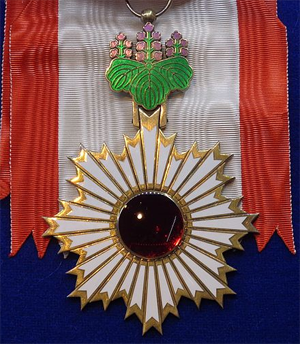
Image
Order of the Rising Sun
Grand Cordon badge and sash
Awarded by the Emperor of Japan
Type Order
Awarded for long and/or especially meritorious civil or military service
Status Currently constituted
Sovereign His Imperial Majesty The Emperor
Grades 1st through 8th Class (1875–2003)
Since 2003:
Grand Cordon
Gold and Silver Star (Rays, Principal Grade)
Gold Rays with Neck Ribbon (Cordon, Middle Grade)
Gold Rays with Rosette (Cordon, Junior Grade)
Gold and Silver Rays (Double Rays)
Silver Rays (Single Ray)
Precedence
Next (higher) Order of the Paulownia Flowers
Next (lower) Order of the Sacred Treasure

http://rapeutation.com/aorderrissunwik.1b.png
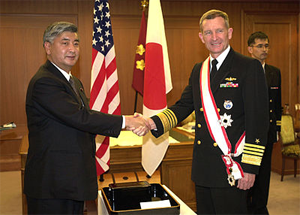
US Navy Admiral Dennis C. Blair being presented the badge and sash of the order (2005).

The Order of the Rising Sun (旭日章 Kyokujitsu-shō) is a Japanese order, established in 1875 by Emperor Meiji. The Order was the first national decoration awarded by the Japanese government,[1] created on 10 April 1875 by decree of the Council of State.[2] The badge features rays of sunlight from the rising sun. The design of the Rising Sun symbolizes energy as powerful as the rising sun[3] in parallel with the "rising sun" concept of Japan ("Land of the Rising Sun").

The order is awarded to those who have made distinguished achievements in international relations, promotion of Japanese culture, advancements in their field, development in welfare or preservation of the environment.[4] Prior to the end of World War II, it was also awarded for exemplary military service. Beginning in 2003, the two lowest rankings (7th and 8th classes) for the Order of the Rising Sun were abolished, with the highest degree becoming a separate order known as the Order of the Paulownia Flowers, with the single rank of Grand Cordon.[5]

While it is the third highest order bestowed by the Japanese government, it is however generally the highest ordinarily conferred order. The highest Japanese order, the Order of the Chrysanthemum, is reserved for heads of state or royalty, while the second highest order, the Order of the Paulownia Flowers, is mostly reserved for politicians.

The modern version of this honour has been conferred on non-Japanese recipients beginning in 1981 (although several foreigners were given the honor before World War II); and women were awarded the Order starting in 2003 (previously, women were awarded the Order of the Precious Crown).[6] The awarding of the Order is administered by the Decoration Bureau of the Cabinet Office headed by the Japanese Prime Minister. It is awarded in the name of the Emperor and can be awarded posthumously.

Classes

The Order was awarded in nine classes until 2003, when the Grand Cordon with Paulownia Flowers was made a separate order, and the lowest two classes were abolished. Since then, it has been awarded in six classes. Conventionally, a diploma is prepared to accompany the insignia of the order, and in some rare instances, the personal signature of the Emperor will have been added. As an illustration of the wording of the text, a translation of a representative 1929 diploma says:

By the grace of Heaven, Emperor of Japan, seated on the throne occupied by the same dynasty from time immemorial,

We confer the Second Class of the Imperial Order of Meiji upon Henry Waters Taft, a citizen of the United States of America and a director of the Japan Society of New York, and invest him with the insignia of the same class of the Order of the Double Rays of the Rising Sun, in expression of the good will which we entertain towards him.

In witness whereof, we have hereunto set our hand and caused the Grand Seal of State to be affixed at the Imperial Palace, Tokyo, this thirteenth day of the fifth month of the fourth year of Shōwa, corresponding to the 2,589th year from the accession to the throne of Emperor Jimmu."[7]


Insignia

The star for the Grand Cordon and Second Class is a silver star of eight points, each point having three alternating silver rays; the central emblem is identical to the badge. It is worn on the left chest for the Grand Cordon, on the right chest for the 2nd Class.

The badge for the Grand Cordon to Sixth Classes is an eight-pointed badge bearing a central red enamelled sun disc, with gilt points (1st–4th Classes), with four gilt and four silver points (5th Class), or with silver points (6th Class); each point comprises three white enamelled rays. It is suspended from three enamelled paulownia leaves (not chrysanthemum leaves as the Decoration Bureau page claims) on a ribbon in white with red border stripes, worn as a sash from the right shoulder for the Grand Cordon, as a necklet for the 2nd and 3rd Classes and on the left chest for the 4th to 6th Classes (with a rosette for the 4th Class).

The badge for the Seventh and Eighth Classes consisted of a silver medal in the shape of three paulownia leaves, enamelled for the 7th Class and plain for the 8th Class. Both were suspended on a ribbon, again in white with red border stripes, and worn on the left chest. Both classes were abolished in 2003 and replaced by the Order of the Paulownia Flowers, a single-class order that now ranks above the Order of the Rising Sun.

Notable recipients

1st Class, Grand Cordon


• V. Krishnamurthy, 2009
• Ashwani Kumar, 2017
• Rear Admiral Ali Osman Pasha, 1890
• Sultan Ibrahim (1873–1959), 1934
• Edmund Allenby, 1921[8]
• Thamir Ghadhban, 2016[9]
• Karu Jayasuriya, 2016
• James F. Amos, 2014[10]
• Michael Armacost, 2007[11]
• Richard Armitage, 2015
• Pridi Banomyong (1900–1983)[12]
• Mahathir Mohamad, 1991
• Arthur Barrett, 1921[13]
• Edmund Barton (1849–1920), 1905[14]
• Carol Bellamy, 2006[15]
• Felix von Bendemann, 1906[16]
• Abdelmalek Benhabyles, 2012.[17]
• Charles Reed Bishop (1822–1915)[18]
• Sepp Blatter, 2009[19][20]
• Gustave Emile Boissonade (1825–1910), 1909
• Sydney Brenner (1927–), 2017[21]
• Laurens Jan Brinkhorst, 2009[20][22]
• Arleigh Burke (1901–1996)[23]
• Erwin Bälz (1849–1913), 1905
• George W. Casey Jr. 2010[24]
• Krasae Chanawongse, 2004[25]
• Dick Cheney, 2018
• Helen Clark, 2017[26]
• James Wheeler Davidson (1872–1933), 1896
• Kemal Derviş, 2009[27][28]
• Malcolm Fraser, 2006[3]
• Jerome Isaac Friedman, 2016
• Sir Stephen Gomersall KCMG, 2015[29]
• Hermann Göring (1893–1946)
• António Guterres, 2002[30]
• Sri Sultan Hamengkubuwono IX (1912–1988)
• John Hamre, 2016
• Kenzaburo Hara (1907–2004)
• Harry B. Harris Jr., 2018
• Dennis Hastert, 2010[31]
• Bob Hawke, 2012[32]
• Soichiro Honda, 1991
• John Howard, 2013[33]
• Masaru Ibuka (1908–1997)[34]
• Daniel Inouye, 2000[35]
• Henry Jackson (1855–1929)[36]
• S. Jayakumar, 2012[37]
• Karu Jayasuriya (1940–), 2016
• Anerood Jugnauth, 1988[38]
• Henk Kamp, 2014[39]
• Ginandjar Kartasasmita, 2008[40]
• Bert Koenders, 2014[39]
• Jorge Kosmas Sifaki 2014
• Sir John Kotelawala (4 April 1895 – 2 October 1980), 1954
• Komura Jutarō (1855–1911)[41]
• Lee Hsien Loong (1952–), 2016[42]
• Abhakara Kiartivongse[43]
• Lee Kuan Yew (1923–2015), 1967[44]
• Curtis LeMay (1906–1990) 1964[45]
• Wangari Maathai, 2009[20][46]
• Douglas MacArthur (1880–1964)[47]
• Sir John Major, 2012
• John McCain, 2018[48]
• John McEwen, 1973[49]
• Franz-Michael Skjold Mellbin, 2011
• Robert Menzies (1894–1978), 1973[50]
• Norman Yoshio Mineta (1931–), 2007[51]
• Amina C. Mohamed, 2017 [52]
• Ernest Moniz, 2017[53]
• Ivan Mrkić, 2018[54]
• Hendrik Pieter Nicolaas Muller (1859–1941)
• A. M. Nair, alias "Nair-San"
• Peter Pace, 2007[55]
• Andrew Peacock, 2017[56]
• Nancy Pelosi, 2015
• William Perry, 2002[57]
• Herbert Plumer (1857–1932)
• Józef Piłsudski, 1928[58]
• Plaek Phibunsongkhram, 1942
• Edward A. Rice Jr.[59]
• Donald Rumsfeld, 2015
• Eishiro Saito, in 1992[60]
• Klaus Schwab, 2013
• Abid Sharifov, 2016
• Shoichiro Toyoda, 2002[61]
• Chea Sim, 2013[62]
• Dr. Manmohan Singh, 2014[63]
• Edward Śmigły-Rydz, (1886–1941)[64]
• Takeshita Isamu (1869–1949), 1920
• Strobe Talbott, 2016
• Her Majesty Queen Te Atairangikaahu of New Zealand (1931–2006), 1970
• John Anthony Cecil Tilley (1869–1952)[65]
• Tokugawa Yoshinobu (1837–1913), 1908[66]
• Goh Chok Tong, 2011[67]
• Gough Whitlam, 2006[3]
• Sir John Whitehead GCMG CVO, (1932–2013), 2006[68]
• Cesar Virata, 2016
• Tengku Ahmad Rithauddeen, 2018[69]
• Võ Hồng Phúc, 2012[70]
• Wataru Kubo, 2001[71]
• Jay Rockefeller, 2013[72]
• Robert Gates, 2017 [73]
• Condoleezza Rice, 2017[74]
• Sir John Tilley (diplomat) (1869-1952), 1927 & 1928[75]

2nd Class, Gold and Silver Star

• Mohammad Hossein Adeli, 2014[76]
• Momofuku Ando (1910–2007), 2002[77]
• Jagdish Bhagwati, 2006[78]
• Arden L. Bement, Jr., 2009[20][22]
• Henryka Bochniarz, 2010[79]
• Louis Bols (1867–1930), 1921[8]
• Gustave Emile Boissonade (1825–1910), 1876[80]
• Donald Prentice Booth (1902–1993), 1961[81][82]
• Georges Hilaire Bousquet (1846–1937), 1898[83]
• Jules Brunet (1838–1911)
• Horace Capron (1804–1885), 1884[84]
• Chang Yung-fa, 2012[85]
• Rita R. Colwell, 2005[86]
• William Douglas Crowder, 2008[87]
• Gerald Curtis, 2005[88]
• Marzuki Darusman, 2017[89][90]
• Sir Joseph Dimsdale (1849–1902), 1902[91]
• Kiin Donarudo, 1993[92]
• Hugh Elles (1880–1945)[93]
• Bill Frenzel, 2000[77][94]
• Thamir Ghadhban, 2016[9]
• Thomas Blake Glover (1838–1911), 1908[95]
• William Reginald Hall (1870–1943)[36]
• Lionel Halsey (1872–1946)[36]
• Michael Kirby, 2017[89][90][96]
• Michał Kleiber, 2012[97]
• David C. Knapp, (1927–2010)[98]
• Tommy Koh, 2009[99]
• Jeffrey Koo, 2012[85]
• George Trumbull Ladd (1842–1921)[100]
• Cecil Lambert (1864–1928)[36]
• Tsung-Dao Lee 2007[101]
• Charles LeGendre (1830–1899), 1874[102]
• Lilia B. de Lima, 2006[103]
• Predrag Filipov, 2019[104]
• William Flynn Martin, 2018[105]
• Connie Morella (1931–), 2016[106]
• Riccardo Muti, 2016[107]
• Thottuvelil Krishna Pillai Ayappan Nair 2015
• Hideyo Noguchi (1876–1928), 1928[108]
• George R. Packard 2007[109]
• Jerzy Pomianowski[110]
• Randles, Sir John Scurrah, 1875-1945
• Chintamani Nagesa Ramachandra Rao, 2015[111]
• Rein Raud, 2011[112]
• Johannis de Rijke (1842–1913)[113]
• Wilbur L. Ross (1937–), 2015[114]
• Vsevolod Rudnev (1855–1913), 1907[115]
• Jacob Schiff (1847–1920), 1907[116]
• William Francis Sempill (1893–1965)[117][118]
• N. K. Singh (2016)[119]
• Jouko Skinnari, 2011[120]
• E. Sreedharan (1932–), 2013[121]
• Wendell M. Stanley (1904–1971), 1966[122]
• Michael Ira Sovern 2003[123]
• Sayidiman Suryohadiprojo [id], 2012[124]
• Washington SyCip, 2017[125]
• Henry W. Taft (1859–1945), 1929[7]
• Frederick Charles Tudor Tudor (1863–1946)[36]
• Charles Vaughan-Lee (1867–1928)[36]
• John Waldron (1909–1975) 1971[126]
• Bryon Wilfert, 2011[127]
• Ernst-Ludwig Winnacker, 2009[20]
• Richard J. Wood, 2010[128]
• Philip Yeo, 2007[129]
• Jaime Zóbel de Ayala, 2018[130]
• José Manuel Entrecanales [es], 2018[131]
• indian foreign diplomat shyam saran (2019)

3rd Class, Gold Rays with Neck Ribbon

• James Curtis Hepburn (1815–1911)[132]
• Gustave Eiffel (1832–1923)
• José Luis Ceacero Inguanzo, 1886
• George Trumbull Ladd (1842–1921)[133]
• John Charles Hoad (1856–1911), 1906[134]
• Kanō Jigorō (1860–1938)[135]
• Otto Hermann Kahn (1867–1934)[136]
• John Milne (1850–1913)[137][138]
• Percival Hall-Thompson (1874—1950)[139]
• Miles Wedderburn Lampson (1880–1964)[140]
• William Elliot Griffis (1843–1928), 1926[141]
• David Bowman Schneder, 1936[142]
• T. Wayland Vaughan (1870–1952), 1940[143]
• István Ujszászy (1894–1948), 1942[144]
• Edmund Blunden (1896–1974), 1963
• Kyuzo Mifune (1883–1965), 1964[145]
• Ichimatsu Tanaka (1895–1983), 1967
• Shinichi Suzuki (1898–1998), circa 1970[146]
• Yanosuke Hirai (1902–1986), 1972
• Jiro Horikoshi (1903–1982), 1973[147]
• Edward Seidensticker, 1975[148]
• Taiichi Ohno, 1982[149]
• Mahdi Elmandjra, 1986[150][circular reference]
• Go Seigen aka Wu Qing Yuan (1914–2014), 1987[151]
• Norman Macrae (1923–2010), 1988[152]
• Earl Miner (1926–2004)[153]
• Joseph K.H. Uy, 1991.[154]
• Ian Nish, 1991[155]
• Andrzej Wajda, 1995[156]
• Edwin McClellan (1925–2009), 1998[157]
• Pyle, Kenneth B. 1999[158][159]
• Peter Drysdale, 2001[160]
• Rustum Roy, 2002[161]
• Susumu Honjo, 2003[162]
• John Howes, (1924–2017), 2003[163]
• Harue Kitamura, 2004[164]
• Robert Garfias, 2005[165]
• Judit Hidasi, 2005[166]
• Kirsti Koch Christensen, 2006[167]
• Willy Vande Walle, 2006[168]
• Jacob Raz, 2006[169]
• Stanisław Filipek, 2006[170]
• Carol Gluck, 2006[171]
• Jochem P. Hanse, 2007[172]
• Patrick Lennox Tierney, 2007[173]
• Charles Wolf, Jr, 2007[174]
• Kusuma Karunaratne[175]
• David Rowe-Beddoe, Baron Rowe-Beddoe, 2008[176]
• Edward Gage Nelson, 2008[177]
• Jerzy Nowacki, 2008[178]
• Emiko "Emily" Sano, 2008[179][180][181]
• Susan Pharr, 2008[182]
• John Powles, 2008[183][184]
• Royall Tyler, 2008[181]
• Setsuko Matsunaga Nishi, 2009[20][185]
• James E. Auer, 2009[186]
• Clint Eastwood, 2009[20][187]
• Edwin Cranston, 2009[20][188]
• Umberto Pineschi, 2009[20][189]
• R.J. Zwi Werblowsky, 2009[190]
• David Russell, 2010[191]
• John O'Conor, 2011[192]
• Ben Nighthorse Campbell, 2011[193]
• Albert Diamond Cohen, 2011[127]
• Jack Fujimoto, 2011[194]
• Kuo-Hsiung Lee, 2011[195]
• Lydia Yu-Jose, 2012[196]
• Muhammad Nurul Islam (b. 1943) (2012)
• Romuald Huszcza, 2012[197]
• Stephen Ira Katz, 2012[198]
• Ivan Bondarenko, 2012[199]
• William Forbes-Sempill, 19th Lord Sempill[200]
• George Tanabe, Jr., 2013[201]
• Richard Bowring, 2013[202]
• Matthew H. Molloy, 2013[202][203]
• Rust Macpherson Deming, 2013[204]
• Kent E. Calder, 2014[205]
• Michael Donnelly, 2014[206]
• Carlos Rubio López de la Llave, 2014.[207]
• Dr. Nghiem Vu Khai, 2014.[208]
• Craig Agena, 2014[209]
• Peter O'Malley, 2015[210]
• Keiichi Ishizaka, 2015[211]
• Dennis M. Ogawa, 2016[212]
• Paul Magnette, 2016
• Yves Leterme, 2016
• Rudy Demotte, 2016
• Rudi Vervoort, 2016
• Raaj Kumar Sah, 2017[213][214][215]
• Paul Watanabe, 2017[216][217]
• Dr. Susumu Nisizaki, 2018[218]
• John Mark Ramseyer, 2018[219]
• Ronald P. Dore[220]
• Tan Sri Dr. Ahmad Tajuddin Ali[citation needed]
• Sadia Rashid, 2019[221]
• Robert Huey, 2019[222]

4th Class, Gold Rays with Rosette

• Charles Von Loewenfeldt, 1987[223]
• Kenji Ekuan, 2000[224]
• Toshiko Akiyoshi, 2004[225]
• Boris Akunin, 2009[226]
• Martha Argerich, 2005[227]
• Andrej Bekeš, 2008[228]
• Henry Pike Bowie, 1909[229]
• James R. Brandon, 1994[230]
• William Penn Brooks, 1888[231]
• David Cope, 2012
• Willard G. Clark (1930–2015), 1991[232]
• Bogna Barbara Dziechciaruk-Maj, 2009[233]
• William Elliot Griffis, 1843–1928[141]
• Glen Gondo, 2013.[234]
• Steven Heine, 2007[235]
• Asao Hirano, 2001[236]
• William Imbrie, 1909[237]
• Randall Sidney Jones, 2015[238]
• Rena Kanokogi, 2008[239]
• Kihachirō Kawamoto, 1995[240]
• Keisuke Kinoshita (1912–1998), 1984[241]
• Włodzimierz Kwieciński, 2012[242]
• Tommy Lasorda, 2008[243]
• Alfred Majewicz, 2002[244]
• Leiji Matsumoto, 2010[245]
• Hazel McCallion, 2014[246]
• Frank A. Miller, 1929[247]
• Shiro Floyd Mori, 2012[248]
• Kent Nagano, 2008[249]
• Hideyo Noguchi (1876–1928), 1915[250]
• David Bowman Schneder, 1917[251]
• Krystyna Okazaki, 2007[11]
• Takao Saito, 2010[252]
• Frederik L. Schodt, 2009[20][253]
• Dr. Manmohan Singh, 2007[254]
• George Shima, 1864–1926[255]
• Tatsuzo Shimaoka (1919–2007), 1999[256]
• Joseph Bower Siddall (1840–1904) 1909[257]
• George Takei, 2004[258]
• Mohammad Hatta (1902–1980) 1943
• Masanobu Tsuji (1902–1961), 1942[259]
• Morihei Ueshiba (1883–1969) 1964[260]
• H. Paul Varley, 1966[261]
• Teruaki Yamagishi, 2008[262]
• Sadao Watanabe, 2005[263]
• Sukarno ( 1901–1970) 1943
• Reiko Hayama [fr] ( 1933–....) 2011
• George Kerr (judoka), 2010[264]
• Charles B. Doleac, Esq., 2011[265]
• Arvydas Ališauskas, 2012[266]
• Rokusaburo Michiba, 2007[267]
• Bobby Charlton, 2012[268]
• The Ventures, 2010[269]
• Dragan Stojković, 2015[270]
• William Scott Wilson, 2015[271]
• Daniel Ost, 2015[272]
• Ferran Adrià. 2015[273]
• Hank Aaron, 2016[274]
• Ivica Osim, 2016[275]
• Masaya Nakamura (1925–2017), 2007[276]
• Myint Wai, 2014[277]
• Dr Aung Kyaw, 2014[277]
• Stephen McEnally, 2017[277]
• Charles Aznavour, 2018
• Kenneth Oye, 2018[278]
• Kenneth H. DeHoff,[279] 2018[280]
• Edwina Palmer, 2018[281]
• Ted Goossen 2018[282]
• David Hughes, 2018[283]
• Raymond S. Uno, 2014[284]
• Carlos Aquino, 2019[285]
• Liao I-chiu (2014)[286]

5th Class, Gold and Silver Rays

• Vincenzo Ragusa (1841–1927), 1884
• George Geddie (1869–1961), 1907[287]
• Rudolf Teusler (1876–1934)[288]
• Kowalewski, Jan (1892–1965), 1923[289]
• Major Douglas Estment Randall, MC (1891–1926), 1925[290][291]
• Kenzo Mori (1914–2007)[292]
• Hironori Ōtsuka (1892–1982), 1966[293]
• Steere Noda, 1968[294]
• Kiyoshi Nishiyama (1893–1983), 1977[295]
• Shōshin Nagamine (1907–1997)
• Yoshizawa, Akira (1911–2005), 1983[296]
• James Takemori (1926–2015), 2004[297]
• Dato' Sri Lee Ee Hoe, 2005[298]
• Shūgorō Nakazato, 2007
• Major Philip Malins MBE MC, 2010[299]
• Ronald Stewart Watt, 2010[269]
• Frances Hashimoto, 2012[300]
• Maki Hiroyuki Miyahara, 2011[301]
• Soleiman Mehdizadeh, 2012[302]
• Jun Noguchi, 2011[303]
• Seiichi Tanaka, 2013[304]
• Low Thian Seng, 2015[305]
• Robert Tadashi Banno, Q.C., 2016[306]
• Mary-Grace Browning, MBE, 2016[307]
• Tom Curtin, 2016[308]
• Vytautas Dumčius, 2016[309]
• Istvan Pinczès, 2016[310]
• Suki Terada Ports, 2016[311]
• Heidi Potter, 2016[277]
• Garrett Serikawa (1932-2019), 2016[312]
• Jalil Sultanov, 2016, director of the Museum of Japanese Internees in Tashkent, Uzbekistan[313][314]
• Marvin Tokayer, 2016[315]
• Dick Beyer, 2017
• Toshihiro Hamano, 2017[316]
• Doreen Simmons, 2017[317]
• Donald A. Wood, 2017[318]
• James F. Hettinger, 2018[319]
• Elise Wessels, 2019[320]

6th Class, Silver Rays

• Henry Hajimu Fujii (1886–1976), 1971[321]
• Bolesław Orliński, 1926[170]
• Fudeko Reekie, 2013[322]
• John Wilson (Captain) (1851–1899), 1895

7th Class, Green Paulownia Leaves Medal

In 2003, the 7th and 8th levels – named for leaves of the Paulownia tree, long used as a mon (emblem) for the highest levels of Japanese society – were moved to a new and distinct order, the single-class Order of the Paulownia Flowers.[5]

• Tetsuzō Iwamoto 1942
• Leonard Kubiak 1926[323]

8th Class, White Paulownia Leaves Medal

In 2003, the 7th and 8th levels – named for leaves of the Paulownia tree, long used as a mon (emblem) for the highest levels of Japanese society – were moved to a new and distinct order, the single-class Order of the Paulownia Flowers.[5]

Class unknown

• Aung, San (1915–1947)[77]
• Beneš, Edvard (1884–1948), 1928
• Ralph T. Browning (1941–2018)[324]
• Burzagli, Ernesto (1873–1944), 1906[325]
• Craig, Albert M. (1988)[326]
• de Bary, William Theodore (1993)[327]
• Eichelberger, Robert Lawrence (1886–1961)[328]
• Ellis, Alfred John (b. 1915), 1989[329]
• Fortescue, Granville Roland (1875–1952)[330]
• Gibney, Frank B. (1976)[331]
• Józef Gieysztor[332]
• Grondijs, Louis (1878–1961)
• Hosoya, Judayu (1840–1907)
• Ibrahim, Sultan of Johor (1873–1959)
• Knott, Cargill G. (1856–1922), 1891[333]
• Wiesław Kotański, 1986[334]
• Kunz, George Frederick (1856–1932)
• Charles, Count of Limburg Stirum (1906–1989)
• Henryk Lipszyc, 1992[335]
• Macrae, Norman, 1988Macrae, Norman (1999). John Von Neumann: The Scientific Genius who Pioneered the Modern Computer, Game Theory, Nuclear Deterrence, and Much More. American Mathematical Society. p. 406. ISBN 978-0-8218-2676-8.</ref>
• McKenzie, Lionel W. (1995)
• Morrison, George F. (1867–1943)
• Musa Ghiatuddin Riayat Shah, Sultan of Selangor (1893–1955)
• Ozaki Yukio (1858–1954)[336]
• Paine, Godfrey (1871–1932), 1918[337]
• Patrick, Hugh Talbot 1994[338]
• Raymond, Rossiter W. (1840–1918)
• Takamine Hideo (1854–1910)
• Tokuda, Kip (1946–2013), 2012[339]
• Tsutakawa, George (1910–1997), 1874
• Wasson, James R. (1847–1923), 1874[340]
• Franciszek Ziejka [pl][341]
• Ivan Ivanovich Zarubin (1822–1902), 1881[342]
admin
Site Admin
 
Posts: 40890
Joined: Thu Aug 01, 2013 5:21 am

Re: Freda Bedi, by Wikipedia

Postby admin » Mon Sep 30, 2019 9:59 am

Part 2 of 2

See also

• Order of Civil Merit (Korea)
• Order of Chula Chom Klao and Order of the White Elephant (Thailand)
• Order of St. Michael and St. George (UK)
• Legion of Honour (France)
• Order of Merit of the Federal Republic of Germany (Grand Merit Cross, Merit Cross and Merit Medal equivalents)
• Order "For Merit to the Fatherland" (Russia)
• Order of Isabella the Catholic (Spain)
• Order of Merit of the Italian Republic
• Decoration of Honour for Services to the Republic of Austria (Grand Decoration in Gold with Sash, in Gold with Star, in Gold, Grand Decoration of Honour, Decoration of Honour in Gold, Decoration of Merit in Gold)
• Order of Prince Henry (Portugal)

Notes

1. "Decorations Bureau web site". CAO. Retrieved 5 November 2011.
2. "Council of State decree". Quan online. Retrieved 5 November 2011.
3. Embassy of Japan in Australia Archived 21 July 2011 at Archive.today
4. Orders of the Rising Sun Cabinet Office
5. Grand Cordon of the Order of the Paulownia Flowers Cabinet Office
6. "Weatherhead East Asian Institute web site - Carol Gluck". Columbia University. 1 May 2006. Retrieved 5 November 2011.
7. Honor awarded 1929: "Japanese Emperor Honors H.W. Taft; Consul-General Gives Insignia for Fostering International Friendship. Diploma Also Presented; Brother of Chief Justice Receives Order of Rising Sun at Exercises Here," New York Times, 28 June 1929.
8. "No. 32201". The London Gazette (Supplement). 18 January 1921. p. 572.
9. http://www.iraq.emb-japan.go.jp/Press_R ... 60429e.pdf
10. [1] Archived 2 May 2014 at the Wayback Machine
11. "2007 Autumn Conferment of Decorations on Foreign Nationals" (PDF). Ministry of Foreign Affairs. 8 November 2007. Retrieved 30 November 2015.
12. aka Luang Pradist ManudharmPridi Banomyong (1974). Ma vie mouvementee et mes 21 ans d'exil en Chine populaire (in French). UNESCON.
13. "No. 32428". The London Gazette (Supplement). 19 August 1921. p. 6569.London Gazette issue 32428, 19 August 1921
14. Rutledge, Martha. (1979). "Barton, Sir Edmund (1849–1920)," Australian Dictionary of Biography,Volume 7, pp 194–200; Scaramouche. "Sir Edmund Barton" Archived 20 July 2008 at the Wayback Machine
15. Nagashima-Hayashi, Michiko. "Former UNICEF Executive Director receives humanitarian award in Japan," UNICEF web site (2006)
16. British Library. "Handlist of Japanese Manuscripts Acquired Since 1984," 'Or. 14819 Certificate conferring Order of the Rising Sun on Admiral von Bendemann,' p. 3.
17. "Ambassade du Japon en Algerie". www.dz.emb-japan.go.jp.
18. "First Hawaiian Bank Annual Report, page 15 "Bishop is later awarded the Grand Cordon of the Imperial First Order of the Rising Sun by Japanese Emperor Meiji"" (PDF). www.bancwestcorp.com.
19. FIFA: Honors, Sepp Blatter Archived 12 June 2009 at the Wayback Machine.
20. "2009 Spring Conferment of Decorations on Foreign Nationals" (PDF). Ministry of Foreign Affairs of Japan. Retrieved 4 March 2012.
21. Dr. Sydney Brenner, Former OIST Promotion Corporation President, Receives Grand Cordon of the Order of the Rising Sun Okinawa Institute of Science and Technology Graduate University, 22 Aug 2017
22. apan Today Archived 5 June 2011 at the Wayback Machine
23. "U.S. Navy History". 6 February 1997. Archived from the original on 6 February 1997.
24. "Army chief of staff receives 'Order of the Rising Sun' decoration during Japan visit". The United States Army. 23 December 2010. Retrieved 5 November 2011.
25. "In Brief", The Nation, archived from the original on 3 June 2013, retrieved 25 February 2012
26. "Helen Clark decorated with top Japanese honours for diplomatic work". Stuff. 19 December 2017.
27. Former Administrator, UNDP
28. "2009 Autumn Conferment of Decorations on Foreign Nationals, Ministry of Foreign Affairs of Japan" (PDF).
29. "Embassy of Japan in the UK". www.uk.emb-japan.go.jp.
30. "Cidadãos nacionais agraciados com ordens estrangeiras". Ordens Honoríficas Portuguesas. Retrieved 13 July 2016.
31. Japan Today[dead link]
32. "Bob Hawke receives top Japanese honour". AustralianAssociatedPress. 20 March 2012. Retrieved 8 August 2019.
33. "Conferral ceremony for Grand Cordon of the Order of the Rising Sun upon the Honourable John Winston Howard OM AC, former Prime Minister of Australia". Embassy Events. Embassy of Japan in Australia. Retrieved 21 December 2013.
34. Kirkup, James. "Obituary: Masaru Ibuka," Independent (London). 22 December 1997.
35. Daniel Inouye, Senate: Awards Archived 7 October 2010 at the Wayback Machine
36. Honor conferred 1917: "No. 30363". The London Gazette (Supplement). 30 October 1917. p. 11322.
37. "Japan to confer award on former DPM Jayakumar". ChannelNewsAsia. Retrieved 29 April 2012.
38. Mauritius Consulate, Malta: Anerood Jugnauth Archived 2 June 2010 at the Wayback Machine
39. Foreign honours recipients 2014 - website of the Ministry of Foreign Affairs of Japan
40. "NEWS REPORT:Campus Now:WASEDA ONLINE". www.yomiuri.co.jp.
41. "The Marquess Komura; A Notable Career," The Times (London). 25 November 1911.
42. PM Lee receives top Japanese honour on behalf of Lee Kuan Yew Channel Newsasia,28 Sep 2016
43. พระราชทานเหรียญดุษฎีมาลา, เล่ม ๑๗,ตอน ๑๘, ๒๙ กรกฎาคม พ.ศ. ๒๔๔๓, หน้า ๒๑๔
44. Lee Kuan Yew Bio Archived 26 September 2008 at the Wayback Machine
45. Honor awarded December 6, 1964: LeMay, Curtis E. (1965). Mission with LeMay: My story, p, 466.
46. Embassy of the Republic of Kenya in Japan: Wangari Maathai, 2009.
47. "General Orders, No. 13" Archived 3 November 2013 at the Wayback Machine. Department of the Army, Headquarters. 6 April 1964. Retrieved 1 March 2010.
48. "2018 Spring Conferment of Decoration on Foreign Nationals" (PDF). Ministry of Foreign Affairs of Japan. Ministry of Foreign Affairs of Japan. Retrieved 22 September 2018.
49. C. J. Lloyd. McEwen, Sir John (1900–1980). ADB. Retrieved 5 November 2011.
50. Honor awarded 1973: National Archives of Australia Archived 20 May 2009 at the Wayback Machine
51. "Secretary Norman Y. Mineta Papers". www.oac.cdlib.org. Retrieved 17 February 2018.
52. "Japan to honour Amina Mohamed for splendid work".
53. Embassy of Japan
54. Ambassador and former Foreign Minister of the Republic of Serbia H.E. Mr. Ivan Mrkić conferred Grand Cordon of the Order of the Rising Sun in Japan
55. Garamone, Jim. "Pace Receives Japanese Emperor's Rising Sun Award", American Forces Press Service. 18 August 2007.
56. 2017 Autumn Conferment of Decorations on Foreign Nationals, Embassy of Japan in Australia, 3 November 2017
57. Stamford alumni: William Perry bio; "4,632 people win awards for contributing to Japan," Japan Times, 3 November 2002.
58. Niewalda, Marcin. "Lista WSZYSTKICH odznaczeń Józefa Piłsudskiego". www.genealogia.okiem.pl.
59. "Biographies : GENERAL EDWARD A. RICE JR". The US Army. Archived from the original on 18 July 2012. Retrieved 5 November 2011.
60. "訃報(経団連名誉会長、当社社友名誉会長 斎藤英四郎殿)[News of death: President Emeritus of Keidanren, Honorary Chairman of our company, Saito Eishiro]". Nippon Steel. Retrieved 22 June2019.
61. MCADCafé: "Dr.Shoichiro Toyoda To Receive SAE Foundation's 2005 Manufacturing Leadership Award," PR Newswire. 15 March 2005.
62. Saing Soenthrith (5 November 2013). "Japanese Government Awards Chea Sim Order of the Rising Sun". The Cambodia Daily. Retrieved 31 May 2014.
63. Kumar, Ajith Vijay (5 November 2014). "Former PM Manmohan Singh receives Japan's top national award". Retrieved 30 November 2015.
64. "Stowarzyszenie Wspólnota Polska". www.wspolnota-polska.org.pl. Archived from the original on 9 June 2015.
65. Kurita, Shunjiro. (1930). Who's Who in Japan, Vol. 13, p. 40; Cambridge University Alumni 1261–1900
66. Honor awarded 1908: Ibaraki Prefecture e-newsletter Archived 2 December 2007 at the Wayback Machine
67. S Ramesh. "Goh Chok Tong to receive award from Japanese emperor". Channelnews Asia. Retrieved 24 October 2011.
68. "The Japanese Government honours Sir John Whitehead". Embassy of Japan in the UK. 1 May 2006. Retrieved 4 October 2016.
69. "Tengku Ahmad Rithauddeen Awarded One Of Japan's Highest Honours". The Star Online. 7 February 2018. Retrieved 29 August 2019.
70. "Japan awards Order of the Rising Sun to Minister Vo Hong Phuc". 8 November 2012. Retrieved 24 July 2016.
71. "Kubo, former vice premier, dies at 74". Kyodo News. Tokyo. 26 June 2003. Retrieved 5 January2013.
72. "Conferral of the Grand Cordon of the Order of the Rising Sun upon Senator John Davison Rockefeller IV". Embassy of Japan in the United States of America. 3 November 2013.
73. "2017 Autumn Conferment of Decoration Secretary Robert M. Gates". www.us.emb-japan.go.jp. Embassy of Japan. Retrieved 26 July 2019.
74. "2017 Autumn Conferment of Decoration". 3 November 2017. Retrieved 11 September 2019.
75. ’’The Times (London, England)’’, Monday, April 7, 1952, Issue 52280, p.8. Sir John Tilley Obituary The Times Archive Database, Gale (subscription required), accessed 28 August 2019
76. "Conferment of the Order of the Rising Sun, Gold and Silver Star upon Dr. Seyyed Mohammad Hossein Adeli" (PDF). 29 April 2014. Retrieved 30 November 2015.
77. NNDB: Order of the Rising Sun
78. "Professor Jagdish N. Bhagwati". Columbia University. 6 July 2010. Retrieved 5 November 2011.
79. Działalność: inne Archived 20 November 2012 at the Wayback Machine
80. Woods, Allan (21 June 2011). "Ex-Liberal MP gets his day in the sun". The Star. Toronto. Retrieved 12 October 2011.
81. Official US Army Register, published by US Army Adjutant General, 1962, page 53.
82. "2,500 Bid Farewell to Booth", Pacific Stars and Stripes, 9 February 1961.
83. "Meiji University". Meiji. Archived from the original on 27 September 2011. Retrieved 5 November2011.
84. The Laurel Historical Society. "Horace Capron at 200: A Laurel Founder's Life". pp. 1279–1291. Archived from the original on 12 November 2006. Retrieved 25 April 2007.
85. "Taiwanese entrepreneurs to be decorated in Japan". The Central News Agency. 29 April 2012.
86. "International Prize for biology - Japan Society for the Promotion of Science". www.jsps.go.jp. Retrieved 21 March 2018.
87. "William Douglas Crowder". The US Navy. Retrieved 5 November 2011.
88. "Periscope," Newsweek. 20 December 2004.
89. Hurst, Daniel (21 May 2017). "Finding Megumi: Michael Kirby calls for 'peaceful initiatives' on North Korea". The Sydney Morning Herald. Retrieved 12 February 2017.
90. Kirby, Michael (July 2017). "2017 Spring Imperial Decorations: the Hon. Michael Kirby AC CMG" (PDF). The Consulate-General of Japan in Sydney's Quarterly Newsletter. 52 (1): 2.
91. "Prince Komatsu at the Mansion House". The Times (36802). London. 24 June 1902. p. 8.
92. "Professor Donald Keene". The Donald Keene Center of Japanese Culture at Columbia University. Columbia University. Archived from the original on 4 October 2011. Retrieved 12 October 2011.
93. Tank Museum: Medal Recipients - Order of the Rising Sun, Second Class; Japan: "Elles, Sir Hugh Jamieson."
94. "2000 Autumn Conferment of Decorations on Foreign Nationals". Ministry of Foreign Affairs of Japan. Retrieved 4 March 2012.
95. Honor awarded 1908: Crossroads: A Journal of Nagasaki History and Culture
96. "The Hon. Mr. Michael Kirby AC CMG – The Order of the Rising Sun, Gold and Silver Star" (PDF). Consulate-General of Japan in Sydney.
97. "Ambasada Japonii w Polsce". www.pl.emb-japan.go.jp.
98. "I-House Life" (PDF). International House News and Information. University of Chicago. Archived from the original (PDF) on 29 April 2012. Retrieved 12 October 2011.
99. "2009 Autumn Conferment of Decorations on Foreign Nationals, p. 2" (PDF). 4 November 2009. Retrieved 5 November 2011.
100. "Business: Japanese Strip". Time. 8 May 1939. Retrieved 5 November 2011.
101. "Tsung-Dao Lee's Home Page". Tdlee. Retrieved 5 November 2011.
102. Honor awarded in July 1874: Charles LeGendre Reed University
103. "Dr. Lilia de Lima profile" (PDF). www.philippinebritish.com.
104. Bivšem ambasadoru Predragu Filipovu orden Japana
105. "2018 Spring Conferment of Decoration The Honorable William Flynn Martin".
106. "Embassy of Japan in the United States of America". www.us.emb-japan.go.jp.
107. "Concert The Roads of Frienship Ravenna-Tokyo". Archived from the original on 20 August 2016. Retrieved 4 July 2016.
108. Honor awarded posthumously 1928: "Mikado Honors Dr. Noguchi, The New York Times. 2 June 1928.
109. "George R. Packard Faculty Page".
110. "Strona nie istnieje [404]". www.msz.gov.pl. Retrieved 21 March 2018.
111. "CNR Rao conferred with Japan's highest civilian award". DNA India. 2 May 2015.
112. "外務省: ご案内- ご利用のページが見つかりません" (PDF). www.mofa.go.jp.
113. Pinedo, Danielle. "Oer-Hollands; In Japan is Johannis de Rijke nog altijd een beroemdheid," NRC Handelsblad. 13 January 2000.
114. "A Japanese Knight? Well, Close Enough". The Wall Street Journal. Retrieved 27 February 2017.
115. "Russians Awarded Order of the Rising Sun in Japan". Russkiymir.ru. Archived from the originalon 29 March 2012. Retrieved 5 November 2011.
116. Honor awarded 1907: Adler, Cyrus (1921). p. 14; Sakamoto, Pamela Rotner. (1998). Japanese Diplomats and Jewish Refugees, p. 17.
117. Day, Peter. "British aviation pioneer was a spy for Japan," Telegraph (London). 1 February 2002.
118. Phillips, Pearson. The Highland peer who prepared Japan for war The Sunday Telegraph, 6 January 2002
119. "Japan confers highest civilian honour on Indian economist - Times of India".
120. Honor awarded 2011: Embassy of Japan in Finland
121. "The Hindu". Kasturi & Sons. 8 March 2014. Retrieved 8 March 2014.
122. "Guide to the Wendell M. Stanley papers, 1926–1972". CDLib. Retrieved 5 November 2011.
123. Honor awarded 2003: Consulate-General of Japan in New York: "Government Of Japan to Honor Professor Michael Ira Sovereign" Archived 4 December 2010 at the Wayback Machine.
124. Embassy of Japan in Indonesia (Kedutaan Besar Jepang di Indonesia) 在インドネシア日本国大使館 (Embassy of Japan in Indonesia)
125. "Japan confers decoration on SGV founder Washington Z. SyCip, Japan Information and Culture Center (JICC) - Press Release No.20 - 2017". Embassy of Japan in the Philippines. 2 May 2017. Retrieved 4 May 2018.
126. "Patent of Decoration". August 2010. Retrieved 5 November 2011.
127. "Media Advisory: Government of Japan to Bestow Honour on Three Canadians". Japanese Embassy. 17 June 2011. Retrieved 5 November 2011.
128. Honor awarded 2010 "Richard J. Wood - About | Earlham College"
129. Honor awarded 2007: Embassy of Japan in Singapore: "Conferment Ceremony for Mr. Philip Yeo, Chairman of SPRING Singapore."
130. "Japanese gov't honors Jaime Zobel de Ayala". ABS-CBN News. 2 May 2018. Retrieved 4 May2018.
131. Japan’s Order of the Rising Sun 2018 "José Manuel Entrecanales receives Japan’s Order of the Rising Sun"
132. "Japanese Order for Missionary" (PDF). New York Times. 15 March 1905. p. 13. Retrieved 25 July2009.
133. "American Honored by the Japanese," The New York Times. 22 October 1899.
134. Honor awarded 1906: Perry, Warren. (1983). "Hoad, Sir John Charles (1856–1911)" in Australian Dictionary of Biography, Volume 9.
135. NNDB: Order of the Rising Sun; Kosho Kempo, Kano Jigoro Archived 13 July 2011 at the Wayback Machine
136. Mortimer H. Schiff and Otto H. Kahn of Kuhn, Loeb & Co., New York, are among the American hankers who have been awarded decorations by the Emperor of Japan. Mr. Schiff was awarded the second class order of the Sacred Treasure and Mr. Kahn, Third Class Order of the Rising Sunhttps://www.jta.org/1927/10/09/archi ... government (retrieved 26 October 2017)
137. L.K. Herbert-Gustar and P.A. Nott published a biography of Milne John Milne, Father of Modern Seismology in 1980 pp 120 ISBN 0-904404-34-X
138. Paul Kabrna "John Milne - the Man who Mapped the Shaking Earth" ISBN 978-0-9555289-0-3Published by Craven & Pendle Geological Society in March 2007.pp68
139. "No. 31811". The London Gazette (Supplement). 5 March 1920. p. 2865.
140. "Pax Britannica (3rd Class)", Time, 16 May 1932.
141. Honor awarded in 1926: Adam Mathew web. Archived 4 December 2008 at the Wayback Machine
142. "Nippu Jiji 1936.06.04 Edition 03 — Hoji Shinbun Digital Collection". hojishinbun.hoover.org. Retrieved 23 March 2019.
143. "Vaughan, Thomas - Biography". www.pwrc.usgs.gov.
144. http://epa.oszk.hu/00900/00995/00006/pdf/szitasz.pdf
145. George, Stuart (2014). "Mifune, Kyuzo". A Supplementary Dictionary of Sports Personalities. Oxford Reference. Oxford University Press. ISBN 9780191752186. Retrieved 15 October 2018.
146. Hermann, Evelyn (1996). Shinichi Suzuki: A Man and His Music. Alfred Music.
147. 1973, 3rd order of merit in Japanese honors system (Kunsantō), 1982 4th rank, court honor (jushii, posthumous)
148. "University of Hawaiʻi Presents Honorary Degree to Edward George Seidensticker". Current News. University of Hawaiʻi at Mānoa. Retrieved 12 October 2011.
149. Taiichi Ohno's Workplace Management, Jon Miller (trans.), Gemba Press 2007, p. xii
150. Mahdi Elmandjra#Awards and decorations
151. Xunzhi, Luo (17 September 2014). "Long Way to Go: Japan celebrates 100th birthday of Chinese Go Master". Macao Magazine. macaulink. Retrieved 4 October 2016.
152. "Norman Macrae". telegraph.co.uk. London: The Telegraph. 22 January 2010. Retrieved 12 October 2011.
153. Quiñones, Eric. "Earl Miner, Specialist in English and Japanese Literature, dies at age 77"Princetonian Weekly Bulletin. 5 May 2004; Europa Publications. (2003). International Who's Who of Authors and Writers 2004, p. 388.
154. "Filipino recipients of Japanese decorations and Japanese recipients of Philippine decorations | GOVPH".
155. Kenrick, Vivienne. "Personality Profile: Ian Nish,"[permanent dead link] Japan Times. 18 September 2004.
156. Rp.pl. "Andrzej Wajda kawalerem Orderu Wschodzącego Słońca - Archiwum Rzeczpospolitej". archiwum.rp.pl.
157. Honor awarded 1998: "McClellan Named Sterling Professor of Japanese", Archived 27 July 2010 at the Wayback Machine Yale Office of Public Affairs. 3 February 1999.
158. "Japan's emperor honors uw professor for his work". Seattle Post-Intelligencer. Seattle. 25 March 1999. pp. B2.
159. ""Hiroshima and the Historians:" Kenneth B. Pyle gives the Griffith and Patricia Way Lecture". Youtube. Retrieved 24 April 2015.
160. Peter Dysdale bio notes: 4th I-House Academy: "Japan and China: Toward Asia- Pacific Cooperation," Archived 24 November 2010 at the Wayback Machine International House of Japan. 22 May 2007.
161. "Rustum Roy, vita for health groups". Rustum Roy. Retrieved 5 November 2011.
162. WHOI Scientist Honored by Japanese Government WHOI 1 May 2003
163. UBC Reports UBC Professor Emeritus Awarded Order of the Rising Sun of Japan Archived 7 February 2011 at the Wayback Machine. 4 December 2003.
164. "Alumni Association NEWS : Our alumni as the awardee of Spring, 2004 has been announced!! — Harue Kitamura, decorated (class of '52)". ritsumei.ac.jp. Ritsumeikan University. 30 April 2004.
165. "California Ethnomusicologist Dr. Robert Garfias to Receive Japan's Order of the Rising Sun Award," Archived 18 November 2008 at the Wayback Machine Alliance for California Traditional Arts (ACTA) Archives.
166. "Hidasi Judit nyelvész, kommunikációs professzor kitüntetése" (in Hungarian). Magyar-Japán Gazdasági Klub. 9 November 2005. Retrieved 11 July 2016.
167. "Vaage, Nora Sørensen. Svein Bolling: Kirsti Koch Christensen, 2005". Archived from the originalon 9 January 2016.
168. Embassy of Japan in Belgium: Decoration Awarding Ceremony of Prof. Dr. W.F. Vande WalleArchived 28 May 2008 at the Wayback Machine
169. "The Order of the Rising Sun, Gold Rays with Neck Ribbon" to Professor Jacob Raz Archived 17 March 2012 at the Wayback Machine, Embassy of Japan in Israel website.
170. "Wybrane epizody w historii stosunków japońsko-polskich Polish Embassy" (PDF).
171. Weatherhead East Asian Institute, The Reed; "Carol Gluck Receives Top Honors from the Japanese Government," Columbia News, 6 October 2006.
172. "former Commissioner of the Netherlands Foreign Investment Agency and Advisor to the SieboldHuis". Embassy. Retrieved 5 November 2011.
173. "Consulate General of Japan, Los Angeles". Consul Generale. Archived from the original on 4 October 2011. Retrieved 5 November 2011.
174. Pike, John. "GlobalSecurity.org - SITREP Situation Report - Charles Wolf, Jr". sitrep.globalsecurity.org.
175. Perera, Suharshi. "Woman: An icon in the literary world," Archived 4 June 2011 at the Wayback Machine Daily News (Sri Lanka). 9 August 2007.
176. Embassy of Japan in the U.K.: Japanese Government honors Lord David Sydney Rowe-Beddoe,"December 18, 2008.
177. "The Government of Japan honors former Honorary Consul-General of Japan in Nashville", Consulate-General of Japan at Nashville website. 4 June 2008.
178. www.ideo.pl, Ideo Sp. z o.o. -. "Dr Jerzy Nowacki uhonorowany japońskim orderem państwowym - Aktualności o polskiej nauce, badaniach, wydarzeniach, polskich uczelniach i instytutach badawczych". www.naukawpolsce.pap.pl. Archived from the original on 9 January 2016.
179. "2008 Emily Sano Awarded Order of the Rising Sun". Consulate-General of Japan in San Francisco. Retrieved 1 July 2008.
180. "SF US Embassy Japan Archives". Retrieved 30 November 2015.
181. "2008 Spring Conferment of Decorations on Foreign Nationals" (PDF). Ministry of Foreign Affairs of Japan. 1 May 2008. Retrieved 30 November 2015.
182. Consulate General of Japan, Boston. Archived 29 December 2008 at the Wayback Machine
183. "2008 Autumn Conferment of Decorations on Foreign Nationals" (PDF). Ministry of Foreign Affairs of Japan. Retrieved 4 March 2012.
184. "John Powles built important ties between Canada and Japan". 24 November 2001. Archived from the original on 23 March 2010. Retrieved 16 March 2010.
185. "Government of Japan Honors Dr. Setsuko Matsunaga Nishi," Asian American Federation. 2009.
186. "Japan honors Vanderbilt Professor Dr. James E. Auer". Consulate-General of Japan at Nashville. Retrieved 16 April 2016.
187. "Japan honors Clint Eastwood in spring decorations," Archived 5 June 2011 at the Wayback Machine Japan Today. 29 April 2008.
188. Harvard Gazette: Japanese government honors Professor Edwin A. Cranston. 14 May 2009.
189. "外務省: ご案内- ご利用のページが見つかりません". www.mofa.go.jp.
190. http://www.mofa.go.jp/mofaj/gaiko/proto ... h21_sp.pdf
191. "David Russell". STEP Journal. 18 (6): 6. June 2010. Retrieved 1 April 2013.[better source needed]
192. Embassy of Ireland in Japan: Irish Pianist decorated by the Government of Japan Archived 18 February 2013 at Archive.today
193. "2011 Spring Conferment of Decorations on Foreign Nationals" (PDF). Ministry of Foreign Affairs of Japan. Retrieved 19 September 2011.
194. "Recipients of Fall 2011 Decorations". Consulate-General of Japan in Los Angeles. Archived from the original on 26 April 2012. Retrieved 27 November 2011.
195. "K. H. Lee Receives Rising Sun Award from Japan". Archived from the original on 23 February 2013. Retrieved 2015-04-20. 20 April 2015.
196. Apolonio, Eric B. (14 June 2012). "Emperor Akihito honors Ateneo prof for promoting Philippine-Japan friendship". TV5 News and Information. Archived from the original on 8 August 2014. Retrieved 7 August 2014.
197. Embassy of Japan in Poland: Odznaczenie rządu japońskiego dla dr. hab. Romualda Huszczy, prof. UW, prof. UJ
198. Embassy of Japan in the United States of America: Conferral of the Order of the Rising Sun, Gold Rays with Neck Ribbon upon Dr. Stephen Ira Katz, Director of the National Institute of Arthritis and Musculoskeletal and Skin Diseases
199. "Уряд Японії нагородив Орденом Вранішнього Сонця двох професорів КНУ імені Тараса Шевченка".
200. Program on Lord Sempill and Japanese espionage, BBC 24 May 2012
201. "Conferral of the Order of the Rising Sun, Gold Rays with Neck Ribbon Upon Dr. George Joji Tanabe, Jr., Professor Emeritus of the Department of Religion, University of Hawaii at Manoa" (PDF). Consulate General of Japan at Honolulu. Retrieved 15 February 2014.
202. "2013 Spring Conferment of Decorations on Foreign Nationals". Embassy of Japan in the UK. Retrieved 24 May 2013.
203. 18th Wing commander presented Order of the Rising Sun Archived 8 December 2015 at the Wayback Machine, Retrieved 21 August 2013.
204. "Conferral of the Order of the Rising Sun, Gold Rays with Neck Ribbon upon Ambassador Rust Macpherson Deming Adjunct Professor of Japan Studies at Johns Hopkins University". Embassy of Japan in the United States. Retrieved 3 November 2015.
205. "Conferral of the Order of the Rising Sun, Gold Rays with Neck Ribbon,upon Professor Kent Eyring Calder, Director of Edwin O. Reischauer Center for East Asian Studies at Johns Hopkins University". Embassy of Japan in the United States. Retrieved 3 November 2015.
206. "Ceremony Confers Japanese Decoration Upon Professor Emeritus of University of Toronto". Consulate-General of Japan in Toronto. Retrieved 24 February 2017.
207. Colao, Leticia (11 March 2014). "El talaverano Carlos Rubio recibe la Orden del Sol Naciente de Japón". La tribuna de Toledo (in Spanish). Archived from the original on 4 June 2016. Retrieved 3 May 2016.
208. "Mr. Nghiem Vu Khai, Chairman of Vietnam - Japan Fraternity, receives Order of the Rising Sun 3rd Class". 21 August 2014. Retrieved 24 July 2016.
209. "List of Order Recipients" (PDF). Ministry Foreign Affairs Japan. Retrieved 13 August 2017.
210. "Recipients of Spring 2015 Decorations". Consulate-General of Japan in Los Angeles. Retrieved 9 July 2015.
211. "Former RIAJ chairman Ishizaka Keiichi gets Order of the Rising Sun, Gold Rays with Neck Ribbon medal". Recording Industry Association of Japan.
212. "UH professor receives medal from Emperor of Japan". University of Hawaiʻi System News. 24 May 2016. Retrieved 8 June 2018.
213. "Raaj Sah". Harris School of Public Policy. Retrieved 12 November 2017.
214. "2017 Autumn Conferment of Decoration". Calameo. Retrieved 12 November 2017.
215. "Government of Japan Record". Calameo. Retrieved 3 May 2018.
216. "2017 Fall Conferment of Decorations of Foreign Nationals". Consulate-General of Japan in Boston. Retrieved 9 December 2017.
217. "Japanese Government Honors Professor Paul Watanabe with Order of the Rising Sun". UMass Boston News. Retrieved 9 December 2017.
218. "2018 Ceremony of Condecoration, Dr. Susumu Nisizaki".
219. Order of the Rising Sun awarded to Professor Mark Ramseyer
220. International Who's Who (2004). Routledge. 19 June 2003. p. 447. ISBN 978-1857432176.
221. Sadia Rashid receives award
222. "Japan grants high honor to UH professor".
223. https://scontent-b-sjc.xx.fbcdn.net/hph ... 2147_n.jpg[permanent dead link]
224. "Japanese designer behind iconic soy sauce bottle dies at 85". ABS-CBN Corporation. 9 February 2015. Retrieved 11 February 2015.
225. "Toshiko Akiyoshi". Berkeley Agency. Retrieved 5 November 2011.
226. "Библиотека изображений "РИА Новости" :: Галерея". Visualrian.com. Retrieved 5 November2011.
227. "Martha Argerich - IMG Artists" Archived 26 June 2009 at the Wayback Machine
228. "Prof. Andrej Bekeš, Ph.D., conferred a high-ranking Japanese order". 12 January 2009. Retrieved 9 August 2017. Embassy of the Republic of Slovenia in Tokyo.
229. Honor awarded 1909: "Receives Guests Attired in Kimono", The San Francisco Call. November 29, 1909. p. 22.
230. Jortner, David; Foley, Kathy (Fall 2001). "James R. Brandon". Asian Theatre Journal. University of Hawai'i Press. 28 (2): 350. JSTOR 41306497.
231. "UMass Presidents William Penn Brooks". Massachusetts.edu. Retrieved 5 November 2011.
232. http://www.fresnobee.com/entertainment/ ... rylink=cpy
233. "Odznaczenie rządu japońskiego dla pani Bogny Barbary Dziechciaruk-Maj, dyrektor Muzeum Sztuki i Techniki Japońskiej Manggha - Japonia". www.japonia.org.pl.
234. Glentzer, Molly (6 May 2013). "Japanese government honors Glen Gondo". Retrieved 30 November2015.
235. "Recent Awards," Archived 19 January 2009 at the Wayback Machine Florida International University, Asian Studies. April 29, 2007.
236. Consulate General of Japan in New York, "Government of Japan to Honor Dr. Asao Hirano,"Archived 3 October 2011 at the Wayback Machine 2001.
237. "Alumni William (Miller Kisselman) Imbrie, D.D.". The Princeton Seminary Bulletin. 23 (2): 572. 1929.
238. "Randall Jones Order of the Rising Sun" (PDF). OECD. Retrieved 29 April 2014.
239. "Consulate General of Japan in New York's Office". Ny.us.emb-japan.go.jp. Retrieved 5 November2011.
240. "Puppet animation producer dies". The Japan Times Online. The Japan Times. 28 August 2010. Retrieved 29 August 2010.
241. Honor awarded 1984: Bergan, Ronald. "A satirical eye on Japan: Keisuke Kinoshita, film director; born December 5, 1912; died December 30, 1998," The Guardian (Manchester). January 5, 1999.
242. "Włodzimierz Kwieciński odznaczony Orderem Wschodzącego Słońca, Złote Promienie z Rozetą"
243. Lasorda honored by Japan, MLB.com, December 3, 2008
244. "Alfred F. MAJEWICZ, professor tytularny zwyczajny, doktor habilitowany" (PDF).
245. "Leiji Matsumoto, Shigeru Mizuki Earn Government Honors - News". Anime News Network. 1 November 2011. Retrieved 5 November 2011.
246. "Mayor Hazel McCallion Awarded the Order of the Rising Sun". City of Mississauga. 10 June 2014. Retrieved 18 June 2014.
247. "Mission Inn Hands on History, Frank A. Miller Order of the Rising Sun". Archived from the original on 28 August 2010.
248. "Conferral of the Order of the Rising Sun, Gold Rays with Rosette upon Mr. Shiro Floyd Mori, National Executive Director Emeritus and former National President of the Japanese American Citizens League (JACL)". Embassy of Japan to the United States. 6 November 2012. Archived from the original on 24 October 2012. Retrieved 7 November 2012.
249. "Maestro Kent Nagano Awarded Order of the Rising Sun". Consulate-General of Japan in San Francisco. 7 December 2008. Archived from the original on 13 May 2012.
250. Honor awarded 1915: Kita, Atsushi (2005). Dr. Noguchi's Journey: A Life of Medical Search and Discovery, p. 196.
251. Pierson, Delvan L. (1918). The Missionary Review of the World, January to December 1917. pp. XIV.
252. "Golgo 13's Saito, Sunset on 3rd St.'s Saigan Win Medals". Anime News Network. 28 April 2010. Retrieved 6 November 2015.
253. Anime News Network: "Frederik L. Schodt Wins The Order of the Rising Sun Award," April 29, 2009.
254. "Embassy of Japan in India: Press Releases from the Embassy". www.in.emb-japan.go.jp.
255. Yoshimura, Toshio. (1981). George Shima, Potato King and Lover of Chinese Classics, p. 53.
256. Honor awarded 1999: Whiting, David. "Obituary: Tatsuzo Shimaoka; Japanese potter steeped in folk traditions who became a cultural ambassador," The Guardian (Manchester). January 17, 2008.
257. "Image gallery: medal". British Museum.
258. "George Takei, bio notes". Georgetakei.com. Archived from the original on 22 September 2001. Retrieved 5 November 2011.
259. Honor awarded 1942: Tsuji, Masanobu. (1997). Japan's Greatest Victory, Britain's Worst Defeat, p. 108.
260. Honor conferred 1964: North Austin Tae Kwan Do: "Chronology of the Life of Morihei Ueshiba, Founder of Aikido."
261. Honor awarded 1996: Columbia University, Department of East Asian Languages and Cultures, Faculty Profiles
262. [2] Archived 26 July 2012 at the Wayback Machine
263. Sadao Watanabe official website: biography
264. "British Judo Association". Britishjudo.org.uk. Archived from the original on 18 July 2011. Retrieved 5 November 2011.
265. "President and founder, Japan-America Society of New Hampshire and founder, Portsmouth Peace Treaty Forum". Archived from the original on 22 January 2012.
266. Founder of center for Japonology in Lithuania, first Japanese translator, Japanese teacher and popularizer of Japanese culture in Lithuania [3]
267. "Rokusaburo Michiba". FutureToday Inc. Archived from the original on 7 May 2013. Retrieved 5 November 2011.
268. "Sir Bobby Charlton awarded Japanese Order". www.jfa.or.jp. Retrieved 4 April 2014.
269. Ministry of Foreign Affairs (Japan): 2010 Spring Conferment of Decorations on Foreign Nationals,p. 8.
270. "Piksi za "Blic": Meni orden, Srbiji priznanje". Blic. Retrieved 30 April 2015.
271. "Conferral of the Order of the Rising Sun, Gold Rays with Rosette, upon translator William Scott Wilson" (PDF). Consulate-General of Japan in Miami. Retrieved 8 December 2015.
272. "Embassy of Japan in Belgium - News". www.be.emb-japan.go.jp.
273. "Ferran Adrià recibe la Orden del Sol Naciente". El País (in Spanish). EFE. 11 December 2015. Retrieved 5 May 2016.
274. "Hank Aaron presented with Order of the Rising Sun". ESPN. 14 January 2016.
275. "Ivica Osim dobio priznanje vlade Japana". OSLOBODJENJE.
276. NAMCO AMERICA INC – Masaya Nakamura receives prestigious award Archived 23 July 2008 at the Wayback Machine coinopTODAY.com, 25 October 2007 (retrieved 2007-25-10)
277. "Embassy of Japan in Myanmar". www.mm.emb-japan.go.jp.
278. "2018 Spring Conferment of Decoration on Foreign Nationals" Ministry of Foreign Affairs of Japan, 2018.[4]
279. https://www.pacificaviationmuseum.org/n ... 2008_4.pdf
280. https://www.mofa.go.jp/files/000358977.pdf
281. "The Conferral of the Order of the Rising Sun, Gold Rays with Rosette upon Dr Edwina Palmer"(PDF) (Press release). Wellington, New Zealand: Embassy of Japan in New Zealand. 3 November 2018. Retrieved 5 November 2018.
282. "York University Professor Conferred the Order of the Rising Sun, Gold Rays with Rosette" Consulate-General of Japan in Toronto, 2018.[5]
283. “Japanese Government Honours Dr David W. Hughes” Embassy of Japan, London, U.K., 2018. [6]
284. "Japan Imperial Decoration The Order of the Rising Sun, Gold Rays with Rosette conferred upon Judge Raymond S. Uno, Former President of National Japanese American Citizens League (JACL)".
285. "Japan to honor 3 Peruvians with Order of the Rising Sun".
286. Central News Agency. "Taiwanese aquatic breeding expert wins Japan's Nikkei Asia Prize". taiwannews.com.tw. Taiwan News. Retrieved 30 May 2019.
287. "George Geddie (1869–1961) – WikiTree FREE Family Tree". www.wikitree.com. Retrieved 21 March 2018.
288. "Obituary". British Medical Journal. 2 (3844): 496. 1934. PMC 2445123. PMID 20778528.
289. Gronczewska, Anna. "Szyfrant, który sprawił cud".
290. "London Gazette issues 33043-p2919".
291. "Major Douglas Estment Randall, MC". Queensland Family Trees. Retrieved 30 November 2015.
292. Cordileone, Elvira. "Kenzo Mori: An impact on two shores," The Star (Toronto). January 22, 2007.
293. "和道流空手道連盟". www.wado-ryu.jp. Archived from the original on 7 December 2013. Retrieved 4 August 2013.
294. Chinen, Karleen C. (2012). Hawaii's AJA Pioneers: One hundred profiles commemorating the centennial of the Hawaii Hochi. Honolulu: Hawaii Hochi. pp. 18–19.
295. Unpaginated editors' chronology appended to Kiyoshi Nishiyama, Shunkō shūshoku (春光秋色) / Seasonal Aspects of Japan (Tokyo: Asahi Sonorama, 1979) (in Japanese)(in English).
296. Honor awarded 1983: "Origami artist of stunning originality who became an ambassador for Japanese culture and his art". The Times (London). March 30, 2005; Lister, David. "Obituary: Akira Yoshizawa; Japanese craftsman who singlehandedly revived the art of origami," The Guardian (Manchester). April 8, 2005.
297. Imada, Vaughn (24 August 2015). "2015 Members of USJF Hall of Fame". United States Judo Federation. Archived from the original on 8 December 2015. Retrieved 30 November 2015.
298. "Conferment of the Order of the Rising Sun, Gold and Silver Rays upon Dato' Sri Ee Hoe Lee". Embassy of Japan in Malaysia. 29 April 2015. Retrieved 4 October 2016.
299. "The Government of Japan honours Mr Philip Malins, MBE, MC". Embassy of Japan in the UK. 25 November 2010. Retrieved 4 October 2016.
300. Endo, Ellen (5 November 2012). "Mikwaya CEO Hashimoto Passes at 69". Rafu Shimpo. Retrieved 2 December 2012.
301. "2012 Jokun Recognition Luncheon". www.rafu.com.
302. Ministry of Foreign Affairs of Japan; 2012 Autumn Conferment of Decorations on Foreign Nationals, p. 6.
303. "Was a celebration From Kishida Masuo's official website". 11 February 2012. Retrieved 28 March2013.(岸田益雄公式ページ - 祝賀会でした)
304. "Reception in Honor of Mr. Seiichi Tanaka, Grand Master of San Francisco Taiko Dojo", Consulate-General of Japan in San Francisco, February 13, 2014 Archived 23 October 2015 at the Wayback Machine
305. "Conferment Ceremony of 2015 Autumn Imperial Decorations for Foreign Recipients". Embassy of Japan in Malaysia. 4 December 2015. Retrieved 4 October 2016.
306. "Commendation Ceremony for Mr. Robert Tadashi Banno, Q.C., President of the Nikkei Place Foundation". Retrieved 21 September 2016.
307. "Japanese Government honours Mrs Mary-Grace Browning MBE=2016-06-28".
308. Schwan, Henry. "Concord's Tom Curtin remembered as 'brilliant'". Retrieved 21 March 2018.
309. "Apdovanojimas : Embassy of Japan in Lithuania". www.lt.emb-japan.go.jp.
310. Honor awarded 2016: Embassy of Japan in Budapest: "Government of Japan to Honor Istvan Pinczès"
311. Honor awarded 2016: Consulate-General of Japan in New York: "Government Of Japan to Honor Suki Terada Ports".
312. "Legacies" (PDF). 23 (1). Spring 2017: 7.
313. UzDaily.com. "Director of Museum of Japanese Internees awarded with Japanese order". UzDaily.com. Retrieved 21 March 2018.
314. Oguma, Hironao (24 March 2016). "Uzbek's museum keeps memories of Japanese prisoners in Soviet camps alive". Japan Times Online. Retrieved 21 March 2018.
315. http://www.mofa.go.jp/mofaj/files/000200238.pdf
316. "平成29年春の叙勲" (PDF). www8.cao.go.jp.
317. Scott, Ellen (9 November 2017). "85-year-old Doreen receives prestigious award for her contribution to sumo wrestling". Metro. Retrieved 16 March 2018.
318. "Dr Don Wood Receives Japan's Highest Cultural Honor". Birmingham, Alabama USA: Birmingham Museum of Art.
319. "Spring Conferment of Decoration by Consulate General of Japan in Detroit to former President & CEO of Battle Creek Unlimited Mr. James F Hettinger In Recognition of His Contributions Toward Strengthening the Relationship Between Japan and the United States" (PDF). 30 April 2018. Retrieved 12 June 2018.
320. "Conferral of the Order of the Rising Sun, Gold and Silver Rays upon Mrs. Elise Wessels-van Houdt, director of Nihon no hanga Museum". Embassy of Japan in the Netherlands. 21 May 2019. Retrieved 23 May 2019.
321. Honor awarded on 1971: Henshall, Mary. "Pioneer Portraits: Henry and Fumiko Fujii," Idaho Yesterdays., Spring, 1975, pp. 20–27; Washington State University Libraries: "Furthering friendship between Japan and the United States, April 1971"
322. "Fudeko receives Japan's Order of the Rising Sun". Western Advocate. 29 April 2013. Retrieved 1 October 2015.
323. Orliński, Bolesław. "Moje wrażenia z lotu do Tokjo" Lwów 1933, p. 79.
324. "Browning, Ralph (Tom)". AVHoF.org. 5 Pints Productions. Retrieved 14 August 2018.
325. Honor awarded in 1906: "Cruiser 'Livia' in Kobe to Greet Italians", Osaka Mainichi. 28 July 1922.
326. Craig, Albert M. (2010). The heritage of Japanese Civilization. Boston: Prentice Hall. pp. Author Bio. ISBN 978-0-13-600524-7.
327. Ohio University Libraries. "Scholars and Librarians in East Asian Studies (North America) - William Theodore de Bary". Retrieved 21 April 2011.
328. "Uncle Bob", Time, 10 September 1945.
329. "A. John Ellis". Simon Fraser University. Archived from the original on 19 March 2014.
330. Arlington National Cemetery: Granville Roland Foretscue
331. Cynthia Peters (4 April 2006). "Frank B. Gibney, 81, One of the Nation's Preeminent Experts on Asia and President of the Pacific Basin Institute at Pomona College, Has Died". Pomona College. Retrieved 21 April 2011.
332. Jeszcze jeden globtroter? Archived 13 June 2010 at the Wayback Machine
333. Honor awarded 1891: Penicuik Community Development Trust (UK): Cargill Gilston Knott
334. Professor Wiesław Kotański (1915–2005) wybitny uczony, japonista, wychowawca pokoleńArchived 24 May 2013 at the Wayback Machine
335. "amb. Henryk LIPSZYC" (PDF).
336. Ozaki, Yukio. (2001). ''The Autobiography of Ozaki Yukio: The Struggle for Constitutional Government in Japan, p. 393.
337. Honor awarded 1918: RAF web page
338. Honor awarded 1994: Weatherhead East Asian Institute, The Reed
339. "Former state legislator Kip Tokuda dies while fishing". The Seattle Times. Archived from the original on 25 August 2013.
340. Honor awarded 1874: "A Victory for the Chinese; Japanese Driven with Heavy Loss from Ping-yang", The New York Times, 22 August 1894.
341. emabe.pl. "WIADOMOŚCI - Spotkanie z prof. Franciszkiem Ziejką".
342. Russian: «Полный послужной список Корпуса Инженер Механиков Генерал-Майора Зарубина 1-го» (ЦГАВМФ СССР Фонд 406 опись 3 дело 960 лист 21 (оборотный)); English: "A full track record of Mechanical Engineering Corps Major-General Zarubin 1st" (Central State Archive of the Navy of the Soviet Union (Russian State Naval Archives now), Fond 406 inventory 3 file 960 sheet 21 (reverse side)).

References

• Peterson, James W., Barry C. Weaver and Michael A. Quigley (2001). Orders and Medals of Japan and Associated States. San Ramon, California: Orders and Medals Society of America. ISBN 1-890974-09-9.

External links

• Japan, Cabinet Office: Decorations and Medals
o Decoration Bureau: Order of the Rising Sun
• Japan Mint: Production Process

admin
Site Admin
 
Posts: 40890
Joined: Thu Aug 01, 2013 5:21 am

Re: Freda Bedi, by Wikipedia

Postby admin » Wed Oct 09, 2019 9:12 pm

Political views of H.G. Wells
by Wikipedia
Accessed: 10/9/19

NOTICE: THIS WORK MAY BE PROTECTED BY COPYRIGHT

YOU ARE REQUIRED TO READ THE COPYRIGHT NOTICE AT THIS LINK BEFORE YOU READ THE FOLLOWING WORK, THAT IS AVAILABLE SOLELY FOR PRIVATE STUDY, SCHOLARSHIP OR RESEARCH PURSUANT TO 17 U.S.C. SECTION 107 AND 108. IN THE EVENT THAT THE LIBRARY DETERMINES THAT UNLAWFUL COPYING OF THIS WORK HAS OCCURRED, THE LIBRARY HAS THE RIGHT TO BLOCK THE I.P. ADDRESS AT WHICH THE UNLAWFUL COPYING APPEARED TO HAVE OCCURRED. THANK YOU FOR RESPECTING THE RIGHTS OF COPYRIGHT OWNERS.


-- A Modern Utopia, by H. G. Wells
-- Tales of Space and Time, by H. G. Wells
-- The History of the Fabian Society, by Edward R. Pease
-- The Open Conspiracy, by H. G. Wells
-- The Time Machine: An Invention, by H. G. Wells
-- The War of the Worlds, by H. G. Wells
-- The Way the World Is Going: Guesses & Forecasts of The Years Ahead, by H.G. Wells
-- Rabindranath Tagore: In Conversation with H. G. Wells, Excerpted from: A Tagore Reader, edited by Amiya Chakravarty
-- H. G. Wells, by Wikipedia
-- Political views of H.G. Wells, by Wikipedia
-- 'The Open Conspiracy': H.G. Wells Plots The World Empire, by Michele Steinberg
-- Celebrating HG Wells’s role in the creation of the UN Declaration of Human Rights: Wells was highly prophetic. But, asks Ali Smith, could he have foreseen that the fundamental freedoms h, set out in The Rights of Man would be under attack 75 years later?, by Ali Smith
-- H.G. Wells' Interview With Stalin Helped Change the Fundamental Principles of Liberalism, by Malcolm Cowley
-- Icarus, or The Future of Science, by Bertrand Russell
-- James Joyce: H.G. Wells reviews "A Portrait of the Artist as a Young Man", by H.G. Wells
-- New Republic, by Spartacus Educational
-- One of Wells’s Worlds, by John Maynard Keynes
-- The Godfather of American Liberalism: H. G. Wells: novelist, historian, authoritarian, anticapitalist, eugenicist, and advisor to presidents, by Fred Siegel
-- The Idea of a League of Nations: "What has happened is essentially this, that the natural limitations on warfare which have existed hitherto appear to have broken down.", by Herbert George Wells
-- Utopian Pessimist: The works, world view, and women of H. G. Wells, by Adam Kirsch


Herbert George Wells (1866–1946) — known as H.G. Wells — was a prolific English writer in many genres, including the novel, history, politics, and social commentary, and textbooks and rules for war games. Wells called his political views socialist.

The Fabian Society

Wells was for a time a member of the socialist Fabian Society, but broke with them as his creative political imagination, matching the originality shown in his fiction, outran theirs.[1] He later grew staunchly critical of them as having a poor understanding of economics and educational reform. He ran as a Labour Party candidate for London University in the 1922 and 1923 general elections after the death of his friend W. H. R. Rivers, but at that point his faith in the party was weak or uncertain.

Class

Social class was a theme in Wells's The Time Machine in which the Time Traveller speaks of the future world, with its two races, as having evolved from

the gradual widening of the present (19th century) merely temporary and social difference between the Capitalist and the Labourer ... Even now, does not an East-end worker live in such artificial conditions as practically to be cut off from the natural surface of the earth? Again, the exclusive tendency of richer people ... is already leading to the closing, in their interest, of considerable portions of the surface of the land. About London, for instance, perhaps half the prettier country is shut in against intrusion.[2]


Wells has this very same Time Traveller, reflecting his own socialist leanings, refer in a tongue-in-cheek manner to an imagined world of stark class division as "perfect" and with no social problem unsolved. His Time Traveller thus highlights how strict class division leads to the eventual downfall of the human race:

Once, life and property must have reached almost absolute safety. The rich had been assured of his wealth and comfort, the toiler assured of his life and work. No doubt in that perfect world there had been no unemployed problem, no social question left unsolved.[2]


In his book The Way the World is Going, Wells called for a non-Marxist form of socialism to be set up, that would avoid both class war and conflict between nations.[3]

Democracy

Fred Siegel of the center-right Manhattan Institute wrote of Wells's unflattering take on American democracy: "Wells was appalled by the decentralised nature of America's locally oriented party and country-courthouse politics. He was aghast at the flamboyantly corrupt political machines of the big cities, unchecked by a gentry that might uphold civilised standards. He thought American democracy went too far in providing leeway to the poltroons who ran the political machines and the 'fools' who supported them."[4] Siegel goes on to note Wells's dislike of America's not allowing African Americans to vote.[4]

World government

His most consistent political ideal was the World State. He stated in his autobiography that from 1900 onward he considered a World State inevitable. He envisioned the state to be a planned society that would advance science, end nationalism, and allow people to progress by merit rather than birth. Wells's 1928 book The Open Conspiracy argued that groups of campaigners should begin advocating for a "world commonwealth", governed by a scientific elite, that would work to eliminate problems such as poverty and warfare.[5] In 1932, he told Young Liberals at the University of Oxford that progressive leaders must become liberal fascists or enlightened Nazis who would "compete in their enthusiasm and self-sacrifice" against the advocates of dictatorship.[6][7] In 1940, Wells published a book called The New World Order that outlined his plan as to how a World Government would be set up. In The New World Order, Wells admitted that the establishment of such a government could take a long time, and be created in a piecemeal fashion.[8]

When the war broke out in 1914, the reports were not finished, so it was decided to print the four sections already sent out, with a concluding chapter. A thousand copies of this, with the title Project of a Commonwealth, were distributed among the groups. Then a popular volume on the subject, with the title The Problem of the Commonwealth and Curtis's name as editor, was published (May 1916). Two months later, the earlier work (Project) was published under the title The Commonwealth of Nations, again with Curtis named as editor. Thus appeared for the first time in public the name which the British Empire was to assume thirty-two years later. In the September 1916 issue of The Round Table, Kerr published a statement on the relationship of the two published volumes to the Round Table Groups. Because of the paper shortage in England, Curtis in 1916 went to Canada and Australia to arrange for the separate publication of The Problem of the Commonwealth in those countries. At the same time he set up new Round Table Groups in Australia and New Zealand. Then he went to India to begin serious work on Indian reform. From this emerged the Government of India Act of 1919, as we shall see later.

By this time Curtis and the others had come to realize that any formal federation of the Empire was impossible. As Curtis wrote in 1917 (in his Letter to the People of India): "The people of the Dominions rightly aspire to control their own foreign affairs and yet retain their status as British citizens. On the other hand, they detest the idea of paying taxes to any Imperial Parliament, even to one upon which their own representatives sit. The inquiry convinced me that, unless they sent members and paid taxes to an Imperial Parliament, they could not control their foreign affairs and also remain British subjects. But I do not think that doctrine is more distasteful to them than the idea of having anything to do with the Government of India."

Reluctantly Curtis and the others postponed the idea of a federated Empire and fell back on the idea of trying to hold the Empire together by the intangible bonds of common culture and common outlook. This had originally (in Rhodes and Milner) been a supplement to the project of a federation. It now became the chief issue, and the idea of federation fell into a secondary place. At the same time, the idea of federation was swallowed up in a larger scheme for organizing the whole world within a League of Nations. This idea had also been held by Rhodes and Milner, but in quite a different form. To the older men, the world was to be united around the British Empire as a nucleus. To Curtis, the Empire was to be absorbed into a world organization. This second idea was fundamentally mystical. Curtis believed: "Die and ye shall be born again." He sincerely felt that if the British Empire died in the proper way (by spreading liberty, brotherhood, and justice), it would be born again in a higher level of existence — as a world community, or, as he called it, a "Commonwealth of Nations."

-- The Anglo-American Establishment: From Rhodes to Cliveden, by Carroll Quigley


Eugenics

Some of Wells's early science fiction works reflect his thoughts about the degeneration of humanity.[9] Wells doubted whether human knowledge had advanced sufficiently for eugenics to be successful. In 1904 he discussed a survey paper by Francis Galton, co-founder of eugenics, saying, "I believe that now and always the conscious selection of the best for reproduction will be impossible; that to propose it is to display a fundamental misunderstanding of what individuality implies... It is in the sterilisation of failure, and not in the selection of successes for breeding, that the possibility of an improvement of the human stock lies". In his 1940 book The Rights of Man: Or What are we fighting for? Wells included among the human rights he believed should be available to all people, "a prohibition on mutilation, sterilization, torture, and any bodily punishment".[10]

Race

In 1901 Wells wrote Anticipations of the Reaction of Mechanical and Scientific Progress Upon Human Life and Thought, which included the following extreme views:

"And how will the new republic treat the inferior races? How will it deal with the black? how will it deal with the yellow man? how will it tackle that alleged termite in the civilized woodwork, the Jew? Certainly not as races at all. It will aim to establish, and it will at last, though probably only after a second century has passed, establish a world state with a common language and a common rule. All over the world its roads, its standards, its laws, and its apparatus of control will run. It will, I have said, make the multiplication of those who fall behind a certain standard of social efficiency unpleasant and difficult… The Jew will probably lose much of his particularism, intermarry with Gentiles, and cease to be a physically distinct element in human affairs in a century or so. But much of his moral tradition will, I hope, never die. … And for the rest, those swarms of black, and brown, and dirty-white, and yellow people, who do not come into the new needs of efficiency?

Well, the world is a world, not a charitable institution, and I take it they will have to go. The whole tenor and meaning of the world, as I see it, is that they have to go. So far as they fail to develop sane, vigorous, and distinctive personalities for the great world of the future, it is their portion to die out and disappear.


When a race is born, the forms are ensouled by a certain group of spirits and have inherent capability of evolving to a certain stage of completion and no further. There can be no standing still in nature, therefore when the limit of attainment has been reached, the bodies or forms of that race begin to degenerate, sinking lower and lower until at last the race dies out.

The reason is not far to seek. New race bodies are particularly flexible and plastic, affording great scope for the Egos who are reborn in them to improve these vehicles and progress thereby. The most advanced Egos are brought to birth in such bodies and improve them to the best of their ability. These Egos, however, are only apprentices as yet, and they cause the bodies to gradually crystallize and harden until the limit of improvement of that particular kind of body has been reached. Then forms for another new race are created, to afford the advancing Egos further scope for more extended experience and greater development. They discard the old race bodies for the new, their discarded bodies becoming the habitations for less advanced Egos who, in their turn, use them as stepping-stones on the path of progress. Thus the old race bodies are used by Egos of increasing inferiority, gradually degenerating until at last there are no Egos low enough to profit by rebirth in such bodies. The women then become sterile and the race-forms die.

We may easily trace this process by certain examples. The Teutonic-Anglo-Saxon race (particularly the American branch of it) has a softer, more flexible body and a more high-strung nervous system than any other race on earth at the present time. The Indian and Negro have much harder bodies and, because of the duller nervous system, are much less sensitive to lacerations. An Indian will continue to fight after receiving wounds the shock of which would prostrate or kill a white man, whereas the Indian will quickly recover. The Australian aborigines or Bushmen furnish an example of a race dying out on account of sterility, notwithstanding all that the British government is doing to perpetuate them. It has been said by white men against the white race, that wherever it goes the other races dies out. The whites have been guilty of fearful oppression against those other races, having in many cases massacred multitudes of the defenseless and unsuspecting natives -- as witness the conduct of the Spaniards towards the ancient Peruvians and Mexicans, to specify but one of many instances. The obligations resulting from such betrayal of confidence and abuse of superior intellect will be paid -- yea, the last, least iota! -- by those incurring them. It is equally true, however, that even had the whites not massacred, starved, enslaved, expatriated and otherwise maltreated those older races, the latter would nevertheless have died out just as surely, though more slowly, because such is the Law of Evolution -- the Order of Nature. At some future time the white race-bodies when they become inhabited by the Egos who are now embodied in red, black, yellow or brown skins, will have degenerated so far that they also will disappear, to give place to other and better vehicles.

Science speaks only of evolution. It fails to consider the lines of degeneration which are slowly but surely destroying such bodies as have crystallized beyond possibility of improvement.


-- The Rosicrucian Cosmo-Conception: An Elementary Treatise Upon Man's Past Evolution, Present Constitution and Future Development, by Max Heindel


The world has a greater purpose than happiness; our lives are to serve God's purpose, and that purpose aims not at man as an end, but works through him to greater issues."[11]

Wells's 1906 book The Future in America, contains a chapter, "The Tragedy of Colour", which discusses the problems facing black Americans.[12] While writing the book, Wells met with Booker T. Washington, who provided him with much of his information for "The Tragedy of Colour".[13] Wells praised the "heroic" resolve of black Americans, stating he doubted if the US could:

show any thing finer than the quality of the resolve, the steadfast effort hundreds of black and coloured men are making to-day to live blamelessly, honourably, and patiently, getting for themselves what scraps of refinement, learning, and beauty they may, keeping their hold on a civilization they are grudged and denied.[12]


In his 1916 book What is Coming? Wells states, "I hate and despise a shrewish suspicion of foreigners and foreign ways; a man who can look me in the face, laugh with me, speak truth and deal fairly, is my brother, though his skin is as black as ink or as yellow as an evening primrose".[14]

In The Outline of History, Wells argued against the idea of "racial purity", stating: "Mankind from the point of view of a biologist is an animal species in a state of arrested differentiation and possible admixture . . . [A]ll races are more or less mixed.".[15]

In 1931 Wells was one of several signatories to a letter in Britain (along with 33 British MPs) protesting against the death sentence passed upon the African-American Scottsboro Boys.[16]

In 1943 Wells wrote an article for the Evening Standard, "What A Zulu thinks of the English", prompted by receiving a letter from a Zulu soldier, Lance Coporal Aaron Hlope.[17][18][19] "What a Zulu thinks of the English" was a strong attack on anti-black discrimination in South Africa. Wells claimed he had "the utmost contempt and indignation for the unfairness of the handicaps put upon men of colour". Wells also denounced the South African government as a "petty white tyranny".[17][18][19]

Zionism

Wells had given some moderate, unenthusiastic support for Territorialism before the First World War, but later became a bitter opponent of the Zionist movement in general. He saw Zionism as an exclusive and separatist movement which challenged the collective solidarity he advocated in his vision of a world state. No supporter of Jewish identity in general, Wells had in his utopian writings predicted the ultimate assimilation of the Jewish people.[20][21][22] In notes to accompany his biographical novel A Man of Parts, David Lodge, describes how Wells came to regret his attitudes to the Jews as he became more aware of the extent of the Nazi atrocities. This included a letter of apology written to Chaim Weizmann for earlier statements he had made.[23]

First World War

He supported Britain in the First World War,[24] despite his many criticisms of British policy, and opposed, in 1916, moves for an early peace.[25] In an essay published that year he acknowledged that he could not understand those British pacifists who were reconciled to "handing over great blocks of the black and coloured races to the [German Empire] to exploit and experiment upon" and that the extent of his own pacifism depended in the first instance upon an armed peace, with "England keep[ing] to England and Germany to Germany". State boundaries would be established according to natural ethnic affinities, rather than by planners in distant imperial capitals, and overseen by his envisaged world alliance of states.[26]

In his book In the Fourth Year published in 1918 he suggested how each nation of the world would elect, "upon democratic lines" by proportional representation, an electoral college in the manner of the United States of America, in turn to select its delegate to the proposed League of Nations.[27] This international body he contrasted with imperialism, not only the imperialism of Germany, against which the war was being fought, but also the imperialism, which he considered more benign, of Britain and France.[28] His values and political thinking came under increasing criticism from the 1920s and afterwards.[29]

Soviet Union

The leadership of Joseph Stalin led to a change in his view of the Soviet Union even though his initial impression of Stalin himself was mixed. He disliked what he saw as a narrow orthodoxy and intransigence in Stalin. He did give him some praise saying in an article in the left-leaning New Statesman magazine, "I have never met a man more fair, candid, and honest" and making it clear that he felt the "sinister" image of Stalin was unfair or false. Nevertheless he judged Stalin's rule to be far too rigid, restrictive of independent thought, and blinkered to lead toward the Cosmopolis he hoped for.[30] In the course of his visit to the Soviet Union in 1934, he debated the merits of reformist socialism over Marxism-Leninism with Stalin.[31]

Monarchy

Wells was a republican[32] and an advocate for the creation of republican clubs in the UK.[33]

Other endeavours

Wells brought his interest in Art & Design and politics together when he and other notables signed a memorandum to the Permanent Secretaries of the Board of Trade, among others. The November 1914 memorandum expressed the signatories concerns about British industrial design in the face of foreign competition. The suggestions were accepted, leading to the foundation of the Design and Industries Association.[34] In the 1920s he was an enthusiastic supporter of rejuvenation attempts by Eugen Steinach and others. He was a patient of Dr Norman Haire (perhaps a rejuvenated one) and in response to Haire's 1924 book Rejuvenation: the Work of Steinach, Voronoff, and others,[35] Wells prophesied a more mature, graver society with 'active and hopeful children' and adults 'full of years' where none will be 'aged'.[36]

In his later political writing, Wells incorporated into his discussions of the World State a notion of universal human rights that would protect and guarantee the freedom of the individual. His 1940 publication The Rights of Man laid the groundwork for the 1948 Universal Declaration of Human Rights.[37]

Summary

In the end Wells's contemporary political impact was limited, excluding his fiction's positivist stance on the leaps that could be made by physics towards world peace. His efforts regarding the League of Nations became a disappointment as the organization turned out to be a weak one unable to prevent the Second World War, which itself occurred towards the very end of his life and only increased the pessimistic side of his nature. In his last book Mind at the End of its Tether (1945) he considered the idea that humanity being replaced by another species might not be a bad idea. He also came to refer to the Second World War era as "The Age of Frustration".

References

1. Cole, Margaret (1974). "H. G. Wells and the Fabian Society". In Morris, A. J. Anthony (ed.). Edwardian radicalism, 1900–1914: some aspects of British radicalism. London: Routledge. pp. 97–114. ISBN 0-7100-7866-8.
2. "The Time Machine". Retrieved 10 June 2012.
3. H. G. Wells, The Way the World is Going. London, Ernest Benn, 1928, (p. 49).
4. Siegel, Fred (2013). The Revolt Against the Masses. New York: Encounter Books, pp. 6–7.
5. Wells, H. G. The Open Conspiracy: Blue Prints for a World Revolution (Garden City, New York: Doubleday, Doran, 1928), (pp. 28, 44, 196).
6. Mazower, Mark, Dark Continent:Europe's Twentieth Century. New York : A.A. Knopf, 1998. ISBN 0679438092 (p. 21–22).
7. Coupland, Philip (October 2000). "H. G. Wells's "Liberal Fascism"". Journal of Contemporary History. 35 (4): 549.
8. Partington, John S. Building Cosmopolis: The Political Thought of H. G. Wells. Ashgate Publishing, Ltd., 2003. ISBN 0754633837, (p. 16).
9. "H. G. Wells and the uses of Degeneration in Literature". Bbk.ac.uk. 1946-08-17. Retrieved 2014-03-25.
10. Andrew Clapham, Human Rights:A Very Short Introduction. Oxford : Oxford University Press, 2007. ISBN 9780199205523 (pp. 29-31).
11. Wells, HG. Anticipations of the Reaction of Mechanical and Scientific Progress: Upon Human Life and Thought. pp. 340–343. ISBN 0486406732 Check |isbn= value: checksum (help).
12. H. G. Wells, The Future in America (New York and London: Harper and Brothers, 1906), p. 201 (Chs.11 & 12,).
13. Virginia L. Denton, Booker T. Washington and the Adult Education Movement. University Press of Florida, 1993. ISBN 0813011825. (p. 150, 231)
14. What is Coming? A Forecast of things after the war, London, Cassell, 1916 (p. 256).
15. H. G. Wells, The Outline of History, 3rd ed. rev. (NY: Macmillan, 1921), p. 110 (Ch. XII, §§1–2).
16. Susan D. Pennybacker, From Scottsboro to Munich: race and political culture in 1930s Britain Princeton University Press, 2009. ISBN 0691088284, (p. 29).
17. "What a Zulu Thinks of the English" was reprinted as "The Rights of Man in South Africa" i '42 to '44: A Contemporary Memoir (London, Secker and Warburg, 1944) (p. 68–74).
18. Robert Crossley, "Wells's Common Readers" in Patrick Parrinder and Christopher Rolfe, H. G. Wells Under Revision: Proceedings of the International Hg Wells Symposium London July 1986. Associated University Press, 1990. ISBN 0945636059, (p. 247).
19. John Huntington, Critical essays on H. G. Wells. G. K. Hall, 1991. ISBN 0816188564 (p. 176,177, 179)
20. Cheyette, Bryan. Constructions of "the Jew" in English Literature and Society. Cambridge University Press, 1995, pp. 143–148
21. Hamerow, Theodore S. Why we watched: Europe, America, and the Holocaust. W. W. Norton & Company, 2008, pp. 98–100, 219
22. "Desirable Aliens: British Men of Letters on The Jews". The Review of Reviews Vol. XXXIII Jan–Jun 1906, p. 378
23. Lodge, David (2011). A Man of Parts. London: Secker. p. 521. ISBN 9781846554964.
24. H. G. Wells: Why Britain Went To War (10 August 1914). The War Illustrated album de luxe. The story of the great European war told by camera, pen and pencil. The Amalgamated Press, London 1915
25. Daily Herald, 27 May 1916
26. Wells, H. G. (1916). "The White Man's Burthen". What is coming? : a forecast of things after the war. London: Cassell. p. 240. ISBN 0-554-16469-8. OCLC 9446824.
27. Wells, H. G. (1918). "The League must be representative". In the Fourth Year. London: Chatto and Windus. ISBN 1-4191-2598-2. OCLC 458935146. The president ... is chosen by a special college elected by the people .... Is there any reason why we should not adopt this method in this sending representatives to the Council of the League of Nations?
28. "The Necessary Powers of the League". In the Fourth Year. [T]he League of Free Nations, if it is to be a reality ... must do no less than supersede Empire; it must end not only this new German imperialism, which is struggling so savagely and powerfully to possess the earth, but it must also wind up British imperialism and French imperialism, which do now so largely and inaggressively possess it.
29. Experiment in Autobiography 556. Also chapter four of Future as Nightmare: H. G. Wells and the Anti-Utopians by Mark Robert Hillegas.
30. Experiment in Autobiography, pp. 215, 687–689
31. "Joseph Stalin and H. G. Wells, Marxism vs. Liberalism: An Interview". Rationalrevolution.net. Retrieved 10 June2012.
32. "...the fall of the once-mighty Romanovs only fuelled republican sympathies elsewhere...in a letter to The Times, the celebrated author H. G. Wells asserted that “the time has come to rid ourselves of the ancient trappings of throne and sceptre". Justin C Vovk, Imperial Requiem: Four Royal Women and the Fall of the Age of Empires iUniverse, 2012. ISBN 1475917503 (p. 338)
33. https://www.theguardian.com/news/1917/a ... ainsection
34. Raymond Plummer, Nothing Need be Ugly Design & Industries Assn. Jun 1985
35. Haire, Norman (1924), Rejuvenation : the work of Steinach, Voronoff, and others, G. Allen & Unwin, retrieved 15 April 2013
36. Diana Wyndham. "'Norman Haire and the Study of Sex'". Foreword by the Hon. Michael Kirby AC CMG. Sydney: "Sydney University Press"., 2012, p. 117
37. ‘Human Rights and Public Accountability in H. G. Wells’ Functional World State’ | John Partington. Academia.edu. Retrieved on 9 August 2013.
admin
Site Admin
 
Posts: 40890
Joined: Thu Aug 01, 2013 5:21 am

Re: Freda Bedi, by Wikipedia

Postby admin » Thu Oct 10, 2019 6:36 am

Anima mundi [World Soul]
by Wikipedia
Accessed: 10/9/19

NOTICE: THIS WORK MAY BE PROTECTED BY COPYRIGHT

YOU ARE REQUIRED TO READ THE COPYRIGHT NOTICE AT THIS LINK BEFORE YOU READ THE FOLLOWING WORK, THAT IS AVAILABLE SOLELY FOR PRIVATE STUDY, SCHOLARSHIP OR RESEARCH PURSUANT TO 17 U.S.C. SECTION 107 AND 108. IN THE EVENT THAT THE LIBRARY DETERMINES THAT UNLAWFUL COPYING OF THIS WORK HAS OCCURRED, THE LIBRARY HAS THE RIGHT TO BLOCK THE I.P. ADDRESS AT WHICH THE UNLAWFUL COPYING APPEARED TO HAVE OCCURRED. THANK YOU FOR RESPECTING THE RIGHTS OF COPYRIGHT OWNERS.


The world soul (Greek: ψυχὴ κόσμου psuchè kósmou, Latin: anima mundi) is, according to several systems of thought, an intrinsic connection between all living things on the planet, which relates to the world in much the same way as the soul is connected to the human body. Plato adhered to this idea and it was an important component of most Neoplatonic systems:

Therefore, we may consequently state that: this world is indeed a living being endowed with a soul and intelligence ... a single visible living entity containing all other living entities, which by their nature are all related.[1]


The Stoics believed it to be the only vital force in the universe. Similar concepts also hold in systems of eastern philosophy in the Brahman-Atman of Hinduism, the Buddha-Nature in Mahayana Buddhism, and in the School of Yin-Yang, Taoism, and Neo-Confucianism as qi.

Other resemblances can be found in the thoughts of hermetic philosophers like Paracelsus, and by Baruch Spinoza, Gottfried Leibniz, Friedrich Schelling and in Hegel's Geist ("Spirit"/"Mind"). Ralph Waldo Emerson published "The Over-Soul" in 1841, which was influenced by the Hindu conception of a universal soul. There are also similarities with ideas developed since the 1960s by Gaia theorists such as James Lovelock.

In Jewish mysticism, a parallel concept is that of "Chokhmah Ila'ah," the all-encompassing "Supernal Wisdom" that transcends, orders and vitalizes all of creation. Rabbi Nachman of Breslov states that this sublime wisdom may be apprehended (or perhaps "channeled") by a perfect tzaddik (holy man).[2] Thus, the tzaddik attains "cosmic consciousness" and thus is empowered to mitigate all division and conflict within creation.

In popular culture

The Police in their song Synchronicity refers to Anima Mundi as Spiritus Mundi.

See also

• Atman (disambiguation)
• Cosmic consciousness
• The Force in Star Wars
• Patrick Harpur
• Neoplatonism and Christianity
• Panpsychism
• Paramatman
• Unus mundus
• Weltgeist

References

1. Plato, Timaeus, 30b–c, 33b.
2. Likutey Moharan I, 61.
• Fideler, David (2014). Restoring the Soul of the World: Our Living Bond With Nature’s Intelligence. Inner Traditions. ISBN 978-162055359-6.
• Jung, C. G. (1968). Psychology and Alchemy. 12. London: Routledge. ISBN 0-691-01831-6.
• Roszak, Theodore (2001) [1992]. The Voice of the Earth: An Exploration of Ecopsychology. Phanes Press. ISBN 1-890482-80-3.
• Southern, R. W. (2001). Scholastic Humanism and the Unification of Europe, Volume II: The Heroic Age. Wiley-Blackwell. ISBN 978-0-631-22079-4.
admin
Site Admin
 
Posts: 40890
Joined: Thu Aug 01, 2013 5:21 am

Re: Freda Bedi, by Wikipedia

Postby admin » Sun Oct 13, 2019 6:43 am

Alfred Richard Orage (1873-1934)
by Leeds Gurdjieff Fourth Way Group
Accessed: 10/12/19

NOTICE: THIS WORK MAY BE PROTECTED BY COPYRIGHT

YOU ARE REQUIRED TO READ THE COPYRIGHT NOTICE AT THIS LINK BEFORE YOU READ THE FOLLOWING WORK, THAT IS AVAILABLE SOLELY FOR PRIVATE STUDY, SCHOLARSHIP OR RESEARCH PURSUANT TO 17 U.S.C. SECTION 107 AND 108. IN THE EVENT THAT THE LIBRARY DETERMINES THAT UNLAWFUL COPYING OF THIS WORK HAS OCCURRED, THE LIBRARY HAS THE RIGHT TO BLOCK THE I.P. ADDRESS AT WHICH THE UNLAWFUL COPYING APPEARED TO HAVE OCCURRED. THANK YOU FOR RESPECTING THE RIGHTS OF COPYRIGHT OWNERS.


Alfred Richard Orage was born in 1873 in North Yorkshire in the village of Dacre, near Harrogate. In 1874 his family moved to his father’s native home in Huntingdonshire. Here Orage went to the village school, and would have gone to work at the age of twelve had not the local squire, impressed with his intelligence and charm, made it possible for him to continue his studies, and eventually to go to a teachers’ training college. At the age of 21, Orage obtained a post at the Leeds Board School, and for the next ten years taught children of various ages.

This, he claimed, was an excellent preparation for his later teaching of adults. In the true sense an educator, he was able to draw people out and get them to formulate their thoughts and feelings. He had, in a high degree, the rare quality of emotional understanding, together with a gaiety and a sense of humour. Not long after coming to Leeds he met a kindred spirit in Holbrook Jackson, and the two young men formed groups to study the philosophers, and, later, they started the Leeds Arts Club, which soon became a ‘sensational success’.

In the meantime Orage developed his talent for public speaking in the open air as well as at meetings with Socialists and Theosophists;


Alfred Richard Orage (1873-1934). Author and journalist who joined the Theosophical Society (TS) on May 10, 1899. Orage was President of the Leeds (England) Lodge of the TS. He was on the staff of the periodical New Age in 1907 and founded New English Weekly in 1932. He resigned from the TS in 1908 to become a follower of G. I. Gurdjieff. He did a great deal of writing and lecturing for the TS and subsequently wrote extensively on Gurdjieff. He died November 5, 1934.

-- Alfred Richard Orage, by Theosophy World Resource Centre


he also was active as a member of the Society for Psychical Research. Throughout his activities in these varied fields, and with the Nietzscheans, Platonists and Fabians, his heart of fire was tempered with a brain of ice which prevented his being caught up in the sentimentality which so often surrounds such groups; he taught with a critical mind that questioned everything.

At the age of thirty he gave up school-teaching and went to London. He became a journalist, and for the first year made hardly enough to exist on. Holbrook Jackson had also gone to London, forsaking the lace trade for journalism. Hearing that ‘The New Age’ was for sale Jackson and Orage decided to acquire it, and induced a number of people, Bernard Shaw among them, to put up the necessary money. They soon discovered that a ‘views-paper’, a paper of ideas, can never pay its way. Jackson left to become a successful publisher and a noted bibliophile, while Orage remained to become, according to his contemporaries, the most brilliant editor that England had had for a hundred years. Almost everyone of note in the world of arts and letters – among them, Chesterton, Arnold Bennett, Belloc, Shaw and Wells – wrote for the paper, and most of them for nothing. In its columns friends were criticized impartially as were foes. It was also a school of literature with Orage as a sort of elder brother critic, which produced more than forty young writers who made their name. What many felt is expressed in a letter to him from Katherine Mansfield. She said:

“I want to thank you for all you let me learn from you. I am still very low down in the school. But you taught me to write, you taught me to think; you showed me what was to be done and what not to do…But let me thank you Orage. Thank you for everything…

Yours in admiration and gratitude,

Katherine Mansfield.”


For fourteen years Orage continued to edit ‘The New Age’. His reputation as a literary critic and writer on current affairs in almost every field of human effort was at its height when an inner discontent began increasingly to manifest itself. With all his searching he had not been able to find an answer to the question which never allowed him to sleep in peace – the question of the meaning and aim of existence. The possibility of finding an answer, however, was nearer than he supposed. P. D. Ouspensky, whom he had been in touch with for some time, arrived in London in the autumn of 1921 and spoke with him about the teachings of G. I. Gurdjieff. Orage, with Rowland Kenny, organized a study group for Ouspensky which first met at the studio of Lady [Margaret Hunam Redhead Harmsworth] Rothermere in Circus Road, N.W. After some months of work Gurdjieff himself visited the group in London early in February 1922 [2] and again for a three week visit in March of that year [3].

TIBETAN REFUGEES

Sir. – Recent devastating events in Tibet caused over 15,000 Tibetans to cross the perilous Himalayas into India. It may be a long time before these unfortunate people can safely return to their overrun country. Our own consciences should allow us neither to neglect nor forget them.

The Indian Government has manfully coped with this addition to its own problems at home. In this country we are bound in honour to help relieve needs of the Tibetan refugees, because from 1905 to 1947 there was a special relationship between Tibet and the United Kingdom – a relationship handed on to the new India.

On balance we think it wisest to concentrate chiefly on collecting money which can be used for the benefit of the refugees, not least in the purchase of necessary antibiotics and other medicaments. The Tibet Society has opened a Tibet Relief Fund for which we now appeal in the hope of a generous response. Donations should be sent to the address below or direct to the National Bank Ltd. (Belgravia Branch), 21 Grosvenor Gardens, S.W.I.

Yours faithfully,

... Harmsworth [Esmond Harmsworth, 2nd Viscount Rothermere] ... The Tibet Relief Fund, 58 Eccleston Square, S.W. I., Letter to the Times, July 31, 1959, p.7.

-- Tibet Society, by tibetsociety.com


His talks convinced Orage that he had found the teacher he was looking for, a teacher who had, as well as a system of ideas, a practical method for inner development. This realization led him to make a complete break with his old life. In October 1922, to the bewilderment of many, he sold “The New Age”, gave up his brilliant life in London – and Ouspensky’s groups – and went to live at the Gurdjieff Institute at the Chateau du Prieurie in Fontainebleau.

A year later, in December 1923, he went to New York as Gurdjieff’s representative – the latter arriving a week later with his pupils to give a number of demonstrations of sacred dances and movements of the East. Before Gurdjieff returned to France he asked Orage to settle in New York and teach his ideas. Thus began a new life for Orage, and for seven years, apart from visits to the Prieure, he remained in America working for Gurdjieff.

One of his accepted tasks, for him very difficult, was to raise money for a fund to enable Gurdjieff to write his book ‘All and Everything: An Objectively Impartial Criticism of the Life of Man; or, Beelzebub’s Tales to his Grandson.’ For some twenty years the greater part of the contribution to this fund came from the American groups. Another of Orage’s tasks was to put the book into readable English. Although he worked for several years on the book he did not live to finish the revision.


Towards the end of his seventh year in America he decided that the time had come for him to go back into life and assimilate what he had learned from Gurdjieff. He afterwards said that in many ways this period in America had been one of the most satisfying of his life. From his teachers exacting discipline and the congenial work with the groups in New York there emerged a bigger, humbler, more understanding, and more youthful man. He returned to England for good in 1931, and in April of 1932 brought out the first number of ‘The New English Weekly’. According to T. S. Elliot, Orage at this time was the best leader writer and the best literary critic in London. He was also the most penetrating writer on economics. The paper became a centre of gravity for those who were studying the causes of the disastrous breakdown of the financial system. It seemed that the paper had appeared in the midst of this economic chaos for a specific purpose. Orage’s office in Cursitor Street was the scene of constant talks and meetings. Toward the end of the paper’s third year this purpose appeared to have been accomplished. During all this time Orage had neither taught Gurdjieff’s ideas nor talked much about them, except to those of us who had been with him at the Prieurie; and he never again saw Ouspensky. But now he began to make fresh plans. D. Mitrinovic, who was interested in Gurdjieff’s ideas, was bringing out a new magazine, and Orage had arranged to be coeditor with him. Orage also intended to introduce some of Gurdjieff’s ideas into the pages of the ‘New English Weekly’, and to take up work with him again.

C. S. Nott remembers talks at this time with Orage [1]:

“We were discussing these matters at the end of 1934 whilst walking up Chancery Lane on the way home – it was the end of October 1934. Then the talk came round to our life at Fontainebleau and our friends in New York. Suddenly he turned to me and said, ‘You know, I thank God every day of my life that I met Gurdjieff’. A week later he was dead”.


Gurdjieff once said:

“I loved Orage as brother. There was indeed in him, together with the inevitable human faults and weaknesses – the denying part – such a composition of the positive qualities that all sorts and conditions of men could not help but love and respect him”.


His body lies in Old Hampstead Churchyard. On the stone is the enneagram carved by his friend Eric Gill, with Krishna’s words to Arjuna:

“You grieve for those who should not be grieved for. The wise grieve neither for the living nor the dead. Never at any time was I not, nor thou, nor these princes of men. Nor shall we cease to be hereafter. The unreal has no being. The real never ceases to be.”


_______________

References:

[1] Orage, Alfred R., 1954. Essays and Aphorisms, Biographical note by C.S. Nott, London: Janus Press.

[2] Moore, James, 1991. Gurdjieff – The Anatomy of a Myth, Dorset: Element.

[3] de Hartmann, Thomas and Olga, 1922. Our Life with Mr. Gurdjieff , London: Arkana/Penguin.

Acknowledgments

Access to written material has been kindly provided by the staff of the Brotherton Special Collections Library at the University of Leeds.

Every effort has been made to obtain permissions from holders of copyright material. However, if any copyright owner has been omitted, the author of this web site would be grateful for any additional copyright information, and undertakes to rectify any omissions.

Explicit permission to quote from the works of A. R. Orage has been kindly provided by Mrs. Anne Orage.
admin
Site Admin
 
Posts: 40890
Joined: Thu Aug 01, 2013 5:21 am

Re: Freda Bedi, by Wikipedia

Postby admin » Tue Oct 15, 2019 3:36 am

A Matter of Fact
by Alfred P. Rubin
The American Journal of International Law
Vol. 59, Issue 3, pp. 586-590
July, 1965

NOTICE: THIS WORK MAY BE PROTECTED BY COPYRIGHT

YOU ARE REQUIRED TO READ THE COPYRIGHT NOTICE AT THIS LINK BEFORE YOU READ THE FOLLOWING WORK, THAT IS AVAILABLE SOLELY FOR PRIVATE STUDY, SCHOLARSHIP OR RESEARCH PURSUANT TO 17 U.S.C. SECTION 107 AND 108. IN THE EVENT THAT THE LIBRARY DETERMINES THAT UNLAWFUL COPYING OF THIS WORK HAS OCCURRED, THE LIBRARY HAS THE RIGHT TO BLOCK THE I.P. ADDRESS AT WHICH THE UNLAWFUL COPYING APPEARED TO HAVE OCCURRED. THANK YOU FOR RESPECTING THE RIGHTS OF COPYRIGHT OWNERS.


An article in a recent issue of the JOURNAL which presented an Indian perspective on the India-China border dispute1 demonstrated the weaknesses as well as some strengths of the Indian position. My own views as to relative strengths and weaknesses of the positions of India and China in the border dispute at an earlier stage have been published elsewhere2 and I do not propose to repeat them here. However, a short summary of Professor Sharma's mistakes of fact might be appreciated by the legal community.

A. Eastern Sector

It is incorrect to say that Tibet was "an independent state under the rule of the Dalai Lama before it became a vassal of China."3 The temporal power of the Dalai Lamas is normally considered to have begun as a donation from Kublai Khan, a Mongol Emperor of China, in the thirteenth century.4 There does not seem to exist any document or recorded statement that can properly be called a "declaration of independence in 1912" issued by any Tibetan authority.5 The first official assertion that one existed, so far as I have been able to discover, was in 1950.6 There is ample evidence that whatever statements were issued in 1912 (or at any other time until the 1940's) fell far short of claiming "independence" of China.7

Tibet for at least 100 years prior to 1914 did not have "freedom to make agreements with other peoples" or "freedom to conduct foreign relations."8 Although Tibet had some authority to speak internationally, there is no evidence that this authority in the field of foreign relations could properly be exercised independently of a Chinese delegation.
While there are many international agreements in which both China and Tibet appear as parties on one side,9 there is no reason to regard this system of dual signature to documents with effects only in the remote fringes of her Empire as negating the demonstrable necessity for a Chinese signature on the documents. "With the exception of the 1856 Treaty with Nepal, none of the agreements cited was concluded without very clear Chinese participation.10 In the case of the Nepal Treaty the facts as to actual Chinese participation are not clear.11

The assertion that in 1914 Tibet was a state "recognized as such by China itself"12 is not supported in Professor Sharma's article by any citation of authority. It is generally accepted that China did not recognize any degree of rightful independence in Tibet at or near that time.13

Tibet did not have "clear competence" to confirm the validity of the boundary between Tibet and India in 1914.14 The fact that the Notes appended to the Simla Convention referred to Tibet as part of Chinese territory15 made the competence of Tibet far from clear
and made the "genuineness" of the expectations of the members of the Simla Conference questionable with regard to the effects they hoped to claim as a result of the Simla transaction. Sir Henry McMahon, the British principal negotiator, has never before had naivete imputed to him in connection with this negotiation.16

Chinese official ratification of the Simla draft of April 27, 1914, was regarded by all participants at the Conference as essential to the conclusion of the attempted settlement, even though the Chinese negotiator had initialed it. After the refusal of Peking to authorize the conclusion of the Agreement on the basis of the draft of April 27, the British and Tibetans proceeded to alter that draft. The final draft of July 3, 1914, was never initialed by any Chinese, officially or unofficially. Yet even this draft contained the clauses indicating British reluctance to recognize Tibetan territorial independence of China, and thus Tibetan failure to insist upon such recognition.17 In these circumstances it is difficult to understand how the phrases "genuine expectations,"18 "factual acceptance,"19 "commitment,"20 and "mutual expectations"21 can be used to describe the results of the Simla Conference in any meaningful way.

It is not true that "at no time was sovereignty of the northern territory [of Assam] to the crest of the Himalayas . . . acquired by either the Tibetans or Chinese.''22 Parts of the Eastern Sector were under Tibetan control at the time of the first British investigations into the area.23 The tale of the drawing of the McMahon Line, and its deviations from ethnic, traditional, and even watershed lines has been concisely told elsewhere.24 These deviations appear to concern specific sections of the Eastern Sector, and thus general allegations as to the validity of the Indian position in some areas cannot properly be taken to support the Indian position throughout the area.25

It is not true, as asserted by Professor Sharma, that China has "acquiesced in the McMahon Line for over 45 years."26 On the contrary, it appears likely that the British authorities in India were not aware of repeated Tibetan assertions of right in the area on the Indian side of the McMahon Line.27

Of maps incorporating the McMahon Line the only one cited which was issued by the Chinese Government was the Postal Map of India of 1917.28 It has been pointed out elsewhere,29 that this map was based upon non-Chinese sources and was issued by a government department not concerned with boundaries in that area. More importantly, however, the Chinese have been able to cite as much, if not more, in the way of official maps issued by the Government of India to support the other side of the case in this Sector.30

B. Central Sector

Very little argument concerning the Central Sector is presented in Professor Sharma's work. The disputed areas, excepting the potential disputes over actual sovereignty in the denned areas of Bhutan and Sikkim, are small and economically and strategically of minor importance to both sides. It should be pointed out, however, that China at no time "clearly regarded the passes under discussion as border passes" in the treaty discussions of 1954.31 The treaty itself32 does not refer to the six passes in question as "border" passes, but says only that "Traders and pilgrims of both countries may travel by the following passes . . ."33 There is no question that the passes mentioned define known routes. It would thus appear that the Chinese acceptance of this ambiguous language in place of their proposal for language making it plain that the passes were in Chinese territory was, although a concession from the Chinese point of view, hardly an acceptance of the Indian version of the border in this area.34 There was, therefore, no "actual shared expectation" as to a border definition35 arising out of this transaction, since the Indian "expectation," however "actual," was certainly not "shared" by the Chinese, whose views had in fact been clearly presented.

C. Western Sector

Neither the 1684 Treaty nor the 1842 Treaty defines the portion of the bulk of the area in this Sector which is under dispute.36 There is no "demarcation" defining the portion of the area in this Sector which is under dispute.37 The deficiencies of the treaties38 are borne out by the fact that the 11 British attempts to define the "customary" border between 1815 and 1900 resulted in 11 different definitions involving at least 3 major basic patterns.39

The control and authority of India in the form of effective administration and jurisdiction have never prevailed "all through the Ladakh Sector" to the exclusion of effective Chinese administration and jurisdiction.40 As noted above, the British conception of the extent of their dominion in the Ladakh area was constantly changing during the 19th century and, in this almost totally unpopulated region, there appears never to have been either occasion or accident resulting in actual Indian assertions of right significantly more substantial than Chinese assertions before the construction of the Chinese motor road through Aksai Chin.

The Chinese claim in Aksai Chin does not rest upon the fact that a Chinese road, built in 1956-1957, was not discovered by India until "some months" later or upon any prescriptive right to the road itself as an easement.41 It purports to rest instead upon the same basis as the Indian claim: long undisturbed exercise of administration and jurisdiction. The earliest known recent practical use of the area by the Chinese was in their invasion of Tibet in 1950, not in the construction of their road.42 The Government of India did not discover the road until about a year after its completion—certainly more than two years from the time work on it began.43

D. Conclusion

The foregoing analysis does not support any part of the Chinese claim or deny the ultimate validity of any particular part of the Indian claim. It does, however, indicate the extent to which the Indian perspective has been achieved in disregard of the facts. Although this short comment is directed to an Indian exegesis, it is only fair to note that the Chinese position, exaggerated apparently to allow for the give-and-take of negotiation the Chinese attempted to begin in New Delhi in April of 1960, is also based in part upon misapprehensions of fact.

ALFRED P. RUBIN

_______________

Notes:

1 Surya P. Sharma, "The India-China Border Dispute: An Indian Perspective," 59 A.J.I.L. 16 (1965).

2 A. P. Rubin, '"The Sino-Indian Border Disputes,'' 9 Int. and Comp. Law Q. 96 (1960). Professor Sharma's criticism of this work in note 13 on p. 19 of his article is too grotesque to warrant comment. The interested reader may peruse the original to discern for himself the nature of Professor Sharma's distortion.

3 Sharma, loc. cit. 21, note 23.

4. W. W. Rockhill, "The Dalai Lamas of Lhasa and their Relations with the Manchu Emperors of China, 1644-1908," 11 T'oung Pao 2 (1910); G. Schulemann, Geschicht der Dalai Lamas 92 (Leipzig, 1958); H. E. Richardson, A Short History of Tibet 34 (New York, 1962). The fullest scope of temporal authority probably exercised by the Dalai Lamas before 1912 was from the donation of authority and establishment of their title by Gusri Khan in 1642 until the conquest of Tibet by the Dzungarians in 1717. At that point Gusri's heirs and possibly the deposed Dalai Lama invited help from the Manchu-Chinese who restored the Dalai Lama to partial authority and reorganized the Tibetan constitution in 1720. Richardson, op. cit. 39 et seq.; Schulemann, op. cit. 233-234, 292 et seq. The Manchu-Chinese remained more or less the dominant political authority in Tibet from that time until 1911.

5 Sharma, loc. cit. 21, note 23. 6

6 Letter from the Tibetan Government to the Secretary General of the United Nations dated Lhasa, Nov. 7, 1950. U.N. Doc. Note to Correspondents No. 233. See also U.N. Docs. A/1549, A/1565 and A/1658. The letter is reproduced also in Dalai Lama, My Land and My People, Appendix II (London, 1962). See p. 229.

7 It would be tedious in this place to analyze all reported statements of the Dalai Lama in 1912 to show that none can be fairly construed in context to declare Tibetan independence of China. It may be noted that in 1914 the Lhasa Government of Tibet was prepared to agree publicly that Tibet formed "part of Chinese territory." See the Schedule of Notes to the Simla Convention of 1914, par. 1, in C. U. Aitchison, A Collection of Treaties . . . , Vol. XIV, at p. 38 (Calcutta, 1929).

8 Sharma, loc. cit. 21-22.

9 Some are cited in ibid. 21, note 24.

10 The Chinese role in negotiating the 1904 Anglo-Tibetan Agreement was very great indeed. See Parliamentary Papers (U.K.), Cd. 1920 (1904), Cd. 2054 (1904) and Cd. 2370 (1905), passim. Aside from the Nepal-Tibet Treaty of 1856, this is the only agreement cited by Professor Sharma which does not actually have a Chinese signature on it. It was, in fact, signed in the absence of the Dalai Lama but in the presence of the Chinese Viceroy of Tibet in Lhasa and with enthusiastic Chinese approval.

11 Schulemann, op. cit. 355.

12 Sharma, loc. cit. 22.

13 Cf. Aide-Memoire of the British Embassy to the U. S. Department of State dated April 19, 1943, reprinted in U. S. Dept. of State, Foreign Relations of the United States, 1943, China, p. 626 at p. 627 (Washington, 1957); C. P. Fitzgerald, The Birth of Communist China 245 (Baltimore, Pelican, 1964).

14 Sharma, loc. cit. 23.

15 See note 7 above.

16 Quite the contrary. See Alistair Lamb, The China-India Border 145 (London, 1964, hereinafter cited as Lamb). Dr. Lamb's excellent summary of historical fact relating to the border is fully annotated.

17. Ibid. 51-52, 144-145.

18 Sharma, loc. cit. 22.

19. Ibid.

20 ibid. 23.

21. Ibid. 45.

22 Ibid. 31.

23 The very complex pattern of Tibetan-Chinese assertion of authority, quite possibly amounting to assertions of sovereignty in this area, are admirably laid out in Lamb, pp. 115 et seq.

24 Ibid. 142 et seq., 148 et seq.

25 As is sought to be done in Sharma, loc. cit. 32.

26 Ibid. 37.

27 Lamb 153 et seq.

28 Sharma, loc. cit. 38.

29 Lamb 46.

30 Report of the Officials of the Governments of India and the People's Republic of China on the Boundary Question, New Delhi, 1961 (hereinafter cited as Report), pp. CR 210, citation no. 45, and CE 211, citation no. 56.

31 Sharma, loc. cit. 25-26.

32 Government of India, Notes, Memoranda and Letters Exchanged and Agreements signed between the Governments of India and China, 1954-1959, New Delhi, 1959 (Vol. III in this indispensable series will be cited below as White Paper III), p. 98.

33 Art. IV.

34 A fair statement of the negotiation on this point is in Report 85. The conclusion drawn in that place from the transaction described seems insupportable. See Chinese Ministry of Foreign Affairs to Indian Embassy at Peking, Note dated Dec. 26, 1959, in White Paper III, p. 60 at p. 63.

35 Sharma, loc. cit. 25.

36 Ibid. 27.

37 Ibid. 29.

38 They are pointed out in Lamb 49-50.

39 Fraser in 1815 (relying mainly on the memory of a single Indian informant rather than his own information); Moorecroft in 1820-1822; Boundary Commissions in 1846 and 1847 (both of which included Cunningham; see Sharma, loc. cit. 34); W. H. Johnson in 1864-1865; The Kashmir Survey in 1868; E. B. Shaw in 1870; Dr. Henderson in 1870; Trelawney Saunders in 1873; Douglas Forsyth in 1873-1874; George Macartney in 1898-1899; and John Ardagh in 1899. These various attempts at definition, and their discrepancies, and the reasons for the discrepancies, are summarized in Lamb 59-87, 100-108.

40 Sharma, loc cit. 34, 36.

41 Ibid. 35.

42 Chinese Ministry of Foreign Affairs to Indian Embassy at Peking, Note dated Dec. 26, 1959, in White Paper III, p. 60 at p. 67.

43 Chou En-Lai to Jawaharlal Nehru, Letter dated Dec. 17, 1959, ibid., p. 52 at p. 54.
 
********************************************

Tibet’s Declarations of Independence
by David A. McCabe
The American Journal of International Law, Vol. 60, No. 2, pp. 369-371
April, 1966

If one applies a low flame to a teapot on the 15,000-foot high Tibetan plateau, the water inside will bubble furiously without giving off much steam or heat. To master this concept is to understand China’s influence in Tibet during the second decade of this century.

No matter how much blustering came from Peking, the external political pressures on Tibet were applied by Great Britain and Russia. China’s role had become ancillary, and Chinese influence was determined and prescribed by whatever plan Great Britain considered would best eliminate Russia’s growing influence in Tibet. It is in this context that comments on any aspect of Tibet’s legal status in 1912 must be viewed.

A decisive turning point in Tibet’s status was the declaration of independence in 1912, existence of which is denied in a note in the July, 1965, JOURNAL by Alfred P. Rubin1 purporting to correct “mistakes of fact” in the Sino-Indian border dispute analysis by Professor Surya P. Sharma in the January, 1965, JOURNAL.2 Mr. Rubin states:

There does not seem to exist any document or recorded statement that can properly be called a “declaration of independence in 1912” issued by any Tibetan authority…. There is ample evidence that whatever statements were issued in 1912 (or at any other time until the 1940’s) fell far short of claiming “independence” of China.3


There is clear and convincing evidence that Mr. Rubin’s suggestion of fact is wrong.

I. On December 29, 1912, Tibet and Mongolia concluded a treaty at Urga which acknowledged mutual independence. The relevant language, in Article 2, states:

The ruler of the Mongol people, Chjebzun Damba Lama, approves and recognizes [sic] the formation of on [sic] independent (Thibetan) State and the proclamation of the Dalai Lama as ruler of Thibet.5


While at least one commentator has reported that the Tibetan envoy lacked authority to conclude the Urga Treaty,5 no statements to this effect appeared prior to the Simla Conference of 1913-1914. At that time, the possibility of any alliance between Russia-courted Mongolia and Tibet had become especially repugnant to Great Britain, whose policy was to maintain Tibet as a Russia-India buffer. It is probable that the idea of discrediting the treaty was developed to further this policy and to highlight Tibet’s swing toward Great Britain.

As frontiersmen following the traditions of Younghusband, their 'founding father', the cadre promoted 'forward' policies, designed to counter the perceived Russian threat to British India by extending British influence over the Himalayas. But Whitehall refused to support these policies to avoid damaging relations with China and other powers who regarded Tibet as part of China. The increased control exerted by central government over the imperial periphery in this period meant that, although the Tibet cadre did succeed in their primary aim of establishing British representation in Lhasa, they were unable to exert a dominant influence on policy-making either in Whitehall or in Lhasa....

Whitehall refused to allow the Government of India to establish a representative in the Tibetan capital, which had been one of Curzon's main policy aims. Younghusband, hoping to salvage Curzon's policy, negotiated a separate agreement with the Tibetans, not included in the Convention.[32] This gave the Gyantse Trade Agent the right to visit Lhasa. Whitehall, however, anxious to avoid continuing involvement in Tibet, rejected the separate agreement, and also reduced the period of the indemnity payments to three years. [33]....

’Forward' policies were even less attractive to Whitehall, whose global perspective gave it an aversion to expanding the frontiers of its empire. Both Russia and China always opposed any extension of British influence in Tibet, while after World War One this opposition widened to include Japan, America and later Nazi Germany, all of whom employed varying degrees of anti-colonialist rhetoric in regard to the British presence in Tibet. Whitehall was particularly concerned to avoid alienating the Chinese, with whom British trade ties were of great economic importance, and therefore sought to solve the Tibetan question through negotiations with China and Russia, leading to wider regional agreements.

There was an obvious tendency for the interests of Whitehall and the Government of India to clash in areas of foreign policy. Measures which India considered essential to safeguard its security interests could be strongly opposed by Whitehall because of their effect on British foreign relations. Whitehall therefore sought to increase its control over India's foreign policy and to limit India's expansionist tendencies. They were deeply distrustful of the frontiersmen and their plans for expanding British authority, and by the turn of this century, improved communications had enabled Whitehall to bring India more firmly under their control. The age of expansion of the British South Asian empire was practically over.

Curzon's period as Viceroy was of seminal importance to Anglo-Tibetan relations, but it marked the high tide of empire on India's north-east frontier. When Curzon ordered Younghusband to Tibet, this seemed likely to end in a British Tibetan protectorate. Whitehall's refusal to allow a British presence to be established at Lhasa was a fatal blow to Curzon's plans, but Younghusband appeared to salvage part of Curzon's aims by obtaining the right to occupy the Chumbi Valley (which was of great strategic importance in that it offered a possible invasion route to and from India) for 75 years; that should have brought the Chumbi Valley into the British Indian empire. But while Younghusband considered that 'I do not see the slightest prospect of our ever being able to give Chumbi up whatever His Majesty's Government may say about not occupying any part of Tibet', Whitehall again refused to approve such a 'forward' move.[50]...

While the Tibet cadre sought to promote an image of Tibet as a separate state, this was restricted by Whitehall's refusal to recognise Tibet as fully-independent....


As will be seen, most cadre officers did their best to strengthen Tibet, albeit under British supervision, but the Tibetan cause was of little concern to Whitehall after World War One, and of no concern at all after World War Two. Thus the Tibetans were abandoned to their fate, despite the efforts of the 'men on the spot'.

-- Tibet and the British Raj, 1904-47: The Influence of the Indian Political Department Officers, by Alexander McKay


II. Affirmation of the Urga Treaty’s validity as evidence of Tibet’s intent appears in several British Foreign Office file references to the fact that independence had been declared. Citation of each would be tedious, but one at least merits attention. Sir Henry McMahon, Britain’s delegate to the Simla Conference, said in his final report:

At the commencement of the year 1913 Thibet was in arms against her neighbour and suzerain China; the Chinese Resident, with his escort and troops, had been driven from the country, and Thibet had declared its independence.6


III. Other evidence of a declaration of independence is contained in Tibet’s opening brief at the conference:

It is decided that Thibet is an independent State and that the precious Protector, the Dalai Lama, is the Ruler of Thibet, in all temporal as well as in spiritual affairs.7


The logical conclusion is that by 1914 Tibet had expressly declared its independence at least twice. Contrary to what Mr. Rubin suggests, it is not necessary to analyze “all reported statements of the Dalai Lama in 1912”8 to show that at least one might possibly be construed as declaring independence. Such a task should be spared even the most diligent fact-finder.

Grasping at Straws: trying to find some way to succeed when nothing you choose is likely to work:
We searched all the backup tapes, trying to find the missing files, but we knew we were grasping at straws.

-- Grasping at Straws, by Cambridge Dictionary


______________

Notes:

1. Rubin, “A Matter of Fact,” 59 A.J.I.L. 586 (1965).

2. Sharma, “The India-China Border Dispute: An Indian Perspective,” ibid. 16.

3. Rubin, loc. cit. at 586-587.

5. Mongol-Thibetan Treaty, Foreign Office File F.O. 535/16, Enclosure 1 in No. 88, p. 66 (1914). Other versions of the treaty appear in Perry-Ayscough & Otter-Barry, With the Russians in Mongolia 10-13 (1914) and Bell, Tibet Past and Present 304-305 (1924).

5. Bell, op. cit. at 151.

6. McMahon, Final Memorandum of the Thibet Conference, Foreign Office File F.O. 535/17, Enclosure 1 in No. 231, p. 231 (1915).

7. Proceedings of the First Meeting of the Thibet Conference held at Simla on October 13, 1913. “Statement of the Thibetan Claims,” Foreign Office File F.O. 535/16, Annex IV to Enclosure in No. 413, p. 393 (1914).

8. Rubin, loc. cit. note 1 above, at 587, note 7.

********************************************

"Tibetan Declaration of Independence": Proclamation Issued by His Holiness the 13th Dalai Lama in 1913
from Tibet House US: Overview, by Tibet House US, quoting "Tibet: A Political History, by Tsepon W.D. Shagapda, New Haven, 1967, pp. 246-248."

PROCLAMATION ISSUED BY H.H. THE DALAI LAMA XIII, ON THE EIGHTH DAY OF THE FIRST MONTH OF THE WATER-OX YEAR (1913) February 14, 1913]

In Ancient Rome, Lupercalia, observed February 13–15, was an archaic rite connected to fertility.

-- Valentine's Day, by Wikipedia


It would be tedious in this place to analyze all reported statements of the Dalai Lama in 1912 to show that none can be fairly construed in context to declare Tibetan independence of China.

-- A Matter of Fact, by Alfred P. Rubin (1965)

***

Contrary to what Mr. Rubin suggests, it is not necessary to analyze “all reported statements of the Dalai Lama in 1912” to show that at least one might possibly be construed as declaring independence. Such a task should be spared even the most diligent fact-finder.

-- Tibet’s Declarations of Independence, by David A. McCabe (1966)

***

We are a small, religious, and independent nation….. To safeguard and maintain the independence of our country, one and all should voluntarily work hard.

-- "Tibetan Declaration of Independence": Proclamation Issued by His Holiness the 13th Dalai Lama in 1913 (1967)


Translation of the Tibetan Text

I, the Dalai Lama, most omniscient possessor of the Buddhist faith, whose title was conferred by the Lord Buddha’s command from the glorious land of India, speak to you as follows:

I am speaking to all classes of Tibetan people. Lord Buddha, from the glorious country of India, prophesied that the reincarnations of Avalokitesvara, through successive rulers from the early religious kings to the present day, would look after the welfare of Tibet.


During the time of Genghis Khan and Altan Khan of the Mongols, the Ming dynasty of the Chinese, and the Ch’ing Dynasty of the Manchus, Tibet and China cooperated on the basis of benefactor and priest relationship. A few years ago, the Chinese authorities in Szechuan and Yunnan endeavored to colonize our territory. They brought large numbers of troops into central Tibet on the pretext of policing the trade marts. I, therefore, left Lhasa with my ministers for the Indo-Tibetan border, hoping to clarify to the Manchu emperor by wire that the existing relationship between Tibet and China had been that of patron and priest and had not been based on the subordination of one to the other. There was no other choice for me but to cross the border, because Chinese troops were following with the intention of taking me alive or dead.

On my arrival in India, I dispatched several telegrams to the Emperor; but his reply to my demands was delayed by corrupt officials at Peking. Meanwhile, the Manchu empire collapsed. The Tibetans were encouraged to expel the Chinese from central Tibet. I, too, returned safely to my rightful and sacred country, and I am now in the course of driving out the remnants of Chinese troops from DoKham in Eastern Tibet. Now, the Chinese intention of colonizing Tibet under the patron-priest relationship has faded like a rainbow in the sky. Having once again achieved for ourselves a period of happiness and peace, I have now allotted to all of you the following duties to be carried out without negligence:

A declaration of independence or declaration of statehood is an assertion by a defined territory that it is independent ...

Independence is a condition of a person, nation, country, or state in which its residents and population, or some portion thereof, exercise self-government, and usually sovereignty, over the territory. The opposite of independence is the status of a dependent territory.

Whether the attainment of independence is different from revolution has long been contested, and has often been debated over the question of violence as legitimate means to achieving sovereignty.

-- Independence, by Wikipedia


and constitutes a state.

In international law, a sovereign state, sovereign country, or simply state, is a political entity that is represented by one centralized government that has sovereignty over a geographic area. International law defines sovereign states as having a permanent population, defined territory, one government, and the capacity to enter into relations with other sovereign states.[1] It is also normally understood that a sovereign state is neither dependent or non subjected to any other power or state.[2]

-- Sovereign State, by Wikipedia


Such places are usually declared from part or all of the territory of another state or failed state, or are breakaway territories from within the larger state.

-- Declaration of Independence, by Wikipedia


1. Peace and happiness in this world can only be maintained by preserving the faith of Buddhism. It is, therefore, essential to preserve all Buddhist institutions in Tibet, such as the Jokhang temple and Ramoche in Lhasa, Samye, and Traduk in southern Tibet, and the three great monasteries, etc.

Lamaism: Early History

What precise form of Buddhism first came to Royal Tibet from China, before the imported Tantra of Indian yogis took it over, is not precisely known. Most historians agree that a stream of Chinese Buddhism influenced a certain Tsongsten Gampo, a seventh century Tibetan chieftain, who wanted to expand and then centralize his power with the help of Chinese protection, after conquering other fighting Tibetan tribes. To accomplish this, he married a Chinese princess, Wen Cheng, of the ruling T'ang dynasty, thus initiating formal relations with China. Princess Wen Cheng not only introduced Buddhism, but a higher cultural influence into the tribal royal reaches of Tibet. She brought butter, tea, cheese, barley beer, ancient medical knowledge, and astrology.75 Her form of Buddhism was probably closer to the Chan Buddhism that had spread into Korea, and later into Japan, developing into Zen Buddhism.

This conversion to Chinese Buddhism was not accomplished easily in Tibet. It was a period of constant struggle between the Bon shamanism of the indigenous people, and this new religion, brought to her royal chieftain by this Chinese princess. For it to take hold, as the established religion, beyond the interests of the royal families and their aristocracy, generations of bloody struggles ensued, while more Vajrayana occultism and Tantric Indian guru-worship permeated what eventually became an amalgam of Buddhism, Bon, and Tantra.

When an Indian sorcerer and sadhu, Guru Padmasambhava76 was invited to Tibet in the eighth century by King Trisong Detsen, Tsongsten Gampo's successor, and was asked to help this royal chieftain curb the rebellious Bon resistance, a wrathful repression of the indigenous Bon took place, even though much of its iconography and influence remained.

King Detsen was a more ardent practitioner than his predecessor, Tsongsten Gampo but, like him, took a practical approach to the Tibetan Lamaist priesthood that was growing inside Tibet, and who saw the uses of these lamas, in unifying the warring Tibetan chieftain tribes. He now declared Tibetan Lamaism the state religion and, following an Indian custom, awarded landed estates and serfs to the Lamaist monasteries that were already starting to proliferate, as its monastic movement spread,77 King Detsen was such a zealous Lamaist that he protected the lama clergy by creating a barbaric code that facilitated their guru-worship and future religious dictatorship when he declared:

He who shows a finger to a monk shall have his finger cut off; he who speaks ill of the monks and king's Buddhist policy shall have his lips cut off; he who looks askance at them shall have his eyes put out; he who them shall pay according to the rule of the restitution of eighty times (the value of the article stolen).78


King Detsen also financially empowered the Lamaist monasteries further, by making them exempt from any taxes and free from performing the hated corvee79 demanded of the peasants by the nobility of Tibet.

Soon, the lamas were also demanding corvee from the Tibetan peasants and, as the Lamaseries' powers grew, the lamas were collecting their own taxes and issuing their own debt notes, that amounted to a debilitating usury on the ordinary Tibetan people whose children and grandchildren inherited the debt. This ensured impoverishment for the vast majority, for centuries, with very little means of social and economic fluidity.

As the monasteries flourished, the lamas kept gaining power, by incorporating the Buddhist concept of "karma," into their predetermined and absolutist Lamaist rule and the Tibetan peoples' fate was sealed. In 797, King Trisong Detsen was succeeded by his second son, Muni Tsenpo who, in a moment of real compassion, tried to devise some way to redistribute some of the wealth in Tibet among its suffering and increasingly impoverished people. However, in the end, the Lamaist system prevailed, and Muni Tsenpo was rewarded by being poisoned by his own mother.80

Padmasambhava, King Trisong Detsen's Tantric Indian sorcerer, always considered more important than the historical Buddha in Tibet, further sealed the fate of the Tibetan people when he publically declared that:

Our condition in this life is entirely dependent upon the actions of our previous life and nothing can be done to alter the scheme of things.81


Poverty and misery; perpetuated by the lamas and their wealthy circle of relatives, who increasingly took over the royal families and their rule, was now to be accepted as one's "karma" from past deeds. This ended any possibility of real compassion for the people of Tibet for the next twelve hundred years.

-- Enthralled, The Guru Cult of Tibetan Buddhism, by Chris Chandler


2. The various Buddhist sects in Tibet should be kept in a distinct and pure form. Buddhism should be taught, learned, and meditated upon properly. Except for special persons, the administrators of monasteries are forbidden to trade, loan money, deal in any kind of livestock, and/or subjugate another’s subjects.

The Buddha was born into a noble family.... His father was king Suddhodana, leader of the Shakya clan in what was the growing state of Kosala, and his mother was queen Maya Devi....A prophecy indicated that if the child stayed at home he was destined to become a world ruler. If the child left home, however, he would become a universal spiritual leader. To make sure the boy would be a great king and world ruler, his father isolated him in his palace.... Separated from the world, he later married Yashodhara (Yaśodhara was the daughter of King Suppabuddha and Amita), and together they had one child, a son, Rāhula....

At the age of 29, Siddhartha left his palace to meet his subjects. Despite his father's efforts to hide from him the sick, aged and suffering, Siddhartha was said to have seen an old man. When his charioteer Channa explained to him that all people grew old, the prince went on further trips beyond the palace. On these he encountered a diseased man, a decaying corpse, and an ascetic. These depressed him, and he initially strove to overcome ageing, sickness, and death by living the life of an ascetic.

Accompanied by Channa and riding his horse Kanthaka, Gautama quit his palace for the life of a mendicant. It's said that "the horse's hooves were muffled by the gods" to prevent guards from knowing of his departure.

Gautama initially went to Rajagaha and began his ascetic life by begging for alms in the street. After King Bimbisara's men recognised Siddhartha and the king learned of his quest, Bimbisara offered Siddhartha the throne. Siddhartha rejected the offer but promised to visit his kingdom of Magadha first, upon attaining enlightenment.


-- Family of Gautama Buddha, by Wikipedia


3. The Tibetan government’s civil and military officials, when collecting taxes or dealing with their subject citizens, should carry out their duties with fair and honest judgment so as to benefit the government without hurting the interests of the subject citizens. Some of the central government officials posted at Ngari Korsum in western Tibet, and Do Kham in eastern Tibet, are coercing their subject citizens to purchase commercial goods at high prices and have imposed transportation rights exceeding the limit permitted by the government. Houses, properties and lands belonging to subject citizens have been confiscated on the pretext of minor breaches of the law. Furthermore, the amputation of citizens’ limbs has been carried out as a form of punishment. Henceforth, such severe punishments are forbidden.

Evil-doers are publicly sentenced. The punishments are pretty drastic but they seem to suit the mentality of the population. I was told of a man who had stolen a golden butter-lamp from one of the temples in Kyirong. He was convicted of the offence, and what we would think an inhuman sentence was carried out. His hands were publicly cut off and he was then sewn up in a wet yak-skin. After this had been allowed to dry, he was thrown over a precipice....

Theft and various minor offences are punished with public whipping. A board is slung round the neck of the offender on which his offence is written, and he has to stand for a few days in a sort of pillory. Here again charitable people come and give him food and drink. When highwaymen or robbers are caught they are usually condemned to have a hand or a foot cut off. I was horrified to see in what manner wounds so inflicted were sterilised. The limb is plunged into boiling butter and held there.


-- Seven Years in Tibet, by Heinrich Harrer


4. Tibet is a country with rich natural resources; but it is not scientifically advanced like other lands. We are a small, religious, and independent nation. To keep up with the rest of the world, we must defend our country. In view of past invasions by foreigners, our people may have to face certain difficulties, which they must disregard. To safeguard and maintain the independence of our country, one and all should voluntarily work hard. Our subject citizens residing near the borders should be alert and keep the government informed by special messenger of any suspicious developments. Our subjects must not create major clashes between two nations because of minor incidents.

For Mackiernan two more months would pass at the frozen campsite. Finally, on March 20, 1950, he and his band said good-bye to the Kazakhs and commenced the final and most grueling leg of their journey, over the Himalayas, into Tibet, and eventually to India. From here on, Mackiernan and his men would be ever more exposed to the elements. At night, Mackiernan would lie down in his sleeping bag, huddled against the back of a camel to shield him from the wind. At morning he and Bessac, the two Americans, could no longer assist in saddling the camels. Their fingers were too numb....

Though there was an abundance of game -- wild horses, sheep, and yak -- the elevation presented its own unique problems of consumption. At sixteen thousand feet, Mackiernan found that water boiled at a decidedly lesser temperature. He could thrust his hand up to the elbow in furiously boiling water and remove it without a hint of scalding. One day Mackiernan shot a yak. The men salivated over the prospect of yak steaks. But after four hours in the boiling cauldron, the meat was still raw....

Mackiernan's clothes had long since become tatters, which he, like the other men, repaired as best he could. But a bigger concern was how to protect their feet in the deep and frigid snowdrifts. After so many miles, the men had virtually walked out of the soles of their shoes. One day, Mackiernan and Zvonzov spotted two yaks. Both men were thinking shoes and meat. Mackiernan let Zvonzov, the better shot of the two, have the honors....

As March, then April wore on, Mackiernan and his men plotted a course for the Tibetan border. At each new campsite, Mackiernan took out his radio and wired headquarters of his progress. He requested that Washington contact the Tibetan government and ask the then sixteen-year-old Dalai Lama to arrange that he and his men be granted safe passage across the border and that they be given an escort once they exited China. Washington sent back a confirmation. Couriers from the Dalai Lama would alert the border guards at all crossing points so that Mackieman and his band would be welcomed....

Thousands of miles away, in Washington, the landscape of the Cold War was taking shape. On April 25, 1950, President Truman signed one of the seminal documents of the decade, National Security Council Directive 68. The blueprint for the Cold War strategy, it called on the United States to step up its opposition to Communist expansion, to rearm itself and to make covert operations an integral part of that opposition. The policy of containment was now the undisputed security objective of the era. The CIA had its marching orders.

But for Mackiernan it was not grand geopolitical issues that concerned him, but the ferocity of mountain winds and biting cold. The border had proved more elusive than he had imagined. Finally, at 11:00 A.M. on April 29, 1950, as he scanned the horizon to the southeast with his binoculars, he caught sight of a tiny Tibetan encampment and knew that he had at long last reached the border. It had taken seven months to cross twelve hundred miles of desert and mountain. A moment earlier he had been weary beyond words, his thirty-seven-year old frame stooped with exhaustion. Now, suddenly, he felt renewed and exuberant.

Mackiernan and Bessac went ahead, leaving the others to tend the camels. In the harsh terrain it was an hour before the Tibetans caught sight of Mackiernan, who was now a quarter of a mile ahead of Bessac. He was waving a white flag. The Tibetans dispatched a girl to meet him. They grinned at each other, unable to find any words in common. The girl stuck out her tongue at Mackiernan, a friendly greeting in Tibet, then withdrew to a hilltop where she was met by a Tibetan who unlimbered a gun. Then the two Tibetans disappeared over the hillside. Mackiernan followed and observed a small group apparently reinforcing a makeshift fortification of rocks. Their guns appeared to be at the ready.

Mackiernan decided that it would be best to strike camp here, on the east side of a stream that meandered through the valley. He chose a place in sight of the Tibetans. There he built a small fire to show his peaceful intentions. He suspected that the Tibetans might be wary of his straggling caravan, fearing them to be Communists or bandits bent on rustling sheep. As Mackiernan, Zvonzov, and the other two Russians drove tent stakes into the hard ground, six more Tibetans on horseback appeared, approaching from the northwest.

Moments later shots rang out. Mackiernan and his men dropped to the ground for cover. Bullets were whizzing overhead. Zvonzov reached for the flap of the tent and ripped it free. He tied it to the end of his rifle as a white flag and waved it aloft. The gunfire stopped. No one had been hit. Mackiernan directed Bessac to approach the first group of Tibetans and offer them gifts of raisins, tobacco, and cloth. As Bessac approached, he held a white flag and was taken in by the Tibetans.

Mackiernan, meanwhile, was convinced he could persuade those who had fired on him that his party was not a threat. His plan was a simple one. He and the others would rise to their feet, hands held high above their heads. Slowly they would approach the Tibetans as a group. Zvonzov argued against the plan. He feared the Tibetans would simply open fire when they were most vulnerable. Mackiernan prevailed.

Slowly he and the three White Russians stood up, hands aloft. They walked in measured steps, closing the distance between their tent site and the Tibetans. As they walked, Zvonzov eyed a boulder to the right and resolved that if there was trouble he would dive for cover behind it.

Mackiernan was in the lead, gaining confidence as the Tibetans held their fire. His arms were raised. Behind him walked the two White Russians, Stephani and Leonid. Fewer than fifty yards now separated them from the Tibetan border guards. Just then two shots were fired. Mackiernan cried out, "Don't shoot!" A third shot echoed across the valley. Mackiernan, Stephani, and Leonid lay in the snow. Vassily ran for the boulder. The air was thin and he ripped his shirt open as if it might give his lungs more air. A bullet smashed into his left knee. He tumbled into the snow and crawled toward the tent, his mind fixed on the machine gun and ammo that were there.

Moments later Bessac appeared, his hands tied behind his back, a prisoner of the Tibetans. Vassily, too, was taken prisoner. The six guards looted the campsite, encircled Vassily, and forced him to the ground. They demanded that he kowtow to them. Vassily pleaded for his life. Not long after, Bessac and Vassily, now hobbling and putting his weight on a stick, approached the place where Mackiernan, Stephani, and Leonid had fallen.

The wind was whipping at sixty miles an hour, the snow a blinding swirl. A half hour had passed since the shooting. Mackiernan was lying on his back, his legs crossed. Vassily looked at Mackiernan and thought to himself how peaceful he looked. Mackiernan even appeared to be smiling. It was a slightly ironic smile. Vassily was overcome with the strangest sense of envy.

Just then one of the border guards began to rifle through Mackiernan's pockets. He withdrew a bursak, one of those biscuits Mackiernan was never without. He offered Vassily a piece. Vassily turned away in revulsion. Then the guard pressed the biscuit to Mackiernan's teeth. The mouth fell wide open. Vassily was overcome with nausea. He turned and walked away. Mackiernan's body was already stiffening. But there would be one more indignity Mackiernan and the others would endure. The guards decapitated Mackiernan, Stephani, and Leonid, and even one of the camels that had been felled by their volley.

Shortly thereafter, the guards realized that they had made a terrible mistake, that these men were neither Communists nor bandits. They unbound Bessac's hands and attempted to put him at ease. Then Bessac and Vassily, in the company of the guards, began what was to be the last tedious march, to Lhasa and to freedom.

Five days after Mackiernan was killed, the two surviving members of his party encountered the Dalai Lama's couriers who were to have delivered the message of safe conduct and who were to have been part of Mackiernan's welcoming party. The couriers gave no explanation or excuse for their tardiness. It was small comfort that they offered Bessac the opportunity to execute the leader of the offending border guards. It was an offer he declined.

Three days later, Tibetan soldiers made the arduous trip back to the border to retrieve that which had been looted -- including the remaining gold -- and to return the heads of Mackiernan, Leonid, and Stephani, that they might be buried with their bodies. The camel head was taken on to Lhasa. While convalescing, Vassily carved three simple wooden crosses to stand above the graves on the Tibetan frontier.

Mackiernan and the others were buried where they fell.The place was called Shigarhung Lung. There was no funeral for Mackiernan, then or ever. His grave was marked by Vassily's cross. It read simply "Douglas Mackiernan." He was buried beneath a pile of rocks, not unlike those many simple graves that he had paused to admire along the way and by which he had plotted his own course. Eleven days after the killing, the border guards who had killed him received forty to sixty lashes across the buttocks.

On June 11, 1950, Vassily and Bessac finally reached the outskirts of Lhasa. In the final entry in the log, Bessac wrote, "Good to be here -- Oh God."


-- The Book of Honor: The Secret Lives and Deaths of CIA Operatives, by Ted Gup


5. Tibet, although thinly populated, is an extensive country. Some local officials and landholders are jealously obstructing other people from developing vacant lands, even though they are not doing so themselves. People with such intentions are enemies of the State and our progress. From now on, no one is allowed to obstruct anyone else from cultivating whatever vacant lands are available. Land taxes will not be collected until three years have passed; after that the land cultivator will have to pay taxes to the government and to the landlord every year, proportionate to the rent. The land will belong to the cultivator.

As is usual in a feudally organised country the peasant manages the property for his landlord, and must produce so much for him before making any profit for himself....

The estates of the landed gentry are often very large. It sometimes takes a whole day to ride across a property. Many serfs are attached to every estate; they are given a few fields to cultivate for their own profit, but are obliged to spend a certain time working for their landlord. The estate managers, who are often merely trusted servants of the landlord, boss the serfs like little kings. Their own master lives in Lhasa, where he works for the Government and has little time to bother about the property. However, his public services are frequently rewarded by gifts of land, and there are noble officials to whom in the course of their careers as many as twenty large farms have been given. The official who falls from grace is equally likely to be dispossessed of his estates, which pass into the hands of the Government. Nevertheless there are many families who have been living in their castles for centuries and bear territorial names. Their ancestors often built these fortresses on the rocky promontories which dominate the valleys. When built on the plain, they are surrounded by moats, but these are now dry and empty. The ancient weapons preserved in the castles testify to the warlike spirit of their former lords, who had constantly to be ready to defend themselves against the attacks of the Mongols.


-- Seven Years in Tibet, by Heinrich Harrer


Your duties to the government and to the people will have been achieved when you have executed all that I have said here. This letter must be posted and proclaimed in every district of Tibet, and a copy kept in the records of the offices in every district.

From the Potala Palace.
(Seal of the Dalai Lama)

********************************************

STATE OF THE DISUNION ADDRESS, BY THE 13TH DALAI LAMA [AKA THE 13TH DALAI LAMA'S DECLARATION OF INDEPENDENCE AGAINST THE TYRANNY OF TIBET]

I, the Dalai Lama, most omniscient possessor of the Buddhist faith, whose title was conferred by the Lord Buddha’s command from the glorious land of India, speak to you as follows:

I am speaking to all classes of Tibetan people….

A few years ago, the Chinese authorities in Szechuan and Yunnan endeavored to colonize our territory. They brought large numbers of troops into central Tibet on the pretext of policing the trade marts…. the existing relationship between Tibet and China had been that of patron and priest and had not been based on the subordination of one to the other…. I am now in the course of driving out the remnants of Chinese troops from DoKham in Eastern Tibet. … the patron-priest relationship has faded ….

Except for special persons, the administrators of monasteries are forbidden to trade, loan money, deal in any kind of livestock, and/or subjugate another’s subjects….

The Tibetan government’s civil and military officials, when collecting taxes or dealing with their subject citizens, should carry out their duties with fair and honest judgment so as to benefit the government without hurting the interests of the subject citizens. Some of the central government officials posted at Ngari Korsum in western Tibet, and Do Kham in eastern Tibet, are coercing their subject citizens to purchase commercial goods at high prices and have imposed transportation rights exceeding the limit permitted by the government. Houses, properties and lands belonging to subject citizens have been confiscated on the pretext of minor breaches of the law. Furthermore, the amputation of citizens’ limbs has been carried out as a form of punishment. Henceforth, such severe punishments are forbidden…..

We are a small, religious, and independent nation….. To safeguard and maintain the independence of our country, one and all should voluntarily work hard. Our subject citizens residing near the borders should be alert and keep the government informed by special messenger of any suspicious developments. Our subjects must not create major clashes between two nations because of minor incidents.

Tibet, although thinly populated, is an extensive country. Some local officials and landholders are jealously obstructing other people from developing vacant lands, even though they are not doing so themselves. People with such intentions are enemies of the State and our progress. From now on, no one is allowed to obstruct anyone else from cultivating whatever vacant lands are available. Land taxes will not be collected until three years have passed; after that the land cultivator will have to pay taxes to the government and to the landlord every year, proportionate to the rent. The land will belong to the cultivator…..

Your duties to the government and to the people will have been achieved when you have executed all that I have said here.

-- State of the Disunion Address, by the 13th Dalai Lama
admin
Site Admin
 
Posts: 40890
Joined: Thu Aug 01, 2013 5:21 am

Re: Freda Bedi, by Wikipedia

Postby admin » Tue Oct 15, 2019 8:14 am

Declaration of Independence
by Wikipedia
Accessed: 10/15/19

A declaration of independence or declaration of statehood is an assertion by a defined territory that it is independent ...

Independence is a condition of a person, nation, country, or state in which its residents and population, or some portion thereof, exercise self-government, and usually sovereignty, over the territory. The opposite of independence is the status of a dependent territory.

Whether the attainment of independence is different from revolution has long been contested, and has often been debated over the question of violence as legitimate means to achieving sovereignty.

-- Independence, by Wikipedia


and constitutes a state.

In international law, a sovereign state, sovereign country, or simply state, is a political entity that is represented by one centralized government that has sovereignty over a geographic area. International law defines sovereign states as having a permanent population, defined territory, one government, and the capacity to enter into relations with other sovereign states.[1] It is also normally understood that a sovereign state is neither dependent or non subjected to any other power or state.[2]

-- Sovereign State, by Wikipedia


Such places are usually declared from part or all of the territory of another state or failed state, or are breakaway territories from within the larger state. In 2010, the UN's International Court of Justice ruled in an advisory opinion in Kosovo that "International law contains no prohibition on declarations of independence",[1] though the state from which the territory wishes to secede may regard the declaration as rebellion, which may lead to a war of independence or a constitutional settlement to resolve the crisis.
admin
Site Admin
 
Posts: 40890
Joined: Thu Aug 01, 2013 5:21 am

Re: Freda Bedi, by Wikipedia

Postby admin » Tue Oct 15, 2019 9:12 am

The Declaration of Independence
The Unanimous Declaration of the Thirteen United States of America
In Congress

July 4, 1776

When in the Course of human events it becomes necessary for one people to dissolve the political bands which have connected them with another and to assume among the powers of the earth, the separate and equal station to which the Laws of Nature and of Nature's God entitle them, a decent respect to the opinions of mankind requires that they should declare the causes which impel them to the separation.

We hold these truths to be self-evident, that all men are created equal, that they are endowed by their Creator with certain unalienable Rights, that among these are Life, Liberty and the pursuit of Happiness. — That to secure these rights, Governments are instituted among Men, deriving their just powers from the consent of the governed, — That whenever any Form of Government becomes destructive of these ends, it is the Right of the People to alter or to abolish it, and to institute new Government, laying its foundation on such principles and organizing its powers in such form, as to them shall seem most likely to effect their Safety and Happiness. Prudence, indeed, will dictate that Governments long established should not be changed for light and transient causes; and accordingly all experience hath shewn that mankind are more disposed to suffer, while evils are sufferable than to right themselves by abolishing the forms to which they are accustomed. But when a long train of abuses and usurpations, pursuing invariably the same Object evinces a design to reduce them under absolute Despotism, it is their right, it is their duty, to throw off such Government, and to provide new Guards for their future security.

Except for special persons, the administrators of monasteries are forbidden to trade, loan money, deal in any kind of livestock, and/or subjugate another’s subjects....

The Tibetan government’s civil and military officials, when collecting taxes or dealing with their subject citizens, should carry out their duties with fair and honest judgment so as to benefit the government without hurting the interests of the subject citizens. Some of the central government officials posted at Ngari Korsum in western Tibet, and Do Kham in eastern Tibet, are coercing their subject citizens to purchase commercial goods at high prices and have imposed transportation rights exceeding the limit permitted by the government. Houses, properties and lands belonging to subject citizens have been confiscated on the pretext of minor breaches of the law. Furthermore, the amputation of citizens’ limbs has been carried out as a form of punishment. Henceforth, such severe punishments are forbidden....

Tibet, although thinly populated, is an extensive country. Some local officials and landholders are jealously obstructing other people from developing vacant lands, even though they are not doing so themselves. People with such intentions are enemies of the State and our progress. From now on, no one is allowed to obstruct anyone else from cultivating whatever vacant lands are available. Land taxes will not be collected until three years have passed; after that the land cultivator will have to pay taxes to the government and to the landlord every year, proportionate to the rent. The land will belong to the cultivator.


-- The 13th Dalai Lama's Declaration of Independence From the Tyranny of Tibet


— Such has been the patient sufferance of these Colonies; and such is now the necessity which constrains them to alter their former Systems of Government. The history of the present King of Great Britain is a history of repeated injuries and usurpations, all having in direct object the establishment of an absolute Tyranny over these States.

I, the Dalai Lama, most omniscient possessor of the Buddhist faith, whose title was conferred by the Lord Buddha’s command from the glorious land of India, speak to you as follows:

I am speaking to all classes of Tibetan people. Lord Buddha, from the glorious country of India, prophesied that the reincarnations of Avalokitesvara, through successive rulers from the early religious kings to the present day, would look after the welfare of Tibet....

Peace and happiness in this world can only be maintained by preserving the faith of Buddhism....

Buddhism should be taught, learned, and meditated upon properly....

We are a small, religious, and independent nation.... To safeguard and maintain the independence of our country, one and all should voluntarily work hard....

Your duties to the government and to the people will have been achieved when you have executed all that I have said here. This letter must be posted and proclaimed in every district of Tibet, and a copy kept in the records of the offices in every district.


-- Proclamation Issued by H. H. The Dalai Lama XIII


To prove this, let Facts be submitted to a candid world.

He has refused his Assent to Laws, the most wholesome and necessary for the public good.

Education is not widely diffused in Tibet. In the neighborhood of Shigatze children are taught comparatively well the three subjects of writing, arithmetic and reading, but in other places no provision exists for teaching children, except at monasteries, so that the boys and girls of ordinary people are generally left uneducated, especially the latter.

As might naturally be expected, educational establishments are few and far between. The only institutions worthy of the name are found on the premises of the Palace at Lhasa, and of the Tashi Lhunpo monasteries in Shigatze; all the rest are only ‘family schools’.

From the important position which priests command in Tibet, the system of training them is pretty well developed, and it is only at religious schools that one can obtain even a comparatively advanced education. Sons of ordinary people can enjoy the benefit of that education only by joining the order, for otherwise they are refused admission to Government schools.

The doors of those schools are, of course, shut against boys of humble origin. In Tibet there exists one class which is the lowest in the scale of social gradation. This lowest grade is subdivided into fishermen, ferry-men, smiths, and butchers. Smiths are relegated to this grade in Tibet just as in India, and for the same reason—that they pursue an objectionable occupation in making edged tools used for slaughtering living things, the most sinful occupation of all. People of this lowest grade are even prohibited from becoming priests, and if ever they enter the privileged order it is by some surreptitious means and by concealing[436] their real rank. In this way some men of the lowest origin have become priests at places remote from their native villages. Compared with these despised classes, the ordinary people may be said to enjoy a great advantage.

The classes who are entitled to enter the Government institutions are only four:

1. Ger-pa, Peers; 2. Ngak-pa, the manṭra clan, 3. Bon-bo, the Old Sect clan; 4. Shal-ngo, families of former chieftains...

As I have mentioned before, lads belonging to the higher ranks are entitled to enter Government schools, but the subjects taught there are at best imperfect. The lessons consist only of learning by memory, penmanship and counting. The first subject is the most important, next comes penmanship, the latter receiving even a larger allotment of hours than the other. Counting is a primitive affair, being taught by means of pebbles, pieces of wood, or shells. The subject matters of learning by memory are Buddhist Texts, the elements of grammar, and lastly rhetoric. This last is a subject of great ambition for Tibetan scholars, who are just like Chinese in their fondness for grandiloquent expressions. Documents to be presented to the Dalai Lama and other high personages bristle with high-flown phraseology and with characters rarely used in ordinary writing, and not found even in Buddhist Texts. The fact is that Tibetan scholars at present hold strange ideas about writing, being of opinion that they should aim at composing in a style unintelligible to ordinary persons. The more characters they can use which cannot easily be understood by others, the better proof, they think, have they given of the profundity of their scholarship. The most scholarly compositions are practically hierographic so far as their incomprehensibility is concerned.

Image
FLOGGING AS A MEANS OF EDUCATION

The birch-rod is considered to be the most useful implement in teaching; not exactly a birch-rod, however, but a flat piece of bamboo. The cramming of difficult passages of rhetoric being the principal mode of learning imposed on pupils, their masters are invariably of opinion that they must make free use of the rod in order to quicken their pupils’[444] progress. The relation between masters and pupils does not differ much from that between gaolers and convicts. The latter, poor fellows, hold their masters in such dread that they find it exceedingly trying, at the sight of them and their formidable pedagogic weapons, to compose their minds and to go on unfalteringly with their lessons. They cower with fear, and are filled with the perturbing thought that the rod is sure to descend upon them for the slightest stumble they make in the path of learning. The ordinary way of using the rod is to give thirty blows with it on the left palm of the pupil. Prudence counsels the pupil to stretch out his hand with alacrity at the bidding of his hard master, for in case he hesitates to do so the penalty is generally doubled, and sixty blows instead of thirty are given. It is a cruel sight to see a little pupil holding out his open hand and submitting to the punishment with tearful eyes. Surely this is not education but mere cruelty...

Abuse is also considered as an efficient means of educating boys. “Beast,” “beggar,” “devil,” “ass,” “eater of parents’ flesh,” are epithets applied to backward boys by their teachers, and this custom of using foul language is naturally handed on from teachers to pupils, who when they grow up are sure to pass on those slanderous appellations to the next generation.

While the education of the sons of laymen is conducted with such severity, that of boy disciples by Lama priests is extremely lenient, and is quite in contrast to that of the others. The disciples are not even reprimanded, much less chastised, when they neglect their work. The priests generally leave them to do as they like, much as uxorious husbands do towards their wilful wives, so that it is no wonder that the disciples of Lamas very seldom make any good progress in learning. They are spoiled by the excessive indulgence of their masters. Some of these masters own the evil of their way of education, and are careful not to spoil the youthful pupils placed under their care, and it is precisely from among these latter disciples that priests of learning and ability may be expected.

The memorising part of the Tibetan system of education, as mentioned above, is a heavy burden on the pupils. To give some idea of what an important part this work occupies in their system, I may note that a young acolyte, who has grown to fifteen or sixteen years old, has to commit to memory, from the oral instruction of his teachers, from three hundred to five hundred pages of Buḍḍhist texts in the course of a year. He has then to undergo an examination on what he has learned. Even for a lad of weak memory, the number of pages is not less than one hundred in a year. For those who have grown older, that is for those whose age ranges between eighteen and thirty, the task imposed is still more formidable, being five to eight hundred and even one thousand pages. I was amazed at this mental feat of the Tibetan priests, for I could barely learn fifty sheets in six months, that being the minimum limit allotted for aspirants of poor memory.

-- Three Years in Tibet, by Shramana Ekai Kawaguchi


An English teacher had been asked by the Government to start a European type of school in Lhasa and had been offered a long contract. After six months he packed up his traps and went away. The reactionary monks had made his task impossible....

The policy of the Government towards medicine is a dark chapter in the history of modern Tibet. The doctors of the British and Chinese Legations were the only qualified medical men in a population of three and a half million.... In the towns and monasteries one can get oneself vaccinated against smallpox, but no other forms of inoculation are practised and many lives are lost needlessly in epidemics for want of prophylactic treatment.... The Lamas often smear their patients with their holy spittle. Tsampa, butter and the urine of some saintly man are made into a sort of gruel and administered to the sick.... A monk who had studied in the school of medicine in Lhasa .... his methods of treatment were diverse. One of them was to press a prayer-stamp on the spot affected, which seemed to succeed with hysterical patients. In bad cases he branded the patient with a hot iron..... During the New Year Celebrations the father of the Dalai Lama died. Everything conceivable had been done to keep him alive.... They had even prepared a doll into which they charmed the patient’s sickness and then burnt it with great solemnity on the river bank. It was all to no purpose.... His brother Lobsang, [was] seriously ill with a heart attack... so the Dalai Lama’s physician recalled him to life by applying a branding-iron to his flesh....

In Tibet the traditional belief is that the earth is a flat disk.

The Chinese invented and used the wheel thousands of years ago. But the Tibetans will have none of it, though its use would give an immense impulse to transport and commerce and would raise the whole standard of living throughout the country. When, later, I was engaged in irrigation works, I made various finds which strengthened my belief that the Tibetans had known and used the wheel many centuries ago. We uncovered hundreds of great blocks of stones as big as wardrobes. These could not have been carried save by mechanical means from the remote quarries where they had been hewn.


-- Seven Years in Tibet, by Heinrich Harrer


He has forbidden his Governors to pass Laws of immediate and pressing importance, unless suspended in their operation till his Assent should be obtained; and when so suspended, he has utterly neglected to attend to them.

He has refused to pass other Laws for the accommodation of large districts of people, unless those people would relinquish the right of Representation in the Legislature, a right inestimable to them and formidable to tyrants only.

He has called together legislative bodies at places unusual, uncomfortable, and distant from the depository of their Public Records, for the sole purpose of fatiguing them into compliance with his measures.

He has dissolved Representative Houses repeatedly, for opposing with manly firmness his invasions on the rights of the people.

He has refused for a long time, after such dissolutions, to cause others to be elected, whereby the Legislative Powers, incapable of Annihilation, have returned to the People at large for their exercise; the State remaining in the mean time exposed to all the dangers of invasion from without, and convulsions within.

He has endeavoured to prevent the population of these States; for that purpose obstructing the Laws for Naturalization of Foreigners; refusing to pass others to encourage their migrations hither, and raising the conditions of new Appropriations of Lands.

Some local officials and landholders are jealously obstructing other people from developing vacant lands, even though they are not doing so themselves. People with such intentions are enemies of the State and our progress. From now on, no one is allowed to obstruct anyone else from cultivating whatever vacant lands are available. Land taxes will not be collected until three years have passed; after that the land cultivator will have to pay taxes to the government and to the landlord every year, proportionate to the rent. The land will belong to the cultivator.

-- Proclamation Issued by H. H. The Dalai Lama XIII


He has obstructed the Administration of Justice by refusing his Assent to Laws for establishing Judiciary Powers.

On March 4th (or a date near to this, as the Tibetan New Year is flexible — similar to our Easter) the City Magistrate hands over his authority to the monks — symbolising the restoration by the secular power of its office to religion, to whom it originally belonged. This is the beginning of a strict and formidable regime. To start with the whole place is tidied up and during this season Lhasa is renowned for its cleanliness — which is not a normal condition. At the same time a sort of civil peace is proclaimed. All quarrels cease. Public offices are closed, but the bargaining of street traders is livelier than ever, except during the festal processions. Crimes and offences, including gambling, are punished with especial severity. The monks are relentless judges and are accustomed to inflict fearful floggings which occasionally cause the death of the victim.

-- Seven Years in Tibet, by Heinrich Harrer


He has made Judges dependent on his Will alone for the tenure of their offices, and the amount and payment of their salaries.

Though the lay nobles play an important part in the administration of the country, a small group of monks has the last word in everything....

The Government consults the State Oracle before taking important decisions... the appointment of a governor, the discovery of a new Incarnation, matters involving war and peace. The Oracle was asked to decide on all these things....

The Dalai Lama's ... will was law...

The gods must have the last word....


-- Seven Years in Tibet, by Heinrich Harrer


He has erected a multitude of New Offices, and sent hither swarms of Officers to harass our people and eat out their substance.

Some of the central government officials posted at Ngari Korsum in western Tibet, and Do Kham in eastern Tibet, are coercing their subject citizens to purchase commercial goods at high prices and have imposed transportation rights exceeding the limit permitted by the government. Houses, properties and lands belonging to subject citizens have been confiscated on the pretext of minor breaches of the law. Furthermore, the amputation of citizens’ limbs has been carried out as a form of punishment. Henceforth, such severe punishments are forbidden.

-- Proclamation Issued by H. H. The Dalai Lama XIII


He has kept among us, in times of peace, Standing Armies without the Consent of our legislatures.

He has affected to render the Military independent of and superior to the Civil Power.

He has combined with others to subject us to a jurisdiction foreign to our constitution, and unacknowledged by our laws; giving his Assent to their Acts of pretended Legislation:

In the seventh century AD, Tibet had emerged as a united tribal federation under a series of sacral kings who ruled at Lhasa. After a brief period as an expansionist power, when Tibetan troops ranged from Samarkand in the west to the Chinese capital of Chang'an (now Xian) in the east, the Tibetan kingdom collapsed after the assassination of the last of the sacral kings in c842. In the 13th century Tibet emerged again as a united, now predominantly Buddhist, state, which submitted to Mongol overlordship. In return it was allowed to retain a large measure of internal autonomy, and was able to convert the Mongols to Tibetan Buddhism.

In 1578, the Mongol ruler, Altan Khan, gave the title of Dalai Lama ('Ocean of Wisdom') to the hierarch of the Tibetan Buddhist Gelugpa sect, who was recognised as the second incarnation of the sect's founder.

The title was later applied retrospectively to his predecessors, and was inherited by his successive incarnations. In 1642, Mongol forces intervened in Tibetan internal struggles on behalf of the Gelugpa sect, and made the 5th Dalai Lama the effective ruler of Tibet. ...

In 1720, the Mongols' overlordship of Tibet was replaced by that of China's Ch'ing dynasty.


-- Tibet and the British Raj, 1904-47: The Influence of the Indian Political Department Officers, by Alexander McKay


For quartering large bodies of armed troops among us:

For protecting them, by a mock Trial from punishment for any Murders which they should commit on the Inhabitants of these States:

For cutting off our Trade with all parts of the world:

No one received permission to come to Tibet. The unchangeable policy was to present Tibet as the Forbidden Land.

-- Seven Years in Tibet, by Heinrich Harrer


For imposing Taxes on us without our Consent:

The New Year’s celebrations did not pass off this year without a mishap.... Every year they put up high flagstaff’s made of heavy tree trunks fitted into one another. These are brought from distant places and it is quite a business to carry them to Lhasa. It is managed in a very primitive way, and my indignation was aroused when I saw, for the first time, a procession coming in. It reminded me of the Volga boatmen. About twenty men drag each trunk which is attached to them by a rope round their waists. They sing a monotonous air as they trudge along, keeping step with one another. They sweat and pant, but their foreman, who leads the singing, gives them no pause for rest. This forced labour is in part a substitute for taxation. The carriers are picked up at villages on the road and dismissed when they come to the next settlement. The monotonous airs to which they drag their burden are said to distract their minds from the severity of their task. I should have thought they would do better to save their breath. The sort of fatalistic resignation with which they lent themselves to this back-breaking toil always used to infuriate me. As a product of our modern age, I could not understand why the people of Tibet were so rigidly opposed to any form of progress. There must obviously be some better means of transporting these heavy burdens than by man-handling them. The Chinese invented and used the wheel thousands of years ago. But the Tibetans will have none of it, though its use would give an immense impulse to transport and commerce and would raise the whole standard of living throughout the country.

-- Seven Years in Tibet, by Heinrich Harrer


For depriving us in many cases, of the benefit of Trial by Jury:

There are no police in our sense of the word. Evil-doers are publicly sentenced. The punishments are pretty drastic but they seem to suit the mentality of the population. I was told of a man who had stolen a golden butter-lamp from one of the temples in Kyirong. He was convicted of the offence, and what we would think an inhuman sentence was carried out. His hands were publicly cut off and he was then sewn up in a wet yak-skin. After this had been allowed to dry, he was thrown over a precipice.

-- Seven Years in Tibet, by Heinrich Harrer


For transporting us beyond Seas to be tried for pretended offences:

For abolishing the free System of English Laws in a neighbouring Province, establishing therein an Arbitrary government, and enlarging its Boundaries so as to render it at once an example and fit instrument for introducing the same absolute rule into these Colonies

For taking away our Charters, abolishing our most valuable Laws and altering fundamentally the Forms of our Governments:

For suspending our own Legislatures, and declaring themselves invested with power to legislate for us in all cases whatsoever.

He has abdicated Government here, by declaring us out of his Protection and waging War against us.

He has plundered our seas, ravaged our coasts, burnt our towns, and destroyed the lives of our people.

He is at this time transporting large Armies of foreign Mercenaries to compleat the works of death, desolation, and tyranny, already begun with circumstances of Cruelty & Perfidy scarcely paralleled in the most barbarous ages, and totally unworthy the Head of a civilized nation.

Tortures are carried to the extreme of diabolical ingenuity. They are such as one might expect in hell. One[383] method consists in drilling a sharpened bamboo stick into the tender part of the tip of the fingers, as already described. Another consists in placing ‘stone-bonnets’ on the head of the victim. Each ‘bonnet’ weighs about eight pounds, and one after another is heaped on as the torture proceeds. The weight at first forces tears out of the eyes of the victim, but afterward, as the weight is increased, the very eye-balls are forced from their sockets. Then flogging, though far milder in itself, is a painful punishment, as it is done with a heavy rod, cut fresh from a willow tree, the criminal receiving it on the bared small of his back. The part is soon torn open by the lashing, and the blood that oozes out is scattered right and left as the beater continues his brutal task, until the prescribed number, three hundred or five hundred blows as the case may be, are given. Very often, and perhaps with the object of prolonging the torture, the flogging is suspended, and the poor victim receives a cup of water, after which the painful process is resumed. In nine cases out of ten the victims of this corporeal punishment fall ill, and while at Lhasa I more than once prescribed for persons who, as the result of flogging, were bleeding internally. The wounds caused by the flogging are shocking to see, as I know from my personal observations.

A prison-house is in any case an awful place, but more especially so in Tibet, for even the best of them has nothing but mud walls and a planked floor, and is very dark in the interior, even in broad day. This absence of sunlight is itself a serious punishment in such a cold country.

As for food, prisoners are fed only once a day with a couple of handfuls of baked flour. This is hardly sufficient to keep body and soul together, so that a prisoner is generally obliged to ask his friends to send him some food. Nothing, however, sent in from outside reaches the[384] prisoners entire, for the gaolers subtract for their own mouths more than half of it, and only a small portion of the whole quantity gets into the prisoners’ hands.

The most lenient form of punishment is a fine; then comes flogging, to be followed, at a great distance, by the extraction of the eye-balls; then the amputation of the hands. The amputation is not done all at once, but only after the hands have been firmly tied for about twelve hours, till they become completely paralysed. The criminals who are about to suffer amputation are generally suspended by the wrists from some elevated object with stout cord, and naughty street urchins are allowed to pull the cord up and down at their pleasure. After this treatment the hands are chopped off at the wrists in public. This punishment is generally inflicted on thieves and robbers after their fifth or sixth offence. Lhasa abounds in handless beggars and in beggars minus their eye-balls; and perhaps the proportion of eyeless beggars is larger than that of the handless ones.

Then there are other forms of mutilation also inflicted as punishment, and of these ear-cutting and nose-slitting are the most painful. Both parties in a case of adultery are visited with this physical deformation. These forms of punishment are inflicted by the authorities upon the accusation of the aggrieved party, the right of lodging the complaint being limited, however, to the husband; in fact he himself may with impunity cut off the ears or slit the noses of the criminal parties, when taken in flagrante delicto. He has simply to report the matter afterwards to the authorities.

With regard to exile there are two different kinds, one leaving a criminal to live at large in the exiled place, and the other, which is heavier, confining him in a local prison.

Capital punishment is carried out solely by immersion in water. There are two modes of this execution: one by[385] putting a criminal into a bag made of hides and throwing the bag with its live contents into the water; and the other by tying the criminal’s hands and feet and throwing him into a river with a heavy stone tied to his body. The executioners lift him out after about ten minutes, and if he is judged to be still alive, down they plunge him again, and this lifting up and down is repeated till the criminal expires. The lifeless body is then cut to pieces, the head alone being kept, and all the rest of the severed members are thrown into the river. The head is deposited in a head vase, either at once, or after it has been exposed in public for three or seven days, and the vase is carried to a building established for this sole purpose, which bears a horrible name signifying “Perpetual Damnation.” This practice comes from a superstition of the people that those whose heads are kept in that edifice will forever be precluded from being reborn in this world.

All these punishments struck me as entirely out of place for a country in which Buddhist doctrines are held in such high respect. Especially did I think the idea of eternal damnation irreconcilable with the principles of mercy and justice, for I should say that execution ought to absolve criminals of their offences. Several other barbarous forms of punishment are in vogue, but these I may omit here, for what I have stated in the preceding paragraphs is enough to convey some idea of criminal procedure as it exists in the Forbidden Land.


-- Three Years in Tibet, by Shramana Ekai Kawaguchi


He has constrained our fellow Citizens taken Captive on the high Seas to bear Arms against their Country, to become the executioners of their friends and Brethren, or to fall themselves by their Hands.

He has excited domestic insurrections amongst us, and has endeavoured to bring on the inhabitants of our frontiers, the merciless Indian Savages whose known rule of warfare, is an undistinguished destruction of all ages, sexes and conditions.

In every stage of these Oppressions We have Petitioned for Redress in the most humble terms: Our repeated Petitions have been answered only by repeated injury. A Prince, whose character is thus marked by every act which may define a Tyrant, is unfit to be the ruler of a free people.

My memories are of many cheerful parties in the Fort and in the homes of wealthy families, the dominance and brutality of the Lamas and officials towards the serf population and the prevalence of venereal diseases.

-- Tibet and the British Raj, 1904-47: The Influence of the Indian Political Department Officersm by Alexander McKay


Nor have We been wanting in attentions to our British brethren. We have warned them from time to time of attempts by their legislature to extend an unwarrantable jurisdiction over us. We have reminded them of the circumstances of our emigration and settlement here. We have appealed to their native justice and magnanimity, and we have conjured them by the ties of our common kindred to disavow these usurpations, which would inevitably interrupt our connections and correspondence. They too have been deaf to the voice of justice and of consanguinity. We must, therefore, acquiesce in the necessity, which denounces our Separation, and hold them, as we hold the rest of mankind, Enemies in War, in Peace Friends.

We, therefore, the Representatives of the united States of America, in General Congress, Assembled, appealing to the Supreme Judge of the world for the rectitude of our intentions, do, in the Name, and by Authority of the good People of these Colonies, solemnly publish and declare, That these united Colonies are, and of Right ought to be Free and Independent States, that they are Absolved from all Allegiance to the British Crown, and that all political connection between them and the State of Great Britain, is and ought to be totally dissolved; and that as Free and Independent States, they have full Power to levy War, conclude Peace, contract Alliances, establish Commerce, and to do all other Acts and Things which Independent States may of right do. — And for the support of this Declaration, with a firm reliance on the protection of Divine Providence, we mutually pledge to each other our Lives, our Fortunes, and our sacred Honor.

I am speaking to all classes of Tibetan people.... We are a small, religious, and independent nation.... Your duties to the government and to the people will have been achieved when you have executed all that I have said here.

-- Proclamation Issued by H. H. The Dalai Lama XIII


New Hampshire:
Josiah Bartlett, William Whipple, Matthew Thornton

Massachusetts:
John Hancock, Samuel Adams, John Adams, Robert Treat Paine, Elbridge Gerry

Rhode Island:
Stephen Hopkins, William Ellery

Connecticut:
Roger Sherman, Samuel Huntington, William Williams, Oliver Wolcott

New York:
William Floyd, Philip Livingston, Francis Lewis, Lewis Morris

New Jersey:
Richard Stockton, John Witherspoon, Francis Hopkinson, John Hart, Abraham Clark

Pennsylvania:
Robert Morris, Benjamin Rush, Benjamin Franklin, John Morton, George Clymer, James Smith, George Taylor, James Wilson, George Ross

Delaware:
Caesar Rodney, George Read, Thomas McKean

Maryland:
Samuel Chase, William Paca, Thomas Stone, Charles Carroll of Carrollton

Virginia:
George Wythe, Richard Henry Lee, Thomas Jefferson, Benjamin Harrison, Thomas Nelson, Jr., Francis Lightfoot Lee, Carter Braxton

North Carolina:
William Hooper, Joseph Hewes, John Penn

South Carolina:
Edward Rutledge, Thomas Heyward, Jr., Thomas Lynch, Jr., Arthur Middleton

Georgia:
Button Gwinnett, Lyman Hall, George Walton

Before proceeding to give an account, necessarily imperfect, of Tibetan diplomacy, I must explain what is the public opinion of the country as to patriotism. I am sorry to say that the attitude of the people in this respect by no means does them credit. So far as my limited observation goes, the Tibetans, who are sufficiently shrewd in attending to their own interest, are not so sensitive to matters of national importance. It seems as if they were destitute of the sense of patriotism, as the term is understood by ordinary people. Not that they are totally ignorant of the meaning of “fatherland,” but they are rather inclined to turn that meaning to their own advantage in preference to the interest of their country. Such seems, in short, the general idea of the politicians of to-day.

The Tibetans are more jealous with regard to their religion. A few of them, a very limited few it is true, seem to be prepared to defend and promote it at the expense of their private interest, though even in this respect the majority are so far unscrupulous as to abuse their religion for their own ends. In the eyes of the common people, religion is the most important product of the country, and they think therefore that they must preserve it at any cost. Their ignorance necessarily makes them fanatics and they believe that any one who works any injury to their religion deserves death. The Hierarchical Government makes a great deal of capital out of this fanatical tendency of the masses. The holy religion is its justification when it persecutes persons obnoxious to it, and when it has committed any wrong it seeks refuge under the same holy name. The Government too often works mischief in the[494] name of religion, but the masses do not of course suspect any such thing—or even if they do now and then harbor a suspicion, they are deterred from giving vent to their sentiments, for to speak ill of the religion is a heinous crime in Tibet.

I have already stated how in general the Tibetan women are highly selfish and but poorly developed in the sense of public duty. One might naturally suppose that the children born of such mothers must be similarly deficient in this important point. I thought at first that the Tibetan men were less open to this charge than their wives and sisters, but I soon found this to be a mistake. I found the men not much better than the women, and equally absorbed in their selfish desires while totally neglecting the interests of the State. A foreign country knowing this weak point, and wishing to push its interests in the Forbidden Land, has only to form its diplomatic procedure accordingly. In other words, it has merely to captivate the hearts of the rulers of Tibet, for once the influential Cabinet Ministers of the Hierarchical Government are won over, the next step will be an easy matter. The greedy Ministers will be ready to listen to any insidious advice coming from outside, provided that the advice carries with it literally the proper weight of gold. They will not care a straw about the welfare of the State or the interest of the general public, if only they themselves are satisfied.

However, foreign diplomatists desiring to succeed in their policy of gaining influence over Tibet must not think that they have an easy task before them. Gold is most acceptable to all Tibetan statesmen, but at times gold alone may not carry the point. The fact is that Tibet has no diplomatic policy in any dignified sense of the word. Its foreign doings are determined by sentiment, which is necessarily destitute of any solid foundation, but[495] is susceptible to change from a trivial cause. A foreign country which has given a large bribe to the principal statesmen of Tibet may find afterwards that its enormous disbursements on this account have been a mere waste of money, and that the recipients who were believed to have been secured with golden chains have broken loose from them, for some mere triviality. It is impossible to rely on the faith of the Tibetan statesmen, for they are entirely led by sentiment and never by rational conviction.

-- Three Years in Tibet, by Shramana Ekai Kawaguchi
admin
Site Admin
 
Posts: 40890
Joined: Thu Aug 01, 2013 5:21 am

Re: Freda Bedi, by Wikipedia

Postby admin » Tue Oct 15, 2019 10:08 am

Imperial cult
by Wikipedia
Accessed: 10/15/19

Image
Ancient Egyptian pharaohs were worshipped as god-kings

An imperial cult is a form of state religion in which an emperor or a dynasty of emperors (or rulers of another title) are worshipped as demigods or deities. "Cult" here is used to mean "worship", not in the modern pejorative sense. The cult may be one of personality in the case of a newly arisen Euhemerus figure, or one of national identity (e.g., Ancient Egyptian Pharaoh or Empire of Japan) or supranational identity in the case of a multi-ethnic state (e.g., Imperial China, Roman Empire). A divine king is a monarch who is held in a special religious significance by his subjects, and serves as both head of state and a deity or head religious figure. This system of government combines theocracy with an absolute monarchy.

Historical imperial cults

Further information: List of people who have been considered deities

Ancient Egypt

Main article: Pharaoh

The Ancient Egyptian pharaohs were, throughout ancient Egyptian history, believed to be incarnations of the deity Horus; thereby derived by being the son of Osiris, the afterlife deity, and Isis, goddess of marriage.

The Ptolemaic dynasty based its own legitimacy in the eyes of its Greek subjects on their association with, and incorporation into, the imperial cult of Alexander the Great.

Imperial China

See also: Son of Heaven, Chinese sovereign, and Religion in China

In Imperial China, the Emperor was considered the Son of Heaven. The scion and representative of heaven on earth, he was the ruler of all under heaven, the bearer of the Mandate of Heaven, his commands considered sacred edicts. A number of legendary figures preceding the proper imperial era of China also hold the honorific title of emperor, such as the Yellow Emperor and the Jade Emperor.

Ancient Rome

Main article: Imperial cult (ancient Rome)

Image
Augustus as Jove, holding scepter and orb (first half of 1st century AD).[1] The Imperial cult of ancient Rome identified emperors and some members of their families with the divinely sanctioned authority (auctoritas) of the Roman State. The official offer of cultus to a living emperor acknowledged his office and rule as divinely approved and constitutional: his Principate should therefore demonstrate pious respect for traditional Republican deities and mores

Even before the rise of the Caesars, there are traces of a "regal spirituality" in Roman society. In earliest Roman times the king was a spiritual and patrician figure and ranked higher than the flamines (priestly order), while later on in history only a shadow of the primordial condition was left with the sacrificial rex sacrorum linked closely to the plebeian orders.

King Numitor corresponds to the regal-sacred principle in early Roman history. Romulus, the legendary founder of Rome, was heroized into Quirinus, the "undefeated god", with whom the later Caesars identified and of whom they considered themselves incarnations.

Varro spoke of the initiatory mystery and power of Roman regality (adytum et initia regis), inaccessible to the exoteric communality.

In Plutarch's Phyrro, 19.5, the Greek ambassador declared amid the Roman Senate he felt instead like being in the midst of "a whole assembly of Kings".

As the Roman Empire developed the Imperial cult gradually developed more formally and constituted the worship of the Roman emperor as a god. This practice began at the start of the Empire under Augustus, and became a prominent element of Roman religion.

The cult spread over the whole Empire within a few decades, more strongly in the east than in the west. Emperor Diocletian further reinforced it when he demanded the proskynesis and adopted the adjective sacrum for all things pertaining to the imperial person.

The deification of emperors was gradually abandoned after the emperor Constantine I started supporting Christianity. However, the concept of the imperial person as "sacred" carried over, in a Christianized form, into the Byzantine Empire.

Ancient and Imperial Japan

Main article: State Shinto

Image
Emperor Hirohito was the last divine Emperor of Japan.

In ancient Japan, it was customary for every clan to claim descendancy from gods (ujigami) and the royal family or clan tended to define their ancestor as the dominant or most important kami of the time. Later in history, this was considered common practice by noble families, and the head members of the family, including that of the imperial family, were not seen to be divine. Rather than establish sovereignty by the manner of claimed godhood over the nation however, the Emperor and the imperial family stood as the bond between the heavens and the earth by claims of descending from the goddess Amaterasu, instead dealing in affairs related with the gods than any major secular political event, with few cases scattered about history. It was not until the Meiji period and the establishment of the Empire, that the Emperor began to be venerated along with a growing sense of nationalism.

• Arahitogami – the concept of a god who is a human being applied to the Emperor Shōwa (Emperor Hirohito as he was known in the Western World), until the end of World War II.
• Ningen-sengen – the declaration with which the Emperor Shōwa, on New Year's Day 1946, (formally) declined claims of divinity, keeping with traditional family values as expressed in the Shinto religion.

Ancient Southeast Asia

Devaraja is the Hindu-Buddhist cult of deified royalty in Southeast Asia.[2] It is simply described as Southeast Asian concept of divine king. The concept viewed the monarch (king) as the living god, the incarnation of the supreme god, often attributed to Shiva or Vishnu, on earth. The concept is closely related to Indian concept of Chakravartin (universal monarch). In politics, it is viewed as the divine justification of a king's rule. The concept gained its elaborate manifestations in ancient Java and Cambodia, where monuments such as Prambanan and Angkor Wat were erected to celebrate the king's divine rule on earth.

In the Medang kingdom, it was customary to erect a candi (temple) to honor the soul of a deceased king. The image inside the garbhagriha (inner sanctum) of the temple often portrayed the king as a god, since the soul was thought to be united with the god referred to, in svargaloka. It is suggested that the cult was the fusion of Hinduism with native Austronesian ancestor worship.[3] In Java, the tradition of the divine king extended to the Kediri, Singhasari and Majapahit kingdoms in the 15th century. The tradition of public reverence to the King of Cambodia and King of Thailand is the continuation of this ancient devaraja cult. The Susuhunan of Surakarta and Sultan of Yogyakarta are the direct descendants of the Mataram Sultanate founded in the late 17th century, and was said to be the continuation of the Ancient 8th century Mataram kingdom.

Tibet

Tibetan Buddhism uses the tulku system, an ancient way of finding the reincarnation of a previous deceased lama: they are usually young boys, sometimes of wealthy and influential families and sometimes of peasant families like the current 14th Dalai Lama, that are found and enthroned as the reincarnation of an enlightened person that has already deceased. Every tulku is still called on the title of Rinpoche and is given as much respect as his previous reincarnation. Complying with each and every wish of a child or adult tulku is not unusual. Tulkus lead responsible lives because of their status as a bodhisattva. While many tulkus are monks, some tulkus choose to lead lay lives with families of their own.

For the people the date of their king’s birth is quite without interest. He represents in his person the return to earth of Chenrezi, the God of Grace, one of the thousand Living Buddhas, who have renounced Nirvana in order to help mankind. Chenrezi was the patron god of Tibet and his reincarnations were always the kings of Bo — as the natives call Tibet. The Mongolian ruler Altan Khan, who had embraced Buddhism, gave the title of Dalai Lama to the Incarnations. The present Dalai Lama was the fourteenth Incarnation. The people regarded him rather as the Living Buddha than as a king, and their prayers were directed to him not as ruler so much as patron god of the land.

-- Seven Years in Tibet, by Heinrich Harrer


Some examples of historic leaders who are often considered divine kings are:

Africa

o Pharaohs of Ancient Egypt
o Shilluk Kingdom was ruled by a divine monarchy
o Ghanas (Kings) of the Empire of Ghana

Asia

Image
Hong Xiuquan

o God Worshipping Society leader Hong Xiuquan, leader of the Taiping Rebellion, claimed to be Christ's younger brother, and attempted to establish rule as a divine king
o Korean Buddhist monk Gung-ye, King of Taebong
o The Japanese emperors up to the end of World War II
o Javanese Kings during Hindu-Buddhist era (4th century – 15th century AD) such as Sailendra dynasty, Kediri, Singhasari and Majapahit empire
o Kings of Khmer Empire, Cambodia
o Srivijaya emperors

Image
14th Dalai Lama

On October 7, 1950, the enemy attacked the Tibetan frontier in six places simultaneously. The first engagement took place, but Lhasa received no news of the fighting for ten days. While the first Tibetans were dying for their country, festivals were being held in Lhasa and the people waited for a miracle. After the news of the first defeats the Government sent for all the most famous oracles in Tibet. There were dramatic scenes in the Norbulingka. The grey-headed abbots and veteran Ministers entreated the oracles to stand by them in their hour of need. In the presence of the Dalai Lama the old men threw themselves at the feet of the prophetic monks, begging them for once to give them wise counsel. At the climax of his trance the State Oracle reared up and then fell down before the Dalai Lama, crying “Make him king!” The other oracles said much the same thing, and as it was felt that the voice of the gods ought to be listened to, preparations for the Dalai Lama’s accession to the throne were at once put in hand.

-- Seven Years in Tibet, by Heinrich Harrer


o The Dalai Lamas of Tibet

Americas

o Kings of the Maya city-states of the Classical period[4]
o Sapa Incas in pre-Hispanic South America; considered descendants of the sun god Inti.[5]

Oceania

o Kings or Akua Aliʻi of the Hawaiian Islands before 1839

Europe

o Many Roman emperors were declared gods by the Roman Senate (generally after their death). (See Imperial cult (ancient Rome).)

See also

Buddhist kingship
• Apotheosis
• Atenism
• Cult of personality
• Divine right of kings
• Euhemerism
• Emperor of Japan
• King-Emperor
• Mandate of Heaven
• North Korean cult of personality

Notes

1. Imperial cult in Roman Britain-Google docs
2. Sengupta, Arputha Rani (Ed.) (2005). "God and King: The Devaraja Cult in South Asian Art & Architecture". ISBN 8189233262. Retrieved 14 September 2012.
3. Drs. R. Soekmono (1973, 5th reprint edition in 1988). Pengantar Sejarah Kebudayaan Indonesia 2, 2nd ed. Yogyakarta: Penerbit Kanisius. p. 83. Check date values in: |date= (help)
4. Sharer and Traxler 2006, p.183.
5. Wilfred Byford-Jones, Four Faces of Peru, Roy Publishers, 1967, p. 17; p. 50.

References

• Sharer, Robert J.; Loa P. Traxler (2006). The Ancient Maya (6th (fully revised) ed.). Stanford, CA: Stanford University Press. ISBN 0-8047-4817-9. OCLC 57577446.

Further reading

• Ameresekere, H. E. (July 1931). "The Kataragama God: Shrines and Legends". Ceylon Literary Register. Kataragama.org. pp. 289–292. Archived from the original on January 12, 2016. Retrieved 20 April 2016.
• Baptist, Maria (Spring 1997). "The Rastafari". Buried Cities and Lost Tribes. Mesa Community College. Archived from the original on June 5, 2008. Retrieved 20 April 2016.
• Effland, Richard (Spring 1997). "Definition of Divine kingship". Buried Cities and Lost Tribes. Mesa Community College. Archived from the original on June 5, 2008. Retrieved 20 April 2016.
• Effland, Richard; Lerner, Shereen (Spring 1997). "The World of God Kings". Buried Cities and Lost Tribes. Mesa Community College. Archived from the original on July 5, 2008. Retrieved 20 April 2016.
• Marglin, F. A. (1989). Wives of the God-King: The Rituals of the Devadasis of Puri. New Delhi: Oxford University Press. ISBN 0-19-561731-2.
admin
Site Admin
 
Posts: 40890
Joined: Thu Aug 01, 2013 5:21 am

Re: Freda Bedi, by Wikipedia

Postby admin » Tue Oct 15, 2019 11:56 pm

State of the Union
by Wikipedia
Accessed: 10/15/19

STATE OF THE DISUNION ADDRESS, BY THE 13TH DALAI LAMA [AKA THE 13TH DALAI LAMA'S DECLARATION OF INDEPENDENCE AGAINST THE TYRANNY OF TIBET]

I, the Dalai Lama, most omniscient possessor of the Buddhist faith, whose title was conferred by the Lord Buddha’s command from the glorious land of India, speak to you as follows:

I am speaking to all classes of Tibetan people….

A few years ago, the Chinese authorities in Szechuan and Yunnan endeavored to colonize our territory. They brought large numbers of troops into central Tibet on the pretext of policing the trade marts…. the existing relationship between Tibet and China had been that of patron and priest and had not been based on the subordination of one to the other…. I am now in the course of driving out the remnants of Chinese troops from DoKham in Eastern Tibet. … the patron-priest relationship has faded ….

Except for special persons, the administrators of monasteries are forbidden to trade, loan money, deal in any kind of livestock, and/or subjugate another’s subjects….

The Tibetan government’s civil and military officials, when collecting taxes or dealing with their subject citizens, should carry out their duties with fair and honest judgment so as to benefit the government without hurting the interests of the subject citizens. Some of the central government officials posted at Ngari Korsum in western Tibet, and Do Kham in eastern Tibet, are coercing their subject citizens to purchase commercial goods at high prices and have imposed transportation rights exceeding the limit permitted by the government. Houses, properties and lands belonging to subject citizens have been confiscated on the pretext of minor breaches of the law. Furthermore, the amputation of citizens’ limbs has been carried out as a form of punishment. Henceforth, such severe punishments are forbidden…..

We are a small, religious, and independent nation….. To safeguard and maintain the independence of our country, one and all should voluntarily work hard. Our subject citizens residing near the borders should be alert and keep the government informed by special messenger of any suspicious developments. Our subjects must not create major clashes between two nations because of minor incidents.

Tibet, although thinly populated, is an extensive country. Some local officials and landholders are jealously obstructing other people from developing vacant lands, even though they are not doing so themselves. People with such intentions are enemies of the State and our progress. From now on, no one is allowed to obstruct anyone else from cultivating whatever vacant lands are available. Land taxes will not be collected until three years have passed; after that the land cultivator will have to pay taxes to the government and to the landlord every year, proportionate to the rent. The land will belong to the cultivator…..

Your duties to the government and to the people will have been achieved when you have executed all that I have said here.

-- State of the Disunion Address, by the 13th Dalai Lama


The State of the Union Address (sometimes abbreviated to SOTU) is an annual message[1] delivered by the President of the United States to a joint session of the United States Congress at the beginning of each calendar year in office.[2] The message typically includes a budget message and an economic report of the nation, and also allows the President to propose a legislative agenda and national priorities.[3]

The address fulfills the requirement in Article II, Section 3 of the U.S. Constitution for the President to periodically "give to the Congress Information of the State of the Union, and recommend to their Consideration such measures as he shall judge necessary and expedient."[1] During most of the country's first century, the President primarily only submitted a written report to Congress. After 1913, Woodrow Wilson, the 28th U.S. President, began the regular practice of delivering the address to Congress in person as a way to rally support for the President's agenda.[1] With the advent of radio and television, the address is now broadcast live across the country on many networks.[4]

Formality

The practice arises from a duty of the President under the State of the Union Clause of the U.S. Constitution:[5]

He shall from time to time give to Congress information of the State of the Union and recommend to their Consideration such measures as he shall judge necessary and expedient.

— Article II, Section 3 of the U.S. Constitution


Though the language of the clause is not specific, since the 1930s, the President has made this report annually in late January or early February. Between 1934 and 2013 the date has been as early as January 3,[6] and as late as February 12.[7]

While not required to deliver a speech, every president since Woodrow Wilson, with the notable exception of Herbert Hoover,[8] has made at least one State of the Union report as a speech delivered before a joint session of Congress. Before that time, most presidents delivered the State of the Union as a written report.[6]

Since Franklin Roosevelt, the State of the Union is given typically each January before a joint session of the United States Congress and is held in the House of Representatives chamber of the United States Capitol. Newly inaugurated presidents generally deliver an address to Congress in February of the first year of their term, but this speech is not officially considered to be a "State of the Union".[6]

What began as a communication between president and Congress has become in effect a communication between the president and the people of the United States. Since the advent of radio, and then television, the speech has been broadcast live on most networks, preempting scheduled programming. To reach the largest audience, the speech, once given during the day, is now typically given in the evening, after 9 p.m. ET (UTC-5).

History

George Washington delivered the first regular annual message before a joint session of Congress on January 8, 1790, in New York City, then the provisional U.S. capital. In 1801, Thomas Jefferson discontinued the practice of delivering the address in person, regarding it as too monarchical (similar to the Speech from the Throne). Instead, the address was written and then sent to Congress to be read by a clerk until 1913 when Woodrow Wilson re-established the practice despite some initial controversy, and an in-person address to Congress has been delivered nearly every year since. However, there have been exceptions to this rule, with some messages being given solely in writing, and others given both in writing and orally (either in a speech to Congress or through broadcast media).[9] The last President to give a written message without a spoken address was Jimmy Carter in 1981, days before his term ended after his defeat by Ronald Reagan.[9]

For many years, the speech was referred to as "the President's Annual Message to Congress".[10] The actual term "State of the Union" first emerged in 1934 when Franklin D. Roosevelt used the phrase, becoming its generally accepted name since 1947.[10]

Prior to 1934, the annual message was delivered at the end of the calendar year, in December. The ratification of the 20th Amendment on January 23, 1933, changed the opening of Congress from early March to early January, affecting the delivery of the annual message. Since 1934, the message or address has been delivered to Congress in January or February.

The Twentieth Amendment also established January 20 as the beginning of the presidential term. In years when a new president is inaugurated, the outgoing president may deliver a final State of the Union message, but none has done so since Jimmy Carter sent a written message in 1981. In 1953 and 1961, Congress received both a written State of the Union message from the outgoing president and a separate State of the Union speech by the incoming president. Since 1989, in recognition that the responsibility of reporting the State of the Union formally belongs to the president who held office during the past year, newly inaugurated Presidents have not officially called their first speech before Congress a "State of the Union" message.

Warren Harding's 1922 speech was the first to be broadcast on radio, albeit to a limited audience,[11] while Calvin Coolidge's 1923 speech was the first to be broadcast across the nation.[2] President Roosevelt's address in 1936 was the first delivered in the evening,[12] but this precedent was not followed again until the 1960s. Harry S. Truman's 1947 address was the first to be broadcast on television. In 1968, television networks in the United States for the first time imposed no time limit for their coverage of a State of the Union address. Delivered by Lyndon B. Johnson, this address was followed by extensive televised commentary by, among others, Daniel Patrick Moynihan and Milton Friedman.[13] Bill Clinton's 1997 address was the first broadcast available live on the World Wide Web.[14]

Ronald Reagan's 1986 State of the Union Address was the first to have been postponed. He had planned to deliver the speech on January 28, 1986, but it was delayed for a week following the Space Shuttle Challenger disaster that morning.[15][16] Reagan instead addressed the nation from the Oval Office about the disaster.[16]

On January 23, 2019, the 2019 State of the Union speech by Donald Trump, originally planned for January 29, 2019, was canceled after an exchange of letters with Speaker of the House Nancy Pelosi in which she stated she would not proceed with a vote on a resolution to permit him to deliver the speech in the House chamber until the end of 2018–19 United States federal government shutdown.[17] This decision rescinded an earlier invitation from the Speaker, reportedly the first time in American history that a Speaker had "disinvited" the President from delivering the address.[18] They later agreed to hold the speech on February 5, 2019.[19]

Delivery of the speech

Because the address is made to a joint session of Congress, the House and Senate must each pass a resolution setting a date and time for the joint session. Then, a formal invitation is made by the Speaker of the House to the President typically several weeks before the appointed date.[20][21]

Invitations

Every member of Congress can bring one guest to the State of the Union address. The President may invite up to 24 guests with the First Lady in her box. The Speaker of the House may invite up to 24 guests in the Speaker's box. Seating for Congress on the main floor is by a first-in, first-served basis with no reservations. The Cabinet, Supreme Court justices, members of the Diplomatic Corps, and the military leaders constituting the Joint Chiefs of Staff have reserved seating.

Protocol of entry into House chamber

By approximately 8:30 p.m. on the night of the address, the members of the House have gathered in their seats for the joint session.[22] Then, the Deputy Sergeant at Arms addresses the Speaker and loudly announces the Vice President and members of the Senate, who enter and take the seats assigned for them.[22]

The Speaker, and then the Vice President, specify the members of the House and Senate, respectively, who will escort the President into the House chamber.[22] The Deputy Sergeant at Arms addresses the Speaker again and loudly announces, in order, the Dean of the Diplomatic Corps, the Chief Justice of the United States and the Associate Justices, and the Cabinet, each of whom enters and takes their seats when called.[22] The justices take the seats nearest to the Speaker's rostrum and adjacent to the sections reserved for the Cabinet and the members of the Joint Chiefs of Staff.[23]

Just after 9 p.m., as the President reaches the door to the chamber,[24] the House Sergeant at Arms stands just inside the doors, faces the Speaker, and waits until the President is ready to enter the chamber.[23] When the President is ready, the Sergeant at Arms always announces the entrance, loudly stating the phrase: "Mister [or Madam] Speaker, the President of the United States!"[24]

As applause and cheering begins, the President slowly walks toward the Speaker's rostrum, followed by members of the Congressional escort committee.[24] The President's approach is slowed by pausing to shake hands, hug, kiss, and autograph copies of the speech for Members of Congress.[23] After taking a place at the House Clerk's desk,[24] the President hands two manila envelopes, previously placed on the desk and containing copies of the speech, to the Speaker and Vice President.

After continuing applause from the attendees has diminished, the Speaker introduces the President to the Representatives and Senators, stating: "Members of Congress, I have the high privilege and distinct honor of presenting to you the President of the United States."[23][24] This leads to a further round of applause and, eventually, the beginning of the address by the President.[24]

At close of the ceremony, attendees leave on their own accord. The Sergeants at Arms guides the President out of the Chamber. Some politicians stay to shake hands with and congratulate the President on the way out.

Designated survivor and other logistics

Customarily, one cabinet member (the designated survivor) does not attend the speech, in order to provide continuity in the line of succession in the event that a catastrophe disables the President, the Vice President, and other succeeding officers gathered in the House chamber. Additionally, since the September 11 attacks in 2001, a few members of Congress have been asked to relocate to undisclosed locations for the duration of the speech to form a rump Congress in the event of a disaster.[25] Since 2003, each chamber of Congress has formally named a separate designated survivor.[26][27]

Both the Speaker and the Vice President sit at the Speaker's desk, behind the President for the duration of the speech. If either is unavailable, the next highest-ranking member of the respective house substitutes. Once the chamber settles down from the President's arrival, the Speaker officially presents the President to the joint session of Congress. The President then delivers the speech from the podium at the front of the House Chamber.

For the 2011 address, Senator Mark Udall of Colorado proposed a break in tradition wherein all members of Congress sit together regardless of party, as well as the avoiding of standing;[28] this was in response to the 2011 Tucson Shooting in which Representative Gabrielle Giffords was shot and wounded in an assassination attempt. This practice was also repeated during the 2012 address and every address after.[29]

Content of the speech

In the State of the Union address, the President traditionally outlines the administration's accomplishments over the previous year, as well as the agenda for the coming year, often in upbeat and optimistic terms.[30] It has become customary to use the phrase "The State of the Union is strong," sometimes with slight variations, since President Ronald Reagan introduced it in his 1983 address.[31] It has been repeated by every president in nearly every year since, with the exception of George H. W. Bush.[31] Gerald Ford's 1975 address had been the first to use the phrasing "The State of the Union is...", though Ford completed the sentence with "not good."[31]

Since Reagan's 1982 address, it has also become common for presidents of both parties to honor special guests sitting in the gallery, such as American citizens or visiting heads of state.[32] During that 1982 address, Reagan acknowledged Lenny Skutnik for his act of heroism following the crash of Air Florida Flight 90.[33] Since then, the term "Lenny Skutniks" has been used to refer to individuals invited to sit in the gallery, and then cited by the President, during the State of the Union.[34][35]

State of the Union speeches usually last a little over an hour, partly because of the large amounts of applause that occur from the audience throughout. The applause is often political in tone, with many portions of the speech being applauded only by members of the President's own party. As non-political officeholders, members of the Supreme Court or the Joint Chiefs of Staff rarely applaud in order to retain the appearance of political impartiality. In recent years, the presiding officers of the House and the Senate, the Speaker and the Vice President, respectively, have departed from the neutrality expected of presiding officers of deliberative bodies, as they, too, stand and applaud in response to the remarks of the President with which they agree.

Opposition response

Main article: Response to the State of the Union address

Since 1966,[36] the speech has been followed on television by a response or rebuttal by a member of the major political party opposing the President's party. The response is typically broadcast from a studio with no audience. In 1970, the Democratic Party put together a TV program with their speech to reply to President Nixon, as well as a televised response to Nixon's written speech in 1973.[37] The same was done by Democrats for President Reagan's speeches in 1982 and 1985. The response is not always produced in a studio; in 1997, the Republicans for the first time delivered the response in front of high school students.[38] In 2010, Virginia Governor Bob McDonnell gave the Republican response from the House of Delegates chamber of the Virginia State Capitol in Richmond, in front of about 250 attendees.[39]

In 2004, the Democratic Party's response was delivered in Spanish for the first time, by New Mexico Governor Bill Richardson.[40] In 2011, Minnesota Congresswoman Michele Bachmann also gave a televised response for the Tea Party Express, a first for a political movement.[41]

Significance

Although much of the pomp and ceremony behind the State of the Union address is governed by tradition rather than law, in modern times, the event is seen as one of the most important in the US political calendar. It is one of the few instances when all three branches of the US government are assembled under one roof: members of both houses of Congress constituting the legislature, the President's Cabinet constituting the executive, and the Chief Justice and Associate Justices of the Supreme Court constituting the judiciary. In addition, the military is represented by the Joint Chiefs of Staff, while foreign governments are represented by the Dean of the Diplomatic Corps. The address has also been used as an opportunity to honor the achievements of some ordinary Americans, who are typically invited by the President to sit with the First Lady.[35]

Local versions

Certain states have a similar annual address given by the governor. For most of them, it is called the State of the State address. In Iowa, it is called the Condition of the State Address; in Kentucky, Massachusetts, Pennsylvania, and Virginia, the speech is called the State of the Commonwealth address. The mayor of Washington, D.C. gives a State of the District address. American Samoa has a State of the Territory address given by the governor. Puerto Rico has a State Address given by the governor. In Guam, the governor delivers an annual State of the Island Address.

Some cities or counties also have an annual State of the City Address given by the mayor, county commissioner or board chair, including Sonoma County, California; Orlando, Florida; Cincinnati, Ohio; New Haven, Connecticut; Parma, Ohio; Detroit, Michigan; Seattle, Washington; Birmingham, Alabama; Boston, Massachusetts; Los Angeles, California; Buffalo, New York; Rochester, New York; San Antonio, Texas; McAllen, Texas; and San Diego, California. The Mayor of the Metropolitan Government of Nashville and Davidson County in Nashville, Tennessee gives a speech similar called the State of Metro Address. Some university presidents give a State of the University address at the beginning of every academic term.[42][43] Private companies usually have a "State of the Corporation" or "State of the Company" address given by the respective CEO.[44]

The State of the Union model has also been adopted by the European Union,[45] and in France since the presidency of Emmanuel Macron.

Historic speeches

• President James Monroe first stated the Monroe Doctrine during his seventh annual State of the Union Address to Congress on December 2, 1823. It became a defining moment in the foreign policy of the United States and one of its longest-standing tenets, and would be invoked by many U.S. statesmen and several U.S. presidents, including Theodore Roosevelt, John F. Kennedy, and Ronald Reagan.
• The Four Freedoms were goals first articulated by Franklin D. Roosevelt on January 6, 1941.[46] In an address known as the Four Freedoms speech, he proposed four fundamental freedoms that people "everywhere in the world" ought to enjoy: freedom of speech and expression, freedom of worship, freedom from want, and freedom from fear.
• During his State of the Union Address on January 11, 1944, FDR proposed the Second Bill of Rights. Roosevelt's argument was that the "political rights" guaranteed by the constitution and the Bill of Rights had "proved inadequate to assure us equality in the pursuit of happiness".
• During his State of the Union address on January 8, 1964, Lyndon B. Johnson introduced legislation that would come to be known as the "War on Poverty". This legislation was proposed by Johnson in response to a national poverty rate of around nineteen percent. The speech led the United States Congress to pass the Economic Opportunity Act, which established the Office of Economic Opportunity (OEO) to administer the local application of federal funds targeted against poverty.[47][48]
• During his State of the Union address on January 15, 1975, Gerald R. Ford very bluntly stated that "the state of the Union is not good: Millions of Americans are out of work... We depend on others for essential energy. Some people question their Government's ability to make hard decisions and stick with them; they expect Washington politics as usual." Ford said he didn't "expect much if any, applause. The American people want action, and it will take both the Congress and the President to give them what they want. Progress and solutions can be achieved, and they will be achieved."[49]
• During his State of the Union address on January 29, 2002, President Bush identified North Korea, Iran, and Iraq as representing significant threats to the United States. He said, "States like these and their terrorist allies constitute an axis of evil, arming to threaten the peace of the world". In this speech, he would outline the objectives for the War on Terror.[50]

See also

• List of joint sessions of the United States Congress
• State Opening of Parliament
• United States presidential address

References

1. "State of the Union Address | US House of Representatives: History, Art & Archives". history.house.gov. Retrieved January 28, 2018.
2. Diaz, Daniella (February 28, 2017). "Why Trump's Tuesday speech isn't a State of the Union address". CNN. Retrieved February 28, 2017.
3. "Ben's Guide to U.S. Government". United States Government Printing Office. Archived from the original on February 25, 2009.
4. "31.7 Million Viewers Tune In To Watch Pres. Obama's State of the Union Address". The Nielsen Company (Press release). January 21, 2015. On Tuesday, Jan. 20, 2015, President Barack Obama delivered his annual State of the Union address. The address was carried live from 9:00 p.m. to 10:15 p.m. on 13 networks and tape-delayed on Univision.
5. Vasan Kesavan and J. Gregory Sidak (2002). "The Legislator-In-Chief". William and Mary Law Review. 44 (1). Retrieved June 28, 2012.
6. The President's State of the Union Address: Tradition, Function, and Policy Implications(PDF). Congressional Research Service. January 24, 2014. p. 2.
7. Jackson, David (January 11, 2013). "Obama State of the Union set for Feb. 12". USA Today.
8. "State of the Union Addresses and Messages: research notes by Gerhard Peters". The American Presidency Project (APP). Retrieved January 24, 2017.
9. Peters, Gerhard. "State of the Union Messages". The American Presidency Project. Retrieved September 25, 2006.
10. Kolakowski, Michael & Neale, Thomas H. (March 7, 2006). "The President's State of the Union Message: Frequently Asked Questions" (PDF). Congressional Research Service Report for Congress. Retrieved January 28, 2010.
11. Robert Yoon, CNN Political Research Director (February 12, 2013). "State of the Union firsts". Retrieved September 29, 2017.
12. "The First Evening Annual Message". history.house.gov. Retrieved January 18, 2019.
13. Kurlansky, Mark (2004). 1968: The Year That Rocked the World. New York: Ballantine. p. 44. ISBN 0-9659111-4-4.
14. Office of the Clerk. Joint Meetings, Joint Sessions, and Inaugurations. House History. United States House of Representatives. Archived from the original on January 18, 2011.
15. "Address to the nation on the Challenger disaster". Ronald Reagan Presidential Library. Retrieved July 4, 2006.
16. Weinraub, Bernard (January 29, 1986). "The Shuttle Explosion: Reagan Postpones State of the Union Speech". The New York Times. p. A9.
17. Liptak, Kevin. "Pelosi denies Trump use of House chamber for State of the Union". CNN. Retrieved January 24, 2019.
18. Haltiwanger, John. "Trump is right, he's the first president in US history to be disinvited from delivering the State of the Union". Business Insider. Retrieved January 24, 2019.
19. Stolberg, Sheryl Gay (January 28, 2019). "Trump to Deliver State of the Union Next Week". The New York Times. ISSN 0362-4331. Retrieved February 4, 2019.
20. "Speaker Boehner Extends President Obama Formal Invitation to Deliver State of the Union Address". Speaker Boehner's Press Office (Press release). January 11, 2011.
21. "State of the Union 2015". Speaker Boehner's Press Office (Press release). December 19, 2014.
22. "Joint Session of Congress Pursuant to House Concurrent Resolution 228 to Receive a Message from the President" (PDF). Congressional Record: H414. January 27, 2010.
23. "President Delivers State of the Union Address" (Transcript). CNN. January 28, 2008.
24. "Joint Session of Congress Pursuant to House Concurrent Resolution 228 to Receive a Message from the President" (PDF). Congressional Record: H415. January 27, 2010.
25. Roberts, Roxanne (September 20, 2016). "The truth behind the 'designated survivor,' the president of the post-apocalypse". Washington Post. Retrieved January 31, 2018.
26. Schultheis, Emily (February 28, 2017). "Joint session 2017: The history of the "designated survivor"". CBS News. Retrieved January 31, 2018.
27. Oritz, Erik (January 30, 2018). "Designated survivors recount nights as doomsday presidents". NBC News. Retrieved January 31, 2018.
28. Epstein, Jennifer (January 13, 2011). "Mark Udall wants parties together at State of the Union". Politico.
29. Hennessey, Kathleen (January 21, 2012). "Rival parties to mix it up – nicely – at State of the Union". Los Angeles Times.
30. Widmer, Ted (January 31, 2006). "The State of the Union Is Unreal". The New York Times. Retrieved January 22, 2007.
31. Desjardins, Lisa (January 30, 2018). "The word nearly every president uses to describe the state of the union". PBS NewsHour. Retrieved February 7, 2019.
32. Arrigo, Anthony F. (February 4, 2019). "Look out for the 'Skutnik' during Trump's State of the Union". The Conversation US. Retrieved February 4, 2019.
33. O'Keefe, Ed (January 24, 2012). "Three decades of 'Skutniks' began with a federal employee". Washington Post. Retrieved January 26, 2012.
34. Wiggin, Addison (January 25, 2011). "Small Business Owners Should Be Obama's Lenny Skutnik". Forbes. Retrieved January 24, 2012.
35. Clines, Francis X. (August 24, 1996). "Bonding as New Political Theater: Bring On the Babies and Cue the Yellow Dog". The New York Times. Retrieved January 24, 2012.
36. Office of the Clerk. "Opposition Responses to State of the Union Messages (1966–Present)". United States House of Representatives. Retrieved January 23, 2007.
37. Frum, David (2000). How We Got Here: The '70s. New York: Basic Books. p. 47. ISBN 0-465-04195-7.
38. Sincere, Richard E., Jr. (February 1997). "O.J., J.C., and Bill: Reflections on the State of the Union". Metro Herald. Archived from the original on July 31, 2002. Retrieved January 23, 2007. Watts told his audience—about 100 high school students from the CloseUp Foundation watched in person, while a smaller number watched on television at home—that he is 'old enough to remember the Jim Crow' laws that affected him and his family while he grew up in a black neighborhood in small-town Oklahoma.
39. Kumar, Anita (January 28, 2010). "Virginia Gov. McDonnell gives Republican Party response to State of the Union". The Washington Post. Retrieved January 17, 2019.
40. York, Byron (January 21, 2004). "The Democratic Response You Didn't See". National Review. Retrieved January 23, 2007. And then there was the Spanish-language response—the first ever—delivered by New Mexico governor, and former Clinton energy secretary, Bill Richardson.
41. "Michele Bachmann offers Tea Party response to President Obama's State of the Union Address". The Washington Post. January 26, 2011. Retrieved January 15, 2015.
42. "UNH State of the University 2015". The University of New Hampshire (Press release). February 17, 2015.
43. "State of the University 2015". Santa Clara University (Press release). February 19, 2015.
44. Goldman, Jeremy (January 20, 2015). "Why Your Company Deserves a 'State of the Union' Address". Inc.
45. "EU has survived economic crisis, Barroso says in first State of Union address". EUobserver.com. September 7, 2010.
46. "The Four Freedoms were goals first articulated by Franklin D. Roosevelt on January 6, 1941. - Google Search". http://www.google.com. Retrieved February 6, 2019.
47. "President Lyndon Johnson's 1964 State of the Union Address called for a war on poverty - LBJ Presidential Library". http://www.lbjlibrary.org. Retrieved February 6, 2019.
48. "Trump says his meeting with North Korea's Kim will be held in Hanoi". cnbc.com.
49. "Gerald R. Ford Presidential Library and Museum". http://www.fordlibrarymuseum.gov. Retrieved February 6, 2019.
50. "President Delivers State of the Union Address". georgewbush-whitehouse.archives.gov. Retrieved February 6, 2019.
51. "2019 State of The Union Address TV Ratings". Nielsen. February 6, 2019. Retrieved February 6,2019.
52. "2018 State of The Union Address TV Ratings". Nielsen. January 31, 2018. Retrieved January 31,2018.
53. "2017 State of The Union Address TV Ratings". Nielsen. February 28, 2017. Retrieved January 11,2018.
54. "2016 State of The Union Address TV Ratings". Nielsen. January 13, 2016. Retrieved January 11, 2018.

External links

• The American Presidency Project: State of the Union Messages "Established in 1999 as a collaboration between John Woolley and Gerhard Peters at the University of California, Santa Barbara," currently (January 2010), the APP "archives contain 87,448 documents related to the study of the Presidency".
• State of the Union videos and transcripts at C-SPAN (since 1945)
• State of the Union (Visualizations, statistical analysis, and searchable texts)
• State of the Union Addresses of American Presidents (1790–2002) (in downloadable electronic file formats)
• State of the Union Addresses of American Presidents (1790–2006) (HTML format)
• Searchable visualizations of all State of the Union Addresses of American Presidents (1790–2009)
• The State of the Union text and PDF at U.S. Government Printing Office (GPO) from January 28, 1992 to current date
• Top 10 State of the Union Addresses, RealClearPolitics.com
• The 2013 State of the Union Address on YouTube (1:01:02)
admin
Site Admin
 
Posts: 40890
Joined: Thu Aug 01, 2013 5:21 am

PreviousNext

Return to Articles & Essays

Who is online

Users browsing this forum: No registered users and 143 guests