
Chapter 14. The 1910 Chinese Invasion of Lhasa and Tibet's Struggle to Maintain Her Independence
In 1896 some of the territories of the Nyarong governor were taken from him by the Chakla chieftain in eastern Tibet. The governor demanded the return of the territories, but the Chakla chieftain was backed by the Chinese from Szechuan, who sent him troops under an officer named Tang-li. The Chinese captured a considerable amount of Tibetan territory in eastern Tibet, and the chieftain of Derge and his entire, family were taken prisoner and sent to Szechuan. The Derge chieftain's father and mother died in prison; but intervention by the Tibetan government resulted in the release of two of his sons. Authority over Derge was conferred on the eldest son by the Tibetans and after negotiations with the Chinese had been concluded, T'ang-li's troops were withdrawn.1
Similar local clashes occurred during the next few years. In 1903 the Chinese began to establish themselves with troops in the territories of Garthar (where the seventh Dalai Lama had lived for several years), Jun Dondupling, and other places.2 Meanwhile, the new deputy Amban, Feng-chien, on his way to Lhasa, stopped over at Bah. He commented on the large number of monks in the local monastery and suggested that some of them would be more useful if they returned to agricultural pursuits. The monks took offense at the Amban's remarks and murdered him and his escort.3 Chinese troops were dispatched from Szechuan, under General Ma Ti-t'ai,4 to deal with the Bah monks, who, having no nearby Tibetan troops to support them, were outnumbered and forced to surrender. The Chinese general arrested 312 monks whom he suspected of having had a hand in the Amban's murder. The monks were executed, their property confiscated, and some of the monastery buildings put to the torch. Ma Ti-t'ai then returned to Szechuan.
On the pretext of continuing investigations into the affair. Chinese troops again come to Bah in 1905 under the command of Chao Erh-feng. Four monks were killed and the monastery heavily fined.5 The monks of the neighboring Lithang monastery protested against the unfair treatment of the Bah monks, who had already been punished. Chao Erh-feng summoned the two Tibetan government representatives from Lithang and asked them if it was true that the Lithang monks were objecting to his methods. When the two Tibetans confirmed the report, Chao had them executed on the spot. This quelled the aggressiveness of the Lithang monks, but the people of nearby Chating began making preparations to assist Bah. When he learned of this, Chao sent his troops to Chating and 1,210 monks and laymen were killed.
In June of 1906, Chao Erh-feng's troops descended on the Gongkar Namling monastery.6 Four monks went out to offer the monastery's surrender, but they were executed on the spot. The others fled into the forest, leaving behind two aged monks and three kitchen attendants, all of whom were slaughtered. Similar attacks were perpetrated on the Yangteng monastery, where forty-eight monks were killed; the rest escaped into the forests. Both monasteries were looted of their gold shrines, silver ornaments, and stocks of grain. The Buddhist scriptures were burned. Most of the loot was sent to Szechuan, where the brass and copper objects were melted down to make coins. A deputy commander of Chao's raided the Lagang monastery, where twenty-five monks were killed in the fighting and nine of their leaders later executed. The Chinese general soon became known among the Tibetans as "Chao the Butcher."
It was proposed by Chao Erh-feng that the area from Tachienlu westward to Kongpo Gyamda be made into a new province of China. Kongpo Gyamda is a village about 120 miles east of Lhasa. Although never subjugated and integrated into the Chinese provincial system, the area proposed by Chao appears on twentieth-century Chinese maps as the province of Hsi~k'ang.7 In 1907 Chao sent troops to Tsa Menkhung in southern Kham, where thousands of loads of grain were taken from the inhabitants without payment being made. In 1908 Chao, reinforced with troops from Szechuan, declared that since the Tibetans were in contact with the British, he would establish a local government at Chamdo and then march to Lhasa.8
In Lhasa, a letter written by the Regent and the Kashag to the Manchu Emperor protesting Chao Erh-feng's depredations was handed over to the Amban, Lien-yu, who refused to forward it to Peking. Because the Amban persisted in refusing to forward the letter, the Regent, Ganden Tri Rimpoche, assumed that the Amban and Chao Erh-feng were acting in agreement, probably without the Emperor's knowledge; therefore, the Kashag sent a representative to Calcutta to telegraph the Chinese Foreign Office and Military Department (Chun-chi-pu ) at Peking, asking them to order Chao to withdraw from Kham. An appeal was also made to the British to use their good offices on this matter with China.9
There was no reply from Peking. Meanwhile, the Chinese garrison at Lhasa was reinforced with six thousand troops and the Amban wrote to the Kashag, informing it that all troops in Tibet were now to be under the command of Chung-yin, a Manchu who had been appointed commander-in -chief. The Kashag refused to acknowledge the Amban's order. Tibetan troops outnumbered the Amban's garrison in Lhasa; but because the Dalai Lama was still in Chinese territory, the Tibetan government had to tolerate numerous acts of aggression in Kham out of concern for the Dalai Lama's personal safety. The Manchu Emperor was weak and could no longer control his provinces, whose governors began making their own decisions and policies. In 1909 the Tibetan government learned that a large Chinese force was being sent to Tibet to police the trade marts, as provided under the Trade Regulations signed at Calcutta in April 1908. The Tibetans objected to the Chinese policing of the trade marts and offered to provide troops themselves, if any were needed. The Kashag made several protests to the Amban, demanding the withdrawal of Chinese troops from Tibetan territory; the Amban's reply was to bring in the troops sooner than planned.
Anxious that the Dalai Lama should arrive in Lhasa before the Chinese troops, the Tibetans sent a representative, Khenchung Chamba Choszang, to Kham with orders to halt the Chinese troops, until Peking should reply to the telegram sent from Calcutta. The Chinese troops had advanced four days' march from Chamdo. Khenchung met them at Tar Dzong and delivered his instructions for them to halt; but the Chinese ignored his orders and placed him under arrest. The Chinese were well equipped with modern arms; however, they carried no food supplies, preferring to halt every fifteen miles or so and help themselves to whatever the local inhabitants could be forced to provide. When they arrived at Kongpo Gyamda, Khenchung Chamba Choszang and eight of his escort were executed on the orders of the Amban.
The Dalai Lama arrived back in Lhasa in December of 1909. Representatives of the Tsongdu were asked to meet the Chinese army and attempt to detain it. Fearing execution, they took with them a deputy of the Nepalese representative in Lhasa and a leader of the Kashmiri Muslims. The deputy Amban, accompanied by the Nepalese representative went to the Dalai Lama and assured him that the Chinese army was intended merely to police the trade marts. It would be dispersed as soon as it reached Lhasa and would not interfere in the internal affairs of Tibet. As security, he offered to give the Dalai Lama a letter to this effect. The letter arrived the next day. It contained the general assurances already given by the Amban; but reference to the "internal affairs of Tibet" was omitted and instead, it guaranteed that there would be no interference in the "religious affairs of the Dalai Lama."
On the third day of the first Tibetan month of the Iron-Dog year (1910), the Chinese army, under the command of Chung-yin, reached the banks of the Kyichu river, where it was met by the Amban's bodyguard. At three o'clock in the afternoon, the Chinese marched through Lhasa, firing on members of the Lhasa police, killing or wounding a number of them. They also fired on the Jokhang temple, and then, passing through the streets, attacked Teji Phunkhang, the head of the Foreign Bureau and organizer of the Monlam festival who was on his way to the temple with his colleagues. Phunkhang's horse was killed under him. He himself was arrested, beaten, stripped of his ornaments, and taken to the Amban's residence. His colleague, Tsedron Jamyang Gyaltsen, and Phunkhang's personal servant were killed.
The Chinese then made their presence further known by firing at the Potala. The Dalai Lama immediately appointed a new Regent, Tri Rimpoche Ngawang Lozang Tsemonling, and provided him with an assistant named Khenche Khenrab Phumsok Neushag. He told them he would have to leave for Yatung, near the Sikkimese border and instructed them to take over his responsibilities. As soon as it grew dark, the Dalal Lama, accompanied by his three Prime Ministers, the council minister, Kalon Serchung, two deputy ministers, Kalon Tenzin Wangpo and Kalon Samdrup Phodrang, and the Medical Adviser, Chamba Thubwang Ngoshi, crossed the Ramagang river and journeyed westward in the direction of Chaksam. (When the present Dalai Lama fled during the Tibetan revolt in 1959, he crossed the same river but then traveled southward.)
The next day, the Amban learned of the Dalai Lama's flight and asked his troops for volunteers to bring back the head of the Dalai Lama. Wu, a Chinese officer,10 and a Chinese-Tibetan named Gyalgodong, volunteered. They were given three hundred cavalrymen, with whom they pursued the Dalai Lama's party.
On the evening of his arrival at Chaksam, the Dalai Lama received a message that his pursuers were only ten miles away. He immediately left for the monastery Yardok Samding, the seat of the abbess Dorje Phagmo, who is one of the few Tibetan Buddhist nuns considered to be an incarnation. (Reincarnations of Dorje Phagmo are selected in much the same manner as those of incarnate lamas.) A few Tibetan troops remained behind with the attendant, Dazang Dadul, to delay the Chinese. At sunrise of the next day, the Chinese cavalry arrived at Chaksam, where they were attacked by Dazang Dadul's small force. The Chinese were held up for two days and suffered a number of casualties. Dadul was rewarded in later years for his heroism at Chaksam.
From the Samding monastery, the Dalai Lama sent a message to Basil Gould, then British Trade Agent at Gyantse, asking for asylum in India if necessary. The Dalai Lama then journeyed on to Phari, where he was visited by the commander of a small contingent of twenty-five Chinese troops stationed at Yatung, one day's journey south of Phari. The commander asked the Dalai Lama not to cross over into India and offered to write a full report to the Manchu Emperor and the Amban at Lhasa. The Dalai Lama said that he would consider the request when he arrived in Yatung.
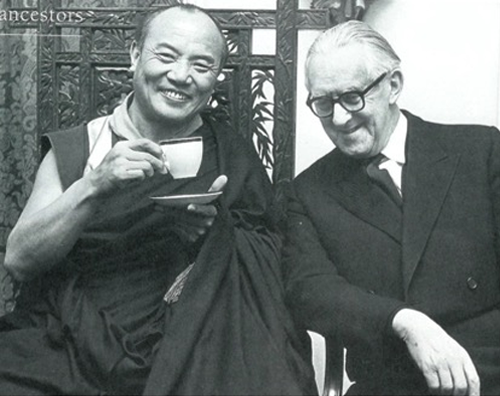
The Dalai Lama was receiving daily reports that the Chinese were still in pursuit from the north. As he continued his trip, almost the entire population of Dromo (Chumbi Valley) and Phari turned out to accompany him to Yatung as bodyguards. The Chinese were warned not to appear on the streets of Yatung on the day the Dalai Lama passed through. Meanwhile, a military officer and the British Trade Agent arrived at Phari from Gyantse to accompany the huge party to Yatung. The party traveled without further interference from the Chinese troops. After passing through the gates, the Dalai Lama was welcomed by David Macdonald, the British Trade Agent at Yatung, and spent the night at his residence. Macdonald had been to Lhasa with the Younghusband Mission in 1904. He spoke and wrote Tibetan very well, and gained the friendship and goodwill of many Tibetans.11
The Dalai Lama's original plan had been to remain at Yatung and from there conduct negotiations with Peking, but when he heard that Chinese troops had arrived at Phari, only one day away, he finally decided to cross over into India. Before leaving Yatung, the Dalal Lama left a letter with Macdonald to be forwarded to the British officials in India. In view of the fact that the British had invaded Lhasa a few short years earlier, causing the Dalai Lama to flee to Mongolia, the contents of the letter he now sent the British are interesting enough to warrant reproducing it in full. It read:
The Chinese have been greatly oppressing the Tibetan people at Lhasa. Mounted infantry arrived there. They fired on the inhabitants, killing and wounding them. I was obliged, together with my six ministers, to make good my escape. My intention now is to go to India for the purpose of consulting the British government. Since my departure from Lhasa I have been greatly harassed on the road by Chinese troops. A force of two hundred Chinese Mongol infantry were behind me at Chak-sam. and I left a party of my soldiers to hold them back. A small fight took place there, in the course of which two Tibetans and seventy Chinese were killed. I have left the Regent and acting ministers at Lhasa, but I and the ministers who accompany me have brought our seals with us. I have been receiving every courtesy from the British government, for which I am grateful. I now look to you for protection, and I trust that the relations between the British government and Tibet will be that of a father to his children. Wishing to be guided by you, I hope to give full information on my arrival in India.12
Traveling via the Dzalep-la pass, the Dalai Lama arrived in Kalimpong, where he was the guest of Raja Kazi Ugyen of Bhutan. The house in which the Dalai Lama lived is known today as Bhutan House, and to the Tibetans, it is still called Migyur Ngonga Phodrang, meaning "Palace of Unchanging Delight," because of its association with the thirteenth Dalai Lama.
After a week at Kalimpong, the Dalai Lama went to Darjeeling, where he stayed in a house called Padabuk. There he was visited by Charles Bell, the Political Officer of Sikkim, who acted as his liaison with the government of India. The Deputy Commissioner of Darjeeling looked after all aspects of the Dalai Lama's security.
Several telegrams were sent to Peking to request the withdrawal of Chinese troops from Tibet; but these were studiously ignored. Moreover, reports appeared in Indian newspapers that the Manchus had deposed the Dalai Lama and were choosing his successor by a lottery. The Manchu Amban circulated similar reports in Lhasa. The Dalai Lama then decided never to have direct negotiations with the Manchus or the Chinese; instead, he invoked one of the articles of the 1904 Lhasa Convention and appealed to the British to intercede on his behalf. The Dalai Lama, on his arrival in Calcutta, received a seventeen-gun salute in his honor and was escorted in a regal carriage to Hastings House.
The Dalai Lama met the Viceroy, Lord Minto, on March 14, 1910, and gave him an account of Chinese deceit and aggrandizement in Tibet. The following are extracts from the private interview as recorded by Butler, who began his account thus: "His Excellency, the Viceroy, received the Dalai Lama in private audience at Government House, Calcutta, this afternoon at five p.m. There were also present Mr. Bell, Political Officer, Sikkim, who acted as interpreter, and myself." The account went on to say that after compliments, in the course of which the Dalai Lama expressed his cordial thanks for the hospitality extended to him and the kindness of his reception, His Holiness said that he had had a trying time in his journey from Lhasa and was in danger from the Chinese soldiers who pursued him. At the time that he left Lhasa, there were 500 of the old Chinese troops and 40 newly-arrived ones, who were the advance guard of a force of 2,000 men then only two days' march from Lhasa. In all, some 1,700 troops had come into Lhasa and its neighborhood lately, according to the information he had received. That total number of Chinese troops in Tibet was not required for Tibet alone. The Chinese had designs on Nepal, Sikkim, and Bhutan, which they intended to subdue, and that would destroy the last vestiges of the Lamaist religion. The Chinese had more than once interposed to prevent amicable direct relations between the Tibetan and British governments. The Sikkim dispute of 1888 and the Younghusband mission of 1904 were due entirely to the actions of the Chinese. While in Peking, His Holiness had asked the British Minister to eliminate the harmful intervention of the Chinese.
The Dalai Lama went on to tell the Viceroy that under the Trade Regulations of 1908, direct relations between the British and Tibetan governments had been assured, and he was appealing that the rights of the Tibetans in this regard should be observed. He asked that he might be restored to the position of the fifth Dalai Lama, who had negotiated with the Emperor of China as the ruler of a friendly state, and he asked that the Chinese troops be withdrawn.
When questioned by the Viceroy as to whether he knew the terms of the treaties, in which the British government had entered with China and Russia, His Holiness replied that he was studying them.
The Tibetan government claimed the right of direct dealing with the British government, and it did not recognize the 1890 and 1906 Conventions, in which it had played no part. Moreover, the Dalai Lama said he had had no communications from the Chinese at Lhasa since he had left Phari. He would not return to Lhasa under the present political conditions there, as the promises made to him had been disregarded: He would not trust the written word of the Peking government as it had violated the promises given him by the late Empress Dowager.
When questioned by the Viceroy as to what he intended to do if he did not return to Lhasa, the Dalai Lama replied that he could not say at the moment, but that unless the matter was satisfactorily settled, he would not return to Lhasa. He denied that he had intrigued against China. He had only been two months in Lhasa before he fled. The Amban was altogether hostile. The Dalai Lama had come away with his ministers and the seals of office. With the Regent, whom he had appointed, he had left the seal that was used in the signing of the 1904 Convention, but his own seal he had with him. Moreover, he had had no contact with the Regent since he left. The Chinese intercepted all official letters and he had no official communication with Tibet. Some private letters had come through, but any communication had to be secret.
During the interview, the Dalai Lama sought to clarify the issue of Dorjieff, the Buriat Mongol, who had visited the Czar of Russia. His Holiness stated that Dorjieff was now in his own country. He had been one of seven assistants to his chief spiritual adviser and had never had anything to say except about spiritual matters.
At the end of the interview, the Dalai Lama said that he had made his appeal and asked what would be the answer. His Excellency, the Viceroy, said that he was very glad to have the opportunity of entertaining His Holiness and of meeting him. He had given instructions that every consideration should be shown to him, but he said that political questions of importance required due consideration and that he could not say more than that he would communicate His Holiness' remarks to His Majesty's government. The Dalai Lama then repeated his expressions of gratitude to the Viceroy and took his leave.
The Viceroy suggested that in the meantime the Dalai Lama enjoy the sights of Calcutta. While showing the Dalai Lama every consideration, the Viceroy was careful not to commit himself to any promises of help, perhaps because he was not very clear as to Britain's own treaty obligations with China and Russia. After spending a few days in Calcutta, the Dalai Lama returned to Darjeeling.
Only two of the original council ministers, Kalon Lozang Trinley and Kalon Tsarong, were still in Lhasa. The Dalai Lama, at the time of his departure, had instructed the Regent Tri Rimpoche to appoint Dekyi Lingpa and Khenchung Gyaltsen Phuntsok as deputy Kalon. The Chinese deposed Lozang Trinley and disqualified Dekyi Lingpa and Gyaltsen Phuntsok, forbidding them to enter the Kashag. Tsarong was the only one kept in office. His new colleagues, appointed by the Chinese, were Tenzin Chosdrak, Rampa, and Lanthongpa. The Regent's assistant, Khenrab Phuntsok Neushag, was arrested by the Chinese and condemned to death; but on the appeal of the Regent, his life was spared and he was dispatched in chains to Tachienlu.
In Lhasa, Tibetan police were replaced by Chinese. The Dalai Lama's personal effects, which were still on their way back from China, were confiscated at Nagchukha. His property in the Potala and Norbulingka (the summer palace), as well as the vast treasury of the Tibetan government, were removed by the Chinese. The Lhasa armory and magazines were emptied, the mint and ammunition factory seized, and the houses of those ministers who had fled with the Dalai Lami systematically pillaged. The property of the ex-Regent Demo, who had been found guilty of plotting against the Dalai Lama in 1899, was restored to his family.
Many districts that had formerly sent their revenue direct to Lhasa began to send it to the Dalai Lama at Darjeeling through merchants and travelers. To put a stop to this, the Chinese set up check-posts along the border and searched all travelers to India. Before long, Tibetans in Lhasa began defacing and removing posters put up by the Chinese. Monastic representatives and Tibetan officials protested to the Manchu Amban against the deposition of the Dalai Lama. Neither the Tibetan people nor their government would cooperate with the Chinese dictatorship at Lhasa. In eastern and southern Tibet, Chinese nationals were frequently attacked.
The Chinese, now realizing that they had made a mistake in declaring the Dalai Lama deposed, instructed the Amban to send Lo Ti-t'ai to Darjeeling to offer the Dalai Lama the restoration of his titles and to request him to return to Tibet. The Chinese official arrived in India in September 1910.
In reply to Lo Ti-t'ai, the Dalai Lama wrote the following letter:
To Lo Ti- t'ai from the Dalai Lama: On the tenth day of the ninth month of the Iron-Dog year [1910], I received through you an urgent message from the Peking political and military departments asking me to return to Lhasa. In reply, I have the following to say: The Manchu Emperors have always shown great care for the welfare of the successive Dalai Lamas, and the Dalai Lamas have reciprocated these feelings of friendship. We have always had each other's best interests at heart. The Tibetan people have never had any evil designs on the Chinese.
In the Wood-Dragon year [1904], when the British expedition arrived in Tibet, I did not consider taking any assistance except from Peking. When at Peking, I met the Emperor and his aunt, and they showed me great sympathy. The Emperor committed himself to taking care of the welfare of Tibet. On the strength of the Emperor's word, I returned to Tibet, only to find that on our eastern borders, large bodies of Chinese troops had massed and many of our subjects had been killed. Monasteries were destroyed and the people's rights suppressed. I am sure that you are fully aware of this.
Furthermore, the Amban at Lhasa, Lien-yu, had been reinforcing his troops with the object of occupying Lhasa. On several occasions, I objected to this; but he turned a deaf ear to my appeals. When the troops were on their way to Lhasa, I sent my representative, Khenchung, to meet them and explain my position; but the military officers executed Khenchung and seized his possessions.
While on their march, Chinese troops had exploited the people and the monasteries to such an extent that my subjects and the monastery monks requested permission to retaliate. Had they done so, it would not have been impossible for us to defeat your army, owing to our knowledge of the terrain. However, a fight by my subjects against your troops might have been construed as against the Manchu Emperor. I, therefore, asked my ministers to negotiate with your officers and to protect your representatives in Lhasa. I also wrote to the Emperor asking him to withdraw these troops. All this is clear in the records held by both the Chinese and the Tibetans. I have several times explained this by wire to the Peking Political Department; but I have received no reply.
At Nagchukha, on my way from China to Lhasa, I wrote several notes to the Amban, informing him that China and Tibet must continue their long-standing friendship; but, instead of listening to my appeal, he insisted on bringing more troops to Lhasa. The advance of the Chinese troops coincided with the Monlam festival being held at Lhasa, at which thousands of monks from different monasteries had come together. In order to avoid a clash the Nepalese representative at Lhasa called on the Manchu Amban to prevent any trouble from arising. The Amban refused to do anything about it; instead, he sent his bodyguard out to meet the advancing troops. On the way, they fired on the Lhasa police, killing some of them. They also fired on the Jokhang temple and the Potala palace.
The eleventh Dalai Lama's nephew, Teji Phunkhang, and Tsedron Jamyang Gyaltsen, were Tibetan government officials assigned to administer the Monlam festival. On their way to the Jokhang temple, they were met by the troops, who fired on them. Tsedron Jamyang and Teji Phunkhang's servant and horse were killed. Teji Phunkhang was then beaten and taken away to the military camp. The people of Lhasa were so outraged that they wanted to take revenge; but I restrained, them from doing so. I still hoped we could negotiate with China and avoid unnecessary bloodshed, Not knowing what would happen if I were captured, I appointed a representative in Lhasa to continue negotiations and I then came to the border of Tibet and India in order to personally conduct negotiations with China.
My ministers had appealed to me to m to remain in Lhasa; but had I done so, a situation similar to the Muslim invasion of India might well have taken place, which resulted in many religious institutions being destroyed. As I did not want this to happen in Tibet, I came here especially to negotiate for my country, not caring what hardships I might have to endure. When I arrived at Phari, I was asked by the Chinese official of Yatung to remain at the Phari monastery and negotiate with Peking and with the Manchu Amban in Lhasa by wire. I thought this arrangement would be ideal; but when troops arrived to take me alive or dead, I had no choice but to cross the Indian border.
At Kalimpong, I came to know that the Manchu Emperor had already issued orders that I had been deposed from office. This was published in Indian newspapers, and even in Lhasa, posters were put up announcing that I was now an ordinary person and that a new Dalai Lama would soon be chosen. Since the Emperor has done everything on the recommendation of the Manchu Amban in Lhasa, without considering the independence of Tibet and the religious relationship between our two countries, I feel there is no further use in my negotiating directly with China. I have lost confidence in China and in finding any solution in consultation with the Chinese.
I have contacted the British, because the 1904 Convention permits us to deal directly with them. The Chinese are responsible for this action of mine.
During my stay in India, Amban Lien-yu has moved Chinese troops all over Tibet and has exploited Tibetan subjects to extremes. They have stopped my supplies and censored my letters from Tibet. They have sealed the treasury in Lhasa, emptied our armory, and seized our mint factories. Khenche Khenrab Phuntsok, assistant to my representative at Lhasa, aged seventy years, who was completely innocent, was imprisoned without cause and sent to Tachienlu. Judicial cases that had already been decided were reopened. Tibetan government property and the property of Tibetan officials and monasteries have been illegally seized.
You are fully aware of this inexcusable illegal action taken by your troops; yet, you inform me and my ministers that the situation in Tibet is peaceful and that status quo is being maintained. I know that this has been said to persuade me to return and I also know that it is false.
Because of the above, it is not possible for China and Tibet to have the same relationship as before. In order for us to negotiate, a third party, is necessary; therefore, we should both request the British government to act as an intermediary. Our future policy will be based on the outcome of discussions between ourselves, the Chinese, and the British. Are you able to agree to the participation of the British in these discussions? If so, please let me know.
In case you are not agreeable to this, I am handing you a letter containing the above facts, written in both the Manchu and Tibetan languages, which I would like you to forward to the Emperor. Please explain carefully to the Emperor the contents of my letter. (Dated) Thirteenth day of the ninth month of the Iron-Dog year [1910].
(SEAL OF THE DALAI LAMA)13
That winter, the Dalai Lama made a tour of the Buddhist pilgrimage places. He visited Lumbini, Bodh Gaya, Sarnath, and Kushinagara, where the Lord Buddha was born, became enlightened, delivered his first sermon, and died.
Meanwhile the officials of the Panchen Lama in Tibet, hoping to use the Panchen for their own purposes, invited him to Lhasa in January 1911. He stayed first in the Jokhang temple and then moved to the Norbulingka (summer palace of the Dalai Lama). This annoyed the Tibetan people, who became even more outraged when the Panchen Lama began to fraternize with the Manchu Amban in public, accompanying him to parties and the theatre.
During the Butter-lamp festival, the Panchen Lama and the Amban placed themselves in sedan chairs and were taken in procession around Lhasa in the same manner in which the Dalai Lama was normally escorted. The Lhasa populace participated in the ceremony, but only to the extent of dropping mud and old socks on to the heads of the Panchen and the Amban as they passed. It was also the occasion for a new Lhasa street-song:
The slovenly attired monk
On the roof of the Jokhang,
Would have been a thief
If it were not for the arrival of the dawn.
"Dawn" in the song refers to the Tibetan resistance movement, which prevented the Panchen Lama from accepting the Dalai Lama's administrative duties, which the people suspected the Chinese were preparing to offer him. From the private correspondence that passed between the Dalai Lama and the Panchen Lama, it is evident that the Panchen held the Dalai Lama in high regard; he was involved in this unpleasantness only because of the collaboration of his officials with the Chinese. Since that time, ill feeling has continued to exist between the Lhasa officials and the Panchen's Tashilhunpo officials.
Meanwhile, back in Lhasa, things were not going well for the Chinese. They could get no cooperation from the people, the Tibetan parliament was proving obstructive, while in parts of the country a resistance movement calling itself "The Dawn" had begun to harass them. When the Chinese invited the Panchen Lama to Lhasa, hoping to use his authority, angry Tibetans expressed their disapproval by dropping old socks and mud on his head as he and the Chinese amban rode through the streets together. Taxes soon began to find their way to Darjeeling, where the Dalai Lamas was now living, instead of to Lhasa, and the Chinese had to search Tibetans leaving for India to prevent this. Finally, the Chinese became so desperate that they were forced to approach the Dalai Lama and plead with him to return, but in vain.
-- Trespassers on the Roof of the World: The Race for Lhasa, by Peter Hopkirk
The Dawn Society
Founder-editor of the Dawn magazine (1897–1913), an organ of Indian Nationalism, in 1902 he organised the "Dawn Society" of culture, to protest against the Report of the Indian Universities Commission, representing the inadequate university education imposed by the Government to fabricate clerks for the merchant offices. "The cry for thorough overhauling of the whole system of University education was in the air."[4]. In 1889, he formulated the scheme for national education.[5]
Dawn occupied an apartment on the first floor of the present Vidyasagar College (formerly known as the Metropolitan Institution: its Principal, Nagendranath Ghosh was the President, and Satish its general secretary). The Dawn Society was "functioning (…) as a training ground of youths and a nursery of patriotism, became in 1905 one of the most active centres for the propagation of Boycott-Swadeshi ideologies..."[6]
In tune with the programme of a new pedagogy introduced by Sri Aurobindo, the Society's object was to draw the attention of the students to the needs of the country, to love Mother India, to cultivate their moral character, to inspire original thinking. It had a weekly session for a "general training course". One of the members, Benoy Kumar Sarkar, considering having lived significantly thanks to Satish Chandra's influence, would remember his ardent message of patriotism and philanthropy rousing the youth to dedicated service; he would also write about the method of Pandit Nilakantha Goswami's explaining the Bhagavad Gita, impressing on the listeners' mind the futility of life and death, the insignificance of the body: the sole thing that counts is Duty, the right Action.[7]
Among active members of the "Dawn" were Sister Nivedita, Bagha Jatin (Jatin Mukherjee), Rajendra Prasad (first President of India), Haran Chakladar, Radha Kumud Mukherjee, Kishorimohan Gupta (principal, Daulatpur College), Atulya Chatterjee, Rabindra Narayan Ghosh, Benoykumar Sarkar, all future celebrities. One day, Satish Chandra heard an inner voice uttering firmly: "God exists."[8]
-- Satish Chandra Mukherjee, by Wikipedia
Among the Chinese troops in Lhasa, there were many who had been enlisted in Szechuan. Some were ordinary soldiers, while others belonged to the Ko-lao-hui, a secret society of revolutionists. Because of rivalry among the soldiers and the insufficiency of their pay in Tibet, clashes took place within the Chinese army. The Amban had the local leader of the Ko-lao-hui executed; but this only led to recriminations and murder among the Chinese officers. Political dissensions and personal feuds resulted in the defection of a Chinese colonel, Hsieh Kuo-liang, and three other officers to the Tibetan side. They joined the Sera monastery as monks.
In October 1911, the revolution led by Sun Yat-sen overthrew the Manchus in China. When this news reached Lhasa, the members of the Ko-lao-hui mutinied. They attacked the Amban's residence and looted his house. The Amban fled from Lhasa and took refuge near the Drepung monastery; but the mutineers caught up with him and carried him off to Shigatse as a hostage. Chung-yin, the Manchu commander-in-chief, intervened on behalf of the Amban and secured his release. Afterwards, the mutineers called for the other army units stationed at outlying points to join them for the march back to China and home. This brought additional Chinese troops to Lhasa "whose plunder on the way and in the capital aroused widespread ill-feeling among the Tibetans."14
The combination of increasing imperialist demands (from both Japan and the West), frustration with the foreign Manchu Government embodied by the Qing court, and the desire to see a unified China less parochial in outlook fed a growing nationalism that spurred on revolutionary ideas....
[M]illions of Chinese living overseas, especially in Southeast Asia and the Americas, began pressing for either widespread reform or outright revolution. Kang Youwei and Liang Qichao emerged as leaders of those proposing the creation of a constitutional monarchy. Sun Yat-sen led the amalgam of groups that together formed the Revolutionary Alliance or Tongmenghui. The Revolutionary Alliance advocated replacing Qing rule with a republican government; Sun himself was a nationalist with some socialist tendencies.
Both the revolutionary leaders and the overseas Chinese bankrolling their efforts had their roots in southern China....
Finally, in the autumn of 1911, the right set of conditions turned an uprising in Wuchang into a nationalist revolt. As its losses mounted, the Qing court responded positively to a set of demands intended to transform authoritarian imperial rule into a Constitutional monarchy. They named Yuan Shikai the new premier of China, but before he was able to retake the captured areas from the revolutionaries, the provinces started to declare their allegiance to the Revolutionary Alliance. Dr. Sun was in the United States on a fundraising tour at the time of the initial revolt; he hastened first to London and Paris to ensure that neither country would give financial or military support to the Qing government in its struggle. By the time he returned to China, the revolutionaries had taken Nanjing, a former capital under the Ming Dynasty, and representatives from the provinces began to arrive for the first national assembly. Together, they elected Dr. Sun the provisional president of the newly declared Republic of China....
[T]he emperor and the royal family abdicated the throne in February of 1912.
The 1911 revolution was only the first steps in a process that would require the 1949 revolution to complete. Though the new government created the Republic of China and established the seat of government in Nanjing, it failed to unify the country under its control. The Qing withdrawal led to a power vacuum in certain regions, resulting in the rise of warlords. These warlords often controlled their territories without acknowledging the nationalist government. Additionally, the reforms set in place by the new government were not nearly as sweeping as the revolutionary rhetoric had intended; unifying the country took precedent over fundamental changes....
[T]he United States was largely supportive of the republican project, and in 1913, the United States was among the first countries to establish full diplomatic relations with the new Republic.
-- The Chinese Revolution of 1911, by Office of the Historian, Department of State
Chao Erh-feng had maintained his headquarters at Chamdo; but on receiving news of the revolution in China, he returned to his capital in Szechuan, leaving his deputy in command of the troops in Kham.15 In the following year, Chao was executed.16
News spread throughout Tibet that the Dalai Lama was about to return from exile. This caused the Chinese troops and civilians in U- Tsang to be constantly harassed. Kanam Depa of Poyul in southeastern Tibet openly revolted against the Chinese. Imperial troops, under Lo Chang-chi, were sent from Lhasa towards Poyul; but, because of the steep, rocky roads leading to that remote area, the Chinese lost many men on the way and had to return without being able to suppress the uprising.
A number of the Dalai Lama's junior officials in Darjeeling volunteered to return to Tibet and fight. They arrived in Tsang and organized uprisings. They attacked the Chinese at Shigatse and Gyantse; but they suffered severe losses and had to return in disgrace to Darjeeling, where for a time they were ridiculed by the senior Tibetan officials. They were summoned into the presence of the Prime Minister, Lonchen Shatra, expecting to be reprimanded; but the shrewd Lonchen praised their efforts. He declared them to be heroes, saying that he was sure they would be more successful in their next venture. Inspired by his confidence in them, the young officials returned again to Tibet, where they did an excellent job of organizing guerrilla resistance. Eventually, they succeeded in driving the Chinese out of Shigatse and Gyantse. Later on, these young officials were all made generals.
The Dalai Lama then moved from Darjeeling to Kalimpong, where he again stayed at Bhutan House. From there he sent his sealed orders to Lhasa, addressed to Tsepon Norbu Wangyal Trimon and the Secretary-General, Chamba Tendar, who was later to become a Kalon and governor of eastern Tibet. Tsepon Trimon was later to become an assistant to Lonchen Shatra at the Simla Convention, with the rank of commander-in-chief. (Eventually he rose to the position of a Kalon and succeeded Chamba Tendar as governor in eastern Tibet.)
The Dalai Lama instructed these two officials to organize in secret a War Department and to prepare for military action. They were told that if they wished to consult him, they should get into direct contact with him at Kalimpong. This statement implied that the Kashag was to be kept ignorant of their plans; nevertheless, Chamba Tendar and Trimon did at least contact prominent monks in the Sera monastery. By that time, the Chinese military dictatorship in Lhasa was weak and inefficient. Chinese soldiers were selling their guns and ammunition to Tibetan merchants. Chamba Tendar and Trimon sponsored their own merchants to buy Chinese firearms, while they secretly organized the recruitment of Tibetan soldiers.
The proud and patriotic Sera monks, aware of the preparations that were being made, became bold enough to provoke the Chinese openly. This roused the suspicions of the Chinese leaders, who held a meeting in Lhasa to discuss the situation. They complained that they were getting no help from Peking and that it was becoming increasingly difficult to live off the Tibetans and their land. Loans were no longer forthcoming from the Tibetan government. The Chinese assumed that if they put pressure on the government, it might provoke an attack by the Sera monks; therefore, they decided to risk an attack on Sera itself, even though they were uncertain as to the extent of opposition they would have to cope with in so doing.
When Trimon and Chamba Tendar learned of the Chinese decision to attack Sera, they contacted the Banagshol tribe of the Kham region, and deployed them to defend Sera. On November 2, 1911, the Chinese attacked the monastery. They captured and burned the surrounding hermitages and laid siege to the monastery itself. The three Chinese officers who had earlier defected to become monks now made themselves very useful to the Tibetan defenders. One of them, Hsieh Kuo~liang, emerged from the monastery at night and penetrated the Chinese lines. He spread the fiction that the monks were approaching from behind and thus diverted the attention of the Chinese so that the Sera monks were able to take the offensive. The Kham tribesmen fought so fiercely that the Chinese were unable to make any headway, even though the fighting lasted ninety-six hours.
Meanwhile, in Lhasa, Trimon and Chamba Tendar had openly declared war, and when this news reached Sera, the Chinese troops abruptly stopped fighting and immediately marched on Lhasa. Lhasa itself was then divided into two zones; the northern being occupied by Tibetans, the southern by Chinese. The front doors and windows of every house in town were blocked with sandbags. Communicating passages were made from one house to another by breaking through the walls. A stockaded street separated the two zones.
Both the Tibetans and the Chinese dug underground tunnels into each other's zone and laid fuses to explode kegs of powder placed under important outposts and houses. These tunnels were made in zigzag fashion to lessen the shock waves from the explosion. To draw the Chinese to the site of a planned explosion, the Tibetans would launch a brief attack on that area. Because the Tibetans repeatedly used the same tactic, the Chinese finally ignored this ruse and the explosion would take place in an area already evacuated. In order to detect underground digging, earthen jars were buried at floor-level and their rims smeared with mud. The slightest vibration would cause the mud to trickle into the jars.
There were very few large scale engagements. Insults were hurled from windows, and, because random sniping took place in streets dividing the two zones, it was dangerous to stand near an open window. By the end of almost a year's fighting, one third of Lhasa had been subjected to devastation and ruin. Tsepon Trimon himself was wounded in the arm; but he concealed his injury and continued to perform his duties. The Sera monks and the Banagshol Khampa joined in the fighting at Lhasa and made frequent raids on the Chinese cantonment at Drapchi, just outside the city. Many men were lost in their attacks on that well-fortified garrison.
Chinese outposts in Tsang and near the Indian border were being consistently attacked and captured by the Tibetans, who had returned from Darjeeling. The roads to Kham and the Indian border were blocked and the fleeing Chinese headed for Lhasa, where they felt there would be safety in numbers.
In Kalimpong, Dazang Dadul, the hero of the Chaksam battle, was made a commander-in-chief of the Tibetan forces and in January 1912 was sent to Lhasa to work in close cooperation with the War Department set up by Trimon and Chamba Tendar. The Chinese troops were facing a grave food shortage. They might have capitulated sooner; but they were able to hold out longer by moving into the friendly Tengyeling monastery in Lhasa, which belonged to the followers of the late Regent Demo. There they found supplies sufficient for another six months. This resulted in another Lhasa street-song, which described the prolongation of the war even after the arrival of the new commander-in-chief.
Dazang Dadul, Tsepon Trimon, and Chamba Tendar called a secret meeting of the Tsongdu, at which it was decided to arrest all pro-Chinese Tibetan officials, before there were any more defections like that of the Tengyeling monastery. As a result of this decision, the members of the Kashag were all arrested. Kalon Tsarong, his son, and Kadrung Tsashagpa, the secretary of the Kashag, were shot for having close relations with the Chinese. The other three Kalons, who had been appointed by the Chinese, namely, Tensing Chosdrak, Rampa, and Langchongpa, were imprisoned. Phunrabpa, a secretary-general, Mondrong, a treasurer, and Lozang Dorje, a monk official, were executed for being on friendly terms with the monks from the Tengyeling monastery. At the outbreak of the fighting in Lhasa, this monastery had declined the offer of government troops for its protection and the three executed officials had guaranteed its defense. There was no longer a Kashag and all important matters were now deliberated by the War Department and the Tsongdu, sometimes in consultation with the Dalai Lama in India.
During his stay in India, the Dalai Lama was very well treated by the British and relations between India and Tibet consequently improved considerably. Since preparations were being made for his return to Tibet, the Dalai Lama wrote to the Viceroy, through Charles Bell, thanking him for the hospitality shown by the British government during his two-year stay in India. He made known his intention to return to Lhasa. He likened the situation in Tibet to a reservoir which requires constant replenishing if it is not to dry up. Due to the revolution in China, the Chinese troops in Tibet were not being reinforced and the level of the Chinese reservoir was falling fast. As the Tibetans were fighting with very high morale, the Dalai Lama hoped that they would soon drive out the Chinese. Even more important to him at that point was the future of Tibet itself. He reminded the Viceroy of his request for British participation in settling future problems between China and Tibet. Charles Bell, who was given the letter, was also apprised of its contents.
While at Kalimpong, the Dalai Lama had been shown great consideration by Raja Kazi Ugyen, whose house he had occupied. The Dalai Lama expressed his appreciation for the Raja's hospitality by conferring on him and all his descendants the Tibetan rank of Rimshi (Fourth Rank).
On the tenth day of the fifth Tibetan month of the Water-Mouse year (1912), the Dalai Lama left Kalimpong for Tibet, via the Dzalep-la pass. At Yatung, he remained a week at the residence of the British Trade Agent, David Macdonald. From there, he wrote to various monasteries and chieftains in eastern Tibet, encouraging them in their opposition to the Chinese and promising them early liberation. He also wrote to the Banagshol Khampa tribesmen, complimenting them on their brave action at Sera and Lhasa.
Shekar Lingpa, who had been a secretary in the Dalai Lama's service at Darjeeling, was appointed a Kalon to fill the place of the late Tsarong minister. Shekar Lingpa was a straightforward, elderly man, known as an accomplished poet. While in Darjeeling, he had written a number of moving poems in remembrance of Lhasa. Not long after returning to Tibet, Shekar Lingpa died.
Two hundred monks from the monasteries of Sera, Ganden, and Drepung volunteered to escort the Dalai Lama back to Lhasa. They were led by Ragashar. At the same time, two well-known Khampas, Nyima Gyalpo Pandatshang of Markham and Chopatshang of Gojo, voluntarily brought an armed escort of Khampas to join the Dalai Lama. They were to protect him day and night until Lhasa was reached.
The Panchen Lama, who seemingly regretted his fraternization with the Chinese, journeyed with his officials from Tashilhunpo to welcome the Dalai Lama at Ralung. Continuing on his journey, the Dalai Lama spent some time at the Samding monastery near lake Yardok Yutso.