Freda Bedi, by Wikipedia

This is a broad, catch-all category of works that fit best here and not elsewhere. If you haven't found it someplace else, you might want to look here.

Re: Freda Bedi, by Wikipedia

Postby admin » Wed Oct 30, 2019 8:31 pm

Asian Art Museum: About the Asian Art Museum
by Asian Art Museum, asianart.org
Accessed: 10/30/19

A Guided Tour of Hell
by Asian Art Museum, San Francisco
Apr 20 — Sep 16, 2018

A guided tour of one man’s harrowing descent into the Tibetan Buddhist realms of hell encourages us to contemplate the meaning of life and the consequences of negative action.

After collapsing in the hospital following heart surgery, longtime Buddhist teacher Sam Bercholz felt himself being pulled violently down into a realm beyond life, where he witnessed dramatic suffering. Bercholz recounted the nightmarish imagery and intense sensations of this near-death experience to Tibetan American artist Pema Namdol Thaye. The artist drew on his training in traditional Tibetan arts as well as his childhood obsession with graphic novels to translate these descriptions into a series of vibrant acrylic paintings; more than 20 of these works are on view in this exhibition.

Thaye’s paintings forcefully depict the karmic suffering of hell-beings in fantastical landscapes, both fiery and crystalline. These characters — among them a suicide bomber, a murderous warlord, a self-absorbed socialite, a scientist who invents a doomsday bomb — each represent a negative habit of mind: envy, hate, greed, disdain, materialism.

The artworks encourage us to contemplate suffering in order to inspire us toward greater good in life. To this end, the final painting in the series, Samsara, reminds us that hell is only one of six possible destinations on the karmic wheel of life.

On Saturday, June 23, get an inside look at the exhibition A Guided Tour of Hell with artist Pema Namdol Thaye. Learn more.


Image
The Asia Foundation
Asian Art Museum Directors' Forum
Funding provided for administration of the inaugural forum hosted by the Asian Art Museum of San Francisco for museum directors of Asian art from the United States and Asia to foster greater global awareness of Asian art and cultures while exploring models for collaboration and partnerships among the institutions.


Asian Art Museum Directors' Forum, by The Asia Foundation, asiafoundation.org/projects/asiant-art-museum-directors-forum/


"The Asia Foundation (TAF), a Central Intelligence Agency proprietary, was established in 1954 to undertake cultural and educational activities on behalf of the United States Government in ways not open to official U.S. agencies."[18]

The Asia Foundation is an outgrowth of the Committee for a Free Asia, which was founded by the U.S. government in 1951.[19] CIA funding and support of the Committee for a Free Asia and the Asia Foundation were assigned the CIA code name "Project DTPILLAR".[20]

In 1954, the Committee for a Free Asia was renamed the Asia Foundation (TAF) and incorporated in California[21] as a private, nominally non-governmental organization devoted to promoting democracy, rule of law, and market-based development in post-war Asia.

Among the original founding officers of the board, there were several presidents/chairmen of large companies including T.S. Peterson, CEO of Standard Oil of California (now Chevron), Brayton Wilbur, president of Wilbur-Ellis Co., and J.D. Zellerbach, chairman of the Crown Zellerbach Corporation; four university presidents including Grayson Kirk from Columbia, J.E. Wallace Sterling of Stanford, and Raymond Allen from UCLA; prominent attorneys including Turner McBaine and A. Crawford Greene; Pulitzer Prize-winning writer James Michener; Paul Hoffman, the first administrator of the Marshall Plan in Europe; and several major figures in foreign affairs.

In 1966, Ramparts revealed that the CIA was covertly funding a number of organizations, including the Asia Foundation.[18] A commission authorized by President Johnson and led by Secretary of State Rusk determined that the Asia Foundation should be preserved and overtly funded by the US government. Following this change, the US government described the Asia Foundation as a "quasi-nongovernmental organizations" and said that "the core of its budget" was still provided by the US government.[22] The Foundation began to restructure its programming, shifting away from its earlier goals of "building democratic institutions and encouraging the development of democratic leadership" toward an emphasis on Asian development as a whole (CRS 1983).


-- The Asia Foundation, by Wikipedia


Image

Welcome and thank you for visiting. Through great art experiences, we strive to be a catalyst for discovery, dialogue and inspiration. Our vision and mission are centered on you, the visitor. We hope you're able to experience our museum in person, in addition to visiting with us online. I look forward to seeing you here soon.

Jay Xu, Director
Asian Art Museum

Strategically located on the Pacific Rim and serving one of the most diverse communities in the United States, the Asian Art Museum of San Francisco – Chong-Moon Lee Center for Asian Art and Culture is uniquely positioned to lead a diverse, global audience in discovering the distinctive materials, aesthetics and intellectual achievements of Asian art and cultures, and to serve as a bridge of understanding between Asia and the United States and among the diverse cultures of Asia.

Our Vision

To make Asian art and culture essential to everyone.

Our Mission

The Asian Art Museum of San Francisco connects art to life. Our mission is to inspire new ways of thinking by connecting diverse communities to historical and contemporary Asian art and culture through our world-class collection, exhibitions and programs.

Our Values

The Asian Art Museum of San Francisco strives to be respectful, engaging, inspirational, nimble and accessible. Learn more about our values.
admin
Site Admin
 
Posts: 39440
Joined: Thu Aug 01, 2013 5:21 am

Re: Freda Bedi, by Wikipedia

Postby admin » Thu Oct 31, 2019 1:01 am

A Brief History of Kagyu Samye Ling
by Kagyu Samye Ling
Accessed: 10/30/19

NOTICE: THIS WORK MAY BE PROTECTED BY COPYRIGHT

YOU ARE REQUIRED TO READ THE COPYRIGHT NOTICE AT THIS LINK BEFORE YOU READ THE FOLLOWING WORK, THAT IS AVAILABLE SOLELY FOR PRIVATE STUDY, SCHOLARSHIP OR RESEARCH PURSUANT TO 17 U.S.C. SECTION 107 AND 108. IN THE EVENT THAT THE LIBRARY DETERMINES THAT UNLAWFUL COPYING OF THIS WORK HAS OCCURRED, THE LIBRARY HAS THE RIGHT TO BLOCK THE I.P. ADDRESS AT WHICH THE UNLAWFUL COPYING APPEARED TO HAVE OCCURRED. THANK YOU FOR RESPECTING THE RIGHTS OF COPYRIGHT OWNERS.

The centre had originally been a hunting lodge on the banks of the River Esk, but in 1965 it had become the Johnstone House Contemplative Community, a retreat centre founded by the Canadian Buddhist Ananda Bodhi.

Ananda Bodhi had met Chogyam Trungpa Rinpoche and Akong Rinpoche the previous year at Oxford, where they had been sent to study. In 1967 he arranged for the ownership of Johnstone House to be transferred to their Tibetan Karma Kagyu order and subsequently returned to Canada. Shortly afterwards the two Tibetans were joined by Sherab Palden.

-- Remembrance: Sherab Palden Beru, by Buddhist Art News


[1965/1966/1967] Venerable Ananda Bodhi returned to England in the Fall of 1961, at the invitation of the English Sangha Trust, becoming the Resident Teacher of the Camden Town Vihara. He was a special guest speaker at the Fifth International Congress of Psychotherapists in London, where he met Julian Huxley, Anna Freud and R.D.Laing, among others. For the next three years he taught extensively throughout the UK, founding the Hampstead Buddhist Vihara in London and the Johnstone House Contemplative Community—a retreat centre in southern Scotland. During this period he also joined a Masonic lodge. In 1965, when he decided to move to Toronto with two of his British students, Johnstone House was entrusted to Venerable Chogyam Trungpa Rinpoche and Akong Tulku, becoming Kagyu Samye Ling—the first Vajrayana centre to be established in the West.

-- Ven. Namgyal Rinpoche [Venerable Ananda Bodhi/Leslie George Dawson], by Dharma Centre of Winnipeg


Ananda Bodhi, senior incumbent of the English Sangha Vihara and founder of a Buddhist contemplative centre in Scotland called Johnstone House, proposed turning the direction of the House over to myself and Akong. At once the fresh air and beautiful rolling hills of Dumfriesshire invigorated me and filled me with joyous expectation. After a series of further visits, Johnstone House was finally turned over to us and we moved in, giving it the name of Samye-Ling Meditation Centre.

-- Epilogue: Planting the Dharma in the West, from "Born in Tibet," "by" Chogyam Trungpa


To celebrate 50 years of Chogyam Trungpa's arrival in the UK Rigdzin Shikpo visited Biddulph Old Hall where he received many precious teachings from Trungpa Rinpoche.

-- A Tour of Biddulph Old Hall: Rigdzin Shikpo takes us on a tour of Biddulph Old Hall in Staffordshire, England. Biddulph Old Hall is the site of some of Trungpa Rinpoche's early teachings in the UK, by Rigdzin Shikpo


Image
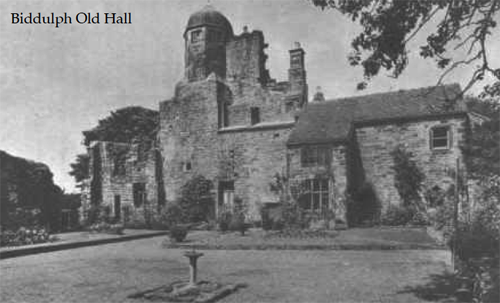
Biddulph Old Hall. Source: Sangha Magazine, May 1963

May 1963 Between February and May, Biddulph Old Hall was bought (S May and June 63)
Nov 1963 Ananda Bodhi to Thailand
1963 129 Haverstock Hill was purchased. The property was rented to provide an income for the Vihāra
April 1964 Ananda Bodhi returned and went to Biddulph and taught samadhi and vipassana, Wat Paknam method. (S Mar 64)
10 Jan 67 Maurice Walshe asked John Garry to manage Biddulph. He also found Richard Randall (previously Mr Purfurst and Venerable Kapilavaddho) and asked him to return
Biddulph Old Hall sold (S Nov 69)


-- Honour Thy Fathers: A Tribute to the Venerable Kapilavaddho ... And brief History of the Development of Theravāda Buddhism in the UK, by Terry Shine


Well, I met him in 1966. And at that time I was married to an Irish actress named Jacqueline Ryan, or Jackie. We had rather a stormy relationship....

I began making the aspiration in my mind, “May I connect with a realized master in the practice lineage.”...

So one day in my mind I was making this aspiration, and I had this sudden thought come to my mind, “Go to the phone book and look up ‘Tibet.’” And I thought, “That’s crazy. What’s that going to do?” And I thought, “Yeah, yeah, but what have you got to lose?” So I went to the phone book, and I looked up “Tibet.” Now in London, there’s 12 million people, the phone book is in four volumes, but I looked up in the “T’s,” and there was only one entry that began with the word “Tibet.” And that was “The Tibet Society of the United Kingdom ... and noted down the address -- I think it was 58 Eccleston Square.” ...

[S]o I got in the car, and I knew where Eccleston Square was, and I managed to find a parking place there without having to use the reverse. And it was sort of a Victorian townhome. And I went up the steps and there was a brass plate that said, “Buddhist Society.” And I thought, “Ha, that’s a good sign.” And underneath it it said, “Tibet Society.” So I pressed that bell push, the buzzer sounded, the door opened, and I went in.

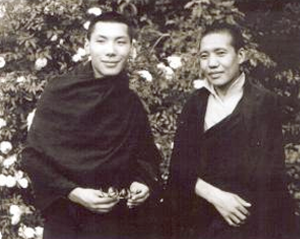
And there was an arrow pointing down to the basement. So I went down to the basement, full of anticipation that there was going to be something very esoteric -- I was sure about that – “Tibet Society!” And there was this middle-aged English woman with her hair in a bun, typing away on an old manual typewriter, looking at me at the top of her glasses and saying, “How can we help you?” And I said, “Well, tell me about the Tibet Society.” And she said, “Oh, it’s a charitable organization, raising money for Tibetan refugees in India. Would you care to make a donation?” I thought, “This is crazy.” And I think I gave her 10 shillings, and I was about to leave, thinking that this was a total waste of time. And at that moment, a young woman came in the door, and she kind of pulled me aside and she said, “If you don’t mind me asking, ‘what are you doing here’?” I said, “Well, it’s really hard to explain, but I’m really interested in the teachings of the Kagyu order of Tibetan Buddhism.” She said, “Oh, you know there are two Tibetan lamas in this country, and they belong to that Kagyu order.” And then she reached into her purse and she pulled out a photo, and she pointed to the one on the left and she said, “That’s Trungpa. That’s the one you want to meet.” I said, “Yes. Okay.” And then she proceeded to give me the address and phone number. They were living in Oxford....

And I rushed home, and I phoned the number in Oxford, and asked to speak to Venerable Trungpa, and someone with a weird foreign accent said, “Oh, he no here right now. Better you write to him.” And then they gave me an address of some place called Biddulph in Staffordshire, Biddulph Old Hall in Staffordshire.

And so I sat down and wrote a letter, “Dear Venerable Trungpa. I’d very much like to come and meet you, and study under your guidance. And I’d be willing to meet you any time or place that would be suitable to you.”...

So I sent off the letter, and of course, the first day there’s no response. The second day there’s no response. The third day, now by that time you could get an answer, because in England you could send a letter one day and it would get there the next day, and you could get a reply the day after that. But on the third day there was still no answer. On the fourth day there was still no answer. Now I was getting antsy. And on the fifth day still no answer. And I thought, “Well, I can’t wait any longer. I’m just going to go.” And I had the address of this place, The Biddulph Old Hall, Biddulph, Staffordshire. And I had a road atlas. So I found this place Biddulph. It was like a dot on the map, it was just this little village. And I decided I was going to go....

And I finally found this little village called “Biddulph” in Staffordshire. It’s kind of in the middle of England. And then I stopped in the village, and got directions to the Old Hall. And it’s a beautiful stone manor house....

And this place had a kind of iron knocker on the door. And I knocked, and a young man came to the door and said, “How can we help you?” And I said, “Well, I came to see the Venerable Trungpa.” And he said, “Ah, you must be Richard. He told us you’d be arriving today.” And I said, “What?,” because I had not had any answer to my letter....

So I stayed there for a week, and I met with him regularly on a one-to-one basis....

So at the end of the week, I went back to London. And a day or two afterwards I was having dinner – I was with my wife Jackie – and she said to me, “I have a feeling you don’t really need me anymore.” And I said, “Yeah, maybe you’re right.” And she said, “I’m going to be leaving you.” And I said, “What?” And I didn’t really say much about it. But when I woke up the next morning – we had this big king-size bed, and there was this big empty space next to me -- she was gone. And I was kind of surprised, although she had said that, because it was so sort of sudden. And I remember calling up Trungpa Rinpoche in Oxford and saying, “You’ll never guess what happened. My wife left me.” He said, “Oh, yes.” And I said, “I have the feeling that if I contacted her, and asked her to come back, she probably would.” And he said, “Well, I wouldn’t do that if I were you.” And I said, “No, I’m not going to.”....

And then a couple of days later we set out for Scotland.

-- Richard Arthure on Meeting Chogyam Trungpa, by The Chronicles of Chogyam Trungpa Rinpoche


Image

It is now fifty years since Chogyam Trungpa Rinpoche and Akong Tulku Rinpoche co-founded the first Tibetan centre in the West, in rolling hills of southern Scotland. These fifty years have given us much to celebrate. Locally, we have had five decades of continuing growth at Samye Ling and, internationally, the development of Akong Rinpoche's spiritual, humanitarian and therapeutic works in four continents, bringing benefit to the lives of tens of thousands of people.

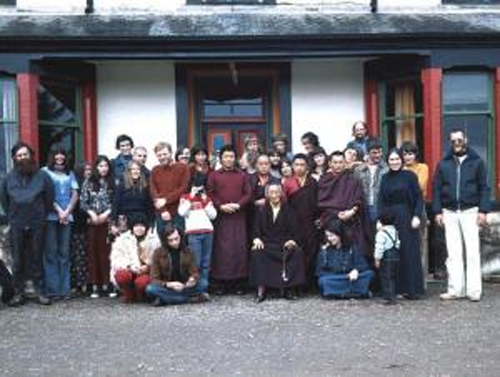
In 1967, the two Rinpoches named their centre after Samye, the first successful Buddhist establishment in Tibet. They were soon joined by master-artist Sherapalden Beru and the monk Samten. By 1970, Trungpa Rinpoche had departed for the USA and His Holiness the 16th Karmapa firmly encouraged Akong Rinpoche to take a leadership role in developing Samye Ling. The early 70s saw a progressive strengthening of Buddhist practice with visiting courses being given by Thai, Burmese, Japanese and just a few Tibetan teachers.

Image

The second visit of Khyabje Kalu Rinpoche, in 1974, was an important milestone. Accompanied by five lamas fresh out of retreat, he gave the first formal Vajrayana empowerments in the West and the distinctive Tibetan sounds of jaling and ra-dong first rang across the green valley. He inspired many people to begin traditional Kagyu practices

Image

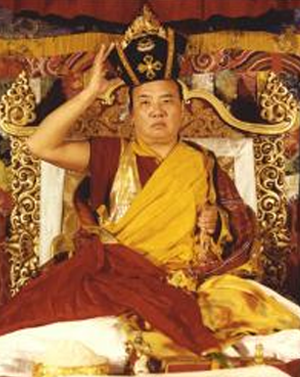
The next milestone came soon afterwards with the two visits by His Holiness the 16th Karmapa. On the second visit he was accompanied by Jamgon Kongtrul Rinpoche and a party of a dozen tulkus, lamas and monks. His Holiness performed the Vajra Crown ceremony and gave empowerments and teachings. Most significantly, he assured Akong Rinpoche about the longer-term future of Buddhism in the West and at Samye Ling. This became the basis for developing the Samye Project to cater for the future demand he foresaw. This seemed very ambitious at the time, but not so with hindsight. The Karmapa's visit also saw the establishment of our first international branches, in Belgium, Spain and Ireland. What seemed to be his playful joke in 1977 - as he ruffled Akong Rinpoche's frizzy hair and called him 'Africa Lama' - turned out also to be full of foresight as Rinpoche several years later became the Karma Kagyu representative for Africa as Kagyu dharma developed there.

During the late 70s and early 80s, Samye Ling benefited greatly from being the major Kagyu centre in Europe and one of very few Tibetan centres in the West. Some of the most eminent masters from the Kagyu tradition came to stay for periods of several months, giving them the time to teach in detail major Buddhist texts and practices to an international audience. We were particularly indebted to the regular visits of the Chamgon Khentin Tai Situpa, Khenchen Thrangu Rinpoche and Khenpo Tsultrim Gyamtso Rinpoche , and also to the Goshir Gyaltsabpa for his long stay in 1983. Nowadays such eminent teachers have so many centres worldwide that their visits are counted in days, not months. We were also deeply honoured by the visits of HH the Dalai Lama, HH Sakya Trizin, HH Dilgo Khyentse Rinpoche and Khamtrul Rinpoche.

The overriding theme of the early 1980s was the construction of the temple, with all the work being done by members of the community, which grew considerably in size and talents for the purpose. Under the direction of Sherapalden, our resident artists and craftspeople produced all the images, carvings, paintings and decorations that are now so admired in the new temple. At the same time, the first long-term retreat started, Rokpa's humanitarian work grew and the Tara Therapy started to evolve.

Image

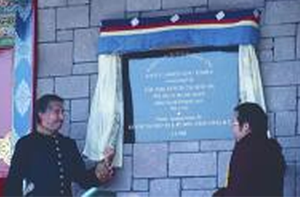
1988 was a key moment. The Samye Temple was inaugurated and the first four-year retreat was successfully completed. Lama Yeshe Losal Rinpoche, who had come here on a brief visit from his long solitary retreat in America, stayed on at Akong Rinpoche's request, first in continued solitary retreat, and then as resident master for the second long retreat that began in 1989.

Since Akong Rinpoche spent more and more time on humanitarian work in Tibet throughout the late 1990s, Lama Yeshe Rinpoche kindly took an increasing responsibility for running the Centre and enthusiastically built up the monastic sangha, developing Samye Ling as a unique experiment combining monastery, nunnery and lay community. Lama Rinpoche became Abbot of what was now known as Samye Ling Monastery and on the occasion of his 60th birthday received the title 'Rinpoche' for his vast dharma attainment and activity.

Image

Throughout the 1980s and 90s, Vajradhara Chamgon Tai Situpa was extraordinarily kind and generous in visiting Samye Ling. In response to Akong Tulku Rinpoche's earnest request, from 1989 through to 1997, Situ Rinpoche gave the Mahamudra transmission emanating from the Saraha tradition of mahamudra, and taught in detail from The Ocean of Certainty text by the 9th Gyalwang Karmapa. Thus the greatest masters have transmitted the very essence of the Kagyu teachings here, and Samye Ling continues to be a place where the ancient wisdom of the Buddha's teaching is both preserved and made available to a new world.

In 2007 we celebrated our '40th' in the spirit of never forgetting the essential points behind the spiritual, humanitarian and therapeutic activities that have grown out of Samye Ling. These are: to accomplish whatever we do in a spirit of loving care for all beings that stems from the boundless heart of compassion; to help all beings discover that it is in serving others that they best serve themselves, find happiness and fulfil their own life potential; to promote a message of peaceful co-existence and taking full responsibility for our precious human lives; and to preserve and share the precious jewels of the wisdom and meditation teachings which had been so well preserved in Tibet.

Between 2008 and 2012 all energy and resources went into building the final two wings of the Samye Project. On completion, the new buildings became home to the Reception and Administration offices amongst other things, changing the administrative focus of Samye Ling from Johnstone House to the Temple complex. In addition, they housed a state of the art 300-seater lecture hall for conferences and big events.

Then on 8th October 2013, our Founder Akong Tulku Rinpoche died in tragic circumstances in Chengdu, China. Although this stunned his many followers, with the guidance and inspiration of Akong Rinpoche's brother and Regent, Choje Lama Yeshe Losal Rinpoche, Samye Ling continues to develop and flourish.

Kagyu Samye Ling is currently under the spiritual direction of His Holiness the 17th Gyalwa Karmapa, Orgyen Drodul Trinley Dorje, and the Vajradhara Chamgon Khentin Tai Situpa. We are deeply grateful for their continued and inestimable support. The next major milestone will certainly be the visit of the Gyalwa Karmapa and we look forward to it with great joy and eagerness.

This short overview is to help us recollect with gratitude all that has contributed to our fifty years of growth, to appreciate the kindness of the Buddha in giving his profound teachings, and of the Tibetan masters who have skilfully presented them here.
admin
Site Admin
 
Posts: 39440
Joined: Thu Aug 01, 2013 5:21 am

Re: Freda Bedi, by Wikipedia

Postby admin » Thu Oct 31, 2019 2:39 am

Admiralty Signals and Radar Establishment
by Wikipedia
Accessed: 10/30/19

NOTICE: THIS WORK MAY BE PROTECTED BY COPYRIGHT

YOU ARE REQUIRED TO READ THE COPYRIGHT NOTICE AT THIS LINK BEFORE YOU READ THE FOLLOWING WORK, THAT IS AVAILABLE SOLELY FOR PRIVATE STUDY, SCHOLARSHIP OR RESEARCH PURSUANT TO 17 U.S.C. SECTION 107 AND 108. IN THE EVENT THAT THE LIBRARY DETERMINES THAT UNLAWFUL COPYING OF THIS WORK HAS OCCURRED, THE LIBRARY HAS THE RIGHT TO BLOCK THE I.P. ADDRESS AT WHICH THE UNLAWFUL COPYING APPEARED TO HAVE OCCURRED. THANK YOU FOR RESPECTING THE RIGHTS OF COPYRIGHT OWNERS.


Admiralty Signal and Radar Establishment
United Kingdom
Department overview
Formed 1917
Preceding Department
Experimental Department, HM Signal School, Portsmouth
Dissolved 1959
Superseding agency
Admiralty Surface Weapons Establishment
Jurisdiction Government of the United Kingdom
Headquarters Haslemere, England
Parent Department Admiralty

The Admiralty Signal and Radar Establishment (ASRE) originally known as the Experimental Department[1] and later known as the Admiralty Signal Establishment (ASE) and Admiralty Surface Weapons Establishment (ASWE) was a research organisation of the British Royal Navy established in 1917 it existed until 1959 when it was merged with the Admiralty Gunnery Establishment to form the Admiralty Surface Weapons Establishment its headquarters were located in Haslemere, Surrey, England.

History

The Admiralty Signal and Radar Establishment began as the Admiralty Experimental Department that was set up in 1917 at HM Signal School, Portsmouth [2], to coordinate research work undertaken since 1896 on the Torpedo School ships HMS Defiance and HMS Vernon. Concern had already arisen in 1940 as regards the vulnerability of the Signal School to Luftwaffe bombing, but a raid in the autumn of 1940 brought matters to a head, and the move was initiated. In April 1941 the Experimental Department was renamed the Admiralty Signal Establishment (ASE)[3] which, like its predecessors, was primarily focused on communications. Premises were found in Lythe Hill House, Haslemere, and in August 1941, the ASE became a separate establishment. Basil Willett was the Captain Superintendent.[4] In July 1943 a delegation came from the USA to discuss radar and communications.[5] The discussions included Henry Tizard, Cecil Horton, Cedric Holland and George Thomson. However, technological advances during the Second World War necessitated an increase in related fields of research, and in 1948 these were brought under one body, the Admiralty Signal and Radar Establishment at Portsmouth. In 1959 it was merged with the Admiralty Gunnery Establishment (AGE) to form the Admiralty Surface Weapons Establishment (ASWE).

Timeline

• Admiralty Experimental Department, (1917-1941)
• Admiralty Signal Establishment, (1941-1948)
• Admiralty Signal and Radar Establishment, Portsmouth (1948-1959)
• Admiralty Surface Weapons Establishment (ASWE), Portsdown, Portsmouth (1959-1984)

References

1. "MoD History of Innovation" (PDF). http://www.ploughshareinnovations.com/. Ploughshare Innovations. Retrieved 29 August 2017.
2. Archives, The National. "Admiralty Surface Weapons Establishment and predecessors: Records". discovery.nationalarchives.gov.uk. National Archives, U.K, 1918-1983, ADM 220. Retrieved 24 December 2017.
3. Archives, The National. "Admiralty Surface Weapons Establishment and predecessors: Records". discovery.nationalarchives.gov.uk. National Archives, U.K, 1918-1983, ADM 220. Retrieved 24 December 2017.
4. Paterson, Clifford (1991). A scientist's war : the war diary of Sir Clifford Paterson, 1939-45, 1st September 1939-9th May 1945. Stevenage, Herts.: Peregrinus. ISBN 9780863412189.
5. Kent, Barrie H. (2004). Signal!: A History of Signalling in the Royal Navy. Hyden House Limited. ISBN 9781856230254. Retrieved 29 August 2017.
admin
Site Admin
 
Posts: 39440
Joined: Thu Aug 01, 2013 5:21 am

Re: Freda Bedi, by Wikipedia

Postby admin » Thu Oct 31, 2019 2:49 am

Signal Intelligence Service
by Wikipedia
Accessed: 10/30/19

NOTICE: THIS WORK MAY BE PROTECTED BY COPYRIGHT

YOU ARE REQUIRED TO READ THE COPYRIGHT NOTICE AT THIS LINK BEFORE YOU READ THE FOLLOWING WORK, THAT IS AVAILABLE SOLELY FOR PRIVATE STUDY, SCHOLARSHIP OR RESEARCH PURSUANT TO 17 U.S.C. SECTION 107 AND 108. IN THE EVENT THAT THE LIBRARY DETERMINES THAT UNLAWFUL COPYING OF THIS WORK HAS OCCURRED, THE LIBRARY HAS THE RIGHT TO BLOCK THE I.P. ADDRESS AT WHICH THE UNLAWFUL COPYING APPEARED TO HAVE OCCURRED. THANK YOU FOR RESPECTING THE RIGHTS OF COPYRIGHT OWNERS.


The Signal Intelligence Service (SIS) was the United States Army codebreaking division through World War II. It was founded in 1930 to compile codes for the Army. It was renamed the Signal Security Agency in 1943, and in September 1945, became the Army Security Agency.[1] For most of the war it was headquartered at Arlington Hall (former campus of Arlington Hall Junior College for Women), on Arlington Boulevard in Arlington, Virginia, across the Potomac River from Washington (D.C.). During World War II, it became known as the Army Security Agency, and its resources were reassigned to the newly established National Security Agency (NSA).

History

The Signal Intelligence Service was a part of the U.S. Army Signal Corps for most of World War II. At that time the Signal Corps was a bureau in the Headquarters, Department of the Army, in addition to being a branch of the Army to which personnel were commissioned or appointed. The Signal Corps supplied the Army with communications and photography equipment and services among other things. The Signal Corps also trained personnel and signal units for service with forces in the field. The evolution and activities of the Signal Intelligence Service before and during World War II is discussed in detail in Chapter XI, "Signal, Security, Intelligence," (pages 327-350) in The Signal Corps: the Outcome, an official history of the Signal Corps.[2]

Chapters 2 and 3 (Pages 4-25) in Army Field Manual FM 11-35, 1942, describe the organization of the Signal Intelligence Service in the War Department and in the forces in the field and the functions performed by SIS units.[3] That manual was marked "RESTRICTED" when it was issued.

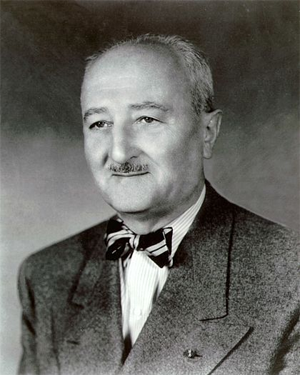
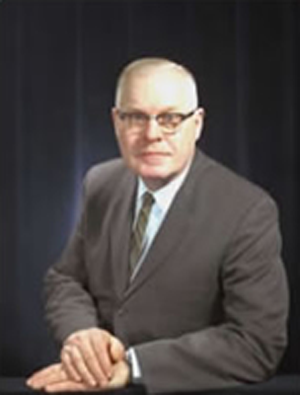
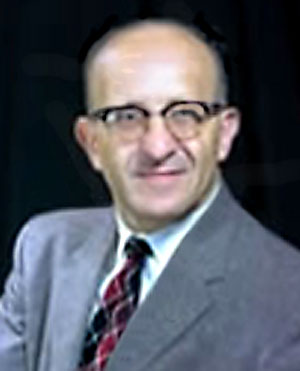
William Friedman began the division with three "junior cryptanalysts" in April 1930. Their names were Frank Rowlett, Abraham Sinkov, and Solomon Kullback. Before this, all three had been mathematics teachers and none had a cryptanalysis background. Friedman was a geneticist who developed his expertise in cryptology at George Fabyan's Riverbank Laboratories Cipher Department during 1915 to 1917, prior to World War I.[4] Besides breaking foreign codes,[5] they were responsible for just about anything to do with the U.S. Department of War's code systems. The SIS initially worked on an extremely limited budget, lacking the equipment it needed so that the analysts could intercept messages to practice decrypting.

Image
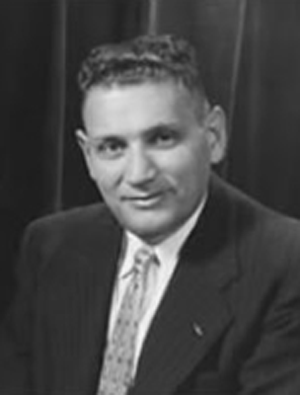
William Friedman (head of the SIS)

Image
Frank Rowlett (junior cryptanalyst)

Image
Abraham Sinkov (junior cryptanalyst)

Image
Solomon Kullback (junior cryptanalyst)

The organization grew rapidly and organized efforts were made to recruit bright women. By the end of the war, most of the SIS staff, some 7000 out of a total 10,500, were female. Ann Z. Caracristi, who would later become Deputy Director of the National Security Agency, started her career there and was a prolific breaker of Japanese army codes. The unit she worked in, largely staffed and led by women, produced a flow of intercepts from the "2468" shipping code system that resulted in the sinking of two-thirds of the Japanese merchant marine.[6]

Image
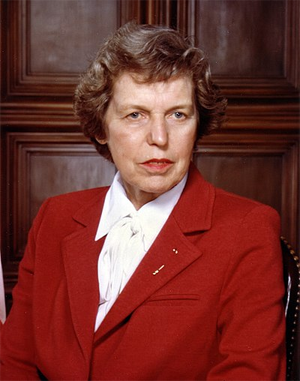
Ann Z. Caracristi (cryptanalyst)

Midway through World War II, in 1943, the Army Signal Intelligence Service (later the Army Security Agency) began intercepting Soviet (Russian) intelligence traffic sent mainly from New York City; they assigned the code name "Venona" to the project. Although the United States had become allies with the Soviet Union in 1941, many officials were suspicious of the communist government and society. By 1945, some 200,000 messages had been transcribed, a measure of Soviet activity.

On 20 December 1946, after the war and at a time of increasing US tensions with the Soviet Union, Meredith Gardner made the first break into the Venona code. Decrypted messages revealed the existence of Soviet espionage at the Los Alamos National Laboratory work on the top-secret Manhattan Project, where the atomic bomb had been developed and research continued. The Venona project was so highly classified, however, that the government never introduced evidence from these messages into court proceedings in prosecution of alleged espionage agents.

Intercept network

Image
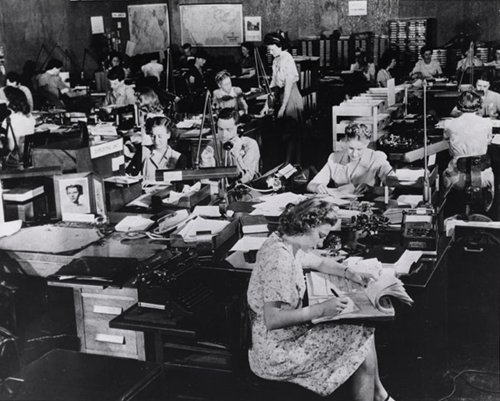
U.S. Army Signals Intelligence Service personnel at Arlington Hall (c. 1943)

The Army intercept network during WWII had six fixed stations, which concentrated on Japanese military signals and Axis diplomatic traffic.[7]

• Vint Hill Farms Station, Warrenton, Virginia
• Two Rock Ranch, Petaluma, California
• Fort Shafter, Territory of Hawaii
• Fairbanks, Alaska
• New Delhi, India
• Asmara, Eritrea

See also

• Signals intelligence
• National Defence Radio Establishment

References

1. Signal Intelligence Service, NSA Center for Cryptologic History, accessed April 4, 2019
2. Thompson, George R. and Harris, Dixie R., The Signal Corps: The Outcome. Washington: Center of Military History, 1966
3. FM 11-35, Signal Corps Intelligence, 2 September 1942
4. "Cryptologic Almanac - NSA/CSS". Nsa.gov. 15 January 2009. Retrieved 15 February 2014.
5. Bernard A. Weisberger "Eavesdropping on the Rising Sun," American Heritage, Fall 2009.
6. Mundy, Liza (2017). Code Girls: The Untold Story of the American Women Code Breakers of World War II. New York, Boston: Hachette Books. ISBN 978-0-316-35253-6.
7. Budiansky 2000, p. 357.

External links

• Pearl Harbor Review. Signal Intelligence Service, National Security Agency/Central Security Service. Nsa.gov.
• Bernard A. Weisberger "Eavesdropping on the Rising Sun", American Heritage magazine.
• Budiansky, Stephen, Battle of Wits: The Complete Story of Codebreaking in World War II, Free Press, 2000. стр.357 ISBN 978-0-684-85932-3.
• William F. Friedman, "A Brief History of the Signal Intelligence Service," 29 June 1942, SRH 029, CCH Files.
• Anon. "Centralized Control of U.S. Army Signal Intelligence Activities," SRH-276, CCH Files.
• Anon., "Memorandum" re O.C.S.O Conference, 19 July 1929.
• Anon., "The Second Signal Service Battalion," SRH-135, CCH Files.
• U.S. Army Signals intelligence in World War II. A documentary history. Edited by James L. Gilbert and John P. Finnegan, Center of Military History, United States Army. Washington, D. C., 1993. 265 pp. ISBN 0-16-037816-8.
• Robert J. Hanyok. Eavesdropping on Hell: Historical Guide to Western Communications Intelligence and the Holocaust, 1939-1945, Series IV, Volume 9. Center cryptologie history. National Security Agence. 2004. 174 pp. ce. 2004. 174 pp.
admin
Site Admin
 
Posts: 39440
Joined: Thu Aug 01, 2013 5:21 am

Re: Freda Bedi, by Wikipedia

Postby admin » Thu Oct 31, 2019 3:36 am

Ramakrishna Mission
by Wikipedia
Accessed: 10/30/19

NOTICE: THIS WORK MAY BE PROTECTED BY COPYRIGHT

YOU ARE REQUIRED TO READ THE COPYRIGHT NOTICE AT THIS LINK BEFORE YOU READ THE FOLLOWING WORK, THAT IS AVAILABLE SOLELY FOR PRIVATE STUDY, SCHOLARSHIP OR RESEARCH PURSUANT TO 17 U.S.C. SECTION 107 AND 108. IN THE EVENT THAT THE LIBRARY DETERMINES THAT UNLAWFUL COPYING OF THIS WORK HAS OCCURRED, THE LIBRARY HAS THE RIGHT TO BLOCK THE I.P. ADDRESS AT WHICH THE UNLAWFUL COPYING APPEARED TO HAVE OCCURRED. THANK YOU FOR RESPECTING THE RIGHTS OF COPYRIGHT OWNERS.


Image
Ramakrishna Mission
Emblem
Abbreviation RKM
Motto Atmano mokshartham jagat hitaya cha
("আত্মান মোঃক্ষারথাম জগৎ হিতায়া চ")
(आत्मनो मोक्षार्थं जगद्धिताय च)
(For one’s own salvation and for the welfare of the world)
Formation 1 May 1897; 122 years ago Calcutta, British India
Founder Swami Vivekananda
Type Religious organisation
Legal status Foundation
Purpose Educational, Philanthropic, Religious Studies, Spirituality
Headquarters Belur Math, West Bengal, India
Location
205 Branch Centres
Coordinates 22.37°N 88.21°ECoordinates: 22.37°N 88.21°E
Area served
Worldwide
President
Swami Smaranananda
Affiliations Neo-Vedanta
Website belurmath.org

Ramakrishna Mission (RKM, Bengali : রামকৃষ্ণ মিশন) is a Hindu religious and spiritual organisation which forms the core of a worldwide spiritual movement known as the Ramakrishna Movement or the Vedanta Movement.[1][2] The mission is named after and inspired by the Indian saint Ramakrishna Paramahamsa[1] and founded by Ramakrishna's chief disciple Swami Vivekananda on 1 May 1897.[1] The organisation mainly propagates the Hindu philosophy of Vedanta–Advaita Vedanta and four yogic ideals–jnana, bhakti, karma, and Raja Yoga.[3][1]

Apart from religious and spiritual teaching the organisation carries out extensive educational and philanthropic work in India. This aspect came to be a feature of many other Hindu movements.[4] The mission bases its work on the principles of karma yoga, the principle of selfless work done with dedication to God.[1] The Ramakrishna Mission has centres around the world and publishes many important Hindu texts.[5] It is affiliated with the monastic organisation Ramakrishna Math, with whom it shares members.[1]

Overview
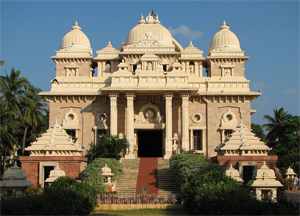
Image
Universal Temple at Sri Ramakrishna Math Chennai

The Math and the Mission are the two key organisations that direct the work of the socio-religious Ramakrishna movement influenced by 19th-century (1800-1900) saint Ramakrishna Paramahamsa and founded by his chief disciple Vivekananda.[6] Also referred to as the Ramakrishna Order, the Math is the movement's monastic organisation. Founded by Ramakrishna in 1886, the Math primarily focuses on spiritual training and the propagation of the movement's teachings.[6]

The Mission, founded by Vivekananda in 1897,[7] is a humanitarian organisation which carries out medical, relief and educational programs. Both the organisations have headquarters at the Belur Math. The Mission acquired a legal status when it was registered in 1909 under Act XXI of 1860. Its management is vested in a Governing Body. Though the Mission with its branches is a distinct legal entity, it is closely related to the Math. The elected trustees of the Math also serve as Mission's Governing Body.[6] Vedanta Societies comprise the American arm of the Movement and work more in purely spiritual field rather than social welfare.[6]

History
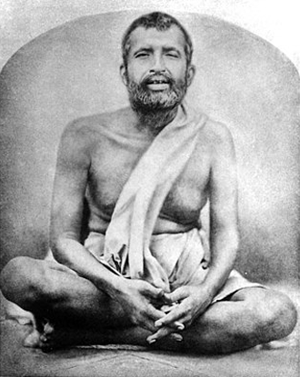
Image
Ramakrishna Paramahamsa

Image
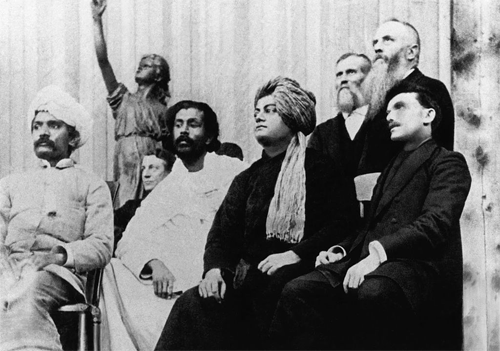
Swami Vivekananda at the Parliament of Religions

Ramakrishna Paramahamsa (1836–1886), regarded as a 19th-century saint, was the inspirator of the Ramakrishna Order of monks[8] and is regarded as the spiritual founder of the Ramakrishna Movement.[9][10] Ramakrishna was a priest in the Dakshineswar Kali Temple and attracted several monastic and householder disciples. Narendranath Dutta, who later became Vivekananda was one of the chief monastic disciples. According to Vrajaprana, shortly before his death in 1886 Ramakrishna gave the ochre cloths to his young disciples, who were planning to become renunciates. Ramakrishna entrusted the care of these young boys to Vivekananda. After Ramakrishna's death, the young disciples of Ramakrishna gathered and practised spiritual disciplines. They took informal monastic vows on a night of December 24th, 1886.[8]

After the death of Ramakrishna in 1886, the monastic disciples formed the first Math (monastery) at Baranagore. Later Vivekananda became a wandering monk and in 1893 he was a delegate at the 1893 Parliament of the World's Religions. His speech there, beginning with "Sisters and brothers of America" became famous and brought him widespread recognition. Vivekananda went on lecture tours and held private discourses on Hinduism and spirituality. He also founded the first Vedanta Society in United States at New York. He returned to India in 1897 and founded the Ramakrishna Mission on 1 May 1897.[8] Though he was a Hindu sadhu and was hailed as the first Hindu missionary in modern times, he exhorted his followers to be true to their faith but respect all religions of the world as his guru Ramakrishna had taught that all religions are pathways to God. One such example is his exhortion that one can be born in a church but he or she should not die in a church meaning that one should realise the spiritual truths for themselves and not stop at blindly believing in doctrines taught to them. The same year, famine relief was started at Sargachi by Swami Akhandananda, a direct disciple of Ramakrishna. Swami Brahmananda, a direct disciple of Ramakrishna was appointed as the first president of the Order. After the death of Vivekananda in 1902, Sarada Devi, the spiritual counterpart of Ramakrishna, played an important role as the advisory head of a nascent monastic organisation. Gayatri Spivak writes that Sarada Devi "performed her role with tact and wisdom, always remaining in the background."[11]

Administration

The Ramakrishna Math is administered by a democratically elected Board of Trustees. From amongst themselves, the Trustees elect President, Vice-Presidents, general secretary, Assistant Secretaries and Treasurer. For the confirmation of the election of the President, Vice-Presidents and the general secretary, the opinion of monks of twenty years standing is sought and taken.

The Ramakrishna Mission is administered by a Governing Body, which is composed of the democratically elected Trustees of Ramakrishna Math. The headquarters of Ramakrishna Math at Belur (popularly known as Belur Math) serves also as the headquarters of Ramakrishna Mission. A branch centre of Ramakrishna Math is managed by a team of monks posted by the Trustees led by a head monk with the title Adhyaksha. A branch centre of Ramakrishna Mission is governed by a Managing Committee consisting of monks and lay persons appointed by the Governing Body of Ramakrishna Mission whose Secretary, almost always a monk, functions as the executive head.[12][12][13]

All the monks of the Ramakrishna Order form the democratic base of the administration. They form the counterpart to the Organisation of what is Parliament to the Nation. A representative meeting of all monks is held every three years, at Belur Math, during October–November. This meeting has come to be known as 'Monks' Conference'. The Conference is for the duration of three days. A few months prior to the conference all the monks are notified about the dates and are asked to suggest subjects for discussion and to send Resolutions to be taken up for discussion. The Agenda is finalised based on the suggestions received. On the first day of the Conference, The general secretary on behalf of all elected Trustees, places the report of all the activities that had taken place in the Organisation, during the years that had gone by since they met last. The accounts are then placed before the Conference by the monk in-charge of accounts. The Conference passes the accounts and discusses the Report of activities. The Minutes of the earlier Conference too is passed. The monks also condole the deaths that had occurred in their ranks in the years between successive Conferences. The proposals of monks are voted upon if necessary.

Thus The Monks' Conference plays a very important Constitutional role of placing its seal of approval on the decisions taken by the Trustees elected by them and giving policy guidance for further works of the Organisation.

The first such formal Conference was held in 1935. The latest and the 25th such Conference was held on the 1, 2 and 3 November 2018.

The scope of the Administration follows the detailed rules made by Swami Vivekananda when he was the General President of Ramakrishna Mission. These rules were formed when the monastic brothers in 1898 wished that there should be specific rules for the work of the Ramakrishna Mission (as the Ramakrishna Movement is commonly known). They were dictated by Swami Vivekananda to Swami Suddhananda, between 1898 and 1899, and has been accepted as the consensus of the opinion of all the monks of the Ramakrishna Mission then, consisting of all the disciples of Sri Ramakrishna and their disciples. Later for clear and formal legal confirmation of these rules, a Trust Deed was registered by Swami Vivekananda and many of the other disciples of Sri Ramakrishna, during 1899 – 1901.[14][12]

The motto and the principles

The aims and ideals of the Mission are purely spiritual and humanitarian and has no connection with politics.[15] Vivekananda proclaimed "Renunciation and service" as the twofold national ideals of modern India and the work of the mission strives to practice and preach these .[16] The service activities are based on the message of "Jiva is Shiva" from Ramakrishna and Vivekananda's message of "Daridra Narayana" to indicate that service to poor is service to God. The Principles of Upanishads and Yoga in Bhagavad Gita reinterpreted in the light of Ramakrishna's Life and Teachings is the main source of inspiration for the Mission.[17] The service activities are rendered looking upon all as veritable manifestation of the Divine. The Motto of the organisation is Atmano Mokshartham Jagad-hitaya Cha. Translated from Sanskrit आत्मनॊ मोक्षार्थम् जगद्धिताय च it means For one's own salvation, and for the good of the world.[18]

Monastic Order

After the death of Ramakrishna in 1886 his young disciples organised themselves into a new monastic order. The original monastery at Baranagar known as Baranagar Math was subsequently moved to the nearby Alambazar area in 1892, then to Nilambar Mukherjee's Garden House, south of the present Belur Math in 1898 before finally being shifted in January 1899 to a newly acquired plot of land at Belur in Howrah district by Vivekananda.[19] This monastery, known as the Belur Math, serves as the Mother House for all the monks of the Order who live in the various branch centres of the Math and/or the Mission in different parts of India and the world.

All members of the Order undergo training and ordination (Sannyasa) at Belur Math. A candidate for monastic life is treated as a pre-probationer during the first year of his stay at any centre, and as a probationer during the next four years. At the end of this period he is ordained into celibacy (Brahmacharya) and is given certain vows (Pratijna), the most important of which are chastity, renunciation and service. After a further period of four years, if found fit, he is ordained into (Sannyasa) and given the ochre (gerua) clothes to wear.

Attitude towards Politics

Swami Vivekananda forbade his organisation from taking part in any political movement or activity, on the basis of the idea that holy men are apolitical.[20]

However, presently, almost 95% of the monks possess voter ID cards. For the sake of identification and particularly for travelling, almost 95 per cent of the monks are forced to seek a voter ID card. But they use it only for identification purpose and not for voting. As individuals, the monks may have political opinions, but these are not meant to be discussed in public.[21]

The Mission, had, however, supported the movement of Indian independence, with a section of the monks keeping close relations with freedom fighters of various camps. A number of political revolutionaries later joined the Ramakrishna Order.[22]

Emblem

Designed and explained by Swami Vivekananda in his own words:[23]

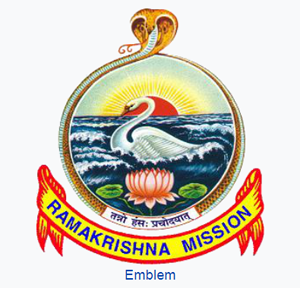
The wavy waters in the picture are symbolic of Karma; the lotus, of Bhakti; and the rising-sun, of Jnana. The encircling serpent is indicative of [Raja] Yoga and the awakened Kundalini Shakti, while the swan in the picture stands for Paramatman (Supreme Self). Therefore, the idea of the picture is that by the union of Karma, Jnana, Bhakti and Yoga, the vision of Paramatman is obtained.

Activities
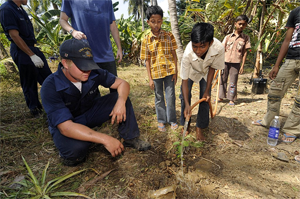
Image
A sailor assigned to the mine countermeasures ship USS Patriot who cleared ground to plant a garden of pomegranate, guava and lemon trees at the mission.
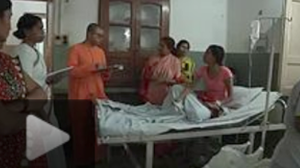
Image
Social service and health promotion at the Home of Service – Ramakrishna Mission, Varanasi, India

The principal workers of the mission are the monks. The mission's activities cover the following areas,[16]

• Education
• Health care
• Cultural activities
• Rural uplift
• Tribal welfare
• Youth movement etc.

The mission has its own hospitals, charitable dispensaries, maternity clinics, tuberculosis clinics, and mobile dispensaries. It also maintains training centres for nurses. Orphanages and homes for the elderly are included in the mission's field of activities, along with rural and tribal welfare work.[24]

The mission has established many renowned educational institutions in India, having its own university, colleges, vocational training centres, high schools and primary schools, teacher-training institutes, as well as schools for the visually handicapped.[24] It has also been involved in disaster relief operations during famine, epidemic, fire, flood, earthquake, cyclone and communal disturbances.[24]

The mission played an important role in the installation of photovoltaic (PV) lighting systems in the Sundarbans region of West Bengal. Due to the geographical features of the Sunderbans, it is very difficult to extend the grid network to supply power to its population. The PV lighting was used to provide electricity to the people who were traditionally depending on kerosene and diesel.[25]

Religious activities

The mission is a non-sectarian organisation[26][27] and ignores caste distinctions.[28]

Ramakrishna ashrama's religious activities include satsang and arati. Satsang includes communal prayers, songs, rituals, discourses, reading and meditation. Arati involves the ceremonial waving of lights before the images of a deity of holy person and is performed twice in a day.[29] Ramakrishna ashramas observes major Hindu festivals, including Maha Shivarathri, Rama Navami, Krishna Ashtami and Durga Puja. They also give special place to the birthdays of Ramakrishna, Sarada Devi, Swami Vivekananda and other monastic disciples of Ramakrishna.[29] 1 January is celebrated as Kalpataru Day.[30]

The math and the mission are known for their religious tolerance and respect for other religions. Among the earliest rules laid down by Swami Vivekananda for them was, "Due respect and reverence should be paid to all religions, all preachers, and to the deities worshiped in all religions."[31] Acceptance and toleration of all religions is the one of ideals of Ramakrishna Math and Mission. Along with the major Hindu festivals, Christmas Eve and Buddha's Birthday are also devoutly observed.[29][31][32] Cyril Veliath of Sophia University writes that the Ramakrishna Mission monks are a relatively orthodox set of monks who are "extremely well respected both in India and abroad", and that they "cannot be classified as just another sect or cult, such as the groups led by the gurus". Veliath writes that "of the Hindu groups I have worked with I have found the Ramakrishna Mission to be the most tolerant and amenable to dialogue, and I believe that we Christians couldn't do better, than to cooperate wholeheartedly in their efforts towards inter-religious harmony.[33][34]

Awards and honourable mentions

The Ramakrishna Mission has received numerous accolades throughout its lifetime:

• Bhagwan Mahavir Foundation Award (1996).[35]
• Dr. Ambedkar National Award (1996).[35]
• Dr. Bhawar Singh Porte Tribal Service Award (1997–98).[35]
• In 1998 the Mission was awarded the Indian government's prestigious Gandhi Peace Prize.[36][37][38]
• Shahid Vir Narayan Singh Award (2001).[35]
• Pt. Ravishankar Shukla Award (2002).[35]
• National Communal Harmony Award (2005).[39]
• The Ramakrishna Mission was selected for an honorary mention of the UNESCO Madanjeet Singh Prize for Promotion of Tolerance and Non violence 2002.[40]
• The Ramakrishna Mission Ashrama of Chhattisgarh's Narainpur was jointly selected for the 25th Indira Gandhi Award for National Integration for the year 2009 with musician A.R.Rehman for their services in promoting and preserving national integration.[41][42]

In a speech made in 1993, Federico Mayor, Director-General of UNESCO, stated:[43]

I am indeed struck by the similarity of the constitution of the Ramakrishna Mission which Vivekananda established as early as 1897 with that of UNESCO drawn up in 1945. Both place the human being at the center of their efforts aimed at development. Both place tolerance at the top of the agenda for building peace and democracy. Both recognize the variety of human cultures and societies as an essential aspect of the common heritage.


Branch Centres
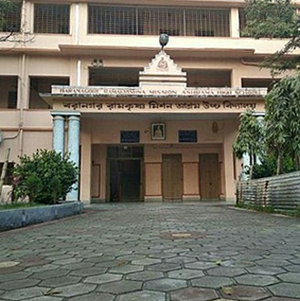
Image
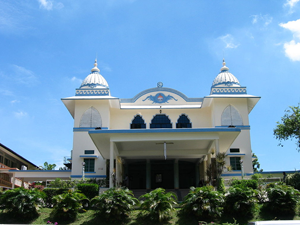
Baranagar Ramakrishna Mission, India

Image
Singapore Ramakrishna Mission, Singapore

As of 2018, the Math and Mission have 201 centres all over the world: 152 in India, 15 in Bangladesh, 14 in United States, 2 in Russia, and one each in Argentina, Australia, Brazil, Canada, Fiji, France, Germany, Ireland, Japan, Malaysia, Mauritius, Nepal, Netherlands, Singapore, South Africa, Sri Lanka, Switzerland, UK, and Zambia. Besides, there are few sub-centres attached to some of these centres.[44][45] The Math and Mission run 748 educational institutions (including 12 colleges, 22 higher secondary schools, 41 secondary schools, 135 schools of other grades, 4 polytechnics, 48 vocational training centres, 118 hostels, 7 orphanages, etc) with a total student population of more than 2,00,000. Besides these branch centres, there are about one thousand unaffiliated centres (popularly called ‘private centres’) all over the world started by the devotees and followers of Sri Ramakrishna and Swami Vivekananda.

The centres of the Ramakrishna Order outside India fall into two broad categories. In countries such as Bangladesh, Nepal, Sri Lanka, Fiji and Mauritius, the nature of service activities is very much similar to India. In other parts of the world, especially in Europe, Canada, United States, Japan, and Australia, the work is mostly confined to the preaching of Vedanta, the publication of books and journals and personal guidance in spiritual matters.[46] Many of the centres outside India are called as the 'Vedanta Society' or 'Vedanta Centre'.

The Universal Prayer Hall of Ramakrishna Math and Ramakrishna Mission, Agartala, was inaugurated on 7 February 2012 by the Vice-President of the Belur Math, Smaranananda ji Maharaj. This formed a part of the celebrations of the 150th birthday of Vivekananda. The project and celebration is the outcome of laborious efforts of Purnatmanandaji Maharaj, Secretary of the Agartala branch of the Belur Math.

Former presidents

The following is the list of presidents (spiritual heads) of the Monastic Order:

• Swami Vivekananda (1897 –1901) (Founder & General President)
From 1901 the term 'General President' was dropped and the term 'President' was adopted.
• Swami Brahmananda (1901–1922)
• Swami Shivananda (1922–1934)
• Swami Akhandananda (1934–1937)
• Swami Vijnanananda (1937–1938)
• Swami Shuddhananda (1938–1938)
• Swami Virajananda (1938–1951)
• Swami Shankarananda (1951–1962)
• Swami Vishuddhananda (1962–1962)
• Swami Madhavananda (1962–1965)
• Swami Vireshwarananda (1966–1985)
• Swami Gambhirananda (1985–1988)
• Swami Bhuteshananda (1989–1998)
• Swami Ranganathananda (1998–2005)
• Swami Gahanananda (2005–2007)
• Swami Atmasthananda (2007–2017)
• Swami Smaranananda (2017–present)

The Heritage

Direct Disciples of Ramakrishna Paramahamsa

Swami Vivekananda, Swami Brahmananda, Baburam Maharaj, Swami Yogananda, Niranjanananda, Swami Saradananda, Swami Shivananda, Swami Ramakrishnananda, Swami Turiyananda, Swami Abhedananda, Swami Adbhutananda, Swami Advaitananda, Swami Nirmalananda, Swami Akhandananda, Swami Trigunatitananda, Swami Subodhananda, Swami Vijnanananda, Sri Sarada Devi, Golap Ma, Gopaler Ma, Gauri Ma

Disciples of Swami Vivekananda

Swami Ashokananda, Swami Virajananda, Swami Paramananda, Swami Abhayananda, Alasinga Perumal, Sister Nivedita, Swami Sadananda, Swami Kalyanananda, Swami Swarupananda, Swami Vimalananda, Swami Prakashananda, Swami Nischayananda, Swami Achalananda, Swami Shubhananda, Swami Shuddhananda and others

Disciples of Sri Sarada Devi

Yogin Ma, Swami Nikhilananda and others

Disciples of Swami Brahmananda

Swami Prabhavananda, Swami Siddheshwarananda, Swami Shankarananda, Swami Vishuddhananda, Swami Madhavananda, Swami Vireshwarananda, Swami Yatiswarananda, Swami Shambhavananda, Swami Siddheshwarananda and others

Controversy

In 1980, in an act that caused "considerable debate" within the order, the mission petitioned the courts to have their organisation and movement declared a non-Hindu minority religion for the purpose of Article 30 of the Indian constitution.[47][48] Many generations of monks and others have been of the view that the religion propounded and practised by Ramakrishna and his disciples is very much different from that practised by Hindu masses then. They held that the Ramakrishna's "Neo-Vedanta" is a truer version of the ideals of Vedanta. So it was honestly felt that this makes the followers of Ramakrishna eligible for the legal status of "minority". It is possible that the immediate cause for the appeal for minority status was because there was a danger that the local Marxist government would take control of its educational institutions unless it could invoke the extra protection the Indian constitution accords to minority religions. They argued that the Ramakrishna's "Neo-Vedanta" is a truer version of the ideals of Vedanta, and that this makes the followers of Ramakrishna eligible for the legal status of "minority".[48][49] This episode highlights the legal and constitutional discriminations due to Article 30 of the Constitution. The constitutional bedrock of these discriminations is Article 30, which accords to the minorities the right to set up and administer their own schools and colleges, preserving their communal identity (through the course contents and by selectively recruiting teachers and students), all while receiving state subsidies. This same right is not guaranteed to Hindus.[50][48] While the Calcutta High Court accepted Ramakrishna Mission's pleas, the Supreme Court of India ruled against the Mission in 1995, citing evidence that it had all the characteristics of a Hindu organization.[51] The Mission found it advisable to let the matter rest. Today it remains as a Hindu organisation.[52][53] The wisdom of the attempt by the Mission's leadership to characterize the Mission as non-Hindu was widely questioned within the membership of the organization itself, and the leadership today embraces the Mission's status as both a Hindu organization and as an organization that emphasizes the harmony of all faiths.[54] Most members – and even monks – of the Ramakrishna Mission consider themselves Hindus, and the Mission's founding figures, such as Swami Vivekananda never disavowed Hinduism.[55]

Vedanta Study Classes Worldwide

AUSTRALIA

Sydney -

Sunday’s 0930am - 1030am & Monday’s 0730pm - 0830 pm Vedanta Centre of Sydney, 144A, Marsden Road, Ermington, NSW 2115. Phone - 61 2 8197 7351

Melbourne

Sunday’s 1100am - 1230pm Melbourne Chapter, Vedanta Centre of Sydney, 5-7 Angus Ave., Ringwood Street, VIC 3135 Phone - 61 426 864 750, 61 413 040

Brisbane

Sunday’s 1000am - 1100am Brisbane Chapter, Vedanta Centre of Sydney, 12 Greenwood St., Springfield Lakes. Phone - (07) 3818 9986

CANADA

Toronto -

Sunday’s 1100am - 0100pm Vedanta Society of Toronto, 120 Emmett Avenues, Toronto, ON M6M 2E6. Phone - 416-240-7262

JAPAN

Tokyo -

Every First Saturday of every month 1000am - 1200pm Embassy of India, Vivekananda Cultural Centre, 2-2-11 Kudan-Minami, Chiyoda-Ku, Tokyo 102-0074. Phone - 81 3 3262 2391-97 Conducted by Vedanta Society of Japan, Phone - 046 873 0428

MALAYASIA

Petaling Jaya

Sundays 1000am - 1200pm Ramakrishna Mission, No 36, JLN 10/7, SEK 10, 46000 Petaling Jaya, Selangor. Phone - 603 79600385

MAURITIUS

Vacoas

Thursday’s 0515pm - 0630pm & Sunday’s 0515pm - 0630pm Ramkrishna Mission, Ramkrishna Temple, Ramkrishna Mission Road, Vacoas. Phone - 696 4313

SINGAPORE

Singapore

Sunday’s 0600pm Ramkrishna Mission, Sarda Hall, 179, Bartley Road, Singapore 539784. Phone - (65) 6288 9077

SOUTH AFRICA

Durban

Saturday’s 0400pm - 0530pm Ramakrishna Centre of South Africa, Sri Ramakrishna Temple, 8, Montreal Road, Glen Anil, Durban 4051. Phone - 031 5692974

UNITED KINGDOM

Bourne End, Buckinghamshire

Sunday’s 0430pm Ramakrishna Vedanta Centre, Blind Lane, Bourne End, Buckinghamshire Sl8 5LF. Phone - (01628) 526 464

UNITED STATES OF AMERICA

Boston

Sunday’s 1100am - 1200pm Ramakrishna Vedanta Society, 58, Deerfield Street, Boston, MA02215. Phone - (617) 536-5320

Chicago

Friday’s 0730pm Vivekananda Vedanta Society of Chicago, 14630, Lemont Road, Homer Glen, IL 60491 Phone - 708.301.9062

Hollywood

Vedanta Society of Southern California, Vedanta Temple, 1946, Vedanta Place, Hollywood, CA 90068. Phone - (323) 465-7114

New York City

Sunday’s 1100am, Wednesday’s 0400pm, Friday’s 0730pm Vedanta Society of New York, 34 West 71st Street, New York, NY 10023. Phone - (212) 877 9197

Sunday’s 1100 am, Friday’s 0800pm Ramkrishna Vivekananda Centre of New York, 17 East 94th Street, New York 10128. Phone - (212) 534 9445

Portland, Oregon

Sunday’s 1100am - 0100pm, Thursday’s 0730pm - 0830pm, Saturday’s 0730pm - 0830 pm Vedanta Society of Portland, 1157 SE 55th Avenue, Portland, Oregon 97215. Phone - (971) 302 6918, 331 1449

Providence, Rhode Island

Friday’s 0730pm - 0830pm, Sunday’s 0500pm - 0600pm Vedanta Society of Providence, 227, Angell Street, Providence, RI 02906 Phone - 401-421-3960

Sacramento, California

Sunday’s 1100am, Wednesday’s 0730pm Vedanta Society of Sacramento, 1337, Mission Avenue, Carmichael, CA 95608 Phone - (916) 489-5137

San Diego

Sunday’s 1100am - 1200pm, Tuesday’s 0615pm - 0800pm Vedanta Society of Southern California, San Diego Vedanta Monastery, 1440 Upas Street, San Diego CA 92103 Phone - (619) 291-9377

San Francisco

Sunday’s 1100am Vedanta Society of Northern California, 2323, Vallejo Street, San Francisco, CA 94213 Phone - 415-922-2323

Santa Barbara

Sunday’s 1100am - 1200pm Vedanta Society of Southern California, Vedanta Temple, 927, Ladera Lane, Santa Barbara, CA 93108. Phone - (805) 969-2903

Seattle

Sunday’s 1100am, Tuesday’s 0730pm The Vedanta Society of Western Washington, 2716 Broadway East Seattle, WA 98102 - 3909. Phone - 206.323.1228

St.Petersburg, Florida

Wednesday’s 0700pm - 0800pm The Vedanta Centre of St.Petersburg, Mothers House, 176, 19th Avenue SE St.Petersburg Phone - (727) 896-9840

Sunday’s 1100am The Vedanta Centre of St.Petersburg, 216 19th Avenue South East, St.Petersburg FL 33705 Phone - (727) 896-9840

Washington D.C.

Sunday’s 1100am, Wednesday’s 0800 pm Vedanta Center of Greater Washington D.C., 3001 Bel Pre Road, Siver Spring, MD 20906 Phone - 301-603-1772

Vedanta Study Classes in India
Ahmedabad

Saturday’s & Sunday’s 0730pm, Ramkrishna Mission, A/202/203, Kalyan Tower, Opp. Alpha One Mall, Vastrapur, Ahmedabad - 380015. Phone - 079-26303409

Aurangabad

Sunday’s 0800am - 0930am, Ramakrishna Mission Ashrama, Ramkrishna Ashrama Marg, Beed Bypass, Aurangabad. Phone - 0240-237 6013/7099

Belagavi

Sunday Evenings, Ramkrishna Mission Ashrama, Fort, Belagavi - 590016. Phone - 0831-243 2789/0789

Bengaluru

Sunday’s Ramkrishna Math, Bull Temple Road, Bengaluru - 560 019. Phone - 080-2661 3149/ 2667 1010

Chennai

Sunday’s 0530pm - 0630pm, Ramkrishananda Hall, Sri Ramakrishna Math, 31, Ramakrishna Math Road, Chennai - 600004. Phone - 044-2462 1110

Hyderabad

Saturday’s 0545pm - 0640pm, Temple Basement Hall, Ramkrishna Math, Lower Tank Bund, Domalguda, Hyderabad. Phone - 040-2763 3936

Indore

Sunday’s, Ramkrishna Mission, Kila Maidan, Ramkrishna Ashrama Mary, Indore - 452006. Phone - 0731-241 1612

Jamshedpur

Daily Evenings, Ramkrishna Mission Vivekananda Society, L-Road, Bistupur, Jamshedpur - 831 001. Phone - 0657-232 0700/0795/0131

Joyrambati

Daily, Sri Sri Matri Mandir & Ramkrishna Mission Sarada Sevaashrama, P.O.Joyrambati, District Bankura, West Bengal. Phone - 03244-244 214/910/911

Kanpur

Wednesday & Sunday Evenings, Ramkrishna Mission Ashrama, Ramakrishna Nagar, Kanpur - 208012. Phone - 0512-254 0673

Kolkata

Daily Evenings, Ramkrishna Math Gadadhar Ashrama, 86 A Harish Chatterjee Street, Kolkata 700025. Phone - 033-2455 4660

Lucknow

Sunday Mornings, Ramakrishna Math, Nirala Nagar, Lucknow. Phone - 0522-278 7143/91

Malda

Sunday Evenings, Ramakrishna Mission Ashrama, R.K.Mission Road, Near Vivekananda Vidyamandir, Malta. Phone - 03512-252479 / 84208 56443

Mumbai

Sunday’s & Thursday’s 0545pm - 0645pm, Ramakrishna Math & Ramkrishna Mission, Ramkrishna Mission Marg, 12th Road, Khar West, Mumbai - 400052. Phone - 022-6181 8000, 2646 4363, 2600 7176

New Delhi

Sunday Evenings, Ramkrishna Mission, Ramkrishna Mission Marg, Panchkuiya Road, New Delhi - 110055. Phone - 011-2358 7110/0091/3023

Sunday Mornings, Gandhi Bhavan, Delhi University. Conducted by Ramkrishna Mission, Delhi. Phone - 011-2358 7110/0091/3024

Porbandar

Sunday Evenings, Ramkrishna Mission Vivekananda Memorial, Swami Vivekananda Marg, Opp. Duleep Cricket School, Bhojeshwar Plot, Porbandar - 360575. Phone - 0286-221 4677, 224 2231

Port Blair

Weekend Evenings, Ramakrishna Mission, Port Blair, Andaman & Nicobar Islands - 744104. Phone - 03192-232 432, 242 278

Pune

Sunday’s 0800am - 0900am, Ramkrishna Math, 131-1A, Sinhagad Road, Near Dandekar Bridge, Pune - 411030. Phone - 2433 3727, 2432 0453/5132

Puri

Thursday, Sunday & Tuesday Evenings, Ramkrishna Mission Ashrama, Chandan Hajuri Road, Puri - 752001. Phone - 06752-222 207, 220 407, 232 407

See also

• List of publications by Ramakrishna Mission
• List of Ramakrishna Mission institutions
• Ramakrishna Sarada Math
• Vedanta Society
• Baranagar Math
• Baranagar Ramakrishna Mission

References

1. "The Ramakrishna Movement". Centre Védantique Ramakrishna. 26 November 2011. Retrieved 14 January 2018.
2. "Ramakrishna Movement". Ramakrishna Vedanta Society of North Carolina. 15 July 2017. Retrieved 14 January 2018.
3. Mission, Belur Math, The Headquarters of Ramakrishna Math & Ramakrishna. "BELUR MATH : The Headquarters of Ramakrishna Math and Ramakrishna Mission, India". belurmath.org. Retrieved 25 July 2017.
4. David Smith, "Religions in the Modern World", p.57
5. David Smith, "Religions in the Modern World", p.58
6. Carl T. Jackson. "Preface". Vedanta for West. pp. xii–xiii.
7. Jeffery D. Long, Historical Dictionary of Hinduism, p.247
8. Vrajaprana, Pravrajika (1994). Living wisdom: Vedanta in the West. Vedanta Press. pp. 34–36. ISBN 978-0-87481-055-4.
9. Carl T. Jackson, Vedanta for the West p.16
10. Sharma, Arvind (1988). Neo-Hindu views of Christianity. Brill Publishers. p. 69. ISBN 978-90-04-08791-0.
11. Spivak, Gayatri Chakravorty (2007). Other Asias. Wiley-Blackwell. p. 207.
12. "Belur Math : The Headquarters of Ramakrishna Math and Ramakrishna Mission – Ramakrishna Mission Vidyalaya, Coimbatore, Tamil Nadu, India". Ramakrishna Mission Vidyalaya, Coimbatore, Tamil Nadu, India – Ramakrishna Mission Vidyalaya, Coimbatore, Tamil Nadu, India. 18 December 2017. Retrieved 14 January 2018.
13. Belur Math (official site)
14. The Story of Ramakrishna Mission,
15. The social role of the Gita: how and why, p.77, p.80
16. The social role of the Gita: how and why, p.83
17. The social role of the Gita: how and why, pp.8–9
18. The social role of the Gita: how and why, p.ix
19. "History of Belur Math". SriRamakrishna.org. Archived from the original on 13 September 2008.
20. Swami Harshananda, p.23
21. http://www.dnaindia.com/india/report-lo ... ng-1983202
22. PTI (29 April 2014). "We use voter ID card for identification, not voting". The Hindu Business Line. Retrieved 14 January 2018.
23. Vivekananda, Swami. "Conversations And Dialogues ~ XVI". The Complete Works of Swami Vivekananda. 7. Advaita Ashrama.
24. Vrajaprana, Pravrajika (1994). "Editor's note on Introduction". Living Wisdom: Vedanta in the West. pp. 36–37.
25. Stone, J.L.; Ullal, H.S.; Chaurey, A.; Bhatia, P. (2000). Ramakrishna Mission initiative impact study-a rural electrification project in West Bengal, India. Photovoltaic Specialists Conference, 2000. Conference Record of the Twenty-Eighth IEEE. Anchorage, AK, USA: IEEE. pp. 1571–1574. doi:10.1109/PVSC.2000.916197. ISBN 978-0-7803-5772-3.
26. Contributions to Indian Sociology. Mouton. 16: 127. 1982. ISSN 0069-9659. Missing or empty |title= (help)
27. Klostermaier, Klaus K. (2000). Hinduism: a short history. Oneworld. p. 271.
28. Oxtoby, Willard Gurdon (1996). World religions: Eastern traditions. Oxford University Press. p. 77.
29. Prozesky, Martin; John De Gruchy (1995). "Hinduism". Living faiths in South Africa. C. Hurst & Co. Publishers. pp. 195–196. ISBN 978-1-85065-244-1.
30. Balakrishnan, S (31 December 2001). "The spiritual significance". The Hindu. Retrieved 1 October 2009.
31. Jung, Moses; Herbert W. Schnieder. "Hinduism". Relations among Religions today. Brill Publishers. pp. 69–70.
32. Ananda (2 April 2009). "Service in the name of god in every human". The Telegraph. Retrieved 25 August 2009.
33. Veliath, Cyril, Sophia University, Tokyo, Japan (1984). "Hinduism in Japan". Inter-Religio. Japan. 5: 21–29.
34. Robinson, Bob (2004). "Ramakrishna and Vivekananda". Christians Meeting Hindus: An Analysis and Theological Critique of the Hindu-Christian Encounter in India. OCMS. pp. 7–8. ISBN 978-1-870345-39-2. OCLC 55970669.
35. "Achievements". Archived from the original on 15 April 2013. Retrieved 24 October 2008.
36. Wilcockson, Michael (2003). A Student's Guide to A2 Religious Studies for the OCR Specification. Rhinegold Publishing. p. 138.
37. "News and Reports: Ramakrishna Mission Activities during 1998–99". Prabuddha Bharata: 191. 2000.
38. "Ramakrishna Mission bags Gandhi prize". The Indian Express. 29 September 1998. Retrieved 25 October2008.[permanent dead link]
39. "National Communal Harmony Awards 2005 announced". Press Information Bureau Government of India. 26 January 2006. Retrieved 25 October 2008.
40. "Aung Suu Kyi, India's Ramakrishna Mission receive UNESCO awards". AsiaPulse News. 7 October 2002. Retrieved 25 October 2008.[dead link]
41. Award for Rahman, Ramakrishna Mission Ashram The Hindu. Thursday, 7 October 2010
42. Indira Gandhi award for Rahman Archived 21 January 2011 at the Wayback Machine Hindustan Time. 1 November 2010
43. "Profiles of famous educators – Swami Vivekananda" (PDF). Prospects. XXXIII (2). June 2003.
44. Math, Belur (18 March 2017). "What They Are : Ramakrishna Math and Ramakrishna Mission". BELUR MATH. Archived from the original on 12 January 2018. Retrieved 14 January 2018.
45. https://belurmath.org/branch-centres/ht ... h-centres/[permanent dead link]
46. Swami Harshananda, p.25
47. Sivaya Subramuniyaswami (2003). Dancing With Siva: Hinduism's Contemporary Catechism. Kappa, Hawaii: Himalayan Academy Publications. p. 686. ISBN 978-0-945497-96-7. OCLC 55227048.
48. Jump up to:a b c The Oxford Handbook of the Indian Constitution Oxford Handbooks, Sujit Choudhry, Madhav Khosla, Pratap Bhanu Mehta, Oxford University Press, 2016
49. Article 30.(1) gives them greater control over their educational institutions: “All minorities, whether based on religion or language, shall have the right to establish and administer educational institutions of their choice.”
50. BJP Retreat from Ayodhya - Part2
51. AIR 1995 SC 2089 = (1995) 4 SCC 646
52. Koenraad Elst Who is a Hindu? (2001) [1] Archived 18 October 2006 at the Wayback Machine ISBN 8188388254
53. Monks With a Mission Hinduism Today August 1999
54. Hinduism Today | Aug 1999
55. [2] Archived 21 November 2008 at the Wayback Machine; [3][permanent dead link]; [4] Archived 8 December 2008 at the Wayback Machine

Further reading

• Elst, Koenraad. Who is a Hindu - Hindu Revivalist Views of Animism, Buddhism, Sikhism and Other Offshoots of Hinduism (2001) Online version of Chapter 6 ISBN 978-8185990743
• Swarup, Ram: Ramakrishna Mission in Search of a New Identity. (1986) PDF in http://www.archive.org

External links

• Official website
• Works by or about Ramakrishna Mission at Internet Archive
• About Ramakrishna Math and Ramakrishna Mission

admin
Site Admin
 
Posts: 39440
Joined: Thu Aug 01, 2013 5:21 am

Re: Freda Bedi, by Wikipedia

Postby admin » Thu Oct 31, 2019 4:05 am

Janaky Athi Nahappan
by Wikipedia
Accessed: 10/30/19

NOTICE: THIS WORK MAY BE PROTECTED BY COPYRIGHT

YOU ARE REQUIRED TO READ THE COPYRIGHT NOTICE AT THIS LINK BEFORE YOU READ THE FOLLOWING WORK, THAT IS AVAILABLE SOLELY FOR PRIVATE STUDY, SCHOLARSHIP OR RESEARCH PURSUANT TO 17 U.S.C. SECTION 107 AND 108. IN THE EVENT THAT THE LIBRARY DETERMINES THAT UNLAWFUL COPYING OF THIS WORK HAS OCCURRED, THE LIBRARY HAS THE RIGHT TO BLOCK THE I.P. ADDRESS AT WHICH THE UNLAWFUL COPYING APPEARED TO HAVE OCCURRED. THANK YOU FOR RESPECTING THE RIGHTS OF COPYRIGHT OWNERS.


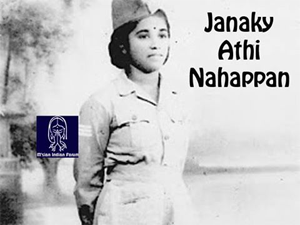
Image
Yang Berbahagia Puan Sri Datin
Janaky Athi Nahappan
Born: Janaky Devar, 25 February 1925, Kuala Lumpur, British Malaya (now Malaysia)
Died: 9 May 2014 (aged 89), Kuala Lumpur, Malaysia
Nationality: Tamil Malaysians
Known for: Figure of Indian independence movement And Malaysian independence movement,
Co founder of Malaysian Indian Congress
Title: Notable commander of Rani of Jhansi Regiment Indian National Army, Puan Sri
Political party: Malaysian Indian Congress
Spouse(s) Athi Nahappan
Children Ishwar Nahappan, Gouri Nahappan, Jayashri Nahappan

Puan Sri Datin Janaky Devar (25 February 1925 – 9 May 2014), better known as Janaky Athi Nahappan, was a founding member of the Malaysian Indian Congress and one of the earliest women involved in the fight for Malaysian (then Malaya) independence.

Janaki grew up in a well-to-do Tamil family in Malaya and was only 16 when she heard Subhas Chandra Bose's appeal to Indians to give whatever they could for their fight for Indian independence. Immediately she took off her gold earrings and donated them. She was determined to join the women's wing, the Rani of Jhansi Regiment of the Indian National Army. There was strong family objection especially from her father. But after much persuasion, her father finally agreed.

She was among the first women to join the Indian National Army organised during the Japanese occupation of Malaya to fight for Indian independence with the Japanese. Having been brought up in luxury, she initially could not adapt to the rigours of army life. However, she gradually got used to military life and her career in the regiment took off. She became second in command of the regiment.[1]

After World War II she emerged as a welfare activist.

Janaki found the Indian National Congress's fight for Indian independence inspiring and joined the Indian Congress Medical Mission in then Malaya. In 1946 Nahappan helped John Thivy to establish the Malayan Indian Congress, which was modelled after the Indian National Congress. The party saw Thivy as its first president. Later in life, she became a senator in the Dewan Negara of the Malaysian Parliament.

The Government of India awarded her the fourth highest civilian honour of Padma Shri in 2000.[2] She died at her house on 9 May 2014 due to pneumonia.[3]

See also

• Malaysia portal
• Rasammah Bhupalan
• Lakshmi Sahgal

References

1. Women Against the Raj: The Rani of Jhansi Regiment By Joyce C. Lebra, p.xii
2. "Padma Awards" (PDF). Ministry of Home Affairs, Government of India. 2015. Archived from the original (PDF) on 15 November 2014. Retrieved 21 July 2015.
3. (in Malay) Pejuang kemerdekaan Janaky meninggal dunia

External links

• Mothers of substance, The Star, 20 August 2007.
• They dared to take up public office, The Star, 20 August 2007.
• Biographies of INA freedom Fighter National Archives of Singapore
• Times of India
• Subhas Chandra Bose and the Indian National Army. Asian Journal, Radio Singapore International.
• Biography of Janaky Athi Nahappan
• Puan Sri Janaky Athi Nahappan Passes Away At Age 89
admin
Site Admin
 
Posts: 39440
Joined: Thu Aug 01, 2013 5:21 am

Re: Freda Bedi, by Wikipedia

Postby admin » Thu Oct 31, 2019 4:29 am

Swami Ramdas
by Wikipedia
Accessed: 10/30/19

NOTICE: THIS WORK MAY BE PROTECTED BY COPYRIGHT

YOU ARE REQUIRED TO READ THE COPYRIGHT NOTICE AT THIS LINK BEFORE YOU READ THE FOLLOWING WORK, THAT IS AVAILABLE SOLELY FOR PRIVATE STUDY, SCHOLARSHIP OR RESEARCH PURSUANT TO 17 U.S.C. SECTION 107 AND 108. IN THE EVENT THAT THE LIBRARY DETERMINES THAT UNLAWFUL COPYING OF THIS WORK HAS OCCURRED, THE LIBRARY HAS THE RIGHT TO BLOCK THE I.P. ADDRESS AT WHICH THE UNLAWFUL COPYING APPEARED TO HAVE OCCURRED. THANK YOU FOR RESPECTING THE RIGHTS OF COPYRIGHT OWNERS.


Image
Swami Ramdas
Born 10 April 1884
Kanhangad, Madras Presidency, British India (present-day Kerala, India)
Died 25 July 1963 (aged 79)

Swami Ramdas (born Vittal Rao 10 April 1884 – 25 July 1963) was an Indian saint, philosopher, philanthropist, pilgrim. Ramdas became a wandering ascetic at a young age. His story and his teachings have been presented in several different books.

Biography

Ramdas was born as Vittal Rao in Kanhangad, in northern Kerala, India on 10 April 1884,[1] to Balakrishna Rao and Lalita Bai. Ramdas worked as a spinning master in a cotton mill, and in 1908 was married. He experienced difficulties, both in his financial pursuits and domestic life, leading him to seek relief from his circumstances. Ramdas began to chant "Ram" – a name used by Hindus to refer to an important deity. Soon afterward, his father instructed him to repeat the mantra Ram Mantra: "Sri Ram jai Ram jai jai Ram". Ramdas then added the "Om" to each repetition: "Om Sri Ram Jai Ram Jai Jai Ram," and he found the benefit at least threefold.[citation needed]

He became detached from the material world and embarked on a pilgrimage, thereby taking on the name Ramdas, and living on charity (though he never accepted money). His practice was to view the world as forms of Ram – and thus to see everything that might befall him as the will of Ram. His mantra practice also gradually became a round-the-clock practice.

In 1922 he met Ramana Maharshi. As a result of this, he went into his first retreat, living for 21 days in solitude in a cave in Arunachala. Upon leaving this cave he began claiming that, “All was Ram, nothing but Ram”[2]

After continuing to live as an itinerant for many years, his devotees established Anandashram for him in Kanhangad, Kerala in 1931. The ashram worked to improve the living conditions of the local people, and continues till present day to share Ramdas’ teachings.

A list of Ramdas' well-known disciples includes Mataji Krishnabai, Swami Satchidananda, Swami Muktananda and Yogi Ramsuratkumar.


Ramdas died in 1963.

Quotations

“ People do not know what the Name of God can do. Those who repeat it constantly alone know its power. It can purify our mind completely... The Name can take us to the summit of spiritual experience. ”
— Swami Ramdas[3]

“ Place yourself as an instrument in the hands of God who does his own work in his own way. ”
— Swami Ramdas[4]

“ Just as a flower gives out its fragrance to whomsoever approaches or uses it, so love from within us radiates towards everybody and manifests as spontaneous service. ”
— Swami Ramdas[5]

See also

• Nama sankeerthanam
• Rama
• Anandashram

External links

• Homepage of Anandashram
• My beloved Papa, Swami Ramdas - Swami Satchidananda
• Biography of Swami (Papa) Ramdas - Hinduismwayoflife.com
• Excerpts and Real Audio clips

References

1. page xiii in: Swami Satchidananda (1979). The Gospel of Swami Ramdas. Published for Anandashram by Bharatiya Vidya Bhavan. OCLC 7173794
2. [1] The Mountain Path
3. Ramdas, Swami. The Essential Swami Ramdas, World Wisdom, 2005.
4. The Tribune, Reflections
5. The Times of India, SACRED SPACE: Caring and Sharing
admin
Site Admin
 
Posts: 39440
Joined: Thu Aug 01, 2013 5:21 am

Re: Freda Bedi, by Wikipedia

Postby admin » Thu Oct 31, 2019 4:54 am

Jagdish Kashyap
by Wikipedia
Accessed: 10/30/19

NOTICE: THIS WORK MAY BE PROTECTED BY COPYRIGHT

YOU ARE REQUIRED TO READ THE COPYRIGHT NOTICE AT THIS LINK BEFORE YOU READ THE FOLLOWING WORK, THAT IS AVAILABLE SOLELY FOR PRIVATE STUDY, SCHOLARSHIP OR RESEARCH PURSUANT TO 17 U.S.C. SECTION 107 AND 108. IN THE EVENT THAT THE LIBRARY DETERMINES THAT UNLAWFUL COPYING OF THIS WORK HAS OCCURRED, THE LIBRARY HAS THE RIGHT TO BLOCK THE I.P. ADDRESS AT WHICH THE UNLAWFUL COPYING APPEARED TO HAVE OCCURRED. THANK YOU FOR RESPECTING THE RIGHTS OF COPYRIGHT OWNERS.


Image
Jagdish Kashyap with peacocks

Bhikkhu Jagdish Kashyap was born on 2 May 1908 in Ranchi, Bihar, India; he died 28 January 1976. His birth name was Jagdish Narain, and the name Kashyap was given to him at his bhikkhu ordination in 1933.

Education

• BA Patna College, 1929
• MA in Philosophy - Banaras Hindu University, 1931.
• MA in Sanskrit - Banaras Hindu University, 1932.

Biography

After finishing his MA, Bhikkhu Kashyap, desiring to doctoral work in Buddhist philosophy, was advised to study Pāli, and so resolved to go to Sri Lanka, to his parents' dismay. They relented in 1933 and he joined the Vidyalankara Pirivena (now the University of Kelaniya). He was ordained by Venerable L. Dhammananda Nayaka Mahathero. During his time at the Vidyalankara Pirivena he translated the Digha Nikāya into Hindi.

On a trip to Japan he was stopped by the police in Malaysia due to his involvement in Gandhi's non-cooperation movement. He spent a year living in Penang, learned some Chinese, lived in a Chinese vihara, and published a collection of lectures.

In 1936 he returned to Sri Lanka to spend time in a forest hermitage to practice meditation, which was quite unusual for a bhikkhu in his day, so much so that his teachers tried to dissuade him. Bhikkhu Kashyap continued to practice meditation throughout his life. Towards the end of 1936 he returned to India and in 1937 settled at Sarnath where he was involved in scholarly and translating work, principally of the Pāli Canon into Hindi. In Sarnath he became associated with the Maha Bodhi Society and was soon helping with the institutional organisation and social services. He became the headmaster of a new high school founded by the Maha Bodhi Society General Secretary, Devapriya Valisinha. While in Sarnath he also worked for Benares Hindu University to offer courses in Pāli - even occasionally walking the 22-mile journey into Varanasi.
Some accounts say this was because he persuaded officials to start these courses and even taught them from free, the accounts below varies slightly.

[url]During this time Bhikkhu Kashyap took on a young English monk as a live-in student for about nine months. Sangharakshita [Dennis Lingwood][/url] went on to found the Western Buddhist Order in 1968, and considers Bhikkhu Kashyap to have been an important teacher in both the spiritual and secular senses.

Sangharakshita's [Dennis Lingwood's] version of the Benares university job, as he understood from Kashyap:

As he had already confided to me, he was there very much on sufferance. Dominated as it was by orthodox brahmins, the University had not wanted to have a Professor of Pali and Buddhist Philosophy at all, and Kashyap-ji’s appointment had been due to the insistence of the multimillionaire philanthropist Jugal Kishore Birla, a benefactor whose wishes the University could not afford to ignore. But though the University had been forced to appoint a Professor of Pali and Buddhist Philosophy it was not obliged to supply him with pupils. In fact it made it as difficult as possible for him to get any. Under University regulations, no one could take Pali without also taking Sanskrit. In other words Pali and Buddhist Philosophy were not allowed to become alternatives to Sanskrit and Hindu Philosophy. One could take Sanskrit and Pali, or only Sanskrit, but under no circumstances could one take only Pali. So effectively did these tactics limit the number of Kashyap-ji’s students that he never had more than three or four, sometimes none at all. For someone as devoted to his subject as he was this was a bitter disappointment. He had accepted the professorship only because he hoped it would enable him to make some contribution to the advancement of Buddhist studies and thus, indirectly, to the cause of Buddhism; but as it became more obvious every year that Pali and Buddhist Philosophy were unwelcome guests at the Benares Hindu University, he had come to the conclusion that he was wasting his time there and he was now thinking of resigning.[1]


In 1947 India became independent and there was a new sense of identity for Indians. In 1949 he toured his ancestral homeland, the ancient province of Magadha, which was also the centre of ancient Buddhism. For the first time in many centuries the villages in Magadha saw a yellow robed bhikkhu, and were pleasantly surprised to find that he spoke their local dialect Magadhi. The locals had long forgotten their own history and Bhikkhu Kashyap was able to furnish many details. The very name of the state of Bihar comes from presence of so many Buddhist viharas in the past. He was able to point out the true identity of the images of Buddhas and Bodhisattvas which were being worshipped as Hindu gods or local deities. Villages such as Sari-chak, near Nalanda, had previously had an association with the Buddha's chief disciple Sariputta. Finally he was able, by quoting passages from the Pāli texts, to demonstrate that Magadhi is still closely related to the Magadhi dialect.

After this visit Bhikkhu Kashyap offered to teach Pāli at Gaya College and at Nalanda College in Bihar-Sharif. Later, when the Bihar state government decided to start an institute for Pāli studies at Nalanda, he was the obvious choice to head the project. In 1951 the institute became the Nava Nalanda Mahavihara.

1956 was the 2500th anniversary of the parinibbana of the Buddha, celebrated by the Indian government as the Buddha Jayanti. As part of the celebrations, Bhikkhu Kashyap's work of bringing out a Devanagari edition of the Pāli Canon was accepted as an official project, and was jointly sponsored by the governments of Bihar and India. The first volume appeared in 1956 on the occasion of the Buddha Jayanti, and the rest followed over five years - guided to completion with enormous effort and marathon labour by Bhikkhu Kashyap. At one point he sold his house to pay the salaries of workers when payments had been delayed.

During the Buddha Jayanti project Bhikkhu Kashyap returned to Varanasi and in 1959 was asked to become the first Professor of Pāli and Buddhism at the Sanskrit University of Varanasi. He remained there until 1965 when he returned to Nalanda for a second term as Director of the Nava Nalanda Mahavihara. He retired in 1973. Having earlier developed diabetes, he became seriously ill in 1974 and spent his last two years bedridden in the Japanese temple in Rajgir, from where he could see the Vulture Peak and the newly constructed Peace Pagoda. He died in 1976.

References

D.C. Ahir. The Pioneers of the Buddhist Revival in India. (Delhi, Sri Satguru Pub. : 1989)

1. From: The Rainbow Road, ISBN 978-0-904766-94-3, P366-367, available for free download at http://www.sangharakshita.org/_books/rainbow-road.pdf

External links

• My Eight Main Teachers A talk by Sangharakshita in which he describes his time
• "Teachers of enlightenment: the refuge tree of the Western Buddhist Order", Dharmachari Kulananda, Windhorse Publications | ISBN 1-899579-25-7 | pages=240–244
admin
Site Admin
 
Posts: 39440
Joined: Thu Aug 01, 2013 5:21 am

Re: Freda Bedi, by Wikipedia

Postby admin » Thu Oct 31, 2019 5:28 am

Jugal Kishore Birla
by Wikipedia
Accessed: 10/30/19

NOTICE: THIS WORK MAY BE PROTECTED BY COPYRIGHT

YOU ARE REQUIRED TO READ THE COPYRIGHT NOTICE AT THIS LINK BEFORE YOU READ THE FOLLOWING WORK, THAT IS AVAILABLE SOLELY FOR PRIVATE STUDY, SCHOLARSHIP OR RESEARCH PURSUANT TO 17 U.S.C. SECTION 107 AND 108. IN THE EVENT THAT THE LIBRARY DETERMINES THAT UNLAWFUL COPYING OF THIS WORK HAS OCCURRED, THE LIBRARY HAS THE RIGHT TO BLOCK THE I.P. ADDRESS AT WHICH THE UNLAWFUL COPYING APPEARED TO HAVE OCCURRED. THANK YOU FOR RESPECTING THE RIGHTS OF COPYRIGHT OWNERS.


Image

Sheth Jugal Kishore Birla (23 May 1883– 24 June 1967) was scion of the Birla family and eldest son of Baldeo Das Birla. He was a noted industrialist, philanthropist and vocal supporter of Hindu philosophy.[1]

Life

He started his business career at an early age, joining his father Baldeodas Birla in Calcutta and soon came to be known as reputed trader and speculator in opium, silver, spice and other trades from which Birlas later diversified into trading of jute and other items like cotton during and after World War I, by which time his younger brother Ghanshyam Das Birla had also joined the business. The family firm, which was till 1918 was run as Baldeodas Jugalkishore, was made into limited company known as Birla Brothers Limited.[1][2]

When at one point of time in early career of his life Ghanshyam Das Birla, suffered heavy losses and had decided to sell the mill to Andrew Yule group, Jugal Kishore stood by him and told him not to worry about money but to run the mill as efficiently as he could, which led to revival of Birla Jute,[2] now the flagship company of Aditya Birla Group.

Although Jugal Kishore started his business life from Calcutta, later he shifted to Delhi and lived in Birla House[3] till his death.

Image
Gandhi Smriti (former Birla House), New Delhi, India

Gandhi Smriti formerly known as Birla House or Birla Bhavan, is a museum dedicated to Mahatma Gandhi, situated on Tees January Road, formerly Albuquerque Road, in New Delhi, India. It is the location where Mahatma Gandhi spent the last 144 days of his life and was assassinated on 30 January 1948. It was originally the house of the Indian business tycoons, the Birla family. It is now also home to the Eternal Gandhi Multimedia Museum, which was established in 2005.[1]

The museum is open for all days except Mondays and National Holidays. The entry is Free for all[2]

History

Image
An exhibit at Eternal Gandhi Multimedia Museum, Gandhi Smriti

Image
The 'Martyr's Column' at the Gandhi Smriti, the spot where Gandhi was assassinated.

The 12-bedroom house was built in 1928 by Ghanshyamdas Birla.[3] Sardar Patel and Mahatma Gandhi were frequent guests of the Birlas. During his final stay, Mahatma Gandhi stayed here from 9 September 1947 to 30 January 1948 when he was assassinated. Jawaharlal Nehru wrote to Ghanshyamdas Birla seeking to turn part of the Birla House in to a memorial. [4] Ghanshyamdas was rather reluctant to give up the house with associated memories. The Birla House was purchased from KK Birla, in 1971, by the Government of India, after protracted and tough negotiations, in which, according to some reports, he even included the cost of fruit trees in the sale price. Eventually KK Birla, sold the property to the Government for Rs 5.4 million and seven acres of urban land in exchange, which was considered a very profitable deal. [5] Birla House opened for the public on 15 August 1973, renamed the Gandhi Smriti (or Gandhi Remembrance). The museum in the building houses a number of articles associated with Gandhi's life and death. Visitors can tour the building and grounds, viewing the preserved room where Gandhi lived and the place on the grounds where he was shot while holding his nightly public walk. Gandhi was shot during his prayers at the place where Martyr's Column now stands.

The Martyr's Column now marks the place where Gandhi, the "Father of the Nation" was assassinated.

The Gandhi Smriti or Birla House is located at 5 Tees January Marg, a couple of kilometres from the Connaught Place, one of the Central Business District's of New Delhi.

Outside the house stands a pillar that contains a swastika symbol.

Image
Jugal Kishore Birla was a Hindu activist and donated monies to various Hindu organisations of India like Swayamsevak Sangh, an Indian right-wing, Hindu nationalist, paramilitary volunteer organisation that is widely regarded as the parent organisation of the ruling party of India, the Bharatiya Janata Party. The organisation promotes the ideals of upholding Indian culture and the values of a civil society and spreads the ideology of Hindutva, to "strengthen" the Hindu community. It drew initial inspiration from European right-wing groups during World War II.


The prominence of the pillar means that it has been used as a visual example of the way the ethical meaning of the swastika symbol has changed in the West in the 20th century.[6] [dubious – discuss] The same pillar also contains the Sanskrit symbol for the meditation sound, Om.

References

1. "The Eternal Gandhi". Sacred World. Retrieved 11 November 2018.
2. "Gandhi Smriti and Darshan Samiti Delhi". KahaJaun. Retrieved 12 June 2019.
3. THE VOICE OF THE MAHATAMA, Dr. Pragnya Ram
4. Bhavan's Journal, Volume 32, Issues 13-24 Published 1986, p. 28-29
5. Tushar A. Gandhi, 'Let's Kill Gandhi!': A CHRONICLE OF HIS LAST DAYS, THE CONSPIRACY, MURDER. INVESTIGATIONS AND TRIAL (New Delhi, Delhi: Rupa & Co, 2007).p 570-71
6. See, e.g., Koehler, Jr., Wallace C. and June Lester. 2007. Fundamentals of Information Studies, 2nd ed. New York: Neal Schuman Publishers, Inc. 347-48: "for Hindus and Buddhists, the swastika symbol is a representation of good."

External links

• Gandhi Smriti – Government of India website

-- Gandhi Smriti, by Wikipedia


Philanthropist

Jugal Kishore Birla was a Hindu activist and donated monies to various Hindu organisations of India like Hindu Mahasabha ...

The Hindu Mahasabha (officially Akhil Bhārat Hindū Mahāsabhā or All-India Hindu Grand-Assembly) is a right wing Hindu nationalist political party in India.[2][3]

The organisation was formed to protect the rights of the Hindu community in British India, after the formation of the All India Muslim League in 1906[4] and the British India government's creation of separate Muslim electorate under the Morley-Minto reforms of 1909.[5][4]....

In the 1940s, the Muslim League stepped up its demand for a separate Muslim state of Pakistan. Although the Congress strongly opposed religious separatism, the League's great popularity amongst Muslims forced the Congress leaders to hold talks with the League president, Muhammad Ali Jinnah. Even though Savarkar agreed with Jinnah and recognised Hindus and Muslims to be separate nations, he condemned the secular Gandhi's overtures to hold talks with Jinnah and regain Muslim support for the Congress as appeasement. After communal violence claimed the lives of thousands in 1946, Savarkar claimed that Gandhi's adherence to non-violence had left Hindus vulnerable to armed attacks by militant Muslims. When the partition of India was agreed upon in June 1947 after months of failed efforts at power-sharing between the Congress and the League, the Mahasabha condemned the Congress and Gandhi for agreeing to the partition plan.

On January 30, 1948 Nathuram Godse shot Mahatma Gandhi three times and killed him in Delhi. Godse and his fellow conspirators Digambar Badge, Gopal Godse, Narayan Apte, Vishnu Karkare and Madanlal Pahwa were identified as prominent members of the Hindu Mahasabha. Along with them, police arrested Savarkar, who was suspected of being the mastermind behind the plot. While the trial resulted in convictions and judgments against the others, Savarkar was released on a technicality, even though there was evidence that the plotters met Savarkar only days before carrying out the murder and had received the blessings of Savarkar. The Kapur Commission in 1967 established that Savarkar was in close contact with the plotters for many months. Kapur Commission said,

All these facts taken together were destructive of any theory other than the conspiracy to murder (of Gandhiji) by Savarkar and his group[29].


-- Hindu Mahasabha, by Wikipedia


and Rashtriya Swayamsevak Sangh[4][5][6][7] ...

Rashtriya Swayamsevak Sangh, abbreviated as RSS (IAST: Rāṣṭrīya Svayamsevaka Saṅgha, IPA: [rɑːʂˈʈriːj(ə) swəjəmˈseːvək ˈsəŋɡʱ], lit. "National Volunteer Organisation"[14] or "National Patriotic Organisation"[15]), is an Indian right-wing, Hindu nationalist, paramilitary volunteer organisation that is widely regarded as the parent organisation of the ruling party of India, the Bharatiya Janata Party.[5][2][6][16] The RSS is the progenitor and leader of a large body of organisations called the Sangh Parivar (the "family of the RSS"), which have presence in all facets of the Indian society. Founded on 27 September 1925, the RSS is the world's largest voluntary organisation.[17] It is the largest NGO in the world,[18] while the BJP is the largest political party in the world.[19]

The initial impetus was to provide character training through Hindu discipline and to unite the Hindu community to form a Hindu Rashtra (Hindu nation).[20][21] The organisation promotes the ideals of upholding Indian culture and the values of a civil society and spreads the ideology of Hindutva, to "strengthen" the Hindu community.[22][9] It drew initial inspiration from European right-wing groups during World War II.[21]
Gradually, RSS grew into a prominent Hindu nationalist umbrella organisation, spawning several affiliated organisations that established numerous schools, charities, and clubs to spread its ideological beliefs.[21]

The RSS was banned once during British rule,[21] and then thrice by the post-independence Indian government, first in year 1948 when a former RSS member[23] assassinated Mahatma Gandhi;[21][24][25] then during the emergency (1975–77); and for a third time after the demolition of Babri Masjid in year 1992.

-- Rashtriya Swayamsevak Sangh, by Wikipedia


at the same time supporting finances of Mahatma Gandhi and Indian National Congress and India's freedom movement,[8] which were looked after together by Ghanshaymdas Birla and others.[9]>[10]

In 1920 he along with his brother Ghanshaym Das donated funds to start girls school under their private trust a school named Marwari Balika Vidyalaya, which has now grown into the noted Shri Shikshayatan School and Shri Shikshayatan College.[11]

He was devoted follower of Mahatma Gandhi and took personal interest also apart from donating funds for relief and charity works.[12]

He spent much of his personal wealth in building Hindu temples known as Birla Temples and dharamshalas across major metropolitan towns of India and promotion of schools and universities and hospitals.[9][13][14][15] and adopting many villages in times of famine and natural disasters.[16][17][18][19]

In his old age, he took the leading role to fulfill the unfinished dream of Madan Mohan Malaviya of building Krishna Janmabhoomi Kesava Deo Temple. He donated a major sum and formed a private trust in 1951 to which the rights of land were later transferred, and temple works begin to be inaugurated in 1965, for which he is fondly remembered by believers of Hindu religion.[20][21]

Image

The Krishna Janmasthan Temple Complex is a group of Hindu temples in Mallapura, Mathura, Uttar Pradesh, India. These temples are built around the place where major Hindu deity Krishna is said to have been born.[1][2] The place holds religious significance since the 6th century BC. The temples were destroyed multiple times throughout history, latest by Mughal emperor Aurangzeb in 1670 who erected Eidgah there. In 20th century, the new temple complex was built with the financial help from industrialists containing the Keshavdeva temple, the Garbha Griha temple at the birth place and the Bhagavata Bhavan.

-- Krishna Janmasthan Temple Complex, by Wikipedia


In his old age he also donated initial funds for building of Vivekananda Rock Memorial and also arranged for further funds for the project from his brothers, the construction of which, however, began several years after his death.[14]

Image

Vivekananda Rock Memorial is a popular tourist monument in Vavathurai, Kanyakumari, India.[1] It was built in 1970 in honour of Swami Vivekananda who is said to have attained enlightenment on the rock.[2][3][1][4] According to local legends, it was on this rock that Goddess Kumari performed austerity. A meditation hall known as Dhyana Mandapam is also attached to the memorial for visitors to meditate. The design of the mandapa incorporates different styles of temple architecture from all over India.[1] The rocks are surrounded by the Laccadive Sea. The memorial consists of two main structures, the Vivekananda Mandapam and the Shripada Mandapam.[5]

-- Vivekananda Rock Memorial, by Wikipedia


Jugal Kishore died in 1967,[1] without any issues and left his wealth to religious trusts and philanthropy.[22]

Some noted philanthropic works

• Founded the trust in 1951, which built the famous Krishna Janmabhoomi Kesava Deo Temple at Mathura.[20][21]
• North Delhi Hanuman Temple founded in 1965.[23]
Shri Laxmi Narayan Temple, Delhi founded in 1939.[24]

Image

The Laxminarayan Temple, also known as the Birla Mandir is a Hindu temple up to large extent dedicated to Laxminarayan in Delhi, India. Laxminarayan usually refers to Vishnu, Preserver in the Trimurti, also known as Narayan, when he is with his consort Lakshmi. The temple, inaugurated by Mahatma Gandhi, was built by Jugal Kishore Birla[1] from 1933 and 1939. The side temples are dedicated to Shiva, Krishna and Buddha.[2]

It was the first large Hindu temple built in Delhi. The temple is spread over 7.5 acres, adorned with many shrines, fountains, and a large garden with Hindu and Nationalistic sculptures
, and also houses Geeta Bhawan for discourses. The temple is one of the major attractions of Delhi and attracts thousands of devotees on the festivals of Janmashtami and Diwali.

-- Laxminarayan Temple, by Wikipedia


• Birla Temple, Varanasi
• Birla Temple (Gita Temple), Mathura founded in 1946[13]
• Shri Shikshayatan School which later grew into Shri Shikshayatan College of Kolkata was founded in 1920.[11]
• Marwari Relief Society, Kolkata founded in 1913.[19]
• Birla Hostel at Benaras Hindu University founded in 1920.[25]
• Birla Temple, Kurukshetra founded in 1950.[26]
• Dev Madir, Bangkok- donated funds for marble slabs of the temple, which was inaugurated in 1969.[27]
• Nipponzan Myohoji Temple, Mumbai – purchased land for building of this Buddhist temple.[28]
• Lord Krishan Temple, Mathura built in 1946 in memory of his parents.[29]
• Paramjyotir Mandir, Barobagh, Himachal Pradesh – donated huge amount of money on request of his friend Stokes, who founded the temple.[30]
• Donated funds and arranged further monies from Birla group for building of Vivekananda Rock Memorial[14]

References

1. Margaret Herdeck; Gita Piramal (1985). India's Industrialists. Lynne Rienner Publishers. p. 62. ISBN 978-0-89410-415-2.
2. "G d birla". Archived from the original on 2 November 2011. Retrieved 14 August 2015.
3. "Srila Prabhupada's Original pre-1978 Books Online". PrabhupadaBooks.com. Retrieved 19 September 2014.
4. "Second Meeting of the Parishad". Vishva Hindu Parishad. Retrieved 19 September 2014.
5. Joya Chatterji (2002). Bengal Divided: Hindu Communalism and Partition, 1932–1947. Cambridge University Press. p. 236. ISBN 978-0-521-52328-8.
6. M. G. Chitkara (2004). Rashtriya Swayamsevak Sangh: National Upsurge. APH Publishing. p. 257. ISBN 978-81-7648-465-7.
7. Dhananjay Keer (1995). Dr. Ambedkar: Life and Mission. Popular Prakashan. p. 277. ISBN 978-81-7154-237-6.
8. Joseph S. Alter (1992). The Wrestler's Body: Identity and Ideology in North India. University of California Press. p. 88. ISBN 978-0-520-91217-5.
9. Anand Mohun Sinha (2011). Unspoken History of India of Six-Thousand Years. AuthorHouse. p. 208. ISBN 978-1-4520-9769-5.
10. K. Satchidananda Murty; Ashok Vohra (1990). Radhakrishnan: His Life and Ideas. SUNY Press. p. 100. ISBN 978-0-7914-0344-0.
11. "About School". Shri Shikshayatan School. Retrieved 19 September 2014.
12. Debi P. Mishra (1998). People's Revolt in Orissa: A Study of Talcher. Atlantic Publishers & Dist. p. 138. ISBN 978-81-7156-739-3.
13. "Birla Temple Mathura also known as Gita Temple was founded by Jugal Kishore Birla in 1946". Retrieved 19 September2014.
14. "The Story of the Vivekananda Rock Memorial". Retrieved 19 September 2014.
15. Chung Tan (1999). In the Footsteps of Xuanzang: Tan Yun-shan and India. Gyan Publishing House. p. 6. ISBN 978-81-212-0630-3.
16. History of Sirsa Town. Atlantic Publishers & Distri. p. 138.
17. "Birla Temple at Kurukshetra established in 1952 by Jugal Kishore Birla". Retrieved 19 September 2014.
18. "North Delhi Hanuman Temple founded by Jugal Kishore Birla in 1965". Retrieved 19 September 2014.
19. S. B. Bhattacherje (2009). Encyclopaedia of Indian Events & Dates. Sterling Publishers Pvt. Ltd. p. A178. ISBN 978-81-207-4074-7.
20. "Shri Krishna Janmasthan". Shri Krishna Janmasthan Trust. Retrieved 24 August 2012.
21. "Tourism: A journey to Mathura- the Braj Mandal of Radha and Krishna". IndiaStudyChannel.com. Retrieved 19 September 2014.
22. "The People's Paper". Tehelka. Retrieved 19 September 2014.
23. "Ashrams & Temples". Retrieved 19 September 2014.
24. "Religious offerings". HDFC Bank. Archived from the original on 3 July 2014. Retrieved 19 September 2014.
25. "Contact". Archived from the original on 5 February 2011. Retrieved 14 August 2015.
26. "In a time warp". The Hindu. Retrieved 19 September 2014.
27. "Thep Montien – Inside Dev Mandir". Retrieved 19 September 2014.
28. "Nipponzan Myohoji temple, Mumbai, Bombay, Maharashtra, India, Video". IndiaVideo. Retrieved 19 September 2014.
29. "Lord Krishna Temple, Mathura – History". Retrieved 19 September 2014.
30. Asha Sharma (2008). An American in Gandhi's India: The Biography of Satyanand Stokes. Indiana University Press. p. 287. ISBN 0-253-21990-6.
admin
Site Admin
 
Posts: 39440
Joined: Thu Aug 01, 2013 5:21 am

Re: Freda Bedi, by Wikipedia

Postby admin » Thu Oct 31, 2019 6:15 am

Hindu Mahasabha
by Wikipedia
Accessed: 10/30/19

NOTICE: THIS WORK MAY BE PROTECTED BY COPYRIGHT

YOU ARE REQUIRED TO READ THE COPYRIGHT NOTICE AT THIS LINK BEFORE YOU READ THE FOLLOWING WORK, THAT IS AVAILABLE SOLELY FOR PRIVATE STUDY, SCHOLARSHIP OR RESEARCH PURSUANT TO 17 U.S.C. SECTION 107 AND 108. IN THE EVENT THAT THE LIBRARY DETERMINES THAT UNLAWFUL COPYING OF THIS WORK HAS OCCURRED, THE LIBRARY HAS THE RIGHT TO BLOCK THE I.P. ADDRESS AT WHICH THE UNLAWFUL COPYING APPEARED TO HAVE OCCURRED. THANK YOU FOR RESPECTING THE RIGHTS OF COPYRIGHT OWNERS.


Akhil Bharat Hindu Mahasabha
President Veervasanthakumar
Founder Madan Mohan Malaviya
Founded 1915
Headquarters New Delhi
Ideology Hindutva
Colours   Saffron
ECI Status Registered Unrecognised[1]
Seats in Lok Sabha 0
Seats in Rajya Sabha
0 / 245

Image
A group photo taken in Shimoga in 1944 when Vinayak Damodar Savarkar (seated fourth from right, second row) came to address the State-level Hindu Mahasabha conference. The late Bhoopalam Chandrashekariah, president of the Hindu Mahasabha State unit, is seated to Savarkar's left.

The Hindu Mahasabha (officially Akhil Bhārat Hindū Mahāsabhā or All-India Hindu Grand-Assembly) is a right wing Hindu nationalist political party in India.[2][3]

The organisation was formed to protect the rights of the Hindu community in British India, after the formation of the All India Muslim League in 1906[4] and the British India government's creation of separate Muslim electorate under the Morley-Minto reforms of 1909.[5][4]

Name

The organisation was originally called Sarvadeshak Hindu Sabha ("Hindu Assembly for the entire country"). In 1921, it changed to the present name Akhil Bharat Hindu Mahasabha ("All-India Hindu Grand Assembly").[6] It is also sometimes referred to as Akhil Bharatiya Hindu Mahasabha.

History

Antecedents


Local forerunners of the Hindu Mahasabha emerged in connection with the disputes after the partition of Bengal in 1905 in British India. Under the then viceroy Lord Curzon, the division of the province of Bengal was in two new provinces of East Bengal and Assam, as well as Bengal. The new province of Bengal had a Hindu majority, the province of East Bengal and Assam was mostly Muslim. The division was justified by the British for administrative reasons. However, many nationalist Indians saw it as an attempt by the British colonial administration to drive a wedge between Hindus and Muslims, thereby splitting the burgeoning Indian autonomy movement.[citation needed]

The formation of the All India Muslim League in 1906[4] and the British India government's creation of separate Muslim electorate under the Morley-Minto reforms of 1909[5] was a catalyst for Hindu leaders coming together to create an organisation to protect the rights of the Hindu community members.[4]

In 1909, Arya Samaj leaders Lala Lajpat Rai, Lal Chand and Shadi Lal established the Punjab Hindu Sabha ("Assembly").[7] Madan Mohan Malaviya presided over the Sabha's first session at Lahore in October 1909. The Sabha stated that it was not a sectarian organisation, but an "all-embracing movement" that aimed to safeguard the interests of "the entire Hindu community". During 21–22 October 1909, it organised the Punjab Provincial Hindu Conference, which criticised the Indian National Congress for failing to defend Hindu interests, and called for promotion of Hindu-centered politics. The Sabha organised five more annual provincial conferences in Punjab.[8]

The development of the broad work for Hindu unity that started in the early 20th century in Punjab was a precursor for the formation of the All India Hindu Sabha. Over the next few years, several such Hindu Sabhas were established outside Punjab, including in United Provinces, Bihar, Bengal, Central Provinces and Berar, and Bombay Presidency.[9]

A formal move to establish an umbrella All-India Hindu Sabha was made at the Allahabad session of Congress in 1910. A committee headed by Lala Baij Nath was set up to draw up a constitution, but it did not make much progress. Another conference of Hindu leaders in Allahabad also took the initial step to establish an All India Hindu Sabha in 1910, but this organisation did not become operational due to factional strife. On 8 December 1913, the Punjab Hindu Sabha passed a resolution to create an All India Hindu Sabha at its Ambala session. The Conference proposed holding a general conference of Hindu leaders from all over India at the 1915 Kumbh Mela in Haridwar.[8]

Establishment

Preparatory sessions of the All India Hindu Sabha were held at Haridwar (13 February 1915), Lucknow (17 February 1915) and Delhi (27 February 1915). In April 1915, Sarvadeshak (All India) Hindu Sabha was formed as an umbrella organisation of regional Hindu Sabhas, at the Kumbh Mela in Haridwar. Gandhi and Swami Shraddhanand were also present at the conference, and were supportive of the formation of All India Hindu Sabha.[8] The Sabha laid emphasis on Hindu solidarity and the need for social reform.[8]

At its sixth session in April 1921, the Sarvadeshak Hindu Sabha formally changed its name to Akhil Bharat Hindu Mahasabha on the model of the Indian National Congress. Presided over by Manindra Chandra Nandi, it amended its constitution to remove the clause about loyalty to the British, and added a clause committing the organisation to a "united and self-governing" Indian nation.[10]

Amongst the Mahasabha's early leaders was the prominent nationalist and educationalist Pandit Madan Mohan Malaviya, who founded the Benaras Hindu University, and the Punjabi populist Lala Lajpat Rai. Under Malaviya, the Mahasabha campaigned for Hindu political unity, for the education and economic development of Hindus as well as for the conversion of Muslims to Hinduism.

In the late 1920s, the Mahasabha came under the influence of leaders like Balakrishna Shivram Moonje and Vinayak Damodar Savarkar. Savarkar was a former revolutionary who had been banned from anti-British political activities and opposed the secularism of the Congress. Under Savarkar, the Mahasabha became a more intense critic of the Congress and its policy of wooing Muslim support. The Mahasabha suffered a setback when in 1925, its former member Keshav Baliram Hedgewar left to form the Rashtriya Swayamsevak Sangh, a Hindu volunteer organisation that abstained from active politics. Although ideologically similar to the Mahasabha, the RSS grew faster across the nation and became a competitor for the core constituency of the Mahasabha.

Indian freedom movement

While being loyal to the British Raj, the Hindu Mahasabha did not support the Indian freedom movement against British rule in India. Rather Mahasabha choose to be sycophants for the British Government [11]

Civil Disobedience Movement

Under the leadership of Mahatma Gandhi, the Congress led several nationwide campaigns of non-violent civil disobedience. The Mahasabha officially abstained from participating in the Civil Disobedience Movement of 1930, which tarnished its image at a national level in India.[12]

Alliance with Muslim League and others

The Indian National Congress won a massive victory in the 1937 Indian provincial elections, decimating the Hindu Mahasabha. However, in 1939, the Congress ministries resigned in protest against Viceroy Lord Linlithgow's action of declaring India to be a belligerent in the Second World War without consulting the Indian people. This led to the Hindu Mahasabha joining hands with the Muslim League and other parties to form governments, in certain provinces. Such coalition governments were formed in Sindh, NWFP, and Bengal.

In Sindh, Hindu Mahasabha members joined Ghulam Hussain Hidayatullah's Muslim League government. In Savarkar's own words,

"Witness the fact that only recently in Sind, the Sind-Hindu-Sabha on invitation had taken the responsibility of joining hands with the League itself in running coalition government[13][14][15]


In March 1943, Sindh Government became the first Provincial Assembly of the sub-continent to pass an official resolution in favour of the creation of Pakistan.[16] In spite of the Hindu Mahasabha's avowed public opposition to any political division of India, the Mahasabha Ministers of the Sindh government did not resign, rather they simply "contented themselves with a protest".[17]

In the North West Frontier Province, Hindu Mahasabha members joined hands with Sardar Aurang Zeb Khan of the Muslim League to form a government in 1943. The Mahasabha member of the cabinet was Finance Minister Mehar Chand Khanna.[18][19]

In Bengal, Hindu Mahasabha joined the Krishak Praja Party led Progressive Coalition ministry of Fazlul Haq in December, 1941.[20] Savarkar appreciated the successful functioning of the coalition government.[13][14]

Quit India Movement

The Hindu Mahasabha openly opposed the call for the Quit India Movement and boycotted it officially.[21] Vinayak Damodar Savarkar, the president of the Hindu Mahasabha at that time, even went to the extent of writing a letter titled "Stick to your Posts", in which he instructed Hindu Sabhaites who happened to be "members of municipalities, local bodies, legislatures or those serving in the army...to stick to their posts" across the country, and not to join the Quit India Movement at any cost.[22]

Following the Hindu Mahasabha's official decision to boycott the Quit India movement,[23] Syama Prasad Mukherjee, leader of the Hindu Mahasabha in Bengal (which was a part of the ruling coalition in Bengal led by Krishak Praja Party of Fazlul Haq), wrote a letter to the British Government as to how they should respond, if the Congress gave a call to the British rulers to Quit India. In this letter, dated July 26, 1942 he wrote:

“Let me now refer to the situation that may be created in the province as a result of any widespread movement launched by the Congress. Anybody, who during the war, plans to stir up mass feeling, resulting internal disturbances or insecurity, must be resisted by any Government that may function for the time being”[24][25]


Mookerjee in this letter reiterated that the Fazlul Haq led Bengal Government, along with its alliance partner Hindu Mahasabha would make every possible effort to defeat the Quit India Movement in the province of Bengal and made a concrete proposal as regards this:

“The question is how to combat this movement (Quit India) in Bengal? The administration of the province should be carried on in such a manner that in spite of the best efforts of the Congress, this movement will fail to take root in the province. It should be possible for us, especially responsible Ministers, to be able to tell the public that the freedom for which the Congress has started the movement, already belongs to the representatives of the people. In some spheres it might be limited during the emergency. Indian have to trust the British, not for the sake for Britain, not for any advantage that the British might gain, but for the maintenance of the defense and freedom of the province itself. You, as Governor, will function as the constitutional head of the province and will be guided entirely on the advice of your Minister.[26]


Even the Indian historian R.C. Majumdar noted this fact and states:

"Shyam Prasad ended the letter with a discussion of the mass movement organised by the Congress. He expressed the apprehension that the movement would create internal disorder and will endanger internal security during the war by exciting popular feeling and he opined that any government in power has to suppress it, but that according to him could not be done only by persecution.... In that letter he mentioned item wise the steps to be taken for dealing with the situation .... "[27]


Although it opposed untouchability, the Mahasabha's orthodoxy on other matters concerning Hindu law and customs were a handicap in attracting the support of many Hindus.

Savarkar met Subhash Chandra Bose at his residence in Mumbai in 1940. This was the first and only time Savarkar met him. The meeting was part of Bose's efforts to meet all national leaders across party lines, to build up support for a united effort against the British rule.[28]

Assassination of Mahatma Gandhi

Main article: Assassination of Mahatma Gandhi

In the 1940s, the Muslim League stepped up its demand for a separate Muslim state of Pakistan. Although the Congress strongly opposed religious separatism, the League's great popularity amongst Muslims forced the Congress leaders to hold talks with the League president, Muhammad Ali Jinnah. Even though Savarkar agreed with Jinnah and recognised Hindus and Muslims to be separate nations, he condemned the secular Gandhi's overtures to hold talks with Jinnah and regain Muslim support for the Congress as appeasement. After communal violence claimed the lives of thousands in 1946, Savarkar claimed that Gandhi's adherence to non-violence had left Hindus vulnerable to armed attacks by militant Muslims. When the partition of India was agreed upon in June 1947 after months of failed efforts at power-sharing between the Congress and the League, the Mahasabha condemned the Congress and Gandhi for agreeing to the partition plan.

On January 30, 1948 Nathuram Godse shot Mahatma Gandhi three times and killed him in Delhi. Godse and his fellow conspirators Digambar Badge, Gopal Godse, Narayan Apte, Vishnu Karkare and Madanlal Pahwa were identified as prominent members of the Hindu Mahasabha. Along with them, police arrested Savarkar, who was suspected of being the mastermind behind the plot. While the trial resulted in convictions and judgments against the others, Savarkar was released on a technicality, even though there was evidence that the plotters met Savarkar only days before carrying out the murder and had received the blessings of Savarkar. The Kapur Commission in 1967 established that Savarkar was in close contact with the plotters for many months. Kapur Commission said,


All these facts taken together were destructive of any theory other than the conspiracy to murder (of Gandhiji) by Savarkar and his group[29].


Aftermath

There was an angry popular backlash against Savarkar, Godse and the Hindu Mahasabha as their involvement in Gandhi's murder was revealed. The Hindu Mahasabha became more marginalised than ever. Its one-time rising star, Syama Prasad Mookerjee, left the party and established the Bharatiya Jana Sangh, the forerunner to the Bharatiya Janata Party, which is today the largest political party in India. The Hindu Mahasabha remains active as an organisation, but only as a marginal presence in some parts of the Indian state of Maharashtra and in negligible instances through the rest of the country.

Attempts at rehabilitation of Godse

In 2014, following the Bharatiya Janata Party's rise to power, the Hindu Mahasabha began attempts to rehabilitate Godse and portray him as a patriot. It requested Prime Minister Narendra Modi to install the bust of Godse. It created a documentary film Desh Bhakt Nathuram Godse (Patriot Nathuram Godse) for release on the death anniversary of Gandhi on 30 January 2015.[30] There were attempts to build a temple for Godse and to celebrate 30 January as a Shaurya Diwas ("Bravery Day").[31] A civil suit was filed in Pune Court asking for a ban on the documentary film.[32]

Ideology

Although the Hindu Mahasabha did not call for the exclusion of other religious communities from government, it identified India as a Hindu Rashtra ("Hindu Nation") and believed in the primacy of Hindu culture, religion and heritage. The Mahasabha advocates that Sikhs, Jains and Buddhists are also Hindu in terms of national and political identity. It argues that Islam and Christianity are foreign religions, with their holy places being in Arabia, Palestine and Rome, and that Indian Muslims and Christians are simply descendants of Hindus who were converted by force, coercion and bribery. At various points in its history, the party called for the re-conversion of Muslims and Christians to Hinduism. The Hindu Mahasabha stridently opposes Westernisation, which it regards as a decadent influence on Indian youth and culture. It calls for a revival of the Sanskrit language and the primacy of Hindi. The Mahasabha opposed socialism and communism as decadent foreign ideologies that do not represent India's indigenous needs and conditions.

Although opposed to untouchability and caste discrimination, the Mahasabha continues to support the varna system. Although Vinayak Damodar Savarkar was in favour of abolishing the entire caste system.

Hindutva

The Mahasabha promoted the principles of Hindutva, a Hindu nationalist ideology developed by its pre-eminent leader Vinayak Damodar Savarkar. The Mahasabha identified India as "Hindu Rashtra" (Hindu Nation). Although it broadly supported the Indian National Congress in its efforts to attain national independence, it criticised the Congress commitment to non-violence, civil disobedience and secularism, as well as its efforts to integrate Muslims and engage in dialogue with the separatist All India Muslim League, which the Mahasabha deemed to be appeasement.

Current ideological positions

In 2015 Vice President of All India Hindu Mahasabha, VP Sadhvi Deva Thakur said Muslims and Christians must undergo sterilization to restrict their growing population which was posing a threat to Hindus. She said, "The population of Muslims and Christians is growing day by day. To rein in this, Union will have to impose emergency, and Muslims and Christians will have to be forced to undergo sterilization so that they can't increase their numbers".[33][34]

References

1. http://eci.nic.in/eci_main/ElectoralLaw ... 4.2018.pdf
2. McDermott, Rachel Fell; Gordon, Leonard A.; Embree, Ainslie T.; Pritchett, Frances W.; Dalton, Dennis (2014). Sources of Indian Traditions: Modern India, Pakistan, and Bangladesh. Columbia University Press. pp. 439–. ISBN 978-0-231-51092-9.
3. Klostermaier, Klaus K. (1989). A Survey of Hinduism: First Edition. SUNY Press. pp. 403–. ISBN 978-0-88706-807-2.
4. Bapu 2013, p. 16.
5. Bapu 2013, p. 3.
6. Bapu 2013, pp. 20–21.
7. Bapu 2013, p. 17.
8. Bapu 2013, pp. 17-20.
9. Jaffrelot 2011, p. 43.
10. Bapu 2013, p. 20.
11. Prabhu Bapu (2013). Hindu Mahasabha in Colonial North India, 1915-1930: Constructing Nation and History. Routledge. pp. 40–. ISBN 978-0-415-67165-1.
12. Prabhu Bapu (2013). Hindu Mahasabha in Colonial North India, 1915-1930: Constructing Nation and History. Routledge. pp. 40–. ISBN 978-0-415-67165-1.
13. Savarkar, Vinayak Damodar (1963). Collected Works of V.d. Savarkar. Maharashtra Prantik Hindusabha. pp. 479–480.
14. Shamsul Islam (2006). Religious Dimensions of Indian Nationalism: A Study of RSS. Media House. pp. 213–. ISBN 978-81-7495-236-3.
15. Mani Shankar Aiyar (1 January 2009). A Time of Transition: Rajiv Gandhi to the 21st Century. Penguin Books India. pp. 75–. ISBN 978-0-670-08275-9.
16. Asian Societies in Comparative Perspective: Papers Presented at the 7th Annual Conference of the Nordic Association for Southeast Asian Studies, Møn, Denmark, 1990. NIAS Press. 1991. pp. 800–. ISBN 978-87-87062-14-5.
17. Abdul Gafoor Abdul Majeed Noorani (2000). The RSS and the BJP: A Division of Labour. LeftWord Books. pp. 59–. ISBN 978-81-87496-13-7.
18. Shamsul Islam (2006). Religious Dimensions of Indian Nationalism: A Study of RSS. Media House. pp. 313–. ISBN 978-81-7495-236-3.
19. Baxter, Craig (1969). The jan Sangh: A biography of an Indian Political Party. University of Pennsylvania Press. p. 20.
20. Sumit Sarkar. Modern India 1886-1947. pp. 349–. ISBN 978-93-325-4085-9.
21. Prabhu Bapu (2013). Hindu Mahasabha in Colonial North India, 1915-1930: Constructing Nation and History. Routledge. pp. 103–. ISBN 978-0-415-67165-1.
22. Prabhu Bapu (2013). Hindu Mahasabha in Colonial North India, 1915-1930: Constructing Nation and History. Routledge. pp. 103–. ISBN 978-0-415-67165-1.
23. Prabhu Bapu (2013). Hindu Mahasabha in Colonial North India, 1915-1930: Constructing Nation and History. Routledge. pp. 103–. ISBN 978-0-415-67165-1.
24. Abdul Gafoor Abdul Majeed Noorani (2000). The RSS and the BJP: A Division of Labour. LeftWord Books. pp. 56–. ISBN 978-81-87496-13-7.
25. Mookherjee, Shyama Prasad. Leaves from a Dairy. Oxford University Press. p. 179.
26. Abdul Gafoor Abdul Majeed Noorani (2000). The RSS and the BJP: A Division of Labour. LeftWord Books. pp. 57–. ISBN 978-81-87496-13-7.
27. Majumdar, Ramesh Chandra (1978). History of Modern Bengal. Oxford University Press. p. 179.
28. "Netaji's meeting with Veer Savarkar". Archived from the original on 10 August 2014.
29. J.L Kapur. Report of Commission of Inquiry in to Conspiracy to Murder Mahatma Gandhi (1969). p. 303. Retrieved 2 October 2019.
30. Ghose, Debobrat (21 December 2014). "Hindu Mahasabha head speaks to FP: Godse was a `martyr' and `patriot'". Firstpost. Retrieved 21 December 2014.
31. "Hindu Mahasabha announces Godse temple". Deccan Chronicle.
32. PTI. "Pune court to hear suit against Godse film". The Hindu.
33. "Muslims, Christians should be forcibly sterilisation, says Hindu Mahasabha leader". Deccan Chronicle.
34. "Hindu Mahasabha leader calls for forced sterilisation of Muslims, Christians to restrict growing population". IBNLive.

Sources

• Gordon, Richard (1975), The Hindu Mahasabha and the Indian National Congress, 1915 to 1926, Modern Asian Studies Vol. 9, No. 2 (1975), pp. 145-203, Cambridge University Press, JSTOR 311959
• Jaffrelot, Christophe (2011). Religion, Caste, and Politics in India. C Hurst & Co. ISBN 978-1849041386.
• Bapu, Prabhu (2013). Hindu Mahasabha in Colonial North India, 1915-1930: Constructing Nation and History. Routledge. ISBN 0415671655.
Further reading[edit]
• Jaffrelot, Christophe (6 October 2014). "The other saffron". Indian Express. Retrieved 6 October 2014.
• Jha, Krishna; Jha, Dhirendra K. (2012). Ayodhya: The Dark Night. HarperCollins India. ISBN 978-93-5029-600-4.
• Ghose, Debobrat (21 December 2014). "Hindu Mahasabha head speaks to FP: Godse was a `martyr' and `patriot'". Firstpost. Retrieved 21 December 2014.
• Mukherjee, Aditya; Mukherjee, Mridula; Mahajan, Sucheta (2008). RSS, School Texts and the Murder of Mahatma Gandhi. New Delhi: Sage. ISBN 8132100476.

External links

• Akhil Bharat Hindu Mahasabha official website
admin
Site Admin
 
Posts: 39440
Joined: Thu Aug 01, 2013 5:21 am

PreviousNext

Return to Articles & Essays

Who is online

Users browsing this forum: Google [Bot] and 25 guests