
by Judith Snodgrass
NOTICE: THIS WORK MAY BE PROTECTED BY COPYRIGHT
YOU ARE REQUIRED TO READ THE COPYRIGHT NOTICE AT THIS LINK BEFORE YOU READ THE FOLLOWING WORK, THAT IS AVAILABLE SOLELY FOR PRIVATE STUDY, SCHOLARSHIP OR RESEARCH PURSUANT TO 17 U.S.C. SECTION 107 AND 108. IN THE EVENT THAT THE LIBRARY DETERMINES THAT UNLAWFUL COPYING OF THIS WORK HAS OCCURRED, THE LIBRARY HAS THE RIGHT TO BLOCK THE I.P. ADDRESS AT WHICH THE UNLAWFUL COPYING APPEARED TO HAVE OCCURRED. THANK YOU FOR RESPECTING THE RIGHTS OF COPYRIGHT OWNERS.
Chapter 6. Buddhist Revival and Japanese Nationalism
Meiji Buddhist revival and Japanese nationalism were united in the work of Inoue Enryo (1858-1919). His widely read and influential book, Bukkyo katsuron joron (1887),1 did much to promote interest in Buddhism among the Western-educated elite of the Meiji Twenties, bringing a new interpretation of Buddhism, the product of two decades of Buddhist reform, out of specialist circles and linking it to the surge in nationalist sentiment of this time. Although Buddhism entered the Meiji period under attack, the foreign heresy against which Shinto was defined, by the 1890s, through the efforts of Inoue and others, it had become a major resource for defining modern, national identity. The apparent paradox is that to promote Buddhism, Inoue gave up his status as a Buddhist priest and took the title of philosopher (tetsugakusha). The word tetsugaku had been introduced into the Japanese language around 1870 by materialist philosopher Nishi Amane. It specifically denoted Western philosophy and carried the post-Enlightenment European connotation of the opposition between religion and philosophy.2 Philosophy was a secular activity.
The previous chapter showed how Buddhist reformers, including Inoue, used the West as a resource in the formation of shin bukkyo [new buddhism]. They adapted the methods of Orientalist scholarship and biblical criticism to their needs. They domesticated Christian institutions in the formation of a local Young Men’s Buddhist Association (YMBA), in instigating a Buddhist marriage ceremony, in using Christianity as a model of the role of religion in modern society. They used Western constructs of scholarship to present Meiji Buddhism as the religion of the modern nation. In Bukkyo katsuron joron, Inoue elaborated on the theme of pro-Buddhist Western scholars who promoted Buddhism as a religion compatible with science and modern thought. He adapted Western philosophical theory to present an analysis of Buddhism. He reinterpreted evolutionary theory to show that Christianity needed Buddhism to reach its full development. This chapter investigates Bukkyo katsuron joron to reveal an additional function of the West in Buddhist revival, Inoue’s deployment of the authority and prestige of Western philosophy in support of Buddhist revival.
Given the reality of Western dominance at this time and the overriding concern to revise Japan’s treaties with the West, Japanese modernity would be measured against the West, and the treaty powers negotiating the terms of revision would be the ultimate assessors of what was acceptable. Consequently, in the battle for the “possession and guidance of social development in the empire,” as the Japan Weekly Mail described the religious debates of the time,3 the important issue was convincing the Western-educated class of Japan of what the Buddhist religion could offer the modern nation. Evidence of this had to stand scrutiny in the terms of the modern West. Inoue used the authority of Western philosophy to argue the case for Buddhism.
By speaking for Buddhism as a philosopher, Inoue assumed the voice of universal rationality. He distanced himself from his Buddhist affiliations and attached the authority of impartial reason (kohei mushi in his terminology) to his speech. He used this claim to unbiased and objective authority to continue the imperatives of Buddhist reform: to denounce Christianity, but also to argue that Japanese Buddhism was the Buddha’s teaching, that Buddhism was not irrational, not otherworldly, not an anachronistic vestige of the past, but the one religion in the world compatible with science and modern thought.[/b]
Because Inoue was a founding member of both the Seikyosha [Society for Political Education]...
Miyake Setsurei (1860-1945), a journalist, was one of the leading nationalists of the late Meiji, Taisho, and early Showa periods. In 1888 he and others founded the Seikyosha [Society for political education], which published a magazine called "Nihonjin". The magazine was renamed "Azia" in 1891 after ceasing publication because of censorship, renamed "Nihonjin" [Japanese] in 1893, and ceased publication again in 1895. It was reincarnated as "Nihon oyobi Nihonjin" [Japan and Japanese] in 1907 and folded in 1944 on the eve of Miyake's death.
-- Becoming Japanese in the Meiji period: Adopted sons, incoming husbands, and naturalization, by William Wetherall
... and the Sonno hobutsu daidodan,....
In 1889, shortly after the founding of the Seikyosha, Inoue Enryo, Ouchi Seiran, Shimaji Mokurai, Ashitsu Jitsuzen, and others concerned about the impact of the constitutional government on Buddhism formed the more specifically Buddhist organization Sonno hobutsu daidodan (The Great Society for Revering the Emperor and Worshiping the Buddha). The society was "a union of all those who wish to protect our land and our religion from the contempt of the foreigner," principally by excluding Christians from public office and installing Buddhists in positions of influence. Its policy statement declared that by "selecting our representatives to the national parliament, to provincial assemblies, to town councils, or local offices, in the distribution of honors, in appointing school teachers, officials of societies and business companies, etc., we pledge ourselves to carefully exclude all those who are disloyal to our Emperor or untrue to Buddhism."66
-- Presenting Japanese Buddhism to the West: Orientalism, Occidentalism, and the Columbian Exposition, by Judith Snodgrass
... his work links Buddhist revival with Japanese nationalist sentiment and the political issues of the Meiji Twenties. Most important, the Manifesto, an open letter to the Buddhist community calling for support for the delegation to Chicago, was an echo and a summary of the arguments he presented at length in Bukkyo katsuron joron. The delegation to the Chicago World’s Parliament of Religions emerged from the same stream of Buddhist activity.4 Summarizing Inoue’s arguments can map the field of Buddhist revival discourse at this time. Inoue’s Bukkyo katsuron joron located the various initiatives of revival – the need to win the support of the new generation, the need for Buddhists to undertake social and philanthropic work, the refutation of Christianity, the reestablishment of Buddhism’s links with the state – within the nationalist program for the future of Japan.
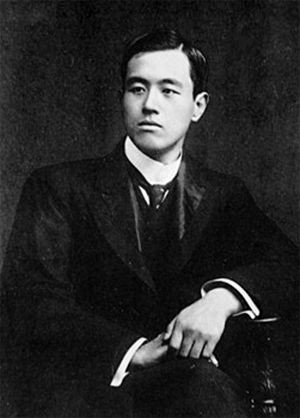
Inoue Enryo
Inoue Enryo (1858-1919), born the son of a Jodoshinshu priest, was ordained at an early age and received a Buddhist education. From 1878 until he graduated as a Bachelor of Arts in Philosophy from Tokyo Imperial University in 1885, his education was funded by the Higashi Honganji as part of its revival program for educating its most able priests. At Tokyo University Inoue studied under the young [url=http://survivorbb.rapeutation.com/viewtopic.php?f=60&t=3938&start=526]American professor Ernest Fenollosa[/url], who taught classes in the history of modern Western philosophy, specializing in Hegel and in Herbert Spencer’s theories of social development and evolutionary sociology.5 Such was the interest in Western philosophy among the Japanese elite at this time that Fenollosa was nicknamed daijin sensei (teacher of great men),6 a recognition that many who attended his classes already held positions of responsibility and others were later to become leaders of the nation. Through his study of philosophy Inoue came into contact with this influential elite, and from 1882 he actively worked to promote contact and understanding between Buddhist and secular intellectuals.
Inoue’s period at Tokyo Imperial University coincided with indications of a growing interest in Buddhism among intellectuals. In 1881, Fukuzawa Yukichi, one of the foremost popularizers of Western studies, declared his support for Buddhism and called upon “priests who were amenable to reason” to defend their religion.7 Two years earlier Fukuzawa’s colleague in the Meirokusha (Meiji 6 society, formed to promote Western learning), Kato Hiroyuki, then president of Tokyo University, had appointed Soto Zen priest Hara Tanzan to lecture on Buddhism, thereby setting the precedent of teaching Buddhism as an academic subject within a secular institution, as a system of thought divorced from its ritual and practice. Buddhist philosophy was extracted from Japanese religion and placed in context with Western philosophy and science as a branch of knowledge. It was endowed with the prestige of university recognition.
Although Westernization continued strongly throughout the 1880s, the beginnings of a change of mood, a swing away from adulation of all things Western, at least among the elite, was evident from the early years of the decade. One sign of this was the immediate and generous response to Fenollosa’s plea in 1882 for the preservation of Japanese art. His speech, delivered to the aristocratic Ryuchikai, apparently crystallized an already existing sentiment. Fenollosa received both financial and official support that allowed him to access and catalog surviving collections and train Japanese to continue the work. The emperor showed his personal support by bestowing official court rank on Fenollosa and awarding him several imperial decorations, including the Order of the Sacred Mirror. By 1886 this promotion of Japanese heritage had been officially sanctioned.8
One of the consequences of this revival was the establishment of the Tokyo Fine Art Academy under the direction of Okakura Kakuzo.9 The art this institute promoted was not the result of a nostalgic revival of the past, but a modern application of long-established Japanese expertise. Traditional styles were studied for their universal principles, and the techniques of past eras were applied to make objects suited to contemporary lifestyles. The revival of art, like that of Buddhism, exemplified the Seikyosha ideal of adapting aspects of Japanese heritage to enhance the modern nation. The movement to revive Japanese art indicated both the changed attitude to Westernization and also the functional value of Western authority in validating and promoting the project. Fenollosa led the campaign testifying to the universal value of Japanese art from the perspective of, and in the vocabulary of, Western aesthetics. Invoking the authority and prestige of Western philosophy and his own academic rank as philosopher was the nearest approximation to this voice of Western authority available to Inoue in his revival of Japanese Buddhism.
Inoue the Philosopher
Inoue had established his identity as a philosopher not only through scholarship but also through his activities at university. The Tetsugakkai, the Philosophy Society (1884), developed out a society Inoue formed in 1882 for the study of Kant, Hegel, and Comte, bringing together progressive leaders of both the Buddhist and secular worlds. Core members of this society included Buddhist reform leaders familiar from the previous chapter (Ouchi Seiran, Shimaji Mokurai, Hara Tanzan, Kitabatake Doryu, Kiyozawa Manshi) and other such prominent Meiji intellectuals as Inoue Tetsujiro, Shiga Shigetaka, Miyake Setsurei, Tanabashi Ichiro, and Kato Hiroyuki. A number of these people would later become prominent in the Seikyosha.10 In 1886 the group began publishing a journal, Tetsugaku zasshi (Philosophy magazine), and in 1887 founded the publishing company Tetsugaku shoin (Philosophy Press). This same year Inoue founded his school of philosophy, the Tetsugakkan (later to become Toyo University), teaching Western philosophy but also Chinese and Japanese thought, resuscitating the “pale shadow of Eastern philosophy.”11 In 1889 Inoue traveled to Europe and America to investigate means of teaching Eastern thought there.12 Inoue diligently cultivated his image as philosopher through this constant repetition of the term in his activities.
Inoue made the decisive statement in 1885 when he gave up his Buddhist robes and distanced himself from institutional Buddhism. This in no way diminished his effort to propagate Buddhism, but from this time he worked as an independent citizen. He thereby became an example of the ideal he espoused in Bukkyo katsuron joron, the educated layman committed to Buddhism as a personal philosophical religion, studying Buddhism in the intellectual pursuit of truth and reviving Buddhism to preserve this truth and defend the nation. He worked without the restrictions of a conservative institutional bureaucracy,13 free to emphasize the nonsectarian aspects of shin bukkyo and to criticize the existing state of Buddhism. The greatest advantage, however, was the authority and objectivity of the title “philosopher.” The author’s preface to Bukkyo katsuron joron explained that as a philosopher his discussion of Buddhism was essentially different from that of a priest. The title allowed him to proclaim that his preference for Buddhism and rejection of Christianity was not based on prejudice but on a rational consideration of the issues. He would “judge on the basis of philosophy which is just and takes no sides.”14 This in no way moderated his criticism. Part 2 of Bukkyo katsuron was entirely devoted to denouncing the “evil religion.” But by denouncing it from the supposedly impartial stance of philosopher, Inoue enlisted the support of an audience beyond Buddhists. He did not simply dismiss it as evil but analyzed it as irrational, conceptually untenable, prescientific, deleterious to Japan.15 By taking the title “philosopher” Inoue was able to promote Buddhism and undermine Christian influence from a pedestal of rationality and objectivity. His arguments were made more palatable, he believed, “because my discussion of Buddhism is based on the impartial judgements of philosophy it is essentially different from the explanations of priests in the world.”16
Hosui, the Paradigmatic Meiji Intellectual
Inoue wrote Bukkyo katsuron joron under the pen name Hosui and opened with an account of his search for truth, which positioned Hosui, the autobiographical subject, as the paradigmatic Meiji intellectual.17 He recalled how, prior to the Restoration of 1868, he, like the nation in general, had followed Buddhism as a matter of course with little knowledge of its doctrines and little commitment, “secretly believ[ing] that there was no truth in Buddhism,” and had seized the opportunity offered by the incoming government’s attack on Buddhism (haibutsu kishaku) to “put aside his clerical robes” and seek truth elsewhere.18 Hosui described how he then turned to Confucianism and even Christianity but this brought him nothing more than the conviction that all the traditional religions were inadequate. Hosui, like so many of the Meiji generation, rejected religion because, as he perceived it then, it was not “in accord with the principles of truth.” He was still at the vanguard of intellectual trends in 1873 when he took up Western learning – 1873 was Meiji 6, the year of the formation of the Meirokusha, the society for the promotion of Western learning – and again in the early 1880s when he rejected religion altogether and came to the conclusion that “[t]he truth that I had been struggling for for over ten years was not in Confucianism or Buddhism, nor was it in Christianity; it could only be found in the philosophy that was being taught in the West.”
Unlike others who had followed this path, however, Hosui did not rest here. He turned again to Japanese Buddhism and, with his mind sharpened by his training in philosophy, was finally able to see and understand the truth he had previously failed to notice. “Having discovered the truth within the world of philosophy, when I made one more review of the various religions of the past, it became increasingly clear that the truth is not within Christianity. It was also easy to prove that the truth is not within Confucianism. Only the Buddhist religion is largely in accord with philosophical principles. Then I reviewed the Buddhist scriptures again, and gradually came to know the truth of their theories; I was overjoyed. Who would have thought that the truth that was the product of thousands of years of study in Europe already existed three thousand years ago in the East.”19
The year of this revelation was 1885, the year of Inoue’s graduation, three years after Fukuzawa’s call for the protection of Buddhism, and the year that Ernest Fenollosa, Inoue’s professor of philosophy at Tokyo University, took Buddhist ordination. Whether this is purely coincidental, Fenollosa’s commitment to Tendai, which he described as offering “all the color and texture that Hegel lacked,” would have reinforced Inoue’s confidence in the appeal of Buddhist philosophy to modern Western intellectuals.20 Bukkyo katsuron joron, the record of Inoue’s discovery of the preeminence of Buddhism, was published in 1887. Inoue’s timing coincided with growing reaction against excessive Westernization, and Hosui’s search for the truth mapped the path for patriotic Meiji intellectuals. Inoue vowed to “reform Buddhism and make it a religion for the enlightened world.”
The realization of the preeminence of Buddhist truth was the cornerstone of Inoue’s project. Buddhism alone was in accord with the teachings of modern philosophy and with modern scientific principles. Inoue argued that the Buddha’s highest teaching, the truth of the Middle Way, existed only in Japan because it had died out in India and China. Consequently Japanese Buddhism is the sole source of the truth that Western philosophy has taken “thousands of years to study” to realize. More than this, Japanese Buddhism contains the truth that Western philosophy is only now approaching but does not yet possess. Inoue therefore believed that Western scholars would now welcome Japanese Buddhism and that Buddhism was the one great and unique contribution Japan could made to the modern world. Because of this Buddhism was a source of national pride and potential international prestige. Together these arguments formed his strategy for the revival of Buddhism by attracting support among the educated elite under the slogan gokoku airi, the defense of the nation through the love of truth.
Gokoku Airi
Gokoku airi united the fundamental sentiments of patriotism, intellectual reverence for the truth, and a Confucian sense of duty. The opening lines of Bukkyo katsuron joron asked, “[W]ho has been born that does not care about his country? Who has studied and does not love the truth?” It was the scholar’s patriotic duty to study became “when a nation has no scholarship it cannot progress”; it was his obligation to study because a scholar owed his existence to the nation. “When a scholar has no nation he cannot sustain his existence.” Because the nation must be independent to produce wisdom and scholarship, Japanese scholars had a duty to work for the preservation of Japan’s independence. Because scholars were also citizens and “it is a citizen’s duty to defend the nation …. it is the duty of scholars to carry out, at the same time, both the great principles of defense of the nation and love of the truth.”21
This apparently secular formulation was transformed into a revitalization of Buddhism by Inoue’s Buddhist definition of truth. His term, shinri no ri, was emphatically not restricted to a positivist, empiricist truth of Western philosophy, which was, in his view, “appropriate for experiential study of concrete objects but useless for the investigation of the intangible truth.”22 The truth for scholars to pursue was not the truth that forms “the basis of the branches of study and the arts … which are allowed to change along with the progress of the world.” It was rather “the unchanging and immutable truth,” “the truth that forms the basis of religion.” It was the truth that is the nature of Buddhism.23 “The underlying principle of the truth is not bounded by the world nor by the universe, and there is nothing in heaven or the cosmos to which it does not penetrate. It is truly ubiquitous, extensive, unfathomable and profound. It is truly without beginning, without end, immeasurable and innumerable. Therefore, to limit all ideas of it to this earth … is … the mistaken view of a scholar”24
The scholar was called upon to defend the nation through the study of Buddhist philosophy because this was the highest expression of truth. Inoue’s formulation of gokoku airi also linked patriotism with the more specifically Buddhist concern of reestablishing the relationship between Buddhism and the state, the concern that led Inoue and his colleagues to form the Sonno hobutsu daidodan (Great Society for Revering the Emperor and Worshiping the Buddha). The interdependence between a scholar and his nation that was basic to this scheme can be read as a reformulation of the traditional relationship between the religion and the state familiar in South and Southeast Asia as the reciprocally beneficial interdependence of the sangha (community of religious specialists) and the state: the security of the nation is essential for the sangha to pursue dharma, and the production of dharma is essential for the prosperity of the state. In Japan the concept was embodied in the expression obo-buppo, the inseparability of imperial law and the Buddha’s law. In Inoue’s scheme the sangha and its pursuit of dharma was replaced by the lay community pursuing philosophic truth. Because this truth was equated with Buddhist truth, the lay community was in effect to take on the duty of the sangha. Gokoku airi was a reformulation of Buddhist polity adapted to a modern democratic and secular state, a polity based on the interdependence of the scholar and the nation rather than of the state and the community of religious specialists.
Deploying Western Philosophy
The study of Western philosophy was not excluded by gokoku airi but seen as essential, if preliminary, training. As Hosui, the authorial subject of Bukkyo katsuron joron confessed, he had initially failed to recognize the truth in Buddhism because “my scholarly abilities were meager then and I was incapable of making that discovery”25 He was only able to recognize the truth that had always existed in Buddhism after the study of Western philosophy had increased his intellectual capability. For Inoue, Western philosophy, unlike Christianity, was a source of truth, but its truth was not as complete or profound as the truth of Japanese Buddhism. It occupied a position similar to the preliminary teachings of the Buddha (hoben), the teachings that provided the mental development that is a necessary prerequisite to understanding the more profound truth.26 Inoue left no doubt that Buddhist thought surpassed Western philosophy. “The only thing in which present day Western philosophy excels is providing theories as a foundation of scientific experimentaion.”27 Proving this was one function of the survey of Western thought and its comparison with the various teachings of the Buddha which constitute the body of the work.28
In Bukkyo katuson joron Inoue summarized the history of Western philosophy, showing how it developed through the dialectical resolution of oppositions. Locke’s empiricism, followed by Leibnitz’s naturalism, had been integrated by Kant; the materialism of Hume and the idealism of Burke had produced Reid’s dualism; Fichte’s subjectivity and Schelling’s objectivity had been harmonized by Hegel’s idealism. Post-Kantian German Idealism and Scottish common sense were reconciled by the Frenchman Cousins. Spencer reconciled intellectual and nonintellectual extremes. Inoue’s point was that the development was not yet complete: “[A]ll these theories contain some sort of excess which would in turn require resolution. Although the scholars have striven to maintain impartiality they have not been able to do so.” The teaching of Sakyamuni, on the other hand, embraced and reconciled these oppositions in the teaching of the Middle Way. “Unlike modern philosophers, Sakyamuni lived three thousand years ago, and yet was aware of the dangers of leaning toward extremes.”29 Because it resolved this excess, the Middle Way is greater than any Western philosophy, “unparalleled in all the world and throughout the ages.”30 The point of the survey of Western philosophy was to prove Buddhist superiority. The various sects of Buddhism contained all the knowledge of Western philosophy, but Western philosophy had not yet reached the stage of evolution of Japanese Mahayana.
Inoue validated this claim by conditionally identifying each of the theories of Western philosophy with the teaching of sects within Buddhism. This “identification” of Western philosophy and Buddhism is exemplified by his discussion of the Hinayana sect, Kusha. Inoue began by equating Kusha with Western materialism on the grounds that it is also based on the constant existence of elements of matter. These are the Five Aggregates (goun in Japanese; panca skandha in Sanskrit), which Inoue explained at some length.31 The explanation then led to the qualification that Kusha was essentially different from materialism because among these five Buddhist elements, only one was matter in the Western sense of the word. The other four were perception, conception, volition, and consciousness, which are classified in the West as mind. Hence, Inoue concluded, Kusha differed widely from materialism. “Seen in this light, it [Kusha] is a philosophical theory of dualism.”32 In the space of a few paragraphs he had overturned his original equation, but the tentative identification had served its purpose by providing an opportunity to expound Buddhist doctrine. He had introduced the reader to a fundamental Buddhist concept. By a similarly qualified and partial identification of the Buddhist concept of “storehouse consciousness” (Japanese araya shiki, Sanskrit alaya vijnana) with the absolute subjectivity of Kant and Fichte, Inoue equated the Hosso sect with Western idealism, and the Tendai concept of ri with Hegel’s absolute reason.
Inoue’s scheme was to present Buddhist thought as both encompassing all of Western philosophy and, following the dialectical pattern of the West, having preceded it to its final development. Unlike Western philosophy, however, Buddhist teaching did not gradually evolve through the trials and error of men. It had all been taught by the Buddha Sakyamuni during his lifetime. According to the Tendai doctrine of goji (Five Periods) the apparently diverse sects of Buddhism are related as graded and partial revelations of the one truth of the Mahayana Middle Way.
The Buddha’s teachings are divided into five periods. In the first, immediately after his Awakening, the Buddha revealed the Middle Way of the Avatamsaka Sutra.33 However, he realized that this was beyond the comprehension of those in his audience. “They simply could not hear what was being explained to them” because they were “clinging to the belief in the distinction of self and non-self.”34 So he then explained the superficial doctrines of the Hinayana, “simply explaining the vanity of believing in the self.” This accomplished, he was then able to teach the Vaipulya sutras and then, by these degrees of the truth adapted to the audience’s ability to comprehend, to progress toward the Mahayana sutras. The message was that the Mahayana teaching of the Middle Way had been his original teaching, his last teaching, and the only complete teaching of his truth. The other teachings were expedients. As such, they were not false but incomplete. They were stepping-stones to the truth. The Middle Way of Japanese Tendai Buddhism was, Inoue explained, a more perfect expression of the conclusions reached thousands of years later by Hegel. By this scheme Inoue not only established Sakyamuni’s priority over Hegel but also answered the charge that the Mahayana was not the Buddha’s teaching.
Throughout the argument, Inoue’s identification of Buddhist concepts with Western philosophical terms was always qualified and, as in the claim of the identity of the teachings of Hegel and Tendai, was always drawn from isolated examples, the coincidence of isolated principles rather than of coherent systems. Nowhere does he give an explication of any Western philosophy. Western names and categories appear rather as signposts within an introductory explication of Buddhist thought – guides to familiarize the territory to his Western-educated audience. Inoue used the prestige of Western philosophy to draw attention to, create interest in, and then expound Japanese Buddhism.
Buddhism and Patriotism
The strong patriotic concern for the welfare and independence of the nation embodied in gokoku airi pervaded Bukkyo katsuron joron. The first step for scholars was to become better equipped to serve the nation through the study of philosophy.35 Next, Inoue called upon them to revive Buddhism because it was the highest form of philosophy. “The doctrines of Buddhism are truly unparalleled in the world and peerless throughout eternity. Should we not offer our strength for this truth? Should we not offer our hearts for the sake of this truth?”36 The intellectual passion for truth was to be justification enough for its preservation. There were, however, more explicitly patriotic reasons for reviving Buddhism, and in 1887, the time of the publication, treaty revision and its implications of Western imperialism were the focus of patriotic concern.
In Bukkyo katsuron joron Inoue introduced the basic Seikyosha premise that defense against Western imperialism depended on developing a strong national spirit. This would win the respect of foreign powers as well as assist in building a strong nation, one that was capable of making a distinctive contribution to international welfare and progress. It was only by maintaining a distinctive national identity that Japan could expect to deal with the world as an equal, and this was the basic aim of treaty revision.
Inoue challenged the belief that adopting Christianity would assist revision with a pragmatic statement of the reality of international relations. Japan’s present inability to establish relations of equality with Westerns was not because of any difference in religion or language but a matter of strength: “If a nation creates both financial solvency and strong military power, the people of that nation will have the necessary strength for instantly forming equal friendships with the West and revising unequal treaties, no matter what religion they are practicing.”37
The role of religion in strengthening the nation lay in its direct relationship with the spirit of man. The advantage of Buddhism was its long connection with Japanese culture. For more than a thousand years, he wrote, it had permeated the hearts and minds of the Japanese. Adopting Christianity would harm the spirit of the country and forfeit the independence of Japan. Progress, he continued, depended on maintaining a balance between heredity and adaptation. Therefore, adapting Japanese Buddhism to modern requirements would be more conducive to progress than following the early Meiji trend of adopting the completely foreign Christianity. “To unseat Buddhism and replace it with Christianity would surely have a negative influence on the spirit of independence.” It would result in “the loss of Japan’s inherited nature, and would unquestionably impair its development”38 He simply could not explain “why anyone believes that by abandoning Buddhism and accepting Christianity we will be obtaining a more satisfactory means for establishing international relations, promoting a national constitution, or realizing the goal of treaty revision”39
The intimate connection between religion and the spirit of man was also an argument against conversion to assist modernization. Because “the West has a nature peculiar to the West,” there was no reason to believe that any benefits that Christianity did bestow on the West would be transferred to Japan.40 Inoue also confronted the assumed association between Western progress and Christianity, arguing that, even within the West, Christianity obstructed progress, it “oppressed men’s spirits and impeded the development of scholarship.”41 Western progress has been achieved in spite of Christianity. Nevertheless, he observed, in Japan Christianity had attracted young men of talent. In a passage of Bukkyo katsuron joron that may well have been addressed to the Doshisha Christians, typical of the talented and ambitious men who converted to Christianity, Inoue wrote: “It is said that the talented men, who should have ambitions for the future, are converted early in life to Christianity …. When I hear about this, I am deeply grieved…. If they have the intention of loving the country how can they not promote their country’s traditional religion? If they know that the clergy’s ignorance and lack of intelligence make it unfit to map out the revival of Buddhism, why do they not plan for the revival of the religion without the clergy?”42
A Secular Sangha
The question Inoue posed was particularly pertinent because these converts rejected all traditional religion equally. The Christianity they had originally adopted was a liberal theology, elaborated upon by their own reading of contemporary criticism. By the late 1880s, the time of Inoue’s publication, they had distanced themselves from missionaries and were developing their own rationalized, demythologized interpretation of the Christian doctrine. Why, Inoue suggested, invoking the reform ideal of koji Buddhism, did they not carry out a similar exercise on Japanese religion? Why not redirect their considerable intellectual effort to making the Japanese religion meet their ideals rather than the foreign one?
Inoue did not attempt to deny that Buddhism as it could be observed in contemporary Japan was in a degraded state and in dire need of reform. Rather, in the mode of all rhetoricians attempting to stir outrage and action, the picture he painted was exaggerated. “Present-day Buddhism is practiced among foolish laymen, it is handed down by foolish clergy, and it is full of depravities; in short it is not free of becoming a barbaric doctrine.”43 This was “nothing intrinsic to Buddhism”; Buddhism simply reflected the “corrupt customs of society.”44 Inoue’s own efforts to effect change included promoting Buddhist philanthropy and campaigning against non-Buddhist superstition, folk belief in ghosts and the supernatural.45
Another passage of Bukkyo katsuron joron that might have been directed at the Doshisha converts confronted the belief of the Min’yusha (Friends of the Nation) that social evolution justified their assiduous Westernization. As they saw it, because social evolution was universally applicable, all societies must pass through the same stages. Therefore, for Japan to outstrip the West it must therefore follow the same path. They believed Japan would be able to overtake the West because of the superiority of the Japanese spirit. Inoue recognized that the intention of “our countrymen in accepting the West and studying English and German is not to make Japan an imitator and follower of other countries, but to make it a competitor and rival that will someday surpass the West.”46 Nevertheless, he warned, Japan would never overtake the West by following in its footsteps, or by discarding its strong points and adopting the shortcomings of the West. This could only be achieved by building a strong national identity, which, as he had already argued, depended on reviving and preserving Buddhism. Buddhism, in spite of its present state, was one of the strengths of Japan. In an argument that paralleled that of his Seikyosha colleague Shiga Shigetaka, Inoue argued that imitation was poor political strategy. It would lead the West to despise the Japanese as lacking energy, strength, and an independent spirit. Imitation was the behavior of slaves and flatterers: “[T]hey may regard us as a vassal state … but never, by any stretch of the imagination, look upon us as equals”47 In the Nihonjin a year later he would be even more explicit. “The best way Japanese can be made Japanese and Japan can remain independent was to preserve and propagate Buddhism.”48
Buddhism and International Prestige
Inoue believed in the necessity of projecting Japanese achievement in indigenous terms, not as an imitation of the West. For him Buddhism was the means by which Japan could gain the respect of the world and contribute to international welfare. Buddhism is Japan’s “special product”, its “strong point,” a source of national identity and international recognition and prestige. The proposal carried the nationalistic appeal of Japanese superiority and offered hope for the practical result of gaining recognition as a “civilized” nation and thereby effecting treaty revision. On top of all this, Inoue offered the altruistic appeal of contributing to the benefit of the world as a whole.
First, he argued Japan’s responsibility to Asia. Buddhism is the basis of Eastern civilization and has greatly influenced its scholarship, language, customs, and even the sentiments of its people.49 However, “the good strain” of Buddhism, the Mahayana, had died out elsewhere; it was virtually extinct in its country of origin and the little that did remain “is only the shallow doctrine of the Hinayana.”50 Japan, therefore, as the sole repository of the Buddha’s highest teaching, had a particular duty to preserve and propagate it. “Only in our country, Japan, do we have these sacred sects and texts, as well as people who know the profundities of the one vehicle [Mahayana]. If this is not maintained in Japan today, and if the people leave, the writings perish, and the sects are destroyed, in what land will Buddhism rise again? This is why the support of Buddhism is our most pressing urgent need today.”51
Inoue did not miss the opportunity to suggest that the survival of the Mahayana teachings in Japan was also evidence of the racial superiority of the Japanese. Mahayana Buddhism had died out elsewhere because of the deterioration of the races. His botanical metaphor of the “strains” of a plant emphasized that, though deriving from a common ancestral seed, the Mahayana Buddhism of India and China was not the same as the Mahayana Buddhism of Japan. The “good strain” was “the special product of the country that nurtured it.” There was, however, “absolutely no reason why it cannot be transplanted to other lands.”52
The next step was a pragmatic recognition of the superiority of Western achievement: that there was very little that Japan could produce that was not already available in the West, that the West was also ahead in its social and public institutions, the model for “government, law, the military system, education, the physical sciences and technology.” The one advantage that Japan had, he argued, was religion, and because “this fine product of ours excels those of other countries”53 it was “the one thing that Japan might transmit to foreign countries and thereby win fame.”54
Inoue then appealed to the sense of duty of his Confucian-educated readers. Just as it is the duty of Japan’s farmers to make agriculture flourish and to export food to foreign countries, and the duty of merchants to increase trade and to compete with the foreigners, it is the scholars’ duty to their country to make learning and religion prosper and to propagate them abroad.55 He assured his readers that the West would welcome Japanese Buddhism. “Western scholars have come to hate Christianity bitterly, and day and night, they are eagerly looking for a religion based upon philosophy.”56 Japanese Buddhism offered the evolutionary completion of Western philosophy, as well as philosophical Buddhism, a religion that accommodated the spiritual needs of the modern world. As a religion based on philosophical truth, far from being in conflict with philosophy as Christianity appeared to be, if offered an introduction to it. The fact that Western scholars studied Buddhism indicated an existing interest in Buddhism in the West, but this interest was not as great as it could be because the West only had very limited and biased access to its truth. Their scholars only investigated the Hinayana, “the most shallow of all Buddhism,” and Western understanding was further hindered by the fact that “the books about Buddhism sent to the West were all written by Christians.”57 Inoue’s message was clear. If the West was to realize the worth of Japanese Buddhism, able Japanese scholars must present it to them.
Fundamental to the whole argument was the evolutionary imperative for competition between species. Not only was Buddhism the most perfect expression of the truth that the Western world had been seeking for centuries, but it would provide the competition with Christianity that was essential if the West was to reach its full evolutionary development. The progress of man depended on competition between different cultures. Japan had a mission – a moral obligation – to develop its distinctive national characteristics to advance world civilization. History demonstrated the need for diversity. The prosperity of the West was a consequence of “competition among all the branches of learning and the arts,” but “when any kind of scholarship or religion is implemented as the sole ideology of that nation, progress is impeded.”58 The West had no religion except Christianity, which carried the additional burden of being “often guilty of obstructing the development of science and philosophy.” Introducing Buddhism would provide the competition essential to stimulate progress without which Christian civilization could not reach its full potential. “This is one more reason why the promotion of Buddhism in Japan is one of the most pressing needs of the day.”59
Though this may seem a particularly beneficent concern, Inoue, like Hirai at the World’s Parliament of Religions, believed that Christianity at its full development – when it had overcome its reliance on myth, mental props such as its concept of Deity, and unscientific doctrines – would not be different from Mahayana Buddhism. It was an expression of generosity not unlike that of the Christian missionaries who came to the East “not to destroy but to fulfill.” Summarizing his argument for the revitalization of Buddhism, Inoue concluded rhetorically, “[I]s it not Buddhism alone that can make our country’s scholarship independent in the East, and supersede that of the West? Is it not Buddhism alone that will make our country’s doctrines overwhelm the world and swallow the globe? Is it not Buddhism alone that can make Japan’s prestige shine throughout the world, and make Japan’s fame resound throughout eternity? Should we not defend this teaching for the sake of the nation? Should we not love this religion for the sake of truth?”60
Taking Buddhism to the West
Whether in response to Inoue’s plea or not, toward the end of the 1880s Japanese Buddhists, led by the Honganji institutions (both Nishi Honganji and Higashi Honganji), developed international contacts. Although there had been contact from earlier times the initiative was formalized with the founding of the Society for Communication with Western Buddhists (Obei bukkyo tsushinkai) [later reorganized as the Buddhist Propagation Society (Kaigai Senkyo Kai, literally Overseas Missionary Society), under the leadership of Akamatsu Renjo] in 1887 under the leadership of Akamatsu Renjo. Akamatsu, an associate of Inoue, had been one of the first Buddhists to travel to Europe and the first to write on Japanese Buddhism in English. A branch office was opened in London in 1890, and a journal, Bijou of Asia, was published.61 The arguments of Bukkyo katsuron joron explain the essential connection between the propagation of Buddhism overseas and the contest of religions within Meiji Japan. It was at least as much a strategy in the discourse determining the religious future of Japan as a missionary drive for expansion. In this context the invitation to the World’s Parliament of Religions was an outstanding opportunity. The Parliament provided a chance to speak directly to a select audience of religious specialists, to introduce them to Japanese Mahayana, and, moreover, offered the opportunity, through the publication of the proceedings, for the reform representation of Buddhism to enter into Western discourse.
Conclusion
The apparent paradox in Inoue Enryo’s career is that he broke his formal ties with Buddhism in order to promote it. Such was the authority of the West in Japan in the 1880s that even in a time of reaction against excessive Westernization, a time when many Japanese were looking to their indigenous heritage in search of a distinctive national identity, Japanese Buddhism had to be validated in the international currency of Western standards. To do this, Inoue adopted the title of philosopher – a distinctively Western title at that time – and, with it, the claim to speak on behalf of Buddhism with the voice of unbiased reason.
He used this claim to rational, objective authority to establish the superiority of Buddhist thought by comparison with the standards of universal reason. He used Western philosophical theory to present an analysis of Buddhism. He used the names of Western philosophy to attract the attention of the Western-educated elite and the terms of Western philosophy to signpost the less familiar concepts of Buddhist teaching. But Inoue’s identity as a philosopher offered more than this. Just as Fenollosa’s authority on Western art and aesthetics had been crucial in launching the revival of Japanese art, Inoue’s credentials in Western philosophy validated his promotion of Japanese Buddhism. This recourse to Western authority was also a factor in taking Japanese Buddhism to Chicago. Acceptance of Japanese Buddhism in the international, Western, and Christian event – or at least the appearance of acceptance – validated the revivalist project. However, regardless of the importance of Western philosophy in Inoue’s work, there is no question that what he taught in Bukkyo katsuron joron was Buddhism. I suggest that Inoue’s use of Western philosophy is best understood as a deployment of Western authority. What was important in this exercise was the authority that Western philosophy commanded among Inoue’s target audience. The term “deployment” points to a strategic purpose – in this case, Inoue’s related projects of recreating a role for Buddhism in modern Japanese society and establishing a relationship between Buddhism and the new Japanese state.
_______________
Notes:
I. BKJ (Introduction to revitalizing Buddhism).
2. The character for tetsu had been used in Chinese in association with Confucian thought.
3. Japan Weekly Mail, March 1893.
4. This is not surprising considering Inoue's association with delegate Ashitsu Jitsuzen in the formation of the Sonno hobutsu daidodan and the Seikyosha, and the number of Inoue's close associates and colleagues in Buddhist revival who were signatories to the document.
5. Chisolm, Fenollosa, 42.
6. Fenollosa, Epochs of Chinese and Japanese Art, 1:xiv.
7. Fukuzawa Yukichi, Chrysanthemum (October 1881): 393, translated by Walter Dening.
8. Chisolm, Fenollosa, 50, describes the Ryuchikai incident. The introductory essay by Mary Fenollosa in Fenollosa, Epochs of Chinese and Japanese Art, xviii, lists his imperial honors.
9. The institute, under Okakura's direction, was responsible for the Hooden, the Japanese Pavilion at the Chicago Exposition.
10. Staggs, "Defend the Nation," 258. Shimaji Mokurai and Ouchi Seiran should need no further introduction. Kitabatake Doryu was a Honganji priest recently returned from study overseas, the first Japanese to visit Bodhgaya. Kiyozawa was also a Honganji student studying philosophy and later wrote on Hegel and Buddhism. His Hegelian-inspired lectures on Buddhism were circulated at the Parliament as the book Outlines of the Mahayiina. He was to become the founding president of Otani University. Inoue Tetsujiro studied philosophy in Europe. Miyake, Tanabashi, and Shiga were major Seikyosha spokesmen. Shiga was the editor of their journal Nihonjin.
11. Tsunemitsu, Meiji no bukkyosha, 174.
12. Staggs, "Defend the Nation," 154.
13. Although reform was supported at the highest levels the conservative opposition should not be underestimated. It is apparent in the refusal to endorse officially the delegation to Chicago, and in the absence of Honganji priests in the delegation in spite of the fact that invitations were originally extended to Nanjo, Shimaji, and Akamatsu as the Buddhists most well known overseas. See also Murakami Sensho's resignation from the Honganji over the controversy of his history of Buddhism. Ibid., 295-96. Kiyozawa Manshi mentions the factions in the Honganji, Inoue's institution. See Haneda, December Fan.
14. BKJ, 350 and 360. Part 2 of Bukkyo katsuron was entitled "Destroying Evil."
15. Staggs, "Defend the Nation," 154. The ploy apparently worked. Thelle, Buddhism and Christianity inJapan, 100-101, is generous in his praises for Inoue's rational approach. Inoue's earliest publications were anti-Christian: Haja shmron (A new refutation of Christianity) (1885); Shinri kishin (The guiding principle of Truth) (1886-87). Volumes 1 and 2 were a "point by point refutation of what Inoue deemed the erroneous and irrational tenets of Christianity." Staggs, "In Defence of Japanese Buddhism," 191-202. Inoue's publishing house, Tetsugaku shoin, published numerous anti-Christian works through the 1890s. Inoue warned, however, against taking Christianity too lightly. "It is much more profound than would be indicated by the foolish chattering of the missionaries we hear" (190).
16. BKJ, 350.
17. BKJ, 362-64.
18. In reality, Inoue (1858-1919) would have been only ten years old at this time and, contrary to the implication of this "autobiography," remained a priest until 1885.
19. BKJ, 363-64.
20. Chisolm, Fenollosa, 131. Inoue's Buddhist philosophy was based on Tendai teachings.
21. BKJ, 334-35.
22. BKJ, 397.
23. BKJ, 351 and 361.
24. BKJ, 358-59.
25. BKJ, 364.
26. The Buddhist term hoben (Sanskrit: upaya) refers to provisional truth used as a means of leading beings to greater understanding. It relates to the Buddha's skill in teaching according to the ability of the audience to comprehend. See the subsequent account of the Five Periods of the Buddha's teachings.
27. BKJ, 397.
28. BKJ, 397-98. Staggs's thesis provides a detailed analysis of this, "In Defence of Japanese Buddhism," 248-72.
29. BKJ, 398.
30. BKJ, 398-99·
31. BKJ, 399. See Inagaki, A Dictionary of Japanese Buddhist Terms, 83, for a definition of goun.
32. BKJ, 402.
33. Japanese Kegonkyo. This is a Mahayana sutra. For Inoue's account of this, see BKJ, 426- 28. The five periods are Kegonji, when Sakyamuni taught the Avatamsaka-sutra; the Agonji, when he taught the Agama-sutras; the Hodoji, when he taught the Vaipulya-sutras; the Hannyaji, when he taught the Prajnaparamita-sutras; and Hokeji or nehanji, when he taught the Saddharma-pundarika-sutra and Mahaparinirvana-sutra. The periods take their names from the Japanese names of the sutras.
34. BKJ, 427.
35. BKJ, 354; Staggs, "Defend the Nation," 274 n. 69.
36. BKJ, 365.
37. BKJ, 377.
38. BKI, 368.
39. BKJ, 377.
40. BKJ, 374.
41. BKJ, 375.
42. BKJ, 386.
43. BKJ, 351.
44. BKJ, 378.
45. Staggs, "Defend the Nation," 226-28.
46. BKJ, 370.
47. Shiga Shigetaka (1863-1927) published his Nanyo jiji (Conditions in the South Seas) in 1887, the same year as BKJ. His voyages in Australia and New Zealand, among other places, had convinced him of the danger of "naive and weak-willed association with Westerners and their culture." Pyle, The New Generation in Meiji Japan, 56-58.
48. Inoue Enryo, Nihonjin 1 (April 1888).
49. BKJ, 368.
50. BKJ, 365.
51. BKJ, 365-66.
52. BKJ, 366.
53. BKJ, 370-71.
54. BKJ, 366.
55. BKJ, 371.
56. BKJ, 366.
57. BKJ, 366-67·
58. BKJ, 372.
59. Ibid.
60. BKJ, 372-73.
61. Thelle, Buddhism and Christianity in Japan, 110.