
by Wikipedia
Accessed: 1/6/20
NOTICE: THIS WORK MAY BE PROTECTED BY COPYRIGHT
YOU ARE REQUIRED TO READ THE COPYRIGHT NOTICE AT THIS LINK BEFORE YOU READ THE FOLLOWING WORK, THAT IS AVAILABLE SOLELY FOR PRIVATE STUDY, SCHOLARSHIP OR RESEARCH PURSUANT TO 17 U.S.C. SECTION 107 AND 108. IN THE EVENT THAT THE LIBRARY DETERMINES THAT UNLAWFUL COPYING OF THIS WORK HAS OCCURRED, THE LIBRARY HAS THE RIGHT TO BLOCK THE I.P. ADDRESS AT WHICH THE UNLAWFUL COPYING APPEARED TO HAVE OCCURRED. THANK YOU FOR RESPECTING THE RIGHTS OF COPYRIGHT OWNERS.
There were three main social groups in Tibet prior to 1959, namely ordinary laypeople (mi ser in Tibetan), lay nobility (sger pa), and monks.[1] The ordinary layperson could be further classified as a peasant farmer (shing-pa) or nomadic pastoralist (trokpa).
The Tsang (17th century) and Dalai Lama (Ganden Podrang) law codes distinguished three social divisions: high, medium and low, each in turn was divided into three classes, to give nine classes in all. Social status was a formal classification, mostly hereditary and had legal consequences: for example the compensation to be paid for the killing of a member of these classes varied from 5 (for the lowest) to 200 'sung' for the second highest, the members of the noble families.
Nobles, government officials and monks of pure conduct were in the high division, only - probably - the Dalai Lama was in the very highest class. The middle division contained a large portion of the population and ranged from minor government officials, to taxpayer and landholding peasants, to landless peasants. Movement between classes was possible in the middle division.[2] The lower division contained ragyabpa ('untouchables') of different types: e.g. blacksmiths and butchers. The very lowest class contained executioners, and (in the Tsang code) bachelors and hermaphrodites.[3]
The exports to Nepāl comprise wool, yak-tails, salt, saltpetre, woollen goods and a few other articles. To the districts lying to the north-east of Tibet, that is to the north-western parts of China and Mongolia, go various kinds of woollen goods; Buddhist books also go largely to Mongolia, as do also Buddhist images, pictures and various paraphernalia. These, considered as objects of art, are worthless, though formerly Tibet produced images and pictures of high artistic standard. The contrast between old and new images and pictures, both of which are to be seen in most temples in Tibet, is sufficiently glaring, for the latter are as a rule clumsy performances, offensive to the taste and also to the sense of decency, being invariably bi-sexual representations of men and women with one common body. I was once struck with the notion that the Tibetans are characterised by four serious defects, these being: filthiness, superstition, unnatural customs (such as polyandry), and unnatural art. I should be sorely perplexed if I were asked to name their redeeming points; but if I had to do so, I should mention first of all the fine climate in the vicinity of Lhasa and Shigatze, their sonorous and refreshing voices in reading the Text, the animated style of their catechisms, and their ancient art.
Three Years in Tibet, by Shramana Ekai Kawaguchi
Anthropologists have presented different taxonomies for the middle social division, in part because they studied specific regions of Tibet and the terms were not universal.[4][5][6][7] Both Melvyn Goldstein and Geoff Childs however classified the population into three main types:[8][9]
• taxpayer families (tre-ba[8] or khral-pa[4][9])
• householders (du-jong[8] or dud-chung-ba[4][9])
• landless peasants (mi-bo[8])
In the middle group, the taxpaying families could be quite wealthy.[10] Depending upon the district, each category had different responsibilities in terms of tax and labor.[11] Membership to each of these classes was primarily hereditary; the linkage between subjects and their estate and overlord was similarly transmitted through parallel descent. The taxpayer class, although numerically smallest among the three subclasses, occupied a superior position in terms of political and economic status.
The question of whether serfdom prevailed in traditional Tibetan society is controversial; Heidi Fjeld [no] argues for a moderate position, recognizing that serfdom existed but was not universal in U-Tsang; a better description of the traditional Tibetan social class system, at least in Central Tibet, would be a caste system, rather than a comparison to European feudalism.
The Higher Division
The highest of the high class was empty, or only contained possibly the Dalai Lama[3]
The Nobility
The middle class of the high division - the highest attainable in practice - was headed by the hereditary nobility. Yabshi were thought to be descendants of the Dalai Lamas, depon were descendants of the ancient royal families, midak were on a slightly lower level.[12]
There were "a small group of about 30 higher status families" and "120 to 170 lower or 'common' aristocratic families".[13]
High Government and Monk Officials
High government officials were appointed from the aristocracy. Monk officials were usually drawn from Lhasa middle classes, the families of existing monk officials, or were the second sons of the aristocracy. They were usually monks in name only, one night spent in a monastery being sufficient to qualify as a monk for this purpose.[14]
The Middle Division
Taxpayer families
The treba (also tralpa or khral-pa) taxpayers lived in "corporate family units" that hereditarily owned estates leased from their district authority, complete with land titles. In Goldstein's review of the Gyantse district he found that a taxpayer family typically owned from 20 acres (81,000 m2) to 300 acres (1.2 km2) of land each. Their primary civil responsibility was to pay taxes (tre-ba and khral-pa means "taxpayer"), and to supply corvée services that included both human and animal labor to their district authority.[9] They had a comfortable standard of living. They also frequently practiced polyandry in marriage and other practices to maintain a single marriage per generation and avoid parceling land holdings.
Householders
The householder class (du-jung, dud-chung-ba[9] duiqoin, duiqion, düchung, dudchhung, duigoin or dujung) comprised peasants who held only small plots of land that were legally and literally "individual" possessions. This was different from the taxpayer families who owned land as a familial corporation. Land inheritance rules for the householders were quite different from taxpayer family rules, in that there was no certainty as to whether a plot of land would be inherited by his son. The district authority — either governmental, monastic, or aristocratic — was the ultimate landowner and decided inheritance. Compared to the taxpayer families the householders, however, had lighter tax obligations and only human labor corvée obligations to their district authorities. These obligations, unlike the taxpayer family obligations, fell only on the individual and not on his family.
Human lease peasants
Human lease peasants (mi-bo) did not have heritable rights to land. They were still obligated to their 'owning' estate under their status as mi-ser. In contrast with the taxpayer families and householders, they had the freedom to go wherever they wanted and could engage in trade or crafts.[15] When farming, they might lease land from taxpayer families and as payment take on work for those families. Like the householders the landless peasants also used resources in their own individual capacity which were non-heritable.
The relative freedom of the mi-bo status was usually purchased by an annual fee to the estate to which the mi-bo belonged. The fee could be raised if the mi-bo prospered, and the lord could still exact special corvée labor, e.g. for a special event.
The status could be revoked at the will of the estate owner. The offspring of the mi-bo did not automatically inherit the status of 'mi-bo', they did inherit the status of 'mi-ser', and could be indentured to service in their earlier teens, or would have to pay their own mi-bo fee.[2]
The Lower Division
Ragyabpa - Untouchables
The ragyabpa or untouchable caste were the lowest level, and they performed the 'unclean' work. This included fishermen, butchers, executioners, corpse disposers, blacksmiths, goldsmiths and prostitutes. Ragyabpa were also divided into three divisions: for instance a goldsmith was in the highest untouchable class, and was not regarded as being as defiled as an executioner, who was in the lowest.
They were regarded as both polluted and polluting, membership of the caste was hereditary, and escape from the untouchable status was not possible.[16]
Nangzan - Household servants
According to Chinese government sources, Nangzan (also nangzen, nangzan, nangsen) were hereditary household servants comprising 5% of the population.[17][18]
Slavery
According to American sinologist A. Tom Grunfeld there were a few slaves in Tibet. Grunfeld quotes Sir Charles Bell, a British colonial official in the Chumbi Valley in the early 19th century and a Tibet scholar who wrote of slaves in the form of small children being stolen or bought from their parents, too poor to support them, to be brought up and kept or sold as slaves.[19] These children came mostly from south-eastern Tibet and the territories of the tribes that dwelt between Tibet and Assam.[20] Grunfeld omits Bell's elaboration that in 1905, there were "a dozen or two" of these, and that it was "a very mild form of slavery".[21]
SECTION 7.5: - IMAGE - THE MISSING PIECES
We have seen that issues which might reflect badly on the cadre, such as cash payments to influential Tibetans, did not emerge into the public knowledge. There was also a gap between what the cadre themselves knew or believed, and what they divulged, as we have seen with Neame's article, which avoided mentioning both the purpose and the results of his mission. This can also be seen clearly in two cases where Politicals posted to Gyantse formed views which differed significantly from the usual cadre perception. It is significant that neither officer remained in Tibet for more than a few months. They were not therefore, by my definition, accepted members of the Tibet cadre.
The recorded memories of 1933 Gyantse Agent Meredith Worth, suggest an image of Tibet closer to that presented by Communist Chinese sources than to that offered in British sources. Interviewed in 1980, Worth recalled thatMy memories are of many cheerful parties in the Fort and in the homes of wealthy families, the dominance and brutality of the Lamas and officials towards the serf population and the prevalence of venereal diseases....It was, therefore, for me a relief to read recently in Han Suyin's book "Lhasa, the Open City" [which promotes a polemically positive view of Communist rule in Tibet] that those conditions no longer exist.[20]
Paul Mainprice confided to his 1944 diary thatI have serious doubts whether Tibet is at all fit for independence and whether the present system of Government should be bolstered up. Would China in control of Tibet really be a very serious menace to India? As we don't seem to do much developing of Tibet, I question whether the Chinese would not be able to do it to our own mutual advantage. Of course the Tibetan aristocracy and officials would not like it, but the peasants preferred the Chinese regime in Eastern Tibet in the early years of this century. [21]
Neither Worth nor Mainprice appear to have expressed these views publicly during their imperial service. They were doubtless aware that views diametrically opposed to those of their superiors would be censored, and were unlikely to advance their careers. This must have acted as an incentive to self-censorship. As a result, the dominant image of Tibet was not affected by alternative views, even those of members of the Political Department.
The doubts which Mainprice expressed over British policy in Tibet do reflect a different perspective from that of other cadre officers. Mainprice 'was always concerned for the underdog'. He was one of the few imperial officers to gain good relations with the Mishmis during service in Assam, and his diaries record his later sympathy and support for the Muslim populace of Kashmir, which led to his being detained and expelled by the new Indian government.[22]
Mainprice's perspective indicates how the emphasis on relations with Tibet's ruling class resulted in a marginalisation of the voice of the majority of Tibetans, those outside ruling circles. Bell was aware that the peasants were often treated 'abominably' and even admitted in his first book that 'There is no doubt some foundation for the Amban's claim that the poorer classes in Tibet were in favour of China.' But Bell's policy of support for the existing Tibetan leadership meant that this perspective was not represented by the British. The condition of the lower classes was heavily criticised on occasion, Macdonald being particularly critical. But a positive image was maintained by attributing misrule to the era of Chinese domination, and describing how conditions were improving under the Dalai Lama's rule. This positive note was enhanced by the constant stress on the overall happiness and contentment of the peasant class, which is a recurrent theme in British accounts of Tibet, where even 'the slavery was of a very mild type'. [23]
-- Tibet and the British Raj, 1904-47: The Influence of the Indian Political Department Officers, by Alexander McKay
According to exile Tibetan writer Jamyang Norbu, later accounts from Westerners who visited Tibet and even long-term foreign residents such as Heinrich Harrer, Peter Aufschnaiter, Hugh Richardson and David Macdonald make no mention of any such practice, which suggests that the 13th Dalai Lama must have eliminated this practice altogether in his reforms.[21]
[A] poor layman cannot expect any help from those quarters, and he has to support his family with his own labor and to pay the poll-tax besides. Very often therefore he is hardly able to drive the wolf of hunger from his door, and in such case his only hope of succor lies in a loan from his landlord, or the lord of the manor wherein he resides. But hope of repayment there is none, and so the poor farmer gets that loan under a strange contract, that is to say, by binding himself to offer his son or daughter as a servant to the creditor when he or she attains a certain age. And so his child when he has reached the age of (say) ten years is surrendered to the[431] creditor, who is entitled to employ him as a servant for fifteen or twenty years, and for a loan which does not generally exceed ten yen. The lives of the children of poor people may therefore be considered as being foreclosed by their parents. Those pitiable children grow up to be practically slaves of the Peers.
Three Years in Tibet, by Shramana Ekai Kawaguchi
Notes
1. Snellgrove, Cultural History, pp. 257–259
2. Goldstein 1986
3. French p. 114
4. Goldstein (May 1971) p.524
5. Samuel, Geoffrey (Feb., 1982) Tibet as a Stateless Society and Some Islamic Parallels The Journal of Asian Studies, Vol. 41, No. 2, pp. 215-229
6. Goldstein (1971) pp.64-65
7. Childs (2003) pp.441-442
8. Goldstein (1971) pp.65-66
9. Childs (2003) pp.427-428
10. Goldstein (1971) p.67
11. Laird (2006) p. 319
12. French p. 113
13. Goldstein 1989, p. 6
14. Goldstein 1989, p. 6-9
15. Goldstein 1987
16. French ps. 111-112
17. Learn Chinese
18. Tibet's Material Wealth
19. Grunfeld, The Making of Modern Tibet (1996) pg. 15.
20. Charles Bell, Tibet Past and Present, Motilal Banarsidass Publ., 1992, 376 pages, pp. xviii and 78-79: "Slavery was not unknown in the Chumbi Valley during our occupation, but proximity to British India had greatly lessened the numbers of the slaves, so that only a dozen or two remained. Across the frontier in Bhutan there were a great many. / Slaves were sometimes stolen, when small children, from their parents. Or the father and mother being too poor to support their child, would sell it to a man, who paid them sho-ring, 'price of mother's milk', brought up the child and kept it, or sold it, as a slave. These children come mostly from south-eastern Tibet and the territories of the wild tribes who dwell between Tibet and Assam. / Two slaves whom I saw both appeared to have come from this tribal territory. They had been stolen from their parents when five years old, and sold in Lhasa for about seven pounds each. [...] / Slaves received food and clothing from their masters on the same scale as servants, but no pay. [...] / The slavery in the Chumpi valley was of a very mild type. If a slave was not well treated, it was easy for him to escape into Sikkim and British India."
21. "Acme of Obscenity". Retrieved 2015-05-25.
References
• Childs, Geoff. 2003. "Polyandry and population growth in a Historical Tibetan Society", History of the Family, 8:423–444.
• French, Rebecca (2002) The Golden Yoke, ISBN 1-55939-171-5
• Goldstein, Melvyn C. (1971) "Stratification, Polyandry, and Family Structure in Central Tibet", Southwestern Journal of Anthropology, 27(1): 64-74.
• Goldstein, Melvyn C. (1971) Serfdom and Mobility: An Examination of the Institution of "Human Lease" in Traditional Tibetan Society The Journal of Asian Studies, Vol. 30, No. 3, (May, 1971), pp. 521–534
• Goldstein, Melvyn C. (1987) "Tibetan History and Social & Political Structure". Retrieved 2008-07-03.
• Goldstein, Melvyn C. A History of Modern Tibet, 1913–1951: The Demise of the Lamaist State (1989) University of California Press. ISBN 978-0-520-06140-8
o Goldstein, Melvyn C. A History of Modern Tibet, 1913–1951: The Demise of the Lamaist State (1989), first Indian edition (1993) Munshiram Manoharlal Publishers, New Delhi, ISBN 81-215-0582-8 Pagination is identical to University of California edition.
• Grunfeld, A. Tom (1996) The making of Modern Tibet, Revised Edition, Armonk, New York: M. E. Sharpe, xvi + 352 p. ISBN 1-56324-713-5
o Grunfield's work, which generally mirrors the Chinese government viewpoint, has been severely criticized by Tibetan critics, see "Acme of Obscenity: Tom Grunfeld and The Making of Modern Tibet" by Jamyang Norbu, 18 August 2008,
• Laird, Thomas (2006) The Story of Tibet ISBN 0-8021-1827-5
• Snellgrove, David; Hugh Richardson (1968). A Cultural History of Tibet. London: George Weidenfeld & Nicolson Ltd. ISBN 0-297-76317-2.
***************************
Education and Castes, Excerpt from
Three Years in Tibet
by Shramana Ekai Kawaguchi
CHAPTER LXIII. Education and Castes.
Education is not widely diffused in Tibet. In the neighborhood of Shigatze children are taught comparatively well the three subjects of writing, arithmetic and reading, but in other places no provision exists for teaching children, except at monasteries, so that the boys and girls of ordinary people are generally left uneducated, especially the latter.
As might naturally be expected, educational establishments are few and far between. The only institutions worthy of the name are found on the premises of the Palace at Lhasa, and of the Tashi Lhunpo monasteries in Shigatze; all the rest are only ‘family schools’.
From the important position which priests command in Tibet, the system of training them is pretty well developed, and it is only at religious schools that one can obtain even a comparatively advanced education. Sons of ordinary people can enjoy the benefit of that education only by joining the order, for otherwise they are refused admission to Government schools.
The doors of those schools are, of course, shut against boys of humble origin. In Tibet there exists one class which is the lowest in the scale of social gradation. This lowest grade is subdivided into fishermen, ferry-men, smiths, and butchers. Smiths are relegated to this grade in Tibet just as in India, and for the same reason—that they pursue an objectionable occupation in making edged tools used for slaughtering living things, the most sinful occupation of all. People of this lowest grade are even prohibited from becoming priests, and if ever they enter the privileged order it is by some surreptitious means and by concealing[436] their real rank. In this way some men of the lowest origin have become priests at places remote from their native villages. Compared with these despised classes, the ordinary people may be said to enjoy a great advantage.
The classes who are entitled to enter the Government institutions are only four:
1. Ger-pa, Peers;
2. Ngak-pa, the manṭra clan;
3. Bon-bo, the Old Sect clan;
4. Shal-ngo, families of former chieftains.
The Peers consist of the descendants of former ministers and generals, and contain the supreme class called Yabshi which is composed of families of the thirteen Grand Lamas, past and present, and also of the descendants of the first King of Tibet, called Tichen Lha-kyari. They all hold the rank of Duke. The descendants in the direct line of that King still exist to this day, and their head is entitled to occupy the same rank as the Grand Lama, only he does not possess any power in public affairs. The highest posts in the Tibetan Hierarchy are within the easy reach of the Yabshi men, who can become Prime Ministers or other great dignitaries of state provided they are judged to possess qualifications for undertaking those high functions. Even when they do not occupy such elevated positions, they at least hold posts that are of next in importance. All the remarks about the Yabshi apply to the families of the Dalai Lamas, installed at Lhasa, for though the other Patriarchs at Tashi Lhunpo also possess Yabshi of their own, they do not enjoy the same privileges as the others. The descendants of the Dalai Lama’s relatives, and those of the former King, may therefore be considered as forming in practice the royal families of Tibet. These should, for convenience, be set apart as a distinct class, though there are other families that do not differ much from them in origin and privilege. Of these, one called De-pon Cheka (families of generals) represents the descendants of the generals and[437] captains who rendered distinguished services when Tibet engaged in war. The merits of those warriors, long since dead, obtain for their descendants great respect from the public and they enjoy great privileges.
The next grade of the Peerage, but considerably below these, consists of the descendants of families of great historic renown, or of ministers of distinguished service. Though occupying the lowest grade in the herald-book of the Peerage, even the portfolio of the Premier is accessible to these Peers, provided that they are men of ability.
In general, honor and ability seldom go together in Tibet, for official posts are freely sold and purchased, though buyers are limited. High officials of real ability are even regarded as a nuisance by their colleagues, and are liable to be dismissed through their intrigues. Such being the case, by far the greater majority of high official posts are held by men who have obtained them in exchange for money.
The class that ranks next to Peers is that of the Ngak-pas or miracle workers, who are the descendants of Lamas who worked miracles, not the least of them being their marriage in violation of the rules of Lama priesthood. Those Lamas transmitted their ‘hidden arts’ exclusively to this social grade, which thus possesses hereditary secrets. The Ngak-pas play an important part in the social organism of Tibet. For instance they are entitled, as already mentioned, to levy the ‘hail-tax’ in summer, and therefore to assume the function of administrators. They are also held in great awe by provincials and townsmen, as being magicians of power. The simple-minded folk believe that if once they incur the displeasure of a Ngak-pa they may be cursed by him, and therefore may bring upon themselves some calamity. As I mentioned before, the Ngak-pa people occupy the advantageous position of being able to procure money in the[438] shape of proceeds of the ‘hail-tax,’ and of presents coming from all classes of people. Strange as it may appear, the Ngak-pa men, while commanding such advantages, are notoriously poor; they even stand as synonyms for poverty. Their sole consolation is that they are conscious of the great power they hold over all classes of people; and even Peers are often seen to dismount from horseback and give a courteous salute when they happen to meet a beggarly Ngak-pa in the street.
The nation is so credulous in the matter of religion that they indiscriminately believe whatever is told to them by their religious teachers, the lamas. Thus for instance they believe that there are eight kinds of evil spirits which delight in afflicting people and send hail to hurt the crops. Some priests therefore maintain that they must fight against and destroy these evil demons in order to keep them off, and the old school profess that in order to combat these spirits effectually they must know when the demons are preparing the hail. During the winter when there is much snow, these spirits, according to the priests, gather themselves at a certain place, where they make large quantities of hail out of snow. They then store the hail somewhere in heaven, and go to rest, until in the summer when the crops are nearly ripe they throw down the hail from the air. Hence the Tibetans must make[272] sharp weapons to keep off the hail, and consequently, while the spirits are preparing their hail, the Tibetans hold a secret meeting in some ravine where they prepare ‘hail-proof shells,’ which are pieces of mud about the size of a sparrow’s egg. These are made by a priest, who works with a servant or two in some lonely ravine, where by some secret method he makes many shells, chanting words of incantation the while, whereby he lays a spell on each shell he makes. These pellets are afterwards used as missiles when hail falls in the summer, and are supposed to drive it back. None but priests of good family may devote themselves to this work. Every village has at least one priest called Ngak-pa (the chanters of incantations of the old school) and during the winter these Ngak-pas offer prayers, perform charms, or pray for blessings for others. But the Tibetans have a general belief that the Ngak-pas sometimes curse others. I was often told that such and such person had offended a Ngak-pa and was cursed to death.
Having spent the winter in this way, the Ngak-pas during the summer prepare to fight against the devils. Let me remark, in passing, that Tibet has not four seasons, as we have, but the year is divided into summer and winter. The four seasons are indeed mentioned in Tibetan books, but there are in reality only two.
The summer there is from about the 15th of March to the 15th of September and all the rest of the year is winter. As early as March or April the ploughing of the fields and sowing of wheat begins, and then the Ngak-pa proceeds to the Hail-Subduing-Temple, erected on the top of one of the high mountains. This kind of temple is always built on the most elevated place in the whole district, for the reason that the greatest advantage is thus obtained for ascertaining the direction from which the clouds containing hail issue forth. From the time that[273] the ears of the wheat begin to shoot, the priest continues to reside in the temple, though from time to time, it is said, he visits his own house, as he has not very much to do in the earlier part of his service. About June, however, when the wheat has grown larger, the protection of the crop from injury by hail becomes more urgent, so that the priest never leaves the temple, and his time is fully taken up with making offerings and sending up prayers for protection to various deities. The service is gone through three times each day and night, and numberless incantations are pronounced. What is more strange is that the great hail storms generally occur when the larger part of the crops are becoming ripe, and then it is the time for the priest on service to bend his whole energies to the work of preventing the attack of hail.
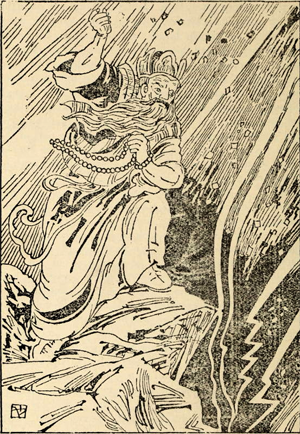
When it happens that big masses of clouds are gathering overhead, the Ngak-pa first assumes a solemn and stern aspect, drawing himself up on the brink of the precipice as firm as the rock itself, and then pronounces an enchantment with many flourishes of his rosary much in the same manner as our warrior of old did with his baton. In a wild attempt to drive away the hail clouds, he fights against the mountain, but it often happens that the overwhelming host comes gloomily upon him with thunders roaring and flashes of lightning that seem to shake the ground under him and rend the sky above, and the volleys of big hailstones follow, pouring down thick and fast, like arrows flying in the thick of battle. The priest then, all in a frenzy, dances in fight against the air, displaying a fury quite like a madman in a rage. With charms uttered at the top of his voice he cuts the air right and left, up and down, with his fist clenched and finger pointed. If in spite of all his efforts, the volleys of hail thicken and strike the fields beneath, the priest grows madder in his wrath,[275] quickly snatches handfuls of the bullets aforementioned which he carries about him, and throws them violently against the clouds as if to strike them. If all this avail nothing, he rends his garment to pieces, and throws the rags up in the air, so perfectly mad is he in his attempt to put a stop to the falling hailstones. When, as sometimes happens, the hail goes drifting away and leaves the place unharmed, the priest is puffed up with pride at the victory he has gained, and the people come to congratulate him with a great show of gratitude. But when, unluckily for him, the hail falls so heavily as to do much harm to the crops, his reverence has to be punished with a fine, apportioned to the amount of injury done by the hail, as provided by the law of the land.
Three Years in Tibet, by Shramana Ekai Kawaguchi
The third caste is the Bon-bo the name of an old religion which prevailed in Tibet long before the introduction of Buddhism. The priests of this practically extinct religion were allowed to marry, and have left behind them the class of people who represent this old social institution in Tibet. The Bon-bo people have to play a certain distinct rôle in public affairs. This is more of a ceremonial than of a religious nature. It consists in worshipping local deities, and undertaking ceremonies intended to secure their favor. When people marry, they ask a Bon-bo man to pray for them to their local deity. Sometimes he undertakes other kinds of prayer or even performs symbolic rites with a benevolent or malevolent aim, according to circumstances. Families of this particular class are found almost everywhere throughout the country, though in limited numbers. In some remote villages, as Tsar-ka in the Himālayas, all the villagers are said to belong to this class, but in most cases only one or two families are found in one village or in one district. In such cases the Bon-bo are objects of great respect, and they sometimes act as local magistrates or administrators. Even when they pursue any other kind of business, they still command great respect from their neighbors as descendants of ancient families.
Though the Bon-bo are descendants of an old religious order, their present representatives are no longer priests,[439] for they do not preach their tenets to others, nor try to persuade them to become converts. They are simply content to hand down their ancestral teachings and traditions to their children and so maintain their distinct position in society. Not unfrequently the young Bon-bo enter the priesthood, and these take precedence over all the other Bon-bo. Strictly speaking the respect which the people belonging to this particular class enjoy over others at present is due to their honorable lineage.
The fourth class is “Shal-ngo” and is composed of the descendants of ancient families who acquired power in the locality on account of their wealth in either money or land. The Tibetans are in general a highly conservative race, and therefore they succeed in most cases in keeping intact their hereditary property. Their polyandrous custom too must be conducive to that result, preventing as it does the splitting up of family property among brothers. By far the great majority of the Shal-ngo people possess therefore more or less property; and even a poor Shal-ngo commands the same respect from the public as his richer confrère.
Common people are divided into two grades, one called tong-ba and the other tong-du. The former is superior, and includes all those common people who possess some means and have not fallen into an ignoble state of slavery. Tong-du means etymologically “petty people,” and their rank being one grade lower than that of others, the people of this class are engaged in menial service. Still they are not strictly speaking slaves; they should more properly be considered as poor tenant-farmers, for formerly these people used to stand in the relation of tenant-farmers to land-owners, though such relation no longer exists.
Some tong-ba are reduced to more straitened circumstances than the tong-du, but, generally considered, the tong-ba are distinguished from the others by the possession of property,[440] greater or less as the case may be, while poverty is a special feature of the tong-du.
However low the tong-ba may fall in the worldly sense of the word, and, on the other hand, however thriving the tong-du may become, a strict line of demarcation still continues to separate the two classes. Society continues to treat them as before, and as if nothing had happened in their relative fortunes. No ordinary people deign to eat with one belonging to the tong-du class, nor do they ever intermarry with them.
This strict rule of social etiquette is in force even among the four divisions of the lowest class, that is to say, ferry-men, fishermen, smiths and butchers. Of the four, the first two rank higher than the other two. Thus, though smiths and butchers are not permitted to eat in the same room with common people, the other two classes are allowed to do so, only they may not sit at table with a privileged plebeian, but must eat or drink from their own vessels.
It is hardly necessary to add that a strong barrier is set up between these four kinds of social outcasts and the ordinary common people, to prevent their intermarriage; a man or woman belonging to the latter class, who is so indiscreet as to obey the bidding of his or her heart and to marry one of the despised race, is socially tabooed from his or her own kith and kin. This punishment is permanent, and even when the bond of this mésalliance has been dissolved by divorce, or any other cause, the fallen man or woman can never hope to regain the caste which he or she has forfeited. The mark of social infamy will follow him or her to the grave.
It is curious, however, that the issues of these mésalliances form a social class of their own. They are called tak ta ril, which means a ‘mixed race produced by black and white twisted together’. They occupy a position even[441] lower than that of the four despised classes mentioned above, and are in fact the lowest caste in Tibet.
There is one interesting feature in regard to this rigid canon of social caste, and that is the presence of gentlemen-smiths, who, being men of a mechanical turn of mind, have become smiths from preference. These gentlemen-smiths do not forfeit their birth and rank on this account.
Both by law and custom the higher classes enjoy special privileges, and these go a long way. The children of aristocrats, for instance, are entitled to exact from their humbler playmates great respect and courtesy. When the latter so forget themselves in their disputes and quarrels with their noble associates as to use rough language, they are at once punished, even when they are in the right. It is evident therefore from what has been stated that a plebeian, no matter how wealthy, is obliged to behave respectfully under all circumstances to a man belonging to the Ngak-pa or Bon-bo, even though the latter may be as poor as a church mouse. As each social class forms practically one distinct community with its own particular etiquette, customs and so forth, ranks are more plainly visible on the surface in Tibet than in most other countries. The Tibetan proverb corresponding to the western saying that “blood will out” [personal character, as determined by condition of birth, will eventually, inevitably be revealed] gains a special significance when applied to the state of affairs prevailing in that semi-civilised country.
The aristocrats of Tibet are distinguished by noble mien and refined manners. Conscious of their elevated position, they possess on the whole a high sense of honor. The other privileged castes occupying a lower plane, such as the men of the Ngak-pa and Bon-bo races and the descendants of ancient grandees, still bear the marks of their respectable birth and can easily be distinguished even by strangers from the common people.
The common people are plebeian in their general bearing and appearance, but one thing to their credit is that they are known for strict honesty, and even extreme poverty seldom tempts them into committing arts of larceny. On the other hand, the lower classes or social outcasts are notorious for their criminal propensities to robbery and murder. In practice they are characterised by crime and wretchedness; they are criminals and beggars. Beggars in fact form a community of their own, the profession being hereditary. These classes are deservedly held in contempt by the public, and their faces even seem to justify such treatment, for they are remarkable for ferocity, depravity and vileness.
As I have mentioned before, lads belonging to the higher ranks are entitled to enter Government schools, but the subjects taught there are at best imperfect. The lessons consist only of learning by memory, penmanship and counting. The first subject is the most important, next comes penmanship, the latter receiving even a larger allotment of hours than the other. Counting is a primitive affair, being taught by means of pebbles, pieces of wood, or shells. The subject matters of learning by memory are Buddhist Texts, the elements of grammar, and lastly rhetoric. This last is a subject of great ambition for Tibetan scholars, who are just like Chinese in their fondness for grandiloquent expressions. Documents to be presented to the Dalai Lama and other high personages bristle with high-flown phraseology and with characters rarely used in ordinary writing, and not found even in Buddhist Texts. The fact is that Tibetan scholars at present hold strange ideas about writing, being of opinion that they should aim at composing in a style unintelligible to ordinary persons. The more characters they can use which cannot easily be understood by others, the better proof, they think, have they given of the[443] profundity of their scholarship. The most scholarly compositions are practically hierographic so far as their incomprehensibility is concerned.
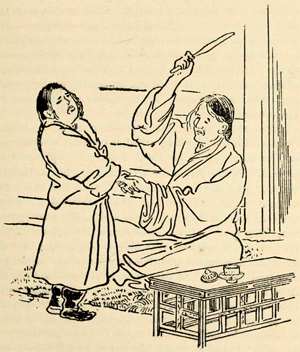
FLOGGING AS A MEANS OF EDUCATION
The birch-rod is considered to be the most useful implement in teaching; not exactly a birch-rod, however, but a flat piece of bamboo. The cramming of difficult passages of rhetoric being the principal mode of learning imposed on pupils, their masters are invariably of opinion that they must make free use of the rod in order to quicken their pupils’[444] progress. The relation between masters and pupils does not differ much from that between gaolers and convicts. The latter, poor fellows, hold their masters in such dread that they find it exceedingly trying, at the sight of them and their formidable pedagogic weapons, to compose their minds and to go on unfalteringly with their lessons. They cower with fear, and are filled with the perturbing thought that the rod is sure to descend upon them for the slightest stumble they make in the path of learning. The ordinary way of using the rod is to give thirty blows with it on the left palm of the pupil. Prudence counsels the pupil to stretch out his hand with alacrity at the bidding of his hard master, for in case he hesitates to do so the penalty is generally doubled, and sixty blows instead of thirty are given. It is a cruel sight to see a little pupil holding out his open hand and submitting to the punishment with tearful eyes. Surely this is not education but mere cruelty.
I once made an earnest remonstrance on this subject with the Minister of Finance who, in common with the rest, used to teach his boys with a liberal application of the rod. To do justice to the Minister, his method of teaching was much more considerate than that of most of his countrymen, and he very seldom resorted to rough handling, such as binding pupils with cords over-night or compelling them to go without dinner or supper. When however I remonstrated with him on the ground that the infliction of corporal punishment was entirely opposed to all sound principles of education, he at first defended the Tibetan system with great earnestness. We had a somewhat animated though courteous dispute on the subject; but at length, being a man of great candor of mind, he seemed to perceive the merit of my position. At any rate he ceased to use the rod as he did before, and generally confined himself to giving a reprimand when[445] any of his boys went astray with his learning. The Minister afterward informed me that his boys seemed to make better progress when they were spared the rod.
Abuse is also considered as an efficient means of educating boys. “Beast,” “beggar,” “devil,” “ass,” “eater of parents’ flesh,” are epithets applied to backward boys by their teachers, and this custom of using foul language is naturally handed on from teachers to pupils, who when they grow up are sure to pass on those slanderous appellations to the next generation.
While the education of the sons of laymen is conducted with such severity, that of boy disciples by Lama priests is extremely lenient, and is quite in contrast to that of the others. The disciples are not even reprimanded, much less chastised, when they neglect their work. The priests generally leave them to do as they like, much as uxorious husbands do towards their wilful wives, so that it is no wonder that the disciples of Lamas very seldom make any good progress in learning. They are spoiled by the excessive indulgence of their masters. Some of these masters own the evil of their way of education, and are careful not to spoil the youthful pupils placed under their care, and it is precisely from among these latter disciples that priests of learning and ability may be expected.
The memorising part of the Tibetan system of education, as mentioned above, is a heavy burden on the pupils. To give some idea of what an important part this work occupies in their system, I may note that a young acolyte, who has grown to fifteen or sixteen years old, has to commit to memory, from the oral instruction of his teachers, from three hundred to five hundred pages of Buddhist texts in the course of a year. He has then to undergo an examination on what he has learned. Even for a lad of weak memory, the number of pages is not less than one hundred in a year. For those who have grown older, that[446] is for those whose age ranges between eighteen and thirty, the task imposed is still more formidable, being five to eight hundred and even one thousand pages. I was amazed at this mental feat of the Tibetan priests, for I could barely learn fifty sheets in six months, that being the minimum limit allotted for aspirants of poor memory.