
by Wikipedia
Accessed: 1/12/20
NOTICE: THIS WORK MAY BE PROTECTED BY COPYRIGHT
YOU ARE REQUIRED TO READ THE COPYRIGHT NOTICE AT THIS LINK BEFORE YOU READ THE FOLLOWING WORK, THAT IS AVAILABLE SOLELY FOR PRIVATE STUDY, SCHOLARSHIP OR RESEARCH PURSUANT TO 17 U.S.C. SECTION 107 AND 108. IN THE EVENT THAT THE LIBRARY DETERMINES THAT UNLAWFUL COPYING OF THIS WORK HAS OCCURRED, THE LIBRARY HAS THE RIGHT TO BLOCK THE I.P. ADDRESS AT WHICH THE UNLAWFUL COPYING APPEARED TO HAVE OCCURRED. THANK YOU FOR RESPECTING THE RIGHTS OF COPYRIGHT OWNERS.
Omori Sogen
Omori Sogen (1904-94) began his Zen practice in 1925 as a lay disciple of Seki Seisetsu, abbot of Tenryuji. Sogen claimed to have realized enlightenment at the age of twenty-nine, after having meditated intensely for eight years on the koan Mu. His breakthrough occurred as follows:I finished zazen and went to the toilet. I heard the sound of the urine hitting the back of the urinal. It splashed and sounded very loud to me. At that time I thought, "Aha!" and I understood. I had a deep realization.16
In 1966 Sogen published a book with a familiar ring to its title, Sword and Zen (Ken to Zen). Sogen opened his book by admitting that he didn't know when the phrase "The sword and Zen are one" (ken Zen ichinyo) had first been used.17 Nevertheless, he had no hesitation in stating "there can be [no] doubt that with regard to their ultimate goals and aims, the sword and Zen are identical."18 He described the nature of this unity:Zen is the sword of the mind while the sword is the Zen of the sword blade .... For a warrior to discharge his duties he must necessarily clarify the origin of life, and transcend life and death in order to reach the absolute realm .... This is the reason the destiny of the sword is inevitably connected to Zen.19
Abstract as this quotation may seem, Sogen was prepared to cut through the metaphorical rhetoric when it came [to] justifying the use of the sword in the defense of "peace and justice":Can someone tell me just how justice is to be protected and peace preserved? Are there any concrete ways of protecting justice and maintaining peace other than resolutely making evil submit and eliminating those who threaten peace? In order to accomplish this, those [who do such things] must be harmed, even though in one respect it is, I dare say, wrong to do so.20
Sogen was well aware that "protecting justice and maintaining peace [in East Asia]" was precisely the rationale given to justify Japan's wartime actions; he had formerly been an ardent supporter of those same actions. In August 1945, Sogen made plans to preempt the broadcast of the emperor's announcement of Japan's surrender and fight till the end.21 He would have had to have very powerful friends indeed to even know in advance of the emperor's radio broadcast, let alone its contents. But in fact Sogen was very well connected, for he enjoyed the patronage of the Toyama family, the patriarch of which, Toyama Mitsuru (1855-1944), was a central figure in two of Japan's most infamous ultranationalist secret societies, the Genyosha (Dark Ocean Society) and Kokuryukai (Black Dragon Society). The historian David Bergamini described Toyama as the Lord High Assassin of these two secret societies.22 A second historian, E. H. Norman, noted that the two secret societies that Toyama helped run formed "the advance guard of Japanese imperialism ... mold[ing] public opinion in favor of aggression."23
Sogen also praised the elder Toyama for providing him with the wisdom necessary to endure his life of hardship amidst the poverty of the immediate postwar period. Toyama, he wrote, had once told him that "Since ancient times there has never been a person who starved from doing the right thing. If you are doing what is right, heaven will surely provide food. Therefore, even if you starve and die, do the right thing.24 What Sogen conveniently omitted from his account is that, for Toyama, doing the right thing had meant a lifetime of assassinations, drug dealing, and terrorism in Japan's colonies, coupled with political blackmail, intimidation, and backstairs intrigue at home.
Just how close Sogen was to the Toyamas is demonstrated by the fact that Toyama Mitsuru's son, Ryusuke, served as an advisor to the martial arts hall, Jiki Shin Dojo, that Sogen founded in 1933 and headed through the end of the war. For Sogen, Toyama Ryusuke's most attractive feature was his utter fearlessness:During his [Ryusuke's] student days at Dobun Shoin, a very good friend had tuberculosis. Seeing this person who was depressed and in despair vomit blood, Toyama Sensei said, "Tuberculosis is nothing. Watch this!" and drank down the blood.25
According to Sogen, Ryusuke was "a great man that one can meet only once in a lifetime."26
Because Japan lost the war, Sogen decided "according to the Way of the Samurai," to formally enter the Rinzai Zen priesthood.27 He then went on to become a professor at Rinzai-affiliated Hanazono University in 1970 and its president in 1978. Six years earlier, in 1972, he had established Chozenji International Zen Dojo, complete with a martial arts training hall, in Hawaii. In material published in 1988, Sogen's American disciples described him as having earlier been am antiwar activist. They wrote:Omori Roshi was influential in government circles before the outbreak of World War II and strenuously appealed to [Prince] Konoe, who was to be the next prime minister, to appoint either Ugaki or Mazaki to the post of Commander of the Army instead of Tojo. He hoped to avert Japan's war with the United States. He blamed his own spiritual weakness for his failure.28
As with D. T. Suzuki and others, the question must be asked as to whether Sogen was opposed to war in principle or merely opposed to fighting a losing war with the United States. The two generals whom Sogen supported, Ugaki Kazushige (1869-1956) and Mazaki Jinzaburo (1876-1956), were both longstanding supporters of Japan's colonial expansion. Ugaki, for example, had willingly accepted appointment as governor general of Korea in 1931. Similarly, there is nothing in the record to suggest that Sogen himself was opposed to the subjugation of Taiwan, Korea, or Manchuria. Thus, even if his "strenuous appeal" to Prince Konoe had been successful, it would have done little or no good for the millions of Chinese, Koreans, and other Asian peoples who became the victims of Japanese aggression, supported by such doctrines as the identity of the sword and Zen.
While corporate Zen is the primary manifestation of imperial-way Zen and soldier Zen in postwar Japan,29 Zen's connection to the Japanese military, and to the sword, has by no means disappeared. Yasutani Hakuun was another of those Zen masters leading retreats for members of the Self-Defense Forces, specifically for officer-candidates at the elite Self-Defense Academy,30 In fact, thanks to the writings and missionary activities of numerous postwar and small numbers of prewar Zen leaders like Yasutani, it can be argued that modern-day variations of imperial-way Zen and soldier Zen are now to be found in the West as well as in Japan, although often without the knowledge or support of their Western adherents. As these Zen variations settle into their new home in the West, the critical question is simply this: Will the doctrine of the unity of Zen and the sword, with all this implies historically, settle in with them?
-- Corporate Zen in Postwar Japan, Chapter Eleven [Excerpt] from "Zen at War", by Brian Daizen Victoria
Black Dragon Society
Formation: 1901; 119 years ago
Founder: Uchida Ryohei
Founded at: Japan
Type: Political
Location: Ethiopia, Turkey, Morocco, throughout Southeast Asia, South America, Europe, the United States
Fields: Politics
The Black Dragon Society (Kyūjitai; 黑龍會; Shinjitai: 黒竜会, kokuryūkai), or Amur River Society, was a prominent paramilitary, ultranationalist right-wing group in Japan.
History
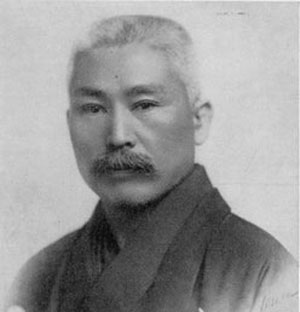
Ryōhei Uchida, founder of the Black Dragon Society
The Kokuryūkai was founded in 1901 by martial artist Uchida Ryohei as a successor to his mentor Mitsuru Tōyama's Gen'yōsha.[1] Its name is derived from the translation of the Amur River, which is called Heilongjiang or "Black Dragon River" in Chinese (黑龍江?), read as Kokuryū-kō in Japanese. Its public goal was to support efforts to keep the Russian Empire north of the Amur River and out of East Asia.
The Kokuryūkai initially made strenuous efforts to distance itself from the criminal elements of its predecessor, the Gen'yōsha. As a result, its membership included Cabinet Ministers and high-ranking military officers as well as professional secret agents. However, as time passed, it found the use of criminal activities to be a convenient means to an end for many of its operations.
The Society published a journal, and operated an espionage training school, from which it dispatched agents to gather intelligence on Russian activities in Russia, Manchuria, Korea and China. It also pressured Japanese politicians to adopt a strong foreign policy. The Kokuryūkai also supported Pan-Asianism, and lent financial support to revolutionaries such as Sun Yat-sen and Emilio Aguinaldo.
During the Russo-Japanese War, annexation of Korea and Siberian Intervention, the Imperial Japanese Army made use of the Kokuryūkai network for espionage, sabotage and assassination. They organized Manchurian guerrillas against the Russians from the Chinese warlords and bandit chieftains in the region, the most important being Marshal Chang Tso-lin. The Black Dragons waged a very successful psychological warfare campaign in conjunction with the Japanese military, spreading disinformation and propaganda throughout the region. They also acted as interpreters for the Japanese army.
The Kokuryūkai assisted the Japanese spy, Colonel Motojiro Akashi. Akashi, who was not directly a member of the Black Dragons, ran successful operations in China, Manchuria, Siberia and established contacts throughout the Muslim world. These contacts in Central Asia were maintained through World War II. The Black Dragons also formed close contact and even alliances with Buddhist sects throughout Asia.
During the 1920s and 1930s, the Kokuryūkai evolved into more of a mainstream political organization, and publicly attacked liberal and leftist thought. Although it never had more than several dozen members at any one time during this period, the close ties of its membership to leading members of the government, military and powerful business leaders gave it a power and influence far greater than most other ultranationalist groups.
Initially directed only against Russia, in the 1930s, the Kokuryūkai expanded its activities around the world, and stationed agents in such diverse places as Ethiopia, Turkey, Morocco, throughout Southeast Asia and South America, as well as Europe and the United States.
The Kokuryūkai was officially disbanded by order of the American Occupation authorities in 1946. According to Brian Daizen Victoria's book, Zen War Stories, the Black Dragon Society was reconstituted in 1961 as the Black Dragon Club (Kokuryū-Kurabu.) The Club never had more than 150 members to succeed in the goals of the former Black Dragon Society.[2]
Activities in the United States
The organization was an influence on seditious black nationalists, aiming to foment racial unrest.[3] African-Americans liked the symbolism of the black dragon fighting against the American eagle and British lion.[4]
As part of that effort, the Black Dragon Society sent their agent, Satokata Takahashi, to promote Pan-Asianism and claim that Japan would treat them as equals.[5] He would become a patron of Elijah Muhammed and the Nation of Islam, as well as the Pacific Movement of the Eastern World.[5]
Mittie Maude Lena Gordon's Peace Movement of Ethiopia claimed to be affiliated with the Kokuryūkai.[4]
On March 27, 1942, FBI agents arrested members of the Black Dragon Society in the San Joaquin Valley, California.[6]
In the Manzanar Internment Camp, a small group of pro-Imperial Japanese flew Black Dragon flags and intimidated other Japanese inmates.[7][8]
See also
• Fifth column
• Sakurakai
• Kōtarō Yoshida
• Uyoku dantai
• Kinoaki Matsuo
• G-Men vs. the Black Dragon (1943)
Notes
1. Kaplan, David (2012). Yakuza: Japan's Criminal Underworld. Berkeley and Los Angeles, California: University of California Press. p. 24. ISBN 978-0-520-27490-7.
2. Victoria, Brian Daizen, Zen War Stories, Routledge Curson 2003, p. 61
3. "U.S. At War: Takcihashi's Blacks". Time. October 5, 1942. Retrieved March 18, 2017.
4. Reginald Kearney, African American Views of the Japanese: Solidarity or Sedition?, SUNY Press 1998, p. 77.
5. Jones, David (May 17, 2014). "Chinese Triads, Japanese Black Dragons & Hidden Paths of Power". New Dawn. Retrieved March 14, 2017.
6. 1942 World War II Chronology Archived 2007-12-16 at the Wayback Machine
7. Burton, Jeffery F., Confinement and Ethnicity: An Overview of World War II Japanese American Relocation Sites, University of Washington Press 2002, p. 172
8. Inada, Lawson Fusao & the California Historical Society, Only What We Could Carry: The Japanese American Internment Experience, Heyday 2000, pp. 161-162
References
• The Encyclopedia of Espionage by Norman Polmar and Thomas B. Allen (ISBN 0-517-20269-7)
• Deacon, Richard: A History of the Japanese Secret Service, Berkley Publishing Company, New York, 1983, ISBN 0-425-07458-7
• Jacob, Frank: Die Thule-Gesellschaft und die Kokuryûkai: Geheimgesellschaften im global-historischen Vergleich, Königshausen & Neumann, Würzburg, 2012, ISBN 978-3826049095
• Jacob, Frank (ed.): Geheimgesellschaften: Kulturhistorische Sozialstudien: Secret Societies: Comparative Studies in Culture, Society and History, Königshausen & Neumann, Würzburg 2012, ISBN 978-3826049088
• Jacob, Frank: Japanism, Pan-Asianism and Terrorism: A Short History of the Amur Society (The Black Dragons) 1901-1945, Academica Press, Palo Alto 2014, ISBN 978-1936320752
• Kaplan, David; Dubro, Alec (2004), Yakuza: Japan's Criminal Underworld, pp. 18–21, ISBN 0520274903
• Saaler, Sven: "The Kokuryûkai, 1901-1920," in Sven Saaler and Christopher W. A. Szpilman (eds.), Pan-Asianism: A Documentary History Vol. I. Lanham: Rowman and Littlefield, 2011, pp. 121-132.
• Saaler, Sven: “The Kokuryûkai (Black Dragon Society) and the Rise of Nationalism, Pan-Asianism, and Militarism in Japan, 1901-1925,” International Journal of Asian Studies 11/2 (2014), pp. 125-160. https://doi.org/10.1017/S147959141400014X
External links
• 1914 Black Dragon statement