Re: LE CERCLE AND THE STRUGGLE FOR THE EUROPEAN CONTINENT: P
Posted: Sun Jan 31, 2016 3:31 am
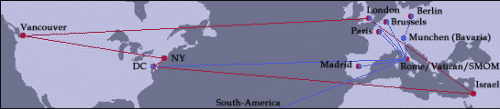
The Vatican-Paneuropa network
Even though its members have been involved in intrigues around the world, the Cercle's main purpose has always been to discuss issues and possible action relating to European integration. The vision of the original French and German founders, as representatives of the Paneuropa movement, seems to have been a strong Catholic-dominated Europe, led by a Franco-German axis. Historically, you'll find a close cooperation between the Vatican-Paneuropa network (from which the Cercle emerged) and the right wing Christian Democratic parties in countries as Germany, Italy, France, and Belgium. It went the same way in Spain, although a democratic system did not exist there until after the death of Franco.
IN GERMANY the main players were CSU members Otto von Habsburg, Franz Joseph Strauss, Count Hans Huyn, and several of their aristocratic friends like the Thurn und Taxis and Thyssen-Bornemisza families. Their connections to Opus Dei and the Knights of Malta have already been discussed. Let's also not forget Paneuropa member Konrad Adenauer, the long time Chancellor of Germany who signed the 1957 Treaty of Rome for Germany. Adenauer, a co-founder of the Christian Democrat Union (CDU) - the national party of the Bavarian CSU - received the Magistral Grand Cross from the Knights of Malta and the Charlemagne award from the Paneuropa Union. Franz Josef Bach, the personal assistant of Adenauer, is likely to have played an important behind the scenes role as a long time organizer of Cercle meetings. Adenauer was a founding member of Le Cercle.
IN ITALY the Opusian Cercle member Giulio Andreotti was one of the main behind the scenes players from the late 1950s to the early 1990s. He started his career under Paneuropa supporter Alcide de Gasperi, one of the early builders of Europe and likely someone who was recruited into the Cercle. Statements from Roberto Calvi that Andreotti was the real head of the P2, with Francesco Cosentino and Umberto Ortolani just beneath him, are entirely possible (162). Although Licio Gelli, nicknamed "Italy's puppet master" for heading the P2, was a member of the Knights of Malta, like Andreotti and Ortolani, Gelli did not have the background to have been any kind of top man. Gelli's foreign puppet masters were Cercle member Henry Kissinger from the White House, NATO official Alexander Haig, and rogue CIA official Ted Shackley. Frank Gigliotti, a ranking US Mason and former OSS agent, was another one of Gelli's immediate instructors (163). Andreotti has numerous accusations against him that he worked with the mafia (and the CIA) to keep his Christian Democrat Party in power. There's also an accusation that he personally ordered an assassination to keep some personal secrets from leaking out. Andreotti was the first to acknowledge the existence of a European Stay-Behind army, named Gladio in case of Italy.
As for Italy's nobility, the earlier-mentioned Prince Carlo della Torre e Tasso is a board member of the Coudenhove-Kalergi Foundation and Prince Carlo de Bourbon, the Duke of Calabria, is head of the Vatican-recognized Italian branch of the the Sacred Military Constantinian Order of St George. It's a Catholic chivalric order, but has recently also invited a small number of non-Catholics, including Cercle chairman Lord Norman Lamont (Privy Council; Rothschild; chair Oil Club) and Cercle member Anthony Cavendish (MI6; not of the Dukes of Devonshire). The controversial Cercle member Nadhmi Auchi (did illegal arms transfers for Saddam) has been awarded by the order. The Catholic Duke of Norfolk (together with the Cecils the most influential family in the history of Britain; British liaisons to the Vatican for centuries; Roxburghe Club member with the Cecils, Cavendishes, Rothschilds, Oppenheimers, and formerly Paul Mellon) and Lord Guthrie (SAS commander; Gold Stick to the Queen; Pilgrims Society; Knights of Malta; Rothschild) can also be found among the British members of the Sacred Military Constantinian Order (164). The controversial Duke of Savoy is another important family in Italy, but has not been tied directly to Paneuropa or Le Cercle.
CERCLE MEMBERS FROM BELGIUM have yet to be identified, but the group they must have come from is rather limited. Take former defense and prime minister Paul Vanden Boeynants and his sidekick Baron Benoît de Bonvoisin, whose father had been a director at Société Générale (still the major pillar of the Belgian economy and the Vatican-linked aristocracy) and an initial Bilderberg participant. Both were reportedly members of Opus Dei. Vanden Boeynants and Benoît de Bonvoisin were two of the founders of Cercle des Nations in 1969, an aristocratic Belgian club with Jean Violet as one of the few foreign members. Cercle des Nations was another hard-right offshoot of Paneuropa activities and had about 80 members when it first opened. Vanden Boeynants is also said to have been involved with Violet's Académie Européenne des Sciences Politiques while the headquarters of the Paneuropean Institut Europeen de Developpement was located in Baron de Bonvoisin's castle (165). Co-founder and vice-chairman of this institute was Paul Vankerkhoven, a side-kick of Otto van Habsburg who founded the Belgian branch of the World Anti-Communist League. Vankerkhoven was a co-founder of CEPIC in 1972, a secretive hard-right inner group of the Social Christian Party (PSC) of vanden Boeynants and Baron de Bonvoisin. To keep things short, this group, which includes the Belgian royal family of Saxe-Coburg-Gotha and many high nobility figures, has at times tried to undermine Belgium's democratic process. One of these attempts was in the early 1970s. Another one in the early 1980s.
There's more going on in Belgium. According to victim-witnesses since the early 1980s, and especially testimonies made in the aftermath of the Dutroux affair, this group (see ISGP's 'Beyond the Dutroux affair' for details) is involved in different pedophile rings. Some of these rings are set up to compromise politicians and businessmen; others seem to be just for "fun" and include child hunts at different domains and some very disturbing forms of mental and physical torture. Reports of involvement of Opus Dei and Knights of Malta figures are quite common. One report that might be relevant here involves a former PSC treasurer of the youth division, Jacques Thoma. He claimed that at some point he was invited to mass orgies by his superior (a CEPIC member and an associate of both Nihoul and suspected Gang of Nijvel members), which were explained to him as an Opus Dei initiation test, to which these people were trying to direct him. Later on, he was drugged and taken to a meeting where everyone was dressed in black robes and masks. The purpose of this meeting was "to be initiated into higher circles". A young girl had been sacrificed and participants drank her blood. Other girls from eastern Europe were also present. He tried to leave, but was drugged again. The next morning he woke up in his car. Still heavily traumatized ten years later, he did not dare to give an official testimony, because he had been intimidated (166).
Another case from Belgium involving the Vatican-Paneuropa network: Paul vanden Boeynants and Prince Albert (now King) was among the names mentioned in the Pinon Affair that began in 1979 (167). It involved parties at which minors were sexually abused. In June 1981 the editor of Pour Magazine was brought into contact with one of the participants in these parties and started an investigation. Within days he receives a telephone call from an attorney in Brussels who advises him to stop his investigation, because "panic has broken out in a certain political milieu". Ten days later the headquarters of Pour are destroyed by a fire (168).
Two individuals have been named as the person that threatened the editor. One is Jacques G. Jonet, formerly a political secretary of Otto von Habsburg and a leading figure in a whole string of Paneuropa-associated groups, including the Habsburg-founded Centre of Documentation and Information and Cercle des Nations. He co-founded several of these institutions and is reported to have been a close associate of Baron de Bonvoisin (169). A quick background check anno 2006 turns up that Jonet is the representative of the Belgian Order of Malta, while his wife is a member of its administrative council (170) (together with a few interesting family names). Both were present at the wedding of Prince Philip (son of King Albert II and Princess Paola Ruffo di Calabria) and Mathilde d'Udekem d'Acoz (Dame of Malta) in 1999 (171). It also turns out that Jonet is still involved with the Wilton Park conferences, together with the Grand Chancellor of the Order of Malta (172).
The other possibility at the time was Vincent vanden Bossche, a lawyer of numerous hard-right individuals who was part of the same milieu as Jonet. Like Jonet, he was a member of Cercle des Nations and Ordre du Rouvre, although his credentials are less impressive (173). It is entirely possible that both men were involved in trying to stop the editor of Pour from publishing the results of his investigation.
Keep in mind that in the first case mentioned (the alleged Opus Dei initiation) we were talking about secretive parallel cells within existing organizations, like those that had been created by this same group in Belgium's gendarmerie, and reportedly also in the military, political parties, and at one or more universities. Even though these reports of extreme child "abuse" initially seem farfetched, they come from more than half a dozen (known) witnesses. They also bear a remarkable similarity to the Franklin and Craig Spence cases, which revolved around the highest level Republican circles in the US. For a quick oversight of these cases you might want to take a look at the biography of Cercle member and Knight of Malta William Casey, who had an awfully close relationship with Larry King and Craig J. Spence. A separate article will appear on this Belgian group and its similarities to other cases.
SPAIN WAS headed by Franco until 1975, which was only partially approved by the reactionary Vatican-Paneuropa network. On the one hand, Franco was a good Catholic boy, treating the non-Catholics in his country as sub-human. On the other hand, because of Franco's totalitarian tendencies Spain remained isolated from the European integration process. That has been a major reason for the pressure on Franco to make reforms, allowing for a more democratic and pro-European Spain to emerge after his death (174). It is said that Franco initially contacted the head of the Paneuropa movement, Otto von Habsburg, to become his follow-up, as the Habsburgs had ruled the country in the past for nearly 200 years. After a long discussion Otto declined, instead suggesting that Prince Juan Carlos should become Franco's successor (175). And so it happened. Franco, Habsburg, and Carlos have all been named as members of the Knights of Malta. They also supported Opus Dei.
There's only one known Cercle member from Spain at the moment, Federico Silva Munoz. In 1967, Munoz, as Franco's Minister of the Interior, had blocked a bill that would have recognized the existence of Spain's small non-Catholic community. Most Opus Dei figures in government voted in favor of the bill, as part of the overall reform process (176). In October 1969, there was an almost complete overhaul of Franco's cabinet with only four members of the old cabinet remaining. One of the four cabinet members that was allowed to stay was Munoz (177), although he resigned five months later, allegedly because of a difference of opinion with the now dominant Opus Dei clique, headed by Franco's eminence grise Admiral Carrero Blanco and several others (178). Munoz remained a member of the Spanish Congress and became head of Campsa, the oil concern which had a monopoly on oil distribution in Spain (179). The struggle between the Falangists and Opusians continued in the years following, with the latter losing a lot of influence after Admiral Blanco had been assassinated in December 1973, allegedly by the ETA. This was the view of the newspapers at the time; not something later put forward by alternative researchers.
Franco passed away in 1975 and King Juan Carlos became the new head of government. After Carlos dismissed the fascist prime minister Carlos Arias Navarro in 1976, Munoz was among the few who were recommended by Carlos' highest advisory body, the Council of the Realm, to be made prime minister of Spain (180). However, Carlos picked the right wing, but far less reactionary, Adolfo Suarez, who reportedly was a member of Opus Dei (181). Munoz, in the mean time, had become head of the hard-right Unión de Centro Democrático (UCD) and in October 1976 he incorporated this party into the newly-created Alianza Popular (AP). The AP was a federation of several parties, which were all fascist or borderline fascist. It opted for a "more gradual" change to democracy than Suarez and his allies had planned for. Some co-founders with Munoz were former Franco ministers Gonzalo Fernandez de la Mora, Lopez Rodo (influential minister in the 1960s and early 1970s, who is said to have engineered the Opus Dei takeover of the Spanish government), and Manuel Fraga Iribarne (182). When the new constitution was approved in 1978, turning Spain into a parliamentary democracy, most members of the AP, as totalitarian as they were, decided to accept the constitution. Not Munoz and Fernandez de la Mora, who withdrew from the AP to continue with their Unión de Centro Democrático party, renaming it in January 1979 to Derecha Democrática Española (DDE). That same month they established a coalition with Fuerza Nueva of Blas Pinar and other ultrafascists; probably the most reactionary and dangerous political faction in Spain at the time (183). Munoz spoke out a few times against the new Spanish constitution in the months and years following (184), but soon disappeared in political obscurity. At some point he did become involved with Le Cercle, and that shows.
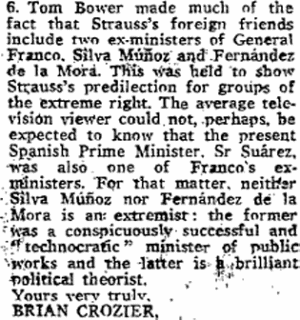
In 1983, Gonzalo Fernandez de la Mora, Munoz's political partner and good friend since they first met at a gathering of the Asociación Católica Nacional de Propagandistas in the 1940s (185), founded the fascist magazine Razon Espanola (Spanish Reason) and became its president. Munoz would regularly write articles for the magazine. Razon Espanola was founded on October 1, 1983 as an outgrowth of the Balmes Foundation, in turn established a few months earlier by a grant of the German Hanns Seidel Foundation (186), which has already been mentioned before. It is the political trust attached to the Christian Social Union of such Opus Dei and Cercle luminaries as Otto von Habsburg and Franz Josef Strauss. There have been accusations that the Foundation has supported the Contras in Latin America and Mobutu(a 1001 Club member like Herbert Batliner, King Juan Carlos and Prince Johannes von Thurn und Taxis) in Zaire (187). In case of Razon Espanola, it funded the magazine over a number of years until it was able to operate on its own. As you can read above, Fernandez and Munoz were friends of Strauss and when the BBC highlighted this in a panorama on Strauss in 1980, Brian Crozier, outgoing chairman of Le Cercle (which no reader of The Times knew) felt compelled to defend his associates (188). However, Crozier himself was a great supporter of the Franco regime and like Munoz, Fernandez de la Mora, or Blas Pinar, he deemed Spain's new constitution unworkable (189). In short, all these people are fascists, even though they always deny that.
In 1989, Cercle investigator David Teacher claimed that Munoz was a "senior Opus Dei member" (190). Judging by most of his career, Munoz was not in the camp that, at least in Spain, has traditionally been identified with Opus Dei. However, this religious group transcends political parties and Munoz's later involvement with Le Cercle, Strauss and the Hanns Seidel Foundation certainly made him a close associate of what has often been termed "God's Octopus".
THE PANEUROPA UNION and the Vatican never had to complain about France. Whether a president was Gaullist or socialist, at the very least they favored a strong Europe as a political and military counterweight to the United States; and even though Great Britain was accepted into the European Union, it was never able to wedge itself into the dominant Franco-German alliance. This mainly had to do with the French. All French presidents were staunch Roman Catholics, some even connected to Opus Dei, like Robert Schuman, Antoine Pinay, and Valery Giscard d'Estaing, with probably a few others we don't know it about.
The French have been the primary motor behind the European Union. Paneuropa member Robert Schuman, through Monnet, laid the foundation for the European Union with the 1949 European Coal and Steel Community (ECSC). In the 1950s, Antoine Pinay founded Le Cercle with the Opusian Jean Violet and Otto von Habsburg. They immediately invited Konrad Adenauer, Robert Schuman and Jean Monnet. Monnet, although mainly connected to Anglo-American banking and political interests, was the Frenchman who organized the 1948 Congress of Europe with Joseph Retinger, came up with the idea of the ECSC, played an important role in the 1957 Treaty of Rome, and later set up his influential action committee.
The decade after the ECSC, Bilderberg, Le Cercle and the European Economic Community (EEC) had been created, Violet and Pinay arranged for the Franco-German alliance between de Gaulle and Adenauer. This was in January 1963 and just in time for a possible acceptance of Britain into the EEC. De Gaulle, however, vetoed Britain's entry anyway, which guaranteed Franco-German dominance of the EEC for the years to come.
Coudenhove and Habsburg adored de Gaulle not only for giving France a strong military and even its own nuclear arsenal, but also for his leadership role in furthering European integration (191). In 1969, however, after de Gaulle had steered Europe too much in an anti-NATO, anti-Anglo-American, and domestically too Conservative course, he had built up so much opposition against himself that he was forced (or forced himself) to resign. His more moderate right hand man, Georges Pompidou, a person in close contact with the Cercle and a long time employee of the Rothschild Bank, took over.
Pompidou's éminence grise became nazi-collaborator Georges Albertini, who worked at Banque Worms, coincidentally said to have been a major Synarchie front. Albertini worked with Jean Violet and Brian Crozier in both The 61 and the Cercle. He also briefed the Pope on several occasions. In 1973, at the recommendation of Georges Pompidou, Otto von Habsburg became the new president of the Paneuropa Union, as Coudenhove-Kalergi had died the year before (192). Pompidou himself suddenly died in 1974 and the interim president became Alain Poher, a member of Le Cercle who was president of the French Senate from 1968 to 1992. He had earlier served as acting president when Charles de Gaulle died, but lost the election to Pompidou. This time Poher lost the election to Valéry Giscard d'Estaing, a Knight of Malta and good friend of Jean Violet, who became the next president of France until 1981. Giscard, his father Edmond, together with associates as Prince Jean de Broglie, Robert Leclerc and members of Le Cercle are said to have introduced Opus Dei to France (193). More on Giscard in a minute.
Things changed in 1981, when the socialist Mitterrand became president of France. One family who couldn't appreciate the new socialist policies were the Rothschilds, who saw their family bank nationalized. They had to shift attention to New Court, their securities firm in New York at Rockefeller Center with stakes in corporations as TRW and Hughes Aircraft (194). But even though Mitterrand was a socialist, he also was a an ardent Catholic who favored European integration. Also, Georges Albertini already anticipated the victory of the socialists and brought Mitterrand's closest friend and confidant, Francois de Grossouvre, into the Cercle six months before the elections. When Mitterrand was elected in 1981, he appointed de Grossouvre as coordinator of security and intelligence (195). Four years later de Grossouvre and Admiral Pierre Lacoste, two leading officers in the French stay-behind networks (196), were among a small group that decided to sink the Rainbow Warrior in reaction to the protests of Greenpeace against French nuclear testing at Mururoa (197).
Mitterrand, known to have been greatly interested in Machiavelli, stayed a long time in office. Only in 1995 the more Liberal Jacques Chirac took over. Besides being the usual opportunist, Chirac has become a great supporter of European integration and of the failed 2005 European constitution. Before the voting process for the new constitution began, Chirac brought up the old issue of Britain's loyalty to the European Union, saying that if its citizens voted against, it would be clear that Britain felt more strongly about cooperation with the Commonwealth and the US. He then promoted the idea that any country who voted against the constitution could better leave the European Union (198). In April 2005, Chirac went on TV and openly stated that a no to the European Constitution "would halt the European project in its tracks, and pave the way to an unregulated, uncontrolled free-market world, dominated by the United States." (199)
Even after these strong statements, the person who oversaw the writing of the European constitution blamed Chirac for France's rejection of it. This person was Valéry Giscard d'Estaing, a long time political rival of Chirac, and claimed it was a mistake of Chirac to hand out the third part of the European Constitution to the French people for reviewing, because part III had already been ratified in previous treaties. Giscard literally begged Chirac not to do this (200). However, since the people of France had to revote on this section as part of the overall constitution, Chirac decided to include it in the mailings, possibly to avoid any accusations of conspiracy that would undermine his chances in the 2007 elections. This third part, which dealt with the major EU policies - the internal market, the economic and monetary union, employment, social policies, consumer protection, environment, agriculture, energy, research, etc. - was severely criticized by the French people, who always leaned to socialism and communism quite severely (which in no small part had to do with France's Vichy and neocolonial past). Back in 1957, at the time of the Treaty of Rome when a lot of these very liberal policies were agreed upon, the socialists had nothing to bring in, as the CIA, MI6, the SDECE and French Gladio units made sure that leftist elements, however strong they were, did not get any executive positions in government. The same thing happened in other countries.
As a good Opusian and Malteser Knight, Valéry Giscard d'Estaing already proposed a solution to the problem of getting the European constitution ratified.
Even though its members have been involved in intrigues around the world, the Cercle's main purpose has always been to discuss issues and possible action relating to European integration. The vision of the original French and German founders, as representatives of the Paneuropa movement, seems to have been a strong Catholic-dominated Europe, led by a Franco-German axis. Historically, you'll find a close cooperation between the Vatican-Paneuropa network (from which the Cercle emerged) and the right wing Christian Democratic parties in countries as Germany, Italy, France, and Belgium. It went the same way in Spain, although a democratic system did not exist there until after the death of Franco.
IN GERMANY the main players were CSU members Otto von Habsburg, Franz Joseph Strauss, Count Hans Huyn, and several of their aristocratic friends like the Thurn und Taxis and Thyssen-Bornemisza families. Their connections to Opus Dei and the Knights of Malta have already been discussed. Let's also not forget Paneuropa member Konrad Adenauer, the long time Chancellor of Germany who signed the 1957 Treaty of Rome for Germany. Adenauer, a co-founder of the Christian Democrat Union (CDU) - the national party of the Bavarian CSU - received the Magistral Grand Cross from the Knights of Malta and the Charlemagne award from the Paneuropa Union. Franz Josef Bach, the personal assistant of Adenauer, is likely to have played an important behind the scenes role as a long time organizer of Cercle meetings. Adenauer was a founding member of Le Cercle.
IN ITALY the Opusian Cercle member Giulio Andreotti was one of the main behind the scenes players from the late 1950s to the early 1990s. He started his career under Paneuropa supporter Alcide de Gasperi, one of the early builders of Europe and likely someone who was recruited into the Cercle. Statements from Roberto Calvi that Andreotti was the real head of the P2, with Francesco Cosentino and Umberto Ortolani just beneath him, are entirely possible (162). Although Licio Gelli, nicknamed "Italy's puppet master" for heading the P2, was a member of the Knights of Malta, like Andreotti and Ortolani, Gelli did not have the background to have been any kind of top man. Gelli's foreign puppet masters were Cercle member Henry Kissinger from the White House, NATO official Alexander Haig, and rogue CIA official Ted Shackley. Frank Gigliotti, a ranking US Mason and former OSS agent, was another one of Gelli's immediate instructors (163). Andreotti has numerous accusations against him that he worked with the mafia (and the CIA) to keep his Christian Democrat Party in power. There's also an accusation that he personally ordered an assassination to keep some personal secrets from leaking out. Andreotti was the first to acknowledge the existence of a European Stay-Behind army, named Gladio in case of Italy.
As for Italy's nobility, the earlier-mentioned Prince Carlo della Torre e Tasso is a board member of the Coudenhove-Kalergi Foundation and Prince Carlo de Bourbon, the Duke of Calabria, is head of the Vatican-recognized Italian branch of the the Sacred Military Constantinian Order of St George. It's a Catholic chivalric order, but has recently also invited a small number of non-Catholics, including Cercle chairman Lord Norman Lamont (Privy Council; Rothschild; chair Oil Club) and Cercle member Anthony Cavendish (MI6; not of the Dukes of Devonshire). The controversial Cercle member Nadhmi Auchi (did illegal arms transfers for Saddam) has been awarded by the order. The Catholic Duke of Norfolk (together with the Cecils the most influential family in the history of Britain; British liaisons to the Vatican for centuries; Roxburghe Club member with the Cecils, Cavendishes, Rothschilds, Oppenheimers, and formerly Paul Mellon) and Lord Guthrie (SAS commander; Gold Stick to the Queen; Pilgrims Society; Knights of Malta; Rothschild) can also be found among the British members of the Sacred Military Constantinian Order (164). The controversial Duke of Savoy is another important family in Italy, but has not been tied directly to Paneuropa or Le Cercle.
CERCLE MEMBERS FROM BELGIUM have yet to be identified, but the group they must have come from is rather limited. Take former defense and prime minister Paul Vanden Boeynants and his sidekick Baron Benoît de Bonvoisin, whose father had been a director at Société Générale (still the major pillar of the Belgian economy and the Vatican-linked aristocracy) and an initial Bilderberg participant. Both were reportedly members of Opus Dei. Vanden Boeynants and Benoît de Bonvoisin were two of the founders of Cercle des Nations in 1969, an aristocratic Belgian club with Jean Violet as one of the few foreign members. Cercle des Nations was another hard-right offshoot of Paneuropa activities and had about 80 members when it first opened. Vanden Boeynants is also said to have been involved with Violet's Académie Européenne des Sciences Politiques while the headquarters of the Paneuropean Institut Europeen de Developpement was located in Baron de Bonvoisin's castle (165). Co-founder and vice-chairman of this institute was Paul Vankerkhoven, a side-kick of Otto van Habsburg who founded the Belgian branch of the World Anti-Communist League. Vankerkhoven was a co-founder of CEPIC in 1972, a secretive hard-right inner group of the Social Christian Party (PSC) of vanden Boeynants and Baron de Bonvoisin. To keep things short, this group, which includes the Belgian royal family of Saxe-Coburg-Gotha and many high nobility figures, has at times tried to undermine Belgium's democratic process. One of these attempts was in the early 1970s. Another one in the early 1980s.
There's more going on in Belgium. According to victim-witnesses since the early 1980s, and especially testimonies made in the aftermath of the Dutroux affair, this group (see ISGP's 'Beyond the Dutroux affair' for details) is involved in different pedophile rings. Some of these rings are set up to compromise politicians and businessmen; others seem to be just for "fun" and include child hunts at different domains and some very disturbing forms of mental and physical torture. Reports of involvement of Opus Dei and Knights of Malta figures are quite common. One report that might be relevant here involves a former PSC treasurer of the youth division, Jacques Thoma. He claimed that at some point he was invited to mass orgies by his superior (a CEPIC member and an associate of both Nihoul and suspected Gang of Nijvel members), which were explained to him as an Opus Dei initiation test, to which these people were trying to direct him. Later on, he was drugged and taken to a meeting where everyone was dressed in black robes and masks. The purpose of this meeting was "to be initiated into higher circles". A young girl had been sacrificed and participants drank her blood. Other girls from eastern Europe were also present. He tried to leave, but was drugged again. The next morning he woke up in his car. Still heavily traumatized ten years later, he did not dare to give an official testimony, because he had been intimidated (166).
Another case from Belgium involving the Vatican-Paneuropa network: Paul vanden Boeynants and Prince Albert (now King) was among the names mentioned in the Pinon Affair that began in 1979 (167). It involved parties at which minors were sexually abused. In June 1981 the editor of Pour Magazine was brought into contact with one of the participants in these parties and started an investigation. Within days he receives a telephone call from an attorney in Brussels who advises him to stop his investigation, because "panic has broken out in a certain political milieu". Ten days later the headquarters of Pour are destroyed by a fire (168).
Two individuals have been named as the person that threatened the editor. One is Jacques G. Jonet, formerly a political secretary of Otto von Habsburg and a leading figure in a whole string of Paneuropa-associated groups, including the Habsburg-founded Centre of Documentation and Information and Cercle des Nations. He co-founded several of these institutions and is reported to have been a close associate of Baron de Bonvoisin (169). A quick background check anno 2006 turns up that Jonet is the representative of the Belgian Order of Malta, while his wife is a member of its administrative council (170) (together with a few interesting family names). Both were present at the wedding of Prince Philip (son of King Albert II and Princess Paola Ruffo di Calabria) and Mathilde d'Udekem d'Acoz (Dame of Malta) in 1999 (171). It also turns out that Jonet is still involved with the Wilton Park conferences, together with the Grand Chancellor of the Order of Malta (172).
The other possibility at the time was Vincent vanden Bossche, a lawyer of numerous hard-right individuals who was part of the same milieu as Jonet. Like Jonet, he was a member of Cercle des Nations and Ordre du Rouvre, although his credentials are less impressive (173). It is entirely possible that both men were involved in trying to stop the editor of Pour from publishing the results of his investigation.
Keep in mind that in the first case mentioned (the alleged Opus Dei initiation) we were talking about secretive parallel cells within existing organizations, like those that had been created by this same group in Belgium's gendarmerie, and reportedly also in the military, political parties, and at one or more universities. Even though these reports of extreme child "abuse" initially seem farfetched, they come from more than half a dozen (known) witnesses. They also bear a remarkable similarity to the Franklin and Craig Spence cases, which revolved around the highest level Republican circles in the US. For a quick oversight of these cases you might want to take a look at the biography of Cercle member and Knight of Malta William Casey, who had an awfully close relationship with Larry King and Craig J. Spence. A separate article will appear on this Belgian group and its similarities to other cases.
SPAIN WAS headed by Franco until 1975, which was only partially approved by the reactionary Vatican-Paneuropa network. On the one hand, Franco was a good Catholic boy, treating the non-Catholics in his country as sub-human. On the other hand, because of Franco's totalitarian tendencies Spain remained isolated from the European integration process. That has been a major reason for the pressure on Franco to make reforms, allowing for a more democratic and pro-European Spain to emerge after his death (174). It is said that Franco initially contacted the head of the Paneuropa movement, Otto von Habsburg, to become his follow-up, as the Habsburgs had ruled the country in the past for nearly 200 years. After a long discussion Otto declined, instead suggesting that Prince Juan Carlos should become Franco's successor (175). And so it happened. Franco, Habsburg, and Carlos have all been named as members of the Knights of Malta. They also supported Opus Dei.
There's only one known Cercle member from Spain at the moment, Federico Silva Munoz. In 1967, Munoz, as Franco's Minister of the Interior, had blocked a bill that would have recognized the existence of Spain's small non-Catholic community. Most Opus Dei figures in government voted in favor of the bill, as part of the overall reform process (176). In October 1969, there was an almost complete overhaul of Franco's cabinet with only four members of the old cabinet remaining. One of the four cabinet members that was allowed to stay was Munoz (177), although he resigned five months later, allegedly because of a difference of opinion with the now dominant Opus Dei clique, headed by Franco's eminence grise Admiral Carrero Blanco and several others (178). Munoz remained a member of the Spanish Congress and became head of Campsa, the oil concern which had a monopoly on oil distribution in Spain (179). The struggle between the Falangists and Opusians continued in the years following, with the latter losing a lot of influence after Admiral Blanco had been assassinated in December 1973, allegedly by the ETA. This was the view of the newspapers at the time; not something later put forward by alternative researchers.
Franco passed away in 1975 and King Juan Carlos became the new head of government. After Carlos dismissed the fascist prime minister Carlos Arias Navarro in 1976, Munoz was among the few who were recommended by Carlos' highest advisory body, the Council of the Realm, to be made prime minister of Spain (180). However, Carlos picked the right wing, but far less reactionary, Adolfo Suarez, who reportedly was a member of Opus Dei (181). Munoz, in the mean time, had become head of the hard-right Unión de Centro Democrático (UCD) and in October 1976 he incorporated this party into the newly-created Alianza Popular (AP). The AP was a federation of several parties, which were all fascist or borderline fascist. It opted for a "more gradual" change to democracy than Suarez and his allies had planned for. Some co-founders with Munoz were former Franco ministers Gonzalo Fernandez de la Mora, Lopez Rodo (influential minister in the 1960s and early 1970s, who is said to have engineered the Opus Dei takeover of the Spanish government), and Manuel Fraga Iribarne (182). When the new constitution was approved in 1978, turning Spain into a parliamentary democracy, most members of the AP, as totalitarian as they were, decided to accept the constitution. Not Munoz and Fernandez de la Mora, who withdrew from the AP to continue with their Unión de Centro Democrático party, renaming it in January 1979 to Derecha Democrática Española (DDE). That same month they established a coalition with Fuerza Nueva of Blas Pinar and other ultrafascists; probably the most reactionary and dangerous political faction in Spain at the time (183). Munoz spoke out a few times against the new Spanish constitution in the months and years following (184), but soon disappeared in political obscurity. At some point he did become involved with Le Cercle, and that shows.
In 1983, Gonzalo Fernandez de la Mora, Munoz's political partner and good friend since they first met at a gathering of the Asociación Católica Nacional de Propagandistas in the 1940s (185), founded the fascist magazine Razon Espanola (Spanish Reason) and became its president. Munoz would regularly write articles for the magazine. Razon Espanola was founded on October 1, 1983 as an outgrowth of the Balmes Foundation, in turn established a few months earlier by a grant of the German Hanns Seidel Foundation (186), which has already been mentioned before. It is the political trust attached to the Christian Social Union of such Opus Dei and Cercle luminaries as Otto von Habsburg and Franz Josef Strauss. There have been accusations that the Foundation has supported the Contras in Latin America and Mobutu(a 1001 Club member like Herbert Batliner, King Juan Carlos and Prince Johannes von Thurn und Taxis) in Zaire (187). In case of Razon Espanola, it funded the magazine over a number of years until it was able to operate on its own. As you can read above, Fernandez and Munoz were friends of Strauss and when the BBC highlighted this in a panorama on Strauss in 1980, Brian Crozier, outgoing chairman of Le Cercle (which no reader of The Times knew) felt compelled to defend his associates (188). However, Crozier himself was a great supporter of the Franco regime and like Munoz, Fernandez de la Mora, or Blas Pinar, he deemed Spain's new constitution unworkable (189). In short, all these people are fascists, even though they always deny that.
In 1989, Cercle investigator David Teacher claimed that Munoz was a "senior Opus Dei member" (190). Judging by most of his career, Munoz was not in the camp that, at least in Spain, has traditionally been identified with Opus Dei. However, this religious group transcends political parties and Munoz's later involvement with Le Cercle, Strauss and the Hanns Seidel Foundation certainly made him a close associate of what has often been termed "God's Octopus".
THE PANEUROPA UNION and the Vatican never had to complain about France. Whether a president was Gaullist or socialist, at the very least they favored a strong Europe as a political and military counterweight to the United States; and even though Great Britain was accepted into the European Union, it was never able to wedge itself into the dominant Franco-German alliance. This mainly had to do with the French. All French presidents were staunch Roman Catholics, some even connected to Opus Dei, like Robert Schuman, Antoine Pinay, and Valery Giscard d'Estaing, with probably a few others we don't know it about.
The French have been the primary motor behind the European Union. Paneuropa member Robert Schuman, through Monnet, laid the foundation for the European Union with the 1949 European Coal and Steel Community (ECSC). In the 1950s, Antoine Pinay founded Le Cercle with the Opusian Jean Violet and Otto von Habsburg. They immediately invited Konrad Adenauer, Robert Schuman and Jean Monnet. Monnet, although mainly connected to Anglo-American banking and political interests, was the Frenchman who organized the 1948 Congress of Europe with Joseph Retinger, came up with the idea of the ECSC, played an important role in the 1957 Treaty of Rome, and later set up his influential action committee.
The decade after the ECSC, Bilderberg, Le Cercle and the European Economic Community (EEC) had been created, Violet and Pinay arranged for the Franco-German alliance between de Gaulle and Adenauer. This was in January 1963 and just in time for a possible acceptance of Britain into the EEC. De Gaulle, however, vetoed Britain's entry anyway, which guaranteed Franco-German dominance of the EEC for the years to come.
Coudenhove and Habsburg adored de Gaulle not only for giving France a strong military and even its own nuclear arsenal, but also for his leadership role in furthering European integration (191). In 1969, however, after de Gaulle had steered Europe too much in an anti-NATO, anti-Anglo-American, and domestically too Conservative course, he had built up so much opposition against himself that he was forced (or forced himself) to resign. His more moderate right hand man, Georges Pompidou, a person in close contact with the Cercle and a long time employee of the Rothschild Bank, took over.
Pompidou's éminence grise became nazi-collaborator Georges Albertini, who worked at Banque Worms, coincidentally said to have been a major Synarchie front. Albertini worked with Jean Violet and Brian Crozier in both The 61 and the Cercle. He also briefed the Pope on several occasions. In 1973, at the recommendation of Georges Pompidou, Otto von Habsburg became the new president of the Paneuropa Union, as Coudenhove-Kalergi had died the year before (192). Pompidou himself suddenly died in 1974 and the interim president became Alain Poher, a member of Le Cercle who was president of the French Senate from 1968 to 1992. He had earlier served as acting president when Charles de Gaulle died, but lost the election to Pompidou. This time Poher lost the election to Valéry Giscard d'Estaing, a Knight of Malta and good friend of Jean Violet, who became the next president of France until 1981. Giscard, his father Edmond, together with associates as Prince Jean de Broglie, Robert Leclerc and members of Le Cercle are said to have introduced Opus Dei to France (193). More on Giscard in a minute.
Things changed in 1981, when the socialist Mitterrand became president of France. One family who couldn't appreciate the new socialist policies were the Rothschilds, who saw their family bank nationalized. They had to shift attention to New Court, their securities firm in New York at Rockefeller Center with stakes in corporations as TRW and Hughes Aircraft (194). But even though Mitterrand was a socialist, he also was a an ardent Catholic who favored European integration. Also, Georges Albertini already anticipated the victory of the socialists and brought Mitterrand's closest friend and confidant, Francois de Grossouvre, into the Cercle six months before the elections. When Mitterrand was elected in 1981, he appointed de Grossouvre as coordinator of security and intelligence (195). Four years later de Grossouvre and Admiral Pierre Lacoste, two leading officers in the French stay-behind networks (196), were among a small group that decided to sink the Rainbow Warrior in reaction to the protests of Greenpeace against French nuclear testing at Mururoa (197).
Mitterrand, known to have been greatly interested in Machiavelli, stayed a long time in office. Only in 1995 the more Liberal Jacques Chirac took over. Besides being the usual opportunist, Chirac has become a great supporter of European integration and of the failed 2005 European constitution. Before the voting process for the new constitution began, Chirac brought up the old issue of Britain's loyalty to the European Union, saying that if its citizens voted against, it would be clear that Britain felt more strongly about cooperation with the Commonwealth and the US. He then promoted the idea that any country who voted against the constitution could better leave the European Union (198). In April 2005, Chirac went on TV and openly stated that a no to the European Constitution "would halt the European project in its tracks, and pave the way to an unregulated, uncontrolled free-market world, dominated by the United States." (199)
Even after these strong statements, the person who oversaw the writing of the European constitution blamed Chirac for France's rejection of it. This person was Valéry Giscard d'Estaing, a long time political rival of Chirac, and claimed it was a mistake of Chirac to hand out the third part of the European Constitution to the French people for reviewing, because part III had already been ratified in previous treaties. Giscard literally begged Chirac not to do this (200). However, since the people of France had to revote on this section as part of the overall constitution, Chirac decided to include it in the mailings, possibly to avoid any accusations of conspiracy that would undermine his chances in the 2007 elections. This third part, which dealt with the major EU policies - the internal market, the economic and monetary union, employment, social policies, consumer protection, environment, agriculture, energy, research, etc. - was severely criticized by the French people, who always leaned to socialism and communism quite severely (which in no small part had to do with France's Vichy and neocolonial past). Back in 1957, at the time of the Treaty of Rome when a lot of these very liberal policies were agreed upon, the socialists had nothing to bring in, as the CIA, MI6, the SDECE and French Gladio units made sure that leftist elements, however strong they were, did not get any executive positions in government. The same thing happened in other countries.
As a good Opusian and Malteser Knight, Valéry Giscard d'Estaing already proposed a solution to the problem of getting the European constitution ratified.
Giscard enjoys the full support of his friend Otto von Habsburg, who agrees that the constitution should be reintroduced, albeit the more "comprehensible" early version of Giscard (202). Discussions about this have already been underway between Chirac and Merkel (of the CDU in Germany). Chirac is a Catholic, but seems to be less influenced by his fate than some of the politicians surrounding him. For example, Giscard and Habsburg strongly oppose any possibility of Turkish membership in the European Union, probably because that will interfere with their vision of a new Holy Roman Empire [update: in late November 2006, Pope Ratzinger all of a sudden saw no objections to Turkey joining the EU. It would be really interesting to know the reason behind this sudden and complete 180 degrees reversal. However, one thing seems to be certain: the reactionary Ultramontanists aren't getting what they want]. Chirac on the other hand is open to the idea that Turkey would eventually be allowed to join. Merkel agrees on this issue with Otto and Giscard, but is not part of their Opusian Bavarian clique. Edmund Stoiber, a protege of Strauss, tried to compete with her for the German chancellorship in 2005."Let's be clear about this: the rejection of the Constitutional Treaty in France was a mistake, which will have to be corrected... the Constitutional Treaty will have to be given its second chance. When? When France has completed her great electoral debate, with the presidential and parliamentary elections which are due to be held 14 months' time, in spring 2007. How? By refocusing the debate on the only genuinely constitutional parts, that is to say, the first part, and the Charter of Fundamental Rights demanded by the European Left, neither of which have given rise to much protest. Then the third part could follow a parliamentary route, which is far better suited to its legal nature." (201)