Re: THE SEVENTEEN TRADITIONS, by Ralph Nader
Posted: Wed Oct 30, 2013 2:47 am
11. The Tradition of Independent Thinking
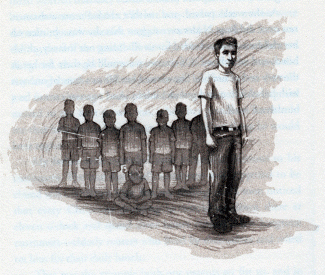
"Turn your back on the pack," I remember my mother telling me more than once during early childhood. Simple words, but they carried a few meanings in a very concise way. If we wanted to be leaders, we were taught -- if we wanted to think boldly, and to excel at what we did -- that we would have to be willing to be different. My mother took a continual interest in who my friends and acquaintances were from year to year. She encouraged us to bring our friends home, and when we did, she would engage them in conversation about school, their families, or the aspects of their lives that mattered to them. Even in those relatively quiet, unfrenzied, drug-free small-town days, she was keenly aware that peer groups were her competition in rearing her children. A child's peer group could be very influential, and the wrong group could dash years' worth of attentive child rearing and proper behavior. Peer pressure could be nerve-wracking for children, especially when it involved coercion, as it often did when there were age differences in "the pack." My mother's saying I believe its you! always comes back to me in this context: She taught us early that we couldn't pass off on others responsibility for our own behavior. "Respect yourself," she taught us, "and others will respect you."
Well, as children will, we understood our parents' words, but still listened to our classmates' taunts, and we weren't immune to them. I was eight years old before I finally confronted my mother about the fact that she still had me wearing short pants to school every day. She believed I was too young to wear long pants, unlike the other boys who wore them. The boys in my class thought short pants were babyish, and I agreed. So one day I brought my odd-boy-out lament home to my mother. After trying out all kinds of practical arguments to shuck the shorts and wear the longs -- such as protecting my knees from scraping falls or being warmer in the cold winters -- I realized I was getting nowhere. So I brought out what I perceived as my trump card. "Mother," I entreated, "their mothers let them wear long pants!" To which mother replied: "Well, they have their mothers and you have yours. Besides, why are you worried about being a little different?"
Word gets around quickly in a small town. Before meeting these youngsters, Mother would inquire about their parents and their older siblings. She had a short list of children who were absolutely off-limits, but generally she let her opinions be known, and we followed her lead. Other mothers did the same for their children -- and sometimes to our detriment. One mother disapproved of her blond son walking to school with me because of my "darker complexion." Winsted, like many New England factory towns, was by then a multiethnic community; the nineteenth-century influx of Irish and Italian immigrants was followed by Eastern European, Greek, and Levantine families. In the town's restaurants and bars, ethnic jokes were common currency; such mutual ribbing probably helped to reduce some tensions, inasmuch as they teased each other face to face. But there were some prejudices manifested in terms of social distance and less occupational mobility for the newer families. The Yankees still held the economic power in Winsted, but Irish Americans and Italian Americans were beginning to play a part in local politics, where there was a strong perceived division between Protestant and Catholic families.
The smaller ethnic groups felt the most discomfort. Our family could have been in that category. I say "could have been" because our parents were predisposed to ignore such pressures, joking about them while shoring up our identity and self-confidence by condemning prejudice itself. Having the largest restaurant in our small town didn't hurt, either: Food can be a great leveler, and the easy interactions in a bustling eatery -- which served American food, by the way, not ethnic fare -- made for a forum where politics and sports were all debated on an even playing field.
My father had come to realize this years earlier, during his time in the melting pots of places like Newark, New Jersey; Detroit, Michigan; Lawrence, Massachusetts; and Danbury, Connecticut. "What is the true value of ethnic identity?" I remember him observing once. "Culture, humor, variety and a common sociability for facing life. And, of course, the pleasure of having one's own cuisine. When it comes to politics, though, a broader humanity should replace ethnicity."
So how did this play out on the children? Ethnic slurs bounced off us because we knew who we were, where we came from, and generally where we wanted to go. From time to time, we heard someone use a phrase like "camel-driver" -- as some anti-Arab voices still do in America today. But such language only singed us when it was associated with rejectionist behavior or tied to social distance. Fortunately, such moments were infrequent. Our teachers were quite even-handed, and we played sports and did odd jobs around the neighborhood with no complaint. The simple fact that we spoke and understood Arabic did, of course, make us different. But our parents' accented English only gave us something in common with the numerous Italian, Polish, European, Jewish, and the few immigrant Lebanese families in town.
Given all this, our parents were remarkably easy in the saddle. They never became overwrought about perceived peer-group pressure or bigotry, and even seemed to understand the old-time families' sensitivities toward the unfamiliar newer immigrants and their customs. The public schools and especially the churches helped newer families like ours assimilate into the community; our family had been embraced by the Methodist Church, even though we came from the Eastern Orthodox division of Christianity. Ultimately, as my father understood, our ethnic differences tended to shore up our defenses against prejudice and temptations. We knew the value of our history, and relished the elements that came with it -- the food and humor especially.
"Turn your back on the pack," I remember my mother telling me more than once during early childhood. Simple words, but they carried a few meanings in a very concise way. If we wanted to be leaders, we were taught -- if we wanted to think boldly, and to excel at what we did -- that we would have to be willing to be different. My mother took a continual interest in who my friends and acquaintances were from year to year. She encouraged us to bring our friends home, and when we did, she would engage them in conversation about school, their families, or the aspects of their lives that mattered to them. Even in those relatively quiet, unfrenzied, drug-free small-town days, she was keenly aware that peer groups were her competition in rearing her children. A child's peer group could be very influential, and the wrong group could dash years' worth of attentive child rearing and proper behavior. Peer pressure could be nerve-wracking for children, especially when it involved coercion, as it often did when there were age differences in "the pack." My mother's saying I believe its you! always comes back to me in this context: She taught us early that we couldn't pass off on others responsibility for our own behavior. "Respect yourself," she taught us, "and others will respect you."
Well, as children will, we understood our parents' words, but still listened to our classmates' taunts, and we weren't immune to them. I was eight years old before I finally confronted my mother about the fact that she still had me wearing short pants to school every day. She believed I was too young to wear long pants, unlike the other boys who wore them. The boys in my class thought short pants were babyish, and I agreed. So one day I brought my odd-boy-out lament home to my mother. After trying out all kinds of practical arguments to shuck the shorts and wear the longs -- such as protecting my knees from scraping falls or being warmer in the cold winters -- I realized I was getting nowhere. So I brought out what I perceived as my trump card. "Mother," I entreated, "their mothers let them wear long pants!" To which mother replied: "Well, they have their mothers and you have yours. Besides, why are you worried about being a little different?"
Word gets around quickly in a small town. Before meeting these youngsters, Mother would inquire about their parents and their older siblings. She had a short list of children who were absolutely off-limits, but generally she let her opinions be known, and we followed her lead. Other mothers did the same for their children -- and sometimes to our detriment. One mother disapproved of her blond son walking to school with me because of my "darker complexion." Winsted, like many New England factory towns, was by then a multiethnic community; the nineteenth-century influx of Irish and Italian immigrants was followed by Eastern European, Greek, and Levantine families. In the town's restaurants and bars, ethnic jokes were common currency; such mutual ribbing probably helped to reduce some tensions, inasmuch as they teased each other face to face. But there were some prejudices manifested in terms of social distance and less occupational mobility for the newer families. The Yankees still held the economic power in Winsted, but Irish Americans and Italian Americans were beginning to play a part in local politics, where there was a strong perceived division between Protestant and Catholic families.
The smaller ethnic groups felt the most discomfort. Our family could have been in that category. I say "could have been" because our parents were predisposed to ignore such pressures, joking about them while shoring up our identity and self-confidence by condemning prejudice itself. Having the largest restaurant in our small town didn't hurt, either: Food can be a great leveler, and the easy interactions in a bustling eatery -- which served American food, by the way, not ethnic fare -- made for a forum where politics and sports were all debated on an even playing field.
My father had come to realize this years earlier, during his time in the melting pots of places like Newark, New Jersey; Detroit, Michigan; Lawrence, Massachusetts; and Danbury, Connecticut. "What is the true value of ethnic identity?" I remember him observing once. "Culture, humor, variety and a common sociability for facing life. And, of course, the pleasure of having one's own cuisine. When it comes to politics, though, a broader humanity should replace ethnicity."
So how did this play out on the children? Ethnic slurs bounced off us because we knew who we were, where we came from, and generally where we wanted to go. From time to time, we heard someone use a phrase like "camel-driver" -- as some anti-Arab voices still do in America today. But such language only singed us when it was associated with rejectionist behavior or tied to social distance. Fortunately, such moments were infrequent. Our teachers were quite even-handed, and we played sports and did odd jobs around the neighborhood with no complaint. The simple fact that we spoke and understood Arabic did, of course, make us different. But our parents' accented English only gave us something in common with the numerous Italian, Polish, European, Jewish, and the few immigrant Lebanese families in town.
Given all this, our parents were remarkably easy in the saddle. They never became overwrought about perceived peer-group pressure or bigotry, and even seemed to understand the old-time families' sensitivities toward the unfamiliar newer immigrants and their customs. The public schools and especially the churches helped newer families like ours assimilate into the community; our family had been embraced by the Methodist Church, even though we came from the Eastern Orthodox division of Christianity. Ultimately, as my father understood, our ethnic differences tended to shore up our defenses against prejudice and temptations. We knew the value of our history, and relished the elements that came with it -- the food and humor especially.