Re: Freda Bedi Cont'd (#3)
Posted: Sun May 02, 2021 2:47 am
No. 35. The Kotwalipara Spurious Grant of Samacara Deva.
by Rakhal Das Banerji, with a Prefatory Note by Mr. H. E. Stapleton, B.A., Inspector of Schools, Dacca
Journal of the Bengal Asiatic Society, Vol. vi., p. 429
1911
NOTE
The principal feature of the bil country lying in the S.W. of Faridpur district is the finely preserved fortification of Kotwalipara, the mud walls of which are each about 2 miles long and 20 to 30 feet high. Early in 1908, in the course of a tour of inspection in Bakarganj and Southern Faridpur, I had the opportunity of visiting the locality in company with an Assistant Settlement Officer, Babu Kalipada Maitra, and as the result of my request that he should look out for coins, and copper plates similar to the one described in the Journ. Asiatic Soc. Bengal for 1896, pp. 6-15, by Babu Nagendranath Basu, that is alleged to have come from the village of Pinjuri close to and outside the south-west corner of the fortification, Kalipada Babu forwarded to me later, in 1908, the rubbings of two Gupta coins, and the copper-plate that forms the subject of Babu Rakhaldas Banerji’s note. A cast of one Gupta coin now in my possession, belonging to Skanda Gupta, was exhibited with the copper-plate at the Society’s Conversazione last January, and the other coin is dealt with in a recent paper on Eastern Bengal and Assam history (Journ. Asiatic Soc. Bengal, 1909, Contributions 1, p. 142). The copper-plate was at first entrusted to Mahamahopadhyaya Haraprasad Sastri who, with the help of Pandit Nilmani Chakravarti, roughly deciphered it and read the date as being 44 of the Sri Harsha era (=651 A.D.). He added, however, that, in the opinion of the late Dr. Bloch, the plate was a kuta sasana, or forgery. Babu Rakhaldas Banerji subsequently undertook to make a more thorough study of the plate, with the result that Dr. Bloch’s opinion seems to be confirmed.
The plate is said to have been recently discovered about 9 inches under the surface of the ground by a cultivator while digging his holding at Ghagrahati, a mauza close to Pinjuri on the Ghagar River which runs from north to south along the western par of the fortification. The names of the mauzas in the immediate vicinity bear no relation to the names given at the end of the fortification, but 2-1/2 miles north, near the north-west corner of the fort, occur four mauzas, Ferdhara (to the south of the village and thana Ghagarhat), Koakha (to the north-east of the same village), Parkunahat (within the fort at the N.W. angle, and Kujbon (a large mauza, of which the southern boundary is the northern par). The first two appear to be the modern representatives of Vidyadhara Jogika and Chandra Varmma Kogaku respectively, and indicate that the original deposit-spot of the copper-plate under consideration was, near the place where the old road from Ghagrahat to Gaurnadi (in N.E. Bakarganj) still passes through the western par.
The plate is interesting as dating from before the time of the Sena Kings, though it is disappointing that no light is thrown on the question as to who was the builder of the pars. The discovery of the Gupta coins in villages lying close to the western par may be taken, however, as proof that the fortification dates back to at least Gupta times, as, apart from the pars, there is nothing in the surrounding bil country to induce invaders from the N.E. to visit the place. The history of the locality will form the subject of a later paper.
H.E.S.
The plate was sent to me at Mussoorie by Mr. H.E. Stapleton in September, 1908. It was sent back in November from Lucknow for the Society’s Conversazione. The plate was finally handed over to me for publication in July 1909. Mr. Stapleton has recorded the provenance in the prefatory note. The discovery of the copper-plate and the gold coin in the mounds of the outskirts of Kotwalipara is of great interest, as it proves beyond doubt that there was an ancient settlement at this place centuries prior to the Mussalman conquest. Kotwalipara or Kotalipada is at present known as one of the oldest Brahmana colonies in Bengal. Prof. Nilmani Chakravartti wrote to me while I was at Lucknow that the late Dr. Bloch had pronounced the grant to be a forgery. Dr. Bloch himself told me a short time before his death, that he considered the grant to be a forgery. Nothing seems irregular in the script or the date at first. The script belongs to the period when acute-angled characters were beginning to be used in North-Eastern India, and the ancient Gupta alphabet of the Eastern variety was gradually becoming out of date. The date also is not irregular, the year 34 of the Harsa era = 640-41 A.D. also suiting the paleography. After prolonged examination I found some of the minor irregularities in the script: --
(1) In all cases, the letter ha, when it occurs singly, is of the form generally to be found in early Gupta inscriptions of the Western variety and shows no acute angle at the bottom. But when it is used in a compound letter it has the form to be found in early Gupta characters of the Eastern variety, which is to be found in the Allahabad Asoka-pillar inscription of Samudra Gupta1 [Fleet’s Gupta Inscriptions, p. 1. ] and the Dhanaidaha grant of Kumaragupta I.2 [See ante, vol. v., p. 459.] In a previous number of the Journal I have tried to establish that the Eastern variety of the early Gupta alphabet was dying out in the early decades of the fifth century. The Patiakella grant of Sivaraja1 [Ep. Ind., vol. ix, p. 285.] and the Bodh-Gaya inscription of Mahanaman2 [Fleet’s Gupta Inscriptions, p. 274, pl. xlia.] prove that the elimination of the Eastern variety of the fourth century alphabet was complete by the end of the sixth century A.D. This conclusion is further borne out by the Mundesvari Inscription of Udayasena3 [Ep. Ind., vol. ix, p. 289.] and the Ganjam plate of the time of Sasankaraja.4 [Ibid., vol. vi, p. 143.] Moreover the ha of the Western variety occurring singly and that of the Eastern variety occurring in compounds (hma in brahmana in line 11 and line 14), are hardly in keeping with the general tone of the characters of the inscriptions. But I shall have to dilate on this point later on.
(2) In all cases, the long I has the form generally to be found in the Eastern variety of the early Gupta alphabet. The most conspicuous case is the I in Jivadatta in line 4 and to some extent I in Kesav-adin in line 15. But in a genuine inscription of the Harsa year 34 one expects long I of the looped form to be found in the Mundesvari Inscription or the Ganjam grant.
(3) There are two cases of the occurrence of the short I in its single form, and in each case it has a different form. The I in icchamy-ahain in line 9 consists of two dots, one above the other, and vertical straight line to the proper left. The I in icchato in line 14 consists of two dots, placed side by side with a horizontal straight line below them. The usual form of I in inscriptions of the first half of the seventh century is to be found in the two copper-plate grants of Harsavarddhana and the Ganjam plate of the time of Sasankaraja. This consists of two dots or circles places side by side and a curved line below them.
(4) Many of the characters of this inscription exhibit fourth century or early Gupta forms. In the majority of cases the letter nia[?] has the hooked form to be found in the Bharadi Dih [illegible] inga inscription. The bipartite ya looks ill side by side with [illegible] ja and ha (when it occurs alone), in which no acute angle can be traced.
(5) La as a subscript letter occurs only once and resembled the hooked la of the Eastern variety. In this inscription la in [illegible] and other cases resembles the la of the Western variety of the Gupta alphabet.
(6) Da has two forms when occurring in the same compound nda: -- c.f. Suvarnda in line 3 and mandale in line 4 with Vatsakunda in line 77 and Janarddaka-kunda in line 8. In the last two cases the compound has the form to be found in all Northern Indian inscriptions from the second to seventh century A.D.
(7) The scribe has made a serious mistake in using some eighth century characters of the Northern variety in the word Parkkati in line 19. The letter pa in the word does not resemble the remaining ones, which are usually rectangular in form, seldom showing an acute angle. In this letter, the right-hand vertical and the horizontal straight lines of the letter have merged into a single curve. The earliest occurrence of this form of pa is to be found in inscriptions of the seventh and eighth centuries A.D. But the more important piece of evidence is to be found in the second syllable rkka. This consists of two looped kas and a superscript ra. But even in the Banskhera and Madhuban plates of Harsavarddhana, which are inscripted with characters so cursive and at the same time the execution is so very beautiful that they may be taken to represent the current script of the period, the looped form of ka in the sixth century A.D. are to be found in the Bodh-Gaya Inscription of Mahanaman and the Ganjam plates of the time of Sasanka.1 [ Fleet’s Gupta Inscriptions, p. 274, pl. xlia: Epi. Ind., vol. vi., 143.]
This form of ka becomes fairly common from the last quarter of the seventh century A.D. and afterwards.
Thus, we find that the characters used in this copper-plate inscription were collection from alphabets in use in three different centuries: --
(1) The alphabet of the third and the first half of the fourth century A.D., c.f. ha in hma and la in sloka. The form of ma shows that it was copied from the early Gupta alphabet of the Eastern variety.
(2) The alphabet of the last half of the fifth century and the first half of the sixth century A.D. of North-Eastern India. The absence of acute angles in ja, pa, ha and la shows that the alphabet of the period of the Mundesvari inscription was also included.
(3) The regular alphabet of the sixth century with its profusion of acute angles is also very conspicuous. This alphabet came into general use in North-Eastern India in the earlier part of the seventh century A.D.
Apart from the palaeographical evidence, the wording of the inscription itself is sufficient to prove that it is a forgery.
The formula of a regular grant of land as is to be found in majority of copper-plate inscriptions may be divided into three separate parts: --
(1) The first portion may be either in prose or verse and generally gives the genealogy of the king or eulogium on him.
In shorter grants this portion is written in prose and gives the titles of the king.
(2) The second portion is invariably written in prose and contains the announcement of the grant to the various officers concerned. This portion also contains the details about the grant, e.c., the particular division, district or sub-division in which the land or village granted was situated.
(3) Some imprecatory verses [verb. (intr) to swear, curse, or blaspheme. (tr) to invoke or bring down (evil, a curse, etc) to imprecate disaster on the ship.] generally taken from some of the Dharma Sastras are added at the end. In some cases the date is given after these imprecatory verses.
This grant differs from the majority of copper-plate grants discovered up to date in the following particulars: --
(1) The king does not seem to be the donor, or to have consented, or to have sanctioned the grant.
(2) The name of the donor cannot be made out from the wording of this grant.
(3) The officers concerned in a particular grant are never mentioned by name: at least no such instance has been discovered up to date.
(4) Supratikasvami seems to be the agent by whom the various officers mentioned in lines 4 to 8 are informed about the grant. But the very same man is again mentioned in line 17. The construction of this line is ambiguous, but it seems that he is the man to whom the grant was made. For example, compare the statement in lines 9 to 12, where he says, “By your grace I intend to settle for ever in order to spread the sacrificial rites in this world.” The wording of this line too is also very ambiguous, and I am not quite sure as to the exactness of the above translation. Such a statement, viz., the expression of the grantee’s intention, is very odd in the wording of a copper-plate grant and, so far as I know, has not been met with before. The employment of the recipient of a grant as a Dutaka is against extremely unusual, and I believe no such case has been met with up to date.
The wording of the copper-plate, as I have already stated, is very ambiguous, and it cannot be made out who is the real donor. It is quite certain that the king mentioned in line 2 is not the donor. The grant may have been made by the officers mentioned on the obverse, but this is not certain. In any case, when a subordinate officer, or a number of officers, or a private personage makes a grant, it is absolutely necessary to obtain the royal sanction to it. Similar cases have already been met with: compare the Kamauli grant of the Singara Chief Vatsaraja of the Vikrama year 1191=1123 A.D.1 [Epi. Ind., vol. iv., p. 131. ]
The contents of lines 12 and 13 are quite unintelligible. Here and there words of Sanskritic origin are to be found mixed up with what seems to be unintelligible gibberish. The scribe’s object most probably was to create an impression by using high-sounding words. Dr. Bloch seems to have deciphered these two lines in a different manner, but I do not think he succeeded in interpreting them. We have a mention of a forged grant in the Madhuban grant of Harsavarddhana, in which we find that the king, finding that a Brahmana named Vamarathya was enjoying a village named Somakundaka in the Sravasti bhukti by holding a forged grant, confiscated the village and granted it to another man in the 25th year of his reign, i.e., 631-32 A.D. The wording of the 10th line of the plate is quite clear.
“Somakundakagramo Brahmana Vamarthyena kutasasanena bhuktaka iti vicarya yatas-tac-chasanam bhanktva tasmadaksipya ca.”1 [Epi. Ind., vol. vii, p. 158. ]
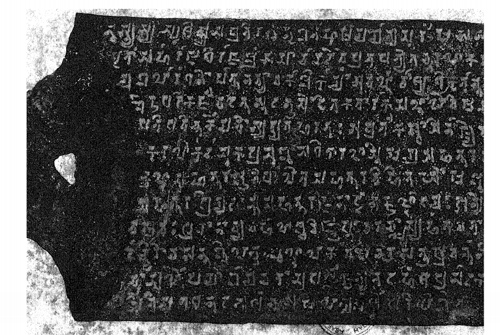
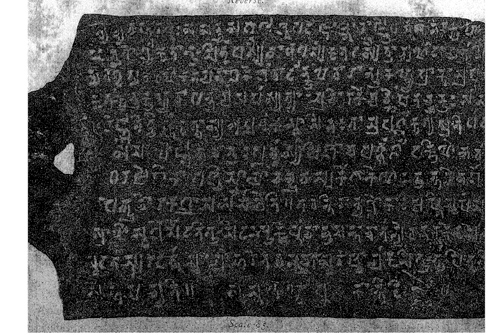
The inscription is incised on a thin plate of copper measuring 8-1/1” x 4-3/4”. There is a projection to the proper right of the inscription to which the seal was attached. The seal itself has now disappeared revealing a triangular slit, the object of which is inexplicable to me. Round holes are to be found in grants which are incised on two or more plates, and the ring holding together these plates passes through these holes, but these holes are always round, and I do not remember having ever seen or heard of an angular hole in a copper-plate. The average height of the letters are 3/8”. The record is incised on both sides of the plate, the obverse bearing 12 lines and the reverse 11. The orthography scarcely needs any comment, but the following forms should be noted: --
(1) The suvarnda in line 3 was most probably meant to be Suvarna.
(2) Vyavahanascha is most probably equivalent to Vyava-harinas-ca.
(3) The word Patacca in line 16 seems to be the Prakrit form of Praticya. The use of this word is another argument against the genuineness of the grant. The language of the grant is incorrect Sanskrit. Another strong argument against the genuineness of the grant is that the scribe wanted to put extra stress on the word Tamrapatta. It has also been used at least thrice, and it seems that the owner of the plate was over-anxious to get the plate established as a regular grant; compare line 11 [x], lines 15-16 [x] and line 17 [x].
Nothing is known at present about Samacaradeva, the king in whose reign the grant purports to have been issued. The date at the end of the grant is 34, and this should be referred to the Harsa era and not to the Gupta era. It must be admitted that a large number of letters of the Eastern variety of the early Gupta alphabets has been used in this grant, but the general tendency of the characters show that the scribe intended to use the acute-angled alphabets of the sixth and sixth [seventh?] century A.D. If this supposition is correct then the date of the grant is the 1st of Kartika of the Harsa year 34, i.e., 640 A.D. I may note in this connection that the date has been different read by two different scholars.
Prof. Nilmani Chakravarti of the Presidency College read this date as 44, but this can hardly be the case, as the letter la has always been used to denote the numeral 30. In another grant I have noticed that any other compound formed with the letter la also denotes the same numeral.1 [ ]
The late Dr. Bloch read the date to be 14, but I believe I have already adduced sufficient proof to establish my reading. In the year 640 Emperor Harsavarddhana of Thanesvara was alive and was in undisputed possession of Northern India from the Panjab to Assam. At this time the existence of an independent monarch, as is indicated by the title Maharajadhiraja, in Eastern Bengal can hardly be credited unless substantiated by epigraphs. I edit the inscription from the original plate.
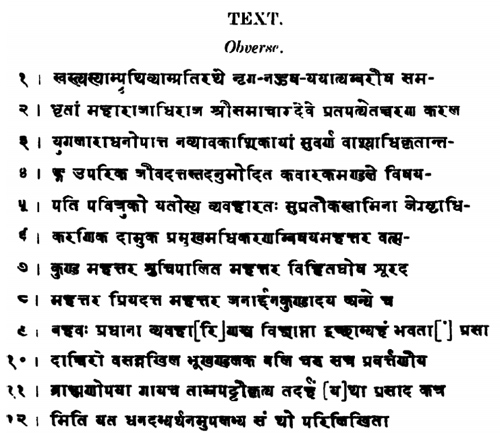
TEXT
Obverse
Reverse
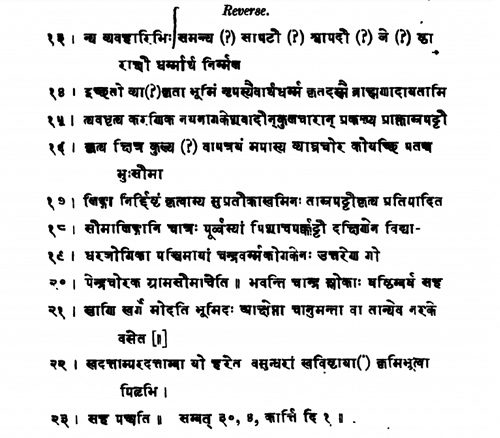
Plate XXIX.
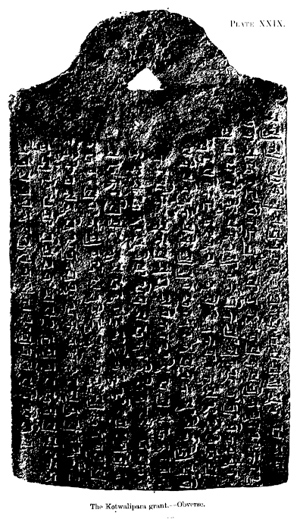
[iThe Kotwalipara grant. – Obverse.[/i]
by Rakhal Das Banerji, with a Prefatory Note by Mr. H. E. Stapleton, B.A., Inspector of Schools, Dacca
Journal of the Bengal Asiatic Society, Vol. vi., p. 429
1911
NOTE
The principal feature of the bil country lying in the S.W. of Faridpur district is the finely preserved fortification of Kotwalipara, the mud walls of which are each about 2 miles long and 20 to 30 feet high. Early in 1908, in the course of a tour of inspection in Bakarganj and Southern Faridpur, I had the opportunity of visiting the locality in company with an Assistant Settlement Officer, Babu Kalipada Maitra, and as the result of my request that he should look out for coins, and copper plates similar to the one described in the Journ. Asiatic Soc. Bengal for 1896, pp. 6-15, by Babu Nagendranath Basu, that is alleged to have come from the village of Pinjuri close to and outside the south-west corner of the fortification, Kalipada Babu forwarded to me later, in 1908, the rubbings of two Gupta coins, and the copper-plate that forms the subject of Babu Rakhaldas Banerji’s note. A cast of one Gupta coin now in my possession, belonging to Skanda Gupta, was exhibited with the copper-plate at the Society’s Conversazione last January, and the other coin is dealt with in a recent paper on Eastern Bengal and Assam history (Journ. Asiatic Soc. Bengal, 1909, Contributions 1, p. 142). The copper-plate was at first entrusted to Mahamahopadhyaya Haraprasad Sastri who, with the help of Pandit Nilmani Chakravarti, roughly deciphered it and read the date as being 44 of the Sri Harsha era (=651 A.D.). He added, however, that, in the opinion of the late Dr. Bloch, the plate was a kuta sasana, or forgery. Babu Rakhaldas Banerji subsequently undertook to make a more thorough study of the plate, with the result that Dr. Bloch’s opinion seems to be confirmed.
The plate is said to have been recently discovered about 9 inches under the surface of the ground by a cultivator while digging his holding at Ghagrahati, a mauza close to Pinjuri on the Ghagar River which runs from north to south along the western par of the fortification. The names of the mauzas in the immediate vicinity bear no relation to the names given at the end of the fortification, but 2-1/2 miles north, near the north-west corner of the fort, occur four mauzas, Ferdhara (to the south of the village and thana Ghagarhat), Koakha (to the north-east of the same village), Parkunahat (within the fort at the N.W. angle, and Kujbon (a large mauza, of which the southern boundary is the northern par). The first two appear to be the modern representatives of Vidyadhara Jogika and Chandra Varmma Kogaku respectively, and indicate that the original deposit-spot of the copper-plate under consideration was, near the place where the old road from Ghagrahat to Gaurnadi (in N.E. Bakarganj) still passes through the western par.
The plate is interesting as dating from before the time of the Sena Kings, though it is disappointing that no light is thrown on the question as to who was the builder of the pars. The discovery of the Gupta coins in villages lying close to the western par may be taken, however, as proof that the fortification dates back to at least Gupta times, as, apart from the pars, there is nothing in the surrounding bil country to induce invaders from the N.E. to visit the place. The history of the locality will form the subject of a later paper.
H.E.S.
The plate was sent to me at Mussoorie by Mr. H.E. Stapleton in September, 1908. It was sent back in November from Lucknow for the Society’s Conversazione. The plate was finally handed over to me for publication in July 1909. Mr. Stapleton has recorded the provenance in the prefatory note. The discovery of the copper-plate and the gold coin in the mounds of the outskirts of Kotwalipara is of great interest, as it proves beyond doubt that there was an ancient settlement at this place centuries prior to the Mussalman conquest. Kotwalipara or Kotalipada is at present known as one of the oldest Brahmana colonies in Bengal. Prof. Nilmani Chakravartti wrote to me while I was at Lucknow that the late Dr. Bloch had pronounced the grant to be a forgery. Dr. Bloch himself told me a short time before his death, that he considered the grant to be a forgery. Nothing seems irregular in the script or the date at first. The script belongs to the period when acute-angled characters were beginning to be used in North-Eastern India, and the ancient Gupta alphabet of the Eastern variety was gradually becoming out of date. The date also is not irregular, the year 34 of the Harsa era = 640-41 A.D. also suiting the paleography. After prolonged examination I found some of the minor irregularities in the script: --
(1) In all cases, the letter ha, when it occurs singly, is of the form generally to be found in early Gupta inscriptions of the Western variety and shows no acute angle at the bottom. But when it is used in a compound letter it has the form to be found in early Gupta characters of the Eastern variety, which is to be found in the Allahabad Asoka-pillar inscription of Samudra Gupta1 [Fleet’s Gupta Inscriptions, p. 1. ] and the Dhanaidaha grant of Kumaragupta I.2 [See ante, vol. v., p. 459.] In a previous number of the Journal I have tried to establish that the Eastern variety of the early Gupta alphabet was dying out in the early decades of the fifth century. The Patiakella grant of Sivaraja1 [Ep. Ind., vol. ix, p. 285.] and the Bodh-Gaya inscription of Mahanaman2 [Fleet’s Gupta Inscriptions, p. 274, pl. xlia.] prove that the elimination of the Eastern variety of the fourth century alphabet was complete by the end of the sixth century A.D. This conclusion is further borne out by the Mundesvari Inscription of Udayasena3 [Ep. Ind., vol. ix, p. 289.] and the Ganjam plate of the time of Sasankaraja.4 [Ibid., vol. vi, p. 143.] Moreover the ha of the Western variety occurring singly and that of the Eastern variety occurring in compounds (hma in brahmana in line 11 and line 14), are hardly in keeping with the general tone of the characters of the inscriptions. But I shall have to dilate on this point later on.
(2) In all cases, the long I has the form generally to be found in the Eastern variety of the early Gupta alphabet. The most conspicuous case is the I in Jivadatta in line 4 and to some extent I in Kesav-adin in line 15. But in a genuine inscription of the Harsa year 34 one expects long I of the looped form to be found in the Mundesvari Inscription or the Ganjam grant.
(3) There are two cases of the occurrence of the short I in its single form, and in each case it has a different form. The I in icchamy-ahain in line 9 consists of two dots, one above the other, and vertical straight line to the proper left. The I in icchato in line 14 consists of two dots, placed side by side with a horizontal straight line below them. The usual form of I in inscriptions of the first half of the seventh century is to be found in the two copper-plate grants of Harsavarddhana and the Ganjam plate of the time of Sasankaraja. This consists of two dots or circles places side by side and a curved line below them.
(4) Many of the characters of this inscription exhibit fourth century or early Gupta forms. In the majority of cases the letter nia[?] has the hooked form to be found in the Bharadi Dih [illegible] inga inscription. The bipartite ya looks ill side by side with [illegible] ja and ha (when it occurs alone), in which no acute angle can be traced.
(5) La as a subscript letter occurs only once and resembled the hooked la of the Eastern variety. In this inscription la in [illegible] and other cases resembles the la of the Western variety of the Gupta alphabet.
(6) Da has two forms when occurring in the same compound nda: -- c.f. Suvarnda in line 3 and mandale in line 4 with Vatsakunda in line 77 and Janarddaka-kunda in line 8. In the last two cases the compound has the form to be found in all Northern Indian inscriptions from the second to seventh century A.D.
(7) The scribe has made a serious mistake in using some eighth century characters of the Northern variety in the word Parkkati in line 19. The letter pa in the word does not resemble the remaining ones, which are usually rectangular in form, seldom showing an acute angle. In this letter, the right-hand vertical and the horizontal straight lines of the letter have merged into a single curve. The earliest occurrence of this form of pa is to be found in inscriptions of the seventh and eighth centuries A.D. But the more important piece of evidence is to be found in the second syllable rkka. This consists of two looped kas and a superscript ra. But even in the Banskhera and Madhuban plates of Harsavarddhana, which are inscripted with characters so cursive and at the same time the execution is so very beautiful that they may be taken to represent the current script of the period, the looped form of ka in the sixth century A.D. are to be found in the Bodh-Gaya Inscription of Mahanaman and the Ganjam plates of the time of Sasanka.1 [ Fleet’s Gupta Inscriptions, p. 274, pl. xlia: Epi. Ind., vol. vi., 143.]
This form of ka becomes fairly common from the last quarter of the seventh century A.D. and afterwards.
Thus, we find that the characters used in this copper-plate inscription were collection from alphabets in use in three different centuries: --
(1) The alphabet of the third and the first half of the fourth century A.D., c.f. ha in hma and la in sloka. The form of ma shows that it was copied from the early Gupta alphabet of the Eastern variety.
(2) The alphabet of the last half of the fifth century and the first half of the sixth century A.D. of North-Eastern India. The absence of acute angles in ja, pa, ha and la shows that the alphabet of the period of the Mundesvari inscription was also included.
(3) The regular alphabet of the sixth century with its profusion of acute angles is also very conspicuous. This alphabet came into general use in North-Eastern India in the earlier part of the seventh century A.D.
Apart from the palaeographical evidence, the wording of the inscription itself is sufficient to prove that it is a forgery.
The formula of a regular grant of land as is to be found in majority of copper-plate inscriptions may be divided into three separate parts: --
(1) The first portion may be either in prose or verse and generally gives the genealogy of the king or eulogium on him.
In shorter grants this portion is written in prose and gives the titles of the king.
(2) The second portion is invariably written in prose and contains the announcement of the grant to the various officers concerned. This portion also contains the details about the grant, e.c., the particular division, district or sub-division in which the land or village granted was situated.
(3) Some imprecatory verses [verb. (intr) to swear, curse, or blaspheme. (tr) to invoke or bring down (evil, a curse, etc) to imprecate disaster on the ship.] generally taken from some of the Dharma Sastras are added at the end. In some cases the date is given after these imprecatory verses.
This grant differs from the majority of copper-plate grants discovered up to date in the following particulars: --
(1) The king does not seem to be the donor, or to have consented, or to have sanctioned the grant.
(2) The name of the donor cannot be made out from the wording of this grant.
(3) The officers concerned in a particular grant are never mentioned by name: at least no such instance has been discovered up to date.
(4) Supratikasvami seems to be the agent by whom the various officers mentioned in lines 4 to 8 are informed about the grant. But the very same man is again mentioned in line 17. The construction of this line is ambiguous, but it seems that he is the man to whom the grant was made. For example, compare the statement in lines 9 to 12, where he says, “By your grace I intend to settle for ever in order to spread the sacrificial rites in this world.” The wording of this line too is also very ambiguous, and I am not quite sure as to the exactness of the above translation. Such a statement, viz., the expression of the grantee’s intention, is very odd in the wording of a copper-plate grant and, so far as I know, has not been met with before. The employment of the recipient of a grant as a Dutaka is against extremely unusual, and I believe no such case has been met with up to date.
The wording of the copper-plate, as I have already stated, is very ambiguous, and it cannot be made out who is the real donor. It is quite certain that the king mentioned in line 2 is not the donor. The grant may have been made by the officers mentioned on the obverse, but this is not certain. In any case, when a subordinate officer, or a number of officers, or a private personage makes a grant, it is absolutely necessary to obtain the royal sanction to it. Similar cases have already been met with: compare the Kamauli grant of the Singara Chief Vatsaraja of the Vikrama year 1191=1123 A.D.1 [Epi. Ind., vol. iv., p. 131. ]
The contents of lines 12 and 13 are quite unintelligible. Here and there words of Sanskritic origin are to be found mixed up with what seems to be unintelligible gibberish. The scribe’s object most probably was to create an impression by using high-sounding words. Dr. Bloch seems to have deciphered these two lines in a different manner, but I do not think he succeeded in interpreting them. We have a mention of a forged grant in the Madhuban grant of Harsavarddhana, in which we find that the king, finding that a Brahmana named Vamarathya was enjoying a village named Somakundaka in the Sravasti bhukti by holding a forged grant, confiscated the village and granted it to another man in the 25th year of his reign, i.e., 631-32 A.D. The wording of the 10th line of the plate is quite clear.
“Somakundakagramo Brahmana Vamarthyena kutasasanena bhuktaka iti vicarya yatas-tac-chasanam bhanktva tasmadaksipya ca.”1 [Epi. Ind., vol. vii, p. 158. ]
The inscription is incised on a thin plate of copper measuring 8-1/1” x 4-3/4”. There is a projection to the proper right of the inscription to which the seal was attached. The seal itself has now disappeared revealing a triangular slit, the object of which is inexplicable to me. Round holes are to be found in grants which are incised on two or more plates, and the ring holding together these plates passes through these holes, but these holes are always round, and I do not remember having ever seen or heard of an angular hole in a copper-plate. The average height of the letters are 3/8”. The record is incised on both sides of the plate, the obverse bearing 12 lines and the reverse 11. The orthography scarcely needs any comment, but the following forms should be noted: --
(1) The suvarnda in line 3 was most probably meant to be Suvarna.
(2) Vyavahanascha is most probably equivalent to Vyava-harinas-ca.
(3) The word Patacca in line 16 seems to be the Prakrit form of Praticya. The use of this word is another argument against the genuineness of the grant. The language of the grant is incorrect Sanskrit. Another strong argument against the genuineness of the grant is that the scribe wanted to put extra stress on the word Tamrapatta. It has also been used at least thrice, and it seems that the owner of the plate was over-anxious to get the plate established as a regular grant; compare line 11 [x], lines 15-16 [x] and line 17 [x].
Nothing is known at present about Samacaradeva, the king in whose reign the grant purports to have been issued. The date at the end of the grant is 34, and this should be referred to the Harsa era and not to the Gupta era. It must be admitted that a large number of letters of the Eastern variety of the early Gupta alphabets has been used in this grant, but the general tendency of the characters show that the scribe intended to use the acute-angled alphabets of the sixth and sixth [seventh?] century A.D. If this supposition is correct then the date of the grant is the 1st of Kartika of the Harsa year 34, i.e., 640 A.D. I may note in this connection that the date has been different read by two different scholars.
Prof. Nilmani Chakravarti of the Presidency College read this date as 44, but this can hardly be the case, as the letter la has always been used to denote the numeral 30. In another grant I have noticed that any other compound formed with the letter la also denotes the same numeral.1 [ ]
The late Dr. Bloch read the date to be 14, but I believe I have already adduced sufficient proof to establish my reading. In the year 640 Emperor Harsavarddhana of Thanesvara was alive and was in undisputed possession of Northern India from the Panjab to Assam. At this time the existence of an independent monarch, as is indicated by the title Maharajadhiraja, in Eastern Bengal can hardly be credited unless substantiated by epigraphs. I edit the inscription from the original plate.
TEXT
Obverse
Reverse
Plate XXIX.
[iThe Kotwalipara grant. – Obverse.[/i]