Re: THE SEVENTEEN TRADITIONS, by Ralph Nader
Posted: Wed Oct 30, 2013 2:33 am
5. The Tradition of Scarcity
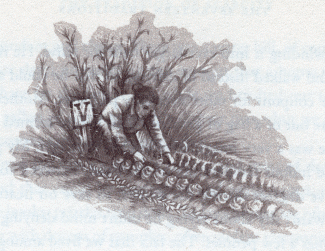
Waste was anathema in our household. Despite their comfortable middle-class income, my patents followed a policy of scarcity that went beyond even the calls for sacrifice that President Franklin Delano Roosevelt made during World War II. My parents took wartime measures like rationing and recycling in stride -- and found that they provided an occasion to teach us the value of scarcity. My parents planted their Victory Garden and raised chickens during those years of food rationing, and during the war my father kept up his long-standing practice of saving string, winding it into ever-larger balls for reuse. He recycled paper and walked instead of driving, so that he could save his gasoline coupons for more necessary purposes. Mother could get more out of a bag of groceries than nature seemed to permit; she was a very imaginative kitchen manager. My parents kept the indoor temperature in our house between sixty and sixty-five degrees during the winter, to save on heating oil. Father wasn't shy about saying he didn't mind denying the oil companies a few pennies. The fact that we lived among thrift-conscious New Englanders didn't hurt.
We children learned early to shop for bargains. We watched our parents, who were both careful shoppers, and when it came time to spend our own nickels and dimes, we tried to follow suit. Of course, we did have one advantage over other children: Since Dad sold ice cream and candies at his restaurant, we never had to spend our own money on such things. When Dad opened up the spigot of his ice cream machine and let the freshly mixed chocolate or strawberry ice cream (made with fresh strawberries) spill onto our dishes, it gave off an aroma and taste I can still recall today.
Our parents taught us, in countless little ways, to control our cravings -- from children's toys to household utilities. We learned to keep the lights off unless they were needed. That way, they told us, we could have brighter bulbs when the lights were on. Careful use of resources was the rule even when it wouldn't have cost us to use more. Our town's municipal water system was abundant and cheap. There was a water bill, of course, but (in those days) no meter on the amount that a home uses; we could have let the faucet run while we brushed our teeth, or used a gallon of water to wash a dish or two -- but we avoided such waste as a matter of family habit.
A new toy was a special occasion, and most of them were the kind that could be used again and again -- tops, crayons, picture books, puzzles, and dolls. Today's homes are often overflowing with dozens of complex, often violent electronic plastic toys, and yet children soon grow bored with them and demand the latest upgrade or fad. Bombarded with dazzling advertisements and irresistible messages, they nag their parents to buy. The result -- to say nothing of what it does to our children's behavior and character -- is this avalanche of things, of stuff that's soon discarded or left to clutter basements, attics, and garages.
That was the point of my parents' emphasis on deliberate scarcity: It taught us to value things, to preserve things, to attach our imaginations to what we had rather than to the unquenchable obsession with more, more, more. Our tradition of scarcity encouraged us to be creative. My sisters busied themselves knitting some of their own clothes, and sewed other pieces of their wardrobe with my mother. In this they were following the tradition of our aunts in Lebanon, whose skills at sewing and embroidery showed such exquisite artistry that today they might make a modest fortune as clothing and linen designers. Scarcity is far less time-consuming than abundance. Saving time for creative pursuits is a continual dividend of not owning so many things that they eventually own you. More, we learned, was really less.
One day after he retired in the early 1970s, Dad observed that "thrift" and "thrifty" were words he used to hear all the time, but that he was hearing them less and less. Thrift and other related principles -- frugality, economy, scarcity -- were once a part of America's shared value system, and they were certainly part of our family's frame of mind. Today, however, millions of children are growing up with the opposite attitude, with a diminished sense of the work that goes into material things. And with such feelings grows a tolerance for wasteful economic systems, for wasteful technologies, for gas-guzzling SUVs, designer cell phones, and disposable products of all kinds.
Such designed-in waste may be profitable for manufacturers, for fuel and electric companies, and for retailers. But it hardly benefits our families, who every year hand over more of their money to the disposable economy, even as their children grow more distracted and more demanding.
As the household goes, so goes the nation.
Waste was anathema in our household. Despite their comfortable middle-class income, my patents followed a policy of scarcity that went beyond even the calls for sacrifice that President Franklin Delano Roosevelt made during World War II. My parents took wartime measures like rationing and recycling in stride -- and found that they provided an occasion to teach us the value of scarcity. My parents planted their Victory Garden and raised chickens during those years of food rationing, and during the war my father kept up his long-standing practice of saving string, winding it into ever-larger balls for reuse. He recycled paper and walked instead of driving, so that he could save his gasoline coupons for more necessary purposes. Mother could get more out of a bag of groceries than nature seemed to permit; she was a very imaginative kitchen manager. My parents kept the indoor temperature in our house between sixty and sixty-five degrees during the winter, to save on heating oil. Father wasn't shy about saying he didn't mind denying the oil companies a few pennies. The fact that we lived among thrift-conscious New Englanders didn't hurt.
We children learned early to shop for bargains. We watched our parents, who were both careful shoppers, and when it came time to spend our own nickels and dimes, we tried to follow suit. Of course, we did have one advantage over other children: Since Dad sold ice cream and candies at his restaurant, we never had to spend our own money on such things. When Dad opened up the spigot of his ice cream machine and let the freshly mixed chocolate or strawberry ice cream (made with fresh strawberries) spill onto our dishes, it gave off an aroma and taste I can still recall today.
Our parents taught us, in countless little ways, to control our cravings -- from children's toys to household utilities. We learned to keep the lights off unless they were needed. That way, they told us, we could have brighter bulbs when the lights were on. Careful use of resources was the rule even when it wouldn't have cost us to use more. Our town's municipal water system was abundant and cheap. There was a water bill, of course, but (in those days) no meter on the amount that a home uses; we could have let the faucet run while we brushed our teeth, or used a gallon of water to wash a dish or two -- but we avoided such waste as a matter of family habit.
A new toy was a special occasion, and most of them were the kind that could be used again and again -- tops, crayons, picture books, puzzles, and dolls. Today's homes are often overflowing with dozens of complex, often violent electronic plastic toys, and yet children soon grow bored with them and demand the latest upgrade or fad. Bombarded with dazzling advertisements and irresistible messages, they nag their parents to buy. The result -- to say nothing of what it does to our children's behavior and character -- is this avalanche of things, of stuff that's soon discarded or left to clutter basements, attics, and garages.
That was the point of my parents' emphasis on deliberate scarcity: It taught us to value things, to preserve things, to attach our imaginations to what we had rather than to the unquenchable obsession with more, more, more. Our tradition of scarcity encouraged us to be creative. My sisters busied themselves knitting some of their own clothes, and sewed other pieces of their wardrobe with my mother. In this they were following the tradition of our aunts in Lebanon, whose skills at sewing and embroidery showed such exquisite artistry that today they might make a modest fortune as clothing and linen designers. Scarcity is far less time-consuming than abundance. Saving time for creative pursuits is a continual dividend of not owning so many things that they eventually own you. More, we learned, was really less.
One day after he retired in the early 1970s, Dad observed that "thrift" and "thrifty" were words he used to hear all the time, but that he was hearing them less and less. Thrift and other related principles -- frugality, economy, scarcity -- were once a part of America's shared value system, and they were certainly part of our family's frame of mind. Today, however, millions of children are growing up with the opposite attitude, with a diminished sense of the work that goes into material things. And with such feelings grows a tolerance for wasteful economic systems, for wasteful technologies, for gas-guzzling SUVs, designer cell phones, and disposable products of all kinds.
Such designed-in waste may be profitable for manufacturers, for fuel and electric companies, and for retailers. But it hardly benefits our families, who every year hand over more of their money to the disposable economy, even as their children grow more distracted and more demanding.
As the household goes, so goes the nation.