Re: THE SEVENTEEN TRADITIONS, by Ralph Nader
Posted: Wed Oct 30, 2013 2:35 am
6. The Tradition of Sibling Equality
During our appearance on Donahue in 1991, Phil asked Mother how she responded when her children asked, "Which of us do you like best?" Mother replied by recalling how Bedouin mothers answered that question: "I like the one who is farthest until they are near, the youngest until they grow older, and the sick until they are well." In other words, It depends on the situation. Children understand that, in any given circumstance, their parents might need to show one of their siblings special treatment. What they can't accept -- what can scar them for years -- is when a parent shows repeated favoritism. This can lead to terrible consequences -- withdrawal, chronic sadness, shattered self-confidence, and bitter resentment.
As the fourth of eight sisters in Lebanon, my mother learned from childhood the importance of treating every child equally. When the eighth sister was born, some neighbors and friends came to commiserate with her parents for having all girls and no boys. My grandfather was having none of it; before the Turkish coffee and sweets were served, he shooed them away with a friendly "scatter from here, scatter from here!" He would not entertain such regrets for a moment. Both of my mother's parents were champions of equal treatment for their children, and for them having eight girls was no less a blessing than having eight boys.
Children early on do sense unequal treatment by their parents. Not surprisingly, this was one of my first awarenesses as a little boy -- my mother especially went to great lengths to ensure that her four children never felt they were being treated or spoken to as inferior (or superior) to one another. How did I discover this? Simple: Whether she was admonishing or praising me, she never measured me against my sisters or brother. Not once do I recall her saying, "Look how much better behaved they are," or "He's so much smarter than you." Nor did she set rules based on the idea that one of us was more or less capable or deserving than another. The only exception had to do with age: Mother did insist that the younger children should show respect toward their older siblings. As the younger brother she very much wanted me to learn from my older brother and sisters. That sibling hand-me-down learning process, she believed, would be an important source of nurturing during our upbringing. It also saved her time. Mom and Dad even welcomed my eight-year-old brother Shaf's offer to name me himself, saying that I would be his new companion.
This equality of rearing extended to the level of daily detail. That was what made it routine and therefore normal. None of us received special gifts denied others without understanding why. Similarly, at a time when more boys than girls went on to college from immigrant families, my father and mother expected us all to obtain a higher education; my two sisters each obtained a Ph.D., and the boys went on to law school after college.
As a result of this equitable treatment, we children grew up with little envy or egocentricity to come between us. The older ones helped the younger ones when we needed it -- and, oh, do I remember one time when I needed it.
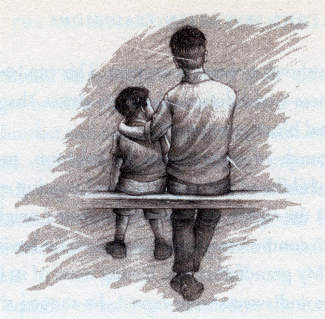
For my eighth-grade graduation, I was chosen to make a speech before several hundred parents and friends in the school auditorium. But as I sat in the living room a few hours before the evening festivities, I developed a terrific case of stage fright. I had planned a presentation on the life of John Muir, the great American naturalist responsible for the creation of Yosemite National Park in California. My brother, Shaf, had recently returned from the navy, and he came over and asked what was wrong. When I explained, he sat down next to me on the sofa, and put his arm around my shoulder.
"Have you ever heard of Stravinsky?" he asked.
"Who?" I replied.
"Igor Stravinsky, the Russian composer. He wrote The Rite of Spring," he added. This piqued my curiosity, so I perked up, and he continued.
"The Rite of Spring was a very unusual composition. It opened in Paris in 1913, before a large and skeptical audience. Three or four minutes into the symphony, the crowd was grumbling; some of them started expressing their revulsion out loud. Soon there were catcalls, and that led to shouting, and then a few people even started throwing debris onstage. Others rose and stormed out of the hall. The orchestra found it impossible to continue.
"Now, Ralph, when you stand up and start describing the work of John Muir before your classmates' families and their friends and neighbors, no one is going to grumble. No one is going to speak against you. There'll be no catcalls, no shouting, no throwing tomatoes. And, certainly, no one is going to march out of the room. So what are you worrying about?" With that he rustled my hair and left the room.
Was I nervous when I finally spoke that evening? Sure. But Shaf was right: There were no catcalls, no jeering, nothing but a respectful audience and one relieved speaker when it was all over.
Was it all harmony between us? Not for a day. We argued and kidded and cajoled each other all the time. But our parents had taught us to respect each other, and we did -- every day.
During our appearance on Donahue in 1991, Phil asked Mother how she responded when her children asked, "Which of us do you like best?" Mother replied by recalling how Bedouin mothers answered that question: "I like the one who is farthest until they are near, the youngest until they grow older, and the sick until they are well." In other words, It depends on the situation. Children understand that, in any given circumstance, their parents might need to show one of their siblings special treatment. What they can't accept -- what can scar them for years -- is when a parent shows repeated favoritism. This can lead to terrible consequences -- withdrawal, chronic sadness, shattered self-confidence, and bitter resentment.
As the fourth of eight sisters in Lebanon, my mother learned from childhood the importance of treating every child equally. When the eighth sister was born, some neighbors and friends came to commiserate with her parents for having all girls and no boys. My grandfather was having none of it; before the Turkish coffee and sweets were served, he shooed them away with a friendly "scatter from here, scatter from here!" He would not entertain such regrets for a moment. Both of my mother's parents were champions of equal treatment for their children, and for them having eight girls was no less a blessing than having eight boys.
Children early on do sense unequal treatment by their parents. Not surprisingly, this was one of my first awarenesses as a little boy -- my mother especially went to great lengths to ensure that her four children never felt they were being treated or spoken to as inferior (or superior) to one another. How did I discover this? Simple: Whether she was admonishing or praising me, she never measured me against my sisters or brother. Not once do I recall her saying, "Look how much better behaved they are," or "He's so much smarter than you." Nor did she set rules based on the idea that one of us was more or less capable or deserving than another. The only exception had to do with age: Mother did insist that the younger children should show respect toward their older siblings. As the younger brother she very much wanted me to learn from my older brother and sisters. That sibling hand-me-down learning process, she believed, would be an important source of nurturing during our upbringing. It also saved her time. Mom and Dad even welcomed my eight-year-old brother Shaf's offer to name me himself, saying that I would be his new companion.
This equality of rearing extended to the level of daily detail. That was what made it routine and therefore normal. None of us received special gifts denied others without understanding why. Similarly, at a time when more boys than girls went on to college from immigrant families, my father and mother expected us all to obtain a higher education; my two sisters each obtained a Ph.D., and the boys went on to law school after college.
As a result of this equitable treatment, we children grew up with little envy or egocentricity to come between us. The older ones helped the younger ones when we needed it -- and, oh, do I remember one time when I needed it.
For my eighth-grade graduation, I was chosen to make a speech before several hundred parents and friends in the school auditorium. But as I sat in the living room a few hours before the evening festivities, I developed a terrific case of stage fright. I had planned a presentation on the life of John Muir, the great American naturalist responsible for the creation of Yosemite National Park in California. My brother, Shaf, had recently returned from the navy, and he came over and asked what was wrong. When I explained, he sat down next to me on the sofa, and put his arm around my shoulder.
"Have you ever heard of Stravinsky?" he asked.
"Who?" I replied.
"Igor Stravinsky, the Russian composer. He wrote The Rite of Spring," he added. This piqued my curiosity, so I perked up, and he continued.
"The Rite of Spring was a very unusual composition. It opened in Paris in 1913, before a large and skeptical audience. Three or four minutes into the symphony, the crowd was grumbling; some of them started expressing their revulsion out loud. Soon there were catcalls, and that led to shouting, and then a few people even started throwing debris onstage. Others rose and stormed out of the hall. The orchestra found it impossible to continue.
"Now, Ralph, when you stand up and start describing the work of John Muir before your classmates' families and their friends and neighbors, no one is going to grumble. No one is going to speak against you. There'll be no catcalls, no shouting, no throwing tomatoes. And, certainly, no one is going to march out of the room. So what are you worrying about?" With that he rustled my hair and left the room.
Was I nervous when I finally spoke that evening? Sure. But Shaf was right: There were no catcalls, no jeering, nothing but a respectful audience and one relieved speaker when it was all over.
Was it all harmony between us? Not for a day. We argued and kidded and cajoled each other all the time. But our parents had taught us to respect each other, and we did -- every day.