Re: Does Civility Matter in the Blogosphere? Examining the
Posted: Tue Dec 03, 2013 8:52 pm
Measurement
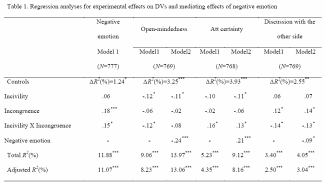
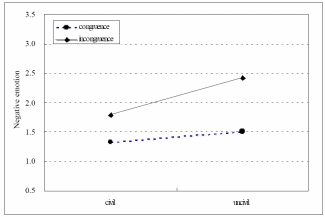
Negative emotions. Negative emotions were measured with respondents’ indication of whether the blogger’s commentary made them feel the following five negative emotions: anger, disgust, contempt, frustration, and irritation (KR-20 =.59, M=1.77, SD=1.35).
Open-mindedness. Respondents were asked to indicate on an 11-point scale (0=strongly disagree, 10=strongly agree) their level of agreement with each of the three statements, asking how reading of blogger’s commentary affected their thoughts: (1) “I felt more open to the arguments on both sides of the issue;” (2) “I learned new things regarding this issue,” and (3) “I changed or modified my opinions about this issue.” These items were averaged into an index (M=3.87, SD=1.90, α =.72).
Attitude certainty. Attitude polarization was constructed by asking respondents’ level of agreement on the following two statements: after reading the blogger’s commentary, (1) “I felt my opinions on this issue became stronger” and “I felt more confident in my own opinion.” Both items were measured on a zero (strongly disagree) to ten (strongly agree) scale (M=5.43, SD=2.04, Inter-item correlation =.56).
Willingness to talk with the other side.. Respondents were asked to indicate their feeling about discussion with people who have opposing views on the issue by asking their level of agreement with the following two statements: (1) “I would enjoy interaction with these people” and (2) “I would find it difficult to talk with these people on the issue” (reverse coded). Both items were measured on a zero (strongly disagree) to ten (strongly agree) scale (M=4.96, SD=2.09, Inter-item correlation =.43).
Control variables. The experimental factor of blog message structure (global vs. interspersed structure) was included as a control variable in order to exclude its potential effects on the dependent variables of this study. In addition to controlling for this experimental factor, we controlled respondents’ gender (68.7% respondents were female), year in college (Median=sophomore), and ideological extremity (M=1.31, SD=.08). ). To construct ideological extremity, we first created ideological conservatism by taking the mean scores of two items (M=2.23, SD=1.33, inter-item correlation=.66) asking about respondents’ ideological orientation on a seven-point scale (0=very liberal, 6=very conservative) with regard to (1) economic issues and (2) social issues. This composite scale was recoded into a 0-3 point scale of ideological extremity by folding the scale at the midpoint (M= 1.31,
Negative emotions. Negative emotions were measured with respondents’ indication of whether the blogger’s commentary made them feel the following five negative emotions: anger, disgust, contempt, frustration, and irritation (KR-20 =.59, M=1.77, SD=1.35).
Open-mindedness. Respondents were asked to indicate on an 11-point scale (0=strongly disagree, 10=strongly agree) their level of agreement with each of the three statements, asking how reading of blogger’s commentary affected their thoughts: (1) “I felt more open to the arguments on both sides of the issue;” (2) “I learned new things regarding this issue,” and (3) “I changed or modified my opinions about this issue.” These items were averaged into an index (M=3.87, SD=1.90, α =.72).
Attitude certainty. Attitude polarization was constructed by asking respondents’ level of agreement on the following two statements: after reading the blogger’s commentary, (1) “I felt my opinions on this issue became stronger” and “I felt more confident in my own opinion.” Both items were measured on a zero (strongly disagree) to ten (strongly agree) scale (M=5.43, SD=2.04, Inter-item correlation =.56).
Willingness to talk with the other side.. Respondents were asked to indicate their feeling about discussion with people who have opposing views on the issue by asking their level of agreement with the following two statements: (1) “I would enjoy interaction with these people” and (2) “I would find it difficult to talk with these people on the issue” (reverse coded). Both items were measured on a zero (strongly disagree) to ten (strongly agree) scale (M=4.96, SD=2.09, Inter-item correlation =.43).
Control variables. The experimental factor of blog message structure (global vs. interspersed structure) was included as a control variable in order to exclude its potential effects on the dependent variables of this study. In addition to controlling for this experimental factor, we controlled respondents’ gender (68.7% respondents were female), year in college (Median=sophomore), and ideological extremity (M=1.31, SD=.08). ). To construct ideological extremity, we first created ideological conservatism by taking the mean scores of two items (M=2.23, SD=1.33, inter-item correlation=.66) asking about respondents’ ideological orientation on a seven-point scale (0=very liberal, 6=very conservative) with regard to (1) economic issues and (2) social issues. This composite scale was recoded into a 0-3 point scale of ideological extremity by folding the scale at the midpoint (M= 1.31,