
Supreme Court strikes down Trump’s tariffs. It’s a rare loss for the president from a conservative-led court and a major rebuke of his economic program.
by Doug Palmer, Josh Gerstein and Daniel Desrochers
Politico
02/20/2026 10:12 AM EST
Updated: 02/20/2026 10:56 AM EST
https://www.politico.com/news/2026/02/2 ... g-00790687
The Supreme Court on Friday struck down President Donald Trump’s sweeping tariffs — a major repudiation of a core piece of Trump’s economic program.
The 6-3 decision is a rare instance of the conservative-led court reining in Trump’s expansive use of executive power. Chief Justice John Roberts and Justices Amy Coney Barrett and Neil Gorsuch joined the court’s three liberals in the majority.
“The President asserts the extraordinary power to unilaterally impose tariffs of unlimited amount, duration, and scope. In light of the breadth, history, and constitutional context of that asserted authority, he must identify clear congressional authorization to exercise it,” Roberts wrote, declaring that the 1977 law Trump cited to justify the import duties “falls short” of the congressional approval that would be needed.
The ruling wipes out the 10 percent tariff Trump imposed on nearly every country in the world, as well as specific, higher tariffs on some of the top U.S. trading partners, including Canada, Mexico, China, the European Union, Japan and South Korea.
Several of those countries have entered trade agreements with the U.S. — and before the ruling indicated that they would continue to honor those agreements.
That is because the victory for the 12 Democratic-run states and small businesses that challenged Trump’s tariffs is expected to be short lived. The White House has signaled it will attempt to use other authorities to keep similar duties in place.
“We’ve been thinking about this plan for five years or longer,” U.S. Trade Representative Jamieson Greer told POLITICO in December. “You can be sure that when we came to the president the beginning of the term, we had a lot of different options”
“My message is tariffs are going to be a part of the policy landscape going forward,” Greer said.
But Trump has repeatedly said that a loss in the tariff case at the Supreme Court would be a “disaster” for the United States, even though critics of his restrictive import tax scheme argue the country prospered for decades with low tariffs.
It undercuts his ability to impose tariffs on a whim to address geopolitical conflict — like a threat to impose tariffs on countries that do business with Iran — and to threaten tariffs as he tries to gain a better negotiating position — like his tariff threats in an attempt to acquire Greenland. Businesses had decried those “national security” tariff threats for fueling economic uncertainty, but the administration said they were necessary for achieving its policy goals.
While Roberts’ ruling was emphatic, the court’s majority was not entirely unified in its rationale.
The six justices who voted to strike down the tariffs agreed that the law Trump cited, the International Emergency Economic Powers Act, could not properly be read to authorize tariffs at all. Roberts, Gorsuch and Barrett also invoked a legal theory called the major questions doctrine to conclude that, due to the broad economic impact of tariffs, Congress would need to be particularly clear before shifting its trade-related powers to the president.
The chief justice, Gorsuch and Barrett also rejected arguments from Trump and the dissenting justices that the court should defer to Trump because of the role tariffs play in foreign relations.
“Whatever may be said of other powers that implicate foreign affairs, we would not expect Congress to relinquish its tariff power through vague language, or without careful limits,” Roberts wrote.
In a visit to Georgia on Wednesday, Trump touted a steel business he said had been able to boost production because of his widespread use of tariffs, questioned why the Supreme Court would rule against him and needled the justices for taking months to resolve the issue.
“The tariff is the greatest thing that’s happened in this country,” Trump said. “We’re making a fortune. But more importantly, all these factories are booming now, and they were all dead.”
The federal government could now be forced to issue billions of dollars in refunds to companies that paid the tariffs the high court ruled illegal. Many companies have already sued to protect their refund claims in the event the court struck down the Trump tariffs.
The majority opinion made no mention of the battle over refunds, but Justice Brett Kavanaugh predicted some chaos in his dissent.
“The United States may be required to refund billions of dollars to importers who paid the IEEPA tariffs, even though some importers may have already passed on costs to consumers or others,” Kavanaugh wrote. “The refund process is likely to be a ‘mess,’” he added, quoting an exchange the justices had on the issue during oral argument in November.
Kavanaugh said “context and common sense” supported the conclusion that IEEPA “clearly authorized” the president to impose tariffs, even though that word doesn’t appear in the statute.
The ruling also raises questions about the future of trade deals that the Trump administration has struck with the European Union, Japan, South Korea and other trading partners to reduce the tariffs he targeted at their exports to the United States.
Part 2 Anti-Anti-Nazi Barbarian Hordes are Knocking Down ...
Re: Part 2 Anti-Anti-Nazi Barbarian Hordes are Knocking Down
 by admin » Fri Feb 20, 2026 6:06 pm
- admin
- Site Admin
- Posts: 40127
- Joined: Thu Aug 01, 2013 5:21 am
Re: Part 2 Anti-Anti-Nazi Barbarian Hordes are Knocking Down
by admin » Fri Feb 20, 2026 6:46 pm
'Trump became enraged' and used expletives after news of Supreme Court smackdown: report
by Nicole Charky-Chami
Raw Story
February 20, 2026 11:42AM ET
https://www.rawstory.com/trump-became-e ... -decision/
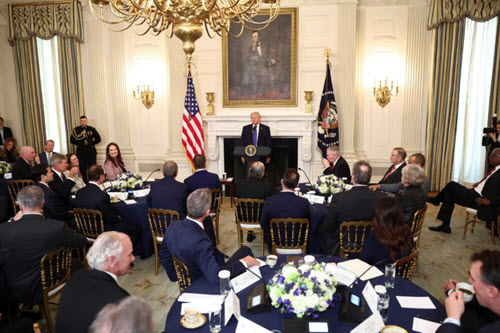
President Donald Trump holds a working breakfast with governors at the White House in Washington, D.C. on Feb. 20, 2026. REUTERS/Kevin Lamarque
President Donald Trump was reportedly infuriated Friday after the Supreme Court ruled that his tariffs were illegal.
Trump was hosting the National Governor's Association breakfast with a room full of the nation's governors at the White House when he found out about the high court's decision to strike down Trump's tariffs in a 6-3 vote.
"Apparently the gov breakfast had been going well, they were working together, and then President Trump became enraged. He started ranting about the decision, not only calling it a disgrace, but started attacking the courts at one point saying, these 'f------ courts,'" said CNN senior White House correspondent Kristen Holmes.
"This tariff policy — this could not be a bigger decision for President Trump — this could not be a bigger loss for President Trump," Holmes added. "Not only is so much of his economic agenda based on these tariffs, so much of his foreign policy is based on these tariffs. He has used these tariffs as leverage in almost every meeting that he has had around the world. He has touted them as the most important part of the economic agenda. So clearly, a huge loss, and he recognizes that today."
Trump and his administration have not yet made an official announcement in response. His team was reportedly meeting to determine next moves, Holmes said.
by Nicole Charky-Chami
Raw Story
February 20, 2026 11:42AM ET
https://www.rawstory.com/trump-became-e ... -decision/
President Donald Trump holds a working breakfast with governors at the White House in Washington, D.C. on Feb. 20, 2026. REUTERS/Kevin Lamarque
President Donald Trump was reportedly infuriated Friday after the Supreme Court ruled that his tariffs were illegal.
Trump was hosting the National Governor's Association breakfast with a room full of the nation's governors at the White House when he found out about the high court's decision to strike down Trump's tariffs in a 6-3 vote.
"Apparently the gov breakfast had been going well, they were working together, and then President Trump became enraged. He started ranting about the decision, not only calling it a disgrace, but started attacking the courts at one point saying, these 'f------ courts,'" said CNN senior White House correspondent Kristen Holmes.
"This tariff policy — this could not be a bigger decision for President Trump — this could not be a bigger loss for President Trump," Holmes added. "Not only is so much of his economic agenda based on these tariffs, so much of his foreign policy is based on these tariffs. He has used these tariffs as leverage in almost every meeting that he has had around the world. He has touted them as the most important part of the economic agenda. So clearly, a huge loss, and he recognizes that today."
Trump and his administration have not yet made an official announcement in response. His team was reportedly meeting to determine next moves, Holmes said.
- admin
- Site Admin
- Posts: 40127
- Joined: Thu Aug 01, 2013 5:21 am
Re: Part 2 Anti-Anti-Nazi Barbarian Hordes are Knocking Down
by admin » Fri Feb 20, 2026 7:15 pm
LIVE: Trump speaks after Supreme Court strikes down his tariffs
Associated Press
Started streaming 3 hours ago
Watch live as President Donald Trump speaks after the Supreme Court struck down his far-reaching tariffs on Friday. This upends a central plank of the administration’s economic agenda.
Associated Press
Started streaming 3 hours ago
Watch live as President Donald Trump speaks after the Supreme Court struck down his far-reaching tariffs on Friday. This upends a central plank of the administration’s economic agenda.
- admin
- Site Admin
- Posts: 40127
- Joined: Thu Aug 01, 2013 5:21 am
Re: Part 2 Anti-Anti-Nazi Barbarian Hordes are Knocking Down
by admin » Fri Feb 20, 2026 7:35 pm
Trump Has Many Options If the Supreme Court Strikes Down Tariffs
by Stan Veuger, Clark Packard
American Enterprise Institute
December 05, 2025
https://www.aei.org/op-eds/trump-has-ma ... n-tariffs/
The U.S. Supreme Court is expected to soon come to a decision in Learning Resources v. Trump, the case that will determine whether the tariffs that the second Trump administration has imposed under the International Emergency Economic Powers Act (IEEPA) pass statutory and constitutional muster. If President Donald Trump’s signature economic policy is struck down, the consequences will be significant: The administration may have to refund the roughly $100 billion in taxes that it has collected so far, and much of the new tariff architecture that it has built this year will be gone.
That will not mean that the country’s long national nightmare will have come to an end. There are a number of alternative statutes that the administration could rely on to issue arbitrary tariffs instead of IEEPA. On the bright side for the administration—but not the country—the administration could likely use those instruments to raise similar amounts of revenue to what it is collecting now. Legal challenges would certainly follow, but the administration would be on firmer statutory ground than IEEPA has provided. The relatively good news would be that statutory guardrails might keep it from taxing imports in the rapidly fluctuating manner in which it has deployed the IEEPA tariffs.
An administration loss at the Supreme Court would have direct implications for two sets of IEEPA tariffs: the so-called “reciprocal tariffs,” first announced in April, and the tariffs imposed on Canada, China, and Mexico in an alleged effort to force those countries to act against fentanyl flows.
Depending on the court’s reasoning, the decision could also have implications for a set of other tariffs imposed under cover of IEEPA, such as those levied on imports from Brazil to aid former President Jair Bolsonaro’s efforts to avoid prosecution for an attempted coup and those imposed on India as punishment for its Russian oil imports. Total IEEPA tariffs vary from 10 percent to 50 percent (for India and Brazil) but are at or below 15 percent for most countries.
Yet even removing all the IEEPA tariffs would still leave the United States with high import duties by the standards of recent decades, as a number of tariffs justified on the basis of other statutes would remain in place.
The first Trump administration imposed tariffs—usually of 25 percent—on some two-thirds of imports from China under Section 301 of the Trade Act of 1974. The Biden administration kept these measures largely intact and used the existing authority to layer on other tariffs, including 100 percent duties on Chinese electric vehicles. Most of these tariffs continue to this day. Because of these Section 301 measures, the effective tariff on imports from China remains particularly high—around 50 percent.
Section 232 tariffs would also survive an administration loss in Learning Resources v. Trump. Under Section 232 of the Trade Expansion Act of 1962, the president may restrict imports determined to pose a threat to national security following an investigation by the Commerce Department. The second Trump administration has substantially expanded national security tariffs to a variety of goods in recent months: cars and car parts; copper; lumber; an array of products made with steel and aluminum, such as washing machines, office furniture, and refrigerators and freezers. More are expected to come, including semiconductors, pharmaceutical goods, critical minerals, and others.
Importing these products does not pose a genuine national security risk to the United States, but courts have been exceedingly deferential to the administration’s claims. Congressional efforts to circumscribe the president’s unilateral authority to impose national security tariffs have floundered.
In combination, this year’s Section 232 tariffs raise about as much revenue as the IEEPA tariffs (as they currently stand after a whirlwind of changes from early April).
If the Supreme Court were to ultimately reject the administration’s sweeping interpretation of IEEPA, Trump has other protectionist tools at his disposal, as Kevin Hassett, the director of the National Economic Council, recently noted during an interview with Bloomberg’s David Rubenstein.
Given the president’s misguided obsession with the trade deficit, the administration could turn to Section 122 of the Trade Act of 1974. That provision empowers the president to address “large and serious” balance-of-payments deficits through import surcharges of up to 15 percent, import quotas, or some combination of the two.
The administration could replicate the IEEPA tariff structure through Section 122 (except for those countries with rates of more than 15 percent, which would be reduced to that rate), and it could do so immediately. Such a structure would collect about 70 percent of the revenue currently coming in through the IEEPA tariffs.
But the statute comes with certain guardrails—principally, that any action taken under Section 122 expires after 150 days unless Congress affirmatively votes to extend it. As the IEEPA case has demonstrated, the Trump administration has shown a willingness to interpret statutes very broadly (to put it mildly).
In theory, the president could reimpose Section 122 tariffs for another 150 days immediately after the initial period lapses, without an affirmative vote from Congress. This tactic would contravene the spirit—if not the letter—of the law, raising serious questions about the separation of powers and the statute’s original intent—and exposing the administration to more legal challenges.
In its 50-plus year history, the law has also never been used to impose trade restrictions. Notably, Congress conceived Section 122 authority as a tool to stabilize exchange rates, not as a pretext for economic protection. In fact, the statute requires the existence of “fundamental international payments problems,” which makes little sense outside a context of fixed or managed exchange rates, such as the early-1970s setting in which Section 122 originated.
The same law’s Section 301—the basis for existing China tariffs—offers another avenue for reconstructing IEEPA tariffs, one where the president enjoys wide unilateral authority. It grants the U.S. trade representative (USTR) broad authority to investigate and remedy “unfair” foreign trade practices. That’s a capacious term encompassing everything from trade agreement violations to foreign trade practices that are “unreasonable” and burden U.S. commerce. This was intended to be a tool to pry open foreign markets, but these days, market access takes a backseat to protectionism.
Section 301 investigations and actions must target specific trading partners (i.e., China or the European Union) for their allegedly unfair practices. On the surface, Section 301 comes with genuine procedural requirements. The USTR must conduct an investigation and publish its findings. If an affirmative determination is made, then the USTR is required to request consultations with the targeted trading partner and pursue formal dispute settlement when a trade agreement violation is alleged.
Yet the Section 301 guardrails are thinner than they appear on first blush, particularly in government-initiated cases. Under the statute, the USTR—and by extension, the president—has plenary discretion to determine whether an issue falls under a trade agreement and may act unilaterally when concluding that it does not. The consultations and dispute settlement can be largely perfunctory, and the law, as currently understood in self-initiated cases, permits massive trade restrictions.
Section 301 actions can also persist indefinitely as long as a domestic beneficiary requests the continuation of the tariffs every four years. Consequently, it would be straightforward to use Section 301 actions to reconstruct the parts of the IEEPA tariff structure that cannot be replicated with Section 122 measures—perhaps not immediately but certainly after a few months.
Though Section 301 is more flexible than other statutes, such extensive use of the law may trigger renewed judicial scrutiny. Especially after the 2023 Loper Bright decision, in which the Supreme Court reduced the amount of deference owed to agency interpretations of the law, the courts may be willing to overrule Section 301 actions that are based on clearly unreasonable concerns around purported unfair trade practices.
Alternatively, the administration may decide to continue expanding its use of Section 232 measures to replace the IEEPA tariffs that cannot be replaced by Section 122 measures. As Section 232 tariffs are based at least nominally on national security grounds, they will be less vulnerable to judicial review. That said, the statute lends itself better to sectoral or product-specific trade measures. It would be difficult to build a compelling case that all imports from Brazil and only from Brazil pose a national security threat. Were the administration to rely on this statute, it will likely be easier to match current IEEPA revenue than the precise rate structure.
A less likely route, and one that may not play well electorally, is to rely on Section 338 of the Tariff Act of 1930—the infamous Smoot-Hawley Act, which is often blamed for worsening the Great Depression and is the one trade statute that at least some voters are familiar with. Section 338 is a precursor to Section 301 and was arguably supplanted by that latter provision, though it remains on the books. It lets the president impose tariffs of up to 50 percent on imports from countries that “discriminate” against U.S. commerce as compared to other nations.
The statute’s limitations are relatively modest. Private parties or the executive branch may petition the U.S. International Trade Commission (USITC) to initiate an investigation. Proving discrimination could be challenging for the Trump administration when targeting World Trade Organization members that are bound by “most favored nation” requirements. Unilateral action by the ever-protectionist Trump administration could invite legal challenges arguing that the president lacks authority to impose restrictions without the trade commission’s involvement, or that the statute’s foreign discrimination requirements have not been met.
If the Supreme Court strikes down the IEEPA tariffs, the critical question becomes which alternative authorities the administration will deploy. Unfettered use of Sections 122 and 338 would recreate the current predicament: the president continuing to make major changes to tax policy and the business environment at his whim, generating paralyzing uncertainty, and redistributing massive amounts of resources without express congressional authorization.
The outlook improves somewhat if the administration must instead rely on sectoral “national security” tariffs under Section 232 and country-specific tariffs under Section 301, particularly if courts are less deferential to implausible claims about national security threats or unfair trading practices.
But meaningful reform requires Congress to rein in presidential authority—judicial constraints alone likely won’t suffice.
by Stan Veuger, Clark Packard
American Enterprise Institute
December 05, 2025
https://www.aei.org/op-eds/trump-has-ma ... n-tariffs/
The U.S. Supreme Court is expected to soon come to a decision in Learning Resources v. Trump, the case that will determine whether the tariffs that the second Trump administration has imposed under the International Emergency Economic Powers Act (IEEPA) pass statutory and constitutional muster. If President Donald Trump’s signature economic policy is struck down, the consequences will be significant: The administration may have to refund the roughly $100 billion in taxes that it has collected so far, and much of the new tariff architecture that it has built this year will be gone.
That will not mean that the country’s long national nightmare will have come to an end. There are a number of alternative statutes that the administration could rely on to issue arbitrary tariffs instead of IEEPA. On the bright side for the administration—but not the country—the administration could likely use those instruments to raise similar amounts of revenue to what it is collecting now. Legal challenges would certainly follow, but the administration would be on firmer statutory ground than IEEPA has provided. The relatively good news would be that statutory guardrails might keep it from taxing imports in the rapidly fluctuating manner in which it has deployed the IEEPA tariffs.
An administration loss at the Supreme Court would have direct implications for two sets of IEEPA tariffs: the so-called “reciprocal tariffs,” first announced in April, and the tariffs imposed on Canada, China, and Mexico in an alleged effort to force those countries to act against fentanyl flows.
Depending on the court’s reasoning, the decision could also have implications for a set of other tariffs imposed under cover of IEEPA, such as those levied on imports from Brazil to aid former President Jair Bolsonaro’s efforts to avoid prosecution for an attempted coup and those imposed on India as punishment for its Russian oil imports. Total IEEPA tariffs vary from 10 percent to 50 percent (for India and Brazil) but are at or below 15 percent for most countries.
Yet even removing all the IEEPA tariffs would still leave the United States with high import duties by the standards of recent decades, as a number of tariffs justified on the basis of other statutes would remain in place.
The first Trump administration imposed tariffs—usually of 25 percent—on some two-thirds of imports from China under Section 301 of the Trade Act of 1974. The Biden administration kept these measures largely intact and used the existing authority to layer on other tariffs, including 100 percent duties on Chinese electric vehicles. Most of these tariffs continue to this day. Because of these Section 301 measures, the effective tariff on imports from China remains particularly high—around 50 percent.
Section 232 tariffs would also survive an administration loss in Learning Resources v. Trump. Under Section 232 of the Trade Expansion Act of 1962, the president may restrict imports determined to pose a threat to national security following an investigation by the Commerce Department. The second Trump administration has substantially expanded national security tariffs to a variety of goods in recent months: cars and car parts; copper; lumber; an array of products made with steel and aluminum, such as washing machines, office furniture, and refrigerators and freezers. More are expected to come, including semiconductors, pharmaceutical goods, critical minerals, and others.
Importing these products does not pose a genuine national security risk to the United States, but courts have been exceedingly deferential to the administration’s claims. Congressional efforts to circumscribe the president’s unilateral authority to impose national security tariffs have floundered.
In combination, this year’s Section 232 tariffs raise about as much revenue as the IEEPA tariffs (as they currently stand after a whirlwind of changes from early April).
If the Supreme Court were to ultimately reject the administration’s sweeping interpretation of IEEPA, Trump has other protectionist tools at his disposal, as Kevin Hassett, the director of the National Economic Council, recently noted during an interview with Bloomberg’s David Rubenstein.
Given the president’s misguided obsession with the trade deficit, the administration could turn to Section 122 of the Trade Act of 1974. That provision empowers the president to address “large and serious” balance-of-payments deficits through import surcharges of up to 15 percent, import quotas, or some combination of the two.
The administration could replicate the IEEPA tariff structure through Section 122 (except for those countries with rates of more than 15 percent, which would be reduced to that rate), and it could do so immediately. Such a structure would collect about 70 percent of the revenue currently coming in through the IEEPA tariffs.
But the statute comes with certain guardrails—principally, that any action taken under Section 122 expires after 150 days unless Congress affirmatively votes to extend it. As the IEEPA case has demonstrated, the Trump administration has shown a willingness to interpret statutes very broadly (to put it mildly).
In theory, the president could reimpose Section 122 tariffs for another 150 days immediately after the initial period lapses, without an affirmative vote from Congress. This tactic would contravene the spirit—if not the letter—of the law, raising serious questions about the separation of powers and the statute’s original intent—and exposing the administration to more legal challenges.
In its 50-plus year history, the law has also never been used to impose trade restrictions. Notably, Congress conceived Section 122 authority as a tool to stabilize exchange rates, not as a pretext for economic protection. In fact, the statute requires the existence of “fundamental international payments problems,” which makes little sense outside a context of fixed or managed exchange rates, such as the early-1970s setting in which Section 122 originated.
The same law’s Section 301—the basis for existing China tariffs—offers another avenue for reconstructing IEEPA tariffs, one where the president enjoys wide unilateral authority. It grants the U.S. trade representative (USTR) broad authority to investigate and remedy “unfair” foreign trade practices. That’s a capacious term encompassing everything from trade agreement violations to foreign trade practices that are “unreasonable” and burden U.S. commerce. This was intended to be a tool to pry open foreign markets, but these days, market access takes a backseat to protectionism.
Section 301 investigations and actions must target specific trading partners (i.e., China or the European Union) for their allegedly unfair practices. On the surface, Section 301 comes with genuine procedural requirements. The USTR must conduct an investigation and publish its findings. If an affirmative determination is made, then the USTR is required to request consultations with the targeted trading partner and pursue formal dispute settlement when a trade agreement violation is alleged.
Yet the Section 301 guardrails are thinner than they appear on first blush, particularly in government-initiated cases. Under the statute, the USTR—and by extension, the president—has plenary discretion to determine whether an issue falls under a trade agreement and may act unilaterally when concluding that it does not. The consultations and dispute settlement can be largely perfunctory, and the law, as currently understood in self-initiated cases, permits massive trade restrictions.
Section 301 actions can also persist indefinitely as long as a domestic beneficiary requests the continuation of the tariffs every four years. Consequently, it would be straightforward to use Section 301 actions to reconstruct the parts of the IEEPA tariff structure that cannot be replicated with Section 122 measures—perhaps not immediately but certainly after a few months.
Though Section 301 is more flexible than other statutes, such extensive use of the law may trigger renewed judicial scrutiny. Especially after the 2023 Loper Bright decision, in which the Supreme Court reduced the amount of deference owed to agency interpretations of the law, the courts may be willing to overrule Section 301 actions that are based on clearly unreasonable concerns around purported unfair trade practices.
Alternatively, the administration may decide to continue expanding its use of Section 232 measures to replace the IEEPA tariffs that cannot be replaced by Section 122 measures. As Section 232 tariffs are based at least nominally on national security grounds, they will be less vulnerable to judicial review. That said, the statute lends itself better to sectoral or product-specific trade measures. It would be difficult to build a compelling case that all imports from Brazil and only from Brazil pose a national security threat. Were the administration to rely on this statute, it will likely be easier to match current IEEPA revenue than the precise rate structure.
A less likely route, and one that may not play well electorally, is to rely on Section 338 of the Tariff Act of 1930—the infamous Smoot-Hawley Act, which is often blamed for worsening the Great Depression and is the one trade statute that at least some voters are familiar with. Section 338 is a precursor to Section 301 and was arguably supplanted by that latter provision, though it remains on the books. It lets the president impose tariffs of up to 50 percent on imports from countries that “discriminate” against U.S. commerce as compared to other nations.
The statute’s limitations are relatively modest. Private parties or the executive branch may petition the U.S. International Trade Commission (USITC) to initiate an investigation. Proving discrimination could be challenging for the Trump administration when targeting World Trade Organization members that are bound by “most favored nation” requirements. Unilateral action by the ever-protectionist Trump administration could invite legal challenges arguing that the president lacks authority to impose restrictions without the trade commission’s involvement, or that the statute’s foreign discrimination requirements have not been met.
If the Supreme Court strikes down the IEEPA tariffs, the critical question becomes which alternative authorities the administration will deploy. Unfettered use of Sections 122 and 338 would recreate the current predicament: the president continuing to make major changes to tax policy and the business environment at his whim, generating paralyzing uncertainty, and redistributing massive amounts of resources without express congressional authorization.
The outlook improves somewhat if the administration must instead rely on sectoral “national security” tariffs under Section 232 and country-specific tariffs under Section 301, particularly if courts are less deferential to implausible claims about national security threats or unfair trading practices.
But meaningful reform requires Congress to rein in presidential authority—judicial constraints alone likely won’t suffice.
- admin
- Site Admin
- Posts: 40127
- Joined: Thu Aug 01, 2013 5:21 am
Re: Part 2 Anti-Anti-Nazi Barbarian Hordes are Knocking Down
by admin » Fri Feb 20, 2026 11:48 pm
Trump Just Ignored the Supreme Court. What Happens Now?
The Lincoln Project
Feb 20, 2026
After the Supreme Court ruled Trump’s tariffs illegal, he responded by saying he’ll keep doing them anyway. Rick Wilson breaks down what this unprecedented defiance means, and what happens next.
Transcript
I have emerged from the hole and and
dear God, I mean, look, when I read the
when I read the Supreme Court decision
this morning, I was like, "Oh, he's
gonna lose his mind. He's going to write
the longest true social post ever." But
instead he went on and did I mean Kate
you and I watched every single COVID
press conference and I think today was
worse than the worst of the co than
worse than bleach up your ass light
bulbs up your ass and bleach press
conference. I think today was worse. I
think this press conference was more
insane
because he was completely unhinged. He
is clearly very angry. Um, and his basic
message to the Supreme Court of the
United States of America was, "Go f
yourself. No, I'm gonna keep doing what
I'm going to do on the tariffs."
Yeah. So, why don't let's let's get into
the Supreme Court ruled this morning
that Trump's Trump doing his unilateral
tariffs was illegal, unconstitutional.
He can't do it anymore. within hours
wrong
at this like governor's lunch that he
had uh he brought the press in and well
actually before the press came in he
said these courts CNN reported
and then when the press came in he just
went off forever um I I'll Castro level
going on forever like hours it felt like
yeah so let's take a look at what he had
to say about the court
tariff is
but there's been bipartisan criticism
not there. Several Republicans have said
that.
Yeah. Why wouldn't you just work with
Congress to come up with a plan to to
push tariffs?
I have the right to do tariffs and I've
always had the right to do tariffs. It
has all been approved by Congress. So,
literally none of that is true.
What can he do? So, he now said at that
presser that he's imposing by executive
order 10% global tariffs. C can he do
that?
No. The Supreme Court just said to him,
just said the words, "Read the
Constitution, You can't." A six-3
decision, including such famous flaming
liberals as Amy Comey Barrett and Neil
Gorsuch and John Roberts. They looked at
this and said, "No, bro. You can't.
It's in the black letter law of the
Constitution."
Now does he have some narrow narrow
narrow like national security based
things like you can't ship certain I
very narrowly
maybe but the key lie in that sentence
that he said I don't have to work with
Congress because I've always had the
right to do terrorists that is a lie
that is that is not what the court says
that is not what the law said that's not
what the constitution says right now
the fact that Trump declared an
emergency and Congress did nothing about
it does not make what he did legal. It
makes them incompetent bootlicking
boobs. It makes them for not
standing up for the prerogatives both of
the Constitution and of the Congress.
All of this
all of this adds up to we now are on a
collision course with Trump and the
Supreme Court where they have said this
is the law. You may not. And he said,
"Yeah, I may and I'm going to what are
you going to do about it?" So, this is
the constitutional crisis everyone told
me wasn't going to happen because Trump
was much more mature in the second term.
Great.
It is. Look, I I think we've got to be
re very realistic right now about about
the immediate future. Trump's going to
continue to do these tariffs. There will
be court orders up and down the chain.
Eventually, those court orders will will
lead him to an outward defiance of the
Supreme Court, which puts him in once
again impeachment territory and puts him
in a position, I think, where where even
his allies in the Senate, who are the
people holding his his hand right now on
a lot of different issues he needs to be
very protected on, even those people are
going to say, "That ain't it, Chief.
We're done. Can't do it." and and in the
House,
the the the damage to the to in the
House to these members of Congress who
are all on these swing seats
is enormous already. Trump should have
recognized what the Supreme Court just
gave him that he they gave him a get out
of jail free card. He could have said,
you know, I I tried to do my best to
bring back the economic blah blah blah
and I did this to to make America great
again. the Supreme Court disagrees with
me and I disagree with them, but I'm
going to follow the law and the tariffs
are gone.
What would have happened? One, the
markets would have gone cuckoo vertical.
They would have gone crazy. They would
have loved it. The the the the global
economic boom that followed would have
made it much easier for Republicans to
make an economic case in the fall.
Right now, the economic case they have
is, yeah, Donald Trump's tariffs will
cost you $1,400 for the average American
family. Too bad,
right?
It's it's I I got to tell you, he he
does not know when to take the exit
ramp, Kate. He doesn't know when to take
like the the the easiest layup in
history politically is to go, "Oh, well,
I tried." And move on.
Right. And he also he also said during
that press conference today when asked
uh like about when we'll see results in
the economy, he said you'll see results
in a year. So we're now pushing back the
you know day one again. So now that's
two years into his presidency. How does
that how's that going to drive with the
American people when when they are
paying extra taxes from his tariffs and
now also the corporations are going to
get the bailout check from the tariffs
if they're ruled that he can't do it.
Yeah. Look, the American taxpayers who
have already paid this this this tax
because tariffs, as they say in the
decision, tariffs are taxes.
Say it with me again, friends. Tariffs
are taxes. They were paid by American
citizens. Now, some companies paid them.
Some companies um um ate the cost,
but they got passed to consumers, folks.
And consumers are going to be the ones
who get screwed. But you know who's
going to make a lot of money, Kate? I
don't know if people have seen this
story yet, but Howard Lutnik and his
sons have invested in these futures that
were betting against the tariffs being
sustained. So, they're going to buy the
tariff debt.
They were they were I'm sorry, before
this, they were buying the tariff debt
for 20 cents on the dollar. So, now they
for their 20 cent investment, they make
a dollar when they've bought up all this
tariff debt from these companies. It is.
So when the when the companies get
reimbursed for
when the companies get reimbursed, they
have to pay um the lutnics.
Great. I love that.
It's just so it it it is like the most
third world garbage you've ever seen.
And we deserve it because that's what we
are now.
Went it went for so long. He he he said
I want to show him saying that he him
saying that he read the decision.
Oh, right. Right. That he read the
decision. Let's let's play that. That's
a great clip. Oh my god, it's so good.
I was surprised because I I thought that
what we did was number one according to
I mean I read the paragraphs. I read
very well. Great comprehension.
Uh I read everything there is to read.
Great comprehension. Look, if you are a
80-year-old man who has to tell people
that you you can read
that you read good,
you don't read well. That's the thing.
Great comprehension. That's the
equivalent of person, woman, man,
camera, TV. That that that is just it's
such a tell. He didn't read check. He
looked at he he looked at a 3x5 note
card that said oops written by some
staffer and and and honestly Kate
we've been watching this guy for five
years now pushing six years now and one
of his great tells is when he's talking
about how good he is at things. One of
his one of one of the it tells about him
that he he's lying and things are in the
dumper is when he does the sir stories
when he talks about how great he is and
and when he talks about
about men who want to kiss me. I mean
that that was that was all today that
would have set off Mike Johnson's porn
alarm.
How's business president? I'd love to
kiss you. This is a very powerful man. I
don't want to be kissed by that man. But
a very powerful, strong man. He's been
in the steel business for many years.
His father started it.
And uh he said, "Sir, I want to kiss
you." He said, "Why?"
He keeps talking about kissing men. It's
crazy.
It's a lot. Like I said, it probably
sets off Mike Johnson's porn alert on
his phone.
Okay, so what happens now? So the
Supreme Court said that it was illegal
and he got on stage two hours later and
said, "I don't care. I'm imposing 10%
tariffs." What happened? Do they go into
effect?
No, I don't think they do. I think the
court orders are going to be flying fast
and furious. The lawsuits are going to
be based on a brand new ruling from the
Supreme Court and the court
the court clearly took a strange turn
today. And I'm not I'm not getting too
polyiana optimistic as you guys know I'm
not a ray of sunshine but I really think
there is a moment here where where when
you've got Roberts Gorsuch Barrett
in this new in this new wing of the of
the majority
along with all of the the other justices
except for uh Alto Thomas and and and I
like beer.
when you have that new alignment.
And Gorsuch says it in his concurrence.
He wrote a beautiful concurrence, 46
page concurrence, and he said, "If you
want tariffs, you must go through the
legislative process. You will regret it
if you don't. The legislative process
because he said, you know, the wheel is
going to turn."
and and that was clearly him
understanding that in the immediate
future, you're not going to have Donald
Trump and Mike Johnson running this
operation in Congress. So if Trump wants
tariffs, all he has to do is propose a
bill.
It will go to the House. Mike Johnson
will immediately put it on the calendar.
They will vote on that bill. It will go
to the Senate. It will die. But that's
just how it's going to go. But he unless
he does that, Trump has just left
himself out there incredibly vulnerable
on this stuff. And it was really Kate I
mean in the in the in the he just can't
see the gift the court handed him right
now. And he he doesn't understand that
continuing these tariffs now it's just
plain illegal.
Voters were already tired of the
tariffs. They hated the trade war. The
the the polling has been awful on the
trade war.
But Trump's illusion that he has the
right to do this. I have the right to do
it. I always had the right to do it.
It is going to absolutely be a boat
anchor on these Republicans. And so the
Senate will vote it down. The House will
pass it. Maybe. Maybe. I'm not even sure
the House will pass it at this point,
but it'll go to the Senate and die.
There's no way there's 60 votes for a
tariff bill of any kind for Trump. So,
he's going to have to retreat into uh
pure defiance of the Supreme Court.
constitutional crisis, which we're in,
folks. If you don't know that we're in
it, we're in it right now. Um, and and
honestly, Kate, I I mean,
I look at what he's doing right now
today as as partly a sign of his decline
in his dementia. This is not a well man.
This is not a healthy guy. He's not
mentally smart out there. He's slurring
his words. He's all over the place as
usual these days. And and I think we
really have we really saw him take the
biggest loss of the second term so far
and he's not take going to take it well.
He's going to act out very badly. And
when the Senate when John Thun tells him
there's not 60 votes in the Senate,
he'll say to Thoon again, you override
the filibuster. Thun's not going to
override the filibuster. He's not going
to do it.
So how should Democrats
for the Save Act for the Save Act or for
tariffs? Democrats should be dancing in
the streets right now. They should be
out there proposing bills to unwind
Trump's tariffs based on the Supreme
Court's ruling. There should be Hakee
should pro they should have a bill I
hope they've already got it written. It
should have been
a bill that says that the the the power
of the presidency to declare tariffs is
now uh clearly delineated even further
by the Supreme Court decision and all
current tariffs in invoked by Donald J.
Trump from the time of his election and
da da da are invalid.
They should assertively do that because
it puts Republicans in three different
boxes. One, they have to sustain the
illusion that the tariffs are a great
thing and that Donald Trump's winning
with the tariffs. They're not. Nobody
believes that. But if they want to be
stuck with that, great.
Two,
Republicans are not going to want to
take that power back
for the Congress because then they'll
have to negotiate it. Then they'll have
to make deals. Then they'll have to to
say to the Democrats, "Okay, we're going
to pass, you know, 4,000% tariffs on
Koala Lampur
and
because Trump doesn't like the leader of
the country." They're going to look at
all these tariffs that he imposed for
spite on different nations, all these
things that he did, and it's going to
all fall apart very quickly legally. So,
they're going to get stuck holding the
bag for bad legal arguments as well,
embarrassing themselves once more. And
finally,
I think there may be a little survival
instinct still vestigularly in some of
these Republicans in bad seats who are
going to go, I'm not touching this. I'm
not getting near this effing thing. I'm
not voting I'm not voting for this
thing. I'm going to get I'm gonna I'm
gonna I'm going to vote against Trump
having the power to do these tariffs and
and let him yell at me. Primary season's
almost over in a lot of the places and
let him yell at me. And once people
start walking away from Trump on his
signature issue, it's got a very big
political weight to him. He's not going
to be not going to be taken that well at
all.
Right.
So, that's what I know.
Who who knows? Who knows what's going to
happen over the weekend? I hate when
like this happens on a Friday.
We'll come back. Everything's upside
down.
Um, but we'll see you guys back here for
the State of the Union
on the State of the Union. It's going to
be amazing. He's gonna give like a 4hour
Fidel Castro length speech. I'm I'm
betting.
Yeah, we actually might be a little
drunk by the time you guys see us.
We might. There might there might be
some liquor involved. So Kate, have a
great Friday. You're the best.
The Lincoln Project
Feb 20, 2026
After the Supreme Court ruled Trump’s tariffs illegal, he responded by saying he’ll keep doing them anyway. Rick Wilson breaks down what this unprecedented defiance means, and what happens next.
Transcript
I have emerged from the hole and and
dear God, I mean, look, when I read the
when I read the Supreme Court decision
this morning, I was like, "Oh, he's
gonna lose his mind. He's going to write
the longest true social post ever." But
instead he went on and did I mean Kate
you and I watched every single COVID
press conference and I think today was
worse than the worst of the co than
worse than bleach up your ass light
bulbs up your ass and bleach press
conference. I think today was worse. I
think this press conference was more
insane
because he was completely unhinged. He
is clearly very angry. Um, and his basic
message to the Supreme Court of the
United States of America was, "Go f
yourself. No, I'm gonna keep doing what
I'm going to do on the tariffs."
Yeah. So, why don't let's let's get into
the Supreme Court ruled this morning
that Trump's Trump doing his unilateral
tariffs was illegal, unconstitutional.
He can't do it anymore. within hours
wrong
at this like governor's lunch that he
had uh he brought the press in and well
actually before the press came in he
said these courts CNN reported
and then when the press came in he just
went off forever um I I'll Castro level
going on forever like hours it felt like
yeah so let's take a look at what he had
to say about the court
tariff is
but there's been bipartisan criticism
not there. Several Republicans have said
that.
Yeah. Why wouldn't you just work with
Congress to come up with a plan to to
push tariffs?
I have the right to do tariffs and I've
always had the right to do tariffs. It
has all been approved by Congress. So,
literally none of that is true.
What can he do? So, he now said at that
presser that he's imposing by executive
order 10% global tariffs. C can he do
that?
No. The Supreme Court just said to him,
just said the words, "Read the
Constitution, You can't." A six-3
decision, including such famous flaming
liberals as Amy Comey Barrett and Neil
Gorsuch and John Roberts. They looked at
this and said, "No, bro. You can't.
It's in the black letter law of the
Constitution."
Now does he have some narrow narrow
narrow like national security based
things like you can't ship certain I
very narrowly
maybe but the key lie in that sentence
that he said I don't have to work with
Congress because I've always had the
right to do terrorists that is a lie
that is that is not what the court says
that is not what the law said that's not
what the constitution says right now
the fact that Trump declared an
emergency and Congress did nothing about
it does not make what he did legal. It
makes them incompetent bootlicking
boobs. It makes them for not
standing up for the prerogatives both of
the Constitution and of the Congress.
All of this
all of this adds up to we now are on a
collision course with Trump and the
Supreme Court where they have said this
is the law. You may not. And he said,
"Yeah, I may and I'm going to what are
you going to do about it?" So, this is
the constitutional crisis everyone told
me wasn't going to happen because Trump
was much more mature in the second term.
Great.
It is. Look, I I think we've got to be
re very realistic right now about about
the immediate future. Trump's going to
continue to do these tariffs. There will
be court orders up and down the chain.
Eventually, those court orders will will
lead him to an outward defiance of the
Supreme Court, which puts him in once
again impeachment territory and puts him
in a position, I think, where where even
his allies in the Senate, who are the
people holding his his hand right now on
a lot of different issues he needs to be
very protected on, even those people are
going to say, "That ain't it, Chief.
We're done. Can't do it." and and in the
House,
the the the damage to the to in the
House to these members of Congress who
are all on these swing seats
is enormous already. Trump should have
recognized what the Supreme Court just
gave him that he they gave him a get out
of jail free card. He could have said,
you know, I I tried to do my best to
bring back the economic blah blah blah
and I did this to to make America great
again. the Supreme Court disagrees with
me and I disagree with them, but I'm
going to follow the law and the tariffs
are gone.
What would have happened? One, the
markets would have gone cuckoo vertical.
They would have gone crazy. They would
have loved it. The the the the global
economic boom that followed would have
made it much easier for Republicans to
make an economic case in the fall.
Right now, the economic case they have
is, yeah, Donald Trump's tariffs will
cost you $1,400 for the average American
family. Too bad,
right?
It's it's I I got to tell you, he he
does not know when to take the exit
ramp, Kate. He doesn't know when to take
like the the the easiest layup in
history politically is to go, "Oh, well,
I tried." And move on.
Right. And he also he also said during
that press conference today when asked
uh like about when we'll see results in
the economy, he said you'll see results
in a year. So we're now pushing back the
you know day one again. So now that's
two years into his presidency. How does
that how's that going to drive with the
American people when when they are
paying extra taxes from his tariffs and
now also the corporations are going to
get the bailout check from the tariffs
if they're ruled that he can't do it.
Yeah. Look, the American taxpayers who
have already paid this this this tax
because tariffs, as they say in the
decision, tariffs are taxes.
Say it with me again, friends. Tariffs
are taxes. They were paid by American
citizens. Now, some companies paid them.
Some companies um um ate the cost,
but they got passed to consumers, folks.
And consumers are going to be the ones
who get screwed. But you know who's
going to make a lot of money, Kate? I
don't know if people have seen this
story yet, but Howard Lutnik and his
sons have invested in these futures that
were betting against the tariffs being
sustained. So, they're going to buy the
tariff debt.
They were they were I'm sorry, before
this, they were buying the tariff debt
for 20 cents on the dollar. So, now they
for their 20 cent investment, they make
a dollar when they've bought up all this
tariff debt from these companies. It is.
So when the when the companies get
reimbursed for
when the companies get reimbursed, they
have to pay um the lutnics.
Great. I love that.
It's just so it it it is like the most
third world garbage you've ever seen.
And we deserve it because that's what we
are now.
Went it went for so long. He he he said
I want to show him saying that he him
saying that he read the decision.
Oh, right. Right. That he read the
decision. Let's let's play that. That's
a great clip. Oh my god, it's so good.
I was surprised because I I thought that
what we did was number one according to
I mean I read the paragraphs. I read
very well. Great comprehension.
Uh I read everything there is to read.
Great comprehension. Look, if you are a
80-year-old man who has to tell people
that you you can read
that you read good,
you don't read well. That's the thing.
Great comprehension. That's the
equivalent of person, woman, man,
camera, TV. That that that is just it's
such a tell. He didn't read check. He
looked at he he looked at a 3x5 note
card that said oops written by some
staffer and and and honestly Kate
we've been watching this guy for five
years now pushing six years now and one
of his great tells is when he's talking
about how good he is at things. One of
his one of one of the it tells about him
that he he's lying and things are in the
dumper is when he does the sir stories
when he talks about how great he is and
and when he talks about
about men who want to kiss me. I mean
that that was that was all today that
would have set off Mike Johnson's porn
alarm.
How's business president? I'd love to
kiss you. This is a very powerful man. I
don't want to be kissed by that man. But
a very powerful, strong man. He's been
in the steel business for many years.
His father started it.
And uh he said, "Sir, I want to kiss
you." He said, "Why?"
He keeps talking about kissing men. It's
crazy.
It's a lot. Like I said, it probably
sets off Mike Johnson's porn alert on
his phone.
Okay, so what happens now? So the
Supreme Court said that it was illegal
and he got on stage two hours later and
said, "I don't care. I'm imposing 10%
tariffs." What happened? Do they go into
effect?
No, I don't think they do. I think the
court orders are going to be flying fast
and furious. The lawsuits are going to
be based on a brand new ruling from the
Supreme Court and the court
the court clearly took a strange turn
today. And I'm not I'm not getting too
polyiana optimistic as you guys know I'm
not a ray of sunshine but I really think
there is a moment here where where when
you've got Roberts Gorsuch Barrett
in this new in this new wing of the of
the majority
along with all of the the other justices
except for uh Alto Thomas and and and I
like beer.
when you have that new alignment.
And Gorsuch says it in his concurrence.
He wrote a beautiful concurrence, 46
page concurrence, and he said, "If you
want tariffs, you must go through the
legislative process. You will regret it
if you don't. The legislative process
because he said, you know, the wheel is
going to turn."
and and that was clearly him
understanding that in the immediate
future, you're not going to have Donald
Trump and Mike Johnson running this
operation in Congress. So if Trump wants
tariffs, all he has to do is propose a
bill.
It will go to the House. Mike Johnson
will immediately put it on the calendar.
They will vote on that bill. It will go
to the Senate. It will die. But that's
just how it's going to go. But he unless
he does that, Trump has just left
himself out there incredibly vulnerable
on this stuff. And it was really Kate I
mean in the in the in the he just can't
see the gift the court handed him right
now. And he he doesn't understand that
continuing these tariffs now it's just
plain illegal.
Voters were already tired of the
tariffs. They hated the trade war. The
the the polling has been awful on the
trade war.
But Trump's illusion that he has the
right to do this. I have the right to do
it. I always had the right to do it.
It is going to absolutely be a boat
anchor on these Republicans. And so the
Senate will vote it down. The House will
pass it. Maybe. Maybe. I'm not even sure
the House will pass it at this point,
but it'll go to the Senate and die.
There's no way there's 60 votes for a
tariff bill of any kind for Trump. So,
he's going to have to retreat into uh
pure defiance of the Supreme Court.
constitutional crisis, which we're in,
folks. If you don't know that we're in
it, we're in it right now. Um, and and
honestly, Kate, I I mean,
I look at what he's doing right now
today as as partly a sign of his decline
in his dementia. This is not a well man.
This is not a healthy guy. He's not
mentally smart out there. He's slurring
his words. He's all over the place as
usual these days. And and I think we
really have we really saw him take the
biggest loss of the second term so far
and he's not take going to take it well.
He's going to act out very badly. And
when the Senate when John Thun tells him
there's not 60 votes in the Senate,
he'll say to Thoon again, you override
the filibuster. Thun's not going to
override the filibuster. He's not going
to do it.
So how should Democrats
for the Save Act for the Save Act or for
tariffs? Democrats should be dancing in
the streets right now. They should be
out there proposing bills to unwind
Trump's tariffs based on the Supreme
Court's ruling. There should be Hakee
should pro they should have a bill I
hope they've already got it written. It
should have been
a bill that says that the the the power
of the presidency to declare tariffs is
now uh clearly delineated even further
by the Supreme Court decision and all
current tariffs in invoked by Donald J.
Trump from the time of his election and
da da da are invalid.
They should assertively do that because
it puts Republicans in three different
boxes. One, they have to sustain the
illusion that the tariffs are a great
thing and that Donald Trump's winning
with the tariffs. They're not. Nobody
believes that. But if they want to be
stuck with that, great.
Two,
Republicans are not going to want to
take that power back
for the Congress because then they'll
have to negotiate it. Then they'll have
to make deals. Then they'll have to to
say to the Democrats, "Okay, we're going
to pass, you know, 4,000% tariffs on
Koala Lampur
and
because Trump doesn't like the leader of
the country." They're going to look at
all these tariffs that he imposed for
spite on different nations, all these
things that he did, and it's going to
all fall apart very quickly legally. So,
they're going to get stuck holding the
bag for bad legal arguments as well,
embarrassing themselves once more. And
finally,
I think there may be a little survival
instinct still vestigularly in some of
these Republicans in bad seats who are
going to go, I'm not touching this. I'm
not getting near this effing thing. I'm
not voting I'm not voting for this
thing. I'm going to get I'm gonna I'm
gonna I'm going to vote against Trump
having the power to do these tariffs and
and let him yell at me. Primary season's
almost over in a lot of the places and
let him yell at me. And once people
start walking away from Trump on his
signature issue, it's got a very big
political weight to him. He's not going
to be not going to be taken that well at
all.
Right.
So, that's what I know.
Who who knows? Who knows what's going to
happen over the weekend? I hate when
like this happens on a Friday.
We'll come back. Everything's upside
down.
Um, but we'll see you guys back here for
the State of the Union
on the State of the Union. It's going to
be amazing. He's gonna give like a 4hour
Fidel Castro length speech. I'm I'm
betting.
Yeah, we actually might be a little
drunk by the time you guys see us.
We might. There might there might be
some liquor involved. So Kate, have a
great Friday. You're the best.
- admin
- Site Admin
- Posts: 40127
- Joined: Thu Aug 01, 2013 5:21 am
Re: Part 2 Anti-Anti-Nazi Barbarian Hordes are Knocking Down
by admin » Mon Feb 23, 2026 8:24 pm
Donald J. Trump
@realDonaldTrump
The supreme court (will be using lower case letters for a while based on a complete lack of respect!) of the United States accidentally and unwittingly gave me, as President of the United States, far more powers and strength than I had prior to their ridiculous, dumb, and very internationally divisive ruling. For one thing, I can use Licenses to do absolutely “terrible” things to foreign countries, especially those countries that have been RIPPING US OFF for many decades, but incomprehensibly, according to the ruling, can’t charge them a License fee - BUT ALL LICENSES CHARGE FEES, why can’t the United States do so? You do a license to get a fee! The opinion doesn’t explain that, but I know the answer! The court has also approved all other Tariffs, of which there are many, and they can all be used in a much more powerful and obnoxious way, with legal certainty, than the Tariffs as initially used. Our incompetent supreme court did a great job for the wrong people, and for that they should be ashamed of themselves (but not the Great Three!). The next thing you know they will rule in favor of China and others, who are making an absolute fortune on Birthright Citizenship, by saying the 14th Amendment was NOT written to take care of the “babies of slaves,” which it was as proven by the EXACT TIMING of its construction, filing, and ratification, which perfectly coincided with the END OF THE CIVIL WAR. How much better can you do than that? But this supreme court will find a way to come to the wrong conclusion, one that again will make China, and various other Nations, happy and rich. Let our supreme court keep making decisions that are so bad and deleterious to the future of our Nation - I have a job to do. MAKE AMERICA GREAT AGAIN! President DONALD J. TRUMP
Feb 23, 2026, 5:06 AM
***
Donald J. Trump
@realDonaldTrump
Any Country that wants to “play games” with the ridiculous supreme court decision, especially those that have “Ripped Off” the U.S.A. for years, and even decades, will be met with a much higher Tariff, and worse, than that which they just recently agreed to. BUYER BEWARE!!! Thank you for your attention to this matter. President DONALD J. TRUMP
Feb 23, 2026, 7:34 AM
***
Donald J. Trump
@realDonaldTrump
As President, I do not have to go back to Congress to get approval of Tariffs. It has already been gotten, in many forms, a long time ago! They were also just reaffirmed by the ridiculous and poorly crafted supreme court decision! President DJT
Feb 23, 2026, 7:49 AM
@realDonaldTrump
The supreme court (will be using lower case letters for a while based on a complete lack of respect!) of the United States accidentally and unwittingly gave me, as President of the United States, far more powers and strength than I had prior to their ridiculous, dumb, and very internationally divisive ruling. For one thing, I can use Licenses to do absolutely “terrible” things to foreign countries, especially those countries that have been RIPPING US OFF for many decades, but incomprehensibly, according to the ruling, can’t charge them a License fee - BUT ALL LICENSES CHARGE FEES, why can’t the United States do so? You do a license to get a fee! The opinion doesn’t explain that, but I know the answer! The court has also approved all other Tariffs, of which there are many, and they can all be used in a much more powerful and obnoxious way, with legal certainty, than the Tariffs as initially used. Our incompetent supreme court did a great job for the wrong people, and for that they should be ashamed of themselves (but not the Great Three!). The next thing you know they will rule in favor of China and others, who are making an absolute fortune on Birthright Citizenship, by saying the 14th Amendment was NOT written to take care of the “babies of slaves,” which it was as proven by the EXACT TIMING of its construction, filing, and ratification, which perfectly coincided with the END OF THE CIVIL WAR. How much better can you do than that? But this supreme court will find a way to come to the wrong conclusion, one that again will make China, and various other Nations, happy and rich. Let our supreme court keep making decisions that are so bad and deleterious to the future of our Nation - I have a job to do. MAKE AMERICA GREAT AGAIN! President DONALD J. TRUMP
Feb 23, 2026, 5:06 AM
***
Donald J. Trump
@realDonaldTrump
Any Country that wants to “play games” with the ridiculous supreme court decision, especially those that have “Ripped Off” the U.S.A. for years, and even decades, will be met with a much higher Tariff, and worse, than that which they just recently agreed to. BUYER BEWARE!!! Thank you for your attention to this matter. President DONALD J. TRUMP
Feb 23, 2026, 7:34 AM
***
Donald J. Trump
@realDonaldTrump
As President, I do not have to go back to Congress to get approval of Tariffs. It has already been gotten, in many forms, a long time ago! They were also just reaffirmed by the ridiculous and poorly crafted supreme court decision! President DJT
Feb 23, 2026, 7:49 AM
- admin
- Site Admin
- Posts: 40127
- Joined: Thu Aug 01, 2013 5:21 am
Return to United States Government Crime
Who is online
Users browsing this forum: No registered users and 15 guests