
Inside the White House Freakout Over the Epstein Files. The president’s top advisers gathered in a series of Situation Room meetings as they struggled to contain a scandal engulfing Donald Trump himself.
by Maggie Haberman and Jonathan Swan
June 10, 2026
https://www.nytimes.com/2026/06/10/maga ... bled=false
NOTICE: THIS WORK MAY BE PROTECTED BY COPYRIGHT
YOU ARE REQUIRED TO READ THE COPYRIGHT NOTICE AT THIS LINK BEFORE YOU READ THE FOLLOWING WORK, THAT IS AVAILABLE SOLELY FOR PRIVATE STUDY, SCHOLARSHIP OR RESEARCH PURSUANT TO 17 U.S.C. SECTION 107 AND 108. IN THE EVENT THAT THE LIBRARY DETERMINES THAT UNLAWFUL COPYING OF THIS WORK HAS OCCURRED, THE LIBRARY HAS THE RIGHT TO BLOCK THE I.P. ADDRESS AT WHICH THE UNLAWFUL COPYING APPEARED TO HAVE OCCURRED. THANK YOU FOR RESPECTING THE RIGHTS OF COPYRIGHT OWNERS.
Maggie Haberman and Jonathan Swan, White House reporters for The Times, are the authors of the forthcoming “Regime Change: Inside the Imperial Presidency of Donald Trump.” This article is drawn from reporting done for that book.
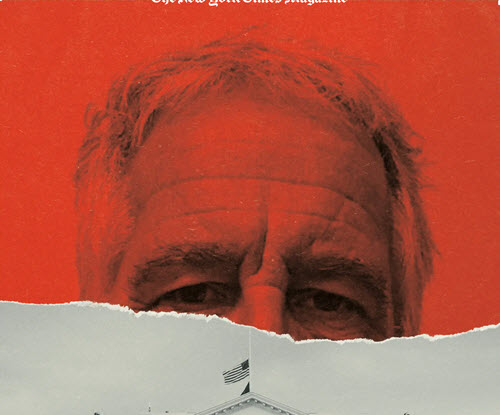
Credit...Photo illustration by Alex Merto
On July 17, 2025, at around 6 o’clock in the evening, President Trump’s top officials filed into the White House Situation Room — the secure bunker where classified and high-stakes national security matters are discussed and decided. This was where President Barack Obama, along with Vice President Joe Biden, Secretary of State Hillary Clinton and the president’s national security team, watched the raid that ended with the death of Osama bin Laden in 2011.
Now, however, Trump’s most senior advisers had gathered — without him — to figure out how to gain some measure of control over a very different kind of crisis threatening to engulf the presidency: the Epstein files.
Ten days earlier, the Justice Department and the F.B.I. had jointly released a memo that bluntly stated that their review had found no “client list” of powerful men for whom the notorious pedophile Jeffrey Epstein had allegedly procured underage girls and young women. Intended to put to rest years of speculation and end the pressure campaign to release the voluminous material in the department’s possession, the memo instead had the opposite effect, setting off a backlash that was notably loud among the MAGA base.
And it was about to get worse: The Wall Street Journal was preparing a damaging article about Trump’s relationship with Epstein. The president’s desperate attempts to kill the story had failed. His team now had to get everyone onto the same page about how to counter the growing swarm of attention. They needed a gesture of transparency to appease an increasingly angry base, but also a way to convey the message that the president was sympathetic to his supporters’ concerns. Which itself was a problem, because he clearly wasn’t.
Vice President JD Vance took a seat at the head of the table in the John F. Kennedy Conference Room of the Situation Room complex. “This is a huge problem,” he told the group. Arrayed around him were the White House chief of staff, Susie Wiles; the White House counsel, David Warrington; the press secretary, Karoline Leavitt; the deputy chief of staff Taylor Budowich; the communications director, Steven Cheung; the deputy attorney general, Todd Blanche; the associate attorney general, Stanley Woodward Jr.; and the deputy chief of staff James Blair. Attorney General Pam Bondi and the F.B.I. director, Kash Patel, joined on speakerphone.
The vice president appeared panicked to others in the room about the way the subject of Epstein was already dividing the MAGA coalition. Some senior officials had the impression that Vance had bought into the darkest theories about Epstein and a cabal of predators hidden within the country’s ruling class. Wiles would tell others that the vice president had proved himself to be a major conspiracy theorist. Another top official said later that Vance had been pounding on the Epstein issue since the release of the memo. He was privately pressing for the administration to release all the Epstein files, everything in the Justice Department’s possession, even encouraging a congressional investigation.
Vance had also floated to colleagues an extraordinary P.R. gambit — that the White House enlist Tucker Carlson to interview Epstein’s longtime girlfriend and co-conspirator, Ghislaine Maxwell, in prison. It might help the president if Maxwell was willing to state that Trump had not been part of any wrongdoing with Epstein.
Vance told the group he believed all the files should be released as soon as possible. He argued that Congress was going to force the release of the files eventually. It was already clear that a bipartisan coalition in favor of such action was forming on Capitol Hill, and the momentum was going in one direction. If the administration got out ahead of this and released everything voluntarily — including whatever material existed about the president — it would at least get credit for transparency. The alternative was to let the story drag on for months as information dripped out, each new revelation renewing the cycle of suspicion and fury. Better to rip the bandage off and move on.
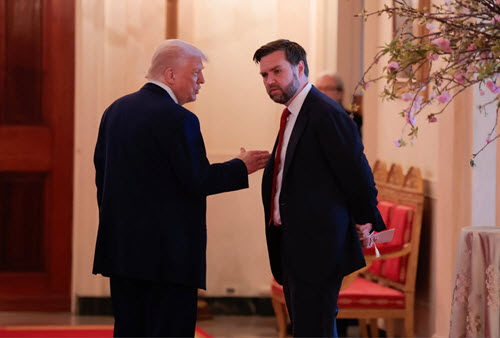
Vice President JD Vance appeared panicked to President Trump’s other top advisers about the way the subject of Jeffrey Epstein was dividing the MAGA coalition. Credit...Anna Moneymaker/Getty Images
Even the unsubstantiated allegations and anecdotes about Trump should go out, Vance argued. They were going to surface regardless, and if the administration published them first, it would demonstrate good faith and take the oxygen out of the conspiracy theories. His arguments fell on skeptical ears, but some advisers thought it would be a good idea to have Justice Department officials call a news conference to explain their position on the Epstein affair — going beyond the memo that precipitated the crisis.
At this point in the meeting, Blair spoke up. “With all due respect,” he said, “the communications strategy of this group got us here. I don’t know that it’s going to get us out. And if you’re going to go in front of the press, you’ve got a lot of work to do.” He began to ask pointed mock questions, demonstrating how difficult a news conference might be.
As the president’s former defense attorney, Blanche had a unique vantage point in the discussion. He was better equipped than anyone else in the room to weigh the ideas being discussed against Trump’s personal and political interests. Blanche laid out what he saw as their best options.
Option 1 was to petition Federal District Courts in Florida and New York to unseal the grand jury testimonies — the secret transcripts of prosecutors’ presentations of witnesses and evidence in their efforts to obtain indictments in past Epstein-related cases. As those were almost certain to contain no significant new information, everyone agreed that this option was a good idea, and not only because a release was unlikely to damage the president.
Under the Federal Rules of Criminal Procedure, the secrecy of grand jury materials is regarded by most federal judges as almost always inviolate, and the bar for any release is exceptionally high. If the courts refused to unseal them — as Blanche predicted — they could shift the blame for withholding the Epstein material away from the Trump administration and onto the judges. And all the better if the judges had been appointed by Democratic presidents. Blanche’s suggestion would make it appear that the White House wanted the materials released, when it was almost certain not to happen.
Option 2 was to have Justice Department lawyers question Maxwell and publicly release the transcript — a twist on the idea proposed earlier by Vance. Blanche offered to interview Maxwell himself.
“What if we got her to talk to Congress?” Vance suggested.
Blanche raised the possibility that Maxwell’s lawyer might expect something in return for her candor.
Warrington, the White House counsel, responded by laying out the available choices, without advocating any of them. Maxwell could be given a pardon, he said, or she could have her sentence reduced.
At that, several around the table spoke up to register their strong disapproval.
“Pardoning Maxwell, a trafficker of young girls, would create a huge P.R. problem,” Cheung said. He predicted that in the wake of a pardon, the Epstein accusers would be fanning out on TV, telling their stories and ripping the administration to shreds.
Blair was also adamantly opposed to a pardon. “We can’t offer Ghislaine Maxwell anything,” he said. “A, I don’t know why we would. And B, if we give Ghislaine Maxwell any sort of break whatsoever and then she turns around and says nice things about us, or says nice things about us and we give her a break, it will undermine the entire point of her saying good things. That will feed the conspiracy theory, period. If there’s nothing for her to say that hurts us, we shouldn’t have to offer her anything.”
The consensus was that calling for the release of the grand jury material was the best course of action. Wiles told the group she would discuss the matter with Trump and ask if he would send a Truth Social post calling for the release of the sealed grand jury documents.
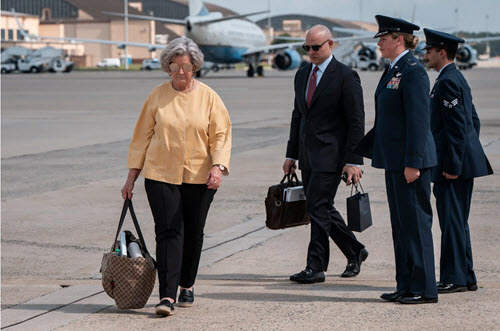
White House Chief of Staff Susie Wiles and her deputy, James Blair, were key members of Trump’s team discussing the crisis. “The communications strategy of this group got us here,” Blair told the others. “I don’t know that it’s going to get us out.” Credit...Haiyun Jiang/The New York Times
Just then, The Wall Street Journal article they had been trying to kill was published online. Cellphones are forbidden in the Situation Room, so a staff member brought in printed copies of the explosive report, which detailed how Trump, and many others, had created birthday cards and letters to be assembled by Maxwell into a special birthday book for Epstein in 2003. The birthday card attributed to Trump depicted a nude woman, hand-drawn and inscribed with an imagined dialogue between the two men about a “wonderful secret.” The drawing was signed with what appeared to be Trump’s distinctive jagged Sharpie signature in place of the woman’s pubic hair.
In the days before publication, Trump, in the effort to quash the story, had called News Corp.’s chief executive, Robert Thomson; News Corp.’s owner, Rupert Murdoch; and The Journal’s editor in chief, Emma Tucker. Practically shouting, the president told Tucker, who is British, that she must “hate America.” He told her he would file a lawsuit.
But none of his bullying had worked, and now, as the group sat quietly reading the full story in the Situation Room, Wiles readied a public denial for the president, which he soon posted on social media.
Shortly after this, the president posted again. He was going along with the plan his advisers had hashed out in the Situation Room, though it was clear he didn’t like having to do it: “Based on the ridiculous amount of publicity given to Jeffrey Epstein, I have asked Attorney General Pam Bondi to produce any and all pertinent Grand Jury testimony, subject to Court approval. This SCAM, perpetuated by the Democrats, should end, right now!”
In response to a request for comment, a White House spokeswoman, Abigail Jackson, repeated Trump’s claims that he was innocent in all Epstein-related matters, adding that “by releasing thousands of pages of documents, cooperating with the House Oversight Committee’s subpoena request, signing the Epstein Files Transparency Act and calling for more investigations into Epstein’s Democrat friends, President Trump has done more for Epstein’s victims than anyone before him.”
Authors’ note: This article is adapted from reporting for our book “Regime Change: Inside the Imperial Presidency of Donald Trump.” The bulk of the reporting took place from the spring of 2023 to the spring of 2026. During that time, we conducted more than 1,000 interviews with a wide range of people close to President Trump, including campaign officials, White House staff members, officials serving in government departments and agencies, former aides, donors, lawmakers, friends and business associates. Many of our interviews were conducted on the journalistic ground rule of “deep background,” agreed to in advance, which meant we could use the information but not identify who gave it to us. Throughout the reporting process, we made extensive efforts to contact the individuals named and give them ample opportunity to offer their perspective. When we use direct quotes, those quotes came either from the person speaking, from someone who heard that person directly or from contemporaneous notes, recordings or transcripts. When we paraphrase, it’s because witnesses or participants in the dialogue could not recall the precise wording but were confident about the thrust of the message expressed. Where there were discrepancies between the accounts of participants in meetings, we generally erred on the side of removing the disagreed-upon material; in some instances, we relied on our own judgment of various sources’ reliability, based on our long histories of covering Trump and his inner circle. Over the course of these past three years, during our daily reporting for The New York Times, each of us has spoken to Donald Trump multiple times, and the president sat for an hourlong interview with us on March 16, 2026.
**************
At the start of last summer, as far as outside observers could see, Trump appeared to be at the pinnacle of his power. He had just bombed nuclear sites in Iran; completed a blitz of executive orders to reshape the immigration system; and rammed through Congress his signature piece of domestic legislation, the Big Beautiful Bill. He was using the levers of the government to go after his enemies, and out of fear and desperation, America’s corporate titans were falling over themselves to genuflect.
But behind the scenes, the Epstein crisis was paralyzing the Trump administration to a far greater extent than the public knew. In their public statements, Trump’s advisers were full of bravado, dismissing the crisis. In reality, it was consuming the highest ranks of the administration as no issue had for the president’s team since the Russia investigation in his first term. His aides were determined to keep their rising sense of panic out of public view.
The Justice Department had struggled with just how to dispose of the Epstein matter since the beginning of Trump’s second term. The issue was all-consuming for the president’s political base, but also potentially compromising for the president himself in ways that officials in the new administration didn’t fully understand. Any path forward would be fraught.
Some of that complexity was self-inflicted. In the engine room of the MAGA movement, the Epstein files were potent fuel. Elon Musk had used his social media platform to repeatedly question why a client list had not been released. Donald Trump Jr. and JD Vance had invoked the Epstein files as a broader campaign message to argue that “powerful people” were hiding the truth from Americans. Tucker Carlson and the young conservative leader Charlie Kirk had each insisted that the government should release the documents and each floated the idea that there was an expansive cover-up in progress.
Trump himself had been cagey. On the “Lex Fridman Podcast” in September 2024, when asked about releasing the client list, Trump responded, “I’d certainly take a look at it,” adding, “I’d have no problem with it.” The list “probably will be” made public, he said, but he sounded less than enthusiastic. In private, Trump later told Representative Marjorie Taylor Greene that a release of Epstein material could hurt some of his friends. He repeatedly insisted that he had done nothing wrong and that the whole saga was “fake news” designed to harm him politically.
But his posture was overtaken by the growing frenzy among his supporters. Throughout 2024, Greene had made it her mission to force the release of the files. And there were so many others. The far-right influencer Laura Loomer, the conservative activist Scott Presler, Chaya Raichik from Libs of TikTok. But when it came to propagating the Epstein files as evidence of a “deep state” capable of evil, two podcasters were not to be outdone: Kash Patel and Dan Bongino.
Patel — a National Security Council director for counterterrorism and Defense Department chief of staff in the first Trump administration — had repeatedly claimed in podcast interviews that the government was hiding Epstein’s “black book” or client list, and he frequently asserted that the F.B.I. was deliberately withholding names to protect the powerful. Patel promised that a second Trump administration would release “everything” to restore public trust.
On “The Dan Bongino Show,” Bongino’s background as a Secret Service agent had lent authority to his claims of a cover-up. “What the hell are they hiding with Jeffrey Epstein?” he’d asked his large audience of MAGA devotees. The release of the client list would “rock the political world,” he predicted. The “Washington swamp” was “not telling you the truth.”
And so as they took office in 2025, Trump’s advisers were subject to intense pressures of their own making. Attorney General Pam Bondi quickly made things much worse.
First, in a Fox News interview on Feb. 21, she appeared to confirm the existence of an Epstein client list, something that the MAGA base had believed was sitting in the files, hidden — and hinted that its release was imminent. Asked whether the Justice Department might release the names, she responded, “It’s sitting on my desk right now to review.”
But many viewed what came six days later as an even more egregious misstep.
On Feb. 27, the White House Communications Office scheduled a lineup of cabinet officials to brief popular right-wing influencers in the Roosevelt Room. The session began with Vice President Vance, followed by Secretary of State Marco Rubio, walking the influencers through the administration’s agenda. In attendance was a who’s who of online MAGA: Mike Cernovich, Liz Wheeler, Collin Rugg, DC Draino. The president himself brought them to the Oval Office and gave them custom-designed challenge coins as a token of his appreciation. Before everything went wrong, one of them would remark, “It was the best day of my life.”
Then the attorney general and her team walked into the Roosevelt Room carrying boxes. Bondi had brought binders as handouts for the influencers; her aides would later tell colleagues that the F.B.I. had prepared them, with the assurance that they contained revelatory details. Someone on her staff said: “Watch this. This is cool. This is going to be epic.”
But as Bondi’s staff started distributing the binders, the blood pressure of other officials in the room skyrocketed. They had no idea what was in the handouts. The attorney general was distributing something she was calling “the Epstein files” that had not been vetted by anyone in the White House. One official, opening the binder, began flipping through pages to see if Trump’s name was mentioned anywhere. A few pages in, right in the middle of the page, there it was.
Keir Starmer, the British prime minister, was at the White House that day. If news broke that the Epstein files had been released before the president was to meet the press with the prime minister, that would be all the journalists would want to talk about. And Trump would be blindsided.
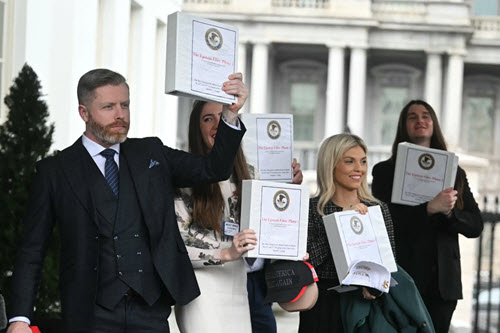
Right-wing influencers were invited to the White House, where Attorney General Pam Bondi’s team gave them binders filled with Epstein-related material that turned out to have been previously released.Credit...Jim Watson/Agence France-Presse — Getty Images
One of Trump’s aides hastily steered the influencers out of the White House, telling them that the content of the binders was embargoed until after the president’s news conference with Starmer but that the communications office would be more than happy to talk about the files afterward. As the influencers left, they snapped selfies in front of the White House holding their binders, quickly posting the pictures on social media. They had now created a new shock wave of anticipation for what might be in them.
Like some others in the White House, Bondi had either grossly underestimated or simply been blind to the voracious appetite of the MAGA base for information about Epstein. Her binders contained information about him and his activities — flight logs, contact lists, summaries of items taken from his residences after his 2019 arrest and other material — but nearly all of it had been previously released. Bondi had somehow simultaneously oversold and trivialized the Epstein files, and now the influencers were made to feel like dupes.
In the Roosevelt Room, Bondi had told the influencers that this was just the first tranche of files. There would be more coming, she assured them. But that story would change, too.
Justice Department officials were reviewing the Epstein material, but months would pass before the department or any of Trump’s closest advisers knew just how many documents there were — more than three million pages of files related to Epstein, and potentially as many as six million. In the early months, officials were focused on going through a trove of what are known as 302 forms — records of F.B.I. agents’ interview notes with witnesses, some of whom were victims of Epstein. These were raw records, often containing unverified information. Trump was mentioned numerous times, as were other prominent men.
In June, four months after the circus in the Roosevelt Room with the influencers, Bondi and Blanche briefed the president on the status of the Epstein review. “We’ve gone through the files,” Blanche told Trump. “There’s not a lot there. A lot of child pornography — obviously we can’t put any of that out. There are some mentions of you, but nothing substantive.” Most of Trump’s advisers had rejected out of hand the idea of releasing the F.B.I.’s raw interview notes. More important, they wanted to avoid putting out anything that could damage the president.
With full transparency a nonstarter, a small group of White House and Justice Department officials decided to draft a memo that would explain why the department was not releasing any further information about Epstein. But even the process of composing the memo was fraught, in part because no one wanted their name on it and in part because of deep concerns within the leadership of the F.B.I.
For weeks, Patel and Bongino, the deputy F.B.I. director, had grown more infuriated as they realized the scale of the mess for which they were now being blamed. They repeatedly raised alarms internally that the Epstein crisis was gathering momentum with Trump’s supporters. Bongino wanted to convey something definitive to the MAGA base, and he and Patel pushed for the immediate release of the surveillance footage from the federal facility where Epstein was found dead in his cell.
Bongino hated the Justice Department’s nothing-to-see-here memo being drawn up for public release. He told Patel this would in no way align with their promises of transparency after taking over the F.B.I., and he objected to putting the F.B.I. seal on the letterhead. But he was overruled.
Patel privately shared many of Bongino’s concerns. But in an internal email on July 2, the F.B.I. director gave his support for the memo.
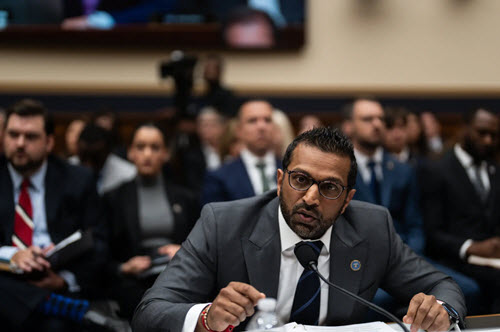
Before the 2024 election, Kash Patel, who would become Trump’s F.B.I. director, promised that a second Trump administration would release “everything” in the Epstein files to restore public trust. Credit...Tierney L. Cross for The New York Times
Thanks for the edits, and I still believe this is the correct vehicle forward,” Patel wrote, with the occasional typo, to a small group of colleagues, including Blanche. “I’m happy to add any additional sentences to compete the short fall. But I do think we addressed specifically why more can’t be released as it relates to specific topics ie court order, csam” — child sexual abuse material — “victim protections etc.”
Bondi rarely used her Justice Department email and was not on the chain where the group worked on the memo. She was aware of both the memo and the release of the prison video but was not involved in editing the document.
Inside the White House, Trump had no interest in releasing anything. And senior officials, including Wiles and Blair, were initially unconvinced about the reach of the Epstein crisis. They told colleagues that Republican voters didn’t care, and they had early data from Trump’s chief pollster, Tony Fabrizio, to demonstrate it. The Epstein brouhaha, in their view, was driven by fringe conspiracy theorists and amplified by noisy online influencers who didn’t represent a meaningful bloc of voters. If the White House engaged, it would only pump it up — putting an official stamp on the matter.
Wiles, Blair and others around Trump had seen him weather every storm imaginable for years. And in their view, this wasn’t a storm — it was passing clouds at most.
Bongino told anyone who would listen that this was a grave miscalculation.
“It’s not an online story,” he told White House advisers. “You don’t understand.”
On July 7, the Department of Justice and the F.B.I. released the memo. It was brief, an unsigned one-and-a-half-page statement explaining that after an exhaustive search of “its databases, hard drives, and network drives as well as physical searches of squad areas, locked cabinets, desks, closets, and other areas where responsive material may have been stored” and a corresponding review of more than 300 gigabytes of evidence, the department concluded that there was no evidence Epstein had maintained a client list.
The memo also reaffirmed the official finding that Epstein’s death in 2019 had been a suicide. The memo was accompanied by the release of video footage from the federal jail in Manhattan where Epstein died, footage that officials said supported the conclusion of suicide. And with that, the memo indicated, the Trump administration would not be releasing further information regarding the Epstein case and no further investigation of uncharged third parties was warranted.
Less than five months after Bondi had referred to a secret client list of high-profile predators, the case was closed. Or so it seemed.
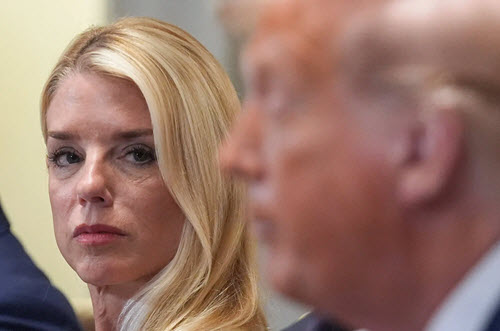
In a Fox News interview, Bondi seemed to confirm the existence of an Epstein client list, which the MAGA base believed was hidden in the files. But no such list was found. Credit...Evan Vucci/Associated Press
If the administration expected that the memo would be the last word on the Epstein case, and that the president’s most ardent supporters would accept the purported conclusions of the Department of Justice simply because the department and its investigative agencies were now controlled by Donald Trump, they were sorely mistaken. The memo was an earthquake, and it was received by a part of the MAGA base as an outright betrayal. It amounted to an abrupt disavowal of the sinister conspiracy theories that some of Trump’s closest confidants had hyped during the Biden presidency and that they had promised to expose once Trump was returned to power.
The release of the surveillance video, which Bongino and Patel had intended as a gesture of transparency, further fueled the fire. The Department of Justice ended up releasing roughly 11 hours of prison video, intended to show that nothing nefarious occurred. But the footage was missing a minute — a visible time-stamp jump from 11:58:58 p.m. to midnight. Bondi initially attributed this to a nightly system reset. (The footage was later restored and released.) To many of Trump’s followers, however, this was yet more evidence of a cover-up. White House officials complained privately that they hadn’t been told about the gap before the release. Social media lit up with blame — not just for Bondi, but for Patel and Bongino, too.
None of the three had ever experienced anger at this volume from Trump’s conservative base. It was disorienting, especially for Patel and Bongino, whose power and influence had been built online. The movement that had treated them as heroes was suddenly turning on them. The two men were now tightly connected to a memo that stated, in black and white, that while information in the government’s possession showed ample evidence of Epstein’s own wrongdoing, there was no evidence of a wider conspiracy.
The day the memo was released, Bongino showed up to a daily Justice Department meeting with the F.B.I. staff and the attorney general. He was in a volcanic mood. As soon as he entered the room, he erupted at Bondi, shouting at her.
“You fucked this thing up from the start,” Bongino yelled. “The way you’ve been talking about this — that dumb fucking charade with the Epstein files, the ‘They’re on my desk’ nonsense, all the promises to the folks out there.”
Patel and Bongino both subsequently told a White House official that Bondi needed to resign.
Two days later, on July 9, the two men were summoned to a meeting with Wiles and Bondi in the Situation Room complex. They were the last to enter the small, wood-paneled room. Seated around the table were Bondi, Wiles, Blanche and Taylor Budowich, one of Wiles’s deputies. The moment Bongino sat down, Wiles told him that she had been informed he leaked a sensitive story about Epstein and Trump to ABC News.
“I’ll tell you what,” Bongino replied. “I’ll give you $100,000 cash right now. I’m not kidding. Walk out to West Exec, put that reporter on speaker and get him to admit I leaked it. A hundred thousand dollars.”
Wiles snapped back, “Well, we all got ourselves into this —— ”
Bongino cut her off.
“No, no, no, no, no. We didn’t get ourselves into anything. I warned you guys about this the whole time, and you ignored me. And exactly what I said was going to happen happened. And now you’re pretending I was in on this. I was never in on this.”
Bongino’s aggressive response to Wiles startled the others; she was the White House chief of staff, essentially a stand-in for the president. Wiles put Bongino on the spot. “Going forward,” she said, “we’re all in. We’re all going to agree to move forward. Are you in or not?”
“No, I’m not,” Bongino said. “This is not my plan. I’m not part of this going forward. Forget it. I’m out of here.” He stormed out of the Situation Room and onto West Executive Avenue, where he climbed into the back of Patel’s armored S.U.V. and directed the driver to take him to F.B.I. headquarters.
Some of Bongino’s close friends hoped he would resign right then — an act of protest that would have made him a MAGA martyr and only increased his following. But White House advisers intervened, urging him to stay. If he quit over Epstein and went public, it could severely damage the president. Bongino told associates he would remain for Trump’s sake and keep pushing for more Epstein information to be released.
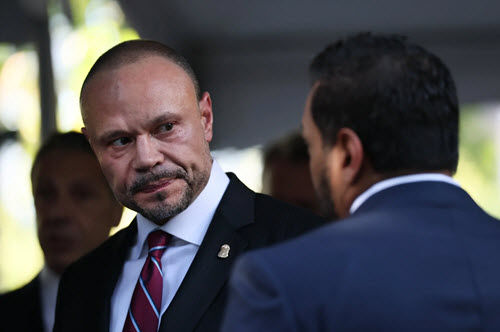
Dan Bongino, the deputy director of the F.B.I., erupted at Bondi and Wiles as the political backlash grew, telling them, “I warned you guys about this the whole time, and you ignored me.” Credit... Michael M. Santiago/Getty Images
Privately, he seethed. In conversations with confidants, he lamented what the job had cost him: millions of dollars in podcast revenue, family time, his audience. He was getting torn apart over a strategy he had opposed from the start.
The relationships at the top of the Justice Department were by now beyond dysfunctional. At another July meeting, in Wiles’s office, Bongino and Patel told the chief of staff they suspected that Bondi had leaked negative stories about them.
“Blondie fucked this whole thing up,” Bongino later told a confidant, echoing Loomer’s derisive nickname for the attorney general. “She was the one on TV saying over and over they had all this stuff. There was never anything. We were always clear about that. But now everyone thinks we did something wrong. And I gave up everything.” Bongino complained that he had given up his high-rated show and millions of dollars, “and now it’s all disappeared, because people think we screwed something up with Epstein.”
Bongino paused.
“This is going to be President Trump’s Iran-contra.”