PART 3 ANTI-ANTI-NAZI BARBARIAN HORDES ARE KNOCKING DOWN THE

Re: PART 3 ANTI-ANTI-NAZI BARBARIAN HORDES ARE KNOCKING DOWN

Postby admin » Sun May 24, 2026 2:37 am

Mark Sleboda: Iran Is Jamming GPS Across the Region – U.S. Tankers Move Into Gulf
Nima Alkhorshid, Dialogue Works
Streamed live on May 23, 2026 Interviews 02


Transcript

Hi everybody. Today's Saturday, May 23rd, 2026, and our dear friend, our brother Mark Saboda is here with us. Welcome back, Mark.
Nema. Thanks for having me. It's always an honor and a pleasure to be on Dialogue Works.
Yeah, we had a last night we had a huge, you know, sort of
a lot of chaos by the way in in the Middle East. Iran it's it's specifically what is was happening in Iran two
delegates one Munir the his name is his first name I I just forgot his name
his first name but Munir was in Iran the head the head of the army of Pakistan was in Iran talking with Iranian side
and we had delegations in Iran I don't know what was the main I today I asked professor What was that? What was the main reason?
1 minuteHe said they had some regional talks with delegation. And today before coming to this live, we've learned that Donald
Trump said to the Israeli channel 12 that I will not make any deal that is not good for Israel.
This is the sort of chaos that we're living in. Nobody knows if there would be some sort of attack. Last night, many people were talking about the attack is
coming. There were reports on Iraq and Syria that the fighter jets are going headed toward Iran. Nothing happened
last night. I don't know. Tonight we're going to have some sort of attack. We have some or we're going to have some sort of announcement. But what can we
say in my opinion that is that's not going to change is the Iranian position because we are hearing over and over that
they're saying our basic terms are important terms are still the same they have not changed your understanding of what's going on.
Yeah. Well, so first of all, I mean, it you shouldn't really beat yourself up over the fact that you can't figure out
whether uh Trump is going to bomb Iran again or not because Trump doesn't know, right? I mean, that they're they're
obviously flailing around. This is not 5D chess, right? This is not some Trump master plan. This is them not knowing
what to do, creating a lot of bluff and bluster, backing down, considering options, trying crazy plan A, crazy plan
D. Um, you know, and looking for a way out of the situation that Trump has put
himself into. Uh, and yeah, it's a, you know, a zoo zang to use the the the chess term. anything he does will only
make the situation worse. That's why they're they're flailing around like they are. And they realize that
bombing Iran again is probably, you know, 90% unlikely to change anything. They'll kill a few more Iranian leaders.
They'll destroy some more stuff, but it's not going to make Iran capitulate, right? It's not going to make them give
in. It's not going to relinquish uh the uh Iranian hold over the straight of four moves. Uh
but uh they don't have any other good options. They they can't just take the L
and walk away, right? Because Iran controls the straight of Hormuz. As long as that is the situation,
no, even Donald Trump can't spin that into a victory. I mean, he at some point he may yet try. Uh, but it it's
extremely unlikely that that he could pull that off. I I fully expect him to
eventually limp away from Iran at some point, right? He may bomb again for a while and then declare victory and walk
away. Uh, but I expect him on the way back from Iran to beat up on Cuba just
to make himself feel better because Cuba is in the Western Hemisphere. It's lowhanging fruit, right? Cuba doesn't
have the military the military assets the the geo you know uh political location you know all of these things
that Iran has that uh you know make it so difficult for the US uh to um regime
change uh Iran uh Cuba lacks a lot of those uh quite obviously so um yeah Cuba
may end up getting shafted by Trump's shy they say a pent up frustration over Iran uh on the way out the door.
That that is uh looking like a a very real possibility. But um what whether he
bombs again or not, I even he doesn't know at this point. Uh he he realizes that it probably won't change anything.
he has at least some level of understanding of how low the Pentagon's inventories of uh air defense
interceptors and of standoff munitions like the Tomahawk and the Jasmar. Uh and
he he keeps promising to you know uh put Iran back into the stone age to destroy
their civilization to bomb every bridge and and um uh power plant in the country. And uh he can't do that. They
can't because they don't have the standoff munitions left to do that. Look
at Russia has been hitting the KV regime's electrical infrastructure for what at least three years now. And yes,
6 minutesit's teetering on the edge now. And they can tap it locally and knock it out when they want. Uh they obviously don't want
to destroy the whole thing. They haven't taken that action. But the point is it took them a long period of time to destroy
Ukraine's uh existing Soviet legacy air defense system. then to destroy the uh
imported uh half-hazard western air defense system that they brought in.
Then to start taking apart the electrical infrastructure piece by piece. It took them years uh to do that.
And yes, the US has some more advanced and and you know uh air assets than Russia does, but not that much more
advanced. Uh and we heard uh leaked from the Pentagon, from US intelligence on
the pages of the New York Times uh that the air force is afraid of Iran's uh
detection and air defense capabilities, right? that if they went into Iranian
airspace to make use of the closer munitions that they have rather than standoff munitions like the the glide
bombs, the J dams, which they do have many more of, but then they would be putting their own air force at risk
because Iran has um various uh new um air defense capabilities, air first of
all, air detection and uh so my understanding of that is that It is a combination of um infrared
uh and um rather than active radar defense which is easily detected and
then homeed in on right um uh they're using a non-active uh detection. uh that
at least in part involves cameras that are placed all over the country at the
sky and the information is collated with artificial intelligence uh and filtered through. And so this
combination of infrared and this has given them a fairly good capacity to
detect even um uh the US's stealth uh capabilities, the F-35s and and uh so on
the B2s and um that um and they're they're still you know obviously they
still have enough uh air defense uh interceptor assets uh you know launch systems and interceptors that you know we saw all those US planes
fall out of the sky in the few days before this ceasefire started and right in the western mainstream media this is
not coming from us and the alt media right this is coming from them and they say yeah Iran has too much capability in
that regard uh and it first of all it's very interesting when you hear these things we've heard a whole lot of leaks
from US intelligence and the military in the last couple of weeks. They admit
that Iran can probably outlast the US blockade. They admit that Iran still has
70% plus of their missile missile launch, drone capacity, everything. They admit that they have capable air
defense. They admit that the Trump administration has no answer to their fast attack swarmboats uh in the Hormus.
That's whenever you get leaks like that.
I mean they confirm what we have known and we've been talking about you me uh many of other people on your show right
across the alt media for the most part have been they confirm right they vindicate what we've been saying for
months now but why why are they leaking this why are they leaking this now who's leaking it why
are they whenever you get a leak like that you have to ask who's leaking it and why. And
as best as I can tell, this is elements within the uh the deep
state, the US deep state, right, within the intelligence apparatus, within the Pentagon, that it is a desperate cry,
warning what a bad situation the US is in and trying to divert Trump
from attacking again, not because they don't want to attack Iran, but because they believe that ultimately that will
simply put the US in an even worse position on the other end of it. Which is fascinating that I mean that is a a
cry of what a bad situation is in that their own deep state or at least element, right? There's no monolithic
deep state, right? There there are many different factions, right, within their deep state, within the blob, right, as Ben Rhodess called it, the foreign
policy and security elite. They there there are elements within it that are making a desperate cry to alert the
public, to alert the media, and thus to try to put pressure on the Trump administration. Don't do this thing,
right? don't attack Iran again because it likely will not end well for us.
We'll likely be in an even worse position because and certainly not out of a moral principle that they're leaking this, right?

So, that's all very fascinating. Every time there's been so many of these leaks to the media from intelligence, and from the military, and of course, again, we've been saying all of these things for a long period of time in the alt media. And they just are 180 degrees almost from the absolutely, you know, mad, unhinged, pural, manchild rantings, megalomaniac manchild rantings of Donald Trump.

And well, I'm not a historian, but like many, I'm sure, out there in the audience, I am a history fan, right? A buff. And I particularly like ancient history. And I've come to the conclusion that Donald Trump is the Emperor Commodus of the Roman Empire. The one who used to fight as a gladiator, was kind of fictionally pieced together out of various elements. But yeah I mean
there's some elements that were kind of true in that. But the real emperor Commodus, the one who used to fight in the Coliseum and everything. He is the US empire's Commodus. And after Commodus, the Roman Empire went straight down, and never came back, right? Not for any significant period of time. And I'm convinced that history doesn't repeat itself, but it rhymes. Yeah. Trump and Commodus, I could very much see him as a reincarnation, if you will, in historical terms, of that creature. And this is the US.


I mean, we we saw I of course I've lost a lot of respect over the past couple of years for Tulsi Gabbard, but Tulsi
Gabbard has now obviously stepped down under pressure, under protest. And you know, I'm I'm fairly certain and I don't
think it's too controversial to say that she has tried to prevent Trump from launching a second or I don't do we want
to call it round two, round three, round four, round three. Yeah, round three. All right, let's call it round three. It all depends on when you
start the counting, but let's call it round three. That that Tulsi Gabbard obviously objects to to that or is warning against it if she doesn't object
to it and uh you know for the US's own interests. Uh and she's gone now and uh
one of her uh top deputies also stepped down uh in the last week. Uh so a whole lot of defections from the Trump
administration as they again they can't take the element. --

Sorry for interrupting just just breaking news that we've learned from Pakistan, Saudi Arabia, Qatar that they
expect that a memorandum of understanding between Iran and the United States could be announced as soon as tomorrow. Go ahead.

They were saying the same thing last week and the week before that. So maybe right. But I wouldn't count on it. I do not believe that any US president can accept Iran's terms.
Donald Trump or not, I don't think that any US president, put in the same situation, could accept Iran's terms. So they can't do that. They can't take the L and walk away. What else do they have left but to roll the crap dice, to take that risk, no matter how unlikely it is, and hope that some black swan event comes out the other end of it, and improves their situation, by dropping a few more bombs, because that's what the US does. That's what they do. They don't seem to have any CIA-MOSSAD options left. If they had them, they probably already would have used them. So now they've just got, you know, bombs, the standoff munitions and so forth, and they haven't achieved anything yet.

And, you know, maybe they'll kill Mojtaba Khamanei. Maybe they'll take out, another round of the heads of the IRGC and so forth, if they bomb again, and almost certainly that's what they would try to do, and then they would try to claim it's the second regime change. And then if things don't change, they would still say, "Well, we've removed the regime, and we've bombed them and they don't have anything left, and we're going to walk away. We're done." And wipe their hands of the affair. That's a real possibility.

Now, if they were more sane, they might at this point just do that without bombing again. But I don't think that they're sane. I don't think that they're logical or rational. So that it would be a mistake to think to reason that a sane person would walk away now before the situation gets worse. But they're no sane people. So it is always dangerous to try
to put yourself into the the thought process of someone who is not sane, not
rational. Uh but unfortunately that's what we need to do you know as as analysts and journalists you know uh
covering uh this and yeah it's let's just say it's it's precarious to our own sanity uh to do that too much.
Don't look too too long too deeply into the abyss. Let the abyss stare back at you. But you know that's that's what
we've got to do. So I I don't see any good options for the US. Nothing has changed. We're still in this geoeconomic
game of chicken. Uh you know um this hurtling towards the precipice or towards each other, however you want to
term it. Uh and um Iran is in their economy and um Trump is stuck driving
the the global economy affected by the global energy crisis. And it we keep getting closer and closer to that cliff.
And even US intelligence told us last week that Iran will outlast this
attempted US blockade. They've got too many other options now. They're they're of course still getting uh ships out on
you know again hugging the Pakistani the Indian coasts land trade routes over Pakistan the Caspian Sea route uh trains
that cut through uh Turk menistan down to from China uh down to Iran. They've just got too many possibilities. You can
you can strain their economy. There's no question about that. uh that you can cause them to get less oil out in
tankers than they were before. But of course, at this point, getting less oil out is hurting the global economy as
well. That's the the conundrum. Uh so, um they're they're hurting themselves in that regard and shortening their own
timer, right, to to the precipice. Um no good options. that I I don't you know
unless they've got a magic death star or something and um evidently even the Europeans are so worried uh that uh we
now know what we were thinking when Trump started going off a few weeks ago about um you know ending Iranian civilization.
They were worried, European leaders were worried he might start using nukes out of frustration
uh and um that that if even the Europeans were afraid of that. Now we talked about that
at the time, you know, that it was a scary possibility, but one that you couldn't discount. Uh but that that is
still a possibility. Of course, we like to think that some US generals would restrain and prevent Trump from doing
that, not obey his orders, but we don't know that. We we don't know that. So, it's uh
you know, we're all right now we're we're we're waiting for the next insane
megalamaniac social media rant from this unhinged man. We're we're
breathless. Oh, Trump is cancelling his he's not attending his son's wedding.
He's not doing his weekend golf routine because he's in the White House, right?
It's it's almost surreal, right? You know, the world uh that we find ourselves in and and they say that
there's a constant argument about in international relations about the role of individuals, about agency, right?
versus systems, versus institutions, versus the weight of history and culture and these things. But how how can you
say that you know even if it's not the final determinant that an absolutely
power powerful and power mad figure uh unhinged like Donald Trump, you know,
uh isn't creating this chaotic situation by himself, you know, to to a very large
degree. Uh and so we're all, you know, this foreign policy by social media is is almost becoming normal to us
now already just just, you know, over a year and not even a year and a half into his
presidency and and we're all taking it, you know, as as as normal at this point.
It's already become other leaders are doing it as well. The Iranians are doing it, right?
um every everything is is now part of this global public theater that that events are being played out on. And and
of course when you're performing for the audience like that, you are also
however consciously or unconsciously changing your own behavior because you are in a public theater now.
um that doesn't make me give it does not give me a warm fuzzy about the situation that
we're in now because um that that is not actually a good thing because it makes it harder for people to back down. It
makes it harder for concessions. It makes you more likely to jump to a kneejerk
emotional response to uh some provocation
uh because your own public right gets um upset o over uh a situation. So it's so
unstable. It's such a a dangerous situation. And you know, the other the other great powers, Russia and China, of
course, are sitting behind this and they're backing Iran quietly. And in the Russia's case, maybe not so quietly
anymore. Um, you know, we're we're being told in the Western media that all sorts of things that Iran and Hezbollah are
doing now are, you know, being helped or provided uh by Russia. And we can only, you know, speculate about whether that's
true or not. Uh but Russia and China are not only
backing Iran to various degrees, but they're also very very worried about this situation spinning out of all kinds
of control, both economically and of course in in the military field as well.
Mark, Donald Trump said to CBS news that the agreement he said that we are getting closer and closer to an
agreement with Iran. I don't know what does agreement mean because I don't see any sort of agreement coming at best going to be that memorandum of
understanding which doesn't mean any sort of agreement or deal. It's been it
it could this course I mean they've been talking about this now for on two months, right? How long have we been
talking about a deal, right? Trump is always talking about a deal that is about to be reached. And we know that,
okay, some of this is the Americans and the Iranians talking to each other through the Pakistanis. Some of it might
be some texts going back and forth or replying to each other's social media posts at this point. But we also know
that a considerable amount of these posts, these reactions by Trump are
intended at least in part to manipulate the oil market. I mean that that I don't think there's any question of that now.
So we can't take anything uh that Trump says with any degree of veracity. uh you
know we we we have to take everything he says uh with I I don't trust anything he says um and
until I have it confirmed by multiple other sources and including of course the Iranian side that's that's the the
world and when even you know we can't trust anything he says of course how could the Iranians trust the US in any
deal anyway uh so um last night, the last when I was doing
my the last thing I heard was that uh the Axios and stuff were going on, oh, a deal is about to be reached and the
Iranians at the same time were saying, "No, that's false. There's no deal.
We're deadlocked." Um, and I heard hours ago that supposedly the Iranians had a
proposal put forward that they were considering giving up their toll of the
straight of Hormuz, but that was coming out of the Western media. So, is that real or is that more disinformation
hoping to shape the narrative and thus hoping to shape the events themselves?
or at least to shape the oil markets even if only on a you know a temporary uh basis. It's very hard uh to judge
these things right now. We I I certainly don't have I mean I know again certain parameters. I know the US is in a bad
situation. I know that Iran is still in a position where they have escalation dominance going forward and anything if
the Trump administration does drop more bombs, well then buckle your belts because the global economy is going to
take so many hits from the the cutting of undersea fiber optic cables to the closing of the Bob Elandab Straits uh to
the bombing of the uh uh East West pipeline to Yanbu across Saudi Arabia to
Fujera to the desolization plants that that make life sustainable in most of
these Gulf states. All of that is is on is on the table um if the US goes
forward. So again, that's I I have not heard anyone present an argument that would dissuade me from
believing that Iran has escalation dominance in these responses. Yes, of course they are asymmetric responses.
No, Iran can't bomb US cities, you know, uh that that is uh you know, not in
their range of capability. But perhaps what they're doing to the global economy is more effective. this this asymmetric
response, this using the historically tried and trueue US weaponizing of the
economy, they've flipped that and they're now doing the same thing back to the US um uh using economics, using the
the global energy markets, the global economy to put pressure uh on the US to
stop this this mad war on Iran And you know, yes, uh I I think there is a
definite argument to be made. Uh while while I still do believe there is a utility, a certain utility to a
strategic deterrent to a nuclear weapon, there are many people who make the argument that this is, you know, has
long they've long argued that closing the straight of Hormuz is Iran's nuclear weapon. But now we know not only uh is
it a nuclear option but it is a usable nuclear option that has real results.
Right? So there is also the argument to be made that Iran doesn't need a nuclear deterrent going forward because they
have this chokeold over the global economy.
That that is of course one ultimately you know that the Iranian National Security Council and the Supreme Leader
will decide you know is that enough or do we need this and a strategic deterrent moving forward that that that
is for them but you know certainly this has very real results and if Iran
couldn't reach out and do this to the straight of war moves they would be in a much more difficult position than they
are right now, but geography is what it is and that's where Iran is and they're on that chokeboat and they have the
30 minutescapability. And has been pointed out, they don't actually need that much of a capability. All they need to do is make
demonstrative attacks with fast boats or mini subs or drones or whatever. And no ship, you know, capitalists being
capitalists is going to risk their ship, their investments, their insurance and everything uh going through it. So, uh,
it's, uh, it's a powerful, uh, ability that Iran has. You know, we've long known that they had it. They've long
known that they have had it. But now there is a real empowerment through their use of it such that it was
just a couple of weeks ago that the New York Times there were articles in the New York Times uh and the Washington
Post uh admitting that Iran uh was emerging out of this not weakened
but as a kind of de facto fourth great power in the world if a little bit behind the others and various spheres,
but uh but as a a new kind of power and influence uh that they have never they
have always had but they've never exercised it before and that makes all the difference.
Mark Iranian the speaker of Iranian foreign minister Poy he said that the case of this rate of formos is a
regional case is not related to the United States it's about Iran and Oman deciding about it that's why there isn't
I would in Iran mark that they are formalizing the mechanism of this rate of formost through the parliament
and being accepted and nobody can change it and that that's why they're coordinating right now coordinating with
Omani government and to finalize that sort of you know being part of the Iranian constitution and
when it comes to the GCC countries Mark they're going to be before just remember
what has happened during the last three years since 2023 you know we had the
October the 7th before that Hamas before Hamas attacking Israel. Israel was
normalizing the relationship with GCC countries together with Turkey. That's gone right now. That's not going to we have what's going on with GCC countries.
They're going to be more dependent on Iran and the straight of that would bring some sort of leverage to axis of resistance in my opinion.
That's why Israel is doing everything to get closer to UA. I don't know they're doing but they're somehow teasing or
knowing UAE to make them more more vulnerable to you know but they're
trying to do their best to divide to make some sort of division within GCC countries. True.
Well, there is there is a division, right? I I do I mean they're Gulf monarchies. Let's let's not lose sight
of that, right? They they are you know a little uh antiquated monarchic states right
that that's what they are and personalities play a greater role than institutions uh and it's to you know the
highest degree and we see there is at least some divergence on reaction between shall we say Saudi Arabia and
Qatar you know not putting them in exactly the same place of course but on one side uh and the UAE on the other
where the UAE has been cleaving closer to the United States and Israel than they were uh before all of this.
Remember the UAE even joined Bricks Plus which has now of course paralyzed bricks
plus um and um you know they were pursuing a multi- vector foreign policy
up until uh now uh and Saudi Arabia has been going back and forth right you know
we heard from some sources that Saudi encouraged the US to go through with this war others saying that they were
doing the opposite. We don't we don't know the truth uh of that. Certainly, I don't know the truth in that regard of what Saudi's position is. But at the
moment, they seem to be trying to um cool the situation down and and
considering their options. But ultimately coming out of this,
the Gulf States are going to be more insecure, right, in both, you know, in in their
security situation and in their geopolitical situation than they were before. There's no
35 minutesthere's no question about that. They're going to be left with a US that has a US in Israel
which has an eroded not not completely gone but an eroded power and eroded hegemony in the Middle
East. And they have Iran which is becoming shall we say to some extents
you know through leverage uh through asymmetric means more than anything else but also through their demonstrated long
range strike capability as well. So that's hard power uh but greater hegemony uh you know uh in the Middle
East and they're going to be empowered and angry coming out the other side of this.
I don't believe that these Gulf Arab states can you know subjugate themselves to Iran, right? Uh because that's ultimately how would they would see it.
They can't make their economies and their militaries completely
vulnerable to Saudi Arabia. That means they need to continue to looking to an outside security provider. Now, never
mind that that outside security provider has um you know brought them to this
situation and dragged them willing or not into this conflict with Iran. thus making their security demonstrabably
less secure. Yes, that that is a logical conundrum, but they've got really no one else seriously to turn to. One of the
the interesting little details we got out of the recent um Russia China summit
uh that was that China has quietly been selling arms to the Gulf States during
this whole thing. Right? you for forget are yes are they probably selling drones and other things or at least components
to Iran as well yes but they were also selling defensive supplies you know almost certainly um anti- drone uh and
and interceptors to the Gulf states now can the Gulf states completely switch to
China as a security provider at the end no they can't right their militaries are locked into the United States and the
West so I expect the us to have a smaller footprint
than before. There's probably a lot of these bases that they will consider that are just too vulnerable to Iran uh
geopolitically and militarily to expose themselves to. They haven't helped us against Iran. They've actually made us
more vulnerable because they've given uh a part of us left hanging out there that
Iran can hit back at. Right. uh whereas all of their other assets in the US itself is you know far beyond the
horizon. So some of them they will probably quietly give up without saying that they're giving them because they
can't do that because that that is the prestige of the United States. They can't do that. Uh but they may give them up but they're not going to completely
be out of the Middle East uh at the end of this. That's that's not uh Iran has a lot of leverage and power, but they don't have that much leverage and power.
Let's let's be honest about that. And the Gulf States are going to both cling
more to the United States at the end of this in some regards. And they're also
going to be exploring how they can have a more multi-vector foreign policy.
Right? They will cut pragmatic deals with Iran
39 minutesto get their energy uh to the global market, but they won't like it. And that's going to create a very tense
situation, right? There's not going I don't believe there's going to be any signed deal at the end of this where the
US and Israel agree never to attack Iran again or anything like that's just not possible. It's not political. never never
the the removal of sanctions in the that's got to go through the US Congress. It's not going to happen.
Giving back Iran their frozen funds, you know, that's not going to happen. It's politically impossible. So whatever the
endgame of this is, it's only still it's going to yes empower Iran in some regards moving forward, but it's also
just going to be kicking the can down the road uh for a few more years until the US and Israel feel theoretically
that they are in a stronger position to resume this conflict with Iran. It is not going to be an end. It is it is only
going to be accomplish.
Yeah. Just Mark just let me read what Lindsey Graham is crying out right now.
He says that if a deal is you you are more of a massochist than I
am subjecting yourself to Lindsey Graham's posts.
Yeah. He he says that if a deal is struck to end the Iranian conflict because it is believed that the straight
of foremost cannot be protected from Iranian terrorism and Iran is still have
Iran still has the capabilities to to destroy major Gulf oil infrastructure
then Iran will be perceived as being a dominant force requiring a diplomatic solution.
This combination of Iran being perceived as having the ability to terrorize the straight of
the strait in perpetuity and the ability to inflict massive damage to Gulf
infrastructure is a major shift of the balance of power in the region and over time will be a nightmare for Israel.
And this is amazing that Lindsey Graham is admitting all of this. This is remember first we had a couple of weeks
ago Robbert Kagan, right? The arch neocon himself, the husband of Victoria
Nuland, right? The the the architect of neoconservatism of of US hijgemony in that sense. the
one that even European leaders quote from his books right as part of their you know exceptionalist
supremacist messianic ideology uh of exceptionalism. Now he has had two pieces out in the last couple of weeks.
first this checkmate Iran piece and now a second one where he yes did this same
type of walk of shame mayakulpa that the US has been strategically defeated right
that they have they have suffered a strategic defeat in all of this um via v
Iran uh and now Lindsey Graham is actually making some sense
and also saying these very same things.
That is remarkable that these I mean, how long ago was it
that Lindsey Graham was screaming fire and fury down on Iran? Uh, and now he's
been dragged, you know, to the uh proverbial river and made to drink. Um
it's uh I mean I don't want to distract from you
know the potential tragedies uh that that could still uh you know befall the Iranian people in all of
this. There could be renewed war for a period of time. There could be many hundreds thousands of deaths. But in if you
I I think nobody going to be surprised if tonight the United States attacks Iran. No, no one would be surprised. I
wouldn't be surprised. Um, but there's just a geopolitical death now
that is now self-evident and even Lindsey Graham and Robert Kagan are seeing it. We are seeing such dramatic
events. Um, now all wars are one war. I believe that at this point. So there are
a number of other events that have led up with this. the US uh and uh you know uh take continually playing whack-a-ole
against the Houthies in Yemen, wasting munitions, all of the US military, US and allied military assets that were
wasted in Ukraine. Uh and then the US went out here with Iran and they
overreached. classic Imperial overreach and they've been smacked and smacked
hard and um they are still trying to distance themselves to some extent at
least publicly from the war in Ukraine and now to have this this is too many defeats uh to to the hegeon you know to
the American empire if you want to call it that they're not going to recover from this we are seeing and everything
they do more again if they attack again it will ultimately make their long-term geopolitical position worse and it will
bring the that erosion of that hegeimon of that empire ever
quicker. We we we keep seeing they keep accelerating this themselves because of their hubris and they're unwilling to
accept uh you know uh changes in the world that that are occurring and trying to cling on to that hegemony. They are
ultimately uh hastening the end of it because uh they're they're overreaching.
Um you you you've probably seen Star Wars Nemo, right? um uh a new hope the
first the first Star Wars movie the you know the the it's number four you know in the canon or whatever but uh uh that
that line when Princess Leia is talking to uh Grandma Moff uh Tarkin and um she
46 minutesuh says that the more you try to tighten your grip the more star systems will
slip through your fingers or something of that sort. That is the situation.
That is that is the proverbial. And forgive me for retreating into that uh American Americanism. But I I think a
lot of uh it will bring the situation uh you know a closer to understanding to a lot of the people uh out there in the
audience that that that is the situation that is the US is in right now. and everything they do only makes their
situation worse, which is why they're so and that makes them very dangerous, of course. Uh because if they're desperate
uh and they stand to lose faith, they stand to lose political careers. They stand to lose geopolitical and military
standing. Every which way they turn, they are more likely to take mad risks, to do desperate and dangerous things.
uh because they they simply can't accept I mean Trump still insists he's winning.
I I just saw a video yesterday where he says he has 100% control of the straight of war moves and and maybe he believes that to a certain degree. I don't know.
I can't see it, you know, inside the man's head that much and I probably don't want to. Uh but uh they're that's
what's making them so desperate and that makes them dangerous. Of course, this is
still a case where Iran has now joined
Russia and China as with this this very weighty burden that they the three of these countries are now jointly sharing.
And that burden is how to manage the decline
of USled western global hegemony, the American empire without it having all coming down and collapsing and bringing
the whole world down with it all at once, right? or without it lashing out in its, you know, fading years and
dropping nukes or doing something else desperate and crazy as a result of that.
That makes uh Iran has now joined Russia and China as shall we say the adults in the room, the elder statesmen who think need to consider at times. Yes. Yes.
national interests are still a priority, but they also have to think a bit beyond that as well because you know the the
future global order and the future of humanity depend on them being able to
manage this decline of the US empire without us all going up in flames as a result of it. That's a heavy burden.
Uh, and it often will make them make decisions to not push the US too hard at every opportunity that they could perhaps.
Yeah.
You said that all wars are one war and here is Pentagon confirming what you've just said.
Buy arms from us. and all of a sudden there's a pause.
What are you hearing from the Taiwanese about the pause?
Chairman, I have not heard I have not spoken to the Taiwanese. However, we are we have done some military uh foreign military sales to them in the P. It's
just right now we're doing a pause in order to to make sure we have the uh munitions we need for Epic Fury, which
we have plenty, but we're just making making sure we have everything. But then the mil foreign military sales will continue uh when the administration
deems necessary. Sir, it's just confirming that's why Taiwanese is not the Taiwanese
government is not receiving the 14 billion dollars of you know weapons because of the war between the United States and Iran. And we know what has
happened before the United States coming to the war against Iran in Ukraine. And these are all connected. Yeah, there was
a a video, I mean, this is already about a year or so old, where uh uh Trump's envoy, his babysitter for the regime in
in Ukraine, the former retired General Kellogg, uh he's been kind of shuffled off to the farm now. But he gave an
interview where he pointed out that the problem that the US has with uh what they call strategic simultane
simultaneity now that Russia and China and Iran and North Korea and a few other
countries you could throw in there are are now so linked together through
strategic partnerships and alliances and largely because the US um pushed them all together at the same
time. provoked them all and uh did not do the realism 101
uh of um uh strategic balancing or divide and conquer principles, you know, citing, you know, they they they
provoked and uh you know, out of their imperial hubris, their hegemonic hubris, they provoked them all and helped push
these very different countries with very different uh um political ical systems
and cultures and histories and and um uh religions, you know, uh together uh into
this cooperation. And Kellogg noted that he the US cannot move now against any
one of these countries particularly the big three now but the others as well without it having negative
backlash effects via v their positions with the others. For instance, they go to war
with Iran and the uh the result is the global market goes energy markets go
crazy. The price of oil, the price of gas, the price of aluminum, the price of helium, the price of fertilizer, the
price of um uh all of these commodities that are byproducts of uh these
hydrocarbon industries as well. will go through the roof and of course Russia benefits from all
of this. So yes, they are handing gifts uh to Russia and if they send military
assets to the K regime in Ukraine over the past few years that means when they
came for Iran they had left less available left less interceptors less
assets available to do that. that that is uh a result not of shall we say some
5D chess on Putin's or their part. It's simply everything is connected so
closely together now that you can't break one web without it having an
effect on the whole structure. uh and and that is is the problem and and you know the um the US tries to frame it now
you know as the answer in uh with uh simultaneity the the the the you know
preferred is how to um do strategic sequencing what is the proper sequence
to go after Russia and China and Iran uh to to somehow preserve US hijgemony at
the end of it and they can't because They turned against Ukraine. They first turned against Russia. We can take Russia out. Oh, we can't do that. Their
economy is too strong. We couldn't crush their economy. We can't defend the defeat them militarily. Actually, they're just getting stronger. Let's
pivot and take out Iran. Oh, that's not working out either, right? You know, uh, and it's just worsening their position.
Now we we had the Washington Post, the fin everyone uh two weeks ago was coming to the same conclusion that we already
had that now the US was in too weak a position with its remaining inventories
of munitions of air defense interceptors and standoff munitions to do anything against the Chinese if the Chinese did
decide which they don't want to do but if they did decide to militarily recover their weward separatist island province
55 minutesof Taiwan from from US influence that there was very little the US could do about. Now I actually believe there was
ultimately there wasn't much the US could do about it anyway. But now their position of course is even worse because they went after Iran in such a big way.
And not only did they waste all of that uh hard power, but they didn't even achieve the results that they wanted
from it. In fact, they may have ultimately in some respects empowered Iran out of all of it. It's
it's a terrible position for the hegeimon to be in. And on one hand, yes, that brings a nice cynical smile to a
lot of our faces to realize what a bad geopolitical situation. But on the other hand, we have to be very careful with
that wounded beast of the hegeimon because a US put in this position is likely to lash out desperately uh and
56 minutesyou know illogically uh not wanting to accept this um you know largely
self-inflicted um damage uh to themselves uh in all of this. But uh it
is amazing times we're living in the amazing times.
Exactly. Just unbelievable what is happening right now. Mark, thank you so much for being with us today. Please go to Let me just put it here and do it.
Yeah, please go to Mark's Laboda website. He's a boosty. You can write you can see it right to the right side
of Mark boost.tothereal tothereal politic and you can go there. I know
that you may find his YouTube channel or his Substack, but he's not active on those accounts. Yes, Mark, you're using Booie.
Yeah. Again, I'm a Russian citizen living in Russia and all your Western governments are sanctioning me, so I
can't, you know, support myself via YouTube or Patreon or Substack or buy me a coffee. But Booie is sanctions proof,
right? It's good for you. It's good for me. Uh it's the one thing that does work. Uh and that's that's where I've
set up shop. So anyone can follow me there for free. And I put all of my interviews with Nema and um um Danny and
Rachel and Garland and Cross Talk and all of those other things I do there free for everyone. But then I also have
for those who want to subject themselves to a little bit more of my cynicism and fatalism, then you can uh support me and
become a subscriber and I put out hours and hours of exclusive content for them on top of everything else uh every week.
And we have a private Discord channel uh for uh chewing the geopolitical fat and so forth. And and thank you. This was not a paid advertisement.
Yeah. No, no. Please go there and subscribe. subscribe. You You have to We have to support Mark Laboda and the
journalism that he does that is important for our for the alternative media. We don't have analysis. Analyst, not a journalist. Analysis. Exactly.
You're a journalist. Yeah. Yeah. Exactly. Exactly.
Thank you so much, Mark, for being with us today. Great pleasure as always. Thanks for having me.
admin
Site Admin
 
Posts: 41279
Joined: Thu Aug 01, 2013 5:21 am

Re: PART 3 ANTI-ANTI-NAZI BARBARIAN HORDES ARE KNOCKING DOWN

Postby admin » Sun May 24, 2026 5:57 pm

[Roman Emperor] Commodus
by Wikipedia
Accessed: 5/24/26
https://en.wikipedia.org/wiki/Commodus

So, that's all very fascinating. Every time there's been so many of these leaks to the media from intelligence, and from the military, and of course, again, we've been saying all of these things for a long period of time in the alt media. And they just are 180 degrees almost from the absolutely, you know, mad, unhinged, pural, manchild rantings, megalomaniac manchild rantings of Donald Trump.

And well, I'm not a historian, but like many, I'm sure, out there in the audience, I am a history fan, right? A buff. And I particularly like ancient history. And I've come to the conclusion that Donald Trump is the Emperor Commodus of the Roman Empire. The one who used to fight as a gladiator, was kind of fictionally pieced together out of various elements. But yeah I mean there's some elements that were kind of true in that. But the real emperor Commodus, the one who used to fight in the Coliseum and everything. He is the US empire's Commodus. And after Commodus, the Roman Empire went straight down, and never came back, right? Not for any significant period of time. And I'm convinced that history doesn't repeat itself, but it rhymes. Yeah. Trump and Commodus, I could very much see him as a reincarnation, if you will, in historical terms, of that creature. And this is the US.

-- Mark Sleboda: Iran Is Jamming GPS Across the Region – U.S. Tankers Move Into Gulf, by Nima Alkhorshid, Dialogue Works, Streamed live on May 23, 2026


Image
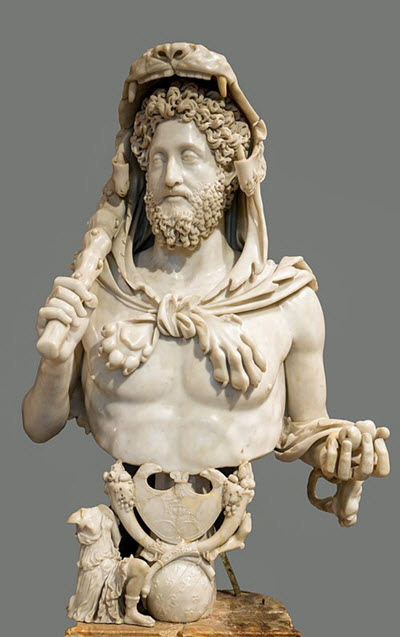
Commodus as Hercules (AD 192), Capitoline Museums, Rome, one of the most famous Roman sculptures.[1]

Roman emperor
Reign: early 177 – 31 December 192
(senior from 17 March 180)
Predecessor: Marcus Aurelius
Successor: Pertinax
Co-emperor: Marcus Aurelius (177–180)
Born: 31 August 161
Lanuvium, near Rome, Roman Italy
Died: 31 December 192 (aged 31)
Rome, Italy
Burial: Hadrian's Mausoleum
Spouse: Bruttia Crispina
Names: Lucius Aelius Aurelius Commodus[2][3]; Marcus Aurelius Commodus Antoninus[4]
Dynasty: Nerva–Antonine
Father: Marcus Aurelius
Mother: Faustina the Younger

Roman imperial dynasties
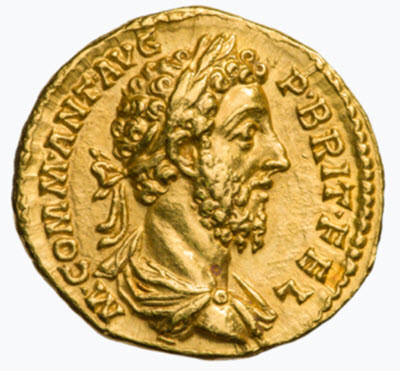
Image
Aureus of Commodus
Nerva–Antonine dynasty (AD 96–192)
Chronology
Nerva: 96–98
Trajan: 98–117
Hadrian: 117–138
Antoninus Pius: 138–161
Lucius Verus: 161–169
Marcus Aurelius: 161–180
Commodus: 177–192

Family
Nerva–Antonine family tree
Category:Nerva–Antonine dynasty

Succession
Preceded by/Followed by: Flavian dynasty Year of the Five Emperors

Commodus (/ˈkɒmədəs/;[5] Latin: [ˈkɔmmɔdʊs]; 31 August 161 – 31 December 192) was Roman emperor from 177 to 192, first serving as nominal co-emperor under his father Marcus Aurelius and then ruling alone from 180. Commodus's sole reign is commonly thought to mark the end of the Pax Romana, a golden age of peace and prosperity in the history of the Roman Empire.

Commodus accompanied his father during the Marcomannic Wars in 172 and on a tour of the Eastern provinces in 176. The following year, he became the youngest emperor and consul up to that point, at the age of 16. His sole reign saw less military conflict than that of Marcus Aurelius, but internal intrigues and conspiracies abounded, goading Commodus to an increasingly dictatorial style of leadership. This culminated in his creating a deific personality cult, including his performances as a gladiator in the Colosseum. Throughout his reign, Commodus entrusted the management of affairs to his palace chamberlain and praetorian prefects, namely Saoterus, Perennis, and Cleander.

Commodus was assassinated by the wrestler Narcissus in 192, ending the Nerva–Antonine dynasty. He was succeeded by Pertinax, the first claimant in the tumultuous Year of the Five Emperors.

Early life and rise to power (161–180)

Early life


Lucius Aelius Aurelius Commodus was born on 31 August 161 in Lanuvium, near Rome.[6] He was the son of the reigning emperor, Marcus Aurelius, and Aurelius' first cousin, Faustina the Younger, the youngest daughter of Emperor Antoninus Pius, who had died only a few months before. Commodus had a twin brother, Titus Aurelius Fulvus Antoninus, who died in 165. On 12 October 166, Commodus was made caesar together with his younger brother, Marcus Annius Verus.[6][7] The latter died in 169 having failed to recover from an operation, which left Commodus as Marcus Aurelius's sole surviving son.[7]

He was looked after by his father's physician, Galen,[8][9] who treated many of Commodus's common illnesses. Commodus received extensive tutoring from a multitude of teachers with a focus on intellectual education.[10] Among his teachers, Onesicrates, Antistius Capella, Titus Aius Sanctus, and Pitholaus are mentioned.[10][11]

Image
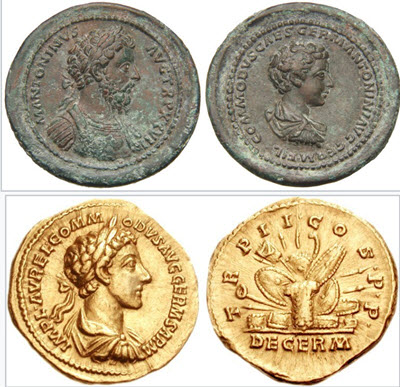
Left: Medallion depicting the caesar Commodus (right) with his father Marcus (left), AD 172
Right: Aureus of Commodus as co-augustus, AD 177[12]


Image
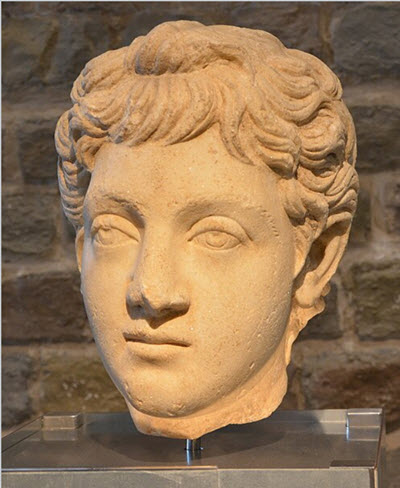
Commodus c. 170–175 AD, Romano-Germanic Museum.

Commodus is known to have been at Carnuntum, the headquarters of Marcus Aurelius during the Marcomannic Wars, in 172. It is presumed that there, on 15 October 172, he was given the victory title Germanicus, in the presence of the army. The title suggests Commodus was present at his father's victory over the Marcomanni. On 20 January 175, Commodus entered the College of Pontiffs, the starting point of a career in public life.[6][13]

In 175, Avidius Cassius, Governor of Syria, declared himself emperor following rumours that Marcus Aurelius had died. Having been accepted as emperor by Syria, Palestina and Egypt, Cassius carried on his rebellion even after it had become obvious Marcus was still alive. During the preparations for the campaign against Cassius, Commodus assumed his toga virilis on the Danubian front on 7 July 175, thus formally entering adulthood. Cassius, however, was killed by one of his centurions before the campaign against him could begin. Commodus subsequently accompanied his father on a lengthy trip to the Eastern provinces, during which he visited Antioch. The Emperor and his son then travelled to Athens, where they were initiated into the Eleusinian Mysteries. They then returned to Rome in the autumn of 176.[13]

Marcus Aurelius was the first emperor since Vespasian to have a legitimate biological son, though he himself was the fifth in the line of the so-called Five Good Emperors, also known as the Adoptive Emperors, each of whom had adopted his successor. Commodus was the first (and until 337, the only) emperor "born in the purple," meaning during his father's reign.[14]

On 27 November 176, Marcus Aurelius bestowed the title of Imperator on Commodus.[15] Modern authors often use this date as the beginning of his reign,[4] but the exact chronology of events is uncertain.[16] Commodus is first mentioned as Augustus (emperor) on 17 June 177,[17] but he reckoned his reign back to his salutation in 176.[16][18] For instance, he assumed the tribunicia potestas (tribunician power) around February 177, but in April 177 he started to backdate this event to November 176.[19]

On 23 December 176, the two imperatores celebrated a joint triumph.[20] On 1 January 177, Commodus became consul for the first time, which made him, aged 15, the youngest consul up to that time (the minimum age for the consulship was around 30).[21] He subsequently married Bruttia Crispina before accompanying his father to the Danubian front once more in 178. Marcus Aurelius died there on 17 March 180, leaving the 18-year-old Commodus as sole emperor.[22]

Sole reign (180–192)

Image
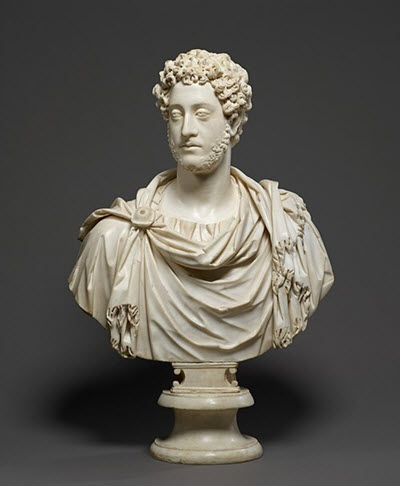
Commodus c. 180 AD, Getty Museum.

Upon his ascension, Commodus devalued the Roman currency. He reduced the weight of the denarius from 96 per Roman pound to 105 per Roman pound (3.85 grams to 3.35 grams). He also reduced the silver purity from 79 percent to 76 percent – the silver weight dropping from 2.57 grams to 2.34 grams. In 186, he further reduced the purity and silver weight to 74 percent and 2.22 grams respectively, being 108 to the Roman pound.[23] His reduction of the denarius during his rule was the largest since the empire's first devaluation during Nero's reign.

Image
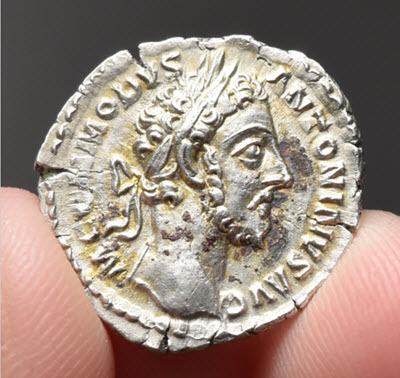
The obverse image of a silver denarius depicting Roman Emperor Commodus (177–192 CE)

Whereas the reign of Marcus Aurelius had been marked by almost continuous warfare, Commodus's rule was comparatively peaceful in the military sense, but was also characterised by political strife and the increasingly arbitrary and capricious behaviour of the emperor himself. In the view of Cassius Dio, his accession marked the descent "from a kingdom of gold to one of iron and rust".[24]

Despite his notoriety, and considering the importance of his reign, Commodus's years in power are not well chronicled. The principal surviving literary sources are Herodian, Cassius Dio (a contemporary and sometimes first-hand observer and Senator during Commodus's reign, whose reports for this period survive only as fragments and abbreviations), and the Historia Augusta (untrustworthy because of its character as a work of literature rather than of history, with elements of fiction embedded within its biographies; in the case of Commodus, it probably embroiders what the author found in reasonably good contemporary sources).

Commodus remained with the Danube armies for only a short time before negotiating a peace treaty with the Danubian tribes. He then returned to Rome and celebrated a triumph for the conclusion of the wars on 22 October 180. Unlike the preceding emperors Trajan, Hadrian, Antoninus Pius, and Marcus Aurelius, he seems to have had little interest in the business of administration. He tended throughout his reign to leave the practical running of the state to a succession of favourites, beginning with Saoterus, a freedman from Nicomedia who had become his chamberlain.

Dissatisfaction with this state of affairs led to a series of conspiracies and attempted coups, which in turn eventually provoked Commodus to take charge of affairs, which he did in an increasingly dictatorial manner. Nevertheless, though the senatorial order came to hate and fear him, the evidence suggests he remained popular with the army and the common people for much of his reign, not least because of his lavish shows of largesse (recorded on his coinage) and because he staged and took part in spectacular gladiatorial combats. He was not an inspired combatant. He killed animals by bow, standing above the arena. When he fought fellow gladiators, they would purposely submit. During this period Rome's economy declined.

One of the ways he paid for his donatives (imperial handouts) and mass entertainments was to tax the senatorial order. On many inscriptions, the traditional order of the two nominal powers of the state, the Senate and People (Senatus Populusque Romanus) was provocatively reversed (Populus Senatusque...).


Conspiracies of 182

Image
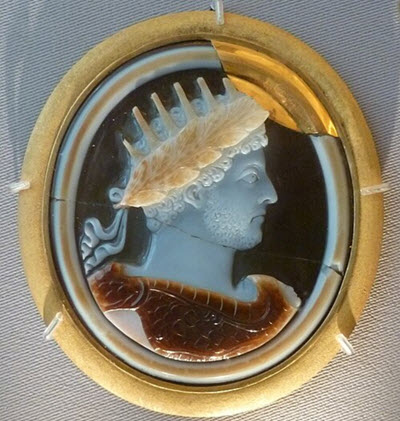
[Commodus with attributes of Helios, Apollo, and Jupiter, late 2nd century AD, sardonyx cameo relief, Hermitage Museum, St. Petersburg

At the outset of his reign, Commodus, aged 18, inherited many of his father's senior advisers, notably Tiberius Claudius Pompeianus (the second husband of Commodus's eldest sister Lucilla), his father-in-law Gaius Bruttius Praesens, Titus Fundanius Vitrasius Pollio, and Aufidius Victorinus the Prefect of the City of Rome. He also had four surviving sisters, all of them with husbands who were potential rivals. Lucilla was over ten years his senior and held the rank of Augusta as the widow of her first husband, Lucius Verus.

The first crisis of the reign came in 182, when Lucilla engineered a conspiracy against her brother. Her motive is alleged to have been the envy of the Empress Crispina. Lucilla's husband, Pompeianus, was not involved, but two men alleged to have been her lovers, Marcus Ummidius Quadratus Annianus (the consul of 167, also her first cousin) and Appius Claudius Quintianus, attempted to murder Commodus as he entered a theater. They failed to kill him and were seized by the emperor's bodyguard.

Quadratus and Quintianus were executed. Lucilla was exiled to Capri and later killed. Pompeianus retired from public life. One of the two praetorian prefects, Publius Tarrutenius Paternus, had actually been involved in the conspiracy but his involvement was not discovered until later. In the meantime, he and his colleague, Sextus Tigidius Perennis, were able to arrange for the murder of Saoterus, the hated chamberlain.

Commodus took the loss of Saoterus badly, and Perennis now seized the chance to advance himself by implicating Paternus in a second conspiracy, one apparently led by Publius Salvius Julianus, the son of the jurist Salvius Julianus and betrothed to Paternus' daughter. Salvius and Paternus were executed along with a number of other prominent consulars and senators. Didius Julianus, the future emperor and a relative of Salvius Julianus, was dismissed from the governorship of Germania Inferior.

Cleander

After the murder of the powerful Saoterus, Perennis took over the reins of government and Commodus found a new chamberlain and favourite in Cleander, a Phrygian freedman who had married one of the emperor's mistresses, Demostratia. Cleander was in fact the person who had murdered Saoterus. After these attempts on his life, Commodus spent much of his time outside Rome, mostly on the family estates at Lanuvium. As he was physically strong, his chief interest was sport: he took part in horse racing, chariot racing, and combat with beasts and men, mostly in private but occasionally in public.

Dacia and Britain

Commodus was inaugurated in 183 as consul with Aufidius Victorinus as colleague and assumed the title Pius. War broke out in Dacia: few details are available, but it appears two future contenders for the throne, Clodius Albinus and Pescennius Niger, both distinguished themselves in the campaign. Also, in Britain in 184, the governor Ulpius Marcellus re-advanced the Roman frontier northward to the Antonine Wall, but the legionaries revolted against his harsh discipline and acclaimed another legate, Priscus, as emperor.[25]

Priscus refused to accept their acclamation, and Perennis had all the legionary legates in Britain cashiered. On 15 October 184, at the Capitoline Games, a Cynic philosopher publicly denounced Perennis before Commodus. The philosopher's tale was considered false and he was immediately put to death. According to Cassius Dio, Perennis, though ruthless and ambitious, was not personally corrupt and was a generally good administrator.[25]

However, the following year a detachment of soldiers from Britain (they had been drafted to Italy to suppress brigands) also denounced Perennis to the emperor as plotting to make his own son emperor (they had been enabled to do so by Cleander, who was seeking to dispose of his rival), and Commodus gave them permission to execute him as well as his wife and sons. The fall of Perennis brought a new spate of executions: Aufidius Victorinus committed suicide. Ulpius Marcellus was replaced as governor of Britain by Pertinax. Brought to Rome and tried for treason, Marcellus narrowly escaped death.

Cleander's zenith and fall (185–190)

Image
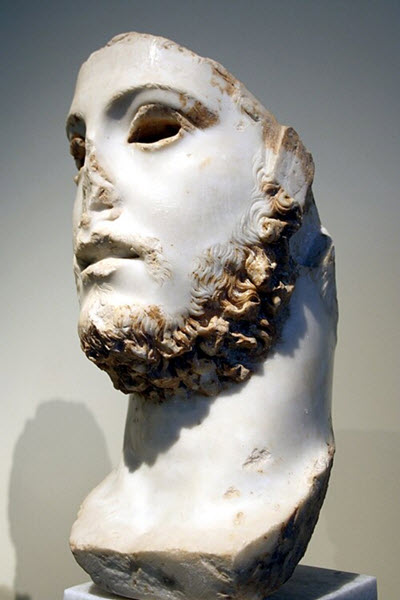
Remnant of a Roman bust of a youth with a blond beard, perhaps Commodus, who is said to have always dyed his hair and used gold dust.[26] National Archaeological Museum, Athens

Cleander proceeded to concentrate power in his own hands and to enrich himself by taking responsibility for all public offices. He sold (and bestowed entry to) Senate seats, army commands, governorships, and increasingly, suffect consulships, to the highest bidder. Unrest rose throughout the empire, with large numbers of army deserters causing trouble in Gaul and Germany. Pescennius Niger dealt with the deserters in Gaul in a military campaign. The revolt in Brittany was put down by two legions brought over from Britain.

In 187, one of the leaders of the deserters, Maternus, came from Gaul intending to assassinate Commodus at the Festival of the Great Goddess in March but was betrayed and executed. In the same year, Pertinax unmasked a conspiracy by two enemies of Cleander, Antistius Burrus (one of Commodus's brothers-in-law) and Arrius Antoninus. As a result, Commodus appeared more rarely in public, preferring to live on his estates.

Early in 188, Cleander disposed of the current praetorian prefect, Atilius Aebutianus, and took over supreme command of the Praetorian Guard at the new rank of a pugione ("dagger-bearer"), with two praetorian prefects subordinate to him. Now at the zenith of his power, Cleander continued to sell public offices as his private business. The climax came in the year 190, which had 25 suffect consuls—a record in the 1,000-year history of the Roman consulship—all appointed by Cleander (they included the future Emperor Septimius Severus).

In the spring of 190, Rome was afflicted by a food shortage, for which the praefectus annonae Papirius Dionysius, the official actually in charge of the grain supply, contrived to lay the blame on Cleander. At the end of June, a mob demonstrated against Cleander during a horse race in the Circus Maximus: he sent the Praetorian Guard to put down the disturbances, but Pertinax, who was now City Prefect of Rome, dispatched the Vigiles Urbani to oppose them. Cleander fled to Commodus, who was at Laurentum in the house of the Quinctilii, for protection, but the mob followed him calling for his head.

At the urging of his mistress Marcia, Commodus had Cleander beheaded and his son killed. Other victims at this time were the praetorian prefect Julius Julianus, Commodus's cousin Annia Fundania Faustina, and his brother-in-law Mamertinus. Papirius Dionysius was executed, too. In AD 191, Commodus took more of the reins of power, though he continued to rule through a cabal consisting of Marcia, his new chamberlain Eclectus, and the new praetorian prefect Quintus Aemilius Laetus.

Megalomania (190–192)

Image
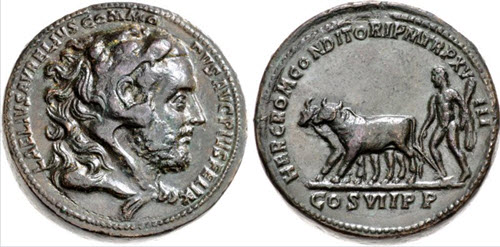
Medallion of Commodus depicting him as Hercules, AD 192.

In opposition to the Senate, in his pronouncements and iconography, Commodus had always stressed his unique status as a source of god-like power, liberality, and physical prowess. Innumerable statues around the empire were set up portraying him in the guise of Hercules, reinforcing the image of him as a demigod, a physical giant, a protector, and a warrior who fought against men and beasts (see § Commodus and Hercules and § Commodus the Gladiator below). Moreover, as Hercules, he could claim to be the son of Jupiter, the supreme god of the Roman pantheon. These tendencies now increased to megalomaniacal proportions. Far from celebrating his descent from Marcus Aurelius, the actual source of his power, he stressed his own personal uniqueness as the bringer of a new order, seeking to re-cast the empire in his own image.

During 191, the city of Rome was extensively damaged by a fire that raged for several days, during which many public buildings including the Temple of Pax, the Temple of Vesta, and parts of the imperial palace were destroyed.

Perhaps seeing this as an opportunity, early in 192 Commodus, declaring himself the new Romulus, ritually re-founded Rome, renaming the city Colonia Lucia Annia Commodiana. All the months of the year were renamed to correspond exactly with his (now twelve) names: Lucius, Aelius, Aurelius, Commodus, Augustus, Herculeus, Romanus, Exsuperatorius, Amazonius, Invictus, Felix, and Pius. The legions were renamed Commodianae, the fleet which imported grain from Africa was termed Alexandria Commodiana Togata, the Senate was entitled the Commodian Fortunate Senate, his palace and the Roman people themselves were all given the name Commodianus, and the day on which these reforms were decreed was to be called Dies Commodianus.[27]

Thus, he presented himself as the fountainhead of the Empire, Roman life, and religion. He also had the head of the Colossus of Nero adjacent to the Colosseum replaced with his own portrait, gave it a club, placed a bronze lion at its feet to make it look like Hercules Romanus, and added an inscription boasting of being "the only left-handed fighter to conquer twelve times one thousand men".
[28]

Assassination (192)

Image
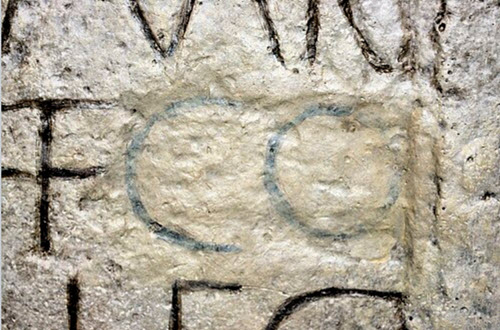
Damnatio memoriae of Commodus on an inscription in the Museum of Roman History in Osterburken, Germany. The abbreviation "CO" has been restored with paint.

In November 192, Commodus held Plebeian Games, in which he shot hundreds of animals with arrows and javelins every morning, and fought as a gladiator every afternoon, winning all the fights. In December, he announced his intention to inaugurate the year 193 as both consul and gladiator on 1 January.

When Marcia found a list of people Commodus intended to have executed, she discovered that she, the prefect Laetus, and Eclectus were on it. The three of them plotted to assassinate the emperor. On 31 December, Marcia poisoned Commodus's food, but he vomited up the poison, so the conspirators sent his wrestling partner Narcissus to strangle him in his bath.[29]

Upon his death, the Senate declared him a public enemy (a de facto damnatio memoriae) and restored the original name of the city of Rome and its institutions. Statues of Commodus were demolished. His body was buried in the Mausoleum of Hadrian.

Commodus's death marked the end of the Nerva–Antonine dynasty. Commodus was succeeded by Pertinax, whose reign was short; he became the first claimant to be usurped during the Year of the Five Emperors.

In 195, the emperor Septimius Severus, trying to gain favour with the family of Marcus Aurelius, rehabilitated Commodus's memory and had the Senate deify him.[30]

Character and physical prowess

Character and motivations


Cassius Dio, a first-hand witness, describes him as "not naturally wicked but, on the contrary, as guileless as any man that ever lived. His great simplicity, however, together with his cowardice, made him the slave of his companions, and it was through them that he at first, out of ignorance, missed the better life and then was led on into lustful and cruel habits, which soon became second nature."[31]

His recorded actions do tend to show a rejection of his father's policies, his father's advisers, and especially his father's austere lifestyle, and an alienation from the surviving members of his family. It seems likely that he was raised in an atmosphere of Stoic asceticism, which he rejected entirely upon his accession to sole rule.

After repeated attempts on Commodus's life, Roman citizens were often killed for making him angry. One such notable event was the attempted extermination of the house of the Quinctilii. Condianus and Maximus were executed on the pretext that while they were not implicated in any plots, their wealth and talent would make them unhappy with the current state of affairs.[32] Historian Aelius Lampridius recorded another event taking place at the Roman baths at Terme Taurine, where a young Commodus ordered an attendant to be thrown into an oven after he had found his bathwater to be lukewarm, although a sheep skin was secretly substituted by a slave to replicate the burnt smell, sparing the attendant's life.[33][34]

Changes of name

Image
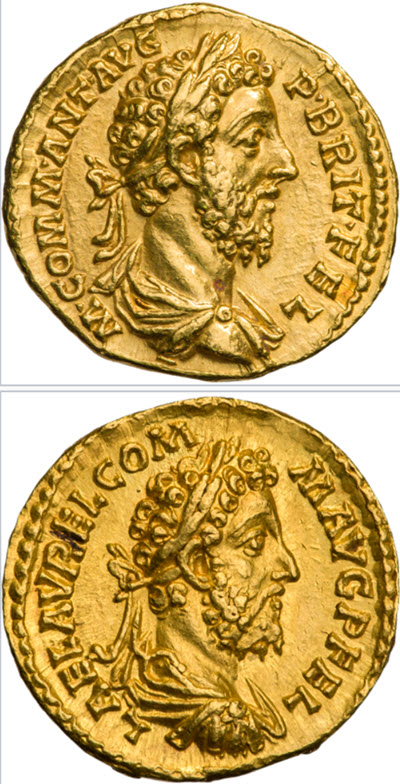
Two aurei of AD 186 and 192 showing Commodus' change from "Marcus Aurelius Commodus Antoninus" to his original "Lucius Aelius Aurelius Commodus"

His original name was Lucius Aelius Aurelius Commodus.[35] On his father's death in 180, Commodus changed this to Marcus Aurelius Commodus Antoninus, before changing back to his birth name in 191.[2] Later that year he adopted as his full style Lucius Aelius Aurelius Commodus Augustus Herculeus Romanus Exsuperatorius Amazonius Invictus Felix Pius (the order of some of these titles varies in the sources). "Exsuperatorius" (the supreme) was a title given to Jupiter, and "Amazonius" identified him again with Hercules.

An inscribed altar from Dura-Europos on the Euphrates shows that Commodus's titles and the renaming of the months were disseminated to the farthest reaches of the Empire; moreover, that even auxiliary military units received the title Commodiana, and that he claimed two additional titles: Pacator Orbis (pacifier of the world) and Dominus Noster (Our Lord). The latter eventually would be used as a conventional title by Roman emperors, starting about a century later, but Commodus seems to have been the first to assume it.[36]

Commodus and Hercules

Disdaining the more philosophic inclinations of his father, Commodus was extremely proud of his physical prowess. The historian Herodian, a contemporary, described Commodus as an extremely handsome man.[37] As mentioned above, he ordered many statues to be made showing him dressed as Hercules with a lion's hide and a club. He thought of himself as the reincarnation of Hercules, frequently emulating the legendary hero's feats by appearing in the arena to fight a variety of wild animals. He was left-handed and very proud of the fact.[38] Cassius Dio and the writers of the Augustan History say that Commodus was a skilled archer, who could shoot the heads off ostriches in full gallop, and kill a panther as it attacked a victim in the arena.

Commodus the gladiator

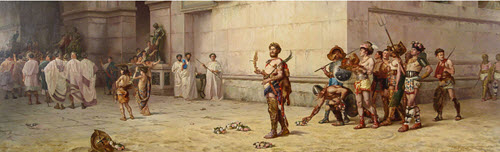
Commodus also had a passion for gladiatorial combat, which he took so far as to take to the arena himself, dressed as a secutor.[39] The Romans found Commodus's gladiatorial combat to be scandalous and disgraceful.[40] According to Herodian, spectators of Commodus thought it unbecoming of an emperor to take up arms in the amphitheater for sport when he could be campaigning against barbarians among other opponents of Rome. The consensus was that it was below his office to participate as a gladiator.[41] Popular rumors spread alleging he was not actually the son of Marcus Aurelius, but of a gladiator his mother Faustina had taken as a lover at the coastal resort of Caieta.[42]

Cassius Dio claimed that citizens of Rome who lacked feet (either through accident or illness) were taken to the arena, where they were tethered together for Commodus to club to death while pretending they were giants.[43] Dio also wrote that it was Commodus's custom to privately use deadly weapons to fight, murdering and maiming his opponents.[44][45]

Commodus was also known for fighting exotic animals in the arena, often to the horror and disgust of the Roman populace. According to Cassius Dio, Commodus once killed 100 lions in a single day.[46] Later, he decapitated a running ostrich with a specially designed dart[47] and afterward carried his sword and the bleeding head of the dead bird over to the Senators' seating area, and motioned to suggest that they were to be next.[48] Dio notes that the targeted senators actually found this more ridiculous than frightening, and chewed on laurel leaves to conceal their laughter.[49] On other occasions, Commodus killed three elephants on the floor of the arena by himself,[50] and a giraffe.
[51]

Image
The Emperor Commodus Leaving the Arena at the Head of the Gladiators (detail) by Edwin Blashfield (1848–1936), Hermitage Museum and Gardens, Norfolk, Virginia.

In popular culture

• An evil and highly narcissistic Commodus is portrayed by Canadian actor Christopher Plummer in the classic epic film The Fall of the Roman Empire (1964), directed by Anthony Mann. This film depicts all of this emperor's reign, from the death of Marcus Aurelius until his own death while fighting against the fictional hero Livius.
• In the Best Picture winner Gladiator (2000), a fictionalized Commodus serves as the main antagonist of the film. He is played by Joaquin Phoenix, who received a Best Supporting Actor nomination at the 73rd Academy Awards.[52]
• Commodus appears in the Horrible Histories song "Evil Emperors", alongside Caligula, Elagabalus and Nero, a parody of "Bad".
• The 2017 docu-drama miniseries Roman Empire: Reign of Blood retells his story.[53][54] In this version, Narcissus kills Commodus in a duel after learning that the Emperor's arena opponents had been armed only with edgeless swords. At first, Narcissus strangles Commodus, but ultimately kills him by piercing his heart with a blunt sword. Aaron Jakubenko portrays Commodus in the series.
• Commodus appears as one of the antagonists in the popular young adult fiction novel series The Trials of Apollo. He is revealed as having become a minor god after his death and has survived into modern times, along with two other Roman emperors, Caligula and Nero.

Nerva–Antonine family tree

[x]
Nerva–Antonine family tree

Nerva–Antonine family tree

See also

• List of Roman emperors

References

1. Bust of Commodus as Hercules. Musei Capitolini
2. Hammond, pp. 32–33.
3. RE Aurelius 89
4. Cooley, Alison E. (2012). The Cambridge Manual of Latin Epigraphy. Cambridge University Press. p. 494. ISBN 978-0-521-84026-2.
5. "Commodus". Random House Webster's Unabridged Dictionary.
6. Historia Augusta – Life of Commodus
7. David L. Vagi Coinage and History of the Roman Empire Vol. One: History p. 248
8. Mattern, Susan P., The Prince of Medicine: Galen in the Roman Empire, p. xx
9. Dio, Cassius, Roman History, 71.33.1
10. Birley, Anthony R., Marcus Aurelius: A Biography, p. 197
11. Historia Augusta 1.6
12. Inscription: "Imperator Lucius Aurelius Commodus Augustus Germanicus Sermaticus, (holder of the) tribunician power for the 2nd time, consul, father of the fatherland."
13. Kienast, Dietmar; Werner Eck; Matthäus Heil (2017). Römische Kaisertabelle: Grundzüge einer römischen Kaiserchronologie (in German). Darmstadt: WBG. pp. 140–143. ISBN 978-3-5342-6724-8.
14. Marcel van Ackeren (2012). A Companion to Marcus Aurelius. John Wiley & Sons. p. 234. ISBN 978-1-4051-9285-9.
15. Historia Augusta 2.4
16. Hammond, Mason (1938). "The Tribunician Day during the Early Empire". Memoirs of the American Academy in Rome. 15: 23–61 (49–53). doi:10.2307/4238599. ISSN 0065-6801. JSTOR 4238599.
17. Manuscripts, British Museum Department of (1907). Greek Papyri in the British Museum. British museum. pp. xxxix, Pap. 845. ISBN 978-0-7141-0486-7.
18. Hammond, Mason (1956). "The Transmission of the Powers of the Roman Emperor from the Death of Nero in A.D. 68 to That of Alexander Severus in A.D. 235". Memoirs of the American Academy in Rome. 24: 61–133 (104–105). doi:10.2307/4238640. ISSN 0065-6801. JSTOR 4238640.
19. Parker, H. M. D. (2024). A History of the Roman World from A.D. 138 to 337. Chapter II, note 77. Taylor & Francis. ISBN 978-1-040-03539-9.
20. Historia Augusta 12
21. Historia Augusta, Marcus Aurelius, 22.12
22. Dio, Cassius, 72.33.
23. "Tulane University "Roman Currency of the Principate"". Archived from the original on 10 February 2001. Retrieved 3 March 2011.
24. Dio, Cassius, 72.36.4, Loeb edition, translated E. Cary
25. Dio, Cassius, 73.10.2, Loeb edition, translated E. Cary
26. Historia Augusta 17.3
27. "Roman Emperors – DIR commodus". http://www.roman-emperors.org. Archived from the original on 21 March 2022. Retrieved 24 June 2022.
28. Dio, Cassius, 73.22.3
29. Dio, Cassius, 73.22
30. To "accept kinship with Commodus ... the bluntly pragmatic decision was taken to deify the former emperor, thus legitimizing Severus' seizure of power." See Annelise Freisenbruch, Caesars' Wives: Sex, Power, and Politics in the Roman Empire (London and New York: Free Press, 2010), 187.
31. Dio, Cassius, 73.1.2, Loeb edition, translated E. Cary
32. Dio, Cassius, 73.5.3, Loeb edition, translated E. Cary
33. Historia Augusta. C 1, 9.
34. Heinz, W. (1986). Die ''Terme Taurine'' von Civitavecchia – ein römisches Heilbad. Antike Welt, 17(4), 22–43.
35. Hammond, p. 32.
36. Spiedel, M.P. (1993). "Commodus the God-Emperor and the Army". Journal of Roman Studies. 83: 109–114. doi:10.2307/300981. JSTOR 300981. S2CID 162303472.
37. Grant, Michael. The Roman Emperors (1985) p. 99.
38. Dio, Cassius, Roman History: Epitome of Book LXXIII pp 111.
39. Gibbon, Edward, The history of the decline and fall of the Roman Empire. Vol. 5. Methuen, 1898.
40. Herodian's Roman History F.L. Muller Edition 1.15.7
41. Echols, Edward C., "Herodian of Antioch's History of the Roman Empire", English translation, UCLA Press, Berkeley, CA (1961), 1.15.1-9
42. Historia Augusta, Life of Marcus Aurelius, XIX. The film The Fall of the Roman Empire makes use of this story: one of the characters is an old gladiator who eventually reveals himself to be Commodus's real father.
43. Dio, Cassius, 73.20.3, Loeb edition, translated E. Cary
44. Cassius DIO, 73.10.3
45. "Intrigue, Insanity, and the Reign of Commodus". Wondrium Daily. 1 December 2017. Archived from the original on 26 May 2022. Retrieved 9 June 2022.
46. Gibbon, p. 106: "disgorged at once a hundred lions; a hundred darts"
47. Gibbon, Edward, The Decline and Fall of the Roman Empire: Volume I. Everyman's Library (Knopf) New York. 1910. p. 106: "with arrows whose point was shaped in the form of a crescent"
48. Lane Fox, Robin, The Classical World: An Epic History from Homer to Hadrian, Basic Books, 2006, p. 446 "brandishing a sword in one hand and bloodied neck...He gesticulated at the Senate."
49. Roman History by Cassius Dio penelope.uchicago.edu
50. Scullard, H. H., The Elephant in the Greek and Roman World, Thames and Hudson, 1974, p. 252
51. Gibbon, p. 107: "*1 Commodus killed a camelopardalis or giraffe ... the most useless of the quadrupeds".
52. IMDB "Commodus". IMDb. Archived from the original on 9 July 2015. Retrieved 16 June 2021.
53. Agius, Den (19 November 2016). "Box Set Binge: Roman Empire: Reign of Blood, The Path and Deutschland 83". What's on TV. TI Media Limited. Retrieved 20 July 2018.
54. O'Keefe, Meghan (25 November 2016). "'Roman Empire: Reign Of Blood': Who Was The Real Lucilla?". Decider. NYP Holdings, Inc. Retrieved 20 July 2018.

Sources

• "Lucius Aurelius Commodus" . Encyclopædia Britannica. Vol. 6 (9th ed.). 1878. pp. 207–208.
• "Commodus, Lucius Aelius Aurelius" . Encyclopædia Britannica. Vol. 6 (11th ed.). 1911. p. 777.

Further reading

• Geoff W Adams [2013]. The Emperor Commodus: gladiator, Hercules or a tyrant?. Boca Raton, FL: BrownWalker Press. ISBN 1612337228.
• G. Alföldy, "Der Friedesschluss des Kaisers Commodus mit den Germanen", Historia, 20 (1971), pp. 84–109.
• P. A. Brunt, "The Fall of Perennis: Dio-Xiphilinus 79.9.2", Classical Quarterly, 23 (1973), pp. 172–177.
• J. Gagé, "La mystique imperiale et l'épreuve des jeux. Commode-Hercule et l'anthropologie hercaléenne", ANRW 2.17.2 (1981), 663–683.
• Hammond, Mason (1957). "Imperial Elements in the Formula of the Roman Emperors during the First Two and a Half Centuries of the Empire". Memoirs of the American Academy in Rome. 25: 19–64. doi:10.2307/4238646. JSTOR 4238646.
• Olivier Hekster, Commodus: An Emperor at the Crossroads: Dutch monographs on ancient history and archaeology, 23. Brill, 2002. ISSN 0924-3550.
• On Heksters study, see the detailed commentary by Christian Witschel, "Kaiser, Gladiator, Gott. Zur Selbstdarstellung des Commodus", Scripta Classica Israelica, 23 (2004), pp. 255–272 (online).
• L. L. Howe, The Praetorian Prefect from Commodus to Diocletian (A.D. 180–305). Chicago, 1942. [ISBN missing]
• Falko von Saldern, Studien zur Politik des Commodus. Verlag Marie Leidorf, 2003, ISBN 3-89646-833-2.
• Bert Smith & Christian Niederhuber, Commodus: The Public Image of a Roman Emperor Reichert Media Library 2023, TOC, Chapter 1 PDF
• M.P. Speidel, "Commodus the God-Emperor and the Army," Journal of Roman Studies, 83 (1993), pp. 109–114.
• Jerry Toner, The Day Commodus Killed a Rhino: Understanding the Roman Games. Johns Hopkins University Press, 2014. [ISBN missing]

External links

Wikimedia Commons has media related to Commodus.
• Historia Augusta: Life of Commodus
• Book 73 of Cassius Dio's History
• Herodian's Roman History

Commodus
Nerva–Antonine dynasty
Born: 31 August 161 Died: 31 December 192
Regnal titles
Preceded by
Marcus Aurelius
Roman emperor
180–192 Succeeded by
Pertinax

Political offices
Preceded by
T. Pomponius Proculus Vitrasius Pollio
M. Flavius Aper II
as ordinary consuls Roman consul
177
with Marcus Peducaeus Plautius Quintillus
Succeeded by
Ser. Cornelius Scipio Salvidienus Orfitus,
Domitius Velius Rufus
as ordinary consuls
Preceded by
Ser. Cornelius Scipio Salvidienus Orfitus,
Domitius Velius Rufus
as ordinary consuls Roman consul
179
with Publius Martius Verus
Succeeded by
T. Flavius Claudianus,
L. Aemilius Iuncus
as suffect consuls
Preceded by
L. Fulvius Rusticus G. Bruttius Praesens II,
Sex. Quintilius Condianus
as ordinary consuls Roman consul
181
with Lucius Antistius Burrus
Succeeded by
M. Petronius Sura Mamertinus,
Q. Tineius Rufus
as ordinary consuls
Preceded by
Marcus Petronius Sura Mamertinus,
Q. Tineius Rufus
as ordinary consuls Roman consul
183
with Gaius Aufidius Victorinus
Succeeded by
L. Tutilius Pontianus Gentianus,
ignotus
as suffect consuls
Preceded by
Triarius Maternus,
Ti. Claudius M. Appius Atilius
Bradua Regillus Atticus
Roman consul
186
with Marcus Acilius Glabrio II
Succeeded by
L. Novius Rufus,
L. Annius Ravus
as suffect consuls
Preceded by
Domitius Iulius Silanus,
Q. Servilius Silanus
as suffect consuls Roman consul
190
with Marcus Petronius Sura Septimianus
Succeeded by
L. Septimius Severus,
Apuleius Rufinus
as suffect consuls
Preceded by
Popilius Pedo Apronianus,
M. Valerius Bradua Mauricus
as ordinary consuls Roman consul
192
with Publius Helvius Pertinax
Succeeded by
Q. Pompeius Sosius Falco,
G. Julius Erucius Clarus Vibianus
as ordinary consuls
admin
Site Admin
 
Posts: 41279
Joined: Thu Aug 01, 2013 5:21 am

Re: PART 3 ANTI-ANTI-NAZI BARBARIAN HORDES ARE KNOCKING DOWN

Postby admin » Sun May 24, 2026 8:38 pm

Empire at its nadir: Trump’s hollow threats mask America’s descent as Iran stamps its authority
by Press TV Strategic Analysis Desk
Saturday, 23 May 2026 12:32 PM [ Last Update: Saturday, 23 May 2026 12:32 PM ]
https://www.presstv.ir/Detail/2026/05/2 ... ry-Baghaei

Behind the bluster of maximalist pressure and theatrical military threats from Washington lies a reality the architects of the “maximum pressure” campaign dare not admit: the United States is slowly hurtling toward a critical economic, political, and strategic precipice.

The high-volume diplomatic trips of Pakistani officials in recent days – from its army chief to its prime minister and interior minister – carrying the US messages reveal a frantic choreography of a hegemon leaning on every available intermediary, including Islamabad, to salvage the bare minimum from a war it has already lost militarily, politically, and morally.

Iran, by contrast, operates from a posture of strategic clarity, exercising patience to ensure that no agreement is accepted unless it safeguards Iranian interests and meets all of Tehran's stipulated conditions for permanently ending the third imposed war.

The Islamic Republic’s objective in the negotiations to put an end to the latest imposed war of aggression is not simply to silence the guns. It is to permanently break the vicious cycle of war, negotiation, and renewed war – a cycle that has defined the enmity and hostility of the United States and the Zionist regime against the Iranian nation for decades.

The fact is that the American Empire is collapsing under the weight of its own failures, Iran’s resistance is rewriting the rules of deterrence, so concessions must flow from the US side.

The hollow superpower – America’s rapid descent into crisis

Contrary to Trump’s posture of raw power, the US is approaching a multidimensional collapse with startling speed. The military defeat the US has suffered against Iran – a defeat no amount of propaganda can erase – has now metastasized into a political and strategic hemorrhage. The world is watching, and the indicators are devastating.


First, the economic battlefield, which Washington believed it could dominate, has turned into a trap of its own making. The same economic deterioration gripping the globe has been exposed as, in large part, a US-driven catastrophe.

Sanctions, reckless fiscal policies, and the weaponization of the dollar have backfired spectacularly. Instead of isolating Iran, America has accelerated global de-dollarization and eroded trust in its own economic stewardship. The very indices that once signaled American economic supremacy – inflation control, market confidence, supply chain reliability – are now flashing red. And the world correctly assigns fault to Washington.

Second, the political unravelling follows the catastrophic military failure. The US war machine entered this war expecting a quick Iranian surrender, like in Venezuela. What it encountered was an indomitable resistance that shattered all US calculations.

Now, the concept of American “superpower” status is being gradually invalidated in real-time. Allies in the region and beyond, who once sheltered under the US security umbrella, see the emperor without clothes. They witness a power that could not break Iran, could not protect its own assets, and is now begging – through Pakistani intermediaries, Arab Persian Gulf capitals, and backchannel emissaries – for an exit ramp.

Third, and most critically, Washington is burning itself alive to secure even minimal political concessions from Iran on the nuclear file. Why? Because the survival of America’s remaining global credibility – whatever is left of it – depends on the ‘myth’ of the Iranian nuclear bomb.

Trump and his strategists know if they return from negotiations empty-handed – unable to claim even a symbolic, face-saving victory – the damage to US standing will be irreversible.

Rivals and enemies alike will interpret that outcome as definitive proof that the US can be defied, defeated, and diminished without any real consequence. Thus, America is pursuing any deal, no matter how hollow, not to enhance security, but to postpone the moment of its own political and strategic death.

It is going through “hell and high water” not for peace, but for the illusion of relevance.


Press TV
@PressTV
The logic of victory: Iran’s end-of-war terms define a new strategic reality for the aggressor

By Press TV Strategic Analysis Desk

https://presstv.ir/Detail/2026/05/22/76 ... ic-reality
8:50 AM · May 22, 2026


The war aims exposed – From annihilation to retreat

Let us rewind to see how this war of aggression began. The US and the Israeli regime did not initiate it over a small dispute about enrichment levels or inspection schedules. Their stated goal was the annihilation of the Islamic Republic, the partition of Iran, and the plunder of its natural resources. That was the objective, and they unapologetically admitted it.

But the battlefield has a way of clarifying illusions. As signs of their defeat became clearer, the enemy’s demands shifted dramatically. They called for Iran’s surrender. And when Trump himself urgently requested a ceasefire, the definition of “surrender” was spelled out: a public renunciation of nuclear weapons, the transfer of all 60 percent enriched uranium to American soil, zero enrichment, and the dismantling of every Iranian nuclear facility.


Here lies the first great victory of the Iranian resistance. Iran did not surrender, but it resisted with all its might. And under that pressure, the enemy was forced to retreat. The demand for zero enrichment was downgraded to a temporary halt. The demand for transferring nuclear material to the US was abandoned altogether. That is the record of a country that forced a so-called “superpower” to eat its own words.

But make no mistake: even the minimal realization of American goals, amplified by a deafening, ear-grating media wave of Trumpian victory propaganda, would carry catastrophic long-term consequences.

If Washington can claim, however falsely, that it saved the world from a “nuclear Iran,” it will achieve two things. First, a temporary political escape hatch from complete collapse. Second, and far more dangerously, it will legitimize war itself as an instrument to strip the Islamic Republic of its sovereign rights.

The very act of extracting concessions through warfare, even minimal ones, validates the logic of aggression. It tells future American and Israeli leaders: if you bomb Iran, you can extract concessions. That validation means the threat of war will remain permanently.

Breaking the vicious cycle – Iran’s core objective


This is the fundamental point that Western pundits consistently miss. Iran is not in these negotiations merely to end the current war of aggression. That would be shortsighted. Iran’s objective is to close the door on another war and prevent the endless, exhausting cycle of war, negotiation, and renewed war that has drained the region for decades.

The pattern has been brutal and predictable. War. Exhaustion. Negotiation. Concessions. Then, inevitably, a new pretext for war. The enemy rests, rearms, and returns with greater demands. Iran has decided that this vicious cycle must end permanently, not temporarily.

This is essential because any concession granted to the arrogant enemy under the shadow of war and the fear of its recurrence may produce a momentary ceasefire, but it does so at the cost of the future. It is a form of short-term political profiteering that sacrifices the fundamental rights of future generations.

It won’t be right to secure a comfortable present for the current generation by guaranteeing devastating wars against future generations. That is the essence of the moral and strategic calculation now facing Iranian decision-makers.


The enemy has already proven its true intentions. It has demonstrated, through two full-scale unprovoked wars in less than a single year, that its ultimate demand is nothing less than the destruction of the Islamic Republic system. Every other issue – nuclear enrichment, regional influence, missile power – is secondary compared to that core objective.

An enemy that has shown no hesitation in imposing total war twice in less than ten months cannot be managed with partial concessions. It must be decisively dissuaded from even considering war as an option anytime in the future. And the only way to achieve that dissuasion is to disappoint the enemy entirely regarding its declared objectives.

Iran must ensure that the United States and the Zionist regime walk away from this imposed war with nothing – no victory, no symbolic concession, no propaganda trophy.


Press TV
@PressTV
Analysis - The geometry of power: Trump’s repeated retreats prove US systemic paralysis, Iran’s strategic ascent

By Press TV Strategic Analysis Desk

https://presstv.ir/Detail/2026/05/19/76 ... gic-ascent

10:01 AM · May 19, 2026


The unfinished battle – Why the war is not over until it’s over

Here lies the most urgent operational reality. As long as a definitive, permanent, final end to the war has not been announced, every conversation, every promise, and every agreement regarding Iran’s rights – particularly in the nuclear sphere – is premature and dangerous.

Even a commitment not to build nuclear weapons, if given in the context of ongoing US hostilities and before a binding final settlement, has the perverse effect of legitimizing war. It signals to the enemy that aggression is a viable tool for extracting Iranian concessions.

Iran’s resistance at this stage has already proven a profound truth: war not only failed to force Iran into surrender but actually granted the Islamic Republic advantages it could never have achieved in peacetime. This is not rhetoric but a consistent historical model.

Every war imposed on Iran has left the enemy weaker and Iran stronger. The enemy’s objectives are never realized. Instead, Iran emerges with new deterrent capabilities, new political leverage, and new strategic depth. War does not achieve a single one of the enemy’s goals but only makes the enemy more vulnerable relative to Iran.

That established model now imposes specific costs on the US for having imposed war on Iran. These are not negotiable niceties. The price of aggression is the firm consolidation of Iran’s control over the Strait of Hormuz, the full release of Iranian assets frozen abroad, compensation for war damages and reparations, the complete withdrawal of US forces from around Iran in the region, and the protection of the Resistance Front against enemy action.

If Iran’s diplomacy stands firm, this model will materialize. And it will create the most powerful deterrent against any future contemplation of war.

The fork in the road – A historic and fateful decision

Iran now stands at a historic and fateful crossroads. On one path lies the American threat of a potential renewed war. On the other hand lies the certainty of future, even harsher wars if Iran concedes prematurely. There is no third option of sustainable peace without cost.

Continuing resistance against US pressure at this stage could lead to either the resumption of war or the acceptance of Iran’s full terms. That uncertainty is uncomfortable, but it is the reality of strategic confrontation.


However, one thing is absolutely certain. Conceding on nuclear rights before a definitive, final end to the war will not avoid another war, but it will guarantee far more devastating wars in the future. The enemy will interpret any concession as validation of its method: war works. And it will return with greater force, greater demands, and greater brutality.

The repeated threats by the United States and the Zionist regime to resume the full-scale war demand a decisive and meaningful response. Resistance on the diplomatic front is the best answer, but it is not the only answer. Reciprocal threats from Iran’s armed forces are powerfully effective in reducing the likelihood of renewed aggression.

The IRGC’s timely and decisive threat to regionalize the war – to expand the battlefield beyond Iran’s borders – was a masterstroke. It introduced doubt into the enemy’s calculations. And doubt is the enemy of aggression.

Moreover, the repeated nuclear threats made by the enemy, especially after the direct attack on Iran’s nuclear facilities, have conclusively demonstrated that continued membership in the Non-Proliferation Treaty (NPT) offers Iran no benefits whatsoever.

The NPT failed to protect Iran’s legal and sovereign nuclear rights. It failed to prevent attacks or to restrain the unhinged enemy. After the third imposed war – one that included not only the martyrdom of the Leader of the Islamic Revolution but also an assault on Iran’s nuclear sanctum – continued adherence to the NPT lacks any logical or rational justification.

Therefore, one of the credible threats Iran must place on the negotiating table is withdrawal from the NPT. The meaning of that threat is clear to the enemy, which means the old rules no longer apply. An Iran outside the NPT is an Iran whose nuclear calculus is no longer bound by the treaty that the enemy itself has rendered worthless.

Iran’s deterrence doctrine must now undergo fundamental reform and change. The enemy has twice imposed war in a single year. It insists on keeping the sword of war permanently suspended over Iran’s head. Under these conditions, revising deterrence is not a threat. It is a reasonable, rational, and necessary measure to keep the country safe from future wars.

Press TV
@PressTV
Analysis - With strategic upper hand, Iran conditions nuclear talks on war's definitive end – on its terms

By Press TV Strategic Analysis Desk
https://t.co/7IkQA1le2u
From presstv.ir
7:08 AM · May 21, 2026


The martyrdom of the Leader – The unpayable debt

No analysis of this war can be complete without addressing the colossal crime at its center: the cowardly assassination of the Leader of the Islamic Revolution, Ayatollah Seyyed Ali Khamenei. This was not a simple act of war. The crime demands a price far heavier than the destruction or execution of the murderers and criminals who carried it out.

Here is the sobering truth: even if all of Iran’s demands for ending the war were fully realized – even if no concessions, minimal or otherwise, were made to the enemy – it would amount to nothing compared to the true price of this assassination.

The martyrdom of the Leader crossed the highest red lines of the Islamic Republic, and crossing the highest red lines must be met with the severest punishment.


Legal and international follow-ups to register this blood vengeance are the absolute minimum that must be undertaken. But beyond that, it is natural for religious decrees (fatwas) to be issued throughout the Islamic Ummah for the implementation of retribution (qisas) against the criminal Trump, the murderers, the instigators, and the executors of this great crime. Iran must be the pioneer in this effort.

Forcing Trump to his knees before Iran and imposing upon him complete political ruin are among the minimal measures required to punish the aggressors. Any suggestion of leaving an escape route open for Trump is flawed logic, contrary to both reason and religious law. A criminal of this magnitude does not deserve a way out.
admin
Site Admin
 
Posts: 41279
Joined: Thu Aug 01, 2013 5:21 am

Re: PART 3 ANTI-ANTI-NAZI BARBARIAN HORDES ARE KNOCKING DOWN

Postby admin » Sun May 24, 2026 11:04 pm

Trump PANICS as US Defeat in Iran War BLOWS UP Israel's Trap | Patrick Henningsen
Danny Haiphong
May 24, 2026

Patrick Henningsen discusses why the US's defeat to Iran has exposed a chilling reality about the war, a trap laid by Israel that has changed the world forever.


Transcript

Israel is reportedly pushing for renewed strikes on Iran. They're claiming that Iran is planning a surprise attack at
any moment and that's why Donald Trump in his administration needs to drop any pretenses of diplomacy. There was this
very interesting report uh the times of Israel citing the Washington Post that says the US has used over half of its
dad interceptors defending Israel during those 37 days or so of active hostilities. And I just want to read
this very important quote from the US officials who decided to disclose what was going on. and they said Israel is
not capable of fighting and winning wars on its own, but nobody actually knows this because they never see the back
end. Amid these reports, you have Israel pushing for renewed war and you have US officials saying that they spent half of what they had left. What do you make of
this? Uh how critical is this to understanding what exactly is going on right now? Well, just on this this uh
story, I think it's just emblematic of the relationship between the United States and Israel um whereby they feel
compelled to have the US empty out its stocks of valuable interceptors, you know, high altitude THAAD interceptors.
So, um and and Israel is obliged to hold back its stock. So, it is so for the US
it's Israel first and for Israel it's Israel first. You see, and that's that's an incredible thing considering the US
is always also trying to manage multiple theaters uh around the world. They're they're not just busy in West Asia.
there. The US is busy in uh half a dozen other theaters and two in particular of
note uh which is the Ukraine theater uh as well as the uh East Asia and and the
Taiwan uh theater as well visav the uh the other allies in the region. So, I
think that's uh that that should be like a real clear signal to people who might be questioning what our relationship
with Israel is. That's the net net result. And it just it goes to show you that
this this war, this undeclared war of aggression, this uh this sort of errant adventurism by the US vis with with Iran
just getting involved with this. This is just accelerating the demise of the United States as a viable imperial power
globally. It you can't manage all of these things. They're not right now.
See, they're in a sort of uh production mode, capitalizing the defense industry.
You see all these sort of big tech people that are now getting into defense and they they're like, "No, no, we're not going to make this mistake again.
We're going to double down on production and this is what we're going to do." Palmer lucky. He's got all this great tech. Palunteer is going to do the back
end. It's going to be fantastic. We're just going to churn out artillery and everything else. Whatever we need, we're have endless stream of it, right? They
think that they can just switch this on and that then all the things that are that are killing the US right now in in
the uh managerial imperial sense. Uh we're going to eliminate all those problems because we we're we're on it
now. We're on it now. And uh it doesn't it's not going to work. It's not it's not going to work because the what's the
premise of the imperial what what's the premise of the imperial mission? What's what's the what's the
imperial sales pitch to the world? What what is that? That that's the important bit. You can you can build up all this
constant conflict and the the the military-industrial might behind that that keep keeps it
going. But if you're not if you're not able to sell this to to the world and to your own allies, you have to threaten
and coers all of your allies. Then you know there's no point there's no point.
What this will do is bankrupt the United States.
And this is again a this is a classic symptom of latestage empire is they'll they'll then bankrupt themselves to try
to maintain their previous position in the world when in fact their previous position in the world is is has has been
vacated. uh probably more because of their political orientation with the world and how they're treating uh everybody and and it's just too
expensive to maintain and to micromanage all of these different theaters and all these different uh um uh you know choke
points and all of these different geopolitical uh flash points. That's how the British Empire collapsed. the British Empire at
the height of the British Empire when it kind of peaked before its ultimate demise.
It was managing something like 40 different conflicts. 40.
And so it had to resource all of that, had to pay for all that. Then there's the political capital, the diplom diplomatic capital, then the economic
considerations, the supply chains and so forth. that that's why they could not afford to maintain all of that. this the
inter interdependency which was at one point the strength of the British Empire became the biggest
liability of the British Empire and by the same token the interdependency of the US empire which is mainly a dollar
driven it's a dollar-driven empire that interdependency which was its greatest asset
um is now its greatest liability and that's because of the behavior of the United States itself
and and and also by prioritizing economic warfare in order to let's be let's be honest the
reason the US has has pursued such an aggressive sanctions agenda was to avoid having to use the military because that
wasn't seen as popular or it's bad optics internationally. So, oh that's okay. We're going to sanction them. We're going to coers them to sanctions.
Of course, sanctions don't work. They never have. They never proven to show that they work. They only work really against your allies, if anything. Hardly
ever against your enemies. They don't change the behavior. So, it was always seen as a bloodless Americans will sell it to themselves. Congress and Senate
love it because they can they can do something by passing sanctions uh without having to send troops.
You know, post Vietnam, this has always been a very popular policy. But by doing
so, they're they're slowly grinding down and killing the goose that laid the golden egg for Uncle Sam. And and and
7 minutesand then they're into the interdependency of the global petro dollar and the US reserve currency, the real engine of US empire. All of a
sudden, it's it's now becoming a liability for everybody else holding it and really only doing the US a favor by
not dumping all their treasuries on the market. and and you know what there will come a point where they'll have to dump them because otherwise it's a get something versus nothing
and and that that day may be not far off. Certainly Japan these are the issues that the Japanese
uh central banks are mulling over at the moment and I'm sure the Chinese and others are have been thinking the same for a very long time. the the numbers
are are pretty staggering just in this report. Uh that there's uh the Washington Post report says 200 FAT
interceptors left. And so if we do some simple math, half being depleted means
uh 200 used uh during 37 days. That's a lot. $12.7 million per interceptor
missile. It's a lot of money. And uh uh this uh goes also in league with you said there's this a huge liability being
built here to being entangled in all of this all of these conflicts. Well, that liability is actually showing real
results. Uh uh this center for responsible statecraft cited the acting navy secretary Hong to Tao who said that
the Iran war stockpile wos are behind the pause on US munition aid to Taiwan.
Um he said Donald Trump that this was a negotiating chip which is why Trump has
not made a decision on this arms package the latest one to Taiwan. But it seems like actually what's happening is that the US military might which is so
important to preserving this hegemony that you just described and outlined on all fronts uh that seems to be actually
depleting and diminishing right before our eyes in real time.
So that's that's the so here's the equation. The equation is and if you take political science or history right
from you know junior high through high school to college they history in America I'll I have an American education so I'll speak and half British
but I'll I'll speak about my American education focus is on war focuses on military battles dates wars generals
treaties that's the focus that's what we learn about we're indoctrinated to believe that American empire is led led
by military. It's not the US dollar as a as a reserve currency leads the US
empire and that that financial power is backed up by the military. But if you don't have the military to back up that
financial uh prepundonderance, as I call it, uh then the whole equation starts to fall apart. And isn't it amazing that
we're watching that equation fall apart in real time right now? And that's to say nothing about the economic disparity
between the cost of producing uh an interceptor missile or a drone in the United States uh versus the cost of
producing the bogey uh in in Iran, the the Shahi drone um or the Iranian uh
missile uh and and just the disparity in terms of the the economy of these two things. It's it's it's it's
unbelievable. And it really would any sane person would look at this at scale and say this is clearly not sustainable.
This is not sustainable economically. So then the there must be another route that is more sustainable. you know, like
maybe negotiations, diplomacy, perhaps trade, you know, you know, maybe mutual
11 minutesbenefit and partnership rather than coercion and punishment. I don't know.
uh but at some point you know so but hey if you're in the industry if you're in those industries right now and that's where the where the money in the US is
flowing but I think I think you could also see a a you know the the defense bubble if you look at history which is
interesting you have financial bubbles those can wipe out economies and countries but what can wipe out governments and regimes is a defense
bubble uh and be because it's usually tied with some uh outrageous adventurism
militarily. Uh and so yeah, the US whe whether it's this presidency, this administration or the next administration,
uh I think this is going to have devastating consequences for for the government uh and also probably for the
US economy. So this could end up also being a bubble of sorts. Pete Hexth, remember he gave this speech uh he put
out this happy clappy video, this sort of like stupid little kind of it's like one of those dumb NGO videos or Sesame Street or something and he's basically saying
no more of these cost overruns. We're not going to do that. And then we're robbing giving the fake populist pitch.
We're rob you're robbing the American taxpayer. Come on. You just doubled the defense the war budget to 1.5 trillion
and asked for another 200 billion o override. 1.7 trillion. that's jacking up our money supply and our inflation.
Uh so who are you what are you talking about the middle the working class? Who who are you talking about? But that that that idea
if this is where the US economy is going if the if the the def the war the war machine the war budget becomes the
central the central piece in the political economy of the un of the of the United States. Uh that's assuming
they're going to be winning all these wars that they're waging. That's a big assumption because if it if it goes the other way, it's not going to be a happy
ending for for America. I'm just going by other historical examples. Uh not not
to mention the obvious one, but you know, it's like um and and also Yeah.
And they're they're depending on a lot of foreign money, too. you know, like a lot of international capital to help uh
bolster this uh defense war war department, war revolution in America.
Um this listen, why would Boeing or Lockheed or Rathon or whatever? Why would they put up the cost of a factory uh unless they have some guarantees?
They're not going to be hiring the best engineers. And then what's Pete Hexath going to do? going to cancel their contract after two years because they're
over budget and start over again and then wait two more years to wait for those interceptor missiles. Okay,
so you you got the system you got in America. It's bloated. It's corrupt.
It's slow. It's overpriced. It's not good value for the money. And a lot of the stuff in the field is redundant by
the time it comes uh by the time it's it comes off the assembly line. But that's the system we got. It's absolutely
concominant with our empire. So you're gonna have there's no way you can operate any other way. Otherwise, you got to get rid of the empire. And that
ain't going to happen or they don't want it to happen. So they're stuck. You know, it's just to me amazing the delusion, the delusional mindset of
these people that cope. Uh we'll call it the postimperial cope. You know, it's just incredible that they would like
push some of these ideas out and clearly it's like real economists and business people even in the defense industry are looking at that happy clappy video by
Hexath and going I don't think so. Like I just had lunch with you last week in New York and we weren't talking about
this, you know, kind of thing. But anyway, no, I mean, and you know, this fantasy
of the Golden Dome and all of these new weapons, new jets, the B-21, you know,
on and on and on. Fantasies in many respects, especially when the old stuff just goes to Israel anyway. I mean, half of it is just going to go to them
because and the really old stuff goes to Ukraine.
Yeah. Yeah. The really they just So, it's a it is it is quite uh the mess.
And and speaking of of this uh then how much of this factors into all of these reports about it feels like it's like
deja vu we are back to the start where despite the the the massive military
expenditure uh diminishment uh from the United States and uh and of course all the damage done to the Gulf to Israel.
We're in this point again where we have a mediator this time Pakistan. Now we're here in Qatar. There's a lot of players trying to get into the mix to Russia
limited framework to allow for talks and to extend the period where there's no fighting. It feels like back before
February 28th when Oman went with the Omani um was it the prime minister who was who was uh uh brokering the talks went on to NBC.
Foreign Minister. Yeah, foreign minister. The foreign minister of Oman went on NBC and said, "We are so close
to a deal that will avoid a war and then not later, the US and Israel were bombing Iran." It seems like Israel
is pushing for that. But what do you make of this uh flurry of news? Nobody, especially the US side, is giving any
indication that uh there's anything genuine going on in the US side. Iran is very firm. It's about their rights. They
don't have any interest in uh settling for limited frameworks. They're they're demanding what they want uh out of uh
the uh destruction that they were uh uh imposed that was imposed upon them plus the fact that they believe they won. So what's your thoughts on this?
Well, that I saw when I saw the the announcement going viral, the usual Twitter accounts putting out fake news.
I won't mention any names, but everybody knows who they are. Saying that there's a draft of this deal and so forth. And immediately it gets leverage because
that's what good propaganda does. Gets leverage. It gets traction because it's what people desire to hear. Everybody is
desperate for some kind of a a peace solution or some kind of a ceasefire and some kind of a treaty or whatever. So,
everyone's desperate. So, you put that out immediately, it's going to get lapped up. and what the net of that from a propaganda point of view would be like
people think well okay Trump's finally you know he's finally read the writing on the wall at last Donald he's come to
his senses um is and it was those those Gulf states that really brought him to to heal and brought him down to reality
Qatar and the Saudis and the Kuwaitis they really tamed the the the beast of Donald Trump okay um and but none of
that was true none of that was true and I I when I saw that I'm like okay and you know little media lesson you know if
if you see something like that and you think wow is that happening or not just go to the Iranian media go to the
Iranian uh websites go to Iran Iran's ex and Twitter accounts nothing there. So where does where does this exist? Uh
it's fake news. It exists in Donald Trump's head. Uh it exists with influencer accounts on X that are all
basically coining money off Elon Musk's monetization uh by putting out fake news. There's just too many of these so-called political analysis accounts or whatever.
But um the the bottom line is this, Danny. Um as far as the peace process goes, in my humble opinion, I'd be happy
if you know things calm down, but there ain't going to be any deals. There's not going to be any deals. there going to be
no no major agreements. Um there might be announcements, there might be temporary impasses, but until this US
administration demonstrates that it has the the a the uh the ADHD
uh proof ability to sit down and actually get involved in some serious diplomacy, then uh I I I I see no hope
for during this presidency that they'll they literally do not have the ability to do a major deal, any kind of
multilateral deal. You're going to need people on the US side as guaranurs.
Otherwise, ain't going to work. So, and who is that? It's not going to be a couple of Gulf states. No, you need major powers. You need China in there.
You need the U. You need Russia in there to glue it. You know, you need Turkey in there to glue it down. You need other uh
not just Gulf states and not just the uh and the Israelis have to give some commitment. There's no use for the US to do anything, put anything down on paper
because Israel can come and undo it in a minute just by attacking that forces the US hand. So I think Danny that they are
now where where Iran and the US are now is where the US and Russia were a year ago, which is Wickoff and Kushner off to
Moscow for caviar. That's where they are. Pre- Alaska. Pre- Alaska. And guess what's happened with Russia and Ukraine?
Nothing. Nothing. Things just grind on as they are on the ground. That's very sad to say, but I think this if that's
the result of a US administration in what is probably would have been the most highstakes geopolitical risk point,
which is uh tension between Europe uh and Russia with Ukraine in the middle there. And if you can't even make any
headway on this, any real headway after a year and a half, I have zero confidence that they can do anything
with Iran. Zero confidence. The best thing the US can do is just back off and go to the US media pretending until the
midterms that nothing ever happened and just focus on something else. That's the best the US can do. They cannot
architect any meaningful framework. They have a problem. It's called Israel.
And uh and you're dealing Iran is not stupid. They know they're dealing with a two-headed beast. And Israel is not
coming to the table. I mean, so if Israel is not coming to the table, then forget it. Forget it. It's it's going to
be uh unstable, status quo, slightly chaotic.
Iran's going to rebuild it and bolster its uh defenses and it's going to do what it needs to do in its near abroad
to secure its national security interest exactly like Russia is doing in Ukraine. No different.
22 minutesSo that's my my my prognosis.
Patrick, I I didn't take you as a neocon, but uh Robert Kagan has said something similar. They're not exactly
the same, but he said that Trump is hoping to the best case scenario for him or at least this isn't what Robert Kagan
is arguing. Uh even though it's likely the best case scenario, Robert Kagan is saying that Trump's actions seem to be
attempting to slip away without Americans noticing the magnitude of the defeat in Iran. This is the second piece
in as many weeks that Robert Kagan has wrote. uh very scathing, deceptive and scathing. Deceptive in the sense that uh
it's uh promoting a more effective kind of war on Iran uh while attempting to uh
argue that uh everything Trump has done is ineffective and totally on him. Um but also there are reports to
Patrick about this. You know, Donald Trump said something very strange where he said he has something called Iran to deal with uh when it comes to his son's
wedding. So, his son is getting married uh over the Memorial Day weekend. And then he just I don't even know Eric. I don't know.
Oh, Donald J.
Donald Jr. Yes. Yes. So, um the one that the Indonesian president supposedly called him a good boy or something and
he wanted to meet with him further. Very strange family. Of course, we know the activities that they are involved with both financially and uh let's say
otherwise. And he just announced that he will not be going to the wedding after all. And this
has made people concerned that this is because uh the United States is kind of dropping everything to hold on to the
possibility of renewed war on Iran. Uh given that Israel is pushing with the surprise attack narrative, Trump himself
has said, "Oh, we'll give a few days and see if we get the answer that we like." They're not going to get the answer that they like, Patrick. So, uh, what do you
make of all this? This appears, I mean, it's unprecedented how clownish this is, but also it is, as Reuters has reported,
an indicator this is where we're at. uh looking at what Trump is saying on Truth Social because that's how he is governing foreign policy. This is
literally what European diplomats are saying, this is what uh many people are saying in the administration that they just hold a screen of true social and
they wait to see what Trump says to get an indication of what they should be doing.
The one of the tells was last week when when Donald Trump said, "I was uh I was I was about to attack. We've been we
would have been doing it by now. we've been doing. But uh the the Qataris and I think he I think it was the Saudis, I can't remember. Two Gulf states said,
"No, wait, wait, wait. We're making progress on the negotiations. What on earth is he talking about?" Anyway, that
was his story. and that that that what what that was was this um that he that
the US wasn't ready and they've had some issues between themselves and Israel that are probably more like logistical
issues more than anything. You know, there Axios reported that there was a scathing phone call between Trump and
Netanyahu, but quite frankly, I don't I don't believe anything in Axios that's foreign policy related, especially when it pertains to Israel.
And how many times have we heard the scathing phone call from Trump and then they work in coordination to escalate war right after this?
That's called Wrestlemania, Danny. It's called Wrestlemania. So, there is an element of that. Okay.
But what what more likely what Trump is referring to and you have to be able to translate Trump because he just makes things up on the fly. But there's always
an element of truth. There's like a thread or there's some he there are real things in the thread of what he's talking about. You just have to
rearrange them. And I think uh the the truth in what Trump was saying was that he's act they actually have problems uh
regarding Saudi Arabia the usage of airspace for attacks on Iran and the use of Saudi bases for direct attacks and
Qatar as well as all of the GCC countries Kuwait included more more than anybody because they're in the closest proximity to Iran. But that's the that's
been a real uh I think sticking point and a real obstacle for the United States in trying to mount an attack because it means you just all of a
sudden you've got more narrow attack vectors against Iran. You don't have full control and you don't have run of
the table as it were. Iraq is also a massive problem now for the United States. And so Iran has made some
changes and they have no doubt made some major contingencies. Uh and probably I
would say uh I wouldn't put it out of the realms of possibility that Iran could have slightly more westernly
forward operating positions. Let's just put it that way. Um than they might have had before. And that changes things as
well. So it just puts a little additional pressure on uh on the United States in mounting such an attack on
Israel as well. So I think that's what Trump was kind of referring to when he was talking about the Gulf States because they weren't negotiating with
the Iranians. you know I mean it might have been conversations happening but between the US it's middlemen people in
Pakistan Saudi and the Pakistanis who are very very close those two governments and and in terms of of defense and foreign policy but that's
what I think that's how I would translate that so yes it is uh very um
it's very tense right now so I don't discount any of these reports that you're saying I think The Iranians are
very realistic about they're preparing for an attack. Um the US is playing the sort of political game. The Iranians are
like we're just preparing for an imminent attack. And but but still there's a chance that this could run into problems because the United States
at the end of the day is a slave uh to all sorts of political uh twoing and throwing um that that drives our our uh
our political system. So, and and you're talking about the exial existential survival of this administration, the Republican party in the midterms, plus a
lot of other big business and uh energy and industrial concerns, economic concerns.
All these things are just additional spanners in in the works of this story. And there's too many of them actually.
And you know what? The longer you wait, the more the tougher it is to restart this war because there's nothing popular about this war. No one supports it.
29 minutesThere is no benefits from it. It's only been drawbacks. And the longer you wait, every day you wait, you make it more
difficult to prosecute and it gives more time for other people to intervene, including golf powers and other international actors, including the
Chinese, including the Russians. More phone calls. Don't do it, Donald. If you do, that's going to happen. And you
start adding these things up and the calculus changes. If he was to do he should have, if he was able to, he would have done it a month ago. But the US did
probably doesn't have the uh the equipment or the ammunition to actually do that. So somehow they think that they
got an opportunity here. It it can only be a short run. It can only be We're talking they've acknowledged over and over.
Yeah. two week campaign max, maybe three.
But what what's the what's week three look like? US jets going into Iranian airspace and getting shot down.
Yes, because that's how the last one ended. That's true.
o, you know, it it's just there's so many drawbacks to this. It's really hard. I can't unless they're they're planning to do something really stupid.
I mean the the really stupid thing too is what uh that curious report in Reuters talking about the uh the curious
way in which the Trump administration administers foreign policy at this time.
Uh it's my understanding and in our last few minutes you can react to this. This seems like the Trump administration really wanted to and Donald Trump
himself maybe wanted to go for this strike the moment he posted on uh True Social that he wanted to end Iran's
civilization that it was going to all end. Uh and there were concerns from Europeans that are you talking about a
nuclear weapon? Because when you say you're gonna wipe out everybody, you need a weapon strong enough to do that.
You don't have weapons conventionally strong enough to do that. So are you talking about nukes? And nobody knew.
31 minutesNobody knew. But uh ultimately I think uh it seems like the delay uh uh had a lot to do with these limitations and all
these variables which the US empire as you said cannot handle. There's too many. There's too many. The economic fallout, the military fallout, the
political fall, and there's there's intricacies in various variables within each of these fronts that uh it does
feel like a gamble and kind of throwing, you know, dipping your hand in one of them and saying, "Okay, we'll go with that one." Um, and that is that that is
concerning. Not to mention the fact that it seems like the Trump administration has this idea that if it can get a victory that might be more worthwhile
now and they're talking about Cuba. They move Nimmits over to Cuba. So um and which I don't think will actually be a victory. I don't think it'll end up like
Venezuela, but there there are those who are are looking at this. So uh your final comments uh Patrick before we wrap
up here? Yeah, I mean uh the the I can see Cuba has a lot of appeal to Trump.
Uh it's a country that's more or less defenseless. Uh you know, from a heavy military point of view, so you could
beat them up, whail on them, uh bully them around. I mean, that's more Trump's flavor, I think. Uh very close to home,
so probably not going to spend a whole lot of money. Um I mean, it looks good on the surface, doesn't it? Like, you know, look at what we did in Venezuela.
We're going to do the same here. I somehow I don't think it's going to end the same as Venezuela. Cuba is a whole different story. I think an invasion or
a military incursion or attack on Cuba, I think that will well and truly be the end of this administration. I think that
will be the final tipping point. Um and and if if if they do go for that, it
would be to parlay uh the disappointment of not doing what they hoped they could do to Iran, which
we're not really clear exactly what that is. There's so many different uh mission statements and ideas that have been
floated out. They can't quite seem to figure out what the objectives are militarily or or politically or whatever
uh in Iran. And so I don't think they're going to be able to achieve. It's easy not to achieve something that you
haven't actually specified. I guess this is in the Danzoo art of war uh art of war, art of the deal of war, whatever.
Don Don Trump's new book, guide book on on how to prosecute wars when he he retires. It'll be a great handbook for
future failed leaders. But so it'll be interesting to see uh how that progresses. I I think for this
administration, I could see them a lot of appeal. We we can get a win in Cuba. Mr. President, I know we can get a win.
I can see Hegathth and these guys just getting off right now. Rubio and everybody else.
Viceroy Marco Rubio. I like the sound of it. It really has a ring to it, doesn't it? Viceroy Rubio. another job title for Marco.
As if he doesn't have enough already. Um I don't So maybe Cuba could be the saving grace for Iran
if that becomes more politically expedient, but it's still going to end in disaster for the Trump administration. I I really that's going
to be one hand too many at the table. I just have a feeling. Uh never I mean I just think they underestimated the
Iranians. That's clearly, you could say from a military and political perspective that was the big mistake.
They underestimated the Iranians in all levels of capability, including the ability for Iran to troll them on social
media with, you know, bringing the US propaganda machine down with Lego videos. Nobody saw that coming. So I
35 minutesthink uh Cuba as well has so much global support and a lot you'll see that
support come come to bear uh if the US attacks and and I think yeah Cuba has deep deep deep political support
globally which is incredible for a country that small but it shows you how uh symbolic they are and how important they are for like the global working
class for the global south and I think you're going to see diplomatic is The US has no basis for doing anything to Cuba.
Cuba hasn't done anything to the United States. They're still grinding in acts of Castro's revolution 70 odd years ago
if if that's what this is about. I mean, the perfect example, the the indictment of Raul Castro this week. What a clown
show. They're indicting him for intervening in what was clearly a CIA
operation. a ter for intervening in a CIA terrorist operation against Cuba. I
mean, is that the best they could come up with? So, what you're you're you're wanting to indict this person for trying
to thwart one of your clandestine terrorist attacks on on Cuba? Seriously, do you think the public's that stupid?
You guys must be that stupid to think that you could sell this. I mean, this this is just a level of clownery that I didn't think the you that this
administration had it in them, but I mean, no limits, I guess. But, uh, just
I mean, unbelievable. So, this shows us, Danny, that either they're incompetent or they're not serious or this is a
truly a clown show with with Washington because there's hundred other things you could have spun up, fake indictments. I
mean, just put some smart people in a room and they'll come up with something plausible after a few hours, you know?
Yeah. Some fake drug charges or something. I don't know. But that to actually go for this one, the brothers
to the rescue shootown in 1996, you want to do that one that sort of
failed CIA operation and hang Cuba, hang the Cuban uh leadership for that.
Seriously, you're dealing with a low IQ cabal that that have superglued themselves to this
Trump administration. This is I can't imagine who's Whose brainchild is this?
Is this is this from Marco Rubio's office? Is this Sebastian Gorka? Have we got Steven Miller involved in spinning
this one up? I mean, they or is this is this are these MAGA supporters from Miami?
people that golf with Trump that who spun this up? This one's amazing.
admin
Site Admin
 
Posts: 41279
Joined: Thu Aug 01, 2013 5:21 am

Re: PART 3 ANTI-ANTI-NAZI BARBARIAN HORDES ARE KNOCKING DOWN

Postby admin » Sun May 24, 2026 11:06 pm

Dawn of a new era: Third imposed war winds down with Iran's ascendency as US hegemony collapses
by Press TV Strategic Analysis Desk
Sunday, 24 May 2026 1:28 PM Last Update: Sunday, 24 May 2026 1:28 PM
https://www.presstv.ir/Detail/2026/05/2 ... -collapses

The third war imposed by the United States and its Zionist proxy on the Islamic Republic of Iran on February 28 is drawing to a close under conditions that unequivocally signify a comprehensive strategic failure for the aggressors.

Not a single one of the publicly declared objectives of the American-Israeli war alliance – the demand for "regime change," the insistence on unconditional surrender, or the explicit threat to physically dismantle Iran's military and civilizational fabric – has been achieved.

On the contrary, the Islamic Republic has not only survived the unprovoked and illegal military aggression but has emerged from it demonstrably strong and more resilient.

The enemy's miscalculations regarding Iran's true military capabilities, its social resilience, and its regional influence have backfired catastrophically.

The end of this war marks nothing less than a historic turning point: the dawn of Iran's era as a new superpower and the definitive beginning of American hegemonic decline.


Anatomy of a failure - Enemy's unachieved objectives

From the outset, the US and the Zionist regime operated under a profound miscalculation of Iran's national power. Convinced that a lethal cocktail of military pressure, economic strangulation, and internal subversion would suffice, they launched the third imposed war with a singular, delusional objective: the complete annihilation of the Islamic Republic.

This was never a limited engagement aimed at extracting concessions but an existential offensive built entirely on the assumption that Iran was brittle, isolated, and ripe for collapse. Every day of the 40-day war proved that assumption catastrophically wrong.

The enemy's propaganda machine, operating with an uncharacteristic transparency born of sheer arrogance, publicly advertised a litany of war aims that have since become historical artifacts of hubris, something acknowledged by both friends and foes of Iran.

From the very first day, American and Israeli regime officials explicitly declared that the war's purpose was nothing less than the destruction of the Islamic Republic. They sketched vivid scenarios of a partitioned Iran, demanded unconditional surrender, and announced the imminent annihilation of Iran's air and naval forces.

President Donald Trump himself speculated openly about designating a new leadership in Tehran. The boasts only escalated – Iranians would soon beg for a ceasefire, the job left unfinished 47 years prior would finally be completed, all of Iran's oil would be seized, Iranian civilization would be reduced to rubble, Iran itself would be wiped off the map.


These were not casual offhand remarks. They were repeated, recorded, and broadcast to the world throughout the 40 days of war and well beyond. Now, they stand as a permanent, irrefutable record of the enemy’s overreach and miscalculation. Notably, this pattern of pre-war grandiosity was not without precedent. During the 12-day war in June last year, the US had already claimed the complete destruction of Iran's nuclear industry, a boast that proved equally hollow. The repetition of such claims only deepens the humiliation of their failure.

Nowhere was the enemy's strategic confusion more starkly on display than in the confrontation over the Strait of Hormuz. Faced with Iran's decisive and entirely lawful action to block the waterway, a sovereign right exercised in legitimate self-defense, Americans cycled frantically through a series of incoherent and self-contradictory postures.

First, it claimed it would reopen the Strait immediately. Then, it declared it would simply abandon the Strait, absurdly asserting that it had no interests there and that others, who supposedly did have interests, should bear the burden.

Next, it called on NATO and its European allies for military assistance, without any favorable response. It then launched a naval armada to force the Strait open by raw military power, only to see that operation collapse in failure in less than 48 hours.

It resorted to a series of propaganda stunts, seeking souvenir photographs near the Strait and exploiting a ceasefire and the Islamabad negotiations to sneak two vessels through deceitfully. It threatened to attack and occupy Kharg Island. Finally, it attempted to line up 30 commercial vessels for an escorted exit from the Strait – an operation that failed disastrously, with serious damage inflicted upon the escorting naval assets.

Each of these maneuvers, from bluster to retreat, exposed a central, undeniable truth: the American war machine lacked both the strategic coherence and the operational capability to challenge Iran's legitimate and unopposed control over its sovereign waters.


Press TV
@PressTV
Analysis - Empire at its nadir: Trump’s hollow threats mask America’s descent as Iran stamps its authority

By Press TV Strategic Analysis Desk
From presstv.ir
6:50 AM · May 23, 2026


The twin miscalculations – Hubris meets reality

The entirety of the enemy's failure can be traced to two fundamental miscalculations, each compounding and reinforcing the other in a deadly spiral of strategic blindness.

The first error was America's intoxication with its own crude propaganda. It grew dangerously arrogant about its capabilities across multiple domains. In domestic politics, it assumed it could sustain a prolonged war without triggering internal backlash. In its internal economy, it believed its financial power could simply outlast Iran's resilience. In international politics, it took for granted that it could maintain a unified coalition.

In military, strategic, and intelligence affairs, it assumed that technological superiority would automatically translate into decisive military victory. This was pure delusion and a classic case of a declining hegemon mistaking its fading legacy for living reality.

The second error – far larger and more consequential – was the enemy's systematic underestimation of Iran's actual capabilities. The US and its Zionist proxy failed catastrophically to assess the full spectrum of Iranian power.

It didn’t take into account Iran’s military and strategic strength, including advanced missile forces and asymmetric warfare doctrines; its deep regional influence and network of allies, chief among them the resistance front; its domestic political cohesion and popular legitimacy, including people’s remarkable resilience and unwavering willingness to defend the nation; its economic and social endurance under maximum pressure; and the extraordinary adaptive capacity of Iranian institutions in wartime.

This double miscalculation, inflating one's own power while deflating the adversary's, is the classic formula for strategic disaster. The enemy marched into this war expecting a walkover and found itself trapped in a deep quagmire with no easy or dignified exit.


This miscalculation wasn’t limited to Iran alone. The Zionist regime repeated the identical error regarding Hezbollah's capabilities, resources, and strategic leverage.

Having profoundly underestimated the Resistance's battlefield competence, logistical depth, and staying power, the regime now finds itself ensnared in southern Lebanon, caught in Hezbollah's strategic net, with no viable path forward and no honorable retreat.

This parallel failure across two fronts underscores a systemic intelligence and strategic deficit running deep through the entire enemy camp, from Tel Aviv to Washington and beyond.

The end of the war – Imposed defeat on America

The war is ending not through an American victory, nor even through a negotiated compromise, but through the outright imposition of a ceasefire upon the United States.

Whether formalized as a memorandum of understanding or a final agreement, this ceasefire has been forced on Washington and its proxies without the achievement of a single one of Trump's declared objectives or boasts. By merely agreeing to end hostilities under such terms, the American side has implicitly admitted the totality of its miscalculations and initiated a disgraceful, headlong retreat from every demand and threat it once made.

For the US, the outcome is a ledger of absolute zeros: no fall of the Islamic Republic, no “regime change,” no strategic realignment of Iranian policy, no weakening of Iran's nuclear or missile capabilities (let alone their destruction), no degradation of the resistance front, and, most critically, no uprising or internal collapse.

Every scenario the enemy had scripted played out instead as a humiliating debunking.


For Iran, by contrast, the gains are substantial and irreversible. Sovereignty over the Strait of Hormuz is now a fact on the water, not a legal abstraction. Iran's power projection in the Persian Gulf has been dramatically enhanced, with its role and standing elevated beyond any pre-war measure. Designated terrorist groups operating against Iranian interests have been destroyed or seriously weakened. Iran's international image, severely damaged by the January coup attempt, has been restored and even enhanced.

And on the domestic front, the war has forged unprecedented unity, marked by the continuous, historic presence of the Iranian people on the scene, actively and visibly supporting the Islamic Republic and the country's armed forces.

Even in the purely hypothetical – indeed impossible – scenario where Iran received no material compensation for the destruction caused by the enemy during the war, the mere fact of American failure would still constitute an unequivocal Iranian victory.

America's failure in the third imposed war must be understood as the final act of a trilogy. In less than ten months, Iran has emerged victorious from three distinct wars: the 12-day war, the January coup attempt, and now the 40-day imposed war. Two military campaigns and one covert regime-change operation – all failed consecutively and disastrously.

This is no coincidence but an unmistakable pattern of systemic Iranian resilience on one side and systematic American incompetence on the other.


Press TV
@PressTV
Analysis - With strategic upper hand, Iran conditions nuclear talks on war's definitive end – on its terms

By Press TV Strategic Analysis Desk
https://t.co/7IkQA1le2u
From presstv.ir
7:08 AM · May 21, 2026


The geopolitical earthquake – Iran's superpower emergence and American decline

Even if secondary issues remain unresolved, such as the precise mechanism for lifting illegal sanctions, the question of war reparations, or formal American recognition of Iran's sovereignty over the Strait of Hormuz, the central, undeniable fact stands immutable: the United States deployed its most advanced military, economic, and technological arsenal to bring Iran to its knees, and it failed utterly and humiliatingly.

Consider the magnitude of this moment. For at least a full century, this was the superpower that dominated global wars and conflicts, a superpower whose mere deployment of aircraft carriers would topple governments and redraw regional maps at will.

That same superpower has now failed against the Iranian nation, a nation materially and economically less powerful by any conventional metric. This is not a minor setback or a tactical inconvenience but a seismic event with far-reaching consequences. It stands as the single most visible evidence of American decline since the end of the Cold War.

The failure of the third imposed war marks not merely a decisive Iranian victory, but the beginning of an entirely new era: Iran's emergence as a superpower in its own right.


This is not hyperbole but a structural shift in the global balance of power. A nation that successfully defends its sovereignty against a full-spectrum and unprovoked aggression, imposes its terms on the defeated aggressor, expands its regional influence, and demonstrates strategic patience and civilizational resilience – such a nation has unequivocally earned its place at the table of great powers.

Iran has accomplished all of this while operating under the most severe sanctions regime in modern history, which continued even during the recent war.

At a minimum, this outcome has radically and permanently altered the cost-benefit calculations of any future aggressor. The decision to impose another war on Iran – should any enemy be foolish enough to contemplate such madness again – is now exponentially harder, more complex, and more perilous than the decision the enemy made on February 28. Iran's deterrent capability has been elevated from a regional asset to a strategic global reality and the war planners in Washington fully know it.


The unending struggle – Hostility with no end

Despite the impending end of the third imposed war, several critical issues within the agreement desired by Iran remain deliberately ambiguous. The US has conspicuously failed to provide clear answers on key clauses. Therefore, from Iran's perspective, no final agreement exists – and no such agreement will be recognized – until every element, component, and clause of it is fully realized and unambiguously clarified.

Moreover, even if an agreement were to be finalized, the potential for American treachery is not a mere possibility but a feature encoded deep in the enemy's political DNA.

The American war machine twice launched wars in the very midst of negotiations. An enemy that resorts to aggression while talking cannot be trusted to honor commitments once the ceasefire takes hold. Past behavior is not merely a warning but a predictor of future conduct.

The enmity and hostility of the US and other arrogant powers toward the Islamic Republic is not a temporary policy disagreement, nor a conflict over this or that administration's priorities. It is a structural feature of the international system itself, and it will remain so as long as Iran maintains its independence, upholds the basic rights of its people, and adheres unwaveringly to its revolutionary Islamic principles and identity.


This struggle will not end with any single agreement, memorandum, or ceasefire. It will persist, relentlessly, albeit on shifting battlefields and through evolving tactics.


Even at this late stage, the enemy retains its full capacity for deception. The heavy offensive military deployment currently arrayed around Iran's borders – troops, naval assets, and air power in overwhelming concentration – is not defensive posturing by any definition. It is a clear signal of potential renewed betrayal.

Iran must therefore remain vigilant, operating always under the expectation that the enemy may once again violate both the spirit and the letter of any dialogue and any agreement. Vigilance is not paranoia but a strategic necessity against an enemy like the US.


Strait of Hormuz – A sovereignty neither negotiated nor dependent on recognition

Iran does not require – and has never sought – American recognition of its legal sovereignty over the Strait of Hormuz. The strategic waterway in the Persian Gulf is under Iran's effective control, a fait accompli carved not from negotiation but from [LC: geography &] action, a right achieved [LC: gifted] and exercised, not a favor to be begged for at the negotiating table.

Image
High angle satellite image


To expect Americans to formally admit this reality would be to expect the enemy to officially certify its own superpower decline and decay. American global hegemony was built upon two pillars above all others: uncontested naval power and the freedom of movement across every waterway on the planet. Formal recognition of Iranian control over one of the world's most vital chokepoints would be nothing less than a public, ceremonial admission that those pillars have crumbled and that era has ended.

Iran's presence in the Strait of Hormuz is not an act of extortion, as enemy propaganda endlessly claims, but an act of responsible stewardship.

The services Iran provides, ensuring maritime security against piracy and aggression, protecting the fragile marine environment from pollution and disaster, offering necessary navigational aid and emergency response to vessels in distress, actively facilitating the free flow of trade and economic prosperity for the entire region and the world at large.

Therefore, any fees Iran receives or will receive for these services are not arbitrary "tolls" or "taxes" levied on international commerce. They are legitimate service charges for vessels transiting the waterway. This framing is no mere semantic distinction but the legal, operational, and moral basis for Iran's continued administration of the waterway.

And unlike the hegemon's unfounded claims, it rests not on boasts but on boots on the ground – or rather, ships on the water.
admin
Site Admin
 
Posts: 41279
Joined: Thu Aug 01, 2013 5:21 am

Re: PART 3 ANTI-ANTI-NAZI BARBARIAN HORDES ARE KNOCKING DOWN

Postby admin » Mon May 25, 2026 7:39 pm

Iran HUMILIATES Trump! Fake Peace Deal COLLAPSES After White House Shooting
Danny Haiphong
May 25, 2026 #trump #iranwar

As a shooting rocked the White House, US president Donald Trump was busy playing a dangerous game with Iran, touting a fake peace deal for public consumption while preparing for all out war with the Israeli regime. Danny Haiphong reviews the latest developments and explains what's really going on beyond the headlines.


Transcript

as 30 plus gunshots rocked the White House and the 21-year-old gunman allegedly was unalived by a secret service.
As all of this was happening, Donald Trump announced that a deal with Iran was eminent. And this all happened late
May 23rd. And even if you watch this and a deal has supposedly transpired, uh
this deal is far from what meets the eye because how the United States has framed it, this memorandum of understanding is
that it has essentially bullied Iran into accepting US terms, especially two
main ones that the New York Times cited, which was the elimination of all enrichment and giving up the uranium,
the enriched uranium that Iran currently has its in its possession as well as returning the straight of Hormuz back to
the prior status quo before February 28th when the United States and Israel launched their war of aggression. Iran
has already thrown cold water on all of this. They've said that the old order is completely done. The straight of form
will remain under its authority. And as this is recording, uh Iran and Oman are having talks about how they are going to
actually uh administer the straight of Hormuz for the long term. Again, the old
order is over and the nuclear file, the enriched uranium Iran has made very clear if they agree to any memorandum of
understanding, it is going to have absolutely nothing to do with the nuclear file until they are able to
negotiate on other issues. There were some who were intimating in the US political establishment that Iran was also going to abandon their allies. Not
true. Iran has firmly and has seemingly won the concession that Lebanon will
indeed actually this time around be included in the extension of any kind of pause. But Iran has also made clear that
they're not interested in pauses and they're not even interested in concessions. They are only interested in securing their rights and the rights of
the region for peaceful development and stability. So Donald Trump made this announcement. He said he talked to all the Gulf leaders and all the Gulf leaders had urged him to take part in
these negotiations and that he told them that he did take part in these negotiations and that they are going to
be uh bearing major fruit imminently and he called Netanyahu and told him that
this was going to happen. The final parts of this deal were going to be negotiated and as this was all happening
the Zionist establishment was losing their minds. You had Eli David, you had Mark Leaven, you had Ted Cruz, you had
the entirety, you had uh the Lindsey Grahams of the world all losing their mind talking about how this would be a
3 minutesmajor capitulation to Iran that Iran that wasn't forced to give up all of its nuclear uh enrichment, all of its um
uranium, all of its enriched uranium, it wasn't forced to essentially cry surrender and cry uncle that this would
only empower Iran. And in some ways, they're right. But what they're not right about is that they cannot actually
obtain any kind of scenario where Iran cries uncle. And that's actually where the big problem is. And so the terms
that were put on the table, again, this is as the White House was being fired upon by supposedly a 21-year-old gunman
who uh walked up to a security checkpoint and just started firing. Uh this is uh part of a handful of
shootings that have either targeted Donald Trump or have targeted the White House in recent months. Um uh as this is
happening, we are getting leaked out the terms of a deal that Iran, the Iranian
ide was really not privy to leaking at all. It was all the US side saying that there was going to be extension of the ceasefire. That the US was going to keep
their military assets in the region for the duration of 60 days. That the straight of Hormuz would be completely open in 60 days. That Iran would be
given the concession of being able to freely sell its oil. So no more blockade. So they would lift the blockade on the ports. They would unfreeze some of these Iranian funds
that are frozen in places like Qatari banks for example. uh the US would issue some sanction sanctions waiverss and
that there would be a draft of the memorandum of understanding with a statement that the war between Israel and Lebanon really Hezbollah's struggle
for of resistance against Israeli aggression would also come to an end and that negotiations would then happen on
the nuclear file and other issues like the straight of Hormuz.
They were told Iran, and this is very interesting, that they shouldn't actually pay attention to Donald Trump's
truth social, which is all over the place right now. Now, Donald Trump is saying that he's in no rush to come to a deal because time is on their side, and
he's never going to negotiate a deal as bad as Obama, for example. But the truth of the matter is is that Iran said they were told by US officials that they
shouldn't even pay attention to that because that is only um all of that is only for US domestic
consumption. And remember, Donald Trump's administration has essentially played the Iran war in this no peace but
no war situation that they're trying to walk the line of as a way to manipulate markets, as a way to boost the stock
market, as a way to try to lower oil prices so the economy globally won't overheat.
All right, so this is this has been a complete disaster from the very outset of the so-called ceasefire that was
brokered almost two months ago. Now, so this fully leaked memorandum of understanding Iran is saying is
completely different from what Iran understands is actually in this memorandum. Meaning that there are no commitments from Iran in this to hand
over nuclear stockpiles, remove any equipment, shut down nuclear facilities, or commit at all uh to not building a
nuclear bomb. And in fact, all of these issues are going to be deferred to the later period. But for this to start, the
US is going to need to give Iran a lot more than what they're saying they're giving. Iran is going to need to um
uh agree to release more than hundred billion dollars of Iranian frozen assets. They need to lift the blockade.
They need to lift all oil and pro uh sanctions uh during the negotiation period. They need to pay $270 billion to
Iran in war reparations and accept that the straight of Hormuz is the sovereign essentially the sovereign territorial
7 minuteswaters of the Islamic Republic of Iran and Oman. Uh so these are terms that the
United States and Donald Trump to this day continues to say he will never accept. Marco Rubio has also said this as well. So Benjamin Netanyahu had to
tweet out after all of this saying that uh Trump is the best friend that Netanyahu and Israel has ever had and
that not only are they happy and this is where the suspicious part, not only is are they happy that Trump is safe and the White House is safe after that
dangerous shooting, but that uh he appreciates Donald Trump's commitment to Israel in the face of these negotiations. Other reports are saying
that Netanyahu is pulling his hair out and is very angry along with a lot of Israeli hawks that the United States is
trying to negotiate all this independent of Israel. What do you believe? Well, I believe that there is no independence here. that Donald Trump is actually
consulting with the Israelis every single step of the way and that they're leaving a big door open now because
uh uh what Donald Trump is saying now is if he makes a deal with Iran, it's going to be a good and proper one. It's not going to be like Obama's and he's not going to rush it. He doesn't make bad
deals and it's always going to be good for the Israelis. All right? And so that's what we have to remember that a
lot of this actually seems to be the US buying time. The US trying to as now top
neocons like Robert Kagan are saying uh they're trying to put lipstick on a pig.
And that lipstick is essentially uh glossing over the actual surrender that the United States needs to engage in if
it's going to extricate itself from the war of aggression that is about to cause the global economy to explode in a
matter of months. Now this is the little secret that they don't want to talk about but economists mainstream economists for example in the financial
times are talking about that the global economy if oil continues to overheat in this direction when all the oil reserves
run out especially on the US side what is going to happen is that oil is going to spike $150 a barrel or more and
that's going to cause massive gas price hikes massive inflation and of course uh a great depression-like scenario where
investment and purchasing power and all kinds of things are just going to absolutely tank. That is the future of the global
economy because of this USIsraeli war of aggression. And that is a future that Donald Trump, the GOP, but really the entirety of the US political
establishment cannot handle. So they are trying to find a way to pause this conflict, not end it. They're trying to find a way to pause the war so they can
get some breathing room from the the war of aggression of their own making. But
again, with all of this, um, Iranian reports continue to get more and more interesting because now they're saying that there is no 60-day pause.
Iran is not negotiating any 60-day extension. Uh according to Iran Tassnim
news agency uh the draft refers to ending the war on all fronts including Lebanon the straight of Hormuz the end of the naval blockade um actually the
naval blockade would be addressed within 30 days and nuclear negotiations would be set for a separate 60-day period. So that's a misreading saying this is a
60-day ceasefire. No, it's a 60-day period from which to address the issues but that the war is over. So that's the
understanding here that uh the United States of course and the mainstream media they are not trying to frame it as
such. So this is all that's on the table right now. But the fact that there has been no
agreement signed I think clearly demonstrates that Iran has called the US bluff again. I think Iran is very much
similar to how Russia we saw what happened in the last couple days uh you know to Ukraine to Kiev in response to
the horrific attack on students and civilians in Lugansk last week uh Russia
fired a Rashnik missile. They fired an arric missile. They fired Iscanders.
They fired Zercon. They absolutely devastated uh a lot of Kiev's most critical military infrastructure in
retaliation for the civilian killings that Ukraine is now regularly engaging in with the help of course of the CIA
and the United States. So it's similar to Russia though in the sense that Iran is in full understanding that any
agreement with the United States cannot be trusted. So they are not going to engage in any kind of temporary pause that isn't going to benefit them. The
what Iran has done over the ceasefire period is consolidated its control of the straight of Hormuz and rebuilt its military infrastructure and made itself
even more ready to fight another round of war. And this also includes rebuilding the infrastructure that was
destroyed by US bombings and continuing the political campaign around the country of rallying people in support of sovereignty which actually has been
going very well because people themselves are rallying in the streets on their own in the thousands uh tens of thousands hundreds of thousands almost
every single day. So this is a complete nightmare for the United States because you have looming an economic crisis. You
have looming a restart of a war that Israel is pushing. The Zionists, the Lindsey Grahams, they have influence in
the White House. Netanyahu has major influence in the White House and Israel has every This is in the policy documents that our friend Brian Berettic
talks all the time and this is a complete setup. I 100% agree with it.
Israel has the capacity to supposedly go it alone. Meaning US support can be in secret. Israel can fire a strike. We heard Marco Rubio say, "Why did we go
into the war against Iran?" Well, we had to help out Israel. Why? Because Israel was going to strike anyway. How? Because the United States continues to assist
Israel every step of the way, even covertly, so that uh it can uh have this plausible deniability, the US side, and
say, "Well, we had to do it anyway." Right? And that's kind of, I believe, what's happening. They're trying to get a pause and they're giving time for that
to work out. They're taking part in real talks in order to try to push Iran into a corner and say, "Look, you know, take
these terms. Take this as the best you're going to get." And Iran has continuously flaunted it and said, "No, we are not going to take the best you
can give us because the best you can give us still requires essentially capitulation in uh the final analysis.
And again, the New York Times continues over and over and over again to publish nonsense about how Iran has agreed in
principle to dispose of its highly enriched uranium as part of negotiations. And that is just first of all, that would never happen because that's essentially not negotiating.
That's just giving something to the United States. Uh nothing that the United States has said that they would give amounts to any kind of equal
exchange of of terms. So now the White House is no longer really expecting a deal. Iran is not expecting a return to
any kind of status quo. It is not going to take any actions against itself that will weaken it while the United States continues as they say to sabotage key
clauses of just this memorandum of understanding. And that is the power of this USIsraeli so-called alliance
because it is really an alliance of death and empire. It is one that is fully committed to war with Iran and
really war on the world to try to subjugate the entire planet under the whims of uh multinational, transnational capital, finance capital, the
military-industrial complex and of course the states that politically manage their affairs. So that is where
15 minuteswe are at with Iran. And then you had this shooting occur at the White House which again is another example of a
complete breakdown in the entirety of the architecture of empire. Francis Fukyama said uh recently before all of
these negotiations were leaked and said to have been occurring uh he called Donald Trump uh the direct uh uh that
that America's decline was a direct product of Trump's rise and a lot of scholars this is Francis Fukuyama the end of history guy right after the fall
of Soviet Union the US is the only game in town it system is going to live forever there is no alternative there
never will be anter alternative to US neoliberal imperial power. This is
it. History is written. Go about your days. Live, die under the whims of US empire. Turns out he was completely
wrong. And now he's trying to blame it all on Donald Trump. But the truth of the matter is is it didn't start with Donald Trump. Uh it actually started
with the system itself that produced Donald Trump in the first place. And that system produces this social
breakdown, this social, political, cultural breakdown happening in the United States where people are angry, they're frustrated, they're incredibly
mentally ill, they are anxious, they are uh not knowing what their future is going to be, they are abused, they are
alienated. And you have a massive number of people experiencing this at some level, different conditions maybe, but at some level they're all experiencing
it. And now you see what happens. You see shootings at the White House. You see people targeting the power structure in a very haphazard way. You have the
potential for uh intelligence and government forces and uh uh the deep state to get involved in this kind of
activity and cause chaos to distract from the real problem. To distract from the fact we have not just a president
but a power structure that is willing to use negotiations as a weapon to try to destroy another country. that we have a
country ruled by oligarchs, corporate oligarchs who are willing to impoverish and make life insufferable for the vast majority of people so they can get as
rich as possible for as long as possible until uh nuclear Armageddon, climate armageddon. You pick the Armageddon, they don't care. They just want to get
as rich as possible. They want to maintain power as much as possible. They want to keep this system going, the system of exploitation as long as
possible. And uh they understand now more than ever. This is why you have people like Fukayama talking about decline. You have more and more uh
people talking about in the establishment the American empire being in decline. You had Donald Trump himself address it in relation to his visit in
China getting triggered by the thusidities trap that Xiinping cited in his meeting because they had no idea how
to process the fact that while thusidity's trap doesn't necessarily mean that you are the declining power that there is a declining power versus a
rising one. It means that there's a rising power and it means that the power that exists has to find out how to deal with that. But Donald Trump said, "Oh
well, uh, Xiinping said that the nation was in decline, but not during me, during Biden." This is a complete
exposure how actually the United States not only under Donald Trump but under this uh brutal corporate militarist
regime understands full well that the system that they preside over is in decline and that they are becoming more
and more outmoded and we are seeing this in these negotiations full stop. We're
seeing Iran be able to uh assert its sovereignty. Forget a deal. If Iran just
continues to be able to assert it sovereignty and prevent an attack, forget peace treaties. Forget papers. Uh the United States's word is not good.
There is no good in the US's word under these wararm mongers and these elites.
uh they will continue to pursue war with Iran and Iran and really the entirety of the world that's trying to build a new
order. The best they can do is to build their own kind of systems, to build their own kind of defenses, to build
their own kind of development projects and uh uh modes of development and to
continue to raise the uh level of their ability to deter attacks. That's the
best they can do until people in the United States figure out what kind of power they want to have, whether they
want to continue to allow oligarchs to run the White House like Donald Trump or to have their lieutenants like Joe Biden, uh, whatever it is, if they want
to continue the two-party duopoly, dominate them, police them, surveil them, make their lives harder, uh, ensure that they're continuously tracked
and followed, that their lives get worse, that they see debt pile up, impoverishment, homelessness, you name it. Uh race wars, racism,
uh uh you know, wars at home, ICE, all of this. If Americans, people in the United States have to wage their own
kind of war for sovereignty, which really is a class war at the end of the day. And every uh uh uh every uh uh
person who belongs to a particular section of this class war whether you're on the class the side of the class war
that is powerless or you are on the side of the class war that has power right now and is looking to keep it uh everyone is going to figure out where
they stand and act accordingly. But nonetheless I mean what we are seeing is a massive shift in the global order. the the news shows us almost every single
day. You have Russia firing off some of the most advanced weapons at Ukraine uh in retaliation for what is now not just
a war of attrition, but really a soon to be a European US war of total aggression on Russia. That's what it's building up
toward. That's what Russia is preparing for. And that's why Russia is now showing and demonstrating, firing these weapons at Kiev, as it does every so
often, to demonstrate to Europe, to demonstrate to the United States, that if they go too far, well, the damage
will be irrevocable. And as Russia continues to build up its own economy, its own defenses, stabilize itself, which it has done uh to an incredible
job. Its currency is the most booming currency on the market right now in relation to the US dollar. So Russia is
doing what it needs to do. China has already done it. We saw the Xiinping Trump meeting demonstrate exactly where China stands. It is really the center of
global power right now. Countries are coming to China for development, for dialogue, for diplomacy and for really
what the economic as well as the overall future of the world is going to look like in terms of priorities, right?
poverty alleviation development, uh, uh, renewable energy, we can go on and on and on, right? High technology, AI,
robotics, all of this. China is going to be the leader, while the US will attempt to thrash about to try to corner these
markets, but ultimately uh, they will drown the United States empire, will drown in its debt, will drown in its
wars, and that's where things currently stand. So, it's a real delicate situation right now. We're in a real
crisis because yes, there is a social fabric breakdown from these shootings that happen every so often. Uh but
there's also what I believe is a huge push by the American Empire to uh shoot
itself in the foot to uh continue to go down a path of its own self-destruction knowing that it actually can't be destroyed on its own. It will decline.
It will uh collapse in many respects. It will lose ground continuously to China economically, technologically. It will
continue to lose the ability to dictate terms to the rest of the world. All this is true. But the United States will not
lose the ability to wage endless wars, will not lose the ability to try to enrich itself at the expense of the rest of the world. Look at what's happening
with the straight of horm. Yeah, it is really getting close to the point where we are going to see a global economic meltdown. and and in many ways we
already are in that. But these LG companies are making a killing. Wall Street's making a killing. So they don't care. So that is that is and some are
saying that it's a grand strategy which I don't believe actually. I don't believe that the United States uh empire that the capitalist the global the the
global capitalist elite the oligarchs that they think that they can run anything. But nonetheless, whether you think it's a grand strategy or or it is
the straight of horm situation is just a byproduct of US imperial decline with US imperial overreach with US imperial
aggression. All of those things can be the same. We're in a time of contradiction, a historic period. And I wanted to get on here to just show you
that that's actually the case. Uh no matter what we are looking at, it is a a huge shift worldwide. We have to
continue to follow this. But regardless of whether a memorandum of understanding is signed or not, regardless of whether there's a deal, whether there's talks in
the future, the threat of war against Iran will continue. And of course, the threat of escalating war in other areas
will continue because that is what the US Empire really is all about until the people of the United States who oppose
this uh begin to do more of their part and begin to try to change realities on the ground
inside of where they are governed. Uh and in many cases, most people see that governance as illegitimate. So, we are
getting to the point of that crisis of legitimacy turning into some kind of push back. But for now, uh we got to
continue to follow these developments and continue to make sure that Americans, Westerners, and everybody understands that the world is not ever going to be the same.
admin
Site Admin
 
Posts: 41279
Joined: Thu Aug 01, 2013 5:21 am

Re: PART 3 ANTI-ANTI-NAZI BARBARIAN HORDES ARE KNOCKING DOWN

Postby admin » Mon May 25, 2026 9:40 pm

INTERVIEW: "Trump Has No Real Military Options", Jeffrey Sachs TORCHES Trump's Iran Strategy
Times Now World
Premiered 5 hours ago #jeffreysachs #professorjeffreysachs #jeffsachs

Economist Jeffrey Sachs delivered a sharp critique of U.S. President Donald Trump's Iran strategy during an interview with Times Now's Managing Editor Zakka Jacob, arguing that Washington has "no real military options" and warning that escalation could trigger wider instability across the Middle East. Sachs claimed Trump's pressure campaign, sanctions and threats against Iran have resulted in fewer strategic choices for the United States while increasing risks to global energy markets. As tensions over Iran, oil prices, the Strait of Hormuz and U.S. foreign policy continue to dominate international headlines, Sachs also warned that prolonged uncertainty could have major consequences for the global economy, including India, Europe and the United States.


Transcript

Hello and welcome to Frankly Speaking.
The war in Iran is approaching 3 months since it began. It seems to be stuck in a stalemate. Neither the United States
and Israel nor Iran are able to see outright victory. The straight of hormones is shut and that is affecting
the rest of the world including India because of a posity of oil supplies.
Last week, President Trump and President Xiinping of China met and there was hope for some kind of a breakthrough, but
that did not happen. So, as the war approaches 3 months, Trump is threatening to restart the war. And even
if he were to, there is no guarantee that America and Israel can win this war. Iran on the other hand says it has
submitted a 14-point proposal back to the Americans. But ultimately the nub of this issue boils down to two points.
One, will Iran be allowed to enrich uranium for peaceful purposes? And two,
will the straight of Hormos be reopened for business? I'm now joined by a very special guest. Professor Jeffrey Saxs is
a leading economist in the world. Uh teaches with the Columbia University.
Thank you very much, Professor Saxs, for speaking with us here on Frankly Speaking and on Times Now. The ceasefire between America and Iran, which came
into existence on the 8th of April, it's been over a month now, but it's hanging by a thread, and Donald Trump this past
week had said that he was about an hour away from striking Iran again. How do
you see this war situation evolving particularly in the next few days?
Whether there is a prospect of the war restarting or will better sense prevail?
Will negotiations resume now that Iran has submitted its new 14-point peace proposal?
I don't think that Trump has any real military options. If the United States
resumes bombing uh Iran is going to resume destruction of the neighboring
countries and the United States should understand this because that's a credible threat uh and a credible
deterrent. So when Trump says that the other countries in the region
urged him to continue negotiating, well, there's probably some truth to that because Qatar, the Emirates, and Saudi
Arabia do not want to be plunged into a regional war that they know would be disastrous. Whether Trump was actually
intending on carrying out renewed attacks is another matter. Maybe it was an empty threat as is usual with Trump.
But in any event, Trump has no real military options that anybody has credibly put forward. What does this
mean? It means one of two things. Uh well maybe one of three things. One is that the uh current situation continues
but the current situation is not satisfactory. Uh the straight of form is
uh largely closed. Oil prices are high and with the tendency to continue to
rise with the Brent oil above $110 a barrel and profound uncertainty and instability.
A second possibility is a negotiated outcome. The fact of the matter is the
two sides have such uh different visions of a negotiated outcome. I find it hard to believe that it can be accomplished.
Mhm.
The third possibility, which I subscribe to, maybe not so likely, is that the
United States just leaves and that life goes back to
something akin to normal before Israel and the United States launch this
absolutely uh absurd and destructive war. So you know amid this ceasefire and
it's a tenuous one as you articulated uh there have been drone attacks carried out by Iran on the UAE and also on Saudi
Arabia. The Americans and their Gulf allies they want to claim that they are under attack. They're exercising restraint while Iran is the one that's
violating the ceasefire. Do you see that putting a spanner in the works in the further sort of expansion of this ceasefire or or at least leading to some kind of a permanent peace?
I don't have any inside knowledge, but the way that they were reported without the countries even making claims of who
had actually launched the drones make them quite suspicious. Were these false flag operations? Who knows? But even the
uh countries hit did not make a big deal of them. So these are the kinds of blips that show up. I don't think that they
were decisive events and I don't think that they signify the fact that Iran is
about to go to an escalated war on its side without a US provocation to do so.
But Professor Saxs, uh we're still waiting to get some clarity on the 14point peace proposal that Iran has put
forth. But as per some media reports, there are indications that this could include the release of Iran's frozen assets abroad, uh something to the tune
of $25 billion, the lifting of sanctions on Iran. Uh this is a reiteration of what Iran had said earlier, but what is
your assessment of how Trump might respond to this new 14-point peace proposal?
I think the Americans will reject this.
But on the other hand, if you look at what Iran is asking for, it's asking for its own money back. For heaven's sake,
this is money that the Americans illegally seized a long time ago. Iran
wants its money back. Iran is asking for the freedom to trade with other countries without the United States
getting in the middle. American unilateral coercive measures so-called or economic sanctions are illegal under
international law. So what Iran is asking for is perfectly plausible. The United States is a bully. The United
States thinks that it can confiscate other countries money, that it can tell other countries where to trade, that it can tell India whether or not to trade
with Russia and so forth. Well, it's been limiting Iran's capacity to do normal economic business with other
7 minutescountries for more than 30 years. This is what Iran wants lifted. Perfectly
plausible. Is it likely? No. Because the American mindset is the mindset of a bully.
So, I ask you this because, you know, for for the United States, the biggest issue, the makeorb breakak issue is the nuclear question. So let's discuss this.
America wants a moratorum on Iran's nuclear program, maybe for 20 years. U but as much as Iran may claim that its
nuclear program is only for civilian purposes, Iran is known to have enriched uranium to about 60%. Which is way more
than what is required for peaceful energy. Now in the 2015 US Iran deal, I think what Iran had agreed to was
roughly about 4%. This was during the Obama regime. Of course, Trump walked out from that Iran deal. The Iranian foreign minister, Mr. Arashi was in
India recently and I asked him this and he said the two sides have reached a deadlock when it comes to the file material about 400 kg of that file
material which is currently locked in Iran. Uh he says we might have negotiations on that file material
sometime later. But what could be a possible compromise both on the material itself and more importantly on Iran's
right as they claim Iran's right to enrich uranium for peaceful purposes.
Of course, let's understand the real situation.
Iran for decades said, "We don't want a nuclear weapon. We want International Atomic Energy Agency monitoring and
inspection. We abide by the non-prololiferation treaty which many other countries do not. So Iran has said
for a very long time yes we're ready to be subject to monitoring and control. On that basis
Iran reached an agreement in 2015 with the world community through the UN security council the joint comprehensive
plan of action. It abided by that agreement. It held its enrichment to
below 3%. It was rigorously monitored by the International Atomic Energy Agency.
Trump ripped up that agreement at the behest of Netanyahu. So this is the
starting point, not Iran, some reckless country on the way to nuclear weapons.
How did Iran get to 60%? Because the US ripped up the agreement, the US
maintained economic sanctions and then the US and Israel engaged in an assassination campaign and in bombings
of Iran's nuclear facilities. And then Iran responded to those continued provocations.
Even then, Iran said, "We are ready to go back to an agreement under the International Atomic Energy Agency." Israel does not want such an agreement.
Israel wants to overthrow the Iranian government. That's the point. And so, this was never about controlling the
nuclear weapons. This is about overthrowing Iran.
Okay? But, but Professor Saxs, here's the thing. Some would say that if Iran were to continue to enrich uranium, it would not result in a stalemate, but it
would only invite further Israeli and American action. Now, 60% enrich uranium is not too far from the 90% enriched
uranium that's required to build a nuclear weapon. Now, will that not be an escalation, a direct challenge really
both to Israel and America if Iran were to go up from 60% to 90%.
That's absolutely true. And the first thing in that case is you should not kill the religious leader who said for
11 minutes30 years that it's against Islam to have the bomb. You don't kill the leader that
has objected to the bomb. Israel has not been interested in a negotiated agreement. Israel is interested in
regime change. It cannot achieve that without destroying the Middle East and destroying the world. That's the hard
fact. That's why diplomacy is necessary, not assassination and regime change carried out by Mossad and the CIA.
Uh, Professor Sax, you know, Russia, for example, has offered to store some of this enriched uranium material. Uh, this was referred to by the Iranian foreign
minister when he was here last week. Do you believe that this is a solution?
Iran is yet to respond on whether they are a willing to give this material to a third country and even from the United States. We're not sure whether President
Trump will be okay with Iran giving away this nuclear file material to a third country and not to the United States.
I think there are probably many practical ways forward, but not at gunpoint because those are not credible
ways forward. You see, Iran is fighting for its survival. The United States and
Israel make no uh uh disguise of the fact that they want to overthrow the
Iranian government and impose their own leader. Today, the New York Times revealed more information about this
absurd war that was launched on February 28th. The plot was that Ahmed and Ahad
was going to be installed by the US and Israel out of his house arrest. Well,
this is the playbook that they used in Venezuela and they wanted to use the same playbook in Iran. So, we should
start from reality. The United States behaves illegally and thuggishly and
until the rest of the world says to the United States, "No, you can't do that."
Then we're going to have a stalemate or worse. This is the basic point.
So, let's talk about the other makeorb breakak issue, which is uh the straight of hormones and the fact that it is now
shut. uh it has been shut for the better part of the last two and a half months.
Iran has now restricted shipping through the strait. Vessels are forced to negotiate uh some kind of a transit arrangement with the Iranians,
particularly with the IRGC. The United States is carrying out a naval blockade just off the street of Hormuz. Uh it
controls which ships enter and exit Iranian ports. And this is a big problem for a lot of countries including for
countries like India. How does this deadlock over the straight of hormones, the shutting of the straight of hormones, how can that be resolved?
Again, we should remember the real history, which is that Iran and the
United States uh signed a ceasefire and then Israel immediately uh broke the
ceasefire by its continuing uh invasion of Lebanon.
Then Iran said, "Well, in the midst of this uh
complete uh uh failure of the of Israel to abide by the ceasefire we just
signed, uh we will not open the straight of Hormuz as was a condition of the ceasefire."
And then the United States said, "Well, we'll block uh Iran from trade. We'll
put a naval blockade." Then uh the United States prevailed on Israel to
15 minutessupposedly halt its invasion which wasn't reality but at least partly uh it
was agreed and Iran said okay we will open the straight of Hormuz as per the ceasefire at which point the United
States said but we'll continue the blockade because we have other interests. You see, the United States
does not deal honorably, fairly, or in a trustworthy manner. This
is a problem. How can you have a ceasefire when the United States and Israel don't abide by it? How can you
open the straight of Hormuz when that's agreed, but then the United States puts on the blockade? It's not just
incidental that oh by the way the United States has a blockade. The United States put on a blockade that prevented the straight of Hormuz from being reopened.
This is this is the problem. If the United States behaved like a normal
country that you negotiate you reach an agreement and then you implement it the straight of form would be opened. So, we
don't quite know how serious President Trump was when he said uh recently about being just an hour away from attacking
Iran again. Whether he was bluffing or whether he was not, we can never quite tell with President Trump. But, Professor Saxs, we' earlier talked about
what could be an exit strategy for the United States and for Trump in particular. What can be that offramp at least from here on?
Well, I don't know whether he was bluffing or not because he is perfectly capable of doing crazy things. I
personally don't believe that there is any identified military strategy that can make sense because in my view if the
United States and Israel escalate now this will lead to a destruction of uh the oil and gas and desalination and
other infrastructure throughout the Middle East leading to a disaster for that region and for the world economy.
So I don't believe that there is a military option. What is the
endg game then? Well, one would be that a a negotiation on all of the issues
we've discussed would be reached. I don't believe that that's feasible right now. Uh if President Trump were to salvage the situation, his his approval
ratings right now are worse than what it was for George W. Bush at the height of the Iraq war. So, if he wants to salvage the situation for himself and for the
Republican party ahead of the midterms, what does he do?
Well, uh, I don't really want to help the guy, but I'll give him good political advice. He should just leave
and have the price of Brent crude fall below $80 a barrel again. That's all.
then the price at the gas tank will come down in the United States and he'll have some uh boost to his approval rating
from that fact. So while I don't want to really give him political advice because I don't think he's a competent president, that's my real political
advice. Get out, lower the price of uh gasoline at the pump and that's your best shot.
Uh you know, last week President Trump was in Beijing. He met with President Xiinping of China. Uh Iran of course extensively relies on China for the
purchase of a bulk of its oil. Do you see China having some kind of leverage over Iran in a way that it can get Iran
to stop the war at least open up the Straight of Hormuz?
I think that if the United States were to leave, China would constructively
urge uh Iran open up the strait. I don't think China's looking for some preferential benefit. It doesn't need
that. China's doing well enough without any preference in this trade of for moves. China would like quiet. When the world is quiet, China's industries hum.
China's economy expands. That's what China wants. So if the United States leaves, I believe China would quite
responsibly in help to ensure that Iran opens the straight uh and doesn't uh undertake any
kind of revenge or new provocations. Not that I think Iran would want to do so, but I think China would be a very
significant stabilizing force. What Trump seemed to want was that China would deliver Trump's demands. Well, that's completely not going to happen.
20 minutesUh so, China can play a constructive role, but it can't
achieve Trump's extreme demands. So, President Xiinping also said that the Taiwan issue is the most important issue
in China US relations and he said if it's not handled properly, it can lead to a lot of problems in the relationship between Beijing and Washington. Uh Trump
reportedly in his time in Beijing did not say a word about Taiwan on board Air Force One. He was asked this by reporters and he said he's not made a
commitment one way or the other including on this 14 billion dollars of weapon sales to Taiwan. How concerned
are you about what Xiinping said and whether all of what has happened in the last couple of years, including this war
in Iran, might embolden Xiinping uh to make a move for Taiwan.
Well, again, we have to understand what this is about. Uh what President Xi was objecting to was the United States arming Taiwan. That's quite different.
That's the United States entering into the internal affairs of China and the
United States should not do so. I hope the United States wouldn't arm a state
in India against the Union government and that is what uh the United States is
proposing to do visav China. So what President Xi was saying is the United States should not arm Taiwan. I
completely agree with that. By the way, I don't want China arming the state of Missouri and I don't want the United States arming Taiwan. That's all.
So, uh, it's not just Taiwan. Now, recently, the Cubans have also been saying that America should not be interfering in its internal affairs, but
Trump doesn't quite seem to be listening. Do you think that the Trump administration is trying to pull off another Venezuela in Cuba?
I'd personally be very surprised if the United States does not overthrow the government of Cuba. And I find it
alarming that the world is not standing up and telling the United States, don't try it. But I think the US is likely to
try it. Uh the US is not threatening to intervene or interfere in Cuba. It's been doing so since 1959.
There have been comprehensive sanctions on the island. The United States is putting a blockade on Cuba. The United
States is sent the CIA director, by the way, which is quite interesting. The CIA
director went to dictate political terms to Cuba. What is the CIA director doing uh with that? People should think about that. Uh maybe it won't be a surprise.
Exactly. But CIA is supposedly an intelligence agency, but it's not a secret that the CIA runs a
lot of American foreign policy. And so that's what we saw on full display.
One final question. Prime Minister Modi had recently visited the UAE. He was part of the Nordic summit. He went to Italy. Uh the Indian government is also
exploring some new uh economic austerity measures if you will because the prices of petrol and diesel have been going up
because of the war. What is your economic outlook as you foresee for the next few months if the uncertainty and the war in West Asia continues?
Well, if oil prices remain at above $110 a barrel, uh this will be a a
significant hit to India and to the world economy. If the war escalates uh
or if the shortages that have been created uh intensify because nothing is
relieved and the price of oil goes to $130 or even $150 a barrel oil then we'll have a real full economic crisis.
Unfortunately, uh the rest of the year is not panning out very safely because perhaps in addition to the current
crisis, we're going to see a very powerful El Nino. By some forecasts,
this is still probability and speculative, but by some forecast, this could be the most powerful El Nino uh in
modern times. That would be very disruptive for India as well in the coming year. Uh, we should all take
care, be prudent, get the United States to go home, get the straight opened, get the price of oil and gas down. This is what we should be doing.
All right, Professor Jeffrey Saxs from the Columbia University. Is always a pleasure speaking with you. Thank you for joining us here on Frankly Speaking and on Time
admin
Site Admin
 
Posts: 41279
Joined: Thu Aug 01, 2013 5:21 am

Re: PART 3 ANTI-ANTI-NAZI BARBARIAN HORDES ARE KNOCKING DOWN

Postby admin » Mon May 25, 2026 11:27 pm

Lindsey Graham says Saudi Arabia must join Abraham Accords to end Israeli-US war on Iran
Middle East Eye
24 May 2026 19:27 BST
https://www.middleeasteye.net/live-blog ... eli-us-war

US Republican Senator Lindsey Graham has threatened Saudi Arabia and other Arab and Muslim countries to join the Abraham Accords as a price to pay to pay for ending the Israeli-US war on Iran.

“If in fact as a result of these negotiations to end the Iranian conflict, our Arab and Muslim allies in the region agreed to join the Abraham Accords, it would make this agreement one of the most consequential in the history of the Middle East,” Graham said in a post on X.

He described the possible inclusion of Saudi Arabia, Qatar and Pakistan as “beyond transformative for the region and world”, calling it “a brilliant move by President Trump”.

Graham also warned Saudi Arabia and others against rejecting the proposal.

“To Saudi Arabia and others: Now is the time to be bold for the future of a new Middle East,” he said. “If you refuse to go down this path as suggested by President Trump, it will have severe repercussions for our future relationships and make this peace proposal unacceptable.”

He added that such a refusal “would be seen by history as a major miscalculation”.

Graham urged Trump to hold firm in talks with Iran and in pressing regional states to normalise relations with Israel.

“President Trump: Stick to your guns in getting a good deal with Iran,” Graham said. “Equally important, stick to your guns in insisting Saudi Arabia and others join the Abraham Accords as part of these negotiations.”
admin
Site Admin
 
Posts: 41279
Joined: Thu Aug 01, 2013 5:21 am

Re: PART 3 ANTI-ANTI-NAZI BARBARIAN HORDES ARE KNOCKING DOWN

Postby admin » Tue May 26, 2026 12:59 am

Trump’s Plot Twist: No Iran Deal unless Saudi Arabia, Qatar sign Abraham Accords
by Rifat Jawaid
Janta Ka Reporter
May 25, 2026

US President Donald Trump has stunned his allies by introducing a new condition to the Iran deal, issuing a 'mandatory request' for Saudi Arabia, Qatar, and Pakistan to sign the Abraham Accords for the peace deal with the Islamic Republic to become a reality. Rifat Jawaid argues this is a sign that Trump agreed to make major concessions to Iran during negotiations.


Transcript

Donald Trump today told us that just as he launched an illegal attack on Iran to please his Israeli masters, ending this
disastrous military misadventure would also have to be to please a dreaded terrorist called Benjamin Netanyao. The
deranged occupant of the White House today set out new conditions to sign a peace deal as he instructed Gulf
monarchies and Pakistan to sign the Abraham Accord with the apartheite settler colony of Israel. And the fact
that this Israeli slave said the quiet part out loud at a time when the anti-Israeli sentiments are growing with
lightning speed not just in America but across the world says a lot about his ability to judge the voters's mood ahead of the midterm polls.
Irony died in India when Tagam Marco Rubio visited the Taj man a symbol of
eternal love even as he propagated war and supported the Holocaust in Palestine.
Two Zionists namely Mike Pompio and Victoria Nuland faced the reality check on the settler colony and propaganda
attached to its existence. This will be the broad focus of my video tonight.
Also in this video, the creator of Iran's Lego series pays tribute to the legendary football coach of Manchester
City Football Club, Pep Guardiola, for his support to Palestine. So, please stay tuned. So, the Israeli lab dog,
Donald Trump, today proved once again why he's often referred to as a loyal servant of the illegal settler colony
built on the stolen land of Palestinians. Two days ago, he told us that a peace deal with Iran had
finalized. Two days later, we still don't know anything about the fate of that much publicized peace deal.

But today, out of nowhere, he wrote a lengthy social media post on his social media platform indicating that for this
deal to be a reality, Saudi Arabia, Pakistan, and Qatar have to sign the Abraham Accord. He used the words
mandatorily request while asking these countries to become the friends of a genocidal entity.

Meanwhile, the president posting this morning on the status of the talks. He writes, "Negotiations with the Islamic Republic of Iran are proceeding nicely.
It will only be a great deal for all or no deal at all. Back to the battlefront and shooting, but bigger and stronger
than ever before, and nobody wants that."

Our Trey Yinst is live in Tel Aviv with the latest on the fastmoving
developments as this deal hopefully reaches a finish line. Trey.
Yeah, Brian. Good morning. Negotiations with Iran are proceeding nicely. That according to President Trump who posted
on True Social just last hour, also calling on regional countries to join the Abraham Accords and make peace with
Israel. He called specifically on Saudi Arabia and Qatar to join and added that others should follow suit, even left the
door open for Iran to join the accords if they sign this deal.
Now, the Trump administration says the agreement with Iran is 95% complete, but final details
are still being addressed.


On a call yesterday with reporters, a senior administration official explained it may take several days for the memorandum of
understanding to be reached because the Iranian system just doesn't move as fast as the United States would like. It would be a miracle if these three
countries indeed agree to fall in line on this issue. I can't see Saudi Arabia, Pakistan, and Qatar officially embracing
a rogue genocidal settler colony as their friend. Trump's sudden decision to add a clause to the peace deal being
discussed with Iran also shows just how bad this deal is for the US and the settler colony. Remember the backlash
when Trump first announced the draft of this deal? Two prominent Israeli fosters, namely Ted Cruz and Lindsey
Graham, had taken to social media to register their outrage. Lindsey Graham had also threatened Saudi Arabia of
consequences if it didn't sign the Abraham Accord with the settler colony.
war criminal wanted by the International Criminal Court. Benjamin Netanyahu too had called Trump and expressed his
dissatisfaction over the content of this deal. Trump couldn't afford to go ahead with this deal when his master was unhappy.
That's what slaves can't do. Hence his decision to make the signing of the Abraham Accord mandatory for Saudi Arabia, Qatar and Pakistan.
This deranged Israeli slave today once again targeted Iran by calling it the world's number one state sponsor of
terror. And watch how members of the armed forces clapped. And you expect the world to show sympathy to these cowards
when they are sacrificed by crooks like Trump in the battlefield. In two wars recently, we've lost a total of 13
service members in Venezuela, which was a complete and total victory where we're working very closely with the Venezuela government right now.
We took that over in one day. We lost no one in Operation Epic Fury. We lost 13 wonderful souls, wonderful, special
people. These incredible men and women gave their lives to ensure that the world's number one state sponsor of terror will never have a nuclear weapon.
Oh, and they won't. They will never have a nuclear weapon. I'm sure you I'm sure you know that
one of them was Major Ariana Savino Lin and we're joined by her great family Darren Zevan and Wick.
Stand up please. Please.
There he is. There he is. Thank you very much. Thank you, Vic.
Thank you very much to all of you.
Ariana's selfless gift will not be in vain. Our debt to you is everlasting and it's always going to end in victory.
We're having victories all over the place, more than we've had in many, many decades. Trump's Secretary of Thug, a
known Israeli poodle and genocidal maniac himself, Marco Rubio, was in India today. He said the talks with Iran
were underway. This idiot was telling us over the weekend that there will be a big news on Iran tonight. He was talking
about Saturday and Sunday. Now he doesn't want to commit to anything. Heat wave. There is a heat wave. All right. Anything new on Iran?
Um we're still a work in progress. As I said, you know, uh we thought we might have some news last night. Maybe today I wouldn't read too much into it. Takes a
little while to hear back. So we have a what I think is a pretty solid thing on the table in terms of their ability to open up the straits, get the straits
open, enter into a very real, significant timelmited negotiation on the nuclear matters and hopefully we can pull it off. It has a lot of support in the Gulf, has a lot of support globally.
Every country that we've walked through it understands it's very not just very reasonable, but it's the right thing for the world to get done. As the president said, he's not in a hurry. He's not
going to make a bad deal. I mean, the president's not going to make a bad agreement. So let's see what happens.
Well, we we're going to give diplomacy every chance to succeed before we we explore the alternatives.
What's the hold up right now? Is there something that needs to be done?
8 minutesIt's just a response. I mean, when you get down to some of these things, you got to hear back and it takes the Iranian system a little while longer to get back. Um,
so like I look, the president's not going to make a bad deal. He's just not.
This this issue, no one has done more and no one has been more serious about the threat of a nuclear Iran than President Trump has been. And so I'm
very confident, we should all be very confident that we're not going to have a we're either going to have a good agreement or we're going to have to deal with it another way. We'd prefer to have a good agreement.
And then we saw this wararmonger and a big sheer leader of the Gaza Holocaust visit the Taj man which symbolizes love
and sacrifice. This is who these double-faced racist hate mongers are.
They pretend to care about love during their foreign visits. But deep inside they hate anything that remotely
signifies love. If I had the power, trust me, I would have banned such lunatics entry to this sacred place. Why
allow baby killers to desecrate these sacred place?
Okay.
One, one, two, three.
All right, I'll do one more.
Not a picture without surgery. All right, here. Perfect.
How many times have you gotten?
Rubio thinks Iran is Venezuela or Hamas, that the US can arm twist to have its
way. Watch this analyst on CNN. He's been a known critic of the Islamic Republic of Iran. And yet, even he knows
Trump and his minions aren't going to be able to find it easy while negotiating with Iran. I have to say that the
negotiations between America and Iran are always very difficult because there are always zero sum and zero trust.
These are two adversaries that don't trust each other at all and there's no kind of common understanding about
mutual benefit. Uh it's always zero sum especially from the Iranian vantage point. And I think even if we do get a
memorandum of understanding Wolf and they're trying to h h h h h h h h h h h h h h h h h h h h h out the points of contention. Um it would it's very
unlikely we're going to see a quick negotiation which resolves the nuclear challenge.
As of now, Kareem, the so-called memorandum of understanding would stop the fighting. It would gradually reopen the straight of Hermuz, and it would set
off what's being described as a 60-day process to negotiate other key issues, including Iran's nuclear program. Given
that the Obama deal required 20 months of negotiation, how much can be achieved, do you think in 60 days?
Well, you put your finger on it, Wolf, that uh the the only major diplomatic uh success that uh the United States has
had with Iran over the last several decades has been the JCPOA, the Obama nuclear deal. And that process took a
couple years. Now, this situation is a little bit different in that Iran's um economic difficulties are far more
challenging now than they were a decade ago, but at the same time, Iran feels that it's it's the victor and it's
prevailed in this war. and they don't seem right now that they're um wanting to make meaningful compromises whether
that's on the future of the straits of Hormuz they want to continue to control that or the two key points of contention
on the nuclear issue which is their stockpile of highlyenriched uranium perhaps as much as uh 450 kilograms and
then their right to enrich uranium those issues are probably going to take many months to hammer out. Another security analyst on CNN made fun of Trump's peace
deal and his social media claims. If anything, he just made a compelling case for Iran to acquire nuclear bombs.
Let me let me start with President uh Trump's kind of mystifying statement about this will be the exact opposite of the Obama deal because Jessica, we
wouldn't be having this conversation if Trump hadn't pulled out of the Obama deal in 2018. The deal, as you may recall, it was that in 201 in 2015, for
15 years, Iran would only be able to enrich the 3.67% uran uh enrichment.
Now, you need 90% for a bomb. So, as soon as the Trump administration pulled out of that deal in 2018, the Iranians started enriching to 60%. So, getting
themselves much closer to nuclear file material. So, I mean, I don't understand what he's saying that this deal would be so diff, you know, will be completely
different than the Obama deal because at the end of the day, something like the Obama deal would actually be a fairly good outcome, unfortunately, in this in this case, but all of this could have
been avoided if Trump hadn't pulled out of the deal in the first place. And then your second point about Secretary Rubio, you know, I I think there's a lot of
different ways to look at it. Um, I doubt Putin would have invaded Ukraine um if Ukraine still had nuclear weapons.
I mean most states understand that the ultimate deterrent is a nuclear weapon.
So you know the idea that Iran will never get to nuclear weapon you can look at it two ways. One the Ayatollas may
may decide that you know that having some kind of nuclear deterrent is the only way to deter further attacks by the
US or or Israel. On the other hand they also may calculate that that's almost a guarantee of being attacked again. So what so then you get to the next thing
which is what is the weapon that they really can deploy which is the straight of hormuz which I think they will continue to deploy in the future.
Lindsey Graham and Ted Cruz today may be upset that Trump's peace deal will mean the abandoning of the settler colony.
But watch what this Cruz chap was saying before the war started. In his fantasy world, he was dreaming of Israel defeating Iran on its own.
Do you think on Israel? Do you think they could defeat Iran without America's help?
Yes, I I do. And and you look at the 12-day war. Mhm.
The 12-day war, Israel completely decimated uh Iran and and they did almost the entirety of that war on their own.
Uh you look at their their bombing raids and I will tell you the MSAD, their intelligence penetration is extraordinary. world.
You can't expect people to care about a regime that has just committed the biggest holocaust in living memory. No wonder more and more people are now
beginning to speak the truth. This is journalist Glenn Grinwald who demolishes an American Zionist in this video.
There's no comparing the influence of Qatar in the United States to Israel.
And the proof of that is that we don't give $4 billion automatically a minimum every year to Qatar the way we do with Israel. This 3.8 8 billion that you
said, much of which has to be spent at American arms manufacturers like Boeing and Rapon is like a gift certificate that the American public gives to Israel
and says, "Here, go shopping for yourself at our at our arms dealers." There's no other country that gets that.
We've given vastly more sums to Israel over the last several decades than any other country by far. We deploy our military for Israel. We don't do that
for Qatar. President Trump has been imposing speech codes at universities to protect Israel and not for Qatar. people who demonstrate against Israel are being
deported, not for cutter. Okay. And that the amount of money itself, 3.8 is the is the minimum. That $3.8 billion is the
minimum. We gave over $20 billion under President Biden in 2024 to Israel. You're not being honest. These are all facts.
No, no, they are facts, but you're not saying the whole story. Israel is the only country that actually gives us a return on investment. That 3.8 billion,
yes. 80% of it is invested right back into America, America jobs, American defense. And guess who tests out all of our military equipment? It's Israel
because they are in the front lines of our enemies. They are doing us a favor.
We need Israel strategically and we are grateful to have them as a strong ally.
The American people have turned against Israel because they're sick of having the propaganda that you're perpetuating on. We didn't have an issue of this
before. If you look at American communities, they're falling apart. This was what President This is Israel Aby's fault. It's not entirely the Israel's fault, but we ought to be Should we talk about Doge?
The 215 billion dollars in Doge. Maybe we should people have a higher standard of living than tens of millions of people in the
United States. And yet because Americans are forced to subsidize the Israeli military to send tens of billions of dollars to Israel to go to war for Israel.
Tens of billions of dollars.
Yeah. I just told you in 2024 alone, it was above 20 billion. They were in a war.
Exactly. Every time Israel is at Israel's always at war.
Every time. Israel has never asked for boots on the ground. And yes, they were in a war. They pay for their wars.
We pay for their wars. We pay for those wars because it's an it's it's to our interest that there is stability in the Middle East because these are proxies to America as well.
The wars that Israel starts creatorize terrorism and the Islamic caliphate. Why
are you so hyperfocused on our the same way that we started off the first question where people say no and Trump doesn't make wars and then okay Trump makes them but they're justified.
The point here is we do more for the Israeli lobby than any other country.
You started off by saying no it's now you're saying yes we do more for Israel but allies a lot of course they're they're an ally and they're an enemy.
They spy on us. They steal our nuclear secrets. We spy. You're selectively Israel is the number one surveillance
threat on everyone. Not the way that Israel spies on the United States. When I did the Snowden reporting, there are documents that say here are the countries that are the greatest surveillance threat. China, Russia,
Iran. Number one on that is Israel because they treat us like an enemy.
They take our money. They sponge off our off our citizenry. They suck money out of suck money out of our country.
You don't want to talk about our actual enemies. You only want to talk about Israel. We got to pause there. You've been voted out by the majority country on the planet.
Please return to your seats.
Also facing the heat were two former US Secretaries of State, Mike Pompio and Victoria Nuland at an event. Watch how
Steven Watt and John Mearsheimer completely destroy the Zionist and supporters of baby killers.

This is what human decency demands. You don't let a radical regime close off the global economy by firing Shahed missiles into nations that did nothing, right? They're firing into civilians in the United Arab Emirates even just this week. Um, that's just not something that the world can accept. And so this monster is worthy of the hunt.

You do know, Mike, that we started the war.

No, absolutely not. Absolutely not. Oh, no. No, no, no.

They they weren't firing those missiles until Israel and the United States attacked Iran. You do understand.

Well, welcome to 1979 when the revolutionary regime began to kill Europeans.

You you do know that we overthrew the democratically elected government in 1954.

Just just for the record, you you were talking about this.

You you don't think Iran has you think Iran's forgotten about that?

No, I suspect they've not.

You don't think Iran remembers that we supported Saddam Hussein in the Iran Iraq war?

I I I forgot about this.

I I know this other countries have history.

Do you think Iran is a monster?

No.

Okay. Okay.

I'm glad I don't live there. I think many countries do many bad things, including my own. And I wouldn't call the United States a monster.

But Stephen, also do also remember that we wouldn't have had October 7th if we hadn't had Iranian support for Hamas.

I agree. We wouldn't have had October 7th if we'd gotten peace in the Middle East. And that's a much longer story.

It is. And every single US president has tried and will continue to.

Not very hard.

But but it is very important to emphasize there's no evidence that Iran even knew about October 7th, much less.

Oh my goodness. Oh my goodness. I'm sure it is lovely to live with.

There's no evidence in the public record of that.

Oh my goodness.


Then in Canada, Christia Freeland, who served as the deputy prime minister of Canada in the past and who
is also a rabid Zionist, faced loud protest from a brave human being. This video is from an event yesterday.

[b][size=120]Thousands murdered because of you. How many children have you orphaned? You monster. You Zionist Nazi dog. And I see you out there, Jesse. You're disgusting. You're disgusting. You're a monster. What do you have to say for yourself? You animal. You disgusting animal. You're a [ __ ] Nazi, [ __ ] of freeland. You're the butcher of TAZA. Those souls will haunt you for the rest of your life. You animal. And you go around with a book deal? You making money off of genocide? You disgusting dog. You disgusting animal. Who do you think you are robbing people of their money, of taxpayer money to fund Nazis? You're disgusting. They should haunt you for the rest of your life. You disgusting animal. Zionist dog.


I will now leave you with another Iranian Lego video paying tribute to Pep Guardiola who just left the Manchester
City Football Club as its head coach after 10 years in which he won 20 major trophies. Pep has been a footballing
genius. We all knew that. But at the Manchester City Football Club, we saw just how great a human he has been. He
used his power and fame to support the Palestinian cause and often expressed his displeasure on the ongoing genocide in Gaza.

That's it from me. Thank you very much for your support of this platform and our journalism. If you haven't subscribed to my channel, please do so
because that's one of the many ways you can support independent journalism. God bless you all.
admin
Site Admin
 
Posts: 41279
Joined: Thu Aug 01, 2013 5:21 am

Re: PART 3 ANTI-ANTI-NAZI BARBARIAN HORDES ARE KNOCKING DOWN

Postby admin » Tue May 26, 2026 5:49 am

'SHUT UP!': Saudi REJECTS Trump's Ultimatum On Recognising Israel; MBS Draws Palestine Red Line
Times Of India
May 25, 2026

Saudi Arabia has just drawn an unalterable red line in front of Donald Trump. Despite massive pressure from the White House to sign a historic normalization deal with Israel, Riyadh has fired back with a definitive 'No.' A Saudi source confirmed to CNN that the Kingdom’s posture remains totally unchanged: there will be zero diplomatic ties with Tel Aviv without a clear and irreversible path to a Palestinian state. As the custodian of Islam’s holiest sites, Crown Prince Mohammed bin Salman is making it clear that Saudi legitimacy cannot be bought by American pressure. Watch the breakdown


Transcript

Despite mounting pressure from Donald Trump to dramatically expand the Abraham Accords, Saudi Arabia is making one
thing unmistakably clear. There will be no normalization with Israel without a Palestinian state.
According to a Saudi source quoted by CNN, Riad's position remains unchanged despite
renewed American diplomatic pressure tied to broader regional negotiations involving Iran and Middle East security arrangements. The position is the same
as always, the source said, emphasizing that diplomatic ties with Israel would require a clear and irreversible pathway
toward the creation of an independent Palestinian state.
The statement is significant because it directly pushes back against Trump's latest regional vision which reportedly seeks to bring countries including Saudi
Arabia, Qatar, Pakistan, Turkey, Egypt, and Jordan into an expanded normalization framework centered around Israel.
Trump has increasingly portrayed the Abraham Accords as the foundation for a new Middle East order. One that could potentially be linked to wider security
arrangements, economic integration, and even ongoing negotiations involving Iran.
For Saudi Arabia, this is not simply a diplomatic question. As custodian of Mecca and Medina, the kingdom occupies a
uniquely sensitive position across the Muslim world. Any formal recognition of Israel without
Palestinian statethood would likely trigger major backlash, not only inside the Arab world, but across broader Islamic, political, and public opinion.
That is why Saudi officials continue treating Palestinian statethood as a strategic red line rather than a negotiable side issue.
Another bigger regional ally, Qatar, historically also rejected normalization
frameworks that bypass Palestinian statethood and may continue that stance even after the Trump push.
Washington has reportedly been trying to package normalization into a much wider regional settlement architecture involving Iran deescalation, Gulf
security arrangements, economic cooperation corridors, and post-war stabilization efforts.
But Riyad's latest message indicates that even amid massive geopolitical shifts, the Palestinian issue still remains central to Saudi regional
legitimacy. The kingdom appears determined to avoid the perception that it normalized relations with Israel purely under American pressure while bypassing Palestinian national demands.
The original Abraham Accords succeeded partly because countries like the United Arab Emirates and Bahrain calculated that normalization carried manageable
political costs. Saudi Arabia is different.
Cornered by mounting pressure at home and [music] rising chaos abroad, Donald Trump has made another massive promise
on Iran. In a lengthy truth social post, Trump demanded Saudi Arabia and Qatar immediately joined the Abraham Accords.
The USbacked [music] normalization agreement with Israel. But Trump went even further. He claimed Iran
itself could eventually [music] join the Accords.
In his truth social post, he recalled [music] his conversation with the leaders of Saudi Arabia, the United Arab
Emirates, already a member, Qatar, Pakistan, Turkey, Egypt, Jordan, and
Bahrain. He also pressed for Iran to be included in the Abraham Accords. The Middle East would be united, powerful,
and [music] economically strong like perhaps no other area anywhere in the world. By copy of this truth, I am
asking my representatives to begin and successfully complete [music] the process of signing these countries into
the already historic Abraham Accords, [music] the US president said in the social media post. Trump's message to the Gulf nations is unmistakable.
Join the coalition or risk being left out of what Trump called the most important deal these [music] countries will ever sign.
On the other hand, Iran said Monday it has no timetable for finalizing a potential deal with the United States as
negotiations continue over ending the war, reopening the Strait of Hormuz, and Thrron's nuclear program.
Iran doesn't rule out any option when it comes to defending itself. You can't confine fire to a single country or
region. When you start a fire, you must expect the fire to spread to other regions too. At this stage, we will in
no way be discussing details of the nuclear issue. The 14point memorandum of understanding is focused on ending the
war. If that happens, over a 60-day period, nuclear related issues will be discussed. No, we have no timetable or
deadline for finalizing the framework agreement. Definitely for us as the Islamic Republic of Iran, the sooner we
can reach a conclusion that would secure Iran's national rights and interests, the better. And we won't spare any effort to reach that. For us, the
criterion is protection of our national interests. Whenever we reach a final conclusion in this process, we'll
certainly announce it. According to an Axios report, Trump had earlier urged Arab and Muslim nations to join Israel's
Abraham Accords after the Iran war ends.
Silence, shock, and then a diplomatic ask that [music] reportedly stunned key Muslim leaders. According to an Axios
report, President Donald Trump urged Arab and Muslim nations to join Israel's Abraham Accords after the Iran war ends.
[music]
The request came during a highlevel call with leaders from Saudi Arabia, Qatar, Pakistan, and other regional powers.
Axios [music] reports that several leaders were caught by surprise with an awkward silence reportedly filling the
line before Trump joked asking if they were still [music] there.
In a highstakes conference call, Trump spoke with leaders from Saudi Arabia, Qatar, Pakistan, Turkey, Egypt, Jordan,
Bahrain, and the UAE. The message [music] was blunt. If a deal to end the Iran conflict succeeds, [music] Trump
wants nations still outside the Abraham Accords to normalize ties with Israel.
The request [music] reportedly caught several leaders offguard. Saudi Arabia, Qatar, and Pakistan, countries without
formal diplomatic relations [music] with Israel, were said to be visibly surprised.
According to US officials, the line went quiet. Trump reportedly broke the awkward pause with a joke, asking leaders if they were still on the call.
The US [music] president is now aiming for what could be the biggest diplomatic prize in the region, a historic Saudi
Arabia Israel [music] peace agreement, but the path looks blocked by political realities, regional tensions, [music] and deep divisions over Palestine.
Saudi Crown Prince Muhammad bin Salman has [music] previously shown openness toward normalization, but Riyad's stance
has hardened since 2023 [music] when Hamas attacked Israel and a war in Gaza erupted, [music] that Saudi on
multiple occasions called a genocidal war.
[music]
Saudi officials continue demanding a clear, irreversible road map toward a Palestinian [music] state before any normalization deal can move ahead.
Israel's leadership rejects those terms.
Trump reportedly told leaders his envoys
[music]
Jared Kushner and Steve Witoff would pursue follow-up talks in the coming weeks.
He later doubled [music] down publicly, praising Middle Eastern cooperation and calling for broader participation in the Abraham Accords.
Trump even floated a dramatic possibility. [music] One day, Iran itself joining the Abraham Accords, a
scenario that would require Thran to recognize [music] Israel, something the Iranian regime has rejected for decades.
One thing [music] is clear. Trump's next Middle East move is no longer just about ending a war. It is about redrawing the region's [music] diplomatic map.
Just when Washington and Tran appeared to be inching closer to a possible [music] breakthrough, fresh warnings,
new disagreements, and escalating threats are now casting serious doubt over whether any agreement can actually
survive. A US official has now told Axios that the White House does not expect a deal to end the war with Iran
to be finalized on Sunday. According to the official, approval from Iran's top leadership, including [music] Supreme
Leader Mushtaba Kamune, could still take several more days. The development comes amid growing signs that negotiations may
be running into fresh turbulence behind [music] closed doors.
Iran's Tasnim [music] news agency is now reporting that the proposed US Iran deal could even be cancelled [music]
altogether if major disagreements remain unresolved.
According [music] to the report, Iranian officials believe American obstruction continues [music] in some clauses of the
draft framework currently under discussion. One of the biggest [music] sticking points reportedly remains the issue of Iran's blocked financial
[music] assets. Thrron has repeatedly demanded the release of frozen funds as part of any broader understanding with
Washington. While negotiations over sanctions relief and implementation mechanisms remain highly [music] sensitive.
The uncertainty surrounding [music] the talks comes even as both sides continue to publicly signal cautious optimism.
But beneath that diplomatic language, tensions appear to be far from resolved.
At the same time, Thran is also escalating its warnings against [music] any possible return to military confrontation.
A senior adviser to the leader of the Islamic Revolution has now warned [music] that Iran would break any naval
blockade imposed by the United States on Iranian vessels and ports if Washington resumes attacks against the Islamic
Republic. The adviser also issued another major warning, saying Iran could withdraw from the nuclear non-prololiferation treaty [music] or
NPT if US military operations restart.
For now, diplomacy remains alive but fragile. The talks [music] continue. The warnings are growing louder. And with
both military pressure and political mistrust still hanging over negotiations, [music] the road to any
final US Iran agreement remains highly uncertain.
admin
Site Admin
 
Posts: 41279
Joined: Thu Aug 01, 2013 5:21 am

PreviousNext

Return to United States Government Crime

Who is online

Users browsing this forum: No registered users and 25 guests