
Qatar cuts government budget amid massive hit from US war on Iran
Saturday, 22 August 2026 6:33 PM [ Last Update: Saturday, 22 August 2026 6:33 PM]
https://www.presstv.co.uk/Detail/2026/0 ... ttacks-LNG
Qatar has slashed its government budget by up to 30% this year as its gas production and exports have been severely hit by Iranian airstrikes and Persian Gulf blockades linked to the US-Israeli aggression on Iran.
A Saturday report by the Financial Times (FT) showed that Qatari authorities were also cutting the country’s overseas aid spending by roughly 85% for 2026.
The report quoted statements from three people briefed on the matter who said the budget cuts were a direct result of the collapse in Qatar’s income from liquefied natural gas (LNG) production.
Qatar’s main LNG production facility, known as Ras Laffan, which is the largest of its kind in the world, came under Iranian attacks during the US-Israeli aggression against Iran that began in late February.
Authorities at the time said the attacks had knocked out some 17% of production at the facility and that repairs would take up to five years.
Iran attacked Ras Laffan to retaliate against US attacks on its energy facilities, after Iranian authorities warned that they would retaliate against any energy facility in the Persian Gulf where US companies have a share.
Iran has imposed tight restrictions on energy transit via the Strait of Hormuz in the Persian Gulf, making it almost impossible for Qatar and other countries in the region to export oil or LNG.
FT’s report said Qatar’s 2026 budget amounts to $61 billion but said it is not yet clear how much the planned cuts to government departments would reduce the total budget.
It also estimated that cuts to Qatar’s foreign aid spending would seriously undermine the small but wealthy country’s contribution to international programs, including aid to the United Nations’ Office for the Coordination of Humanitarian Affairs, which reached some $1.5 billion in 2025.
PART 3 ANTI-ANTI-NAZI BARBARIAN HORDES ARE KNOCKING DOWN THE
Re: PART 3 ANTI-ANTI-NAZI BARBARIAN HORDES ARE KNOCKING DOWN
 by admin » Sat Aug 22, 2026 7:57 pm
- admin
- Site Admin
- Posts: 41446
- Joined: Thu Aug 01, 2013 5:21 am
Re: PART 3 ANTI-ANTI-NAZI BARBARIAN HORDES ARE KNOCKING DOWN
by admin » Sat Aug 22, 2026 8:01 pm
Israeli military conducts new ground incursion in Syria’s Quneitra, ransacks house
Saturday, 22 August 2026 7:46 AM [ Last Update: Saturday, 22 August 2026 7:46 AM]
https://www.presstv.co.uk/Detail/2026/0 ... acks-house
Israeli forces have carried out a new ground incursion into a village in Syria’s southwestern province of Quneitra amid heightened military activity near the Israeli-occupied Golan Heights, according to local media.
Al-Ikhbariyah Syria television news channel reported that an Israeli military convoy moved into the village of al-Basali on Friday, and ransacked one of the houses before withdrawing from the area. However, no abductions were reported.
The development came a day after Israeli artillery fire struck agricultural land south of the town of Jubata al-Khashab. They simultaneously launched a number of illumination flares, which sparked a fire in the farmland.
Earlier, Israeli forces had raided the town and abducted two people.
On Tuesday, Israeli warplanes carried out eight airstrikes on the runway of the Abu al-Duhur Military Airbase in the northwestern Idlib province, damaging its infrastructure as a Turkish military delegation was visiting the site.
Following the fall of former Syrian President Bashar al-Assad’s administration in early December 2024, the Israeli military has been conducting airstrikes aimed at military sites, facilities, and stockpiles that were formerly managed by the Syrian army.
Israel has faced considerable criticism for ending the 1974 ceasefire agreement with Syria and taking advantage of the chaos in the war-torn nation to seize territory.
The United Nations and several Arab nations condemned Israel's actions, labeling them as breaches of international law and violations of Syria's sovereignty.
Even though Syria’s ruling Hay’at Tahrir al-Sham (HTS) regime has made promises of collaboration with Tel Aviv, Israel has consistently refused to depart from Syria.
The two parties have engaged in sporadic discussions aimed at establishing a “safety pact,” but no agreement or notable advancements have been reported.
Israeli Prime Minister Benjamin Netanyahu has directed his military to push deeper into Syrian territory beyond the Golan Heights, which have been occupied since 1967, with the objective of seizing several strategic locations.
The majority of Israeli airstrikes have concentrated on the southern Syrian provinces of Quneitra, Dara’a, and Damascus, accounting for approximately 80 percent of all recorded Israeli attacks.
Saturday, 22 August 2026 7:46 AM [ Last Update: Saturday, 22 August 2026 7:46 AM]
https://www.presstv.co.uk/Detail/2026/0 ... acks-house
Israeli forces have carried out a new ground incursion into a village in Syria’s southwestern province of Quneitra amid heightened military activity near the Israeli-occupied Golan Heights, according to local media.
Al-Ikhbariyah Syria television news channel reported that an Israeli military convoy moved into the village of al-Basali on Friday, and ransacked one of the houses before withdrawing from the area. However, no abductions were reported.
The development came a day after Israeli artillery fire struck agricultural land south of the town of Jubata al-Khashab. They simultaneously launched a number of illumination flares, which sparked a fire in the farmland.
Earlier, Israeli forces had raided the town and abducted two people.
On Tuesday, Israeli warplanes carried out eight airstrikes on the runway of the Abu al-Duhur Military Airbase in the northwestern Idlib province, damaging its infrastructure as a Turkish military delegation was visiting the site.
Following the fall of former Syrian President Bashar al-Assad’s administration in early December 2024, the Israeli military has been conducting airstrikes aimed at military sites, facilities, and stockpiles that were formerly managed by the Syrian army.
Israel has faced considerable criticism for ending the 1974 ceasefire agreement with Syria and taking advantage of the chaos in the war-torn nation to seize territory.
https://www.presstv.co.uk/Detail/2026/08/21/774792/Israeli-forces-expand-ground-incursions-in-southern-Syria,-advancing-with-tanks-
Israeli forces expand ground incursions in southern Syria, advancing with tanks to Quneitra countryside
Israeli occupation forces have expanded their incursions into southern Syria, advancing with two tanks and three military vehicles toward Tal al-Dariyat in the southern countryside of Quneitra.
The United Nations and several Arab nations condemned Israel's actions, labeling them as breaches of international law and violations of Syria's sovereignty.
Even though Syria’s ruling Hay’at Tahrir al-Sham (HTS) regime has made promises of collaboration with Tel Aviv, Israel has consistently refused to depart from Syria.
The two parties have engaged in sporadic discussions aimed at establishing a “safety pact,” but no agreement or notable advancements have been reported.
Israeli Prime Minister Benjamin Netanyahu has directed his military to push deeper into Syrian territory beyond the Golan Heights, which have been occupied since 1967, with the objective of seizing several strategic locations.
The majority of Israeli airstrikes have concentrated on the southern Syrian provinces of Quneitra, Dara’a, and Damascus, accounting for approximately 80 percent of all recorded Israeli attacks.
- admin
- Site Admin
- Posts: 41446
- Joined: Thu Aug 01, 2013 5:21 am
Re: PART 3 ANTI-ANTI-NAZI BARBARIAN HORDES ARE KNOCKING DOWN
by admin » Sat Aug 22, 2026 8:16 pm
Without a binding ‘no aggression, no threat’ US guarantee, no war-ending deal with Iran can make headway
By Press TV Strategic Analysis Desk
Saturday, 22 August 2026 7:18 AM [ Last Update: Saturday, 22 August 2026 7:18 AM]
https://www.presstv.co.uk/Detail/2026/08/22/774836/without-binding-no-aggression-no-threat-us-guarantee-no-deal-make-make-headway
In the aftermath of the 40-day Ramadan War – the unprovoked and illegal joint US-Israeli aggression against Iran from February 28 to April 8, 2026 – both sides, with Pakistani mediation, discussed the contours of a potential agreement to end the third imposed war.
A memorandum of understanding (MoU) was signed in Islamabad, outlining a framework for ending US-Israeli hostilities on all fronts, lifting illegal and draconian US sanctions, withdrawing US occupation forces from Iran’s periphery, and addressing other outstanding issues.
On paper, the document promised a comprehensive ceasefire on all fronts, the dismantling of US military infrastructure in the region, and a multibillion-dollar reconstruction package.
Yet, as the 60-day window for final negotiations has expired, the prospect of sustainable peace has grown perilously fragile, primarily because the American side has so far refused to honor its commitments, which, in effect, amount to an acknowledgment of its defeat in the war and growing desperation over the losses it has suffered.
Iran has maintained that any war-ending deal that does not provide for a definitive end to all acts of aggression against Iran and its allies in the region, as well as ironclad guarantees against any future acts of aggression or threats, is destined to fail.
Lesson of war: Security cannot be negotiated under fire
The Ramadan War left more than 3,500 Iranian civilians martyred, including over 270 schoolchildren. The ghastly terrorist attack on the Shajareh Tayyebeh girls' school in Minab, where over 168 students were killed on the first day of the war, became a symbol of the brutality of the unprovoked and unjustified aggression.
In the words of Iranian officials, this atrocity "cannot be justified even by the most barbaric standards." The war demonstrated, in the starkest terms, that the United States and its allies are willing to strike anywhere, at any time, to accomplish their sinister objectives.
That the US war machine failed to achieve any of its stated objectives, suffered catastrophic human and material losses, and was ultimately forced to propose a ceasefire through Pakistani mediators is another matter entirely.
For Tehran, this experience crystallized a strategic insight: any war-ending deal without sufficient security guarantees is not enough. The MoU may have promised an end to “military operations,” but within weeks of its signing, US forces struck Iranian vessels near the Strait of Hormuz and carried out a series of airstrikes on civilian areas in southern Iran.
Iranian armed forces also retaliated against US assets across the region, warning that it reserves the "legitimate and definitive" right to respond to any ceasefire violation.
This pattern – ceasefires followed by renewed aggression – is not an anomaly. It reflects a deeper problem, which is that the United States has treated negotiations as a tool to manage war rather than resolve it. Any military escalation reinforces concerns that Washington could once again violate or withdraw from future deals, as it previously did with the nuclear deal.
Hence, without binding and enforceable guarantees against future aggression, any deal is merely a pause in hostilities, a lull before the storm. The United States and its allies must commit that Iran's land, sea, and air borders will not be violated, and that the territory or bases of regional countries will not be used for military aggression against the Islamic Republic.
The integrated security vision: A war on one front is a war on all
To understand why Iran insists that any peace must address all fronts of aggression – from Lebanon to Yemen, from Iraq to Palestine – one must grasp the logic of the Axis of Resistance. This is not a loose alliance of convenience but a strategic partnership built on mutual interests.
The architecture of this network has been decades in the making. From the establishment of Hezbollah in Lebanon in the 1980s to the integration of Iraqi Hashd al-Shaabi, Yemen's Ansarullah, and Palestinian resistance groups, a multi-front defensive network is in place that operates in coordination but retains independent action capability.
This integration is not merely military but strategic. As Iranian officials have made clear, regional security is an interconnected reality. A separate peace on one front while aggression continues elsewhere is a trap. For Iran, security in the Persian Gulf cannot be separated from security in Lebanon, and security in Lebanon cannot be separated from security in Palestine.
Iran has made its position absolutely clear, and the world would do well to listen. The end of the war against Iran must mean the end of the war on all fronts of the resistance axis. An act of aggression against one component of this axis means an act of aggression against all components, from Iran to Lebanon to Yemen to Iraq and Palestine.
A ceasefire cannot happen in the Persian Gulf while aggression in any form or manifestation against Lebanon, Palestine, Iraq or Yemen continues. It is a strategic doctrine established in clear terms by the Islamic Republic after the recent two US-Israeli-imposed wars.
The United States and Israel have pursued a strategy of fragmentation, seeking to isolate Gaza from Lebanon, separate Ansarullah from Hezbollah, and drive a wedge between Iraq and Iran. The recent war brought the Axis closer together. Instead of fragmenting the resistance, the US-Israeli aggression forged a more cohesive alliance with clearer operational coordination.
The United States has also employed what it calls "diplomatic pressure" on Iraq to disarm its resistance factions, and has carried out false flag attacks in Iraqi Kurdistan. In Lebanon, persistent calls for Hezbollah's disarmament are not expressions of concern for Lebanese stability but a ploy to expose the country to Zionist aggression without resistance. In Yemen, the US-backed Saudi-led coalition has bombed schools, hospitals, and markets while maintaining a crippling blockade. Each of these acts of aggression is a component of a broader campaign to weaken the entire resistance network.
The price of a real peace: Ending all aggression and threats
The MoU signed in Islamabad reflected the recognition that peace requires more than a ceasefire. The document includes provisions for the end of aggression on all fronts, guarantees for non-aggression, removal of illegal US naval blockade, the withdrawal of US occupation forces from the vicinity of Iran, war reparations and the lifting of all sanctions, including UN Security Council resolutions and all unilateral US measures.
Yet, as the final negotiations have stalled, Iran has signaled that it will not wait indefinitely for the United States to meet its commitments. In the event of any fresh aggression, Iran's response will be severe. It has switched from a defensive to an offensive posture.
The problem here is that the United States and Israel have consistently demanded that Iran abandon its allies, dismantle its deterrence, and accept a regional order designed by and for its adversaries. Iran cannot, on one hand, commit to restraint and de-escalation, while on the other, witness the concentration of US naval vessels, fighter jets, bombers, and military infrastructure along its borders and across the region.
From Tehran's perspective, genuine de-escalation must be accompanied by the end of America's threatening military posture and the gradual withdrawal of its forces from around Iran and the region. Foreign military presence must not become a tool for encirclement, intimidation, or laying the groundwork for yet another war.
The way forward: A deal without aggression, threats
A war-ending deal requires more than a piecemeal ceasefire. It requires a definitive end to all acts of aggression against Iran and its allies, backed by enforceable guarantees and a clear mechanism for addressing violations.
It requires the United States to commit, in clear terms, that Iran's land, sea, and air borders will not be violated, and that the territory or bases of regional countries will not be used for military aggression against the Islamic Republic and its people. It requires an end to the strategy of fragmentation and the recognition that a war on one front is a war on all.
The resistance will not be bullied into disarmament and surrender. The Lebanese people will not abandon their Hezbollah allies to face Israeli aggression alone. The Yemeni people will not accept the continuation of a brutal blockade while a ceasefire is negotiated elsewhere.
And the Palestinian people will not accept that their cause is separable from the broader war for regional self-determination. The United States and its allies must ensure that the blockade of Yemen and the military aggression that has spawned a humanitarian catastrophe ends immediately. They must ensure that Israeli aggression against Lebanon ends, and that Hezbollah is not forced to disarm while the Zionist regime remains a threat.
The choice before the United States and its allies is clear. They can continue their policy of aggression, fragmentation, and pressure, in which case the war will continue, not in its current form, but in a cycle of confrontation that will draw in ever more actors and devastate ever more lives.
Or they can choose a genuine deal, one that respects the sovereignty and territorial integrity of all countries in the region, that ends all acts of aggression, and that allows the peoples of the region to determine their own futures without foreign interference.
One of the most important lessons of the war is that any deal without security guarantees is not enough. This guarantee must be accompanied by a clear mechanism for addressing any violation of the deal, because the aggressor cannot hit and simply walk away.
Any war-ending deal that does not include a definitive end to all acts of aggression in the future and a binding commitment against any future threats against Iran and its allies is not a deal that would be acceptable to the people of Iran who have been on the streets for over 160 days now.
The choice is not Iran's alone to make. If the United States and its allies want the war to end and the Strait of Hormuz to reopen, they must ensure that no act of aggression – military, economic, or otherwise – continues against Iran or any member of the resistance axis.
They must provide ironclad guarantees that no future threats will be issued, no future strikes will be carried out, and no future attempts will be made to destabilize the region through force.
By Press TV Strategic Analysis Desk
Saturday, 22 August 2026 7:18 AM [ Last Update: Saturday, 22 August 2026 7:18 AM]
https://www.presstv.co.uk/Detail/2026/08/22/774836/without-binding-no-aggression-no-threat-us-guarantee-no-deal-make-make-headway
In the aftermath of the 40-day Ramadan War – the unprovoked and illegal joint US-Israeli aggression against Iran from February 28 to April 8, 2026 – both sides, with Pakistani mediation, discussed the contours of a potential agreement to end the third imposed war.
A memorandum of understanding (MoU) was signed in Islamabad, outlining a framework for ending US-Israeli hostilities on all fronts, lifting illegal and draconian US sanctions, withdrawing US occupation forces from Iran’s periphery, and addressing other outstanding issues.
On paper, the document promised a comprehensive ceasefire on all fronts, the dismantling of US military infrastructure in the region, and a multibillion-dollar reconstruction package.
Yet, as the 60-day window for final negotiations has expired, the prospect of sustainable peace has grown perilously fragile, primarily because the American side has so far refused to honor its commitments, which, in effect, amount to an acknowledgment of its defeat in the war and growing desperation over the losses it has suffered.
Iran has maintained that any war-ending deal that does not provide for a definitive end to all acts of aggression against Iran and its allies in the region, as well as ironclad guarantees against any future acts of aggression or threats, is destined to fail.
Lesson of war: Security cannot be negotiated under fire
The Ramadan War left more than 3,500 Iranian civilians martyred, including over 270 schoolchildren. The ghastly terrorist attack on the Shajareh Tayyebeh girls' school in Minab, where over 168 students were killed on the first day of the war, became a symbol of the brutality of the unprovoked and unjustified aggression.
In the words of Iranian officials, this atrocity "cannot be justified even by the most barbaric standards." The war demonstrated, in the starkest terms, that the United States and its allies are willing to strike anywhere, at any time, to accomplish their sinister objectives.
That the US war machine failed to achieve any of its stated objectives, suffered catastrophic human and material losses, and was ultimately forced to propose a ceasefire through Pakistani mediators is another matter entirely.
For Tehran, this experience crystallized a strategic insight: any war-ending deal without sufficient security guarantees is not enough. The MoU may have promised an end to “military operations,” but within weeks of its signing, US forces struck Iranian vessels near the Strait of Hormuz and carried out a series of airstrikes on civilian areas in southern Iran.
Iranian armed forces also retaliated against US assets across the region, warning that it reserves the "legitimate and definitive" right to respond to any ceasefire violation.
This pattern – ceasefires followed by renewed aggression – is not an anomaly. It reflects a deeper problem, which is that the United States has treated negotiations as a tool to manage war rather than resolve it. Any military escalation reinforces concerns that Washington could once again violate or withdraw from future deals, as it previously did with the nuclear deal.
Hence, without binding and enforceable guarantees against future aggression, any deal is merely a pause in hostilities, a lull before the storm. The United States and its allies must commit that Iran's land, sea, and air borders will not be violated, and that the territory or bases of regional countries will not be used for military aggression against the Islamic Republic.
https://x.com/PressTV/status/2076997974152933783
Press TV
@PressTV
Analysis - Iran’s decisive response to fresh US aggression signals no red lines in defending national security, strategic interests
By Press TV Strategic Analysis Desk
Read more: https://presstv.ir/Detail/2026/07/12/77 ... -interests
5:51 AM · Jul 14, 2026
The integrated security vision: A war on one front is a war on all
To understand why Iran insists that any peace must address all fronts of aggression – from Lebanon to Yemen, from Iraq to Palestine – one must grasp the logic of the Axis of Resistance. This is not a loose alliance of convenience but a strategic partnership built on mutual interests.
The architecture of this network has been decades in the making. From the establishment of Hezbollah in Lebanon in the 1980s to the integration of Iraqi Hashd al-Shaabi, Yemen's Ansarullah, and Palestinian resistance groups, a multi-front defensive network is in place that operates in coordination but retains independent action capability.
This integration is not merely military but strategic. As Iranian officials have made clear, regional security is an interconnected reality. A separate peace on one front while aggression continues elsewhere is a trap. For Iran, security in the Persian Gulf cannot be separated from security in Lebanon, and security in Lebanon cannot be separated from security in Palestine.
Iran has made its position absolutely clear, and the world would do well to listen. The end of the war against Iran must mean the end of the war on all fronts of the resistance axis. An act of aggression against one component of this axis means an act of aggression against all components, from Iran to Lebanon to Yemen to Iraq and Palestine.
A ceasefire cannot happen in the Persian Gulf while aggression in any form or manifestation against Lebanon, Palestine, Iraq or Yemen continues. It is a strategic doctrine established in clear terms by the Islamic Republic after the recent two US-Israeli-imposed wars.
The United States and Israel have pursued a strategy of fragmentation, seeking to isolate Gaza from Lebanon, separate Ansarullah from Hezbollah, and drive a wedge between Iraq and Iran. The recent war brought the Axis closer together. Instead of fragmenting the resistance, the US-Israeli aggression forged a more cohesive alliance with clearer operational coordination.
The United States has also employed what it calls "diplomatic pressure" on Iraq to disarm its resistance factions, and has carried out false flag attacks in Iraqi Kurdistan. In Lebanon, persistent calls for Hezbollah's disarmament are not expressions of concern for Lebanese stability but a ploy to expose the country to Zionist aggression without resistance. In Yemen, the US-backed Saudi-led coalition has bombed schools, hospitals, and markets while maintaining a crippling blockade. Each of these acts of aggression is a component of a broader campaign to weaken the entire resistance network.
The price of a real peace: Ending all aggression and threats
The MoU signed in Islamabad reflected the recognition that peace requires more than a ceasefire. The document includes provisions for the end of aggression on all fronts, guarantees for non-aggression, removal of illegal US naval blockade, the withdrawal of US occupation forces from the vicinity of Iran, war reparations and the lifting of all sanctions, including UN Security Council resolutions and all unilateral US measures.
Yet, as the final negotiations have stalled, Iran has signaled that it will not wait indefinitely for the United States to meet its commitments. In the event of any fresh aggression, Iran's response will be severe. It has switched from a defensive to an offensive posture.
The problem here is that the United States and Israel have consistently demanded that Iran abandon its allies, dismantle its deterrence, and accept a regional order designed by and for its adversaries. Iran cannot, on one hand, commit to restraint and de-escalation, while on the other, witness the concentration of US naval vessels, fighter jets, bombers, and military infrastructure along its borders and across the region.
From Tehran's perspective, genuine de-escalation must be accompanied by the end of America's threatening military posture and the gradual withdrawal of its forces from around Iran and the region. Foreign military presence must not become a tool for encirclement, intimidation, or laying the groundwork for yet another war.
https://x.com/PressTV/status/2089720620296688123?ref_src=twsrc%5Etfw%7Ctwcamp%5Etweetembed%7Ctwterm%5E2089720620296688123%7Ctwgr%5E9678c33d58f47c1ee319b9440da9e43376d39726%7Ctwcon%5Es1_&ref_url=https%3A%2F%2Fwww.presstv.co.uk%2FDetail%2F2026%2F08%2F22%2F774836%2Fwithout-binding-no-aggression-no-threat-us-guarantee-no-deal-make-make-headway
Press TV
@PressTV
Analysis - Why expelling US military and dismantling their assets are key to regional peace and stability
By Press TV Strategic Analysis Desk
From presstv.co.uk
8:26 AM · Aug 18, 2026
The way forward: A deal without aggression, threats
A war-ending deal requires more than a piecemeal ceasefire. It requires a definitive end to all acts of aggression against Iran and its allies, backed by enforceable guarantees and a clear mechanism for addressing violations.
It requires the United States to commit, in clear terms, that Iran's land, sea, and air borders will not be violated, and that the territory or bases of regional countries will not be used for military aggression against the Islamic Republic and its people. It requires an end to the strategy of fragmentation and the recognition that a war on one front is a war on all.
The resistance will not be bullied into disarmament and surrender. The Lebanese people will not abandon their Hezbollah allies to face Israeli aggression alone. The Yemeni people will not accept the continuation of a brutal blockade while a ceasefire is negotiated elsewhere.
And the Palestinian people will not accept that their cause is separable from the broader war for regional self-determination. The United States and its allies must ensure that the blockade of Yemen and the military aggression that has spawned a humanitarian catastrophe ends immediately. They must ensure that Israeli aggression against Lebanon ends, and that Hezbollah is not forced to disarm while the Zionist regime remains a threat.
The choice before the United States and its allies is clear. They can continue their policy of aggression, fragmentation, and pressure, in which case the war will continue, not in its current form, but in a cycle of confrontation that will draw in ever more actors and devastate ever more lives.
Or they can choose a genuine deal, one that respects the sovereignty and territorial integrity of all countries in the region, that ends all acts of aggression, and that allows the peoples of the region to determine their own futures without foreign interference.
One of the most important lessons of the war is that any deal without security guarantees is not enough. This guarantee must be accompanied by a clear mechanism for addressing any violation of the deal, because the aggressor cannot hit and simply walk away.
Any war-ending deal that does not include a definitive end to all acts of aggression in the future and a binding commitment against any future threats against Iran and its allies is not a deal that would be acceptable to the people of Iran who have been on the streets for over 160 days now.
The choice is not Iran's alone to make. If the United States and its allies want the war to end and the Strait of Hormuz to reopen, they must ensure that no act of aggression – military, economic, or otherwise – continues against Iran or any member of the resistance axis.
They must provide ironclad guarantees that no future threats will be issued, no future strikes will be carried out, and no future attempts will be made to destabilize the region through force.
- admin
- Site Admin
- Posts: 41446
- Joined: Thu Aug 01, 2013 5:21 am
Re: PART 3 ANTI-ANTI-NAZI BARBARIAN HORDES ARE KNOCKING DOWN
by admin » Sat Aug 22, 2026 8:49 pm
UK judge blocks sentencing Palestine Action activists under terrorism-related charges
Saturday, 22 August 2026 5:45 AM [ Last Update: Saturday, 22 August 2026 5:45 AM]
https://www.presstv.co.uk/Detail/2026/08/22/774827/UK-judges-blocks-sentencing-Palestine-Action-activists-under-terrorism-related-charges
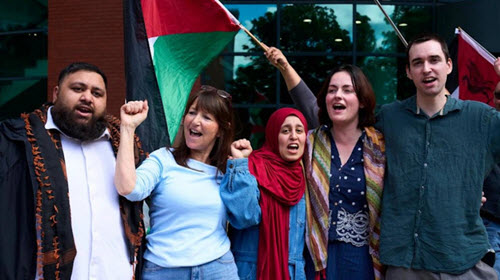
From left to right: Mohammed Malik; Alma Yaniv; Hmeera Atiqnisar; Amanda Kelly and Brendon O’Hagan (Photo via social media)
A British judge has ruled that five members of the Palestine Action group convicted over an attack on a Barclays Bank branch that caused damage of 212,000 pounds ($290,000) will not be sentenced under terrorism provisions.
Brendon O’Hagan, 28, Amanda Kelly, 31, Hmeera Atiqnisar, 31, Mohammed Malik, 28, and Alma Yaniv, 70, were convicted in June of causing damage to a branch of the bank on St James’s Street in the town of Burnley in Lancashire in August 2024.
The five defendants, known as the “Barclays five,” said the action was intended to pressure Barclays to withdraw financial support for Israeli weapons manufacturer Elbit Systems.
As Judge Robert Altham announced his ruling at Preston Crown Court on Friday, scores of their supporters gathered outside erupted into cheers and pro-Palestine chants.
In a joint statement, the activists said they were “extremely relieved that the court has seen sense and decided not to sentence us as terrorists.”
“This should never have been an option,” they said. “We were on trial for charges of criminal damage, for damaging some windows and spraying red paint on a Barclays branch. At no point during the trial were we, or the jury, informed that, if convicted, we could face being sentenced as terrorists.”
The five defendants are due to be sentenced for criminal damage at Preston Crown Court on September 4.
Palestine Action was not a proscribed terrorist organization when the attack took place.
The UK government proscribed the group in July 2025 following a series of direct-action protests targeting Elbit Systems over its links to the Israeli regime’s military.
The High Court ruled the ban disproportionate and unlawful in February, but the Court of Appeal overturned that decision in June.
According to the rights group Defend our Juries, more than 3,500 people – many over the age of 60 – have been arrested for expressing support for Palestine Action after it was proscribed by politicians in July 2025, placing it on the same legal footing as al-Qaeda and Daesh terrorist groups.
Rights groups have long decried the ban on Palestine Action as an illiberal overreach by the British government, calling on the ruling Labour Party to lift it.
Saturday, 22 August 2026 5:45 AM [ Last Update: Saturday, 22 August 2026 5:45 AM]
https://www.presstv.co.uk/Detail/2026/08/22/774827/UK-judges-blocks-sentencing-Palestine-Action-activists-under-terrorism-related-charges
From left to right: Mohammed Malik; Alma Yaniv; Hmeera Atiqnisar; Amanda Kelly and Brendon O’Hagan (Photo via social media)
A British judge has ruled that five members of the Palestine Action group convicted over an attack on a Barclays Bank branch that caused damage of 212,000 pounds ($290,000) will not be sentenced under terrorism provisions.
Brendon O’Hagan, 28, Amanda Kelly, 31, Hmeera Atiqnisar, 31, Mohammed Malik, 28, and Alma Yaniv, 70, were convicted in June of causing damage to a branch of the bank on St James’s Street in the town of Burnley in Lancashire in August 2024.
The five defendants, known as the “Barclays five,” said the action was intended to pressure Barclays to withdraw financial support for Israeli weapons manufacturer Elbit Systems.
As Judge Robert Altham announced his ruling at Preston Crown Court on Friday, scores of their supporters gathered outside erupted into cheers and pro-Palestine chants.
https://www.presstv.co.uk/Detail/2026/07/31/773427/Chaos-London-court-Palestine-Action-cases-
Scores arrested outside UK court as 1,500 Palestine Action cases cause meltdown
Chaos has erupted in London after more than 1,500 peaceful supporters of the banned group Palestine Action had their cases listed for hearings in a single day.
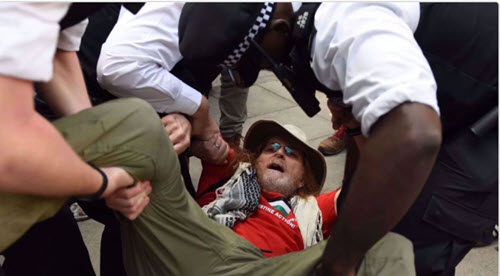
In a joint statement, the activists said they were “extremely relieved that the court has seen sense and decided not to sentence us as terrorists.”
“This should never have been an option,” they said. “We were on trial for charges of criminal damage, for damaging some windows and spraying red paint on a Barclays branch. At no point during the trial were we, or the jury, informed that, if convicted, we could face being sentenced as terrorists.”
The five defendants are due to be sentenced for criminal damage at Preston Crown Court on September 4.
Palestine Action was not a proscribed terrorist organization when the attack took place.
The UK government proscribed the group in July 2025 following a series of direct-action protests targeting Elbit Systems over its links to the Israeli regime’s military.
The High Court ruled the ban disproportionate and unlawful in February, but the Court of Appeal overturned that decision in June.
According to the rights group Defend our Juries, more than 3,500 people – many over the age of 60 – have been arrested for expressing support for Palestine Action after it was proscribed by politicians in July 2025, placing it on the same legal footing as al-Qaeda and Daesh terrorist groups.
Rights groups have long decried the ban on Palestine Action as an illiberal overreach by the British government, calling on the ruling Labour Party to lift it.
- admin
- Site Admin
- Posts: 41446
- Joined: Thu Aug 01, 2013 5:21 am
Return to United States Government Crime
Who is online
Users browsing this forum: No registered users and 5 guests