General Epstein Articles

There is no shorter route to power than through the genitals of male leaders. This principle guided the Lolita Gambit, played by the Mossad through its "Agent" Jeffrey Epstein

Re: General Epstein Articles

Postby admin » Wed Nov 26, 2025 4:59 pm

As Summers Sought Clandestine Relationship With Woman He Called a Mentee, Epstein Was His ‘Wing Man’. When former Harvard President Lawrence H. Summers was pursuing a romantic relationship with a woman he described as a mentee, he turned to a longtime associate for guidance: convicted sex offender Jeffrey E. Epstein.
by Dhruv T. Patel and Cam N. Srivastava
The Harvard Crimson
November 17, 2025
https://www.thecrimson.com/article/2025 ... as-mentee/

[x]
Former Harvard President Lawrence H. Summers processes into the University's 2018 Commencement ceremony. The former Treasury secretary remained in contact with convicted sex offender Jeffrey E. Epstein until the day before Epstein's arrest in 2019. By Amy Y. Li

When former Harvard President Lawrence H. Summers was pursuing a romantic relationship with a woman he described as a mentee, he sought guidance from a longtime associate: convicted sex offender Jeffrey E. Epstein.

In a sequence of texts and emails between November 2018 and July 5, 2019, Summers turned to Epstein for advice on his pursuit of the woman. Epstein was quick to chime in with assurance and suggestions, describing himself in one November 2018 message as Summers’ “wing man.”

The messages became public after House Republicans released more than 20,000 files from the Epstein estate on Wednesday. Summers’ correspondence with Epstein, a financier who pled guilty to soliciting prostitution from a minor in 2008, ends just one day before Epstein was arrested on new sex trafficking charges.

Together, the messages show Summers — who served as Treasury Secretary under former United States President Bill Clinton — placing an extraordinary degree of trust in Epstein, asking him for help in navigating a relationship that blurred the boundaries of his professional and personal lives.

Summers, who has been married since 2005, told Epstein he thought the woman was reluctant to leave him because she valued his professional connections. Epstein told him in one June 2019 text, “She is doomed to be with you.”


“Think for now I’m going nowhere with her except economics mentor,” Summers wrote in November 2018. “I think I’m right now in the seen very warmly in rear view mirror category.”

“She must be very confused or maybe wants to cut me off but wants professional connection a lot and so holds to it,” Summers wrote in a March 2019 exchange to Epstein, explaining why he believed she continued to engage with him despite tensions.

A spokesperson for Summers said that the woman described in the exchanges was never Summers’ student, but declined to comment further for this article.

In at least some of his exchanges with Epstein on the relationship, Summers appears to refer to macroeconomist Keyu Jin ’04, a tenured professor at the London School of Economics at the time, who is mentioned in a series of late 2018 messages between the two men.

In one, Summers forwarded Epstein an email from Jin asking for feedback on a paper. Summers mused to Epstein that it was “probably appropriate” to hold off on responding.

“She’s already begining to sound needy :) nice,” Epstein replied.


Jin, who earned her bachelor’s degree and Ph.D. at Harvard between 2000 and 2009, declined to comment on the months of messages between Summers and Epstein. In the messages released by the House, she does not refer to a romantic relationship with Summers. It is not clear whether she was aware that Summers shared her emails or discussed her with Epstein.

Throughout the seven months of correspondence reviewed by The Crimson, Summers and Epstein referred to the woman Summers was pursuing in some messages by the code name “peril” but never used her name in messages directly describing the relationship. On at least two occasions, the two men discussed Jin’s emails to Summers, which he forwarded to Epstein. In later messages, the two men appeared to joke about the probability that Summers would have sex with the woman, apparently Jin.

Summers’ long relationship with Epstein has been well documented, but the depth of their conversations, including over intimate matters, became public only this week. He traveled on Epstein’s private airplane on at least four occasions, including at least three times while serving as president of Harvard. Summers also met more than a dozen times with him and solicited donations from the disgraced financier for his wife, Harvard English professor emerita Elisa New. The messages released Wednesday show Summers organizing visits to Harvard on Epstein’s behalf and discussing contributions for New’s work.

“I have great regrets in my life,” Summers wrote in a Wednesday statement to The Crimson. “As I have said before, my association with Jeffrey Epstein was a major error of judgement.”


The exchanges concerning Jin’s messages and Summers’ relationship began shortly before a November 2018 investigation from the Miami Herald surfaced accusations from 80 girls and women that Epstein had abused them between 2001 and 2006, drawing on court records and interviews. Summers continued to correspond with Epstein about his relationship even after the Department of Justice opened an investigation in February 2019 into Epstein’s 2008 plea deal.

Wednesday’s documents also revealed messages where Summers, whose speculation that innate differences between men and women could drive women’s underrepresentation in science contributed to the end of his Harvard presidency in 2006, joked about women’s intelligence and what he described as excessive penalties for men who “hit on” women in the workplace.


In an October 2017 email to Epstein, Summers retread the same terrain that had proven treacherous for him in the past, writing that he “observed that half the IQ in world was possessed by women without mentioning they are more than 51 percent of population….”

Summers has continued to teach at Harvard since, interrupted by brief stints in Washington, and currently holds Harvard’s highest faculty distinction as a University Professor. This semester, he is teaching two large undergraduate courses and one graduate class.

The first interactions between Summers and Epstein on his relationship with the woman — apparently Jin — appear in late November and early December 2018, when she and Summers seem to have met during an academic conference. For two days, Summers sent Epstein updates on his interactions with her.

On Dec. 1, Summers wrote that the woman had been “interested in my commentary on her outfits” and said he had “referenced your having figured us out” — suggesting Summers told her that Epstein was aware of their relationship.

Summers described his feelings as conflicted in the messages to Epstein, writing in remarkably candid terms.

“When I’m reflective I think I’m dodging a bullet,” he wrote. “Think right thing is to cut off contact. Suspect she will miss it. Problem is I will too.”

The next morning, Summers struck a different tone: “Game day at conference she was extremely good Smart Assertive and clear Gorgeous. I’m fucked.”

In messages from later that month, Summers and Epstein discussed Summers’ relationship with Jin’s father, a former high-ranked Chinese Communist Party official and the founding president of the Asian Infrastructure Investment Bank, who Summers had long been close with.

When Jin emailed Summers on Dec. 22 to thank him for his support of her and her father — minutes after she sent Summers an outline of an academic paper — Summers forwarded the exchange to Epstein, explaining that he had recently “sent a comment in mtg w her father flattering her father and saying other China officials had flattered him as well.”

Summers continued to detail his interactions with the woman — who appears to be Jin but is not named in the Epstein emails after December 2018 — throughout March 2019, now expressing frustration that she was canceling or shortening plans and appeared to be interested in another man.

“I think she is tired of this alas. Sustaining w secrecy hard,” he wrote.

The final tranche of messages, beginning in mid-June, shows the relationship still unresolved and Summers again turning to Epstein for guidance on how to pursue it. Summers asked Epstein whether it was “meaningful” to discuss the probability of “my getting horizontal w peril,” drawing parallels to forecasting Trump’s reelection.

“U r better at understanding Chinese women than at probability theory,” Summers told Epstein. The two men bantered about probability and mathematics, but repeatedly steered the conversation back to Summers’ relationship.

Epstein joked that “the probability of you in bed again with peril” was “0,” before reversing course and assuring Summers that “she is never ever going to find another Larry summers. Probability ZERO.”

Summers went on to describe what he saw as his “best shot”: that the woman finds him “invaluable and interesting” and concludes “she can’t have it without romance / sex.”

Throughout June, Summers fed Epstein updates about the woman’s workload and continued contact. Epstein urged him to play the “long game” and keep her in what he called a “forced holding pattern.”

The final messages, dated July 5, 2019, show Summers still in regular contact with Epstein. That morning, Summers wrote he was in Cape Cod with his family — “Bit of an Ibsen play,” he joked — and the two men exchanged a brief flurry of literary one-liners.


The thread ends at 1:27 p.m.

Epstein was arrested the next day.

​​—Staff writer Dhruv T. Patel can be reached at [email protected]. Follow him on X @dhruvtkpatel.

—Staff writer Cam N. Srivastava can be reached at [email protected]. Follow him on X @camsrivastava.
admin
Site Admin
 
Posts: 40080
Joined: Thu Aug 01, 2013 5:21 am

Re: General Epstein Articles

Postby admin » Wed Nov 26, 2025 11:27 pm

Inside the FBI’s Review and Redaction of Epstein Files. The communications released to FOIA Files provide a look behind the scenes as agents and other FBI personnel started to work on the Epstein files earlier this year.
by Jason Leopold
Bloomberg
November 25, 2025 at 1:35 PM PST
https://www.bloomberg.com/news/newslett ... on-project

Image
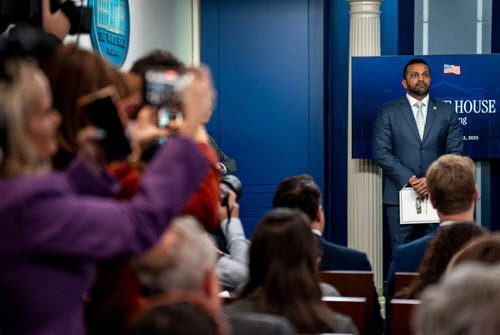
Kash Patel, director of the Federal Bureau of Investigation (FBI), during a news conference at the White House in Washington, DC, US, on Wednesday, Nov. 12, 2025. Photographer: Bonnie Cash/UPI

Welcome to a special edition of FOIA Files. This morning, the Federal Bureau of Investigation turned over dozens of emails to me that reveal some details about how FBI agents and personnel from the Freedom of Information Act office reviewed and processed the Epstein files earlier this year. Let’s dive in! If you’re not already getting FOIA Files in your inbox, sign up here.

The legacy of disgraced financier Jeffrey Epstein continues to hang over national politics. Earlier this month, President Donald Trump signed legislation that required the Justice Department to release the Epstein files. Soon, the public may finally get to see at least some of what the government has in its voluminous cache, which comprises more than 300 gigabytes of data and physical evidence from its criminal probe of the serial sex abuser. Getting to this point has been quite a winding path that started just after Trump took office—and that FOIA Files has been covering.

As I reported in March, after a botched rollout of what Attorney General Pam Bondi described as “Phase 1” of the release of the Epstein files, FBI Director Kash Patel ordered around 1,000 FBI special agents to team up with the bureau’s FOIA personnel at an FBI facility in Winchester, Virginia to prepare the Epstein files for public release.

The army of agents from the New York and Washington field offices, along with FOIA officers, were instructed on how to review and apply redactions to the documents.

Over the summer, I filed a wide-ranging FOIA request for those directives, as well as communications between agency personnel pertaining to their review of the files and the taxpayer dollars spent on the marathon two-month process. I then sued the FBI to compel release of the documents.

Just this morning I got the partially redacted records from the FBI. They mostly consist of emails that provide a look behind the scenes as agents and other FBI personnel started to work on the documents. The bureau withheld more than 161 pages citing ongoing law enforcement proceedings and other FOIA exemptions.

The emails reveal the special training given to FBI personnel working on what it called the “Epstein Transparency Project.” In some instances they referred to it as the “Special Redaction Project.” The training entailed PowerPoint slide presentations and video instruction on how to review the files.


Image
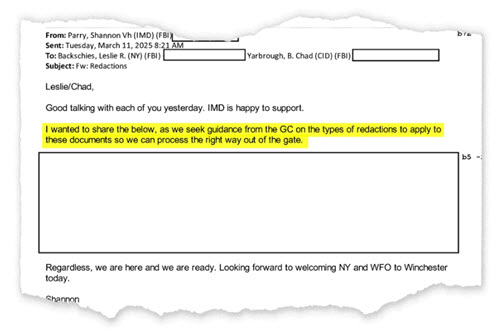
Click here to view the documents (page 11)

From: Parry, Shannon Vh (IMD) (FBI) [DELETE]
Sent: Tuesday, March 11, 2025 8:21 AM
To: Backschies, Leslie R. (NY) (FBI) [DELETE] Yarbrough, B. Chad (CID) (FBI) [DELETE]
Subject: Fw: Redactions

Leslie/Chad,

Good talking with each of you yesterday. IMD is happy to support.

I wanted to share the below, as we seek guidance from the GC on the types of redactions to apply to these documents so we can process the right way out of the gate.

[DELETE]

Regardless, we are here and we are ready. Looking forward to welcoming NY and WFO to Winchester today.

Shannon


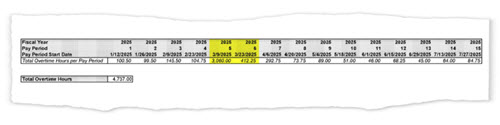
The records I got also reveal the number of hours the FBI devoted to the project, which required some agents to work nights and weekends. The FBI paid personnel from various divisions, including counterintelligence and international operations, $851,344 in overtime for working on the Epstein files between March 17 and March 22, according to the documents. FBI personnel clocked in a total of 4,737 hours of overtime between January and July. Of that, more than 70% [3,315 hours] occurred during the month of March while personnel reviewed the Epstein files, the documents show.

Image
Click here to view the documents (page 23)

Fiscal Year / Pay Period / Pay Period Start Date / Total Overtime Hours per Pay Period

2025 / 1 / 1.12.2025 / 100.50
2025 / 2 / 1.26.2025 / 99.50
2025 / 3 / 2.9.2025 / 145.50
2025 / 4 / 2.23.2025 / 104.75
2025 / 5 / 3.9.2025 / 3,060.00
2025 / 6 / 3.23.2025 / 412.25

2025 / 7 / 4.6.2025 / 292.75
2025 / 8 / 4.20.2025 / 73.75
2025 / 9 / 5.4.2025 / 89.00
2025 / 10 / 5.18.2025 / 51.00
2025 / 11 / 6.1.2025 / 46.00
2025 / 12 / 6.15.2025 / 68.25
2025 / 13 / 6.29.2025 / 45.00
2025 / 14 / 7.13.2025 / 64.00
2025 / 15 / 7.27.2025 / 84.75

Total Overtime Hours: 4,737.00


‘Boxes’

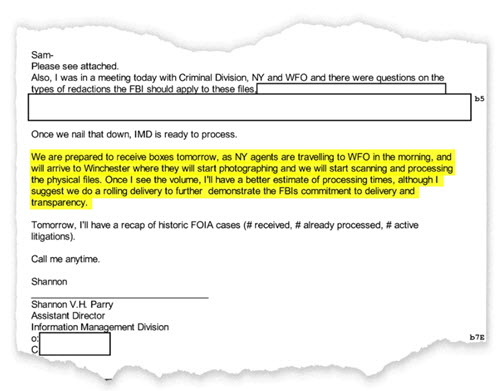
In an email on March 10, FBI personnel from the Office of General Counsel and the bureau’s Information Management Division discussed pending FOIA requests for Epstein-related records and digitizing and redacting “physical files” and the bureau’s “commitment to transparency.”

Image
Click here to view the documents (page 12)

Sam-
Please see attached.
Also, I was in a meeting today with Criminal Division, NY and WFO and there were questions on the types of redactions the FBI should apply to these files. [DELETE]
[DELETE]

Once we nail that down, IMD is ready to process.

We are prepared to receive boxes tomorrow, as NY agents are traveling to WFO in the morning, and will arrive to Winchester where they will start photographing and we will start scanning and processing the physical files. Once I see the volume, I'll have a better estimate of processing times, although I suggest we do a rolling delivery to further demonstrate the FBIs commitment to delivery and transparency.

Tomorrow, I'll have a recap of historic FOIA cases (# received, # already processed, # active litigations).

Call me anytime.

Shannon

Shannon V.H. Parry
Assistant Director
Information Management Division
o: [DELETE]
cc: [DELETE]


Another email describes categories of videos the FBI reviewed related to certain Epstein files, which includes “search warrant execution photos,” “street surveillance video” and “aerial footage from FBI search warrant execution.”

A couple of weeks later, an email sent from the Information and Management Division said the office “continues discussions with DOJ and is awaiting clarification regarding additional criteria for the next phase of this project.”

“We continue to scope and update workflow processes and training material based on those discussions,” the March 22 email says. “Updated training materials and workflow guidance is expected for dissemination later tonight.”

The next day another email was sent to FBI personnel reviewing the Epstein files advising them to “stand by.”

“We have identified more files requiring Phase l review. Please continue to refresh as files will be populated momentarily,” the email said.

The emails indicate FBI personnel were continuously checking out Epstein files to review and redact.

On March 24, an email sent to FBI personnel said “Phase 1 redactions are complete” and “Phase 2” was being prepared for “final delivery to DOJ.”

“Phase 2 review of the new criteria provided by DOJ was approximately 75.2% complete,” the email said. “Upon completion of Phase 2,” the Information Management Division “will provide a copy of all see-through redaction files for DOJ review.”


Bureau personnel also reviewed videos. According to an April 15 email, one of the videos was from the New York City jail where Epstein was found dead a month after his arrest in 2019 on sex trafficking charges. (The DOJ publicly released 11 hours of the prison video in July.)

Image
Click here to view the documents (page 18)

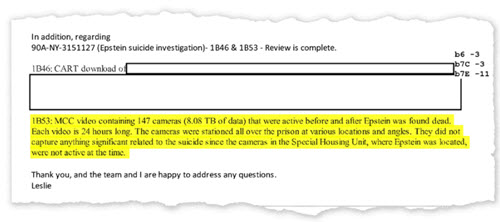
In addition, regarding
90A-NY-3151127 (Epstein suicide investigation)- 1B46 & 1B53 - Review is complete.

1B46: CART download of [DELETE]
[DELETE]

1B53: MCC video containing 147 cameras (8.08 TB of data) that were active before and after Epstein was found dead. Each video is 24 hours long. The cameras were stationed all over the prison at various locations and angles. They did not capture anything significant related to the suicide since the cameras in the Special Housing Unit, where Epstein was located, were not active at the time.

Thank you, and the team and I are happy to address any questions.
Leslie


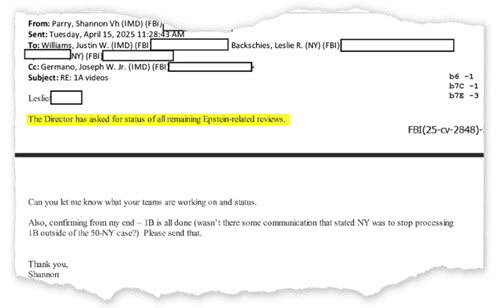
That same day, Parry sent an email to other FBI personnel that said Patel “asked for status of all remaining Epstein-related reviews.”

Image
Click here to view the documents (pages 18 and 19)

From: Parry, Shannon Vh (IMD) (FBI) [DELETE]
Sent: Tuesday, April 15, 2025 11:28:43 1 AM
To: Williams, Justin W. (IMD) (FBI) [DELETE] Backschies, Leslie R. (NY) (FBI) [DELETE] DELETE] (NY) (FBI) [DELETE]
Cc: Germano, Joseph W. Jr. (IMD) (FBI) [DELETE]
Subject: RE: 1a videos

Leslie [DELETE]

The Director has asked for status of all remaining Epstein-related reviews.

FBI(25-cv-2848)-

________________

Can you let me know what your teams are working on and status.

Also, confirming from my end - 1B is all done (wasn't there some communication that stated NY was to stop processing 1B outside of the 50-NY case?) Please send that.

Thank you,
Shannon


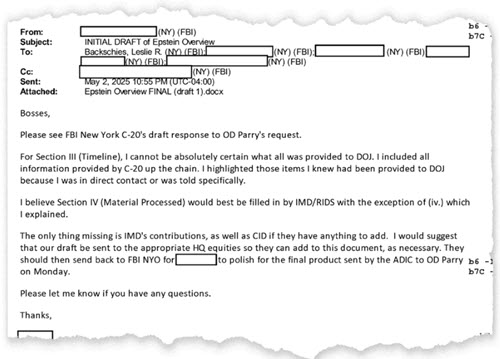
On May 2, an FBI employee from the New York field office sent an email and attached a document titled, “Epstein Overview FINAL” that summarized their work. The FBI withheld a copy of the attachment.

Image
Click here to view the documents (page 20)

From: [DELETE] (NY) (FBI)
Subject: INITIAL DRAFT of Epstein Overview
To: Backshies, Leslie R. (NY) (FBI) [DELETE] (NY) (FBI) [DELETE] (NY) (FBI) [DELETE] [DELETE] (NY) (FBI) [DELETE] (NY) (FBI)
Cc: [DELETE] (NY) (FBI)
Sent: May 2, 2025 10:55 PM (UTC-04:00)
Attached: Epstein Overview FINAL (draft 1).docx

Bosses,

Please see FBI New York C-20's draft response to OD Parry's request.

For Section III (Timeline), I cannot be absolutely certain what all was provided to DOJ. I included all information provided by C-20 up the chain. I highlighted those items I knew had been provided to DOJ because I was in direct contact or was told specifically.

I believe Section IV (Material Processed) would best be filled in my IMD/RIDS with the exception of (iv.) which I explained.

The only thing missing is IMD's contributions, as well as CID if they have anything to add. I would suggest that our draft be sent to the appropriate HQ equities so they can add to this document, as necessary. They should then send back to FBI NYO for [DELETE] to polish for the final product sent by the ADIC to OD Parry on Monday.

Please let me know if you have any questions.

Thanks,

[DELETE]
admin
Site Admin
 
Posts: 40080
Joined: Thu Aug 01, 2013 5:21 am

Re: General Epstein Articles

Postby admin » Sat Dec 13, 2025 7:46 pm

The Network. Jeffrey Epstein’s private emails show the support and advice the disgraced financier got in his “hour of terror.”
by Max Abelson, Surya Mattu, Jason Leopold, Ava Benny-Morrison, Harry Wilson, Jeff Kao and Dhruv Mehrotra
Bloomberg
September 25, 2025 at 9:00 PM UTC
https://archive.is/9u0Qe#selection-1214.0-2747.206

[x]

When investigators were closing in on Jeffrey Epstein, he thought about saying sorry. Merrie Spaeth, a sought-after crisis strategist who once served as the director of media relations for Ronald Reagan’s White House, helped him pick his words.

She sent Epstein three versions of a public apology in February 2008, according to emails obtained by Bloomberg News. The first was meek: “As a child growing up, I was taught to apologize,” it read. “I fervently hope it will be acceptable for me to simply offer to the community my apologies for associating with young women who turned out to be under the age of eighteen.” The second, at just 33 words, offered little more than a “wish to apologize” and a vow to “conduct myself appropriately in the future.” The third, elegiac and cultured, opened with ideas from philosopher William James about the “hour of terror and the hour of satiety.” It described the “substantial” rewards Epstein had reaped by chasing the American dream, evoked introspection—“I’ve been forced to ask myself what’s important”— and culminated in a “public and heartfelt apology.” He had a clear favorite:

From: J. Epstein <[email protected]>
To: [REDACTED] <[REDACTED]>
Date: Tue, Feb 26 2008 4:26 AM
Subject: Re: letters
third has promise


Four months later, he pleaded guilty to two Florida state charges, felony solicitation of prostitution and procurement of minors to engage in prostitution, and was taken into custody to serve a sentence that lasted just over a year. Over the next decade, he never made any broad public apology of the sort the three drafts envisioned. The emails from Spaeth, whose connection to Epstein hasn’t been described publicly, span only a few weeks and don’t make clear what happened to the apologies she prepared. Spaeth’s firm was hired through a lawyer “to provide communications options for Mr. Epstein and his legal team,” she said in response to questions for this story. “I ultimately terminated the engagement because of my discomfort with it.”

[x]
DRAFT NUMBER ONE
I AM SORRY

As a child growing up, I was taught to apologize. One apologized for any number of things, and I recall thinking it was unfair when I had to apologize for something I didn't do or something I didn't think was my fault. As I've grown older, I've said 'I'm sorry' for events unrelated to me but where an event or outcome caused distress or pain. Those apologies are an expression of sympathy, a way of saying we care about our fellow human beings.

I have been wrestling energetically with the challenged of how to apologize for actions of mine which caused distress to parents, distracted our courageous members of law enforcement and caused long time friends to question my judgment.

It is too painful to rehash events which have been prominently featured, if mischaracterized, in our local headlines. I fervently hope it will be acceptable for me to simply offer to the community my apologies for associating with young women who turned out to be under the age of eighteen. While some may question my assertion, I did not know. Truly. And I apologize.

Lawyers argue against apologies on the theory that they are an admission of guilt. I disagree. There are now enough facts on the public record for people to make up their own minds. So I hope my apology will be noted and taken as evidence of my concern for my neighbors here in Palm Beach.

Apology letter email attachment
Attach: [02 25 08 Apology #1.doc]


[x]
APOLOGY #2
I wish to apologize to my neighbors and friends for my actions which brough scandal and shame to my name and to assure them that I will conduct myself appropriately in the future.

Apology letter email attachment
Attachment: [02 25 08 apology #2.doc]


[x]
APOLOGY #3
To my neighbors:

William James, the great 19th century medical doctor and religious philosopher, wrote an essay in which he talks about two hours we face, the hour of terror and the hour of satiety The latter means that time when someone has everything -- is "sated" -- and asks "Is this all there is?"

I've been blessed during my life. I've taken advantage of the opportunities offered by the American dream. The rewards have been substantial, but I've experienced that second hour. My life was satiated, and I failed to ask what waws really important. What's important is to live so that first hour, the terror of death, is erased by having lived to make a difference in the lives of others. I've been forced to ask myself what's important, and my choices will be different in the future.

This isn't the place to review the sensational charges you may have read about. There are enough facts on the public record for anyone who wishes to review and make up his or her own mind. Please accept my sincere apologies for my selfish actions which have embarrassed me, caused my friends to question my judgment and taken a great deal of time on the part of all levels of law enforcement authorities. Again, this is a public and heartfelt apology.

Apology letter email attachment
Attachment: [02 25 08 Apology #3.doc]


Her 2008 exchanges are part of more than 18,000 emails from Epstein’s personal Yahoo account obtained by Bloomberg News. That cache reveals a sweeping array of details about his public and private life, including his callous and methodical recruitment of young women, a close partnership with Ghislaine Maxwell that went beyond what either has admitted and adoration from one of the UK’s most influential figures. The emails also provide new levels of detail about Epstein’s other connections—relationships that were less public but nevertheless crucial to him, especially once he became the target of state and federal investigations.

Epstein was drawn to what he saw as the finest things in life. The substantial wealth he acquired after leaving Bear Stearns in 1981 to advise the ultrarich afforded him a Boeing 727, one of Manhattan’s largest townhouses and his own Caribbean island. And when his own hour of terror dawned in 2005, following a tip to police in Palm Beach County from the family of a teenage girl, he didn’t rely on just one champion or defender, his inbox shows, but a collection of elite professionals. Though lawyers, academics and media advisers helped him in different ways and to different extents, his network included past and future White House officials, a top Hollywood publicist, a former child-exploitation prosecutor and renowned researchers, including one on his way to winning a Nobel Prize.

That support for Epstein—who harmed more than 1,000 people, according to the US Justice Department—came when he needed it most. The professionals who surrounded Epstein defended and deflected, coached and countermessaged, burnished and polished. Together, they helped extend Epstein’s influence and freedom, even lending an air of invincibility. His reckoning was postponed until 2019, when federal prosecutors charged him with trafficking minors. Weeks later, he was found dead in jail in New York City awaiting trial.

Epstein’s emails veered between domineering, cloying, comfortable and obsessive, and were often riddled with typos. In response, his advisers and supporters were deferential and even fawning.

In October 2007, when the New York Post reported that Epstein was preparing a guilty plea, one of his many friends at Harvard University got in touch.

“I read the newspapers early this morning,” the neurologist Mark Tramo wrote to one of Epstein’s assistants. “Please remind him that boys from The Bronx (even if they end up at Harvard) have long memories, know all about cops, and stay true to their friends through thick and thin (no less peccadilloes).” Tramo, who is currently listed as an adjunct professor at University of California at Los Angeles, didn’t respond to multiple messages seeking comment.

The Academy

Epstein, a former math teacher, wasn’t merely interested in academia. He was fixated, and academics were drawn to him, too. Despite his indictment, he was able to assemble a prestigious network of Ivy League researchers who remained helpful to him even years after he was released from jail.

His connections to academia have been well established. In 2020, a year after the federal sex-trafficking charge, Harvard disclosed in a report that it had accepted more than $9 million in gifts from him between 1998 and 2008. The report also described Epstein’s unusual reach across the university, including access to an office until 2018 and a phone line until 2017. Since then, other institutions have acknowledged their own ties with him, too, helping to shed light on the breadth of his relationships.

The emails obtained by Bloomberg, however, reveal their depth. They detail how key relationships were initiated and maintained and how the research he funded was conceptualized. The emails show how aggressively some researchers prioritized him, even as allegations spilled out into the open.

For them, Epstein represented money, access and a champion. For Epstein, who left college without a degree, they offered bonafides, advice and a willingness to confer on topics both universal and esoteric, including sex and beauty, disease and genetics, and the life of the mind. Epstein was also interested in artificial intelligence—and in emails with a computer scientist, sent right before reporting to jail, he even weighed a “Manhattan Project” for AI.

In January 2006, six months before the indictment, Epstein’s assistant asked about nailing down an appointment for him with Stephen Kosslyn, then-chair of Harvard’s psychology department. “kosslyn is a priority,” Epstein wrote. Within days, the psychologist was proposing a dinner with bigwigs across economics, genomics and limb regeneration to discuss a lab “centered on genetics and the brain” that would explore “far-out ideas such as life extension.” He also helped plan smaller gatherings for Epstein, including “pizza over a table” with him and “The Dersh”—Harvard Law professor Alan Dershowitz, one of Epstein’s lawyers.

[x]
Kosslyn

Kosslyn, who’s now president of an AI education startup, corresponded that February with geneticist George Church and Gary Ruvkun, a Harvard molecular biologist who won a Nobel Prize in Physiology or Medicine last year. They shared ideas about a project whose “farthest reaching harvard goal” would bring together experts in law, psychology, biology and economics to describe the “pleasure signatures in the brain” that they said could correspond to hunger, sexuality and fear.

In a February 2006 email forwarded to Epstein’s assistant, Ruvkun wrote: “i shall again try to drive home the point about the pleasure genome initiative.” He added this request: “let me know if this subject is too strange for our patron.”

When Epstein received the exchange, he wrote to his assistant:

From: J. Epstein <[email protected]>
To: [REDACTED] <[REDACTED]@gmail.com>
Date: Mon, 27 Feb 2006 3:19 PM
Subject: Re: Steve Kosslyn-Interdisciplinary Dinner #2 Mar 13
the patron has no boundaries


It isn’t clear from the emails what money, if any, Epstein gave to the project, though he’d previously donated $200,000 to support Kosslyn's research, according to the Harvard report. A university spokesperson had no comment for this story. Kosslyn didn’t return calls and messages.

“Dr. Ruvkun attended a large group dinner with academic colleagues to discuss potential research projects in the spring of 2006, prior to any public accusations being made,” said a spokesperson for Mass General Brigham, where Ruvkun has long been affiliated. He had no further contact with Epstein, “did not pursue any of the research areas discussed, nor received any financial support for his work.”

Epstein, meanwhile, was ruminating on the nature of beauty, according to a series of email exchanges. One June 2006 email in his inbox differentiates between the beauty of human bodies and “a Mozart piano concerto, a Ted Williams swing, a Caribbean vista, the fragrance of a gardenia, Euler’s formula.”

Shortly after, Epstein wrote to his assistant that he was planning to contribute to Harvard’s Personal Genome Project, run by Church, the geneticist: Epstein wanted to know if beauty resides in DNA, he said. He was due to spend more than $1 million on the project from 2006 to 2009, according to an itemized budget in his inbox. Church, who leads synthetic biology at Harvard’s Wyss Institute, proposed “possible topics” for one of their gatherings, including “re-engineering humans.” (In response to questions, Church’s lab referred to his apology in 2019 for meeting with Epstein, which cited “nerd tunnel vision.”)

From: J. Epstein <[email protected]>
To: [REDACTED] <[REDACTED]@gmail.com>
Date: Fri, Jun 23 2006 5:19 PM
Subject: Re: [REDACTED]: Genetic basis of beauty

I am going to fund the personal genome project at
harvard , questions does the beauty reside in the
dna,, is the formula more elegatn.. ,, of is it the
hunt for complementarity, that determines the eye of
the beholder


In the years before 2006, magazines and newspapers had introduced Epstein as a rich and secretive globetrotter who enjoyed the company of young women. But a new kind of Epstein story hit newspapers that July in New York, Palm Beach and Cambridge, Massachusetts: The 53-year-old investor had been charged. In the months after, articles chronicled sworn statements to the police from teenagers about giving him massages in their underwear for cash.

Epstein's academic ties were helpful as reporters began focusing more intently on him. Kosslyn was vacationing in the “backwoods of nowhere” in August when he let Epstein's office know about an inquiry he’d received from a Fortune reporter who was working on a “short article” about Epstein. And when a reporter for the Harvard Crimson emailed about a spat that involved Epstein and Dershowitz, Kosslyn sent that along, too:

From: Stephen M. Kosslyn <[REDACTED]@wjh.harvard.edu>
To: [email protected]
Date: Thu, Jun 14 2007 5:32 PM
Subject: Fwd: Crimson Article: [REDACTED]
FYI:

I'll not respond


In October 2007, Epstein received an email from Howard Gardner, a leading developmental psychologist at Harvard who helped start an initiative on living ethically called the Good Project, which “strives to equip individuals to reflect upon the ethical dilemmas that arise in everyday life.” Gardner said he’d be getting back to him on two requests: “a reading list and advice about offsprings.” Epstein was less than a year away from reporting to jail. “Meanwhile,” Gardner added, “take a deep breath, take one day at a time, and you'll get through the coming period fine.”

According to Epstein’s inbox, Gardner followed up by recommending novels including Kazuo Ishiguro’s The Remains of the Day and Saul Bellow’s Henderson the Rain King. “As for the other, more personal question that you posed, that requires a longer conversation-whenever you'd like.”

That “offsprings” question may have been “about the possibility of having children,” Gardner told Bloomberg News. “Beyond common sense I did not have any advice on that score.”

Asked why he and so many academics flocked to Epstein, Gardner said he was charming, knowledgeable and “had a sixth sense for what others—including faculty members and senior administrators—would appreciate.” Gardner added that he wished he “had asked more questions, but I don’t even know what questions I would or should have asked.” He added: “I never had the slightest knowledge or even intimation of the darker sides.”

In January 2008, Kosslyn offered Epstein a birthday wish: “May the coming year be infinitely better than the previous one.”

The next month, as reporters chronicled new lawsuits against Epstein by women who said he sexually assaulted them when they were teenagers, a new endeavor was underway. Star researchers across universities made plans to better understand the brain with Epstein’s backing. One of them, Elkhonon Goldberg, a renowned neuropsychologist then at New York University, laid out a plan in a February 2008 email.

“We are quite confident that with your support our Brain can become an exceptional scientific endeavor and we will be proud to name it ‘The Epstein Brain,’” Goldberg wrote, adding a smiley face.

Epstein demurred: “I appreciate the honor, but decline any name association,” he responded. He proceeded to set up an all-hands meeting for the following week. According to emails, the group of researchers was set to include NYU’s Yann LeCun, who is now chief AI scientist at Meta Platforms Inc.’s Facebook AI Research. Goldberg’s $1.3 million proposal to study the “brain dynamics of learning” included LeCun as a co-supervisor of students or fellows.

In an interview with Bloomberg, Goldberg said the project didn't move forward, Epstein didn’t provide funding and the proposal to name it for him was “obviously in jest.” He added that surrounding himself with prominent researchers may have been a way for Epstein to fulfill a fantasy of being a scientist.

LeCun, who doesn’t come up elsewhere in the email cache, told Bloomberg he’d never heard of Epstein before. “I had no further interaction with Epstein after this one meeting and I did not receive any funding from him. The project never took off. Only later did I learn about Epstein's reputation and legal troubles,” he added. “As far as I can tell, Epstein’s impact on AI research has been essentially nil.”

In May, Kosslyn wrote that he had “decided to be Dean of Social Sciences” at Harvard. Kosslyn added a month later that he’d love to visit him.

“unfortunately jail starts monday,” Epstein wrote.

From: Stephen M. Kosslyn <[REDACTED]@wjh.harvard.edu>
To: J. Epstein <[email protected]>
Date: Fri, Jun 27 2008 8:48 AM
Subject: Re: Checking in
DAMN!

Let me know how/if I can help..

s.


The Counselors

Long before Epstein reported to jail, Dershowitz and prominent lawyers from Florida and New York had worked in 2006 to narrow the scope of his prosecution in Palm Beach County. They did it so well that the lead detective flagged concerns to the FBI. After a federal investigation began that May, Epstein’s team added even heavier hitters, with major Washington credentials. They helped bring both cases to a close by negotiating a non-prosecution agreement that spared him from federal prosecution in exchange for his guilty plea to state charges. After about 13 months in prison, Epstein would be a free man for almost a decade.

In early 2006, as Epstein’s legal peril was deepening, he got a note from a Harvard Law School student and research assistant to Dershowitz named Mitch Webber. What email address, read by Epstein alone, would be private, he asked.

Epstein wrote back: “this one.”

It was at the dawn of a career that took Webber to the White House, where he was an associate counsel and special assistant to Donald Trump, into the partnership of law firm Paul Weiss and onto the board of the Louis D. Brandeis Center for Human Rights Under Law.

Though his presence in Epstein’s inbox lasted less than a year, Webber memorialized a key moment in the Florida case. He took shorthand notes during a February 2006 meeting with Epstein’s legal defense team and two members of the Palm Beach County State Attorney’s Office and a detective.

[x]
Dershowitz. Source: Brian Snyder/Reuters

“These girls are self-described prostitutes, they don’t feel harmed, and they’re out for money,” Dershowitz said, according to a memo from Webber that said it paraphrased his notes. Epstein “is decimated already. He hasn’t slept in months. I want to leave here and tell him we’ve got this resolved. Why can’t we figure something out today?”

An assistant state attorney told Epstein’s team her office had an ethical obligation to consult with victims before making any deals. As they discussed possible outcomes, Dershowitz said he refused to make Epstein “into a public pariah.”

Webber, whose work for Dershowitz extended past the Harvard Law commencement that June, went on to field sensitive questions from Epstein. “I'm sorry I was a little confused about what you were asking on the phone,” Webber wrote him. “I se what you were asking now. The question is: what would happen if one were to transport a minor for sex—or transport oneself with the intent to have sex with a minor—into a state in which the age of consent is below eighteen (assuming the minor is above the age of consent in the given state)? And your intuition was right. The answer is that there is no violation of law.”

“let’s also look at sex tourism laws,” Epstein wrote back that August. “going someplace with specific intent ot have underage sex.”

Webber’s last emails in the inbox came that November. “To pretend that Epstein has an unimpeachable, airtight legal defense is disingenuous,” he wrote in one. Another email added: “No matter what happened between Epstein and his masseuses, the fact that they kept coming back militates powerfully against any sort of pressure on Epstein’s part.” Webber didn’t respond to requests for comment.

Not many figures in Epstein’s legal circle have been more closely linked to him than Dershowitz, a central member of his legal team for years. The emails show the depth of the support he gave Epstein.

[x]
Epstein and Dershowitz, 2004. Source: Rick Friedman/Corbis/Getty Images

“I am writing this letter to Jeffrey’s close friends as one of his close friends, not as a lawyer,” read a draft of a letter in September 2006. “NO, there was never any underage sex. Absolutely none.” The letter, which closes with “Cordially, Alan Dershowitz,” was flattering and savvy: “We all know Jeffrey is extremely smart, and in fact a little ‘complex.’ However, he is not self-destructive.” It rose to a crescendo: “I know that you wish him well, and I'm sure that as this too will pass, we can all help him bring this difficult time to a forgiving close. When the full story finally comes out, the world will learn what we already know—that Jeffrey is a good person who does many good things.” Dershowitz told Bloomberg that he doesn’t recall the letter.

For Epstein, who was reviewing drafts of the letter, that wording wasn’t enough:

From: J. Epstein <[email protected]>
To: Alan M. Dershowitz <[REDACTED]@law.harvard.edu>
Date: Wed, Sep 13 2006 4:52 AM
Subject: Re: draft - letter to friends

I would amend the place where it says he wishes I had
cameras in the massage room... IT would be illegal...
ANd I think we could do better thatn the last
paragraph ,, JEffrey is a "good person".. great
friend. , loyal, funny, generous, not GOOD


Then, in a version that Epstein later sent to himself, there was an edit. “Jeffrey is a very charitable, and caring person,” that copy read. It kept this earlier pledge: “Jeffrey has not approved the contents of this letter, though he is aware that I am writing it.”

“The memos are all privileged lawyer client communications and should not have been provided to you or made public,” Dershowitz told Bloomberg News. “But they show that I was acting as any responsible lawyer should: making the case for my client.” He added that “Epstein was dissatisfied with the deal I helped arrange. He wanted a misdemeanor with no jail time and no sex registration.”

In May 2007, the Assistant US Attorney responsible for the Epstein investigation submitted a 60-count indictment to supervisors. Then, just after prosecutors offered terms that would lead to the non-prosecution agreement, they heard from some of the biggest names in law—including Ken Starr, the independent counsel whose report had led to Bill Clinton’s impeachment. Epstein had called in reinforcements.

[x]
Epstein, in custody in West Palm Beach, July 2008. Source: Uma Sanghvi/USA Today Network

Rather than simply seeking advice from them, he told them what to say.

“Starr needs to explain his appearing,” he wrote to his lawyers on Aug. 12, weeks before Starr first met with US Attorney Alex Acosta to discuss the case. “He is not defending my conduct he is defending the constitution.” Epstein went on to propose language and ideas to his legal team, while apparently trying not to offend. “I don't mean to put words in your eloquent mouth,” he told Starr in June 2008, before offering a numbered list that ranged from legalistic (“we are asking for a de novo review”) to impassioned (“this is not righteous”). Days later, Epstein was incarcerated. In the cache, there are emails to but not from Starr, who died in 2022.

The reach of Epstein’s team was vast. In the weeks before the guilty plea, Epstein delegated work to lawyers including Kirkland & Ellis partner Jay Lefkowitz, Starr, Dershowitz and Stephanie Thacker—who’d spent years with the Justice Department’s Child Exploitation and Obscenity Section and is now a federal judge on the Court of Appeals for the Fourth Circuit. Lefkowitz and Thacker didn’t respond to requests for comment.

In total, Epstein paid $4 million to Dershowitz and almost $3 million to Kirkland & Ellis, according to a forensic accountant’s report filed in court records two years ago.

“He essentially fired me and refused to pay what he still owed me,” Dershowitz said. “We ultimately resolved the fee issue but I believe my total fee—which was based on my hourly charges—was far less than what you say.” He later estimated that he made about $3 million after paying out the rest to other lawyers and researchers.

Epstein’s legal fees from 2003 through 2013 hit more than $54 million, according to the accounting report. Yet he came close to spending even more—after the indictment—on a Paris mansion on the Île Saint-Louis that he wanted to make into “a mathematical institute,” the emails show. A Qatari prince outbid him.

The ‘Good’ and the ‘Bad’

As some of the country’s best-connected lawyers were defending Epstein and elite academics were catering to his intellectual interests, media professionals worked to protect his public image. His publicists and consultants, according to the emails, included veteran executives Howard Rubenstein, Dan Klores and Mike Sitrick. Peggy Siegal, who held sway over some of Hollywood’s biggest movie premieres, emailed after the 2006 indictment to flag a Vanity Fair story.

“Can only assume Jeffrey does not want me to talk to this reporter,” she wrote his team, “not unless he wants certain things said on his behalf.” (Like Dershowitz and Sitrick, Siegal also did work for Harvey Weinstein.) Rubenstein died in 2020. Sitrick said he was retained by Epstein’s lawyers for a fairly short period. Klores and Siegal didn’t return messages.

But it was a former actor who taught Epstein her own communication method in the months before his sentence began.

Spaeth, featured as a teenager in the 1964 film The World of Henry Orient, went on to become a White House Fellow, director of public affairs at the Federal Trade Commission and then the Reagan White House’s director of media relations. Later, after founding her own firm, she advised Swift Boat Veterans for Truth, which sought to undermine John Kerry’s service record during the 2004 presidential campaign. (She was later quoted saying she regretted her involvement.)

According to an email in Epstein’s inbox at the end of February 2008, the two spent time together preparing for interviews, though it’s unclear which ones. Her memo after their session describes showing Epstein “the Spaeth methodology” to answer questions without “being trapped by the parameters.” During their exercise, she emphasized having “material to change the subject” and the “skill to repeat ‘it’s not appropriate to discuss…’ without sounding canned or bored.”

[x]
Spaeth. Source: Jemal Countess/Getty Images

“JEFFREY INTERNALIZED AND ACED THIS EXERCISE IMMEDIATELY,” she wrote.

They came up with “a long list of questions” that, Spaeth predicted “will, alas, almost certainly be permanent features for years to come.” One example: “Mr. Epstein, as you preyed on these innocent young girls, did you actually know any of them were under the age of 18?”

Spaeth coached him to respond by choosing “a phrase like ‘I disagree,’ or one of our favorites, ‘on the contrary.’”

According to the emails, Epstein paid Spaeth $1,900 for consulting earlier that year, and sent an additional $5,000, at least in part for the February work.

“Principles of confidentiality and privilege preclude further comment about the substance of this engagement,” she told Bloomberg News.

Spaeth also helped Epstein tailor his vocabulary. She instructed him to use what she called “Good Words,” such as smart, brilliant and lucky—and avoid “Bad Words,” including playboy, powerful and pervert. She taped him to “benchmark and critique whether he seemed authentic.”

[x]
SPAETH COMMUNICATIONS, INC.

New York Strategy Group, LLC
Interview Prep.
February 28, 2008

Good Words

Smart
Brilliant
Future oriented
Right place at the right time
Lucky Friendly (?)
**Unique
*Hardworking
*Focused
Opportunities ()
Long term view
Out of the box
*Mathematician
See what others couldn't (math)
Down to earth
(No) playful
*Respectful
Respectful of legal process
*Remember where I grew up
Loyal
Long term relationships
(Goal is to) do the right thing
Cooperative (with legal authorities)
Chinese proverb (opportunity knocking)
Long term view
Down to earth
Informal
From a poor/working class background
Remember where I grew up
Investor in science
Visionary

Bad Words

Lied
Rich
Pervert (sex)
Abuse
Indict
Sex slave
Coerce
Dirty old man
Secretive
Opportunistic
"Child"
Under age
Pornography
Sex terms
Sex toys
Playboy
Shallow
Arrogant
Misogynist
Powerful
Bought and paid for
Intimidate
Threat
Harass
Greedy
Obsessed

Attachment: [02 28 07 Jeffrey Epstein Good Bad words and headlines.doc]


She sent messages for him to focus on. The first one: “I have tried to be very respectful of the legal process.”

Spaeth wrote to his team to say it “was a fascinating session, and I hope he found it useful.”

Months later, as Epstein got ready to serve the jail sentence that so many lawyers had pushed to make so short, he gave a rare interview to the New York Times. His first quote in that story: “I respect the legal process.”

Edited by Lauren Etter and John Voskuhl
Designed by Chris Nosenzo
Produced by Emily Engelman, Thomas Houston, Eugene Reznik and Margaret Sutherlin
Photos edited by Jane Yeomans

Lead image, from top, left to right: Siegal, Starr, Dershowitz, Webber, Rubenstein, Lefkowitz, Gardner, Tramo, Kosslyn, Spaeth. Photo illustration: 731; Photos: Getty Images (5), Reuters (1), Zuma Press (1)
admin
Site Admin
 
Posts: 40080
Joined: Thu Aug 01, 2013 5:21 am

Re: General Epstein Articles

Postby admin » Sat Dec 13, 2025 8:09 pm

Following Epstein’s Money. Federal prosecutors opened a financial-crimes investigation into Jeffrey Epstein in 2007 amid their larger sex-trafficking probe. The financier and his legal team waged a war against them, his emails show.
by Jason Leopold, Jeff Kao, Max Abelson, Harry Wilson, Ava Benny-Morrison and Surya Mattu
October 31, 2025, 9:00 AM UTC
https://archive.is/5D2CS

[x]
Photo Illustration: 731; Photo: Uma Sanghvi/Palm Beach Post/USA Today Network

Federal prosecutors expanded their probe into Jeffrey Epstein’s sex crimes in 2007 to include potential charges of money laundering, an effort that included an outreach to one of his most important clients, according to documents and emails from Epstein’s personal Yahoo account.

The lead prosecutor requested that a grand jury issue subpoenas for “every financial transaction conducted by Epstein and his six businesses” dating to 2003, the emails show. Prosecutors also subpoenaed major banks for records about Epstein’s accounts and financial activity, according to two people familiar with the matter, who asked not to be identified to discuss a sensitive investigation.

Marie Villafaña, who was an assistant US attorney for the Southern District of Florida at the time, even contacted Epstein’s longtime wealth-management client, Les Wexner, the billionaire businessman behind the brands Victoria’s Secret and Bath & Body Works, about the investigation, according to the documents and emails.

Epstein grew furious when he learned that prosecutors had broadened their investigation’s scope, the emails show. His high-powered team of lawyers, including Gerald Lefcourt, Harvard Law School professor Alan Dershowitz, former Bush administration official Jay Lefkowitz and former Independent Counsel Kenneth Starr, argued that Villafaña was pursuing baseless claims to pressure their client into a plea deal. They launched an aggressive campaign to discredit her attempts to follow the money and pressured her higher-ups to remove her and others from the case—or scuttle the case entirely.

[x]
Gerald Lefcourt; Alan Dershowitz; Jay Lefkowitz; Kenneth Starr Source: AP Photo, Getty Images (3)

Ultimately, efforts to prosecute Epstein for sex crimes and financial crimes ended after senior officials in the US attorney’s office directed prosecutors to begin plea negotiations with Epstein. Those talks led to a federal non-prosecution agreement as Epstein pleaded guilty to two state-level sex charges—an outcome that’s been widely derided as far too lenient. More than a decade would pass before Epstein’s finances came under scrutiny again.

Villafaña, who left the federal prosecutor’s office in 2023, declined to comment for this story.

These previously unreported details of the financial-crimes probe were contained in a trove of 18,000 emails from Epstein’s private Yahoo email account obtained by Bloomberg. The relevant correspondence began about a year before Epstein reported to a Palm Beach County jail in June 2008. It includes his communications with his attorneys, correspondence pertaining to the grand jury’s inquiry and draft complaints that some of his lawyers prepared alleging prosecutorial misconduct. It also includes Epstein’s aggrieved, typo-laden missives about the investigation to friends and business associates, including the former chief executive officer of investment bank Bear Stearns.

The money laundering probe adds a new layer to the narrative about how the government conducted its investigation into the notorious sex abuser. It also raises questions about what evidence prosecutors may have gathered as they followed Epstein’s money, long before the public began demanding a full accounting of his case. If that investigation had continued, prosecutors may have been able to identify other individuals and institutions that facilitated his sex-trafficking operation, said Stefan Cassella, the former deputy chief of the Department of Justice’s Asset Forfeiture and Money Laundering Section. They might also have recovered more restitution for his victims, Casella said.

The documents and emails obtained by Bloomberg do not reveal important aspects of the money laundering investigation—including, most prominently, what it found. Nor do they detail the transactions that the government sought to examine, the six businesses that were targeted by subpoenas, the specific dollar amounts involved nor the manner in which Epstein was suspected of laundering funds. One former law enforcement official familiar with the matter, who spoke to Bloomberg on the condition of anonymity because of the sensitivities surrounding the case, said the probe lasted 18 months and turned up at least tens of millions of dollars in questionable financial transactions.

The revelation that the investigation had a financial aspect also puts a spotlight on Alex Acosta, the former US Attorney for the Southern District of Florida, who signed off on Epstein’s plea deal.

[x]
Then-US Attorney Alex Acosta at a press conference, Aug. 7, 2007. Source: Scott Fisher/Sun-Sentinel/Zuma Press/Alamy

Last month, Acosta told the House Committee on Oversight and Government Reform that he didn’t recall any discussion of “potential financial crimes” as part of his office’s Epstein investigation. Yet the emails and documents from Epstein’s Yahoo account show that prosecutors in his office discussed the financial-crimes component of the investigation with Acosta and copied him on correspondence about it. Records obtained as part of the money laundering probe were stored at the US Attorney’s Office in a folder titled, “Money Laundering,” which contains “attorney research and handwritten notes,” according to a partial list of the government’s evidence that was filed in a related court proceeding.

That list also mentions folders containing subpoenas, correspondence and responsive documents for JPMorgan Chase & Co. as well as for Bear Stearns and Washington Mutual. (In 2008, JPMorgan acquired Bear and took over the banking operations of WaMu.) A spokesperson for the bank said it’s “unable to find any such subpoena in the Epstein matter.” The JPMorgan spokesperson added that it “cannot identify anything” on Washington Mutual but confirmed that Bear Stearns responded to a subpoena. Two people familiar with the investigation told Bloomberg that JPMorgan received a subpoena in 2007 in connection with the money laundering probe.

Epstein’s case has garnered enormous interest since President Donald Trump took office this year after promising to release the so-called Epstein files, which the government has said encompass more than 300 gigabytes of investigative material. However, in July, the Trump administration backtracked, saying that “no further disclosure would be appropriate or warranted.”

Since then, lawmakers on two congressional committees have intensified their scrutiny over a notorious case that has only become more controversial in the six years since Epstein was found dead in his New York City jail cell. Among the unanswered questions are how a college dropout-turned-financial adviser amassed his fortune and how he grew to hold such influence among the world’s elite, including politicians, celebrities and bankers.

In July, Democratic Senator Ron Wyden, the ranking member of the Senate Finance Committee, said the panel reviewed records compiled by the Treasury Department’s Financial Crimes Enforcement Network, or FinCEN, that revealed major banks facilitated more than $1.5 billion in payments that Epstein used to traffic women or “engage in dubious transactions indicative of money laundering.” This month, House Democrats on the Judiciary Committee sent letters to four major banks requesting records related to Epstein: JPMorgan, Deutsche Bank, Bank of America, and Bank of New York Mellon.

Wyden said in a statement to Bloomberg that “money laundering charges surely would have been a centerpiece of any serious prosecution aimed at bringing [Epstein] down for good.” He added that the decision to drop the federal money laundering case as part of the government’s non-prosecution agreement was a “staggering miscarriage of justice.”

“These new details only raise additional questions about Acosta’s truthfulness,” Wyden said. “The best-case scenario according to his story is that it was by incompetence rather than by choice that he allowed Epstein to go on trafficking women and girls for another decade.”

Democratic Representative Robert Garcia, the ranking member on the House Oversight Committee, said in an interview that he was appalled that he’s only now learning of a money laundering investigation. “This information makes it incredibly clear that there is a massive cover-up happening right now,” he said. “It appears that DOJ is likely sitting on evidence that Epstein’s crimes were perhaps even bigger than have been publicly reported. I think this calls into question Acosta’s entire testimony.”

An attorney for Acosta, Jeffrey Neiman, told Bloomberg that the existence of a financial probe would not be “inconsistent” with Acosta’s statements to the committee. “Back in 2006, the Southern District employed over two hundred attorneys and, at any given moment, conducted countless investigations. Although Mr. Acosta approved the terms of the Epstein matter, he did not direct that investigation—or any investigation, for that matter,” he said. “If evidence of financial wrongdoing existed, no agreement prevented the Department of Justice from pursuing it in the many years following Epstein’s sex-crimes prosecution.”

Large amounts of cash

Federal prosecutors began investigating Epstein in 2006, about a year after the Palm Beach Police Department opened a criminal investigation into a local man that teenage girls referred to simply as Jeff.

In November of that year, prosecutors issued a subpoena for Epstein’s personal income-tax returns for the previous two years, documents in Epstein’s inbox show. Then, in February 2007, the money-laundering probe was opened, according to the former law enforcement official. At around the same time, prosecutors focused on a pattern of transactions in which Epstein directed some of his employees to withdraw large amounts of cash to disburse to women around the world he was suspected of having victimized—the basis for a potential charge of operating an unlicensed money-transmitting business, according to the former law enforcement official.

Three months later, in May 2007, Villafaña drafted a 53-page indictment and an 82-page prosecution memo, according to a 2020 Justice Department report that examined the integrity of the federal investigation. That report described Villafaña urging her superiors to move swiftly because she believed Epstein was continuing to sexually abuse girls. Instead, the report concluded, she was stonewalled by senior officials at the office who saw her as too aggressive. (The 2020 report does not mention any financial-crime element of the probe.)

The evidence Villafaña collected was serious enough that she wrote in the prosecution memo that Epstein should be charged with money-laundering and operating an unlicensed money transmitting business, according to the former law enforcement official. The indictment, a copy of which hasn’t been publicly released, was never filed and remains shrouded in secrecy.

Instead, in July 2007, Villafaña and her colleague Jeffrey Sloman, the second in command at the US Attorney’s office, were directed to enter into negotiations with Epstein’s legal team on a non-prosecution agreement. Sloman didn’t respond to requests for comment.

Initially, the emails and documents show, Epstein rejected prosecutors’ proposals that he plead guilty to sex crimes with a minor, register as a sex offender, pay damages to an undisclosed list of victims and spend two years in prison. A month in, the negotiations stalled.

Then on Aug. 16, 2007, Villafaña requested that a grand jury issue subpoenas for Epstein’s financial records dating back to 2003. On the same day, Villafaña also sent a letter informing Epstein’s defense attorneys that she would continue investigating his finances as long as the NPA remained unsigned. That letter was detailed in a 22-page document prepared by Epstein and his lawyers that was titled “In re: Grand Jury Investigation of Jeffrey Epstein.” (Track changes in a draft of the document show Epstein made numerous edits under the initials “JEE.”)

(“In other words, if the sex offense case is resolved, the Office would close its investigation into other areas as well. The matter has not been, and it does not appear that it will be, resolved so the money laundering investigation continues, and Request Number 6 [seeking records of every financial transaction conducted by Epstein and his six businesses from “January 1, 2003 to the present”] will not be withdrawn.”)

Attachment: Sloman Misconduct jeffrey.doc


Two weeks later, Epstein continued to reject the government’s offer and sought a meeting with Acosta, according to the documents in Epstein’s inbox. Villafaña then issued target letters to three of Epstein’s assistants informing them that their boss was now under investigation for money laundering and other financial crimes. She also dispatched agents from the Federal Bureau of Investigation to the homes of two of his secretaries.

Finally, on Sept. 24, 2007, one day before Villafaña said she was prepared to indict him, Epstein signed the non-prosecution agreement.

‘this is how crazy’

The federal investigation and the money laundering probe didn’t end there. Villafaña kept both open as she worked with Epstein’s attorneys to reach an agreement on certain terms of the plea deal.

Epstein was incensed. He and his attorneys took steps to back out of the agreement he’d signed. On Oct. 15, 2007, Epstein sent himself an email and attached a word document he wrote titled, “Did you know that.”

The document contained 29 complaints about the federal investigation. It portrayed his victims as unreliable witnesses and drug abusers vying for his money. It cast the investigators and prosecutors as biased, inept and unethical.

“She does not follow procedure to get the necessary approvals. Before subpoenaing a lawyer,” he wrote about Villafaña. He also argued that he was being unfairly targeted by the financial investigation:

20. She begins a money laundering investigation, without the necessary requirement of specified illegal funds,

21 She says she is contemplating charging a violation of a money transmitting statute, though Epstein has no such business,

Attachment: did you know that 2.docx


And he took note of one particular move Villafaña made: “She calls Les Wexner to inform him of the investigation.”

The former law enforcement official said Villafaña contacted Wexner in an effort to get him to cooperate and provide information about Epstein, his business, his travels and his enterprise.

Shortly after that conversation, Wexner took steps to end Epstein’s role as his wealth manager, the emails show. The first signs of a break-up appeared in the emails in October 2007. That’s when Epstein’s lawyer, Darren Indyke, sent him a message discussing the transfer of interests in Wexner’s Aspen ranch from one of Epstein’s entities to another controlled by Abigail Wexner, Wexner’s wife.

[x]
Page from a 2003 book celebrating Epstein’s 50th birthday, released by the House Oversight Committee. It shows Les Wexner, center, with his arm around Epstein, left, and a person whose face has been redacted.

Source: House Oversight Committee


Over the following months, a flurry of emails shows the steps the Wexners took to reassert control over tens of millions of dollars of their assets. (In 2019, after federal prosecutors in New York charged Epstein with sex trafficking, Wexner sent a letter to his charitable foundation stating that he’d largely cut ties with Epstein around 2007 and “discovered that he had misappropriated vast sums of money from me and my family.”)

As Epstein reflected on his case, his emails about it became more frantic. On Nov. 16, 2007, he sent one to Jimmy Cayne, the former chief executive of Bear Stearns, and his friend the psychiatrist Henry Jarecki to run an “initial pitch” past them that he planned to send to his attorneys. Under the subject line, “this is how crazy,” it contained a litany of grievances toward the prosecutors.

From: jeffrey epstein <[email protected]>
To: jcayne@[REDACTED], henry jarecki <[REDACTED]>
Date: Fri, Nov 16 2007 9:08 AM
Subject: this is how crazy

1.my team consists of professionals with over 250 years of criminal experience. In an abundance of care , we have also consulted with outside ethics experts,and former justice dept officials .The clear and unanimous consensus is they find the conduct outrageous and frankly not one of them , has been able to recall seeing anything like this before.. .2 . After the state had conducted its own investigation and returned a grand jury indictment.,the federal gov't , while adamantly refusing to coordinate with the duly elected district attorney, and his sex prosecutor of 13 years, ,, engaged in a virtual extortion , to force the defendant and his counsel to go the state ,and in a wholly unprecedented step, demand , himself that he be charged with a crime greater than the state and grand jury thought appropriate. They then further demanded he obtain, from the state a sentence much greater than the state and its officials wanted., including
having to register as a sex offender, a position that the state adamantly opposed. They then compounded their outrageous behavior by then demanding that Epstein pay an unnamed list of people ""alleged victims"",, a minimum of 150 thousand dollars each. No matter what their actual damages. They then refused the defendant, even the right to contact these adults.or conduct his own investigation. This was demanded in exchange for the gov't not prosecuting him for crimes, that they , the feds admittedly could only make the most tenuous connection to. The ausa then suggested the defendant be required to hire one of her friends as a continency lawyer, to , be paid for by the defendant to actually sue the defendant himself ,on behalf of a list of adults that she would only make avaliable after sentencing.. They threatened to use the sex tourism statute 2423 ( with a min mandatory sentence of 10 years) , and apply it to a man going to his home in Florida, a state where he has had a home for twenty years. They also threatened , to bring a case based on the Internet luring statute,2422 that would have to be tortured and stretched beyond all recognition to apply.( in fact there was no internet use at all). They demanded a jail sentence for someone , who had no criminal history,, no violence , drugs, no position of authority, then when they were confronted with an extensive brief as to why these statutes did not apply, they threatened to bring a money crime based on a illegal money transmitting business, even though no such business ever actually existed.. After subpoenaing his
tax returns , and medical records, they then suggested a money laundering charge or a host of others including the mann act, obstruction etc. , even though they were unable to even postulate the minimum prerequisitie of a specified unlawful activity,.

Be a better pen pal.

Text or chat with friends inside Yahoo! Mail. See how.
http://overview.mail.yahoo.com/


Jarecki didn’t respond to requests for comment. Cayne died in 2021.

A week later, Epstein sent himself another email with another document attached titled, “Acosta challenge.” It was intended for his attorneys to send to Acosta after they met with him. The letter criticized Villafaña, particularly her pursuit of his alleged financial crimes.

Thank you for your time on wed. It was very informative. I was quite surprised to learn that both you and your office are committed to a level playing field. The horizontal equity, policy to which you referred has clearly not been exercised in this case. The policy clearly implies that a man of wealth of should be treated no differently than any of those less fortunate . That has certainly not happened here .Though many cases of a similar and even more serious nature have been resolved with a sentence of house arrest,(even the madam in the recent Kuton case) we were told that it was not available to my client, because it would be considered “mansion” arrest . My client, under investigation for a sex offense, has been asked for his income tax returns, all bank accounts, his medical records , threatened with a money laundering charge, though the minimum pre-requisite of a specified unlawful activity could not be described. , and even a money transmitting business violation , where in fact no business even existed. In addition , Marie called his largest business client directly. With no justification .

Attachment: Acosta challenge.docx


‘Always be careful’

On Dec. 13, 2007, after additional attacks reflected in the emails, Villafaña responded to the accusations in a five-page letter to Lefkowitz that addressed his numerous criticisms about the government’s case. Both Acosta and Sloman were copied on the letter, which was made public in a 2016 lawsuit filed by Epstein’s victims.

“Dear Jay, I am writing not to respond to your asserted ‘policy concerns’ regarding Mr. Epstein's Non Prosecution Agreement, which will be addressed by the United States Attorney,” wrote Villafaña. “But the time has come for me to respond to the ever-increasing attacks on my role in the investigation and negotiations.”

In a footnote, she called out Lefkowitz for what she said were “unfounded allegations in your letter about document demands, the money laundering investigation, contacting potential witnesses, speaking with the press, and the like.”

Villafaña wrote that she prepared an analysis of Epstein’s alleged money laundering and ran it by the duty attorney (a specialist prosecutor who provides authorization or legal guidance on urgent matters) at DOJ’s Asset Forfeiture and Money Laundering Section before she launched the investigation.

“You also accuse me of ‘broaden[ing] the scope of the investigation without any foundation for doing so by adding charges of money laundering and violations of a money transmitting business to the investigation,’” she wrote. “Again, I consulted with the Justice Department’s Money Laundering Section about my analysis before expanding that scope. The duty attorney agreed with my analysis.”

Lefkowitz didn’t respond to requests for comment. Lefcourt, another one of Epstein’s attorneys, declined to comment. In response to questions about the letters and the financial crimes investigation, Dershowitz told Bloomberg that he does not recall “any involvement” in the discussions related to allegations of money laundering. Starr died in 2022.

Through the first half of 2008, members of Epstein’s legal team continued to challenge the non-prosecution agreement and question the motives and ethics of Villafaña and her colleagues.

One 10-page letter, shared among Epstein and his attorneys in March 2008, was composed in the manner of a formal complaint and was addressed to H. Marshall Jarrett, the head of DOJ’s Office of Professional Responsibility. The letter closed with “Very truly yours” alongside the names of Starr and Dershowitz. (It’s unclear whether this version of the letter was sent.)

In the draft obtained by Bloomberg, Epstein’s lawyers complained that Villafaña and Sloman deployed “unduly invasive” and “heavy handed” tactics, including the threat of financial-crimes charges, to pressure Epstein into making a deal. They also accused the prosecutors of trying to “harass and terrorize” Epstein by “requesting documents whose subject matter have no relation whatsoever to the allegations against Mr. Epstein including his personal tax returns, a significant number of bank records, and an array of email and computer records that would jeopardize the privacy of many of his friends and business clients.”

The letter then accused Villafaña of inappropriately using information in those documents to pursue criminal charges relating to Epstein’s finances.

Ms. Villafana then inexplicably broadened the scope of the investigation without any foundation for doing so. In what can only be seen as an attempt to intimidate Mr. Epstein, Ms. Villafana then added money-laundering and unlicensed wire-transmittal to the list of violations under investigation even though there was no evidence against Mr. Epstein concerning these charges.

Attachment: opr draft 1.doc


The letter also said prosecutors behaved contrary to professional norms by using the grand jury to “discover irrelevant financial information about Epstein” and improperly “called Mr. Epstein’s largest and most valued business client without any basis to inform him of the investigation in an effort to poison Mr. Epstein’s reputation in the business community.” (The letters do not cite Wexner by name. Epstein wrote in an email and a separate document that the call was made to Wexner.)

On May 31, 2008, Epstein sent his attorneys an email, asking them to mention the money laundering probe among other items in a letter they were drafting for then-Deputy Attorney General Mark Filip to demand a high-level review of the case. The 2020 DOJ report says Filip delegated another senior DOJ official to deal with the letter. (That official concluded that there was no cause to intervene, according to a document made public in 2017.)

Epstein’s relentlessness paid off. Prosecutors made several concessions during settlement talks following months of tense negotiations. On June 30, 2008, Epstein pleaded guilty to two sex charges in state court. It was nine months after he’d signed the non-prosecution agreement that allowed him to escape federal charges, serve a reduced jail sentence and shield his co-conspirators from prosecution.

The deal also brought the government’s investigation into Epstein's finances to a halt. According to the former law enforcement official, the money-laundering probe remained open until the day of Epstein’s guilty plea.

Four days before he reported to prison, Epstein received an email from Wexner, whose wife had updated him about Epstein’s situation.

From: Wexner, Les <LesW@[REDACTED]>
To: [email protected] <>
Date: Thu, Jun 26 2008 5:45 PM
Subject:

Abigail told me the result...all I can say is I feel sorry. You violated your own number 1 rule...
Always be careful.


“no excuse,” Epstein responded.

A spokesperson for Wexner declined to comment. A person close to Wexner said his email “expressed his strong disappointment that Epstein had breached his fiduciary duties and broken the family’s trust.”

‘I can’t speak to that’

Last month, Acosta told the House Oversight Committee he had no recollection of the financial crimes investigation that prosecutors in his office led for more than a year.

During the interview with lawmakers, Representative Melanie Stansbury, a New Mexico Democrat, peppered Acosta with questions about whether his office probed any “financial crimes” as part of their Epstein case.

“I don't recall a financial aspect,” Acosta said, according to a transcript of his interview the committee released this month. “We were focused on the inappropriate acts that took place in Palm Beach.”

She then asked him whether his office discussed “potential financial crimes” and whether it was “part of the decision as to whether or not to pursue federal charges?”

“To my recollection, the discussion was focused on the sex crimes,” Acosta said.

“And why not on the financial crimes?” Stansbury pressed.

“This was 20 years ago. I can’t speak to that.”

“Was that not a part of what was recommended through the line prosecutor?” Stansbury asked, referring to Villafaña.

“Again, I can’t speak to that,” Acosta said.

At one point during the interview, Acosta turned the questioning on Stansbury. He asked her: “Are there communications about a financial aspect to the case?”

“You were the prosecutor,” Stansbury said. “Not me.”

Additional reporting by Dhruv Mehrotra
Edited by Lauren Etter and John Voskuhl
Designed by Chris Nosenzo
Produced by Emily Engelman, Thomas Houston, Eugene Reznik and Margaret Sutherlin
Photos edited by Jane Yeomans
admin
Site Admin
 
Posts: 40080
Joined: Thu Aug 01, 2013 5:21 am

Re: General Epstein Articles

Postby admin » Sat Dec 13, 2025 8:20 pm

A Jeffrey Epstein Money Probe Stayed Hidden for 17 Years. We Found It.
November 3, 2025 • 34 mins
https://www.iheart.com/podcast/1119-dis ... 304702553/


How did Jeffrey Epstein make his money? How did he spend it? In exclusive reporting, Jason Leopold reveals that federal prosecutors followed Epstein’s money trail almost two decades ago – in an 18-month money laundering inquiry whose existence has remained hidden until now. In this episode, Leopold and co-host Matt Topic dive into Epstein’s old emails, which capture his fury at the probe and his efforts to discredit the investigation and investigators. And they show which “Epstein Files” documents may hold the keys to the Epstein money mystery.

See omnystudio.com/listener for privacy information.

Episode Transcript

Available transcripts are automatically generated. Complete accuracy is not guaranteed.
Speaker 1 (00:00):
So Matt, I've been up since three am waiting for this.

Speaker 2 (00:02):
Story to drop. Better be a big one.

Speaker 1 (00:05):
It's huge, huge. This week we've got a special episode
of Disclosure. Let's go, Let's go, Let's go. I'm investigative
journalist Jason Leopold. I spend most of my days getting
documents from the government.

Speaker 2 (00:17):
I'm attorney Matt Tappik, and I fight them in court
to open their files when they don't want to.

Speaker 1 (00:22):
From Bloomberg and no smiling. This is Disclosure, a podcast
about prying loose government secrets, the Freedom of Information Act,
and the unexpected places that takes us. Cool shirt Jason
Horror Business by the Misfits. This is my annual Halloween shirt.

(00:43):
We are recording this on Friday, October thirty first, my
favorite day of the year. Halloeen.

Speaker 2 (00:52):
I swear this is the coincidence I have on my
annual Halloween original Misfits hoodie that I bring out every
Halloween as I'm giving out candy to the local kids
with the soundtrack of like Slayer and Decide and you
know a bunch of like thrashing. Oh man, you threw
in da side. So where you've been, you've been quiet?
This week.

Speaker 1 (01:10):
Well, Matt, I've been working on a story at Jeffrey
Epstein's story. By the looks of it, Yes, Matt, that
is correct. There's a breakthrough in the Jeffrey Epstein case.
Today Bloomberg is reporting this revelation.

Speaker 2 (01:22):
The scope of the investigation to Epstein may have been
actually much larger than we previously knew.

Speaker 1 (01:28):
Congressman Robert Garcia, the ranking member on House Oversight, shared his.

Speaker 2 (01:32):
Alarm and this is a huge problem. Part of the
investigation is incredibly troubling.

Speaker 1 (01:36):
You know, Jeffrey Epstein has been in the news a
lot this year. Epstein, of course, is the wealthy and
connected financier who is convicted of sex trafficking miners before
his death and detention in twenty nineteen. So the news
cranked up in the past year again when Donald Trump,
on the campaign trail said that if he were elected,
he put out the full files that the government has

(01:59):
on Epstein. However, in July, the Trump administration backtracked, saying
that no further disclosure would be appropriate or warranted.

Speaker 2 (02:09):
Uh oh, how did that go over?

Speaker 1 (02:10):
Well, it's left a lot of unanswered questions about Epstein
that go back almost twenty years to the first Epstein
investigation we know about. That was the federal probe into
allegations that he solicited sex with minors. A lot of
the Epstein controversy dates back to that investigation and the
deal that federal prosecutors struck. That deal led Epstein to

(02:31):
plead guilty to lesser state charges in Florida and effectively
shielded co conspirators from prosecution, and it left his accusers
in the dark about the deal the Feds were striking.
The outcome has been widely derided as far too lenient,
and it let Epstein return pretty quickly to a social
circles that also included a lot of well known, wealthy

(02:52):
people like.

Speaker 2 (02:53):
Say, Prince Andrew. Well, Matt, it's just Andrew.

Speaker 3 (02:56):
Now Prince Andrew will no longer be a prince, something
that has not happened in more than a century. King
Charles stripping his brother of all his titles over his
ties to the late convicted sex predator Jeffrey Epstein.

Speaker 2 (03:09):
Okay, so there's a lot out about Epstein, and yet
you found something pretty big.

Speaker 1 (03:14):
Oh yeah, I definitely found something pretty big, Matt. I
found out about a whole other line of federal investigation
to Epstein that hasn't been reported ever. Nont allegations about
sex trafficking or sex with minors, but something else, entirely
money laundering. Wait what let me tell you, Matt, this
really does change a lot about how we look at

(03:35):
the whole Epstein affair. There's still big questions about his money,
how a college dropout turned financial advisor built his fortune
in the first place, And since you have found dead
in his cell in twenty nineteen, those questions have only
grown this summer. Senator Ron Wyden, he's a top Democrat
on the Senate Finance Committee, stoke that fire.

Speaker 4 (03:56):
Now somewhere in the Treasury Department, mister President, locked away
in a cab a drawer, is a big Epstein file.

Speaker 1 (04:03):
Wyden said. His panel reviewed records compiled by the Treasury's
Financial Crimes Enforcement Network, also known as FINN, said, and
those records revealed that major banks processed more than one
point five billion in suspicious transactions.

Speaker 2 (04:19):
That's billion with a B.

Speaker 1 (04:20):
Yeah, one point five billion that Epstein allegedly used to
traffic women or in suspicious transactions that looked a lot
like money laundering.

Speaker 4 (04:30):
Four seven hundred and twenty five Wire transfers flowing in
and out of just one of mister Epstein's bank accounts.
That is more than four thousand potential lines of investigation.

Speaker 1 (04:43):
So my new story, Matt, shows that almost twenty years ago,
federal prosecutors were going down a similar path following Epstein's
money until they just stopped.

Speaker 2 (04:55):
Okay, tell me where does this start?

Speaker 1 (04:57):
All?

Speaker 2 (04:58):
Right?

Speaker 1 (04:58):
So I've been learning quite a bit about Jeffrey Epstein
these past few months because I've been going through a
trove of emails eighteen thousand emails from Epstein's private Yahoo
email account obtained by Bloomberg. And these emails show Epstein,
in his own words, they've never been released before. They

(05:19):
detail a methodical and callous approach he took to recruiting
young women, his close partnership with Glain Maxwell, and the
support he received from an array of high powered associates, attorneys, academics, bankers.

Speaker 2 (05:34):
So when is he writing all these emails?

Speaker 1 (05:36):
These emails from Epstein's inbox span a twenty year timeframe.

Speaker 2 (05:40):
Wow.

Speaker 1 (05:41):
But the message traffic was most active between like two
thousand and five and two thousand and eight, which is
critical because that happens to be a pivotal period for Epstein.
That was the period when he came under scrutiny by
Florida officials. And it's when the Palm Beach Police Department
and a criminal investigation into a local man that teenage

(06:04):
girls refer to simply as Jeff. So this first investigation
into allegations relating to sex with minors started locally, but
then about a year later, in two thousand and six,
in came federal prosecutors from the Southern District of Florida.

Speaker 2 (06:19):
So how do you know what the feds we're looking into?
Do you have documents from their investigation?

Speaker 1 (06:25):
For the most part, No, I don't. What I have though,
are Epstein's emails, So I'm not seeing the investigation itself,
just how Epstein and his lawyers reacted and shaped their
legal strategy. From the start, he cast this whole thing
as an unfair probe into him, despite that it focused
on his involvement with underage girls, which by then investigators

(06:45):
had known about for years.

Speaker 2 (06:47):
So did you get these records through foya?

Speaker 1 (06:49):
No, Matt, I have other ways of getting records.

Speaker 2 (06:52):
Could you foya the DOJ and ask for the prosecutor's records?

Speaker 1 (06:56):
Yeah? You could, and in fact, a lot of people
have FOYA DOJ, FBI and even some other agencies for
Epstein's records, which are the records that make up the
Epstein files. And in fact, way back in twenty seventeen,
Radar Magazine had filed a Fouer request with the FBI
for Jeffrey Epstein related records and they got about one

(07:18):
thousand pages released, but it took them suing the FBI
to get those records, and the bureau withheld thousands of
other pages. That lawsuit is still pending, it's still happening
right now, and so it's happening alongside the pressure that's
coming on the Trump administration to release the Epstein files.

(07:38):
So there is active foil litigation. There's still a bunch
of Fouyer requests that have been filed for Epstein records.

Speaker 2 (07:45):
So we may be learning more through some government records
later on possibly. Okay, So where does the money laundering
investigation come in?

Speaker 1 (07:53):
Okay? So, documents in Epstein's inbox show that in November
of two thousand and six, prosecutors issued us a pace
for Epstein's personal income tax returns for the previous two years.
Then in February two thousand and seven, a money laundering
probe was opened, and around the same time, prosecutors focused
on a pattern of transactions in which Epstein directed some

(08:16):
of his employees to withdraw large amounts of cash to
disperse to women around the world he exploited, and that
was the basis for a potential charge of operating an
unlicensed money transmitting business. So these emails show Matt that
the lead federal prosecutor on this case requested that a
grand jury issue subpoenas for every financial transaction conducted by

(08:39):
Epstein and his six businesses dating to two thousand and three.
And I also reported that prosecutors sent subpoenas to some
major banks.

Speaker 2 (08:47):
And so, according to the emails, when Jeffrey Epstein learned
that the investigation had been broadened into financial crimes, how
did he take that? Oh?

Speaker 1 (08:56):
He was furious, in part because the prosecutor contacted one
of his longtime wealth management clients, Les Wexner. Les Wexner
is the billionaire businessman behind Victoria's Secret and Bath and
body Works, and Epstein's emails showed that not long after

(09:17):
the prosecutor's conversation with Wexner, Wexner then took steps to
end Epstein's role as his wealth manager.

Speaker 2 (09:25):
I'm guessing that didn't go over too well with Epstein.
So what did he do?

Speaker 1 (09:29):
Epstein pulled in some high powered lawyers, including Harvard law
professor Alan Dershowitz and former independent counsel Ken Starr, and
the lawyers launched an aggressive campaign to discredit the federal
prosecutor's attempts to follow the money and pressure higher ups
to remove the prosecutor and others from the case or

(09:51):
scuttle it entirely. Dershowitz told Bloomberg that he does not
recall any involvement in the discussions related to allegations of
money laundering, and ken Starr died in twenty twenty two.

Speaker 2 (10:05):
Now that's interesting, Jason, because listeners on this pot are
going to hear a lot about the fact that when
famous people die, you can foia the FBI and see
what files there are, which you normally can't get while
they're alive because it's considered an invasion of privacy, But
once they've died you can get records.

Speaker 1 (10:21):
Which you know very well is my knee jerk reaction.
Whenever someone prominent dies.

Speaker 2 (10:27):
I usually find out about famous people dying when I
get a text from Jason about his foyer requests before
I've even seen it in the news. And so I
took a look on the FBI vault. That's where they
post records that are frequently requested if they've been requested
multiple times, and sure enough, there are hundreds of Ken
Starr pages. All right, let's get back to this story here.

(10:47):
So who is the federal prosecutor that's issuing these subpoenas
and talking to Epstein's client.

Speaker 1 (10:53):
So the lead prosecutor here was an assistant US attorney
for the Southern District of Florida. Her name is Marie
Villa Fania. She left that office in twenty twenty three,
and she declined to comment on the story. But we
already know some things about her broader prosecution. By May
two thousand and seven, she had drafted a fifty three

(11:15):
page indictment and an eighty two page prosecution memo. And
we know from a Justice Department report that came out
in twenty twenty that Villa Fanya urged her superiors to
move swiftly because she believed that Epstein was continuing to
sexually abuse girls. But the report says that Villa Fanya
was stonewalled by senior officials at the office who saw

(11:38):
her as too aggressive.

Speaker 2 (11:39):
Interesting, So that Justice Department report from twenty twenty does
that mention that the Florida prosecutor was looking into financial crimes.

Speaker 1 (11:49):
No, there's not a single mention in that report about
financial crimes, but we know it from Epstein's inbox. And
I also talked to a former law enforcement official who
was familiar with the case, and that person said the
evidence Villafani collected was serious enough that she wrote in
the prosecution memo that Epstein should be charged with money

(12:11):
laundering and operating an unlicensed money transmitting business. And this
person also said that the probe lasted eighteen months and
turned up at least tens of millions of dollars in
questionable financial transactions. And Matt, what is really important here
is that these details have never been disclosed. So everything

(12:34):
that we know about the Epstein investigation that took place
in two thousand and six through two thousand and eight,
for the most part, center on the sex crimes. There's
never been any disclosure around financial crimes.

Speaker 2 (12:51):
Yeah, this is really good stuff. So that's what we
know about the indictment. It's just a draft indictment, Jason, right.

Speaker 1 (12:57):
Yeah, the indictment has never been publicly released. It was
never filed with the court along with that eighty two
page prosecution memo, and to this day it remained shrouded
in secrecy.

Speaker 2 (13:08):
So he was never indicted for the things that the
lengthy memo and draft indictment were contemplating.

Speaker 1 (13:13):
No. Never, Let's jump to July two thousand and seven.
She and another prosecutor are then directed to enter into
the negotiations with Epstein and his legal team on a
non prosecution agreement.

Speaker 2 (13:28):
So she works up the materials towards an indictment, but
her superiors decide, we're not going to do that, let's
go negotiate a deal instead.

Speaker 1 (13:37):
Well that's the implication. So the Justice Department report that
was released in twenty twenty that basically examined the integrity
of the non prosecution agreement, as well as our emails,
show that prosecutors wanted Epstein to plead guilty to sex
crimes with a minor, register as a sex offender, paid
damages to an undisclosed list of victims, and spend two

(14:00):
years in prison, but Epstein's lawyers rejected that, and a
month in these negotiations stalled.

Speaker 2 (14:06):
So what happens after that?

Speaker 1 (14:08):
Well, then on August sixteenth, two thousand and seven, Villafania
requested that a grand jury issue subpoenas for Epstein's financial
records dating back to two thousand and three. And on
the same day she also sent a letter informing Epstein's
defense attorneys that she would continue investigating his finances as
long as the non prosecution agreement remained unsigned. And in

(14:29):
the emails you can see Epstein and his lawyers are
grappling with this, so they prepare a twenty two page
document titled in Ree Grand Jury Investigation of Jeffrey Epstein.

Speaker 2 (14:40):
Hey, it's in RAY.

Speaker 1 (14:41):
I like to say in reere, you really because I
have no idea. Yeah, I mean that's what I usually said.
In ray. That's legal speak for with regard to grand
jury investigation of Jeffrey Epstein. And you can see from
the track changes that there are a lot of edits
here from Jee and those are at Stein's initials, and
there's a line in it from Villafania that says, quote,

(15:05):
in other words, if the sex offense cases resolved, the
office would close its investigation into other areas as well.
The matter has not been and it does not appear
that it will be resolved, So the money laundering investigation continues,
and requests number six, seeking records of every financial transaction
conducted by Epstein and his six businesses from January first,

(15:27):
two thousand and three to the present will not be withdrawn.

Speaker 2 (15:31):
So the prosecutor is basically saying, plead did the sex
offense charges? Or we're continuing on with the money laundering investigation.

Speaker 1 (15:38):
Well, it's hard to say for sure, but he signs
the non prosecution agreement on September twenty fourth, two thousand
and seven, one day before Villafania says she was prepared
to indict him, and he would ultimately agree to plead
guilty to two sex charges, state level charges, not federal charges.

Speaker 2 (15:56):
And that's what led to all these criticisms. The deal
was way too easy.

Speaker 1 (16:01):
On it in part yes and the fact that it
later came out the women who had accused Epstein didn't
know the Feds were making this deal.

Speaker 2 (16:09):
So Epstein agrees to the deal, the money laundering investigation goes.

Speaker 1 (16:13):
Away, and that's that not exactly. I'll tell you what
happens after the break. So it's September two thousand and seven.
Epstein has just agreed to admit sex charges as part
of this non prosecution agreement. But according to the Epstein

(16:34):
emails we obtained, the federal investigation and the money laundering
probe didn't end there. The prosecutor, Marie Villafana, she kept
both the sex crimes and financial crimes investigations open as
she began working with Epstein's attorneys to reach an agreement
on certain terms of the plea deal, and Epstein was incensed.

(16:56):
He and his attorneys immediately took steps to back out
of the agreement he'd sign, and on October fifteenth, two
thousand and seven, Epstein sends himself an email and attached
a word document he wrote titled did you know that.

Speaker 2 (17:11):
I see some of that in the story? So what
does it say?

Speaker 1 (17:14):
Okay? So this document contains twenty nine complaints about the
federal investigation. It portrays his victims as unreliable witnesses and
drug abusers vuying for his money, and it casts the
investigators and prosecutors as biased, inept, and unethical. And he
says he was unfairly targeted by the financial investigation. Here

(17:35):
are a few bullet points. Point twenty she begins a
money laundering investigation without the necessary requirement of specified illegal funds.
Point twenty one she says she is contemplating charging a
violation of a money transmitting statue, though Epstein has no
such business, so he's lashing out. His email is becoming

(17:57):
pretty frantic. You could see Epstein venting a about the
prosecution in another email he wrote in November two thousand
and seven to Jimmy Kain, the former chief executive officer
of bear Stearns, and another friend.

Speaker 2 (18:10):
Matt read the subject subject line this is how crazy Jason?
What does Epstein write?

Speaker 1 (18:15):
Okay, so this is a lengthy email and he starts
off this email Matt by writing, my team consists of
professionals with over two hundred and fifty years of criminal experience.

Speaker 2 (18:31):
Wait, wait, criminal experience or criminal justice experience.

Speaker 1 (18:36):
No, No, two hundred and fifty years of criminal experience.

Speaker 2 (18:43):
Look, my guys know about crime, and what they're telling
me this isn't a crime.

Speaker 1 (18:48):
Well. What I do think you need to know about
Epstein's emails is they contain so many typos and grammatical errors,
misspelled words, and we just publish it as he wrote it.
So yeah, but yes, two hundred and fifty years of
criminalist sparents.

Speaker 2 (19:08):
I'm going to jump into or two and just note
his email address is littlest Jeff at yahoo dot com.

Speaker 1 (19:15):
That's how it reads. That's how it reads littlest Jeff.
But it's actually Little Saint Jeff, which is the name
of the island he bought.

Speaker 2 (19:25):
Oh it looks like Littlest Jeff. Yeah, but it's Little
Saint Jeff.

Speaker 1 (19:29):
Yeah. So the email goes on to say, in an
abundance of care, we have also consulted with outside experts
and former Justice Department officials. The clear and unanimous consensus
is they find the conduct outrageous and frankly, not one
of them has been able to recall seeing anything like

(19:50):
this before. And among the outrageous behavior he accuses the
FEDS of is demanding that he registers a sex offender
and pay his quote alleged victims a minimum of one
hundred and fifty thousand dollars each. In his letter to Kane,
he accuses the federal government of engaging in quote virtual extortion.

Speaker 2 (20:11):
I get to say, I mean, this guy's facing some
pretty serious stuff. And I think he's worth a lot
of money at this point, and he's quibbling over the
amount of money to be paid to the victims.

Speaker 1 (20:20):
Yeah, he is questioning whether they are actually victims. That's
what is laid bare in these emails during the course
of the government's investigation and prosecution, and this particular email
goes on to say, quote, they demanded a jail sentence
for someone who had no criminal history, no violence, drugs,

(20:43):
no position of authority. Then when they were confronted with
an extensive brief as to why these statutes did not apply,
they threatened to bring a money crime based on an
illegal money transmitting business, even though no such business ever
actually existed.

Speaker 2 (21:00):
I get to say, as a lawyer, this guy sounds
like a nightmare of a client. So anyway, now you
have an email a week later, what's that about.

Speaker 1 (21:07):
Epstein is sending himself an email with a file he's
intending for his attorneys to send to the top federal
prosecutor in southern Florida, Alex Acosta. The documents called Acosta Challenge.
It criticizes Prosecutor Villafana, who's leading the investigation, especially our
focus on his alleged financial crimes. And he also false

(21:29):
the department for ignoring its own policy of so called
horizontal equity, which is supposed to ensure a level playing
field in prosecutions.

Speaker 2 (21:37):
He's saying they're prejudiced against rich people. That's his argument.
They're prejudiced against rich people. So tell me more about
what that letter says.

Speaker 1 (21:44):
Okay, here's part of it. The policy clearly implies that
a man of wealth should be treated no differently than
any of those less fortunate. That has certainly not happened here.
Though many cases of a similar and even more serious
nature have been resolved with a sentence of house arrest.
We were told that it was not available to my

(22:05):
client because it would be considered manshin arrest. My client,
under investigation for a sex offense, has been asked for
his income tax returns, all bank accounts, his medical records,
threatened with a money laundering charge, though the minimum prerequisite
of a specified unlawful activity could not be described.

Speaker 2 (22:27):
Okay, So Epstein's high powered lawyers are engaging with US
Attorney Alex Acosta. That's the alex Acosta.

Speaker 1 (22:36):
Yes, the alex Acosta. Matt the US Labor secretary. In
Donald Trump's first administration, and years before he got that job,
he was a US attorney for the Southern District of
Florida who oversaw the Epstein prosecution and the deal he
worked out. That deal finally came together in June of
two thousand and eight, nine months after Epstein signed his

(22:59):
non prosecution agreement and after relentless letters from Epstein's lawyers.
In its final form, the agreement allowed him to escape
federal charges, serve a reduced jail sentence, and shield his
co conspirators from prosecution. Alex Acosta signed off on the
plea deal.

Speaker 2 (23:17):
So what does this mean for a costa now?

Speaker 1 (23:20):
Well, Matt, I'm glad you asked. Last month, Acosta met
with a House committee on Oversight in Government Reform, and
during that interview, Representative Melanie Stansbury, she's a New Mexico
Democrat on the committee, asked Acosta whether his office had
discussed potential financial crimes and whether that factored into the
decision not to pursue federal charges.

Speaker 2 (23:42):
So what did he say? What was his answer?

Speaker 1 (23:44):
Well, according to the transcript of this interview the committee
released this month, Acosta answered, quote, I don't recall a
financial aspect and then he went on to say, to
my recollection, the discussion was focused on the sex crimes.

Speaker 2 (23:57):
And so what do the emails the you obtained?

Speaker 1 (24:01):
And to that, well, the emails and documents from Epstein's
Yahoo account show that prosecutors in Acosta's office discussed the
financial crimes component of the investigation with Acosta and copied
him on correspondence about it. I spoke with Senator Ron
Wyden's office for my story, and in a statement he
said the new details quote only raise additional questions about

(24:24):
Acosta's truthfulness. And then Wyden also said that the best
case scenario, according to his story that's a Costas story,
is that it was by incompetence rather than by choice,
that he allowed Epstein to go on trafficking women and
girls for another decade.

Speaker 2 (24:40):
Wow, So what is Acosta said?

Speaker 1 (24:43):
So? Acosta's attorney told Bloomberg that he stands by his testimony.
He said that back in two thousand and six, the
Southern District of Florida employed over two hundred attorneys working
on countless investigations, and although Acosta approved of the EPSO matter,
he did not direct that or any investigation. That's what

(25:04):
his attorney said, So.

Speaker 2 (25:06):
This whole financial crimes investigation of Epstein that happened almost
twenty years ago, but it managed to stay pretty quiet.
This has never been out there.

Speaker 1 (25:15):
Well, there was a hint of it, remember in the
emails that I read. The lead prosecutor in the case,
Marie vill Fanya. She was on the receiving end of
a lot of attacks from Epstein's attorneys, and at one
point she responded in a five page letter to one
of the lawyers. She writes, quote, the time has come
for me to respond to the ever increasing attacks on

(25:38):
my role in the investigation and negotiations. And that letter
made its way into a court filing in a twoenty
sixteen lawsuit filed by Epstein's victims. So the letter was public,
but no one ever picked up on it. And at
the bottom of one of the pages, Villa Fania included

(25:59):
a footnote and she calls out the Epstein lawyer for
quote unfounded allegations in your letter about document demands, the
money laundering investigation, contacting potential witnesses, speaking with the press
and the like.

Speaker 2 (26:17):
So she mentions a money laundering investigation.

Speaker 1 (26:20):
Yeah, there was a mention, one breadcrumb, easy to miss,
but now we have way more.

Speaker 2 (26:26):
So when I see this, Jason, I mean, I'm thinking
there's got to be all kinds of foyas to be asking, right.

Speaker 1 (26:34):
So there are a ton of foyas that could be
filed for this material. And you know, as I said earlier,
Mad this these records presumably make up what's in the
Epstein file. So the letters that were sent to the
government by Epstein's attorneys could be requested through the FOYA.

(26:55):
But the Justice Department of the FBI has already said
that they are not releasing any more records from the
so called Epstein files. What could the public request through
FOYA from say, the Department of Justice or FBI.

Speaker 2 (27:12):
Well, I mean prosecutor records, FBI records. These things are
all what are called agency records under FOYA, and so
they're subject to disclosure unless an exemption applies. And when
you get into criminal kinds of records and law enforcement records,
there's a lot of things that can be with held,
names of people who are alive, whether they're a witness

(27:34):
or a suspect or just incidentally mentioned. It's often hard
to get those. I mean, you can sometimes overcome that
with sufficient public interest and I think there's an awful
lot of public interest, in legitimate public interest in getting
to the bottom of the Epstein prosecution and how all
this stuff was handled. You know, you can have withholdings
based on ongoing investigations, but at this point Epstein has died.

(27:59):
They're not going to charge him with anything further. You know,
I suppose there could be others who maybe there's still
some active investigations, but I haven't heard of that, and
that seems kind of unlikely. And you have like investigative
techniques and things like that that you know, they could say, well,
we were using these secret techniques and if we disclose
them then it would be harmful to other investigations. So

(28:21):
I think that in general, there should be things that
the public could know under foyer around this, especially given
the high public interests and disclosure.

Speaker 1 (28:31):
Yeah, and none of this would be controversial for the
government to process. I mean, for example, if I wanted
to gain access to the various letters that went to say,
the US Attorney's Office in the Southern District of Florida
and correspondence around that, would that be withheld under attorney
client privilege, no deliberative process, or could I get that

(28:54):
could we get that.

Speaker 2 (28:55):
Well, yeah, if you're talking, you're talking about the exchange
of letters between the prosecutors and Epstein's lawyers. Yeah, yeah, No,
definitely not privileged. I mean, it's the opposite of privilege.
You're disclosing it to your adversary, So that's not privilege.
It's not going to be deliberative process because they're not
like deliberating together, they're adverse to each other. Right, So

(29:17):
now that the government's internal discussions about how to respond
to a letter from Epstein, then you're going to run
into some exemptions around attorney work product and potentially attorney
client privilege and deliberative process and stuff like that. But
all that back and forth, that's not going to be privileged.
There could be some privacy redactions or some other things

(29:37):
like that, but that's the opposite of privileged. Yeah.

Speaker 1 (29:42):
That raises the question as to why the Justice Department
MVFBI made the final decision in July that they would
not release any additional files from the Epstein investigation files.
Like we were just discussing, like the various correspondents that

(30:03):
took place between the prosecutors and Epstein's lawyers. I mean,
some of that has been disclosed in civil litigation as exhibits.
But based on what I've seen in Epstein's emails and
what I've reported through this story, it's really clear that
there are a lot of records that the Justice Department

(30:24):
NFBI have that could appease many of those who are
clamoring for some more info from so called Epstein files.

Speaker 2 (30:33):
Yeah. I mean, this is the maddening thing I've seen,
and you've seen over and over again, both political parties,
all levels of government running on a campaign saying we're
going to be transparent, and when the time comes, yeah, no,
we're not going to be so transparent after him. So, Jason,
what's the takeaway?

Speaker 1 (30:48):
When I talked to Ron Wyden, he said money laundering
charges would have been a centerpiece in what he called
any serious prosecution of Epstein. He said, resolving the federal
money laundering case is part of the government's non prosecution
agreement was a staggering This charriage of justice, and another
expert I spoke with, a former top money laundering prosecutor,

(31:10):
said if the money laundering investigation had continued, it's possible
that prosecutors may have been able to identify other individuals
and institutions that facilitated Epstein's sex trafficking operation or recovered
more restitution for his victims. And beyond that. It's a
reminder that there's just more to the Epstein story, and

(31:31):
you can see how the prosecutor's files could shed some
light on one of the central mysteries of Epstein, the
source of his money. If prosecutors were following the money
long before the public demand full accounting of his case,
what other evidence might they have gathered.

Speaker 2 (31:48):
In that presumably is still in the files.

Speaker 1 (31:55):
So that's it for this week. Since this is a
special episode, we won't have a public episode now next week,
but subscribers will be able to access our next episode
then and you won't want to miss it.

Speaker 2 (32:05):
Here's why we should estimate how many presidential records would
fit inside the toilet.

Speaker 1 (32:10):
There were these big sinkholes both at the White House
and on mar A Lago's lawn.

Speaker 2 (32:16):
Matt sinkholes, sinkholes. There is a chance that some intrepid
splunkers could find these documents in the sewers system.

Speaker 1 (32:27):
Either I want to go on a sewer tour.

Speaker 2 (32:29):
You really want to go on a sewer tour?

Speaker 1 (32:31):
This feels like I don't know a Nicholas Cage movie
That's next Tuesday. Early access for subscribers from Bloomberg and
No Smiling. This is Disclosure. The show is hosted by
Matt Topic and me Jason Leopold. It's produced by Heather
Schroing and Sean Cannon for No Smiling. Our editor for
Bloomberg is Jeff Grocott. Our executive producers for Bloomberg are

(32:55):
Sage Bauman and me Jason Leopold, and our executive producers
for No Smiling are Sean Cannon, Heather Schrowing and Matt Topic.
The Disclosure theme song is by Nick, with additional music
by Nick and Epidemic Sound. Sound design and mixing is
by Sean Cannon. Special thanks to my co authors on

(33:15):
this story, Jeff cow Max Abelson, Harry Wilson, Afa Benni Morrison,
and ser Yarmantu. For more transparency news and important document thumps,
you can subscribe to my Weeklyfoya Files newsletter at Bloomberg
dot com slash Foya Files. That's Foia Files. To get
every episode early on Apple Podcasts. Become a Bloomberg dot

(33:39):
Com subscriber today. Check out our special intro offer right
now at bloomberg dot com Slash Podcast Offer or click
the link in the show notes. You'll also unlock deep
reporting data and analysis from reporters around the world.

Speaker 2 (33:53):
We'll see you again next Tuesday. What's up Ella? She
only wants to growl at being up. Rip my face off,
I

Speaker 1 (34:04):
Said, get your punk inside, girl,

admin
Site Admin
 
Posts: 40080
Joined: Thu Aug 01, 2013 5:21 am

Re: General Epstein Articles

Postby admin » Sat Dec 13, 2025 8:30 pm

Key Takeaways From Jeffrey Epstein and Ghislaine Maxwell’s Emails. Bloomberg News obtained over 18,000 messages to and from the disgraced financier, revealing the deep ties to the people around him.
by Jason Leopold, Ava Benny-Morrison, Jeff Kao, Dhruv Mehrotra, Surya Mattu, Harry Wilson, and Max Abelson
Bloomberg
September 11, 2025 at 9:00 AM UTC
https://archive.is/ni2Rv#selection-1353.0-1387.33

[x]
Photo illustration: 731; Photos: Clinton Library, MEGA Agency, Splashnews/Shutterstock

Bloomberg News has obtained more than 18,000 emailsfrom Jeffrey Epstein’s personal Yahoo account. The emails, which have not been previously reported, reveal new details about the disgraced financier and sex offender and his yearslong partnership with socialite Ghislaine Maxwell.

The emails span a 20-year timeframe but the message traffic is most active between 2005 and 2008. The communications reveal that Maxwell and Epstein were closer, in many respects, than either publicly admitted. They exchanged at least 650 emails in all and about 203 messages during the first six months of 2008, undercutting Maxwell’s public assertions that her connection to Epstein had diminished by the time he went to jail in June 2008. (Maxwell is currently serving a 20-year prison sentence after a jury found that she recruited and groomed women and girls for Epstein to sexually abuse.)

Several of the emails, which are riddled with spelling and grammatical errors, describe Maxwell’s efforts to nurture Epstein’s ties with political figures, celebrities and tech billionaires by offering, say, a visit to his private Caribbean island or a seat aboard his jet.

Here are five other takeaways from Bloomberg’s investigation:

Epstein’s callousness

Epstein’s abuse has been well documented, but the emails detail a methodical and callous approach he took to recruiting young women into his orbit. His female contacts and assistants sent him steady streams of photographs and descriptions of women like this one: nice personality, student, a little curvy, Russian, 19. Epstein often replied with a brief yes or no. Sometimes he was more expansive: “fat and Asian sorry,” he wrote in one email.

Maxwell on Epstein’s criminal charges

Maxwell has said repeatedly she was kept in the dark about details of Epstein's initial sexual abuse case in the mid-2000s. Yet the emails demonstrate how she helped him strategize over even the most consequential details.

“Question,” Epstein wrote to her on May 23, 2008. “Which one do you prefer,,, lewd and lscivious conduct ,, or procuring minors for prostituion.” At the time, Epstein’s defense lawyers were closing in on a generous plea deal with federal and state officials in Florida, and Epstein was trying to negotiate the state charges to which he’d plead guilty. Maxwell’s response was matter-of-fact: “I suppose Lewd and lecivious conduct..I would prefer lewd and lescivious conduct w/a prositute if possible”

Maxwell’s attorney did not respond to questions about his client’s email correspondence with Epstein or contradictions between those exchanges and her public statements.

Trump appears in only a few emails

Except for three minor instances, the emails do not mention President Donald Trump, who has said that his friendship with Epstein ended before Epstein was charged with sex crimes. One exchange referencing Trump came on Sept. 14, 2006, two months after Epstein was charged in Florida with solicitation of prostitution. It includes a list of 51 politicians, business executives and Wall Street powerbrokers. The list includes people who’ve previously been linked to Epstein, including Jimmy Cayne, former chief executive of Bear Stearns; Jes Staley, who would later be named the CEO of Barclays; and Trump. Cayne died in 2021. Staley did not respond to a request for comment. “Plse review list and add or remove peeps,” Maxwell wrote. “Remove trump,” Epstein responded.

Bloomberg was unable to determine the meaning of this list. The email has no subject line or additional commentary, so it’s impossible to know whether they were planning an event, preparing a holiday card list or something else.

“This is just more stupid, fake news playing into the hands of the Democrat Hoax trying to link President Trump and Epstein,” White House spokeswoman Abigail Jackson said.

Gifts and payments

An accountant’s spreadsheet attached to a 2007 email describes about $1.8 million in gifts and payments between 2003 and 2006. The document includes big-ticket items, including a $71,000 Lexus that went to Epstein’s lawyer, Alan Dershowitz. It also indicates that a $35,000 Audemars Piguet watch was for Doug Band, then a senior aide to former President Bill Clinton; and an $11,000 Rolex watch was for Tom Barrack, the wealthy investor and a longtime friend of President Trump who’s now the US ambassador to Turkey. (Dershowitz told Bloomberg the vehicle was considered part of his legal fees. Band and Barrack said they never received the watches.)

The spreadsheet also itemizes cash payments for women who were later identified as Epstein’s victims, as well as small gifts, such as a laptop and an item from lingerie chain Victoria’s Secret. One victim received just over $75,000 in gifts. Attorneys for victims have said that Epstein weaponized his wealth to emotionally control and manipulate his victims.

Maxwell’s legal jeopardy

Email traffic between Maxwell and Epstein tapered off after he was imprisoned in 2008. It wasn’t until late 2014, as Maxwell began facing her own serious legal scrutiny, that she reappeared in his Yahoo inbox. (There’s evidence that some emails from his inbox were deleted.)

In 2014, one of Epstein’s victims, Virginia Giuffre, accused Maxwell of conspiring with Epstein to sexually abuse underage girls. Shortly thereafter, Maxwell sent Epstein a request: “Can you send me the file on Virginia that your lawyers have or what ever info you have on her.”

In another message, dated Jan. 3, 2015, she circulated a two-decade-old report from the Palm Beach County Sheriff’s Office stamped confidential. The 20-page report recounted how Giuffre, at the age of 15, had accused two male acquaintances of rape. The document said the complaint had been dropped due to “the victim’s lack of credibility.”

On Jan. 13, 2015, Maxwell forwarded Epstein an email chain between her lawyer and Epstein’s lawyer that discussed, in part, how Giuffre’s allegations could prompt a new police investigation into Maxwell in the UK.
“I guess they are fishing to see if I can have allegations against me,” she wrote. “This would take whatever slim shred of a life I have after this mess and kill it.”
admin
Site Admin
 
Posts: 40080
Joined: Thu Aug 01, 2013 5:21 am

Re: General Epstein Articles

Postby admin » Sat Dec 13, 2025 8:33 pm

How Bloomberg News Vetted the Epstein Emails. Methods included cryptographic analysis, metadata analysis and corroboration with external sources.
by Jeff Kao, Surya Mattu, and Dhruv Mehrotra
Bloomberg
September 11, 2025 at 9:00 AM UTC
https://archive.is/NFdzz#selection-1339.0-1397.9

Bloomberg News used multiple methods to test the authenticity of thousands of emails sent to and from the disgraced financier Jeffrey Epstein, including cryptographic analysis, metadata analysis and corroboration with external sources.

We examined the emails themselves as well as enclosures to the emails. Four independent experts reviewed our methods and said they aligned with best practices. In summary, these examinations strongly authenticated a portion of the emails; corroborated sources of important enclosures; and found no meaningful evidence of fakery. We did find evidence that some emails had been deleted.

About these emails

Jeffrey Epstein was known to use several email accounts. Court records show he used both public email services, such as Gmail and Yahoo, as well as private email servers. Bloomberg News obtained a cache of roughly 18,700 emails from one of Epstein’s Yahoo accounts that has been identified in court records. This set of communications has never been reported to the public.

The trove contains more than 2,600 emails sent and more than 16,000 emails received, beginning in 2002 and covering a timespan of roughly 20 years. The account was most active during the period from October 2005 through August 2008. About a quarter of the emails are dated during that period.

There are notable gaps in the emails’ frequency. After July 2008, when he went to a South Florida jail after pleading guilty to state criminal charges, the account reflects very few sent or received emails.

Received emails reappear in the inbox in October 2013, and they continue until 2022, three years after Epstein’s death in a New York City jail. For the most part, these later emails were generated by services such as LinkedIn, Amazon and Spotify, or they’re marketing emails, newsletters and spam. No outgoing messages were sent from the account after October 2008, other than a few dozen pieces of the account’s old correspondence that were forwarded to Epstein and an associate, without further commentary.

Missing emails

Bloomberg found clear indications that some emails had been deleted from the cache: The inbox shows no received messages before August 2007, yet nearly 2,000 emails were sent from the account during that time. Roughly half of these sent emails are replies to received emails no longer in the inbox. That discrepancy is a sign that a number of incoming emails from before August 2007 are now missing. It’s unclear how many and whether that gap resulted from intentional deletions, other mailbox maintenance or archiving actions.

There’s also some evidence of missing emails from later periods. One clue: When the received emails resume in October 2013, the first is a LinkedIn reminder about “an invitation to connect 7 days ago,” but the original invitation is absent from the inbox. The cache includes neither a trash folder nor a spam folder.

Email verification

To verify the emails’ authenticity, we used approaches that included cryptographic verification, metadata analysis and corroboration with external sources, such as public information and interviews with individuals involved. Digital security experts who reviewed our analyses called them solid and thorough.

We analyzed industry-standard verification methods recorded in the header metadata of each email. Cryptographic checks verify that an email’s contents hadn’t been tampered with, while other checks assess an email’s chain of custody. Because common cryptographic checks hadn’t yet been widely adopted in the years when this account was most active, many older messages could not be reconfirmed cryptographically.

For emails whose headers report the results of such checks, the “fail” rate — or the portion of the emails that failed to validate for a type of check — was less than 1%. Manual review of those rare failures found no evidence of foul play.

While it’s possible to modify header data, our analysis found no anachronistic methods of verification were used. In spot checks, provider-specific header formats matched their providers’ practices at the time. It would be difficult to generate such a large body of documents containing such consistent metadata and content spanning two decades.

Whenever emails included cryptographic “DomainKeys Identified Mail” signatures, or DKIM, in their headers, we used Python’s dkimpy library to verify that signatures matched their messages. A valid signature match is strong evidence that the message is genuine and unaltered, but a failed DKIM check is not, by itself, evidence of fabrication. Our analysis of emails from the years when DKIM was widely seen in the inbox (2013-2022) validated roughly 45% of the messages, rising from about 20% in 2013 to nearly two-thirds by 2020 as DKIM adoption broadened. For these messages we also checked DKIM-based DMARC identifier alignment—whether the DKIM d= domain aligned with the visible “From:” domain—and 55% of messages were aligned. We manually inspected the emails that weren’t aligned and found all matched to known mailing list providers and other similar services.

These results show that a subset of the emails is strongly authenticated and appears unaltered. For most older emails, the lack of a DKIM “pass” is not evidence of fakery; it means the emails can’t be confirmed cryptographically. Overall, we saw a very low rate of explicit authentication failures across protocols, and each failure was manually reviewed and found to be not relevant. The data show no signs of systematic spoofing.

Sent emails don’t have the same authentication paper trail as received emails. But for every sent email, we were able to examine routing metadata showing that it was sent through Yahoo’s mail servers. The only emails missing routing data were in a “Draft” mailbox, and were likely never sent.

Maxwell’s emails

Emails attributed to Ghislaine Maxwell didn’t contain DKIM signatures. That’s not remarkable for the time period. We manually collected headers for emails on which Maxwell was the sender in 2014 and 2015. They show a straightforward route from sender to recipient. The server stamps and timestamps line up against each hop, and the return paths and message IDs match the sending domain. Independently, historical DNS records from late 2014 show that the email server for Maxwell’s account resolved to the same IP address recorded in the email’s “Originating-IP” header. These signals are consistent with routine delivery and show no signs of tampering.

One recurring internal hostname that appears in the headers of Maxwell’s emails contains a reference to East 65th Street. It’s an internal label that reflects how the sender’s network named its mail server and shouldn’t be regarded as proof of location. But it is consistent with the fact that she maintained a residence on East 65th Street in New York.

Attachment metadata

We also analyzed metadata from around 1,700 attachments that were extracted from the emails. We examined creation dates, last-saved timestamps, software identifiers and user information. We found no common signs of tampering. (It should be noted that some metadata fields are editable.)

Key attachments’ metadata aligned with expectations: A Microsoft Word document attributed to lawyer Alan Dershowitz listed Harvard Law School as the last-modifying user. A Microsoft Excel spreadsheet listing gifts and payments that was exchanged between Epstein and one of his accountants showed that the accountant had created and modified the document on the day it was sent. Other legal memos showed similar attribution to institutional and professional users. Many image files also included detailed metadata like camera models, lens types and image dimensions — the kind of information that would be difficult to fabricate consistently across many files. A media forensics expert, Hany Farid of the University of California at Berkeley, reviewed our methods and a sample of image attachments and found no indicators of manipulation.

In an interview, Dan Guido, the chief executive officer and co-founder of the cybersecurity firm Trail of Bits, said that, taken together, our verification checks demonstrate a “high confidence in authenticity” in the inbox. “This approach uses cryptographic checks where available, then backs them up with header and timeline analysis,” he said. “Short of logging into Yahoo, that’s the right way to vet an email archive.”

— With assistance from Priyanjana Bengani
admin
Site Admin
 
Posts: 40080
Joined: Thu Aug 01, 2013 5:21 am

Re: General Epstein Articles

Postby admin » Sun Dec 14, 2025 2:06 am

Trump team email to Epstein: 'Pedophiles, I want you to know how important you are to me'
by Alexander Willis
Raw Story
December 12, 2025 8:54AM ET
https://archive.is/e0XU5

An email account belonging to Jeffrey Epstein regularly received alerts from Donald Trump’s 2020 campaign and, after Epstein’s death, was addressed under a shocking new name, newly released records show.

“I need you right now, Pedophiles,” reads an Oct. 27, 2020 email from Trump’s campaign team, signed by Trump, and sent to Epstein’s email address, “[email protected].”

The new batch of emails were obtained by Distributed Denial of Secrets (DDoSecrets), a nonprofit whistleblower group that shared them selectively with news outlets, including Raw Story. They differ from the document dump of 20,000 pages of files from Epstein’s estate, released by the House Oversight Committee last month.

“Pedophiles, I want you to know how important you are to me,” reads another email from Trump’s campaign to Epstein, dated Oct. 1, 2020, and signed off on by Trump.

“I’m turning to my strongest supporters, like Pedophiles,” reads another, dated Oct 25, 2020.

Epstein was reportedly “obsessed” with Trump for years, with the same batch of emails revealing that he had purchased “basically every major exposé” about the president. Trump was the single-most mentioned individual in the batch of emails released by the House Oversight Committee, and Epstein apparently would coordinate his flights around Trump’s, Raw Story previously reported.

Epstein once called Trump his "closest friend for 10 years,” with the House Oversight Committee’s release revealing that Trump might have “spent hours” with one of Epstein’s victims at his home, and may have spent Thanksgiving with Epstein during his first term in office. Trump has also flown on Epstein’s private jet at least seven times in the 1990s.

“Pedophiles, I am so proud to be your president,” reads another email from Trump’s campaign to Epstein, dated Sept. 14, 2020, and signed by Trump.

Alexander Willis@ReporterWillis

An email account belonging to Jeffrey Epstein used the name "Pedophiles" to sign up for Trump's campaign alerts

Notably, the first Trump campaign email using the name "Pedophiles" didn't show up until 2020, after his death

Emails obtained by DDoSecrets

50 DAYS UNTIL ELECTION DAY

Pedophiles,

I am so proud to be your President.

What we've accomplished in less than four years is unprecedented. Everyone said we couldn't do it, but every day, we are MAKING AMERICA GREAT AGAIN.

Today marks a huge day for us. We are officially 50 DAYS OUT from Election day and I need to know that you're still in this fight with me.

I've asked my team to print and frame the 50 Days out Presidential Donor List made up of the first 50 Patriots who choose to step up at the critical time. This list will proudly hang in my office, and I want to see your name on there.

FOR ONE HOUR: ALL GIFTS 700%-MATCHED

I'm going to review the 50 Days Out Presidential Donor List soon and I want to see that Pedophiles from Colorado gave to show your dedicated support.

Please contribute ANY AMOUNT IMMEDIATELY for a 700% MATCH and to get your name on the framed Presidential Donor List that will hang in my office. >>


1:40 PM · Dec 12, 2025
admin
Site Admin
 
Posts: 40080
Joined: Thu Aug 01, 2013 5:21 am

Re: General Epstein Articles

Postby admin » Sun Dec 14, 2025 2:25 am

Epstein aide solicited stories for another birthday ‘booklet,’ hacked emails show
by Mikael Thalen (Tech Reporter)
Straight Arrow News
Sep 09, 2025 at 05:20 PM UTC
https://archive.is/ulRmE#selection-583.0-1297.35

Summary

Hacked emails:

Emails stolen from the inbox of ex-Israeli Prime Minister Ehud Barak show dozens of conversations with Jeffrey Epstein and his associates.

Birthday book:
A longtime assistant of Jeffrey Epstein sent an email in 2015 asking Barak to contribute to a birthday book for the convicted sex offender.

'Jeffrey’s Dining Room':
Epstein’s assistant requested “interesting stories” from "interesting friends" for the birthday book about “Sharing A Meal in Jeffrey’s Dining Room.”

Full story

A hacked email from the inbox of former Israeli Prime Minister Ehud Barak shows efforts to compile a birthday “booklet” for Jeffrey Epstein more than a decade after President Donald Trump allegedly contributed to a similar gift. The email, sent on Oct. 13, 2015, by the disgraced financier’s then-assistant, Lesley Groff, asks recipients to contribute a short story for the book to be gifted to Epstein on his 63rd birthday.

The booklet conversation was among a cache of more than 100,000 emails provided to Straight Arrow News by the nonprofit leak archiver DDoSecrets. The emails were stolen last year by a hacking group with suspected ties to Iranian intelligence known as Handala.

The emails to and from Epstein, as well as mention of the booklet, were first reported by Reason, whose coverage did not quote or feature the email. SAN, which used the dataset to exclusively reveal new details on Barak’s relationship with Epstein, is publishing the email in the wake of questions surrounding Trump’s alleged message and signature in a similar book for Epstein in 2003.

On Oct 13, 2015, at 5:35 PM, Lesley Groff [DELETE] wrote:

Nello Nili. Hope you are well. ...Karyna and I are asking a few of Jeffrey's personal friends if they could help us out this year with a special gift for Jeffrey's birthday (Jan. 20th) We are hoping Ehud could write a short, one page 'story' on 'Sharing a Meal in Jeffrey's Dining Room...with Jeffrey and his friends'...We are hoping Ehud may have some fabulous, weird or enlightening story he could share...

We will then create a booklet of all these 'interesting stories' from all his 'interesting friends' to present to him!

Might you be able to help in our creation!?? Hoping so!!

Thank you,
Lesley
Assistant to Jeffrey Epstein


In the email, Groff, Epstein’s executive assistant for 20 years, informed Barak’s wife, Nili Priel, about the planned booklet three months before Epstein’s birthday on Jan. 20.

Groff wrote that she and “Karyna” — an apparent reference to Karyna Shuliak, Epstein’s girlfriend at the time — “are asking a few of Jeffrey’s personal friends” for help with a special birthday gift.

“We are hoping Ehud could write a short, one page ‘story’ on ‘Sharing A Meal in Jeffrey’s Dining Room…with Jeffrey and his friends,’” the email says. “We are hoping Ehud may have some fabulous, weird or enlightening story he could share.”

Barak, Israel’s prime minister from 1999 to 2001 and defense minister from 2007 to 2013, has denied knowing about accusations against Epstein until after his arrest on federal sex-trafficking charges in 2019.

SAN reported last week, however, that Barak was sent an email containing two news stories about Epstein’s accusers in 2011. Epstein himself, as also reported by SAN, forwarded Barak an email from his then-lawyer Alan Dershowitz regarding similar allegations. In 2008, Epstein had pleaded guilty to two prostitution-related charges in a plea deal with prosecutors.

‘Interesting stories’ from ‘interesting friends’

In the email, Groff wrote that all of the “interesting stories” from Epstein’s “interesting friends” would be placed into the booklet and presented to him on his birthday.
In response, Priel, Barak’s wife, called the gift a “very good idea” before making an apparent tongue-in-cheek remark about the book’s being a “best seller.”

She closed the email by asking for a “bulky arm chair” to be removed from the bedroom of a New York apartment that Epstein provided to her and Barak.

From: Nili Priell Barak [DELETE]
To: Jeff Epstein [DELETE]
CC:
Date: Tue, 10/13/2015 7:15:46 PM
Subject: Re: Jeffrey Epstein-Birthday Favor

Hi Lesley,
It is a very good idea and I am sure it will be a "best seller". We sure will do! Please let me have the dead-line for it.

Another matter -- there is a bulky arm chair in the bedroom. Can you please ask somebody to take it out and away. I will by a valet, and so we will have more space and a nicer ad more spacious bedroom.
thanks a lot,
Nili


The emails show that such books have repeatedly been gifted to Epstein on his birthday. The House Oversight Committee released the 2003 book on Monday after obtaining it from Epstein’s estate. It contains a letter, allegedly from Trump, that is decorated with a drawing of a woman’s body.

The White House and Trump’s allies responded by calling the image fabricated and Trump’s signature forged. However, analyses by The Wall Street Journal and The New York Times found that the signature matched that of other letters from the same time frame.

The book was released weeks after the Journal first reported its existence. Trump filed a defamation lawsuit against the Journal and its parent company, News Corp, after the newspaper’s initial report.

SAN reached out to Lesley to inquire about the email, but did not receive a reply.

Alan Judd (Content Editor) and Mathew Grisham (Digital Producer) contributed to this report.
admin
Site Admin
 
Posts: 40080
Joined: Thu Aug 01, 2013 5:21 am

Re: General Epstein Articles

Postby admin » Sun Dec 14, 2025 2:34 am

Revealed: Peter Mandelson asked Jeffrey Epstein for Israel advice. Britain’s ambassador to the US asked the convicted paedophile to help vet an Israeli consultant in London.
by JOHN McEVOY and Martin Williams
1 September 2025
https://archive.is/AJtrC

[x]
Keir Starmer picked Peter Mandelson as Britain’s ambassador in Washington, DC. (Photo: Carl Court / Alamy)

Lord Peter Mandelson asked Jeffrey Epstein to assist with a background check on an Israeli political consultant, Declassified can reveal.

The Labour party grandee and lobbyist – who is now Britain’s ambassador to the US – has always denied having “any kind of professional or business relationship with Epstein in any form”.

But leaked messages show Mandelson contacted him from his work email address in 2013, more than five years after Epstein had pleaded guilty to solicitation of prostitution with a minor.

Mandelson signed off the email in his capacity as chairman of Global Counsel, the multi-million pound lobbying firm that he co-founded.

The email refers to a little-known Israeli political consultant, called Asaf Eisin.

“Can you ask Ehud [Barak, the former Israeli prime minister] whether he knows/thinks of this Israeli guy living in London,” Mandelson wrote. “He says he worked on political campaigns for Ehud. Thanks. Peter.”

---------- Forwarded message ------------
From: Peter Mandelson <[email protected]>
Date: Sun, Sep 1, 2013 at 10:14 AM
Subject: Asaf Eisin
To: "[email protected]" <[email protected]>

Can you ask Ehud whether he knows/thinks of this Israeli guy living in London. He says he worked on political campaigns for Ehud. Thanks. Peter

Lord Mandelson

Chairman

[email protected]

The leaked email.


It is not clear whether he got a response, but records show that Epstein forwarded the message to Barak’s personal email address.

The correspondence is contained in a huge leak of Barak’s emails, published by a file-sharing website, Distributed Denial of Secrets (DDoS).

They reportedly come from a pro-Palestine hacking consortium. “Dozens of details” have since been independently verified by the Sunday Times.

The Foreign Office declined to comment when approached by Declassified but did not dispute the email’s authenticity.

Mandelson once told a journalist to “fuck off” when asked about his relationship with the sex trafficker.

His spokesperson has previously said: “Lord Mandelson very much regrets ever having been introduced to Epstein. This connection has been a matter of public record for some time. He never had any kind of professional or business relationship with Epstein in any form.”

Global Counsel was asked to comment.

This is not the first time emails have been disclosed detailing the relationship between Epstein and Mandelson.

Epstein sent an email to JP Morgan bankers in 2009 boasting of his friendship with Mandelson, who he referred to as “Petie”.

The historian Andrew Lownie, whose recent biography of Prince Andrew exposed new details about the British establishment’s links to Epstein, told Declassified: “I’ve always felt that Peter Mandelson has questions to answer about his involvement with Jeffrey Epstein – and indeed his relationship with Prince Andrew. I can understand concerns about his appointment as British ambassador.

He added: “For legal reasons, I was not able to put everything I know in my book, ‘Entitled’, but I welcome these further investigations into him.”

ABOUT THE AUTHOR

John McEvoy is Chief Reporter for Declassified UK. John is an historian and filmmaker whose work focuses on British foreign policy and Latin America. His PhD was on Britain’s Secret Wars in Colombia between 1948 and 2009, and he is currently working on a documentary about Britain’s role in the rise of Augusto Pinochet.

Martin is Declassified UK's chief investigator. He previously worked for The Guardian, Channel 4 News and openDemocracy, where he was UK Investigations Editor. His book, ‘Parliament Ltd’, exposed widespread corruption in British politics and sparked multiple inquiries by Westminster authorities. It was described as “ground-breaking” by the Sunday Times, while the New Statesman said the book was “a powerful reminder that reporters can serve the public good”. Martin has published investigations on issues ranging from lobbying and dark money, to espionage and human rights. He has also produced investigations for TV and YouTube, including going undercover. Between 2015 and 2016, he co-presented a live stage show with comedian Josie Long which combined investigative journalism with stand-up.
admin
Site Admin
 
Posts: 40080
Joined: Thu Aug 01, 2013 5:21 am

PreviousNext

Return to Sacrifice Virgins, Get World by the Balls: The Mossad's Lolita Gambit

Who is online

Users browsing this forum: No registered users and 7 guests