
Part 2 of 2
The Impact of Macaulay’s Minutes on the Classical and Local Languages
The minutes, in clandestine manner, suggested for the abolition of Sanskrit College and Calcutta Madrassa. It was explicitly mentioned that the funds for the printing of books in Arabic and Sanskrit and the stipends of the students pursuing oriental studies should be discontinued. As a result, the institutes imparting education in the classical and regional vernaculars were affected: their funds were curtailed on the pretext of investment in English education system. Besides, the stipends granted to Sanskrit, Arabic and Persian language students were also curtailed. English language replaced Persian in office, court, administration and diplomacy. Onwards, only those having western education and competence in English language were able to qualify job requirements, which increased the demand of English in the region. To reduce the expenditures of the company, Bentinck wanted to replace the British expatriates with Indian natives, for that he introduced educational reforms and got this sub-clause included in the Act of 1833 that appointment in government post will be purely on qualification “irrespective of religion, birth, descent or colour” (Adams & Adams, 1971:167). The job incentives aggrandized the demand of English in India (Mukherjee, 1989).
Cheshire asserts that English was used as a political tool to colonize and exploit but it has become the symbol of social superiority and status after the end of colonization (Cheshire, 1991: 6). But Kachru (1986b:136) maintains that it depends that who used English language, it was a tool in the hands of the colonizers for economic exploitation, cultural indoctrination, dislocation of indigenous culture and lingocide; whereas for nationalist, it became medium, link and window to the world to champion their cause and instill political awareness in the nation during the movement of liberty and independence to dismantle colonization.
Three Phases of the Introduction of English Language and Its Development
Kachru maintains that English was introduced in three phases: the first, by Christian missionary around 1614. The second, at the demand of the public and important figures in the 18th century, Raja Rammohan Roy (1772-1833) and Rajunath Hari Navalkar (fl.1770) were the chief exponents who supported the western education system, as they believed, it would strengthen the people socially, politically and economically, whereas, the knowledge of vernaculars would not help the native to obtain these goals (Kachru, 1983:67-68). Roy, in his letter to Lord Amherst (1773-1857) written in 1823, suggested that the investment should be made for the western knowledge on priority basis than the vernaculars. This letter was presented as the proof of public demand for western knowledge. Roy considered European knowledge essential for the social development and uplift. He believed that English language would serve as a “key to all knowledge”, which would be useful for Indian (Bailey, 1991:136). Roy wanted Indians to be educated with the knowledge of mathematics, natural philosophy, chemistry, anatomy and other useful sciences (Kachru, 1983:68). The third phase began with the Government policy in 1765, when the East India Company’s authority was stabilized (Kachru, 1983: 21-22).
Lord Bentinck, the governor-general in India, supported by Lord Macaulay initiated some social reforms in India in the beginning of the 19th century. English was used as official language in higher courts, for record-keeping and as the medium of instruction for the cultivation of western learning and science (The New Encyclopedia Britannica (NEB), 1974: 403). Thus, English was used as the medium of instruction in law, higher education, administration, commercial enterprise, science, technology, business and trade because the indigenous vernaculars did not have adequate stuff to meet the nature of demand these fields posed so for.
The Outcome and Implication of the Educational Reform
After the declaration of English as the medium of instruction and administrative affairs, it anglicized the education system of India even in alien sociolinguistic and cultural settings. Moss reported that the British government allocated funds for uplifting education in 1813. The Hindu college was set up in Culcuta in 1816, followed by the Culcuta Medical College. In the 1840, and 1850 under Lord Dalhousie there was a great emphasis on primary education and high schools. Three universities were opened by 1857 as well as the Roorkee College of Engineering (Moss, 1999:76). Mubarak (2008) adds: "For the subservience of the mind of the local people, the British government introduced English as medium of instruction in the schools and colleges especially in the higher educational institutions. In the pursuit of the same, the universities were founded in Calcutta, Bombay and Madras in 1857, Punjab in 1882; while in 1887, more universities were set up in Allahabad. These universities catered knowledge to the students belonging to the upper middle class who had deep craving for government jobs." (P: 5).
The missionary from America and England initially established colleges for boys, but in the 20th century colleges for women were also founded in Madras, Lucknow and Lahore to cater education to the children of the converts along with their financial support. The English reformists also provided western education in their institutes with no intention of conversion. Henceforth, English was the language of office, court, press, middle bourgeois class and administration. The English newspapers started receiving wide readership and Indian literature in English also remarkably developed as being the logical consequence of encounter with English language (Kachru 1983: 69). He further mentions that English established its significant role in politics, court and in the domain of national administrative institutes, which remained dominant over the vernaculars even after the cessation of colonization (Kachru, 1986a:8). During the National Movement in 1920, despite anti-English sentiment, English was used as the language of protest and upsurge against the colonizers. Political leaders like Gandhi, who endeavored for the revival of local vernaculars, also chose English to communicate the upper class (ibid, p.8).
In 1880, approximately eight thousand pupils passed high school education, whereas the number of secondary education pass-out was almost 500,000 (five lac) (James, 1994). Vohra (2001:94) presents the education classification and pattern prevalent in the British India. The students after passing vernacular primary education joined Anglo-vernacular high school for the secondary education. At the completion of the secondary education, they had the possibility of seeking admission in one of 140 state-run or private colleges. In 1901, about 17000 students were enrolled in these colleges. The education system, British government introduced in India, groomed a number of intellectual figures but it also produced “a vast class of semi-educated, low-paid English speaking subordinates.” (ibid, p.68). Vohra mentions that English language provided a common means of communication to the people of India where there were “179 languages, 544 major dialects and thousands of dialects” (Vohra, 2001:94).
The Attitude of the Hindus and the Muslims towards English-based Education System
The Hindus, particularly Brahmans, were very much inclined to the British education system, whereas the Muslim refused to join these schools for long period, because they were hostile to English language as it replaced Persian language and the Muslim-ruler-introduced education system. They cherished the nostalgia of past education system and strove for its revival. The English dethroned the Muslim Mughal king, snatched power and colonized the land, therefore, they always held the Muslims in suspect. Because of this, the English interpreted the Muslims as the perpetrator of 1857 upheaval. The edge in education strengthened the Hindu community, and they dominated the politics of the country but Brahmans were again at lead. Thus, the education provided a way for social, political uplift and upward mobility, but it was the matter of opportunity for those who could avail it. Those, who failed to have access to the British education owing to whatsoever reason, lagged and lingered behind and could not acquire high slot in the social vertical or horizontal mobility. Dumont (1980:323) mentions that the Muslims were not happy with the replacement of Persian with English, they remained detached from both English education system and English language. As a result, the Hindu dominated the political and administrative fronts.
The Legacy of the British English
The British India government’s priority was rather running administration and draining wealth by developing trade than making arrangement for the learning of the Queen’s English. However, the present Indian English is very much influenced by the British English, especially Scottish English dialect, which has a pronounced “r” and trilled “r”. The Received Pronunciation (RP) or BBC English is also emulated by some people; nevertheless, the Indian dialect has also established its recognition as a distinct dialect even during the period of British imperialism. Besides, the British and Indian dialects, the American English has also got official acceptance, when the Indian students went to study in the universities of America rather than UK. The American English spellings and structures are common phenomena in scientific and technical scholarship and research studies; whereas the British English still pre-dominates the other fields of life. The survey conducted reveals that 70% preferred RP as the suitable pattern for Indian English, 10% opted American English and 17% liked distinctive Indian dialect (Das and Patra, 2009: 29-31).
The legacy of the East India Company still pervades the modern day Indian official correspondence: the phrases like “do the needful” or “you will be intimated shortly” still find frequent mention in the official correspondence. Malcolm Muggeridge, the English Journalist, writer and wit, added witty remarks that the last Englishman would be Indian (Das and Patra, 2009:30). In Pakistan, RP is preferred in English medium schools however the impact of local accent cannot be altogether ruled out.
Antithetical Status of English Language: From the Tool of Power to the Means of Protest and Communication
The story of English in the Indian subcontinent had antithetical characteristics: it was introduced by the British colonizers as the language of power, but it was used as the language of retaliation during the national movement in India. It was the language of invaders but was absorbed by the natives at great deal. It was the language of authority at the hands of the colonizers but the natives subverted its course. It has evolved from the tool of imperial, colonial and cultural indoctrination to powerful means of communication. English was used as the medium of instruction in the British Indian westernized education system, yet it served to the cause of both of the colonizers and the colonized: from central to the periphery and vice versa. The center, the British, used it to create a class tuned with the western outlook to regard the colonizers as the true benefactors; conversely, the periphery, the colonized, subverted it to translate their grievances and abhorrence against the colonialism. English, in the Indian subcontinent, immensely influenced the cultural outlook with ambivalent phenomenon of both loss and gain. However, after the revolution of information technology, the role of English language has remained highly powerful, which enables the people of Pakistan, India and Bangladesh to have direct interaction with the international community by employing English language as a neutral source of communication. In this connection, they have even excelled the advanced nations like China, Russia and Japan. After realizing its importance and shedding the colonial indifference, the countries of the Indian subcontinent are using it as economic, political and social necessity. The English language has been separated from its master, the colonizers, and it has been brought down to serve the cause of the masses; henceforth, it has no longer remained the language of classes but of masses.
Annika Hohenthal (2003) maintains, “In the same country the English language can be characterized by different terms representing the power of the language: Positive/Negative, National identity, Antinationalism, Literary renaissance, Anti-native culture, Cultural mirror (for native cultures), Materialism, Modernization, Westernization, Liberalism, Rootlesness, Universalism, Ethnocentrism, Technology, Permissiveness, Science, Divisiveness, Mobility, Alienation, etc.”
There has been a great deal of Indian natives who had astonished command over English, whose speeches and creative writings bear strong evidence of their mastery of style and articulation of language. Among them: Nobel prize winner in literature (1913) Rabindranath Tagore, C Rajagopalachari, Sri Aurbindo, Jawaharlal Nehru, Mohandas Gandhi, Swami Vivekananda, R.K. Narayan, the eminent novelist, and Sarvepali Radhakrishanan. Following these precursors, there emerged some prominent figures who claimed world -wide recognition in the contemporary literature which include: Vikram Seth and Salman Rushdie, the Booker prize winner, Arundahti Roy, the author of international bestseller “The God of Small Things” (1997), Kiran Desai, Jhumpa Lahiri, Pulitzer Prize Winner, and V.S Naipal, the Noble Prize Winner (2001). From Pakistan, Ahmed Ali, Mumtaz Shahnawaz, Bapsi Sidhwa, Sara Suleri, Tariq Ali, Muhammad Hanif, Zaib-un-Nisa Hamidullah, Rukhsana Ahmad, Bina Shah, Tahira Naqvi, Uzma Aslam Khan, Kamila Shamshie and many other writer of international acclaim have showed the hallmarks of their ingenuity and creative verve in English language with distinctive mark of creative use of language, variety of style and deep artistic innovation.
In post-independence period, English has claimed significant importance in office, court, science, technology, trade, commerce, business, law, state affairs and transaction of whatsoever nature. English is the medium of instructions in all up standard schools, colleges and universities. English has asserted its significance in the national literature and national language policy. Realizing its global significance, Pakistan, India and Bangladesh have equally and unequivocally effected relentless pursuit for the acquisition of the language competence and skills. India is considered the third largest English book producing country after the US and the UK, and the largest number of books is published in English. India is a vast nation and in term of number of English speakers, it ranks third in the world after the USA and the UK. An estimated 4 percent of the population uses English; though this may seem like a small number, it consists of about 40 million people and this small segment of the population dominates the domains of professional and social prestige. Kachru (1997:68-69) states that there is an overwhelming majority consisting of 350 million in Asia that uses English. India is the third largest English-using country after the United Kingdom and America. The Indian English is closer to the British English, because it originated from that style. With the influx of globalization, American English has also influenced the youth and other sphere of professional fields. However, Indian English can neither be classified as American nor British English because after being intermingled with other Indian languages it is emerged with its own distinct flavor. This has made several scholars realize that it cannot be equated with either. In Pakistan, English language significantly dominates every walk of life, yet its scope and usefulness for the Pakistani English writers is still of the greater importance.
Conclusion
The education and English language policy in the Indian subcontinent varied from time to time and was subject to the political and ideological affiliation of the British government representatives in the region. As Warren Hastings was in the favour of orientalism, engraftment, conciliation and consolidation, whereas Cornwallis thwarted that approach and preferred the gap between the rulers and the ruled ones. He asserted the superiority of the English race and kept the colonized in abject humiliation. He did not trust the natives to be appointed at higher positions. With the appointment of Richard Wellseley, the policy of Hastings was revived and his successors followed him but Lord Bentinck along with Thomas Babington Macaulay hit the last nail in the coffin of Anglo-oriental controversy and by abandoning the policy of “engraftment” officially imposed the western education system with English as the medium of instruction.
The Directors’ dispatch in 1841 was a retreat from the strict stance of Macaulay (Carson, 1999). In 1854, Sir Charles Wood dispatched for the enrichment of indigenous vernaculars and making them worth-instructing for the western learnings. Woods emphasized that the core of argument lied in the fact that main objective was the diffusion of the learning of western science and literature in the Indian education system not the promotion of English language. Therefore, the indigenous vernaculars should be enriched for medium of instruction through the translation of the European knowledge. Woods policy remained central until the Act of 1919 was passed, in which the control of education was handed over to the Indian ministry and provincial legislation. In the Education Conference of 1927, the pro-vernacular policy received endorsement (Whitehead, 1991). Mwiria (1991) maintains that policy of promotion elementary vernacular education was also devised to perpetuate the British rule in India. Despite all efforts, Indian education was regarded as second rate in comparison with the education provided in England. It remained rather quantitative than qualitative. It could not produce the class of cultural intermediaries, Macaulay envisaged; however it ended with the hordes of Babus – the band of semi-educated cult taught and trained for routine office work.
The British education system, for what there was much debate and consumed much attention of the British Parliament, could only literate a small number of the natives. The literacy rate in 1911 was only 6%, which gained two points up to 1931and became 8%. In 1947, when India became independent its literacy rate was only 11%. The enrollment in universities or the degree-awarding institutes was also very low. In 1935, only 4 out of 10,000 people were enrolled in any degree awarding higher education institute. Besides the literacy rate, the quantity of published books and number of publications also help to estimate the real standing of a nation. In 1935, only sixteen thousand books were published for the nation consisting over 350 million people, the ratio stands: one book for twenty thousand people.
English influenced Indian subcontinent religiously, culturally, socially, politically and academically. The indigenous vernaculars were affected, as the emphasis shifted to English language. As a result, the translation of western knowledge into local vernaculars remained inadequate. It introduced innovation in teaching pedagogy, but owing to religious prejudice or differences, the religious education institutes remained stuck to age-old contents and methodology. It was the parsimony of British government in India, which wielded adverse impact on the local vernaculars, if the government had allocated sufficient funds, there had been no reason for the Anglo-Oriental controversy; the both could have developed in parallel. The low standard of Indian elementary education was because of negligent, parsimonious and apathetic attitude of the British towards India (Mayhew, 1926). Perhaps, it could not produce the class of cultural intermediaries as Macaulay envisaged, but it nourished the hordes of babus – the semi-educated clerical staff for routine office work.
English and European learnings served the cause of both the colonizers in the beginning and the colonized in the end. English was a socio-political tool at the disposal of the colonizers to wield power and exercise their writ. Later on, the same was used by the periphery against the center to challenge its writ and vent their dissatisfaction. The mass education mitigated the difference of class; urbanization integrated the people of various factions and classes. English provided a common communication ground to the people of different religions and vernaculars, to some extent also united them. Such cultural synthesis was manifest in the national movement of independence, in which the Hindu, the Muslim and the Jain strove against the British rule. Besides, English was used to record their grievances, dissatisfaction and protest at national and international level.
English provided access to the modern knowledge and rich expository of science, technology, literature, medical sciences, philosophy and art. It has its share in the economic development and business exposure, in which India has excelled and Pakistan is pressing hard to reach the socio-economic pinnacle. The Anglo-Indian literature led the natives to creative ingenuity in English, hence Indo- Anglican literature came into existence, which initially was an explicit retaliation and repulsion to the act of colonization, but after independence, the literature produced in English in India, Pakistan and Bangladesh has claimed international interest and recognition. The creative impulse and ingenuity of the diasporas and the writers at home have added new branch of English literature to the bulk produced in India, Pakistan and Bangladesh. In the wake of globalization, it has got fresh stimulus in international perspective, and the revolution of information technology has its own share and role. Thus, it provides edge to the people of these countries over the natives of even developed nations like Chinese, Japanese and Russian. Presently, the children of elite upper class, upper middle class are enrolled in the English medium institutes, which have its own pros and cons. The cultural dislocation, alienation would cast its grey repercussion in future. The vernaculars have received fatal blow in the aftermath of English language dominance, these vernaculars have been heavily Anglicized. The amalgamation of English words in the vernacular articulation is the most common phenomenon even at the level of mediocre layman.
It will be befitting to wind up the argument that the story of English language in the Indian subcontinent is the matter of loss and gain: it has given much to the region, at the same it has taken very much from it. However, it is an obvious fact that with the shift in the medium of instruction from the classical or local vernaculars and “engraftment of contents” to English as a medium of instruction, the classical languages and the local vernaculars of the subcontinent were adversely affected. If the practice of engraftment of the western knowledge and science into the classical languages and local vernaculars had been continued, presently these languages would have been infinitely rich in semantics, contents and concepts to keep pace with the modern era of science and technology. However, the upcoming time will account the ultimate impact of this innovation in the region.
Reference:
• Adams, N.L. and Adams, D.M. “An Examination of Some of the Forces Affecting English Educational Policies in India: 1780–1850.” History of Education Quarterly 11, 1971, pp. 157-173.
• Annika Hohenthal. “English in India: Loyalty and Attitude”. In Language in India, vol.3, 2003, http://www.languageinindia.com/ may2003/annika.html, visited on June 13, 2013.
• Ashton, S.R. Colonization in India. The British Library: London. 1988.
• Bailey, Richard W. Images of English. A Cultural History of the Language. Cambridge: CUP, 1991.
• Benson, J. The British debate over the medium of instruction in Indian education,1823–64. Journal of Educational Administration and History 4, 1972, pp. 1-12.
• Brian, Mac Arthur. The Penguin Book of Historic Speeches ed. Penguin Books. (1996).
• Carson, P. “Golden Casket or Pebbles and Trash? J.S. Mill and the Anglicist/Orientalist Controversy.” In M.I. Moir, D.M. Peers and L. Zastoupil (eds) J.S. Mill’s Encounter with India. Toronto: University of Toronto Press, 1999, pp. 149-172.
• Chatterji, Reena. Impact of Raja Rammohan Roy on Education in India. Delhi: S. Chand, 1983.
• Cheshire, Jenny. English around the World. Sociolinguistic Perspectives. Cambridge: CUP, 1991.
• Clive, J. Macaulay: The Shaping of the Historian. New York: Alfred A. Knopf, 1973.
• Das, Krishanchand and Patra, Deepchand. Studies in English Literature. New Delhi: Commonwealth Publishers, 2009.
• David, S.M. ‘Save the Heathens from Themselves’: The evolution of the educational policy of the East India Company till 1854. Indian Church History Review 18. Education Commission (1883) Report of the Indian Education Commission. Calcutta: Superintendent of Government Printing. 1984, pp. 19–29.
• Dumont, Louis. Homo Hierarchicus: The Caste System and its Implication. University of Chicago Press, 1980.
• Fisher, T. “Memoir on Education of Indians. Bengal Past and Present 18. 1919, pp.73-156.
• Frykenberg, R.E. “Modern Education in South India, 1784–1854: Its Roots and its Role as a Vehicle of Integration under Company Raj”, American Historical Review 91, 1986, pp. 37–65.
• Frykenberg, R.E. “The myth of English as a ‘colonialist’ imposition upon India: A reappraisal with special reference to south India”. Journal of the Royal Asiatic Society of Great Britain and Ireland 2, 1988, pp. 305– 315.
• Ghosh, S.C. “Bentinck, Macaulay and the Introduction of English Education in India.” History of Education 24, 1995, pp.17–24.
• Hilliker, J.F. “Charles Edward Trevelyan as an Educational Reformer in India 1827–1838.” Canadian Journal of History 9, 1974, pp. 275-291.
• James, Lawrence. The Rise and Fall of the British Empire. London: Little, Brown and Company (UK), 1994, pp.221-231.
• Kachru, Braj B. "The power and politics of English." In World Englishes, Vol. 5, No. 2/3, 1986b, pp.121-140.
• Kachru, Braj B. "World Englishes and English-using communities." In Annual Review of Applied Linguistics 17, 1997, pp. 66-87.
• Kachru, Braj B. The Alchemy of English. The Spread, Functions and Models of Non-Native Englishes. Oxford: Pergamon Press Ltd, 1986a.
• Kachru, Braj B. The Indianization of English. The English Language in India. Oxford: OUP. 1983.
• Kirshnaswamy, N. and Lalitah Krishnaswamy. The Story of English in India. New Delhi: Foundation Books, 2006.
• Kopf, D. British Orientalism and the Bengal Renaissance. Berkeley: University of California, 1969.
• Majumdar, R.C. “The Hindu College”, Journal of the Asiatic Society 11, 1955, pp.39–51.
• Mayhew, A. The Education of India. London: Faber and Gwyer, 1926.
• Moss, Peter. Oxford History for Pakistan, a revised and expanded version of Oxford History Project Book Three; Oxford: Oxford University Press, 1999. • Mubarak Ali. “Different Strokes”, published in The Sunday, Magazine: The daily Dawn, Karachi, Oct.5, 2008.
• Mukherjee, “A. Decline of Oriental Education (Sanskrit, Arabic and Persian) in Bengal from 1835 to the End of the Century: Some Social Aspects.” Quarterly Review of Historical Studies 28, 1989, pp. 19–28.
• Mwiria, K. “Education for Subordination: African Education in Colonial Kenya.” History of Education 20, 1991, pp.261-273.
• NEB: The New Encyclopedia Britannica (Macropaedia). 15th ed., vol.9. Chicago: Helen Hemingway Benton, 1974.
• Pachori, S.S. “The language policy of the East India Company and the Asiatic Society of Bengal.” Language Problems and Language Planning 14, 1990, pp. 104–118.
• Pennycook, Alastair. The Cultural Politics of English as an International Language. Harlow: Longman Group Ltd, 1994.
• Philips, C.H. (Eds.) The Correspondence of Lord William Bentinck, Governor-General of India, 1828–1835: Volume II. Oxford: Oxford University Press, 1977.
• Rahim, S.A. Language as Power Apparatus: Observations on English and Cultural Policy in Nineteenth-century India. World Englishes 5, 1986, pp. 231–239.
• Rosselli, J. Lord William Bentinck: The Making of a Liberal Imperialist 1774–1839. Berkeley and Los Angeles: University of California Press, 1974.
• Spear, Percival. “Bentinck and education”, Cambridge Historical Journal 6, 1938, pp. 78–101.
• Vohra, Ranbir. The Making of India: A Historical Survey. Second Edition. New York: M.E. Sharpe, Inc. 2001.
• Washbrook, D.A. “India, 1818–1860: The two faces of colonialism.” In A. Porter (ed.) The Oxford History of the British Empire: The Nineteenth Century. Oxford: Oxford University Press, 1999, pp. 395-421.
• Whitehead, C. “The Advisory Committee on Education in the [British] Colonies 1924–1961.” Paedagogica Historica 27, 1991, pp.385-421.
• Zastoupil, L. and Moir, M. (Eds.). The Great Indian Education Debate: Documents Relating to the Orientalist-Anglicist Controversy, 1781– 1843. Richmond: Curzon Press, 1999.
• Zastoupil, L. John Stuart Mill and India. Stanford: Stanford University Press, 1994.
FREDA BEDI CONT'D (#4)
Re: FREDA BEDI CONT'D (#4)
 by admin » Fri Aug 30, 2024 11:20 pm
- admin
- Site Admin
- Posts: 41356
- Joined: Thu Aug 01, 2013 5:21 am
Re: FREDA BEDI CONT'D (#4)
by admin » Sun Sep 29, 2024 2:13 am
Worshipful Company of Stationers and Newspaper Makers
by Wikipedia
Accessed: 9/28/24
https://en.wikipedia.org/wiki/Worshipfu ... per_Makers
Worshipful Company of Stationers and Newspaper Makers
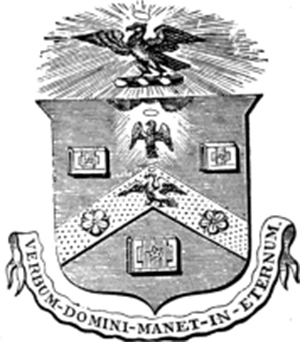
Motto: Verbum Domini Manet in Aeternum
Location: Stationers' Hall, London
Date of formation: 1403
Company association: Printing and publishing
Order of precedence: 47th
Master of company: Paul Wilson
Website stationers.org
The Worshipful Company of Stationers and Newspaper Makers (until 1937 the Worshipful Company of Stationers), usually known as the Stationers' Company, is one of the livery companies of the City of London.[1] The Stationers' Company was formed in 1403; it received a Royal Charter in 1557.[2] It held a monopoly over the publishing industry and was officially responsible for setting and enforcing regulations until the enactment of the Statute of Anne, also known as the Copyright Act of 1710.[3] Once the company received its charter, "the company's role was to regulate and discipline the industry, define proper conduct and maintain its own corporate privileges."[4]
The company members, including master, wardens, assistants, liverymen, freemen and apprentices are mostly involved with the modern visual and graphic communications industries that have evolved from the company's original trades. These include printing, paper-making, packaging, office products, engineering, advertising, design, photography, film and video production, publishing of books, newspapers and periodicals and digital media. The company's principal purpose nowadays is to provide an independent forum where its members can advance the interests (strategic, educational, training and charitable) of the industries associated with the company.[5]
History
In 1403, the Corporation of London approved the formation of a guild of stationers. At this time, the occupations considered stationers for the purposes of the guild were text writers, limners (illuminators), bookbinders or booksellers who worked at a fixed location (stationarius) beside the walls of St Paul's Cathedral.[6] Booksellers sold manuscript books, or copies thereof produced by their respective firms for retail; they also sold writing materials. Illuminators illustrated and decorated manuscripts.
Printing gradually displaced manuscript production so that, by the time the guild received a royal charter of incorporation on 4 May 1557, it had in effect become a printers' guild. In 1559, it became the 47th in city livery company precedence. At the time, it was based at Peter's College, which it bought from St Paul's Cathedral.[7] During the Tudor and Stuart periods, the Stationers were legally empowered to seize "offending books" that violated the standards of content set down by the Church and state; its officers could bring "offenders" before ecclesiastical authorities, usually the Bishop of London or the Archbishop of Canterbury, depending on the severity of the transgression.[8] Thus the Stationers played an important role in the culture of England as it evolved through the intensely turbulent decades of the Protestant Reformation and toward the English Civil War.
The Stationers' Charter, which codified its monopoly on book production, ensured that once a member had asserted ownership of a text or "copy" by having it approved by the company, no other member was entitled to publish it, that is, no one else had the "right to copy" it. This is the origin of the term "copyright". However, this original "right to copy" in England was different from the modern conception of copyright. The stationers' "copy right" was a protection granted to the printers of a book; "copyright" introduced with the Statute of Anne, or the Copyright Act of 1710, was a right granted to the author(s) of a book based on statutory law.[9]
Members of the company could, and mostly did, document their ownership of copyright in a work by entering it in the "entry book of copies" or the Stationers' Company Register.[10] The Register of the Stationers' Company thus became one of the most essential documentary records in the later study of English Renaissance theatre.[11] (In 1606 the Master of the Revels, who was responsible until this time for licensing plays for performance, acquired some overlapping authority over licensing them for publication as well; but the Stationers' Register remained a crucial and authoritative source of information after that date too.) Enforcement of such rules was always a challenge, in this area as in other aspects of the Tudor/Stuart regime. Works were often printed surreptitiously and illegally, and this would remain a subject of interest to both the Company and the government into the modern period.
In 1603, the Stationers formed the English Stock, a joint stock publishing company funded by shares held by members of the company.[12] This profitable venture gave the Company a monopoly on printing certain types of works, including almanacs, prayer-books, and primers, some of the best-selling works of the day. By buying and holding shares in the English Stock (which were limited in number), members of the company received a nearly guaranteed return each year. The English Stock at times employed out-of-work printers, and disbursed some of the profit to the poor and to those reliant on the Company's pensions. When a printer or bookseller who held a share died, it might often pass to another relation, most often his widow.[13]
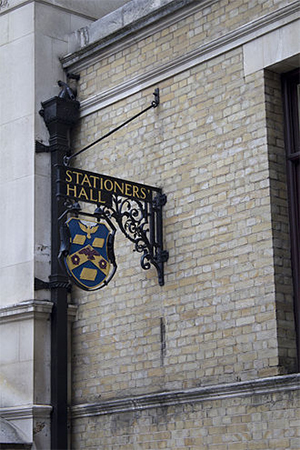
Stationers' Hall, London (2013 photo)
In 1606, the company bought Abergavenny House in Ave Maria Lane and moved out of Peter's College.[14] The new hall burnt down in the Great Fire of 1666, along with most of its contents, including a great number of books. The Company's clerk, George Tokefeild, is said to have removed a great number of the Company's records to his home in the suburbs—without this act, much of the Company's history before 1666 would have been lost.[15] It was rebuilt by 1674, and its present interior is much as it was when it reopened. The Court Room was added in 1748, and in 1800 the external façade was remodelled to its present form.[16]
In 1695, the monopoly power of the Stationers' Company was diminished by the lapsing of their monopoly on printing, allowing presses to operate more freely outside of London than they had previously. This blow was compounded when in 1710 Parliament passed the Copyright Act 1709, the first such act to establish copyright as the purview of authors, not printers or publishers.[17]
In 1861, the company established the Stationers' Company's School at Bolt Court, Fleet Street for the education of sons of members of the Company. In 1894, the school moved to Hornsey in north London, eventually closing nearly a century later in 1983.
Registration under the Copyright Act 1911 ended in December 1923; the company then established a voluntary register in which copyrights could be recorded to provide printed proof of ownership in case of disputes.
In 1937, a royal charter amalgamated the Stationers' Company and the Newspaper Makers' Company, which had been founded six years earlier (and whose members were predominant in Fleet Street), into the company of the present name.
In March 2012, the company established the "Young Stationers", to provide a forum for young people (under the age of 40) within the company and the civic City of London more broadly. This led to the establishment of the Young Stationers' Prize in 2014, which recognises outstanding achievements within the company's trades. Prize winners have included novelist Angela Clarke, journalist Katie Glass, and professor of journalism Dr Shane Tilton.
The company's motto is Verbum Domini manet in aeternum, Latin for "The Word of the Lord endures forever;" which appears on their heraldic charge.[18]
In November 2020 Stationers' Hall the home of the Stationers' Company were granted approval to redevelop their Grade 1 listed building to bring modern day conference facilities, air-cooling and step free access to its historic rooms. It reopened in July 2022 for live events, weddings, and filming.
Trades
The modern Stationers' Company represents the "content and communications" industries within the City of London Liveries. This includes the following trades and specialisms:
• Archiving (including librarian, curators, and book conservation)
• Bookselling and distribution
• Communications (including advertising, marketing, and PR)
• Digital media and software
• Newspapers and broadcasting
• Office products and supplies
• Packaging
• Paper
• Print machinery
• Printing
• Publishing (including digital publishing and design)
• Writing (including journalism, broadcasting, and authorship)
Hall
Stationers' Hall is at Ave Maria Lane near Ludgate Hill. The site of the present hall was formerly the site of Abergavenny House, which was purchased by the Stationers in 1606 for £3,500, but destroyed in the Great Fire of London, 1666.[19] The current building and hall date from circa 1670. The hall was remodelled in 1800 by the architect Robert Mylne and, on 4 January 1950, it was designated a Grade I listed building.[20][21]
Stationers' Hall hosts the Shine School Media Awards, where students compete in the creation of websites and magazines.
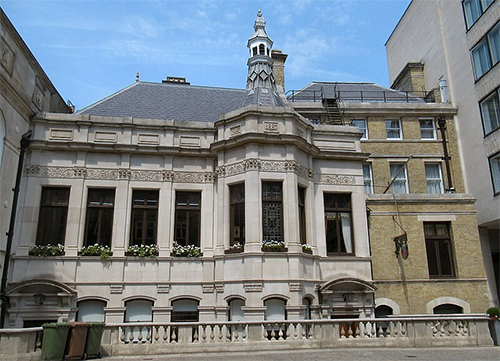
Stationers' Hall
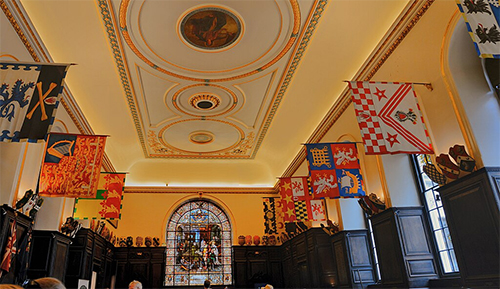
Main Hall
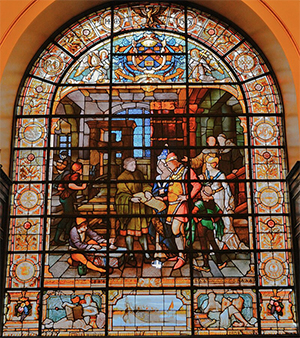
Caxton window
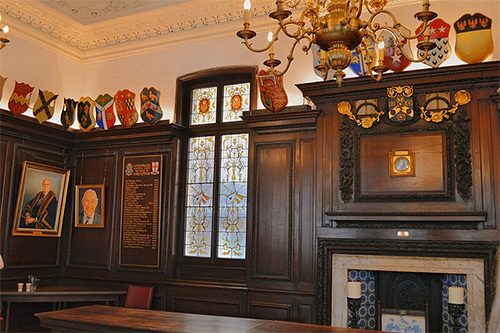
The Stock Room
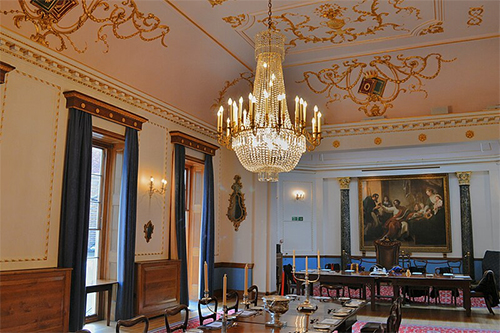
The Court Room
Notable liverymen
• Edward Allde
• John Cleave
• Thomas Cotes
• George Eld
• Edmund Evans
• George Faulkner
• Richard Field
• Augustine Matthews
• George Mudie (Owenite)
• Rupert Murdoch
• Thomas Cautley Newby
• Nicholas Okes
• Peter Short
• William Stansby
• John Trundle
• Sir Christopher Meyer
• William Hague
Court
Below are lists of officials who either sat on the Stationer's Company Court of Assistants, or who worked for the Company in another official capacity (Beadle, Treasurer, and Clerk) from the time the Company was first granted a charter in 1556 to the present day. As with most London livery companies, the Master of the Company was elected yearly, along with the Wardens. For the Stationers, this election day always took place in late June, the day before St. Peter's Day (June 29). Thus, a Master's term would run effectively from July to July. The dates below reflect the year a Master was elected and began a term of service. Upper and Under Wardens were elected at the same time, while Renter Wardens (those two wardens charged with collecting dues from members of the Company annually) were chosen for the following year in March, on or around Lady Day. The roles of Beadle and Clerk were likewise elected positions, filled whenever they came open, but were often held by the same members for years or even decades. The Treasurer of the Company/English Stock was elected annually in March along with the Stockeepers, and again, was often held by the same person for years.
The master oversaw Company "courts", meetings of the Assistants and sometimes the Livery and wider membership where Company business was discussed and resolved. These courts were usually held monthly but could be held more or less frequently. Although official company positions were historically always held by men until the twentieth century, women have always participated meaningfully in the life of the Company, at certain times even holding a controlling interest in the Company's joint stock venture, known as the English Stock.[22][23][24]
The first woman elected master was Helen Esmonde, who held the position in 2015.[25]
1555–1599
1600–1699
1700–1799
1800–1899
1900–1999
2000–present
Young Stationers' Prize
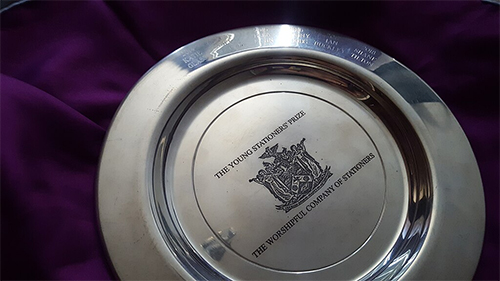
Young Stationers' Prize with engraved winners as of 2018
The "Young Stationers' Prize" is an annual prize awarded by the Young Stationers' Committee to a young person under 40 years of age who has distinguished themself within the company's trades. Launched in 2014, the prize is a pewter plate (donated by the Worshipful Company of Pewterers) onto which each winner's name is engraved.
List of Young Stationers' Prize winners
As of December 2019 there have been seven winners of the Young Stationers' Prize: Katie Glass, journalist, 2014;[38][39] Angela Clarke, novelist, playwright, and columnist, 2015;[40][41] Ella Kahn and Bryony Woods, founders of Diamond Kahn & Woods Literary Agency (awarded jointly), 2016;[42] Ian Buckley, managing director of Prima Software, 2017;[43] Shane Tilton, academic and professor of multimedia journalism, 2018;[44] Amy Hutchinson, CEO of the BOSS Federation, 2019.[45]
Arms
Coat of arms of Worshipful Company of Stationers and Newspaper Makers hide

Crest: On a wreath of the colours, An eagle, wings expanded, with a diadem above its head, perched on a book fessewise, all Or.
Escutcheon
Azure, on a chevron between three books with clasps, all Or an eagle volant gules with a nimbus Or, between two roses gules leaved vert, in chief issuing out of a cloud proper radiated Or a Holy Spirit, wings displayed, argent with a nimbus Or.
Supporters
On either side an angel proper, vested argent, mantled azure, winged and blowing a trumpet Or.
Motto
'Verbum Dei manet in aetemum'[46]
See also
• Authorized King James Version
• Eyre & Spottiswoode
• Fleet Street
• Printing patent
References
1. "Livery Committee: The Worshipful Company of Stationers & Newspaper Makers". Retrieved 25 January 2024.
2. Blagden, Cyprian. The Stationers' Company: A History, 1403–1959. London: George Allen & Unwin, 1960, p.19
3. Raven, James (2007). The Business of Books: Booksellers and the English Book Trade 1450–1850. Yale University Press. p. 200. ISBN 9780300181630.
4. Lyons, Martyn (2011). Books: A Living History. Los Angeles, CA: J. Paul Getty Museum. p. 61.
5. "About Us". The Stationer's Company.
6. Patterson, Lyman Ray (1968). Copyright in Historical Perspective. Vanderbilt University Press.
7. Blagden, Cyprian. "The Property". The Stationers' Company: a History, 1403–1959. p. 206, n2. On November 24, 1548, John and Richard Keyme, gentlemen of Lewes, paid £1,154 15 shillings into the Court of Augmentations and obtained possession, along with other property, of 'the site, house and mansion commonly called Peter College' (Cal. Patent Rolls Ed. VI, i, 362–363). Four years later, William Sparke, a Merchant Taylor, conveyed the property to the executors of Matthew Wotton, clerk, but retained the right to reclaim it on payment of £340; this figure may approximate to that paid by the Stationers two years later still (Hustings Roll 246, 63). For a short period before 1553 William Seres used the building for a printing house.
8. Loades, D. M. (1974). "The Theory and Practice of Censorship in Sixteenth-Century England". Transactions of the Royal Historical Society (24): 141–157. doi:10.2307/3678936.
9. Gadd, Ian (2016). "The Stationers' Company in England before 1710". In Alexander, I.; Gómez-Arostegui, H.T. (eds.). Research handbook on the history of copyright law. Cheltenham: Elgar.
10. Arber, Edward, ed. (1875–1877). Transcript of the Registers of the Company of Stationers of London, 1554–1640 A.D.
11. Chambers, Edmund Kerchever (1923). The Elizabethan Stage. Vol. 3. Oxford: Clarendon Press. pp. 160–177, 186–191.
12. Blagden, Cyprian (1957). "English Stock of the Stationers' Company in the Time of the Stuarts". The Library (12).
13. Turner, Michael (2009). "Personnel within the London Book Trades: Evidence from the Stationers' Company". Cambridge History of the Book in Britain. Vol. 5. Cambridge: Cambridge University Press.
14. See Blagden, "The Property", in The Stationers' Company: a History, especially pages 212–215.
15. Blagden, "The Great Fire and the Rebuilding", in The Stationer's Company: a History, p.215. The Company remembers Tokefeild's contribution today in the name of its Archives Center.
16. Blagden, The Stationers' Company: a History
17. See the Statute of Anne. The Company maintained a copyright registry untl 1923, after which registrations became voluntary.
18. "Stationer's Company". British Armorial Bindings Database. University of Toronto. Retrieved 25 January 2024.
19. "Official website". Stationers Livery Company. Retrieved 12 April 2021.
20. Historic England. "Stationers' Hall (Grade I) (1064742)". National Heritage List for England. Retrieved 12 April 2021.
21. Blagden, Cyprian (1977) [1960]. "The Property". The Stationers' Company: A History, 1403–1959. Stanford University Press. ISBN 9780804709354.
22. Turner, Michael (2009). "Personnel within the London Book Trades: Evidence from the Stationers' Company". The Cambridge History of the Book in Britain 5: 1695–1830. p. 331. There were occasions in the eighteenth century when the majority of the Assistants' shares were in the hands of surviving widows rather than active Assistants.
23. Smith, Helen (2012). Grossly Material Things: Women and Book Production in Early Modern England. Oxford University Press.
24. McDowell, Paula (1998). The Women of Grub Street: Press, Politics, and Gender in the London Literary Marketplace 1678–1730. Oxford University Press.
25. "Master breaks centuries old barrier". Print Business. 27 July 2015. Retrieved 25 January 2024.
26. Turner, Michael. "London Booktrades Database". London Booktrades Database. Bodleian Libraries. Retrieved 23 January 2024.
27. Worshipful Company of Stationers and Newspaper Makers (4 October 2021). "Masters of the Company" (Document). Worshipful Company of Stationers and Newspaper Makers.
28. Turner, Michael. "London Booktrades Database". London Booktrades Database. Bodleian Libraries. Retrieved 23 January 2024.
29. Worshipful Company of Stationers and Newspaper Makers (4 October 2021). "Masters of the Company" (Document). Worshipful Company of Stationers and Newspaper Makers.
30. Turner, Michael. "London Booktrades Database". London Booktrades Database. Bodleian Libraries. Retrieved 23 January 2024.
31. Worshipful Company of Stationers and Newspaper Makers (4 October 2021). "Masters of the Company" (Document). Worshipful Company of Stationers and Newspaper Makers.
32. Turner, Michael. "London Booktrades Database". London Booktrades Database. Bodleian Libraries. Retrieved 23 January 2024.
33. Worshipful Company of Stationers and Newspaper Makers (4 October 2021). "Masters of the Company" (Document). Worshipful Company of Stationers and Newspaper Makers.
34. Turner, Michael. "London Booktrades Database". London Booktrades Database. Bodleian Libraries. Retrieved 23 January 2024.
35. Worshipful Company of Stationers and Newspaper Makers (4 October 2021). "Masters of the Company" (Document). Worshipful Company of Stationers and Newspaper Makers.
36. Turner, Michael. "London Booktrades Database". London Booktrades Database. Bodleian Libraries. Retrieved 23 January 2024.
37. Worshipful Company of Stationers and Newspaper Makers (4 October 2021). "Masters of the Company" (Document). Worshipful Company of Stationers and Newspaper Makers.
38. "Announcement of the Young Stationers' Prize winner". InPublishing. 24 July 2014. Retrieved 12 April 2021.
39. "Profile: Katie Glass". The Times & Sunday Times. Retrieved 12 April 2021.
40. Crockett, Sophie (4 August 2015). "St Albans playwright, Angela Clarke, scoops award". The Herts Advertiser. Retrieved 12 April 2021.
41. Cheesman, Neil (24 July 2015). "Debut playwright Angela Clarke wins The Young Stationers' Prize 2015". LondonTheatre1. Retrieved 12 April 2021.
42. "Former SYP committee members win Young Stationers' Prize". Society of Young Publishers. 31 August 2016. Retrieved 12 April 2021.
43. Goldbart, Max (28 July 2017). "Buckley scoops Young Stationers' prize". Printweek. Retrieved 12 April 2021.
44. "Dr Shane Tilton wins Young Stationers' Prize". British Printing Industries Federation. 31 July 2018. Retrieved 12 April 2021.
45. Handley, Rhys (12 July 2019). "New Boss chief wins Young Stationers' prize". Printweek. Retrieved 12 April 2021.
46. "Worshipful Company of Stationers and Newspaper Makers". Heraldry of the World. Retrieved 1 May 2024.
Further reading
• Arber, Edward, ed. (1875–1877), Transcript of the Registers of the Company of Stationers of London, 1554–1640 A.D.
• v.2, 1571–1595
• v.3, 1595–1620
• v.4, 1620–1640
• v.5, index
• Bell, Maureen (1996). "Women in the English Book Trades 1557–1700". Leipziger Jahrbuch zur Buchgeschichte. 6: 13–45.
• Blagden, Cyprian (1957). "Accounts of the Wardens of the Stationers' Company". Studies in Bibliography. 9: 69–93. JSTOR 40371196.
• Blagden, Cyprian (1957). "English Stock of the Stationers' Company in the Time of the Stuarts". The Library. 12.
• Blagden, Cyprian (1958). "Stationers' Company in the Civil War Period". The Library. 13.
• Blagden, Cyprian (1959). "Stationers' Company in the Eighteenth Century". Guildhall Miscellany. ISSN 0072-8985.
• Blagden, Cyprian (1960). The Stationers' Company: A History, 1403–1959. London: Allen & Unwin. OCLC 459559508.
• Blayney, Peter (2003), Stationers' Company before the Charter, 1403–1557, London: Worshipful Company of Stationers and Newspaper Makers, OCLC 52634009
• Blayney, Peter W. M. (2013). The Stationers' Company and the Printers of London: 1501–1557. Vol. 1. Cambridge: Cambridge University Press.
• Eyre, G. E. B.; Rivington, C. R., eds. (1913–1914), Transcript of the Registers of the worshipful Company of Stationers, from 1640–1708 A.D. + v.2–3
• Ferdinand, C. Y. (1992). "Towards a Demography of the Stationers' Company, 1601–1700". Journal of the Printing Historical Society. 21. ISSN 0079-5321.
• Gadd, Ian; Wallis, Patrick (2002). Guilds, Society and Economy in London, 1450–1800. Centre for Metropolitan History in association with Guildhall Library, London. ISBN 9781871348651.
• Gadd, Ian (2016). "The Stationers' Company in England before 1710". In Alexander, I.; Gómez-Arostegui, H.T. (eds.). Research handbook on the history of copyright law. Research handbooks in intellectual property. Cheltenham: Elgar. pp. 81–95. ISBN 9781783472390.
• Gadd, Ian (2013). "The press and the London book trade". In Gadd, Ian (ed.). History of Oxford University Press, Volume 1: Beginnings to 1780. Oxford: Oxford University Press. pp. 569–600. ISBN 9780199557318.
• Gadd, Ian; Wallis, Patrick (2008). "Reaching beyond the City Wall: London guilds and national regulation, 1500–1700". In Epstein, S.; Prak, M. (eds.). Guilds, innovation, and the European economy 1400–1800. Cambridge: Cambridge University Press. ISBN 9780521887175.
• Gadd, Ian (2021). "The Stationers' Company, 1403–1775: London's book trade guild". Oxford Research Encyclopedia of Literature.
• Greg, W. W.; Boswell, E. (1930). Records of the Court of the Stationers' Company, 1576 to 1602 – from Register B.
• Greg, W. W. (1928). The Decrees and Ordinances of the Stationers' Company, 1576–1602.
• "Government Control of the Printing Press: Star Chamber Censorship Ordinances (1566, 1586) and Philip Stubbs' Comments on Censorship (1593)". Voices of Shakespeare's England: Contemporary Accounts of Elizabethan Daily Life. 2010.
• Jackson, W. A. (1957). Records of the Court of the Stationers' Company, 1602 to 1640.
• Knight, Charles, ed. (1844), "Stationers' Company", London, vol. 6, London: C. Knight & Co.
• McDowell, Paula (1998). The Women of Grub Street: Press, Politics, and Gender in the London Literary Marketplace 1678–1730. Oxford University Press. ISBN 9780198184492.
• McKenzie, D. F. (ed.), Stationers' Company Apprentices, 1605–1800 in three volumes: 1605–1640, 1641–1700 and 1701–1800. (Charlottesville: Bibliographical Society of the University of Virginia, 1961; Oxford: Oxford Bibliographical Society, 1974 and 1978)
• Mendle, Michael (1995). "De Facto Freedom De Facto Authority: Press and Parliament 1640–1643". The Historical Journal: 307–32.
• Myers, Robin (1985), Myers, Robin; Harris, Michael (eds.), "The Financial Records of the Stationers' Company, 1605–1811", Economics of the British Booktrade 1605–1939, Cambridge: Chadwyck-Healey, ISBN 0859641694
• Myers, Robin (1990). The Stationers' Company Archive: An Account of the Records, 1554–1984. Winchester: St Paul's Bibliographies.
• Myers, Robin; Harris, Michael, eds. (1997). Stationers' Company and the Book Trade 1550–1990. Winchester: St Paul's Bibliographies. ISBN 9781873040331.
• Myers, Robin, ed. (2001). Stationers' Company: a history of the later years 1800–2000. Chichester: Phillimore. ISBN 9781860771408.
• Nichols, John Gough (1861), Historical notices of the worshipful Company of stationers of London, OCLC 5386736, OL 6639628M
• Pollard, Graham (1937). "Company of Stationers before 1557". The Library. 18. ISSN 1744-8581.
• Pollard, Graham (1937). "Early Constitution of the Stationers' Company". The Library. 18.
• Raven, James (2007). The Business of Books: Booksellers and the English Book Trade 1450–1850. Yale University Press. ISBN 9780300181630.
• Rivington, Charles Robert (1883), Records of the Worshipful Company of Stationers, Nichols and Sons, OCLC 19943126
• Siebert, Fred S. (1936). "Regulation of the Press in the Seventeenth Century: Excerpts from the Records of the Court of the Stationers' Company". Journalism Quarterly. 13 (4): 381–393. doi:10.1177/107769903601300402. S2CID 159460546.
• Sketch of the History and Privileges of the Company of Stationers. London Stationers' Hall. 1871.
• Smith, Helen (2012). Grossly Material Things: Women and Book Production in Early Modern England. Oxford University Press. ISBN 9780199651580.
• "Stationers' Hall", Handbook to London as It Is, London: J. Murray, 1879
• "Stationers' Hall", London and Its Environs (17th ed.), Leipzig: Karl Baedeker, 1915, hdl:2027/mdp.39015019440851
External links
Wikimedia Commons has media related to Worshipful Company of Stationers and Newspaper Makers.
• The Stationers' and Newspaper Makers' Company
• Events Venue Website
by Wikipedia
Accessed: 9/28/24
https://en.wikipedia.org/wiki/Worshipfu ... per_Makers
[Mountstuart Elphinstone] There appear to me to be only three lines of conduct which we can possibly adopt. 1st, To check the diffusion of knowledge and the introduction of printing so as to keep the Natives in their present state and confine the effects of the Press as hitherto to the Europeans. 2nd, To allow perfect freedom to Native Press and to offer no resistance to the natural tendency of such freedom to dispose the Native to attempts at establishing a national Government. 3rd, To promote learning and to encourage printing, but to keep the Press under the same degree of restraint which was maintained in England for more than two centuries after the invention of printing and which is still enforced in all countries where the Government does not rest on a popular basis. The first of these plans would be criminal if it were practicable. The second would only lead to the premature removal of the British Government, without a chance of its being succeeded by a better; the third alone appears to me to offer any prospect of improvement and rational liberty to the Natives. Under it we might safely do our duty in communicating to them all the sciences of Europe; and at some distant period the two nations might be sufficiently on a footing to determine the relation they were thenceforth to bear to one another. At that stage the people might be admitted to a share of the Government and then or at a later period the freedom of the Press might be permitted without control.
-- The Printing Press in India: It's Beginnings and Early Development Being a Quatercentenary Commemoration Study of the Advent of Printing in India (In 1556), by Anant Kakba Priolkar, Director, Marathi Samshodhana Mandala, Bombay
Worshipful Company of Stationers and Newspaper Makers
Motto: Verbum Domini Manet in Aeternum
Location: Stationers' Hall, London
Date of formation: 1403
Company association: Printing and publishing
Order of precedence: 47th
Master of company: Paul Wilson
Website stationers.org
The Worshipful Company of Stationers and Newspaper Makers (until 1937 the Worshipful Company of Stationers), usually known as the Stationers' Company, is one of the livery companies of the City of London.[1] The Stationers' Company was formed in 1403; it received a Royal Charter in 1557.[2] It held a monopoly over the publishing industry and was officially responsible for setting and enforcing regulations until the enactment of the Statute of Anne, also known as the Copyright Act of 1710.[3] Once the company received its charter, "the company's role was to regulate and discipline the industry, define proper conduct and maintain its own corporate privileges."[4]
The company members, including master, wardens, assistants, liverymen, freemen and apprentices are mostly involved with the modern visual and graphic communications industries that have evolved from the company's original trades. These include printing, paper-making, packaging, office products, engineering, advertising, design, photography, film and video production, publishing of books, newspapers and periodicals and digital media. The company's principal purpose nowadays is to provide an independent forum where its members can advance the interests (strategic, educational, training and charitable) of the industries associated with the company.[5]
History
In 1403, the Corporation of London approved the formation of a guild of stationers. At this time, the occupations considered stationers for the purposes of the guild were text writers, limners (illuminators), bookbinders or booksellers who worked at a fixed location (stationarius) beside the walls of St Paul's Cathedral.[6] Booksellers sold manuscript books, or copies thereof produced by their respective firms for retail; they also sold writing materials. Illuminators illustrated and decorated manuscripts.
Printing gradually displaced manuscript production so that, by the time the guild received a royal charter of incorporation on 4 May 1557, it had in effect become a printers' guild. In 1559, it became the 47th in city livery company precedence. At the time, it was based at Peter's College, which it bought from St Paul's Cathedral.[7] During the Tudor and Stuart periods, the Stationers were legally empowered to seize "offending books" that violated the standards of content set down by the Church and state; its officers could bring "offenders" before ecclesiastical authorities, usually the Bishop of London or the Archbishop of Canterbury, depending on the severity of the transgression.[8] Thus the Stationers played an important role in the culture of England as it evolved through the intensely turbulent decades of the Protestant Reformation and toward the English Civil War.
The Stationers' Charter, which codified its monopoly on book production, ensured that once a member had asserted ownership of a text or "copy" by having it approved by the company, no other member was entitled to publish it, that is, no one else had the "right to copy" it. This is the origin of the term "copyright". However, this original "right to copy" in England was different from the modern conception of copyright. The stationers' "copy right" was a protection granted to the printers of a book; "copyright" introduced with the Statute of Anne, or the Copyright Act of 1710, was a right granted to the author(s) of a book based on statutory law.[9]
Members of the company could, and mostly did, document their ownership of copyright in a work by entering it in the "entry book of copies" or the Stationers' Company Register.[10] The Register of the Stationers' Company thus became one of the most essential documentary records in the later study of English Renaissance theatre.[11] (In 1606 the Master of the Revels, who was responsible until this time for licensing plays for performance, acquired some overlapping authority over licensing them for publication as well; but the Stationers' Register remained a crucial and authoritative source of information after that date too.) Enforcement of such rules was always a challenge, in this area as in other aspects of the Tudor/Stuart regime. Works were often printed surreptitiously and illegally, and this would remain a subject of interest to both the Company and the government into the modern period.
In 1603, the Stationers formed the English Stock, a joint stock publishing company funded by shares held by members of the company.[12] This profitable venture gave the Company a monopoly on printing certain types of works, including almanacs, prayer-books, and primers, some of the best-selling works of the day. By buying and holding shares in the English Stock (which were limited in number), members of the company received a nearly guaranteed return each year. The English Stock at times employed out-of-work printers, and disbursed some of the profit to the poor and to those reliant on the Company's pensions. When a printer or bookseller who held a share died, it might often pass to another relation, most often his widow.[13]
Stationers' Hall, London (2013 photo)
In 1606, the company bought Abergavenny House in Ave Maria Lane and moved out of Peter's College.[14] The new hall burnt down in the Great Fire of 1666, along with most of its contents, including a great number of books. The Company's clerk, George Tokefeild, is said to have removed a great number of the Company's records to his home in the suburbs—without this act, much of the Company's history before 1666 would have been lost.[15] It was rebuilt by 1674, and its present interior is much as it was when it reopened. The Court Room was added in 1748, and in 1800 the external façade was remodelled to its present form.[16]
In 1695, the monopoly power of the Stationers' Company was diminished by the lapsing of their monopoly on printing, allowing presses to operate more freely outside of London than they had previously. This blow was compounded when in 1710 Parliament passed the Copyright Act 1709, the first such act to establish copyright as the purview of authors, not printers or publishers.[17]
In 1861, the company established the Stationers' Company's School at Bolt Court, Fleet Street for the education of sons of members of the Company. In 1894, the school moved to Hornsey in north London, eventually closing nearly a century later in 1983.
Registration under the Copyright Act 1911 ended in December 1923; the company then established a voluntary register in which copyrights could be recorded to provide printed proof of ownership in case of disputes.
In 1937, a royal charter amalgamated the Stationers' Company and the Newspaper Makers' Company, which had been founded six years earlier (and whose members were predominant in Fleet Street), into the company of the present name.
In March 2012, the company established the "Young Stationers", to provide a forum for young people (under the age of 40) within the company and the civic City of London more broadly. This led to the establishment of the Young Stationers' Prize in 2014, which recognises outstanding achievements within the company's trades. Prize winners have included novelist Angela Clarke, journalist Katie Glass, and professor of journalism Dr Shane Tilton.
The company's motto is Verbum Domini manet in aeternum, Latin for "The Word of the Lord endures forever;" which appears on their heraldic charge.[18]
In November 2020 Stationers' Hall the home of the Stationers' Company were granted approval to redevelop their Grade 1 listed building to bring modern day conference facilities, air-cooling and step free access to its historic rooms. It reopened in July 2022 for live events, weddings, and filming.
Trades
The modern Stationers' Company represents the "content and communications" industries within the City of London Liveries. This includes the following trades and specialisms:
• Archiving (including librarian, curators, and book conservation)
• Bookselling and distribution
• Communications (including advertising, marketing, and PR)
• Digital media and software
• Newspapers and broadcasting
• Office products and supplies
• Packaging
• Paper
• Print machinery
• Printing
• Publishing (including digital publishing and design)
• Writing (including journalism, broadcasting, and authorship)
Hall
Stationers' Hall is at Ave Maria Lane near Ludgate Hill. The site of the present hall was formerly the site of Abergavenny House, which was purchased by the Stationers in 1606 for £3,500, but destroyed in the Great Fire of London, 1666.[19] The current building and hall date from circa 1670. The hall was remodelled in 1800 by the architect Robert Mylne and, on 4 January 1950, it was designated a Grade I listed building.[20][21]
Stationers' Hall hosts the Shine School Media Awards, where students compete in the creation of websites and magazines.
Stationers' Hall
Main Hall
Caxton window
The Stock Room
The Court Room
Notable liverymen
• Edward Allde
• John Cleave
• Thomas Cotes
• George Eld
• Edmund Evans
• George Faulkner
• Richard Field
• Augustine Matthews
• George Mudie (Owenite)
• Rupert Murdoch
• Thomas Cautley Newby
• Nicholas Okes
• Peter Short
• William Stansby
• John Trundle
• Sir Christopher Meyer
• William Hague
Court
Below are lists of officials who either sat on the Stationer's Company Court of Assistants, or who worked for the Company in another official capacity (Beadle, Treasurer, and Clerk) from the time the Company was first granted a charter in 1556 to the present day. As with most London livery companies, the Master of the Company was elected yearly, along with the Wardens. For the Stationers, this election day always took place in late June, the day before St. Peter's Day (June 29). Thus, a Master's term would run effectively from July to July. The dates below reflect the year a Master was elected and began a term of service. Upper and Under Wardens were elected at the same time, while Renter Wardens (those two wardens charged with collecting dues from members of the Company annually) were chosen for the following year in March, on or around Lady Day. The roles of Beadle and Clerk were likewise elected positions, filled whenever they came open, but were often held by the same members for years or even decades. The Treasurer of the Company/English Stock was elected annually in March along with the Stockeepers, and again, was often held by the same person for years.
The master oversaw Company "courts", meetings of the Assistants and sometimes the Livery and wider membership where Company business was discussed and resolved. These courts were usually held monthly but could be held more or less frequently. Although official company positions were historically always held by men until the twentieth century, women have always participated meaningfully in the life of the Company, at certain times even holding a controlling interest in the Company's joint stock venture, known as the English Stock.[22][23][24]
The first woman elected master was Helen Esmonde, who held the position in 2015.[25]
1555–1599
Sixteenth Century Court Officials, 1556–1599[26][27]
Year elected / Master / Upper Warden / Under Warden / Renter Wardens / Clerk / Beadle / Treasurer
1555 Thomas Dockwray John Cawood Henry Cooke John Walley; Anthony Smythe Unknown Unknown Unknown
1556 Thomas Dockwray John Cawood Henry Cooke John Walley Unknown Unknown Unknown
1557 Thomas Dockwray John Cawood John Walley John Walley Unknown John Ffayreberne Unknown
1558 Richard Waye John Jaques John Turke Unknown Unknown John Ffayreberne Unknown
1559 Reginald (Reyner) Wolfe
Michael Loble Thomas Duxwell Unknown Unknown John Ffayreberne Unknown
1560 Stephen Kevall Richard Jugge John Judson Unknown Unknown John Ffayreberne Unknown
1561 John Cawood
William Seres Richard Tottell Unknown Unknown John Ffayreberne Unknown
1562 John Cawood
Michael Loble Richard Harrison; John Judson [from February] Unknown Unknown John Ffayreberne Unknown
1563 Richard Waye Richard Jugge Roger Ireland Unknown Unknown John Ffayreberne Unknown
1564 Reginald (Reyner) Wolfe
John Walley John Day Unknown Unknown John Ffayreberne Unknown
1565 Stephen Kevall William Seres James Gonneld Unknown Unknown John Ffayreberne Unknown
1566 John Cawood
Richard Jugge John Day Unknown Unknown John Ffayreberne Unknown
1567 Reginald (Reyner) Wolfe
Richard Tottell James Gonneld Unknown Unknown John Ffayreberne Unknown
1568 Richard Jugge
Richard Tottell Roger Ireland Unknown Unknown John Ffayreberne Unknown
1569 Richard Jugge
John Walley William Norton Unknown Unknown John Ffayreberne Unknown
1570 William Seres
John Judson William Norton Unknown Unknown John Ffayreberne Unknown
1571 William Seres
John Day Humphrey Toy Unknown George Wapull Unknown Unknown
1572 Reginald (Reyner) Wolfe
James Gonneld Humphrey Toy Unknown George Wapull Unknown Unknown
1573 Richard Jugge
William Norton John Harrison [the elder] Unknown George Wapull Unknown Unknown
1574 Richard Jugge
Richard Tottell William Cooke Unknown George Wapull Unknown Unknown
1575 William Seres
John Day Thomas Marsh Unknown Richard Collins Unknown Unknown
1576 William Seres
James Gonneld Richard Watkins Unknown Richard Collins Unknown Unknown
1577 William Seres
William Norton Richard Watkins Unknown Richard Collins Unknown Unknown
1578 Richard Tottel
John Harrison [the elder] George Bishop Unknown Richard Collins Unknown Unknown
1579 James Gonneld John Harrison [the elder] George Bishop Unknown Richard Collins Unknown Unknown
1580 John Day
Richard Watkins Francis Coldock Unknown Richard Collins Timothy Rider Unknown
1581 William Norton Thomas Marsh Garrat Dewce Unknown Richard Collins Timothy Rider Unknown
1582 James Gonneld Christopher Barker Francis Coldock Unknown Richard Collins Timothy Rider Unknown
1583 John Harrison [the elder] Richard Watkins Ralph Newbery Unknown Richard Collins Timothy Rider Unknown
1584 Richard Tottel
George Bishop Ralph Newbery Unknown Richard Collins Timothy Rider Unknown
1585 James Gonneld Christopher Barker Henry Conway Unknown Richard Collins Timothy Rider Unknown
1586 William Norton George Bishop Henry Denham
Unknown Richard Collins Timothy Rider Unknown
1587 John Judson Francis Coldock Henry Middleton; Henry Conway [from September] Unknown Richard Collins John Wolfe Unknown
1588 John Harrison [the elder] Francis Coldock Henry Denham Unknown Richard Collins John Wolfe Unknown
1589 Richard Watkins Ralph Newbery Gabriel Cawood Unknown Richard Collins John Wolfe Unknown
1590 George Bishop Ralph Newbery Gabriel Cawood Unknown Richard Collins John Wolfe Unknown
1591 Francis Coldock Henry Conway George Allen Unknown Richard Collins John Wolfe Unknown
1592 George Bishop Henry Conway Thomas Stirrop Unknown Richard Collins John Wolfe Unknown
1593 William Norton [succeeded by George Bishop] Gabriel Cawood Thomas Woodcock; Thomas Stirrop [from April] Unknown Richard Collins John Wolfe Unknown
1593 George Bishop [succeeds William Norton in December] Gabriel Cawood Thomas Woodcock; Thomas Stirrop [from April] Unknown Richard Collins John Wolfe Unknown
1594 Richard Watkins Gabriel Cawood Isaac Binge Unknown Richard Collins John Wolfe Unknown
1595 Francis Coldock Isaac Binge Thomas Dawson Unknown Richard Collins John Wolfe Unknown
1596 John Harrison [the elder] Thomas Stirrop Thomas Dawson Unknown Richard Collins John Wolfe Unknown
1597 Gabriel Cawood Thomas Stirrop Thomas Man Unknown Richard Collins John Wolfe Unknown
1598 Ralph Newbery Isaac Binge William Ponsonby Unknown Richard Collins Toby Cooke Unknown
1599 Gabriel Cawood Thomas Man John Windet Unknown Richard Collins Toby Cooke Unknown
1600–1699
Seventeenth Century Court Officials, 1600–1699[28][29]
Year elected /Master /Upper Warden /Under Warden /Senior Renter Warden /Junior Renter Warden Clerk / Beadle / Treasurer
1600 George Bishop Thomas Dawson Richard White Unknown Unknown Richard Collins John Hardy Unknown
1601 Ralph Newbery Robert Barker Gregory Seton Unknown Unknown Richard Collins John Hardy Unknown
1602 George Bishop Thomas Man Simon Waterson Unknown Unknown Richard Collins John Hardy Unknown
1603 Isaac Binge Thomas Dawson Humphrey Hooper Unknown Unknown Richard Collins John Hardy Unknown
1604 Thomas Man John Norton William Leake Unknown Unknown Richard Collins John Hardy Unknown
1605 Robert Barker
John Norton Richard Feild Unknown Unknown Richard Collins John Hardy Nathaniel Butter
1606 Robert Barker
Edward White William Leake Unknown Unknown Richard Collins John Hardy William Cotton
1607 John Norton Gregory Seton John Standish William Newton Unknown Richard Collins John Hardy William Cotton
1608 George Bishop Humphrey Hooper Humphrey Lownes Unknown Unknown Richard Collins John Hardy William Cotton
1609 Thomas Dawson Simon Waterson John Standish Unknown Unknown Richard Collins John Hardy Edmund Weaver
1610 Thomas Man William Leake Thomas Adams Anthony Gilman Unknown Richard Collins John Hardy Edmund Weaver
1611 John Norton Richard Feild Humphrey Lownes Unknown Unknown Richard Collins John Hardy Edmund Weaver
1612 John Norton Humphrey Hooper John Harrison [the younger] Unknown Unknown Richard Collins John Hardy Edmund Weaver
1613 Bonham Norton
Richard Field Richard Ockould Unknown Unknown Thomas Mountfort Thomas Bushell Edmund Weaver
1614 Thomas Man William Leake Thomas Adams Felix Kingston Unknown Thomas Mountfort Thomas Bushell Edmund Weaver
1615 Thomas Dawson Humphrey Lownes, senior George Swinhowe Unknown Unknown Thomas Mountfort Thomas Bushell Edmund Weaver
1616 Thomas Man Thomas Adams Matthew Lownes Matthew Law Unknown Thomas Mountfort Thomas Bushell Edmund Weaver
1617 Simon Waterson Humphrey Lownes, senior George Swinhowe Robert Bolton Unknown Thomas Mountfort Richard Badger Edmund Weaver
1618 William Leake Thomas Adams Anthony Gilman Leonard Kempe Unknown Thomas Mountfort Richard Badger Edmund Weaver
1619 Richard Field
George Swinhowe John Jaggard Thomas Purfoote John Harrison Thomas Mountfort Richard Badger Edmund Weaver
1620 Humphrey Lownes Matthew Lownes George Cole John Harrison John Jaggard Thomas Mountfort Richard Badger Edmund Weaver
1621 Simon Waterson George Swinhowe Clement Knight Richard Tombes Unknown Thomas Mountfort Richard Badger Edmund Weaver
1622 Richard Field Anthony Gilman Thomas Pavier Richard Tombes John Browne Thomas Mountfort Richard Badger Edmund Weaver
1623 George Swinhowe George Cole John Bill John Browne Unknown Thomas Mountfort Richard Badger Edmund Weaver
1624 Humphrey Lownes Matthew Lownes Henry Cooke Unknown Unknown Thomas Mountfort Richard Badger Edmund Weaver
1625 George Swinhowe Anthony Gilman Adam Islip William Aspley Roger Jackson Thomas Mountfort Richard Badger Edmund Weaver
1626 Bonham Norton
Clement Knight Felix Kingston John Rothwell Henry Fetherstone Thomas Mountfort Richard Badger Edmund Weaver
1627 George Cole Clement Knight Edmund Weaver Henry Featherstone Nathaniel Butter Thomas Mountfort Richard Badger Edmund Weaver
1628 George Cole Adam Islip Edmund Weaver Unknown Unknown Thomas Mountfort Richard Badger Edmund Weaver
1629 Bonham Norton
John Bill Thomas Purfoote John Busby Emanuel Exoll Thomas Mountfort Richard Badger Edmund Weaver
1630 George Swinhowe Felix Kingston John Harrison Emanuel Exoll Thomas Downes Thomas Mountfort Richard Badger Edmund Weaver
1631 George Cole Adam Islip John Smethwick Thomas Downes Richard Moore Henry Walley Richard Badger Edmund Weaver
1632 George Cole Edmund Weaver William Aspley John Beale Richard Higganbotham Henry Walley Richard Badger Edmund Weaver
1633 Adam Islip Edmund Weaver William Aspley John Hoth John Parker Henry Walley Richard Badger Edmund Weaver
1634 Adam Islip Thomas Purfoote John Rothwell John Parker Francis Constable Henry Walley Richard Badger Edmund Weaver
1635 Felix Kingston John Smethwick Henry Featherstone Richard Whitaker George Latham Henry Walley John Badger Edmund Weaver
1636 Felix Kingston John Harrison Thomas Downes George Latham Jonas Wellings Henry Walley John Badger Edmund Weaver
1637 Edmund Weaver, died June 1638 William Aspley Nicholas Bourne Jonas Wellings Ephraim Dawson Henry Walley John Badger Edmund Weaver
1638 John Harrison [the younger] John Rothwell Robert Mead George Miller Edward Brewster Henry Walley John Badger Unknown/Open
1639 John Smethwick
Henry Featherstone Nicholas Bourne Jonas Wellings Ephraim Dawson Henry Walley John Badger Edward Brewster
1640 William Aspley, died in office; succeeded by John Smethwick Thomas Downes Samuel Mann Jacob Bloome John Bellamy Henry Walley Joseph Hunscott Edward Brewster
1641 Henry Fetherstone Nicholas Bourne John Parker Robert Bird, died in office; succeeded by Richard Thrale John Bartlett, fined out; succeeded by Nicholas Fussell Henry Walley Joseph Hunscott Edward Brewster
1642 Thomas Downes Robert Meade George Edwards Nicholas Fussell Christopher Meredith Henry Walley Joseph Hunscott Edward Brewster
1643 Nicholas Bourne Samuel Mann Richard Whitaker Christopher Meredith Robert Dawlman Henry Walley Joseph Hunscott Edward Brewster
1644 Robert Mead John Parker Richard Whitaker Robert Dawlman William Crawley Henry Walley Joseph Hunscott Edward Brewster
1645 Robert Mead John Parker George Miller William Crawley John Marriott Henry Walley Joseph Hunscott Edward Brewster
1646 Samuel Mann Richard Whitaker Henry Seile John Marriott Richard Coates Henry Walley Joseph Hunscott Edward Brewster
1647 John Parker George Latham John Bellamy Richard Coates Samuel Cartwright Henry Walley Joseph Hunscott Edward Brewster [died between August and October 1647]
1648 Thomas Downes, succeeded by John Parker Ephraim Dawson William Lee Samuel Cartwright Humphrey Moseley Henry Walley Joseph Hunscott George Sawbridge
1649 Robert Mead Miles Flesher John Chappell Humphrey Moseley Thomas Dainty Henry Walley Joseph Hunscott George Sawbridge
1650 George Latham Miles Flesher Philemon Stephens Thomas Dainty Roger Norton Henry Walley Joseph Hunscott George Sawbridge
1651 Nicholas Bourne John Legate Humphrey Robinson Roger Norton George Thomason Henry Walley Joseph Hunscott George Sawbridge
1652 Miles Flesher John Legate Richard Thrale George Thomason Octavian Pulleyn John Burroughs Joseph Hunscott George Sawbridge
1653 Miles Flesher Henry Seile Humphrey Robinson Octavian Pulleyn Andrew Crooke John Burroughs Joseph Hunscott George Sawbridge
1654 Samuel Mann William Lee Roger Norton Andrew Crooke Luke Fawne John Burroughs Joseph Hunscott George Sawbridge
1655 Henry Walley Philemon Stephens Roger Norton Luke Fawne Thomas Gold John Burroughs Joseph Hunscott George Sawbridge
1656 Robert Mead Humphrey Robinson Richard Thrale Evan Tiler Ralph Rounthwaite John Burroughs Joseph Hunscott George Sawbridge
1657 Henry Seile William Lee George Thomason Alexander Fifield Ralph Smith John Burroughs Joseph Hunscott George Sawbridge
1658 Samuel Mann Philemon Stephens Octavien Pulleyn Francis Leach Thomas Hunt John Burroughs Joseph Hunscott George Sawbridge
1659 William Lee Richard Thrale Humphrey Moseley Joshua Kirton Abel Roper John Burroughs Joseph Hunscott [died June 1660] George Sawbridge
1660 Philemon Stephens Roger Norton Andrew Crooke Abel Roper Giles Calvert John Burroughs Nicholas Fussell George Sawbridge
1661 Humphrey Robinson George Thomason William Leake Robert White Richard Best John Burroughs Nicholas Fussell George Sawbridge
1662 Miles Flesher Octavian Pulleyn Daniel Pakeman Richard Best Abraham Miller John Burroughs Nicholas Fussell George Sawbridge
1663 Miles Flesher Andrew Crooke Luke Fawne Humphrey Tuckey Edmund Paxton George Tokefeild Nicholas Fussell George Sawbridge
1664 Richard Thrale Octavian Pulleyn Evan Tyler Joseph Surbutt Richard Tomlyns George Tokefeild Nicholas Fussell George Sawbridge
1665 Andrew Crooke
William Leake Ralph Smith Richard Tomlyns Samuel Gellibrand George Tokefeild Nicholas Fussell George Sawbridge
1666 Andrew Crooke
Evan Tyler Richard Royston Samuel Gellibrand John Macocke George Tokefeild John Cleaver George Sawbridge
1667 Humphrey Robinson
Evan Tyler Richard Royston John Macocke Richard Clarke George Tokefeild John Cleaver George Sawbridge
1668 Thomas Davies Ralph Smith Thomas Hunt Richard Clarke Henry Twyford George Tokefeild John Cleaver George Sawbridge
1669 Thomas Davies Ralph Smith Thomas White Henry Twyford John Clarke, junior George Tokefeild John Cleaver George Sawbridge
1670 William Leake
Francis Coles Abell Roger John Clarke George Calvert George Tokefeild John Cleaver George Sawbridge
1671 Evan Tyler Richard Royston Roger Norton George Calvert Thomas Vere George Tokefeild John Cleaver George Sawbridge
1672 Ralph Smith Abell Roper Samuel Mearne Major Brook George Eversden George Tokefeild John Cleaver George Sawbridge
1673 Richard Royston
Robert White Samuel Mearne Thomas Williams Andrew Nicholson John Lilly John Cleaver George Sawbridge
1674 Richard Royston
Robert White Thomas Roycroft Henry Leigh Henry Herringman John Lilly Randall Taylor George Sawbridge
1675 George Sawbridge Roger Norton Samuel Gellibrand; died in office, succeeded by John Macocke William Miller Henry Lee John Lilly Randall Taylor George Sawbridge
1676 Abel Roper
Samuel Mearne Richard Clarke Henry Lee John Wright John Lilly Randall Taylor George Sawbridge
1677 Robert White Thomas Roycroft Thomas Vere Christopher Wall Thomas Raw John Lilly Randall Taylor George Sawbridge
1678 Roger Norton John Macocke John Martin William Fisher John Haies John Lilly Randall Taylor John Leigh
1679 Samuel Mearne
Thomas Vere Thomas Newcomb John Sims Robert Clavell John Lilly Randall Taylor John Leigh
1680 John Macock Richard CLarke Francis Tyton Thomas Goreing Godfrey Head John Lilly Randall Taylor John Leigh
1681 Thomas Vere; died in January or February 1682, succeeded by Samuel Mearne Thomas Newcomb; died in January or February 1682, succeeded by Francis Tyton John Towse Nathaniel Ranew Dorman Newman John Garrett Randall Taylor John Leigh
1682 Samuel Mearne; died in June 1683, succeeded by Roger Norton Francis Tyton Henry Hills Thomas Spicer (Helder?) Samuel Herrick John Garrett Randall Taylor John Leigh
1683 Roger Norton John Towse Henry Hills Samuel Hoyle Adam Felton John Garrett Randall Taylor John Leigh
1684 Roger Norton Henry Hills James Cotterell Christopher Wall Nathaniel Ponder John Garrett Randall Taylor John Leigh
1685 Henry Herringman
John Bellinger Ambrose Isted Bennitt Griffin Adiel Mill John Garrett Randall Taylor John Leigh
1686 John Bellinger John Baker Robert Clavell Daniel Peacock Thomas Sawbridge John Garrett Randall Taylor Obadiah Blagrave, pro tempore
1687, June to October Roger Norton John Baker Thomas Bassett John Penn George Wells John Garrett Randall Taylor Benjamin Tooke
1687, October to 1688, June Henry Hills Edward Brewster Christopher Wilkinson John Penn Gabriel Cox John Garrett Randall Taylor Benjamin Tooke
1688, July to November Henry Hills John Simms Benjamin Tooke Thomas Hodgkins Robert Roberts John Garrett Randall Taylor Benjamin Tooke
1688, November to 1689, June John Towse Major John Baker [died in office in March 1689; succeeded by Ambrose Isted] Robert Clavell Thomas Hodgkins Robert Roberts John Garrett Randall Taylor Benjamin Tooke
1689 Edward Brewster Ambrose Isted Thomas Parkhurst Thomas Snodham Thomas Minshull John Garrett Randall Taylor Benjamin Tooke
1690 Ambrose Isted Henry Clarke Henry Mortlock John Harding James Oades John Garrett Randall Taylor Benjamin Tooke
1691 Ambrose Isted Thomas Bassett Henry Mortlock Freeman Collins William Baker John Garrett Randall Taylor Benjamin Tooke
1692 Edward Brewster John Simms William Phillipps John Miller Edward Jones John Garrett [resigned 1692; succeeded by Christopher Grandorge] Randall Taylor [ejected, March; succeeded by Nicholas Hooper] Benjamin Tooke
1693 John Bellinger Thomas Bassett William Phillipps Richard Sare James Damson Christopher Grandorge Nicholas Hooper Benjamin Tooke
1694 John Sims Henry Mortlock Samuel Lowndes John Williams John Darby Christopher Grandorge Nicholas Hooper Benjamin Tooke
1695 John Sims William Rawlins Samuel Lowndes William Horton John Heptinstall Christopher Grandorge Nicholas Hooper Benjamin Tooke
1696 Henry Mortlock Samuel Heyrick John Richardson Oliver Elliston John Baskett Christopher Grandorge Nicholas Hooper Benjamin Tooke
1697 Henry Mortlock Samuel Lowndes Bennett Griffin William Wyld Nicholas Boddington Christopher Grandorge [resigned in March; succeeded by Simon Beckley] Nicholas Hooper Benjamin Tooke
1698 Robert Clavell
Samuel Lowndes Richard Simpson John Leake Luke Meredith Simon Beckley Nicholas Hooper Benjamin Tooke
1699 Robert Clavell
Samuel Heyrick Charles Harper Edward Limpany Benjamin Bound Simon Beckley Nicholas Hooper Benjamin Tooke
1700–1799
Eighteenth Century Court Officials, 1700–1799[30][31]
Year elected / Master / Upper Warden / Under Warden / Senior Renter Warden / Junior Renter Warden / Clerk / Beadle / Treasurer
1700 William Phillips Richard Simpson Samuel Sprint Awnsham Churchill Robert Vincent Simon Beckley Nicholas Hooper Benjamin Tooke
1701 William Phillips Richard Simpson Samuel Sprint John Lawrence Thomas Bennett Simon Beckley Nicholas Hooper Benjamin Tooke
1702 William Phillips Walter Kettleby Robert Andrews Matthew Wootton Christopher Bateman Simon Beckley Nicholas Hooper Benjamin Tooke [suspended from post 16 July] Joseph Collyer [elected 15 October]
1703 Thomas Parkhurst Walter Kettleby Robert Andrews John Taylor Richard Mount Simon Beckley Henry Million Joseph Collyer
1704 Richard Simpson Samuel Sprint Thomas Hodgkin Ralph Simpson Joshua Phillips Simon Beckley Henry Million Joseph Collyer
1705 Richard Simpson
1706 Walter Kettilby
1707 Edward Darrel
1708 Charles Harper
1709 William Phillips
1710 William Phillips
1711 William Phillips
1712 William Phillips
1713 Daniel Brown
1714 John Baskett
1715 John Baskett
1716 Nicholas Boddington
1717 Nicholas Boddington [joint with Richard Mount]
1717 Richard Mount [joint with Nicholas Boddington]
1718 Richard Mount
1719 Richard Mount
1720 John Sprint
1721 John Sprint
1722 John Knaplock
1723 John Knaplock
1724 John Knaplock
1725 John Walthoe
1726 John Walthoe
1727 James Knapton
1728 James Knapton
1729 James Roberts
1730 James Roberts
1731 James Roberts
1732 James Roberts
1733 William Mount
1734 William Mount
1735 William Mount
1736 Samuel Ashurst
1737 Samuel Ashurst
1738 Samuel Buckley
1739 Samuel Buckley
1740 James Round
1741 James Round
1742 John Knapton
1743 John Knapton
1744 John Knapton
1745 Thomas Brewer
1746 Thomas Brewer
1747 William Innys
1748 William Innys
1749 Stephen Theodore Janssen, Baronet
1750 Stephen Theodore Janssen, Baronet
1751 Thomas Ridge
1752 Thomas Ridge
1753 Thomas Page
1754 Samuel Richardson
1755 John March
1756 Francis Gosling, Knight
1757 Thomas Wotton
1758 Charles Hitch
1759 Jacob Tonson
1760 John Clarke
1761 Allington Wilde
1762 John Coles
1763 Edward Say
1764 Richard Brooke
1765 Richard Manby
1766 Henry Woodfall
1767 John Vowell
1768 James Bailey
1769 Matthew Jenour
1770 Paul Vaillant
1771 Thomas Gamull [joint with John Vowell]
1771 John Vowell [joint with Thomas Gamull]
1772 Joshua Jenour
1773 John Beecroft
1774 William Strahan
1775 John Rivington
1776 Robert Brown
1777 Thomas Wright
1778 Daniel Richards
1779 Lockyer Davis
1780 William Gill
1781 William Owen
1782 Thomas Caslon
1783 John Boydell
1784 Thomas Harrison
1785 Robert Gyfford
1786 William Fenner
1787 Thomas Greenhill
1788 Thomas Hooke
1789 Thomas Field
1790 John March
1791 Thomas Pote
1792 Henry Baldwin
1793 John Townsend
1794 Henry Clarke
1795 William Chapman
1796 Richard Welles
1797 Henry Sampson Woodfall
1798 Thomas Cadell
1799 James Bate
1800–1899
Nineteenth Century Masters, 1800–1899[32][33]
Year elected / Name / Trade
1800 William Stephens
Law Stationer
1801 Henry Parker
Printer, Bookseller, Print-seller, Stationer
1802 Charles Dilly
Publisher, Bookseller
1803 William Domville
Bookseller, Stationer
1804 John Nichols
Printer
1805 Francis Rivington
Bookseller
1806 Mathew Bloxham
Stationer
1807 Thomas Vallance
Paper maker; Wholesale Stationer
1808 Henry Woolsey Byfield
Printer; Bookseller; Stationer
1809 Samuel Hawksworth
Printer, Bookseller, Stationer
1810 John Crickitt
Stationer; Marshall of the High Court of Admiralty
1811 Josiah Boydell
Publisher, Painter
1812 Thomas Smith
Bookbinder, Stock Broker
1813 John Barker
Printer
1814 James Wallis Street
Bookseller, Stationer
1815 Joseph Collyer
Engraver
1816 Christopher Magnay
Wholesale Stationer
1817 Thomas Payne
Bookseller
1818 Joseph Gardiner
Wholesale Stationer
1819 Charles Rivington
Publisher
1820 William Walker
Stationer, Tea-dealer
1821 William Witherby
Printer, Law Stationer
1822 Robert Davidson
Pocket-book-maker
1823 George Wilkie
Bookseller
1824 William Venables
Wholesale Stationer
1825 Thomas Bensley
Printer; Lithographer
1826 Richard Marsh
Fancy Stationer
1827 Thomas Turner
Paper-maker; Paper-hanging Manufacturer; Stationer
1828 James Harrison
Printer
1829 John Crowder
Printer
1830 John Key
Wholesale Stationer
1831 Roger Pettiward
Businessman; Antiquarian
1832 Joseph Baker
Map engraver
1833 George Woodfall
Printer
1834 Charles Fourdrinier
Wholesale Stationer
1835 Edward London Witts
Stationer
1836 Thomas Chapman
Printer; Bookseller
1837 William Barron
Stationer
1838 William Francis Chapman
Bookseller; Wholesale Stationer
1839 George Rowe
Fancy Stationer
1840 Thomas Steel
Law Stationer
1841 William Barron
Stationer
1842 Charles Baldwin
Printer
1843 Charles Baldwin
Printer
1844 Richard Bate
Merchant, Stationer
1845 William Carpenter
Printer
1846 John Walter
Printer; Proprietor of The Times
1847 William Magnay
Stationer
1848 John Lewis Cox
Printer to the East India Company
1849 Benjamin Gibbons
Wholesale Stationer
1850 John Bowyer Nichols
Printer
1851 Thomas Gardiner
Wholesale Stationer
1852 Thomas Taylor
Printer; Stationer; Coal-merchant
1853 William Farlow
Law Stationer
1854 Samuel Gyfford
Stationer
1855 Francis Graham Moon
Printseller; Publisher
1856 Nathaniel Graham
Bookseller; Grocer; Upholsterer
1857 John Dickinson
Paper-maker; Stationer
1858 John Dickinson
Paper-maker; Stationer
1859 John Saddington
Copperplate-printer; Stationer; Slop-seller
1860 Henry Foss
Bookseller
1861 James William Adlard
Printer
1862 Henry Foss
Bookseller
1863 John Simpson
Music publisher; Musical-instrument-maker; Music-seller
1864 James Daikers
Stationer
1865 Thomas Jones
Painter; Paper-hanger; Paper-maker; Stationer
1866 Edmund Hodgson
Book auctioneer; Stationer
1867 Edmund Hodgson
Book auctioneer; Stationer
1868 Henry Adlard
Printer; Engraver
1869 Henry Good
Stationer
1870 Henry George Brown
Stationer
1871 William Tyler
Wholesale Stationer
1872 Sydney Hedley Waterlow
Politician
1873 Francis Rivington
Bookseller
1874 William Watson
Printer; Bookbinder; Stationer
1875 William Good
Stationer
1876 Charles Rivington [died in office, succeeded by Henry George Brown]
1876 Henry George Brown [succeeded Charles Rivington]
Stationer
1877 William Rivington
Printer; Bookseller
1878 George Chater
Wholesale Stationer
1879 Francis Wyatt Truscott
Wholesale Stationer
1880 James Figgins
Type-founder; Sheriff of London; Conservative MP
1881 Richard William Starkey
Wholesale Stationer
1882 Joseph Johnson Miles
1883 John Miles
1884 Charles Layton
1885 Edmund Waller
1886 Thomas Curson Hansard
Printer
1887 Francis Wyatt Truscott
Wholesale Stationer
1888 William Hawksworth
1889 James George Alexander Diggens
1890 James Evan Adlard [joint with Joseph Greenhill]
1890 Joseph Greenhill [joint with James Evan Adlard]
1891 George Singer
1892 Guildford Barker Richardson
1893 George Robert Tyler
Paper-maker
1894 Joshua Whitehead Butterworth [joint with Sir George Tyler]
1894 George Robert Tyler [joint with Joshua Whitehead Butterworth]
Paper-maker
1895 Henry Sotheran
Bookseller
1896 William Richard Stephens
1897 Charles John Clay
1898 William Rider
Publisher
1899 Joseph Hunt
1900–1999
Twentieth Century Masters, 1900–1999[34][35]
Year elected / Name
1900 James William Harrison
1901 George Wyatt Truscott
1902 Matthew Thomas Roe [joint with John Miles]
1902 John Miles [joint with Matthew Thomas Roe]
1903 Thomas Vezey Strong
1904 George North-Cox
1905 John Ion
1906 Richard Stevens
1907 Henry Hill Hodgson
1908 Richard Webster Cox
1909 William Charles Knight Clowes
1910 George Chater
1911 Daniel Greenaway
1912 George Edward Briscoe Eyre
1913 Henry Hill
1914 Henry Good
1915 Herbert Jameson Waterlow
1916 Edward Hanslope Cox
1917 Horace Brooks Marshall
1918 John Bruce Nichols
1919 Edwin James Layton
1920 Edward Unwin
1921 Charles Robert Rivington
1922 Herbert Fitch
1923 Edward Pinney Vacher
1924 Richard Bentley
1925 Frederick Harris Miles
1926 George Rowland Blades
1927 Arthur William Rivington
1928 Cecil Reeves Harrison
1929 William Alfred Waterlow
1930 Edgar Erat Harrison
1931 John Henry Williams
1932 Percy Walter Greenaway
1933 Percy Walter Greenaway
1934 HRH The Prince of Wales [ Ralph David Blumenfeld, deputy]
1935 HRH The Prince of Wales [John William Davy, deputy]
1936 Robert Evan Adlard [joint with Sidney John Sandle]
1936 Sidney John Sandle [joint with Robert Evan Adlard]
1937 John William Baddeley [joint with Edward Manger Iliffe]
1937 Edward Manger Iliffe [joint with John William Baddeley]
1938 Henry Dexter Truscott [joint with Charles Felix Clay]
1938 Charles Felix Clay [joint with Henry Dexter Truscott]
1939 Edward Chenivix Austen-Leigh [joint with Edward Unwin]
1939 Edward Unwin [joint with Edward Chenivix Austen-Leigh]
1940 Edgar Lutwyche Waterlow [joint with Stanley Low]
1940 Stanley Low [joint with Edgar Lutwyche Waterlow]
1941 George Henry Wilkinson
1942 John Jacob Astor
1943 Herbert Arthur Cox
1944 Charles John Watts
1945 Robert Kingston Burt
1946 Herbert William Jordan
1947 Victor Bobardt Harrison
1948 Bernard Guy Harrison
1949 Sidney Hodgson
1950 Reginald Thurston Rivington
1951 Arthur George Fowler
1952 Charles Clifton Tollit
1953 William Will
1954 Richard Arthur Austen-Leigh
1955 William Penman
1956 Cuthbert Grasemann
1957 Victor Robert Penman
1958 George Percival Simon
1959 Denis Henry Truscott
1960 James Edward Ousey
1961 William Henry Young
1962 John Betts
1963 John Mylne Rivington
1964 James Alexander Bailey
1965 Henry Arthur Johnson
1966 Donald Fores Kellie
1967 Henry Frank Thompson
1968 Charles Arthur Rivington
1969 John Hubbard
1970 Eric Burt
1971 Philip Soundy Unwin
1972 George Low Riddell
1973 Alan Pearce Greenaway
1974 Derek Burdick Greenaway
1975 Leonard Entwisle Kenyon
1976 Jack Matson
1977 Edward Glanvill Benn
1978 Brian Trevena Coulton
1979 Wilfrid Becket Hodgson
1980 Kenneth Buckingham Robinson
1981 David Wyndham Smith
1982 Peter Cox
1983 Christopher Rivington
1984 Laurence Viney
1985 Ray Tindle
1986 Allen Thompson
1987 Mark Tollit
1988 John Leighton
1989 Desmond Ryman
1990 Thomas Corrigan
1991 William Young
1992 George Mandl
1993 Peter Rippon
1994 Richard Haselden
1995 Alan Brooker
1996 Roy Fullick
1997 Clive Martin
1998 Vernon Sullivan
1999 Richard Harrison
2000–present
Twenty-first Century Masters, 2000– [36][37]
Year elected / Name
2000 Henry Frank Chappell
2001 Robert J Russell
2002 Michael A Pelham
2003 Jonathan Straker
2004 James Benn
2005 Patrick Shorten
2006 Neville Cusworth
2007 John W Waterlow
2008 Noel Osborne
2009 Richard Brewster
2010 Christopher McKane
2011 Nigel Stapleton
2012 Kevin Dewey
2013 Tom Hempenstall
2014 Ian Locks
2015 Helen Esmonde
2016 Ian Bennett
2017 Nick Steidl
2018 David Allan
2019 Trevor Fenwick
2020 Stephen Platten
2021 Robert Flather
2022 Moira Sleight
2023 Anthony Mash
2024 Paul Wilson
Young Stationers' Prize
Young Stationers' Prize with engraved winners as of 2018
The "Young Stationers' Prize" is an annual prize awarded by the Young Stationers' Committee to a young person under 40 years of age who has distinguished themself within the company's trades. Launched in 2014, the prize is a pewter plate (donated by the Worshipful Company of Pewterers) onto which each winner's name is engraved.
List of Young Stationers' Prize winners
As of December 2019 there have been seven winners of the Young Stationers' Prize: Katie Glass, journalist, 2014;[38][39] Angela Clarke, novelist, playwright, and columnist, 2015;[40][41] Ella Kahn and Bryony Woods, founders of Diamond Kahn & Woods Literary Agency (awarded jointly), 2016;[42] Ian Buckley, managing director of Prima Software, 2017;[43] Shane Tilton, academic and professor of multimedia journalism, 2018;[44] Amy Hutchinson, CEO of the BOSS Federation, 2019.[45]
Arms
Coat of arms of Worshipful Company of Stationers and Newspaper Makers hide
Crest: On a wreath of the colours, An eagle, wings expanded, with a diadem above its head, perched on a book fessewise, all Or.
Escutcheon
Azure, on a chevron between three books with clasps, all Or an eagle volant gules with a nimbus Or, between two roses gules leaved vert, in chief issuing out of a cloud proper radiated Or a Holy Spirit, wings displayed, argent with a nimbus Or.
Supporters
On either side an angel proper, vested argent, mantled azure, winged and blowing a trumpet Or.
Motto
'Verbum Dei manet in aetemum'[46]
See also
• Authorized King James Version
• Eyre & Spottiswoode
• Fleet Street
• Printing patent
References
1. "Livery Committee: The Worshipful Company of Stationers & Newspaper Makers". Retrieved 25 January 2024.
2. Blagden, Cyprian. The Stationers' Company: A History, 1403–1959. London: George Allen & Unwin, 1960, p.19
3. Raven, James (2007). The Business of Books: Booksellers and the English Book Trade 1450–1850. Yale University Press. p. 200. ISBN 9780300181630.
4. Lyons, Martyn (2011). Books: A Living History. Los Angeles, CA: J. Paul Getty Museum. p. 61.
5. "About Us". The Stationer's Company.
6. Patterson, Lyman Ray (1968). Copyright in Historical Perspective. Vanderbilt University Press.
7. Blagden, Cyprian. "The Property". The Stationers' Company: a History, 1403–1959. p. 206, n2. On November 24, 1548, John and Richard Keyme, gentlemen of Lewes, paid £1,154 15 shillings into the Court of Augmentations and obtained possession, along with other property, of 'the site, house and mansion commonly called Peter College' (Cal. Patent Rolls Ed. VI, i, 362–363). Four years later, William Sparke, a Merchant Taylor, conveyed the property to the executors of Matthew Wotton, clerk, but retained the right to reclaim it on payment of £340; this figure may approximate to that paid by the Stationers two years later still (Hustings Roll 246, 63). For a short period before 1553 William Seres used the building for a printing house.
8. Loades, D. M. (1974). "The Theory and Practice of Censorship in Sixteenth-Century England". Transactions of the Royal Historical Society (24): 141–157. doi:10.2307/3678936.
9. Gadd, Ian (2016). "The Stationers' Company in England before 1710". In Alexander, I.; Gómez-Arostegui, H.T. (eds.). Research handbook on the history of copyright law. Cheltenham: Elgar.
10. Arber, Edward, ed. (1875–1877). Transcript of the Registers of the Company of Stationers of London, 1554–1640 A.D.
11. Chambers, Edmund Kerchever (1923). The Elizabethan Stage. Vol. 3. Oxford: Clarendon Press. pp. 160–177, 186–191.
12. Blagden, Cyprian (1957). "English Stock of the Stationers' Company in the Time of the Stuarts". The Library (12).
13. Turner, Michael (2009). "Personnel within the London Book Trades: Evidence from the Stationers' Company". Cambridge History of the Book in Britain. Vol. 5. Cambridge: Cambridge University Press.
14. See Blagden, "The Property", in The Stationers' Company: a History, especially pages 212–215.
15. Blagden, "The Great Fire and the Rebuilding", in The Stationer's Company: a History, p.215. The Company remembers Tokefeild's contribution today in the name of its Archives Center.
16. Blagden, The Stationers' Company: a History
17. See the Statute of Anne. The Company maintained a copyright registry untl 1923, after which registrations became voluntary.
18. "Stationer's Company". British Armorial Bindings Database. University of Toronto. Retrieved 25 January 2024.
19. "Official website". Stationers Livery Company. Retrieved 12 April 2021.
20. Historic England. "Stationers' Hall (Grade I) (1064742)". National Heritage List for England. Retrieved 12 April 2021.
21. Blagden, Cyprian (1977) [1960]. "The Property". The Stationers' Company: A History, 1403–1959. Stanford University Press. ISBN 9780804709354.
22. Turner, Michael (2009). "Personnel within the London Book Trades: Evidence from the Stationers' Company". The Cambridge History of the Book in Britain 5: 1695–1830. p. 331. There were occasions in the eighteenth century when the majority of the Assistants' shares were in the hands of surviving widows rather than active Assistants.
23. Smith, Helen (2012). Grossly Material Things: Women and Book Production in Early Modern England. Oxford University Press.
24. McDowell, Paula (1998). The Women of Grub Street: Press, Politics, and Gender in the London Literary Marketplace 1678–1730. Oxford University Press.
25. "Master breaks centuries old barrier". Print Business. 27 July 2015. Retrieved 25 January 2024.
26. Turner, Michael. "London Booktrades Database". London Booktrades Database. Bodleian Libraries. Retrieved 23 January 2024.
27. Worshipful Company of Stationers and Newspaper Makers (4 October 2021). "Masters of the Company" (Document). Worshipful Company of Stationers and Newspaper Makers.
28. Turner, Michael. "London Booktrades Database". London Booktrades Database. Bodleian Libraries. Retrieved 23 January 2024.
29. Worshipful Company of Stationers and Newspaper Makers (4 October 2021). "Masters of the Company" (Document). Worshipful Company of Stationers and Newspaper Makers.
30. Turner, Michael. "London Booktrades Database". London Booktrades Database. Bodleian Libraries. Retrieved 23 January 2024.
31. Worshipful Company of Stationers and Newspaper Makers (4 October 2021). "Masters of the Company" (Document). Worshipful Company of Stationers and Newspaper Makers.
32. Turner, Michael. "London Booktrades Database". London Booktrades Database. Bodleian Libraries. Retrieved 23 January 2024.
33. Worshipful Company of Stationers and Newspaper Makers (4 October 2021). "Masters of the Company" (Document). Worshipful Company of Stationers and Newspaper Makers.
34. Turner, Michael. "London Booktrades Database". London Booktrades Database. Bodleian Libraries. Retrieved 23 January 2024.
35. Worshipful Company of Stationers and Newspaper Makers (4 October 2021). "Masters of the Company" (Document). Worshipful Company of Stationers and Newspaper Makers.
36. Turner, Michael. "London Booktrades Database". London Booktrades Database. Bodleian Libraries. Retrieved 23 January 2024.
37. Worshipful Company of Stationers and Newspaper Makers (4 October 2021). "Masters of the Company" (Document). Worshipful Company of Stationers and Newspaper Makers.
38. "Announcement of the Young Stationers' Prize winner". InPublishing. 24 July 2014. Retrieved 12 April 2021.
39. "Profile: Katie Glass". The Times & Sunday Times. Retrieved 12 April 2021.
40. Crockett, Sophie (4 August 2015). "St Albans playwright, Angela Clarke, scoops award". The Herts Advertiser. Retrieved 12 April 2021.
41. Cheesman, Neil (24 July 2015). "Debut playwright Angela Clarke wins The Young Stationers' Prize 2015". LondonTheatre1. Retrieved 12 April 2021.
42. "Former SYP committee members win Young Stationers' Prize". Society of Young Publishers. 31 August 2016. Retrieved 12 April 2021.
43. Goldbart, Max (28 July 2017). "Buckley scoops Young Stationers' prize". Printweek. Retrieved 12 April 2021.
44. "Dr Shane Tilton wins Young Stationers' Prize". British Printing Industries Federation. 31 July 2018. Retrieved 12 April 2021.
45. Handley, Rhys (12 July 2019). "New Boss chief wins Young Stationers' prize". Printweek. Retrieved 12 April 2021.
46. "Worshipful Company of Stationers and Newspaper Makers". Heraldry of the World. Retrieved 1 May 2024.
Further reading
• Arber, Edward, ed. (1875–1877), Transcript of the Registers of the Company of Stationers of London, 1554–1640 A.D.
• v.2, 1571–1595
• v.3, 1595–1620
• v.4, 1620–1640
• v.5, index
• Bell, Maureen (1996). "Women in the English Book Trades 1557–1700". Leipziger Jahrbuch zur Buchgeschichte. 6: 13–45.
• Blagden, Cyprian (1957). "Accounts of the Wardens of the Stationers' Company". Studies in Bibliography. 9: 69–93. JSTOR 40371196.
• Blagden, Cyprian (1957). "English Stock of the Stationers' Company in the Time of the Stuarts". The Library. 12.
• Blagden, Cyprian (1958). "Stationers' Company in the Civil War Period". The Library. 13.
• Blagden, Cyprian (1959). "Stationers' Company in the Eighteenth Century". Guildhall Miscellany. ISSN 0072-8985.
• Blagden, Cyprian (1960). The Stationers' Company: A History, 1403–1959. London: Allen & Unwin. OCLC 459559508.
• Blayney, Peter (2003), Stationers' Company before the Charter, 1403–1557, London: Worshipful Company of Stationers and Newspaper Makers, OCLC 52634009
• Blayney, Peter W. M. (2013). The Stationers' Company and the Printers of London: 1501–1557. Vol. 1. Cambridge: Cambridge University Press.
• Eyre, G. E. B.; Rivington, C. R., eds. (1913–1914), Transcript of the Registers of the worshipful Company of Stationers, from 1640–1708 A.D. + v.2–3
• Ferdinand, C. Y. (1992). "Towards a Demography of the Stationers' Company, 1601–1700". Journal of the Printing Historical Society. 21. ISSN 0079-5321.
• Gadd, Ian; Wallis, Patrick (2002). Guilds, Society and Economy in London, 1450–1800. Centre for Metropolitan History in association with Guildhall Library, London. ISBN 9781871348651.
• Gadd, Ian (2016). "The Stationers' Company in England before 1710". In Alexander, I.; Gómez-Arostegui, H.T. (eds.). Research handbook on the history of copyright law. Research handbooks in intellectual property. Cheltenham: Elgar. pp. 81–95. ISBN 9781783472390.
• Gadd, Ian (2013). "The press and the London book trade". In Gadd, Ian (ed.). History of Oxford University Press, Volume 1: Beginnings to 1780. Oxford: Oxford University Press. pp. 569–600. ISBN 9780199557318.
• Gadd, Ian; Wallis, Patrick (2008). "Reaching beyond the City Wall: London guilds and national regulation, 1500–1700". In Epstein, S.; Prak, M. (eds.). Guilds, innovation, and the European economy 1400–1800. Cambridge: Cambridge University Press. ISBN 9780521887175.
• Gadd, Ian (2021). "The Stationers' Company, 1403–1775: London's book trade guild". Oxford Research Encyclopedia of Literature.
• Greg, W. W.; Boswell, E. (1930). Records of the Court of the Stationers' Company, 1576 to 1602 – from Register B.
• Greg, W. W. (1928). The Decrees and Ordinances of the Stationers' Company, 1576–1602.
• "Government Control of the Printing Press: Star Chamber Censorship Ordinances (1566, 1586) and Philip Stubbs' Comments on Censorship (1593)". Voices of Shakespeare's England: Contemporary Accounts of Elizabethan Daily Life. 2010.
• Jackson, W. A. (1957). Records of the Court of the Stationers' Company, 1602 to 1640.
• Knight, Charles, ed. (1844), "Stationers' Company", London, vol. 6, London: C. Knight & Co.
• McDowell, Paula (1998). The Women of Grub Street: Press, Politics, and Gender in the London Literary Marketplace 1678–1730. Oxford University Press. ISBN 9780198184492.
• McKenzie, D. F. (ed.), Stationers' Company Apprentices, 1605–1800 in three volumes: 1605–1640, 1641–1700 and 1701–1800. (Charlottesville: Bibliographical Society of the University of Virginia, 1961; Oxford: Oxford Bibliographical Society, 1974 and 1978)
• Mendle, Michael (1995). "De Facto Freedom De Facto Authority: Press and Parliament 1640–1643". The Historical Journal: 307–32.
• Myers, Robin (1985), Myers, Robin; Harris, Michael (eds.), "The Financial Records of the Stationers' Company, 1605–1811", Economics of the British Booktrade 1605–1939, Cambridge: Chadwyck-Healey, ISBN 0859641694
• Myers, Robin (1990). The Stationers' Company Archive: An Account of the Records, 1554–1984. Winchester: St Paul's Bibliographies.
• Myers, Robin; Harris, Michael, eds. (1997). Stationers' Company and the Book Trade 1550–1990. Winchester: St Paul's Bibliographies. ISBN 9781873040331.
• Myers, Robin, ed. (2001). Stationers' Company: a history of the later years 1800–2000. Chichester: Phillimore. ISBN 9781860771408.
• Nichols, John Gough (1861), Historical notices of the worshipful Company of stationers of London, OCLC 5386736, OL 6639628M
• Pollard, Graham (1937). "Company of Stationers before 1557". The Library. 18. ISSN 1744-8581.
• Pollard, Graham (1937). "Early Constitution of the Stationers' Company". The Library. 18.
• Raven, James (2007). The Business of Books: Booksellers and the English Book Trade 1450–1850. Yale University Press. ISBN 9780300181630.
• Rivington, Charles Robert (1883), Records of the Worshipful Company of Stationers, Nichols and Sons, OCLC 19943126
• Siebert, Fred S. (1936). "Regulation of the Press in the Seventeenth Century: Excerpts from the Records of the Court of the Stationers' Company". Journalism Quarterly. 13 (4): 381–393. doi:10.1177/107769903601300402. S2CID 159460546.
• Sketch of the History and Privileges of the Company of Stationers. London Stationers' Hall. 1871.
• Smith, Helen (2012). Grossly Material Things: Women and Book Production in Early Modern England. Oxford University Press. ISBN 9780199651580.
• "Stationers' Hall", Handbook to London as It Is, London: J. Murray, 1879
• "Stationers' Hall", London and Its Environs (17th ed.), Leipzig: Karl Baedeker, 1915, hdl:2027/mdp.39015019440851
External links
Wikimedia Commons has media related to Worshipful Company of Stationers and Newspaper Makers.
• The Stationers' and Newspaper Makers' Company
• Events Venue Website
- admin
- Site Admin
- Posts: 41356
- Joined: Thu Aug 01, 2013 5:21 am
Re: FREDA BEDI CONT'D (#4)
by admin » Thu Oct 03, 2024 12:50 am
Part 1 of 2
Tipu Sultan [Tippoo Sultan]
by Wikipedia
Accessed 10/2/24
https://en.wikipedia.org/wiki/Tipu_Sultan
Tipu Sultan
Badshah
Nasib-ud-Daulah
Mir Fateh Ali Bahadur Tipu
Portrait of Tipu Sultan, from Mysore (c. 1790–1800).
Sultan of Mysore
Reign: 10 December 1782 – 4 May 1799
Coronation: 29 December 1782
Predecessor: Hyder Ali
Successor: Krishnaraja III (as Maharaja of Mysore)
Born: Sultan Fateh Ali Sahab Tipu, 1 December 1751, Devanahalli, Kingdom of Mysore (present-day Karnataka, India)
Died: 4 May 1799 (aged 47)
Burial: Srirangapatna, present-day Mandya, Karnataka
Spouse: Sultan Begum Sahib (m. 1774); Ruqaya Banu Begum (m. 1774); Khadija Zaman Begum (m. 1796; died 1797);
Buranti Begum; Roshani Begum
Issue: Shezada Hyder Ali, Ghulam Muhammad Sultan Sahib and many others
Names: Badshah Nasib-ud-Daulah Sultan Mir Fateh Ali Bahadur Saheb Tipu
House: Mysore
Father: Hyder Ali
Mother: Fatima Fakhr-un-Nisa
Religion: Sunni Islam[1][2][3][4]
Seal:
Military career
Service/branch: Mysore Army
Rank: Sultan
Battles/wars:
Second Anglo-Mysore War
Battle of Annagudi
Maratha-Mysore War
Battle of Moti Talab
Siege of Nargund
Siege of Adoni
Battle of Savanur
Siege of Bahadur Benda
Mysorean invasion of Malabar
Siege of Bednore
Battle of Nedumkotta
Third Anglo-Mysore War
Fourth Anglo-Mysore War
Siege of Seringapatam (1799) †
Tipu Sultan (Sultan Fateh Ali Sahab Tipu; 1 December 1751 – 4 May 1799), commonly referred to as Sher-e-Mysore or "Tiger of Mysore",[5][6] was an Indian ruler of the Kingdom of Mysore based in South India.[7] He was a pioneer of rocket artillery.[8][9][10] He expanded the iron-cased Mysorean rockets and commissioned the military manual Fathul Mujahidin. He deployed the rockets against advances of British forces and their allies during the Anglo-Mysore Wars, including the Battle of Pollilur and Siege of Srirangapatna.[11]
Tipu Sultan and his father Hyder Ali used their French-trained army in alliance with the French in their struggle with the British,[12] and in Mysore's struggles with other surrounding powers: against the Marathas, Sira, and rulers of Malabar, Kodagu, Bednore, Carnatic, and Travancore. Tipu became the ruler of Mysore upon his father's death from cancer in 1782 during the Second Anglo-Mysore War. He negotiated with the British in 1784 with the Treaty of Mangalore which ended the war in status quo ante bellum.
Tipu's conflicts with his neighbours included the Maratha–Mysore War, which ended with the signing of the Treaty of Gajendragad.[13]
Tipu remained an enemy of the British East India Company. He initiated an attack on British-allied Travancore in 1789. In the Third Anglo-Mysore War, he was forced into the Treaty of Seringapatam, losing a number of previously conquered territories, including Malabar and Mangalore. In the Fourth Anglo-Mysore War, a combined force of British East India Company troops supported by the Marathas and the Nizam of Hyderabad defeated Tipu. He was killed on 4 May 1799 while defending his stronghold of Seringapatam.
Tipu also introduced administrative innovations during his rule, including a new coinage system and calendar,[14] and a new land revenue system, which initiated the growth of the Mysore silk industry.[15] He is known for his patronage to Channapatna toys.[16]
Early years
Tipu's birthplace, Devanahalli.
Childhood
Tipu Sultan was born in Devanahalli, in present-day Bangalore Rural district, about 33 km (21 mi) north of Bangalore on 1 December 1751.[17][18] He was named "Tipu Sultan" after the saint Tipu Mastan Aulia of Arcot. Being illiterate, Hyder was very particular in giving his eldest son a prince's education and a very early exposure to military and political affairs. At age of 17 onwards Tipu was given charge of diplomatic and military missions and supported his father Hyder in his wars.[19]
Tipu's father, Hyder Ali, was a military officer in service to the Kingdom of Mysore who had become the de facto ruler of Mysore in 1761 while his mother Fatima Fakhr-un-Nisa was the daughter of Mir Muin-ud-Din, the governor of the fort of Kadapa. Hyder Ali appointed able teachers to give Tipu an early education in subjects like Urdu, Persian, Arabic, Kannada, beary, Quran, Islamic jurisprudence, riding, shooting and fencing.[17][20][21][22]
Language
Tipu Sultan's mother tongue was Urdu. The French noted that "Their language is Moorish[Urdu] but they also speak Persian."[23] Moors at the time was a European designation for Urdu: "I have a deep knowledge [je possède à fond] of the common tongue of India, called Moors by the English, and Ourdouzebain by the natives of the land."[24]
Early military service
War coat used by Tipu Sultan of Mysore.c. 1785-1790
A flintlock blunderbuss, built for Tipu Sultan in Srirangapatna, 1793–94. Tipu Sultan used many Western craftsmen, and this gun reflects the most up-to-date technologies of the time.[25]
Early Conflicts
Tipu Sultan was instructed in military tactics by French officers in the employment of his father. At age 15, he accompanied his father against the British in the First Mysore War in 1766. He commanded a corps of cavalry in the invasion of Carnatic in 1767 at age 16. He also took part in the First Anglo-Maratha War of 1775–1779.[26]
Alexander Beatson, who published a volume on the Fourth Mysore War entitled View of the Origin and Conduct of the War with Tippoo Sultaun, described Tipu Sultan as follows: "His stature was about five feet eight inches; he had a short neck, square shoulders, and was rather corpulent: his limbs were small, particularly his feet and hands; he had large full eyes, small arched eyebrows, and an aquiline nose; his complexion was fair, and the general expression of his countenance, not void of dignity".[27]
Second Anglo-Mysore War
Main articles: Second Anglo-Mysore War and Battle of Annagudi
Mural of the Battle of Pollilur on the walls of Tipu's summer palace, painted to celebrate his triumph over the British
Very small Cannon used by Tipu Sultan's forces now in Government Museum (Egmore), Chennai
In 1779, the British captured the French-controlled port of Mahé which Tipu had placed under his protection, providing some troops for its defence. In response, Hyder launched an invasion of the Carnatic, with the aim of driving the British out of Madras.[28] During this campaign in September 1780, Tipu Sultan was dispatched by Hyder Ali with 10,000 men and 18 guns to intercept Colonel William Baillie who was on his way to join Sir Hector Munro. In the Battle of Pollilur, Tipu defeated Baillie. Out of 360 Europeans, about 200 were captured alive, and the sepoys, who were about 3800 men, suffered very high casualties. Munro was moving south with a separate force to join Baillie, but on hearing the news of the defeat he retreated to Madras, abandoning his artillery in a water tank at Kanchipuram.[29]
Tipu Sultan defeated Colonel Braithwaite at Annagudi near Tanjore on 18 February 1782. Braithwaite's forces, consisting of 100 Europeans, 300 cavalry, 1400 sepoys and 10 field pieces, was the standard size of the colonial armies. Tipu Sultan seized all guns and took the detachment prisoner. In December 1781 Tipu Sultan seized Chittur from the British. Tipu Sultan had gained sufficient military experience by the time Hyder Ali died on Friday, 6 December 1782. Some historians put Hyder Ali's death at 2 or 3 days later or before due to the Hijri date being 1 Muharram, 1197 as per some records in Persian (which can result in a difference of 1 to 3 days due to the Lunar Calendar). He became the ruler of Mysore on Sunday, 22 December 1782 (the inscriptions in some of Tipu's regalia show it as 20 Muharram, 1197 Hijri Sunday) in a simple coronation ceremony. He subsequently worked on to check the advances of the British by making alliances with the Marathas and the Mughals. The Second Mysore War came to an end with the 1784 Treaty of Mangalore.[clarification needed][30]
Ruler of Mysore
On 29 December 1782, Tipu Sultan crowned himself Badshah or Emperor of Mysore with the title Nawab Tipu Sultan Bahadur at age 32, and struck coinage.[31]
Conflicts with Maratha Confederacy
See also: Battles involving the Maratha Empire § Conflict with the Kingdom of Mysore
Tipu Sultan seated on his throne (1800), by Anna Tonelli
Tipu Sultan's Summer Palace at Srirangapatna, Karnataka
The Maratha Empire under its new Peshwa Madhavrao I regained most of Indian subcontinent, twice defeating Tipu's father in 1764 and then in 1767. In 1767 Maratha Peshwa Madhavrao defeated both Hyder Ali and Tipu Sultan and entered Srirangapatna, the capital of Mysore. Hyder Ali accepted the authority of Madhavrao who gave him the title of Nawab of Mysore.[32]
Subsequently, to escape the treaty, Tipu tried to take some Maratha forts in Southern India captured by in the previous war and also stopped the tribute to Marathas which was promised by Hyder Ali.[33] This brought Tipu in direct conflict with the Marathas, leading to Maratha–Mysore War[33] Conflicts between Mysore (under Tipu) and Marathas:
• Siege of Nargund during February 1785 won by Mysore
• Siege of Badami during May 1786 in which Mysore surrendered
• Siege of Adoni during June 1786 won by Mysore
• Battle of Gajendragad, June 1786 won by Marathas
• Battle of Savanur during October 1786 won by Mysore
• Siege of Bahadur Benda during January 1787 won by Mysore
Conflict ended with Treaty of Gajendragad in March 1787, as per which Tipu returned all the territory captured by Hyder Ali to Maratha Empire.[33][34] Tipu would elease Kalopant and return Adoni, Kittur, and Nargund to their previous rulers. Badami would be ceded to the Marathas and Tipu would also pay an annual tribute totaling 12 lakhs for an agreed period of 4 years to the Marathas. In return, Tipu Sultan would get all the region that he had captured during the war. This included Gajendragarh and Dharwar.[35][36] The Marathas in return agreed to recognize his authority and to address Tipu sultan as "Nabob Tipu Sultan Futteh Ally Khan".[36] However the Marathas ultimately reneged on the treaty and in the Fourth Anglo-Mysore War the Marathas presented their support to the British East India Company which helped the British to take over Mysore in 1799.[37][page needed][38]
The Invasion of Malabar (1766–1790)
Main article: Mysorean invasion of Malabar
Tipu Sultan at the lines of Travancore.
In 1766 when he was 15 years old Tipu accompanied his father on an invasion of Malabar. After the incident- Siege of Tellicherry in Thalassery in North Malabar,[39] Hyder Ali started losing his territories in Malabar. Tipu came from Mysore to reinstate the authority over Malabar. After the Battle of the Nedumkotta (1789–90), due to the monsoon flood, the stiff resistance of the Travancore forces and news about the attack of British in Srirangapatnam he went back.[40]
Third Anglo-Mysore War
Main article: Third Anglo-Mysore War
Cannon used by Tipu Sultan's forces at the battle of Srirangapatna 1799
General Lord Cornwallis, receiving two of Tipu Sultan's sons as hostages in the year 1793.
In 1789, Tipu Sultan disputed the acquisition by Dharma Raja of Travancore of two Dutch-held fortresses in Cochin. In December 1789 he massed troops at Coimbatore, and on 28 December made an attack on the lines of Travancore, knowing that Travancore was (according to the Treaty of Mangalore) an ally of the British East India Company.[41] On account of the staunch resistance by the Travancore army, Tipu was unable to break through the Tranvancore lines and the Maharajah of Travancore appealed to the East India Company for help. In response, Lord Cornwallis mobilised company and British military forces, and formed alliances with the Marathas and the Nizam of Hyderabad to oppose Tipu. In 1790 the company forces advanced, taking control of much of the Coimbatore district.[41] Tipu counter-attacked, regaining much of the territory, although the British continued to hold Coimbatore itself. He then descended into the Carnatic, eventually reaching Pondicherry, where he attempted without success to draw the French into the conflict.[41]
In 1791 his opponents advanced on all fronts, with the main British force under Cornwallis taking Bangalore and threatening Srirangapatna. Tipu harassed the British supply and communication and embarked on a "scorched earth" policy of denying local resources to the British.[41] In this last effort he was successful, as the lack of provisions forced Cornwallis to withdraw to Bangalore rather than attempt a siege of Srirangapatna. Following the withdrawal, Tipu sent forces to Coimbatore, which they retook after a lengthy siege.[41]
The 1792 campaign was a failure for Tipu. The allied army was well-supplied, and Tipu was unable to prevent the junction of forces from Bangalore and Bombay before Srirangapatna.[41] After about two weeks of siege, Tipu opened negotiations for terms of surrender. In the ensuing treaty, he was forced to cede half his territories to the allies,[26] and deliver two of his sons as hostages until he paid in full three crores and thirty lakhs rupees fixed as war indemnity to the British for the campaign against him. He paid the amount in two instalments and got back his sons from Madras.[41]
Napoleon's attempt at a junction
Main article: Franco-Indian alliances
In 1794, with the support of French Republican officers, Tipu allegedly helped found the Jacobin Club of Mysore for 'framing laws comfortable with the laws of the Republic'. He planted a Liberty Tree and declared himself Citizen Tipoo.[42] In a 2005 paper, historian Jean Boutier argued that the club's existence, and Tipu's involvement in it, was fabricated by the East India Company in order to justify British military intervention against Tipu.[43]
One of the motivations of Napoleon's invasion of Egypt was to establish a junction with India against the British. Bonaparte wished to establish a French presence in the Middle East, with the ultimate dream of linking with Tippoo Sahib.[44] Napoleon assured the French Directory that "as soon as he had conquered Egypt, he will establish relations with the Indian princes and, together with them, attack the English in their possessions."[45] According to a 13 February 1798 report by Talleyrand: "Having occupied and fortified Egypt, we shall send a force of 15,000 men from Suez to India, to join the forces of Tipu-Sahib and drive away the English."[45] Napoleon was unsuccessful in this strategy, losing the Siege of Acre in 1799 and at the Battle of Abukir in 1801.[46]
Death
Further information: Fourth Anglo-Mysore War
Tipu Sultan confronts his opponents during the Siege of Srirangapatna.
Horatio Nelson defeated François-Paul Brueys D'Aigalliers at the Battle of the Nile in Egypt in 1798. Three armies marched into Mysore in 1799—one from Bombay and two British, one of which included Arthur Wellesley.[47] They besieged the capital Srirangapatna in the Fourth Mysore War.[48] There were more than 60,000 soldiers of the British East India Company, approximately 4,000 Europeans and the rest Indians; while Tipu Sultan's forces numbered only around 30,000. The betrayal by Tipu Sultan's ministers in working with the British and weakening the walls to make an easy path for the British.[49][50] The death of Tipu Sultan led British General Harris to exclaim "Now India is ours."[37][page needed]
When the British broke through the city walls, French military advisers told Tipu Sultan[51] to escape via secret passages and to fight the rest of the wars from other forts, but he refused.[52] Tipu famously said "Better to live one day as a tiger than a thousand years as a sheep".[53]
The Last Effort and Fall of Tipu Sultan by Henry Singleton, c. 1800
Tipu Sultan was killed at the Hoally (Diddy) Gateway, which was located 300 yards (270 m) from the N.E. Angle of the Srirangapatna Fort.[54] He was buried the next afternoon at the Gumaz, next to the grave of his father. Many members of the British East India Company believed that Nawab of Carnatic Umdat Ul-Umra secretly provided assistance to Tipu Sultan during the war and sought his deposition after 1799.[citation needed] These five men include Mir Sadiq, Purnaiya, two military commanders Saiyed Saheb and Qamaruddin, and Mir Nadim, commandant of the fort of Seringapatam. The episode of treachery as narrated by Hasan starts with the disobedience of Tipu's instructions.[55] When he died there were jubilant celebrations in Britain, with authors, playwrights and painters creating works to celebrate it.[56] The death of Tipu Sultan was celebrated with declaration of public holiday in Britain.[57]
Administration
Tipu introduced a new calendar, new coinage, and seven new government departments, during his reign, and made military innovations in the use of rocketry.
Mysorean rockets
Main article: Mysorean rockets
A soldier from Tipu Sultan's army, using his rocket as a flagstaff.
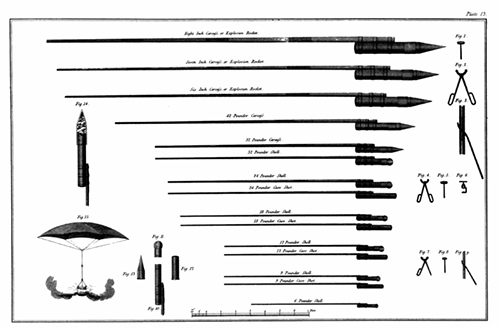
Tipu Sultan organised his Rocket artillery brigades known as Cushoons, Tipu Sultan expanded the number of servicemen in the various Cushoons from 1500 to almost 5000. The Mysorean rockets utilised by Tipu Sultan, were later updated by the British and successively employed during the Napoleonic Wars.
Dr APJ Abdul Kalam, the former President of India, in his Tipu Sultan Shaheed Memorial Lecture in Bangalore (30 November 1991), called Tipu Sultan the innovator of the world's first war rocket. Two of these rockets, captured by the British at Srirangapatna, were displayed in the Royal Artillery Museum in London. According to historian Dr Dulari Qureshi Tipu Sultan was a fierce warrior king and was so quick in his movement that it seemed to the enemy that he was fighting on many fronts at the same time.[49] Tipu managed to subdue all the petty kingdoms in the south. He was also one of the few Indian rulers to have defeated British armies.
Tipu Sultan's father had expanded on Mysore's use of rocketry, making critical innovations in the rockets themselves and the military logistics of their use. He deployed as many as 1,200 specialised troops in his army to operate rocket launchers. These men were skilled in operating the weapons and were trained to launch their rockets at an angle calculated from the diameter of the cylinder and the distance to the target. The rockets had twin side sharpened blades mounted on them, and when fired en masse, spun and wreaked significant damage against a large army. Tipu greatly expanded the use of rockets after Hyder's death, deploying as many as 5,000 rocketeers at a time.[58] The rockets deployed by Tipu during the Battle of Pollilur were much more advanced than those the British East India Company had previously seen, chiefly because of the use of iron tubes for holding the propellant; this enabled higher thrust and longer range for the missiles (up to 2 km range).[58][11]
British accounts describe the use of the rockets during the third and fourth wars.[59] During the climactic battle at Srirangapatna in 1799, British shells struck a magazine containing rockets, causing it to explode and send a towering cloud of black smoke with cascades of exploding white light rising up from the battlements. After Tipu's defeat in the fourth war the British captured a number of the Mysorean rockets. These became influential in British rocket development, inspiring the Congreve rocket, which was soon put into use in the Napoleonic Wars.[11]
Navy
In 1786 Tipu Sultan, again following the lead of his father, decided to build a navy consisting of 20 battleships of 72 cannons and 20 frigates of 65 cannons. In the year 1790 he appointed Kamaluddin as his Mir Bahar and established massive dockyards at Jamalabad and Majidabad. Tipu Sultan's board of admiralty consisted of 11 commanders in service of a Mir Yam. A Mir Yam led 30 admirals and each one of them had two ships. Tipu Sultan ordered that the ships have copper-bottoms, an idea that increased the longevity of the ships and was introduced to Tipu by Admiral Suffren.[60]
Army
Due to their perpetual battle engagements, Haidar and Tipu required a disciplined standing army. Thus, Rajputs, Muslims and able tribal men were enrolled for full time service replacing the local militia called the Kandachar[61] force of agricultural origin which existed in the Mysore army earlier. The removal of the Vokkaligas from the local militia which had taken part in wars for centuries and the imposition of higher taxes on them in place of their quit rent led indirectly to the implementation of Ryotwari system. Now the Ryots could not rely upon slaves for their agricultural activities since their slaves were enrolled in the army in some places. Besides paying higher taxes they had to endure the additional responsibility of feeding the slaves and financing their marriages. This led to the weakening of the system of slavery in Mysore.[62]
Economy
Main article: Economy of the Kingdom of Mysore
Further information: Mysore silk and Economic history of India
The peak of Mysore's economic power was under Tipu Sultan in the late 18th century. Along with his father Hyder Ali, he embarked on an ambitious program of economic development, aiming to increase the wealth and revenue of Mysore.[63] Under his reign, Mysore overtook Bengal Subah as India's dominant economic power, with highly productive agriculture and textile manufacturing.[64] Mysore's average income was five times higher than subsistence level at the time.[65]
Tipu Sultan laid the foundation for the construction of the Kannambadi dam (present-day Krishna Raja Sagara or KRS dam) on the Kaveri river, as attested by an extant stone plaque bearing his name, but was unable to begin the construction.[66][67] The dam was later built and opened in 1938. It is a major source of drinking water for the people of Mysore and Bangalore.
The Mysore silk industry was first initiated during the reign of Tipu Sultan.[68] He sent an expert to Bengal Subah to study silk cultivation and processing, after which Mysore began developing polyvoltine silk.[15]
The greater prominence of the Channapatna toys can be traced to patronage from Tipu Sultan, the historic ruler of Mysore, though these toys existed before this period historically given as gifts as part of Dusshera celebrations. It is known that he was an ardent admirer of arts, and in particular of woodwork.[69][16]
Road development
Tipu Sultan was considered as pioneer of road construction, especially in Malabar, as part of his campaigns, he connected most of the cities by roads.[70]
Foreign relations
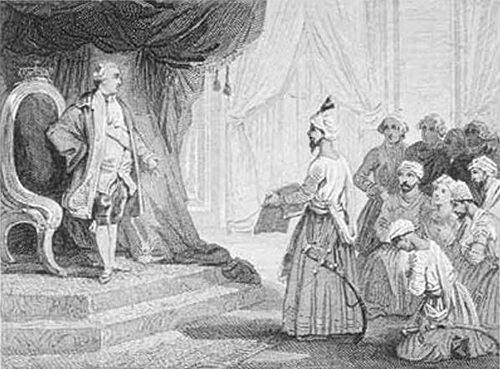
Louis XVI receives the ambassadors of Tipu Sultan in 1788. Tipu Sultan is known to have sent many diplomatic missions to France, the Ottoman Empire, Sultanate of Oman, Zand dynasty and Durrani Empire.[71]
Mughal Empire
Both Hyder Ali and Tipu Sultan owed nominal allegiance to the Mughal Emperor Shah Alam II; both were described as Nabobs by the British East India Company in all existing treaties. But unlike the Nawab of Carnatic, they did not acknowledge the overlordship of the Nizam of Hyderabad.[72]
Immediately after his coronation as Badshah, Tipu Sultan sought the investiture of the Mughal emperor. He earned the title "Nasib-ud-Daula" with the heavy heart of those loyal to Shah Alam II. Tipu was a selfdeclared "Sultan" this fact drew towards him the hostility of Nizam Ali Khan, the Nizam of Hyderabad, who clearly expressed his hostility by dissuading the Mughal emperor and laying claims on Mysore. Disheartened, Tipu Sultan began to establish contacts with other Muslim rulers of that period.[73]
Tipu Sultan was the master of his own diplomacy with foreign nations, in his quest to rid India of the East India Company and to ensure the international strength of France. Like his father before him he fought battles on behalf of foreign nations which were not in the best interests of Shah Alam II.
After Ghulam Qadir had Shah Alam II blinded on 10 August 1788, Tipu Sultan is believed to have broken into tears.[74][page needed]
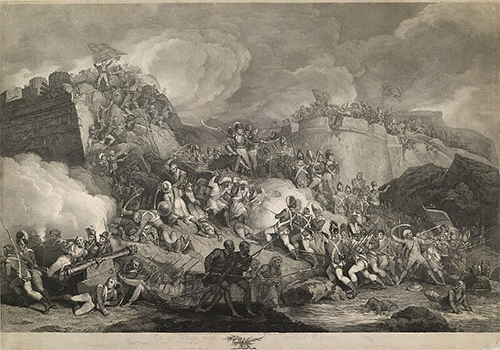
Tipu Sultan's forces during the Siege of Srirangapatna.
After the Fall of Seringapatam in 1799, the blind emperor did remorse for Tipu, but maintained his confidence in the Nizam of Hyderabad, who had now made peace with the British.
Afghanistan
After facing substantial threats from the Marathas, Tipu Sultan began to correspond with Zaman Shah Durrani, the ruler of the Afghan Durrani Empire, so they could defeat the British and Marathas. Initially, Zaman Shah agreed to help Tipu, but the Persian attack on Afghanistan's Western border diverted its forces, and hence no help could be provided to Tipu.
Ottoman Empire
In 1787, Tipu Sultan sent an embassy to the Ottoman capital Constantinople, to the Ottoman Sultan Abdul Hamid I requesting urgent assistance against the British East India Company. Tipu Sultan requested the Ottoman Sultan to send him troops and military experts. Furthermore, Tipu Sultan also requested permission from the Ottomans to contribute to the maintenance of the Islamic shrines in Mecca, Medina, Najaf and Karbala.
However, the Ottomans were themselves in crisis and still recuperating from the devastating Austro-Ottoman War and a new conflict with the Russian Empire had begun, for which Ottoman Turkey needed British alliance to keep off the Russians, hence it could not risk being hostile to the British in the Indian theatre.
Due to the Ottoman inability to organise a fleet in the Indian Ocean, Tipu Sultan's ambassadors returned home only with gifts from their Ottoman brothers.
Nevertheless, Tipu Sultan's correspondence with the Ottoman Empire and particularly its new Sultan Selim III continued till his final battle in the year 1799.[73]
Persia and Oman
Like his father before him, Tipu Sultan maintained friendly relations with Mohammad Ali Khan, ruler of the Zand dynasty in Persia. Tipu Sultan also maintained correspondence with Hamad bin Said, the ruler of the Sultanate of Oman.[75]
Qing China
Tipu's and Mysore's tryst with silk began in the early 1780s when he received an ambassador from the Qing dynasty-ruled China at his court. The ambassador presented him with a silk cloth. Tipu was said to be enchanted by the item to such an extent that he resolved to introduce its production in his kingdom. He sent a return journey to China, which returned after twelve years.[76]
France
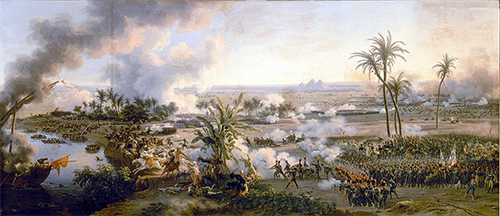
In his attempts to junction with Tipu Sultan, Napoleon annexed Ottoman Egypt in the year 1798.
Both Hyder Ali and Tipu sought an alliance with the French, the only European power still strong enough to challenge the British East India Company in the subcontinent. In 1782, Louis XVI concluded an alliance with the Peshwa Madhu Rao Narayan. This treaty enabled Bussy to move his troops to the Isle de France (now Mauritius). In the same year, French Admiral De Suffren ceremonially presented a portrait of Louis XVI to Haidar Ali and sought his alliance.[77]
Napoleon conquered Egypt in an attempt to link with Tipu Sultan.[citation needed] In February 1798, Napoleon wrote a letter to Tipu Sultan appreciating his efforts of resisting the British annexation and plans, but this letter never reached Tipu and was seized by a British spy in Muscat. The idea of a possible Tipu-Napoleon alliance alarmed the British Governor, General Sir Richard Wellesley (also known as Lord Wellesley), so much that he immediately started large scale preparations for a final battle against Tipu Sultan.
Social system
Judicial system
Tipu Sultan appointed judges from both communities for Hindu and Muslim subjects. Qadi for Muslims and Pandit for Hindus in each province. Upper courts also had similar systems.[78]
Moral Administration
Usage of liquor and prostitution were strictly prohibited in his administration.[79] Usage and agriculture of psychedelics, such as Cannabis, was also prohibited.[80]
Polyandry in Kerala was prohibited by Tipu Sultan. He passed a decree for all women to cover their breasts, which was not practised in Kerala in the previous era.[81][82]
Religious policy
On a personal level, Tipu was a devout Muslim, saying his prayers daily and paying special attention to mosques in the area.[83] Regular endowments were made during this period to about 156 Hindu temples,[84] including the famed Ranganathaswami Temple at Srirangapatna.[85] Many sources mention the appointment of Hindu officers in Tipu's administration[86] and his land grants and endowments to Hindu temples,[87][88][89] which are cited as evidence for his religious tolerance.
His religious legacy has become a source of considerable controversy in India, with some groups (including Christians[90] and even Muslims) proclaiming him a great warrior for the faith or Ghazi[91][92] for both religious and political reasons.[85] Various sources describe the massacres,[93] imprisonment[94] and forced conversion[95] of Hindus (Kodavas of Coorg, Nairs of Malabar) and Christians (Catholics of Mangalore), the destruction of churches[96] and temples, and the clamping down on Muslims (Mappila of Kerala, the Mahdavia Muslims, the rulers of Savanur and the people of Hyderabad State), which are sometimes cited as evidence for his intolerance.
British accounts
Historians such as Brittlebank, Hasan, Chetty, Habib, and Saletare, amongst others, argue that controversial stories of Tipu Sultan's religious persecution of Hindus and Christians are largely derived from the work of early British authors (who were very much against Tipu Sultan's independence and harboured prejudice against the Sultan) such as James Kirkpatrick[97] and Mark Wilks,[98] whom they do not consider to be entirely reliable and likely fabricated.[99] A. S. Chetty argues that Wilks' account in particular cannot be trusted.[100]
Irfan Habib and Mohibbul Hasan argue that these early British authors had a strong vested interest in presenting Tipu Sultan as a tyrant from whom the British had liberated Mysore.[99][101] This assessment is echoed by Brittlebank in her recent work where she writes that Wilks and Kirkpatrick must be used with particular care as both authors had taken part in the wars against Tipu Sultan and were closely connected to the administrations of Lord Cornwallis and Richard Wellesley, 1st Marquess Wellesley.[102]
Relations with Hindus
Tipu Sultan's treasurer was Krishna Rao, Shamaiya Iyengar was his Minister of Post and Police, his brother Ranga Iyengar was also an officer, and Purnaiya held the very important post of "Mir Asaf". Moolchand and Sujan Rai were his chief agents at the Mughal court, and his chief "Peshkar", Suba Rao, was also a Hindu.[86]
The Editor of Mysore Gazette reports of correspondence between his court and temples, and his having donated jewellery and deeded land grants to several temples, which he was compelled to for forming alliances with Hindu rulers. Between 1782 and 1799 Tipu Sultan issued 34 "Sanads" (deeds) of endowment to temples in his domain, while also presenting many of them with gifts of silver and gold plate.[89]
The Srikanteswara Temple in Nanjangud still possesses a jeweled cup presented by the Sultan.[88] He also gave a greenish linga; to Ranganatha temple at Srirangapatna, he donated seven silver cups and a silver camphor burner. This temple was hardly a stone's throw from his palace from where he would listen with equal respect to the ringing of temple bells and the muezzin's call from the mosque; to the Lakshmikanta Temple at Kalale he gifted four cups, a plate and Spitoon in silver.[87][89]
During the Maratha–Mysore War in 1791, a group of Maratha horsemen under Raghunath Rao Patwardhan raided the temple and matha of Sringeri Shankaracharya. They wounded and killed many people, including Brahmins, plundered the monastery of all its valuable possessions, and desecrated the temple by displacing the image of goddess Sarada.[86]
The incumbent Shankaracharya petitioned Tipu Sultan for help. About 30 letters written in Kannada, which were exchanged between Tipu Sultan's court and the Sringeri Shankaracharya, were discovered in 1916 by the Director of Archaeology in Mysore. Tipu Sultan expressed his indignation and grief at the news of the raid:[86][103]
He immediately ordered the Asaf of Bednur to supply the Swami with 200 rahatis (fanams) in cash and other gifts and articles. Tipu Sultan's interest in the Sringeri temple continued for many years, and he was still writing to the Swami in the 1790s.[105]
In light of this and other events, historian B. A. Saletare has described Tipu Sultan as a defender of the Hindu dharma, who also patronised other temples including one at Melkote, for which he issued a Kannada decree that the Shrivaishnava invocatory verses there should be recited in the traditional form.[106] The temple at Melkote still has gold and silver vessels with inscriptions indicating that they were presented by the Sultan. Tipu Sultan also presented four silver cups to the Lakshmikanta Temple at Kalale.[106] Tipu Sultan does seem to have repossessed unauthorised grants of land made to Brahmins and temples, but those which had proper sanads (certificates) were not. It was a normal practice for any ruler, Muslim or Hindu, on his accession or on the conquest of new territory.
Persecution of Kodavas outside Mysore
Main article: Captivity of Kodavas at Seringapatam
Tipu got Runmust Khan, the Nawab of Kurnool, to launch a surprise attack upon the Kodavas who were besieged by the invading Muslim army. 500 were killed and over 40,000 Kodavas fled to the woods and concealed themselves in the mountains.[107] Thousands of Kodavas were seized along with the Raja and held captive at Seringapatam.[95]
Mohibbul Hasan, Prof. Sheikh Ali, and other historians cast great doubt on the scale of the deportations and forced conversions in Coorg in particular. Hassan says that it is difficult to estimate the real number of Kodava captured by Tipu.[108]
In a letter to Runmust Khan, Tipu himself stated:[109]
Tipu Sultan [Tippoo Sultan]
by Wikipedia
Accessed 10/2/24
https://en.wikipedia.org/wiki/Tipu_Sultan
The earliest book printed in Bombay which is at present available is one published in 1793 under the following title: "Remarks and Occurrences of Mr. Henry Becher, during his imprisonment of two years and a half in the Dominions of Tippoo Sultan, from whence he made his escape." 5 [A copy of this book is available in the Heras Institute of Indian History and Culture, Bombay.] This book does not bear the name of the press where it was printed. It is clearly stated in the introduction of this book that "It is the first book ever printed in Bombay."1793 The Times 24 August
“We learn, that not withstanding Tippoo’s repeated declarations that he had no more English prisoners in his possession, it is evident that all those declarations have been insincere. Mr Becher, who some years ago was proceeding in a Pattamar boat, with stores for Mr. Rivitt’s ship at Cochin, was unfortunately driven on shore near Mangalore, and taken prisoner: after undergoing a long and painful imprisonment, and being marched from fort to fort, has at last effected his escape from Seringapatam. Latterly his confinement was not so strict as formerly, and he was sometimes permitted to go a shooting, under the guard of a sepoy, - One day having strolled a comfortable distance from the fort, he turned upon the sepoy & threatened to shoot him, if he did not accompany him – the sepoy was obliged to comply, and they are both now safely arrived at Tellicherry. Mr. Becher reports there are several prisoners at Seringapatram.”
-- https://freepages.rootsweb.com/~becher/ ... papers.htm
Tipu Sultan
Badshah
Nasib-ud-Daulah
Mir Fateh Ali Bahadur Tipu
Portrait of Tipu Sultan, from Mysore (c. 1790–1800).
Sultan of Mysore
Reign: 10 December 1782 – 4 May 1799
Coronation: 29 December 1782
Predecessor: Hyder Ali
Successor: Krishnaraja III (as Maharaja of Mysore)
Born: Sultan Fateh Ali Sahab Tipu, 1 December 1751, Devanahalli, Kingdom of Mysore (present-day Karnataka, India)
Died: 4 May 1799 (aged 47)
Burial: Srirangapatna, present-day Mandya, Karnataka
Spouse: Sultan Begum Sahib (m. 1774); Ruqaya Banu Begum (m. 1774); Khadija Zaman Begum (m. 1796; died 1797);
Buranti Begum; Roshani Begum
Issue: Shezada Hyder Ali, Ghulam Muhammad Sultan Sahib and many others
Names: Badshah Nasib-ud-Daulah Sultan Mir Fateh Ali Bahadur Saheb Tipu
House: Mysore
Father: Hyder Ali
Mother: Fatima Fakhr-un-Nisa
Religion: Sunni Islam[1][2][3][4]
Seal:
Military career
Service/branch: Mysore Army
Rank: Sultan
Battles/wars:
Second Anglo-Mysore War
Battle of Annagudi
Maratha-Mysore War
Battle of Moti Talab
Siege of Nargund
Siege of Adoni
Battle of Savanur
Siege of Bahadur Benda
Mysorean invasion of Malabar
Siege of Bednore
Battle of Nedumkotta
Third Anglo-Mysore War
Fourth Anglo-Mysore War
Siege of Seringapatam (1799) †
Tipu Sultan (Sultan Fateh Ali Sahab Tipu; 1 December 1751 – 4 May 1799), commonly referred to as Sher-e-Mysore or "Tiger of Mysore",[5][6] was an Indian ruler of the Kingdom of Mysore based in South India.[7] He was a pioneer of rocket artillery.[8][9][10] He expanded the iron-cased Mysorean rockets and commissioned the military manual Fathul Mujahidin. He deployed the rockets against advances of British forces and their allies during the Anglo-Mysore Wars, including the Battle of Pollilur and Siege of Srirangapatna.[11]
Tipu Sultan and his father Hyder Ali used their French-trained army in alliance with the French in their struggle with the British,[12] and in Mysore's struggles with other surrounding powers: against the Marathas, Sira, and rulers of Malabar, Kodagu, Bednore, Carnatic, and Travancore. Tipu became the ruler of Mysore upon his father's death from cancer in 1782 during the Second Anglo-Mysore War. He negotiated with the British in 1784 with the Treaty of Mangalore which ended the war in status quo ante bellum.
Tipu's conflicts with his neighbours included the Maratha–Mysore War, which ended with the signing of the Treaty of Gajendragad.[13]
Tipu remained an enemy of the British East India Company. He initiated an attack on British-allied Travancore in 1789. In the Third Anglo-Mysore War, he was forced into the Treaty of Seringapatam, losing a number of previously conquered territories, including Malabar and Mangalore. In the Fourth Anglo-Mysore War, a combined force of British East India Company troops supported by the Marathas and the Nizam of Hyderabad defeated Tipu. He was killed on 4 May 1799 while defending his stronghold of Seringapatam.
Tipu also introduced administrative innovations during his rule, including a new coinage system and calendar,[14] and a new land revenue system, which initiated the growth of the Mysore silk industry.[15] He is known for his patronage to Channapatna toys.[16]
Early years
Tipu's birthplace, Devanahalli.
Childhood
Tipu Sultan was born in Devanahalli, in present-day Bangalore Rural district, about 33 km (21 mi) north of Bangalore on 1 December 1751.[17][18] He was named "Tipu Sultan" after the saint Tipu Mastan Aulia of Arcot. Being illiterate, Hyder was very particular in giving his eldest son a prince's education and a very early exposure to military and political affairs. At age of 17 onwards Tipu was given charge of diplomatic and military missions and supported his father Hyder in his wars.[19]
Tipu's father, Hyder Ali, was a military officer in service to the Kingdom of Mysore who had become the de facto ruler of Mysore in 1761 while his mother Fatima Fakhr-un-Nisa was the daughter of Mir Muin-ud-Din, the governor of the fort of Kadapa. Hyder Ali appointed able teachers to give Tipu an early education in subjects like Urdu, Persian, Arabic, Kannada, beary, Quran, Islamic jurisprudence, riding, shooting and fencing.[17][20][21][22]
Language
Tipu Sultan's mother tongue was Urdu. The French noted that "Their language is Moorish[Urdu] but they also speak Persian."[23] Moors at the time was a European designation for Urdu: "I have a deep knowledge [je possède à fond] of the common tongue of India, called Moors by the English, and Ourdouzebain by the natives of the land."[24]
Early military service
War coat used by Tipu Sultan of Mysore.c. 1785-1790
A flintlock blunderbuss, built for Tipu Sultan in Srirangapatna, 1793–94. Tipu Sultan used many Western craftsmen, and this gun reflects the most up-to-date technologies of the time.[25]
Early Conflicts
Tipu Sultan was instructed in military tactics by French officers in the employment of his father. At age 15, he accompanied his father against the British in the First Mysore War in 1766. He commanded a corps of cavalry in the invasion of Carnatic in 1767 at age 16. He also took part in the First Anglo-Maratha War of 1775–1779.[26]
Alexander Beatson, who published a volume on the Fourth Mysore War entitled View of the Origin and Conduct of the War with Tippoo Sultaun, described Tipu Sultan as follows: "His stature was about five feet eight inches; he had a short neck, square shoulders, and was rather corpulent: his limbs were small, particularly his feet and hands; he had large full eyes, small arched eyebrows, and an aquiline nose; his complexion was fair, and the general expression of his countenance, not void of dignity".[27]
Second Anglo-Mysore War
Main articles: Second Anglo-Mysore War and Battle of Annagudi
Mural of the Battle of Pollilur on the walls of Tipu's summer palace, painted to celebrate his triumph over the British
Very small Cannon used by Tipu Sultan's forces now in Government Museum (Egmore), Chennai
In 1779, the British captured the French-controlled port of Mahé which Tipu had placed under his protection, providing some troops for its defence. In response, Hyder launched an invasion of the Carnatic, with the aim of driving the British out of Madras.[28] During this campaign in September 1780, Tipu Sultan was dispatched by Hyder Ali with 10,000 men and 18 guns to intercept Colonel William Baillie who was on his way to join Sir Hector Munro. In the Battle of Pollilur, Tipu defeated Baillie. Out of 360 Europeans, about 200 were captured alive, and the sepoys, who were about 3800 men, suffered very high casualties. Munro was moving south with a separate force to join Baillie, but on hearing the news of the defeat he retreated to Madras, abandoning his artillery in a water tank at Kanchipuram.[29]
Tipu Sultan defeated Colonel Braithwaite at Annagudi near Tanjore on 18 February 1782. Braithwaite's forces, consisting of 100 Europeans, 300 cavalry, 1400 sepoys and 10 field pieces, was the standard size of the colonial armies. Tipu Sultan seized all guns and took the detachment prisoner. In December 1781 Tipu Sultan seized Chittur from the British. Tipu Sultan had gained sufficient military experience by the time Hyder Ali died on Friday, 6 December 1782. Some historians put Hyder Ali's death at 2 or 3 days later or before due to the Hijri date being 1 Muharram, 1197 as per some records in Persian (which can result in a difference of 1 to 3 days due to the Lunar Calendar). He became the ruler of Mysore on Sunday, 22 December 1782 (the inscriptions in some of Tipu's regalia show it as 20 Muharram, 1197 Hijri Sunday) in a simple coronation ceremony. He subsequently worked on to check the advances of the British by making alliances with the Marathas and the Mughals. The Second Mysore War came to an end with the 1784 Treaty of Mangalore.[clarification needed][30]
Ruler of Mysore
On 29 December 1782, Tipu Sultan crowned himself Badshah or Emperor of Mysore with the title Nawab Tipu Sultan Bahadur at age 32, and struck coinage.[31]
Conflicts with Maratha Confederacy
See also: Battles involving the Maratha Empire § Conflict with the Kingdom of Mysore
Tipu Sultan seated on his throne (1800), by Anna Tonelli
Tipu Sultan's Summer Palace at Srirangapatna, Karnataka
The Maratha Empire under its new Peshwa Madhavrao I regained most of Indian subcontinent, twice defeating Tipu's father in 1764 and then in 1767. In 1767 Maratha Peshwa Madhavrao defeated both Hyder Ali and Tipu Sultan and entered Srirangapatna, the capital of Mysore. Hyder Ali accepted the authority of Madhavrao who gave him the title of Nawab of Mysore.[32]
Subsequently, to escape the treaty, Tipu tried to take some Maratha forts in Southern India captured by in the previous war and also stopped the tribute to Marathas which was promised by Hyder Ali.[33] This brought Tipu in direct conflict with the Marathas, leading to Maratha–Mysore War[33] Conflicts between Mysore (under Tipu) and Marathas:
• Siege of Nargund during February 1785 won by Mysore
• Siege of Badami during May 1786 in which Mysore surrendered
• Siege of Adoni during June 1786 won by Mysore
• Battle of Gajendragad, June 1786 won by Marathas
• Battle of Savanur during October 1786 won by Mysore
• Siege of Bahadur Benda during January 1787 won by Mysore
Conflict ended with Treaty of Gajendragad in March 1787, as per which Tipu returned all the territory captured by Hyder Ali to Maratha Empire.[33][34] Tipu would elease Kalopant and return Adoni, Kittur, and Nargund to their previous rulers. Badami would be ceded to the Marathas and Tipu would also pay an annual tribute totaling 12 lakhs for an agreed period of 4 years to the Marathas. In return, Tipu Sultan would get all the region that he had captured during the war. This included Gajendragarh and Dharwar.[35][36] The Marathas in return agreed to recognize his authority and to address Tipu sultan as "Nabob Tipu Sultan Futteh Ally Khan".[36] However the Marathas ultimately reneged on the treaty and in the Fourth Anglo-Mysore War the Marathas presented their support to the British East India Company which helped the British to take over Mysore in 1799.[37][page needed][38]
The Invasion of Malabar (1766–1790)
Main article: Mysorean invasion of Malabar
Tipu Sultan at the lines of Travancore.
In 1766 when he was 15 years old Tipu accompanied his father on an invasion of Malabar. After the incident- Siege of Tellicherry in Thalassery in North Malabar,[39] Hyder Ali started losing his territories in Malabar. Tipu came from Mysore to reinstate the authority over Malabar. After the Battle of the Nedumkotta (1789–90), due to the monsoon flood, the stiff resistance of the Travancore forces and news about the attack of British in Srirangapatnam he went back.[40]
Third Anglo-Mysore War
Main article: Third Anglo-Mysore War
Cannon used by Tipu Sultan's forces at the battle of Srirangapatna 1799
General Lord Cornwallis, receiving two of Tipu Sultan's sons as hostages in the year 1793.
In 1789, Tipu Sultan disputed the acquisition by Dharma Raja of Travancore of two Dutch-held fortresses in Cochin. In December 1789 he massed troops at Coimbatore, and on 28 December made an attack on the lines of Travancore, knowing that Travancore was (according to the Treaty of Mangalore) an ally of the British East India Company.[41] On account of the staunch resistance by the Travancore army, Tipu was unable to break through the Tranvancore lines and the Maharajah of Travancore appealed to the East India Company for help. In response, Lord Cornwallis mobilised company and British military forces, and formed alliances with the Marathas and the Nizam of Hyderabad to oppose Tipu. In 1790 the company forces advanced, taking control of much of the Coimbatore district.[41] Tipu counter-attacked, regaining much of the territory, although the British continued to hold Coimbatore itself. He then descended into the Carnatic, eventually reaching Pondicherry, where he attempted without success to draw the French into the conflict.[41]
In 1791 his opponents advanced on all fronts, with the main British force under Cornwallis taking Bangalore and threatening Srirangapatna. Tipu harassed the British supply and communication and embarked on a "scorched earth" policy of denying local resources to the British.[41] In this last effort he was successful, as the lack of provisions forced Cornwallis to withdraw to Bangalore rather than attempt a siege of Srirangapatna. Following the withdrawal, Tipu sent forces to Coimbatore, which they retook after a lengthy siege.[41]
The 1792 campaign was a failure for Tipu. The allied army was well-supplied, and Tipu was unable to prevent the junction of forces from Bangalore and Bombay before Srirangapatna.[41] After about two weeks of siege, Tipu opened negotiations for terms of surrender. In the ensuing treaty, he was forced to cede half his territories to the allies,[26] and deliver two of his sons as hostages until he paid in full three crores and thirty lakhs rupees fixed as war indemnity to the British for the campaign against him. He paid the amount in two instalments and got back his sons from Madras.[41]
Napoleon's attempt at a junction
Main article: Franco-Indian alliances
In 1794, with the support of French Republican officers, Tipu allegedly helped found the Jacobin Club of Mysore for 'framing laws comfortable with the laws of the Republic'. He planted a Liberty Tree and declared himself Citizen Tipoo.[42] In a 2005 paper, historian Jean Boutier argued that the club's existence, and Tipu's involvement in it, was fabricated by the East India Company in order to justify British military intervention against Tipu.[43]
One of the motivations of Napoleon's invasion of Egypt was to establish a junction with India against the British. Bonaparte wished to establish a French presence in the Middle East, with the ultimate dream of linking with Tippoo Sahib.[44] Napoleon assured the French Directory that "as soon as he had conquered Egypt, he will establish relations with the Indian princes and, together with them, attack the English in their possessions."[45] According to a 13 February 1798 report by Talleyrand: "Having occupied and fortified Egypt, we shall send a force of 15,000 men from Suez to India, to join the forces of Tipu-Sahib and drive away the English."[45] Napoleon was unsuccessful in this strategy, losing the Siege of Acre in 1799 and at the Battle of Abukir in 1801.[46]
Although I never supposed that he (Napoleon) possessed, allowing for some difference of education, the liberality of conduct and political views which were sometimes exhibited by old Hyder Ali, yet I did think he might have shown the same resolved and dogged spirit of resolution which induced Tipu Sahib to die manfully upon the breach of his capital city with his sabre clenched in his hand.
— Sir Walter Scott, commenting on the abdication of Napoleon Bonaparte in 1814
Death
Further information: Fourth Anglo-Mysore War
Tipu Sultan confronts his opponents during the Siege of Srirangapatna.
Horatio Nelson defeated François-Paul Brueys D'Aigalliers at the Battle of the Nile in Egypt in 1798. Three armies marched into Mysore in 1799—one from Bombay and two British, one of which included Arthur Wellesley.[47] They besieged the capital Srirangapatna in the Fourth Mysore War.[48] There were more than 60,000 soldiers of the British East India Company, approximately 4,000 Europeans and the rest Indians; while Tipu Sultan's forces numbered only around 30,000. The betrayal by Tipu Sultan's ministers in working with the British and weakening the walls to make an easy path for the British.[49][50] The death of Tipu Sultan led British General Harris to exclaim "Now India is ours."[37][page needed]
When the British broke through the city walls, French military advisers told Tipu Sultan[51] to escape via secret passages and to fight the rest of the wars from other forts, but he refused.[52] Tipu famously said "Better to live one day as a tiger than a thousand years as a sheep".[53]
The Last Effort and Fall of Tipu Sultan by Henry Singleton, c. 1800
Tipu Sultan was killed at the Hoally (Diddy) Gateway, which was located 300 yards (270 m) from the N.E. Angle of the Srirangapatna Fort.[54] He was buried the next afternoon at the Gumaz, next to the grave of his father. Many members of the British East India Company believed that Nawab of Carnatic Umdat Ul-Umra secretly provided assistance to Tipu Sultan during the war and sought his deposition after 1799.[citation needed] These five men include Mir Sadiq, Purnaiya, two military commanders Saiyed Saheb and Qamaruddin, and Mir Nadim, commandant of the fort of Seringapatam. The episode of treachery as narrated by Hasan starts with the disobedience of Tipu's instructions.[55] When he died there were jubilant celebrations in Britain, with authors, playwrights and painters creating works to celebrate it.[56] The death of Tipu Sultan was celebrated with declaration of public holiday in Britain.[57]
Administration
Tipu introduced a new calendar, new coinage, and seven new government departments, during his reign, and made military innovations in the use of rocketry.
Mysorean rockets
Main article: Mysorean rockets
A soldier from Tipu Sultan's army, using his rocket as a flagstaff.
Tipu Sultan organised his Rocket artillery brigades known as Cushoons, Tipu Sultan expanded the number of servicemen in the various Cushoons from 1500 to almost 5000. The Mysorean rockets utilised by Tipu Sultan, were later updated by the British and successively employed during the Napoleonic Wars.
Dr APJ Abdul Kalam, the former President of India, in his Tipu Sultan Shaheed Memorial Lecture in Bangalore (30 November 1991), called Tipu Sultan the innovator of the world's first war rocket. Two of these rockets, captured by the British at Srirangapatna, were displayed in the Royal Artillery Museum in London. According to historian Dr Dulari Qureshi Tipu Sultan was a fierce warrior king and was so quick in his movement that it seemed to the enemy that he was fighting on many fronts at the same time.[49] Tipu managed to subdue all the petty kingdoms in the south. He was also one of the few Indian rulers to have defeated British armies.
Tipu Sultan's father had expanded on Mysore's use of rocketry, making critical innovations in the rockets themselves and the military logistics of their use. He deployed as many as 1,200 specialised troops in his army to operate rocket launchers. These men were skilled in operating the weapons and were trained to launch their rockets at an angle calculated from the diameter of the cylinder and the distance to the target. The rockets had twin side sharpened blades mounted on them, and when fired en masse, spun and wreaked significant damage against a large army. Tipu greatly expanded the use of rockets after Hyder's death, deploying as many as 5,000 rocketeers at a time.[58] The rockets deployed by Tipu during the Battle of Pollilur were much more advanced than those the British East India Company had previously seen, chiefly because of the use of iron tubes for holding the propellant; this enabled higher thrust and longer range for the missiles (up to 2 km range).[58][11]
British accounts describe the use of the rockets during the third and fourth wars.[59] During the climactic battle at Srirangapatna in 1799, British shells struck a magazine containing rockets, causing it to explode and send a towering cloud of black smoke with cascades of exploding white light rising up from the battlements. After Tipu's defeat in the fourth war the British captured a number of the Mysorean rockets. These became influential in British rocket development, inspiring the Congreve rocket, which was soon put into use in the Napoleonic Wars.[11]
Navy
In 1786 Tipu Sultan, again following the lead of his father, decided to build a navy consisting of 20 battleships of 72 cannons and 20 frigates of 65 cannons. In the year 1790 he appointed Kamaluddin as his Mir Bahar and established massive dockyards at Jamalabad and Majidabad. Tipu Sultan's board of admiralty consisted of 11 commanders in service of a Mir Yam. A Mir Yam led 30 admirals and each one of them had two ships. Tipu Sultan ordered that the ships have copper-bottoms, an idea that increased the longevity of the ships and was introduced to Tipu by Admiral Suffren.[60]
Army
Due to their perpetual battle engagements, Haidar and Tipu required a disciplined standing army. Thus, Rajputs, Muslims and able tribal men were enrolled for full time service replacing the local militia called the Kandachar[61] force of agricultural origin which existed in the Mysore army earlier. The removal of the Vokkaligas from the local militia which had taken part in wars for centuries and the imposition of higher taxes on them in place of their quit rent led indirectly to the implementation of Ryotwari system. Now the Ryots could not rely upon slaves for their agricultural activities since their slaves were enrolled in the army in some places. Besides paying higher taxes they had to endure the additional responsibility of feeding the slaves and financing their marriages. This led to the weakening of the system of slavery in Mysore.[62]
Economy
Main article: Economy of the Kingdom of Mysore
Further information: Mysore silk and Economic history of India
The peak of Mysore's economic power was under Tipu Sultan in the late 18th century. Along with his father Hyder Ali, he embarked on an ambitious program of economic development, aiming to increase the wealth and revenue of Mysore.[63] Under his reign, Mysore overtook Bengal Subah as India's dominant economic power, with highly productive agriculture and textile manufacturing.[64] Mysore's average income was five times higher than subsistence level at the time.[65]
Tipu Sultan laid the foundation for the construction of the Kannambadi dam (present-day Krishna Raja Sagara or KRS dam) on the Kaveri river, as attested by an extant stone plaque bearing his name, but was unable to begin the construction.[66][67] The dam was later built and opened in 1938. It is a major source of drinking water for the people of Mysore and Bangalore.
The Mysore silk industry was first initiated during the reign of Tipu Sultan.[68] He sent an expert to Bengal Subah to study silk cultivation and processing, after which Mysore began developing polyvoltine silk.[15]
The greater prominence of the Channapatna toys can be traced to patronage from Tipu Sultan, the historic ruler of Mysore, though these toys existed before this period historically given as gifts as part of Dusshera celebrations. It is known that he was an ardent admirer of arts, and in particular of woodwork.[69][16]
Road development
Tipu Sultan was considered as pioneer of road construction, especially in Malabar, as part of his campaigns, he connected most of the cities by roads.[70]
Foreign relations
Louis XVI receives the ambassadors of Tipu Sultan in 1788. Tipu Sultan is known to have sent many diplomatic missions to France, the Ottoman Empire, Sultanate of Oman, Zand dynasty and Durrani Empire.[71]
Mughal Empire
Both Hyder Ali and Tipu Sultan owed nominal allegiance to the Mughal Emperor Shah Alam II; both were described as Nabobs by the British East India Company in all existing treaties. But unlike the Nawab of Carnatic, they did not acknowledge the overlordship of the Nizam of Hyderabad.[72]
Immediately after his coronation as Badshah, Tipu Sultan sought the investiture of the Mughal emperor. He earned the title "Nasib-ud-Daula" with the heavy heart of those loyal to Shah Alam II. Tipu was a selfdeclared "Sultan" this fact drew towards him the hostility of Nizam Ali Khan, the Nizam of Hyderabad, who clearly expressed his hostility by dissuading the Mughal emperor and laying claims on Mysore. Disheartened, Tipu Sultan began to establish contacts with other Muslim rulers of that period.[73]
Tipu Sultan was the master of his own diplomacy with foreign nations, in his quest to rid India of the East India Company and to ensure the international strength of France. Like his father before him he fought battles on behalf of foreign nations which were not in the best interests of Shah Alam II.
After Ghulam Qadir had Shah Alam II blinded on 10 August 1788, Tipu Sultan is believed to have broken into tears.[74][page needed]
Tipu Sultan's forces during the Siege of Srirangapatna.
After the Fall of Seringapatam in 1799, the blind emperor did remorse for Tipu, but maintained his confidence in the Nizam of Hyderabad, who had now made peace with the British.
Afghanistan
After facing substantial threats from the Marathas, Tipu Sultan began to correspond with Zaman Shah Durrani, the ruler of the Afghan Durrani Empire, so they could defeat the British and Marathas. Initially, Zaman Shah agreed to help Tipu, but the Persian attack on Afghanistan's Western border diverted its forces, and hence no help could be provided to Tipu.
Ottoman Empire
In 1787, Tipu Sultan sent an embassy to the Ottoman capital Constantinople, to the Ottoman Sultan Abdul Hamid I requesting urgent assistance against the British East India Company. Tipu Sultan requested the Ottoman Sultan to send him troops and military experts. Furthermore, Tipu Sultan also requested permission from the Ottomans to contribute to the maintenance of the Islamic shrines in Mecca, Medina, Najaf and Karbala.
However, the Ottomans were themselves in crisis and still recuperating from the devastating Austro-Ottoman War and a new conflict with the Russian Empire had begun, for which Ottoman Turkey needed British alliance to keep off the Russians, hence it could not risk being hostile to the British in the Indian theatre.
Due to the Ottoman inability to organise a fleet in the Indian Ocean, Tipu Sultan's ambassadors returned home only with gifts from their Ottoman brothers.
Nevertheless, Tipu Sultan's correspondence with the Ottoman Empire and particularly its new Sultan Selim III continued till his final battle in the year 1799.[73]
Persia and Oman
Like his father before him, Tipu Sultan maintained friendly relations with Mohammad Ali Khan, ruler of the Zand dynasty in Persia. Tipu Sultan also maintained correspondence with Hamad bin Said, the ruler of the Sultanate of Oman.[75]
Qing China
Tipu's and Mysore's tryst with silk began in the early 1780s when he received an ambassador from the Qing dynasty-ruled China at his court. The ambassador presented him with a silk cloth. Tipu was said to be enchanted by the item to such an extent that he resolved to introduce its production in his kingdom. He sent a return journey to China, which returned after twelve years.[76]
France
In his attempts to junction with Tipu Sultan, Napoleon annexed Ottoman Egypt in the year 1798.
Both Hyder Ali and Tipu sought an alliance with the French, the only European power still strong enough to challenge the British East India Company in the subcontinent. In 1782, Louis XVI concluded an alliance with the Peshwa Madhu Rao Narayan. This treaty enabled Bussy to move his troops to the Isle de France (now Mauritius). In the same year, French Admiral De Suffren ceremonially presented a portrait of Louis XVI to Haidar Ali and sought his alliance.[77]
Napoleon conquered Egypt in an attempt to link with Tipu Sultan.[citation needed] In February 1798, Napoleon wrote a letter to Tipu Sultan appreciating his efforts of resisting the British annexation and plans, but this letter never reached Tipu and was seized by a British spy in Muscat. The idea of a possible Tipu-Napoleon alliance alarmed the British Governor, General Sir Richard Wellesley (also known as Lord Wellesley), so much that he immediately started large scale preparations for a final battle against Tipu Sultan.
Social system
Judicial system
Tipu Sultan appointed judges from both communities for Hindu and Muslim subjects. Qadi for Muslims and Pandit for Hindus in each province. Upper courts also had similar systems.[78]
Moral Administration
Usage of liquor and prostitution were strictly prohibited in his administration.[79] Usage and agriculture of psychedelics, such as Cannabis, was also prohibited.[80]
Polyandry in Kerala was prohibited by Tipu Sultan. He passed a decree for all women to cover their breasts, which was not practised in Kerala in the previous era.[81][82]
Religious policy
On a personal level, Tipu was a devout Muslim, saying his prayers daily and paying special attention to mosques in the area.[83] Regular endowments were made during this period to about 156 Hindu temples,[84] including the famed Ranganathaswami Temple at Srirangapatna.[85] Many sources mention the appointment of Hindu officers in Tipu's administration[86] and his land grants and endowments to Hindu temples,[87][88][89] which are cited as evidence for his religious tolerance.
His religious legacy has become a source of considerable controversy in India, with some groups (including Christians[90] and even Muslims) proclaiming him a great warrior for the faith or Ghazi[91][92] for both religious and political reasons.[85] Various sources describe the massacres,[93] imprisonment[94] and forced conversion[95] of Hindus (Kodavas of Coorg, Nairs of Malabar) and Christians (Catholics of Mangalore), the destruction of churches[96] and temples, and the clamping down on Muslims (Mappila of Kerala, the Mahdavia Muslims, the rulers of Savanur and the people of Hyderabad State), which are sometimes cited as evidence for his intolerance.
British accounts
Historians such as Brittlebank, Hasan, Chetty, Habib, and Saletare, amongst others, argue that controversial stories of Tipu Sultan's religious persecution of Hindus and Christians are largely derived from the work of early British authors (who were very much against Tipu Sultan's independence and harboured prejudice against the Sultan) such as James Kirkpatrick[97] and Mark Wilks,[98] whom they do not consider to be entirely reliable and likely fabricated.[99] A. S. Chetty argues that Wilks' account in particular cannot be trusted.[100]
Irfan Habib and Mohibbul Hasan argue that these early British authors had a strong vested interest in presenting Tipu Sultan as a tyrant from whom the British had liberated Mysore.[99][101] This assessment is echoed by Brittlebank in her recent work where she writes that Wilks and Kirkpatrick must be used with particular care as both authors had taken part in the wars against Tipu Sultan and were closely connected to the administrations of Lord Cornwallis and Richard Wellesley, 1st Marquess Wellesley.[102]
Relations with Hindus
Tipu Sultan's treasurer was Krishna Rao, Shamaiya Iyengar was his Minister of Post and Police, his brother Ranga Iyengar was also an officer, and Purnaiya held the very important post of "Mir Asaf". Moolchand and Sujan Rai were his chief agents at the Mughal court, and his chief "Peshkar", Suba Rao, was also a Hindu.[86]
The Editor of Mysore Gazette reports of correspondence between his court and temples, and his having donated jewellery and deeded land grants to several temples, which he was compelled to for forming alliances with Hindu rulers. Between 1782 and 1799 Tipu Sultan issued 34 "Sanads" (deeds) of endowment to temples in his domain, while also presenting many of them with gifts of silver and gold plate.[89]
The Srikanteswara Temple in Nanjangud still possesses a jeweled cup presented by the Sultan.[88] He also gave a greenish linga; to Ranganatha temple at Srirangapatna, he donated seven silver cups and a silver camphor burner. This temple was hardly a stone's throw from his palace from where he would listen with equal respect to the ringing of temple bells and the muezzin's call from the mosque; to the Lakshmikanta Temple at Kalale he gifted four cups, a plate and Spitoon in silver.[87][89]
During the Maratha–Mysore War in 1791, a group of Maratha horsemen under Raghunath Rao Patwardhan raided the temple and matha of Sringeri Shankaracharya. They wounded and killed many people, including Brahmins, plundered the monastery of all its valuable possessions, and desecrated the temple by displacing the image of goddess Sarada.[86]
The incumbent Shankaracharya petitioned Tipu Sultan for help. About 30 letters written in Kannada, which were exchanged between Tipu Sultan's court and the Sringeri Shankaracharya, were discovered in 1916 by the Director of Archaeology in Mysore. Tipu Sultan expressed his indignation and grief at the news of the raid:[86][103]
"People who have sinned against such a holy place are sure to suffer the consequences of their misdeeds at no distant date in this Kali age in accordance with the verse: "Hasadbhih kriyate karma rudadbhir-anubhuyate" (People do [evil] deeds smilingly but suffer the consequences crying)."[104]
He immediately ordered the Asaf of Bednur to supply the Swami with 200 rahatis (fanams) in cash and other gifts and articles. Tipu Sultan's interest in the Sringeri temple continued for many years, and he was still writing to the Swami in the 1790s.[105]
In light of this and other events, historian B. A. Saletare has described Tipu Sultan as a defender of the Hindu dharma, who also patronised other temples including one at Melkote, for which he issued a Kannada decree that the Shrivaishnava invocatory verses there should be recited in the traditional form.[106] The temple at Melkote still has gold and silver vessels with inscriptions indicating that they were presented by the Sultan. Tipu Sultan also presented four silver cups to the Lakshmikanta Temple at Kalale.[106] Tipu Sultan does seem to have repossessed unauthorised grants of land made to Brahmins and temples, but those which had proper sanads (certificates) were not. It was a normal practice for any ruler, Muslim or Hindu, on his accession or on the conquest of new territory.
Persecution of Kodavas outside Mysore
Main article: Captivity of Kodavas at Seringapatam
Tipu got Runmust Khan, the Nawab of Kurnool, to launch a surprise attack upon the Kodavas who were besieged by the invading Muslim army. 500 were killed and over 40,000 Kodavas fled to the woods and concealed themselves in the mountains.[107] Thousands of Kodavas were seized along with the Raja and held captive at Seringapatam.[95]
Mohibbul Hasan, Prof. Sheikh Ali, and other historians cast great doubt on the scale of the deportations and forced conversions in Coorg in particular. Hassan says that it is difficult to estimate the real number of Kodava captured by Tipu.[108]
In a letter to Runmust Khan, Tipu himself stated:[109]
"We proceeded with the utmost speed, and, at once, made prisoners of 40,000 occasion-seeking and sedition-exciting Kodavas, who alarmed at the approach of our victorious army, had slunk into woods, and concealed themselves in lofty mountains, inaccessible even to birds. Then carrying them away from their native country (the native place of sedition) we raised them to the honour of Islam, and incorporated them into our Ahmedy corps." [110]
- admin
- Site Admin
- Posts: 41356
- Joined: Thu Aug 01, 2013 5:21 am
Re: FREDA BEDI CONT'D (#4)
by admin » Thu Oct 03, 2024 12:51 am
Part 2 of 2
The coinage system
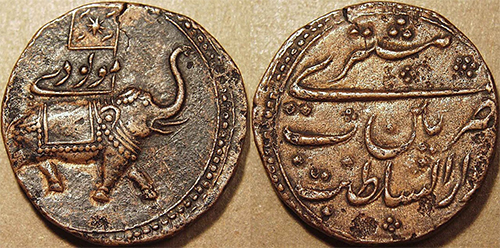
Among his many innovations, Tipu introduced new coin denominations and new coin types, including this copper double paisa weighing over 23 gm. The coin on the left also contains the emblem of the Sultanate of Mysore.
A gold coin issued by the Kingdom of Mysore during the reign of the Tipu Sultan.
The coinage of Tipu Sultan is one of the most complex and fascinating series struck in India during the 18th century. Local South India coinage had been struck in the area that became Mysore since ancient times, with the first gold coinage introduced about the 11th century (the elephant pagoda), and other pagodas continuing through the following centuries. These pagoda were always in the South Indian style until the reign of Haidar Ali (1761–1782), who added pagodas with Persian legends, plus a few very rare gold mohurs and silver rupees, always in the name of the Mughal emperor Shah Alam II plus the Arabic letter "ح" as the first letter of his name. His successor, Tipu Sultan, continued to issue pagodas, mohurs and rupees, with legends that were completely new. As for copper, the new large paisa was commenced by Haidar Ali in AH1195, two years before his death, with the elephant on the obverse, the mint on the reverse, and was continued throughout the reign of Tipu Sultan, who added other denominations. Tipu Sultan introduced a set of new Persian names for the various denominations, which appear on all of the gold and silver coins and on some of the copper. They were:
Copper: Qutb "قطب" for the 1/8 paisa (Persian for the pole star) – Akhtar "اختر" for the 1/4 paisa (star) – Bahram "بهرام" for the 1/2 paisa (the planet Mars) – Zohra "زهره" for the paisa (the planet Venus) – either Othmani "عثمانی" for the double-paisa (the third caliph of the Rashidun) or Mushtari "مشتری" (the planet Jupiter).
Silver: Khizri "خضری" for the 1/32 rupee (Khizr the prophet) – Kazimi "کاظمی" for the 1/16 rupee (for Musa, the seventh Shi'ite Imam) – Ja'fari "جعفری" for the 1/8 rupee (Ja'far al-Sadiq, the sixth Shi'ite Imam) – Bâqiri "باقری" for the 1/4 rupee (Muhammad al-Baqir, the fifth Imam) – Abidi "عبیدی" for the 1/2 rupee (Ali Zain al-'Abidin, the fourth Imam) – Imami for the rupee (reference to the 12 Shi'ite Imams) – Haidari "حیدری" for the double-rupee (lion, for Ali b. Abi Talib, who was both the fourth caliph and the first Shi'ite Imam).
Gold: Faruqi "فاروقی" for the pagoda (Umar al-Faruq, the second caliph) – Sadîqi "صدیقی" for the double-pagoda (Abu Bakr al-Sadiq, the first caliph) – Ahmadi "احمدی" for the four-pagoda ( "most praised ", one of the name of the Islamic prophet Muhammad). During his first 4 years, the large gold coin was the mohur, with an average weight of about 10.95g (AH1197-1200), replaced with the four-pagoda of 13.74g with the calendar change to the Mauludi "مولودی" system (AM1215-1219).
Coinage dating system
2 gold Two Pagoda Coins issued by tipu Sultan
The denomination does not appear on the Hijri dated gold coins, but was added on all the Mauludi dated pieces.
At the beginning of his first year, Tipu Sultan abandoned the Hijri dating system and introduced the Mauludi system (from the Arabic word "walad ", which means "birth "), based on the solar year and the birth year of Muhammad (actually 571 AD, but for some perplexing reason reckoned as 572 by Tipu Sultan for his staff).
From the beginning of his reign, Tipu Sultan added the name of the Indian cyclic year on the large silver and gold coins, including this double-pagoda, together with his regnal year. Each of the names is Persian, though in several examples, the meaning of the names in India was different from the Iranian meaning (not indicated here). According to the Indian meanings, these are the cyclic years: Zaki "زکي" for cyclic 37, which corresponded to his year 1 ( "pure ") – Azâl "أزل" for 38 ( "eternity ", year 2) – Jalal "جَلال" for 39 ( "splendor ", year 3) – Dalv "دَلو" for 40 (the sign of Aquarius, year 4) – Shâ "شاه" for 41 ( "king ", year 5) – Sârâ "سارا" for 42 ( "fragrant ", year 6) – Sarâb "سراب" for 43 ( "mirage ", for year 7) – Shitâ "شتا" for 44 ( "winter ", year 8) – Zabarjad "زبرجد" for 45 ( "topaz ", year 9) – sahar "سَحَر" ( "dawn ", year 10) – Sâher "ساحِر" ( "magician ", year 11).[111]
Assessment and legacy
The spot in Srirangapatna where Tipu's body was found
Assessments of Tipu Sultan have often been passionate and divided. Successive Indian National Congress governments have often celebrated Tipu Sultan's memory and monuments and relics of his rule while the Bharatiya Janata Party has been largely critical. School and college textbooks in India officially recognize him as a "freedom-fighter" along with many other rulers of the 18th century who fought European powers.[112] The original copy of the Constitution of India bears a painting of Tipu Sultan.[113]
In 2017 the 14th Indian president Ram Nath Kovind hailed Tipu Sultan in his address to the Karnataka Assembly on the occasion of the Diamond Jubilee celebrations of the state secretariat Vidhana Soudha saying "Tipu Sultan died a heroic death fighting the British. He was also a pioneer in the development and use of Mysore rockets in warfare. This technology was later adopted by the Europeans."[114]
Tipu Sultan is also admired as a hero in Pakistan. Former Pakistani Prime Minister Imran Khan has said that he admires Tipu Sultan as a freedom fighter.[115]
Tipu also patronised art forms such as Ganjifa cards, effectively saving this art form.[116] Ganjifa card of Mysore have the GI Tag today.[117]
Sword and tiger
Main article: Tipu's Tiger
Tipu Sultan's Tiger. Victoria and Albert Museum, London
Sword of Tipu Sultan. National Museum, New Delhi
Tipu Sultan had lost his sword in a war with the Nairs of Travancore during the Battle of the Nedumkotta (1789), in which he was forced to withdraw due to the severe joint attack from the Travancore army and British army.[118] The Nair army under the leadership of Raja Kesavadas again defeated the army of Tipu near Aluva. The Maharaja, Dharma Raja, gave the famous sword to the Nawab of Arcot, from whom the sword was taken as a war trophy by the British after annexing Arcot and sent to London. The sword was on display at the Wallace Collection, No. 1 Manchester Square, London.
Tipu was commonly known as the Tiger of Mysore and adopted this animal as the symbol (bubri/babri)[119] of his rule.[120] It is said that Tipu Sultan was hunting in the forest with a French friend. They came face to face with a tiger there. The tiger first pounced on the French soldier and killed him. Tipu's gun did not work, and his dagger fell on the ground as the tiger jumped on him. He reached for the dagger, picked it up, and killed the tiger with it. That earned him the name "the Tiger of Mysore". [citation needed] He even had French engineers build a mechanical tiger for his palace.[121] The device, known as Tipu's Tiger, is on display in the Victoria and Albert Museum, London.[122] Not only did Tipu place relics of tigers around his palace and domain, but also had the emblem of a tiger on his banners and some arms and weapons. Sometimes this tiger was very ornate and had inscriptions within the drawing, alluding to Tipu's faith – Islam.[123] Historian Alexander Beatson reported that "in his palace was found a great variety of curious swords, daggers, fusils, pistols, and blunderbusses; some were of exquisite workmanship, mounted with gold, or silver, and beautifully inlaid and ornamented with tigers' heads and stripes, or with Persian and Arabic verses".[124]
The last sword used by Tipu in his last battle, at Sri Rangapatnam, and the ring worn by him were taken by the British forces as war trophies. Till April 2004, they were kept on display at the British Museum London as gifts to the museum from Maj-Gen Augustus W.H. Meyrick and Nancy Dowager.[125] At an auction in London in April 2004, Vijay Mallya purchased the sword of Tipu Sultan and some other historical artefacts, and brought them back to India.[126]
In October 2013, another sword owned by Tipu Sultan and decorated with his babri (tiger stripe motif) surfaced and was auctioned by Sotheby's.[127] It was purchased for £98,500[128] by a telephone bidder.
Tipu Sultan Jayanti
In 2015, the Government of Karnataka, under the leadership of then Chief Minister Siddaramaiah from the Congress party, began to celebrate Tipu's birth anniversary as the "Tipu Sultan Jayanti".[129] The Congress regime declared it as an annual event to be celebrated on 20 November.[130] It was officially celebrated in Karnataka initially by the Minority Welfare department, and later by the Kannada & Culture department. However, on 29 July 2019, the next Chief Minister B. S. Yediyurappa, who belongs to the Bharatiya Janata Party (BJP), ordered the celebrations cancelled, saying: "Legislators from Kodagu had highlighted incidents of violence during Tipu Jayanti."
Objecting against the cancellation of the celebrations, the previous Chief Minister Siddaramaiah said: "BJP has cancelled it because of their hatred towards minorities. It's a big crime. He [Tipu] was a king of Mysore and fought against the British [as] a freedom fighter. It was during his time when the foundation was laid for the Krishna Raja Sagara dam. He also tried to improve industry, agriculture and trade". The previous year, not a single JD(S) leader, including the then chief minister HD Kumaraswamy, attended the event, turning it into a fiasco.[129]
The Lok Sabha Congress leader, Mallikarjun Kharge, also earlier criticized BJP and RSS for their opposition against holding the celebrations, and asked: "When RSS can celebrate Nathuram Godse, can't we celebrate Tipu Sultan?"[131]
In fiction
Sir David Baird Discovering the Body of Sultan Tipoo Sahib by David Wilkie, 1839
• He has a role in G. A. Henty's 1896 book The Tiger of Mysore,[132] and is also mentioned in Henty's 1902 At the Point of the Bayonet,[132] which deals with much of the same period.
• In Jules Verne's Mysterious Island, Captain Nemo is described as Tipu's nephew.
• He was portrayed by Paidi Jairaj in the 1959 Indian historical drama film Tipu Sultan, directed by Jagdish Gautam.[133]
• Bharat Ek Khoj, a 1988 Indian television series based on Jawaharlal Nehru's The Discovery of India which aired on DD National, dedicated an episode to Tipu Sultan with Salim Ghouse portraying the king.
• Tipu's life and adventures were the central theme of a short-running South Indian television series The Adventures of Tipu Sultan, and of a more popular national television series The Sword of Tipu Sultan based on a historical novel by Bhagwan Gidwani.[134][135]
• The Dreams of Tipu Sultan is a 1997 play written in Kannada by Indian writer Girish Karnad. It follows the last days as well as the historic moments in the life of Tipu, through the eyes of an Indian court historian and a British Oriental scholar.
• Tipu Sultan: The Tiger Lord is a Pakistani television series that broadcast on PTV in 1997, deals with the life of Sultan.
• Naseem Hijazi's novels Muazam Ali and Aur Talvar Ṭūṭ Gaye (And The Sword Broke) describe Tipu's wars.
• Wilkie Collins's novel The Moonstone contains an account of Tipu and the fall of Srirangapatna in the prologue.
• In The Surprising Adventures of Baron Munchausen by Rudolf Erich Raspe, Munchausen vanquishes Tipu near the end of the novel.
• Sharpe's Tiger is a novel by Bernard Cornwell in which Napoleonic–era British soldier Richard Sharpe fights at Seringapatam, later killing Tipu.
• Tipu appears as a "Great Person" in the video games, Sid Meier's Civilization: Revolution and Sid Meier's Civilization IV.
• In his historical Konkani-language novels on the Seringapatam captivity of Konkani Catholics by Indian littérateur V. J. P. Saldanha, Belthangaddicho Balthazar (Balthazar of Belthangady), Devache Krupen (By the Grace of God), Sardarachi Sinol (The sign of the Knights) and Infernachi Daram (The gates of Hell), Tipu is portrayed as "cunning, haughty, hard-hearted, revengeful, yet full of self-control".[136]
Family
The mausoleum housing Tipu Sultan's tomb is another example of Islamic architecture. Tipu Sultan's flag is in the foreground.
The tomb of Tipu Sultan at Srirangapatna. Tipu's tomb is adjacent to his mother's and father's graves.
Tipu had several wives.[137] His first wife was Sultan Begum Sahib also known as Padishah Begum.[138] She was the daughter of Imam Sahib Bakhshi Naita from Arcot,[139] and sister of Ghulam Husain Khan, known as the Pondicherry Nawab, a descendant of Chanda Sahib.[138] They married in 1774.[140] Another wife married at the same time was Ruqaya Banu Begum. She was the daughter of Lala Miyan Shaheed Charkoli,[141] and the sister of Sheikh Burhanuddin.[142] She died in February 1792 at the time of the siege of Seringapatam.[139] Another wife was Khadija Zaman Begum. She was the daughter of Mir Sayyid Moinuddin Khan[142] also known as Sayyid Sahib.[143] They married in 1796. She died in childbirth in 1797.[140] Another wife was Buranti Begum. She was the daughter of Mir Muhammad Pasand Beg, a nobleman from Delhi and her mother's father was Sayyid Muhammad Khan, once a subedar of Kashmir. Another wife was Roshani Begum. She was the mother of his eldest son Fath Haider.[138]
His sons were Hyder Ali Khan Sultan,[144] Muin-ud-din Sultan, Abdul Khaliq Sultan, Muiz-ud-din Sultan, Muhammad Subhan Sultan, Shukrullah Sultan, Ghulam Ahmad Sultan, Ghulam Muhammad Sultan, Sarwar-ud-din Sultan, Muhammad Yasin Sultan, Jamal-ud-din Sultan and Munir-ud-din Sultan. One of his daughters was married to Husain Ali Khan.[138] Many of Tipu's descendants live in Kolkata and have expressed objection to use of Tipu Sultan's name by political parties for polarising votes.[145][146]
Image gallery
A view of the Hoally Gateway, Srirangapatnam, where Tipu Sultan was killed, Seringapatam (Mysore), by Thomas Sydenham (c. 1799)
A flintlock blunderbuss, made for Tipu Sultan in Srirangapatnam in 1793–94. Tipu Sultan used many Western craftsmen, and this gun reflects the most up-to-date technologies of the time.[25]
Cannon used by Tipu Sultan in the battle of Srirangapatnam 1799
General Lord Cornwallis, receiving two of Tipu Sultan's sons as hostages in the year 1793.
During the Republic Day Parade in 2014, in New Delhi, the tableau of Karnataka, highlighting "Tipu Sultan: The Tiger of Mysore," made its way through the Rajpath.
See also
• Muslim warriors
• Mysore invasion of Kerala
• PNS Tippu Sultan
• Tipu Sultan Mosque
• The Sword of Tipu Sultan – an Indian TV series on Tipu Sultan
• Tipu's Tiger
• The Dreams of Tipu Sultan by Girish Karnad
• Mir Ghulam Ali, an official and senior military commander
References
1. H. Davis, Richard (1999). Lives of Indian Images. Chichester, West Sussex, UK: Princeton University Press. p. 149. ISBN 0-691-00520-6. Both Haidar 'Ali and Tipu Sultan were parvenu Sunni Muslim rulers...
2. The Writing of the Nation by Its Elite: The Politics of Anglophone Indian Literature in the Global Age. 605 Third Avenue, New York, NY 10158, USA: Routledge. 2022. ISBN 978-0-367-54129-3.
3. Yazdani, Kaveh (2017). "2: Mysore". India, Modernity and the Great Divergence: Mysore and Gujarat (17th to 19th C.). Brill. p. 312, 313. doi:10.1163/9789004330795_004. ISBN 978-90-04-33078-8. ISSN 1877-3206. After coming into power, Tipu ordered his 'ulama' to collect significant matters of Mohammadan law, especially those corresponding to the Hanafi School of thought. As a result, a Persian treatise on the important laws of Islam called Fiqh-i Mohammadi was written down. Indeed, the existing sources suggest that Tipu was in all likelihood a Sunni Muslim who belonged to the Hanafi School.
4. "6: The Private as Public". The Politics of Modern Indian Language Literature. 605 Third Avenue, New York, NY 10158, USA: Routledge. 2024. ISBN 978-1-032-69578-5.
5. Cavendish, Richard (4 May 1999). "Tipu Sultan killed at Seringapatam". History Today. 49 (5). Retrieved 13 December 2013.
6. Brittlebank, Kate (2022). Tiger: The Life of Tipu Sultan. Claritas Books. ISBN 978-1-905837-87-8. Retrieved 15 April 2024. Quote=Aer he died, it became his epithet – 'the Tiger of Mysore' the British called him.
7. Yazdani, Kaveh (2017). India, Modernity and the Great Divergence. Brill. p. 67. ISBN 9789004330795.
8. Colley, Linda (2000). "Going Native, Telling Tales: Captivity, Collaborations and Empire". Past & Present (168): 190. ISSN 0031-2746. JSTOR 651308.
9. Dalrymple 2019, p. 243.
10. Jamil, Arish. "Why Mysore? The Idealistic and Materialistic Factors Behind Tipu Sultan's War Rocket Success" (PDF). Emory Endeavors in World History – Volume 5. Emory College of Arts and Science. Retrieved 21 May 2022.
11. Narasimha, Roddam (27 July 2011). "Rockets in Mysore and Britain, 1750–1850 A.D." (PDF). National Aeronautical Laboratory and Indian Institute of Science. Archived from the original on 27 July 2011.
12. Roy 2011, p. 77.
13. Hasan 2005, pp. 105–107.
14. Hasan 2005, p. 399.
15. Datta, R.K. (2007). Global Silk Industry: A Complete Source Book. APH Publishing. p. 17. ISBN 978-81-313-0087-9.
16. "History of Channapatna Toys". Craftdeals.in. January 2023. Retrieved 1 January 2023.
17. Hasan 2005, p. 6.
18. "Rewriting History: How I Discovered the True Birth Date of Tipu Sultan". News18. 19 July 2021. Retrieved 22 July 2021.
19. "The history of South India is relatively unknown: Rajmohan Gandhi". Business Standard India. 9 December 2018.
20. Haroon, Anwar (June 2013). Kingdom of Hyder Ali and Tipu Sultan. Xlibris Corporation. p. 95. ISBN 9781483615349.
21. Wenger 2017, p. 4.
22. "The Sultan of Mysore – Tipu Sultan". Karnataka.com. Retrieved 7 August 2019.
23. Coller, Ian (2020). Muslims and Citizens:Islam, Politics, and the French Revolution. Yale University Press. p. 31. ISBN 9780300243369.
24. Subrahmanyam, Sanjay (2017). Europe's India: Words, People, Empires, 1500–1800. Harvard University Press. ISBN 9780674977556.
25. Exhibition at the Metropolitan Museum of Art, New York.
26. Chisholm 1911.
27. Beatson, Alexander (1800). "Appendix No. XXXIII". A View of the Origin and Conduct of the War with Tippoo Sultaun. London: G. & W. Nichol. pp. ci–civ. Archived from the original on 9 June 2013.
28. Fortescue, John William (1902). A history of the British army, Volume 3. Macmillan. pp. 431–432.
29. "The Tiger and The Thistle – Tipu Sultan and the Scots in India". nationalgalleries.org. Archived from the original on 11 November 2006.
30. The Parliamentary History of England from the Earliest Period to the Year 1803. T.C. Hansard. 1817.
31. Brittlebank, K. (2022). Tiger: The Life of Tipu Sultan. Claritas Books. ISBN 978-1-905837-87-8. Retrieved 15 April 2024.
32. Roy 2011, p. 72.
33. Naravane, M. S. (2006). Battles of the Honourable East India Company: Making of the Raj. APH Publishing. ISBN 9788131300343.
34. Sen 1995, p. 54.
35. Hasan 2005, p. 105.
36. Sen 1995, p. 59.
37. Moienuddin 2000.
38. Hasan 2005, p. 105; Sen 1995, p. 59.
39. Dictionary of Indian biography. London S. Sonnenschein. 1906.
40. "Tipu Sultan – Personalities". Karnataka.com. 10 November 2016.
41. Wenger 2017, pp. 11–.
42. Roychoudhury, Upendrakishore (April 2004). White Mughals. Penguin Books India. p. 101. ISBN 978-0-14-303046-1.
43. Boutier, Jean (2005). "Les "lettres de créances" du corsaire Ripaud. Un "club jacobin" à Srirangapatnam (Inde), mai-juin 1797". Les Indes Savantes.
44. Watson, William E. (2003). Tricolor and Crescent. Greenwood Publishing. ISBN 9780275974701.
45. Amini, Iradj (January 1999). Napoleon and Persia. Mage Publishers. ISBN 9780934211581.
46. Karsh, Efraim; Karsh, Inari (2001). Empires of the Sand. Harvard University Press. ISBN 9780674005419.
47. Francis, P. Sempa. "Wellington in India: A Great Commander in Embryo". thediplomat.com. Retrieved 16 September 2020.
48. The Parliamentary Register; Or, History of the Proceedings and Debates of the [House of Lords and House of Commons]-J. Almon, 1793
49. Zachariah, Mini Pant (7 November 2010). "Tipu's legend lives on". The Hindu. Archived from the original on 29 October 2013. Retrieved 18 December 2013.
50. Sunderlal, Pandit (2018). How India Lost Her Freedom. SAGE Publications. p. 364. ISBN 978-93-5280-642-3. Retrieved 20 January 2022.
51. "Tipu Sultan: Here're lesser known facts about 'Tiger of Mysore'". The Siasat Daily. 2 November 2019. Retrieved 16 September 2020.
52. "Tipu, the Citizen-Sultan and the Myth of a Jacobin Club in India". The Wire.
53. Speake, Jennifer; Simpson, John (23 October 2008). Better to live one day as a tiger than a thousand years as a sheep. OUP Oxford. ISBN 978-0-19-953953-6. Retrieved 14 February 2017. {{cite book}}: |website= ignored (help)
54. "View of the Hoally Gateway, where Tipu Sultan was killed, Seringapatam (Mysore)". British Library Online Gallery. Retrieved 14 June 2009.
55. Rafiq, Ayesha (20 November 2018). "A Revaluation of tales of concerning Tipu Sultan's defeat". Daily Times. Retrieved 13 July 2022.
56. Brittlebank, Kate (22 July 2016). "Seven things you may not have known about Tipu Sultan, India's first freedom fighter". Scroll.in. Archived from the original on 19 March 2022.
57. Sengupta, Anjali (1984). Cameos of Twelve European Women in India, 1757-1857. Ṛddhi-India. p. 11. OCLC 13531696.
58. "Over 5,000 'war rockets' of Tipu Sultan unearthed". Deccan Herald. 28 July 2018. Retrieved 16 September 2020.
59. "How the Mysorean rocket helped Tipu Sultan's military might gain new heights". 5 August 2018.
60. Roy 2011, p. 22.
61. Gopal, Mysore Hatti (1960). The Finances Of The Mysore State 1799 – 1831. Orient Longmans. p. 255. These were armed militia who served as police officers, helped in the collection of revenue and often garrisoned small forts . They resembled the sibundi in the Company ' s territories . In Mysore they were divided into the huzur kandachar or those who were in the capital and about the Maharaja, and the taluq kandachar or those in the taluqs, the latter being far more numerous than the former.
62. R. Gopal, ed. (2010). Tipu Sultan: The Tiger of Mysore. Mysore: Directorate of Archaeology and Museums, Government of Karnataka. p. 279. OCLC 813417527. Since Haidar and Tipu were perpetually engaged in battles, they formed a disciplined standing army . Thus, instead of the local militia called the Kandachar force of agricultural origin which existed in the Mysore army earlier, Haidar and Tipu enrolled to their army forces the able tribal men, Muslims and Rajputs on full time service. In this way, Haidar and Tipu removed the Vokkaligas of the agricultural base from the local militia which took part in wars for centuries and in place of their quit rent, they imposed higher taxes and thus became indirectly responsible for implementation of Ryotwari system. The Ryots were not liberated from the shackles of Kandachar service; the slaves who were with them were enrolled in the army in some places. As a result, the Ryots removed from the military service could not even rely upon slaves for their agricultural activities. Hence these ryots had to endure the greater responsibility of feeding the slaves and of financing their marriages besides paying the higher taxes. So in the plains of Mysore the system of slavery was loosened.
63. Parthasarathi 2011, p. 207.
64. Parthasarathi 2011, pp. 38, 271.
65. Parthasarathi 2011, p. 45.
66. "Tiger of Mysore: Saviour or savage?". Deccan Chronicle. 4 August 2019. Retrieved 22 September 2019.
67. Shekhar, Divya (10 November 2017). "How Tipu Sultan was the original tech innovator". The Economic Times. Retrieved 22 September 2019.
68. Hunter, William Wilson (1886). The Indian empire : its peoples, history, and products. Trubner, London. p. 512. Retrieved 21 June 2020.
69. Handmade in India: A Geographic Encyclopedia of Indian, Page 362, Aditi Ranjan, M. P. Ranjan (2009)
70. Edgar, Thurston. The Madras presidency, with Mysore, Coorg and the associated states. Cambridge, University press. p. 185. Retrieved 9 May 2020.
71. B. Sheik Ali (August 1999). "The Vision and Mission of Tipu Sultan". Islamic Voice. Archived from the original on 5 October 2011. Retrieved 16 August 2011.
72. Brittlebank 1999, p. [page needed].
73. Özcan, Azmi (1997). Pan-Islamism: Indian Muslims, the Ottomans and Britain, 1877–1924. BRILL. ISBN 978-90-04-10632-1.
74. Kausar, Kabir (1980). Secret correspondence of Tipu Sultan. Light and Life Publishers. plight.
75. Bhacker, Mohmed Reda (1992). Trade and Empire in Muscat and Zanzibar: The Roots of British Domination. Routledge. ISBN 978-0-415-07997-6.
76. "A sultan's silken dreams". downtoearth.org.in. Retrieved 21 August 2022.
77. "Tipu Sultan and the Scots in India". The Tiger and The Thistle. Archived from the original on 21 November 2008. Retrieved 11 March 2017.
78. Panikkar, K.N. (1991). "Men of Valour and Vision". Social Scientist. 19 (8): 110. doi:10.2307/3517708. JSTOR 3517708.
79. Sastri 1943, p. 269.
80. Naik, B. Shreedhara. The society and politics in South Kanara 1500 A D to 1800 A D (PDF). p. 211. Retrieved 7 September 2019.
81. Miller, Rolland E. (27 April 2015). Mappila Muslim Culture. State University of New York Press. p. 34. ISBN 9781438456027. Retrieved 28 March 2020.
82. Sastri 1943, p. 270.
83. Yadav, Bhupendra (1990). "Tipu Sultan: Giving 'The Devil' His Due". Economic and Political Weekly. 25 (52): 2835–2837. JSTOR 4397149.
84. A. Subbaraya Chetty "Tipu's endowments to Hindus and Hindu institutions" in Confronting Colonialism
85. Pande, B. N. (1996). Aurangzeb and Tipu Sultan: Evaluation of Their Religious Policies. University of Michigan. ISBN 9788185220383.
86. Hasan 2005, pp. 357–358.
87. Confronting Colonialism, p. 118
88. A. Subbaraya Chetty, "Tipu's endowments to Hindus", pp. 111–115 in Confronting Colonialism.
89. Hasan 2005, p. 360.
90. The Chaldean Syrian Church of the East. ISPCK. 1983. p. 30.
91. Brittlebank 1999, pp. 1–3.
92. Valath, V. V. K. (1981). Keralathile Sthacharithrangal – Thrissur Jilla (in Malayalam). Kerala Sahithya Academy. pp. 74–79.
93. Goel, Sita Ram (1993). Tipu Sultan: Villain Or Hero? : an Anthology. Voice of India. ISBN 978-81-85990-08-8.
94. Farias, Kranti K. (1999), The Christian Impact on South Kanara, Church History Association of India, p. 76
95. Cariappa, M. P.; Cariappa, Ponnamma (1981), The Coorgs and their Origins, Aakar Books, p. 48, OCLC 641505186
96. Sarasvati's Children Archived 6 December 2022 at the Wayback Machine, Joe Lobo
97. Kirkpatrick, W. (1811) Select Letters of Tipu Sultan, London
98. Wilks, M. (1930) Report on the Interior Administration, Resources and Expenditure of the Government of Mysore under the System prescribed by the Order of the Governor-General in Council dated 4 September 1799, Bangalore 1864, and Historical Sketches of the South of India in an Attempt to Trace the History of Mysore, 2 vols, ed. M. Hammick, Mysore.
99. Habib, Irfan (2001). "War and Peace. Tipu Sultan's Account of the last Phase of the Second War with the English, 1783-4", p. 5 in State and Diplomacy Under Tipu Sultan: Documents and Essays, Manohar Publishers and Distributors, ISBN 81-85229-52-X
100. A. Subbaraya Chetty "Tipu's endowments to Hindus and Hindu institutions", p. 111 in Confronting Colonialism
101. Hasan 2005, p. 368.
102. Brittlebank 1999, pp. 2–12.
103. Sampath, Vikram (31 January 2014). "Why we love to hate Tipu Sultan". livemint.com.
104. Annual Report of the Mysore Archaeological Department 1916 pp 10–11, 73–6
105. Hasan 2005, p. 359.
106. Saletare, B.A. "Tipu Sultan as Defender of the Hindu Dharma", pp. 116–8 in Confronting Colonialism
107. Prabhu 1999, p. 223.
108. Hasan 2005, p. 79.
109. Sen, Surendranath (1930). Studies in Indian history. University of Calcutta. p. 157.
110. Sultan, Tipu (1811). Select letters of Tippoo Sultan to various public functionaries. London: Black. p. 228.
111. "CoinArchives.com Lot Viewer". coinarchives.com. Retrieved 17 April 2019.
112. Moudgal, Sandeep (1 November 2019). "Tipu Sultan history lessons can't be erased, says textbook committee chairman". The Times of India.
113. Ramdas, Inayat (27 January 2016). "Bet You Didn't Know All This About the Indian Constitution!". TheQuint. Retrieved 27 September 2020.
114. Aji, Sowmya (26 October 2017). "President Ram Nath Kovind hails Tipu Sultan, sparks war of words between Congress and BJP". The Economic Times.
115. "Pakistan PM Imran pays tribute to Tipu Sultan on his death anniversary". The Hindu. 5 May 2019.
116. "Untitled" (PDF). ccrt.addsofttech.com. Archived from the original (PDF) on 16 February 2022. Retrieved 16 February 2022.
117. "Geographical Indications".
118. "The swords of Tipu Sultan". The Hindu. 3 May 2011. Archived from the original on 9 May 2011.
119. "Tipu Sultan and the tiger motif". The Seringapatnam Times. Toshkhana : wordpress. 17 August 2011. Retrieved 13 December 2013.
120. Brittlebank, K. (1995). "Sakti and Barakat: The ∀ Power of Tipu's Tiger. An Examination of the Tiger Emblem of Tipu Sultan of Mysore". Modern Asian Studies. 29 (2): 257–269. doi:10.1017/S0026749X00012725. JSTOR 312813. S2CID 145790819.
121. James, Lawrence (2000). Raj: The Making and Unmaking of British India. MacMillan. ISBN 978-0-312-26382-9. Retrieved 12 February 2010.
122. "Tippoo's Tiger". Victoria & Albert Museum. 11 April 2004. Archived from the original on 25 August 2006. Retrieved 10 December 2006.
123. "Tiger Motif". Macquarie University Library. Archived from the original on 4 March 2011. Retrieved 12 February 2010.
124. Beatson, Alexander (1800). A View of the Origin and Conduct of the War with Tippoo Sultaun. London: G. & W. Nichol. Archived from the original on 9 June 2013.
125. "Ring and sword of Tipu Sultan". Exploring the museum. The British Museum. Retrieved 13 December 2013.
126. Beary, Habib (7 April 2004). "Tipu's sword back in Indian hands". BBC News.
127. Sinha, Kounteya (4 October 2013). "Another Tipu Sultan sword surfaces, to be auctioned". The Times of India. Archived from the original on 7 October 2013. Retrieved 13 December 2013.
128. Nag, Ashoke (21 October 2013). "Tipu Sultan memorabilia goes under hammer at Sotheby's 'The Arts of Imperial India' auction". The Economic Times. Retrieved 13 December 2013.
129. "BJP govt orders cancellation of Tipu Sultan Jayanti". Deccan Herald. 30 July 2019. Retrieved 20 September 2019.
130. "Tipu Sultan Birth Anniversary: Life And Works of the 18th Century Ruler". NDTV. NDTV. 20 November 2019. Retrieved 30 November 2019.
131. Upadhya, Harish (31 October 2016). "Karnataka Prepares To Celebrate Tipu Sultan Jayanti, BJP Threatens Stir Karnataka". NDTV. NDTV. Retrieved 5 November 2016.
132. The Project Gutenberg eBook of The Tiger of Mysore, by G. A. Henty. 12 July 2006 – via Project Gutenberg.
133. "Tipu Sultan (1959)". BFI.
134. Swaminathan, Chitra (20 May 2006). "The return of the Sultan". The Hindu. Archived from the original on 4 August 2009. Retrieved 17 August 2007.
135. Khosla, G. D. (1977). "Review of The Sword of Tipu Sultan". India International Centre Quarterly. 4 (2): 214–216. ISSN 0376-9771. JSTOR 23001501.
136. George, K. M. (1992). Modern Indian Literature, an Anthology: Surveys and poems. Vol. 2. Sahitya Akademi. p. 217. ISBN 978-81-7201-324-0.
137. Howes, Jennifer (October 2021). "Tipu Sultan's female entourage under East India Company rule". Journal of the Royal Asiatic Society. 31 (4): 855–874. doi:10.1017/S135618632000067X. ISSN 1356-1863. S2CID 229455847.
138. Hasan 2005, p. 372.
139. Brittlebank, K. (1997). Tipu Sultan's Search for Legitimacy: Islam and Kingship in a Hindu Domain. Oxford University Press. p. 23. ISBN 978-0-19-563977-3.
140. Brittlebank, K. (2022). Tiger: The Life of Tipu Sultan. Claritas Books. p. 51. ISBN 978-1-905837-87-8.
141. Mahmood, M.K. (2013). Kingdom of Hyder Ali and Tipu Sultan: Sultanat E Khudadad. Xlibris US. p. 77. ISBN 978-1-4836-1536-3.
142. Nadvī, M.I. (2004). Tipu Sultan, a Life History. Institute of Objective Studies. p. 216.
143. Hoover, J.W. (2007). Men Without Hats: Dialogue, Discipline, and Discontent in the Madras Army 1806-1807. Manohar Publishers & Distributors. p. 83. ISBN 978-81-7304-725-1.
144. "Karunanidhi to release stamp on Vellore sepoy mutiny". The Hindu. 9 July 2006.
145. "Descendent objects to use of Tipu Sultan's name for polarising votes | News – Times of India Videos". The Times of India. 21 February 2023.
146. "Misuse His Name and We'll Sue for Defamation, Say Tipu Sultan's Descendants as Karnataka Poll Heat Rises". News18. 14 February 2023.
Cited sources
• Brittlebank, Kate (1999). Tipu Sultan's Search for Legitimacy. Delhi: Oxford University Press. ISBN 978-0-19-563977-3. OCLC 246448596.
• Chisholm, Hugh, ed. (1911). "Tippoo Sahib" . Encyclopædia Britannica. Vol. 26 (11th ed.). Cambridge University Press. p. 1005.
• Dalrymple, William (2019). The Anarchy: The Relentless Rise of the East India Company (Hardcover). New York: Bloomsbury publishing. ISBN 978-1-63557-395-4.
• Fernandes, Praxy (1969). Storm over Seringapatam: the incredible story of Hyder Ali & Tippu Sultan. Thackers..
• Habib, Irfan, ed. (2002). Confronting Colonialism: Resistance and Modernization Under Haider Ali and Tipu Sultan (Anthem South Asian Studies). Anthem Press. ISBN 1-84331-024-4.
• Hasan, Mohibbul (2005), History of Tipu Sultan, Aakar Books, ISBN 978-81-87879-57-2
• Knight, Charles (1858). The English cyclopædia: a new dictionary of universal knowledge, Volume 6. Bradbury & Evans. Retrieved 28 November 2011..
• Moienuddin, Mohammad (2000). Sunset at Srirangapatam: After the Death of Tipu Sultan. London: Sangam Books. ISBN 978-0-86311-850-0. OCLC 48995204.
• Palsokar, R. D. (1969). Tipu Sultan. s.n..
• Punganuri, Ram Chandra Rao (1849). Memoirs of Hyder and Tippoo: rulers of Seringapatam, written in the Mahratta language. Simkins & Co. Retrieved 28 November 2011..
• Parthasarathi, Prasannan (2011). Why Europe Grew Rich and Asia Did Not: Global Economic Divergence, 1600–1850. Cambridge University Press. ISBN 978-1-139-49889-0.
• Prabhu, Alan Machado (1999). Sarasvati's Children: A History of the Mangalorean Christians. I.J.A. Publications. ISBN 978-81-86778-25-8.
• Roy, Kaushik (2011). War, Culture and Society in Early Modern South Asia, 1740–1849. Taylor & Francis. ISBN 978-1-136-79087-4.
• Sastri, K.N.V. (1943). Moral Laws under Tipu Sultan. Indian History Congress. Retrieved 25 August 2019.
• Sen, Sailendra Nath (1995). Anglo-Maratha Relations, 1785-96. Popular Prakashan. ISBN 9788171547890.
• Sharma, Hari Dev (1991). The real Tipu: a brief history of Tipu Sultan. Rishi Publications..
• Wenger, Estefania (March 2017). Tipu Sultan: A Biography. Vij Books India Private Limited. ISBN 9789386367440.
Further reading
• Balakrishna, Sandeep, Tipu Sultan, The Tyrant of Mysore, Rare Publications
• Sen, Surendra Nath (1930), Studies in Indian History, University of Calcutta, OCLC 578119748
• Subramanian, K. R. (1928), The Maratha Rajas of Tanjore, self-published, OCLC 249773661
• William, Logan (1887), Malabar Manual, Asian Educational Services, ISBN 978-81-206-0446-9
• Grose, John Henry; Charmichael (1777), A Voyage to the East Indies
• Thompson, Rev. E. W. (1990) [1923]. The last siege of Seringapatam. Mysore City: Wesleyan Mission. ISBN 978-8120606029.
• Agha, Shamsu. Tipu Sultan", "Mirza Ghalib in London";, "Flight Delayed", Paperback, ISBN 0-901974-42-0
• Ali, B Sheik. Tipu Sultan, Nyasanal Buk Trast
• Amjad, Sayyid. 'Ali Ashahri, Savanih Tipu Sultan, Himaliyah Buk Ha®us
• Banglori, Mahmud Khan Mahmud. Sahifah-yi Tipu Sultan, Himālayah Pablishing Hā'ūs,
• Bhagwan, Gidwami S (1976). The Sword of Tipu Sultan: a historical novel about the life and legend of Tipu Sultan of India. Allied Publishers. OCLC 173807200. A fictionalised account of Tipu's life.
• Buddle, Anne. Tigers Round the Throne, Zamana Gallery, ISBN 1-869933-02-8
• Campbell, Richard Hamilton. Tippoo Sultan: The fall of Srirangapattana and the restoration of the Hindu raj, Govt. Press
• Chinnian, P. Tipu Sultan the Great, Siva Publications
• Hashimi, Sajjad. Tipu Sultan, Publisher: Maktabah-yi Urdu Da®ijast
• Home, Robert. Select Views in Mysore: The Country of Tipu Sultan from Drawings Taken on the Spot by Mr. Home, Asian Educational Services, India, ISBN 81-206-1512-3
• Kareem, C.K (1973). Kerala Under Haidar Ali and Tipu Sultan. Kerala History Association: distributors, Paico Pub. House.
• V.M. Korath, P. Parameswaran, Ravi Varma, Nandagopal R Menon, S.R. Goel & P.C.N. Raja: Tipu Sultan: Villain or hero? : an anthology. (1993). ISBN 9788185990088
• Mohibbul Hasan. Tipu Sultan's Mission to Constantinople, Aakar Books, ISBN 81-87879-56-4
• Pande, B. N. Aurangzeb and Tipu Sultan: Evaluation of their religious policies (IOS series), Institute of Objective Studies
• Sil, Narasingha P. "Tipu Sultan: A Re-Vision," Calcutta Historical Journal' (2008) 28#1 pp 1–23. historiography
• Strandberg, Samuel. Tipu Sultan: The Tiger of Mysore: or, to fight against the odds, AB Samuel Travel, ISBN 91-630-7333-1
• Taylor, George. Coins of Tipu Sultan, Asian Educational Services, India, ISBN 81-206-0503-9
• Wigington, Robin. Firearms of Tipu Sultan, 1783–99, J. Taylor Book Ventures, ISBN 1-871224-13-6
• Ashfaq Ahmed Mathur – "SALTANATH-E-KHUDADAT" and a book by Allama Iqbal ahmed (RH) "Daana e Raaz Diyaar e Dakan mein"
External links
• Media related to Tipu Sultan at Wikimedia Commons
• The Sword of Tipu Sultan – Volume 1
• The Tiger of Mysore – Dramatised account of the British campaign against Tipu Sultan by G. A. Henty, from Project Gutenberg
• Illuminated Qurʾān from the library of Tippoo Ṣāḥib, Cambridge University Digital Library
• UK Family Finds Tipu Sultan's Gun, Sword In Attic
• Tipu's Legacy
The coinage system
Among his many innovations, Tipu introduced new coin denominations and new coin types, including this copper double paisa weighing over 23 gm. The coin on the left also contains the emblem of the Sultanate of Mysore.
A gold coin issued by the Kingdom of Mysore during the reign of the Tipu Sultan.
The coinage of Tipu Sultan is one of the most complex and fascinating series struck in India during the 18th century. Local South India coinage had been struck in the area that became Mysore since ancient times, with the first gold coinage introduced about the 11th century (the elephant pagoda), and other pagodas continuing through the following centuries. These pagoda were always in the South Indian style until the reign of Haidar Ali (1761–1782), who added pagodas with Persian legends, plus a few very rare gold mohurs and silver rupees, always in the name of the Mughal emperor Shah Alam II plus the Arabic letter "ح" as the first letter of his name. His successor, Tipu Sultan, continued to issue pagodas, mohurs and rupees, with legends that were completely new. As for copper, the new large paisa was commenced by Haidar Ali in AH1195, two years before his death, with the elephant on the obverse, the mint on the reverse, and was continued throughout the reign of Tipu Sultan, who added other denominations. Tipu Sultan introduced a set of new Persian names for the various denominations, which appear on all of the gold and silver coins and on some of the copper. They were:
Copper: Qutb "قطب" for the 1/8 paisa (Persian for the pole star) – Akhtar "اختر" for the 1/4 paisa (star) – Bahram "بهرام" for the 1/2 paisa (the planet Mars) – Zohra "زهره" for the paisa (the planet Venus) – either Othmani "عثمانی" for the double-paisa (the third caliph of the Rashidun) or Mushtari "مشتری" (the planet Jupiter).
Silver: Khizri "خضری" for the 1/32 rupee (Khizr the prophet) – Kazimi "کاظمی" for the 1/16 rupee (for Musa, the seventh Shi'ite Imam) – Ja'fari "جعفری" for the 1/8 rupee (Ja'far al-Sadiq, the sixth Shi'ite Imam) – Bâqiri "باقری" for the 1/4 rupee (Muhammad al-Baqir, the fifth Imam) – Abidi "عبیدی" for the 1/2 rupee (Ali Zain al-'Abidin, the fourth Imam) – Imami for the rupee (reference to the 12 Shi'ite Imams) – Haidari "حیدری" for the double-rupee (lion, for Ali b. Abi Talib, who was both the fourth caliph and the first Shi'ite Imam).
Gold: Faruqi "فاروقی" for the pagoda (Umar al-Faruq, the second caliph) – Sadîqi "صدیقی" for the double-pagoda (Abu Bakr al-Sadiq, the first caliph) – Ahmadi "احمدی" for the four-pagoda ( "most praised ", one of the name of the Islamic prophet Muhammad). During his first 4 years, the large gold coin was the mohur, with an average weight of about 10.95g (AH1197-1200), replaced with the four-pagoda of 13.74g with the calendar change to the Mauludi "مولودی" system (AM1215-1219).
Coinage dating system
2 gold Two Pagoda Coins issued by tipu Sultan
The denomination does not appear on the Hijri dated gold coins, but was added on all the Mauludi dated pieces.
At the beginning of his first year, Tipu Sultan abandoned the Hijri dating system and introduced the Mauludi system (from the Arabic word "walad ", which means "birth "), based on the solar year and the birth year of Muhammad (actually 571 AD, but for some perplexing reason reckoned as 572 by Tipu Sultan for his staff).
From the beginning of his reign, Tipu Sultan added the name of the Indian cyclic year on the large silver and gold coins, including this double-pagoda, together with his regnal year. Each of the names is Persian, though in several examples, the meaning of the names in India was different from the Iranian meaning (not indicated here). According to the Indian meanings, these are the cyclic years: Zaki "زکي" for cyclic 37, which corresponded to his year 1 ( "pure ") – Azâl "أزل" for 38 ( "eternity ", year 2) – Jalal "جَلال" for 39 ( "splendor ", year 3) – Dalv "دَلو" for 40 (the sign of Aquarius, year 4) – Shâ "شاه" for 41 ( "king ", year 5) – Sârâ "سارا" for 42 ( "fragrant ", year 6) – Sarâb "سراب" for 43 ( "mirage ", for year 7) – Shitâ "شتا" for 44 ( "winter ", year 8) – Zabarjad "زبرجد" for 45 ( "topaz ", year 9) – sahar "سَحَر" ( "dawn ", year 10) – Sâher "ساحِر" ( "magician ", year 11).[111]
Assessment and legacy
The spot in Srirangapatna where Tipu's body was found
Assessments of Tipu Sultan have often been passionate and divided. Successive Indian National Congress governments have often celebrated Tipu Sultan's memory and monuments and relics of his rule while the Bharatiya Janata Party has been largely critical. School and college textbooks in India officially recognize him as a "freedom-fighter" along with many other rulers of the 18th century who fought European powers.[112] The original copy of the Constitution of India bears a painting of Tipu Sultan.[113]
In 2017 the 14th Indian president Ram Nath Kovind hailed Tipu Sultan in his address to the Karnataka Assembly on the occasion of the Diamond Jubilee celebrations of the state secretariat Vidhana Soudha saying "Tipu Sultan died a heroic death fighting the British. He was also a pioneer in the development and use of Mysore rockets in warfare. This technology was later adopted by the Europeans."[114]
Tipu Sultan is also admired as a hero in Pakistan. Former Pakistani Prime Minister Imran Khan has said that he admires Tipu Sultan as a freedom fighter.[115]
Tipu also patronised art forms such as Ganjifa cards, effectively saving this art form.[116] Ganjifa card of Mysore have the GI Tag today.[117]
Sword and tiger
Main article: Tipu's Tiger
Tipu Sultan's Tiger. Victoria and Albert Museum, London
Sword of Tipu Sultan. National Museum, New Delhi
Tipu Sultan had lost his sword in a war with the Nairs of Travancore during the Battle of the Nedumkotta (1789), in which he was forced to withdraw due to the severe joint attack from the Travancore army and British army.[118] The Nair army under the leadership of Raja Kesavadas again defeated the army of Tipu near Aluva. The Maharaja, Dharma Raja, gave the famous sword to the Nawab of Arcot, from whom the sword was taken as a war trophy by the British after annexing Arcot and sent to London. The sword was on display at the Wallace Collection, No. 1 Manchester Square, London.
Tipu was commonly known as the Tiger of Mysore and adopted this animal as the symbol (bubri/babri)[119] of his rule.[120] It is said that Tipu Sultan was hunting in the forest with a French friend. They came face to face with a tiger there. The tiger first pounced on the French soldier and killed him. Tipu's gun did not work, and his dagger fell on the ground as the tiger jumped on him. He reached for the dagger, picked it up, and killed the tiger with it. That earned him the name "the Tiger of Mysore". [citation needed] He even had French engineers build a mechanical tiger for his palace.[121] The device, known as Tipu's Tiger, is on display in the Victoria and Albert Museum, London.[122] Not only did Tipu place relics of tigers around his palace and domain, but also had the emblem of a tiger on his banners and some arms and weapons. Sometimes this tiger was very ornate and had inscriptions within the drawing, alluding to Tipu's faith – Islam.[123] Historian Alexander Beatson reported that "in his palace was found a great variety of curious swords, daggers, fusils, pistols, and blunderbusses; some were of exquisite workmanship, mounted with gold, or silver, and beautifully inlaid and ornamented with tigers' heads and stripes, or with Persian and Arabic verses".[124]
The last sword used by Tipu in his last battle, at Sri Rangapatnam, and the ring worn by him were taken by the British forces as war trophies. Till April 2004, they were kept on display at the British Museum London as gifts to the museum from Maj-Gen Augustus W.H. Meyrick and Nancy Dowager.[125] At an auction in London in April 2004, Vijay Mallya purchased the sword of Tipu Sultan and some other historical artefacts, and brought them back to India.[126]
In October 2013, another sword owned by Tipu Sultan and decorated with his babri (tiger stripe motif) surfaced and was auctioned by Sotheby's.[127] It was purchased for £98,500[128] by a telephone bidder.
Tipu Sultan Jayanti
In 2015, the Government of Karnataka, under the leadership of then Chief Minister Siddaramaiah from the Congress party, began to celebrate Tipu's birth anniversary as the "Tipu Sultan Jayanti".[129] The Congress regime declared it as an annual event to be celebrated on 20 November.[130] It was officially celebrated in Karnataka initially by the Minority Welfare department, and later by the Kannada & Culture department. However, on 29 July 2019, the next Chief Minister B. S. Yediyurappa, who belongs to the Bharatiya Janata Party (BJP), ordered the celebrations cancelled, saying: "Legislators from Kodagu had highlighted incidents of violence during Tipu Jayanti."
Objecting against the cancellation of the celebrations, the previous Chief Minister Siddaramaiah said: "BJP has cancelled it because of their hatred towards minorities. It's a big crime. He [Tipu] was a king of Mysore and fought against the British [as] a freedom fighter. It was during his time when the foundation was laid for the Krishna Raja Sagara dam. He also tried to improve industry, agriculture and trade". The previous year, not a single JD(S) leader, including the then chief minister HD Kumaraswamy, attended the event, turning it into a fiasco.[129]
The Lok Sabha Congress leader, Mallikarjun Kharge, also earlier criticized BJP and RSS for their opposition against holding the celebrations, and asked: "When RSS can celebrate Nathuram Godse, can't we celebrate Tipu Sultan?"[131]
In fiction
Sir David Baird Discovering the Body of Sultan Tipoo Sahib by David Wilkie, 1839
• He has a role in G. A. Henty's 1896 book The Tiger of Mysore,[132] and is also mentioned in Henty's 1902 At the Point of the Bayonet,[132] which deals with much of the same period.
• In Jules Verne's Mysterious Island, Captain Nemo is described as Tipu's nephew.
• He was portrayed by Paidi Jairaj in the 1959 Indian historical drama film Tipu Sultan, directed by Jagdish Gautam.[133]
• Bharat Ek Khoj, a 1988 Indian television series based on Jawaharlal Nehru's The Discovery of India which aired on DD National, dedicated an episode to Tipu Sultan with Salim Ghouse portraying the king.
• Tipu's life and adventures were the central theme of a short-running South Indian television series The Adventures of Tipu Sultan, and of a more popular national television series The Sword of Tipu Sultan based on a historical novel by Bhagwan Gidwani.[134][135]
• The Dreams of Tipu Sultan is a 1997 play written in Kannada by Indian writer Girish Karnad. It follows the last days as well as the historic moments in the life of Tipu, through the eyes of an Indian court historian and a British Oriental scholar.
• Tipu Sultan: The Tiger Lord is a Pakistani television series that broadcast on PTV in 1997, deals with the life of Sultan.
• Naseem Hijazi's novels Muazam Ali and Aur Talvar Ṭūṭ Gaye (And The Sword Broke) describe Tipu's wars.
• Wilkie Collins's novel The Moonstone contains an account of Tipu and the fall of Srirangapatna in the prologue.
• In The Surprising Adventures of Baron Munchausen by Rudolf Erich Raspe, Munchausen vanquishes Tipu near the end of the novel.
• Sharpe's Tiger is a novel by Bernard Cornwell in which Napoleonic–era British soldier Richard Sharpe fights at Seringapatam, later killing Tipu.
• Tipu appears as a "Great Person" in the video games, Sid Meier's Civilization: Revolution and Sid Meier's Civilization IV.
• In his historical Konkani-language novels on the Seringapatam captivity of Konkani Catholics by Indian littérateur V. J. P. Saldanha, Belthangaddicho Balthazar (Balthazar of Belthangady), Devache Krupen (By the Grace of God), Sardarachi Sinol (The sign of the Knights) and Infernachi Daram (The gates of Hell), Tipu is portrayed as "cunning, haughty, hard-hearted, revengeful, yet full of self-control".[136]
Family
The mausoleum housing Tipu Sultan's tomb is another example of Islamic architecture. Tipu Sultan's flag is in the foreground.
The tomb of Tipu Sultan at Srirangapatna. Tipu's tomb is adjacent to his mother's and father's graves.
Tipu had several wives.[137] His first wife was Sultan Begum Sahib also known as Padishah Begum.[138] She was the daughter of Imam Sahib Bakhshi Naita from Arcot,[139] and sister of Ghulam Husain Khan, known as the Pondicherry Nawab, a descendant of Chanda Sahib.[138] They married in 1774.[140] Another wife married at the same time was Ruqaya Banu Begum. She was the daughter of Lala Miyan Shaheed Charkoli,[141] and the sister of Sheikh Burhanuddin.[142] She died in February 1792 at the time of the siege of Seringapatam.[139] Another wife was Khadija Zaman Begum. She was the daughter of Mir Sayyid Moinuddin Khan[142] also known as Sayyid Sahib.[143] They married in 1796. She died in childbirth in 1797.[140] Another wife was Buranti Begum. She was the daughter of Mir Muhammad Pasand Beg, a nobleman from Delhi and her mother's father was Sayyid Muhammad Khan, once a subedar of Kashmir. Another wife was Roshani Begum. She was the mother of his eldest son Fath Haider.[138]
His sons were Hyder Ali Khan Sultan,[144] Muin-ud-din Sultan, Abdul Khaliq Sultan, Muiz-ud-din Sultan, Muhammad Subhan Sultan, Shukrullah Sultan, Ghulam Ahmad Sultan, Ghulam Muhammad Sultan, Sarwar-ud-din Sultan, Muhammad Yasin Sultan, Jamal-ud-din Sultan and Munir-ud-din Sultan. One of his daughters was married to Husain Ali Khan.[138] Many of Tipu's descendants live in Kolkata and have expressed objection to use of Tipu Sultan's name by political parties for polarising votes.[145][146]
Image gallery
A view of the Hoally Gateway, Srirangapatnam, where Tipu Sultan was killed, Seringapatam (Mysore), by Thomas Sydenham (c. 1799)
A flintlock blunderbuss, made for Tipu Sultan in Srirangapatnam in 1793–94. Tipu Sultan used many Western craftsmen, and this gun reflects the most up-to-date technologies of the time.[25]
Cannon used by Tipu Sultan in the battle of Srirangapatnam 1799
General Lord Cornwallis, receiving two of Tipu Sultan's sons as hostages in the year 1793.
During the Republic Day Parade in 2014, in New Delhi, the tableau of Karnataka, highlighting "Tipu Sultan: The Tiger of Mysore," made its way through the Rajpath.
See also
• Muslim warriors
• Mysore invasion of Kerala
• PNS Tippu Sultan
• Tipu Sultan Mosque
• The Sword of Tipu Sultan – an Indian TV series on Tipu Sultan
• Tipu's Tiger
• The Dreams of Tipu Sultan by Girish Karnad
• Mir Ghulam Ali, an official and senior military commander
References
1. H. Davis, Richard (1999). Lives of Indian Images. Chichester, West Sussex, UK: Princeton University Press. p. 149. ISBN 0-691-00520-6. Both Haidar 'Ali and Tipu Sultan were parvenu Sunni Muslim rulers...
2. The Writing of the Nation by Its Elite: The Politics of Anglophone Indian Literature in the Global Age. 605 Third Avenue, New York, NY 10158, USA: Routledge. 2022. ISBN 978-0-367-54129-3.
3. Yazdani, Kaveh (2017). "2: Mysore". India, Modernity and the Great Divergence: Mysore and Gujarat (17th to 19th C.). Brill. p. 312, 313. doi:10.1163/9789004330795_004. ISBN 978-90-04-33078-8. ISSN 1877-3206. After coming into power, Tipu ordered his 'ulama' to collect significant matters of Mohammadan law, especially those corresponding to the Hanafi School of thought. As a result, a Persian treatise on the important laws of Islam called Fiqh-i Mohammadi was written down. Indeed, the existing sources suggest that Tipu was in all likelihood a Sunni Muslim who belonged to the Hanafi School.
4. "6: The Private as Public". The Politics of Modern Indian Language Literature. 605 Third Avenue, New York, NY 10158, USA: Routledge. 2024. ISBN 978-1-032-69578-5.
5. Cavendish, Richard (4 May 1999). "Tipu Sultan killed at Seringapatam". History Today. 49 (5). Retrieved 13 December 2013.
6. Brittlebank, Kate (2022). Tiger: The Life of Tipu Sultan. Claritas Books. ISBN 978-1-905837-87-8. Retrieved 15 April 2024. Quote=Aer he died, it became his epithet – 'the Tiger of Mysore' the British called him.
7. Yazdani, Kaveh (2017). India, Modernity and the Great Divergence. Brill. p. 67. ISBN 9789004330795.
8. Colley, Linda (2000). "Going Native, Telling Tales: Captivity, Collaborations and Empire". Past & Present (168): 190. ISSN 0031-2746. JSTOR 651308.
9. Dalrymple 2019, p. 243.
10. Jamil, Arish. "Why Mysore? The Idealistic and Materialistic Factors Behind Tipu Sultan's War Rocket Success" (PDF). Emory Endeavors in World History – Volume 5. Emory College of Arts and Science. Retrieved 21 May 2022.
11. Narasimha, Roddam (27 July 2011). "Rockets in Mysore and Britain, 1750–1850 A.D." (PDF). National Aeronautical Laboratory and Indian Institute of Science. Archived from the original on 27 July 2011.
12. Roy 2011, p. 77.
13. Hasan 2005, pp. 105–107.
14. Hasan 2005, p. 399.
15. Datta, R.K. (2007). Global Silk Industry: A Complete Source Book. APH Publishing. p. 17. ISBN 978-81-313-0087-9.
16. "History of Channapatna Toys". Craftdeals.in. January 2023. Retrieved 1 January 2023.
17. Hasan 2005, p. 6.
18. "Rewriting History: How I Discovered the True Birth Date of Tipu Sultan". News18. 19 July 2021. Retrieved 22 July 2021.
19. "The history of South India is relatively unknown: Rajmohan Gandhi". Business Standard India. 9 December 2018.
20. Haroon, Anwar (June 2013). Kingdom of Hyder Ali and Tipu Sultan. Xlibris Corporation. p. 95. ISBN 9781483615349.
21. Wenger 2017, p. 4.
22. "The Sultan of Mysore – Tipu Sultan". Karnataka.com. Retrieved 7 August 2019.
23. Coller, Ian (2020). Muslims and Citizens:Islam, Politics, and the French Revolution. Yale University Press. p. 31. ISBN 9780300243369.
24. Subrahmanyam, Sanjay (2017). Europe's India: Words, People, Empires, 1500–1800. Harvard University Press. ISBN 9780674977556.
25. Exhibition at the Metropolitan Museum of Art, New York.
26. Chisholm 1911.
27. Beatson, Alexander (1800). "Appendix No. XXXIII". A View of the Origin and Conduct of the War with Tippoo Sultaun. London: G. & W. Nichol. pp. ci–civ. Archived from the original on 9 June 2013.
28. Fortescue, John William (1902). A history of the British army, Volume 3. Macmillan. pp. 431–432.
29. "The Tiger and The Thistle – Tipu Sultan and the Scots in India". nationalgalleries.org. Archived from the original on 11 November 2006.
30. The Parliamentary History of England from the Earliest Period to the Year 1803. T.C. Hansard. 1817.
31. Brittlebank, K. (2022). Tiger: The Life of Tipu Sultan. Claritas Books. ISBN 978-1-905837-87-8. Retrieved 15 April 2024.
32. Roy 2011, p. 72.
33. Naravane, M. S. (2006). Battles of the Honourable East India Company: Making of the Raj. APH Publishing. ISBN 9788131300343.
34. Sen 1995, p. 54.
35. Hasan 2005, p. 105.
36. Sen 1995, p. 59.
37. Moienuddin 2000.
38. Hasan 2005, p. 105; Sen 1995, p. 59.
39. Dictionary of Indian biography. London S. Sonnenschein. 1906.
40. "Tipu Sultan – Personalities". Karnataka.com. 10 November 2016.
41. Wenger 2017, pp. 11–.
42. Roychoudhury, Upendrakishore (April 2004). White Mughals. Penguin Books India. p. 101. ISBN 978-0-14-303046-1.
43. Boutier, Jean (2005). "Les "lettres de créances" du corsaire Ripaud. Un "club jacobin" à Srirangapatnam (Inde), mai-juin 1797". Les Indes Savantes.
44. Watson, William E. (2003). Tricolor and Crescent. Greenwood Publishing. ISBN 9780275974701.
45. Amini, Iradj (January 1999). Napoleon and Persia. Mage Publishers. ISBN 9780934211581.
46. Karsh, Efraim; Karsh, Inari (2001). Empires of the Sand. Harvard University Press. ISBN 9780674005419.
47. Francis, P. Sempa. "Wellington in India: A Great Commander in Embryo". thediplomat.com. Retrieved 16 September 2020.
48. The Parliamentary Register; Or, History of the Proceedings and Debates of the [House of Lords and House of Commons]-J. Almon, 1793
49. Zachariah, Mini Pant (7 November 2010). "Tipu's legend lives on". The Hindu. Archived from the original on 29 October 2013. Retrieved 18 December 2013.
50. Sunderlal, Pandit (2018). How India Lost Her Freedom. SAGE Publications. p. 364. ISBN 978-93-5280-642-3. Retrieved 20 January 2022.
51. "Tipu Sultan: Here're lesser known facts about 'Tiger of Mysore'". The Siasat Daily. 2 November 2019. Retrieved 16 September 2020.
52. "Tipu, the Citizen-Sultan and the Myth of a Jacobin Club in India". The Wire.
53. Speake, Jennifer; Simpson, John (23 October 2008). Better to live one day as a tiger than a thousand years as a sheep. OUP Oxford. ISBN 978-0-19-953953-6. Retrieved 14 February 2017. {{cite book}}: |website= ignored (help)
54. "View of the Hoally Gateway, where Tipu Sultan was killed, Seringapatam (Mysore)". British Library Online Gallery. Retrieved 14 June 2009.
55. Rafiq, Ayesha (20 November 2018). "A Revaluation of tales of concerning Tipu Sultan's defeat". Daily Times. Retrieved 13 July 2022.
56. Brittlebank, Kate (22 July 2016). "Seven things you may not have known about Tipu Sultan, India's first freedom fighter". Scroll.in. Archived from the original on 19 March 2022.
57. Sengupta, Anjali (1984). Cameos of Twelve European Women in India, 1757-1857. Ṛddhi-India. p. 11. OCLC 13531696.
58. "Over 5,000 'war rockets' of Tipu Sultan unearthed". Deccan Herald. 28 July 2018. Retrieved 16 September 2020.
59. "How the Mysorean rocket helped Tipu Sultan's military might gain new heights". 5 August 2018.
60. Roy 2011, p. 22.
61. Gopal, Mysore Hatti (1960). The Finances Of The Mysore State 1799 – 1831. Orient Longmans. p. 255. These were armed militia who served as police officers, helped in the collection of revenue and often garrisoned small forts . They resembled the sibundi in the Company ' s territories . In Mysore they were divided into the huzur kandachar or those who were in the capital and about the Maharaja, and the taluq kandachar or those in the taluqs, the latter being far more numerous than the former.
62. R. Gopal, ed. (2010). Tipu Sultan: The Tiger of Mysore. Mysore: Directorate of Archaeology and Museums, Government of Karnataka. p. 279. OCLC 813417527. Since Haidar and Tipu were perpetually engaged in battles, they formed a disciplined standing army . Thus, instead of the local militia called the Kandachar force of agricultural origin which existed in the Mysore army earlier, Haidar and Tipu enrolled to their army forces the able tribal men, Muslims and Rajputs on full time service. In this way, Haidar and Tipu removed the Vokkaligas of the agricultural base from the local militia which took part in wars for centuries and in place of their quit rent, they imposed higher taxes and thus became indirectly responsible for implementation of Ryotwari system. The Ryots were not liberated from the shackles of Kandachar service; the slaves who were with them were enrolled in the army in some places. As a result, the Ryots removed from the military service could not even rely upon slaves for their agricultural activities. Hence these ryots had to endure the greater responsibility of feeding the slaves and of financing their marriages besides paying the higher taxes. So in the plains of Mysore the system of slavery was loosened.
63. Parthasarathi 2011, p. 207.
64. Parthasarathi 2011, pp. 38, 271.
65. Parthasarathi 2011, p. 45.
66. "Tiger of Mysore: Saviour or savage?". Deccan Chronicle. 4 August 2019. Retrieved 22 September 2019.
67. Shekhar, Divya (10 November 2017). "How Tipu Sultan was the original tech innovator". The Economic Times. Retrieved 22 September 2019.
68. Hunter, William Wilson (1886). The Indian empire : its peoples, history, and products. Trubner, London. p. 512. Retrieved 21 June 2020.
69. Handmade in India: A Geographic Encyclopedia of Indian, Page 362, Aditi Ranjan, M. P. Ranjan (2009)
70. Edgar, Thurston. The Madras presidency, with Mysore, Coorg and the associated states. Cambridge, University press. p. 185. Retrieved 9 May 2020.
71. B. Sheik Ali (August 1999). "The Vision and Mission of Tipu Sultan". Islamic Voice. Archived from the original on 5 October 2011. Retrieved 16 August 2011.
72. Brittlebank 1999, p. [page needed].
73. Özcan, Azmi (1997). Pan-Islamism: Indian Muslims, the Ottomans and Britain, 1877–1924. BRILL. ISBN 978-90-04-10632-1.
74. Kausar, Kabir (1980). Secret correspondence of Tipu Sultan. Light and Life Publishers. plight.
75. Bhacker, Mohmed Reda (1992). Trade and Empire in Muscat and Zanzibar: The Roots of British Domination. Routledge. ISBN 978-0-415-07997-6.
76. "A sultan's silken dreams". downtoearth.org.in. Retrieved 21 August 2022.
77. "Tipu Sultan and the Scots in India". The Tiger and The Thistle. Archived from the original on 21 November 2008. Retrieved 11 March 2017.
78. Panikkar, K.N. (1991). "Men of Valour and Vision". Social Scientist. 19 (8): 110. doi:10.2307/3517708. JSTOR 3517708.
79. Sastri 1943, p. 269.
80. Naik, B. Shreedhara. The society and politics in South Kanara 1500 A D to 1800 A D (PDF). p. 211. Retrieved 7 September 2019.
81. Miller, Rolland E. (27 April 2015). Mappila Muslim Culture. State University of New York Press. p. 34. ISBN 9781438456027. Retrieved 28 March 2020.
82. Sastri 1943, p. 270.
83. Yadav, Bhupendra (1990). "Tipu Sultan: Giving 'The Devil' His Due". Economic and Political Weekly. 25 (52): 2835–2837. JSTOR 4397149.
84. A. Subbaraya Chetty "Tipu's endowments to Hindus and Hindu institutions" in Confronting Colonialism
85. Pande, B. N. (1996). Aurangzeb and Tipu Sultan: Evaluation of Their Religious Policies. University of Michigan. ISBN 9788185220383.
86. Hasan 2005, pp. 357–358.
87. Confronting Colonialism, p. 118
88. A. Subbaraya Chetty, "Tipu's endowments to Hindus", pp. 111–115 in Confronting Colonialism.
89. Hasan 2005, p. 360.
90. The Chaldean Syrian Church of the East. ISPCK. 1983. p. 30.
91. Brittlebank 1999, pp. 1–3.
92. Valath, V. V. K. (1981). Keralathile Sthacharithrangal – Thrissur Jilla (in Malayalam). Kerala Sahithya Academy. pp. 74–79.
93. Goel, Sita Ram (1993). Tipu Sultan: Villain Or Hero? : an Anthology. Voice of India. ISBN 978-81-85990-08-8.
94. Farias, Kranti K. (1999), The Christian Impact on South Kanara, Church History Association of India, p. 76
95. Cariappa, M. P.; Cariappa, Ponnamma (1981), The Coorgs and their Origins, Aakar Books, p. 48, OCLC 641505186
96. Sarasvati's Children Archived 6 December 2022 at the Wayback Machine, Joe Lobo
97. Kirkpatrick, W. (1811) Select Letters of Tipu Sultan, London
98. Wilks, M. (1930) Report on the Interior Administration, Resources and Expenditure of the Government of Mysore under the System prescribed by the Order of the Governor-General in Council dated 4 September 1799, Bangalore 1864, and Historical Sketches of the South of India in an Attempt to Trace the History of Mysore, 2 vols, ed. M. Hammick, Mysore.
99. Habib, Irfan (2001). "War and Peace. Tipu Sultan's Account of the last Phase of the Second War with the English, 1783-4", p. 5 in State and Diplomacy Under Tipu Sultan: Documents and Essays, Manohar Publishers and Distributors, ISBN 81-85229-52-X
100. A. Subbaraya Chetty "Tipu's endowments to Hindus and Hindu institutions", p. 111 in Confronting Colonialism
101. Hasan 2005, p. 368.
102. Brittlebank 1999, pp. 2–12.
103. Sampath, Vikram (31 January 2014). "Why we love to hate Tipu Sultan". livemint.com.
104. Annual Report of the Mysore Archaeological Department 1916 pp 10–11, 73–6
105. Hasan 2005, p. 359.
106. Saletare, B.A. "Tipu Sultan as Defender of the Hindu Dharma", pp. 116–8 in Confronting Colonialism
107. Prabhu 1999, p. 223.
108. Hasan 2005, p. 79.
109. Sen, Surendranath (1930). Studies in Indian history. University of Calcutta. p. 157.
110. Sultan, Tipu (1811). Select letters of Tippoo Sultan to various public functionaries. London: Black. p. 228.
111. "CoinArchives.com Lot Viewer". coinarchives.com. Retrieved 17 April 2019.
112. Moudgal, Sandeep (1 November 2019). "Tipu Sultan history lessons can't be erased, says textbook committee chairman". The Times of India.
113. Ramdas, Inayat (27 January 2016). "Bet You Didn't Know All This About the Indian Constitution!". TheQuint. Retrieved 27 September 2020.
114. Aji, Sowmya (26 October 2017). "President Ram Nath Kovind hails Tipu Sultan, sparks war of words between Congress and BJP". The Economic Times.
115. "Pakistan PM Imran pays tribute to Tipu Sultan on his death anniversary". The Hindu. 5 May 2019.
116. "Untitled" (PDF). ccrt.addsofttech.com. Archived from the original (PDF) on 16 February 2022. Retrieved 16 February 2022.
117. "Geographical Indications".
118. "The swords of Tipu Sultan". The Hindu. 3 May 2011. Archived from the original on 9 May 2011.
119. "Tipu Sultan and the tiger motif". The Seringapatnam Times. Toshkhana : wordpress. 17 August 2011. Retrieved 13 December 2013.
120. Brittlebank, K. (1995). "Sakti and Barakat: The ∀ Power of Tipu's Tiger. An Examination of the Tiger Emblem of Tipu Sultan of Mysore". Modern Asian Studies. 29 (2): 257–269. doi:10.1017/S0026749X00012725. JSTOR 312813. S2CID 145790819.
121. James, Lawrence (2000). Raj: The Making and Unmaking of British India. MacMillan. ISBN 978-0-312-26382-9. Retrieved 12 February 2010.
122. "Tippoo's Tiger". Victoria & Albert Museum. 11 April 2004. Archived from the original on 25 August 2006. Retrieved 10 December 2006.
123. "Tiger Motif". Macquarie University Library. Archived from the original on 4 March 2011. Retrieved 12 February 2010.
124. Beatson, Alexander (1800). A View of the Origin and Conduct of the War with Tippoo Sultaun. London: G. & W. Nichol. Archived from the original on 9 June 2013.
125. "Ring and sword of Tipu Sultan". Exploring the museum. The British Museum. Retrieved 13 December 2013.
126. Beary, Habib (7 April 2004). "Tipu's sword back in Indian hands". BBC News.
127. Sinha, Kounteya (4 October 2013). "Another Tipu Sultan sword surfaces, to be auctioned". The Times of India. Archived from the original on 7 October 2013. Retrieved 13 December 2013.
128. Nag, Ashoke (21 October 2013). "Tipu Sultan memorabilia goes under hammer at Sotheby's 'The Arts of Imperial India' auction". The Economic Times. Retrieved 13 December 2013.
129. "BJP govt orders cancellation of Tipu Sultan Jayanti". Deccan Herald. 30 July 2019. Retrieved 20 September 2019.
130. "Tipu Sultan Birth Anniversary: Life And Works of the 18th Century Ruler". NDTV. NDTV. 20 November 2019. Retrieved 30 November 2019.
131. Upadhya, Harish (31 October 2016). "Karnataka Prepares To Celebrate Tipu Sultan Jayanti, BJP Threatens Stir Karnataka". NDTV. NDTV. Retrieved 5 November 2016.
132. The Project Gutenberg eBook of The Tiger of Mysore, by G. A. Henty. 12 July 2006 – via Project Gutenberg.
133. "Tipu Sultan (1959)". BFI.
134. Swaminathan, Chitra (20 May 2006). "The return of the Sultan". The Hindu. Archived from the original on 4 August 2009. Retrieved 17 August 2007.
135. Khosla, G. D. (1977). "Review of The Sword of Tipu Sultan". India International Centre Quarterly. 4 (2): 214–216. ISSN 0376-9771. JSTOR 23001501.
136. George, K. M. (1992). Modern Indian Literature, an Anthology: Surveys and poems. Vol. 2. Sahitya Akademi. p. 217. ISBN 978-81-7201-324-0.
137. Howes, Jennifer (October 2021). "Tipu Sultan's female entourage under East India Company rule". Journal of the Royal Asiatic Society. 31 (4): 855–874. doi:10.1017/S135618632000067X. ISSN 1356-1863. S2CID 229455847.
138. Hasan 2005, p. 372.
139. Brittlebank, K. (1997). Tipu Sultan's Search for Legitimacy: Islam and Kingship in a Hindu Domain. Oxford University Press. p. 23. ISBN 978-0-19-563977-3.
140. Brittlebank, K. (2022). Tiger: The Life of Tipu Sultan. Claritas Books. p. 51. ISBN 978-1-905837-87-8.
141. Mahmood, M.K. (2013). Kingdom of Hyder Ali and Tipu Sultan: Sultanat E Khudadad. Xlibris US. p. 77. ISBN 978-1-4836-1536-3.
142. Nadvī, M.I. (2004). Tipu Sultan, a Life History. Institute of Objective Studies. p. 216.
143. Hoover, J.W. (2007). Men Without Hats: Dialogue, Discipline, and Discontent in the Madras Army 1806-1807. Manohar Publishers & Distributors. p. 83. ISBN 978-81-7304-725-1.
144. "Karunanidhi to release stamp on Vellore sepoy mutiny". The Hindu. 9 July 2006.
145. "Descendent objects to use of Tipu Sultan's name for polarising votes | News – Times of India Videos". The Times of India. 21 February 2023.
146. "Misuse His Name and We'll Sue for Defamation, Say Tipu Sultan's Descendants as Karnataka Poll Heat Rises". News18. 14 February 2023.
Cited sources
• Brittlebank, Kate (1999). Tipu Sultan's Search for Legitimacy. Delhi: Oxford University Press. ISBN 978-0-19-563977-3. OCLC 246448596.
• Chisholm, Hugh, ed. (1911). "Tippoo Sahib" . Encyclopædia Britannica. Vol. 26 (11th ed.). Cambridge University Press. p. 1005.
• Dalrymple, William (2019). The Anarchy: The Relentless Rise of the East India Company (Hardcover). New York: Bloomsbury publishing. ISBN 978-1-63557-395-4.
• Fernandes, Praxy (1969). Storm over Seringapatam: the incredible story of Hyder Ali & Tippu Sultan. Thackers..
• Habib, Irfan, ed. (2002). Confronting Colonialism: Resistance and Modernization Under Haider Ali and Tipu Sultan (Anthem South Asian Studies). Anthem Press. ISBN 1-84331-024-4.
• Hasan, Mohibbul (2005), History of Tipu Sultan, Aakar Books, ISBN 978-81-87879-57-2
• Knight, Charles (1858). The English cyclopædia: a new dictionary of universal knowledge, Volume 6. Bradbury & Evans. Retrieved 28 November 2011..
• Moienuddin, Mohammad (2000). Sunset at Srirangapatam: After the Death of Tipu Sultan. London: Sangam Books. ISBN 978-0-86311-850-0. OCLC 48995204.
• Palsokar, R. D. (1969). Tipu Sultan. s.n..
• Punganuri, Ram Chandra Rao (1849). Memoirs of Hyder and Tippoo: rulers of Seringapatam, written in the Mahratta language. Simkins & Co. Retrieved 28 November 2011..
• Parthasarathi, Prasannan (2011). Why Europe Grew Rich and Asia Did Not: Global Economic Divergence, 1600–1850. Cambridge University Press. ISBN 978-1-139-49889-0.
• Prabhu, Alan Machado (1999). Sarasvati's Children: A History of the Mangalorean Christians. I.J.A. Publications. ISBN 978-81-86778-25-8.
• Roy, Kaushik (2011). War, Culture and Society in Early Modern South Asia, 1740–1849. Taylor & Francis. ISBN 978-1-136-79087-4.
• Sastri, K.N.V. (1943). Moral Laws under Tipu Sultan. Indian History Congress. Retrieved 25 August 2019.
• Sen, Sailendra Nath (1995). Anglo-Maratha Relations, 1785-96. Popular Prakashan. ISBN 9788171547890.
• Sharma, Hari Dev (1991). The real Tipu: a brief history of Tipu Sultan. Rishi Publications..
• Wenger, Estefania (March 2017). Tipu Sultan: A Biography. Vij Books India Private Limited. ISBN 9789386367440.
Further reading
• Balakrishna, Sandeep, Tipu Sultan, The Tyrant of Mysore, Rare Publications
• Sen, Surendra Nath (1930), Studies in Indian History, University of Calcutta, OCLC 578119748
• Subramanian, K. R. (1928), The Maratha Rajas of Tanjore, self-published, OCLC 249773661
• William, Logan (1887), Malabar Manual, Asian Educational Services, ISBN 978-81-206-0446-9
• Grose, John Henry; Charmichael (1777), A Voyage to the East Indies
• Thompson, Rev. E. W. (1990) [1923]. The last siege of Seringapatam. Mysore City: Wesleyan Mission. ISBN 978-8120606029.
• Agha, Shamsu. Tipu Sultan", "Mirza Ghalib in London";, "Flight Delayed", Paperback, ISBN 0-901974-42-0
• Ali, B Sheik. Tipu Sultan, Nyasanal Buk Trast
• Amjad, Sayyid. 'Ali Ashahri, Savanih Tipu Sultan, Himaliyah Buk Ha®us
• Banglori, Mahmud Khan Mahmud. Sahifah-yi Tipu Sultan, Himālayah Pablishing Hā'ūs,
• Bhagwan, Gidwami S (1976). The Sword of Tipu Sultan: a historical novel about the life and legend of Tipu Sultan of India. Allied Publishers. OCLC 173807200. A fictionalised account of Tipu's life.
• Buddle, Anne. Tigers Round the Throne, Zamana Gallery, ISBN 1-869933-02-8
• Campbell, Richard Hamilton. Tippoo Sultan: The fall of Srirangapattana and the restoration of the Hindu raj, Govt. Press
• Chinnian, P. Tipu Sultan the Great, Siva Publications
• Hashimi, Sajjad. Tipu Sultan, Publisher: Maktabah-yi Urdu Da®ijast
• Home, Robert. Select Views in Mysore: The Country of Tipu Sultan from Drawings Taken on the Spot by Mr. Home, Asian Educational Services, India, ISBN 81-206-1512-3
• Kareem, C.K (1973). Kerala Under Haidar Ali and Tipu Sultan. Kerala History Association: distributors, Paico Pub. House.
• V.M. Korath, P. Parameswaran, Ravi Varma, Nandagopal R Menon, S.R. Goel & P.C.N. Raja: Tipu Sultan: Villain or hero? : an anthology. (1993). ISBN 9788185990088
• Mohibbul Hasan. Tipu Sultan's Mission to Constantinople, Aakar Books, ISBN 81-87879-56-4
• Pande, B. N. Aurangzeb and Tipu Sultan: Evaluation of their religious policies (IOS series), Institute of Objective Studies
• Sil, Narasingha P. "Tipu Sultan: A Re-Vision," Calcutta Historical Journal' (2008) 28#1 pp 1–23. historiography
• Strandberg, Samuel. Tipu Sultan: The Tiger of Mysore: or, to fight against the odds, AB Samuel Travel, ISBN 91-630-7333-1
• Taylor, George. Coins of Tipu Sultan, Asian Educational Services, India, ISBN 81-206-0503-9
• Wigington, Robin. Firearms of Tipu Sultan, 1783–99, J. Taylor Book Ventures, ISBN 1-871224-13-6
• Ashfaq Ahmed Mathur – "SALTANATH-E-KHUDADAT" and a book by Allama Iqbal ahmed (RH) "Daana e Raaz Diyaar e Dakan mein"
External links
• Media related to Tipu Sultan at Wikimedia Commons
• The Sword of Tipu Sultan – Volume 1
• The Tiger of Mysore – Dramatised account of the British campaign against Tipu Sultan by G. A. Henty, from Project Gutenberg
• Illuminated Qurʾān from the library of Tippoo Ṣāḥib, Cambridge University Digital Library
• UK Family Finds Tipu Sultan's Gun, Sword In Attic
• Tipu's Legacy
- admin
- Site Admin
- Posts: 41356
- Joined: Thu Aug 01, 2013 5:21 am
Re: FREDA BEDI CONT'D (#4)
by admin » Sat Nov 09, 2024 11:23 pm
Fardunjee Marzban
by Wikipedia
Accessed: 11/9/2024
Fardunjee Marzaban or Fardoonjee Marazban (22 August 1787– 17 March 1847)[1] was, among other things, a printer and a newspaper editor. He established the first vernacular printing press in Bombay, India.[2] He also started India’s oldest running periodical called the Bombay Samachar, which was printed primarily in Gujarati. He pioneered vernacular journalism in India,[3] as also the production of Gujarati types.[4]
Life and work
Fardunjee Marzban was born at Surat[5] in 1787 into a family of Parsi-Zoroastrian priests in Gujarat, and initially trained for the priesthood. His father and grandfather had been scholars of Zoroastrian religious literature (i.e. Middle Persian and Avestan texts), and Marzban followed their example.
In 1805, Fardunji went to Bombay[1] and learnt Persian and Arabic languages under Mulla Feroze. In 1808, Fardunji opened a book-bindery.[2]
It was while working as a book binder that he met the printer Jijibhai Chhapghar. Perhaps it was his interaction with Jijibhai Chhapghar that inspired Fardunji to open an Indian printing press.[6]
A Page from Fardunji's Dabistān-i Mazāhibm (1815)
The press was set up in 1812, but the first book would not be printed until 1814. This book would be an Almanac for the Hindu Samvat Year 1871.[2] No copy of the work survives.[2]
Between 1814 and 1822 he printed several other works. In 1815 he printed a Gujarati translation of the Persian book Dabistān-i Mazāhibm,[1] which he had himself prepared. The work was priced at Rs 15 per copy.[2]
In 1817 he published a Gujarati translation of the Khordeh Avesta.
Later, he would also publish translations of the Shahnameh in 1833,
the Gulistan in 1838,
the Bostan (posthumously in 1849).
He even published a Persian dictionary in 1833.
Fardunji’s Bombay Samachar, which started off as a weekly paper, priced at Rs 2 per month,[5] was turned into a daily in 1832.[2] It would serve as a template for the foundation of several other Parsi-run newspapers, including the Indian Spectator (later the Voice of India) and the Bombay Times (now a supplement of the Times of India).
1832 was not a fortuitous year for Fardunji Marzban. He had to withdraw from the Bombay Samachar that year. It appears that his printing Gujarati translations of Parsi scriptures caused great controversy. In addition to this, he also lost his trading ship (which traded with China) that he owned. The ship was called Hindustan. Perhaps because of these double losses in his journalistic enterprise and trade, he had to leave Bombay.[7]
He went to Daman, then a Portuguese settlement, where he practiced medicine.[8] He died on 23 March 1847.[1]
Notes
1. CE Buckland, Dictionary of Indian Biography, (New Delhi: Cosmo Publications, 1999), p. 278
2. AK Priolkar, The Printing Press in India: Its Beginnings and Early Development, (Mumbai: Marathi Samsodhana Mandala, 1958), p. 78
3. see endnote: Arun Chaudhuri, Indian Advertising: 1750 to 1950 A.D., (New Delhi: Tata McGraw Hill, 2007), p. 256; see also: http://timesofindia.indiatimes.com/city ... 179847.cms (retrieved: 31 August 2010)
4. These types were not, however, very elegant, but it must be remembered that these resulted from a pioneering enterprise. Gujarati types would be improved by Ganpat Kishanji and Javji Dadaji. See Priolkar, The Printing Press in India, pp. 78, 101-2.
5. Veena Naregal, Language Politics, Elites, and the Public Sphere, (New Delhi: Orient Blackswan, 2001), p. 178
6. paraphrase of a quotation in Priolkar, The Printing Press in India, p. 73
7. In a footnote, Naregal, Language Politics, Elites, and the Public Sphere, p. 178
8. The Portuguese settlement would then have been the joint territory of Goa, Daman and Diu. See Buckland, Dictionary of Indian Biography, p. 278; and Naregal’s footnote, Language Politics, Elites, and the Public Sphere, p. 178. Also, Buckland qualifies that it was an ‘oriental’ medicine that Fardunji practiced.
References
• Darukhanawala, Hormusji Dhunjishaw (1939), Parsi Lustre on Indian Soil, vol. 1, Bombay: G. Claridge
See also
• Bhimjee Parikh
by Wikipedia
Accessed: 11/9/2024
Fardunjee Marzaban or Fardoonjee Marazban (22 August 1787– 17 March 1847)[1] was, among other things, a printer and a newspaper editor. He established the first vernacular printing press in Bombay, India.[2] He also started India’s oldest running periodical called the Bombay Samachar, which was printed primarily in Gujarati. He pioneered vernacular journalism in India,[3] as also the production of Gujarati types.[4]
Life and work
Fardunjee Marzban was born at Surat[5] in 1787 into a family of Parsi-Zoroastrian priests in Gujarat, and initially trained for the priesthood. His father and grandfather had been scholars of Zoroastrian religious literature (i.e. Middle Persian and Avestan texts), and Marzban followed their example.
-- ZEND-AVESTA, WORK OF ZOROASTRE, Containing the Theological, Physical & Moral Ideas of this Legislator, the Ceremonies of the Religious Worship he established, & several important features relating to the ancient History of the Persians: Translated into French on the Original Zend, with Notes; & accompanied by several Treatises specific to clarifying the Matters who are subject to it. By M. ANQUETIL DU PERRON, of the Royal Academy of Inscriptions & Belles-Lettres, & Interpreter of the King for Oriental Languages. FIRST VOLUME. SECOND PART, Which includes the [url=https://survivorbb.rapeutation.com/viewtopic.php?f=60&t=4440&start=210]Vendidad Sade (i.e. I'zeschnè, the Vispered & the VENDIDAD itself), preceded by the Notices of the Zend Manuscripts, Pehlvis, Persians & Indians, deposited by the Translator in the Library of King; Titles & Summaries of Articles & c. both. Volumes of this Work; & of the VIE DE ZOROASTRE: With a plate engraved in intaglio. 1771[/url]
In 1805, Fardunji went to Bombay[1] and learnt Persian and Arabic languages under Mulla Feroze. In 1808, Fardunji opened a book-bindery.[2]
It was while working as a book binder that he met the printer Jijibhai Chhapghar. Perhaps it was his interaction with Jijibhai Chhapghar that inspired Fardunji to open an Indian printing press.[6]
A Page from Fardunji's Dabistān-i Mazāhibm (1815)
The press was set up in 1812, but the first book would not be printed until 1814. This book would be an Almanac for the Hindu Samvat Year 1871.[2] No copy of the work survives.[2]
Between 1814 and 1822 he printed several other works. In 1815 he printed a Gujarati translation of the Persian book Dabistān-i Mazāhibm,[1] which he had himself prepared. The work was priced at Rs 15 per copy.[2]
The Dabestan-e Mazaheb (Persian: دبستان مذاهب) "school of religions" is a Persian language work that examines and compares Abrahamic, Dharmic and other religions of the mid-17th century South Asia and the Middle East. Additionally, it has information on various Hellenic philosophical traditions, such as Aristotelianism and Neoplatonism. The work, composed in the mid-17th century, is of uncertain authorship. The text's title is also transliterated as Dabistān-i Mazāhib, Dabistan-e Madahib, or Dabestan-e Madaheb.
The text is best known for its dedication of an entire chapter to Din-i Ilahi, the syncretic religion propounded by the Mughal emperor Jalāl ud-Dīn Muḥammad Akbar after 1581 and is possibly the most reliable account of the Ibādat Khāna discussions that led up to this. It is also one of the first works in history to make any mention of Sikhism.
-- Dabestan-e Mazaheb, by Wikipedia
In 1817 he published a Gujarati translation of the Khordeh Avesta.
Khordeh Avesta, meaning 'little, or lesser, or small Avesta', is the name given to two different collections of Zoroastrian religious texts. One of the two collections includes the other and takes its name from it.
In a narrow sense, the term applies to a particular manuscript tradition that includes only the five Nyayesh texts, the five Gah texts, the four Afrinagans, and five introductory chapters that consist of quotations from various passages of the Yasna.[1] More generally, the term may also be applied to Avestan texts other than the lengthy liturgical Yasna, Visperad and Vendidad. The term then also extends to the twenty-one yashts and the thirty Siroza texts, but does not usually encompass the various Avestan language fragments found in other works.
In the 19th century, when the first Khordeh Avesta editions were printed, the selection of Avesta texts described above (together with some non-Avestan language prayers) became a book of common prayer for lay people.[2] In addition to the texts mentioned above, the published Khordeh Avesta editions also included selections from the Yasna necessary for daily worship, such as the Ahuna Vairya and Ashem Vohu. The selection of texts is not fixed, and so publishers are free to include any text they choose. Several Khordeh Avesta editions are quite comprehensive, and include Pazend prayers, modern devotional compositions such as the poetical or semi-poetical Gujarati monagats, or glossaries and other reference lists such as dates of religious events.
-- Khordeh Avesta, by Wikipedia
Later, he would also publish translations of the Shahnameh in 1833,
The Shahnameh (Persian: شاهنامه, romanized: Šāhnāme, lit. 'The Book of Kings', modern Iranian Persian pronunciation [ʃɒːh.nɒː.ˈme]),[a] also transliterated Shahnama,[ b] is a long epic poem written by the Persian poet Ferdowsi between c. 977 and 1010 CE and is the national epic of Greater Iran. Consisting of some 50,000 distichs or couplets (two-line verses) the Shahnameh is one of the world's longest epic poems, and the longest epic poem created by a single author. It tells mainly the mythical and to some extent the historical past of the Persian Empire from the creation of the world until the Muslim conquest in the seventh century. Iran, Azerbaijan, Afghanistan, Tajikistan and the greater region influenced by Persian culture such as Armenia, Dagestan, Georgia, Turkey, Turkmenistan and Uzbekistan celebrate this national epic.
The work is of central importance in Persian culture and Persian language. It is regarded as a literary masterpiece, and definitive of the ethno-national cultural identity of Iran.
-- Shahnameh, by Wikipedia
the Gulistan in 1838,
Gulistān (Persian: گُلِستان, romanized: Golestān, lit. 'The Rose Garden'; [golestɒːn]), sometimes spelled Golestan, is a landmark of Persian literature, perhaps its single most influential work of prose. Written in 1258 CE, it is one of two major works of the Persian poet Sa'di, considered one of the greatest medieval Persian poets. It is also one of his most popular books, and has proved deeply influential in the West as well as the East.
The Gulistan is a collection of poems and stories, just as a rose-garden is a collection of flowers. It is widely quoted as a source of wisdom. The well-known aphorism still frequently repeated in the western world, about being sad because one has no shoes until one meets the man who has no feet "whereupon I thanked Providence for its bounty to myself" is from the Gulistan.
The minimalist plots of the Gulistan's stories are expressed with precise language and psychological insight, creating a "poetry of ideas" with the concision of mathematical formulas. The book explores virtually every major issue faced by humankind with both an optimistic and a subtly satirical tone. There is much advice for rulers, in this way coming within the mirror for princes genre. But as Eastwick comments in his introduction to the work, there is a common saying in Persian, "Each word of Sa'di has seventy-two meanings", and the stories, alongside their entertainment value and practical and moral dimension, frequently focus on the conduct of dervishes and are said to contain Sufi teachings. Idries Shah elaborates further. "The place won by the Gulistan as a book of moral uplift invariably given to the literate young has had the effect of establishing a basic Sufic potential in the minds of its readers."
-- Gulistan (book), by Wikipedia
the Bostan (posthumously in 1849).
The Bustan (Persian: بوستان, also transliterated as Būstān, Bustān; "the orchard") is a book of poetry by the Persian poet Saadi, completed in 1257 CE and dedicated to the Salghurid Atabeg Sa'd I or Sa'd II. Bustan is considered one of two major works of Saadi.
It was Saadi's first work. The book contains the fruits of Saadi's long experience and his judgements upon life, and is illustrated by a vast collection of anecdotes. It includes accounts of Saadi's travels and his analysis of human psychology. He often mentions his accounts with fervour and advice similar to Aesop's fables. The book has ten chapters regarding the issues of ethics and training; namely, justice, mercy, love, humility, contentment, devotions, education, gratitude, repentance, and praying.
This book is one of the 100 greatest books of all time according to Bokklubben World Library. It is composed in mathnawī style (rhyming couplets), and has been translated into English. The Bustan was translated into Dutch in 1688 by Daniel Havart.
In India, Bustan and Gulistan were taught to schoolboys in maktabs, and it had to be learnt by heart.4
[Glimpses of World History, Being Further Letters to His Daughter, Written in Prison, and Containing a Rambling Account of History for Young People, by Jawaharlal Nehru, 1934]Firdausi lived at the turn of the century and the millennium, from 932 to 1021. Soon after him came a name famous in English as it is in Persian—Omar Khayyam, the astronomer-poet of Nishapur in Persia. And Omar was followed by Sheikh Sadi of Shiraz, one of the greatest of Persian poets, whose Gulistan and Bustan schoolboys in Indian maktabs have had to learn by heart for generations past.
-- Glimpses of World History, Being Further Letters to His Daughter, Written in Prison, and Containing a Rambling Account of History for Young People, by Jawaharlal Nehru, 1934
-- Bustan (book), by Wikipedia
He even published a Persian dictionary in 1833.
Fardunji’s Bombay Samachar, which started off as a weekly paper, priced at Rs 2 per month,[5] was turned into a daily in 1832.[2] It would serve as a template for the foundation of several other Parsi-run newspapers, including the Indian Spectator (later the Voice of India) and the Bombay Times (now a supplement of the Times of India).
1832 was not a fortuitous year for Fardunji Marzban. He had to withdraw from the Bombay Samachar that year. It appears that his printing Gujarati translations of Parsi scriptures caused great controversy. In addition to this, he also lost his trading ship (which traded with China) that he owned. The ship was called Hindustan. Perhaps because of these double losses in his journalistic enterprise and trade, he had to leave Bombay.[7]
He went to Daman, then a Portuguese settlement, where he practiced medicine.[8] He died on 23 March 1847.[1]
Notes
1. CE Buckland, Dictionary of Indian Biography, (New Delhi: Cosmo Publications, 1999), p. 278
2. AK Priolkar, The Printing Press in India: Its Beginnings and Early Development, (Mumbai: Marathi Samsodhana Mandala, 1958), p. 78
3. see endnote: Arun Chaudhuri, Indian Advertising: 1750 to 1950 A.D., (New Delhi: Tata McGraw Hill, 2007), p. 256; see also: http://timesofindia.indiatimes.com/city ... 179847.cms (retrieved: 31 August 2010)
4. These types were not, however, very elegant, but it must be remembered that these resulted from a pioneering enterprise. Gujarati types would be improved by Ganpat Kishanji and Javji Dadaji. See Priolkar, The Printing Press in India, pp. 78, 101-2.
5. Veena Naregal, Language Politics, Elites, and the Public Sphere, (New Delhi: Orient Blackswan, 2001), p. 178
6. paraphrase of a quotation in Priolkar, The Printing Press in India, p. 73
7. In a footnote, Naregal, Language Politics, Elites, and the Public Sphere, p. 178
8. The Portuguese settlement would then have been the joint territory of Goa, Daman and Diu. See Buckland, Dictionary of Indian Biography, p. 278; and Naregal’s footnote, Language Politics, Elites, and the Public Sphere, p. 178. Also, Buckland qualifies that it was an ‘oriental’ medicine that Fardunji practiced.
References
• Darukhanawala, Hormusji Dhunjishaw (1939), Parsi Lustre on Indian Soil, vol. 1, Bombay: G. Claridge
See also
• Bhimjee Parikh
- admin
- Site Admin
- Posts: 41356
- Joined: Thu Aug 01, 2013 5:21 am
Re: FREDA BEDI CONT'D (#4)
by admin » Sat Nov 09, 2024 11:46 pm
Dabestan-e Mazaheb
by Wikipedia
Accessed: 11/9/24
Mughal Emperor Akbar (c. 1556–1605) holds interfaith dialogue in the Ibadat Khana (House of Worship) in Fatehpur Sikri; the two men dressed in black are the Jesuit missionaries Rodolfo Acquaviva and Francisco Henriques. Illustration to the Akbarnama, miniature painting by Nar Singh, c. 1605.
The Dabestan-e Mazaheb (Persian: دبستان مذاهب) "school of religions" is a Persian language work that examines and compares Abrahamic, Dharmic and other religions of the mid-17th century South Asia and the Middle East. Additionally, it has information on various Hellenic philosophical traditions, such as Aristotelianism and Neoplatonism. The work, composed in the mid-17th century, is of uncertain authorship. The text's title is also transliterated as Dabistān-i Mazāhib, Dabistan-e Madahib, or Dabestan-e Madaheb.
The text is best known for its dedication of an entire chapter to Din-i Ilahi, the syncretic religion propounded by the Mughal emperor Jalāl ud-Dīn Muḥammad Akbar after 1581 and is possibly the most reliable account of the Ibādat Khāna discussions that led up to this. It is also one of the first works in history to make any mention of Sikhism.
Authorship
Several manuscripts have been discovered that identifies the author as Mīr Du'lfiqar Ardestānī (also known as Mollah Mowbad). Mir Du'lfiqar is now generally accepted as the author of this work.[1]
Before these manuscripts were discovered, however, Sir William Jones identified the author as Mohsin Fani Kashmiri.[2] In 1856, a Parsi named Keykosrow b. Kāvūs claimed Khosrow Esfandiyar as the author, who was son of Azar Kayvan.[1] [Fatḥ-Allāh Mojtabālī (November 10, 2011). "DABESTĀN-E MADĀHEB". Encyclopedia Iranica. ...identified the author as Mīr Du'l-feqār Ardestānī (ca. 1026-81/1617-70), better known under his pen name Mollā Mowbad or Mowbadšāh, and this attribution is now generally accepted.]
Editions
This work was first printed by Nazar Ashraf in a very accurate edition in movable type at Calcutta in 1809 (an offset reprint of this edition was published by Ali Asghar Mustafawi from Teheran in 1982). A lithographed edition was published by Ibrahim bin Nur Muhammad from Bombay in AH 1292 (1875). In 1877, Munshi Nawal Kishore published another Lithographed edition from Lucknow. The distinguished Persian scholar Francis Gladwin translated the chapter on the Persians into English and published it from Calcutta in 1789. A German version by E. Dalburg from Wurzburg was published in 1809. The section on the Roshani movement was translated into English by J. Leyden for the Asiatic Researches, xi, Calcutta and the entire work was translated into English by David Shea and Anthony Troyer under the title, The Dabestan, or School of Manners (1843) in three volumes from London.[3]
The author describes that he spent time in Patna, Kashmir, Lahore, Surat and Srikakulam (Andhra Pradesh). He is perceived to have been a person of great scholarship and curiosity, and extremely open-minded for the context of his time. He mentions numerous interviews with scholars of numerous faiths, which suggests that he was well connected, and so qualified to report on the Din-i Ilahi.
According to The Jew in the Lotus by Rodger Kamenetz, a Dabestan was commissioned by a Mughal prince, Dara Shikoh. The section on Judaism consists of translations by a Persian Jew, Sarmad Kashani, and his Hindu disciple from Sindh.[4] Walter Fischel notes:
An English version of the Dabestan by David Shea (1843) is available at the Digital Library of India IISc.[6]
Religions included
The work has information regarding several religions and their sects, over a course of twelve chapters.[7][8] The religions and their sects included in Dabestan-e Mazaheb are as follows:[7][8][9]
• Persian folk religion
• Sipasiyya
• Jemshaspiyya
• Samradiyya
• Khodaniyya
• Radiyya
• Shidrangiyya
• Pykeriyya
• Milaniyya
• Alariyya
• Shidabiyya
• Akhshiyya
• Zoroastrianism[a]
• Mazdakism[a]
• Hinduism
• Vaishnavism
• Shaivism
• Shaktism
• Smartism
• Charvkaism
• Jainism[a]
• Sikhism[a]
• Madariyya[a]
• Jelali[a]
• Kaka’i[a]
• Bhakti
• Buddhism
• Tibetan Buddhism
• Judaism
• Orthodox Judaism
• Kashani, the followers of Sarmad Kashani
• Chala
• Christianity
• Islam
• Sunni
• Shia
• Akbari
• Ali-Illahi
• Roshani
• Sadakiyya, founded by Musaylima, an enemy of Muhammad
• Wahidiyya, a central Asian religion founded by Wahid Mahmud
• Din-i Ilahi
Notes
1. Dabestan-e Mazaheb does indeed list Zoroastrianism and Mazdakism under folk religion of the Persian[s], and Jainism, Sikhism along with the Madariyya, Jelali, and Kaka’i sects under Hinduism.
References
1. Fatḥ-Allāh Mojtabālī (November 10, 2011). "DABESTĀN-E MADĀHEB". Encyclopedia Iranica. ...identified the author as Mīr Du'l-feqār Ardestānī (ca. 1026-81/1617-70), better known under his pen name Mollā Mowbad or Mowbadšāh, and this attribution is now generally accepted.
2. Karim Najafi Barzegar (2009–2010). "INTRODUCING A HITHERTO UNDISCOVERED COPY OF DABESTAN-E-MAZAHEB". Proceedings of the Indian History Congress. 70: 318–328.
3. Ali, M. Athar (2008). Mughal India. New Delhi: Oxford University Press. pp. 216–28. ISBN 0-19-569661-1.
4. Jews and Judaism at the Court of the Moghul Emperors in Medieval India, Walter J. Fischel, Proceedings of the American Academy for Jewish Research, Vol. 18, (1948 - 1949), pp. 137-177
5. Kamenetz p. 249
6. [1] Archived 2011-07-19 at the Wayback Machine
7. "DABESTĀN-E MAḎĀHEB". iranicaonline.org.
8. David Shea (1843). The Dabistán, or School of Manners, translated from the original Persian.
9. Goodwin, Gordon N. (2020-09-01). "Hindu Muslims: Shared Religiosity and Mixed Identities in Mughal India" (PDF). The Macksey Journal. 1 (1).
External links
• Translation by Shea and Troyer at the Packard Humanities Institute, also at The Dabestan-e Madaheb, or 'School of religious doctrines'
• Copies of the text in the Khuda Bakhsh Oriental Public Library
by Wikipedia
Accessed: 11/9/24
Mughal Emperor Akbar (c. 1556–1605) holds interfaith dialogue in the Ibadat Khana (House of Worship) in Fatehpur Sikri; the two men dressed in black are the Jesuit missionaries Rodolfo Acquaviva and Francisco Henriques. Illustration to the Akbarnama, miniature painting by Nar Singh, c. 1605.
The Dabestan-e Mazaheb (Persian: دبستان مذاهب) "school of religions" is a Persian language work that examines and compares Abrahamic, Dharmic and other religions of the mid-17th century South Asia and the Middle East. Additionally, it has information on various Hellenic philosophical traditions, such as Aristotelianism and Neoplatonism. The work, composed in the mid-17th century, is of uncertain authorship. The text's title is also transliterated as Dabistān-i Mazāhib, Dabistan-e Madahib, or Dabestan-e Madaheb.
The text is best known for its dedication of an entire chapter to Din-i Ilahi, the syncretic religion propounded by the Mughal emperor Jalāl ud-Dīn Muḥammad Akbar after 1581 and is possibly the most reliable account of the Ibādat Khāna discussions that led up to this. It is also one of the first works in history to make any mention of Sikhism.
Authorship
Gentlemen,
I turn with delight from the vast mountains and barren deserts of Turan over which we travelled last year with no perfect knowledge of our course, and request you now to accompany me on a literary journey through one of the most celebrated and most beautiful countries in the world; a country, the history and languages of which, both ancient and modern, I have long attentively studied, and on which I may without arrogance promise you more positive information, than I could possibly procure on a nation so disunited and so unlettered as the Tartars: I mean that, which Europeans improperly call Persia, the name of a single province being applied to the whole Empire of Iran, as it is correctly denominated by the present natives of it, and by all the learned Muselmans, who reside in these British territories....
The rare and interesting tract on twelve different religions, entitled the Dabistan, and composed by a Mohammedan traveller, a native of Cashmir, named MOHSAN, but distinguished by the assumed surname of FANI, or Perishable, begins with a wonderfully curious chapter on the religion of HUSHANG, which was long anterior to that of ZERATUSHT, but had continued to be secretly professed by many learned Persians even to the author's time; and several of the most eminent of them, dissenting in many points from the Gabrs, and persecuted by the ruling powers of their country, had retired to India; where they compiled a number of books, now extremely scarce, which MOHSAN had perused, and with the writers of which, or with many of them, he had contracted an intimate friendship: from them he learned, that a powerful monarchy had been established for ages in Iran before the accession of CAYUMERS, that it was called the Mahabadian dynasty for a reason, which will soon be mentioned, and that many princes, of whom seven or eight only are named in the Dabistan, and among them MAHBUL, or MAHA BELI, had raised their empire to the zenith of human glory. If we can rely on this evidence, which to me appears unexceptionable, the Iranian monarchy must have been the oldest in the world ...
[S]ince I have no system to maintain, and have not suffered imagination to delude my judgement; since I have habituated myself to form opinions of men and things from evidence, which is the only solid basis of civil, as experiment is of natural knowledge; and since I have maturely considered the questions which I mean to discuss; you will not, I am persuaded, suspect my testimony, or think that I go too far, when I assure you, that I will assert nothing positively, which I am not able satisfactorily to demonstrate.
-- III. The Sixth Discourse; on the Persians, by Sir William Jones, Delivered 10th February, 1789, from Asiatic Researches; or Transactions of the Society Instituted in Bengal For Inquiring Into the History and Antiquities, The Arts, Sciences, and Literature of Asia, Volume II, 1788 P. 36-53
Several manuscripts have been discovered that identifies the author as Mīr Du'lfiqar Ardestānī (also known as Mollah Mowbad). Mir Du'lfiqar is now generally accepted as the author of this work.[1]
Before these manuscripts were discovered, however, Sir William Jones identified the author as Mohsin Fani Kashmiri.[2] In 1856, a Parsi named Keykosrow b. Kāvūs claimed Khosrow Esfandiyar as the author, who was son of Azar Kayvan.[1] [Fatḥ-Allāh Mojtabālī (November 10, 2011). "DABESTĀN-E MADĀHEB". Encyclopedia Iranica. ...identified the author as Mīr Du'l-feqār Ardestānī (ca. 1026-81/1617-70), better known under his pen name Mollā Mowbad or Mowbadšāh, and this attribution is now generally accepted.]
Dabestan-E Madaheb
by Encyclopedia Iranica
Accessed: 11/14/24
DABESTĀN-E MAḎĀHEB (School of religious doctrines), an important text of the Āḏar Kayvānī pseudo-Zoroastrian sect (see āẕar kayvān). It was written anonymously between the years 1055/1645 and 1068/1658 (Rieu, Persian Manuscripts I, pp. 141-43) and contains information particularly about the prevalent religions of India in the 17th century. The author refers to himself only as “the author” (nāma-negār) and “the writer of the acts” (kerdār-gozār), but from autobiographical references in the book he seems to have been born in Patna around 1026/1617, for he was about seven years old in 1033/1624, when he was taken to Agra (formerly Akbarābād). He subsequently lived in several different parts of India, particularly Kashmir and Punjab, until about 1063/1653, and in 1053/1643 he traveled to Kabul and from there to Mašhad.
Three different men have been identified as the author of Dābestān-e maḏāheb. In 1789 William Jones proposed Moḥsen Fānī Kašmīrī (d. 1081/1670), but subsequently Captain Vans Kennedy and William Erskine both independently rejected this identification. An entirely conjectural attribution to Āḏar Kayvān’s son and spiritual successor Keyḵosrow Esfandīār was put forth in 1856 by an Indian Parsi, Keyḵosrow b. Kāvūs, and this suggestion has been reiterated by Raḥīm Reżāzāda Malek, editor of the most recent edition (see below; II, pp. 58-67, quoted from Cama Oriental Institute, Bombay, ms. 300). Some historians and authors of biographical dictionaries, including Ṣamṣām-al-Dawla Šāhnavāz Khan (I, pp. 226-27; II, pp. 76, 392), Serāj-al-Dīn ʿAlī Khan Ārezū (Rieu, Persian Manuscripts II, p. 1081), Āzād Belgrāmī (p. 22), and Raḥm-ʿAlī Khan Īmān (p. 179) identified the author as Mīr Ḏu’l-feqār Ardestānī (ca. 1026-81/1617-70), better known under his pen name Mollā Mowbad or Mowbadšāh, and this attribution is now generally accepted.
In several manuscripts of various dates the author of the Dabestān is variously identified as Mīr Ḏu’l-feqār ʿAlī or Mīr Ḏu’l-feqār ʿAlī Ḥosaynī known as Mowbadšāh (Rieu, Persian Manuscripts I, p. 142), Ḏu’l-feqār Beg (Ivanow, 11, p. 1134), Mowbadšāh (Mawlawī, p. 127), Mowbadšāh Mohtadī (Baḡdādī I, p. 442), and Mīr Du’l-feqār ʿAlī Ḥosaynī known as Hūšīār (Dāʿī al-Eslām I, p. 30). In a very old manuscript, apparently dating from the author’s own time and currently preserved in the Ganjbaḵš library in Rawalpindi (Monzawī, II, p. 471), the name is given as Mīrzā Ḏu’l-feqār Āḏar Sāsānī known as Mowbad. A collection of Mowbad’s verses (ca. 3,000 couplets) is preserved in the public library in Patna (ʿAskarī, pp. 85-104). Some fragments from these verses are quoted in the Dabestān, including the opening poem, which contains the word “Dabestān” in the first couplet and the pen name “Mowbad” in the last (ʿAskarī, pp. 90-91). Furthermore, most of the personal and place names mentioned in Mowbad’s dīvān also turn up in the Dabestān, and the opinions and beliefs expressed in both books have much in common. For example, Mowbad praised Zoroaster and his religion, as well as the Dasātīr and the “Book of Mahābād” (ʿAskarī, pp. 90-104).
From evidence derived from both the Dabestān and the dīvān the author seems to have belonged to a Persian Shiʿite family and to have become a devotee of the Āḏar Kayvānī sect while still a child. He composed most of the Dabestān during the reign of Shah Jahān (1037-68/1628-57), traveling to various parts of India in order to study different religious creeds. In 1059/1649, probably to escape harassment from the ʿolamāʾ and the fanaticism of Islamic jurists, he moved to the remote Kalinga region on the eastern shore of India, where he remained until 1063/1653. From allusions in the dīvān to Shah Jahān’s death, the accession of Awrangzēb (1068-1118/1658-1707) to the throne, and the murder of Dārā Šokūh (q.v.; ʿAskarī, p. 92), it is clear that Mowbad was still alive in 1077/1666.
Awrangzēb was a staunch upholder of the Šarīʿa (Muslim religious law) and its outward observance, and during his reign the propagation of any ideas deemed heretical was likely to carry the penalty of death. It is not surprising, therefore, that the author’s name does not appear in the Dabestān. It seems probable that he himself, or perhaps a close friend or relative, deliberately expunged all references to his identity. Information on Keyḵosrow Esfandīār may have been included in the book but then deleted for the same reasons. Nevertheless, the author’s name and reputation were known to writers like the learned Deccani Ṣamṣām-al-Dawla in the subsequent generation.
The Dabestān consists of twelve chapters (taʿlīm, lit., “teaching”), further subdivided into several sections (naẓar, lit., “view”). Each of the chapters is devoted to the beliefs of a different religious group: respectively Parsis (not to be confused with Zoroastrians), Hindus, Tibetans, Jews, Christians, Muslims, Ṣādeqīya, Wāḥedīya, Rowšanīān, Elāhīya, Philosophers, and the Sufis. The account of the Parsis contains fifteen sections, the first three devoted to the beliefs of the Sepāsīān (or Yazdānīān, Ābādīān, or Āḏar Hūšangīān) and other sects in very nearly the same terms as in the Dasātīr and in other writings of the Āḏar Kayvānīs. The next ten sections are devoted to earlier Jamšāsbī, Samrādī, Ḵodāʾī, Rādī, and other communities and contains references to various imaginary persons and events. The beliefs attributed to adherents of these sectarian “communities” correspond closely to those of ancient Greek philosophers, Sabeans, and Hindus. Only in the last two sections of the chapter are the Zoroastrians proper and the Mazdakites treated; the author drew his information on Zoroastrianism from al-Melal wa’l-neḥal, written in the 12th century by Moḥammad b. ʿAbd-al-Karīm Šahrestānī, which contains traditions current among Zoroastrians, as well as from the Dasātīr, particularly the Persian commentary on Zoroaster and Mazdak contained there.
The other “teachings” in the Dabestān were either drawn from the original literature of the sects dealt with (e.g., the Noqṭawīān, included in chapter 8) or are adaptations or even copies of the works of other writers about these religions and schools; for example, the interpretation of the Prophet Moḥammad’s ascension at the end of chapter 11 was extracted from the Meʿrāj-nāma attributed to Avicenna. Sometimes traditions and stories heard from the adherents of the various creeds provided the subject matter (e.g., material in chapter 5, on Christianity). The text throughout is interlarded with Āḏar Kayvānī ideas and modes of expression. The author’s proselytizing attitude is especially apparent in the section on Islam, which is filled with distortions, fabrications, unwarranted interpretations, and even outright lies. Nevertheless, the Dabestān is not devoid of historical merit and contains useful information about intellectual and social conditions in India in the 17th century. For instance, the second chapter, on the popular beliefs and religious practices of the Hindus, incorporates a great many of the author’s personal observations.
Dabestān-e maḏāheb was first published in Calcutta in 1224/1809 and has since been reprinted several times in India and Persia. Francis Gladwin’s translation of some of the “teachings” into English was published in New Asiatic Miscellany 1-2 (Calcutta, 1789). In 1843 David Shea and Anthony Troyer translated the entire book into English; it was published, with Troyer’s extensive introduction, in Paris. The American Orientalist A. V. W. Jackson published a one-volume abridgment (New York and London, 1901) of this translation with a new preface. The Dabestān was also translated into Gujarati and published twice in Bombay, in 1815 and 1845. The most recent Persian edition was edited in two volumes by Reżāzāda Malek in Tehran in 1362 Š./1983; the first volume contains the text, the second annotations and explanatory remarks.
Bibliography:
• S. H. ʿAskarī, “Dabistān-i Madhāhib and Dīwān-i Mubad,” Indo-Iranian Studies Presented for the Golden Jubilee of the Pahlavi Dynasty of Iran, ed. F. Mujtabai, New Delhi, 1977, pp. 85-104.
• Āzād Belgrāmī, Maʾāṯer al-akrām, Agra, 1910.
• Esmāʿīl Pāšā Baḡdādī, Īżāḥ al-maknūn I, Istanbul, 1945, p. 442. M.-ʿA. Dāʿī al-Eslām, Farhang-e neẓām I, Hyderabad (Deccan), 1346-58/1927-39.
• W. Erskine, “On the Authority of the Desatir, with Remarks on the Account of the Mahabadi Religion Contained in the Dabistan,” Transactions of the Literary Society of Bengal 2, 1818, pp. 395-98.
• Raḥm-ʿAlī Khan Īmān, Montaḵab al-laṭāʾef, Tehran, 1349 = 1309-10 Š./1930-31.
• W. Ivanow, Concise Descriptive Catalogue of the Persian Manuscripts in the Collection of the Asiatic Society of Bengal II, Calcutta, 1928, p. 1134.
• W. Jones, “The Sixth Discourse on the Persians,” Asiatic Researches 2, 1789, pp. 43-66; repr. New Delhi, 1979.
• V. Kennedy, “Notice Respecting the Religion Introduced into India by the Emperor Akbar,” Transactions of the Literary Society of Bombay 2, 1818, pp. 265-86.
• ʿAbd-al Raḥīm Mawlawī, Lobāb al-maʿāref al-ʿelmīya, Peshawar, n.d.
• A. Monzawī, Fehrest-e nosḵahhā-ye ḵaṭṭī-e ketāb-ḵāna-ye Ganjbaḵš II, Islamabad, 1359/1940, p. 471.
• Ṣamṣām-al-Dawla Šāhnavāz Khan, Maʾāṯer al-omarāʾ, Calcutta, 1888.
• (FathÂṟ-Allāh Mojtabāʾī)
• (Fatḥ-Allāh Mojtabāʾī)
Originally Published: December 15, 1993
Last Updated: November 10, 2011
Editions
This work was first printed by Nazar Ashraf in a very accurate edition in movable type at Calcutta in 1809 (an offset reprint of this edition was published by Ali Asghar Mustafawi from Teheran in 1982). A lithographed edition was published by Ibrahim bin Nur Muhammad from Bombay in AH 1292 (1875). In 1877, Munshi Nawal Kishore published another Lithographed edition from Lucknow. The distinguished Persian scholar Francis Gladwin translated the chapter on the Persians into English and published it from Calcutta in 1789. A German version by E. Dalburg from Wurzburg was published in 1809. The section on the Roshani movement was translated into English by J. Leyden for the Asiatic Researches, xi, Calcutta and the entire work was translated into English by David Shea and Anthony Troyer under the title, The Dabestan, or School of Manners (1843) in three volumes from London.[3]
The author describes that he spent time in Patna, Kashmir, Lahore, Surat and Srikakulam (Andhra Pradesh). He is perceived to have been a person of great scholarship and curiosity, and extremely open-minded for the context of his time. He mentions numerous interviews with scholars of numerous faiths, which suggests that he was well connected, and so qualified to report on the Din-i Ilahi.
According to The Jew in the Lotus by Rodger Kamenetz, a Dabestan was commissioned by a Mughal prince, Dara Shikoh. The section on Judaism consists of translations by a Persian Jew, Sarmad Kashani, and his Hindu disciple from Sindh.[4] Walter Fischel notes:
Through the medium of the Dabestan Sarmad thus became the channel through which Jewish ideas, though with a Sufic blending, penetrated into the religious fabric of the India of his time.[5]
An English version of the Dabestan by David Shea (1843) is available at the Digital Library of India IISc.[6]
Religions included
The work has information regarding several religions and their sects, over a course of twelve chapters.[7][8] The religions and their sects included in Dabestan-e Mazaheb are as follows:[7][8][9]
• Persian folk religion
• Sipasiyya
• Jemshaspiyya
• Samradiyya
• Khodaniyya
• Radiyya
• Shidrangiyya
• Pykeriyya
• Milaniyya
• Alariyya
• Shidabiyya
• Akhshiyya
• Zoroastrianism[a]
• Mazdakism[a]
• Hinduism
• Vaishnavism
• Shaivism
• Shaktism
• Smartism
• Charvkaism
• Jainism[a]
• Sikhism[a]
• Madariyya[a]
• Jelali[a]
• Kaka’i[a]
• Bhakti
• Buddhism
• Tibetan Buddhism
• Judaism
• Orthodox Judaism
• Kashani, the followers of Sarmad Kashani
• Chala
• Christianity
• Islam
• Sunni
• Shia
• Akbari
• Ali-Illahi
• Roshani
• Sadakiyya, founded by Musaylima, an enemy of Muhammad
• Wahidiyya, a central Asian religion founded by Wahid Mahmud
• Din-i Ilahi
Notes
1. Dabestan-e Mazaheb does indeed list Zoroastrianism and Mazdakism under folk religion of the Persian[s], and Jainism, Sikhism along with the Madariyya, Jelali, and Kaka’i sects under Hinduism.
References
1. Fatḥ-Allāh Mojtabālī (November 10, 2011). "DABESTĀN-E MADĀHEB". Encyclopedia Iranica. ...identified the author as Mīr Du'l-feqār Ardestānī (ca. 1026-81/1617-70), better known under his pen name Mollā Mowbad or Mowbadšāh, and this attribution is now generally accepted.
2. Karim Najafi Barzegar (2009–2010). "INTRODUCING A HITHERTO UNDISCOVERED COPY OF DABESTAN-E-MAZAHEB". Proceedings of the Indian History Congress. 70: 318–328.
3. Ali, M. Athar (2008). Mughal India. New Delhi: Oxford University Press. pp. 216–28. ISBN 0-19-569661-1.
4. Jews and Judaism at the Court of the Moghul Emperors in Medieval India, Walter J. Fischel, Proceedings of the American Academy for Jewish Research, Vol. 18, (1948 - 1949), pp. 137-177
5. Kamenetz p. 249
6. [1] Archived 2011-07-19 at the Wayback Machine
7. "DABESTĀN-E MAḎĀHEB". iranicaonline.org.
8. David Shea (1843). The Dabistán, or School of Manners, translated from the original Persian.
9. Goodwin, Gordon N. (2020-09-01). "Hindu Muslims: Shared Religiosity and Mixed Identities in Mughal India" (PDF). The Macksey Journal. 1 (1).
External links
• Translation by Shea and Troyer at the Packard Humanities Institute, also at The Dabestan-e Madaheb, or 'School of religious doctrines'
• Copies of the text in the Khuda Bakhsh Oriental Public Library
- admin
- Site Admin
- Posts: 41356
- Joined: Thu Aug 01, 2013 5:21 am
Re: FREDA BEDI CONT'D (#4)
by admin » Sat Nov 09, 2024 11:56 pm
Ibadat Khana
by Wikipedia
Accessed: 11/9/24
Ibādat Khāna
House of Worship
Akbar the Great holds a religious assembly in the Ibādat Khāna; the two men dressed in black are the Jesuit missionaries Rodolfo Acquaviva and Francisco Henriques. Illustration to the Akbarnama by Nar Singh, c. 1605.
Religion
Region: Fatehpur Sikri
Location
Country: Mughal Empire
Architecture
Founder: Emperor Akbar
Date established: c. 1575
The Ibādat Khāna (House of Worship) was a meeting house built in 1575 CE by the Mughal Emperor Akbar (r. 1556–1605) at Fatehpur Sikri to gather spiritual/religious leaders of different religious grounds (and beliefs) so as to conduct a discussion and debates on the teachings of the respective religious leaders (if any).[1]
In his eagerness to learn about different religions, Akbar built hall of prayer at Fatehpur Sikri in 1575 known as the Ibadat Khana. At this place, he invited selected mystics, intellectuals and theologians, and held discussions on religious and spiritual themes. He invited scholars belonging to various religions such as Hinduism, Islam, Zoroastrianism, Christianity and even atheists. He conducted religious debates with these people. They visited Ibadat Khana in the past and discussed their religious belief (and faiths) with Akbar. The result of these discussions at the Hall of Prayer led them to the conclusion that all religions lead to the same goal.
Historical background
Akbar built the Ibādat Khāna as a debating house. He encouraged Hindus, Catholics, Zoroastrians, Jains, Buddhists, Sikhs and even atheists to participate. Religious leaders and philosophers from around this diverse empire, as well as those passing through, were invited to Akbar's Thursday evening discussions. Akbar's spiritual inclinations were roused to a large extent by the example of Sulaiman Kirani, a past ruler of Bengal, who was said to spend nights in the company of over a hundred ratiocinating spiritual men. Akbar also wanted to sharpen his theological grasp because he had been told of the imminent arrival to his court of Mirza Sulaiman of Badakshan, a Sufi with a predilection for spiritual debates.[2]
Faith of the Divine
By the late 1580s CE, Akbar began an attempt to reconcile the differences of all religions by creating a new faith, the Din-i-Ilahi ("Faith of the Divine"), which incorporated both pantheistic versions of Islamic Sufism (most notably Ibn Arabi's doctrine of Wahdat al-Wujud or Unity of Existence) and Bhakti or devotional movements of Hinduism. Even some elements of Christianity (like crosses), Zoroastrianism (fire ceremonies) and Jainism were amalgamated in the new religion. Akbar was greatly influenced by the teachings of Jain Acharyas Hir Vijay Suri and Jin Chandra Suri and gave up non-vegetarian food because of their influence. He declared Amari or non-killing of animals on the holy days of Jains like Paryushan and Mahavir Jayanti. He rolled back the Jizya tax from Jain pilgrimage places like Palitana.
This faith, however, was not for the masses. In fact, the only "converts" to this new religion were the upper nobility of Akbar's court. Historians have so far been able to identify only 18 members of this new religion, including his closest minister Birbal.
Alfred, Lord Tennyson's poem Akbar’s Dream lauds the Ibādat Khāna, ascribing tolerance and humanity to his "Divine Faith", while implicitly criticising the intolerance of 19th century British Christianity.[3]
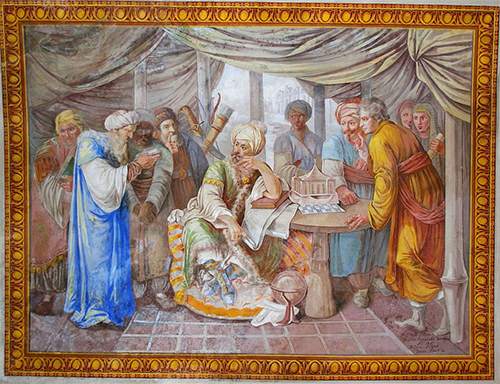
A painting depicting the scenes of the Ibādat Khāna.
Discovery of Ibadat Khana
Different archaeologists and historians had different thoughts on the location of Ibadat Khana. Saeed Ahmed Mararavi, followed by Athar Abbas Rizvi and Vincent Flynn suggested that the mound between Jama Masjid and Jodha Bai's Mahal is the site of Ibadat Khana. However, they had no tangible proof to support their argument. In early 1980s, K. K. Muhammed working under Prof. R. C. Gaur of Aligarh Muslim University excavated the mound and found the steps, platforms and boundary wall, which matched the painting of Ibadat Khana from Akbar's period.
See also
• Akbar the Great
• Dabestan-e Mazaheb
• Din-i-Ilahi
• Fatehpur Sikri
• Taj Mahal
• Jama Masjid
• Tomb of Salim Chishti
• Jodha Bai Mahal
• Naubat Khana
Further reading
• Akbar's "House of Worship", or 'Ibadat-Khana. Vincent A. Smith, Journal of the Royal Asiatic Society for 1927, pages 715-722.
• Rezavi, Dr. Syed Ali Nadeem (2008). Religious Disputation and Imperial Ideology: The Purpose and Location of Akbar's Ibadatkhana. SAGE Publications.
• The Din-I-Ilahi Or The Religion Of Akbar. Makhan Lal Roy Choudhury. Munshiram Manoharlal Publishers Pvt. Ltd. (Edition: 1997) ISBN 81-215-0777-4
• Jews and Judaism at the Court of the Moghul Emperors in Medieval India. Walter J. Fischel. Proceedings of the American Academy for Jewish Research, Vol. 18. (1948–1949), pp. 137–177.
• Akbar's Personality Traits and World Outlook: A Critical Reappraisal. Iqtidar Alam Khan. Social Scientist, Vol. 20, No. 9/10. (Sep. - Oct., 1992), pp. 16–30.
• Muslim Civilization in India. S. M. Ikram (edited by Ainslie T. Embree). New York: Columbia University Press, 1964.
References
1. Sen, Sailendra (2013). A Textbook of Medieval Indian History. Primus Books. p. 171. ISBN 978-9-38060-734-4.
2. Smith, Vincent A. (1917). "Akbar's "House of Worship", or Ibadat-Khana". Journal of the Royal Asiatic Society of Great Britain and Ireland. 49 (4). JSTOR: 715–722. doi:10.1017/S0035869X00050814. JSTOR 25209315. S2CID 159864148.
3. Notes to Akbar’s Dream, from The Death of Œnone, and Other Poems by Alfred Tennyson (1892).
External links
• Media related to Ibādat Khāna at Wikimedia Commons
by Wikipedia
Accessed: 11/9/24
Ibādat Khāna
House of Worship
Akbar the Great holds a religious assembly in the Ibādat Khāna; the two men dressed in black are the Jesuit missionaries Rodolfo Acquaviva and Francisco Henriques. Illustration to the Akbarnama by Nar Singh, c. 1605.
Religion
Region: Fatehpur Sikri
Location
Country: Mughal Empire
Architecture
Founder: Emperor Akbar
Date established: c. 1575
The Ibādat Khāna (House of Worship) was a meeting house built in 1575 CE by the Mughal Emperor Akbar (r. 1556–1605) at Fatehpur Sikri to gather spiritual/religious leaders of different religious grounds (and beliefs) so as to conduct a discussion and debates on the teachings of the respective religious leaders (if any).[1]
In his eagerness to learn about different religions, Akbar built hall of prayer at Fatehpur Sikri in 1575 known as the Ibadat Khana. At this place, he invited selected mystics, intellectuals and theologians, and held discussions on religious and spiritual themes. He invited scholars belonging to various religions such as Hinduism, Islam, Zoroastrianism, Christianity and even atheists. He conducted religious debates with these people. They visited Ibadat Khana in the past and discussed their religious belief (and faiths) with Akbar. The result of these discussions at the Hall of Prayer led them to the conclusion that all religions lead to the same goal.
Historical background
Akbar built the Ibādat Khāna as a debating house. He encouraged Hindus, Catholics, Zoroastrians, Jains, Buddhists, Sikhs and even atheists to participate. Religious leaders and philosophers from around this diverse empire, as well as those passing through, were invited to Akbar's Thursday evening discussions. Akbar's spiritual inclinations were roused to a large extent by the example of Sulaiman Kirani, a past ruler of Bengal, who was said to spend nights in the company of over a hundred ratiocinating spiritual men. Akbar also wanted to sharpen his theological grasp because he had been told of the imminent arrival to his court of Mirza Sulaiman of Badakshan, a Sufi with a predilection for spiritual debates.[2]
Faith of the Divine
'The Divine Faith.' The Divine Faith slowly passed away under the immediate successors of Akbar. An idea of what the Divine Faith was may be gathered from the inscription at the head of the poem. The document referred to, Abul Fazl says, 'brought about excellent results: (1) the Court became a gathering place of the sages and learned of all creeds; the good doctrines of all religious systems were recognized, and their defects were not allowed to obscure their good features; (2) perfect toleration or peace with all was established; and (3) the perverse and evil-minded were covered with shame on seeing the disinterested motives of His Majesty, and these stood in the pillory of disgrace.' Dated September 1579 — Ragab 987 (Blochmann xiv.)
-- Akbar's Dream, by Alfred Lord Tennyson
By the late 1580s CE, Akbar began an attempt to reconcile the differences of all religions by creating a new faith, the Din-i-Ilahi ("Faith of the Divine"), which incorporated both pantheistic versions of Islamic Sufism (most notably Ibn Arabi's doctrine of Wahdat al-Wujud or Unity of Existence) and Bhakti or devotional movements of Hinduism. Even some elements of Christianity (like crosses), Zoroastrianism (fire ceremonies) and Jainism were amalgamated in the new religion. Akbar was greatly influenced by the teachings of Jain Acharyas Hir Vijay Suri and Jin Chandra Suri and gave up non-vegetarian food because of their influence. He declared Amari or non-killing of animals on the holy days of Jains like Paryushan and Mahavir Jayanti. He rolled back the Jizya tax from Jain pilgrimage places like Palitana.
This faith, however, was not for the masses. In fact, the only "converts" to this new religion were the upper nobility of Akbar's court. Historians have so far been able to identify only 18 members of this new religion, including his closest minister Birbal.
Alfred, Lord Tennyson's poem Akbar’s Dream lauds the Ibādat Khāna, ascribing tolerance and humanity to his "Divine Faith", while implicitly criticising the intolerance of 19th century British Christianity.[3]
A painting depicting the scenes of the Ibādat Khāna.
Discovery of Ibadat Khana
Different archaeologists and historians had different thoughts on the location of Ibadat Khana. Saeed Ahmed Mararavi, followed by Athar Abbas Rizvi and Vincent Flynn suggested that the mound between Jama Masjid and Jodha Bai's Mahal is the site of Ibadat Khana. However, they had no tangible proof to support their argument. In early 1980s, K. K. Muhammed working under Prof. R. C. Gaur of Aligarh Muslim University excavated the mound and found the steps, platforms and boundary wall, which matched the painting of Ibadat Khana from Akbar's period.
See also
• Akbar the Great
• Dabestan-e Mazaheb
• Din-i-Ilahi
• Fatehpur Sikri
• Taj Mahal
• Jama Masjid
• Tomb of Salim Chishti
• Jodha Bai Mahal
• Naubat Khana
Further reading
• Akbar's "House of Worship", or 'Ibadat-Khana. Vincent A. Smith, Journal of the Royal Asiatic Society for 1927, pages 715-722.
• Rezavi, Dr. Syed Ali Nadeem (2008). Religious Disputation and Imperial Ideology: The Purpose and Location of Akbar's Ibadatkhana. SAGE Publications.
• The Din-I-Ilahi Or The Religion Of Akbar. Makhan Lal Roy Choudhury. Munshiram Manoharlal Publishers Pvt. Ltd. (Edition: 1997) ISBN 81-215-0777-4
• Jews and Judaism at the Court of the Moghul Emperors in Medieval India. Walter J. Fischel. Proceedings of the American Academy for Jewish Research, Vol. 18. (1948–1949), pp. 137–177.
• Akbar's Personality Traits and World Outlook: A Critical Reappraisal. Iqtidar Alam Khan. Social Scientist, Vol. 20, No. 9/10. (Sep. - Oct., 1992), pp. 16–30.
• Muslim Civilization in India. S. M. Ikram (edited by Ainslie T. Embree). New York: Columbia University Press, 1964.
References
1. Sen, Sailendra (2013). A Textbook of Medieval Indian History. Primus Books. p. 171. ISBN 978-9-38060-734-4.
2. Smith, Vincent A. (1917). "Akbar's "House of Worship", or Ibadat-Khana". Journal of the Royal Asiatic Society of Great Britain and Ireland. 49 (4). JSTOR: 715–722. doi:10.1017/S0035869X00050814. JSTOR 25209315. S2CID 159864148.
3. Notes to Akbar’s Dream, from The Death of Œnone, and Other Poems by Alfred Tennyson (1892).
External links
• Media related to Ibādat Khāna at Wikimedia Commons
- admin
- Site Admin
- Posts: 41356
- Joined: Thu Aug 01, 2013 5:21 am
Re: FREDA BEDI CONT'D (#4)
by admin » Sun Nov 10, 2024 12:13 am
Dara Shikoh’s World of Islam Imagined: Inspiring peaceful coexistence
by Rohan Singh
January 4, 2023
https://www.viewsnews.net/2023/01/04/da ... -imagined/
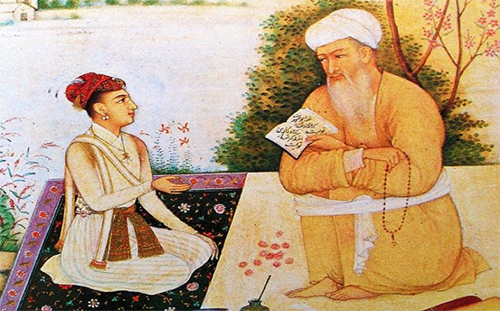
During the Fall 2022 semester, I had the pleasure of taking a course titled “The World of Islam,” taught by Ambassador Akbar Ahmed, an American-Pakistani academic, author, poet, playwright, filmmaker, former Pakistan High Commissioner to the UK and Ireland, Wilson Center Global Fellow, and the Ibn Khaldun Chair of Islamic Studies at American University. One of my personal highlights of the course was Dr. Ahmed’s play The Trial of Dara Shikoh, a historical reimagining of Prince Dara Shikoh’s execution and Aurangzeb’s rise to the Mughal throne in the 17th century. But what does a play about 17th-century royalty have to do with the world of Islam today? The Trial of Dara Shikoh envisions Prince Dara as a tragic hero with a timeless message for unity, not only in India but among all the world’s faiths. In this article, I will discuss the historical and modern significance of Dara Shikoh’s message in times of increasing religious conflict and what Dara Shikoh means to me as a South Asian American.
The Historical Significance of Dara Shikoh
Shah Jehan was one of the mighty emperors of the Mughal Empire. His name is easily recognized by many as he commissioned the Taj Mahal as a tomb for his beloved wife, Mumtaz Mahal. Prince Dara Shikoh was the eldest son of Emperor Shah Jehan and was therefore named heir apparent to the Mughal throne.
During this period, Muslim empires like the Ottomans and Safavids held great power, but none were as wealthy and prosperous as the Mughal Empire at its peak, which accounted for a quarter of the world’s GDP. However, the 17th century was a key turning point for many civilizations as European colonists started traveling and surveying land to conquer. Whether India would be the next land conquered or not would depend on the Mughals holding on to their power.
India has always been a very complex mix of cultures and religions, which at times led to tensions. Early Mughals had imposed a tax for non-Muslims, which essentially was an indirect way to encourage conversion. Under Emperor Akbar, the Great, Shah Jehan’s father, abolished this tax as a way of promoting unity in the empire after marrying a Rajput Hindu Princess, Jodha Bai. Akbar knew unity between India’s religious communities was key in maintaining power and protecting the empire from invasion.
Dara Shikoh, like his grandfather Emperor Akbar, was very interested in maintaining unity and even went the distance to understand his soon-to-be subjects. Dara Shikoh was responsible for the first-ever translation of the Hindu text of the Upanishads into Persian and also translated the Bhagavad Gita, thus allowing both texts to be introduced to the world (Ahmed). He was well-liked by mystics of all religions, and many awaited Dara Shikoh’s ascension to the throne, given his ideology toward unification (Ahmed).
However, Dara Shikoh’s brother Aurangzeb was not going to let that happen and utilized his military and administrative power to defeat his brother and declare himself emperor. Aurangzeb was far more of an orthodox Muslim and according to Dr. Ahmed, “Many powerful Muslim nobles and generals preferred Aurangzeb in order to underline the Islamic nature of the Mughal Empire.” Aurangzeb eventually imprisoned his father in the Agra Fort until his death and executed his brother Dara.
Under Aurangzeb’s rule, the tax on non-Muslims was reinstated along with oppressive policies towards non-Muslim communities. Many stories of Sikh Gurus are about the abuse they faced at the hands of Aurangzeb’s rule, such as Guru Govind Singh’s children being buried alive behind a wall in front of his eyes because he refused to convert. Such incidents led to major tensions between religious groups. However, Aurangzeb was also able to expand the reach of the Mughal empire further than any other previous king, fortifying the empire’s strength.
As I mentioned, this time period put many empires at a crossroads, with Europeans surveying the globe for land and resources. While the strength of the Mughal empire was beyond anyone’s wildest imagination, it does not take much for the house of cards to eventually fall. This clash between the two brother’s conflicting ideologies is a perfect example of just how crucial this period was. We saw what Aurangzeb did and it is possible that Dara Shikoh’s ideology of unification may have helped prevent colonialism or at least made it difficult for colonists to exploit religious tensions in their favor, but we will never know. [???!!!]
However, the thought of “what if?” is enough for someone to dream of a world where the famines imposed on Indians by the British, the Partition of India (which the United Nations Human Rights Council calls “the world’s largest mass migration”), and countless other atrocities could have been prevented had we been under Dara Shikoh’s unifying hand. Could the world have been in a much better place or was Aurganzeb’s ideology the only way forward?
The Trial of Dara Shikoh and The World of Islam
Dr. Ahmed’s play, The Trial of Dara Shikoh opens with Dara Shikoh on trial for apostasy, an allegation leveled at him by Aurangzeb. Dara Shikoh chooses to represent himself and testify. In addition, there are two other witnesses, a Hindu scholar named Gopi Lal, and a Sikh religious leader named Bahadur Singh. Both witnesses attest to Dara Shikoh’s work in creating religious unity which is unfortunately used against him by prosecutor Abdullah Khan. Khan argues that Dara Shikoh’s work with these scholars and belief that all religions are somehow intertwined is blasphemous and deserving of the highest sentence: the death penalty. One major example that Khan uses to argue his case is a ring that Dara Shikoh wears. On one side of the ring, the inscription reads, “Allah,” while the other side reads, “Prabhu,” the Sanskrit word for God. Dara Shikoh says “the two universes are encompassed and counterpoised in harmony on one small ring. For me, the concept provides a visual representation in its continuum of the essence of our spiritual unity (Ahmed).” Prosecutor Khan calls this show of unity to be blasphemous, claiming that this is proof of Dara Shikoh wandering away, “from the straight path of Islam (Ahmed).” So how does any of this tie in with Dr. Ahmed’s teachings in The World Of Islam?
The World Of Islam is a very popular course at American University for undergraduate students wishing to select the Middle East and North Africa (MENA) as a regional focus or students of International Service. Dr. Ahmed started with a discussion on early Islam and some theological concepts. We then proceeded to discuss the Golden Age of Islam, the colonial and the post-colonial identity, eventually leading to modern conflicts with and within the Muslim world.
Dr. Ahmed has a way of planning a brighter future by looking at the successes of the past. A major discussion we had in class was on the Caliphate of Córdoba when the Umayyad Dynasty established its presence in Andalusia. Dr. Ahmed explained how this was the golden age of Islam where religious and ethnic diversity not only thrived but was encouraged by the Caliphate and many technological advancements happened, some of which we still use today. Dr. Ahmed compared Córdoba to The United States, asking the class whether we currently live in the new Andalusia. Additionally, Dr. Ahmed also tried to dispel stereotypes of Muslims by telling us key concepts, principles, and events in the Holy Quran. For example, we discussed inclusivity in Islam by talking about Bilal Ibn Rabah, an Abyssian slave freed by Prophet Muhammed (peace be upon him). Bilal, who became a companion of the Prophet of Islam, was the first person to give the Muslim call to prayer, also known as Azan (or Adhan). Additionally, we discussed key figures like Khadija, the first wife of Prophet Muhammed (peace be upon him). Khadija was the first Muslim, proving that women have an integral place in Islam. We were also taught about Aisha, the youngest and revered wife of Prophet Muhammed (peace be upon him), who led troops into war! Yes, female Muslim general in the 7th century!
Greatest of all Dr. Ahmed taught us about how Islam is not about divisions or about fighting, it is about peace and harmony. Dara Shikoh’s ideals were the exact same, finding peace and harmony. The Trial Of Dara Shikoh could be considered a way to not only help understand the past but also to understand our present. There are very clearly individuals in the Muslim world that believe Aurangzeb’s orthodox ideology is the best way forward, and similarly, there are people who wished they could have seen Dara Shikoh’s views come to fruition. Both sides remain at odds with each other as Muslims work to understand their place in the world despite the challenges of conflict, globalization, and Islamophobia.
Dara Shikoh and Me
When I was growing up, my maternal grandmother would come to the United States from India to take care of me while my mother worked. I have so many fond memories of spending time with her, but some of my most fond memories were spent learning about her time growing up in an undivided India. Unfortunately, those stories also came with horrifying recounts of the partition. Both my grandparents were born in what is now Pakistan, 75 years after the end of British colonization. My grandmother, Shakuntala, was born a daughter of a Sikh ophthalmologist, Rai Bahadur Aroor Singh Chawala, and a Hindu lady, Kesar Devi in Daska, a town in Punjab. Already, my family had created a bond across religious tensions, one that resulted in eight brothers and sisters.
My maternal grandfather was born to landowners Gopal Singh and Veeranwali Saluja in Jhelum, Punjab. The story of my grandfather, while very interesting, doesn’t quite involve the partition, as his family had moved to Jaipur, Rajasthan, long before. However, my grandmother and her family ended up having to escape to India. She told me that there was never any “formal announcement,”; it just came through the grapevine that the partition was happening and everyone needed to go to their respective side. Initially, my great-grandfather was apprehensive to leave but after hearing of the atrocities that occurred, he purchased a rifle and poison. He had instructed all the women of the house that if anyone attempted to come in and cause harm that they were all to line up against the wall where they would be shot one by one and if they survived, poison was plan B. It was their Muslim neighbors who helped my half-Sikh and half-Hindu family escape. After hours of sitting in a tiny military jeep with at least 3 other families packed like sardines, they arrived at a refugee camp across the newly created border with nothing but the clothes on their backs. Their lives as they knew them, were forever gone. My grandmother talked about how her mother left milk boiling on the stove before they ran out of their home. From this refugee camp in Amritsar, just past the famed Wagah Border, they were then displaced again to Jalander, Punjab where they worked to rebuild their lives.
My mother, Rima was born in New Delhi and soon thereafter my grandfather got a job offer in Patiala, Punjab. So their family of three moved. My mother ended up attending Yadavindra Public School, the sister school of Aitchison College, Lahore. Growing up, my mother taught me exactly what my grandparents taught her: all religions believe in peace and unity, and all faiths deserve equal respect.
Despite the hardship my grandmother’s family went through, she recognized that it was a mutual respect for one another despite religion that not only created her family but allowed her to escape the atrocities of the Partition. My grandfather, a lawyer by profession, worked on cases for women’s rights and religious discrimination hoping that the wounds of the Partition would eventually heal. However, religious tensions only got worse with the Indo-Pak wars and the 1984 riots against Sikhs following the death of Prime Minister Indira Gandhi.
Growing up and learning this history of my family, all I could think of is how different my life would have been if my family’s history was rooted in intolerance. I probably would not have been here today. For centuries, inter-religious unity (or at the very least tolerance) existed in India and led to such amazing achievements. The great Mughal empire, of which Dara Shikoh was named heir apparent, was a blend of Persian, Central Asian, and Indian cultures. This can be seen in Shah Jehan’s Taj Mahal.
On the other hand, Aurangzeb deepened religious tensions which I believe eventually led to the almost irreconcilable frictions that caused the partition. Could Dara Shikoh have prevented the Partition? I can’t definitively answer that question but, unity would have made it harder for India to fall into the hands of the British Empire.
I did not learn about Dara Shikoh until I was in Dr. Ahmed’s class, and I believe that it is a disservice to the world for us not to have to learn about him earlier. There are so many stories across the world, just like mine, of families created and surviving thanks to unity across perceived “enemy” lines. I’m sure every South Asian, whether they are Pakistani, Indian, Nepalese, Sri Lankan, or Bangladeshi, can attest to this. Time and time again, history has taught us that unity maintains culture while those who are divided fall. The British took advantage of this with their “divide and rule” policy. I’m sure Aurangzeb was not all bad, he did help the empire to flourish. He also did not ever use state funds for himself, instead making skull caps and shoes to earn a living.
Dr. Ahmed told us that later writings by Aurangzeb show that he regretted executing his brother and imprisoning his father. It still does not stop me from thinking “what if.” I try to honor my family’s legacy by learning about the past and present conflicts between religious communities in South Asia and hope that I can one day see peace between its nations. Recently, I started a fundraiser at American University for flood relief in Pakistan. I feel like even small gestures of kindness can have a profound impact. They can even help start the process of healing deep wounds. Beyond asking, “What if?” Dara Shikoh’s story and Dr. Ahmed’s teachings stand as a reminder that if those in the past could envision a future of peace and unity, we should never stop fighting for those values today.
by Rohan Singh
January 4, 2023
https://www.viewsnews.net/2023/01/04/da ... -imagined/
-- Oupnek'hat [Four Upanishads], by Anquetil Duperron. [Dara Shako (Mohammed Dara Shikuh, 1615-59), the eldest son of Shahdjehan, shows publicly his indifference for Islam. In Delhi in 1656, this prince has brahmins of Benares translate the Oupnekat, a Sanskrit work whose name signifies The Word that must not be enounced (the secret that must not be revealed). This work is the essence of the four Vedas. It presents in 51 sections the complete system of Indian theology of which the result is the unity of the supreme Being [premier Etre] whose perfections and personified operations have the name of the principal Indian divinities, and the reunion [reunion] of the entire nature with this first Agent. -- by Anquetil Duperron, 1802]
-- Travels in the Mogul Empire, A.D. 1656-1668, by Francois Bernier, M.D., of the Faculty of Montpellier, Translated on the Basis of Irving Brock's Version & Annotated by Archibald Constable, 1891. Second Edition Revised by Vincent A. Smith, M.A., Author of 'The Early History of India,' etc., 1916
During the Fall 2022 semester, I had the pleasure of taking a course titled “The World of Islam,” taught by Ambassador Akbar Ahmed, an American-Pakistani academic, author, poet, playwright, filmmaker, former Pakistan High Commissioner to the UK and Ireland, Wilson Center Global Fellow, and the Ibn Khaldun Chair of Islamic Studies at American University. One of my personal highlights of the course was Dr. Ahmed’s play The Trial of Dara Shikoh, a historical reimagining of Prince Dara Shikoh’s execution and Aurangzeb’s rise to the Mughal throne in the 17th century. But what does a play about 17th-century royalty have to do with the world of Islam today? The Trial of Dara Shikoh envisions Prince Dara as a tragic hero with a timeless message for unity, not only in India but among all the world’s faiths. In this article, I will discuss the historical and modern significance of Dara Shikoh’s message in times of increasing religious conflict and what Dara Shikoh means to me as a South Asian American.
The Historical Significance of Dara Shikoh
Shah Jehan was one of the mighty emperors of the Mughal Empire. His name is easily recognized by many as he commissioned the Taj Mahal as a tomb for his beloved wife, Mumtaz Mahal. Prince Dara Shikoh was the eldest son of Emperor Shah Jehan and was therefore named heir apparent to the Mughal throne.
The Taj Mahal; lit. 'Crown of the Palace'
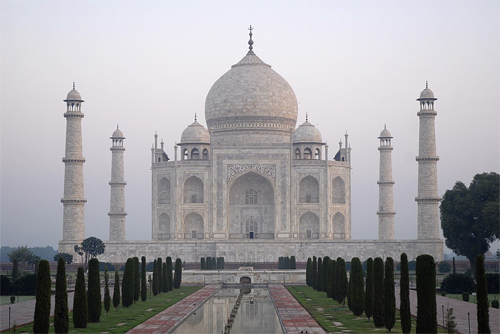
During this period, Muslim empires like the Ottomans and Safavids held great power, but none were as wealthy and prosperous as the Mughal Empire at its peak, which accounted for a quarter of the world’s GDP. However, the 17th century was a key turning point for many civilizations as European colonists started traveling and surveying land to conquer. Whether India would be the next land conquered or not would depend on the Mughals holding on to their power.
India has always been a very complex mix of cultures and religions, which at times led to tensions. Early Mughals had imposed a tax for non-Muslims, which essentially was an indirect way to encourage conversion. Under Emperor Akbar, the Great, Shah Jehan’s father, abolished this tax as a way of promoting unity in the empire after marrying a Rajput Hindu Princess, Jodha Bai. Akbar knew unity between India’s religious communities was key in maintaining power and protecting the empire from invasion.
Dara Shikoh, like his grandfather Emperor Akbar, was very interested in maintaining unity and even went the distance to understand his soon-to-be subjects. Dara Shikoh was responsible for the first-ever translation of the Hindu text of the Upanishads into Persian and also translated the Bhagavad Gita, thus allowing both texts to be introduced to the world (Ahmed). He was well-liked by mystics of all religions, and many awaited Dara Shikoh’s ascension to the throne, given his ideology toward unification (Ahmed).
... the Sufi-Vedanta-Neoplatonic amalgam of Prince Dara as reported by Bernier ...Dara [Shikoh] was not deficient in good qualities: he was courteous in conversation, quick at repartee, polite, and extremely liberal but he entertained too exalted an opinion of himself; believed he could accomplish everything by the powers of his own mind, and imagined that there existed no man from whose counsel he could derive benefit. He spoke disdainfully of those who ventured to advise him, and thus deterred his sincerest friends from disclosing the secret machinations of his brothers. He was also very irascible; apt to menace; abusive and insulting even to the greatest Omrahs; but his anger was seldom more than momentary. Born a Mahometan, he continued to join in the exercises of that religion; but although thus publicly professing his adherence to its faith. Dara was in private a Gentile with Gentiles, and a Christian with Christians. He had constantly about him some of the Pendets, or Gentile Doctors, on whom he bestowed large pensions, and from these it is thought he imbibed opinions in no wise accordant with the religion of the land but upon this subject I shall make a few observations when I treat of the religious worship of the Indous or Gentiles. He had, moreover, for some time lent a willing ear to the suggestions of the Reverend Father Buzee, a Jesuit, in the truth and propriety of which he began to acquiesce. 1 [Catrou in his History of the Mogul Dynasty in India, Paris, 1715, which is largely based upon the materials collected by Signer Manouchi, a Venetian, who was for forty-eight years a Physician at the Courts of Delhi and Agra, and for some time attached to Dara’s person, says that ‘no sooner had Dara begun to possess authority, than he became disdainful and inaccessible. A small number of Europeans alone shared his confidence. The Jesuits, especially, were in the highest consideration with him. These were the Fathers . . . and Henry Busee, a Fleming. This last had much influence over the mind of the prince, and had his counsels been followed, it is probable that Christianity would have mounted the throne with Dara.’] There are persons, however, who say that Dara was in reality destitute of all religion, and that these appearances were assumed only from motives of curiosity, and for the sake of amusement; while, according to others, he became by turns a Christian and a Gentile from political considerations; wishing to ingratiate himself with the Christians who were pretty numerous in his corps of artillery, and also hoping to gain the affection of the Rajas, or Gentile Princes tributary to the empire; as it was most essential to be on good terms with these personages, that he might, as occasion arose, secure their co-operation. Darn's false pretences to this or that mode of worship, did not, however, promote the success of his plans; on the contrary, it will be found in the course of this narrative, that the reason assigned by Aureng-Zebe for causing him to be beheaded was, that he had turned Kafer, that is to say an infidel, without religion, an idolater..........
Do not be surprised if, notwithstanding my ignorance of Sanscrit 2 ['Hanscrit' in the original, see p. 329, footnote 3.] (the language of the learned, and possibly that of the ancient Brahmens, as we may learn further on), I yet say something of books written in that tongue. My Agah, Danechmend-kan, partly from my solicitation and partly to gratify his own curiosity, took into his service one of the most celebrated Pendets in all the Indies, who had formerly belonged to the household of Dara, 3 [Dara Shikoh, when Governor or Viceroy of Benares, in 1656, caused a Persian translation to be made from the Sanskrit text of the Upanishads ('the word that is not to be revealed'), which he called the Sarr-i-Asrar, or Secret of Secrets. This translation, which was made by a large staff of Benares Pandits, has been rendered into Latin by Anquetil-Duperron, and published by him at Paris, 1801, under the title of Oupnekhat (id est, Secretum Tegendum) opus ipsa in India rarissimum, etc. etc. His version is criticised in an article published in the second number (January 1803) of The Edinburgh Review, which I believe to have been written by Alexander Hamilton, 'a Scotchman who had been in India; . . . of excellent conversation and great knowledge of Oriental literature. He was afterwards professor of Sanscrit' [in the official lists he is designated Professor of Hindu Literature and History of Asia] 'in the East India College at Haileybury,' p. 141, vol. i. Cockburn's Life of Lord Jeffrey, Edin. 1852, also see p. 256, vol. i. of Lord Brougham's Life and Times, Edin. and Lond. 1871. In this critique pleasing testimony is borne to the great abilities of Prince Dara Shikoh, as follows: — 'If intolerance and fanaticism be the usual concomitants of Islamism (an assertion, we think, too generally expressed), the descendants of Tamerlane, who reigned in Hindustan, furnish some remarkable exceptions to the received opinion. At the head of these illustrious personages we should, perhaps, place Dara Shecuh, the eldest son of the Emperor Shah Gehan. The attention which this Prince bestowed, investigating the antique dogmas of the Hindu theology, and the munificence with which he rewarded the learned Brahmans, whom he collected from all parts of the empire, furnished his brother Aurengzebe with a pretext to misrepresent his motives, and to alarm the zealous Moslems with the danger of an apostate succeeding to the throne. The melancholy catastrophe which ensued; the death of the unhappy Dara, with the long and brilliant reign of the successful hypocrite, who founded his greatness on the destruction of his brothers, are detailed in the page of history. If the sceptical philosopher be disposed to exclaim with the Roman Epicurean, 'Tanta Religio potuit suadere malorum,' we must state our conviction that ambition, not fanaticism, prompted the deed; though the steps by which he mounted the throne threw the rigid veil of superstition over the subsequent conduct of Aurengzebe, and gave that tone to his court.'] the eldest son of the King Chah-Jehan; and not only was this man my constant companion during a period of three years, but he also introduced me to the society of other learned Pendets, whom he attracted to the house. When weary of explaining to my Agah the recent discoveries of Harveus and Pecquet in anatomy, and of discoursing on the philosophy of Gassendi and Descartes, 1 [FN1]FN1: William Harvey, born in 1578, and died in 1657. It was in 1616, the year of Shakespeare's death, that he began his course of lectures to the Royal College of Physicians in London, and formally announced his discovery of the circulation of the blood, which has rendered his name for ever famous.
Jean Pecquet, born at Dieppe, in France, in 1622, died in 1674. He studied medicine at Montpellier, where Bernier was also a student, and it was there that he prosecuted those investigations which led to his discoveries, in connection with the conversion of the chyle into blood, which have immortalised his name.
Rene Descartes, born at La Haye, Touraine, in France, in 1596, and died at Stockholm in 1650.
which I translated to him in Persian (for this was my principal employment for five or six years) we had generally recourse to our Pendet, who, in his turn, was called upon to reason in his own manner, and to communicate his fables; these he related with all imaginable gravity without ever smiling; but at length we became disgusted both with his tales and childish arguments. ............
In conclusion, I shall explain to you the Mysticism of a Great Sect 1 [In the original, 'le mystere d'une grande Cabale.'] which has latterly made great noise in Hindoustan, inasmuch as certain Pendets or Gentile Doctors had instilled it into the minds of Dara and Sultan Sujah, the elder sons of Chah-Jehan. 2 [FN2]FN2: Mirza Muhammad Kazim, the historian, in his Alamgir Nama, which is a history of the first ten years of the reign of the Emperor Alamgir (Aurangzeb), written in 1688, treats of the heresy of Dara Shikoh as follows —
'Dara Shukoh in his later days did not restrain himself to the free-thinking and heretical notions which he had adopted under the name of Tasawwuf (Sufism), but showed an inclination for the religion and institutions of the Hindus. He was constantly in the society of Brahmans, Jogis, and Sannyasis, and he used to regard these worthless teachers of delusions as learned and true masters of wisdom. He considered their books, which they call Bed, as being the Word of God and revealed from Heaven, and he called them ancient and excellent books. He was under such delusion about this Bed that he collected Brahmans and Sannyasis from all parts of the country, and paying them great respect and attention, he employed them in translating the Bed. He spent all his time in this unholy work, and devoted all his attention to the contents of these wretched books. . . . Through these perverted opinions he had given up the prayers, fasting, and other obligations imposed by the law. ... It became manifest that if Dara Shukoh obtained the throne and established his power, the foundations of the faith would be in danger and the precepts of Islam would be changed for the rant of infidelity and Judaism.'— Elliot, History of India, vol. vii. page 179. For a definition of Sufism, which is and always has been looked upon as rank heresy by orthodox Moslems, see p. 320, footnote 2. Sannyasi is the name in modern times for various sects of Hindoo religious mendicants who wander about and subsist upon alms; the 'naked Fakires' described by Bernier (p. 317), of whom Sarmet was one. According to the laws of Manu, the life of a Brahman was divided into four stages, the fourth of which was that of a Sannyasi. ' The religious mendicant who, freed from all forms and observances, wanders about and subsists on alms, practising or striving for that condition of mind which, heedless of the flesh, is intent only upon the Deity and final absorption.'— Dowson, Classical Diet, of Hindu Mythology, London, 1879. [END FN]
You are doubtless acquainted with the doctrine of many of the ancient philosophers concerning that great life-giving principle of the world, of which they argue that we and all living creatures are so many parts if we carefully examine the writings of Plato and Aristotle, we shall probably discover that they inclined towards this opinion. This is the almost universal doctrine of the Gentile Pendets of the Indies, and it is this same doctrine which is held by the sect of the Soufys and the greater part of the learned men of Persia at the present day, and which is set forth in Persian poetry in very exalted and emphatic language, in their Goul-tchen-raz, 1 [FN1]FN1: The Gulshan Raz, or 'Mystic Rose Garden,' was composed in 717 A.H. (1317 A.D.) in answer to fifteen questions on the doctrines of the Sufis propounded by Amir Syad Hosaini, a celebrated Sufi of Khorasan. Hardly anything is known of the author, Muhammad Shabistari, further than that he was born at Shabistar, a village in Azarbaijan, and that he wrote this poem and died at Tabriz, the capital town of the same province, in 720 A.H. = 1320 A.D. 'To the European reader the Gulshan Raz is useful as being one of the clearest explanations of that peculiar phraseology which pervades Persian poetry, and without a clear understanding of which it is impossible to appreciate that poetry as it deserves. And it is also interesting as being one of the most articulate expressions of "Sufism," that remarkable phrase of Muhammadan religious thought which corresponds to the mysticism of European theology.' See the Gulshan Raz of Najm ud din, otherwise called Sa'd ud din Mahmud Shabistari Tabrizi. Translated by E. H. Whinfield, M.A., of the Bengal Civil Service. Wyman and Co., Publishers, Hare Street, Calcutta, 1876. [END FN1]
or Garden of Mysteries. This was also the opinion of Flud 2 [FN2]FN2: Robert Flud, or Fludd, Physician, healer by 'faith-natural,' and Rosicrucian, was born at Bearsted in Kent in 1574, and died in London, 1637. He is the chief English representative of that school of medical mystics who laid claim to the possession of the key to universal science, and his voluminous writings on things divine and human, attracted more attention abroad than in his own country. Gassendi's contribution to the controversy was his Examen Philosophiae Fluddanae, published in 1633, and an earlier treatise, published in 1631.[END FN2]
whom our great Gassendy has so ably refuted; and it is similar to the doctrines by which most of our alchymists have been hopelessly led astray. Now these Sectaries or Indou Pendets, so to speak, push the incongruities in question further than all these philosophers, and pretend that God, or that supreme being whom they call Achar l [See p. 325.] (immovable, unchangeable) has not only produced life from his own substance, but also generally everything material or corporeal in the universe, and that this production is not formed simply after the manner of efficient causes, but as a spider which produces a web from its own navel, and withdraws it at pleasure. The Creation then, say these visionary doctors, is nothing more than an extraction or extension of the individual substance of God, of those filaments which He draws from his own bowels; and, in like manner, destruction is merely the recalling of that divine substance and filaments into Himself; so that the last day of the world, which they call maperle or pralea, 2 [Maha-pralaya, or total dissolution of the universe at the end of a kalpa (a day and night of Brahma, equal to 4,320,000,000 years) when the seven lokas (divisions of the universe) and their inhabitants, men, saints, gods, and Brahma himself, are annihilated. Pralaya is a modified form of dissolution.] and in which they believe every being will be annihilated, will be the general recalling of those filaments which God had before drawn forth from Himself. — There is, therefore, say they, nothing real or substantial in that which we think we see, hear or smell, taste or touch; the whole of this world is, as it were, an illusory dream, inasmuch as all that variety which appears to our outward senses is but one only and the same thing, which is God Himself; in the same manner as all those different numbers, of ten, twenty, a hundred, a thousand, etc., are but the frequent repetition of the same unit. — But ask them some reason for this idea; beg them to explain how this extraction and reception of substance occurs, or to account for that apparent variety; or how it is that God not being corporeal but biapek, as they allow, and incorruptible, He can be thus divided into so many portions of body and soul, they will answer you only with some fine similes — That God is as an immense ocean in which many vessels of water are in continual motion; let these vessels go where they will, they always remain in the same ocean, in the same water; and if they should break, the water they contain would then be united to the whole, to that ocean of which they were but parts. — Or they will tell you that it is with God as with the light, which is the same everywhere, but causes the objects on which it falls to assume a hundred different appearances, according to the various colours or forms of the glasses through which it passes. — They will never attempt to satisfy you, I say, but with such comparisons as these, which bear no proportion with God, and which serve only to blind an ignorant people. In vain will you look for any solid answer. If one should reply that these vessels might float in a water similar to their own, but not in the same; and that the light all over the world is indeed similar, but not the same, and so on to other strong objections which may be made to their theory, they have recourse continually to the same similes, to fine words, or, in the case of the Soufys, to the beautiful poems of their Goul-tchen-raz.
Now, Sir, what think you? Had I not reason from all this great tissue of extravagant folly on which I have re marked; from that childish panic of which I have spoken above; from that superstitious piety and compassion toward the sun in order to deliver it from the malignant and dark Deuta; from that trickery of prayers, of ablutions, of dippings, and of alms, either cast into the river, or bestowed on Brahmens; from that mad and infernal hardihood of women to burn themselves with the body of those husbands whom frequently they have hated while alive; from those various and frantic practices of the Fakires; and lastly, from all that fabulous trash of their Beths and other books; was I not justified in taking as a motto to this letter, — the wretched fruit of so many voyages and so many reflections, a motto of which the modern satirist has so well known how to catch and convey the idea without so long a journey — 'There are no opinions too extravagant and ridiculous to find reception in the mind of man '?
To conclude, you will do me a kindness by delivering Monsieur Chapelle's 1 [The letter referred to, despatched, as was the present one, from Chiras, but on the 10th June 1668, Concerning his intention of resuming his studies, on some points which relate to the doctrine of atoms, and to the nature of the human understanding, is not printed in this present edition. It contains much curious matter, but nothing directly relating to Bernier's Indian experiences. Claude-Emmanuel Luillier Chapelle (1626-1645) was a natural son of Francois Luillier's, at whose house Gassendi was a frequent guest; struck by the talent of young Chapelle he gave him lessons in philosophy together with Moliere and Bernier.] letter into his own hands; it was he who first obtained for me that acquaintance with your intimate and illustrious friend, Monsieur Gassendi, which has since proved so advantageous to me. I am so much obliged to him for this favour that I cannot but love and remember him wherever my lot may be cast. I also feel myself under much obligation to you, and am bound to honour you all my life, not only on account of the partiality you have manifested toward me, but also for the valuable advice contained in your frequent letters, by which you have aided me during my journeys, and for your goodness in having sent me so disinterestedly and gratuitously a collection of books to the extremity of the world, whither my curiosity had led me; while those of whom I requested them, who might have been paid with money which I had left at Marseilles, and who in common politeness should have sent them, deserted me and laughed at my letters, looking on me as a lost man whom they were never more to see.
-- Travels in the Mogul Empire, A.D. 1656-1668, by Francois Bernier, M.D., of the Faculty of Montpellier, Translated on the Basis of Irving Brock's Version & Annotated by Archibald Constable, 1891. Second Edition Revised by Vincent A. Smith, M.A., Author of 'The Early History of India,' etc., 1916
-- The Birth of Orientalism, by Urs App
-- Oupnek'hat [Four Upanishads], by Anquetil Duperron. [Dara Shako (Mohammed Dara Shikuh, 1615-59), the eldest son of Shahdjehan, shows publicly his indifference for Islam. In Delhi in 1656, this prince has brahmins of Benares translate the Oupnekat, a Sanskrit work whose name signifies The Word that must not be enounced (the secret that must not be revealed). This work is the essence of the four Vedas. It presents in 51 sections the complete system of Indian theology of which the result is the unity of the supreme Being [premier Etre] whose perfections and personified operations have the name of the principal Indian divinities, and the reunion [reunion] of the entire nature with this first Agent. -- by Anquetil Duperron, 1802]
However, Dara Shikoh’s brother Aurangzeb was not going to let that happen and utilized his military and administrative power to defeat his brother and declare himself emperor. Aurangzeb was far more of an orthodox Muslim and according to Dr. Ahmed, “Many powerful Muslim nobles and generals preferred Aurangzeb in order to underline the Islamic nature of the Mughal Empire.” Aurangzeb eventually imprisoned his father in the Agra Fort until his death and executed his brother Dara.
Under Aurangzeb’s rule, the tax on non-Muslims was reinstated along with oppressive policies towards non-Muslim communities. Many stories of Sikh Gurus are about the abuse they faced at the hands of Aurangzeb’s rule, such as Guru Govind Singh’s children being buried alive behind a wall in front of his eyes because he refused to convert. Such incidents led to major tensions between religious groups. However, Aurangzeb was also able to expand the reach of the Mughal empire further than any other previous king, fortifying the empire’s strength.
As I mentioned, this time period put many empires at a crossroads, with Europeans surveying the globe for land and resources. While the strength of the Mughal empire was beyond anyone’s wildest imagination, it does not take much for the house of cards to eventually fall. This clash between the two brother’s conflicting ideologies is a perfect example of just how crucial this period was. We saw what Aurangzeb did and it is possible that Dara Shikoh’s ideology of unification may have helped prevent colonialism or at least made it difficult for colonists to exploit religious tensions in their favor, but we will never know. [???!!!]
A fundamental factor in the premodern European discovery of Asian religions is easily overlooked just because it is so pervasive and determines the outlook of most discoverers: the biblical frame of reference. All religions of the world had to originate with a survivor of the great deluge (usually set circa 2500 B.C.E.) because nobody outside Noah's ark survived. In Roman times, young Christianity was portrayed as the successor of Adam's original pure monotheism, thus stretching its roots into antediluvian times....
After the discovery of America and the opening of the sea route to India at the end of the fifteenth century, new challenges to biblical authority arose. It was difficult to establish a connection between hitherto unknown people and animals and Noah's ark.... Our case studies show different ways in which Europeans tried to rise to such challenges: missionaries who attempted to incorporate ancient Asian cultures and religions into Bible-based scenarios; others who tried to move the starting shot of biblical history backward to beat the Chinese annals...
[F]rom the sixteenth to the nineteenth centuries, the doctrines of emanation and transmigration constituted a crucial link between East and West extending from Japan in the Far East ... authors identified transmigration as a most ancient and universal pre-Mosaic teaching concerning the fall of angels before the creation of the earth -- a teaching that in their view forms the initial part of the biblical creation story that Moses omitted. They regarded human souls as the souls of fallen angels imprisoned in human bodies who have to migrate from one body to the next until they achieve redemption and can return to their heavenly home....
[T]wo significations of Buddhist doctrines, an exoteric or outer one for the simple-minded people and an esoteric or inner one for the philosophers and literati ...
[W]hen Ricci in [1582] moved with another Italian missionary, Michele Ruggieri, to Canton and then to Zhaoqing in South China... the two Jesuits adopted the title and vestments of the Chinese seng -- that is, they identified themselves and dressed as ordained Buddhist bonzes. Even their Ten Commandments in Chinese contained Buddhist terms; for example, the third commandment read that on holidays it was forbidden to work and one had to go to the Buddhist temple (si) in order to recite the sutras (jing) and worship the Master of Heaven (tianzhu, the Lord of devas). Ruggieri's and Ricci's first Chinese catechism, the Tianzhu shilu of 1584-the first book printed by Europeans in China -- also brimmed with Buddhist terms and was signed by "the bonzes from India" (tianzhuguo seng) (Ricci 1942:198). The doorplate of the Jesuit's residence and church read "Hermit-flower [Buddhist] temple" (xianhuasi), while the plate displayed prominently inside the church read "Pure Land of the West" (xilai jingdu). As can be seen in the report about the inscriptions on the Jesuit residence and church of Zhaoqing (Figure 1), Ruggieri translated "hermit" (xian), a term with Daoist connotations, by the Italian "santi" (saints), and the Buddhist temple (St) became an "ecclesia" (church). Even more interesting is his transformation of the Buddhist paradise or "Pure Land of the West" into "from the West came the purest fathers." This presumably referred to the biblical patriarchs, but it is not excluded that a double-entrendre Jesuit fathers from the West) was intended.
Nine years later, in 1592, when Ricci was translating the four Confucian classics, he decided to abandon his identity as a Buddhist bonze (seng); and during a visit in Macao, he asked his superior Valignano for permission also to shed his bonze's robe, begging bowl, and sutra recitation implements. The Christian churches were renamed from si to tang (a more neutral word meaning "hall"), and in 1594 the final step in this rebranding process was taken when Ricci received Valignano's permission to present himself and dress up as a Chinese literatus. It was the year when Ricci finished his translation of the four Confucian classics, the books that any Chinese wishing to reach the higher ranks of society had to study. In Ricci's view, these books contained unmistakable vestiges of ancient monotheism. In his journals he wrote,Of all the pagan sects known to Europe, I know of no people who fell into fewer errors in the early stages of their antiquity than did the Chinese. From the very beginning of their history it is recorded in their writings that they recognized and worshipped one supreme being whom they called the King of Heaven, or designated by some other name indicating his rule over heaven and earth .... They also taught that the light of reason came from heaven and that the dictates of reason should be hearkened to in every human action....
Ricci and his companions focused on cozying up to the Confucians. On November 4, 1595, Ricci wrote to the Jesuit Father General Acquaviva: "I have noted down many terms and phrases [of the Chinese classics] in harmony with our faith, for instance, 'the unity of God,' 'the immortality of the soul,' the glory of the blessed,' and the like". Ricci intended to identify appropriate terms in the Confucian classics to give the Christian dogma a Mandarin dress and to illustrate his view that the Chinese had successfully safeguarded an extremely ancient knowledge of God. The portions of Ruggieri and Ricci's old "Buddhist" catechism dealing with God's revelation and requiring faith rather than reason were removed, while topics such as the "goodness of human nature" that appealed to Confucians were added. Ricci systematically substituted Buddhist terminology with phrases from the Chinese classics.... It was not a catechism in the traditional sense but a praeparatio evangelica: a way to entice the rationalist upper crust of Chinese society and to refute the "superstitious" and "foreign" forms of Chinese religion (such as Daoism and Buddhism) by logical argument while interpreting "original" Confucianism as a kind of Old Testament to Christianity. Ricci's "catechism" was thus not yet the Good News itself but a first step toward it. It argued that Chinese religion had once been thoroughly monotheistic and that this primeval monotheism had later degenerated through the influence of Daoism and Buddhism. In Ricci's view Christianity was nothing other than the fulfillment of China's Ur-monotheism.
-- The Birth of Orientalism, by Urs App
-- Noble lie 1 [Royal Lie] [Pious Fiction] [Pious Fraud] [Pious Invention], by Wikipedia
However, the thought of “what if?” is enough for someone to dream of a world where the famines imposed on Indians by the British, the Partition of India (which the United Nations Human Rights Council calls “the world’s largest mass migration”), and countless other atrocities could have been prevented had we been under Dara Shikoh’s unifying hand. Could the world have been in a much better place or was Aurganzeb’s ideology the only way forward?
The Trial of Dara Shikoh and The World of Islam
Dr. Ahmed’s play, The Trial of Dara Shikoh opens with Dara Shikoh on trial for apostasy, an allegation leveled at him by Aurangzeb. Dara Shikoh chooses to represent himself and testify. In addition, there are two other witnesses, a Hindu scholar named Gopi Lal, and a Sikh religious leader named Bahadur Singh. Both witnesses attest to Dara Shikoh’s work in creating religious unity which is unfortunately used against him by prosecutor Abdullah Khan. Khan argues that Dara Shikoh’s work with these scholars and belief that all religions are somehow intertwined is blasphemous and deserving of the highest sentence: the death penalty. One major example that Khan uses to argue his case is a ring that Dara Shikoh wears. On one side of the ring, the inscription reads, “Allah,” while the other side reads, “Prabhu,” the Sanskrit word for God. Dara Shikoh says “the two universes are encompassed and counterpoised in harmony on one small ring. For me, the concept provides a visual representation in its continuum of the essence of our spiritual unity (Ahmed).” Prosecutor Khan calls this show of unity to be blasphemous, claiming that this is proof of Dara Shikoh wandering away, “from the straight path of Islam (Ahmed).” So how does any of this tie in with Dr. Ahmed’s teachings in The World Of Islam?
The World Of Islam is a very popular course at American University for undergraduate students wishing to select the Middle East and North Africa (MENA) as a regional focus or students of International Service. Dr. Ahmed started with a discussion on early Islam and some theological concepts. We then proceeded to discuss the Golden Age of Islam, the colonial and the post-colonial identity, eventually leading to modern conflicts with and within the Muslim world.
Dr. Ahmed has a way of planning a brighter future by looking at the successes of the past. A major discussion we had in class was on the Caliphate of Córdoba when the Umayyad Dynasty established its presence in Andalusia. Dr. Ahmed explained how this was the golden age of Islam where religious and ethnic diversity not only thrived but was encouraged by the Caliphate and many technological advancements happened, some of which we still use today. Dr. Ahmed compared Córdoba to The United States, asking the class whether we currently live in the new Andalusia. Additionally, Dr. Ahmed also tried to dispel stereotypes of Muslims by telling us key concepts, principles, and events in the Holy Quran. For example, we discussed inclusivity in Islam by talking about Bilal Ibn Rabah, an Abyssian slave freed by Prophet Muhammed (peace be upon him). Bilal, who became a companion of the Prophet of Islam, was the first person to give the Muslim call to prayer, also known as Azan (or Adhan). Additionally, we discussed key figures like Khadija, the first wife of Prophet Muhammed (peace be upon him). Khadija was the first Muslim, proving that women have an integral place in Islam. We were also taught about Aisha, the youngest and revered wife of Prophet Muhammed (peace be upon him), who led troops into war! Yes, female Muslim general in the 7th century!
Greatest of all Dr. Ahmed taught us about how Islam is not about divisions or about fighting, it is about peace and harmony. Dara Shikoh’s ideals were the exact same, finding peace and harmony. The Trial Of Dara Shikoh could be considered a way to not only help understand the past but also to understand our present. There are very clearly individuals in the Muslim world that believe Aurangzeb’s orthodox ideology is the best way forward, and similarly, there are people who wished they could have seen Dara Shikoh’s views come to fruition. Both sides remain at odds with each other as Muslims work to understand their place in the world despite the challenges of conflict, globalization, and Islamophobia.
Dara Shikoh and Me
When I was growing up, my maternal grandmother would come to the United States from India to take care of me while my mother worked. I have so many fond memories of spending time with her, but some of my most fond memories were spent learning about her time growing up in an undivided India. Unfortunately, those stories also came with horrifying recounts of the partition. Both my grandparents were born in what is now Pakistan, 75 years after the end of British colonization. My grandmother, Shakuntala, was born a daughter of a Sikh ophthalmologist, Rai Bahadur Aroor Singh Chawala, and a Hindu lady, Kesar Devi in Daska, a town in Punjab. Already, my family had created a bond across religious tensions, one that resulted in eight brothers and sisters.
My maternal grandfather was born to landowners Gopal Singh and Veeranwali Saluja in Jhelum, Punjab. The story of my grandfather, while very interesting, doesn’t quite involve the partition, as his family had moved to Jaipur, Rajasthan, long before. However, my grandmother and her family ended up having to escape to India. She told me that there was never any “formal announcement,”; it just came through the grapevine that the partition was happening and everyone needed to go to their respective side. Initially, my great-grandfather was apprehensive to leave but after hearing of the atrocities that occurred, he purchased a rifle and poison. He had instructed all the women of the house that if anyone attempted to come in and cause harm that they were all to line up against the wall where they would be shot one by one and if they survived, poison was plan B. It was their Muslim neighbors who helped my half-Sikh and half-Hindu family escape. After hours of sitting in a tiny military jeep with at least 3 other families packed like sardines, they arrived at a refugee camp across the newly created border with nothing but the clothes on their backs. Their lives as they knew them, were forever gone. My grandmother talked about how her mother left milk boiling on the stove before they ran out of their home. From this refugee camp in Amritsar, just past the famed Wagah Border, they were then displaced again to Jalander, Punjab where they worked to rebuild their lives.
My mother, Rima was born in New Delhi and soon thereafter my grandfather got a job offer in Patiala, Punjab. So their family of three moved. My mother ended up attending Yadavindra Public School, the sister school of Aitchison College, Lahore. Growing up, my mother taught me exactly what my grandparents taught her: all religions believe in peace and unity, and all faiths deserve equal respect.
Despite the hardship my grandmother’s family went through, she recognized that it was a mutual respect for one another despite religion that not only created her family but allowed her to escape the atrocities of the Partition. My grandfather, a lawyer by profession, worked on cases for women’s rights and religious discrimination hoping that the wounds of the Partition would eventually heal. However, religious tensions only got worse with the Indo-Pak wars and the 1984 riots against Sikhs following the death of Prime Minister Indira Gandhi.
Growing up and learning this history of my family, all I could think of is how different my life would have been if my family’s history was rooted in intolerance. I probably would not have been here today. For centuries, inter-religious unity (or at the very least tolerance) existed in India and led to such amazing achievements. The great Mughal empire, of which Dara Shikoh was named heir apparent, was a blend of Persian, Central Asian, and Indian cultures. This can be seen in Shah Jehan’s Taj Mahal.
On the other hand, Aurangzeb deepened religious tensions which I believe eventually led to the almost irreconcilable frictions that caused the partition. Could Dara Shikoh have prevented the Partition? I can’t definitively answer that question but, unity would have made it harder for India to fall into the hands of the British Empire.
I did not learn about Dara Shikoh until I was in Dr. Ahmed’s class, and I believe that it is a disservice to the world for us not to have to learn about him earlier. There are so many stories across the world, just like mine, of families created and surviving thanks to unity across perceived “enemy” lines. I’m sure every South Asian, whether they are Pakistani, Indian, Nepalese, Sri Lankan, or Bangladeshi, can attest to this. Time and time again, history has taught us that unity maintains culture while those who are divided fall. The British took advantage of this with their “divide and rule” policy. I’m sure Aurangzeb was not all bad, he did help the empire to flourish. He also did not ever use state funds for himself, instead making skull caps and shoes to earn a living.
Dr. Ahmed told us that later writings by Aurangzeb show that he regretted executing his brother and imprisoning his father. It still does not stop me from thinking “what if.” I try to honor my family’s legacy by learning about the past and present conflicts between religious communities in South Asia and hope that I can one day see peace between its nations. Recently, I started a fundraiser at American University for flood relief in Pakistan. I feel like even small gestures of kindness can have a profound impact. They can even help start the process of healing deep wounds. Beyond asking, “What if?” Dara Shikoh’s story and Dr. Ahmed’s teachings stand as a reminder that if those in the past could envision a future of peace and unity, we should never stop fighting for those values today.
- admin
- Site Admin
- Posts: 41356
- Joined: Thu Aug 01, 2013 5:21 am
Re: FREDA BEDI CONT'D (#4)
by admin » Fri Nov 15, 2024 12:14 am
Part 1 of 2
III. The Sixth Discourse; on the Persians
by Sir William Jones
Delivered 10th February, 1789
Gentlemen,
I turn with delight from the vast mountains and barren deserts of Turan over which we travelled last year with no perfect knowledge of our course, and request you now to accompany me on a literary journey through one of the most celebrated and most beautiful countries in the world; a country, the history and languages of which, both ancient and modern, I have long attentively studied, and on which I may without arrogance promise you more positive information, than I could possibly procure on a nation so disunited and so unlettered as the Tartars: I mean that, which Europeans improperly call Persia, the name of a single province being applied to the whole Empire of Iran, as it is correctly denominated by the present natives of it, and by all the learned Muselmans, who reside in these British territories. To give you an idea of its largest boundaries, agreeably to my former mode of describing India, Arabia, and Tartary, between which it lies, let us begin with the source of the great Assyrian stream, Euphrates, (as the Greeks, according to their custom, were pleased to miscall the Forat) and thence descend to its mouth in the Green Sea, or Persian Gulf, including in our line some considerable districts and towns on both sides of the river; then, coasting Persia, properly so named, and other Iranian provinces, we come to the delta of the Sindhu or Indus; whence ascending to the mountains of Cashghar, we discover its fountains and those of the Jaihun, down which we are conducted to the Caspian, which formerly perhaps it entered, though it lose itself now in the sands and lakes of Khwarezm: we next are led from the sea of Khozar, by the banks of the Cur, or Cyrus, and along the Caucasean ridges, to the shore of the Euxine, and thence, by the several Greecian seas, to the point, whence we took our departure, at no considerable distance from the Mediterranean. We cannot but include the lower Asia within this outline, because it was unquestionably a part of the Persian, if not of the old Assyrian, Empire; for we know, that it was under the dominion of CAIKHOSRAU; and DIODORUS, we find, asserts, that the kingdom of Troas was dependent on Assyria, since PRIAM implored and obtained succours from his Emperor TEUTAMES, whose name approaches nearer to TAHMURAS, than to that of any other Assyrian monarch. Thus may we look on Iran as the noblest Island, (for so the Greeks and the Arabs would have called it), or at least as the noblest peninsula, on this habitable globe; and if M. BAILLY had fixed on it as the Atlantis of PLATO, he might have supported his opinion with far stronger arguments than any, that he has adduced in favour of New Zembla: if the account, indeed, of the Atlantes be not purely an Egyptian, or an Utopian, fable, I should be more inclined to place them in Iran than in any region, with which I am acquainted.
It may seem strange, that the ancient history of so distinguished an Empire should be yet so imperfectly known; but very satisfactory reasons may be assigned for our ignorance of it: the principal of them are the superficial knowledge of the Greeks and Jews, and the loss of Persian archives or historical compositions. That the Greecian writters, before XENOPHON [430 BC-355 BC], had no acquaintance with Persia, and that all their accounts of it are wholly fabulous, is a paradox too extravagant to be seriously maintained; but their connection with it in war or peace had, indeed, been generally confined to bordering kingdoms under feudatory princes; and the first Persian Emperor, whose life and character they seem to have known with tolerable accuracy, was the great CYRUS, whom I call, without fear of contradiction, CAIKHOSRAU; for I shall then only doubt that the KHOSRAU of FIRDAUSI was the CYRUS of the first Greek historian, and the Hero of the oldest political and moral romance, when I doubt that LOUIS Quatorze and LEWIS the Fourteenth were one and the same French King: it is utterly incredible, that two different princes of Persia should each have been born in a foreign and hostile territory; should each have been doomed to death in his infancy by his maternal grandfather in consequence of portentous dreams, real or invented; should each have been saved by the remorse of his destined murderer, and should each, after a similar education among herdsmen as the son of a herdsman, have found means to revisit his paternal kingdom, and having delivered it, after a long and triumphant war, from the tyrant, who had invaded it, should have restored it to the summit of power and magnificence. Whether so romantic a story, which is the subject of an Epic Poem, as majestic and entire as the Iliad, be historically true, we may feel perhaps an inclination to doubt; but it cannot with reason be denied, that the outline of it related to a single Hero, whom the Asiatics, conversing with the father of European history, described according to their popular traditions by his true name, which the Greek alphabet could not express: nor will a difference of names affect the question; since the Greeks had little regard for truth, which they sacrificed willingly to the Graces of their language, and the nicety of their ears; and, if they could render foreign words melodious, they were never solicitous to make them exact; hence they probably formed CAMBYSES from CAMBAKHSH, or Granting desires, a title rather than a name, and XERXES from SHIRUYI, a Prince and warrior in the Shahnama, or from SHIRAHAH, which might also have been a title; for the Asiatic Princes have constantly assumed new titles or epithets at different periods of their lives, or on different occasions; a custom, which we have seen prevalent in our own times both in Iran and Hindustan, and which has been a source of great confusion even in the scriptural accounts of Babylonian occurrences: both Greeks and Jews have in fact accommodated Persian names to their own articulation; and both seem to have disregarded the native literature of Iran, without which they could at most attain a general and imperfect knowledge of the country. As to the Persians themselves, who were contemporary with the Jews and Greeks, they must have been acquainted with the history of their own times, and with the traditional accounts of past ages; but for a reason, which will presently appear, they chose to consider CAYUMERS as the founder of their empire; and, in the numerous distractions, which followed the overthrow of DARA, especially in the great revolution on the defeat of YEZDEGIRD, their civil histories were lost, as those of India have unhappily been, from the solicitude of the priests, the only depositaries of their learning, to preserve their books of law and religion at the expense of all others: hence it has happened, that nothing remains of genuine Persian history before the dynasty of SASAN [224-651], except a few rustic traditions and fables, which furnished materials for the Shahnamah, and which are still supposed to exist in the Pahlavi language.
The annals of the Pishdadi, or Assyrian, race must be considered as dark and fabulous; and those of the Cayani family, or the Medes and Persians, as heroic and poetical; though the lunar eclipses, said to be mentioned by PTOLEMY, fix the time of GUSHTASP, the prince, by whom ZERATUSHT was protected: of the Parthian kings descended from ARSHAC or ARSACES, we know little more than the names; but the Sasani's had so long an intercourse with the Emperors of Rome and Byzantium, that the period of their dominion may be called an historical age. In attempting to ascertain the beginning of the Assyrian empire, we are deluded, as in a thousand instances, by names arbitrarily imposed: it had been settled by chronologers, that the first monarchy established in Persia was the Assyrian; and NEWTON, finding some of opinion, that it rose in the first century after the Flood, but unable by his own calculations to extend it farther back than seven hundred and ninety years before CHRIST, rejected part of the old system and adopted the rest of it; concluding, that the Assyrian Monarchs began to reign about two hundred years after SOLOMON, and that, in all preceding ages, the government of Iran had been divided into several petty states and principalities. Of this opinion I confess myself to have been; when, disregarding the wild chronology of the Muselmans and Gabrs, I had allowed the utmost natural duration to the reigns of eleven Pishdadi kings, without being able to add more than a hundred years to NEWTON'S computation. It seemed, indeed, unaccountably strange, that, although ABRAHAM had found a regular monarchy in Egypt, although the kingdom of Yemen had just pretensions to very high antiquity, although the Chinese, in the twelfth century before our era, had made approaches at least to the present form of their extensive dominion, and although we can hardly suppose the first Indian monarchs to have reigned less than three thousand years ago, yet Persia, the most delightful, the most compact, the most desirable country of them all, should have remained for so many ages unsettled and disunited. A fortunate discovery, for which I was first indebted to Mir MUHAMMED HUSAIN, one of the most intelligent Muselmans in India, has at once dissipated the cloud, and cast a gleam of light on the primeval history of Iran and of the human race, of which I had long despaired, and which could hardly have dawned from any other quarter.
The rare and interesting tract on twelve different religions, entitled the Dabistan, and composed by a Mohammedan traveller, a native of Cashmir, named MOHSAN, but distinguished by the assumed surname of FANI, or Perishable, begins with a wonderfully curious chapter on the religion of HUSHANG, which was long anterior to that of ZERATUSHT, but had continued to be secretly professed by many learned Persians even to the author's time; and several of the most eminent of them, dissenting in many points from the Gabrs, and persecuted by the ruling powers of their country, had retired to India; where they compiled a number of books, now extremely scarce, which MOHSAN had perused, and with the writers of which, or with many of them, he had contracted an intimate friendship: from them he learned, that a powerful monarchy had been established for ages in Iran before the accession of CAYUMERS, that it was called the Mahabadian dynasty for a reason, which will soon be mentioned, and that many princes, of whom seven or eight only are named in the Dabistan, and among them MAHBUL, or MAHA BELI, had raised their empire to the zenith of human glory. If we can rely on this evidence, which to me appears unexceptionable, the Iranian monarchy must have been the oldest in the world; but it will remain dubious, to which of the three stocks, Hindu, Arabian, or Tartar, the first Kings of Iran belonged, or whether they sprang from a fourth race distinct from any of the others; and these are questions, which we shall be able, I imagine, to answer precisely, when we have carefully inquired into the languages and letters, religion and philosophy, and incidentally into the arts and sciences, of the ancient Persians.
I. In the new and important remarks, which I am going to offer, on the ancient languages and characters of Iran, I am sensible, that you must give me credit for many assertions, which on this occasion it is impossible to prove; for I should ill deserve your indulgent attention, if I were to abuse it by repeating a dry list of detached words, and presenting you with a vocabulary instead of a dissertation; but, since I have no system to maintain, and have not suffered imagination to delude my judgement; since I have habituated myself to form opinions of men and things from evidence, which is the only solid basis of civil, as experiment is of natural knowledge; and since I have maturely considered the questions which I mean to discuss; you will not, I am persuaded, suspect my testimony, or think that I go too far, when I assure you, that I will assert nothing positively, which I am not able satisfactorily to demonstrate. When MUHAMMED was born, and ANUSHIRAVAN, whom he calls the Just King, sat on the throne of Persia, two languages appear to have been generally prevalent in the great empire of Iran; that of the Court, thence named Deri, which was only a refined and elegant dialect of the Parsi, so called from the province of which Shiraz is now the capital, and that of the learned, in which most books were composed, and which had the name of Pahlavi, either from the heroes, who spoke it in former times, or from Pahlu, a tract of land, which included, we are told, some considerable cities of Irak: the ruder dialects of both were, and, I believe, still are, spoken by the rustics in several provinces; and in many of them, as Herdt, Zabul, Sistan and others, distinct idioms were vernacular, as it happens in every kingdom of great extent. "Besides the Parsi and Pahlavi, a very ancient and abstruse tongue was known to the priests and philosophers, called the language of the Zend, because a book on religious and moral duties, which they held sacred, and which bore that name, had been written in it; while the Pazend, or comment on that work, was composed in Pahlavi, as a more popular idiom; but a learned follower of ZERATUSHT, named BAHMAN, who lately died at Calcutta, where he had lived with me as a Persian reader about three years, assured me, that the letters of his prophet's book were properly called Zend, and the language, Avesta, as the words of the Veda's are Sanscrit, and the characters, Nagari; or as the old Saga's and poems of Iceland were expressed in Runic letters: let us however, in compliance with custom, give the name of Zend to the sacred language of Persia, until we can find, as we shall very soon, a fitter appellation for it. The Zend and the old Pahlavi are almost extinct in Iran; for among six or seven thousand Gabrs, who reside chiefly at Yezd, and in Cirman, there are very few, who can read Pahlavi, and scarce any, who even boast of knowing the Zend; while the Parsi, which remains almost pure in the Shahnamah, has now become by the Intermixture of numberless Arabic words, and many imperceptible changes, a new language exquisitely polished by a series of fine writers in prose and verse, and analogous to the different idioms gradually formed in Europe after the subversion of the Roman empire: but with modern Persian we have no concern in our present inquiry, which I confine to the ages, that preceded the Mohammedan conquest. Having twice read the works of FIRDAUSI with great attention, since I applied myself to the study of old Indian literature, I can assure you with confidence, that hundreds of Parsi nouns are pure Sanscrit, with no other change than such as may be observed in the numerous bhasha's, or vernacular dialects, of India; that very many Persian imperatives are the roots of Sanscrit verbs; and that even the moods and tenses of the Persian verb substantive, which is the model of all the rest, are deducible from the Sanscrit by an easy and clear analogy: we may hence conclude, that the Parsi was derived, like the various Indian dialects, from the language of the Brahmans; and I must add, that in the pure Persian I find no trace of any Arabian tongue, except what proceeded from the known intercourse between the Persians and Arabs, especially in the time of BAHRAM, who was educated in Arabia, and whose Arabic verses are still extant, together with his heroic line in Deri, which many suppose to be the first attempt at Persian versification in Arabian metre: but, without having recourse to other arguments, the composition of words, in which the genious of the Persian delights, and which that of the Arabic abhors, is a decisive proof, that the Parsi sprang from an Indian, and not from an Arabian, stock. Considering languages as mere instruments of knowledge, and having strong reasons to doubt the existence of genuine books in Zend or Pahlavi (especially since the well-informed author of the Dabistan affirms the work of ZERATUSHT to have been lost, and its place supplied by a recent compilation) I had no inducement, though I had an opportunity, to learn what remains of those ancient languages; but I often conversed on them with my friend BAHMAN, and both of us were convinced after full consideration, that the Zend bore a strong resemblance to Sanscrit, and the Pahlavi to Arabic. He had at my request translated into Pahlavi the fine inscription, exhibited in the Gulistan, on the diadem of CYRUS; and I had the patience to read the list of words from the Pazend in the appendix to the Farhangi Jehangiri: this examination gave me perfect conviction, that the Pahlavi was a dialect of the Chaldaic; and of this curious fact I will exhibit a short proof. By the nature of the Chaldean tongue most words ended in the first long vowel like shemia, heaven; and that very word, unaltered in a single letter, we find in the Pazend, together with lailia, night, meya, water, nira, fire, matra, rain, and a multitude of others, all Arabic or Hebrew with a Chaldean termination: so zamar, by a beautiful metaphor from pruning trees, means in Hebrew to compose verses, and thence, by an easy transition, to sing, them; and in Pahlavi we see the verb zamruniten, to sing, with its forms zamrunemi, I sing, and zamrunid, he sang; the verbal terminations of the Persian being added to the Chaldaic root. Now all those words are integral parts of the language, not adventitious to it like the Arabic nouns and verbals engrafted on modern Persian; and this distinction convinces me, that the dialect of the Gabrs, which they pretend to be that of ZERATUSHT, and of which BAHMAN gave me a variety of written specimens, is a late invention of their priests, or subsequent at least to the Muselman invasion; for, although it may be possible, that a few of their sacred books were preserved, as he used to assert, in sheets of lead or copper at the bottom of wells near Yezd, yet as the conquerors had not only a spiritual, but a political, interest in persecuting a warlike, robust, and indignant race of irreconcilable conquered subjects, a long time must have elapsed, before the hidden scriptures could have been safely brought to light, and few, who could perfectly understand them, must then have remained; but, as they continued to profess among themselves the religion of their forefathers, it became expedient for the Mubeds to supply the lost or mutilated works of their legislator by new compositions, partly from their imperfect recollection, and partly from such moral and religious knowledge, as they gleaned, most probably, among the Christians, with whom they had an intercourse. One rule we may fairly establish in deciding the question, whether the books of the modern Gabrs were anterior to the invasion of the Arabs: when an Arabic noun occurs in them changed only by the spirit of the Chaldean idiom, as werta, for werd, a rose, daba, for dhahab, gold, or deman, for zeman, time, we may allow it to have been ancient Pahlavi; but, when we meet with verbal nouns or infinitives, evidently formed by the rules of Arabian grammar, we may be sure, that the phrases, in which they occur, are comparatively modern; and not a single passage, which BAHMAN produced from the books of his religion, would abide this test.
We come now to the language of the Zend, and here I must impart a discovery, which I lately made, and from which we may draw the most interesting consequences. M. ANQUETIL, who had the merit of undertaking a voyage to India, in his earliest youth, with no other view than to recover the writings of ZERATUSHT, and who would have acquired a brilliant reputation in France, if he had not sullied it by his immoderate vanity and virulence of temper, which alienated the good will even of his own countrymen, has exhibited in his work, entitled Zendavesta, two vocabularies in Zend and Pahlavi, which he had found in an approved collection of Rawayat, or Traditional Pieces, in modern Persian: of his Pahlavi no more needs be said, than that it strongly confirms my opinion concerning the Chaldaic origin of that language; but, when I perused the Zend glossary, I was inexpressibly surprised to find, that six or seven words in ten were pure Sanscrit, and even some of their inflexions formed by the rules of the Vyacaran; as yushmacam, the genitive plural of yushmad. Now M. ANQUETIL most certainly, and the Persian compiler most probably, had no knowledge of Sanscrit; and could not, therefore, have invented a list of Sanscrit words: it is, therefore, an authentic list of Zena words, which had been preserved in books or by tradition; and it follows, that the language of the Zend was at least a dialect of the Sanscrit, approaching perhaps as nearly to it as the Pracrit, or other popular idioms, which we know to have been spoken in India two thousand years ago. From all these facts it is a necessary consequence, that the oldest discoverable languages of Persia were Chaldaic and Sanscrit; and that, when they had ceased to be vernacular, the Pahlavi and Zend were deduced from them respectively, and the Parsi either from the Zend, or immediately from the dialect of the Brahmans; but all had perhaps a mixture of Tartarain; for the best lexicographers assert, that numberless words in ancient Persian are taken from the language of the Cimmerians, or the Tartars of Kipchak; so that the three families, whose lineage we have examined in former discourses, had left visible traces of themselves in Iran, long before the Tartars and Arabs had rushed from their deserts, and returned to that very country, from which in all probability they originally proceeded, and which the Hindus had abandoned in an earlier age, with positive commands from their legislators to revisit it no more. [???] I close this head with observing, that no supposition of a mere political or commercial intercourse between the different nations will account for the Sanscrit and Chaldaic words, which we find in the old Persian tongues; because they are, in the first place, too numerous to have been introduced by such means, and, secondly, are not the names of exotic animals, commodities, or arts, but those of material elements, parts of the body, natural objects and relations, affections of the mind, and other ideas common to the whole race of man.
III. The Sixth Discourse; on the Persians
by Sir William Jones
Delivered 10th February, 1789
-- III. The Sixth Discourse; on the Persians, by Sir William Jones, Delivered 10th February, 1789, from Asiatic Researches; or Transactions of the Society Instituted in Bengal For Inquiring Into the History and Antiquities, The Arts, Sciences, and Literature of Asia, Volume II, 1788 P. 36-53
-- ZEND-AVESTA, WORK OF ZOROASTRE, Containing the Theological, Physical & Moral Ideas of this Legislator, the Ceremonies of the Religious Worship he established, & several important features relating to the ancient History of the Persians: Translated into French on the Original Zend, with Notes; & accompanied by several Treatises specific to clarifying the Matters who are subject to it. By M. ANQUETIL DU PERRON, of the Royal Academy of Inscriptions & Belles-Lettres, & Interpreter of the King for Oriental Languages. FIRST VOLUME. SECOND PART, Which includes the Vendidad Sade (i.e. I'zeschnè, the Vispered & the VENDIDAD itself), preceded by the Notices of the Zend Manuscripts, Pehlvis, Persians & Indians, deposited by the Translator in the Library of King; Titles & Summaries of Articles & c. both. Volumes of this Work; & of the VIE DE ZOROASTRE: With a plate engraved in intaglio. 1771
-- Oupnek'hat [Four Upanishads], by Anquetil Duperron. 1802
Gentlemen,
I turn with delight from the vast mountains and barren deserts of Turan over which we travelled last year with no perfect knowledge of our course, and request you now to accompany me on a literary journey through one of the most celebrated and most beautiful countries in the world; a country, the history and languages of which, both ancient and modern, I have long attentively studied, and on which I may without arrogance promise you more positive information, than I could possibly procure on a nation so disunited and so unlettered as the Tartars: I mean that, which Europeans improperly call Persia, the name of a single province being applied to the whole Empire of Iran, as it is correctly denominated by the present natives of it, and by all the learned Muselmans, who reside in these British territories. To give you an idea of its largest boundaries, agreeably to my former mode of describing India, Arabia, and Tartary, between which it lies, let us begin with the source of the great Assyrian stream, Euphrates, (as the Greeks, according to their custom, were pleased to miscall the Forat) and thence descend to its mouth in the Green Sea, or Persian Gulf, including in our line some considerable districts and towns on both sides of the river; then, coasting Persia, properly so named, and other Iranian provinces, we come to the delta of the Sindhu or Indus; whence ascending to the mountains of Cashghar, we discover its fountains and those of the Jaihun, down which we are conducted to the Caspian, which formerly perhaps it entered, though it lose itself now in the sands and lakes of Khwarezm: we next are led from the sea of Khozar, by the banks of the Cur, or Cyrus, and along the Caucasean ridges, to the shore of the Euxine, and thence, by the several Greecian seas, to the point, whence we took our departure, at no considerable distance from the Mediterranean. We cannot but include the lower Asia within this outline, because it was unquestionably a part of the Persian, if not of the old Assyrian, Empire; for we know, that it was under the dominion of CAIKHOSRAU; and DIODORUS, we find, asserts, that the kingdom of Troas was dependent on Assyria, since PRIAM implored and obtained succours from his Emperor TEUTAMES, whose name approaches nearer to TAHMURAS, than to that of any other Assyrian monarch. Thus may we look on Iran as the noblest Island, (for so the Greeks and the Arabs would have called it), or at least as the noblest peninsula, on this habitable globe; and if M. BAILLY had fixed on it as the Atlantis of PLATO, he might have supported his opinion with far stronger arguments than any, that he has adduced in favour of New Zembla: if the account, indeed, of the Atlantes be not purely an Egyptian, or an Utopian, fable, I should be more inclined to place them in Iran than in any region, with which I am acquainted.
It may seem strange, that the ancient history of so distinguished an Empire should be yet so imperfectly known; but very satisfactory reasons may be assigned for our ignorance of it: the principal of them are the superficial knowledge of the Greeks and Jews, and the loss of Persian archives or historical compositions. That the Greecian writters, before XENOPHON [430 BC-355 BC], had no acquaintance with Persia, and that all their accounts of it are wholly fabulous, is a paradox too extravagant to be seriously maintained; but their connection with it in war or peace had, indeed, been generally confined to bordering kingdoms under feudatory princes; and the first Persian Emperor, whose life and character they seem to have known with tolerable accuracy, was the great CYRUS, whom I call, without fear of contradiction, CAIKHOSRAU; for I shall then only doubt that the KHOSRAU of FIRDAUSI was the CYRUS of the first Greek historian, and the Hero of the oldest political and moral romance, when I doubt that LOUIS Quatorze and LEWIS the Fourteenth were one and the same French King: it is utterly incredible, that two different princes of Persia should each have been born in a foreign and hostile territory; should each have been doomed to death in his infancy by his maternal grandfather in consequence of portentous dreams, real or invented; should each have been saved by the remorse of his destined murderer, and should each, after a similar education among herdsmen as the son of a herdsman, have found means to revisit his paternal kingdom, and having delivered it, after a long and triumphant war, from the tyrant, who had invaded it, should have restored it to the summit of power and magnificence. Whether so romantic a story, which is the subject of an Epic Poem, as majestic and entire as the Iliad, be historically true, we may feel perhaps an inclination to doubt; but it cannot with reason be denied, that the outline of it related to a single Hero, whom the Asiatics, conversing with the father of European history, described according to their popular traditions by his true name, which the Greek alphabet could not express: nor will a difference of names affect the question; since the Greeks had little regard for truth, which they sacrificed willingly to the Graces of their language, and the nicety of their ears; and, if they could render foreign words melodious, they were never solicitous to make them exact; hence they probably formed CAMBYSES from CAMBAKHSH, or Granting desires, a title rather than a name, and XERXES from SHIRUYI, a Prince and warrior in the Shahnama, or from SHIRAHAH, which might also have been a title; for the Asiatic Princes have constantly assumed new titles or epithets at different periods of their lives, or on different occasions; a custom, which we have seen prevalent in our own times both in Iran and Hindustan, and which has been a source of great confusion even in the scriptural accounts of Babylonian occurrences: both Greeks and Jews have in fact accommodated Persian names to their own articulation; and both seem to have disregarded the native literature of Iran, without which they could at most attain a general and imperfect knowledge of the country. As to the Persians themselves, who were contemporary with the Jews and Greeks, they must have been acquainted with the history of their own times, and with the traditional accounts of past ages; but for a reason, which will presently appear, they chose to consider CAYUMERS as the founder of their empire; and, in the numerous distractions, which followed the overthrow of DARA, especially in the great revolution on the defeat of YEZDEGIRD, their civil histories were lost, as those of India have unhappily been, from the solicitude of the priests, the only depositaries of their learning, to preserve their books of law and religion at the expense of all others: hence it has happened, that nothing remains of genuine Persian history before the dynasty of SASAN [224-651], except a few rustic traditions and fables, which furnished materials for the Shahnamah, and which are still supposed to exist in the Pahlavi language.
Dara I or Darab I was the penultimate king of the mythological Kayanian dynasty, ruling for 12 years. He was the son of Kay Bahman. Most accounts agree that Dara's mother was Humay Chehrzad, who had married her father, Kay Bahman. After Kay Bahman's death, Humay, who was pregnant with Dara, became the regent of the realm. Humay later hid the news of Dara's birth, and abandoned him on casket filled with expensive jewels on a river. The river has reported to have been the Euphrates, the Tigris, the Kor river in Fars, the Polvar river in Fars, or the Balkh river.
When Dara became older he eventually found his way back to Humay, who abdicated in his favor. Dara I was later succeeded by his son Dara II.
Dara I has been credited with the establishment of the Persian postal system, which is a reflection of [???] the introduction or restructuring of the postal system by the Achaemenid King of Kings, Darius I the Great (r. 522–486 BC). The last Kayanian kings were usually connected with western Iran, as demonstrated by reports of Dara I using Babylon as his residence. Most sources credit Dara I with the foundation of the city of Darabgerd in Fars, while a few consider Dara II to have been its founder.
According to later sources, Dara I had a son named Firuzshah [!!!], whose achievements are mentioned in the Firuz-nameh by Haji Muhammad Bigami.
-- Dara I, by Wikipedia
DĀRĀ(B) (1)
Dārā(b) I was the son of the Kayanid Bahman Ardašīr. According to most of the sources, his mother was Homā Čehrāzād, who married her own father, Bahman (Šāh-nāma, Moscow, VI, p. 352; Ṭabarī, I, p. 687; Balʿamī, ed. Bahār, p. 687; Masʿūdī, Morūj, ed. Pellat, I, p. 272; Ṯaʿālebī, Ḡorar, p. 389; Meskawayh, p. 34; Gardīzī, ed. Ḥabībī, p. 15; Ṭarsūsī, pp. 10-11). In one tradition, however, this marriage was denied, and it was maintained that Homā died a virgin (Ebn al-Balḵī, p. 54). Nevertheless, the former version, which accords with the old Iranian tradition of next-of-kin marriage, is certainly authentic. According to this legend, Bahman died before Dārā was born and appointed Homā his regent. When Dārā was born she did not reveal the news of his birth but had him laid, together with precious jewels, in a casket and exposed on the river Euphrates (Šāh-nāma, Moscow, VI, p. 356; Ṭarsūsī, p. 11), the Tigris (Maqdesī, Badʾ III, p. 150), the Kor river in Fārs (Ṭabarī, I, p. 689), the Eṣṭaḵr (i.e., Polvār) river in Fārs (Ṯaʿālebī, Ḡorar, p. 392), or the Balḵ river (Ṭabarī, I, p. 690). The child was found by a fuller (Šāh-nāma, Moscow, VI, p. 356; Ṯaʿālebī, Ḡorar, p. 392; Mojmal, ed. Bahār, p. 54; Maqdesī, Badʾ III, p. 150; Ṭarsūsī, where his name is given as Hormaz) or a miller (Ṭabarī, I, p. 690; Balʿamī, ed. Bahār, p. 690), who called him Dārāb, because he was found in the water (āb) among the trees (dār;itfoṮaʿālebī, Ḡorar, p. 394; Šāh-nāma, Moscow, VI, p. 358; Ṭarsūsī, pp. 13-14; Balʿamī, ed. Bahār, p. 690: dār “hold, take”).
This story seems to be based on popular etymology. A similar etiological legend is told about Kawād, the founder of the Kayanid dynasty (Bundahišn, TD2, p. 231; Christensen, 1931, pp. 70-71; idem, 1933-35; Bailey, pp. 69 ff.). It belongs to a type of legend “which is generally associated with the change of dynasties, the end of an era, or a major shift of power” (Yarshater, p. 522; cf. Christensen, 1933-35). In spite of the discontent of his foster-father, who wanted the boy to become a fuller, Dārā, eager to receive an aristocratic education, was first handed over to scholars, who taught him the Avesta and its commentary (Zand o Estā); then he was trained in archery, horsemanship, polo, and similar skills. Dārā, who doubted his relationship to the fuller and was curious to find out his true origin, compelled the fuller’s wife to reveal his descent. As he was ambitious to reach high positions, Dārā entered the service of Rašnavād, Homā’s commander-in-chief (Šāh-nāma, Moscow, VI, pp. 358 ff.; Ṯaʿālebī, Ḡorar, pp. 394 ff.; Maqdesī, Badʾ III, p. 150; Balʿamī, ed. Bahār, pp. 690-91; Ṭarsūsī, pp. 27 ff., with different details). Eventually Dārā was introduced to the queen, who after a reign of thirty years (thirty-two according to Šāh-nāma, Moscow, VI, p. 371 v. 312) abdicated in his favor.
Dārā reigned for twelve years (Bundahišn, TD2, p. 240; Ḥamza, p. 13; Mojmal, ed. Bahār, p. 55; Ebn al-Balḵī, p. 55; Dīnavarī, ed. Guirgass, p. 31; Masʿūdī, Morūj, ed. Pellat, I, p. 272). During his reign he fought with Šoʿayb, the Arab commander from the Qotayb tribe (Šāh-nāma, Moscow, VI, pp. 374-75; Ṭarsūsī, pp. 354-72). He also campaigned against Fīlfūs (Philip) of Rūm (i.e., Greece), who was defeated and compelled to pay tribute and agreed to marry his daughter Nāhīd (Šāh-nāma, Moscow, VI, p. 377; Ṭarsūsī, p. 380) or Halāy (Ṭabarī, I, p. 697) to Dārā. Although pregnant, she was soon sent back home because of her foul breath. In Rūm she bore Eskandar (Alexander; Šāh-nāma, Moscow, pp. 375 ff.; Dīnavarī, pp. 31-32; Ṯaʿālebī, Ḡorar, pp. 399 ff.; Ṭabarī, I, pp. 696-97; Mojmal, ed. Bahār, p. 54; Ṭarsūsī, pp. 390 ff.). This last episode represents an obvious attempt to provide a link between Alexander the Great and the Persian royal house by making him a half-brother of Dārā II (Yarshater, pp. 522-23).
The introduction of the Persian postal system was attributed to Dārā I (Ṭabarī, I, p. 692; Ḥamza, p. 39; Ṯaʿālebī, Ḡorar, p. 398; Gardīzī, ed. Ḥabībī, p. 16), apparently reflecting a historical fact: the introduction or reorganization of the postal system by Darius I the Great. The foundation of the city of Dārābgerd in Fārs was attributed to him in most of the sources (Ḥamza, p. 39; Ṭabarī, I, p. 692; Balʿamī, ed. Bahār, p. 692; Ebn al-Balḵī, p. 55; Ṯaʿālebī, Ḡorar, p. 398; Gardīzī, ed. Ḥabībī, p. 16; Mojmal, ed. Bahār, p. 55; Ebn al-Balḵī, p. 55; Ṭarsūsī, pp. 353, 452; see Dārāb ii), though in some others Dārā II was credited with its foundation (Pahlavi Texts, ed. Jamasp-Asana, p. 22; Tārīḵ-e gozīda, ed. Browne, p. 99). Babylon was mentioned as his residence (Ṭabarī, I, p. 692; Masʿūdī, Morūj, ed. Pellat, I, p. 272), which shows the general tendency in the tradition to link the exploits of the last Kayanid kings with western Iran.
Dārā was supposed, according to the late sources, to have had a son called Fīrūzšāh, whose exploits are related in the popular Persian romance Fīrūzšāh-nāma, published under the title Dārāb-nāma by Ḥājī Moḥammad Bīḡamī (ed. Ḏ. Ṣafā, Tehran, 1339-41 Š./1960-62).
-- DĀRĀ(B) (1), by Encyclopedia Iranica
The annals of the Pishdadi, or Assyrian, race must be considered as dark and fabulous; and those of the Cayani family, or the Medes and Persians, as heroic and poetical; though the lunar eclipses, said to be mentioned by PTOLEMY, fix the time of GUSHTASP, the prince, by whom ZERATUSHT was protected: of the Parthian kings descended from ARSHAC or ARSACES, we know little more than the names; but the Sasani's had so long an intercourse with the Emperors of Rome and Byzantium, that the period of their dominion may be called an historical age. In attempting to ascertain the beginning of the Assyrian empire, we are deluded, as in a thousand instances, by names arbitrarily imposed: it had been settled by chronologers, that the first monarchy established in Persia was the Assyrian; and NEWTON, finding some of opinion, that it rose in the first century after the Flood, but unable by his own calculations to extend it farther back than seven hundred and ninety years before CHRIST, rejected part of the old system and adopted the rest of it; concluding, that the Assyrian Monarchs began to reign about two hundred years after SOLOMON, and that, in all preceding ages, the government of Iran had been divided into several petty states and principalities. Of this opinion I confess myself to have been; when, disregarding the wild chronology of the Muselmans and Gabrs, I had allowed the utmost natural duration to the reigns of eleven Pishdadi kings, without being able to add more than a hundred years to NEWTON'S computation. It seemed, indeed, unaccountably strange, that, although ABRAHAM had found a regular monarchy in Egypt, although the kingdom of Yemen had just pretensions to very high antiquity, although the Chinese, in the twelfth century before our era, had made approaches at least to the present form of their extensive dominion, and although we can hardly suppose the first Indian monarchs to have reigned less than three thousand years ago, yet Persia, the most delightful, the most compact, the most desirable country of them all, should have remained for so many ages unsettled and disunited. A fortunate discovery, for which I was first indebted to Mir MUHAMMED HUSAIN, one of the most intelligent Muselmans in India, has at once dissipated the cloud, and cast a gleam of light on the primeval history of Iran and of the human race, of which I had long despaired, and which could hardly have dawned from any other quarter.
Authorship
Several manuscripts have been discovered that identifies the author as Mīr Du'lfiqar Ardestānī (also known as Mollah Mowbad). Mir Du'lfiqar is now generally accepted as the author of this work.
Before these manuscripts were discovered, however, Sir William Jones identified the author as Mohsin Fani Kashmiri. In 1856, a Parsi named Keykosrow b. Kāvūs claimed Khosrow Esfandiyar as the author, who was son of Azar Kayvan.
-- Dabestan-e Mazaheb, by Wikipedia, by Wikipedia
Three different men have been identified as the author of Dābestān-e maḏāheb. In 1789 William Jones proposed Moḥsen Fānī Kašmīrī (d. 1081/1670), but subsequently Captain Vans Kennedy and William Erskine both independently rejected this identification. An entirely conjectural attribution to Āḏar Kayvān’s son and spiritual successor Keyḵosrow Esfandīār was put forth in 1856 by an Indian Parsi, Keyḵosrow b. Kāvūs, and this suggestion has been reiterated by Raḥīm Reżāzāda Malek, editor of the most recent edition (see below; II, pp. 58-67, quoted from Cama Oriental Institute, Bombay, ms. 300). Some historians and authors of biographical dictionaries, including Ṣamṣām-al-Dawla Šāhnavāz Khan (I, pp. 226-27; II, pp. 76, 392), Serāj-al-Dīn ʿAlī Khan Ārezū (Rieu, Persian Manuscripts II, p. 1081), Āzād Belgrāmī (p. 22), and Raḥm-ʿAlī Khan Īmān (p. 179) identified the author as Mīr Ḏu’l-feqār Ardestānī (ca. 1026-81/1617-70), better known under his pen name Mollā Mowbad or Mowbadšāh, and this attribution is now generally accepted. [???!!!]
-- Dabestan-E Madaheb, by Encyclopedia Iranica
The rare and interesting tract on twelve different religions, entitled the Dabistan, and composed by a Mohammedan traveller, a native of Cashmir, named MOHSAN, but distinguished by the assumed surname of FANI, or Perishable, begins with a wonderfully curious chapter on the religion of HUSHANG, which was long anterior to that of ZERATUSHT, but had continued to be secretly professed by many learned Persians even to the author's time; and several of the most eminent of them, dissenting in many points from the Gabrs, and persecuted by the ruling powers of their country, had retired to India; where they compiled a number of books, now extremely scarce, which MOHSAN had perused, and with the writers of which, or with many of them, he had contracted an intimate friendship: from them he learned, that a powerful monarchy had been established for ages in Iran before the accession of CAYUMERS, that it was called the Mahabadian dynasty for a reason, which will soon be mentioned, and that many princes, of whom seven or eight only are named in the Dabistan, and among them MAHBUL, or MAHA BELI, had raised their empire to the zenith of human glory. If we can rely on this evidence, which to me appears unexceptionable, the Iranian monarchy must have been the oldest in the world; but it will remain dubious, to which of the three stocks, Hindu, Arabian, or Tartar, the first Kings of Iran belonged, or whether they sprang from a fourth race distinct from any of the others; and these are questions, which we shall be able, I imagine, to answer precisely, when we have carefully inquired into the languages and letters, religion and philosophy, and incidentally into the arts and sciences, of the ancient Persians.
I. In the new and important remarks, which I am going to offer, on the ancient languages and characters of Iran, I am sensible, that you must give me credit for many assertions, which on this occasion it is impossible to prove; for I should ill deserve your indulgent attention, if I were to abuse it by repeating a dry list of detached words, and presenting you with a vocabulary instead of a dissertation; but, since I have no system to maintain, and have not suffered imagination to delude my judgement; since I have habituated myself to form opinions of men and things from evidence, which is the only solid basis of civil, as experiment is of natural knowledge; and since I have maturely considered the questions which I mean to discuss; you will not, I am persuaded, suspect my testimony, or think that I go too far, when I assure you, that I will assert nothing positively, which I am not able satisfactorily to demonstrate. When MUHAMMED was born, and ANUSHIRAVAN, whom he calls the Just King, sat on the throne of Persia, two languages appear to have been generally prevalent in the great empire of Iran; that of the Court, thence named Deri, which was only a refined and elegant dialect of the Parsi, so called from the province of which Shiraz is now the capital, and that of the learned, in which most books were composed, and which had the name of Pahlavi, either from the heroes, who spoke it in former times, or from Pahlu, a tract of land, which included, we are told, some considerable cities of Irak: the ruder dialects of both were, and, I believe, still are, spoken by the rustics in several provinces; and in many of them, as Herdt, Zabul, Sistan and others, distinct idioms were vernacular, as it happens in every kingdom of great extent. "Besides the Parsi and Pahlavi, a very ancient and abstruse tongue was known to the priests and philosophers, called the language of the Zend, because a book on religious and moral duties, which they held sacred, and which bore that name, had been written in it; while the Pazend, or comment on that work, was composed in Pahlavi, as a more popular idiom; but a learned follower of ZERATUSHT, named BAHMAN, who lately died at Calcutta, where he had lived with me as a Persian reader about three years, assured me, that the letters of his prophet's book were properly called Zend, and the language, Avesta, as the words of the Veda's are Sanscrit, and the characters, Nagari; or as the old Saga's and poems of Iceland were expressed in Runic letters: let us however, in compliance with custom, give the name of Zend to the sacred language of Persia, until we can find, as we shall very soon, a fitter appellation for it. The Zend and the old Pahlavi are almost extinct in Iran; for among six or seven thousand Gabrs, who reside chiefly at Yezd, and in Cirman, there are very few, who can read Pahlavi, and scarce any, who even boast of knowing the Zend; while the Parsi, which remains almost pure in the Shahnamah, has now become by the Intermixture of numberless Arabic words, and many imperceptible changes, a new language exquisitely polished by a series of fine writers in prose and verse, and analogous to the different idioms gradually formed in Europe after the subversion of the Roman empire: but with modern Persian we have no concern in our present inquiry, which I confine to the ages, that preceded the Mohammedan conquest. Having twice read the works of FIRDAUSI with great attention, since I applied myself to the study of old Indian literature, I can assure you with confidence, that hundreds of Parsi nouns are pure Sanscrit, with no other change than such as may be observed in the numerous bhasha's, or vernacular dialects, of India; that very many Persian imperatives are the roots of Sanscrit verbs; and that even the moods and tenses of the Persian verb substantive, which is the model of all the rest, are deducible from the Sanscrit by an easy and clear analogy: we may hence conclude, that the Parsi was derived, like the various Indian dialects, from the language of the Brahmans; and I must add, that in the pure Persian I find no trace of any Arabian tongue, except what proceeded from the known intercourse between the Persians and Arabs, especially in the time of BAHRAM, who was educated in Arabia, and whose Arabic verses are still extant, together with his heroic line in Deri, which many suppose to be the first attempt at Persian versification in Arabian metre: but, without having recourse to other arguments, the composition of words, in which the genious of the Persian delights, and which that of the Arabic abhors, is a decisive proof, that the Parsi sprang from an Indian, and not from an Arabian, stock. Considering languages as mere instruments of knowledge, and having strong reasons to doubt the existence of genuine books in Zend or Pahlavi (especially since the well-informed author of the Dabistan affirms the work of ZERATUSHT to have been lost, and its place supplied by a recent compilation) I had no inducement, though I had an opportunity, to learn what remains of those ancient languages; but I often conversed on them with my friend BAHMAN, and both of us were convinced after full consideration, that the Zend bore a strong resemblance to Sanscrit, and the Pahlavi to Arabic. He had at my request translated into Pahlavi the fine inscription, exhibited in the Gulistan, on the diadem of CYRUS; and I had the patience to read the list of words from the Pazend in the appendix to the Farhangi Jehangiri: this examination gave me perfect conviction, that the Pahlavi was a dialect of the Chaldaic; and of this curious fact I will exhibit a short proof. By the nature of the Chaldean tongue most words ended in the first long vowel like shemia, heaven; and that very word, unaltered in a single letter, we find in the Pazend, together with lailia, night, meya, water, nira, fire, matra, rain, and a multitude of others, all Arabic or Hebrew with a Chaldean termination: so zamar, by a beautiful metaphor from pruning trees, means in Hebrew to compose verses, and thence, by an easy transition, to sing, them; and in Pahlavi we see the verb zamruniten, to sing, with its forms zamrunemi, I sing, and zamrunid, he sang; the verbal terminations of the Persian being added to the Chaldaic root. Now all those words are integral parts of the language, not adventitious to it like the Arabic nouns and verbals engrafted on modern Persian; and this distinction convinces me, that the dialect of the Gabrs, which they pretend to be that of ZERATUSHT, and of which BAHMAN gave me a variety of written specimens, is a late invention of their priests, or subsequent at least to the Muselman invasion; for, although it may be possible, that a few of their sacred books were preserved, as he used to assert, in sheets of lead or copper at the bottom of wells near Yezd, yet as the conquerors had not only a spiritual, but a political, interest in persecuting a warlike, robust, and indignant race of irreconcilable conquered subjects, a long time must have elapsed, before the hidden scriptures could have been safely brought to light, and few, who could perfectly understand them, must then have remained; but, as they continued to profess among themselves the religion of their forefathers, it became expedient for the Mubeds to supply the lost or mutilated works of their legislator by new compositions, partly from their imperfect recollection, and partly from such moral and religious knowledge, as they gleaned, most probably, among the Christians, with whom they had an intercourse. One rule we may fairly establish in deciding the question, whether the books of the modern Gabrs were anterior to the invasion of the Arabs: when an Arabic noun occurs in them changed only by the spirit of the Chaldean idiom, as werta, for werd, a rose, daba, for dhahab, gold, or deman, for zeman, time, we may allow it to have been ancient Pahlavi; but, when we meet with verbal nouns or infinitives, evidently formed by the rules of Arabian grammar, we may be sure, that the phrases, in which they occur, are comparatively modern; and not a single passage, which BAHMAN produced from the books of his religion, would abide this test.
We come now to the language of the Zend, and here I must impart a discovery, which I lately made, and from which we may draw the most interesting consequences. M. ANQUETIL, who had the merit of undertaking a voyage to India, in his earliest youth, with no other view than to recover the writings of ZERATUSHT, and who would have acquired a brilliant reputation in France, if he had not sullied it by his immoderate vanity and virulence of temper, which alienated the good will even of his own countrymen, has exhibited in his work, entitled Zendavesta, two vocabularies in Zend and Pahlavi, which he had found in an approved collection of Rawayat, or Traditional Pieces, in modern Persian: of his Pahlavi no more needs be said, than that it strongly confirms my opinion concerning the Chaldaic origin of that language; but, when I perused the Zend glossary, I was inexpressibly surprised to find, that six or seven words in ten were pure Sanscrit, and even some of their inflexions formed by the rules of the Vyacaran; as yushmacam, the genitive plural of yushmad. Now M. ANQUETIL most certainly, and the Persian compiler most probably, had no knowledge of Sanscrit; and could not, therefore, have invented a list of Sanscrit words: it is, therefore, an authentic list of Zena words, which had been preserved in books or by tradition; and it follows, that the language of the Zend was at least a dialect of the Sanscrit, approaching perhaps as nearly to it as the Pracrit, or other popular idioms, which we know to have been spoken in India two thousand years ago. From all these facts it is a necessary consequence, that the oldest discoverable languages of Persia were Chaldaic and Sanscrit; and that, when they had ceased to be vernacular, the Pahlavi and Zend were deduced from them respectively, and the Parsi either from the Zend, or immediately from the dialect of the Brahmans; but all had perhaps a mixture of Tartarain; for the best lexicographers assert, that numberless words in ancient Persian are taken from the language of the Cimmerians, or the Tartars of Kipchak; so that the three families, whose lineage we have examined in former discourses, had left visible traces of themselves in Iran, long before the Tartars and Arabs had rushed from their deserts, and returned to that very country, from which in all probability they originally proceeded, and which the Hindus had abandoned in an earlier age, with positive commands from their legislators to revisit it no more. [???] I close this head with observing, that no supposition of a mere political or commercial intercourse between the different nations will account for the Sanscrit and Chaldaic words, which we find in the old Persian tongues; because they are, in the first place, too numerous to have been introduced by such means, and, secondly, are not the names of exotic animals, commodities, or arts, but those of material elements, parts of the body, natural objects and relations, affections of the mind, and other ideas common to the whole race of man.
Jamshid, also known as Yima, is the fourth Shah of the mythological Pishdadian dynasty of Iran according to Shahnameh.
In Persian mythology and folklore, Jamshid is described as the fourth and greatest king of the epigraphically unattested Pishdadian Dynasty (before the Kayanian dynasty). This role is already alluded to in Zoroastrian scripture (e.g. Yasht 19, Vendidad 2), where the figure appears as Yima [x], "radiant Yima", from which the name 'Jamshid' is derived.
Both Jam and Jamshid remain common Iranian and Zoroastrian male names that are also popular in surrounding areas of Iran such as Afghanistan and Tajikistan. Edward FitzGerald transliterated the name as Jamshyd. In the eastern regions of Greater Iran, and by the Zoroastrians of the Indian subcontinent it is rendered as Jamshed based on the Classical Persian pronunciation.
-- Jamshid, by Wikipedia
The Kayanians are a legendary dynasty of Persian/Iranian tradition and folklore which supposedly ruled after the Pishdadians each of whom held the title Kay (such as Kay Khosrow), meaning "king". Considered collectively, the Kayanian kings are the heroes of the Avesta, the sacred texts of Zoroastrianism, and of the Shahnameh, the national epic of Greater Iran.
As an epithet of kings and the reason the dynasty is so called, Middle [x] and New Persian kay(an) originates from Avestan [x] kavi (or kauui) "king" and also "poet-sacrificer" or "poet-priest". Kavi may have originally signified an insightful fashioner in Proto-Indo-Iranian, which later acquired a poetic aspect in Indic and warrior and royal connotation in Iranian.In·dic: 1. Of or relating to India or its peoples or cultures. 2. Of or relating to the branch of the Indo-European language family comprising Sanskrit, the Prakrits, and their modern descendants, such as Bengali, Hindi-Urdu, and Punjabi. n. The Indic branch of Indo-European. Also called Indo-Aryan.
-- Indic, by The Free Dictionary
The word is also etymologically related to the Avestan notion of kavaēm kharēno, the "divine royal glory" that the Kayanian kings were said to hold. The Kiani Crown is a physical manifestation of that belief.
In Zoroastrianism
The earliest known foreshadowing of the major legends of the Kayanian kings appears in the Yashts of the Avesta, where the dynasts offer sacrifices to the god Ahura Mazda in order to earn their support and to gain strength in the perpetual struggle against their enemies, the Anaryas (non-Aryans, sometimes identified as the Turanians).
In Yasht 5, 9.25, 17.45-46, Haosravah, a Kayanian king later known as Kay Khosrow, together with Zoroaster and Jamasp (a premier of Zoroaster's patron Vishtaspa, another Kayanian king) worship in Airyanem Vaejah. The account tells that King Haosravah united the various Aryan (Iranian) tribes into one nation (Yasht 5.49, 9.21, 15.32, 17.41).
In Mandaeism
In Mandaeism, Book 18 of the Right Ginza lists several Kayanian kings, namely Kay Kawad, Kay Kavus (Uzava), Kay Khosrow, Kay Lohrasp, and Vishtaspa.
Sassanid legend
Towards the end of the Sassanid period, Khosrow I (named after the Kay Khosrow of legend) ordered a compilation of the legends surrounding the Kayanians. The result was the Khwaday-Namag or "Book of Lords", a long historiography of the Iranian nation [???] from the primordial Gayomart to the reign of Khosrow II, with events arranged according to the perceived sequence of kings and queens, fifty in number.historiography: the writing of history, especially the writing of history based on the critical examination of sources, the selection of particular details from the authentic materials in those sources, and the synthesis of those details into a narrative that stands the test of critical examination. The term historiography also refers to the theory and history of historical writing.
-- Historiography, by Britannica
The compilation may have been prompted by concern over deteriorating national spirit. There were disastrous global climate changes of 535-536 and the Plague of Justinian to contend with and the Iranians would have found much-needed solace in the collected legends of their past.
Islamic legend
Following the collapse of the Sassanid Empire [224 to 651] and the subsequent rise of Islam in the region, the Kayanian legends fell out of favour until the first revival of Iranian culture under the Samanids. Together with the folklore preserved in the Avesta, the Khwaday-Namag served as the foundation of other epic collections in prose, such as those commissioned by Abu Mansur Abd al-Razzaq, the texts of which have since been lost. The Samanid-sponsored revival also led to the resurgence of Zoroastrian literature, such as the Denkard, book 7.1 of which is also a historiography of Kayanians. The best known work of the genre is however Firdowsi's Shahnameh "Book of Kings", which, though drawing on earlier works, is entirely in verse.
-- Kayanian dynasty, by Wikipedia
- admin
- Site Admin
- Posts: 41356
- Joined: Thu Aug 01, 2013 5:21 am
Re: FREDA BEDI CONT'D (#4)
by admin » Sun Nov 17, 2024 1:33 am
Part 2 of 2
If a nation of Hindus, it may be urged, ever possessed and governed the country of Iran, we should find on the very ancient ruins of the temple or palace, now called the throne of JEMSHID, some inscriptions in Devanagari, or at least in the characters on the stones at Elephanta, where the sculpture is unquestionably Indian, or in those on the Staff of FIRUZ SHAH, which exist in the heart of India; and such inscriptions we probably should have found, if that edifice [Persepolis] had not been erected after the migration of the Brahmans from Iran [???], and the violent schism in the Persian religion, of which we shall presently speak; for, although the popular name of the building at Istakhr, or Persepolis, be no certain proof that it was raised in the time of JEMSHID [???!!!], yet such a fact might easily have been preserved by tradition, and we shall soon have abundant evidence, that the temple was posterior [after] to the reign of the Hindu monarchs: the cypresses indeed, which are represented with the figures in procession, might induce a reader of the Shahnamah to believe, that the sculptures related to the new faith introduced by ZERATUSHT; but, as a cypress is a beautiful ornament, and as many of the figures appear inconsistent with the reformed adoration of fire, we must have recourse to stronger proofs, that the Takhti JEMSHID was erected after CAYUMERS. [???]
The building has lately been visited, and the characters on it examined, by MR. FRANCKLIN; from whom we learn, that NIEBUHR has delineated them with great accuracy: but without such testimony I should have suspected the correctness of the delineation; because the Danish traveller has exhibited two inscriptions in modern Persian, and one of them from the same place, which cannot have been exactly transcribed: they are very elegant verses of NIZAMI and SADI on the instability of human greatness, but so ill engraved or so ill copied, that, if I had not had them nearly by heart, I should not have been able to read them; and M. ROUSSEAU of Isfahan, who translated them with shameful inaccuracy, must have been deceived by the badness of the copy; or he never would have created a new king WAKAM, by forming one word of JEM and the particle prefixed to it. Assuming, however, that we may reason as conclusively on the characters published by NIEBUHR, as we might on the monuments themselves, were they now before us, we may begin with observing, as CHARDIN had observed on the very spot, that they bear no resemblance whatever to the letters used by the Gabrs in their copies of the Vendidad: this I once urged, in an amicable debate with BAHMAN, as a proof, that the Zend letters were a modern invention; but he seemed to hear me without surprise, and insisted, that the letters, to which I alluded, and which he had often seen, were monumental characters never used in books, and intended either to conceal some religious mysteries from the vulgar, or to display the art of the sculptor, like the embellished Cufic and Nagari on several Arabian and Indian monuments. He wondered, that any man could seriously doubt the antiquity of the Pahlavi letters; and in truth the inscription behind the horse of Rustam, which NIEBUHR has also given us, is apparently Pahlavi, and might with some pains be decyphered: that character was extremely rude, and seems to have been written, like the Roman and the Arabic, in a variety of hands, for I remember to have examined a rare collection of old Persian coins in the Museum of the great Anatomist, WILLIAM HUNTER, and, though I believed the legends to be Pahlavi, and had no doubt, that they were coins of Parthian kings, yet I could not read the inscriptions without wasting more time, than I had then at command, in comparing the letters and ascertaining the proportions, in which they severally occurred. The gross Pahlavi was improved by ZERATUSHT or his disciples into an elegant and perspicuous character, in which the Zendavesta was copied; and both were written from the right hand to the left like other Chaldaic alphabets; for they are manifestly both of Chaldean origin; but the Zend has the singular advantage of expressing all the long and short vowels, by distinct marks, in the body of each word, and all, the words are distinguished by full points between them; so that, if modern Persian were unmixed with Arabic, it might be written in Zend with the greatest convenience, as any one may perceive by copying in that character a few pages of the Shahnamah. As to the unknown inscriptions in the place of JEMSHID, it may reasonably be doubted, whether they contain a system of letters, which any nation ever adopted: in five of them the letters, which are separated by points, may be reduced to forty, at least I can distinguish no more essentially different; and they all seem to be regular variations and compositions of a straight line and an angular figure like the head of a javelin, or a leaf (to use the language of botanists) hearted and lanced. Many of the Runic letters appear to have been formed of similar elements; and it has been observed, that the writing at Persepolis bears a strong resemblance to that, which the Irish call Ogham: the word Agam in Sanscrit means mysterious knowledge; but I dare not affirm, that the two words had a common origin, and only mean to suggest, that, if the characters in question be really alphabetical, they were probably secret and sacerdotal, or a mere cypher, perhaps: of which the priests only had the key. They might, I imagine, be decyphered, if the language were certainly known; but, in all the other inscriptions of the same sort, the characters are too complex, and the variations of them too numerous, to admit an opinion, that they could be symbols of articulate sounds; for even the Nagari system, which has more distinct letters than any known alphabet, consists only of forty-nine simple characters, two of which are mere, substitutions, and four of little use in Sanscrit or in any other language; while the more complicated figures, exhibited by NIEBUHR, must be as numerous at least as the Chinese keys, which are the signs of ideas only, and some of which resemble the old Persian letters at Istakher: the Danish traveller was convinced from his own observation, that they were written from the left hand, like all the characters used by Hindu nations; but I must leave this dark subject, which I cannot illuminate, with a remark formerly made by myself, that the square Chaldaic letters, a few of which are found on the Persian ruins, appear to have been originally the same with the Devanagari, before the latter were enclosed, as we now see them, angular frames.
II. The primeval religion of Iran, if we rely on the authorities adduced by MOHSANI FANI, was that, which NEWTON calls the oldest (and it may justly be called the noblest) of all religions; "a firm belief, that One Supreme GOD made the world by his power, and continually governed it by his providence; a pious fear, love, and adoration of Him; a due reverence for parents and aged persons; a fraternal affection for the whole human species, and a compassionate tenderness even for the brute creation." A system of devotion so pure and sublime could hardly among mortals be of long duration; and we learn from the Dabistan, that the popular worship of the Iranians under HUSHANG was purely Sabian; a word, of which I cannot offer any certain etymology, but which has been deduced by grammarians from Saba; a host, and, particularly the host of heaven, or the celestial bodies, in the adoration of which the Sabian ritual is believed to have consisted: there is a description, in the learned work just mentioned, of the several Persian temples dedicated to the Sun and Planets, of the images adored in them, and of the magnificent processions to them on prescribed festivals, one of which is probably represented by sculpture in the ruined city of JEMSHID; but the planetary worship in Persia seems only a part of a far more complicated religion, which we now find in these Indian provinces; for MOHSAN assures us, that, in the opinion of the best informed Persians, who professed the faith of HUSHANG, distinguished from that of ZERATUSHT, the first monarch of Iran and of the whole earth was MAHABAD, a word apparently Sanscrit, who divided the people into four orders, the religious, the military, the commercial, and the servile, to which he assigned names unquestionably the same in their origin with those now applied to the four primary classes of the Hindus. They added, that He received from the creator, and promulgated among men, a sacred book in a heavenly language, to which the Muselman author gives the Arabic title of desatir, or regulations, but the original name of which he has not mentioned; and that fourteen MAHABADS had appeared or would appear in human shapes for the government of this world: now when we know, that the Hindus believe in fourteen MENU'S, or celestial personages with similar functions, the first of whom left a book of regulations or divine ordinances, which they hold equal to the Veda, and the language of which they believe to be that of the Gods, we can hardly doubt, that the first corruption of the purest and oldest religion was the system of Indian Theology, invented by the Brahmans and prevalent in these territories, where the book of MAHABAD or MENU is at this hour the standard of all religious, and moral duties. The accession of CAYUMERS to the throne of Persia, in the eighth or ninth century before CHRIST, seems to have been accompanied by a considerable revolution both in government and religion: he was most probably of a different race from the Mahabadians, who preceded him, and began perhaps the new system of national faith, which HUSHANG, whose name it bears, completed; but the reformation was partial; for, while they rejected the complex polytheism of their predecessors, they retained the laws of MAHABAD, with a superstitious veneration for the sun, the planets, and fire; thus resembling the Hindu sects, called Saura's and Sagnica's, the second of which is very numerous at Banares where many agnihotra's are continually blazing, and where the Sagnica's, when they enter on their sacerdotal office, kindle, with two pieces of the hard wood Semi, a fire which they keep lighted through their lives for their nuptial ceremony, the performance of solemn sacrifices, the obsequies of departed ancestors, and their own funeral pile. This remarkable rite was continued by ZERATUSHT; who reformed the old religion by the addition of genii, or angels, presiding over months and days, of new ceremonies in the veneration shown to fire, of a new work, which he pretended to have received from heaven, and, above all, by establishing the actual adoration of One Supreme Being: he was born, according to MOHSAN, in the district of Rai; and it was He, not, as AMMIANUS asserts, his protector GUSHTASB, who traveIled into India, that he might receive information from the Brahmans in theology and ethics. It is barely possible, that PYTHAGORAS knew him in the capital of Irak; but the Greecian sage must then have been far advanced in years, and we have no certain evidence of an intercourse between the two philoso phers. The reformed religion of Persia continued in force, till that country was subdued by the Muselmans; and, without studying the Zend, we have ample information concerning it in the modern Persian writings of several, who professed it. BAHMAN always named ZERATUSHT, with reverence; but he was in truth a pure Theist, and strongly disclaimed any adoration of the fire or other elements: he denied, that the doctrine of two coeval principles. supremely good and supremely bad, formed any part of his faith; and he often repeated with emphasis the verses of FIRDAUSI on the prostration of CYRUS and his paternal grandfather before the blazing altar: "Think not, that they were adorers of fire; for that element was only an exalted object, on the lustre of which they fixed their eyes; they humbled themselves a whole week before GOD; and, if thy understanding be ever so little exerted, thou must acknowledge thy dependence on the being supremely pure." In a story of SADI, near the close of his beautiful Bustan, concerning the idol of SOMANATH, or MAHADE'VA, he confounds the religion of the Hindus with that of the Gabrs, calling the Brahmans not only Moghs, (which might be justified by a passage in the Mesnavi) but even readers of the Zend and Pazend: now, whether this confusion proceeded from real or pretended ignorance, I cannot decide, but am as firmly convinced, that the doctrines of the Zend were distinct from those of the Veda, as I am that the religion of the Brahmans, with whom we converse every day, prevailed in Persia before the accession of CAYUMERS [myth: 8th or 9th Century B.C.], whom the Parsi's, from respect to his memory, consider as the first of men, although they believe in an universal deluge before his reign.
With the religion of the of Persians their philosophy (or as much as we know of it) was intimately connected; for they were assiduous observers of the luminaries, which they adored, and established, according to MOHSAN, who confirms in some degree the fragments of BEROSUS, a number of artificial cycles with distinct names, which seem to indicate a knowledge of the period, in which the equinoxes appear to revolve: they are said also to have known the most wonderful powers of nature, and thence to have acquired the fame of magicians and enchanters; but I will only detain you with a few remarks on that metaphysical theology, which has been professed immemorially by a numerous sect of Persians and Hindus, was carried in part into Greece, and prevails even now among the learned Muselmans, who sometimes avow it without reserve. The modern philosophers of this persuasion are called Sufi's, either from the Greek word for a sage, or from the woollen mantle which they used to wear in some provinces of Persia: their fundamental tenets are, that nothing exists absolutely but GOD: that the human soul is an emanation from his essence, and, though divided for a time from its heavenly source, will be finally re-united with it; that the highest possible happiness will arise from its reunion, and that the chief good of mankind, in this transitory world, consists in as perfect an union with the Eternal Spirit as the incumbrances of a mortal frame will allow; that, for this purpose, they should break all connexion (or taalluk, as they call it), with extrinsic objects, and pass through life without attachments, as a swimmer in the ocean strikes freely without the impediment of clothes; that they should be straight and free as the cypress, whose fruit is hardly perceptible, and not sink under a load, like fruit-trees attached to a trellis; that, if mere earthly charms have power to influence the soul, the idea of celestial beauty must overwhelm it in extatic delight; that, for want of apt words to express the divine perfections and the ardour of devotion, we must borrow such expressions as approach the nearest to our ideas, and speak of Beauty and Love in a transcendent and mystical sense; that, like a reed torn from its native bank, like wax separated from its delicious honey, the soul of man bewails its disunion with melancholy music, and sheds bunting tears, like the lighted taper, waiting passionately for the moment of its extinction, as a disengagement from earthly trammels, and the means of returning to its Only Beloved. Such in part (for I omit the minuter and more subtil metaphysics of the Sufis, which are mentioned in the Dabistan) is the wild and enthusiastic religion of the modern Persian poets, especially of the sweet HAFIZ and the great Maulavi: such is the system of the Vedanti philosophers and best lyric poets of India; and, as it was a system of the highest antiquity in both nations, it may be added to the many other proofs of an immemorial affinity between them.
III. On the ancient monuments of Persian sculpture and architecture we have already made such observations, as were sufficient for our purpose; nor will you be surprised at the diversity between the figures at Elephanta, which are manifestly Hindu, and those at Persepolis, which are merely Sabin, if you concur with me in believing, that the Takhti Jemshid was erected after the time of CAYUMERS, when the Brahmans had migrated from Iran, and when their intricate mythology had been superseded by the simpler adoration of the planets and of fire.
IV. As to the sciences or arts of the old Persians, I have little to say; and no complete evidence of them seems to exist. MORSAN speaks more than once of ancient verses in the Pahlavi language; and BAHMAN assured me, that some scanty remains of them had been preserved: their music and painting, which NIZAMI celebrated, have irrecoverably perished; and in regard to MANI, the painter and impostor, whose book of drawings called Artang, which he pretended to be divine, is supposed to have been destroyed by the Chinese, in whose dominions he had sought refuge, the whole tale is too modern to throw any light on the questions before us concerning the origin of nations and the inhabitants of the primitive world.
Thus has it been proved by clear evidence and plain reasoning, that a powerful monarchy was established in Iran long before the Assyrian, or Pishdadi, government; that it was in truth a Hindu monarchy, though, if any choose to call it CUSTAN, Casdean, or Scythian, we shall not enter into a debate on mere names; that it subsisted many centuries, and that its history has been ingrafted on that of the Hindus, who founded the monarchies of Ayodhya and Indraprestha; that the language of the first Persian empire was the mother of the Sanscrit, and consequently of the Zend, and Parsi, as well as of Greek, Latin, and Gothic; that the language of the Assyrians was the parent of Chaldaic and Pahlavi, and that the primary Tartarian language also had been current in the same empire; although, as the Tartars had no books or even letters, we cannot with certainty trace their unpolished and variable idioms. We discover, therefore in Persia, at the earliest dawn of history, the three distinct races of men, whom we described on former occasions as possessors of India, Arabia, Tartary; and, whether they were collected in Iran from distant regions, or diverged from it, as from a common centre, we shall easily determine by the following considerations. Let us observe in the first place the central position of Iran, which is bounded by Arabia, by Tartary, and by India; whilst Arabia lies contiguous to Iran only, but is remote from Tartary, and divided even from the skirts of India by a considerable gulf; no country, therefore, but Persia seems likely to have sent forth its colonies to all the kingdoms of Asia: the Brahmans could never have migrated from India to Iran, because they are expressly forbidden by their oldest existing laws to leave the region, which they inhabit at this day; the Arabs have not even a tradition of an emigration into Persia before MOHAMMED, nor had they indeed any inducement to quit their beautiful and extensive domains; and, as to the Tartars, we have no trace in history of their departure from their plains and forests, till the invasion of the Medes, who, according to etymologists, were the sons of MADAI, and even they were conducted by princes of an Assyrian family. The three races, therefore, whom we have already mentioned, (and more than three we have not yet found) migrated from Iran, as from their common country; and thus the Saxon chronicle, I presume from good authority, brings the first inhabitants of Britain from Armenia; while a late very learned writer concludes, after all his laborious researches, that the Goths or Scythians came from Persia; and another contends with great force, that both the Irish and old Britons proceeded severally from the borders of the Caspian; a coincidence of conclusions from different media by persons wholly unconnected. which could scarce have happened, if they were not grounded on solid principles. We may therefore hold this proposition firmly established, that Iran, or Persia in its largest sense, was the true centre of population, of knowledge, of languages, and of arts; which, instead of travelling westward only, as it has been fancifully supposed, or eastward, as might with equal reason have been asserted, were expanded in all directions to all the regions of the world, in which the Hindu race had settled under various denominations: but whether Asia has not produced other races of men, distinct from the Hindus, the Arabs, or the Tartars, or whether any apparent diversity may not have sprung from an intermixture of those three in different proportions, must be the subject of a future inquiry. There is another question of more immediate importance, which you, gentlemen, only can decide: namely, "by what means we can preserve our Society from dying gradually away, as it has advanced gradually to its present (shall I say flourishing or languishing?) state." It has subsisted five years without any expense to the members of it, until the first volume of our Transactions was published; and the price of that large volume, if we compare the different values of money in Bengal and in England, is not more than equal to the annual contribution towards the charges of the Royal Society by each of its fellows, who may not have chosen to compound for it on his admission: this I mention, not from an idea that any of us could object to the purchase of one copy at least, but from a wish to inculcate the necessity of our common exertions in promoting the sale of the work both here and in London. In vain shall we meet, as a literary body, if our meetings shall cease, to be supplied with original dissertations and memorials; and in vain shall we collect the most interesting papers, if we cannot publish them occasionally without exposing the superintendents of the Company's press, who undertake to print them at their own hazard, to the danger of a considerable loss: by united efforts the French have compiled their stupendous repositories of universal knowledge; and by united efforts only can we hope to rival them, or to diffuse over our own country and the rest of Europe the lights attainable by our Asiatic Researches.
If a nation of Hindus, it may be urged, ever possessed and governed the country of Iran, we should find on the very ancient ruins of the temple or palace, now called the throne of JEMSHID, some inscriptions in Devanagari, or at least in the characters on the stones at Elephanta, where the sculpture is unquestionably Indian, or in those on the Staff of FIRUZ SHAH, which exist in the heart of India; and such inscriptions we probably should have found, if that edifice [Persepolis] had not been erected after the migration of the Brahmans from Iran [???], and the violent schism in the Persian religion, of which we shall presently speak; for, although the popular name of the building at Istakhr, or Persepolis, be no certain proof that it was raised in the time of JEMSHID [???!!!], yet such a fact might easily have been preserved by tradition, and we shall soon have abundant evidence, that the temple was posterior [after] to the reign of the Hindu monarchs: the cypresses indeed, which are represented with the figures in procession, might induce a reader of the Shahnamah to believe, that the sculptures related to the new faith introduced by ZERATUSHT; but, as a cypress is a beautiful ornament, and as many of the figures appear inconsistent with the reformed adoration of fire, we must have recourse to stronger proofs, that the Takhti JEMSHID was erected after CAYUMERS. [???]
Persepolis (romanized: Takht-e Jamshīd, lit. 'Throne of Jamshid') was the ceremonial capital of the Achaemenid Empire (c. 550–330 BC). It is situated in the plains of Marvdasht, encircled by the southern Zagros mountains, Fars province of Iran. It is one of the key Iranian cultural heritage sites and a UNESCO World Heritage Site since 1979.
The earliest remains of Persepolis date back to 515 BC. The city, acting as a major center for the empire, housed a palace complex and citadel designed to serve as the focal point for governance and ceremonial activities. It exemplifies the Achaemenid style of architecture. The complex was taken by the army of Alexander the Great in 330 BC, and soon after, its wooden parts were completely destroyed by fire, likely deliberately.
The function of Persepolis remains unclear. It was not one of the largest cities in ancient Iran, let alone the rest of the empire, but appears to have been a grand ceremonial complex that was only occupied seasonally; the complex was raised high on a walled platform, with five "palaces" or halls of varying size, and grand entrances. It is still not entirely clear where the king's private quarters actually were. Until recently, most archaeologists held that it was primarily used for celebrating Nowruz, the Persian New Year, held at the spring equinox, which is still an important annual festivity in Iran. The Iranian nobility and the tributary parts of the empire came to present gifts to the king, as represented in the stairway reliefs. It is also unclear what permanent structures there were outside the palace complex; it may be better to think of Persepolis as only one complex rather than a "city" in the usual sense.
The exploration of Persepolis from the early 17th century led to the modern rediscovery of cuneiform writing and, from detailed studies of the trilingual Achaemenid royal inscriptions found on the ruins, the initial decipherment of cuneiform in the early 19th century.
-- Persepolis, by Wikipedia
The building has lately been visited, and the characters on it examined, by MR. FRANCKLIN; from whom we learn, that NIEBUHR has delineated them with great accuracy: but without such testimony I should have suspected the correctness of the delineation; because the Danish traveller has exhibited two inscriptions in modern Persian, and one of them from the same place, which cannot have been exactly transcribed: they are very elegant verses of NIZAMI and SADI on the instability of human greatness, but so ill engraved or so ill copied, that, if I had not had them nearly by heart, I should not have been able to read them; and M. ROUSSEAU of Isfahan, who translated them with shameful inaccuracy, must have been deceived by the badness of the copy; or he never would have created a new king WAKAM, by forming one word of JEM and the particle prefixed to it. Assuming, however, that we may reason as conclusively on the characters published by NIEBUHR, as we might on the monuments themselves, were they now before us, we may begin with observing, as CHARDIN had observed on the very spot, that they bear no resemblance whatever to the letters used by the Gabrs in their copies of the Vendidad: this I once urged, in an amicable debate with BAHMAN, as a proof, that the Zend letters were a modern invention; but he seemed to hear me without surprise, and insisted, that the letters, to which I alluded, and which he had often seen, were monumental characters never used in books, and intended either to conceal some religious mysteries from the vulgar, or to display the art of the sculptor, like the embellished Cufic and Nagari on several Arabian and Indian monuments. He wondered, that any man could seriously doubt the antiquity of the Pahlavi letters; and in truth the inscription behind the horse of Rustam, which NIEBUHR has also given us, is apparently Pahlavi, and might with some pains be decyphered: that character was extremely rude, and seems to have been written, like the Roman and the Arabic, in a variety of hands, for I remember to have examined a rare collection of old Persian coins in the Museum of the great Anatomist, WILLIAM HUNTER, and, though I believed the legends to be Pahlavi, and had no doubt, that they were coins of Parthian kings, yet I could not read the inscriptions without wasting more time, than I had then at command, in comparing the letters and ascertaining the proportions, in which they severally occurred. The gross Pahlavi was improved by ZERATUSHT or his disciples into an elegant and perspicuous character, in which the Zendavesta was copied; and both were written from the right hand to the left like other Chaldaic alphabets; for they are manifestly both of Chaldean origin; but the Zend has the singular advantage of expressing all the long and short vowels, by distinct marks, in the body of each word, and all, the words are distinguished by full points between them; so that, if modern Persian were unmixed with Arabic, it might be written in Zend with the greatest convenience, as any one may perceive by copying in that character a few pages of the Shahnamah. As to the unknown inscriptions in the place of JEMSHID, it may reasonably be doubted, whether they contain a system of letters, which any nation ever adopted: in five of them the letters, which are separated by points, may be reduced to forty, at least I can distinguish no more essentially different; and they all seem to be regular variations and compositions of a straight line and an angular figure like the head of a javelin, or a leaf (to use the language of botanists) hearted and lanced. Many of the Runic letters appear to have been formed of similar elements; and it has been observed, that the writing at Persepolis bears a strong resemblance to that, which the Irish call Ogham: the word Agam in Sanscrit means mysterious knowledge; but I dare not affirm, that the two words had a common origin, and only mean to suggest, that, if the characters in question be really alphabetical, they were probably secret and sacerdotal, or a mere cypher, perhaps: of which the priests only had the key. They might, I imagine, be decyphered, if the language were certainly known; but, in all the other inscriptions of the same sort, the characters are too complex, and the variations of them too numerous, to admit an opinion, that they could be symbols of articulate sounds; for even the Nagari system, which has more distinct letters than any known alphabet, consists only of forty-nine simple characters, two of which are mere, substitutions, and four of little use in Sanscrit or in any other language; while the more complicated figures, exhibited by NIEBUHR, must be as numerous at least as the Chinese keys, which are the signs of ideas only, and some of which resemble the old Persian letters at Istakher: the Danish traveller was convinced from his own observation, that they were written from the left hand, like all the characters used by Hindu nations; but I must leave this dark subject, which I cannot illuminate, with a remark formerly made by myself, that the square Chaldaic letters, a few of which are found on the Persian ruins, appear to have been originally the same with the Devanagari, before the latter were enclosed, as we now see them, angular frames.
II. The primeval religion of Iran, if we rely on the authorities adduced by MOHSANI FANI, was that, which NEWTON calls the oldest (and it may justly be called the noblest) of all religions; "a firm belief, that One Supreme GOD made the world by his power, and continually governed it by his providence; a pious fear, love, and adoration of Him; a due reverence for parents and aged persons; a fraternal affection for the whole human species, and a compassionate tenderness even for the brute creation." A system of devotion so pure and sublime could hardly among mortals be of long duration; and we learn from the Dabistan, that the popular worship of the Iranians under HUSHANG was purely Sabian; a word, of which I cannot offer any certain etymology, but which has been deduced by grammarians from Saba; a host, and, particularly the host of heaven, or the celestial bodies, in the adoration of which the Sabian ritual is believed to have consisted: there is a description, in the learned work just mentioned, of the several Persian temples dedicated to the Sun and Planets, of the images adored in them, and of the magnificent processions to them on prescribed festivals, one of which is probably represented by sculpture in the ruined city of JEMSHID; but the planetary worship in Persia seems only a part of a far more complicated religion, which we now find in these Indian provinces; for MOHSAN assures us, that, in the opinion of the best informed Persians, who professed the faith of HUSHANG, distinguished from that of ZERATUSHT, the first monarch of Iran and of the whole earth was MAHABAD, a word apparently Sanscrit, who divided the people into four orders, the religious, the military, the commercial, and the servile, to which he assigned names unquestionably the same in their origin with those now applied to the four primary classes of the Hindus. They added, that He received from the creator, and promulgated among men, a sacred book in a heavenly language, to which the Muselman author gives the Arabic title of desatir, or regulations, but the original name of which he has not mentioned; and that fourteen MAHABADS had appeared or would appear in human shapes for the government of this world: now when we know, that the Hindus believe in fourteen MENU'S, or celestial personages with similar functions, the first of whom left a book of regulations or divine ordinances, which they hold equal to the Veda, and the language of which they believe to be that of the Gods, we can hardly doubt, that the first corruption of the purest and oldest religion was the system of Indian Theology, invented by the Brahmans and prevalent in these territories, where the book of MAHABAD or MENU is at this hour the standard of all religious, and moral duties. The accession of CAYUMERS to the throne of Persia, in the eighth or ninth century before CHRIST, seems to have been accompanied by a considerable revolution both in government and religion: he was most probably of a different race from the Mahabadians, who preceded him, and began perhaps the new system of national faith, which HUSHANG, whose name it bears, completed; but the reformation was partial; for, while they rejected the complex polytheism of their predecessors, they retained the laws of MAHABAD, with a superstitious veneration for the sun, the planets, and fire; thus resembling the Hindu sects, called Saura's and Sagnica's, the second of which is very numerous at Banares where many agnihotra's are continually blazing, and where the Sagnica's, when they enter on their sacerdotal office, kindle, with two pieces of the hard wood Semi, a fire which they keep lighted through their lives for their nuptial ceremony, the performance of solemn sacrifices, the obsequies of departed ancestors, and their own funeral pile. This remarkable rite was continued by ZERATUSHT; who reformed the old religion by the addition of genii, or angels, presiding over months and days, of new ceremonies in the veneration shown to fire, of a new work, which he pretended to have received from heaven, and, above all, by establishing the actual adoration of One Supreme Being: he was born, according to MOHSAN, in the district of Rai; and it was He, not, as AMMIANUS asserts, his protector GUSHTASB, who traveIled into India, that he might receive information from the Brahmans in theology and ethics. It is barely possible, that PYTHAGORAS knew him in the capital of Irak; but the Greecian sage must then have been far advanced in years, and we have no certain evidence of an intercourse between the two philoso phers. The reformed religion of Persia continued in force, till that country was subdued by the Muselmans; and, without studying the Zend, we have ample information concerning it in the modern Persian writings of several, who professed it. BAHMAN always named ZERATUSHT, with reverence; but he was in truth a pure Theist, and strongly disclaimed any adoration of the fire or other elements: he denied, that the doctrine of two coeval principles. supremely good and supremely bad, formed any part of his faith; and he often repeated with emphasis the verses of FIRDAUSI on the prostration of CYRUS and his paternal grandfather before the blazing altar: "Think not, that they were adorers of fire; for that element was only an exalted object, on the lustre of which they fixed their eyes; they humbled themselves a whole week before GOD; and, if thy understanding be ever so little exerted, thou must acknowledge thy dependence on the being supremely pure." In a story of SADI, near the close of his beautiful Bustan, concerning the idol of SOMANATH, or MAHADE'VA, he confounds the religion of the Hindus with that of the Gabrs, calling the Brahmans not only Moghs, (which might be justified by a passage in the Mesnavi) but even readers of the Zend and Pazend: now, whether this confusion proceeded from real or pretended ignorance, I cannot decide, but am as firmly convinced, that the doctrines of the Zend were distinct from those of the Veda, as I am that the religion of the Brahmans, with whom we converse every day, prevailed in Persia before the accession of CAYUMERS [myth: 8th or 9th Century B.C.], whom the Parsi's, from respect to his memory, consider as the first of men, although they believe in an universal deluge before his reign.
In the eighth century BC, Scythian warriors pursuing the Cimmerians rode south out of the steppes into the Near East in the area of northern Iran. They defeated the Cimmerians in the 630s and in the process conquered the powerful nation of the Medes, their Iranic ethnolinguistic relatives. As allies of the Assyrians, the Scythians fought across the Levant as far as Egypt. When they were defeated by the Medes in about 585 BC, they withdrew to the north and established themselves in the North Caucasus Steppe and the Pontic Steppe north of the Black Sea. They and their relatives built a huge empire stretching across Central Eurasia as far as China, including most of urbanized Central Asia, and grew fabulously rich on trade.1
The Scythians and other North Iranic speakers thus dominated Central Eurasia at the same time that their southern relatives, the Medes and Persians, formed a vast empire based in the area of what is now western Iran and Iraq. Though the Scythians were increasingly fragmented, and were probably weakened by the Persian capture of the prosperous and populous Central Asian countries of Bactria, Sogdiana, and others, they and other North Iranic-speaking relatives -- including their eastern branch, the Sakas -- continued to rule much of Central Eurasia for many centuries.2
To their south the prophet Zoroaster "reformed" the traditional religion of Media, Mazdaism, evidently around the time of Cyrus the Great [600 BC-530BC], who was half Mede and half Persian. Although the Scythians never adopted Zoroastrianism, they too were interested in religion and philosophy. We know of not one but two great Scythian philosophers, and both still have much to teach us.
ANACHARSIS THE SCYTHIAN
In about the forty-seventh Olympiad (592-589 BC), the age of Solon, he travelled to Greece and became well known for his astute, pithy remarks and wise sayings...For example, "He said he wondered why among the Greeks the experts contend, but the non-experts decide.
The Greeks regularly quoted this and other pithy sayings of Anacharsis, which taken together are unlike those of any other known figure, Greek or foreign, in ancient Greek literature. Though he was considered to be a Scythian, the Greeks liked him, and he was counted as one of the Seven Sages of Antiquity in Greek philosophy. His own literary works are lost, but his fame was such that other writers used him as a stock character in their own compositions....
The argument is also strikingly close to the second part of the argument about the Problem of the Criterion in the Chuangtzu. Exactly as in the genuine saying of Anacharsis and in the argument attributed to him by Sextus Empiricus, the Chinese argument specifically concerns the ability to decide which of two contending individuals is right:If you defeat me, I do not defeat you, are you then right, and I am not? If I defeat you, you do not defeat me, am I then right, you are not? Is one of us right, one of us wrong? Or are both of us right, both of us wrong? If you and I cannot figure it out, then everyone will be mystified by it. Who shall we get to decide who is right? We could get someone who agrees with you to decide who is right, but since he agrees with you, how could he decide it aright? We could get someone who agrees with me to decide who is right, but since he agrees with me, how can he decide it aright? Therefore, neither I nor you nor anyone else can figure it out.
The explanation for the similarity of these two passages could well be that the author of the "Anacharsis" quotation given by Sextus Empiricus had heard just such an argument, directly or indirectly, from a Scythian. This would have been a simple matter during the Classical Age because many Scythians then lived in Athens, where a number of them even served as the city's police force. If it was a stock Scythian story, an eastern Scythian -- a Saka -- could have transmitted a version of it to the Chinese, so that it ended up in the Chuangtzu, which is full of stories and arguments of a similar character.
Whatever the explanation, the explicit Greek connection of this story with a Scythian philosopher known for pithy sayings having a clever argument structure clearly indicates that it is the kind of thing Scythians were expected to say. In view of the Chinese testimony, it seems likely that it was something that some Scythians actually did say.
GAUTAMA BUDDHA, THE SCYTHIAN SAGE
The dates of Gautama Buddha are not recorded in any reliable historical source, and the traditional dates are calculated on unbelievable lineages .... Scholars' continued insistence on following such dates anyway led to a 1988 conference devoted specifically to reconsideration of the dates of the Buddha, which however largely continued to take the fanciful, ahistorical, traditional accounts as if they were actual historical accounts ....
His personal name, Gautama, is evidently earliest recorded in the Chuangtzu, a Chinese work from the late fourth to third centuries BC. His epithet Sakamuni (later Sanskritized as Sakyamuni), 'Sage of the Scythians ("Sakas")', is unattested in the genuine Mauryan inscriptions or the Pali Canon. [However, it has been demonstrated that the caretakers of the Pali tradition systematically expunged references to various ideas and practices to which they objected, especially things thought to be non-Indian.] ... It is earliest attested, as Sakamuni, in the Gandhari Prakrit texts, which date to the first centuries AD (or possibly even the late first century BC).
It is thus arguable that the epithet could have been applied to the Buddha during the Saka (Saka or "Indo-Scythian") Dynasty [150 BCE–400 CE] -- which dominated northwestern India on and off from approximately the first century BC, continuing into the early centuries AD as satraps or "vassals" under the Kushans -- and that the reason for it was strong support for Buddhism by the Sakas, Indo-Parthians, and Kushans.
However, it must be noted that the Buddha is the only Indian holy man before early modern times who bears an epithet explicitly identifying him as a non-Indian, a foreigner. It would have been unthinkably odd for an Indian saint to be given a foreign epithet if he was not actually a foreigner.... There are also very strong arguments -- including basic "doctrinal" ones -- indicating that Buddhism had fundamental foreign connections from the very beginning, as shown below. It is at any rate certain that Buddha has been identified as Sakamuni ~ Sakyamuni "Sage of the Scythians" in all varieties of Buddhism from the beginning of the recorded Buddhist tradition to the present, and that much of what is thought to be known about him can be identified specifically with things Scythian.... we have no concrete datable evidence that any other wandering ascetics preceded the Buddha. The Scythians were nomads (from Greek [x]; 'wanderers in search of pasture, pastoralists') who lived in the wilderness, and it is thus quite likely that Gautama himself introduced wandering asceticism to India....
[Considering the mostly Anatolian [Turkey] origins of Greek philosophy, and the long domination of that region by the Medes and Persians, it must be wondered if the peripatetic tradition in Greek philosophy also reflects the Iranic penchant for wandering.]...
Buddha's teachings were unprecedented mainly because they opposed new foreign ideas -- the Early Zoroastrian ideas of good and bad karma, rebirth in Heaven (for those who were good), absolute Truth versus the Lie, and so on ....
Buddha therefore must have lived after the introduction of Zoroastrianism in 519/518 BC, when the Achaemenid ruler Darius I invaded and conquered several Central Asian countries and then continued to the east, where he conquered Gandhara and Sindh, which were Indic-speaking, in about 517/516 BC....
While, not surprisingly, the ordinary generic human contrast between truth and falsehood is found in the Vedas, the specifically Early Zoroastrian form of the ideas, including the result of following one or the other path, is completely alien to them. In the early Vedic religion, ritually correct performance of blood sacrifices was believed to be rewarded in this life, but the reward had nothing to do with one's virtuous actions or one's future in the afterlife....
Bronkhorst (2007: 358), remarks, "In the middle of the third century BC, it was Mazdaism, rather than Brahmanism, which predominated in the region between Kandahar and Taxila". ...
These specific "absolutist" or "perfectionist" ideas are firmly rejected by the Buddha in his earliest attested teachings, as shown in Chapter One. In short, the Buddha reacted primarily (if at all) not against Brahmanism, but against Early Zoroastrianism... [From (Bronkhorst's) discussion it is clear that even the earliest attested Brahmanist texts reflect the influence of Buddhism, so it would seem that the acceptance of Early Zoroastrian ideas in Gandhara happened later than the Buddhist rejection of them, but before the Alexander historians and Megasthenes got there in the late fourth century BC.] ... At the lower end of the chronological scale, the Buddha must have lived before the visit of the two best known and attested Greek visitors of the late fourth century, Pyrrho of Elis, who was in Bactria, Gandhara, and Sindh from 330 to 325 BC with Alexander the Great and learned an early form of Buddhism there, and two decades later than the ambassador Megasthenes, who travelled from Alexandria in Arachosia (now Kandahar) to Gandhara and Magadha in 305-304 BC and recorded his observations on Indian beliefs, including Early Buddhism and Early Brahmanism, in his Indica.
-- Prologue: Scythian Philosophy. Pyrrho, the Persian Empire, and India, Excerpt from Greek Buddha: Pyrrho's Encounter With Early Buddhism in Central Asia, by Christopher I. Beckwith
With the religion of the of Persians their philosophy (or as much as we know of it) was intimately connected; for they were assiduous observers of the luminaries, which they adored, and established, according to MOHSAN, who confirms in some degree the fragments of BEROSUS, a number of artificial cycles with distinct names, which seem to indicate a knowledge of the period, in which the equinoxes appear to revolve: they are said also to have known the most wonderful powers of nature, and thence to have acquired the fame of magicians and enchanters; but I will only detain you with a few remarks on that metaphysical theology, which has been professed immemorially by a numerous sect of Persians and Hindus, was carried in part into Greece, and prevails even now among the learned Muselmans, who sometimes avow it without reserve. The modern philosophers of this persuasion are called Sufi's, either from the Greek word for a sage, or from the woollen mantle which they used to wear in some provinces of Persia: their fundamental tenets are, that nothing exists absolutely but GOD: that the human soul is an emanation from his essence, and, though divided for a time from its heavenly source, will be finally re-united with it; that the highest possible happiness will arise from its reunion, and that the chief good of mankind, in this transitory world, consists in as perfect an union with the Eternal Spirit as the incumbrances of a mortal frame will allow; that, for this purpose, they should break all connexion (or taalluk, as they call it), with extrinsic objects, and pass through life without attachments, as a swimmer in the ocean strikes freely without the impediment of clothes; that they should be straight and free as the cypress, whose fruit is hardly perceptible, and not sink under a load, like fruit-trees attached to a trellis; that, if mere earthly charms have power to influence the soul, the idea of celestial beauty must overwhelm it in extatic delight; that, for want of apt words to express the divine perfections and the ardour of devotion, we must borrow such expressions as approach the nearest to our ideas, and speak of Beauty and Love in a transcendent and mystical sense; that, like a reed torn from its native bank, like wax separated from its delicious honey, the soul of man bewails its disunion with melancholy music, and sheds bunting tears, like the lighted taper, waiting passionately for the moment of its extinction, as a disengagement from earthly trammels, and the means of returning to its Only Beloved. Such in part (for I omit the minuter and more subtil metaphysics of the Sufis, which are mentioned in the Dabistan) is the wild and enthusiastic religion of the modern Persian poets, especially of the sweet HAFIZ and the great Maulavi: such is the system of the Vedanti philosophers and best lyric poets of India; and, as it was a system of the highest antiquity in both nations, it may be added to the many other proofs of an immemorial affinity between them.
III. On the ancient monuments of Persian sculpture and architecture we have already made such observations, as were sufficient for our purpose; nor will you be surprised at the diversity between the figures at Elephanta, which are manifestly Hindu, and those at Persepolis, which are merely Sabin, if you concur with me in believing, that the Takhti Jemshid was erected after the time of CAYUMERS, when the Brahmans had migrated from Iran, and when their intricate mythology had been superseded by the simpler adoration of the planets and of fire.
IV. As to the sciences or arts of the old Persians, I have little to say; and no complete evidence of them seems to exist. MORSAN speaks more than once of ancient verses in the Pahlavi language; and BAHMAN assured me, that some scanty remains of them had been preserved: their music and painting, which NIZAMI celebrated, have irrecoverably perished; and in regard to MANI, the painter and impostor, whose book of drawings called Artang, which he pretended to be divine, is supposed to have been destroyed by the Chinese, in whose dominions he had sought refuge, the whole tale is too modern to throw any light on the questions before us concerning the origin of nations and the inhabitants of the primitive world.
Thus has it been proved by clear evidence and plain reasoning, that a powerful monarchy was established in Iran long before the Assyrian, or Pishdadi, government; that it was in truth a Hindu monarchy, though, if any choose to call it CUSTAN, Casdean, or Scythian, we shall not enter into a debate on mere names; that it subsisted many centuries, and that its history has been ingrafted on that of the Hindus, who founded the monarchies of Ayodhya and Indraprestha; that the language of the first Persian empire was the mother of the Sanscrit, and consequently of the Zend, and Parsi, as well as of Greek, Latin, and Gothic; that the language of the Assyrians was the parent of Chaldaic and Pahlavi, and that the primary Tartarian language also had been current in the same empire; although, as the Tartars had no books or even letters, we cannot with certainty trace their unpolished and variable idioms. We discover, therefore in Persia, at the earliest dawn of history, the three distinct races of men, whom we described on former occasions as possessors of India, Arabia, Tartary; and, whether they were collected in Iran from distant regions, or diverged from it, as from a common centre, we shall easily determine by the following considerations. Let us observe in the first place the central position of Iran, which is bounded by Arabia, by Tartary, and by India; whilst Arabia lies contiguous to Iran only, but is remote from Tartary, and divided even from the skirts of India by a considerable gulf; no country, therefore, but Persia seems likely to have sent forth its colonies to all the kingdoms of Asia: the Brahmans could never have migrated from India to Iran, because they are expressly forbidden by their oldest existing laws to leave the region, which they inhabit at this day; the Arabs have not even a tradition of an emigration into Persia before MOHAMMED, nor had they indeed any inducement to quit their beautiful and extensive domains; and, as to the Tartars, we have no trace in history of their departure from their plains and forests, till the invasion of the Medes, who, according to etymologists, were the sons of MADAI, and even they were conducted by princes of an Assyrian family. The three races, therefore, whom we have already mentioned, (and more than three we have not yet found) migrated from Iran, as from their common country; and thus the Saxon chronicle, I presume from good authority, brings the first inhabitants of Britain from Armenia; while a late very learned writer concludes, after all his laborious researches, that the Goths or Scythians came from Persia; and another contends with great force, that both the Irish and old Britons proceeded severally from the borders of the Caspian; a coincidence of conclusions from different media by persons wholly unconnected. which could scarce have happened, if they were not grounded on solid principles. We may therefore hold this proposition firmly established, that Iran, or Persia in its largest sense, was the true centre of population, of knowledge, of languages, and of arts; which, instead of travelling westward only, as it has been fancifully supposed, or eastward, as might with equal reason have been asserted, were expanded in all directions to all the regions of the world, in which the Hindu race had settled under various denominations: but whether Asia has not produced other races of men, distinct from the Hindus, the Arabs, or the Tartars, or whether any apparent diversity may not have sprung from an intermixture of those three in different proportions, must be the subject of a future inquiry. There is another question of more immediate importance, which you, gentlemen, only can decide: namely, "by what means we can preserve our Society from dying gradually away, as it has advanced gradually to its present (shall I say flourishing or languishing?) state." It has subsisted five years without any expense to the members of it, until the first volume of our Transactions was published; and the price of that large volume, if we compare the different values of money in Bengal and in England, is not more than equal to the annual contribution towards the charges of the Royal Society by each of its fellows, who may not have chosen to compound for it on his admission: this I mention, not from an idea that any of us could object to the purchase of one copy at least, but from a wish to inculcate the necessity of our common exertions in promoting the sale of the work both here and in London. In vain shall we meet, as a literary body, if our meetings shall cease, to be supplied with original dissertations and memorials; and in vain shall we collect the most interesting papers, if we cannot publish them occasionally without exposing the superintendents of the Company's press, who undertake to print them at their own hazard, to the danger of a considerable loss: by united efforts the French have compiled their stupendous repositories of universal knowledge; and by united efforts only can we hope to rival them, or to diffuse over our own country and the rest of Europe the lights attainable by our Asiatic Researches.
- admin
- Site Admin
- Posts: 41356
- Joined: Thu Aug 01, 2013 5:21 am
Who is online
Users browsing this forum: No registered users and 74 guests