
Trump's DOJ UNRAVELS into COMPLETE DISASTER
Legal AF
Nov 14, 2025
The Court of History's Sidney Blumenthal & Sean Wilentz are joined by Aaron Davis and Carol Leonnig to discuss their powerful new book (Injustice: How Politics and Fear Vanquished America's Justice Department). Together they dive into the untold threads behind the Jan. 6 riot and the ongoing questions surrounding Merrick Garland’s approach to accountability. A sharp, historically grounded conversation you won’t want to miss.
Transcript
Welcome to the Court of History. The Court is now in session. I'm Sydney Blumenthal. I'm here with my co-host
Sean Wentz of Princeton University. and Sean, every day there's just another
scandal out of the Justice Department of firing prosecutors, of of um persecuting
Trump's enemies, uh of purges, retribution.
Um we we've never seen anything like this in American history with the Justice Department. Yeah, the
transformation of the justice department into a kind of what a u it's the department of vengeance, not the
department of justice. And um but it is extraordinary. I mean, give them their due. I mean, it is every day. I mean,
this is a very active justice department. They're getting a lot done. It's just that what they're doing is is
is is criminal in my view. I mean, it's it's the Department of Injustice. Um
but the question is I I suppose is, you know, Why? What was the Justice Department
like before this? I mean, that's the question that comes to mind because, you know, if if we had this act of a justice
department as we do then as we do now, I suspect we know a lot more about what
would have happened back in 2020. I suspect we know a lot more about you know the the connection between say Donald Trump and and January 6th. But that department was very different and
you know just striking the difference at that level, quite apart from the what they're doing is how active they
are.
Well fortunately we can explore all of that now
with our guests. We're really lucky to have with us the uh co-authors
of an indispensable work of journalism that is really a lasting work
of history. Now, the book is entitled Injustice: How Politics and Fear Vanquished
America's Justice Department. It's really the story of the unraveling of justice since the first Trump
administration, and what happened. It's the inside view. No one else has this
information.
The authors are Carol Lennig, the chief investigative reporter
for MSNBC and a former reporter for the Washington Post. She has won the
Pulitzer Prize five times and is the author of Zero Fail and co-author of
books on Trump's first administration, a very stable genius and I alone can fix
it. And we also have Erin C. Davis, an
investigative reporter for the Washington Post. He's been awarded the Pulitzer Prize twice. I don't know where he fell down. He's was a finalist three
times. His coverage of the January 6 attack on the Capitol won the George
Pulk award, the Robert Robin Toner Award, and for his other post coverage,
the Pulitzer, welcome to the Court of History, Carol and Aaron Davis.
Pleasure to be here. Thank you for having us. I wonder if we can go through this history and this
chronicle that we're still living through and start not so much at
the beginning but at the Trump administration
in its first iteration and James Comey is the FBI director and
Robert Mueller the former FBI director is conducting the investigation. You
write a chapter whose title really tells a lot. The chapter
is called a trusting Mueller and a failure to see the endgame. What do you mean by that? What's going on here?
Thanks for zeroing in on that moment, which we haven't talked a lot about since the book was released November
4th. You know, everyone thinks they know, including Aaron and I. Everyone
thought they knew everything there was to know about the Mueller investigation, but actually there was a lot of concern
and dissension, mild level dissension and infighting
inside the Mueller team of investigators over how firm or how direct Robert
Mueller was going to be in reporting his findings. the ultimate findings of the team when looking at both the Russian
operation to try to infiltrate the election and try to interfere and hurt Hillary Clinton's chances for reelection
and also the investigation into whether Donald Trump as president had
obstructed that investigation, had sought to shutter it. Inside the
Mueller team there were people very concerned that his deputy Aaron Zebi was
sort of milding the report if you will and there's a moment where this is
where failure to see the endgame plays out.
There's a moment where Jeannie Ree, who's a senior counsel for Mueller, and
Aaron Zebi are arguing over the final report and the language that should be
used about what was found with regard to Russian interference. At some point,
Zebi, who is, you know, the right-hand man of Robert Mueller and channeling a
lot of his institutionalism, Mueller's desire to
see himself as working hand-in-hand with Bill Barr's justice department, not only
his good friend, but also ultimately the supervisor of this case. And Jeannie Ree
is saying to Zebi, "We need to be really clear that Russia tried to influence
this election in a way that would elect Donald Trump." I'm paraphrasing her, of
course, but we learned that in this argument, Aaron Zebi
believed that they should really say something like maybe we didn't find
anything when it came to allegations of Russian collusion. She was sort of gobsmacked by that. And Jeannie Ree was
a chess player, which is where we draw the chapter name from. She liked to play
the endgame of chess. She thought that was the most challenging part. And she
and her other teammates ultimately concluded that Mueller didn't really plan for the endgame, how his work might
be manipulated and recast as it ultimately was in a very fatal way for
the investigation by Attorney General Bill Barr. Yeah. And then that infamous press
conference where he claimed there was no collusion and distorted the findings. I remember that vividly. I had a report on the report, right? And I looked at the report and I said, "This is if you dig
deeply enough, this is devastating, you know, and then along comes Mueller and shut down my statement." I mean,
everybody just turned the other way immediately. Yeah. And Jeannie Reed, according to our reporting, was on a European
vacation when Bill Barr recast that there was nothing to see here. And she called her
team from abroad and said you know, I'm really feeling for you. I'm sorry
about what's happening. But she ultimately concluded there was no way to put that genie back in the bottle once
the American people heard there was nothing to see here. That they could fight and fight and fight over new press releases, or asking Bill Barr to do certain things, and to recast or
re-say, but she felt like it was all over.
Yeah. There's another investigation
that people have completely forgotten about that you and Aaron deal with in
the book that is kind of like prehistory, but I think Donald
Trump has not forgotten about it. And it is the investigation involving the alleged $10 million
bribe from the Egyptian president to Donald Trump that was investigated by
the DC US attorney Jesse Lou, and what happens to that?
Well, just as Carol said, you know, there were things that we all saw and and felt about the first Trump term that you realized how much the Justice Department was being changed, and pressure was being put on it then. But there were other
things that we really only began to peel back and understand in the years since then. And one is certainly this hidden part of the Muller investigation that is later sent to the US attorney's office regarding Egypt.
Yes. And this began in the very earliest days of the Trump term when
they were setting up Crossfire hurricane. And one of the things that
comes to the FBI's attention is that the CIA has an informant who's been
telling him that the Egyptian president, Abdel Fattah el-Sisi, told people to get
$10 million to Donald Trump for his 2016 campaign.
And this was a significant source of the CIA who had been beneficial
for American interests, and so they began investigating this. He
becomes a part of the Mueller team. He had broken up his operation into team M for Manifort and team R for Russian interference. And this was known as team 10 because it came from the
the idea of $10 million. And they did a lot of work on
this in the Mueller investigation in those years, but one thing they would not do was go the full
length of what the investigators felt needed to be done, to get the bank records, to see if you could find that money coming into Trump's bank accounts or campaign accounts.
And just near the end of the Mueller investigation, there is a significant break in this case. The Mueller team had pressed the
Egyptian government, and the Egyptian national bank, to release information about these accounts where they understood money came out of, and they actually do. It goes all the way to the Supreme Court, and we didn't know it at the time but they ultimately order the bank of Egypt to release these
records or face you know huge penalties, contempt of court. And
included in this information is a statement from one of the bank managers
describing how 5 days before Donald Trump is inaugurated, two guys come in who are
associated with the secret intelligence police in Egypt. They fill up two bags with $100 bills. These are US
currency totaling 10 million in cash, weighing over 220 pounds. And they carry
these bags out of a bank branch near Cairo airport.
This happens just before Mueller closes down his operation. And so this goes to the US attorney's office, and the investigators come over, some of them come over from the Mueller team, and continue working on it inside the US attorney's office, and they're like, "We really need to get all the bank records for Donald Trump, including from the time period after we know this money left Egypt." They had gotten some other bank credit records from previous months. But they now knew it was 5 days before the inauguration that the money left Egypt. What happened to it? Did it go to Trump? But
this required them to take the step of seeking the bank account records of the sitting president at that point in time after he'd been brought into the White House. And Jesse Lou initially is
concerned. She starts to eventually get convinced, we know, from a meeting that takes place with FBI agents, where they kind of lay out all the facts that they have of this case. She goes over to CIA headquarters and reviews intelligence there at Bill Barr's direction because he says, "I'm not sure there's really a predicate for this." And ultimately, Bill Barr meets with then FBI director Chris Ray and his deputy and really puts it on the line saying, "The kids have to stop playing around in this
investigation. Has to be done. if you guys are going to do it, put your names on it.
But I don't really think there's a predicate to go forward with this." And of course, like Carol, I'm paraphrasing as well. And Jesse Lou is also in the predicament at this point in time of seeking a new job inside the administration and the Treasury Department. And she decides not to go forward with the investigation at this moment just before she's seeking this
other job.
This investigation is then left to die, left to wither inside the
department. There's nobody advocating to get those records. And there's
two moments left to just tell you about. One is that the acting
US attorney comes in and is briefed about all of this, Tim Sheay, and
the people sitting around the room in that briefing are stunned when at the end of the briefing they tell him all the evidence that they have, the
only thing he asks is who else knows about this investigation? The implication being for those in the
room that you know, do I have to worry about this getting anywhere else? Sheay later says, "I just wanted to, you know, make sure that this had been told to people up in main justice." But again, nothing happens.
And then, with a oneline email nearly a year later, another Trump bar appointee, Michael Sherwin, ends this investigation, saying to the FBI, "We don't have enough evidence to go forward." Well, by that point in time, they'd spent a year doing
absolutely nothing on the investigation, and it'd been pretty much left to wither and close, unlike even the
most routine basic criminal investigations inside US attorney's office, without any memo explaining why.
What was the roadblock, what was the impediment that it didn't allow you to go any further, and why'd you close this case?
And so it's sitting there, and we still don't know what happened there.
Yeah, it's an extraordinary episode that people have overlooked, and is a predicate for what appears to be Trump's massive self-enrichment using the presidency in his second term. But now Trump resists the election results of 2020, and we have January 6th, and the attack happens on the capital, and we get a new attorney general that is the former Supreme Court nominee who was rejected as a result
of Senator Mitch McConnell's actions in not even allowing him a hearing, Merrick Garland. He's a judge on the US DC circuit court and federal court, and is now attorney general. How does he become attorney general, and what is his attitude about what he wants
to do about all of the things that are left in his lab about what Trump has
done in January 6 and everything else. Great question about how he was chosen.
Something we haven't talked a lot about but is in the book and revealed for the first time. Merrick Garland, by the way,
a very respected judge who I used to cover many, many moons ago when I covered federal court. Uh, has a
sterling reputation both for his his humanity and civility, but also for his
legal mind. And Ron Clay, who is going to be the White House chief of staff for
Joe Biden, is very good close personal friends with Merrick Garland and has,
you know, their their children are friends. They've traveled together and Ron Clay is lobbying Joe Biden hard to
choose Merrick Garland and makes the argument that Garland will give the
Department of Justice a fresh and independent stalwart at its at its helm and that
that will be really critical to changing the tone from when Donald Trump was
president telling Bill Bar through tweets and personal exhortations how to run the department. Uh this will create
a new impeccable independence. There is another person there are other people
around Biden who are lobbying for other candidates uh including um Doug Jones
but ultimately Garland is the person that Biden chooses.
Merrick Garland comes in with his own view of what should be done, which is
that he should not even give the whiff of having any politically motivated
investigations or goals. And he says this publicly in which he describes it's
not enough to be independent and apolitical. You have to be perceived as
being apolitical. Ultimately, this leads to the delays because he concludes they
must investigate the riot and determine once you investigate the January 6 violence brick by brick, perhaps those
rioters will lead you to the higherups who may have coordinated or orchestrated
or pulled together folks to come to Washington on January 6th to block the
certification of the election. Of course, now we know there was no way to
go brick by brick and eventually get to uh evidence that connected you from the
rioters to a very complex and unique
conspiracy to use fake electors to try to cast shade and doubt on the election.
Anyway, Mar Merrick Garland's al other view is that
the fever dream around Donald Trump has burst. He believes that that time is
over. Donald Trump is uh on the dust bin of history because many Republican
senators on January 7th are saying, "I'm done with this guy." Republicans are resigning Amas from his White House and
saying that it that the violence at the capital is is part of their reasoning
for leaving and the way in which Donald Trump fermented that riot.
But Garland's calculations end up being wrong. Um by spring of 2021, Donald
Trump is already planning his return. He's already plotting how to be both a
kingmaker and possibly run for reelection in four more years.
Yeah. You mentioned the fake elector scheme. I was aware of it um almost in
real time. It was reported um and people were aware of it out in the field in the
states. Um they were not secret about what they were doing. Um and they were
operating in lots of states uh creating these fake electors. Um the whole con uh
large parts of the conservative infrastructure were involved um uh
including Turning Point USA in Arizona. Um uh uh and Jenny Thomas, the wife of
uh Justice Clarence Thomas, was deeply involved in Arizona and elsewhere. Um so
but somehow this evaded um Merrick Garland's
purview and he was just concentrating on putting people he considered to be
rioters away. He did not see it as a coup d'eta. Well let me let me add to that though
there was evidence that had come through the national archives. There's this wonderful character in your book um
Leester Mlennon who who had who said she was getting all this stuff across her desk and said who
are these people these are not secretaries of state of these she had it figured out so quite apart from what the insiders knew he was this federal
official what happened with her I mean they could have gotten it from her presumably
well there are there are a couple obviously times that we knew about that uh fake electors have been out there in
the open clearly on January 6th the Republicans are holding up these saying, you know, Mike Pence should send it back
to the states because look, we have this disputed election. But you're right. I mean, it was it's a new uh episode in
all of this and in one of our chapters where even before January 6th in the weeks beforehand, back in December,
Wlesco Mlullen is uh reaching out to the US attorney's office in DC saying, "I'm
not sure what to make of this, but this doesn't feel right." And you know, they had only ever in history by the archives
officials there had one other time when someone who was a little bit delusional and thought wrote himself in for vice
president had sent in a fake collector document to the archives. This was wholly different than that. This was uh
multiple states sending in documents and you know Republican officials from multiple states having signed these
documents and um so uh uh so Weslesca
did see this and you know took this to the US attorney's office and the US attorney's office begins talking to her
about it but then of course just a matter of days later there's January 6th and she follows up with them just a
couple days after that and they're like we really don't think we can do anything with this. Uh we're and they were
legitimately snowed under by rier cases at that point in time. Um and they send it and the only option then for Weslesca
and others at the National Archives is to try to get someone in the states to investigate this. And so they go to
Michigan, they go to Pennsylvania, they go to, you know, attorneys general and those places and and seeking help. But
then you end up a situation where no one sees the forest, you know, for the trees here where there's only, you know, a
slice of this that makes sense under state law and what was it a violation of in Michigan forging these documents. No
one is seeing the broad picture. And it's especially disconcerting uh in our reporting that these do come out
publicly in March of 2021, two months after January 6th when the group American Prosperity uh foyers these
documents and gets them from the archives and then they're sitting out there, but no one is assigned to look at
this within the Department of Justice and whether this was a crime until nearly a year later. And the and the FBI
begins his investigation in April 2022, a full 15 months after January 6th. And
what do they site as some of the predicate for their investigation? These very documents that have been now sitting out in public sphere for over a
year. Yeah. Well, the reason that they're prodded is because of the um select
committee investigating the insurrection um that's been created by the Congress
and they're starting to hold here they hold public hearings including testimony as you point out
from um White House aid Cassidy Hutchinson the dramatic day where she
testified and it turns out according to your book that Um, they had no idea who
she was. That's right. That's right. You know, in many Jeffrey Tubin in the New York Times
review of our book described um the January 6 investigators for the House
Select Committee as perhaps the only heroes that emerge from our book. We
think there are other heroes, but I take his point because this group
investigated like no other congressional investigation since Watergate. Um there
were they were essentially most of them former prosecutors hired by a former US
attorney who created essentially a grand jury like environment um for the House
Select Committee under Liz Cheney and Benny Thompson at the behest of Nancy Pelosi. And the investigative
investigation is incredibly rigorous and fast-paced. Um,
there are three moments that I think are probably the most important that we discovered in our book that show you how
the House investigation, the first footprints in the snow, uh, end up pressuring, humiliating, um, spurring
the Department of Justice to actually take action. One of them is in January,
the week of January 10th, 2022, news begins to leak just as you
described, Sydney, of of the House committee's investigative team finding
all of these records, but also finding all of the uh subpoening records that show the coordination with the campaign,
the campaign's interactions with these officials. Let's be fair, some of their
actions were in open sight. They were being public about it, but there's additional information showing the coordination with Trump's campaign. This
begins to become a news story, including on the network where I work now, MSNBC.
And for a full week, there are questions on this program about where is Merrick Garland, where is the Department of
Justice, because these electors and this scheme appears to not only be a crime
and coordinated, but it, you know, it is a federal and a state crime to interfere in elections. So, what is going on? Um,
very very very soon after, I'd say January 10th and 11th are when these big
stories come out. January 12th and 13th, there's additional news coverage. And on January 14th, the only prosecutor in the
entire Department of Justice who's been assigned to look at whether Trump's campaign has some connection to the
riot, Thomas Wendam, reaches out to that character that you mentioned, Wlesco
Mlen. The second big moment is uh with the Cassidy Hutchinson testimony in
June, Merrick Garland is watching that testimony and turns to one of his aids
and says, "Did we know about her?" The answer from the aid is no sir. And that
afternoon um again Thomas Windham reaches out we now know and we reveal
for the first time in our book reaches out to George Towiliger an attorney for Mark Meadows and requests uh copies of
all the texts and emails that Meadows had around the time of January 6th. The
the reason that is so striking is these same records are records that the House
Select Committee first received in November of 2021. Nine months, eight months, I can't seven
months earlier. I'm sorry, my math is bad now. Um, but that was publicly known
that the House had that information and they and they boasted of it, but uh Windham doesn't ask for it until Merrick
Garland sees Cassidy Hutchinson's testimony. Yeah. Tell us about the story of what
happens with Thomas Windam. That itself is an incredible little story within the larger
narrative. Which part? Bench meetings, all kinds of things. Yeah. I mean, he's he's the he's the one
guy who is he's the only prosecutor with the mand investig.
It is an amazing kind of thing. And it's the kind of it's kind of like to me the cinematic part of the one of the cinematic parts of the whole book which
is that you know a year after January 6th finally there's an investigation
beginning and looking at uh was Trump or anyone around him criminally culpable for the things that have been done and
you know it's really one prosecutor who gets assigned gets moved from Maryland to DC and so the day that uh the new US
attorney comes in he signs the transfer order and Thomas Windham begins looking through a lot documents that nobody had
ever had time or nobody had been assigned to look at until then like all the focus inside the US attorney's
office is really on the riers on questions of sedicious conspiracy and and those groups and um he quickly goes
to the to the FBI and you know tries to see if they would work with him to see
what what they can find and he begins to focus in on this area around uh you know the Willard Hotel and you know the
people close to Donald Trump's campaign who all stayed there it seem to be a kind of a nexus point
and the FBI is very reluctant. Um, in fact, uh, Windham goes to meet with the
then Washington field office director and and others and and says, you know, can we get a subpoena? Can we see who
all is staying there? And Steven Dantoano says, no way. I'm not going to subpoena these, in his words, the the
frigin Willard Hotel. Uh, you know, this is a hundreds of rooms. What if we find,
you know, an affair going on? There's going to be all kinds of information we could get that we don't need that would be relevant to this. We're just
searching. We're fishing, basically. What's the crime that you're trying to prove? And so, not only is Windam the
only one um starting this, but he has to then go find without the FBI his own
team to to to figure this out. And you're right, as Carol said, he goes to Wlesca, he goes to the postal office,
the postal inspector's office to get an agent there to see if they'll investigate if there was mail fraud involved in sending these fake elector
documents uh to DC. He does because he has a personal relationship, goes and meets, you know, one point in time with
Tim Hayy, the head of the the uh investigation on the and the House Select Committee. They meet on a park
bench like a very DC scene, you know, in between the big buildings of DC.
Not a parking garage. We didn't get a parking garage in the story. Yeah. So, um, but you know, I've
thought about it for a while. Thomas Windham had the most interesting job in all of the United States and nobody even knew about it.
Yeah. With that, let us close part one. We have much, much more to discuss with
Carol and Erin Davis in their book, Injustice. In part two, we're going to
discuss the appointment and the travailes of the special prosecutor Jack
Smith. We're going to discuss the Mara Lago investigation and Trump's uh
reelection uh and the purges to come and what happens at the Department of Justice. So
on on behalf of my colleague Sean Wence, uh this session of the Court of History
is now adjourned.
Part 2 Anti-Anti-Nazi Barbarian Hordes are Knocking Down ...
Re: Part 2 Anti-Anti-Nazi Barbarian Hordes are Knocking Down
 by admin » Sat Nov 15, 2025 1:39 am
- admin
- Site Admin
- Posts: 41355
- Joined: Thu Aug 01, 2013 5:21 am
Re: Part 2 Anti-Anti-Nazi Barbarian Hordes are Knocking Down
by admin » Sat Nov 15, 2025 6:11 am
Jeffrey Epstein claimed he gave Russians insight into Trump. Newly released emails show the late convicted sex offender’s extensive network of foreign contacts, whom he corresponded with about Trump’s policy decisions.
By Kyle Cheney and Nahal Toosi
Politico
11/12/2025 03:40 PM EST
https://www.politico.com/news/2025/11/1 ... s-00648919
[x]
President Donald Trump, left, and Russian President Vladimir Putin shake hands at the beginning of a meeting at the Presidential Palace in Helsinki, Finland, July 16, 2018. | Pablo Martinez Monsivais/AP
Nearly a month before President Donald Trump met Russian leader Vladimir Putin in Helsinki in 2018, Jeffrey Epstein attempted to pass a message to Russia’s top diplomat: If you want to understand Trump, talk to me.
“I think you might suggest to putin that lavrov can get insight on talking to me,” Epstein wrote in a June 24, 2018, email to Thorbjorn Jagland, a former prime minister of Norway who was leading the Council of Europe at the time of the exchange. Lavrov was an apparent reference to Sergei Lavrov, Russia’s longtime foreign minister.
In the email exchange, one of hundreds released Wednesday by congressional investigators, Epstein indicated he had previously talked about Trump with Vitaly Churkin, Russia’s forceful ambassador to the United Nations, before Churkin died in 2017.
“Churkin was great,” Epstein, the late convicted sex offender, wrote. “He understood trump after our conversations. it is not complex. he must be seen to get something its that simple.”
The exchange was among dozens that showcase Epstein’s extraordinary network of international associates, whom he often corresponded with about Trump’s first-term policy decisions.
The White House did not immediately respond to a request for comment about the emails, but press secretary Karoline Leavitt said at a briefing Wednesday the broader set of emails “prove absolutely nothing other than President Trump did nothing wrong.”
Trump later posted on Truth Social: “Democrats are trying to bring up the Jeffrey Epstein Hoax again because they’ll do anything at all to deflect on how badly they’ve done on the Shutdown.” He was referring to the U.S. government shutdown.
In the emails, Jagland said he was meeting Lavrov’s assistant the following day and would suggest a connection with Epstein. It’s unclear if anything ever came of the proposed contact.
But Epstein would later opine about Trump’s fateful meeting with Putin, which was panned around the world for his apparent capitulations to the Russian dictator.
“Do the Russians have stuff on Trump? Today was appalling even by his standards,” wrote Larry Summers, the former Clinton administration Treasury secretary and Obama administration economic adviser, in an email to Epstein on July 16, 2018, the day of the Helsinki summit with Putin.
“My email is full with similar comments. wow,” Epstein replied the next day. “Im sure his view is that it went super well. he thinks he has charmed his adversary.. Admittedly he has no idea of the symbolism. He has no idea of most things.” He also called Trump’s handling of the summit with Putin “predictable.”
Summers did not immediately respond to a request for comment.
Days later, Epstein was flexing his overseas relationships in an email exchange with former Trump adviser Steve Bannon, telling him in a July 23, 2018, message that Bannon needed to be physically present in Europe to wield influence on the continent.
“If you are going to play here , you’ll have to spend time, europe by remote doesn’t work,” Epstein wrote.
Epstein told Bannon he could organize one-on-one meetings with foreign leaders but that he would have to stay for several days.
“The fear is that you gin up their hopes and emotions and then abandon them. I think you want to be an insider, not an outsider flying in and out.”
A representative for Bannon declined to comment.
Epstein often relied on his foreign contacts to learn about their views of Trump as he obsessively tracked the new president’s actions. And at other times, he simply showcased his deep connections around the world in emails with other associates.
“Can you belive MBS sent me a TENT carpets and all,” Epstein wrote to billionaire businessman Tom Pritzker in December 2016, referring to Mohammed bin Salman, who is now the Saudi crown prince.
“A tent? Hmmm…” Pritzker wrote back. “I think that is code for ‘I love you’. Or, maybe code for ‘go pound sand’. Better check your [Kingdom of Saudi Arabia] urban dictionary.”
Pritzker did not immediately respond to a request for comment.
A year before he reached out to Jagland for help with the Russians, Jagland asked Epstein to visit him in Strasbourg, France, so Epstein could help him “understand more about Trump and what’s going on in the American society.”
Among Epstein’s international connections was Sultan Ahmed bin Sulayem, a businessman based in the United Arab Emirates. Sulayem asked Epstein two weeks before Trump’s first inauguration if he should “accept the invitation” extended to him by Trump associate Tom Barrack, who oversaw the event.
Barrack did not immediately respond to a request for comment.
Epstein responded that it would be “very crowded” but might be worth it to make connections in Washington or New York before and after the festivities.
“Do you think it will be possible to shake hand with trump,” Sulayem responded. It’s unclear if Epstein replied.
Saudi representatives declined to immediately respond to a request for comment, and the Russian Embassy in Washington didn’t immediately respond to a request for comment. Jagland couldn’t be reached for comment and Sulayem didn’t respond to a request sent to what appeared to be his Instagram account.
Shia Kapos, Gregory Svirnovskiy, Cheyanne Daniels and Aaron Pellish contributed to this report.
By Kyle Cheney and Nahal Toosi
Politico
11/12/2025 03:40 PM EST
https://www.politico.com/news/2025/11/1 ... s-00648919
[x]
President Donald Trump, left, and Russian President Vladimir Putin shake hands at the beginning of a meeting at the Presidential Palace in Helsinki, Finland, July 16, 2018. | Pablo Martinez Monsivais/AP
Nearly a month before President Donald Trump met Russian leader Vladimir Putin in Helsinki in 2018, Jeffrey Epstein attempted to pass a message to Russia’s top diplomat: If you want to understand Trump, talk to me.
“I think you might suggest to putin that lavrov can get insight on talking to me,” Epstein wrote in a June 24, 2018, email to Thorbjorn Jagland, a former prime minister of Norway who was leading the Council of Europe at the time of the exchange. Lavrov was an apparent reference to Sergei Lavrov, Russia’s longtime foreign minister.
In the email exchange, one of hundreds released Wednesday by congressional investigators, Epstein indicated he had previously talked about Trump with Vitaly Churkin, Russia’s forceful ambassador to the United Nations, before Churkin died in 2017.
“Churkin was great,” Epstein, the late convicted sex offender, wrote. “He understood trump after our conversations. it is not complex. he must be seen to get something its that simple.”
The exchange was among dozens that showcase Epstein’s extraordinary network of international associates, whom he often corresponded with about Trump’s first-term policy decisions.
The White House did not immediately respond to a request for comment about the emails, but press secretary Karoline Leavitt said at a briefing Wednesday the broader set of emails “prove absolutely nothing other than President Trump did nothing wrong.”
Trump later posted on Truth Social: “Democrats are trying to bring up the Jeffrey Epstein Hoax again because they’ll do anything at all to deflect on how badly they’ve done on the Shutdown.” He was referring to the U.S. government shutdown.
In the emails, Jagland said he was meeting Lavrov’s assistant the following day and would suggest a connection with Epstein. It’s unclear if anything ever came of the proposed contact.
But Epstein would later opine about Trump’s fateful meeting with Putin, which was panned around the world for his apparent capitulations to the Russian dictator.
“Do the Russians have stuff on Trump? Today was appalling even by his standards,” wrote Larry Summers, the former Clinton administration Treasury secretary and Obama administration economic adviser, in an email to Epstein on July 16, 2018, the day of the Helsinki summit with Putin.
“My email is full with similar comments. wow,” Epstein replied the next day. “Im sure his view is that it went super well. he thinks he has charmed his adversary.. Admittedly he has no idea of the symbolism. He has no idea of most things.” He also called Trump’s handling of the summit with Putin “predictable.”
Summers did not immediately respond to a request for comment.
Days later, Epstein was flexing his overseas relationships in an email exchange with former Trump adviser Steve Bannon, telling him in a July 23, 2018, message that Bannon needed to be physically present in Europe to wield influence on the continent.
“If you are going to play here , you’ll have to spend time, europe by remote doesn’t work,” Epstein wrote.
Epstein told Bannon he could organize one-on-one meetings with foreign leaders but that he would have to stay for several days.
“The fear is that you gin up their hopes and emotions and then abandon them. I think you want to be an insider, not an outsider flying in and out.”
A representative for Bannon declined to comment.
Epstein often relied on his foreign contacts to learn about their views of Trump as he obsessively tracked the new president’s actions. And at other times, he simply showcased his deep connections around the world in emails with other associates.
“Can you belive MBS sent me a TENT carpets and all,” Epstein wrote to billionaire businessman Tom Pritzker in December 2016, referring to Mohammed bin Salman, who is now the Saudi crown prince.
“A tent? Hmmm…” Pritzker wrote back. “I think that is code for ‘I love you’. Or, maybe code for ‘go pound sand’. Better check your [Kingdom of Saudi Arabia] urban dictionary.”
Pritzker did not immediately respond to a request for comment.
A year before he reached out to Jagland for help with the Russians, Jagland asked Epstein to visit him in Strasbourg, France, so Epstein could help him “understand more about Trump and what’s going on in the American society.”
https://survivorbb.rapeutation.com/viewtopic.php?f=227&t=4642#p41922
Jeffrey Epstein Helped Broker Israeli Security Agreement With Mongolia
by Murtaza Hussain and Ryan Grim
Dropsite News
Sep 28, 2025
https://www.dropsitenews.com/p/jeffrey- ... urity
Among Epstein’s international connections was Sultan Ahmed bin Sulayem, a businessman based in the United Arab Emirates. Sulayem asked Epstein two weeks before Trump’s first inauguration if he should “accept the invitation” extended to him by Trump associate Tom Barrack, who oversaw the event.
Barrack did not immediately respond to a request for comment.
Epstein responded that it would be “very crowded” but might be worth it to make connections in Washington or New York before and after the festivities.
“Do you think it will be possible to shake hand with trump,” Sulayem responded. It’s unclear if Epstein replied.
Saudi representatives declined to immediately respond to a request for comment, and the Russian Embassy in Washington didn’t immediately respond to a request for comment. Jagland couldn’t be reached for comment and Sulayem didn’t respond to a request sent to what appeared to be his Instagram account.
Shia Kapos, Gregory Svirnovskiy, Cheyanne Daniels and Aaron Pellish contributed to this report.
- admin
- Site Admin
- Posts: 41355
- Joined: Thu Aug 01, 2013 5:21 am
Re: Part 2 Anti-Anti-Nazi Barbarian Hordes are Knocking Down
by admin » Sat Nov 15, 2025 6:54 am
- admin
- Site Admin
- Posts: 41355
- Joined: Thu Aug 01, 2013 5:21 am
Re: Part 2 Anti-Anti-Nazi Barbarian Hordes are Knocking Down
by admin » Sat Nov 15, 2025 7:57 am
Part 1 of 2
The Epstein TRAP: Trump, Israel & the DEATH of America | Prof Jiang Xueqin
Danny Haiphong
Nov 14, 2025
Prof. Jiang Xueqin PREDICTED THIS, and he returns to the program to break down his shocking insights into the collapse of Trump and the US empire amid the exploding Epstein files crisis and the critical role of Israel in fueling it.
Jiang Xueqin's Substack: https://predictivehistory.substa..
Transcript
Good evening everyone. Welcome back to the show. It's your host. It's your host
Danny Hiong. Thanks for coming out this evening. Uh please do hit the like button before you or as you come on
because we have a great show for you today because what we're talking about is much bigger than just a scandal. We
are talking about a major trap that was now being exposed by the very people who
built it. Newly released Epstein emails have sent shock waves through Trump's circle and really the entire
establishment because what's inside them reveals corruption, power, and criminality on a scale that we may have
seen before, but uh it is only getting worse and worse as people clamor for the
files. Tonight we are joined by uh professor Jang Sue Chin of predictive
history, a geopolitical analyst who connects the dots between the elites, secret societies, and the forces driving
the collapse of America's empire. Uh, Professor Jang, thanks so much for
coming back on the show. It's great to have you. Thanks so much, Danny. Thanks so much for having having me back.
Of course. Of course. Well, let's get right to it. many have been paying attention and really diving into these
uh major email revelations. And now what we have regarding Epstein is Trump's
response. And here it is. Now that the Democrats are using the Epstein hoax involving Democrats, not Republicans, to
try to deflect from the disastrous shutdown. And then he goes on and on. He is going to now ask his own attorney
general and the Department of Justice and the FBI to investigate Epstein's involvement with the leadership and with
the relationships with Bill Clinton, Larry Summers, Reed Hoffman, JP Morgan,
on and on and on saying it's another Russia Russia Russia scam. Now what's uh
pretty incredible about this uh professor Jang is that uh we are seeing
power I think be exposed in real time and I want your take on how this all
works because Donald Trump cannot run away from the fact that Jeffrey Epste in these emails said it straight up. He
said it is wild. I am the one to be able to take him down. referring to Donald
Trump when he was being investigated uh in the first term that he served.
So, Professor Jang, maybe you can give us an overview first of how uh power
works. I know you've been covering secret societies. What is the conspiracy here? Because just as this was
happening, you had Trump begging for Netanyahu to be pardoned and we have a major political crisis and of course the
collapsing American empire all coming together. Uh take it away. Yeah, so these Epstein files, these
emails, they're being released and um they're really enlightening and they
really illuminate for us how power works. So I will give a structural
overview of what these emails reveal to us. Okay. The first thing um it reveals to us is that all these people in power,
the elite, they're all friends with each other. Um so in public, you know, the
Democrats and Republicans, they can be fighting each other, but in reality, they go to the same schools, um they go
to the same parties, um they they're just friends with each other. So what
you're seeing in public, the sort of like um polit political struggle in public, it's all um just fake. It's like
wrestling. Uh it's reality TV. These the elite are all friends with each other. That's the first thing. Um second thing
that we've noticed about the um emails is how cavalier the elite are. They
think that they're above everyone else. They think they're untouchable. So they just they just speak their minds freely,
you know. I mean, Jeffrey Epstein, he was using Gmail in order to make all these sensitive communications. There's
absolutely no operation operational security. Um, he didn't really care because he believed he was untouchable.
Um, and that's that's how how the elite think and behave. They live in a bubble. They think that they control the world
uh and they're untouchable. So they can do they can do what whatever want whatever they want. And all that matters is staying within this bubble, staying
close to um each other. The third thing I will say is that
these emails don't tell us but we can assume that there are many layers of u
networking among the elite. Um so uh so Trey Epstein why was he so popular uh
among the elite? Well, I mean, first of all, he he was just a friendly guy who did a lot of networking and was able to
bring the elite together. But if you look at go to Epson Island, you will find that there are there's a temple
there that's almost designed for ritual sacrifice. So, um, what I've researched
and what what I've discovered is that the way that the elite stay together is through rituals, secret society rituals.
Why? Because at the at the end of the day, if you're part of elite, your biggest problem is um trust. How can you
trust that person to not rat you out in this political struggle? And the answer
is well, you blackmail each other, right? So, so you do acts together uh that were considered taboo, including um
you know, sex with uh underage children. Um I mean there are lots of
transgressions that that you can do and the more trans transgressions you do the more cohesive the elite is. So um
unfortunately if you dig deeper into Jeffrey Epstein what you'll find is a lot of um um transgressions both sexual
and violent as well bring these social taboos. I mean like as like like like
the public I mean it it like like what's really astonishing about the EP Jeffrey
Epstein case is that slowly the inner workings of the elite are being revealed
to the public and all these conspiracy theories that we once believed couldn't possibly be true um including that the
entire um American elite are just a bunch of pedophiles. I mean, they're slowly turning out to be true and and
and this marks a radical turning point in American history.
Yeah. Yeah. Great point. And you know, to that end, uh, in terms of how
flippant all of this is and and you know, there is this email that's been the most recent emails that have been
going around. What is so incredible about them is that the more that they are released in this weaponized way, the
more we find out. And here is one between Epstein and his and between
Epstein's brother Mark and him talking, you know, how are you doing? This is what they're saying. How are you doing?
What is your boy Donald up to? Now referring to Donald Trump. Uh Mark Epstein says or he says all good. Bannon
is with me. So Steve Bannon. Uh then Mark says ask him if Putin has the
photos of Trump blowing Bubba. Uh and then and I thought I had sir. That's
what um Jeffrey Epstein said what that mean. That's a Yiddish word for trouble. Uh you and your boy Donnie can make a
remake of the movie Get Hard. This is how they're talking to each other on an unsecure server. Uh Professor Jang
talking about Bill Clinton and Donald Trump. I mean, this is shocking a lot of people, but uh maybe you can reiterate
or reinforce or elaborate on kind of what this really reveals about uh uh uh
all of this, what what's going on here? Because what I see is a dying American empire kind of just being exposed
without uh really, you know, not by journalists, not by people doing the work, but by themselves.
Well, I mean, we also have to remember that um Jeffrey Epstein in his Manhattan penthouse, there's a painting of Bill
Clinton in a dress in drag basically. So, um one possible interpretation is
that all these politicians that we think are our representatives, um you know, they're all just the play
things of the elite. They're just puppets of the elite. U they're just paid actors. They're literally paid
actors. And so American democracy has always been a lie. Um, and so Bill
Clinton, Donald Trump, they just do the bidding of the powerful. And the
powerful are, you know, in their party, secret parties laughing at us, mocking
us because um they've been able to deceive us. and and we um every day are
fighting over um you know these petty politics that has absolutely nothing to do with real power. So I I think that
what these Ipsy emails reveals is the deep contempt that the elite has for the
people um and these politicians are nothing more than just these um puppets
that the elite um display in front of us to in order to distract our distract us.
Everything's being created by by the powerful and so what we see in Washington DC has is has nothing been
more than a rally rally TV show. Yeah. Yeah. Great points. Uh, Professor
Jang, you know, and it goes deeper than this because I think one of the things
that is left out of this conversation has been, we're going to be touching this a lot throughout the program,
Israel. Because this is we have to remember this was a limited release uh by the House Oversight Committee by the
US government itself, a major uh I guess a slight Democratic party majority. So really it was a partisan thing despite
how much the emails really showed. But I want to pull up what are what emails are
not being emphasized. And I want to pull up this one in particular uh talking about how Epstein was effectively
drafting foreign policy messaging for former Israeli PM Eud Barack who many
believe was uh really um instrumental in
the Epstein rel they had a very close relationship. Uh I would use the opportunity says Jeffrey Epstein to
compare it with Iran talking about Syria. The solutions become more complex with the time I see. I think many people
would like your views on Egypt, Syria, etc. Russia's role. I think you might point out that gassing of women and
children is an expression of the 20th century. Women are no longer equivalent children, civilians versus combatants
only. Literally giving advice, Professor Jang on how Jeffrey Epstein giving
advice on how Israel should paint uh uh its you know, US foreign policy. I mean,
talk about this. I I think this really blows open the realities of these
relationships and how it gets all the way to the level of empire. Yeah. So um the first thing we need to
understand is that power um always consolidates and coaleses.
What I mean by that is that these intelligence agencies Mossad, CIA, MI6
um they're all you know they're all interlocked together. They're all in alliance together. Um that's the first
thing. Second thing is that these um intelligence agencies are also in alliance with different secret societies
as well as criminal organizations. Um so from the perspective of uh people like
someone like Jeffrey Epstein, he's the real power in the world and that's why
he thinks that he can dictate foreign policy to everyone. Okay. So um um I
don't think Jeffrey Epstein was actually a spy. I think Gileian Maxwell um his girlfriend was actually the spy. Um and
one good piece of evidence for that is that Galileen Maxwell's father, Robert Maxwell, was a notorious spy and he was
working for Mossad, um MI6 as well as Russian intelligence,
uh the KGB. Um so that's how the powerful works. the powerful are almost like a nexus of all these intelligence
agencies, uh, foreign governments, secret societies and criminal organizations. And so they discuss
amongst themselves how to best frame issues and how to best push um, uh,
events. So you know from the p perspective if you look at if you look at more and more of Jeffrey Epson's
emails what you what you would discover is that he he was privy to a lot of geopolitical events and in fact he was
actually helping to plan a lot of geopolitical events as well.
Yeah. Yeah. And uh let's go dive more deeply now into some of these power
players that were revealed to be not to be very close to Jeffrey Epstein where
he was literally talking about them with Kathy Rumier who is Obama's uh on Obama's legal council u white house
council he says girls when talking to her careful I will renew an old habit mind you uh she says you might get sick
of me just sat down on this train you're not managing it anything your time well enough. It's UN General Assembly week.
He says this week, Peter Teals, Larry Summers, William Burns, former CIA director, Gordon Brown, a former UK
Prime Minister, Jaglin, who is a Nobel Peace Prize chairman, was Mongolian
president. He's just naming people. Boris Gates, Bill Gates, everyone who he has contacts with, who he meets with,
and says, "I might uh pick up I might renew an old habit."
you just your response before we move on. Yeah. So, um I mean first of all it's
obvious that everyone in power they're friends with each other. They know they know each other. So this sort of like um
struggle between nation states. It's all just um a a curated media show for us.
Um it's not it's actually real. What goes on behind the scenes is that these powerful people are all friends. Okay.
So, u even though there's wars going on uh between Russia and Ukraine, guess
what? The elite of Ukraine and Russia all friends. Guess what? Uh the elite of
Europe and Russia and Ukraine and America, they're all friends. They go to the same parties. Um their children go
to the same schools. Uh they probably they're probably intermarried with with each other. So, that's really how the
world works. And as these more as more and more of these Epstein files are released, the more and more we will
discover that the elite is all interconnected. They're just playing us for fools. That I think is is the
ultimate message of these file release. Yeah. Yeah. And uh, Professor Jang, you
know, in your uh, works you have called America where while Jeffrey Epste
seemingly was working for Israel, he was working within the United States and tugging on all of the most powerful
people to the point where he was I I mean, a lot of people have been bringing this up. Uh, he had all of this dirt on
Donald Trump and then he ended up dead. Could you could you talk about the uh
given that we know Jeffrey Epste was a major player in driving US foreign policy was a major drive was majorly
connected and was likely conducting some kind of what seemed like a blackmail operation. uh talk about why why is this
necessary from the point of view of the the power elite those who are ruling
over this empire because uh we have major connections to Israel, major
connections to this decaying American empire that now Donald Trump is looking
like the kind of uh per the the leader that's falling on the sword so to speak
that he is being uh absolutely uh he is being dragged almost as the you
know antichrist figure in all of this. Yeah. So the first thing to note is that
Jeffrey Epstein is not unique. You go to any major American city, I guarantee you
there is a Jeffrey Epstein like figure coordinating among the cities different
politicians, celebrities, mafia organizations, secret societies. Okay. So Jeffrey Epstein is a very common
character in today's world. Now why is that the case? Well, okay. So let's look at today's world and I will and I will
highlight three structural issues with today's world. Okay. The first major problem with today's world is the
atomization of society. Meaning that we focus on the individual whereas before in previous societies we focus on the
family, the tribe, the clan. Um but nowadays uh we've all been atomized.
We've all been individualized that diminish our capacity to work together for the pursuit of certain political
ends. Okay, that's the first major problem in today's world. Second major problem in today's world is um
globalization, multiculturalism, transnationalism. So people's sense of
ethnic identity has been dampened. It's um it's been diluted and so people are
less willing to work for um a cultural cohesive cause. Okay, that's second
major problem. The third major problem which is the most major problem is the bureaucratization
of society. You look at the growth of the federal government uh in in uh
Washington DC. Then you look at the growth of the EU superstate uh in uh in
Europe. So our lives have become more and more bureaucratic. The problem with this is that bureaucracies
are indifferent. They're aloof. They're compartmentalized. Okay. So um all these
different departments are siloed off and they cannot coordinate together. So in
today's society you have a problem of coordination. How do you get groups to work together? Well you get them to work
together mainly for secret societies um and and because secret societies solve
three major problems that would benefit uh the members in today's society. The first is secrecy, second is trust and
the third is coronation. Okay. So secrecy because you don't want to be discovered, you know. Um if you are
discovered, people would think that you're cheating in this game and then they would be you would be outlawed, you' be persecuted. Uh trust is how do
you trust members of your society not to um rat you out? And the third is how do
you work together for a common cause, coronation? And the solution to all
three problems is of course blackmail. Um so you need someone like Jeffrey
Epstein and there are lots of people uh like um Jeffrey Epstein to help the
elite um coales together through blackmail by engaging in acts of
transgression whether it's uh ritual sexual abuse of children which is very
common but look there are actually even worse forms of transgression I'm not going to go into them uh because they
are disgusting and vile but but but we've all heard rumors um of of this transgression. So that's
why we have blackmail today. That's why someone like Jeffrey Epstein is everywhere in society. Um and that's why
we need someone like Jeffrey Epstein because the only way for the elite to work together is through blackmail.
Otherwise, they don't trust each other. Otherwise, they'll go to war um with each other. So something something I
will say uh with regard to Donald Trump is that people forget that Trump's first
mentor and his most influential teacher was actually Ray Cole. Okay, if you look at Ray Cole, if you look at that at
history, he was actually the original Jeffrey Epstein. Um he was um part of
the Washington gay mafia and he specialized in blackmailing politicians.
He was very good friends with Jay Edgar Edgar Hoover. they they went to each other's um parties um where they engaged
in all these sort of like homosexual endeavors and they had pictures of each other. So um Roy Cole was the original
Jeffrey Epstein and he was the mentor of Donald Trump. So what did Donald Trump learn from Roy Cole? He learned how to
blackmail other people but most importantly and this is this is really important for us to understand is he
learned how to avoid being blackmailed. So, another thing
that I will say about Donald Trump is that he's a tea toddler. He does not drink. This is really weird because
we've known him as a playboy ever since the 1980s and he's always dating the, you know, these beautiful women. He's
he's always throwing these lavish parties. He's always hanging out with um
the most famous, the most wealthy. And he himself, even though he's organizing his parties, does not touch alcohol or
drugs. Why? because he learned from Roy Cole, that's how they get you. Okay? The
worst thing that can happen to you is blackmail. So, I guarantee you these emails that are coming out, there's no
dirt on this guy. If there was any dirt on this guy, Donald Trump, we we would have seen it in 2016 or 2020 when the
elite spent $6 billion to get rid of Donald Trump. Okay? So, I'm telling you right now, there's absolutely no
blackmail on Donald Trump. I'm also telling you that blackmail is just a way of life among the powerful.
Yeah. Well, what's interesting about this from what you're saying then, Professor Jang, is that uh Donald Trump
has been melting down about this. So, I guess we can talk about why because
we've seen now there's a lot of conversations that have been happening since early on in this Epstein saga. You
know, the Trump administration promised to release these files and then broke that promise. And here is what some
people are bringing up. Here is uh many he had many run-ins with the mainstream
media about this. Here is just one lingering mysteries. One of the biggest ones is whether he ever worked for a
American or foreign intelligence agency. Um the former labor secretary who was uh
Miami US attorney um Alex Costiki allegedly said that he did work for an
intelligence agency. So could you resolve whether or not he did? And also, could you say why there was a minute missing from the jail house tape on the
night of Yeah, sure. If I could I just interrupt a second? Are you still talking about Jeffrey
Epstein? This guy's been talked about for years. You're asking, "We have
Texas. We have this. We have all of the things." And are people still talking about this
guy, this creep? That is unbelievable.
So, that was his response there. But this uh has had a major impact on the
what many are calling the MAGA base and uh it has been angered by this and
Trump has lost many prominent figures including Candace Owens who commented on this situation. Here it is.
Seems to have been hiding these emails. They're not good. Okay, they are
completely indefensible. But I already told you I was done with MAGA at the moment he looked us in the face and he said what files, right? What? What are
we still talking about? Jeffrey Epstein. Pam Bondi said it was a Democrat hoax. No, I I think the entire nation has been
hoaxed by Republicans and Democrats and there are pervert elites that sit at the top.
So that was her response. Professor Jang, you know, given if there is no dirt on Trump, why would he hide it
then? Because in the emails, uh, what it was proven was that he had deep associations. Of course, we don't have
proof that he took part necessarily in any of the activities beyond the fact that uh it seems like Virginia group
Frey was saying that she didn't want to run into Trump uh should Jeffrey Epste
not be there. So your your assessment? Yeah, so we know um from news reporting
that Epstein and Trump go all the way back. Um they've known each other ever since the 1980s. Um and they they used
to be best friends. Uh Epstein was a frequent uh visitor to Mara Lago and
they had a falling out because um Trump believed that Epstein was stealing uh
his um his workers to go work for for himself. Um and so they had a falling
out and there's actually rumors that Trump uh was one of the informants that
um that um um landed Epstein in in trouble the law in in in the first place
and this this is back in the early 2000s. So um Epstein and Trump had a falling out. Okay. So that's that's
something that that that we we know. Uh that's number one. Number two is that it's as you say, it's
really interesting that Trump doesn't want to talk about Epstein. In fact, uh
he's done a lot to suppress the Epstein files. Um so why would he do that? So,
okay, now let's do a thought experiment. U it's really important for us to do a thought experiment to understand what's going on. The year is so so we go back a
year. Donald Trump has just won the presidency and let's just assume what a second term
would look like. We would think that in the in the uh business world, Ellen Musk
would be his main backer because Ellen Musk gave $100 million to Trump's um campaign, right? We would also expect
that in the media there would be three individuals that would be more supportive of Trump. Nick Fuentes,
Taco Carlson, Kenneth Owens. Okay. And we can also expect within the US
Congress, Trump would have some diehard supporters that would do whatever he wants. Okay. And um the two that that
would come most readily to mind are MTG, Marjorie Taylor Green as well as Lauren Bobett. Why? Because during the first
term, these were these two were the most diehard Trump MAGA supporters. Okay? So
that's what we expect. Now, what is the reality? The reality is
that with Ellen Musk, he had a falling out with Donald Trump. You know, he had a black eye, then he left the White House, and and after he leaves the White
House, he has this tweet and and he and he's basically like Trump's in the Epstein bios. Mark my words. Okay,
that's kind of strange. Then uh you have Nick Fuentes, Kenneth Owens, Taro
Carlson turning against Trump uh and in fact doing as much as possible to
embarrass uh the Trump administration. Now you look at Congress, these Epstein files
are being released because four members, four Republican members of Congress have sided with the Democrats in voting for
uh their release. Okay, these four Republicans are Thomas Massie, Nancy
Mace, and Marjorie Taylor Green, and
Lauren Bobbit. In fact, what we know is that Pen Bondi had a very long meeting
with Lauren Bobbit trying to tell her, "Hey, man, don't switch sides. Don't vote for the release of these files. The
president will be very angry at you." Okay, so this is really weird. The people that we expect to most support
Donald Trump in the second term have now turned against him.
This makes no sense because what did Donald Trump do to piss these people off. So, and also like as as I keep on
saying, there's absolutely no blackmail on on this guy because a guy like Donald Trump, he has been breaking a law in his
entire life and getting away with it. So he knows how to skirt the law. He knows how to not get in trouble with the law.
And he knows how to be careful of of someone like Jeffrey Epstein who cannot keep his mouth shut. Okay. So there's I
don't think there's any dirt on this guy. I I'd be very surprised if the Epstein files implicate Trump in any
manner. I understand yes Trump is named a lot in his files and I understand that
yeah Trump um likes to be seen with underage girls. I mean he he was in charge of these like Miss Teen USA
pageantss. Okay. So there's nothing really surprising about these Epstein files. So the question is why is this
happening? And I have a theory. Okay. And this theory could be completely
idiotic. Okay. But but but I I propose this theory. It's all a show. It's a Trump show. It's
all an illusion. Okay. These Epstein files do not implicate Trump. but he
wants to create a spectacle around the Epcene Files. You know, he was um part
of the World Wrestling Federation for a long time. He was and he had his own TV show, The Apprentice, for a long time. So, he he understands TV show plotting.
He understands how to maximize an audience emotional reaction to a certain
event. What he's doing is creating tension, right? He could release the
tension the Epson files um like many months ago and we would go over the
Epson files and we'd be like what is this crap? This is this tells us nothing that we don't already know. We know Bill
Clinton. We know Bill Gates. We know Larry Summers. We know Jamie Diamond. We're all part of the Epstein circle and
they all visit Epstein. We all know we all we know all this, right? So how do
you create a visceral hatred for the Democrats and for the elite among the
people? What you do is you create as much tension as possible by making this
Epstein files as seemingly secretive as possible. But not only that, but you create a situation in which the people
are begging for the Epstein files so that when new information comes out,
they become more and more agitated. They become more and more violent. That's what we're seeing today. Okay. So,
remember what's happening. Remember what's happening is that while the uh House Oversight Committee um the
Democrats are releasing more and more files with Trump being implicated, Trump has announced that they will launch an
investigation of Bill Clinton and his ties with Epstein. And before people would be like, "This
is partisan. Trump is clearly going after Democrats." But now people are like, "Oh, well this makes sense because
we want more information released about about Epstein. Release all the files." Okay. So, um, this is all theater. This
is all an illusion. Trump is not implicated in ets files, but Bill
Clinton, Bill Gates, Larry Summers, Jimmy Diamond, the the main leaders of
the Democratic party in many ways in and it's possible that eventually um um
Podesta, John Podesta will be implicated as well. Okay, we're seeing Trump slowly
use lawfare to go after his Democratic enemies. Um, and it, you know, it's
quite quite honestly it's entirely possible that one day Trump will use lawfare against Obama as well. So,
I know this sounds strange. I know it sounds like a conspiracy theory, but just look at the facts before you.
Yeah. Well, that's that's an interesting take, President Jar. From what I see from these emails, while they don't, you
know, I think a lot of people are seeing a smoking gun on a lot of these emails given that uh Jeffrey Epstein was
hanging out with him during his presidency, was in the Trump Tower. So many things have been revealed about
their relationship. A and Jeffrey Epste in these emails himself said that, you
know, he's the the dog that's barking, so to speak, around this particular victim. So it would be interesting, you
know, but at the same time it it it's a very limited release. So we don't necessarily know everything and we don't
know how far this goes. But we do know that Donald Trump was in the situation room right after this trying to
discipline his uh you know u colleagues like uh Lauren Boowbert uh who is a
representative in Congress. they're voting on uh releasing these files and uh it seems like the Trump
administration was trying to discipline her to not go along with this and she ended up rescending. So would you say
that this is all theater because it does look like we are being taken down this
road of uh these files are in the conversation. The problem for Donald
Trump is that it actually is hurting him quite badly in terms of his own base. Uh
you said Candace Owens, Nick Fuentes, these folks are going against him now. They are uh they are and they a lot of
reason a lot of the reason is because of this because he he didn't fulfill this pro promise to release the files. Your
thoughts? Look, it's all tension and release. It's all theater, right? Because um you know,
you you look at World Wrestling Federation, okay? People love those who
they hate and people love redemption story. Okay, so Trump Yeah. Yeah. He's
got 36% approval ratings and his base has turned against him and Tor Carlson,
Nick Fantes, um Dave Smith all talking trash about him. But so what you know
what does it matter? What matters is in 2028 that election. That's what matters
because Trump has the intention of running for a third term. That's the key. Okay. Also, what's the key what's
key is that we can expect more political violence in America over the next few years. Um the the sort of the sort of
political consensus has it's broken down. Uh there's this major infighting among the elite that these Epstein fouls
are revealing to us. So Trump needs a street army on his side. And what he's
doing is that he's messaging to the MAGA. Listen, the real enemy is the
elite. Um the elite has me cornered. Okay. The elite the elite has blackmail
on me and that's why I'm begging for help. You know, like like like there's nothing I can do. Uh if Nahu wants me to
go bomb Iran, I can't do anything about it. If um the deep state wants me to go bomb Venezuela, I can't I can't do
anything about it. I'm being held hostage, save me. Okay, that's that's slowly the message being sent to his base. Okay, I
know it sounds weird, but what we need to understand is that look, watch a
football game or watch a basketball game. These athletes are superstars. They're able to do things that are
unimaginable to us. these politicians, Donald Trump, um um MTG, uh Tom Thomas
Massie, they're able to have a six sense of political winds, of how the of how
America, the mood in America is developing and how to best manipulate it through nuance. Okay. They're able to
ride that wave. So again, I know this sounds crazy, but like let's how things
play out over the next few months. Yeah. No, I mean it look look uh this is
a moment right now and it looks really bad. Uh and you know this is one of the
worst uh I think starts to a presidency in a long time. But at the same time we were talking about this there there's
elites pulling strings for real policy which I think we can get to now this
what isn't being talked about and at all really when it comes to these emails and
that is the role of Israel. And I want to pull up this. Um, Professor Jang,
Caitlin Johnstone, great uh, journalist, does great analysis, pulled up a bunch
of headlines that, you know, uh, stories that have been coming out in recent
weeks, many of them from Drop Site News, uh, you know, and I'll just pull them up here. Israeli spy safe for weeks at a
time with Jeffrey Epstein in Manhattan. leaked emails show Epstein working on a wire transfer to Ahoud Barack's top aid
Yoni Corin who regularly stayed at his apartment. Jeffrey Epstein helped broker Israeli security agreement with
Mongolia. Jeffrey Epste and the Mossad. How he helped Israel build a back channel to Russia amid serious war,
although there was no real back channel that was proven to be but there was talks about it. Jeffrey Epste helped
Israel sell a surveillance state to Kotto Dvoir. So, Professor Jang, this is
what isn't being talked about. Uh, help us understand then the role of Israel in
all of this. Um, what is the true power dynamic, the true power relationship?
Why is it turning out like this? And why are these Epstein files so important to understanding all of this?
Um, so issue is a very complicated issue. Um, and again, I'm going to go on
a limb and um, give everyone a controversial take. The Jewish identity, the Jewish people
is a creation of empire. It's a construct of empire. So, I know this. So, let me slowly explain what's going
on and and and please be patient. Okay. So, um, the Jewish people, the the the
term Jews, uh, came from the Persian Empire. And I would argue that uh Israel
is a construct of the Persian Empire. Okay. So, um I know that in the Bible
um you know the Bible says that the Jews come from Abraham uh who lived like
4,000 years ago. But if you just look at the real history um Israel was a
creation of the Persian Empire. Why? Well, because if you look at a map
at that time in history, uh the Middle East was the wealthiest part of the world. You had Anatolia, you had me
Egypt, you had Mesopotamia, uh you had the Mediterranean and the Aian. And the
center of this world was the Levant. Whoever controlled the Levant controlled
the world. Um so uh Cyrus the great he had just conquered Babylon and he
discovered that there were these um captives from the former um state of
Judah. Uh these are the protojews and the policy for the Persians is
divide and rule. Okay. So um to create as much these instability in a border
area as much as possible as to maintain control. Right? Because if you if the region is unstable, the empire empire
has reason to exert control, but also much more importantly, you prevent
another power from arising within your borderlands. So um at this time in
history, this this would up the year 500 um common era. Um Judah and Samra were
pretty peaceful places. There were there were Jews, Israelites who had converted into the local polytheistic religion. At
this time in history, most mo most people in that area was polytheistic and people got along really really well.
They intermarried together. And then along comes this guy Ezra, okay? And he's the governor um um who is sent by
Persia in in order to recreate the Jewish identity. Okay? and and and he
immediately proclaims that if you're a Jewish man and you want to make be still
be Jewish, you must divorce your wife if you marry into a different religion.
Okay? And this creates a lot of conflict. This creates a lot of instability. Ezra is the one who gives
us the modern day Bible because he needs to construct this um issue identity.
Now, why is this important? This is important because this is the same trick. This is the same um um strategy
that the British will use when they become an empire. Okay. So at this time in history uh they since 1700 1800
Jerusalem the Levant is is is being controlled by the Ottoman Empire. Okay. So the Ottoman Empire is a great
geopolitical rival to the British. So how do you destabilize the Ottoman Empire? Well, you promote Zionism. Okay,
you promote the idea that this land is um the promised land that God promised
to Abraham and therefore the Jews have a right to it. And um at first this idea
wasn't very popular but then uh starting about 100 100 years ago uh with the
publication of uh theorell's book um fatherland uh in German calling for the
creation of a zionist state uh then it start to gain more and more traction.
Okay, so this is what we have to remember. Israel is a construct of empire in order to destabilize the
region and Israel has been doing doing a great job of that. Um, you know, before the arrival of of Israel, before the Sus
project, Jews in the Middle East got along really well with Muslims. In fact,
throughout history, it's the Christians that were mainly to blame for the persecution of Jews. The Muslims have
always been protective of Jews. So in 1492 when the Spaniards expelled the
Jews, it was the Ottoman Empire that took them in. Um the Jews um you know
climbed to position of power and authority within the Islamic caliphate. Uh they've always been well respected.
Um going back to the 1950s and the 1940s, uh the Jews were welcome in
Baghdad. They were welcome in Tran. They were welcome throughout the middle Middle Middle East. But uh the Zionist
project was is being fueled by anti-semitism and they need manpower. So these Zionists were conducting all these
terrorist attacks in Baghdad. The Jews no longer felt safe in Baghdad. So they start to immigrate to um uh to Israel.
So that's something that we have to keep in mind that Israel is the pitbull of
empire. It's a country of empire in order to destabilize the Middle East. And that's what Israel is today. uh
America is using Israel in order to destabilize the the Middle East in order to maint
so so so that's why we keep on hearing about Israel. You know uh Jeffrey Epstein has long
been considered an Israeli intelligence asset of some kind. Um I'm curious on
where that factors into all of this given uh his extensive involvement with
some of the most important people, most powerful people dictating US foreign policy, dictating empire um and of
course uh you know using channels like Israeli intelligence um in all of this.
Your thoughts? Look, Jeremy Epstein was definitely Mossad operative, but he was definitely a CI operative, and he could
have been operative for the Russians, for um uh the British. Okay? So, the way
that these spies work is that they're all they're all double agents, triple agents. Uh and that's why they're so effective because they're able to be a
nexus of different power power uh elites. So, so definitely Jeffrey
Epstein was a MSAD operative, but did did have loyalty to Israel? Maybe, maybe
not. Was he good friends with um uh Israel? Absolutely. But people like Jeffrey Epstein, they're all
psychopaths. They're they're first and foremost loyal to themselves. And they they use their power, they they use
their connections in order to amass more and more um personal power uh to
themselves. Uh look, the the reality is that uh America is turning against
Israel and um there's no stopping this. Um, and I think one thing that we'll see
over the next few years is just a surge in anti-inist settlement in in America.
And this Jeffrey Epstein is it will be a catalyst for for that. And and and you
know what uh American the American people are absolutely right in that uh their foreign policy should not be held
hostage. the foreign foreign policy should not be be dictated by any uh
foreign nation. Uh it makes absolutely no sense that Apac is not register
foreign agent in um uh America. So I think that one thing that Donald Trump
will do in the next couple years, possibly sooner, is that he will ask for
Apac to be registered as a foreign agent. And this will create a firestorm in American politics that we've never
seen before. You know, uh, Professor Jang, uh, as all
this drama around, you know, we have MAGA splits, Candace Owens, these types
moving away from Donald Trump around Epstein. Uh, as the emails came out, uh,
preh US President Donald Trump begged for a pardon for Benjamin Netanyahu.
uh uh he pardoned a major billionaire, a former Spurs owner, British billionaire
who you know was involved in insider trading. How do you think all of this factors into uh what's going on here in
the current atmosphere? Is is the U you call the US or America anti-vilization.
Is this anti-vilization going up in smoke? The American empire is definitely in
decline. So uh let me respond to uh this Trump Netanyahu relationship. So what
happened was that um after the Gaza ceasefire, Trump flew to Israel and give
a speech uh in the Kasset and um he he seen out two individuals. The first is
Benjamin Nanyahu and the second is Miriam Aden. And what he said um is that
hey guys we should give Benj Nanyahu a pardon man and then um he got and Na got
a got to send an ovation. You look at N's face at that moment uh he was mortified because what Trump was
implying uh is that Na Na is starting all these wars um around the Middle East
in order to not go to prison. Okay. So, so Trump made a point of embarrassing
Nanyahu in the Knesset in front of the entire uh Israeli people. Okay. Then he
also sent out Miriam Adlesen. Uh he he told a story of how he once had a conversation with Miriam Adlesen and he
asked her uh do you love America or do you love Israel more? And Miriam would
not answer.
The Epstein TRAP: Trump, Israel & the DEATH of America | Prof Jiang Xueqin
Danny Haiphong
Nov 14, 2025
Prof. Jiang Xueqin PREDICTED THIS, and he returns to the program to break down his shocking insights into the collapse of Trump and the US empire amid the exploding Epstein files crisis and the critical role of Israel in fueling it.
Jiang Xueqin's Substack: https://predictivehistory.substa..
Transcript
Good evening everyone. Welcome back to the show. It's your host. It's your host
Danny Hiong. Thanks for coming out this evening. Uh please do hit the like button before you or as you come on
because we have a great show for you today because what we're talking about is much bigger than just a scandal. We
are talking about a major trap that was now being exposed by the very people who
built it. Newly released Epstein emails have sent shock waves through Trump's circle and really the entire
establishment because what's inside them reveals corruption, power, and criminality on a scale that we may have
seen before, but uh it is only getting worse and worse as people clamor for the
files. Tonight we are joined by uh professor Jang Sue Chin of predictive
history, a geopolitical analyst who connects the dots between the elites, secret societies, and the forces driving
the collapse of America's empire. Uh, Professor Jang, thanks so much for
coming back on the show. It's great to have you. Thanks so much, Danny. Thanks so much for having having me back.
Of course. Of course. Well, let's get right to it. many have been paying attention and really diving into these
uh major email revelations. And now what we have regarding Epstein is Trump's
response. And here it is. Now that the Democrats are using the Epstein hoax involving Democrats, not Republicans, to
try to deflect from the disastrous shutdown. And then he goes on and on. He is going to now ask his own attorney
general and the Department of Justice and the FBI to investigate Epstein's involvement with the leadership and with
the relationships with Bill Clinton, Larry Summers, Reed Hoffman, JP Morgan,
on and on and on saying it's another Russia Russia Russia scam. Now what's uh
pretty incredible about this uh professor Jang is that uh we are seeing
power I think be exposed in real time and I want your take on how this all
works because Donald Trump cannot run away from the fact that Jeffrey Epste in these emails said it straight up. He
said it is wild. I am the one to be able to take him down. referring to Donald
Trump when he was being investigated uh in the first term that he served.
So, Professor Jang, maybe you can give us an overview first of how uh power
works. I know you've been covering secret societies. What is the conspiracy here? Because just as this was
happening, you had Trump begging for Netanyahu to be pardoned and we have a major political crisis and of course the
collapsing American empire all coming together. Uh take it away. Yeah, so these Epstein files, these
emails, they're being released and um they're really enlightening and they
really illuminate for us how power works. So I will give a structural
overview of what these emails reveal to us. Okay. The first thing um it reveals to us is that all these people in power,
the elite, they're all friends with each other. Um so in public, you know, the
Democrats and Republicans, they can be fighting each other, but in reality, they go to the same schools, um they go
to the same parties, um they they're just friends with each other. So what
you're seeing in public, the sort of like um polit political struggle in public, it's all um just fake. It's like
wrestling. Uh it's reality TV. These the elite are all friends with each other. That's the first thing. Um second thing
that we've noticed about the um emails is how cavalier the elite are. They
think that they're above everyone else. They think they're untouchable. So they just they just speak their minds freely,
you know. I mean, Jeffrey Epstein, he was using Gmail in order to make all these sensitive communications. There's
absolutely no operation operational security. Um, he didn't really care because he believed he was untouchable.
Um, and that's that's how how the elite think and behave. They live in a bubble. They think that they control the world
uh and they're untouchable. So they can do they can do what whatever want whatever they want. And all that matters is staying within this bubble, staying
close to um each other. The third thing I will say is that
these emails don't tell us but we can assume that there are many layers of u
networking among the elite. Um so uh so Trey Epstein why was he so popular uh
among the elite? Well, I mean, first of all, he he was just a friendly guy who did a lot of networking and was able to
bring the elite together. But if you look at go to Epson Island, you will find that there are there's a temple
there that's almost designed for ritual sacrifice. So, um, what I've researched
and what what I've discovered is that the way that the elite stay together is through rituals, secret society rituals.
Why? Because at the at the end of the day, if you're part of elite, your biggest problem is um trust. How can you
trust that person to not rat you out in this political struggle? And the answer
is well, you blackmail each other, right? So, so you do acts together uh that were considered taboo, including um
you know, sex with uh underage children. Um I mean there are lots of
transgressions that that you can do and the more trans transgressions you do the more cohesive the elite is. So um
unfortunately if you dig deeper into Jeffrey Epstein what you'll find is a lot of um um transgressions both sexual
and violent as well bring these social taboos. I mean like as like like like
the public I mean it it like like what's really astonishing about the EP Jeffrey
Epstein case is that slowly the inner workings of the elite are being revealed
to the public and all these conspiracy theories that we once believed couldn't possibly be true um including that the
entire um American elite are just a bunch of pedophiles. I mean, they're slowly turning out to be true and and
and this marks a radical turning point in American history.
Yeah. Yeah. Great point. And you know, to that end, uh, in terms of how
flippant all of this is and and you know, there is this email that's been the most recent emails that have been
going around. What is so incredible about them is that the more that they are released in this weaponized way, the
more we find out. And here is one between Epstein and his and between
Epstein's brother Mark and him talking, you know, how are you doing? This is what they're saying. How are you doing?
What is your boy Donald up to? Now referring to Donald Trump. Uh Mark Epstein says or he says all good. Bannon
is with me. So Steve Bannon. Uh then Mark says ask him if Putin has the
photos of Trump blowing Bubba. Uh and then and I thought I had sir. That's
what um Jeffrey Epstein said what that mean. That's a Yiddish word for trouble. Uh you and your boy Donnie can make a
remake of the movie Get Hard. This is how they're talking to each other on an unsecure server. Uh Professor Jang
talking about Bill Clinton and Donald Trump. I mean, this is shocking a lot of people, but uh maybe you can reiterate
or reinforce or elaborate on kind of what this really reveals about uh uh uh
all of this, what what's going on here? Because what I see is a dying American empire kind of just being exposed
without uh really, you know, not by journalists, not by people doing the work, but by themselves.
Well, I mean, we also have to remember that um Jeffrey Epstein in his Manhattan penthouse, there's a painting of Bill
Clinton in a dress in drag basically. So, um one possible interpretation is
that all these politicians that we think are our representatives, um you know, they're all just the play
things of the elite. They're just puppets of the elite. U they're just paid actors. They're literally paid
actors. And so American democracy has always been a lie. Um, and so Bill
Clinton, Donald Trump, they just do the bidding of the powerful. And the
powerful are, you know, in their party, secret parties laughing at us, mocking
us because um they've been able to deceive us. and and we um every day are
fighting over um you know these petty politics that has absolutely nothing to do with real power. So I I think that
what these Ipsy emails reveals is the deep contempt that the elite has for the
people um and these politicians are nothing more than just these um puppets
that the elite um display in front of us to in order to distract our distract us.
Everything's being created by by the powerful and so what we see in Washington DC has is has nothing been
more than a rally rally TV show. Yeah. Yeah. Great points. Uh, Professor
Jang, you know, and it goes deeper than this because I think one of the things
that is left out of this conversation has been, we're going to be touching this a lot throughout the program,
Israel. Because this is we have to remember this was a limited release uh by the House Oversight Committee by the
US government itself, a major uh I guess a slight Democratic party majority. So really it was a partisan thing despite
how much the emails really showed. But I want to pull up what are what emails are
not being emphasized. And I want to pull up this one in particular uh talking about how Epstein was effectively
drafting foreign policy messaging for former Israeli PM Eud Barack who many
believe was uh really um instrumental in
the Epstein rel they had a very close relationship. Uh I would use the opportunity says Jeffrey Epstein to
compare it with Iran talking about Syria. The solutions become more complex with the time I see. I think many people
would like your views on Egypt, Syria, etc. Russia's role. I think you might point out that gassing of women and
children is an expression of the 20th century. Women are no longer equivalent children, civilians versus combatants
only. Literally giving advice, Professor Jang on how Jeffrey Epstein giving
advice on how Israel should paint uh uh its you know, US foreign policy. I mean,
talk about this. I I think this really blows open the realities of these
relationships and how it gets all the way to the level of empire. Yeah. So um the first thing we need to
understand is that power um always consolidates and coaleses.
What I mean by that is that these intelligence agencies Mossad, CIA, MI6
um they're all you know they're all interlocked together. They're all in alliance together. Um that's the first
thing. Second thing is that these um intelligence agencies are also in alliance with different secret societies
as well as criminal organizations. Um so from the perspective of uh people like
someone like Jeffrey Epstein, he's the real power in the world and that's why
he thinks that he can dictate foreign policy to everyone. Okay. So um um I
don't think Jeffrey Epstein was actually a spy. I think Gileian Maxwell um his girlfriend was actually the spy. Um and
one good piece of evidence for that is that Galileen Maxwell's father, Robert Maxwell, was a notorious spy and he was
working for Mossad, um MI6 as well as Russian intelligence,
uh the KGB. Um so that's how the powerful works. the powerful are almost like a nexus of all these intelligence
agencies, uh, foreign governments, secret societies and criminal organizations. And so they discuss
amongst themselves how to best frame issues and how to best push um, uh,
events. So you know from the p perspective if you look at if you look at more and more of Jeffrey Epson's
emails what you what you would discover is that he he was privy to a lot of geopolitical events and in fact he was
actually helping to plan a lot of geopolitical events as well.
Yeah. Yeah. And uh let's go dive more deeply now into some of these power
players that were revealed to be not to be very close to Jeffrey Epstein where
he was literally talking about them with Kathy Rumier who is Obama's uh on Obama's legal council u white house
council he says girls when talking to her careful I will renew an old habit mind you uh she says you might get sick
of me just sat down on this train you're not managing it anything your time well enough. It's UN General Assembly week.
He says this week, Peter Teals, Larry Summers, William Burns, former CIA director, Gordon Brown, a former UK
Prime Minister, Jaglin, who is a Nobel Peace Prize chairman, was Mongolian
president. He's just naming people. Boris Gates, Bill Gates, everyone who he has contacts with, who he meets with,
and says, "I might uh pick up I might renew an old habit."
you just your response before we move on. Yeah. So, um I mean first of all it's
obvious that everyone in power they're friends with each other. They know they know each other. So this sort of like um
struggle between nation states. It's all just um a a curated media show for us.
Um it's not it's actually real. What goes on behind the scenes is that these powerful people are all friends. Okay.
So, u even though there's wars going on uh between Russia and Ukraine, guess
what? The elite of Ukraine and Russia all friends. Guess what? Uh the elite of
Europe and Russia and Ukraine and America, they're all friends. They go to the same parties. Um their children go
to the same schools. Uh they probably they're probably intermarried with with each other. So, that's really how the
world works. And as these more as more and more of these Epstein files are released, the more and more we will
discover that the elite is all interconnected. They're just playing us for fools. That I think is is the
ultimate message of these file release. Yeah. Yeah. And uh, Professor Jang, you
know, in your uh, works you have called America where while Jeffrey Epste
seemingly was working for Israel, he was working within the United States and tugging on all of the most powerful
people to the point where he was I I mean, a lot of people have been bringing this up. Uh, he had all of this dirt on
Donald Trump and then he ended up dead. Could you could you talk about the uh
given that we know Jeffrey Epste was a major player in driving US foreign policy was a major drive was majorly
connected and was likely conducting some kind of what seemed like a blackmail operation. uh talk about why why is this
necessary from the point of view of the the power elite those who are ruling
over this empire because uh we have major connections to Israel, major
connections to this decaying American empire that now Donald Trump is looking
like the kind of uh per the the leader that's falling on the sword so to speak
that he is being uh absolutely uh he is being dragged almost as the you
know antichrist figure in all of this. Yeah. So the first thing to note is that
Jeffrey Epstein is not unique. You go to any major American city, I guarantee you
there is a Jeffrey Epstein like figure coordinating among the cities different
politicians, celebrities, mafia organizations, secret societies. Okay. So Jeffrey Epstein is a very common
character in today's world. Now why is that the case? Well, okay. So let's look at today's world and I will and I will
highlight three structural issues with today's world. Okay. The first major problem with today's world is the
atomization of society. Meaning that we focus on the individual whereas before in previous societies we focus on the
family, the tribe, the clan. Um but nowadays uh we've all been atomized.
We've all been individualized that diminish our capacity to work together for the pursuit of certain political
ends. Okay, that's the first major problem in today's world. Second major problem in today's world is um
globalization, multiculturalism, transnationalism. So people's sense of
ethnic identity has been dampened. It's um it's been diluted and so people are
less willing to work for um a cultural cohesive cause. Okay, that's second
major problem. The third major problem which is the most major problem is the bureaucratization
of society. You look at the growth of the federal government uh in in uh
Washington DC. Then you look at the growth of the EU superstate uh in uh in
Europe. So our lives have become more and more bureaucratic. The problem with this is that bureaucracies
are indifferent. They're aloof. They're compartmentalized. Okay. So um all these
different departments are siloed off and they cannot coordinate together. So in
today's society you have a problem of coordination. How do you get groups to work together? Well you get them to work
together mainly for secret societies um and and because secret societies solve
three major problems that would benefit uh the members in today's society. The first is secrecy, second is trust and
the third is coronation. Okay. So secrecy because you don't want to be discovered, you know. Um if you are
discovered, people would think that you're cheating in this game and then they would be you would be outlawed, you' be persecuted. Uh trust is how do
you trust members of your society not to um rat you out? And the third is how do
you work together for a common cause, coronation? And the solution to all
three problems is of course blackmail. Um so you need someone like Jeffrey
Epstein and there are lots of people uh like um Jeffrey Epstein to help the
elite um coales together through blackmail by engaging in acts of
transgression whether it's uh ritual sexual abuse of children which is very
common but look there are actually even worse forms of transgression I'm not going to go into them uh because they
are disgusting and vile but but but we've all heard rumors um of of this transgression. So that's
why we have blackmail today. That's why someone like Jeffrey Epstein is everywhere in society. Um and that's why
we need someone like Jeffrey Epstein because the only way for the elite to work together is through blackmail.
Otherwise, they don't trust each other. Otherwise, they'll go to war um with each other. So something something I
will say uh with regard to Donald Trump is that people forget that Trump's first
mentor and his most influential teacher was actually Ray Cole. Okay, if you look at Ray Cole, if you look at that at
history, he was actually the original Jeffrey Epstein. Um he was um part of
the Washington gay mafia and he specialized in blackmailing politicians.
He was very good friends with Jay Edgar Edgar Hoover. they they went to each other's um parties um where they engaged
in all these sort of like homosexual endeavors and they had pictures of each other. So um Roy Cole was the original
Jeffrey Epstein and he was the mentor of Donald Trump. So what did Donald Trump learn from Roy Cole? He learned how to
blackmail other people but most importantly and this is this is really important for us to understand is he
learned how to avoid being blackmailed. So, another thing
that I will say about Donald Trump is that he's a tea toddler. He does not drink. This is really weird because
we've known him as a playboy ever since the 1980s and he's always dating the, you know, these beautiful women. He's
he's always throwing these lavish parties. He's always hanging out with um
the most famous, the most wealthy. And he himself, even though he's organizing his parties, does not touch alcohol or
drugs. Why? because he learned from Roy Cole, that's how they get you. Okay? The
worst thing that can happen to you is blackmail. So, I guarantee you these emails that are coming out, there's no
dirt on this guy. If there was any dirt on this guy, Donald Trump, we we would have seen it in 2016 or 2020 when the
elite spent $6 billion to get rid of Donald Trump. Okay? So, I'm telling you right now, there's absolutely no
blackmail on Donald Trump. I'm also telling you that blackmail is just a way of life among the powerful.
Yeah. Well, what's interesting about this from what you're saying then, Professor Jang, is that uh Donald Trump
has been melting down about this. So, I guess we can talk about why because
we've seen now there's a lot of conversations that have been happening since early on in this Epstein saga. You
know, the Trump administration promised to release these files and then broke that promise. And here is what some
people are bringing up. Here is uh many he had many run-ins with the mainstream
media about this. Here is just one lingering mysteries. One of the biggest ones is whether he ever worked for a
American or foreign intelligence agency. Um the former labor secretary who was uh
Miami US attorney um Alex Costiki allegedly said that he did work for an
intelligence agency. So could you resolve whether or not he did? And also, could you say why there was a minute missing from the jail house tape on the
night of Yeah, sure. If I could I just interrupt a second? Are you still talking about Jeffrey
Epstein? This guy's been talked about for years. You're asking, "We have
Texas. We have this. We have all of the things." And are people still talking about this
guy, this creep? That is unbelievable.
So, that was his response there. But this uh has had a major impact on the
what many are calling the MAGA base and uh it has been angered by this and
Trump has lost many prominent figures including Candace Owens who commented on this situation. Here it is.
Seems to have been hiding these emails. They're not good. Okay, they are
completely indefensible. But I already told you I was done with MAGA at the moment he looked us in the face and he said what files, right? What? What are
we still talking about? Jeffrey Epstein. Pam Bondi said it was a Democrat hoax. No, I I think the entire nation has been
hoaxed by Republicans and Democrats and there are pervert elites that sit at the top.
So that was her response. Professor Jang, you know, given if there is no dirt on Trump, why would he hide it
then? Because in the emails, uh, what it was proven was that he had deep associations. Of course, we don't have
proof that he took part necessarily in any of the activities beyond the fact that uh it seems like Virginia group
Frey was saying that she didn't want to run into Trump uh should Jeffrey Epste
not be there. So your your assessment? Yeah, so we know um from news reporting
that Epstein and Trump go all the way back. Um they've known each other ever since the 1980s. Um and they they used
to be best friends. Uh Epstein was a frequent uh visitor to Mara Lago and
they had a falling out because um Trump believed that Epstein was stealing uh
his um his workers to go work for for himself. Um and so they had a falling
out and there's actually rumors that Trump uh was one of the informants that
um that um um landed Epstein in in trouble the law in in in the first place
and this this is back in the early 2000s. So um Epstein and Trump had a falling out. Okay. So that's that's
something that that that we we know. Uh that's number one. Number two is that it's as you say, it's
really interesting that Trump doesn't want to talk about Epstein. In fact, uh
he's done a lot to suppress the Epstein files. Um so why would he do that? So,
okay, now let's do a thought experiment. U it's really important for us to do a thought experiment to understand what's going on. The year is so so we go back a
year. Donald Trump has just won the presidency and let's just assume what a second term
would look like. We would think that in the in the uh business world, Ellen Musk
would be his main backer because Ellen Musk gave $100 million to Trump's um campaign, right? We would also expect
that in the media there would be three individuals that would be more supportive of Trump. Nick Fuentes,
Taco Carlson, Kenneth Owens. Okay. And we can also expect within the US
Congress, Trump would have some diehard supporters that would do whatever he wants. Okay. And um the two that that
would come most readily to mind are MTG, Marjorie Taylor Green as well as Lauren Bobett. Why? Because during the first
term, these were these two were the most diehard Trump MAGA supporters. Okay? So
that's what we expect. Now, what is the reality? The reality is
that with Ellen Musk, he had a falling out with Donald Trump. You know, he had a black eye, then he left the White House, and and after he leaves the White
House, he has this tweet and and he and he's basically like Trump's in the Epstein bios. Mark my words. Okay,
that's kind of strange. Then uh you have Nick Fuentes, Kenneth Owens, Taro
Carlson turning against Trump uh and in fact doing as much as possible to
embarrass uh the Trump administration. Now you look at Congress, these Epstein files
are being released because four members, four Republican members of Congress have sided with the Democrats in voting for
uh their release. Okay, these four Republicans are Thomas Massie, Nancy
Mace, and Marjorie Taylor Green, and
Lauren Bobbit. In fact, what we know is that Pen Bondi had a very long meeting
with Lauren Bobbit trying to tell her, "Hey, man, don't switch sides. Don't vote for the release of these files. The
president will be very angry at you." Okay, so this is really weird. The people that we expect to most support
Donald Trump in the second term have now turned against him.
This makes no sense because what did Donald Trump do to piss these people off. So, and also like as as I keep on
saying, there's absolutely no blackmail on on this guy because a guy like Donald Trump, he has been breaking a law in his
entire life and getting away with it. So he knows how to skirt the law. He knows how to not get in trouble with the law.
And he knows how to be careful of of someone like Jeffrey Epstein who cannot keep his mouth shut. Okay. So there's I
don't think there's any dirt on this guy. I I'd be very surprised if the Epstein files implicate Trump in any
manner. I understand yes Trump is named a lot in his files and I understand that
yeah Trump um likes to be seen with underage girls. I mean he he was in charge of these like Miss Teen USA
pageantss. Okay. So there's nothing really surprising about these Epstein files. So the question is why is this
happening? And I have a theory. Okay. And this theory could be completely
idiotic. Okay. But but but I I propose this theory. It's all a show. It's a Trump show. It's
all an illusion. Okay. These Epstein files do not implicate Trump. but he
wants to create a spectacle around the Epcene Files. You know, he was um part
of the World Wrestling Federation for a long time. He was and he had his own TV show, The Apprentice, for a long time. So, he he understands TV show plotting.
He understands how to maximize an audience emotional reaction to a certain
event. What he's doing is creating tension, right? He could release the
tension the Epson files um like many months ago and we would go over the
Epson files and we'd be like what is this crap? This is this tells us nothing that we don't already know. We know Bill
Clinton. We know Bill Gates. We know Larry Summers. We know Jamie Diamond. We're all part of the Epstein circle and
they all visit Epstein. We all know we all we know all this, right? So how do
you create a visceral hatred for the Democrats and for the elite among the
people? What you do is you create as much tension as possible by making this
Epstein files as seemingly secretive as possible. But not only that, but you create a situation in which the people
are begging for the Epstein files so that when new information comes out,
they become more and more agitated. They become more and more violent. That's what we're seeing today. Okay. So,
remember what's happening. Remember what's happening is that while the uh House Oversight Committee um the
Democrats are releasing more and more files with Trump being implicated, Trump has announced that they will launch an
investigation of Bill Clinton and his ties with Epstein. And before people would be like, "This
is partisan. Trump is clearly going after Democrats." But now people are like, "Oh, well this makes sense because
we want more information released about about Epstein. Release all the files." Okay. So, um, this is all theater. This
is all an illusion. Trump is not implicated in ets files, but Bill
Clinton, Bill Gates, Larry Summers, Jimmy Diamond, the the main leaders of
the Democratic party in many ways in and it's possible that eventually um um
Podesta, John Podesta will be implicated as well. Okay, we're seeing Trump slowly
use lawfare to go after his Democratic enemies. Um, and it, you know, it's
quite quite honestly it's entirely possible that one day Trump will use lawfare against Obama as well. So,
I know this sounds strange. I know it sounds like a conspiracy theory, but just look at the facts before you.
Yeah. Well, that's that's an interesting take, President Jar. From what I see from these emails, while they don't, you
know, I think a lot of people are seeing a smoking gun on a lot of these emails given that uh Jeffrey Epstein was
hanging out with him during his presidency, was in the Trump Tower. So many things have been revealed about
their relationship. A and Jeffrey Epste in these emails himself said that, you
know, he's the the dog that's barking, so to speak, around this particular victim. So it would be interesting, you
know, but at the same time it it it's a very limited release. So we don't necessarily know everything and we don't
know how far this goes. But we do know that Donald Trump was in the situation room right after this trying to
discipline his uh you know u colleagues like uh Lauren Boowbert uh who is a
representative in Congress. they're voting on uh releasing these files and uh it seems like the Trump
administration was trying to discipline her to not go along with this and she ended up rescending. So would you say
that this is all theater because it does look like we are being taken down this
road of uh these files are in the conversation. The problem for Donald
Trump is that it actually is hurting him quite badly in terms of his own base. Uh
you said Candace Owens, Nick Fuentes, these folks are going against him now. They are uh they are and they a lot of
reason a lot of the reason is because of this because he he didn't fulfill this pro promise to release the files. Your
thoughts? Look, it's all tension and release. It's all theater, right? Because um you know,
you you look at World Wrestling Federation, okay? People love those who
they hate and people love redemption story. Okay, so Trump Yeah. Yeah. He's
got 36% approval ratings and his base has turned against him and Tor Carlson,
Nick Fantes, um Dave Smith all talking trash about him. But so what you know
what does it matter? What matters is in 2028 that election. That's what matters
because Trump has the intention of running for a third term. That's the key. Okay. Also, what's the key what's
key is that we can expect more political violence in America over the next few years. Um the the sort of the sort of
political consensus has it's broken down. Uh there's this major infighting among the elite that these Epstein fouls
are revealing to us. So Trump needs a street army on his side. And what he's
doing is that he's messaging to the MAGA. Listen, the real enemy is the
elite. Um the elite has me cornered. Okay. The elite the elite has blackmail
on me and that's why I'm begging for help. You know, like like like there's nothing I can do. Uh if Nahu wants me to
go bomb Iran, I can't do anything about it. If um the deep state wants me to go bomb Venezuela, I can't I can't do
anything about it. I'm being held hostage, save me. Okay, that's that's slowly the message being sent to his base. Okay, I
know it sounds weird, but what we need to understand is that look, watch a
football game or watch a basketball game. These athletes are superstars. They're able to do things that are
unimaginable to us. these politicians, Donald Trump, um um MTG, uh Tom Thomas
Massie, they're able to have a six sense of political winds, of how the of how
America, the mood in America is developing and how to best manipulate it through nuance. Okay. They're able to
ride that wave. So again, I know this sounds crazy, but like let's how things
play out over the next few months. Yeah. No, I mean it look look uh this is
a moment right now and it looks really bad. Uh and you know this is one of the
worst uh I think starts to a presidency in a long time. But at the same time we were talking about this there there's
elites pulling strings for real policy which I think we can get to now this
what isn't being talked about and at all really when it comes to these emails and
that is the role of Israel. And I want to pull up this. Um, Professor Jang,
Caitlin Johnstone, great uh, journalist, does great analysis, pulled up a bunch
of headlines that, you know, uh, stories that have been coming out in recent
weeks, many of them from Drop Site News, uh, you know, and I'll just pull them up here. Israeli spy safe for weeks at a
time with Jeffrey Epstein in Manhattan. leaked emails show Epstein working on a wire transfer to Ahoud Barack's top aid
Yoni Corin who regularly stayed at his apartment. Jeffrey Epstein helped broker Israeli security agreement with
Mongolia. Jeffrey Epste and the Mossad. How he helped Israel build a back channel to Russia amid serious war,
although there was no real back channel that was proven to be but there was talks about it. Jeffrey Epste helped
Israel sell a surveillance state to Kotto Dvoir. So, Professor Jang, this is
what isn't being talked about. Uh, help us understand then the role of Israel in
all of this. Um, what is the true power dynamic, the true power relationship?
Why is it turning out like this? And why are these Epstein files so important to understanding all of this?
Um, so issue is a very complicated issue. Um, and again, I'm going to go on
a limb and um, give everyone a controversial take. The Jewish identity, the Jewish people
is a creation of empire. It's a construct of empire. So, I know this. So, let me slowly explain what's going
on and and and please be patient. Okay. So, um, the Jewish people, the the the
term Jews, uh, came from the Persian Empire. And I would argue that uh Israel
is a construct of the Persian Empire. Okay. So, um I know that in the Bible
um you know the Bible says that the Jews come from Abraham uh who lived like
4,000 years ago. But if you just look at the real history um Israel was a
creation of the Persian Empire. Why? Well, because if you look at a map
at that time in history, uh the Middle East was the wealthiest part of the world. You had Anatolia, you had me
Egypt, you had Mesopotamia, uh you had the Mediterranean and the Aian. And the
center of this world was the Levant. Whoever controlled the Levant controlled
the world. Um so uh Cyrus the great he had just conquered Babylon and he
discovered that there were these um captives from the former um state of
Judah. Uh these are the protojews and the policy for the Persians is
divide and rule. Okay. So um to create as much these instability in a border
area as much as possible as to maintain control. Right? Because if you if the region is unstable, the empire empire
has reason to exert control, but also much more importantly, you prevent
another power from arising within your borderlands. So um at this time in
history, this this would up the year 500 um common era. Um Judah and Samra were
pretty peaceful places. There were there were Jews, Israelites who had converted into the local polytheistic religion. At
this time in history, most mo most people in that area was polytheistic and people got along really really well.
They intermarried together. And then along comes this guy Ezra, okay? And he's the governor um um who is sent by
Persia in in order to recreate the Jewish identity. Okay? and and and he
immediately proclaims that if you're a Jewish man and you want to make be still
be Jewish, you must divorce your wife if you marry into a different religion.
Okay? And this creates a lot of conflict. This creates a lot of instability. Ezra is the one who gives
us the modern day Bible because he needs to construct this um issue identity.
Now, why is this important? This is important because this is the same trick. This is the same um um strategy
that the British will use when they become an empire. Okay. So at this time in history uh they since 1700 1800
Jerusalem the Levant is is is being controlled by the Ottoman Empire. Okay. So the Ottoman Empire is a great
geopolitical rival to the British. So how do you destabilize the Ottoman Empire? Well, you promote Zionism. Okay,
you promote the idea that this land is um the promised land that God promised
to Abraham and therefore the Jews have a right to it. And um at first this idea
wasn't very popular but then uh starting about 100 100 years ago uh with the
publication of uh theorell's book um fatherland uh in German calling for the
creation of a zionist state uh then it start to gain more and more traction.
Okay, so this is what we have to remember. Israel is a construct of empire in order to destabilize the
region and Israel has been doing doing a great job of that. Um, you know, before the arrival of of Israel, before the Sus
project, Jews in the Middle East got along really well with Muslims. In fact,
throughout history, it's the Christians that were mainly to blame for the persecution of Jews. The Muslims have
always been protective of Jews. So in 1492 when the Spaniards expelled the
Jews, it was the Ottoman Empire that took them in. Um the Jews um you know
climbed to position of power and authority within the Islamic caliphate. Uh they've always been well respected.
Um going back to the 1950s and the 1940s, uh the Jews were welcome in
Baghdad. They were welcome in Tran. They were welcome throughout the middle Middle Middle East. But uh the Zionist
project was is being fueled by anti-semitism and they need manpower. So these Zionists were conducting all these
terrorist attacks in Baghdad. The Jews no longer felt safe in Baghdad. So they start to immigrate to um uh to Israel.
So that's something that we have to keep in mind that Israel is the pitbull of
empire. It's a country of empire in order to destabilize the Middle East. And that's what Israel is today. uh
America is using Israel in order to destabilize the the Middle East in order to maint
so so so that's why we keep on hearing about Israel. You know uh Jeffrey Epstein has long
been considered an Israeli intelligence asset of some kind. Um I'm curious on
where that factors into all of this given uh his extensive involvement with
some of the most important people, most powerful people dictating US foreign policy, dictating empire um and of
course uh you know using channels like Israeli intelligence um in all of this.
Your thoughts? Look, Jeremy Epstein was definitely Mossad operative, but he was definitely a CI operative, and he could
have been operative for the Russians, for um uh the British. Okay? So, the way
that these spies work is that they're all they're all double agents, triple agents. Uh and that's why they're so effective because they're able to be a
nexus of different power power uh elites. So, so definitely Jeffrey
Epstein was a MSAD operative, but did did have loyalty to Israel? Maybe, maybe
not. Was he good friends with um uh Israel? Absolutely. But people like Jeffrey Epstein, they're all
psychopaths. They're they're first and foremost loyal to themselves. And they they use their power, they they use
their connections in order to amass more and more um personal power uh to
themselves. Uh look, the the reality is that uh America is turning against
Israel and um there's no stopping this. Um, and I think one thing that we'll see
over the next few years is just a surge in anti-inist settlement in in America.
And this Jeffrey Epstein is it will be a catalyst for for that. And and and you
know what uh American the American people are absolutely right in that uh their foreign policy should not be held
hostage. the foreign foreign policy should not be be dictated by any uh
foreign nation. Uh it makes absolutely no sense that Apac is not register
foreign agent in um uh America. So I think that one thing that Donald Trump
will do in the next couple years, possibly sooner, is that he will ask for
Apac to be registered as a foreign agent. And this will create a firestorm in American politics that we've never
seen before. You know, uh, Professor Jang, uh, as all
this drama around, you know, we have MAGA splits, Candace Owens, these types
moving away from Donald Trump around Epstein. Uh, as the emails came out, uh,
preh US President Donald Trump begged for a pardon for Benjamin Netanyahu.
uh uh he pardoned a major billionaire, a former Spurs owner, British billionaire
who you know was involved in insider trading. How do you think all of this factors into uh what's going on here in
the current atmosphere? Is is the U you call the US or America anti-vilization.
Is this anti-vilization going up in smoke? The American empire is definitely in
decline. So uh let me respond to uh this Trump Netanyahu relationship. So what
happened was that um after the Gaza ceasefire, Trump flew to Israel and give
a speech uh in the Kasset and um he he seen out two individuals. The first is
Benjamin Nanyahu and the second is Miriam Aden. And what he said um is that
hey guys we should give Benj Nanyahu a pardon man and then um he got and Na got
a got to send an ovation. You look at N's face at that moment uh he was mortified because what Trump was
implying uh is that Na Na is starting all these wars um around the Middle East
in order to not go to prison. Okay. So, so Trump made a point of embarrassing
Nanyahu in the Knesset in front of the entire uh Israeli people. Okay. Then he
also sent out Miriam Adlesen. Uh he he told a story of how he once had a conversation with Miriam Adlesen and he
asked her uh do you love America or do you love Israel more? And Miriam would
not answer.
- admin
- Site Admin
- Posts: 41355
- Joined: Thu Aug 01, 2013 5:21 am
Re: Part 2 Anti-Anti-Nazi Barbarian Hordes are Knocking Down
by admin » Sat Nov 15, 2025 11:04 pm
Part 2 of 2
And Trump said to the Knesset again um in front of the entire
nation uh in in front of these live cameras he said oh well this tells us that Marinism loves Israel more. Okay so
he's basically saying that Morason has traitor to America. This is not complimentary. Trump has is basically
trolling um his biggest supporter Miam Aden as well as Netanyahu who and and so
um I mean I if you are just watching what's happening you don't think that Nanyahu and Trump are friends in fact
you think that they absolutely hate each other so so it's a very complicated
um uh relationship and so what's really going on I think is that you have a
decline of empire um I mean as you're saying and when an empire declines what
often happens is the elites attack each other. Okay. So Peter Turchin um has a
theory called elite overp production and this is what explains the decline of empires that you have too many people
who want these too few positions of elite status in which they can extract
rent from everyone else. So another way a way of saying this is that everything that Trump is doing is ultimately to
target the deep state to reveal who they are. Okay? To reveal who they are, what
they want, and how they work so that the American people can rise up and
overthrow the deep state. Now maybe this is all just conspiracy.
But if we understood in this way that Israel is a pet project of the existing
deep state and Trump wants to over the deep state. So he wants to create all its problems for Israel. that can help
us understand a lot of what a lot of of what's going on because remember the
people who are most attacking Israel in the media Nick Fantes Kenneth Owens Park
Tucker Carlson they are they used to be adamant Trump supporters so why they
have a falling out um also remember that Kenos Owens be is blowing up on the
internet because of Charlie Kirk right and what she's saying what she's implying is that Israel
is um was responsible for the Charlie Kirk assassination because Charlie Kirk didn't want Trump to bomb Iran. Okay,
that's that that's what she's implying. So, a lot of sentiment is turning against Israel. Also remember that
what's happening right now is that Larry Ellison has bought Tik Tok uh which was u for the longest time one of those
weird platforms in which you can criticize the genocide in Gaza. his son
has bought um CBS Viacom and installed Barry Weiss, a very well-known Zionist
as uh editor-inchief of CBS News. Okay. So, this does not seem like Israel is
getting power in America. It seems more like desperation. It seems like more like they're being revealed. Um they're
they're being attacked and they uh feel as though they have no choice but to
defend themselves. So um it's almost like a fight orflight mentality. So we
are seeing I think the end of Zionism in America. I really think that these next
two to three years there'll be concerted attack against uh Zionism in America which implicates the deep state. Okay?
Because the deep state is first and foremost a Zionist um organization. The
deep the deep the deep state and Zionism are almost intermarried with with with each other. So if you attack Zionism,
you're also attacking the deep state as well. So I think that's that's what's happening. Would you say then based on your take
here that people like Candace Owens for example, their opposition to Trump,
which they say is because of Epstein and also because of Trump's inability to
stop the genocide of Palestinians in Gaza. Would you say that those reasons
that they that people like her, Tucker Carlson have given are disingenuous? Like they it's not the stated reason um
that there really isn't a reason why they should be breaking from Trump. What's your take on that?
Yeah, I I think look uh emails tell us that journalists are political
operatives, right? So if you look at uh Michael Wolf, you look at Thomas Landon of New York Times, they were basically
acting like um um political strategist for Epstein. Okay. So you know for
someone like Kenneth Owens, Tucker Carlson, Nick Fantes to reach the level of fame and power that they have in
America, they need to be able to read the political winds properly. Okay? So,
I'm not saying that Donald Trump and Kenneth Owens talk on the phone and discuss strategy. They don't do that.
But Kenneth Owens has a read on Donald Trump. He has he has a read on his intentions. She reads the political
winds in America. She knows where the magnet base is going. And she positions herself in a position that allows her to
speak the truth in a way that is also political advantage to her. And that's why they're so successful because
they're able to have a six sense of where political winds are shifting and how to best position yourself in a
certain place that allows you that allows the wind to ride you to success.
Yeah. Yeah. Well, I mean Tara Carlson's history, he has a history of being close to, if not an operative of the CIA,
especially during the years of the US dirty war in Nicaragua. So um that
history is never really spoken of. So for me you know uh while it's
understandable that uh these figures can play a positive role for especially
those who follow them in opposing things like Ukraine, Iran war, Gaza. Yeah.
Yeah, it wouldn't be a surprise to me if all that was was political winds because they jumped on it when things were going
south and that sentiment was already there even if they've built upon it. But please no I mean look to Carson his
father was CI operative right and he's trying to keep it secret for a long long time. Um I mean like I think in an
interview he once said you know I said that he he really doesn't know what his father does. Like how how do you not know what your father does like like
like like you know does you like you know Tos was for the longest time trying to pretend that his father was a journalist. Okay. So his father was a
CIA operative but also much more importantly he was very high up in the CIA. He was part of a major CI faction.
and sort of tin grew up in that sort of environment even today he's probably very close with the CIA and as you
mentioned in his in his 20s he once went he once went to Naaga and he uh and he
had this you know picture of a gun you know standing with CI offers and he was very proud of that when he interviewed
uh Putin Putin said to him hey uh I know that you once applied to the CIA and they rejected you they don't reject uh a
son of a CI operative um what what they probably what the probably said Taro is like, you know, you're probably more
useful to us if you worked as a journalist, right? You everyone he sort of operation mockingb bird um, you know,
a project to embed journalists into uh the media to better control, right? So
someone like um uh Bob Bernstein of um
uh the of of um of Watergate fame, I mean, sorry. Uh Bob Wart, I'm sorry. I'm
sorry. Sorry. Bob Wward, he is clearly clearly a CIA asset. If you just read
his books, if you look at his role in um Watergate, okay, this this guy who's
like in his mid20s, gradu from Yale, was probably in Skones,
joins the Navy, he's a naval intelligence officer. He quits that and he joins the Washington Post metro um
section. Guess what his first assignment is? It's Watergate. Who the hell does that? Who the hell
gets assigned Watergate as his first assignment? No reporting experience, no connections whatsoever. This guy gets
Watergate. So, um, the media, it's all CIA. I'm sorry, it's not all CIA, but
but but you know what I mean. Like like like a lot there's a lot of u media that's CIA.
I mean, Operation Mockingbird, right? I mean, that's that's a classic um classic reality that uh we need to
definitely fess up to. Well, before we close on the story and move on to a different one, Professor Jang, maybe
summarize uh how your research uh really
can help us explain this particular moment not only with Epstein but also this kind of crumbling of the Trump
administration and of course this uh larger problem of the US is uh declining
power. Um I mean the reality is that America is an
empire and never before in human history um has an empire done any good in this
world. Um so let me explain what I mean. If you look at historically the three
ways in which people get rich, okay, what are three major sources of wealth? Well, they are slavery. Okay, which
includes human trafficking, prostitution. It includes debt which includes gambling and finance. The last
thing is drugs um smuggling. So you look at the opium wars
in which basically uh Britain turned China into a slave state. Um that appar
apparatus never went away right because you need a very sophistic apparatus to run that sort of operation where you
enslave an entire nation using opium. That apparatus became the financial centers of the world. Hong Kong, uh,
Paris, New York, London. Um, so that's what finance is based on. It's all based
on money laundering for for for drugs. And that's what an empire is. An empire
um uh exercise power, creates wealth through these three uh uh major
mechanisms. So an empire is a nexus of organized crime, secret societies,
intelligence agencies, the most evil powerful people in the world. So that the American so so now that the American
empire is declining, we should be celebrating. Okay? Because uh hopefully there'll be less evil in the world um
because of the decline um of of empire. At the same time, what we do know is
that when empire declines, it never goes peacefully. Okay? It clings on the power
um in a way that could cause entire world to be destroyed. So that's what we're seeing today. That's why we're
seeing these wars all around all around the world right now.
Yeah. Well, you know, you've covered Iran in particular, that war that nearly
blew up into a world war. Some say the World War III is ongoing, but uh
Professor John, I want your comments on, you know, there are major escalations relating to Venezuela right now. And I
just want to pull up uh what uh Secretary of War Pete Hegsth had to say
about it. Recently announcing Operation Southern Spear, led by the Joint Task
Force Southern Spear and Southcom, the US Southern Command. This mission defends homeland, removes narot
terrorists from our hemisphere and secure hemisphere and secures our homeland from drugs killing our people. The western hemisphere is America's
neighborhood. We will protect it. So, sounds familiar. Sounds like the Monroe
Doctrine, Professor John. And then I just want to pull up um some of this buildup here. We have major US
destroyers coming off of uh the coast of Venezuela now even operating in
Venezuela's exclusive economic zone just 50 kilometers from the capital Karakas.
Um 20 boats have been struck uh in the recent period by the short
administration killing dozens and uh many and and governments like Colombia
saying that those who survived and came back to shore and were you know uh
legally tried and they weren't they weren't archetterists they were or naroterists whatever that is they were
you know poor laborers. Professor Jung, talk about this uh coming war. It's uh what's your
assessment of it? Where does it fit within the overall context? Maybe even if you want to bring in game theory, your assessment of where this fits. It
it it reminds me a lot of Iran to be honest, but but please your thoughts. Right. So we have to remember that this
uh Venezuela affair it comes right after Trump's meeting with Putin in anguage
Alaska in mid August. So after that meeting uh Trump starts to deploy uh
destroyers towards Venezuela and as you say there's just there's just gradual but very forceful buildup of naval power
right now uh off the coast of Venezuela. Um, so that's very curious. Why would
that happen? Why would why would it that you know Trump is trying to negotiate peace in Ukraine? He's met with Putin
and we can assume that there'll be more meetings. But um what's happened instead
of moving towards peace is that Trump has um deployed destroyers to Venezuela.
But also much more importantly, we see a Russian um breakthrough in Ukraine. So
the entire Ukrainian front lines are collapsing. It seems very much that NATO will have no choice but to come into the
war at some point in order to shore up the front lines of of Ukraine to prevent
a a complete implosion. Um so this is all very curious. Now I don't know why
this happening but I do find the timing very suspicious. Okay, that's point one.
Point two is that no one has figured out why this is happening. Okay, so we can
say it's for oil, but look, the reality is this. The reality is that if you're America and you need oil, you can buy it
from Venezuela really, really cheap. It is much more problematic. It is much
more expensive, much more consequential for you to go invade a country to steal its oil than to just, you know, buy off
the elite and grab the elite and steal its oil. Okay? Uh that's what America's been doing for the past 100 years. It's
worked out really well. So why would you go invade Venezuela? Also the oil issues is problematic because
um oil is actually pretty capital intensive to refine in uh Venezuela. You
need a lot of pretty uh high-grade technology. It's very uh capital intensive. It's labor intensive. It's
it's it's it's it's cost prohibit prohibitive and that's why you know Venezuela has not been has not risen to
the ranks of great oil powers in the way that Saudi Arabia has. So, I know that
Venezuela has the world's um um largest oil reserves, but it's pretty hard to access, pretty expensive to access it.
So, the oil thing doesn't really make sense. Now, some people say, well, it's just geopolitical in that, you know,
Russia is about to win the war and um Ukraine and so America needs to show off
its hijgemony by beating up a uh beat up Venezuela. Well, yeah, I understand that
argument, but it doesn't really make sense either because like who would take you seriously if you go invade
Venezuela. Also, um, remember that Venezuela, it's mountainous, so it's
very hard to invade and occupy and defend Venezuela. So, you could go and
attack Venezuela, that's fine, but what does that really get you? And also it could turn into quagmire where you have
you have um troops in Venez Venezuela and they are attacked by uh by guerrilla
warfare by it's asymmetrical warfare. So from a military perspective um attacking
Venezuela doesn't really make any sense. It really doesn't get you um anything.
Okay. Um also if you attack Venezuela you're going to create a um dumpster
fire in Latin America because you still have to deal with Cuba. you still have to deal with um Nicaragua. There are
lots of enemies that the United States has to deal with in Latin America. Latin America is a huge place. Do you really want to be you really want to send
millions of soldiers to occupy and colonize um Latin America? So, it doesn't really make any sense what's
happening. So, let me offer you an explanation, okay? And I I don't know if this um explanation makes any sense, but
I'm going to offer you my explanation and and we can just wait and see what happens to see if this theory makes any
sense. Okay? So, the Trump administration says that they're doing this to stop uh the flow of drugs into
America. And everyone's like, well, that's because most of the drugs is coming from Mexico or Canada. It's not
coming from Venezuela. This makes no sense. Okay, but let's just assume that
what Trump says has validity. That in fact they are targeting drugs. Well, why
would they do that? Um, so a theory is that this is part again of the elite
civil war going on in America right now between the nationalists and the globalists. Remember I just said that an
empire engages in drug smuggling as a way to generate wealth for its elite
members. And drug smuggling is a very important component of the global
financial economy. Right? because uh city of London, Wall Street, Hong Kong, Dubai, uh they're all designed really to
launder money. So when you attack drug flow uh when you stop drug flow,
that creates a lot of problems for the elite. So okay, given that we have this
theory, how can we test it out? Well, if we if this theory um uh makes any
sense, then one, I don't think United States will actually attack Venezuela.
The point of this huge naval presence is actually disrupt the um the the the the
trade the drug smulling going on. Okay. Second is that I think Trump may turn
his attention to the Mexican cartels because that's where the real money is, right? these Mexican drug cartels that are really controlled by the CIA and um
the uh global deep state and the financial elite of the world. So I think
that I I cannot possibly imagine the United States launching a ground invasion of Venezuela. It makes it would
make absolutely no sense. I could foresee though operations against Mexican cartels. Um um so so so that's
what I think and I could be completely wrong. Okay, I'm just speculating because like I actually no idea what's going on. Well, let's keep up with this.
You know, the the Trump administration has said they're pondering land strikes, right? They're they're pondering all
sorts of options on the table. Um, but they've been doing this for quite a long time. I mean, we're talking about weeks
now, weeks and weeks and weeks, foreshadowing, foreshadowing. Um what do
you make then of uh what some have said is kind of another attempt to uh knock
off another chess piece uh uh uh in this larger building multi-olar world because
Venezuela's relationship to Russia to China to Iran is pretty strong. Um and
uh even Venezuela's president Nicholas Maduro has been talking a lot about this. Uh what's your thoughts on this?
and then we can get into some of the consequences after this. I have something I want to show you, but please
first this. Yeah. So, um
I you know I I hate to say this but I don't think American policy makers
America American foreign policy elite they think that far ahead. I think the problem with Washington DC right now is
that it's become very bureaucratic, very corrupt. So, it's always like short-term interest. In other words, let's not
think about how the United States benefits. Let's ask ourselves how a certain faction of American policy elite
benefits from an attack uh against Venezuela. Now, we know that if America
were to attack Iran, well, this would benefit a lot of political factions within the US deep state. Okay? So, you
have the Zionists, um you have um the financial elite who want to better
control trade in the Middle East. you have these oil interests, you have the military-industrial complex. So I I
don't know which faction, the American foreign policy elite would actually benefit from a war in Venezuela. So that
so so so that's that's how I see the world. I mean like another way of saying this is the conflict within nation
states is far more intense uh far more violent and far more important significant than the conflict between
nation states. Okay. So I think that what's happening in Venezuela, it's more it's driven more by conflict within
Washington DC as opposed to geopol geopolitical um calculations against Russia and uh Iran and China.
Now uh I want to show you something for Sir Jang because there are major consequence to all these wars. I know
you've uh talked a lot about the consequences of what will happen in a possible um war uh uh with Iran and
Venezuela seems to have some of these elements to it, especially this point
that you made about uh how uh people uh you know the the a military occupation
or an invasion could have major consequences on how people view uh you
know the United States in this region and I want to show this. This is a video of Nicholas Maduro as there is literally
basically a bounty on his head. The United States is actively attempting to
uh regime change him which often means kill or uh kidnap. Here is Nicholas
Maduro. 13,000 US wrong video. Let's let let me remove
that. Um, here we go. This is why Streamyard has become absolutely unusable. Here we go.
What is your message to the people of the United States? President to unite for the peace of the continent.
No more endless wars. No more unjust wars. No more Libya. No more
Afghanistan. Do you have a message for President Trump? My message is yes. Peace. Yes. Peace.
And it's so interesting, Professor John, because a lot of people who are pushing, especially the I will call them the MAGA astroturf uh uh section of the uh social
media class, they've been saying, "Look how weak he looks when he's in the
middle. I mean, he he has a bounty on his head. The CIA has announced that they have operations inside of Venezuela, and he's walking around
amongst people saying, "No war. No, we don't want war. We don't want this to be
another Libya which had a big blowback effect. Talk about what could be the blowback effect here because uh Pete
Hexath is talking about almost like Monroe Doctrine 2.0 on steroids. I don't
know how that would go down in Latin America should this occur. What's your take? Listen. Um, if we assume that
Donald Trump is interested in igniting a civil war in America, if Donald Trump
were interested in accelerating the collapse of American empire, then that helps us explain exactly why he's doing
what he's doing, right? Because as you say, when you send off this massive naval force and threaten the people of
Venezuela, what they will do is they will rally behind their leader. they and
this leader will become almost invincible. Now, but not only that, but
many Latin American countries will rally um um and support Venezuela as well.
You're almost like uniting all of Latin America against the US Empire. So, why
doing this? I don't know. Okay. But like one data point is remember like um during the Canadian elections um Mark
Carney uh was um the liberal candidate and Donald
Trump said hey you know we should make Canada our 51st state and he he was
joking about annexing Canada and Mark Carney who was part he's leader of the
Liberal Party and Liberal Party has been in power in Canada for like 10 years and they were extremely disliked. Okay, Canadians just hate the
Liberal Party. But because Trump was saying this crap, okay, he's saying, you know, like, you know, let's annex Canada. Carney surged in the polls and
he's still in power. The Liberal Party is still in power. So, you're like like
either this guy Donald Trump is the dumbest guy in the world or he's the smartest guy in the world. Either like
the guy is completely incompetent or he's playing like five dimensional dimensional chess, right? So if you just
assume that Trump wanted to instigate a civil war and he wants to uh accelerate
the collapse of the American empire, then what he's doing around the world around the world makes perfect sense, right?
So I'm sorry. No. Yeah. No, no. I mean uh you know it's it is really
interesting because with Venezuela too, there is this uh other element as well. Marco Rubio, for example, having huge
political connections to those who hate the Venezuelan government, who hate the Cuban government, who hate any
government that espouses any sovereignty at all. Uh they hate uh Marco Rubio and
and the people in Miami. Um so there's a lot of elements here. I'm curious on uh
uh where it fits within also this larger picture of the US as an empire not
really able to get what it wants. Do you find that it could be that Venezuela is simply being calculated here as an
easier target than let's say an Iran which failed dramatically in June of
2025. Uh the three plus year proxy war in Ukraine not going their way. I mean,
China, forget about it. Uh, you predicted here that there would be a a
day tant of a kind. And right now, it seems there is at at the very least,
while there's still aggressive, you know, I don't think we can ever say the US empire will not be aggressive toward
countries it doesn't like. But, um, on this trade issue, it had decay pretty badly. And we see we see a pause there.
So, where do you think this all fits? Look, look, you're absolutely right in
that if America wanted to invade Venezuela, it would take two weeks. Uh
the American naval power is overwhelming. Uh they could completely destroy all Venezuela's air defenses
very quickly. Um but where what does that get you really? It just makes you a parass state, right? The entire world is
would be disgusted by your actions. China, Venez uh China, Iran, Russia we
would be much more popular. They would come together. They would coales more in response to uh the violence uh the
random violence of American empire. Uh global opinion would completely churn against uh America. Breaks would be a
lot stronger. The Iranian people would be much more prepared and united uh in case America were to attack. Also, you
couldn't possibly hold Venezuela because uh the Venezuelan people would fight for the freedom. They would die for the
freedom. You would all all this guilla warfare. It be it' be like another Vietnam. So what? So what what so yeah,
you can destroy Venezuela and you can replace the government. You can kill Maduro. It's not a problem. It's it's
very easy for the American power to do this. But but but it puts you in a very very difficult position. Um and it it
becomes a quagmire. And not only that, but like once you do Venezuela, then you're kind of stuck doing Cuba and Nicaragua
um and it just becomes um a a cascading effect. Uh and and the American Empire
just needs to occupy all of South America and Latin America. And maybe it will. Okay. But if it were to do that,
then the American Empire would collapse very quickly. uh because one uh America
doesn't have the manpower, the resources, the political will, the manufacturing capacity to actually invade all of America and to occupy it.
That's number one. Number two is the American people would would rise up and revolt against you because they're the
ones being sent to make these sacrifices. They're the ones who have to pay these taxes to fund these forever wars. Um and three is that you if you
can if you were to do this, you'd be isolated from the rest of the world. uh Europe, Russia, uh Africa, Asia would
see America as a prior state and they would they would basically impose trade embargos against America. America would
lose its authority, its empire in the world. So, it's be counterproductive to
go invade Venezuela. I'm not saying they won't do it. Um but I'm just saying that if it were to do this, then the
consequences would be dire. Yeah. I they definitely would be dire.
I'm hearing something like there are millions of Venezuelans uh who are being
armed right now to defend their country if there is an invasion. I mean that's
that alone should give pause because u we've already seen how bombing right
just bombing a country like for example Iran uh that seemed to be more theater
because there wasn't really any possibility to do more uh with Venezuela. You're talking about a
country that's right smack in the middle of the backyard for the United States. And that means every other country is
going to be wondering what happens to us if we don't do what the United States
likes. Uh, and does that mean we need to find another path? Uh, what do you think about that?
Look, look, look, look. If you bomb Venezuela, Venezuela's not going to sit
back. They're going to they're going to strike back and they might, you know, destroy um a a US destroyer. And so
it'll be slow mission creep. It'll be provocation. the United States would find itself embroiled in a war. You're
absolutely right in that if the United States were attack Venezuela, all of South America would unite and rally
behind Venezuela because they would know that we're next. Brazil, Argentina, Chile, not just sit back and wait uh for
America, American Empire to come after them. U because they know that once they go after Venezuela, they would have
broken a consensus. They would have broken an understanding that's lasted for hundreds of years. uh you know the
moral doctrine yeah the moral doctrine says that the west he hemisphere belongs to America but at the same time the
moral doctrine implies that America is a protector of the western hemisphere uh
and so it doesn't go around and invade the countries of the western western hemisphere if America were to actually
launch invasion of Venezuela and occupy the country then that would compel response from all South America
yeah and in all of South America is not necessarily aligned here. I mean, we have many different situations with
every country. Um, and as it stands, that wouldn't be the case, but things
change a lot when uh there's a major US uh intervention. Look, if you threaten a
people's national sovereignty, if you if you destroy their dignity, um their
freedom, their sense of independence, they will respond violently. Uh we've seen this throughout history. Uh you
know, you go back and look at Vietnam. Uh before uh the invasion of Vietnam, uh
before the American presence in Vietnam, we couldn't possibly expect the sort of courageous response uh from the
Vietnamese people. And remember like it was not really the North Vietnamese, it
was not really the Chinese Soviet Union that that defeated the Americans. It was the Vietnamese people themselves that defeated the American military. Why?
Because they love freedom. And all people um are like that. Yeah. And they were ready to be done. I
mean, they kicked out the French. They had elected a president. They had a government. Um you know, right after
World War II, they they had it. I think it was August 45. Uh and then it wasn't
too long afterward that they no longer had it, you know, with the US, the UN coming in, the US, the French, etc. Um
French at the back end helping the US. Professor Jo, my final question to you then is where are we on this World War
III situation, right? Because that's really where all of this appears to be
going. Um, there are bigger players that the US, it seems, can't really touch
right now, or at least can't touch in the way they want to. Pardon the uh reference given all the Epstein talk
we've been having, but they can't they can't do anything with them to a significant degree, affect an outcome.
Um but where are we in this uh World War III nexus so to speak?
Yeah. So um I would say the major flash point in the world right now is what's
happening in Ukraine. The reason why is that the Ukraine front lines has collapsed. Um Russia has had multiple
breakthroughs this past week. Um the city of Pvos uh has fallen uh which
allows Russia to control the Damas region. Um and the Damas is
important because it is the agricultural industrial heartland of Ukraine. So in
effect Ukraine has lost the war and there's really no way for Ukraine to
come back. Um they lost anywhere between one to two million uh fighting age men
in this war. uh millions of Ukrainians have fled the country and they they will never come back. The UK the the
landscape government is plagued uh with corruption. Um so there's um uh news
that this past week um someone who was very close to Zilanski has fled uh
Ukraine for Israel and he was notorious for being corrupt. And that's that's not
just one person. It's entire regime. Okay, you've got these dozens of high level military officers in Ukraine that
have benefited tremendously from corruption in the war. So, Ukraine is
lost. Uh the war is lost. The problem is that if Ukraine is lost, if NATO admits
to losing this war, then the then there's a threat that there'll be a political earthquake throughout Europe
because uh NATO and Europe has invested heavily in this war. They expect they
literally expect that Ukraine will win this war and they can just collect reparations from Russia. uh they froze
in $22 billion of Russian assets in European banks. Um so they cannot afford
to lose the war. They cannot explain to their people how for the past four years
um in the media um there's this narrative that Ukraine is about to march all the way to Moscow and then suddenly
oops sorry we were lying to you. We were gaslighting you sorry we've lost the war. So they believe the lead in in
Europe cannot withstand a loss. the Lencian government would could not possibly withstand a a peace. Um so we
can expect this war to um accelerate. We can expect NATO to send in more forces
to shore up uh the defenses of Ukraine. Remember that uh NATO officers, NATO
special forces, NATO weaponry already in Ukraine, but we can expect that over the
next few months these volunteers, okay, volunteers we sent to Ukraine to fight
um with the Ukrainian army. The Ukrainian army has collapsed. Okay. Um you're talking about like 100 thousands
of of desertions. Um so uh what I'm watching and I think what everyone
should be watching is what happens in in Ukraine for the next two months. Um the
real concern is that NATO involves itself in a war and if it does that it
cannot extrogate itself from the war. It it's all or nothing. The other thing that we have to remember is that the
western model of fighting a war is through debt financing. Okay. So like
the example is you look at the noonic wars right where basically the bank of England was financing all these European
powers to fight uh France and uh that led to like seven wars. Why? Because
even though Napoleon was defeating all his enemies, the Bank of England could not afford to omit defeat because it
would mean that the entire debt would be wiped out and the entire nation of
England would would be wiped out. So it's all Ponzi scheme. Europe has invested heavily in this Ponzi scheme uh
in this war in Ukraine and if it ever emits defeat then the entire Pon scheme
collapses and all of Europe collapses as well. So we can see a so we can expect a massive escalation of war in Ukraine
over the next few months and next year. Well that seems to contradict uh Donald
Trump's promise to end the war and you know forget 24 hours at all. Uh I don't
know if you saw and we're you know we're about the at the end here. The uh uh the United States is considering deporting
Ukrainians and Ukraine is saying they're going to use those Ukrainians at the front lines. It's an it's an absolute
embarrassment really uh for Ukrainians who have been living in the US and you know these Ukrainians are said to have
committed crimes, immigration status, what whatever. But if they're deported and then maybe we'll never hear about
them again, but they're deported. The Ukrainian the government Zalinski, they're all saying,
"Yeah, we need men for the front line. I I mean, this is this is how bad it's getting." Look, look, look, the reality is that
there's a high possibility of a revolution uh in Ukraine. There's a high possibility of coup d'eta in uh in in
Ukraine because the military feels betrayed by Zilinski and the Americans.
the Europeans. Look, the reality is that we should have been in this war in the first place, right? Putin and then h had
a deal like three years ago. Then Boris Johnson flies into KF and says, "Hey man, don't worry about Russia. We will
finance you. We'll give you all the weaponry you need to defeat. Russia's a paper tiger. You fight them. Uh Russia
will collapse. You'll march to Moscow. You'll work for Putin and then you'll be the hedgeimon of of Europe." So all
these promises, all these guarantees were made to the Ukrainian people. Ukrainian people have um lost millions
of people in this war. They've lost their country. They lost their nation state. If there were ever a peace, I
guarantee you that elements of the Ukrainian military would stage political assassinations against people like
Zilinski. Surprising hasn't happened. All righty. Professor Jung, this was a great
conversation. I want to make sure that everyone knows that your substack is in the video description. Uh before we head
out of here, uh I also want to let everyone know to hit that like button before you head out of here. And lastly,
I want you all to know that I do have Mark Labota on 2 PM Eastern tomorrow.
So, I'm putting that link in the chat right now and the video description and
it will be public right after this show is over. So we will be talking uh even
more deeply and even more with more uh time on what's happening in Ukraine. Uh
so that is going to be there now. That show is in the video description. Um
so Professor J, anything you want to say final words before we head out of here? No, no, it's always fun talking you
Danny and and hope to do do this again and uh Yeah, of course. I you know and I'm this is confused as everyone uh right now as
to what's happening. Okay, but again I say that if you just work with the assumption that Trump for whatever reason wants to is get a civil war in
America and wants to accelerate the collapse of the American empire a lot of things make more sense.
Professor Jung, thank you so much everyone. We're going to head out of here together. Hit the like button before you go. Um and be sure to catch
Professor Jung Substack. Be sure to catch the link to the stream for tomorrow, 2:00 p.m. Eastern, November 15th with Mark Labota. And also be sure
to find all the places to support this channel, Patreon, Substack, and much more. But hitting that like button will keep this stream going after we are
done. And without further ado, see you tomorrow afternoon. Bye-bye.
And Trump said to the Knesset again um in front of the entire
nation uh in in front of these live cameras he said oh well this tells us that Marinism loves Israel more. Okay so
he's basically saying that Morason has traitor to America. This is not complimentary. Trump has is basically
trolling um his biggest supporter Miam Aden as well as Netanyahu who and and so
um I mean I if you are just watching what's happening you don't think that Nanyahu and Trump are friends in fact
you think that they absolutely hate each other so so it's a very complicated
um uh relationship and so what's really going on I think is that you have a
decline of empire um I mean as you're saying and when an empire declines what
often happens is the elites attack each other. Okay. So Peter Turchin um has a
theory called elite overp production and this is what explains the decline of empires that you have too many people
who want these too few positions of elite status in which they can extract
rent from everyone else. So another way a way of saying this is that everything that Trump is doing is ultimately to
target the deep state to reveal who they are. Okay? To reveal who they are, what
they want, and how they work so that the American people can rise up and
overthrow the deep state. Now maybe this is all just conspiracy.
But if we understood in this way that Israel is a pet project of the existing
deep state and Trump wants to over the deep state. So he wants to create all its problems for Israel. that can help
us understand a lot of what a lot of of what's going on because remember the
people who are most attacking Israel in the media Nick Fantes Kenneth Owens Park
Tucker Carlson they are they used to be adamant Trump supporters so why they
have a falling out um also remember that Kenos Owens be is blowing up on the
internet because of Charlie Kirk right and what she's saying what she's implying is that Israel
is um was responsible for the Charlie Kirk assassination because Charlie Kirk didn't want Trump to bomb Iran. Okay,
that's that that's what she's implying. So, a lot of sentiment is turning against Israel. Also remember that
what's happening right now is that Larry Ellison has bought Tik Tok uh which was u for the longest time one of those
weird platforms in which you can criticize the genocide in Gaza. his son
has bought um CBS Viacom and installed Barry Weiss, a very well-known Zionist
as uh editor-inchief of CBS News. Okay. So, this does not seem like Israel is
getting power in America. It seems more like desperation. It seems like more like they're being revealed. Um they're
they're being attacked and they uh feel as though they have no choice but to
defend themselves. So um it's almost like a fight orflight mentality. So we
are seeing I think the end of Zionism in America. I really think that these next
two to three years there'll be concerted attack against uh Zionism in America which implicates the deep state. Okay?
Because the deep state is first and foremost a Zionist um organization. The
deep the deep the deep state and Zionism are almost intermarried with with with each other. So if you attack Zionism,
you're also attacking the deep state as well. So I think that's that's what's happening. Would you say then based on your take
here that people like Candace Owens for example, their opposition to Trump,
which they say is because of Epstein and also because of Trump's inability to
stop the genocide of Palestinians in Gaza. Would you say that those reasons
that they that people like her, Tucker Carlson have given are disingenuous? Like they it's not the stated reason um
that there really isn't a reason why they should be breaking from Trump. What's your take on that?
Yeah, I I think look uh emails tell us that journalists are political
operatives, right? So if you look at uh Michael Wolf, you look at Thomas Landon of New York Times, they were basically
acting like um um political strategist for Epstein. Okay. So you know for
someone like Kenneth Owens, Tucker Carlson, Nick Fantes to reach the level of fame and power that they have in
America, they need to be able to read the political winds properly. Okay? So,
I'm not saying that Donald Trump and Kenneth Owens talk on the phone and discuss strategy. They don't do that.
But Kenneth Owens has a read on Donald Trump. He has he has a read on his intentions. She reads the political
winds in America. She knows where the magnet base is going. And she positions herself in a position that allows her to
speak the truth in a way that is also political advantage to her. And that's why they're so successful because
they're able to have a six sense of where political winds are shifting and how to best position yourself in a
certain place that allows you that allows the wind to ride you to success.
Yeah. Yeah. Well, I mean Tara Carlson's history, he has a history of being close to, if not an operative of the CIA,
especially during the years of the US dirty war in Nicaragua. So um that
history is never really spoken of. So for me you know uh while it's
understandable that uh these figures can play a positive role for especially
those who follow them in opposing things like Ukraine, Iran war, Gaza. Yeah.
Yeah, it wouldn't be a surprise to me if all that was was political winds because they jumped on it when things were going
south and that sentiment was already there even if they've built upon it. But please no I mean look to Carson his
father was CI operative right and he's trying to keep it secret for a long long time. Um I mean like I think in an
interview he once said you know I said that he he really doesn't know what his father does. Like how how do you not know what your father does like like
like like you know does you like you know Tos was for the longest time trying to pretend that his father was a journalist. Okay. So his father was a
CIA operative but also much more importantly he was very high up in the CIA. He was part of a major CI faction.
and sort of tin grew up in that sort of environment even today he's probably very close with the CIA and as you
mentioned in his in his 20s he once went he once went to Naaga and he uh and he
had this you know picture of a gun you know standing with CI offers and he was very proud of that when he interviewed
uh Putin Putin said to him hey uh I know that you once applied to the CIA and they rejected you they don't reject uh a
son of a CI operative um what what they probably what the probably said Taro is like, you know, you're probably more
useful to us if you worked as a journalist, right? You everyone he sort of operation mockingb bird um, you know,
a project to embed journalists into uh the media to better control, right? So
someone like um uh Bob Bernstein of um
uh the of of um of Watergate fame, I mean, sorry. Uh Bob Wart, I'm sorry. I'm
sorry. Sorry. Bob Wward, he is clearly clearly a CIA asset. If you just read
his books, if you look at his role in um Watergate, okay, this this guy who's
like in his mid20s, gradu from Yale, was probably in Skones,
joins the Navy, he's a naval intelligence officer. He quits that and he joins the Washington Post metro um
section. Guess what his first assignment is? It's Watergate. Who the hell does that? Who the hell
gets assigned Watergate as his first assignment? No reporting experience, no connections whatsoever. This guy gets
Watergate. So, um, the media, it's all CIA. I'm sorry, it's not all CIA, but
but but you know what I mean. Like like like a lot there's a lot of u media that's CIA.
I mean, Operation Mockingbird, right? I mean, that's that's a classic um classic reality that uh we need to
definitely fess up to. Well, before we close on the story and move on to a different one, Professor Jang, maybe
summarize uh how your research uh really
can help us explain this particular moment not only with Epstein but also this kind of crumbling of the Trump
administration and of course this uh larger problem of the US is uh declining
power. Um I mean the reality is that America is an
empire and never before in human history um has an empire done any good in this
world. Um so let me explain what I mean. If you look at historically the three
ways in which people get rich, okay, what are three major sources of wealth? Well, they are slavery. Okay, which
includes human trafficking, prostitution. It includes debt which includes gambling and finance. The last
thing is drugs um smuggling. So you look at the opium wars
in which basically uh Britain turned China into a slave state. Um that appar
apparatus never went away right because you need a very sophistic apparatus to run that sort of operation where you
enslave an entire nation using opium. That apparatus became the financial centers of the world. Hong Kong, uh,
Paris, New York, London. Um, so that's what finance is based on. It's all based
on money laundering for for for drugs. And that's what an empire is. An empire
um uh exercise power, creates wealth through these three uh uh major
mechanisms. So an empire is a nexus of organized crime, secret societies,
intelligence agencies, the most evil powerful people in the world. So that the American so so now that the American
empire is declining, we should be celebrating. Okay? Because uh hopefully there'll be less evil in the world um
because of the decline um of of empire. At the same time, what we do know is
that when empire declines, it never goes peacefully. Okay? It clings on the power
um in a way that could cause entire world to be destroyed. So that's what we're seeing today. That's why we're
seeing these wars all around all around the world right now.
Yeah. Well, you know, you've covered Iran in particular, that war that nearly
blew up into a world war. Some say the World War III is ongoing, but uh
Professor John, I want your comments on, you know, there are major escalations relating to Venezuela right now. And I
just want to pull up uh what uh Secretary of War Pete Hegsth had to say
about it. Recently announcing Operation Southern Spear, led by the Joint Task
Force Southern Spear and Southcom, the US Southern Command. This mission defends homeland, removes narot
terrorists from our hemisphere and secure hemisphere and secures our homeland from drugs killing our people. The western hemisphere is America's
neighborhood. We will protect it. So, sounds familiar. Sounds like the Monroe
Doctrine, Professor John. And then I just want to pull up um some of this buildup here. We have major US
destroyers coming off of uh the coast of Venezuela now even operating in
Venezuela's exclusive economic zone just 50 kilometers from the capital Karakas.
Um 20 boats have been struck uh in the recent period by the short
administration killing dozens and uh many and and governments like Colombia
saying that those who survived and came back to shore and were you know uh
legally tried and they weren't they weren't archetterists they were or naroterists whatever that is they were
you know poor laborers. Professor Jung, talk about this uh coming war. It's uh what's your
assessment of it? Where does it fit within the overall context? Maybe even if you want to bring in game theory, your assessment of where this fits. It
it it reminds me a lot of Iran to be honest, but but please your thoughts. Right. So we have to remember that this
uh Venezuela affair it comes right after Trump's meeting with Putin in anguage
Alaska in mid August. So after that meeting uh Trump starts to deploy uh
destroyers towards Venezuela and as you say there's just there's just gradual but very forceful buildup of naval power
right now uh off the coast of Venezuela. Um, so that's very curious. Why would
that happen? Why would why would it that you know Trump is trying to negotiate peace in Ukraine? He's met with Putin
and we can assume that there'll be more meetings. But um what's happened instead
of moving towards peace is that Trump has um deployed destroyers to Venezuela.
But also much more importantly, we see a Russian um breakthrough in Ukraine. So
the entire Ukrainian front lines are collapsing. It seems very much that NATO will have no choice but to come into the
war at some point in order to shore up the front lines of of Ukraine to prevent
a a complete implosion. Um so this is all very curious. Now I don't know why
this happening but I do find the timing very suspicious. Okay, that's point one.
Point two is that no one has figured out why this is happening. Okay, so we can
say it's for oil, but look, the reality is this. The reality is that if you're America and you need oil, you can buy it
from Venezuela really, really cheap. It is much more problematic. It is much
more expensive, much more consequential for you to go invade a country to steal its oil than to just, you know, buy off
the elite and grab the elite and steal its oil. Okay? Uh that's what America's been doing for the past 100 years. It's
worked out really well. So why would you go invade Venezuela? Also the oil issues is problematic because
um oil is actually pretty capital intensive to refine in uh Venezuela. You
need a lot of pretty uh high-grade technology. It's very uh capital intensive. It's labor intensive. It's
it's it's it's it's cost prohibit prohibitive and that's why you know Venezuela has not been has not risen to
the ranks of great oil powers in the way that Saudi Arabia has. So, I know that
Venezuela has the world's um um largest oil reserves, but it's pretty hard to access, pretty expensive to access it.
So, the oil thing doesn't really make sense. Now, some people say, well, it's just geopolitical in that, you know,
Russia is about to win the war and um Ukraine and so America needs to show off
its hijgemony by beating up a uh beat up Venezuela. Well, yeah, I understand that
argument, but it doesn't really make sense either because like who would take you seriously if you go invade
Venezuela. Also, um, remember that Venezuela, it's mountainous, so it's
very hard to invade and occupy and defend Venezuela. So, you could go and
attack Venezuela, that's fine, but what does that really get you? And also it could turn into quagmire where you have
you have um troops in Venez Venezuela and they are attacked by uh by guerrilla
warfare by it's asymmetrical warfare. So from a military perspective um attacking
Venezuela doesn't really make any sense. It really doesn't get you um anything.
Okay. Um also if you attack Venezuela you're going to create a um dumpster
fire in Latin America because you still have to deal with Cuba. you still have to deal with um Nicaragua. There are
lots of enemies that the United States has to deal with in Latin America. Latin America is a huge place. Do you really want to be you really want to send
millions of soldiers to occupy and colonize um Latin America? So, it doesn't really make any sense what's
happening. So, let me offer you an explanation, okay? And I I don't know if this um explanation makes any sense, but
I'm going to offer you my explanation and and we can just wait and see what happens to see if this theory makes any
sense. Okay? So, the Trump administration says that they're doing this to stop uh the flow of drugs into
America. And everyone's like, well, that's because most of the drugs is coming from Mexico or Canada. It's not
coming from Venezuela. This makes no sense. Okay, but let's just assume that
what Trump says has validity. That in fact they are targeting drugs. Well, why
would they do that? Um, so a theory is that this is part again of the elite
civil war going on in America right now between the nationalists and the globalists. Remember I just said that an
empire engages in drug smuggling as a way to generate wealth for its elite
members. And drug smuggling is a very important component of the global
financial economy. Right? because uh city of London, Wall Street, Hong Kong, Dubai, uh they're all designed really to
launder money. So when you attack drug flow uh when you stop drug flow,
that creates a lot of problems for the elite. So okay, given that we have this
theory, how can we test it out? Well, if we if this theory um uh makes any
sense, then one, I don't think United States will actually attack Venezuela.
The point of this huge naval presence is actually disrupt the um the the the the
trade the drug smulling going on. Okay. Second is that I think Trump may turn
his attention to the Mexican cartels because that's where the real money is, right? these Mexican drug cartels that are really controlled by the CIA and um
the uh global deep state and the financial elite of the world. So I think
that I I cannot possibly imagine the United States launching a ground invasion of Venezuela. It makes it would
make absolutely no sense. I could foresee though operations against Mexican cartels. Um um so so so that's
what I think and I could be completely wrong. Okay, I'm just speculating because like I actually no idea what's going on. Well, let's keep up with this.
You know, the the Trump administration has said they're pondering land strikes, right? They're they're pondering all
sorts of options on the table. Um, but they've been doing this for quite a long time. I mean, we're talking about weeks
now, weeks and weeks and weeks, foreshadowing, foreshadowing. Um what do
you make then of uh what some have said is kind of another attempt to uh knock
off another chess piece uh uh uh in this larger building multi-olar world because
Venezuela's relationship to Russia to China to Iran is pretty strong. Um and
uh even Venezuela's president Nicholas Maduro has been talking a lot about this. Uh what's your thoughts on this?
and then we can get into some of the consequences after this. I have something I want to show you, but please
first this. Yeah. So, um
I you know I I hate to say this but I don't think American policy makers
America American foreign policy elite they think that far ahead. I think the problem with Washington DC right now is
that it's become very bureaucratic, very corrupt. So, it's always like short-term interest. In other words, let's not
think about how the United States benefits. Let's ask ourselves how a certain faction of American policy elite
benefits from an attack uh against Venezuela. Now, we know that if America
were to attack Iran, well, this would benefit a lot of political factions within the US deep state. Okay? So, you
have the Zionists, um you have um the financial elite who want to better
control trade in the Middle East. you have these oil interests, you have the military-industrial complex. So I I
don't know which faction, the American foreign policy elite would actually benefit from a war in Venezuela. So that
so so so that's that's how I see the world. I mean like another way of saying this is the conflict within nation
states is far more intense uh far more violent and far more important significant than the conflict between
nation states. Okay. So I think that what's happening in Venezuela, it's more it's driven more by conflict within
Washington DC as opposed to geopol geopolitical um calculations against Russia and uh Iran and China.
Now uh I want to show you something for Sir Jang because there are major consequence to all these wars. I know
you've uh talked a lot about the consequences of what will happen in a possible um war uh uh with Iran and
Venezuela seems to have some of these elements to it, especially this point
that you made about uh how uh people uh you know the the a military occupation
or an invasion could have major consequences on how people view uh you
know the United States in this region and I want to show this. This is a video of Nicholas Maduro as there is literally
basically a bounty on his head. The United States is actively attempting to
uh regime change him which often means kill or uh kidnap. Here is Nicholas
Maduro. 13,000 US wrong video. Let's let let me remove
that. Um, here we go. This is why Streamyard has become absolutely unusable. Here we go.
What is your message to the people of the United States? President to unite for the peace of the continent.
No more endless wars. No more unjust wars. No more Libya. No more
Afghanistan. Do you have a message for President Trump? My message is yes. Peace. Yes. Peace.
And it's so interesting, Professor John, because a lot of people who are pushing, especially the I will call them the MAGA astroturf uh uh section of the uh social
media class, they've been saying, "Look how weak he looks when he's in the
middle. I mean, he he has a bounty on his head. The CIA has announced that they have operations inside of Venezuela, and he's walking around
amongst people saying, "No war. No, we don't want war. We don't want this to be
another Libya which had a big blowback effect. Talk about what could be the blowback effect here because uh Pete
Hexath is talking about almost like Monroe Doctrine 2.0 on steroids. I don't
know how that would go down in Latin America should this occur. What's your take? Listen. Um, if we assume that
Donald Trump is interested in igniting a civil war in America, if Donald Trump
were interested in accelerating the collapse of American empire, then that helps us explain exactly why he's doing
what he's doing, right? Because as you say, when you send off this massive naval force and threaten the people of
Venezuela, what they will do is they will rally behind their leader. they and
this leader will become almost invincible. Now, but not only that, but
many Latin American countries will rally um um and support Venezuela as well.
You're almost like uniting all of Latin America against the US Empire. So, why
doing this? I don't know. Okay. But like one data point is remember like um during the Canadian elections um Mark
Carney uh was um the liberal candidate and Donald
Trump said hey you know we should make Canada our 51st state and he he was
joking about annexing Canada and Mark Carney who was part he's leader of the
Liberal Party and Liberal Party has been in power in Canada for like 10 years and they were extremely disliked. Okay, Canadians just hate the
Liberal Party. But because Trump was saying this crap, okay, he's saying, you know, like, you know, let's annex Canada. Carney surged in the polls and
he's still in power. The Liberal Party is still in power. So, you're like like
either this guy Donald Trump is the dumbest guy in the world or he's the smartest guy in the world. Either like
the guy is completely incompetent or he's playing like five dimensional dimensional chess, right? So if you just
assume that Trump wanted to instigate a civil war and he wants to uh accelerate
the collapse of the American empire, then what he's doing around the world around the world makes perfect sense, right?
So I'm sorry. No. Yeah. No, no. I mean uh you know it's it is really
interesting because with Venezuela too, there is this uh other element as well. Marco Rubio, for example, having huge
political connections to those who hate the Venezuelan government, who hate the Cuban government, who hate any
government that espouses any sovereignty at all. Uh they hate uh Marco Rubio and
and the people in Miami. Um so there's a lot of elements here. I'm curious on uh
uh where it fits within also this larger picture of the US as an empire not
really able to get what it wants. Do you find that it could be that Venezuela is simply being calculated here as an
easier target than let's say an Iran which failed dramatically in June of
2025. Uh the three plus year proxy war in Ukraine not going their way. I mean,
China, forget about it. Uh, you predicted here that there would be a a
day tant of a kind. And right now, it seems there is at at the very least,
while there's still aggressive, you know, I don't think we can ever say the US empire will not be aggressive toward
countries it doesn't like. But, um, on this trade issue, it had decay pretty badly. And we see we see a pause there.
So, where do you think this all fits? Look, look, you're absolutely right in
that if America wanted to invade Venezuela, it would take two weeks. Uh
the American naval power is overwhelming. Uh they could completely destroy all Venezuela's air defenses
very quickly. Um but where what does that get you really? It just makes you a parass state, right? The entire world is
would be disgusted by your actions. China, Venez uh China, Iran, Russia we
would be much more popular. They would come together. They would coales more in response to uh the violence uh the
random violence of American empire. Uh global opinion would completely churn against uh America. Breaks would be a
lot stronger. The Iranian people would be much more prepared and united uh in case America were to attack. Also, you
couldn't possibly hold Venezuela because uh the Venezuelan people would fight for the freedom. They would die for the
freedom. You would all all this guilla warfare. It be it' be like another Vietnam. So what? So what what so yeah,
you can destroy Venezuela and you can replace the government. You can kill Maduro. It's not a problem. It's it's
very easy for the American power to do this. But but but it puts you in a very very difficult position. Um and it it
becomes a quagmire. And not only that, but like once you do Venezuela, then you're kind of stuck doing Cuba and Nicaragua
um and it just becomes um a a cascading effect. Uh and and the American Empire
just needs to occupy all of South America and Latin America. And maybe it will. Okay. But if it were to do that,
then the American Empire would collapse very quickly. uh because one uh America
doesn't have the manpower, the resources, the political will, the manufacturing capacity to actually invade all of America and to occupy it.
That's number one. Number two is the American people would would rise up and revolt against you because they're the
ones being sent to make these sacrifices. They're the ones who have to pay these taxes to fund these forever wars. Um and three is that you if you
can if you were to do this, you'd be isolated from the rest of the world. uh Europe, Russia, uh Africa, Asia would
see America as a prior state and they would they would basically impose trade embargos against America. America would
lose its authority, its empire in the world. So, it's be counterproductive to
go invade Venezuela. I'm not saying they won't do it. Um but I'm just saying that if it were to do this, then the
consequences would be dire. Yeah. I they definitely would be dire.
I'm hearing something like there are millions of Venezuelans uh who are being
armed right now to defend their country if there is an invasion. I mean that's
that alone should give pause because u we've already seen how bombing right
just bombing a country like for example Iran uh that seemed to be more theater
because there wasn't really any possibility to do more uh with Venezuela. You're talking about a
country that's right smack in the middle of the backyard for the United States. And that means every other country is
going to be wondering what happens to us if we don't do what the United States
likes. Uh, and does that mean we need to find another path? Uh, what do you think about that?
Look, look, look, look. If you bomb Venezuela, Venezuela's not going to sit
back. They're going to they're going to strike back and they might, you know, destroy um a a US destroyer. And so
it'll be slow mission creep. It'll be provocation. the United States would find itself embroiled in a war. You're
absolutely right in that if the United States were attack Venezuela, all of South America would unite and rally
behind Venezuela because they would know that we're next. Brazil, Argentina, Chile, not just sit back and wait uh for
America, American Empire to come after them. U because they know that once they go after Venezuela, they would have
broken a consensus. They would have broken an understanding that's lasted for hundreds of years. uh you know the
moral doctrine yeah the moral doctrine says that the west he hemisphere belongs to America but at the same time the
moral doctrine implies that America is a protector of the western hemisphere uh
and so it doesn't go around and invade the countries of the western western hemisphere if America were to actually
launch invasion of Venezuela and occupy the country then that would compel response from all South America
yeah and in all of South America is not necessarily aligned here. I mean, we have many different situations with
every country. Um, and as it stands, that wouldn't be the case, but things
change a lot when uh there's a major US uh intervention. Look, if you threaten a
people's national sovereignty, if you if you destroy their dignity, um their
freedom, their sense of independence, they will respond violently. Uh we've seen this throughout history. Uh you
know, you go back and look at Vietnam. Uh before uh the invasion of Vietnam, uh
before the American presence in Vietnam, we couldn't possibly expect the sort of courageous response uh from the
Vietnamese people. And remember like it was not really the North Vietnamese, it
was not really the Chinese Soviet Union that that defeated the Americans. It was the Vietnamese people themselves that defeated the American military. Why?
Because they love freedom. And all people um are like that. Yeah. And they were ready to be done. I
mean, they kicked out the French. They had elected a president. They had a government. Um you know, right after
World War II, they they had it. I think it was August 45. Uh and then it wasn't
too long afterward that they no longer had it, you know, with the US, the UN coming in, the US, the French, etc. Um
French at the back end helping the US. Professor Jo, my final question to you then is where are we on this World War
III situation, right? Because that's really where all of this appears to be
going. Um, there are bigger players that the US, it seems, can't really touch
right now, or at least can't touch in the way they want to. Pardon the uh reference given all the Epstein talk
we've been having, but they can't they can't do anything with them to a significant degree, affect an outcome.
Um but where are we in this uh World War III nexus so to speak?
Yeah. So um I would say the major flash point in the world right now is what's
happening in Ukraine. The reason why is that the Ukraine front lines has collapsed. Um Russia has had multiple
breakthroughs this past week. Um the city of Pvos uh has fallen uh which
allows Russia to control the Damas region. Um and the Damas is
important because it is the agricultural industrial heartland of Ukraine. So in
effect Ukraine has lost the war and there's really no way for Ukraine to
come back. Um they lost anywhere between one to two million uh fighting age men
in this war. uh millions of Ukrainians have fled the country and they they will never come back. The UK the the
landscape government is plagued uh with corruption. Um so there's um uh news
that this past week um someone who was very close to Zilanski has fled uh
Ukraine for Israel and he was notorious for being corrupt. And that's that's not
just one person. It's entire regime. Okay, you've got these dozens of high level military officers in Ukraine that
have benefited tremendously from corruption in the war. So, Ukraine is
lost. Uh the war is lost. The problem is that if Ukraine is lost, if NATO admits
to losing this war, then the then there's a threat that there'll be a political earthquake throughout Europe
because uh NATO and Europe has invested heavily in this war. They expect they
literally expect that Ukraine will win this war and they can just collect reparations from Russia. uh they froze
in $22 billion of Russian assets in European banks. Um so they cannot afford
to lose the war. They cannot explain to their people how for the past four years
um in the media um there's this narrative that Ukraine is about to march all the way to Moscow and then suddenly
oops sorry we were lying to you. We were gaslighting you sorry we've lost the war. So they believe the lead in in
Europe cannot withstand a loss. the Lencian government would could not possibly withstand a a peace. Um so we
can expect this war to um accelerate. We can expect NATO to send in more forces
to shore up uh the defenses of Ukraine. Remember that uh NATO officers, NATO
special forces, NATO weaponry already in Ukraine, but we can expect that over the
next few months these volunteers, okay, volunteers we sent to Ukraine to fight
um with the Ukrainian army. The Ukrainian army has collapsed. Okay. Um you're talking about like 100 thousands
of of desertions. Um so uh what I'm watching and I think what everyone
should be watching is what happens in in Ukraine for the next two months. Um the
real concern is that NATO involves itself in a war and if it does that it
cannot extrogate itself from the war. It it's all or nothing. The other thing that we have to remember is that the
western model of fighting a war is through debt financing. Okay. So like
the example is you look at the noonic wars right where basically the bank of England was financing all these European
powers to fight uh France and uh that led to like seven wars. Why? Because
even though Napoleon was defeating all his enemies, the Bank of England could not afford to omit defeat because it
would mean that the entire debt would be wiped out and the entire nation of
England would would be wiped out. So it's all Ponzi scheme. Europe has invested heavily in this Ponzi scheme uh
in this war in Ukraine and if it ever emits defeat then the entire Pon scheme
collapses and all of Europe collapses as well. So we can see a so we can expect a massive escalation of war in Ukraine
over the next few months and next year. Well that seems to contradict uh Donald
Trump's promise to end the war and you know forget 24 hours at all. Uh I don't
know if you saw and we're you know we're about the at the end here. The uh uh the United States is considering deporting
Ukrainians and Ukraine is saying they're going to use those Ukrainians at the front lines. It's an it's an absolute
embarrassment really uh for Ukrainians who have been living in the US and you know these Ukrainians are said to have
committed crimes, immigration status, what whatever. But if they're deported and then maybe we'll never hear about
them again, but they're deported. The Ukrainian the government Zalinski, they're all saying,
"Yeah, we need men for the front line. I I mean, this is this is how bad it's getting." Look, look, look, the reality is that
there's a high possibility of a revolution uh in Ukraine. There's a high possibility of coup d'eta in uh in in
Ukraine because the military feels betrayed by Zilinski and the Americans.
the Europeans. Look, the reality is that we should have been in this war in the first place, right? Putin and then h had
a deal like three years ago. Then Boris Johnson flies into KF and says, "Hey man, don't worry about Russia. We will
finance you. We'll give you all the weaponry you need to defeat. Russia's a paper tiger. You fight them. Uh Russia
will collapse. You'll march to Moscow. You'll work for Putin and then you'll be the hedgeimon of of Europe." So all
these promises, all these guarantees were made to the Ukrainian people. Ukrainian people have um lost millions
of people in this war. They've lost their country. They lost their nation state. If there were ever a peace, I
guarantee you that elements of the Ukrainian military would stage political assassinations against people like
Zilinski. Surprising hasn't happened. All righty. Professor Jung, this was a great
conversation. I want to make sure that everyone knows that your substack is in the video description. Uh before we head
out of here, uh I also want to let everyone know to hit that like button before you head out of here. And lastly,
I want you all to know that I do have Mark Labota on 2 PM Eastern tomorrow.
So, I'm putting that link in the chat right now and the video description and
it will be public right after this show is over. So we will be talking uh even
more deeply and even more with more uh time on what's happening in Ukraine. Uh
so that is going to be there now. That show is in the video description. Um
so Professor J, anything you want to say final words before we head out of here? No, no, it's always fun talking you
Danny and and hope to do do this again and uh Yeah, of course. I you know and I'm this is confused as everyone uh right now as
to what's happening. Okay, but again I say that if you just work with the assumption that Trump for whatever reason wants to is get a civil war in
America and wants to accelerate the collapse of the American empire a lot of things make more sense.
Professor Jung, thank you so much everyone. We're going to head out of here together. Hit the like button before you go. Um and be sure to catch
Professor Jung Substack. Be sure to catch the link to the stream for tomorrow, 2:00 p.m. Eastern, November 15th with Mark Labota. And also be sure
to find all the places to support this channel, Patreon, Substack, and much more. But hitting that like button will keep this stream going after we are
done. And without further ado, see you tomorrow afternoon. Bye-bye.
- admin
- Site Admin
- Posts: 41355
- Joined: Thu Aug 01, 2013 5:21 am
Re: Part 2 Anti-Anti-Nazi Barbarian Hordes are Knocking Down
by admin » Sat Nov 15, 2025 11:26 pm
Donald Trump ‘Blowing Bubba’ Message in Epstein Emails Under Scrutiny
By Kate Plummer, Senior US News Reporter
Newsweek
Published Nov 14, 2025 at 12:08 PM EST
Nov 14, 2025 at 01:44 PM EST
https://www.newsweek.com/donald-trump-b ... y-11046836
An email in the Jeffrey Epstein files that references U.S. President Donald Trump "blowing Bubba" has attracted scrutiny on social media.
On Wednesday, U.S. lawmakers released more than 20,000 pages of documents connected to Epstein, a convicted sex offender who died by suicide in a New York jail in 2019 while awaiting sex trafficking charges.
Some of the documents mentioned Trump, including one from Epstein's brother, Mark, which references photos of Trump "blowing Bubba." "Bubba" is a nickname of former president Bill Clinton, but Mark Epstein told Newsweek the individual was not Clinton. He did not provide any additional details about the identity of “Bubba” or the meaning of the emails.
Newsweek reached out to the White House by email to comment on this story outside of normal business hours.
[x]
President Donald Trump speaks with reporters in the Cabinet Room of the White House, November 7, 2025, in Washington. | (AP Photo/Evan Vucci, File)
Why It Matters
Files related to Epstein continue to cause problems for the Trump administration, as bipartisan groups have called for greater transparency in the case and the further publication of documents and evidence in the government's possession.
Trump has consistently denied any wrongdoing in connection with Epstein and has said their friendship ended in the early 2000s. But the recent release of thousands of documents has brought fresh scrutiny to the president's relationship with Epstein.
What To Know
In an email sent in March 2018, Mark Epstein told Jeffrey Epstein to ask Steve Bannon, Trump's former chief strategist, if Russian President Vladimir Putin has "the photos of Trump blowing Bubba."
“You and your boy Donnie can make a remake of the movie Get Hard,” Mark Epstein wrote.
Newsweek also reached out to Bannon and the Kremlin by email to comment on this story outside of normal business hours.
Posts on social media about the email have since gone viral, with people questioning what the email means.
One user wrote: "Who is Bubba, and why did Trump blow him?"
Call to Activism, an account with over 1.1 million followers, wrote: "WTF: In one of the leaked emails, Mark Epstein, Jeffrey Epstein’s brother suggests to ask Steve Bannon if Putin has 'the photo of Trump blowing Bubba,' to which Epstein replied, 'and I thought- I had tsuris,' which is Yiddish for troubles."
Trump is also referenced in other documents, including in emails between Epstein and his associate Ghislaine Maxwell in which Epstein called Trump "that dog that hasn't barked." In an email to author Michael Wolff, Epstein said Trump "knew about the girls as he asked Ghislaine to stop."
Democrats on the House Oversight Committee later released additional emails said to show Epstein's correspondence with former Trump adviser Steve Bannon and former Treasury Secretary Larry Summers.
What People Are Saying
President Donald Trump wrote on Truth Social in response to the newly released documents: "The Democrats are trying to bring up the Jeffrey Epstein Hoax again because they'll do anything at all to deflect on how badly they've done on the Shutdown, and so many other subjects. Only a very bad, or stupid, Republican would fall into that trap.
"The Democrats cost our Country $1.5 Trillion Dollars with their recent antics of viciously closing our Country, while at the same time putting many at risk—and they should pay a fair price. There should be no deflections to Epstein or anything else, and any Republicans involved should be focused only on opening up our Country, and fixing the massive damage caused by the Democrats!"
House Oversight Committee Ranking Member Robert Garcia, a California Democrat, said in a statement: "The more Donald Trump tries to cover up the Epstein files, the more we uncover. These latest emails and correspondence raise glaring questions about what else the White House is hiding and the nature of the relationship between Epstein and the President."
What Happens Next
Soon, the House of Representatives will vote on whether to publicly release the full set of Epstein-related government records after a petition to force a vote surpassed the required 218-signature threshold on Wednesday.
By Kate Plummer, Senior US News Reporter
Newsweek
Published Nov 14, 2025 at 12:08 PM EST
Nov 14, 2025 at 01:44 PM EST
https://www.newsweek.com/donald-trump-b ... y-11046836
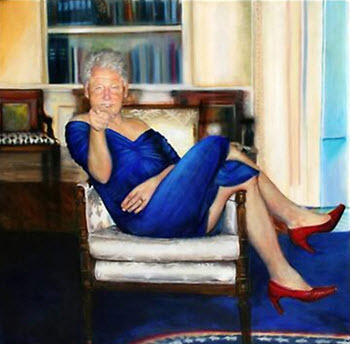
An email in the Jeffrey Epstein files that references U.S. President Donald Trump "blowing Bubba" has attracted scrutiny on social media.
On Wednesday, U.S. lawmakers released more than 20,000 pages of documents connected to Epstein, a convicted sex offender who died by suicide in a New York jail in 2019 while awaiting sex trafficking charges.
Some of the documents mentioned Trump, including one from Epstein's brother, Mark, which references photos of Trump "blowing Bubba." "Bubba" is a nickname of former president Bill Clinton, but Mark Epstein told Newsweek the individual was not Clinton. He did not provide any additional details about the identity of “Bubba” or the meaning of the emails.
Newsweek reached out to the White House by email to comment on this story outside of normal business hours.
[x]
President Donald Trump speaks with reporters in the Cabinet Room of the White House, November 7, 2025, in Washington. | (AP Photo/Evan Vucci, File)
Why It Matters
Files related to Epstein continue to cause problems for the Trump administration, as bipartisan groups have called for greater transparency in the case and the further publication of documents and evidence in the government's possession.
Trump has consistently denied any wrongdoing in connection with Epstein and has said their friendship ended in the early 2000s. But the recent release of thousands of documents has brought fresh scrutiny to the president's relationship with Epstein.
What To Know
In an email sent in March 2018, Mark Epstein told Jeffrey Epstein to ask Steve Bannon, Trump's former chief strategist, if Russian President Vladimir Putin has "the photos of Trump blowing Bubba."
“You and your boy Donnie can make a remake of the movie Get Hard,” Mark Epstein wrote.
Newsweek also reached out to Bannon and the Kremlin by email to comment on this story outside of normal business hours.
Posts on social media about the email have since gone viral, with people questioning what the email means.
One user wrote: "Who is Bubba, and why did Trump blow him?"
Call to Activism, an account with over 1.1 million followers, wrote: "WTF: In one of the leaked emails, Mark Epstein, Jeffrey Epstein’s brother suggests to ask Steve Bannon if Putin has 'the photo of Trump blowing Bubba,' to which Epstein replied, 'and I thought- I had tsuris,' which is Yiddish for troubles."
Trump is also referenced in other documents, including in emails between Epstein and his associate Ghislaine Maxwell in which Epstein called Trump "that dog that hasn't barked." In an email to author Michael Wolff, Epstein said Trump "knew about the girls as he asked Ghislaine to stop."
Democrats on the House Oversight Committee later released additional emails said to show Epstein's correspondence with former Trump adviser Steve Bannon and former Treasury Secretary Larry Summers.
What People Are Saying
President Donald Trump wrote on Truth Social in response to the newly released documents: "The Democrats are trying to bring up the Jeffrey Epstein Hoax again because they'll do anything at all to deflect on how badly they've done on the Shutdown, and so many other subjects. Only a very bad, or stupid, Republican would fall into that trap.
"The Democrats cost our Country $1.5 Trillion Dollars with their recent antics of viciously closing our Country, while at the same time putting many at risk—and they should pay a fair price. There should be no deflections to Epstein or anything else, and any Republicans involved should be focused only on opening up our Country, and fixing the massive damage caused by the Democrats!"
House Oversight Committee Ranking Member Robert Garcia, a California Democrat, said in a statement: "The more Donald Trump tries to cover up the Epstein files, the more we uncover. These latest emails and correspondence raise glaring questions about what else the White House is hiding and the nature of the relationship between Epstein and the President."
What Happens Next
Soon, the House of Representatives will vote on whether to publicly release the full set of Epstein-related government records after a petition to force a vote surpassed the required 218-signature threshold on Wednesday.
- admin
- Site Admin
- Posts: 41355
- Joined: Thu Aug 01, 2013 5:21 am
Re: Part 2 Anti-Anti-Nazi Barbarian Hordes are Knocking Down
by admin » Sat Nov 15, 2025 11:28 pm
Rep. Marjorie Taylor Greene
@RepMTG
6h
I am now being contacted by private security firms with warnings for my safety as a hot bed of threats against me are being fueled and egged on by the most powerful man in the world.
The man I supported and helped get elected.
Aggressive rhetoric attacking me has historically led to death threats and multiple convictions of men who were radicalized by the same type rhetoric being directed at me right now.
This time by the President of the United States.
As a woman I take threats from men seriously.
I now have a small understanding of the fear and pressure the women, who are victims of Jeffrey Epstein and his cabal, must feel.
As a Republican, who overwhelmingly votes for President Trump‘s bills and agenda, his aggression against me which also fuels the venomous nature of his radical internet trolls (many of whom are paid), this is completely shocking to everyone.
My phone is blowing up with constant amazing support. I’m so thankful!
The Political Industrial Complex and the toxic violent nature of American politics must end.
Our country is worth saving and it can only be done if we pull together and save ourselves.
***
Rep. Marjorie Taylor Greene
@RepMTG
20h
President Trump just attacked me and lied about me. I haven’t called him at all, but I did send these text messages today. Apparently this is what sent him over the edge.
The Epstein files.
And of course he’s coming after me hard to make an example to scare all the other Republicans before next weeks vote to release the Epstein files.
It’s astonishing really how hard he’s fighting to stop the Epstein files from coming out that he actually goes to this level.
But really most Americans wish he would fight this hard to help the forgotten men and women of America who are fed up with foreign wars and foreign causes, are going broke trying to feed their families, and are losing hope of ever achieving the American dream.
That’s what I voted for.
I have supported President Trump with too much of my precious time, too much of my own money, and fought harder for him even when almost all other Republicans turned their back and denounced him.
But I don’t worship or serve Donald Trump.
I worship God, Jesus is my savior, and I serve my district GA14 and the American people.
I remain the same today as I’ve always been and I will continue to pray this administration will be successful because the American people desperately deserve what they voted for.
For me, I remain America First and America Only!!!
@RepMTG
6h
I am now being contacted by private security firms with warnings for my safety as a hot bed of threats against me are being fueled and egged on by the most powerful man in the world.
The man I supported and helped get elected.
Aggressive rhetoric attacking me has historically led to death threats and multiple convictions of men who were radicalized by the same type rhetoric being directed at me right now.
This time by the President of the United States.
As a woman I take threats from men seriously.
I now have a small understanding of the fear and pressure the women, who are victims of Jeffrey Epstein and his cabal, must feel.
As a Republican, who overwhelmingly votes for President Trump‘s bills and agenda, his aggression against me which also fuels the venomous nature of his radical internet trolls (many of whom are paid), this is completely shocking to everyone.
My phone is blowing up with constant amazing support. I’m so thankful!
The Political Industrial Complex and the toxic violent nature of American politics must end.
Our country is worth saving and it can only be done if we pull together and save ourselves.
***
Rep. Marjorie Taylor Greene
@RepMTG
20h
President Trump just attacked me and lied about me. I haven’t called him at all, but I did send these text messages today. Apparently this is what sent him over the edge.
The Epstein files.
And of course he’s coming after me hard to make an example to scare all the other Republicans before next weeks vote to release the Epstein files.
It’s astonishing really how hard he’s fighting to stop the Epstein files from coming out that he actually goes to this level.
But really most Americans wish he would fight this hard to help the forgotten men and women of America who are fed up with foreign wars and foreign causes, are going broke trying to feed their families, and are losing hope of ever achieving the American dream.
That’s what I voted for.
I have supported President Trump with too much of my precious time, too much of my own money, and fought harder for him even when almost all other Republicans turned their back and denounced him.
But I don’t worship or serve Donald Trump.
I worship God, Jesus is my savior, and I serve my district GA14 and the American people.
I remain the same today as I’ve always been and I will continue to pray this administration will be successful because the American people desperately deserve what they voted for.
For me, I remain America First and America Only!!!
- admin
- Site Admin
- Posts: 41355
- Joined: Thu Aug 01, 2013 5:21 am
Re: Part 2 Anti-Anti-Nazi Barbarian Hordes are Knocking Down
by admin » Tue Nov 18, 2025 2:57 am
I Read FBI's Wild Epstein and Andrew Files: Author | The Daily Beast Podcast
The Daily Beast
Premiered 54 minutes ago The Daily Beast Podcast
Andrew Lownie joins Joanna Coles to examine wild new reporting that Jeffrey Epstein tried to hire a British sniper to kill Prince Andrew — a story now echoed by two separate sources. Joanna presses into the fever-dream paranoia that surrounded Epstein in his final years and the ripple effects now hitting the palace. Lownie, author of the bombshell book ‘Entitled: The Rise and Fall of the House of York,’ explains why, if true, this plot reframes Epstein’s reach and the danger surrounding everyone in his orbit. And Joanna ends by asking the blunt question lingering under all of it: what else was Epstein willing to do that we still don’t know?
Transcript
Trump and Epstein. They're broken. Contact. That Epstein was making threats to expose Trump.
Trump was concerned about that. Epstein thought he might be given a pardon protected by Trump. And that might explain, the story of Epstein's death.
I'm John Nichols, this is the Daily Beast podcast. And today we are talking to the British historian Andrew Loney,
whose remarkable book entitled The Rise and Fall of the House of Yorks really began the unraveling of
Andrew, formerly known as Prince Andrew, now Andrew Loney has, because he's been inundated with new information, started a Substack.
I signed up to it, and I urge you to it's extremely compelling. But he has two outrageous allegations
this weekend that we're going to completely unpack. And I have to say, when I read them, I couldn't quite believe them.
I wasn't sure if they were true. They both involve, of course, Jeffrey Epstein. And we know that Jeffrey Epstein's friendship with Prince Andrew
was part of the reason for Andrew's fall from grace. Anyway, you don't need me to tell you about them.
We're going to talk to Andrew about them, and I don't think you're going to want to look away. So let's get into it.
Andrew, I can't believe how much has happened since we last talked. And it was only, I think three weeks ago.
And you have in your new Substack, two absolutely explosive allegations, which we are going to unpack.
And when I say explosive, they really are. They really are. We will get to them in a minute.
But what I wanted you to do first was give us an update with where we are. We have some embarrassing emails of Prince Andrew coming out
from the Epstein trove, the emails that came out last week. But but where is Prince Andrew right now?
Has he left Royal Lodge and what are the developments since we last spoke when he just lost his title of Prince?
Well, I mean, what I'm hearing, he doesn't seem too concerned. He feels he's a free man now. He's saying he's going to go on dating apps and he's going to go on dating apps.
Really. And you know, he's still in Royal Lodge. They still haven't haven't opened all the present, all the, the parcels that Sir Ferguson ordered and hadn't open to self.
So, I think they're not going to go up to Sandringham till after the New Year.
I'm clearly when all the royal family have left, and I'm not totally convinced he will go to Sandringham.
I there's suspects that he may go somewhere else. We've got, a prosecution being brought by Republic.
We have calls from, former head of Royal security, and I was saying that he should be investigated both for sexual and financial irregularities.
So he's clearly not out of the woods. I mean, there's been a lot of speculation about whether he might go to the Middle East,
a lot of speculation about what Sarah Ferguson is going to do. Will she go to Switzerland? Portugal? Will she have a look at the tower in London?
She's been it's been said that she's going to promote herself as a, a speaker for empowerment and, positivity.
I don't know how that. Well, that's going to go. Empowerment. How is she a speaker for empowerment?
She was being funded by the world's most notorious pedophile.
Well, she is a woman, you know, with her own, logic.
But she is a survivor. She she she's been, you know, she's been a, you know, pretty much,
you know, a broken spirit. So particularly in 2010 when she was caught selling access to Andrew
and she came back, she went on Oprah, and people gave her the benefit of the doubt that she had she had repented.
And I think she's going to try this again. I don't think many people think that she's, a busted flush.
So, it's a lot of it's up in the air. I mean, actually, tensions between the King and the Prince of Wales over how this is handled.
The king's authority, I think, has been a bit diminished by the fact that he didn't act sooner and more ruthlessly.
As you say, there are these lines coming out, Andrew fro from the Epstein disclosures showing him to being panicking.
Really? When the story of Jeffrey broke. Of course, that kind of goes against the conventional line
that he was pushing that, you know, he didn't know her, and and he didn't know what this was all about. But of course, it confirms what I found my research and other people have written about.
For those of us who haven't gone through the emails in as much depth as you have,
can you tell us exactly how he did react when it first became clear
the allegations were that he'd slept with Virginia Giuffre?
Yeah, well, basically keep me out of the story.
And he went to PR people, PR people to undermine Giuffre. He he tried to get information about up through his police
protection officer using his contacts with the FBI. It was all about damage limitations and about distancing himself
from the story. And, you know, he is only one of three many, revelations that have come out with the disclosures, in the files.
We've got more, I think, imminent. I mean, interesting that Trump has now kind of changed his tune and is happy for the material to be released.
So I would say I'm not sure if he's happy for the material to be released. He realizes that he wasn't going to win the battle to keep them suppressed.
So he sort of leant into the rebels in the Republican Party, I would say.
I think it's more of a political maneuver, rather than he's happy for them to be released. Absolutely right. You know, he's he's he sees that, you know, that there's new advantage in him
trying to prevent the other release, as he has done up till now. And, and he's having to go with the mood.
And I mean, thank goodness we're seeing this stuff. I think again, we've seen the publication, of course, of Virginia Giuffre, his
own book. Ghosted by Amy Wallace, which has been well received and been a bestseller
and I think has again changed the Da for a lot of people. It really brings home how awful the situation was
and how entitled these people felt they were. So, as you say, there have been a lot of developments.
And I think there will be more. I mean, I think more people will come forward. Now, I'm certainly finding from my own research that, people are coming forward, but.
Objection. Officers, former members of staff, ambassadors who I think are appalled by what they've discovered and learned,
and I think also want to be on the right side of history here. And clearly, that's what's motivated Trump to a certain extent as well.
And there've been lots of accusations. Tina Brown made it over the weekend that the Queen really enabled
Andrew's behavior. Do you think that's fair?
Yeah, absolutely. And I mean, I was vilified when I said this in August, because
the Queen, of course, was a saint and wouldn't have done anything like that. So it's great that, you know, people like Tina Brown are saying these things.
It's but it's exactly what I found. I mean, we know that attempts were made to suppress this story.
ABC television were were threatened. Basically, if they went ahead, they would lose access to the Royals.
I know from talking to ambassadors and others that they were basically sent away with a flea in their ear when they tried to bring,
the concerns to the Queen and her staff about Andrew. And of course, every time he seemed to be involved
in some scandal, the Queen seemed to either, I've taken with her to church or give them some new honor.
So I think it was pretty apparent at the time. Just no one was prepared to say it, and,
and there was even a leak in the Sunday Times the other day, I think, by the palace, but trying to basically put the blame on the Queen for not basically sorting
this problem out and handing a time bomb to to King Charles.
So there's a lot of buck passing going on at the moment in your book, entitled
The Rise and Fall of the House of you, which we've talked about, extensively on this podcast.
You talk about a weekend in Thailand where Prince Andrew went through 40 prostitutes.
I mean, subsequent reporting has also found that he appeared to have prostitutes coming into Buckingham Palace
with no security clearance checks whatsoever.
No. Absolutely nothing. Paul Page has gone public on that.
He was one of the policemen on the North gate. And I think this isn't a this was of concern to the police
because there were always people who didn't know who they were. It was pretty clear that they were escorts.
And, I mean, there were lots and lots and coming in, and, we've got lots of stories of escorts from in Hong Kong
who took over the top floor of the Landmark Hotel and entertained escorts there on, I think, a trade mission.
So, everyone was turning a blind eye to, to his activities, which is extraordinary.
And I think one of the things that hasn't really come out
yet is the whole national security element to the story. We've had hints of, alleged Chinese spies, but there are a lot of spies
running around this story. You were to seek. Could is easy to see that both Andrew and Sarah Ferguson were very easy ways into to.
They were very vulnerable because of their greed. And, they did have some very useful context.
Yeah, it's absolutely fascinating. And of course, greed does make people vulnerable. And we've seen that with members of the family time and again.
[b][size=120]So let's move on to Andrew. Two remarkable allegations in your Substack,
which I couldn't believe I was reading. The second one, which will come on to
is that Jeffrey Epstein was actually killed.
But but let's look at the first one, which sort of leads to the second one, which is that Jeffrey Epstein had had enough of Prince Andrew and Fergie.
He was concerned that they would perhaps spill his secrets and that he had hired, a hitman
to basically, to remove them.
Yes. I mean, this comes from two sources.
One one, one in Paris, and another one in Palm Beach, who were very close to Epstein.
I mean, you know, Epstein said all sorts of things. We can't always believe everything he said, but, I think he was getting very nervous.
He thought particularly Sarah Ferguson might spill the beans on him. And this was a precautionary measure, I suppose.
Now, how far he went down the line of trying to get more details about, in terms, the sniper. But the sniper was, British Special forces trained.
And had he actually had conversations with this particular sniper? I mean, it sounds so.
Conspiracy theorist. I find it hard to believe. But then so much about this story is hard to believe.
Exactly. No. And I was very nervous about putting it up because clearly, you know, it's an easy way of undermining my credibility.
So we'll see what comes. I mean, we do know that Sarah was was very concerned. I mean, that was the reason that she kind of kept in with Epstein because she was scared of him.
And I think this this could have been just a threat. It could have been just as paranoia. As I said, I haven't been able to follow up the story to find any more detail.
Though I've been told I will be given the name of a sniper. But, it is an extraordinary story, but it's,
you know, as you say, that the story is is bizarre. Anyway. And, we're dealing with people who are not necessarily in the realms of reality.
If you are a sniper actively in the special services in the UK, the idea of being commissioned by an American to kill members
of the British royal family, I mean, how on earth would he get away with it?
I mean, it just seems remarkable.
Well, I do think this was a serving member of Special Forces as someone who being trained in as a British Special Forces person,
you know, I'm just thinking of the update of the Freddie Forsyth's novel The Day of the Jackal, and it is not, I think, than the update.
It is about an ex-British Special Forces person who is basically a gun for her. So in some ways that isn't that odd.
It's interesting that I've got, you know, that's come from two different sources, but, you know, often that happens. It doesn't mean it's true.
But, you know, interested to see if that does bring forward anything else. In terms of, of disclosures, a lot of these things are rumors,
and you just kind of float them and just see what happens. And maybe they have to be disregarded.
Well, and in the hierarchy of people that Epstein was frightened of,
I wouldn't have thought Sarah Ferguson would be very high on this list.
No, I agree, but I mean, you know, maybe she's more garrulous than the others. I don't know. I mean, I don't know what she knew that she was concerned about.
But, you know, we have had, you know, these rumors, for example, moving on to the second part of this, of this, the revelation that,
you know, Trump, and Epstein, the their broken, contact,
that Epstein was making threats to expose Trump. That was one of the stories Trump was concerned about, that Epstein
thought he might be given a pardon protected by Trump. And those rumors have circulated for a while.
And that might explain, the story of the, Epstein's death, which I think, you know,
a lot of people have of questions and I question in the book. I mean, just in terms of of Epstein being one of the great survivors
he was at the beginning of his, his, his court problems. He had always called out to them in the past by,
paying people off and having good lawyers. And, he was not someone talking to, to, for example, the, the,
the lawyers who, who were dealing with some someone who was suicidal. And then we have all the strange things
going on in the prison with the cameras not working and the guards falling asleep. We have Michael Braden's, autopsy suggesting it was homicide
rather than, suicide. We've got former members of, other correctional facilities saying it was impossible to kill yourself,
just because of the heights and the sheets and various all things. And then, as I say, the source, which has come from a good FBI source
talking about, a fellow convict who was brought in to do this. Can you explain to me how this all unfolded?
So you were contacted by a former FBI agent. How did this play out?
If you you're the historian, hugely respected historian. You have a PhD in history.
How did you get this information? How did it come to you?
It didn't didn't come to me. I went to them.
I knew about a case that they worked on, that I knew they'd left the FBI. I approached them, and they kindly, in confidence,
just shared some, correspondence with me that that revealed this. And the correspondence was between him, internal I fi, correspondence.
Internal FBI correspondence. Has Jeffrey Epstein being killed in his cell, and that's what I was told.
And this is what actually, Glenn Maxwell also said. I think, when she was interviewed by Daphne back a few months ago,
and it k course makes sense. You know, someone who has very little to lose and a lot to gain.
Set the scene.
What did the correspondence say, Andrew. And how was he killed?
I don't know.
I don't think it says that in the correspondence for I remember looking at what --
Were these internal emails that you saw?
Yes.
This was the investigation into into this character. And this seemed to be a correspondence talking about
about this particular figure, and, and the, what had happened, what he had done.
But it's only a fragment, shall we say. So again, you know, it would it would be useful. I know the FBI had been looking at this.
I mean, it's, you know, it's kind of been passed off. You know, it was a suicide and that's been the line. But,
I do know that people were looking at it. And I think a lot of people suspected that, and that would all fit in
to the sort of his paranoia, when he went into prison.
And worries about some Sarah Ferguson and others.
So I just want to get this completely straight,
because I know you talked at the book fair this weekend, and you talked about being told by FBI agents
that Epstein was killed in his prison cell by another prison inmate.
And you're now saying you saw correspondence, FBI correspondence that discussed this?
Were they discussing it as a possibility? Were they floating it as a theory, or were they saying they were confident
this is what had happened?
But from what I remember, it's a little while since I looked at it. I've shown it, but it was it was treated as fact.
This wasn't speculation. And they know.
And you know who the inmate was?
Yes.
There was a name there. Yeah.
Why haven't you shared the name?
Well, I mean, you know, I haven't got.
This is the only word of evidence I've got. I mean, clearly there the libel, considerations, and,
you know, given that what's happened to various people in the story, perhaps wiser, I didn't share it too publicly.
But, you know, at some point, I hope I can, and, you know, it's still sort of ongoing research.
So a lot of people are going to say, Andrew Loney, he's just launched a Substack. He's trying to sell more copies of his book.
He's now floating conspiracies that have been around. What do you say to people who are just saying, this is
this is wild exaggerations from a man who can't possibly know?
Well, I'd like to like to be able to follow up on this as soon as I can.
I mean, the story has slightly run earlier than I expected. Incision was taken by people doing my Substack, that we would release it
when I was waiting to do more research.
But didn't you say it when you were actually at the book fair? So you sort of put it out into the world?
I did, and I know we picked it up, so I thought it was okay.
So no one picks it up.
What are the British press doing? Oh my goodness, it's only small people. Like you said, it is all gone.
Roll the court.
And and then, the, people who myself thought we should put it out there, but, Yeah, I'm a bit more cautious.
Yes, you should put it out there. Yeah. So. But you obviously. Right. You know, you know, I can understand, you know, people want more evidence.
I mean, the problem with the stories is often difficult to get the affidavits and things that people want.
It is, yeah. Of course, I'm starting a Substack, and I've got a book sale, so, there's a
there's a perfectly fair comments to make, but, you know, lots of people have sub stacks and books to sell.
Doesn't mean what they say isn't true. Right.
And also, I think what's so interesting about your book entitled The Rise
in the fall of the House of York, is that so much of what you said in the book that the,
the Yorks were trying to stop coming out? I mean, we know that they tried to stop their friends from speaking to you.
They wouldn't speak to you. So much of what has come out in the book,
has proven not only to be true, certainly more than the tip of the iceberg,
but it's led to, along with Virginia Drew phrase. But nobody's fool. The Prince losing his title.
Yeah, yeah. I mean, that's extraordinarily I mean, I think they realized that this, there were wider questions about royal privilege
and accountability being asked by the media, by social media. And they felt that they had to kind of cut,
cut him loose before he infected the rest of them. And I think when the king saw you know, was being heckled at Litchfield,
when I think they were worried that there might be more Epstein material, they may know. What's that? I don't know,
I think they realized that they had to distance themselves and he, you know, there had been increasing calls that he should be investigated
and could be charged. And in those circumstances, clearly they needed to distance themselves.
And, you know, in some ways they should've been dealing with this problem years ago. They shouldn't have allowed it to drag on as long as it has.
Well, I was going to ask you about because in a sense, this story has become so prominent because of Jeffrey Epstein.
And yet the prince was off frequently, as you have pointed out, on taxpayers
money, on diplomatic jaunts, supposedly trade jaunts,
where in fact, he didn't want to stay at the residences of the ambassador because it clearly becomes, evident
that he wanted hot and cold running prostitutes where he was staying. And I'm surprised that given how many people knew
this was going on in the palace, that nobody ran to men, was it because the Queen and Prince Philip gave him cover
and that you can't, you know, once you know that they support him,
even if you're a respected member of the household, the royal household staff, your word is not going to be taken seriously.
Yes.
I mean, the problem was, you know, policemen were reporting not to the, the Metropolitan Police, but to the head of the household.
In fact, an even, Tony Johnson. But he's the head of the household. When people brought him complaints, said, look,
you know, we just got to do a master's bidding. He wasn't a great fan of of Andrew. In fact, they got into fisticuffs themselves at one point.
They got into fisticuffs. He supposedly it's it's supposed to turn physical when Andrew couldn't get hold of a room that he wanted.
So. Johnson. But it's or stand up to him.
But, Andrew just always went to mommy and mommy would overrule the one.
And Busters did complain and then found that their careers were pretty curtailed.
Son Wilson, who was the deputy ambassador in Bahrain, spoke out and then found his security clearance, I think was
was was withdrawn, for, for a job he had later on. So they could
they have ways of making life difficult for people who don't play ball. And I think the view was taken.
Just just give him what he wants. I mean, I'm talking to members. The royal household last week, I was amazed that both
he and Sarah Ferguson still seem to have staffs. Sarah was coming in and getting her laundry done at Windsor or Buckingham
Palace. And they were still entertaining businessmen, in royal palaces
and still was still operating under the radar. So I think what we're told and what's happening are some two very different things.
But you see right there, you know, the obscene thing is kind of taking everyone's attention away from what is the real scandal, I think,
which is why they've abused their position as royals to make money from sales. I mean, some ambassadors refuse to play ball.
And when they were given a list of people that Andrew wanted and other he or his mates to meet, didn't
provide it or said they were unsuitable and kind of warned him off. But there was quite a lot, as I forget, the book of And,
I'm not Karl senior aspersions, but Andrew had close connections with, with banks, banks that dealt with
the sort of customers that no one else wanted to deal with. And so, you know, the,
the you can see how the system might have worked.
So, Peter Morgan, the writer of the brilliant,
Netflix series The Crown, I read, said that when he was envisaging writing about the royal family,
he thought about the Queen as almost as Tony Soprano, that this was a business.
And she was the sort of head of it. I'm not saying he was likening it to the mob,
but as he was thinking about it unfolding over seasons, how did you sustain the story now you look back on
the Queen and Prince Philip, given all we know now
and the love and respect and all with which the Queen was held,
do you think that if she was still alive, she would still have that?
Or do you think she's been subsequently revealed as enabling a very corrupt son, fully knowing what he was up to?
Yeah, and it's interesting whether, you know, in my book why you're being published, and whether the press would have been as confident
as some of them were in running some of the stories they did, because, I mean, I know there are a lot of stories. It's suppressed.
So I, you know, I suspect now the Queen's dead, that it was a little easier for me to, to get published.
I had a very, supportive publisher and big publisher and that helped. And I think then,
you know, people felt the ground would've being softened and they could come, come back. And there was clearly a very strong feeling among the population
that, you know, elites were getting away with some pretty bad behavior and needed to be held to account. And, you know, that was a big factor in the seats.
But I think it was also a stronger feeling in Britain, too. So, you know, I think the whole softening up process
was beginning, and it made it possible.
But yeah, I think Queen it's the Queen was still alive.
I think it would be very difficult.
I wanted to ask you about the Queen's husband, Prince Philip,
otherwise known as the Duke of Edinburgh. What was his role in all this? Was he a supporter of Andrew?
Did he try and rein him in? Did the Queen always take preference over the Duke of Edinburgh?
I mean, as a married couple, as parents, how would they trying to influence Andrew?
Well, I mean, my design had always been that, you know, the Duke of Edinburgh was the chap who ran the family and he ran a pretty tight ship.
I mean, he was the one who basically summoned Andrew to Wood Farm and told him basically, you know, you got to resign all your things, you know, this is it.
And he was pretty tough. So I, and the Queen did, did sort of listen to him. So I find it is extraordinarily that that wasn't to what happened.
And all I've been told is that to the Queen that he he did obey the Queen. The Queen said no.
And, you know, we're kind of sort of tough this one out. And he had to, to, to go with her.
I mean, to be fair, he was also by this stage in his 70s, and I think he was just didn't really want to have all the fights as she was that might be required.
They thought they could probably get away with it, or they thought they could deal with it. So they thought maybe the problems at the time were worse.
Addressing, because the buffer lost in the Duke, quite the behind the scenes. Never it never happened.
They may not have been told the full story by Andrew.
I mean, one of the interesting things I picked up last week was that,
the Andrew hadn't told the staff he didn't know about the interview, with Newsnight in Buckingham Palace.
And therefore the room hadn't been prepared, hadn't actually been cleaned. And there were the the staff were very upset that that actually,
it wasn't enough for they didn't begin a fit state to, to have TV cameras in it. The, Queen and Prince Philip must have been older than in their 70s.
When were they in their 70s? Because I thought the first story about Andrew and Epstein,
came out, I think, in the mail or Mail on Sunday in 2011. So they were doing so.
Wouldn't they have been in the 80s at that stage?
Hey, sorry I just a yeah.
So they're older. Yes. Exactly. So I mean so in some ways you know they, they
they were kind of they had this attitude was sticking their head in the sand sometimes. And I think that's what they did. And maybe they thought someone else would deal with it who didn't deal with it.
I'd who knows? I mean, they're not here to tell us, you know, but I mean, to be fair, it was also a problem for King Charles.
I mean, he was taking a much more active role. I by that stage. And, and Williams is, is taking more active role now.
So it's it was kind of on his watch as well. And he's not a great you know, there's no love lost between the brothers.
And he has a full measure of his younger brother. He was the one who didn't want him to have this job as a special envoy,
because he knew how you would abuse a position. So it's it is
a mystery how this was allowed to happen.
And, you know, maybe we'll know maybe some of the courtiers
will eventually talk. I was very interested that you said that since the publication of the book and since Prince Andrew has lost his title,
that now members of the household of the Royal household feel, much freer to talk to you,
even off the record, because they're much less frightened of him.
Yes, absolutely. I seems to be, you know, I'm amazed.
I mean, I had dinner last week with the former EC3, and these are people who would have given me a very wide berth, before the book was published.
So, and again, you got to wonder why of these people coming forward. Is it they did they,
want want to share information, feel uncomfortable about what they know, and,
feel that there's a higher loyalty than there is to the NDA or, or the previous job.
Or are they giving you just information in the woods to undermine your credibility, or are they is there some factor that,
I mean, a lot of them didn't like Andrew and were very, very happy to see him, you know, the, fallen, a fallen figure.
So you you're constantly assessing why people are talking to you.
But certainly I've gone back to a lot of people
and they've talked a lot of people now prefer to go on the record, as well.
Very interesting. So, and I know you're doing a follow up to your book entitled calling it untitled.
Is that going to be packed with new revelations?
Yeah, well, I got 150 pages of notes so far just from the material through keep.
You've come forward. And so this is some you know, this book is a couple of years away. So yeah, I think that will be it will all be completely new.
You know, we will cover some of the same period, but I'm good at getting new lot more new information.
For example, about his time as a trade envoy, and activities and places like Kazakhstan, places I didn't know about, like Mongolia.
We took out a I think almost all the material about his, activities in Libya, for example.
And those have now been I think we could now put that stuff back in good little the stuff from Peter Mandelson and Epstein was taken out,
because people didn't do those, didn't believe it. And now, of course, we've got the revelations about Madison
Epstein's activities together and how close they were.
So, you know, it's been gratifying to see that a lot of my sources proved to be absolutely right, which is why
I sort of felt I felt it was okay to go on the Substack, because the sources have proved to be reliable in the past.
And, I'm hopeful that I, you know, the opportunity to reduce stress be so well now that the Epstein files are about to be released.
I'm assuming,
that there will be more, more emails, more texts, more communications
with the former Prince Andrew and Sarah Ferguson are you expecting more?
Oh, absolutely. I mean, and other names, you know, because clearly the focus has been on him.
And, you know, we've had Mandelson and but very little on the American side. So, you know, given the number of documents are, are
I mean, there's they've got to be huge number of revelations. And if we remember, there were 40, I think 40 girls came forward
to give evidence in the original Palm Beach, investigation. So there's, you know,
I still think you've only got the tip of the iceberg here, in terms of of what, even law enforcement
knows, let alone what, may emerge quite separately from other other, other witnesses and testimony.
Do you think there is, the chance that Andrew, Prince Andrew, as he was known,
will end up coming to the United States to give evidence?
No, I think that's very unlikely.
I mean, I think that was a little bit of grandstanding by the Democrats.
I mean, he he's been caught between a rock and a hard place for a long time, because clearly, if you didn't give evidence
or didn't cooperate with the sorties before Evans, you guys was guilty. But if you did, he was going to probably, implicate himself.
So, isn't exactly the same position, that I'm sure the lawyers will just say
this is a sort of, a political trick. Democrats career, a minority on the committee.
He's not an American citizen, so, I can't see him cooperating until he's forced to do so.
But I can see material being passed to the British authorities for him to be investigated.
Both. In terms of of the sexual trafficking and the misconduct in public office,
which is, I think, the most obvious charge that we leveled against him. And I think that, you know, there are good grounds there,
and I've offered to to offer material that wasn't put in the book, but for legal reasons to give that to the National Crime Agency.
I think I have a story in my Substack of about $5 million in a suitcase in Kazakhstan, for example.
This was a suitcase of cash. This is a suitcase of cash that he was given. We know, you know, for example, that he was offered a 3.85 million pounds,
1% of a huge deal to bring a Greek water company into Kazakhstan.
And that that that emerged through email leaks. So I think the deal never took place, though, right?
It didn't take place because of internal unrest. So but we do know that there were these sort of deals going on.
And so, I think we may find other things emerge, other people may come forward and talk.
You know, Elon Musk has said various things in the past. There were people who seen the files, before they were redacted.
You may again be prepared to tour or leak material. Are these just the things that were in Jeffrey
Epstein's safe, or what do we actually think they were? At least the supposed documents and information
that he was, in theory or alleged to have been, blackmailing people with?
Well, I mean, there's material for the Department of Justice and the FBI. This is all part of the investigation. So there'll be witness testimony, with people who interviewed.
There will be material that they've collected. So, for example, we know that there were, videos and tapes
that he made of people who came to the house, of the various homes, and those in may be released.
I think one of them is be briefly shown on on the internet. So, there's a lot of material this, as you say, the stuff that may
he just kept himself that was confiscated when they raided the homes.
We don't really know. I mean, this is this is this is what's so interesting. But there certainly is a lot of material,
and, you know, just to see how devastating the limited amount that's been leaked so far has been, it's suggested
that there's there's some really big, damaging disclosures to come.
Well, well, you couldn't have launched a Substack at a better time.
Andrew. I can't wait for the next, the next installment. And, you know, I hope you get more information
on what actually happened to Jeffrey Epstein in jail, but good luck, with, you know, solving what
sometimes feels like the world's biggest mystery.
Yes. Well, I mean, think how much has come out
and just in the last few months, you know, so I'm hopeful that the full story will a pretty full story will eventually emerge.
But it just may take time. Yeah. And as I say, you really couldn't make it up. Every day there's something coming at you
and you just think, how is this even possible? Anyway, I'm glad to know that you haven't entirely jumped the shark.
And we will come back to you the moment the Epstein files released, because we would love your take on what what you've found in there.
So promises you'll come back.
Of course. I look forward to it all right, Andrew Loney, thank you so much.
I sometimes feel that I'm on psychedelics listening to these stories that they're so outlandish, the claims.
And yet time after time, it turns out the conspiracies are true,
that Randy Andy, as he was nicknamed by the tabloids the beginning of well, I want to say the 1980s
turned out to be so much truer than anyone could have imagined. And now Andrew Lowndes allegations about Jeffrey Epstein
being killed in his prison cell, about Jeffrey Epstein hiring a sniper
to actually take out two members of the British royal family. It seems so outlandish.
And yet this is where we are. Well, we'll have Andrew back with the release of the Epstein Files to dig into them more.
But in the meantime, please subscribe to The Daily Beast. We are independent media.
We love and are very grateful for your support. Don't forget to leave us your comments.
The comments have blown up and I'm trying my best to read most of them. I can't get through all of them, but we certainly try.
And as our first lady would have a say, do not forget this week in particular, beast.
And special thanks to our beast tier of membership Herbie, Andrew Mellor, Fulvia, Orlando, Lars
Condie, Sandra Clark, Bonzo, Val, love, Francisco Bo Kok, DC, Karen White, Heidi.
Riley, Connie Rutherford, Sharon Shipley, and Andrea Hodel. And thank you to our production team Devin Rotary
now and Yvonne Ersan and our editor, Jesse Millwood.
The Daily Beast
Premiered 54 minutes ago The Daily Beast Podcast
Andrew Lownie joins Joanna Coles to examine wild new reporting that Jeffrey Epstein tried to hire a British sniper to kill Prince Andrew — a story now echoed by two separate sources. Joanna presses into the fever-dream paranoia that surrounded Epstein in his final years and the ripple effects now hitting the palace. Lownie, author of the bombshell book ‘Entitled: The Rise and Fall of the House of York,’ explains why, if true, this plot reframes Epstein’s reach and the danger surrounding everyone in his orbit. And Joanna ends by asking the blunt question lingering under all of it: what else was Epstein willing to do that we still don’t know?
Transcript
Trump and Epstein. They're broken. Contact. That Epstein was making threats to expose Trump.
Trump was concerned about that. Epstein thought he might be given a pardon protected by Trump. And that might explain, the story of Epstein's death.
I'm John Nichols, this is the Daily Beast podcast. And today we are talking to the British historian Andrew Loney,
whose remarkable book entitled The Rise and Fall of the House of Yorks really began the unraveling of
Andrew, formerly known as Prince Andrew, now Andrew Loney has, because he's been inundated with new information, started a Substack.
I signed up to it, and I urge you to it's extremely compelling. But he has two outrageous allegations
this weekend that we're going to completely unpack. And I have to say, when I read them, I couldn't quite believe them.
I wasn't sure if they were true. They both involve, of course, Jeffrey Epstein. And we know that Jeffrey Epstein's friendship with Prince Andrew
was part of the reason for Andrew's fall from grace. Anyway, you don't need me to tell you about them.
We're going to talk to Andrew about them, and I don't think you're going to want to look away. So let's get into it.
Andrew, I can't believe how much has happened since we last talked. And it was only, I think three weeks ago.
And you have in your new Substack, two absolutely explosive allegations, which we are going to unpack.
And when I say explosive, they really are. They really are. We will get to them in a minute.
But what I wanted you to do first was give us an update with where we are. We have some embarrassing emails of Prince Andrew coming out
from the Epstein trove, the emails that came out last week. But but where is Prince Andrew right now?
Has he left Royal Lodge and what are the developments since we last spoke when he just lost his title of Prince?
Well, I mean, what I'm hearing, he doesn't seem too concerned. He feels he's a free man now. He's saying he's going to go on dating apps and he's going to go on dating apps.
Really. And you know, he's still in Royal Lodge. They still haven't haven't opened all the present, all the, the parcels that Sir Ferguson ordered and hadn't open to self.
So, I think they're not going to go up to Sandringham till after the New Year.
I'm clearly when all the royal family have left, and I'm not totally convinced he will go to Sandringham.
I there's suspects that he may go somewhere else. We've got, a prosecution being brought by Republic.
We have calls from, former head of Royal security, and I was saying that he should be investigated both for sexual and financial irregularities.
So he's clearly not out of the woods. I mean, there's been a lot of speculation about whether he might go to the Middle East,
a lot of speculation about what Sarah Ferguson is going to do. Will she go to Switzerland? Portugal? Will she have a look at the tower in London?
She's been it's been said that she's going to promote herself as a, a speaker for empowerment and, positivity.
I don't know how that. Well, that's going to go. Empowerment. How is she a speaker for empowerment?
She was being funded by the world's most notorious pedophile.
Well, she is a woman, you know, with her own, logic.
But she is a survivor. She she she's been, you know, she's been a, you know, pretty much,
you know, a broken spirit. So particularly in 2010 when she was caught selling access to Andrew
and she came back, she went on Oprah, and people gave her the benefit of the doubt that she had she had repented.
And I think she's going to try this again. I don't think many people think that she's, a busted flush.
So, it's a lot of it's up in the air. I mean, actually, tensions between the King and the Prince of Wales over how this is handled.
The king's authority, I think, has been a bit diminished by the fact that he didn't act sooner and more ruthlessly.
As you say, there are these lines coming out, Andrew fro from the Epstein disclosures showing him to being panicking.
Really? When the story of Jeffrey broke. Of course, that kind of goes against the conventional line
that he was pushing that, you know, he didn't know her, and and he didn't know what this was all about. But of course, it confirms what I found my research and other people have written about.
For those of us who haven't gone through the emails in as much depth as you have,
can you tell us exactly how he did react when it first became clear
the allegations were that he'd slept with Virginia Giuffre?
Yeah, well, basically keep me out of the story.
And he went to PR people, PR people to undermine Giuffre. He he tried to get information about up through his police
protection officer using his contacts with the FBI. It was all about damage limitations and about distancing himself
from the story. And, you know, he is only one of three many, revelations that have come out with the disclosures, in the files.
We've got more, I think, imminent. I mean, interesting that Trump has now kind of changed his tune and is happy for the material to be released.
So I would say I'm not sure if he's happy for the material to be released. He realizes that he wasn't going to win the battle to keep them suppressed.
So he sort of leant into the rebels in the Republican Party, I would say.
I think it's more of a political maneuver, rather than he's happy for them to be released. Absolutely right. You know, he's he's he sees that, you know, that there's new advantage in him
trying to prevent the other release, as he has done up till now. And, and he's having to go with the mood.
And I mean, thank goodness we're seeing this stuff. I think again, we've seen the publication, of course, of Virginia Giuffre, his
own book. Ghosted by Amy Wallace, which has been well received and been a bestseller
and I think has again changed the Da for a lot of people. It really brings home how awful the situation was
and how entitled these people felt they were. So, as you say, there have been a lot of developments.
And I think there will be more. I mean, I think more people will come forward. Now, I'm certainly finding from my own research that, people are coming forward, but.
Objection. Officers, former members of staff, ambassadors who I think are appalled by what they've discovered and learned,
and I think also want to be on the right side of history here. And clearly, that's what's motivated Trump to a certain extent as well.
And there've been lots of accusations. Tina Brown made it over the weekend that the Queen really enabled
Andrew's behavior. Do you think that's fair?
Yeah, absolutely. And I mean, I was vilified when I said this in August, because
the Queen, of course, was a saint and wouldn't have done anything like that. So it's great that, you know, people like Tina Brown are saying these things.
It's but it's exactly what I found. I mean, we know that attempts were made to suppress this story.
ABC television were were threatened. Basically, if they went ahead, they would lose access to the Royals.
I know from talking to ambassadors and others that they were basically sent away with a flea in their ear when they tried to bring,
the concerns to the Queen and her staff about Andrew. And of course, every time he seemed to be involved
in some scandal, the Queen seemed to either, I've taken with her to church or give them some new honor.
So I think it was pretty apparent at the time. Just no one was prepared to say it, and,
and there was even a leak in the Sunday Times the other day, I think, by the palace, but trying to basically put the blame on the Queen for not basically sorting
this problem out and handing a time bomb to to King Charles.
So there's a lot of buck passing going on at the moment in your book, entitled
The Rise and Fall of the House of you, which we've talked about, extensively on this podcast.
You talk about a weekend in Thailand where Prince Andrew went through 40 prostitutes.
I mean, subsequent reporting has also found that he appeared to have prostitutes coming into Buckingham Palace
with no security clearance checks whatsoever.
No. Absolutely nothing. Paul Page has gone public on that.
He was one of the policemen on the North gate. And I think this isn't a this was of concern to the police
because there were always people who didn't know who they were. It was pretty clear that they were escorts.
And, I mean, there were lots and lots and coming in, and, we've got lots of stories of escorts from in Hong Kong
who took over the top floor of the Landmark Hotel and entertained escorts there on, I think, a trade mission.
So, everyone was turning a blind eye to, to his activities, which is extraordinary.
And I think one of the things that hasn't really come out
yet is the whole national security element to the story. We've had hints of, alleged Chinese spies, but there are a lot of spies
running around this story. You were to seek. Could is easy to see that both Andrew and Sarah Ferguson were very easy ways into to.
They were very vulnerable because of their greed. And, they did have some very useful context.
Yeah, it's absolutely fascinating. And of course, greed does make people vulnerable. And we've seen that with members of the family time and again.
[b][size=120]So let's move on to Andrew. Two remarkable allegations in your Substack,
which I couldn't believe I was reading. The second one, which will come on to
is that Jeffrey Epstein was actually killed.
But but let's look at the first one, which sort of leads to the second one, which is that Jeffrey Epstein had had enough of Prince Andrew and Fergie.
He was concerned that they would perhaps spill his secrets and that he had hired, a hitman
to basically, to remove them.
Yes. I mean, this comes from two sources.
One one, one in Paris, and another one in Palm Beach, who were very close to Epstein.
I mean, you know, Epstein said all sorts of things. We can't always believe everything he said, but, I think he was getting very nervous.
He thought particularly Sarah Ferguson might spill the beans on him. And this was a precautionary measure, I suppose.
Now, how far he went down the line of trying to get more details about, in terms, the sniper. But the sniper was, British Special forces trained.
And had he actually had conversations with this particular sniper? I mean, it sounds so.
Conspiracy theorist. I find it hard to believe. But then so much about this story is hard to believe.
Exactly. No. And I was very nervous about putting it up because clearly, you know, it's an easy way of undermining my credibility.
So we'll see what comes. I mean, we do know that Sarah was was very concerned. I mean, that was the reason that she kind of kept in with Epstein because she was scared of him.
And I think this this could have been just a threat. It could have been just as paranoia. As I said, I haven't been able to follow up the story to find any more detail.
Though I've been told I will be given the name of a sniper. But, it is an extraordinary story, but it's,
you know, as you say, that the story is is bizarre. Anyway. And, we're dealing with people who are not necessarily in the realms of reality.
If you are a sniper actively in the special services in the UK, the idea of being commissioned by an American to kill members
of the British royal family, I mean, how on earth would he get away with it?
I mean, it just seems remarkable.
Well, I do think this was a serving member of Special Forces as someone who being trained in as a British Special Forces person,
you know, I'm just thinking of the update of the Freddie Forsyth's novel The Day of the Jackal, and it is not, I think, than the update.
It is about an ex-British Special Forces person who is basically a gun for her. So in some ways that isn't that odd.
It's interesting that I've got, you know, that's come from two different sources, but, you know, often that happens. It doesn't mean it's true.
But, you know, interested to see if that does bring forward anything else. In terms of, of disclosures, a lot of these things are rumors,
and you just kind of float them and just see what happens. And maybe they have to be disregarded.
Well, and in the hierarchy of people that Epstein was frightened of,
I wouldn't have thought Sarah Ferguson would be very high on this list.
No, I agree, but I mean, you know, maybe she's more garrulous than the others. I don't know. I mean, I don't know what she knew that she was concerned about.
But, you know, we have had, you know, these rumors, for example, moving on to the second part of this, of this, the revelation that,
you know, Trump, and Epstein, the their broken, contact,
that Epstein was making threats to expose Trump. That was one of the stories Trump was concerned about, that Epstein
thought he might be given a pardon protected by Trump. And those rumors have circulated for a while.
And that might explain, the story of the, Epstein's death, which I think, you know,
a lot of people have of questions and I question in the book. I mean, just in terms of of Epstein being one of the great survivors
he was at the beginning of his, his, his court problems. He had always called out to them in the past by,
paying people off and having good lawyers. And, he was not someone talking to, to, for example, the, the,
the lawyers who, who were dealing with some someone who was suicidal. And then we have all the strange things
going on in the prison with the cameras not working and the guards falling asleep. We have Michael Braden's, autopsy suggesting it was homicide
rather than, suicide. We've got former members of, other correctional facilities saying it was impossible to kill yourself,
just because of the heights and the sheets and various all things. And then, as I say, the source, which has come from a good FBI source
talking about, a fellow convict who was brought in to do this. Can you explain to me how this all unfolded?
So you were contacted by a former FBI agent. How did this play out?
If you you're the historian, hugely respected historian. You have a PhD in history.
How did you get this information? How did it come to you?
It didn't didn't come to me. I went to them.
I knew about a case that they worked on, that I knew they'd left the FBI. I approached them, and they kindly, in confidence,
just shared some, correspondence with me that that revealed this. And the correspondence was between him, internal I fi, correspondence.
Internal FBI correspondence. Has Jeffrey Epstein being killed in his cell, and that's what I was told.
And this is what actually, Glenn Maxwell also said. I think, when she was interviewed by Daphne back a few months ago,
and it k course makes sense. You know, someone who has very little to lose and a lot to gain.
Set the scene.
What did the correspondence say, Andrew. And how was he killed?
I don't know.
I don't think it says that in the correspondence for I remember looking at what --
Were these internal emails that you saw?
Yes.
This was the investigation into into this character. And this seemed to be a correspondence talking about
about this particular figure, and, and the, what had happened, what he had done.
But it's only a fragment, shall we say. So again, you know, it would it would be useful. I know the FBI had been looking at this.
I mean, it's, you know, it's kind of been passed off. You know, it was a suicide and that's been the line. But,
I do know that people were looking at it. And I think a lot of people suspected that, and that would all fit in
to the sort of his paranoia, when he went into prison.
And worries about some Sarah Ferguson and others.
So I just want to get this completely straight,
because I know you talked at the book fair this weekend, and you talked about being told by FBI agents
that Epstein was killed in his prison cell by another prison inmate.
And you're now saying you saw correspondence, FBI correspondence that discussed this?
Were they discussing it as a possibility? Were they floating it as a theory, or were they saying they were confident
this is what had happened?
But from what I remember, it's a little while since I looked at it. I've shown it, but it was it was treated as fact.
This wasn't speculation. And they know.
And you know who the inmate was?
Yes.
There was a name there. Yeah.
Why haven't you shared the name?
Well, I mean, you know, I haven't got.
This is the only word of evidence I've got. I mean, clearly there the libel, considerations, and,
you know, given that what's happened to various people in the story, perhaps wiser, I didn't share it too publicly.
But, you know, at some point, I hope I can, and, you know, it's still sort of ongoing research.
So a lot of people are going to say, Andrew Loney, he's just launched a Substack. He's trying to sell more copies of his book.
He's now floating conspiracies that have been around. What do you say to people who are just saying, this is
this is wild exaggerations from a man who can't possibly know?
Well, I'd like to like to be able to follow up on this as soon as I can.
I mean, the story has slightly run earlier than I expected. Incision was taken by people doing my Substack, that we would release it
when I was waiting to do more research.
But didn't you say it when you were actually at the book fair? So you sort of put it out into the world?
I did, and I know we picked it up, so I thought it was okay.
So no one picks it up.
What are the British press doing? Oh my goodness, it's only small people. Like you said, it is all gone.
Roll the court.
And and then, the, people who myself thought we should put it out there, but, Yeah, I'm a bit more cautious.
Yes, you should put it out there. Yeah. So. But you obviously. Right. You know, you know, I can understand, you know, people want more evidence.
I mean, the problem with the stories is often difficult to get the affidavits and things that people want.
It is, yeah. Of course, I'm starting a Substack, and I've got a book sale, so, there's a
there's a perfectly fair comments to make, but, you know, lots of people have sub stacks and books to sell.
Doesn't mean what they say isn't true. Right.
And also, I think what's so interesting about your book entitled The Rise
in the fall of the House of York, is that so much of what you said in the book that the,
the Yorks were trying to stop coming out? I mean, we know that they tried to stop their friends from speaking to you.
They wouldn't speak to you. So much of what has come out in the book,
has proven not only to be true, certainly more than the tip of the iceberg,
but it's led to, along with Virginia Drew phrase. But nobody's fool. The Prince losing his title.
Yeah, yeah. I mean, that's extraordinarily I mean, I think they realized that this, there were wider questions about royal privilege
and accountability being asked by the media, by social media. And they felt that they had to kind of cut,
cut him loose before he infected the rest of them. And I think when the king saw you know, was being heckled at Litchfield,
when I think they were worried that there might be more Epstein material, they may know. What's that? I don't know,
I think they realized that they had to distance themselves and he, you know, there had been increasing calls that he should be investigated
and could be charged. And in those circumstances, clearly they needed to distance themselves.
And, you know, in some ways they should've been dealing with this problem years ago. They shouldn't have allowed it to drag on as long as it has.
Well, I was going to ask you about because in a sense, this story has become so prominent because of Jeffrey Epstein.
And yet the prince was off frequently, as you have pointed out, on taxpayers
money, on diplomatic jaunts, supposedly trade jaunts,
where in fact, he didn't want to stay at the residences of the ambassador because it clearly becomes, evident
that he wanted hot and cold running prostitutes where he was staying. And I'm surprised that given how many people knew
this was going on in the palace, that nobody ran to men, was it because the Queen and Prince Philip gave him cover
and that you can't, you know, once you know that they support him,
even if you're a respected member of the household, the royal household staff, your word is not going to be taken seriously.
Yes.
I mean, the problem was, you know, policemen were reporting not to the, the Metropolitan Police, but to the head of the household.
In fact, an even, Tony Johnson. But he's the head of the household. When people brought him complaints, said, look,
you know, we just got to do a master's bidding. He wasn't a great fan of of Andrew. In fact, they got into fisticuffs themselves at one point.
They got into fisticuffs. He supposedly it's it's supposed to turn physical when Andrew couldn't get hold of a room that he wanted.
So. Johnson. But it's or stand up to him.
But, Andrew just always went to mommy and mommy would overrule the one.
And Busters did complain and then found that their careers were pretty curtailed.
Son Wilson, who was the deputy ambassador in Bahrain, spoke out and then found his security clearance, I think was
was was withdrawn, for, for a job he had later on. So they could
they have ways of making life difficult for people who don't play ball. And I think the view was taken.
Just just give him what he wants. I mean, I'm talking to members. The royal household last week, I was amazed that both
he and Sarah Ferguson still seem to have staffs. Sarah was coming in and getting her laundry done at Windsor or Buckingham
Palace. And they were still entertaining businessmen, in royal palaces
and still was still operating under the radar. So I think what we're told and what's happening are some two very different things.
But you see right there, you know, the obscene thing is kind of taking everyone's attention away from what is the real scandal, I think,
which is why they've abused their position as royals to make money from sales. I mean, some ambassadors refuse to play ball.
And when they were given a list of people that Andrew wanted and other he or his mates to meet, didn't
provide it or said they were unsuitable and kind of warned him off. But there was quite a lot, as I forget, the book of And,
I'm not Karl senior aspersions, but Andrew had close connections with, with banks, banks that dealt with
the sort of customers that no one else wanted to deal with. And so, you know, the,
the you can see how the system might have worked.
So, Peter Morgan, the writer of the brilliant,
Netflix series The Crown, I read, said that when he was envisaging writing about the royal family,
he thought about the Queen as almost as Tony Soprano, that this was a business.
And she was the sort of head of it. I'm not saying he was likening it to the mob,
but as he was thinking about it unfolding over seasons, how did you sustain the story now you look back on
the Queen and Prince Philip, given all we know now
and the love and respect and all with which the Queen was held,
do you think that if she was still alive, she would still have that?
Or do you think she's been subsequently revealed as enabling a very corrupt son, fully knowing what he was up to?
Yeah, and it's interesting whether, you know, in my book why you're being published, and whether the press would have been as confident
as some of them were in running some of the stories they did, because, I mean, I know there are a lot of stories. It's suppressed.
So I, you know, I suspect now the Queen's dead, that it was a little easier for me to, to get published.
I had a very, supportive publisher and big publisher and that helped. And I think then,
you know, people felt the ground would've being softened and they could come, come back. And there was clearly a very strong feeling among the population
that, you know, elites were getting away with some pretty bad behavior and needed to be held to account. And, you know, that was a big factor in the seats.
But I think it was also a stronger feeling in Britain, too. So, you know, I think the whole softening up process
was beginning, and it made it possible.
But yeah, I think Queen it's the Queen was still alive.
I think it would be very difficult.
I wanted to ask you about the Queen's husband, Prince Philip,
otherwise known as the Duke of Edinburgh. What was his role in all this? Was he a supporter of Andrew?
Did he try and rein him in? Did the Queen always take preference over the Duke of Edinburgh?
I mean, as a married couple, as parents, how would they trying to influence Andrew?
Well, I mean, my design had always been that, you know, the Duke of Edinburgh was the chap who ran the family and he ran a pretty tight ship.
I mean, he was the one who basically summoned Andrew to Wood Farm and told him basically, you know, you got to resign all your things, you know, this is it.
And he was pretty tough. So I, and the Queen did, did sort of listen to him. So I find it is extraordinarily that that wasn't to what happened.
And all I've been told is that to the Queen that he he did obey the Queen. The Queen said no.
And, you know, we're kind of sort of tough this one out. And he had to, to, to go with her.
I mean, to be fair, he was also by this stage in his 70s, and I think he was just didn't really want to have all the fights as she was that might be required.
They thought they could probably get away with it, or they thought they could deal with it. So they thought maybe the problems at the time were worse.
Addressing, because the buffer lost in the Duke, quite the behind the scenes. Never it never happened.
They may not have been told the full story by Andrew.
I mean, one of the interesting things I picked up last week was that,
the Andrew hadn't told the staff he didn't know about the interview, with Newsnight in Buckingham Palace.
And therefore the room hadn't been prepared, hadn't actually been cleaned. And there were the the staff were very upset that that actually,
it wasn't enough for they didn't begin a fit state to, to have TV cameras in it. The, Queen and Prince Philip must have been older than in their 70s.
When were they in their 70s? Because I thought the first story about Andrew and Epstein,
came out, I think, in the mail or Mail on Sunday in 2011. So they were doing so.
Wouldn't they have been in the 80s at that stage?
Hey, sorry I just a yeah.
So they're older. Yes. Exactly. So I mean so in some ways you know they, they
they were kind of they had this attitude was sticking their head in the sand sometimes. And I think that's what they did. And maybe they thought someone else would deal with it who didn't deal with it.
I'd who knows? I mean, they're not here to tell us, you know, but I mean, to be fair, it was also a problem for King Charles.
I mean, he was taking a much more active role. I by that stage. And, and Williams is, is taking more active role now.
So it's it was kind of on his watch as well. And he's not a great you know, there's no love lost between the brothers.
And he has a full measure of his younger brother. He was the one who didn't want him to have this job as a special envoy,
because he knew how you would abuse a position. So it's it is
a mystery how this was allowed to happen.
And, you know, maybe we'll know maybe some of the courtiers
will eventually talk. I was very interested that you said that since the publication of the book and since Prince Andrew has lost his title,
that now members of the household of the Royal household feel, much freer to talk to you,
even off the record, because they're much less frightened of him.
Yes, absolutely. I seems to be, you know, I'm amazed.
I mean, I had dinner last week with the former EC3, and these are people who would have given me a very wide berth, before the book was published.
So, and again, you got to wonder why of these people coming forward. Is it they did they,
want want to share information, feel uncomfortable about what they know, and,
feel that there's a higher loyalty than there is to the NDA or, or the previous job.
Or are they giving you just information in the woods to undermine your credibility, or are they is there some factor that,
I mean, a lot of them didn't like Andrew and were very, very happy to see him, you know, the, fallen, a fallen figure.
So you you're constantly assessing why people are talking to you.
But certainly I've gone back to a lot of people
and they've talked a lot of people now prefer to go on the record, as well.
Very interesting. So, and I know you're doing a follow up to your book entitled calling it untitled.
Is that going to be packed with new revelations?
Yeah, well, I got 150 pages of notes so far just from the material through keep.
You've come forward. And so this is some you know, this book is a couple of years away. So yeah, I think that will be it will all be completely new.
You know, we will cover some of the same period, but I'm good at getting new lot more new information.
For example, about his time as a trade envoy, and activities and places like Kazakhstan, places I didn't know about, like Mongolia.
We took out a I think almost all the material about his, activities in Libya, for example.
And those have now been I think we could now put that stuff back in good little the stuff from Peter Mandelson and Epstein was taken out,
because people didn't do those, didn't believe it. And now, of course, we've got the revelations about Madison
Epstein's activities together and how close they were.
So, you know, it's been gratifying to see that a lot of my sources proved to be absolutely right, which is why
I sort of felt I felt it was okay to go on the Substack, because the sources have proved to be reliable in the past.
And, I'm hopeful that I, you know, the opportunity to reduce stress be so well now that the Epstein files are about to be released.
I'm assuming,
that there will be more, more emails, more texts, more communications
with the former Prince Andrew and Sarah Ferguson are you expecting more?
Oh, absolutely. I mean, and other names, you know, because clearly the focus has been on him.
And, you know, we've had Mandelson and but very little on the American side. So, you know, given the number of documents are, are
I mean, there's they've got to be huge number of revelations. And if we remember, there were 40, I think 40 girls came forward
to give evidence in the original Palm Beach, investigation. So there's, you know,
I still think you've only got the tip of the iceberg here, in terms of of what, even law enforcement
knows, let alone what, may emerge quite separately from other other, other witnesses and testimony.
Do you think there is, the chance that Andrew, Prince Andrew, as he was known,
will end up coming to the United States to give evidence?
No, I think that's very unlikely.
I mean, I think that was a little bit of grandstanding by the Democrats.
I mean, he he's been caught between a rock and a hard place for a long time, because clearly, if you didn't give evidence
or didn't cooperate with the sorties before Evans, you guys was guilty. But if you did, he was going to probably, implicate himself.
So, isn't exactly the same position, that I'm sure the lawyers will just say
this is a sort of, a political trick. Democrats career, a minority on the committee.
He's not an American citizen, so, I can't see him cooperating until he's forced to do so.
But I can see material being passed to the British authorities for him to be investigated.
Both. In terms of of the sexual trafficking and the misconduct in public office,
which is, I think, the most obvious charge that we leveled against him. And I think that, you know, there are good grounds there,
and I've offered to to offer material that wasn't put in the book, but for legal reasons to give that to the National Crime Agency.
I think I have a story in my Substack of about $5 million in a suitcase in Kazakhstan, for example.
This was a suitcase of cash. This is a suitcase of cash that he was given. We know, you know, for example, that he was offered a 3.85 million pounds,
1% of a huge deal to bring a Greek water company into Kazakhstan.
And that that that emerged through email leaks. So I think the deal never took place, though, right?
It didn't take place because of internal unrest. So but we do know that there were these sort of deals going on.
And so, I think we may find other things emerge, other people may come forward and talk.
You know, Elon Musk has said various things in the past. There were people who seen the files, before they were redacted.
You may again be prepared to tour or leak material. Are these just the things that were in Jeffrey
Epstein's safe, or what do we actually think they were? At least the supposed documents and information
that he was, in theory or alleged to have been, blackmailing people with?
Well, I mean, there's material for the Department of Justice and the FBI. This is all part of the investigation. So there'll be witness testimony, with people who interviewed.
There will be material that they've collected. So, for example, we know that there were, videos and tapes
that he made of people who came to the house, of the various homes, and those in may be released.
I think one of them is be briefly shown on on the internet. So, there's a lot of material this, as you say, the stuff that may
he just kept himself that was confiscated when they raided the homes.
We don't really know. I mean, this is this is this is what's so interesting. But there certainly is a lot of material,
and, you know, just to see how devastating the limited amount that's been leaked so far has been, it's suggested
that there's there's some really big, damaging disclosures to come.
Well, well, you couldn't have launched a Substack at a better time.
Andrew. I can't wait for the next, the next installment. And, you know, I hope you get more information
on what actually happened to Jeffrey Epstein in jail, but good luck, with, you know, solving what
sometimes feels like the world's biggest mystery.
Yes. Well, I mean, think how much has come out
and just in the last few months, you know, so I'm hopeful that the full story will a pretty full story will eventually emerge.
But it just may take time. Yeah. And as I say, you really couldn't make it up. Every day there's something coming at you
and you just think, how is this even possible? Anyway, I'm glad to know that you haven't entirely jumped the shark.
And we will come back to you the moment the Epstein files released, because we would love your take on what what you've found in there.
So promises you'll come back.
Of course. I look forward to it all right, Andrew Loney, thank you so much.
I sometimes feel that I'm on psychedelics listening to these stories that they're so outlandish, the claims.
And yet time after time, it turns out the conspiracies are true,
that Randy Andy, as he was nicknamed by the tabloids the beginning of well, I want to say the 1980s
turned out to be so much truer than anyone could have imagined. And now Andrew Lowndes allegations about Jeffrey Epstein
being killed in his prison cell, about Jeffrey Epstein hiring a sniper
to actually take out two members of the British royal family. It seems so outlandish.
And yet this is where we are. Well, we'll have Andrew back with the release of the Epstein Files to dig into them more.
But in the meantime, please subscribe to The Daily Beast. We are independent media.
We love and are very grateful for your support. Don't forget to leave us your comments.
The comments have blown up and I'm trying my best to read most of them. I can't get through all of them, but we certainly try.
And as our first lady would have a say, do not forget this week in particular, beast.
And special thanks to our beast tier of membership Herbie, Andrew Mellor, Fulvia, Orlando, Lars
Condie, Sandra Clark, Bonzo, Val, love, Francisco Bo Kok, DC, Karen White, Heidi.
Riley, Connie Rutherford, Sharon Shipley, and Andrea Hodel. And thank you to our production team Devin Rotary
now and Yvonne Ersan and our editor, Jesse Millwood.
- admin
- Site Admin
- Posts: 41355
- Joined: Thu Aug 01, 2013 5:21 am
Re: Part 2 Anti-Anti-Nazi Barbarian Hordes are Knocking Down
by admin » Wed Nov 19, 2025 9:25 am
New LEAK Shows Trump Plans To Declare WAR On America
Really American
Nov 14, 2025
Really American host Justin Horwitz is joined by Independent Journalist Ken Klippenstein breaking down the Trump administrations blatant abuse of power!
Really American
Nov 14, 2025
Really American host Justin Horwitz is joined by Independent Journalist Ken Klippenstein breaking down the Trump administrations blatant abuse of power!
- admin
- Site Admin
- Posts: 41355
- Joined: Thu Aug 01, 2013 5:21 am
Re: Part 2 Anti-Anti-Nazi Barbarian Hordes are Knocking Down
by admin » Wed Nov 19, 2025 9:51 pm
Trump RAGES After Brazil ROASTS HIM With Protest Statue
Really American
Nov 18, 2025
Really American host Steve Harness breaks down Brazilian protestors surprising Trump with an incredible work of Protest Art in a stunning display of solidarity with us!
Transcript
There's a saying that perception is
everything and right now the
international perception of the US is
trending negatively according to a new
global survey.
Yeah, trending negatively is a very nice
way to say that the whole planet
is laughing at us for putting Trump back
in the White House. And honestly, we
deserve to be mocked. Whether it's his
tariffs screwing with the global economy
or him ignoring the effects of climate
change, we are no longer the beacon of
hope. We're a place that most foreigners
would rather not visit, let alone move
here. And I do not blame them. And at
the recent COP 30 climate change summit
in Brazil that the Trump regime skipped,
we found yet another piece of protest
art making fun of our dear Emperor
Trump. So, hit subscribe to Really
American Media. Let's add another piece
of art to the long list of protest art
that we have seen abroad. like Trump
strapped to a gurnie for a lethal
injection, a giant banner in England
with Trump and his BFF Jeffrey Epstein.
We had the Statue of Liberty crying on
the side of a building in France, or the
Mount Rushmore of dictators in Thailand,
a personal favorite of mine. But now we
head to Brazil to show you the aptly
named Orange Plague.
Heat. Heat.
Heat. Heat.
Yeah, that's the work of a Danish artist
named Yen's Galio. And yes, I practiced
that several times. I hope I got it
close enough. And although that visual
of a fat Trump crushing a little man
kind of speaks for itself, let's hear
from the artist himself as to what all
of this represents.
It's Trump on top of a thin man. And the
thin man represents you and me and
climate and everything that he tries to
rule with power and threat.
So this is the message that we need to
get him down from there.
Should not sit on top of everybody and
decide what they think we decide for
ourselves. and we need to discuss it.
Right. So, Trump is sitting at top the
common man, crushing us with his weight
and authoritarian rule, which does sound
about right. Although, it could also be
a statue of Trump just on the
common man. But hey, I'm no art expert.
But I am good at finding obscure video
clips on the internet. And somehow I
managed to find a clip of Santa Claus
interviewing that artist right there in
Brazil. And it offers even more insight
to his inspiration.
So, we're going to work together somehow
during this COP 30, this very big
opportunity to get this message to the
leaders. And you know, this guy didn't
even show up and and and
we made him show up.
Well, yeah, exactly. You made him show
up, but in a nice form that is
ridiculous
and and ridicules him. So let's get
together all of us right around the
world and let's uh promote these kind of
satirical images these these ideas of of
you know the best way to deal with
fascism is to make fun of it. That is
the absolute me best way. So let's do
that and uh Marcus just tell us a little
bit about how this came about. Well, we
made it uh we made this in cover statue
of of Donald Trump sitting on top of it.
And he says he's kind of he holds a
weight. So because he wants to decide
what is right and what is wrong. And
what he says on the on the on the statue
is I'm I'm sitting on the back of a thin
man. He's falling under my weight. I
will do anything to help him except
stepping down. Which shows the
hypocrisy. I mean he wants to control
the world. He wants to rule the
decisions of all of us. uh he wants to
do what is what is best but in the end
uh for him
he should let people decide for
themselves and this is the big problem
exactly he's doing what's best for him
and his cronies
yeah he wants us to do what is best for
him but we should do what's best for us
yes as he said he wants us to do what's
best for him but we should do what is
best for us isn't it funny that a Danish
guy can see the obviousness of that
truth but the mega sheep in America
cannot and will hot. It's no wonder the
whole world is laughing at us. And if
you saw my last protest art video about
that statue of Trump on the gurnie, you
may recall that it also came in this
short version, too, which is perfect
holiday gift giving for your
short-sighted mega relatives. But this
new orange plague statue, well, hey,
it's also available in a short mini me
version.
As you said,
we made 6,000 small 3D print here that
we are handing out at the at the
conference.
Isn't that cool? So because people are
afraid of say of putting Trump on the
agenda because they are afraid of the
revenge from revenge from him and we ran
into NOS's and governments and and I
think all of them were good and I
understand why they were afraid because
they are risking getting funds cut. So
we have this. We're an independent art
organization. So we hand these out and
whenever you're in a meeting room
discussing this, maybe you talk about
this little figure and you say, "Hey,
maybe it's not on the agenda, but let's
discuss how we do next time Trump runs
to ruin a climate deal or or something
so that we don't have to talk about him
next year." That's right.
I definitely want one of those and I
love the idea that there's going to be a
year when we don't have to talk about
Trump anymore. I appreciate his
optimism, but given his health issues of
late, hey, who knows? That year could be
this year, which would also be a great
holiday gift for all of us.
Yeah. And just in case you don't think
we still need to be involved in an
international climate change meeting
like that one in Brazil, just look at
some of these comments from that video
that show you just how ignorant MAGA
still is in the year 2025 with people
saying like they're just buttth
hurt because climate change has been
exposed as a moneyaundering scam or
aren't we past the climate change scam
yet? No. No, we definitely are not. Just
look at these mega comets stacking up
one after another. I'm assuming those
are paid protesters. Disgusting. I
really hate paid protesters and climate
change is a hoax. It's almost like these
sheep are all getting the same talking
points. And with idiots like that voting
for Trump, it is no wonder that not only
did Trump skip this COP 30 climate
change summit, he couldn't even be
bothered to send anybody else in his
place. But it's a good thing that like
always, the Democrats step in and step
up. Governor Gavin Newsome is keeping
busy overseas in Brazil attending COP
30, the United Nations 30th annual
climate change conference.
Yeah, President Trump is not there.
Instead, a US delegation of more than
100 governors, mayors, and other state
and local officials are attending.
Today, Newsome was quick to criticize
the president's absence, saying while
it's a disgrace President Trump has
quote abandoned the clean energy space,
California is stepping into the
international spotlight, especially in
staying competitive with China. Yep.
Good old Gavin Newsome in California
stepping up. And Gavin went to represent
America and, you know, act like an
adult. And while he was there fighting
to cool off our planet, he decided to
turn up the heat on King Trump.
California has two things. A reliable
partner
in relationship to this space.
I cannot say that for the United States
of America, particularly as it relates
to the current occupant in the White
House. Quite the contrary. This is not
about electric power. This is about
economic power.
And we in the state of California are
not going to seed that race to China.
We're going to compete.
Yeah. He's got my vote for president,
assuming he runs. Uhhuh. And while he
was there, he certainly looked
presidential and was asked about whether
or not he'd be running in 2028.
Today, Newsome also signed a memorandum
of understanding to collaborate on
wildfire prevention and response. As far
as his political future, yesterday he
said this,
the
most important office, Brian, I said, is
office of citizen. Uh, active, not inert
citizenship. So, I I that's that's a
gift uh to go back. But we'll see what
the hell happens. I' I've been very
animated by, as you can tell, by what's
going on in my country.
Yeah, we're all pretty animated by
what's going on in our country. And
that's why we need protest artists to
keep attacking the vanity of our wannabe
dictator.
Yeah. All right. Well, as always, please
like this video, comment below, and get
vocal. From the vocal minority with Nick
and Steve podcast available right here
on this fine YouTube channel.
Really American
Nov 18, 2025
THE ORANGE PLAGUE
I am sitting on the back of a man.
He is sinking under my burden.
I will do anything to help him.
Except step down from his back.
-- The King of Injustice
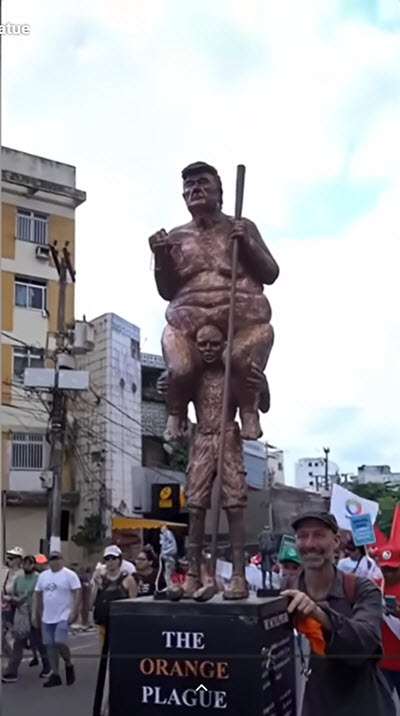
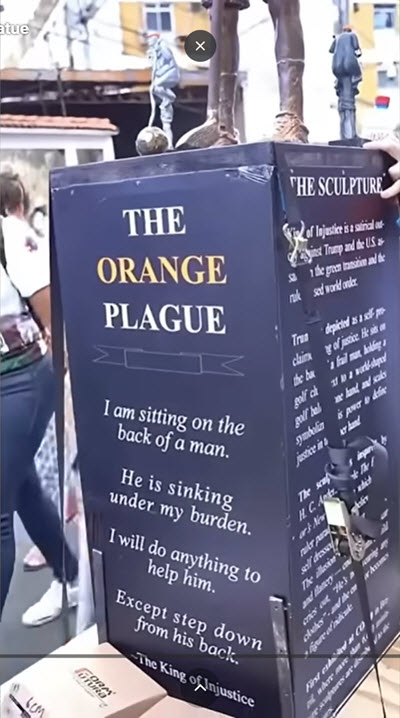
Really American host Steve Harness breaks down Brazilian protestors surprising Trump with an incredible work of Protest Art in a stunning display of solidarity with us!
Transcript
There's a saying that perception is
everything and right now the
international perception of the US is
trending negatively according to a new
global survey.
Yeah, trending negatively is a very nice
way to say that the whole planet
is laughing at us for putting Trump back
in the White House. And honestly, we
deserve to be mocked. Whether it's his
tariffs screwing with the global economy
or him ignoring the effects of climate
change, we are no longer the beacon of
hope. We're a place that most foreigners
would rather not visit, let alone move
here. And I do not blame them. And at
the recent COP 30 climate change summit
in Brazil that the Trump regime skipped,
we found yet another piece of protest
art making fun of our dear Emperor
Trump. So, hit subscribe to Really
American Media. Let's add another piece
of art to the long list of protest art
that we have seen abroad. like Trump
strapped to a gurnie for a lethal
injection, a giant banner in England
with Trump and his BFF Jeffrey Epstein.
We had the Statue of Liberty crying on
the side of a building in France, or the
Mount Rushmore of dictators in Thailand,
a personal favorite of mine. But now we
head to Brazil to show you the aptly
named Orange Plague.
Heat. Heat.
Heat. Heat.
Yeah, that's the work of a Danish artist
named Yen's Galio. And yes, I practiced
that several times. I hope I got it
close enough. And although that visual
of a fat Trump crushing a little man
kind of speaks for itself, let's hear
from the artist himself as to what all
of this represents.
It's Trump on top of a thin man. And the
thin man represents you and me and
climate and everything that he tries to
rule with power and threat.
So this is the message that we need to
get him down from there.
Should not sit on top of everybody and
decide what they think we decide for
ourselves. and we need to discuss it.
Right. So, Trump is sitting at top the
common man, crushing us with his weight
and authoritarian rule, which does sound
about right. Although, it could also be
a statue of Trump just on the
common man. But hey, I'm no art expert.
But I am good at finding obscure video
clips on the internet. And somehow I
managed to find a clip of Santa Claus
interviewing that artist right there in
Brazil. And it offers even more insight
to his inspiration.
So, we're going to work together somehow
during this COP 30, this very big
opportunity to get this message to the
leaders. And you know, this guy didn't
even show up and and and
we made him show up.
Well, yeah, exactly. You made him show
up, but in a nice form that is
ridiculous
and and ridicules him. So let's get
together all of us right around the
world and let's uh promote these kind of
satirical images these these ideas of of
you know the best way to deal with
fascism is to make fun of it. That is
the absolute me best way. So let's do
that and uh Marcus just tell us a little
bit about how this came about. Well, we
made it uh we made this in cover statue
of of Donald Trump sitting on top of it.
And he says he's kind of he holds a
weight. So because he wants to decide
what is right and what is wrong. And
what he says on the on the on the statue
is I'm I'm sitting on the back of a thin
man. He's falling under my weight. I
will do anything to help him except
stepping down. Which shows the
hypocrisy. I mean he wants to control
the world. He wants to rule the
decisions of all of us. uh he wants to
do what is what is best but in the end
uh for him
he should let people decide for
themselves and this is the big problem
exactly he's doing what's best for him
and his cronies
yeah he wants us to do what is best for
him but we should do what's best for us
yes as he said he wants us to do what's
best for him but we should do what is
best for us isn't it funny that a Danish
guy can see the obviousness of that
truth but the mega sheep in America
cannot and will hot. It's no wonder the
whole world is laughing at us. And if
you saw my last protest art video about
that statue of Trump on the gurnie, you
may recall that it also came in this
short version, too, which is perfect
holiday gift giving for your
short-sighted mega relatives. But this
new orange plague statue, well, hey,
it's also available in a short mini me
version.
As you said,
we made 6,000 small 3D print here that
we are handing out at the at the
conference.
Isn't that cool? So because people are
afraid of say of putting Trump on the
agenda because they are afraid of the
revenge from revenge from him and we ran
into NOS's and governments and and I
think all of them were good and I
understand why they were afraid because
they are risking getting funds cut. So
we have this. We're an independent art
organization. So we hand these out and
whenever you're in a meeting room
discussing this, maybe you talk about
this little figure and you say, "Hey,
maybe it's not on the agenda, but let's
discuss how we do next time Trump runs
to ruin a climate deal or or something
so that we don't have to talk about him
next year." That's right.
I definitely want one of those and I
love the idea that there's going to be a
year when we don't have to talk about
Trump anymore. I appreciate his
optimism, but given his health issues of
late, hey, who knows? That year could be
this year, which would also be a great
holiday gift for all of us.
Yeah. And just in case you don't think
we still need to be involved in an
international climate change meeting
like that one in Brazil, just look at
some of these comments from that video
that show you just how ignorant MAGA
still is in the year 2025 with people
saying like they're just buttth
hurt because climate change has been
exposed as a moneyaundering scam or
aren't we past the climate change scam
yet? No. No, we definitely are not. Just
look at these mega comets stacking up
one after another. I'm assuming those
are paid protesters. Disgusting. I
really hate paid protesters and climate
change is a hoax. It's almost like these
sheep are all getting the same talking
points. And with idiots like that voting
for Trump, it is no wonder that not only
did Trump skip this COP 30 climate
change summit, he couldn't even be
bothered to send anybody else in his
place. But it's a good thing that like
always, the Democrats step in and step
up. Governor Gavin Newsome is keeping
busy overseas in Brazil attending COP
30, the United Nations 30th annual
climate change conference.
Yeah, President Trump is not there.
Instead, a US delegation of more than
100 governors, mayors, and other state
and local officials are attending.
Today, Newsome was quick to criticize
the president's absence, saying while
it's a disgrace President Trump has
quote abandoned the clean energy space,
California is stepping into the
international spotlight, especially in
staying competitive with China. Yep.
Good old Gavin Newsome in California
stepping up. And Gavin went to represent
America and, you know, act like an
adult. And while he was there fighting
to cool off our planet, he decided to
turn up the heat on King Trump.
California has two things. A reliable
partner
in relationship to this space.
I cannot say that for the United States
of America, particularly as it relates
to the current occupant in the White
House. Quite the contrary. This is not
about electric power. This is about
economic power.
And we in the state of California are
not going to seed that race to China.
We're going to compete.
Yeah. He's got my vote for president,
assuming he runs. Uhhuh. And while he
was there, he certainly looked
presidential and was asked about whether
or not he'd be running in 2028.
Today, Newsome also signed a memorandum
of understanding to collaborate on
wildfire prevention and response. As far
as his political future, yesterday he
said this,
the
most important office, Brian, I said, is
office of citizen. Uh, active, not inert
citizenship. So, I I that's that's a
gift uh to go back. But we'll see what
the hell happens. I' I've been very
animated by, as you can tell, by what's
going on in my country.
Yeah, we're all pretty animated by
what's going on in our country. And
that's why we need protest artists to
keep attacking the vanity of our wannabe
dictator.
Yeah. All right. Well, as always, please
like this video, comment below, and get
vocal. From the vocal minority with Nick
and Steve podcast available right here
on this fine YouTube channel.
- admin
- Site Admin
- Posts: 41355
- Joined: Thu Aug 01, 2013 5:21 am
Return to United States Government Crime
Who is online
Users browsing this forum: No registered users and 135 guests