
Part 1 of 2
"This guy talks to God"
When they found Dr. Hugo Spadafora in September 1985, they found everything but his head. The rest of him had been tied up in a U.S. mail sack and dumped under a bridge on the border of Costa Rica and Panama.
His body bore evidence of unimaginable tortures. The thigh muscles had been neatly sliced so he could not close his legs, and then something had been jammed up his rectum, tearing it apart. His testicles were swollen horribly, the result of prolonged garroting, his ribs were broken, and then, while he was still alive, his head had been sawed off with a butcher's knife.
The horrors of Hugo Spadafora's death brought thousands of people into the streets of Panama City, where they formed a miles-long human chain of outrage and lament. The dashing young doctor had been a hero to many Panamanians— an unusual mix of revolutionary warrior and middle-class professional.
When he was murdered, Spadafora had been fighting for the Contras in Costa Rica, at the side of his old friend Eden Pastora. They had fought together in the 1970s against the Somoza dictatorship, with Spadafora leading an international brigade of jungle fighters—the Brigada Internacional Simon Bolivar—in support of Pastora's southern forces. After the Sandinistas became too oppressive for Pastora's liking, he joined the CIA and took over command of a Contra army in Costa Rica. Hugo Spadafora gave up his medical practice in Panama and, with his wife Winy, moved to Costa Rica to take up arms with Pastora once again— this time against their old Marxist comrades.
The Reagan administration's Contra PR machine couldn't have dreamed up a better freedom fighter than Hugo Spadafora. The DEA called him "reportedly the best known guerrilla fighter in Central America." He was so popular in Panama that the country's civilian president, Nicolas Barletta, announced an immediate investigation into his shocking murder. It was to be one of Barletta's last official acts. A few weeks later he was forced to resign by Manuel Noriega, the commander of the country's military, and the promised investigation never \ occurred. Charged with masterminding Spadafora's murder, Noriega was convicted in absentia by a Panamanian court in 1993.
The New York Times, in a June 1986 story that first exposed Noriega as a drug dealer and money launderer, cited Spadafora's murder as an example of why U.S. government officials were growing tired of the tyrant. "Officials in the Reagan Administration and past Administrations said in interviews that they had overlooked General Noriega's illegal activities because of his cooperation with American intelligence," the story said. "They said, for example, that General Noriega had been a valuable asset to Washington in countering insurgencies in Central America and was now cooperating with the Central Intelligence Agency in providing sensitive information from Nicaragua."
But the Times story left unaddressed a rather obvious question: why would a cunning political strategist like Noriega take the risky step of having the popular Spadafora, Panama's former vice minister of public health, kidnapped by government security men in full view of dozens of witnesses, and decapitated?
The answer, which may be the reason the Times sidestepped the issue, involved drugs and the CIA. When Noriega's goons hauled Spadafora off a bus at the Panamanian border, he was on his way to Panama City, where he intended to publicly release evidence of Noriega's cocaine-smuggling activities— activities that also involved the Contras in Costa Rica. Before leaving for Panama, Spadafora had excitedly told friends that he now had the proof he needed to document the dictator's participation in cocaine trafficking, and he was convinced that the revelations would sink the tyrant.
In the months before his murder, the doctor had befriended a drug and arms smuggler who once ran Noriega's dmg operation, Floyd Carlton Caceres. Carlton, who also served as Noriega's personal pilot, began confiding in Spadafora, sharing intimate details of Noriega's drug trade. "Dr. Spadafora was a very honest man," Carlton said. "He was an idealist and he tried to get the best for anyone needing justice."
If anyone needed justice right then, it was Floyd Carlton. The smuggler was lying low, trying to avoid a hit man Colombian dealers had sent after him. Carlton had lost $1.8 million in cash the Colombians had entrusted to him to fly from Los Angeles to their banks in Panama City. Since he was too busy to do it himself, he'd delegated the task to an underling, who later turned up in Miami, sans cash.
"I had to pay that money," Carlton said, which he agreed to do by flying a dmg load north for free. But again, he'd sent someone else to fly the mission, one of his partners, Teofilo Watson. Watson had never returned, disappearing with 530 kilos of cocaine. Now the Colombians were really angry.
"They thought I had agreed or made a plan with Mr. Watson to steal the drug," Carlton said. Carlton suspected that Costa Rican Contra leader Sebastian "Guachan" Gonzalez and his strange M-3 Contra group had done Watson in, leading him into an ambush at an airstrip owned by the local CIA man, John Hull. "They killed him and then took the airplane and the drugs to Mr. Hull's ranch," Carlton testified. The plane was cut up and thrown into a river that ran through Hull's property, and the cocaine was spirited to the United States, where it may have been traded for weapons.
The Colombians sent a hired killer named Alberto Aldimar out to find Carlton and the cocaine. Aldimar started by kidnapping Carlton's friends and employees and slapping them around. One of his relatives, Carlton said, "was brutally beaten." Then the power shovels arrived and began digging up Carlton's ranch. "They spent weeks there looking for some type of metal and found nothing," he said. Next the Colombians kidnapped the daughter of the Contras' CIA liaison, John Hull, on whose ranch the theft supposedly had taken place. Hull ransomed the girl back unharmed and blamed it on the Communists.
After that, Carlton bolted Central America altogether and took refuge in Miami, the U.S. headquarters of his cocaine transportation network. That's where Spadafora found him, in hiding. "He was trying to unmask Noriega and he was successful in obtaining truth that could imperil Noriega," Carlton later testified.
That in large part was due to Carlton, who would later astonish DEA officials with his photographic recall of Noriega's drug deals. Carlton eventually became the U.S. government's star witness against the Panamanian dictator at his trial on drug charges. The pilot gave Spadafora the names of other pilots involved and the dates of specific-drug flights through Costa Rica. He also implicated Noriega's high school buddy, "Guachan" Gonzalez, who was then hiding out in Panama from a Costa Rican cocaine indictment.
When he was finished, Carlton said, Spadafora announced, "I am going to have a bomb explode in Panama. I am going to set it off with all this information which I have." Hurrying back to Costa Rica, Spadafora began sharing his discoveries with law enforcement and intelligence officials, which may have been his worst mistake.
News of Spadafora's visit to the DEA's offices in San Jose was quickly relayed back to CIA headquarters in Langley, which was informed that "Hugo Spadafora had made vague allegations to DEA. . .that [Guachan] Gonzalez, Manuel Noriega and [another Contra leader] were engaged in drug trafficking. The chief of the local DEA office [Robert Nieves] met Spadafora twice and. . .Spadafora had promised that he would provide evidence of drug trafficking by Gonzalez."
If Nieves needed a way to confirm the doctor's explosive claims, he had just the man for the job—his deep-cover informant Norwin Meneses. In addition to Meneses's connections within the Contras, the trafficker was a close friend and trafficking partner of the Contra official Spadafora was trying to unmask, "Guachan" Gonzalez.
Somehow Meneses's lieutenants got wind of what Spadafora was planning, and they began devising a counterattack. During their investigation of Meneses aide Horacio Pereira, the Costa Rican police taped Gonzalez and Pereira discussing Spadafora's probe and plotting ways to silence him. The Costa Rican newspaper La Nacion obtained copies of the tapes and printed partial transcripts. One ploy Gonzalez and Pereira batted around was paying a witness in Guanacaste Province between $200,000 and $300,000 falsely accuse Spadafora of drug trafficking and exonerate Gonzalez of his pending Costa Rican drug charges.
"Now he's surrounded because if he comes over here, he's finished," Gonzalez confidently told Pereira in a phone call from Panama.
"Yes," Pereira replied. "If he shows up over there, you'll get him."
The district attorney in the Panamanian province where Spadafora was murdered ordered Gonzalez arrested in 1990 for allegedly offering to pay someone to kill the doctor, but no charges were filed, and Gonzalez was quickly released. He has strenuously denied any involvement in Spadafora's death, but Spadafora's family remains convinced Gonzalez played a major role.
Though Noriega apparently felt the information Spadafora possessed was important enough to kill him over, DEA official Robert Nieves had a very different reaction. He told La Nacion that his discussions with Spadafora were "not important" and said he did nothing with the information the doctor had risked his life to bring him. Since Noriega's drug dealing was the official reason the United States invaded Panama four years later, Nieves's professed inaction is astounding. But it would not be out of character for the DEA at that time.
Floyd Carlton testified that he got the same cold shoulder from the DEA office in Panama City when he tried telling them about Noriega's drug dealing in January 1986. "I did actually make contact with intelligence agents in the United States Embassy in Panama," Carlton related. "And I asked, 'Have you not heard my name?' And they said, 'Yes, we have.' And so I said, 'On different occasions I have sent people to speak to you so that you interview me. But you have always told them that you have nothing to talk to me about. And the fact is that I believe that I can go before the American judicial system and speak of a lot of things that are happening in this country, and I can even prove them.'
"So they asked, 'Such as what?' So, I said, 'Money laundering, drugs, weapons, corruption, assassinations.' When I mentioned the name of General Noriega, they immediately became upset." Carlton said the DEA agents "did not try to contact me again. And the only thing that I asked for was protection for myself and my family. And at that time I had no problems with the American justice system."
Judging from the DEA's response to a Freedom of Information Act request, Nieves took a similarly incurious stance when his informant turned up with his head missing. Apparently, none of the DEA's Costa Rican agents ever looked into the doctor's gruesome death. All the agency had on Spadafora, it claimed, was a couple of paragraphs culled from Panamanian newspaper stories written a year after the murder.
The CIA's reaction was even more bizarre. Its Costa Rican station chief, Joe Fernandez, helped Noriega plant false media reports about who really killed Hugo Spadafora.
Jose Blandon, then Noriega's consul general in New York, told Congress that he and Noriega discussed Spadafora's murder a few weeks after the body was found, during a long flight home from New York aboard the dictator's private Lear Jet. Noriega, who'd been in France when Spadafora was killed, wanted an update on how the public was reacting to the killing, the diplomat said. "Especially, he was interested in the developments regarding a witness whose name is Hoffman, a witness of German origin who appeared on Panamanian television saying that he knew who had killed Spadafora and publicly said that Spadafora had been killed by the FMLN [leftist guerrillas] of El Salvador," Blandon testified.
The German, Manfred Hoffman, "was a witness who was created by Noriega, and he was obtained through the CIA operating in Costa Rica," Blandon testified. "He is a specialist in electronics and he worked for the CIA in some cases." Blandon, describing the episode as "an absurd farce," said he told Noriega "nobody believed that story."
A month after Spadafora's killing, Noriega's men contacted the CIA and asked for help in "defusing an effort by family members of slain rebel Hugo Spadafora to implicate Manuel Antonio Noriega in drug trafficking." The CIA cable discussed putting Gonzalez on a popular morning radio talk show to discredit Spadafora's brother, who was trying to obtain Costa Rican documents implicating the Contra commander as a drug dealer. According to a handwritten note on the CIA cable, brother Winston was barking up the right tree: "If the truth be told," someone had written, "we had reason to believe that Gonzalez has been involved in drugs about a yr, 1 Vi yrs ago."
Actually, it was longer than that. A CIA contract agent had first reported on Gonzalez's drug dealings in October 1983, after Spadafora had informed him that "Noriega was smuggling drugs with the Contras and that Gonzalez was involved." The agent said his CIA supervisor simply "replied that CIA had heard some rumors of drug trafficking involving the Contras."
Unfortunately for Spadafora's wife and family, the good doctor had the bad luck of being murdered at a politically inconvenient time. It was in no one's interests right then—Noriega's or the U.S. government's—to delve too deeply into the crime for fear of what would be exposed: the apparent complicity of two CIA assets—Noriega and Gonzalez—in the murder of someone trying to expose government drug trafficking.
At that point the Reagan administration was nuzzling up to Noriega as it had never done before, frantically searching for ways around the 1984 congressional ban on CIA support to the Contras. For months, a steady stream of high-ranking visitors from Washington had been paying courtesy calls to the despot, reminding him of how much Uncle Sam liked and needed him.
In June 1985, aboard a luxurious yacht anchored in the Pacific port of Balboa, North and Noriega struck a very important bargain, said Jose Blandon, who attended the meeting. "Colonel North was interested in gaining Panama's support for the Contras and he particularly requested training assistance in bases located in Panama," Blandon told Congress in 1988. "General Noriega promised to provide training in specific locations to members of the Contras, training to be provided at bases located in Panama." He was also willing to allow Contra leaders free access to the country, and made it clear to North that he was willing to do much, much more.
According to government documents filed during North's trial, Noriega offered to have the entire Sandinista leadership assassinated in exchange for "a promise from the U.S. government to help clean up Noriega's image." North raised the proposal at a top level meeting in Washington and made it clear that "Noriega had the capabilities that he had proffered." North was instructed to tell Noriega that the administration wasn't keen on murdering Nicaraguan government officials, but that Panamanian assistance with sabotage would be another story.
A month after Spadafora's body was found under the bridge, North went back to Panama for another visit, this time to assure the dictator that the U.S. government would be boosting Noriega's foreign aid payments. Within a year an additional $200 million in U.S. taxpayer funds and bank loans was sent his way.
Meanwhile, a former staffer on the National Security Council, Dr. Norman A. Bailey, was frantically trying to alert various high-ranking government officials to the fact that Noriega was in bed with drug traffickers and other criminals.
Bailey, the NSC's former director of planning, had discovered that Panamanian banks were taking in billions of dollars in $50 and $100 bills, money that Bailey concluded could only have come from criminal activities.
Bailey set off on a quixotic quest to persuade the Reagan administration to distance itself from Noriega, pressing his reports into the hands of Reagan's top advisers, including national security adviser Admiral John Poindexter. "I took the initiative myself after the murder of Dr. Spadafora," Bailey testified. "As far as I know, the only thing that actually took place was that Admiral Poindexter added Panama to a trip he was making to Central America in December of 1985."
But Poindexter's meeting with Noriega was hardly what Norman Bailey had envisioned. According to Jose Blandon, who was in attendance, Poindexter did bring up the Spadafora murder, but only to give Noriega some friendly advice on how to handle it; Poindexter "spoke of the need to have a group of officers be sent abroad, outside of Panama, while the situation changed and the attitudes changed regarding Spadafora's assassination."
Noriega met CIA director William Casey after that, again to discuss his help for the Contras. According to a Senate subcommittee report, Casey decided not to raise the allegations of Noriega's cocaine trafficking with him "on the ground that Noriega was providing valuable support for our policies in Central America."
While all of this official ring-kissing was going on, Oliver North and the CIA were quietly knitting parts of Noriega's drug transportation system into the Contras' lines of supply—and hiring drug smugglers to make Contra supply flights for them.
At the time of his visits with Noriega, North was firmly in control of the Contra project, having been handed the ball personally by CIA director Casey. Far from being the dopey, gap-toothed zealot portrayed by the Reagan administration and the press, North was one of the most powerful men in Washington. "The spring of 1985, he was the top gun," testified Alan Fiers, the CIA's Central American Task Force chief and North's liaison at Langley. "He was the top player in the NSC as well. And there was no doubt that he was—he was driving the process, driving the policy."
Former Iran-Contra special prosecutor Lawrence Walsh, who indicted and convicted North on a variety of felonies, suspects the Marine officer was a cutout for the CIA, a human lightning rod to keep the agency from becoming directly involved in illegal activities. "The CIA had continued as the agency overseeing U.S. undercover activities in support of the Contras after the Boland amendments were enacted," Walsh wrote in his memoirs. "The CIA's strategy determined what North would do."
In a city where information is power, North had access to the nation's deepest secrets, subjects so highly classified even top CIA officials didn't know about them. "He told me in 1985 that there was [sic] two squadrons of Stealth bombers operational in Arizona and I just thought he was crazy," Fiers testified. "It was the, one of the greatest secrets the government had and then all of a sudden we, in fact, ended up with two squadrons of Stealth bombers operational. And there were many, many other instances when he told me things, and I thought they were totally fanciful and, in fact, turned out to be absolute truth."
One of the many surprises North had for Fiers was the fact that he had received specialized training usually reserved for CIA officers. During one late- night conversation about the Contra supply operation in Costa Rica, Fiers testified, North blurted out that he had "put together a whole cascade of cover companies, 'just like they taught us at the CIA clandestine training site.' And I thought that was pretty interesting because I went there and I didn't learn how to put together a whole cascade of companies. And 1 also didn't know that Ollie North had gone down to the training site."
Savvy bureaucrats in Washington knew North was not someone to be taken lightly. Fiers called him "a power figure in the government. . .a force to be reckoned with." When he asked for something, people jumped. When he gave orders, they were followed. "Ollie North had the ability to work down in my chain of command and to cause [it] to override me if and when I didn't do something," Fiers testified. "And, I would like to add, subsequently I saw that happen in other ways, other places and other agencies."
Fiers's boss at the CIA, Clair E. George, echoed that. "I suffer from the bureaucrat's disease, that when people call me and say, 'I am calling from the White House for the National Security Council on behalf of the national security advisor,' I am inclined to snap to."
CIA Costa Rican station chief Joe Fernandez was more blunt. "To a GS-15, this guy talks to God, right?" Fernandez said of North during a secret congressional hearing in 1987. "Obviously, I knew where he worked in the Executive Office Building. He has got tremendous access. . .. I mean, North is not some ordinary American citizen that is suddenly in this position. This is a man who had dealings with, obviously, the Director of the CIA. . .. You know, he deals with my division chief."
North was even telling U.S. ambassadors what to do.
In July 1985, before taking his new job as ambassador to Costa Rica, Lewis Tambs said North sat him down and gave him his marching orders. "Colonel North asked me to go down and open up the Southern Front," Tambs told the Iran-Contra committees. "We would encourage the freedom fighters to fight. And the war was in Nicaragua. The war was not in Costa Rica, and so that is what I understood my instructions were."
But with the CIA's billions officially banned from the scene, North had a big problem if he was going to get the Contras out of their Costa Rican border sanctuaries and into Nicaragua to do some actual fighting.
He had no way to supply them; the CIA had been doing all that.
It takes tons of material to sustain an army in the field, particularly one that is going to be warring deep inside enemy territory, separated by days from its supply depots. The CIA had plenty of experience handling such complicated logistical problems, but North didn't. It was a problem he took up with his friends at Langley, who, according to CIA official Fiers, "spent major time, major effort" trying to come up with a solution.
"Air resupply of the Contras was the key," Fiers testified. "We had a 15,000- man army of guerrillas operating in Nicaragua and had to supply them. All of the supply went by air. They carried in what—their boots and their clothes, and then their new ammunition and such had to be dropped in by air. So the success or failure turned on air resupply operations."
One of the vehicles North selected to handle that chore was a new unit set up inside the U.S. State Department called the Nicaraguan Humanitarian Assistance Office (NHAO). The office was officially created in mid-1985 to oversee the delivery of $27 million in "humanitarian" aid Congress agreed to give the Contras, under considerable pressure from the White House.
North and the CIA first tried to get the operation placed inside the National Security Council, where it would be free from public scrutiny and North could control it directly, but that move failed. Instead, Fiers said, North simply "hijacked" it from the State Department. In November 1985 he pressured the NHAO to hire one of his aides as a consultant, a tall, blond former L.A. prep school counselor named Robert W Owen. A Stanford University grad and onetime advertising executive, Owen idolized North. Since 1984 he had been, in his own words, North's "trusted courier" in Central America, zigzagging through the war zones for Ollie, listening to the concerns of Contra officials, setting up arms deals, and solving problems.
Owen's work had drawn rave reviews from his CIA contacts. "That man has all of the attributes that we want in our officers," Costa Riean station chief Fernandez told Congress during a 1987 hearing. "I met with him on a number of occasions. . .introduced him to one of my officers who regularly met with him when he was in town." Fernandez said his superiors were "so impressed with Mr. Owen that he was being considered as a possible applicant for the clandestine service."
Owen, in 1989 court testimony, admitted that "there was a possibility that I might have gone with the CIA on contract."
But because Owen was a private citizen, Fernandez said, he couldn't legally send him out on intelligence-gathering missions. He could listen when Owen reported back but couldn't, in CIA jargon, "task" him. But that all changed once Owen began working for the NHAO, which probably explains North's insistence that Owen be hired. "When he did that, then we did have a much more operational relationship," Fernandez confirmed. "Because then he was a government employee, I did ask him to find out things."
NHAO director Robert Duemling and his aides couldn't figure out why they needed to have Rob Owen around, and initially they rebuffed North's suggestions. "I certainly didn't see the necessity for a middleman," Duemling testified in a once-secret deposition to the Iran-Contra committees. But North kept pushing. Duemling said North had Contra leaders write letters demanding Owen's hiring, and he lobbied Duemling's superior at the State Department, Assistant Secretary of State Elliott Abrams, a fervent Contra supporter. After one stormy meeting with North and Abrams, Duemling said, "Elliott Abrams turned to me and said, 'Well, Bob, I suppose you probably ought to hire Owen.' Well, in bureaucratic terms the jig was up, since I was the only person who was speaking out against this."
Owen was given a $50,000 contract as a "facilitator," a job that mystified Duemling's aide, Chris Arcos. Arcos testified that no one was "sure what, in fact, Rob Owen could do or bring or offer to the office that we couldn't do. He didn't have much Spanish, he didn't have an expertise in medical or anything like that."
The minutes of that November 1985 meeting show that for some reason, Abrams and North were extremely concerned about the fallout if someone discovered Owen's involvement with the NHAO, and they began working on a cover story to explain his presence there in case it leaked. "Abrams and North agreed that Owen will be expendable if he becomes a political or diplomatic liability," the minutes state. If that happened, Congress would be told that he was "an experiment that hadn't worked out."
It was an experiment right out of Dr. Frankenstein's lab.
Rob Owen's mission was to serve as the CIA's unofficial liaison to the drug traffickers and other undesirables who were helping the Contras in Costa Rica, people who were too dirty for the CIA to deal with directly. Like North, he was another "cutout." "He probably had the most extensive network of contacts among the resistance leaders," CIA station chief Fernandez testified in 1987, "including people with whom we did not want to have contact with and who, however, were involved with the Nicaraguan resistance."
The untouchables Fernandez was referring to were the Cuban anti¬ communists in Costa Rica—the rough mix of mercenaries, bombers, assassins, and drug dealers recruited in Miami by UDN-FARN commander Fernando "El Negro" Chamorro and CIA agent Ernesto Cruche. The agency, Fernandez testified, was "very leery of these people. I however, Rob Owen had an entree to them."
And now, thanks to his NHAO job, he had an official entree—as an operational CIA asset. Owen's specific assignment, in fact, put him directly over the drug traffickers Fernandez and the CIA didn't want to be seen with.
He was assigned to "monitor" an NHAO contract with a Costa Rican shrimp company called Frigorificos de Puntarenas, S.A. This consisted of a small fleet of fishing boats based in the humid Pacific Coast village of Puntarenas, and an import company in Miami called Ocean Hunter, which brought Frigorificos' catch into the United States. In reality, however, it was "a firm owned and operated by Cuban-American drug traffickers," according to a 1988 Senate subcommittee report.
That conclusion was based partly on the congressional testimony of former Medellin cartel accountant Ramon Milian Rodriguez, a suave Cuban-American who was the cartel's money-laundering wizard until his arrest in Miami in 1983, when he and $5 million in cash were taken off a Lear jet bound for Panama. Frigorificos, he testified, was one of an interlocking chain of companies he'd created to launder the torrents of cash that were pouring into the cartel's coffers from its worldwide cocaine sales. Drug money would go into one company and come out of another through a series of intercompany transactions, clean and ready to be banked or invested. In 1982, Frigorificos was taken over by a group of major Miami-based drug traffickers, who began using it to help the Contras.
"Were payments or arrangements made by which the Contras could receive money through Frigorificos?" Senator John Kerry asked Milian during a Senate subcommittee hearing in 1987.
"Yes sir," the accountant answered.
"You arranged that?"
"I, through my intermediaries, made it possible."
"Was any of the money that you provided Frigorificos traceable to drugs or to drug-related transactions?" Kerry asked.
"No, sir."
"Why was that?"
"Because," said Milian, "we were experts at what we do."
Dark Alliance: The CIA, the Contras ..., by Gary Webb
28 posts
• Page 3 of 3 • 1, 2, 3
Re: Dark Alliance: The CIA, the Contras ..., by Gary Webb
 by admin » Sun Feb 15, 2026 9:22 pm
- admin
- Site Admin
- Posts: 41361
- Joined: Thu Aug 01, 2013 5:21 am
Re: Dark Alliance: The CIA, the Contras ..., by Gary Webb
by admin » Sun Feb 15, 2026 9:34 pm
Part 2 of 2
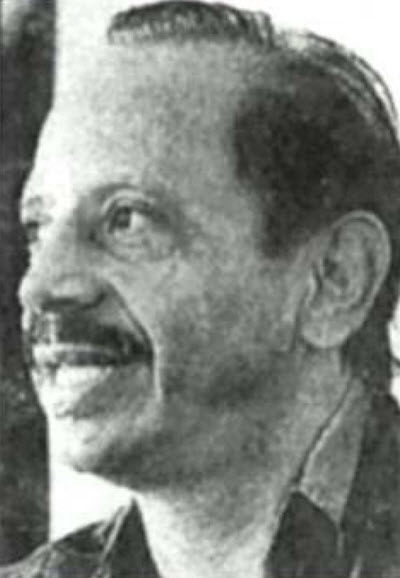
"El Rey de la Droga" (The King of Drugs), Norwin Meneses Cantarero, during an interview with the author and Georg Hodel at Tipitapa Prison outside Managua in 1996. PHOTO BY GARY WEBB
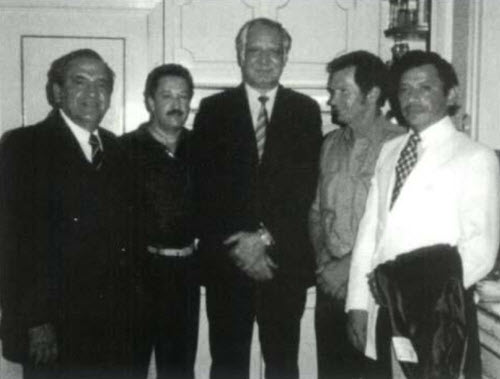
FDN supporter Don Sinicco snapped this picture in his kitchen in San Francisco during a cocktail party he was hosting for CIA agent Adolfo Calero, center. Drug lord Norwin Meneses is on the far right. The other men are local Contra supporters. At the time this photo was taken, June 1984, Meneses was engaged in a cocaine smuggling conspiracy, according to federal prosecutors, photo. COURTESY OF DON SINICCO
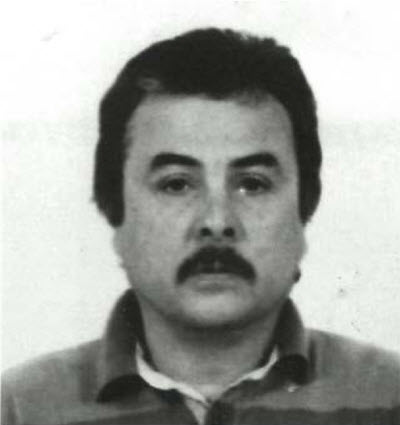
Danilo Blandon, circa 1995.
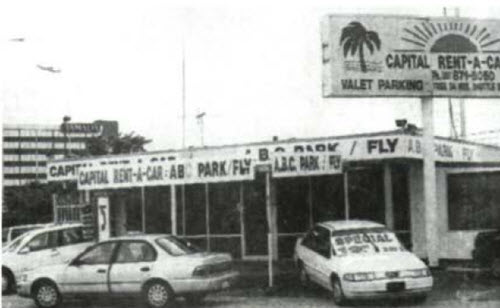
ABC Park and Fly, near the Miami International Airport. Blandon established his car rental company in this building during his brief "retirement" from the cocaine business in 1987. The day this picture was taken Anastasio Somoza's former counterinsurgency expert, Maj. Gen. Gustavo "El Tigre" Medina, was working behind the counter, Photo by Gary Webb
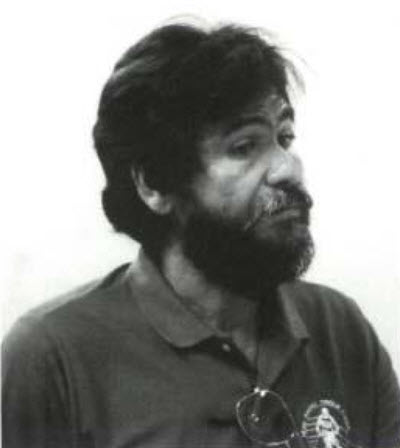
Enrique Miranda Jaime, shortly after the FBI kidnapped him in Miami and sent him back to Nicaragua to face escape charges in late 1996. Miranda, a former double agent for the CIA and the Sandinistas, was Meneses's top aide after the war and would later help send his boss to prison, photo by Gary Webb
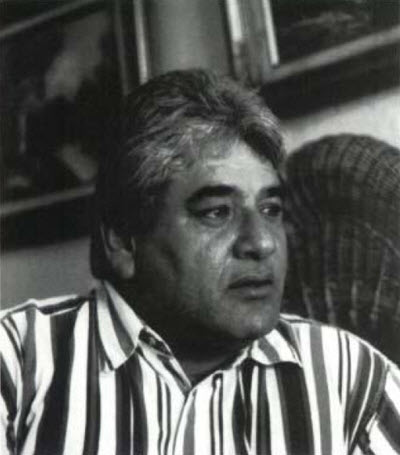
Former Contra cocaine courier Carlos Cabezas, at his law office in Managua. PHOTO BY GARY WEBB
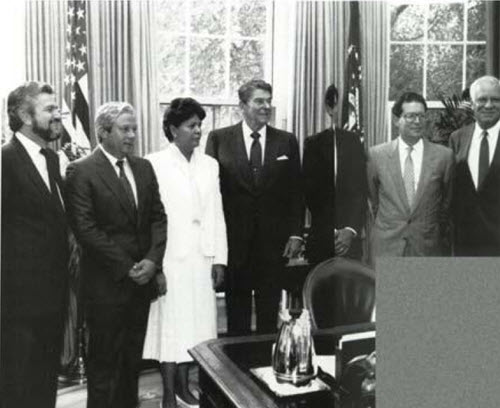
The Oval Office, August 5, 1987. A gathering of Nicaraguan resistance leaders to mark yet another CIA-inspired merger of the Contra armies from the FDN to the United Nicaraguan Opposition (UNO). Second from left is Aristides Sanchez. Adolfo Calero is on the far right, courtesy of the Ronald Reagan Library.
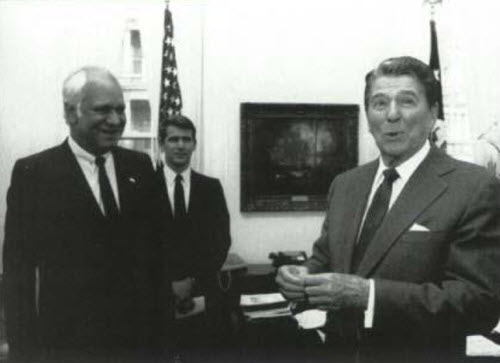
The Oval Office, April 4, 1985. From left: CIA agent Adolfo Calero, political boss of the FDN; Lt. Col. Oliver North and President Ronald Reagan, after the CIA handed off the day-to-day management of the Contra project to North and the National Security Council, courtesy of the Ronald Reagan library
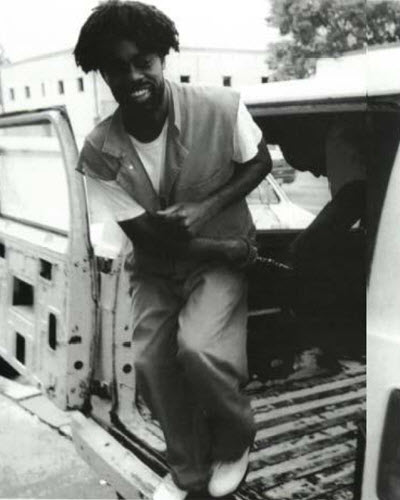
L.A. crack kingpin "Freeway" Ricky Ross was all smiles as he was released from a Texas prison in 1994 after serving a short stint for cocaine trafficking. Though he had vowed to go straight, a few months later he would be lured back into the drug business by his old friend and cocaine supplier, Danilo Blandon. ROBERT GAUTHIER/LOS ANGELES TIMES
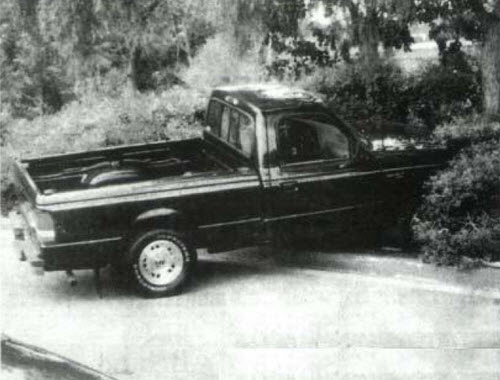
Ricky Ross was captured March 2,1995 in National City after his truck careened into a hedgerow, photo by Gary Webb
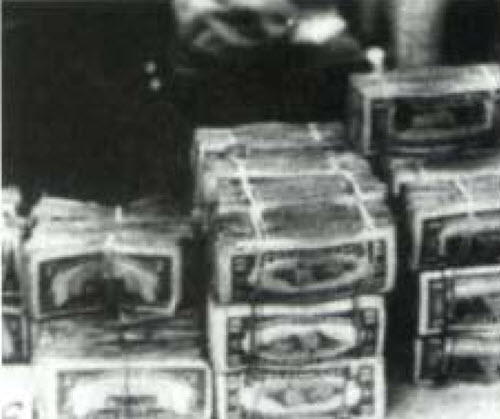
Part of the $160,000 seized by the DEA from crack dealer Leroy "Chico" Brown during the 1995 sting that snared "Freeway" Ricky Ross, DEA photo
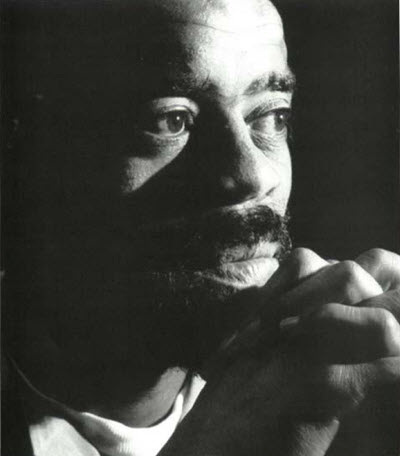
Ricky Donnell Ross, shortly before he was sentenced to life in prison without the possibility of parole in October 1996. Robert Gauthier/Los Angeles Times
Milian, a graduate of Santa Clara University in Silicon Valley, told Kerry's committee that he used the firm to launder a $10 million donation from the Medellin cartel to the Contras, a donation he said was arranged by and paid to a former CIA agent, Cuban Felix Rodriguez. Kerry's committee didn't believe that tale, especially after Milian flunked a lie detector test on the question.
But during the drug trafficking trial of Manuel Noriega several years later, one of the government's star witnesses, former Medellin cartel transportation boss Carlos Lehder, confirmed under oath that the cartel had given the Contras $10 million, just as Milian had testified. Lehder said he arranged for the donation himself.
Contra leader Adolfo Calero has always denied the Contras received such a sum, but Calero is hardly a credible source when it comes to Contra fund¬ raising. I le denied for many years that the Contras ever got money from the CIA, or assistance from Oliver North.
The FBI first picked up word of Frigorificos' involvement with drugs in September 1984, while the CIA was still running the Contra program. An investigation of a 1983 bombing of a Miami bank had led police and FBI agents into the murky underworld of Miami's Cuban anti-Communist groups, who were suspected of blowing up the bank.
Miami police questioned the president of the Cuban Legion, Jose Coutin, who told them what he knew of the bombing and then unloaded some unexpected information about the Contras and drugs, naming a host of Cuban CIA operatives and Bay of Pigs veterans he said were working for the Contras in Costa Rica. One drug dealer Coutin named was Francisco Chanes, whom Coutin said "was giving financial support to anti-Castro groups and the Nicaraguan Contra guerrillas. The monies come from narcotic transactions." lie identified Chanes as one of the owners of Ocean Hunter, the sister company of Frigorificos. The Miami cops quickly turned the information over to the FBI, records show.
Coutin's statements were corroborated years later by former drug pilot Fabio Ernesto Carrasco, who admitted flying cocaine and weapons loads for the Contras in 1984 and 1985. As a U.S. government witness, Carrasco testified that Frigorificos was being used by the Contras during the war as a front to bring cocaine into the United States to finance the war effort.
"To make sure I understand, is this company Frigorificos de Puntarenas in any way involved in drug trafficking?" defense attorney Richard "Racehorse" Haynes asked Carrasco during a 1990 drug trial in Tulsa, Oklahoma.
"That's correct."
"In what way was it involved?"
"As I have said, they would load cocaine inside the containers which were being shipped loaded with vegetables and fruit to the United States," Carrasco said.
"Did this company have a role in your drug operations dealing with the Contras and the weapons that you believed to be involved with the CIA?"
"It did in my opinion," the pilot testified.
So how could a company started by the Medellin cartel and used as a front to run drugs into America ever wind up with a contract from the U.S. State Department's Nicaraguan Humanitarian Assistance Office?
Through Rob Owen and the CIA, court records show.
"The people that were involved in Ocean Hunter in Costa Rica were ones that had been helpful to the cause," Owen testified in a 1988 civil deposition. He identified those helpful souls as Frank Chanes, the Miami Cuban who was reported to the FBI as a drug trafficker in 1984, and Moises Nunez, another Bay of Pigs veteran who was suspected by Interpol of being a drug trafficker as well as an intelligence operative.
Another man involved with Frigorificos was the exiled Nicaraguan lawyer Francisco Aviles Saenz, the CIA asset who claimed the $36,000 police had seized during the investigation of the Frogman case in San Francisco in 1983 belonged to the Contras. On several occasions Aviles, the brother-in-law of Meneses's lieutenant Horacio Pereira, notarized affidavits submitted by the shrimp company to obtain payment from the State Department, records show.
Owen claimed the shrimp company was used mainly for its international bank accounts, serving as one of several Central American "brokers" for the humanitarian aid money going to the Contras on the Southern Front. In all, more than $260,000 in U.S. taxpayer funds flowed through Frigorificos's bank accounts during 1986.
"We needed an account in Miami that the [State Department] money could be deposited to. [There were] constant financial transactions between Miami and Costa Rica, between Frank Chanes and Moises Nunez. They had been helpful and supportive of the cause. They were willing to do it," Owen testified. "I felt that they were honest and that the money would go where it was supposed to go."
Where it ended up is anybody's guess. Some of the money paid Frigorificos, bank records show, was wired out in never-explained transfers to banks in Israel and South Korea. When the U.S. General Accounting Office audited the NHAO's "broker" accounts, it was unable to trace most of the money. Of $4.4 million that went into the accounts, less than $1 million could be accounted for, and much of that was in payoffs to Honduran military officials. The rest was traced to offshore banks and then disappeared.
Owen insisted that the traffickers at Frigorificos had been cleared by the CIA and presumably the FBI. "U.S. intelligence sources were involved in Costa Rica to provide a check and a balance on this. They would be knowledgeable, they knew the lay of the ground. I thought it important and appropriate to talk with them," Owen testified. "To the best of my knowledge, I talked to U.S. intelligence officials regarding Moises Nunez. I believe I would have asked about Frank Chanes as well."
In addition, Owen said, "their names were given to NHAO and it was my understanding that any account that NHAO provided funds to was checked through the FBI. The FBI was informed who was being used as a banker. Now, whether they did any check on it or not, I'm not sure. I guess I assume that they did."
The director of the NHAO testified that the FBI never answered his letters of inquiry.
"So, is it fair to say, then, that you were the one that suggested these gentlemen be utilized?" Owen was asked during a deposition.
"It is fair to say. . .in consultation with U.S. intelligence officials," Owen replied. Owen refused to identify them further, other than to say that it was "someone who works for the CIA."
One reason the CIA gave Frigorificos a clean bill of health may have been because its Costa Rican manager, Moises Nunez, was a CIA agent. John Hull, the CIA's Costa Rican liaison with the Contras, confirmed in an interview that Nunez was working with the agency as an intelligence source, and a 1988 UPI story said Nunez was "identified as an Agency officer by two senior Costa Rican government officials, a U.S. intelligence source, and American law enforcement authorities."
In addition to distributing State Department money to the Costa Rican Contras, Nunez was also permitting Frigorificos to be used by North and CIA station chief Fernandez as a cover for a secret maritime operation they were running against the Sandinistas, records show.
In February 1986, one of the Cubans working with North in Costa Rica, a longtime CIA contract agent named Felipe Vidal, devised a plan for a "small, professionally managed rebel naval force" that would serve as a supply line for the Contras, an intelligence-gathering operation, and a transportation unit "to infiltrate into the [Nicaraguan] mainland rebel cadres for specific missions."
Vidal recommended using a Costa Rican shrimp company as "a front" and getting two shrimp boats to act as motherships and to gather intelligence. "These boats could be acquired from U.S. government auctions," Vidal wrote, noting that "existing connections with a high-ranking official in the DEA would facilitate the purchase of said boats. The cost of these boats, with cooperation from the DEA, could come to as low as $10,000 per boat." CIA records show that Vidal was employed by Frigorificos at the time he proposed this scheme.
Vidal's "existing connections" with a top DEA official are fascinating, considering the Cuban's shady background. Vidal's criminal history "reflects an assortment of assault, robbery, narcotics, and firearms violations," the CIA Inspector General wrote, and included a 1971 drug conviction and a 1977 arrest for conspiracy to sell marijuana. Former CIA official Alan Fiers admits being aware of Vidal's "record of misbehavior and general thuggery" but claims he didn't know the Cuban was a convicted drug trafficker. The following month, Owen informed North that "the first hard intelligence mission inside by boat has taken place and the people arc now out." He said five small boats were being constructed and "a safe house [in Costa Rica] has been rented on a river, which flows into the ocean."
"Moises Nunez, a Cuban who has a shrimping business in Punteranous [sic] is fronting the operation," Owen wrote North. "He is willing to have an American come work for him under cover to advise the operation. ... If we can get two shrimp boats, Nunez is willing to front a shrimping operation on the Atlantic coast. These boats can be used as motherships. I brought this up awhile ago and you agreed and gave me the name of a DEA person who might help with the boats."
In other words, in early 1986 the DEA was being asked to provide cheap oceangoing vessels to a company started by the Medellin cartel, run by drug traffickers, for espionage missions planned and fronted by drug traffickers.
The identity of Vidal's high-ranking DEA contact was not divulged, nor is it known whether the agency ever provided the boats, but records show the maritime operation was going strong in April 1986 and would soon be running "several trips a week," according to a memo Owen sent to North. Curiously, the Iran-Contra investigations barely looked at this clandestine operation, which was a clear violation of the Boland Amendment since, according to Owen, it directly involved CIA station chief Joe Fernandez.
Despite his background, Moises Nunez also maintained a chummy relationship with antidrug agencies, both American and Costa Rican. "Nunez got to be known by our authorities as a collaborator of the DEA and of other police bodies," said a 1989 Costa Rican prosecutor's report, adding that the Cuban carried credentials from the Costa Rican Ministry of Public Safety's Department of Narcotics, provided funds and vehicles for an antidrug unit, and went out on raids with them, though his effectiveness was somewhat questionable. The report said he blew a four-month investigation of a Colombian drug ring by making a "premature" arrest.
Most of this strange activity was occurring with the knowledge and apparent approval of CIA station chief Fernandez and other CIA agents in Costa Rica, records indicate. Fernandez admitted to the Iran-Contra committees that he knew Nunez and knew he was meeting with Owen to discuss Contra operations. Fernandez was asked if he knew that Nunez claimed to have met North, but his answer was classified for reasons of national security.
Nunez, however, shed light on that question when the CIA interrogated him in March 1987 about allegations that he'd been dealing drugs in Costa Rica through his shrimp company, Frigorificos. Thanks to a DEA seizure, the CIA already knew that Nunez's partners in that firm were behind a 414-pound cocaine load shipped to Miami in January 1986 amidst crates of yucca.
"Nunez revealed that since 1985, he had engaged in a clandestine relationship with the National Security Council [NSC]," the CIA Inspector General reported. "Nunez refused to elaborate on the nature of these actions but indicated it was difficult to answer questions relating to his involvement in narcotics trafficking because of the specific tasks he had performed at the direction of the NSC."
Instead of following up on this eyebrow-raising answer, CIA headquarters ordered an immediate halt to Nunez's questioning. "The Agency position was not to get involved in this matter and to turn it over to others because it had nothing to do with the Agency, but with the National Security Council," former CIA officer Louis Dupart reasoned in an interview with the CIA Inspector General. "That's all we had to do. It was someone else's problem." That "someone" was harried Iran-Contra prosecutor Lawrence Walsh, upon whom every potential allegation of drug trafficking by the Contras was dumped by the CIA and the Reagan Administration. Of course, Walsh had neither the time nor the authority to look into most of those leads and the CIA refused to cooperate on the few occasions when he did ask some questions. Therefore he made an excellent scapegoat in case anyone wondered why tips about drug dealing by the NSC and the Contras were never investigated. "We turned it over to Lawrence Walsh," became the Agency's standard reply.
Former CIA official Alan Fiers, who ran the Contra project at the time, confirmed that Nunez's questioning was stopped "because of the NSC connection and the possibility that this could be somehow connected to [North's] Private Benefactor program, otherwise known as the Iran-Contra affair."
The CIA made the same decision when a security check on the CIA's logistics advisor to the Costa Rican Contras, Cuban mercenary Felipe Vidal, discovered evidence of drug running.
"Narcotics trafficking relative to Contra-related activities is exactly the sort of thing that the U.S. Attorney's Office will be investigating," CIA attorney Gary Chase worried in an August 1987 memo. Chase "expressed concern over the possibility that the security process. . .could be exposed during any future litigation." Vidal's security check was shut down.
But the Agency's conduct was far worse than simply burying its head in the sand. For years afterward, it shielded both Dago Nunez and Felipe Vidal from criminal investigations into drug trafficking and money laundering. At various times, the CIA told U.S. Customs and the DEA that it had no information about Nunez's trafficking activities. The CIA's Directorate of Operations—which runs covert operations—lied even to the Agency's own lawyers, denying knowledge of Nunez's shrimp company though there was plenty of information in its files.
Fiers also confirmed that the CIA played a critical role in the "humanitarian" aid operation involving Frigorificos; without the agency, Fiers said, the NHAO was simply "a shell entity. . .. We were to be the eyes and ears of the NHAO office. The only way that they could monitor alignments, verify shipments and receipts was by having CIA capabilities in the region perform that function for them. And so that's what we did." But since at least three other drug-dealing companies ended up working for the NHAO during its brief lifespan, either the CIA's oversight was woefully incompetent or it was seeking a special kind of contractor.
One such company was DIACSA, the Miami aircraft company that Floyd Carlton had used for years as the U.S. headquarters for his Panamanian drug¬ smuggling venture with Noriega. It was in DIACSA's offices, Carlton admitted, that he and his partners plotted their drug flights and arranged the laundering of their cocaine profits. DEA records confirm that.
Just like Frigorificos, DIACSA was run by a Cuban drug dealer who had been part of the CIA's Bay of Pigs operation, Alfredo Caballero. Carlton testified that Cabellero was "involved with drug trafficking and to a certain extent he helped the Contras. But to be more specific he was helpful to Mr. Pastora's organization [ARDE]."
According to a Senate subcommittee report, the Contras were dealing with DIACSA even before it was hired by the State Department. "During 1984 and 1985, the principal Contra organization, the FDN, chose DIACSA for 'infra¬ account transfers.' The laundering of the money through DIACSA concealed the fact that some funds of the Contras were deposits arranged by Lieutenant Colonel Oliver North," the report stated.
The State Department's selection of DIACSA as a "humanitarian" aid contractor is perhaps even more egregious than its choice of Frigorificos. At the time DIACSA got its government contract, the company had been penetrated by an undercover DEA agent, Danny Moritz, who was churning out eyewitness reports of Caballero's drug dealing and money-laundering rackets. Moreover, both Caballero and Carlton were under indictment in the United States for conspiring to import 900 pounds of cocaine and laundering $2.6 million in drug profits. Both were convicted, and both became U.S. government informants.
How the CIA missed those clues has never been explained. It is highly likely the agency knew exactly what DIACSA was, since its owner was said to be working for the CIA. "Alfredo Caballero was CIA and still is," insisted Carol Prado, Eden Pastora's top aide in ARDE. "I say that because I knew him very well. A lot of times I went to DIACSA in Miami." Prado has reason to know. A 1985 CIA cable described DIACSA as the "cover company" used by the Costa Rican Contras to secretly buy aircraft.
During Noriega's trial in 1991, Floyd Carlton testified that his smuggling operation was flying weapons to the Contras at the same time he was flying dope to the United States and he said some of the arms flights were organized by Caballero. When Noriega's lawyers asked Carlton about Oliver North's knowledge of those flights, federal prosecutors vehemently objected, and U.S. judge William Hoeveler became angry. "Just stay away from it," the judge snapped, refusing to allow any more questions on the topic.
Another Miami company the NHAO hired to ferry supplies was Vortex Aviation, which was being operated by a Detroit drug dealer named Michael Palmer. Palmer, a former airline pilot, had worked since 1977 for "the largest marijuana business cartel in the history of the country," according to a federal prosecutor in Detroit. Yet in 1985 Palmer became a freedom fighter and volunteered for the Contra war effort, transporting humanitarian aid for the State Department.
In a recently declassified interview with FBI agents in 1991, CIA official Fiers admitted that the CIA had information that Palmer was dealing drugs during that time. "Fiers heard that sonic of Palmer's people got caught taking a plane of drugs into the U.S. and this is what caused a lot of problems for Palmer," the FBI reported. "CIA thought the northern Contras were clean but Palmer was an exception."
One DC-4 Palmer was using to deliver Contra aid was shot up in February 1986 as it attempted an airdrop over Nicaragua, and it made an emergency landing on San Andres Island off the coast of Nicaragua, a notorious haven for cocaine traffickers. Four days later Owen wrote to North, saying, "No doubt you know that the DC-4 Foley got was used at one time to run drugs and part of the crew had criminal records. Nice group the Boys chose." Pat Foley was the owner of a Delaware-based company, Summit Aviation, a longtime CIA and U.S. military contractor, often for clandestine air operations. Foley was reportedly overseeing Palmer's operations at Vortex.
Francis McNeil, at the time one of the State Department's top narcotics intelligence officers, confirmed to Congress that the DC-4's appearance at San Andres caused red flags to go up in Washington. "A stop at San Andres Island for a Contra resupply plane is a bit suspicious since San Andres is known to be a transshipment point for drugs," McNeil testified.
The pilot of that unlucky DC-4, former CIA contract pilot Ronald Lippert, said in an interview that neither his trip nor his crew were involved with drugs, though the plane had been involved with drug flights "long before I acquired it." He said the landing at San Andres was for repairs only. But he acknowledged that his plane was probably used for drug flights while Vortex was hauling humanitarian aid for the Contras. Those flights were piloted by Vortex's own crews, Lippert said. He knew one of the flights wound up in Colombia, because he got a call from the FAA in Miami "asking what my plane was doing, taking off from a dirt strip on the northeast coast of Colombia during its two-day mysterious absence on the Nicaraguan Contra flight."
Lippert, a Canadian who flew for the CIA in the early 1960s until his imprisonment by Cuban intelligence agents in 1963 for espionage, said that "the most I was able to find out from a friend in the intelligence community was the name 'Operation Stolen Mercedes' and that aside from Costa Rica, its itinerary may have included a stop in Panama and Mexico after it left Colombia."
On another Contra flight, Lippert's plane came back with an unexplained twelve and a half hours of excess flying time on it; Palmer told him the pilots had to make an emergency detour to Costa Rica. In his testimony to the Iran- Contra committees, Rob Owen confirmed that the airplane was involved in an unexplained "embarrassing situation" in Costa Rica. "That's when 1 decided some real strange shit was happening," Lippert said. "It came back all messed up with bullet holes in the tail and the engine burned out and, after that, I told them that was it. Unless I'm flying the plane, it was no dice. So Palmer says, 'Fine, I'll buy the damned thing from you.'"
Palmer, whom the CIA admits was working as an Agency subcontractor at this point, arranged to buy Lippert's DC-4 through some associates of his: a Cuban lawyer from Miami named Jose Insua and an aircraft company executive, Richard Kelley, both of whom intimated to Lippert that they were working with the CIA. After the sale, Lippert said, the DC-4 was used to airdrop explosives off the coast of Cuba. Then, a month after he signed the installment sale papers, it was seized in Mexico with 2,500 pounds of marijuana on board.
A story in the Mexican newpaper La Opinion quoted the attorney general of Mexico as saying that the plane was being used by a "powerful gang of drug- smugglers. . .known to have been operating for a long time using large aircraft to transport arms southbound and bring back marijuana through here."
Lippert never got the plane back, nor was he ever paid for it. The company that issued the letters of credit that "guaranteed" the purchase of his plane was later shut down by the state of Florida, which announced that its owners were drug traffickers and fugitive stock swindlers. "Can't we close a bank or even a supposed bank anymore without finding some sort of tie to the Contras?" bank examiner Barry Cladden wondered to a Miami Herald reporter in 1987. "What's the world coming to?"
One of the DC-4's buyers, Jose Insua, was later exposed as a drug trafficker and DMA informant himself, and was used by the agency in an unsuccessful attempt to snare the former chairman of the Florida Democratic party in a bribery sting. During the trial, the government admitted that Insua was "involved in the brokering of aircraft for narcotics smugglers on approximately 12 occasions."
As Lippert aptly observed in 1997, "Jose Insua is a drug dealer and he's hanging around a company [Vortex] with a State Department eon-tract. Michael Zapcdis is a drug dealer and he issues two letters of credit for planes that are used by the CIA. Mike Palmer is a drug dealer and he's running an airline for the CIA. You tell me what's going on."
Actually, the litany of drug dealers working for Vortex was even longer than that, according to the CIA's Inspector General. "Michael Palmer, Joseph Haas, Alberto Prado Herreros, Mauricio Letona, Martin Gomez, Donaldo Frixone, and two pilots for the prime contractor—all of whom were affiliated with the CIA Contra support program—may have been involved in narcotics trafficking prior to their relationship with the Agency," the Inspector General found.
Records show top CIA officials were fully aware that Vortex was dabbling in drugs even before they recommended the company for the NHAO's "humanitarian aid" project and, later, for a CIA subcontract.
"At least two Agency officers [Alan Fiers and an unnamed CIA contractor] knew about Palmer's drug dealing before the Agency agreed to buy an aircraft from Vortex and approved the subcontracting to Vortex of the servicing of aircraft flying resupply flights for the Contras," a May 1988 CIA memo states.
The NHAO also hired a Honduran air freight company, SETCO, which happened to be owned by the Honduran drug kingpin Juan Matta Ballesteros, a fact that the U.S. Customs Service had known since 1983. "SETCO was the principal company used by the Contras in Honduras to transport supplies and personnel for the FDN," the CIA's Inspector General reported. "[Oliver] North also used SETCO for airdrops of military supplies to Contra forces inside Nicaragua." In fact, that appears to have been the reason behind all of the State Department contracts that were awarded to cocaine smugglers: they were the same people the CIA had hired to do that work when the agency was running the show.
"I believe we guided them toward the carriers they ultimately used," former CIA official Alan Fiers confirmed in 1998. Fiers told CIA interviewers in 1987 that he and NHAO director Robert Duemling "had frequent meetings regarding possible contract cargo carriers. . .[Fiers] said he had checked out some of these carriers for Duemling."
Duemling told Iran-Contra investigators that he was given very specific instructions regarding the cargo carriers when he took over the humanitarian aid program. "One of the policy guidelines was do not disrupt the existing arrangements of the resistance movement unless there is a terribly good reason," Duemling testified.
"Who told you that, by the way, going back to the beginning of this?"
"Ollie North," Duemling said. He said North instructed him not to "dislodge or replace their existing arrangements, which seemed to be working perfectly well."
They certainly were, in one sense. According to Danilo Blandon's lawyer, Brad Brunon, the Centra's cocaine was arriving in the United States literally by the planeload. "The transportation channel got established and got filled up with cocaine rather quickly," Brunon said in an interview. "As I understood it, these large transports were coming back from delivering food and guns and humanitarian aid and things like that and they were just loading them up with cocaine and bringing them back. I think 1,000-kilo shipments were not unheard of. That scale. Because all of a sudden they seemed to have unlimited sources of supply."
According to former Meneses aide Enrique Miranda, Meneses's drug-laden planes were flying out of a military air base in El Salvador called Ilopango. Like the CIA before him, North had selected that base as the hub for his Contra air force; his operatives worked there "practically unfettered," according to the report of Iran-Contra prosecutor Lawrence Walsh.
And it was at Ilopango where the whole sordid mess first started to unravel.
"El Rey de la Droga" (The King of Drugs), Norwin Meneses Cantarero, during an interview with the author and Georg Hodel at Tipitapa Prison outside Managua in 1996. PHOTO BY GARY WEBB
FDN supporter Don Sinicco snapped this picture in his kitchen in San Francisco during a cocktail party he was hosting for CIA agent Adolfo Calero, center. Drug lord Norwin Meneses is on the far right. The other men are local Contra supporters. At the time this photo was taken, June 1984, Meneses was engaged in a cocaine smuggling conspiracy, according to federal prosecutors, photo. COURTESY OF DON SINICCO
Danilo Blandon, circa 1995.
ABC Park and Fly, near the Miami International Airport. Blandon established his car rental company in this building during his brief "retirement" from the cocaine business in 1987. The day this picture was taken Anastasio Somoza's former counterinsurgency expert, Maj. Gen. Gustavo "El Tigre" Medina, was working behind the counter, Photo by Gary Webb
Enrique Miranda Jaime, shortly after the FBI kidnapped him in Miami and sent him back to Nicaragua to face escape charges in late 1996. Miranda, a former double agent for the CIA and the Sandinistas, was Meneses's top aide after the war and would later help send his boss to prison, photo by Gary Webb
Former Contra cocaine courier Carlos Cabezas, at his law office in Managua. PHOTO BY GARY WEBB
The Oval Office, August 5, 1987. A gathering of Nicaraguan resistance leaders to mark yet another CIA-inspired merger of the Contra armies from the FDN to the United Nicaraguan Opposition (UNO). Second from left is Aristides Sanchez. Adolfo Calero is on the far right, courtesy of the Ronald Reagan Library.
The Oval Office, April 4, 1985. From left: CIA agent Adolfo Calero, political boss of the FDN; Lt. Col. Oliver North and President Ronald Reagan, after the CIA handed off the day-to-day management of the Contra project to North and the National Security Council, courtesy of the Ronald Reagan library
L.A. crack kingpin "Freeway" Ricky Ross was all smiles as he was released from a Texas prison in 1994 after serving a short stint for cocaine trafficking. Though he had vowed to go straight, a few months later he would be lured back into the drug business by his old friend and cocaine supplier, Danilo Blandon. ROBERT GAUTHIER/LOS ANGELES TIMES
Ricky Ross was captured March 2,1995 in National City after his truck careened into a hedgerow, photo by Gary Webb
Part of the $160,000 seized by the DEA from crack dealer Leroy "Chico" Brown during the 1995 sting that snared "Freeway" Ricky Ross, DEA photo
Ricky Donnell Ross, shortly before he was sentenced to life in prison without the possibility of parole in October 1996. Robert Gauthier/Los Angeles Times
Milian, a graduate of Santa Clara University in Silicon Valley, told Kerry's committee that he used the firm to launder a $10 million donation from the Medellin cartel to the Contras, a donation he said was arranged by and paid to a former CIA agent, Cuban Felix Rodriguez. Kerry's committee didn't believe that tale, especially after Milian flunked a lie detector test on the question.
But during the drug trafficking trial of Manuel Noriega several years later, one of the government's star witnesses, former Medellin cartel transportation boss Carlos Lehder, confirmed under oath that the cartel had given the Contras $10 million, just as Milian had testified. Lehder said he arranged for the donation himself.
Contra leader Adolfo Calero has always denied the Contras received such a sum, but Calero is hardly a credible source when it comes to Contra fund¬ raising. I le denied for many years that the Contras ever got money from the CIA, or assistance from Oliver North.
The FBI first picked up word of Frigorificos' involvement with drugs in September 1984, while the CIA was still running the Contra program. An investigation of a 1983 bombing of a Miami bank had led police and FBI agents into the murky underworld of Miami's Cuban anti-Communist groups, who were suspected of blowing up the bank.
Miami police questioned the president of the Cuban Legion, Jose Coutin, who told them what he knew of the bombing and then unloaded some unexpected information about the Contras and drugs, naming a host of Cuban CIA operatives and Bay of Pigs veterans he said were working for the Contras in Costa Rica. One drug dealer Coutin named was Francisco Chanes, whom Coutin said "was giving financial support to anti-Castro groups and the Nicaraguan Contra guerrillas. The monies come from narcotic transactions." lie identified Chanes as one of the owners of Ocean Hunter, the sister company of Frigorificos. The Miami cops quickly turned the information over to the FBI, records show.
Coutin's statements were corroborated years later by former drug pilot Fabio Ernesto Carrasco, who admitted flying cocaine and weapons loads for the Contras in 1984 and 1985. As a U.S. government witness, Carrasco testified that Frigorificos was being used by the Contras during the war as a front to bring cocaine into the United States to finance the war effort.
"To make sure I understand, is this company Frigorificos de Puntarenas in any way involved in drug trafficking?" defense attorney Richard "Racehorse" Haynes asked Carrasco during a 1990 drug trial in Tulsa, Oklahoma.
"That's correct."
"In what way was it involved?"
"As I have said, they would load cocaine inside the containers which were being shipped loaded with vegetables and fruit to the United States," Carrasco said.
"Did this company have a role in your drug operations dealing with the Contras and the weapons that you believed to be involved with the CIA?"
"It did in my opinion," the pilot testified.
So how could a company started by the Medellin cartel and used as a front to run drugs into America ever wind up with a contract from the U.S. State Department's Nicaraguan Humanitarian Assistance Office?
Through Rob Owen and the CIA, court records show.
"The people that were involved in Ocean Hunter in Costa Rica were ones that had been helpful to the cause," Owen testified in a 1988 civil deposition. He identified those helpful souls as Frank Chanes, the Miami Cuban who was reported to the FBI as a drug trafficker in 1984, and Moises Nunez, another Bay of Pigs veteran who was suspected by Interpol of being a drug trafficker as well as an intelligence operative.
Another man involved with Frigorificos was the exiled Nicaraguan lawyer Francisco Aviles Saenz, the CIA asset who claimed the $36,000 police had seized during the investigation of the Frogman case in San Francisco in 1983 belonged to the Contras. On several occasions Aviles, the brother-in-law of Meneses's lieutenant Horacio Pereira, notarized affidavits submitted by the shrimp company to obtain payment from the State Department, records show.
Owen claimed the shrimp company was used mainly for its international bank accounts, serving as one of several Central American "brokers" for the humanitarian aid money going to the Contras on the Southern Front. In all, more than $260,000 in U.S. taxpayer funds flowed through Frigorificos's bank accounts during 1986.
"We needed an account in Miami that the [State Department] money could be deposited to. [There were] constant financial transactions between Miami and Costa Rica, between Frank Chanes and Moises Nunez. They had been helpful and supportive of the cause. They were willing to do it," Owen testified. "I felt that they were honest and that the money would go where it was supposed to go."
Where it ended up is anybody's guess. Some of the money paid Frigorificos, bank records show, was wired out in never-explained transfers to banks in Israel and South Korea. When the U.S. General Accounting Office audited the NHAO's "broker" accounts, it was unable to trace most of the money. Of $4.4 million that went into the accounts, less than $1 million could be accounted for, and much of that was in payoffs to Honduran military officials. The rest was traced to offshore banks and then disappeared.
Owen insisted that the traffickers at Frigorificos had been cleared by the CIA and presumably the FBI. "U.S. intelligence sources were involved in Costa Rica to provide a check and a balance on this. They would be knowledgeable, they knew the lay of the ground. I thought it important and appropriate to talk with them," Owen testified. "To the best of my knowledge, I talked to U.S. intelligence officials regarding Moises Nunez. I believe I would have asked about Frank Chanes as well."
In addition, Owen said, "their names were given to NHAO and it was my understanding that any account that NHAO provided funds to was checked through the FBI. The FBI was informed who was being used as a banker. Now, whether they did any check on it or not, I'm not sure. I guess I assume that they did."
The director of the NHAO testified that the FBI never answered his letters of inquiry.
"So, is it fair to say, then, that you were the one that suggested these gentlemen be utilized?" Owen was asked during a deposition.
"It is fair to say. . .in consultation with U.S. intelligence officials," Owen replied. Owen refused to identify them further, other than to say that it was "someone who works for the CIA."
One reason the CIA gave Frigorificos a clean bill of health may have been because its Costa Rican manager, Moises Nunez, was a CIA agent. John Hull, the CIA's Costa Rican liaison with the Contras, confirmed in an interview that Nunez was working with the agency as an intelligence source, and a 1988 UPI story said Nunez was "identified as an Agency officer by two senior Costa Rican government officials, a U.S. intelligence source, and American law enforcement authorities."
In addition to distributing State Department money to the Costa Rican Contras, Nunez was also permitting Frigorificos to be used by North and CIA station chief Fernandez as a cover for a secret maritime operation they were running against the Sandinistas, records show.
In February 1986, one of the Cubans working with North in Costa Rica, a longtime CIA contract agent named Felipe Vidal, devised a plan for a "small, professionally managed rebel naval force" that would serve as a supply line for the Contras, an intelligence-gathering operation, and a transportation unit "to infiltrate into the [Nicaraguan] mainland rebel cadres for specific missions."
Vidal recommended using a Costa Rican shrimp company as "a front" and getting two shrimp boats to act as motherships and to gather intelligence. "These boats could be acquired from U.S. government auctions," Vidal wrote, noting that "existing connections with a high-ranking official in the DEA would facilitate the purchase of said boats. The cost of these boats, with cooperation from the DEA, could come to as low as $10,000 per boat." CIA records show that Vidal was employed by Frigorificos at the time he proposed this scheme.
Vidal's "existing connections" with a top DEA official are fascinating, considering the Cuban's shady background. Vidal's criminal history "reflects an assortment of assault, robbery, narcotics, and firearms violations," the CIA Inspector General wrote, and included a 1971 drug conviction and a 1977 arrest for conspiracy to sell marijuana. Former CIA official Alan Fiers admits being aware of Vidal's "record of misbehavior and general thuggery" but claims he didn't know the Cuban was a convicted drug trafficker. The following month, Owen informed North that "the first hard intelligence mission inside by boat has taken place and the people arc now out." He said five small boats were being constructed and "a safe house [in Costa Rica] has been rented on a river, which flows into the ocean."
"Moises Nunez, a Cuban who has a shrimping business in Punteranous [sic] is fronting the operation," Owen wrote North. "He is willing to have an American come work for him under cover to advise the operation. ... If we can get two shrimp boats, Nunez is willing to front a shrimping operation on the Atlantic coast. These boats can be used as motherships. I brought this up awhile ago and you agreed and gave me the name of a DEA person who might help with the boats."
In other words, in early 1986 the DEA was being asked to provide cheap oceangoing vessels to a company started by the Medellin cartel, run by drug traffickers, for espionage missions planned and fronted by drug traffickers.
The identity of Vidal's high-ranking DEA contact was not divulged, nor is it known whether the agency ever provided the boats, but records show the maritime operation was going strong in April 1986 and would soon be running "several trips a week," according to a memo Owen sent to North. Curiously, the Iran-Contra investigations barely looked at this clandestine operation, which was a clear violation of the Boland Amendment since, according to Owen, it directly involved CIA station chief Joe Fernandez.
Despite his background, Moises Nunez also maintained a chummy relationship with antidrug agencies, both American and Costa Rican. "Nunez got to be known by our authorities as a collaborator of the DEA and of other police bodies," said a 1989 Costa Rican prosecutor's report, adding that the Cuban carried credentials from the Costa Rican Ministry of Public Safety's Department of Narcotics, provided funds and vehicles for an antidrug unit, and went out on raids with them, though his effectiveness was somewhat questionable. The report said he blew a four-month investigation of a Colombian drug ring by making a "premature" arrest.
Most of this strange activity was occurring with the knowledge and apparent approval of CIA station chief Fernandez and other CIA agents in Costa Rica, records indicate. Fernandez admitted to the Iran-Contra committees that he knew Nunez and knew he was meeting with Owen to discuss Contra operations. Fernandez was asked if he knew that Nunez claimed to have met North, but his answer was classified for reasons of national security.
Nunez, however, shed light on that question when the CIA interrogated him in March 1987 about allegations that he'd been dealing drugs in Costa Rica through his shrimp company, Frigorificos. Thanks to a DEA seizure, the CIA already knew that Nunez's partners in that firm were behind a 414-pound cocaine load shipped to Miami in January 1986 amidst crates of yucca.
"Nunez revealed that since 1985, he had engaged in a clandestine relationship with the National Security Council [NSC]," the CIA Inspector General reported. "Nunez refused to elaborate on the nature of these actions but indicated it was difficult to answer questions relating to his involvement in narcotics trafficking because of the specific tasks he had performed at the direction of the NSC."
Instead of following up on this eyebrow-raising answer, CIA headquarters ordered an immediate halt to Nunez's questioning. "The Agency position was not to get involved in this matter and to turn it over to others because it had nothing to do with the Agency, but with the National Security Council," former CIA officer Louis Dupart reasoned in an interview with the CIA Inspector General. "That's all we had to do. It was someone else's problem." That "someone" was harried Iran-Contra prosecutor Lawrence Walsh, upon whom every potential allegation of drug trafficking by the Contras was dumped by the CIA and the Reagan Administration. Of course, Walsh had neither the time nor the authority to look into most of those leads and the CIA refused to cooperate on the few occasions when he did ask some questions. Therefore he made an excellent scapegoat in case anyone wondered why tips about drug dealing by the NSC and the Contras were never investigated. "We turned it over to Lawrence Walsh," became the Agency's standard reply.
Former CIA official Alan Fiers, who ran the Contra project at the time, confirmed that Nunez's questioning was stopped "because of the NSC connection and the possibility that this could be somehow connected to [North's] Private Benefactor program, otherwise known as the Iran-Contra affair."
The CIA made the same decision when a security check on the CIA's logistics advisor to the Costa Rican Contras, Cuban mercenary Felipe Vidal, discovered evidence of drug running.
"Narcotics trafficking relative to Contra-related activities is exactly the sort of thing that the U.S. Attorney's Office will be investigating," CIA attorney Gary Chase worried in an August 1987 memo. Chase "expressed concern over the possibility that the security process. . .could be exposed during any future litigation." Vidal's security check was shut down.
But the Agency's conduct was far worse than simply burying its head in the sand. For years afterward, it shielded both Dago Nunez and Felipe Vidal from criminal investigations into drug trafficking and money laundering. At various times, the CIA told U.S. Customs and the DEA that it had no information about Nunez's trafficking activities. The CIA's Directorate of Operations—which runs covert operations—lied even to the Agency's own lawyers, denying knowledge of Nunez's shrimp company though there was plenty of information in its files.
Fiers also confirmed that the CIA played a critical role in the "humanitarian" aid operation involving Frigorificos; without the agency, Fiers said, the NHAO was simply "a shell entity. . .. We were to be the eyes and ears of the NHAO office. The only way that they could monitor alignments, verify shipments and receipts was by having CIA capabilities in the region perform that function for them. And so that's what we did." But since at least three other drug-dealing companies ended up working for the NHAO during its brief lifespan, either the CIA's oversight was woefully incompetent or it was seeking a special kind of contractor.
One such company was DIACSA, the Miami aircraft company that Floyd Carlton had used for years as the U.S. headquarters for his Panamanian drug¬ smuggling venture with Noriega. It was in DIACSA's offices, Carlton admitted, that he and his partners plotted their drug flights and arranged the laundering of their cocaine profits. DEA records confirm that.
Just like Frigorificos, DIACSA was run by a Cuban drug dealer who had been part of the CIA's Bay of Pigs operation, Alfredo Caballero. Carlton testified that Cabellero was "involved with drug trafficking and to a certain extent he helped the Contras. But to be more specific he was helpful to Mr. Pastora's organization [ARDE]."
According to a Senate subcommittee report, the Contras were dealing with DIACSA even before it was hired by the State Department. "During 1984 and 1985, the principal Contra organization, the FDN, chose DIACSA for 'infra¬ account transfers.' The laundering of the money through DIACSA concealed the fact that some funds of the Contras were deposits arranged by Lieutenant Colonel Oliver North," the report stated.
The State Department's selection of DIACSA as a "humanitarian" aid contractor is perhaps even more egregious than its choice of Frigorificos. At the time DIACSA got its government contract, the company had been penetrated by an undercover DEA agent, Danny Moritz, who was churning out eyewitness reports of Caballero's drug dealing and money-laundering rackets. Moreover, both Caballero and Carlton were under indictment in the United States for conspiring to import 900 pounds of cocaine and laundering $2.6 million in drug profits. Both were convicted, and both became U.S. government informants.
How the CIA missed those clues has never been explained. It is highly likely the agency knew exactly what DIACSA was, since its owner was said to be working for the CIA. "Alfredo Caballero was CIA and still is," insisted Carol Prado, Eden Pastora's top aide in ARDE. "I say that because I knew him very well. A lot of times I went to DIACSA in Miami." Prado has reason to know. A 1985 CIA cable described DIACSA as the "cover company" used by the Costa Rican Contras to secretly buy aircraft.
During Noriega's trial in 1991, Floyd Carlton testified that his smuggling operation was flying weapons to the Contras at the same time he was flying dope to the United States and he said some of the arms flights were organized by Caballero. When Noriega's lawyers asked Carlton about Oliver North's knowledge of those flights, federal prosecutors vehemently objected, and U.S. judge William Hoeveler became angry. "Just stay away from it," the judge snapped, refusing to allow any more questions on the topic.
Another Miami company the NHAO hired to ferry supplies was Vortex Aviation, which was being operated by a Detroit drug dealer named Michael Palmer. Palmer, a former airline pilot, had worked since 1977 for "the largest marijuana business cartel in the history of the country," according to a federal prosecutor in Detroit. Yet in 1985 Palmer became a freedom fighter and volunteered for the Contra war effort, transporting humanitarian aid for the State Department.
In a recently declassified interview with FBI agents in 1991, CIA official Fiers admitted that the CIA had information that Palmer was dealing drugs during that time. "Fiers heard that sonic of Palmer's people got caught taking a plane of drugs into the U.S. and this is what caused a lot of problems for Palmer," the FBI reported. "CIA thought the northern Contras were clean but Palmer was an exception."
One DC-4 Palmer was using to deliver Contra aid was shot up in February 1986 as it attempted an airdrop over Nicaragua, and it made an emergency landing on San Andres Island off the coast of Nicaragua, a notorious haven for cocaine traffickers. Four days later Owen wrote to North, saying, "No doubt you know that the DC-4 Foley got was used at one time to run drugs and part of the crew had criminal records. Nice group the Boys chose." Pat Foley was the owner of a Delaware-based company, Summit Aviation, a longtime CIA and U.S. military contractor, often for clandestine air operations. Foley was reportedly overseeing Palmer's operations at Vortex.
Francis McNeil, at the time one of the State Department's top narcotics intelligence officers, confirmed to Congress that the DC-4's appearance at San Andres caused red flags to go up in Washington. "A stop at San Andres Island for a Contra resupply plane is a bit suspicious since San Andres is known to be a transshipment point for drugs," McNeil testified.
The pilot of that unlucky DC-4, former CIA contract pilot Ronald Lippert, said in an interview that neither his trip nor his crew were involved with drugs, though the plane had been involved with drug flights "long before I acquired it." He said the landing at San Andres was for repairs only. But he acknowledged that his plane was probably used for drug flights while Vortex was hauling humanitarian aid for the Contras. Those flights were piloted by Vortex's own crews, Lippert said. He knew one of the flights wound up in Colombia, because he got a call from the FAA in Miami "asking what my plane was doing, taking off from a dirt strip on the northeast coast of Colombia during its two-day mysterious absence on the Nicaraguan Contra flight."
Lippert, a Canadian who flew for the CIA in the early 1960s until his imprisonment by Cuban intelligence agents in 1963 for espionage, said that "the most I was able to find out from a friend in the intelligence community was the name 'Operation Stolen Mercedes' and that aside from Costa Rica, its itinerary may have included a stop in Panama and Mexico after it left Colombia."
On another Contra flight, Lippert's plane came back with an unexplained twelve and a half hours of excess flying time on it; Palmer told him the pilots had to make an emergency detour to Costa Rica. In his testimony to the Iran- Contra committees, Rob Owen confirmed that the airplane was involved in an unexplained "embarrassing situation" in Costa Rica. "That's when 1 decided some real strange shit was happening," Lippert said. "It came back all messed up with bullet holes in the tail and the engine burned out and, after that, I told them that was it. Unless I'm flying the plane, it was no dice. So Palmer says, 'Fine, I'll buy the damned thing from you.'"
Palmer, whom the CIA admits was working as an Agency subcontractor at this point, arranged to buy Lippert's DC-4 through some associates of his: a Cuban lawyer from Miami named Jose Insua and an aircraft company executive, Richard Kelley, both of whom intimated to Lippert that they were working with the CIA. After the sale, Lippert said, the DC-4 was used to airdrop explosives off the coast of Cuba. Then, a month after he signed the installment sale papers, it was seized in Mexico with 2,500 pounds of marijuana on board.
A story in the Mexican newpaper La Opinion quoted the attorney general of Mexico as saying that the plane was being used by a "powerful gang of drug- smugglers. . .known to have been operating for a long time using large aircraft to transport arms southbound and bring back marijuana through here."
Lippert never got the plane back, nor was he ever paid for it. The company that issued the letters of credit that "guaranteed" the purchase of his plane was later shut down by the state of Florida, which announced that its owners were drug traffickers and fugitive stock swindlers. "Can't we close a bank or even a supposed bank anymore without finding some sort of tie to the Contras?" bank examiner Barry Cladden wondered to a Miami Herald reporter in 1987. "What's the world coming to?"
One of the DC-4's buyers, Jose Insua, was later exposed as a drug trafficker and DMA informant himself, and was used by the agency in an unsuccessful attempt to snare the former chairman of the Florida Democratic party in a bribery sting. During the trial, the government admitted that Insua was "involved in the brokering of aircraft for narcotics smugglers on approximately 12 occasions."
As Lippert aptly observed in 1997, "Jose Insua is a drug dealer and he's hanging around a company [Vortex] with a State Department eon-tract. Michael Zapcdis is a drug dealer and he issues two letters of credit for planes that are used by the CIA. Mike Palmer is a drug dealer and he's running an airline for the CIA. You tell me what's going on."
Actually, the litany of drug dealers working for Vortex was even longer than that, according to the CIA's Inspector General. "Michael Palmer, Joseph Haas, Alberto Prado Herreros, Mauricio Letona, Martin Gomez, Donaldo Frixone, and two pilots for the prime contractor—all of whom were affiliated with the CIA Contra support program—may have been involved in narcotics trafficking prior to their relationship with the Agency," the Inspector General found.
Records show top CIA officials were fully aware that Vortex was dabbling in drugs even before they recommended the company for the NHAO's "humanitarian aid" project and, later, for a CIA subcontract.
"At least two Agency officers [Alan Fiers and an unnamed CIA contractor] knew about Palmer's drug dealing before the Agency agreed to buy an aircraft from Vortex and approved the subcontracting to Vortex of the servicing of aircraft flying resupply flights for the Contras," a May 1988 CIA memo states.
The NHAO also hired a Honduran air freight company, SETCO, which happened to be owned by the Honduran drug kingpin Juan Matta Ballesteros, a fact that the U.S. Customs Service had known since 1983. "SETCO was the principal company used by the Contras in Honduras to transport supplies and personnel for the FDN," the CIA's Inspector General reported. "[Oliver] North also used SETCO for airdrops of military supplies to Contra forces inside Nicaragua." In fact, that appears to have been the reason behind all of the State Department contracts that were awarded to cocaine smugglers: they were the same people the CIA had hired to do that work when the agency was running the show.
"I believe we guided them toward the carriers they ultimately used," former CIA official Alan Fiers confirmed in 1998. Fiers told CIA interviewers in 1987 that he and NHAO director Robert Duemling "had frequent meetings regarding possible contract cargo carriers. . .[Fiers] said he had checked out some of these carriers for Duemling."
Duemling told Iran-Contra investigators that he was given very specific instructions regarding the cargo carriers when he took over the humanitarian aid program. "One of the policy guidelines was do not disrupt the existing arrangements of the resistance movement unless there is a terribly good reason," Duemling testified.
"Who told you that, by the way, going back to the beginning of this?"
"Ollie North," Duemling said. He said North instructed him not to "dislodge or replace their existing arrangements, which seemed to be working perfectly well."
They certainly were, in one sense. According to Danilo Blandon's lawyer, Brad Brunon, the Centra's cocaine was arriving in the United States literally by the planeload. "The transportation channel got established and got filled up with cocaine rather quickly," Brunon said in an interview. "As I understood it, these large transports were coming back from delivering food and guns and humanitarian aid and things like that and they were just loading them up with cocaine and bringing them back. I think 1,000-kilo shipments were not unheard of. That scale. Because all of a sudden they seemed to have unlimited sources of supply."
According to former Meneses aide Enrique Miranda, Meneses's drug-laden planes were flying out of a military air base in El Salvador called Ilopango. Like the CIA before him, North had selected that base as the hub for his Contra air force; his operatives worked there "practically unfettered," according to the report of Iran-Contra prosecutor Lawrence Walsh.
And it was at Ilopango where the whole sordid mess first started to unravel.
- admin
- Site Admin
- Posts: 41361
- Joined: Thu Aug 01, 2013 5:21 am
Re: Dark Alliance: The CIA, the Contras ..., by Gary Webb
by admin » Thu Feb 19, 2026 12:09 am
"The wrong kind of friends"
It didn't take DEA agent Celerino Castillo III very long to discover that something very strange was going on at Ilopango Air Force Base in El Salvador. Two days into his new job at the DEA's regional office in Guatemala City in October 1985, Castillo said the agent-in-charge, Robert Stia, took him aside and told him that the U.S. government was running a covert operation at the air base. Castillo should be careful not to interfere with it.
It struck the former Texas policeman as odd advice. Why would a DEA field agent need to be warned about interfering with a legitimate government operation? Castillo was there to fight drug dealers. Whatever they were doing at the military airfield outside San Salvador couldn't possibly concern him. At any rate, it wasn't as if he was going to be spending a lot of time in El Salvador. Though he was the country's only DEA agent, Castillo lived and worked in neighboring Guatemala and had duties there also.
Besides, El Salvador in late 1985 had all the makings of a very sorry posting. The war-torn country produced no drugs, and as far as anyone knew there were no major drug rings operating there. It was of such little concern to the American government that the DEA never opened an office in the country. If El Salvador was anything, it was a resting place for cocaine mules on their way north.
Flipping through the reports of his predecessors, Castillo could see that the DEA's role in the country had been limited to intelligence gathering, collecting information about drug shipments passing through and filing them away, making few seizures. "We were playing traffic cop, taking down the license numbers of speeders but never writing any tickets," Castillo would later observe.
Castillo put his boss's warning about Ilopango down to bureaucratic caution and got on with his job, which was to train and recruit Guatemalan and Salvadoran policemen to become soldiers in America's worldwide war on drugs. Since the DEA couldn't legally make any arrests in Central America, his assignment was to put together local antinarcotics squads the DEA could trust enough to work with, and develop informants who could provide real-time intelligence.
But no matter where he went, it seemed, Ilopango kept coming up.
Castillo was out one day with a DEA informant in Guatemala, a Cuban named Socrates Sofi-Perez, who proudly informed Castillo that he was a Bay of Pigs veteran and a Contra supporter. After learning that his new control agent had been decorated for fighting Communists in Vietnam, Sofi-Perez confided that he was helping the Contras fight Marxism in Nicaragua and laid out a scheme that was remarkably similar to the operation Frigorifieos was then conducting in Costa Rica: a shrimp company he owned was being used as a front to launder money for the Contras. The Contras were also dealing in cocaine, he told Castillo, using a small air force based at Ilopango that was ferrying war materials for the cause. He justified the trafficking by blaming the U.S. Congress for ill-advisedly cutting off Contra aid.
Castillo wasn't sure if his informant was trying to impress him, pull his leg, or waste his time. I he idea of a U.S. government-sponsored operation dabbling in drugs struck the six-year DEA veteran as absurd. But there was one way to find out. The next time he was in El Salvador, Castillo said, he bounced the Cuban's story off one of the few informants the DEA had there, Ramiro Guerra, who owned a coffee shop in San Salvador. Guerra was working for the DEA as the result of a pending cocaine trafficking indictment in San Francisco, where he had lived for many years. While hiding out in El Salvador, Guerra picked up pocket money by acting as an informant for the very agency that wanted him in jail back in the United States. He had also insinuated himself into Roberto D'Aubuisson's right-wing ARENA party, and had risen to a high level inside the party structure.
To Castillo's surprise, Guerra told him that the information about drugs at Ilopango was probably true. He'd heard the same rumors himself. And he confirmed that there was indeed a small air force based there that was illegally flying supplies to the Contras, but it really wasn't very secretive. While headquartered on the restricted military side of the Ilopango airport, the Contra air supply operation was being run quite openly, and a lot of his friends in the Salvadoran Air Force knew about it, Guerra told Castillo.
"The woman selling tortillas at the gate of Ilopango could tell you what was going on," the assistant regional security officer for the U.S. embassy in San Salvador told Iran-Contra investigators in 1991. "Anyone who ever flew into or over Ilopango air base could see something like that was going on. When looking down at Ilopango from the air, one could see one side of the airfield having a ragtag operation of inferior planes, dilapidated buildings and the like.
On the other side of the airport were nice facilities, lift trucks unloading supplies from more sophisticated and bigger aircraft, and gringos running around."
The modern facilities "all belonged to the American operation," the officer said, adding that he didn't know "if it was a CIA operation or what, but he knew there was Contra resupply activity at Ilopango."
While CIA officials denied they were running the show, they admitted they were keeping a very close eye on it. "We had a capability and indeed a responsibility for reporting what had been happening at Ilopango," said Alan Fiers Jr., the former CIA official who headed the Contra program from 1984 to 1988.
Guerra told Castillo that a Cuban named Max Gomez was doing the actual day-to-day management of the operation for the U.S. government. "Gomez," was the name then being used by CIA agent Felix Rodriguez, a Bay of Pigs veteran who'd had a remarkable career with the agency as a paramilitary specialist. Among other operations, he'd been in on the capture and execution of Che Guevara. In early 1985 Rodriguez appeared in El Salvador as an adviser to the Salvadoran Air Force, working on a helicopter-based counterinsurgency operation against the FMLN guerrillas.
While Rodriguez has always claimed—sometimes under oath—that he was retired from the CIA and in El Salvador merely as a volunteer and private citizen, former CIA officer Fiers suggested otherwise. He testified that Rodriguez was sent there in early 1985 as part of a CIA reorganization that began after Fiers took over the Central American Task Force. "As a result of the change in management of the task force. . .we undertook a complete review of our efforts in San Salvador. . .and made adjustments in that undertaking that left certain operations, certain activities that we had—left a void," Fiers testified in 1992. "Felix Rodriguez was put into—sent to El Salvador to work in the areas where we had left a void and was going to take over those responsibilities, or at least in part take over those responsibilities."
Rodriguez's journey from "retirement" to Ilopango began with a very strange step. Shortly before he left for Washington, D.C., to get final approval for his mission to El Salvador, he received a call from a friendly private eye in Miami who wanted him to meet "a client who could compromise the Nicaraguan Sandinista government for drug-money laundering," Rodriguez wrote in his memoirs.
The client turned out to be former Medellin cartel accountant Ramon Milian Rodriguez—the man who had set up the Costa Rican shrimp company Oliver North would later use to funnel money to the Contras. Rodriguez said Milian was trying to broker information to obtain help in the money laundering case pending against him. Not only did he tell Rodriguez of Manuel Noriega's drug activities, but he claimed he could provide proof of Sandinista drug dealing. Rodriguez said he passed the info along to the CIA and FBI and heard nothing back.
Milian tells a very different story. He met with Rodriguez to offer $10 million to the Contras in exchange for the U.S. government dropping the money laundering charges against him, he says; Rodriguez accepted the offer, and money was delivered to him on five separate occasions. Milian later failed a lie detector test when asked about making payments to Rodriguez, but the examiner reached no conclusions about his claim that he'd given money to the Contras. In congressional testimony, Noriega's former political adviser described Felix Rodriguez as "a very close friend of Milian." Both were Cubans who had been active in Miami's anti-Castro movement.
Most accounts date the Contras' use of Ilopango to September 1985, when North wrote to Rodriguez, asking him to use his influence with Salvadoran Air Force commander Juan Rafael Bustillo to secure hangar space for Contra supply flights. Rodriguez claimed he "greased the skids" with Bustillo and eventually became the overseer of North's Contra resupply operation at the air base.
In actuality, the Contras had been using Ilopango with General Bustillo's blessings since 1983, when Norwin Meneses's friend, CIA pilot Marcos Aguado, made arrangements to base Eden Pastora's ARDE air force there.
Since he could not devote all of his time to North's secret air force, Rodriguez wrote, "I found someone to manage the Salvadoran-based resupply operation on a day-to-day basis. [At Ilopango] they knew that person as Ramon Medina. I knew him by his real name: Luis Posada Carriles."
With men like Luis Posada and Marcos Aguado running things at Ilopango, it's little wonder DEA agent Castillo was hearing rumors about Contra drug trafficking. Luis Posada was a veteran CIA agent with a history of involvement with drug traffickers, mobsters, and terrorists. He was recruited by the CIA in the 1960s after years of working with anti-Castro Cubans in Miami and was implicated in a number of terrorist incidents conducted by various Cuban extremist groups. In 1967, CIA records show, Posada was investigated by the Justice Department for supplying explosives, silencers, and hand grenades to Miami mobsters "Lefty" Rosenthal and Norman "Roughhouse" Rothman. Rothman was a close associate of South Florida's Mafia chieftain, Santos Trafficante. A memo in Posada's CIA file said, "Posada may have been moonlighting for Rosenthal," but in late 1968 he was transferred by the agency for "unreported association with gangster elements, thefts from CIA, plus other items."
Posada was sent to Venezuela and began working as an official of the Venezuelan intelligence service. In 1973 the DEA received a report that Posada "was in contact with two Cubans in Miami who were reportedly smuggling narcotics into the United States for Luis Posada." According to the informant, Posada was to be "the main contact" in a major cocaine smuggling operation involving members of the Venezuelan government. The DEA placed Posada under surveillance and he "was observed by agents in Miami to meet with numerous identified upper echelon traffickers in Miami during March 1973."
Records show the CIA was fully aware of its agent's reported involvement with drug traffickers. It received word in February 1973 that "Posada may be involved in smuggling cocaine from Colombia through Venezuela to Miami, also counterfeit U.S. money in Venezuela." But the agency decided "not to directly confront Posada with allegation so as not to compromise ongoing investigation."
According to the notes of a congressional investigator who reviewed Posada's voluminous CIA files in the late 1970s, cables in the file "indicate concern that Posada [was a] serious potential liability. Anxious to terminate association promptly if allegations prove true. By April 1973, it seems sure that Posada involved in narcotics, drug trafficking—seen with known big time drug trafficker." But after questioning the Cuban about his contacts, the agency found him "guilty only of having the wrong kind of friends" and continued his employment.
His choice of friends continued to plague Posada, however. In January 1974 he asked the CIA to provide a Venezuelan passport for a Dominican military official, which the agency refused to do on the grounds that it "cannot permit controlled agents to become directly involved with illicit drug trafficking." A few months later the DEA received a report that Posada was trading weapons for cocaine with a man the DEA believed "is involved in political assassinations."
According to records at the National Archives, the CIA formally terminated Posada in February 1976. Eight months later he was arrested in Venezuela and accused of participating in the midair bombing of a Cuban DC-8 airliner, which killed seventy-eight people. Though never convicted of the crime, he spent nearly ten years in Venezuelan prisons before escaping in the summer of 1985 and going underground. He resurfaced at Ilopango in early 1986 as Felix Rodriguez's right-hand man, telling investigators that "Rodriguez and other Cuban friends" helped him "get out of Venezuela and relocate in FI Salvador. Upon arriving in El Salvador, Posada stayed with Rodriguez for two or three days. Rodriguez then helped Posada get a house in San Salvador, where Posada lived for the next year or so."
Though allegations of Contra drug trafficking were swirling around Ilopango, DEA agent Castillo was having difficulty getting firsthand evidence of it. For one thing, the air base was in a very protected position, high atop a plateau, surrounded by imposing cliffs. The area where the trafficking was supposedly going on was off limits to the public, tightly guarded by the Salvadoran military. If he was ever going to find out the truth, Castillo figured, he needed to get onto that side of the base.
He went to Salvadoran Air Force commander Bustillo, lord and master of Ilopango, for permission, but got the cold shoulder. "An agent from the DEA's branch office in Guatemala City came to San Salvador seeking access to Ilopango," the New Republic reported in 1990, adding that Bustillo "stalled" the requests. "There was never a good reason why [the DEA] couldn't get on Ilopango," the magazine quoted an unnamed U.S. official as saying. "They just kept putting off meetings, stuff like that."
So Castillo improvised. He recruited a Salvadoran named Murga, who wrote the flight plans for the private planes on the civilian portion of the base. Murga had excellent contacts on the military side and could come and go at will. He became Castillo's eyes and ears inside Ilopango.
Murga knew all about the Contras' drug running, Castillo said, because he was filling out their flight plans and inspecting their aircraft; the pilots were so brazen that they told him they were flying dope to the United States and money to Panama. Sometimes they left with the kilos in plain view, or arrived with boxloads of money, Castillo said.
In a once-secret 1992 interview with the FBI, ex-CIA agent Posada recounted that "the resupply project was always looking for people to carry cash from the United States into El Salvador for Posada to dispense. They were always worried about the restriction on only taking $ 10,000 out of the United States at one time. Any time any of the resupply people went up to the United States for any reason, whether it was a personal visit or whatever, they would be asked to bring money back." Posada was told "the money came from Washington," but never got a better explanation than that.
The drugs often arrived in private planes flown by Contra pilots from Costa Rica, Murga told Castillo; on other occasions they came in military aircraft from Panama.
When Castillo typed the names of the Contra pilots Murga had given him into the DEA's computers, nearly all of them came back as documented narcotics traffickers. Among the busiest of the pilots was Francisco Guirola Beeche, the scion of one of El Salvador's most influential families. How Chico Guirola wound up at Ilopango flying f or the Contras is an illuminating tale; he should have been sitting in a federal prison cell in the United States.
On the morning of February 6, 1985, a white T-39 Sabreliner jet took off from John Wayne Airport in Orange County, California, with Guirola and three other men—Cuban-Americans—aboard. It stopped briefly at the Kleberg County Airport in Kingsville, Texas, to refuel, and was met by a posse of U.S. Customs Service agents wielding search warrants. The agents had been tracking the men since the month before, when they were spotted in the same plane leaving Orange County for Florida. In mid-flight, they had suspiciously diverted to Panama, where they landed with $1.2 million in cash.
Guirola and his crew were all listed in Customs databases as suspected drug traffickers, and their airplane was on a watch list as a suspected smuggling craft —for good reason, it turned out. In the Sabreliner's cargo hold were fourteen suitcases, which Guirola claimed as his. He pulled out a Costa Rican diplomatic passport and advised the agents not to search the suitcases, or it would "cause trouble."
He was right. They were bulging with cash, a total of $5.9 million in small bills, the largest cash seizure in Texas history. When the agents announced they were arresting the men for trying to smuggle the cash out of the country, Guirola claimed diplomatic immunity because his mother was the Costa Rican vice- consul in New Mexico.
In court records, federal agents charged that the cash was drug money destined for El Salvador. They cited DEA records that said Guirola had been "reportedly involved in cocaine and arms smuggling in El Salvador and Guatemala" and noted that he was a top aide to Salvadoran death squad leader Roberto D'Aubuisson.
The latter claim was confirmed by the Los Angeles Times, which reported that Guirola had accompanied D'Aubuisson to a "very sensitive" meeting with former CIA deputy director Vernon Walters in May 1984. According to the story, Walters had been dispatched in a frantic attempt to talk D'Aubuisson out of assassinating Thomas Pickering, the U.S. ambassador to El Salvador.
Guirola, who attended college in California with one of Anastasio Somoza's nephews, had allowed D'Aubuisson to use his house as a campaign headquarters when he ran for Salvadoran president in 1984. Guirola's passport, which was signed by D'Aubuisson, identified him as a "special adviser" to the Salvadoran Assembly. He was also carrying credentials from the Salvadoran attorney general's office.
Since Guirola was using an Orange County airport as his departure point, it is possible that the millions he was hauling out of the country came from Los Angeles—area drug sales. But the source of the funds was never made public. "The investigation came to a sudden, abrupt halt with a lot of questions unanswered," U.S. Customs agent Krnest Allison complained.
That was because the justice Department had made a quick deal with Guirola: If he let the U.S. government keep the money, he'd be let off with probation. Guirola and one of his companions pleaded guilty to a minor currency violation charge and walked. Charges against another passenger and the pilot were dropped, and the plane was given back.
"I have a hard time swallowing it," federal judge I layden I lead Jr. told Guirola after the Justice Department announced its plea bargain with the smuggler. "The punishment doesn't fit the crime. ... I don't know what you were up to, but this conduct cannot be tolerated."
Less than a year later, DEA agent Castillo and his informants were watching Guirola zoom in and out of Ilopango, hauling drugs in, carrying cash to the Bahamas, and flashing credentials from the Salvadoran Air Force and the Salvadoran president's office. "When I ran Guirola's name in the computer, it popped up in 11 DEA files, detailing his South America-to-United States cocaine, arms and money laundering," Castillo wrote in his memoirs.
In response to a Freedom of Information Act request filed in 1997, the Customs Service claimed it could not locate any records relating to the Guirola case.
Castillo said that in January 1986 he began firing off a string of reports to DEA headquarters in Washington about the suspicious activities of the Contra pilots, listing their names, destinations, tail numbers, and criminal records. He got no replies, and no offers of assistance. It was, he wrote later, as if his reports were "falling into some faceless, bureaucratic black hole."
But in late March 1986 Castillo got his first official confirmation that he was on the right track. A cable arrived from the Costa Rican DEA office reporting that a pilot named Carlos Amador was intending to fly into Ilopango, pick up cocaine at Hangar No. 4, and take it to Miami. Amador would be carrying Salvadoran government identification, which got him through Customs and any inspections. Castillo was asked to "investigate Amador and any persons or companies associated with Hangar No. 4."
As Castillo would soon realize, that was easier said than done; he was about to plunge headlong into the darkness of one of the Reagan Administration's most secret operations, a clandestine activity that Reagan privately predicted would result in him and his Cabinet being strung up by their thumbs on the White House lawn if word ever leaked out to the public. CIA records show that Hangar No. 4 had been used by the Agency for covert Contra operations until it was turned over in 1985 to the National Security Council and Oliver North's illegal arms network, "The Enterprise." CIA agent Felix Rodriguez also used the hangar for his helicopter-based counterinsurgency program. The adjoining hangar, No. 5, was still being used by the CIA in support of the Contra project.
Moreover, the suspected drug pilot, Carlos Amador, had been working with the CIA for years, flying missions for the Costa Rican Contras. The CIA had been collecting information for at least a year indicating Amador was also flying drug planes between Costa Rica, Panama, Belize, and Miami for a pair of major cocaine traffickers, the Sarcovic brothers, at the same time he was flying for the White House.
Excited that his investigation was finally starting to bear fruit, Castillo drove to El Salvador to tell his informants and the Salvadoran narcotics police the good news—he now had independent confirmation that their stories of Contra drug flights at Ilopango were true. Someone would finally start listening to them, Castillo exulted.
But the CIA had other ideas. Within weeks, cables were shooting off in a dozen directions as the Agency quickly tried to get a handle on the DEA agent's investigation.
In April 1986 the CIA station in El Salvador sent a desperate message to the Costa Rican CIA office, asking if the DEA office there could be persuaded to back off.
"Hangar No. 4 at Ilopango was the location of Contra operations and. . .the El Salvador Station could assure that the only thing Amador and the other pilot had transported during their flights there was military supplies," the cable stated. "Based on that information, El Salvador Station would appreciate Costa Rica Station advising DEA not to make any inquiries into anyone re: Hangar No. 4 at Ilopango since only legitimate CIA supported operations were conducted from this facility. FYI, Station air operations moved from Hangar No. 4 into Hangar No. 5, which Station still occupies."
The CIA official who wrote that cable told the agency's Inspector General that "his statement was not intended to thwart an investigation of activities in Hangar No. 4. He concedes, however, that the language in the cable could be read to suggest a meaning he did not intend." Plus, that was the effect it had.
The official alarm was easily understood. Not only was someone like-Carlos Amador strolling freely in and out of CIA-run hangars, but there was a host of other Contra traffickers milling about Ilopango, including Norwin Meneses and friends.
Enrique Miranda Jaime, who became Meneses's emissary to the cartels of Colombia in the late 1980s, testified in a 1992 trial in Nicaragua that "Norwin was selling drugs and tunneled the benefits to the Contras with help of high- ranking military officials of the Salvadoran Army, especially with the help of the head of the Salvadoran Air Force and a Nicaraguan pilot named Marcos Aguado."
Aguado, the chief pilot for the ARDE Contra forces in Costa Rica, was identified in 1987 congressional testimony as a CIA agent. Soon after North set up his resupply operation at the air base, Aguado moved to Ilopango permanently, working as an aide to a high-ranking Salvadoran air force commander. The pilot, who had been instrumental in arranging the Contras' 1984 arms-and-drugs deals with Colombian trafficker George Morales, was no longer welcome in Costa Rica, having been formally accused of cocaine trafficking. "Aguado became a colonel in the Salvadoran Air Force, sharing all the privileges of a high-ranking military officer in El Salvador and was accepted by subordinate ranks as Deputy Commander of the Salvadoran Air Force," Miranda testified. "The flights he directed went as far as Colombia, where they were loaded with cocaine and then redirected to the United States, to a U.S. Air Force base located in the state of Texas."
In interviews, Miranda and former Nicaraguan antidrug czar Roger Mayorga, who arrested Miranda, said the U.S. air base was near Fort Worth, but neither knew the name of it. The only air force base near Fort Worth at the time of the alleged drug flights from Ilopango was the now-closed Carswell Air Force Base, the home of a Strategic Air Command bomber squadron. In response to a Freedom of Information Act request filed in 1997, the U.S. Air Force said all flight records that may have shown arrivals and departures of Salvadoran military aircraft during the mid-1980s were destroyed years ago.
Miranda, a former Sandinista intelligence officer who became a double agent for the CIA during the Contra war and has worked as a DEA informant in recent years, said the cocaine brought from Colombia by Medellin cartel pilots arrived in Costa Rica in square twenty-five-kilo packages. It was unloaded at various airstrips there, including one located on CIA operative John Hull's farm in northern Costa Rica, where it was placed aboard Contra planes and flown into Ilopango.
Once it had arrived at the Salvadoran base, Miranda said, Aguado and Meneses supervised the loading of the cocaine onto U.S.-bound aircraft owned by the Salvadoran Air Force and, on occasion, a Miami-based CIA contractor, Southern Air Transport. Though Southern Air officials have vehemently denied involvement with drug smuggling, once suing a Florida TV station for daring to suggest such a thing, CIA and DEA records show that the airline was under investigation for drug trafficking by U.S. Customs in 1987. Further, Southern Air was "of record" in the DEA's databases from 1985 through 1990 "for alleged involvement in cocaine trafficking. . .several of the firm's pilots and executives were suspected of smuggling narcotics currency," the DEA reported. Southern Air was once owned by the CIA.
Miranda testified that he met CIA pilot Aguado for dinner at Meneses's mansion in Managua in 1991, where Aguado regaled them with tales of flying for the Colombian cartels. Aguado told him that he once took a Salvadoran Air Force bomber and leveled a warehouse full of Medellin cartel cocaine on behalf of the rival Cali cartel. Another time, he made plans to bomb the prison where Medellin cartel chief Pablo Escobar was briefly imprisoned. Aguado also boasted of flying weapons from the Salvadoran military to the Colombian cartels, a story Miranda said he doubted until a Salvadoran Air Force colonel and his associates were arrested in 1992 for selling bombs and high explosives to Colombian drug dealers.
Miranda said Meneses told him that U.S. military hardware stockpiled at Ilopango was loaded onto Salvadoran transport planes and flown south, where the guns were traded for cocaine and flown back to Ilopango. As wild as that scheme sounds, records show Enrique Miranda is not the first drug trafficker to have reported such a fantastic operation. During the 1980s the U.S. Justice Department received at least three other reports from reliable informants detailing arms-for-drugs swaps involving the Medellin cartel, the Contras, and elements of the U.S. government.
One of those informants, records show, was a member of Meneses' drug ring, a boyhood friend who "had a long track record of providing information and was considered extremely reliable," according to the Justice Department's Inspector General. The friend was questioned in April 1986 by a DEA intelligence analyst as part of a secret DEA assessment of allegations that the Contras were involved in drug smuggling; he not only confirmed that Meneses was selling cocaine to raise money for the Contras, but said "some of these proceeds were used to buy weapons for the Contras in Colombia." The DEA informant related that "Meneses had recruited him to coordinate drug and weapons shipments from Colombia. . .the drugs were shipped to the United States, sometimes through Nicaragua. Meneses boasted that he traveled in and out of Nicaragua freely and that U.S. agents would assist him."
Another report of Colombian cocaine being traded for U.S. weapons surfaced less than two years later, during the 1988 debriefings of a Colombian trafficker turned government informant, Allen Raul Rudd, who was questioned by Justice Department officials and the U.S. Attorney's office in Tampa, Florida.
In a February 1988 memo marked "Sensitive," Assistant U.S. Attorney Walter E. Furr told his boss that Rudd "is a very articulate individual and there has been no indication to date that he has not been totally candid. In a real sense his life is on the line for the cooperation he has given so far." Furr probably thought it necessary to add his testament to Rudd's credibility in light of what he was about to report next: the Medellin cartel reportedly had made a deal with Vice President George Bush to supply American weapons to the Contras in exchange for free passage for their cocaine deliveries to the U.S.
Rudd told the officials that in the spring of 1987 he'd met in Medellin, Colombia, with cartel boss Pablo Escobar to arrange a drug deal. In the course of their conversation at Escobar's palatial home, Rudd said, the cocaine lord began ranting about Bush and his South Florida Drug Task Force, which was making the cartel's deliveries to the Miami area more difficult.
"Escobar then stated that Bush is a traitor who used to deal with us, but now he is tough," Rudcl told the federal officials. Escobar described "an agreement or relationship between Bush and the American government and members of the Medellin cartel which resulted in planes similar to C-130s (but smaller) flying guns to the cartel in Colombia. According to Rudd, Escobar stated that the cartel then off-loaded the guns, put cocaine aboard the planes and the cocaine was taken to United States military base(s). The guns were delivered and sold to the Contras in Nicaragua by the Cartel."
Escobar, Rudd said, explained that "it was a swap of cocaine for guns. . .Rudd has stated that while Escobar did not say the CIA was involved in the exchange of guns for cocaine, that was the tenor of the conversation. Rudd has stated that Escobar and the rest of the cartel members are very supportive of the Contras and dislike the Sandinistas as they dislike the guerrillas which operate within Colombia."
Rudd claimed that Escobar had photographic proof to back up his story. Not only were there "photographs of the planes containing the guns being unloaded in Columbia," but he claimed to have a picture of Bush posing with Medellin cartel leader Jorge Ochoa, in front of suitcases full of money. "After Escobar talked about the photograph, Rudd said that if the photograph was not genuine (and was merely two individual photographs spliced together somehow) it would be easily discredited," Furr wrote. "In response, Escobar stated that the photograph was genuine, it would stand up to any test. . .Escobar stated that the photo would be made public at the 'appropriate time.' Rudd indicated that the photo is being held back as blackmail if the cartel ever needs to bring pressure on Bush."
By 1993 Escobar was dead, killed in a shoot-out with Colombian police, and Jorge Ochoa was in jail. The photos, if they ever existed, were never heard of again.
Rudd's story is very similar to one told by a Miami FBI informant, Wanda Palacios, who reported in 1986 that she had witnessed Southern Air Transport planes being loaded with cocaine and unloading guns in Barranquilla, Colombia, in 1983 and October 1985. Palacios, the wife of a Colombian trafficker, said she'd accompanied Pablo Escobar in a limousine to the landing site and had spoken about it as well to Jorge Ochoa, who bragged that he was working with the CIA to get cocaine into south Florida.
Palaeios was interviewed in 1986 by the staff of Senator John Kerry of Massachusetts, which was looking into allegations of Contra drug smuggling. Kerry's staff found her and her story credible and took an eleven-page statement from her. The senator and an aide took it to the Justice Department in September 1986, and met with William Weld, one of Attorney General Edwin Meese's top assistants.
"Weld read about a half a page and chuckled," Kerry aide Jonathan Winer wrote in a memorandum after the meeting. "I asked him why. He said this isn't the first time today I've seen allegations about CIA agent involvement in drugs. . .he stated several times in reading Wanda's statement that while he couldn't vouch for every line in it. . .there was nothing in it which didn't appear true to him, or inconsistent with what he already knew."
But when her allegations leaked out to the press, Palacios was publicly dismissed as a crank by top Justice Department officials, who said polygraph tests she'd been given were "inconclusive." Southern Air Transport called her "a lunatic" and sued or threatened suit against news organizations that aired her allegations.
Her story was buttressed mightily by subsequent events, however.
When the Sandinistas blew a Southern Air Transport C-123K out of the sky over Nicaragua in early October 1986, the dead pilot's flight logs revealed that he had flown several Southern Air Transport flights to Barranquilla, Colombia. The flights had occurred during October 1985, exactly as Palacios had claimed, and she was able to identify the pilot's picture in a lineup. Southern Air said in a statement that the planes were carrying drilling equipment, not drugs.
The wrecked C-123K in which those flight logs were found had a history of involvement with cocaine, the Medellin cartel, and the CIA. It was the same airplane Louisiana drug dealer Barry Seal used in a joint CIA-DEA sting operation in 1984 against the Sandinistas. In that case the CIA had taken Seal's plane—which he'd recently obtained through a complicated airplane swap with the cartel—to Rickenbacker Air Force Base in Ohio and outfitted it with hidden cameras. Then Seal, who was working as a DEA informant, flew the aircraft to an airfield in Nicaragua and snapped pictures of men loading bags of cocaine into his plane.
One of Seal's grainy, almost indistinguishable photos was later shown on national television by President Ronald Reagan the night before a crucial vote in Congress on Contra aid. "This picture, secrcth taken at a military airfield outside Managua, shows Federico Vaughn, a top aide to one of the nine commandantes who rule Nicaragua, loading an aircraft with illegal narcotics, bound for the United States," Reagan announced. "No, there seems to be no crime to which the Sandinistas will not stoop—this is an outlaw regime."
But declassified CIA records show the Reagan Administration knew there was precious little to substantiate that. Even with the entire CIA contingent in Central America on the alert for Sandinista drug dealing, no evidence had been found. "Although uncorroborated reports indicating Nicaraguan involvement in the shipping of cocaine to the United States had been received, CIA was unable to confirm reports implicating high-level Sandinistas in drug trafficking," the CIA informed the Senate Select Committee on Intelligence in April 1984. Two years later, Justice Department officials reached the same discouraging conclusion.
A 1988 congressional investigation raised troubling questions about whether or not the Seal sting was even a real sting. It produced evidence suggesting that the whole episode had been stage-managed by Oliver North and the CIA as a domestic disinformation operation. Among other things, the House Judiciary Committee investigation revealed that the alleged Sandinista official named by Reagan, Federico Vaughn, may have actually been working for the U.S. government. Committee chairman William Hughes of New Jersey told reporters that "subcommittee staff recently called Vaughn's number in Managua, Nicaragua, and spoke to a 'domestic employee' who said the house belonged to a U.S. Embassy employee," and that his investigators were told the house had been "continuously rented" by the United States since 1981.
Recently declassified CIA cables lend additional support to the idea that Vaughn was in fact a U.S. double agent. In March 1985 the CIA reported that Vaughn "was said to be an associate of Nicaraguan narcotics trafficker Norwing [sic] Meneses Cantarero." Meneses at that time was working with the DEA in Costa Rica, assisting the Contras. And Oliver North's daily diaries for that period contained several references to "Freddy Vaughn," including a July 6, 1984, entry that said, "Freddy coming in late July."
Far from being a "top aide" to a Sandinista commandante, Vaughn was a deputy director of Heroes and Martyrs Trading Corporation, the official import- export agency of the Sandinista government, a firm that had been heavily infiltrated by CIA operatives. Records show that one of the Costa Rican-based drug traffickers working for North and the CIA, Bay of Pigs veteran Dagoberto Nunez, obtained a contract with H&M Corp. in order to cover an intelligence¬ gathering operation aimed at Nicaraguan president Daniel Ortega, his brother Humberto, and Interior Minister Tomas Borge. According to a 1986 memo from CIA operative Rob Owen to North, Nunez was preparing to sign an agreement with H&M for shrimping rights off the Pacific Coast of Nicaragua. "Nunez is doing this so he can help us. He will cooperate and do anything we ask," Owen told North. "He believes this will provide an opportunity to use his boats for cover operations, or to implicate the Ortegas and Borge in taking money on the side for their own pocket. He is right on both counts."
Four DEA officials testified before Hughes's committee that they'd received pressure from North and the CIA to leak the news of Vaughn's involvement with drugs to the press. They also said North wanted to take $1.5 million in drug profits Seal had collected from the Medellin cartel and give it to the Contras. When the DEA refused to do either, the DEA officials testified, the story was leaked by the White House to the right-wing Washington Times, which was supporting the Contras both financially and editorially.
The leak accomplished two things. It publicly linked the Sandinistas to drug trafficking right before a crucial Contra aid vote. And by prematurely exposing the sting, it blew the DEA's investigation of the Medellin cartel, which DEA agents said had been their most promising chance ever to break up the Colombian drug conglomerate. The drug lords went free, and Vaughn disappeared.
"The [Seal] sting operation has North's fingerprints ah over it," columnist Jefferson Morley wrote in the L.A. Times in 1986.
After Seal flew his CIA/DEA missions, he never used the C-123K cargo plane again, parking it at the tiny Mena, Arkansas, airport for a year, then selling it back to the same company he'd gotten it from originally. In early 1986 it wound up with CIA contractor Southern Air Transport, where it was used for Contra supply runs and based at Ilopango until its last, fatal flight.
Unfortunately, the informants' allegations of a guns-for-drugs deal between the Reagan administration and the Medellin cartel were never seriously investigated. The memo of Rudd's debriefing was sent to Iran-Contra prosecutor Lawrence Walsh by the Department of Justice a month later, with a note from Associate Attorney General Stephen S. Trott, which said that "no action is being taken by the Department pending a determination by your office as to whether you intend to assert jurisdiction." Walsh's office apparently just filed the memo away; National Archives researchers found it while working their way through the Iran-Contra prosecutor's closed investigative files.
One of the lawyers who worked for Walsh told the CIA in 1997 that investigating Contra drug dealing comprised "only about one percent" of the Walsh probe's interest. "For the most part," the CIA reported, "any drug trafficking activity would have been 'stumbled on' in the course of the investigation of other issues, especially money laundering."
In an interview, Walsh said he tried to stay away from the Contra drug trafficking issue as much as possible because it was outside his jurisdiction and because he knew Senator John Kerry's Senate subcommittee was investigating the topic. But it appears that Walsh's office never passed the Rudd memo along to Kerry's investigators.
Castillo's investigation into Contra drug dealing at Ilopango met with a similar fate, thanks to the activities of the American ambassador in El Salvador, Edwin Corr, to whom Castillo was regularly reporting. Corr said he thought Castillo "was a very professional and a good agent" and had no reason to doubt what Castillo was telling him about what was going on Ilopango. But, Corr told Justice Department investigators, Castillo was making a lot of people nervous, including him, because his investigation had the potential to "destroy relationships with Salvadoran officials that had taken so long to build."
Worried, Corr sent a secret "back channel" cable to the State Department requesting an internal DEA review of Castillo's allegations. The DEA, he said, informed him that "a lot of [Castillo's] information was just totally inaccurate" and Castillo soon was "told by his superiors to close his investigation. . .and move onto something else." But Corr said the headstrong agent "continued to snoop around the airport and make allegations" until the Ambassador was personally forced to take matters in hand.
Corr said he ordered Castillo to "stop the witch hunt" and warned him that "they were dealing with a very sensitive matter and Castillo would have to take care not to make false allegations." Just what was false about the allegations Castillo was investigating isn't clear; indeed, most of his information has since been corroborated by the CIA and the traffickers.
Castillo now suspects that the Costa Rican DEA cable alerting him to Contra drug trafficking at the two hangars was less a request for him to investigate it than a way to cover the DEA office in Costa Rica in case his investigation got anywhere. Since Castillo had been sending his Contra drug reports to Washington for months, it is likely they were being shared with Nieves, the top DEA official in the country where the drug flights were allegedly originating.
If, as Meneses aide Miranda claims, the Ilopango operation was part of Meneses's drug pipeline into the United States, Castillo's probe might have raised some very sticky questions about how well the DEA was monitoring its top-level informant.
Denied access to the military side of Ilopango, Castillo settled on another tactic: he would hit an off-base location linked to the Ilopango operation. He and his informants zeroed in on a likely suspect: a New York weapons dealer and U.S. military contractor named Walter "Wally" Grasheim. The tall, bearded arms broker was the Salvadoran sales representative for the Litton Corp. and other American weapons makers, and had a booming business selling night vision goggles, Steyer sniper rifles, and assorted other gear to the Salvadoran military. He was also advising and training Salvadoran army units in long-range reconnaisance operations on behalf of the U.S. government. One of Castillo's informants at Ilopango told him Grasheim was intimately involved with the Contra drug operation there, and Castillo claims that DEA computers turned up several references to Grasheim as a suspected drug trafficker.
On September 1, 1986, Salvadoran police working with Castillo raided Grasheim's elegant hillside home in San Salvador. A pound of marijuana was reportedly found, but that was nothing compared to what else was in the place. "Some of the rooms in the house had munitions and explosives piled to the ceiling, including automatic weapons, M-16's, hand grenades and C-4 [plastic explosives]," Castillo later told the FBI. "The raid at Grasheim's house uncovered Embassy license plates, radios and ID's in Grasheim's name. Castillo. . .showed Grasheim's U.S. Embassy ID to the interviewer."
Grasheim, who says the weapons were legally his, strenuously denied he had anything to do with either the Contras or drugs and believes Castillo was duped by his informants, whom he says were secretly working for the CIA. "The Agency put Castillo onto me as a way of getting him away from whatever it was they were doing at Ilopango," Grasheim insisted in an interview. "The person who claimed I was a drug trafficker was on the payroll of the CIA. I've never been involved with drugs in my life." The marijuana found at his house, Grasheim said, probably belonged to a U.S. Army colonel who was a frequent visitor.
According to the Justice Department Inspector General's report, Grasheim is not entirely wrong. Castillo's informant, the ever-helpful Murga, was indeed working for the CIA and had been for quite some time. And soon after he put Castillo on Grasheim's trail—fingering him as "head of smuggling operations at Ilopango"—the CIA decided to take Murga back.
Castillo's boss, Robert Stia, "recalled being asked by the CIA station chief in El Salvador to relinquish the use of informant STG6. The Station Chief had explained that the CIA had established the informant before he had ever worked for the DEA" and wanted the DEA to stop using him because "he was currently a CIA informant." Stia complied, but complained internally that the CIA had cost the DEA a valuable asset.
Though Castillo's 1986 investigation was killed, he picked up word three years later that Hangar No. 5 at Ilopango was once again being used for drug trafficking, this time by members of the Salvadoran Air Force. He opened up another investigation, much to the irritation of U.S. Embassy personnel, who regarded Castillo with hostility due to his "reputation as a man who is always digging up things," the Justice Department Inspector General reported.
This time the CIA intervened directly and refused to allow Castillo to set foot on Ilopango. When Castillo asked how he was supposed to investigate drug trafficking allegations if he couldn't get on the airbase, a CIA officer told Castillo that it was "not necessary" because the CIA was on the case. "The CIA Chief of Station assured [Castillo] that there was no drug activity associated with Hangar No. 5," the Justice's Inspector General wrote.
In an ironic turn of events, Castillo soon found himself under investigation by the DEA. He spent the next five years fending off accusations that he had gotten too close to his Central American informants, accepted improper gifts, inappropriately handled firearms, and a number of other technical, administrative failures. Castillo's boss complained to his superiors that the charges against Castillo were unfair, and ultimately the DEA gave Castillo a disability retirement. In his 1994 memoirs, he blamed the fallout on his investigation of Ilopango.
The DEA declined to respond to questions about Castillo, and in response to a Freedom of Information Act request, it claimed it had no reports from Castillo about drug trafficking at the Salvadoran air base. Like so much of what the DEA has said about Castillo and Ilopango over the years, that was a lie. The Justice Department Inspector General had no trouble locating the agent's reports and quoted from them liberally.
The quashing of Castillo's investigation ended any official U.S. government interest in trafficking at Ilopango. But the issue refused to stay buried. At the same time the Contra drug pipeline in El Salvador was being hastily covered back up, police officers thousands of miles away in Los Angeles were starting to prying the covers off the other end of it.
As one of them would sadly remark ten years later, they had no idea what a Pandora's box they were opening
It didn't take DEA agent Celerino Castillo III very long to discover that something very strange was going on at Ilopango Air Force Base in El Salvador. Two days into his new job at the DEA's regional office in Guatemala City in October 1985, Castillo said the agent-in-charge, Robert Stia, took him aside and told him that the U.S. government was running a covert operation at the air base. Castillo should be careful not to interfere with it.
It struck the former Texas policeman as odd advice. Why would a DEA field agent need to be warned about interfering with a legitimate government operation? Castillo was there to fight drug dealers. Whatever they were doing at the military airfield outside San Salvador couldn't possibly concern him. At any rate, it wasn't as if he was going to be spending a lot of time in El Salvador. Though he was the country's only DEA agent, Castillo lived and worked in neighboring Guatemala and had duties there also.
Besides, El Salvador in late 1985 had all the makings of a very sorry posting. The war-torn country produced no drugs, and as far as anyone knew there were no major drug rings operating there. It was of such little concern to the American government that the DEA never opened an office in the country. If El Salvador was anything, it was a resting place for cocaine mules on their way north.
Flipping through the reports of his predecessors, Castillo could see that the DEA's role in the country had been limited to intelligence gathering, collecting information about drug shipments passing through and filing them away, making few seizures. "We were playing traffic cop, taking down the license numbers of speeders but never writing any tickets," Castillo would later observe.
Castillo put his boss's warning about Ilopango down to bureaucratic caution and got on with his job, which was to train and recruit Guatemalan and Salvadoran policemen to become soldiers in America's worldwide war on drugs. Since the DEA couldn't legally make any arrests in Central America, his assignment was to put together local antinarcotics squads the DEA could trust enough to work with, and develop informants who could provide real-time intelligence.
But no matter where he went, it seemed, Ilopango kept coming up.
Castillo was out one day with a DEA informant in Guatemala, a Cuban named Socrates Sofi-Perez, who proudly informed Castillo that he was a Bay of Pigs veteran and a Contra supporter. After learning that his new control agent had been decorated for fighting Communists in Vietnam, Sofi-Perez confided that he was helping the Contras fight Marxism in Nicaragua and laid out a scheme that was remarkably similar to the operation Frigorifieos was then conducting in Costa Rica: a shrimp company he owned was being used as a front to launder money for the Contras. The Contras were also dealing in cocaine, he told Castillo, using a small air force based at Ilopango that was ferrying war materials for the cause. He justified the trafficking by blaming the U.S. Congress for ill-advisedly cutting off Contra aid.
Castillo wasn't sure if his informant was trying to impress him, pull his leg, or waste his time. I he idea of a U.S. government-sponsored operation dabbling in drugs struck the six-year DEA veteran as absurd. But there was one way to find out. The next time he was in El Salvador, Castillo said, he bounced the Cuban's story off one of the few informants the DEA had there, Ramiro Guerra, who owned a coffee shop in San Salvador. Guerra was working for the DEA as the result of a pending cocaine trafficking indictment in San Francisco, where he had lived for many years. While hiding out in El Salvador, Guerra picked up pocket money by acting as an informant for the very agency that wanted him in jail back in the United States. He had also insinuated himself into Roberto D'Aubuisson's right-wing ARENA party, and had risen to a high level inside the party structure.
To Castillo's surprise, Guerra told him that the information about drugs at Ilopango was probably true. He'd heard the same rumors himself. And he confirmed that there was indeed a small air force based there that was illegally flying supplies to the Contras, but it really wasn't very secretive. While headquartered on the restricted military side of the Ilopango airport, the Contra air supply operation was being run quite openly, and a lot of his friends in the Salvadoran Air Force knew about it, Guerra told Castillo.
"The woman selling tortillas at the gate of Ilopango could tell you what was going on," the assistant regional security officer for the U.S. embassy in San Salvador told Iran-Contra investigators in 1991. "Anyone who ever flew into or over Ilopango air base could see something like that was going on. When looking down at Ilopango from the air, one could see one side of the airfield having a ragtag operation of inferior planes, dilapidated buildings and the like.
On the other side of the airport were nice facilities, lift trucks unloading supplies from more sophisticated and bigger aircraft, and gringos running around."
The modern facilities "all belonged to the American operation," the officer said, adding that he didn't know "if it was a CIA operation or what, but he knew there was Contra resupply activity at Ilopango."
While CIA officials denied they were running the show, they admitted they were keeping a very close eye on it. "We had a capability and indeed a responsibility for reporting what had been happening at Ilopango," said Alan Fiers Jr., the former CIA official who headed the Contra program from 1984 to 1988.
Guerra told Castillo that a Cuban named Max Gomez was doing the actual day-to-day management of the operation for the U.S. government. "Gomez," was the name then being used by CIA agent Felix Rodriguez, a Bay of Pigs veteran who'd had a remarkable career with the agency as a paramilitary specialist. Among other operations, he'd been in on the capture and execution of Che Guevara. In early 1985 Rodriguez appeared in El Salvador as an adviser to the Salvadoran Air Force, working on a helicopter-based counterinsurgency operation against the FMLN guerrillas.
While Rodriguez has always claimed—sometimes under oath—that he was retired from the CIA and in El Salvador merely as a volunteer and private citizen, former CIA officer Fiers suggested otherwise. He testified that Rodriguez was sent there in early 1985 as part of a CIA reorganization that began after Fiers took over the Central American Task Force. "As a result of the change in management of the task force. . .we undertook a complete review of our efforts in San Salvador. . .and made adjustments in that undertaking that left certain operations, certain activities that we had—left a void," Fiers testified in 1992. "Felix Rodriguez was put into—sent to El Salvador to work in the areas where we had left a void and was going to take over those responsibilities, or at least in part take over those responsibilities."
Rodriguez's journey from "retirement" to Ilopango began with a very strange step. Shortly before he left for Washington, D.C., to get final approval for his mission to El Salvador, he received a call from a friendly private eye in Miami who wanted him to meet "a client who could compromise the Nicaraguan Sandinista government for drug-money laundering," Rodriguez wrote in his memoirs.
The client turned out to be former Medellin cartel accountant Ramon Milian Rodriguez—the man who had set up the Costa Rican shrimp company Oliver North would later use to funnel money to the Contras. Rodriguez said Milian was trying to broker information to obtain help in the money laundering case pending against him. Not only did he tell Rodriguez of Manuel Noriega's drug activities, but he claimed he could provide proof of Sandinista drug dealing. Rodriguez said he passed the info along to the CIA and FBI and heard nothing back.
Milian tells a very different story. He met with Rodriguez to offer $10 million to the Contras in exchange for the U.S. government dropping the money laundering charges against him, he says; Rodriguez accepted the offer, and money was delivered to him on five separate occasions. Milian later failed a lie detector test when asked about making payments to Rodriguez, but the examiner reached no conclusions about his claim that he'd given money to the Contras. In congressional testimony, Noriega's former political adviser described Felix Rodriguez as "a very close friend of Milian." Both were Cubans who had been active in Miami's anti-Castro movement.
Most accounts date the Contras' use of Ilopango to September 1985, when North wrote to Rodriguez, asking him to use his influence with Salvadoran Air Force commander Juan Rafael Bustillo to secure hangar space for Contra supply flights. Rodriguez claimed he "greased the skids" with Bustillo and eventually became the overseer of North's Contra resupply operation at the air base.
In actuality, the Contras had been using Ilopango with General Bustillo's blessings since 1983, when Norwin Meneses's friend, CIA pilot Marcos Aguado, made arrangements to base Eden Pastora's ARDE air force there.
Since he could not devote all of his time to North's secret air force, Rodriguez wrote, "I found someone to manage the Salvadoran-based resupply operation on a day-to-day basis. [At Ilopango] they knew that person as Ramon Medina. I knew him by his real name: Luis Posada Carriles."
With men like Luis Posada and Marcos Aguado running things at Ilopango, it's little wonder DEA agent Castillo was hearing rumors about Contra drug trafficking. Luis Posada was a veteran CIA agent with a history of involvement with drug traffickers, mobsters, and terrorists. He was recruited by the CIA in the 1960s after years of working with anti-Castro Cubans in Miami and was implicated in a number of terrorist incidents conducted by various Cuban extremist groups. In 1967, CIA records show, Posada was investigated by the Justice Department for supplying explosives, silencers, and hand grenades to Miami mobsters "Lefty" Rosenthal and Norman "Roughhouse" Rothman. Rothman was a close associate of South Florida's Mafia chieftain, Santos Trafficante. A memo in Posada's CIA file said, "Posada may have been moonlighting for Rosenthal," but in late 1968 he was transferred by the agency for "unreported association with gangster elements, thefts from CIA, plus other items."
Posada was sent to Venezuela and began working as an official of the Venezuelan intelligence service. In 1973 the DEA received a report that Posada "was in contact with two Cubans in Miami who were reportedly smuggling narcotics into the United States for Luis Posada." According to the informant, Posada was to be "the main contact" in a major cocaine smuggling operation involving members of the Venezuelan government. The DEA placed Posada under surveillance and he "was observed by agents in Miami to meet with numerous identified upper echelon traffickers in Miami during March 1973."
Records show the CIA was fully aware of its agent's reported involvement with drug traffickers. It received word in February 1973 that "Posada may be involved in smuggling cocaine from Colombia through Venezuela to Miami, also counterfeit U.S. money in Venezuela." But the agency decided "not to directly confront Posada with allegation so as not to compromise ongoing investigation."
According to the notes of a congressional investigator who reviewed Posada's voluminous CIA files in the late 1970s, cables in the file "indicate concern that Posada [was a] serious potential liability. Anxious to terminate association promptly if allegations prove true. By April 1973, it seems sure that Posada involved in narcotics, drug trafficking—seen with known big time drug trafficker." But after questioning the Cuban about his contacts, the agency found him "guilty only of having the wrong kind of friends" and continued his employment.
His choice of friends continued to plague Posada, however. In January 1974 he asked the CIA to provide a Venezuelan passport for a Dominican military official, which the agency refused to do on the grounds that it "cannot permit controlled agents to become directly involved with illicit drug trafficking." A few months later the DEA received a report that Posada was trading weapons for cocaine with a man the DEA believed "is involved in political assassinations."
According to records at the National Archives, the CIA formally terminated Posada in February 1976. Eight months later he was arrested in Venezuela and accused of participating in the midair bombing of a Cuban DC-8 airliner, which killed seventy-eight people. Though never convicted of the crime, he spent nearly ten years in Venezuelan prisons before escaping in the summer of 1985 and going underground. He resurfaced at Ilopango in early 1986 as Felix Rodriguez's right-hand man, telling investigators that "Rodriguez and other Cuban friends" helped him "get out of Venezuela and relocate in FI Salvador. Upon arriving in El Salvador, Posada stayed with Rodriguez for two or three days. Rodriguez then helped Posada get a house in San Salvador, where Posada lived for the next year or so."
Though allegations of Contra drug trafficking were swirling around Ilopango, DEA agent Castillo was having difficulty getting firsthand evidence of it. For one thing, the air base was in a very protected position, high atop a plateau, surrounded by imposing cliffs. The area where the trafficking was supposedly going on was off limits to the public, tightly guarded by the Salvadoran military. If he was ever going to find out the truth, Castillo figured, he needed to get onto that side of the base.
He went to Salvadoran Air Force commander Bustillo, lord and master of Ilopango, for permission, but got the cold shoulder. "An agent from the DEA's branch office in Guatemala City came to San Salvador seeking access to Ilopango," the New Republic reported in 1990, adding that Bustillo "stalled" the requests. "There was never a good reason why [the DEA] couldn't get on Ilopango," the magazine quoted an unnamed U.S. official as saying. "They just kept putting off meetings, stuff like that."
So Castillo improvised. He recruited a Salvadoran named Murga, who wrote the flight plans for the private planes on the civilian portion of the base. Murga had excellent contacts on the military side and could come and go at will. He became Castillo's eyes and ears inside Ilopango.
Murga knew all about the Contras' drug running, Castillo said, because he was filling out their flight plans and inspecting their aircraft; the pilots were so brazen that they told him they were flying dope to the United States and money to Panama. Sometimes they left with the kilos in plain view, or arrived with boxloads of money, Castillo said.
In a once-secret 1992 interview with the FBI, ex-CIA agent Posada recounted that "the resupply project was always looking for people to carry cash from the United States into El Salvador for Posada to dispense. They were always worried about the restriction on only taking $ 10,000 out of the United States at one time. Any time any of the resupply people went up to the United States for any reason, whether it was a personal visit or whatever, they would be asked to bring money back." Posada was told "the money came from Washington," but never got a better explanation than that.
The drugs often arrived in private planes flown by Contra pilots from Costa Rica, Murga told Castillo; on other occasions they came in military aircraft from Panama.
When Castillo typed the names of the Contra pilots Murga had given him into the DEA's computers, nearly all of them came back as documented narcotics traffickers. Among the busiest of the pilots was Francisco Guirola Beeche, the scion of one of El Salvador's most influential families. How Chico Guirola wound up at Ilopango flying f or the Contras is an illuminating tale; he should have been sitting in a federal prison cell in the United States.
On the morning of February 6, 1985, a white T-39 Sabreliner jet took off from John Wayne Airport in Orange County, California, with Guirola and three other men—Cuban-Americans—aboard. It stopped briefly at the Kleberg County Airport in Kingsville, Texas, to refuel, and was met by a posse of U.S. Customs Service agents wielding search warrants. The agents had been tracking the men since the month before, when they were spotted in the same plane leaving Orange County for Florida. In mid-flight, they had suspiciously diverted to Panama, where they landed with $1.2 million in cash.
Guirola and his crew were all listed in Customs databases as suspected drug traffickers, and their airplane was on a watch list as a suspected smuggling craft —for good reason, it turned out. In the Sabreliner's cargo hold were fourteen suitcases, which Guirola claimed as his. He pulled out a Costa Rican diplomatic passport and advised the agents not to search the suitcases, or it would "cause trouble."
He was right. They were bulging with cash, a total of $5.9 million in small bills, the largest cash seizure in Texas history. When the agents announced they were arresting the men for trying to smuggle the cash out of the country, Guirola claimed diplomatic immunity because his mother was the Costa Rican vice- consul in New Mexico.
In court records, federal agents charged that the cash was drug money destined for El Salvador. They cited DEA records that said Guirola had been "reportedly involved in cocaine and arms smuggling in El Salvador and Guatemala" and noted that he was a top aide to Salvadoran death squad leader Roberto D'Aubuisson.
The latter claim was confirmed by the Los Angeles Times, which reported that Guirola had accompanied D'Aubuisson to a "very sensitive" meeting with former CIA deputy director Vernon Walters in May 1984. According to the story, Walters had been dispatched in a frantic attempt to talk D'Aubuisson out of assassinating Thomas Pickering, the U.S. ambassador to El Salvador.
Guirola, who attended college in California with one of Anastasio Somoza's nephews, had allowed D'Aubuisson to use his house as a campaign headquarters when he ran for Salvadoran president in 1984. Guirola's passport, which was signed by D'Aubuisson, identified him as a "special adviser" to the Salvadoran Assembly. He was also carrying credentials from the Salvadoran attorney general's office.
Since Guirola was using an Orange County airport as his departure point, it is possible that the millions he was hauling out of the country came from Los Angeles—area drug sales. But the source of the funds was never made public. "The investigation came to a sudden, abrupt halt with a lot of questions unanswered," U.S. Customs agent Krnest Allison complained.
That was because the justice Department had made a quick deal with Guirola: If he let the U.S. government keep the money, he'd be let off with probation. Guirola and one of his companions pleaded guilty to a minor currency violation charge and walked. Charges against another passenger and the pilot were dropped, and the plane was given back.
"I have a hard time swallowing it," federal judge I layden I lead Jr. told Guirola after the Justice Department announced its plea bargain with the smuggler. "The punishment doesn't fit the crime. ... I don't know what you were up to, but this conduct cannot be tolerated."
Less than a year later, DEA agent Castillo and his informants were watching Guirola zoom in and out of Ilopango, hauling drugs in, carrying cash to the Bahamas, and flashing credentials from the Salvadoran Air Force and the Salvadoran president's office. "When I ran Guirola's name in the computer, it popped up in 11 DEA files, detailing his South America-to-United States cocaine, arms and money laundering," Castillo wrote in his memoirs.
In response to a Freedom of Information Act request filed in 1997, the Customs Service claimed it could not locate any records relating to the Guirola case.
Castillo said that in January 1986 he began firing off a string of reports to DEA headquarters in Washington about the suspicious activities of the Contra pilots, listing their names, destinations, tail numbers, and criminal records. He got no replies, and no offers of assistance. It was, he wrote later, as if his reports were "falling into some faceless, bureaucratic black hole."
But in late March 1986 Castillo got his first official confirmation that he was on the right track. A cable arrived from the Costa Rican DEA office reporting that a pilot named Carlos Amador was intending to fly into Ilopango, pick up cocaine at Hangar No. 4, and take it to Miami. Amador would be carrying Salvadoran government identification, which got him through Customs and any inspections. Castillo was asked to "investigate Amador and any persons or companies associated with Hangar No. 4."
As Castillo would soon realize, that was easier said than done; he was about to plunge headlong into the darkness of one of the Reagan Administration's most secret operations, a clandestine activity that Reagan privately predicted would result in him and his Cabinet being strung up by their thumbs on the White House lawn if word ever leaked out to the public. CIA records show that Hangar No. 4 had been used by the Agency for covert Contra operations until it was turned over in 1985 to the National Security Council and Oliver North's illegal arms network, "The Enterprise." CIA agent Felix Rodriguez also used the hangar for his helicopter-based counterinsurgency program. The adjoining hangar, No. 5, was still being used by the CIA in support of the Contra project.
Moreover, the suspected drug pilot, Carlos Amador, had been working with the CIA for years, flying missions for the Costa Rican Contras. The CIA had been collecting information for at least a year indicating Amador was also flying drug planes between Costa Rica, Panama, Belize, and Miami for a pair of major cocaine traffickers, the Sarcovic brothers, at the same time he was flying for the White House.
Excited that his investigation was finally starting to bear fruit, Castillo drove to El Salvador to tell his informants and the Salvadoran narcotics police the good news—he now had independent confirmation that their stories of Contra drug flights at Ilopango were true. Someone would finally start listening to them, Castillo exulted.
But the CIA had other ideas. Within weeks, cables were shooting off in a dozen directions as the Agency quickly tried to get a handle on the DEA agent's investigation.
In April 1986 the CIA station in El Salvador sent a desperate message to the Costa Rican CIA office, asking if the DEA office there could be persuaded to back off.
"Hangar No. 4 at Ilopango was the location of Contra operations and. . .the El Salvador Station could assure that the only thing Amador and the other pilot had transported during their flights there was military supplies," the cable stated. "Based on that information, El Salvador Station would appreciate Costa Rica Station advising DEA not to make any inquiries into anyone re: Hangar No. 4 at Ilopango since only legitimate CIA supported operations were conducted from this facility. FYI, Station air operations moved from Hangar No. 4 into Hangar No. 5, which Station still occupies."
The CIA official who wrote that cable told the agency's Inspector General that "his statement was not intended to thwart an investigation of activities in Hangar No. 4. He concedes, however, that the language in the cable could be read to suggest a meaning he did not intend." Plus, that was the effect it had.
The official alarm was easily understood. Not only was someone like-Carlos Amador strolling freely in and out of CIA-run hangars, but there was a host of other Contra traffickers milling about Ilopango, including Norwin Meneses and friends.
Enrique Miranda Jaime, who became Meneses's emissary to the cartels of Colombia in the late 1980s, testified in a 1992 trial in Nicaragua that "Norwin was selling drugs and tunneled the benefits to the Contras with help of high- ranking military officials of the Salvadoran Army, especially with the help of the head of the Salvadoran Air Force and a Nicaraguan pilot named Marcos Aguado."
Aguado, the chief pilot for the ARDE Contra forces in Costa Rica, was identified in 1987 congressional testimony as a CIA agent. Soon after North set up his resupply operation at the air base, Aguado moved to Ilopango permanently, working as an aide to a high-ranking Salvadoran air force commander. The pilot, who had been instrumental in arranging the Contras' 1984 arms-and-drugs deals with Colombian trafficker George Morales, was no longer welcome in Costa Rica, having been formally accused of cocaine trafficking. "Aguado became a colonel in the Salvadoran Air Force, sharing all the privileges of a high-ranking military officer in El Salvador and was accepted by subordinate ranks as Deputy Commander of the Salvadoran Air Force," Miranda testified. "The flights he directed went as far as Colombia, where they were loaded with cocaine and then redirected to the United States, to a U.S. Air Force base located in the state of Texas."
In interviews, Miranda and former Nicaraguan antidrug czar Roger Mayorga, who arrested Miranda, said the U.S. air base was near Fort Worth, but neither knew the name of it. The only air force base near Fort Worth at the time of the alleged drug flights from Ilopango was the now-closed Carswell Air Force Base, the home of a Strategic Air Command bomber squadron. In response to a Freedom of Information Act request filed in 1997, the U.S. Air Force said all flight records that may have shown arrivals and departures of Salvadoran military aircraft during the mid-1980s were destroyed years ago.
Miranda, a former Sandinista intelligence officer who became a double agent for the CIA during the Contra war and has worked as a DEA informant in recent years, said the cocaine brought from Colombia by Medellin cartel pilots arrived in Costa Rica in square twenty-five-kilo packages. It was unloaded at various airstrips there, including one located on CIA operative John Hull's farm in northern Costa Rica, where it was placed aboard Contra planes and flown into Ilopango.
Once it had arrived at the Salvadoran base, Miranda said, Aguado and Meneses supervised the loading of the cocaine onto U.S.-bound aircraft owned by the Salvadoran Air Force and, on occasion, a Miami-based CIA contractor, Southern Air Transport. Though Southern Air officials have vehemently denied involvement with drug smuggling, once suing a Florida TV station for daring to suggest such a thing, CIA and DEA records show that the airline was under investigation for drug trafficking by U.S. Customs in 1987. Further, Southern Air was "of record" in the DEA's databases from 1985 through 1990 "for alleged involvement in cocaine trafficking. . .several of the firm's pilots and executives were suspected of smuggling narcotics currency," the DEA reported. Southern Air was once owned by the CIA.
Miranda testified that he met CIA pilot Aguado for dinner at Meneses's mansion in Managua in 1991, where Aguado regaled them with tales of flying for the Colombian cartels. Aguado told him that he once took a Salvadoran Air Force bomber and leveled a warehouse full of Medellin cartel cocaine on behalf of the rival Cali cartel. Another time, he made plans to bomb the prison where Medellin cartel chief Pablo Escobar was briefly imprisoned. Aguado also boasted of flying weapons from the Salvadoran military to the Colombian cartels, a story Miranda said he doubted until a Salvadoran Air Force colonel and his associates were arrested in 1992 for selling bombs and high explosives to Colombian drug dealers.
Miranda said Meneses told him that U.S. military hardware stockpiled at Ilopango was loaded onto Salvadoran transport planes and flown south, where the guns were traded for cocaine and flown back to Ilopango. As wild as that scheme sounds, records show Enrique Miranda is not the first drug trafficker to have reported such a fantastic operation. During the 1980s the U.S. Justice Department received at least three other reports from reliable informants detailing arms-for-drugs swaps involving the Medellin cartel, the Contras, and elements of the U.S. government.
One of those informants, records show, was a member of Meneses' drug ring, a boyhood friend who "had a long track record of providing information and was considered extremely reliable," according to the Justice Department's Inspector General. The friend was questioned in April 1986 by a DEA intelligence analyst as part of a secret DEA assessment of allegations that the Contras were involved in drug smuggling; he not only confirmed that Meneses was selling cocaine to raise money for the Contras, but said "some of these proceeds were used to buy weapons for the Contras in Colombia." The DEA informant related that "Meneses had recruited him to coordinate drug and weapons shipments from Colombia. . .the drugs were shipped to the United States, sometimes through Nicaragua. Meneses boasted that he traveled in and out of Nicaragua freely and that U.S. agents would assist him."
Another report of Colombian cocaine being traded for U.S. weapons surfaced less than two years later, during the 1988 debriefings of a Colombian trafficker turned government informant, Allen Raul Rudd, who was questioned by Justice Department officials and the U.S. Attorney's office in Tampa, Florida.
In a February 1988 memo marked "Sensitive," Assistant U.S. Attorney Walter E. Furr told his boss that Rudd "is a very articulate individual and there has been no indication to date that he has not been totally candid. In a real sense his life is on the line for the cooperation he has given so far." Furr probably thought it necessary to add his testament to Rudd's credibility in light of what he was about to report next: the Medellin cartel reportedly had made a deal with Vice President George Bush to supply American weapons to the Contras in exchange for free passage for their cocaine deliveries to the U.S.
Rudd told the officials that in the spring of 1987 he'd met in Medellin, Colombia, with cartel boss Pablo Escobar to arrange a drug deal. In the course of their conversation at Escobar's palatial home, Rudd said, the cocaine lord began ranting about Bush and his South Florida Drug Task Force, which was making the cartel's deliveries to the Miami area more difficult.
"Escobar then stated that Bush is a traitor who used to deal with us, but now he is tough," Rudcl told the federal officials. Escobar described "an agreement or relationship between Bush and the American government and members of the Medellin cartel which resulted in planes similar to C-130s (but smaller) flying guns to the cartel in Colombia. According to Rudd, Escobar stated that the cartel then off-loaded the guns, put cocaine aboard the planes and the cocaine was taken to United States military base(s). The guns were delivered and sold to the Contras in Nicaragua by the Cartel."
Escobar, Rudd said, explained that "it was a swap of cocaine for guns. . .Rudd has stated that while Escobar did not say the CIA was involved in the exchange of guns for cocaine, that was the tenor of the conversation. Rudd has stated that Escobar and the rest of the cartel members are very supportive of the Contras and dislike the Sandinistas as they dislike the guerrillas which operate within Colombia."
Rudd claimed that Escobar had photographic proof to back up his story. Not only were there "photographs of the planes containing the guns being unloaded in Columbia," but he claimed to have a picture of Bush posing with Medellin cartel leader Jorge Ochoa, in front of suitcases full of money. "After Escobar talked about the photograph, Rudd said that if the photograph was not genuine (and was merely two individual photographs spliced together somehow) it would be easily discredited," Furr wrote. "In response, Escobar stated that the photograph was genuine, it would stand up to any test. . .Escobar stated that the photo would be made public at the 'appropriate time.' Rudd indicated that the photo is being held back as blackmail if the cartel ever needs to bring pressure on Bush."
By 1993 Escobar was dead, killed in a shoot-out with Colombian police, and Jorge Ochoa was in jail. The photos, if they ever existed, were never heard of again.
Rudd's story is very similar to one told by a Miami FBI informant, Wanda Palacios, who reported in 1986 that she had witnessed Southern Air Transport planes being loaded with cocaine and unloading guns in Barranquilla, Colombia, in 1983 and October 1985. Palacios, the wife of a Colombian trafficker, said she'd accompanied Pablo Escobar in a limousine to the landing site and had spoken about it as well to Jorge Ochoa, who bragged that he was working with the CIA to get cocaine into south Florida.
Palaeios was interviewed in 1986 by the staff of Senator John Kerry of Massachusetts, which was looking into allegations of Contra drug smuggling. Kerry's staff found her and her story credible and took an eleven-page statement from her. The senator and an aide took it to the Justice Department in September 1986, and met with William Weld, one of Attorney General Edwin Meese's top assistants.
"Weld read about a half a page and chuckled," Kerry aide Jonathan Winer wrote in a memorandum after the meeting. "I asked him why. He said this isn't the first time today I've seen allegations about CIA agent involvement in drugs. . .he stated several times in reading Wanda's statement that while he couldn't vouch for every line in it. . .there was nothing in it which didn't appear true to him, or inconsistent with what he already knew."
But when her allegations leaked out to the press, Palacios was publicly dismissed as a crank by top Justice Department officials, who said polygraph tests she'd been given were "inconclusive." Southern Air Transport called her "a lunatic" and sued or threatened suit against news organizations that aired her allegations.
Her story was buttressed mightily by subsequent events, however.
When the Sandinistas blew a Southern Air Transport C-123K out of the sky over Nicaragua in early October 1986, the dead pilot's flight logs revealed that he had flown several Southern Air Transport flights to Barranquilla, Colombia. The flights had occurred during October 1985, exactly as Palacios had claimed, and she was able to identify the pilot's picture in a lineup. Southern Air said in a statement that the planes were carrying drilling equipment, not drugs.
The wrecked C-123K in which those flight logs were found had a history of involvement with cocaine, the Medellin cartel, and the CIA. It was the same airplane Louisiana drug dealer Barry Seal used in a joint CIA-DEA sting operation in 1984 against the Sandinistas. In that case the CIA had taken Seal's plane—which he'd recently obtained through a complicated airplane swap with the cartel—to Rickenbacker Air Force Base in Ohio and outfitted it with hidden cameras. Then Seal, who was working as a DEA informant, flew the aircraft to an airfield in Nicaragua and snapped pictures of men loading bags of cocaine into his plane.
One of Seal's grainy, almost indistinguishable photos was later shown on national television by President Ronald Reagan the night before a crucial vote in Congress on Contra aid. "This picture, secrcth taken at a military airfield outside Managua, shows Federico Vaughn, a top aide to one of the nine commandantes who rule Nicaragua, loading an aircraft with illegal narcotics, bound for the United States," Reagan announced. "No, there seems to be no crime to which the Sandinistas will not stoop—this is an outlaw regime."
But declassified CIA records show the Reagan Administration knew there was precious little to substantiate that. Even with the entire CIA contingent in Central America on the alert for Sandinista drug dealing, no evidence had been found. "Although uncorroborated reports indicating Nicaraguan involvement in the shipping of cocaine to the United States had been received, CIA was unable to confirm reports implicating high-level Sandinistas in drug trafficking," the CIA informed the Senate Select Committee on Intelligence in April 1984. Two years later, Justice Department officials reached the same discouraging conclusion.
A 1988 congressional investigation raised troubling questions about whether or not the Seal sting was even a real sting. It produced evidence suggesting that the whole episode had been stage-managed by Oliver North and the CIA as a domestic disinformation operation. Among other things, the House Judiciary Committee investigation revealed that the alleged Sandinista official named by Reagan, Federico Vaughn, may have actually been working for the U.S. government. Committee chairman William Hughes of New Jersey told reporters that "subcommittee staff recently called Vaughn's number in Managua, Nicaragua, and spoke to a 'domestic employee' who said the house belonged to a U.S. Embassy employee," and that his investigators were told the house had been "continuously rented" by the United States since 1981.
Recently declassified CIA cables lend additional support to the idea that Vaughn was in fact a U.S. double agent. In March 1985 the CIA reported that Vaughn "was said to be an associate of Nicaraguan narcotics trafficker Norwing [sic] Meneses Cantarero." Meneses at that time was working with the DEA in Costa Rica, assisting the Contras. And Oliver North's daily diaries for that period contained several references to "Freddy Vaughn," including a July 6, 1984, entry that said, "Freddy coming in late July."
Far from being a "top aide" to a Sandinista commandante, Vaughn was a deputy director of Heroes and Martyrs Trading Corporation, the official import- export agency of the Sandinista government, a firm that had been heavily infiltrated by CIA operatives. Records show that one of the Costa Rican-based drug traffickers working for North and the CIA, Bay of Pigs veteran Dagoberto Nunez, obtained a contract with H&M Corp. in order to cover an intelligence¬ gathering operation aimed at Nicaraguan president Daniel Ortega, his brother Humberto, and Interior Minister Tomas Borge. According to a 1986 memo from CIA operative Rob Owen to North, Nunez was preparing to sign an agreement with H&M for shrimping rights off the Pacific Coast of Nicaragua. "Nunez is doing this so he can help us. He will cooperate and do anything we ask," Owen told North. "He believes this will provide an opportunity to use his boats for cover operations, or to implicate the Ortegas and Borge in taking money on the side for their own pocket. He is right on both counts."
Four DEA officials testified before Hughes's committee that they'd received pressure from North and the CIA to leak the news of Vaughn's involvement with drugs to the press. They also said North wanted to take $1.5 million in drug profits Seal had collected from the Medellin cartel and give it to the Contras. When the DEA refused to do either, the DEA officials testified, the story was leaked by the White House to the right-wing Washington Times, which was supporting the Contras both financially and editorially.
The leak accomplished two things. It publicly linked the Sandinistas to drug trafficking right before a crucial Contra aid vote. And by prematurely exposing the sting, it blew the DEA's investigation of the Medellin cartel, which DEA agents said had been their most promising chance ever to break up the Colombian drug conglomerate. The drug lords went free, and Vaughn disappeared.
"The [Seal] sting operation has North's fingerprints ah over it," columnist Jefferson Morley wrote in the L.A. Times in 1986.
After Seal flew his CIA/DEA missions, he never used the C-123K cargo plane again, parking it at the tiny Mena, Arkansas, airport for a year, then selling it back to the same company he'd gotten it from originally. In early 1986 it wound up with CIA contractor Southern Air Transport, where it was used for Contra supply runs and based at Ilopango until its last, fatal flight.
Unfortunately, the informants' allegations of a guns-for-drugs deal between the Reagan administration and the Medellin cartel were never seriously investigated. The memo of Rudd's debriefing was sent to Iran-Contra prosecutor Lawrence Walsh by the Department of Justice a month later, with a note from Associate Attorney General Stephen S. Trott, which said that "no action is being taken by the Department pending a determination by your office as to whether you intend to assert jurisdiction." Walsh's office apparently just filed the memo away; National Archives researchers found it while working their way through the Iran-Contra prosecutor's closed investigative files.
One of the lawyers who worked for Walsh told the CIA in 1997 that investigating Contra drug dealing comprised "only about one percent" of the Walsh probe's interest. "For the most part," the CIA reported, "any drug trafficking activity would have been 'stumbled on' in the course of the investigation of other issues, especially money laundering."
In an interview, Walsh said he tried to stay away from the Contra drug trafficking issue as much as possible because it was outside his jurisdiction and because he knew Senator John Kerry's Senate subcommittee was investigating the topic. But it appears that Walsh's office never passed the Rudd memo along to Kerry's investigators.
Castillo's investigation into Contra drug dealing at Ilopango met with a similar fate, thanks to the activities of the American ambassador in El Salvador, Edwin Corr, to whom Castillo was regularly reporting. Corr said he thought Castillo "was a very professional and a good agent" and had no reason to doubt what Castillo was telling him about what was going on Ilopango. But, Corr told Justice Department investigators, Castillo was making a lot of people nervous, including him, because his investigation had the potential to "destroy relationships with Salvadoran officials that had taken so long to build."
Worried, Corr sent a secret "back channel" cable to the State Department requesting an internal DEA review of Castillo's allegations. The DEA, he said, informed him that "a lot of [Castillo's] information was just totally inaccurate" and Castillo soon was "told by his superiors to close his investigation. . .and move onto something else." But Corr said the headstrong agent "continued to snoop around the airport and make allegations" until the Ambassador was personally forced to take matters in hand.
Corr said he ordered Castillo to "stop the witch hunt" and warned him that "they were dealing with a very sensitive matter and Castillo would have to take care not to make false allegations." Just what was false about the allegations Castillo was investigating isn't clear; indeed, most of his information has since been corroborated by the CIA and the traffickers.
Castillo now suspects that the Costa Rican DEA cable alerting him to Contra drug trafficking at the two hangars was less a request for him to investigate it than a way to cover the DEA office in Costa Rica in case his investigation got anywhere. Since Castillo had been sending his Contra drug reports to Washington for months, it is likely they were being shared with Nieves, the top DEA official in the country where the drug flights were allegedly originating.
If, as Meneses aide Miranda claims, the Ilopango operation was part of Meneses's drug pipeline into the United States, Castillo's probe might have raised some very sticky questions about how well the DEA was monitoring its top-level informant.
Denied access to the military side of Ilopango, Castillo settled on another tactic: he would hit an off-base location linked to the Ilopango operation. He and his informants zeroed in on a likely suspect: a New York weapons dealer and U.S. military contractor named Walter "Wally" Grasheim. The tall, bearded arms broker was the Salvadoran sales representative for the Litton Corp. and other American weapons makers, and had a booming business selling night vision goggles, Steyer sniper rifles, and assorted other gear to the Salvadoran military. He was also advising and training Salvadoran army units in long-range reconnaisance operations on behalf of the U.S. government. One of Castillo's informants at Ilopango told him Grasheim was intimately involved with the Contra drug operation there, and Castillo claims that DEA computers turned up several references to Grasheim as a suspected drug trafficker.
On September 1, 1986, Salvadoran police working with Castillo raided Grasheim's elegant hillside home in San Salvador. A pound of marijuana was reportedly found, but that was nothing compared to what else was in the place. "Some of the rooms in the house had munitions and explosives piled to the ceiling, including automatic weapons, M-16's, hand grenades and C-4 [plastic explosives]," Castillo later told the FBI. "The raid at Grasheim's house uncovered Embassy license plates, radios and ID's in Grasheim's name. Castillo. . .showed Grasheim's U.S. Embassy ID to the interviewer."
Grasheim, who says the weapons were legally his, strenuously denied he had anything to do with either the Contras or drugs and believes Castillo was duped by his informants, whom he says were secretly working for the CIA. "The Agency put Castillo onto me as a way of getting him away from whatever it was they were doing at Ilopango," Grasheim insisted in an interview. "The person who claimed I was a drug trafficker was on the payroll of the CIA. I've never been involved with drugs in my life." The marijuana found at his house, Grasheim said, probably belonged to a U.S. Army colonel who was a frequent visitor.
According to the Justice Department Inspector General's report, Grasheim is not entirely wrong. Castillo's informant, the ever-helpful Murga, was indeed working for the CIA and had been for quite some time. And soon after he put Castillo on Grasheim's trail—fingering him as "head of smuggling operations at Ilopango"—the CIA decided to take Murga back.
Castillo's boss, Robert Stia, "recalled being asked by the CIA station chief in El Salvador to relinquish the use of informant STG6. The Station Chief had explained that the CIA had established the informant before he had ever worked for the DEA" and wanted the DEA to stop using him because "he was currently a CIA informant." Stia complied, but complained internally that the CIA had cost the DEA a valuable asset.
Though Castillo's 1986 investigation was killed, he picked up word three years later that Hangar No. 5 at Ilopango was once again being used for drug trafficking, this time by members of the Salvadoran Air Force. He opened up another investigation, much to the irritation of U.S. Embassy personnel, who regarded Castillo with hostility due to his "reputation as a man who is always digging up things," the Justice Department Inspector General reported.
This time the CIA intervened directly and refused to allow Castillo to set foot on Ilopango. When Castillo asked how he was supposed to investigate drug trafficking allegations if he couldn't get on the airbase, a CIA officer told Castillo that it was "not necessary" because the CIA was on the case. "The CIA Chief of Station assured [Castillo] that there was no drug activity associated with Hangar No. 5," the Justice's Inspector General wrote.
In an ironic turn of events, Castillo soon found himself under investigation by the DEA. He spent the next five years fending off accusations that he had gotten too close to his Central American informants, accepted improper gifts, inappropriately handled firearms, and a number of other technical, administrative failures. Castillo's boss complained to his superiors that the charges against Castillo were unfair, and ultimately the DEA gave Castillo a disability retirement. In his 1994 memoirs, he blamed the fallout on his investigation of Ilopango.
The DEA declined to respond to questions about Castillo, and in response to a Freedom of Information Act request, it claimed it had no reports from Castillo about drug trafficking at the Salvadoran air base. Like so much of what the DEA has said about Castillo and Ilopango over the years, that was a lie. The Justice Department Inspector General had no trouble locating the agent's reports and quoted from them liberally.
The quashing of Castillo's investigation ended any official U.S. government interest in trafficking at Ilopango. But the issue refused to stay buried. At the same time the Contra drug pipeline in El Salvador was being hastily covered back up, police officers thousands of miles away in Los Angeles were starting to prying the covers off the other end of it.
As one of them would sadly remark ten years later, they had no idea what a Pandora's box they were opening
- admin
- Site Admin
- Posts: 41361
- Joined: Thu Aug 01, 2013 5:21 am
Re: Dark Alliance: The CIA, the Contras ..., by Gary Webb
by admin » Thu Feb 19, 2026 12:14 am
14. "It's bigger than I can handle"
Victor Gill had no job and no business license, but for some reason he found it necessary to buy eight money-counting machines in the space of a month in early 1986. To U.S. Customs agent Fred Ghio and IRS agent Karl Knudsen, Gill might as well have been wearing a neon sign that said, "Arrest Me!"
The two agents were on the prowl for money launderers. A good way to find them, they reasoned, was to cheek with companies that made cash-counting machines. One such firm was the Glory Business Machine Co. in Bell, California, a rundown suburb of Los Angeles that in better days had been Hollywood gangster Mickey Cohen's stomping grounds. After seeing how often Gill was visiting Glory, they decided he could stand some scrutiny.
Ghio and Knudsen dropped by the Bell Police Department to see if anyone there knew their quarry. As luck would have it, the city of Bell's only narcotics detective, Jerry Guzzetta, was on duty, and he knew Gill well. He'd arrested him on cocaine charges a few years earlier and was more than happy to help the two federal agents bust him again. "You can't investigate money laundering without getting into dope. There's just no way," Guzzetta said.
Jerry Guzzetta went after dopers with a vengeance, and his one-man investigations had produced some impressive results. In November 1985 he'd been the subject of a glowing piece in the Los Angeles Times for his work in taking down a large Colombian trafficking ring. Some of his fellow officers regarded him as a loose cannon and a publicity hound, always trying to make a name for himself. But his friends said Guzzetta's zeal was largely misunderstood.
"He hated dope dealers. He hated them with a vehement passion, because a dope dealer had killed his brother, and that's one of the things that spurred him to go after these people so aggressively," Officer Tom McReynolds said.
"In a sense, a drug dealer killed my entire family," Guzzetta said. "After the guy shot my brother in the head, my father died of a heart attack. And then my mother died a couple years later. And he got off with two years for involuntary manslaughter."
Knudsen and Ghio liked Guzzetta's enthusiasm, and they invited him to join their surveillance of Gill. The trio soon discovered that Gill was buying the money machines for Colombian traffickers who didn't want their names turning up on purchase orders. He was arrested and eventually pleaded guilty to conspiracy charges.
It was the start of a mutually beneficial relationship for Guzzetta and the two federal agents, who specialized in money-laundering cases. For a small-town police department like Guzzetta's, busting a money launderer was an answered prayer, because the police got to keep a percentage of the spoils.
After California voters passed Proposition 103, which slashed local property taxes, many local police departments became hooked on drug money, using asset forfeiture laws to replace their lost tax revenues. Cash seized from traffickers and money launderers began being used to pay officers' salaries, for overtime, new patrol ears, uniforms, guns, and even helicopters.
The cash-strapped Bell PD was delighted to loan Guzzetta out to work with the federal agents. They would find the suspects, Guzzetta would help with surveillance and the search warrants, and afterward the city of Bell and the federal government would divvy up the booty—a win-win situation all the way around.
The trio "did some very good work together at first," Ghio said. "[We] took a lot of dope off the streets and seized a lot of cash." He said Guzzetta "became somewhat a local hero. He got a lot of recognition from his fellow officers, the public, and the Bell City Council, mainly due to the funds they got through asset sharing, which was generated from the seized cash."
Later that summer IRS agent Knudsen received notifications from two L.A. banks about a pair of customers who were making large cash deposits on a regular basis, officially known as "suspicious transactions." Banks routinely report them to the IRS. "They did a bank account check and found out [the customers] had no visible means of support but had over $1 million in the bank," Guzzetta said. The federal agents approached Guzzetta and asked him if he wouldn't mind helping out "because one of the banks was in the city of Bell and I had a good rapport with [the bank officers]."
Guzzetta began tailing the two depositors, which was easy because they stood out in a crowd. They were the Trees—Jacinto and Edgar Torres, Danilo Blandon's gigantic associates. The Torres brothers were running all over L.A., picking up packages, dropping off packages, making strange nighttime trips into South Central Los Angeles.
Jacinto, Guzzetta discovered, was on probation for cocaine possession. That, combined with the bank accounts, the surveillance, and the lack of employment, provided all the ammunition he needed to get a search warrant for the addresses the Torres brothers had been visiting. On August 11, 1986, Guzzetta and his federal friends raided them—and they hit the jackpot.
"We found $400,000 in the closet of one of the houses," Guzzetta said. "That was their spare change." But the Torreses were too smart to mix their money with their cocaine. Like their friend Blandon, they kept the two far apart, hidden in nondescript rental houses around the city. The raid produced not an ounce of dope.
Guzzetta said the brothers disclaimed ownership of the $400,000 and handed it over to the feds, which satisfied Ghio and Knudsen. "They'd seized some money, cleared some paper, and made their bosses happy. They weren't interested in prosecuting them federally because all they really had them on was a currency violation. Even if they were convicted they'd have pulled three years and been out in a year and a half," Guzzetta said.
But Guzzetta wasn't willing to just turn the brothers loose. If he couldn't put them away, he'd put them to work—for the police.
As imposing as they were, the Torreses had an Achilles heel that Guzzetta and the federal agents skillfully exploited: their live-in girlfriends, who were close relatives of Medellin cartel boss Pablo Escobar. (In a 1996 interview, Norwin Meneses confirmed the relationship between the women and Escobar.)
Guzzetta said the Torreses were informed that no charges would be filed against them, but their girlfriends would be prosecuted on conspireacy and tax evasion charges, imprisoned, and then deported as undesirable aliens who would never be allowed to set foot in the United States again.
To the rest of the world, it would seem like the brothers had sacrificed their women to save themselves, offending traditional Latin machismo. Even worse, it would appear as if they'd ratted out two of the cocaine lord's relatives. "You give up Pablo Escobar's family, and you're dead," Guzzetta chuckled. "So we turned them."
To keep the brothers on a short leash, it was arranged with the Los Angeles County District Attorney's Office for the Torreses to plead guilty to drug charges under false names. They were given suspended sentences, put on probation, and turned over to Guzzetta, who was assigned as their sole law enforcement contact to minimize their chances of exposure.
"They were scared to death," Guzzetta said. "They believed very strongly, and I agreed with them, that if anyone found out they were informants— including their girlfriends—they'd be killed in a minute."
During a debriefing on August 22, 1986, the Torreses told Guzzetta that they were convinced their girlfriends had already hired a couple of assassins. They told the detective they would check in with him every twenty-four hours to let him know they were still alive. "The informants advise that if. . .they are found dead in some other location, that it was their girlfriends who had contracted their killing," Guzzetta's report stated. "The informants relate that if, in fact, they are found dead, that the method which would probably be used upon them is a lethal injection of drugs, which will show up as a drug overdose."
Guzzetta and the federal agents began debriefing the brothers, and slowly, like an ocean liner emerging from a fog bank, the size of the operation they were part of began to take shape.
It was mind-boggling.
They revealed a drug ring that was dumping hundreds of kilos of cocaine every week into the black neighborhoods of Los Angeles, generating truckloads of cash. "The Cl [confidential informant] has admitted laundering approximately $100 million since Jan. 1986," Customs agent Ghio wrote a few days after the debriefings began. "They currently have approximately 1,000 kilos of cocaine currently stored in the Los Angeles area as well as between $250,000,000 and $500,000,000 secreted in various locations locally that they have been unable to get out of the U.S."
Guzzetta said he initially doubted the brothers' story. Crooks trying to wiggle out of a jam often made extragavant claims, but this took the cake. No one he had questioned claimed to have a half a billion dollars stashed somewhere. "These guys were right off the street. They had absolutely no credibility as far as I was concerned," Guzzetta recalled.
To prove what they were saying, the Torres brothers invited Guzzetta and his friends to follow them while they made their rounds, dropping off dope and picking up cash from their customers in South Central Los Angeles. "The reliability of the Cl has been substantiated," Ghio reported to his bosses a few days later. "Under the control of Det. Guzzetta, Bell, P.D., the Cl has picked up and delivered 40 kilos of cocaine and collected and delivered $720,000." Within two weeks, Guzzetta wrote, he had "observed the movement of monies totaling $750,000, $230,000, $130,000, $150,000 respectively, which have been moved by informants and picked up from the Black market area."
Guzzetta began compiling his debriefing notes into a series of reports he titled "Project Sahara," because he figured the Torreses could help dry up the cocaine supply in South Central. Portions of his Project Sahara reports were located by police investigators ten years later, in 1996. "Basically, there is one major market which informant 36210 and 36211 are dealing with, which for the sake of argument in this report will be designated the Black market, because it is solely controlled by two male Negroes by the name of Rick and Ollie," Guzzetta wrote in his first report.
Guzzetta listened gape-mouthed as the brothers rattled off names, dates, delivery sites, and routes of transportation. The two black dealers in South Central, they reported, "are generating a conservative figure of approximately $10 million dollars a month."
The Torreses told him that the blacks were getting their cocaine from three Colombians and "a fourth peripheral source." Two of the Colombians, they knew only by nickname; the "peripheral source" they knew quite well: Danilo Blandon.
"Informants relate that Danilo Blandon is extremely dangerous because of his access to information," Guzzetta wrote, "and further, is extremely dangerous because of his potential to override the informants' market, thus cutting off the informants from the supply source of cocaine and currency, thus cutting off the informants' source of information."
Guzzetta said the brothers told him that Blandon had "a lot of inside information as to law enforcement activity, as to people that are working him," and they warned him to "be extremely careful about releasing any information to other law enforcement agencies. . .because they were afraid that Blandon had somebody inside the police department or whatever that was feeding him information." Ricky Ross confirmed that Blandon had an uncanny ability to accurately predict upcoming police raids but said he was never able to explain Blandon's clairvoyance.
The Torres brothers told Guzzetta that "Blandon is working with an ex- Laguna Beach police officer by the name of Ronnie, who lives in an expensive house in Mission Viejo and drives a new Mercedes automobile. . .. Ronnie transported 100 kilos of cocaine to the Black market and has transported millions of dollars to Miami for Danilo Blandon." Once Blandon's cash arrived in Florida, the brothers reported, a relative of Blandon's, Orlando Murillo, would launder it. They described Murillo as "a bank chairman under Somoza prior to his being thrown out of power."
Roberto Orlando Murillo, the uncle of Blandon's wife, was an influential Nicaraguan economist who'd been appointed by President Somoza in 1978 to the Central Bank of Nicaragua, which is similar in function to the U.S. Federal Reserve Bank. The debonair investment banker was also the official representative of two Swiss banks located in Panama and Managua, and had managed a number of the Somoza family's businesses before the revolution.
It was when the Trees started talking about Murillo and the Contras—and the airfields in New Orleans and Brownsville, Texas, where Contra cocaine was allegedly being flown in under armed guard—that Guzzetta knew he was way out of his league.
Even if only half of what the Torreses were saying was true, the detective realized, he was up against an organization that could roll over a small-town cop like he was a bug. "I took it to the chief of police. I told the chief, 'It's bigger than I can handle. These guys are talking about millions of dollars in cocaine, they're talking about a Nicaraguan [leader] named Calero being involved in this, Colombian families that strike fear into the hearts of mortal men. I can't handle this by myself.'"
Mischief, Frank Fording, asked him if he would mind teaming up with one of the F.A. County Sheriff's Major Violators squads, the "Majors," as the elite units were known.
Guzzetta didn't mind at all. In fact, he was thrilled by the prospect. "The Majors were hot shit," Guzzetta said. "They had all the resources, they had the funding, they had the manpower, they had the surveillance equipment, the night vision stuff, the helicopters, the overtime. They had everything."
They were semilegendary in F.A. law enforcement circles as the best the 8,000-man sheriff's department had to offer. Any cop with the slightest amount of ambition lusted for an assignment to the Majors. They got the biggest eases, seized the largest amounts of cash and cocaine, got the fattest overtime checks, and worked virtually unsupervised.
As F.A. defense attorney Jay Fichtman put it: "This was really the cream of the crop, the elite, the top officers of the Sheriff's Department." They were considered some of the best drug detectives in the nation.
They also won notoriety for their boozy off-duty carousing. A drunken crew member had once pulled out a pistol at a restaurant to hurry along a lazy waiter. On another occasion Deputy Daniel Garner, regarded as the best drug detective in the department, relieved himself on the pants leg of an aspiring narcotics officer Garner deemed unworthy of joining the Majors.
The squads—Majors I, II, and III—worked out of trailers at the Whittier and Fennox stations, each team of seven or eight detectives commanded by a sergeant. Guzzetta was put together with Majors II, headed by Sergeant Edward Huffman, whose brother was a friend of Guzzetta's. "Huffman was great," Guzzetta said. "Areal straight arrow."
Guzzetta gathered up his "Project Sahara" reports and delivered them to the Majors, where they landed on the desk of Detective Thomas Gordon, a tall, soft- spoken officer who had spent sixteen years with the Eos Angeles County Sheriff's Department.
By 1986, Tom Gordon had become a hard man to impress. Since 1982 he and his cohorts on the Majors had been tangling with the biggest criminals L.A. had to offer: the Mexican mafia, the gangbangers, Medellin cartel cells, international money launderers. But "Project Sahara" had a bit of everything, and it had an element the Majors had never before faced—a CIA-linked guerrilla army that was allegedly dealing in dope. There was no telling where this investigation could take them. Former lieutenant Mike Fossey, the unit supervisor and intelligence officer for the Majors II squad, called it one of the biggest cases he'd ever handled.
One of its main attractions was that it would provide the law enforcement community with a wealth of information on the inner workings of the L.A. crack market. Though the crack epidemic had been raging in South Central for three years by then, drug agents still had very little understanding of its dynamics.
They knew the street gangs that dominated the trade rarely left their own neighborhoods, which meant that somehow, someone was bringing in massive amounts of cocaine and delivering it to them. But no one—from the DEA on clown—had been able to figure out where it was coming from, who was importing it, or who was reselling it to the gangs.
Many narcotics detectives assumed that the normal rules of the drug trade— where one or two major drug rings control a "turf"—didn't apply to crack, because the marketplace appeared so disorganized and fragmented. There were crack dealers everywhere, on every corner. The problem seemed uncontrollable.
"We haven't encountered any major network. We're conducting these little skirmishes. It's very frustrating," one narcotics detective complained to the Los Angeles Times in early August 1986. Robert Stutman, the head of the DEA office in New York in the mid-1980s, wrote that "the marketing of crack was thought to be a cottage industry, a low-level blip in the drug trade like the selling of single marijuana cigarettes."
But that was only because the cops had never gotten much beyond the streets. In June 1986, DEA intelligence revealed that "what looked like independent street corner pushers were actually the bottom rung of carefully managed organizations," Stutman wrote in his 1992 memoirs. "It came as a revelation."
Analyzing the information provided by the Torres brothers, the Majors reached the same frightening conclusion. The L.A. crack market, they realized, was far more disciplined and well organized than anyone had ever dreamed.
And worse, through these two mystery dealers named Rick and Ollie, it appeared that the gangs had established a direct pipeline to the Colombian cartels, which meant they had access to as much cocaine as they could sell. Since the circle was so small, it was little wonder that its bosses had escaped detection for so many years.
It had been one long cop-free party, but it was coming to an end. The Majors now had the names and addresses of everyone at the top of the distribution chain, from the Colombian importers to the Nicaraguan middlemen to the black wholesalers who controlled the South Central marketplace. If everything went right, Gordon and his men could take down the biggest crack operation ever uncovered—one whose tentacles reached all the way to South America—and cut off the L.A. ghettos' main source of supply.
"This was going to be my last hurrah," said Gordon, who was scheduled to be rotated out of the Majors in a few months. "Like anyone, I've got an ego, and I wanted to go out with a bang."
Victor Gill had no job and no business license, but for some reason he found it necessary to buy eight money-counting machines in the space of a month in early 1986. To U.S. Customs agent Fred Ghio and IRS agent Karl Knudsen, Gill might as well have been wearing a neon sign that said, "Arrest Me!"
The two agents were on the prowl for money launderers. A good way to find them, they reasoned, was to cheek with companies that made cash-counting machines. One such firm was the Glory Business Machine Co. in Bell, California, a rundown suburb of Los Angeles that in better days had been Hollywood gangster Mickey Cohen's stomping grounds. After seeing how often Gill was visiting Glory, they decided he could stand some scrutiny.
Ghio and Knudsen dropped by the Bell Police Department to see if anyone there knew their quarry. As luck would have it, the city of Bell's only narcotics detective, Jerry Guzzetta, was on duty, and he knew Gill well. He'd arrested him on cocaine charges a few years earlier and was more than happy to help the two federal agents bust him again. "You can't investigate money laundering without getting into dope. There's just no way," Guzzetta said.
Jerry Guzzetta went after dopers with a vengeance, and his one-man investigations had produced some impressive results. In November 1985 he'd been the subject of a glowing piece in the Los Angeles Times for his work in taking down a large Colombian trafficking ring. Some of his fellow officers regarded him as a loose cannon and a publicity hound, always trying to make a name for himself. But his friends said Guzzetta's zeal was largely misunderstood.
"He hated dope dealers. He hated them with a vehement passion, because a dope dealer had killed his brother, and that's one of the things that spurred him to go after these people so aggressively," Officer Tom McReynolds said.
"In a sense, a drug dealer killed my entire family," Guzzetta said. "After the guy shot my brother in the head, my father died of a heart attack. And then my mother died a couple years later. And he got off with two years for involuntary manslaughter."
Knudsen and Ghio liked Guzzetta's enthusiasm, and they invited him to join their surveillance of Gill. The trio soon discovered that Gill was buying the money machines for Colombian traffickers who didn't want their names turning up on purchase orders. He was arrested and eventually pleaded guilty to conspiracy charges.
It was the start of a mutually beneficial relationship for Guzzetta and the two federal agents, who specialized in money-laundering cases. For a small-town police department like Guzzetta's, busting a money launderer was an answered prayer, because the police got to keep a percentage of the spoils.
After California voters passed Proposition 103, which slashed local property taxes, many local police departments became hooked on drug money, using asset forfeiture laws to replace their lost tax revenues. Cash seized from traffickers and money launderers began being used to pay officers' salaries, for overtime, new patrol ears, uniforms, guns, and even helicopters.
The cash-strapped Bell PD was delighted to loan Guzzetta out to work with the federal agents. They would find the suspects, Guzzetta would help with surveillance and the search warrants, and afterward the city of Bell and the federal government would divvy up the booty—a win-win situation all the way around.
The trio "did some very good work together at first," Ghio said. "[We] took a lot of dope off the streets and seized a lot of cash." He said Guzzetta "became somewhat a local hero. He got a lot of recognition from his fellow officers, the public, and the Bell City Council, mainly due to the funds they got through asset sharing, which was generated from the seized cash."
Later that summer IRS agent Knudsen received notifications from two L.A. banks about a pair of customers who were making large cash deposits on a regular basis, officially known as "suspicious transactions." Banks routinely report them to the IRS. "They did a bank account check and found out [the customers] had no visible means of support but had over $1 million in the bank," Guzzetta said. The federal agents approached Guzzetta and asked him if he wouldn't mind helping out "because one of the banks was in the city of Bell and I had a good rapport with [the bank officers]."
Guzzetta began tailing the two depositors, which was easy because they stood out in a crowd. They were the Trees—Jacinto and Edgar Torres, Danilo Blandon's gigantic associates. The Torres brothers were running all over L.A., picking up packages, dropping off packages, making strange nighttime trips into South Central Los Angeles.
Jacinto, Guzzetta discovered, was on probation for cocaine possession. That, combined with the bank accounts, the surveillance, and the lack of employment, provided all the ammunition he needed to get a search warrant for the addresses the Torres brothers had been visiting. On August 11, 1986, Guzzetta and his federal friends raided them—and they hit the jackpot.
"We found $400,000 in the closet of one of the houses," Guzzetta said. "That was their spare change." But the Torreses were too smart to mix their money with their cocaine. Like their friend Blandon, they kept the two far apart, hidden in nondescript rental houses around the city. The raid produced not an ounce of dope.
Guzzetta said the brothers disclaimed ownership of the $400,000 and handed it over to the feds, which satisfied Ghio and Knudsen. "They'd seized some money, cleared some paper, and made their bosses happy. They weren't interested in prosecuting them federally because all they really had them on was a currency violation. Even if they were convicted they'd have pulled three years and been out in a year and a half," Guzzetta said.
But Guzzetta wasn't willing to just turn the brothers loose. If he couldn't put them away, he'd put them to work—for the police.
As imposing as they were, the Torreses had an Achilles heel that Guzzetta and the federal agents skillfully exploited: their live-in girlfriends, who were close relatives of Medellin cartel boss Pablo Escobar. (In a 1996 interview, Norwin Meneses confirmed the relationship between the women and Escobar.)
Guzzetta said the Torreses were informed that no charges would be filed against them, but their girlfriends would be prosecuted on conspireacy and tax evasion charges, imprisoned, and then deported as undesirable aliens who would never be allowed to set foot in the United States again.
To the rest of the world, it would seem like the brothers had sacrificed their women to save themselves, offending traditional Latin machismo. Even worse, it would appear as if they'd ratted out two of the cocaine lord's relatives. "You give up Pablo Escobar's family, and you're dead," Guzzetta chuckled. "So we turned them."
To keep the brothers on a short leash, it was arranged with the Los Angeles County District Attorney's Office for the Torreses to plead guilty to drug charges under false names. They were given suspended sentences, put on probation, and turned over to Guzzetta, who was assigned as their sole law enforcement contact to minimize their chances of exposure.
"They were scared to death," Guzzetta said. "They believed very strongly, and I agreed with them, that if anyone found out they were informants— including their girlfriends—they'd be killed in a minute."
During a debriefing on August 22, 1986, the Torreses told Guzzetta that they were convinced their girlfriends had already hired a couple of assassins. They told the detective they would check in with him every twenty-four hours to let him know they were still alive. "The informants advise that if. . .they are found dead in some other location, that it was their girlfriends who had contracted their killing," Guzzetta's report stated. "The informants relate that if, in fact, they are found dead, that the method which would probably be used upon them is a lethal injection of drugs, which will show up as a drug overdose."
Guzzetta and the federal agents began debriefing the brothers, and slowly, like an ocean liner emerging from a fog bank, the size of the operation they were part of began to take shape.
It was mind-boggling.
They revealed a drug ring that was dumping hundreds of kilos of cocaine every week into the black neighborhoods of Los Angeles, generating truckloads of cash. "The Cl [confidential informant] has admitted laundering approximately $100 million since Jan. 1986," Customs agent Ghio wrote a few days after the debriefings began. "They currently have approximately 1,000 kilos of cocaine currently stored in the Los Angeles area as well as between $250,000,000 and $500,000,000 secreted in various locations locally that they have been unable to get out of the U.S."
Guzzetta said he initially doubted the brothers' story. Crooks trying to wiggle out of a jam often made extragavant claims, but this took the cake. No one he had questioned claimed to have a half a billion dollars stashed somewhere. "These guys were right off the street. They had absolutely no credibility as far as I was concerned," Guzzetta recalled.
To prove what they were saying, the Torres brothers invited Guzzetta and his friends to follow them while they made their rounds, dropping off dope and picking up cash from their customers in South Central Los Angeles. "The reliability of the Cl has been substantiated," Ghio reported to his bosses a few days later. "Under the control of Det. Guzzetta, Bell, P.D., the Cl has picked up and delivered 40 kilos of cocaine and collected and delivered $720,000." Within two weeks, Guzzetta wrote, he had "observed the movement of monies totaling $750,000, $230,000, $130,000, $150,000 respectively, which have been moved by informants and picked up from the Black market area."
Guzzetta began compiling his debriefing notes into a series of reports he titled "Project Sahara," because he figured the Torreses could help dry up the cocaine supply in South Central. Portions of his Project Sahara reports were located by police investigators ten years later, in 1996. "Basically, there is one major market which informant 36210 and 36211 are dealing with, which for the sake of argument in this report will be designated the Black market, because it is solely controlled by two male Negroes by the name of Rick and Ollie," Guzzetta wrote in his first report.
Guzzetta listened gape-mouthed as the brothers rattled off names, dates, delivery sites, and routes of transportation. The two black dealers in South Central, they reported, "are generating a conservative figure of approximately $10 million dollars a month."
The Torreses told him that the blacks were getting their cocaine from three Colombians and "a fourth peripheral source." Two of the Colombians, they knew only by nickname; the "peripheral source" they knew quite well: Danilo Blandon.
"Informants relate that Danilo Blandon is extremely dangerous because of his access to information," Guzzetta wrote, "and further, is extremely dangerous because of his potential to override the informants' market, thus cutting off the informants from the supply source of cocaine and currency, thus cutting off the informants' source of information."
Guzzetta said the brothers told him that Blandon had "a lot of inside information as to law enforcement activity, as to people that are working him," and they warned him to "be extremely careful about releasing any information to other law enforcement agencies. . .because they were afraid that Blandon had somebody inside the police department or whatever that was feeding him information." Ricky Ross confirmed that Blandon had an uncanny ability to accurately predict upcoming police raids but said he was never able to explain Blandon's clairvoyance.
The Torres brothers told Guzzetta that "Blandon is working with an ex- Laguna Beach police officer by the name of Ronnie, who lives in an expensive house in Mission Viejo and drives a new Mercedes automobile. . .. Ronnie transported 100 kilos of cocaine to the Black market and has transported millions of dollars to Miami for Danilo Blandon." Once Blandon's cash arrived in Florida, the brothers reported, a relative of Blandon's, Orlando Murillo, would launder it. They described Murillo as "a bank chairman under Somoza prior to his being thrown out of power."
Roberto Orlando Murillo, the uncle of Blandon's wife, was an influential Nicaraguan economist who'd been appointed by President Somoza in 1978 to the Central Bank of Nicaragua, which is similar in function to the U.S. Federal Reserve Bank. The debonair investment banker was also the official representative of two Swiss banks located in Panama and Managua, and had managed a number of the Somoza family's businesses before the revolution.
It was when the Trees started talking about Murillo and the Contras—and the airfields in New Orleans and Brownsville, Texas, where Contra cocaine was allegedly being flown in under armed guard—that Guzzetta knew he was way out of his league.
Even if only half of what the Torreses were saying was true, the detective realized, he was up against an organization that could roll over a small-town cop like he was a bug. "I took it to the chief of police. I told the chief, 'It's bigger than I can handle. These guys are talking about millions of dollars in cocaine, they're talking about a Nicaraguan [leader] named Calero being involved in this, Colombian families that strike fear into the hearts of mortal men. I can't handle this by myself.'"
Mischief, Frank Fording, asked him if he would mind teaming up with one of the F.A. County Sheriff's Major Violators squads, the "Majors," as the elite units were known.
Guzzetta didn't mind at all. In fact, he was thrilled by the prospect. "The Majors were hot shit," Guzzetta said. "They had all the resources, they had the funding, they had the manpower, they had the surveillance equipment, the night vision stuff, the helicopters, the overtime. They had everything."
They were semilegendary in F.A. law enforcement circles as the best the 8,000-man sheriff's department had to offer. Any cop with the slightest amount of ambition lusted for an assignment to the Majors. They got the biggest eases, seized the largest amounts of cash and cocaine, got the fattest overtime checks, and worked virtually unsupervised.
As F.A. defense attorney Jay Fichtman put it: "This was really the cream of the crop, the elite, the top officers of the Sheriff's Department." They were considered some of the best drug detectives in the nation.
They also won notoriety for their boozy off-duty carousing. A drunken crew member had once pulled out a pistol at a restaurant to hurry along a lazy waiter. On another occasion Deputy Daniel Garner, regarded as the best drug detective in the department, relieved himself on the pants leg of an aspiring narcotics officer Garner deemed unworthy of joining the Majors.
The squads—Majors I, II, and III—worked out of trailers at the Whittier and Fennox stations, each team of seven or eight detectives commanded by a sergeant. Guzzetta was put together with Majors II, headed by Sergeant Edward Huffman, whose brother was a friend of Guzzetta's. "Huffman was great," Guzzetta said. "Areal straight arrow."
Guzzetta gathered up his "Project Sahara" reports and delivered them to the Majors, where they landed on the desk of Detective Thomas Gordon, a tall, soft- spoken officer who had spent sixteen years with the Eos Angeles County Sheriff's Department.
By 1986, Tom Gordon had become a hard man to impress. Since 1982 he and his cohorts on the Majors had been tangling with the biggest criminals L.A. had to offer: the Mexican mafia, the gangbangers, Medellin cartel cells, international money launderers. But "Project Sahara" had a bit of everything, and it had an element the Majors had never before faced—a CIA-linked guerrilla army that was allegedly dealing in dope. There was no telling where this investigation could take them. Former lieutenant Mike Fossey, the unit supervisor and intelligence officer for the Majors II squad, called it one of the biggest cases he'd ever handled.
One of its main attractions was that it would provide the law enforcement community with a wealth of information on the inner workings of the L.A. crack market. Though the crack epidemic had been raging in South Central for three years by then, drug agents still had very little understanding of its dynamics.
They knew the street gangs that dominated the trade rarely left their own neighborhoods, which meant that somehow, someone was bringing in massive amounts of cocaine and delivering it to them. But no one—from the DEA on clown—had been able to figure out where it was coming from, who was importing it, or who was reselling it to the gangs.
Many narcotics detectives assumed that the normal rules of the drug trade— where one or two major drug rings control a "turf"—didn't apply to crack, because the marketplace appeared so disorganized and fragmented. There were crack dealers everywhere, on every corner. The problem seemed uncontrollable.
"We haven't encountered any major network. We're conducting these little skirmishes. It's very frustrating," one narcotics detective complained to the Los Angeles Times in early August 1986. Robert Stutman, the head of the DEA office in New York in the mid-1980s, wrote that "the marketing of crack was thought to be a cottage industry, a low-level blip in the drug trade like the selling of single marijuana cigarettes."
But that was only because the cops had never gotten much beyond the streets. In June 1986, DEA intelligence revealed that "what looked like independent street corner pushers were actually the bottom rung of carefully managed organizations," Stutman wrote in his 1992 memoirs. "It came as a revelation."
Analyzing the information provided by the Torres brothers, the Majors reached the same frightening conclusion. The L.A. crack market, they realized, was far more disciplined and well organized than anyone had ever dreamed.
And worse, through these two mystery dealers named Rick and Ollie, it appeared that the gangs had established a direct pipeline to the Colombian cartels, which meant they had access to as much cocaine as they could sell. Since the circle was so small, it was little wonder that its bosses had escaped detection for so many years.
It had been one long cop-free party, but it was coming to an end. The Majors now had the names and addresses of everyone at the top of the distribution chain, from the Colombian importers to the Nicaraguan middlemen to the black wholesalers who controlled the South Central marketplace. If everything went right, Gordon and his men could take down the biggest crack operation ever uncovered—one whose tentacles reached all the way to South America—and cut off the L.A. ghettos' main source of supply.
"This was going to be my last hurrah," said Gordon, who was scheduled to be rotated out of the Majors in a few months. "Like anyone, I've got an ego, and I wanted to go out with a bang."
- admin
- Site Admin
- Posts: 41361
- Joined: Thu Aug 01, 2013 5:21 am
Re: Dark Alliance: The CIA, the Contras ..., by Gary Webb
by admin » Thu Feb 19, 2026 12:22 am
15. "This thing is a tidal wave"
That summer, three years after crack exploded in South Central L.A., the national news media finally figured out M what was happening.
Within weeks of each other in May 1986, NBC News, People magazine, and the Associated Press trumpeted the news that a deadly new drug plague was stalking the countryside. According to Tom Brokaw, crack was "flooding America." The AP, in a special weekend feature, said "crack is becoming the nation's drug of choice," spreading "like wildfire." The New York Times drew a picture of "a wave of crack addicts" engulfing the city, spreading "prostitution and other crimes."
Then came the cataclysmic event that is needed to convert any problem into a National Disaster: celebrity deaths. Two well-known black athletes dropped dead from cocaine abuse.
What Richard Pryor did for freebase, college basketball star Len Bias and pro football player Don Rogers did for crack. With their deaths in June 1986, crack went from being a long-ignored problem in a few black neighborhoods to "a threat to our national security," as one U.S. senator described it. Before the year was out, Time and Newsweek would run five cover stories apiece on crack and the drug war; Newsweek would anoint it as the biggest story since Vietnam and Watergate. Time said it was the "Issue of the Year." By November NBC News alone had run more than 400 stories on the topic.
As with most drug stories, the mainstream reporting tended to be half-baked, or just plain wrong. The coverage "followed a typical pattern in which exaggerated claims were supported by carefully selected cases and fueled with evocative words such as 'epidemic,' with its implications of plague, disease, crisis and uncontrollable spread," drug researchers Andrew Golub and Donna Hartman wrote in a study of the media's role in the 1986 crack scare.
The Crack Attack began with a faulty premise, based largely on the news media's myopia. Because there had been few previous reports about crack, many editors assumed that it hadn't existed until then, or they surely would have heard about it. And now crack was seemingly everywhere: in Houston, Detroit, Newark, New York, Atlanta, Kansas City, San Francisco, Los Angeles. Thus, the nation's editors and news directors concluded, crack had spread from coast to coast overnight. While we slept, we had become the victims of a dastardly sneak attack—a kind of chemical Pearl Harbor.
That crack had been ravaging South Central L.A. since 1983 was not mentioned. None of the stories reported how vast the L.A. crack market had become by the summer of 1986, or how enterprising Crips and Bloods were fanning out across the country, introducing it into other black neighborhoods in the West and Midwest, precisely as the two USC sociologists Malcolm Klein and Cheryl Maxson had predicted. The spread of crack by the L.A. gangs would not become generally known for another two years.
Nor did the press notice that a similar migration had been occurring on the East Coast for about eighteen months, as the Jamaican posses and Dominican gangs from Miami began expanding their markets westward. A typical observation was contained in the Washington Post of June 13, 1986, which reported that crack was "virtually unheard of nine months ago on the East Coast." In the Post's newsroom, perhaps.
The only explanation a frightened and bewildered public was given for this "sudden" deluge of crack was a modern-day theory of spontaneous combustion, which holds that people can simply burst into flames. "Crack hit our society with a suddenness unprecedented in the history of illicit drug use," Senator Sam Nunn of Georgia stated. "Literally an overnight phenomenon, crack caught many police agencies by surprise."
"Eight months ago I had never heard of crack," said Senator Lawton Chiles of Florida, who would write the harshest anticrack laws on the books. "This thing is a tidal wave that has hit everywhere. . .. We are talking about a phenomenon that basically has hit this country in the last year, nine months, eight months, six months."
Representative Hamilton Fish of New York declared that "nine months ago, addiction to crack was virtually unheard of and today it's an epidemic, a plague, that is sweeping the country."
If one believed the papers and the politicians, the crack "epidemic" simply happened, and no one knew how or why. During two well-publicized congressional hearings that superheated summer, the government's top drug experts and law enforcement officers lined up to proclaim their official shock and surprise.
Top scientists at the National Institute on Drug Abuse (NIDA) testified that the agency had never even heard of crack until 1985, which is why it still had no information about it a year later. "We have not had enough time elapse since then for us to get epidemiological data about crack use per se," NIDA official Charles Schuster explained. The DEA's director of operations, David Westrate, said his agency could only guess at how prevalent the problem was, since "crack has emerged as a major drug problem in less than a year. As a result, data on usage, emergency room mentions and arrests have not been focused on crack as an individual category of drug abuse apart from cocaine."
Westrate confirmed that "there is no comprehensive analysis of the crack problem, either from a health or enforcement viewpoint. . .. DEA's own enforcement information on crack is also incomplete."
Representative Benjamin Gilman of New York could scarcely believe what he was hearing. "Well, of course you are telling us that crack is just beginning to spread across the country like wildfire in the past year. We have no current data, is that correct?" Gilman asked the government experts.
"I think it would be fair to say that we do not have any accurate estimate at this time," replied Dr. Jerome Jaffe of NIDA.
"Am I correct, then," Gilman continued, "that at this point we really don't have any definitive knowledge of how extensive the use of crack is in our country? With all of our expertise? Is that right?"
"That's correct," admitted Edgar Adams, NIDA's head of epidemiology and statistical analysis.
"Is that right, Dr. Jaffe?"
"That's fair."
Gilman looked at the DEA's representative. "Mr. Westrate?"
"Yes, I would say especially with statistically valid information."
But the government's experts weren't quite as ill-informed as they claimed. There was a method to their ignorance.
Pretending that crack was something that had appeared out of nowhere was, politically, much safer than admitting the truth—that the federal government had been warned about it very specifically many years earlier and hadn't lifted a finger to stop it, effectively surrendering the inner cities to an oncoming plague. If that information became too widely known, the public might start asking prickly questions, such as: Why weren't we told?
And how could a question like that be answered? Because we didn't believe it? Because we didn't care? Because we thought it might encourage people to try it? Or was it because the drug problem looked as if it would be confined to lower-income neighborhoods, ghettos, as it had been in South America, Jamaica, and the Bahamas?
Sitting in the audience at one of the congressional hearings that summer of 1986, listening to all the official excuses, was a man who knew the sorry truth better than anyone: Dr. Robert Byck, Yale University's top cocaine expert. It had been seven years since he had appeared before Congress to sound the alarm about the approaching drug plague, only to have his warnings ignored. He had no intention of letting the government get away with the charade he was witnessing.
"In 1979, I testified before the House Committee on Narcotics Abuse and Control and I said that we were about to have the worst epidemic of drug use this country had ever seen, something like the speed epidemic of the 1960s, except on a national scale, and that it was going to be the use of free-base cocaine," Byck said, hunching over his microphone. "I begged people, and I begged people at NIDA, for goodness sake, this is a chance to stop, if not to stop it, at least to take a chance on an educational campaign to avert a drug abuse epidemic. . .. This advice went unheeded. We are not significantly more knowledgeable about cocaine smoking. No educational campaign was mounted. Today we are in the midst of the predicted epidemic."
DEA official Westrate hastened to assure Congress that the drug agency was on full alert now: "DEA last week began an extensive, in-depth intelligence survey through all of the domestic field offices to try to discern the use and availability of crack, its purity and its price." Westrate mentioned that the administration's top drug experts were meeting with President Reagan that very morning to discuss crack.
Byck renewed his plea for research money so scientists could get the answers they needed about crack use and find some way to slow its spread. "I hope my testimony today will have a greater effect than my warnings in 1979," Byck said bitterly.
It didn't.
"Every problem that comes before us, everybody says that money is the answer," scoffed the committee chairman, Senator William Roth of Delaware. "I think you have to use it pretty intelligently and we don't have it in large supply."
Instead of authorizing money for crack research and educational campaigns, the congressmen voted for tougher laws against crack dealing. If crack was more dangerous than regular cocaine, they said, its sellers needed to be dealt with much more severely. And that kind of medicine didn't cost the federal government a cent—up front.
At least, that was the rationale behind one of the laws Congress created that summer, the so-called 100-to-l weight ratio, which would fill America's prisons with tens of thousands of black street-corner crack peddlers and users over the next decade without making a dent in the crack problem. Under the 100-to-l ratio —a law Congress passed without any hearings—crack dealers were singled out for particularly harsh punishment. The scales of justice became so lopsided that a powder dealer had to sell $50,000 worth of cocaine to get the same five-year mandatory sentence as someone who'd sold $750 worth of crack. (As if crack could be made without powder cocaine.)
It was, Byck said years later, absolutely senseless. "That all comes from one of the congressmen, the one from Florida, Lawton Chiles," he recalled. "Chiles was asking me a question in which he stated something up front: 'Dr. Byck, isn't it true [crack's] 50 times more addicting?' or something like that. And I said, yes, and that 50 is the number that got doubled by people who wanted to get tough on cocaine and some expert's opinion on addictiveness got translated into weight. . .. The numbers are a fabrication of whoever wrote the law, but not reality."
As drug expert Steven Belenko of the New York City Criminal Justice Agency later observed, "One interesting aspect of the anti-crack crusade is that it occurred in the presence of a real vacuum of knowledge about the drug."
Meanwhile, drug experts who were reading and hearing about this "tidal wave" of crack began wondering which planet the media was reporting from. When the scientists looked around, they didn't see any epidemic, except for a few hot spots here and there—specific neighborhoods in Los Angeles, Miami, New York, Houston. It was certainly not the grand nationwide epidemic the press was portraying. A Chicago drug expert went so far as to call the whole issue "a hoax."
"Researchers were finding crack to be, not a national epidemic, but a phenomenon isolated to the inner cities of less than a dozen urban areas," drug expert James Inciardi observed in 1987. Even in New York, Inciardi wrote, "the fact of the matter was that if you lived outside of Washington Heights, crack was just plain unavailable."
Belenko wrote that "during the period of strongest concern over crack, 1986 to 1990, crack was actually the least-used drug among all illicit drugs." In Miami, at the supposed height of the crack epidemic there, cops running a sting operation in Liberty City had to call it quits because few cocaine customers wanted crack; they were looking for powder. (It was a different story in South Central L.A., of course. There, crack clearly was the drug of choice.)
But those who deviated from the official line of nationwide crack pandemonium were ignored or chastised. After NIDA officials called a press conference to announce the good news that cocaine use appeared to be leveling off, Senator Lawton Chiles sternly reprimanded the head of NIDA, Charles Schuster. "What kind of message are we sending out there, on the one hand, when we are saying that it is an epidemic, you have your Newsweek story, you have Time magazine, the New York Times, you have everybody in the world saying we have an epidemic, and then along comes NIDA which says that the figures are level, not to worry, and uses numbers that go back to 1982?" Chiles huffed. "Was it really necessary to call a press conference?"
After finishing its review of local field offices, the DEA initially sided with the scientists. "Crack is currently the subject of considerable media attention. The result has been a distortion of the public perception of the extent of crack use as compared to the use of other drugs," the DEA noted in an August 1986 press release. "Crack presently appears to be a secondary rather than primary problem in most areas."
The DEA's findings went virtually unreported; that kind of news was not what the politicians or the media wanted to hear. But when DEA officials changed their tune and began denouncing crack as the scourge of scourges, those comments got plenty of ink and air time.
One truly remarkable thing about the crack scare was the degree to which the national press—particularly the New York Times —walked in lockstep with the federal government on the issue, fanning the flames of hysteria and unquestioningly parroting the official line, a media phenomenon usually seen only in times of armed conflict.
While First Lady Nancy Reagan was off on a world antidrug tour in the spring of 1986, the Times began almost daily reporting on the "growing public outcry over the spread of crack." Throughout July and August, the Times featured leaks from "White House sources" who confided that the president himself was taking this crack issue very seriously. Television news was a steady barrage of hair-raising stories. (Years later, Nancy Reagan would pine for what she called "the steady drumbeat" of antidrug stories produced by the government/media partnership.)
Robert Stutman, chief of the New York DEA office, would later admit that the crack panic of 1986 had been largely his creation. He didn't think the Justice Department was taking the issue seriously enough so "to speed up the process of convincing Washington, I needed to make it a national issue and quickly. I began a lobbying effort and I used the media. Reporters were only too willing to cooperate, because as far as the New York media was concerned, crack was the hottest combat-reporting story to come along since the end of the Vietnam War." By the end of August, Stutman noted, the "groundwork that had been carefully laid through press accounts and my own public appearances" had produced incredible results: Newsweek was calling crack "a national scandal" and the New York papers were blaming every crime on crackheads. "Crack was a national \ menace," Stutman wryly observed in his memoirs, "and 1986 was the Year of Crack."
The PR campaign worked so well that the New York Times was reporting a "frenzy in Washington over drugs." The "frenzy" created a bonanza for the media. CBS News' 48 Hours on Crack Street, which aired in the fall of 1986, is still one of the highest-rated TV documentaries in history. A New York Times —CBS News poll done in early September showed that 13 percent of the American public considered drugs America's number-one problem; five months earlier, only 2 percent had felt that way, a remarkable shift in public attitude in a very short time.
For politicians facing critical midterm elections a few months down the road, the crack panic had been heaven-sent. Lashing out at crack and crack dealers was a painless way to get a lot of free publicity, a perfect issue for any politician —almost too perfect. "Crack could not have appeared at a more opportune political moment. After years of dull debates on budget balancing, a 'hot' issue had arrived just in time for a crucial election," professors Craig Reinarman and Harry Levine wrote in the journal Contemporary Drug Problems.
In their analysis of media coverage during the crack panic, drug researchers Golub and Hartman found that most of the information appearing in the New York Times, Newsweek, and Time came from two types of sources: cops and politicians. Drug researchers or academics were quoted much less frequently. The New York Times, in particular, showed a remarkable aversion to experts: fewer than one in ten Times stories about crack carried an expert opinion. "It is interesting to note that the top two sources—law enforcement and public officials—are among those who stand to gain the most from a drug panic," Golub and Hartman observed.
The crack hysteria continued unabated through the elections until something else arose to divert the public's attention. "It was not until the revelations about Lieutenant Colonel Oliver L. North and the Iran-Contra connection toward the close of 1986 that crack media coverage experienced significant declines," drug researcher Inciardi wrote.
Law enforcement seemed to lose interest as quickly as the public, although the crack problem remained as fierce as ever. In October 1986, about a week after the Iran-Contra scandal began, the L.A. Times carried a story inside the paper about the LAPD "quietly disbanding" its thirty-two-member anticrack task force in South Central Los Angeles. Chief Darrell Gates told the Times that the task force was needed "in other parts of the city" but assured the residents of inner-city L.A. that they were not being abandoned because "conventional law enforcement efforts will continue."
As the Reverend Charles Mims, a South Central minister, observed, "It seems illogical to move this task force from what most everybody grants is the most active rock cocaine area on earth."
Just how quickly the crack problem was forgotten by the Reagan administration was demonstrated when DEA director Jack Lawn—following up on Reagan's pledge to crack down on crack—asked for $44 million to hire an additional 200 agents to focus solely on crack. The Justice Department's budget committee rejected his request. "They didn't treat it like a major issue," a surprised Lawn told U.S. News and World Report. The magazine identified the Justice Department official responsible for that decision as Associate Attorney General Stephen S. Trott.
By then, however, Steve Trott had bigger worries than inner-city crackheads: he had Iran-Contra to deal with. Not only was Congress screaming about North and beginning to scrutinize the Justice Department's involvement in the scandal, but Trott was monitoring a pesky Senate investigation into allegations of Contra drug trafficking. Trott viewed this probe with considerable agitation. Oliver North and the LBI were also keenly interested in its progress, North's notebooks reveal.
The administration's concern was understandable. By the spring of 1986, the Contras were almost out of money. While North and his agents were able to replace some of the Contras' lost CIA funding with donations from Saudi Arabia and Taiwan, the amounts were only a fraction of what it took to keep the Contras trained, armed, fed, and fighting. Reagan administration and CIA officials estimated that their monthly food bill alone was between $1 million and $2 million. Some estimated the annual cost of the Contra war to be $100 million to $200 million.
In March 1986 the White House began lobbying Congress to turn the money spigots back on and put the CIA back in charge, and to overtly provide what it truly cost to fight the Sandinistas: $100 million a year. The early indications were that Congress was willing to consider the matter seriously.
But then Senator John Kerry of Massachusetts and his staff started making noises about the Contras being involved with cocaine. They had been interviewing mercenaries, former Contras, and Cuban-American sympathizers, making trips to Costa Rica and Miami, talking to foreign officials and federal prosecutors. They started pushing for an official investigation of Contra connections to drug traffickers. With the public's crack hysteria at a fever pitch, a more deadly or untimely accusation could not have been made against the Contras, and the Reagan administration knew it.
"The obvious intent of Senator Kerry is to try to orchestrate a series of sensational accusations against the Contras in order to obtain massive press coverage at about the time of the next Contra aid vote," Trott was informed in a May 1986 memo from the Justice Department's congressional liaison. "It will be Senator Kerry's intention to try and twist facts and circumstances in order to unjustifiably defame the Justice Department, the Federal Bureau of Investigation and the Drug Enforcement Administration. Indeed, we have been informed that Senator Kerry will take every opportunity to make the implication or express claim that there is a conspiracy within the Administration to cover up illegal activities of the Contras and their supporters." The fact that Kerry, a former federal prosecutor, had been an outspoken opponent of Contra aid made Reagan administration officials even more distrustful.
By June 1986 Kerry's staff had compiled enough information for the senator to approach his colleagues on the Senate Foreign Relations Committee and seek authorization for an official investigation. According to a transcript of that secret meeting, Kerry warned the assembled senators that some of what he was about to tell them "strains credulity at moments in time and it strained my credulity. When I first heard this stuff, I said 'I do not believe this, you know? It cannot be true.'"
But after talking to many current and former Contras, Kerry said, there was ample evidence to suggest that the Contra leaders were corrupt, dealing in drugs and weapons, using their supply lines to run both, and that some U.S. government officials were protecting them. "We can produce specific law enforcement officials who will tell you that they have been called off drug trafficking investigations because CIA is involved or because it would threaten national security or because the State Department did not want it to happen," Kerry told the committee. "Our sources have suggested in direct testimony that agencies of the United States government may be failing to stop or punish those engaging in these criminal activities because those individuals are otherwise engaged in helping United States foreign policy."
Kerry warned: "When the State Department begins to say that we should not be pursuing the drug trafficking because it would threaten our national security, this committee ought to understand why we are making a decision that it is okay to have drugs coming into this country."
Kerry's chief investigator, Washington, D.C., attorney Jack Blum, detailed some of the charges Kerry's staff had looked into and told the senators that "the narcotics are coming into the United States not by the pound, not by the bag, but by the ton, by the cargo planeload."
And, Kerry added, the leadership of the FDN knew about it and was involved in it. "It is clear that there is a network of drug trafficking through the Contras, and it goes right up to Calero, Mario Calero, Adolfo Calero, Enrique Bermudez. And we have people who will so testify and who have," he said.
But the idea of diving into such a stinking swamp made some of the other senators squeamish. Senator Joe Biden of Delaware warned that "we should understand that this thing may take us places we would have rather not gone. But we should be aware of it and I think there is no choice but to go there." Senator Nancy Kassebaum of Kansas said she didn't think the committee had the authority to get into the issue. Instead of holding hearings or subpoenaing records, she suggested an alternative approach: "It seems to me that we should be able somehow to really work with the CIA, the DEA. There are channels, it seems to me, that have that ability."
Kerry almost laughed. "Well, let me say that I would be amazed if the CIA were to be very cooperative in this," he said. "We had a meeting with the CIA, Justice Department. . .. CIA jumped out of their seats at some of the stuff that they heard we were thinking about looking at. I mean, they just literally jumped out of their seats. They were amazed that we were going to look at this stuff."
At the request of Foreign Relations Committee chairman Senator Richard Lugar of Indiana, Kerry gave the committee a list of areas that needed investigation. Among them: "The murder of Dr. Hugo Spottiforo [sic] by contras engaged in drug smuggling in Costa Rica"; "An ongoing drug smuggling operation connecting Colombia, Costa Rica, Nicaragua and the United States, in which Contras and American supporters, with the apparent knowledge of Contra leadership, handled the transport of cocaine produced in Colombia, shipped to Costa Rica, process [ed] in the region, transported to airstrips controlled by American supporters of the Contras and Contras, and distributed in the U.S."; and "Allegations [that] have also surfaced regarding other drug smuggling operations involving shrimp boats operating out of Texas, Louisiana and Florida."
The Foreign Relations Committee voted to approve Kerry's request for a behind-the-scenes investigation, but grudgingly, and the Republican staff members on the committee kept the Reagan administration fully informed of what the investigators were unearthing. Those timely tips allowed the Justice Department to head off attempts to obtain certain records, or interview certain witnesses.
When Kerry's investigators sought to interview Contra drug dealer Carlos Cabezas about the San Francisco Frogman case, the Justice Department announced that he couldn't possibly be questioned, since he was going to be a federal witness in an upcoming drug trial. Cabezas said that was "bullshit. I was never a witness in that case. They just didn't want anyone talking to me."
Justice Department official Mark Richard later admitted in a deposition that the department "was seemingly just stonewalling. . .. DEA was saying they won't do it. They didn't want to respond. They didn't want to provide any information." But some information trickled out anyway. And it got awfully close to exposing the Norwin Meneses-Danilo Blandon drug operation.
In the spring of 1986, San Francisco Examiner reporter Seth Rosenfeld broke the story of the Frogman case, exposing the Justice Department's bizarre handling of the $36,000 found in Julio Zavala's nightstand in 1983. It also reported Zavala's claim, from a prison cell in Arizona, that he had personally delivered about $500,000 in drug profits to the Contras in Costa Rica. Rosenfeld also unearthed Carlos Cabezas's long-buried testimony about selling Horacio Pereira's cocaine to raise money for the Contra revolution.
Coming on the heels of several Associated Press reports by Robert Parry and Brian Barger about Contra cocaine trafficking in Costa Rica, Rosenfeld's story provided the first hard evidence of a Contra drug ring operating in the United States. The Associated Press picked up the story, and several other newspapers printed it, but cautiously, burying it deep inside the paper and surrounded by plenty of official denials. Nonetheless, the Reagan administration reacted with fury.
San Francisco U.S. attorney Joseph Russoniello mailed a four-page letter to the Examiner's editor, calling Rosenfeld's work "one of the most blatant attempts at contrived news-making we have witnessed in recent years," and suggesting that it was a political stunt to harm the Contras' chances of getting aid from Congress. Though Rosenfeld never made the charge, Russoniello indignantly wrote that "there is absolutely no evidence of CIA involvement." Incredibly, he made the same claim regarding the Contras. "There is no evidence to warrant the insinuation the defendants were connected to the Contras except. . .their own statements offered after the fact of arrest and in a futile attempt to explain away their own conduct."
Russoniello did not disclose that Carlos Cabezas—as a witness for Russoniello's office—had testified about selling dope for the Contras under oath in 1984. Nor did he mention that two high-ranking UDN-FARN officials had written letters to the court attesting to Zavala's official position in the Contra organization. He also forgot about the 1982 FBI teletypes that named Contra officials Fernando and Troilo Sanchez as the drug ring's suppliers.
In a White Paper subsequently circulated to Congress by the U.S. State Department, Zavala and Cabezas were portrayed as liars and opportunists, and Rosenfeld's story was dismissed as malarkey.
One-upping Russoniello, the State Department claimed that Cabezas and Zavala had never said anything about the Contras until "long after their conviction. . .. [They] did not raise these issues as a defense in their trial or at sentencing but waited two years before making these allegations, which, as indicated, could not be confirmed." Congress was assured that "DEA has examined allegations of linkages between members of the UNO/FARN and suspected traffickers. It has found no information indicating that members of this group have been involved in narcotics trafficking."
But it couldn't have been looking very hard. In April 1986, a UPI story featured an interview with former Contra official Leonardo Zeledon Rodriguez, who said he was beaten, paralyzed, and left for dead because he had denounced Contra involvement in drug dealing. Zeledon specifically identified Norwin Meneses's partner, Troilo Sanchez, as being involved and said Sanchez had been arrested for cocaine trafficking in Costa Rica.
Then, a month before the State Department White Paper was sent to Congress, Rosenfeld had another major front-page story in the Examiner, exposing Norwin Meneses's cocaine trafficking network and his involvement with the FDN in San Francisco and Los Angeles. Rosenfeld reported on Meneses's meetings with CIA agents Enrique Bermudez and Adolfo Calero and other Contra leaders. He reported that the FDN's spokesman in San Francisco had been convicted of cocaine charges. He disclosed Meneses's donations at FDN fund-raisers.
The Meneses story was considerably more damaging to the Contras than the Frogman story because it directly involved the CIA's primary army, the FDN, with a major international cocaine and arms trafficker. Yet it drew no response from the administration, no angry denunciations from federal prosecutors. The State Department's White Paper—which belittled every other allegation of Contra drug trafficking that had surfaced in the past year—studiously avoided any mention of Meneses and his well-connected gang. And it wasn't just the government that was keeping mum.
Though the Examiner's expose appeared just two days before the House of Representatives was scheduled to take up the highly controversial issue of Reagan's $100 million Contra aid package, not a single major newspaper in the country touched the Meneses story. It drew nothing but silence, almost as if it had never appeared.
After Kerry Committee lawyer Jack Blum saw the Examiner's stories, he asked the Justice Department to turn over its files on Meneses and the long- closed Frogman case. He ran into a buzzsaw, he said. "We had a terrible, terrible time getting information about Meneses from the fellow who was the U.S. attorney out there at the time, Russoniello, who was as rabid a right-wing true believer as ever came down the road and who was bound and determined to prevent anyone from learning anything about that case," said Blum. "He and the Justice Department flipped out to prevent us from getting access to people, records, finding anything out about it. It was one of the most frustrating exercises I can ever recall." Blum said Kerry and Russoniello got into "a screaming match" over the telephone.
On October 15, 1986, the controversy over the Frogman files reached Oliver North's ears. "46 boxes of transcripts of SF Frogman case," North wrote in his diary. "Justice never provided."
That summer, three years after crack exploded in South Central L.A., the national news media finally figured out M what was happening.
Within weeks of each other in May 1986, NBC News, People magazine, and the Associated Press trumpeted the news that a deadly new drug plague was stalking the countryside. According to Tom Brokaw, crack was "flooding America." The AP, in a special weekend feature, said "crack is becoming the nation's drug of choice," spreading "like wildfire." The New York Times drew a picture of "a wave of crack addicts" engulfing the city, spreading "prostitution and other crimes."
Then came the cataclysmic event that is needed to convert any problem into a National Disaster: celebrity deaths. Two well-known black athletes dropped dead from cocaine abuse.
What Richard Pryor did for freebase, college basketball star Len Bias and pro football player Don Rogers did for crack. With their deaths in June 1986, crack went from being a long-ignored problem in a few black neighborhoods to "a threat to our national security," as one U.S. senator described it. Before the year was out, Time and Newsweek would run five cover stories apiece on crack and the drug war; Newsweek would anoint it as the biggest story since Vietnam and Watergate. Time said it was the "Issue of the Year." By November NBC News alone had run more than 400 stories on the topic.
As with most drug stories, the mainstream reporting tended to be half-baked, or just plain wrong. The coverage "followed a typical pattern in which exaggerated claims were supported by carefully selected cases and fueled with evocative words such as 'epidemic,' with its implications of plague, disease, crisis and uncontrollable spread," drug researchers Andrew Golub and Donna Hartman wrote in a study of the media's role in the 1986 crack scare.
The Crack Attack began with a faulty premise, based largely on the news media's myopia. Because there had been few previous reports about crack, many editors assumed that it hadn't existed until then, or they surely would have heard about it. And now crack was seemingly everywhere: in Houston, Detroit, Newark, New York, Atlanta, Kansas City, San Francisco, Los Angeles. Thus, the nation's editors and news directors concluded, crack had spread from coast to coast overnight. While we slept, we had become the victims of a dastardly sneak attack—a kind of chemical Pearl Harbor.
That crack had been ravaging South Central L.A. since 1983 was not mentioned. None of the stories reported how vast the L.A. crack market had become by the summer of 1986, or how enterprising Crips and Bloods were fanning out across the country, introducing it into other black neighborhoods in the West and Midwest, precisely as the two USC sociologists Malcolm Klein and Cheryl Maxson had predicted. The spread of crack by the L.A. gangs would not become generally known for another two years.
Nor did the press notice that a similar migration had been occurring on the East Coast for about eighteen months, as the Jamaican posses and Dominican gangs from Miami began expanding their markets westward. A typical observation was contained in the Washington Post of June 13, 1986, which reported that crack was "virtually unheard of nine months ago on the East Coast." In the Post's newsroom, perhaps.
The only explanation a frightened and bewildered public was given for this "sudden" deluge of crack was a modern-day theory of spontaneous combustion, which holds that people can simply burst into flames. "Crack hit our society with a suddenness unprecedented in the history of illicit drug use," Senator Sam Nunn of Georgia stated. "Literally an overnight phenomenon, crack caught many police agencies by surprise."
"Eight months ago I had never heard of crack," said Senator Lawton Chiles of Florida, who would write the harshest anticrack laws on the books. "This thing is a tidal wave that has hit everywhere. . .. We are talking about a phenomenon that basically has hit this country in the last year, nine months, eight months, six months."
Representative Hamilton Fish of New York declared that "nine months ago, addiction to crack was virtually unheard of and today it's an epidemic, a plague, that is sweeping the country."
If one believed the papers and the politicians, the crack "epidemic" simply happened, and no one knew how or why. During two well-publicized congressional hearings that superheated summer, the government's top drug experts and law enforcement officers lined up to proclaim their official shock and surprise.
Top scientists at the National Institute on Drug Abuse (NIDA) testified that the agency had never even heard of crack until 1985, which is why it still had no information about it a year later. "We have not had enough time elapse since then for us to get epidemiological data about crack use per se," NIDA official Charles Schuster explained. The DEA's director of operations, David Westrate, said his agency could only guess at how prevalent the problem was, since "crack has emerged as a major drug problem in less than a year. As a result, data on usage, emergency room mentions and arrests have not been focused on crack as an individual category of drug abuse apart from cocaine."
Westrate confirmed that "there is no comprehensive analysis of the crack problem, either from a health or enforcement viewpoint. . .. DEA's own enforcement information on crack is also incomplete."
Representative Benjamin Gilman of New York could scarcely believe what he was hearing. "Well, of course you are telling us that crack is just beginning to spread across the country like wildfire in the past year. We have no current data, is that correct?" Gilman asked the government experts.
"I think it would be fair to say that we do not have any accurate estimate at this time," replied Dr. Jerome Jaffe of NIDA.
"Am I correct, then," Gilman continued, "that at this point we really don't have any definitive knowledge of how extensive the use of crack is in our country? With all of our expertise? Is that right?"
"That's correct," admitted Edgar Adams, NIDA's head of epidemiology and statistical analysis.
"Is that right, Dr. Jaffe?"
"That's fair."
Gilman looked at the DEA's representative. "Mr. Westrate?"
"Yes, I would say especially with statistically valid information."
But the government's experts weren't quite as ill-informed as they claimed. There was a method to their ignorance.
Pretending that crack was something that had appeared out of nowhere was, politically, much safer than admitting the truth—that the federal government had been warned about it very specifically many years earlier and hadn't lifted a finger to stop it, effectively surrendering the inner cities to an oncoming plague. If that information became too widely known, the public might start asking prickly questions, such as: Why weren't we told?
And how could a question like that be answered? Because we didn't believe it? Because we didn't care? Because we thought it might encourage people to try it? Or was it because the drug problem looked as if it would be confined to lower-income neighborhoods, ghettos, as it had been in South America, Jamaica, and the Bahamas?
Sitting in the audience at one of the congressional hearings that summer of 1986, listening to all the official excuses, was a man who knew the sorry truth better than anyone: Dr. Robert Byck, Yale University's top cocaine expert. It had been seven years since he had appeared before Congress to sound the alarm about the approaching drug plague, only to have his warnings ignored. He had no intention of letting the government get away with the charade he was witnessing.
"In 1979, I testified before the House Committee on Narcotics Abuse and Control and I said that we were about to have the worst epidemic of drug use this country had ever seen, something like the speed epidemic of the 1960s, except on a national scale, and that it was going to be the use of free-base cocaine," Byck said, hunching over his microphone. "I begged people, and I begged people at NIDA, for goodness sake, this is a chance to stop, if not to stop it, at least to take a chance on an educational campaign to avert a drug abuse epidemic. . .. This advice went unheeded. We are not significantly more knowledgeable about cocaine smoking. No educational campaign was mounted. Today we are in the midst of the predicted epidemic."
DEA official Westrate hastened to assure Congress that the drug agency was on full alert now: "DEA last week began an extensive, in-depth intelligence survey through all of the domestic field offices to try to discern the use and availability of crack, its purity and its price." Westrate mentioned that the administration's top drug experts were meeting with President Reagan that very morning to discuss crack.
Byck renewed his plea for research money so scientists could get the answers they needed about crack use and find some way to slow its spread. "I hope my testimony today will have a greater effect than my warnings in 1979," Byck said bitterly.
It didn't.
"Every problem that comes before us, everybody says that money is the answer," scoffed the committee chairman, Senator William Roth of Delaware. "I think you have to use it pretty intelligently and we don't have it in large supply."
Instead of authorizing money for crack research and educational campaigns, the congressmen voted for tougher laws against crack dealing. If crack was more dangerous than regular cocaine, they said, its sellers needed to be dealt with much more severely. And that kind of medicine didn't cost the federal government a cent—up front.
At least, that was the rationale behind one of the laws Congress created that summer, the so-called 100-to-l weight ratio, which would fill America's prisons with tens of thousands of black street-corner crack peddlers and users over the next decade without making a dent in the crack problem. Under the 100-to-l ratio —a law Congress passed without any hearings—crack dealers were singled out for particularly harsh punishment. The scales of justice became so lopsided that a powder dealer had to sell $50,000 worth of cocaine to get the same five-year mandatory sentence as someone who'd sold $750 worth of crack. (As if crack could be made without powder cocaine.)
It was, Byck said years later, absolutely senseless. "That all comes from one of the congressmen, the one from Florida, Lawton Chiles," he recalled. "Chiles was asking me a question in which he stated something up front: 'Dr. Byck, isn't it true [crack's] 50 times more addicting?' or something like that. And I said, yes, and that 50 is the number that got doubled by people who wanted to get tough on cocaine and some expert's opinion on addictiveness got translated into weight. . .. The numbers are a fabrication of whoever wrote the law, but not reality."
As drug expert Steven Belenko of the New York City Criminal Justice Agency later observed, "One interesting aspect of the anti-crack crusade is that it occurred in the presence of a real vacuum of knowledge about the drug."
Meanwhile, drug experts who were reading and hearing about this "tidal wave" of crack began wondering which planet the media was reporting from. When the scientists looked around, they didn't see any epidemic, except for a few hot spots here and there—specific neighborhoods in Los Angeles, Miami, New York, Houston. It was certainly not the grand nationwide epidemic the press was portraying. A Chicago drug expert went so far as to call the whole issue "a hoax."
"Researchers were finding crack to be, not a national epidemic, but a phenomenon isolated to the inner cities of less than a dozen urban areas," drug expert James Inciardi observed in 1987. Even in New York, Inciardi wrote, "the fact of the matter was that if you lived outside of Washington Heights, crack was just plain unavailable."
Belenko wrote that "during the period of strongest concern over crack, 1986 to 1990, crack was actually the least-used drug among all illicit drugs." In Miami, at the supposed height of the crack epidemic there, cops running a sting operation in Liberty City had to call it quits because few cocaine customers wanted crack; they were looking for powder. (It was a different story in South Central L.A., of course. There, crack clearly was the drug of choice.)
But those who deviated from the official line of nationwide crack pandemonium were ignored or chastised. After NIDA officials called a press conference to announce the good news that cocaine use appeared to be leveling off, Senator Lawton Chiles sternly reprimanded the head of NIDA, Charles Schuster. "What kind of message are we sending out there, on the one hand, when we are saying that it is an epidemic, you have your Newsweek story, you have Time magazine, the New York Times, you have everybody in the world saying we have an epidemic, and then along comes NIDA which says that the figures are level, not to worry, and uses numbers that go back to 1982?" Chiles huffed. "Was it really necessary to call a press conference?"
After finishing its review of local field offices, the DEA initially sided with the scientists. "Crack is currently the subject of considerable media attention. The result has been a distortion of the public perception of the extent of crack use as compared to the use of other drugs," the DEA noted in an August 1986 press release. "Crack presently appears to be a secondary rather than primary problem in most areas."
The DEA's findings went virtually unreported; that kind of news was not what the politicians or the media wanted to hear. But when DEA officials changed their tune and began denouncing crack as the scourge of scourges, those comments got plenty of ink and air time.
One truly remarkable thing about the crack scare was the degree to which the national press—particularly the New York Times —walked in lockstep with the federal government on the issue, fanning the flames of hysteria and unquestioningly parroting the official line, a media phenomenon usually seen only in times of armed conflict.
While First Lady Nancy Reagan was off on a world antidrug tour in the spring of 1986, the Times began almost daily reporting on the "growing public outcry over the spread of crack." Throughout July and August, the Times featured leaks from "White House sources" who confided that the president himself was taking this crack issue very seriously. Television news was a steady barrage of hair-raising stories. (Years later, Nancy Reagan would pine for what she called "the steady drumbeat" of antidrug stories produced by the government/media partnership.)
Robert Stutman, chief of the New York DEA office, would later admit that the crack panic of 1986 had been largely his creation. He didn't think the Justice Department was taking the issue seriously enough so "to speed up the process of convincing Washington, I needed to make it a national issue and quickly. I began a lobbying effort and I used the media. Reporters were only too willing to cooperate, because as far as the New York media was concerned, crack was the hottest combat-reporting story to come along since the end of the Vietnam War." By the end of August, Stutman noted, the "groundwork that had been carefully laid through press accounts and my own public appearances" had produced incredible results: Newsweek was calling crack "a national scandal" and the New York papers were blaming every crime on crackheads. "Crack was a national \ menace," Stutman wryly observed in his memoirs, "and 1986 was the Year of Crack."
The PR campaign worked so well that the New York Times was reporting a "frenzy in Washington over drugs." The "frenzy" created a bonanza for the media. CBS News' 48 Hours on Crack Street, which aired in the fall of 1986, is still one of the highest-rated TV documentaries in history. A New York Times —CBS News poll done in early September showed that 13 percent of the American public considered drugs America's number-one problem; five months earlier, only 2 percent had felt that way, a remarkable shift in public attitude in a very short time.
For politicians facing critical midterm elections a few months down the road, the crack panic had been heaven-sent. Lashing out at crack and crack dealers was a painless way to get a lot of free publicity, a perfect issue for any politician —almost too perfect. "Crack could not have appeared at a more opportune political moment. After years of dull debates on budget balancing, a 'hot' issue had arrived just in time for a crucial election," professors Craig Reinarman and Harry Levine wrote in the journal Contemporary Drug Problems.
In their analysis of media coverage during the crack panic, drug researchers Golub and Hartman found that most of the information appearing in the New York Times, Newsweek, and Time came from two types of sources: cops and politicians. Drug researchers or academics were quoted much less frequently. The New York Times, in particular, showed a remarkable aversion to experts: fewer than one in ten Times stories about crack carried an expert opinion. "It is interesting to note that the top two sources—law enforcement and public officials—are among those who stand to gain the most from a drug panic," Golub and Hartman observed.
The crack hysteria continued unabated through the elections until something else arose to divert the public's attention. "It was not until the revelations about Lieutenant Colonel Oliver L. North and the Iran-Contra connection toward the close of 1986 that crack media coverage experienced significant declines," drug researcher Inciardi wrote.
Law enforcement seemed to lose interest as quickly as the public, although the crack problem remained as fierce as ever. In October 1986, about a week after the Iran-Contra scandal began, the L.A. Times carried a story inside the paper about the LAPD "quietly disbanding" its thirty-two-member anticrack task force in South Central Los Angeles. Chief Darrell Gates told the Times that the task force was needed "in other parts of the city" but assured the residents of inner-city L.A. that they were not being abandoned because "conventional law enforcement efforts will continue."
As the Reverend Charles Mims, a South Central minister, observed, "It seems illogical to move this task force from what most everybody grants is the most active rock cocaine area on earth."
Just how quickly the crack problem was forgotten by the Reagan administration was demonstrated when DEA director Jack Lawn—following up on Reagan's pledge to crack down on crack—asked for $44 million to hire an additional 200 agents to focus solely on crack. The Justice Department's budget committee rejected his request. "They didn't treat it like a major issue," a surprised Lawn told U.S. News and World Report. The magazine identified the Justice Department official responsible for that decision as Associate Attorney General Stephen S. Trott.
By then, however, Steve Trott had bigger worries than inner-city crackheads: he had Iran-Contra to deal with. Not only was Congress screaming about North and beginning to scrutinize the Justice Department's involvement in the scandal, but Trott was monitoring a pesky Senate investigation into allegations of Contra drug trafficking. Trott viewed this probe with considerable agitation. Oliver North and the LBI were also keenly interested in its progress, North's notebooks reveal.
The administration's concern was understandable. By the spring of 1986, the Contras were almost out of money. While North and his agents were able to replace some of the Contras' lost CIA funding with donations from Saudi Arabia and Taiwan, the amounts were only a fraction of what it took to keep the Contras trained, armed, fed, and fighting. Reagan administration and CIA officials estimated that their monthly food bill alone was between $1 million and $2 million. Some estimated the annual cost of the Contra war to be $100 million to $200 million.
In March 1986 the White House began lobbying Congress to turn the money spigots back on and put the CIA back in charge, and to overtly provide what it truly cost to fight the Sandinistas: $100 million a year. The early indications were that Congress was willing to consider the matter seriously.
But then Senator John Kerry of Massachusetts and his staff started making noises about the Contras being involved with cocaine. They had been interviewing mercenaries, former Contras, and Cuban-American sympathizers, making trips to Costa Rica and Miami, talking to foreign officials and federal prosecutors. They started pushing for an official investigation of Contra connections to drug traffickers. With the public's crack hysteria at a fever pitch, a more deadly or untimely accusation could not have been made against the Contras, and the Reagan administration knew it.
"The obvious intent of Senator Kerry is to try to orchestrate a series of sensational accusations against the Contras in order to obtain massive press coverage at about the time of the next Contra aid vote," Trott was informed in a May 1986 memo from the Justice Department's congressional liaison. "It will be Senator Kerry's intention to try and twist facts and circumstances in order to unjustifiably defame the Justice Department, the Federal Bureau of Investigation and the Drug Enforcement Administration. Indeed, we have been informed that Senator Kerry will take every opportunity to make the implication or express claim that there is a conspiracy within the Administration to cover up illegal activities of the Contras and their supporters." The fact that Kerry, a former federal prosecutor, had been an outspoken opponent of Contra aid made Reagan administration officials even more distrustful.
By June 1986 Kerry's staff had compiled enough information for the senator to approach his colleagues on the Senate Foreign Relations Committee and seek authorization for an official investigation. According to a transcript of that secret meeting, Kerry warned the assembled senators that some of what he was about to tell them "strains credulity at moments in time and it strained my credulity. When I first heard this stuff, I said 'I do not believe this, you know? It cannot be true.'"
But after talking to many current and former Contras, Kerry said, there was ample evidence to suggest that the Contra leaders were corrupt, dealing in drugs and weapons, using their supply lines to run both, and that some U.S. government officials were protecting them. "We can produce specific law enforcement officials who will tell you that they have been called off drug trafficking investigations because CIA is involved or because it would threaten national security or because the State Department did not want it to happen," Kerry told the committee. "Our sources have suggested in direct testimony that agencies of the United States government may be failing to stop or punish those engaging in these criminal activities because those individuals are otherwise engaged in helping United States foreign policy."
Kerry warned: "When the State Department begins to say that we should not be pursuing the drug trafficking because it would threaten our national security, this committee ought to understand why we are making a decision that it is okay to have drugs coming into this country."
Kerry's chief investigator, Washington, D.C., attorney Jack Blum, detailed some of the charges Kerry's staff had looked into and told the senators that "the narcotics are coming into the United States not by the pound, not by the bag, but by the ton, by the cargo planeload."
And, Kerry added, the leadership of the FDN knew about it and was involved in it. "It is clear that there is a network of drug trafficking through the Contras, and it goes right up to Calero, Mario Calero, Adolfo Calero, Enrique Bermudez. And we have people who will so testify and who have," he said.
But the idea of diving into such a stinking swamp made some of the other senators squeamish. Senator Joe Biden of Delaware warned that "we should understand that this thing may take us places we would have rather not gone. But we should be aware of it and I think there is no choice but to go there." Senator Nancy Kassebaum of Kansas said she didn't think the committee had the authority to get into the issue. Instead of holding hearings or subpoenaing records, she suggested an alternative approach: "It seems to me that we should be able somehow to really work with the CIA, the DEA. There are channels, it seems to me, that have that ability."
Kerry almost laughed. "Well, let me say that I would be amazed if the CIA were to be very cooperative in this," he said. "We had a meeting with the CIA, Justice Department. . .. CIA jumped out of their seats at some of the stuff that they heard we were thinking about looking at. I mean, they just literally jumped out of their seats. They were amazed that we were going to look at this stuff."
At the request of Foreign Relations Committee chairman Senator Richard Lugar of Indiana, Kerry gave the committee a list of areas that needed investigation. Among them: "The murder of Dr. Hugo Spottiforo [sic] by contras engaged in drug smuggling in Costa Rica"; "An ongoing drug smuggling operation connecting Colombia, Costa Rica, Nicaragua and the United States, in which Contras and American supporters, with the apparent knowledge of Contra leadership, handled the transport of cocaine produced in Colombia, shipped to Costa Rica, process [ed] in the region, transported to airstrips controlled by American supporters of the Contras and Contras, and distributed in the U.S."; and "Allegations [that] have also surfaced regarding other drug smuggling operations involving shrimp boats operating out of Texas, Louisiana and Florida."
The Foreign Relations Committee voted to approve Kerry's request for a behind-the-scenes investigation, but grudgingly, and the Republican staff members on the committee kept the Reagan administration fully informed of what the investigators were unearthing. Those timely tips allowed the Justice Department to head off attempts to obtain certain records, or interview certain witnesses.
When Kerry's investigators sought to interview Contra drug dealer Carlos Cabezas about the San Francisco Frogman case, the Justice Department announced that he couldn't possibly be questioned, since he was going to be a federal witness in an upcoming drug trial. Cabezas said that was "bullshit. I was never a witness in that case. They just didn't want anyone talking to me."
Justice Department official Mark Richard later admitted in a deposition that the department "was seemingly just stonewalling. . .. DEA was saying they won't do it. They didn't want to respond. They didn't want to provide any information." But some information trickled out anyway. And it got awfully close to exposing the Norwin Meneses-Danilo Blandon drug operation.
In the spring of 1986, San Francisco Examiner reporter Seth Rosenfeld broke the story of the Frogman case, exposing the Justice Department's bizarre handling of the $36,000 found in Julio Zavala's nightstand in 1983. It also reported Zavala's claim, from a prison cell in Arizona, that he had personally delivered about $500,000 in drug profits to the Contras in Costa Rica. Rosenfeld also unearthed Carlos Cabezas's long-buried testimony about selling Horacio Pereira's cocaine to raise money for the Contra revolution.
Coming on the heels of several Associated Press reports by Robert Parry and Brian Barger about Contra cocaine trafficking in Costa Rica, Rosenfeld's story provided the first hard evidence of a Contra drug ring operating in the United States. The Associated Press picked up the story, and several other newspapers printed it, but cautiously, burying it deep inside the paper and surrounded by plenty of official denials. Nonetheless, the Reagan administration reacted with fury.
San Francisco U.S. attorney Joseph Russoniello mailed a four-page letter to the Examiner's editor, calling Rosenfeld's work "one of the most blatant attempts at contrived news-making we have witnessed in recent years," and suggesting that it was a political stunt to harm the Contras' chances of getting aid from Congress. Though Rosenfeld never made the charge, Russoniello indignantly wrote that "there is absolutely no evidence of CIA involvement." Incredibly, he made the same claim regarding the Contras. "There is no evidence to warrant the insinuation the defendants were connected to the Contras except. . .their own statements offered after the fact of arrest and in a futile attempt to explain away their own conduct."
Russoniello did not disclose that Carlos Cabezas—as a witness for Russoniello's office—had testified about selling dope for the Contras under oath in 1984. Nor did he mention that two high-ranking UDN-FARN officials had written letters to the court attesting to Zavala's official position in the Contra organization. He also forgot about the 1982 FBI teletypes that named Contra officials Fernando and Troilo Sanchez as the drug ring's suppliers.
In a White Paper subsequently circulated to Congress by the U.S. State Department, Zavala and Cabezas were portrayed as liars and opportunists, and Rosenfeld's story was dismissed as malarkey.
One-upping Russoniello, the State Department claimed that Cabezas and Zavala had never said anything about the Contras until "long after their conviction. . .. [They] did not raise these issues as a defense in their trial or at sentencing but waited two years before making these allegations, which, as indicated, could not be confirmed." Congress was assured that "DEA has examined allegations of linkages between members of the UNO/FARN and suspected traffickers. It has found no information indicating that members of this group have been involved in narcotics trafficking."
But it couldn't have been looking very hard. In April 1986, a UPI story featured an interview with former Contra official Leonardo Zeledon Rodriguez, who said he was beaten, paralyzed, and left for dead because he had denounced Contra involvement in drug dealing. Zeledon specifically identified Norwin Meneses's partner, Troilo Sanchez, as being involved and said Sanchez had been arrested for cocaine trafficking in Costa Rica.
Then, a month before the State Department White Paper was sent to Congress, Rosenfeld had another major front-page story in the Examiner, exposing Norwin Meneses's cocaine trafficking network and his involvement with the FDN in San Francisco and Los Angeles. Rosenfeld reported on Meneses's meetings with CIA agents Enrique Bermudez and Adolfo Calero and other Contra leaders. He reported that the FDN's spokesman in San Francisco had been convicted of cocaine charges. He disclosed Meneses's donations at FDN fund-raisers.
The Meneses story was considerably more damaging to the Contras than the Frogman story because it directly involved the CIA's primary army, the FDN, with a major international cocaine and arms trafficker. Yet it drew no response from the administration, no angry denunciations from federal prosecutors. The State Department's White Paper—which belittled every other allegation of Contra drug trafficking that had surfaced in the past year—studiously avoided any mention of Meneses and his well-connected gang. And it wasn't just the government that was keeping mum.
Though the Examiner's expose appeared just two days before the House of Representatives was scheduled to take up the highly controversial issue of Reagan's $100 million Contra aid package, not a single major newspaper in the country touched the Meneses story. It drew nothing but silence, almost as if it had never appeared.
After Kerry Committee lawyer Jack Blum saw the Examiner's stories, he asked the Justice Department to turn over its files on Meneses and the long- closed Frogman case. He ran into a buzzsaw, he said. "We had a terrible, terrible time getting information about Meneses from the fellow who was the U.S. attorney out there at the time, Russoniello, who was as rabid a right-wing true believer as ever came down the road and who was bound and determined to prevent anyone from learning anything about that case," said Blum. "He and the Justice Department flipped out to prevent us from getting access to people, records, finding anything out about it. It was one of the most frustrating exercises I can ever recall." Blum said Kerry and Russoniello got into "a screaming match" over the telephone.
On October 15, 1986, the controversy over the Frogman files reached Oliver North's ears. "46 boxes of transcripts of SF Frogman case," North wrote in his diary. "Justice never provided."
- admin
- Site Admin
- Posts: 41361
- Joined: Thu Aug 01, 2013 5:21 am
Re: Dark Alliance: The CIA, the Contras ..., by Gary Webb
by admin » Thu Feb 19, 2026 12:29 am
16. "It 's a burn"
It was time to put the Torres brothers to the test. Providing intelligence and letting the cops follow them around was one thing. But if the investigation was going to progress beyond that level, the Majors had to be sure the two Nicaraguans could take the next, critical step: they had to give someone up.
The brothers chose one of the Colombians they'd named as a source for the black dealers, Jaime Ramos. One day in early September 1986, they told Bell narcotics detective Jerry Guzzetta that Ramos and another man were going to be making a pickup from two dealers that day at an abandoned apartment house in South Central. Around 1:00 p.m., the Majors set up surveillance on the building.
Within an hour, a red Chevy carrying two Latinos and a black Mustang with two black men inside rumbled up the driveway. They chatted briefly and drove off, leading the detectives on an aimless six-hour ride around Los Angeles.
About 8:00 p.m., near the intersection of 159th and Vermont Streets, the cars pulled over, and one of the black men got out and tossed a blue nylon gym bag into the Chevy. The Chevy sped off to a restaurant in Glendale, where the bag was transferred to a white car and driven to a house on Kenwood Avenue.
After a short wait, the Majors burst in, yelling and waving their guns. Jaime Ramos and the blue gym bag were found in the bedroom, the latter stuffed with $120,005 in small bills and $101,000 in cashier's checks. In a closet, they found a suitcase and six more nylon gym bags—with 114 kilos of cocaine inside. At another house a brown suitcase contained 17 kilos. Ramos, who was carrying ID from the Colombian military, and three other Colombians, were arrested.
Two million dollars worth of dope and a quarter million in cash. Not bad for an afternoon's work. It looked as if the Torres brothers were for real. While Detective Tom Gordon and the Majors plotted their next moves, Jerry Guzxetta asked the Torres brothers to show him around South Central. He wanted to know more about this mysterious black dealer they called "Rick," and needed to determine how well the Torreses really knew him.
They drove Guzzetta by a vacant two-story apartment complex off South Avalon Boulevard and told Guzzetta that a cocaine lab was located there. The building was occupied only when the dealers were at work, measuring, testing, and packaging the product. The rest of the time it was vacant, so there would be no suspicious traffic in and out of the dilapidated structure.
Near an entrance ramp to the Harbor Freeway, they pointed out a multistory apartment building, which they said served as one of Rick's distribution centers. Even during the middle of the week there was a lot of activity—young men lounging along the curb, hanging in the doorways—but the Torreses told Guzzetta to come by the place on a Friday or Saturday night if he really wanted to see some action. "There are numerous drug dealers that come to the location to party and there are numerous new vehicles, like Mercedes and Cadillacs, which would be parked on the street at the time of the parties," Guzzetta's report stated.
Swinging by 75th and Figueroa, the brothers pointed out a newly constructed motel, the Freeway Motor Inn. Rick had bought the land for a million dollars, they told Guzzetta, and had the motel built to his specifications. Rick's mother, Annie, worked the front desk.
Suddenly, everything clicked.
Rick. The Freeway Motor Inn. This was too good to be true, Guzzetta marvelled. The Torres brothers had led him to the legendary Freeway Rick, the elusive crack lord whose existence had only become known to the Majors within the past few months.
While rumors of a super crack dealer had been floating around South Central since late 1985, it wasn't until April 1986 that the police received informant information suggesting that there might be truth behind the rumors. The Majors I squad asked Detective John Edner to see what he could find out, and Edner confirmed that "Freeway Rick" had a name—Ricky Donnell Ross. While Edner couldn't track him down, he did find Freeway Rick's girlfriend, Marilyn Stubblefield, and got her address.
On May 15, 1986, the Majors introduced themselves. According to Stubblefield's brother, Steve, they kicked the door in, ransacked the apartment, arrested Marilyn, and beat Steve with a flashlight, telling him to pass a message along to Freeway Rick that he had some real bad hombres looking for him.
During the search of the Stubblefields' house, which turned up a bit of cocaine, some marijuana, and some empty kilo wrappers, Ross's cousin, George Mauldin, stopped by, and the Majors gave him the same warm welcome they'd given Steve Stubblefield. "Mauldin showed up while we were in the process of searching the house. We had most of the subjects detained in the living room.
Mauldin showed up and got into a shoving match with [Detective Robert] Tolmaire after he was told not to interfere with what we were doing," Majors I supervisor Sergeant Robert Sobel recalled. "I believe Tolmaire hit him with a flashlight."
In late August Majors I struck again, rousting two of Ross's cousins, Anthony and Eric Mauldin, on suspicion of possessing stolen firearms. They didn't arrest them. They "tuned them up" and told them to tell Rick to watch his ass. For the first time in his young life, Rick Ross started worrying about the cops.
Years later, Ross surmised that the Torres brothers gave him up because he'd quit buying cocaine from them in 1986, reverting back to an exclusive relationship with Danilo Blandon. "Danilo's price was so low, that the Torres brothers simply could not continue to compete," Ross told police investigators in 1996. In addition, Ross and Blandon had become very close friends. "We got more personal with Danilo. We started to get more like friends than just selling dope. You know, first it was just like businesses, you know, like we'd meet him in the street. Eventually we started goin' over to his house and hanging out with him and stuff like that."
While the Majors I crew worked Ross's organization from the bottom up, Majors II was working it from the top down, trying to zero in on Ross's suppliers. The Ramos bust had been impressive in terms of cocaine and cash seized, but ultimately it had been a dead end. Despite the Torres's claims that the Colombian was one of Ross's big suppliers, no evidence was found linking him to Ross. In later interviews with police, Ross and his partner, Ollie Newell, both specifically denied that any of their suppliers had been arrested in September 1986, and both said they had not lost any money that month as the result of an arrest.
The Ramos case was eventually plea-bargained down to nothing, "and they let a guy who we found with 230 pounds of coke plead to a five-kilo bust and deported him," Gordon said. Later events led him to believe that Ramos had been a CIA operative, but according to court records, his light punishment may have been due to the fact that the Majors had no search warrant when they busted into his house.
Gordon went back to square one.
He started working his way down the list of other men the Torres brothers had identified as supplying Ross. It was not promising. He had only first names —Diego and Stefano—for the other two Colombians. All he knew about Diego was that he was a flashy dresser and a womanizer. Stefano, reportedly a college student, appeared to be working with some Italians who owned a fish processing plant in Riverside. Neither path seemed to point to South Central L.A., and the Torres brothers seemed vague on details about those two.
The information was much harder on the fourth man, Danilo Blandon, and his ex-cop sidekick, Ronnie Lister. These were the guys who, according to Guzzetta, the Torreses were really afraid of. If they were able to frighten a pair of heavily armed behemoths like the Torreses, they must be something.
On the afternoon of September 17, 1986, Gordon ran the names the Torres brothers had provided through two computer databases, NIN and NADDIS, which collect information from narcotics investigations around the world. They can instantly provide an officer with a criminal history of the suspect, his known associates, aliases, addresses, and the case file numbers of all DEA investigations in which the suspected trafficker's name has turned up.
Running a NIN and NADDIS check is a routine way to begin a narcotics investigation; it lets the investigator know if anyone else is working on the same suspects. If a doper has a NIN or NADDIS file, the protocol dictates that whoever entered the trafficker into the database "owns" that doper from then on. (Narcotics cops frequently complain about officers who enter everyone they run across into the databases, just to claim ownership in case the person one day turns out to be a major trafficker.) NADDIS also alerts the "owner" if someone else accesses the computer file. "The idea is so that we don't end up shooting each other," Gordon explained.
The computer screen brought up Blandon's file first. He was listed as a Class One trafficker, the biggest. He had some addresses in Glendale, which showed up in connection with the Torres brothers. A couple file references from 1983 and 1984 described him as the head of a cocaine distribution organization in Los Angeles. He had only two known associates: Roger Sandino and Norwin Meneses.
Gordon decided to check them out with the computer.
Sandino's criminal history included a 1981 conviction in Hialeah, Florida, for attempting to sell 50,000 Quaalude tablets, while in the country illegally from Nicaragua.
The next name Gordon typed into the NADDIS computer was that of Norwin Meneses. When his file came up, it seemed as if it would never end. On and on it went, screen after screen.
This guy, Gordon observed, was in a league of his own. Another Nicaraguan, he had been in the NADDIS database since 1976—a decade. A Class One trafficker. Twelve aliases. Houses all over the Bay Area. A mansion in Managua. Mentioned in thirty-two DEA investigations, some as far back as 1974. A couple of classified files from 1976. Bringing in cocaine from Colombia, Costa Rica, and Ecuador, sending it to New Orleans, Miami, San Francisco, Los Angeles.
Among a host of current associates were a cross-match: Roger Sandino and Danilo Blandon.
The report also revealed that someone else had been in Meneses's NADDIS file recently. The date of the last update was only nineteen days earlier. When Gordon started checking the status of the DEA investigations in Meneses's file, he learned that a number of them were still open. Yet despite all the official interest, Meneses had never been charged with a single thing. He was clean.
Gordon called up Ronald Lister's file next. It was short and sweet. He was an ex-policeman who was under active DEA investigation. The case was so active, Gordon noticed, that Lister's NADDIS file was less than a month old.
Another live wire.
But all the details of that case were classified, the NADDIS report stated. Gordon jotted the name of Lister's "owner" on the bottom of the printout: DEA agent Sandalio "Sandy" Gonzalez, U.S. Embassy, San Jose, Costa Rica—the same agent who "owned" Blandon.
Something didn't add up. Lister lived in Orange County. Blandon lived in San Bernardino County. Why would a Costa Rican DEA agent have them under investigation—unless they'd been down in Costa Rica recently? Then Gordon noticed that Meneses had been under investigation in Costa Rica also.
When Jerry Guzzetta brought the case in the door, he'd been insisting that he'd uncovered an international crack ring. It was sure beginning to look that way.
Gordon picked up the phone and called DEA agent Gonzalez to find out what was going on. The reaction he got was memorable. Gonzalez "goes through the ceiling," Gordon recalled. "He starts screaming that all the phone lines go through Nicaragua and [says] 'You can't call me on an open line and talk about this!' He said he'd fly to Panama and call me from there."
Now the detective was really baffled. So what if the phone lines went through Nicaragua? They probably went through a lot of other places on their way down there and back. What's the big deal?
Gordon didn't hear from Gonzalez for five days, and when the DEA agent finally called back, Gordon was out. Gonzalez asked the cop who answered the phone to take a message for him, which Gordon found on his desk: "Tom, got a call from Sandy Gonzalez of Costa Rica DEA. He said [local DEA agent] will let you read the info. Sandy can not talk on the phone because all the lines are through Nicaragua. Sandy asks that you don't mention anything in your s/w [search warrant affidavit]. It's a burn."
There's those Nicaraguan phone lines again, Gordon saw. And what's this crap about "a burn?" That was cop slang meaning that his investigation had been exposed and the bad guys knew he was investigating them. Gonzalez was telling Gordon not to put any details of his investigation into the sworn statement he had to file with his application for a search warrant because the search would come up dry and he would tip his hand for nothing.
Gordon didn't get that one at all. How the hell could his investigation of Blandon and Lister have been burned? It hadn't even started yet. The case was still sitting on top of his desk. Nobody had done anything except run a couple of computer checks, and no one besides Jerry Guzzetta—and now the DEA—even knew the Majors were working on it.
Besides, how would a DEA agent a couple thousand miles away know that a newborn investigation by the L.A. County Sheriff's Office had been burned?
When Gordon called the DEA office in L.A., as Gonzalez suggested, his uneasiness grew. No, he was told, the Costa Rican DEA office was not investigating Lister and Blandon. But an agent in Riverside, California, just outside L.A., was.
Gordon found that Riverside DKA agent Thomas A. Schrettner was only too happy to help him. Schrettner had his hands full with other investigations, he told Gordon, and his supervisors weren't letting him spend much time on the Blandon case. All he could do for him was pass along what little information he had and let the L.A. detectives take it from there.
In retrospect, Gordon said, that should have set off some alarms. The DEA was notorious among local lawmen for coming in and stealing the best cases, mainly for the publicity value. It almost never handed off a big case to a smaller department. Yet here was a case involving major international cocaine traffickers, crack in the ghettos, multikilo shipments, and hundreds of millions of dollars—the kind of case the DEA exists for—and the agency didn't want to investigate it?
At the time, though, Gordon thought Schrettner's offer was a clever way to get around a bureaucratic roadblock and still bring a dope dealer to justice. And when Schrettner sent Gordon a copy of his report on the investigation, the detective quickly forgot his concerns about the unusual behavior of the federal agents. The case was everything Gordon imagined it would be. It was worldwide.
In late August 1986 Schrettner had debriefed a Nicaraguan informant who'd known Blandon since meeting him in Miami in 1983. The informant admitted hauling cocaine and millions of dollars across the country for Blandon during 1984 and 1985, but said he felt bad about doing it and was planning to turn Danilo in eventually. As a matter of fact, he said, he'd already tried to turn him in once. Before starting a drug-hauling trip to the West Coast, the informant said, he "informed the FBI in Miami of the shipment and route but no action was taken."
Schrettner's informant described the drug ring as consisting of "loosely associated Nicaraguans located principally in the Southern California area. Said groups together purchase/distribute approximately 400 kilos of cocaine per month. . .. Cocaine is often transported to the Blandon organization and then from Blandon to Meneses in San Francisco." For Gordon, that information held special meaning. It provided an independent verification of the accuracy of the information that Guzzetta had gotten from the Torres brothers and the data he'd pulled off NADDIS.
According to Schrettner's informant, Norwin Meneses was involved. Roger Sandino was involved. So were Jacinto Torres, Ronald Lister, and Anastasio Somoza's former bank chairman, Orlando Murillo, who was allegedly laundering Blandon's cash in Miami and serving as a front man in property deals.
The informant told the DEA that Blandon's millions were being driven to Florida in motor homes and taken to the Fontainebleu Apartment Complex between Miami and Sweetwater, "which had been purchased for Blandon by Orlando Murillo."
Murillo was identified as working at the Government Security Bank in Coral Gables, and acting as "the principal money-launderer" for Blandon and Meneses. While Murillo denied those accusations, Blandon admitted under oath that Murillo had handled cash transfers to Panama for him, and put his name on deeds to properties that Blandon owned but he said Murillo didn't know he was handling drug money. However, in an interview with the author Murillo said he'd known Blandon was a drug dealer since early 1981.
According to the Schrettner's informant, the Nicaraguan drug ring was made up of "two separate organizations. The principal group is controlled by Blandon and is the focal point for drug supply and money-laundering for the others. Blandon utilizes the nickname 'Chanchin' [fat pig] and works closely with his wife Chepita in his trafficking. The other group is run by Meneses and is located principally in the San Francisco Bay Area."
The informant filled seven pages with names, dates, cash deliveries, stash house locations, drug storehouses, and business fronts. History has proven that nearly all of the information was accurate. Among those named as members of Blandon's operation were Claudio Villavicencio, aka Ivan Arguellas, Rick Ross's first major supplier. Another one of Blandon's employees, a cocaine distributor named Ivan Torres, was listed as having "political connections with the FDN."
Then Schrettner dropped a real bombshell on Tom Gordon. The DEA wasn't the only federal agency with its eye on Blandon. Just a few days earlier, Schrettner related, he'd met with an FBI agent named Douglas Aukland, whose office was just down the hall from Schrettner's. The FBI agent had told him a story that was dead-bang the same as what had just happened to Schrettner: Aukland was sitting in his office, minding his own business, when a stranger ambled in off the streets with story right out of the movies: A monster drug ring, mn by high-ranking Contras, pouring cocaine into the ghettos of Los Angeles, where it was being turned into crack and marketed through crack houses.
According to Aukland's official report of the encounter, the man said the ring was being run by Blandon and Norwin Meneses, who "imported cocaine from Colombia, through Nicaragua, Honduras, and Costa Rica, and was one of the largest distributors of cocaine on the West Coast. A pilot named 'Oklahoma Dick,' who possibly lived in the Tulsa area, regularly flew to South America to obtain this cocaine. . .among the members of Blandon's organization were his wife [Chepita], Orlando Murillo [who routinely laundered cocaine funds for Blandon] and Ronald Lister, a former Laguna Beach, California, police officer who, in September 1985, allegedly drove with Blandon to deliver 100 kilos of cocaine to major suppliers of LA. 'rock houses' in exchange for $2.6 million."
And these weren't your everyday, run-of-the-mill drug dealers, the informant had warned Aukland. They had. . .connections.
"Blandon and Meneses were founding members of the Nicaraguan Democratic Force (FDN), a wing of the Contra movement headed by Calcro, and Blandon and Meneses used their drug profits to help fund the FDN," the FBI report states. "In January 1985, Eden Pastora, another Contra leader, had met with Blandon in Miami in an effort to seek cocaine funds from Blandon to fund Contra operations but no deals were struck during that meeting."
For the first time, the pieces were falling together to form a complete and utterly horrifying picture. All the blanks were filling in. The CIA's secret warriors were not only killing the citizens of Nicaragua, Honduras, and Costa Rica, but if the two federal informants were right, they were using L.A.'s inner city as an addict base from which to draw money to buy their guns. At the same time the Contras was being sold to American citizens as their great, shining hope for freedom and democracy in Latin America, they were providing the demons for the Reagan Administration's hyperbolic War on Drugs at home. The Contras were largely to blame for the birth of the L.A. crack market. They were part of why the L.A. gangs had gotten so powerful and fearsome. And those developments were part of the reason for the Draconian anti-crack laws that came out of Washington that summer, a product of the Congressional stampede whipped up by all the lurid anti-crack propaganda the media was carrying. It was a self-perpetuating cycle, nice and neat, with obvious benefits for both foreign and domestic policy initiatives.
Though FBI agent Douglas Aukland had never worked a dope case in his life, he knew a major crime when he saw one. His informant was believable; he had lots of details, lots of valuable information, things that could only have come from inside.
Aukland checked on Meneses with his counterparts in the San Francisco FBI office and got an earful from agent Donald Hale, who had been following Norwin's exploits in the Bay Area for many frustrating years. No one had been able to catch the drug lord with dope, or get anyone inside of his operation, Aukland learned. But Hale told him he'd recently gotten permission from the U.S. Attorney's Office to build a "historical" case against Meneses, in anticipation of an indictment for running a continuing criminal enterprise.
"Hale said he had three informants willing to testify against Meneses," Aukland related to Justice Department inspectors. And Hale, too, had been hearing stories of drug profits going to Nicaragua, for both the Contras and the Sandinistas.
Convinced that his informant was reliable, Aukland went to his supervisors in Riverside, and to their supervisors in Los Angeles, and pleaded for permission to open an investigation. For a probe this big and this sensitive, Aukland told them, he'd need an "off-site" location from which to operate; he couldn't work on something like this in the FBI office. He also wanted pen registers put on Blandon's phones, and he would need surveillance teams set up at the stash locations the informant had named.
Aukland got permission to start an investigation, along with $10,000 to pay his informant, and that was about it. If he wanted to look into this, his bosses said, fine. And, by the way, you're on your own.
"Aukland said he did not get much help on the case from his supervisors or other agents, who were already spread thin handling other matters," the Justice Department's Inspector General later wrote. Nor was the DEA particularly eager to assist. Except when he could steal an hour or two, Tom Schrettner wasn't allowed to work on the Blandon investigation at all. He was told to keep his eyes on his heroin cases, and let the FBI worry about the Contras.
(In hindsight, the FBI's and DEA's refusal to assign more than one rookie dmg agent to a ease this grave seems almost incredible. It is evidence either of amazing incompetence, amazing cowardice, or obstruction of justice.)
After L.A. Deputy Tom Gordon saw the lay of the land, he decided the Majors weren't going to wait for the feds to get off their duffs. His crew could handle these bad boys themselves. But Aukland objected. The Majors should step aside, he told Gordon. This was a federal case, the FBI was on it first, and their informant was in the best position of any to help them take this operation down. But Gordon was adamant. The Majors were going ahead and if the FBI didn't like it, too had. The drug ring was bringing in too much dope for them to sit around and wait until a lone FBI agent nobody wanted to help could pull a federal case together. The Majors didn't need the feds. They could make their own case, (pick up with "He now had. . .)" He now had three independent sources telling the same story. The Majors had enough evidence to obtain a search warrant and bust the whole operation, Gordon told the FBI agent, and that was what they were going to do.
Once it became clear that Gordon was not going to back off, Aukland said, he agreed to help the Majors with their probe. "Agent Aukland thought very highly of LASD Deputy Tom Gordon," police investigators reported later. "He said it was obvious Gordon was very knowledgable and had extensive narcotics experience."
Gordon also had enough bureaucratic experience to know he was heading into some very dangerous political territory. Anyone who read the papers knew what the Contras were and just how strongly the U.S. government felt about them, particularly then. Congress had just approved Reagan's $100 million aid package, and Reagan was getting ready to sign the bill.
If Gordon was going to end up investigating his own government or its proxy army for drug trafficking, he realized, he'd better get someone to sign off on it. He approached Lieutenant Mike Fossey, the acting captain of the bureau, and laid out the whole scenario. "The allegations were that the Contras were selling cocaine throughout the United States and in Southern California in particular," Fossey recalled in a 1996 interview with police investigators. Fossey recalled being told "that the CIA was involved with them, screened them, and protected their operation." He considered Gordon's claims to be "a major accusation," and told the detective to keep after it.
Gordon's immediate supervisor, Sergeant Ed Huffman, decided to brief the commander of the Sheriff's Narcotics Bureau, Captain Robert Wilber, just to make sure the top brass had no qualms about pursuing such a sensitive case. Wilber confirmed that Huffman and his men "believed the suspects were possibly Contras. During this conversation they also said they were reluctant to work with the FBI on the case because the FBI might 'burn' them."
Wilber wasn't sure if Huffman's suspicions were "a political thing," or if the veteran sergeant just felt uncomfortable working with the feds. During this period, Wilber told investigators in 1996, his "guys were not working with the federal agents very well and. . .he pushed his deputies to work with them on this case."
"It was a tough nut to crack," he said, "but I was constantly emphasizing that they had to work with the Feds." Huffman reluctantly agreed to bring the Justice Department's agents aboard. But had the L.A. officers known what was going on right then with the DEA office in Costa Rica, and the agents who were monitoring Meneses, Blandon, and Lister, it's doubtful they would have let the Feds anywhere near their investigation.
It was time to put the Torres brothers to the test. Providing intelligence and letting the cops follow them around was one thing. But if the investigation was going to progress beyond that level, the Majors had to be sure the two Nicaraguans could take the next, critical step: they had to give someone up.
The brothers chose one of the Colombians they'd named as a source for the black dealers, Jaime Ramos. One day in early September 1986, they told Bell narcotics detective Jerry Guzzetta that Ramos and another man were going to be making a pickup from two dealers that day at an abandoned apartment house in South Central. Around 1:00 p.m., the Majors set up surveillance on the building.
Within an hour, a red Chevy carrying two Latinos and a black Mustang with two black men inside rumbled up the driveway. They chatted briefly and drove off, leading the detectives on an aimless six-hour ride around Los Angeles.
About 8:00 p.m., near the intersection of 159th and Vermont Streets, the cars pulled over, and one of the black men got out and tossed a blue nylon gym bag into the Chevy. The Chevy sped off to a restaurant in Glendale, where the bag was transferred to a white car and driven to a house on Kenwood Avenue.
After a short wait, the Majors burst in, yelling and waving their guns. Jaime Ramos and the blue gym bag were found in the bedroom, the latter stuffed with $120,005 in small bills and $101,000 in cashier's checks. In a closet, they found a suitcase and six more nylon gym bags—with 114 kilos of cocaine inside. At another house a brown suitcase contained 17 kilos. Ramos, who was carrying ID from the Colombian military, and three other Colombians, were arrested.
Two million dollars worth of dope and a quarter million in cash. Not bad for an afternoon's work. It looked as if the Torres brothers were for real. While Detective Tom Gordon and the Majors plotted their next moves, Jerry Guzxetta asked the Torres brothers to show him around South Central. He wanted to know more about this mysterious black dealer they called "Rick," and needed to determine how well the Torreses really knew him.
They drove Guzzetta by a vacant two-story apartment complex off South Avalon Boulevard and told Guzzetta that a cocaine lab was located there. The building was occupied only when the dealers were at work, measuring, testing, and packaging the product. The rest of the time it was vacant, so there would be no suspicious traffic in and out of the dilapidated structure.
Near an entrance ramp to the Harbor Freeway, they pointed out a multistory apartment building, which they said served as one of Rick's distribution centers. Even during the middle of the week there was a lot of activity—young men lounging along the curb, hanging in the doorways—but the Torreses told Guzzetta to come by the place on a Friday or Saturday night if he really wanted to see some action. "There are numerous drug dealers that come to the location to party and there are numerous new vehicles, like Mercedes and Cadillacs, which would be parked on the street at the time of the parties," Guzzetta's report stated.
Swinging by 75th and Figueroa, the brothers pointed out a newly constructed motel, the Freeway Motor Inn. Rick had bought the land for a million dollars, they told Guzzetta, and had the motel built to his specifications. Rick's mother, Annie, worked the front desk.
Suddenly, everything clicked.
Rick. The Freeway Motor Inn. This was too good to be true, Guzzetta marvelled. The Torres brothers had led him to the legendary Freeway Rick, the elusive crack lord whose existence had only become known to the Majors within the past few months.
While rumors of a super crack dealer had been floating around South Central since late 1985, it wasn't until April 1986 that the police received informant information suggesting that there might be truth behind the rumors. The Majors I squad asked Detective John Edner to see what he could find out, and Edner confirmed that "Freeway Rick" had a name—Ricky Donnell Ross. While Edner couldn't track him down, he did find Freeway Rick's girlfriend, Marilyn Stubblefield, and got her address.
On May 15, 1986, the Majors introduced themselves. According to Stubblefield's brother, Steve, they kicked the door in, ransacked the apartment, arrested Marilyn, and beat Steve with a flashlight, telling him to pass a message along to Freeway Rick that he had some real bad hombres looking for him.
During the search of the Stubblefields' house, which turned up a bit of cocaine, some marijuana, and some empty kilo wrappers, Ross's cousin, George Mauldin, stopped by, and the Majors gave him the same warm welcome they'd given Steve Stubblefield. "Mauldin showed up while we were in the process of searching the house. We had most of the subjects detained in the living room.
Mauldin showed up and got into a shoving match with [Detective Robert] Tolmaire after he was told not to interfere with what we were doing," Majors I supervisor Sergeant Robert Sobel recalled. "I believe Tolmaire hit him with a flashlight."
In late August Majors I struck again, rousting two of Ross's cousins, Anthony and Eric Mauldin, on suspicion of possessing stolen firearms. They didn't arrest them. They "tuned them up" and told them to tell Rick to watch his ass. For the first time in his young life, Rick Ross started worrying about the cops.
Years later, Ross surmised that the Torres brothers gave him up because he'd quit buying cocaine from them in 1986, reverting back to an exclusive relationship with Danilo Blandon. "Danilo's price was so low, that the Torres brothers simply could not continue to compete," Ross told police investigators in 1996. In addition, Ross and Blandon had become very close friends. "We got more personal with Danilo. We started to get more like friends than just selling dope. You know, first it was just like businesses, you know, like we'd meet him in the street. Eventually we started goin' over to his house and hanging out with him and stuff like that."
While the Majors I crew worked Ross's organization from the bottom up, Majors II was working it from the top down, trying to zero in on Ross's suppliers. The Ramos bust had been impressive in terms of cocaine and cash seized, but ultimately it had been a dead end. Despite the Torres's claims that the Colombian was one of Ross's big suppliers, no evidence was found linking him to Ross. In later interviews with police, Ross and his partner, Ollie Newell, both specifically denied that any of their suppliers had been arrested in September 1986, and both said they had not lost any money that month as the result of an arrest.
The Ramos case was eventually plea-bargained down to nothing, "and they let a guy who we found with 230 pounds of coke plead to a five-kilo bust and deported him," Gordon said. Later events led him to believe that Ramos had been a CIA operative, but according to court records, his light punishment may have been due to the fact that the Majors had no search warrant when they busted into his house.
Gordon went back to square one.
He started working his way down the list of other men the Torres brothers had identified as supplying Ross. It was not promising. He had only first names —Diego and Stefano—for the other two Colombians. All he knew about Diego was that he was a flashy dresser and a womanizer. Stefano, reportedly a college student, appeared to be working with some Italians who owned a fish processing plant in Riverside. Neither path seemed to point to South Central L.A., and the Torres brothers seemed vague on details about those two.
The information was much harder on the fourth man, Danilo Blandon, and his ex-cop sidekick, Ronnie Lister. These were the guys who, according to Guzzetta, the Torreses were really afraid of. If they were able to frighten a pair of heavily armed behemoths like the Torreses, they must be something.
On the afternoon of September 17, 1986, Gordon ran the names the Torres brothers had provided through two computer databases, NIN and NADDIS, which collect information from narcotics investigations around the world. They can instantly provide an officer with a criminal history of the suspect, his known associates, aliases, addresses, and the case file numbers of all DEA investigations in which the suspected trafficker's name has turned up.
Running a NIN and NADDIS check is a routine way to begin a narcotics investigation; it lets the investigator know if anyone else is working on the same suspects. If a doper has a NIN or NADDIS file, the protocol dictates that whoever entered the trafficker into the database "owns" that doper from then on. (Narcotics cops frequently complain about officers who enter everyone they run across into the databases, just to claim ownership in case the person one day turns out to be a major trafficker.) NADDIS also alerts the "owner" if someone else accesses the computer file. "The idea is so that we don't end up shooting each other," Gordon explained.
The computer screen brought up Blandon's file first. He was listed as a Class One trafficker, the biggest. He had some addresses in Glendale, which showed up in connection with the Torres brothers. A couple file references from 1983 and 1984 described him as the head of a cocaine distribution organization in Los Angeles. He had only two known associates: Roger Sandino and Norwin Meneses.
Gordon decided to check them out with the computer.
Sandino's criminal history included a 1981 conviction in Hialeah, Florida, for attempting to sell 50,000 Quaalude tablets, while in the country illegally from Nicaragua.
The next name Gordon typed into the NADDIS computer was that of Norwin Meneses. When his file came up, it seemed as if it would never end. On and on it went, screen after screen.
This guy, Gordon observed, was in a league of his own. Another Nicaraguan, he had been in the NADDIS database since 1976—a decade. A Class One trafficker. Twelve aliases. Houses all over the Bay Area. A mansion in Managua. Mentioned in thirty-two DEA investigations, some as far back as 1974. A couple of classified files from 1976. Bringing in cocaine from Colombia, Costa Rica, and Ecuador, sending it to New Orleans, Miami, San Francisco, Los Angeles.
Among a host of current associates were a cross-match: Roger Sandino and Danilo Blandon.
The report also revealed that someone else had been in Meneses's NADDIS file recently. The date of the last update was only nineteen days earlier. When Gordon started checking the status of the DEA investigations in Meneses's file, he learned that a number of them were still open. Yet despite all the official interest, Meneses had never been charged with a single thing. He was clean.
Gordon called up Ronald Lister's file next. It was short and sweet. He was an ex-policeman who was under active DEA investigation. The case was so active, Gordon noticed, that Lister's NADDIS file was less than a month old.
Another live wire.
But all the details of that case were classified, the NADDIS report stated. Gordon jotted the name of Lister's "owner" on the bottom of the printout: DEA agent Sandalio "Sandy" Gonzalez, U.S. Embassy, San Jose, Costa Rica—the same agent who "owned" Blandon.
Something didn't add up. Lister lived in Orange County. Blandon lived in San Bernardino County. Why would a Costa Rican DEA agent have them under investigation—unless they'd been down in Costa Rica recently? Then Gordon noticed that Meneses had been under investigation in Costa Rica also.
When Jerry Guzzetta brought the case in the door, he'd been insisting that he'd uncovered an international crack ring. It was sure beginning to look that way.
Gordon picked up the phone and called DEA agent Gonzalez to find out what was going on. The reaction he got was memorable. Gonzalez "goes through the ceiling," Gordon recalled. "He starts screaming that all the phone lines go through Nicaragua and [says] 'You can't call me on an open line and talk about this!' He said he'd fly to Panama and call me from there."
Now the detective was really baffled. So what if the phone lines went through Nicaragua? They probably went through a lot of other places on their way down there and back. What's the big deal?
Gordon didn't hear from Gonzalez for five days, and when the DEA agent finally called back, Gordon was out. Gonzalez asked the cop who answered the phone to take a message for him, which Gordon found on his desk: "Tom, got a call from Sandy Gonzalez of Costa Rica DEA. He said [local DEA agent] will let you read the info. Sandy can not talk on the phone because all the lines are through Nicaragua. Sandy asks that you don't mention anything in your s/w [search warrant affidavit]. It's a burn."
There's those Nicaraguan phone lines again, Gordon saw. And what's this crap about "a burn?" That was cop slang meaning that his investigation had been exposed and the bad guys knew he was investigating them. Gonzalez was telling Gordon not to put any details of his investigation into the sworn statement he had to file with his application for a search warrant because the search would come up dry and he would tip his hand for nothing.
Gordon didn't get that one at all. How the hell could his investigation of Blandon and Lister have been burned? It hadn't even started yet. The case was still sitting on top of his desk. Nobody had done anything except run a couple of computer checks, and no one besides Jerry Guzzetta—and now the DEA—even knew the Majors were working on it.
Besides, how would a DEA agent a couple thousand miles away know that a newborn investigation by the L.A. County Sheriff's Office had been burned?
When Gordon called the DEA office in L.A., as Gonzalez suggested, his uneasiness grew. No, he was told, the Costa Rican DEA office was not investigating Lister and Blandon. But an agent in Riverside, California, just outside L.A., was.
Gordon found that Riverside DKA agent Thomas A. Schrettner was only too happy to help him. Schrettner had his hands full with other investigations, he told Gordon, and his supervisors weren't letting him spend much time on the Blandon case. All he could do for him was pass along what little information he had and let the L.A. detectives take it from there.
In retrospect, Gordon said, that should have set off some alarms. The DEA was notorious among local lawmen for coming in and stealing the best cases, mainly for the publicity value. It almost never handed off a big case to a smaller department. Yet here was a case involving major international cocaine traffickers, crack in the ghettos, multikilo shipments, and hundreds of millions of dollars—the kind of case the DEA exists for—and the agency didn't want to investigate it?
At the time, though, Gordon thought Schrettner's offer was a clever way to get around a bureaucratic roadblock and still bring a dope dealer to justice. And when Schrettner sent Gordon a copy of his report on the investigation, the detective quickly forgot his concerns about the unusual behavior of the federal agents. The case was everything Gordon imagined it would be. It was worldwide.
In late August 1986 Schrettner had debriefed a Nicaraguan informant who'd known Blandon since meeting him in Miami in 1983. The informant admitted hauling cocaine and millions of dollars across the country for Blandon during 1984 and 1985, but said he felt bad about doing it and was planning to turn Danilo in eventually. As a matter of fact, he said, he'd already tried to turn him in once. Before starting a drug-hauling trip to the West Coast, the informant said, he "informed the FBI in Miami of the shipment and route but no action was taken."
Schrettner's informant described the drug ring as consisting of "loosely associated Nicaraguans located principally in the Southern California area. Said groups together purchase/distribute approximately 400 kilos of cocaine per month. . .. Cocaine is often transported to the Blandon organization and then from Blandon to Meneses in San Francisco." For Gordon, that information held special meaning. It provided an independent verification of the accuracy of the information that Guzzetta had gotten from the Torres brothers and the data he'd pulled off NADDIS.
According to Schrettner's informant, Norwin Meneses was involved. Roger Sandino was involved. So were Jacinto Torres, Ronald Lister, and Anastasio Somoza's former bank chairman, Orlando Murillo, who was allegedly laundering Blandon's cash in Miami and serving as a front man in property deals.
The informant told the DEA that Blandon's millions were being driven to Florida in motor homes and taken to the Fontainebleu Apartment Complex between Miami and Sweetwater, "which had been purchased for Blandon by Orlando Murillo."
Murillo was identified as working at the Government Security Bank in Coral Gables, and acting as "the principal money-launderer" for Blandon and Meneses. While Murillo denied those accusations, Blandon admitted under oath that Murillo had handled cash transfers to Panama for him, and put his name on deeds to properties that Blandon owned but he said Murillo didn't know he was handling drug money. However, in an interview with the author Murillo said he'd known Blandon was a drug dealer since early 1981.
According to the Schrettner's informant, the Nicaraguan drug ring was made up of "two separate organizations. The principal group is controlled by Blandon and is the focal point for drug supply and money-laundering for the others. Blandon utilizes the nickname 'Chanchin' [fat pig] and works closely with his wife Chepita in his trafficking. The other group is run by Meneses and is located principally in the San Francisco Bay Area."
The informant filled seven pages with names, dates, cash deliveries, stash house locations, drug storehouses, and business fronts. History has proven that nearly all of the information was accurate. Among those named as members of Blandon's operation were Claudio Villavicencio, aka Ivan Arguellas, Rick Ross's first major supplier. Another one of Blandon's employees, a cocaine distributor named Ivan Torres, was listed as having "political connections with the FDN."
Then Schrettner dropped a real bombshell on Tom Gordon. The DEA wasn't the only federal agency with its eye on Blandon. Just a few days earlier, Schrettner related, he'd met with an FBI agent named Douglas Aukland, whose office was just down the hall from Schrettner's. The FBI agent had told him a story that was dead-bang the same as what had just happened to Schrettner: Aukland was sitting in his office, minding his own business, when a stranger ambled in off the streets with story right out of the movies: A monster drug ring, mn by high-ranking Contras, pouring cocaine into the ghettos of Los Angeles, where it was being turned into crack and marketed through crack houses.
According to Aukland's official report of the encounter, the man said the ring was being run by Blandon and Norwin Meneses, who "imported cocaine from Colombia, through Nicaragua, Honduras, and Costa Rica, and was one of the largest distributors of cocaine on the West Coast. A pilot named 'Oklahoma Dick,' who possibly lived in the Tulsa area, regularly flew to South America to obtain this cocaine. . .among the members of Blandon's organization were his wife [Chepita], Orlando Murillo [who routinely laundered cocaine funds for Blandon] and Ronald Lister, a former Laguna Beach, California, police officer who, in September 1985, allegedly drove with Blandon to deliver 100 kilos of cocaine to major suppliers of LA. 'rock houses' in exchange for $2.6 million."
And these weren't your everyday, run-of-the-mill drug dealers, the informant had warned Aukland. They had. . .connections.
"Blandon and Meneses were founding members of the Nicaraguan Democratic Force (FDN), a wing of the Contra movement headed by Calcro, and Blandon and Meneses used their drug profits to help fund the FDN," the FBI report states. "In January 1985, Eden Pastora, another Contra leader, had met with Blandon in Miami in an effort to seek cocaine funds from Blandon to fund Contra operations but no deals were struck during that meeting."
For the first time, the pieces were falling together to form a complete and utterly horrifying picture. All the blanks were filling in. The CIA's secret warriors were not only killing the citizens of Nicaragua, Honduras, and Costa Rica, but if the two federal informants were right, they were using L.A.'s inner city as an addict base from which to draw money to buy their guns. At the same time the Contras was being sold to American citizens as their great, shining hope for freedom and democracy in Latin America, they were providing the demons for the Reagan Administration's hyperbolic War on Drugs at home. The Contras were largely to blame for the birth of the L.A. crack market. They were part of why the L.A. gangs had gotten so powerful and fearsome. And those developments were part of the reason for the Draconian anti-crack laws that came out of Washington that summer, a product of the Congressional stampede whipped up by all the lurid anti-crack propaganda the media was carrying. It was a self-perpetuating cycle, nice and neat, with obvious benefits for both foreign and domestic policy initiatives.
Though FBI agent Douglas Aukland had never worked a dope case in his life, he knew a major crime when he saw one. His informant was believable; he had lots of details, lots of valuable information, things that could only have come from inside.
Aukland checked on Meneses with his counterparts in the San Francisco FBI office and got an earful from agent Donald Hale, who had been following Norwin's exploits in the Bay Area for many frustrating years. No one had been able to catch the drug lord with dope, or get anyone inside of his operation, Aukland learned. But Hale told him he'd recently gotten permission from the U.S. Attorney's Office to build a "historical" case against Meneses, in anticipation of an indictment for running a continuing criminal enterprise.
"Hale said he had three informants willing to testify against Meneses," Aukland related to Justice Department inspectors. And Hale, too, had been hearing stories of drug profits going to Nicaragua, for both the Contras and the Sandinistas.
Convinced that his informant was reliable, Aukland went to his supervisors in Riverside, and to their supervisors in Los Angeles, and pleaded for permission to open an investigation. For a probe this big and this sensitive, Aukland told them, he'd need an "off-site" location from which to operate; he couldn't work on something like this in the FBI office. He also wanted pen registers put on Blandon's phones, and he would need surveillance teams set up at the stash locations the informant had named.
Aukland got permission to start an investigation, along with $10,000 to pay his informant, and that was about it. If he wanted to look into this, his bosses said, fine. And, by the way, you're on your own.
"Aukland said he did not get much help on the case from his supervisors or other agents, who were already spread thin handling other matters," the Justice Department's Inspector General later wrote. Nor was the DEA particularly eager to assist. Except when he could steal an hour or two, Tom Schrettner wasn't allowed to work on the Blandon investigation at all. He was told to keep his eyes on his heroin cases, and let the FBI worry about the Contras.
(In hindsight, the FBI's and DEA's refusal to assign more than one rookie dmg agent to a ease this grave seems almost incredible. It is evidence either of amazing incompetence, amazing cowardice, or obstruction of justice.)
After L.A. Deputy Tom Gordon saw the lay of the land, he decided the Majors weren't going to wait for the feds to get off their duffs. His crew could handle these bad boys themselves. But Aukland objected. The Majors should step aside, he told Gordon. This was a federal case, the FBI was on it first, and their informant was in the best position of any to help them take this operation down. But Gordon was adamant. The Majors were going ahead and if the FBI didn't like it, too had. The drug ring was bringing in too much dope for them to sit around and wait until a lone FBI agent nobody wanted to help could pull a federal case together. The Majors didn't need the feds. They could make their own case, (pick up with "He now had. . .)" He now had three independent sources telling the same story. The Majors had enough evidence to obtain a search warrant and bust the whole operation, Gordon told the FBI agent, and that was what they were going to do.
Once it became clear that Gordon was not going to back off, Aukland said, he agreed to help the Majors with their probe. "Agent Aukland thought very highly of LASD Deputy Tom Gordon," police investigators reported later. "He said it was obvious Gordon was very knowledgable and had extensive narcotics experience."
Gordon also had enough bureaucratic experience to know he was heading into some very dangerous political territory. Anyone who read the papers knew what the Contras were and just how strongly the U.S. government felt about them, particularly then. Congress had just approved Reagan's $100 million aid package, and Reagan was getting ready to sign the bill.
If Gordon was going to end up investigating his own government or its proxy army for drug trafficking, he realized, he'd better get someone to sign off on it. He approached Lieutenant Mike Fossey, the acting captain of the bureau, and laid out the whole scenario. "The allegations were that the Contras were selling cocaine throughout the United States and in Southern California in particular," Fossey recalled in a 1996 interview with police investigators. Fossey recalled being told "that the CIA was involved with them, screened them, and protected their operation." He considered Gordon's claims to be "a major accusation," and told the detective to keep after it.
Gordon's immediate supervisor, Sergeant Ed Huffman, decided to brief the commander of the Sheriff's Narcotics Bureau, Captain Robert Wilber, just to make sure the top brass had no qualms about pursuing such a sensitive case. Wilber confirmed that Huffman and his men "believed the suspects were possibly Contras. During this conversation they also said they were reluctant to work with the FBI on the case because the FBI might 'burn' them."
Wilber wasn't sure if Huffman's suspicions were "a political thing," or if the veteran sergeant just felt uncomfortable working with the feds. During this period, Wilber told investigators in 1996, his "guys were not working with the federal agents very well and. . .he pushed his deputies to work with them on this case."
"It was a tough nut to crack," he said, "but I was constantly emphasizing that they had to work with the Feds." Huffman reluctantly agreed to bring the Justice Department's agents aboard. But had the L.A. officers known what was going on right then with the DEA office in Costa Rica, and the agents who were monitoring Meneses, Blandon, and Lister, it's doubtful they would have let the Feds anywhere near their investigation.
- admin
- Site Admin
- Posts: 41361
- Joined: Thu Aug 01, 2013 5:21 am
Re: Dark Alliance: The CIA, the Contras ..., by Gary Webb
by admin » Thu Feb 19, 2026 1:26 am
17. "We're going to blow your fucking head off"
Joseph Kelso, an undercover informant for the U.S. Customs Service, slipped quietly into Costa Rica in April 1986 on the trail of an elusive drug dealer. Before his visit was over, he would be chased, beaten, shot at, clubbed, caged, threatened with death, and deported. Kelso's horrific misadventures would earn him a minor place in history, a footnote to one of America's worst scandals—the Iran-Contra affair. His case would be cited by the congressional Iran-Contra committees as one example of how Lieutenant Colonel Oliver North of the National Security Council impeded law enforcement investigations to protect his illegal Contra supply operation from public exposure.
But the four paragraphs about Joe Kelso—buried deep inside the official Iran-Contra report—tell only a fraction of his story. How the former fireman from Golden Valley, Minnesota, happened to attract the stony gaze of Oliver North and his preppy CIA informant, Robert Owen, was never explained by the congressional committee. That omission bothered several Democratic members of the Iran-Contra panel—Congressmen Peter Rodino of New Jersey, Dante Fascell of Florida, Jack Brooks of Texas, and Louis Stokes of Ohio—who decided to write their own report on the matter of Joe Kelso. "The significance of the Kelso section. . .of the Committee report is not entirely clear from the facts as stated," the congressmen complained in a little-read appendix to the final report. "In order to understand why Owen and North were so concerned about Kelso, one must understand just what Kelso was doing and learning in Costa Rica."
What Kelso was doing, records show, was investigating allegations that the same Costa Rican DEA agents watching over Norwin Meneses and Danilo Blandon were trafficking in drugs and funny money. What he was learning was just how hazardous investigating such matters could be.
Kelso, a would-be spy and inveterate thrill seeker, had been working as a CIA informant since the early 1980s, after he befriended a German-born arms dealer in Denver named Heinrich Rupp. Kelso said he was approached by a CIA agent who called himself Bill Chandler and asked to gather information about Rupp's activities. Rupp was selling arms to the Argentines during their short war with Great Britain over the Falkland Islands, and the CIA wanted to know what they were buying. At the CIA's suggestion, Kelso began working for Rupp, posing as a weapons broker seeking arms for Iraqi president Saddam Hussein. The agency figured it would draw some interesting people out of the woodwork, Kelso said, but the mission ended in a minor disaster. The tough-talking twenty-six-year-old was arrested by the U.S. Customs Service and charged with attempting to buy Harpoon missiles—big radar-guided cruise missiles designed to blow up ships— for the Iraqi government. Unbeknownst to Kelso, the men he had been negotiating missile deals with were undercover Customs investigators.
Kelso's arrest presented the CIA with a problem; the agency's charter prohibits it from spying on people inside the United States. To keep the operation under wraps, Kelso was advised by his CIA handlers to keep his mouth shut and plead guilty to the weapons charges, and they promised that his legal problems would go away.
Federal court records lend support to Kelso's story. Despite the severity of his crime—attempting to acquire cruise missiles for an unfriendly foreign government—Kelso was put on probation and promptly vanished. Supplied with a new identity and a matching passport, Kelso went back to work for the federal government, this time as an informant for the very agency that had just arrested him: the U.S. Customs Service. His control officer, Special Agent Larry LaDodge, registered him as an informant under the name of Richard Williams and sent him to Europe to hunt down a fugitive methamphetamine dealer who was wanted in the United States on "numerous, numerous charges," Kelso said.
Kelso followed the dealer's trail around Holland and England, and then LaDodge picked up word that the doper had a ranch in Costa Rica. In mid-1986, Kelso went to find it. He also had another mission to perform while there: "a standing directive" from the CIA to gather intelligence about Robert Vesco, the millionaire swindler and fugitive who lived in Havana and had been flitting through Costa Rica and Nicaragua during the time of the Contra war, always managing to stay one step ahead of the law. Kelso found the methamphetamine dealer's ranch, but not its owner; he "had a house on the Mexican border, so he could hop back and forth between the U.S. border and the Mexican border to continue to conduct his narcotics business."
But Kelso continued his search for Vesco; he found the financier's private jet, he says, parked in a hangar in San Jose. When he checked to see who was paying the storage bills, he learned that it was the owners of a shrimp company called Frigorificos de Puntarenas—the cocaine-dealing CIA front that was helping Oliver North funnel U.S. government money to the Contras.
"A decision was being made up here in the United States whether we were going to put a satellite pinger on it or not," Kelso later testified, "and they chose not to, even though we had such direct access."
While on his Vesco hunt, Kelso started frequenting a bar in San Jose across from the headquarters of a right-wing political group known as Costa Rica Libre. To hear Kelso tell it, the watering hole was like something out of Casablanca. It was "where most of the upper echelon of Costa Rica Libre hang out," he testified in a videotaped deposition taken in 1988. "Now the oddity that we found was that the ETA [a left-wing guerrilla group] would hang out there and drink with them. M-19 [a Colombian terrorist group] was there. The German Mafia people were there. And it was just—they were drinking together, and having a good time like they were old buddies."
From the carousing crooks and mercenaries Kelso picked up word that "the [U.S.] Embassy was dirty and the Embassy, you know, had leaks. . .in the visa and passport section. Some 'Ticos'—or Costa Ricans—that were hired there had been manufacturing passports for a long time and selling visas." Kelso said he forwarded a report to the FBI, "and they turned around and shut the embassy down for 45 days. . .while they did a security check." Then Kelso began hearing rumors that DEA agent Robert Nieves, the country attache and Norwin Meneses's control agent, had been taking cocaine from seizures made by the Costa Rican narcotics police. Kelso said the allegations were largely conjecture, but he confided them to Department of Defense officials stationed in Costa Rica. "They just shrugged their shoulders and said, 'Geez, he found out' and, you know, left it at that."
Kelso claimed that Agent LaDodge authorized him to pursue the allegations further. He snooped around Nieves and the other DEA agents working at the embassy for a couple months, enlisting the aid of a Canadian who worked as a U.S. Customs informant, Brian Caldwell. By the end of that summer of 1986, Kelso testified, he had "hard-core, documentable, bring-it-into-court information." Six witnesses—current and former Costa Rican and American government officials—were willing to testify that the DEA agents were skimming cocaine from drug seizures, making counterfeit money, sanitizing intelligence reports to Washington, and protecting cocaine processing labs in northern Costa Rica, including at least two on Contra bases, Kelso testified.
"What did they say to you was their direct knowledge of Mr. Nieves and his activities?" Kelso was asked during his deposition, which was taken by the Washington-based Christie Institute as part of a civil racketeering lawsuit it filed in 1986 against a variety of current and former government officials involved with the Contras.
"Well, they were all reverting back to direct involvement with narcotics smuggling and—if you want to use the word—protection in that situation. And that's the bottom line. I mean, it was all relative to that, with exact situations, exact information, documentation." The witnesses also told Kelso that the Contras were "involved in coke. And these were the people that also reiterated that these are 'bad' Contras. These particular Contras were, in fact, involved in narcotics, and were, in fact, involved in smuggling. Period."
One of Kelso's "witnesses" was Warren W Treece, the deputy director of the Narcotics Department of the Costa Rican Ministry of Public Affairs. Treece, according to a 1989 Costa Rican prosecutor's report, had had a strange experience with one of Nieves's men, Sandy Gonzalez—the DEA agent who'd yelled at L.A. detective Tom Gordon about the phone lines running through Nicaragua. "Information of the existence of a cocaine laboratory in the Nicoya peninsula and another one in Talamanca were transmitted by Treece to an official of the DEA with the surname of Gonzalez, in Costa Rica, but they were not investigated on account of the leak of information from this agent," Costa Rican prosecutor Jorge Chavarria wrote. "As Treece and Kelso affirmed, that person was protecting those laboratories."
Gonzalez and Nieves were never charged with a crime either in Costa Rica or the United States, and the allegations were never proven. In response to a Freedom of Information Act request, the DEA claimed it could find no records about Kelso or his investigation—rather unbelievably, considering that some DEA records concerning Kelso were made-available to Iran-Contra investigators in 1987. The DEA would not allow Gonzalez to be interviewed, and Nieves refused to answer any questions.
Costa Rican attorney Gloria Navas, a former prosecutor and judge who advises the Costa Rican Legislative Assembly on drug issues, strongly believes that the DEA agents stationed in Costa Rica during the Contra war were not what they appeared. "In my opinion, both Nieves and Sandy Gonzalez were connected with the CIA. There is no doubt," insisted Navas. "You aren't going to find hard evidence because these were covert operations. But I did my own investigations and you can't come to any other conclusion." The DEA refused to release any records or answer any questions about the agents' backgrounds or their possible work for other government agencies.
"Sometimes the lines really got blurred when you were working for Oliver North," agreed former Iran-Contra Committee attorney Pam Naughton, who investigated the Justice Department's role in the scandal. "He was using DEA agents in Europe as CIA. I mean, they were doing activities that were way beyond the scope of the DEA. Those were clearly, clearly covert activities."
One of those double-duty DEA agents was James Kible, a Madrid-based agent who visited jailed Medellin cartel boss Jorge Ochoa in Spain in 1984 and attempted to persude him to publicly implicate the Sandinistas in drug trafficking. According to a 1987 story in The Nation, Kible "was one of a select group of DEA operatives who conducted secret missions for Oliver North and the National Security Council. On October 24, 1986, Kible and another DEA agent, Victor Oliveira, were apprehended by Spanish customs officials while boarding a plane for Switzerland at Madrid's Barajos Airport. In their possession was a briefcase filled with $5 million in cash. According to Spanish government officials quoted in El Pais of May 9, 1987, the money was destined for a bank account in Zurich controlled by North's contra-aid team. Some of the funds were intended as ransom to free American hostages in Lebanon."
At the time DEA agents Nieves and Gonzalez were stationed in Costa Rica, the CIA station chief was Joe Fernandez, a close friend and confidant of North who was later forced to resign from the CIA for his illegal involvement with the Contras. Fernandez was indicted by Iran-Contra prosecutor Lawrence Walsh, but the charges were dropped on November 22, 1989, when the U.S. Attorney General, Richard Thornburgh, refused to declassify records needed in the trial, the first time in history that had ever happened.
Kelso said his witnesses claimed the CIA was involved in the operation of a drug lab at a Contra base near Quepos, Costa Rica. "So, it was my problem, or my duty, to go and respond back to the CIA that this allegation is—is that we got two CIA agents at Quepos at this laboratory participating in drug manufacturing, okay?" Kelso said. He said it was later determined that the men may have been part of North's resupply operation "and not, in fact, CIA personnel."
Kelso claimed to have obtained maps pinpointing the locations of thirty-two cocaine labs in Costa Rica and some personal papers of the DEA agents, including their radio code names—Jaguar 1, 2, and 3. A Customs agent familiar with the case said Kelso stole Agent Nieves's briefcase from his car. In an interview with the author Kelso denied this, but laughed while doing so.
At the end of July 1986, Kelso felt he had enough information about the DEA's activities to report his findings to his control agent, Larry LaDodge, and to the U.S. military's Southern Command headquarters in Panama "to the CIA officer there. It was hand-carried, on a microcassette." The allegations of counterfeiting were sent to the Secret Service.
William Rosenblatt, then head of enforcement for U.S. Customs, confirmed in a deposition that "Mr. LaDodge had received communications from one of these two gentlemen by telephone that they had uncovered a counterfeit operation in Costa Rica, and there was other information that the informants wanted to provide. . .but they did not feel comfortable doing it over the phone." That "other" information, Rosenblatt said in once-secret testimony to Congress, concerned "narcotics allegations relative to the Drug Enforcement Administration." Rosenblatt said the allegations were taken seriously in Washington: the Customs Service "coordinated with the Secret Service as well as our Customs attache in Panama, who is responsible also for the country of Costa Rica. Arrangements were made for one of the New Orleans agents to travel through Miami down to Costa Rica to meet up with the informants and the Secret Service, so that we could provide firsthand information to the Secret Service about this alleged counterfeit money operation."
The New Orleans agent, Douglas Lee Knochenberger, met with Kelso and Caldwell in early August "ostensibly to debrief them and also to pay them the money that Mr. LaDodge felt was owed to them," Rosenblatt testified. "He did not check in with the Embassy. He immediately met with the informant, paid the informant and to some extent debriefed the informant."
According to the Iran-Contra committee minority report, Kelso and Caldwell "told Customs that the DEA agents in Costa Rica knew the location of drug laboratories and had been paid to conceal the location of narcotics." Kelso said he gave Knochenberger maps showing the locations of the drug labs, cassette tapes of interviews, and other documents. But Knochenberger—whom Kelso called a "newbie" and Rosenblatt termed "relatively inexperienced"—became nervous, insisting that he had to report the information to DEA attache Nieves at the embassy.
Kelso couldn't believe his ears. "If we had this rumor and either qualified it or disqualified it, going and telling this person that you're doing research on him, qualifying it or disqualifying it, would be stupid," Kelso testified, "because if he is doing it, he would normally head over the hill or protect himself well enough that no one could touch him." Kelso said Knochenberger "had explicit orders not to say anything to Nieves. . .to keep his mouth shut, go in there, tell him he found nothing, that it was a waste of time, get back on the airplane immediately with all the documentation and get the hell out of town."
The agent's response, Kelso said, was: "'Wow, that's not State Department policy. I can't do that. I'm going to get in trouble.'" Knochenberger made a beeline for the U.S. embassy and spilled everything to the very DEA agents Kelso and Caldwell had just fingered.
"Both the Customs representative from our Panama office, as well as the Customs agent from LaDodge's office sat down with the DEA personnel [deleted] and related, summarized, however you want to, discussed what the informant had said, to include the allegations of corruption by DEA officials [deleted]," Rosenblatt confirmed.
Iran-Contra lawyer Pam Naughton, who was questioning Rosenblatt, was incredulous. "Did they do that on your instructions, or was that their own idea to tell the DEA about the allegations of corruption in their midst?" she asked.
"That was their idea," Rosenblatt insisted. "They didn't do that on my instructions. I didn't even know about this until after they came back." He agreed that "one may believe it is not prudent to tell the very same office what the allegations were. . .and relate those allegations to them," but pointed out that it was "part of the agreements that we have-that we fill in DEA about narcotics information."
The next day, while Kelso and Brian Caldwell were lounging in their rooms at the Irazu Hotel in San Jose, the DEA called the Costa Rican national narcotics police and asked them to arrest the two foreigners on the grounds that they were impersonating narcotics agents. One of Nieves's subordinates, Kelso said, "came stomping in there and demanding to see Caldwell and the stuff. . .and he saw a couple rolled up maps and he started yelling, you know, 'Are those some of those goddamned maps,' you know, 'floating around here?' And, 'We want those,' and started taking them." The DEA agent, accompanied by two Costa Rican national police agents, "started confiscating everything in the room, tried to do notebooks, things like that, my briefcase."
Kelso and Caldwell were hustled off to a construction warehouse owned by the Costa Rican electric company, where they were shoved around and interrogated about whom they were working for. When Kelso told of finding Robert Vesco's airplane, he said, the DEA agent became "extremely nervous. . .then he says, 'Get in the fucking car,' so we go in there and we go down to the OIJ [the Costa Rican national police] main office, right up to the director's office there."
Soon, Kelso said, DEA agent Nieves "comes in and he starts screaming, 'I'm going to blow your fucking ass away!' and 'You son-of-a-bitch!' and on and on and on. . .he's short-tempered anyway. I said, 'All you are is a motherfucking Puerto Rican.' And that—that's the key word that makes him trip off, okay? And I mean, he gets psychotic and just goes bananas."
According to Kelso, Nieves told him, "'You're a dead son-of-a-bitch.' You know? And he must have repeated, you know, 'We're going to blow your fucking head off!' about 50 times. You know? I mean, he was furious, absolutely out of control." Kelso's story was confirmed by Costa Rican police officials who were questioned during the Costa Rican government's investigation of the incident.
According to the Costa Rican paper La Nacion, which asked Nieves about Kelso in 1986, "Nieves did not disguise his anger about the fact that the U.S. Customs was investigating a matter that is a priority task for the DEA."
Kelso was taken to the U.S. embassy, where he said the DEA agents began copying the documents in his briefcase until "a person that I never saw before came in, sat down at one of the desks, very nice suit, well dressed, which later I learned, that's Rob Owen." What Kelso didn't know was that Rob Owen was the eyes and ears of both the CIA and Oliver North on the Southern Front. Kelso testified that after Owen got a look at the documents seized from the hotel room, he ordered the DEA agents to stop making copies, whisked Kelso out of the embassy, and dropped him back at his hotel.
Owen, in a deposition, admitted being in Costa Rica during August 1986, right around the time Kelso was abducted, but he denied meeting him.
Shaken, Kelso ran to Costa Rican narcotics investigator Warren Treece's house and hid out. The next day, he said, Nieves called him there and ordered him back to the embassy. Kelso refused, and Nieves told him he would be at Treece's house in five minutes.
"I said, 'Fuck you, try to find me,' and I slammed the phone down."
And then he ran for his life.
Treece and Alexander Z. MeNulty, the chief of security for Costa Rican president Oscar Arias, took Kelso "up in the jungle" and dropped him off, and then returned to San Jose to pick up weapons and one of the presidential security cars.
Kelso said he had been instructed by his handlers to rendezvous at CIA operative John Hull's ranch if he got into trouble, because Hull had an airstrip where he could make a speedy getaway. In the dead of night, Treece and MeNulty drove Kelso north to Hull's well-guarded compound and dropped him off with a dentist friend of Hull's, where he spent the night. The dentist drove Kelso onto Hull's ranch the next day.
Rob Owen later recounted the meeting in a deposition: "This guy [Kelso] came in and said, 'Look, I have been told that you are the one guy I should contact. There is a real problem here. I think the DEA people are trying to kill me. I am convinced that they were involved in narcotics trafficking and looking the other way. And I don't know who else to turn to.'"
Hull, in an interview, confirmed that. He wrote a report on Kelso's visit the next day, noting that Kelso claimed "[name deleted] of the U.S.A.-D.E.A. has maps of coke lab locations in Costa Rica but is protecting them. One large lab located in southern Nicoya. And another in Talamanca region."
While Kelso talked, Hull carefully examined the stranger's passport, which bore the name Richard Williams and "showed immigration stamps for several European and Mideast countries."
Though Kelso clearly seemed in fear for his life, Hull—who'd been accused repeatedly of facilitating Contra drug trafficking—was wary, thinking Kelso might have been sent by the Sandinistas to set him up on drug charges. "Not being known for wisdom or prudence, but having just heard that the USA-DEA team had checked in their white hats for black ones. . .1 decided to call the local Rural Guard and the local DIS Dept, internal security," Hull wrote in his August 9, 1986, report of Kelso's visit. He put Kelso in his guest house, under guard, until he could figure out what to do with him.
About three in the morning, Kelso said, he was jolted out of bed by automatic rifle fire. Peering into the darkness, he saw a yard full of Costa Rican Rural Guards armed with AK-47 assault rifles and heard "this guy yelling something in Spanish." Kelso, wearing only his undershorts, was pulled out of the guest house and, at gunpoint, marched across the yard toward Hull's house.
Suddenly, Kelso felt his head explode. One of his captors bashed him from behind with the butt of his assault rifle, "and I reach up there and fucking draw blood, and I turned around and, you know, this guy's serious, you know?"
Kelso was pushed forward again, "and then halfway up, he hits me again and knocks me right down to the ground."
Hull watched the impromptu parade from his porch with growing concern. "It was a very, very obvious attempt to get him to resist so they could shoot him," he recalled. "This colonel came running up and pointing his finger at me, saying, 'The [U.S.] Embassy says he's extremely dangerous. It's better I kill him than he kill me.'"
According to the Costa Rican prosecutor's report, the embassy official who issued those dire warnings was DEA agent Nieves. Hull's report stated that the embassy told the Rural Guard colonel that Kelso "should be shot if he resisted arrest."
The Contras on Hull's ranch surrounded the Costa Rican intelligence agents who were beating Kelso, Hull said, and pulled out 12-gauge riot guns, which they leveled at the Costa Ricans. "All their guns were down and all the Contra guys were ready to pull the trigger," Kelso said. The Contras reminded Hull of "Alabama guard dogs that had been told to bite a black and couldn't decide which one."
Hull ran down and broke up the standoff, permitting the Rural Guard to take Kelso away. The woozy Customs informant was tossed into the back of an Isuzu Trooper and taken to a Rural Guard facility in San Jose, where, he said, he was thrown "into this little dog—well, it's, you know, a cell, but it's like a dog cage."
U.S. Ambassador Lewis Tambs, at Nieves's request, asked the Costa Rican government to deport Kelso for using a false passport to enter the country, he said. After several hours in the cage, Kelso was put aboard the next plane out of the country.
Hull typed out a detailed letter on Kelso's visit and gave it to CIA informant Rob Owen, telling him to deliver it to Oliver North once he got back to Washington. Owen testified that "I went in to talk to North and gave him a copy of the letter and said, 'I am concerned because I don't know whether Hull is being set up, whether there is a problem with the DEA, or what is going on.'"
In his letter, Hull wrote North: "Since you are in Washington] you might check these things out. If the DEA people are in the drug business it should be stopped."
Hull eventually came to believe Kelso was telling the truth about his investigation: "He was giving me locations of cocaine labs in Costa Rica and who they belonged to and then a week later one of them was busted and it was right where he said it was."
By the time Kelso arrived back in Denver, bells were ringing all over Washington. Customs enforcement chief Rosenblatt received a blistering cable from Ambassador Tambs, chewing him out for "having informants in Costa Rica without the Embassy knowing about it. . .. I apologized profusely that it happened and I assured him that these informants had not gone down there with our approval, and if they had, we would have definitely let the Embassy or the Ambassador know about it and all I was doing there for about 15 minutes was apologizing profusely, assuring them it wouldn't happen again."
Back in Denver, Kelso met with his lawyer, former federal prosecutor Rod Snow, and told him he feared for his safety. He asked Snow to hold onto the evidence he'd gathered in Costa Rica—tapes of interviews he'd done with U.S. intelligence agents and Costa Rican officials. Snow listened to them and called U.S. Attorney Bruce Black, urging him to do the same. But before he turned the tapes over, Snow wanted Black to promise that the tapes would not wind up in Washington because Kelso was afraid they would fall into the "wrong hands."
Black agreed, but the tapes ended up there anyway.
After listening to Kelso's tapes, Black called the special agent in charge of the Denver office of U.S. Customs, Gary Hilberry, and had him listen. Hilberry immediately phoned Washington, telling Rosenblatt that "based on the contents that he was very concerned, that one could almost make a case from these conversations, that there was some connection between Kelso and some member of the intelligence community," Rosenblatt testified. "I have known Gary Hilberry a very long time. He is now our special agent in charge of New York.
He is not an alarmist. . .therefore, I called Colonel North."
Asked why he would call the National Security Council about a Customs agent's investigation of the DEA, Rosenblatt bluntly admitted that he was covering the Reagan administration's ass.
"My objective was to save any potential embarrassment to the government," he testified. "My main purpose was to find out whether Kelso/Williams was working with the intelligence community because of the tapes that Gary Hilberry had, and the potential for embarrassment."
Rosenblatt "went through the whole story with [North] from beginning to end. The Costa Rica business." He told North that Kelso had tapes to back up his charges "and was threatening to go to the media about his connection to the intelligence community." It was a threat to be reckoned with. As Rob Owen discovered after talking to Kelso's control agent, Larry LaDodge, Kelso really was who he claimed to be. "He validated the claim that Kelso was an asset," Owen testified. LaDodge told him that "Kelso said he was working for the CIA. He passed the polygraph. LaDodge started using him as an asset."
Customs official Rosenblatt testified that North knew all about the Kelso affair and didn't seem eager to talk about it over the phone. "He indicated he was extremely busy, but he was going to have Rob Owen call me. . .. It was clear to me that he wanted me to deal with Rob Owen on this matter." When Owen came around, Rosenblatt testified, he assumed the young man was on North's staff at the National Security Council. He told Owen about the tapes—which he numbered at "around six or seven"—and agreed to let Owen listen to them "and see if he recognized any voices. . .we were looking to use the NSC as a vehicle to determine whether or not the accusations made by Kelso/Williams were accurate."
Owen confirmed that he picked up the tapes from Customs in Washington and listened to some of them. The tapes he heard were of Customs agents debriefing Kelso's chief informant, Warren Treece, Owen said. "There was some thought that, at least according to Mr. Treece, that the Drug Enforcement Administration officials may have been on the take," he remembered. "There had been accusations made about Drug Enforcement Agency officials being involved in receiving funds to look the other way regarding narcotics trafficking in Costa Rica."
Rosenblatt said he washed his hands of the matter after he turned the tapes over to Owen, and he never heard another word about it. "I assumed that by not hearing from Owen or Colonel North, they were not coming up with anything positive," he said.
The congressmen on the Iran-Contra panel were stunned by Rosenblatt's actions. "He gave his only copy of tape recordings made by an undercover source to a total stranger," the congressmen complained. "Owen did not tell Rosenblatt he worked for North or the CIA. He told him he worked for a private organization. Not surprisingly, Owen never returned the tape recordings. Instead, he made two trips to Costa Rica to meet with the DEA agents."
Owen said his last trip to Costa Rica to meet the DEA agents occurred in October 1986. Within a day or two of the Iran-Contra scandal breaking, Owen threw the Kelso tapes away. "They were thrown out, along with a bunch of other stuff, when I moved," he testified. They were never seen again.
When the Iran-Contra committees heard about the Kelso investigation, they asked the DEA to provide them with the records of the case. "It was like pulling teeth out of Justice to get any cooperation, and we finally had to threaten everything imaginable to get to these documents," Iran-Contra committee attorney Naughton said. "Finally they caved in. And we had to go over to Justice to look at them in their secure area, on the sixth floor or wherever it is, and it reminded me of Get Smart —remember all those doors you had to go through? That's how it was. We finally get to the situation room and they had turned down the heat to about 30 degrees so that we wouldn't stay long. So they said, 'Here are the documents'—and they're all in Spanish."
Naughton said that, to her knowledge, the DEA never investigated the drug trafficking allegations against the Costa Rican agents. DEA director Jack Lawn told Congress in 1987 he'd never heard of the case. The U.S. Customs Service also quit looking. Customs agent Hilberry said the DEA allegations were "turned over to the DEA."
Two Costa Rican intelligence officers were eventually charged with illegally arresting Kelso, but the only American agent to go to jail as a result of the investigation was Joe Kelso. In January 1987 he was charged with violating his probation on his 1983 weapons charge—by being in Costa Rica—even though the Customs Service had been sending him all over the world for four years.
During Kelso's probation hearing both Snow and U.S. Attorney Bruce Black vouched for his credibility. "Some of what he said has totally checked out to the best of my ability to corroborate it, but some is inherently unverifiable," Black told U.S. District Judge Sherman Finesilver. He confirmed that "Kelso worked around the world under another name for several U.S. Customs Service operations."
Argued Snow: "By his belief, and quite frankly mine, he is working for the government. I believe and the U.S. Attorney believes there is a fairly high percentage of truth to what he is saying."
But Judge Finesilver wasn't interested. He ordered Kelso to prison for two years for violating his probation, "and didn't discuss the matter further," a newspaper report stated.
Kelso served his time quietly at Pleasanton federal prison camp in California and later became involved in a short-lived attempt to help an Italian financier buy MGM studios in Hollywood.
The target of Kelso's investigation, DEA agent Robert Nieves, went on to have a long and illustrious career at the DEA, rising to great heights. Me became head of cocaine investigations in Washington, then chief of major investigations, and at the time of his retirement in late 1995, he was serving as chief of the DEA's International Division. After his retirement, Nieves went to work for a body armor manufacturing company in Virginia—Guardian Technologies. That company is owned by Oliver North, and the CIA's former chief of station in Costa Rica, Joe Fernandez.
Joseph Kelso, an undercover informant for the U.S. Customs Service, slipped quietly into Costa Rica in April 1986 on the trail of an elusive drug dealer. Before his visit was over, he would be chased, beaten, shot at, clubbed, caged, threatened with death, and deported. Kelso's horrific misadventures would earn him a minor place in history, a footnote to one of America's worst scandals—the Iran-Contra affair. His case would be cited by the congressional Iran-Contra committees as one example of how Lieutenant Colonel Oliver North of the National Security Council impeded law enforcement investigations to protect his illegal Contra supply operation from public exposure.
But the four paragraphs about Joe Kelso—buried deep inside the official Iran-Contra report—tell only a fraction of his story. How the former fireman from Golden Valley, Minnesota, happened to attract the stony gaze of Oliver North and his preppy CIA informant, Robert Owen, was never explained by the congressional committee. That omission bothered several Democratic members of the Iran-Contra panel—Congressmen Peter Rodino of New Jersey, Dante Fascell of Florida, Jack Brooks of Texas, and Louis Stokes of Ohio—who decided to write their own report on the matter of Joe Kelso. "The significance of the Kelso section. . .of the Committee report is not entirely clear from the facts as stated," the congressmen complained in a little-read appendix to the final report. "In order to understand why Owen and North were so concerned about Kelso, one must understand just what Kelso was doing and learning in Costa Rica."
What Kelso was doing, records show, was investigating allegations that the same Costa Rican DEA agents watching over Norwin Meneses and Danilo Blandon were trafficking in drugs and funny money. What he was learning was just how hazardous investigating such matters could be.
Kelso, a would-be spy and inveterate thrill seeker, had been working as a CIA informant since the early 1980s, after he befriended a German-born arms dealer in Denver named Heinrich Rupp. Kelso said he was approached by a CIA agent who called himself Bill Chandler and asked to gather information about Rupp's activities. Rupp was selling arms to the Argentines during their short war with Great Britain over the Falkland Islands, and the CIA wanted to know what they were buying. At the CIA's suggestion, Kelso began working for Rupp, posing as a weapons broker seeking arms for Iraqi president Saddam Hussein. The agency figured it would draw some interesting people out of the woodwork, Kelso said, but the mission ended in a minor disaster. The tough-talking twenty-six-year-old was arrested by the U.S. Customs Service and charged with attempting to buy Harpoon missiles—big radar-guided cruise missiles designed to blow up ships— for the Iraqi government. Unbeknownst to Kelso, the men he had been negotiating missile deals with were undercover Customs investigators.
Kelso's arrest presented the CIA with a problem; the agency's charter prohibits it from spying on people inside the United States. To keep the operation under wraps, Kelso was advised by his CIA handlers to keep his mouth shut and plead guilty to the weapons charges, and they promised that his legal problems would go away.
Federal court records lend support to Kelso's story. Despite the severity of his crime—attempting to acquire cruise missiles for an unfriendly foreign government—Kelso was put on probation and promptly vanished. Supplied with a new identity and a matching passport, Kelso went back to work for the federal government, this time as an informant for the very agency that had just arrested him: the U.S. Customs Service. His control officer, Special Agent Larry LaDodge, registered him as an informant under the name of Richard Williams and sent him to Europe to hunt down a fugitive methamphetamine dealer who was wanted in the United States on "numerous, numerous charges," Kelso said.
Kelso followed the dealer's trail around Holland and England, and then LaDodge picked up word that the doper had a ranch in Costa Rica. In mid-1986, Kelso went to find it. He also had another mission to perform while there: "a standing directive" from the CIA to gather intelligence about Robert Vesco, the millionaire swindler and fugitive who lived in Havana and had been flitting through Costa Rica and Nicaragua during the time of the Contra war, always managing to stay one step ahead of the law. Kelso found the methamphetamine dealer's ranch, but not its owner; he "had a house on the Mexican border, so he could hop back and forth between the U.S. border and the Mexican border to continue to conduct his narcotics business."
But Kelso continued his search for Vesco; he found the financier's private jet, he says, parked in a hangar in San Jose. When he checked to see who was paying the storage bills, he learned that it was the owners of a shrimp company called Frigorificos de Puntarenas—the cocaine-dealing CIA front that was helping Oliver North funnel U.S. government money to the Contras.
"A decision was being made up here in the United States whether we were going to put a satellite pinger on it or not," Kelso later testified, "and they chose not to, even though we had such direct access."
While on his Vesco hunt, Kelso started frequenting a bar in San Jose across from the headquarters of a right-wing political group known as Costa Rica Libre. To hear Kelso tell it, the watering hole was like something out of Casablanca. It was "where most of the upper echelon of Costa Rica Libre hang out," he testified in a videotaped deposition taken in 1988. "Now the oddity that we found was that the ETA [a left-wing guerrilla group] would hang out there and drink with them. M-19 [a Colombian terrorist group] was there. The German Mafia people were there. And it was just—they were drinking together, and having a good time like they were old buddies."
From the carousing crooks and mercenaries Kelso picked up word that "the [U.S.] Embassy was dirty and the Embassy, you know, had leaks. . .in the visa and passport section. Some 'Ticos'—or Costa Ricans—that were hired there had been manufacturing passports for a long time and selling visas." Kelso said he forwarded a report to the FBI, "and they turned around and shut the embassy down for 45 days. . .while they did a security check." Then Kelso began hearing rumors that DEA agent Robert Nieves, the country attache and Norwin Meneses's control agent, had been taking cocaine from seizures made by the Costa Rican narcotics police. Kelso said the allegations were largely conjecture, but he confided them to Department of Defense officials stationed in Costa Rica. "They just shrugged their shoulders and said, 'Geez, he found out' and, you know, left it at that."
Kelso claimed that Agent LaDodge authorized him to pursue the allegations further. He snooped around Nieves and the other DEA agents working at the embassy for a couple months, enlisting the aid of a Canadian who worked as a U.S. Customs informant, Brian Caldwell. By the end of that summer of 1986, Kelso testified, he had "hard-core, documentable, bring-it-into-court information." Six witnesses—current and former Costa Rican and American government officials—were willing to testify that the DEA agents were skimming cocaine from drug seizures, making counterfeit money, sanitizing intelligence reports to Washington, and protecting cocaine processing labs in northern Costa Rica, including at least two on Contra bases, Kelso testified.
"What did they say to you was their direct knowledge of Mr. Nieves and his activities?" Kelso was asked during his deposition, which was taken by the Washington-based Christie Institute as part of a civil racketeering lawsuit it filed in 1986 against a variety of current and former government officials involved with the Contras.
"Well, they were all reverting back to direct involvement with narcotics smuggling and—if you want to use the word—protection in that situation. And that's the bottom line. I mean, it was all relative to that, with exact situations, exact information, documentation." The witnesses also told Kelso that the Contras were "involved in coke. And these were the people that also reiterated that these are 'bad' Contras. These particular Contras were, in fact, involved in narcotics, and were, in fact, involved in smuggling. Period."
One of Kelso's "witnesses" was Warren W Treece, the deputy director of the Narcotics Department of the Costa Rican Ministry of Public Affairs. Treece, according to a 1989 Costa Rican prosecutor's report, had had a strange experience with one of Nieves's men, Sandy Gonzalez—the DEA agent who'd yelled at L.A. detective Tom Gordon about the phone lines running through Nicaragua. "Information of the existence of a cocaine laboratory in the Nicoya peninsula and another one in Talamanca were transmitted by Treece to an official of the DEA with the surname of Gonzalez, in Costa Rica, but they were not investigated on account of the leak of information from this agent," Costa Rican prosecutor Jorge Chavarria wrote. "As Treece and Kelso affirmed, that person was protecting those laboratories."
Gonzalez and Nieves were never charged with a crime either in Costa Rica or the United States, and the allegations were never proven. In response to a Freedom of Information Act request, the DEA claimed it could find no records about Kelso or his investigation—rather unbelievably, considering that some DEA records concerning Kelso were made-available to Iran-Contra investigators in 1987. The DEA would not allow Gonzalez to be interviewed, and Nieves refused to answer any questions.
Costa Rican attorney Gloria Navas, a former prosecutor and judge who advises the Costa Rican Legislative Assembly on drug issues, strongly believes that the DEA agents stationed in Costa Rica during the Contra war were not what they appeared. "In my opinion, both Nieves and Sandy Gonzalez were connected with the CIA. There is no doubt," insisted Navas. "You aren't going to find hard evidence because these were covert operations. But I did my own investigations and you can't come to any other conclusion." The DEA refused to release any records or answer any questions about the agents' backgrounds or their possible work for other government agencies.
"Sometimes the lines really got blurred when you were working for Oliver North," agreed former Iran-Contra Committee attorney Pam Naughton, who investigated the Justice Department's role in the scandal. "He was using DEA agents in Europe as CIA. I mean, they were doing activities that were way beyond the scope of the DEA. Those were clearly, clearly covert activities."
One of those double-duty DEA agents was James Kible, a Madrid-based agent who visited jailed Medellin cartel boss Jorge Ochoa in Spain in 1984 and attempted to persude him to publicly implicate the Sandinistas in drug trafficking. According to a 1987 story in The Nation, Kible "was one of a select group of DEA operatives who conducted secret missions for Oliver North and the National Security Council. On October 24, 1986, Kible and another DEA agent, Victor Oliveira, were apprehended by Spanish customs officials while boarding a plane for Switzerland at Madrid's Barajos Airport. In their possession was a briefcase filled with $5 million in cash. According to Spanish government officials quoted in El Pais of May 9, 1987, the money was destined for a bank account in Zurich controlled by North's contra-aid team. Some of the funds were intended as ransom to free American hostages in Lebanon."
At the time DEA agents Nieves and Gonzalez were stationed in Costa Rica, the CIA station chief was Joe Fernandez, a close friend and confidant of North who was later forced to resign from the CIA for his illegal involvement with the Contras. Fernandez was indicted by Iran-Contra prosecutor Lawrence Walsh, but the charges were dropped on November 22, 1989, when the U.S. Attorney General, Richard Thornburgh, refused to declassify records needed in the trial, the first time in history that had ever happened.
Kelso said his witnesses claimed the CIA was involved in the operation of a drug lab at a Contra base near Quepos, Costa Rica. "So, it was my problem, or my duty, to go and respond back to the CIA that this allegation is—is that we got two CIA agents at Quepos at this laboratory participating in drug manufacturing, okay?" Kelso said. He said it was later determined that the men may have been part of North's resupply operation "and not, in fact, CIA personnel."
Kelso claimed to have obtained maps pinpointing the locations of thirty-two cocaine labs in Costa Rica and some personal papers of the DEA agents, including their radio code names—Jaguar 1, 2, and 3. A Customs agent familiar with the case said Kelso stole Agent Nieves's briefcase from his car. In an interview with the author Kelso denied this, but laughed while doing so.
At the end of July 1986, Kelso felt he had enough information about the DEA's activities to report his findings to his control agent, Larry LaDodge, and to the U.S. military's Southern Command headquarters in Panama "to the CIA officer there. It was hand-carried, on a microcassette." The allegations of counterfeiting were sent to the Secret Service.
William Rosenblatt, then head of enforcement for U.S. Customs, confirmed in a deposition that "Mr. LaDodge had received communications from one of these two gentlemen by telephone that they had uncovered a counterfeit operation in Costa Rica, and there was other information that the informants wanted to provide. . .but they did not feel comfortable doing it over the phone." That "other" information, Rosenblatt said in once-secret testimony to Congress, concerned "narcotics allegations relative to the Drug Enforcement Administration." Rosenblatt said the allegations were taken seriously in Washington: the Customs Service "coordinated with the Secret Service as well as our Customs attache in Panama, who is responsible also for the country of Costa Rica. Arrangements were made for one of the New Orleans agents to travel through Miami down to Costa Rica to meet up with the informants and the Secret Service, so that we could provide firsthand information to the Secret Service about this alleged counterfeit money operation."
The New Orleans agent, Douglas Lee Knochenberger, met with Kelso and Caldwell in early August "ostensibly to debrief them and also to pay them the money that Mr. LaDodge felt was owed to them," Rosenblatt testified. "He did not check in with the Embassy. He immediately met with the informant, paid the informant and to some extent debriefed the informant."
According to the Iran-Contra committee minority report, Kelso and Caldwell "told Customs that the DEA agents in Costa Rica knew the location of drug laboratories and had been paid to conceal the location of narcotics." Kelso said he gave Knochenberger maps showing the locations of the drug labs, cassette tapes of interviews, and other documents. But Knochenberger—whom Kelso called a "newbie" and Rosenblatt termed "relatively inexperienced"—became nervous, insisting that he had to report the information to DEA attache Nieves at the embassy.
Kelso couldn't believe his ears. "If we had this rumor and either qualified it or disqualified it, going and telling this person that you're doing research on him, qualifying it or disqualifying it, would be stupid," Kelso testified, "because if he is doing it, he would normally head over the hill or protect himself well enough that no one could touch him." Kelso said Knochenberger "had explicit orders not to say anything to Nieves. . .to keep his mouth shut, go in there, tell him he found nothing, that it was a waste of time, get back on the airplane immediately with all the documentation and get the hell out of town."
The agent's response, Kelso said, was: "'Wow, that's not State Department policy. I can't do that. I'm going to get in trouble.'" Knochenberger made a beeline for the U.S. embassy and spilled everything to the very DEA agents Kelso and Caldwell had just fingered.
"Both the Customs representative from our Panama office, as well as the Customs agent from LaDodge's office sat down with the DEA personnel [deleted] and related, summarized, however you want to, discussed what the informant had said, to include the allegations of corruption by DEA officials [deleted]," Rosenblatt confirmed.
Iran-Contra lawyer Pam Naughton, who was questioning Rosenblatt, was incredulous. "Did they do that on your instructions, or was that their own idea to tell the DEA about the allegations of corruption in their midst?" she asked.
"That was their idea," Rosenblatt insisted. "They didn't do that on my instructions. I didn't even know about this until after they came back." He agreed that "one may believe it is not prudent to tell the very same office what the allegations were. . .and relate those allegations to them," but pointed out that it was "part of the agreements that we have-that we fill in DEA about narcotics information."
The next day, while Kelso and Brian Caldwell were lounging in their rooms at the Irazu Hotel in San Jose, the DEA called the Costa Rican national narcotics police and asked them to arrest the two foreigners on the grounds that they were impersonating narcotics agents. One of Nieves's subordinates, Kelso said, "came stomping in there and demanding to see Caldwell and the stuff. . .and he saw a couple rolled up maps and he started yelling, you know, 'Are those some of those goddamned maps,' you know, 'floating around here?' And, 'We want those,' and started taking them." The DEA agent, accompanied by two Costa Rican national police agents, "started confiscating everything in the room, tried to do notebooks, things like that, my briefcase."
Kelso and Caldwell were hustled off to a construction warehouse owned by the Costa Rican electric company, where they were shoved around and interrogated about whom they were working for. When Kelso told of finding Robert Vesco's airplane, he said, the DEA agent became "extremely nervous. . .then he says, 'Get in the fucking car,' so we go in there and we go down to the OIJ [the Costa Rican national police] main office, right up to the director's office there."
Soon, Kelso said, DEA agent Nieves "comes in and he starts screaming, 'I'm going to blow your fucking ass away!' and 'You son-of-a-bitch!' and on and on and on. . .he's short-tempered anyway. I said, 'All you are is a motherfucking Puerto Rican.' And that—that's the key word that makes him trip off, okay? And I mean, he gets psychotic and just goes bananas."
According to Kelso, Nieves told him, "'You're a dead son-of-a-bitch.' You know? And he must have repeated, you know, 'We're going to blow your fucking head off!' about 50 times. You know? I mean, he was furious, absolutely out of control." Kelso's story was confirmed by Costa Rican police officials who were questioned during the Costa Rican government's investigation of the incident.
According to the Costa Rican paper La Nacion, which asked Nieves about Kelso in 1986, "Nieves did not disguise his anger about the fact that the U.S. Customs was investigating a matter that is a priority task for the DEA."
Kelso was taken to the U.S. embassy, where he said the DEA agents began copying the documents in his briefcase until "a person that I never saw before came in, sat down at one of the desks, very nice suit, well dressed, which later I learned, that's Rob Owen." What Kelso didn't know was that Rob Owen was the eyes and ears of both the CIA and Oliver North on the Southern Front. Kelso testified that after Owen got a look at the documents seized from the hotel room, he ordered the DEA agents to stop making copies, whisked Kelso out of the embassy, and dropped him back at his hotel.
Owen, in a deposition, admitted being in Costa Rica during August 1986, right around the time Kelso was abducted, but he denied meeting him.
Shaken, Kelso ran to Costa Rican narcotics investigator Warren Treece's house and hid out. The next day, he said, Nieves called him there and ordered him back to the embassy. Kelso refused, and Nieves told him he would be at Treece's house in five minutes.
"I said, 'Fuck you, try to find me,' and I slammed the phone down."
And then he ran for his life.
Treece and Alexander Z. MeNulty, the chief of security for Costa Rican president Oscar Arias, took Kelso "up in the jungle" and dropped him off, and then returned to San Jose to pick up weapons and one of the presidential security cars.
Kelso said he had been instructed by his handlers to rendezvous at CIA operative John Hull's ranch if he got into trouble, because Hull had an airstrip where he could make a speedy getaway. In the dead of night, Treece and MeNulty drove Kelso north to Hull's well-guarded compound and dropped him off with a dentist friend of Hull's, where he spent the night. The dentist drove Kelso onto Hull's ranch the next day.
Rob Owen later recounted the meeting in a deposition: "This guy [Kelso] came in and said, 'Look, I have been told that you are the one guy I should contact. There is a real problem here. I think the DEA people are trying to kill me. I am convinced that they were involved in narcotics trafficking and looking the other way. And I don't know who else to turn to.'"
Hull, in an interview, confirmed that. He wrote a report on Kelso's visit the next day, noting that Kelso claimed "[name deleted] of the U.S.A.-D.E.A. has maps of coke lab locations in Costa Rica but is protecting them. One large lab located in southern Nicoya. And another in Talamanca region."
While Kelso talked, Hull carefully examined the stranger's passport, which bore the name Richard Williams and "showed immigration stamps for several European and Mideast countries."
Though Kelso clearly seemed in fear for his life, Hull—who'd been accused repeatedly of facilitating Contra drug trafficking—was wary, thinking Kelso might have been sent by the Sandinistas to set him up on drug charges. "Not being known for wisdom or prudence, but having just heard that the USA-DEA team had checked in their white hats for black ones. . .1 decided to call the local Rural Guard and the local DIS Dept, internal security," Hull wrote in his August 9, 1986, report of Kelso's visit. He put Kelso in his guest house, under guard, until he could figure out what to do with him.
About three in the morning, Kelso said, he was jolted out of bed by automatic rifle fire. Peering into the darkness, he saw a yard full of Costa Rican Rural Guards armed with AK-47 assault rifles and heard "this guy yelling something in Spanish." Kelso, wearing only his undershorts, was pulled out of the guest house and, at gunpoint, marched across the yard toward Hull's house.
Suddenly, Kelso felt his head explode. One of his captors bashed him from behind with the butt of his assault rifle, "and I reach up there and fucking draw blood, and I turned around and, you know, this guy's serious, you know?"
Kelso was pushed forward again, "and then halfway up, he hits me again and knocks me right down to the ground."
Hull watched the impromptu parade from his porch with growing concern. "It was a very, very obvious attempt to get him to resist so they could shoot him," he recalled. "This colonel came running up and pointing his finger at me, saying, 'The [U.S.] Embassy says he's extremely dangerous. It's better I kill him than he kill me.'"
According to the Costa Rican prosecutor's report, the embassy official who issued those dire warnings was DEA agent Nieves. Hull's report stated that the embassy told the Rural Guard colonel that Kelso "should be shot if he resisted arrest."
The Contras on Hull's ranch surrounded the Costa Rican intelligence agents who were beating Kelso, Hull said, and pulled out 12-gauge riot guns, which they leveled at the Costa Ricans. "All their guns were down and all the Contra guys were ready to pull the trigger," Kelso said. The Contras reminded Hull of "Alabama guard dogs that had been told to bite a black and couldn't decide which one."
Hull ran down and broke up the standoff, permitting the Rural Guard to take Kelso away. The woozy Customs informant was tossed into the back of an Isuzu Trooper and taken to a Rural Guard facility in San Jose, where, he said, he was thrown "into this little dog—well, it's, you know, a cell, but it's like a dog cage."
U.S. Ambassador Lewis Tambs, at Nieves's request, asked the Costa Rican government to deport Kelso for using a false passport to enter the country, he said. After several hours in the cage, Kelso was put aboard the next plane out of the country.
Hull typed out a detailed letter on Kelso's visit and gave it to CIA informant Rob Owen, telling him to deliver it to Oliver North once he got back to Washington. Owen testified that "I went in to talk to North and gave him a copy of the letter and said, 'I am concerned because I don't know whether Hull is being set up, whether there is a problem with the DEA, or what is going on.'"
In his letter, Hull wrote North: "Since you are in Washington] you might check these things out. If the DEA people are in the drug business it should be stopped."
Hull eventually came to believe Kelso was telling the truth about his investigation: "He was giving me locations of cocaine labs in Costa Rica and who they belonged to and then a week later one of them was busted and it was right where he said it was."
By the time Kelso arrived back in Denver, bells were ringing all over Washington. Customs enforcement chief Rosenblatt received a blistering cable from Ambassador Tambs, chewing him out for "having informants in Costa Rica without the Embassy knowing about it. . .. I apologized profusely that it happened and I assured him that these informants had not gone down there with our approval, and if they had, we would have definitely let the Embassy or the Ambassador know about it and all I was doing there for about 15 minutes was apologizing profusely, assuring them it wouldn't happen again."
Back in Denver, Kelso met with his lawyer, former federal prosecutor Rod Snow, and told him he feared for his safety. He asked Snow to hold onto the evidence he'd gathered in Costa Rica—tapes of interviews he'd done with U.S. intelligence agents and Costa Rican officials. Snow listened to them and called U.S. Attorney Bruce Black, urging him to do the same. But before he turned the tapes over, Snow wanted Black to promise that the tapes would not wind up in Washington because Kelso was afraid they would fall into the "wrong hands."
Black agreed, but the tapes ended up there anyway.
After listening to Kelso's tapes, Black called the special agent in charge of the Denver office of U.S. Customs, Gary Hilberry, and had him listen. Hilberry immediately phoned Washington, telling Rosenblatt that "based on the contents that he was very concerned, that one could almost make a case from these conversations, that there was some connection between Kelso and some member of the intelligence community," Rosenblatt testified. "I have known Gary Hilberry a very long time. He is now our special agent in charge of New York.
He is not an alarmist. . .therefore, I called Colonel North."
Asked why he would call the National Security Council about a Customs agent's investigation of the DEA, Rosenblatt bluntly admitted that he was covering the Reagan administration's ass.
"My objective was to save any potential embarrassment to the government," he testified. "My main purpose was to find out whether Kelso/Williams was working with the intelligence community because of the tapes that Gary Hilberry had, and the potential for embarrassment."
Rosenblatt "went through the whole story with [North] from beginning to end. The Costa Rica business." He told North that Kelso had tapes to back up his charges "and was threatening to go to the media about his connection to the intelligence community." It was a threat to be reckoned with. As Rob Owen discovered after talking to Kelso's control agent, Larry LaDodge, Kelso really was who he claimed to be. "He validated the claim that Kelso was an asset," Owen testified. LaDodge told him that "Kelso said he was working for the CIA. He passed the polygraph. LaDodge started using him as an asset."
Customs official Rosenblatt testified that North knew all about the Kelso affair and didn't seem eager to talk about it over the phone. "He indicated he was extremely busy, but he was going to have Rob Owen call me. . .. It was clear to me that he wanted me to deal with Rob Owen on this matter." When Owen came around, Rosenblatt testified, he assumed the young man was on North's staff at the National Security Council. He told Owen about the tapes—which he numbered at "around six or seven"—and agreed to let Owen listen to them "and see if he recognized any voices. . .we were looking to use the NSC as a vehicle to determine whether or not the accusations made by Kelso/Williams were accurate."
Owen confirmed that he picked up the tapes from Customs in Washington and listened to some of them. The tapes he heard were of Customs agents debriefing Kelso's chief informant, Warren Treece, Owen said. "There was some thought that, at least according to Mr. Treece, that the Drug Enforcement Administration officials may have been on the take," he remembered. "There had been accusations made about Drug Enforcement Agency officials being involved in receiving funds to look the other way regarding narcotics trafficking in Costa Rica."
Rosenblatt said he washed his hands of the matter after he turned the tapes over to Owen, and he never heard another word about it. "I assumed that by not hearing from Owen or Colonel North, they were not coming up with anything positive," he said.
The congressmen on the Iran-Contra panel were stunned by Rosenblatt's actions. "He gave his only copy of tape recordings made by an undercover source to a total stranger," the congressmen complained. "Owen did not tell Rosenblatt he worked for North or the CIA. He told him he worked for a private organization. Not surprisingly, Owen never returned the tape recordings. Instead, he made two trips to Costa Rica to meet with the DEA agents."
Owen said his last trip to Costa Rica to meet the DEA agents occurred in October 1986. Within a day or two of the Iran-Contra scandal breaking, Owen threw the Kelso tapes away. "They were thrown out, along with a bunch of other stuff, when I moved," he testified. They were never seen again.
When the Iran-Contra committees heard about the Kelso investigation, they asked the DEA to provide them with the records of the case. "It was like pulling teeth out of Justice to get any cooperation, and we finally had to threaten everything imaginable to get to these documents," Iran-Contra committee attorney Naughton said. "Finally they caved in. And we had to go over to Justice to look at them in their secure area, on the sixth floor or wherever it is, and it reminded me of Get Smart —remember all those doors you had to go through? That's how it was. We finally get to the situation room and they had turned down the heat to about 30 degrees so that we wouldn't stay long. So they said, 'Here are the documents'—and they're all in Spanish."
Naughton said that, to her knowledge, the DEA never investigated the drug trafficking allegations against the Costa Rican agents. DEA director Jack Lawn told Congress in 1987 he'd never heard of the case. The U.S. Customs Service also quit looking. Customs agent Hilberry said the DEA allegations were "turned over to the DEA."
Two Costa Rican intelligence officers were eventually charged with illegally arresting Kelso, but the only American agent to go to jail as a result of the investigation was Joe Kelso. In January 1987 he was charged with violating his probation on his 1983 weapons charge—by being in Costa Rica—even though the Customs Service had been sending him all over the world for four years.
During Kelso's probation hearing both Snow and U.S. Attorney Bruce Black vouched for his credibility. "Some of what he said has totally checked out to the best of my ability to corroborate it, but some is inherently unverifiable," Black told U.S. District Judge Sherman Finesilver. He confirmed that "Kelso worked around the world under another name for several U.S. Customs Service operations."
Argued Snow: "By his belief, and quite frankly mine, he is working for the government. I believe and the U.S. Attorney believes there is a fairly high percentage of truth to what he is saying."
But Judge Finesilver wasn't interested. He ordered Kelso to prison for two years for violating his probation, "and didn't discuss the matter further," a newspaper report stated.
Kelso served his time quietly at Pleasanton federal prison camp in California and later became involved in a short-lived attempt to help an Italian financier buy MGM studios in Hollywood.
The target of Kelso's investigation, DEA agent Robert Nieves, went on to have a long and illustrious career at the DEA, rising to great heights. Me became head of cocaine investigations in Washington, then chief of major investigations, and at the time of his retirement in late 1995, he was serving as chief of the DEA's International Division. After his retirement, Nieves went to work for a body armor manufacturing company in Virginia—Guardian Technologies. That company is owned by Oliver North, and the CIA's former chief of station in Costa Rica, Joe Fernandez.
- admin
- Site Admin
- Posts: 41361
- Joined: Thu Aug 01, 2013 5:21 am
Re: Dark Alliance: The CIA, the Contras ..., by Gary Webb
by admin » Thu Feb 19, 2026 1:38 am
18. "We bust our ass and the government's involved"
On the morning of October 23, 1986, Sergeant Tom Gordon did precisely what Costa Rican DEA agent Sandy Gonzalez had told him not to do: he drove down to L.A. County Municipal Court, went before a judge, and applied for a warrant to search the Nicaraguans' drug operation. His twenty-one-page sworn statement described a "large scale cocaine distributing organization" made up of "well over 100 persons storing, transporting and distributing cocaine for Danilo Blandon."
Gordon linked up Blandon with Freeway Rick's first major drug supplier, Ivan Arguellas, exposing the Contra drug pipeline into South Central. Blandon, he wrote, "has up to 20 kilos of cocaine per week delivered to Arguellas who, in turn, sells mainly to blacks living in the south central Los Angeles area." Another South Central distribution point was a bar at Central Avenue and Adams Street, which Blandon uses "to distribute as much as 10 kilos of cocaine per week," the affidavit said.
And the detective didn't pull any punches when it came to the Contras. "Danilo Blandon is from Nicaragua, a Central American country which has been at civil war for several years," Gordon wrote. "One side of this civil war is the 'Contra army.' Informant] #2 stated to your affiant that Blandon is a 'Contra' sympathizer and a founder of the 'Kronte [sic] Demoeratica Nicaragua' [FDN] an organization that assists the Contra movement with arms and money. The money and arms generated by this organization comes through the sale of cocaine."
Gordon listed more than a dozen locations across southern California where Blandon and his cohorts were storing drugs and cash. He traced the money trail from Los Angeles across the country, writing that the "monies gained from the sales of cocaine are transported to Florida and laundered thru Orlando Murillo who is a high ranking officer of a chain of banks in Florida named Government Securities Corporation. From this bank the monies are filtered to the Contra rebels to buy arms in the war in Nicaragua."
Gordon's sworn statement would prove to be a remarkably accurate portrait of the drug ring. A decade later Blandon would admit under oath that he was one of the founders of the FDN, and that nearly all of the people and locations Gordon named in his warrant were part of his drug operation. Blandon would also admit sending money to Orlando Murillo, who did, in fact, work for Government Securities Corporation, a chain of securities brokerages in southern Florida that went belly-up in 1987 amid federal allegations of fraud. The one accusation Blandon denied was that his father—Julio Blandon, the ex-slumlord —stored cocaine in his San Gabriel apartment.
Gordon's affidavit was pure political dynamite. At the time, the Contras were the hottest story in the country. Less than three weeks earlier, drug smuggler Barry Seal's old C-123K cargo plane had been shot out of the sky over Nicaragua, carrying a full load of weapons. Since then, new revelations about illegal U.S. government involvement in the Contra war had been appearing in the media almost daily. The White House, the State Department, and the CIA had immediately denied that the cargo plane—which was part of Oliver North's resupply operation—had any connections to the government, but those lies began unraveling the moment Sandinista patrols got back from the site of the smoldering wreck.
"The Sandinistas announced that the flight crew had not been flying with what we call in the business 'clean pockets,"' said Alan Fiers, the CIA officer then in charge of the Contra program. "They had all sorts of pocket litter that identified and connected them back to Ilopango. They had the cards of some of the NHAO—one particular NHAO employee, flight logs, essentially enough information so that the Sandinistas could put together, and did in fact, a lot of information relative to the connections of that flight."
If that wasn't enough, the Sandinistas also had one slightly battered cargo kicker named Eugene Hasenfus, the only crew member carrying a parachute. Hasenfus, who'd worked for the CIA's Air America airline during the agency's secret war in Laos, told the press that he was again working for the CIA—at a time when the agency was allegedly not involved with the Contras. Hasenfus identified his CIA handlers as Ramon Medina, the alias of the Cuban terrorist and suspected drug trafficker Luis Posada Carriles, and Max Gomez, an alias of former CIA agent Felix Rodriguez. Hasenfus also exposed the secret Contra air base at Ilopango.
Aside from the legal problems Hasenfus presented for the administration, he was an even bigger political headache—living proof that the CIA and the White House had been lying about U.S. involvement with the Contras. The burgeoning scandal threatened to derail the administration's hard-fought efforts to win congressional approval for $100 million the CIA needed to restart the Contra war.
When the cargo plane went down, the new aid bill was in the final stages of passage through Congress. Reagan administration officials scrambled to keep a lid on the incident, sending out false press advisories, booking administration spokesmen on political talk shows to spread the official line, and sending CIA officials to Capitol Hill to give false testimony to bewildered congressional committees. The disinformation campaign, combined with a strange reluctance by the congressional intelligence committees to delve too deeply into the matter, worked long enough to get the $100 million aid bill through Congress.
But now, with the legislation sitting on Reagan's desk awaiting his signature, a respected Los Angeles narcotics detective was formally accusing the Contras in court of raising money by selling cocaine to black Americans. It is not difficult to imagine what would have happened to the Contra project had that information gotten out. Unlike the earlier allegations of Contra drug dealing that had appeared sporadically in the press over the past ten months, Gordon's charges would not be easy for the law-and-order Reagan administration to dismiss as the fantasies of a Sandinista sympathizer or a convicted drug dealer. This time, the accusations were coming from the police—under oath—in black and white.
Gordon's affidavit was persuasive enough for Municipal Court judge Glenette Blackwell. She gave the detective his search warrant.
The next day, October 24, Gordon conducted a lengthy preraid briefing at the sheriff's training center, handing out raid plans, briefing booklets, raid assignments, and radio frequencies, and locating command centers.
As drug raids went, this was going to be a big one. "On Monday, October 27, 1986, a 30-day investigation will culminate by executing a search warrant that will be served at fourteen locations in Los Angeles, Orange and San Bernardino Counties," the briefing book stated. It would involve more than forty-five agents from the Majors, the DEA, the IRS, the ATF, the San Bernardino County sheriff, and Bell police. Gordon split the officers into seven groups, each responsible for searching two locations.
Gordon's briefing left no doubts about who and what the police were up against: "The investigation centers around a male Nicaraguan named Danilo Blandon. The Blandon organization is believed to be moving hundreds of kilos of cocaine a month in the Southern California area and the money is laundered through a variety of business fronts and then sent to Florida where the money goes toward the purchase of arms to aid the 'Contra' rebels fighting the civil war in Nicaragua."
Gordon also mentioned that the drug ring involved a crooked ex-cop from Laguna Beach, Ronald Lister, who was known to have access to large quantities of heavy weapons. He was to be considered extremely dangerous.
Several of the officers in attendance distinctly recalled being warned that the federal government was unhappy that the Majors were going ahead with the raids. Deputy William Wolfbrandt said Gordon reported that he had "been contacted by someone from the government who told him not to do the warrant. . .. I thought it was pretty bitchin' just going out and doing it anyhow."
Lieutenant Mike Fossey, the Majors' intelligence officer, said it "was before the warrant [was served] that we were forewarned that there may be a CIA link"; information had "filtered down" that the "CIA and the Contras were dealing in arms and cocaine for Nicaragua."
According to Deputy Virgil Bartlett, the general belief among the police that day was that "the U.S. government backed the operation. . .. The government was bringing drugs into the country and shipping weapons back out." Bartlett said he was informed that Ronald Lister "had done jobs for the federal government, and we weren't so sure he hadn't done hits for them." (No evidence has surfaced linking Lister to murder.)
Jerry Guzzetta, who was assigned to search Blandon's mountain cabin near Big Bear ski resort, glanced around the briefing room to see which federal agents were there. To his surprise, they were not the ones he'd been working with during the investigation. Guzzetta thought it "strange that federal agents from the Riverside DEA and FBI offices initially worked with the L.A. Sheriff's Narcotics investigators on the Blandon case, but Los Angeles DEA and FBI agents were present at the briefing and later during the warrant execution."
Around 7:00 a.m. on Monday, October 27, the raid teams gathered at their designated staging areas, taking their last few gulps of coffee and strapping on their bulletproof raid vests. As they methodically went through their final preparations, coincidentally, another kind of ritual was unfolding back in Washington.
That day Ronald Reagan would triumphantly sign his name to the bill authorizing the CIA to spend $100 million on the Contras. It was now official. After a two-year absence, the CIA was back in the Contra business.
As Danilo Blandon's neighbors stepped onto their porches to retrieve that morning's edition of the L.A. Times —the front page was headlined "Contras Seek Quick Results on Two Fronts"—four big cars roared up to Blandon's elegant home and disgorged eleven heavily armed men wearing flak jackets. They quickly surrounded the house and banged on the front door, hollering that they had a warrant. "We'd certainly never seen the likes of it," one elderly neighbor said. "It was the talk of the neighborhood for quite some time, I can tell you. And they seemed like such a nice family. They had a maid, and the two little girls were so cute."
Chepita Blandon, wearing a pink housecoat, sleepily opened the door, and Deputy Dan Gainer of Majors II thrust Gordon's warrant in her face. The raid team shouldered her aside and fanned out through the two-story house, emptying drawers and closets. Blandon, wearing a pair of green shorts and a brown shirt, stood silently by his ten-year-old daughter and watched the agents rummage around. The maid, Rosa Garcia, cuddled the Blandons' twenty-one-month-old daughter.
Jerry Guzzetta brought in a drug-sniffing dog, and the hound alerted in the master bedroom and the rec room. A search of the bedroom turned up an envelope with a gram of cocaine in it, a maroon briefcase with three-tenths of a gram of cocaine inside, an AR-15 assault rifle with five full magazines of ammunition, a Mossberg 12-gauge shotgun with three boxes of shells, $163, and some assorted papers.
Out in the detached recreation room, which had a full bar and pool table overlooking the golf course, Deputy Wolfbrandt found an envelope behind the bar with a folded $10 bill inside; the bill held one and a half grams of cocaine. He also found "pay-owe" sheets—records of drug transactions.
It wasn't much, but a couple grams of coke and some pay-owes were all the detectives needed to justify an arrest for possession for sale of a controlled substance. They slapped handcuffs on both Blandon and his wife, read them their rights, and marched them out to the waiting cars for a trip to the San Bernardino County Sheriff's station—and jail.
"As the suspects were being taken from the location to be booked," the police report said, "suspect #1 [Danilo Blandon] spontaneously stated, 'The cocaine is mine. The cocaine is mine. It's mine.'"
Now the cops had a confession to go with the coke. The drug kingpin was as good as convicted.
Across town, however, the other raid teams were not doing as well. Location after location was coming up dry. Some of the houses looked as if they had been scrubbed clean. One officer reported finding an empty safe with a garden hose running into it. Another said an occupant told him he'd been expecting him for an hour.
DEA agent Hector Berrellez—who would later discover evidence of CIA dmg trafficking in Mexico—was one of the L.A. agents assigned to the Blandon raids. He accompanied the team that hit Roberto Aguilar's house, who was reputed to be Blandon's chemist. "There was a safe at the house which the occupants were told to open," Berrellez told Justice Department inspectors. Inside was "a box containing photographs, and ledgers typical of those that big drug dealers keep. . .the photographs were of men in military uniforms, and military operations." The agent specifically recalled seeing "a photograph of a man in an aviator's flight suit standing before a warplane and holding an automatic weapon."
Berrellez said the people in Aguilar's house told the police they knew the search was coming and had been expecting the raid team. They didn't say how they knew, Berrellez said, but he'd heard the CIA may have monitored the Blandon case through the DEA's El Paso Intelligence Center—EPIC—from which the CIA, among other agencies, draws sensitive narcotics intelligence.
The word started circulating among the raiders. Something was fucked. "We're just going through the motions," one of the officers griped.
Down the coast in Orange County, Detective Bobby Juarez and his team were banging on Ronald Lister's door in Mission Viejo. Receiving no reply, they kicked it open. The house was uninhabited, but it wasn't empty. The detectives came out carrying bags of records, card files, video monitors, and photographs, which they tossed in a patrol car. A neighbor wandered over and told them that the Listers didn't live there anymore. They'd moved recently to an even bigger house a couple miles away. "Male and female Latins were now living at the Lagarto address," the neighbor reported. Some of the seized paperwork showed the neighbor was right: there were letters, video rental receipts, and bank records for someone named Aparicio Moreno and his wife, Aura.
The discovery of those documents corroborated another accusation that the DEA informant inside Blandon's ring had made: that Aparicio Moreno, a Colombian, was involved in the Contra drug operation. The informant described Moreno as a cocaine supplier and money launderer to both Norwin Meneses's San Francisco-based branch and Blandon's network in L.A., and said Moreno, his wife, and his family had hauled millions in drug profits to Miami for the two Nicaraguans, hidden in an innocuous-looking motor home.
Blandon would later admit that Moreno had supplied him with "so many" thousands of kilos of cocaine in 1984 and 1985 that he couldn't put an exact number on them. He said he was introduced to Moreno by Norwin Meneses and worked with the Colombian until 1987. It is likely that Meneses turned Blandon over to Moreno when Meneses moved to Costa Rica to work as a DEA informant. Ronald Lister would tell police in 1996 that Moreno was "affiliated with [the] FDN," and Blandon strongly suggested the same thing during his interviews with the CIA Inspector Ceneral's Office.
Blandon claimed that Moreno arranged "at least one 1-ton delivery that was delivered by air via Oklahoma," a summary of his CIA interview states. Blandon said "he and his associates thought the plane might be connected with the CIA because someone had placed a small FDN sticker somewhere on the airplane. This was just a rumor though."
It was a rumor that the CIA Inspector General apparently never bothered investigating, as there is no further mention of Aparicio Moreno in the entire declassified report. But considering what else is known about the mysterious Colombian, the omission is not surprising. Moreno had an affinity for dealing dope to people with CIA connections.
Records show DEA agent Celerino Castillo III ran across Aparicio Moreno's trail in Guatemala in 1988 while investigating allegations of drug trafficking by a Guatemalan CIA agent, Julio Roberto Alpirez. A high-ranking officer in the Guatemalan military and a fixture on the CIA's payroll there, Colonel Alpirez was accused by the president's Foreign Intelligence Oversight Board in 1996 of covering up the murder of an American innkeeper in Guatemala, Michael Devine.
Castillo said he discovered that Aparicio Moreno was both supplying Colonel Alpirez with cocaine and selling drugs for Alpirez that had been seized by the Guatemalan military. Castillo believes Devine was killed by Guatemalan soldiers after he had discovered that the military was moving cocaine, a theory that has never been proven.
DEA files obtained under the Freedom of Information Act confirmed that Castillo reported Moreno's activities in Guatemala to the DEA, but the agency censored all of the information in his reports. From the records, it appears Moreno was also working as a DEA informant, in addition to his other activities.
After securing Moreno's residence, Juarez and his crew raced over to Lister's new house and performed a "soft knock." Since they didn't have a warrant for that address, they needed Lister's permission to search it. A rumpled man in a bathrobe opened the door and stood there calmly while Juarez explained the facts of life to him. "If you don't give me permission to come in, I'm going to stand out here with these guys until a judge signs it and then we're going to come later on today," Lister said Juarez told him. "So that's your choice. What's it gonna be?" Lister said he was living in "a nice community" and didn't like the idea of heavily armed officers hanging around in public view, so he invited them in.
According to Juarez, he told Lister they were executing a search warrant for drugs and asked him to sign a consent form. Lister's response brought the deputy up short.
"I know why you're here," Lister told him, "but why are you here? Mr. Weekly knows what I'm doing and you're not supposed to be here." Lister "told me that he had dealings in South America and worked with the CIA and added that his friends in Washington weren't going to like what was going on," Juarez's report of the search stated. "I told Mr. Lester [sic] that we were not interested in his business in South America. Mr. Lester replied that he would call Mr. Weekly of the CIA and report me."
Juarez decided to call Lister's bluff. "I don't know who Mr. Weekly is," the detective told Lister. "Let me talk to him. If I find out I'm not supposed to be here, I'll leave."
Juarez silently urged Lister to make the call so "I could get a phone record trace and find out who it was he was calling." Lister walked over to the phone and started dialing a number. "He looked at me, smiled, and then put it back down again," Juarez said. "He figured out what I was doing."
"Never mind," Lister told the deputy. "I'll talk to him later."
Lister claimed later he was planning to call his attorney and decided not to antagonize Juarez by doing so. He denied telling anyone he was working with the CIA, but other members of the raid team had very different recollections.
Sergeant Art Fransen said Lister erupted in a "tirade" and began shouting, "You guys don't know what you are doing. Oh, you don't know who you're dealing with. I deal with the CIA. I got power!"
Deputy Richard Love said Lister warned them, "You don't know what you're doing. There's a bigger picture here. I'm working for the CIA. I know the director of the CIA in Los Angeles. The government is allowing drug sales to go on in the United States." Love said Lister also "seemed to have some intimate details about a plane loaded with guns that crashed in Nicaragua and about the pilot. Lister alluded to the fact that he had been on one of those planes before and had actually been down there on a gun run."
Sergeant Fransen, an ex-Marine, poked around in a file cabinet in Lister's garage and said he found "stuff that a civilian shouldn't have or be privy to. . .paperwork, pamphlets and manuals relating to technical stuff concerning armaments."
Lister would later say that the cops may have gotten the wrong idea about him because he "was involved in legal arms sales. The deputies saw various weapons, scopes, pictures, literature or paperwork on arms and items that were tagged 'Not for Sale in U.S.' " In Lister's account, members of the raid team "became fascinated with what they found," and Sergeant Fransen walked by him later and muttered, "Man, you've gotta be CIA."
No drugs were found, and Lister was not arrested. The raiders packed up the paperwork and hauled it back down to the sheriff's station, where it was logged into the Master Narcotics Evidence Control ledger as "miscellaneous CIA info." Another report noted that there was "a lot of Contra rebel correspondence found."
As the raid teams straggled back to the sheriff's headquarters throughout the morning and early afternoon, the deputies compared notes and concluded that they'd been had. Someone had burned their warrant—and their suspicions immediately fell on the federal agents.
"After the search warrants had been served, the word among the investigators was that the operation had been compromised," said former Lieutenant Mike Fossey. "It appeared to have been snitched off by somebody in another agency, which is probably not a local agency, but probably an agency back towards the east, a big agency, a government agency."
Guzzetta was convinced federal agents had burned the investigation, pointing out that previous raids they'd conducted on the basis of the Torres brothers' information had always produced large amounts of cocaine and money. The only difference between those raids and Blandon's, he said, was the involvement of the FBI and DEA.
Deputy Love said it "was mutually agreed upon between narcotics investigators that the suspects had been tipped off."
In a case chronology prepared in late 1986, Majors II supervisor Sergeant Ed Huffman noted that "items seized (such as scales, weights, cocaine cutting agents) indicate cocaine activity. The small amount of cocaine (approx. 3 grams) seized is in contrast to the investigation indicators (informant's information, surveillance observations, background information). Did a burn occur? Possible, but can't say where or by who."
The Torres brothers would claim that the investigation was uncovered by Lister, who'd spotted police surveillance teams outside of Blandon's car lot and near his old house in Mission Viejo. Lister told the police and the CIA the same story and said he informed Blandon about it two weeks before the raids. "Lister states that Blandon simply smiled, but did not comment," a 1998 CIA report states.
However, Assistant U.S. Attorney L. J. O'Neale, who investigated Lister and Blandon for several years, said the sheriff's probe was compromised by an FBI agent who did "a clumsy investigation and contacted somebody who knew Blandon and this person told Blandon about the inquiry." In an interview with the CIA, Blandon said he "suspected there would be searches after FBI agents interviewed one of his employees."
But the Justice Department's Inspector General was unable to find evidence of any contact between FBI agents and Blandon's associates in the weeks leading up to the raids.
The deputies' suspicions of federal interference grew even stronger once they began examining the stacks of papers they'd hauled out of the houses. These people weren't just dope dealers, they realized. They were dope dealers who were dealing with the Contras and, apparently, the U.S. government. Deputy Bartlett recalled seeing photos of Lister in a Contra military compound "standing with a general, and in the background were tents, munitions and automatic weapons." He also saw "U.S. Army training manuals and videotapes concerning deployment, supply, ordnance and bomb disposal," telephone records showing calls to Nicaragua, letters bearing Nicaraguan postmarks, and "possibly one document. . .which had an FBI letterhead."
"Some of the paperwork contained what he reeorganized from his military career as Department of Defense codes," according to Deputy John Hurtado. Other papers, Hurtado told police investigators, "contained some type of reference to the Central Intelligence Agency. Hurtado believed some of the papers had 'CIA' handwritten or typed on them. He also recalled a note pad was written in what he described as some type of Department of Defense code." When Hurtado questioned raid leader Tom Gordon, Gordon told him "they had gotten involved in something over their heads."
Deputy Dan Garner saw handwritten lists of weapons—specifically AR-15 assault rifles—and papers that involved "transporting weapons from one location to another." He also recalled "that there were manuals on various weapons, military training films, and photographs of military bases. . .the manuals and films seemed to have been standard U.S. government military issue." Garner said that they involved "higher-tech equipment such as ground-to-air missiles," and that it was "unusual to have recovered these items in a search warrant."
Deputy Juarez described some of the paperwork as containing "references about Mr. Weekly and his contacts in Teheran relating to the hostages." He saw "training manuals and training films for state of the art weapons—Stinger missiles, tanks, and other armored vehicles."
Observed Lieutenant Fossey: "If it was just arms they were talking about on that paperwork, it's still interesting that we had a drug investigation going here."
What was even more interesting were some of the files the cops had found in Blandon's house: a big stack of bank records, showing deposits in seven bank accounts. "Some of these deposits were marked 'U.S. Treasury/State' and totalled approximately $9,000,000," the Justice Department Inspector General wrote. "Other deposits were marked Cayman Islands and totaled about $883,000." Stuck amongst the bank records was a note, in Spanish, from Blandon's sister, Leysla Balladares, an FDN member who did Contra fundraising in San Francisco.
"Little brother," the note began. "There arc the bank statements of the suppliers of the Contra. They have issued checks to different persons and companies, the same to the Cayman Islands. These are just one part and is the continuation of the report you have. I'll later send you the rest so you can laugh."
Balladares told Justice Department investigators that she got the documents from a Contra official shortly before he was killed in Honduras, and said they documented how Contra officials were stealing money and perhaps laundering it through the Cayman Islands. She'd sent Danilo copies because she thought he would be "amused at the level of corruption of some of the Contras."
The documents partly solved one of the day's mysteries—the identity of Lister's purported CIA contact, Mr. Weekly. Weekly's name was found in a sheaf of handwritten papers dealing with weapons and equipment sales. The documents included a list of armaments: antiaircraft weapons, fire bombs, 1,000 AR-15 semiautomatic rifles, air-to-sea torpedos, and napalm bombs.
The next page bore a list of names and phone numbers. Near the name 'Aparicio," Lister had written: "FDN coordinator." Another list of names included Bill Nelson, the CIA's former deputy director of operations; Salvadoran politicians Roberto D'Aubuisson and Ray Prendes; and someone named Scott Weekly.
In another document, Lister had written, "I had regular meeting with DIA subcontractor Scott Weekly. Scott had worked in El Salvador for us. Meeting concern my relationship with Contra grp. in Cent. Am." (The DIA—Defense Intelligence Agency—is the Pentagon's version of the CIA, responsible for collecting military-related foreign intelligence. It was heavily involved in the Contra war and in the civil war in El Salvador.)
The detectives were confused. DIA? Hadn't Lister said Weekly was with the CIA? What the hell was the DIA? When the detectives read the confidential security proposal that Lister's Pyramid International security company made to the government of El Salvador in 1982, they knew they were in unfamiliar territory. They'd never run into drug dealers who did business with heads of state.
Detective Juarez, who also translated the bulky document from Spanish to English for the flabbergasted detectives, said he became concerned that the records "would not remain in evidence for very long because of their sensitive subject matter." He made a copy of the Pyramid International proposal and took it home with him. That decision, Juarez suspects, probably cost his brother-in- law, Manuel Gomez, a 32-year-old Salvadoran jeweler, his life. Juarez told the author that in 1993 he gave Gomez a copy of Lister's security proposal. His brother-in-law sympathized with the leftist rebels in El Salvador and was active in the Salvadoran solidarity movement in Los Angeles. Gomez was going to get the documents to an underground radio station in El Salvador in hopes of publicizing this example of the U.S. government's unsavory involvement in Salvadoran internal affairs.
"Two weeks after the document made its way to the underground radio station in February 1993, Manuel Gomez was found murdered in his ear," Juarez told police investigators. He said Gomez "had apparently been tortured and strangled with a wire. His body was found wrapped in a blanket." When the police checked out Juarez's claims, they found that Manuel Gomez had indeed been strangled in 1993, his body dumped in the trunk of a car in South Central L.A. They also found a note in the homicide case files reporting that Deputy Juarez had called the police five days after the murder to tell them that his brother-in-law "had government documents in his possession that may have provided a motive for the murder." But the homicide investigators decided politics had little to do with the killing. After picking up rumors that Gomez was dealing drugs in South Central, they wrote the death off as drug-related and didn't pursue it much further. The killer was never apprehended.
Juarez sat down at a computer terminal and entered Ronald Lister's name into the NIN (Narcotics Information Network) database to make sure that any other narcotics agents who encountered him knew what they were dealing with. He reported that Lister had been searched in connection with a narcotics investigation, "and locations were cleaned out. Documents recovered indicate that Suspect Lister is involved in buying and selling police and government radio equipment and heavy duty weapons. Suspect possibly P BI informant and private detective."
Other deputies also began furtively copying some of Lister's papers. Deputy Garner grabbed a handful of records, including Lister's handwritten notes, as did Lieutenant Fossey. Fossey and Garner took the copies home with them "to safeguard them from loss or theft," Fossey explained. It would prove to be a wise precaution.
A few hours after the raids, Blandon's lawyer, Bradley Brunon, called the sheriff's station to ask where his clients were and how he could bail them out. He said Tom Gordon answered the phone and tore him a new asshole.
"He was a vile, vicious son of a bitch," Brunon recalled. He said Gordon screamed, "I'm not telling you anything! You're worse than they are!"
"'Fuck,' I said, 'I just called up to find out where you're going to arraign the guy."'
"'Fuck you! I don't have to tell you!' I mean just, boom, off the wall."
So Brunon called Gordon's supervisor, Sergeant Ed Huffman. Huffman took notes of the odd conversation, which he later passed along to the FBI. Huffman had suspected all along that there was something creepy about the Blandon case, and the phone call from Brunon clinched it. "Thought you knew CIA kinda winks at that activity," Brunon told the astonished detective. "Now that U.S. Congress had voted funds for Nicaraguan Contra movement, U.S. government now appears to be turning against organizations like this."
In an interview, Brunon confirmed that as "not far from what I said."
According to former narcotics bureau captain Robert Wilber, Sergeant Huffman came to see him afterward and sourly remarked, "We bust our ass and the government's involved." The deputies "were upset about the incident," Wilber said, but he didn't take it too seriously because he thought they were using it as an excuse not to work with federal agents again.
If the Majors needed any more excuses, they got another one quickly enough. According to Deputy Bartlett, "Two federal agents came into the office looking angry. With the agents were a 'zone' lieutenant and the Narcotics Bureau admin lieutenant, both of whom also appeared angry. . .. The agents put some of the evidence into boxes and then walked out of the office." Sergeant Huffman's daily diaries and other records recently found in the Sheriff's Office's archives confirm that agents from the DEA, FBI, and IRS arrived at the narcotics bureau on October 30 and for two days pored through the seized files, making copies of everything.
Later that night, a cable from the CIA's Los Angeles office marked "Immediate Director" buzzed out of the teletype machine at CIA headquarters in Langley, Virginia. Entitled "Three Persons Claiming CIA Affiliation," the once- secret cable stated, "Three individuals claiming CIA affiliation have been arrested by Los Angeles County Sheriff's Department on narcotics related charges. Details received via FBI are sketchy. However, request preliminary traces to determine if any of the three listed below have CIA connections." The first person named was Ronald Lister, who "claims that for many years he has assisted in supplying small arms and helicopters to CIA contacts in Latin and Central America." The cable also named Danilo Blandon, identified as an accomplice of Lister. Curiously, it also asked for a trace on Norwin Meneses, who was identified as another accomplice of Lister's. Why the Los Angeles CIA was asking about Meneses in connection with the Blandon raid is unclear, since he was neither arrested, named in the search warrant affidavit, nor even living in the United States.
"Please respond immediate indicating what portions of response may be passed to local law enforcement authorities," the cable concluded. Langley cabled back the next day; there were no headquarters traces on Blandon and Lister, but Meneses was "apparently well known as the Nicaraguan Mafia, dealing in drugs, weapons, and smuggling and laundering of counterfeit money." What happened next is still a matter of dispute.
After the raids, Sergeant Gordon and Deputy Juarez said they took a couple of days off. When they returned to work, Gordon said, he was told by deputy Dan Garner that the CIA had come into the offices and taken the records the Majors had seized during the raid. Gordon didn't believe it and went to the evidence room to check.
The papers were no longer there.
According to Garner, Gordon walked back into the squad room and announced, "The evidence is gone." Juarez said he ran over to the evidence lockup and confirmed what Gordon was saying. Nothing was left. Both Juarez and Gordon claimed they never saw the documents again.
In addition to the seized documents, said Blandon's attorney, Brad Brunon, the official police records of the raid seemed to disappear also. Despite his best efforts, he was unable to come up with more than an informal note about the preraid briefing, and that only by accident a couple years after the raid. "For a long time, they (the Sheriff's Office) never acknowledged the existence of this warrant. I mean the whole thing was quite mysterious. Boom, they did 15 locations. Nothing turned up. Nobody got busted. There was a little tiny bit of cocaine found in one location. Nobody got filed on. They gave all the stuff back. The whole thing just was very strange," Brunon said. "I'd never had a case where all the reports disappeared. I mean, early on, the only theory I had was the CIA involvement."
An investigation by the L.A. County Sheriff's Office in late 1996 strongly disputed the idea that "mysterious federal agents swooped down. . .and stole away with any documents relating to this case. Investigators have determined that this allegation was apparently spread through second-hand rumor and innuendo among some members of the narcotics team personnel." The department said that for each item seized, "there is a consistent paper trail."
The paper trail, however, raises more suspicions than it quiets. If the Sheriff's Office files are accurate, nearly all of the seized evidence was given back to Blandon and Lister within days of the raid, and apparently no copies were retained by the department, even for intelligence purposes. The Sheriff's 1996 investigation failed to find a single document that had been seized during the raids. As for the piles of copies made by the federal agents in the days following the raids, nearly all of those have disappeared also. According to the Justice Department Inspector General, neither the DEA, the FBI, or the U.S. Attorney's office could locate a single one of the more than 1,000 pages of documents the agents copied. The IRS, fortunately, still had some stashed away.
All of the property that wasn't claimed—including the cocaine and the weapons manuals—was allegedly destroyed within six months. That destruction occurred while the investigation was still listed as open and active.
As Jerry Guzzetta had done earlier, the L.A. County Sheriff's Office soon concluded that the Blandon case was just too big for it to handle alone. Sergeant Huffman "did not believe it was the proper responsibility of the L.A. Sheriff's Department to investigate the activities of the CIA," he said; he and his superiors "felt it would be more appropriately handled by federal agencies from that point because there was evidence that there was a continuing narcotics trafficking organization which involved a very large geographical area." When the U.S. Department of Justice stepped in and offered to adopt the investigation, the Majors had no objections. Sergeant Gordon, in fact, was no longer around, having been promoted and transferred out of the Majors.
According to Sergeant Huffman's notes, one of the first things the federal agents did was to put Gordon's bombshell search warrant affidavit under court seal, which kept it from becoming public. The affidavit also disappeared from the Sheriff's Office case files and was never found again. (In 1996 Sheriff Sherman Block sheepishly admitted that his investigators were unable to locate a copy of the affidavit in the department's files and had to use the author's copy, which had been posted by the San Jose Mercury News on its Web site. And again, the only reason that copy existed was because an officer took a copy of the affidavit home shortly after the raid.)
Huffman was then informed that no charges would be filed against Blandon, "to protect the ongoing investigation and informants." Despite being caught red- handed with cocaine—and admitting it was his—the drug kingpin was set free. Federal prosecutors interviewed called that a stunning decision, given Blandon's stature as one of L.A.'s biggest traffickers and the fact that he was in the U.S. seeking political asylum at the time. The mere fact of the arrest should have been enough to deport him, his wife, and every other Nicaraguan implicated. "If he was a major trafficker and we got him with even a little bit, he'd have been prosecuted," said former federal strike force attorney Brian Leighton, who worked in central California during those years. "You could also charge him with conspiracy, because in conspiracy cases you don't need any dope. I've done plenty of no-dope conspiracy cases. Just because he has [only] a half a gram doesn't mean you let him go."
But Blandon was not merely turned loose. On December 10, 1986, he has said, he was formally notified that the case against him had been dropped and that there would be no charges filed. That day, records show, he drove into Los Angeles and hired a lawyer to file an application for permanent residency with the Immigration and Naturalization Service, which would make it much more difficult to deport him in the future.
Blandon's choice of attorneys was interesting; he hired a man who was then under federal indictment for immigration fraud, and a cocaine addict to boot. Just a week before Blandon retained him, attorney John M. Garrisi had been charged with illegally smuggling Iranian scientists into the United States. Garrisi's lawyer, Roy Koletsky, said Garrisi had "a pipeline" into the Iranian community and had been bringing Iranians into the States since "around the time the Shah was deposed. He had a number of Iranians working in his office. They spoke Farsi at the office."
At Garrisi's disbarment hearing, it was alleged that he had been criss-crossing the globe in his quest to get Iranians into the United States, creating phony immigration records with an apparently genuine stamp from the Iranian Ministry of Justice and referring clients to an expert document forger. He was also accused of cheating clients of money. Garrisi "repeatedly stated he believed he had a duty (emphasizing repeatedly the word 'duty') to bring 'these people' (most of his visa clients are Iranian) into the United States," a California Bar Association report stated. "He strongly inferred that he would pursue that duty even against their expressed wishes."
Koletsky had no idea what "duty" Garrisi was talking about, he said, and Garrisi did not respond to interview requests. After one mistrial, he was convicted in 1987 of making false statements and sent to federal prison for a year.
Blandon's application for permanent residency, which disclosed his membership in an unnamed "anti-communist organization," reported that he had been arrested for "possession of drugs and weapons" in October 1986 but added, "They didn't find nothing." Under "Outcome of Case," Blandon wrote: "No complaint filed. They exonerated me 12-10-86."
On December 11, 1986, one day after Blandon says he was "exonerated," the director of the FBI sent a long teletype to the CIA's deputy director for operations and the director of the DIA. 'The teletype said the FBI was doing an "investigation focused on a cocaine distribution operation principally comprised of Nicaraguan nationals. Significant quantities of cocaine are reportedly distributed throughout the West Coast." Furthermore, "Information provided to FBI Los Angeles indicates that subject Ronald Jay Lister has made statements concerning his 'CIA contact,' identified by Lister as 'Mr. Weekly.' Investigation has also identified documents indicating that Lister has been in contact with 'Scott Weekly' of the DIA."
The CIA replied that it had information only on Meneses and Murillo. The DIA claimed it didn't know anything at all.
But that didn't keep Riverside FBI agent Doug Aukland from digging a little further. He decided to do some checking on "Mr. Weekly," Ronald Lister's alleged CIA contact.
"Scott Weekly is an arms dealer in San Diego," the agent told Sergeant Huffman in mid-January 1987. "Can't confirm Weekly is or isn't CIA connected." But that was only because Aukland wasn't asking the right people: his own bosses in Washington. By then, records show, senior officials at the U.S. Department of Justice had Weekly under investigation and were intimately familiar with him because they had been reading transcripts of his telephone conversations. Those transcripts suggested that Scott Weekly was connected not only to the CIA but to the National Security Council and the U.S. State Department as well.
On the morning of October 23, 1986, Sergeant Tom Gordon did precisely what Costa Rican DEA agent Sandy Gonzalez had told him not to do: he drove down to L.A. County Municipal Court, went before a judge, and applied for a warrant to search the Nicaraguans' drug operation. His twenty-one-page sworn statement described a "large scale cocaine distributing organization" made up of "well over 100 persons storing, transporting and distributing cocaine for Danilo Blandon."
Gordon linked up Blandon with Freeway Rick's first major drug supplier, Ivan Arguellas, exposing the Contra drug pipeline into South Central. Blandon, he wrote, "has up to 20 kilos of cocaine per week delivered to Arguellas who, in turn, sells mainly to blacks living in the south central Los Angeles area." Another South Central distribution point was a bar at Central Avenue and Adams Street, which Blandon uses "to distribute as much as 10 kilos of cocaine per week," the affidavit said.
And the detective didn't pull any punches when it came to the Contras. "Danilo Blandon is from Nicaragua, a Central American country which has been at civil war for several years," Gordon wrote. "One side of this civil war is the 'Contra army.' Informant] #2 stated to your affiant that Blandon is a 'Contra' sympathizer and a founder of the 'Kronte [sic] Demoeratica Nicaragua' [FDN] an organization that assists the Contra movement with arms and money. The money and arms generated by this organization comes through the sale of cocaine."
Gordon listed more than a dozen locations across southern California where Blandon and his cohorts were storing drugs and cash. He traced the money trail from Los Angeles across the country, writing that the "monies gained from the sales of cocaine are transported to Florida and laundered thru Orlando Murillo who is a high ranking officer of a chain of banks in Florida named Government Securities Corporation. From this bank the monies are filtered to the Contra rebels to buy arms in the war in Nicaragua."
Gordon's sworn statement would prove to be a remarkably accurate portrait of the drug ring. A decade later Blandon would admit under oath that he was one of the founders of the FDN, and that nearly all of the people and locations Gordon named in his warrant were part of his drug operation. Blandon would also admit sending money to Orlando Murillo, who did, in fact, work for Government Securities Corporation, a chain of securities brokerages in southern Florida that went belly-up in 1987 amid federal allegations of fraud. The one accusation Blandon denied was that his father—Julio Blandon, the ex-slumlord —stored cocaine in his San Gabriel apartment.
Gordon's affidavit was pure political dynamite. At the time, the Contras were the hottest story in the country. Less than three weeks earlier, drug smuggler Barry Seal's old C-123K cargo plane had been shot out of the sky over Nicaragua, carrying a full load of weapons. Since then, new revelations about illegal U.S. government involvement in the Contra war had been appearing in the media almost daily. The White House, the State Department, and the CIA had immediately denied that the cargo plane—which was part of Oliver North's resupply operation—had any connections to the government, but those lies began unraveling the moment Sandinista patrols got back from the site of the smoldering wreck.
"The Sandinistas announced that the flight crew had not been flying with what we call in the business 'clean pockets,"' said Alan Fiers, the CIA officer then in charge of the Contra program. "They had all sorts of pocket litter that identified and connected them back to Ilopango. They had the cards of some of the NHAO—one particular NHAO employee, flight logs, essentially enough information so that the Sandinistas could put together, and did in fact, a lot of information relative to the connections of that flight."
If that wasn't enough, the Sandinistas also had one slightly battered cargo kicker named Eugene Hasenfus, the only crew member carrying a parachute. Hasenfus, who'd worked for the CIA's Air America airline during the agency's secret war in Laos, told the press that he was again working for the CIA—at a time when the agency was allegedly not involved with the Contras. Hasenfus identified his CIA handlers as Ramon Medina, the alias of the Cuban terrorist and suspected drug trafficker Luis Posada Carriles, and Max Gomez, an alias of former CIA agent Felix Rodriguez. Hasenfus also exposed the secret Contra air base at Ilopango.
Aside from the legal problems Hasenfus presented for the administration, he was an even bigger political headache—living proof that the CIA and the White House had been lying about U.S. involvement with the Contras. The burgeoning scandal threatened to derail the administration's hard-fought efforts to win congressional approval for $100 million the CIA needed to restart the Contra war.
When the cargo plane went down, the new aid bill was in the final stages of passage through Congress. Reagan administration officials scrambled to keep a lid on the incident, sending out false press advisories, booking administration spokesmen on political talk shows to spread the official line, and sending CIA officials to Capitol Hill to give false testimony to bewildered congressional committees. The disinformation campaign, combined with a strange reluctance by the congressional intelligence committees to delve too deeply into the matter, worked long enough to get the $100 million aid bill through Congress.
But now, with the legislation sitting on Reagan's desk awaiting his signature, a respected Los Angeles narcotics detective was formally accusing the Contras in court of raising money by selling cocaine to black Americans. It is not difficult to imagine what would have happened to the Contra project had that information gotten out. Unlike the earlier allegations of Contra drug dealing that had appeared sporadically in the press over the past ten months, Gordon's charges would not be easy for the law-and-order Reagan administration to dismiss as the fantasies of a Sandinista sympathizer or a convicted drug dealer. This time, the accusations were coming from the police—under oath—in black and white.
Gordon's affidavit was persuasive enough for Municipal Court judge Glenette Blackwell. She gave the detective his search warrant.
The next day, October 24, Gordon conducted a lengthy preraid briefing at the sheriff's training center, handing out raid plans, briefing booklets, raid assignments, and radio frequencies, and locating command centers.
As drug raids went, this was going to be a big one. "On Monday, October 27, 1986, a 30-day investigation will culminate by executing a search warrant that will be served at fourteen locations in Los Angeles, Orange and San Bernardino Counties," the briefing book stated. It would involve more than forty-five agents from the Majors, the DEA, the IRS, the ATF, the San Bernardino County sheriff, and Bell police. Gordon split the officers into seven groups, each responsible for searching two locations.
Gordon's briefing left no doubts about who and what the police were up against: "The investigation centers around a male Nicaraguan named Danilo Blandon. The Blandon organization is believed to be moving hundreds of kilos of cocaine a month in the Southern California area and the money is laundered through a variety of business fronts and then sent to Florida where the money goes toward the purchase of arms to aid the 'Contra' rebels fighting the civil war in Nicaragua."
Gordon also mentioned that the drug ring involved a crooked ex-cop from Laguna Beach, Ronald Lister, who was known to have access to large quantities of heavy weapons. He was to be considered extremely dangerous.
Several of the officers in attendance distinctly recalled being warned that the federal government was unhappy that the Majors were going ahead with the raids. Deputy William Wolfbrandt said Gordon reported that he had "been contacted by someone from the government who told him not to do the warrant. . .. I thought it was pretty bitchin' just going out and doing it anyhow."
Lieutenant Mike Fossey, the Majors' intelligence officer, said it "was before the warrant [was served] that we were forewarned that there may be a CIA link"; information had "filtered down" that the "CIA and the Contras were dealing in arms and cocaine for Nicaragua."
According to Deputy Virgil Bartlett, the general belief among the police that day was that "the U.S. government backed the operation. . .. The government was bringing drugs into the country and shipping weapons back out." Bartlett said he was informed that Ronald Lister "had done jobs for the federal government, and we weren't so sure he hadn't done hits for them." (No evidence has surfaced linking Lister to murder.)
Jerry Guzzetta, who was assigned to search Blandon's mountain cabin near Big Bear ski resort, glanced around the briefing room to see which federal agents were there. To his surprise, they were not the ones he'd been working with during the investigation. Guzzetta thought it "strange that federal agents from the Riverside DEA and FBI offices initially worked with the L.A. Sheriff's Narcotics investigators on the Blandon case, but Los Angeles DEA and FBI agents were present at the briefing and later during the warrant execution."
Around 7:00 a.m. on Monday, October 27, the raid teams gathered at their designated staging areas, taking their last few gulps of coffee and strapping on their bulletproof raid vests. As they methodically went through their final preparations, coincidentally, another kind of ritual was unfolding back in Washington.
That day Ronald Reagan would triumphantly sign his name to the bill authorizing the CIA to spend $100 million on the Contras. It was now official. After a two-year absence, the CIA was back in the Contra business.
As Danilo Blandon's neighbors stepped onto their porches to retrieve that morning's edition of the L.A. Times —the front page was headlined "Contras Seek Quick Results on Two Fronts"—four big cars roared up to Blandon's elegant home and disgorged eleven heavily armed men wearing flak jackets. They quickly surrounded the house and banged on the front door, hollering that they had a warrant. "We'd certainly never seen the likes of it," one elderly neighbor said. "It was the talk of the neighborhood for quite some time, I can tell you. And they seemed like such a nice family. They had a maid, and the two little girls were so cute."
Chepita Blandon, wearing a pink housecoat, sleepily opened the door, and Deputy Dan Gainer of Majors II thrust Gordon's warrant in her face. The raid team shouldered her aside and fanned out through the two-story house, emptying drawers and closets. Blandon, wearing a pair of green shorts and a brown shirt, stood silently by his ten-year-old daughter and watched the agents rummage around. The maid, Rosa Garcia, cuddled the Blandons' twenty-one-month-old daughter.
Jerry Guzzetta brought in a drug-sniffing dog, and the hound alerted in the master bedroom and the rec room. A search of the bedroom turned up an envelope with a gram of cocaine in it, a maroon briefcase with three-tenths of a gram of cocaine inside, an AR-15 assault rifle with five full magazines of ammunition, a Mossberg 12-gauge shotgun with three boxes of shells, $163, and some assorted papers.
Out in the detached recreation room, which had a full bar and pool table overlooking the golf course, Deputy Wolfbrandt found an envelope behind the bar with a folded $10 bill inside; the bill held one and a half grams of cocaine. He also found "pay-owe" sheets—records of drug transactions.
It wasn't much, but a couple grams of coke and some pay-owes were all the detectives needed to justify an arrest for possession for sale of a controlled substance. They slapped handcuffs on both Blandon and his wife, read them their rights, and marched them out to the waiting cars for a trip to the San Bernardino County Sheriff's station—and jail.
"As the suspects were being taken from the location to be booked," the police report said, "suspect #1 [Danilo Blandon] spontaneously stated, 'The cocaine is mine. The cocaine is mine. It's mine.'"
Now the cops had a confession to go with the coke. The drug kingpin was as good as convicted.
Across town, however, the other raid teams were not doing as well. Location after location was coming up dry. Some of the houses looked as if they had been scrubbed clean. One officer reported finding an empty safe with a garden hose running into it. Another said an occupant told him he'd been expecting him for an hour.
DEA agent Hector Berrellez—who would later discover evidence of CIA dmg trafficking in Mexico—was one of the L.A. agents assigned to the Blandon raids. He accompanied the team that hit Roberto Aguilar's house, who was reputed to be Blandon's chemist. "There was a safe at the house which the occupants were told to open," Berrellez told Justice Department inspectors. Inside was "a box containing photographs, and ledgers typical of those that big drug dealers keep. . .the photographs were of men in military uniforms, and military operations." The agent specifically recalled seeing "a photograph of a man in an aviator's flight suit standing before a warplane and holding an automatic weapon."
Berrellez said the people in Aguilar's house told the police they knew the search was coming and had been expecting the raid team. They didn't say how they knew, Berrellez said, but he'd heard the CIA may have monitored the Blandon case through the DEA's El Paso Intelligence Center—EPIC—from which the CIA, among other agencies, draws sensitive narcotics intelligence.
The word started circulating among the raiders. Something was fucked. "We're just going through the motions," one of the officers griped.
Down the coast in Orange County, Detective Bobby Juarez and his team were banging on Ronald Lister's door in Mission Viejo. Receiving no reply, they kicked it open. The house was uninhabited, but it wasn't empty. The detectives came out carrying bags of records, card files, video monitors, and photographs, which they tossed in a patrol car. A neighbor wandered over and told them that the Listers didn't live there anymore. They'd moved recently to an even bigger house a couple miles away. "Male and female Latins were now living at the Lagarto address," the neighbor reported. Some of the seized paperwork showed the neighbor was right: there were letters, video rental receipts, and bank records for someone named Aparicio Moreno and his wife, Aura.
The discovery of those documents corroborated another accusation that the DEA informant inside Blandon's ring had made: that Aparicio Moreno, a Colombian, was involved in the Contra drug operation. The informant described Moreno as a cocaine supplier and money launderer to both Norwin Meneses's San Francisco-based branch and Blandon's network in L.A., and said Moreno, his wife, and his family had hauled millions in drug profits to Miami for the two Nicaraguans, hidden in an innocuous-looking motor home.
Blandon would later admit that Moreno had supplied him with "so many" thousands of kilos of cocaine in 1984 and 1985 that he couldn't put an exact number on them. He said he was introduced to Moreno by Norwin Meneses and worked with the Colombian until 1987. It is likely that Meneses turned Blandon over to Moreno when Meneses moved to Costa Rica to work as a DEA informant. Ronald Lister would tell police in 1996 that Moreno was "affiliated with [the] FDN," and Blandon strongly suggested the same thing during his interviews with the CIA Inspector Ceneral's Office.
Blandon claimed that Moreno arranged "at least one 1-ton delivery that was delivered by air via Oklahoma," a summary of his CIA interview states. Blandon said "he and his associates thought the plane might be connected with the CIA because someone had placed a small FDN sticker somewhere on the airplane. This was just a rumor though."
It was a rumor that the CIA Inspector General apparently never bothered investigating, as there is no further mention of Aparicio Moreno in the entire declassified report. But considering what else is known about the mysterious Colombian, the omission is not surprising. Moreno had an affinity for dealing dope to people with CIA connections.
Records show DEA agent Celerino Castillo III ran across Aparicio Moreno's trail in Guatemala in 1988 while investigating allegations of drug trafficking by a Guatemalan CIA agent, Julio Roberto Alpirez. A high-ranking officer in the Guatemalan military and a fixture on the CIA's payroll there, Colonel Alpirez was accused by the president's Foreign Intelligence Oversight Board in 1996 of covering up the murder of an American innkeeper in Guatemala, Michael Devine.
Castillo said he discovered that Aparicio Moreno was both supplying Colonel Alpirez with cocaine and selling drugs for Alpirez that had been seized by the Guatemalan military. Castillo believes Devine was killed by Guatemalan soldiers after he had discovered that the military was moving cocaine, a theory that has never been proven.
DEA files obtained under the Freedom of Information Act confirmed that Castillo reported Moreno's activities in Guatemala to the DEA, but the agency censored all of the information in his reports. From the records, it appears Moreno was also working as a DEA informant, in addition to his other activities.
After securing Moreno's residence, Juarez and his crew raced over to Lister's new house and performed a "soft knock." Since they didn't have a warrant for that address, they needed Lister's permission to search it. A rumpled man in a bathrobe opened the door and stood there calmly while Juarez explained the facts of life to him. "If you don't give me permission to come in, I'm going to stand out here with these guys until a judge signs it and then we're going to come later on today," Lister said Juarez told him. "So that's your choice. What's it gonna be?" Lister said he was living in "a nice community" and didn't like the idea of heavily armed officers hanging around in public view, so he invited them in.
According to Juarez, he told Lister they were executing a search warrant for drugs and asked him to sign a consent form. Lister's response brought the deputy up short.
"I know why you're here," Lister told him, "but why are you here? Mr. Weekly knows what I'm doing and you're not supposed to be here." Lister "told me that he had dealings in South America and worked with the CIA and added that his friends in Washington weren't going to like what was going on," Juarez's report of the search stated. "I told Mr. Lester [sic] that we were not interested in his business in South America. Mr. Lester replied that he would call Mr. Weekly of the CIA and report me."
Juarez decided to call Lister's bluff. "I don't know who Mr. Weekly is," the detective told Lister. "Let me talk to him. If I find out I'm not supposed to be here, I'll leave."
Juarez silently urged Lister to make the call so "I could get a phone record trace and find out who it was he was calling." Lister walked over to the phone and started dialing a number. "He looked at me, smiled, and then put it back down again," Juarez said. "He figured out what I was doing."
"Never mind," Lister told the deputy. "I'll talk to him later."
Lister claimed later he was planning to call his attorney and decided not to antagonize Juarez by doing so. He denied telling anyone he was working with the CIA, but other members of the raid team had very different recollections.
Sergeant Art Fransen said Lister erupted in a "tirade" and began shouting, "You guys don't know what you are doing. Oh, you don't know who you're dealing with. I deal with the CIA. I got power!"
Deputy Richard Love said Lister warned them, "You don't know what you're doing. There's a bigger picture here. I'm working for the CIA. I know the director of the CIA in Los Angeles. The government is allowing drug sales to go on in the United States." Love said Lister also "seemed to have some intimate details about a plane loaded with guns that crashed in Nicaragua and about the pilot. Lister alluded to the fact that he had been on one of those planes before and had actually been down there on a gun run."
Sergeant Fransen, an ex-Marine, poked around in a file cabinet in Lister's garage and said he found "stuff that a civilian shouldn't have or be privy to. . .paperwork, pamphlets and manuals relating to technical stuff concerning armaments."
Lister would later say that the cops may have gotten the wrong idea about him because he "was involved in legal arms sales. The deputies saw various weapons, scopes, pictures, literature or paperwork on arms and items that were tagged 'Not for Sale in U.S.' " In Lister's account, members of the raid team "became fascinated with what they found," and Sergeant Fransen walked by him later and muttered, "Man, you've gotta be CIA."
No drugs were found, and Lister was not arrested. The raiders packed up the paperwork and hauled it back down to the sheriff's station, where it was logged into the Master Narcotics Evidence Control ledger as "miscellaneous CIA info." Another report noted that there was "a lot of Contra rebel correspondence found."
As the raid teams straggled back to the sheriff's headquarters throughout the morning and early afternoon, the deputies compared notes and concluded that they'd been had. Someone had burned their warrant—and their suspicions immediately fell on the federal agents.
"After the search warrants had been served, the word among the investigators was that the operation had been compromised," said former Lieutenant Mike Fossey. "It appeared to have been snitched off by somebody in another agency, which is probably not a local agency, but probably an agency back towards the east, a big agency, a government agency."
Guzzetta was convinced federal agents had burned the investigation, pointing out that previous raids they'd conducted on the basis of the Torres brothers' information had always produced large amounts of cocaine and money. The only difference between those raids and Blandon's, he said, was the involvement of the FBI and DEA.
Deputy Love said it "was mutually agreed upon between narcotics investigators that the suspects had been tipped off."
In a case chronology prepared in late 1986, Majors II supervisor Sergeant Ed Huffman noted that "items seized (such as scales, weights, cocaine cutting agents) indicate cocaine activity. The small amount of cocaine (approx. 3 grams) seized is in contrast to the investigation indicators (informant's information, surveillance observations, background information). Did a burn occur? Possible, but can't say where or by who."
The Torres brothers would claim that the investigation was uncovered by Lister, who'd spotted police surveillance teams outside of Blandon's car lot and near his old house in Mission Viejo. Lister told the police and the CIA the same story and said he informed Blandon about it two weeks before the raids. "Lister states that Blandon simply smiled, but did not comment," a 1998 CIA report states.
However, Assistant U.S. Attorney L. J. O'Neale, who investigated Lister and Blandon for several years, said the sheriff's probe was compromised by an FBI agent who did "a clumsy investigation and contacted somebody who knew Blandon and this person told Blandon about the inquiry." In an interview with the CIA, Blandon said he "suspected there would be searches after FBI agents interviewed one of his employees."
But the Justice Department's Inspector General was unable to find evidence of any contact between FBI agents and Blandon's associates in the weeks leading up to the raids.
The deputies' suspicions of federal interference grew even stronger once they began examining the stacks of papers they'd hauled out of the houses. These people weren't just dope dealers, they realized. They were dope dealers who were dealing with the Contras and, apparently, the U.S. government. Deputy Bartlett recalled seeing photos of Lister in a Contra military compound "standing with a general, and in the background were tents, munitions and automatic weapons." He also saw "U.S. Army training manuals and videotapes concerning deployment, supply, ordnance and bomb disposal," telephone records showing calls to Nicaragua, letters bearing Nicaraguan postmarks, and "possibly one document. . .which had an FBI letterhead."
"Some of the paperwork contained what he reeorganized from his military career as Department of Defense codes," according to Deputy John Hurtado. Other papers, Hurtado told police investigators, "contained some type of reference to the Central Intelligence Agency. Hurtado believed some of the papers had 'CIA' handwritten or typed on them. He also recalled a note pad was written in what he described as some type of Department of Defense code." When Hurtado questioned raid leader Tom Gordon, Gordon told him "they had gotten involved in something over their heads."
Deputy Dan Garner saw handwritten lists of weapons—specifically AR-15 assault rifles—and papers that involved "transporting weapons from one location to another." He also recalled "that there were manuals on various weapons, military training films, and photographs of military bases. . .the manuals and films seemed to have been standard U.S. government military issue." Garner said that they involved "higher-tech equipment such as ground-to-air missiles," and that it was "unusual to have recovered these items in a search warrant."
Deputy Juarez described some of the paperwork as containing "references about Mr. Weekly and his contacts in Teheran relating to the hostages." He saw "training manuals and training films for state of the art weapons—Stinger missiles, tanks, and other armored vehicles."
Observed Lieutenant Fossey: "If it was just arms they were talking about on that paperwork, it's still interesting that we had a drug investigation going here."
What was even more interesting were some of the files the cops had found in Blandon's house: a big stack of bank records, showing deposits in seven bank accounts. "Some of these deposits were marked 'U.S. Treasury/State' and totalled approximately $9,000,000," the Justice Department Inspector General wrote. "Other deposits were marked Cayman Islands and totaled about $883,000." Stuck amongst the bank records was a note, in Spanish, from Blandon's sister, Leysla Balladares, an FDN member who did Contra fundraising in San Francisco.
"Little brother," the note began. "There arc the bank statements of the suppliers of the Contra. They have issued checks to different persons and companies, the same to the Cayman Islands. These are just one part and is the continuation of the report you have. I'll later send you the rest so you can laugh."
Balladares told Justice Department investigators that she got the documents from a Contra official shortly before he was killed in Honduras, and said they documented how Contra officials were stealing money and perhaps laundering it through the Cayman Islands. She'd sent Danilo copies because she thought he would be "amused at the level of corruption of some of the Contras."
The documents partly solved one of the day's mysteries—the identity of Lister's purported CIA contact, Mr. Weekly. Weekly's name was found in a sheaf of handwritten papers dealing with weapons and equipment sales. The documents included a list of armaments: antiaircraft weapons, fire bombs, 1,000 AR-15 semiautomatic rifles, air-to-sea torpedos, and napalm bombs.
The next page bore a list of names and phone numbers. Near the name 'Aparicio," Lister had written: "FDN coordinator." Another list of names included Bill Nelson, the CIA's former deputy director of operations; Salvadoran politicians Roberto D'Aubuisson and Ray Prendes; and someone named Scott Weekly.
In another document, Lister had written, "I had regular meeting with DIA subcontractor Scott Weekly. Scott had worked in El Salvador for us. Meeting concern my relationship with Contra grp. in Cent. Am." (The DIA—Defense Intelligence Agency—is the Pentagon's version of the CIA, responsible for collecting military-related foreign intelligence. It was heavily involved in the Contra war and in the civil war in El Salvador.)
The detectives were confused. DIA? Hadn't Lister said Weekly was with the CIA? What the hell was the DIA? When the detectives read the confidential security proposal that Lister's Pyramid International security company made to the government of El Salvador in 1982, they knew they were in unfamiliar territory. They'd never run into drug dealers who did business with heads of state.
Detective Juarez, who also translated the bulky document from Spanish to English for the flabbergasted detectives, said he became concerned that the records "would not remain in evidence for very long because of their sensitive subject matter." He made a copy of the Pyramid International proposal and took it home with him. That decision, Juarez suspects, probably cost his brother-in- law, Manuel Gomez, a 32-year-old Salvadoran jeweler, his life. Juarez told the author that in 1993 he gave Gomez a copy of Lister's security proposal. His brother-in-law sympathized with the leftist rebels in El Salvador and was active in the Salvadoran solidarity movement in Los Angeles. Gomez was going to get the documents to an underground radio station in El Salvador in hopes of publicizing this example of the U.S. government's unsavory involvement in Salvadoran internal affairs.
"Two weeks after the document made its way to the underground radio station in February 1993, Manuel Gomez was found murdered in his ear," Juarez told police investigators. He said Gomez "had apparently been tortured and strangled with a wire. His body was found wrapped in a blanket." When the police checked out Juarez's claims, they found that Manuel Gomez had indeed been strangled in 1993, his body dumped in the trunk of a car in South Central L.A. They also found a note in the homicide case files reporting that Deputy Juarez had called the police five days after the murder to tell them that his brother-in-law "had government documents in his possession that may have provided a motive for the murder." But the homicide investigators decided politics had little to do with the killing. After picking up rumors that Gomez was dealing drugs in South Central, they wrote the death off as drug-related and didn't pursue it much further. The killer was never apprehended.
Juarez sat down at a computer terminal and entered Ronald Lister's name into the NIN (Narcotics Information Network) database to make sure that any other narcotics agents who encountered him knew what they were dealing with. He reported that Lister had been searched in connection with a narcotics investigation, "and locations were cleaned out. Documents recovered indicate that Suspect Lister is involved in buying and selling police and government radio equipment and heavy duty weapons. Suspect possibly P BI informant and private detective."
Other deputies also began furtively copying some of Lister's papers. Deputy Garner grabbed a handful of records, including Lister's handwritten notes, as did Lieutenant Fossey. Fossey and Garner took the copies home with them "to safeguard them from loss or theft," Fossey explained. It would prove to be a wise precaution.
A few hours after the raids, Blandon's lawyer, Bradley Brunon, called the sheriff's station to ask where his clients were and how he could bail them out. He said Tom Gordon answered the phone and tore him a new asshole.
"He was a vile, vicious son of a bitch," Brunon recalled. He said Gordon screamed, "I'm not telling you anything! You're worse than they are!"
"'Fuck,' I said, 'I just called up to find out where you're going to arraign the guy."'
"'Fuck you! I don't have to tell you!' I mean just, boom, off the wall."
So Brunon called Gordon's supervisor, Sergeant Ed Huffman. Huffman took notes of the odd conversation, which he later passed along to the FBI. Huffman had suspected all along that there was something creepy about the Blandon case, and the phone call from Brunon clinched it. "Thought you knew CIA kinda winks at that activity," Brunon told the astonished detective. "Now that U.S. Congress had voted funds for Nicaraguan Contra movement, U.S. government now appears to be turning against organizations like this."
In an interview, Brunon confirmed that as "not far from what I said."
According to former narcotics bureau captain Robert Wilber, Sergeant Huffman came to see him afterward and sourly remarked, "We bust our ass and the government's involved." The deputies "were upset about the incident," Wilber said, but he didn't take it too seriously because he thought they were using it as an excuse not to work with federal agents again.
If the Majors needed any more excuses, they got another one quickly enough. According to Deputy Bartlett, "Two federal agents came into the office looking angry. With the agents were a 'zone' lieutenant and the Narcotics Bureau admin lieutenant, both of whom also appeared angry. . .. The agents put some of the evidence into boxes and then walked out of the office." Sergeant Huffman's daily diaries and other records recently found in the Sheriff's Office's archives confirm that agents from the DEA, FBI, and IRS arrived at the narcotics bureau on October 30 and for two days pored through the seized files, making copies of everything.
Later that night, a cable from the CIA's Los Angeles office marked "Immediate Director" buzzed out of the teletype machine at CIA headquarters in Langley, Virginia. Entitled "Three Persons Claiming CIA Affiliation," the once- secret cable stated, "Three individuals claiming CIA affiliation have been arrested by Los Angeles County Sheriff's Department on narcotics related charges. Details received via FBI are sketchy. However, request preliminary traces to determine if any of the three listed below have CIA connections." The first person named was Ronald Lister, who "claims that for many years he has assisted in supplying small arms and helicopters to CIA contacts in Latin and Central America." The cable also named Danilo Blandon, identified as an accomplice of Lister. Curiously, it also asked for a trace on Norwin Meneses, who was identified as another accomplice of Lister's. Why the Los Angeles CIA was asking about Meneses in connection with the Blandon raid is unclear, since he was neither arrested, named in the search warrant affidavit, nor even living in the United States.
"Please respond immediate indicating what portions of response may be passed to local law enforcement authorities," the cable concluded. Langley cabled back the next day; there were no headquarters traces on Blandon and Lister, but Meneses was "apparently well known as the Nicaraguan Mafia, dealing in drugs, weapons, and smuggling and laundering of counterfeit money." What happened next is still a matter of dispute.
After the raids, Sergeant Gordon and Deputy Juarez said they took a couple of days off. When they returned to work, Gordon said, he was told by deputy Dan Garner that the CIA had come into the offices and taken the records the Majors had seized during the raid. Gordon didn't believe it and went to the evidence room to check.
The papers were no longer there.
According to Garner, Gordon walked back into the squad room and announced, "The evidence is gone." Juarez said he ran over to the evidence lockup and confirmed what Gordon was saying. Nothing was left. Both Juarez and Gordon claimed they never saw the documents again.
In addition to the seized documents, said Blandon's attorney, Brad Brunon, the official police records of the raid seemed to disappear also. Despite his best efforts, he was unable to come up with more than an informal note about the preraid briefing, and that only by accident a couple years after the raid. "For a long time, they (the Sheriff's Office) never acknowledged the existence of this warrant. I mean the whole thing was quite mysterious. Boom, they did 15 locations. Nothing turned up. Nobody got busted. There was a little tiny bit of cocaine found in one location. Nobody got filed on. They gave all the stuff back. The whole thing just was very strange," Brunon said. "I'd never had a case where all the reports disappeared. I mean, early on, the only theory I had was the CIA involvement."
An investigation by the L.A. County Sheriff's Office in late 1996 strongly disputed the idea that "mysterious federal agents swooped down. . .and stole away with any documents relating to this case. Investigators have determined that this allegation was apparently spread through second-hand rumor and innuendo among some members of the narcotics team personnel." The department said that for each item seized, "there is a consistent paper trail."
The paper trail, however, raises more suspicions than it quiets. If the Sheriff's Office files are accurate, nearly all of the seized evidence was given back to Blandon and Lister within days of the raid, and apparently no copies were retained by the department, even for intelligence purposes. The Sheriff's 1996 investigation failed to find a single document that had been seized during the raids. As for the piles of copies made by the federal agents in the days following the raids, nearly all of those have disappeared also. According to the Justice Department Inspector General, neither the DEA, the FBI, or the U.S. Attorney's office could locate a single one of the more than 1,000 pages of documents the agents copied. The IRS, fortunately, still had some stashed away.
All of the property that wasn't claimed—including the cocaine and the weapons manuals—was allegedly destroyed within six months. That destruction occurred while the investigation was still listed as open and active.
As Jerry Guzzetta had done earlier, the L.A. County Sheriff's Office soon concluded that the Blandon case was just too big for it to handle alone. Sergeant Huffman "did not believe it was the proper responsibility of the L.A. Sheriff's Department to investigate the activities of the CIA," he said; he and his superiors "felt it would be more appropriately handled by federal agencies from that point because there was evidence that there was a continuing narcotics trafficking organization which involved a very large geographical area." When the U.S. Department of Justice stepped in and offered to adopt the investigation, the Majors had no objections. Sergeant Gordon, in fact, was no longer around, having been promoted and transferred out of the Majors.
According to Sergeant Huffman's notes, one of the first things the federal agents did was to put Gordon's bombshell search warrant affidavit under court seal, which kept it from becoming public. The affidavit also disappeared from the Sheriff's Office case files and was never found again. (In 1996 Sheriff Sherman Block sheepishly admitted that his investigators were unable to locate a copy of the affidavit in the department's files and had to use the author's copy, which had been posted by the San Jose Mercury News on its Web site. And again, the only reason that copy existed was because an officer took a copy of the affidavit home shortly after the raid.)
Huffman was then informed that no charges would be filed against Blandon, "to protect the ongoing investigation and informants." Despite being caught red- handed with cocaine—and admitting it was his—the drug kingpin was set free. Federal prosecutors interviewed called that a stunning decision, given Blandon's stature as one of L.A.'s biggest traffickers and the fact that he was in the U.S. seeking political asylum at the time. The mere fact of the arrest should have been enough to deport him, his wife, and every other Nicaraguan implicated. "If he was a major trafficker and we got him with even a little bit, he'd have been prosecuted," said former federal strike force attorney Brian Leighton, who worked in central California during those years. "You could also charge him with conspiracy, because in conspiracy cases you don't need any dope. I've done plenty of no-dope conspiracy cases. Just because he has [only] a half a gram doesn't mean you let him go."
But Blandon was not merely turned loose. On December 10, 1986, he has said, he was formally notified that the case against him had been dropped and that there would be no charges filed. That day, records show, he drove into Los Angeles and hired a lawyer to file an application for permanent residency with the Immigration and Naturalization Service, which would make it much more difficult to deport him in the future.
Blandon's choice of attorneys was interesting; he hired a man who was then under federal indictment for immigration fraud, and a cocaine addict to boot. Just a week before Blandon retained him, attorney John M. Garrisi had been charged with illegally smuggling Iranian scientists into the United States. Garrisi's lawyer, Roy Koletsky, said Garrisi had "a pipeline" into the Iranian community and had been bringing Iranians into the States since "around the time the Shah was deposed. He had a number of Iranians working in his office. They spoke Farsi at the office."
At Garrisi's disbarment hearing, it was alleged that he had been criss-crossing the globe in his quest to get Iranians into the United States, creating phony immigration records with an apparently genuine stamp from the Iranian Ministry of Justice and referring clients to an expert document forger. He was also accused of cheating clients of money. Garrisi "repeatedly stated he believed he had a duty (emphasizing repeatedly the word 'duty') to bring 'these people' (most of his visa clients are Iranian) into the United States," a California Bar Association report stated. "He strongly inferred that he would pursue that duty even against their expressed wishes."
Koletsky had no idea what "duty" Garrisi was talking about, he said, and Garrisi did not respond to interview requests. After one mistrial, he was convicted in 1987 of making false statements and sent to federal prison for a year.
Blandon's application for permanent residency, which disclosed his membership in an unnamed "anti-communist organization," reported that he had been arrested for "possession of drugs and weapons" in October 1986 but added, "They didn't find nothing." Under "Outcome of Case," Blandon wrote: "No complaint filed. They exonerated me 12-10-86."
On December 11, 1986, one day after Blandon says he was "exonerated," the director of the FBI sent a long teletype to the CIA's deputy director for operations and the director of the DIA. 'The teletype said the FBI was doing an "investigation focused on a cocaine distribution operation principally comprised of Nicaraguan nationals. Significant quantities of cocaine are reportedly distributed throughout the West Coast." Furthermore, "Information provided to FBI Los Angeles indicates that subject Ronald Jay Lister has made statements concerning his 'CIA contact,' identified by Lister as 'Mr. Weekly.' Investigation has also identified documents indicating that Lister has been in contact with 'Scott Weekly' of the DIA."
The CIA replied that it had information only on Meneses and Murillo. The DIA claimed it didn't know anything at all.
But that didn't keep Riverside FBI agent Doug Aukland from digging a little further. He decided to do some checking on "Mr. Weekly," Ronald Lister's alleged CIA contact.
"Scott Weekly is an arms dealer in San Diego," the agent told Sergeant Huffman in mid-January 1987. "Can't confirm Weekly is or isn't CIA connected." But that was only because Aukland wasn't asking the right people: his own bosses in Washington. By then, records show, senior officials at the U.S. Department of Justice had Weekly under investigation and were intimately familiar with him because they had been reading transcripts of his telephone conversations. Those transcripts suggested that Scott Weekly was connected not only to the CIA but to the National Security Council and the U.S. State Department as well.
- admin
- Site Admin
- Posts: 41361
- Joined: Thu Aug 01, 2013 5:21 am
28 posts
• Page 3 of 3 • 1, 2, 3
Who is online
Users browsing this forum: No registered users and 110 guests