
Supreme Court strikes down Trump’s tariffs. It’s a rare loss for the president from a conservative-led court and a major rebuke of his economic program.
by Doug Palmer, Josh Gerstein and Daniel Desrochers
Politico
02/20/2026 10:12 AM EST
Updated: 02/20/2026 10:56 AM EST
https://www.politico.com/news/2026/02/2 ... g-00790687
The Supreme Court on Friday struck down President Donald Trump’s sweeping tariffs — a major repudiation of a core piece of Trump’s economic program.
The 6-3 decision is a rare instance of the conservative-led court reining in Trump’s expansive use of executive power. Chief Justice John Roberts and Justices Amy Coney Barrett and Neil Gorsuch joined the court’s three liberals in the majority.
“The President asserts the extraordinary power to unilaterally impose tariffs of unlimited amount, duration, and scope. In light of the breadth, history, and constitutional context of that asserted authority, he must identify clear congressional authorization to exercise it,” Roberts wrote, declaring that the 1977 law Trump cited to justify the import duties “falls short” of the congressional approval that would be needed.
The ruling wipes out the 10 percent tariff Trump imposed on nearly every country in the world, as well as specific, higher tariffs on some of the top U.S. trading partners, including Canada, Mexico, China, the European Union, Japan and South Korea.
Several of those countries have entered trade agreements with the U.S. — and before the ruling indicated that they would continue to honor those agreements.
That is because the victory for the 12 Democratic-run states and small businesses that challenged Trump’s tariffs is expected to be short lived. The White House has signaled it will attempt to use other authorities to keep similar duties in place.
“We’ve been thinking about this plan for five years or longer,” U.S. Trade Representative Jamieson Greer told POLITICO in December. “You can be sure that when we came to the president the beginning of the term, we had a lot of different options”
“My message is tariffs are going to be a part of the policy landscape going forward,” Greer said.
But Trump has repeatedly said that a loss in the tariff case at the Supreme Court would be a “disaster” for the United States, even though critics of his restrictive import tax scheme argue the country prospered for decades with low tariffs.
It undercuts his ability to impose tariffs on a whim to address geopolitical conflict — like a threat to impose tariffs on countries that do business with Iran — and to threaten tariffs as he tries to gain a better negotiating position — like his tariff threats in an attempt to acquire Greenland. Businesses had decried those “national security” tariff threats for fueling economic uncertainty, but the administration said they were necessary for achieving its policy goals.
While Roberts’ ruling was emphatic, the court’s majority was not entirely unified in its rationale.
The six justices who voted to strike down the tariffs agreed that the law Trump cited, the International Emergency Economic Powers Act, could not properly be read to authorize tariffs at all. Roberts, Gorsuch and Barrett also invoked a legal theory called the major questions doctrine to conclude that, due to the broad economic impact of tariffs, Congress would need to be particularly clear before shifting its trade-related powers to the president.
The chief justice, Gorsuch and Barrett also rejected arguments from Trump and the dissenting justices that the court should defer to Trump because of the role tariffs play in foreign relations.
“Whatever may be said of other powers that implicate foreign affairs, we would not expect Congress to relinquish its tariff power through vague language, or without careful limits,” Roberts wrote.
In a visit to Georgia on Wednesday, Trump touted a steel business he said had been able to boost production because of his widespread use of tariffs, questioned why the Supreme Court would rule against him and needled the justices for taking months to resolve the issue.
“The tariff is the greatest thing that’s happened in this country,” Trump said. “We’re making a fortune. But more importantly, all these factories are booming now, and they were all dead.”
The federal government could now be forced to issue billions of dollars in refunds to companies that paid the tariffs the high court ruled illegal. Many companies have already sued to protect their refund claims in the event the court struck down the Trump tariffs.
The majority opinion made no mention of the battle over refunds, but Justice Brett Kavanaugh predicted some chaos in his dissent.
“The United States may be required to refund billions of dollars to importers who paid the IEEPA tariffs, even though some importers may have already passed on costs to consumers or others,” Kavanaugh wrote. “The refund process is likely to be a ‘mess,’” he added, quoting an exchange the justices had on the issue during oral argument in November.
Kavanaugh said “context and common sense” supported the conclusion that IEEPA “clearly authorized” the president to impose tariffs, even though that word doesn’t appear in the statute.
The ruling also raises questions about the future of trade deals that the Trump administration has struck with the European Union, Japan, South Korea and other trading partners to reduce the tariffs he targeted at their exports to the United States.
Part 2 Anti-Anti-Nazi Barbarian Hordes are Knocking Down ...
Re: Part 2 Anti-Anti-Nazi Barbarian Hordes are Knocking Down
 by admin » Fri Feb 20, 2026 6:06 pm
- admin
- Site Admin
- Posts: 41362
- Joined: Thu Aug 01, 2013 5:21 am
Re: Part 2 Anti-Anti-Nazi Barbarian Hordes are Knocking Down
by admin » Fri Feb 20, 2026 6:46 pm
'Trump became enraged' and used expletives after news of Supreme Court smackdown: report
by Nicole Charky-Chami
Raw Story
February 20, 2026 11:42AM ET
https://www.rawstory.com/trump-became-e ... -decision/
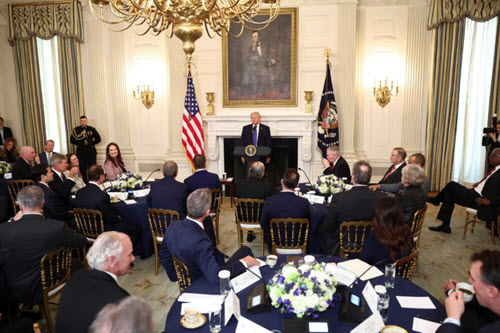
President Donald Trump holds a working breakfast with governors at the White House in Washington, D.C. on Feb. 20, 2026. REUTERS/Kevin Lamarque
President Donald Trump was reportedly infuriated Friday after the Supreme Court ruled that his tariffs were illegal.
Trump was hosting the National Governor's Association breakfast with a room full of the nation's governors at the White House when he found out about the high court's decision to strike down Trump's tariffs in a 6-3 vote.
"Apparently the gov breakfast had been going well, they were working together, and then President Trump became enraged. He started ranting about the decision, not only calling it a disgrace, but started attacking the courts at one point saying, these 'f------ courts,'" said CNN senior White House correspondent Kristen Holmes.
"This tariff policy — this could not be a bigger decision for President Trump — this could not be a bigger loss for President Trump," Holmes added. "Not only is so much of his economic agenda based on these tariffs, so much of his foreign policy is based on these tariffs. He has used these tariffs as leverage in almost every meeting that he has had around the world. He has touted them as the most important part of the economic agenda. So clearly, a huge loss, and he recognizes that today."
Trump and his administration have not yet made an official announcement in response. His team was reportedly meeting to determine next moves, Holmes said.
by Nicole Charky-Chami
Raw Story
February 20, 2026 11:42AM ET
https://www.rawstory.com/trump-became-e ... -decision/
President Donald Trump holds a working breakfast with governors at the White House in Washington, D.C. on Feb. 20, 2026. REUTERS/Kevin Lamarque
President Donald Trump was reportedly infuriated Friday after the Supreme Court ruled that his tariffs were illegal.
Trump was hosting the National Governor's Association breakfast with a room full of the nation's governors at the White House when he found out about the high court's decision to strike down Trump's tariffs in a 6-3 vote.
"Apparently the gov breakfast had been going well, they were working together, and then President Trump became enraged. He started ranting about the decision, not only calling it a disgrace, but started attacking the courts at one point saying, these 'f------ courts,'" said CNN senior White House correspondent Kristen Holmes.
"This tariff policy — this could not be a bigger decision for President Trump — this could not be a bigger loss for President Trump," Holmes added. "Not only is so much of his economic agenda based on these tariffs, so much of his foreign policy is based on these tariffs. He has used these tariffs as leverage in almost every meeting that he has had around the world. He has touted them as the most important part of the economic agenda. So clearly, a huge loss, and he recognizes that today."
Trump and his administration have not yet made an official announcement in response. His team was reportedly meeting to determine next moves, Holmes said.
- admin
- Site Admin
- Posts: 41362
- Joined: Thu Aug 01, 2013 5:21 am
Re: Part 2 Anti-Anti-Nazi Barbarian Hordes are Knocking Down
by admin » Fri Feb 20, 2026 7:15 pm
LIVE: Trump speaks after Supreme Court strikes down his tariffs
Associated Press
Started streaming 3 hours ago
Watch live as President Donald Trump speaks after the Supreme Court struck down his far-reaching tariffs on Friday. This upends a central plank of the administration’s economic agenda.
Associated Press
Started streaming 3 hours ago
Watch live as President Donald Trump speaks after the Supreme Court struck down his far-reaching tariffs on Friday. This upends a central plank of the administration’s economic agenda.
- admin
- Site Admin
- Posts: 41362
- Joined: Thu Aug 01, 2013 5:21 am
Re: Part 2 Anti-Anti-Nazi Barbarian Hordes are Knocking Down
by admin » Fri Feb 20, 2026 7:35 pm
Trump Has Many Options If the Supreme Court Strikes Down Tariffs
by Stan Veuger, Clark Packard
American Enterprise Institute
December 05, 2025
https://www.aei.org/op-eds/trump-has-ma ... n-tariffs/
The U.S. Supreme Court is expected to soon come to a decision in Learning Resources v. Trump, the case that will determine whether the tariffs that the second Trump administration has imposed under the International Emergency Economic Powers Act (IEEPA) pass statutory and constitutional muster. If President Donald Trump’s signature economic policy is struck down, the consequences will be significant: The administration may have to refund the roughly $100 billion in taxes that it has collected so far, and much of the new tariff architecture that it has built this year will be gone.
That will not mean that the country’s long national nightmare will have come to an end. There are a number of alternative statutes that the administration could rely on to issue arbitrary tariffs instead of IEEPA. On the bright side for the administration—but not the country—the administration could likely use those instruments to raise similar amounts of revenue to what it is collecting now. Legal challenges would certainly follow, but the administration would be on firmer statutory ground than IEEPA has provided. The relatively good news would be that statutory guardrails might keep it from taxing imports in the rapidly fluctuating manner in which it has deployed the IEEPA tariffs.
An administration loss at the Supreme Court would have direct implications for two sets of IEEPA tariffs: the so-called “reciprocal tariffs,” first announced in April, and the tariffs imposed on Canada, China, and Mexico in an alleged effort to force those countries to act against fentanyl flows.
Depending on the court’s reasoning, the decision could also have implications for a set of other tariffs imposed under cover of IEEPA, such as those levied on imports from Brazil to aid former President Jair Bolsonaro’s efforts to avoid prosecution for an attempted coup and those imposed on India as punishment for its Russian oil imports. Total IEEPA tariffs vary from 10 percent to 50 percent (for India and Brazil) but are at or below 15 percent for most countries.
Yet even removing all the IEEPA tariffs would still leave the United States with high import duties by the standards of recent decades, as a number of tariffs justified on the basis of other statutes would remain in place.
The first Trump administration imposed tariffs—usually of 25 percent—on some two-thirds of imports from China under Section 301 of the Trade Act of 1974. The Biden administration kept these measures largely intact and used the existing authority to layer on other tariffs, including 100 percent duties on Chinese electric vehicles. Most of these tariffs continue to this day. Because of these Section 301 measures, the effective tariff on imports from China remains particularly high—around 50 percent.
Section 232 tariffs would also survive an administration loss in Learning Resources v. Trump. Under Section 232 of the Trade Expansion Act of 1962, the president may restrict imports determined to pose a threat to national security following an investigation by the Commerce Department. The second Trump administration has substantially expanded national security tariffs to a variety of goods in recent months: cars and car parts; copper; lumber; an array of products made with steel and aluminum, such as washing machines, office furniture, and refrigerators and freezers. More are expected to come, including semiconductors, pharmaceutical goods, critical minerals, and others.
Importing these products does not pose a genuine national security risk to the United States, but courts have been exceedingly deferential to the administration’s claims. Congressional efforts to circumscribe the president’s unilateral authority to impose national security tariffs have floundered.
In combination, this year’s Section 232 tariffs raise about as much revenue as the IEEPA tariffs (as they currently stand after a whirlwind of changes from early April).
If the Supreme Court were to ultimately reject the administration’s sweeping interpretation of IEEPA, Trump has other protectionist tools at his disposal, as Kevin Hassett, the director of the National Economic Council, recently noted during an interview with Bloomberg’s David Rubenstein.
Given the president’s misguided obsession with the trade deficit, the administration could turn to Section 122 of the Trade Act of 1974. That provision empowers the president to address “large and serious” balance-of-payments deficits through import surcharges of up to 15 percent, import quotas, or some combination of the two.
The administration could replicate the IEEPA tariff structure through Section 122 (except for those countries with rates of more than 15 percent, which would be reduced to that rate), and it could do so immediately. Such a structure would collect about 70 percent of the revenue currently coming in through the IEEPA tariffs.
But the statute comes with certain guardrails—principally, that any action taken under Section 122 expires after 150 days unless Congress affirmatively votes to extend it. As the IEEPA case has demonstrated, the Trump administration has shown a willingness to interpret statutes very broadly (to put it mildly).
In theory, the president could reimpose Section 122 tariffs for another 150 days immediately after the initial period lapses, without an affirmative vote from Congress. This tactic would contravene the spirit—if not the letter—of the law, raising serious questions about the separation of powers and the statute’s original intent—and exposing the administration to more legal challenges.
In its 50-plus year history, the law has also never been used to impose trade restrictions. Notably, Congress conceived Section 122 authority as a tool to stabilize exchange rates, not as a pretext for economic protection. In fact, the statute requires the existence of “fundamental international payments problems,” which makes little sense outside a context of fixed or managed exchange rates, such as the early-1970s setting in which Section 122 originated.
The same law’s Section 301—the basis for existing China tariffs—offers another avenue for reconstructing IEEPA tariffs, one where the president enjoys wide unilateral authority. It grants the U.S. trade representative (USTR) broad authority to investigate and remedy “unfair” foreign trade practices. That’s a capacious term encompassing everything from trade agreement violations to foreign trade practices that are “unreasonable” and burden U.S. commerce. This was intended to be a tool to pry open foreign markets, but these days, market access takes a backseat to protectionism.
Section 301 investigations and actions must target specific trading partners (i.e., China or the European Union) for their allegedly unfair practices. On the surface, Section 301 comes with genuine procedural requirements. The USTR must conduct an investigation and publish its findings. If an affirmative determination is made, then the USTR is required to request consultations with the targeted trading partner and pursue formal dispute settlement when a trade agreement violation is alleged.
Yet the Section 301 guardrails are thinner than they appear on first blush, particularly in government-initiated cases. Under the statute, the USTR—and by extension, the president—has plenary discretion to determine whether an issue falls under a trade agreement and may act unilaterally when concluding that it does not. The consultations and dispute settlement can be largely perfunctory, and the law, as currently understood in self-initiated cases, permits massive trade restrictions.
Section 301 actions can also persist indefinitely as long as a domestic beneficiary requests the continuation of the tariffs every four years. Consequently, it would be straightforward to use Section 301 actions to reconstruct the parts of the IEEPA tariff structure that cannot be replicated with Section 122 measures—perhaps not immediately but certainly after a few months.
Though Section 301 is more flexible than other statutes, such extensive use of the law may trigger renewed judicial scrutiny. Especially after the 2023 Loper Bright decision, in which the Supreme Court reduced the amount of deference owed to agency interpretations of the law, the courts may be willing to overrule Section 301 actions that are based on clearly unreasonable concerns around purported unfair trade practices.
Alternatively, the administration may decide to continue expanding its use of Section 232 measures to replace the IEEPA tariffs that cannot be replaced by Section 122 measures. As Section 232 tariffs are based at least nominally on national security grounds, they will be less vulnerable to judicial review. That said, the statute lends itself better to sectoral or product-specific trade measures. It would be difficult to build a compelling case that all imports from Brazil and only from Brazil pose a national security threat. Were the administration to rely on this statute, it will likely be easier to match current IEEPA revenue than the precise rate structure.
A less likely route, and one that may not play well electorally, is to rely on Section 338 of the Tariff Act of 1930—the infamous Smoot-Hawley Act, which is often blamed for worsening the Great Depression and is the one trade statute that at least some voters are familiar with. Section 338 is a precursor to Section 301 and was arguably supplanted by that latter provision, though it remains on the books. It lets the president impose tariffs of up to 50 percent on imports from countries that “discriminate” against U.S. commerce as compared to other nations.
The statute’s limitations are relatively modest. Private parties or the executive branch may petition the U.S. International Trade Commission (USITC) to initiate an investigation. Proving discrimination could be challenging for the Trump administration when targeting World Trade Organization members that are bound by “most favored nation” requirements. Unilateral action by the ever-protectionist Trump administration could invite legal challenges arguing that the president lacks authority to impose restrictions without the trade commission’s involvement, or that the statute’s foreign discrimination requirements have not been met.
If the Supreme Court strikes down the IEEPA tariffs, the critical question becomes which alternative authorities the administration will deploy. Unfettered use of Sections 122 and 338 would recreate the current predicament: the president continuing to make major changes to tax policy and the business environment at his whim, generating paralyzing uncertainty, and redistributing massive amounts of resources without express congressional authorization.
The outlook improves somewhat if the administration must instead rely on sectoral “national security” tariffs under Section 232 and country-specific tariffs under Section 301, particularly if courts are less deferential to implausible claims about national security threats or unfair trading practices.
But meaningful reform requires Congress to rein in presidential authority—judicial constraints alone likely won’t suffice.
by Stan Veuger, Clark Packard
American Enterprise Institute
December 05, 2025
https://www.aei.org/op-eds/trump-has-ma ... n-tariffs/
The U.S. Supreme Court is expected to soon come to a decision in Learning Resources v. Trump, the case that will determine whether the tariffs that the second Trump administration has imposed under the International Emergency Economic Powers Act (IEEPA) pass statutory and constitutional muster. If President Donald Trump’s signature economic policy is struck down, the consequences will be significant: The administration may have to refund the roughly $100 billion in taxes that it has collected so far, and much of the new tariff architecture that it has built this year will be gone.
That will not mean that the country’s long national nightmare will have come to an end. There are a number of alternative statutes that the administration could rely on to issue arbitrary tariffs instead of IEEPA. On the bright side for the administration—but not the country—the administration could likely use those instruments to raise similar amounts of revenue to what it is collecting now. Legal challenges would certainly follow, but the administration would be on firmer statutory ground than IEEPA has provided. The relatively good news would be that statutory guardrails might keep it from taxing imports in the rapidly fluctuating manner in which it has deployed the IEEPA tariffs.
An administration loss at the Supreme Court would have direct implications for two sets of IEEPA tariffs: the so-called “reciprocal tariffs,” first announced in April, and the tariffs imposed on Canada, China, and Mexico in an alleged effort to force those countries to act against fentanyl flows.
Depending on the court’s reasoning, the decision could also have implications for a set of other tariffs imposed under cover of IEEPA, such as those levied on imports from Brazil to aid former President Jair Bolsonaro’s efforts to avoid prosecution for an attempted coup and those imposed on India as punishment for its Russian oil imports. Total IEEPA tariffs vary from 10 percent to 50 percent (for India and Brazil) but are at or below 15 percent for most countries.
Yet even removing all the IEEPA tariffs would still leave the United States with high import duties by the standards of recent decades, as a number of tariffs justified on the basis of other statutes would remain in place.
The first Trump administration imposed tariffs—usually of 25 percent—on some two-thirds of imports from China under Section 301 of the Trade Act of 1974. The Biden administration kept these measures largely intact and used the existing authority to layer on other tariffs, including 100 percent duties on Chinese electric vehicles. Most of these tariffs continue to this day. Because of these Section 301 measures, the effective tariff on imports from China remains particularly high—around 50 percent.
Section 232 tariffs would also survive an administration loss in Learning Resources v. Trump. Under Section 232 of the Trade Expansion Act of 1962, the president may restrict imports determined to pose a threat to national security following an investigation by the Commerce Department. The second Trump administration has substantially expanded national security tariffs to a variety of goods in recent months: cars and car parts; copper; lumber; an array of products made with steel and aluminum, such as washing machines, office furniture, and refrigerators and freezers. More are expected to come, including semiconductors, pharmaceutical goods, critical minerals, and others.
Importing these products does not pose a genuine national security risk to the United States, but courts have been exceedingly deferential to the administration’s claims. Congressional efforts to circumscribe the president’s unilateral authority to impose national security tariffs have floundered.
In combination, this year’s Section 232 tariffs raise about as much revenue as the IEEPA tariffs (as they currently stand after a whirlwind of changes from early April).
If the Supreme Court were to ultimately reject the administration’s sweeping interpretation of IEEPA, Trump has other protectionist tools at his disposal, as Kevin Hassett, the director of the National Economic Council, recently noted during an interview with Bloomberg’s David Rubenstein.
Given the president’s misguided obsession with the trade deficit, the administration could turn to Section 122 of the Trade Act of 1974. That provision empowers the president to address “large and serious” balance-of-payments deficits through import surcharges of up to 15 percent, import quotas, or some combination of the two.
The administration could replicate the IEEPA tariff structure through Section 122 (except for those countries with rates of more than 15 percent, which would be reduced to that rate), and it could do so immediately. Such a structure would collect about 70 percent of the revenue currently coming in through the IEEPA tariffs.
But the statute comes with certain guardrails—principally, that any action taken under Section 122 expires after 150 days unless Congress affirmatively votes to extend it. As the IEEPA case has demonstrated, the Trump administration has shown a willingness to interpret statutes very broadly (to put it mildly).
In theory, the president could reimpose Section 122 tariffs for another 150 days immediately after the initial period lapses, without an affirmative vote from Congress. This tactic would contravene the spirit—if not the letter—of the law, raising serious questions about the separation of powers and the statute’s original intent—and exposing the administration to more legal challenges.
In its 50-plus year history, the law has also never been used to impose trade restrictions. Notably, Congress conceived Section 122 authority as a tool to stabilize exchange rates, not as a pretext for economic protection. In fact, the statute requires the existence of “fundamental international payments problems,” which makes little sense outside a context of fixed or managed exchange rates, such as the early-1970s setting in which Section 122 originated.
The same law’s Section 301—the basis for existing China tariffs—offers another avenue for reconstructing IEEPA tariffs, one where the president enjoys wide unilateral authority. It grants the U.S. trade representative (USTR) broad authority to investigate and remedy “unfair” foreign trade practices. That’s a capacious term encompassing everything from trade agreement violations to foreign trade practices that are “unreasonable” and burden U.S. commerce. This was intended to be a tool to pry open foreign markets, but these days, market access takes a backseat to protectionism.
Section 301 investigations and actions must target specific trading partners (i.e., China or the European Union) for their allegedly unfair practices. On the surface, Section 301 comes with genuine procedural requirements. The USTR must conduct an investigation and publish its findings. If an affirmative determination is made, then the USTR is required to request consultations with the targeted trading partner and pursue formal dispute settlement when a trade agreement violation is alleged.
Yet the Section 301 guardrails are thinner than they appear on first blush, particularly in government-initiated cases. Under the statute, the USTR—and by extension, the president—has plenary discretion to determine whether an issue falls under a trade agreement and may act unilaterally when concluding that it does not. The consultations and dispute settlement can be largely perfunctory, and the law, as currently understood in self-initiated cases, permits massive trade restrictions.
Section 301 actions can also persist indefinitely as long as a domestic beneficiary requests the continuation of the tariffs every four years. Consequently, it would be straightforward to use Section 301 actions to reconstruct the parts of the IEEPA tariff structure that cannot be replicated with Section 122 measures—perhaps not immediately but certainly after a few months.
Though Section 301 is more flexible than other statutes, such extensive use of the law may trigger renewed judicial scrutiny. Especially after the 2023 Loper Bright decision, in which the Supreme Court reduced the amount of deference owed to agency interpretations of the law, the courts may be willing to overrule Section 301 actions that are based on clearly unreasonable concerns around purported unfair trade practices.
Alternatively, the administration may decide to continue expanding its use of Section 232 measures to replace the IEEPA tariffs that cannot be replaced by Section 122 measures. As Section 232 tariffs are based at least nominally on national security grounds, they will be less vulnerable to judicial review. That said, the statute lends itself better to sectoral or product-specific trade measures. It would be difficult to build a compelling case that all imports from Brazil and only from Brazil pose a national security threat. Were the administration to rely on this statute, it will likely be easier to match current IEEPA revenue than the precise rate structure.
A less likely route, and one that may not play well electorally, is to rely on Section 338 of the Tariff Act of 1930—the infamous Smoot-Hawley Act, which is often blamed for worsening the Great Depression and is the one trade statute that at least some voters are familiar with. Section 338 is a precursor to Section 301 and was arguably supplanted by that latter provision, though it remains on the books. It lets the president impose tariffs of up to 50 percent on imports from countries that “discriminate” against U.S. commerce as compared to other nations.
The statute’s limitations are relatively modest. Private parties or the executive branch may petition the U.S. International Trade Commission (USITC) to initiate an investigation. Proving discrimination could be challenging for the Trump administration when targeting World Trade Organization members that are bound by “most favored nation” requirements. Unilateral action by the ever-protectionist Trump administration could invite legal challenges arguing that the president lacks authority to impose restrictions without the trade commission’s involvement, or that the statute’s foreign discrimination requirements have not been met.
If the Supreme Court strikes down the IEEPA tariffs, the critical question becomes which alternative authorities the administration will deploy. Unfettered use of Sections 122 and 338 would recreate the current predicament: the president continuing to make major changes to tax policy and the business environment at his whim, generating paralyzing uncertainty, and redistributing massive amounts of resources without express congressional authorization.
The outlook improves somewhat if the administration must instead rely on sectoral “national security” tariffs under Section 232 and country-specific tariffs under Section 301, particularly if courts are less deferential to implausible claims about national security threats or unfair trading practices.
But meaningful reform requires Congress to rein in presidential authority—judicial constraints alone likely won’t suffice.
- admin
- Site Admin
- Posts: 41362
- Joined: Thu Aug 01, 2013 5:21 am
Re: Part 2 Anti-Anti-Nazi Barbarian Hordes are Knocking Down
by admin » Fri Feb 20, 2026 11:48 pm
Trump Just Ignored the Supreme Court. What Happens Now?
The Lincoln Project
Feb 20, 2026
After the Supreme Court ruled Trump’s tariffs illegal, he responded by saying he’ll keep doing them anyway. Rick Wilson breaks down what this unprecedented defiance means, and what happens next.
Transcript
I have emerged from the hole and and
dear God, I mean, look, when I read the
when I read the Supreme Court decision
this morning, I was like, "Oh, he's
gonna lose his mind. He's going to write
the longest true social post ever." But
instead he went on and did I mean Kate
you and I watched every single COVID
press conference and I think today was
worse than the worst of the co than
worse than bleach up your ass light
bulbs up your ass and bleach press
conference. I think today was worse. I
think this press conference was more
insane
because he was completely unhinged. He
is clearly very angry. Um, and his basic
message to the Supreme Court of the
United States of America was, "Go f
yourself. No, I'm gonna keep doing what
I'm going to do on the tariffs."
Yeah. So, why don't let's let's get into
the Supreme Court ruled this morning
that Trump's Trump doing his unilateral
tariffs was illegal, unconstitutional.
He can't do it anymore. within hours
wrong
at this like governor's lunch that he
had uh he brought the press in and well
actually before the press came in he
said these courts CNN reported
and then when the press came in he just
went off forever um I I'll Castro level
going on forever like hours it felt like
yeah so let's take a look at what he had
to say about the court
tariff is
but there's been bipartisan criticism
not there. Several Republicans have said
that.
Yeah. Why wouldn't you just work with
Congress to come up with a plan to to
push tariffs?
I have the right to do tariffs and I've
always had the right to do tariffs. It
has all been approved by Congress. So,
literally none of that is true.
What can he do? So, he now said at that
presser that he's imposing by executive
order 10% global tariffs. C can he do
that?
No. The Supreme Court just said to him,
just said the words, "Read the
Constitution, You can't." A six-3
decision, including such famous flaming
liberals as Amy Comey Barrett and Neil
Gorsuch and John Roberts. They looked at
this and said, "No, bro. You can't.
It's in the black letter law of the
Constitution."
Now does he have some narrow narrow
narrow like national security based
things like you can't ship certain I
very narrowly
maybe but the key lie in that sentence
that he said I don't have to work with
Congress because I've always had the
right to do terrorists that is a lie
that is that is not what the court says
that is not what the law said that's not
what the constitution says right now
the fact that Trump declared an
emergency and Congress did nothing about
it does not make what he did legal. It
makes them incompetent bootlicking
boobs. It makes them for not
standing up for the prerogatives both of
the Constitution and of the Congress.
All of this
all of this adds up to we now are on a
collision course with Trump and the
Supreme Court where they have said this
is the law. You may not. And he said,
"Yeah, I may and I'm going to what are
you going to do about it?" So, this is
the constitutional crisis everyone told
me wasn't going to happen because Trump
was much more mature in the second term.
Great.
It is. Look, I I think we've got to be
re very realistic right now about about
the immediate future. Trump's going to
continue to do these tariffs. There will
be court orders up and down the chain.
Eventually, those court orders will will
lead him to an outward defiance of the
Supreme Court, which puts him in once
again impeachment territory and puts him
in a position, I think, where where even
his allies in the Senate, who are the
people holding his his hand right now on
a lot of different issues he needs to be
very protected on, even those people are
going to say, "That ain't it, Chief.
We're done. Can't do it." and and in the
House,
the the the damage to the to in the
House to these members of Congress who
are all on these swing seats
is enormous already. Trump should have
recognized what the Supreme Court just
gave him that he they gave him a get out
of jail free card. He could have said,
you know, I I tried to do my best to
bring back the economic blah blah blah
and I did this to to make America great
again. the Supreme Court disagrees with
me and I disagree with them, but I'm
going to follow the law and the tariffs
are gone.
What would have happened? One, the
markets would have gone cuckoo vertical.
They would have gone crazy. They would
have loved it. The the the the global
economic boom that followed would have
made it much easier for Republicans to
make an economic case in the fall.
Right now, the economic case they have
is, yeah, Donald Trump's tariffs will
cost you $1,400 for the average American
family. Too bad,
right?
It's it's I I got to tell you, he he
does not know when to take the exit
ramp, Kate. He doesn't know when to take
like the the the easiest layup in
history politically is to go, "Oh, well,
I tried." And move on.
Right. And he also he also said during
that press conference today when asked
uh like about when we'll see results in
the economy, he said you'll see results
in a year. So we're now pushing back the
you know day one again. So now that's
two years into his presidency. How does
that how's that going to drive with the
American people when when they are
paying extra taxes from his tariffs and
now also the corporations are going to
get the bailout check from the tariffs
if they're ruled that he can't do it.
Yeah. Look, the American taxpayers who
have already paid this this this tax
because tariffs, as they say in the
decision, tariffs are taxes.
Say it with me again, friends. Tariffs
are taxes. They were paid by American
citizens. Now, some companies paid them.
Some companies um um ate the cost,
but they got passed to consumers, folks.
And consumers are going to be the ones
who get screwed. But you know who's
going to make a lot of money, Kate? I
don't know if people have seen this
story yet, but Howard Lutnik and his
sons have invested in these futures that
were betting against the tariffs being
sustained. So, they're going to buy the
tariff debt.
They were they were I'm sorry, before
this, they were buying the tariff debt
for 20 cents on the dollar. So, now they
for their 20 cent investment, they make
a dollar when they've bought up all this
tariff debt from these companies. It is.
So when the when the companies get
reimbursed for
when the companies get reimbursed, they
have to pay um the lutnics.
Great. I love that.
It's just so it it it is like the most
third world garbage you've ever seen.
And we deserve it because that's what we
are now.
Went it went for so long. He he he said
I want to show him saying that he him
saying that he read the decision.
Oh, right. Right. That he read the
decision. Let's let's play that. That's
a great clip. Oh my god, it's so good.
I was surprised because I I thought that
what we did was number one according to
I mean I read the paragraphs. I read
very well. Great comprehension.
Uh I read everything there is to read.
Great comprehension. Look, if you are a
80-year-old man who has to tell people
that you you can read
that you read good,
you don't read well. That's the thing.
Great comprehension. That's the
equivalent of person, woman, man,
camera, TV. That that that is just it's
such a tell. He didn't read check. He
looked at he he looked at a 3x5 note
card that said oops written by some
staffer and and and honestly Kate
we've been watching this guy for five
years now pushing six years now and one
of his great tells is when he's talking
about how good he is at things. One of
his one of one of the it tells about him
that he he's lying and things are in the
dumper is when he does the sir stories
when he talks about how great he is and
and when he talks about
about men who want to kiss me. I mean
that that was that was all today that
would have set off Mike Johnson's porn
alarm.
How's business president? I'd love to
kiss you. This is a very powerful man. I
don't want to be kissed by that man. But
a very powerful, strong man. He's been
in the steel business for many years.
His father started it.
And uh he said, "Sir, I want to kiss
you." He said, "Why?"
He keeps talking about kissing men. It's
crazy.
It's a lot. Like I said, it probably
sets off Mike Johnson's porn alert on
his phone.
Okay, so what happens now? So the
Supreme Court said that it was illegal
and he got on stage two hours later and
said, "I don't care. I'm imposing 10%
tariffs." What happened? Do they go into
effect?
No, I don't think they do. I think the
court orders are going to be flying fast
and furious. The lawsuits are going to
be based on a brand new ruling from the
Supreme Court and the court
the court clearly took a strange turn
today. And I'm not I'm not getting too
polyiana optimistic as you guys know I'm
not a ray of sunshine but I really think
there is a moment here where where when
you've got Roberts Gorsuch Barrett
in this new in this new wing of the of
the majority
along with all of the the other justices
except for uh Alto Thomas and and and I
like beer.
when you have that new alignment.
And Gorsuch says it in his concurrence.
He wrote a beautiful concurrence, 46
page concurrence, and he said, "If you
want tariffs, you must go through the
legislative process. You will regret it
if you don't. The legislative process
because he said, you know, the wheel is
going to turn."
and and that was clearly him
understanding that in the immediate
future, you're not going to have Donald
Trump and Mike Johnson running this
operation in Congress. So if Trump wants
tariffs, all he has to do is propose a
bill.
It will go to the House. Mike Johnson
will immediately put it on the calendar.
They will vote on that bill. It will go
to the Senate. It will die. But that's
just how it's going to go. But he unless
he does that, Trump has just left
himself out there incredibly vulnerable
on this stuff. And it was really Kate I
mean in the in the in the he just can't
see the gift the court handed him right
now. And he he doesn't understand that
continuing these tariffs now it's just
plain illegal.
Voters were already tired of the
tariffs. They hated the trade war. The
the the polling has been awful on the
trade war.
But Trump's illusion that he has the
right to do this. I have the right to do
it. I always had the right to do it.
It is going to absolutely be a boat
anchor on these Republicans. And so the
Senate will vote it down. The House will
pass it. Maybe. Maybe. I'm not even sure
the House will pass it at this point,
but it'll go to the Senate and die.
There's no way there's 60 votes for a
tariff bill of any kind for Trump. So,
he's going to have to retreat into uh
pure defiance of the Supreme Court.
constitutional crisis, which we're in,
folks. If you don't know that we're in
it, we're in it right now. Um, and and
honestly, Kate, I I mean,
I look at what he's doing right now
today as as partly a sign of his decline
in his dementia. This is not a well man.
This is not a healthy guy. He's not
mentally smart out there. He's slurring
his words. He's all over the place as
usual these days. And and I think we
really have we really saw him take the
biggest loss of the second term so far
and he's not take going to take it well.
He's going to act out very badly. And
when the Senate when John Thun tells him
there's not 60 votes in the Senate,
he'll say to Thoon again, you override
the filibuster. Thun's not going to
override the filibuster. He's not going
to do it.
So how should Democrats
for the Save Act for the Save Act or for
tariffs? Democrats should be dancing in
the streets right now. They should be
out there proposing bills to unwind
Trump's tariffs based on the Supreme
Court's ruling. There should be Hakee
should pro they should have a bill I
hope they've already got it written. It
should have been
a bill that says that the the the power
of the presidency to declare tariffs is
now uh clearly delineated even further
by the Supreme Court decision and all
current tariffs in invoked by Donald J.
Trump from the time of his election and
da da da are invalid.
They should assertively do that because
it puts Republicans in three different
boxes. One, they have to sustain the
illusion that the tariffs are a great
thing and that Donald Trump's winning
with the tariffs. They're not. Nobody
believes that. But if they want to be
stuck with that, great.
Two,
Republicans are not going to want to
take that power back
for the Congress because then they'll
have to negotiate it. Then they'll have
to make deals. Then they'll have to to
say to the Democrats, "Okay, we're going
to pass, you know, 4,000% tariffs on
Koala Lampur
and
because Trump doesn't like the leader of
the country." They're going to look at
all these tariffs that he imposed for
spite on different nations, all these
things that he did, and it's going to
all fall apart very quickly legally. So,
they're going to get stuck holding the
bag for bad legal arguments as well,
embarrassing themselves once more. And
finally,
I think there may be a little survival
instinct still vestigularly in some of
these Republicans in bad seats who are
going to go, I'm not touching this. I'm
not getting near this effing thing. I'm
not voting I'm not voting for this
thing. I'm going to get I'm gonna I'm
gonna I'm going to vote against Trump
having the power to do these tariffs and
and let him yell at me. Primary season's
almost over in a lot of the places and
let him yell at me. And once people
start walking away from Trump on his
signature issue, it's got a very big
political weight to him. He's not going
to be not going to be taken that well at
all.
Right.
So, that's what I know.
Who who knows? Who knows what's going to
happen over the weekend? I hate when
like this happens on a Friday.
We'll come back. Everything's upside
down.
Um, but we'll see you guys back here for
the State of the Union
on the State of the Union. It's going to
be amazing. He's gonna give like a 4hour
Fidel Castro length speech. I'm I'm
betting.
Yeah, we actually might be a little
drunk by the time you guys see us.
We might. There might there might be
some liquor involved. So Kate, have a
great Friday. You're the best.
The Lincoln Project
Feb 20, 2026
After the Supreme Court ruled Trump’s tariffs illegal, he responded by saying he’ll keep doing them anyway. Rick Wilson breaks down what this unprecedented defiance means, and what happens next.
Transcript
I have emerged from the hole and and
dear God, I mean, look, when I read the
when I read the Supreme Court decision
this morning, I was like, "Oh, he's
gonna lose his mind. He's going to write
the longest true social post ever." But
instead he went on and did I mean Kate
you and I watched every single COVID
press conference and I think today was
worse than the worst of the co than
worse than bleach up your ass light
bulbs up your ass and bleach press
conference. I think today was worse. I
think this press conference was more
insane
because he was completely unhinged. He
is clearly very angry. Um, and his basic
message to the Supreme Court of the
United States of America was, "Go f
yourself. No, I'm gonna keep doing what
I'm going to do on the tariffs."
Yeah. So, why don't let's let's get into
the Supreme Court ruled this morning
that Trump's Trump doing his unilateral
tariffs was illegal, unconstitutional.
He can't do it anymore. within hours
wrong
at this like governor's lunch that he
had uh he brought the press in and well
actually before the press came in he
said these courts CNN reported
and then when the press came in he just
went off forever um I I'll Castro level
going on forever like hours it felt like
yeah so let's take a look at what he had
to say about the court
tariff is
but there's been bipartisan criticism
not there. Several Republicans have said
that.
Yeah. Why wouldn't you just work with
Congress to come up with a plan to to
push tariffs?
I have the right to do tariffs and I've
always had the right to do tariffs. It
has all been approved by Congress. So,
literally none of that is true.
What can he do? So, he now said at that
presser that he's imposing by executive
order 10% global tariffs. C can he do
that?
No. The Supreme Court just said to him,
just said the words, "Read the
Constitution, You can't." A six-3
decision, including such famous flaming
liberals as Amy Comey Barrett and Neil
Gorsuch and John Roberts. They looked at
this and said, "No, bro. You can't.
It's in the black letter law of the
Constitution."
Now does he have some narrow narrow
narrow like national security based
things like you can't ship certain I
very narrowly
maybe but the key lie in that sentence
that he said I don't have to work with
Congress because I've always had the
right to do terrorists that is a lie
that is that is not what the court says
that is not what the law said that's not
what the constitution says right now
the fact that Trump declared an
emergency and Congress did nothing about
it does not make what he did legal. It
makes them incompetent bootlicking
boobs. It makes them for not
standing up for the prerogatives both of
the Constitution and of the Congress.
All of this
all of this adds up to we now are on a
collision course with Trump and the
Supreme Court where they have said this
is the law. You may not. And he said,
"Yeah, I may and I'm going to what are
you going to do about it?" So, this is
the constitutional crisis everyone told
me wasn't going to happen because Trump
was much more mature in the second term.
Great.
It is. Look, I I think we've got to be
re very realistic right now about about
the immediate future. Trump's going to
continue to do these tariffs. There will
be court orders up and down the chain.
Eventually, those court orders will will
lead him to an outward defiance of the
Supreme Court, which puts him in once
again impeachment territory and puts him
in a position, I think, where where even
his allies in the Senate, who are the
people holding his his hand right now on
a lot of different issues he needs to be
very protected on, even those people are
going to say, "That ain't it, Chief.
We're done. Can't do it." and and in the
House,
the the the damage to the to in the
House to these members of Congress who
are all on these swing seats
is enormous already. Trump should have
recognized what the Supreme Court just
gave him that he they gave him a get out
of jail free card. He could have said,
you know, I I tried to do my best to
bring back the economic blah blah blah
and I did this to to make America great
again. the Supreme Court disagrees with
me and I disagree with them, but I'm
going to follow the law and the tariffs
are gone.
What would have happened? One, the
markets would have gone cuckoo vertical.
They would have gone crazy. They would
have loved it. The the the the global
economic boom that followed would have
made it much easier for Republicans to
make an economic case in the fall.
Right now, the economic case they have
is, yeah, Donald Trump's tariffs will
cost you $1,400 for the average American
family. Too bad,
right?
It's it's I I got to tell you, he he
does not know when to take the exit
ramp, Kate. He doesn't know when to take
like the the the easiest layup in
history politically is to go, "Oh, well,
I tried." And move on.
Right. And he also he also said during
that press conference today when asked
uh like about when we'll see results in
the economy, he said you'll see results
in a year. So we're now pushing back the
you know day one again. So now that's
two years into his presidency. How does
that how's that going to drive with the
American people when when they are
paying extra taxes from his tariffs and
now also the corporations are going to
get the bailout check from the tariffs
if they're ruled that he can't do it.
Yeah. Look, the American taxpayers who
have already paid this this this tax
because tariffs, as they say in the
decision, tariffs are taxes.
Say it with me again, friends. Tariffs
are taxes. They were paid by American
citizens. Now, some companies paid them.
Some companies um um ate the cost,
but they got passed to consumers, folks.
And consumers are going to be the ones
who get screwed. But you know who's
going to make a lot of money, Kate? I
don't know if people have seen this
story yet, but Howard Lutnik and his
sons have invested in these futures that
were betting against the tariffs being
sustained. So, they're going to buy the
tariff debt.
They were they were I'm sorry, before
this, they were buying the tariff debt
for 20 cents on the dollar. So, now they
for their 20 cent investment, they make
a dollar when they've bought up all this
tariff debt from these companies. It is.
So when the when the companies get
reimbursed for
when the companies get reimbursed, they
have to pay um the lutnics.
Great. I love that.
It's just so it it it is like the most
third world garbage you've ever seen.
And we deserve it because that's what we
are now.
Went it went for so long. He he he said
I want to show him saying that he him
saying that he read the decision.
Oh, right. Right. That he read the
decision. Let's let's play that. That's
a great clip. Oh my god, it's so good.
I was surprised because I I thought that
what we did was number one according to
I mean I read the paragraphs. I read
very well. Great comprehension.
Uh I read everything there is to read.
Great comprehension. Look, if you are a
80-year-old man who has to tell people
that you you can read
that you read good,
you don't read well. That's the thing.
Great comprehension. That's the
equivalent of person, woman, man,
camera, TV. That that that is just it's
such a tell. He didn't read check. He
looked at he he looked at a 3x5 note
card that said oops written by some
staffer and and and honestly Kate
we've been watching this guy for five
years now pushing six years now and one
of his great tells is when he's talking
about how good he is at things. One of
his one of one of the it tells about him
that he he's lying and things are in the
dumper is when he does the sir stories
when he talks about how great he is and
and when he talks about
about men who want to kiss me. I mean
that that was that was all today that
would have set off Mike Johnson's porn
alarm.
How's business president? I'd love to
kiss you. This is a very powerful man. I
don't want to be kissed by that man. But
a very powerful, strong man. He's been
in the steel business for many years.
His father started it.
And uh he said, "Sir, I want to kiss
you." He said, "Why?"
He keeps talking about kissing men. It's
crazy.
It's a lot. Like I said, it probably
sets off Mike Johnson's porn alert on
his phone.
Okay, so what happens now? So the
Supreme Court said that it was illegal
and he got on stage two hours later and
said, "I don't care. I'm imposing 10%
tariffs." What happened? Do they go into
effect?
No, I don't think they do. I think the
court orders are going to be flying fast
and furious. The lawsuits are going to
be based on a brand new ruling from the
Supreme Court and the court
the court clearly took a strange turn
today. And I'm not I'm not getting too
polyiana optimistic as you guys know I'm
not a ray of sunshine but I really think
there is a moment here where where when
you've got Roberts Gorsuch Barrett
in this new in this new wing of the of
the majority
along with all of the the other justices
except for uh Alto Thomas and and and I
like beer.
when you have that new alignment.
And Gorsuch says it in his concurrence.
He wrote a beautiful concurrence, 46
page concurrence, and he said, "If you
want tariffs, you must go through the
legislative process. You will regret it
if you don't. The legislative process
because he said, you know, the wheel is
going to turn."
and and that was clearly him
understanding that in the immediate
future, you're not going to have Donald
Trump and Mike Johnson running this
operation in Congress. So if Trump wants
tariffs, all he has to do is propose a
bill.
It will go to the House. Mike Johnson
will immediately put it on the calendar.
They will vote on that bill. It will go
to the Senate. It will die. But that's
just how it's going to go. But he unless
he does that, Trump has just left
himself out there incredibly vulnerable
on this stuff. And it was really Kate I
mean in the in the in the he just can't
see the gift the court handed him right
now. And he he doesn't understand that
continuing these tariffs now it's just
plain illegal.
Voters were already tired of the
tariffs. They hated the trade war. The
the the polling has been awful on the
trade war.
But Trump's illusion that he has the
right to do this. I have the right to do
it. I always had the right to do it.
It is going to absolutely be a boat
anchor on these Republicans. And so the
Senate will vote it down. The House will
pass it. Maybe. Maybe. I'm not even sure
the House will pass it at this point,
but it'll go to the Senate and die.
There's no way there's 60 votes for a
tariff bill of any kind for Trump. So,
he's going to have to retreat into uh
pure defiance of the Supreme Court.
constitutional crisis, which we're in,
folks. If you don't know that we're in
it, we're in it right now. Um, and and
honestly, Kate, I I mean,
I look at what he's doing right now
today as as partly a sign of his decline
in his dementia. This is not a well man.
This is not a healthy guy. He's not
mentally smart out there. He's slurring
his words. He's all over the place as
usual these days. And and I think we
really have we really saw him take the
biggest loss of the second term so far
and he's not take going to take it well.
He's going to act out very badly. And
when the Senate when John Thun tells him
there's not 60 votes in the Senate,
he'll say to Thoon again, you override
the filibuster. Thun's not going to
override the filibuster. He's not going
to do it.
So how should Democrats
for the Save Act for the Save Act or for
tariffs? Democrats should be dancing in
the streets right now. They should be
out there proposing bills to unwind
Trump's tariffs based on the Supreme
Court's ruling. There should be Hakee
should pro they should have a bill I
hope they've already got it written. It
should have been
a bill that says that the the the power
of the presidency to declare tariffs is
now uh clearly delineated even further
by the Supreme Court decision and all
current tariffs in invoked by Donald J.
Trump from the time of his election and
da da da are invalid.
They should assertively do that because
it puts Republicans in three different
boxes. One, they have to sustain the
illusion that the tariffs are a great
thing and that Donald Trump's winning
with the tariffs. They're not. Nobody
believes that. But if they want to be
stuck with that, great.
Two,
Republicans are not going to want to
take that power back
for the Congress because then they'll
have to negotiate it. Then they'll have
to make deals. Then they'll have to to
say to the Democrats, "Okay, we're going
to pass, you know, 4,000% tariffs on
Koala Lampur
and
because Trump doesn't like the leader of
the country." They're going to look at
all these tariffs that he imposed for
spite on different nations, all these
things that he did, and it's going to
all fall apart very quickly legally. So,
they're going to get stuck holding the
bag for bad legal arguments as well,
embarrassing themselves once more. And
finally,
I think there may be a little survival
instinct still vestigularly in some of
these Republicans in bad seats who are
going to go, I'm not touching this. I'm
not getting near this effing thing. I'm
not voting I'm not voting for this
thing. I'm going to get I'm gonna I'm
gonna I'm going to vote against Trump
having the power to do these tariffs and
and let him yell at me. Primary season's
almost over in a lot of the places and
let him yell at me. And once people
start walking away from Trump on his
signature issue, it's got a very big
political weight to him. He's not going
to be not going to be taken that well at
all.
Right.
So, that's what I know.
Who who knows? Who knows what's going to
happen over the weekend? I hate when
like this happens on a Friday.
We'll come back. Everything's upside
down.
Um, but we'll see you guys back here for
the State of the Union
on the State of the Union. It's going to
be amazing. He's gonna give like a 4hour
Fidel Castro length speech. I'm I'm
betting.
Yeah, we actually might be a little
drunk by the time you guys see us.
We might. There might there might be
some liquor involved. So Kate, have a
great Friday. You're the best.
- admin
- Site Admin
- Posts: 41362
- Joined: Thu Aug 01, 2013 5:21 am
Re: Part 2 Anti-Anti-Nazi Barbarian Hordes are Knocking Down
by admin » Mon Feb 23, 2026 8:24 pm
Donald J. Trump
@realDonaldTrump
The supreme court (will be using lower case letters for a while based on a complete lack of respect!) of the United States accidentally and unwittingly gave me, as President of the United States, far more powers and strength than I had prior to their ridiculous, dumb, and very internationally divisive ruling. For one thing, I can use Licenses to do absolutely “terrible” things to foreign countries, especially those countries that have been RIPPING US OFF for many decades, but incomprehensibly, according to the ruling, can’t charge them a License fee - BUT ALL LICENSES CHARGE FEES, why can’t the United States do so? You do a license to get a fee! The opinion doesn’t explain that, but I know the answer! The court has also approved all other Tariffs, of which there are many, and they can all be used in a much more powerful and obnoxious way, with legal certainty, than the Tariffs as initially used. Our incompetent supreme court did a great job for the wrong people, and for that they should be ashamed of themselves (but not the Great Three!). The next thing you know they will rule in favor of China and others, who are making an absolute fortune on Birthright Citizenship, by saying the 14th Amendment was NOT written to take care of the “babies of slaves,” which it was as proven by the EXACT TIMING of its construction, filing, and ratification, which perfectly coincided with the END OF THE CIVIL WAR. How much better can you do than that? But this supreme court will find a way to come to the wrong conclusion, one that again will make China, and various other Nations, happy and rich. Let our supreme court keep making decisions that are so bad and deleterious to the future of our Nation - I have a job to do. MAKE AMERICA GREAT AGAIN! President DONALD J. TRUMP
Feb 23, 2026, 5:06 AM
***
Donald J. Trump
@realDonaldTrump
Any Country that wants to “play games” with the ridiculous supreme court decision, especially those that have “Ripped Off” the U.S.A. for years, and even decades, will be met with a much higher Tariff, and worse, than that which they just recently agreed to. BUYER BEWARE!!! Thank you for your attention to this matter. President DONALD J. TRUMP
Feb 23, 2026, 7:34 AM
***
Donald J. Trump
@realDonaldTrump
As President, I do not have to go back to Congress to get approval of Tariffs. It has already been gotten, in many forms, a long time ago! They were also just reaffirmed by the ridiculous and poorly crafted supreme court decision! President DJT
Feb 23, 2026, 7:49 AM
@realDonaldTrump
The supreme court (will be using lower case letters for a while based on a complete lack of respect!) of the United States accidentally and unwittingly gave me, as President of the United States, far more powers and strength than I had prior to their ridiculous, dumb, and very internationally divisive ruling. For one thing, I can use Licenses to do absolutely “terrible” things to foreign countries, especially those countries that have been RIPPING US OFF for many decades, but incomprehensibly, according to the ruling, can’t charge them a License fee - BUT ALL LICENSES CHARGE FEES, why can’t the United States do so? You do a license to get a fee! The opinion doesn’t explain that, but I know the answer! The court has also approved all other Tariffs, of which there are many, and they can all be used in a much more powerful and obnoxious way, with legal certainty, than the Tariffs as initially used. Our incompetent supreme court did a great job for the wrong people, and for that they should be ashamed of themselves (but not the Great Three!). The next thing you know they will rule in favor of China and others, who are making an absolute fortune on Birthright Citizenship, by saying the 14th Amendment was NOT written to take care of the “babies of slaves,” which it was as proven by the EXACT TIMING of its construction, filing, and ratification, which perfectly coincided with the END OF THE CIVIL WAR. How much better can you do than that? But this supreme court will find a way to come to the wrong conclusion, one that again will make China, and various other Nations, happy and rich. Let our supreme court keep making decisions that are so bad and deleterious to the future of our Nation - I have a job to do. MAKE AMERICA GREAT AGAIN! President DONALD J. TRUMP
Feb 23, 2026, 5:06 AM
***
Donald J. Trump
@realDonaldTrump
Any Country that wants to “play games” with the ridiculous supreme court decision, especially those that have “Ripped Off” the U.S.A. for years, and even decades, will be met with a much higher Tariff, and worse, than that which they just recently agreed to. BUYER BEWARE!!! Thank you for your attention to this matter. President DONALD J. TRUMP
Feb 23, 2026, 7:34 AM
***
Donald J. Trump
@realDonaldTrump
As President, I do not have to go back to Congress to get approval of Tariffs. It has already been gotten, in many forms, a long time ago! They were also just reaffirmed by the ridiculous and poorly crafted supreme court decision! President DJT
Feb 23, 2026, 7:49 AM
- admin
- Site Admin
- Posts: 41362
- Joined: Thu Aug 01, 2013 5:21 am
Re: Part 2 Anti-Anti-Nazi Barbarian Hordes are Knocking Down
by admin » Tue Feb 24, 2026 8:15 pm
- admin
- Site Admin
- Posts: 41362
- Joined: Thu Aug 01, 2013 5:21 am
Re: Part 2 Anti-Anti-Nazi Barbarian Hordes are Knocking Down
by admin » Tue Feb 24, 2026 10:23 pm
Part 1 of 2
Iran War OVER? US Warship Sinking, Pentagon in PANIC | Larry Johnson & Patrick Henningsen
Danny Haiphong
Streamed live 4 hours ago #iran #trump #israel
Has Iran already won the war? The USS Gerald Ford is in big trouble and Patrick Henningsen & Larry Johnson join the show react to the devastating warning sent by the Pentagon which threatens to upend Trump's war push. Don't miss this show.
Transcript
Welcome everyone. Welcome back to the show. It's your host Danny Hyomb. Be sure to hit the like button as you come
on. That helps boost the show in YouTube's algorithm. As you can see, I am joined by friends of the show, former CIA analyst and geopolitical commentator
Larry Johnson. And we have geopolitical analyst and commentator Patrick
Hennington of 21st Century Wire. Gentlemen, thanks so much for joining me today. Great to be with you, Danny.
Well, I have to go over this story. We can begin with you, Larry. So apparently the USS Gerald Ford is sinking but not
in the way you might think. It's kind of uh sinking amidst its own sewage and
this comes amid massive reports of uh morale that is just absolutely tanking.
Uh it is in the sher so to speak. And I'm just going to pull
uh this story up here. So apparently there's a major speed bump in the Iran
war that the US the Trump administration is trying to wage that uh you have 4600
on board who have been on board now nearly a year and since that time there have been massive sewage problems that
have only just now been reported by the Wall Street Journal. Uh but this comes
amid massive just absolutely uh I think bombshell reports that sailors
themselves there were some reports that that they were they were stuffing uh t-shirts in the toilets. Some rumors
maybe of a passive mutiny among some of them who want to not be at sea anymore.
They start they were in the Caribbean then they had to travel all the way to the Middle East. I think they docked at
CIT recently in order to get a break and get some working toilets. So, uh, Larry,
let's talk about this because it comes amid reports now that there are major frustrations with this war pushed by the
Trump administration. The Pentagon is warning it's not a good idea. Now, you have thousands of sailors on this
aircraft carrier that are essentially swimming in their own poop. Well, you know, the the metaphor of
saying that somebody's full of [ __ ] Well, in this case, they actually are, you know, or they're filling up with
[ __ ] uh on board on board the ship. Um the, you know, reportedly they're
standing in line for 45 minutes to relieve themselves. Yeah, that'd make me a tad grumpy. Uh and so this is uh to to
expect them to operate under combat conditions and that kind of when they're faced with that kind of physical
discomfort. Uh look th this deployment uh massive
deployment of air combat air assets accompanied by what I'll call is a
poulry deployment of naval assets and let's not kid ourselves uh the when we
conducted operation rough rider a year ago in March uh in Yemen in the Red Sea we had two aircraft carriers there uh
with you know five other support ships until the Gerald Ford was limping into
the Mediterranean, you only had one aircraft carrier with three support ships and it was staying a thousand
miles offshore because it was afraid of getting blown up. Uh, we got we we actually learned why all of this was
being done yesterday or from the day before in that interview that Steve Witco did with Laura Trump on Fox News
in which he was saying, "God, why why aren't these Iranians capitulating?
We've shown up with all this military force." It turns out there was no plan for
attack. And I, you know, I'm I I missed I I missed I missed the signal. I should
have talked about it uh earlier, but you're not going to have an attack on
Iran until you start seeing the embassies I getting rid of non-essential
personnel andor closing. We've only seen that in Lebanon right now, but uh Baghdad's still intact. uh Riad in Saudi
Arabia in Qatar at Doha in Dubai the United air none of those have been drawn
down so there's not an attack imminent yet the second thing is the lack of notams what are called notices for air
missions that's not happening this so this was really intended as a show of
force to try to coers the Iranians into giving up because the United States has
been believing its own lies about what the conditions are in Iran.
They really believe that the government was on uh just on uh very fragile could
be easily pushed over, knocked over. Uh and that's because they were relying
upon information that's being generated from a public opinion poll that was paid for by the US government with CIA
backing. Okay? So, we pay to lie to ourselves and then we believe our own lies. Uh but but the reality is
otherwise. So uh until you know we've moved all these air assets. But here's
the other thing I don't get. And we yeah we've got 30%
of the entire fleet of F-35s that are in the Air Force inventory. There are, you
know, about 21 squadrons. Seven of those squadrons have been deployed.
They're deployed at uh Mwafak Salty Air Base in Jordan and at the
Prince Sultan uh in Saudi Arabia. Do you know off hand what the distance is from
Prince Sultan airport to Thran? That's 900 miles.
Do you know what the combat radius of the F-35 is? The F-30 a combat radius
means how far out can you fly before you have to turn around and come back? And
the answer to that is 300 miles. 300 miles out, 300 miles back. 600 mile
combat radius. I'm not great at math, but if I'm at the if I'm at at Prince
Sultan and I'm going to bomb Thrron and it's 900 miles away and my plane can
only go 300 miles in that direction, how the hell do I go the other 600 miles?
It doesn't make sense. I mean, we're being fed such a line of
[ __ ] about, oh yeah, we're going to go and suppress enemy air defense. How are we
going to do that? Well, normally what you do is you take a tanker that would refuel those planes. You're going to
tell me we're going to put a KC 135 tanker over the territory of Iran who
actually had now has upgraded air defense systems courtesy of the Chinese and the Russians.
You know, what sort of drugs are you doing? So, you know, this is why you saw Dan
Kaine, the chairman of the Joint Chiefs of Staff, he's he's having his subordinates leak to both the Washington
Post and the Wall Street Journal, saying, "Oh, no. This would be Oh, this is highly risky. We you probably
shouldn't do it. That you're going to have casualties." All he's doing is covering his ass because he knows that
Trump is going to order it to be done. And he's going to be able to come out and say, "I told him not to do it. He
didn't listen to me. See, I was on the record. I told him not to do it because he's just saying he recognizes he can't
stop Trump. Patrick, uh, the USS Gerald Ford is
supposed to be the ace in the hole for this war. And now it seems like it has a bigger hole that it needs to fix. And
that is it's plumbing problems. But this also comes these reports from the Wall Street Journal are saying that uh people
on this ship are tired. They, you know, I've spoken to, I went to Vietnam with a
bunch of vets whose son was in the Navy during the 2023 buildup after October 7th and said that they were afraid of a
a strike back from Iran if this turned regional. What do you make of this? I mean, this seems like a pretty bad
situation the US is in just as we, as Larry said, there are reports of raisin Kane trying to save his own behind.
Oh, sorry, you're muted. Sorry. Yeah. Yeah, Danny. Yeah, it's uh
aircraft carriers are very cumbersome. Uh and you know the amount of support that you need for just a single battle
carrier group. It's submarines, naval frigates and so forth. I mean it's a
huge operation and they can't be out at sea for more than really a few weeks um
idle. Uh so we're way past that at the moment. I personally think that it's a
very irresponsible use of the US military by the Trump administration uh to you know to to use if if indeed
this is for a show of force and to intimidate the Iranians into capitulating and all indications are
that is the case uh especially by the recent comments by the uh nerd dwell uh
property developer from Long Island who's masquerading as diplomat Steve Wickoff. off. Uh it seems to be the
case. So if that's the case, that's that's a hugely irresponsible you. No, no, no US president has ever done that
in history. Uh you know, moved that level of military assets, air and naval,
although it could be a bigger naval complement, but as it is, it's still significant if if indeed it's just
merely to intimidate the Iranians and and make them fold and accept uh you know, whatever the surrender terms of
Trump are. Uh so it it there's no diplomatic compliment to it. There's no
coherent foreign policy complement to it. I have not heard uh any reason for
or articulate Trump has can't articulate a pretext for this. He's flip-flopped three times. First it was the nuclear
program that supposedly doesn't exist. Now it does. Then it was the peaceful protesters. Uh then it was the missiles.
Now it's the nuclear it's the enriched uranium again. He's all over the place. And Trump needs to if if indeed there's
going he comes good on his threats. There needs he needs to throw a no hitter. Okay. Can't have any US
casualties at all. can't have any US ships because if if Iran strikes back and the US take any losses be it
aircraft, naval or even personnel uh or severe damage to Aladin you know air
force Udida air force base in Qatar as an example then that's a that's a price
that the US has incurred then Trump is going to have to justify why he launched a unprovoked war of choice against the
Iranians he's going to have to justify that to a lot of half of America at least some people in
Congress and maybe to the press. It's just not going to look good unless he throws a no hitter on this. And so how
are they going to do that? Maybe they can lie about the results and so forth. And I I was just in Iran uh two weeks
ago and what what what I understood from there is it's an important point. The
Iranians are not afraid of the United States. They are prepared. They they
believe this is the time where they need to uh draw a line uh and they're not
going to get into any symbolic tit fortat controlled um at least that's what was conveyed to to myself uh and
other journalists that uh that were there that they're not going to be uh drawn into some sort of symbolic
exchange. Uh so that's a win-win for both sides. That's not going to happen. So I think that's fundamentally changed
the calculus of the Trump administration because uh the gambit that Trump likes to play uh doesn't involve anybody
striking back at the US in any significant way and Israel will also bear the brunt of any uh Iranian
retaliation as well. So there's a lot of risks involved overall. There's a huge
amount of risk for escalation by the United States, but there's not a lot of reward. I can't it's very hard to see
what the uh reward is. Where's the upside as they say uh in business? It's
it's it's not clear. So therefore, what is actually going on here? Is this a is this a a act of desperation on behalf of
the Netanyahu uh regime to keep uh to keep that situation Israel stable uh
because they're in a crisis as well, existential crisis? I mean, I can't see how this would end well if Trump doesn't
uh if he doesn't and they drag on these negotiations, which the Iranians are under no illusions that these
negotiations can be used as a ruse to uh mount some kind of a sneak attack uh by
by the United States and Israel. They're they're under no illusions. They're prepared for that. But what the US
doesn't understand is that the greatest honor in the Islamic Republic of Iran is to die for a good cause. So they have
plenty of people willing to martyr themselves uh to you know fight the most grave injustice uh which is represented
by the likes of the US and Israel. I'm talking about the uh the Palestinian issue, but more more uh more aptly the
the the the open threats against a sovereign country on on no basis
whatsoever on you know on all these fabricated pretexts and what that means to you know the international community
and stability internationally. That's kind of what's at stake. The Iranians realize that they understand their place
in history right now. And they also have the ability to defend themselves in
terms of drones, anti-aircraft, and of course missiles. And they have missile technology they have not unveiled yet.
Um, I can say that for certain. At least it was conveyed to us that the
hypersonic missiles that were launched in June were 6 years old. And they have
not unveiled the the last two generations of hypersonic missiles. That includes uh the ability to change course
um and also to hit moving targets. So this is this is what was said. This is what was conveyed. You know, what does
that mean for the US with all of its naval assets uh parked all over the place? I don't think it's a very good
thing for the United States to engage in that kind of a a roulette spin, if you will.
Yeah. Well, Larry, Danny, Danny, let me just jump. I can't miss the comedy gold. You know, I can
see the president calling up the secretary of the Navy and said, "Why did you send the Gerald Ford to the
Mediterranean?" And he said, "Well, sir, you told me to send an aircraft carrier." No, craft. Not crap. Craft.
Sorry. No. He was sitting there staring at us in the off. It had to be done. Larry had to be done.
Amazing. I mean, Larry, you know, how much of this from what uh
you know, when I think about what Patrick just said, it makes me think about uh well, moving target that could
very well be a naval aircraft carrier. And I know you remember 2025. You talk
about it all the time. And I'm wondering if you could speak on the crisis that is facing uh the US Navy, US military on
this Iran front because you might remember from back in February 2025. Uh
you just have aircraft carriers like the USS just colliding uh into a merchant
ship. No reason, no understanding why. They say they have no idea why. Uh then you also had during the Yemen uh you
know bombings you had uh evasive maneuvers being taken by an aircraft carrier which led to I believe not one
but two super horned F-18s into the ocean. So Larry talk about the crisis
that is FA like what what explains this crisis because it's it seems like also a functional crisis like an inability to
actually perform uh you know so to speak. What's your assessment? uh we're
we're locked in the 20th century and have refused to understand that we're in the 21st century. So let let's look at a
couple of u you know the technological changes. First I want to point out that
the Chinese reportedly have have given and deployed in Iran a radar that's
described as a 3D radar detecting u stealth aircraft. the its capability is
from where it is placed it can see out 420 miles. So let's say that you put it
at um 100 miles from the coast and so it's now
looking 320 miles out past uh the the
the western border of Iran. So, it will see all of those F-35s coming and well
in advance and be able to uh pos go after them. The same thing can be said
if it's put on the southern coast, it would see a ship approaching within 300 miles. Now, interestingly, the United
States is reportedly they're keeping that Lincoln carrier strike group a thousand
miles offshore because of fear of the hypersonic missiles. What what we're
witnessing now is the end of a weapon system. the the aircraft carrier was a
great weapon system back in World War II
because at that time we didn't have you know we didn't have in place a way to refuel aircraft in midair and uh the
only way to get these planes uh was from one point to another is either have them
island hop and or put them on board uh a ship and fly them off the ship. But now
with the advent of hypersonic missiles with the Chinese have the Iranians have
the Russians have the United States doesn't have any note they have been unable to develop that technology which
because it's not just that it travels above Mach 6 but that it is also maneuverable
US has failed to accomplish that but what it has done it's now made these aircraft carriers completely irrelevant
that they are big fat targets nothing more And let's just look tactically how
they'd be. How were they going to be used? Well, if the Gerald Ford is in the Mediterranean, it can't be used to
attack targets in Iran. Sorry. All it can do is try to provide air defense
against inbound missiles and or drones. U but the the Abraham Lincoln uh it's
it's got a contingent of tomahawk cruise missiles scattered among the destroyers
that are its screening fleet. Okay. If there let's let's sorry to do this as
math class, but you know, hi Danny Hiong. Math for the modern age. Um, if
you're a thousand miles offshore and you've got tomahawk cruise missiles whose maximum range is a thousand miles,
how much damage can you do in Iran? Little, if any. So that means you got to
bring those ships in closer to shore. And then once they're closer to shore, then you can extend the rate. But
maximum the they can really go about uh you know 950 miles inland. And that doesn't even
get you to torn from you know the southern coast. So
not all of the prime targets both nuclear ballistic missile uh are are on
the coastal areas. They're in the interior really beyond the reach of all
these weapon systems we've said. So that's why I say it this doesn't make
does this look like this was a planned operation to you? No, no, no. This is um
this reminds me of that scene from the movie The Professional that had Jean Reno in it and Gary Oldm. Gary Olden's a
corrupt cop and they and his guys get all shot up by John Reno who's his professional hitman and he comes out and
he says call the station. Who do we want to bring? Everybody, he yells every
bring them all. That that's Trump's strategy. Bring bring every asset we have. How are
we going to use it? Oh, we'll figure that out once we get there. Like I said, please explain to me how you employ an
F35 to attack a target that's 900 miles inside or or let's say it's 400 miles
inside Iran when your closest air base that you is is 900 miles away. Just if if give me an
explanation, brief me on how that operation is going to be run. It can't be done.
Patrick, if it can't be done, then it seems like the US will have to rely on its uh assets in the region, which are
also quite tenuous and at big risk, I imagine. Uh well, what's your reaction
to uh what Larry said and this? Well, a aside from what Larry's um said
there uh you know, in terms of that side of things, the the other aspect of it is
um is the available airspace. Now, Saudi Arabia, Jordan has even said that they
won't allow the airspace to be used uh for an attack on Iran. I I I'm not sure if I believe that. Um but anyway,
they've said that. Um and also Iraq is also an X-factor there. The United States is meddling leaning heavily on
Iraq right now. Uh meddling in their political system trying to prevent uh the ascendancy of uh Nur al- Maliki to
the prime ministership. is a former um leader in Iraq back into politics. Now
the reason is is because that issue of Iraqi airspace is very important and that technically includes Iraqi
Kurdistan uh which was used as a launching pad for attacks uh against uh
Iran previously in the previous attacks by Israel and the US. So this is why why this is important be is because if the
United States go down this route and Iran responds, this will not be um a
sort of standoff between those two countries or even three countries if you include Israel, it's going to be a
regional war. Um it's it's invariably going to include probably they they
would they would have Israel and the US would have to use Azeraijan. Um I'm not sure where Turkey stands on this issue
either. So, you know, m some of these uh avenues are vectors of attack. It's not
it's not clear how that they're as strong as maybe they were in the past. And there's ramifications politically uh
as well. So, so you're talking about five, six, seven, eight, possibly more countries on if this thing cascades and
escalates um after a period of time. And right right there you have a a huge
conundrum for the United States. Are they prepared to be involved in that type of a conflict? Are they just going
to cut and run or stand off uh cruise missile attacks from submarines or tomahawk missiles or or whatever? I
mean, is that the is that the is that the plan by the United States? Because that's well, you know, it could could be
successful to a limited degree. It's not going to achieve a regime change. Regime change is impossible. I'm going to say
impossible. It's not that it's unlikely. It's not that it be difficult. It's impossible. Why? Because the Islamic
Republic of Iran and the the support for the government, the supreme leader, it's
the overwhelming majority of the country. Okay? So any attack on the country is going to galvanize the
country. I know that myself because I was at the National Day March and had the biggest turnout that anybody could
remember because the because Iran was under threat. So the Iranians respond by
solid with solidarity and galvanizing if they're threatened. That's just a fact. So if the United States uh decide to
escalate, they're it's not that they're going to, you know, achieve regime change or weaken the regime. It's it's
going to be they're going to strengthen the resolve and the solidarity of the Iranian people and and and strengthen
the quote regime. That's that's the outcome that's going to happen. There is no zero zero chance of regime change.
zero chance. What they're going to do is create much stronger resilience and uh
you know they they're very proud of their government. They're very proud of what they've achieved even in the face
of sanctions, even in the face of all the attacks by Israel and the US and the assassinations of their generals, their
nuclear scientists. They're not going to throw it away because of a few threats or even uh some attacks on
infrastructure or you know assassination of even their highest political leadership. They're not going to throw
away the revolution. It's a it's a it's a republic. It's a revolutionary government. It's in the name Islamic
Republic. Republic of Iran. Every single position is democratically elected
through the entire system from federal or national down to local. and even the
supreme leader selected by a special counsel. But he put that off to the side for a moment. I really don't think
anybody in Washington really understands or has read the cliffnotes on Iran because I listen to them all the time
and I've not heard anything coming from anybody in Washington that even remotely resembles reality in Iran in terms of
like what makes their political economy tick. I have not I've yet to hear it. So this is high level of ignorance and
they're all marinated in their own propaganda and they don't realize Iran's
ready to sacrifice for to to preserve their sovereignty. Is the US is not even
willing to sacrifice one soldier uh because the political cost that would
incur for the Trump administration or one one battleship or one aircraft carrier uh against Iran. So, we'll see
what Trump does, but it doesn't look like there's a coherent strategy by
Trump. He's really relying on the capitulation of the Iranians and and the
more and I agree with Larry is with Larry's opening statement, the more and more the more data points that come in,
it does seem like this is the strategy. It's hard to deny this now. So, where do
we go from here? You know, is it going to be a lashing out at some act of desperation to save face? Some kind of
vanity project for for to to save the face of Lindsay to save the pasty, oily,
sweaty brow of Lindsey Graham? Is is that is that where we're going to end up
uh with this situation? I don't know. Yeah. And uh Larry, so we're we're we're
looking at a huge Oh, sorry. Are you well? Sorry. It's Yes. Yeah. Let me add to what Patrick said
there. Sure. The uh How old are you, if you don't mind me asking?
Who? Me? Danny. I know how. 30. 35. Okay. 35. So, you were only 10 years old when 9/11
happened. And uh you may or may not remember the kind of political divide
that existed in in the United States prior to that attack. And you know, I'm
not going to get into all the, you know, who actually did it and was it see, you know, let's just, you know, keep keep
that aside. The effect in the United States was to break down those divisions
for for a brief moment. The United States was united until George W. Bush
figured a way to piss it all away. The same thing happened in Iran last
June. Because remember um let's take professor Morandi who you know you've talked to
before uh he was he fought in that war that that that the last time Iran was
attacked and and faced an outside threat that they had to fight was 1980 to 89
with Saddam Hussein backed by the United States and that that war experience was
it galvanized that generation of Iranians.
Well, until last June, if you were 50 years of age, you really had no memory
of that period. You know, it's like listen listening to your grandfather tell war stories.
June 13th, all of a sudden, a surprise attack out of the blue and the the
murder of men, women, and children by Israel with the help of the United States. and then the United States car
helping carry out further attacks. That had the same effect in Iran. That's
exactly what Patrick was talking about. It all of a sudden they came together in a way they never had before. And I I you
know, I got reinforcement. It's it's anecdotal evidence, but I think it's solid anecdotal evidence from Nema. Uh
you know, Nema Alkers. Uh Nema just went back after a 12-year absence. He hadn't
been back to Iran in 12 years. and he just spent a month and a half there and he was he was blown away in a positive
way by the unity how they come together. Exactly what Pat you know again what Patrick said. So it's just Patrick is
not some tool of the Ayatollah. He's not he's not being paid to pander. He's
given good honest reporting as is his hallmark. I'm glad that Patrick has ears and eyes
and is able to to bring that here. uh you know uh it's it's something that
isn't uh being factored in Larry. That's for sure. Another uh issue I think that isn't really being factored in uh and
maybe we can say on you Larry to begin uh is how Iran has been receiving
uh pretty robust assistance uh from its friends in the east uh Russia and
China's and uh let's just focus on China for a second and Larry you can comment on the whole picture here but uh it's
being reported in Reuters this is I24 uh piggybacking off the story that China
may be shipping anti-ship missiles to Iran, which they say follows a so-called
secret $500 million deal with Russia to purchase thousands of advanced shoulder fired missiles. And and then there's
also the story that has been making somewhat of the rounds that China has been supplying Iran with radars,
surveillance technology to track US stealth aircraft. So Larry, uh, how big
are these developments? I I mean, uh, on the one hand, Iran champions its indigenous capabilities and we've seen
what it is capable of. And on the other, uh, we've been having reports for months
now that since the US has once again escalated with Iran, that Iran has been
receiving more and more assistance from, uh, Russia and China. So, what do you make of it? How significant is it?
Oh, yeah. Iran learned a tough lesson prior to the June 13th attack. They had
basically rebuffed efforts by both China and Russia to step up and expand military cooperation. They they they had
sort of that mother please. I'd rather do it myself attitude. U you know, anybody that's dealt with a a
three-year-old that's just trying to start, you know, exploring the world and they they resist being helped. They want
to do it themselves even though they can't necessarily do it. Well, uh, that 12-day war showed Iran you get by with a
little help from your friends. uh and uh immediately after that at the conclusion
uh they were t talking to Russia talking to China and uh the the upgrade across
the board in both the radar and I can't I can't emphasize the importance of that radar system
because um let's uh again that let's let's take the scenario
of flying from Al Udid or flying from Prince Sultan to bomb a critical target
outside of Tehran. So, you're looking at a 900 mile trip. The the the the F-35
can go 300 miles. So, they're still 600 miles away. They'd have to be air
refueled to be able to go another 300 miles. So, they're now they're 300 miles
from Tehran. And at that point, they could fire what's called a JASM, a joint
air surface strike missile. and that has a range of about 250 mi that still falls
short. Well, that radar that the Chinese provide, they'll detect that plane when
it's when it's within u you know when it's within 600 miles or it'll be 320
miles out from the shore. So, that radar is important for an early warning. They didn't have that in June. uh the what
they call SEAD, suppression of enemy air defense, SEAD. You know, you can't if
you're going to deal with the military, you got to learn how to talk in acronyms. Uh the SEAD was carried out not by aircraft that flew into Iranian
airspace, but by units on the ground that were tak
that that created some damage. And I'm basing that Alistister Crook has reported at no time did did any jets fly
over into deep into the interior of Iran during that 12-day war. So this is where
the Chinese have now given the Iranians an advantage there and with the Russians providing S300 S400 air defense systems
that are now integrated into that radar and and that radar is
integrated into satellites. It is Iran now has a capability that I
don't that I think maybe General Kaine and at least the intel analysts
understand but uh at least the military knows the potential for damage that Iran
can do. And so this is where what what we've seen with China and Russia on this
is I mean it's a game changer because notice they signed a trilateral security
agreement on January 29th. You think that was just a coincidence that comes
after, you know, two two and a half weeks after the failed attempt to launch a color revolution. So at that point,
Iran was making a clear declaration. Hey, I'm with you guys.
Yeah. Well, Patrick, your comment on on this assistance, it does seem like there
are even in the CIA, I don't know if you all saw this, but someone who's literally has been in the CIA talks
about what the smartest way the US can promote regime change in Iran, literally a retired CIA case officer and Iran
specialist, so-called and his whole claim is uh don't militarily attack Iran. Uh support whatever's inside Iran
to overthrow the government because uh that's going to be more effective. seems like there's a lot of fear even in intel
about what could happen here and so talk about what the significance of China and Russia's support has been uh and and
maybe how it factors into this uh CIA's assets and knowledge on the
ground is probably not great uh in Iran. Maybe it was before. I had the distinct
pleasure as a uh US taxpayer to inspect the CIA uh skiff rooms at the former US
embassy in Tran which they've rebranded to the den of espionage. So the Iranians
are the uh master trollers, masters of MEMS. And uh so I managed to see all the
shredded documents all put back together. uh if they had internet back then, they would have all been dumped
online like the Epstein files. But um so I I think that I I I think personally
it's a little bit wishful thinking um to think that uh all you know keeping
sanctions on and strangling the country and continuously threaten continuously
threatening Iran is going to promote uh regime change at this point. Um so on
the military side back to that point try I did get the distinct and I I did
inquire a lot about China and Russia uh assistance there and it didn't seem like
they were desperate or you know they're prepared to basically fight on their own and go it alone. Um obviously any
assistance that they get I'm sure it's welcome um provided they can integrate
it into the systems they have. Um but uh you know Iran has a bonafide space
program. They have multi-stage rockets. I saw a demonstration of their sat their
satellite uh uh painting targets painting targets around the Persian
Gulf. They have their own proprietary algorithms. They have their own proprietary uh GPS equivalents which
they can also interface with the Chinese uh by due systems as well. Uh they're
very advanced in terms of uh communications and jamming and intercept electronic warfare. I saw the the US
drone. I ran my hands over the wing of the US drone that was downed uh I believe under Barack Obama's
administration in mint condition. They intercepted the uplink and captured it and then took control of the US drone.
They've done that twice. So it Obama asked they got a call from Obama after
that say can we have that back please? And uh that was kind of it's an in kind of a joke. um on the Iranian end.
Iran War OVER? US Warship Sinking, Pentagon in PANIC | Larry Johnson & Patrick Henningsen
Danny Haiphong
Streamed live 4 hours ago #iran #trump #israel
Has Iran already won the war? The USS Gerald Ford is in big trouble and Patrick Henningsen & Larry Johnson join the show react to the devastating warning sent by the Pentagon which threatens to upend Trump's war push. Don't miss this show.
Transcript
Welcome everyone. Welcome back to the show. It's your host Danny Hyomb. Be sure to hit the like button as you come
on. That helps boost the show in YouTube's algorithm. As you can see, I am joined by friends of the show, former CIA analyst and geopolitical commentator
Larry Johnson. And we have geopolitical analyst and commentator Patrick
Hennington of 21st Century Wire. Gentlemen, thanks so much for joining me today. Great to be with you, Danny.
Well, I have to go over this story. We can begin with you, Larry. So apparently the USS Gerald Ford is sinking but not
in the way you might think. It's kind of uh sinking amidst its own sewage and
this comes amid massive reports of uh morale that is just absolutely tanking.
Uh it is in the sher so to speak. And I'm just going to pull
uh this story up here. So apparently there's a major speed bump in the Iran
war that the US the Trump administration is trying to wage that uh you have 4600
on board who have been on board now nearly a year and since that time there have been massive sewage problems that
have only just now been reported by the Wall Street Journal. Uh but this comes
amid massive just absolutely uh I think bombshell reports that sailors
themselves there were some reports that that they were they were stuffing uh t-shirts in the toilets. Some rumors
maybe of a passive mutiny among some of them who want to not be at sea anymore.
They start they were in the Caribbean then they had to travel all the way to the Middle East. I think they docked at
CIT recently in order to get a break and get some working toilets. So, uh, Larry,
let's talk about this because it comes amid reports now that there are major frustrations with this war pushed by the
Trump administration. The Pentagon is warning it's not a good idea. Now, you have thousands of sailors on this
aircraft carrier that are essentially swimming in their own poop. Well, you know, the the metaphor of
saying that somebody's full of [ __ ] Well, in this case, they actually are, you know, or they're filling up with
[ __ ] uh on board on board the ship. Um the, you know, reportedly they're
standing in line for 45 minutes to relieve themselves. Yeah, that'd make me a tad grumpy. Uh and so this is uh to to
expect them to operate under combat conditions and that kind of when they're faced with that kind of physical
discomfort. Uh look th this deployment uh massive
deployment of air combat air assets accompanied by what I'll call is a
poulry deployment of naval assets and let's not kid ourselves uh the when we
conducted operation rough rider a year ago in March uh in Yemen in the Red Sea we had two aircraft carriers there uh
with you know five other support ships until the Gerald Ford was limping into
the Mediterranean, you only had one aircraft carrier with three support ships and it was staying a thousand
miles offshore because it was afraid of getting blown up. Uh, we got we we actually learned why all of this was
being done yesterday or from the day before in that interview that Steve Witco did with Laura Trump on Fox News
in which he was saying, "God, why why aren't these Iranians capitulating?
We've shown up with all this military force." It turns out there was no plan for
attack. And I, you know, I'm I I missed I I missed I missed the signal. I should
have talked about it uh earlier, but you're not going to have an attack on
Iran until you start seeing the embassies I getting rid of non-essential
personnel andor closing. We've only seen that in Lebanon right now, but uh Baghdad's still intact. uh Riad in Saudi
Arabia in Qatar at Doha in Dubai the United air none of those have been drawn
down so there's not an attack imminent yet the second thing is the lack of notams what are called notices for air
missions that's not happening this so this was really intended as a show of
force to try to coers the Iranians into giving up because the United States has
been believing its own lies about what the conditions are in Iran.
They really believe that the government was on uh just on uh very fragile could
be easily pushed over, knocked over. Uh and that's because they were relying
upon information that's being generated from a public opinion poll that was paid for by the US government with CIA
backing. Okay? So, we pay to lie to ourselves and then we believe our own lies. Uh but but the reality is
otherwise. So uh until you know we've moved all these air assets. But here's
the other thing I don't get. And we yeah we've got 30%
of the entire fleet of F-35s that are in the Air Force inventory. There are, you
know, about 21 squadrons. Seven of those squadrons have been deployed.
They're deployed at uh Mwafak Salty Air Base in Jordan and at the
Prince Sultan uh in Saudi Arabia. Do you know off hand what the distance is from
Prince Sultan airport to Thran? That's 900 miles.
Do you know what the combat radius of the F-35 is? The F-30 a combat radius
means how far out can you fly before you have to turn around and come back? And
the answer to that is 300 miles. 300 miles out, 300 miles back. 600 mile
combat radius. I'm not great at math, but if I'm at the if I'm at at Prince
Sultan and I'm going to bomb Thrron and it's 900 miles away and my plane can
only go 300 miles in that direction, how the hell do I go the other 600 miles?
It doesn't make sense. I mean, we're being fed such a line of
[ __ ] about, oh yeah, we're going to go and suppress enemy air defense. How are we
going to do that? Well, normally what you do is you take a tanker that would refuel those planes. You're going to
tell me we're going to put a KC 135 tanker over the territory of Iran who
actually had now has upgraded air defense systems courtesy of the Chinese and the Russians.
You know, what sort of drugs are you doing? So, you know, this is why you saw Dan
Kaine, the chairman of the Joint Chiefs of Staff, he's he's having his subordinates leak to both the Washington
Post and the Wall Street Journal, saying, "Oh, no. This would be Oh, this is highly risky. We you probably
shouldn't do it. That you're going to have casualties." All he's doing is covering his ass because he knows that
Trump is going to order it to be done. And he's going to be able to come out and say, "I told him not to do it. He
didn't listen to me. See, I was on the record. I told him not to do it because he's just saying he recognizes he can't
stop Trump. Patrick, uh, the USS Gerald Ford is
supposed to be the ace in the hole for this war. And now it seems like it has a bigger hole that it needs to fix. And
that is it's plumbing problems. But this also comes these reports from the Wall Street Journal are saying that uh people
on this ship are tired. They, you know, I've spoken to, I went to Vietnam with a
bunch of vets whose son was in the Navy during the 2023 buildup after October 7th and said that they were afraid of a
a strike back from Iran if this turned regional. What do you make of this? I mean, this seems like a pretty bad
situation the US is in just as we, as Larry said, there are reports of raisin Kane trying to save his own behind.
Oh, sorry, you're muted. Sorry. Yeah. Yeah, Danny. Yeah, it's uh
aircraft carriers are very cumbersome. Uh and you know the amount of support that you need for just a single battle
carrier group. It's submarines, naval frigates and so forth. I mean it's a
huge operation and they can't be out at sea for more than really a few weeks um
idle. Uh so we're way past that at the moment. I personally think that it's a
very irresponsible use of the US military by the Trump administration uh to you know to to use if if indeed
this is for a show of force and to intimidate the Iranians into capitulating and all indications are
that is the case uh especially by the recent comments by the uh nerd dwell uh
property developer from Long Island who's masquerading as diplomat Steve Wickoff. off. Uh it seems to be the
case. So if that's the case, that's that's a hugely irresponsible you. No, no, no US president has ever done that
in history. Uh you know, moved that level of military assets, air and naval,
although it could be a bigger naval complement, but as it is, it's still significant if if indeed it's just
merely to intimidate the Iranians and and make them fold and accept uh you know, whatever the surrender terms of
Trump are. Uh so it it there's no diplomatic compliment to it. There's no
coherent foreign policy complement to it. I have not heard uh any reason for
or articulate Trump has can't articulate a pretext for this. He's flip-flopped three times. First it was the nuclear
program that supposedly doesn't exist. Now it does. Then it was the peaceful protesters. Uh then it was the missiles.
Now it's the nuclear it's the enriched uranium again. He's all over the place. And Trump needs to if if indeed there's
going he comes good on his threats. There needs he needs to throw a no hitter. Okay. Can't have any US
casualties at all. can't have any US ships because if if Iran strikes back and the US take any losses be it
aircraft, naval or even personnel uh or severe damage to Aladin you know air
force Udida air force base in Qatar as an example then that's a that's a price
that the US has incurred then Trump is going to have to justify why he launched a unprovoked war of choice against the
Iranians he's going to have to justify that to a lot of half of America at least some people in
Congress and maybe to the press. It's just not going to look good unless he throws a no hitter on this. And so how
are they going to do that? Maybe they can lie about the results and so forth. And I I was just in Iran uh two weeks
ago and what what what I understood from there is it's an important point. The
Iranians are not afraid of the United States. They are prepared. They they
believe this is the time where they need to uh draw a line uh and they're not
going to get into any symbolic tit fortat controlled um at least that's what was conveyed to to myself uh and
other journalists that uh that were there that they're not going to be uh drawn into some sort of symbolic
exchange. Uh so that's a win-win for both sides. That's not going to happen. So I think that's fundamentally changed
the calculus of the Trump administration because uh the gambit that Trump likes to play uh doesn't involve anybody
striking back at the US in any significant way and Israel will also bear the brunt of any uh Iranian
retaliation as well. So there's a lot of risks involved overall. There's a huge
amount of risk for escalation by the United States, but there's not a lot of reward. I can't it's very hard to see
what the uh reward is. Where's the upside as they say uh in business? It's
it's it's not clear. So therefore, what is actually going on here? Is this a is this a a act of desperation on behalf of
the Netanyahu uh regime to keep uh to keep that situation Israel stable uh
because they're in a crisis as well, existential crisis? I mean, I can't see how this would end well if Trump doesn't
uh if he doesn't and they drag on these negotiations, which the Iranians are under no illusions that these
negotiations can be used as a ruse to uh mount some kind of a sneak attack uh by
by the United States and Israel. They're they're under no illusions. They're prepared for that. But what the US
doesn't understand is that the greatest honor in the Islamic Republic of Iran is to die for a good cause. So they have
plenty of people willing to martyr themselves uh to you know fight the most grave injustice uh which is represented
by the likes of the US and Israel. I'm talking about the uh the Palestinian issue, but more more uh more aptly the
the the the open threats against a sovereign country on on no basis
whatsoever on you know on all these fabricated pretexts and what that means to you know the international community
and stability internationally. That's kind of what's at stake. The Iranians realize that they understand their place
in history right now. And they also have the ability to defend themselves in
terms of drones, anti-aircraft, and of course missiles. And they have missile technology they have not unveiled yet.
Um, I can say that for certain. At least it was conveyed to us that the
hypersonic missiles that were launched in June were 6 years old. And they have
not unveiled the the last two generations of hypersonic missiles. That includes uh the ability to change course
um and also to hit moving targets. So this is this is what was said. This is what was conveyed. You know, what does
that mean for the US with all of its naval assets uh parked all over the place? I don't think it's a very good
thing for the United States to engage in that kind of a a roulette spin, if you will.
Yeah. Well, Larry, Danny, Danny, let me just jump. I can't miss the comedy gold. You know, I can
see the president calling up the secretary of the Navy and said, "Why did you send the Gerald Ford to the
Mediterranean?" And he said, "Well, sir, you told me to send an aircraft carrier." No, craft. Not crap. Craft.
Sorry. No. He was sitting there staring at us in the off. It had to be done. Larry had to be done.
Amazing. I mean, Larry, you know, how much of this from what uh
you know, when I think about what Patrick just said, it makes me think about uh well, moving target that could
very well be a naval aircraft carrier. And I know you remember 2025. You talk
about it all the time. And I'm wondering if you could speak on the crisis that is facing uh the US Navy, US military on
this Iran front because you might remember from back in February 2025. Uh
you just have aircraft carriers like the USS just colliding uh into a merchant
ship. No reason, no understanding why. They say they have no idea why. Uh then you also had during the Yemen uh you
know bombings you had uh evasive maneuvers being taken by an aircraft carrier which led to I believe not one
but two super horned F-18s into the ocean. So Larry talk about the crisis
that is FA like what what explains this crisis because it's it seems like also a functional crisis like an inability to
actually perform uh you know so to speak. What's your assessment? uh we're
we're locked in the 20th century and have refused to understand that we're in the 21st century. So let let's look at a
couple of u you know the technological changes. First I want to point out that
the Chinese reportedly have have given and deployed in Iran a radar that's
described as a 3D radar detecting u stealth aircraft. the its capability is
from where it is placed it can see out 420 miles. So let's say that you put it
at um 100 miles from the coast and so it's now
looking 320 miles out past uh the the
the western border of Iran. So, it will see all of those F-35s coming and well
in advance and be able to uh pos go after them. The same thing can be said
if it's put on the southern coast, it would see a ship approaching within 300 miles. Now, interestingly, the United
States is reportedly they're keeping that Lincoln carrier strike group a thousand
miles offshore because of fear of the hypersonic missiles. What what we're
witnessing now is the end of a weapon system. the the aircraft carrier was a
great weapon system back in World War II
because at that time we didn't have you know we didn't have in place a way to refuel aircraft in midair and uh the
only way to get these planes uh was from one point to another is either have them
island hop and or put them on board uh a ship and fly them off the ship. But now
with the advent of hypersonic missiles with the Chinese have the Iranians have
the Russians have the United States doesn't have any note they have been unable to develop that technology which
because it's not just that it travels above Mach 6 but that it is also maneuverable
US has failed to accomplish that but what it has done it's now made these aircraft carriers completely irrelevant
that they are big fat targets nothing more And let's just look tactically how
they'd be. How were they going to be used? Well, if the Gerald Ford is in the Mediterranean, it can't be used to
attack targets in Iran. Sorry. All it can do is try to provide air defense
against inbound missiles and or drones. U but the the Abraham Lincoln uh it's
it's got a contingent of tomahawk cruise missiles scattered among the destroyers
that are its screening fleet. Okay. If there let's let's sorry to do this as
math class, but you know, hi Danny Hiong. Math for the modern age. Um, if
you're a thousand miles offshore and you've got tomahawk cruise missiles whose maximum range is a thousand miles,
how much damage can you do in Iran? Little, if any. So that means you got to
bring those ships in closer to shore. And then once they're closer to shore, then you can extend the rate. But
maximum the they can really go about uh you know 950 miles inland. And that doesn't even
get you to torn from you know the southern coast. So
not all of the prime targets both nuclear ballistic missile uh are are on
the coastal areas. They're in the interior really beyond the reach of all
these weapon systems we've said. So that's why I say it this doesn't make
does this look like this was a planned operation to you? No, no, no. This is um
this reminds me of that scene from the movie The Professional that had Jean Reno in it and Gary Oldm. Gary Olden's a
corrupt cop and they and his guys get all shot up by John Reno who's his professional hitman and he comes out and
he says call the station. Who do we want to bring? Everybody, he yells every
bring them all. That that's Trump's strategy. Bring bring every asset we have. How are
we going to use it? Oh, we'll figure that out once we get there. Like I said, please explain to me how you employ an
F35 to attack a target that's 900 miles inside or or let's say it's 400 miles
inside Iran when your closest air base that you is is 900 miles away. Just if if give me an
explanation, brief me on how that operation is going to be run. It can't be done.
Patrick, if it can't be done, then it seems like the US will have to rely on its uh assets in the region, which are
also quite tenuous and at big risk, I imagine. Uh well, what's your reaction
to uh what Larry said and this? Well, a aside from what Larry's um said
there uh you know, in terms of that side of things, the the other aspect of it is
um is the available airspace. Now, Saudi Arabia, Jordan has even said that they
won't allow the airspace to be used uh for an attack on Iran. I I I'm not sure if I believe that. Um but anyway,
they've said that. Um and also Iraq is also an X-factor there. The United States is meddling leaning heavily on
Iraq right now. Uh meddling in their political system trying to prevent uh the ascendancy of uh Nur al- Maliki to
the prime ministership. is a former um leader in Iraq back into politics. Now
the reason is is because that issue of Iraqi airspace is very important and that technically includes Iraqi
Kurdistan uh which was used as a launching pad for attacks uh against uh
Iran previously in the previous attacks by Israel and the US. So this is why why this is important be is because if the
United States go down this route and Iran responds, this will not be um a
sort of standoff between those two countries or even three countries if you include Israel, it's going to be a
regional war. Um it's it's invariably going to include probably they they
would they would have Israel and the US would have to use Azeraijan. Um I'm not sure where Turkey stands on this issue
either. So, you know, m some of these uh avenues are vectors of attack. It's not
it's not clear how that they're as strong as maybe they were in the past. And there's ramifications politically uh
as well. So, so you're talking about five, six, seven, eight, possibly more countries on if this thing cascades and
escalates um after a period of time. And right right there you have a a huge
conundrum for the United States. Are they prepared to be involved in that type of a conflict? Are they just going
to cut and run or stand off uh cruise missile attacks from submarines or tomahawk missiles or or whatever? I
mean, is that the is that the is that the plan by the United States? Because that's well, you know, it could could be
successful to a limited degree. It's not going to achieve a regime change. Regime change is impossible. I'm going to say
impossible. It's not that it's unlikely. It's not that it be difficult. It's impossible. Why? Because the Islamic
Republic of Iran and the the support for the government, the supreme leader, it's
the overwhelming majority of the country. Okay? So any attack on the country is going to galvanize the
country. I know that myself because I was at the National Day March and had the biggest turnout that anybody could
remember because the because Iran was under threat. So the Iranians respond by
solid with solidarity and galvanizing if they're threatened. That's just a fact. So if the United States uh decide to
escalate, they're it's not that they're going to, you know, achieve regime change or weaken the regime. It's it's
going to be they're going to strengthen the resolve and the solidarity of the Iranian people and and and strengthen
the quote regime. That's that's the outcome that's going to happen. There is no zero zero chance of regime change.
zero chance. What they're going to do is create much stronger resilience and uh
you know they they're very proud of their government. They're very proud of what they've achieved even in the face
of sanctions, even in the face of all the attacks by Israel and the US and the assassinations of their generals, their
nuclear scientists. They're not going to throw it away because of a few threats or even uh some attacks on
infrastructure or you know assassination of even their highest political leadership. They're not going to throw
away the revolution. It's a it's a it's a republic. It's a revolutionary government. It's in the name Islamic
Republic. Republic of Iran. Every single position is democratically elected
through the entire system from federal or national down to local. and even the
supreme leader selected by a special counsel. But he put that off to the side for a moment. I really don't think
anybody in Washington really understands or has read the cliffnotes on Iran because I listen to them all the time
and I've not heard anything coming from anybody in Washington that even remotely resembles reality in Iran in terms of
like what makes their political economy tick. I have not I've yet to hear it. So this is high level of ignorance and
they're all marinated in their own propaganda and they don't realize Iran's
ready to sacrifice for to to preserve their sovereignty. Is the US is not even
willing to sacrifice one soldier uh because the political cost that would
incur for the Trump administration or one one battleship or one aircraft carrier uh against Iran. So, we'll see
what Trump does, but it doesn't look like there's a coherent strategy by
Trump. He's really relying on the capitulation of the Iranians and and the
more and I agree with Larry is with Larry's opening statement, the more and more the more data points that come in,
it does seem like this is the strategy. It's hard to deny this now. So, where do
we go from here? You know, is it going to be a lashing out at some act of desperation to save face? Some kind of
vanity project for for to to save the face of Lindsay to save the pasty, oily,
sweaty brow of Lindsey Graham? Is is that is that where we're going to end up
uh with this situation? I don't know. Yeah. And uh Larry, so we're we're we're
looking at a huge Oh, sorry. Are you well? Sorry. It's Yes. Yeah. Let me add to what Patrick said
there. Sure. The uh How old are you, if you don't mind me asking?
Who? Me? Danny. I know how. 30. 35. Okay. 35. So, you were only 10 years old when 9/11
happened. And uh you may or may not remember the kind of political divide
that existed in in the United States prior to that attack. And you know, I'm
not going to get into all the, you know, who actually did it and was it see, you know, let's just, you know, keep keep
that aside. The effect in the United States was to break down those divisions
for for a brief moment. The United States was united until George W. Bush
figured a way to piss it all away. The same thing happened in Iran last
June. Because remember um let's take professor Morandi who you know you've talked to
before uh he was he fought in that war that that that the last time Iran was
attacked and and faced an outside threat that they had to fight was 1980 to 89
with Saddam Hussein backed by the United States and that that war experience was
it galvanized that generation of Iranians.
Well, until last June, if you were 50 years of age, you really had no memory
of that period. You know, it's like listen listening to your grandfather tell war stories.
June 13th, all of a sudden, a surprise attack out of the blue and the the
murder of men, women, and children by Israel with the help of the United States. and then the United States car
helping carry out further attacks. That had the same effect in Iran. That's
exactly what Patrick was talking about. It all of a sudden they came together in a way they never had before. And I I you
know, I got reinforcement. It's it's anecdotal evidence, but I think it's solid anecdotal evidence from Nema. Uh
you know, Nema Alkers. Uh Nema just went back after a 12-year absence. He hadn't
been back to Iran in 12 years. and he just spent a month and a half there and he was he was blown away in a positive
way by the unity how they come together. Exactly what Pat you know again what Patrick said. So it's just Patrick is
not some tool of the Ayatollah. He's not he's not being paid to pander. He's
given good honest reporting as is his hallmark. I'm glad that Patrick has ears and eyes
and is able to to bring that here. uh you know uh it's it's something that
isn't uh being factored in Larry. That's for sure. Another uh issue I think that isn't really being factored in uh and
maybe we can say on you Larry to begin uh is how Iran has been receiving
uh pretty robust assistance uh from its friends in the east uh Russia and
China's and uh let's just focus on China for a second and Larry you can comment on the whole picture here but uh it's
being reported in Reuters this is I24 uh piggybacking off the story that China
may be shipping anti-ship missiles to Iran, which they say follows a so-called
secret $500 million deal with Russia to purchase thousands of advanced shoulder fired missiles. And and then there's
also the story that has been making somewhat of the rounds that China has been supplying Iran with radars,
surveillance technology to track US stealth aircraft. So Larry, uh, how big
are these developments? I I mean, uh, on the one hand, Iran champions its indigenous capabilities and we've seen
what it is capable of. And on the other, uh, we've been having reports for months
now that since the US has once again escalated with Iran, that Iran has been
receiving more and more assistance from, uh, Russia and China. So, what do you make of it? How significant is it?
Oh, yeah. Iran learned a tough lesson prior to the June 13th attack. They had
basically rebuffed efforts by both China and Russia to step up and expand military cooperation. They they they had
sort of that mother please. I'd rather do it myself attitude. U you know, anybody that's dealt with a a
three-year-old that's just trying to start, you know, exploring the world and they they resist being helped. They want
to do it themselves even though they can't necessarily do it. Well, uh, that 12-day war showed Iran you get by with a
little help from your friends. uh and uh immediately after that at the conclusion
uh they were t talking to Russia talking to China and uh the the upgrade across
the board in both the radar and I can't I can't emphasize the importance of that radar system
because um let's uh again that let's let's take the scenario
of flying from Al Udid or flying from Prince Sultan to bomb a critical target
outside of Tehran. So, you're looking at a 900 mile trip. The the the the F-35
can go 300 miles. So, they're still 600 miles away. They'd have to be air
refueled to be able to go another 300 miles. So, they're now they're 300 miles
from Tehran. And at that point, they could fire what's called a JASM, a joint
air surface strike missile. and that has a range of about 250 mi that still falls
short. Well, that radar that the Chinese provide, they'll detect that plane when
it's when it's within u you know when it's within 600 miles or it'll be 320
miles out from the shore. So, that radar is important for an early warning. They didn't have that in June. uh the what
they call SEAD, suppression of enemy air defense, SEAD. You know, you can't if
you're going to deal with the military, you got to learn how to talk in acronyms. Uh the SEAD was carried out not by aircraft that flew into Iranian
airspace, but by units on the ground that were tak
that that created some damage. And I'm basing that Alistister Crook has reported at no time did did any jets fly
over into deep into the interior of Iran during that 12-day war. So this is where
the Chinese have now given the Iranians an advantage there and with the Russians providing S300 S400 air defense systems
that are now integrated into that radar and and that radar is
integrated into satellites. It is Iran now has a capability that I
don't that I think maybe General Kaine and at least the intel analysts
understand but uh at least the military knows the potential for damage that Iran
can do. And so this is where what what we've seen with China and Russia on this
is I mean it's a game changer because notice they signed a trilateral security
agreement on January 29th. You think that was just a coincidence that comes
after, you know, two two and a half weeks after the failed attempt to launch a color revolution. So at that point,
Iran was making a clear declaration. Hey, I'm with you guys.
Yeah. Well, Patrick, your comment on on this assistance, it does seem like there
are even in the CIA, I don't know if you all saw this, but someone who's literally has been in the CIA talks
about what the smartest way the US can promote regime change in Iran, literally a retired CIA case officer and Iran
specialist, so-called and his whole claim is uh don't militarily attack Iran. Uh support whatever's inside Iran
to overthrow the government because uh that's going to be more effective. seems like there's a lot of fear even in intel
about what could happen here and so talk about what the significance of China and Russia's support has been uh and and
maybe how it factors into this uh CIA's assets and knowledge on the
ground is probably not great uh in Iran. Maybe it was before. I had the distinct
pleasure as a uh US taxpayer to inspect the CIA uh skiff rooms at the former US
embassy in Tran which they've rebranded to the den of espionage. So the Iranians
are the uh master trollers, masters of MEMS. And uh so I managed to see all the
shredded documents all put back together. uh if they had internet back then, they would have all been dumped
online like the Epstein files. But um so I I think that I I I think personally
it's a little bit wishful thinking um to think that uh all you know keeping
sanctions on and strangling the country and continuously threaten continuously
threatening Iran is going to promote uh regime change at this point. Um so on
the military side back to that point try I did get the distinct and I I did
inquire a lot about China and Russia uh assistance there and it didn't seem like
they were desperate or you know they're prepared to basically fight on their own and go it alone. Um obviously any
assistance that they get I'm sure it's welcome um provided they can integrate
it into the systems they have. Um but uh you know Iran has a bonafide space
program. They have multi-stage rockets. I saw a demonstration of their sat their
satellite uh uh painting targets painting targets around the Persian
Gulf. They have their own proprietary algorithms. They have their own proprietary uh GPS equivalents which
they can also interface with the Chinese uh by due systems as well. Uh they're
very advanced in terms of uh communications and jamming and intercept electronic warfare. I saw the the US
drone. I ran my hands over the wing of the US drone that was downed uh I believe under Barack Obama's
administration in mint condition. They intercepted the uplink and captured it and then took control of the US drone.
They've done that twice. So it Obama asked they got a call from Obama after
that say can we have that back please? And uh that was kind of it's an in kind of a joke. um on the Iranian end.
- admin
- Site Admin
- Posts: 41362
- Joined: Thu Aug 01, 2013 5:21 am
Re: Part 2 Anti-Anti-Nazi Barbarian Hordes are Knocking Down
by admin » Tue Feb 24, 2026 10:24 pm
Part 2 of 2
But so to think that they you know they are capable in terms of drones and various
types of drones. They have all sorts of different versions of Shahid drones, many different versions of cruise
missiles. The pave cruise missile, they have something equivalent to a US Tomahawk. And in terms of missiles, they
they have such a wide array and and again this is coordinated with proprietary satellite capabilities as
well. And so they they have basically everything they need in in in their
array to defend themselves. And it's so interesting that Iran never invested a lot in manned uh fighter jets having a
you know massive fleet of man fighters. They made that decision many many years ago to to put their limited resources
because of sanctions uh into something more practical. And so they decided they're going to go all in on drones and
missiles and also air air defense. And I think this investment and this foresight
um on on the part of the Iranians, I think it's it's been a good strategy considering the limited resources they
have. And so much so if you think about it the British made a statement you know how true it is is remains to be seen but
that they won't allow uh the you know facilities in Diego Garcia to be used to
launch an attack on Iran. Why? Because they know full well the British know that Iran have the capability in terms
of intermediate range missiles to hit those facilities if they're being
implicated uh in a war of aggression against them. U so the British know
this. This is why they've issued that statement. And it's not only because of Diego Garcia and the Cheos Islands. It's
because of Cyprus. Because Cypress will be absolutely pivotal the US and the
British uh bases there, RAF Eur that that will be pivotal for providing uh um
a safe haven for Israeli F-35s should Nevatim and other facilities come under
attack. it it's also an escape hatch for the uh Israeli uh political uh elites as
well and that's that's going to be on the table. Article 5 doesn't mean anything NATO wise. Cypress is a NATO
country. If Iran decides to attack uh Cypress, it's neither here nor there because the US has already launched an
unprovoked war of choice against Iran. So to think that there's going to be some article 5 case and the entirety of
NATO is going to pile in on Iran, I don't think that's going to happen because again to my initial point,
US is in this is all instigated by the United States and Israel. They are the
instigators in this conflict. This is a quote war of choice. This is an unprovoked undeclared war of aggression.
It's in violation of every single international law and convention and it's against the U. It's against US law
as well. So Cyprus will become a uh collateral damage if they decide to go
forward. And the last thing I'll say that there's a huge risk the longer our US naval assets are loitering the the
the higher there's a risk of a false flag attack. That is not a hyperbolic statement. We're talking about Israel.
They have form in this regard. They have they have carried out false flags before against the United States, against naval
assets during a major conflict in order to blame it on another country. In this
case, they'll try to blame it on Iran. In ' 67 with the US Liberty, they tried to blame it on Egypt. They will do
Israel. If they're desperate enough and Trump's not moving quick enough, let me tell you, that's a huge risk and I would
not discount that. That's that that is not conspiratorial at all. You're
looking at an existential regime in Tel Aviv that uh basically their entire
existence, the state of Israel's existence in its current iteration relies on this war happening and the US
doing all the heavy lifting for it. So, I just wanted to put that out there as a point that people need to consider.
Yeah. No, it's good. Uh great point, Patrick. Well, Larry, uh, you know,
never have I seen before, uh, you know, uh, in conjunction with these warnings
from Raising Kane and, you know, there's so many there actually was a mass I'll
put it up here. Never have I seen this before. So, we have massive warnings all over the Western mainstream media now.
now after all this bill to pull back but never have I seen Larry at the same time
there also be concerns about major assistance from Russia from China uh at
the same time uh you know oftentimes the western mainstream media you know shoes
it off and says it's it's nothing now it seems like from whatever the chatter on social media is and even in the western
mainstream media these two things are going together concern about the war and concern ern about this assistance. Uh
how much of a factor do you think uh uh even there's naval assets? There were
Russian naval assets just there as the US was preparing for attack. Major problems that could arise. What do you
make of this uh correlation here? Well, let let's be clear that the presence of Russian and Chinese naval
assets in that area that was pre-planned going back 12 18 months. Thi this is the
the three countries have conducted annual joint naval military exercises
since uh February March of 20 2019. So this was actually the eighth time that
they've done this. So that that shouldn't be a surprise. But it took on it took on added importance because of
what the United States was trying to do in the in the region. um the
you know until I'd say until January 29th with the signing of that trilateral security agreement the prospects for
actual Russian and Chinese intervention militarily on behalf of uh Iran was
pretty low. Uh I I'd say it's now it's it's gone up substantially. There's a
growing recognition that the United States is out of control. We
we've openly said we do not respect international law and and as such we're
not going to abide by it. And I think the Chinese and Russians are finally okay. Yeah. that apparently they mean
that uh you know previously people keep forgetting that in 2015
when the JCPOA was uh negotiated and concluded Russia and China at that time were
willing to cooperate with the west in imposing economic sanctions on Iran.
That's gone. That's done now. So that's why I say right now
Iran is the strongest it's ever been militarily and it's starting to come out
of the darkness of the economic uh jail that it's been in for the last, you know, 25 years. So u this is the United
States doesn't have a clear strategy. Trump's Trump went all in betting that
he could intimidate Iran, not being not properly understanding the influence of Russia and China. And now he's left
himself with he either has to back down and admit the weakness of the United
States, which frankly is what he should do, but he's not going to do that. Uh
he's been toying with this idea of quote limited strikes. Iran doesn't care whether it's limited
or broad-based. If you strike Iran, they're going to punch back and they're
not going to stop until they effectively force the United States to surrender.
Now, think about that because they think the United States thinks we're the ones going to be calling the shots. What
happens to us when our air defense systems, the Patriot missile batteries,
run out of missiles and we don't have any more to supply them? Not that they're going to be that effective
anyway. What do we do when the defense missile systems on board the destroyers
are out and there's nothing left to resupply? What do we do? We're not about to send
troops. You know, it took us it took us uh close to a year to mobilize and move
forces into Saudi Arabia that were used Saudi Arabia and Kuwait that were used to invade Iraq back in 2003.
We we no longer live in an era where we've got the luxury of moving troops on
troop transport ships and airplanes without the Russians and Chinese
monitoring every step of it. So, like I said, this the world has
fundamentally changed, but the United States is still playing by rules that are more uh more in line with 20th
century capabilities. Haven't caught up to the 21st century.
Yeah. Yeah. And uh Patrick, you know, uh and with those naval drills that Larry
uh you know, helped clarify too, uh the US was about to strike Iran while those
annual exercises were happening, which you know, and they were happening clo you know, close in in the straight of
Hormuz. There there seems to be uh a massive underestimation not just of Iran
here but also of its uh openness to the world and it's you know and how its
biggest friends are assisting it and you know on that front just that
China's uh deployment of signals and communications ship those types of
vessels I mean if the US is going into is is is going into operational mode
then they're they're exposing a lot of their electronic and military profile by having Russia and China present in the
near vicinity. I mean that's also I think a um a strategic liability for the
US. I mean I have they thought these things through because all these things do matter. Um so that's that's just one
example there. And to Larry's point, um, Iran has the volume of drones to
overwhelm any US ships and empty out their arsenal and their supplies uh, in
a very short space of time and then they can follow up with a second wave of cruise missiles. that just to give you
an idea for the US to produce one Tomahawk cruise missile, it costs, you
know, between one or and 2 million dollars US dollars each. Each the
equivalent cruise missile for the Iranians to produce is by ordinance of
magnitude less, probably something along the cost of a Ferrari or, you know,
maybe $50,000 or something like that. It's literally a fraction of the cost
that comparably it performs the same function. Um so the and this is Iran in
their home on their home turf. They have huge advantages uh in terms of resourcing strategic depth being able to
deploy uh being able to maneuver and reposition. The United States doesn't
United States has overwhelming firepower. There's no doubt about that. But to think that they're going to do
this and and carry this out and and remain unscathed um through the process uh I don't think
that's a reasonable assumption uh on the on the American part. Maybe you starting
to see some military people um that are articulating that. Um in terms of uh the
the other countries that have also expressed concern about this Pakistan
being extremely important uh in this regard. So uh whether whether Pakistan
and to what degree they could assist Iran, they can they can assist them on a number of fronts. Uh so in terms of
intelligence, terms of signals, intelligence, lots of different things. So that that's another uh asset for
Iran. on the on the other side uh Afghanistan you regard is is regarded as a hostile country now for Iran and
Azarbaijan is uh flirting you know with disaster uh by playing this uh role uh
that they've allowed themselves to be co-opted into by the US and Israel as we saw in the previous attacks and that's
ultimately a destabilizing factor potentially uh for the region so that
that means Russia is very interested in the outcome um uh of this particular situation and certainly this isn't
something that Russia is going to be very happy about um having Azerbaijan become a militarized tool of uh of the
United States and its allies. So the there there are there are a lot of unanswered questions, but I think some
of those unanswered questions are going to get answered even through this process of posturing and threats by the
United States. And I think it ultimately this is going to change the orientation of uh the Gulf countries for the most
part, not not necessarily in favor of Iran, but uh more skeptical and more
guarded against Israel uh and the United States. And the last thing I will say is
that there's no way the United States and Israel are going to be able to contain counter strikes by Yemen uh by
Ansir Allah if this thing escalates. Um there's all sorts of things that Yemen
that the Yemenes can throw at Israel and also throw at US targets and US already
declared war against Yemen. So Yemen reserves the right to retaliate at any time infant item against the United
States for what they've done to Yemen over the last uh 12 months. So there's that plus the hasht shabi uh in Iraq uh
as an example and also we can't discount Hezbollah. If this escalates and Israel
becomes involved, um then invariably it's possible that Hezbollah could become involved as well as they have
nothing to lose and they could provide an irritant an irritant for Israel and
this this the defense of Israel is very delicate very delicate and it relies on total coordination with the United
States on every single conceivable level. So it's it's a delicate balance that the US and Israel are trying to
orchestrate here. Uh Larry, I know you got only a couple minutes, so uh your final comments on this before we say
bye-bye. Yeah. No, the there's just a gross, you know, Patrick said it best earlier. The
the gross ignorance in the policym circles about Iran, all predicated on a
number of assumptions that have basically been we've created ourselves, a narrative that is not based in
reality. Um, you know, like as I pointed it out, um, the big lie about Iran being
the major sponsor of terrorism. In fact, Danny, what I appreciate, I I published on countercurrens yesterday. I've got a
new video out just me explaining what the three big lies are about Iran. Number one, that they're the number one
sponsor of terrorism in the world. Absolutely not true. That Hamas and Hezbollah are major uh actors on the
terrorist front. Not true. Uh and third that uh the majority of the Iranian
population wants to get rid of uh the Islamic Republic. Not true. Uh but we
keep telling those lies to ourselves. Yeah. And as a consequence of that, we make policy choices that ultimately when when
all is said and done is going to damage us severely and hurt us. Uh I'm sorry. Yeah. I'm sorry I got a
bail. I'm always happy to be with my friend Patrick. Yeah, he's he's the
intrepid reporter going everywhere that's dangerous or not dangerous, but at least telling the truth. So, thanks
for all you do, Patrick. Yeah, Larry. Oh, sorry, Patrick. Uh, say that again. You were muted.
No, it's all right. Thank you, Larry. Larry, and uh definitely share that article with me on the back channels. I will share that uh across my social
media. So, that I'd look forward to reading that. All right, man. Yeah. Great. All right. We'll be in touch, Larry. See
you soon. Bye. All right, Patrick. So, in our uh final
uh minutes or so, maybe we can talk about your thoughts. I mean, you were just in Iran, and I'm wondering, you
know, if you could talk about what you learned uh not just about Iran, but maybe the the entire picture, because I
know you uh are considering this coming war on Iran, which it is coming, no
matter when it happens, it is coming. um within a larger global context of
massive changes happening as well as the domestic US situation which last time I checked the Trump administration is
polling at somewhere in the worst in the US's history of presidencies. So
Patrick, yeah, this this this strategy or lack thereof, whatever you want to call it,
of this Trump administration, this sort of smash and grab type of uh foreign policy, uh intimidation, just running a
protection racket, international gangsterism. It it can work to a certain degree and they can sort of tout a win,
if you will, in uh in Venezuela by snatching and grabbing their president and, you know, bringing them to New York
for a a kangaroo stallin trial. I mean, they can they can say that's a win.
Stealing oil and being proud of stealing people's oil and, you know, imposing a
military blockade on Cuba. Cuba has never done anything to the United States
other than embarrass it, you know, 75 years ago or whatever 60 years ago, uh,
with the Bay of Pigs, uh, and the C Castro's revolution. So, Cuba hasn't
done anything, but the United States feels it is, uh, justified, this Trump administration, in imposing collective
punishment on the people of Cuba. Uh, even if that means many people will die, that they feel justified in that sense.
And so this is the way that they're going to be, you know, doing business apparently. And they don't have any
problem basically uh reigging and uh flip-flopping on negotiations for the
last 12 months with the Russians over Ukraine. and they got no problem with uh
completely driving the whole Gaza negotiations into the dirt and you know
backing arming and backing uh uh an ongoing genocide with Israel against the
native Palestinian population. So they they they seem to be quite proud and quite capable of just steamrolling
through all of these different situations. And if you look at it, this situation, however, is different. Why is this
situation different? Well, the if you look at the Ukraine conflict, that's a
proxy war. So, it's very easy, good cop, bad cop, provide the weapons, the cash,
the clout, the the intelligence, the ISR to Ukraine to attack Russia. And
Russia's willing to play that game um in order for now anyway, in order to, you
know, realize and consolidate its its goals on the ground. Okay, that's different. That's a proxy war. the
situation in Gaza. Ga people, Palestinians are basically defenseless in Gaza. They're just getting pummeled,
slaughtered, bombed into, you know, oblivion. So that's there's not a lot of
risk for the United States there. And Cuba, again, relatively defenseless,
poor, broke, uh is a victim of ongoing embargo for the last 70 plus years.
However, with Iran, this is a different story. Iran has capabilities. They have
capabilities to hit back and do damage to the US in the Middle East. So, this
is a completely different situation. And this is where Trump might get uh I mean,
I consider all of these things I just mentioned as losses. I consider them losses for the United States. Venezuela,
Cuba, Ukraine, Gaza. They're losses for the US because uh with those situations
uh you see the uh complete sapping and evaporation of US credibility and
authority internationally. That's a huge huge knock to US power internationally.
It's it's a US's power is predicated on its ability to win trust of its allies
and even its enemies. uh and and that's where real power comes from in the international system. Uh if you if
indeed you you we have an international system which is being called into question now and and for for the reason
of the United States issuing and abandoning those principles I just mentioned. But with Iran, this is this
is a country that actually has the ability to hit back. So the United States there's there's limitations. It's
it's now run run up against the limitation of a potential strike back
and that this has always been a problem for the modern United States military. They have not I don't even count Vietnam
because that was more or less an anti-insurgency type guerrilla war um
whereby the United States had a long-term occupation in in in there similar to Afghanistan. It's not really
a war, a conventional war, but every in almost every other occasion, the United States has basically uh steamrolled and
a cakewalked in to get whatever they want from whoever they want and then run it as some major sort of galliant
victory on across their media and it becomes part of the US living memory of military lore at that point. So, but the
situation in Iran's very different. So, and it's attached invariably attached tethered to the Israeli question as
well. This is different. We're reaching an inflection point at at the moment in
terms of US imperialism. We really are reaching that inflection point. How this
is going to go and and what it's going to result in terms of the US's ability to do to project power especially into
West Asia uh but maybe even into the Pacific is all hinging on how this situation goes. And I I just find that
interesting that those pundits, Danny, when you put that article up, uh the leading pundit in that think piece in
the Washington Post, I think about how military confrontation with Iran is not is not the way to regime change. You
know, that that that becomes a school of thought that's a result of I think just
practical considerations about a lot of the stuff that we've been talking about today. So yeah, it's it's
interesting. Um, I think the punditry the pundantry class may catch up very
quickly on this because the longer this this lingers this thing and it's it's
this is really going to cut into the credibility of Trump even as a hawk as a kind of you know wararmongering
president you know and the taco the taco talking point starts emerging at that
point. So I I I don't know, you know, I I can't see I can't see anything
positive in the short term for the US on this. I can't see anything positive at all. And that's a hell of a position for
the US being so powerful and so overwhelmingly well equipped to be in a position where they don't even have a
short-term upside uh in this situation. That's incredible. Actually, it is incredible. And uh you know with
the $13 billion USS Gerald Ford alone uh
you know just absolutely a wash in its own excrement. I mean that it it really is a symbol of where US imperialism, the
US empire is. And in that piece from the CIA, I'll just make sure people know that this is from Mark Fowler who was a
case offer in the CIA and was a so-called Iran specialist. I'll just go here. This is exactly what not even
limited strikes. Washington should step back from leading with military strikes on nuclear facilities, which many would
say in the hawkish foreign policy process is limited. It's targeted to force Iran's leaders to a deal they have
no intention of honoring in the long term. Quick dramatic strikes against nuclear facilities may feel decisive and
satisfying, but they're just a short-term fix likely to backfire by unifying the regime's factions and
alienate the populace by appearing irrelevant to their struggle. So again, this point which I think is fantasy on
the part of the CIA uh believing that there's some massive force in Iran that's going to latch on to the US's
dictats uh if they don't strike. Um but I think what the message is here is give it more time. We need more time to
operate in Iran because a war right now is absolutely going to be disastrous and
it's so disastrous. Patrick, your just want your comment on this that we're seeing and I'm not going to play the
video here, but I'll just play the numbers. You'll see this is from CNN. Yes, of course, you could say it's a [ __ ] li media outlet or whatever, but
polls are saying a lot and they're saying a lot uh very similarly that his
poll numbers are very down. Negative 27 point approval uh at this point in his
administration and this is the shocking one independence. uh he was already negative -13 as of February 2025
nowgative 47. I mean and this is coming
in the midst of this Iran escalation and I'm I think the two are related in some
respects at least. But your comments, Patrick? Yeah, the the that that's pretty
shocking looking at those polls. Um Trump has already lost his base. He's lost the independence. That was the
swing vote. That's what put him into power. what got him the last two elections in 2016 and now in 2024. It
was the independent vote. It that that was the swing vote for Trump. He they're they're never coming back. They're never
ever coming back. It's permanent loss. So that whatever poll numbers he's suffering from now, they're not going to
improve. Not this president. uh you know the Republicans will only start polling I think better when Trump has announced
his resignation or it it's seen that he's out of there and it's a it's a certainty otherwise there's going to be
a lot of questions lingering uh over the Republican party in general with this
you know titular leader uh of the you know of the MAGA movement so the MAGA's base is u the the real MAGA the original
MAGA many of them I'd say a large proportion of them the ones with with character
the intellectual base, even the alt-right, even the alt-right base, they're gone. They've fled Trump
already. So, I don't think he can recover from that. And if you don't have the mandate, which he doesn't have,
and that will sort of show itself probably in the midterm elections a bit clearer, then you're dealing with a lame
duck president for the second half of the second term. And uh I think at that
point uh domestic domestic issues are going to take over. Um the the US has
always got this foreign policy addiction and the war addiction here. But as I
said previously, they've they've they've come up against a wall. They f there's finally a country that is prepared to
draw a red line. It's not going to do the usual uh uh re pre-rehearsed dance
with the US. And I think you can at this point uh if if Trump is not seen to have
succeeded with Iran or made a big statement with Iran, I think you can kiss his dreams of uh dominating the
Pacific goodbye. Uh with regards to, you know, musling China over the Taiwan
issue. Uh at that point, you know, the the US domestic situation economically
is dire. The the tariff wars have been an abject failure. the inflation rate is
much higher than what's been reported and the stock market is just probably the most overvalued that it's been in
history. So all all of these things plus the uh the the the fleeing of a lot of
countries and major funds around the world out of the dollar uh I think you
got you got a serious problem uh with the US on all those different levels. So, uh, yeah, while while there would he
he would have been wanting to extract a win out of this situation in order to
make all these other sort of areas look somewhat, you know, palatable. Uh, despite the fact it's a train wreck
across the board, I don't think he's going to get a win here with with Iran. The win would have been not to start
this in the first place. And again, now it comes back to Israel as being an
official liability for the Trump administration. They got everything they wanted in 12 months. But
thing the the the public mood on Israel has changed permanently, invariably.
It's it's unescapable at this point. Well, uh Patrick, you remember that uh
uh Netanyahu came rushing to Washington. how he I mean for the thousandth time
since Trump took office January 2025 but uh this last time around right after
this uh Trump was deploying the Gerald Ford and Trump was and we've seen the mass massive militarization of the
region ever since then. So there's a huge um while on the one hand he said well we're going to do what we want
right playing off this division uh you see the uh the militarization nonetheless. So uh that's to your point
and then here's another thing that I think is shocking Patrick uh you know Iran has never been really a popular
country in the United States and I would say that's been true until the 12-day war and I think views on Iran have of
course changed since then but this is a shocking number. Only 20% of US adults support Trump's war on Iran according to
a new poll by the University of Maryland critical issues uh department. Uh and
this was released on February 15th. It revealed that just 21% of adults in the US support President Trump's plan of war
against Iran. 49% of US residents oppose it and then the rest are either don't
know, don't care. So, I mean, this is this is a big deal. Uh, not only is the
Trump administration facing all kinds of limits uh now being warned to or sent to
Trump uh in warnings by the Pentagon, but there's also the people factor. Uh,
you know, when the last time the US went full scale militarily during the war on terror, there was unfortunately popular
support for that. that hasn't been the case since then and we haven't seen the same kind of wars ever since then.
There's not and and they can't make that clear case uh against Iran. And as Larry
rightly pointed out, uh this the the lies that underpin the whole reason for
demonizing Iran, that Iran is the number one sponsor of state sponsor of terror in the world is just complete and total
BS. And they they don't they're not I I I I can't see where they are sponsoring
any terror in the world. The United States sponsors the MEK which is a
terrorist group which is deployed against Iran. Okay. They're based in Albania. That's a USbacked terrorist
organization. The United States has been caught trafficking weapons to al-Qaeda and mass in Syria and in Iraq
and caches magically appearing into the hands of ISIS and the list can goes on
and on. Uh I don't know know where we can uh stop uh listing all of these
other insurgent and terrorist groups. So uh so the the US is the number one
sponsor state sponsor of terror uh on the planet on the on this planet. So
financed in the past by the Gulf states. The US procures the weapons. They direct
the strategy. Israel is also involved in the strategy room for the deployment of these forces. Syria is obviously the
greatest example of this. But what our governments do in the west in the US and Britain and their allies and Israel at
the behest of the Israel lobby by the way because that's the major uh um uh that's the major factor in terms of
accelerating the quote prescription of terrorist groups. So anybody that opposes Israel as if you haven't noticed
gets quote prescribed as a terrorist organization in the west. So therefore
it cuts off any chance of political dialogue. they they they label the political wing of of Hezbollah in
Lebanon which is in the government as terrorist and same with Hamas. So that
you can't you not only can't have dialogue, not only is is negotiations difficult, um but showing any sympathy
or any sort of opening up any political dialogue could get you as a as a
diplomat or some kind of international peace negotiator or various other
organizations, stakeholder organizations. It keeps them away from these people. So isolates them. So this
is a tactic. So an armed liberation struggle as recognized by the United Nations under international law of which
every country especially countries and people under occupations have a right to
and that includes those in Palestine and Gaza and also in South Lebanon. Okay.
that that is armed liberation struggle or a a well- reggulated militia to
defend your borders and to South Lebanon's getting carpet bombed by the Israelis and there's no out uh uh
condemnation from the the international community because they've already done the prerequisite uh at the behest of the
Israel lobby in the UK in Europe and in the US and Canada and Australia across
the you know Anglo European Anglo osphere of label labeling them
terrorist. Therefore, you don't need to advocate for the people who are getting
bombed in South Lebanon or Gaza or anywhere else where they extend this.
That's such an important part of this whole picture because that's how these things are able to persist and it's done
so through legal ease. It's done done so through our courts and through statutory
instruments uh from our various governments and Israel is is the driving
force. The Israeli lobby in the west is the driving force uh behind all of those
quote prescriptions. So, and this is a I can't underline what a problem this is.
And it's allowed it gives Israel license to kill on mass. Period. That's the end
result. The end result is that of that of that political process of labeling
armed liberation struggles and militias as terrorists. The end result is genocide. Full stop and and and no due
process for anybody advocating for them anywhere within the Euro Anglo uh
American sphere around the world. So, uh, you know, if we if we didn't have
that, it'd probably be much easier to politically mobilize in the west to kind of curtail some of these situations. But
as it stands, that political aspect of it is hugely consequential. Hugely
consequential. Yeah. Yeah. Well, great points, Patrick.
And uh you know I couldn't have said it better especially in regards to the liberation struggles in the region which
Israel is no doubt even if the Iran war fails the US is Iran war USI Israeli le
Iran war fails they're already using it as an excuse to continue this narrative of well we're going to pound them uh
we're going to pound these liberation movements into the ground and use it as use Iran as an excuse and that's part of
this whole process. I'll even Danny, I'll even add the IRGC into that. The Europe the European Union made them into
a terrorist group. Yeah, that's the standing army of the Islamic Republic of Iran is now a
terrorist group. They haven't like carried out any terrorist attacks against Europe or anybody, but they've
been labeled a terrorist group. So, it's part of it's again and who who are they opposing? Israel
effectively. So, anybody who fights back or opposes Israeli aggression is a
terrorist. Let's just call it simply. That's what it is.
Yep. Uh well, on that note, Patrick, I think we can head out now. Everybody hit
the like button before you go. That helps keep boosting uh the conversation even after we are done here. In the
video description, you can find uh Patrick's work, both his YouTube channel, 21st Century Wire, and his Substack. You can also find Larry's
counterparent YouTube channel there as well who was here with us earlier and of course all the places support this work
Patreon subsec for this channel. Uh Patrick, am I forgetting anything? No. Um send us a collaboration link if
you want. Um I'll run this through my uh this through my YouTube channel as well. So yeah,
sure. Well uh everyone uh I'll be back tomorrow 1 p.m. Eastern. We're going to start with Rana Khalik for the first
time on the show and then we're going to have Stannislav Krautnik on the show for a good uh 2hour program. So be sure to
catch that 1 PM Eastern time, same time as today, February 25th. So further ado, everybody, we're going to head out
together. Bye-bye. Thank you.
But so to think that they you know they are capable in terms of drones and various
types of drones. They have all sorts of different versions of Shahid drones, many different versions of cruise
missiles. The pave cruise missile, they have something equivalent to a US Tomahawk. And in terms of missiles, they
they have such a wide array and and again this is coordinated with proprietary satellite capabilities as
well. And so they they have basically everything they need in in in their
array to defend themselves. And it's so interesting that Iran never invested a lot in manned uh fighter jets having a
you know massive fleet of man fighters. They made that decision many many years ago to to put their limited resources
because of sanctions uh into something more practical. And so they decided they're going to go all in on drones and
missiles and also air air defense. And I think this investment and this foresight
um on on the part of the Iranians, I think it's it's been a good strategy considering the limited resources they
have. And so much so if you think about it the British made a statement you know how true it is is remains to be seen but
that they won't allow uh the you know facilities in Diego Garcia to be used to
launch an attack on Iran. Why? Because they know full well the British know that Iran have the capability in terms
of intermediate range missiles to hit those facilities if they're being
implicated uh in a war of aggression against them. U so the British know
this. This is why they've issued that statement. And it's not only because of Diego Garcia and the Cheos Islands. It's
because of Cyprus. Because Cypress will be absolutely pivotal the US and the
British uh bases there, RAF Eur that that will be pivotal for providing uh um
a safe haven for Israeli F-35s should Nevatim and other facilities come under
attack. it it's also an escape hatch for the uh Israeli uh political uh elites as
well and that's that's going to be on the table. Article 5 doesn't mean anything NATO wise. Cypress is a NATO
country. If Iran decides to attack uh Cypress, it's neither here nor there because the US has already launched an
unprovoked war of choice against Iran. So to think that there's going to be some article 5 case and the entirety of
NATO is going to pile in on Iran, I don't think that's going to happen because again to my initial point,
US is in this is all instigated by the United States and Israel. They are the
instigators in this conflict. This is a quote war of choice. This is an unprovoked undeclared war of aggression.
It's in violation of every single international law and convention and it's against the U. It's against US law
as well. So Cyprus will become a uh collateral damage if they decide to go
forward. And the last thing I'll say that there's a huge risk the longer our US naval assets are loitering the the
the higher there's a risk of a false flag attack. That is not a hyperbolic statement. We're talking about Israel.
They have form in this regard. They have they have carried out false flags before against the United States, against naval
assets during a major conflict in order to blame it on another country. In this
case, they'll try to blame it on Iran. In ' 67 with the US Liberty, they tried to blame it on Egypt. They will do
Israel. If they're desperate enough and Trump's not moving quick enough, let me tell you, that's a huge risk and I would
not discount that. That's that that is not conspiratorial at all. You're
looking at an existential regime in Tel Aviv that uh basically their entire
existence, the state of Israel's existence in its current iteration relies on this war happening and the US
doing all the heavy lifting for it. So, I just wanted to put that out there as a point that people need to consider.
Yeah. No, it's good. Uh great point, Patrick. Well, Larry, uh, you know,
never have I seen before, uh, you know, uh, in conjunction with these warnings
from Raising Kane and, you know, there's so many there actually was a mass I'll
put it up here. Never have I seen this before. So, we have massive warnings all over the Western mainstream media now.
now after all this bill to pull back but never have I seen Larry at the same time
there also be concerns about major assistance from Russia from China uh at
the same time uh you know oftentimes the western mainstream media you know shoes
it off and says it's it's nothing now it seems like from whatever the chatter on social media is and even in the western
mainstream media these two things are going together concern about the war and concern ern about this assistance. Uh
how much of a factor do you think uh uh even there's naval assets? There were
Russian naval assets just there as the US was preparing for attack. Major problems that could arise. What do you
make of this uh correlation here? Well, let let's be clear that the presence of Russian and Chinese naval
assets in that area that was pre-planned going back 12 18 months. Thi this is the
the three countries have conducted annual joint naval military exercises
since uh February March of 20 2019. So this was actually the eighth time that
they've done this. So that that shouldn't be a surprise. But it took on it took on added importance because of
what the United States was trying to do in the in the region. um the
you know until I'd say until January 29th with the signing of that trilateral security agreement the prospects for
actual Russian and Chinese intervention militarily on behalf of uh Iran was
pretty low. Uh I I'd say it's now it's it's gone up substantially. There's a
growing recognition that the United States is out of control. We
we've openly said we do not respect international law and and as such we're
not going to abide by it. And I think the Chinese and Russians are finally okay. Yeah. that apparently they mean
that uh you know previously people keep forgetting that in 2015
when the JCPOA was uh negotiated and concluded Russia and China at that time were
willing to cooperate with the west in imposing economic sanctions on Iran.
That's gone. That's done now. So that's why I say right now
Iran is the strongest it's ever been militarily and it's starting to come out
of the darkness of the economic uh jail that it's been in for the last, you know, 25 years. So u this is the United
States doesn't have a clear strategy. Trump's Trump went all in betting that
he could intimidate Iran, not being not properly understanding the influence of Russia and China. And now he's left
himself with he either has to back down and admit the weakness of the United
States, which frankly is what he should do, but he's not going to do that. Uh
he's been toying with this idea of quote limited strikes. Iran doesn't care whether it's limited
or broad-based. If you strike Iran, they're going to punch back and they're
not going to stop until they effectively force the United States to surrender.
Now, think about that because they think the United States thinks we're the ones going to be calling the shots. What
happens to us when our air defense systems, the Patriot missile batteries,
run out of missiles and we don't have any more to supply them? Not that they're going to be that effective
anyway. What do we do when the defense missile systems on board the destroyers
are out and there's nothing left to resupply? What do we do? We're not about to send
troops. You know, it took us it took us uh close to a year to mobilize and move
forces into Saudi Arabia that were used Saudi Arabia and Kuwait that were used to invade Iraq back in 2003.
We we no longer live in an era where we've got the luxury of moving troops on
troop transport ships and airplanes without the Russians and Chinese
monitoring every step of it. So, like I said, this the world has
fundamentally changed, but the United States is still playing by rules that are more uh more in line with 20th
century capabilities. Haven't caught up to the 21st century.
Yeah. Yeah. And uh Patrick, you know, uh and with those naval drills that Larry
uh you know, helped clarify too, uh the US was about to strike Iran while those
annual exercises were happening, which you know, and they were happening clo you know, close in in the straight of
Hormuz. There there seems to be uh a massive underestimation not just of Iran
here but also of its uh openness to the world and it's you know and how its
biggest friends are assisting it and you know on that front just that
China's uh deployment of signals and communications ship those types of
vessels I mean if the US is going into is is is going into operational mode
then they're they're exposing a lot of their electronic and military profile by having Russia and China present in the
near vicinity. I mean that's also I think a um a strategic liability for the
US. I mean I have they thought these things through because all these things do matter. Um so that's that's just one
example there. And to Larry's point, um, Iran has the volume of drones to
overwhelm any US ships and empty out their arsenal and their supplies uh, in
a very short space of time and then they can follow up with a second wave of cruise missiles. that just to give you
an idea for the US to produce one Tomahawk cruise missile, it costs, you
know, between one or and 2 million dollars US dollars each. Each the
equivalent cruise missile for the Iranians to produce is by ordinance of
magnitude less, probably something along the cost of a Ferrari or, you know,
maybe $50,000 or something like that. It's literally a fraction of the cost
that comparably it performs the same function. Um so the and this is Iran in
their home on their home turf. They have huge advantages uh in terms of resourcing strategic depth being able to
deploy uh being able to maneuver and reposition. The United States doesn't
United States has overwhelming firepower. There's no doubt about that. But to think that they're going to do
this and and carry this out and and remain unscathed um through the process uh I don't think
that's a reasonable assumption uh on the on the American part. Maybe you starting
to see some military people um that are articulating that. Um in terms of uh the
the other countries that have also expressed concern about this Pakistan
being extremely important uh in this regard. So uh whether whether Pakistan
and to what degree they could assist Iran, they can they can assist them on a number of fronts. Uh so in terms of
intelligence, terms of signals, intelligence, lots of different things. So that that's another uh asset for
Iran. on the on the other side uh Afghanistan you regard is is regarded as a hostile country now for Iran and
Azarbaijan is uh flirting you know with disaster uh by playing this uh role uh
that they've allowed themselves to be co-opted into by the US and Israel as we saw in the previous attacks and that's
ultimately a destabilizing factor potentially uh for the region so that
that means Russia is very interested in the outcome um uh of this particular situation and certainly this isn't
something that Russia is going to be very happy about um having Azerbaijan become a militarized tool of uh of the
United States and its allies. So the there there are there are a lot of unanswered questions, but I think some
of those unanswered questions are going to get answered even through this process of posturing and threats by the
United States. And I think it ultimately this is going to change the orientation of uh the Gulf countries for the most
part, not not necessarily in favor of Iran, but uh more skeptical and more
guarded against Israel uh and the United States. And the last thing I will say is
that there's no way the United States and Israel are going to be able to contain counter strikes by Yemen uh by
Ansir Allah if this thing escalates. Um there's all sorts of things that Yemen
that the Yemenes can throw at Israel and also throw at US targets and US already
declared war against Yemen. So Yemen reserves the right to retaliate at any time infant item against the United
States for what they've done to Yemen over the last uh 12 months. So there's that plus the hasht shabi uh in Iraq uh
as an example and also we can't discount Hezbollah. If this escalates and Israel
becomes involved, um then invariably it's possible that Hezbollah could become involved as well as they have
nothing to lose and they could provide an irritant an irritant for Israel and
this this the defense of Israel is very delicate very delicate and it relies on total coordination with the United
States on every single conceivable level. So it's it's a delicate balance that the US and Israel are trying to
orchestrate here. Uh Larry, I know you got only a couple minutes, so uh your final comments on this before we say
bye-bye. Yeah. No, the there's just a gross, you know, Patrick said it best earlier. The
the gross ignorance in the policym circles about Iran, all predicated on a
number of assumptions that have basically been we've created ourselves, a narrative that is not based in
reality. Um, you know, like as I pointed it out, um, the big lie about Iran being
the major sponsor of terrorism. In fact, Danny, what I appreciate, I I published on countercurrens yesterday. I've got a
new video out just me explaining what the three big lies are about Iran. Number one, that they're the number one
sponsor of terrorism in the world. Absolutely not true. That Hamas and Hezbollah are major uh actors on the
terrorist front. Not true. Uh and third that uh the majority of the Iranian
population wants to get rid of uh the Islamic Republic. Not true. Uh but we
keep telling those lies to ourselves. Yeah. And as a consequence of that, we make policy choices that ultimately when when
all is said and done is going to damage us severely and hurt us. Uh I'm sorry. Yeah. I'm sorry I got a
bail. I'm always happy to be with my friend Patrick. Yeah, he's he's the
intrepid reporter going everywhere that's dangerous or not dangerous, but at least telling the truth. So, thanks
for all you do, Patrick. Yeah, Larry. Oh, sorry, Patrick. Uh, say that again. You were muted.
No, it's all right. Thank you, Larry. Larry, and uh definitely share that article with me on the back channels. I will share that uh across my social
media. So, that I'd look forward to reading that. All right, man. Yeah. Great. All right. We'll be in touch, Larry. See
you soon. Bye. All right, Patrick. So, in our uh final
uh minutes or so, maybe we can talk about your thoughts. I mean, you were just in Iran, and I'm wondering, you
know, if you could talk about what you learned uh not just about Iran, but maybe the the entire picture, because I
know you uh are considering this coming war on Iran, which it is coming, no
matter when it happens, it is coming. um within a larger global context of
massive changes happening as well as the domestic US situation which last time I checked the Trump administration is
polling at somewhere in the worst in the US's history of presidencies. So
Patrick, yeah, this this this strategy or lack thereof, whatever you want to call it,
of this Trump administration, this sort of smash and grab type of uh foreign policy, uh intimidation, just running a
protection racket, international gangsterism. It it can work to a certain degree and they can sort of tout a win,
if you will, in uh in Venezuela by snatching and grabbing their president and, you know, bringing them to New York
for a a kangaroo stallin trial. I mean, they can they can say that's a win.
Stealing oil and being proud of stealing people's oil and, you know, imposing a
military blockade on Cuba. Cuba has never done anything to the United States
other than embarrass it, you know, 75 years ago or whatever 60 years ago, uh,
with the Bay of Pigs, uh, and the C Castro's revolution. So, Cuba hasn't
done anything, but the United States feels it is, uh, justified, this Trump administration, in imposing collective
punishment on the people of Cuba. Uh, even if that means many people will die, that they feel justified in that sense.
And so this is the way that they're going to be, you know, doing business apparently. And they don't have any
problem basically uh reigging and uh flip-flopping on negotiations for the
last 12 months with the Russians over Ukraine. and they got no problem with uh
completely driving the whole Gaza negotiations into the dirt and you know
backing arming and backing uh uh an ongoing genocide with Israel against the
native Palestinian population. So they they they seem to be quite proud and quite capable of just steamrolling
through all of these different situations. And if you look at it, this situation, however, is different. Why is this
situation different? Well, the if you look at the Ukraine conflict, that's a
proxy war. So, it's very easy, good cop, bad cop, provide the weapons, the cash,
the clout, the the intelligence, the ISR to Ukraine to attack Russia. And
Russia's willing to play that game um in order for now anyway, in order to, you
know, realize and consolidate its its goals on the ground. Okay, that's different. That's a proxy war. the
situation in Gaza. Ga people, Palestinians are basically defenseless in Gaza. They're just getting pummeled,
slaughtered, bombed into, you know, oblivion. So that's there's not a lot of
risk for the United States there. And Cuba, again, relatively defenseless,
poor, broke, uh is a victim of ongoing embargo for the last 70 plus years.
However, with Iran, this is a different story. Iran has capabilities. They have
capabilities to hit back and do damage to the US in the Middle East. So, this
is a completely different situation. And this is where Trump might get uh I mean,
I consider all of these things I just mentioned as losses. I consider them losses for the United States. Venezuela,
Cuba, Ukraine, Gaza. They're losses for the US because uh with those situations
uh you see the uh complete sapping and evaporation of US credibility and
authority internationally. That's a huge huge knock to US power internationally.
It's it's a US's power is predicated on its ability to win trust of its allies
and even its enemies. uh and and that's where real power comes from in the international system. Uh if you if
indeed you you we have an international system which is being called into question now and and for for the reason
of the United States issuing and abandoning those principles I just mentioned. But with Iran, this is this
is a country that actually has the ability to hit back. So the United States there's there's limitations. It's
it's now run run up against the limitation of a potential strike back
and that this has always been a problem for the modern United States military. They have not I don't even count Vietnam
because that was more or less an anti-insurgency type guerrilla war um
whereby the United States had a long-term occupation in in in there similar to Afghanistan. It's not really
a war, a conventional war, but every in almost every other occasion, the United States has basically uh steamrolled and
a cakewalked in to get whatever they want from whoever they want and then run it as some major sort of galliant
victory on across their media and it becomes part of the US living memory of military lore at that point. So, but the
situation in Iran's very different. So, and it's attached invariably attached tethered to the Israeli question as
well. This is different. We're reaching an inflection point at at the moment in
terms of US imperialism. We really are reaching that inflection point. How this
is going to go and and what it's going to result in terms of the US's ability to do to project power especially into
West Asia uh but maybe even into the Pacific is all hinging on how this situation goes. And I I just find that
interesting that those pundits, Danny, when you put that article up, uh the leading pundit in that think piece in
the Washington Post, I think about how military confrontation with Iran is not is not the way to regime change. You
know, that that that becomes a school of thought that's a result of I think just
practical considerations about a lot of the stuff that we've been talking about today. So yeah, it's it's
interesting. Um, I think the punditry the pundantry class may catch up very
quickly on this because the longer this this lingers this thing and it's it's
this is really going to cut into the credibility of Trump even as a hawk as a kind of you know wararmongering
president you know and the taco the taco talking point starts emerging at that
point. So I I I don't know, you know, I I can't see I can't see anything
positive in the short term for the US on this. I can't see anything positive at all. And that's a hell of a position for
the US being so powerful and so overwhelmingly well equipped to be in a position where they don't even have a
short-term upside uh in this situation. That's incredible. Actually, it is incredible. And uh you know with
the $13 billion USS Gerald Ford alone uh
you know just absolutely a wash in its own excrement. I mean that it it really is a symbol of where US imperialism, the
US empire is. And in that piece from the CIA, I'll just make sure people know that this is from Mark Fowler who was a
case offer in the CIA and was a so-called Iran specialist. I'll just go here. This is exactly what not even
limited strikes. Washington should step back from leading with military strikes on nuclear facilities, which many would
say in the hawkish foreign policy process is limited. It's targeted to force Iran's leaders to a deal they have
no intention of honoring in the long term. Quick dramatic strikes against nuclear facilities may feel decisive and
satisfying, but they're just a short-term fix likely to backfire by unifying the regime's factions and
alienate the populace by appearing irrelevant to their struggle. So again, this point which I think is fantasy on
the part of the CIA uh believing that there's some massive force in Iran that's going to latch on to the US's
dictats uh if they don't strike. Um but I think what the message is here is give it more time. We need more time to
operate in Iran because a war right now is absolutely going to be disastrous and
it's so disastrous. Patrick, your just want your comment on this that we're seeing and I'm not going to play the
video here, but I'll just play the numbers. You'll see this is from CNN. Yes, of course, you could say it's a [ __ ] li media outlet or whatever, but
polls are saying a lot and they're saying a lot uh very similarly that his
poll numbers are very down. Negative 27 point approval uh at this point in his
administration and this is the shocking one independence. uh he was already negative -13 as of February 2025
nowgative 47. I mean and this is coming
in the midst of this Iran escalation and I'm I think the two are related in some
respects at least. But your comments, Patrick? Yeah, the the that that's pretty
shocking looking at those polls. Um Trump has already lost his base. He's lost the independence. That was the
swing vote. That's what put him into power. what got him the last two elections in 2016 and now in 2024. It
was the independent vote. It that that was the swing vote for Trump. He they're they're never coming back. They're never
ever coming back. It's permanent loss. So that whatever poll numbers he's suffering from now, they're not going to
improve. Not this president. uh you know the Republicans will only start polling I think better when Trump has announced
his resignation or it it's seen that he's out of there and it's a it's a certainty otherwise there's going to be
a lot of questions lingering uh over the Republican party in general with this
you know titular leader uh of the you know of the MAGA movement so the MAGA's base is u the the real MAGA the original
MAGA many of them I'd say a large proportion of them the ones with with character
the intellectual base, even the alt-right, even the alt-right base, they're gone. They've fled Trump
already. So, I don't think he can recover from that. And if you don't have the mandate, which he doesn't have,
and that will sort of show itself probably in the midterm elections a bit clearer, then you're dealing with a lame
duck president for the second half of the second term. And uh I think at that
point uh domestic domestic issues are going to take over. Um the the US has
always got this foreign policy addiction and the war addiction here. But as I
said previously, they've they've they've come up against a wall. They f there's finally a country that is prepared to
draw a red line. It's not going to do the usual uh uh re pre-rehearsed dance
with the US. And I think you can at this point uh if if Trump is not seen to have
succeeded with Iran or made a big statement with Iran, I think you can kiss his dreams of uh dominating the
Pacific goodbye. Uh with regards to, you know, musling China over the Taiwan
issue. Uh at that point, you know, the the US domestic situation economically
is dire. The the tariff wars have been an abject failure. the inflation rate is
much higher than what's been reported and the stock market is just probably the most overvalued that it's been in
history. So all all of these things plus the uh the the the fleeing of a lot of
countries and major funds around the world out of the dollar uh I think you
got you got a serious problem uh with the US on all those different levels. So, uh, yeah, while while there would he
he would have been wanting to extract a win out of this situation in order to
make all these other sort of areas look somewhat, you know, palatable. Uh, despite the fact it's a train wreck
across the board, I don't think he's going to get a win here with with Iran. The win would have been not to start
this in the first place. And again, now it comes back to Israel as being an
official liability for the Trump administration. They got everything they wanted in 12 months. But
thing the the the public mood on Israel has changed permanently, invariably.
It's it's unescapable at this point. Well, uh Patrick, you remember that uh
uh Netanyahu came rushing to Washington. how he I mean for the thousandth time
since Trump took office January 2025 but uh this last time around right after
this uh Trump was deploying the Gerald Ford and Trump was and we've seen the mass massive militarization of the
region ever since then. So there's a huge um while on the one hand he said well we're going to do what we want
right playing off this division uh you see the uh the militarization nonetheless. So uh that's to your point
and then here's another thing that I think is shocking Patrick uh you know Iran has never been really a popular
country in the United States and I would say that's been true until the 12-day war and I think views on Iran have of
course changed since then but this is a shocking number. Only 20% of US adults support Trump's war on Iran according to
a new poll by the University of Maryland critical issues uh department. Uh and
this was released on February 15th. It revealed that just 21% of adults in the US support President Trump's plan of war
against Iran. 49% of US residents oppose it and then the rest are either don't
know, don't care. So, I mean, this is this is a big deal. Uh, not only is the
Trump administration facing all kinds of limits uh now being warned to or sent to
Trump uh in warnings by the Pentagon, but there's also the people factor. Uh,
you know, when the last time the US went full scale militarily during the war on terror, there was unfortunately popular
support for that. that hasn't been the case since then and we haven't seen the same kind of wars ever since then.
There's not and and they can't make that clear case uh against Iran. And as Larry
rightly pointed out, uh this the the lies that underpin the whole reason for
demonizing Iran, that Iran is the number one sponsor of state sponsor of terror in the world is just complete and total
BS. And they they don't they're not I I I I can't see where they are sponsoring
any terror in the world. The United States sponsors the MEK which is a
terrorist group which is deployed against Iran. Okay. They're based in Albania. That's a USbacked terrorist
organization. The United States has been caught trafficking weapons to al-Qaeda and mass in Syria and in Iraq
and caches magically appearing into the hands of ISIS and the list can goes on
and on. Uh I don't know know where we can uh stop uh listing all of these
other insurgent and terrorist groups. So uh so the the US is the number one
sponsor state sponsor of terror uh on the planet on the on this planet. So
financed in the past by the Gulf states. The US procures the weapons. They direct
the strategy. Israel is also involved in the strategy room for the deployment of these forces. Syria is obviously the
greatest example of this. But what our governments do in the west in the US and Britain and their allies and Israel at
the behest of the Israel lobby by the way because that's the major uh um uh that's the major factor in terms of
accelerating the quote prescription of terrorist groups. So anybody that opposes Israel as if you haven't noticed
gets quote prescribed as a terrorist organization in the west. So therefore
it cuts off any chance of political dialogue. they they they label the political wing of of Hezbollah in
Lebanon which is in the government as terrorist and same with Hamas. So that
you can't you not only can't have dialogue, not only is is negotiations difficult, um but showing any sympathy
or any sort of opening up any political dialogue could get you as a as a
diplomat or some kind of international peace negotiator or various other
organizations, stakeholder organizations. It keeps them away from these people. So isolates them. So this
is a tactic. So an armed liberation struggle as recognized by the United Nations under international law of which
every country especially countries and people under occupations have a right to
and that includes those in Palestine and Gaza and also in South Lebanon. Okay.
that that is armed liberation struggle or a a well- reggulated militia to
defend your borders and to South Lebanon's getting carpet bombed by the Israelis and there's no out uh uh
condemnation from the the international community because they've already done the prerequisite uh at the behest of the
Israel lobby in the UK in Europe and in the US and Canada and Australia across
the you know Anglo European Anglo osphere of label labeling them
terrorist. Therefore, you don't need to advocate for the people who are getting
bombed in South Lebanon or Gaza or anywhere else where they extend this.
That's such an important part of this whole picture because that's how these things are able to persist and it's done
so through legal ease. It's done done so through our courts and through statutory
instruments uh from our various governments and Israel is is the driving
force. The Israeli lobby in the west is the driving force uh behind all of those
quote prescriptions. So, and this is a I can't underline what a problem this is.
And it's allowed it gives Israel license to kill on mass. Period. That's the end
result. The end result is that of that of that political process of labeling
armed liberation struggles and militias as terrorists. The end result is genocide. Full stop and and and no due
process for anybody advocating for them anywhere within the Euro Anglo uh
American sphere around the world. So, uh, you know, if we if we didn't have
that, it'd probably be much easier to politically mobilize in the west to kind of curtail some of these situations. But
as it stands, that political aspect of it is hugely consequential. Hugely
consequential. Yeah. Yeah. Well, great points, Patrick.
And uh you know I couldn't have said it better especially in regards to the liberation struggles in the region which
Israel is no doubt even if the Iran war fails the US is Iran war USI Israeli le
Iran war fails they're already using it as an excuse to continue this narrative of well we're going to pound them uh
we're going to pound these liberation movements into the ground and use it as use Iran as an excuse and that's part of
this whole process. I'll even Danny, I'll even add the IRGC into that. The Europe the European Union made them into
a terrorist group. Yeah, that's the standing army of the Islamic Republic of Iran is now a
terrorist group. They haven't like carried out any terrorist attacks against Europe or anybody, but they've
been labeled a terrorist group. So, it's part of it's again and who who are they opposing? Israel
effectively. So, anybody who fights back or opposes Israeli aggression is a
terrorist. Let's just call it simply. That's what it is.
Yep. Uh well, on that note, Patrick, I think we can head out now. Everybody hit
the like button before you go. That helps keep boosting uh the conversation even after we are done here. In the
video description, you can find uh Patrick's work, both his YouTube channel, 21st Century Wire, and his Substack. You can also find Larry's
counterparent YouTube channel there as well who was here with us earlier and of course all the places support this work
Patreon subsec for this channel. Uh Patrick, am I forgetting anything? No. Um send us a collaboration link if
you want. Um I'll run this through my uh this through my YouTube channel as well. So yeah,
sure. Well uh everyone uh I'll be back tomorrow 1 p.m. Eastern. We're going to start with Rana Khalik for the first
time on the show and then we're going to have Stannislav Krautnik on the show for a good uh 2hour program. So be sure to
catch that 1 PM Eastern time, same time as today, February 25th. So further ado, everybody, we're going to head out
together. Bye-bye. Thank you.
- admin
- Site Admin
- Posts: 41362
- Joined: Thu Aug 01, 2013 5:21 am
Re: Part 2 Anti-Anti-Nazi Barbarian Hordes are Knocking Down
by admin » Wed Feb 25, 2026 3:07 am
- admin
- Site Admin
- Posts: 41362
- Joined: Thu Aug 01, 2013 5:21 am
Return to United States Government Crime
Who is online
Users browsing this forum: No registered users and 39 guests