
Houthis’ ENTRY In Iran War Triggers Global Oil Nightmare; First Hormuz, Now Bab el-Mandeb Strait?
Times Of India
Mar 28, 2026 #Babalmandeb #Houthis #Redsea
The Bab al-Mandeb Strait is emerging as a critical pressure point in the ongoing conflict, with growing concern that Houthi activity could expand beyond limited strikes into a broader disruption of global trade. As a key maritime corridor linking the Red Sea to the Gulf of Aden, the strait handles a significant share of global oil shipments and cargo flows toward Europe. Any sustained instability in this region would have immediate implications for supply chains and energy markets. The current risk lies not in a declared blockade, but in the potential for gradual escalation. Even sporadic missile or drone attacks can alter shipping behaviour, raising insurance costs and forcing vessels to reroute. Such shifts, if sustained, can produce disruption comparable to a formal closure of the route. This concern is amplified by the broader geopolitical context. With the Strait of Hormuz already under pressure, a simultaneous disruption at Bab al-Mandeb would create a dual chokepoint scenario, affecting two of the world’s most critical maritime passages. For now, Houthi actions appear calibrated, applying pressure without triggering a full-scale response. However, this balance remains fragile. As the conflict evolves, Bab al-Mandeb represents not just a geographic chokepoint, but a strategic lever.
Transcript
The Houthi's latest missile activity against Israel and the United States may have had limited immediate impact, but
the larger concern is not what they have done. It is what they could do next. At the center of that concern lies the Bab el-mandeb Strait, a narrow maritime corridor connecting the Red Sea to the Gulf of Aiden. It is one of the most critical arteries of global trade,
carrying a significant share of oil shipments and cargo moving toward Europe via the Suez Canal. Any sustained
disruption here would not remain confined to the region. It would ripple across global markets. What makes the
current moment particularly sensitive is the broader context. The Strait of Hormuz is already under pressure amid
the Iran conflict. If Bab el-mandeb Strait were to come under similar strain, the result would be a dual choke point crisis. Two
of the world's most vital energy and trade routes simultaneously disrupted.
According to Aljazeera, analysts believe this could move from disruption to something far more severe, potentially
crippling trade toward Europe if escalation continues. That is why even the possibility of Houthi action in this
area is being described as a nightmare scenario. Unlike conventional naval blockades, the Houthis do not need
overwhelming maritime power to create impact. Their strength lies in asymmetric tactics, drones, anti-ship
missiles, and sporadic strikes that inject uncertainty into shipping lanes.
Even limited attacks can force commercial vessels to reroute, increase insurance premiums, and slow down global
supply chains. This is already visible in parts of the Red Sea. Shipping companies are highly sensitive to risk.
They do not wait for a full blockade.
The perception of danger alone is often enough to divert routes. If Bob Almand is seen as unstable, traffic could shift
toward longer routes around the Cape of Good Hope, adding weeks to transit times and significantly increasing costs. But
for now, the Houthis appear to be calibrating their actions carefully.
Rather than immediately escalating toward a full disruption, they are operating in a space of controlled pressure, demonstrating capability
without triggering a fullscale regional response. Analysts describe this as a strategic balance, applying enough
pressure to remain relevant in the conflict while avoiding moves that could provoke direct intervention from countries like Saudi Arabia or a broader
coalition response. There are also indications that this restraint may not be accidental. The Red Sea has in recent
months become a relatively stable outlet for energy exports, particularly from Saudi Arabia's Yanboo port. Any major
disruption here would not only affect global markets, but also directly impact regional stakeholders. This creates an
incentive structure where escalation is weighed carefully against potential backlash. That said, the situation
remains highly fluid. The Houthi's current posture suggests they are testing thresholds, gauging reactions,
assessing responses, and positioning themselves within the broader conflict. But that posture can shift quickly,
especially if the conflict elsewhere intensifies or if strategic calculations change. The real risk lies in escalation
by accumulation. Not a single decisive move, but a gradual increase in frequency and intensity of attacks that
slowly erodes confidence in the safety of the route. Over time, this can have the same effect as a blockade without
ever formally declaring one. In that sense, Bab el-mandeb Strait is not just a geographic choke point. It is a
strategic lever. If activated fully, it could transform a regional conflict into a global economic disruption, linking battlefield dynamics with supply chains,
energy prices, and international trade flows. For now, that lever has not been pulled completely, but the fact that it
exists and is being discussed is enough to place the situation on edge. Because in a war already spreading across
multiple fronts, the opening of a maritime front at Bob Al-Mande would not just escalate the conflict, it would
redefine it. Official statement issued by the Yemeni armed forces. In the name of Allah, the most gracious, the most merciful. Allah Almighty has declared,
"Oh you who believe, if you aid Allah,
he will aid you and make your feet firm." In Allah Almighty has spoken the truth in implementation of what was
stated in the previous statement of the Yemeni armed forces regarding direct military intervention in support and
backing of the Islamic Republic of Iran and for the resistance fronts in Lebanon, Iraq, and Palestine. And due to the continued military escalation,
targeting of infrastructure and committing crimes and massacres in defense of our brethren in Lebanon,
Iran, Iraq, and Palestine, the Yemeni armed forces, with the divine assistance of Almighty God and placing their full reliance upon him, have successfully
executed their very first military operation. This was accomplished through a significant barrage of ballistic missiles which were precisely aimed at
critical and sensitive military targets belonging to the Israeli enemy in the southern regions of occupied Palestine.
This operation was launched in conjunction with the heroic actions being carried out by our mujahedin brothers in Iran and Hezbollah in
Lebanon. The operation successfully achieved all its objectives thanks to the grace of God. Our operations with
the assistance of Almighty God will persist until the stated objectives are fully realized and as was stated in the previous communicate issued by the armed
forces until the aggression against all fronts of resistance is brought to a complete halt. God is our sufficiency
and he is the best disposer of all our affairs. He is the best protector and the best helper. Long live Yemen, free,
proud and independent. and victory for Yemen and for all the free people of the nation. Sana the th of Shawal
Hiji corresponding to the th of March
This official statement was issued by the Yemeni armed forces.
The Iran US-Israel war has grown deadlier with the entry of the Yemen-based Houthi militant group. The powerful Ansarala
movement has officially joined the conflict. According to a statement by the Israeli Defense Forces, a missile
was launched from Yemen toward Israel early on March th. The IDF said its air defense systems were activated to intercept the aerial threat. However,
the Israeli military did not confirm whether the missile was launched by pro-Iran Houthi rebels, though the projectile was most likely fired by the group.
The missile launch also prompted Israel to issue alerts around the Shimon Perez Negev Nuclear Research Center, commonly
known as the Dimona nuclear site in the Negev Desert.
The militant group has previously carried out missile and drone attacks against Israel and ships passing through
the Red Sea in retaliation for Israel's offensive in Gaza, which has killed more than people since October
The missile launch came a day after Houthi military spokesperson Yakya Sari threatened to intervene in the Iran war against Israel and the United States,
saying, "Our fingers are on the trigger."
In light of the continued aggression by the American and Israeli enemy against the Islamic Republic of Iran, Palestine and Gaza, Iraq and Lebanon in
implementation of the Zionist plan which threatens the entire nation. The Yemeni armed forces keen on the stability and
security of the region and the cessation of aggression affirm the following.
First, the necessity for the American and Israeli enemy to respond immediately to international diplomatic efforts to halt the aggression against Iran and the
countries of the Axis as it is an unjust, oppressive, and unprovoked aggression that harms stability and security at the global and regional levels and damages the global economy.
, the necessity of an immediate cessation of aggression against Muslim countries in Palestine, Lebanon, Iran,
and Iraq, and the lifting of the unjust siege on Yemen. Third, the necessity of implementing the Gaza Agreement and
fulfilling the obligations it includes regarding humanitarian entitlements and the legitimate rights of the Palestinian people. Fourth, we affirm that our
fingers are on the trigger for direct military intervention in any of the following cases. the joining of any other alliances with America and Israel
against the Islamic Republic of Iran and the axis of jihad and resistance. The use of the Red Sea to carry out hostile
operations by America and Israel against the Islamic Republic of Iran and against any Muslim country which we will not
allow the continuation of the escalation against the Islamic Republic and the axis of jihad and resistance as dictated by the theater of military operations.
Fifth, the Yemeni armed forces warn against any unjust measures aimed at tightening the siege on the Yemeni people. In conclusion, we affirm that
our military operations only target the Israeli and American enemy to thwart the Zionist scheme and do not target any Muslim people.
The fresh Houthi attack near Israel's nuclear site comes almost a week after Iranian forces struck two southern
Israeli towns, Dimona and Arad, on March st. According to reports, the Iranian
attack wounded more than people after Israeli air defense systems failed to intercept the projectiles.
Iranian state television said the strike on Dimona which houses a nuclear facility was a response to an earlier attack on its own nuclear site at Natanz.
The International Atomic Energy Agency said it had received no indication of damage to the Shimon Perez Negev nuclear
research center and that no abnormal radiation levels had been detected in the area.
IAEA Director General Raphael Gross said the agency is closely monitoring the situation and urged that maximum military restraint should be observed,
particularly in the vicinity of nuclear facilities.
Dimona has been at the heart of Israel's nuclear program since the research center built in secret with French
assistance was established there in
A direct missile strike near one of the most sensitive nuclear sites in the world. Southern Israel rocked, defenses
breached, and dozens wounded in a single evening.
A chilling escalation unfolds in southern Israel as a ballistic missile slams into a residential area near
Dimona. The exact moment the Iranian missile struck Deona was captured on CCTV cameras. The desert city home to
Israel's most secretive nuclear research center is suddenly thrust into the center of a rapidly intensifying conflict.
Emergency sirens wail across the region as residents scramble for shelters. But the incoming projectile proves
unstoppable. For the first time, Iran linked missile fire appears to penetrate Israel's heavily fortified air defense systems near Dimona.
According to Magen David Adom, more than three dozen people require urgent medical attention following the strike.
Shrapnel injuries, panic-induced trauma,
and injuries sustained while rushing to shelters overwhelm emergency responders on the ground.
Among the wounded, a -year-old boy is left with moderate injuries, a stark reminder of the civilian toll in an increasingly volatile confrontation.
Scenes of chaos unfold as ambulances rush through dimly lit streets, carrying victims away from shattered homes.
So far, over casualties with varying degrees of severity have arrived at the hospital. A -year-old child was severely injured and has now been
transferred to the operating room for further treatment. Another injured person in his s sustained moderate injuries and all other casualties with
minor injuries or anxiety are currently being treated in Soroka's emergency room. The strike comes with a clear message from Thran. Iran declares it is
targeting Israel's nuclear program in retaliation for an earlier attack on its Natan's enrichment facility. That
facility located deep within Iranian territory was reportedly struck just hours earlier. Iranian state media
points fingers at joint US-Israeli involvement, though Israel swiftly denies responsibility.
The International Atomic Energy Agency acknowledges reports of the Deona incident, but offers cautious reassurance. No signs of damage to the
NEGEV nuclear research center are detected, and no abnormal radiation levels are reported.
Yet, the symbolism of the strike cannot be ignored. Dimona, operational since represents the heart of Israel's
alleged nuclear capability, a program shrouded in decades of secrecy. While Israel has never officially confirmed
possessing nuclear weapons, global consensus strongly suggests otherwise.
And now that very symbol appears to have been placed directly in the crosshairs.
As tensions surge, another southern city, Ard, also comes under missile attack. The simultaneous strikes signal
a coordinated escalation, widening the threat footprint across Israel's southern flank. Israeli defense systems,
long considered among the most advanced in the world, failed to intercept the incoming projectiles. This unprecedented
breach raises urgent questions about the effectiveness of existing missile defense shields.
Iran's parliament speaker Muhammad Baker Galibath declares the moment a turning point. He claims the inability to
protect Dimona signals a new phase in the conflict's operational dynamics.
Back in Israel, Prime Minister Benjamin Netanyahu delivers a somber message. He describes the evening as one of the most
difficult in the nation's ongoing battle for its future.
Meanwhile, the situation at Natanz continues to draw global concern.
The IAEA confirms no radioactive leakage, but begins investigating the reported strike in greater detail.
Russia's foreign ministry issues a stark warning condemning any attack on nuclear facilities. It cautions that such
actions risk triggering a catastrophic disaster across the Middle East.
This is not the first time Natanz has been targeted. It has previously been hit during earlier phases of the conflict, including a brief but intense
war last year. But the latest exchange marks a dangerous escalation with both sides now appearing willing to strike
near nuclear linked sites. The margin for error shrinks dramatically as the risk of miscalculation grows.
For civilians on both sides, the consequences are immediate and terrifying. Air raid sirens, shattered
homes, and mounting casualties paint a grim picture of a conflict spiraling out of control. The world watches closely as
nuclear-tensions move from shadow warfare into direct confrontation. Each strike, each response bringing the
region closer to a potential point of no return. As night falls over southern Israel, the question remains, is this a
limited escalation or the beginning of a far more dangerous phase in the Middle East conflict?
Part 2 Anti-Anti-Nazi Barbarian Hordes are Knocking Down ...
Re: Part 2 Anti-Anti-Nazi Barbarian Hordes are Knocking Down
 by admin » Sat Mar 28, 2026 8:39 pm
- admin
- Site Admin
- Posts: 41470
- Joined: Thu Aug 01, 2013 5:21 am
Re: Part 2 Anti-Anti-Nazi Barbarian Hordes are Knocking Down
by admin » Sat Mar 28, 2026 10:39 pm
UAE’s biggest aluminum facility suffers heavy damage in Iranian strikes
Saturday, 28 March 2026 6:23 PM [ Last Update: Saturday, 28 March 2026 6:23 PM ]
https://www.presstv.ir/Detail/2026/03/2 ... an-strikes
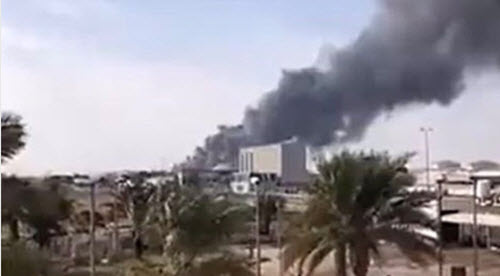
The photo shows columns of smokes from Iranian missiles on Emirates Global Aluminum’s key production site in Abu Dhabi.
Emirates Global Aluminum (EGA) says its key production site in Abu Dhabi has suffered significant damage following Iranian missile and drone strikes, with several employees injured.
In a statement released Saturday, EGA confirmed that its Al Taweelah facility, located in Khalifa Economic Zone, was hit during the Iranian retaliatory strikes.
The company reported multiple injuries among staff, though none were described as life-threatening.
Chief Executive Abdulnasser Bin Kalban said the company is prioritizing worker safety while assessing the extent of the damage.
The strikes came after the US-Israeli aggression against parts of Iran’s industrial infrastructure. Iranian officials had warned the attacks would be met with a firm response to the criminal enemy.
Shipping routes have been severely affected due to restrictions around the Strait of Hormuz following the US-Israeli aggression.
EGA noted that its Al Taweelah smelter produced 1.6 million metric tons of aluminum in 2025, alongside 2.4 million tons of alumina from its nearby refinery.
The company added that it has existing stock both in transit and stored overseas, and is exploring alternative logistics routes, including shipments via the Omani port of Sohar.
The United States and Israel launched a large-scale and unprovoked war of aggression against Iran on February 28, assassinating Leader of the Islamic Revolution Ayatollah Seyed Ali Khamenei and several high-ranking military commanders despite indirect Tehran-Washington negotiations on Iran's peaceful nuclear program.
In response, Iranian Armed Forces immediately initiated powerful missile and drone operations against US interests across West Asia and Israeli positions in the occupied territories.
Saturday, 28 March 2026 6:23 PM [ Last Update: Saturday, 28 March 2026 6:23 PM ]
https://www.presstv.ir/Detail/2026/03/2 ... an-strikes
The photo shows columns of smokes from Iranian missiles on Emirates Global Aluminum’s key production site in Abu Dhabi.
Emirates Global Aluminum (EGA) says its key production site in Abu Dhabi has suffered significant damage following Iranian missile and drone strikes, with several employees injured.
In a statement released Saturday, EGA confirmed that its Al Taweelah facility, located in Khalifa Economic Zone, was hit during the Iranian retaliatory strikes.
The company reported multiple injuries among staff, though none were described as life-threatening.
Chief Executive Abdulnasser Bin Kalban said the company is prioritizing worker safety while assessing the extent of the damage.
The strikes came after the US-Israeli aggression against parts of Iran’s industrial infrastructure. Iranian officials had warned the attacks would be met with a firm response to the criminal enemy.
Shipping routes have been severely affected due to restrictions around the Strait of Hormuz following the US-Israeli aggression.
Press TV@PressTV
Iran strikes depot of Ukrainian anti-drone systems in Dubai: Military official
From presstv.ir
https://www.presstv.ir/Detail/2026/03/2 ... y-official
11:00 AM · Mar 28, 2026
EGA noted that its Al Taweelah smelter produced 1.6 million metric tons of aluminum in 2025, alongside 2.4 million tons of alumina from its nearby refinery.
The company added that it has existing stock both in transit and stored overseas, and is exploring alternative logistics routes, including shipments via the Omani port of Sohar.
The United States and Israel launched a large-scale and unprovoked war of aggression against Iran on February 28, assassinating Leader of the Islamic Revolution Ayatollah Seyed Ali Khamenei and several high-ranking military commanders despite indirect Tehran-Washington negotiations on Iran's peaceful nuclear program.
In response, Iranian Armed Forces immediately initiated powerful missile and drone operations against US interests across West Asia and Israeli positions in the occupied territories.
- admin
- Site Admin
- Posts: 41470
- Joined: Thu Aug 01, 2013 5:21 am
Re: Part 2 Anti-Anti-Nazi Barbarian Hordes are Knocking Down
by admin » Sat Mar 28, 2026 10:51 pm
IRGC: Scores of US soldiers slain as tactical vessels targeted in Persian Gulf
Saturday, 28 March 2026 6:09 AM [ Last Update: Saturday, 28 March 2026 6:09 AM ]
https://www.presstv.ir/Detail/2026/03/2 ... rsian-Gulf
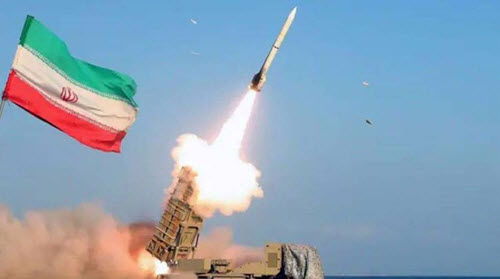
The Islamic Revolution Guards Corps (IRGC) has announced that it struck six American tactical vessels in the Persian Gulf waters on March 27, 2026, leaving scores of the terrorist forces killed in the process.
The Islamic Revolution Guards Corps (IRGC) has announced the targeting of six tactical vessels operated by the terrorist US military in the Persian Gulf waters, leaving a large number of American forces killed in the process.
“In continuation of the 84th wave of Operation True Promise 4, the IRGC naval units conducted a hybrid operation against US and Israeli terrorists deployed in al-Shoyoukh port as well as Dubai’s coasts and port, hitting downhearted American troops and their tactical hardware precisely,” the public relations department of the IRGC said in a statement on Friday.
The statement noted that six US landing craft utility (LCU) were struck in the operation, which was carried out using homegrown ballistic missiles, such as Qadr 380 cruise missiles.
“Given field reports, three of the combat vessels sank after the (retaliatory) strikes, whilst the rest are aflame,” the IRGC further noted.
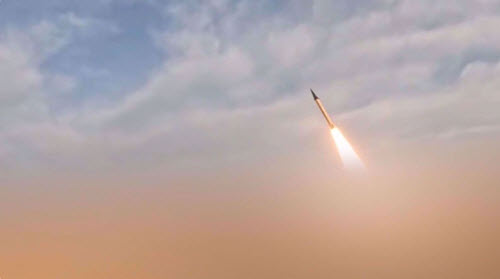
True Promise 4, Wave 84: IRGC missiles target US refueling planes at Al-Kharj Base. The Islamic Revolution Guards Corps (IRGC) announced in a statement that it has successfully destroyed a number of refueling vehicles and the logistical support fleet belonging to the “terrorist” US military at the Al-Kharj base.
In the meantime, kamikaze drones were employed to launch operations against the gathering centers of the US drone unit personnel on the coasts and one of the hotels in Dubai.
“During the operation, a large number of American terrorists were killed, and tactical vessels sunk,” the statement said.
The United States and Israel initiated a large-scale and unprovoked military campaign against Iran in the wake of the assassination of Leader of the Islamic Revolution Ayatollah Seyyed Ali Khamenei, along with several high-ranking military commanders and civilians on February 28.
The aggression has comprised a series of intensive strikes on both military installations and civilian facilities throughout Iran, leading to considerable loss of life and widespread damage to infrastructure.
In response, Iranian Armed Forces carried out retaliatory missile and drone strikes against US interests across West Asia and Israeli positions in the occupied territories.
Saturday, 28 March 2026 6:09 AM [ Last Update: Saturday, 28 March 2026 6:09 AM ]
https://www.presstv.ir/Detail/2026/03/2 ... rsian-Gulf
The Islamic Revolution Guards Corps (IRGC) has announced that it struck six American tactical vessels in the Persian Gulf waters on March 27, 2026, leaving scores of the terrorist forces killed in the process.
The Islamic Revolution Guards Corps (IRGC) has announced the targeting of six tactical vessels operated by the terrorist US military in the Persian Gulf waters, leaving a large number of American forces killed in the process.
“In continuation of the 84th wave of Operation True Promise 4, the IRGC naval units conducted a hybrid operation against US and Israeli terrorists deployed in al-Shoyoukh port as well as Dubai’s coasts and port, hitting downhearted American troops and their tactical hardware precisely,” the public relations department of the IRGC said in a statement on Friday.
The statement noted that six US landing craft utility (LCU) were struck in the operation, which was carried out using homegrown ballistic missiles, such as Qadr 380 cruise missiles.
“Given field reports, three of the combat vessels sank after the (retaliatory) strikes, whilst the rest are aflame,” the IRGC further noted.
True Promise 4, Wave 84: IRGC missiles target US refueling planes at Al-Kharj Base. The Islamic Revolution Guards Corps (IRGC) announced in a statement that it has successfully destroyed a number of refueling vehicles and the logistical support fleet belonging to the “terrorist” US military at the Al-Kharj base.
In the meantime, kamikaze drones were employed to launch operations against the gathering centers of the US drone unit personnel on the coasts and one of the hotels in Dubai.
“During the operation, a large number of American terrorists were killed, and tactical vessels sunk,” the statement said.
The United States and Israel initiated a large-scale and unprovoked military campaign against Iran in the wake of the assassination of Leader of the Islamic Revolution Ayatollah Seyyed Ali Khamenei, along with several high-ranking military commanders and civilians on February 28.
The aggression has comprised a series of intensive strikes on both military installations and civilian facilities throughout Iran, leading to considerable loss of life and widespread damage to infrastructure.
In response, Iranian Armed Forces carried out retaliatory missile and drone strikes against US interests across West Asia and Israeli positions in the occupied territories.
- admin
- Site Admin
- Posts: 41470
- Joined: Thu Aug 01, 2013 5:21 am
Re: Part 2 Anti-Anti-Nazi Barbarian Hordes are Knocking Down
by admin » Sat Mar 28, 2026 11:01 pm
Drone attack on residence of Iraqi Kurdistan president ‘clear act of terrorism’: IRGC
Saturday, 28 March 2026 6:43 PM [ Last Update: Saturday, 28 March 2026 6:43 PM ]
https://www.presstv.ir/Detail/2026/03/2 ... 0%99--IRGC
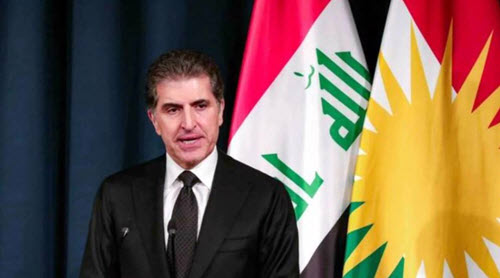
President of Iraq’s autonomous Kurdistan Region Nechirvan Barzani
The Islamic Revolution Guards Corps (IRGC) has denounced a US-Israeli drone strike on the residence of the president of Iraq's Kurdistan Region, describing the assassination attempt as “a clear act of terrorism.”
According to security sources, a drone attack targeted Kurdish President Nechirvan Barzani’s home in Duhok, the northwestern part of the Iraqi Kurdistan Region, on Saturday.
Citing these sources, Reuters reported that air defenses also shot down a drone near a Peshmerga base in the region.
In the wake of the attack, Iraqi Prime Minister Mohammed Shia al-Sudani spoke with Barzani by phone, his office said. He also ordered an investigation into the drone strike.
In its statement, the IRGC described the drone attack on Barzani’s residence as “a clear example of a terrorist act by aggressor enemies.”
The aggression, it said, follows a pattern of “cowardly assassinations” of senior Iranian officials by the US and Israel.
The IRGC added that these “malicious efforts” by the two enemies are aimed at undermining peace, stability, and regional cooperation between the Kurdistan Region and neighboring countries.
The IRGC also expressed its full readiness to defend neighboring countries through a “collective defense shield” and enhanced regional security cooperation to counter the aggressors.
The United States and Israel launched a joint military aggression against the Islamic Republic on February 28 by assassinating Leader of the Islamic Revolution Ayatollah Seyyed Ali Khamenei, along with senior military commanders.
The enemies have deliberately targeted Iran’s civilian infrastructure and energy facilities, killing hundreds of Iranian people.
Iran’s response to the unprovoked war, however, has been decisive and precise. The country’s armed forces have so far carried out 85 waves of Operation True Promise 4, targeting Israeli military and strategic sites as well as US military bases across the region with missiles and drones, inflicting heavy losses on the enemy.
Saturday, 28 March 2026 6:43 PM [ Last Update: Saturday, 28 March 2026 6:43 PM ]
https://www.presstv.ir/Detail/2026/03/2 ... 0%99--IRGC
President of Iraq’s autonomous Kurdistan Region Nechirvan Barzani
The Islamic Revolution Guards Corps (IRGC) has denounced a US-Israeli drone strike on the residence of the president of Iraq's Kurdistan Region, describing the assassination attempt as “a clear act of terrorism.”
According to security sources, a drone attack targeted Kurdish President Nechirvan Barzani’s home in Duhok, the northwestern part of the Iraqi Kurdistan Region, on Saturday.
Citing these sources, Reuters reported that air defenses also shot down a drone near a Peshmerga base in the region.
In the wake of the attack, Iraqi Prime Minister Mohammed Shia al-Sudani spoke with Barzani by phone, his office said. He also ordered an investigation into the drone strike.
In its statement, the IRGC described the drone attack on Barzani’s residence as “a clear example of a terrorist act by aggressor enemies.”
The aggression, it said, follows a pattern of “cowardly assassinations” of senior Iranian officials by the US and Israel.
The IRGC added that these “malicious efforts” by the two enemies are aimed at undermining peace, stability, and regional cooperation between the Kurdistan Region and neighboring countries.
The IRGC also expressed its full readiness to defend neighboring countries through a “collective defense shield” and enhanced regional security cooperation to counter the aggressors.
The United States and Israel launched a joint military aggression against the Islamic Republic on February 28 by assassinating Leader of the Islamic Revolution Ayatollah Seyyed Ali Khamenei, along with senior military commanders.
The enemies have deliberately targeted Iran’s civilian infrastructure and energy facilities, killing hundreds of Iranian people.
Iran’s response to the unprovoked war, however, has been decisive and precise. The country’s armed forces have so far carried out 85 waves of Operation True Promise 4, targeting Israeli military and strategic sites as well as US military bases across the region with missiles and drones, inflicting heavy losses on the enemy.
- admin
- Site Admin
- Posts: 41470
- Joined: Thu Aug 01, 2013 5:21 am
Re: Part 2 Anti-Anti-Nazi Barbarian Hordes are Knocking Down
by admin » Sat Mar 28, 2026 11:19 pm
IRGC: Israeli, US universities in region legitimate targets after strikes on Iranian university
Saturday, 28 March 2026 10:53 PM [ Last Update: Saturday, 28 March 2026 10:55 PM ]
https://www.presstv.ir/Detail/2026/03/2 ... -West-Asia
The Islamic Revolution Guards Corps (IRGC)'s logo
The Islamic Revolution Guards Corps (IRGC) has declared that Israeli and American universities in West Asia have become targets of Iran’s retaliatory strikes following attacks on a major Iranian university.
In a statement on Saturday, the Corps condemned the actions of "American–Zionist aggressor forces," citing earlier bombings of Tehran’s University of Science and Technology.
"The American–Zionist aggressor forces, by bombing Tehran’s University of Science and Technology, have once again targeted Iranian universities."
The IRGC warned that all Israeli and American universities in the region would be considered legitimate targets until two universities belonging to the aggressors were struck in retaliation.
The statement advised all staff, professors, and students of American universities in the region, as well as nearby residents, to maintain a distance of one kilometer from these institutions for their own safety.
The IRGC outlined conditions under which regional American universities might avoid retaliatory strikes.
"If the US government wants its universities in the region to be exempt from retaliatory strikes, it must, by 12:00 noon Tehran time (08:30 a.m. GMT) on Monday, March 30, issue an official statement condemning the bombings of universities."
It further stated, "Furthermore, if it wants its regional universities to remain unharmed afterward, it must prevent its allied forces from attacking universities and research centers."
"Otherwise, the threat remains valid and will be carried out."
The Iranian university was struck on Saturday during the aggression that began targeting the Islamic Republic late last month. The attack resulted in destruction of some scientific and research sites inside the facility.
Earlier too, aggressors had targeted the Isfahan University of Technology, reportedly afflicting damage to one building.
Shortly after the launch of the American-Israeli aggression on February 28, the Corps launched unrelenting retaliatory strikes against sensitive and strategic enemy targets across the region using hundreds of ballistic and hypersonic missiles as well as attack drones.
Saturday, 28 March 2026 10:53 PM [ Last Update: Saturday, 28 March 2026 10:55 PM ]
https://www.presstv.ir/Detail/2026/03/2 ... -West-Asia
The Islamic Revolution Guards Corps (IRGC)'s logo
The Islamic Revolution Guards Corps (IRGC) has declared that Israeli and American universities in West Asia have become targets of Iran’s retaliatory strikes following attacks on a major Iranian university.
In a statement on Saturday, the Corps condemned the actions of "American–Zionist aggressor forces," citing earlier bombings of Tehran’s University of Science and Technology.
Press TV @PressTV
Footage documents the aftermath of the US-Israeli attack on Tehran's University of Science and Technology.
https://x.com/i/status/2037874848391745679
6:50 AM · Mar 28, 2026
"The American–Zionist aggressor forces, by bombing Tehran’s University of Science and Technology, have once again targeted Iranian universities."
The IRGC warned that all Israeli and American universities in the region would be considered legitimate targets until two universities belonging to the aggressors were struck in retaliation.
The statement advised all staff, professors, and students of American universities in the region, as well as nearby residents, to maintain a distance of one kilometer from these institutions for their own safety.
The IRGC outlined conditions under which regional American universities might avoid retaliatory strikes.
"If the US government wants its universities in the region to be exempt from retaliatory strikes, it must, by 12:00 noon Tehran time (08:30 a.m. GMT) on Monday, March 30, issue an official statement condemning the bombings of universities."
It further stated, "Furthermore, if it wants its regional universities to remain unharmed afterward, it must prevent its allied forces from attacking universities and research centers."
"Otherwise, the threat remains valid and will be carried out."
The Iranian university was struck on Saturday during the aggression that began targeting the Islamic Republic late last month. The attack resulted in destruction of some scientific and research sites inside the facility.
Earlier too, aggressors had targeted the Isfahan University of Technology, reportedly afflicting damage to one building.
Press TV @PressTV
US-Israeli aggression targets Isfahan University of Technology, causes damage
https://t.co/xDqf2cZGoC
https://www.presstv.ir/Detail/2026/03/26/765877/US-Israeli-aggression-Isfahan-University-Technology-attack
From presstv.ir
9:30 AM · Mar 26, 2026
Shortly after the launch of the American-Israeli aggression on February 28, the Corps launched unrelenting retaliatory strikes against sensitive and strategic enemy targets across the region using hundreds of ballistic and hypersonic missiles as well as attack drones.
- admin
- Site Admin
- Posts: 41470
- Joined: Thu Aug 01, 2013 5:21 am
Re: Part 2 Anti-Anti-Nazi Barbarian Hordes are Knocking Down
by admin » Sat Mar 28, 2026 11:44 pm
True Promise 4: Iran and resistance axis ops. against US-Israeli assets on Mar. 28
by Press TV Website Staff
Saturday, 28 March 2026 8:56 PM [ Last Update: Saturday, 28 March 2026 8:56 PM ]
https://www.presstv.ir/Detail/2026/03/2 ... tes-mar-28
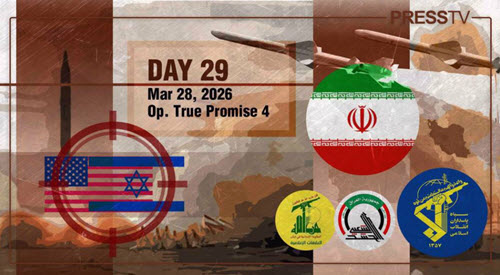
Iranian armed forces and resistance groups across the region continue to carry out retaliatory military operations against the United States and the Israeli regime.
On Saturday, March 28, 2027, the Islamic Revolution Guards Corps (IRGC) and the Iranian Army conducted multiple operations as part of Operation True Promise 4, which was launched immediately after the US-Israeli coalition carried out an unprovoked act of aggression against the Islamic Republic of Iran on February 28.
Iranian armed forces have so far carried out 85 waves of missile and drone strikes with advanced weaponry targeting Israeli military facilities in the occupied territories, as well as US occupation bases and assets scattered across the West Asia region.
The Lebanese Hezbollah resistance movement and the Islamic Resistance in Iraq have also joined the front against the external aggressors, inflicting heavy blows on the enemy.
Hezbollah’s operations have been primarily focused on Israeli military sites in the occupied territories. Its operations are both in response to the assassination of the Leader of the Islamic Revolution, Ayatollah Seyyed Ali Khamenei, and the relentless ceasefire violations by the Israeli regime over the past year.
Iraqi resistance groups have also been carrying out daily operations, primarily against American military assets in Iraq and other Arab countries.
Below is a list of operations carried out by the Iranian armed forces, as well as resistance movements in Lebanon and Iraq, against the US and the Zionist regime on March 28:
Islamic Revolution Guards Corps (IRGC):
• The 85th wave of Operation True Promise 4, jointly carried out by IRGC aerospace and naval divisions, under the blessed code "Ya Rasul Allah" (O Messenger of Allah), as a tribute to the martyrs of the country's industrial workers and producers, used long-range and medium-range solid and liquid-fueled systems and attack drones to target several industries belonging to the Israeli-American enemy in the occupied territories and other locations.
• During this extensive missile and drone operation, the enemy air force attempted to target our launch platforms by deploying fighter jets and drones. However, with the fire of the IRGC air defense, one American MQ9 strategic drone was shot down in the skies over Shiraz, and an American F16 fighter jet was also hit in the south of Fars province and was destroyed before landing at one of the airports in Saudi Arabia.
Iranian Army:
• The electronic warfare and radar center of "Elta," from the Israeli military’s aerospace complex in the port of Haifa, and the fuel storage centers of "Ben Gurion" airbase were targeted with a barrage of drones.
• A "Lucas" drone of the US military was downed by the air defense fire of the Navy in the Bandar Abbas region. The number of drones downed by the integrated network of the Joint Air Defense Headquarters of the country has reached 135 now.
Hezbollah:
• In defense of Lebanon and its people, the Islamic Resistance fighters targeted infrastructure belonging to the Israeli army in "HaKirayot" with a barrage of qualitative missiles.
• Defending Lebanon and its people, the Islamic Resistance fighters targeted a gathering of soldiers and vehicles of the Israeli army in the Al-Malikiyah site with a rocket barrage.
• In defense of Lebanon and its people, the Islamic Resistance fighters targeted the artillery position of the Israeli army in the "Dan" settlement in northern occupied Palestine with a swarm of attack drones.
• In defense of Lebanon and its people, the Islamic Resistance fighters targeted a gathering of Israeli soldiers and their vehicles at the Al-Malikiyah site with a rocket barrage.
• In defense of Lebanon and its people, the Islamic Resistance fighters targeted a gathering of Israeli army soldiers and vehicles in the "Metulla" site with a rocket barrage.
• In defense of Lebanon and its people, the Islamic Resistance fighters targeted the "Ramot Naftali" barracks with a swarm of attack drones.
• In defense of Lebanon and its people, the Islamic Resistance fighters targeted the "Stella Maris" base (a strategic base for maritime monitoring and surveillance on the northern coast level) with a qualitative missile.
• In defense of Lebanon and its people, the Islamic Resistance fighters targeted a gathering of Israeli soldiers near the reservoir in the town of Deir Seryan with a rocket barrage.
• In defense of Lebanon and its people, the Islamic Resistance fighters targeted gatherings of Israeli soldiers in the town of Al-Qantara with a rocket barrage.
• After monitoring the movements of an Israeli force near Baydar al-Faqa'ani in the town of Taybeh as it advanced down towards the Litani River bed in the Baydar al-Nahr area, the Islamic Resistance fighters lured it into a tight fire ambush and targeted it with rocket weaponry, artillery shells, and attack drones. The ambush area turned into a kill zone, resulting in a large number of casualties in the ranks of the enemy.
• In defense of Lebanon and its people, the Islamic Resistance fighters targeted the Israeli military’s artillery position in Al-Zaoura with a rocket barrage.
• In defense of Lebanon and its people, the Islamic Resistance fighters targeted the "Mishar" base (the main intelligence headquarters for the northern region) northeast of Safad city with a rocket barrage.
• In defense of Lebanon and its people, and within the framework of the warning issued by the Islamic Resistance to a number of settlements in northern occupied Palestine, the Islamic Resistance fighters targeted the "Malkiya" settlement with a rocket barrage.
• In defense of Lebanon and its people, and within the framework of the warning issued by the Islamic Resistance to a number of settlements in northern occupied Palestine, the Islamic Resistance fighters targeted the "Avivim" settlement with a rocket barrage.
• In defense of Lebanon and its people, the fighters of the Islamic Resistance targeted a gathering of Israeli soldiers and vehicles near the pool of the town of Dibel with a rocket barrage.
• In defense of Lebanon and its people, the Islamic Resistance fighters targeted a gathering of Israeli soldiers and their vehicles at the Wadi Al-Oyoun - Rashaf triangle with a rocket barrage.
• In defense of Lebanon and its people, and after monitoring a force from the Israeli army that had positioned itself in a house in the town of Dibl, the Islamic Resistance fighters targeted it with an attack drone.
• In defense of Lebanon and its people, the Islamic Resistance fighters targeted a Merkava tank in the town of Dibl with an attack drone.
• In defense of Lebanon and its people, the Islamic Resistance fighters confronted a manned reconnaissance aircraft of the type RC12 in the skies of the Western Bekaa and forced it to retreat.
• In defense of Lebanon and its people, the Islamic Resistance fighters targeted the "Ya'ara" barracks with a swarm of attack drones.
• In defense of Lebanon and its people, the Islamic Resistance fighters targeted the headquarters of the Northern Region command of the Israeli army ("Dado" base) north of Safad city with a rocket barrage.
• In defense of Lebanon and its people, and within the framework of the warning issued by the Islamic Resistance to a number of settlements in northern occupied Palestine, the Islamic Resistance fighters targeted the "Shlomi" settlement with a rocket barrage.
• In defense of Lebanon and its people, the Islamic Resistance fighters targeted the communication and surveillance equipment at the maritime Naqoura site with a swarm of attack drones.
• In defense of Lebanon and its people, the Islamic Resistance fighters targeted two Merkava tanks in the vicinity of the reservoir in the town of Al-Qantara with guided missiles.
• In defense of Lebanon and its people, and after monitoring a force from the Israeli army that had positioned itself in a house in the town of Al-Bayyadah, the Islamic Resistance fighters targeted it with an attack drone.
• In defense of Lebanon and its people, the Islamic Resistance fighters targeted a gathering of Israeli soldiers and vehicles in the town of Al-Bayada with artillery shells.
• In defense of Lebanon and its people, after monitoring a force from the Israeli army positioned inside a house in the town of Al-Bayyadah, the Islamic Resistance fighters targeted it with an attack drone.
• In defense of Lebanon and its people, the Islamic Resistance fighters targeted another "Merkava" tank near the water tank in the town of Al-Qantara with a guided missile.
• In defense of Lebanon and its people, the Islamic Resistance fighters targeted a Hummer vehicle in the town of Al-Bayyada with an attack drone, achieving a direct hit.
• In defense of Lebanon and its people, the Islamic Resistance fighters targeted the radar site in the town of Al-Bayyadah with an attack drone.
• In defense of Lebanon and its people, the Islamic Resistance fighters targeted a Merkava tank in the town of Al-Bayyada with an attack drone.
• In defense of Lebanon and its people, the Islamic Resistance fighters targeted a Merkava tank in the town of Al-Bayyadah with an attack drone.
• The Islamic Resistance fighters targeted a gathering of Israeli soldiers and vehicles in the town of Al-Bayyada with a rocket barrage and also targeted the "Namira" armored personnel carrier.
• In defense of Lebanon and its people, the Islamic Resistance fighters targeted a "Merkava" tank in the town of Al-Bayada with a guided missile.
• In defense of Lebanon and its people, and after monitoring a force from the Israeli army positioned inside two houses west of the Al-Hazzan area in the town of Al-Qantara, the Islamic Resistance fighters targeted them with guided missiles.
• In defense of Lebanon and its people, the Islamic Resistance fighters clashed with a force from the Israeli army on the western outskirts of the town of Chamaa with light and medium weapons, achieving direct hits.
• In defense of Lebanon and its people, the Islamic Resistance fighters targeted a newly established artillery position of the Israeli army in the town of Arab Al-Louizeh near Ghajar with a rocket barrage and artillery shells, achieving confirmed hits.
• In defense of Lebanon and its people, the Islamic Resistance fighters targeted the "Nesher" base southeast of the city of Haifa with a swarm of attack drones.
• In defense of Lebanon and its people, the Islamic Resistance fighters targeted a gathering of Israeli soldiers and their vehicles in Baydar Al-Faqani in the town of Taybeh with a rocket barrage.
Yemeni military:
• Carried out its first military operation with a barrage of ballistic missiles, which targeted sensitive military targets of the Israeli military in southern occupied Palestine.
• Targeted a number of vital targets of the Israeli military in southern occupied Palestine using a volley of cruise missiles and drones.
Islamic Resistance in Iraq:
• Targeted multiple assets of American and Israeli military occupation forces in Jordan using appropriate weapons.
by Press TV Website Staff
Saturday, 28 March 2026 8:56 PM [ Last Update: Saturday, 28 March 2026 8:56 PM ]
https://www.presstv.ir/Detail/2026/03/2 ... tes-mar-28
Iranian armed forces and resistance groups across the region continue to carry out retaliatory military operations against the United States and the Israeli regime.
On Saturday, March 28, 2027, the Islamic Revolution Guards Corps (IRGC) and the Iranian Army conducted multiple operations as part of Operation True Promise 4, which was launched immediately after the US-Israeli coalition carried out an unprovoked act of aggression against the Islamic Republic of Iran on February 28.
Iranian armed forces have so far carried out 85 waves of missile and drone strikes with advanced weaponry targeting Israeli military facilities in the occupied territories, as well as US occupation bases and assets scattered across the West Asia region.
The Lebanese Hezbollah resistance movement and the Islamic Resistance in Iraq have also joined the front against the external aggressors, inflicting heavy blows on the enemy.
Hezbollah’s operations have been primarily focused on Israeli military sites in the occupied territories. Its operations are both in response to the assassination of the Leader of the Islamic Revolution, Ayatollah Seyyed Ali Khamenei, and the relentless ceasefire violations by the Israeli regime over the past year.
Iraqi resistance groups have also been carrying out daily operations, primarily against American military assets in Iraq and other Arab countries.
Below is a list of operations carried out by the Iranian armed forces, as well as resistance movements in Lebanon and Iraq, against the US and the Zionist regime on March 28:
Islamic Revolution Guards Corps (IRGC):
• The 85th wave of Operation True Promise 4, jointly carried out by IRGC aerospace and naval divisions, under the blessed code "Ya Rasul Allah" (O Messenger of Allah), as a tribute to the martyrs of the country's industrial workers and producers, used long-range and medium-range solid and liquid-fueled systems and attack drones to target several industries belonging to the Israeli-American enemy in the occupied territories and other locations.
• During this extensive missile and drone operation, the enemy air force attempted to target our launch platforms by deploying fighter jets and drones. However, with the fire of the IRGC air defense, one American MQ9 strategic drone was shot down in the skies over Shiraz, and an American F16 fighter jet was also hit in the south of Fars province and was destroyed before landing at one of the airports in Saudi Arabia.
Press TV @PressTV
IRGC strikes US-Israeli industrial sites in retaliation for infrastructure attacks
https://www.presstv.ir/Detail/2026/03/2 ... re-attacks
From presstv.ir
1:30 PM · Mar 28, 2026
Iranian Army:
• The electronic warfare and radar center of "Elta," from the Israeli military’s aerospace complex in the port of Haifa, and the fuel storage centers of "Ben Gurion" airbase were targeted with a barrage of drones.
• A "Lucas" drone of the US military was downed by the air defense fire of the Navy in the Bandar Abbas region. The number of drones downed by the integrated network of the Joint Air Defense Headquarters of the country has reached 135 now.
Hezbollah:
• In defense of Lebanon and its people, the Islamic Resistance fighters targeted infrastructure belonging to the Israeli army in "HaKirayot" with a barrage of qualitative missiles.
• Defending Lebanon and its people, the Islamic Resistance fighters targeted a gathering of soldiers and vehicles of the Israeli army in the Al-Malikiyah site with a rocket barrage.
• In defense of Lebanon and its people, the Islamic Resistance fighters targeted the artillery position of the Israeli army in the "Dan" settlement in northern occupied Palestine with a swarm of attack drones.
• In defense of Lebanon and its people, the Islamic Resistance fighters targeted a gathering of Israeli soldiers and their vehicles at the Al-Malikiyah site with a rocket barrage.
• In defense of Lebanon and its people, the Islamic Resistance fighters targeted a gathering of Israeli army soldiers and vehicles in the "Metulla" site with a rocket barrage.
• In defense of Lebanon and its people, the Islamic Resistance fighters targeted the "Ramot Naftali" barracks with a swarm of attack drones.
• In defense of Lebanon and its people, the Islamic Resistance fighters targeted the "Stella Maris" base (a strategic base for maritime monitoring and surveillance on the northern coast level) with a qualitative missile.
• In defense of Lebanon and its people, the Islamic Resistance fighters targeted a gathering of Israeli soldiers near the reservoir in the town of Deir Seryan with a rocket barrage.
• In defense of Lebanon and its people, the Islamic Resistance fighters targeted gatherings of Israeli soldiers in the town of Al-Qantara with a rocket barrage.
• After monitoring the movements of an Israeli force near Baydar al-Faqa'ani in the town of Taybeh as it advanced down towards the Litani River bed in the Baydar al-Nahr area, the Islamic Resistance fighters lured it into a tight fire ambush and targeted it with rocket weaponry, artillery shells, and attack drones. The ambush area turned into a kill zone, resulting in a large number of casualties in the ranks of the enemy.
Press TV @PressTV
Hezbollah reports it has carried out over 150 operations against Israeli targets in the past two days in retaliation.
https://x.com/i/status/2037970477830771014
Follow Press TV on Telegram: http://t.me/PressTV
1:10 PM · Mar 28, 2026
• In defense of Lebanon and its people, the Islamic Resistance fighters targeted the Israeli military’s artillery position in Al-Zaoura with a rocket barrage.
• In defense of Lebanon and its people, the Islamic Resistance fighters targeted the "Mishar" base (the main intelligence headquarters for the northern region) northeast of Safad city with a rocket barrage.
• In defense of Lebanon and its people, and within the framework of the warning issued by the Islamic Resistance to a number of settlements in northern occupied Palestine, the Islamic Resistance fighters targeted the "Malkiya" settlement with a rocket barrage.
• In defense of Lebanon and its people, and within the framework of the warning issued by the Islamic Resistance to a number of settlements in northern occupied Palestine, the Islamic Resistance fighters targeted the "Avivim" settlement with a rocket barrage.
• In defense of Lebanon and its people, the fighters of the Islamic Resistance targeted a gathering of Israeli soldiers and vehicles near the pool of the town of Dibel with a rocket barrage.
• In defense of Lebanon and its people, the Islamic Resistance fighters targeted a gathering of Israeli soldiers and their vehicles at the Wadi Al-Oyoun - Rashaf triangle with a rocket barrage.
• In defense of Lebanon and its people, and after monitoring a force from the Israeli army that had positioned itself in a house in the town of Dibl, the Islamic Resistance fighters targeted it with an attack drone.
• In defense of Lebanon and its people, the Islamic Resistance fighters targeted a Merkava tank in the town of Dibl with an attack drone.
• In defense of Lebanon and its people, the Islamic Resistance fighters confronted a manned reconnaissance aircraft of the type RC12 in the skies of the Western Bekaa and forced it to retreat.
• In defense of Lebanon and its people, the Islamic Resistance fighters targeted the "Ya'ara" barracks with a swarm of attack drones.
• In defense of Lebanon and its people, the Islamic Resistance fighters targeted the headquarters of the Northern Region command of the Israeli army ("Dado" base) north of Safad city with a rocket barrage.
• In defense of Lebanon and its people, and within the framework of the warning issued by the Islamic Resistance to a number of settlements in northern occupied Palestine, the Islamic Resistance fighters targeted the "Shlomi" settlement with a rocket barrage.
• In defense of Lebanon and its people, the Islamic Resistance fighters targeted the communication and surveillance equipment at the maritime Naqoura site with a swarm of attack drones.
• In defense of Lebanon and its people, the Islamic Resistance fighters targeted two Merkava tanks in the vicinity of the reservoir in the town of Al-Qantara with guided missiles.
• In defense of Lebanon and its people, and after monitoring a force from the Israeli army that had positioned itself in a house in the town of Al-Bayyadah, the Islamic Resistance fighters targeted it with an attack drone.
• In defense of Lebanon and its people, the Islamic Resistance fighters targeted a gathering of Israeli soldiers and vehicles in the town of Al-Bayada with artillery shells.
• In defense of Lebanon and its people, after monitoring a force from the Israeli army positioned inside a house in the town of Al-Bayyadah, the Islamic Resistance fighters targeted it with an attack drone.
Press TV @PressTV
WATCH: Yemen’s Armed Forces warn they have their “hands on the trigger” for direct military action if the US and Israel expand aggression against Iran or the Axis of Resistance.
https://x.com/i/status/2037641485395403208
Follow http://t.me/presstv
3:22 PM · Mar 27, 2026
• In defense of Lebanon and its people, the Islamic Resistance fighters targeted another "Merkava" tank near the water tank in the town of Al-Qantara with a guided missile.
• In defense of Lebanon and its people, the Islamic Resistance fighters targeted a Hummer vehicle in the town of Al-Bayyada with an attack drone, achieving a direct hit.
• In defense of Lebanon and its people, the Islamic Resistance fighters targeted the radar site in the town of Al-Bayyadah with an attack drone.
• In defense of Lebanon and its people, the Islamic Resistance fighters targeted a Merkava tank in the town of Al-Bayyada with an attack drone.
• In defense of Lebanon and its people, the Islamic Resistance fighters targeted a Merkava tank in the town of Al-Bayyadah with an attack drone.
• The Islamic Resistance fighters targeted a gathering of Israeli soldiers and vehicles in the town of Al-Bayyada with a rocket barrage and also targeted the "Namira" armored personnel carrier.
• In defense of Lebanon and its people, the Islamic Resistance fighters targeted a "Merkava" tank in the town of Al-Bayada with a guided missile.
• In defense of Lebanon and its people, and after monitoring a force from the Israeli army positioned inside two houses west of the Al-Hazzan area in the town of Al-Qantara, the Islamic Resistance fighters targeted them with guided missiles.
• In defense of Lebanon and its people, the Islamic Resistance fighters clashed with a force from the Israeli army on the western outskirts of the town of Chamaa with light and medium weapons, achieving direct hits.
• In defense of Lebanon and its people, the Islamic Resistance fighters targeted a newly established artillery position of the Israeli army in the town of Arab Al-Louizeh near Ghajar with a rocket barrage and artillery shells, achieving confirmed hits.
• In defense of Lebanon and its people, the Islamic Resistance fighters targeted the "Nesher" base southeast of the city of Haifa with a swarm of attack drones.
• In defense of Lebanon and its people, the Islamic Resistance fighters targeted a gathering of Israeli soldiers and their vehicles in Baydar Al-Faqani in the town of Taybeh with a rocket barrage.
Yemeni military:
• Carried out its first military operation with a barrage of ballistic missiles, which targeted sensitive military targets of the Israeli military in southern occupied Palestine.
• Targeted a number of vital targets of the Israeli military in southern occupied Palestine using a volley of cruise missiles and drones.
Islamic Resistance in Iraq:
• Targeted multiple assets of American and Israeli military occupation forces in Jordan using appropriate weapons.
- admin
- Site Admin
- Posts: 41470
- Joined: Thu Aug 01, 2013 5:21 am
Re: Part 2 Anti-Anti-Nazi Barbarian Hordes are Knocking Down
by admin » Sun Mar 29, 2026 12:04 am
'Iran calls the shots': Mearsheimer says US Navy powerless to control Strait of Hormuz
Thursday, 19 March 2026 11:56 AM [ Last Update: Thursday, 19 March 2026 11:56 AM ]
https://www.presstv.ir/Detail/2026/03/1 ... ait-hormuz

US political scientist John Mearsheimer. (File photo)
As tensions in the Persian Gulf reach a fever pitch, a top American political scientist has delivered a stark assessment of US military limitations, saying Washington is unable to guarantee the security of the world's most important energy waterway.
In remarks that have resonated widely on social media, international relations scholar John Mearsheimer pointed to the strategic reality unfolding in the region and asserted that the Strait of Hormuz is firmly within Tehran's sphere of influence.
The strategic waterway, through which roughly one-fifth of the world’s oil supply flows each day, has been in the news after Iran closed it to ships linked to the US and the Israeli regime.
Many tankers have been targeted by Iranian naval forces in the past few weeks for breaching the ban imposed by Iran amid the American-Israeli war of aggression on the country.
US President Donald Trump had warned to escort vessels passing through the strategic waterway, but abandoned the idea after subsequent warnings from the Iranian side.
The closure of the waterway has led to economic shockwaves across the world, with energy prices in the US and Europe soaring alarmingly.
Mearsheimer emphasized the critical nature of the chokepoint, ruling out the American leverage to have it opened without the permission of the Islamic Republic of Iran.
The Strait of Hormuz is of extraordinary importance," the prominent political scientist and theorist stated, delivering a blunt verdict on American capabilities.
"The reality is that we have no way to keep the Strait of Hormuz open."
He pointed to the Trump administration’s unsuccessful lobbying to have his European and NATO allies join the anti-Iran naval alliance as proof of this weakness, noting that the very fact the US has been compelled to seek assistance for naval missions in the region is telling.
"The fact that Trump has requested help to carry out this mission shows that the US Navy, which is the most powerful navy in the world, is not capable of keeping this strait open on its own," he stated.
He also referred to a significant shift in the balance of power in the Persian Gulf. Wth the US unable to guarantee safe passage unilaterally, Tehran holds the position of strength.
"Therefore, as this process continues, it seems that Iran holds a very strong hand to play," Mearsheimer observed.
This military reality check comes as the wider US-Israeli military aggression against Iran faces intense scrutiny. As noted by other analysts covering the war, which entered its 20th day on Thursday, the Trump administration's goals remain unclear, and the risk of escalation, potentially targeting global energy supplies, has assumed alarming proportions.
Mearsheimer's comments suggest that any further aggression against Iran could backfire, as the country possesses the geographic and military advantages to disrupt global oil flows in a way that the US Navy cannot reliably prevent.
Thursday, 19 March 2026 11:56 AM [ Last Update: Thursday, 19 March 2026 11:56 AM ]
https://www.presstv.ir/Detail/2026/03/1 ... ait-hormuz
US political scientist John Mearsheimer. (File photo)
As tensions in the Persian Gulf reach a fever pitch, a top American political scientist has delivered a stark assessment of US military limitations, saying Washington is unable to guarantee the security of the world's most important energy waterway.
In remarks that have resonated widely on social media, international relations scholar John Mearsheimer pointed to the strategic reality unfolding in the region and asserted that the Strait of Hormuz is firmly within Tehran's sphere of influence.
The strategic waterway, through which roughly one-fifth of the world’s oil supply flows each day, has been in the news after Iran closed it to ships linked to the US and the Israeli regime.
Many tankers have been targeted by Iranian naval forces in the past few weeks for breaching the ban imposed by Iran amid the American-Israeli war of aggression on the country.
US President Donald Trump had warned to escort vessels passing through the strategic waterway, but abandoned the idea after subsequent warnings from the Iranian side.
The closure of the waterway has led to economic shockwaves across the world, with energy prices in the US and Europe soaring alarmingly.
Mearsheimer emphasized the critical nature of the chokepoint, ruling out the American leverage to have it opened without the permission of the Islamic Republic of Iran.
The Strait of Hormuz is of extraordinary importance," the prominent political scientist and theorist stated, delivering a blunt verdict on American capabilities.
Press TV @PressTV
Following US Israeli war on Iran, the Brent crude oil soared above $116, a whopping 8.5% in just a day.
How many days to $200?
4:59 AM · Mar 19, 2026

"The reality is that we have no way to keep the Strait of Hormuz open."
He pointed to the Trump administration’s unsuccessful lobbying to have his European and NATO allies join the anti-Iran naval alliance as proof of this weakness, noting that the very fact the US has been compelled to seek assistance for naval missions in the region is telling.
"The fact that Trump has requested help to carry out this mission shows that the US Navy, which is the most powerful navy in the world, is not capable of keeping this strait open on its own," he stated.
He also referred to a significant shift in the balance of power in the Persian Gulf. Wth the US unable to guarantee safe passage unilaterally, Tehran holds the position of strength.
"Therefore, as this process continues, it seems that Iran holds a very strong hand to play," Mearsheimer observed.
This military reality check comes as the wider US-Israeli military aggression against Iran faces intense scrutiny. As noted by other analysts covering the war, which entered its 20th day on Thursday, the Trump administration's goals remain unclear, and the risk of escalation, potentially targeting global energy supplies, has assumed alarming proportions.
Mearsheimer's comments suggest that any further aggression against Iran could backfire, as the country possesses the geographic and military advantages to disrupt global oil flows in a way that the US Navy cannot reliably prevent.
- admin
- Site Admin
- Posts: 41470
- Joined: Thu Aug 01, 2013 5:21 am
Re: Part 2 Anti-Anti-Nazi Barbarian Hordes are Knocking Down
by admin » Sun Mar 29, 2026 12:42 am
How closure of Strait of Hormuz over US-Israeli war on Iran could trigger energy catastrophe
by Press TV Website Staff
Wednesday, 11 March 2026 8:13 AM [ Last Update: Wednesday, 11 March 2026 8:13 AM ]
https://www.presstv.ir/Detail/2026/03/1 ... atastrophe
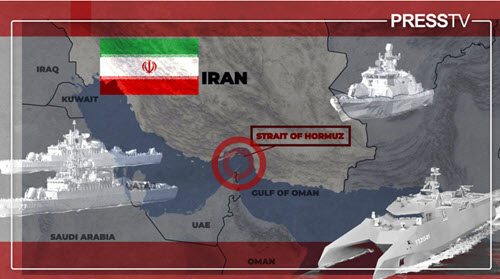
The world’s most important energy chokepoint, through which roughly one-fifth of the world’s oil supply flows each day, has once again become the epicenter of global economic anxiety.
The narrow waterway of the Strait of Hormuz has turned from a vital artery of global commerce into a potential trigger for economic shockwaves spreading from the Persian Gulf to Asia, Europe and the United States.
In the wake of escalating US-Israel military adventurism against Iran, the prospect of the strategic waterway’s closure has jolted financial markets, disrupted energy flows and raised fears of a global economic rupture.
The numbers alone illustrate the scale of the risk. More than 20 million barrels of crude oil pass daily through the narrow channel separating the Iranian coast from Oman.
That volume represents roughly a fifth of global oil consumption and nearly a quarter of all seaborne oil trade. A significant share of the world’s liquefied natural gas also moves through the same passage.
When that flow falters even briefly, the consequences cascade across financial markets, supply chains and household budgets around the world.
Within days of the latest war against Iran, financial markets immediately began to reflect the magnitude of the shock. Regional stock exchanges were among the first to react. The market in Dubai reportedly lost nearly $12 billion in a single session, as investors fled risk assets.
In East Asia, the selloff was even more dramatic. South Korean equities shed roughly 20 percent in three days, erasing about $450 billion in market value. Japanese markets lost an estimated $ 650 billion in capitalization.
For the far larger American market, the immediate impact was bloodcurdling. Over $1 trillion in value evaporated from US equities as investors reassessed expectations for growth, energy costs, and geopolitical stability.
Such volatility reflects the central role energy plays in the modern global economy. Nearly every sector, from manufacturing and transport to agriculture and logistics, depends directly or indirectly on stable energy supplies.
The potential closure of the Strait of Hormuz threatens not merely to raise prices but to destabilize the entire energy system that underpins global trade.
Oil markets have already begun to signal the severity of the disruption. The benchmark Brent crude price jumped more than 10 percent shortly after tanker traffic slowed near the strait, soaring past $90 a barrel and edging toward $100.
Analysts warn that if the war imposed on Iran drags on, prices could surge rapidly beyond $120 per barrel and potentially reach $140 or even $150 in the event of sustained disruption.
The implications extend well beyond crude prices. A spike of that magnitude would ripple through transport costs, manufacturing expenses and consumer prices across multiple continents.
Petrol prices in the United States have already climbed above $3 per gallon for the first time since November, and analysts warn that prices approaching $5 per gallon cannot be ruled out if supply disruptions deepen.
Military deployments, naval patrols and logistical operations across the Persian Gulf demand vast resources.
Each additional carrier group, each surge in aggression, adds to the fiscal burden at a moment when inflation remains one of the most politically sensitive issues confronting American voters.
The rise in fuel prices and the turbulence in financial markets have quickly become subjects of increasingly heated debate in Washington.
Observers highlight a pattern of escalation that has pulled the US deeper into regional aggression, closely aligned with Benjamin Netanyahu’s dangerous adventurist ambitions.
In economic terms, the costs are beginning to surface not only in military budgets but also in the rising price of everyday necessities.
The shock is even more severe in the global gas market. Liquefied natural gas shipments from the Persian Gulf are heavily dependent on the Strait of Hormuz, particularly those originating from Qatar, one of the world’s largest LNG exporters.
Nearly all Qatari gas exports must pass through the narrow corridor before reaching Asian or European buyers.
As the crisis intensified, LNG tanker costs in the Atlantic basin doubled to more than $200,000 per day, reflecting both the rising insurance premiums and the scarcity of vessels willing to enter the conflict zone.
The disruption has forced producers to halt or scale back operations. Energy companies linked to Qatar’s export network have already announced the suspension of several industrial outputs, including fertilizers, polymers, methanol and aluminum.
Without safe passage through Hormuz, the Persian Gulf’s production infrastructure cannot easily deliver its products to global markets. That reality exposes a structural vulnerability within the economic model of the Persian Gulf states.
Countries such as Saudi Arabia, United Arab Emirates, Kuwait and Iraq have built export-driven economies premised on uninterrupted maritime access through the strait.
Roughly half of the oil shipped through the channel originates from Saudi Arabia and the UAE, while the remainder comes from Iraq, Kuwait and Iran itself.
Alternative routes are extremely limited. Only two major pipelines provide partial bypasses, and neither has the capacity to absorb more than a fraction of the oil normally transported by tanker.
Should the closure extend beyond a brief disruption, billions of dollars in energy exports would be effectively stranded within days.
For the Persian Gulf economies, the implications extend beyond lost revenue. Budget balances, currency stability and social spending programs all rely heavily on energy exports.
A prolonged halt in shipments would quickly strain fiscal resources and potentially trigger financial instability across the region.
The consequences are equally acute for the world’s largest energy consumers. Since the outbreak of the Ukraine war, European countries have increasingly turned to LNG imports from the Persian Gulf to replace pipeline gas previously supplied by Russia.
A disruption in Qatari exports would therefore create not just price spikes but potential physical shortages.
The early signs of that stress are already visible. Gas prices in the United Kingdom have jumped by more than 90 percent, while LNG prices across European markets have surged roughly 50 percent to their highest level in a year.
Energy-intensive industries, including petrochemicals, steel and cement, face immediate pressure as feedstock costs soar.
These sectors operate on thin margins and cannot easily pass sudden cost increases onto consumers. If energy prices remain elevated, companies may be forced to reduce production or lay off workers.
The result would be a widening economic shock extending from industrial supply chains to household finances.
Transport and logistics networks are also under strain. The temporary shutdown of the major container hub at Jebel Ali Port has disrupted shipping schedules across multiple trade corridors.
Airlines have cancelled thousands of flights throughout the region amid escalating security concerns, with roughly 3,400 flights reportedly grounded in a single day across seven major regional airports.
Every day of closure carries a significant financial toll. Analysts estimate that shutting down Dubai’s aviation hub alone could cost more than $1 billion daily in lost revenue and economic activity.
The occupying regime of Israel’s own economy has been slammed. In just the first two days of aggression, financial officials estimate direct losses at roughly $3 billion.
Shipping insurers, commodity traders and energy companies now face a stark calculation. For global markets, time is the decisive factor. Energy systems operate on continuous flows rather than stockpiles.
Even a few weeks of disruption can destabilize supply chains that stretch across continents. Governments may attempt to mitigate the shock by releasing strategic petroleum reserves, but those measures offer only temporary relief.
The turmoil exposes how the world economy hangs on a single maritime corridor, now imperiled by a fascist Zionist regime exploiting a corrupt, Epstein-tainted leader to shift the world’s gaze from his moral corruption.
What unfolds in the narrow waters of the Strait of Hormuz now reverberates across energy markets, financial systems and industrial supply chains worldwide, as the economic fallout from escalating confrontation continues to unfold across continents.
Iranian officials have declared that while the waterway is not yet closed, any ships linked to the US or the Israeli regime will be denied passage for as long as the aggression continues.
And the Islamic Republic reserves the sovereign right to decide the next steps.
by Press TV Website Staff
Wednesday, 11 March 2026 8:13 AM [ Last Update: Wednesday, 11 March 2026 8:13 AM ]
https://www.presstv.ir/Detail/2026/03/1 ... atastrophe
The world’s most important energy chokepoint, through which roughly one-fifth of the world’s oil supply flows each day, has once again become the epicenter of global economic anxiety.
The narrow waterway of the Strait of Hormuz has turned from a vital artery of global commerce into a potential trigger for economic shockwaves spreading from the Persian Gulf to Asia, Europe and the United States.
In the wake of escalating US-Israel military adventurism against Iran, the prospect of the strategic waterway’s closure has jolted financial markets, disrupted energy flows and raised fears of a global economic rupture.
The numbers alone illustrate the scale of the risk. More than 20 million barrels of crude oil pass daily through the narrow channel separating the Iranian coast from Oman.
That volume represents roughly a fifth of global oil consumption and nearly a quarter of all seaborne oil trade. A significant share of the world’s liquefied natural gas also moves through the same passage.
When that flow falters even briefly, the consequences cascade across financial markets, supply chains and household budgets around the world.
Within days of the latest war against Iran, financial markets immediately began to reflect the magnitude of the shock. Regional stock exchanges were among the first to react. The market in Dubai reportedly lost nearly $12 billion in a single session, as investors fled risk assets.
In East Asia, the selloff was even more dramatic. South Korean equities shed roughly 20 percent in three days, erasing about $450 billion in market value. Japanese markets lost an estimated $ 650 billion in capitalization.
For the far larger American market, the immediate impact was bloodcurdling. Over $1 trillion in value evaporated from US equities as investors reassessed expectations for growth, energy costs, and geopolitical stability.
Such volatility reflects the central role energy plays in the modern global economy. Nearly every sector, from manufacturing and transport to agriculture and logistics, depends directly or indirectly on stable energy supplies.
The potential closure of the Strait of Hormuz threatens not merely to raise prices but to destabilize the entire energy system that underpins global trade.
Press TV@PressTV
Iranian armed forces 'await' US Navy deployment to Strait of Hormuz: Official
https://t.co/fSCDIZ8bPe
https://www.presstv.ir/Detail/2026/03/07/765088/Iran-awaiting-arriva%D9%85-of-US-forces-in-Strait-of-Hormuz-Military-official
From presstv.ir
6:43 PM · Mar 7, 2026
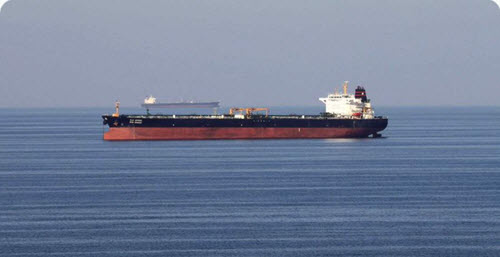
Oil markets have already begun to signal the severity of the disruption. The benchmark Brent crude price jumped more than 10 percent shortly after tanker traffic slowed near the strait, soaring past $90 a barrel and edging toward $100.
Analysts warn that if the war imposed on Iran drags on, prices could surge rapidly beyond $120 per barrel and potentially reach $140 or even $150 in the event of sustained disruption.
The implications extend well beyond crude prices. A spike of that magnitude would ripple through transport costs, manufacturing expenses and consumer prices across multiple continents.
Petrol prices in the United States have already climbed above $3 per gallon for the first time since November, and analysts warn that prices approaching $5 per gallon cannot be ruled out if supply disruptions deepen.
Military deployments, naval patrols and logistical operations across the Persian Gulf demand vast resources.
Each additional carrier group, each surge in aggression, adds to the fiscal burden at a moment when inflation remains one of the most politically sensitive issues confronting American voters.
The rise in fuel prices and the turbulence in financial markets have quickly become subjects of increasingly heated debate in Washington.
Observers highlight a pattern of escalation that has pulled the US deeper into regional aggression, closely aligned with Benjamin Netanyahu’s dangerous adventurist ambitions.
In economic terms, the costs are beginning to surface not only in military budgets but also in the rising price of everyday necessities.
The shock is even more severe in the global gas market. Liquefied natural gas shipments from the Persian Gulf are heavily dependent on the Strait of Hormuz, particularly those originating from Qatar, one of the world’s largest LNG exporters.
Nearly all Qatari gas exports must pass through the narrow corridor before reaching Asian or European buyers.
As the crisis intensified, LNG tanker costs in the Atlantic basin doubled to more than $200,000 per day, reflecting both the rising insurance premiums and the scarcity of vessels willing to enter the conflict zone.
The disruption has forced producers to halt or scale back operations. Energy companies linked to Qatar’s export network have already announced the suspension of several industrial outputs, including fertilizers, polymers, methanol and aluminum.
Press TV@PressTV
Trump’s Strait of Hormuz rhetoric aims to control oil prices; Iran has ‘major surprises’: Source
https://t.co/2hCfBY27jl
https://www.presstv.ir/Detail/2026/03/08/765132/trump-strait-hormuz-rhetoric-aims-control-oil-prices-iran-major-surprises-source
From presstv.ir
12:41 PM · Mar 8, 2026
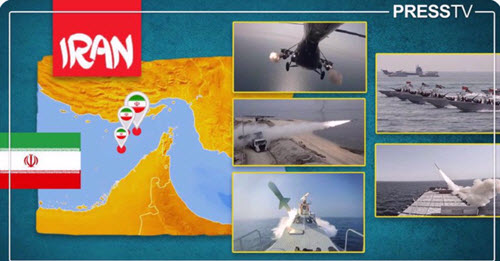
Without safe passage through Hormuz, the Persian Gulf’s production infrastructure cannot easily deliver its products to global markets. That reality exposes a structural vulnerability within the economic model of the Persian Gulf states.
Countries such as Saudi Arabia, United Arab Emirates, Kuwait and Iraq have built export-driven economies premised on uninterrupted maritime access through the strait.
Roughly half of the oil shipped through the channel originates from Saudi Arabia and the UAE, while the remainder comes from Iraq, Kuwait and Iran itself.
Alternative routes are extremely limited. Only two major pipelines provide partial bypasses, and neither has the capacity to absorb more than a fraction of the oil normally transported by tanker.
Should the closure extend beyond a brief disruption, billions of dollars in energy exports would be effectively stranded within days.
For the Persian Gulf economies, the implications extend beyond lost revenue. Budget balances, currency stability and social spending programs all rely heavily on energy exports.
A prolonged halt in shipments would quickly strain fiscal resources and potentially trigger financial instability across the region.
The consequences are equally acute for the world’s largest energy consumers. Since the outbreak of the Ukraine war, European countries have increasingly turned to LNG imports from the Persian Gulf to replace pipeline gas previously supplied by Russia.
A disruption in Qatari exports would therefore create not just price spikes but potential physical shortages.
The early signs of that stress are already visible. Gas prices in the United Kingdom have jumped by more than 90 percent, while LNG prices across European markets have surged roughly 50 percent to their highest level in a year.
Energy-intensive industries, including petrochemicals, steel and cement, face immediate pressure as feedstock costs soar.
These sectors operate on thin margins and cannot easily pass sudden cost increases onto consumers. If energy prices remain elevated, companies may be forced to reduce production or lay off workers.
Press TV @PressTV
According to the Wall Street Journal, if the Strait of Hormuz remains blocked for an extended period, oil prices could surpass the record of $215 per barrel.
Follow: http://T.me/presstv
10:40 AM · Mar 9, 2026
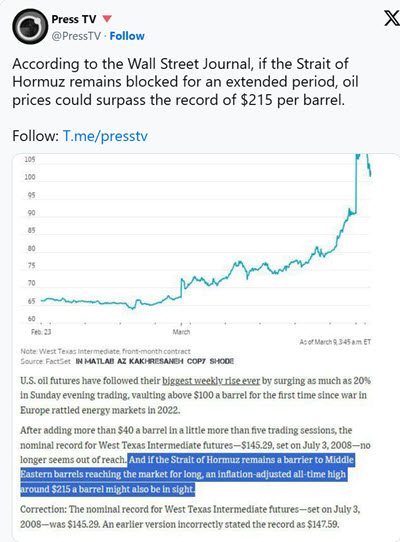
The result would be a widening economic shock extending from industrial supply chains to household finances.
Transport and logistics networks are also under strain. The temporary shutdown of the major container hub at Jebel Ali Port has disrupted shipping schedules across multiple trade corridors.
Airlines have cancelled thousands of flights throughout the region amid escalating security concerns, with roughly 3,400 flights reportedly grounded in a single day across seven major regional airports.
Every day of closure carries a significant financial toll. Analysts estimate that shutting down Dubai’s aviation hub alone could cost more than $1 billion daily in lost revenue and economic activity.
The occupying regime of Israel’s own economy has been slammed. In just the first two days of aggression, financial officials estimate direct losses at roughly $3 billion.
Shipping insurers, commodity traders and energy companies now face a stark calculation. For global markets, time is the decisive factor. Energy systems operate on continuous flows rather than stockpiles.
Even a few weeks of disruption can destabilize supply chains that stretch across continents. Governments may attempt to mitigate the shock by releasing strategic petroleum reserves, but those measures offer only temporary relief.
The turmoil exposes how the world economy hangs on a single maritime corridor, now imperiled by a fascist Zionist regime exploiting a corrupt, Epstein-tainted leader to shift the world’s gaze from his moral corruption.
What unfolds in the narrow waters of the Strait of Hormuz now reverberates across energy markets, financial systems and industrial supply chains worldwide, as the economic fallout from escalating confrontation continues to unfold across continents.
Iranian officials have declared that while the waterway is not yet closed, any ships linked to the US or the Israeli regime will be denied passage for as long as the aggression continues.
And the Islamic Republic reserves the sovereign right to decide the next steps.
- admin
- Site Admin
- Posts: 41470
- Joined: Thu Aug 01, 2013 5:21 am
Re: Part 2 Anti-Anti-Nazi Barbarian Hordes are Knocking Down
by admin » Sun Mar 29, 2026 1:11 am
US navy men 'ran for their lives' as Iranian forces struck USS Gerald R. Ford from 17 angles: Trump
Saturday, 28 March 2026 2:52 PM [ Last Update: Saturday, 28 March 2026 11:14 PM ]
https://www.presstv.ir/Detail/2026/03/2 ... -17-angles
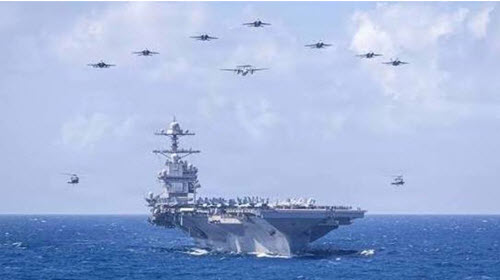
USS Gerald R. Ford
US President Donald Trump has reportedly detailed how the world's largest aircraft carrier, the USS Gerald R. Ford, came under a coordinated 17-angle attack by Iranian armed forces in the Red Sea.
Delivering a speech at a Saudi investment forum in Miami on Friday, Trump described the moments leading up to the attack as “a serious situation” for the US Navy.
He said the naval forces were prepared, but the intensity of the attack by Iranian naval forces quickly escalated the situation.
“It was one o’clock in the morning,” Trump said, when the warship came under attack “from 17 different angles.”
“We knew we were in trouble,” the president admitted.
“They were here, they were there.
We ran for our lives, it was over,” Trump said, citing one of his Navy commanders who was on board at the time the warship came under attack.
The US Navy's most advanced and largest supercarrier, which was deployed to West Asia ahead of US-Israeli joint military aggression against Iran, was engulfed in flames earlier this month.
Following the incident, the aircraft carrier retreated from its positions to the Greek island of Crete, as the Pentagon attempted to frame the withdrawal as a mere mishap.
US officials claimed that the ship was limping for repairs after a "non-combat-related" fire broke out in the ship's main laundry spaces.
The Islamic Revolution Guards Corps (IRGC) rejected the Pentagon’s narrative as absurd, asking, "What kind of military giant is this that faces a crisis and is forced to leave the battlefield due to a fire occurring in its laundry room?"
The IRGC had already warned that the presence of the aircraft carrier in the Red Sea made it a legitimate target for the Iranian armed forces, as its presence in regional waters constitutes a direct threat to Iran.
Iran’s armed forces have previously reported successful drone and missile strikes against another US carrier, the USS Abraham Lincoln.
Saturday, 28 March 2026 2:52 PM [ Last Update: Saturday, 28 March 2026 11:14 PM ]
https://www.presstv.ir/Detail/2026/03/2 ... -17-angles
USS Gerald R. Ford
US President Donald Trump has reportedly detailed how the world's largest aircraft carrier, the USS Gerald R. Ford, came under a coordinated 17-angle attack by Iranian armed forces in the Red Sea.
[Trump] Now, you know, we had an attack of 101 a few days ago. 101 missiles shot at a very valuable thing that we had floating on the water, namely an aircraft carrier, biggest in the world. And they were shot, 101, going 2,500 miles an hour. And out of the 101 missiles shot, 101 missiles were shot down. And the general, there was a general, a professional general, really good. And he said, "We were all set for them. We knew there was a problem when we noticed at 1:00 in the morning, every 32 seconds, another airplane, a very fast plane, was coming off the deck of an aircraft carrier." That's actually the biggest aircraft carrier in the world. "Then every 32 seconds, boom, boom, boom. And it was 1:00 in the morning. So we said, 'Okay, I think we're in trouble.' But they were ready for us, Johnny. And we were ready." He said, "We were ready, and then they hit us, and they came from 17 different angles. They were here, they were there, then we ran for our lives. It was over."
Delivering a speech at a Saudi investment forum in Miami on Friday, Trump described the moments leading up to the attack as “a serious situation” for the US Navy.
He said the naval forces were prepared, but the intensity of the attack by Iranian naval forces quickly escalated the situation.
“It was one o’clock in the morning,” Trump said, when the warship came under attack “from 17 different angles.”
“We knew we were in trouble,” the president admitted.
Press TV@PressTV
Iran's IRGC says that at least 500 US troops have been killed or injured during Iranian retaliatory strikes targeting regional hideouts.
Follow Press TV on Telegram: http://t.me/PressTV
7:55 AM · Mar 28, 2026
“They were here, they were there.
We ran for our lives, it was over,” Trump said, citing one of his Navy commanders who was on board at the time the warship came under attack.
The US Navy's most advanced and largest supercarrier, which was deployed to West Asia ahead of US-Israeli joint military aggression against Iran, was engulfed in flames earlier this month.
Following the incident, the aircraft carrier retreated from its positions to the Greek island of Crete, as the Pentagon attempted to frame the withdrawal as a mere mishap.
US officials claimed that the ship was limping for repairs after a "non-combat-related" fire broke out in the ship's main laundry spaces.
The Islamic Revolution Guards Corps (IRGC) rejected the Pentagon’s narrative as absurd, asking, "What kind of military giant is this that faces a crisis and is forced to leave the battlefield due to a fire occurring in its laundry room?"
The IRGC had already warned that the presence of the aircraft carrier in the Red Sea made it a legitimate target for the Iranian armed forces, as its presence in regional waters constitutes a direct threat to Iran.
Iran’s armed forces have previously reported successful drone and missile strikes against another US carrier, the USS Abraham Lincoln.
- admin
- Site Admin
- Posts: 41470
- Joined: Thu Aug 01, 2013 5:21 am
Re: Part 2 Anti-Anti-Nazi Barbarian Hordes are Knocking Down
by admin » Sun Mar 29, 2026 2:04 am
Kuwait Airport ON FIRE, Huge EXPLOSIONS As Iran Hammers US Ally With Deadly Missile Onslaught |Watch
Times Of India
Mar 28, 2026
Kuwait has reported a significant aerial security incident, with 15 drones detected over its territory within a 24-hour period, including activity near Kuwait International Airport. According to the country’s defence authorities, the intrusion triggered an immediate military response, with at least one incident resulting in a fire near the airport, later contained by emergency services. While no casualties have been reported, the development marks a notable expansion of the conflict’s geographic footprint. Kuwait, which hosts critical logistical and military infrastructure of the United States, has until now remained largely outside the direct line of fire on its own infrastructure.
Transcript
Kuwait has reported a new wave of aerial threats, saying drones were detected over its territory in the past hours,
with at least some targeting the vicinity of Kuwait International Airport. A spokesperson for the Kuwaiti
Ministry of Defense said the drones were tracked as they entered the country's airspace, prompting an immediate military response. The army confirmed
that one of the attacks led to a fire near the airport, which has since been brought under control by emergency teams. No casualties have been reported
so far, and authorities said operations at the airport were stabilized following the incident. The development marks a
significant spillover of the wider regional conflict into the Gulf as drone warfare continues to expand beyond
traditional battle zones. Kuwait, which hosts key logistical and military infrastructure, has largely remained on
the periphery of direct attacks, making this incident particularly notable.
Kuwaiti authorities have not officially attributed the drones, but the incident comes amid intensified exchanges
involving Iran, the United States, and allied forces across West Asia. The proximity of the attack to a major
international airport raises concerns about civil aviation safety in addition to military risks. Kuwait's response for
now has focused on containment and damage control. But the incident underscores a larger reality. The
battlefield is expanding and the lines between front line and rear areas are becoming increasingly blurred.
Iran has intensified attacks on the United Arab Emirates a day after a report by Financial Times said Abu Dhabi
is considering joining the United States and Israel to help secure the straight of Hormuz.
In the latest incident, the Iranian military launched crews and ballistic missiles along with drones toward the
UAE's capital, Abu Dhabi. According to UAE authorities, five people were injured after fires broke out in an industrial zone following the attack.
Abu Dhabi's government media office said the injured are Indian nationals who were hit by falling debris from
intercepted ballistic missiles. Their injuries range from minor to moderate.
According to officials, the media office earlier said authorities were working to extinguish two fires caused by missile
debris in the Khalifa economic zones Abu Dhabi. The United Arab Emirates defense ministry said its air defenses responded
to incoming cruise missiles and drones fired by Iran as Thran continued its strikes in the Gulf a month into the
regional war. The Abu Dhabi media office said relevant authorities in Abu Dhabi are responding to two fire incidents in
the vicinity of Khalifa economic zones Abu Dhabi ke caused by falling debris following the
successful interception of a ballistic missile by air defense systems. Further updates will be provided in due course.
The public is advised to obtain information only from official sources and to avoid spreading rumors or unverified information.
Meanwhile, two senior Iranian sources told Middle East Eye that tan believes the UAE is playing an active role in the
USIsraeli war on Iran, warning that any ground invasion could trigger widespread attacks on Emirati state assets.
According to one official, the Iranian leadership has decided to end a week's long period of tolerance toward Abu
Dhabi after concluding that the Emirati role went beyond simply hosting US military facilities already targeted in Iranian retaliatory strikes.
The official said Iranian intelligence believes the UAE has also made some of its air facilities available for
operations against Iran, adding that Abu Dhabi has served as an advanced platform for US and Israeli interests in the region.
He further claimed that part of this cooperation involved the use of advanced AI infrastructure inside the UAE to
support data collection and analysis for US and Israeli targeting, including information on Iranian figures and sites.
The official added that attacks on Iranian vessels, small boats, and coastal areas launched from UAE
territory would now be considered a major escalation by Thran, requiring a strong response.
The Iran US-Israel war has escalated further, turning deadlier as more regional players consider joining the
conflict. Struck by Iranian missiles and drones, the United Arab Emirates, a close ally of the US and Israel, is now
preparing to enter the fry. According to a bombshell report by the Financial Times, the UAE has informed Washington
and other Western allies that it is willing to participate in a multinational maritime task force aimed
at reopening the Strait of Hormuz, one of the world's most critical energy lifelines. The report citing two people
familiar with the matter said Abu Dhabi could deploy its navy to ensure safe passage through the strait. The UAE has
hardened its stance as it continues to bear the brunt of Tehran's retaliatory strikes following US and Israeli bombardments.
One source said the focus is on creating as broad and international force as possible. It's not about going to war
with Iran. Iran has gone to war with the global economy and countries need to stand up. The UAE is also working with
Bahrain on a UN Security Council resolution to provide a mandate for any future task force. However, Russia and
China, both close to Iran, could block the move.
Tehran's attacks have slowed traffic through the strait through which nearly ifth of the world's oil and gas
normally passes to a trickle. Gulf states fear Iran may try to maintain control even after the war ends. The
secretary general of the Gulf Cooperation Council said on March th that Iran is now charging fees for ships to safely transit the Strait of Hormuz.
Indeed, Iran's destabilizing behavior in the Arabian Gulf has challenged all boundaries as it proceeded to close the straight of Hormuz, preventing the free
passage of commercial vessels and oil tankers, and furthermore impose charges for transit through the straight. This constitutes a blatant and unacceptable
transgression, a clear violation of the United Nations Convention on the Law of the Sea. There have been repeated instances of vessel hijackings into
Iranian territorial waters over the past years or through their deliberate targeting in the Red Sea and the Horn of Africa by its proxies and affiliated
groups within the region. The Gulf Cooperation Council states have demonstrated the highest degree of self-restraint and chose not to
retaliate against these attacks to prevent the conflict from escalating,
hoping Iran would come to its senses and cease these aggressions.
Everyone knows that the GCC states have worked diligently throughout the past years to deescalate tensions uh in the region with utmost seriousness,
professionalism, diplomacy, and transparency. There is growing belief among some Gulf states and the Donald Trump administration that there is no
easy way to reopen the strait without naval escorts. The UAE, which has a relatively small but modern navy, is
pushing for a multinational Hormuz Security Force to protect shipping lanes, escort vessels, and ease a
blockade that threatens global oil supplies and supply chains. Bahrain,
home to the US fifth fleet, is the only Gulf state currently backing the plan.
The UAE is also seeking support from Saudi Arabia and other international partners. However, not all Gulf nations
support the US position. Oman has publicly criticized the US and Israel's decision to go to war and says it is
working intensively to ensure safe passage through the strait. Meanwhile,
US allies in NATO have resisted pressure from Washington to join escort operations. US Secretary of State Marco
Rubio has urged allies to step up their involvement. I'm here on behalf of the United States of America. I look forward to meeting with them. I don't know what
reception I would get from them. Uh I think they should be happy that I'm going to go be happy, but they're not happy with what's going on.
Well, again, I'm not there to make them happy. I get along with all of them on a personal level. We work with those governments very carefully. But the people I'm interested in making happy are the people of the United States.
That's who I work for. I don't work for France or Germany or Japan. These are all good people. We're going to have great meetings.
But I I work for them. The United States is constantly being asked to help in a war and we have more than any other country in the war in the world on a war
that's happening in another continent in Ukraine. But uh but when the US had a need, he didn't get positive responses.
So right now he's just making the observation that you know I think there was a couple of the leaders in Europe who said that this was not Europe's war.
Well, Ukraine is not America's war and yet we've contributed more to that fight than any other country in the world. So it'll be something to examine. uh the president will have to take into account
down the road. I'm not going to, you know, speculate on what it would take.
It can be open tomorrow if Iran stops threatening global shipping, which is an outrage and a violation of international law for all these countries that care about international law. They should be doing something about it.
Well, it's not help for us. Like I said,
very little of our energy comes through the Straits of Hormuz. It's the world that has a great interest in that, and so they should step up and deal with it.
Meanwhile, President Donald Trump has extended the deadline for Iran to reopen the Strait of Hormuz until April th. In
a post on Truth Social, Trump said he would hold off on bombing Iran's energy infrastructure for now. The problem with the straits is this.
Let's say we do a great job. We say we got %.
% is unacceptable because % is a missile going into the hull of a ship that cost a billion dollars, right? So % is un we can't if we do a %
decimation that's no good.
So it's really you know little little bit but I have a feeling it's going to clean up pretty quickly. I can just say this they they want to make they want to make and
I I probably hurt our little negotiation. And it gives them a little impetus to say, "Well, I wish you didn't say that." But they said yesterday that
we weren't negotiating with them, and now they admit that we were negotiating with them. So, they want to make a deal.
The reason they want to make a deal is they have been just beat to [ __ ]
You're looking at a coalition of ships to help, warships, to help protect tankers. How close are you to getting that coalition?
Well, we have a coalition for them, but they should have been up here a long time ago, and you know, they're affected. The amazing thing is we don't need the Hormuz straight. We don't need
it. We don't need it at all. We don't We have so much oil. Our country is not affected by this. We have more We have
twice the amount of oil as Saudi Arabia or Russia and soon it'll be three times the amount.
Despite mounting US pressure, Iran has significantly restricted movement through the strait. Before the conflict,
more than a ships passed through daily. Now traffic has dropped sharply with only a handful of vessels making
the journey. Iran's Revolutionary Guard has claimed complete control over the waterway which carries roughly /of
global oil supplies. Shipping firms remain wary. Data from analytics firm Kepler and shipping journal Lloyd's List
shows traffic through the Straight of Hormuz has dropped by as much as to % since early March as attacks, mines,
and security threats deter most commercial vessels.
Times Of India
Mar 28, 2026
Kuwait has reported a significant aerial security incident, with 15 drones detected over its territory within a 24-hour period, including activity near Kuwait International Airport. According to the country’s defence authorities, the intrusion triggered an immediate military response, with at least one incident resulting in a fire near the airport, later contained by emergency services. While no casualties have been reported, the development marks a notable expansion of the conflict’s geographic footprint. Kuwait, which hosts critical logistical and military infrastructure of the United States, has until now remained largely outside the direct line of fire on its own infrastructure.
Transcript
Kuwait has reported a new wave of aerial threats, saying drones were detected over its territory in the past hours,
with at least some targeting the vicinity of Kuwait International Airport. A spokesperson for the Kuwaiti
Ministry of Defense said the drones were tracked as they entered the country's airspace, prompting an immediate military response. The army confirmed
that one of the attacks led to a fire near the airport, which has since been brought under control by emergency teams. No casualties have been reported
so far, and authorities said operations at the airport were stabilized following the incident. The development marks a
significant spillover of the wider regional conflict into the Gulf as drone warfare continues to expand beyond
traditional battle zones. Kuwait, which hosts key logistical and military infrastructure, has largely remained on
the periphery of direct attacks, making this incident particularly notable.
Kuwaiti authorities have not officially attributed the drones, but the incident comes amid intensified exchanges
involving Iran, the United States, and allied forces across West Asia. The proximity of the attack to a major
international airport raises concerns about civil aviation safety in addition to military risks. Kuwait's response for
now has focused on containment and damage control. But the incident underscores a larger reality. The
battlefield is expanding and the lines between front line and rear areas are becoming increasingly blurred.
Iran has intensified attacks on the United Arab Emirates a day after a report by Financial Times said Abu Dhabi
is considering joining the United States and Israel to help secure the straight of Hormuz.
In the latest incident, the Iranian military launched crews and ballistic missiles along with drones toward the
UAE's capital, Abu Dhabi. According to UAE authorities, five people were injured after fires broke out in an industrial zone following the attack.
Abu Dhabi's government media office said the injured are Indian nationals who were hit by falling debris from
intercepted ballistic missiles. Their injuries range from minor to moderate.
According to officials, the media office earlier said authorities were working to extinguish two fires caused by missile
debris in the Khalifa economic zones Abu Dhabi. The United Arab Emirates defense ministry said its air defenses responded
to incoming cruise missiles and drones fired by Iran as Thran continued its strikes in the Gulf a month into the
regional war. The Abu Dhabi media office said relevant authorities in Abu Dhabi are responding to two fire incidents in
the vicinity of Khalifa economic zones Abu Dhabi ke caused by falling debris following the
successful interception of a ballistic missile by air defense systems. Further updates will be provided in due course.
The public is advised to obtain information only from official sources and to avoid spreading rumors or unverified information.
Meanwhile, two senior Iranian sources told Middle East Eye that tan believes the UAE is playing an active role in the
USIsraeli war on Iran, warning that any ground invasion could trigger widespread attacks on Emirati state assets.
According to one official, the Iranian leadership has decided to end a week's long period of tolerance toward Abu
Dhabi after concluding that the Emirati role went beyond simply hosting US military facilities already targeted in Iranian retaliatory strikes.
The official said Iranian intelligence believes the UAE has also made some of its air facilities available for
operations against Iran, adding that Abu Dhabi has served as an advanced platform for US and Israeli interests in the region.
He further claimed that part of this cooperation involved the use of advanced AI infrastructure inside the UAE to
support data collection and analysis for US and Israeli targeting, including information on Iranian figures and sites.
The official added that attacks on Iranian vessels, small boats, and coastal areas launched from UAE
territory would now be considered a major escalation by Thran, requiring a strong response.
The Iran US-Israel war has escalated further, turning deadlier as more regional players consider joining the
conflict. Struck by Iranian missiles and drones, the United Arab Emirates, a close ally of the US and Israel, is now
preparing to enter the fry. According to a bombshell report by the Financial Times, the UAE has informed Washington
and other Western allies that it is willing to participate in a multinational maritime task force aimed
at reopening the Strait of Hormuz, one of the world's most critical energy lifelines. The report citing two people
familiar with the matter said Abu Dhabi could deploy its navy to ensure safe passage through the strait. The UAE has
hardened its stance as it continues to bear the brunt of Tehran's retaliatory strikes following US and Israeli bombardments.
One source said the focus is on creating as broad and international force as possible. It's not about going to war
with Iran. Iran has gone to war with the global economy and countries need to stand up. The UAE is also working with
Bahrain on a UN Security Council resolution to provide a mandate for any future task force. However, Russia and
China, both close to Iran, could block the move.
Tehran's attacks have slowed traffic through the strait through which nearly ifth of the world's oil and gas
normally passes to a trickle. Gulf states fear Iran may try to maintain control even after the war ends. The
secretary general of the Gulf Cooperation Council said on March th that Iran is now charging fees for ships to safely transit the Strait of Hormuz.
Indeed, Iran's destabilizing behavior in the Arabian Gulf has challenged all boundaries as it proceeded to close the straight of Hormuz, preventing the free
passage of commercial vessels and oil tankers, and furthermore impose charges for transit through the straight. This constitutes a blatant and unacceptable
transgression, a clear violation of the United Nations Convention on the Law of the Sea. There have been repeated instances of vessel hijackings into
Iranian territorial waters over the past years or through their deliberate targeting in the Red Sea and the Horn of Africa by its proxies and affiliated
groups within the region. The Gulf Cooperation Council states have demonstrated the highest degree of self-restraint and chose not to
retaliate against these attacks to prevent the conflict from escalating,
hoping Iran would come to its senses and cease these aggressions.
Everyone knows that the GCC states have worked diligently throughout the past years to deescalate tensions uh in the region with utmost seriousness,
professionalism, diplomacy, and transparency. There is growing belief among some Gulf states and the Donald Trump administration that there is no
easy way to reopen the strait without naval escorts. The UAE, which has a relatively small but modern navy, is
pushing for a multinational Hormuz Security Force to protect shipping lanes, escort vessels, and ease a
blockade that threatens global oil supplies and supply chains. Bahrain,
home to the US fifth fleet, is the only Gulf state currently backing the plan.
The UAE is also seeking support from Saudi Arabia and other international partners. However, not all Gulf nations
support the US position. Oman has publicly criticized the US and Israel's decision to go to war and says it is
working intensively to ensure safe passage through the strait. Meanwhile,
US allies in NATO have resisted pressure from Washington to join escort operations. US Secretary of State Marco
Rubio has urged allies to step up their involvement. I'm here on behalf of the United States of America. I look forward to meeting with them. I don't know what
reception I would get from them. Uh I think they should be happy that I'm going to go be happy, but they're not happy with what's going on.
Well, again, I'm not there to make them happy. I get along with all of them on a personal level. We work with those governments very carefully. But the people I'm interested in making happy are the people of the United States.
That's who I work for. I don't work for France or Germany or Japan. These are all good people. We're going to have great meetings.
But I I work for them. The United States is constantly being asked to help in a war and we have more than any other country in the war in the world on a war
that's happening in another continent in Ukraine. But uh but when the US had a need, he didn't get positive responses.
So right now he's just making the observation that you know I think there was a couple of the leaders in Europe who said that this was not Europe's war.
Well, Ukraine is not America's war and yet we've contributed more to that fight than any other country in the world. So it'll be something to examine. uh the president will have to take into account
down the road. I'm not going to, you know, speculate on what it would take.
It can be open tomorrow if Iran stops threatening global shipping, which is an outrage and a violation of international law for all these countries that care about international law. They should be doing something about it.
Well, it's not help for us. Like I said,
very little of our energy comes through the Straits of Hormuz. It's the world that has a great interest in that, and so they should step up and deal with it.
Meanwhile, President Donald Trump has extended the deadline for Iran to reopen the Strait of Hormuz until April th. In
a post on Truth Social, Trump said he would hold off on bombing Iran's energy infrastructure for now. The problem with the straits is this.
Let's say we do a great job. We say we got %.
% is unacceptable because % is a missile going into the hull of a ship that cost a billion dollars, right? So % is un we can't if we do a %
decimation that's no good.
So it's really you know little little bit but I have a feeling it's going to clean up pretty quickly. I can just say this they they want to make they want to make and
I I probably hurt our little negotiation. And it gives them a little impetus to say, "Well, I wish you didn't say that." But they said yesterday that
we weren't negotiating with them, and now they admit that we were negotiating with them. So, they want to make a deal.
The reason they want to make a deal is they have been just beat to [ __ ]
You're looking at a coalition of ships to help, warships, to help protect tankers. How close are you to getting that coalition?
Well, we have a coalition for them, but they should have been up here a long time ago, and you know, they're affected. The amazing thing is we don't need the Hormuz straight. We don't need
it. We don't need it at all. We don't We have so much oil. Our country is not affected by this. We have more We have
twice the amount of oil as Saudi Arabia or Russia and soon it'll be three times the amount.
Despite mounting US pressure, Iran has significantly restricted movement through the strait. Before the conflict,
more than a ships passed through daily. Now traffic has dropped sharply with only a handful of vessels making
the journey. Iran's Revolutionary Guard has claimed complete control over the waterway which carries roughly /of
global oil supplies. Shipping firms remain wary. Data from analytics firm Kepler and shipping journal Lloyd's List
shows traffic through the Straight of Hormuz has dropped by as much as to % since early March as attacks, mines,
and security threats deter most commercial vessels.
- admin
- Site Admin
- Posts: 41470
- Joined: Thu Aug 01, 2013 5:21 am
Return to United States Government Crime
Who is online
Users browsing this forum: No registered users and 32 guests