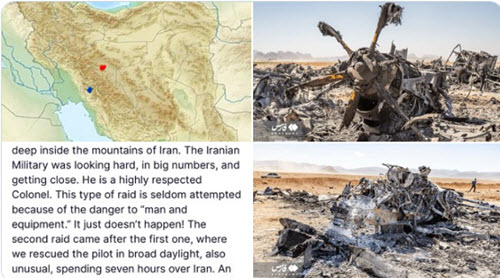
https://x.com/arashreisi/status/2040885998817591779 Arash Reisinezhad @arashreisi Emerging evidence suggests that U.S. operations south of Isfahan (marked in red on the map) were unrelated to any pilot rescue mission.
The downed American pilot was reportedly located in southwest Iran, near Kohgiluyeh and Boyer-Ahmad Province (marked in blue on the map), not central Iran.
Instead, this appears to have been a failed heliborne insertion aimed at locating uranium within Iran.
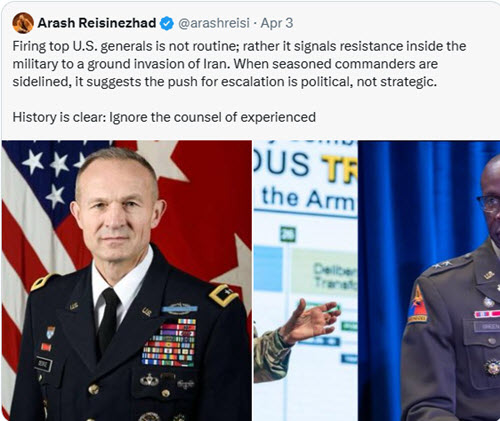
The recent dismissal of seasoned U.S. generals may not be coincidental; it may reflect internal resistance to such high-risk operations.
Given Iran’s increasingly effective air defense, and the apparent failure of this mission, the viability of future heliborne incursions deep into Iranian territory is now in serious doubt and may ultimately be abandoned.
Arash Reisinezhad @arashreisi Firing top U.S. generals is not routine; rather it signals resistance inside the military to a ground invasion of Iran. When seasoned commanders are sidelined, it suggests the push for escalation is political, not strategic.
History is clear: Ignore the counsel of experienced generals, and failure may follow!
Last edited 10:53 AM · Apr 3, 2026
***************************
Was Pilot Rescue A Nuclear Seizure PLOT Gone Wrong? Breaking Points Apr 6, 2026
Krystal and Saagar discuss the rescue operation of the downed US pilot in Iran.
Transcript
Very excited now to be joined by our friend Brandon Wert. He is a senior editor at com. Great friend of the show. Good to see you, man. Thanks for joining us. Thanks for having me as always. So, Brandon, we want to go through uh the story of this raid uh inside deep inside of Iran to rescue a weapon systems officer who was part of an F-crew which was shot down over Iran. Uh, of course, there's now an official story from the Pentagon. We want to get some of your reaction to all of that and potentially some other theories. Let's go and start with Donald Trump's announcement. We'll put it up here on the screen. He says, "We got him. My fellow Americans over the past several hours, United States military pulled off one of the most daring search and rescue operations in US history." He talks specifically about how all of the, you know, he get it's a miraculous operation, etc. The official story uh of the operation was recounted here by Jack Murphy. He is the journalist actually who broke the initial news that this weapon system officer had been recovered. Let's take a listen to what he said. We're going to get your reaction. But the broad pieces of it, as know, there was a F-pilot on the ground. He was escaping and evading for about hours uh inside Iran. And from what we can tell about the um the the effort to get him back, they did a lot of air strikes to keep the Iranians off of his back. The Iranians have flooded a lot of assets into the area. We're actively searching for him. And meanwhile, we have to get, you know, a ground team, helicopters in to actually extract the guy. And as we now know, they set up what's called a FARP or a forward air refueling point. So for like people who aren't familiar, when you have to fly helicopters, but also airplanes sometimes, especially long distances, you have to set up some sort of like a fuel depot. Um, you know, I did this many moons ago for little birds in in Iraq. you know, just driving out somewhere and taking a fuel bolivet out, leaving it in a field for a little bird pilot sometimes. This is a little bit more elaborate. There a Caircraft flown in that was refueling um some of these helicopters. And this kind of plays into, you know, how the pilot was actually pulled out of there. So, they occupied this improvised landing strip, set up the FARP, and the pilot was eventually pulled out by Littleird. So, they went in and extracted him. Uh, but then on the way out, the Cgot, as I understand, a wheel stuck in the sand. It like sunk into the dirt and the crew was trying to dig it out and that was resulted in some delays. It took them a while to get out off of that far. Um, and the Delta Force element that was standing by as a quick reaction force was actually called in. They came in and helped blow up the aircraft. I mean, I know Cone Cwas blown. Some media reports are saying two Cs. Um it I also believe at least one helicopter was blown up. I guess they just determined that they could not recover them and get them home for whatever reason. Um and after that happened, you know, whichever new aircraft, probably helicopters that they flew in um the QRF on, they got everybody on those and flew them back home. and they were uh they were back over the Persian Gulf probably around uh Eastern Standard Time last night. Um and that was pretty much the end of the operation as far as that's concerned, but I mean the air strikes are still ongoing. So that's the official story. Brandon, uh first zoom out, tell us a little bit about what happened here. What does it say strategically about some of the problems already with the United States? Then of course, you know, the bravery of the people who also pulled this off. Yeah. Well, I'll start with that last part first. I mean, I know that there's a narrative the administration is putting out and I know there's now a counternarrative possibly on social media and I'll just say in either event, I think uh the professionalism of the US military was on full display. Um and you know these these people that that we we have as an all volunteer force are extremely competent and they can execute missions under a lot of pressure and um you know even under some of the most strenuous circumstances. And so with that being said, I think we have to look at the larger picture here and say um this was our first taste of real ground combat in Iran. And uh you know, we we probably got the WIZO and the pilot as you know, the administration has said, we've gotten them back home, but look at what it cost us in the process. Uh my colleague Larry Johnson, uh who's a former CIA analyst, has said that's about $million worth of taxpayer equipment that was, you know, destroyed in the process of this operation. Um that is not sustainable, especially if you look at some of the logistical problems we're having already. Not only are we cannibalizing Indoaccom stock piles for interceptors and some of these JSUM ERS which are very long range extended range um long range strike missiles but also we're already pulling um KCrefuelers out from the boneyard which usually indicates that we really are strapped here uh for stuff. So the idea that we kind of had to blow up some of our own equipment there is which is the story coming out of the administration uh is very um disturbing because we can anticipate if there is a larger ground operation planned as people have been saying it's going to be even costlier than what we went through. This is a snapshot. Um and as for the operation itself it does seem it does seem like there was a lot of resources thrown into recovering to individuals. Now, I know we don't leave our people behind and we try to even if they're dead, we try to organize missions to bring their bodies home. That is something that's gone on. The R, you know, the Ranger ethos goes back to the French Indian War. So, we don't leave men behind. I understand that. But um the people online who are questioning the official narrative, I think are not wrong to because not only has this administration been very misleading in its official statements about everything in the war, but also it's a lot of resources and a lot of money thrown into one mission set. Yeah. So basically I I read the Reuters inside story of what happened. I read the Wall Street Journal inside story of what happened. And so the narrative is effectively, you know, this one F-was downed. The the pilot was rescued really quickly. The other guy uh was, you know, it was very difficult to find him. He's able to he's wounded, but he's able to sort of clamber up the side of this mountain, send off a distress signal. They're able to pinpoint where he is. The CIA also ran some sort of misinformation up to sort of throw the Iranians off of the case. They bring in something like a hundred special operators on these Cs. The Cs immediately, both of them get stuck in the dirt. Um, now I saw the pictures. We just saw some of the pictures. I don't know anything. It looks like the ground's pretty hard there, but who knows? These are very large aircraft, very heavy, etc. They bring in these little bird helicopters on the Ctransport planes. Those are then used to go and grab this guy, bring him back. But since the Cs can't get off the ground, they have to destroy the Cs. Plus, some reports say two, some reports say four of the little birds, bring in other aircraft, then rescue now this roughly uh men and potentially women who are now stuck behind enemy lines, get them all out, etc. At the same time, you've got Reaper drones and others who are firing in the surrounding area to keep the Iranians or anyone else away from the area where this rescue is happening. So what are as you listen to that narrative I agree with you I it's not you know it seems to me in line with the ethos of the US military that it would not be crazy to expend that amount of resources but is it actually necessary to expend that amount of res is this the way that a rescue op would normally go is this the normal amount of like I don't know what the the lang proper language is but is this the sort of stuff that you would bring to would you normally bring in men to accomplish this sort of thing what would be the reason for that the the only thing comparable to this level was actually the failed Carter administration, Operation Eagle Claw, which actually was very similar to what occurred in Iran this last weekend, where Carter had a bunch of seaw a bunch of transport planes uh meet navy uh elements in the middle of the Iranian desert and they set up kind of a refueling temporary refueling station and the whole thing went pear-shaped from from that moment onward uh which which it was very similar to here. And of course, in that case though, you had a lot of American hostages at the embassy. So, they needed to have an even larger military force that was able to kind of go in and and and get theoretically get them out. So, so for two guys, it just seems like a lot of a lot of resources were expended. Now the argument I think would be that the Iranian uh territory is very well defended and this was very deep inside their territory. So they needed to have enough stuff to punch a hole, land, minutesrefuel and then go out and um you know execute their mission and under a lot of a lot of hostile fire which we saw those videos coming out of Iran. It looked like something from, you know, like a battlefield video game where it was just incoming everywhere and you you very confusing modern combat situation. So I I think probably um this is not the norm in terms of the the amount of resources expended, but this is a pretty extraordinary instance. And if you know whether it was just a rescue operation or a rescue opera operation plus something else, the fact of the matter is this is a a preview of what to expect if the president really does pull the trigger on putting a larger force on Kar Island or Kashm Island or some other part of Iran. It's going to be a very messy situation. And I think that's what we're trying to underscore here. You know, nobody is saying uh nobody is trying to underplay, even if the official story is correct about how great it is to get a pilot back. But, you know, it doesn't make you a nine to say, "Look, that's really great that that happened." But, let's zoom out a little bit. We weren't even supposed to have aircraft being shot down, period. I mean, we have a we had two A-s go down. Can we go ahead and put uh what is it? Bup there on the screen. You have two A-s that go down uh in the span of hours. apparently is part of this operation. You have F-I mean, what that alone is a couple hundred million in aircraft. Two combat rescue helicopters. An Fhas to declare emergency, lands safely. A Strato tanker declares emergency over Israel. Has to land. And Iran also claimed that it had fired another US jet. Now, the last one has not been confirmed. all the rest of them. It's very clear, especially when you combine some of the tanker incidents that brought down those four Americans uh who died a few weeks ago over Iraq. It is very obvious many of our airmen are in much more harm over Iran than they ever were in the global war on terror, which is a shock to the system and would be only times more if there was any sort of ground invasion. So, I just really would love your perspective on that. Yeah. No, the the administration keeps saying that we have total air control and this this experience clearly indicates that that is not the case. Um the air defense network of Iran may be degraded. I fully admit it is likely degraded because of our attacks over the last what month now. Uh but ultimately it is not destroyed. And I think that any American who has family in the military should be aware that this mission set is not exactly as the Pentagon is claiming. It is not this walk in the park. It's not this spike the football moment. Uh this is a very dangerous uh and high tempmpo operation. It's straining our people. It's strain in the military. It's straining the already strained equipment and it's draining our already finite supplies of critical weapons and material at a time when the whole world seems to be stretching the American military juggernaut. So this is not the the the the rosy scenario that's being depicted in American corporate press. And I think this is very dangerous because I think this also misleads the president actually. I think the president starts thinking, oh well, you know, this is a cakewalk. I've got total control. I can then do the next step which is to put more troops on the ground and and we'll wrap this up in a few weeks. And that is not going to be the case. All right. So let's talk about the alternate theory. No one is saying this is proven, but um we certainly can't take this administration's word for literally anything. We also can't take the Iranian regime's word for literally anything. So, it's left to all of us to look at the evidence and ask us if we think that it makes sense and comports with reality. So, here is one example of the the way this theory is being put together. Let's go ahead and put this up on the screen. Um, so this is from a visiting assistant professor at Fletcher School and he says that he believes this was not just about rescuing this one airman, but that this was actually unrelated to the pilot rescue mission and the attempt here was to go in and try to grab the nuclear material. So I'll read what what he lays out. He says, "Emerging evidence suggests that US operations south of Isvahan, marked in red on the map, were unrelated to any pilot rescue mission. The downed American pilot was reportedly located in southwest Iran uh near these different provinces that whose names I definitely will screw up if I try to pronounce marked in blue on the map, not central Iran. Instead, this appears to have been a failed hellaorn insertion aimed at locating uranium within Iran. The recent dismissal of seasoned US generals may not be coincidental may reflect internal resistance to such high-risisk operations. Given Iran's increasingly effective air defense and the apparent failure of this mission, the viability of future helibborne incursions deep into Iranian territory is now in serious doubt and may need to be abandoned. So the idea here is effectively that you know I think it's it's not in doubt. an F-went down and there were two um individuals on board who had to be rescued. When they were rescued, how they were rescued, whether this was a rescue plus or whether the guy was already rescued and then they just used that as a cover to try this thing so that they could declare mission accomplished even if it went sideways. I think that is all all of this is, you know, is pure speculation at this point. But basically what people are looking at is the fact that you had so many resources de uh devoted to this that it was really close to Isvahan which is reportedly where most of the enriched uranium is that there seems to have been an attempt to set up effectively sort of like a temporary base um in this agricultural air strip that this attempt apparently failed and you know that you had to have blow up all of this equipment and then you know have others come in and to the rescue that this is indicative potentially not of at least just a pilot rescue, but it may have been another mission that ultimately failed. Yeah, absolutely. And and you know, I I wrote for the Daily Caller last week uh an opinion piece analyzing why I thought if we did do a ground incursion, it would be the Tom Clancy uranium hunt because uh that seems to be what President Trump has been fixated on is the prospect of a Iranian nuclear weapons breakout. Uh he's been talking about this for years. you know, to be fair to him, this is not something new. Um, he's been talking about it since the campaign when he was opposed to the JCPOA that Obama negotiated. So, that would have been the most consistent. And if you were doing the the ghost recon uranium hunt in the middle of the desert, uh, the kind of equipment that was brought in and the kind of planes that were brought in and the kind of, you know, out outlay of of resources, that's all consistent with a uranium hunt. Um, you know, they needed to set up an air strip. They they did. They needed to be able to have uh, you know, hold the territory long enough for heavier uh, equipment to ultimately be brought in. That didn't happen, but it very well may have been the next step if this was just more than a rescue operation. And the fact that it's in Isfahan, you know, or just near Isvahan, that that's the real that's the real thing that has a lot of very learned people. This isn't just internet conspiracy theorists. This is, you know, very learned people who are experts in foreign policy and national security who are suggesting that, hey, there's more to this story because the kind of resources that were brought to bear are not consistent with two people being rescued. Furthermore, the F-that was used in question is a two-seater Strike Eagle. That is a very specific aircraft that is uh used for certain kind of at times suppression of enemy air defense seed missions. Um that indicates to me also that there was some kind of escalation in the offing when that airplane was deployed in the first place to go out and and I believe it was deployed near Carg Island. Uh so ultimately there's there's some there's some very odd things going on here that do not align with the official narrative. And I think look it it genuinely could be both. The guy is nearby. Hey, also we need to be able to test. Put a landing strip down. Let's put all these people. If this works well, then we could build off of this. Uh, last operating base, right? So, that's my last question for you. Are you more so, so some people saw, oh, maybe Trump will take this as an offramp. Knowing his psychology, especially with Venezuela, they're going to sell this to him as a stunning success. This only makes ground troops more likely to me. Curious for your view. Oh, I think there's I think we're going in somewhere into Iran. I think now if anything you saw that that very troubling Easter message from the president and uh you know I was at my church yesterday and and we are they're all very proTrump but even they were like why did he say such a thing on Easter of all days. It's, you know, well, I think it's because he was reacting likely to what was really a disastrous I mean, they they pulled it off in terms of getting the pilots back, which again, that's that's excellent and good job. But ultimately, $million worth of equipment lost and, you know, the Iranians now have this big propaganda victory, etc. Um, I think that Trump now is going to want to double down because he's going to want to basically reassert his control over the situation, which means ground troops are next somewhere. And uh, that, you know, this is a snapshot of of how badly things could go and they will go badly. Um, and then after that, of course, the next escalation is is nuclear weapons. Uh, and as you know, I'm still very fearful that that is ultimately where this is headed in some fashion. Absolutely. So, you mean to tell me open the [ __ ] straight praise be to Allah was not the Easter message that churchgoers were expecting from our president? How strange. No, no, no. It was uh it was very jarring. Like, wow. I'd actually love to hear the cope on that one, but that's a segment uh for another time. Uh thank you, Brandon, for we always appreciate your analysis. Yeah, have a good one. Hey, if you like that video, hit the like button or leave a comment below. It really helps get the show to more people. And if you'd like to get the full show ad free and in your inbox every morning, you can sign up at breakingpoints.com. That's right. Get the full show. Help support the future of independent media at breakingpoints.com.
US satellite firm Planet Labs announces blackout on war on Iran images. Company says move amid US-Israel war on Iran comes after a request from the US government. by AFP and Reuters 5 April 2026
Satellite imaging company Planet Labs has said it will indefinitely withhold visuals of Iran and the region of conflict in the Middle East to comply with a request from United States President Donald Trump’s administration.
The US company announced the decision in an email to customers on Saturday, with news agencies quoting it as saying the government had asked satellite imagery providers to impose an “indefinite withhold of imagery”.
The restriction expands upon a 14-day delay on imagery of the Middle East that Planet Labs implemented last month, which extended an initial 96-hour delay, a move the firm said was meant to prevent adversaries from using the imagery to attack the US and its allies.
Planet Labs said it will withhold imagery dating back to March 9 and that it expects the policy to remain in effect until the end of the war, which began on February 28 when the US and Israel launched aerial attacks against Iran. The conflict has since spread across the region, with Iran firing missile and drone barrages at Israel and US assets, as well as civilian infrastructure across the Gulf.
Planet Labs, which was founded in 2010 by former NASA scientists, said in its email to customers that it would switch to a “managed distribution of images” deemed not to pose a risk to safety.
Under a new system, Planet Labs will release imagery on a case-by-case basis for urgent, mission-critical requirements or in the public interest.
“These are extraordinary circumstances, and we are doing all we can to balance the needs of all our stakeholders,” the California-based company was quoted as saying.
Military uses of satellite technology include target identification, weapons guidance, missile tracking and communications. Some space specialists say Iran could be accessing commercial imagery, including pictures obtained via US adversaries. Satellite images also help journalists and academics studying hard-to-reach places.
Krystal and Saagar discuss Trump covering up damage to US bases.
Transcript
Let's go ahead and turn to some of the ways that they're working to keep accurate information from uh you all and from the world and from us and everybody else. And this is really quite extraordinary. So, let's put this up on the screen. This is from Planet Labs. And we've talked a little bit about this before, but this is an expanded uh level of censorship here being done willfully by Planet Labs at the request of the United States government. So, this is from Alazer. They say US satellite firm Planet Labs announces blackout on war on Iran images. The company says the move is being made amid the US-Israel war on Iran and it comes after a direct request from the US government. So, previously there had been a hold on satellite data from the region with the idea being that maybe two weeks later we'll post the information so you're not getting real time looks from this private satellite company of what the damage is in the region and damage specifically to like US bases throughout the region. We still have very little information. We know that many of our service members have been pulled off of some bases in the region and are being put up in civilian hotels, which by the way in and of itself could constitute a war crime because you're then putting civilian you're using civilians as human shields. Um, in any case, that's our only indication of how much damage there is. You'll get a few photos out, a little bit of glimpse here, a little bit of glimpse there. But this private satellite company has just completely bent to the desires of the Trump administration here to hide how much damage there is. I would pair this with there was a report from the Intercept about the way that they are delaying and underplaying reports of casualties and even service members deaths to try to um you know to try to create a misimpression of how the war is going and downplay the damage. Now, I'm not going to say these things are really new in war. I think there's typically an effort to downplay the level of death, the level of injuries, the level of damage, etc. You know, Trump is very big and he had the very big on this whole victory narrative and they're obliterated, etc., etc. But for a private company to just go ahead and sort of collapse like this and agree to the whims of the US federal government is pretty pathetic. Well, first of all, yeah, screw them. It's also, don't forget this, you know, they have contracts, right? Like they have contracts with all these news organizations. I have covered war since and I have used open- source satellite imagery for every single conflict we have ever been in ever been in. This is from Afghanistan to these OSEN satellite images. And by the way, we were able to get them a couple of days after the incident. This now is cutting off everything from like what March uh it was like March th dating back to March th that they are withholding all imagery and that was some of the initial imagery that we had of US bases. America the American public has a absolute right to know especially with this government and the regime that you know that we've seen put in place over the extreme restrictions in the Gulf. I talked earlier about how people who are entering Oman are being told to sign these documents where they're not allowed to record. They're able to report, but they have to do some writing. In the UAE, you have citizens who can get arrested uh for or you have foreigners who can get arrested for, you know, publishing videos of missile strikes. I know that this is the place in place for much of the Gulf. There's really only one or two journalists who have even been gone to the Straits of Hormuz. Not saying that they don't have the ability to do so, but more so like that the governments are not letting them. You've only had two journalists, Western journalists who are able to go to Iran. Uh, one of them, remember the guy who we interviewed? Oh, that guy got bombed by Israel. Let's not forget that. So, the censorship regime now is dramatic in place. And actually, you have Chinese and Russian satellite because yeah, turns out, oh, nobody owns like geostationary orbit. Okay, so you've got a bunch of Chinese and Russian satellite companies. They're publishing everything or they're not publishing open source. They're sending it straight over to the Islamic Republic. And you can see how these Chinese and Russian satellites look what you think they don't want revenge, especially the Russians after all of these Ukrainian attacks that we have done on them that we've backed stop. We've given them all of this intelligence. They are salivating at this ability to try and destroy as much US military aircraft as possible to create this huge uh energy crisis in Europe. I mean, all I follow a bunch of accounts that are directly from the Kremlin. They're doing backflips over this. They're like, "Oh, this is the end of the European Union. Screw you. Oh, not so fun whenever it happens to you." Same in China. I mean, they're just sitting there. You know, seen the meme do nothing win from Xi Jinping. Literally doing nothing. just sharing satellite imagery. And by the way, they're doing a export ban on all of their oil. They seem to be doing okay, but the general tack of the CCP so far has been, let's sit here, we'll take some temporary hit on the oil market, but we are bleeding the West dry and we are destroying the ability of their navy. All we have to do is support Iran a little bit, few of these hit pin prick strikes and we can create significant chaos and damage in the US. Why wouldn't you do it? Well, you add that to the AI misinformation. People were sharing, including politician Greg Abbott shared this fake AI image of the supposed um airman who, you know, was shot down and rescued and whatever. This thing was spread widely. It's just completely fabricated. And I if any of you guys have gone on Twitter and tried to figure out what the hell is going on, it's a near impossibility. There's all kinds of fake strikes or repurposed video from this or that. It's very hard to sort through what is going on. You've got a whole bunch of authoritarian governments including Israel's that are involved here that are only showing the world the pieces that they want to show. You know, maybe strategically leaking something or showing something in order to uh some sympathy from the world, but otherwise lots of damage is being um undersold. And let me go back to that intercept report I mentioned because I think this is highly significant. So they uh at the intercept they say there's a casualty cover up. The Pentagon is hiding US losses under Trump in the Middle East. According to their reporting, this is from last week, almost US troops have been wounded or killed in the Middle East. Since October that's an analysis from the Intercept. But the Pentagon will not acknowledge it. Centcom, which oversees military operations in the Middle East, appears to be engaged in what a defense official called a casualty coverup, offering the Intercept lowball and outdated figures, failing to provide clarifications on military deaths and injuries. At least troops, they say, were wounded Friday in an Iranian attack on a Saudi air base that hosts American troops. That's according to two government officials who spoke with the intercept. Hundreds of US personnel have been killed or injured in the region since the US launched a war on Iran just over a month ago. They go on to detail the way that Sentcom has sent outdated statements on casualty numbers. They result in undercounts, including a statement sent Monday from spokesperson Captain Tim Hawkins, noting that since the start of Operation Epic Fury, approximately US service members have been wounded. That comment was days old and excluded at least wounded in the Friday attack on Prince Sultan Air Base in Saudi Arabia. Command did not reply to repeated requests for updated figures. They also would not provide a count of troops who have died in the region since the start of the war. and intercept analysis puts the number at no less than So they are they're cooking the books here. You know, they're underelling the amount of deaths. They're underelling the amount of injuries in a systematic fashion using outdated numbers and trying to deceive the news media. And so the Interceptor was able to catch them in some of this deception. Yeah. Not a surprise literally at all. Right. And so you could see uh pretty obviously that but also we all knew this was the case. Let's go through a few other examples. Do you remember the Saudi embassy, the US embassy in Riad when it got hit? And we were told just a fire. Don't worry about it. Turns out the fire raged for hours, destroyed a significant part of the embassy. We learned about it weeks later. Same with the bases. We've sustained minor damage. Now, we're being told they're basically uninhabitable and a lot of the troops there had to, you know, relocate to some of these hotels. This was the case for some of the radars that were hit. we were told it's no big deal. That's when the satellite imagery came out immediately after we're like, "Oh my god, this entire battery is completely gone." Uh, and so at basically at every turn, you should remember there's more damage than we know about. And the really big stuff like the tankers and remember, you know, some of those aircraft that we've lost that are on the ground, that stuff has to come out because it's so sensational. But lower level things about, oh, we're not living in the base anymore. Oh, actually the the embassy was on fire, but actually burned a lot more. I would not be shocked if energy infrastructure has been hit I would say five times harder that I mean what are you really going to disclose the amount of damage that has taken place in your oil refinery probably not you don't want to show how weak actually you are how close to breaking so I really think everyone should just remember the immense amount of censorship and then look Iran too they release all kinds of stuff they released something about some guy's skull that was in uh you know a US milit and you're like maybe I mean Look, it's I mean, is it possible that an American was killed and we're not told about it? I I find it very hard to believe. Oh, I find it very easy to believe. See, because I've asked around about this KIA is just a whole other thing. According to Intercept Report, there's at least two that we haven't been told about. And so, what they can do is I don't think they can delay it forever, but can they, you know, can they delay it? Absolutely. And these people will lie about things even that they know will ultimately come out. They just have zero shame. So no is that's not hard to be for me to imagine at all. I'm not saying the Iranian report is true. I'm just saying that that is not difficult for me to imagine whatsoever. And the other piece that is unaccounted for is we have I don't know how many contractors throughout the region as well. That's true. We haven't gotten any any insight into injuries among contractors you casualties among contractors and they're you know in many cases basically doing the same job as the US military. So in any case, um very very incomplete picture of what the reality is for um you know for for Israel, for our Gulf allies, for the US inside of Iran. Very limited pictures of what's actually going on here. That's right. All right, let's get to uh treat to Pari. Crystal is going to step out because she's got a train to catch. That's right. I'm going to New York. By the way, if anyone is in Brooklyn tonight, I'm going to be doing this Jack and Jackabin event um that I'm excited about. So see you guys there. All right, let's get to Tito. Hey, if you like that video, hit the like button or leave a comment below. It really helps get the show to more people. And if you'd like to get the full show, ad free and in your inbox every morning, you can sign up at breakingpoints.com. That's right. Get the full show. Help support the future of independent media at breakingpoints.com.
Iran AMBUSHES US Special Ops, Trump BEGS for 45-Day Ceasefire | Jon Elmer & Justin Podur Danny Haiphong Apr 6, 2026
Iran just exposed a major US ground operation masquerading as a rescue operation of the F-15 pilot and the consequences are devastating. Now Trump is responding with pleas for 45-day ceasefire while escalating the war rhetorically as Iran hits back for the 98th wave of Operation True Promise 4. Jon Elmer of the Resistance Report and Justin Podur of the anti-Empire project join the show to break down the latest military updates.
Transcript
Welcome everyone. Welcome back to the show. It's your host Danny Hi Fong and I am glad to announce that I have for the first time on the show John Elmer from the Resistance Report at Electronic Antifa and returning guest Justin Podor at the Anti-Empire Project. We have a lot to get to. So gentlemen, thanks so much for joining me today. Thanks for having us. Yeah, it's our pleasure. Yeah. Well, uh speaking of Resistance Report, John, how about we get started with you? I wanted to uh first play what Donald Trump said about this operation, the so-called rescue operation now shrouded in all kinds of I wouldn't even say mystery anymore, just v various uh reports on what actually happened there. We do know that Iran did undertake an ambush of these US special forces attempting to either rescue the pilot uh who was down or colonel or uh steal the uranium or both. We you know I want your take on this but here is what Donald Trump said about the uh uh the size of the operation and then I want to get your uh uh take on uh what exactly happened here and and why is it significant. Here we go. The second rescue mission involved aircraft, including four bombers, fighters, refueling tankers, rescue aircraft, and more. We were bringing them all over and a lot of it was subtrauge. So, John, I mean, that's a lot of aircraft and they did lose some aircraft, which I will uh pull up in as you're talking, but uh John, what what exactly happened here? How did Iran respond to this? What was the actually the nature of this operation in your assessment? Yeah, I mean, I think there's still obviously a lot we don't know, but from what we do know, um the the F-was shot down by Iranian air defenses. Um both pilots ejected and ended up in roughly the same area. Um over the course of several hours on the first day in the daylight um the uh US attempted the rescue operation and in doing that um basically got lit up. They lost the AWarthog that uh crash landed in uh in Kuwait. They lost a couple of Blackhawk helicopters. um they lost a couple of reapers in that operation and they failed and withdrew from that. And then what appears to hap has uh happened is that they went back the next day under the cover of darkness and that gives obviously the United States a massive advantage given um their capabilities. Um, and they successfully apparently got the uh weapons officer uh who was, you know, I think a lot of the story um that's left out is that like he was in communication with the US from the time that he goes down. He's got a transponder. They knew where he was. He was in he moved into the mountains. Um that was in a valley. What you're looking at there on the screen is in the valley. um he moved up into the mountains and was in full communication with the US and so um and the US didn't let anyone get within you know miles of the of the scene so it just isn't as heroic a story as is being u told you know the US has all the advantage in this situation I mean even just like talking about the troops that go in there the amount of you know the two Cs that were combat search and rescue Cs. Um they come in with special forces um who are trained to do this kind of operation all year round all you know for the last decade. They're the most uh elite trained troops in the US military and they have two million service members to call upon to cull um to get these in these um you know these special forces that could be inserted into this. Um, so given all of those advantages, the fact that they um apparently needed to blow up their um the HC-s before they left, blow up the helicopters before they left cuz they were stuck in the mud. I mean, I don't know, that story doesn't seem um super strong. I imagine there's going to be a lot more that we learn in the coming days. Um, but yeah, when you take a look at the resources that the US had and and that Trump quote that you played, he was saying that they literally took all of their resources in the region and turned them towards this single operation in the southwest of Iran in the mountains um away from cities. Um so a lot of the complexity of the operation um it kind of washes away when you when you see that analysis. Um so they did something that they are you know pretty good at doing both because of the resources um that they have and because of the training that they have uh you know for their permanent war state. H well uh Justin I wanted to uh now uh let's play uh the Iranian take and I'm actually going to read it because it's the military spokesperson of the RGC uh giving Iran's take of what happened here um mute it here uh and read it. So following the desperate efforts of the US terrorist army um and he continues to carry out a rescue operation for the pilot of its downed fighter jet. Several enemy aircraft entered our beloved country of Iran in the early hours of April th, A number of these aircraft uh including two Ctransport planes, military transport planes and two Blackhawk helicopters were hit and forced to make emergency landings in an area south of Isfahan. So, uh, a lot of people have been making note of the location, Isfahan, as possibly a staging ground of a, uh, an operation to, uh, do what Trump has been and the administration has been plotting, which is to seize the uranium from, uh, a nuclear site, uh, like Isfahan. And then there's was this uh, that I want you to comment on if you saw it. Uh it hasn't it hasn't been I don't think confirmed yet but this is from uh Iranian media RT reporting that someone named Amanda Ryder uh her ID her US Air Force ID was recovered from the wreckage and an Israeli visa was found. Uh hold on one second. Let me pull that up here. Here it is. Uh the ID of the US Air Force's Amanda Ryder was recovered from an aircraft wreckage after the rescue mission an Israeli visa was found. So Justin, your comments. What do you think is going on here? Um, you know, Ron says they took American casualties. They saw it with their own eyes. But, uh, the US, Trump, Hegseth, they came out today and said God is good. Everything went very smoothly other than blowing up the aircraft as John noted. Yeah, we we don't have um a lot of really high quality information. So, we do have to use logic here um where we can and I I don't see how that much destruction could happen with manned aircraft and soldiers and have no one die. But, and I also we also have to remember that according to American sources, virtually nobody has died ever fighting Iran. Um there always injuries uh there are lots of injuries and then people die in accidents afterwards. So I you know this one I I do think that if there were um a lot of US casualties there would be that that graveyard of of aircraft that we saw would have had lots of dead bodies as well unless the Iranians took them away. But it's it's uh what the the the patterns that I've seen so far are that Iranians more or less have been telling the truth as they've seen it. Um and and when they before this rescue operation concluded, I saw a message from I think one of the Iranian um sources where they said, "If we did have them, we wouldn't tell you." So it was sort of like that even that's truthful in a way, right? They're sort of like, "We're not going to tell you." Um, but I don't I don't see them like manipulating the the site in that way or or anything like that. I mean, um, so I I don't know if there were huge casualties that the Americans are saying uh didn't happen. I do think, you know, if they wanted to, because we did hear a little bit about this uranium uh snatch plan. Um, the idea was, as I heard it was that they were going to go snatch the uranium, uh, build a runway and fly out. I guess they found this runway near Isfahan, so that that solves their runway problem. Um, but, uh, I it still seems it seems like a big force, too big for a rescue, but it seems too small for a uranium snatch. So, I I think maybe they were just trying to build a base. Like the first step of a ground war is to um you know, set up a base somewhere where you could then start loading tons of other stuff and material and and maybe they you know they did their map, they analyzed their maps and they were like here's a runway. We can turn this into a base and we can go from here. And you know, the other the other consideration like John was saying, you know, the the the the dream of like a go in and do something and get out like that's the that's the model that they're going on. They were really pleased with how that went in Venezuela presumably. Um because Venezuela was preparing for a long guerilla war against an occupation and the uh the the Americans just went in for a couple seconds and left. So leaving the Venezuelans with nobody to really fight and no nothing to get going. And um so the Iranian um the Iranian defense plan is presumably also like they have millions of men. They they have people ready to fight. Uh they know the Americans very well. They have uh lots of equipment, but they they have a gigantic area to defend, too. So they're not going to be there in numbers in every every corner where the Americans can fly to. It's going to take them a while to get there. Maybe a lot of them would have to drive there. You know, the drones would get there first. So you know, some remote corner where the Americans are trying to set something up and get it going and it takes the Iranians a while to get there and then there's a battle and the Americans withdraw. That that all makes perfect sense to me in terms of what happened. None of the stuff about pilots and rescues and Amanda's um I mean Amanda Ryder like it's a bit on the nose in terms of like making fun of the name and stuff, right? Like like Amanda, it's a real person supposedly. Did the Americans leave that there? I don't know that the whole thing is weird to me. Like like recovering the pass like the recovered passports after Like how how does there an ID? Like, did she why'd she bring her ID on a on a mission? And I don't That's always the question. I don't understand it. Is that what you do? I don't know. I I Yeah. No. Great. Well, uh I think those are really good questions. And uh John, I mean, if what Justin is saying is true, and there's a lot of I think uh good points to follow there uh toward uh the truth of the matter, uh that means the US failed dramatically because there is no forward operating base coming out of Iran after this operation and the US has refused to acknowledge any such thing. Uh this is just a heroic operation to rescue one guy who happened to be a colonel with what many say a much higher ranking than what you would normally take on a standard mission um that he was on. But then you know uh there's all this talk about this being an operation. Many people are saying that this is a fake story that simply this is about stealing the uranium and making that forward operating base. So, John, your final your comments on this. I mean, you know, uh, how did Iran in particular, uh, hit back so hard because this is being underestimated? The Trump administration is saying they didn't do anything there, but yet there's videos everywhere of a gunfight. You know, we hear it. Uh, and Iran is saying even in their Lego videos that everybody was involved. People were stopping traffic and, you know, helping the, you know, the uh, local forces get to the location. I mean it and obviously a lot happened there. Yeah. I mean I think I'm not sure about the forward base. I'm not sure the value of that kilometers in uh in land. I think it's on the wrong side of the mountains if the target. So I'm not sure about that in terms of military logic of of why you would you know you would have a long um supply line from there and that is going to be hit by the integrated air defense systems that the Iranians run and they run them on a guerilla style where they set up ambush zones um rather than have an umbrella defense. Um and so if you were if you were trying to feed that base, you would be coming along a track of land, hundreds of kilometers track of land um in which the Iranians would be able to use um their you know surfaceto-air ambush tactics for um air defense. So I I'm not sure about that. I mean, this is the thing. I think we could speculate a lot of of of what might uh be, but based on the evidence that we have right now. I um you know, I'm inclined to believe that they lost a pilot by an air defense operation by the Iranians and then when they went to get the pilot, they lost a bunch more assets. Um that made it a dicey operation at which point they withdrew effectively. They withdrew for a day and a half um and then went back in at a time in the night and botched the extraction in a pretty spectacular way to lose those planes. Um, so yeah, I mean it's the difficult part about the, you know, the way that the US has handled information in this war, like lying about things that are already proven and then hiding things that we know these bases have been targeted. We know they're lying about their casualties. The question is how much they're lying about their casualties. Um all of those things I think if we knew them would put a much more um you know how many were injured just in the extraction of that single um that single you know weapons officer um and then they didn't on the second day they didn't have the AWarthog uh close air support um so it's just uh you know it it took the most financed uh military on earth, the most well-resourced uh military on Earth with the most soldiers. Um to to to get one uh pilot out of a or one weapons officer out of a you know, pretty much barren mountain area. Um you know, if that if that had have happened in an area where people could reach it easily, I think we would this would be just a completely different story. And I think that the that that mountain range, I mean, I was looking taking the Google Earth drive, you know, around to try to see what would make sense for the Americans, you know, they don't, you know, they don't need an air with those uh search and rescue combat search and rescue um Cs. They don't need runways. I mean, that's that's the selling point of them, but it sure sounded like they needed a runway. So it's, you know, it's not clear that this was uh as successful an operation as they as the US is trying to frame it. And it would have been, you know, I mean, it was uh really egg on the face of the ridiculous statements of Trump saying that there was zero air defenses and then you get so many assets lost, it doesn't fit on a single page. Um, yeah. Yeah, you can go with with the right infographic, you can fit it on a single, make sure it's to scale. Yeah. No, that's very true. Uh well, Justin, I mean, with uh what John just said there, uh we had Pete Hegth say call this operation uh incredibly humiliating for Iran's uh military. And they know it. They know that this was incredibly uh humiliating for them. Uh and yet Iran doesn't seem to be acting like that. They're incredibly humiliated. Actually, Iran on the other side is saying, "Well, we responded very quick to this violation, you know, on our territory." And they're claiming that these losses that I had pulled up earlier uh are theirs. That the the US did try to blow up. They claim that the US tried to blow up the pilot himself and they try to blow up anyone that that they couldn't retrieve uh you know as they try to high-tail out of there. But you know what do you make of uh these comments by Hegseth? And let me actually uh play this from Heg Seth because this is I think why people can't really believe the United States right now about anything in this war the theatrics of it all. I mean just listen to this short comment that he made at the press conference about what uh happened in the beginning of this whole ordeal. Airman evaded capture for more than a day, scaling rugged ridges while hunted by the enemy. When he was finally able to activate his emergency transponder, his first message was simple and it was powerful. He sent a message, "God is good." In that moment of isolation and danger, his faith and fighting spirit shone through. You see, shot down on a Friday. Good Friday. Hidden in a cave, a crevice all of Saturday and rescued on Sunday. Flown out of Iran as the sun was rising on Easter Sunday. A pilot reborn all home and accounted for a nation rejoicing. God is good. So, it's a biblical prophecy. everything that just happened here just according to you know you know given that Trump said uh you know praise be to Allah I was I would have thought Haggath might have said God is great instead of God is good right translation pilot was probably saying that for sure how do we translate God is great into Arabic again so um so I just um and the other thing is like why is the pilot's name a secret like He's Wouldn't it be cool to have a ceremony with the pilot like you know at the White House and maybe his family especially for US lore. I mean isn't it the pinnacle of of US exceptionalism to show how heroic this guy was. They do this for for lesser things like shoot you know shootings all of this. I mean this is crazy. But anyway continue. Sorry. He should be on the Yeah, he should be at that he should be at this meeting. I think it's I think it's unfair that he's not he doesn't get to be at this meeting this brave colonel. And I also feel like um oh what what do you call them? The internet [ __ ] ought to be able to process of elimination figure out who he was. I mean colonels are not like this is he's not like a covert operator, right? He's pro he's is he an army colonel or a marine or something? How many colonels are there? There are there thousands of colonels deploy like I just think this like I don't know if there are people are saying it's because he's dead. I don't know if there ever was a colonel. I don't know. I don't know if there's any reason I don't see any reason to believe any of the any of these plot points. Like I I'm you know I'm partly criticizing this as a as a fiction writer here. um some of this stuff is is not a very good writing and and so you know you you want your story to hang together. You want there to be some logical progression from one part of the story to the next and and a lot of it is missing here. So, um, you know, we have only their word on all of this, on this pilot going missing, the pilot, you know, existing, um, the the story of him going to, you know, going to this hiding in a crevice and then flying to safety. We don't know anything, you know, and I don't believe anything they say. uh you know I I I the the the thing that I'm looking for is Iranian sources and they're not saying all that much. So it's hard to know there too cuz even the ones that say claim to know like I've seen officials say the whole story will come out but they didn't they don't say here's the story. They say you know we'll see that they're all saying it wasn't a rescue. So the Iranian sources that I've seen are all saying it wasn't a rescue. It was a much bigger thing. and uh it'll be revealed in due course. So the only credible the only sources that have told anything resembling uh accurate information are not explaining what happened. Yeah. And we should watch what we wish for because this this guy may end up getting a movie that uh that's fine. That's fine. He can have a movie. Well, uh you know, there were also some uh reports. I don't know if you saw, one of the big questions people had was uh how did this person uh walk so far um in order and survive uh I believe it was hundreds and hundreds of kilometers uh likely up uh uh mountains or various mountains, hills, whatever in that region. Uh even Pete Hegseth said crevice cave, right? Those are two very different things. Uh there's a lot uh of storytelling here, John, but maybe you could tell us what exactly does the lay of the land of the actual battlefield look like because Donald Trump, you know, just as all this is happening, it was reported that he through mediators is really trying to push a day ceasefire and um that's kind of the um uh where we are hanging right now is this Iran has to accept a ceasefire or it's going to get obliterated again. Right. So your uh your take on the lay of the actual battlefield lands right now? Yeah, I mean I think if the sites that we saw burning, which I think are obviously the sites of at least a significant portion of it, um it looks like they landed in a in a valley in a you know in a in a wadi and that there was a a mountainside right up from there and that he climbed up some amount of distance to get off of the ground. and then they had drones over him the whole time that didn't let anyone get within miles of him. Um, so those engagements prevented, I think, any kind of Iranian rescue, which was the point cuz they knew where he was. I think, you know, they have transponders, they have encrypted communications, they have a whole setup for this to happen. Um, so it wasn't like they were looking for a needle in a hay stack, which is the way that they like to make it seem like they did this heroic, you know, deep inside Iran operation, but um, in reality, he was pretty sheltered on the mountain side. Um, if you have drones over him, constantly shooting at anyone that approaches. Um, so yeah, I I think that the the the heroism of this story, I don't see it. Um, I I I just don't see it because of the evidence that we have seen right now. Um, the attempt to get him on the first day. I mean, maybe it's a she to get them on the first day um failed pretty spectacularly. Trump says the entire uh air every air asset they had was def deferred away from the battle and focused on this person and and rescuing this person. And with that they the air defense systems of the Iranians were able to take down I mean they've been able to take down basically one of every kind of plane that the Americans have flown so far. Um, and and I think that if there, you know, they had tried that again in the day, I in the daylight, I think probably the same thing would have happened. I think they got the small um window of the night to get the person out. Um, and I I guess that's just really all that we know at this point. Um, if you look at the at the Google Earth of where the plane went down, you can pretty clearly see the mountain that he would go up on and that he could get up on it. It was pretty gradual. Um, you know, it wasn't sharp cliffs. It was um, yeah, I mean, I think the crevice comes from the fact that it it looked pretty spiny all the way up. So, you would just get into one of those tracks and and and hike to safety, at which point your, you know, your guys are communicating with you that you're going to be rescued and that people aren't going to come up to where you are. Um, so that from that point, it seems to be it, you know, the the plane went down in a in a sparsely populated area. for sure it's within distance of uh Isvahan but again I I don't see the for there to be a forward base there I mean it would be under fire from all sides and then there would have to be this kilometer inland um supply line that would have to be completely secured so I mean I don't I don't think they can get a beach head uh you know from the straight of Hormuz let alone hundreds of kilome in. And I would suspect that the reason there wasn't more planes taken down was because they didn't need to send more planes once they knew where the guy was. The the goal was to find a time that you can go in and get them where you don't lose uh all your assets or your human assets. Um and they did that, but then they lost their assets. So, it's not really u, you know, a clean mission. It's definitely not, you know, the Hegsth story. Uh, I mean, they they said at one point he was injured. So, if he was injured, seriously, he said he was seriously injured, too. Trump did. Yeah. To then climb. I don't know those. But, yeah, I think that Why do we not see the person's name? I I can't remember a time where there's been a story like this that we haven't um that we haven't seen the names and it just matches with all of the secrecy of this um war because I mean because frankly the Americans are not winning this war. They're just not. and um you know all these threats about you know tomorrow night this show might be stale by p.m. tomorrow night when you know Trump escalates the war to a level um that becomes no one has ever seen no one's ever seen the biggest ever um but it you know if that were to happen the Gulf states are going to be eliminated and so that you know that style of warfare that Trump is threatening is really cat I mean it'll be catastrophic for Iran but it'll be catastrophic for the US uh footprint in the region because the countries that are all in the Gulf right across you know right across the lake from Iran all single point of failure um um infrastructure right like desalination plants their fuel deep I mean they're small countries so they you know their fuel um their energy projects aren't all spread out over um the land like Iran's are um I just think that that escalation that is not going to win the Americans the war. It it's going to redraw the map of the Middle East. And I don't know if I don't know if Trump has I don't know if he has that in him. I guess we're going to see. Yeah. Well, uh this he said uh Justin at this press conference that uh the entire country could be taken out in one night and that night may be tomorrow night referencing this I think p.m. Eastern time deadline. Uh Iran though has uh essentially given the middle finger to this deadline and to any ceasefire proposal like the day one that has been relayed through Pakistan. uh Pakistan uh Iran rejects temporary ceasefire and instead demands what it's been demanding since the beginning of the war which is a permanent end to all theaters in the Middle East all war theaters Lebanon Gaza Iran with guarantees implementation of a transit protocol that recognizes Iranian control over the straight of Hormuz which is essentially already underway the lifting of economic sanctions on Iran and acknowledging the right to peacefully enrich uranium under the NPT and UN charter and paying reparations for damages So, doesn't seem like Iran is uh capitulating here, Justin. So, uh what does that say about then where this war is? Trump and it feels like Trump and the chief of staff and Pete Hegth and John Ratcliffe, they were trying to portray a lot of confidence and that things are going very well at the moment. But uh maybe you can help us understand what this tells us then that Iran is rejecting the ceasefire despite these massive threats. When you look at the when you look at the overall picture of who how this war has been conducted um and like you just try to ask yourself who which side of this war looks like it's implementing a plan that it's step by step following. if they do this, we'll do this. If we see that, we'll do this. And and we march towards our objective in a kind of systematic way. And which side seems to be making up objectives um as they go along? Like the US has like I I had this tweet the other day that did pretty well where I said, you know, they started off with their objective being preventing weapons that weren't being made. They moved on to trying to open a straight that wasn't closed and then they moved on to trying to rescue pilots who weren't missing until after their operation. So they're they just keep um moving on from one plan to another. Uh I don't you know as legendary even if you take them at their word about how wonderful and legendary and unprecedented this rescue operation was. it was a rescue operation. Um, so presumably already if you're doing a rescue operation, something has happened that you didn't want to happen in the first place. um the the escalation um ability of Iran uh is has you know for anyone who's paying attention including the Americans it's been definitively shown uh every time they've said they were going to destroy something they said if you do this we're going to destroy that then the Israelis destroy something they say okay you you destroyed this thing we said we were going to destroy that tomorrow we're going to destroy that and then they do the next day they destroy it. So similarly now Trump has said uh I'm tomorrow I'm going to destroy the power plants and bridges and the Iranians have said if Trump follows through with this foolhardy plan we will destroy everything uh in an irreparable way. And so I, you know, I I just don't see any reason anybody should have to think that they're bluffing. Um, they're not they have not they haven't even once done that. So there's a there is now now the the the last thing I'll say about this is um if if you take like John was saying he you know he he has this phrase the the single point of failure infrastructure. If everything in the Middle East is turned into ash um Iran will rise from the ash. Um, so so will Palestine and and Lebanon and probably Syria and some of these societies. Um, but the Gulf States will not the Gulf States are uh, you know, they're not societies. They're theme parks, right? Uh, somebody I saw that on online. Somebody said, you know, if you if you work if the people who work in a place can't afford to live in that place, you you're not you don't have a city, you have a theme park. And the Gulf States are theme parks. um they won't rise from the ashes and and and you can't there's no such thing by the other okay really the last thing there's no such thing as taking out a country in a day not a you can you can if you're willing to use nuclear weapons take out a city in a day um and you know as horrific as that is you can't take out you can't there's no mechanism for taking out a country of million people that's the size of France and Germany combined in a day if people think about France and Germany combined and or or some contacts that they know a little better. They'll they'll see there's no way to take you can maybe destroy the entire planet. It might be it's a problem on that order. So again, Trump doesn't know what he's talking about. Yeah. I I mean I I just a second that like the Gulf would be wiped out and and it's not hard to do because the Gulf is essentially a collection of cities, right? It's not they don't have hinterlands. Um yeah, it's they don't have mountains that they're b they've buried their missile cities in or their you know resilient or their desalination plant. Like I if that plant goes and you don't have water, it's not, you know, like it doesn't take a water geologist, whoever rocket scientist for water geology to tell you that you're not going to last long in the Middle East, uh, if you're desalination plants. And those have been targeted. Those are said to be targets. And every time Iran says they're going to target them, they do. Um and every time the US tries for escalation dominance um they really just strengthen Iran's hand at this point. And now sitting here days into the war, Iran is in the process of overthrowing the sanctions regime, recovering their currency through the straight of Hormuz uh toll booth. um you know making their ally their countries around them in their neighborhood more likely to not want war than to end this war saying we need more weapons to protect against Iran. I think they're going to look at the Gulf and say it makes a lot more sense for us to be allied with the people who are you know controlling the strait where our fuel exits. So, it's just really, you know, I Trump never has like a program, but whatever this program is is all in Iran's favor and he I don't see what the way out is if Trump other than to wake up one morning um and just say the war's over and then at that point, does Iran decide the war is over? Does Israel decide the war is over? And I think that's one of the really important things that have come from this war is that Iran in those points that you listed, they want all the wars on all the fronts to end. And that is the thing that the region is desperate for because the ceasefire in Gaza is garbage. It's just a a license to kill. Um and it's been consistently that way. And if it it is to continue in Gaza that you can just assassinate any Kasam figure or any government figure at any point that cannot continue. That's the situation that was in Lebanon because they also had a garbage ceasefire that allowed Israel to just assassinate everybody. If if Iran is able to enforce ceasefires in pal in Palestine and in Lebanon, um the strength of that uh axis of resistance and that alliance that you know over at some points over the last years has been called into question is absolutely not under these circumstances. they have the power to um to be the dominant force in the region and they're carrying out the war in that way. They're not firing ballistic missiles that will leave them with nothing or little to enforce the period after the war. They're seeing a life after the war where being continually um able to fire at any point is a crucial part of their long-term strategy. whereas the Americans are in this race where they're, you know, they have a finite number of interceptors. Um they're trying to make do with them and at some point they run out and it's it there's not more coming and the longer the war goes on, the more it's in Iran's favor. And Bloomberg recently tried to count the JSUs, the stealth cruise missiles that they have, and they counted uh not very many left. And when they run out of those or get close, they're going to start doing more more runs of their bombers over Iran, exposing them to air defense. And many more planes will be shot down. There will be planes shot down like we've never seen before to Yeah. Donald Trump might have difficulty holding himself back. And so, and I I do, by the way, I I do think I do think that that's what's going to happen. I don't think the Americans are going to call it off. I don't think they're going to stop. Um I think they're going to go way beyond what most of us thought their tolerance was. I think their tolerance for um protecting Israel and allowing the Gulf to be destroyed is going to prove to be a lot higher than we thought. And uh and I think Iran um would like would have liked it to be otherwise, but I do think Iran uh is prepared for that possibility as well. And I think that like the way, you know, the way you put it, John, like I think that Iran wants to inherit whatever is left of the region as the hegemon as the rightful hegemon of the region. Uh morally as well, like Egypt could have been the hegemon of the region and Turkey could have been the hegemon of the region. They're both in the region. They're both big. They're potentially strong, but they just decided to give away their sovereignty to America and Israel. So that it leaves it to Iran. Uh, and if Iran and Iran doesn't want to destroy everything, they don't. Why should they? They're going to they're going to be running the place after. Um, and uh, and and so I I that's what I think is behind the restraint such as it is that we've seen. But once once bridge what are they what's he calling it? Bridge day. Once bridge day and power plant day power plant day, there's no longer any reason for Iran to to not uh respond in kind. So yeah, and the US propaganda is that they're firing at, you know, innocent civilians in these Gulf countries, but there's no record of that whatsoever. Um, so they have seemingly been fighting this war uh as if these countries are going to be their neighbors when the the war is over. And part of driving the US out of the region um is to be allied with those countries. Um so but but once yeah once you're destroying you know the Iranian nation um and using those countries to do it um especially if they're running out of uh you know long range aerial cruise missiles. They're you know going to be firing their attackums and their precision strike munitions from those Gulf countries. Um I yeah I think all bets are off. Yeah. Yeah. I mean uh and what is you know with the word the it's it's almost like a different kind of of war of attrition. not like the one we see in Ukraine, but one where I don't know if you heard John and Justin that you know the Iranians are saying that they are not only are they firing very strategically obviously but they're also producing still that they're not it's not like they're just loading up their the missile launchers or underground launchers whatever and the missiles are going and that's it. No, that they actually have a production system that's uh still happening um mainly underground. uh that the United States cannot hit and that the New York Times even uh said the United States cannot hit because they think they're all deco, you know, they they're just mistaking decoys for actual missile systems. And that's led to this uh this is even JP Morgan talking about how uh especially against Israel, the hit rate that Iran is uh essentially leveling onto Israel has increased dramatically. And now we're hearing something like eight out of missiles that Iran fires at Israel are getting through. And uh every day we see the results. And I'll put those up. Whoever wants to comment on this. I mean that this seems to indicate that what Iran is trying to do is it's it's trying it's going to go the long haul to get exactly what it wants regardless of whatever the US says. and whatever it does, they're prepared for matching that. Yeah. Well, we haven't seen the best stuff that Iran has. They've been firing ballistic missiles. They have better ballistic missiles, more difficult to intercept ballistic missiles that they're not using. The Sajil, um the Haj Cassams, the you know, they have those ready and numerous. They've been preparing for this war for two generations. Um, and the war is going exactly how they would have thought that the war was going, right? There's there's no um, you know, military science in the United States that is um, you know, going over the head of Trump to make a proper military strategy in this situation. So really everything that Iran um, you know, planned for is is happening. And the long-term goal or the long-term benefit out of this is that the straight of Hormuz was never treated as an Iranian asset. Iran treated it as an international waterway. They, you know, threatened wartime conditions should the war happen. They told us this before uh Trump launched the war exactly what would happen. But that's not ever going back. So Iran has that asset now um that that just completely changes this last you know generation of maximum pressure sanctions um and gives them a really strong position each of these turns that you look Iran is in a very strong position and what the Americans are doing and the Israelis especially are blowing up schools universities um you know that kind of warfare. They're not they're not hitting deep bunkers uh over and over again with the you know giving the idea that they know that that's a missile base. We haven't seen any of that. We definitely have seen a lot of decoys and we've seen a lot of just like pot shots like taking out you know -year-old uh naval vessels um and then saying that the Navy is destroyed when the Navy is primarily a you know a set of fast boats missile uh with missiles on them that can do whatever they want in the straight and they have those all still in uh underground bases ready to be used they they haven't used there hasn't been a need for Iran to use any of these things because fighting the war with their old missiles at a slow pace um it's still working. Israel gets to warnings a day where people are running into their shelters. the warnings because of the early warning radars that have been destroyed are slower warnings and they cover more area because the radar can't hone in exactly on where the trajectory is landing. So, they have these huge swaths of area that are under sirens that they never used to have before. They used to be able to be pretty pinpoint about it. um if Iran turns to decide and Iran hasn't been targeting civilian targets in Israel. You know, they've been firing those submunitions and occasionally a submunition um will end up in a civilian area, but they're clearly targeting the military-industrial base of the Israelis. Um and they're not hitting Tel Aviv with um you know two ton uh warheads, which they have many of them. So this war has a lot of room for Iranian escalation and they hold the escalation dominance over a country, you know, that has a multi- trillion dollar military infrastructure. Um, it's pretty remarkable. They said the Iranians have said twice, you know, don't bother trying to count uh because your our production uh you know, you can't touch it. It's where you can't reach it and and you'll never know. But we have plenty. The the other, you know, there's a there's a um a podcast I was on, Resistance is Fertile, and one of the hosts is Indi Indie. He go, if you go to indie.ca is his writing, he said, you know, uh the way the Americans talk about the Iranians running out of missiles is like going to a bakery at the end of the day and saying there's no more bread. Like they bake it in the morning, you know? um there there's going to be bread again in the morning. And so there's uh there's just um you can't you can't actually um that that's why I I even found that I kind of chuckled a little when you showed that chart, Danny, because these these charts that people are trying to come up with to count missiles and percentages um as if they can count down from some fixed number. Um there's you know there's production there's a rate of production there's a rate of getting the inputs for the production there you can you can speed up or slow down the expenditure and that all applies on the other side too I I don't necessarily think that you know um the Americans or the Israelis are going to run out of anything when they get low enough they're going to change their behavior and adopt a a new policy that's a little bit different and less advantageous to them. Um, but you know, you can't count you can't watch and and then like come up with a strategy for like out counting uh the other side. Um, that's not that's that's not how this this war is going to be decided. And ultimately, this war is going to be decided by Iran. It's going to be decided by Iran. And Iran is going to decide when it ends uh and when their their terms have been uh when their when their conditions have been met. Yeah. And it seems like the United States is quite okay at this point, even though you see it in, you know, whatever it is, the financial mainstream media, the mainstream media journal, you know, the -hour news cycle, the the military experts, all of them, uh, they don't like it, but they're okay with the United States doing what they're doing right now, which is drawing away from other parts of the world. That's what they they've been doing this for quite some time uh uh over the course of this war. Taking from Korea, taken from the Asia theater because you know uh despite the the desire for there to be a uh preparedness against China, which was always a fantasy I believe to begin with, but despite their desire for that, this is happening right now and they're getting their butts kicked right now and they need this to to keep going. But John, your comments on the uh because a lot of people are making note of uh what Justin brought up there and then his earlier point about Jasums. We know about the air defense interceptors. It feels to me though that the economic uh consequences of this war may catch up far faster than even the military uh you know consequences for the US and Israel but Europe and the region and the Gulf. That's absolutely the truth. And the so the longer the war goes, the more it's in Iran's uh favor again. So each of these uh vectors that we analyze um it's a ron each time because once the you know there's a certain amount of oil that was in the system um but once that uh starts to dry up and then because of the um the large scale oil projects being shut down and require time to fire those back up. And then the just the straight up what they call flow rate, which is even if you had the oil, how can you get how many u barrels can you get to x y or z place in the world? Um there's a limit to that. So it's going to take even if the war ended yesterday, it's going to take months to repair um the damage from it. And every day that it goes on longer is more of a benefit to Iran. And it's also more of a deterrence for this uh you know marauding uh Israeli military and American military on you know on their side um that these wars if you're going to start these genocidal wars the world economy is going to immediately be impacted that is such an a an advance in Iranian uh power civilization civilization It goes, it takes them from, you know, the weeks before the war when they had uh when their currency was essentially annihilated um to now midwar their currency is bounced back. The economist is writing about how it's made them so rich this war. Um just yeah like I said every vector is not in the American interest and and to continually escalate against a country that has escalation dominance over you um because they can fire missiles from anywhere in the country. So the the Americans can go around bombing all the bridges and all the power plants, but that's not going to do anything for the launching of uh short range ballistic missiles at um the Gulf and Gulf infrastructure. Um you know, when we were talking about what weapons, they haven't even brought out their better drones. They have far better drones, uh the Shawad s that they could bring out that um that they haven't really used yet. Um, and those are much they're faster, they have a heavier warhead, they are very difficult to jam electronically, and they're super precise. And so those tools coming out of the tool bag when you're supposed to be running out of things and you're pulling out higher caliber uh material to fight the battle. It's just um yeah, I mean, it it's it's it's remarkable. and and and Iran had this um you know sort of sitting there through all of when you think about all the geopolitical um you know phases that we've gone through in the last few years even when you kind of look back to true promise one and two and and I guess less so three because they they hit pretty hard there um Iran has been very um you know they haven't been blustery about this they took their time. They were very cautious about it and now that their moment is here, they appear to be ready to seize it. And I think that that's something that you do hear from um the Iranian spokespeople and from just the general vibe uh within the military in Iran that they are going to seize. They're not going to let this moment pass. Yeah. with regional impacts, you know, like for, you know, my primary job is is covering uh Palestine and covering Gaza and the way that that war ended is is horrible. And, you know, the genocide is still continuing. And the fact that you could have the resistance access to step forward in this moment and and take advantage of of enforcing a ceasefire, um, you know, it's the same for Lebanon as well. there. It's a genocidal war in the south of Lebanon um run by ethnic cleansing um and targeting people for you know their race and nationality. Yeah. So yeah, can I just say like you know Danny I I know you have an interest in China and uh and like this is benefiting China. Um you know there's a book I read called Here Comes the Sun. It's kind of like my, you know, my day job is to study environmental issues and and environmental management. And um the book, it's a book by Bill McKibben. He's talking about the the kind of roll out of solar energy all over the world. And someone is quoted in that book as saying, you're going to love this, that China is the Saudi Arabia of renewable energy. Um that's hilarious, actually. And so uh you know if you know if the idea is and it's going to have to be that you know the best way to try to reduce uh you know dependence of the world on Iran's power over the straight of Hormuz is to go renewable. Well that's fine because you're going to have to get that technology from China. So uh it really is not the time. It's not the West's not the West's time. It's not the petro dollar. The petro dollar's time is does not seem like it's uh gonna last much longer. No, may already be over. Well, Trump was asked about this toll, too. And and he just redirected it back to, oh, we'll be running the toll because we're winning. I think you literally said this but Iran is actually exact you know enforcing this toll right now and saying to every not to publicly that this is to accumulate reparations for the war uh because they need to rebuild and you know and it's their waterway you know they're like it's our waterway with Oman like you know and then but there are these consequences too now Saudi oil and this is going to happen across the board it's going to keep happening the longer this goes if Trump this is what maybe final comments on this is every time Trump the it's such a interesting trap to be in. Every time the United States and Israel go farther up the escalation ladder, the bigger the consequences are for the uh entirety of the oil petro dollar dominated uh global economy and and so if this time tomorrow, you know, about hours tomorrow, they are hitting every power plant or as many as they can, as many uh oil fields as they can. uh we're going to keep seeing this sa Saudi oil, everyone's oil, the entirety of the oil markets go up to astronomical rates and and that's a I I guess final comments on how does that influence the battlefield especially since there's something even bigger than this that people miss which John you alluded to which is that there's a entire resistance force movement uh very much in motion and uh with Iran and the rest are are are not looking to step back until they get what they want and they get what they find is just. Yeah. I mean, I I I'm hoping that that's what it is and I hope they stand firm on on that regional element for sure. Um that that you know, the price of oil will go up, it will benefit certain countries when the price goes up. But when the Saudi uh infrastructure has been shut down, um you know, that's going to take a long time of not uh you it's going to take a long time to fix. And I don't think we even fully understand how long it will take to fix. Um and I think that's uh that's something that's going to be felt in every household, you know, probably all over the world. If you need oil, you're probably going to have to go to Russia. I mean, no matter how you no matter how you slice it, it's going to be renewables from China, uh, oil from Russia if everything is destroyed, and oil from Iran, you know, via the straight of Hormuz for which you have to pay Iran if everything isn't destroyed, whatever there is that exists. Uh, so but you'll pay Iran, you'll pay Iran less than the insurance that is being charged for these tankers um already. So you might get support from the tanker industry to actually do that in the straight of Hormuz and it's not that crazy. A lot of other straits, a lot of other canals uh charge tolls. It's a basic um you know in some in some ways you might wonder and I'm sure they do in Iran wonder why they didn't do it before. Yeah. Yeah. Well uh and then we basically well Donald Trump would disagree with both of you guys. He would say, "Well, everyone's going to buy oil from us." Which is actually not going to be the the case at all. But that's that's that's the um that's the hill that uh the United States at this point, the hegemon, the empire is dying on right now is Trump's belief that, you know, everyone's going to want to turn into, you know, be a Venezuela, for example. And then you find out that a lot of Venezuelan oil is going to China and that this so-called control may not be as firm. And to rebuild all of these weapons, they need these critical minerals that are in China as well. And so it it's they're yeah, they're firing their arrows. There's really they're they're doing it. They're golden they're firing their golden arrows at the wooden at the wooden uh kites that are that the Persian cats are sending towards them. Well, guys, uh any final comments you want to make? Anything that we didn't uh discuss here that you want to get in here before we close out? But uh we can begin with you uh John and then Justin. Um no I think we we covered uh most of what I had in uh in my notes in front of me. I think um I'm glad you had us on. I appreciate it and it was a good conversation. Yeah. Justin, anything? Yeah. No, I I'm I'm also thank you very much um for having us, Danny. It's it's it's always fun. And like like John said, uh make sure everybody share this with your friends before tomorrow night because this is going to be completely obsolete by Tuesday. This is why the daily grind. Then you just have to clip those two parts where we talked about the gulf. Yeah, exactly. Well, everybody, uh make sure you can go to the video description. You can find the Anti-Empire Project YouTube as well as the Resistance Report on Electronic and Tapata there. That's where you can find both their work. Am I forgetting anything? Is there anything else you'd like me to put under there? Um, okay. I can do that uh even after the show. So, go to the video description, uh, find them there. You can, of course, hit the like button. That keeps the show going after this is done. As John said, uh, things are moving very quickly here. So, if you want more eyes to see this, hitting the like button is a great way to do that. I also want to uh let you know that there's place to support the show in the video description as well uh for this show, Patreon, subsewani of the cradle. Thanks everyone who gave a uh super chat here today and uh I'll see you again tomorrow, a.m. Eastern time. All right, everyone, hit the like button for our guests today. They did an incredible job and see you tomorrow. Thanks for having us.
Is the Iranian War About to Become Apocalyptic? (w/ Trita Parsi) | The Chris Hedges Report The Chris Hedges YouTube Channel Apr 6, 2026
Transcript
Donald Trump on Easter of all days issued an expletive laden threat to Iran in which he demanded the regime quote open theing straight of Hormuz you crazy bastards. He vowed to target the country's energy and transport infrastructure which is a war crime. His latest rant is part of a pattern of incendiary rhetoric, including a threat to bomb Iranians, quote, "Back to the stone age where they belong. Tuesday will be power plant day and bridge day all wrapped up in one in Iran," he posted. There will be nothing like it. Open the straight, you crazy bastards, or you'll be living in hell. Just watch. Praise be to Allah, President Donald J. Trump. Leaving aside the obvious questions about Trump's mental stability, the threat comes as the Trump White House approaches yet another self-imposed deadline. By tomorrow, Iran must reopen the Strait of Hormuz, one of the world's most important shipping lanes for oil and gas, or according to Trump, face apocalyptic retribution. The strait has been effectively closed since the US and Israel launched the war in Iran in February and has seen global oil prices skyrocket. What does this latest deadline portend? Will it be extended in desperation as past deadlines by the US have been? Or will it signal an escalation of the war? One where vital energy facilities and infrastructure, including desalination plants, will be targeted by Israel and the United States, as well as by Iran. Iran insists that it will only open the strait after receiving compensation for war damages paid via a new legal regime based on transit fees imposed on shipping in the straight. Joining me to discuss the looming Tuesday deadline in the war on Iran is Tita Parsy, an expert on US Iranian relations, Iranian foreign policy, and the geopolitics of the Middle East. He is the author of four books on US foreign policy in the Middle East with a particular focus on Iran and Israel. He is the co-founder and executive vice president of the Quincy Institute and the co-founder and former president of the National Iranianamerican Council. He has served as an adjunct professor of international relations at John's Hopkins Universities, SIS, New York University, Georgetown University, and George Washington University, as well as an adjunct scholar at the Middle East Institute and as a policy fellow at the Woodrow Wilson International Center for Scholars in Washington DC. So Trita, let's begin with this self-imposed deadline, the newest that I spoke about in the introduction. Uh but it does seem although these, you know, the these self-imposed deadlines have been extended, it does seem that we have reached a very frightening point where there's serious consideration of massive escalation in desperation uh obviously driven by desperation. Is is that where you see us headed? I fear that is where we are. We can see a pattern in which Trump is issuing angrier and angrier tweets with all kinds of deadlines and threats of escalation. He has largely backed off from actualizing many of those knowing very well that he doesn't have escalation dominance. So take a look at what the situation is in the Persian Gulf right now. For instance, we have high oil prices because the Iranians are not letting the tankers through. Um uh you know, they're letting some through but not all. Uh they're trying to collect transit fees, etc. But we don't have a destruction of the oil infrastructure in the region. And this is deliberate. Now, if the United States goes after the power plants and other type of infrastructure in Iran, the Iranians have threatened that they will go after the oil infrastructure in the region. If that happens, we're not just in a situation in which right now oil prices are high because of a bottleneck in the Persian Gulf, but once that bottleneck is open, the oil will flow rather quickly. We will be in a situation in which the oil will not flow for quite some time because there will be a production problem. It can take to years to rebuild all of those different things. that would cause a prolonged and much higher level of oil prices that would destroy Trump's presidency and throw the world most likely into a global depression. So precisely because of these reasons, Trump has so far been very careful not to go that full distance. But because of his desperation, because of his false belief that he's still in a strong position, they can dictate the terms to the Iranians and his psychological refusal to accept the fact that in order to get out of this war, he actually has to give some concessions, there is a likelihood that he will just go all out and do something absolutely insane, potentially using non-conventional weapons. So that risk cannot be discounted because if we presume rationality, well, we wouldn't be in this position in the first place. There's nothing rational about being in this war or having started this war under this false belief that the Iranians would cave or collapse within days. And of course, the other question is how desperate is Israel? I don't think the Israelis are desperate, but I think the Israelis are very comfortable knowing that they can keep on pushing Trump uh in the direction that they want him. I mean, take a look at, for instance, where he's now suddenly saying that he will bomb Iran back to the stone age. And then on top of that, he said, uh, we will set them back and then the next president may have to bomb them again. That's the exact Israeli blueprint for their strategy of mowing the grass. Uh, this is not the way the US has been conducting war. You know, the US, as much as it it's committed a lot of atrocities in Iraq and Afghanistan, the United States did not deliberately target universities Iraq. But that is what the Israelis have been doing in Gaza and in Lebanon. And this is exactly what they're doing right now together with the US and Iran. Sharif University, their top university was hit just yesterday. So we're seeing the Israelization of America's conduct of the war, but also of the goals of the war in which uh you know mowing the grass strategy which by definition means an endless state of war with Iran is now being embraced by Donald Trump. That's a sign of desperation and a sign of the control or or the influence that the Israelis have over his direction. uh if there is an escalation, a military escalation, if they hit for instance the oil facilities on Kharg Island, if they actually strike the power plants uh in Iran, what do you see the Iranians doing at that point? And I see them targeting uh um refineries as well as power grids in the GCC countries and in Israel. And as I mentioned that will create a completely different oil crisis than compared to what we have right now. Right now this is just because of a bottleneck in that other scenario will be because of infrastructure being destroyed, production being uh uh degraded. that's going to cause a completely different type of a scenario that ultimately will likely destroy Trump's presidency. And this is part of the reason why he's refrain from going in that direction so far. But out of this desperation and which he realizes he is not in control. He cannot dictate the terms. He cannot decide when this war ends or when it uh uh pauses. Uh there is a risk that he will go down this path. Right now, the US is apparently putting forward these phased uh ceasefire proposals and then Trump gets more and more frustrated because the Iranians are rejecting them. But why would any country at this point agree to a phased ceasefire? Would the United States and Israel, mindful of the track record that Israel and the United States have in Lebanon and in Gaza in which these ceasefires have been violated uh within by the Israelis without any repercussions from the US and we have never reached phase two or phase three because they were not meant to go to that point. And if you take a look at the proposal that has been put on the table so far, it is essentially asking the Iranians to give up all of their leverage in phase one. And then there's a huge question mark as to whether there ever will be an achievement of reaching phase two. Well, that's every agreement going back to Camp David. They're they're always written in phases. Israel gets what it wants in the first phase and ignores every other phase. That's that's the pattern for those of us who have covered the Middle East. Indeed. And when we when it comes to Gaza, for instance, the Israelis were very I mean, they're not even hiding it. They were very clearcut. They're never going to go to phase two. Uh and and uh the Trump administration thought that at least phase two would be achievable, but they knew themselves that phase three was never going to be achieved. At at this point, if you're serious about diplomacy, you don't put forward proposals of that kind and lowballing uh because it simply won't go anywhere. And if you don't have time on your side, which Trump does not, getting serious means that you actually put some real compromises on the table. And so far, we have not seen that. Well, you also had strikes on Iran in June and then again starting on February th with this war in the midst of negotiations. Exactly. Twice Iran now has been struck by two nuclear weapons states in the middle of negotiations. So all of that adds to a scenario in which the Iranians are not going to agree to anything that does not end the war in a durable manner. End the war, not just cause some sort of a ceasefire. Um, and within that also they're going to be asking for concessions that the US probably thought it would never have to give, such as uh lifting of the sanctions. They may not agree to completely open the straight. They may actually try to install a transit fee system permanently and use their control of the straits not to end the war but to negotiate uh or manage the relations with states after the war. States who in the past used to have economic relations with Iran but who cut those economic relations in the last years because of pressure from the United States. It seems like the Iranians are going to try to use this leverage to rein restart those economic relations with those states rather than using it uh for some sort of a uh negotiations with the United States. If that is the case, it tells you something of what type of assessment the Iranians have themselves of their position of weakness or strength. And they may be miscalculating as well and overplaying their hands. But it shows you that the distance between where the US is and where the Iranians believe they are is so massive that any negotiation um that is based on these type of lowball things are are absolute non-starters and are probably setting back the cause of uh ending this war. Well, that's what we get for having two Zionist asset Jared Kushner and Steve Witov running our negotiations with Iran. I think at the end of the day though um the real issue is that it's not the negotiators not to say you know in defending them or how they conduct themselves or even if they know anything about these subjects the details that have come out of from the Geneva round of negotiations really are frankly embarrassing in terms of how little technical knowledge uh coffin and Kushner appear to have had uh and as a result opportunities you know they contributed to those opportunities being missed but the fundamental problem is who the negotiators are reporting to and that is Trump and with him right now you have a scenario in which he had been lulled into this belief that the Iranian regime is so weak it has no choice but to capitulate and all you need to do is to push it a little bit whether it's through military threats or actually taking military action and they will either implode internally or they will surrender and that was a fundamental misread of the situation But it was not a misread from the Israeli side. I think the Israelis knew very well that that was not the reality. But they knew also that the only way you could convince Trump to do something like this, take military action, adopt a regime change policy, things he had promised his base that he wouldn't do, the only way you could do that is to convince him that it's going to be so easy. It's just going to be a repeat of Venezuela. And as a result, you're better off doing that than to negotiate a deal and agree to a compromise with Iranians. And that mindset ruined the negotiations and then also led to this war being turned into a debacle. You already have the Iranians imposing tariffs, fees, whatever you want to call it. I think it's $million per oil tanker. I think those tankers have about $million worth of oil. They've already set up this kind of toll booth system in the straight. They have, but it has not been I mean de facto is operating right now. Even the French apparently now are getting some ships through and I suspect that there's going to be a larger number of countries that will negotiate either collectively or their bilateral deals with Iran. But whether that is a temporary situation on war or whether that becomes a permanent mechanism post-war remains a question. Clearly the Iranians want to go towards the latter making sure that this is now a permanent situation. If that ends up becoming one of the long-term outcomes of this war, u then that it's a clear sign of what a disastrous decision it was for the United States to initiate this war in the first place. But there's still a lot of question marks as to whether that mechanism in the long run will work, will be accepted, etc. But right now, that is where the Iranians have their mindset. I want to talk about the diaspora. I was in a Persian restaurant in New York on Saturday and the owner told me when the on February th when they assassinated the supreme leader, they all broke out the champagne. Um, and but there is this disconnect between the diaspora, the Iranian diaspora. Uh and I think at this point the citizens of Iran were watching uh their schools be obliterated with the death of what's the final count school girls uh you know basic infrastructure being they just hit a petrochemical plant um and it reminds me very much of the Iraq war where you had figures like Anan McKaya and Chalabi and others kind of cheering on the destruction of Iraq. Can you speak to that issue? Sure. Absolutely. First of all, I think it's important to know that those people in the diaspora who were cheering the war, not just the assassination of how many, but actually wanted more war, were never a majority in the community, but they had become a very strong plur plurality just in the last year or so, which in and of itself is quite astonishing. Mindful of the fact that just years ago, support for war within the Iranian-American community was less than %. So some things clearly had shifted. Uh the latest poll done by the National Iranian-American Council that was published last week showed that two-thirds of the Iranian-American community opposed this war. But this brings us to the other parallel that you just mentioned in regards to Iraq. Back in those Iraqi voices, Iraqi American voices that were cheerleading this war, they were paraded on mainstream media going from channel to channel begging the United States to bomb their ancestral home. The same thing happened here in which a lot of those voices were overwhelmingly invited onto all mainstream media shows to kind of give um uh an Iranian face to this war to humanize it to say that essentially this is done out of humanitarian concerns. Um those voices were never representative of the majority of the community and that right now they're representative of a a shrinking minority because more and more people are understandably turning against this war. They had been criminally naive, thinking that this was going to be a quick affair and that this would liberate the country, that Israel would bring democracy to Iran in the midst of its ongoing genocide in Gaza. Criminally naive, but nevertheless, people are understandably turning away from that position. But it is the mainstream media that I think more than anything else have been responsible for giving everyone the impression that that is the totality of the Iranian-American community, whereas it wasn't even a majority to begin with. It is a shrinking minority now, but still those are the voices that are being paraded on TV just as they were in the Iraq war. I want to talk about the sanctions. Um Iran is a wealthy country. Uh it uh had uh a thriving middle class. We should also be clear, Iranians like Iraqis, I also worked in Iraq, are highly educated. A vast majority are highly educated. Um it's not in any way as uh you know the the kind of the way it's painted certainly by the Trump White House but often in the media. Um and the middle class is a bull work of any democracy. Our own disintegrating middle class certainly contributed to the rise of Trump and the right wing. Um, but many of the policies that the United States have has carried out since the the revolution uh I think have have been counterproductive to building democracy. And then we just have to throw in the Moseday the overthrow of Mosadegh by the CIA and British intelligence which at the time was the he was the prime minister and he wanted control of Iranian oil rather than turning it over to British petroleum. he was overthrown in a coup and that was one of the last if I have that correct truly functioning democracies in the Middle East which we destroyed. So, but talk a little bit about how this uh I don't think Israel United States actually wants democracy. That's why they're kind of pushing the Shaw's son on on us. Not so much Trump, but certainly the Israelis. But talk a little bit about how counterproductive our policies have been and how those policies have really um uh played to the advantage of this uh Ayatollah, you know, the Ayatollah-led regime. No, you're you're absolutely right and you're putting your finger on something very important that goes to explain why you had % support for military strikes years ago and and then suddenly a strong minority uh in the community uh above % but not that um uh in the beginning of this war were in favor of it. Obviously the fundamental factor is the repression of the Iranian uh government itself that has intensified but the question is why has it intensified and here the sanctions come in as a very important factor between and when the JCPA was in effect and the US had lifted or at least waved its sanctions the Iranian economy grew to% every year the middle class was getting stronger um and if this had continued for another years if the US had never walked out of the JCPOA and sanctions had remained. This is just for people who don't know this is the Obama correct uh the the agreement which freed up I think billions you probably know the exact figure of Iranian frozen assets correct frozen assets were freed up but more importantly the Iranians were were able to sell oil again uh investments could be flowing in it didn't happen to the extent that the Iranians hoped for but nevertheless even in that limited sense their economy grew to %. If that had continued, economists have uh made calculations, Iran's middle class would have become the strongest, if not one of the strongest middle classes in the Middle East by years after the signing of the JCPOA. This would then have led to a scenario in which the Iranian middle class, as in all other middle classes, would be exerting pressure on their government for greater openness, political liberalization, same trends that we have seen in other places. But they would be doing so from a position of strength because the growing economy would have reduced the state's ability to control all means of production and assets and and uh uh income in the country. Instead, Trump walked out of the JCPOA, imposed even stricter sanctions on Iran, which then decimated the Iranian middle class. Between and onethird of Iran's middle class actually went into poverty. as a direct result of the sanctions. This then predictably led to an even more repressive Iranian government who had to use more repression in order to be able to sustain their own power in the country as the economy was deteriorating further. Then we saw the massive protest in around Masa Amini and of course the protest uh earlier in December and January uh in which the government was using more and more repressive means and in January killing several thousand uh protesters. And what you saw there is that as a result of this increased repression which to a large extent has to do with the economic situation which has very much to do with the sanctions uh being reimposed is that uh the population also then in reaction became radicalized. In they were protesting in favor of making sure that the election results would stand that there wouldn't be any election fraud. uh but it was about change within the system. By there was no demand for reform. It was a demand for the re the regime to fall altogether and the means for that was street protest and revolution. By the demands that we were increasingly hearing from the protesters was again no reform just get rid of this regime. But now suddenly at least a portion of the protesters a minority but nevertheless started asking for military uh intervention from the outside. The argument being that the population no longer is in a position to overthrow the government on its own. It has to have military intervention. So you had these protests again occurring of course but instead of being from a position of strength as they could have been had the sanctions been lifted now people were out there out of desperation and despair protesting from a position of weakness. Um and I think this is a very important lesson for us to understand because yes sanctions can destroy and devastate the economies of these countries but we have almost no examples in which the sanctions lead to successful protest movements that overthrow the government. More protest but less successful protests and more desperate protest. That's exactly the pattern that we have seen here and it tells us how counterproductive US policy has been. if we assume that the goal actually has been to see Iran move in a more liberal and and democratic direction. Now, the US government has admitted to also arming factions within Iran. Can you speak about that? Yes. So, we had Trump himself reveal it to uh a Fox News reporter that the US had been sending arms to the Kurdish rebels in Iran. Um, and on top of that, of course, we saw how both the Israelis were saying that they were on the ground. How we saw the uh former head of the CIA, Mike Pompeo, saying that the Mossad and others are on the ground and that armament, etc. have been shipped. I think what is emerging here with these revelations or admissions is that the protests in December and January were overwhelmingly peaceful and they were overwhelmingly by people who just came out out of their frustration and anger at the repression and mismanagement of the economy by the Iranian government. But there were also elements there who operated under the shadow of these protesters who the protesters had no relationship with and did not know about, who were armed and trained by Israel or the United States, who used extensive violence, burning banks, burning mosques, burning fire stations, killing a lot of um uh police and other members of the Basie for instance, which is something we had not I just want to interrupt you. The best seizure are these popular militias the popular militias for people who don't know which are used by the government to repress the population but you know despite the fact that they are of course extremely unpopular we had not seen this level of violence from protesters before the protesters were extensively peaceful with a very strong nonviolent discipline. Uh a person I spoke to who has essentially attended all protests in Iran since uh said that in if anyone started using violence or throwing stones at uh shops etc other protesters would intervene to keep a nonviolent discipline. This time around he said he was out protesting in ou in in in January but then he saw people dressed in black that seemed to move very coordinated planned way uh using violence and he saw no one intervening because people were as afraid of those violent elements as they were of the repressive representatives of the state and this is a phenomenon we had not seen before in Iran in the last years or so. And again, when Trump is coming out and saying, "Hey, we armed these people." It frankly makes sense. The picture is starting to become complete. Well, and that those armed attacks became the excuse for wholesale slaughter. We don't really know. I mean, Iranians killed in the streets, maybe more, but they became the excuse to gun people down all mass. Yeah. The Iranian government essentially started gunning people down on mass not making a distinction between you know uh peaceful legitimate protesters and others who have been trained and armed by foreign u uh services. Uh and as a result you had frankly a massacre. You know some people are throwing out the number etc. see no evidence for that. But reality is there is evidence for around and people killed is a ridiculous and horrific number of people killed by the Iranian government in just two days. Uh and that tells you something. It tells you how bad the situation was. Uh how how u perhaps desperate even the Iranian government was uh thinking that it was losing control and then allowed its militias to just use violence in an indiscriminate manner. There's an internet blackout. It's hard to get information. Um, but one senses from a distance, you know more than I do, that the mood within Iran is changing as Iranians understand that this is not about regime change. This is about the the destruction of the physical infrastructure of Iran to do to Iran, what Israel did to Gaza, what it's doing as I speak to southern Lebanon, and what it did to Syria um to turn Iran into a failed state. Absolutely. I think it's starting to become clear. I think it was clear to a lot of people, but for those um portions of the Iranian population who out of desperation thought perhaps military intervention can help them, it's starting to become very clear to them that this was never about them. This was never about their freedom. this was a campaign that had nothing to do with those things and that the goal of the Israelis always have been to turn Iran into a failed state because that takes Iran off of the geopolitical chessboard and Iran can no longer pose a challenge to Israel's designs for hegemony in the region if Iran turns into a failed state. Um, and I've written about this going years back that that was the Israeli objective with uh any war that they would be engaging or or starting. Uh and now I think it's become clear to a lot of folks that um you know they're they're they're not out there to help them but to destroy the country as a whole. And we're seeing at least on the side of folks inside of Iran that um uh you know more and more people are speaking out against this war even people who may have been part of the protest early on or who perhaps even were in favor of the war that they are shifting sides. Still some people I'm sure this is a huge country million people. you can find a lot of different opinions but the trend I think is quite clear and I think um what is not happening with the same clarity is within the diaspora and I think part of the reason is for many of those who took these strong positions in favor of the war they've essentially entered no man's land they don't know where to go from here uh and as a result they're just doubling down uh on the position that they held before and just becoming more and more radical to be able to essentially handle the cognitive dissonance for uh that they have put themselves in and put uh helped put their their compatriots in inside of Iran. We had a similar phenomenon happening in the s with a group called the Mujah which was an opposition group on the US labeled as a terrorist group by the United States. Exactly. Up until uh they sided with Saddam Hussein during the Iraq Iran war. They actually were a pretty popular group prior to that as part of the opposition to the Shaw. But because they sided with that invader, uh it was essentially their death now. And instead of reassessing uh and and rethinking what they had done, their response was to just double down and become more and more dependent on any foreign entity, a rival of Iran, that would seek use of them. And as a result, essentially they turn themselves into a hated group that became like a mercenary for any of Iran's geopolitical rivals. I fear that the monarchists may actually go in the same direction because they made this massive bet on this idea that bombing their own country would bring about democracy instead of it's bringing about death and destruction. Um and uh and I think it's very hard for them to manage that. So I think they will frankly double down instead of trying to extricate uh themselves from this situation. Unfortunately I just want to close about the use of nuclear weapons. Um that is you know especially with Israel there's no been no Israel has certainly if they've learned anything with the almost three years of genocide it's that they can kill with impunity. not only with impunity, but they can be supplied with billions of dollars of armaments to continue to kill with impunity. Um, and yet they are not achieving their objectives. As you pointed out correctly, it is Iran that will determine, I think, when this thing ends and they can through asymmetrical warfare and crippling the global economy, they have uh, you know, they have us by the throat. I I know it's speculation, but I I unfortunately, you know, my fear is that we can't rule it out. And can you talk about that? Yeah. No, it's it's extremely concerning because this is just a scenario the United States should not be in. But I'm hearing it increasingly from people, including former officials, that fear that this is the direction that Trump may be going in. that his desperation for something that can turn this war around, something that can allow him to declare victory and end it even without an agreement um requires him from to take actions of this kind. Perhaps it could have worked if there was a a successful effort to extract the uh highlyenriched uranium, the % enriched uranium that the Iranians have somewhere underneath the ground around Fordo, which they apparently have not been able to access or extract themselves. But this would be a tremendously difficult operation, probably quite a few American deaths. But Trump seems to think that he needs something of that kind in order to say, "I won the war. it's now over and I'm going to leave and that this is then pushing him in the direction of more seriously considering nuclear options and and from what I hear there is that pressure from Israel as well. I don't know this for certain. Again, um there's a lot of communic, you know, a lot of information that is flowing around right now, a lot of speculation. We don't know any of this for certain, but folks are pointing to the fact that Trump is using the language of World War II, for instance, total surrender, the type of language that preceded the bombing of Hiroshima and Nakasaki. uh and and they're very worried that because Trump doesn't have any other options, he doesn't, you know, he's doesn't seem to be willing to take the deescalatory offramps that are available to him because it will be an admission that this war was a failure. It will be an admission that he did not succeed that as a result he may actually go so desperate that he will take uh escalatory actions such as using nuclear weapons. And just to close, what would be the Iranian response? How fast can they I mean at that point it's impossible to know because we don't even know if if this were to be used and it feels uh frankly uncomfortable even talking about this publicly given the fact that it is such an unthinkable option or should be such an unthinkable option. Um no idea whatsoever what the Iranian response would be and if they even could respond in any way, shape or form because it would be completely unclear um uh because it all depends on exactly where they would hit etc. But again, I don't think we are there yet. I hope we don't get to that point. But the fact that this is increasingly being discussed in Washington as a potential possibility, it tells you about how badly this war is going. Great. Thank you, Trita. Uh, and I want to thank uh Sophia, Max, Thomas, and Victor who produced the show. You can find me at chrisedges.substack.com. Thank you so much for having me on, Chris.
As deadly riots burn Iranian cities, Western media ignores the shocking wave of violence, turning instead to US government-funded NGOs for data. The one-sided portrayal has helped push Trump to the brink of authorizing renewed US attacks.
Western media has ignored a growing trove of video evidence showing terrorist tactics deployed across Iran by protesters described by Amnesty International and Human Rights Watch as “largely peaceful.” Recent videos published both by Iranian state media and anti-government forces reveal public lynchings of unarmed guards, the torching of mosques, arson attacks on municipal buildings, marketplaces and fire stations, and mobs of armed gunmen opening fire in the heart of Iranian cities.
Instead, Western media has focused almost exclusively on violence attributed to the Iranian government. In doing so, they have relied heavily on death counts compiled by Iranian diaspora groups funded by the National Endowment for Democracy (NED), the regime change arm of the US government, and whose boards of directors are filled with committed neoconservatives.
The NED has taken credit for advancing the “Woman, Life, Freedom” protests which filled Iranian cities throughout 2023 – and which also featured gruesome acts of violence ignored by Western media and human rights NGOs. Today, the NED is far from alone among the intelligence-aligned actors seeking to fuel the chaos inside Iran.
The Israeli spying and assassination agency known as Mossad issued a message from its official Farsi language account on Twitter/X urging Iranians to escalate their regime change activities, pledging that it would be supporting them on the ground.
“Go out together into the streets. The time has come,” Mossad instructed Iranians. “We are with you. Not only from a distance and verbally. We are with you in the field.”
Toppling Tehran through terror
Protests began in Iran in early January 2026 when merchants took to the streets to demonstrate against rising inflation rates triggered by Western sanctions. Iran’s government responded sympathetically to the bazaar protests, providing them with police protection. However, these demonstrations quickly dissolved, as an amorphous mass of anti-government elements seized the moment to launch a violent insurrection encouraged by governments from Israel to the US – and by self-proclaimed “Crown Prince” Reza Pahlavi, who has branded government workers and state media outlets as “legitimate targets.”
On January 9, the city of Mashhad became the scene of some of the most intense riots, as anti-government forces torched fire stations, burning fire fighters alive, while setting buses alight, attacking city workers, vandalizing Metro stations and causing over $18 million in damage, according to local municipal authorities.
In Kermanshah, where anti-government rioters shot and killed 3 year-old Melina Asadi, groups of militants were filmed firing automatic weapons at police. In cities from Hamedan to Lorestan, rioters have filmed themselves beating unarmed security guards to death for attempting to impede their rampages.
https://x.com/MaxBlumenthal/status/2010453405698064552?ref_src=twsrc%5Etfw%7Ctwcamp%5Etweetembed%7Ctwterm%5E2010453405698064552%7Ctwgr%5E10b11e49813aaa0630e7df216d60c45f826cd336%7Ctwcon%5Es1_&ref_url=https%3A%2F%2Fthegrayzone.com%2F2026%2F01%2F12%2Fwestern-media-riots-iran-govt-regime-change%2F Max Blumenthal @MaxBlumenthal
Kermanshah was infested with armed militants and rioters when 3 year old Melina was killed
The Israel-controlled Trump administration brands unarmed American protesters as terrorists and supports terrorists in Iran
VIDEO | Funeral procession in Iran's Kermanshah, where a flood of people turned out to mourn Melina Asadi, a 3-year-old girl who was killed in the province after being shot by anti-government rioters.
Melina was murdered three days ago while on her way to a pharmacy with her
Footage has emerged from the central Iranian city of rioters attacking a public bus and setting it aflame on January 10.
In Tehran, meanwhile, mobs of rioters have attacked the historic Abazar Mosque, burning its interior, while others conducted arson attacks and burned copies of the Quran inside the Grand Mosque of Sarableh and the Muhammad ibn Musa al-Kadhim shrine in Kuzestan.
Hussein bin Saeed Ahvazi @SayyidHussein
The footage shows damage being inflicted on ABUZAR #mosque. In recent days, claims had circulated that mosques were being used as bases for repression or as detention sites. However, the images indicate that the mosque was closed at the time, with no signs of unusual activity or detention inside.
Rioters have set fire to a large municipal building in the heart of the city of Karaj, while burning the marketplace to the ground in central Rasht. In Borujen, anti-government hooligans reportedly torched a historic library filled with ancient texts during a night of looting and destruction.
Max Blumenthal @MaxBlumenthal
Rioters burned the marketplace in the Iranian city of Rasht to a crisp
Netanyahu, Trump and every leader of the collective West has endorsed this
Of course, they are a model of tolerance toward protesters in their own cities
None of these incidents have elicited any reaction from Western media outlets or governments, even after the Iranian foreign ministry obliged ambassadors from Britain, France, Germany, and Italy to view footage of the violence carried out by rioters firsthand.
According to the Iranian government, over 100 police and security officers have been killed during the unrest. However, a pair of Iranian NGOs based in Washington and funded by the US government has set the death toll on the government’s side at a much lower figure. These groups have become the go-to source for Western media on the protests.
Regime change lobbyists set the agenda
In assessing the death toll in Iran, outlets throughout the US and Europe have depended on two NGOs based in Washington and funded by the US government’s National Endowment for Democracy: the Abdorrahman Boroumand Center for Human Rights in Iran and Human Rights Activists in Iran.
A 2024 press release by the NED explicitly described the Abdorrahman Boroumand Center for Human Rights in Iran as “a partner of the National Endowment for Democracy (NED).”
Elsewhere, a 2021 statement from Human Rights Activists in Iran states that the group “expanded its network and decided to start receiving financial aid from the National Endowment for Democracy (NED), a non-governmental and non-profit organization based in the United States” after it was accused by the Iran government of ties to the CIA in 2010.
The NED was created under the watch of the Reagan administration’s CIA director, William Casey, to enable the government to continue meddling abroad despite widespread distrust in US intelligence services. One of its founders, Allen Weinstein, famously admitted, “a lot of what we do today was done covertly 25 years ago by the CIA.”
While failing to acknowledge the NGO’s funding from NED, The Washington Post and ABC News have cited the Abdorrahman Boroumand Center prominently in their coverage of Iranian protests. Seated on the Center’s board of directors is Francis Fukuyama, the ideologue who signed the Project for the New American Century’s founding letter – perhaps the most important manifesto of modern neoconservatism.
Figures from the suggestively-named “Human Rights Activists in Iran” have circulated even more widely, with the NGO’s recent estimated death toll of 544 people cited by dozens of US and Israeli mainstream outlets across the political spectrum, as well as by Dropsite. The “shadow CIA” intelligence firm Stratfor has also cited the NGO in an article entitled, “Protests in Iran Provide a Window for U.S. and/or Israeli Intervention.”
With the precise number of casualties from the protests still difficult to ascertain, a motley crew of online influencers has filled the information void with overblown, dubiously sourced claims. These propagandists include the noted Jewish supremacist Trump confidant Laura Loomer, who crowed that “the death count of Iranian protesters killed by the Islamic regimes’ forces is now over 6,000!,” citing a supposed “source in the Intel community.”
The digital casino Polymarket also inflated the death toll, claiming without sourcing that “over 10,000” people had been killed by “Iranian Forces [using] Automatic Rifles on Protesters,” and falsely stating that Iran had “lost nearly all control” of three of its five largest cities.
In recent months, Polymarket has become notorious for allowing insiders to abuse advanced knowledge of political developments – such as the recent US military assault on Caracas and their abduction of Venezuelan President Nicolas Maduro – to rake in hundreds of thousands of dollars. The self-described “world’s largest prediction market” was established with a major investment from AI warlord Peter Thiel, and now features Donald Trump Jr. as an advisor.
Polymarket spreads neocon disinformation to manufacture consent for bombing Iran
It is also paying influencers all across this site to popularize its brand
The "world's largest prediction market" relies on psychological warfare to manipulate betting markets
Polymarket @Polymarket Jan 9
BREAKING:
Iranian Regime security forces have lost nearly all control of Iran’s:
- Capital city, Tehran - 2nd-largest city, Mashhad - 5th-largest city, Shiraz
7:44 AM · Jan 12, 2026
By spreading clearly inflated death tolls, regime change activists and Trump cronies are apparently goading the notoriously gullible president into launching another military assault on Tehran.
In a January 7 assessment of the protests, Stratfor described the chaos in Iran’s streets as an enticing opportunity for war, writing, “While unlikely to collapse the regime, the ongoing unrest could open the door for Israel or the United States to conduct covert or overt activities aimed at further destabilizing the Iranian government, either indirectly by encouraging the protests or directly via military action against Iranian leaders.”
However, the CIA contractor acknowledged that “renewed military strikes on Iran would also likely put an end to the current protest movement by leading instead to a wider display of Iranian nationalism and unity, a pattern observed after U.S. and Israeli strikes in 2025.”
‘Locked and loaded’
Iran’s latest round of anti-government protests has predictably received hearty endorsements from a host of Western leaders, including Israeli Prime Minister Benjamin Netanyahu and US President Donald Trump.
“If Iran shots [sic] and violently kills peaceful protesters, which is their custom, the United States of America will come to their rescue,” Trump announced. “We are locked and loaded and ready to go.”
Days later, Trump threatened Iran again: “You better not start shooting [protesters] – because we’ll start shooting too.” Then, on Jan. 12, Trump decreed that any country caught trading with Iran would face a 25% tariff on goods exchanged with the US.
Now, Trump is reportedly mulling an attack, considering options ranging from cyber-warfare to airstrikes. However, the pace of the anti-government protests appears to have slowed, with relative calm returning to major cities.
As the dust clears, millions of Iranian citizens are pouring into the streets of cities from Tehran to Mashhad to express their indignation at the riots, to denounce the foreign elements that helped spur the regime change rampage, and to proclaim their support for the government. But in newsrooms across the West, giving voice to these masses of Iranian demonstrators seems forbidden.
Max Blumenthal Editor The editor-in-chief of The Grayzone, Max Blumenthal is an award-winning journalist and the author of several books, including best-selling Republican Gomorrah, Goliath, The Fifty One Day War, and The Management of Savagery. He has produced print articles for an array of publications, many video reports, and several documentaries, including Killing Gaza. Blumenthal founded The Grayzone in 2015 to shine a journalistic light on America's state of perpetual war and its dangerous domestic repercussions.
Military Leaders GO OFF On Hegseth With CATASTROPHIC Warning WatchlistTYT Apr 6, 2026 #JayarJackson #News #Watchlist
As Donald Trump’s Pentagon faces mounting alarm during the Iran war, multiple retired military leaders warn that Pete Hegseth’s sweeping purge highlighted by the abrupt firing of Army Chief Randy George signals a dangerous power grab that could destabilize U.S. command at the worst possible moment. Jayar Jackson breaks it down. Give us your thoughts in the comments below!
Transcript
General George as the as the chief of staff of the Air Force is well loved by soldiers across the board. He's created a culture that's very good within the US Army. But he's not the only one uh that was reported in that u statement by the New York Times when when uh over the yesterday uh it's not only General Randy George, Chief of Staff of the Air Force. It's also General Dave Hodney, a four-star general, one of the few that are in the Army who's in charge of Army Futures Command. And here's one that hit personally for me which I I don't know how to connect the dots on this but the third officer mentioned was Major General Bill Green. Bill Green is the chief of chaplain in the army. Uh and and what that means is he oversees all the moral capabilities uh of the chaplain in the force. And I know Bill Green. He was one of my chaplain when I was a brigade commander. And he is one of the finest officers and ministers in the army. and that's why he was chosen as the chief of chaplain. When you have those three individuals, it tells me more of what's going on. There's all kinds of uh conclusions on why George was fired, but when you talk about all three of them together, it's much more damaging. And there's a whole lot more to this story. They were standing up for something. I don't know what the issue was, but when you hear Secretary Hexes say that soldiers are fighting for Jesus, which is what he said in a speech the other day, that just chills me to the bone, especially when you have soldiers and all military personnel who are of other faith and it's on Passover weekend. It just doesn't make sense to me and it's just despicable. That's kind of the sentiment from many retired uh uh leaders in this specifically a general retired army lieutenant general Mark Hurtling talking about this idea that they're fighting for Jesus but also they're also kicking out chaplain that apparently are not fighting for Jesus. It's the wrong kind of Christianity. Let me go ahead and give you guys uh more of a direct picture of what is that Mark Hurtling was talking about there and what has him so concerned. As the war in Iran rages on, US Defense Secretary Pete Hgsth has ousted another senior military officer. I, Randy George. With more than a year left in his term, the US Army's Chief of Staff, General Randy George, has been asked to step down by the Pentagon. No reason was provided for the dismissal. General Randy A. George will be retiring from his position as the st Chief of Staff of the Army, effective immediately. The Department of War is grateful for General George's decades of service to our nation. We wish him well in his retirement. Before becoming the US Army's top uniformed officer in George served in the first Gulf War as well as Iraq and Afghanistan. He was also Defense Secretary Lloyd Austin's top military aid from to during the Biden administration. This is the latest sacking among the US military's top brass during the second Trump presidency. Others who have been removed include chairman of the joint chiefs of staff, air force general CQ Brown, as well as the chief of naval operations and air force vice chief of staff. More than a dozen other top military generals and admirals have also either retired early or been removed from their posts by Hegseth. So these retired uh leaders previously in the army and also in all these other aspects of our military continue to come out and talk about how startling this really is. It's odd. They want us to believe people like Pete, drunk ass Hegseth, rather than the folks who used to be in charge of things running this military as things get much worse. You know, this is just more uh uh evidence that this is the greatest geopolitical disaster, I believe, in the history of of of America. Um Donald Trump has stuck his hand in the middle of a horn's nest. He doesn't know how to get it out, and we've got a long way to go. Brigadier General Steve Anderson, of course, also retired there, too. The greatest geopolitical disaster in the history of America. Look, it gets said so smoothly and cleanly by him. And not to say that he's downplaying it, but I feel like our ears don't take it in. It goes in and then we go, "Oh, that was a startling thing to hear." And then we move on. We're in the middle of this war where this guy is threatening ground invasions, which he's also, by the way, threatening much larger things, which I'm going to get to. And you have people who know what they're talking about talking about how this is potentially the worst military move that any president can make in the history of this country. Crazy how that works. Hey, here's another guy, Major General Randy Manor. All of our military personnel are in greater risk than they have ever been before in terms of any other previous administration. We have a Secretary of Defense who has actually stated words in his speeches and in writing that are literally the words of potential war criminals. Even if the president pardons him for these things, the Hague will eventually come to get him. It's very disheartening whenever the secretary of defense, who we're supposed to look up to for guidance and counsel and strategy, is saying things about show no quarter, which by its quote is prohibited and defined in US law as a war crime. The idea of attacking infrastructure that affects civilians, is a war crime. So it goes on and on and our military members start to question what are we doing here if we're attacking for example a bridge a bridge under construction. It's it just doesn't make any sense in terms of what are the military objectives which seem to keep changing on a regular basis. And if you don't have military objectives and then you know when success has been achieved, that means all you're going to do is get further and further um involved in this warfare and it's going to go worse and worse for the United States and for the American public in terms of the the oil prices, just as an example. I wonder if we're supposed to believe that they've all got together on some email and decide to coordinate similar types of conclusions to these actions rather than understanding that they know what they're talking about and maybe we should pay attention to it. The thing is, you would think, oh yeah, JR, you only gather like two guys that decided to be these radical leftist libs that formerly a part of leading military. Uh all it is is just those guys. Yeah, I think you know the fact that the war is not going to the way that the president wants uh he's getting very frustrated. That frustration gets pushed down to his secretaries, his cabinet, his cabinet then pushes back on to, you know, the people in the rank and file. And in this particular case, the army's doing an awful lot of stuff. There probably was an awful lot of push back on, you know, putting ground troops in there and, you know, the and the danger of another Iraq or Afghanistan. And I don't think that's what he wanted to hear. But, you know, the army commander is a warrior. He's been in these places. He knows what happens when ground troops get put there. And I think, you know, we can safely uh deduce that that probably was part of the conversation and why he's no longer there for the health of the army and for, you know, the generation of forces necessary for uh operations. I mean, it's going to have a significant, you know, impact because what they're saying is they want a philosophical change at the top. They probably don't want warriors. They probably want uh sick offense and people that will tell the secretary of war exactly what he wants to hear. As we've already seen, the purge happens for a reason. And they figure they'll weather the storm of people criticizing it. We'll go back to talking about the Epstein files for a couple days and get nothing out of it. Then we'll go back to the disastrous decisions and the waffling on the promises and threats that Donald Trump keeps making, which again, we have another one coming up for tomorrow uh showing its face. But what they want are people that will eventually do the things that remember that Democraticled video of folks, the elected officials that talked about and advised accurately and legally to people that are in the military to not follow unlawful orders. Our laws are clear. You can refuse illegal orders. You can refuse illegal orders. You must refuse illegal orders. No one has to carry out orders that violate the law or our constitution. We know this is hard and that it's a difficult time to be a public servant. But whether you're serving in the CIA, the Army or Navy, the Air Force, your vigilance is critical. So, let me show you something else as as this is happening. Um, I always wonder this. There has to be these breaking points. I ran across Representative Richard McCormack and man, he is a MAGA guy. He is a Pete Hegseth guy and apparently he's also a guy that's associated with this fired or forced to resign uh um leader in the army and he heard the news somehow only on TV and watch his face every time he's trying to figure out how he's going to excuse this cuz he doesn't know which way to go. I wonder if you can respond to some breaking news we got a few moments ago that the secretary of war Pete Agath has now asked the Army Chief of Staff to step down. Is there turmoil at the Pentagon when we need everybody more than ever to be on the same page? Sir, that would be news to me if you're talking about General George. I'm not sure which general you're talking about. Uh but that would be very surprising to me and uh I look into it immediately because those are people that I know very well. Yeah. This is General Randy George. The Associated Press has just confirmed with a Pentagon official that he's out. Does that concern you? Is this you said this is someone you know well? I mean obviously we need all the top officials and leaders there in place. Yeah. I I'd be very curious to hear why. I mean General George is a brilliant mind. Uh I I think General General George and Admiral Paparo are two of the brighter minds we have in the military. When he asked him to step down he had like a hm I never heard of this before. And then when he got the confirmation it was a small headshake like this isn't right. What do I say now? Damn. I'm stuck between a rock and a hard place. I'm sorry two hard places. Pete Hex says head and Donald Trump's head and I don't know how I'm gonna pull this off. He did wonder. He goes, "I'm g have to look into it and find out why." It's, you know what's really good? Fox News is maybe he can trust her. Fox News's Jennifer Griffin who reports on all this stuff uh to the Pentagon, who actually got into a bit of a a kurfuffle with Pete Hex before, I'm sorry, he barked at her earlier on and she responded. Um she has this report about maybe this is the reason why and it makes all the sense in the world. Yesterday Hegsth surprised the Pentagon and White House by firing the Army Chief General Randy George, a respected close ally of Army Secretary Dan Driscoll. Multiple sources tell us the removal has to do with Secretary Hegseth's rivalry with Dan Driscoll, who is a close ally of Vice President JD Vance and was considered a short list on the short list to replace Hegseth at one point. You seeing this? It it seems like it's two or three levels removed, but it's still directly related to Pete Hegth and his insecure ass. That's why he's barking all the time. That's why he's reading prepared notes where he thinks it's like poetry to talk about murder. He's against Rand Randy George who they got rid of because he's close to another guy that's a rival of his that could potentially could have at one point potentially taken over Pete Hegseth's job to destroy the country. It's it's like he's thinking about himself when he's supposed to be talking about running the military that they changed over into the Department of War. Let me end with this. Senator Alyssa Slotkin uh talked about what this looks like if it was happening in another country that are are in opposition to us. By my count, that is GOPs, general officers who have been removed from their positions or retired early in nine months. I'm a former CIA officer, so we used to look at other foreign militaries and make assessments on them. If I saw general officers removed from their positions in a foreign military, um, we would call that a purge. That's the technical definition. when a new leader comes in and just cleans house. Um, uh, the the places where we've looked at these kinds of things are places like China, right, where they remove large numbers of officers at one time. I used to work on Iraq. They would do the same thing. Um it is very clear that the Secretary of Defense is trying to reshape the department um in ways that uh are very different than previous administrations and he is critical of anyone who takes issue with him, his leadership or decision-making of him or the President.
A whole civilization will die tonight, never to be brought back again. I don’t want that to happen, but it probably will. However, now that we have Complete and Total Regime Change, where different, smarter, and less radicalized minds prevail, maybe something revolutionarily wonderful can happen, WHO KNOWS? We will find out tonight, one of the most important moments in the long and complex history of the World. 47 years of extortion, corruption, and death, will finally end. God Bless the Great People of Iran!
Trump’s new threat against Iran as Kharg island targeted; BBC alters quotes | Janta Ka Reporter Janta Ka Reporter Apr 7, 2026
US President Donald Trump has issued a fresh ultimatum to Iran, threatening to end the Islamic Republic's civilisation tonight. This follows his earlier threats to target the country's power plants and bridges if the Strait of Hormuz didn't open by the end of Tuesday. Meanwhile, there are reports of strikes on the Kharg island. Elsewhere, the BBC is facing global backlash after it was found to carry a quote from an anonymous Iranian in favour of US trikes. Rifat Jawaid sums up the day's events as he examines the BBC's questionable editorial practice.
Transcript
So, Donald Trump has issued more threats by using more evil words and displaying more depravity. This would tell you everything about his current state of mind and the trouble that he finds himself in. In his latest social media post, he's talking about ending the entire Iranian civilization tonight. I just hope that this sick man from the White House is not talking about nuking Iran. Someone just stopped this Israeli lab dog immediately before he causes unending global catastrophe. This would be the broad focus of my video today. Also in this video, an editorial fraud by the BBC as its Persian Service reporter faces massive backlash for allegedly using fictional quotes in support of nuking Iran. I mean, this organization continues to touch a new law every day. Hence my belief that the BBC has turned into a rogue organization. Plenty to unpack here, so please stay tuned. Donald Trump on Sunday had threatened to bomb every single power plant, nuclear plant, and bridge in Iran if the Islamic Republic didn't open the state of Hormuz by tonight. Hours before the expiry of that mad ultimatum, the deranged occupant of the White House has issued another chilling threat. This time he's talking about ending the great Iranian civilization. He wrote on Truth Social and I quote, "A whole civilization will die tonight, never to be brought back again. I don't want that to happen, but it probably will. However, now that we have complete and total regime change where different, smarter, and less radicalized minds prevail, maybe something revolutionary, wonderful can happen. Who knows? We will find out tonight one of the most important moments in the long and complex history of the world. years of extortion, corruption and death will finally end. God bless the great people of Iran. End quote. Just see the utter depravity and mental sickness of this man. After threatening to kill the entire Iranian civilization, he ends his social media post with this line. God bless the great people of Iran. We had no doubt about this man's mental sickness, but his social media post also shows his fear. It shows how he is in deep trouble, but is refusing to publicly acknowledge it. He was expecting Iran to surrender after his last ultimatum. But now that Iran has rejected his threat, he's resorted to using more chilling words, hoping that Iran finally capitulates before his deadline. This sick man knows that he will be left with no choice but to commit war crimes after tonight's deadline or face public humiliation. Whichever way you look at it, he will emerge a loser. Meanwhile, there are reports of American and Israeli terrorists bombing the strategic KG island of Iran. Breaking news to bring you now from Iranian state media saying that explosions have been reported on KG Island. This is according to the Iranian semiofficial mer news agency saying that explosions reported in K Island saying that the enemy has carried out multiple attacks on Kar Island and the sound of several explosions has been heard on the island. This is also being uh reported by the revolutionary guard saying that neighboring countries uh restraint is over saying that it will target the US and partners' infrastructure threatening to disrupt regional oil and gas supply for years. Qatar's foreign ministry spokesperson though saying that it is supporting efforts to mediate between the two sides. It is a very complex, fastmoving, developing story and we'll bring it more details to you as we get it, but this is the location of Kag Island. It is responsible for about % of Iran's oil exports. It is deep within the Persian Gulf. It is north of the straight of Hormuz. And that straight of Hormuz is that key choke point for a large proportion of the world's crude oil exports. Uh this is a key site of of of many of Iran's oil exports. There are other areas but pipelines lead from mainland Iran to Kag Island. We're hearing reports like I say being cited by the Iranian semiofficial Mer news agency saying that uh strikes have been taking uh place against installations on K Island. Iran has warned that any damage to its energy infrastructure would lead to unimaginable consequences for the entire Gulf region and beyond. Iran's IRGC has said that it will respond outside the region and deprive US and its allies of oil and gas for many years. Their words, not mine, if the US crosses red lines and attacks civilian facilities. Elsewhere in Lebanon, Hezbollah fighters have claimed to inflict heavy losses on the Israelis. The Lebanese armed group said that its fighters were currently engaged in violent clashes with the Israeli force at the eastern outskirts of the city of Bin Jabir in southern Lebanon. Hebah said that his fighters were using light and medium weapons in conjunction with rocket fire and artillery shells. The IDF had earlier said that at least members of its terror outfit has sustained injuries in Lebanon over the past two days. Clearly, the Israeli terrorists are realizing firsthand the power of a resurgent Hezbollah. In the UK, the BBC is facing global outrage after one of its Persian service reporters of Iranian origin was found to have altered a quote in her reporting on Iran. This would blow your mind away. You wouldn't expect even a rogue journalist from a propaganda outlet to stoop this low. And this is the BBC we are talking about funded by UK's taxpayers. Here's what happened. This woman Hhabib Yazad who is being described as a senior reporter at the BBC Persian service wrote a piece for BBC online titled we are sinking deeper. Iranians brace for infrastructure strikes as Trump deadline near. This hunche woman used several anonymous quotes in her article. Yes, she used several anonymous quotes. This is unique journalism peddled by the BBC these days. You wouldn't see a serious media organization carry anonymous quotes so frequently with regularity. This is the BBC's invention. One of the anonymous persons being quoted in her story was someone called Radin. This honche woman wrote quoting her anonymous character called Radin. Radian also in his s and living in Thran said about them hitting energy and infrastructure using an atomic bomb or leveling Iran. My honest reaction is that I'm okay with all of these. End quote. Yes, this woman working for the BBC and earning her salary from our license fee published a quote in support of the new king of Iran. You wouldn't do such a thing even if you spoke to real people. Here the BBC was publishing such an outrageous quote being attributed to an imaginary character. As expected, the internet lost its mind on such grotesque filth being described as journalism by the BBC. Here are some of these reactions. Have a read of these responses and see if they are wrong in their criticism for the BBC. Many wondered why this woman was still in her job after writing this garbage. Faced with growing outrage and public shaming, the BBC quietly altered the quote attributed to the fictional character called Radin. The new quote now reads this and I quote, "Radin also in his s and living in Tehran said, "If attacking targets in the country brings down the Islamic Republic, I'm fine with that because if the Islamic Republic survives this war, it will stay forever." End quote. This imaginary person either supported new king of Iran despite living in Iran or he didn't. If he did, did this one woman challenge that person or she was too happy to run this dangerous line because it suited the BBC's agenda? The BBC has a lot to answer for. There should be an investigation into this honche woman's biases and possible links with Resa Pelvi. This is necessary in light of many users accusing this BBC's Iranian woman of being a Raza Pahlevli supporter. I asked the BBC press to comment. As expected, they have ignored my request. It's time that we, the licensers, tell this rogue organization to go and seek funding from Israel and the US since it has ceased to be a serious news organization. Meanwhile, the Israeli and American terrorists today bombed a synagogue in Tehran. Yes, they bombed a synagogue. And this also proves that Iran has synagogues even though the western propaganda outlets such as the BBC would tell you that the Iranians are inherently anti-Jews. Watch this video of the destruction caused by the Israelis and Americans at the place of worships for Jews in Iran. Okay. This should hopefully open the eyes of the Jewish community in the West about the propaganda against Iran. Although this war has opened the eyes of Gulf countries who are now beginning to get uncomfortable with the hidden objective of Trump and his Israeli master Benjamin Netanyahu behind the military aggression against Iran. But if he does hit uh these civilian installations in Iran, the Iranians have already threatened that they would hit targets uh in the Persian and Gulf countries, countries that are allies with the United States. I mean surely there must be some pressure from the monarchies in this countries to the white house to bring this to an end. There is from some of them and apparently from some of the others they wish to see a more intensified campaign in order to make sure that the war does not end in a manner in which Iran is in a stronger position. But I think this war has really split the GCC. I think the Omanis and the Qataris are on a very very different page from that where the Emiratis are. And in fact, I also think that some of the other GCC countries privately are not entirely discontent to see that the Emiratis are paying a pretty high price in this war. I will leave you with another Lego clip on Trump's power plant and bridge day threat against Iran. Power day. You scared of the pictures power-led. Open the straight or you'll be living in hell. Sensor the satellites how what we did to your bases. You're losing your mind and you're losing this war face. You tweet like a mad man threatening power plants and bridges. Praise be to Allah. You sound unhinged. You You want us living in hell, but you're the one scared of the sky. Begging every satellite company to hide what we did to your guys. bases hit Cand Blackhawk's gone on a million wasted just to save one pawn. Now you're blocking the photo so the world doesn't see how bad little I ran. up your military power. Open the straight or you'll be living in hell. Sensor the satellites. How what we did to your bases. You're losing your mind and you're losing this war. Don't face it. Sacred defense, we still standing. You censoring the sky. That's it for me. Thank you very much for your support of this platform and our journalism. If you haven't subscribed to my channel, please do so because that's one of the many ways you can support independent journalism. God bless you all.
EXPLOSIVE RIFT! UK SLAMS Door on Trump, Diego Garcia, Fairford OFF-LIMITS for Iran Blackout Blitz? Times Of India Apr 7, 2026
In a dramatic development, Britain is set to refuse permission for the United States to use its Royal Air Force bases, including Diego Garcia and RAF Fairford, for any strikes targeting Iran’s bridges or power plants. The explosive April 7 report by The i Paper comes as US President Donald Trump has threatened to unleash what he calls “hell” on Iran’s civilian infrastructure if Tehran does not reopen the Strait of Hormuz, a global oil artery partially blocked following US-Israeli strikes on the country since February. What does this mean for Trump's latest war on Iran?
Transcript
A major rift has widened between allies as the United Kingdom draws a red line on participation in the Iran war and says no to Donald Trump. In a dramatic development, Britain is set to refuse permission for the United States to use its Royal Air Force bases for any strikes targeting Iran's bridges or power plants. The explosive April report by the eye paper comes as US President Donald Trump has threatened to unleash what he calls hell on Iran's civilian infrastructure if tan does not reopen the straight of Hormuz a global oil artery partially blocked following US-Israeli strikes on the country since February. UK Prime Minister Kia Starmer is holding firm and has made it clear that British bases can only be used for defensive missions such as targeting missile launch sites that threaten UK and allied interests. Striking civilian infrastructure, including bridges and power plants, does not fall under that definition. And if Washington makes such a request, it will be denied. The report says the move could deepen already tense relations between the two leaders. Trump has once again lashed out at Starmer, even comparing him to Neville Chamberlain in a sharp and controversial remark. They have a long way to go. The UK has a long way to go. We don't want another Neville Chamberlain. Do we agree? We don't want We don't want Neville Chamberlain. Chamberlain is most commonly used by today's politicians as a warning against not standing up to what they say are tyrannical regimes because of his discredited pre-second World War policy of trying to appease Hitler's Germany. The comments underline Trump's continued annoyance at Starmer's skepticism about the aims and legality of the Iran war, a view that has not been shifted by the US president's jobs. Meanwhile, legal experts are sounding the alarm, warning that targeting civilian infrastructure could amount to a war crime under international law. Despite the tensions, the UK is still allowing the US to use bases like Diego Garcia and RAF Fairford, but strictly for what it describes as defensive operations. However, amid Trump's latest threats, Britain could refuse to allow the US to use its air bases, particularly RAF Fairford and Diego Garcia, the Indian Ocean base previously used by the US to carry out bomber strikes on Iran. As of now, the report says no request has been made by the US to use RAF bases, including RAF Fairford and Diego Garcia, for Tuesday's planned attacks. Meanwhile, Trump doubled down on his threats to strike Iran's power plants and bridges during a press conference on April th. We have a a plan because of the power of our military where every bridge in Iran will be decimated by tomorrow night. Where every power plant in Iran will be out of business, burning, exploding, and never to be used again. I mean, complete demolition by And it'll happen over a period of hours if we wanted to. We don't want that to happen. We may even get involved with helping them rebuild their nation. And you know what? If that's the case, the last thing we want to do is start with power plants, which are among the most expensive thing, and bridges. The ceasefire include Israel, or would it just be between Iran? We can't talk about ceasefire, but I can tell you that we have a active willing participant on the other side. They would like to be able to make a deal. I can't say any more than that. Uh they have till tomorrow now. We'll see what happens. I can tell you they're negotiating, we think, in good faith. We're going to find out. We're getting the help of some incredible countries that want this to be ended because it affects them. Also, a lot of people are affected by this. But we're giving them uh we're giving them till tomorrow o'clock Eastern time. And after that they're gonna have no bridges. They're gonna have no power plants. Stone ages. Yeah. Stone. Earlier the UK prime minister had made it clear that Britain does not want to get dragged into the conflict between America, Israel, and Iran. NATO is the single most effective military alliance the world has ever seen. um and it has kept us safe for many decades and we are fully committed to NATO. Um secondly that uh whatever the pressure on me and others uh whatever the noise um I'm going to act in the British national interest in all the decisions that I make and that's why I've been absolutely clear that this is not our war and we're not going to get dragged into it. But I'm equally clear that when it comes to defense and security and our economic future, we have to have closer tries with Europe. In a major escalatory strike, the Iranian IRGC launched a big attack on US military, wounding over a dozen soldiers. According to reports, American troops were injured in Kuwait, while the strike also reportedly destroyed critical US military infrastructure, signaling a dangerous shift from proxy confrontations to direct sustained attacks on American forces in one of the world's most volatile regions. According to CBS News, at least American soldiers were wounded in a drone attack on Ali al-Smu, a critical hub for US military operations located just km from the Iraqi border. Citing two American officials, CBS News reports that most of the injured personnel sustained light wounds and have already returned to duty. But the strike highlights the increasing frequency and precision of attacks targeting key US installations across the Gulf. This development comes as US Central Command confirms that a total of American service members have been wounded since the beginning of the Iran operation with approximately returning to duty while several remain in serious condition reflecting the sustained human cost of the conflict. Meanwhile, the Islamic Revolutionary Guard Corps IRGC has announced that during the second phase of wave of Operation True Promise it carried out missile and drone strikes on the US Aladeri base in Kuwait, claiming to have destroyed helicopter storage facilities and troop accommodation units in a precise and calculated operation. At the same time, US command and control centers at Victoria base in Baghdad were targeted by Iraqi resistance forces, indicating a synchronized regional campaign aimed at disrupting American military coordination and operational capabilities. According to IRGC, the US amphibious assault ship LHAreportedly came under heavy fire and was forced to retreat deep into the Indian Ocean, raising serious concerns about the vulnerability of US naval assets in an increasingly contested environment. However, US Sentcom has denied IRGC's claim that assault ship USS Tripoli LH Awas targeted with missiles. Iran has also emphasized the effectiveness of its integrated air defense network, claiming that it successfully intercepted and destroyed multiple aerial threats across key regions including Kermanshaw, Espahan, Tran, and Hamadan. Among the reported interceptions were advanced platforms such as MQdrones, a Hermes unmanned aerial vehicle, and sophisticated cruise missiles, including the Tomahawk and JASSM, pointing to an intense and technologically advanced aerial confrontation unfolding alongside ground and maritime operations. In the name of God the beneficent, the merciful. An IRGC naval and aerospace forces following warning statements from Katamalia central headquarters peace be upon him. Since this morning in the th wave of operation true promise for with the blessed code name Yah say al- sajidin peace be upon him by divine grace they have launched their offensive operations against American and Zionist operational command centers logistical sites and military industrial infrastructures. In the initial phase of this operation which took place this morning, the combatants of the Islamic Revolutionary Guard Corps Navy launched a cruise missile attack on the container ship SDNwhich belongs to the Zionist regime. Following its destruction, the vessel was engulfed in a massive fire. So, was struck by a barrage of assault projectiles and following this intense barrage was compelled to withdraw deep into the Indian Ocean. North and south of Tel Aviv, strategic centers in Hifa, chemical companies and factories in Berba and the gathering place of Zionist military personnel in Patatikva were precisely struck by ballistic missiles of the brave aerospace division of the IRGC. as as part of yam abapaba further offensive operations of my south aba at the joint drone production facility of the zionist regime in the emirates and several aircraft stationed at alayyad sal base were precisely hit by drone and missile strikes in the second phase of the th wave the American al- base in Kuwait was subjected to missile and drone attacks by the IRGC aerospace force following this operation the helicopter storage facilities and the accommodations for the invading personnel of the terrorist US army were destroyed. The assembly and command control centers of the United States's Victoria base in Baghdad were effectively targeted through a series of successful and powerful operations carried out by the Iraqi Islamic resistance. Additionally, five hideouts and organizational sites belonging to terrorist groups in the northern regions of Iraq were also effectively hit by drone strikes following thorough intelligence identification. The brave and valiant men of the army of the Islamic Republic of Iran in a meticulously precise and well planned operation utilizing their destructive drones in the past few hours have successfully targeted the Alkash base and the al- UDE cam used by American terrorists placing them under the powerful strikes of Varash destructive drones. The deployment of Awax Eaircraft and MQdrones effectively functions as the eyes of the United States in the region. Given the strategic positioning of these specific aircraft along with essential refueling planes at the Alcad base, this facility plays an absolutely critical role in providing comprehensive support for all American operations due to the strategic deployment of ground units, special forces, and the highly specialized nightstalkers helicopter unit alluded camp located in Kuwait played a crucial role in the enemy's failed operation in southern Isfahan. This camp is now under the precise and targeted attacks of our army. Iran's air defenders in the army and IRGC under the guidance of the country's integrated air defense network successfully shot down an orbiter drone in Kerman Sha in recent hours. One he drone in Andimesh, two MQdrones in Isvahan and Chesam and one Jasmam cruise missile were downed by the valiant men of the IRGC. Additionally, two Tomahawk and Jasmam cruise missiles were downed in Tehran and Hamadan by the brave men of the army. the impolite and audacious remarks and the unsubstantiated threats from the delusional president of America stemming from the US Army's deadlock and his justification of repeated failures. It will have no impact on the continuation of the offensive and crushing operations by the Islamic combatants against American and Zionist enemies. Nor will it be able to compensate for America's disgrace and humiliation in the West Asia region. By the grace of God Almighty, every single action you undertake will only add another crushing defeat to your previous failures. And victory comes only from Allah, the Almighty. The all wise
US Bases ‘CARPET-BOMBED’ By IRGC; Iran Calls It Response To ‘Hitler’ Trump’s New ‘Trigger’ | Watch Times Of India Apr 7, 2026
Iran has escalated both its military operations and information campaign, launching the second phase of Wave 99 under Operation True Promise 4 while simultaneously directing sharp messaging at US President Donald Trump. The strikes reportedly involved Kheibar Shekan ballistic missiles launched using dual-base systems for the first time, targeting multiple locations across Israel, including Tel Aviv, Petah Tikva, Beersheba, and areas near sensitive sites like Dimona. The widening geographical spread reflects a broader operational reach in this phase of the conflict. Alongside the missile barrage, Iranian media and affiliated channels circulated provocative imagery targeting Trump, signalling a deliberate shift in messaging. The framing appears designed to personalise the conflict, portraying it as driven by leadership decisions while also aiming to influence political narratives beyond the battlefield.
Transcript
Iran has fused firepower with fury, pairing its latest missile barrage with a searing propaganda strike aimed straight at US President Donald Trump, framing the war as a highstakes gamble that could explode back in Washington's face. At first light, the IRGC unleashed the second phase of wave under operation true promise A show of force and intent. for the first time deploying dualbase launchers and firing Kber Shikhan ballistic missiles in a sweeping arc across Israel from Rishon Leion and Paf Tika to the heart of Tel Aviv and down into the negative striking Bayer Sheba and the sensitive zone of Deona. A widening storm with deeper more dangerous reach. But alongside the military claims, it was the messaging that stood out. Iranian media and affiliated channels circulated imagery of missiles carrying a poster depicting Trump in a stylized form resembling Adolf Hitler accompanied by the message, "America will be destroyed by Trump himself." The symbolism is deliberate. By portraying Trump in such terms, Iran is attempting to shift the framing of the war from a confrontation between states to one driven by the decisions of a single leader whose actions, it suggests could ultimately harm his own country. The message also appears designed to resonate beyond the battlefield, targeting political divisions within the United States and amplifying criticism of the war. Iran's warning that attacks will continue to intensify, combined with increasingly provocative messaging, points to a phase where perception and pressure are being deployed together, not just to influence outcomes on the battlefield, but to shape how the war itself is understood. Meanwhile, Trump has issued an alarming warning to Tehran, indicating a drastic measure if the Strait of Hormuz doesn't open by the deadline he set. A dramatic warning has been issued by the United States, raising fresh fears of a major escalation in the Middle East. US President Donald Trump has warned that a whole civilization could be wiped out as his deadline for Iran to reopen the Straight of Hormuz approaches. In a post on social media, Trump said a whole civilization will die tonight, never to be brought back again. He added that he did not want such an outcome, but suggested it may be unavoidable. Trump spoke of complete and total regime change, adding that new leadership could bring what he described as something revolutionarily wonderful. The remarks come just hours before the expiry of Washington's ultimatum, significantly heightening tensions in an already volatile region. The Strait of Hormuz remains one of the world's most critical oil transit routes, and any disruption there could have immediate and far-reaching global consequences. Trump's language marks a sharp escalation in rhetoric with observers warning that such statements could further inflame the situation and increase the risk of conflict. The international community is now watching closely as fears grow that the standoff could spiral into a broader confrontation with potentially devastating humanitarian and economic consequences. It's a great honor to be with you and happy Easter. We had a great Easter. This is one of our better eers, I think, in a lot of different ways. I can say militarily it's been one of the best. So, good afternoon. We have quite a bit to discuss. We'll go into pretty good detail and we have the people that are most involved will give you exactitude. And we're here today to celebrate the success of one of the largest, most complex, most harrowing combat searches. I guess you would call it a search and rescue mission ever attempted by the military. Generally, when planes are knocked down in war, especially when you're fighting a strong group, an evil group, you can't really do this because you send in men to pick up one. And it's something that's usually not attempted as much as you want to attempt. And bad things happen to that one or two. And in this case, we did two and might not have been attempted before, but we did. And we got we had great talent, but we got a little luck too, I would say. And uh we were helped by a lot of people, a lot of great people. And it was an honor to be involved with it. It's uh very historic. This is a a rescue that's very historic. It'll go down in the books. Late Thursday night, an American F-fighter jet went down deep inside enemy territory in Iran while participating in Operation Epic Fury, where we're doing unbelievably well, well at a level that nobody's ever seen before. The entire country can be taken out in one night, and that night might be tomorrow night. Both members of the crew ejected from the aircraft and landed alive on Iranian soil. I immediately was asked to make a decision. I ordered the US armed forces to do whatever was necessary to bring our brave warriors back home. A risky decision because we could have ended up with a hundred dead as opposed to one or two. It's a hard decision to make. But in the United States military, we leave no American behind. We don't do it. Within hours, our armed forces deployed military aircraft into hostile airspace. Many flying at very low altitude, being shot by bullets. You bring rifles into play when you're going that low. But there are also certain advantages. and in broad daylight over Iran for seven hours at times facing very very heavy enemy fire. We have a helicopter that's got a lot of bullets in it. It's amazing. We just realized how good those those weapons are. Those our machines are nobody has nobody has the equipment that we have and nobody has the military that we have. Not even close. We're most powerful military anywhere in the world by far. The flight crews and war fighters aboard those aircraft took extraordinary risks to rescue their fellow service members. This first wave of search and rescue forces successfully located the pilot of the F- and he was extracted from enemy territory by an HHJolly Green helicopter. Fabulous machine as our warriors faced gunfire at very close range. It's amazing that when you look at the machinery, what happened that nobody was even injured. Meanwhile, the second crew member, a weapon system officer, highly respected colonel, had landed a significant distance away from the pilot when you're going at those speeds. Even if you go out two or three later, it's miles. It's miles and miles away because you're going fast. He was injured quite badly and stranded in an area teaming with terrorists from the Islamic Revolutionary Guard Corps rough group as well as besieged milit militia and local authorities. many uh on top of everything else, they told the communities actually with inside of Iran, the people of Iran, they were given a tremendous incentive to find this pilot. Despite the peril, the officer followed his training and climbed into the treacherous mountain terrain and started climbing toward a higher altitude, something they were trained to do in order to evade capture. Uh they want to always go as far away from the site of the shootdown. You want to go as far away because they all head right to that site. You want to be as far away as you can. And he was injured and he was an amazing amazing thing. He scaled cliff faces, bleeding rather profusely, treated his own wounds and contacted American forces to transmit his location. And they have a very sophisticated beeper type apparatus that is on them at all times. And when they when they go out on these missions, they make sure they have lots of battery space. And they're in good shape. And this one worked really well. Amazingly saved his life. We immediately mobilized a massive operation to retrieve him from the mountain holdout. and he kept going higher and higher. The mountain kept getting rougher and rougher and really very very hard to find. The second rescue mission involved aircraft including four bombers, fighters, refueling tankers, rescue aircraft, and more. We were bringing them all over and a lot of it was subterfuge. We wanted to have them think he was in a different location because they had a vast military force out there. Thousands thousands of people were looking. So we wanted them to look in different areas. So we were scattered all over like we were right on top of them. We had seven different locations where they thought and they were very confused. They said, "Well, wait a . They've got groups here. They've got groups there. It's an amazing thing." I was listening to these great people, these great generals. General Raisin Kane was amazing and Pete Hegseth was amazing. But I listened to the whole thing. It was pretty amazing. So they had all these different sites where everybody thought he was located. We think we have them over there because they have nine planes circling a little area that's miles down the coast. So in a breathtaking show of skill and precision, lethality and force, America's military descended on the area, the real area, engaged the enemy, rescued the stranded officer, destroyed all threats, and exited Iranian territory while taking no casualties of any kind. The heroic F-weapon system officer had evaded capture on the ground in Iran for almost hours. That's a long time when you're in tough shape and when you're bleeding. It's a long time. When uh when we left, as you probably know, we had two large planes, old pretty old planes. It carried a lot. We needed a lot more equipment going in than coming out obviously because going in we needed to be able to scale mountains and we had a lot of equipment but the sand was it was sandy wet sand. So we thought there may be a problem taking off because of the weight of the plane. And then we also had all the men jumping back onto the planes and they got pretty well bogged down and we had a contingency plan which was unbelievable where lighter faster aircraft came in and they took them out. We blew up the old planes and we blew them up to smitherines because we had equipment on the planes that frankly we'd like to take but I don't think it was worthwhile spending another four hours there taking it off. So, we didn't want anybody to have we have the best best equipment anywhere in the world. We didn't want anybody examining our uh anti-aircraft and other equipment. So, these were large planes that uh were old and pretty old and we blew them up and we had faster, lighter planes come in and they were able to land on the sand. We needed the bigger planes because we had so much equipment that we need. We took three helicopters over there which were very strongly used and couldn't have lived without them. They did they performed unbelievably well and if you'd see it, you wouldn't believe it. They came off the plane and these guys had them the the uh the rotors were off. They rebuilt these helicopters in less than . And that was one of the more amazing things. These are helicopters. Uh, small, unbelievably powerful, but small hel very small so it can get into certain areas. And they got them off the plane and they rebuilt all three of them in a matter of less than I would say less than . It's pretty amazing what the the genius of these people. Who would think that? You'd think it would take five days to build them and in some companies it would take five days and they wouldn't do it well but they served us well. The as commander-in-chief I never forget the extraordinary risk taken by the warriors that we send into battle and the genius. I mean think of it having a contingency of three planes waiting because we think the sand is so bad they probably won't be able to take off and the planes really got bogged. Sand was this was not much of a runway. This was a farm, not a runway. It's a farm, but uh it did the trick. But to have a contingency as opposed to having to wait two days, can you imagine right in the middle? This was central. This was right, you would call it central casting if you were doing a movie for location and probably the toughest area of Iran where we'd be sitting there. So these planes came in, those pilots came in so fast and so quick and got out of there. Everybody got aboard and just got intervals. One load out. One load out. One load out. The three it happened and we were watching and we said that's amazing. It's in many ways I was I was almost more impressed by the contingency that we had than the fact that you know we would have had a runway or decent soil. But it was an amazing thing. But we thank God for every single one of them. And the talent, the genius is not even talent. It's genius. It's the whole ball game. Every one of them.