IRGC pounded 25+ US-Israeli targets in 100th wave of Operation True Promise 4 Wednesday, 08 [02] April 2026 1:26 PM [ Last Update: Wednesday, 08 April 2026 1:31 PM ] https://www.presstv.ir/Detail/2026/04/0 ... 4-wave-100
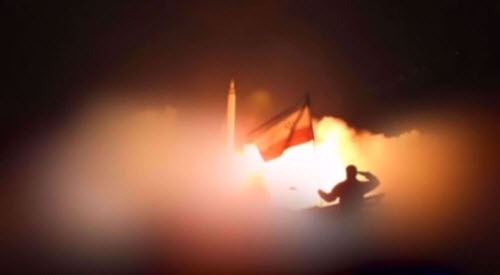
Screengrab from footage released by the IRGC on April 8, 2026, shows a man holding an Iranian flag and giving a military salute as a missile is launched toward US‑Israeli positions during the 100th wave of Operation True Promise 4.
The Islamic Revolution Guards Corps (IRGC) pounded more than 25 strategic targets belonging to the United States and Israel in the 100th wave of the decisive Operation True Promise 4.
The IRGC announced the large-scale offensive in a statement early on Wednesday, saying it was a response to the enemy’s “insolence” the previous day.
“Your sons and servants, by God’s grace and the support of you dear nation, fulfilled their duty last night,” the IRGC said.
The statement said the “crushing blows” hit targets that included 13 energy complexes and oil pipelines affiliated with the United States and Israel, among others.
“The fighters of the IRGC Aerospace Force put American and Zionist enemy targets from the Mediterranean shores to the eastern Hejaz peninsula under heavy fire, so that the foolish enemy understands that attacking the infrastructure of the Iranian people will have severe punishment.”
Press TV @PressTV IRGC released footage of the 100th wave of Operation True Promise 4 in which 25 strategic positions of enemies were targeted
The IRGC Navy, while continuing its smart control of the Strait of Hormuz, also struck several naval targets:
· The LHA-7 helicopter carrier was hit by cruise missiles, suffering damage and deck fires before retreating into the depths of the Indian Ocean.
· The CVN-74 aircraft carrier was struck by several drones, suffering hull damage and also retreating into the Indian Ocean.
· An Israeli drone manufacturing plant in the UAE.
· Oil facilities invested by US companies in LSB, Kuwait.
· US base in Ali Al Salem, Kuwait.
‘Finger on the trigger’
The IRGC warned that its fighters remain ready for further action.
“The Guards, devoted to the Iranian nation, are now listening to the orders of Leader and Commander-in-Chief Ayatollah Seyyed Mojtaba Khamenei, and their fingers are on the trigger.”
“With the great lessons learned from two imposed wars, they are ready to create an even greater epic if the enemy miscalculates again.”
The IRGC also addressed the United States’ regional partners.
“America’s partners in the region have seen with their own eyes the inability of the US and Israel. It is fitting that they take a lesson and end their cooperation with the enemies of Islam.”
“The enemy has always plotted, and we have no trust in its promises. We will respond to any aggression with a higher level of force.”
The United States and Israel launched their unprovoked war of aggression against Iran on February 28. They assassinated Leader of the Islamic Revolution Ayatollah Seyyed Ali Khamenei and struck nuclear sites, schools, hospitals and civilian infrastructure.
Iran’s decisive Operation True Promise 4 was launched in retaliation. Hundreds of ballistic and hypersonic missiles, and drones, have pounded US military bases across West Asia and Israeli positions throughout the occupied territories.
Iran’s Supreme National Security Council (SNSC) announced on Wednesday that there was an agreement to a Pakistan-brokered two-week ceasefire after the US accepted Iran’s 10-point proposal, potentially followed by negotiations to effectively end the war.
Pepe Escobar: Iran Just DEFIED Trump, Air Defenses LIGHT UP Over Tehran as War Blows UP Danny Haiphong May 1, 2026
Pepe Escobar discusses signals of the war on Iran restarting as CENTCOM briefs Trump on the US's "final blow" and Iran's air defenses activate overnight. The renowned geopolitical analyst and journalist of the multipolar world breaks down the huge geopolitical shift precipitated by this war and why it's quickly becoming existential for the empire.
Transcript
Welcome everyone. Welcome back to the show. It's your host Danny Hi Fong. I am joined by good friend of the show, independent journalist and geopolitical analyst Pepe Escobar. Pepe, good to see you again. Good to see you, Danny. And good to see all of you out there. Uh, well, I am I am sorry a little bit because I am now in paradise. So, my initial instinct would be to drop everything we're doing and jump into the underman sea. But we have work to do. Right. Right. Yeah. Well, of course, I am greatly appreciative of you taking the time out today. Everybody hit the like button so more people can hear this conversation as we begin here. So, uh, Pepe, I know you've been deeply covering the latest developments surrounding the war in Iran. You know, overnight there reports of air defenses lighting up in the skies over Tan. We have the Trump administration being briefed or Donald Trump himself being briefed on multiple options to strike Iran. Uh and uh we have of course the uh ongoing uh uh talk uh uh uh you know uh absolutely just I don't even know what to call it. Uh Kabuki theater. Uh Trump just rejected the latest proposal by Iran. The only consistency that I see here, Pepe, is Iran's defiance of all of the Trump administration, the US's ongoing escalations, the blockade, and uh, you know, all kinds of other uh, uh, provocations. But, uh, Pepe, maybe you can help us understand uh, given your latest analyses. You've written two public two latest publications. Uh uh the straight of horror moves is of course at the center of all this. The US sentcom they're all talking about trying to reopen this thing quote unquote. And I'm curious on where we are in the war now and and what you're looking at as we uh move forward here toward possibly a new round of strikes by the US and Israel. Well, apparently uh there's going to be an urgent pronouncement by Trump at 4 p.m. today, right? uh after the markets close. So anything could happen including uh you may try to implement what uh the joint chiefs of stab and the head of Sandcom were building as the final blow. Wow. As far as we know they haven't even delivered the first blow. So they want to deliver the final blow. Well, look, this week has been quite something. A lot of immensely important things happening. Uh let's try to backtrack a little bit because essentially they involve Iran and Russia. First thing uh Arai did uh a very well organized, meticulously organized mini diplomatic tour, Islamabad, Muscat and St. Petersburg. First he went to Islamabad to talk to the Pakistani mediators. Then he went to Oman where he talked to his counterpart but also he was received by the Amir as well and they talked essentially about the straight of Hormuz. Then he went back to Islamabad where he redelivered to the Pakistanis let's say a more concise version of what they had been uh proposing from the beginning. But now uh the order the parameters are different because uh there are essentially three points three stages according to the Iranians and this by the way is what Trump rejected today again. First one is end the war by by all means and this means all wars including especially in fact the war against the axis of the resistance as a whole. It's not only US abstent syndicate against Iran but also against Hezbollah, against Yemen, against the militias in Iraq, against the axis of of of resistance. Number two, an in-depth discussion about a new uh jeridical setup for the straight of Hormuz and only then in the third stage in the third uh stage number three uh a discussion about the Iranian nuclear dosier. It's obvious that Trump would uh reject the whole thing. First of all, if uh if you go straight to number one, that's the graphic proof of the American strategic defeat. And number two, straight of Hormuz, the Americans have zero cards to play unless keep this uh erat blockade indefinitely. And the only thing that register in Trump's mind is he wants a new nuclear deal which whatever happens in the short term, middle term etc is going to be a sort of diluted JCPOA is going to be what we had since 2015 discussed in Vienna then ratified by the UN security council which was stored up by Trump himself and we're going to have a JCPOA 2.0 which is not going to be much different. Then very very important Arshi went to not Moscow sorry to St. Petersburg where he talked not only to Lavrov but he was received personally by the president of Russian Federation for one hour and a half. That in itself is Milky Way spectacular. Trump never Putin never gives heads of state more than half an hour, , , one hour and a half to a foreign minister which tells us leaks aside because he only leaked what was uh the most obvious part. That was a very very serious discussion. so serious that Putin called Trump after that and that also lasted over one hour and a half apparent over one hour and a half. So Putin was basically telling Trump what he discussed with Ara in St. Pete and um what we got from the official Kremling transcript from St. Pete was already quite something everything in terms of Russia basically saying we are all in uh Putin demonstrating uh uh an enormous amount of respect towards Ayatava. He opened uh his uh speech to Arashi saying look last week I received a letter from your new supreme leader and I wish him all the best. you know all the typical protocol or stuff but way beyond that what does that mean that they are talking at the ultra highest level and of course this is deeply uh appreciated by the Iranians and this proves that Putin is is like totally in the game. Russia has skin in the game and now this is made uh public directly by Putin's words and not only his words but his actions immediately after that which is to call Trump for a long long discussion where among other things he said that this has to be resolved diplomatically that uh Trump going back to war is going to be unacceptable not only for Iran but obviously because it will involve the other Persian golf play the other Persian golf players the monarchies. Did Trump register did did he understood the memo? Apparently not. Once again, after this phone call, he was briefed by the joint chiefs and by the the head of Sandcom with the final blow possibilities, which are all of them absolutely horrendous, including attacks on Iranian civilian infrastructure. And of course, they could try another decapitation strike. 9 minutesAnd of course the wet dream of sending Delta forces or whatever to capture uh the uranium that they don't even know if it's in Isfahan anymore and it's not. Most of the Iranian is out of is is Fahaman and is now in smaller packages and it's a little bit everywhere and nobody knows where where it is exactly. And of course today Trump said uh I I I I reject the new Iranian offer and he's trying to pose like he is in charge and he has cards to play. He has zero cards to play apart from this erat blockade which may have uh one of two Hollywoodish Netflix productions of you know the Marines jumping on board a tanker here and there but that's it. Most tankers are going back and forth dribbling football style. the American block. The Americans cannot locate a it's it's ridiculous. From the southern Indian Ocean to the Arabian Sea, it's like 1,000 kilometers. This is completely absurd because obviously cowards cannot be in the Sea of Oman, much less in the Persian Gulf. So yeah, so you have tankers dribbling it and the Iranians are masters of dribbling sanctions, blockades, harassment, maximum pressure, you know that they have PhDs on that, you know. So that's it. And Pakistan early this week, they opened six overland corridors. So uh people tend to forget and just look at the map. What is the the the the shortest way between Iran and China? What is it? What's in the middle? Pakistan with excellent relations to both. So obviously everything that Iran needs to do the back and forth via Pakistan and it's an even uh oil if it's transported via highways lesser quantities but can also be done. Same thing in the China Iran railway. They can transport some oil via the China Iran railway across Medistan, then Kygystan, Kazakhstan going to Sing Jang and Exactly. And this is less than uh the maritime um uh corridor. So obviously these people in Washington, they are not very familiar with maps of Eurasia. They they simply don't understand all those stands over there. It's too complicated for them. But the people who actually live in Eurasia and have been trading among themselves for at least 2,500 years, they know it very well and they know all the corridors, ancient corridors, new corridors, overland corridors. So it's not that is uh uh uh reigning anymore especially with this uh once again apparently there is a blockade but nobody knows how how this blockade is actually being enforced and where nobody even knows where these bloody destroyers are far away in the southern Indian Ocean. So maybe maybe some of them are in near Sri Lanka. They they in fact they boarded a tanker not far from Sri Lanka by the way and another one not far from um Southeast Asia from the street of Mala. So that's it. These are Trump's cards. But it's dangerous. It's always very very dangerous uh Denny because uh considering the volatility of uh the man in question, considering how much pressure he's under, considering that deep down in his psyche, he knows that he [ __ ] up and there's no way back. Yeah, we are still hostages of his uh uh volatility and that's what makes it so dangerous. Please go ahead. No, I mean I I think those are all great points and to this point about the blockade, I don't know if you saw this from uh uh Mr. Galibbah the uh you know speaker of the Islamic the parliament in Iran, but also he's like the head negotiator. But just this response about Iran's massive borders. I mean, when you total the length of the entirety of the United States, east to west, you're still a thousand kilometers short of Iran's total borders. And of course, this is great for Pete. You know, this is he has to explain to Hex that kilometers. What's a kilometer? But again, that just speaks to uh and then it just speaks to Iran's mentality here, though. It seems like Iran is exercising a vast amount of strategic patience and is not letting up at all on its core demands. uh despite the fact that as you said, I'm not going to play the video because it's on the outside of the Air Force One and incredibly noisy, but uh he Trump just said, as you said, the volatility here, uh that the the briefing with Sentcom was to go over options to blast the hell out of Iran and finish them forever. And that's that's the narrative right now despite massive increases in the oil prices and a lot of anxiety about what targeting of oil infrastructure in Iran would mean for the entire region. But uh uh you know maybe you can talk about two these bigger moves. I know you wrote a couple of pieces recently. uh one the UAE has left uh uh OPEC and uh you know and uh there's of course this kind of like chokepoint politics happening where the US is so obviously desperate about Iran's control of the straight of Hormuz but the way they're behaving is they're it seems like they're trying to choke 15 minutesoff uh as much of global trade as possible that goes through not just the straight of Hormuz but the entirety of these waterways that are so critical that I know you follow. Uh so maybe you can talk about this as part of this war. Uh Scott Besson is saying this blockade will last until February 27th conditions exist which seem to never seem to be uh quite a fantasy that's never going to happen again. But you're this this idiot has never been to Iran. He has never been to Eurasia. doesn't know [ __ ] about how Eurasia works or the Iran as the crossroads of Eurasia. These people have no idea about that. Well, uh the great uh let's say the great American blockade uh project. This is how I defined it. It started it was very very simple. Venezuela. But basically what they were doing in Venezuela, they were shooting boats of field of fishermen. That that was the American blockade. But it worked because of uh everything that was already rotten in Karacas. So the next step is was the big test straight of Hormuz for this great blockade project. It's essential for the West to control Hormus because essentially it would control Iranian exports via Hormuz, not so much uh the other Persian Gulf monarchies, but Iran's exports by passing the petro dollar. and later. Obviously, as we can see by ourselves right now, this is going terribly wrong from an American imperial talisoccratic point of view. The next step will be Malaa and that's where it gets even more complicated because the blockade project is Iran but most of all China. in the minds of the conceptualizers of this blockade and we can certainly uh stress that the Elbridge KBY is the brains behind the concept it's to blockade uh supply lines energy supply lines to China obviously these people don't look at what's going on over land zillions of examples Power of Siberia 1 and soon power of Siberia 2. The gas pipeline from Turk Manistan to Sing Jang. Uh Kazakhstan oil pipelines from Kazakhstan to Singh Jan. Myamar h gas pipeline from Myamar to Yunan province in southern China and all that. So that the zillions of of possibilities and for the Chinese so far before the blockade there was no problem for uh tankers uh leaving from Iran and going uh to China. the blockade. The Americans don't have the cojones to blockade a Chinese tanker in the Arabian Sea in the southern India. Well, first of all, they will never go to the southern let's say in the Arabian Sea for for that. They they will never do that. They they don't have the guts to do that. What they were trying is to blockade Iranian ships. Iranian ships, they among other uh dribbling strategies, they can navigate very close to the Iranian uh in Iranian territorial waters within the 12 uh nautical mile limit. Then same thing in the Pakistani uh territorial waters all the way to Mumbai. So this is one of the things they they are doing. The number of uh Iranian tankers that were not seized but rerouted. Let's put it this way. It's nobody knows for sure. We cannot trust anything that Sencom says by the way. So uh this blockade uh works uh uh as a Netflix fantasy. Yes, definitely. But in real life is a completely different story. And obviously Iran overland, they don't care. And of of course they can even use the Caspian later on if that's the case. Uh with a little bit of infrastructure adjustment, they could use their Caspian ports. Uh going for instance to uh Turkmanbashi in Turk Manistan and then connecting with uh Central Asia, the rest of Central Asia. So uh the the let's say the big picture of controlling this checkpoints is there but the Americans don't have the means to implement it because the all of that presupposed their control in the straight over that's why now this is an obsession for the whole industrial military complex and also for Trump even though for Trump the number one obsession is the nuclear deal which he tore up originally. So, uh that's why he keeps rejecting everything because if we look again at this three stage Iranian proposal which probably the last redaction is quite similar to because they are basically refining what started with the 10 points to these three top points which are already included in the original 10 points. uh they know that sanctions relief uh this is a com we can you they can only discuss that if there is an end to the war. So you know there the logical person thinking about the whole thing is extremely logical but obviously for Trump is illogical by definition obviously he has to refuse it right but the thing is can the Americans sustain this non-blocade blockade for another let's say a month this will collapse the global economy even more than it's already collapsing the global economy. So, we're going to have a global revolt against the thing sooner rather than later, right? And of course, the rest of the world will personally blame Trump for this global economy crisis and for basically detonating famine in absolutely crazy proportions, a little bit everywhere. And there's already a list of very fragile countries that includes Yemen, uh Egypt, Bangladesh, uh Somalia, Sudan, and many others. And of course, uh the Iranians, they have been telegraphing, faxing, sending emails for the whole planet over and over again. Look, we're not going to flinch. That's it. We go till the end and they want to restart the war against us. No problem. Our response now is going to be much much worse than it was before. Right? So we go back to zoom zoo zwang all the time. Right. Danny, anything he does, he's still trapped. And even if which we know it's not going to happen, even if he declares a mission accomplished, we won. I'm leaving. This means uh de facto accepting a monster strategic defeat with uh global consequences. We cannot even imagine, right? So he cannot leave. He needs an offramp that he can sell as a victory. All the offramps spell out defeat. All of them with no exception. Even if he bombs Iran to the what what was it? uh stone ages as he say ages stone ages even if he bombs he run to the stone ages is not going to change anything and of course and this uh they have to keep saying it over and over again everybody our friend professor Marandi uh members of parliament uh people linked to the IRGC some of the best independent Iranian analysts everybody saying the same saying look if we're attacked again just wait we'll We already have our target list and it's going to be a hardcore and it will include US vessels. So it takes one missile sinking an American aircraft carrier. Very very simple scenario. Wow. Oh, has a storm come for you? This is the weather here in in in the undermanc comment our podcast. Yeah. Yeah. Wow. That's that's incredible actually. Yeah. You are describing a storm indeed. And here it is. So this this is the storm guys. So, uh, how can you possibly sell what already started as a strategic defeat because of a single fateful decision by a completely unprepared president controlled by the usual suspects? We all know who they are. How can you backtrack from that? And how can you possibly spin that into a victory? It's it's it's absolutely impossible. So So no wonder uh anything that he says, of course, the only thing that he's very very good at is to control the new cycle. He opens his mouth, he says something absolutely stupid, monopolizes the new cycle all over the planet. But uh uh is this going somewhere? Of course not. And then you compare with the extremely measured now it's it's great because the the Iranians uh discover the power of soft power in fact and of course when we we have some of their tweets are absolutely you know hilarious. Not to mention uh the Lego angle. They conquered the whole planet with their Lego videos. So they are winning the soft power war as well which until a few days ago we saw was an American monopoly forever. Not anymore. So so what's left for even after he listens to Putin for one hour and a half. This means that Putin probably outline in minute detail the consequences of doing something stupid like uh restarting uh the war. Still it doesn't register. So that's where we are. We are in the middle of a very dangerous uh strategic impa uh strategic impass uh Danny and all of you. And there is no way out unless the president of the United States would start thinking in 27 minutesrealistic terms. And we know all of us we know that it's absolutely impossible. Yeah. Yeah. Yeah. So, uh, great points, Pepe. And, you know, for the Trump administration, it seems, uh, there no matter what which of these options is chosen in terms of a quote unquote offramp for it, you said it it is no matter what, it'll be a defeat for the United States. Um, and if we if we just look at all of those options, they all have to take into consideration Iran. The United States would rather behave in a vacuum and do whatever the hell it wants, even if it means uh uh, you know, walking away from a war. But, uh, no matter what, the United States has to address Iran. It has to address these core demands because it seems to me that Iran is not just going if if the United States declares it's over tomorrow, but there's still a blockade. Iran is still going to respond. Iran isn't going to give up anything and Iran is still going to put pressure to ensure that it gets uh uh what it wants. And I think that's that's kind of a historically um unfamiliar place for the US to be in in such so so direct in such a direct manner in a war that it started. Uh now it has to face this reality of uh it is the one that's replying. Even if Trump says, "Oh, we'll finish them off. We have these finishing blows. I'm not satisfied with the proposals, the demands." It's still Iran that's the one saying, "This is what we want. What's your response to this?" rather than the other way around. Uh the Iran isn't really listening to the maximalist demands that the US is putting out there. That's why this is uh I'm coming back with my initial point uh not 60 days ago maybe uh 40 days ago already. It's the war that defines the 21st century uh geopolitically. Whatever happens and we are already seeing the emergence of not yet a force power as uh professor Pape has been saying no and we're not there yet but a very very strong middle power that is capable of staring down one of the three top powers in the This is already wow the consequences will be we'll will feel the consequences for not not only for the rest of this century but beyond uh Iran is now at the center of geopolitics and the whole planet especially the whole global south is paying attention uh learning their lessons. Uh people are amazed at how a country under 47 years of sanctions which has been deliberately impoverished by the Americans all this time but manage to organize themselves against of odds to exercise uh their independence, their sovereignty and especially militarily to absorb everything that was thrown Against that it is immensely impressive and everything made in Iran which makes it even more impressive. Everything is indigenous. So uh yes, yeah, yesterday I was looking at photos of Saigon in 1975 and yes, you look at those Vietnamese in Saigon in 1975 and say, "Yeah, now you have your brothers, the Iranas in 2026." It's the same spirit, resistance, sovereignty, and against all odds, you go to the end. uh the empire is not capable of doing that. And now even worse and now they lost the war in record time. Literally they lost this war in the let's say in the first 10 days it was we could see that it was already lost and that they will never uh uh reach those uh lofty objectives targets whatever. So as so this is an unmanageable by definition and and there is a a a a parallel a mirror image of the Ukraine story. The difference now is that Trump uh inherited the Ukrainian debacle. So in the in the Ukraine story, 32 minutesTrump has to manage the strategic defeat even though he did not cause it. Now it's even worse. He has to manage a strategic defeat that he provoked. He he doesn't have the intellectual capability to deal with that. Absolutely impossible. When you look at his uh uh previous history, when you look at how he deals with adversity, when he looks at when we look at his uh mafio Tony Soprano mindset, it's absolutely impossible. And on top of it, he's not the main player. He's just an actor. The people who are behind, the people who are really responsible for the war, that's it. They they also never had a plan B. So they cannot blame Trump. Trump can blame somebody in his team, a very mediocre team, but the people who run 33 minutesthe show are going to blame him. And he knows it. and that adds to his desperation because there won't be anybody to save him in the end. So uh there is an element of Shakespearean tragedy in all that even though obviously apply Shakespeare to Trump is a stretch of the imagination but uh but we can have a glimpse of how desperate he is at the moment. Yeah. And it seems to all boil down to uh Pepe, you know, I don't know if you saw it, but CNN actually better late than ever uh published this investigation of what happened to the US military sites. It's all coming out. It's all coming out. 16 of them were damaged, including highv value targets. And in this investigation work I play because it is quite long but uh they find out that almost all of these sites have either been damaged vitally or unusable. So, uh, that is, I think, uh, uh, at the bottom of all of this is this acknowledgement that no matter what the United States does, Iran can continue to do this, which will, uh, push the, uh, global economic uh, uh, overheating that's occurring to uh, an even uh, higher boiling point. Um, and you know, Pepe, you wrote an article recently about uh the UAE leaving the GC, not the GCC, uh, the OPEC, and I'm curious on the GC as well. Yeah. Yeah. Yeah. I mean, maybe you call it the uh creating an Arab Israel. And uh it it you know, at this point, it seems like the consequences of the war, the US and Israeli war in Iran are are just are so far reaching that it's it's even impacting uh the future of these uh Gulf vessel states. So maybe you can comment on this because it seems like the [ __ ] is is rolling downhill. Um even if this move is being portrayed I think by the United States as a uh almost like a checkmate uh that is going to help oil prices but it's deeper than that. Maybe you can talk about this. Much deeper. Well the whole thing in the GCC is collapsing Danny. Well the GCC is already uh I would say irreparably split. Uh Kather and Oman are being are playing real politic especially Oman and Oman you know they have a very nice diplomatic core uh they are very discreet uh not flashy like the the Emirates for instance and of course they they're they're talking to Iran from the beginning Qatar for the moment they are also in the background but they know that they need a working relationship with Iran. Saudi Arabia is uh it's complicated but at least they are in the camp that is trying to find uh some sort of agreement. It's important because they were uh me a member of those four Sunnis that first met in Islamabad in the beginning of all this uh uh let's say the Islamabad Kabuki the extended Islamabad Kabuki the first meeting was Egypt Turkey Saudi Arabia and Pakistan so from the beginning they were trying to find some sort of uh of course they deferred to Pakistan as the top mediator haters, but they were on the table. It's important. Guess who was not on the table? The Emirates. And when we say Emirates, we need to make a distinction. This is not the seven Emirates. This is basically Abu Dhabi, Dubai. The other ones, they don't we we have nothing to do with whatever you're doing in Abu Dhabi and Dubai. So it no wonder we already have circulating the possibility of the Republic of Sharah springing up one of these days. Fascinating story. Um MBZ MBZ. Okay, let's go straight to the point. He's a bloody gangster. Extremely dangerous, opportunistic. uh people who know him close say wow if you think that uh MBS is a a rotten apple and by the way in the beginning MBZ was the mentor of MBS so extremely dangerous character he made his bet even before the war he made his bet with the Abraham Accords and even before the war he made his bet that he was going to align the Emirates with US and Israel and of course part of IMAC which as it stands now is dead for all practical 38 minutespurposes and once again we have to remind all of you I'm sure most of you know about it IMAC is not uh India Middle East corridor it's a misnomer it's Israel center on the part of Hifa Saudi Arabia the Emirates Europe India corridor because the idea the central idea of IMAC is to make Israel the key trading hub connected to two Arab nations and then connect to Europe and Indian markets for as it stand this thing is dead it's very very hard to recover later on uh and then we enter into the big clash between Riyad and Abu Dhabi, the competition between the UAE and Saudi Arabia. Now, in terms of how to deal with Iran, this is graphic in front of everybody to see. Saudi Arabia is trying some sort of arrangement, some sort of composition, uh even diplomatic. and the UAE for all practical purposes they are at war against Iran and Thran knows it and there will be blood there will be a response. The Iranians know exactly what the UAE did in terms of facilitating or even unleashing attacks on Iran from UAE soil. So there will be a response. So what MBZ's uh master plan? Okay, I need to sell as much oil as I can. If he's inside OPAC, he needs to respect the quotas. So far, the quot for the UAE was a little over 3 million, 3.4 million max. They built capacity to export 5 million barrels a day. How can they do that inside OPEC? They can't. So, bye-bye OPEC. Bye-bye OPEC plus. So they can sell as much oil as they want and as their Asian customers especially want. Three top customers of UAE are China, Japan and India. So they can sell as much as China, Japan and India want. Trump loves it because this will uh oil prices will theoretically go down. But the problem is Iran will look at that and said, "Look, uh, no, you're not get away so easy like that. You still we still owe you a response for what you did to us during the war. This means Fuja, the oil terminal of the UAE, is not going to be safe anytime soon. And it just takes, you know, a little flash for the Iranians to bomb Fuja for in MBZ's plans collapse completely. Of course, uh on top of that, the conceptual approach of MBZ, he aligned himself with the US and Israel because he wants to turn the UAE into a sort of Arab Israel. And that's when it's going to be analyzed in detail by the other GCC members and the BRICS members because once again everybody don't forget the UAE is a full member of bricks. So MBZ I'm not sure who's been advising him but uh wow this is going nowhere. It's a an extremely risky bet with no guarantee that it's going to work at any level uh in terms of energy markets, geopolitically of of course geoeconomically, militarily, you name it. Not to mention that the GCC and uh the bricks when they look at that. Wow. So that's why we can even uh u consider the possibility that sooner or later they're going to leave the Arab League and the GCC as well. After all, it's uh Arab Israel. What the hell they have they're going to do at the inside the GCC or inside the Arab League. Very, very dangerous. So the Iranians are looking on that for the not doing anything. It's fascinating. The Iranian silence on the UAE for the moment is fascinating because depending on what happens next, there will be something and of course one of the reasons that uh an extra reason that MBZ made his risky bet is that from the beginning he was saying we are not going to pay the toll in the straight of our moose And closing it all up, uh, Danny, the big big thing, he made his bet that he's going to stay with the petro dollar. And that's why Trump loves the move. Yeah. So, he's not he's betting on the petro dollar. And at the moment, to bet on the petro dollar is not exactly a long-term view. No. No. I I I mean it it seems like the the UAE is following a potential pattern for the rest of the uh I guess the Gulf vassel states, which is to despite the obvious unfavorable position of the United States in this war uh to kind of form a circle around the United States and and become even more ingratiated than even uh they were before. and and that that that is a risky a very risky gamble since it seems to be their behinds that are going to be the ones that are uh uh you know that pay the biggest price. Uh if and we know it's not even an if it's when the United States and Israel want to engage in more hostilities, more acts of aggression against Iran, right? I mean that's what it seems like. It's it's very curious decision, right? Uh Danny. Yeah. Yeah. Anything any anything is possible. Exactly. We're not startled by anything anymore. Could even be this weekend. Yeah. Yeah. Yeah. And that gets that begs the question, Pepe. You know, a lot of people are concerned about uh the position of of China, the position of Asia uh in the multipolar world out of all of this. Uh uh what's your view right now on that? Uh it appears there is no panic coming from any I was just in China. There certainly is no panic coming out of China is any panic panic in China is I'll be going next fine I made up my mind I want to go before Trump arrives in Beijing uh from what I've been reading and talking uh to people before I go same thing they're not panicking they're just observing it's the Chinese way of course now uh it's careful considerations here and there. Uh nothing, no abs language absurdities, you name it, you know, very composed. But of course uh they are paying a lot of attention to individual mo moves of their Persian Gulf suppliers and that means Saudi and UAE especially and of course with Iran there's no problem because even before when when the IRGC navy were they were collecting 46 minutesthe toll booths in krypto or in yan no problem the Chinese they had free passes and they will always have free passage. By the way, the Russians as well, the Iranians said, I think yesterday that Russian ships, they don't need to pay any fees whatsoever. So, uh countries, country by country, they are already negotiating with Iran. That's the same. The jeridical status of the straight of Hormuz is going to be something completely different. And nobody is complaining. They will adapt and the toll boos in real no problem. Everybody will adapt and of course maybe a lot of them will the the second option will be E1 obviously and of course the Iranians will accept it. Yeah. So none of that can be changed by the US. None of it. None of it. it we are already in a different system completely different not to mention now that Iran is well but in in a geopolitical global terms wow now Iran is respected as a major power by everybody the eur the Europeans are already starting individual European nations are ready to okay how are we going to deal with that you know not Brussels Bruss Brussels is lost. That that thing is uh you cannot even qualify it how stupid it is. But individual nations in Europe that we're going to have to do our own deals. So obviously we're going to have individual European nations negotiating the passage of their tankers uh with the with the Iranian government. Of course. Of course. Yeah. And I don't know, you've probably noticed, Pepe, that uh the United States, Donald Trump is continuing despite the uh perhaps uh the need to close ranks, build support for the war. Uh he is uh very uh keen on uh kind of bludgeoning Europe uh and beating over so-called European allies which have not been so useful uh in the war on Iran. So now there's of course Germany, Italy, uh these countries uh threatening to pull troops. It's like okay, but I'm I'm curious on your it's like all right, I'm you know, but but of course you know how the uh oligarchy how the uh you know the the elites how they view it is this is a big tragedy, right? There's a huge uh problem here. But what's your view on this? because it seems like there is at least some uh constrnation, anger by uh the United States and Trump administration over the fact that uh Europe doesn't really have I mean you talk the US has no cards to play. Uh uh Europe is running in the negative and certainly cannot afford to it can't 49 minutesafford to lose anything else. I mean it already know what a card means in Europe. Cards what's that? If they lose any access to these waterways, if they're blockade, you know, if they're blockaded because of blockades, I mean, it's a complete disaster for it already is. I mean, we know that uh uh the European economies are being hit pretty hard by what's going on. So, your thoughts on this position of Europe and Trump? And you have those abs, those intergalactic uh idiots in Brussels still talking about sanctions on Iran. Can you believe this? Well, uh, anything that Europe does or doesn't, uh, it's their zoo, but their zuk zang is different. Their zuk zang is the stupidity zoom zang, but every move they they make is by definition stupid. And of course, uh, knives on their collective backs, right? So we what we're going to see from now on is more and more uh national individual nations uh initiatives which goes in parallel to the progressive collapse of not only the EU but also NATO. They are on go going to the you know plunging into the dark pit in parallel inevitably. Um what it depends on countries that have a strong dependence of imported energy. They are in dire straits. Some are slightly better in the case of France for instance because they still have uh nuclear energy and they have a gas deal with Algeria which is not so bad. But Germany, wow, absolute disaster. And of course uh even if the opposition says look we 51 minutesneed to start talking with the Russians again as it stands with the current uh discombobulated sausage as uh prime minister. Nothing's going to happen. And Brussels forget it. Brussels Brussels forget it. Brussels they they would impose sanctions on both uh Iran and Russia till the end of time by the way the the storm here comment of the storm here is fant they are they are deep into our conversation then no totally yeah no I mean it is uh I I I love it I love uh the uh the background noise it's very um it's very apt I think for uh going on here Well, I guess finally in the last uh five or uh or so we have here Pepe. I wanted to ask you about this development which I know you've been writing about. Uh I know you've been uh uh talking about Indonesia in particular. There's a lot of I think ripple effects from this war. Uh but one appears to be of course uh even despite the US doing its best to bludgeon countries uh over the head, Asia, Europe, everywhere uh to pull away from China, uh countries like Indonesia are playing a very delicate game and there was a big the big news that they have fully linked their QR payment systems uh together which is big because these two countries are are very big trade partners and have actually achieved quite a lot in recent years. Uh but I'm curious on what your thoughts are on this. This whole war has really put up the question of what is the future actually of the petro dollar of the US dollar and of the international financial system dominated by the United States and uh we just it seems like we're seeing move after move uh away from it uh despite the threats that exist from this uh war. So your thoughts on on this uh development here is this post that uh this is excellent because it goes straight to the point for uh most people traveling across Asia mostly businessmen but also tourists they uh they can use Alipe virtually everywhere now which was not the case until I would say two years ago. uh the real boom of Alip pay all across Asia started last year and Union Pay as well. So uh a lot of people across Asia now they have they don't have a Mastercard or a Visa card. They have a Union Pay card and this is something well I saw this from the beginning and uh I never cease to be amazed how Union Pay they basically conquered the Asian market. Okay, it took a while 2012. Okay, 14 years but uh in retrospect 14 years is not much. In the beginning they had nothing. For instance, when I was in Hong Kong, uh uh okay, I I dealt with HSBC. One day they gave me a Union Pay card and I arrived in Europe and I couldn't use it. There was only one bank in France that accepted Union Pay. So, so I came back to Hong Kong. I went to talk to the guys. I said, "Guys, what is that?" They said, "Well, why why why don't you tell us, your customers, that you give us a Union Pay card and not a Visa or a Mastercard?" They said, "Yes, because um they made a mega offer to us." They said, "We give you anything you want. you. HSBC, one of the biggest banks on the planet, if you start switching from Visa and Mastercard to our card, 55 minutesHSBC obviously because they probably got a mega bonus for that. They start doing that in 2012, 13, 14. Now in Europe, everywhere you go, you can also use Union Pay. So Visa and Mastercard are being expelled from the market little by and across Asia everybody is using uh QR codes from their banks once again bypassing completely uh the American system. That's the future and this is the future that the Chinese are also implementing with their payment system sips the Chinese international payment system. the the Russian SPFs, the Iranians, they have their system as well. So soon they're going to coordinate all these payment systems, especially the three big ones, China, Russia, and Iran. And that's it. You don't need to go through the American control system anymore. That's it. In the case of Russia and Iran, they have deep experience because they're are they're ultra sanctioned. Uh in the case of China, it's complicated because uh the Chinese are always afraid of secondary uh sanctions. But if you're using uh the Chinese international payment system, no problem. And of course, if you use Union Pay, it's a Chinese bank. It says Chinese credit uh facilitating credit mechanism completely outside of the the western system. So no wonder it's a it's a huge hit here all all across everywhere around here. Uh now here in Thailand you can you can you can go to a stall in the street and you can you can use union pay or alipe literally everywhere. It's something that was not happening until two years ago. Now, now it's lightning speed, you know. That's it. This is so the Iranians when they look around there there are many many options and and of course the Russians as well because the Russians when they were expelled from Swift they had to start from scratch. So obviously they asked they asked the Iranians okay h how have you been dealing under sanctions for so long? So they learn a few lessons from the Iranians as well. Yeah. And of course uh Russia is a very complicated case. For instance, I I go to Russia a lot. Uh what I do in Russia cannot do outside of Russia because it's of course we you you cannot use Swift or the American system. And even a mega bank in Russia like Spare is one of the biggest banks in the world. You cannot 58 minutesuse your mirror card anywhere because of the American system. So that's why they are all work. Okay, let's which is something that they have to do inside bricks. It's one of the first things that bricks should do. introduce the famous bricks pay bricks card whatever for the moment it's complicated because it takes a long time testing and very complicated Danny most of these nations they are still connected to the American system right so try to explain to the Indians that from now on we going to use the bricks uh system of payment very complicated. The UAE, for instance, the UAE is going to be impossible. They're going to have to be thrown out of bricks eventually, you know. Because after all, they are linked with Israel and the US. Yeah. Yeah. Moving very fast. This internationalization alternative payment system, it's absolutely inevitable and there's absolutely nothing the Americans can do about it. No. Yeah. Uh this is the future and of course Iran there was reports that Iran I know there were early reports about in the straight of Hormuz the toll system uh settling that in Chinese UN but now it seems like there's reports Iran settling their own currency which is a very interesting development. It it conforms to what you just said in terms of Iran, Russia, and China spearheading. It strengthened their currency which was attacked directly by the Americans early this year uh late last year and early this year. Um good thing for them and of course the UN is going to be uh the backup currency. There's no question about that. But they need to promote their own currency. Of course. Yep. Yeah, definitely. Well, this has been a great conversation. Pepe, how about we do this? Everybody, uh, be sure to hit the like button, but I have both of Pepe's articles that we spoke on today in the video description below, as well as, uh, his Telegram and X accounts. Um, I want to thank everyone who watched. I want to thank the new members here. And Pepe, do you have any uh anything else you want to announce or or say before we head out of here? Thank you. Uh, well, I'll be here for another week and then I'm going to China before Trump arrives in Beijing. So maybe we should have a conversation after uh Trump's trip to China. This is going to be quite something. Wow. Yeah, it will be quite something. Uh and I and I think what's quite something about it too is uh what is the status of this war on Iran because that's going to be a huge influence on we already know what China is aiming at here. They've talked about Taiwan. They're already signaling that Taiwan is going to be a major uh point for them to emphasize. But if the war on Iran is either back on or unsettled, it's going to be make it's going to make it's going to make this visit I think uh very very interesting, very targeted and and potentially. Well, the Chinese have no illusions. They're not expecting much from this. You you talked to our great friend, Professor Jang Wei. Yeah. Did he talk to you about the war in Iraq? Yeah. Yeah, that was mainly the topic you know and his view was uh you know the civilizational perspective of course where he always comes at but uh everything we've been saying here he I mean he views it as a massive uh defeat for the United States and that if it doesn't get its act together it's only going to get worse and worse and worse leading to of course um you know the the world especially the important players like China uh moving on ahead and uh saying goodbye to the United States. In a lot of ways, I that seemed to be his view is like the world is is looking at the US with you know uh a kind of death wish that it has and and view it what what to do about that from here and everyone of course has different it's good because he knows the west well. He travels to the west a lot. Absolutely. There are not many ultra highlevel Chinese scholars that know the west well. He's one of the few. Yeah, totally. Yeah. And everyone can catch that. Uh the interview is up still. Uh it was live which was great. Uh so be sure to check that out. Um but yeah, Pepe. Okay, we'll head out of here then. Hit the like button everybody. Uh that will spread the show around. Uh Pepe's uh where you can find him and his articles are both in the video description. Of course, all the places to support this channel are there. Thanks to all the viewers, moderators, everybody who came out today. And I'll be back again soon. And I'll let you know when. Bye-bye.
Late Show Home Shopping with Jon Stewart The Late Show with Stephen Colbert Apr 23, 2026
Stephen Colbert is joined by his longtime friend and "The Daily Show" host Jon Stewart to announce a HUGE drop of memorabilia for The Late Show's charity auction. Visit http://colbertlateshow.com/ebay to bid on these one-of-a-kind items and grab a "The Last Show" t-shirt while you're at it! All profits go directly to World Central Kitchen.
Transcript
Welcome back everybody. Give it up for Louisis Ko and the great big joy machine. [cheering] There you go [applause] folks. In case in case you're not aware, the network has canled the show. And um and of course that boo is just our audience honoring CBS's hit show Ghosts. Boo. The motto is Boo, right? It's Boo. So, we're going to have to leave the beautiful Ed Sullivan Theater and more importantly, all the beautiful stuff in it, which legally is property of the network. But they're not really paying attention to us at this point. So, instead, we're harnessing the power and style of home shopping to sell it all and donate the proceeds to charity. This is Late Show Home Shopping canceled clearance sale. Bye-bye. Bye. [cheering] [music] [applause] [applause and cheering] 1 minuteWelcome to the shop. Tonight we are selling items that will make your friends say wow and your accountant say why. Everything you see here plus more is up for auction on our website colbearlatehow.com/ebay or use this QR code. QR codes you know their slogan. The thing that makes your dad say, "Can I please just get a real menu?" Go bid on these items, folks, because all the proceeds will go to the charity of my choice, which is Joseé Andre's World Central Kitchen. Joining me [applause and cheering] joining me tonight as always, please welcome my co-host, John Stewart. [cheering] Baby, can you see? Oh my goodness. [cheering] Look at that. Please, [applause] please have a seat. John, thanks so much for being here. 2 minutesAlways, Stephen. I came as soon as I heard about your cancellation. [laughter] That happened nine months ago, John. Uh, what day of the week was it? Uh, it was on a Thursday. Ah, I only pay attention to news on Mondays. My mistake. Now, let's sell some great items for a great cause. Let's do it. First up is a beautiful piece of decor. It's the red carpet our guests walk on to enter the Late Show stage. Yes. Before our guests can enter. Before our guests can enter, they first have to walk down this carpet and stand on the little gold star at the [music] end, waiting for Steven to call their name. It's all part of the sick head games he plays to make himself feel important. Busted. This [laughter] gorgeous carpet has welcomed countless guests to the Late Show like presidential candidates, American icons, and the crew of trained cats called the amazing Acroats, [cheering] which means you're going to want to clean it because the Acroats also sprinkled some Acrope. Now, John, what would you pay for an incredible item like this? What would I pay? I mean, it's a I mean, with the cats and all I'm going to say 40 to $50 million. I'm That's what I would pay. Great guest, John. But as always, wrong. In order in honor or in order of my favorite guest that I've ever had on the show, we are starting the bidding at just 50. Well, to make this red carpet even better, I'm going [music] to be throwing in my own celebrity rug. Yes, ladies and gentlemen, [cheering] you can get That's right, my [applause] You can get the wig I wore during the first season of the Daily Show. And as you can tell from looking at it, time is a mother. Yes. [applause] A cruel, cruel mistress. It really is just the worst. Up next, we have an item so rare, basically, no one even knew it existed. You can put the head away. All right. No one knew it existed until this very moment. It is a prop certificate I had made for a joke when I hosted the 2006 White House correspondent dinner 20 years ago this month. Four years ago this month, [applause] it was part of the only joke, and this is true, the only joke I cut on the fly while I was up at the podium. You see, George W. Bush had just given out a lot of medals of freedom to a bunch of the staff who [music] were overseeing Iraq and it wasn't going well. And I mentioned that he gives out these medals of freedom like candy, but nobody gives him [music] anything. And that ended tonight. So I was going to give him the highest honor a citizen can give a president this certificate of presidency that reads from Steven Colbear to George W. Bush in recognition that you are president of the United States. I even signed it, dated [applause] it. There you go. Fantastic gift. [applause] My My plan was to hand this to George W. Bush and say, "Why don't you give this to your mom? She could put on the refrigerator or something." Oh, that's such a such a lovely gesture. [music] I I can't remember. Why didn't you do that? Well, John, I'm not sure if you are familiar with that speech, but by the end, the vibes were a little tense. So, [laughter] I decided to not do that joke, which means I still have this item, and it's now perfect for anyone out there who was a fan of my 2006 correspondents in her speech or of George W. Bush or somehow of both rare group. That's a ven diale. You know what? That is gorgeous. And to make this even better, I'm going to throw in my own certificate. This [music] is very exciting news. I've never before given this for all the people who have mixed up my name over the years. It's a certificate that says I hereby declare that you are right. My name is actually John Dailyaly. Uh you were not wrong when you said it that way and it was not embarrassing at all. And that's signed John uh Stewart and and then of course uh Liwoods at the end which I dropped so that people don't know [music] I'm a Jew. [cheering] Wow. John, I had no idea. No one does. No one knew. They can't tell at all. I thought you were a defrocked priest. Son, I've seen that one. That is going to make someone very happy andor very confused. Last and also largest folks, we are selling off the giant sign from the top of our set that reads the Late Show with buy this and like me, you could have the Late Show hanging over your head for the rest of your life. And by the way, if that's not enough, I am also going to throw in, and this is very exciting news because it's a wonderful sign, a limited edition [music] Daily Show mug. Wow. That I have signed. Stephen, that's what that's what I'm generous. Wow. John, how much would you pay for all these incredible items together? And before you [music] answer, let me just take a sip of water. [laughter] [laughter] Yes. Oh, yeah. No, I was I was So, yeah. Well, you would get the giant sign, the standard size uh mug, uh which is I don't know, like 20 bucks [cheering and applause] here. Very hard not to. Very hard not to. I understand, John. There's no way. There's no way way we could start bidding that high. Well, Stephen, uh, what would you like to start the bidding at before you tell me? Do you mind if I take a sip of water? Not at all, John. John, you got the big sign, the Daily Show mug, and I will throw in the Late Show mug I just used for that spit take. And we are starting bidding at just $19.99. [laughter] [laughter] [cheering] If I may, uh, that is actually tremendous value. Thank you, John. To bid on these great items and more, head to colarlatehow.com/ebay, where you can also buy our commemorative The Last Show t-shirts. [cheering] [applause] What? What? There are Wait, what? [applause] There are [screaming] you what? There are t-shirts. Oh my god. I can't believe it. I can't believe it. [cheering] Yes, John. Yes, John. They're t-shirts [applause] and they're very absorbent. We'll be right back. Reporter. [cheering] [music] [cheering]
BIG ESCALATION: Putin ’STEPS IN', Orders Russian Warships To Escort Tankers As Tensions Boil? Times Of India May 2, 2026
The Baltic Sea is on the verge of a military escalation. Russia has warned that it is ready to deploy warships to escort its commercial fleet, responding to aggressive NATO insurance inspections and the new "Baltic Sentry" mission. With the Kremlin reflagging its "shadow fleet" to claim sovereign immunity and placing armed security on tankers, the "Gray Zone" conflict is turning white-hot. NATO warns that mixing warships with under-insured tankers is a recipe for a catastrophic clash or environmental disaster.
Transcript
Russia is now openly considering naval escorts for its commercial fleet in the Baltic Sea. A move that could sharply raise military visibility in one of Europe's most sensitive waterways. According to Russian officials, Moscow is weighing the deployment of warships to accompany Russian flagged merchant vessels amid what it describes as growing Western pressure and encroachments against its maritime activity. Artum Bulattov, ambassador at large for the Russian Foreign Ministry, told Sputnik that European Union and NATO are using the Baltic as a testing ground for unilateral mechanisms to control international navigation and target undesirable nations. Bullet emphasized that Moscow will use a full range of available means including legal, 1 minutepolitical, and military resources to ensure the unhindered movement of Russian flagged vessels. The warning follows a period of escalating maritime friction in Northern Europe. 12 European nations led by the UK and Germany began aggressive insurance inspections of the Shadow Fleet earlier this year. In March 2026, Swedish and Belgian forces executed high-profile boardings and detentions of vessels suspected of sanctions violations and espionage. Moscow has identified the recently launched NATO mission Baltic Century as a direct attempt to establish a blockade. Deputy Foreign Minister Alexander Grusko stated the mission poses an existential threat to Russia's economic security. The Kremlin has already begun reflagging tankers to the Russian Registry to claim sovereign immunity and has reportedly placed armed mobile fire groups from the FSB linked Moran security group on certain high value tankers. The deployment of full naval convoys would mark a significant escalation in the grayzone conflict between Russia and the West. While Moscow maintains these escorts are purely defensive, NATO officials express concern that the presence of Russian warships alongside aging underinsured tankers increases the risk of a catastrophic environmental accident or a direct military clash. Europe is quietly building a new naval front and this time it's outside NATO. In a significant strategic shift, Britain and nine northern European allies are moving to create a multinational maritime force independent of NATO structures aimed at countering what London calls growing Russian activity in European waters. The announcement came from Admiral Sir Gwyn Jenkins, the first seaord and chief of the naval staff during a speech at the Royal United Services Institute where he confirmed that members of the Joint Expeditionary Force or Jeff signed a statement of intent last week to establish the new force. The force will be composed of member nations from the UK-led Joint Expeditionary Force or Jeff, including the Netherlands, the Nordic nations, and the Baltic States. According to Jenkins, the initiative aims to achieve full operational integration by 2029, featuring real war plans to counter a surge in Russian maritime activity. The first sea lord claimed that Russian incursions into British and Allied waters have increased by nearly 30% over the last 2 years, warning that the intensification of surface and submarine deployments by Moscow remains the gravest threat to European security. Despite the ongoing focus on the conflict in the Middle East, Moscow has dismissed the formation of the maritime force as hysterical with Dmitri Medviev, deputy chair of the Russian Security Council, saying the Kremlin harbors no aggressive plans toward Western Europe. Medviev warned that the persistent rhetoric from London and Brussels regarding an inevitable war risks creating a self-fulfilling prophecy. Russian officials have characterized the move as a domestic political distraction intended to justify the rearm initiative and record high military spending across the continent. Tensions in the English Channel and North Sea have reached a friction point following Prime Minister Kier Starer's March directive to potentially seize Russian oil tankers. In response, Moscow has deployed armed frigots to escort its energy exports through British waters. While the Guardian reports that nearly 100 tankers have passed unimpeded since the escort policy began, the new Jeff Naval Force will be commanded directly from London to provide a more agile, regionally focused response than the broader 32nation NATO alliance. By 2029, this integrated fleet will effectively place the naval assets of 10 nations under a singular London-based command for northern Atlantic operations, formalizing a northern European defense block capable of independent kinetic action.
[Robert Fico, Slovak Prime Minister] Everyone criticizes me beforehand, but when I returned from a meeting with Putin, everyone in the toilets in Brussels asks me what he said. such heroes. Why don't they go and communicate with him themselves? Then I categorically reject those narrow-minded ideological blinkers some insist on wearing. Anyone is welcome to come to me and explain why they believe I should not be meeting with President Putin. Regardless of that, I am going to meet with him.
[Robert Fico, Slovak Prime Minister] What is the answer to a potential NATO collapse? Because in reality, a total NATO collapse could very well happen. Let's not pretend that NATO is immutable or that we cannot easily foresee a situation where the alliance might cease to exist. What alternatives do we actually have? Currently, there are simply none. The only alternative is I don't want to burden you. Article 47 of the founding treaties which states that if one European Union member state is under an attack of aggression from another state, the other European Union member states should come to its aid. This all occurred during the tragic terrorist attacks in Paris when many European nations stepped forward to provide vital assistance to France. Those were the coordinated assaults on major department stores and various other public places. That is precisely why we really ought to initiate a serious discussion here in Slovakia regarding what this security is actually supposed to entail. We simply cannot ensure such security by ourselves. We are unable to secure it entirely on our own. We can only ever hope to be a part of something larger if we act collectively. Or perhaps is it then a fundamental question of our neutrality. To be honest, I really do not know. Over in Slovenia, the party that won the elections is now actively opening up the topic of a referendum on the neutrality of Slovenia itself. We are currently navigating through uncharted waters. So I would advise being extremely cautious about engaging with anything other than collective security at this moment. Maintaining collective security remains a matter of the utmost importance to us. Finally, we must consider the proper functioning of international organizations which are fundamentally designed to ensure lasting peace and stability throughout the world. What was the original purpose behind the creation of the United Nations in the first place? Well, it was primarily intended to guarantee global peace and deploy military force only when it was absolutely essential to preserve that stability. Honestly, the UN has become nothing more than a total pathetic joke in these modern days. Tell me, who was it that actually stopped the Americans in Iraq? Who was it that managed to stop Russia in Ukraine? Who was it that stopped the Americans in Iran? Who stopped the Americans in Venezuela? Just to give you a clear example. And I truly fear that other nations will follow, countries that are very, very much on the United States's map of strategic interests. And today I am speaking primarily about the case of Cuba and the diplomatic situation involving Denmark and Greenland is still far from being resolved. A scenario where the United States will likely continue to be actively asserting its own strategic interests. So here we find ourselves today. We are perceived as a sovereign state, a sovereign country. I believe we have successfully instilled in the public mind the idea of a sovereign foreign policy oriented towards all four corners of the globe. The west has run dry. Forgive me, it has run dry in terms of economic opportunities. We must look for economic opportunities elsewhere. That is why we are also looking to the south to Africa and we have visited several countries that is the reason why we have visited nations like Kazakhstan, Usbakistan and many others Azarbaian as well. We are actively searching for new opportunities. Vietnam, China and I believe that we are performing quite well across many different areas. Are we to persist with this specific policy moving forward? It is after all a completely sovereign and independent policy. I categorically reject those narrow-minded ideological blinkers some insist on wearing. Anyone is welcome to come to me and explain why they believe I should not be meeting with President Putin. Regardless of that, I am going to meet with him. Everyone criticizes me beforehand, but when I returned from a meeting with Putin, everyone in the toilets in Brussels asks me what he said. Such heroes. Why don't they go and communicate with him themselves then? After all, we have to talk to these people. And that is why we bet on communicating with everyone. And I firmly believe that there are very few governments across the European continent that maintain such extensive international relations. This begins with our high level dialogue with Chinese President Xiinping as well as our discussions with Vietnamese President Tulam. Furthermore, we were recently present in Brazil where we held meetings with Brazilian President Lula. In essence, we are simply striving to maintain an open and constructive engagement with every nation. For instance, I have personally engaged with the United States. In Europe is a Shia Europe. We have opportunities to meet both through European councils and bilaterally. However, these bilateral meetings are no longer as important as they used to be because we have multilateral meetings at the European Council level. That is precisely why international organizations like the United Nations, much like the European Union, must undergo major changes and fundamental reforms. Because if the UN Security Council cannot function and lacks the capacity to guarantee that if a crisis occurs somewhere, we can send someone in to restore order, then this entire security mechanism created after the Second World War is rendered practically useless. It's not a good time. H we're under pressure from oil prices. Depending on how President Trump wakes up that when he wakes up in a good mood, oil prices go down. When he wakes up in a bad mood and make some statement, oil prices automatically automatically go up. We are currently engaged in a very difficult and ongoing struggle to secure other vital sources of oil for our nation. There was an informal summit held just last week and President Zalinski was in attendance to represent his country. During his formal address, President Zalinski spoke at length regarding the monthly casualty figures that have resulted from this ongoing war. However, they continue to guard these specific numbers as if they were a highly classified state secret. Even the Russians don't talk about their own. Russians like to talk about Ukrainians. Ukrainians don't talk about their own, but they talk about the Russians. So, the Ukrainian president said, I hope I remember the number correctly, that there was a month recently this year where 35,000 Russian soldiers were taken out, meaning either dead or severely wounded. 35,000. I really don't mean to question your figures, but it honestly strikes me as a rather exaggerated number because the way we fight wars has changed so much in the modern era. It is certainly not a simple frontal charge anymore. You cannot simply line up 20,000 soldiers and send them marching into battle the way they used to do back during the first or the second world war. These are relatively small, highly mobile operational groups of soldiers currently on the move. And that is precisely why 35,000 dead and seriously wounded soldiers represent such a staggering significant number to me. All right, so this is the specific message that President Zilinski is currently conveying to the Russian side. Meanwhile, the Russian side is telling the Ukrainian side that they have suffered at least equal losses, if not significantly higher ones. Let's say that's a realistic number. that it's realistic. Let's say it's 20,000 on one side and 20,000 on the other. Let's be conservative. That's 40,000 people dead or seriously injured every month in a year. That's times 12, 480,000. That's like wiping out Bratislava where you don't have a single child or elderly person left. You have absolutely no one there. If only there were some sense to be found in all of this. We all acknowledge this fact and we keep repeating it throughout the European Union that this ongoing war has no military solution that there is no way for anyone to win it through military means. Neither neither side will emerge victorious. Yet there remains a persistent drive to fund this conflict as the dominant view is that it serves to economically undermine the Russian Federation. This may be true to a certain degree but not to the extent that some media outlets are suggesting. Therefore, we must consider that uh I make absolutely no secret of the matter. I am certainly not the type of person to beat around the bush. I do not believe in feeding people a bunch of empty promises. I am currently heading to a very important high level meeting with the Russian president which is officially scheduled to take place on the 9th, specifically the 9th day of May. I will most certainly be speaking about the ceasefire once again in the near future. Slovakia, the Czech Republic and Hungary are not participating in this particular loan agreement. So we have absolutely nothing to do with it because I refuse to provide or be any part of the loan itself. Out of that total of 90 billion, 60 billion is allocated for weapons and 30 goes to the running of Ukraine. This effectively means that Ukraine has enough money for the next year. So I see absolutely no prospect of the war in Ukraine ending because it has the resources to continue the war. You just have to keep pushing and pushing and pushing. There is a prevailing strategy, my dear colleague, which suggests that peace negotiations will supposedly only take place once one of the sides has become so incredibly weak that they will have no choice but to agree to talk. But honestly, when will anyone ever actually admit that they are weak enough to finally agree to such negotiations? That is precisely why, in my humble opinion, we are still in for a rather long and drawn out military conflict.
I Know Why Trump Is Terrified of Firing RFK Jr. | Inside Trump's Head The Daily Beast May 2, 2026
Michael Wolff and Joanna Coles examine a White House spiraling under the weight of Donald Trump’s collapsing authority, as disastrous poll numbers sink into the 30s and panic spreads through his inner circle; they trace the quiet unraveling of RFK Jr. as his anti-vax crusade backfires and allies plot a face-saving exit, while a bitter, calculating Tucker Carlson turns on Trump and positions himself for 2028, exposing the raw opportunism driving the movement; all of it unfolds against the grinding uncertainty of the Iran war, a conflict with no clear victory, no public support, and no exit, leaving Trump increasingly isolated, his team turning on itself, and the entire project teetering toward a reckoning that no one inside seems able to control.
Transcript
Chapter 1: RFK Jr's Cabinet Future They don't want to fire him because he has the Maha constituency is significant. They feel to their to the Trump base. So they want him to go away but not go away mad. That's a powerful constituency. If he becomes their enemy. Tucker has become there and there's only so many enemies in their own base they can afford. We are seeing the gradual defense of RFK Jr. Still junior at 72. Michael. Juliana. How goes. It's a lot. As as close observers of this podcast will know, this is not my usual background. I'm in my childhood home where my mum is terminally ill. And what I've discovered through so many notes from people and comments and emails is how many people are going through this right now and have gone through this and how devastating it is. And we mentioned last time when we were talking about it, this is something that everybody inevitably goes through, but it's very hard to prepare for. My mum has pancreatic cancer, which is a you know, it's a nasty cancer. A lot of people out there have had run ins with it and lost loved ones. And just a big thank you to everybody who's written in and this is this is difficult. But I didn't want to pretend that it was business as usual because it's not. But as they say, thank you for asking. Yeah. No, as as you know, I've been through this and as as we've discussed, everyone is inevitably heading for this so. Well. And the weird thing is a little bit like we talked about often at the beginning of the Trump madness of Trump, too. You walk outside, you order your cappuccino, the sun's shining, and you think, can all this really be going on? Is America being dismantled brick by brick? And it's a little bit like that. You walk outside, people seem to be having normal lives and you think, But I'm dealing with this enormously. And then you think, well, other people are dealing with it too. And we all potter around as if it's not going on when it is. Anyway, anyway, we have a lot to discuss. We've got all our friends. We've got frat boy hackers that we need to get into. We've got RFK junior, who's still junior at 72. As you're always pointing out, we have a lot of stuff to get through. I know the the. And don't forget Cache Patel and don't forget Tucker. I mean, it's a a great it's a great cast of characters. I mean, it's a rogues gallery characters. It's a rogues gallery, actually. Of of. It's extraordinary. Yes. Today, the New York Times, we're recording on this on a Saturday morning US time. And the New York Times has dropped a podcast which is almost two hours long, an interview with Tucker Carlson, which will get into a bit later. And it's not just the podcast because they reproduce and they reproduce the podcast word for word in the paper. It's a it's actually a monumental Tucker package. Well, he must be involved. Well, it's in contrast to I wrote a book a couple of years ago about Fox News, and Tucker was one of the main characters, of course, in, in at Fox News and in, in my book. And I was with him and I think this would have been the spring of 2022, when The New York Times did a three part series about him. Devastating. I mean, it was just every just taking him apart, everything that he had ever said. I mean, it was a real, a real, a real focus. All the guns on Tucker Carlson. So now I think it's just worth pointing out more as a media point than anything else that because Tucker has, has now disassociated himself from Donald Trump, he gets to gets quite a respectful treatment from the New York Times. Well, I will confess, I'm halfway through it. I started listening to it somewhat surreally, picking up medicines for my mum in the local pharmacy. So I'm halfway through it. Chapter 2: Trump World Chaos And RFK Jr Under Pressure But he sounds so convincing, and I want to remind people a little bit later on at some of the texts and the emails that surfaced during that Dominion battle, when, of course, he got fired for for as part of the settlement, they wanted the head of Tucker Carlson. Yeah. Well, let's let's talk about that because I know I know a considerable amount about that, because I've known Tucker for a very long time. Well, we should talk about that. But I wonder if we talk about it later, because I would love to get into what on earth is going on with the appointment of the Surgeon general. We haven't had a surgeon general since Donald Trump took over in Trump two, which makes me wonder if we actually even need one. Well, let's let's look at this. The more global global issue. And there are two levels. First, the the level of all of the people around Donald Trump. And, you know, they're now like each one in turn seems to be in danger of his of of losing his position, his or her position. Many are her, many hers so far. And and this is among Donald Trump's problems. This is a central one that he is staffed the administration with people who everyone, everyone thinks are jokes. And that is also this is certainly true of RFK Jr, but also very specifically directed at him because he has become the face of something that is deeply, deeply unpopular, which is the anti-vax position, you know, and that's a kind of worth noting that that anti-vax position became something that that central to MAGA and something that much of the media credited with, with, with, with being behind Donald Trump's 2024 victory. Well, it turns out, in fact, that the anti-vax position is wildly unpopular, wildly unpopular everywhere. That whole idea that this was part of a new movement in America is flat out wrong. o they are now stuck with RFK junior and his the the the anti-vax face. So what do they do now? What I'm hearing is that they're trying to get rid of them. I mean, and they are trying to to get him the way this was put to me, they are trying to get him to go. So the rationale that they're trying to get him to relinquish power himself, they're not going to fire him. They want him to somehow resign. Right? They don't want to fire him because he's he's he you know, he has the Maha constituency is significant. They feel to their to the Trump base. So they want him to go away but not go away mad. Wow. What do they think would happen if he went away mad. 8 minutesWell it's just a that's a that's a powerful constituency. If he becomes their enemy. I mean we'll get we'll get to Tucker in a in a minute. But Tucker has become there and there's only so many enemies in their own base they can afford. Well, and you have always made the point that that he, like Tucker, is contemplating standing in 2028 as president himself. So this would be a way of him taking his base, perhaps with him and building on it for 2028, though, it's hard to to believe anybody could possibly vote for RFK junior, apart from Cheryl Hines, who, you know, tragically was trailing behind him as Secret Service led him out of the ballroom at the white House Correspondents Dinner last week. I saw so many memes of Cheryl sort of running behind him as he was led away. You would think they might remember the wives. And in all this there is. You know, it's also worth noting that Tucker and RFK are closely aligned in some sense. Chapter 3: Surgeon General Turmoil And White House Power Struggles RFK is a Tucker creation. I mean, that was his sort of that was his first his first big media base in the 20 when he became a 2024 candidate. Tucker's show. So the first two nominations for the secretary general, the first one was Jeanette near Swat. I think that's how we pronounce it. What's surgeon general? Sorry, sorry, surgeon general. She was dismissed. General. Is that the UN? Yeah, I knew there was a general in there somehow. Okay, so Surgeon General first. First nominee was Jennette Nash. What? She was dismissed because it turned out, though, questions about her academic qualifications. Casey means after a year has finally been put to one side. So we've we've not had a surgeon general for the first, what, 16 months of Donald Trump's second administration and the third one, Nicole Sapphire is an expert in in breast cancer in Casey Means. Just got the ax this past week. Yeah this happened on Thursday. So so this seems much more significant than just someone having their nomination withdrawn. No. And there's also at the CDC, there was a RFK lost his choice in the white House, imposed another choice, a doctor Schwartz doctor Erika Schwartz. So he's being the white House is trying is trying to essentially curtail or limit RFK junior. And they're trying to put in their own people who are mostly less extreme, certainly on the anti-vax side than RFK. So, I mean, I think we can, you know, I mean, it's certainly we we are seeing the gradual defenestration of RFK junior, still junior at 72. Still, we should always remind people of that. Still junior at 72. Yeah. And Casey Means was particularly problematic. She hadn't finished her residency. She'd suspended her own license to practice. She was very much an entrepreneur who is a big believer in metabolic health. So she wanted everybody wearing a glucose monitor, which, happily, she sells through her own company called levels. Nicole Sapphire, who's now been nominated instead, is, of course, she is a doctor. She's head of, I think, breast cancer radiology in in New York at one of the big hospitals in New York, but also a Fox News contributor, which is probably where she first surfaced. And she also has her own business. Interestingly, she suffers from Hashimoto's disease, which is an autoimmune disease that actually attacks the thyroid. And of course, she has her own company full of organic supplements. So if you need some tinctures, Michael, I recommend you go on, drop our X and you can support our potential new Surgeon General. No. The entire right wing appears to be supported by supplements. So do you. How does this go down? Obviously taking them to. Well, so do you. Does RFK junior at 72. Does he leave voluntarily? Isn't this the most exciting thing that's ever happened to him? Here's a man who's been trying to fulfill his destiny. 13 minutesHe's finally swinging his legs from a cabinet secretaries chair. Yeah. I mean, if they want you to leave, you're going to leave. Absolutely. And and so, I imagine, I mean, I assume that what that's what's going on right now. They are negotiating a leave taking. They don't want him to go in a hostile fashion. They will probably find something else for him. And by the way, that's not so bad for him either. I mean, he is now a national figure. He has his own constituency. He's got if he wants to take the next step. Chapter 4: RFK Jr Exit Strategy And Political Future Speculation Then he has to get out there. He has to free himself from the from the Trumpers. And I'm not sure you want to be. You want to you want to be bolted on to this, to this white House. You want an independent, an independent life, an independent platform, and then you want to devote your time to raising money and running for president. Well, and he may want to start a supplement business. He's going to have to finance the campaigns and to direct a supplement business. Cheryl Hines has her own bath and body business, which I can't remember if you've. I feel like we talked about the ad where RFK Jr at 72, is in the shower behind her, and she's kind of blocking his tackle, as it were. So he appears to be naked, but you never actually see anything, as Sylvia Plath would say. You never see the turkey giblets, but he's promoting her bath and body line, so they could do a quick year at that, build up some resources because he won't have his previous supporter. No, but I don't think that I think he's gone. I think the entire RFK junior career has has changed. I mean, he he went from a marginal figure to now he's a central figure in the conservative movement. So I think that there's probably an enormous amount of of money that will be available to him. I mean, this is this is I mean, one of one of the things that I think you can say about this, about this administration, is that it has elevated all kinds of of unlikely people to national stature. Indeed, indeed. And also, we mentioned in the last podcast the recent spate of hearings and will come on to the frat boy, Pete Hegseth, in a moment. But RFK sat through, I think, seven hearings, seven committee hearings, and by the end of it, you just thought that he'd been pretty much shredded. Yeah. Nobody in the white House was was, was happy about this. I mean, it is just a thing. It was a misunderstanding that has now been corrected. The anti-vaxx position is not popular, and I think it's come as a kind of a shock to a lot of people. There there was I mean, we've all lived through this, this idea that that suddenly there was this reaction in the United States against vaccines turns out totally wrong. Everybody wants their vaccines except some, you know, oddballs, right? And nobody wants measles. And having eradicated the disease wholly in 2020. It's now back with an estimated 6000 cases this year. We're projected to have, what about the damage she has done to science and scientific research? Is that coming up at all as you talk to people? Well, you know, it's one of the things that's, that's that's coming up is an interesting it's interesting is that a lot of the money that has been cut appears to be returning. So this is I mean, you know, and it's one of those those few instances where I think that the Trumpers are looking at this and saying, hey, you know, you know, we've really got a course correct on this. This is radically unpopular. But how could they ever think that it would be popular in the first place? Everybody knows someone who's got some sort of disease where America is ahead of everybody else in terms of trying to figure out the cure for it. It's just it's astounding that they would think that could have been a popular position. Oh, we're going to cut cancer research. We're going to cut clinical trials. How could that possibly be popular with people? You know, I think I think this this was just a general, you know, the the fog of politics that somehow this became an idea that America had profoundly changed in this regard. And you saw this everywhere through the certainly through the through Covid and the 2024 campaign. Chapter 5: Anti-Vaccine Backlash And Public Opinion Reality Check These were the things people didn't want this. There was a rebellion against science, against medicine. And it just turns out not to be true. It's crazy. And yet Donald Trump talks about bombing Iran back to the Stone age, and his own health department is trying to take American science back to the Stone age. No. And there was another there was a decision this this week by an appeals court on, on on MyFord Preston, which is the which is the abortion drug. And you take a pill and, you know, it's the it's the it's the method of abortion, which has become infinitely more popular since abortion has been been been been made illegal in many states. Yeah, yeah. You know, in that's that's something in that within the white House that is going to be something else that will be that, that there. You know, they regret this. They know that this is not a popular issue now. And actually on the on the I remember at one moment on the campaign trail, Trump was asked about about misoprostol. And, you know, clearly he had he had no idea what this was. And I remember his his immediate answer was was, we're we're going to we have a position on that. We're going to make that clear in two weeks. Of course, those. The two weeks and the two weeks. Yes. Well, well just explain. Yeah. Just explain the two weeks because I love this as a as how Trump operates. For those who didn't hear it when you discussed it last time, it's such a good insight into Trump. Well, whenever he doesn't know something, whenever he gets hung up about something, it's just two weeks. I'm going to I'm going to we're going to discuss that in two weeks. Let me get back to you with two weeks, even in the war, you know, in the in the you know, this this the cease fire was supposed to last two weeks. And he has a special understanding of that, which is that during the first week, people still remember, but by the second week everybody forgets. Well, especially the pace with which he works. So the decision on Stone was what exactly? I will confess, this is one I slightly dropped, which I shouldn't have done, but what was the decision? So the appeals court has restricted me for Preston in, in in states I mean any it we the court the courts have now allowed states to put up put up, you know, really kind of absolute restrictions against getting, getting the oral abortion drug. It's just extraordinary. The rights of women are being stripped back all the time. Maybe maybe this is something Jeff Bezos can deal with. And maybe they can make it available on Amazon, as apparently they are thinking of rebooting The Apprentice because Amazon got the rights to The Apprentice in some deal, I think with MGM, and they're thinking of rebooting it with Don Jr as the host. You know, it's interesting because I remember when and I guess this was this was in the first in the first flush of the second term when all kinds of media companies were were either settling their the lawsuits that Donald Trump had brought against them or rushing down to see how they could court favor with the new administration. And the people at Warner Brothers discovery went down, had a meeting in the white House with with top Trump aides. And very specifically, they were told, well, why don't you look at the example of Amazon and Jeff Bezos paying Melania Trump $40 million? And then they went on to say that there were, in fact, other members of the Trump family who might like a. Their own particular shows specifically and specifically, it was that John Don Jr would have would like a show about hunting and fishing, Chapter 6: Bezos, Media Deals, And Trump Family Influence and that was specifically on the Discovery Channel, which I guess would have been appropriate. But but Jeff Bezos certainly has gotten the message. So this would be yet another suck up from Jeff Bezos to the Trump administration. He's using corporate resources to give money to people in the Trump family and the Melania movie. I mean, the Melania movie, I mean, can't can't possibly have been a a financial success for for Amazon and certainly not, shall we say, a critical success. Well, I think it took 16 million at the box office, global box office. They paid her, I think 40,000,028 was what she actually got. And then they spent another 35 million promoting it. I mean, I guess it goes on their service. So I don't know how many people have actually watched it on the on Amazon Prime. Perhaps over the years, the long tail of it will repay their $75 million. I seriously doubt that. Just amazing. And I think and if and if the the the Trump's exit public life as as I expect they will I don't think you'll you'll ever be able to see Melanie of the movie. Do you think that Don Jr who I will confess I don't have as much experience of. Do you think he would be a suitable replacement for his father? I remember Martha Stewart and Schwarzenegger and and Trump delighting with glee that their ratings were not as good as his. Would this be something that the son would be forced to do under pressure from his father, and then it wouldn't work? I'm sure it wouldn't work, but. And I'm. But I'm sure he wouldn't be forced. I'm sure he'd be delighted to do it. I mean, he's always do well. Hunting and fishing could run for president. I mean, he probably sees this. I will I will become the, the the host of The Apprentice. And then I will become the president of the United States. Let's now discuss, Tucker, let's discuss this two hour podcast that The New York Times put out two interviews by Lulu Garcia-Navarro of The New York Times with Tucker Carlson, two interviews that they put together. Okay. And then the background of this is that Tucker, last week, week before last came out in a very vocal way, a very kind of an extraordinary way to say that that he was that he has he not only was against the war in, in Iran, but he regretted his support for Donald Trump from the very beginning. And there's a there's a back and forth in the, in the, in the New York Times interview about Tucker calling Trump the Antichrist, which then Tucker says he didn't do, but then they produce the evidence that he did. And, you know, at any rate, he was everything that he says about Donald Trump at this point is a. What I've seldom heard, actually, a former supporter, even a former supporter, damn, someone like this. And that, of course, as we said before, is the reason that the New York Times is now is now deviating from their past coverage of Tucker and making him somewhat of a poster boy. Which is not to defend Donald Trump, but. Right. But but we have heard this because when it looked as well, when when Trump lost the election in 2020 and the case for Dominion, the voting machine company, brought its case against Fox News for arguing that Trump had actually won the election. The problem was with the voting machines, a case that was settled for almost $1 billion in damages, and Tucker Carlson's job, he lost his job over it. Chapter 7: Tucker Carlson Breaks With Trump And Fallout Begins Texts and emails surfaced that were going on. And I've got some here. Tucker, I this is Tucker Carlson about Donald Trump in January 21st. I hate him passionately. We are very, very close to being able to ignore Trump most nights. I truly can't wait. What he's good at is destroying things. And then he described his presidency, his first presidency, as a disaster with no upside. So we know that he thought this about Trump. Well, I know it even more intimately because I've been talking to Tucker from certainly from the earliest point in to even before 2016 about Trump. And his view of Trump has always been harsh, disparaging and harsh. And also Tucker has been a fantastic source for me. He knows all kinds of all kinds of inner workings, the the negative spin on the inner workings of the of the Trump White House, which he do you still talk to me and to others? Yeah, on occasion I do. Yes. And so but I think that that's an interesting example. I mean, because it is not Tucker is emblematic of people around Trump who who are incredibly in public and professionally, completely loyal to Trump and in private are unsparing in their descriptions of, of of Trump as a, as a buffoon and moron, incompetent and, and a man with malice in his heart. So the question is, is this is this not only a break in MAGA, but the kind of break in which we will see other people who have expressed their true feelings that they're the, the, the Republicans and MAGA people suddenly are. Will they be feel that there is permission or the beginnings of permission to state their real feelings about Donald Trump? I mean, one of the interesting things in the in the interview, when people have finished watching and listening to this podcast, it's very important you do that forecast first. If you decide to listen to the daily. 30 minutesWhat's fascinating is, is Tucker saying that it's as if Trump casts a spell on those around him, and that you can end up getting very confused by the end of spending time with. Or at least Tucker says, that that's his experience of being with him, and that he watches how people around Trump get weaker because Trump is able to sort of squash them just by sheer dint of personality. I actually feel that he's got the sort of opposite effect on lots of people, which which is that they harden their positions against him. But Tucker's suggestion was that it was almost a sort of surreal, out of body experience being with Trump. He was so powerful. I mean, he literally said, it's spellbinding. It's as if he's cast a spell. Yeah, I think this is this is rationalizing because in my experience, Tucker has been 31 minutesabsolutely clear about his feelings about Donald Trump, his view of Donald Trump. He's been actually incredibly insightful and uncompromising in his view that Trump was was a was unfit to be the president of the United States. I mean, this seems to be the feeling of so many people around him. That's what makes it just I mean, but just understand this because I think it's hard for people to understand this. This is the world of politics. Politics is in politics. You have to accept what is if you and what is, is that Donald Trump was elected by the American people. Chapter 8: Loyalty Versus Reality Inside Trump’s Inner Circle He you know, if if you want a career in the Republican Party, it is Donald Trump and you have only so much leeway. So, yes, and that's immoral to want a career, having to support someone who who you feel is, is, is unfit. Absolutely. But at the same time. You know, the world is as it is. And that's the that's the central lesson of politics. Oh, goodness. What a it's just that may be true, but the interesting thing is that that may be changing. The other thing about politics is it changes the world is as it is at this moment and that it changes. Do you think it's changed or do you do you think King Charles's visit will have any longer term impact? Do you think it was just a couple of great speeches, or do you think actually it will have left a legacy to improve things? No. Well, I think I think all of this stuff, I think it it accrues. And the question is how much of it occurs. In other words, it's were this just to be an where King Charles to be an isolated incident in which you see Donald Trump and King Charles and King Charles is obviously the the more intelligent, rational, dignified and. And approachable figure, then that probably would have gone away. But if you combine King Charles with the war in Iran with ice, with the failing economy, with tariffs, with all of the morons that surround Trump, well, that's a that's pretty impactful. Well, I wanted to give a shout out. We forgot to mention this last Thursday when we were wildly enthusiastic, or I was certainly wildly enthusiastic about the King's speeches. Shout out to the person who found the bell. It must be incredibly difficult to find a gift for Donald Trump, and Charles managed to find a bell from a submarine which, who knew had been called HMS Trump. And if you're in the diplomatic department and your job is finding gifts that certainly deserves, I think it deserves a prize because Trump looked thrilled with it. I'm sure he can put it on his resolute desk, which was made from wood and was a gift from Charles's great great great grandmother, Victoria. I think that's right. So what a what an incredible gift for someone. Hard to think of something. And of course it was shiny, which we know that Trump loves shiny objects. Shiny objects that he can just bang when he wants attention. Although we know that he has his buzzer for the Diet Coke on the on the desk, which I think you reported first years ago from Trump won. Let me, let me, let me I just want to go back to Tucker, because I really think that this Tucker thing is, 35 minutesis a potentially a hinge moment. And, and and to also point out that Tucker Carlson is running for president. I mean, that's what this is. He has identified this issue. And I think it's a powerful issue and possibly a mortal issue for Donald Trump. The war in Iran. How did you think our favorite frat boy, American boy doll, as I think of him, did in his hearings? Because that was all about the war to, I think, interrupt. I have A4A4 year old who's just come back from his first tee ball experience. Sweet. Oh, hackers. Yeah. Hangers. Oh my God, Hagar's. You know, I mean, to me, he's he's the the cannon fodder. It's interesting that the that that the secretary of of defense or the secretary of war is the person who, who, who sends, sends people into, into harm's way. And in this instance, I think Trump is sending him into harm's way. Chapter 9: King Charles Visit And Symbolism Versus Substance Trump is pushing him out there again and again. He just made made. Hagar's go on, go out and and defend this idea that they don't have to report. They don't have to ask Congress for permission about the war at the 60 day mark, which they the legislation clearly says they they do. So you know, I mean, I think I think along with RFK Jr, we ought to start to start the clock on Hagar's someone is going to pay for this war. And hackers who was really, I thought, taken apart by the Democrats actually, many of whom had served alongside him in Iraq and Afghanistan to so he couldn't pull the well, I've served and you haven't obviously Jason Crow and Elissa Slotkin and Seth Moulton all went off to him, and their experience is every bit as good as his in the battlefield, which is something he holds aloft all the time. But he's trying to get other things. Did you just stop? Did you just stop? You interrupt me and then you suddenly thought better of it, and now you're laughing. Now you're laughing. I was I was simply going to say that. Of course, Hedges has found a loophole. He's found a 14 day loophole because of this supposed ceasefire, which means that if you have a ceasefire, then you can tack it onto the 60 days, by which point you're supposed to have congressional approval, when in fact they've just road roughshod. They've driven a coach and horses through the notion of congressional approval. Now, please, Michael, continue. You know, I don't think I mean, it's it's again, Hargus is one of those those people that everybody I mean, 100% of everybody in, in, in Washington, in the military with any association with, with, with with the military feels is is inexplicable. This this co-host of the week of a weekend television show sits at the highest level of the of the industrial military complex and worth pointing out that that that as this war is waged, the US munitions are being our being are being decimated at a level that we cannot keep up with. So that's the guy who we who we depend on. Well, and the other thing is that he's asking for a record $1.45 trillion for the Pentagon budget. And this is a man who ran two Veterans affairs organizations and left, both under accusations of drunkenness and incompetence. I mean, the idea that you would take someone like that and a allow them to ask for such an enormous budget, record breaking budget and then entrust it to Pete Hegseth, seems to be a terrible lapse in judgment. And speaking of drunkenness and incompetence, that means that perhaps we should go on to cash Patel, strangely missing, conspicuous by his absence at the state dinner. He was not on the guest list and causing a lot of unpleasant attention for for Donald Trump. Well, I mean, so we have we have three figures here in our cast of characters RFK Junior hangers, Cash Patel, who each of them seem in a in a mortal position within the Trump administration, who's going first and who is whispering in Trump's ear? Is this Susie Wild whispering in his ear at this point? Well, you know, I always find that whispering in Trump's ear is a is a different sort of thing because he doesn't listen. Chapter 10: Tucker’s Presidential Ambitions And MAGA Fracturing So I you know, I think that there is a separate kind of thing. I think Susie Wiles is maneuvering and that's that's one of the things that he's she's kind of kind of really good at to do these things that are kind of at, at a distance from Trump. So will she that she will undermine RFK junior and Cash Patel and even Hagar's. On her own account, let's say. Well, I wonder if the cabinet will be intact when we next speak on Tuesday. Well. I mean, we we speak often, so. But I don't think the cabinet will be in this in the state is in now for or five weeks from now. And I would go I would put my money on, on cash as the first one out at this point. Well, haggis surely has to survive the war, doesn't he? I mean, according to Trump yesterday the war has been terminated. Its terminated. It's unclear if the Iranians know that. It's unclear who's got control of the Strait of Hormuz, which we haven't managed to say yet. This particular episode. I always like saying it because it's such a beautiful word, but it is it is clear who has control of the Strait of Hormuz. And that's the Iranians. The Iranians. Yeah. Okay. You know, they have I mean, we've we've blockaded the Iranians so that they can't they don't have access to the to the Strait of Hormuz either, effectively. But having said that, they don't they have deprived everyone else of access. So I think Hedges doesn't go until they can resolve this, surely. Well, they can't resolve this. This is part of the problem. So the the blame here is going to be on for not resolving this. So someone is going to have to be the fall guy there. Why is the war still dragging on? Why is there no resolution? Why didn't we win? Why is also the price of oil is still so high? So who's going to who's going to be the fall guy there. Right. You know there's there's there's only one guy right in the middle standing up. And he stands up again and again, just positioned to be knocked down. He looked so agitated in this hearings. He was trying to do his best to kind of perform and laugh. And you know that he's just thinking Donald Trump is watching this wherever he is in his bed behind the resolute Desk, hanging out with the King, whatever. He's watching this and I just have to look angry and as if I'm just dismissing the Democrats claims. And yet he looked agitated. He looked like he lost control and he looked furious. He looked absolutely furious. And he must know that, as you say, he's been put out there eventually to be knocked down. Yeah. No. And this is against the I mean, there are there's some key things here, you know, that he has taken that position, that the war is being lost because Americans are disloyal. Never, never, never a good move. And this is against the backdrop of, of of polling numbers that show a how unpopular the war is, just complete. I mean, I mean, it has it has no natural base at all in the American electorate. Number one. Number two, Trump becomes, day by day, increasingly unpopular. So his his numbers have sunk into the 30s. This is a this is a catastrophe. We are really at the catastrophic point here. I think it's it's good that we start to develop a kind of scorecard here. Who's going next? Because this is this is the thing that really shows the weakness of where this administration is, you know, for a year and almost a year and a half, they were they, they it didn't matter what anyone did. Everybody was secure in their jobs. Now no one is secure in their jobs. That's a tell. And we should keep following it. Well, we will keep following it. We'll be back on Tuesday with more if you have been. Thank you for joining us. And Michael, I will see you on Tuesday. Can you remind people to press the subscription button, please? I forgot at the beginning. Press the subscription button please. So the good news is we have so many beast tier members now. There are too many names to read out and we really appreciate your support. Thanks to our production team Devin, Roger Reno, Ryan Murray, Rachel Pace, Heather Passaro, Neil Rosenhaus.
Trump IGNORES Congress, Uses EMERGENCY POWERS To Send Billion-Dollar Weapons To Mideast Allies Times Of India May 2, 2026
The Trump administration has invoked emergency powers to bypass the standard congressional review process and fast-track over $8.6 billion in arms sales to key Middle East allies, including Israel, Qatar, Kuwait, and the UAE. The deals include advanced missile defense systems, precision-guided munitions, and other military equipment. Officials say the move was necessary due to urgent regional security concerns amid ongoing tensions in the Middle East. The decision has drawn attention for its speed and scale, as billions in defense contracts are pushed forward under emergency authority.
Transcript
In a move that is drawing global attention, the Trump administration has invoked emergency powers to fasttrack more than 8.6 billion in arms sales to key Middle East allies, bypassing the usual congressional review process. The decision announced on May 1st allows Washington to push through major weapons deals to Israel, Qatar, Kuwait, and the United Arab Emirates without the standard scrutiny required under the Arms Export Control Act. Normally, lawmakers are given time to review and potentially block such sales. This time, the administration says the urgency of the situation left no room for delay. US Secretary of State Marco Rubio justified the move by citing ongoing security threats in the region, particularly as the conflict involving Iran enters its ninth week with a fragile ceasefire still holding after weeks of intense fighting. At the heart of the package is a massive $4 billion deal with Qatar, which will receive advanced Patriot air and missile defense systems, including hundreds of PAC 2 and PAC 3 interceptor missiles. The goal to strengthen defenses against aerial threats in an increasingly volatile environment. Israel and the UAE are also set to receive advanced precision kill weapon systems or APKWS, laserg guided rockets designed to counter drones and smaller fastmoving targets. Israel's package alone includes nearly $1 billion in these systems along with thousands of rounds. Kuwait, meanwhile, will receive a $2.5 billion integrated battle command system aimed at enhancing coordination across its defense networks. US officials insist these sales are meant to boost defensive capabilities without altering the broader military balance in the region. But the scale and speed of the approvals tell a deeper story, one of mounting pressure, evolving threats, and a race to reinforce allies as tensions simmer. This latest move comes just months after Washington approved over $15 billion in additional arms deals, even before the current conflict escalated with missile exchanges, drone warfare, and proxy engagements now defining the battlefield. The message is clear. The Middle East is rearming rapidly, and the United States is moving just as fast to shape the outcome. A new flash point is emerging at one of the world's most critical choke point. Iran is preparing draft legislation that could fundamentally change who is allowed to sail through the straight of Hormuz, the narrow maritime artery through which a significant share of the world's oil and trade flows. The proposal revealed by Iran's deputy speaker of parliament Hammed Ra [ __ ] Babai and reported by Al Jazzer signals to Iran's intent to formalize wartime controls over the waterway long after the guns have quieted. According to [ __ ] Babai, the bill would permanently bar Israeli vessels from transiting the strait. Ships from countries deemed hostile would also be denied passage unless their governments first pay what he described as war reparations. All other ships, he said, would require prior permission from Iranian authorities before entering the channel. Shipping traffic will not return to what it was before the war, he warned, indicating a shift from temporary disruption to structured regulation. The announcement comes as the US raises its own red flags. In a formal alert, the US Treasury's Office of Foreign Asset Control cautioned shipping firms that paying Iran for safe passage could expose them to sanctions. The notice stated that US persons are broadly prohibited from making payments to Iranian government entities, while non US firms could also face penalties if such payments cause American insurers, banks, or service providers to violate sanctions rules. OFAC said these payments could take many forms, including cash, digital assets, informal swaps, or inind transfers. Iran, meanwhile, insists it has already begun collecting tolls from some vessels seeking safe transit. [ __ ] Babai claimed the first such revenues had been deposited into the country's central bank, though no evidence or figures were provided and the claim has not been independently verified. Thrron has also accused the US of piracy for intercepting ships under a naval blockade that Washington imposed on Iranian ports in midappril. 5 minutesUS Central Command said dozens of commercial ships have been turned back since the blockade began, dramatically reducing traffic through a straight that normally sees thousands of transits each month. The waterways disruption is already being felt beyond energy markets. The UN refugee agency has warned that rerouting aid shipments around Africa is doubling delivery times and sharply raising costs for humanitarian missions to conflict zones such as Sudan. This maritime standoff unfolds amid a fragile ceasefire between the US and Iran that began on April 8th, followed by indirect talks through regional mediators. Iran's state news agency reported that tan recently sent a proposal aimed at ending the war, but US President Donald Trump responded coolly, saying he was unconvinced by the offer and describing Iran's leadership as disjointed. At stake is more than diplomacy. Control of the Strait of Hormuz now appears to be a central lever in Thran's post-war strategy. One that could redefine global shipping routes, energy markets, and the balance of power in the Gulf for months, if not years to come. Beijing has sent a clear message ahead of US President Donald Trump's planned visit to China. If the straight of Hormuz is still in crisis by the time Air Force One lands in Beijing, it will be on top of the agenda. Speaking to reporters in New York, China's permanent representative to the UN, Fukong, stressed that while the China US relationship goes far beyond the current crisis, the continued closure of the world's most vital energy choke point has become an unavoidable priority. Trump is scheduled to meet President Xihinping on May 14th 15th for a historic summit that was previously delayed by the outbreak of hostilities on February 28th. As the world's largest oil importer with nearly 40% of its crude passing through the straight, China views the restoration of navigation as a matter of urgent national and global interest. The responsibility for reopening the strait lies with both sides, Fu stated, calling for a synchronized deescalation where Iran lifts its restrictions and the United States terminates its retaliatory naval blockade. He expressed particular alarm over recent rhetoric from Washington, suggesting the current ceasefire is merely temporary, urging the international community to speak out against a resumption of kinetic operations. He also denied military collaboration of China with Iran in the hostilities which began in February 2026. o China's view is that we need to open the the the straight of hormones as quickly as possible. And that actually actually applies to both sides. Iran needs to uh uh lift its restrictions on the straight of Hus and the US need to lift its naval uh blockade. Frankly speaking, uh we are very concerned about some of the remarks we have been hearing recently about this ceasefire being temporary, about the need to to initiate another round of attack. I think the uh the international community should be mobilized and raise our voices against uh the resumption of fighting in that part of the world. I'm sure if uh the hormos is still closed by the time President Trump goes to China, this issue will be high on the agenda of the bilateral talk. And of course the uh the bilateral relationship between China and the US goes far beyond uh the issue of hormones. And I think it is in the interest of both countries and both peoples. And I may say for the entire world of of the people of the entire world that China and the US maintain steady and sound and sustainable uh relationship and uh yes in our belief uh if the two sides uh can show mutual respect and can uh stick to the principle of peaceful coexistence and the winning cooperation. uh the uh the the the rel this bilateral relationship can can prosper and as we often say that the world is big enough to accommodate both China and the United States. It doesn't have to be a zero sum game between the two countries. So uh the the the two sides as far as I know now in the here in New York as far as I know the two sides are making preparations for this historic visit and we do hope that this visit will materialize. So it is incumbent upon both China and the United States to help maintain the international order and to support the role of the UN and uh as the biggest financial contributors of the of the organization and there are a lot of commonalities in the positions in how the UN is is run. Of course I also want hasten to add that the UN is for all member states. So no big power should adopt this approach that that the interest of that big country should be put above the interest of the entire membership. But there are things that we do believe that China and US can work together. There is no military cooperation between China and Iran and we know that some of the uh the allegations from some of the US officials they were they were forced. Uh but uh we we we we we are very sympathetic to the what the Iranian people are enduring uh which actually the uh the as I said the illegitimate war uh that was that is imposed on the on the people and uh we do hope that uh we're trying our best uh to see to an end to the fighting and as much as we can we are supportive of the geographical rotation And also we want we also be happy to see uh a lady uh SG female SG. It has been uh 80 years and uh so if we can have uh uh the female uh SG, China will be very happy to see. 12 minutesBut you can rest assured China will continue our support of the UN. We'll continue to to support our brother and sisters in the global south and as much as we can. As China grows, the ability of China to help these countries will also grow and we'll continue to do that. The Chinese ambassador's remarks reflect a delicate balancing act for Beijing. China has faced massive supply chain disruptions, though reports suggest some Chinese linked vessels have been granted passage by Thran after paying tolls in Yuan. China has positioned itself as a decisive arbiter, working through Pakistan to facilitate the original April 8th ceasefire and pushing for a long-term peace framework. While preparations for the Beijing summit remain on track, China has said it expects the US to transition from Operation Epic Fury to a sustainable diplomatic solution. If the blockade persists, the summit will likely pivot from trade and technology towards a highstakes negotiation over the future of Middle Eastern energy security.
Einar Tangen: U.S. Destroying World Order to Keep Hegemony Glenn Diesen May 2, 2026
Einar Tangen is a Senior Fellow at Teihe Institute and a Senior Fellow at CIGI. Tangen discusses how the US is dismantling the international system in a desperate effort to restore its global hegemony.
Transcript
Welcome back. We are joined today by Aar Tangan, a senior fellow at the Thai Institute and uh also a senior fellow at the Center for International Governance Innovation. Uh thank you very much for coming back on. There's uh yeah a lot of ground to cover today as always. Um well I wanted to ask you first though about what we can expect this month from uh this uh expected meeting at least between Xiinping and Donald Trump. Uh it was supposed to have already taken place of course but it was postponed by the American side. What what are you what are you expecting from uh Trump's visit? Actually very little of substance. Um, you know, Glenn, this is a situation where China's strategy towards the United States is, as we have discussed before, is to continue to engage. Um, they do not want him, you know, kind of painted into a corner like he's done in Iran, uh, and then doing something, you know, uh, that can't be repaired. Although many of the things he's done, the people he's have resulted in deaths, obviously those won't be reversed. So uh they I was quite surprised. Uh many people thought that um uh the meeting would be called off. Uh I thought they would continue. Um but I was surprised at how narrow the scope has become. Um there was a meeting in California to discuss uh the issues. Apparently the Trump side was not very prepared. Uh they were just you know the usual maximist stuff. You know you you you do this for us. you you help us with the Straits of Hormuz and things like this. And then those were all non-starters. Uh China is is signaled that um Taiwan is going to come up as a red line. Uh it's not clear what uh Donald Trump will do about that. Uh other than that, um I think you can expect the Chinese to say, "Okay, we'll buy some grain or we'll buy some gas or oil or something like this." Uh not that the US needs to sell more gas and oil at the moment. Um and unfortunately the price of grain by the time it's ready for delivery um if it's a new crop is going to be much more expensive. So as I said continued engagement do not expect any kind of broad sweeping uh uh arrangements just something that Trump can go back to the United States with and say that you know declare victory uh but nothing really changes. Well, you said the United States doesn't really need to sell more of its energy and it's part of the reason for this is um well the way the US uh has used the war in Ukraine to well decouple Europe from Russia so make them more dependent on American energy. They're now seemingly doing the same with East Asia. Um how do you see this? Uh yeah. Yeah. So, decoupling them from the Middle Eastern energy and making them dependent on the US instead. Uh, a lot of this seems very deliberate, at least with the Ukraine war. This was stated, you know, in some think tank papers long before the US even provoked the war back in 2014. So how do you uh how do you see this wider uh competition or it's not so much competition as the US gra for international energy resources if not grab it for itself at least cut off others. Yeah I mean the the US strategy towards energy has always been about control. Uh that's why you had the petro dollar after the 73 crisis. Um it was all about okay how do we uh turn this lemon into lemonade. Uh they were successful for a while. Unfortunately it led to a lot of borrowing which has resulted in the massive debt bomb that the US has. In terms of more lately um it's not just uh Russia. There's this goal of uh preventing China's rise by interfering with its oil imports. uh you know the simplistic ideas that they have in Washington is if we cut off their oil uh that will stop their economy. So you saw uh within this last year and a half you saw attacks on Nigeria which sold oil to US obviously Venezuela and then uh Iran uh and then you have these you know talks about choking um you know choke points like the straits of Malaa uh in addition to Hormuz and in addition to uh the area uh along the Red Sea. So, the US is thinking that it can cut it off, but but they're not really thinking about is that times are dynamic. Uh Russia does have tremendous amounts of oil and gas reserves and more that can be developed. It was a question of market before and now it appears the market is going to be very good. China will be switching away from uh oil that is uh not you know cannot that can be cut off in essence. uh and that means that they'll be much more lary about uh entering into more deals in the Middle East also Africa and um South America simply because it becomes a strategic risk issue. If they can get oils from and gas from the uh stands and from Russia uh and or piped uh through friendly countries uh I think that's where they will go uh strategically or at least that's uh what I would anticipate. So, um, in terms of what the US is doing, uh, you have to separate what Trump is doing, uh, who's kind of a useful idiot in my book, uh, from the long-term goals of the, uh, neocons, Pentagon, etc. Um they really I mean before Trump was around they were trying to figure out how they would contain Russia and make sure Russia and Europe didn't get together because of the resources and um manufacturing and technology knowhow. Uh they successfully done that. The question is what happens next? And um it's uh it's just not clear. I mean you you can sell only so many bombs. The fact is we can't make enough bombs. Now I misspoke when I said the US doesn't need to sell gas and oil. I mean it is not a uh a uh you know a major impact on the US. It's the oil price that is killing us. Oil prices are set internationally. Obviously as they go up that increases inflation. Uh the oil companies are very happy. They're taking their existing stocks and selling them for much more. uh you've seen doubling of profits almost across the board uh with the uh oil companies and expect to see more as they cash in on this uh very uh favorable uh situation. The US would like to be the world's uh largest exporter of uh oil and gas. Uh it's already the largest consumer. Um but the question is price. Uh if you start drilling in the areas they're talking about, you're not talking about the lowhanging fruit anymore. Arctic it takes a lot of manpower. It takes a lot of u investment. Uh you're stuck up in a place where you know for six months of the year there is absolutely no sunlight. Um and it's very expensive to man and crew these uh remote areas or if you're going into the sea etc. So the lowlying areas where you could get oil at uh the reasonable prices are going away. That means that the price of oil has to go up uh to about where it is to make it really profitable to make these type of investments. But you have to see that on a long-term basis. Uh you've already seen some push back by American oil companies uh over Venezuela. They've said no, we don't want to put a hundred billion dollars into Venezuela, re-up it, and then face the risk that there's, you know, change in Washington. And then all of a sudden, Venezuela says, you know, you you guys attacked us and we're nationalizing the oil companies again. They they've been down that road once before and they're very very leery. Uh they've been looking for absolute guarantees uh by the government, the US government that any investment they put in there will be uh you know obviously recouped in the event that there is uh some sort of change. I don't think that anybody would sign that, but you never know with Trump. So the energy situation um is going to change dramatically. Uh you're already seeing demand destruction. Uh that means that people are just switching period. Uh instead of having a a a pump, a irrigation pump that runs on diesel, uh they're now switching it over to a couple of electrical panels uh which will be a lot cheaper. They have to get a a slightly different motor uh obviously. Um but uh long-term they'll recoup their costs at the higher costs of of diesel uh in less than a year. Uh and after that it's a substantial savings above what they are. Uh I don't know if they are going to go to um uh electric tractors. That's probably something to watch as people look at it because there's a lot of farm equipment that uses diesel. If you can switch those over to free and plentiful um solar or wind power, uh you're in much better shape. Also, the um the cost of of um solar uh per watt uh generated has dramatically decreased by about 10 times as my understanding since about 10 10 15 years ago. So as a result, you can buy that you can recoup uh your um your investment very very quickly and you're independent. Uh you don't have to, you know, ask for somebody to run the tanker down there. You have a battery uh solar or wind power or combination and um and you're pretty much off the grid. You could run your your household. you can run your farm and uh you're going so when I'm when I'm talking about this there's demand destruction like this uh where people will switch out which means that the total volume of oil will probably go down which means that the US say if it starts producing more oil and gas but at higher costs right it's not going to work out uh very well long term so you know when I say the US doesn't need to do that it doesn't need to double down in a market which could in effect uh start to deteriorate. There's about 40% of oil which is used in uh everything from chemicals uh to uh perfumes obviously clothes and things like that. Uh long string hydrocarbons are very unique very um you know very important a lot of processes that doesn't go away but the 60% uh which is you know fueling ships etc those in fact could change. We saw LA uh just this last week um CL had uh a order for 60 uh kajillows of power. I don't quote me on that. It's it's a big number. All I know is that one kilog one one of those units, one of those 60 units can run 750,000 homes for an entire year. So think about that. That that is amazing. That's just the battery, you know, you put energy in and things like that. Things are profoundly changing. China has said that they can now uh manufacture 50 nuclear plants at a time and they already have uh 30 that are on tap. So, you're going to start seeing uh real changes and this is part of their original plan uh to decrease their amount of coal. about 60% of electricity is produced by coal in China and this was part of their plan to uh reduce that because obviously um nuclear is a lot less expensive but down the road as uh said before um they put in their 5-year plan that they want to have commercially available fusion power. Fusion is just like nuclear except you don't have radiation. It's safe. uh there's tremendous amounts of almost unlimited fuel for you know hundreds of thousands of years. So it's not uh something that you're going to run out with. If that is the case then oil literally um you know only 40% of the existing market before the Iran fair you can really count on the rest of it is uh not going to uh be useful. And even with jet fuel, uh if you you you're not going to need it as much because you can make jet fuel from bofuel like this. So there are alternatives that will be uh pushed especially during these very very difficult times. So I'm just saying the energy equation as we know it is changing dramatically because of what the US has done and their assumption that everybody needs more oil and are willing to pay high prices is probably wrong. You know that's an interesting development though that um while the US destroying the trust in reliable access to hydrocarbons uh this kind of a threat to energy security it actually plays well for China to some extent though by being the key a key supplier of um of renewable resources and you say cleaner energies technologies. Uh but this overall war though that is the war against Russia, Venezuela, Iran, the common thread as you pointed out well obviously is energy markets but uh the the US is also part of this world. They're currently burning down. So how does this how do you see the wider impact for the world economy or I guess the distribution of pain where who will have a more difficult time absorbing what is coming our way because it's the energy is playing into the food markets of course some are more vulnerable than others well okay so you have to look at this short medium and long term in the short term it's countries that do not have reserves Um I'm hearing uh various things uh about for instance India uh you know 1.4 billion people they need to be fed uh they have not had access to um um I mean they they can't get the fertilizers they need and if they do get them it's at very high price because they're competing against global markets. Um obviously diesel is a big issue because their farm equipment and everything like that runs on diesel. This is the planting season. Once the planting season's done, it's over. You didn't get the crop in the ground. It's not like, oh, um, you know, I can wait a few more weeks. Um, you're you're not get the maturity that you want. Uh, without the fertilizers, you're looking at a 15 to 25% cut depending uh in your overall yield. So, meaning if you you were anticipating 100,000 bushels, you would get somewhere between um 75 and 85,000 bushels. uh if you start looking at that on a you know overall period you're you're you're talking some very very serious uh pain. If there is droughts if there are other things which are the normal u course of things you could be looking at a very very difficult year and high inflation for food uh perhaps food shortages because there's only so many going around. I mean uh already um you know countries are thinking about uh stopping uh feeding pigs and things like that because they take up too much um of the food chain. Uh you get a kind of 8:1 uh 10 times as much energy has to go in in terms of you know agriculture into a beef in order to get one um you know one pound of of beef out there. So it's not a thing. So they, you know, you're hearing that saying, "Look, we're going to try to discourage that uh simply because we can't afford it and the prices uh anyways will will go up and obviously people will say, well, I can't afford a steak, so I'm not going to have one." Um, in in terms of uh who pays, you know, it's going to be India, it's going to be the global south, especially over the initial phases for the same reason that India's having problems. Uh they don't have any reserved uh or, you know, a few days, few weeks at most. Um, so they're going to get hit really hard. Um, now they're talking about how they could, you know, set up emergency funds to help them buy this, but how do you pay it back? You know, their economies are are are being hit hard. Um, they're going to have food, regular inflation, food inflation, a fuel inflation. Um, this is is not good. I mean, I was somebody asked me says, "Well, what's the big deal?" I said, "Well, okay, so let's just take bread." bread is between 15 and 25% pure energy from the um you know you have to get the uh the not pesticides but the uh uh fertilizer there so there's energy to get the fertilizer the energy itself the fertilizer itself comes from stripping hydrocarbons uh from gas I mean not hydrocarbons stripping um um okay you just you uh not hydrogen. I keep thinking hydrogen. All right. But you you strip you strip these uh from the gas in order you have to pull the gas out of the ground and you have to put it a container container. Most of it is compressed. It takes energy. Then it's put on a boat special boat that can carry it. That takes energy. Then it's taken somewhere where energy it's processed. It's nitrogen. I'm sorry. So the nitrogen is stripped out of that. That takes um energy. Then it has to be delivered to you. that takes energy. Then it's put on the ground by your tractors etc. That takes energy. Um and then you have uh watering it uh irrigation that takes energy. Harvesting takes energy. Then you go into the processing of the wheat or grains and things like that takes energy. Then you know the plastics that it goes into takes energy and it's put on trucks and delivered to you and that's all energy. So, you know, when I explain it that way, they suddenly realize that a, you know, an oil and and fuel crisis is going to result in a food crisis. And though it seems, yeah, even if uh everything gets back on track today, much of the pain has already been incurred. That is, as you said, it's very difficult to catch up, especially with um yeah, with the coming food shortages. Uh I did want to switch though into the Iran war because this is of course the the source of much of these problems uh in addition to all of these um other other conflicts. Uh the yeah I guess yeah the the control over the straight of moose or the blockade which the US has also put on it. This fits within a larger spectrum now of um of uh yeah blocking international waterways. This has always been a key component of great power politics that is the maritime hedgemon has always sought to control the key corridors and uh we see now the blockade on Venezuela to Cuba around Iran. There's also this uh the Europeans at behest of the Americans are also now considering uh putting in place what would essentially be a naval blockade on Russia, whatever consequences that might have. But uh you know at some point this is going to move towards uh China and uh you as you've seen uh Trump made this uh comment that uh well we're doing piracy now that this is what we do is seize ships and take the content. I mean there's a strange incrementalism. when they began ceasing ships, they tried to refer to some u pretend it was legal by referring to their own unilateral sanctions as if that makes anything legal. Any country can put sanctions on anyone. uh but now of course we've gone through these steps as we always do this incrementalism and now all pretense is thrown away and you know one can call it what it is piracy but how does this eventually affect China you see because that is I think the ultimate target that is the rival of the United States so are they coming to the straight of Malaa how how are you seeing this well obviously uh they're they've been hinting around at that u and the other question is uh they would need local uh countries to go along with it. But the problem with that is that these same local countries and ASEAN etc depend they have a very very uh entangled and profitable relationship with China. uh the amount of trade continues to go up because actually of the um you know the sanctions that the US was put on because Chinese companies uh set up in other countries uh they import Chinese intermediate goods and then they assemble and um sell them off as you know coming from that other country. Uh if they cut off access there it's going to be very very difficult. Now I don't know you know in the US we have uh not been above trying to create regime change um pushing uh our candidates in who are willing to do whatever it is that we want. Um it's possible that we might go that route. Uh we've done it before. Um or just try to entangle things false flag u attacks whatever. Um I think they would love to have that. Um, I don't know that it necessarily helps the United States. And this this goes back many times we discussed the fact that there is no endgame. What What if the US got everything it wanted, what would the endgame be? We're we're on top of the hill for how long until somebody pushes you over? And US is acting on a set of assumptions just as I was describing about oil that are outdated and lack um, you know, reflection. They don't think, "Oh, are those assumptions still valid?" They're just plowing ahead. I mean, when the president of the United States says, "Yeah, we're pirates." Um, I don't I don't know what to say about that. Uh, yes, it's very good at keeping the Epstein files off the front page. Um, the press will, you know, run around after this little white rabbit and say, "Oh, look, look what he said. Look what he said. Um, but, uh, you know, what does it mean?" Um, it means that we're deteriorating. Everything you said, Glenn, pointed to a world which is heading in the wrong direction. You know, the question is, are are we backing our way into some sort of worldwide conflict? Uh, maybe it's not at a nuclear level, maybe it's just a trade and blockades and things like that, but it's not going to work. um you know this this idea that somehow you can prevent uh countries from developing especially the size of Russia and China who have other allied nations who also are going to say oh we don't want to be part of the the negative uh downward spiral we want to go up uh we prefer uh China's approach which is uh non non ideological and pragmatic to the US approach which is you know either with us or against us ideologically and you know literally. So um the US is scoring a lot of own goals here. Um the irony being that you you hear people in Washington saying oh China did this. Okay so China got Trump to say I want to be a pirate. They got Trump to uh invade uh Iran uh to kidnap the president and his wife of of Venezuela to threaten all these countries. I mean, it doesn't make any sense. But what is bothersome is that so many people are reacting to it emotionally. There's still lots of people who support Trump even though his base is fracturing. Um they say, "Oh, he's a straight talker. He's a great guy." you know, he he really tells it like it is. You know, he's he's doing things. Well, what is he doing? I wrote a long article about the fact that he has accomplished nothing. I mean, yeah. Yeah. He's terrorized uh migrants. Okay. Okay. So, he's removed a million people from uh you know, the the work chain. Huh. That's not a victory. That's costing our a lot of small farmers uh their livelihood. They're going bankrupt because they don't have the people to run their farms. Um what else does he develare? No, it's gone in the opposite direction. Healthcare is more expensive. Did he uh he promised that there would be a golden age that uh manufacturing come back? Quite the opposite. It's leaving. He promised you to look at prices. I mean that he would, you know, be a champion for the ordinary person, make sure that their cost of groceries and gasoline and everything would go down. But it hasn't. It's gone the other way. So I I wish the press were looking not at all the things he says but the things that he hasn't done and asking him those questions because that is really the issue here. I don't care what he says. I know why he's saying it. He wants to divert attention from his failures. But why is the press buying into this? It befules me. I I know people aggress I talk to them about this. They acknowledge it and yet the reporting remains the same. And they of course blame their editors. They say, "Well, the editor wanted us to follow up on what the last thing he said or the first six things he said over the last two days, so we don't have time." So, in essence, the fourth estate, which is supposed to hold those accountable for their words based on their actions and no longer function because they can be easily distracted like a cat and a ball of yarn. It's uh it's a bit sad. Uh obviously Trump has learned to gain the system but the system should not respond by cooperating. I agree but I'm thinking whatever discussions or however discussions will go between Trump and Xiinping it doesn't seem like it matters much. I mean, if you cut if you cut, you know, away from all this noise, uh, the comments or whatever deal they might sign, at the end of the day, if you take a step back, the nothing has changed though. The the overarching objective of the United States is to push for an international system based on US global primacy. There's US hedgeimonyy, global dominance. And as we've seen with Russia, Iran, any peace deal is simply a temporary pause to regroup and try to fight from a position of strength. And uh I know that China had it always seems to favor, as you said, stability over confrontation. And for this reason, he's also taken a quite a cautious position uh with Iran and I guess uh yeah to a large extent wisely so preventing the Iran war from taking on uh global format. I mean this is you you see important conflicts be it from Ukraine to Iran how it can become how it can spread become more internationalized but uh and this is obviously a very dangerous thing but uh this uh focus on stability over confrontation what does it actually mean in practice because this conflict is coming to China either way because I think China is a key target here. Well yeah obviously they they know it. I mean, um, the one thing I've been very impressed by is, uh, we discussed this before. They were surprised by Donald Trump during his first, uh, administration. They thought, uh, he would talk tough about China, but he's a businessman and he knows, I mean, all his campaign gear was made in China. All the, uh, phony cufflings and watches that he gives to people also made in China. uh when I say phony, he he says they're solid gold, but then they they're only 14 karat goldplated and not even very well as according to a number of stories. Um they thought, oh, he's a businessman, you know, he's he's not going to go that direction. And uh there were people within China who kind of said, "Yeah, don't worry about it. This is just normal American politics. You always make China the villain." And then when you get in inside the office and realize what the realities are, you don't do that. Well, he started acting out and whether it was his own idea or he was easily led by the neocons, uh, or the people who, you know, the the China hawks, uh, he got it. So, China was surprised, but they're no longer surprised. Um, I I know a lot of people at the think tanks here in in China, and they do a tremendous amount of modeling. Um, they try to figure out, you know, what what are the thousand things that Trump might do or say? uh or issues he might introduce. They study his his background, his psychology, everything like that. And then basically they uh write a a response uh and I don't know if you've seen it, but you know um Xi Jinping has a a briefing book and uh in that briefing book he has responses to probable scenarios and how they uh should approach them. So I don't think there's going to be any kind of real surprises from the Chinese side. Obviously, Trump just before any um meeting will try to throw something on the table because he thinks that gives him leverage. You know, he'll make some announcement. He'll put more tariffs on Chinese uh companies or people or or say something. Um but once you've done that twice, it becomes predictable. And uh this is kind of, you know, the Chinese are just watching this. You know, think of Donald Trump as the the from my perspective, you see him as a large spoiled kid, but this large spoiled kid has is armed with nuclear weapons and he controls one of the most powerful uh economies on Earth. Um so what do you do? Um you can't spank him because you might light off a a nuclear weapon. Uh so you you have to figure out some way of engaging him. Uh keeping him steady. Remember this is a time game. at some point Trump goes away and every day we get closer to the midterms uh I you know I predict he will lose both house and senate uh and when that happens u then you know I it's not clear uh whether he'll accept that uh if he'll try another say you know Congress it was all illegal it was phony despite the fact that he was the one person most involved in trying to rig the elections through encouraging redistricting ing to favor Republicans and Republican states and things like that. He can try. I don't think it it's going to work. Uh the American public, 61% in the latest polls um by Ipsos uh says 61% thought it was the wrong thing to go into uh Iran. Um people are about the same numbers are are disenchanted with the current economic situation. uh there are some supporters but the vast majority of Americans are not in favor of what Donald Trump is doing worthy uh what it's bringing uh to the country. So um when when we start uh looking this how does China view this? They're taking a long-term view u engage with him. They know that they're the target. Um they are looking for uh to basically lead by example. Uh China is still growing at a much faster rate more than double the rate of the US. In fact right now it's about 10 times. Um and that is really going to be the bellweather for uh many countries. Uh should I stay with the US, be bullied, uh told what to do, um get involved, be involved tangentially in proxy wars? Uh or do I go uh with a country that does not insist or tell me what I can and can't do? They simply say, "We'd like to trade with you." Um I mean, it's not even close, Glenn. I mean, think about it. you know what country wants to be bullied by the US and if you are with the US you know you're going to get bullied so you know gradually I've talked to a lot of of uh ambassadors here from other countries it's about 150 uh plus ambassadors from other countries or ambassador rank uh from other countries and places here in Beijing and you know it's a small community people know each other you run into people you can take the temperature um and even those countries that are supposedly, you know, have the relationship with the United States. Uh they made it clear that they're doing everything they can to decouple from the US. Not not completely, just they say for safety sake, we cannot be that close to the US. They're not reliable. They're changeable. Even when Donald Trump goes, the fact that he was elected twice means that the book ends of of political discourse and action in the US have moved. The US is a wounded animal. Um it might be self-wounded but the fact is it is acting uh out uh is blaming everybody else. The richest most powerful country on the earth is uh being um being victimized by countries in Africa which can't feed their people and have water problems etc. I mean it it sounds laughable uh but the fact is that is exactly what is happening. So what country wants to go with the US? Uh, China offers something that completely different and I do believe that that will be the deciding factor. The US can't bully everybody all the time. I'm still hoping that the world comes together uh they go to the three actors here which are you know uh Israel uh Iran and the United States and they say knock it off Israel you have to give up your nuclear weapons. Uh the Middle East will be a nuclear-free zone. In exchange there will be uh multiple guarantees uh against this. Uh no one is to support any kind of movement that is uh you know in favor of separatism, terrorism or or extremism. And um the US you have to pay reparations for the damage you've done not only to Iran but also uh to their supposed allies in the Middle East. I mean, tens of trillions of dollars were lost because these countries are no longer seen as safe places to live and do business. You know, Abu Dhabi, I mean, I have so many friends saying, "Where are you going?" Well, I'm going to move to Abu Dhabi. Why? Well, it's a great place to do business. Uh, weather's great. You know, everything's wonderful. They're leaving. Uh, prices for real estate have gone down 30%. I'm not saying it can't recover, but the only way it can recover if is there is long-term peace in the Middle East. And that can never happen while one pugnacious country that has pushed a genocide isn't has uh over 118 nuclear weapons. And given the fact that they attacked six countries, there's no reason to believe that they're pacifists. you know, they've said already that they're now going to target of whole places. Turkey. All right. This is an expansive uh country. It's only 7 and a half million people and it wants to take on you know what is it couple hundred million Arabs uh throughout the Middle East on this theory that somehow they were given this land a long time ago. So uh it's uh the US has to pay repatriation. they have to pay um for the damage they've done. Uh they have to remove the sanctions and Iran has to give up any you know kind of proxy uh situations. Uh then I think you could have a peace there as as I said remove the um the nukes from Israel. I think those are the tenants of any kind of lasting long-term peace. Short of that, all you have is what you referred to before, a series of stop gaps where you have temporary pauses in an ongoing war. Ger always thinking that the that Trump isn't the only problem though. I mean, yes, he's very loud. He has um yeah, some character flaws, lack of morals, you know, to be kind uh with, you know, that modest description. But uh the wider problem we look at the international system though is that the US is in relative decline and um it's h it can either try to facilitate uh a multipolar system that brings stability or it can attempt to restore hedgemony by defeating adversaries. So the latter obviously demands massive wars and even its uh allies abused as they are such as the Europeans they don't have the political imagination to uh to envision anything other than uh collective hedgemony. This is uh this is what their ideology has committed them to. So it kind of makes me so no matter what Trump or his next successor which will follow similar policies will do um you know the vassels will blindly follow the United States it seems uh but um it kind of takes me to my last question because I did want to ask how how do you think China could well make might be involved in uh well it relationship change with the Europeans because uh without being hyperbolic. It does seem that Europe we're heading towards a war possibly with Russia now. That is the Germans are spending more on its military since 1945. The European capitals are openly talking about war with Russia. They're setting dates. We see now more direct attacks on Russia. not just, you know, assisting or, you know, carrying out these attacks on Russia's Black Sea coast, but we also see the attacks on the Baltic coastline of Russia, uh, using NATO territory. I mean, it's it's from what I hear, it's it's not a very good mood in Moscow at the time in terms of allowing this to continue to happen. So, if we do see a direct war, uh, how do you think China would respond to such a scenario? the same way it does in all these scenarios. It's not in a position to say, "Okay, we're going to help uh Russia fight uh you know, we're going to send troops uh to fight in Europe." That that there's no way that that's going to happen. They can't send ships there because they couldn't resupply them. They'd be shot out of the water before they ever arrived. terms of sending troops, um if you're going to have a battle of that sort, uh I'm less concerned about troops than uh to tactical nukes and uh nuclear weapons use because they it would be you know an escalation uh situation. One size a tactical nuke and all of a sudden you have a full nuclear blown nuclear uh war. Um so thanks but I I would add one um other possible scenario and that is that the European electorate uh is not happy. Uh there's a real divergence between which I see as the elite uh existing uh governance structure uh people and um you know the general populace and this is going to get worse especially with this food shock. uh Europeans uh already had the energy shock. Uh it has decimated um uh the industrial capacity of places like Germany. Uh many companies just simply closed down, moved out. First time Volkswagen has ever closed a factory. Uh you know thing things are are tough there. This is a lot of it is driven by energy. Uh if you could do not have competitive energy prices, how are you going? And also your your uh prices of labor are higher, uh building is higher, compliance is higher. How are you going to compete in a global uh situation especially when you have competitors uh not just China uh you can look all over Asia uh they're very fast and if you start looking at high you know labor added value uh obviously that's not going to be um uh Europe either. So Europe Europe is in an existential crisis right now. They have to find a way to stabilize their um economy, their competitiveness, what what can they offer the world uh that they can continue their high, you know, high level of lifestyle. Uh that's very difficult. It would be going in the opposite direction of what they're doing now. That means putting money into universities so that you're investing in the future, not guns uh and bombs. Um, even with these added uh, you know, weapon systems, you still need people to man them. And uh, that is going to be a problem. And then on top of that, once you add it all up together, young people are not going to be in favor of being conscripted, drafted into a war that they don't understand or want. Um, so they're not going to follow it. Uh, the old people are getting hit by price increases. they're going to be unhappy and so are everyone in between. So, you're going to you're going to see a lot of political change. Uh people are hungry and they're, you know, exhausted. Um they don't see a future for themselves. Uh these there that is not a vote for the incumbent. That's a vote for anybody else who promises anything else. The irony there or the bad part of that is you're seeing the rise of the right. um a lot of them neo-fascists uh you know out and out you know sympathizers with uh uh the Nazis and things like that they tone it down but this is where they come from but they're very uh isolationist they believe that the money should be at home that you should build up the things do they have real um economic plan I don't think so uh they just say you know invest at home and everything will be fine uh isolationism does not take in the fact that we already live in a very complex uh world of you know u uh interrelated economies. Uh if you're you know if you're you're taking a drink of beer you think oh it's German beer. Well no uh the equipment now is increasingly made in Asia and uh some of the attitudes and things like that those are also made in Asia. uh the hops might be from um from Germany but maybe not it might be imported from Czechoslovakia or some other place. So that we live in an interconnected world uh and that's the way we've kept prices down. Um and if you abandon that you're going to see skyrocketing uh inflation. So my prediction is you see the right come into power they're unable to solve things make it worse you know then you get another group on the other side coming into power and you have a period of prolonged instability where you have this seessaw effect uh you know one is up and the other one's down and then you know the electorate turns the other one because um they want to they want to change um the problems but the only alternative they have is to change the leadership but new leaders leadership has to deal with existing problems and in most cases they do not have any kind of new thinking uh or ideas about how they can uh solve these things. So yeah uh China's looking at this they're trying to gauge how bad it will be. uh you'll note that over the last I don't know six seven years they've been talking about internal uh you know maintaining their economic growth through internal consumption and I think that's uh where they're going to continue to go control what you can to the best of your ability uh and then react to what you cannot control and uh I think that is in a nutshell what uh China uh will continue Well, I think that's an important role China could play though in terms of uh accommodating a new world order. You know, Frederick Kinichi and well others always made the point that when when there's change, all change well requires first that uh well the old dies and then for something new to be created this this creative destruction. But uh you know they make the point if the old dies without something else to replace it. anarchy is essentially the the predictable outcome and it seems that's kind of where we are. the old world order has now essentially come to an end and um there's nothing really to replace it uh any yet and we therefore see all this chaos if you see at least the thinking in Europe the war is seemingly the only option forward now because uh the there is nothing else it seems that you know if if the China could elevate some different form of model for the world to work together some new path to prosper erity cooperation. It um it it could make again the alternative to war. I think uh that's at the moment what the world needs because at the moment it's all only, you know, grabbing your guns and uh trying to restore a world which has already gone away, which has passed away. So, it's I'm not sure if um yeah, you have any final thoughts in terms of an appealing format for a new world order. Okay. Okay. Well, I actually big question. Sorry. No, no. It's actually a question I get asked quite a bit. Uh my answer is very simply that um Europe's unwillingness to listen or look at a model that has been proposed is is not an absence of a model. It is simply their stubbornness and their clinging to the old paradigm. Um so what China has proposed is is very simple. No no more ideology between countries. And this goes back basically to the west uh treaty of Westfailia that ended the you know the wars between the Catholics and Protestants. They say okay I'm not going to insist that you become a Catholic. You don't insist that I become a Protestant. Um I do what I do on my side of my border and you do what you do on yours. This is exactly what China is saying. They're saying every country should be secure. Security should not depend on the insecurity of another country. Every country has the right um to choose its own path of development. No country has a right to interfere with the internal path that they're trying to pursue. And then finally, uh countries are as they are. They're a mixture. They're complex. Different peoples, the languages even um you have to respect them. They are. If we start dividing countries um into little smaller and smaller pieces, it doesn't create peace. It just creates new sources of conflict. Uh age-old trying to go back to the old days and talk about how things used to be. can't swim in the same river twice. But also part of that is respect for the sovereignity of these nations. And then China has said there should be a global governance initiative. And this means that uh people should sit around a table instead of throwing tanks at each other. They should talk, figure it out. It all ends up at the negotiating table anyways. Why is it necessary for young men, women um to die? Um why is it necessary for destruction of property? this does nothing for the world. So I do think that China is proposing it. It's just as I go back my first things. They're not proposing it in the way that the US used to propose things or that um the colonial powers proposed things. They didn't propose them. They just, you know, basically imposed. So China is trying to lead by example. Uh if you don't want to see it or you want to view it as as evil, that's fine. There's no way anyone can make you do that. So, you know, Europe's problems are problems of choice. Uh they're in bed with a bad partner. They can't seem to get away from it. There are other options, but they're completely blind to it. I I always think of it as as, you know, um somebody who is in a bad marriage where they're being abused uh by their partner uh but they don't see any way out of it. And uh unfortunately, that's something that has come for realization within Europe and it is beginning. So, you know, you start looking at Spain. I know he has his uh his problems and he's getting a lot of good press out of this and that's kind of offsetting what, you know, is the politics of what he's doing. But the fact is he makes a very compelling case that it's time to put the ideology away and start just thinking about the good of your people. Yeah. Now I this is why I've been a bit optimistic about China's u what is called the global civilizational uh initiative that is uh essentially for civilizations to begin to cooperate again under this vest fian format which we desperately need. So uh well uh thank you for yeah taking the time on a Saturday. Very much appreciate it. I always enjoy our chats. Unfortunately, I gas on too much, but
Trump RUSHES Arms to Israel for Imminent Strike, Iran Drops HAMMER on US Navy | KJ Noh Danny Haiphong Streamed live 5 hours ago #trump #iran #china
Geopolitical analyst KJ Noh discusses reports of an imminent strike as Trump reviews Iran's peace proposal. We talk about how Iran has dropped a hammer on the US Navy as well as the crucial role of China in bringing the empire to the brink of its biggest defeat yet.
Transcript
Welcome everyone. Welcome back to the show. It's your host Danny Hiong. As you can see, I am joined by KJ No, geopolitical analyst, commentator, independent journalist. Uh KJ, you're good to have you back on the program. Thank you. Pleasure to be with you, Danny. Yes. Well, let's get right to it then. I wanted to begin with your reactions to where we are with regard to what is really a global war centered on Iran. Uh and first I just want to pull up some of the latest updates. Uh here we have in the last or so a massive buildup according to Israeli channel 12. Uh there are US ammo shipments that are coming to Israel about 6,500 tons in the last day. in which there's a lot of speculation about the resumption of the war. Uh there's US military aircraft activity surging toward the Middle East, an $ 8.9 billion expenditure that the Trump administration approved. But there's also Iran setting a kind of ultimatum. They're breaking the blockade pretty significantly. Dozens and dozens of tankers in the last have actually made it through the blockade with absolutely no capacity for the US Navy to interdict those ships. And they just submitted a proposal to the United States which essentially gave the US 30 days to agree to the mechanisms from which Iran wants to end this war. So KJ where are we in this war? What has been its impact? because there's a massive impact being had here all across the world. But first your reactions to where we are in the war and then its impact. Well, I think it certainly looks like there is going to be an escalation, reescalation, recommencement of kinetic war. Um, you see that kind of logistical movement. I don't think it's, you know, purely bluff. Uh, remember the US has essentially three options. It has blockade. It has bombing. It h it has boots on the ground. And it's actually fallen short on all three of these three of these strategies. Uh but it looks like it wants to resume the bombing. We'll see if this works. I mean certainly if you look at the way that Iran is maneuvering and reacting, it seems ready for the war to recommence. Uh if we look at the previous 38-day war, we can see that Iran had strategic overmatch. Uh it had escalation dominance. Uh it had certainly strategic advantage in terms of geography, terrain, topography, magazine depth, etc. So all of these things are factors that have not changed. It's pretty clear that the US is starting to rob Peter to pay Paul. it is, you know, u pulling munitions from other theaters in order to resume fighting in Iran. But I don't think it changes the basic equation, which is that Iran still has strategic overmatch and escalation dominance. It's not clear what the US is thinking here other than that it's continuing to double down on a losing bet. Yeah. Well, I our friend Pepe Esser, our friend of the show, reported that there's been around 81 Iranian tankers in counting that have actually made it through this blockade. And there's also reports that Iran may have seized another ship um in the Straight Hormuz. you know, Iran is putting out the olive branch to the United States saying we can discuss a 30day kind of timeline for ending the war, but they are being very clear that nuclear talks are not going to be had and of course this is a sticking point for the US's war narrative. talk about the impact of where of this war given what is an obvious at this point both sides are not budging and there's no reason to believe that Iran will budge at all in the coming days and weeks well I mean I think Iran has made very very clear when it goes into negotiation it has the upper hand it holds the stronger cards it is not going to concede anything at the negotiating table that the US has not been able to win in kinetic war on the battlefield. And so I think Iran sees itself as definitely having the stronger hand, the upper hand. Uh it essentially has proposed a three-phase process of negotiation. let's figure out you know 5 minuteswhat are the conditions that we need in order to stop the war which entail essentially security for Iran non-aggression towards Iran and also in Lebanon and then the second phase of this would be a discussion around the strait of Hormuz and then the third part which is the most involved and complex would be regarding you know nuclear capacity nuclear enrichment etc. So it's put out a very very rational and logical approach to deescalation. It's I believe that it's you know negotiating or offering the olive branch in good faith and of course from as far as we can see the US is not agreement capable. it, you know, it will pretend to negotiate, then it will, you know, bomb the negotiators. Uh, it will call all kinds of subtrifuge. If you look at the history of US negotiation, it really isn't a good precedent. I mean, for example, think of North Korea, think of Libya, think of Syria, think of the 380 treaties the, you know, indigenous nations signed with the United States. it just simply isn't agreement capable as Sergey Lavrov put it. And so I think the Iranians are putting forth their best foot. They're putting forth their good offices. They want to negotiate and deescalate, but they are not afraid of you know kinetic war. They've shown certainly that they have greater resolve. They have the the faster learning curve and they have all the logistical material and geographic advantages that fighting a defensive war entails. Uh what are the impacts? Well, the impacts are global and they are slow to hit. but right now at the current moment we think there are about 7 there is a deficit of about 700 billion barrels of oil in the global market and then all the other you know prochemical related hydrocarbon related chemicals that are tied to this including natural gas, ura, ammonia and and as well as metals. And so these are catastrophic effects that we still haven't felt yet. Uh you know it's like you know you you take you know some some medicine or drug. Uh those effects don't hit you right away but they will. There's a kind of a delay involved. Uh and I think that the US is is thinking that you know these things are not going to happen but they will. They're they're just building momentum. And as I said, we're looking already at a 700 million barrel oil deficit soon to hit a trillion barrels of oil. Uh and you know there is an easy offramp which is to make peace with Iran, offer security guarantees, stop trying to destroy the country and if Iran wants you know um a transit fee it's within its rights you know for 47 years they have given free transit but you know if they want to impose a small transit fee $1 per barrel that works out to between 2 to5 5 cents per gallon at the gas station. I think people would be perfectly fine with this except that it has become a matter of US you know domination. The US can only see the world in terms of you know master and slave dominator dominated. It wants to subjugate and therefore it is not looking for a reasonable accommodation with what are clearly you know reasonable demands. And so I think this is the the key risk here is that the US could reescalate. It could reescalate to even more severe kinetic measures. Uh it could take it could escalate towards nuclear war. Uh it could unleash Israel in ways that it hasn't done before. And I think these are all catastrophic consequences that we have to be be very very aware of. And I think on the domestic level, we have to struggle and put pressure to make sure that this doesn't happen. Yeah, great. Uh very well said. And you know, I'll just pull up what Donald Trump has said about this KJ this plan. He said he's going to review it, Iran's plan, but can imagine it won't be acceptable and that they've not paid in your comments on this a big enough price for what they have done to humanity and the world for the last 47 years. Uh very interesting words, KJ, you know, Iran of course is not backing down at all. Uh today there are reports of another cargo ship that was attacked and possibly even seized. It's hard to know what exactly has happened because it's it's very breaking news, but at the end of the day this blockade KJ appears to be the almost the permanent war that the United States wants to wage on Iran, but not just Iran. This feels like a strategy that is being used, if we can call it that, all across the world. Um, but it it looks like it's having very difficult effects, very negative effects on the United States itself. What do you make of this?
[Danny Haiphong] And what do you make of Trump's comments that Iran has not paid enough for what it has done to humanity?
[KJ Noh] Well, I think there's a certain amount of projection going on. I mean, what has Iran done? I mean Iran has not invaded another country in what 200-250 years, if even that. And Iran has not been the bad actor in the Middle East. The bad actor in the Middle East is most certainly Israel, and the US, and the US's quizzlings. These are the ones that have really been a blight on the human conscience, and on humanity. They've been the serial violators of international law, and this current war on Iran is also a violation of international law. It is, you know, the crime of crimes, the crime of aggression.
And so if there's some notion that Iran has not paid enough, I just find those terms to be absurd, and what would that mean? What would that look like? You know, put a price on it. I mean, isn't thousands of dead civilians enough? I just kind of stagger at that kind of framing.
But you know what the US does do, and it's done it for a very, very long time, is it uses sanctions, and blockade, and embargos, as a form of warfare. It's simply a continuum: economic warfare; trade warfare; financial warfare; along with lawfare; and kinetic warfare; and subversion; and dirty wars; and all of that. It's all part of the toolkit. It's all part of a continuum. It's a kind of multi-dimensional approach to waging war against its enemies in order to maintain permanent hegemony over the planet.
And certainly on that level, you know, we know that these are not new. Iran has been suffering some of the most stringent sanctions since, you know, 1979, and certainly for the past decades. And sanctions, we have to remember, kill more than kinetic war. On any given day, on any given year, more people die from sanctions, far more people die from sanctions than they do from kinetic war. And certainly the US has this notion that it will blockade, and strangle, and choke, and weaken, and infeeble Iran, and other enemies, until they are willing to submit, at which point usually the strategy is to sanction a country so much, that it's on the verge of collapse, at which point the US goes in with kinetic action, and then proclaims itself the military victor, and trumpets its military prowess. That's usually how the scenario goes. It's not working this way here, because Iran has planned for decades, because it knew the US had it in its crosshairs at least since the '90s, certainly since the early 2000s. And it has prepared, you know, severely and with tremendous discipline, and now it's showing its metal.
On the other hand, the US really hasn't developed its strategies since the early 2000s, essentially trying to use the same playbook, which Iran was prepared for.
And so the US has this doctrine of war called air-sea battle, derived from air-land battle, which is derived from Israeli war doctrine from the Yom Kipppur war. Air-sea battle and air-land battle are about decapitation: strikes in the rear, and decapitating your enemy. This strategy didn't work for the very simple reason that Iran had a starfish strategy. You cannot decapitate a starfish.
The mosaic strategy involves 31 independent, or semi-independent, commands, that are holographic, and fractal, that can simply split off, and become their own independent agents of kinetic response, which they did with extraordinary skill, extraordinary acumen. And within the first hours and days of the war, they knocked out the US's key strategic capacities, in particular its radar capacities, and it also struck the Awax. This is like sacking the quarterback, because you cannot wage coordinated war once you're blind, and once your quarterbacks have been taken out.
So Iran has shown that it is learning that it has a much faster learning curve, and the US has a learning curve which is flat. So in war, war is essentially a contest of learning curves. Iran's is exponential, and the US's is flat. And this is yet another reason why Iran looks to be having the upper hand going into any sort of negotiation.
So Iran has shown that it is learning that it has a much faster learning curve, and the US has a learning curve which is flat. So in war, war is essentially a contest of learning curves. Iran's is exponential, and the US's is flat. And this is yet another reason why Iran looks to be having the upper hand going into any sort of negotiation.
Yeah. And what we're hearing now is that Trump is giving another deadline of Tuesday. He said 8:00 p.m. eastern time, for Iran to completely capitulate.
This is what Iran is putting out there though just in terms of the details. Uh the IRGC linked Tasnam news agency has said it reported it its response is a 14-point proposal that includes demands for guarantees against future military aggression which includes withdrawal of US forces from the area surrounding Iran, lifting the naval blockade, unfreezing Iranian assets, compensation payments, sanctions relief, and the ending of war across all fronts including Lebanon and outlining a met new mechanism for the Strait of Hormuz. So in that there is no sign of capitulation there and as you said KJ we've seen the consequences of this war now just starting to hit especially in terms of gas prices any attack by the United States in Israel will likely make that worse. Uh so that begs the question then KJ how has how has this changed the world not just in terms of energy because there are some who are talking about this war solely in terms of how US LG corporations are are running away with profits. There's definitely no question about that as as gas prices and oil prices absolutely peak. But there is a it seems like a an overheating of the overall world economy and given the lay of the balance of forces here that is not going to be relieved it seems unless the United States picks one of a myriad of bad options. Even Iran is saying you have essentially a couple of bad options here. You you either stop what you're doing or you escalate. Either way, Iran isn't going to budge and the consequences are going to be felt mainly for the United States. What do you make of this? Well, I think I think that's a very correct you know analysis. Um essentially the US is in in in chess it's what's called a zukswang. Any move you make simply worsens your position. You cannot you have to make a move but any make any move you make makes things worse for you. Uh we know certainly for Trump in terms of what he's facing essentially the markets the munition situation and the midterms anything he does is just going to make things worse. If he backs off he's going to be in a bad position. If he accelerates either in blockade bombing or boots on the ground all of those are going to be bad options. There are no good options for the United States. and in terms of the economy let's remember that you know this is the key asymmetrical advantage that Iran has is that it controls the carroted artery of the global economy 1/5if of the global oil supply now if the US wants to blockade the blockade you know this is an act of madness you know somebody's you know you you decide that you're going to add pressure to a tourniquet that is going to cut your leg off well I I mean, you know, you know, that's a, you know, if if you want to do that, you can do that, but it's it's an act of foolishness. Of course, in the short term, um, you know, , oil prices have gone up. There is a temporary , you know, profit taking off of this. I mean, capitalist firms always thrive off of crisis. You know, like your blood pressure goes up if you apply a tourniquet. But the problem is that you're going to lose limbs. you're going to lose vital capacity. Uh and I think that you know we know that the global capitalist system is reliant on prochemicals and hydrocarbons. Uh you cannot run a capitalist economy certainly the US capitalist economy without an adequate flow of hydrocarbons globally. It's a global market. It's not a local market. It's not a a restricted market. and because of that essentially what you're setting yourself up is you're setting yourself up for cardiac arrest. So I think it's a very very foolish idea. Uh but but who knows? I mean, the thing that we're always struck by, at least I'm struck by, is that, you know, President Trump's very very unusual way of creating outcomes that are detrimental to the United States itself. Here in this situation, he's actually pushing the world towards decarbonization, which is something that the world actually needs to do. Certainly on the level of energy generation decarbonization is going to become much much more intense. China's already made these preparations in sustainables 25 to 30% of its energy is through sustainables or you know non-hydrocarbon sources that's simply going to accelerate certainly its transportation infrastructure and its EV industry are all non-hydrocarbon-based that is going to accelerate. BYD had its best month ever. It sold what half a million vehicles in the last month alone. And so all these things that Trump is doing to, you know, accelerate or intensify the use of hydrocarbons, US hydrocarbons is actually pushing the world towards decarbonization and it's actually building up Chinese industry. In other words, that old trope or joke or meme that Trump is making China great again seems to be operative here as well. Yeah. Well, , what's so interesting is, , I mean, KJ, we've both been around for a while and, , just a couple of decades ago when Iran, as they site, , the war against it really started, , , or really, sorry to ask, at least in its modern iteration after 9/11, , everyone was talking about wars for oil, right? The United States waging wars for oil against Iraq and then on and on and on throughout, uh, the Middle East and West Asia. Now though, , what the United States seems to have done with its targeting of Iran is open up a kind of Pandora's box where these wars for oil simply are are literally just about oil and it's a very almost archaic way of trying to dictate terms in the world because we are really going toward the lowest the lowest level of the value chain when it comes to this and that has done what it's done which is drive costs way up in terms of oil and that leads to countries not saying yes please please let's bankrupt ourselves with US LNG it appears that what that what really it's going to do is move countries toward finding cheaper options and better options not just for its energy needs but also for its production needs and China is really attractive at the moment moment because of all of this. So, it's a very curious way of going about attempting to reassert global domination given that oil is really just one part of a massive global value supply chain which um the United States really isn't a part of after the fact of trying to blockade oil. So, it's almost like the US is trying to starve the world because it can't offer anything else. Uh that doesn't feel like a winning formula to me. But what's your reaction? Well, it's a very short-sighted formula because it's not going to work over the long term or even the midterm. Uh it may have a kind of you know theatrical effect in the short term, but it's not going to work. Uh essentially what this does, as I said, it it accelerates the process of decarbonization, which Trump considers global warming to be a Chinese hoax. But actually what he's doing is driving more industry and more energy production towards sustainables and towards Chinese production of sustainables. So it is this lack of dialectical thinking in the US leadership which is I think ultimately going to be their downfall. But in the meantime I'm seeing gas prices at $6.50 in the US all over the world including many many US allies. we see massive disruptions to their industry to their prochemical industries to their agricultural industries etc. It's a kind of global delegitimation of US US influence, US power. It certainly turns the entire planet off of US quote unquote leadership. So I think that it's as you put it a Pandora's box. It has a vast unended consequences from the standpoint of the US. It will ultimately undermine US power. And yet it is from, you know, the kind of short-term perspective. It looks like an effective strategy in the short term. You're going to turn the world. You're going to, you know, choke everybody out, including, you know, your own population. Well, maybe that makes you feel powerful, but it's a little bit like choking yourself and feeling, you know, yourself pumped up. It I think it's a very very foolish foolish thing to do. Uh and as I said, it speaks to the kind of shortterm thinking, the short-term lack of dialectical capacity in the US leadership. and and um and I think that it won't last very long. Certainly it cannot last until the midterms because already at this point um you know not just the global south but even the US population is feeling the hurt and I think that they will make their voices heard. Well, there's just been I guess we could call this breaking news, although I think we should have expected it. According to RT, Iran Iran's offer that we just reviewed is not acceptable to him. He tells Israel. Of course, it feels like the United States is often just consulting with Israel. Iran has a different view on this. They're saying that they're reviewing the US's reply as we speak. Uh but nonetheless, we don't expect anything huge to to change out of all of this. One thing that did happen KJ that I think is very significant and and many people are talking about it is that according to drop site news, China has invoked a blocking statue for the first time its ministry of commerce has activated blocking rules for all firms and individuals. So they are mandated not to comply with US sanctions targeting their independent refineries accused of purchasing Iranian crude. Um and of course China even CNN has noted that China has played a a big role when it comes to this war on Iran especially in just maintaining a robust trade relations and even possibly providing satellite technology which could be used as of now I think a lot of people were enamored by the satellite technology being used in Iran's missile strikes but it could very well be used right now to evade the US blockade because as Galibbah the head of the negotiations and the head of parliament Iran said he said that the border of Iran is massive. It's a thousand more miles longer than the farthest points of the United States from coast to coast. Meaning it's really hard to blockade that. And if Iran has satellite technology, they can certainly locate the ships where they are and just move around them. But your thoughts on this China's moves here and how China and the rest of the multipolar world have navigated this current stage of the war? Well, they moving very gingerly because you know an empire in decline is probably the most dangerous you know entity around. But what we see here is China is meeting you United States tit for tat. You know, the US has is threatening or has threatened China's refiners. Uh and now China is coming back and it's applying its anti-forign sanctions law. These were laws passed in 2021. Essentially allows for blacklisting, asset freezes, visa bans, and prohibitions on compliance. These also relate to to the recent state council decrees released I think I think earlier this month or last month 834835 which have to do with supply chain security regulations and also the counter extr territoriality regulations. Essentially they're saying that extr territorial measures applied to Chinese firms are to be resisted. Essentially, they're saying that you don't get to have long armed jurisdiction over our own corporations willy-nilly. The world is not your legal oyster. Uh and it what it does is it prohibits implementation and compliance with what are essentially illegal US measures that are being applied extr territory extr territorially to Chinese suppliers and their secondary you know suppliers etc including financial institutions. So China is pushing back hard. It's putting its foot down. saying that you don't get to have your way with the entire global economy. Certainly, you don't get to apply your laws to our companies in violation of international law. And it's doing two things. One is it's asserting its sovereign rights and two it's upholding the international you know international law. what does this mean in terms of um you know um China's measures in general? I think it shows that China is pushing back on a more active level. Uh it is meeting the United States tit for tat. It's interesting because this takes place just weeks before the meeting between President Xi and President Trump. And so I think they're situating themselves to say look you know the fact that we're going to meet we're going to you know send a signal ahead of time that we mean business you know it's no longer a matter of our accommodating you and playing nice. We're going to you know meet you you know and encounter you whatever you do. Certainly they did the same thing for the tariffs. when the US imposed tariffs, China, you know, responded with counter tariffs as well as rare earth element ban. Certainly that is still in place and still poses a tremendous risk to the United States because essentially it makes its military-industrial supply chain extraordinarily infeebled. And so I think there are things that they're being done tit for tat. Uh I think that you know the 32 minutesthe selling of a Chinese satellite to Iran was as others have pointed out a gamecher. It allows a tremendous resolution. It gives Iran a near comparable capacity to see the battlefield. The US has always relied on having this kind of transparent battlefield. this battlefield panopticon where it can see everything and the counterparty is essentially blind. Uh and it has gotten used to that kind of warfare. But now Iran being only the 16th military power was able to best the US the the top military power on the battlefield. I think that signals that you know the situation has shifted in you know tectonic ways. and satellite technology and the kind of data gathering that Chinese you know systems have enabled really have changed the global battlefield and I think you know at the end of the day it signals that the US is not the military power that it has you know proposed or you know promoted itself as being that sends a global message to the rest of the world, you know, a security alliance with the United States is actually a liability, not a strength. Uh, and this is something that you can already see the fractures in the , GCC countries. Yeah. And I think one thing that some may be underestimating here is that the you talked about the fractures in the GCC. I think that there are fractures across even the elites, those who truly do run US foreign policy, those who um who run US economic policy and and development, you know, and I think we're seeing that all over. I mean, this just just published today in the New York Times. It is an opinion piece, but generally the New York Times does not publish opinions that do not reflect the whims of its editorial board. Uh America is officially an empire in decline. And and this piece actually cites um directly that the war on Iran has overextended the empire dangerously. And KJ, you are probably aware that Donald Trump is still going to go ahead according to him and his administration with a visit to China. Um he's going to do that in the middle of May. And according to The Hill and many other publications, they are saying that the United States is going in there with no cards at all. So maybe you can speak to KJ what these observers in the elite might be worrying about given that there's all kinds of of course I think correct assertions that you know the war on Iran definitely does have a particular purpose for the US empire not just against Iran but for its own global hegemony but seems like this contradiction in terms and in its own position is getting harder and harder to ignore. Um I think definitely you know the empire is in decline. It has been in decline for a very very long time. Certainly in terms of you know the internal contradictions. All you have to do is look inside these United States to see the vast suffering of the vast majority of its working classes. 60% do not have $1,000 to their name of families, you know, not just individuals. families do not have, you know, $1,000 to their name. 40% do not have $400 to their name. We see mass emiseration. We see the conditions of life getting worse and worse. Uh we see um the life expectancy reducing. That's unheard of in a developed state that the life expectancy actually starts to move you know in the wrong direction. But these are all signs of an empire in terminal decline in a kind of necrotic state. Uh and um these have to do I mean the New York Times will not say this but you know if you look at the larger picture these have to do with the contradictions of capitalism itself. These are the contradictions of monopoly capital as it reaches a kind of necrotic stage. It financializes it de-industrializes. It emiserates even more. Uh and it also tends towards violent means of you know trying to reclaim its u you know power in particular reversion to primitive accumulation, war, piracy, slavery etc. All of these things have to do with the terminal decline of the imperial of the US imperium. but Iran is accelerating this and I believe President Trump is also accelerating this in this sense you know his agenda is making the global south great again he's accelerating the rise of the global south even as he takes desperate and dangerous measures to prevent the rise of the global south and the bricks and the belt and road etc. Originally the plan was a three-stage plan. Uh if you look at the national security strategy documents you know there was what they call the two plus three formulation. There were the two great enemies. They were China and Russia and then there were the lesser enemies. These were North Korea, Iran and you know non-state actors. And this was 2 plus three formulation. The US saw itself as the global hgeimon after the fall of the Soviet Union and it was simply looking for a way to knock out the two quote unquote revisionist challenggers and then polish off you know the the small you know annoyances like North Korea and Iran and non-state actors. All of that went south in dramatic ways partly because the US has this kind of terminal political Dunning Dunning Krugerg syndrome. It's what I refer to as the grizzly bear fallacy. It thinks that it's much much more powerful than it actually is. grizzly bear fallacy, meaning that 6% of sentient adult humans in the United States think that they can fight a grizzly bear and beat it with their bare hands. The US has the same syndrome regarding geopolitical strategy and kinetic war in general. It has gotten spoiled over decades of what they refer to as Cohen, counterinsurgency warfare. Essentially using you know 20th century 21st century electronic panopticon to rain down unlimited fire on you know sheep herders and goat herders with trucks. you you do that a lot and you have an inflated sense of your own military capacity. It didn't it hadn't fought a peer competitor really since World War II. and so when it started the war with Iran and even before that the war with Russia through proxies but still you know a war with Russia it underestimated and it considered that it would simply polish off Russia as an appetizer on the way to the main dish which was China and then it would polish off Iran as a dessert. Uh China was clearly the main dish. It's what air sea battle and the pivot to Asia all of that was preparing for and Russia was just a gas station with pretensions which it would knock out using you know you know a cheap proxy and that didn't work out that well. So the sequencing already the appetizer got stuck in its crawl and it started to choke on it and then it missequenced the the the process by going for Iran because again it thought that after Venezuela Iran would be another easy because it was getting bogged down in in Ukraine. It thought that Iran would be another simple and easy demonstration of its power despite decades of warning both from Iran and both from its own you know internal you know think tanks that the first thing that would happen would be a closure of the straight of Hermuz. Iran has these you know inexorable asymmetric advantages. One of which is its control of the strait of Hmuz. I mean, as Trump calls it, the straight of Iran. I mean, it is, you know, , at least half of it is within Iran's territorial waters. These are not high seas. These are not international waters. Uh, they are Iran's, , you know, territorial waters. and because of that you have the global economy you know being held in this precarious way by subject to Iran's control. Now of course the notion was you know with Israel as its proxy US would simply take back Iran essentially fulfilling what Winston Churchill started in the earlier 20th century that they understood that the flow of oil and the control of straight horos was critical for global domination that has worked out in exactly the opposite way. Trump has demonstrated both US lack of capacity, US impotence. Uh he's decarbonizing, he's pushing the world towards decarbonization. A and he's showing that you know the US vaunted you know air sea battle is actually a paper tiger that the US cannot have its way either in blockade bombing or boots on the ground. All of those have failed to date. Uh and so to double down on that is simply making a bad situation worse. But once again, it's you know the sunk cost fallacy. The gambler who wants to bet even bigger because of so much that he has already invested. And there was an ominous sign. I think it's being actually understated the closure of Spirit Airlines. And I've taken Spirit just once. I took it actually from Cuba back to the United tates. more than 10 years ago now actually and I can tell you I did not have a great time on that. I mean it was cheap but it was not a good time. It was very small. you know they they no they don't give you anything you know it was a it when they say budget airline yeah there were a lot of problems with it but its closure I think marks a the beginning of what actually I think is a fatal contradiction for this war and also for as you said capitalism imperialism that lies at the heart of it which is yeah you can run away with LNG profits you can make all this money off the higher gas and oil prices. But as it gets worse and worse and worse, well then you see the signs of depression and recession on coming these businesses there's going to be more and more of this going on. there's going to be massive closures, massive economic shock because of all this and it's going to get worse and and that while on the one hand there's always banks and financeers and all of that that will profit off of this chaos and catastrophe but it will also create very desperate conditions as a whole for the population not just in the United States and the world meaning that there's a level of instability coming which usually Usually the the the imperialists, the the capitalists, they don't love that. They really do like to operate within conditions where they are operating in relative obscurity. That will not be the case. Uh and that already isn't the case, but it won't be the case. And and I think there's another point here, KJ, I'd like you to comment on, especially I know you wanted to comment some on what's going on in the periphery around China. Uh but finally here just to go back to this article on the US being an empire in decline. Uh you know this article talks about how this attack on Iran was different. that the United States as an energy so-called independent country it was not in its vital interest to attack Iran at this time and it wasn't even on the radar screen just a couple of months ago and that it lacks the military means to impose its will on Iran in a long conflict. So with all these admissions it it really does I think expose that if the United States can't impose its will militarily in a short or a long conflict with Iran. That really is all it has. It's not as if the US has this massive tool belt that it can employ which have shown deep results. The sanctions have killed a lot of people. Even elites elite observers say that they it has not led to massive amounts of political change that they desire. And after that it's what what economically is the US really offering other than sanctions. What politically and diplomatically can the United States offer as opposed to let's say a China or a Russia or now as the fourth global power Iran? Not much. So your comments on this and anything you want to talk about in terms of what's happening in China's periphery? Well, if the US if the only thing that the US can offer the world is you know something negative that is we won't hurt you that's not going to be sustainable. Uh you know countries will pivot and they will you know um join up and they will resist US pressure which is what we're already to starting to see. We're seeing defection from the US security umbrella. We're seeing a kind of balancing. We're seeing even some bandwagoning from other countries. And so I don't think that this is the I certainly don't think this is sustainable. And I also point out once again, you know, this lack of dialectical thinking. You know, you think that by putting pressure on Iran through blockades or through decapitation that you're weakening it. No, actually you're strengthening it. It's like, you know, tempering iron. The more you beat it, the stronger it gets. Uh certainly in terms of its goals, you know, there's that Clausowitzian formula. You know, you war is a way of imposing, you know, your will on on the counterparty. If you can't impose your will, then you've lost the war. Certainly you have to set out goals and say what you're trying to do, but certainly, you know, the mere fact that you can destroy things or threaten doesn't amount to a military win. And once again, it underlines and heightens American weakness and impotence. once the bully loses its aura of being able to bully at will, then it's just a matter of time before it gets, you know, undermined by its own sidekicks. We're already seeing some of that. And also as you point out you know the internal contradictions you know as we're saying you know the markets and the midterms loom large and the vast emiseration of the population inside the United States cannot tolerate these kinds of extraordinary measures for much longer. You talked about, you know, the, you know, the failure of airlines. Spirit Airlines, you know, I've ridden in them, too. I mean, I was just astonished. You know, you pay for everything. They don't even have seatback pockets. So, if you're carrying anything, you have to hold them in your hand the whole time. I think that's a that has to be some kind of a security, you know, safety failure because those things are going to fall out of your hands if you, you know, if you, you know, if the plane shifts suddenly. So anyway, um I'm not mourning the death of Spirit Airlines, but it 49 minutesdoes signal how bad the economic situation has gotten. It's just the canary in the coal mine. We see other airlines struggling. Air jet fuel has gone up. You know, it has doubled in the last few months. Airlines are cutting back on the number of flights they have. People are being, you know, crushed into, you know, into into, you know, flights. and I think that's just a signal that we can see tangibly of the kind of global economic pressure that is happening around the world. We still haven't seen it yet in the United States in food but we will this is these supply chains are global. The US cannot simply think that it is isolated from the rest of the world that it can kind of blockade a part of the world and not have it affect itself. If you look at a single car, a car has 30,000 components. The supply chains, most of which come from other countries, a significant amount which come from China. If you're thinking purely in terms of milit of the military-industrial complex, you know, jet fighter has what um a quarter of a million individual components. Again, once again, vast majority which come from other countries, the vast majority which will come from you know industrialized countries like China. And so it is it is shooting itself in the foot. It is turn quitting its own limbs and then it expects that somehow to come out of this you know in some kind of you know with with some measure of strength. this is not going to happen. The US is simply digging itself deeper and deeper into the hole. And yet it looks like if you look at certain sectors of the ruling imperial elite, they are taking all the wrong lessons from the Iran war. It's that you know eternal question, you know, is our people learning? Is our generals learning? They're not. They're taking all the wrong lessons. So for example, if you look at the foreign affairs, which is the official journal of the council for foreign relations, you know, they recently published an article by u a professor at the army war college. He says that Iran shows that we had essentially that we had gotten a tactical win. It's a nonsense statement. It's not I mean he kind of brackets itself by call by calling it tactical because to call it a strategic win he knows that he would be laughed out of the you know the house but he says you know we had a tactical win in Iran. Uh and what this means is that it shows that we can prevail against war kinetic war against China. we have to reccalibrate, recalculate everything. Essentially saying that we are greenlighting, Iran should greenlight us for war against China in particular over Taiwan. So this is the kind of absolute nonsense that the ruling imperial elite or at least sectors of it are telling themselves. Uh they want to double down on militarism. They want to double down on kinetic war. having lost to the 16th power on the planet on the battlefield, they think that they can go and challenge a peer competitor, not a nearpeer competitor, a peer competitor who has all the asymmetric advantages that Iran had plus industrial strength plus you know an endless arsenal of standoff weaponry plus decades of preparation. So I think there's a kind of psychotic and you know extraordinary miscalculation that is happening among the imperial ruling elite. Uh but you know as I said you know there is a kind of madness to empire. I mean there's there's a way in which capitalism is mad from beginning to end. It's it's violence, its cruelty, its brutality is all, you know, a kind of madness. But they see themselves as, you know, no longer in touch with reality. It's that quote from the neocons, you know, we don't you know, you can study reality, we make reality. Uh we make our own reality. And by doing that what they've really pointed out this this is not you know an east west or north south conflict. It's the it's the neocons. It's the ruling imperial elite who are doing battle with reality itself. Financial reality physical reality geographic reality material reality with reality itself. And if you fight reality you're going to lose. KJ maybe you can help us now with in the last five or or so talk about what's how is this impacting East Asia, Korea, Japan u of course the periphery of China which has been loaded up by the United States militarily for what used to be at least the principal focus of US foreign policy or or at least the principal focus of US military buildup which is the war on China. Now of course all these resources have been stripped for this long war on Iran but nonetheless the impact on the region the impact on Asia is quite dramatic. Uh we've talked a bit we always talk about West Asia we always talk about the United States and even Europe when it comes to the impact of all of this. But what is the state of of Asia now given this massive shift by the United States, the economic fallout and of course the political winds that have been blowing hard in Asia for quite some time. 55 minutesWell, you know, I was just in Korea and Korea is struggling with these um you know, with with the shortage of hydrocarbons. Uh you know, gasoline prices are through the roof. you know, plastics are starting to become unavailable. You're feeling it in the pocketbook, etc. So, these are big pressures, tectonic pressures that are already happening. It's just a matter of before it erupts. Uh but, um we have to understand that, you know, the neocons since the 1990s have essentially envisaged war on China. in 2000. And in the early 2000s, there was a faction that actually wanted to take the war to China. Uh and and then they got derailed in West Asia, primarily Iran and Iraq and Afghanistan and and now subsequently Iran. But the 56 minutesplan for war with China accelerated in 2008 when the global financial system collapsed. You have to understand US policy towards China in terms of phases during you know the early 20th century was essentially one of colonization. China was colonized by the imperial powers. Uh and then from 1949 until the early early to mid70s it was essentially war and dirty war primarily using Taiwan and Myanmar as proxies to get and also um the Vietnam war was also a proxy war against China. So you had this phase of outright colonization which shifted into war and then from 1979 to you know the early 2000 there was this kind of quasi day tant which was also a form of there was a kind of a grayson warfare that was happening but also an attempt to absorb China into the global capitalist economic system as a subalton if you will a kind tenant farmer on the global capitalist plantation with the US being the apex predator, the plantation holder if you will. And this was undergarded by you know Clinton's ushering in of China into you know the global economic system a session to the WTO etc. And the premise behind that was China would either collapse from its own internal contradictions allowing the United States to swoop in and sweep up all of its assets like it did with the USSR or it would of its own accord subjugate itself and become a western vassel you know a subcontractor to US capital. It did neither of those things. It developed on its own terms. It de developed in a form that was a non-western b that was non-c capitalist or at least certainly non neoliberal capitalist and also it showed more recently that you can develop without becoming more carbonintensive. So these are three kind of extraordinary developments that it showed that development does not entail becoming more western, more capitalist or more carbon intensive or that there's a way out of that carbon trap. Uh and when the global economy collapsed, the global financial system collapsed in 2008, China was the only country that was robust and standing. And that's when the neocons got the idea that okay China is not going to fall of its own accord. It is not going to naturally be absorbed as sub alteral into the global catalyst system. It needs a good shove down the stairs and that's when they specifically concretely prepared for war against China. This was templated in what is called air sea battle which is a formal doctrine of war against China which also included Iran. Air sea battle was destined for both China and Iran. They they just tried it out. It didn't work but they want to move continue and apply it anyway to China. So they drew up a formal doctrine of war called air sea battle and then they began a vast project of hybrid warfare which was held under this you know political framework that they called the pivot to Asia. So encirclement, legal warfare, information warfare, economic warfare, trade warfare, tech warfare, all of these things, you see successive administrations since the Obama administration simply escalating further and further, taking it even further. And so ultimately, we know what the end goal is. It is to wage war and take down China. And of course, China is not going to allow that to happen. They've worked too hard. they suffer too long and they simply will not tolerate being pushed back into you know a second century of humiliation. And so under these circumstances, the key players that the US has tried to enlist just as it enlisted Ukraine and other Eastern European states against Russia has tried to integrate and to corral its East Asian vassels and quizzlings into war with China. So key among them are Japan and Korea. I'm from Korea, so I know this intimately. The Korean military is an extension of the US military. It's technically under US wartime opcon, which is to say it's under US military control. Korea holds you know, one of the largest militaries on the planet, 500,000 troops at arms and 3.1 reserveists. That's 3.6 million troops. one of the largest military you know manpower capacities on the planet and these fall under the eminent domain under the immediate control of the United States the moment the US snaps his fingers and says two magic words defcon 3. And so this kind of extraordinary cannon foder creates this again tremendous moral hazard because it gives the US unlimited capacity to wage war against China using proxy foreign or in this case Korean troops. The other key force multiplier for the United States is Japan. And again, Japan is a core vassal state for the United States, essentially the Israel, if you will, of the Far East. And it again has this extraordinarily violent history of domination and colonial you know, atrocity. Um, Japan, Japan's current political class, the LDP, was put into place by the CIA through CIA funding in 1955. They've held one party control since then, and they're essentially an elomeration of unrepentant war criminals and military profiteers, military-industrial proiteeers, and organized crime. These three were brought together you know 3 minutesNoukishi, Kodama etc. All these people came together they created the LDP. They've held one party control and they are in the process of rapid remilitarization in the current moment. So the current president Sanane Takayichi was mentored by Shinszo Abbe who was the grandson of Nou Kishi probably one of the worst war criminals of the 20th century. Uh essentially Sane Takayichi has said that anything that happens in Taiwan is our business. If there's a Taiwan contingency, it's Japan's business. We will essentially go to war if China, you know, decides that it is that its own sovereign territory is its own business. We're saying that our security perimeter extends to Taiwan. And so you see this rapid militarization. Japan is remilitarizing leaps and bounds, doubling its military budget. It has decided that it's going to export lethal weapons to other countries which then creates this you know cycle of industrial military acceleration. Uh it's decided that it's going to you know involve itself in war against China using Taiwan as a pretext. and and it's demonstrating in some of the most blatant and offensive ways that it does not care about global opinion. For example, San Taka just recently, you know, sent flowers to Yasukuni Shrine. It's lawmakers are visiting Yasukuni Shrine. Yasakuni shrine is where Japanese militarism and Japanese criminality is venerated and consecrated in defiance of global you know of a global conscience. And so all of these things signal that there's a massive acceleration of Japan to become one of the key proxies in East Asia. They just recently joined the Balikatan exercises in the Philippines. The Philippines will be the other proxy. Uh and of course the South China Sea where they do the Balik Katan exercises, one of the global choke points. Uh and by joining Bali Katan this time for the first time in history using combat troops, they're signaling their intent to rehearse their interoperability for joint arms maneuver in preparation for war against China. And then there's a whole bunch of other things that Korea has also been doing as well, despite the fact that it's had, you know, its missile batteries and patriots taken away. It's robbing Peter to pay Paul. But even so, South Korea is so deeply under US control that the current president who is a progressive and wants to rest back sovereignty has been told that any attempt to put a timeline on the resting back of OPCON of its own military will not happen. the US you know USFK CFC UNCC commander Javier Brunson H has said he's essentially the big dog who is the person who controls the Korean military and the US military has said you know no upcon return on a timeline you can you know you can go jump off a lake and he has also said that what we're doing right now is we're creating a kill web using Korea Japan in order to essentially wage war against China. So we can see the acceleration happening. We can see the unrepentant militarism. Uh we can see that US is doubling down. It's going to use its proxies in a war against China even as it flounders and flails in West Asia. 7 minutesYeah. Well, I think that's a great summary of what's going on and it really does spell a very chaotic future for the world and it you know a worsening of the crisis and myriad of crises that the empire is imposing upon us but also hopefully opening up opportunities for the development of a a new world arrangement a multipolar world and of course one that's not just multipolar but also more just and you know better than the world that was inherited before it. Uh KJ, this was a great show. I want to make sure everyone knows that if they want more people to hear KJ and what we have talked about today, you should hit the like button because that will keep the show going and YouTube's algorithm. So, everyone who's watching now, , just do that before you head out of here. All the places to support this channel are in the video description below. Patreon, Subsec, and much more. KJ, any parting words before we head out of here? Um, this is a critical moment in history. Uh, I think everybody has a part to play. Uh the part that we have to play is to keep our imperial elite from doubling down on insanity and unleashing havoc as President Trump would say like the world has never seen before. We really are facing that possibility. I believe we all have a a part to play. That means hitting the streets, hitting the phone banks, hitting your keyboard, doing whatever you can, but more than anything else, building solidarity in resistance against this imperial war that seems never ending. We have to stop the machine here and now, otherwise things are just going to get worse and worse. You heard KJ, everybody. All right, that's the end of the show today. Hit the like button before you go. check out the video description and then of course you know ponder on KJ's call here as we head out. I'll be back tomorrow, Monday, 2:00 p. p.m. Eastern time with Colonel Lawrence Wilkerson and Larry Johnson. So be sure to catch me then. And until next time everyone, I will see you all on the next show. Bye-bye.
China Takes ‘DIRECT FIGHT’ With US Before Trump’s Beijing Visit; Orders To ‘IGNORE ALL AMERICAN…’ Times Of India May 3, 2026 #china #usa #economy
Beijing is fighting back. The Chinese Ministry of Commerce has issued a major blocking order, making it illegal for any company or bank in China to comply with U.S. sanctions on five massive petrochemical firms. By shielding these companies—which are vital to refining Iranian crude—China is effectively telling Washington that its energy security is off-limits. With the digital yuan and CIPS system waiting in the wings, this move marks a massive step in the "de-dollarization" of the global energy market.
Transcript
Beijing has fired back at Washington's sanctions campaign. And this time, China is not just protesting. It is ordering its companies not to comply.
The Chinese Ministry of Commerce has issued a formal blocking order prohibiting domestic entities from recognizing, enforcing, or complying with recent US sanctions targeting five major Chinese petrochemical firms. The order issued under China's rules on counteracting unjustified extraterritorial application of foreign legislation, effectively shields these companies from the legal and financial fallout of Washington's economic fury campaign.
The US Treasury recently blacklisted the firms for their alleged involvement in the shipment and refining of Iranian petroleum, which currently fuels much of China's independent refining sector. The MOOM directive creates a legal firewall, making it a violation of Chinese law for any individual, or institution within China, including branches of foreign banks, to freeze the assets of these companies, or refuse to conduct business with them based on US designations.
By formalizing this resistance, China is signaling that its energy security, particularly its reliance on Iranian crude to power its teapot refineries, is non-negotiable.
If these companies are effectively cut off from the dollar clearing system, Beijing is expected to facilitate their transactions through the crossborder interbank payment system CIP, using the digital yuan ECNY, further accelerating the de-dollarization of the global oil trade. Beijing has warned that it would take necessary counter measures against any party that complies with the US sanctions to the detriment of Chinese national interests, placing multinational corporations, and global banks, in a difficult dual compliance trap.
Beijing has sent a clear message ahead of US President Donald Trump's planned visit to China. If the straight of Hormuz is still in crisis by the time Air Force One lands in Beijing, it will be on top of the agenda. Speaking to reporters in New York, China's permanent representative to the UN, Fukong, stressed that while the China-US relationship goes far beyond the current crisis, the continued closure of the world's most vital energy chokepoint has become an unavoidable priority.
Trump is scheduled to meet President Xihinping on May 14th 15th for a historic summit that was previously delayed by the outbreak of hostilities on February 28th. As the world's largest oil importer, with nearly 40% of its crude passing through the strait, China views the restoration of navigation as a matter of urgent national and global interest. The responsibility for reopening the strait lies with both sides, Fu stated, calling for a synchronized deescalation where Iran lifts its restrictions, and the United States terminates its retaliatory naval blockade.
He expressed particular alarm over recent rhetoric from Washington suggesting the current ceasefire is merely temporary, urging the international community to speak out against a resumption of kinetic operations.
He also denied military collaboration of China with Iran in the hostilities, which began in February 2026. So China's view is that we need to open the strait of hormuz as quickly as possible. And that actually applies to both sides. Iran needs to lift its restrictions on the straight of Hormuz, and the US needs to lift its naval blockade.
Frankly speaking, we are very concerned about some of the remarks we have been hearing recently about this ceasefire being temporary, about the need to to initiate another round of attack. I think the uh the international community should be mobilized and raise our voices against uh the resumption of fighting in that part of the world. I'm sure if uh the hormos is still closed by the time President Trump goes to China, this issue will be high on the agenda of the bilateral talk. And of course the uh the bilateral relationship between China and the US goes far beyond uh the issue of Hormus. And I think it is in the interest of both countries and both peoples. And I may say for the entire world of of the people of the entire world that China and the US maintain steady and sound and sustainable uh relationship. And uh yes in our belief uh if the two sides uh can show mutual respect and can uh stick to the principle of peaceful coexistence and the winning cooperation uh the uh the the rel this bilateral relationship can can prosper and as we often say that the world is big enough to accommodate both China and the United States. It doesn't have to be a zero sum game between the two countries. So, uh the the two sides as far as I know now in the here in New York, as far as I know, the two sides are making preparations for this historic visit and we do hope that this visit will materialize. So it is incumbent upon both China and the United States to help maintain the international order and to support the role of the UN and uh as the biggest financial contributors of the of the organization and there are a lot of commonalities in the positions in how the UN is is run. Of course I also want hasten to add that the UN is for all member states. So no big power should adopt this approach that that the interest of that big country should be put above the interest of the entire membership. But there are things that we do believe that China and US can work together. There is no military cooperation between uh China and Iran and we know that some of the uh the allegations from some of the US officials they were they were forced. Uh but uh we we we we we are very sympathetic to the what the Iranian people are enduring uh which actually the uh the as I said the illegitimate war uh that was that is imposed on the on the people and uh we do hope that uh we're trying our best uh to see to an end to the fighting and as much as we can we are supportive of the geographical rotation ation and also we want we also be happy to see uh a lady uh SG female SG and it has been uh 80 years and uh so if we can have uh uh the female uh SG China will be very happy to see but you can rest assured China will continue our support of the UN will continue to to support our brothers and sisters in the global south and as much as we can as China grows the ability of China to help these countries will also grow and we'll continue to do that.
The Chinese ambassador's remarks reflect a delicate balancing act for Beijing. China has faced massive supply chain disruptions, though reports suggest some Chinese linked vessels have been granted passage by Thran after paying tolls in Yuan. China has positioned itself as a decisive arbiter, working through Pakistan to facilitate the original April 8th ceasefire and pushing for a long-term peace [music] framework. While preparations for the Beijing summit remain on track, China has said it expects the US to transition from Operation Epic Fury to a sustainable diplomatic solution. If the blockade persists, the summit will likely pivot from trade and technology towards a highstakes negotiation over the future of Middle Eastern energy security.