
Part 3 of 3
But if we're just talking about a general statute and application to the I
mean I think a court would not second guessess congressional decision that that addresses the equities in that way.
So if they spoke specifically to this project have an independent role in weighing the equities here and making decisions. So this is really something that can't be stopped in courts. It can only be stopped by Congress.
I think that's right because Congress is better at weighing equities than courts are. Well, this is ultimately the claims they're raising
are claims that sound in interbranch dispute. And I think that's exactly the type of case where we generally would
let it play out politically um and have them resolve ranch disputes here and and sometimes they get enjoined or
not and sometimes they affect private interests more directly and sometimes as here they affect private interests only very incidentally and I think the more
incidental the private interest is the more appropriate it is it is as matter of separation of powers for this court or a court to say we're going to let this play out in the political process.
Are you arguing this is a political question?
No. No. I'm not arguing it through the through the remedy is what you're through the lens of the equities.
Congress hasn't done anything with respect to the ballroom. Correct. Is that correct? That's correct.
Various bills pending on various different aspects of it, but Congress has not actually stepped it. And and what I told the district court was if you know one thing that you could do if
you think it's illegal, issue a declaratory judgment that it's illegal and Congress can figure out how to deal with that given the fact that we have these national security imperatives and
that we now have a project that like I was there this week. You know, it's it's well along. So, it's above ground. You
know, they've installed like 3 million pounds of steel rebar, which is a lot apparently. Um and you know, it's it's
well on its way. And so I think yes, Congress would be the appropriate entity to decide how do we balance these considerations at this juncture.
Questions?
Thank you. We've a little bit over your time. Thank you very much. We'll still give you some time for rebuttal.
Good morning. May please the court tad chewer on behalf of the plan of the National Trust for Historic Preservation. Uh, I was going to open with something slightly different, but I would just touch on the point that Mr.
Roth just made and emphasize it. Uh, under Marberry versus Madison, it is emphatically the province of the judicial department to say what the law
is. And the government's position apparently is that even a lawless action of this type can never be stopped by the court. That is entirely wrong. That's
exactly the court's job. And this case is about who controls federal property.
Is it Congress, its owner, or is it the president, its temporary tenant? And the Constitution is clear. It is Congress.
And the defendants, as we've just heard, don't really have a persuasive argument on the merits as to either 105D or the Organic Act. Because if they did, I
don't think it would have taken them the amount of time it did to try to explain why what they're doing is permissible.
This is how the district court described it as a Rub Goldberg contraption because it's incredibly hard to follow. and aims
raiser would say the easy way to resolve this is that they just can't do it.
Well, Mr. Her why don't we start then with standing uh for the trust here. So, so I guess there are two aspects. One is
whether Miss Hogland has independently established standing and then also germanine to the trust's purposes. And
and I'm having a hard time seeing why Miss Holand's declaration is any different from Environmental Defense
Fund um or Alliance for Hypocratic Medicine where this court and the Supreme Court have found these types of harms not to confer standing.
Certainly. So let's start with Professor Hogland. Uh so professor Hogland is using this resource exactly as the
National Park Service intends to be used. This is a national park. The park service describes every one of its national parks in something called a
foundation document. That foundation document says what are the essential elements of the park. And here the NPS foundation document says this. They say
the White House and the wings are fundamental resources essential to achieving the purposes of the park. that I think it's interesting that almost all
of your arguments go back to some some substantial generality. Marberry, you know, like the purpose of the White House. I mean, we're we're talking
about, you know, Miss Hogland's specific interest, like what is her particularized concrete use? I mean, she says that
she's going to walk past the White House maybe once a month. She doesn't really say anything specific about the kind of
use that constitutes an article 3 injury in fact. So maybe drill down on the specifics because standing isn't just a generalized feeling.
It absolutely isn't. But here she has made that very specific statement. And if we look at her declaration, she says she intends to continue to travel to the
area to walk through Lafayette Square and to continue to be impressed by this iconic building and appreciates that the building embodies the ideals on which the nation was founded.
Why isn't that a generalized credence?
Because then we look at what the park service says the park is designed to do.
How you would use that park if you were to go and use it. Everyone understands if you go to Yellowstone, you use the park by going and looking at Old Faithful. You look at the bison, you
look at the mountains. That's how you use Yellowstone. The National Park Service says, "Here's why we established this park. We established it um so that
you would preserve the cultural resource at the White House." And they say on their website, "It is a site for national discourse about what it means to be American as one of the most iconic
sites in the country. It seeks to tell the stories of all the people who have lived, worked, and visited there. when she goes to this park and does those
things, she is using that park exactly as the park service says it should be used. She's not saying that she's walking by and not taking a look. She's
not saying she's on Pennsylvania Avenue just headed somewhere else and doesn't even know that the White House is on her left. She is saying I go there and I do
exactly what the park service says I should be using. any any passer by of any federal building would have standing
to to challenge physical changes to that building. I think I think that's what I just did not say, right? I just said if she were just
walking by on Pencil Avenue, Pennsylvania Avenue and didn't look at it and didn't give it a second glance, then of course she wouldn't have standing passer by who was looking at a federal building.
No, in this particular instance, it's a federal national park and she goes and uses that park exactly as it should be used. Now, there's a difference between
standing and your right of action in your in your claims, right? For standing, we just need to have an aesthetic injury. In fact, is it
possible that someone is walking by a federal building and has the ability to say this harms me greatly because of its aesthetic monstrosity?
Very possible. Um, if somebody else walks by and says, "That's great." Maybe that person doesn't have standing. But that's not our test. Our test is whether
there's an aesthetic injury to how you use or desire to use or observe something for aesthetic purposes. That's Luhan. It says that is undeniably a
cognizable injury for the purposes of standing. The government's position seems to be that every aesthetic injury is really a psychological injury and every psychological injury is not
cognizable. Unfortunately, that's not what Luhan or Summers or Friends of the Earth say.
What about gerineess trust? I mean the trust is not a private I mean the trust
was created by Congress for certain purposes. The trust has no authority over the White House or its grounds. So
Congress has limited the trust's authority and yet the trust is coming to use the article 3 courts to control the
white house. So I'm I'm not sure how that can be gerine to the trust's purposes.
Sure. I'd say two things. The first is that the Supreme Court has said germanine is not a particularly demanding standard. The reason yes
so that's our baseline and where we start from on that is the reason it exists in understanding juristp prudence at all is because the courts have said
we are trying to avoid people with no expertise whatsoever coming in and bringing courts uh these claims.
That's true for private entities which we generally allowed to you know define their own purposes. If you're Sierra Club, we're not going to question that you're interested in the environment or
something like that. But the trust is not that type of entity. The trust's purposes and powers are set by statute.
And so it seems very peculiar for the article 3 courts to do an end run around what the trust could do directly by
allowing the trust to bring a lawsuit that is not gerine to its statutory purposes. And there was nothing in your brief responding to any of these. Um I
believe our pile of beef does, but let's walk through it. So if we look at their enabling act, that's 54 USC 312102.
Um it says that they're established to further the policy enunciated in chapter 3201 of this title and to facilitate
public participation in the preservation of sites, buildings, and objects of national significance or interest. And then they are established. Right?
There's then the purposes clause and the government wants to go right to the purposes clause. One thing I want to make clear at the outset is that that
chapter 3201 is not the National Historic Preservation Act of 1966.
That's where the exemption for the White House is in section 107 of the original act. That reference is to the Historic Sites Act of 1935.
It's an entirely different act. The reason that the National Historic Preservation Act and its 107 exception for the White House isn't here is because there's no claim to be brought.
it is exempt. That's why there's no NHPA claim in this case. You have to look at the policy that they are being asked to further and that's the historic sight setting.
Right. But but so you don't doubt that the trust doesn't have any authority over White House grounds.
No one has any authority over the White House grounds under the National Historic Preservation Act. That's a separate statute.
Right. So you can't acquire property on the White House grounds. you can't manage or or further promote any of
those properties. That is not authority that's been given to the trust.
I don't think that we're claiming it has. What we are saying is that if you look at an injunction from a district court to control how White House property is
used, even though there's no direct authority, again, we're talking about geriness. Um, but if you look at the purposes clause,
it says they can do four things. Their purpose is to receive donations of sites and buildings, preserve and administer the sites, accept hold and administrator gifts of money, and execute other
functions vested in the National Trust by this chapter. That's a catchall. And this chapter, as we've just seen in
paragraph A, says that they are to further the policy established under the Historic Sites Act and to facilitate
public participation, preservation of sites. Those are verbs. to further a policy to facilitate public participation and that's what they are
doing here. They are taking those established purposes as functions vested in them by Congress and they are saying that's what we're going to do here.
So a generalized purpose is a function vested by law.
I don't think it's a generalized purpose. It's a very specific one. Their purpose is not go forth and do all things that you may want to do. They're
being instructed to facilitate public participation in preservation of sites, buildings, and objects of national significance or interest. That's about
as specific as you can get um to furthering the policy. What that policy says, just so everyone is clear,
so the trusts could do that with any any federal building anywhere.
Is it a one of an object of national significance?
I think the White House is I mean I may be wrong but I think the White House is the White House is something of national significance but Congress seems to have carved that out from the type of
building that again they haven't. We're talking about two different acts. Right? If I had said the Medicare act and the National Historic Preservation Act, maybe we
would have a bit more common ground here into understanding why those are different. But the historic sites act of 1935 is 31 years before the national
historic preservation national historic preservation act of 1966.
Right? The 66 act is what says the White House is excluded from 106 review.
Right? That's going through the chapter 106 process. You have, you know, certain types of consultations. You bring in the DC historic preservation officer. You
have anou that resolves how you're going to deal with historic matters. That is not an issue here. We haven't brought a claim here. If it had been, we would
have, but we didn't because it's not. We are looking solely at the trust established purposes and those purposes as established by Congress
can't do the specific thing, but they can go to court to enforce the general thing.
They're two different things. It's like saying you have 18 different causes of action. You're saying you can't do one of them, so therefore you don't have the other 17. That's never how the the courts have worked.
So the I mean I think the concern is that the purposes are to receive donations of sites and then preserve and administer
those sites and the concern is that the trust has no authority to receive and administer property in President's Park.
Correct. And so you need to show that it is germanine to the trust's purposes to preserve objects of national
significance that it has no authority to uh receive and administer. And it sounds like you'd have us look at A.
Mhm.
Which might be enough or might not. Is there anything else in the statute that would you'd point us to to address this concern?
Yes. So look at B4. B4. refers to the rest of the chapter.
So what else in the chapter refers you helps on this?
I don't mean to be pedantic, but the chapter includes 312102A, right? So you're agreeing with me that you're relying on A.
I am. I'm relying on A by virtue of B4.
The government's position is that A is merely merely a hordatory clause that says nice things about historic preservation. Uh I think it would be
rather surprising that the Congress would say we would like to have an entity that furthers the purposes of the historic sites act and also facilitates
public participation in the preservation of sites but the only thing it can do is acquire sites and expend money on them.
Um it would seem that when Congress says we have broader purposes for this organization, those are other functions that is vested in the trust and that's
squarely covered by B4. Um we don't read sequentially and forget what we've just read. It's for the entire chapter, which means we go both up and down the line.
Um, if there are no further questions on standing, um, I would turn to the
arguments on the merits. That's 105D and the Organic Act. Um,
105D doesn't authorize the president to do anything. As we've just had previously in the discussion with uh the
government, the way the red book says that you authorize and appropriate is pretty clear. You authorize Congress to
do something or Congress authorizes itself to do something. Um and it says your appropriators can then appropriate for the things that you have authorized.
Um and it's even clearer in 105.
A serious thing. Congress doesn't need to authorize itself to do it. It can just pass an appropriation. It could.
Um, what is the point of 105D?
105D sets the bounds for what Congress says it can do because Congress change those in the next appropriation.
I don't I don't understand quite what the purpose of it is.
The purpose entirely appropriation authorization quite frankly.
And partly it's how Congress has decided to set its own rules and how it will establish a system for how it orderly creates funding for various projects. I
think for this in particular, it's important because Congress as we know has the plenary authority over federal property and there's a huge distinction
uh which was articulated in the colloquy before about 105A, B and C which say the president may do something. It
authorizes the president, right? And it's for staff and I think it's correct.
Congress says we're setting limits on how many people you can have on your staff but it doesn't matter to us who they are. uh you can go and decide
whether you want lots of lawyers, whether you want lots of policy people.
They've just got to fall in various um classifications of GS levels and you're good to go. D is different. D doesn't
ay you're authorized to go and do whatever you wish. D says there is authorized funds for these specific
activities and then after listing them out, it says the president may utilize those funds only for the
purposes appropriate. So, we have a set of requirements that say here's what you can spend it on and then it says we're
going to give you some money and that's all you can spend it on. And as we know, sorry, is it saying the president can do anything or it says we can appropriate
for these things and once we do appropriate then the president deal with the money?
Sure. It's once we do appropriate, the president can then do what he wishes with the funds. Um, but it has to be
consistent with what 105D says he can do. He can't go beyond the bounds of 105D. He can't, as the government seems to say, turn it into a roving
construction authority just because Congress has provided a small amount of money for things like care, maintenance,
refernishing, heating, lighting, alterations, improvements. So, are you saying that sounds like you're saying you don't read 105D as just and only an
appropriation authorization? It's an appropriation authorization. And then in the second the the bottom paragraph here
is an authorization to act limited by the scope of appropriations. Is that a fair summary?
Right. That's all that he can do. He all he can do is limited by the amount of money do the limited things that Congress has told him he could do if they gave him money to do those things.
Um it is not a free floating grant of authority. Um, and we know this because that's what history tells us. As we cite
in our brief, this isn't a new provision. This provision goes back for at least a hundred years. And we know
that Congress has used the same rough language to give the president a maintenance allowance. And we also know
that throughout that hundred-year period, there have been large public projects at the White House when the roof of the White House had problems.
Calvin Culage was still getting this maintenance allowance. Congress then appropriated a certain fund amount of funds for a major capital project to
repair the roof. When Truman said, "I need a gut rehab. The building's falling apart. My foot, you know, my piano fell through the floor." They said, "Right."
They didn't put a lot of money into his 105D account. They said, "We will appropriate you a separate capital appropriation for doing that
renovation." So the history is that Congress views this as limited maintenance type projects of that scale and scope. And when it wants something
bigger, it steps in and exercises its property clause authority and says you want to do something more than just routine maintenance projects or small little improvements around the house.
Then you come to us and we will tell you scope and the amount of money you can have for that. And I will say this goes historical examples of presidents using
the gift authority to build structures on the White House grounds like the swimming pool and the tennis pavilion.
Are we going to gift authority away from 105D?
Well, but the gift authority I mean those are arguably a kind of improvement.
Um they are potentially improvements and I think you know if we're talking about what's an improvement, an improvement may be something very small. Um, but the
other question is you still have 8106 which steps in. So you can have an improvement says I'd like to improve and build a patio. That's not a building or
a structure. You would like to say I'm going to alter a bathroom. Uh, that's not a building or a structure. There are interlocking elements here all of which
the government needs to be able to demonstrate that they've done in order to do what they are doing.
Well, but actually um the trust has brought an ultra vera claim. So you have to show that the any violation of these
statutes is so extreme that you can get a hailmary pass a against the government and and so the
word improvement in 105D I mean 105D like 105D1 is about real property right
and improvement has a meaning in real property that includes buildings and structures and specifically means not
minor repairs. So, so that is an a very established common law meaning from
property law. And if that is a possible meaning of 105D1, I mean, even if you don't agree with that meaning, how do you prevail on an ultravirus claim?
Sure. So, I'd say two things. Uh, one on the Hail Mary pass. Um, let's say Hail Mary pass is difficult to complete only
if the defense has sent back people into the end zone. Um, and here it seems the government is having a bit of difficulty even just calling its plays. It doesn't
know whether EXR is in charge or the park service. No, it's back to the park service is not EXR. Is it that the ballroom is in an integral element of
the bunker or absolutely nothing to do with my statutory question?
But the issue that we have here is that all we need to demonstrate uh for an alter's claim is that there's a clear command and the clear command here in our position is 8106. It's a thou shalt
not thou shalt not build in a federal park in DC. But that just begs the question of whether 105D does provide
the authority. Like you could go yes 8106 says you need authority but then my question is why doesn't D1
provide authority or at least arguably reasonably provide authority which would be enough to defeat an ultravirus claim.
Sure. A couple answers to that. First is we know Congress doesn't hide elephants in mouse holes. Right here we have a
statute that says uh you can do heating, air conditioning, lighting, other things. Um it doesn't say the president can do it.
It says Congress can appropriate money for that. Correct. And if Congress appropriates money for that, then the president can spend it with discretion for that.
Correct. He can spend I thought your answer would have been in 2024, 2025, and 2026 the appropriations for Congress do not include the word improvement.
Uh that's entirely true. They've done only for maintenance and preventive maintenance and health and safety purposes. But even improvements not in any of the
appropriations. Whatever discretion the president may have under here, it's only for sums appropriated for such expenses.
We do not disagree in the slightest. I think Justice Ralph's question may have been even if they had appropriated slightly more money um or if they had
appropriated to the full extent, could he have used it? And our answer there is still that the answer is no. because improvement as it is interpreted in isolation
I didn't maybe I'm wrong and J will correct me I didn't think she was asking an abstract question to the extent that she's not asking whether it was clear whether you could
bring an alter action that the president in this case couldn't do this thing when in fact the statute mentions the word improvement correct the appropriations have not
I will remain silent unless there's another question as to this no no I'm just I mean so so in terms of like whether
Congress has appropriated I mean Congress Congress, you know, there obviously, you know, I take the trust to be saying it has to be like a line item
appropriation, but but Congress has also provided for this gift authority in the NPS organic
act. And so, and that gift authority is has been used in the past for, you know, fixing things up in the White House. And
so, so you know, the fact that there's not a line item appropriation for that
specifically says you can improve or make a ballroom or something like that, I I'm not sure that that answers the question either where there is this
statutory gift authority that can be used by EXR and has in the past been used by EXR.
So they, as we've just had this discussion, EXR only has that authority if they receive it from the park service. Uh the park service therefore needs to be able to do it on its own.
The park services statute doesn't say anything about constructing buildings in the District of Columbia, which is what they need to be able to do under 8106.
And as the government conceded, all there is at best is an implied authority to construct. That implied authority certainly isn't express authority. Those
two are very different and contravening terms to one another. Furthermore, how does the ballroom not promote the
the use of President's Park where the president has said that it's important not only for national security but for
hosting you know state dinners and you know a whole range of important functions that take place at the White
House. We know it doesn't because the park service itself in its own environmental assessment said that there would be permanent adverse effects to
the park by building the ballroom. Um, and when you have an adverse effect, what the government what the statute that the park service statute says is
impairing a fundamental resource of the park. And recall the park service says the White House and its wings are the fundamental resources. They're what make
that park the park that it is. If you're going to do that, you also need to go to Congress and get their direct and specific authorization. So here you just
2 hoursdon't have 8106 which says you have to go to Congress to get express authorization to build on a park in the District of Columbia. You also have AD
you have the organic act which says that you need to have the direct and specific approval of Congress if you're going to impair the park which the park service has conceded that this project will do.
There's nowhere around that to just say, "I really want to do this and I've got the funds here I'd like to build." And even if there were, that wouldn't get
you over into 105D. There's nothing that says you can move your park service funds. Bring them over into 105D and deposit them in the 105D account and
then say Congress has approved them as though they were 105D funds. The president only gets I think that's their argument. I think
their argument is NPS could come and you can you have your arguments against them, but their argument is NPS could
come and do this or NPS can contract with EXR to do it um through the economy act and has chosen the latter route.
Sure. And then we would have an depositing these funds in a 105D account. this is these are funds that belong to NPS and NPS can do this and it
can if it can do it it can ask EXR to do it. I think that's the argument you need to answer.
I mean I think I hope that's what I just said which is that nothing to do with depositing things in a 105D account. That's not what they're saying is
that that was their position below initially. Um this is part of the difficulty certainly not I'm not I'm concerned with
what their arguments are here and the ones the district court address.
Correct. Um, so our argument on the on the organic act is straightforward. The organic act says does not provide the
express authority to construct on a federal park in the District of Columbia, which this is. So there's no express authority in the organic act.
They're claiming that there is merely implied authority and that just doesn't get them far enough. If that's not enough, then you have the second provision of
That's also not what the government said. I mean, the government said that they view promotion of of Parkland as an explicit authority. I mean, you can say
that it's not explicit, but I mean, I don't think it's fair to say that the government said it was an implicit authority.
I mean, I think in their brief, they say they think it's implicit or I think that's around page 47 or 48. I'm just saying what they said. Um, if they're
saying something differently here, then we're of a piece. Um the issue here is that they don't have the authority under
either 8106 or under the second paragraph of their organic act uh which says that if you were going to impair a
fundamental resource, you need to go to Congress. Uh they just don't want to go to Congress. Um but that's not that's
not what the statutes say and that's what the constitutional framework requires, which is that you do go to Congress because Congress controls
federal property. And when Congress says I would like something to happen or not, that's what we deal with. And
is that the the they have a lot of arguments based on practice and one of their better examples is the
tennis pavilion that was constructed. My understanding is that is a structure. is do you have an argument that that um
uh was that permitted under your reading of the NPS Organic Act and 8106?
So with the obvious caveat that that's not this case, I think there are couple of things to say.
You have some examples in the past that were you know not authorized. That's a position you can take. I'm just curious if you think
correct. Yeah. Um, so there are some that, you know, they talk about the tennis pavilion, they talk about the the park service stables near the mall. Um,
our position, first of all, as you see in our brief, is that many of these things actually were authorized by Congress in our view. Mission 66, the funding provisions funded a number of
these items. So the notion that Congress didn't know they were happening um and they just happened to appear is not true. Um second we would say that to the
extent that 8106 is a clear statutory command the fact that people didn't contest these things in the past is not the issue here. Here we are contesting
it. Uh the issue is joined and therefore the clear command as the Supreme Court has said in lexicon can't um yield the
fact that prior practice has done something different. Um, and we would say the same thing about Ford's pool and the tennis pivot, the changing hype on
those on the um White House grounds. Do those violate 8106? Probably. Uh, did anyone challenge them? They did not. Why
didn't they challenge them? Maybe because the juice wasn't worth the squeeze. They're small projects. You can't see them. They're for the president's own personal use for him and
his guests. Um, but if they had been challenged, um, 8106 would certainly apply. It's the same rationale. Someone
says, "I always drive 57 miles an hour in a 55 zone and I never get caught. So when I get pulled over, you tell the police officer, you can't pull me over
for speeding because I always go 57." The police officer says 55 is 55. That doesn't change because you've violated
it in the past. It's what's happening at the moment. And that's what we have here. We have challenged this as violative of 8106. And that's something
the court needs to respect and take into account. And that's exactly what the district court did. Another question.
Um, yes. Can you speak to the to the equities here? I mean,
the president has talked about the national security interests, you know, both below the ballroom in the ballroom structure itself, the necessity of this,
you know, both for social purposes and national security purposes. Um, and on the other side, the trust has some
aesthetic concerns of someone who walks past once a month. I mean, based on those equities,
I mean, h how do how do the equities weigh in favor of the trust given what's at stake here?
Sure. Um just on that point before I talk about the difference uh when you say that it's always been um a a
national security issue uh their reply brief says that they have never suggested that the below ground facilities were independent of the ballroom.
Their supplemental reply brief said the below surface work is driven by national security concerns independent of the above grade construction. So part of our
issue here is that the national security issue um is not one that they have consistently represented even as to the district court.
So some of these issues were were classified and over time I think because of this litigation the president and the department of justice have provided more
details about the national security purposes of both the ballroom and the underground facilities. Does the trust
question those national security concerns? So, I mean, I don't know on what basis it would.
So, recall the trust brought this lawsuit before anyone knew that there was an underground bunker being constructed.
Okay. But now we know and now we know more about it and we know more about what's, you know, anticipated for the roof of the ballroom and how the ballroom structure itself is protective
of the underground facilities. So, I I don't take the trust to be questioning the government's representations about
those things. I mean there there's a lot of waving at okay they that's not what they said initially but you could understand why the government want want
to keep some of those issu you know matters classified because they don't want to advertise the types of facilities they're building for national
security purposes and they've had to do so in you know in order to you know in the course of this litigation but but
does the trust question that there are these serious national security concerns? No. And we have never opposed the underground construction of the
bunker which is where the government until recently has said the national security because there does concern the trust question that the that the
ballroom is is now is part of that and like the roof of the ballroom is going to be used for a drone port or you know
whatever these you know other um you know more information that we've received about how the ballroom is going to function.
Yes. And I would say two things on that.
One, the district court reviewed not one, not two, not three, but four exparte in camera filings about national security. We obviously haven't seen
them. This court has seen them. The district court has seen them. The government's seen them. We're the only party here who has no idea what they're talking about. But what we do know is
that the district court reviewed all of those and the district court said and made factual findings that are reviewed on clear error that it found no basis
for a claim that national security required the ballroom. And then it entered a very narrow injunction in our favor which says you can continue doing all your below ground national security.
You can preserve um the White House. You can protect the safety of the president.
The only thing you can't do is build above ground a ballroom. And they had an opportunity when this court remanded
back on national security grounds. This court said tell us just about the national security question. At that moment, it would have been entirely
appropriate for the government to have submitted the affidavit from the secretary of the army um because that's what the judge in the district court was looking at and said here are the issues.
They didn't. They submitted nothing from the secretary. They only submitted that two days later with their stay on motion for an appeal.
Okay. But so let's talk about the equities. If we assume for a minute that what the government is saying, we credit the government. We give them a
presumption of regularity in in many matters and national security more than most. Um, and if those national security
interests are what the government says it is, how can the equities weigh in favor of trust?
First, the government has set it up as essentially the aesthetic injury versus the national security injury. And that's the improper way to do it. Aesthetic
injury is what gets you through the courthouse door. That's a standing based argument. Once we have standing and you're in, then we're talking about the balance of equities. And quite frankly,
here the issue more goes to what the resolution would be, what the red addressibility is. And the addressability here on the standing side
was the project should be stopped and should the construction should be stopped until Congress gets to say pursuant to its property clause power
what can and can't go on at the White House in terms of construction. That's the balance of equities. The balance of
equities is Congress's right to be able to be involved and say here is exactly what you can do. You can leave a hole.
Congress can allow a hole to be left. It's its property. build a ballroom.
Congress can allow a ballroom to be built. It's its property. What the government's position is is that these affidavit about national security
supersede Congress's property clause power. But we know from Youngstown that that's not how it works. In Youngstown, the court faced the Supreme Court faced
a nearly identical circumstance. The government said there is an ex exigency, a national emergency. We're in the middle of wartime. We must have this.
The court said no. It said when Congress has the legislative power, it cannot be usurped by the executive even though the
executive says national security imperative. We have the same thing here.
The property clause is plenary. It goes only to Congress. Rely on the property clause.
The district court didn't rely on the property clause because presumably it felt it didn't need to. Well, but the whole question about the property clause, I mean, again, you know, I think
it's very interesting that trust just keeps going back to its, you know, the most, you know, broad arguments because the whole question about the property
clause is, did Congress in fact give the authority and then we talk about the organic act in 105D, right? that the district court made no no conclusion
about the constitutional claim that was brought by the but the government's position here is that even if they are unlikely to succeed in the merits that they still
should have an injunction issued because of national security and that is a very concerning point because what the
government is saying is that even it is correct that neither of these statutes apply and therefore the only thing left is a constitutional authority which we
don't have this court should still enter an injunction because national security trumps interest
day or uh interest day or reverse the injunction vacate the injunction because that's a question of available remedies
right I mean the the district court could enter a declaratory judgment you know the question is do the equities weigh in favor of the trust getting the
equitable remedy of an injunction the answer is yes um and again the notion
because of the property clause because of the property clause because of the injury that you know they want to say it's because the aesthetic injury and they want to balance it and say one
person looking at the White House doesn't mean but that is the injury that you've put forth that's the injury but that's not balance of equities. Injury gets you in the
door. Balance of equities is is it appropriate to allow the injunction to stand uh or to issue the injunction in the first place from the
equities are the compete the first two prongs or the competing injuries of the two parties.
Sure. Um, and here you think I mean you can't just keep walking away from her question with we don't need to talk about the injury
anymore. That in fact is irreparable injury to you, balanced against harm to the government and
public interest. That's what the balancing of equities is.
Well, I mean I I think we would say that the balancing of equities is the third prong in that test, right? Um, you likely succeed in the
What do you think the equities are that are balanced? The equities that are balanced are the fact that you have a national park that has been turned into
uh or you have a national park whose fundamental resources um one of them has been demolished and is being turned into
a 90,000 square foot ballroom um which is a harm to as we just discussed to Professor Hogland to the National Trust
um and to the national park that they are going to view. That's significant.
Congress has a right as to what goes on in that park and that's the remedy that they've sought that Congress should be able to come in and do it. And we've
said that we are allowed to say to this court, Congress has a right to determine what happens with federal property. Um we are looking at that federal property.
We are harmed by it. Um and the notion that national security supersedes that um is simply not what the court has ever
said before. Um you know we have a new world.
Okay, just just sum up your last point here.
I say that, you know, when we talk about, you know, drone ports and all these other activities, this is a similar argument that the government made earlier this year uh to the Supreme
Court in the birthright citizenship case. They said there things have changed in the new world and Chief Justice Roberts said it may be a new world, but it's the same constitution.
And that's our position here as well. All right. Thank you very much, Mr.
Roth. We will give you uh three minutes for rebuttal.
Thank you your honors. Um so just a few things on the different points on standing. We are not saying every aesthetic harm is psycholog is merely
psychological harm. What we are saying is that u subjective visual disagreement with something the government builds
where the objection is to the statement or message that it sends. That is not cognizable injury. In fact, and it's not just us saying that. I think that is
what EDF says. I think that is what Alliance says. And I think that has to be true or else we would be uh in welcoming and inviting lawsuits over
anything the government does that has a physical manifestation that someone finds offensive or upsetting. That is not the law. On gerineness, I think
council was mischaracterizing the argument. We are relying on the subsection B which specifically enumerates the purposes. Subsection A
says we care, you know, we congress, we care about historic preservation. We're going to create this trust. And then subsection B says, "Here's how it's
going to advance that goal by doing these particular things." And they conceded none of those uh have the
required nexus to this lawsuit. On the merits, I did not really hear a serious answer to the NPS Organic Act part of
the argument. Uh I heard council cite the NPS environmental assessment and took one line out. Yes, as part of that
lengthy analysis, NPS considered all the positives and all the negatives of the project and reached the conclusion that
on the whole it was consistent with advancing the purposes of the park unit.
You can't just pull out one line and say, see, they acknowledge there was harm uh and call that an arbitrary and capriccious or whatever whatever it is
they want to say about it. That that analysis, by the way, is a JA 97 to 144 of uh of the appendix. Uh then I heard
him say, well, even if NPS can build, 8106 says uh that in DC they need something more. Uh and I think a 100
years of practice shows otherwise. And yes, if the text were absolutely crystal clear, maybe that would not be good enough. But it's not. The text is not that clear. It says you need authority.
Uh and it's perfectly reasonable to read that as general authority to build on parkland. And that's how the park service has understood it and applied it
uh for a very long time. for a BAPA claim against the National Park Service.
Well, either whether it's characterized require requires a clarity, but this is I think so. I think
the better reading of the statute for contrary to law.
I think it is I think our reading of the statute is the better reading of the statute.
I just want to make sure I was understanding you use the word clear.
Yeah. Um I also heard council say that some of the projects in DC national parks have
been funded by Congress. That is true, but they were funded by lump sums. So if that is good enough for 8106, then I
don't know why this isn't good enough for 8106. There's a statute that says you can take donations and they're authorized to be appropriated and dispersed consistent with the purposes
of the trust fund. That should be good enough if if all the other projects for 100 years were good enough. Uh and on equities, I'm not sure I have have much
to say. He's conceded it's it's an interest in aesthetics and the you know the the park versus what uh senior
military officials have said is critical to protect the president and the continuity of government and I don't as in winter I don't think that is a close
call on the equities unless the court has further questions we ask to reverse the injunction. All right. Thank you uh to all council. The case is submitted.
Stand please.
This honorable court
PART 3 ANTI-ANTI-NAZI BARBARIAN HORDES ARE KNOCKING DOWN THE
Re: PART 3 ANTI-ANTI-NAZI BARBARIAN HORDES ARE KNOCKING DOWN
 by admin » Fri Jun 05, 2026 7:54 pm
- admin
- Site Admin
- Posts: 41470
- Joined: Thu Aug 01, 2013 5:21 am
Re: PART 3 ANTI-ANTI-NAZI BARBARIAN HORDES ARE KNOCKING DOWN
by admin » Fri Jun 05, 2026 9:22 pm
Iran's Missiles HUMILIATE US Navy, IMMINENT Strike on Israel Next | Andrei Martyanov
Danny Haiphong
Streamed live 4 hours ago
Geopolitical analyst Andrei Martyanov joins the show to break down new revelations on the status of the USS Gerald Ford as Iran forces what's left of the US Navy back to the Indian Ocean with missile strikes. Top Iranian military leaders are also warning a strike on Israel could be imminent as the Netanyahu-led colony continues to cross Tehran's red line on Lebanon. Don't miss this must watch show!
Transcript
Welcome everyone. Welcome back to the show. It's your host Danny Hiong. As you can see, I am joined by geopolitical analyst, prolific author, and uh
all-around friend of the show, Andre Martian. Andre, good to see you again. My pleasure.
Everyone hit the like button. That helps boost the show in YouTube's algorithm, and it would be very much appreciated.
All right, Andre. So, uh, I usually start these off with just the latest, uh, developments on the, uh, war front.
And first, I want to, uh, pull up that, uh, Iran is has announced that it has
fired warning shots at two US destroyers, the USS Truckton and the USS Mason, forcing them to flee the Sea of
Oman toward the Indian Ocean. Sanscom predictably has said that nothing of the sort has occurred. This has been a
pattern where we see Sentcom deny everything that Iran does and say
nothing exactly happens. But I wanted to first, you know, it seems like uh one humiliation at a long string of them and
you're really an expert on the or andor effectiveness of these weapons.
Andre, help me understand why it is that even to this point where the US has been waging this blockade for months now and
of course this war for months now that uh these destroyers can't seem to make their way anywhere close uh to uh Iran uh let alone uh the Persian Gulf itself.
What what's going on here? Why are these warships so vulnerable?
Well, uh there's a number of issues here with the overall u approach of the US Navy to building itself and its
operations and one of them are very expensive uh ships with a very insffective air defense. Uh American air
defense in general is not effective. We saw everything how it works or rather doesn't work in the uh during the uh
times of active combat. uh recently between Iran and Israel which also operates primarily American air defense.
And when you have something like the Arley Burke class destroyer which is uh
the older ones are around probably 1 billion to some but slightly above 1 billion. The latest ones are can run you
almost two billion per a pop. They are armed with the equipped with the um spy
six radar active phase array radar and uh they have the combat control system called
AEIS and they have only two weapons to defend themselves in terms of the air defense which are really even remotely
effective. This is of course the uh SM6 which they carry loaded in the MK41 vertical launch systems and of course
the sea sparrows. We're not talking about SM3. They are completely not designed for any kind of the combat or
surface uh combat. And so um what you have is very ineffective air defense.
They can shoot down one maybe two uh anti-shipping missiles.
is granted that they are subsonic but if you have a salvo which obviously it could be anywhere between four six to
eight the air defense is not going to handle it you will have the so-called leaker at least one of the missiles
which going to hit the ship and considering what modern air anti-shipping missiles are such as
Iranian and these are not some of them are not light they are mediumsiz basically missiles. Um the damage could
be very serious if not catastrophic if they are lucky in terms of their shot and that takes out of the operation
immediately the whole ship. You can will have the casualties well enough to remember the uh situation with the Stark
uh you know during the uh first Gulf War and the time you know basically approach to it. Uh you have the well
coal you know USS Cole what have been attacked though by the uh drone not drone really it was a suicide mission.
So once you have this uh and you have casualties um United States is extremely sensitive to own casualties that is why
they constantly have to lie to say that yeah we are nothing is no yeah sure and uh once you have this situation uh you
immediately have not only the well military well serious issue let's put it this way operational because you take
out the whole hull out of the uh oper operation, but you have the they are all of the American uh weaponry because of
their you know what shameless uh you know what uh bragging which of course never was based on any reality by the US
military industrial corpus of how good they are. You have a heavier reputation of basically uh being loaded to those
weapons. So when you lose that destroyer even if it's damaged not sunk it's a humongous reputational heat and again
for uh propaganda which is the you know that's why they call it military-industrial congressional media complex for this propaganda which
constantly talks about some kind of uh finest fighting force or in history or those incredible weapons mostly through
Hollywood basically they are not good to put it mildly they still can do damage.
Obviously uh you have the situation and it becomes political because you know Haloy which
they brainwash constantly those legacy media uh they start asking questions.
Hey we thought it's like Top Gun Maverick you know you fly the aircraft kill those bad guys and go to
Disneyland. Oh it's a hot shot. I'm sorry. Uh so and uh what do you what
expect? You cannot uh tell people truth because uh the it's most people don't
understand the level of catastrophe NATO NATO unified NATO headed by the United States sustained Ukraine. You you just
can't tell the truth. They need to lie constantly. And now you have the situation with Iran. And that tells you everything about low professional level
uh of the operational strategic planners and Pentagon which was known for a while now. And you have the vulnerability and
you have very expensive noise which you cannot lose. It's called risk aversion and risk avoidance. This is the
fullblown established uh patterns of the operations of the uh US Navy and US military. And that is why uh it this
whole concept came to a dead end uh operational dead end and it's completely bankrupt and that's what we observe.
Yeah. And uh as I said earlier, Andre, this is one in a kind of long string of humiliations. And I I want to bring this
up. I don't know if you saw CNN's uh exclusive uh video, very very brief video here.
Here, I'm just going to rewind it to the beginning. Uh, just s long, but CNN released a video of the USS Gerald
Ford. Now, uh, as the audience may know, the USS Gerald Ford is out of the field.
It is now back in the United States docked because ostensibly a laundry fire. I know you
know this story, uh, uh, Andrea. Laundry fire ignited on the the the biggest aircraft carrier in the world. and made
it essentially inoperable. Here is the photos of what it looked like inside after this quote unquote laundry fire.
Uh just massive damage done uh to uh this ship. It it looked like there if
it's a fire there was many things malfunctioning at that time. Andre, but what's your thoughts? Was this a laundry fire, Andre, or or is this something
more? Did this did this thing get hit by Iran? And is this a cover story? What do you make of just those? That video is
very brief. They obviously didn't want to show too much, but yeah. What's your thoughts on that?
Yeah, I don't need to intercede video. I saw the first videos which came out and uh the only number which I cared about
was . Uh you fight the the fire um famous uh you know forest
wall fire which day and that was a catastrophe. So uh for this back to uh to the port it will be uh put into
dock and essentially this will be rebuilt from ground up and I mean it literally so the uh flight deck will be
completely rebuilt which is a multi-billion undertaking. Uh they will remove this uh allegedly top-notch you
know two band radar which evidently doesn't work. they will instill now just standard spy 6 radar which
actually destroyers of the Arabic bird class carry. So there's something there obviously I don't know of fire
fire granted uh if they say now that uh the uh what is called sprinkler
system well it's more complex than sprinkler goddamn uh is that um so something
happened there what I don't know long fire and the system of the firefighting system didn't turn on uh so
uh Yeah, it's uh probably uh not a good sign for the ship of this uh class and
uh again it is known now what's going to happen to it uh to her uh in in the dock and in the shipyard is that it's going
to be essentially rebuilt a new the uh sewer system the what is called it's called fan system in the it has nothing
to do with the fan uh uh in um in the ship their sewage is horrible.
Obviously, they used like 50 mm uh radius uh the the diameter uh pipes.
It's just like really uh so there's some a lot of wrong with this uh ship. And so it's already 13.5 billion. So it's going
to run into many more billions just to rebuild it. Especially when you consider the fact that it they want now this deck handling the F-35B
which of course has a very hot exhaust and so unlike it is with F18s and so
it's just the wrong ship to put it mildly it's such a cluster cos in every single respect that at this stage it
doesn't matter if it was hit which could happen could have happened but they will be using all kinds of the cover stories until somebody you know what some
whistleblower comes out and says okay that's what really happened but uh evidently the fire again in the
same time if your firefighting system is off which is another issue uh who really was making those firefighting systems
you know uh yeah you you are in a deep pickle really and so and that's what happened and this is embarrassment
actually yeah that's what people cannot say that And again as with the destroyers, you cannot really uh risk
those expensive and reputationheavy uh assets because it takes one liquor. It takes one it takes one probably $1
million anti-shipping missile to put it out of commission. the thing which is well because they love to talk about
prices $1.5 billion destroyer which carries 96 cells of half of which are
loaded with those you know tomahawk uh you know land attack missiles. So yeah, you it's a catching too. They build up
this, you know, topheavy extremely expensive set of the toys with uh some
of their critical capability such as air defense being not what it always sold to sold so to speak to um to the world.
It's not very effective. So and then suddenly what are you going to do when the real call came in and you need to allegedly you know to provide the
13 minutessupport of the which United States doesn't have real uh ground force you can try to do something like what oh
launch missiles that's about it okay you can conduct some kind of the operations including the escort or interdiction operations there but you constantly
under the uh essentially eye of Iranian shorebased batteries And again the worst
case scenario for them is the fact that which is not confirmed. I don't know if it is true but if Russia sold onyx
missiles to Iran uh that is a bad news for US Navy.
Yeah. Well uh you know it's it's been bad news it seems all around for the United States. I don't know if you've caught Donald Trump recently. He has
been a lot more uh timid in his even just in his uh public facing uh stance on Iran. Uh you know Iran hit Kuwait.
They they Iran has been keeping its promises. The US pin prick strikes on Keshum Island. Iran hits Kuwait. Then
the fifth fleet again in uh Bahrain, whatever is left of that. uh and uh uh
you know what's happened since then is that uh now Iran is saying that they are ready to uh strike Israel again if
Israel decides on its operations in uh Beirut now. Yeah, if they strike Beirut, I mean they are bombing Lebanon, but
there is this understanding that if they go farther into the nation's capital that Iran will hit them back. And so my
question to you Andre uh what what can you help us understand the balance of forces in these back and forth strikes
so far? Because it seems like uh the United States has been engaging with Iran in a very what they call limited
15 minutesmanner. They even go so far to say that it doesn't violate the ceasefire and then Iran seemingly hits a a little
harder and then a little harder. But how do we understand this? And uh should Israel be concerned uh should they cross
that red line because it seems like they have no interest of course in meeting the demand of Iran to stop the war together.
Israel is run by criminals essentially all criminals and uh as Axel reported we all know what had happened. They went
into the profan profanity and shouting match. But then again listen Trump is uh not the man who can control anything. He
is a narcissist, very hollow, doesn't understand the first thing actually about war. It's all about it's his
administration is infested with the Zionist. So it doesn't matter what Trump says. Uh there was this very interesting
information uh coming from Pepe Escobar and Larry Johnson that essentially uh Trump knows now that Iran has a nuclear
weapon. So and I don't know how true it is. I'm just saying that this is one of the things which is you know being
circulated right now and let me put it this way if I were Iranian uh yeah I would make sure that they have the
nuclear weapon okay per Israel it's a really uh nothing more than collection
of the punitive battalions and uh they have uh no real military capacity as they have been humiliated militarily in
this Lebanon uh and so uh what can I say They lost the war. Simple as that. And
they are now doing what the only thing United States was able to do together with Israel to do the propaganda grandeur statements, you know, shaking
the air with whatever they uh find, you know, what are promising or expedient at this any given moment. But
basically strategically, United States lost and it's lost actually militarily. It doesn't have resources to fight.
Neither does Israel. While obviously Iran retains practically full capability to deliver I mean Iran can essentially
turn Israel into the parking lot without any nuclear weapons. Simple as that. And that's their reality and nothing they
can do with also how the so-called air defense works which is I mean you know
it's it's embarrassment. It's it's ridiculous. And so yeah that's what is happening there. And the balance of
power. What balance of power? There is no balance of power. The only thing United States has that means Israel. Israel is the
subdivision of the US air force essentially or rather the other way around. US air force is serve you know what is commanded by Israel and they do
their bidding. Uh essentially they can do the only thing they can do take off fly in launch or you know something and
then go back you know trying to escape the air defense. uh and so that's the only thing and yeah the world saw it the
only thing they have as I already stated is this media complex they spin doctors which is a you know human thrush
essentially goes into this profession and so they spin it in some way that United States has any kind of the
control of the situation it does not it is being dictated the conditions as simple as that they they call it catch
22 uh Trump and his administrations are administration are cornered. There's no that dead end. They have no way out. And
this is the result of being them utterly incompetent bunch of the amateurs with the degrees in law and whatever the hell
also and you know you look at the Trump foreign policy it's insanity you know and uh what can I say? They wanted it.
They got it. So you know uh obviously Mr. Trump thinks that he's a great strategist. He's not. He's a showman.
He's a real estate sher from New York and he never graduated any further from that.
Good points, Andre. And is the reason why Iran because you know Iran has made good on its threats and it is not
inconceivable to think that Iran will strike Israel if if Israel continues to move forward. But uh you said that Iran
has the ability to turn Israel into a parking lot. Uh now much of the world is very uh sick of Israel Andre as you
know. Uh what are the considerations for Iran not doing this? Is it because that would lead to some kind of nuclear standoff whether Iran has the bomb
doesn't have the bomb? Uh we know how valuable Israel is to United States. Is this why Iran doesn't simply make good
on the nightmare that Israelis have been thinking about for so long? Iran wiping it off the map, so to speak.
Well, first, uh, Israel is not valuable for the United States. It's a parasitic country. It is valuable for the 57, uh,
you know, fanatical, uh, so-called Christian Zionist. They're not Christians. They are Zionists. It just they cover themselves with this ideic
pseudo Christian rhetoric there and heresy of the Scoffield Bible. So they uh but Israel is one of the major
reasons why United States finds itself into this pickle today and it's bankrupt. It's humiliated all all over
the place and it's absolutely militarily impotent. So the only thing United States has is their obviously nuclear weapons. That's the only thing. And so
uh well but Israeli lobby Apac and Kufi whatever Christian United for Israel and
all that they keep this uh basically uh destructive connection between United States and Israel alive because Israel
in and of itself the only thing they have those undeclared nuclear weapons and they have obviously Samson option
21 minuteswhich of course they know as they said hey you know what if we are going to disappear uh you what we will go all out
and hit everybody you know so well sure I mean that's what they are good at only you know so the rest of it they are not
good militarily they are once faced with the enemy which is well organized disciplined well trained and has the
means to strike back they fold immediately and again many people do not understand they essentially lost in
terms of armor in the south Lebanon the something of equivalent of couple of the armor brigades Many people don't even understand and
and again it's difficult to explain to a public which you know is basically brainwashed with the legacy media what is happening apart that's why they are
actually only good at committing atrocity and genocide as a fighting force they are second rate and sobba
actually showed who they are and all those wanted rather not want yeah it's
just promoted by the media systems like iron dome it's useless it's incompetent you know it's absolutely
ineffective against the modern weaponry and the operations how they are designed in terms of what essentially has ward
done uh it's uh suppression of the enemy air defense by very limited means and it's not just drones that now you have
those ballistic missiles which are you know the tactical ballistic missiles um hitting the northern Israeli towns And
so yeah that will continue and what can I say until Israel either dissipates itself because they committed atrocity
genocide which nobody who have any morality in their except for the Washington Washington DC they don't have
morality so they will forgive them because it's the pariah state essentially and no matter how they try using their lobbies and you know all
kinds of the diasp diaspora uh they probably will dissipate at some point of time and cease to exist because
essentially everybody saw now what they they represent politically uh morally or
rather lack thereof uh ideologically and economically. Economically it's a pipsqueak. They have some uh industries
obviously uh but all this is as always uh promotion of the Israeli some kind of the incredible qualities. most of it
they are totally dependent on the United States which provides $18 billion dollars a year essentially. Well,
essentially they are built most of it for the for Israel. You know, look at the uh IDF, Israeli Defense Force, uh
table of equipment. Most of it is American. I mean, yeah, they have this merca, some APCs, you know, some small arms and things like that. They get
parts of electronics and things like that. Look at this. I mean, the air force, what is Israeli Air Force? It's the US Air Force. It's all American B made from uh F-15s to F-16s to F-35s.
It's all American. This the most expensive pieces of equipment there.
Look at their air defense. All those you know hats, you know, David Sling, what are they? They are raon and Boing. Okay.
So, and you look at this without the United States, they are nobody. The only thing they have is the nuclear weapons.
And so it is just due to the Arabs utter incompetence and coverties and the corruption of their elite that the Israel is still alive as the state.
Simple as that. Uh they are surrounded by people who are even less competent than they are. And uh as a result so um
you know uh it's going to take some time but uh I think Israeli society will already killed itself. It will decompose
eventually because you cannot live after what you committed. You know, you come out on the other side completely screwed
25 minutesup like Germans did you know who uh you know there are all kinds of the social anomalies and cultural anomalies which
are already happening there. So uh what can I say? Uh now they are they even refuse their services now in Europe to
Israelis. That's how bad it has become, you know. So, yeah. Well, certainly being a a a colony
incomplete and utter uh you know, just rampage, genocidal rampage, that's that's certainly an anomaly uh Andre that uh as you said cannot last forever.
Well, let me play uh you may uh uh despise uh this figure because he
represents exactly who you talk about often times. these uh you know IV educated yet totally uneducated masters
of war in the United States. Here's Leon Panetta, former CIA director and US and US Department of Defense head under
Obama. So uh people may know that under Obama essentially everybody did everything and uh it was just a bunch of
neocons uh revolving uh going through their own revolving doors within the administration. So here you have a
former CIA director and uh Department of Defense head. Here's what he had to say though. Not it's not a rosy picture that he's painting with regard to Iran.
Uh I think what you're seeing is that uh this war is very much turning into uh
Trump's Vietnam. Uh in Vietnam we negotiated uh but in the end the North Vietnamese
basically uh took total control. We were lucky to get our forces out. I think we're heading in the same direction with this war.
You are describing a grave mistake that ends in a quagmire then. Is that right?
Exactly. Exactly. I think you know in the end as long as we have a hardline regime in Iran uh that that cannot be
trusted whatever you work out for example on the straits of Hormuz uh is going to be temporary at b best because
uh Iran remains in control of the straits of Hormuz and if you're trying to work out some kind of nuclear
agreement based on the word of the hardline regime they cannot be trusted.
you're going to have to develop a verification process uh to to really make sure that they're abiding by limits
on enrichment. And that process hasn't even begun yet.
So uh not a rosy picture, but this whole idea that Iran can't be trusted. So interesting. The United States has thousands of nuclear weapons already and
uh its foreign policy record is surely the definition of untrustworthy. Your thoughts?
Well, I mean, um, Obama is one of the worst and his administration is one of the worst president in the American history, only superseded by, uh, Trump
and Biden. Uh, if you look at naturally at the this whole string of the so-called US presidents starting from
Bill Clinton, you can see yourself the complete degeneration of the American strategic thought, which never was the first rate to start with. Then you have
the diplomacy basically ceasing to exist as the craft states craft in the United States because the when you look
attentively at who runs state department and who they are I mean this is pathetic really it's a third world essentially
but yeah they have to go out and say something they uh they're primitive minds they're very feeble and listen to
expect from some uh Washington bureaucrat with degree in whatever political science whoever and law and to be like Oh yeah, CI director and yeah
all those uh you know credentials credentialed idiots but he is not incorrect saying about Kagmire but it's
not quagmire United States have been defeated militarily and uh it's just a matter of the arrangement now and Trump
well he might be an idiot but he obviously senses that judging by his hysteria when in the talk with Netanyahu
which have been be has become known to all of us. He understands that uh he
didn't just screw up. He betrayed his own country. Okay? Because he made this uh his country which in itself in is
filled with problems. He delivered nothing on anything except for his buddies who uh made you know what made them rich on the inside trading and the you know manipulation with the market.
uh and again not real market only with the futures you know of the um of the
oil and uh it's complete disaster catastrophe and again it doesn't matter
people do not understand United States doesn't have resources it really never had but this is time it
have been exposed of even attempting to get into the uh you know Iran on the ground and even if United States
reinstates the draft which itself will be the end of the United States. Uh that whole thing even if United States
somehow drafts you know whatever the million or whatever uh personnel it's not enough to get into Iran and do
something or achieve any political objective because the price the cost will be catastrophic. It will make Iran
I mean Vietnam look like the stroll in the park like they you know what weekend picnic and so uh some people understand
it. Trump only now evidently he got the message you know and again United States is absolutely casualties averse society.
It was always about hiding, covering up the playing with that and it never recovers from the Vietnam syndrome which
in itself if you take a look at the level of the casualties which United State sustained and in terms of the KAS
which were 56,000 over 10 years uh 10 year period I mean it's by no means
catastrophic. It's it's I mean it's horrible. It's always bad when you kill you know your soldier get lost but
reality combat losses were only 41,000 you know then there was this um whole uh
so to speak mythology created around Vietnam but reality is the ma bulk of the the main number so to speak of
casualties wasn't taken by the United States in Vietnam it was a RVN it was the South Vietnamese army which
sustained 1.3 million casualties with more than 350,000 KAS. Of course, they said that they
couldn't fight. Oh, of course. Yeah. So, but the point is that uh it is all came to a head. I warned about it for the
last 12 years. Uh it was the society essentially in the mythology built around this uh Alban's four touchdowns
from marriage with children when they beat the crap out of the third rate retired uh uh Saddam's army and b oh my
god look at this you just beat the 5-year-old kid everybody expects you to win you know but they for some reason
decided that this is the only uh uh essentially uh lesson they can draw from it then of course the whole history of
World War II has been rewritten including by the way the participation of the German generals such as scale of Munchstein or Hower who were official
employees of the US Army Department of History and they say oh yeah we defeated everybody we are the winners with the
historical military historical approach like that and military doctrinal thinking or rather lack thereof which is happening in the United States you're
not going to win anything and this is uh and this is thing I warned about uh I remember when this book came out, it
created a rather interesting splash. I'm talking about my first book in 2018 that uh United States is not the force actually designed to fight real war.
It's expeditionary force that actually fights somewhere else in some third rate third world you know crap hole and
that's about it in terms of you saw yourself what happened you saw it's the these are totally obsolete doctrinal
operational concepts and of course technology which doesn't work uh Andre you know uh I think this is
being seen very clearly when it comes to uh If we just look at you, you know, you said yourself and I agree with you 100%.
Israel's military, uh, it's its toys are built off the backs of the United States. The United States provides these things, and that's why Israel has them.
They can't stop these FPV drones. And we've been hear I've been hearing about this almost every single day all over social media. Uh, mainstream media is
even covering it. What are these FPV drones? Why are they so troublesome? uh they don't seem to be very expensive and
they don't seem to be uh very difficult to build. Why are they causing Israel so many problems? Because Israel has a uh
multi-billion dollar military backed by the United States.
Well, uh it's those multi-billions of dollars are worthless against the specific tactical and
operational requirements, you know, against the background. Yeah, you can have whatever the hell you have this David Sling, you know, or Iron Dome
thing which is designed to fight actually the regular ballistic targets.
35 minutesOnce the ballistic target suddenly begins to fly on the suppressed ballistic trajectory and begin to maneuver, that's the whole other story.
And then you have drones. For drones, you need to have things such as well only Russia has them. It's called
integrated uh air defense and it has some systems such as obviously to M1 to
M2 to M1. It has the panser uh S1 which are extremely effective against those drones. And you have to have what is
called mobile fire groups which also have the ability to actually using the AAA uh anti-aircraft artillery to uh
engage those drones. Apart from the complex of other systems which are of course the suppression of the optical optical electronic channels of the
drones and of course electronic warfare it's a completely different system neither United States nor Israel have it
you know and as the result you can see yourself they penetrate those drones uh in inexpensive FPV drones they stick on
them the uh you know the head of the RPG7 which is the you know what tandem
charge and they kill all those things there you know and they don't even know how to build proper screen for the tanks for example Russians know how to build
it that is why Russian tanks are continuing to increase in numbers and they operate almost freely you have the special ability to establish screens
which can take one T90 emperor of Russia recently well documented and uh took 47
hits from the Ukrainian drones and continued moving until it hit their anti-tank mind and then yeah one of the
tracks well det got detached. You have to have this absolutely totally different view on the warfare. Neither Pentagon nor let alone Israel have it.
And even the introduction of this such thing as we saw ourselves more effective ballistic missiles not some kind of the
Kusha rockets made out of the you know what sewage pipes as it was happening before. And then they suddenly have the pretty sophisticated well uh uh you know
high accuracy and even maneuvering ballistics from Iran. And guess what the this air defense you know completely
collapses in Israel. And so goes for those uh 16 uh US uh bases in Middle East which are gone now. They are not
operational. You uh essentially Iran evicted the United States from the region. And so let's recall what happened with the
those three out of eight available uh TH missile anti- anti-missile complexes.
Three of them are destroyed by what? By drones.
So they just don't understand what air defense is. American idea of the air defense defense was always this. Oh
yeah, we get the uh actually E3 sentry into the air. We get all those F-16s, F, you know, uh F-15s. Oh yeah, this rotate, you know, awax thing rotates.
Oh, here we have missiles flying. Okay, let's go. You know what? And shoot them down. And then there we have the patriots which do not work. You know,
and then they kind of mop up the rest of it. Cray. This is our air defense. This is World War II uh concept of the uh
warfare and United States together with the United States Navy are affected by the World War II thinking because they learned absolutely nothing from the
World War II. They learned that, oh yeah, we came in, you know, in 1944 and we won all of it, you know. Uh, sure.
Yeah, the Red Army. Yeah, that's just they defeated 80 the cramp of the axis.
But sure, you this is what happens. This is what happens when you produce the core of the thinkers which is driven by
lack of any serious engineering and tactical and operational knowledge and operates on what we know as garbage in garbage out. They cannot get listen they
still believe those uh the BS which uh Ukraine supplies Pentagon you know in copious amount amounts and so you're
they believe that yeah Ukraine is about to win. So well what what can I say?
Yeah. Well speaking of that Andre how about we pull up our favorite uh Qatari western basically western propaganda
when it comes to this conflict. Um uh we're seeing Oh, this is not even I don't know if this is the right article.
Uh uh anyway, so let me just pull this out for a second. Al Jazzer is reporting
that Ukraine has been slowing down Russia on the front lines, but and this
is kind of a worry I believe for the entirety of the West, can't slow down its ballistic missiles. Uh and we've
seen a number now of strikes that Russia has engaged in in the last couple weeks including the big one which uh 23 people
were reported killed in that one and I believe there was at least a half dozen Zercon missiles that were used. So help
us understand uh what exactly uh Russia is unleashing on Ukraine now uh via the
air on Kiev in particular and uh maybe help us understand also the uh this this
odd dynamic of uh Russia having this massive firepower a couple weeks ago what they use the Archnik missile again.
Um yet the mainstream media keeps saying that on the battlefield Russia has been slowed if not uh pushed back. Is any of
this true and uh help us understand the reality.
Average western jour is a war criminal and lying sack of excrement. Simple as that. The editorial boards uh again
western world and especially Europe they don't have free media. If you look at those CNN's, Washington Post or New York
Times or let alone UK media, these are propaganda gibbsonian machines. For example, number of them are controlled
by CIA. I don't remember which one either Washington Post or New York Times. One of the those two is CIA. Uh
for example, the obviously the uh the economist and financial times are outright MI6 operations. So they lie.
they are covered because they hide behind this uh you know civilians and behind the uh uh backs of the um canon
photo of Ukraine. So they lie because and now when uh Russia already essentially reacted to their terrorism.
Yeah. The Alazer just Yeah. It's it's it's a trash. Okay. Qatar trash. They are prostitutes. All of them are
prostitutes. literally they will sell their wives or husbands to whatever just for the so-called story. So this is
disinformation uh machines. Uh but reality is uh so why uh Russia reacted so harshly after the terrorist act
against children? anybody would. And so uh as the result uh well they g they already hunting down there all kinds of
reports of their uh hospital and you know uh medical uh aircraft uh taking off from Jes which is the main uh kind
of base of the you know handling their wounded and killed of NATO countries. So they will be hunted down and killed
because they are sitting within the ke and within the uh uh actually the uh civilian areas of the apartment blocks
and things like that. That's what they do. They also hide their their air defense systems and things like that. So um it already has happened you saw
yourself hower on arrives and then now Arashnik as Vladimir Putin stated yesterday we just trained for the last
three times. We looked at the ability of the accuracy which is very good. Uh and so now they will be uh hitting uh the uh
KEF and other places into the bunkers where this covered sit and uh that will be Arashnik and it's not going to be
inert anymore. So uh yeah, Russians are ready and they are doing this now and uh it sounded was stated by Vladimir Putin
yesterday and uh they better run. But the problem is that uh Russia Russia has a very good human actually on on the
ground in Ukraine. the names of the people who were ordering the strikes uh and CNN actually was part of the
coverage team that is why they didn't appear uh in the star area because they were the ones who covering actually this
people who killed those children. Well, CNN is a terrorist organization. They are all terrorists essentially they supported and that's the whole separate issue why it is so uh but um that's it.
They will be hunted down and killed and this is the reality. But they have to maintain the ho paloy completely into the dosile state and tell them fairy
tales. While Russians are already fighting at the outskirts of Zaparosia and each day they gaining several kilometers deep into the territory. Many
people do not understand that Russians are deep into area 40 kilometers. So but yeah what do I do? What do I know? So
but again Argentina is the Qatar Qatar is the one of the uh actually suppliers if you wish
and supporters of the ISIS together with Israel you know so you you cannot expect anything normal from those people. H
yeah and oddly uh Andre Zalinski I always find these contrasts so interesting is you have uh uh Zalinski
on the one hand and the United States and and the mainstream media the uh these these terrorists as you call them they they keep saying Russia's on the
back foot Russia's losing they say they say ballistic missiles are the last argument the only thing left at
its disposal right and Yeah. Well, um remember uh Muhammad Ali, he was uh
winning those titles because he was so weak and he was winning because he was weak and so yeah, same goes for Mike Tyson.
What a weakling, you know, just yeah, it's because of the last argument, you know. So these are not normal people.
Again, we have to understand that and discussing their delirium and discussing their other lies which you know if they
believe they again you have to understand average journal uh Hunter Thompson uh look up the uh you know fear
and loathing in Las Vegas how he defined press. Yeah, I'm not going to be saying it on your uh basically it's all
profanity. They are low lives. They are literally prostitute. Take any person from the CNN or Washington Post or Al
46 minutesJazzer. They are They are media horse. They are people who have no education because essentially this is
nothing more than the uh uh well there's no such thing as journalism. That doesn't exist. It's not profession. As correctly Hunter Thompson stated, it's
not a craft. It's any with IQ above room temperature can become the journalist. Okay. So or reporter if you
wish. But uh generally speaking uh discussing this it's a Gibbsonian propaganda. Gilbert never killed anybody
personally. You have to understand Gilbert was kind of oh yeah softspoken dude you know who slept around in you
know babbitsburg at you know in in uh ser of Berlin and um but for some reason
he knew that he has to kill himself and he they also executed their own family with children you know uh so and uh he
knew they we have to understand average uh crit who comes out of the German school anyway in Harvard. They he or she
is a crit. They do not understand the real world. They are brainwashed uh cogs in this uh uh you know propaganda
machine. And it is thanks to the independent media like yours for example uh that people begin to hear in United
States you know alternative point of view and not alternative. You see that's the whole it's another catch catch. Oh it's alternative point of view. No truth
is knowable. It's that's what those creatants want to convince you that oh truth you cannot know the truth. You need to have two people who are just
screaming in each other. Oh it's alternative point of view. There is no alternative point of view. There is either truth or there is lie. Period.
Simple as that. And it's black and white. Although sometimes truth could be complex. Let's put it this way. But this
uh you know what prost they're literally prostitutes. They sleep around. They will sell themselves for you know whatever the good I don't know good
48 minutesdinner they have no human integrity no morality not a single person in CNN or Washington Post or New York Times or let
alone UK media have any morality they are human trash including the editorial boards and they well they are
blackmailed by the obviously people who uh find them and know with what to blackmail them let alone like BBC which
is pedophile central you know So this is the type of people who go in there and so they want to convince us that you
know somehow they need to alternative there is truth and there is not truth
which is lie and so that's the only uh thing not there are alternative universes which they create through
their narratives but that's about it and uh that's the thing which has to be understood about you cannot go out and
constantly you What create those taxonomies for example about let's say pop music. Oh yeah some kind hip hop rap. No it's not music it's garbage.
Okay there are only two types of music good and bad. You know what there is a classic music. There's a great rock that
which are great music jazz you know uh and there's bad music or something which pretends to be uh music. And these are
the distinctions which they constantly impose on us with this uh you know what fakery essentially which is like oh
alternative point of view. How about you get to the bottom of it? They don't uh
you can buy any scumbag from CNN or whatever Washington Post and they are
not there to deliver the story. They are there to manipulate.
Yeah. Andre, you may remember Donald Trump used to say this a lot. Uh, alternative facts. You may have remember
him say that and uh I think that is the the pinnacle of uh because he is an
imbecile himself in many ways. He kind of accidentally revealed just how as you
were stating um the people like himself and those who back him, the these parasitic elites, how they like to spin
things to make us seem like the uh the alternative when in fact they're the ones who are always actually putting out
alternative facts for us to digest and uh and act like it's somehow quote unquote truth. Uh so it's you know uh uh
uh to maybe to close Andre you know Vladimir Putin is at the St. Petersburg economic forum uh right now uh he has
responded to many things related to Iran. Uh he said that actually Iran hasn't received anything from Russia during this period but had said he said
that he understands why Iran has reacted the way it has to USIsraeli. Yeah, it's you can all say yeah it's
what's your uh what's your thoughts on this and um maybe if you can give a bit of an overview of you know Leon Petta
said this is Trump's Vietnam moment do you agree with that and is this uh is this kind of where we're heading not just with Iran but also I mean Ukraine
is still happening and the United States every time it gets into something seems to have a hard time sealing the deal so
to speak and I think that's a that's a big change in history especially given the fact that uh as you said the US has
liked to make its post World War II track record look really grand and big when a lot of the times it was fighting far uh weaker if not completely
destitute uh you know opponents first it's not Vietnam Vietnam United States could sustain it affected it
culturally tremendously and that because of the Vietnam we have the bunch of the baby boomers who were draft dodgers and now they are having the high moral
ground in but reality is uh Vietnam United States could absorb this one it can't it has been paraded uh for the
rest of the world for what it is it's a you know big mouth bully which cannot fight and so uh this is the sad reality
for many Americans but that's what it is but again at this stage it's what many people do not understand it doesn't matter what Americans think it doesn't
matter what I think it matters what the world thinks and the world sees what it's you know what what United States
has become. We're not talking about Europe. And so, uh, that's what it is.
And in Ukraine, yeah, uh, things are moving along and, uh, again, Russians
help only, uh, the practically 90% of the rest I mean 90% of DK obl is
liberated. They have to deal with this finish of this chromatation on which they are closing in surrounding
surrounding it and Constantin soon to fall uh and uh yeah things move along.
They every day there are progress 1 2 3 kilometers and so but again you cannot
explain to some imbeile that Russians there are not to capture Ukraine.
Russians there are not for uh territorial gains. But again you cannot explain to people uh who grew up on the
Hollywood in you know representation of the war and know the war including many people in Pentagon from the uh
entertainment industry that uh Russians are not there for the gains territorial gains except for those four obelists
which have been you know joined returned to Russia. Uh, so it's all about what Lazier Putin stated, full denification
of Ukraine. How is it going? I know what I'm about to say is going to hurt many people and going to terrify many people.
You can denify Ukraine by actually eliminating annihilating its mobilizational potential and any kind of
the restoration of the Ukrainian state under the basis of which we saw starting from the 2000 well essentially 1991. how
how it's done. Uh for people who want to know the real numbers of the KAS, I can
tell you one thing. The uh essentially Ukrainian army together with those so-called volunteers from the west sustained about 5 million casualties.
It's at least two and a half million KAS, at least two and a half million wounded maimed. So uh and Ukrainian society is disintegrating. It's the
country which lives on the handouts from United States and Europe. period.
Yeah. Yeah. And uh you know, I think that's a good place uh to leave you, Andre, because uh all of this that
you've described here. I think that there's a a big misconception right now that the United States is uh on the
55 minutesresurgence. Of course, you have the MAGA people who have this idea that uh America is being made great again by this massive expansion of war. But even
people who uh you know oppose uh you know US empire and who find the US empire to be abhorrent in the way that
it does its dealings uh they have uh found a lot of pessimism I think in the
fact that uh uh even though Iran can hit back and all of this uh there's been a huge focus on the energy markets and
gobbling them up and cornering them and the blockades and all of this. I just have to say that the United States was
never as in the postw World War II era really built to um you know fight endless wars. It was supposed to
maintain economic hegemony. That is really out the window in many ways. It's the the US economy will not stop
shrinking. It will continue to become a smaller Well, it's in decline. Yeah, it's uh listen uh American society is absolutely
ignorant of the real war. It is and this is not my opinion only. This is opinion by uh general major general PhD in
physics no less and 20 years in DARPA uh General Robert Latif American society knows and public in including political
elites about war is from the entertainment industry. This is a direct quote. So uh many in Pentagon believe
that you know they watch movie pattern and they think that this is war this is not they have no clue despite the fact that uh uh uh actually the uh Americans
are the most armed nation you know in civilian I have my weapons you know so but the uh you know what the issue is
that uh it's the uh turning point for the United States and you know what that's it.
Yeah. Well, uh there's a question about the 25th amendment that I don't know if you want to I don't know. Yeah, everybody discusses.
Listen, it's uh Trump is very good for Israel. Okay. And until and he and the United States doesn't have US Congress.
It has the 2.0. Uh Washington is controlled by Israel. So, it will continue this thing until United States
is completely driven into the uh you know what oblivion with all that. and we'll have to wait and see what's going to happen. But the country we dearly
love, you know, I look at the country, I don't recognize it anymore.
Andre, uh, I want to make sure everyone knows that both your blog and your YouTube channel in the video description below so people can check that out after the show. I want to thank you for
joining the program. Much appreciated, my friend, and I hope to see you again very soon. Sure. Thank you. All right. Take care. Bye, ma'am. Bye.
Bye.
All right, everybody. So uh I am going to just uh close uh quickly here. Let me just uh adjust this camera a little bit.
Try to mess with the uh setup here.
Trying to get some upgraded lighting and all that made possible by you and your views uh and your uh capacity to watch this program. So hit the like button
everybody. Tomorrow I will be back with Mark Labota 2:00 PM Eastern time, good friend of the show. we will dive deeper
into these military affairs and that will be 2 pm Eastern June 6th. Uh but before I leave you, I'll just say this
that we h you know we have a general crisis of the US empire. I'm not of the belief that the United States Empire is
is is catching another breath, has been able to somehow revive itself just
because it has been able to park its incredibly old and wasteful aircraft
carriers here and there. Starve Cuba, try to starve Iran, try to starve Russia, not succeeding in that, try to
contain China. You know, on the one hand, the US can do these things. The US empire can do it. The neocons, the wararm mongers, the elites, they can do
them. But does it mean it is working? Uh you could say that working means that the United States has been able to cut off energy markets, destroy, destroy.
And if we measure a success in destruction, then sure, the United States empire still remains in peak
form. But if we look at the actual data, if we look at the actual reality on the ground, you have a massive crisis of
legitimacy at home. you have massive tensions about to boil over. Uh people are sick and tired of this. You of
course the United States itself is also a reflection of empire. So you have uh many various oppressed groups, nationalities, uh people, working-class
people as a whole suffering, struggling, unable to make ends meet. Uh you have corporations taking more and more and more from the people. And even people
that are supposed to be economically comfortable are not finding themselves to be anything uh uh sort anything of the sort. Uh then you of course you have
the global situation. You could say yes the United States has cut off uh you know has cut off Venezuela. It's controlling its oil supposedly right?
It's controlling its oil almost entirely. Cuba has been surrounded. USS Nimttz is there now ready to conduct
some kind of operation. and Iran has had to cut some of its oil exporting because of this blockade. Then you find out
though that uh the truth is and then of course they say Russia too, the Black Sea. But then you come to find out that well is the United States empire getting
stronger? Has the US share of the world economy increased in recent years? And the answer to that question would be
absolutely not. Uh, has the US empire been able to contain China? Has been
able to weaken Russia? The last time I checked, both of those countries, Russia has been able to advance uh militarily
to a large degree, has built new weapons, more advanced systems, has made itself more stable economically, has the
best fastest growing currency alongside the dollar in the world. Uh, China technologically absolutely has surpassed
the United States in many different areas uh in and in the most important areas. You even had on America's Got
Talent, you had a Chinese dancer dancing with Unitry Robots uh during his uh
segment. So uh the the United States has been surpassed in so many ways and of course China's economic might is
measured in all levels including rising standard of living, rising trust in the government, rising life expectancy. All
these things do not exist in the United States. The opposite is true. And if an empire can survive with a with a
declining uh sick and suffering po overall population, then perhaps we're putting way too much stock in the power
of elites themselves because they are trying to pull the strings. But those strings are not moving in the same way
anymore. Iran is not going to fall. and Iran, unless the United States can pull
a rabbit out of the hat and find a way to go full throttle uh military uh
interventionism on Iran and achieve what it said it wanted to achieve. Iran is going to be there for the long haul.
It's going to be the Islamic Republic of Iran and it is going to pursue its own objectives like repairing itself with
the fees it collects out of the straight of Hormuz building an even stronger military and all of this will have a cascade effect on the world I think even
temporary setbacks like what we saw in Venezuela what we're seeing with the suffering in Cuba none of that is permanent and if we don't believe right
this isn't religion this is simply believing in what we see if we don't uh understand that Venezuelans that Cubans
that they've been fighting for years and years and years the process isn't linear. If we if we if we believe that the US empire somehow can overturn
things in uh perpetuity with a level of permanence then we have been reading history very well. So overall the
situation is looking good. The multipolar world the pillars of the multipolar world they're here to stay.
uh I don't see any capacity of the US empire to influence politics in Russia and China and then the rest of the
global south has those anchors for the long haul and that will only lead to more of the same developments that we've
been seeing and it really is up to the people of the United States then and up to the people in the West to begin to join this process in the way that they
can which is to stop their governments from committing terrorism, stop their governments from committing war crimes, genocide, all this. Stop your
governments from doing this. And if you can't stop them, then maybe you need a new one. Or maybe you need a new kind of political arrangement. Maybe the
political arrangement of having just a small fraction of the population own and control all the land, the wealth, the banks, all the means of production.
Maybe that's not a good system that's going to lead to anything but catastrophe for the present and the
future. It's just a thought. But I just want to leave you with that thought because that is I think where we need to place our focus because we've had a lot
I think of inspiration gained from the resistance of forces like Iran uh Hezbollah the resistance in West Asia
and of course the moving multipolar world. But uh we can't just be spectators in it. We've got to continue to hone our understanding of this so we
can bring it to the people. That's the entire point. and uh we need to reach as broad of a people as possible. Without
further ado, everyone, I want to thank everyone who gave us super chat. Okay, thank you servant of the most high. Thank you, Celtic RNA for that question.
You know, I again the US political process is so it's just not constructed well. It is constructive for the ruling
class. And I I believe that if people are going to hold leaders accountable, they're going to have to find a way to do it themselves through an alternative
process that uh will hopefully eventually be the one that reigns over the society rather than that of the
elites. Um everyone hit the like button before you go. Again, Mark Labota tomorrow uh 200 p.m. Eastern time, June
5th. All right, mark that down. I'll be back with Mark uh for another hour of geopolitics.
Uh in the video description below, you can find all the place support this show, Patreon, Substack, and much more.
Without further ado, everyone, thanks again for the new membership. Uh thanks again for the super chats, and I will see you then. Bye-bye.
Danny Haiphong
Streamed live 4 hours ago
Geopolitical analyst Andrei Martyanov joins the show to break down new revelations on the status of the USS Gerald Ford as Iran forces what's left of the US Navy back to the Indian Ocean with missile strikes. Top Iranian military leaders are also warning a strike on Israel could be imminent as the Netanyahu-led colony continues to cross Tehran's red line on Lebanon. Don't miss this must watch show!
Tehran Times
@TehranTimes79
Army: The USS Truxtun and USS Mason fled the Sea of Oman towards the Indian Ocean following warning shots fired by Iran's Navy.
7:02 AM · Jun 5, 2026
https://x.com/TehranTimes79/status/2062882763255017911/video/1
https://x.com/IraninHyderabad/status/2062488864183488747
Tasnim News Agency
@Tasnimnews_EN
False Flag Exposed: Daylight Attack Claims Clash with Iran’s Midnight Strike
A false flag op. has been exposed after footage claiming to show a daylight attack on Kuwait International Airport contradicts formal reports of Iran’s retaliatory drone strike occurring at midnight.
https://x.com/IraninHyderabad/status/2062488864183488747/video/1
Tasnim News Agency
@Tasnimnews_EN
A new CNN investigation reveals the US Navy significantly downplayed the severity of a fire aboard the USS Gerald R. Ford, with newly released footage and eyewitness accounts exposing far greater destruction than officially acknowledged.
11:20 PM · Jun 4, 2026
https://x.com/Tasnimnews_EN/status/2062766598298251454/video/1
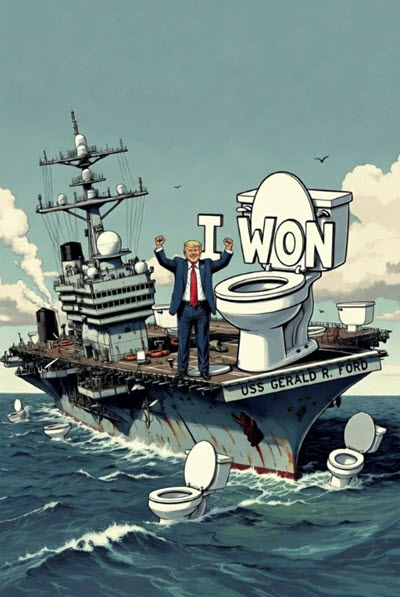
Transcript
Welcome everyone. Welcome back to the show. It's your host Danny Hiong. As you can see, I am joined by geopolitical analyst, prolific author, and uh
all-around friend of the show, Andre Martian. Andre, good to see you again. My pleasure.
Everyone hit the like button. That helps boost the show in YouTube's algorithm, and it would be very much appreciated.
All right, Andre. So, uh, I usually start these off with just the latest, uh, developments on the, uh, war front.
And first, I want to, uh, pull up that, uh, Iran is has announced that it has
fired warning shots at two US destroyers, the USS Truckton and the USS Mason, forcing them to flee the Sea of
Oman toward the Indian Ocean. Sanscom predictably has said that nothing of the sort has occurred. This has been a
pattern where we see Sentcom deny everything that Iran does and say
nothing exactly happens. But I wanted to first, you know, it seems like uh one humiliation at a long string of them and
you're really an expert on the or andor effectiveness of these weapons.
Andre, help me understand why it is that even to this point where the US has been waging this blockade for months now and
of course this war for months now that uh these destroyers can't seem to make their way anywhere close uh to uh Iran uh let alone uh the Persian Gulf itself.
What what's going on here? Why are these warships so vulnerable?
Well, uh there's a number of issues here with the overall u approach of the US Navy to building itself and its
operations and one of them are very expensive uh ships with a very insffective air defense. Uh American air
defense in general is not effective. We saw everything how it works or rather doesn't work in the uh during the uh
times of active combat. uh recently between Iran and Israel which also operates primarily American air defense.
And when you have something like the Arley Burke class destroyer which is uh
the older ones are around probably 1 billion to some but slightly above 1 billion. The latest ones are can run you
almost two billion per a pop. They are armed with the equipped with the um spy
six radar active phase array radar and uh they have the combat control system called
AEIS and they have only two weapons to defend themselves in terms of the air defense which are really even remotely
effective. This is of course the uh SM6 which they carry loaded in the MK41 vertical launch systems and of course
the sea sparrows. We're not talking about SM3. They are completely not designed for any kind of the combat or
surface uh combat. And so um what you have is very ineffective air defense.
They can shoot down one maybe two uh anti-shipping missiles.
is granted that they are subsonic but if you have a salvo which obviously it could be anywhere between four six to
eight the air defense is not going to handle it you will have the so-called leaker at least one of the missiles
which going to hit the ship and considering what modern air anti-shipping missiles are such as
Iranian and these are not some of them are not light they are mediumsiz basically missiles. Um the damage could
be very serious if not catastrophic if they are lucky in terms of their shot and that takes out of the operation
immediately the whole ship. You can will have the casualties well enough to remember the uh situation with the Stark
uh you know during the uh first Gulf War and the time you know basically approach to it. Uh you have the well
coal you know USS Cole what have been attacked though by the uh drone not drone really it was a suicide mission.
So once you have this uh and you have casualties um United States is extremely sensitive to own casualties that is why
they constantly have to lie to say that yeah we are nothing is no yeah sure and uh once you have this situation uh you
immediately have not only the well military well serious issue let's put it this way operational because you take
out the whole hull out of the uh oper operation, but you have the they are all of the American uh weaponry because of
their you know what shameless uh you know what uh bragging which of course never was based on any reality by the US
military industrial corpus of how good they are. You have a heavier reputation of basically uh being loaded to those
weapons. So when you lose that destroyer even if it's damaged not sunk it's a humongous reputational heat and again
for uh propaganda which is the you know that's why they call it military-industrial congressional media complex for this propaganda which
constantly talks about some kind of uh finest fighting force or in history or those incredible weapons mostly through
Hollywood basically they are not good to put it mildly they still can do damage.
Obviously uh you have the situation and it becomes political because you know Haloy which
they brainwash constantly those legacy media uh they start asking questions.
Hey we thought it's like Top Gun Maverick you know you fly the aircraft kill those bad guys and go to
Disneyland. Oh it's a hot shot. I'm sorry. Uh so and uh what do you what
expect? You cannot uh tell people truth because uh the it's most people don't
understand the level of catastrophe NATO NATO unified NATO headed by the United States sustained Ukraine. You you just
can't tell the truth. They need to lie constantly. And now you have the situation with Iran. And that tells you everything about low professional level
uh of the operational strategic planners and Pentagon which was known for a while now. And you have the vulnerability and
you have very expensive noise which you cannot lose. It's called risk aversion and risk avoidance. This is the
fullblown established uh patterns of the operations of the uh US Navy and US military. And that is why uh it this
whole concept came to a dead end uh operational dead end and it's completely bankrupt and that's what we observe.
Yeah. And uh as I said earlier, Andre, this is one in a kind of long string of humiliations. And I I want to bring this
up. I don't know if you saw CNN's uh exclusive uh video, very very brief video here.
Here, I'm just going to rewind it to the beginning. Uh, just s long, but CNN released a video of the USS Gerald
Ford. Now, uh, as the audience may know, the USS Gerald Ford is out of the field.
It is now back in the United States docked because ostensibly a laundry fire. I know you
know this story, uh, uh, Andrea. Laundry fire ignited on the the the biggest aircraft carrier in the world. and made
it essentially inoperable. Here is the photos of what it looked like inside after this quote unquote laundry fire.
Uh just massive damage done uh to uh this ship. It it looked like there if
it's a fire there was many things malfunctioning at that time. Andre, but what's your thoughts? Was this a laundry fire, Andre, or or is this something
more? Did this did this thing get hit by Iran? And is this a cover story? What do you make of just those? That video is
very brief. They obviously didn't want to show too much, but yeah. What's your thoughts on that?
Yeah, I don't need to intercede video. I saw the first videos which came out and uh the only number which I cared about
was . Uh you fight the the fire um famous uh you know forest
wall fire which day and that was a catastrophe. So uh for this back to uh to the port it will be uh put into
dock and essentially this will be rebuilt from ground up and I mean it literally so the uh flight deck will be
completely rebuilt which is a multi-billion undertaking. Uh they will remove this uh allegedly top-notch you
know two band radar which evidently doesn't work. they will instill now just standard spy 6 radar which
actually destroyers of the Arabic bird class carry. So there's something there obviously I don't know of fire
fire granted uh if they say now that uh the uh what is called sprinkler
system well it's more complex than sprinkler goddamn uh is that um so something
happened there what I don't know long fire and the system of the firefighting system didn't turn on uh so
uh Yeah, it's uh probably uh not a good sign for the ship of this uh class and
uh again it is known now what's going to happen to it uh to her uh in in the dock and in the shipyard is that it's going
to be essentially rebuilt a new the uh sewer system the what is called it's called fan system in the it has nothing
to do with the fan uh uh in um in the ship their sewage is horrible.
Obviously, they used like 50 mm uh radius uh the the diameter uh pipes.
It's just like really uh so there's some a lot of wrong with this uh ship. And so it's already 13.5 billion. So it's going
to run into many more billions just to rebuild it. Especially when you consider the fact that it they want now this deck handling the F-35B
which of course has a very hot exhaust and so unlike it is with F18s and so
it's just the wrong ship to put it mildly it's such a cluster cos in every single respect that at this stage it
doesn't matter if it was hit which could happen could have happened but they will be using all kinds of the cover stories until somebody you know what some
whistleblower comes out and says okay that's what really happened but uh evidently the fire again in the
same time if your firefighting system is off which is another issue uh who really was making those firefighting systems
you know uh yeah you you are in a deep pickle really and so and that's what happened and this is embarrassment
actually yeah that's what people cannot say that And again as with the destroyers, you cannot really uh risk
those expensive and reputationheavy uh assets because it takes one liquor. It takes one it takes one probably $1
million anti-shipping missile to put it out of commission. the thing which is well because they love to talk about
prices $1.5 billion destroyer which carries 96 cells of half of which are
loaded with those you know tomahawk uh you know land attack missiles. So yeah, you it's a catching too. They build up
this, you know, topheavy extremely expensive set of the toys with uh some
of their critical capability such as air defense being not what it always sold to sold so to speak to um to the world.
It's not very effective. So and then suddenly what are you going to do when the real call came in and you need to allegedly you know to provide the
13 minutessupport of the which United States doesn't have real uh ground force you can try to do something like what oh
launch missiles that's about it okay you can conduct some kind of the operations including the escort or interdiction operations there but you constantly
under the uh essentially eye of Iranian shorebased batteries And again the worst
case scenario for them is the fact that which is not confirmed. I don't know if it is true but if Russia sold onyx
missiles to Iran uh that is a bad news for US Navy.
Yeah. Well uh you know it's it's been bad news it seems all around for the United States. I don't know if you've caught Donald Trump recently. He has
been a lot more uh timid in his even just in his uh public facing uh stance on Iran. Uh you know Iran hit Kuwait.
They they Iran has been keeping its promises. The US pin prick strikes on Keshum Island. Iran hits Kuwait. Then
the fifth fleet again in uh Bahrain, whatever is left of that. uh and uh uh
you know what's happened since then is that uh now Iran is saying that they are ready to uh strike Israel again if
Israel decides on its operations in uh Beirut now. Yeah, if they strike Beirut, I mean they are bombing Lebanon, but
there is this understanding that if they go farther into the nation's capital that Iran will hit them back. And so my
question to you Andre uh what what can you help us understand the balance of forces in these back and forth strikes
so far? Because it seems like uh the United States has been engaging with Iran in a very what they call limited
15 minutesmanner. They even go so far to say that it doesn't violate the ceasefire and then Iran seemingly hits a a little
harder and then a little harder. But how do we understand this? And uh should Israel be concerned uh should they cross
that red line because it seems like they have no interest of course in meeting the demand of Iran to stop the war together.
Israel is run by criminals essentially all criminals and uh as Axel reported we all know what had happened. They went
into the profan profanity and shouting match. But then again listen Trump is uh not the man who can control anything. He
is a narcissist, very hollow, doesn't understand the first thing actually about war. It's all about it's his
administration is infested with the Zionist. So it doesn't matter what Trump says. Uh there was this very interesting
information uh coming from Pepe Escobar and Larry Johnson that essentially uh Trump knows now that Iran has a nuclear
weapon. So and I don't know how true it is. I'm just saying that this is one of the things which is you know being
circulated right now and let me put it this way if I were Iranian uh yeah I would make sure that they have the
nuclear weapon okay per Israel it's a really uh nothing more than collection
of the punitive battalions and uh they have uh no real military capacity as they have been humiliated militarily in
this Lebanon uh and so uh what can I say They lost the war. Simple as that. And
they are now doing what the only thing United States was able to do together with Israel to do the propaganda grandeur statements, you know, shaking
the air with whatever they uh find, you know, what are promising or expedient at this any given moment. But
basically strategically, United States lost and it's lost actually militarily. It doesn't have resources to fight.
Neither does Israel. While obviously Iran retains practically full capability to deliver I mean Iran can essentially
turn Israel into the parking lot without any nuclear weapons. Simple as that. And that's their reality and nothing they
can do with also how the so-called air defense works which is I mean you know
it's it's embarrassment. It's it's ridiculous. And so yeah that's what is happening there. And the balance of
power. What balance of power? There is no balance of power. The only thing United States has that means Israel. Israel is the
subdivision of the US air force essentially or rather the other way around. US air force is serve you know what is commanded by Israel and they do
their bidding. Uh essentially they can do the only thing they can do take off fly in launch or you know something and
then go back you know trying to escape the air defense. uh and so that's the only thing and yeah the world saw it the
only thing they have as I already stated is this media complex they spin doctors which is a you know human thrush
essentially goes into this profession and so they spin it in some way that United States has any kind of the
control of the situation it does not it is being dictated the conditions as simple as that they they call it catch
22 uh Trump and his administrations are administration are cornered. There's no that dead end. They have no way out. And
this is the result of being them utterly incompetent bunch of the amateurs with the degrees in law and whatever the hell
also and you know you look at the Trump foreign policy it's insanity you know and uh what can I say? They wanted it.
They got it. So you know uh obviously Mr. Trump thinks that he's a great strategist. He's not. He's a showman.
He's a real estate sher from New York and he never graduated any further from that.
Good points, Andre. And is the reason why Iran because you know Iran has made good on its threats and it is not
inconceivable to think that Iran will strike Israel if if Israel continues to move forward. But uh you said that Iran
has the ability to turn Israel into a parking lot. Uh now much of the world is very uh sick of Israel Andre as you
know. Uh what are the considerations for Iran not doing this? Is it because that would lead to some kind of nuclear standoff whether Iran has the bomb
doesn't have the bomb? Uh we know how valuable Israel is to United States. Is this why Iran doesn't simply make good
on the nightmare that Israelis have been thinking about for so long? Iran wiping it off the map, so to speak.
Well, first, uh, Israel is not valuable for the United States. It's a parasitic country. It is valuable for the 57, uh,
you know, fanatical, uh, so-called Christian Zionist. They're not Christians. They are Zionists. It just they cover themselves with this ideic
pseudo Christian rhetoric there and heresy of the Scoffield Bible. So they uh but Israel is one of the major
reasons why United States finds itself into this pickle today and it's bankrupt. It's humiliated all all over
the place and it's absolutely militarily impotent. So the only thing United States has is their obviously nuclear weapons. That's the only thing. And so
uh well but Israeli lobby Apac and Kufi whatever Christian United for Israel and
all that they keep this uh basically uh destructive connection between United States and Israel alive because Israel
in and of itself the only thing they have those undeclared nuclear weapons and they have obviously Samson option
21 minuteswhich of course they know as they said hey you know what if we are going to disappear uh you what we will go all out
and hit everybody you know so well sure I mean that's what they are good at only you know so the rest of it they are not
good militarily they are once faced with the enemy which is well organized disciplined well trained and has the
means to strike back they fold immediately and again many people do not understand they essentially lost in
terms of armor in the south Lebanon the something of equivalent of couple of the armor brigades Many people don't even understand and
and again it's difficult to explain to a public which you know is basically brainwashed with the legacy media what is happening apart that's why they are
actually only good at committing atrocity and genocide as a fighting force they are second rate and sobba
actually showed who they are and all those wanted rather not want yeah it's
just promoted by the media systems like iron dome it's useless it's incompetent you know it's absolutely
ineffective against the modern weaponry and the operations how they are designed in terms of what essentially has ward
done uh it's uh suppression of the enemy air defense by very limited means and it's not just drones that now you have
those ballistic missiles which are you know the tactical ballistic missiles um hitting the northern Israeli towns And
so yeah that will continue and what can I say until Israel either dissipates itself because they committed atrocity
genocide which nobody who have any morality in their except for the Washington Washington DC they don't have
morality so they will forgive them because it's the pariah state essentially and no matter how they try using their lobbies and you know all
kinds of the diasp diaspora uh they probably will dissipate at some point of time and cease to exist because
essentially everybody saw now what they they represent politically uh morally or
rather lack thereof uh ideologically and economically. Economically it's a pipsqueak. They have some uh industries
obviously uh but all this is as always uh promotion of the Israeli some kind of the incredible qualities. most of it
they are totally dependent on the United States which provides $18 billion dollars a year essentially. Well,
essentially they are built most of it for the for Israel. You know, look at the uh IDF, Israeli Defense Force, uh
table of equipment. Most of it is American. I mean, yeah, they have this merca, some APCs, you know, some small arms and things like that. They get
parts of electronics and things like that. Look at this. I mean, the air force, what is Israeli Air Force? It's the US Air Force. It's all American B made from uh F-15s to F-16s to F-35s.
It's all American. This the most expensive pieces of equipment there.
Look at their air defense. All those you know hats, you know, David Sling, what are they? They are raon and Boing. Okay.
So, and you look at this without the United States, they are nobody. The only thing they have is the nuclear weapons.
And so it is just due to the Arabs utter incompetence and coverties and the corruption of their elite that the Israel is still alive as the state.
Simple as that. Uh they are surrounded by people who are even less competent than they are. And uh as a result so um
you know uh it's going to take some time but uh I think Israeli society will already killed itself. It will decompose
eventually because you cannot live after what you committed. You know, you come out on the other side completely screwed
25 minutesup like Germans did you know who uh you know there are all kinds of the social anomalies and cultural anomalies which
are already happening there. So uh what can I say? Uh now they are they even refuse their services now in Europe to
Israelis. That's how bad it has become, you know. So, yeah. Well, certainly being a a a colony
incomplete and utter uh you know, just rampage, genocidal rampage, that's that's certainly an anomaly uh Andre that uh as you said cannot last forever.
Well, let me play uh you may uh uh despise uh this figure because he
represents exactly who you talk about often times. these uh you know IV educated yet totally uneducated masters
of war in the United States. Here's Leon Panetta, former CIA director and US and US Department of Defense head under
Obama. So uh people may know that under Obama essentially everybody did everything and uh it was just a bunch of
neocons uh revolving uh going through their own revolving doors within the administration. So here you have a
former CIA director and uh Department of Defense head. Here's what he had to say though. Not it's not a rosy picture that he's painting with regard to Iran.
Uh I think what you're seeing is that uh this war is very much turning into uh
Trump's Vietnam. Uh in Vietnam we negotiated uh but in the end the North Vietnamese
basically uh took total control. We were lucky to get our forces out. I think we're heading in the same direction with this war.
You are describing a grave mistake that ends in a quagmire then. Is that right?
Exactly. Exactly. I think you know in the end as long as we have a hardline regime in Iran uh that that cannot be
trusted whatever you work out for example on the straits of Hormuz uh is going to be temporary at b best because
uh Iran remains in control of the straits of Hormuz and if you're trying to work out some kind of nuclear
agreement based on the word of the hardline regime they cannot be trusted.
you're going to have to develop a verification process uh to to really make sure that they're abiding by limits
on enrichment. And that process hasn't even begun yet.
So uh not a rosy picture, but this whole idea that Iran can't be trusted. So interesting. The United States has thousands of nuclear weapons already and
uh its foreign policy record is surely the definition of untrustworthy. Your thoughts?
Well, I mean, um, Obama is one of the worst and his administration is one of the worst president in the American history, only superseded by, uh, Trump
and Biden. Uh, if you look at naturally at the this whole string of the so-called US presidents starting from
Bill Clinton, you can see yourself the complete degeneration of the American strategic thought, which never was the first rate to start with. Then you have
the diplomacy basically ceasing to exist as the craft states craft in the United States because the when you look
attentively at who runs state department and who they are I mean this is pathetic really it's a third world essentially
but yeah they have to go out and say something they uh they're primitive minds they're very feeble and listen to
expect from some uh Washington bureaucrat with degree in whatever political science whoever and law and to be like Oh yeah, CI director and yeah
all those uh you know credentials credentialed idiots but he is not incorrect saying about Kagmire but it's
not quagmire United States have been defeated militarily and uh it's just a matter of the arrangement now and Trump
well he might be an idiot but he obviously senses that judging by his hysteria when in the talk with Netanyahu
which have been be has become known to all of us. He understands that uh he
didn't just screw up. He betrayed his own country. Okay? Because he made this uh his country which in itself in is
filled with problems. He delivered nothing on anything except for his buddies who uh made you know what made them rich on the inside trading and the you know manipulation with the market.
uh and again not real market only with the futures you know of the um of the
oil and uh it's complete disaster catastrophe and again it doesn't matter
people do not understand United States doesn't have resources it really never had but this is time it
have been exposed of even attempting to get into the uh you know Iran on the ground and even if United States
reinstates the draft which itself will be the end of the United States. Uh that whole thing even if United States
somehow drafts you know whatever the million or whatever uh personnel it's not enough to get into Iran and do
something or achieve any political objective because the price the cost will be catastrophic. It will make Iran
I mean Vietnam look like the stroll in the park like they you know what weekend picnic and so uh some people understand
it. Trump only now evidently he got the message you know and again United States is absolutely casualties averse society.
It was always about hiding, covering up the playing with that and it never recovers from the Vietnam syndrome which
in itself if you take a look at the level of the casualties which United State sustained and in terms of the KAS
which were 56,000 over 10 years uh 10 year period I mean it's by no means
catastrophic. It's it's I mean it's horrible. It's always bad when you kill you know your soldier get lost but
reality combat losses were only 41,000 you know then there was this um whole uh
so to speak mythology created around Vietnam but reality is the ma bulk of the the main number so to speak of
casualties wasn't taken by the United States in Vietnam it was a RVN it was the South Vietnamese army which
sustained 1.3 million casualties with more than 350,000 KAS. Of course, they said that they
couldn't fight. Oh, of course. Yeah. So, but the point is that uh it is all came to a head. I warned about it for the
last 12 years. Uh it was the society essentially in the mythology built around this uh Alban's four touchdowns
from marriage with children when they beat the crap out of the third rate retired uh uh Saddam's army and b oh my
god look at this you just beat the 5-year-old kid everybody expects you to win you know but they for some reason
decided that this is the only uh uh essentially uh lesson they can draw from it then of course the whole history of
World War II has been rewritten including by the way the participation of the German generals such as scale of Munchstein or Hower who were official
employees of the US Army Department of History and they say oh yeah we defeated everybody we are the winners with the
historical military historical approach like that and military doctrinal thinking or rather lack thereof which is happening in the United States you're
not going to win anything and this is uh and this is thing I warned about uh I remember when this book came out, it
created a rather interesting splash. I'm talking about my first book in 2018 that uh United States is not the force actually designed to fight real war.
It's expeditionary force that actually fights somewhere else in some third rate third world you know crap hole and
that's about it in terms of you saw yourself what happened you saw it's the these are totally obsolete doctrinal
operational concepts and of course technology which doesn't work uh Andre you know uh I think this is
being seen very clearly when it comes to uh If we just look at you, you know, you said yourself and I agree with you 100%.
Israel's military, uh, it's its toys are built off the backs of the United States. The United States provides these things, and that's why Israel has them.
They can't stop these FPV drones. And we've been hear I've been hearing about this almost every single day all over social media. Uh, mainstream media is
even covering it. What are these FPV drones? Why are they so troublesome? uh they don't seem to be very expensive and
they don't seem to be uh very difficult to build. Why are they causing Israel so many problems? Because Israel has a uh
multi-billion dollar military backed by the United States.
Well, uh it's those multi-billions of dollars are worthless against the specific tactical and
operational requirements, you know, against the background. Yeah, you can have whatever the hell you have this David Sling, you know, or Iron Dome
thing which is designed to fight actually the regular ballistic targets.
35 minutesOnce the ballistic target suddenly begins to fly on the suppressed ballistic trajectory and begin to maneuver, that's the whole other story.
And then you have drones. For drones, you need to have things such as well only Russia has them. It's called
integrated uh air defense and it has some systems such as obviously to M1 to
M2 to M1. It has the panser uh S1 which are extremely effective against those drones. And you have to have what is
called mobile fire groups which also have the ability to actually using the AAA uh anti-aircraft artillery to uh
engage those drones. Apart from the complex of other systems which are of course the suppression of the optical optical electronic channels of the
drones and of course electronic warfare it's a completely different system neither United States nor Israel have it
you know and as the result you can see yourself they penetrate those drones uh in inexpensive FPV drones they stick on
them the uh you know the head of the RPG7 which is the you know what tandem
charge and they kill all those things there you know and they don't even know how to build proper screen for the tanks for example Russians know how to build
it that is why Russian tanks are continuing to increase in numbers and they operate almost freely you have the special ability to establish screens
which can take one T90 emperor of Russia recently well documented and uh took 47
hits from the Ukrainian drones and continued moving until it hit their anti-tank mind and then yeah one of the
tracks well det got detached. You have to have this absolutely totally different view on the warfare. Neither Pentagon nor let alone Israel have it.
And even the introduction of this such thing as we saw ourselves more effective ballistic missiles not some kind of the
Kusha rockets made out of the you know what sewage pipes as it was happening before. And then they suddenly have the pretty sophisticated well uh uh you know
high accuracy and even maneuvering ballistics from Iran. And guess what the this air defense you know completely
collapses in Israel. And so goes for those uh 16 uh US uh bases in Middle East which are gone now. They are not
operational. You uh essentially Iran evicted the United States from the region. And so let's recall what happened with the
those three out of eight available uh TH missile anti- anti-missile complexes.
Three of them are destroyed by what? By drones.
So they just don't understand what air defense is. American idea of the air defense defense was always this. Oh
yeah, we get the uh actually E3 sentry into the air. We get all those F-16s, F, you know, uh F-15s. Oh yeah, this rotate, you know, awax thing rotates.
Oh, here we have missiles flying. Okay, let's go. You know what? And shoot them down. And then there we have the patriots which do not work. You know,
and then they kind of mop up the rest of it. Cray. This is our air defense. This is World War II uh concept of the uh
warfare and United States together with the United States Navy are affected by the World War II thinking because they learned absolutely nothing from the
World War II. They learned that, oh yeah, we came in, you know, in 1944 and we won all of it, you know. Uh, sure.
Yeah, the Red Army. Yeah, that's just they defeated 80 the cramp of the axis.
But sure, you this is what happens. This is what happens when you produce the core of the thinkers which is driven by
lack of any serious engineering and tactical and operational knowledge and operates on what we know as garbage in garbage out. They cannot get listen they
still believe those uh the BS which uh Ukraine supplies Pentagon you know in copious amount amounts and so you're
they believe that yeah Ukraine is about to win. So well what what can I say?
Yeah. Well speaking of that Andre how about we pull up our favorite uh Qatari western basically western propaganda
when it comes to this conflict. Um uh we're seeing Oh, this is not even I don't know if this is the right article.
Uh uh anyway, so let me just pull this out for a second. Al Jazzer is reporting
that Ukraine has been slowing down Russia on the front lines, but and this
is kind of a worry I believe for the entirety of the West, can't slow down its ballistic missiles. Uh and we've
seen a number now of strikes that Russia has engaged in in the last couple weeks including the big one which uh 23 people
were reported killed in that one and I believe there was at least a half dozen Zercon missiles that were used. So help
us understand uh what exactly uh Russia is unleashing on Ukraine now uh via the
air on Kiev in particular and uh maybe help us understand also the uh this this
odd dynamic of uh Russia having this massive firepower a couple weeks ago what they use the Archnik missile again.
Um yet the mainstream media keeps saying that on the battlefield Russia has been slowed if not uh pushed back. Is any of
this true and uh help us understand the reality.
Average western jour is a war criminal and lying sack of excrement. Simple as that. The editorial boards uh again
western world and especially Europe they don't have free media. If you look at those CNN's, Washington Post or New York
Times or let alone UK media, these are propaganda gibbsonian machines. For example, number of them are controlled
by CIA. I don't remember which one either Washington Post or New York Times. One of the those two is CIA. Uh
for example, the obviously the uh the economist and financial times are outright MI6 operations. So they lie.
they are covered because they hide behind this uh you know civilians and behind the uh uh backs of the um canon
photo of Ukraine. So they lie because and now when uh Russia already essentially reacted to their terrorism.
Yeah. The Alazer just Yeah. It's it's it's a trash. Okay. Qatar trash. They are prostitutes. All of them are
prostitutes. literally they will sell their wives or husbands to whatever just for the so-called story. So this is
disinformation uh machines. Uh but reality is uh so why uh Russia reacted so harshly after the terrorist act
against children? anybody would. And so uh as the result uh well they g they already hunting down there all kinds of
reports of their uh hospital and you know uh medical uh aircraft uh taking off from Jes which is the main uh kind
of base of the you know handling their wounded and killed of NATO countries. So they will be hunted down and killed
because they are sitting within the ke and within the uh uh actually the uh civilian areas of the apartment blocks
and things like that. That's what they do. They also hide their their air defense systems and things like that. So um it already has happened you saw
yourself hower on arrives and then now Arashnik as Vladimir Putin stated yesterday we just trained for the last
three times. We looked at the ability of the accuracy which is very good. Uh and so now they will be uh hitting uh the uh
KEF and other places into the bunkers where this covered sit and uh that will be Arashnik and it's not going to be
inert anymore. So uh yeah, Russians are ready and they are doing this now and uh it sounded was stated by Vladimir Putin
yesterday and uh they better run. But the problem is that uh Russia Russia has a very good human actually on on the
ground in Ukraine. the names of the people who were ordering the strikes uh and CNN actually was part of the
coverage team that is why they didn't appear uh in the star area because they were the ones who covering actually this
people who killed those children. Well, CNN is a terrorist organization. They are all terrorists essentially they supported and that's the whole separate issue why it is so uh but um that's it.
They will be hunted down and killed and this is the reality. But they have to maintain the ho paloy completely into the dosile state and tell them fairy
tales. While Russians are already fighting at the outskirts of Zaparosia and each day they gaining several kilometers deep into the territory. Many
people do not understand that Russians are deep into area 40 kilometers. So but yeah what do I do? What do I know? So
but again Argentina is the Qatar Qatar is the one of the uh actually suppliers if you wish
and supporters of the ISIS together with Israel you know so you you cannot expect anything normal from those people. H
yeah and oddly uh Andre Zalinski I always find these contrasts so interesting is you have uh uh Zalinski
on the one hand and the United States and and the mainstream media the uh these these terrorists as you call them they they keep saying Russia's on the
back foot Russia's losing they say they say ballistic missiles are the last argument the only thing left at
its disposal right and Yeah. Well, um remember uh Muhammad Ali, he was uh
winning those titles because he was so weak and he was winning because he was weak and so yeah, same goes for Mike Tyson.
What a weakling, you know, just yeah, it's because of the last argument, you know. So these are not normal people.
Again, we have to understand that and discussing their delirium and discussing their other lies which you know if they
believe they again you have to understand average journal uh Hunter Thompson uh look up the uh you know fear
and loathing in Las Vegas how he defined press. Yeah, I'm not going to be saying it on your uh basically it's all
profanity. They are low lives. They are literally prostitute. Take any person from the CNN or Washington Post or Al
46 minutesJazzer. They are They are media horse. They are people who have no education because essentially this is
nothing more than the uh uh well there's no such thing as journalism. That doesn't exist. It's not profession. As correctly Hunter Thompson stated, it's
not a craft. It's any with IQ above room temperature can become the journalist. Okay. So or reporter if you
wish. But uh generally speaking uh discussing this it's a Gibbsonian propaganda. Gilbert never killed anybody
personally. You have to understand Gilbert was kind of oh yeah softspoken dude you know who slept around in you
know babbitsburg at you know in in uh ser of Berlin and um but for some reason
he knew that he has to kill himself and he they also executed their own family with children you know uh so and uh he
knew they we have to understand average uh crit who comes out of the German school anyway in Harvard. They he or she
is a crit. They do not understand the real world. They are brainwashed uh cogs in this uh uh you know propaganda
machine. And it is thanks to the independent media like yours for example uh that people begin to hear in United
States you know alternative point of view and not alternative. You see that's the whole it's another catch catch. Oh it's alternative point of view. No truth
is knowable. It's that's what those creatants want to convince you that oh truth you cannot know the truth. You need to have two people who are just
screaming in each other. Oh it's alternative point of view. There is no alternative point of view. There is either truth or there is lie. Period.
Simple as that. And it's black and white. Although sometimes truth could be complex. Let's put it this way. But this
uh you know what prost they're literally prostitutes. They sleep around. They will sell themselves for you know whatever the good I don't know good
48 minutesdinner they have no human integrity no morality not a single person in CNN or Washington Post or New York Times or let
alone UK media have any morality they are human trash including the editorial boards and they well they are
blackmailed by the obviously people who uh find them and know with what to blackmail them let alone like BBC which
is pedophile central you know So this is the type of people who go in there and so they want to convince us that you
know somehow they need to alternative there is truth and there is not truth
which is lie and so that's the only uh thing not there are alternative universes which they create through
their narratives but that's about it and uh that's the thing which has to be understood about you cannot go out and
constantly you What create those taxonomies for example about let's say pop music. Oh yeah some kind hip hop rap. No it's not music it's garbage.
Okay there are only two types of music good and bad. You know what there is a classic music. There's a great rock that
which are great music jazz you know uh and there's bad music or something which pretends to be uh music. And these are
the distinctions which they constantly impose on us with this uh you know what fakery essentially which is like oh
alternative point of view. How about you get to the bottom of it? They don't uh
you can buy any scumbag from CNN or whatever Washington Post and they are
not there to deliver the story. They are there to manipulate.
Yeah. Andre, you may remember Donald Trump used to say this a lot. Uh, alternative facts. You may have remember
him say that and uh I think that is the the pinnacle of uh because he is an
imbecile himself in many ways. He kind of accidentally revealed just how as you
were stating um the people like himself and those who back him, the these parasitic elites, how they like to spin
things to make us seem like the uh the alternative when in fact they're the ones who are always actually putting out
alternative facts for us to digest and uh and act like it's somehow quote unquote truth. Uh so it's you know uh uh
uh to maybe to close Andre you know Vladimir Putin is at the St. Petersburg economic forum uh right now uh he has
responded to many things related to Iran. Uh he said that actually Iran hasn't received anything from Russia during this period but had said he said
that he understands why Iran has reacted the way it has to USIsraeli. Yeah, it's you can all say yeah it's
what's your uh what's your thoughts on this and um maybe if you can give a bit of an overview of you know Leon Petta
said this is Trump's Vietnam moment do you agree with that and is this uh is this kind of where we're heading not just with Iran but also I mean Ukraine
is still happening and the United States every time it gets into something seems to have a hard time sealing the deal so
to speak and I think that's a that's a big change in history especially given the fact that uh as you said the US has
liked to make its post World War II track record look really grand and big when a lot of the times it was fighting far uh weaker if not completely
destitute uh you know opponents first it's not Vietnam Vietnam United States could sustain it affected it
culturally tremendously and that because of the Vietnam we have the bunch of the baby boomers who were draft dodgers and now they are having the high moral
ground in but reality is uh Vietnam United States could absorb this one it can't it has been paraded uh for the
rest of the world for what it is it's a you know big mouth bully which cannot fight and so uh this is the sad reality
for many Americans but that's what it is but again at this stage it's what many people do not understand it doesn't matter what Americans think it doesn't
matter what I think it matters what the world thinks and the world sees what it's you know what what United States
has become. We're not talking about Europe. And so, uh, that's what it is.
And in Ukraine, yeah, uh, things are moving along and, uh, again, Russians
help only, uh, the practically 90% of the rest I mean 90% of DK obl is
liberated. They have to deal with this finish of this chromatation on which they are closing in surrounding
surrounding it and Constantin soon to fall uh and uh yeah things move along.
They every day there are progress 1 2 3 kilometers and so but again you cannot
explain to some imbeile that Russians there are not to capture Ukraine.
Russians there are not for uh territorial gains. But again you cannot explain to people uh who grew up on the
Hollywood in you know representation of the war and know the war including many people in Pentagon from the uh
entertainment industry that uh Russians are not there for the gains territorial gains except for those four obelists
which have been you know joined returned to Russia. Uh, so it's all about what Lazier Putin stated, full denification
of Ukraine. How is it going? I know what I'm about to say is going to hurt many people and going to terrify many people.
You can denify Ukraine by actually eliminating annihilating its mobilizational potential and any kind of
the restoration of the Ukrainian state under the basis of which we saw starting from the 2000 well essentially 1991. how
how it's done. Uh for people who want to know the real numbers of the KAS, I can
tell you one thing. The uh essentially Ukrainian army together with those so-called volunteers from the west sustained about 5 million casualties.
It's at least two and a half million KAS, at least two and a half million wounded maimed. So uh and Ukrainian society is disintegrating. It's the
country which lives on the handouts from United States and Europe. period.
Yeah. Yeah. And uh you know, I think that's a good place uh to leave you, Andre, because uh all of this that
you've described here. I think that there's a a big misconception right now that the United States is uh on the
55 minutesresurgence. Of course, you have the MAGA people who have this idea that uh America is being made great again by this massive expansion of war. But even
people who uh you know oppose uh you know US empire and who find the US empire to be abhorrent in the way that
it does its dealings uh they have uh found a lot of pessimism I think in the
fact that uh uh even though Iran can hit back and all of this uh there's been a huge focus on the energy markets and
gobbling them up and cornering them and the blockades and all of this. I just have to say that the United States was
never as in the postw World War II era really built to um you know fight endless wars. It was supposed to
maintain economic hegemony. That is really out the window in many ways. It's the the US economy will not stop
shrinking. It will continue to become a smaller Well, it's in decline. Yeah, it's uh listen uh American society is absolutely
ignorant of the real war. It is and this is not my opinion only. This is opinion by uh general major general PhD in
physics no less and 20 years in DARPA uh General Robert Latif American society knows and public in including political
elites about war is from the entertainment industry. This is a direct quote. So uh many in Pentagon believe
that you know they watch movie pattern and they think that this is war this is not they have no clue despite the fact that uh uh uh actually the uh Americans
are the most armed nation you know in civilian I have my weapons you know so but the uh you know what the issue is
that uh it's the uh turning point for the United States and you know what that's it.
Yeah. Well, uh there's a question about the 25th amendment that I don't know if you want to I don't know. Yeah, everybody discusses.
Listen, it's uh Trump is very good for Israel. Okay. And until and he and the United States doesn't have US Congress.
It has the 2.0. Uh Washington is controlled by Israel. So, it will continue this thing until United States
is completely driven into the uh you know what oblivion with all that. and we'll have to wait and see what's going to happen. But the country we dearly
love, you know, I look at the country, I don't recognize it anymore.
Andre, uh, I want to make sure everyone knows that both your blog and your YouTube channel in the video description below so people can check that out after the show. I want to thank you for
joining the program. Much appreciated, my friend, and I hope to see you again very soon. Sure. Thank you. All right. Take care. Bye, ma'am. Bye.
Bye.
All right, everybody. So uh I am going to just uh close uh quickly here. Let me just uh adjust this camera a little bit.
Try to mess with the uh setup here.
Trying to get some upgraded lighting and all that made possible by you and your views uh and your uh capacity to watch this program. So hit the like button
everybody. Tomorrow I will be back with Mark Labota 2:00 PM Eastern time, good friend of the show. we will dive deeper
into these military affairs and that will be 2 pm Eastern June 6th. Uh but before I leave you, I'll just say this
that we h you know we have a general crisis of the US empire. I'm not of the belief that the United States Empire is
is is catching another breath, has been able to somehow revive itself just
because it has been able to park its incredibly old and wasteful aircraft
carriers here and there. Starve Cuba, try to starve Iran, try to starve Russia, not succeeding in that, try to
contain China. You know, on the one hand, the US can do these things. The US empire can do it. The neocons, the wararm mongers, the elites, they can do
them. But does it mean it is working? Uh you could say that working means that the United States has been able to cut off energy markets, destroy, destroy.
And if we measure a success in destruction, then sure, the United States empire still remains in peak
form. But if we look at the actual data, if we look at the actual reality on the ground, you have a massive crisis of
legitimacy at home. you have massive tensions about to boil over. Uh people are sick and tired of this. You of
course the United States itself is also a reflection of empire. So you have uh many various oppressed groups, nationalities, uh people, working-class
people as a whole suffering, struggling, unable to make ends meet. Uh you have corporations taking more and more and more from the people. And even people
that are supposed to be economically comfortable are not finding themselves to be anything uh uh sort anything of the sort. Uh then you of course you have
the global situation. You could say yes the United States has cut off uh you know has cut off Venezuela. It's controlling its oil supposedly right?
It's controlling its oil almost entirely. Cuba has been surrounded. USS Nimttz is there now ready to conduct
some kind of operation. and Iran has had to cut some of its oil exporting because of this blockade. Then you find out
though that uh the truth is and then of course they say Russia too, the Black Sea. But then you come to find out that well is the United States empire getting
stronger? Has the US share of the world economy increased in recent years? And the answer to that question would be
absolutely not. Uh, has the US empire been able to contain China? Has been
able to weaken Russia? The last time I checked, both of those countries, Russia has been able to advance uh militarily
to a large degree, has built new weapons, more advanced systems, has made itself more stable economically, has the
best fastest growing currency alongside the dollar in the world. Uh, China technologically absolutely has surpassed
the United States in many different areas uh in and in the most important areas. You even had on America's Got
Talent, you had a Chinese dancer dancing with Unitry Robots uh during his uh
segment. So uh the the United States has been surpassed in so many ways and of course China's economic might is
measured in all levels including rising standard of living, rising trust in the government, rising life expectancy. All
these things do not exist in the United States. The opposite is true. And if an empire can survive with a with a
declining uh sick and suffering po overall population, then perhaps we're putting way too much stock in the power
of elites themselves because they are trying to pull the strings. But those strings are not moving in the same way
anymore. Iran is not going to fall. and Iran, unless the United States can pull
a rabbit out of the hat and find a way to go full throttle uh military uh
interventionism on Iran and achieve what it said it wanted to achieve. Iran is going to be there for the long haul.
It's going to be the Islamic Republic of Iran and it is going to pursue its own objectives like repairing itself with
the fees it collects out of the straight of Hormuz building an even stronger military and all of this will have a cascade effect on the world I think even
temporary setbacks like what we saw in Venezuela what we're seeing with the suffering in Cuba none of that is permanent and if we don't believe right
this isn't religion this is simply believing in what we see if we don't uh understand that Venezuelans that Cubans
that they've been fighting for years and years and years the process isn't linear. If we if we if we believe that the US empire somehow can overturn
things in uh perpetuity with a level of permanence then we have been reading history very well. So overall the
situation is looking good. The multipolar world the pillars of the multipolar world they're here to stay.
uh I don't see any capacity of the US empire to influence politics in Russia and China and then the rest of the
global south has those anchors for the long haul and that will only lead to more of the same developments that we've
been seeing and it really is up to the people of the United States then and up to the people in the West to begin to join this process in the way that they
can which is to stop their governments from committing terrorism, stop their governments from committing war crimes, genocide, all this. Stop your
governments from doing this. And if you can't stop them, then maybe you need a new one. Or maybe you need a new kind of political arrangement. Maybe the
political arrangement of having just a small fraction of the population own and control all the land, the wealth, the banks, all the means of production.
Maybe that's not a good system that's going to lead to anything but catastrophe for the present and the
future. It's just a thought. But I just want to leave you with that thought because that is I think where we need to place our focus because we've had a lot
I think of inspiration gained from the resistance of forces like Iran uh Hezbollah the resistance in West Asia
and of course the moving multipolar world. But uh we can't just be spectators in it. We've got to continue to hone our understanding of this so we
can bring it to the people. That's the entire point. and uh we need to reach as broad of a people as possible. Without
further ado, everyone, I want to thank everyone who gave us super chat. Okay, thank you servant of the most high. Thank you, Celtic RNA for that question.
You know, I again the US political process is so it's just not constructed well. It is constructive for the ruling
class. And I I believe that if people are going to hold leaders accountable, they're going to have to find a way to do it themselves through an alternative
process that uh will hopefully eventually be the one that reigns over the society rather than that of the
elites. Um everyone hit the like button before you go. Again, Mark Labota tomorrow uh 200 p.m. Eastern time, June
5th. All right, mark that down. I'll be back with Mark uh for another hour of geopolitics.
Uh in the video description below, you can find all the place support this show, Patreon, Substack, and much more.
Without further ado, everyone, thanks again for the new membership. Uh thanks again for the super chats, and I will see you then. Bye-bye.
- admin
- Site Admin
- Posts: 41470
- Joined: Thu Aug 01, 2013 5:21 am
Re: PART 3 ANTI-ANTI-NAZI BARBARIAN HORDES ARE KNOCKING DOWN
by admin » Sat Jun 06, 2026 1:32 am
Iran General rejects Trump’s request to meet Supreme Leader, warns of reprisals
by Rifat Jawaid
Janta Ka Reporter
Jun 5, 2026
A top military adviser to the Iranian Supreme Leader has turned down US President Donald Trump's request for a meeting with Ayatollah Mojtaba Khamenei. Gen. Mohsen Rezaei also threatened to shut down the strategic Bab al-Mandab Strait if the US military does not end its ongoing aggression and blockade against Iran. Rifat Jawaid analyses today's explosive geopolitical developments.
Transcript
Plenty of developments to capture in tonight's video and apologies for not being able to come to you last night as
I was busy meeting like-minded pro Palestinian journalists in London and by the time I got back home in Birmingham,
it was simply too late. In fact, it was early in the morning. So, here are some of the top stories. The deranged
occupant of the White House has expressed his desire to meet the new Iranian Supreme Leader after murdering
his father, wife, and child in a cold-blooded bombing. The top Iranian military adviser to the Supreme Leader
has vowed to hunt American forces all the way to the Indian Ocean if they don't mend their ways. The Lebanese
president has hit out at Iran for the carnage caused by Israeli terrorists.
Violent protests have continued in Albania over Trump's Jewish daughter Ivanka and Jewish son-in-law Jared
Kushner buying an Albanian island which is environmentally protected with the help of a company involved in the
stealing of Palestinian land in the occupied West Bank.
US Congress has voted to officially become the occupied territory of war criminal Benjamin Nathan Young. This will be the broad focus of my video
tonight. Also in this video, the rogue BBC loses sleep over its coverage of a propaganda report on anti-semitism by
British peer John Man. So please stay tuned. So, Israeli lap dog Donald Trump has continued with his nonsensical
utterances over Iran. After suffering defeat against the Islamic Republic, this Netanyahu's poodle now wants to
meet the new supreme leader of Iran, Ayatah Mushtab.
You have to admire his audacity. This killer of over 160 school girls in Minab
was also responsible for the coldblooded murder of the late Ayatali Kami, his daughter-in-law and grandson. But he
thinks the new Iranian supreme leader should meet the murderer of his father, wife, and young child. Does this man's stupidity have any limits?
Want to meet with the new ayat, the new supreme leader? I don't want to meet, but if if I did meet, I'd be honored to meet him. I I'd like to see if we make a deal.
But if we make a deal, it's possible that I would meet him. I'd be okay with it.
Would that happen here in the US White House?
Oh, I don't know. I I haven't really heard too much about it. It's I I didn't suggest it, but some people have suggested it. If it happened, it would be happen. I'd be I'd be respectful.
Do you think Do you think because Epic Fury killed his dad and his wife and his kid that he's got hard feelings and wouldn't want to meet? Well, I I would
say I'm not his favorite person, but with that being said, he's probably a prof. I don't know him. He's probably a
professional. In some circles, he has a very good reputation. Actually, you know, sometimes some people say bad, but a lot of people say bad about me. It's totally false, of course.
Mr. President, well, the office of the Iranian Supreme Leader has kind of reacted to his delusions. The Iranian Supreme Leader's
senior military adviser, Mosin Razi, has firmly rejected Trump's desire. If anything, Razi has told CNN that his
country's military was determined to hunt US military all the way to the Indian Ocean as he threatened to shut
the Babel Mandep corridor. You are the military adviser of the Supreme Leader.
Um, how is the Supreme Leader doing? Is he fully in control of everything? and President Trump said that he would be honored to meet the Supreme Leader.
This will not happen. Right now, we are in the first stage of negotiations and Mr. Trump has brought the negotiations to a standstill. This will not happen.
Are the negotiations right now blocked or do you think that a memorandum of understanding can be reached quickly? In my opinion, the negotiations are at a
deadlock and Trump must break this deadlock.
They are waiting for an answer from Iran.
Iran has openly stated that our assets have been frozen and you must release them. The Americans are not telling the truth in this regard.
So the frozen assets are the big problem right now.
This is a sign of trust building. If Trump takes the negotiation seriously, $24 billion is not much to America.
If he wants to reach an agreement with Iran, this $24 billion is a test of trust that Iran wants to have with
Trump. This is a test that America must pass and the path will be opened. This is our own money, not America's money.
Wouldn't a war be catastrophic for Iran as well, though, if it was a big bombing campaign?
If the war continues and the naval blockade is not lifted, we will drag the war to the Indian Ocean, the Babal
Mandab Straight, the Red Sea and the Mediterranean. And we will give another dimension to the war by attacking these
other American bases that we have been attacking so far. America will definitely suffer much more losses.
America's losses will be very heavy.
Final question. What's your message to Donald Trump?
Mr. Trump must make decisions independently of Israel. He must give what is the rights of the Iranian people
and stop the blockade, release our frozen assets, and this can be a new horizon for the future of Iran and
America. Therefore, Trump must put aside his personal interests and think about the interests of the American people. If
Trump has the courage, many issues will be resolved in the future.
Meanwhile, Israeli terrorists have continued to cause carnage in Lebanon.
But the Lebanese president Joseph has hit out at Iran for this carnage. Do you
ever remember either this guy or the Lebanese PM Nav Salam using such a tone
against the bunch of Israeli terrorists who are responsible for committing ethnic cleansing in Lebanon? No, it's not your country. It's our country.
It's our obligation. It's not your job to interfere into our country. I reject the statement totally because our people
being killed, our people being our house is being destroyed. They are using Lebanon as a ch bargaining chip
in their negotiation with the United States. It's unacceptable.
And here also, Hezbollah must understand that. Hezbollah must understand that no other way but
to sit and talk. People like Christian Amanpor are used to running propaganda against Iran when the global sentiments
are against Trump and his war criminal Israeli master Benjamin Netanyao. Wait until Amanpor goes to Albania to
interview its prime minister as the violent anti-government protest continue for the fourth day in a row.
Albanian Prime Minister Eddie Raman and American and Israeli stoogge is being accused of effectively turning over the
sovereign Albanian territory, specifically the pristine uninhabited
Sazan Island and the Zorn Peninsula to private foreign interests, namely Trump's Jewish son-in-law Jared Kushner
and daughter Ivanka. Albanians fear that this would lead to the creation of another Israeli settlement on the
Albanian territory with local groups explicitly drawing parallels between their situation and the Israel Palestine
conflict. That's because the company involved in this deal is Kushner's Affinity Partners, which is also linked
to illegal West Bank settlements through its role as the largest shareholder in Phoenix Financial, an Israeli
conglomerate heavily invested in blacklisted companies.
This is an old interview of Ivanka Trump who wouldn't hide her excitement over the prospect of building her project on
Albanian territory. I've also gone back to my real estate roots which has been a lot of fun and I'm
working on an incredible project with my husband in the Mediterranean. It's it's massive in scale.
I think that's an understatement. Can you explain it? There's no power on this island. You're building you're building everything from scratch, correct?
9 minutesWell, it's an unbelievable, beautiful 1,400 hectare private island in the middle of the Mediterranean. We were on a friend's boat and we stopped for a
swim effectively. That's how we found it. We swam to the islands. We went on a hike barefoot all the way up to the top
and we were just captivated and it stayed with us ever since. And over the course of of many years, we developed
the opportunity to help realize its potential and and transform it, but with a lot of restraint and care because the
land is so beautiful that really the architecture has to be fully integrated into it, almost rise from it. You know,
it's not even a business for me despite the scale of it. We not only the island, but we have five miles of beachfront
directly across from the island. this beautiful peninsula with a lagoon on one side, the ocean on the other.
Trump and his entire clan are real parasites who will go to any length to build their business empire, even if it
means stealing people's land with zero respect to morality, environmental concerns or territorial sovereignty. I
say this because the land in question is environmentally protected area. The current Albanian government relaxed the
rule so that it could sell this land to the Trump family.
Albanians have also been in the news after they welcomed Israeli footballers with shoes and other projectiles.
Albanian fans who are mostly Muslims feel passionately about the Israeli barbarity in Gaza and the occupied West Bank.
They were incensed by an Israeli footballer's provocative gesture after scoring a goal. This has reignited the
debate on corrupt FIFA's refusal to ban the Israeli football team from the international competition. Mind you,
only this week, Israeli terrorist kidnapped two Palestinian footballers, young Palestinian footballers from the
country's national women's football team. They are 20-year-old Rand Al-Halwani and 21-year-old
Natalie Abu Dhier. Israeli barbarians continue to commit brutalities in broad daylight, but the corrupt FIFA and his
genocidal Tug President Infantino chooses to look the other way. Listen to this British Jewish sports writer who
says that Israel should have been kicked out of world football several decades ago. I think we just need to go back a
little. Even before Gaza happened, Israel should have been kicked out of football a decade ago. It should have
been kicked out of every sporting institution. It was completely clear when the Palestinian Football Association and its allies took the case
to FIFA for the first time, I believe in 2015, arguing that Israel systematically
broke FIFA statutes. They allowed teams to play in their league who are on occupied land in the West Bank as
defined by the UN. They have a systematic problem with racism inside
their stadiums, which I can testify to having been to quite a lot of football in Israel and uh heard an unbelievable
level of anti-Palestinian racism and expressions of violence. They have systematically undermined Palestinian
football by refusing players the opportunity to enter and leave freely from the West Bank and Gaza to participate in international
tournaments. All of these things are explicitly against FIFA statutes. This was agreed by Villi Lama who was the
German uh social democrat who was working as the special rapur on sport for the UN who ruled on this matter
matter in 2017. It is entirely legally unambiguous.
13 minutesIf any other state, if any other football association was guilty of anything close to this, they would have
been out of FIFA faster than you can imagine. Perhaps Infantino's inability to act against Israel stems from the
fact that bloodthirsty terrorists running this settler colony have now gone on to own several Western
countries, including the US, the UK, and Australia, to name a few. In the US, Congress has just voted to integrate the
functioning of the Israeli forces with that of the US military. What this means is that Israeli terrorists will no longer have to rely on American dollars.
Instead, they will now suck into whatever they want by being firmly aligned with the US military, its
research and manufacturing of deadly weapons so that they can be used at will against Palestinian, Lebanese and
Iranian civilians. Congressman Ro Kana was one of those minority voices who registered his protest.
Mr. Chairman, the American people are tired of the arrogance and insolence of
Prime Minister Netanyahu telling America what we should do.
The entire country of Israel has a GDP that is less than a single town in my district. Yet somehow Netanyahu thinks
he could tell the American people what we should do. The person who's most upset with him right now is President Donald Trump.
And everyone in America, whether you're a Republican, an independent, or a Democrat, says that we need to tell
Netanyahu that America calls the shots, not the prime minister of any other country. They want less cooperation and blank checks to Israel, not more.
only the United States Congress would dream up at this moment. Let's actually do more for Israel, not less. And that's
15 minuteswhat section 2024 does. It's a pretty simple thing. Should we do more for Israel than we already do? Or should we
do less? If you think we should do more for Israel, you should be against my amendment. If you think we should do less for Israel at the time that he's
arrogantly telling Donald Trump what to do, then you should be for my amendment.
Now, let me just be clear, Mr. Netanyahu actually wrote to a member of Congress to put this section 224 into the bill.
He says, "I know that aid is unpopular in America. I know that even Republicans don't want aid. So here's what you got
to do." Quote, "Let's create a new framework." This is Netanyahu telling us what we should do. a new framework of joint defense cooperation,
co-development, co-production, and mutual investment in areas including advanced missile defense, artificial intelligence, cyber security, and next generation military platforms. Why?
Because he doesn't want Congress to vote on the aid. He just wants it fused in the bill. Last I checked, Netanyahu doesn't have a seat on this committee.
Mr. Chairman, we need to reject an amendment which is language is coming directly from the Israeli prime minister
and we ought to have any aid have a vote of the American people. I am for team America. I am for the interests of this
country and I believe that when Donald Trump ran, he ran America first. That includes American interests against any
foreign country. We should have American sovereignty and make it clear that we strike 224. If we want to give aid to
Israel, if we want to sell them weapons, that should be a vote for the entire Congress.
The control of the US and the UK government by Israeli terrorists is such that anyone criticizing Israel is
punished in these two countries with lightning speed. We saw how the UK home secretary Shabbana Mahmud rejected the
visa of two American journalists Jenk Huger and Hassan for their criticism of Israel. Now Trump has
banned reigning UFC middleweight champion Sean Strickland an American citizen from an upcoming White House UFC
event scheduled to be held on 14th of June. Why? Because his criticism of Israel. But Sean
responded to this ban with a sarcastic video.
Well, you guys, I'm not surprised, but I got the call. I I got the call. I got the call. The UFC higherups called me,
you know, big names. They said, "Sean, I got to apologize, but uh you're not Israeli enough to go to
UFC 250 Israel edition. Uh the White House didn't clear you." And and I'm I'm not really surprised, you know. I'm not
really surprised. So, you know, I think moving forward, I would like to just apologize to Israel. I'd like to say I'm
sorry, you know, like to apologize to Trump and I just want to prove that I'm Israeli enough for you guys. Like for
instance, you know, whenever the list like disappeared and Trump goes out there and says to everybody that uh that
he can't really go into it because people that uh by association will get prosecuted and like their names will be tarnished. I want to apologize because,
you know, I don't want them to to be prosecuted.
or um you know when Trump goes and bombs the out of Iran that that no Americans agree with that cost Americans
five to 15,000 dollars to go fight Israel's war. I want to apologize. Sorry I've been a critic of that. You know my
my allegiance was apparently in the wrong place and I just want to apologize. Or and Trump goes out there and says, "Hey Trump, your approval
ratings are the lowest it's ever been across all demographics." And Trump says, "Well, you know what? I have a 99% approval rate in Israel. I want to
apologize and I want to repent and I want to repent. You know, apparently I'm not American enough to go to Freedom
250, but uh I still got my ticket. So maybe we'll just go I'll bring the bell and we'll just stand outside the gate and we'll just let him know what we
really think about uh Trump uh in Israel. You know, boxer A Price Mitchell
lashed out at the slavery of the Trump regime to Israeli terrorists.
Did you see that Sean Strickland got banned from the White House for talking about Israel?
I'm not surprised at all. I mean, it, you know, freedom of speech is what really makes this country great. And when you can't criticize a foreign nation, a foreign nation, come on, man.
We ought to be able to criticize our own nation, let alone a foreign nation. In fact, that's the only nation you're not
allowed to criticize, you know. So, uh, something's going to change because evil
empires don't last forever. There's always a rebellion. You ever seen Star Wars? That's what's going to happen, bro. Darth Vader's going to get took down.
I will now leave you with another example of just how rogue the BBC has turned to serve the interest of its
genocidal masters from Israel. But let me explain you the context first. This Israeli broadcasting corporation's
coverage on a piece of questionable report by an equally questionable character from British politics, John Man, truly shamed the profession of
journalism once again. So John man who was instrumental in defending the thug of Makabi Talvi football supporters and
whose wife sits on the home office select committee published this week a report claiming the rise in
anti-semitism in the NHS. The entire might of the BBC led with the story as if some calamity had gripped the UK.
Good morning. These are the headlines.
The government's independent adviser on anti-semitism has recommended banning NHS staff from wearing political badges at work and from attending protests in
their uniform. Ministers have accepted the proposals in full for England as part of a wider package aimed at tackling anti-semitism and other forms
21 minutesof racism. Hello, it's 6:00 on Thursday the 4th of June. This is Today with Johnny Diamond and Amal Rajan. The
headlines today, NHS staff are set to be banned from wearing political badges on their uniforms after a review of anti-semitism in the health service.
They kept on peddling this fake agenda all through the day. BBC radio force Amun Rajan who has faced criticism for
his coverage of the Gaza genocide interviewed one doctor who claimed to face anti-semitism in the NHS but gave
no evidence. In fact, one of the examples this so-called doctor gave to support his wild claims was that his
colleagues equated the Gaza genocide with the Holocaust.
How dare they? But Amul Rajan refused to challenge him in any way or form. The
Gaza Holocaust is the worst Holocaust witnessed by the world on their mobile phones in real time. And yet the Israeli
22 minutesBroadcasting Corporation was worried about the rise in the so-called anti-semitism amongst the NHS staff.
Immediately after this broadcast by the IBC, also known as the BBC, the Kestama government said it had accepted all the
recommendations by John Man. But you can't say this was choreographed or staged. And by the way, this was on a
day a Jewish leader of a prominent UK political party, the Greens, demanded accountability for 2,000 odd dual
British Israeli citizens who had committed war crimes in Gaza.
But this was not worthy of any coverage for the Israeli Broadcasting Corporation. But first, let's turn to
Dr. Richard Kaplan who works in the NHS and whose experience of anti-semitism in the workplace led him to write about the problem. Dr. Kaplan, good morning.
Good morning, Ammo.
Thank you very much indeed for for joining us. Um, reading your essay in the Health Service Journal, the impression is of a a sometimes hidden, sometimes blatant form of prejudice.
Just tell us what you uh experienced, then we'll get on to why you're speaking out about it. What sort of anti-semitism did you face? Um I experienced views
which are anti-semitic being expressed quite freely in communal workplaces. So uh views that reference things like
Jewish control of global finance suggesting the events of October the 7th were fabricated and making regular comparisons between Gaza and the
Holocaust. And what I found quite surprising was that these opinions were expressed as if they were widely accepted and uncontroversial.
Do you mind just spelling out in detail what you're talking about there just to give our listeners a real chance to understand it when you say so there's tropes which are sadly very familiar
from history about uh I think you mentioned Jewish control of global finance or money but in terms of the specific things people were saying to you about the Holocaust or indeed about
Gaza. What sort of things were they saying? Well, just those things really.
It arose in um you know, informal political discussions about, you know, um recent events and then quickly what
was quite a measured discussion between colleagues turned into, you know, expressing these tropes and quite literally sort of, you know, pointing at
the irony of what's going on in Gaza and comparing it to the Holocaust and drawing on the other tropes that I' I've I've mentioned as if that was sort of a
widely accepted fact and that was a perfectly acceptable thing to say. And would you say that there'd been a a sharp rise, a spike if you like, since October the 7th, 2023?
I think certainly I've never uh experienced, you know, views like that being expressed before. And I think that was certainly the turning point was on October the 7th.
That's it from me. Thank you very much for your support of this platform and our journalism. If you haven't subscribed to my channel, please do so
because that's one of the many ways you can support independent journalism. God bless you all.
by Rifat Jawaid
Janta Ka Reporter
Jun 5, 2026
A top military adviser to the Iranian Supreme Leader has turned down US President Donald Trump's request for a meeting with Ayatollah Mojtaba Khamenei. Gen. Mohsen Rezaei also threatened to shut down the strategic Bab al-Mandab Strait if the US military does not end its ongoing aggression and blockade against Iran. Rifat Jawaid analyses today's explosive geopolitical developments.
Transcript
Plenty of developments to capture in tonight's video and apologies for not being able to come to you last night as
I was busy meeting like-minded pro Palestinian journalists in London and by the time I got back home in Birmingham,
it was simply too late. In fact, it was early in the morning. So, here are some of the top stories. The deranged
occupant of the White House has expressed his desire to meet the new Iranian Supreme Leader after murdering
his father, wife, and child in a cold-blooded bombing. The top Iranian military adviser to the Supreme Leader
has vowed to hunt American forces all the way to the Indian Ocean if they don't mend their ways. The Lebanese
president has hit out at Iran for the carnage caused by Israeli terrorists.
Violent protests have continued in Albania over Trump's Jewish daughter Ivanka and Jewish son-in-law Jared
Kushner buying an Albanian island which is environmentally protected with the help of a company involved in the
stealing of Palestinian land in the occupied West Bank.
US Congress has voted to officially become the occupied territory of war criminal Benjamin Nathan Young. This will be the broad focus of my video
tonight. Also in this video, the rogue BBC loses sleep over its coverage of a propaganda report on anti-semitism by
British peer John Man. So please stay tuned. So, Israeli lap dog Donald Trump has continued with his nonsensical
utterances over Iran. After suffering defeat against the Islamic Republic, this Netanyahu's poodle now wants to
meet the new supreme leader of Iran, Ayatah Mushtab.
You have to admire his audacity. This killer of over 160 school girls in Minab
was also responsible for the coldblooded murder of the late Ayatali Kami, his daughter-in-law and grandson. But he
thinks the new Iranian supreme leader should meet the murderer of his father, wife, and young child. Does this man's stupidity have any limits?
Want to meet with the new ayat, the new supreme leader? I don't want to meet, but if if I did meet, I'd be honored to meet him. I I'd like to see if we make a deal.
But if we make a deal, it's possible that I would meet him. I'd be okay with it.
Would that happen here in the US White House?
Oh, I don't know. I I haven't really heard too much about it. It's I I didn't suggest it, but some people have suggested it. If it happened, it would be happen. I'd be I'd be respectful.
Do you think Do you think because Epic Fury killed his dad and his wife and his kid that he's got hard feelings and wouldn't want to meet? Well, I I would
say I'm not his favorite person, but with that being said, he's probably a prof. I don't know him. He's probably a
professional. In some circles, he has a very good reputation. Actually, you know, sometimes some people say bad, but a lot of people say bad about me. It's totally false, of course.
Mr. President, well, the office of the Iranian Supreme Leader has kind of reacted to his delusions. The Iranian Supreme Leader's
senior military adviser, Mosin Razi, has firmly rejected Trump's desire. If anything, Razi has told CNN that his
country's military was determined to hunt US military all the way to the Indian Ocean as he threatened to shut
the Babel Mandep corridor. You are the military adviser of the Supreme Leader.
Um, how is the Supreme Leader doing? Is he fully in control of everything? and President Trump said that he would be honored to meet the Supreme Leader.
This will not happen. Right now, we are in the first stage of negotiations and Mr. Trump has brought the negotiations to a standstill. This will not happen.
Are the negotiations right now blocked or do you think that a memorandum of understanding can be reached quickly? In my opinion, the negotiations are at a
deadlock and Trump must break this deadlock.
They are waiting for an answer from Iran.
Iran has openly stated that our assets have been frozen and you must release them. The Americans are not telling the truth in this regard.
So the frozen assets are the big problem right now.
This is a sign of trust building. If Trump takes the negotiation seriously, $24 billion is not much to America.
If he wants to reach an agreement with Iran, this $24 billion is a test of trust that Iran wants to have with
Trump. This is a test that America must pass and the path will be opened. This is our own money, not America's money.
Wouldn't a war be catastrophic for Iran as well, though, if it was a big bombing campaign?
If the war continues and the naval blockade is not lifted, we will drag the war to the Indian Ocean, the Babal
Mandab Straight, the Red Sea and the Mediterranean. And we will give another dimension to the war by attacking these
other American bases that we have been attacking so far. America will definitely suffer much more losses.
America's losses will be very heavy.
Final question. What's your message to Donald Trump?
Mr. Trump must make decisions independently of Israel. He must give what is the rights of the Iranian people
and stop the blockade, release our frozen assets, and this can be a new horizon for the future of Iran and
America. Therefore, Trump must put aside his personal interests and think about the interests of the American people. If
Trump has the courage, many issues will be resolved in the future.
Meanwhile, Israeli terrorists have continued to cause carnage in Lebanon.
But the Lebanese president Joseph has hit out at Iran for this carnage. Do you
ever remember either this guy or the Lebanese PM Nav Salam using such a tone
against the bunch of Israeli terrorists who are responsible for committing ethnic cleansing in Lebanon? No, it's not your country. It's our country.
It's our obligation. It's not your job to interfere into our country. I reject the statement totally because our people
being killed, our people being our house is being destroyed. They are using Lebanon as a ch bargaining chip
in their negotiation with the United States. It's unacceptable.
And here also, Hezbollah must understand that. Hezbollah must understand that no other way but
to sit and talk. People like Christian Amanpor are used to running propaganda against Iran when the global sentiments
are against Trump and his war criminal Israeli master Benjamin Netanyao. Wait until Amanpor goes to Albania to
interview its prime minister as the violent anti-government protest continue for the fourth day in a row.
Albanian Prime Minister Eddie Raman and American and Israeli stoogge is being accused of effectively turning over the
sovereign Albanian territory, specifically the pristine uninhabited
Sazan Island and the Zorn Peninsula to private foreign interests, namely Trump's Jewish son-in-law Jared Kushner
and daughter Ivanka. Albanians fear that this would lead to the creation of another Israeli settlement on the
Albanian territory with local groups explicitly drawing parallels between their situation and the Israel Palestine
conflict. That's because the company involved in this deal is Kushner's Affinity Partners, which is also linked
to illegal West Bank settlements through its role as the largest shareholder in Phoenix Financial, an Israeli
conglomerate heavily invested in blacklisted companies.
This is an old interview of Ivanka Trump who wouldn't hide her excitement over the prospect of building her project on
Albanian territory. I've also gone back to my real estate roots which has been a lot of fun and I'm
working on an incredible project with my husband in the Mediterranean. It's it's massive in scale.
I think that's an understatement. Can you explain it? There's no power on this island. You're building you're building everything from scratch, correct?
9 minutesWell, it's an unbelievable, beautiful 1,400 hectare private island in the middle of the Mediterranean. We were on a friend's boat and we stopped for a
swim effectively. That's how we found it. We swam to the islands. We went on a hike barefoot all the way up to the top
and we were just captivated and it stayed with us ever since. And over the course of of many years, we developed
the opportunity to help realize its potential and and transform it, but with a lot of restraint and care because the
land is so beautiful that really the architecture has to be fully integrated into it, almost rise from it. You know,
it's not even a business for me despite the scale of it. We not only the island, but we have five miles of beachfront
directly across from the island. this beautiful peninsula with a lagoon on one side, the ocean on the other.
Trump and his entire clan are real parasites who will go to any length to build their business empire, even if it
means stealing people's land with zero respect to morality, environmental concerns or territorial sovereignty. I
say this because the land in question is environmentally protected area. The current Albanian government relaxed the
rule so that it could sell this land to the Trump family.
Albanians have also been in the news after they welcomed Israeli footballers with shoes and other projectiles.
Albanian fans who are mostly Muslims feel passionately about the Israeli barbarity in Gaza and the occupied West Bank.
They were incensed by an Israeli footballer's provocative gesture after scoring a goal. This has reignited the
debate on corrupt FIFA's refusal to ban the Israeli football team from the international competition. Mind you,
only this week, Israeli terrorist kidnapped two Palestinian footballers, young Palestinian footballers from the
country's national women's football team. They are 20-year-old Rand Al-Halwani and 21-year-old
Natalie Abu Dhier. Israeli barbarians continue to commit brutalities in broad daylight, but the corrupt FIFA and his
genocidal Tug President Infantino chooses to look the other way. Listen to this British Jewish sports writer who
says that Israel should have been kicked out of world football several decades ago. I think we just need to go back a
little. Even before Gaza happened, Israel should have been kicked out of football a decade ago. It should have
been kicked out of every sporting institution. It was completely clear when the Palestinian Football Association and its allies took the case
to FIFA for the first time, I believe in 2015, arguing that Israel systematically
broke FIFA statutes. They allowed teams to play in their league who are on occupied land in the West Bank as
defined by the UN. They have a systematic problem with racism inside
their stadiums, which I can testify to having been to quite a lot of football in Israel and uh heard an unbelievable
level of anti-Palestinian racism and expressions of violence. They have systematically undermined Palestinian
football by refusing players the opportunity to enter and leave freely from the West Bank and Gaza to participate in international
tournaments. All of these things are explicitly against FIFA statutes. This was agreed by Villi Lama who was the
German uh social democrat who was working as the special rapur on sport for the UN who ruled on this matter
matter in 2017. It is entirely legally unambiguous.
13 minutesIf any other state, if any other football association was guilty of anything close to this, they would have
been out of FIFA faster than you can imagine. Perhaps Infantino's inability to act against Israel stems from the
fact that bloodthirsty terrorists running this settler colony have now gone on to own several Western
countries, including the US, the UK, and Australia, to name a few. In the US, Congress has just voted to integrate the
functioning of the Israeli forces with that of the US military. What this means is that Israeli terrorists will no longer have to rely on American dollars.
Instead, they will now suck into whatever they want by being firmly aligned with the US military, its
research and manufacturing of deadly weapons so that they can be used at will against Palestinian, Lebanese and
Iranian civilians. Congressman Ro Kana was one of those minority voices who registered his protest.
Mr. Chairman, the American people are tired of the arrogance and insolence of
Prime Minister Netanyahu telling America what we should do.
The entire country of Israel has a GDP that is less than a single town in my district. Yet somehow Netanyahu thinks
he could tell the American people what we should do. The person who's most upset with him right now is President Donald Trump.
And everyone in America, whether you're a Republican, an independent, or a Democrat, says that we need to tell
Netanyahu that America calls the shots, not the prime minister of any other country. They want less cooperation and blank checks to Israel, not more.
only the United States Congress would dream up at this moment. Let's actually do more for Israel, not less. And that's
15 minuteswhat section 2024 does. It's a pretty simple thing. Should we do more for Israel than we already do? Or should we
do less? If you think we should do more for Israel, you should be against my amendment. If you think we should do less for Israel at the time that he's
arrogantly telling Donald Trump what to do, then you should be for my amendment.
Now, let me just be clear, Mr. Netanyahu actually wrote to a member of Congress to put this section 224 into the bill.
He says, "I know that aid is unpopular in America. I know that even Republicans don't want aid. So here's what you got
to do." Quote, "Let's create a new framework." This is Netanyahu telling us what we should do. a new framework of joint defense cooperation,
co-development, co-production, and mutual investment in areas including advanced missile defense, artificial intelligence, cyber security, and next generation military platforms. Why?
Because he doesn't want Congress to vote on the aid. He just wants it fused in the bill. Last I checked, Netanyahu doesn't have a seat on this committee.
Mr. Chairman, we need to reject an amendment which is language is coming directly from the Israeli prime minister
and we ought to have any aid have a vote of the American people. I am for team America. I am for the interests of this
country and I believe that when Donald Trump ran, he ran America first. That includes American interests against any
foreign country. We should have American sovereignty and make it clear that we strike 224. If we want to give aid to
Israel, if we want to sell them weapons, that should be a vote for the entire Congress.
The control of the US and the UK government by Israeli terrorists is such that anyone criticizing Israel is
punished in these two countries with lightning speed. We saw how the UK home secretary Shabbana Mahmud rejected the
visa of two American journalists Jenk Huger and Hassan for their criticism of Israel. Now Trump has
banned reigning UFC middleweight champion Sean Strickland an American citizen from an upcoming White House UFC
event scheduled to be held on 14th of June. Why? Because his criticism of Israel. But Sean
responded to this ban with a sarcastic video.
Well, you guys, I'm not surprised, but I got the call. I I got the call. I got the call. The UFC higherups called me,
you know, big names. They said, "Sean, I got to apologize, but uh you're not Israeli enough to go to
UFC 250 Israel edition. Uh the White House didn't clear you." And and I'm I'm not really surprised, you know. I'm not
really surprised. So, you know, I think moving forward, I would like to just apologize to Israel. I'd like to say I'm
sorry, you know, like to apologize to Trump and I just want to prove that I'm Israeli enough for you guys. Like for
instance, you know, whenever the list like disappeared and Trump goes out there and says to everybody that uh that
he can't really go into it because people that uh by association will get prosecuted and like their names will be tarnished. I want to apologize because,
you know, I don't want them to to be prosecuted.
or um you know when Trump goes and bombs the out of Iran that that no Americans agree with that cost Americans
five to 15,000 dollars to go fight Israel's war. I want to apologize. Sorry I've been a critic of that. You know my
my allegiance was apparently in the wrong place and I just want to apologize. Or and Trump goes out there and says, "Hey Trump, your approval
ratings are the lowest it's ever been across all demographics." And Trump says, "Well, you know what? I have a 99% approval rate in Israel. I want to
apologize and I want to repent and I want to repent. You know, apparently I'm not American enough to go to Freedom
250, but uh I still got my ticket. So maybe we'll just go I'll bring the bell and we'll just stand outside the gate and we'll just let him know what we
really think about uh Trump uh in Israel. You know, boxer A Price Mitchell
lashed out at the slavery of the Trump regime to Israeli terrorists.
Did you see that Sean Strickland got banned from the White House for talking about Israel?
I'm not surprised at all. I mean, it, you know, freedom of speech is what really makes this country great. And when you can't criticize a foreign nation, a foreign nation, come on, man.
We ought to be able to criticize our own nation, let alone a foreign nation. In fact, that's the only nation you're not
allowed to criticize, you know. So, uh, something's going to change because evil
empires don't last forever. There's always a rebellion. You ever seen Star Wars? That's what's going to happen, bro. Darth Vader's going to get took down.
I will now leave you with another example of just how rogue the BBC has turned to serve the interest of its
genocidal masters from Israel. But let me explain you the context first. This Israeli broadcasting corporation's
coverage on a piece of questionable report by an equally questionable character from British politics, John Man, truly shamed the profession of
journalism once again. So John man who was instrumental in defending the thug of Makabi Talvi football supporters and
whose wife sits on the home office select committee published this week a report claiming the rise in
anti-semitism in the NHS. The entire might of the BBC led with the story as if some calamity had gripped the UK.
Good morning. These are the headlines.
The government's independent adviser on anti-semitism has recommended banning NHS staff from wearing political badges at work and from attending protests in
their uniform. Ministers have accepted the proposals in full for England as part of a wider package aimed at tackling anti-semitism and other forms
21 minutesof racism. Hello, it's 6:00 on Thursday the 4th of June. This is Today with Johnny Diamond and Amal Rajan. The
headlines today, NHS staff are set to be banned from wearing political badges on their uniforms after a review of anti-semitism in the health service.
They kept on peddling this fake agenda all through the day. BBC radio force Amun Rajan who has faced criticism for
his coverage of the Gaza genocide interviewed one doctor who claimed to face anti-semitism in the NHS but gave
no evidence. In fact, one of the examples this so-called doctor gave to support his wild claims was that his
colleagues equated the Gaza genocide with the Holocaust.
How dare they? But Amul Rajan refused to challenge him in any way or form. The
Gaza Holocaust is the worst Holocaust witnessed by the world on their mobile phones in real time. And yet the Israeli
22 minutesBroadcasting Corporation was worried about the rise in the so-called anti-semitism amongst the NHS staff.
Immediately after this broadcast by the IBC, also known as the BBC, the Kestama government said it had accepted all the
recommendations by John Man. But you can't say this was choreographed or staged. And by the way, this was on a
day a Jewish leader of a prominent UK political party, the Greens, demanded accountability for 2,000 odd dual
British Israeli citizens who had committed war crimes in Gaza.
But this was not worthy of any coverage for the Israeli Broadcasting Corporation. But first, let's turn to
Dr. Richard Kaplan who works in the NHS and whose experience of anti-semitism in the workplace led him to write about the problem. Dr. Kaplan, good morning.
Good morning, Ammo.
Thank you very much indeed for for joining us. Um, reading your essay in the Health Service Journal, the impression is of a a sometimes hidden, sometimes blatant form of prejudice.
Just tell us what you uh experienced, then we'll get on to why you're speaking out about it. What sort of anti-semitism did you face? Um I experienced views
which are anti-semitic being expressed quite freely in communal workplaces. So uh views that reference things like
Jewish control of global finance suggesting the events of October the 7th were fabricated and making regular comparisons between Gaza and the
Holocaust. And what I found quite surprising was that these opinions were expressed as if they were widely accepted and uncontroversial.
Do you mind just spelling out in detail what you're talking about there just to give our listeners a real chance to understand it when you say so there's tropes which are sadly very familiar
from history about uh I think you mentioned Jewish control of global finance or money but in terms of the specific things people were saying to you about the Holocaust or indeed about
Gaza. What sort of things were they saying? Well, just those things really.
It arose in um you know, informal political discussions about, you know, um recent events and then quickly what
was quite a measured discussion between colleagues turned into, you know, expressing these tropes and quite literally sort of, you know, pointing at
the irony of what's going on in Gaza and comparing it to the Holocaust and drawing on the other tropes that I' I've I've mentioned as if that was sort of a
widely accepted fact and that was a perfectly acceptable thing to say. And would you say that there'd been a a sharp rise, a spike if you like, since October the 7th, 2023?
I think certainly I've never uh experienced, you know, views like that being expressed before. And I think that was certainly the turning point was on October the 7th.
That's it from me. Thank you very much for your support of this platform and our journalism. If you haven't subscribed to my channel, please do so
because that's one of the many ways you can support independent journalism. God bless you all.
- admin
- Site Admin
- Posts: 41470
- Joined: Thu Aug 01, 2013 5:21 am
Re: PART 3 ANTI-ANTI-NAZI BARBARIAN HORDES ARE KNOCKING DOWN
by admin » Sat Jun 06, 2026 1:58 am
Senate Republicans Pull SHOCK STUNT in MIDDLE OF NIGHT!!!
Katie Phang
Jun 5, 2026
While you were sleeping, Senate Republicans voted for an additional $70 BILLION in funding to ICE and CBP. This is on top of the $140 BILLION that was already apportioned to those agencies last July in Trump’s Big Bullshit Bill. Katie Phang on why more funding to untrained, undisciplined federal agents will just results in more deaths and destruction.
Transcript
By now, you and like uh many of us here in the United States have awakened to the news that Senate Republicans decided
that $70 billion was necessary to fund ICE and CBP over the span of the next three years.
Conveniently towards the end of convicted felon Donald Trump's second term as president of the United States.
The vote was 52-47.
Nearly along party lines, Senator Lisa Marowski of Alaska, the only Republican
to vote against it, Democratic Senator Michael Bennett of Colorado, actually missed the vote. The vote took place at 500 a.m. this morning.
If that isn't one big huge [ __ ] red flag, I don't know what is. And of course, of course, Senate Republicans
would do this while most Americans were asleep. And they should, these Republicans should hang their heads in
shame because this money was not necessary.
I've talked about the following numbers at length here at Katy Fang News and on every social media platform upon which I
have gained access. And I'm going to repeat it now because I want you to share this episode far and wide to let
everyone regardless of party affiliation understand what has just happened last year. Donald Trump and the GOP over the
objections of Democrats passed what I call the big [ __ ] bill. It is definitely not beautiful and it certainly is big.
Last year, I'm talking July 2025 in the big [ __ ] bill,
$75 billion was aortioned to ICE.
$75 billion.
And in that big [ __ ] bill as well, $65 billion was aortioned to CBP.
75 billion to ICE, 65 billion to CBP.
And at the end of April, just a month ago, maybe a month, maybe five weeks ago,
the Office of Management and Budget, provided the following numbers to Senator Jeff Mkeley, who's the
ranking member of the Senate Budget Committee.
of that money from the big [ __ ] bill just last year in July of 2025. We haven't even hit a year yet, right? 63
billion remains for ICE to use and 37 billion remain for CBP to use. I mean,
in my humble opinion, one of the biggest questions that needs to be answered is what in the actual [ __ ] did CBP do with,
3 minutesI don't know, approximately $30 billion since last July.
You know, look, I fairing a little bit better. Only about 12 billion has been used. still an abomination that we sit
here today with continuing skyrocketing prices for gas, oil, fuel, basic
necessities and goods. A no, there's no such thing as affordable health care left. Slashes to Medicaid, Medicare, you
name it. Life has gotten extravagantly, disgustingly expensive in America. It's
allegedly the greatest country in the world. And yet Senate Republicans voted accepting Lisa Marowski to give an
additional 70 billion dollar to ICE and CBP. For what?
For what?
Let's get into more of the details of this vote because the bill is now going to head to the House, which is expected to take it up next week.
Well, let's talk details because the devil is always in the details.
As I mentioned, the vote happened 52 to 47 500 a.m. this morning. And part of
the holdup has been multiffold. One was originally the $1 billion
that Trump wanted for his ballroom and bunker.
And luckily, Republicans figured out, you know, the political backlash is just too much. And so they jettison that out of this bill.
But but the $ 1.776 billion dollar slush fund, which is just theft of American
taxpayer dollars, has caused a lot of consternation for Republicans because many of them are
facing races that will come to a head in November of this year. And it's a really
shitty look if you are greenlighting and supporting a slush fund that will go to
pay money to January 6 insurrectionists who harmed, assaulted, battered, and did
really grievous injury to law enforcement. It really doesn't fit with the back the blue brand that the
Republican party alleges to be alleges to be the party of law and order. So
several Republican senators were trying to either get rid of it in its entirety or make material amendments so that
Trump couldn't move forward with this slush fund. For example, let's talk about what the Democrats and
the Republicans that were trying to deal with the slush fund did. Thursday morning, just yesterday morning, there was a Democratic effort to ban the settlement wholesale.
And there were senators like Bill Cassidy that were weighing whether or not they were going to sign on to this.
Ultimately, they did not. So, that effort failed. Then, the second effort that was made was actually an amendment that was brought up by Republican
Senator Tom Tillis. I don't have to tell you Bill Cassidy as you know lost his primary and Tom Tillis is resigning like right he's on his way out he's retiring
from Congress so neither of them owe any loyalty allegiance or feelalty to Trump ma world etc. So Tom Tillis proposes
this second amendment and it would have also banned the settlement fund but would have moved the money to a separate anti-fraud fund at the department of
justice. Predictably, most Democrats voted against this amendment because the money isn't necessary, let alone is it
legal to begin with. So, Democrats voting for this amendment would have been explicitly acknowledging that that
IRS lawsuit, which was collusion from the get-go, could be used as a legal basis to even get us to a quote
settlement. Cuz again, it is all [ __ ] and collusion. One of the other proposed amendments was from Senator
Bill Cassidy and it would have redirected the payments from the [ __ ] settlement, but it would have actually redirected that money to help
members of law enforcement who were injured by the insurrectionists on January 6, 2021.
That failed as well. You know, it is an incredible slap in the face of Americans, regardless of party
affiliation, that at a time when we see egregious measures of grift and corruption being
perpetrated by this administration, when we see efforts to hide, offiscate, and
you know, completely pervert the truth that Republicans that have been elected to office to represent
their constituents have decided that their constituents have no value and that really their lives are worthless
because one man named convicted felon Donald Trump has given their marching orders instead because it really isn't
to benefit anyone else other than Donald Trump. I will remind people that there
have been a series of lawsuits that have been brought against this slush fund. in
today, Friday, June 5th, is the deadline from a federal judge in the Eastern District of Virginia in one of those
slush fund lawsuits where the Trump administration and the Department of Justice are
required to file papers responding to the plaintiffs in that lawsuit motion to
9 minutesbe able to have expedited briefing and hearing on their motion for temporary restraining order. And remember, this
federal judge back on May 29th entered an order that said, "Look,
Trump, DOJ, Trump administration, you can't move forward in any way to create, operate, transfer money, consider any
claims submitted, or disperse any funds from this slush fund." So, it's dead in the water right now. And I don't care
what acting attorney general Todd Blanch says about whether or not this thing is going to happen or not. The fact that Donald Trump himself continues to play
hide the ball as to whether or not this flush slush fund is officially dead and buried is a very big problem as
evidenced by the fact that it was not eliminated and it was not just
jettisoned during consideration of this vote for ICE and CBP. What the hell does the slush fund have anything to do with
funding for ICE and CBP? Putting aside ICE and CBP don't need more money.
You know, we should also probably have a really quick conversation about Republicans finding their balls and finding some measure of spine and
courage when they've either been defeated in primaries by Trumpbacked opponents or because they're resigning
or retiring. I mean, at this point, we could probably use that measure of courage when you aren't facing a
primary, when you haven't lost, or when you aren't exiting Congress because fundamentally, these are bad decisions
for Americans. We have now seen members of Congress that have been attacked when
they have been attempting to do their congressional oversight over detention facilities that have been highlighted by
way of hunger strikes and other protests for the subhuman conditions that exist within them.
We have an acting DHS Secretary, Marquane Mullen, who refuses to commit that his agency, the Department of
Homeland Security, will abide by and comply with federal court orders despite being required to do so.
And we also have an acting attorney general who is now going to be nominated to serve in the permanent role as attorney general who's made it
explicitly clear that the only agenda for the department of justice is that of his personal client Donald Trump and
that he as in Todd Blanch will do whatever whenever and however his client
Donald Trump once says as demands, orders, and directs.
All I'm seeing, and you don't have to be a Democrat to see it, is a one-way street of benefit, grift, and corruption.
And that one-way street only helps Donald Trump and only hurts Americans.
But Republicans, for the most part, accepting outliers here, are falling over themselves to be
able to advance this, which just goes to show a leopard doesn't change its spots.
And any claims by a Republican that they think that they are doing something for their constituents is a lie.
supporting 70 billion dollars on top of the billions, tens of billions that
these agencies have already received knowing that these agencies have been killing American citizens like Renee
Nicole Good and Alex Prey that they've been shooting American citizens and
immigrants on the streets that they've been complicit in violating court orders by surreptitiously
rounding up, detaining, deporting, and now we learn that they're not even going
to report by ICE any of the deaths that are happening with people that are being
held in their care, custody, and control. You want to know the details about that? Let's get into it. In an
memo that was sent to ICE agency employees just yesterday, acting director of ICE David Venturella said
that ICE will eliminate its requirement to report deaths that occur within 30 days of people being released from its custody.
Just in the first 5 months of 2026, ICE has reported the deaths of 18 detainees.
That count is on pace to surpass last year's total of at least 30 deaths, which was the highest number in two
decades. But what's wild is the excuse that's being provided by Venture Ella is we only want to report what's happening with people in our custody. We don't
want to have to deal with stuff once people have been released. But we know that ICE and CBP have actually been releasing people that have ended up dead
on the streets because they haven't been released into other people's safe custody. I mean, it's just another
example of how absolutely egregious and the total lack of disregard for humanity that we're seeing from these
agencies. And David Venturella is somebody I've spoken about a lot, especially this week with Senator Andy Kim and with Congresswoman Deia Ramirez.
David Venturella is the acting head of ICE. But hello, he was a senior VP of Geog Group, the private prison company
that owns and operates several detention facilities across our country. the ones with the subhuman conditions with one
doctor for every 800 detainees and rotting food that has maggots and congealed milk as Senator Andy Kim told
us and with people being pregnant and not getting any type of medical treatment for people being sick. I mean
you could go on and on. Geog Group is creating because guess who else worked there as well? Tom Hman, right?
Geog Group is creating this pipeline of this disgusting revolving door of people coming from privatized prison facility
care and maintenance and ownership and control. And they've been expanding that into detention facilities and these people that are occupying these roles of
these private companies are going into the federal government and they're achieving very top roles there as well at CBP, DHS, ICE, etc. And then these
private companies are getting awarded millions upon millions of dollars in contracts with the federal government oftent times and running the the bidding
process or the RFP process that's in place. Very incestuous, very corrupt.
But this is why the provision of billions of dollars more to any of these agencies makes no sense. And
furthermore, the Democrats were seeking amendments as well that would include conditions on CBP and ICE that would
just underscore not only the protection of people's civil rights and, you know, compliance with the law, but would just
be decent ways of being able to have the immigration process move forward, but do
it so that people are not getting gunned down in broad daylight in the middle of the street or people were still being able to have their constitutionally
guaranteed rights preserved and protected.
But no, and again, it's not just detainees. We've seen the way that they've been treating protesters that have been exercising their constitutionally guaranteed right to
assemble and to free speech. We see what they've been doing to members of Congress. I mean it is it is an army
of unregulated, untrained, undisiplined, incompetent
boys with toys. Yeah, I know that there are women, but they're just boys with toys and people are dying.
And look, the the horror may not be marquee and at the top of every news
program just like it was for Metro Surge and Midway, etc., but it's still happening
and that is the reason why we cannot stand silent when this type of funding package gets across a finish line. And
so the House is taking this up next week.
18 minutescall your members of Congress, speak up and speak out about this because this is insanity that another $70 billion has
just been provided to CBP and ICE and that that slush fund. It's like a zombie is still not dead.
Be mad, be outraged, demand accountability. I wanted to make sure that you had this info and that you knew what was going on. I'll see you on the other side. Katie Fang here. We launched
the Katy Fang News Channel in partnership with the Midas Touch Network so we could bring you the latest in legal and political news. Straight, no chaser. So, if you're a fellow trutht
teller, hit that subscribe button and share the word about this channel so we can build a highinformation America
Katie Phang
Jun 5, 2026
While you were sleeping, Senate Republicans voted for an additional $70 BILLION in funding to ICE and CBP. This is on top of the $140 BILLION that was already apportioned to those agencies last July in Trump’s Big Bullshit Bill. Katie Phang on why more funding to untrained, undisciplined federal agents will just results in more deaths and destruction.
Transcript
By now, you and like uh many of us here in the United States have awakened to the news that Senate Republicans decided
that $70 billion was necessary to fund ICE and CBP over the span of the next three years.
Conveniently towards the end of convicted felon Donald Trump's second term as president of the United States.
The vote was 52-47.
Nearly along party lines, Senator Lisa Marowski of Alaska, the only Republican
to vote against it, Democratic Senator Michael Bennett of Colorado, actually missed the vote. The vote took place at 500 a.m. this morning.
If that isn't one big huge [ __ ] red flag, I don't know what is. And of course, of course, Senate Republicans
would do this while most Americans were asleep. And they should, these Republicans should hang their heads in
shame because this money was not necessary.
I've talked about the following numbers at length here at Katy Fang News and on every social media platform upon which I
have gained access. And I'm going to repeat it now because I want you to share this episode far and wide to let
everyone regardless of party affiliation understand what has just happened last year. Donald Trump and the GOP over the
objections of Democrats passed what I call the big [ __ ] bill. It is definitely not beautiful and it certainly is big.
Last year, I'm talking July 2025 in the big [ __ ] bill,
$75 billion was aortioned to ICE.
$75 billion.
And in that big [ __ ] bill as well, $65 billion was aortioned to CBP.
75 billion to ICE, 65 billion to CBP.
And at the end of April, just a month ago, maybe a month, maybe five weeks ago,
the Office of Management and Budget, provided the following numbers to Senator Jeff Mkeley, who's the
ranking member of the Senate Budget Committee.
of that money from the big [ __ ] bill just last year in July of 2025. We haven't even hit a year yet, right? 63
billion remains for ICE to use and 37 billion remain for CBP to use. I mean,
in my humble opinion, one of the biggest questions that needs to be answered is what in the actual [ __ ] did CBP do with,
3 minutesI don't know, approximately $30 billion since last July.
You know, look, I fairing a little bit better. Only about 12 billion has been used. still an abomination that we sit
here today with continuing skyrocketing prices for gas, oil, fuel, basic
necessities and goods. A no, there's no such thing as affordable health care left. Slashes to Medicaid, Medicare, you
name it. Life has gotten extravagantly, disgustingly expensive in America. It's
allegedly the greatest country in the world. And yet Senate Republicans voted accepting Lisa Marowski to give an
additional 70 billion dollar to ICE and CBP. For what?
For what?
Let's get into more of the details of this vote because the bill is now going to head to the House, which is expected to take it up next week.
Well, let's talk details because the devil is always in the details.
As I mentioned, the vote happened 52 to 47 500 a.m. this morning. And part of
the holdup has been multiffold. One was originally the $1 billion
that Trump wanted for his ballroom and bunker.
And luckily, Republicans figured out, you know, the political backlash is just too much. And so they jettison that out of this bill.
But but the $ 1.776 billion dollar slush fund, which is just theft of American
taxpayer dollars, has caused a lot of consternation for Republicans because many of them are
facing races that will come to a head in November of this year. And it's a really
shitty look if you are greenlighting and supporting a slush fund that will go to
pay money to January 6 insurrectionists who harmed, assaulted, battered, and did
really grievous injury to law enforcement. It really doesn't fit with the back the blue brand that the
Republican party alleges to be alleges to be the party of law and order. So
several Republican senators were trying to either get rid of it in its entirety or make material amendments so that
Trump couldn't move forward with this slush fund. For example, let's talk about what the Democrats and
the Republicans that were trying to deal with the slush fund did. Thursday morning, just yesterday morning, there was a Democratic effort to ban the settlement wholesale.
And there were senators like Bill Cassidy that were weighing whether or not they were going to sign on to this.
Ultimately, they did not. So, that effort failed. Then, the second effort that was made was actually an amendment that was brought up by Republican
Senator Tom Tillis. I don't have to tell you Bill Cassidy as you know lost his primary and Tom Tillis is resigning like right he's on his way out he's retiring
from Congress so neither of them owe any loyalty allegiance or feelalty to Trump ma world etc. So Tom Tillis proposes
this second amendment and it would have also banned the settlement fund but would have moved the money to a separate anti-fraud fund at the department of
justice. Predictably, most Democrats voted against this amendment because the money isn't necessary, let alone is it
legal to begin with. So, Democrats voting for this amendment would have been explicitly acknowledging that that
IRS lawsuit, which was collusion from the get-go, could be used as a legal basis to even get us to a quote
settlement. Cuz again, it is all [ __ ] and collusion. One of the other proposed amendments was from Senator
Bill Cassidy and it would have redirected the payments from the [ __ ] settlement, but it would have actually redirected that money to help
members of law enforcement who were injured by the insurrectionists on January 6, 2021.
That failed as well. You know, it is an incredible slap in the face of Americans, regardless of party
affiliation, that at a time when we see egregious measures of grift and corruption being
perpetrated by this administration, when we see efforts to hide, offiscate, and
you know, completely pervert the truth that Republicans that have been elected to office to represent
their constituents have decided that their constituents have no value and that really their lives are worthless
because one man named convicted felon Donald Trump has given their marching orders instead because it really isn't
to benefit anyone else other than Donald Trump. I will remind people that there
have been a series of lawsuits that have been brought against this slush fund. in
today, Friday, June 5th, is the deadline from a federal judge in the Eastern District of Virginia in one of those
slush fund lawsuits where the Trump administration and the Department of Justice are
required to file papers responding to the plaintiffs in that lawsuit motion to
9 minutesbe able to have expedited briefing and hearing on their motion for temporary restraining order. And remember, this
federal judge back on May 29th entered an order that said, "Look,
Trump, DOJ, Trump administration, you can't move forward in any way to create, operate, transfer money, consider any
claims submitted, or disperse any funds from this slush fund." So, it's dead in the water right now. And I don't care
what acting attorney general Todd Blanch says about whether or not this thing is going to happen or not. The fact that Donald Trump himself continues to play
hide the ball as to whether or not this flush slush fund is officially dead and buried is a very big problem as
evidenced by the fact that it was not eliminated and it was not just
jettisoned during consideration of this vote for ICE and CBP. What the hell does the slush fund have anything to do with
funding for ICE and CBP? Putting aside ICE and CBP don't need more money.
You know, we should also probably have a really quick conversation about Republicans finding their balls and finding some measure of spine and
courage when they've either been defeated in primaries by Trumpbacked opponents or because they're resigning
or retiring. I mean, at this point, we could probably use that measure of courage when you aren't facing a
primary, when you haven't lost, or when you aren't exiting Congress because fundamentally, these are bad decisions
for Americans. We have now seen members of Congress that have been attacked when
they have been attempting to do their congressional oversight over detention facilities that have been highlighted by
way of hunger strikes and other protests for the subhuman conditions that exist within them.
We have an acting DHS Secretary, Marquane Mullen, who refuses to commit that his agency, the Department of
Homeland Security, will abide by and comply with federal court orders despite being required to do so.
And we also have an acting attorney general who is now going to be nominated to serve in the permanent role as attorney general who's made it
explicitly clear that the only agenda for the department of justice is that of his personal client Donald Trump and
that he as in Todd Blanch will do whatever whenever and however his client
Donald Trump once says as demands, orders, and directs.
All I'm seeing, and you don't have to be a Democrat to see it, is a one-way street of benefit, grift, and corruption.
And that one-way street only helps Donald Trump and only hurts Americans.
But Republicans, for the most part, accepting outliers here, are falling over themselves to be
able to advance this, which just goes to show a leopard doesn't change its spots.
And any claims by a Republican that they think that they are doing something for their constituents is a lie.
supporting 70 billion dollars on top of the billions, tens of billions that
these agencies have already received knowing that these agencies have been killing American citizens like Renee
Nicole Good and Alex Prey that they've been shooting American citizens and
immigrants on the streets that they've been complicit in violating court orders by surreptitiously
rounding up, detaining, deporting, and now we learn that they're not even going
to report by ICE any of the deaths that are happening with people that are being
held in their care, custody, and control. You want to know the details about that? Let's get into it. In an
memo that was sent to ICE agency employees just yesterday, acting director of ICE David Venturella said
that ICE will eliminate its requirement to report deaths that occur within 30 days of people being released from its custody.
Just in the first 5 months of 2026, ICE has reported the deaths of 18 detainees.
That count is on pace to surpass last year's total of at least 30 deaths, which was the highest number in two
decades. But what's wild is the excuse that's being provided by Venture Ella is we only want to report what's happening with people in our custody. We don't
want to have to deal with stuff once people have been released. But we know that ICE and CBP have actually been releasing people that have ended up dead
on the streets because they haven't been released into other people's safe custody. I mean, it's just another
example of how absolutely egregious and the total lack of disregard for humanity that we're seeing from these
agencies. And David Venturella is somebody I've spoken about a lot, especially this week with Senator Andy Kim and with Congresswoman Deia Ramirez.
David Venturella is the acting head of ICE. But hello, he was a senior VP of Geog Group, the private prison company
that owns and operates several detention facilities across our country. the ones with the subhuman conditions with one
doctor for every 800 detainees and rotting food that has maggots and congealed milk as Senator Andy Kim told
us and with people being pregnant and not getting any type of medical treatment for people being sick. I mean
you could go on and on. Geog Group is creating because guess who else worked there as well? Tom Hman, right?
Geog Group is creating this pipeline of this disgusting revolving door of people coming from privatized prison facility
care and maintenance and ownership and control. And they've been expanding that into detention facilities and these people that are occupying these roles of
these private companies are going into the federal government and they're achieving very top roles there as well at CBP, DHS, ICE, etc. And then these
private companies are getting awarded millions upon millions of dollars in contracts with the federal government oftent times and running the the bidding
process or the RFP process that's in place. Very incestuous, very corrupt.
But this is why the provision of billions of dollars more to any of these agencies makes no sense. And
furthermore, the Democrats were seeking amendments as well that would include conditions on CBP and ICE that would
just underscore not only the protection of people's civil rights and, you know, compliance with the law, but would just
be decent ways of being able to have the immigration process move forward, but do
it so that people are not getting gunned down in broad daylight in the middle of the street or people were still being able to have their constitutionally
guaranteed rights preserved and protected.
But no, and again, it's not just detainees. We've seen the way that they've been treating protesters that have been exercising their constitutionally guaranteed right to
assemble and to free speech. We see what they've been doing to members of Congress. I mean it is it is an army
of unregulated, untrained, undisiplined, incompetent
boys with toys. Yeah, I know that there are women, but they're just boys with toys and people are dying.
And look, the the horror may not be marquee and at the top of every news
program just like it was for Metro Surge and Midway, etc., but it's still happening
and that is the reason why we cannot stand silent when this type of funding package gets across a finish line. And
so the House is taking this up next week.
18 minutescall your members of Congress, speak up and speak out about this because this is insanity that another $70 billion has
just been provided to CBP and ICE and that that slush fund. It's like a zombie is still not dead.
Be mad, be outraged, demand accountability. I wanted to make sure that you had this info and that you knew what was going on. I'll see you on the other side. Katie Fang here. We launched
the Katy Fang News Channel in partnership with the Midas Touch Network so we could bring you the latest in legal and political news. Straight, no chaser. So, if you're a fellow trutht
teller, hit that subscribe button and share the word about this channel so we can build a highinformation America
- admin
- Site Admin
- Posts: 41470
- Joined: Thu Aug 01, 2013 5:21 am
Re: PART 3 ANTI-ANTI-NAZI BARBARIAN HORDES ARE KNOCKING DOWN
by admin » Sat Jun 06, 2026 2:22 am
Amb. Chas Freeman: Israel’s Free Fall on All Fronts
by Nima Alkhorshid
Dialogue Works
Streamed live 4 hours ago
Transcript
Everybody, today's Friday, June 5th, 2026, and our dear friend, Ambassador Chess Freeman is here with us. Welcome back, Ambassador.
Very glad to be with you, Nema. Happy Friday.
Yeah, thank you. And I want to start, ambassador, with the new polls coming out and the public opinion toward
Israel. and every is a freef fall for Israel looking at the polls what's going on on each and every front here for
example here you see Canada the United States Sweden Spain you know the left side you know it's getting very
unfavorable or have negative views of Israel you see the blue dark blue and
light blue are representing somewhat unfavorable to Israel or very unfavorable to Israel you See it comes
it goes from Canada, Sweden, Netherland, all Europe together then Pakistan, Malaysia, Indonesia
in in Turkey is the worst case in Turkey just imagine on the right side you see the Turkey 97%
negative yeah very yeah 91% very unfavorable this country is so important in my opinion
because they're receiving 60% of their energy from Turkey passing from Azerba
and comes through Turkey then to Israel and you see the Africa in Kenya, Nigeria
and going to Peru Peru and here is what foreign policy reported on thei in the
United States then more negative than positive here you see the Republicans Democrats you know is not in Democrats
is so high compared to Republicans but independently the way 63% and in total you see 56%.
And you see 21% they say I don't know and it seems that so
this is these are not good you know polls for Israel.
No what is your interpretation of or do they care about what's going on and how
the world is feeling about Israel? Well, they do care for the simple reason that u they are dependent on international
support particularly from the United States. Um and uh that is withering. Um they're at the moment in the United
States they are attempting to sneak uh some legislation through that would basically treat the Israeli armed forces
like members of the US armed forces. uh and and really uh nobody uh who has any
knowledge of the situation in the region is in favor of this. It is a maneuver by
the Zionist lobby that is quite desperate because they recognize that their ability to continue to supply
themselves uh in a normal fashion by by weapons transfers from the United States uh is going away. that that ability is
rapidly u disappearing. So they've come up with a different method which would basically make it very very hard to
oppose uh their uh their actions, their military actions uh and uh institutionalize American support for
them on a long-term basis. This is legislation that is still pending. Uh but in my view, it's a very serious uh
mistake for the United States to hitch its wagon to Israel in that manner. Uh and it will not save Israel from the consequences of its own misbehavior.
We had ambassador two important one of the rumors that came out. I I I'm sure
that you've heard about what Larry Johnson and Pepe Scoba reported on the new sort of the new leaks from a
Pakistani intelligence or somehow figure or an official from Pakistan that is reporting or leaking this sort of
information about Iranian nuclear policy or Iranian nuclear bomb. I my understanding from what I've seen so far
from Iranian Persian media I have seen no sign of Iran having these bombs or I have seen no sign that the fatwa they
had before has changed and today I talked with with Alistister Krook he he
he mentioned the same sort of mindset he said he somehow feeling this way but we have Larry Johnson and K Wilkerson we
have Pepe Scobar reporting that Iran is, you know, literally Iran possess
possesses the nuclear bomb. What coming out of these sort of speculations
when it comes to this sort of this is a war. This is a real war, real impact.
This death and destructions during the war was huge for Iranian people. They have never felt this way that they're
feeling right now, right?
It was something new. How how what is your understanding of Iran today?
Well, I think um uh that's important to recognize that um uh for Iran this is an
existential struggle. Uh the purpose of it is to eliminate the possibility of future attack by Israel with or without
the United States. Uh and therefore um Iran is not interested in a ceasefire.
it is interested in long-term peace in West Asia in which deterrence is restored. You know what we have is not
really a ceasefire. It's an agreed diminution, the lowering of the level of the combat. But there's still combat going on. And you can easily see, if you look
at the Iranian response to American violations of the truce, that these are escalating.
So there's a principle of international law which has been very important. It has
been trashed by Israel, and that is that responses to attacks should be proportionate. Israel's attacks, counterattacks, are always disproportionate. Iran now appears to be accepting that doctrine as its own. And so we're seeing an escalation. In my view, it's very likely that this escalation will eventually produce the sinking of an American naval vessel. Iran has been very careful so far to fire warning shots, but it has not really exercised its ability to sink a US Navy ship. I think we're seeing that on the nuclear issue.
Let me just say that logically, with the killing of the late supreme leader Ali Khamanei, who was opposed to weapons of mass destruction and issued fatwa arguments against them, with the decimation of the Iranian leadership echelon around him, the Islamic Revolutionary Guard is now in charge, and they apparently favor a nuclear weapon. That's logical. What other deterrent does Iran have? Iran looks at the example of other countries, Libya, which gave up its nuclear program, and ended with the destruction of the regime, and the murder of the leader.
And then you look at North Korea, which responded to maximum pressure by developing an ICBM with a capability to strike the United States, it has been immune from American attack. So what we have is a confrontation.
Now I don't know whether Iran has actually built a warhead. That is a leak, or that story serves Iranian deterrent interests. It seems to me, it enables Iran to achieve the same plausibly deniable status that Israel long claimed for its nuclear weapons. Everybody knows Israel has a substantial nuclear arsenal. But initially they denied that they had one. And there were stories, much like this one, coming out, that were refuted, or not addressed, by the Israeli spokesman. So Iran has not addressed the question of whether this is real or not.
I think part of what Larry Johnson and Pepe Escobar reported initially was that there was an Iranian plan to explode a nuclear device in Iran, on Iranian territory, to in effect demonstrate, after leaving the non-proliferation treaty, that Iran was in possession of nuclear weapons. This would parallel the behavior of Pakistan and India, and maybe North Korea as well. So you can't dismiss that as a possibility. But so far it hasn't happened. And so I think at the moment the Iranians are keeping open the possibility that there may be some kind of compromise by the United States.
There will be no compromise from Israel. Prime Minister Netanyahu faces an existential challenge to himself. Israel is his country, but he doesn't care much about anything except himself. And he has staked his entire political career on bringing down Iran, on smashing the Iranian state. And every time Donald Trump seems tempted to reach an agreement with Iran, he backtracks, because Netanyahu either does something to wreck that, or talks to him and instructs him to back off.
And here I just want to end with a final thought. And that is that essentially there is no Iranian-American agreement possible for the simple reason that structurally, these so-called negotiations, which are indirect, either via amateur transactionalists like Witkoff and Kushner, or now, between Pakistan and Qatar, passing messages, I don't think there's an active negotiation. Iran has denied that there is. If there is some kind of understanding reached in these talks, direct or indirect, we've seen again and again that the emissaries report back to Donald Trump where he then alters what was agreed unilaterally, and then he calls Netanyahu and asks for Netanyahu's approval, and Netanyahu routinely inserts poison pill proposals.
So you have a negotiating process that is inchoate, not well-established, not professional. And that's true even with the Pakistanis and Qatar passing messages. That's not really a negotiating process. And this is all a referendum first to Trump, then to the prime minister of Israel. And both Trump and Netanyahu have to contend with domestic politics. In Trump's case, he's caught between the Epstein files, which probably have information in them that would be extremely damaging to his status as president, and his wealthy Zionist donors who insist on this, who support the idea that the war should continue. And he's also affected by his own military's judgment and statements that he doesn't have a military option, that he's basically in the Zugzwang, as I've said before, the chess situation in which any move you make leads to a deterioration in your position, and your ultimate defeat. So those are pressures on him.
But Netanyahu has pressure within his cabinet from fanatic fascist ultranationists, like Smotrich and Ben Gvir. He also has pressure from his own military, who probably are quite cautious about what is going on. And he is meanwhile attempting the conquest and annexation of Lebanon south of the Zatrani River, or maybe the Latani. The Zatrani is a little north of Vitani, and he's not prepared to give that up.
So when Donald Trump announced a ceasefire in Lebanon, Israel immediately began to violate it. There has been no ceasefire, not even an Israeli-style ceasefire. Basically, what there has been, is a demand that the Lebanese surrender, and allow a permanent presence of Israel on their territory. And sadly, the Lebanese government, which is not a combatant with Israel, has not been fighting Israel, has now signed a ceasefire with Israel. What kind of ceasefire is it when it's between one party that is not fighting, and another party that intends to continue to fight? That is Israel.
Hezbollah is the only force defending Lebanon and its sovereignty. And you may not like Hezbollah, but that's a fact. And the Lebanese government cannot speak for Hezbollah.
So what we have in this agreement between Israel and the Lebanese government is essentially the Lebanese government becoming an agent of Israel in the suppression of Hezbollah. And part of the agreement apparently is the establishment of a permanent Israeli presence in southern Lebanon. That's according to the defense minister of Israel, Israel Katz. He says that is the case. So this is exactly what Na'vi Berry, the speaker of the parliament in Beirut, called it. It's a booby trap ceasefire.
It's not a real ceasefire. It's not even the uh reduction in level of fighting that the so-called ceasefire in the strait of Hormuz is. So where are we? We are in a situation where there is every danger of further escalation. And I know that Iran has been in touch with Ansarallah, the Houthis in Yemen, about closing the Bab el Mandeb, and they appear to be willing to do that when the circumstances demand.
So, we're talking about a war that is regionwide, and Iran proposes to settle it on a regionwide basis. Israel proposes to accomplish its objective, which is to remove the Iranian obstacle to its continued expansion, seizure of territory, expulsion of populations, and genocide. In this also I note that Iran has been in touch with Hamas, which is back in Cairo talking about how to implement phase one of the three-phase ceasefire to which it agreed, which called for the withdrawal of Israel as well as the disarmament of Hamas. Israel, rather than withdrawing, has expanded its territory, and continues to murder innocent Palestinian civilians in Gaza at will.
So this is a very ugly picture. And every sign points to the continuation of the confrontation, and the combat, and its escalation, and no respite whatsoever for the world's energy supplies. And that will come to a head in late July, early August. People are talking about $200 a barrel for oil at that time. So Donald Trump also
faces that pressure at home. But he doesn't seem to care very much about that, and doesn't seem to care at all about the damage that is being done to less developed countries all over the globe from higher energy prices. Farmers can't find fuel for their tractors. They can't plow. They have no fertilizer to insert in the soil. And um the prospect therefore is for a real food crisis later on this year. And even if the war were somehow ended now, there are forces in motion which guarantee that these crisis cannot be avoided. It's too late. So I think this is a very dire situation. And I expect in due course we will find out, to answer your original question, whether Iran does in fact have the nuclear device that Pepe Escobar and Larry Johnson have reported, that hey understand it built.
Yeah. When we look at the two fronts, one of them between Iran and the United States in the Persian Gulf, and the other one between Israel and Lebanon, I see the situation in Lebanon as much more complicated than what it is in the Persian Gulf, because Israel militarily cannot sustain what's going on in the southern part of Lebanon, because Hezbollah is attacking. Snd we had the Israeli ambassador to the UN talking about the use of drones, and how these drones are accurate. They're precise, and they hit the target. They cannot perceive them when they get 2 meters to the target. Then because these drones are so silent when they get to the target, the air defense system is not going to be able to detect them. This is the problem they're facing.
Not only that, together with rockets, and that's why I think Israel has decided to attack Dahi in Beirut, because you when you are not able to fight them in the southern part of Lebanon, you have to do something bigger in Beirut against civilians, to put some sort of shot to the whole country. This is one side. On the other hand, Iran set a new sort of position from Iranian government. This is new for
Iranian foreign policy. If Israel attacks the way they attack Gaza, they're going to do the same to the northern part of Israel. This is a deadlock, one of the most
difficult situations in my opinion that the Trump administration has been involved in so far.
Yes. I agree with you. Um I note that uh President Trump takes credit for
Israel not so far attacking DA in the way that it planned to do. Uh but that is beside the point because the Iranian
position uh as you said uh suggests that if DA is attacked uh the northern part of Israel will be savaged by Iranian
missiles and drones. U that's a credible threat given the deterioration in the intercept capability of the Israelis and
Americans. Uh we could talk about that uh too. I mean I think I'm very much uh
a fan of Ted Postol uh who says that the interception capability has been uh very
ineffective. maybe only two or three% of incoming missiles have been detected and
uh and uh successfully deflected. Uh but anyway, um this is a credible threat.
It's a deterrent against Israel going ahead with its plans, which I think do reflect a sense of desperation. Um what
do you do, as you say, when your your your troops are being u uh hit as hard as they are? Now the number of deaths on
the Israeli side is not high. Uh but Israel has a very low tolerance for combat deaths and uh so I think this is
22 minutestaking its toll. Meanwhile, people in northern Israel um many of them have left and um um so and others are deeply
apprehensive because they don't know what the Israeli government is going to going to direct the military to do. So
uh yes it's much more complicated than the straight of hormones. uh we know I think I think we can foresee uh the
outcome of the struggle over the state of Hormuz. It's basically come down to a uh a confront a game of chicken uh in
the short term that is you strike me I'm going to strike you harder. you want to do that uh daring each other to hit hit
each other and as I said I'm very apprehensive that this will escalate in further um but the capabilities of the
United States relative to Iran in in terms of who can hold their breath
longer underwater are not good and uh and I think the Iranian arsenal has
proven its uh its ability to withstand American attack even all out attack which is very much what happened in the
first days of this war. So um that in the end we will see the straight of
those under some sort of Iranian management maybe probably jointly with Oman despite Donald Trump's inmperate
uh insults to Oman. Um I think he probably did more to advance Iranian
Omani negotiations than anyone else could have possibly done. Uh, in the case of Lebanon, the outcome is far less
clear. I don't think Israel can establish a permanent control over Lebanon. It's tried repeatedly to do
that, and every time it has failed. Uh the real question is will Donald Trump um who claims
that he wants the Israelis to stop what they're doing in Lebanon have the courage to pull the plug on them because
they couldn't do any of the things they're doing without the constant flow of resupplied weapons uh and equipment
from the United States. Um the you know when he says um I've I've told Netanyahu
to stop and Netanyahu says I won't stop which he has explicitly said. Uh this is a challenge to Donald Trump. Uh you know
and we so far he's behaving like a classic bully. When he's confronted he backs off. He does not make good on his
threats. So we have a combination of phony negotiations, manipulation of public perceptions of
those negotiations for for purposes of manipulating markets uh and erratic threats. This is not a winning formula.
Here is the clip ambassador about that Robert Kagan is talking about just two days ago. had an interview talking about the situation that Donald Trump is in and Israel is in.
We can clearly see now uh what the future looks like. Iran is in control of the strait. There's there seems to be no
prospect the United States is going to be able to open the straight by military force. Trump clearly doesn't want to do that. Um which means which means the
straight will be open but under new management. uh it'll be under Iranian management which means they will control
who gets in and who gets out uh how quickly and at what price because they're certainly going to charge for it eventually and this gives Iran enormous
leverage in the region uh and in the world and we're already seeing that leverage playing out today uh with uh
with the crisis in Lebanon and how Trump is handling that. I don't see any particular options. I think we have already lost this war. Uh it's just a question of when do we acknowledge it.
Trump of course doesn't want to acknowledge it at all which is why we're sort of in this stasis of paralysis right now. Uh but I don't see any
options uh for the United States. This this mistake uh unfortunately is going to be a lasting mistake with lasting
strategic consequences. Well, it means that uh the the power relationship in in in the region will will shift
dramatically. I mean, before the war began, Israel was by far the strongest power in the region. Iran was decimated,
uh, weak, isolated. Uh, after the war with Iran in control of the strait, Iran is going to be calling the shots. You'll
see the Gulf States cutting deals with Iran. They've already begun to do so.
And you'll see Iran exercising influence over Israel's behavior, as it is doing right now in Lebanon. Iran wanted an end
to Israel's bombing of Beirut. They they demanded it and Trump called up BB Netanyahu and told him to cut it out.
That that's the future. Uh Israel is going to find itself tremendously isolated. Iran is going to be in a position to have leverage over countries
as far away as Japan and Korea who are of course utterly dependent on access to the energy supplies of the Gulf which Iran will be able to control that access.
There is something ambassador. So before your you you give us your comment your understanding is he says that before this war started Iran was decimated.
What does that mean? Because this is the same sort of assessment of the of the Trump administration to start this war.
Yeah. I don't and that is the only thing part of what he said that I don't agree with. Um I think he's very realistic
about the current situation and the prospects uh for the future. Uh I think what he's referring to is a
justification for policies he and others earlier advocated that is policies of maximum pressure on Iran. And the theory
was that maximum pressure on Iran through sanctions. The June 2025 attack
on Iran uh had uh had done grave damage to Iran such that it was intimidated.
And of course they then want went on to extrapolate from that situation that the one more push against Iran and the
Islamic Republic would fall which is completely wrong. Um so I think his judgment of how much damage how weak
Iran was prior to this war is wrong. On the other hand, uh Iran has
strengthened its position enormously, which he does appear to recognize. It now controls the straight of Hormuz.
It's not going to give up that control.
Um Israeli ships like Zim, the Zim carriers are not going to be allowed through the straight as long as there's
no peace between Israel and Iran. You know, Israel could always um make peace with its neighbors, including Iran. I
think Iran would favor that. It would require Israel to give up its program of uh pursuing a greater Israel. It would
require the uh some kind of compromise on the status of the Palestinians and their autonomy, perhaps a separate
state. Uh it would be very difficult for the Israelis, maybe impossible. But the alternative exactly as Kagan states is
that the Iran will be the dominant force in the region. It will have made peace with the Gulf Arabs. There will be a new
security architecture in the Persian Gulf and the Gulf of Oman, the Arabian Sea, uh which is dominated not by any
external power, certainly not the United States, not China, not Russia, uh but is basically under the control of the
regional countries themselves with Pakistan, Egypt, Saudi Arabia and Turkey at the
core. that fourparty u uh quadrumbet is
uh assuming ever greater importance. Uh you mentioned when you talked about attitudes toward Israel,
Israel's status as a pariah state that the Turks are the most anti-Israel. Um
I'm not surprised by that. Um, Turks have been killed on in efforts to provide aid to uh the starving people of
Gaza. Uh, Turks have been humiliated by the Israelis. Um, and Turkey, when all
is said and done, is a an overwhelmingly Muslim country, and it watches what
Israel is doing to Al Axa, the mosque at top the Temple Mount um, uh, in
Jerusalem with with great uh, apprehension. uh and in fact I think one of the reasons that we haven't you know
as as as poor as Israel's reputation is uh it has further to descend if Israel
keeps doing what it's doing to against Christians and Muslims uh then I think it will lose even
further respect by the and and and all support from the international community. Uh so I think uh Robert Kagan
is a realist uh even if he misjudges um the previous situation.
Do you think that with the situ the phone call there was a phone call as it was mentioned Robert
Kagan mentioned that in his analysis and do you think that Donald Trump really talked that way with Benjamin Netanyahu
or if that was the case it means that he can do something about what's going on if that well it's
no I I don't think it means that I think it's an attempt to signal to Iran that
it could that he could do something. I don't find it credible. I think he I'm
sure he did say harsh things to Benjamin Netanyahu. Whether they were what Barack
David reported, I don't know. Uh that's the Axios reporter who's also a MSAD
agent. Um and he leaked this. So that immediately raises questions about uh
what the intention was. Is this real or propaganda? Um, but I don't think it really matters that much. Um, in the
end, uh, yes, Donald Trump is extremely frustrated with Netanyahu, displeased with his defiance of re of
reasonable peacemaking efforts. Um, and his sabotage of those that is real. Um
but all he asked was don't attack DA. He didn't say get out of Lebanon.
And in fact he helped to broker this phony agreement between the impotent government of Lebanon
and Israel whereby the the government of of Lebanon which has not effectively resisted Israeli invasion and occupation
and displacement of 1.2 2 million Lebanese.
This non-combatant agreed not to combat Israel. That's completely phony. It's all performative.
It has no effect on the lives of Lebanese or the Israeli invaders at all.
So, um that is the situation.
Yeah. And when it comes to negotiation, when it comes to situation between we mentioned
that maybe the Persian Gulf would be easier for Donald Trump to do something about it. Is that going to be the same
scenario as we've been witnessing or we we've seen in the Red Sea between the United States and Yemen or it's going to
be something different? because there was no treaty, no, you know, no paper, no agreement, no deal, nothing. Thus,
Donald Trump declaring victory and they capitulated. I'm going to get out of here. They're not going to attack our ships. So, we are done with the Red Sea.
We're going to get back. Is that going to be the same? Because with the ongoing talks and negotiating messages, I don't see any sort of seriousness in the Trump administration.
No. And you're quite right. U the the retreat from the war on Yemen is a very
35 minutesrelevant precedent. Uh I know it wasn't just that Donald Trump bea proclaimed victory. He claimed he had a deal. There
was no deal. Uh he just unilaterally proclaimed there was a deal. Uh I suppose he could do the same thing with
Iran. Uh but the consequences of the closure of the straight of Hormuz are vastly greater uh than uh the the Babel
Mandeb. Uh and so um and he has expended uh all trust in him in uh
internationally and by the public. I mean at this point he has proclaimed victory. There's a deal in the making
how many times? Dozens of times. and each time it has turned out to be false and a deception. So he's got he's made
it very difficult for himself to claim any kind of success. Um I agree with you. You know um that would not solve
the regional war issue. It would not stop the Iranian ability to hold Israel hostage to uh its behavior in Lebanon.
But uh it certainly would gratify the Japanese, the Koreans, the Europeans, the Indians, uh the Pakistanis,
everybody. Uh the Filipinos who are in terrible trouble uh with their uh oil
completely running out. Um uh so uh you know the the the knock-on effects of this war have been global. They're not
limited to the region although the most relevant effects are in the region.
I remember you once mentioned that maybe Senate or Congress can help him in that.
Is that happening?
Uh no, not really. I mean uh a few Republicans have defected. The House of
Representatives has voted to act under the War Powers Act. If you read the resolution they passed, however, it's
very very weak because it basically says you can't go to war except when an ally
or partner is attacked. Well, what is a partner?
A partner is anybody um that you choose to declare to be a partner. So, this is
very very mild. It's not effective. And I would say um you know at root even uh
the ultimate ultimately the war powers act is probably unconstitutional because the constitution says only the
congress has the power to authorize war and this basically delegates that power
from the congress to the president in major ways and such delegations under our constitutional system are unconstitutional.
o acting under the war powers resolution is mild, weak and so on. It's not insignificant because it's basically
a warning shot to the administration that its ability to to continue this war
is in doubt and that the war may indeed as the Vietnam War was be put to an end
by an act of Congress. You know, I mean, I used to have a t-shirt because I served in Southeast Asia and it said um
Southeast Asia War Games in 1952 to 1976, second place by Act of Congress.
Yeah, Ambassador, when you look at the new
section that they're trying to introduce or they're trying to pass it or would it
in the Congress, it's about 224 merging the US and Israel, the US and Israeli
military and it's basically coming everything together. Many people would I would say for example here in Brazil if
they have something so special only few people know about what's going on with the military-industrial complex but with
this new sort of section that they're introducing is about Israel going to have access to everything that the United States
Exactly. And if an American general refused to share intelligence or doctrine with the Israelis under this
bill, that would be illegal. Um, would uh an American officer follow this law
because it is basically treasonous? I doubt it. I think this is setting us up for a major confl conflict between
civilian control of the military and the military themselves. And it's being done in the dark of night by a few people.
Thomas Massie, the defeated Republican maverick congressman from Kentucky is
speaking out against it. Um and uh on the sinking of the US Liberty Uss
Liberty uh on Tuesday uh this coming this coming Tuesday. uh and uh more and
more people are citing the example of the USS Liberty which was a an American
reconnaissance vessel uh which was sunk by the Israelis. Uh they machine gun people in lifeboats. They killed 34
sailors. They wounded I don't know how many others. Um, and the whole thing was covered up uh by uh Lyndon Johnson's
administration on behalf of the well the embryionic Zionist lobby. Uh, and it's
now all coming out. Uh, so is a lot of information by the way about the manner in which the Nakba was executed.
There are now papers emerging from Israeli archives that show the huge number of massacres. genocidal
massacres. Um, same thing after the 1967 war. I at least had been unaware of the
extent of the mass murders that Israel conducted to drive more people out of Palestine. Another 300,000
uh out of Palestine after Israel's victory from its surprise attack on Egypt and Syria uh in June 1967.
Uh so Israel Israel's reputation with which you started uh this show um uh has
not hit bottom yet. Uh we're watching its destruction in not such slow motion.
One part of the argument that Robert Kagan was making was how the war is changing the face of the
Middle East and West Asia. basically talking about the Arab states and do you think we have we know how
dependent they are during the war even during the war we had UAE running out of cash you remember that they have announced that they're running out of
cash that shows how dependent they are on the on on on the United States and we
have right now the two sides the Iranian formos on one side and the United States on the other side trying to help Israel
Israeli position. How do you find the calculation in the mind of these you know elites in GCC countries?
Well, let me make a number of comments.
Um first uh the political tradition of these u emirates kingdoms
um federations uh is tribal um and their model is they are not bedin they are
urban people uh much more sophisticated than uh Arabs in other or the Arabized populations elsewhere the so-called
mutaharab the people who became Arab who were not originally Arab uh as a result
of the spread of the of Arab power, the Umayad dynasty and other forces. Uh this
uh uh you know um the tradition is one of very great strategic flexibility. Uh
they can change alliances on a moment's notice. Uh they are very pragmatic.
uh which is why I am been saying from the beginning that the outcome of this
war will be a peace and a partnership not a happy one but a partnership
between the Gulf Arabs and Iran aimed at constraining Israel and proceeding with
this Pakistan, Egypt, Saudi Arabia, Turkey uh devised new architecture for
the region um that is going to happen. I think Robert Kagan is correct. It is already in progress. That is to say,
some, not all, of the Gulf Arabs are in active dialogue with Iran about um how
about a post-war order, which would not include American bases on their territory in as much as the United
States has not been able to protect them and has shown a preference for Israel over them, which they find quite
damaging. So, that's one reality, a new reality that is indeed going to emerge.
Uh the other is of course as he mentioned um the continuing Iranian control in partnership with Oman I
believe possibly with others later uh of the straight of Hormuz and the regulation of the Persian Gulf by the
countries in the Persian Gulf rather than by external powers colonial powers imperialist powers the United States. So
um this is a new uh set of realities um and um uh Israel will be left out of it like the United States.
There are major implications I think that from from the involvement of Turkey
in this in that Turkeykey's relationship with the United States has long been deeply troubled um over issue many
issues including the Kurd Kurdish situation in Turkey uh including Turkey's involvement with
uh the Palestinians um but also as I've said before on your show and I I think it bears repeating.
46 minutesEffectively, the United States or any other great power cannot conduct policies toward a vast number of
countries and issues without either the acquiescence or the cooperation and support of the Turks. These issues
include relations with the European Union, the management of NATO, uh the state of the Eastern Mediterranean,
relations with Greek, with Greece, with Cyprus, with the Balkans, uh with uh the Black Sea countries, with Russia, with
Central Asia, with West Asia, including uh as far away as the West Asian Central Asian country of Afghanistan.
uh relations with Israel, relations with Syria, relations with Iraq, relations with Iran all require Turkish support or
engagement or acquiescence. So when Turkey goes against the Israel lobby and the United States and the American
commitment to Israel, it is challenging the United States on quite a broad front
and um so u we'll see what happens. But I think Kagan is correct. This is a um
site init. It's a it's a turning point in the history of the region and geopolitics.
The alternative ambassador to to an agreement between on a some sort of deal between Iran and the United
States would be some people argue maybe Donald Trump and his administration they're preparing to have a new round of
war right after the midterm election. As soon as the midterm election is over, they're going to attack again Iran because that's not going to influence their administration and the situation.
And what would that be if we assume that happened? It's going to be the Trump administration continuing with a war of
attrition and he's going to hand over the two wars, the war in Ukraine and the war in in the Middle East to the next president of the United States.
Um, I don't think the United States has the ability to sustain the blockade and the confrontation with Iran through the midterm elections.
I think uh the ability to do this is going to run out quite a bit before
that. As for Ukraine, I fear we're about to see a major Russian escalation in response to an
escalation by the West. This is the pattern there. The West escalates, the Russians counter escalate. Uh the latest
issue is the use of bul Baltic airspace by Ukrainian drones in the attack on St.
Petersburg uh and on other attacks on Russia. Um this is a bit murky, but
there's a lot a growing amount of evidence that NATO has facilitated these Ukrainian attacks through NATO territory
and Russia is bound to retaliate. And I am hearing Vladimir Putin threaten that.
Finally, there's only what about 15% of the Donetsk oblast which is not under
Russian control. Uh I think we're going to see a push there. Ukraine has actually uh managed to hold uh its
frontiers with Russia far better than anyone would have predicted. Uh Ukrainians are obviously very brave. uh
very resourceful, very innovative. Um but the clock is ticking. Uh at the St.
Petersburg International Economic Conference, Vladimir Putin gave figures on Ukrainian casualties, on desertions,
on forced recruitment um that I think are quite credible. Uh and these are not
figures that show uh Ukraine in good shape at all. Quite the contrary. And in
this context uh we have a propagandistic open letter from President Silinski to
President Putin um full of insults of taunting uh the Russians. obviously
intended for internal morale purposes and to appeal to foreign supporters of
Ukraine, but guaranteed to infuriate Putin and draw a counterproductive
response from the Russians. So when you talk about bequething the Ukraine war to his successor, I think the Ukraine war
is going to be over. The Russians will have won decisively well before 2028.
Yeah, Ambassador, there is something going on in before wrapping up, there is something going on in Albania.
Oh yes, Kushner is buying an island in Albania which came out and the people are so angry in Albania. There is a firestorm
of criticism and protests breaking out in Albania and against this island that Jared Kushner together with
his wife is buying that and the Trump administration was so successful looking at what they've done so far in terms of
the personal wealth and how they achieved you know this is the only area
for Donald Trump that he just did So well, so good.
There had to be a day of reckoning someday. Maybe it's coming in Albania. There are a number of issues there.
First, um this is regarded by Albanians as an imposition on Albanian sovereignty. Second, those in Albania
who care about the natural environment see this as a threat to uh migratory animals, sea turtles, birds, and so on.
and a threat to the environment. Uh this is uh the island of butts, an area that is a nature preserve under protection.
Um there's question about whether that will continue. Uh third, the simple arrogance of the Trump family, Kushner and his daughter Ivanka.
um and the global animosity to Trump and his family and the fact that there you showed you showed polls about uh where
how Israel is regarded. Uh I think Trump is regarded with equal disfavor in most of those places. Um so and finally of
course um it it uh there may be an echo here of of um sympathy with the Palestinians and the Lebanese and
others. Um, Albania is a Muslim country and uh, Albania was part of the Turkish Empire and the Ottoman Empire and
Albania has that part of the Baltics have connections uh, to the Levant to to
Lebanon to uh, to Palestine, ancient connections. So, um, uh, this may be the
the moment when the when the wave breaks for the the corrupt Trump government. I mean, the level of corruption is actually has actually been staggering.
And uh nobody knows how much money Donald Trump and his family have made from their manipulations of the stock
market, their trading on his name, their investments, their blackmail, their uh forced um their their coercion of
companies to use their facilities and so on. And you know all of this is taking a broader toll. Um, one of the
things that's happening is that the role of the dollar in US trade in global trade is rapidly diminishing. In the
Persian Gulf, more and more deals are settled in yen, Chinese currency. Uh, I
just read that in terms of global financial reserves, gold just overtook the dollar as the largest single
component of reserves. That is a remarkable development and it reflects a growing lack of confidence
uh and distaste uh directed at Washington and its its uh behavior especially its dogmatic support
of Israel regardless of what Israel does.
Thank you so much ambassador for being with us today. Great pleasure as always.
Well, let's find happier topics in the future, but um uh for the time being, thank you for what you do.
Thank you.
by Nima Alkhorshid
Dialogue Works
Streamed live 4 hours ago
Transcript
Everybody, today's Friday, June 5th, 2026, and our dear friend, Ambassador Chess Freeman is here with us. Welcome back, Ambassador.
Very glad to be with you, Nema. Happy Friday.
Yeah, thank you. And I want to start, ambassador, with the new polls coming out and the public opinion toward
Israel. and every is a freef fall for Israel looking at the polls what's going on on each and every front here for
example here you see Canada the United States Sweden Spain you know the left side you know it's getting very
unfavorable or have negative views of Israel you see the blue dark blue and
light blue are representing somewhat unfavorable to Israel or very unfavorable to Israel you See it comes
it goes from Canada, Sweden, Netherland, all Europe together then Pakistan, Malaysia, Indonesia
in in Turkey is the worst case in Turkey just imagine on the right side you see the Turkey 97%
negative yeah very yeah 91% very unfavorable this country is so important in my opinion
because they're receiving 60% of their energy from Turkey passing from Azerba
and comes through Turkey then to Israel and you see the Africa in Kenya, Nigeria
and going to Peru Peru and here is what foreign policy reported on thei in the
United States then more negative than positive here you see the Republicans Democrats you know is not in Democrats
is so high compared to Republicans but independently the way 63% and in total you see 56%.
And you see 21% they say I don't know and it seems that so
this is these are not good you know polls for Israel.
No what is your interpretation of or do they care about what's going on and how
the world is feeling about Israel? Well, they do care for the simple reason that u they are dependent on international
support particularly from the United States. Um and uh that is withering. Um they're at the moment in the United
States they are attempting to sneak uh some legislation through that would basically treat the Israeli armed forces
like members of the US armed forces. uh and and really uh nobody uh who has any
knowledge of the situation in the region is in favor of this. It is a maneuver by
the Zionist lobby that is quite desperate because they recognize that their ability to continue to supply
themselves uh in a normal fashion by by weapons transfers from the United States uh is going away. that that ability is
rapidly u disappearing. So they've come up with a different method which would basically make it very very hard to
oppose uh their uh their actions, their military actions uh and uh institutionalize American support for
them on a long-term basis. This is legislation that is still pending. Uh but in my view, it's a very serious uh
mistake for the United States to hitch its wagon to Israel in that manner. Uh and it will not save Israel from the consequences of its own misbehavior.
We had ambassador two important one of the rumors that came out. I I I'm sure
that you've heard about what Larry Johnson and Pepe Scoba reported on the new sort of the new leaks from a
Pakistani intelligence or somehow figure or an official from Pakistan that is reporting or leaking this sort of
information about Iranian nuclear policy or Iranian nuclear bomb. I my understanding from what I've seen so far
from Iranian Persian media I have seen no sign of Iran having these bombs or I have seen no sign that the fatwa they
had before has changed and today I talked with with Alistister Krook he he
he mentioned the same sort of mindset he said he somehow feeling this way but we have Larry Johnson and K Wilkerson we
have Pepe Scobar reporting that Iran is, you know, literally Iran possess
possesses the nuclear bomb. What coming out of these sort of speculations
when it comes to this sort of this is a war. This is a real war, real impact.
This death and destructions during the war was huge for Iranian people. They have never felt this way that they're
feeling right now, right?
It was something new. How how what is your understanding of Iran today?
Well, I think um uh that's important to recognize that um uh for Iran this is an
existential struggle. Uh the purpose of it is to eliminate the possibility of future attack by Israel with or without
the United States. Uh and therefore um Iran is not interested in a ceasefire.
it is interested in long-term peace in West Asia in which deterrence is restored. You know what we have is not
really a ceasefire. It's an agreed diminution, the lowering of the level of the combat. But there's still combat going on. And you can easily see, if you look
at the Iranian response to American violations of the truce, that these are escalating.
So there's a principle of international law which has been very important. It has
been trashed by Israel, and that is that responses to attacks should be proportionate. Israel's attacks, counterattacks, are always disproportionate. Iran now appears to be accepting that doctrine as its own. And so we're seeing an escalation. In my view, it's very likely that this escalation will eventually produce the sinking of an American naval vessel. Iran has been very careful so far to fire warning shots, but it has not really exercised its ability to sink a US Navy ship. I think we're seeing that on the nuclear issue.
Let me just say that logically, with the killing of the late supreme leader Ali Khamanei, who was opposed to weapons of mass destruction and issued fatwa arguments against them, with the decimation of the Iranian leadership echelon around him, the Islamic Revolutionary Guard is now in charge, and they apparently favor a nuclear weapon. That's logical. What other deterrent does Iran have? Iran looks at the example of other countries, Libya, which gave up its nuclear program, and ended with the destruction of the regime, and the murder of the leader.
And then you look at North Korea, which responded to maximum pressure by developing an ICBM with a capability to strike the United States, it has been immune from American attack. So what we have is a confrontation.
Now I don't know whether Iran has actually built a warhead. That is a leak, or that story serves Iranian deterrent interests. It seems to me, it enables Iran to achieve the same plausibly deniable status that Israel long claimed for its nuclear weapons. Everybody knows Israel has a substantial nuclear arsenal. But initially they denied that they had one. And there were stories, much like this one, coming out, that were refuted, or not addressed, by the Israeli spokesman. So Iran has not addressed the question of whether this is real or not.
I think part of what Larry Johnson and Pepe Escobar reported initially was that there was an Iranian plan to explode a nuclear device in Iran, on Iranian territory, to in effect demonstrate, after leaving the non-proliferation treaty, that Iran was in possession of nuclear weapons. This would parallel the behavior of Pakistan and India, and maybe North Korea as well. So you can't dismiss that as a possibility. But so far it hasn't happened. And so I think at the moment the Iranians are keeping open the possibility that there may be some kind of compromise by the United States.
There will be no compromise from Israel. Prime Minister Netanyahu faces an existential challenge to himself. Israel is his country, but he doesn't care much about anything except himself. And he has staked his entire political career on bringing down Iran, on smashing the Iranian state. And every time Donald Trump seems tempted to reach an agreement with Iran, he backtracks, because Netanyahu either does something to wreck that, or talks to him and instructs him to back off.
And here I just want to end with a final thought. And that is that essentially there is no Iranian-American agreement possible for the simple reason that structurally, these so-called negotiations, which are indirect, either via amateur transactionalists like Witkoff and Kushner, or now, between Pakistan and Qatar, passing messages, I don't think there's an active negotiation. Iran has denied that there is. If there is some kind of understanding reached in these talks, direct or indirect, we've seen again and again that the emissaries report back to Donald Trump where he then alters what was agreed unilaterally, and then he calls Netanyahu and asks for Netanyahu's approval, and Netanyahu routinely inserts poison pill proposals.
So you have a negotiating process that is inchoate, not well-established, not professional. And that's true even with the Pakistanis and Qatar passing messages. That's not really a negotiating process. And this is all a referendum first to Trump, then to the prime minister of Israel. And both Trump and Netanyahu have to contend with domestic politics. In Trump's case, he's caught between the Epstein files, which probably have information in them that would be extremely damaging to his status as president, and his wealthy Zionist donors who insist on this, who support the idea that the war should continue. And he's also affected by his own military's judgment and statements that he doesn't have a military option, that he's basically in the Zugzwang, as I've said before, the chess situation in which any move you make leads to a deterioration in your position, and your ultimate defeat. So those are pressures on him.
But Netanyahu has pressure within his cabinet from fanatic fascist ultranationists, like Smotrich and Ben Gvir. He also has pressure from his own military, who probably are quite cautious about what is going on. And he is meanwhile attempting the conquest and annexation of Lebanon south of the Zatrani River, or maybe the Latani. The Zatrani is a little north of Vitani, and he's not prepared to give that up.
So when Donald Trump announced a ceasefire in Lebanon, Israel immediately began to violate it. There has been no ceasefire, not even an Israeli-style ceasefire. Basically, what there has been, is a demand that the Lebanese surrender, and allow a permanent presence of Israel on their territory. And sadly, the Lebanese government, which is not a combatant with Israel, has not been fighting Israel, has now signed a ceasefire with Israel. What kind of ceasefire is it when it's between one party that is not fighting, and another party that intends to continue to fight? That is Israel.
Hezbollah is the only force defending Lebanon and its sovereignty. And you may not like Hezbollah, but that's a fact. And the Lebanese government cannot speak for Hezbollah.
So what we have in this agreement between Israel and the Lebanese government is essentially the Lebanese government becoming an agent of Israel in the suppression of Hezbollah. And part of the agreement apparently is the establishment of a permanent Israeli presence in southern Lebanon. That's according to the defense minister of Israel, Israel Katz. He says that is the case. So this is exactly what Na'vi Berry, the speaker of the parliament in Beirut, called it. It's a booby trap ceasefire.
It's not a real ceasefire. It's not even the uh reduction in level of fighting that the so-called ceasefire in the strait of Hormuz is. So where are we? We are in a situation where there is every danger of further escalation. And I know that Iran has been in touch with Ansarallah, the Houthis in Yemen, about closing the Bab el Mandeb, and they appear to be willing to do that when the circumstances demand.
So, we're talking about a war that is regionwide, and Iran proposes to settle it on a regionwide basis. Israel proposes to accomplish its objective, which is to remove the Iranian obstacle to its continued expansion, seizure of territory, expulsion of populations, and genocide. In this also I note that Iran has been in touch with Hamas, which is back in Cairo talking about how to implement phase one of the three-phase ceasefire to which it agreed, which called for the withdrawal of Israel as well as the disarmament of Hamas. Israel, rather than withdrawing, has expanded its territory, and continues to murder innocent Palestinian civilians in Gaza at will.
So this is a very ugly picture. And every sign points to the continuation of the confrontation, and the combat, and its escalation, and no respite whatsoever for the world's energy supplies. And that will come to a head in late July, early August. People are talking about $200 a barrel for oil at that time. So Donald Trump also
faces that pressure at home. But he doesn't seem to care very much about that, and doesn't seem to care at all about the damage that is being done to less developed countries all over the globe from higher energy prices. Farmers can't find fuel for their tractors. They can't plow. They have no fertilizer to insert in the soil. And um the prospect therefore is for a real food crisis later on this year. And even if the war were somehow ended now, there are forces in motion which guarantee that these crisis cannot be avoided. It's too late. So I think this is a very dire situation. And I expect in due course we will find out, to answer your original question, whether Iran does in fact have the nuclear device that Pepe Escobar and Larry Johnson have reported, that hey understand it built.
Yeah. When we look at the two fronts, one of them between Iran and the United States in the Persian Gulf, and the other one between Israel and Lebanon, I see the situation in Lebanon as much more complicated than what it is in the Persian Gulf, because Israel militarily cannot sustain what's going on in the southern part of Lebanon, because Hezbollah is attacking. Snd we had the Israeli ambassador to the UN talking about the use of drones, and how these drones are accurate. They're precise, and they hit the target. They cannot perceive them when they get 2 meters to the target. Then because these drones are so silent when they get to the target, the air defense system is not going to be able to detect them. This is the problem they're facing.
Not only that, together with rockets, and that's why I think Israel has decided to attack Dahi in Beirut, because you when you are not able to fight them in the southern part of Lebanon, you have to do something bigger in Beirut against civilians, to put some sort of shot to the whole country. This is one side. On the other hand, Iran set a new sort of position from Iranian government. This is new for
Iranian foreign policy. If Israel attacks the way they attack Gaza, they're going to do the same to the northern part of Israel. This is a deadlock, one of the most
difficult situations in my opinion that the Trump administration has been involved in so far.
Yes. I agree with you. Um I note that uh President Trump takes credit for
Israel not so far attacking DA in the way that it planned to do. Uh but that is beside the point because the Iranian
position uh as you said uh suggests that if DA is attacked uh the northern part of Israel will be savaged by Iranian
missiles and drones. U that's a credible threat given the deterioration in the intercept capability of the Israelis and
Americans. Uh we could talk about that uh too. I mean I think I'm very much uh
a fan of Ted Postol uh who says that the interception capability has been uh very
ineffective. maybe only two or three% of incoming missiles have been detected and
uh and uh successfully deflected. Uh but anyway, um this is a credible threat.
It's a deterrent against Israel going ahead with its plans, which I think do reflect a sense of desperation. Um what
do you do, as you say, when your your your troops are being u uh hit as hard as they are? Now the number of deaths on
the Israeli side is not high. Uh but Israel has a very low tolerance for combat deaths and uh so I think this is
22 minutestaking its toll. Meanwhile, people in northern Israel um many of them have left and um um so and others are deeply
apprehensive because they don't know what the Israeli government is going to going to direct the military to do. So
uh yes it's much more complicated than the straight of hormones. uh we know I think I think we can foresee uh the
outcome of the struggle over the state of Hormuz. It's basically come down to a uh a confront a game of chicken uh in
the short term that is you strike me I'm going to strike you harder. you want to do that uh daring each other to hit hit
each other and as I said I'm very apprehensive that this will escalate in further um but the capabilities of the
United States relative to Iran in in terms of who can hold their breath
longer underwater are not good and uh and I think the Iranian arsenal has
proven its uh its ability to withstand American attack even all out attack which is very much what happened in the
first days of this war. So um that in the end we will see the straight of
those under some sort of Iranian management maybe probably jointly with Oman despite Donald Trump's inmperate
uh insults to Oman. Um I think he probably did more to advance Iranian
Omani negotiations than anyone else could have possibly done. Uh, in the case of Lebanon, the outcome is far less
clear. I don't think Israel can establish a permanent control over Lebanon. It's tried repeatedly to do
that, and every time it has failed. Uh the real question is will Donald Trump um who claims
that he wants the Israelis to stop what they're doing in Lebanon have the courage to pull the plug on them because
they couldn't do any of the things they're doing without the constant flow of resupplied weapons uh and equipment
from the United States. Um the you know when he says um I've I've told Netanyahu
to stop and Netanyahu says I won't stop which he has explicitly said. Uh this is a challenge to Donald Trump. Uh you know
and we so far he's behaving like a classic bully. When he's confronted he backs off. He does not make good on his
threats. So we have a combination of phony negotiations, manipulation of public perceptions of
those negotiations for for purposes of manipulating markets uh and erratic threats. This is not a winning formula.
Here is the clip ambassador about that Robert Kagan is talking about just two days ago. had an interview talking about the situation that Donald Trump is in and Israel is in.
We can clearly see now uh what the future looks like. Iran is in control of the strait. There's there seems to be no
prospect the United States is going to be able to open the straight by military force. Trump clearly doesn't want to do that. Um which means which means the
straight will be open but under new management. uh it'll be under Iranian management which means they will control
who gets in and who gets out uh how quickly and at what price because they're certainly going to charge for it eventually and this gives Iran enormous
leverage in the region uh and in the world and we're already seeing that leverage playing out today uh with uh
with the crisis in Lebanon and how Trump is handling that. I don't see any particular options. I think we have already lost this war. Uh it's just a question of when do we acknowledge it.
Trump of course doesn't want to acknowledge it at all which is why we're sort of in this stasis of paralysis right now. Uh but I don't see any
options uh for the United States. This this mistake uh unfortunately is going to be a lasting mistake with lasting
strategic consequences. Well, it means that uh the the power relationship in in in the region will will shift
dramatically. I mean, before the war began, Israel was by far the strongest power in the region. Iran was decimated,
uh, weak, isolated. Uh, after the war with Iran in control of the strait, Iran is going to be calling the shots. You'll
see the Gulf States cutting deals with Iran. They've already begun to do so.
And you'll see Iran exercising influence over Israel's behavior, as it is doing right now in Lebanon. Iran wanted an end
to Israel's bombing of Beirut. They they demanded it and Trump called up BB Netanyahu and told him to cut it out.
That that's the future. Uh Israel is going to find itself tremendously isolated. Iran is going to be in a position to have leverage over countries
as far away as Japan and Korea who are of course utterly dependent on access to the energy supplies of the Gulf which Iran will be able to control that access.
There is something ambassador. So before your you you give us your comment your understanding is he says that before this war started Iran was decimated.
What does that mean? Because this is the same sort of assessment of the of the Trump administration to start this war.
Yeah. I don't and that is the only thing part of what he said that I don't agree with. Um I think he's very realistic
about the current situation and the prospects uh for the future. Uh I think what he's referring to is a
justification for policies he and others earlier advocated that is policies of maximum pressure on Iran. And the theory
was that maximum pressure on Iran through sanctions. The June 2025 attack
on Iran uh had uh had done grave damage to Iran such that it was intimidated.
And of course they then want went on to extrapolate from that situation that the one more push against Iran and the
Islamic Republic would fall which is completely wrong. Um so I think his judgment of how much damage how weak
Iran was prior to this war is wrong. On the other hand, uh Iran has
strengthened its position enormously, which he does appear to recognize. It now controls the straight of Hormuz.
It's not going to give up that control.
Um Israeli ships like Zim, the Zim carriers are not going to be allowed through the straight as long as there's
no peace between Israel and Iran. You know, Israel could always um make peace with its neighbors, including Iran. I
think Iran would favor that. It would require Israel to give up its program of uh pursuing a greater Israel. It would
require the uh some kind of compromise on the status of the Palestinians and their autonomy, perhaps a separate
state. Uh it would be very difficult for the Israelis, maybe impossible. But the alternative exactly as Kagan states is
that the Iran will be the dominant force in the region. It will have made peace with the Gulf Arabs. There will be a new
security architecture in the Persian Gulf and the Gulf of Oman, the Arabian Sea, uh which is dominated not by any
external power, certainly not the United States, not China, not Russia, uh but is basically under the control of the
regional countries themselves with Pakistan, Egypt, Saudi Arabia and Turkey at the
core. that fourparty u uh quadrumbet is
uh assuming ever greater importance. Uh you mentioned when you talked about attitudes toward Israel,
Israel's status as a pariah state that the Turks are the most anti-Israel. Um
I'm not surprised by that. Um, Turks have been killed on in efforts to provide aid to uh the starving people of
Gaza. Uh, Turks have been humiliated by the Israelis. Um, and Turkey, when all
is said and done, is a an overwhelmingly Muslim country, and it watches what
Israel is doing to Al Axa, the mosque at top the Temple Mount um, uh, in
Jerusalem with with great uh, apprehension. uh and in fact I think one of the reasons that we haven't you know
as as as poor as Israel's reputation is uh it has further to descend if Israel
keeps doing what it's doing to against Christians and Muslims uh then I think it will lose even
further respect by the and and and all support from the international community. Uh so I think uh Robert Kagan
is a realist uh even if he misjudges um the previous situation.
Do you think that with the situ the phone call there was a phone call as it was mentioned Robert
Kagan mentioned that in his analysis and do you think that Donald Trump really talked that way with Benjamin Netanyahu
or if that was the case it means that he can do something about what's going on if that well it's
no I I don't think it means that I think it's an attempt to signal to Iran that
it could that he could do something. I don't find it credible. I think he I'm
sure he did say harsh things to Benjamin Netanyahu. Whether they were what Barack
David reported, I don't know. Uh that's the Axios reporter who's also a MSAD
agent. Um and he leaked this. So that immediately raises questions about uh
what the intention was. Is this real or propaganda? Um, but I don't think it really matters that much. Um, in the
end, uh, yes, Donald Trump is extremely frustrated with Netanyahu, displeased with his defiance of re of
reasonable peacemaking efforts. Um, and his sabotage of those that is real. Um
but all he asked was don't attack DA. He didn't say get out of Lebanon.
And in fact he helped to broker this phony agreement between the impotent government of Lebanon
and Israel whereby the the government of of Lebanon which has not effectively resisted Israeli invasion and occupation
and displacement of 1.2 2 million Lebanese.
This non-combatant agreed not to combat Israel. That's completely phony. It's all performative.
It has no effect on the lives of Lebanese or the Israeli invaders at all.
So, um that is the situation.
Yeah. And when it comes to negotiation, when it comes to situation between we mentioned
that maybe the Persian Gulf would be easier for Donald Trump to do something about it. Is that going to be the same
scenario as we've been witnessing or we we've seen in the Red Sea between the United States and Yemen or it's going to
be something different? because there was no treaty, no, you know, no paper, no agreement, no deal, nothing. Thus,
Donald Trump declaring victory and they capitulated. I'm going to get out of here. They're not going to attack our ships. So, we are done with the Red Sea.
We're going to get back. Is that going to be the same? Because with the ongoing talks and negotiating messages, I don't see any sort of seriousness in the Trump administration.
No. And you're quite right. U the the retreat from the war on Yemen is a very
35 minutesrelevant precedent. Uh I know it wasn't just that Donald Trump bea proclaimed victory. He claimed he had a deal. There
was no deal. Uh he just unilaterally proclaimed there was a deal. Uh I suppose he could do the same thing with
Iran. Uh but the consequences of the closure of the straight of Hormuz are vastly greater uh than uh the the Babel
Mandeb. Uh and so um and he has expended uh all trust in him in uh
internationally and by the public. I mean at this point he has proclaimed victory. There's a deal in the making
how many times? Dozens of times. and each time it has turned out to be false and a deception. So he's got he's made
it very difficult for himself to claim any kind of success. Um I agree with you. You know um that would not solve
the regional war issue. It would not stop the Iranian ability to hold Israel hostage to uh its behavior in Lebanon.
But uh it certainly would gratify the Japanese, the Koreans, the Europeans, the Indians, uh the Pakistanis,
everybody. Uh the Filipinos who are in terrible trouble uh with their uh oil
completely running out. Um uh so uh you know the the the knock-on effects of this war have been global. They're not
limited to the region although the most relevant effects are in the region.
I remember you once mentioned that maybe Senate or Congress can help him in that.
Is that happening?
Uh no, not really. I mean uh a few Republicans have defected. The House of
Representatives has voted to act under the War Powers Act. If you read the resolution they passed, however, it's
very very weak because it basically says you can't go to war except when an ally
or partner is attacked. Well, what is a partner?
A partner is anybody um that you choose to declare to be a partner. So, this is
very very mild. It's not effective. And I would say um you know at root even uh
the ultimate ultimately the war powers act is probably unconstitutional because the constitution says only the
congress has the power to authorize war and this basically delegates that power
from the congress to the president in major ways and such delegations under our constitutional system are unconstitutional.
o acting under the war powers resolution is mild, weak and so on. It's not insignificant because it's basically
a warning shot to the administration that its ability to to continue this war
is in doubt and that the war may indeed as the Vietnam War was be put to an end
by an act of Congress. You know, I mean, I used to have a t-shirt because I served in Southeast Asia and it said um
Southeast Asia War Games in 1952 to 1976, second place by Act of Congress.
Yeah, Ambassador, when you look at the new
section that they're trying to introduce or they're trying to pass it or would it
in the Congress, it's about 224 merging the US and Israel, the US and Israeli
military and it's basically coming everything together. Many people would I would say for example here in Brazil if
they have something so special only few people know about what's going on with the military-industrial complex but with
this new sort of section that they're introducing is about Israel going to have access to everything that the United States
Exactly. And if an American general refused to share intelligence or doctrine with the Israelis under this
bill, that would be illegal. Um, would uh an American officer follow this law
because it is basically treasonous? I doubt it. I think this is setting us up for a major confl conflict between
civilian control of the military and the military themselves. And it's being done in the dark of night by a few people.
Thomas Massie, the defeated Republican maverick congressman from Kentucky is
speaking out against it. Um and uh on the sinking of the US Liberty Uss
Liberty uh on Tuesday uh this coming this coming Tuesday. uh and uh more and
more people are citing the example of the USS Liberty which was a an American
reconnaissance vessel uh which was sunk by the Israelis. Uh they machine gun people in lifeboats. They killed 34
sailors. They wounded I don't know how many others. Um, and the whole thing was covered up uh by uh Lyndon Johnson's
administration on behalf of the well the embryionic Zionist lobby. Uh, and it's
now all coming out. Uh, so is a lot of information by the way about the manner in which the Nakba was executed.
There are now papers emerging from Israeli archives that show the huge number of massacres. genocidal
massacres. Um, same thing after the 1967 war. I at least had been unaware of the
extent of the mass murders that Israel conducted to drive more people out of Palestine. Another 300,000
uh out of Palestine after Israel's victory from its surprise attack on Egypt and Syria uh in June 1967.
Uh so Israel Israel's reputation with which you started uh this show um uh has
not hit bottom yet. Uh we're watching its destruction in not such slow motion.
One part of the argument that Robert Kagan was making was how the war is changing the face of the
Middle East and West Asia. basically talking about the Arab states and do you think we have we know how
dependent they are during the war even during the war we had UAE running out of cash you remember that they have announced that they're running out of
cash that shows how dependent they are on the on on on the United States and we
have right now the two sides the Iranian formos on one side and the United States on the other side trying to help Israel
Israeli position. How do you find the calculation in the mind of these you know elites in GCC countries?
Well, let me make a number of comments.
Um first uh the political tradition of these u emirates kingdoms
um federations uh is tribal um and their model is they are not bedin they are
urban people uh much more sophisticated than uh Arabs in other or the Arabized populations elsewhere the so-called
mutaharab the people who became Arab who were not originally Arab uh as a result
of the spread of the of Arab power, the Umayad dynasty and other forces. Uh this
uh uh you know um the tradition is one of very great strategic flexibility. Uh
they can change alliances on a moment's notice. Uh they are very pragmatic.
uh which is why I am been saying from the beginning that the outcome of this
war will be a peace and a partnership not a happy one but a partnership
between the Gulf Arabs and Iran aimed at constraining Israel and proceeding with
this Pakistan, Egypt, Saudi Arabia, Turkey uh devised new architecture for
the region um that is going to happen. I think Robert Kagan is correct. It is already in progress. That is to say,
some, not all, of the Gulf Arabs are in active dialogue with Iran about um how
about a post-war order, which would not include American bases on their territory in as much as the United
States has not been able to protect them and has shown a preference for Israel over them, which they find quite
damaging. So, that's one reality, a new reality that is indeed going to emerge.
Uh the other is of course as he mentioned um the continuing Iranian control in partnership with Oman I
believe possibly with others later uh of the straight of Hormuz and the regulation of the Persian Gulf by the
countries in the Persian Gulf rather than by external powers colonial powers imperialist powers the United States. So
um this is a new uh set of realities um and um uh Israel will be left out of it like the United States.
There are major implications I think that from from the involvement of Turkey
in this in that Turkeykey's relationship with the United States has long been deeply troubled um over issue many
issues including the Kurd Kurdish situation in Turkey uh including Turkey's involvement with
uh the Palestinians um but also as I've said before on your show and I I think it bears repeating.
46 minutesEffectively, the United States or any other great power cannot conduct policies toward a vast number of
countries and issues without either the acquiescence or the cooperation and support of the Turks. These issues
include relations with the European Union, the management of NATO, uh the state of the Eastern Mediterranean,
relations with Greek, with Greece, with Cyprus, with the Balkans, uh with uh the Black Sea countries, with Russia, with
Central Asia, with West Asia, including uh as far away as the West Asian Central Asian country of Afghanistan.
uh relations with Israel, relations with Syria, relations with Iraq, relations with Iran all require Turkish support or
engagement or acquiescence. So when Turkey goes against the Israel lobby and the United States and the American
commitment to Israel, it is challenging the United States on quite a broad front
and um so u we'll see what happens. But I think Kagan is correct. This is a um
site init. It's a it's a turning point in the history of the region and geopolitics.
The alternative ambassador to to an agreement between on a some sort of deal between Iran and the United
States would be some people argue maybe Donald Trump and his administration they're preparing to have a new round of
war right after the midterm election. As soon as the midterm election is over, they're going to attack again Iran because that's not going to influence their administration and the situation.
And what would that be if we assume that happened? It's going to be the Trump administration continuing with a war of
attrition and he's going to hand over the two wars, the war in Ukraine and the war in in the Middle East to the next president of the United States.
Um, I don't think the United States has the ability to sustain the blockade and the confrontation with Iran through the midterm elections.
I think uh the ability to do this is going to run out quite a bit before
that. As for Ukraine, I fear we're about to see a major Russian escalation in response to an
escalation by the West. This is the pattern there. The West escalates, the Russians counter escalate. Uh the latest
issue is the use of bul Baltic airspace by Ukrainian drones in the attack on St.
Petersburg uh and on other attacks on Russia. Um this is a bit murky, but
there's a lot a growing amount of evidence that NATO has facilitated these Ukrainian attacks through NATO territory
and Russia is bound to retaliate. And I am hearing Vladimir Putin threaten that.
Finally, there's only what about 15% of the Donetsk oblast which is not under
Russian control. Uh I think we're going to see a push there. Ukraine has actually uh managed to hold uh its
frontiers with Russia far better than anyone would have predicted. Uh Ukrainians are obviously very brave. uh
very resourceful, very innovative. Um but the clock is ticking. Uh at the St.
Petersburg International Economic Conference, Vladimir Putin gave figures on Ukrainian casualties, on desertions,
on forced recruitment um that I think are quite credible. Uh and these are not
figures that show uh Ukraine in good shape at all. Quite the contrary. And in
this context uh we have a propagandistic open letter from President Silinski to
President Putin um full of insults of taunting uh the Russians. obviously
intended for internal morale purposes and to appeal to foreign supporters of
Ukraine, but guaranteed to infuriate Putin and draw a counterproductive
response from the Russians. So when you talk about bequething the Ukraine war to his successor, I think the Ukraine war
is going to be over. The Russians will have won decisively well before 2028.
Yeah, Ambassador, there is something going on in before wrapping up, there is something going on in Albania.
Oh yes, Kushner is buying an island in Albania which came out and the people are so angry in Albania. There is a firestorm
of criticism and protests breaking out in Albania and against this island that Jared Kushner together with
his wife is buying that and the Trump administration was so successful looking at what they've done so far in terms of
the personal wealth and how they achieved you know this is the only area
for Donald Trump that he just did So well, so good.
There had to be a day of reckoning someday. Maybe it's coming in Albania. There are a number of issues there.
First, um this is regarded by Albanians as an imposition on Albanian sovereignty. Second, those in Albania
who care about the natural environment see this as a threat to uh migratory animals, sea turtles, birds, and so on.
and a threat to the environment. Uh this is uh the island of butts, an area that is a nature preserve under protection.
Um there's question about whether that will continue. Uh third, the simple arrogance of the Trump family, Kushner and his daughter Ivanka.
um and the global animosity to Trump and his family and the fact that there you showed you showed polls about uh where
how Israel is regarded. Uh I think Trump is regarded with equal disfavor in most of those places. Um so and finally of
course um it it uh there may be an echo here of of um sympathy with the Palestinians and the Lebanese and
others. Um, Albania is a Muslim country and uh, Albania was part of the Turkish Empire and the Ottoman Empire and
Albania has that part of the Baltics have connections uh, to the Levant to to
Lebanon to uh, to Palestine, ancient connections. So, um, uh, this may be the
the moment when the when the wave breaks for the the corrupt Trump government. I mean, the level of corruption is actually has actually been staggering.
And uh nobody knows how much money Donald Trump and his family have made from their manipulations of the stock
market, their trading on his name, their investments, their blackmail, their uh forced um their their coercion of
companies to use their facilities and so on. And you know all of this is taking a broader toll. Um, one of the
things that's happening is that the role of the dollar in US trade in global trade is rapidly diminishing. In the
Persian Gulf, more and more deals are settled in yen, Chinese currency. Uh, I
just read that in terms of global financial reserves, gold just overtook the dollar as the largest single
component of reserves. That is a remarkable development and it reflects a growing lack of confidence
uh and distaste uh directed at Washington and its its uh behavior especially its dogmatic support
of Israel regardless of what Israel does.
Thank you so much ambassador for being with us today. Great pleasure as always.
Well, let's find happier topics in the future, but um uh for the time being, thank you for what you do.
Thank you.
- admin
- Site Admin
- Posts: 41470
- Joined: Thu Aug 01, 2013 5:21 am
Re: PART 3 ANTI-ANTI-NAZI BARBARIAN HORDES ARE KNOCKING DOWN
by admin » Sat Jun 06, 2026 2:41 am
Why Gen. Pershing Says No to Section 224
by Charles Carreon, @chascarreon
6/5/26
Transcript
Hi folks, Charles Carreon here, punk lawyer, to deal a little rough justice on this proposed merger of the US and Israeli military forces. So grab your helmets, cuz today we're going to dig up the ghosts of military history to expose a backdoor surrender of American sovereignty.
The MAGA-led Congress is trying to push section 224 of the National Defense Authorization Act through Congress. They call it technological fusion. I call it a total forfeiture of American independent leverage. Let's wake up General John J. Blackjack Pershing from his grave.
Back in World War I, European powers begged for "amalgamation." They wanted American doughboys poured piece meal into foreign regiments to be used as trench fodder. Pershing said "hell no". He knew that the moment you submerge your troops under a foreign flag, you lose your independent seat at the bargaining table. You become a proxy for someone else's war. Netanyahu's in this case.
Fast forward to 1993. Mogadishu, Somalia. American soldiers were thrust into a meat grinder under a fractured UN mandate. It was a disaster forever burned into the public mind in Ridley Scott's classic Blackhawk Down. The Pentagon learned a bloody lesson. They adopted Presidential Decision Directive 25, drawing a hard line in the sand. The United States President must always maintain absolute command. We do not surrender our strategic autonomy to anyone.
But Congress has amnesia. Look what just happened. Prime Minister Benjamin Netanyahu tried to launch a massive bombing campaign in Beirut, intentionally stoking the flames of a regional forever war. Why? To maintain his domestic authority. And as Donald Trump bluntly noted, to keep his ass out of a prison cell. But Trump used the independent leverage Pershing fought for, got Netanyahu in the horn. used raw expletive laden American clout, to turn the IDF around, and forced a ceasefire, because the US still held the cards.
But the MAGA Congress wants to give away those cards, strip the commander-in-chief of that very power, by legally welding our AI, targeting cyber weapons and supply chains to the IDF. They are administratively destroying our leverage, and guaranteeing that American taxpayers will fund a permanent conflict that we no longer have the power to stop.
If this merger goes through, we aren't partners. We are hostages to a foreign leader's political survival.
And that, sir, is rough justice.
by Charles Carreon, @chascarreon
6/5/26
Transcript
Hi folks, Charles Carreon here, punk lawyer, to deal a little rough justice on this proposed merger of the US and Israeli military forces. So grab your helmets, cuz today we're going to dig up the ghosts of military history to expose a backdoor surrender of American sovereignty.
The MAGA-led Congress is trying to push section 224 of the National Defense Authorization Act through Congress. They call it technological fusion. I call it a total forfeiture of American independent leverage. Let's wake up General John J. Blackjack Pershing from his grave.
Back in World War I, European powers begged for "amalgamation." They wanted American doughboys poured piece meal into foreign regiments to be used as trench fodder. Pershing said "hell no". He knew that the moment you submerge your troops under a foreign flag, you lose your independent seat at the bargaining table. You become a proxy for someone else's war. Netanyahu's in this case.
Fast forward to 1993. Mogadishu, Somalia. American soldiers were thrust into a meat grinder under a fractured UN mandate. It was a disaster forever burned into the public mind in Ridley Scott's classic Blackhawk Down. The Pentagon learned a bloody lesson. They adopted Presidential Decision Directive 25, drawing a hard line in the sand. The United States President must always maintain absolute command. We do not surrender our strategic autonomy to anyone.
But Congress has amnesia. Look what just happened. Prime Minister Benjamin Netanyahu tried to launch a massive bombing campaign in Beirut, intentionally stoking the flames of a regional forever war. Why? To maintain his domestic authority. And as Donald Trump bluntly noted, to keep his ass out of a prison cell. But Trump used the independent leverage Pershing fought for, got Netanyahu in the horn. used raw expletive laden American clout, to turn the IDF around, and forced a ceasefire, because the US still held the cards.
But the MAGA Congress wants to give away those cards, strip the commander-in-chief of that very power, by legally welding our AI, targeting cyber weapons and supply chains to the IDF. They are administratively destroying our leverage, and guaranteeing that American taxpayers will fund a permanent conflict that we no longer have the power to stop.
If this merger goes through, we aren't partners. We are hostages to a foreign leader's political survival.
And that, sir, is rough justice.
- admin
- Site Admin
- Posts: 41470
- Joined: Thu Aug 01, 2013 5:21 am
Re: PART 3 ANTI-ANTI-NAZI BARBARIAN HORDES ARE KNOCKING DOWN
by admin » Sat Jun 06, 2026 4:02 pm
- admin
- Site Admin
- Posts: 41470
- Joined: Thu Aug 01, 2013 5:21 am
Re: PART 3 ANTI-ANTI-NAZI BARBARIAN HORDES ARE KNOCKING DOWN
by admin » Sat Jun 06, 2026 4:55 pm
Pentagon raised threat of Israelis spying on US to highest level: Report
Saturday, 06 June 2026 11:09 AM [ Last Update: Saturday, 06 June 2026 11:09 AM ]
https://www.presstv.ir/Detail/2026/06/0 ... vel-Report
[x]
US President Donald Trump and Israeli Prime Minister Benjamin Netanyahu. (Photo by AP)
The Pentagon has raised the counter-intelligence threat level to its highest level, amid escalating concerns that the Israeli regime had become more aggressive in its US espionage activities.
In a report, NBC News cited US Department of War sources as saying that the Pentagon is increasingly concerned about Israeli spies ramping up their espionage operations on US officials, advising them to take extra precautionary measures with the Israelis.
According to the report, two US officials and one former official, the Pentagon recently raised the counter-intelligence threat level from America’s closest regional ally to the highest degree.
The sources said the Pentagon’s Defense Intelligence Agency (DIA) posted an internal warning message, which one eyewitness had viewed, raising the danger level of the Israeli regime’s agencies spying on the US military to “critical.”
The increased risk level stems from the rising concerns within the War Ministry that the Israeli espionage apparatus is making an added effort to spy on US officials to get information on the Trump administration’s internal deliberations and decision-making processes on the illegal US-Israeli wars in West Asia, the officials said.
According to one of the current US officials cited in the report, a DIA seven-page assessment featured a chart demonstrating the Israelis have the ability to conduct human espionage and technical collection of sensitive data at a “critical level.”
The official said that the assessment also identified a pattern in a series of specific incidents that raises the Americans’ espionage concerns.
The Israeli embassy in Washington, DC, dismissed DIA’s report as “completely false.” Its spokesperson claimed that the Israeli regime’s spies would “not gather intelligence on American ...government officials.”
The Israelis have a long and dark history of establishing espionage networks in the US. For years, current and former diplomats and former national security officials have warned against Israeli espionage networks operating in the US.
US Navy intelligence analyst Jonathan Pollard was handed a 30-year prison sentence after he was found spying for the Israeli regime in the 80s. Pollard revealed aspects of the US intelligence gathering process, including its “sources and methods”. In 1995, while imprisoned, he was granted Israeli citizenship. Pollard was released from prison on November 20, 2015.
US officials are often advised to take extra precautionary measures when traveling to the occupied territories, sometimes using burner phones and computers and extreme caution when speaking in hotel rooms during official trips, the current and former US officials and experts said.
The Israeli regime has “a hyper-aggressive intelligence service,” said Emily Harding, vice president of the Defense and Security Department and director of the intelligence, national security and technology program at the Center for Strategic and International Studies, a think tank in Washington.
“They are exceedingly interested in what we are up to,” Harding said of the Israelis due to Tel Aviv and Washington not being in full agreement about the US-Israeli war on Iran.
Most analysts believe US President Donald Trump was blackmailed by the Israeli Prime Minister Benjamine Naetanyu over the Epstein case to launch war on Iran.
Saturday, 06 June 2026 11:09 AM [ Last Update: Saturday, 06 June 2026 11:09 AM ]
https://www.presstv.ir/Detail/2026/06/0 ... vel-Report
[x]
US President Donald Trump and Israeli Prime Minister Benjamin Netanyahu. (Photo by AP)
The Pentagon has raised the counter-intelligence threat level to its highest level, amid escalating concerns that the Israeli regime had become more aggressive in its US espionage activities.
In a report, NBC News cited US Department of War sources as saying that the Pentagon is increasingly concerned about Israeli spies ramping up their espionage operations on US officials, advising them to take extra precautionary measures with the Israelis.
According to the report, two US officials and one former official, the Pentagon recently raised the counter-intelligence threat level from America’s closest regional ally to the highest degree.
The sources said the Pentagon’s Defense Intelligence Agency (DIA) posted an internal warning message, which one eyewitness had viewed, raising the danger level of the Israeli regime’s agencies spying on the US military to “critical.”
The increased risk level stems from the rising concerns within the War Ministry that the Israeli espionage apparatus is making an added effort to spy on US officials to get information on the Trump administration’s internal deliberations and decision-making processes on the illegal US-Israeli wars in West Asia, the officials said.
According to one of the current US officials cited in the report, a DIA seven-page assessment featured a chart demonstrating the Israelis have the ability to conduct human espionage and technical collection of sensitive data at a “critical level.”
The official said that the assessment also identified a pattern in a series of specific incidents that raises the Americans’ espionage concerns.
The Israeli embassy in Washington, DC, dismissed DIA’s report as “completely false.” Its spokesperson claimed that the Israeli regime’s spies would “not gather intelligence on American ...government officials.”
The Israelis have a long and dark history of establishing espionage networks in the US. For years, current and former diplomats and former national security officials have warned against Israeli espionage networks operating in the US.
US Navy intelligence analyst Jonathan Pollard was handed a 30-year prison sentence after he was found spying for the Israeli regime in the 80s. Pollard revealed aspects of the US intelligence gathering process, including its “sources and methods”. In 1995, while imprisoned, he was granted Israeli citizenship. Pollard was released from prison on November 20, 2015.
US officials are often advised to take extra precautionary measures when traveling to the occupied territories, sometimes using burner phones and computers and extreme caution when speaking in hotel rooms during official trips, the current and former US officials and experts said.
The Israeli regime has “a hyper-aggressive intelligence service,” said Emily Harding, vice president of the Defense and Security Department and director of the intelligence, national security and technology program at the Center for Strategic and International Studies, a think tank in Washington.
“They are exceedingly interested in what we are up to,” Harding said of the Israelis due to Tel Aviv and Washington not being in full agreement about the US-Israeli war on Iran.
Most analysts believe US President Donald Trump was blackmailed by the Israeli Prime Minister Benjamine Naetanyu over the Epstein case to launch war on Iran.
- admin
- Site Admin
- Posts: 41470
- Joined: Thu Aug 01, 2013 5:21 am
Re: PART 3 ANTI-ANTI-NAZI BARBARIAN HORDES ARE KNOCKING DOWN
by admin » Sat Jun 06, 2026 5:16 pm
Iran urges UN to stop repeated US violations of ceasefire after attack on radar facilities
Saturday, 06 June 2026 2:21 PM [ Last Update: Saturday, 06 June 2026 2:21 PM ]
https://www.presstv.ir/Detail/2026/06/0 ... ion-Qeshm-
Iran has strongly condemned a pre-dawn US drone strike on its radar facilities as a "flagrant breach" of the April ceasefire, reaffirming its "legitimate and inherent" right to self-defense while urging the United Nations to take action against repeated US violations of the truce.
In a statement on Saturday, Iran’s Foreign Ministry said the US strikes on radar and coastal monitoring facilities in the southern Sirik region and Qeshm Island early in the morning was a "flagrant violation" of the April ceasefire and an act of "military aggression" against the Islamic Republic's national sovereignty and territorial integrity.
It added that the attack targeted facilities responsible for safeguarding the country's border security and ensuring the safety of international shipping waterways.
"This move, which took place in the continuation of the hostile and provocative behavior of the US regime against the Islamic Republic of Iran, exposes the complete disregard of the American ruling establishment for the fundamental principles of international law and the United Nations Charter,” it emphasized.
In line with the inherent right of legitimate self-defense under Article 51 of the United Nations Charter, the statement said, the powerful Iranian Armed Forces gave a proportionate and effective response to the US act of aggression with vigilance, decisiveness, and full power and did not allow the perpetrators to achieve their sinister goals.
The ministry pointed to the United States’ repeated ceasefire violations, emphasizing that Washington lacks the necessary will to ease tensions or restore stability to the region.
"The repeated violation of the ceasefire by the United States proves once again that this country not only has no intention of reducing tensions and returning to the path of stability, but also jeopardizes regional security with its provocative actions," it asserted.
It held the US government responsible for all consequences of such illegal actions that could lead to further escalation of tensions.
According to the statement, the Islamic Republic will defend its sovereignty, security, and national interests with full strength and making use of its utmost capacities.
In a direct appeal to regional countries, the ministry urged them to uphold the principle of good neighborliness and refrain from allowing aggressors to use their territory or resources to design or carry out acts of aggression against Iran.
"The Ministry of Foreign Affairs strongly calls upon the regional countries to observe the principle of good neighborliness and adhere to the fundamental principle of international law regarding the refusal to allow aggressor parties to use their territory and facilities to design and carry out aggressive acts against the Islamic Republic of Iran," the statement read.
The ministry also called on the United Nations Secretary General, the Security Council, and other responsible international bodies to show a swift and effective reaction to the US's continued flagrant violation of the ceasefire and illegal moves and to “prevent the growing normalization of violations of the UN Charter and acts threatening regional and international peace and security."
The statement comes after US Central Command wrote in a post on X that “moments ago, CENTCOM forces shot down four Iranian one-way attack drones that were launched toward the Strait of Hormuz.”
The post claimed that the attack drones posed an immediate threat to regional maritime traffic and that US forces subsequently struck Iranian coastal surveillance radar sites in Goruk and on Qeshm Island to defend against further attacks.
In retaliation, the Islamic Revolution Guards Corps (IRGC) said in a statement that it had targeted two US air bases in Kuwait and the remaining facilities of the US Fifth Fleet in Bahrain in response to the latest US aggression.
The IRGC said that four violating oil tankers, instigated and guided by the aggressive American army and without coordination or attention to repeated warnings from the IRGC Navy, attempted to illegally exit the Strait of Hormuz early on Saturday.
Following warnings, one of the tankers was targeted and stopped, and the other violating vessels turned back, it said.
Saturday, 06 June 2026 2:21 PM [ Last Update: Saturday, 06 June 2026 2:21 PM ]
https://www.presstv.ir/Detail/2026/06/0 ... ion-Qeshm-
Iran has strongly condemned a pre-dawn US drone strike on its radar facilities as a "flagrant breach" of the April ceasefire, reaffirming its "legitimate and inherent" right to self-defense while urging the United Nations to take action against repeated US violations of the truce.
In a statement on Saturday, Iran’s Foreign Ministry said the US strikes on radar and coastal monitoring facilities in the southern Sirik region and Qeshm Island early in the morning was a "flagrant violation" of the April ceasefire and an act of "military aggression" against the Islamic Republic's national sovereignty and territorial integrity.
It added that the attack targeted facilities responsible for safeguarding the country's border security and ensuring the safety of international shipping waterways.
"This move, which took place in the continuation of the hostile and provocative behavior of the US regime against the Islamic Republic of Iran, exposes the complete disregard of the American ruling establishment for the fundamental principles of international law and the United Nations Charter,” it emphasized.
In line with the inherent right of legitimate self-defense under Article 51 of the United Nations Charter, the statement said, the powerful Iranian Armed Forces gave a proportionate and effective response to the US act of aggression with vigilance, decisiveness, and full power and did not allow the perpetrators to achieve their sinister goals.
The ministry pointed to the United States’ repeated ceasefire violations, emphasizing that Washington lacks the necessary will to ease tensions or restore stability to the region.
"The repeated violation of the ceasefire by the United States proves once again that this country not only has no intention of reducing tensions and returning to the path of stability, but also jeopardizes regional security with its provocative actions," it asserted.
It held the US government responsible for all consequences of such illegal actions that could lead to further escalation of tensions.
According to the statement, the Islamic Republic will defend its sovereignty, security, and national interests with full strength and making use of its utmost capacities.
In a direct appeal to regional countries, the ministry urged them to uphold the principle of good neighborliness and refrain from allowing aggressors to use their territory or resources to design or carry out acts of aggression against Iran.
"The Ministry of Foreign Affairs strongly calls upon the regional countries to observe the principle of good neighborliness and adhere to the fundamental principle of international law regarding the refusal to allow aggressor parties to use their territory and facilities to design and carry out aggressive acts against the Islamic Republic of Iran," the statement read.
The ministry also called on the United Nations Secretary General, the Security Council, and other responsible international bodies to show a swift and effective reaction to the US's continued flagrant violation of the ceasefire and illegal moves and to “prevent the growing normalization of violations of the UN Charter and acts threatening regional and international peace and security."
The statement comes after US Central Command wrote in a post on X that “moments ago, CENTCOM forces shot down four Iranian one-way attack drones that were launched toward the Strait of Hormuz.”
The post claimed that the attack drones posed an immediate threat to regional maritime traffic and that US forces subsequently struck Iranian coastal surveillance radar sites in Goruk and on Qeshm Island to defend against further attacks.
In retaliation, the Islamic Revolution Guards Corps (IRGC) said in a statement that it had targeted two US air bases in Kuwait and the remaining facilities of the US Fifth Fleet in Bahrain in response to the latest US aggression.
The IRGC said that four violating oil tankers, instigated and guided by the aggressive American army and without coordination or attention to repeated warnings from the IRGC Navy, attempted to illegally exit the Strait of Hormuz early on Saturday.
Following warnings, one of the tankers was targeted and stopped, and the other violating vessels turned back, it said.
- admin
- Site Admin
- Posts: 41470
- Joined: Thu Aug 01, 2013 5:21 am
Re: PART 3 ANTI-ANTI-NAZI BARBARIAN HORDES ARE KNOCKING DOWN
by admin » Sat Jun 06, 2026 5:23 pm
US-Israeli military aggression against Iran 'not a just war': Pope Leo
Saturday, 06 June 2026 4:52 PM [ Last Update: Saturday, 06 June 2026 4:52 PM ]
https://www.presstv.ir/Detail/2026/06/0 ... n-just-war
[x]
Pope Leo XIV says the military aggression by the United States and Israel against Iran was "not a just war", insisting that the centuries-old doctrine does not fit the realities of modern warfare.
The pope made the remarks during a flight from Rome to Madrid on Saturday, marking the fourth international trip of his pontificate, when asked by journalists whether the conflict with Iran could be regarded as a "just war" after US Vice President JD Vance cited the doctrine in defense of Washington's military actions against Tehran.
“There is no just war there,” Pope Leo said.
“The problem is that the just war theory comes from centuries ago, from a time when people could not imagine the weapons and destructive capacities that exist today,” he added.
The pontiff’s comments come amid tensions with President Donald Trump over the US and Israeli-imposed war on Iran.
Since the start of the war, Pope Leo has repeatedly called for an end to the aggression, warning against rhetoric that could contribute to further escalation.
Back in April, he criticized Trump’s warning that “there will be no civilization left in Iran,” describing the statement as “truly unacceptable.”
Trump later responded by calling the pope “weak and terrible on foreign policy,” remarks that sparked criticism in Italy and drew support for the Vatican leader from several political figures.
Pope Leo dismissed the criticism, saying he was not intimidated and would continue to speak out against war and violence.
The exchange prompted reactions from Italian officials, including Prime Minister Giorgia Meloni, who described Trump’s comments about the pope as “unacceptable.”
On February 28, the United States and Israel initiated an unprovoked war against Iran with the assassination of Leader of the Islamic Revolution Ayatollah Seyyed Ali Khamenei and several high-ranking military commanders.
In response, the Iranian Armed Forces carried out 100 waves of counterattacks over 40 days, targeting US and Israeli military assets, which resulted in significant damage.
A Pakistani-mediated two-week ceasefire was brokered on April 8. However, subsequent talks in Islamabad failed to produce an agreement, with Iranian negotiators citing deep mistrust regarding Washington’s willingness to honor its commitments.
Saturday, 06 June 2026 4:52 PM [ Last Update: Saturday, 06 June 2026 4:52 PM ]
https://www.presstv.ir/Detail/2026/06/0 ... n-just-war
[x]
Pope Leo XIV says the military aggression by the United States and Israel against Iran was "not a just war", insisting that the centuries-old doctrine does not fit the realities of modern warfare.
The pope made the remarks during a flight from Rome to Madrid on Saturday, marking the fourth international trip of his pontificate, when asked by journalists whether the conflict with Iran could be regarded as a "just war" after US Vice President JD Vance cited the doctrine in defense of Washington's military actions against Tehran.
“There is no just war there,” Pope Leo said.
“The problem is that the just war theory comes from centuries ago, from a time when people could not imagine the weapons and destructive capacities that exist today,” he added.
The pontiff’s comments come amid tensions with President Donald Trump over the US and Israeli-imposed war on Iran.
Since the start of the war, Pope Leo has repeatedly called for an end to the aggression, warning against rhetoric that could contribute to further escalation.
Back in April, he criticized Trump’s warning that “there will be no civilization left in Iran,” describing the statement as “truly unacceptable.”
Trump later responded by calling the pope “weak and terrible on foreign policy,” remarks that sparked criticism in Italy and drew support for the Vatican leader from several political figures.
Pope Leo dismissed the criticism, saying he was not intimidated and would continue to speak out against war and violence.
The exchange prompted reactions from Italian officials, including Prime Minister Giorgia Meloni, who described Trump’s comments about the pope as “unacceptable.”
On February 28, the United States and Israel initiated an unprovoked war against Iran with the assassination of Leader of the Islamic Revolution Ayatollah Seyyed Ali Khamenei and several high-ranking military commanders.
In response, the Iranian Armed Forces carried out 100 waves of counterattacks over 40 days, targeting US and Israeli military assets, which resulted in significant damage.
A Pakistani-mediated two-week ceasefire was brokered on April 8. However, subsequent talks in Islamabad failed to produce an agreement, with Iranian negotiators citing deep mistrust regarding Washington’s willingness to honor its commitments.
- admin
- Site Admin
- Posts: 41470
- Joined: Thu Aug 01, 2013 5:21 am
Return to United States Government Crime
Who is online
Users browsing this forum: No registered users and 12 guests