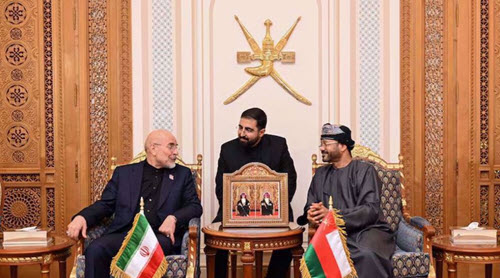
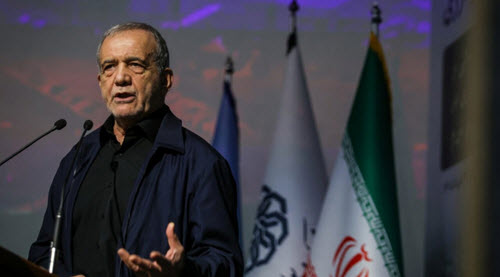
Iran's Parliament Speaker Mohammad Bagher Ghalibaf (L) during a recent meeting with Omani Foreign Minister Badr Al Busaidi.
Oman’s Foreign Minister Badr al-Busaidi has expressed support for Iran’s plan to impose “maritime service fees” on vessels crossing the Strait of Hormuz.
In an interview with Monte Carlo Doualiya, published by Oman’s Foreign Ministry on Monday, al-Busaidi reaffirmed Muscat’s commitment to the United Nations Convention on the Law of the Sea (UNCLOS).
He clarified that Oman opposes any tolls on transit passage itself. However, the minister drew a clear distinction between transit tolls and legitimate maritime, environmental, and navigational service fees, which can be discussed voluntarily with benefiting states and companies.
Al-Busaidi explained that such fees would enhance navigational safety, protect the waters from pollution, and improve preparedness for accidents and emergencies, models already successfully implemented in the Strait of Malacca and around Singapore.
He stressed that Oman and Iran are in full agreement that any future arrangements for the strait must remain strictly within the framework of international law.
Regarding French and British proposals to clear mines in the waterway, al-Busaidi emphasized that primary responsibility for ensuring the safety of the strait and international shipping lanes lies with Iran, in line with the recent memorandum of understanding signed between the Iranian and American presidents.
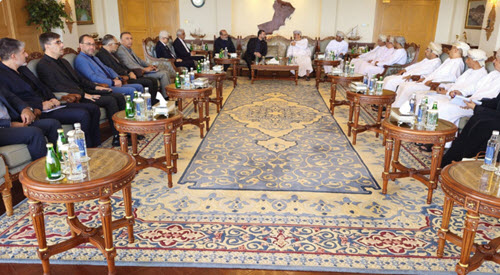
His remarks follow the first meeting of the newly established Iran-Oman joint Hormuz committee, which focused on future governance of the strait.
https://www.presstv.ir/Detail/2026/06/29/771281/Iran-Oman-first-Hormuz-meeting Iran, Oman launch joint Hormuz committee to discuss strait’s future governance Iran and Oman hold the first meeting of their newly established joint Hormuz committee, with discussions focusing on the future governance of the Strait of Hormuz.
Iran closed the Strait of Hormuz to its enemies and their allies after the latest round of unprovoked American-Israeli aggression against the Islamic Republic.
A Pakistan-mediated memorandum of understanding was recently signed between Tehran and Washington to help end the cycle of aggression.
Under the 14-point deal, Iran is required to ensure toll-free passage for commercial vessels for at least 60 days, with full restoration of traffic in the Strait of Hormuz within 30 days.
The MoU’s fifth clause explicitly recognizes Iran’s sovereignty over this vital chokepoint.
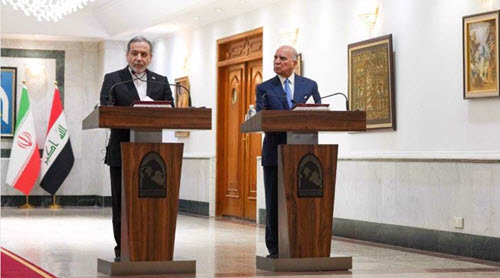
Iranian Foreign Minister Abbas Araghchi (L) speaks during a press conference with his Iraqi counterpart, Fuad Hussein, in Baghdad on June 28, 2026. (Photo by Tasnim news agency)
Foreign Minister Abbas Araghchi says only Iran is in charge of reopening the Strait of Hormuz under the Tehran-Washington Memorandum of Understanding (MoU), warning that any foreign interference will complicate the process.
Araghchi made the remarks on Sunday during a press conference with his Iraqi counterpart, Fuad Hussein, in Baghdad amid renewed tensions in the Strait of Hormuz, which has remained under Iranian control after the illegal US-Israeli war of aggression against the Islamic Republic.
“According to the MoU, the strait will return to its pre-war capacity within 30 days under the management that Iran will adopt and after the removal of obstacles by the Islamic Republic,” he said.
“These arrangements are being implemented, and the responsibility for them lies with the Islamic Republic … Any interference in this matter and any attempt to adopt new or separate arrangements compared to what is underway by Iran will only lead to more complicated situations and delays in the reopening of the Strait of Hormuz, and will fuel tensions.”
Referring to fresh tensions in the Strait of Hormuz, the top Iranian diplomat called on all parties not to meddle in the arrangements that are being adopted by Iran for the reopening of the strategic waterway, and ensure that the MoU does not deviate from its intended course.
Iran has restricted transit through the Strait of Hormuz, responsible for a fifth of global oil demand, since the early days of the unprovoked US-Israeli aggression on the country that began on February 28 and came to a halt under a ceasefire on April 8.
On July [June] 17, Iran and the US signed the Pakistan-brokered MoU, which calls for a permanent end to hostilities across all fronts, including Lebanon, as well as the removal of the naval blockade on Iran within 30 days, and the restoration of commercial traffic through the Strait of Hormuz.
Additionally, in his remarks, Araghchi voiced regret that Israel continues its attacks on Lebanon, saying under the MoU, the US should stop the Zionist regime’s strikes.
He further expressed his gratitude to the Iraqi government and nation for their solidarity with Iranians as victims of the illegal US-Israeli war of aggression.
Iran says indirect talks with Washington will begin after the terms of the Iran-US MoU are implemented.
The spokesman for Iran's negotiating delegation with the United States says the indirect talks with the US to finalize an agreement between the two countries will begin once the key terms of a bilateral 14-point memorandum of understanding signed in mid-June are fully implemented.
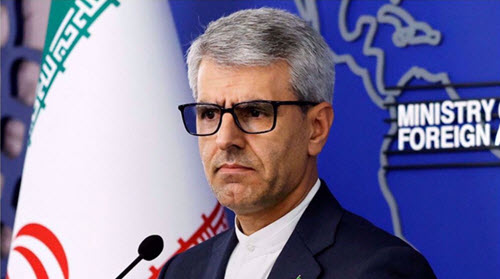
Esmaeil Baghaei said on Monday that Iran has yet to be satisfied that the terms of the Iran-US MoU have been implemented, as he rejected reports that technical talks with the United States are planned for later this week.
“Iran's current priority is to ensure the implementation of the provisions of the MoU, and we are seriously pursuing our demands in this regard,” said Baghaei.
He said launching any negotiations on a final agreement between Iran and the US “is contingent upon the initiation and continued implementation of paragraphs 1, 4, 5, 10, and 11.”
The diplomat said that Iran is specifically pressing the US to keep its commitments regarding the provisional lifting of sanctions on Iranian oil exports and the release of Iran's blocked funds.
Baghaei said a planned visit by an Iranian delegation to the Qatari capital, Doha, later this week is in line with efforts to have the blocked funds released, adding that the delegation will not hold talks with US negotiators there.
https://www.presstv.ir/Detail/2026/06/2 ... abadi-Doha Iran says ‘no technical talks’ with US scheduled for this week in Doha An Iranian deputy foreign minister says no technical talks with the US have been set in the Qatari capital Doha this week.
“In the coming days, we will have no negotiation meetings at any level with the American side, and the trip by US representatives to Qatar is unrelated to the trip of the Iranian delegation,” he said.
The remarks follow reports from several US media outlets that representatives from both sides had agreed to hold consultations in Doha on Tuesday to resolve their differences, including on the Strait of Hormuz.
US President Donald Trump said in a post on Truth Social that the two sides would meet Tuesday in Doha.
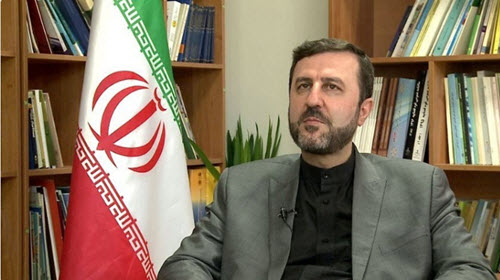
Iran’s Deputy Foreign Minister for Legal and International Affairs Kazem Gharibabadi has rejected France’s bid to demine the Strait of Hormuz in collaboration with its allies, saying the operation will exclusively be carried out by the Islamic Republic.
Gharibabadi made the remarks on Monday after French President Emmanuel Macron said that his country and Oman had decided to work jointly, in coordination with partners, on demining the Strait of Hormuz to secure maritime routes and ensure free and unconditional passage through the strategic waterway.
“Under the Islamabad Memorandum of Understanding (MoU) demining [the strait] will be carried out solely by Iran and not by any other country,” he said.
The deputy foreign minister also noted that Iran will not allow any foreign meddling in the removal of mines from the Strait of Hormuz given the current “sensitive and complex” situation in the critical energy chokepoint.
“We strongly advise France not to make the situation more complicated with its provocations,” he added.
Iran restricted transit through the Strait of Hormuz, responsible for a fifth of global oil demand, in response to the illegal US-Israeli aggression on the country that began on February 28 and came to a halt under a ceasefire on April 8.
On July [June] 17, Iran and the US signed the Pakistan-brokered MoU, which calls for a permanent end to hostilities across all fronts and includes a commitment from both sides to hold further talks on a final agreement in the next 60 days.
Under the 14-point deal, Iran is required to ensure toll-free passage for commercial vessels for at least 60 days, with full restoration of traffic in the Strait of Hormuz within 30 days.
Iran has stressed that the strait will not return to pre-war conditions, emphasizing its legitimate right to sovereignty over the waterway.
Tensions flare in Washington as Vance, Rubio clash over Persian Gulf policy, 2028 ambitions: Report Monday, 29 June 2026 8:50 PM [ Last Update: Monday, 29 June 2026 8:50 PM ] https://www.presstv.ir/Detail/2026/06/2 ... ons-report
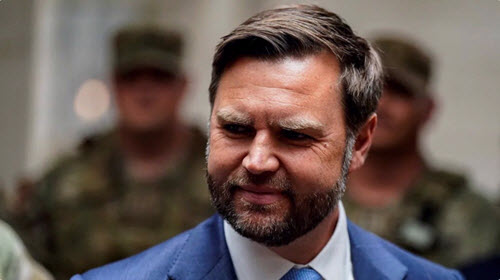
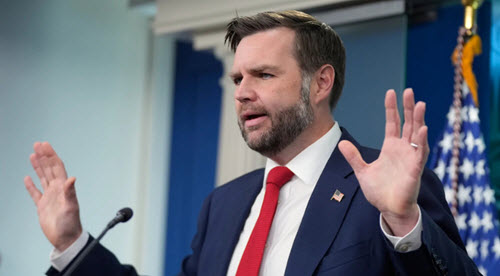
Behind the closed doors of the Trump administration, a simmering power struggle has erupted between Vice President JD Vance and Secretary of State Marco Rubio, according to a report.
Tensions have spilled beyond policy disagreements into personal grievances and charges of political maneuvering ahead of the 2028 presidential race, according to an article published by The Cradle website on Monday.
The friction, which has been building, reportedly reached a breaking point when Vance learned that Rubio had been planning a tour of the Persian Gulf region without consulting him beforehand, the report notes.
The vice president, who had been the lead negotiator in Pakistan-mediated Iran-US talks and has sought to position himself as a key player in West Asia diplomacy, was said to be furious at being excluded from a trip that carries significant geopolitical implications.
But the grievances run deeper than a single diplomatic tour. Sources cited by The Cradle say Vance has grown increasingly suspicious that Rubio is operating behind the scenes with US envoys Jared Kushner and possibly Steve Witkoff to undermine his “diplomatic achievements” and marginalize his influence within the administration.
The vice president and his inner circle now reportedly believe that Rubio, Kushner, and hawkish pro-Israel senator Lindsey Graham have formed an “informal alliance” aimed at sidelining him ahead of the 2028 presidential contest.
The emerging coalition appears to be working in concert to limit Vance’s visibility on foreign policy and position Rubio as the preferred successor within the Republican establishment.
Graham's involvement is seen as particularly significant given his long-standing ties to the party's foreign policy wing and his role in shaping Republican national security positions.
For his part, Rubio is said to remain uncertain about the true nature of his relationship with Trump. Sources close to the secretary of state suggest he has been grappling with a fundamental question on whether he is being used by the president as a counterweight to Vance, or whether Trump himself is more heavily influenced by Kushner and Rubio's faction.
The uncertainty has reportedly left Rubio uneasy, unsure whether he is a principal player in the administration's long-term strategy or merely a pawn in a larger game.
The rift comes at a critical moment, with the administration navigating a complex and volatile landscape following the failed war against the Islamic Republic of Iran and a memorandum that cements Iran’s status as a new regional superpower.
The Persian Gulf tour that sparked the latest tensions was seen as a key opportunity to repair the tattered US image among allies, and Rubio's decision to proceed without consulting Vance appears to have deepened the distrust between the two camps.
The informal alliance between Rubio, Kushner, and Graham has raised alarms among those close to the vice president, who fear the coalition's influence could shape the administration's policy direction in ways that favor Rubio's standing at Vance's expense.
As the 2028 presidential race looms on the horizon, the growing friction between two figures once seen as potential allies underscores the complex dynamics inside the Trump administration and the intense jockeying for position among those vying for the Republican Party's future leadership at a time when the party’s popularity has touched historic lows due to the unprovoked and illegal war against Iran as well as support for Israel.
US–Iran: A ceasefire Washington reads as a concession. The post-war MoU with Iran is being sold as a compromise. In practice, it is a narrow deal shaped by the need to end a war that could not be sustained. by Ali Ahmadi JUN 24, 2026 https://thecradle.co/articles/us-iran-a ... concession
The framework that halted the 2026 war with Iran has been read across much of Washington as a giveaway. Critics on the right treat the memorandum of understanding (MoU) as a reward handed to a country that should have been left to absorb the consequences of the fighting.
The comparison that has traveled furthest places the sanctions relief alongside the 2015 nuclear accord, as if Tehran has been readmitted to the global economy in a single step.
That reading does not hold. Washington made concessions to end the war and restore traffic through the Strait of Hormuz. The arrangement reflects those priorities. What Iran receives is narrower than the public debate suggests, and much of it remains uncertain in both scope and duration. The terms set out in the MoU fall into three distinct categories.
What Iran actually receives
The first covers the benefits Iran will gain in practice. These amount to access to roughly $12 billion of its own funds held abroad, along with a waiver allowing it to sell oil and oil products during a 60-day negotiating window.
Iran was already selling that oil, much of it to China, so the waiver does not open a closed market. What it does is narrow the sanctions discount Iran has been forced to accept on each barrel, which has already shrunk to $1 a barrel, and make it easier to bring the proceeds home. The gain is real, but it is counted in margins rather than in any return to the world economy.
There is also a political dimension to this access. The ability to bring funds home without the same level of friction matters for domestic stability, particularly after a period of sustained pressure on the economy. Yet even here, the effect should not be overstated. These are Iran’s own funds, released under conditions that can shift quickly, and the broader sanctions architecture remains intact.
The second category includes concessions that are temporary and reversible. The clearest is the withdrawal of US forces from Iran’s periphery. That move carries weight, but its durability is uncertain. The record of the US President Donald Trump administration weakens confidence in any commitments it makes, and the drawdown was partly inevitable.
The US cannot sustain that level of deployment in the region indefinitely. Some retrenchment would have come regardless of any agreement.
Even the release of frozen assets can be reversed in practice. Former US president Joe Biden's administration unfroze around $6 billion in Iranian funds, only to refreeze them under domestic and Israeli pressure. Episodes like this have eroded American credibility over time. A concession that can be undone with a signature is discounted before it is even tested, and that discount shapes how Tehran reads the present framework.
Reversibility now sits at the center of the talks. The familiar point that Iran and the US do not trust one another has been repeated for years, but the character of that mistrust has shifted. During the 2013 to 2015 negotiations, Iranian officials questioned whether Washington would uphold its commitments over time.
What has changed is the character of the mistrust. Iranian officials in that period doubted American fidelity over the long run, whereas they now begin from the assumption that Trump will actively look for ways to abrogate its commitments before the ink is dry on any agreement.
Diplomatic credibility matters in ways Trump never appreciated. A concession that can be undone with a signature is discounted heavily before it is even weighed, and that discount falls hardest on the parts of this framework that matter most.
The third category concerns what has not been committed at all. The removal of sanctions and the creation of a $300 billion investment fund are not present obligations. They are conditional statements tied to the conclusion of a broader nuclear deal within the 60-day window.
In fact, the $300 investment fund idea, originally proposed by the GCC countries during last year’s negotiations in Oman, is still a highly abstract concept.
Despite the White House claiming money has been committed, the structure and parameters of the fund are unclear and are likely still in the initial planning phase. Whether a fund like this will attract $300 billion, a figure of unknown providence, or whether it will ever exist at all is highly speculative.
After the 2015 Joint Comprehensive Plan of Action (JCPOA), despite US assurances and a far better geopolitical climate, global investors were hesitant to even lend Iran money outside of a one-year repayment timeline. They feared that the deal breaking down would prevent Iran from repaying them. It does little for the politics of the agreement that its most eye-catching line items are the ones being held back.
The nuclear file returns
Less attention has been paid to what Iran may offer in return. Beyond the downblending of its stockpile of highly enriched uranium, the picture remains unclear. That uncertainty is itself part of the story, reflecting both the pace of the negotiations and the political constraints on all sides.
In the round of talks that preceded both the recent war and the earlier 12-day conflict, Iran signaled a willingness to suspend enrichment for a number of years. It also indicated a return to enrichment capped at 3.67 percent under close inspection by the International Atomic Energy Agency (IAEA), along with a zero stockpiling provision. The details are technical, but such a framework would significantly reduce proliferation risks and extend the time required for any potential breakout.
There is no guarantee that the same terms are on the table now. Majlis Speaker Mohammad Bagher Ghalibaf stated that “We will not return to pre-war conditions.” Although his remarks focused on the Strait of Hormuz, they have been read more broadly as a signal that Tehran expects a different balance in any renewed agreement.
Foreign Minister Abbas Araghchi has also indicated that “as of now, no decisions have been made” and that Iran's approach to concessions needs to be established by the Supreme National Security Council and achieve the approval of the supreme leader.
Even so, a deal that includes elements of earlier proposals, such as a multi-year suspension of possibly 10 years or more, and limits on stockpiling, would represent a significant outcome for Washington. It would allow the Trump administration to argue that it secured deeper concessions than those achieved under former US president Barack Obama, even if the path to that outcome has been shaped by a far more volatile set of circumstances.
That claim would not erase the consequences of earlier policy. When the US withdrew from the nuclear deal, it released Iran from constraints on research and development. Iran has since advanced its enrichment capabilities, including the development and deployment of more efficient centrifuges. The objective that once guided American policy, keeping Iran at least a year away from sufficient material for a nuclear weapon, is no longer achievable in the same form.
Comparisons with the Obama-era agreement, therefore, require care. The 2015 deal suspended secondary sanctions on a broad and open-ended basis. It enabled Iran to re-engage with global markets and regain access to assets abroad, estimated at over $100 billion. Trade expanded, financial channels reopened, and Iranian businesses gained room to operate within a more predictable environment.
The current framework does not offer anything comparable. Its economic impact is far smaller and more tightly defined, and it does not alter the underlying structure of sanctions in a lasting way.
A more useful comparison lies with the Joint Plan of Action, the interim agreement that preceded the 2015 deal. The present terms are more generous than the earlier arrangement, for a clear reason. Washington needed to secure the reopening of the Strait of Hormuz and stabilize energy flows. That requirement shaped the concessions on offer, and it explains why the terms appear uneven when measured against broader strategic ambitions.
A deal shaped by limits
There is no certainty that the 60-day window will produce a lasting agreement. The same reversibility that weakens American commitments also limits Iran’s incentives to make binding concessions, and both sides are operating within tight political constraints.
The MoU follows a military campaign that killed senior Iranian figures and thousands of civilians. It emerges from a context in which Washington does not hold decisive leverage, despite its military reach. Any expectation of symmetry in the outcome rests on an assumption that does not match the balance of forces or the costs already incurred.
The agreement should be read in that light. It reflects an attempt to contain the consequences of a war that did not produce a decisive outcome. The decision to pursue the conflict set the parameters within which diplomacy now operates, narrowing the space for more ambitious objectives.
For policymakers in Washington, the question is not how many concessions have been exchanged, but what the arrangement achieves in practice. Goals such as overthrowing the Iranian government, forcing capitulation, or removing Iran from regional influence were never realistic. The present moment offers a narrower opportunity, shaped by the limits exposed during the conflict.
The US has a real opportunity to address the Iranian nuclear issue permanently and reform its relationship with Iran at a time when president after president has made clear that US national security imperatives lie elsewhere in the world.
Trying to lock up as many Iranian assets in Qatari bank accounts or obstruct Iranian petrochemical sales for as long as possible should not be the measure of diplomatic success.
That requires a degree of consistency that has been lacking in recent years, as well as a willingness to accept outcomes that fall short of maximalist goals.
The MoU does not resolve these questions. It creates space in which they might be addressed, while also exposing the limits of what can be achieved in the current moment. Whether that space is used will depend on decisions that have yet to be made, and on whether both sides are prepared to move beyond the patterns that have defined their relationship for decades.
Iranian President Masoud Pezeshkian has said that any agreement between Iran and the United States must be rooted in mutual respect and reciprocal commitments, not threats or one-sided pressure.
In a post on X on Monday night, President Pezeshkian wrote, “Mutual understanding is a two-way street. If the American side adheres to the agreement, we will also fulfill our commitments.”
“Our approach to unreasonable saber-rattling and baseless threats is to rely on rationality and human dignity in decision-making, and to defend decisively and fearlessly when it comes time to act.”
The remarks come as both sides work toward implementing a Pakistan- and Qatar-mediated Memorandum of Understanding (MoU) aimed at ending the recent cycle of US-Israeli aggression and reducing regional tensions.
Iran has consistently shown readiness for serious diplomacy based on justice and equality, while firmly rejecting any form of coercion or empty promises.
Iranian officials have repeatedly stressed that while the Islamic Republic seeks peaceful resolutions through dialogue, it remains fully prepared to defend its sovereignty and national dignity with strength and resolve.
Echoing this position, Foreign Ministry spokesman Esmaeil Baghaei announced on Monday that technical talks with the US will only begin once the key terms of the bilateral 14-point MoU are fully implemented.
Baghaei rejected reports of imminent consultations in Doha, stating that Iran is not yet satisfied that the agreement’s provisions have been met.
The comments follow claims in US media and a post by President Donald Trump on Truth Social suggesting that representatives from both sides would meet in Doha on Tuesday to address remaining differences, including issues related to the Strait of Hormuz.
As negotiations proceed, the initiative now rests firmly with Washington. Iran has demonstrated its seriousness about reciprocal commitments, the question remains whether the American side is prepared to do the same.
Richard Wolff: Iran War UNRAVELS US Empire, Economic Collapse Has ALREADY BEGUN Danny Haiphong Streamed live 84 minutes ago #richardwolff #iran #economy
Economist and Professor Richard Wolff discusses what Trump and the talking heads won't: that a major economic collapse is already underway and it's unraveling the US empire. Prof. Wolff breaks it down in this must-watch show.
Transcript
Welcome back to the show everyone. With me is professor in economist Richard Wolf. Now first the news. The Iran war keeps unraveling the US empire fueling economic collapse. A new analysis reported in the LA Times finds that the economic consequences of the Iran war are reverberating even harder than anticipated. The Iran war has cost the average American household per the report between $775 and $1,700 according to the American Enterprise Institute. Now, we also have economist Paul Krugman reporting that the Iran war has also caused great damage to the US dollar's financial empire. According to Krugman, even Gulf nations, including the United Arab Emirates, are now considering payment systems in UN, giving a regional boost to China's SIPs, an alternative to the Swift, uh, greatly challenging the US's dollar dominance. We also have here uh oil prices have risen by 1% despite theou talks in large part because today's meeting in Doha was rife with uncertainty as the war could jump off any moment. Professor Richard Wolf is here to join uh us and discuss these latest developments. Professor Wolf, your uh reactions to these developments, in particular, the fact that it seems like despite all the economic enthusiasm as the Iran war enters these talks phase, uh there's a lot of trouble in the waters. Help us understand how this impacts the US empire in particular. Yes, I'd be glad to try uh to do that. I think the clue or the key to understanding this is that much more is going on than just the war between Iran on one side and the United States on the other. And when you add up the other stakes if you like that are involved then it becomes clear I think that on the one hand you have Iran trying to figure out and that's not so easy how to take advantage of the enormous increase in their power in their standing in the world in in simply the position of Iran in the world economy that has just been achieved by what they did in this war. And by the same token, on the other side, the United States is debating what to do about the decline in its global economic position that losing that war has already cost them and is likely to do so, as the clips you picked how quite well. So I think that's what's going on and the uncertainty, the fact that there were times over the last weekend when it looked like the memorandum of understanding and the end socalled of the war uh was a mirage and it was all over and we were going to resume uh striking and bombing and droning and missing as we had been doing uh in the months after February 28th. Now it's off again, on again. It's not even clear, if you read the stories closely, whether the people sent to the Middle East by the United States and Iran will in fact meet and talk where they are or not. And if they do, when now as if that weren't enough, you have also other bizarre problems here. Number one, the memorandum of understanding is an under a memorandum but only among two of more than two participants in this whole war. And by that I mean at least the Israelis and Hezbollah, a movement inside Lebanon. And I won't even talk about the Lebanon government because it's barely there. But I will certainly talk about Hezbollah which has not agreed to this m this business nor uh the Israelis who have not agreed and who make it quite clear Hezbollah to the extent that it is in touch with Iran, the Houthis and Hamas may be considered to probably go along if Iran does, but that's as far as we can go. Israel has made it quite clear that they do not intend to go along uh at all. Or if they do, then it's offset by what various members of Mr. Netanyahu's cabinet are saying literally every day, which is they won't have it, they won't participate, they will withdraw from the government if it does. That means the government collapses and so we're back to what happens then. So when you add it all together, we are in a very very upside down topsyturvy uncertainty. And anyone who tells you it's certainly going to go this way or that way really is playing games with prediction that none of us can in fact do. What is the uh actual impact of this uncertainty in this prolonged war now that uh you know as you said any moment it could restart again there's no uh that you know I see everywhere despite the Trump administration's optimism that uh there's lots of uh concerns that at any moment there will need to be a huge jump in the oil prices for example because of renewed war. So, uh what what is the impact though on people in the United States, on the world economy? Uh how is this driving uh how is this uncertainty driving that? Well, the key word there uh is uncertainty and uncertainty which is part of life has always been a big problem for people and human beings have a way of dealing with uncertainty that is mostly phony efforts to magically make it disappear. In my field in economics where you have to fundamentally deal with uncertainty, every investment for example in any business in the world means that you're making a decision to spend money now. Build a factory, erect an office, open a store, buy inputs, hire workers. You won't be making money until the future when the production happens and the workers are there and they finish their job and the product or the service is ready to be sold. That's a passage of time. You have to make the investment now to get it underway, but you won't realize a revenue until weeks, months, or years later. And you don't know. That's what uncertainty means. What the circumstances will be like. You don't know what the price will be that you can 8 minutessell the output at. It might be what you guess, but it might be higher. It might be lower. There is no way out of that uncertainty. So what do you do? Well, in my profession, some people think they can attach a probability. It's 20% chance that that will happen. Yes, but that's uncertain too. Why would it be 20? Might be 25. Might be only 15. Either you understand uncertainty as to induce an absence of knowing or you find that so frightening you pretend it won't happen. Why is that important? Because the uncertainty about this war is what everybody in the world and I have to stress this Danny because it's so important. Every country in the world, no exception, and most of the bigger corporations and firms in the world are dealing now with that uncertainty that in addition to all the other uncertainties that plague every economy, there is now a new one. What is that? It is the fact that not only the Gulf of Hormuz is blocked or shut or partially shut limiting the movement of oil and gas and the products of oil and gas, fertilizer, helium, jet fuel engine materials and so on. these things will or will not be more or less likely at a higher or lower price. It's all uncertain. And yet corporations have to make a decision. If you're in agriculture and you need fertilizer, what are you going to do when the fertilizer you were supposed to get on March 15th never arrived? because it's sitting in a tanker somewhere or on a dock someplace and you don't know even if it were to resume coming. Is that reliable or not? And the answer is that's uncertain. And now you have to add that there are other. There's the straight of Malaa, there's the Panama Canal, there add them up. They are all, it turns out, uncertain. And among the other adjustments being made are countries looking at their coastlines wondering if not only by by being hurt by what's going on in Iran, 11 minutesthey might get back at the situation by introducing an uncertainty with their water, with their coastline, with their territorial water in order to compensate themselves for the losses. of what is happening in the straight of Hermu. When you put all that together, here's the impact on the world. It is a shock. And one of the things corporations and countries do when confronted with a shock is they look for, and it takes time. What is our best bet given the uncertainty? For example, I'll give you just a few. Maybe we should switch in our company from trucks that use gasoline, which is becoming dangerously short supply in many Asian countries. And we should switch finally to electric vehicles which would mean buying more Chinese because vehicles because they have the best quality at the lowest price electric vehicles on this planet at this time. And that's good for Chinese exports but but not for other people's exports. So is that happening? You bet. How much? Who knows? It'll take us all kinds of time. Here's another response. We might have to get our fertilizer someplace else. Where else is there? Suddenly, the price of fertilizer goes up. That's going to be tempting some companies in other parts of the world to start producing fertilizer. They never did that before. They will need workers. They will need machinery. They will need storage. So they're going to but that's very expensive and they're going to wonder should we do that? Should we not and you want me to give you an answer? Nobody can do that. That's why if you read an article, what you're going to be reading is a kind of cherrypicking. If you pick certain examples, things look really grim. If you pick other examples, they look quite hopeful. The problem is it's neither the one nor the other. It's either you face the reality of uncertainty or you don't. And here's a last one that has to be factored in when you talk about capitalism. Capitalism, which is the dominant system in the world, has a deeply ingrained instability. Every four to seven years it goes down everywhere in the world. It's been that way for three centuries. Everything in the manageable has been tried to cope with to manage that. None of it worked. In the 1930s when we had 14 minutesthe worst crash in the history of capitalism, a whole new economics was developed by John Maynard Kanes in Britain called Keynesian economics whose whole focus was to explain what the government needs to do to try to minimize the damage from the instability. Have we been able to stop the crisis since then? the downturns, the crashes, the depressions. No, we had one in the year 2000, the so-called dotcom crash. We had one in 2008, the so-called subprime mortgage crash. We had one in 2020, the so-called uh pandemic crash. We give different names because we're afraid of confronting the fact that they are always with us. Well, is every four to seven years. And if the last one was in the year 2020, 15 minutesguess what? We're about due. So, on top of all of the shocks and uncertainty is the worrisome reality that we may well be on the edge of a downturn. And Lord knows what might happen if we have the coincidence of a periodic downturn with this special crash of the war in Iran. It's one more reason why had any competent economist been in the room to advise the president and Mr. Netanyahu. Besides all the other reasons now obvious you shouldn't have attacked Iran on the 28th of February here. I'm giving you two more. The uncertainty and the cycle. This is not a good idea. And if I were advising the Europeans as they gather to make war on Russia, it is the same terrible mistake on their part and they will suffer unfortunately so will the mass of the European people and the Russian people and it is a catastrophe that is happening as we watch. Yeah. And you mentioned uh economic uh uh crisis and and collapse uh professor Wolf and I just want to bring this up because uh this is something that is now being talked about more actually it seems like a lot of mainstream economists want to focus on the discrepancy between how stocks are behaving and economic indicators. Uh but this uh reality that uh the costs of the Iran war, for example, Americans paying $7 a pound for ground beef, uh that appears to be a huge point of possible a possible trigger for that economic collapse. Maybe you could talk about the how the impacts of the war on Iran uh now with you know there are so there are still thousands of of ships that have not been able to make the the voyage out of the straighter form and they're probably not going to make it out anytime soon. And then you have the costs of this that are now it seems like being whistled past by mainstream economists, the Trump administration, but some are sounding the alarm that yeah, the costs of this war are not are going to linger, which means the consequences of those costs are going to get worse. So where does that lead? What how do you explain what uh happens when uh these things all come together? Well, I mean again, you need to understand the complexity of a modern economy. We are now enga we the United States are now engaged in uh the war in Europe. We provide the weapons, the intelligence, very very expensive. Hundreds of billions of dollars have already been poured into the war in Ukraine and that's continuing. Number two, we have the war in the Middle East. I want to remind people, United States and Israel attacked Iran a year ago, June of last year, then again in February of this year. That's far from over. We have a naval operations uh in the Mediterranean still focused on all of that. We have another navy, the seventh fleet uh around Taiwan, in Asia. We are a a country that is more and more war engaged. President Trump has proposed an increase in the defense budget for the coming year from the current level roughly $900 billion to $1.5 trillion. That's a 65% increase in one year from one year to the next. This is a massive movement of resources to war to to and I want to remind people you're spending money for a missile that you shoot somewhere into the mountains of Iran where nobody is by the way uh because you don't know where they put everything underground and they've shown how to do that in a way that the United States utterly unprepared for. So you're blowing up and therefore having to replace all of this hardware. What here what people have to understand the resources that go into war are not dropping from heaven. They are resources taken away from other things. For example, please remember Elon Musk standing there with his chainsaw as he got rid of this that governmental agency. Well, some of those agencies were devoted to studying animal diseases. The, you know, the kind like the screw worm that is messing up beef herds all over the western half of the world, including the beeftock of the United States. Whoa. So it turns out a government policy moving resources away from scientific study by making fun of it and moving it over into missile production and take taking that dreadfully seriously helps explain why we have to pay $7 a pound for uh ground beef. We're and we're going to have to do all kinds of things like that. We're not building housing in this country. Why not? Well, we have been able to keep wages down as the price of a home goes up, and it has quite steadily over the last 20 years. Incomes of Americans haven't kept up anywhere near. And so, more and more Americans are priced out of having a home. And that means homebuilders are not building the homes they once did. The only homes they build are for the really rich. We have a growing number of them, but they are very small in number compared to the masses that are no longer able to afford it. Well, that's changing everything in this country having impact. All of those are wrapped up with the focus on war. And if you want to really understand what the war is costing us, I understand the little exercises people make. But we're not talking about a,000 or $2,000. We're talking about much, much more. And over a distant number of years, many of which are in the future. And there again, uncertainty makes it very difficult to put a number around it. To fight a war in the modern age is very expensive. To fight a war thousands of miles away is very much more expensive. The United States likes to think it can control the world. It's going to fight the Chinese over Taiwan. It's going to fight in the Middle East against Iran. It's going to fight uh with the Europeans against the Russia. Uh really? Really? You think you can do all of that? Now, let me make a reminder as a historian, 23 minutesevery empire in the history of the world, the Roman, the Greek, the Ottoman, the Dutch, the British, the French, the German. You know what killed them finally? What made their empires die? Overreach. Not understanding the limits that they all faced. Imagining they could hold back the barbarians, whoever they decided those are barbarians were. And then it turned out they couldn't. And they blew themselves up by the overreach from not understanding what the history of empires should teach you. Now it's the turn of the United States as our empire goes down. Are we going to learn the lesson or are we going to be another sorry example? Well, uh, to follow up on on that point, Professor Wolf, uh, you probably know him. Um, I'm not a huge fan of him, but he has been, of course, the New York Oh, sorry. Uh, he has been the New York Times's, uh, preeminent economist for a very long time, Paul Krugman. And he published this article that I thought was very interesting where he talks about uh, the humbling of the once almighty dollar. And I'm just going to read a quick uh note from it where he says, "The Iran debacle has demonstrated using dollars and retaining access to the US banking system, while convenient, aren't necessary. Iran's ability to withstand American pressures demonstrated that US sanctions are a lot less effective than in the past given that rogue actors can use Chinese UN and SIPs, the uh China inter uh border payment system, as a workaround. And as Gulf States's actions show, even countries that are US allies are now considering signing on to China's uh payment systems, alternative payment systems. So uh Professor Wolf, how does this uh impact the overall global economic picture uh particularly with regard to the US uh empire's dominance or uh waning dominance maybe we should call it? Well, the the impact is enormous. I would only amend a little bit. The decline of the dollar was already going on for quite some years before any of this warfare in Iran broke out. So, it's important to understand part of the decline of the American empire is the decline of the dollar. Look, it was after World War II that the world, which had been used to dealing with a global currency called the British pound, put that aside and switched over to the American dollar because the British were destroyed in World Wars one and two. Their empire was taken basically from them by the revolt of the colonial people led by the the folks in India. Uh so their empire blew apart. The Americans stepped right in to fill the vacuum left by the British Empire. And they then dictated that now we're in charge. Our currency can and should become the global standard. And that was what happened. It happened because the United States was the great producer. Everybody else had been destroyed by World War II. United States would ship it everywhere. United States. Just to give you an idea, Russians dying in World War II number roughly 25 million. Americans dying in World War II numbered roughly 400,000. People should understand that's the difference between a mouse and an elephant. Uh the impact on Russia to this day is profound. And the impact on the United States is by comparison barely visible. So we have to understand that that made the dollar all powerful. The almighty dollar. Now that the empire for many reasons has passed its peak and is on the way down, the dollar is less and less the global currency. Still important. still important. And before the war with Iran, most people, myself included, understood that it would be a long slow decline. That's probably what the British thought also, say, in the year 1900. What they didn't count on were World Wars one and two, which took the decline of the British Empire from 33 to 78. It took a slow process and speeded it up. I believe that's the same way we should understand the American wars of the 21st century. They are shocks that speed up what was already going on. And this to give people a sense of why and how that'll work. If if oil, which used to be bought and sold around the world in dollars, that was a deal worked out by President Nixon and his advisor Henry Kissinger with Saudi Arabia. at that time in the 1970s the number one oil producer in the world creating what is known as the petro dollar system. The whole world needed dollars now to buy oil if you had oil in your energy system and every country did. You would always need oil uh dollars because you had to use them to buy any the oil you needed. So everybody kept a stash of dollars in their central bank, in their local bank, in their accounts. And why was this important? Because if you have dollars that you have to use, you have to hold them. So you have them available when you need them. But holding a dollar gets you nothing. It's a green piece of paper. So what do you do? You lend it to the United States government and you hold instead Treasury securities. IUS of the United States government saying to the holder of this IOU, you have lent, let's say, $10 million to us. Thank you. We will repay you on such and such a date and we'll pay you interest twice a year between now and then. And that's how they hold dollars, which they need to do to deal in oil. But look at the benefit to the United States. One of the reasons we can run deficits in this country, deficits, that means the government spends more money than it takes in in taxes. It can only do that if it can borrow that money. Otherwise, it can't spend more than it raises in taxes. If it couldn't borrow, it would have to take the money from us in higher taxes. So we can lower the taxes on you and me and American business because the whole world is looking to put their money into US treasuries. It is a subsidy to the United States government. I would go so far as to say most of the wars we fought, think about it with me if you will, most of the wars we fought the government would never have raised taxes to pay for them. You know why? Because the opposition to the war would have been 10 times stronger than what we already have if people had to shell out thousands of dollars. We just passed April 15th. If on April 15th we had all had to shell out an extra thousand or two to pay for the war. You think the war would be going on? Not a chance. But our government didn't have to do that. it could borrow to sustain the wars that protected this whole system and kept it going. So when countries decide the way Krugman correctly notices that even if they're an ally of the United States, they're not going to be stuck by having a currency that doesn't get the job done. They're going to move from dollars to yuan because while the US empire is declining, the power and role of China in the world keeps going in one direction up. And the whole world is responding to that just like the whole world is responding to the closing of the straight of hormones. Yeah. And uh this is becoming ever more clear too. We're hearing uh talks now across mainstream media about the bubble of AI for example and how there is now a huge shift in focus in AI and a complete neglect by the United States economy and uh the US uh uh administration, the US uh regime so to speak uh in focusing on any other element of the economy. Uh, and we're seeing this quite clearly in the words of Donald Trump himself with the Housing Affordability Act that is making its way uh through Congress. This was his reaction to it. There's so much talk about, oh, we're going to drive housing prices down. I don't want to drive housing prices down. I want to drive housing prices up. So, he wants higher housing prices than already exist in the United States. And this is his view on the bill. Elections. What are your plans for the housing bill, Mr. President? Are you I don't know. I think it's so unimportant by comparative by compared to the save America act. I think so it's unimportant. So there's uh just so much evidence first of all wolf that the economy itself and those who are supposed to uh govern it or at least play a role in managing it uh that they are not interested in this part of the economy but they are very interested in the straight of Hormuz. The entire war on Iran has now focused on this waterway which does hug the Iranian and the Omani coast. uh uh what does this tell us that there's a complete neglect of these issues that ordinary most people in the United States uh outside of millionaires would uh care about and uh the fact that uh now all attention is on oil prices the stray form and this war that is shaking up the global economy. Well, let me let me respond, Danny, first by responding to to your clip of Donald Trump. Uh, and here I'm going to put on my metaphysical hat as a professional economist. Uh, and say that listening to the president indicates that in an economics class, he wouldn't do very well. And I'm being as polite as I know how to do. Let's unpack what he said. He doesn't want uh housing prices to go down, which of course the mass of people want because they want to be able to afford to buy a house. He would prefer for housing prices to go up. Well, who's interested in that? The people who make and sell houses. They want more. The people who buy them want to pay less. That's the problem with every market in a market system. He doesn't understand how this works. He's been talking to the people who produce housing. The man he he nominated to be the head of intelligence, Mr. Py, is a home builder, one of the biggest in the United States, Pyols. He wants higher prices. And he doesn't just want them. He holds us up for what is effectively capitalist blackmail. He says to the president and through the president to all of us, "You want me to build houses? You make him worth my while. You get the prices up. Then I'll build houses." "Yeah," we answer. "But nobody can afford them." "Well, now how could we solve this problem?" "I got it. We could do it the way other countries do. The government should say to the homebuilders, either you build houses that are affordable or the government will go into competition with you and we will because our job as the government of all the people is to do what they want and most of them are home buyers. They want lower prices and that's what we'll give them. Houses at lower prices. We don't have to make a profit because we're the government. You do. So you can make houses for rich people. We'll make houses for everybody else. Oh no, say the companies. We don't want competition from the government because then everybody will understand how we have been ripping folks off. That's what's going on here. We're being ripped off. We're being told if you don't have enough money, we're not going to build houses for you. And if you think that argument is reasonable, be very careful because the next place it will be applied is to food and clothing because the same logic. Oh, you want to buy good food here. $20 a pound for ground beef. You want us to make ground beef for you, don't you? Well, you got to make it worth our while. This is the problem of a capitalist system. And when that capitalist system is going down, as ours is, all of these things become more obvious and harsher in how they impact us. And that's what you're seeing around this housing bill as one area. If you look at the statistics, they are stunning, Danny. Over the last 20 years, 25 years, the price of housing has gone up much, much faster than the level of income, uh, wages and salaries, pricing people out of the housing market year in and year out. For Mr. Trump to say he's not interested. Uh, you know, all I can tell you if you needed more information is he's not the president of the United States. He's the president of the people who fund his campaigns. How are these people who fund his campaigns going to react uh now or how are they reacting now and into the future now that it is quite clear that the consequences of the Iran war of the Ukraine conflict and of course of uh the US empire's both its military and its economic coercion is uh fast becoming I think not just ineffective but also maybe uh we could describe it as a drag. on the uh overall economic uh situation and development of the United States. How how are they going to continue to react to this development and uh how are they reacting now? Well, I have to hand it to the president. I really do. I mean this he has figured out a way and his predecessors, some of them figured it out, too. He figured out a way to do pretty much what he wants by keeping the top 10% of the American people happy with him. The top 10% of the American, the richest 10% of the American people own about 80 to 85% of the shares of stock on the New York Stock Exchanges. So he knows he's got to keep them happy. If he can do that, they don't care what else. Does he want to bring back white supremacy? Does he want to bring back misogyny? Does he want to undo the protections for workers? Does he want to cut the education department so our schools and universities are closing? They don't care. Do they agree with it? No. But they don't care enough. And they don't want to stop the gravy train. And what is the gravy train? The stock market. The stock market keeps going up as these people buy and sell stocks to each other driving up the price. And if you're wondering how does all that work, here's the answer. Over the last 30 years, the United States government has printed more money, added more money into our economy on a scale we had never done before. It led many people who were very nervous seeing these numbers say, "This is very dangerous. We're going to have a terrible inflation." Well, we never had a terrible one. We had one, but it wasn't particularly terrible. We've had worse. Other countries have had much worse. Well, why didn't we have the kind of inflation? And I'm talking about the price of gasoline and eggs and beef and milk and and all the and housing. We've had a rising prices, but not a crazy inflation because a great deal of the money never went into producing goods and services for you and me. That might have bid up the prices. Where that money went into was the stock market. And you see an inflation in the stock market is exactly what the richest 10% want. The higher the prices of the stocks, the richer they feel themselves to be. It's not a problem. It's a virtue. Mr. Trump or his spokespeople are constantly pointing at the stock market. Why? because it's one of the few things that's up. They carefully avoid telling you that when it's good news at the stock market, it's only good news for the 10% who own them all. The other 90%, most of them have no stocks and the rest of them have, you know, four shares of General Motors that grandmother left when she passed. But the block the the the ownership of shares is in the top 10%. They are very happy and they keep Mr. Trump in office. If he didn't take care of them first, he wouldn't be there. If you wonder about that, let me remind you the first act and the most important one he committed himself to the first time he was president, 2016 to 2020. He went and he passed a tax bill December of the year 2017. It was the largest tax cut in the history of the United States for rich people and corporations. In his second term that he's in the middle of now, what was his number one focus? Well, remember few months ago, the big beautiful tax bill. Uhhuh. Another big tax cut. He took care of those people. Where did the money go that they didn't have to pay in taxes anymore? Those corporations and those rich people. Answer the stock market. They took their tax savings and bit up the price of their stock portfolios. Those rich people are laughing all the way to the bank and they don't find anything wrong with Mr. Trump no matter how fascistic his behavior might be because he took care of them. Yeah. Uh very very good great points Professor Wolf. Now there is a theory going around that I would like you to if you could uh break down debunk if it needs debunking or confirm if it needs confirming which is that these people that you're talking about the the ultra rich the super rich the uh ultra rich capitalist uh there are some who are speculating that given the events of the war in Iran uh given what we've seen around energy markets that this is more of a controlled demolition than perhaps a economic decline or collapse of the empire. Meaning that that dynamic you just uh uh uh outlined of the super rich laughing all the way to the bank off of uh stocks and all of this uh that they're saying that this is an economic uh uh universal trend where around especially around energy markets this is a destruction for profit and I wonder if you uh how do you uh not only for profit but also to uh usurp control of the energy markets. And I'm wondering how you see this given the global economic outlook. We have this decline that you're talking that you talk about often on this program and others. Uh we have all of these massive contradictions and then you of course have uh the rich getting even richer despite the dynamic of chaos and crisis that uh is left in the wake. Well, it it's a trueism in the stock market, for example, that if you know how to play the game, you can make as much money when stocks go down as you can when stocks go up. In other words, if you know how this is done, you can sell a stock for delivery at a future point, gambling that you will deliver it at a future point when it's much cheaper than than today. So you sell it today at a high point, promise to deliver later when you can get it, replace it much more cheaply. You can make a fortune of money and there are plenty of people on Wall Street who do that. So making money is not a question of it always going up. It's being in a position to take advantage when it's going up and to likewise take advantage when it's going down. That's precisely what people who don't have a lot of money and cannot hire the appropriate advisors probably can't do. But I would argue that the super rich are the ones who don't care about this. They are busy making money when it's going up or down. And I'm going to give you two examples. Here's the first one. Starting in the 1970s, large American corporations led for example by General Motors at that time in the 1970s our biggest and perhaps most successful corporation. They understood that they could make much more profit than they were already making in Detroit by leaving Detroit by arranging to produce part car parts and whole cars elsewhere where they could pay much lower wages, where they could pay lower taxes, and where they could sell their product locally for as much money or more than they were getting in the United States. So they left. The population of Detroit in 1970 was nearly 2 million. The population of Detroit today is about 600,000. The majority of people working in the auto factories of GM, Ford, Chrysler, and so on left. They lost their jobs. They lost their homes. They wrenched their kids out of the school and they went God knows where where it often happened to them again. And our automobile industry now is a small shadow of what it once was. That are those people sorry about the decline of Detroit. Absolutely. They're the ones whose factories are sitting empty there. They're the ones where weeds are growing up through the parking lot. They're the ones who are nowhere near the major corporations in America anymore, but they made a ton of money moving to China. China is now where GM sells most of its cars. China is where GM produces many of its cars, those that aren't produced in Mexico or Canada or elsewhere. So these people made money on the decline of American capitalism. Mr. Uh um Peter Teal, one of the billionaires from Silicon Valley, recently admitted because he was caught having moved his residence, his wife, his family, his children from uh that part of California, Silicon Valley, south of San Francisco to Sao Paulo in Brazil. or perhaps it was uh uh Argentina, one of the countries in Latin America 51 minuteswhere he he feels safer. Okay, he's letting you know I'm taking my money. I'm taking my wealth. I'm going someplace else. I have no commitment to the United States. Oh, sure. If you invite me on the 4th of July, I'll give the same speech and I'll wave the flag. But I go where the money is. Just like the leading British corporations. Look, let me give you a dramatic example. Earlier this year, meetings were held, I believe, in Washington, possibly in New York. On the one side, a group of American officials. On the other side, the leaders of the VW Corporation of Germany. That's one of the five largest companies in Europe in Germany. Producers of the VW, the Porsche, the Audi, all the major car brands of that country, an industrial powerhouse. You know what they were discussing? whether to move their company to the United States. Would we give them enough incentives, enough property? Okay, there you see it. That's the mentality of these people. They're not held back by some patriotic commitment. Are there a few who are? No doubt. But these are people and they will tell you why. We have to make the most profit to survive in this industry. If we don't make enough profit, well, we won't be able to survive. If we had stayed in the United States, General Motors said, we'd be in worse shape than we are now when we luckily moved to China when we did. Look, if you want capitalism, you got it. But it's only fun when capitalism is on the rise up. It is not fun when capitalism is on the ride. Unless you're rich enough to make money on the downturn as well as the upturn. And the big corporations, that's what they're good at. But you and me. Yeah. And uh maybe you know in the last uh five to seven minutes that we have uh professor Wolf you could uh talk about how uh now we have the rise of Iran and before this we had and and still now we have the rise of China, the rise even of Russia now as more of a global uh economic and political and military force. uh we have a an eastward shift it seems like of both economic and military power. uh how does this factor into the impact and the shocks to the the especially the US economy built on as you just said these ultra rich individuals, these monopolies, these corporations that uh are looking at this I think very in a very concerning manner and therefore are uh very much willing to they all do it invest in the mechanisms of war, for example, like the military-industrial complex. They all do it. All the big they all have major investments in the military-industrial complex, meaning that uh they're obviously both wanting, as you said, to profit from this and also want to uh see the escalations work out in their favor. But how is that going to go and how how is that going? I guess I should ask. Well, I am afraid that what I have to tell you will be a little bit depressing. On the other hand, if you don't want to hear what's really going on, you can always turn on the television or the radio here in the United States and you'll hear a different story and it'll be very comforting and everything will sound like it's under control in a perfectly reasonable way. And I'm going to assure you it is not. And let me let me do it. uh uh as follows. There is at this point as you put it a shift to the east to Asia and what that means is that the United States which for most of the last century was kind of the model. It was where everybody I mean I'm exaggerating but they get the idea. where people were comfortable, where everybody had a house and everybody has a car and everybody can go on vacation and everybody etc etc etc. The model to be replicated to be copied to be envied all of that everybody learned to wear jeans everybody etc etc. The latest gimmick from Silicon Valley was the kind of telephone you had to have or the kind of Wi-Fi you had to use. On and on. All of that is fading away. China is matching the United States gimmick by gimmick, including everything in AI, everything in agent AI, all the latest bells and whistles. the Chinese are matching or doing better. And there's no end of that. And it's going to get worse, not better. It's going to become more and more the Chinese. And we're going to be the catchup because they've already caught up. And and the whole world sees it. And as the gap between rich and poor happened, and let me stress that too, one of the things every declining empire shows is that when the empire declines, the people who are rich and powerful in it are in the best position to hold on to their high standards of living. That's what we're watching with the top 10% playing with the stock market. They're holding on to their great wealth. But that means the costs of decline. Who's going to bear them? And the answer is you who can't afford your home anymore. You who can't afford to go to college with at all or without loading up on a level of debt. You won't retire for the rest of your life. The signs of it are everywhere if you just look. But that's the problem. We're not at the point yet of looking. We're still at the point in this country, in the United States, of denial. It's a psychological syndrome in which something that frightens you is handled not by coming up with an understanding, not by coming up with a strategy. No, no, no. By simply saying it isn't there, by insisting. What do you talk about decline? Look at the stock market. It's going up. Absolutely. It's going up. Has got nothing to do with nothing. I've explained to you why that happens. It's a symptom of a society that's completely out of whack. We all saw that last week, Danny, when it was announced that the richest man on earth, Elon Musk, a man with three or400 billion dollars of wealth, working the capitalist system in the stock market, had now become very much wealthier. He's now a the world's first trillionaire. Now, what kind of an economic system is boasting that it made the already richest man richer, the several hundred billion dollars richer that he became and he couldn't spend that money anyway. He's only got 300 billion before because he sits on wealth that simply compounds. If that money had been used instead to help the mass of the American people, they could have a home, they could have cheap food, they could have everything they need, and he'd live in a much more calm, much more happy, much more satisfying community. But instead, he didn't. They're not going to have adequate food. They're not going to have adequate health care. They're not going to have the college education they need. And why? So that the richest man can become richer. This is beyond obscene. This isn't as if you might allow me the language. This is not sustainable. This is as unsustainable as anything we are doing to our physical and natural climate. And which of these blows up in our face first, I don't know. And no one else knows either. Yeah, I think on that note, uh, we can close. I mean uh one of the biggest uh signs of denial too is to then project onto your so-called adversaries those that you are seeing rising in your midst and call them both weak and also a terrifying uh a terrifying dangerous entity as we see often China Iran Russia on and on and on. So with that said everybody I want to make sure that you know and thank you to Guitar Jim Ber for the super sticker. I want to make sure you all know that you can find all of Professor Wolf's uh where you can find him in the video uh description below after the program. I will make sure to put uh in Democracy at Work as the YouTube channel as well as the website. Uh uh and make sure you hit the like button before you go. That helps boost the show. And tomorrow I'll be back on at 2:00 p.m. Eastern time. Be sure to be there to open July. First of all, anything you want to say before we head out of here? No, I I just want to express my appreciation as one of your many uh members of your audience that for all that you do and bring the kinds of programs you create to us, this is more important in the in my country, United States, than ever. And so I want you to know we appreciate you very much. Thank you so much for that. Everybody, uh, be sure to hit that like button before you go. I'm putting the links in right now in the video description to find Professor Wolf. All the play support this channel are also there as well. See you tomorrow to begin July 2 p.m. Eastern time. And until next time, bye-bye.
Scott Ritter: Iran PUNCHES BACK at Trump – Putin UNLEASHES on US-NATO Drone War Danny Haiphong Jul 1, 2026
Former UN Weapons Inspector and US Marine Corps Intelligence Officer Scott Ritter takes down US-NATO neocon propaganda as Iran hits back at Trump dragging on deal commitments and Putin issues a major response to US-NATO backed Ukrainian drone strikes into Russia. This plus much more in this geopolitical round up.
Iran bars IAEA from inspecting damaged nuclear sites; Trump’s UN envoy reacts | Janta Ka Reporter by Rifat Jawaid Janta Ka Reporter Jul 2, 2026
Iranian Parliament Speaker Mohammad Bagher Ghalibaf has stated that Tehran will not allow IAEA inspectors to visit nuclear sites damaged in US strikes during the 40-day conflict. Ghalibaf also announced that Iran will soon begin charging transit fees for safe passage through the Strait of Hormuz. Meanwhile, the country has begun preparations for the funeral of late Supreme Leader Ayatollah Ali Khamenei on 4 July. Rifat Jawaid analyses the day's major developments with his sharp commentary.
Transcript
Three big developments concerning the Iran conflict. Iran has made it clear that it is not willing to relinquish its control over the state of Foremost. If anything, the Islamic Republic has plans in place to charge fees in exchange for a safe passage. The Iranian parliament speaker has also said that his country will not allow the inspection of nuclear sites that were recently bombed by the US and the settler colony. Iran has begun its preparations for the funeral of its late supreme leader Aah Ali Kame. The rogue Aipac has unleashed its campaign to defame pro Palestinian candidates who won in recent Democratic primaries. But this isn't affecting at least one winner. In the UK, the head of the Crown Prosecution Service makes outrageous statement on his plans to convict and jail thousands of protesters for opposing a genocide. This would be the broad focus of my video tonight. Also in this video, an American representative gets rattled in the UN Security Council after a fiery speech by the Iranian ambassador today. So, please stay tuned. So Iran has made it clear that it is moving ahead with its plans to roll out a comprehensive strategy to continue to hold its control over the state of Formos. Iranian parliament speaker Muhammad Bakar Khalibah said that Iran will also charge fees in exchange for the safe passage to commercial ships. There are only two conditions. These ships must not have military mission and be linked to the US or the illegal settler colony. Watch this clip. English voice over done by Kibria.
God willing, we will quickly set the stage there for the companies that need to provide services and carry out the discussions required for this work. I said right at the start of the war that the strait was truly a divine gift given to us, our greatest tool of power. And we are properly safeguarding this blessing. We found many opportunities here militarily, economically and politically. But we must not turn the strait into its opposite, as it is valuable when the traffic increases day by day, not decreases.
A 100 years ago, before energy or oil, the strait never had the same geopolitical weight it has today. If actions are taken that move Oman, the UAE, Saudi Arabia, or Iraq to bypass it via other shores or pipelines, we must ensure we make the strait thrive rather than diminish its importance.
We are not creating a restriction for everyone. Rather, we are cutting America's hand off from here, echoing the Imam's words from the 1960s that the interests here belong to the people of this region, not America. The restrictions we enforce belong strictly to America, Israel, and those who approach militarily. Whereas we want more daily traffic to enhance the area's recognized importance, we will show the world that the strait is more secure than ever, urging others to go about their business, ignore America, and benefit from established security, smoother services, and reduced insurance costs that were previously inflated by collusion. Ultimately, where we cut through restrictions, we are cutting American interference, and where we comply with international law, we are simply doing our job.
Ghalibaf also said that Iran will not allow the IAEA inspectors to visit his country's nuclear sites that the US and Israeli terrorists had bombed recently. Watch how the American ambassador to the UN, Mike Walls, reacted to Ghalibaf's statement.
Ambassador Mohammed Alib said today the head negotiator that they are not going to let IAEA inspectors into the sites, nuclear sites that were bombed by the US. What do you think of that statement?
They made that statement before too, but this is the newest. We continue to see this complete disconnect from what the Iranian regime says. One can only surmise that they're speaking to their hardliners versus the ongoing conversations that are being had with the IAEA with our technical teams from the Department of Energy, and the Iranians have agreed to allow those inspectors access. Now, a lot of those details are being worked out as we speak. So, we're paying attention to what's being done and what results we'll see, not the hot air and rhetoric we're seeing from some of these officials.
Meanwhile, Iran has begun its elaborative plans to hold the funeral service for Ayatollah Ali Khamanei, who was brutally assassinated with his wife, daughter, daughter-in-law, and grandson, by the US and Israeli terrorists on the very first day of the 40-day war. This Mehr news agency reporter explains the preparations from the site of Saturday's funeral.
In the name of God, we are in Musah of Imam Khamanei in Tehran. The location you see behind me has been earmarked for placing the pure body of martyred leader of the Islamic Revolution Ayat Ali. In less than __ hours, the world will witness the most magnificent funeral ceremony. The farewell ceremony of the martyred leader of the Islamic Revolution Ayat will begin on Saturday, July 4 at 8 a.m., and will last until 8:00 p.m. On Sunday, February 28th, the leader of the Islamic Revolution Ayat Ali Khamanei, along with his other family members and highranking military commanders, as well as civilians, were martyed by the terrorist US government and criminal Zionist regime. Mehr news agency correspondent Mortis Ahmedi. And this is a aerial view of the site where the funeral will take place on 4th of July. The last time Iran held a funeral for its supreme leader, an estimated 10 million people had taken part in that event. This time, a significantly higher number of people are expected to join the funeral service.
Meanwhile, Israeli terrorists have continued to bomb southern Lebanon in violation of the terms of the MOU and also the so-called peace deal that the Israeli barbarians signed with the Lebanese government in presence of Marco Rubio. It remains to be seen how Iran reacts to these transgressions after Kame's funeral on 4th of July. In the US, rogue Israeli body, the Apac has unleashed its money power to defame pro Palestinian Democratic nominees who won in recent primaries. One Jewish rabbi even wrote a long oped article linking these candidates victory to the rise in anti-semitism. And the CNN even saw an editorial merit sharing the rabbi's concern while interviewing Melat Kirros who won the Colorado primary this week. No one told the Zionist rabbi that if he thought condemning a bunch of barbarians for carrying out a holocaust made him nervous, then it's his problem. It's he who has to explain why he is choosing to be on the side of genocidal maniacs. And if the US wasn't controlled by Israeli savages, the rabbi should have been interrogated for his support to a bunch of bloodthirsty terrorists and enemies of humanity. The Jewish community has repeatedly tried to engage with you to discuss their fears, their concerns, but says time and again we have been met with dismissal, indifference or silence. Are you open to those conversations? I am. and and our campaign has been in communication with with folks in the Jewish community about some of the things that we're talking about. At the end of the day, my commitment is to protecting the sanctity of human life and dignity. And that includes combating the hate and the rising anti-semitism that we are seeing not only in this city and in this state, but across the country. Um, and standing up to combat that hate and protect our Jewish neighbors in our district as one of my top priorities. I sincerely believe that part of that fight is going to be decoupling the um conflation that we are seeing right now with the actions of the state of Israel and with the Jewish people and with Judaism, which is putting them in greater risk. And so making sure we're combating that conflation, combating the hate that is rising as a result of it is a top priority for me. So you say that's a top priority for you that your campaign has been in touch. But what about you personally? Yes, I've had conversations with members of the Jewish community, members who, you know, disagree with me on on certain issues, but we at the very least have the same baseline of protecting human life, protecting the dignity of life for Palestinians, for Israelis, for anyone of any faith. Um, regardless of what what kind of government they believe in, at the end of the day, what we are talking about is a genocide that's taking place in Palestine. and you're talking about those actions being conflated to to all Jewish people, which could not be more dangerous um to the rising anti-semitism that we are seeing. So, decoupling that is is a number one priority for me. It's a conversation I've had with several members of the Jewish community here in in Denver and and conversations that I hope to continue to have so that we can work together to combat this rising hate. If I were meat, I would have told this presenter, "No, I'm not going to give this rabbi any importance after he linked the criticism of genocidal maniacs to the criticism of Jews." Because that's not the case. But that's how America functions these days. It's become a vasal state for the rogue settler colony. Why blame just a TV presenter? Watch this video of Alex Karp, the CEO of Palunteer. He told CNBC that Israel was on the side of good. Imagine if someone said Nazis were on the side of good and these sociopaths are controlling key global institutions. You have been a uh proponent and great supporter of Israel over the years. Great support of Israel and right now we have a ceasefire uh in in the Middle East which we hope holds. Having said that, there is a bit of space between where the US is now and where Netanyahu is on what is happening here and whether they ultimately be protected. And I'm curious given that and given also your relationship with the US government and the work you do there, how you think about that disconnect. The the the the is like so many things. I am the most publicly supportive CEO of Israel. And that's true. Uh, I think Israel is a is is on the side of good. In the UK, this week we saw the head of the Crown Prosecution Service, Steven Parkinson, appeared before a parliamentary select committee. One MP asked him about the progress on those thousands of Palestine Action supporters who were arrested by the UK police for simply opposing a genocide. His reply should worry everyone. He actually said that he hoped more and more arrested individuals would plead guilty. Remember who these individuals are. They are pensioners, retired health professionals and even priests. Some of them are in their late 80s. This is how the judiciary or the judicial system in the UK is getting killed just to please a rogue settler colony. Ask you about Palestine action. Um you'll be aware that earlier this month the court of appeal ruled that the prescription of Palestine action was lawful. Yes. Um so again as at December 2025 there were a huge number of arrests made 2779 under the terrorism act that were linked to Palestine action and there were 412 charging decisions made. So h how is the CPS now going to approach these prosecutions following the court appeals decision? Um well um the the position is as follows. Uh first of all in terms of numbers they've grown um since you were last given that information. So um the prosecution's been authorized in in over 2,400 cases. Um they they've all been stayed um and um it will be a matter for the court um to decide whether to continue the stay until the Supreme Court has decided whether or not it will hear an appeal. My understanding is an application's been made to the Supreme Court. Um but no decisions been made yet on as to whether or not an appeal will be heard. Um but the current position is that those those prosecutions are lawful uh and they have been stayed. Um if the Supreme Court upholds um the decision of the court of appeal, those cases will come to trial. Um it will be a matter for the courts as to how to handle that. I think what's likely to happen um is that a sample number of cases would be heard perhaps by the chief magistrate perhaps selected to highlight the sorts of issues that might arise in terms of a defense um and the outcome of that will will shape I suspect what happens to the rest. If guilty verdicts are pronounced by him, then I would expect, although I can't guarantee it, that a significant number of people who've been charged will then choose to plead guilty. Um, but they may not. But that that's the way typically um cases are handled. You you take a small number, you identify the issues in dispute, a judgment is given, and then hopefully that impacts the remainder of the case load. But this isn't changing the global perception about these human devils. Watch what happened when a woman identified as Bru was disrupted by a bunch of Israeli thugs in Vietnam recently. Clip. Yeah. Free Palestine. Free. No, I'm not going to shut the Because you're a genocidal maniac who bombs children and then tries to come to Vietnam and like go on vacation. You're a war criminal. war criminal right in front of me. Actually, yeah, I see many war criminals right in front of me. Yes. How do you say that? I don't know when I literally was in Egypt working with Palestinians. No. No. I'm not going to shut the Because you're a genocide maniac that thinks that you can go to Asia and not be held accountable for your actions. No, I will not shut I will keep speaking up about it. Free Palestine. Palestine genocidal maniac. Yeah. Did you serve in the IDF? Did you Did you serve in the IDF? Yeah. So you killed children. You bomb faith. Of course they killed children. What is wrong with you? Insane. Israeli monsters are not even sparing Jewish people who dare to condemn them for carrying out the biggest holocaust in living memory in Gaza. Noted Jewish human rights activist Sarah Schwarz said that she was hounded by the Israeli lobby for her stand in support of Gaza. Enables Israel to use um accusations of anti-semitism and to claim that it is sort of this persecuted that it represents the persecuted Jew. Um it enables Israel to shield itself from a lot of criticism that I think is justified against it. Um, and and I think it's incredibly harmful not just to me, but you know, for I I speak um I would say almost every day to Jewish people who contact me and who are terrified of speaking out um because they know that if they speak their political convictions, they face the risk of a similar sort of abuse and vilification and targeting that I have experienced. Um, and they're made to feel like it's a condition of their Jewishness to support Israel. I think that represents a real problem when Jewish people don't feel like they can speak their political convictions, particularly in support of Palestinians. I will now leave you with this fascinating video from the United Nations Security Council today where members convened to discuss a motion brought by Bahran against Iran. Bahran, the American colony in the Gulf, wanted the UN Security Council to condemn Iran for its recent military strikes against US military targets in his territory. The Iranian ambassador started by effectively saying that the UN Security Council had no business to discuss such a frivolous motion. This angered the American representative Mike WS. But his best argument was that how dare you say this when the UN itself is based on American soil. Mr. President, at the time when technical talks facilitated by our Pakistani and Gatis brothers are focused on implementing the Islamabad memorandum of understanding the council is expected to refrain from convening a meeting that risk undermining these ongoing efforts. I categorically reject the baseless allegation made by the United States. Once again, the representative of the United States has resorted to lies and disinformation against Iran. The facts are clear. In the midst of diplomatic negotiation together with the Israeli regime, the United States betrayed diplomacy twice and launched two wars of aggression against Iran in blatant violation of the charter of the United Nations and international law. These violations constitute a grave threat to international peace and security. I also reject reject the unfunded accusation made by certain western members of the council and the representative of Bahrain. Instead of addressing the root cause of the current crisis, they have ignored the unlawful aggression committed against Iran remained silent in the face of these serious violations and sought to shift blame onto the victims. Their double standards and hypocritical behavior have deprived them of any credibility of to lecture others. Against this background, I would like to make the following points. First, Iran is the main victim of the wars of aggression launched by the United States and Israeli regime. The role of the victims and aggressor must not be reversed. The United States and Israeli regime have flagrantly violated the UN charter and international law, including international humanitarian law, by imposing two unjustified and unwarranted wars against the Iranian people. During the attacks in June 2025 and between 28th February and 8th April 2026, the United States deliberately targeted civilians and civilian infrastructure, including hospitals, sport facilities, schools, and cultural sites. Even the president of the United States and other senior units officials publicly admitted to and openly boasted about committing these heinous war crimes against the Iranian people and civilian infrastructure. More than 4,800 civilians including women and children were killed. The killing of school girls in Minup remains one of the most horrific example of this atrocious crime. The Security Council failure to discharge its responsibilities has reinforced impunity and emboldened further unlawful acts. The United States and the Israeli regime bear full responsibility for all the consequences of these wars of aggression and must be held fully accountable. Unfortunately, the representative of the regime started his remarks today by saying, "Apparently, this council should not meet, should not speak." Let me remind you where you are. This is not Tehran. This is the United States of America. This is the United Nations Security Council. You will not silence this body. The re the representative goes on to say that the ambassador from Bahrain, the foreign minister, myself and other members of this body are full of lies, that we're lying. Let me ask you, what here is a lie? Who's lying here? Is this Arab family in Bahrain in a residential neighborhood whose home was destroyed by an Iranian Shahed drone? Are they lying? Crown Plaza Hotel full of tourists. Were they lying? First responders whose headquarters were struck deliberately so that they couldn't put out fires. Were they lying? That's it from me. Thank you very much for your support of this platform and our journalism. If you haven't subscribed to my channel, please do so because that's one of the many ways you can support independent journalism. God bless you all.