The Cradle @TheCradleMedia Iranian state leaders and senior government officials gathered at the Imam Khomeini Prayer Hall in Tehran to welcome foreign dignitaries attending the funeral of the late Supreme Leader Ali Khamenei. 8:58 AM · Jul 3, 2026
Iran ASS*SSINATION Plot BLOWN, Russia's New Weapon SHOCKS West | Larry Johnson Danny Haiphong Streamed live 70 minutes ago
Larry Johnson joins at 19:11 to cover the headlines of the shocking decapitation strike attempt in the lead up to the funeral for Iran's slain Supreme Leader, as well as new military developments in the Ukraine conflict changing everything!
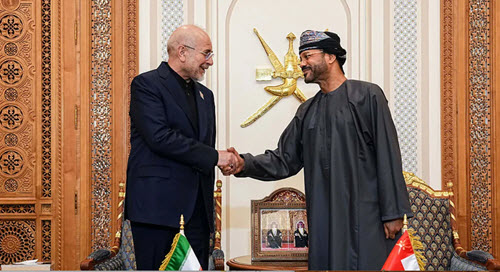
Iran announces deal with Oman to 'manage' Strait of Hormuz traffic. Iran’s parliament speaker told Chinese officials that the Islamic Republic will block any US ‘interference’ in the strait The Cradle News Desk JUL 3, 2026 https://thecradle.co/articles-id/38578
(Photo credit: Hamed Malekpour/Middle East Images/AFP via Getty Images)
The Islamic Republic of Iran and the Sultanate of Oman have reached an agreement on the joint management and regulation of traffic in the Strait of Hormuz, Iranian Parliament Speaker Mohammad Bagher Ghalibaf announced on 3 July.
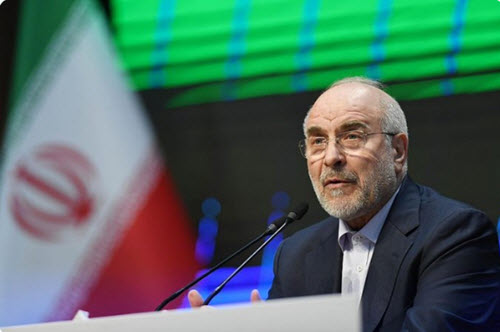
The Cradle @TheCradleMedia Ghalibaf: US will not be allowed to interfere in Strait of Hormuz, Israel seeks to sabotage Iran-US memorandum —— Iranian Parliament Speaker Mohammad Bagher Ghalibaf said Iran "will not allow the United States to interfere in the Strait of Hormuz," announcing that Tehran and Oman have agreed on a navigation mechanism for the strategic waterway under Article Five of the Iran-US Memorandum of Understanding.
He said Iran will proceed with implementing the mechanism while consulting with other states bordering the regional waters.
Ghalibaf added that Israel is attempting to undermine the Iran-US Memorandum of Understanding, adding that Iran's regional deterrence capabilities would prevent Israel from resuming the war.
He also called on all Lebanese components to implement the Lebanon-related provisions of the memorandum, saying they are essential to preventing internal strife. 2:26 AM · Jul 3, 2026
The announcement was made during a meeting with Chinese officials visiting Iran to attend the funeral of late supreme leader Ali Khamenei – who was killed by a US-Israeli strike on 28 February – set to begin on Saturday.
“During my visit to Oman a few days ago, based on Article Five of the memorandum of understanding, we reached an agreement on organizing maritime traffic,” Ghalibaf said.
He added that Tehran and Muscat are “determined to implement this, and we will certainly consult with the Persian Gulf littoral states as well.”
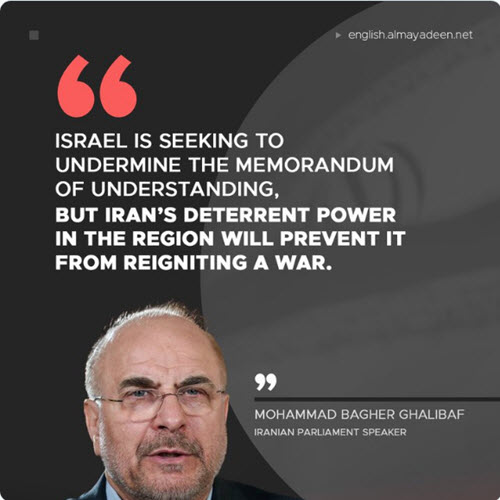
“The Israelis are undoubtedly seeking to undermine the … understanding between Iran and the US. However, the deterrent power of … Iran in the region will prevent them from reigniting the war. At the same time, we must reduce these tensions through a well-organized strategy and careful political measures,” he went on to say.
Al Mayadeen English
@MayadeenEnglish The Speaker of the Iranian Parliament, Mohammad Bagher Ghalibaf, declared that Iran will not permit United States interference in the Strait of Hormuz, emphasizing Tehran's commitment to securing the strategic waterway alongside regional partners. Ghalibaf announced that Iran has finalized a joint navigation mechanism with the Sultanate of Oman, based on Article 5 of the MoU agreed upon with the US.
According to the Speaker, Iran is actively moving forward with the implementation of this new maritime framework and intends to hold further consultations with other countries bordering the Gulf. While Ghalibaf noted that "Israel" is actively seeking to undermine the memorandum of understanding, he asserted that Iran’s robust deterrent capabilities in the region will ultimately prevent Israel from reigniting a war.
Ghalibaf also expressed appreciation for Beijing–Tehran relations and thanked the Chinese officials for participation in the upcoming funeral of the late leader.
The Cradle @TheCradleMedia Ghalibaf calls for deeper Iran-China strategic cooperation —— Iranian Parliament Speaker Mohammad Bagher Ghalibaf called for stronger strategic, political, and parliamentary cooperation between Iran and China, saying recent regional developments have increased the need for closer coordination between the two countries.
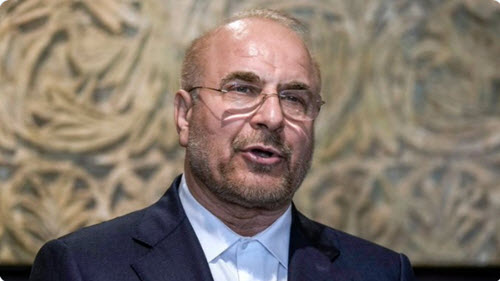
Speaking during a meeting in Tehran with He Wei, Vice Chairman of the Standing Committee of China's National People's Congress, Ghalibaf thanked the Chinese delegation for attending the funeral of late Supreme Leader Ali Khamenei and praised the growing political and economic partnership between Tehran and Beijing.
He said both countries should further strengthen their strategic partnership, arguing that closer Iran-China ties could contribute to easing international tensions. Ghalibaf also emphasized expanding parliamentary cooperation, as well as coordination within the Shanghai Cooperation Organization (SCO) and on broader regional issues.
Referring to recent regional tensions, he said deeper political and economic coordination between Tehran and Beijing was necessary in response to unilateral US policies.
On maritime security, Ghalibaf said Iran had ensured the safe passage of Chinese vessels through the Strait of Hormuz and stated that Tehran would not allow US interference in the strategic waterway. He added that Iran had recently reached an understanding with Oman on managing maritime traffic and would continue consultations with other Persian Gulf coastal states.
For his part, He Wei expressed condolences to the Iranian people and reaffirmed China's commitment to expanding bilateral ties, noting that this year marks the 55th anniversary of diplomatic relations and the 10th anniversary of the Iran-China comprehensive strategic partnership.
(IRNA) 4:01 AM · Jul 3, 2026
“In the Strait of Hormuz, we resolved the issues affecting the passage of Chinese vessels, as China stood by us during difficult times, ” he went on to say.
He stressed that the Islamic Republic “will not allow any US interference in the strait.”
Talks have been ongoing between Tehran and Muscat regarding joint post-war management of the strait.
Iranian management of the vital waterway, along with Oman and with the potential cooperation of other regional states, has been included as an official term in the Washington–Tehran memorandum of understanding (MoU).
At the end of last month, Oman had announced that it endorsed an Iranian proposal to levy maritime “service fees” on shipping in the Strait of Hormuz.
This came after the recent announcement on the activation of a US–Omani shipping corridor through Hormuz, which Tehran had considered a violation of Clause 5 of the MoU.
Tehran has repeatedly vowed that the strait will not return to its pre-war status despite an illegal US blockade on its ports and attempts to undermine Iranian control of the waterway.
“Hormuz is defined under Iran's command, not CENTCOM,” Iranian Deputy Foreign Minister and top negotiator Kazem Gharibabadi said in a statement on 2 July.
Weeks earlier, Tehran announced the formation of the Persian Gulf Strait Authority (PGSA), a new body to oversee its management of the Strait of Hormuz.
Washington accepted the inclusion of practically all of Iran’s demands in the MoU, including a full halt to war in Lebanon, asset releases, sanctions removal, a lifting of the illegal blockade, and Iranian–Omani management of Hormuz.
A 60-day period, consisting of several rounds of talks aimed at hammering out details, was scheduled to commence.
Yet Washington continued to violate the MoU through multiple attacks on Iran, and a failure to rein in Israel’s brutal campaign of ethnic cleansing and occupation in Lebanon.
The first 30 days of talks were meant to facilitate a gradual opening of the Strait of Hormuz and end the US blockade. Washington’s attacks and threats, as well as Israel’s behavior in Lebanon, complicated the process.
Tehran has repeatedly responded to Washington’s violations of the MoU, striking US assets in the Gulf following continuous attacks on the southern Iranian coast.
Iran Fires Back After 'BOMB KHAMENEI FUNERAL' Demand, Drops Chilling Warning For Trump Camp | WATCH Times Of India Jul 3, 2026 #lauraloomer #khameneifuneral #ayatollahkhamenei
A massive global outrage has erupted after far-right American activist Laura Loomer in a social media post called for bombing the funeral of Iran's former Supreme Leader Ayatollah Ali Khamanei. Loomer described the gathering as a "target-rich environment" and later suggested that the Israel Defense Forces had "the opportunity to do the funniest thing," prompting widespread criticism online. The Iranian Embassy in Tunisia condemned the remarks, accusing Loomer of openly calling for an attack on civilians attending the funeral and stating that such comments "must be unequivocally condemned." The controversy unfolded as Iran hosted a large state funeral attended by senior officials, foreign dignitaries, and delegations from regional groups.
Transcript
A shocking social media post by a prominent MAGA activist on former Iranian Supreme Leader Ayatollah Ali Khamanei has stoked major controversy. Laura Loomer, known for her provocative statements, reposted reports about Khamanei's long delayed funeral and described the gathering as a target-rich environment, adding a bomb emoji to the post. In another post, Loomer wrote, and I quote, "The IDF has the opportunity to do the funniest thing." The Iranian embassy in Tunisia, in a fierce reply, said, "American journalist Laura Loomer, with 1.9 million followers, has openly called on the IDF to bomb civilians attending the funeral of Iran's leader. It must be unequivocally condemned."
Leaders and officials paid their respects to Ali Khamanei on Friday as Iran prepared for the Ayatollah's dayslong funeral. Attendees included Iraqi President Nazar Amagi and key negotiator Pakistani Prime Minister Shabbaz Sharif among others. Iranbacked militant groups such as Hezbollah, the Palestinian Islamic Jihad Movement and Hamas also sent delegations. According to an Associated Press report, Kmeni's flagd dropped coffin sat at Tehran's Grand Masala alongside family members killed in the Israeli air strike that came in the first moments of the war on February 28th. Black flags, rows of coffins, and emotional scenes as senior Iranian officials and foreign dignitaries gathered to bid farewell to Iran's late Supreme Leader Ali Kam. Iran's capital witnessed an emotional state funeral as thousands of mourners gathered to pay their final respect to former Supreme Leader Ali Khamanei and members of his family. The ceremony brought together senior Iranian political and military figures, religious leaders, and foreign delegations from across the region. One after another, dignitaries approached the coffins, paused in prayer, and offered their final respects. Throughout the ceremony, several attendees were seen wiping away tears or appearing visibly emotional, while others stood silently with bowed heads. Among the most striking images was mourners breaking down in front of the coffins as prayers echoed through the venue. Not only the international delegations, but key members of Kam's inner circle from Parliament Speaker MB Ghalibaf to Iran Judiciary Chief Golam Hussein Moseni AJ to senior Iranian military officials were also emotional as they bid farewell to the late Supreme Leader. Iranian officials described the funeral as both a national farewell and a tribute to the country's wartime leadership. Another powerful image from the ceremony was the smallest coffin displayed alongside the others. A framed photograph identified it as belonging to Zara Makamadi Gulpagani, the granddaughter of Ali Kame. The smallest coffins are the hardest to carry. And today, that painful truth hangs over Iran. As the Iranian nation gathers to mourn at the funeral of Supreme Leader Ali Kam, grief has taken on a deeply personal dimension. Among those mourned are members of Khamanei's own family, including his grandchildren killed in the US strike. Iran has begun days of funeral ceremonies for its late Supreme Leader Ali Khamanei, who was killed during US and Israeli strikes in the opening phase of the conflict. Amid rows of coffins at the farewell ceremony for Iran's late Supreme Leader, Ali Khamanei, one image stood out. It wasn't the coffin of the former leader himself. It was the smallest casket placed beside the others with a photograph of Ali Kam's granddaughter, Zahra Muhammadi Gulpayagani. The image quickly became one of the ceremony's defining visuals, drawing the attention of mourers gathered to pay their final respects. The small coffin surrounded by floral tributes and Iranian flags stood in stark contrast to the larger caskets placed beside it, highlighting the personal cost of the conflict. T
he funeral marks the beginning of several days of nationwide mourning ceremonies organized by Iran's leadership following the deaths of Khamanei and members of his family. But for many watching the ceremony, it was the image of Zahra Muhammadi Gulpagani's small coffin that became the most poignant symbol of the family's loss. State funeral ceremonies often focus on political transitions and national symbolism. This time, however, one of the most enduring images was deeply personal. The smallest coffin carrying the heaviest message of the conflict. I have a very strange feeling about the fact that we are going to hold the funeral for our leader. I truly have a bad feeling because I have lost a father once before, but this is very, very heavy for me. I have developed a strange sense of conflict. Iran begins one of the most consequential funerals in its modern history. As the nation mourns the slain Supreme Leader Ayatollah Ali Khamanei, thousands of Iranians have begun gathering on the streets of Tehran, paying their respects before the start of the day's long funeral ceremonies. Emotions are running high as the Islamic Republic prepares to bid farewell to the man who ruled Iran for 36 years and shaped the country's political and military direction. The funeral ceremonies are scheduled to begin in Tehran on Saturday, July 4th, before continuing across several cities, culminating with KA's burial in the holy city of Mashhad on July 9th. Additional memorial ceremonies are also planned in the religious city of Kum, while events will extend beyond Iran's borders into Iraq. The smallest thing is that in any case that has seen the daily routine, the normal life that maybe one cannot even have a normal sleep, the stress one has when a family member wants to go out, one is worried that when they want to return, god forbid something might happen to them. Well, this itself is a major stress. Seeing that around their home, these houses, these places have been destroyed. I think these are perhaps among the most natural stresses let alone the major stresses and great sorrows such as losing a leader uh the country's infrastructure uh hospitals uh the destruction of hospitals. I think for many people like me, one of the ways to release anxiety was being present in these squares when people are together side by side, united in heart and voice, chanting slogans and listening to speeches. Anyway, people being together helps because when you're alone at home, the anxiety increases. But when there's a large crowd like in Revolution Square or other squares, that's perhaps why I participated in both the squares and the car convoys that were moving. This gives a person a sense of calm and I think courage as well. I have a very strange feeling about the fact that we are going to hold the funeral for our leader. I truly have a bad feeling because I have lost a father once before, but this is very very heavy for me. I have developed a strange sense of conflict. I do not know what to do. I just come here to calm down a little. Security has been a key issue as millions are expected to gather for funeral ceremonies. Thran has been turned into a fortress. Security forces have fanned out across major roads, public squares, and religious sites. As authorities brace for massive crowds expected to attend the farewell, Iranian leaders hope the funeral will demonstrate national unity and reaffirm support for the Islamic Republic during one of the most turbulent moments in its history.
Netanyahu's plot against Iranian leaders unraveled by US media; Trump intervened | Janta Ka Reporter by Rifat Jawaid Janta Ka Reporter Jul 3, 2026
The New York Times has exposed a chilling plot by Benjamin Netanyahu's regime to derail peace talks between Iran and the US. According to the report, Netanyahu planned to assassinate top Iranian negotiators, including Parliament Speaker Mohammad Bagher Ghalibaf and Foreign Minister Seyed Abbas Araghchi. The American media outlet claims that Donald Trump alerted Iran through regional intermediaries while simultaneously pressuring Netanyahu to abort the plan. Rifat Jawaid breaks down today's explosive stories with his sharp, unfiltered commentary.
Transcript
Three headlines for tonight. American media outlet The New York Times has sensationally reported that bloodthirsty Israeli barbarians had planned to assassinate the Iranian foreign minister and the Iranian parliament speaker to sabotage the peace process. At least 20 million people are expected to attend the late Iranian Supreme Leader Ayatah Ali K's funeral tomorrow as world leaders descend on Thran to pay their last respect. Amongst those arriving in Thran to attend the funeral service was a delegation from Saudi Arabia. Who would have expected that? UK minister is chased by a journalist from declassified UK on his government's complicity in the Ghaza genocide. This will be the broad focus of my video tonight. Also in this video, the rogue regime of Donald Trump stoops to a new law as the Egyptian footballers are prevented by cops from being photographed with fans. The Egyptian team let a scor course a brilliant win over Australia to advance to the round of 16 in the ongoing World Cup. So please stay tuned. The New York Times has sensationally claimed that bloodthirsty terrorist and baby killer in chief Benjamin Nathan Yao had planned to assassinate two key Iranian figures namely the Iranian foreign minister Sayyad Basarakshi and Iranian parliament speaker Muhammad Bakal Khalibah. during the peace negotiations to derail the peace process. As expected, war criminal Netanyahu called the report fake news. But the New York Times replied by defending its reporting. According to the report, the deranged occupant of the White House had alerted the Iranian leaders through intermediaries about the Israeli plans. He had apparently also asked his Israeli masters to not go ahead with another terrorist plan. This former Israeli Navy chief says that terrorist Netanyahu wants forever war to stay in power. After so many years uh of war, um Israel is uh in a way we are used to understand that there is no other opportunity. our our political bleeders are trying to explain us and this is what Netanyahu is saying by the way in his case uh it is the only way for him to survive in power because he needs a war he need extern external enemy in order to survive in power because his coalition uh is led by a very small minority about 10% of the Israeli people who believe in eternal war and uh but this do not represent uh the Israeli people. Now why it is important because uh from the first day after the 7th of October uh Netanyahu refused to speak he refused to discuss the very simple concept of the day later when we say the day later what will be the reality after the war. Now it was not a mistake and nobody forgot it. He did it, you know, because he understand that the moment that he will put on the table. The simple question, what do we want to be in 10 years, in 20 years or 40 years from today? He his his coalition will collapse. And this is something that he is in a way sacrificing the future of Israel by not trying to discuss how to win the war. There is no way to win the war by the use of military power alone. And this is what he's trying to do in Lebanon. Exactly. In Gaza, in Iran, in everywhere. Clearly, the Gaza genocide and illegal war against Iran and Lebanon were part of that strategy. Barbarian Netanyahu knows that he can pretty much commit any number of war crimes and get away because Western politicians have turned into his personal slaves. The UK is one such example. This week, UK's disgraceful minister Hamesh Faulner audaciously accused Jeremy Corbin of anti-semitism just because he highlighted the Israeli barbarity in the occupied West Bank. Thank you, Madam Deputy Speaker. All this hand ringing over the E1 zone is very important, but in reality, it is part of the Greater Israel plan. They already control 70% of the Gaza Strip, squeezing the whole population into the sea or into Egypt. They're already supporting by military means all the activities of the settlers and their abominable behavior towards Palestinian people and this construction of massive settlements all over the West Bank. In reality, it is Israel's strategy, Israel's plan, and Israel's determination that we're up against. Merely condemning them for this occupation of E1 will achieve nothing. There has to be a policy of stopping all arms, trade, and military cooperation of any sort with Israel until they end this settlement policy. And anything less than that simply will be just hand ringing that the Israeli government will just ignore. Yeah. Yeah. U mad dep I'd just like to say that I do not think that the policy of settlements is supported across the whole of Israel. That is very clear in the discussions about the elections that are coming. There are many voices in Israel who recognize the terrible harm being done to the state of Israel by the expansion of settlements. And I hope the members who will forgive me just to come back to the point about anti-semitism. We must be really careful in our language. There are many, many Israelis and indeed many, many British Jews who can see the terrible damage done by violent settlements and we must not tar communities in this country or the whole nation of Israel. No wonder this compromised Labor minister had no reply when a reporter from the declassified UK platform confronted him on his way to the parliament this week. Good day, Foreign Minister. Bill from Declassified UK. Are you Are you worried that war criminals might be walking the streets of Britain? I'm just on my way to answer an urgent question in the House of Commons, so you'll you'll hear from me first from there. Are you going to talk about what what you're doing to stop British nationals fighting in the Israeli army in Gaza? I'll be answering the questions of my colleagues shortly, so you'll be able to catch me there rather than here. There's more than 2,000 British nationals who've fought in the Israeli army since 2023. Are you not worried that Are you not worried that some of them might come back to the UK? Are you doing enough to try and screen British nationals who fought for Israel? I'll be answering, I'm sure, a whole range of questions in parliament in a second. So, I suggest I've seen the order list. I don't think this is on the list, though. Is it? I mean, it's a fairly straightforward question. Why aren't you stopping British nationals fighting for Israel while the UN says there's a genocide going on? Isn't that a fairly reasonable thing for the Foreign Office to do? You will see. I suggest your viewers tune in to BBC Parliament and I'm sure they'll be able to see lots of questions being. So that was the Middle East Minister Hamish Falconer there refusing to answer our questions about what his department is doing to investigate British nationals who fought for the Israeli army in Gaza. We know there's more than 2,000 British nationals who've served in the IDF since 2023. Many of them will have been deployed to Gaza where the UN has repeatedly said there's a genocide taking place. The UK is a signary to the genocide convention. It's a member of the International Criminal Court. It should by law be investigating British nationals involved in war crimes. And yet, when it comes to those who fought for the IDF, they seem to be running away from even answering questions about it. More than 25,000 of you have signed a letter demanding that the Foreign Office and the Home Office start investigating this matter seriously and screen for potential IDF soldiers coming back through British airports. Hish Faulner there clearly didn't want to answer questions about that. Any person with an iota of conscience and morality left should never vote for the Labor Party in the UK. This is just an extension. It has actually become an extension of the genocidal entity of the settler colony. While some UK politicians may have mortgaged their conscience to a genocidal settler colony, we are seeing some kinds of green shoot in the US. Listen to Congressman Roana. What do you think the position on Israel Palestine of the Democratic nominee for president in 2028 should be? It should be a position that convinces Americans and the world that this person is really going to be able to bring a just peace in the region. that they're going to be able to bring together America in uh actually getting the recognition of a Palestinian state and actually having Palestinian elections and actually having a progress towards a secure Israel with equal rights and a Palestinian state. Now, we could talk about the details of how I believe there shouldn't be aid and we shouldn't be sending military weapons and that we need to call out the occupation and call out the genocide. But ultimately I don't think people vote just based on uh a particular position. I think they look at a person and they say is this the kind of leader who will move us forward who will help us solve something that has been intractable. And one of the things I love about America is uh the nation that produced Donald Trump also produced Zan Mandani. uh the nation that uh has Josh Godheimer sitting in Congress also has Rashida Talib. If we can have a new generation that recognize America is blessed with the diasporas from around the world with the stories of freedom and struggle from around the world with the stories of people who trace their heritage back to those who uh were killed in the Holocaust with those who have family uh who were killed in Gaza. And we can have someone who can 11 minutesunderstand that pain and understand our hope for moving forward with a multi-racial democracy that is a force for justice and human rights in the world. That's I think what we need to to convey. The details of the policies matter, but what people are looking for is leadership and vision in a a more hopeful uh America and a more hopeful world. Meanwhile, late Iranian Supreme Leader Ayatah Ali K's funeral service has begun in Thran where at least 20 million people are expected to take part in this historic event tomorrow. Remember the US and Israeli savages had mercilessly slaughtered the Iranian spiritual leader along with his wife, daughter, daughter-in-law, and granddaughter on 28th of February. Today, Iranians went hysterical on seeing the coffin carrying the body of the youngest member of World leaders arriving at the Thran airport were also given the reminder of Israeli and American savagery as they saw the photos of 168 girls from an elementary school in Minab who was slaughtered by these human devils from the US And started. The Iranian speaker couldn't control his emotions. But the highlights of today's funeral service was the presence of the Saudi delegation. It's me. for Thank you. Rock feel delegation two arrive. rived in Thran today. Also attending the funeral were delegations from Russia, India, Pakistan, Hamas, Islamic Jihad and Hezbollah among others. Representatives from more than 100 countries are likely to attend the funeral service tomorrow. This Sky News reporter explains the elaborate arrangement made for this historic event. We're in central Thran where they are preparing for the mother of all funerals uh for this man Ali Hame who was supreme leader of Iran for 37 years and they want to give him a sendoff fitting to his status but also of course to give a show of public unity and strength after this four-month war that has battered Iran but left its leadership standing. He was killed of course on the first day of the war with a massive Israeli bombardment on his compound along with members of his family and that is a picture of Zakra, his granddaughter. Other members of the family were killed along with leading members of the Iranian elite in that bombardment. But they've waited till now for his funeral which we expect will attract millions of people here to Thran. So they've set up these stands here that we've seen all along these streets of the capital where they'll be handing out refreshments uh and other things to the faithful for the mourers as they come here and converge on the city for what is going to be a week-long funeral. Now that's begun already uh with Ali Hame's body his coffin and those family members being laid out in the government compound where they were killed on that first day. But those uh coffins have now been taken from there to the grand mosque, the big mosque complex, the Grand Masala as it's called in the heart of Tehran that's down this road where members of the public over the next two days will be able to pay their respects. So foreign dignitaries, uh leaders of Iran and other officials from the elites have paid their respects, but ordinary Iranians will be able to do so now over Saturday and Sunday. And then on Monday will be the highlight of the event if you like where his coffin will be taken through the city of uh city streets of Tehran uh where we're told 15 million people will converge on the city. It's not ending there. He's then going to be taken to Najaf and Kbala which are cities in Iraq neighboring Iraq key Shiite cities along with the holy city to the south of here. and then he'll be buried in Mashad where his family is from uh which will be the culmination of this week-long uh funeral uh set of events. Now obviously the government is keen to give a sense of unity uh and strength papering over if you like what are deep divisions within Iran. We saw those massive protests on the streets of Iran before the war where thousands of people were killed by their own uh government. But the government's hoping now that the war has galvanized support for the leadership again and they want that to be on display. So they'll be trying to show that but also trying to avoid the events of 1989 when Ayatalah H the first supreme leader of Iran was buried in a funeral that attracted a sixth of the population of Iran in chaotic scenes where his coffin was uh tipped over, his body uh fell out. They'll also want to avoid the events of Kasamsulammani, the Iranian commander funeral, uh, where more than 50 people were killed in a stampede. So, the sense we have here is of a city that's being controlled, um, of an event that's going to be choreographed where we, I think, are expecting a spontaneous sher brief, but also a certain amount of, uh, governments managing the events to give the Supreme Leader Ali Ham send off that these people at least feel he deserves. The commander of the IRGC, Brigadier General Ahmed Wahidi said that his country will never surrender to the Zionist aggressors. English voiceover done by Rui. Of course, we will never be separated from him. He holds a place in our heart, souls and lives. He is permanent and eternal for all of us, for our beloved Iran, for our ummah and we will never bid him farewell. One sentence, we will always be with him. A message to those who are eyeing our soil hoping to trample it. They must know that the pure blood of our martyed Imam will be another turning point in the victories of dear Islam across the global infidel world and they will go to their graves before they see this nation 20 minutessurrender. This nation will rise higher and higher with each passing day and with this pure blood. Meanwhile, the Houthis or Ansarah fighters in Yemen today revealed that a plane carrying 200 Iranians was prevented from landing at the Sana airport by the Saudi military. The Houthis said in a statement that the Saudi attempts were thwarted in the end. This is the Houthi military spokesperson Yayyasari English voice over by Ruei statement issued by the Yemeni armed forces. In the name of God the most gracious, the most merciful. God the Almighty has said and as for those who after being wronged take revenge against them there is no blame. God the Almighty has spoken the truth. This Friday morning at 5:20 a.m. a formation of Saudi enemy warplanes entered the airspace of Yemeni governor rates as part of his attempt to prevent an Iranian civilian aircraft carrying more than 200 stranded, wounded and sick citizens from landing at SA International Airport which has been subject to an unjust blockade imposed on it and on Yemen for nearly 11 years. However, this attempt failed by the grace of God as the Yemen armed forces thwarted this attempt by targeting the air force with a number of air defense missiles, forcing it to leave Yemeni airspace by the will and power of God. Accordingly, the Yemeni armed forces affirmed the following. First, we warn the criminal Saudi enemy against repeating any attempt to create a hostile environment or launch an aggression targeting our country as it will be met with a comprehensive response targeting its airports and vital interest on land and at sea. Second, we will not accept the continuation of the unjust Saudi American blockade on our country indefinitely, and we will take all legitimate steps to end this blockade. Third, we call on our beloved people to maintain a state of general mobilization and combat readiness in response to the call of commander Abdul Malik alin al-Houthi. May God protect him. Fourth, we affirm the readiness of the armed forces and all their formations for any decisions made by commander Abd Malik ali. May God protect him and what they stand ready to carry out his directives to lift the Saudi American blockade on our beloved people and expel the occupiers. I will now leave you with this video of the Egyptian football team which has gone viral. This video captures the true rogue mentality of cops in the US. It also raises more questions on the FIFA's ability to organize this footballing competition. A fan wanted a photo taken with Egyptian footballers who had absolutely no problem in obliging the fan's request. But then local goons in uniform masquerading as cops decided to assert their power as they tried to rudely stop Egyptian footballers from being photographed with their fans. This angered the Egyptian team officials who confronted the rogue police officer in Dallas by asking if they had truly gone crazy just like their boss, a deranged and depraved occupant of the White House. Egypt later defeated Australia on penalties to secure a place in the round of 16. Back off. That's it from me. Thank you very much for your support of this platform and our journalism. If you haven't subscribed to my channel, please do so because that's one of the many ways you can support independent journalism. God bless you all.
Trump Was Caught Doing It And Everyone Is FURIOUS Really American Jul 3, 2026
Really American hosts Marco Foster and Corinne Straight break down the brand new report from House Rep. Jared Huffman detailing Trump’s unbelievably corrupt scheme to steal money from Americans over America 250
Transcript
This is how Trump hijacked America's birthday.
We have an insane report out from Representative Jared Huffman from California uh describing the entire grift and graft of Trump around the America 250. We're going to watch this whole video and then we're going to catch it on the other side. You've got to watch this.
[Congressman Jared Huffman] America's 250th birthday is being run by a shadow company you've never heard of. Freedom 250 has raised millions of dollars. It's selling access to the President, and it won't tell you who's paying, or where the money goes. This is how Trump hijacked America's birthday by rewriting the rules to let the ultra wealthy, and politically connected, take advantage of the American people. I'm Congressman Jared Huffman. I lead the Democrats on the House Natural Resources Committee. We've spent the past year trying to uncover the truth about what happened, and I want to walk you through exactly what we've found.
So, how did this private company end up running America's official 250th celebration, siphoning off millions of taxpayer dollars, and harvesting Americans personal data? Let's start at the beginning.
In 2016, Congress did something rare. Republicans and Democrats came together and created a commission called America 250 to plan the 250th. They built it to be nonpartisan on purpose, so no president could ever make the country's birthday his own. The America 250 commission was well underway to honor the anniversary with expertly planned festivals, activities, and unifying events to celebrate our country and its founding. Then Donald Trump decided he wanted something different. He wanted a party he could use for his own personal political and financial gain. So first he tried to take over America 250. His appointee to the commission teamed up with the speaker of the house in an attempt to push four commissioners out of their seats and replace them with MAGA loyalists. When that didn't work, Trump created his own shadow entity to circumvent and supplant America 250. They call it Freedom 250. On paper, it's a shell company registered in Delaware through the same anonymous vendor the President uses for his other businesses. But this LLC is different. It was lodged inside the National Park Foundation, the charity that's funded our national parks for 50 years. Think about why you'd do that. As part of a charity, the LLC could take in huge sums of money without ever naming who or where it came from. This arrangement lets them sell access to the President, collect checks from anyone willing to pay, and keep every donor's name secret, all under the banner of a trusted American institution, the National Parks Foundation.
Then they starved America 250. Congress had set aside $150 million to celebrate our 250th. The America 250 Commission was promised a hundred million of that funding, but in November of 2025, the White House told the America 250 chairwoman she would only get 50 million. And in the months that followed, they whittled it down to just 25 million. The rest of the money was taken by Freedom 250. Between this and other redirected funds, hundreds of millions of taxpayer dollars are now unaccounted for.
Now, follow the money, because this is where it gets worse. Freedom 250 went after the real Commission's corporate sponsors. Not just donations, but a quid pro quo of access to Trump in exchange for cash. Lockheed Martin, Exxon Mobil, Chevron, Mastercard, United Airlines, United Health. Most of these corporations are lobbying and trying to win contracts from the same government that's now selling them special access. And as they wrote their checks to Freedom 250, the President was trading their stocks, and posting their ticker symbols online to juice their values.
Trump's cronies were then deployed across the globe to solicit money from foreign governments. The CEO of Freedom 250 flew to Davos, stood in front of a room of foreign governments, and asked them, in his words, how they wanted to shape America's birthday. Foreign governments shaping our 250th. He called it "marketing freedom".
According to a whistleblower, not everyone who donated money to Freedom 250 knew that's what they were doing. Fundraisers misled donors who intended to support the America 250 Commission by giving them Freedom 250's banking information. And through this bait and switch, contributions meant for the nonpartisan Birthday Foundation were routed to Trump's Shadow Corporation instead. This is potential wire fraud.
And Freedom 250 has been collecting more than money. Its website runs through a company owned by Brad Parscale, the President's longtime digital strategist. Every American who signs up for a free event, even the families who registered for the World Cup fan zone on the National Mall, hands over a name, a location, and a phone number, that feeds straight into a political operation built to profile and target voters. Americans just wanting to celebrate our nation's 250th birthday are unknowingly signing up to potentially have their data harvested and added to Trump's campaign operation.
While Trump and Freedom 250 are pretending this celebration is about America's history, they've been forcing public servants across the country to erase our country's real story from parks and public spaces. Park Rangers were given marching orders to take down factual signs about slavery, climate change, and the forced removal of Native Americans. And in their place, Trump and his political allies have been pushing their sanitized and distorted version of history. They paid out 10 million taxpayer dollars for a fleet of trucks, running Prager U videos, and an AI generated George Washington, that tells school kids that their rights are a gift from God, something the real Washington never said. They're parading these propaganda trucks in front of schools on your block. They've turned what should be a non-political, unifying celebration of America's 250th, into a right-wing Christian battering ram aimed at breaking down what Thomas Jefferson called "the wall of separation between church and state," enshrining their extreme version of Christianity as our de facto national religion. This agenda is not subtle. It fuses white Christian supremacist identity with history revisionism, insisting the nation's founding, its laws, and our fundamental rights, are rooted in the Christian Bible, rather than the revolutionary principle of self-government. Their own documents are littered with proof that for them, this anniversary is not actually about America, it's about promoting two things: Christian nationalism and Donald Trump. An internal playbook called for scripture readings and worship nights on the National Mall as official birthday programming. They peddled sponsorship packages, and photo ops with Trump, at 10 million bucks a pop. A UFC ring was built on the south lawn of the White House, not for the 4th of July, but for the President's 80th birthday, with seats that ran a million and a half dollars, and went to executives from the companies his government is supposed to regulate. They handed out contracts to Trump's closest allies, including Event Strategies, Inc., one of the masterminds who orchestrated the rallies surrounding the January 6th insurrection.
For every fact we've unearthed in this investigation, we've had to fight to get it. The Republican majority in Congress has far more power than we do to demand answers. But instead of joining us in serious oversight, they've used their power to do the opposite. They've blocked our requests, shielded the individuals and entities involved, and refused to hold a single hearing on any of this. They are shielding bad actors, instead of holding them accountable.
So today, against the obstruction and resistance of our Republican colleagues, we are dragging this fiasco out of the shadows, and shining a bright light on the corruption and fraud surrounding Freedom 250. America turns 250 years old only once. We should be celebrating this anniversary together with patriotism and integrity. This milestone was paid for by every generation that built this country. But Trump has tried to quietly steal it, warping it into a celebration for one man, and weaponizing it to advance his own personal political and financial interests.
This is bigger than one anniversary. The political and legal maneuvers that brought us to this point are a potential blueprint for others who seek to betray the public trust, take something the public loves, run dark money through it, sell access, and make sure the details are hidden from public scrutiny. It worked this time. We can't allow it to happen again for the next government program, the next fund, the next thing that's supposed to work for all of us, to be exploited and misused this way. That's why we have to confront this grift and corruption right now.
We laid out in meticulous detail how it happened. Not to tell you what to think about America's 250th anniversary, but so you'd know what they've done in our name. So that you have the facts to decide for yourself whether it's acceptable. 2 days from now, Americans of all walks of life will gather to celebrate our 250th anniversary. It's a moment for all of us to reflect on what this country stands for, and who it belongs to. 250 years ago, our founders made a statement that America belongs to the people, not to powerful tyrants. We think America still belongs to all of us, to you, and we will fight to keep it that way.
I mean, that's just it's just so insane. And like I say it a million times, but just can you just imagine if Obama or Biden [laughter] or anyone else had done even a fraction of this? I mean, Fox News would uh, you know, be spontaneously combusting. Um, you know, the Republicans would be, you know, trying to get a nuke pointed at the White House. It's just it's just insane. It's ins. I mean, they would immediately begin impeachment proceedings. It would be a whole I mean, everything would be turned on its head. they would focus on no other business except for the, you know, the the pack of gum that Obama got at a discount because he I mean the that is such a welldone and succinct presentation that could be done on so many different contracts. I mean, pick any contract that the Trump administration has handed out over the last year and a half. um you just do a do a control F, just find and replace um the the 250 with whatever or other organization is in there. I mean, we're learning similar things about the Kennedy Center, the foundation that Trump set up for the Kennedy Center that nobody knew about. And so, it's obviously this is this is money laundering. I mean, this is so obvious. It's so obvious. And the fact that people believe that he's so brilliant, he should be able to do this while they are being fleeced is is is a disconnect that is just difficult to wrap your mind around. Yeah. And I think it's it's disheartening too to see all these companies that are like giving money to this and that are complicit in it. And you know, it's part of the reason why it is very important that the Democrats retain power again, uh, you know, in the midterms because then they can actually finally investigate these things. They can finally have House committees and Senate committees and they can actually dig into this stuff. And that's honestly why Trump is so scared and why I think they're going to do everything that they can to rig the midterms, whether it's, you know, not delivering mail ballots or, you know, all these plethora of of other, you know, [ __ ] up schemes that they have, you know, going on. But, um, yeah, it is and it's really depressing. I mean, of course, like obviously that needs to happen. I mean, that kind of investigation and deep dive and holding anybody accountable that can be held accountable um in the years to come with a new makeup of Congress needs to happen. On on the flip side of that, I am so [ __ ] frustrated that Congress needs to to spend their time on that instead of spending time on some of the um institutional corrections that need to happen because we are many people are reaping what Trump swed in his first term right now when it comes to tax cuts um and attacks on health care, not to mention the big beautiful bill that was signed last year that's going to hurt people even more. So we are living in a today that is more harmful, less prosperous, less healthy, less safe for for regular folks um because of what he did almost 10 years ago. And to think that we are going to have to spend another 10, 15, 20 years possibly hopefully we get the chance to undo it. I mean it's kind of like both thing. I'm I hope we get the chance to do it, but I'm really frustrated that that much energy is going to have to be expended that we're kind of all in neutral if the horrible [ __ ] that he has passed just stays policy for the next decade while we maybe prosecute some people. You know, again, does that help the average American? Those are kind of all it's just it's we're wrestling with with so many contradictions that we allowed to happen because we allowed him to get back into office again. Yeah. And you know, today is the third that we're recording this. Tomorrow is the fourth. And I'm not feeling the most patriotic right now. But what does give me a little bit of patriotism is uh all you guys out there in our community. Uh and and all of the like-minded people that are still fighting back that are still going to be turning out, all the wins that we're seeing in the primaries, all the momentum and energy that we have right now. And it it's going to take some time, but we are going to finally hold them to account when the time comes. Absolutely. That gives me I mean looking forward to just being able to talk to you and our other colleagues every day to kind of feel like we're not because so much of this you you feel like you're going crazy. You feel like you're being gaslit. You feel like oh it's really not that bad. No, it is. It is that bad. And if you want a community to um commiserate with and coordinate with, um that's that's what we're here for because we're not going to shut up and pretend this is normal because it's
INTERVIEW: The US wants to be the boss of the world and that involves taking down China George Galloway Jul 3, 2026
There's a worldwide war on China, hybrid at this point. It's about US aspirations to maintain global hegemony, says journalist KJ Noh. Russia, Ukraine, Iran are the appetisers, but China is the main course
Transcript
And I am very very proud to be a part of the mother of all talk shows and very proud to have a guy who I've been working with for years who does fantastic work on peace. He's a journalist. He's a writer. He's an educator and his name is KJ. No. KJ, welcome. A pleasure to be with you, Garland. Thank you very much. Always a pleasure, KJ. A man who I respect a lot who has tremendous knowledge and historical knowledge particularly of um of things in Asia. Now, let's start here. You know, I think that in order to discuss what's happening, even Ukraine, but in order to discuss what's happening in the Straits of Hormuz, what's happening in um West Asia, it has to be connected to the worldwide war on China that you know what happened. They start off, okay, we're going to attack uh uh uh Iran and where it's the protesters and the nuclear weapons or whatever else we can come up with. Fine, all a bunch of lies. and then all of the sudden, well, we'll just blockade uh oil tankers going to China. It's, you know, a lot of people 1 minutedon't want to accept this, but they have told us that it's ultimately all about China. And that is my belief. And not to not to belittle what's going on and the importance of it and the criticality of standing up for the rights of the people in Iran and stopping these brutal wars and attacks. But we have to understand the the big picture. And I and I'd like to ask you your thoughts on that KJ. No. Yeah, you're absolutely right, Garland. You know, the big picture is that this is about US uh aspirations for maintaining global hegemony. It wants to be the boss of the world and that involves taking down China. And originally both Russia and Iran were supposed to be like side dishes, appetizers. That is to say, the US would knock off Russia as a appetizer. the main dish was China and then it would knock off Iran as kind of dessert. It didn't turn out that way. The sequencing got jumbled and the appetizer that Russia was supposed to be Russia was supposed to be a drive driveby. That is to say, you know, it's a gas station with pretensions. You know, how could the US not just, you know, take walk over it? But it didn't turn out that way. Turned out into a protracted battle. And so now it's stuck both in Europe and in West Asia. and it doesn't quite know what to do but it is still continuing to escalate and is still continuing to prepare for war against China as we can see as what is happening both with Japan with Korea the Philippines uh Australia and the entire you know you know gamut of continued information warfare hybrid warfare against China both inside China in the United States and all along the periphery of China you know one of the interesting things is Australia. The Australians are being told that they have to be prepared to protect their country from their number one trading partner from the country that makes them wealthy and gives them a pretty good life. Um, and that they have to get these nuclear submarines and the whole AUS thing which seems to be falling apart. And what's the latest on this whole Australia thing wherein Australia is trying to be set up to be like a nuclear submarine base and uh you know which seems again seems to be falling apart. But what's the latest on um the the the this attempt to to weaponize Australia against China? Well, Australia is very very important because first it has always served as a US subcontractor for US wars um or western imperial wars going all the way back to Gallipoli but also World War II. In the Korean War there were significant presence there significant uh you know force multiplier for the US. During the Vietnam War they were there during Afghanistan we know that the US uh you used Australian uh troops as shock troops. you know, they were caught out, you know, slicing the throats of, you know, young children just for sport, what they referred to as bloody. It was a kind of an initi initiation ritual for their own special forces. So, Australia has always been this quizzling subcontractor to US militarism. And in this escalating war against China, it is also being recruited to serve that same role. which is not to say that this is what the Australian people want or that there aren't parties that are strongly opposed to this, but the leading, you know, ruling parties are pretty much in bed with the United States. And these structures have been put in place over decades now. Very, very hard to dismantle. But one of the ideas is that they were going to use Perth, the naval base Perth as kind of the rear base uh from which to make sure that they could uh exert pressure against China. If you look at the Pacific, there's a kind of a uh it's it's what they call the quad, but there is a kind of four poster uh uh strategy uh battle strategy which involves the first island chain that is Korea and uh Taiwan Island and Okinawa Islands and then in going all the way to Borneo, Philippines, uh Indonesia etc. So that is the kind of initial cordon sanitary with which they've created a wall of missiles with which to box in China and to obliterate it. And as we speak the US is rehearsing with Japan an island hopping strategy which would be to move from island to island and continually shoot and scoot fire standoff missile against China. Their theory is that we can move if we can move quickly enough uh and continue to attack China, we will be able to devastate it with our doctrine of war which is called air sea battle. But if you look at uh this form for formulation that they call the quad, this involves the United States uh Japan uh Australia uh and um uh uh and and and the UK is India. Uh and oh UK. Okay. Uh India sorry India involves India UK US and Australia. Yes. So the quad blocks off the four quadrants. A uh India is the left tackle. Uh Japan is the right tackle. Australia is kind of the you know the rear uh you know defense. Uh and then the front line is Taiwan and Korea etc. Okay. So this is well blocked out and then you also have Ocus Australia, UK uh US uh alliance and this was presented as some kind of a contract to acquire nuclear submarines. Turns out that they're not going to get those nuclear submarines if if at all if at best they're going to get like second generation washed out things. And it has nothing to do with the actual submarine contracts because Australia doesn't face any risks from China. China is not going to, you know, be mining Australia's harbors. Uh, and essentially, as you point out, uh, China, Australia's greatest trade partner is China. Australia's wealth is dependent on trade with China. And any trade that goes back and forth if they need to, you know, protect those waterways, they're not, they don't need to protect them against China because they're going to China or coming from China. So, absolute nonsense. But what it is, what ARUS is, is essentially a basing agreement combined with um combined with weapons contracts that locks the United States even that locks Australia even more deeply inside the US military embrace. So all of this is happening almost on autopilot. And although Australia has, you know, vacasillated back and forth, played jackal and hide with China, essentially the momentum is for Australia to continue to be militarized 8 minutesas a platform for projecting war against China. Now, well, interestingly enough, Korea, they I think they've got some stumbling blocks in Korea, more so than some other places in that um they um attempted the with the latest uh the the the previous leader of Korea, they attempted a really a violent coup to ret return a military dictatorship and the people were able to stand up and fight that off and in fact the guy got I think life in prison. Um what's the what's the current I know there were problems with the US empire in Korea. I also know that the US empire literally in in the instance of war takes full control. Most people don't know this. If there is a war the United States then takes total control of the South Korean military. It completely becomes part of the US military. But what is the uh the status of of Korea right now and the ability of it to push back against the US empire? Um it's a little bit of a minefield. Very very tricky. So you're absolutely correct. The previous president, his name was Yunagal, was a complete and total US quizzling proxy. Uh he was u Mr. American Pie. He was giving the US everything they wanted, including a war on the peninsula that would justify the US taking control over South Korea's military, which it does under conditions of wartime opcon. That is to say, South Korea is unique in all the quote unquote sovereign countries on the planet that its military is under the control of the United States. It has a 500,000 man army, 3.1 million reserve troops. All of these troops fall immediately under US control. At the drop of a hat, the moment the US says two magic words, Defcon 3. If it says DEFCON 3, everything that is yours is mine now. And so the ostensible pretext is that it can only be exercised under conditions of war. It's kind of a a nonsense, you know, you know, tortology because the only time control of a military matters is when they are at war. It's like the only time you need to steer a car is when it's moving on the streets, right? Not in the garage. But anyway, the US claims that it has wartime operational control. The thing is, so it's like an eminent domain and it can get it anytime it wants, but ostensibly needs a pretext. It needs the pretext of war. And that was what Yunagal, the former US quizing uh South Korean president was supposed to provide with his martial law declaration because as he declared martial law just prior to that he had uh launched scores of uh attacks on North Korea hoping that they would uh retaliate uh and that this would give him you know the pretext the ostensible pre pretext for martial law. Well, as interestingly, the North Koreans didn't respond. They were very, very chill because, you know, they didn't want to get pulled into a war. Uh, and then so Yuna just went ahead and declared martial law anyway. And part of the plan was to kill off South Korean legislators and claimed that North Korean uh spies and commandos had done this, etc. All of this unraveled because essentially the moment he declared martial law, the South Koreans, he declared martial law, you know, I think it was on a Monday night uh around 11 p.m. and the South Koreans came out on in their pajamas and they surrounded the national um uh legislature and they fought handtohand uh you know with special forces troops and event essentially uh you know defeated them. you know, people who were doing deliveries at the time. These are the these are the people out on the streets, you know, delivery drivers ditched their deliveries and went straight to the National Assembly, you know, to, you know, to to resist the martial law troops. People in chemotherapy, you know, tore off their chemotherapy and rushed to, you know, the National Assembly. So the Koreans you know were very very you know South Koreans were very very um you know upset about this and because of that they were able to thwart this uh declaration of martial law which would have turned Korea back into a police state which it was for most for at least half of its history and under US control. So that was thwarted and so then we had uh an election uh and uh and Yuniel the former president um was arrested. He's currently in prison facing at least a life sentence plus uh other charges and a progressive was elected by the name of Ejyong. Now, EJong is really interesting because he comes from the progressive wing of South Korean politics. But more importantly, he himself was a child worker. You know, starting from the age of 12, he worked in factories. So, he is a man of the common people. You know, he says that every day I would go into a a factory uh and I would be beaten within inches of my life uh you know, just you know, just for the privilege of you know, working. So he he knows a thing or two about uh you know what the Korean uh dictatorship is available is is capable of uh and he also you know is you know is a man of the people. Uh and one of the things that he wants to do is he wants to rest back South Korean sovereignty from the US. Uh and the the first step in this is he needs to rest back opcon or operational control of South Korean troops. South Korea wants control of its troops back. And the US uh National Defense Authorization Act has just passed uh uh a law saying that OPCON essentially will not be returned to Koreans. They're essentially saying that, you know, uh we uh it prohibits a reduction in US military posture on the Korean Peninsula uh and that any change has to be you know uh dependent on you know very specific uh risk assessment uh and that there will be no return of OPCON. uh uh uh it uh and it actually directs efforts to enhance US and Republic of Korea operational capabilities and interoperabilities. So essentially the US is saying no f you are not going to be able to uh get your own military back. Javier Brunson is the CFC commander. uh he's a three-star general who currently controls the US military, US forces Korea, but also would control South Korean troops. And again, he has said to the president, uh you know, you're not going to get OPCON back. You know, we're not going to essentially saying go f yourself uh to the president of South Korea. uh and he's and he's has also pointed out that South Korea is critical in war against China because as he point out in in his own words it is inside China's defense perimeter. It's essentially he's pointed out China is playing a defensive game and that it is already on the Asian continent right next to China which is why South Korea is so important. So yes, the US is definitely seeking to use Korea as uh the kind of spear point against China along with Taiwan, along with Japan, along with Philippines. But also more specifically uh the US is not happy with South Korean President Eyang. Uh they have said no to his request for return of OPCON and they have sent in uh I think her name is Michelle Lee. uh they've appointed this new ambassador who is extreme far-right who has accused President uh EJong of being in the Chinese pocket and a communist and we generally uh refer to these types of ambassadors as regime change ambassadors. These are ambassadors. Well, we got to get ready. We got to get ready to run. We going to have to get ready to run. KJ, we're getting close up to the hour. Where can people find you online? Uh they can find me of course on Moes on your show uh on Danny Hyong on good progressive uh channels and then I've very recently written a book with Finian Cunningham called uh killing democracy Daniel Kavalik myself Finian Cunningham uh etc. Uh we worked on this book together.
John Mearsheimer: The End of Russian Restraint & New U.S. Grand Strategy Glenn Diesen Jul 3, 2026
Prof. John Mearsheimer discusses how Russia and NATO continue to go up the escalation ladder; the deceptions about how the war is sold to the public; and how the U.S. must establish a new grand strategy to organise it foreign policy to new realities. Prof. Mearsheimer is the R. Wendell Harrison Distinguished Service Professor in the Political Science Department at the University of Chicago
Transcript
Welcome back. We're joined again by Professor John Mearsheimer to discuss uh what's happening in Ukraine, Iran, and of course uh US grand strategy in an increasingly confusing time. So, thank you for coming back on, John. It's uh great to see you again. You're welcome, Glenn. I'm glad to be back. So I I initially had uh intended a different topic but as we see the bombing of uh Kiev last night which according to the mayor uh Klitschko he argued this was the worst bombing of Kiev in the entire war. It begs the question yeah what does this mean? And also I've seen in other parts of the country airfields being bombed of military airfields which again begs the question why why wait four and a half years to go after these airfields. Uh how are you assessing what the Russians are doing now? Well, if you listen to a lot of the chatter surrounding this massive attack last night, it's seen as a reprisal for all of these drone attacks, these Ukrainian drone attacks into Russia. And the argument is that the Russians are getting tough now. Uh when you hear that and before you read about what the attacks looked like, you might think that what the Russians were going to do is go out and pound the civilian population, uh launch what might be called a classic punishment campaign. But it seems quite clear that that's not the case. that the Russians went after military industrial targets uh and they did not purposely attack civilians. According to the Kev Independent, uh 20 Ukrainians were killed. This is surely regrettable, but it's not a large number and it does not represent a punishment campaign, a campaign designed to kill civilians. And what the Russians did was they launched a massive attack against, let's call them strategic targets. And they've done this in the past. There's not really that much new here. Yes, it was a massive attack, but as we know, there have been numerous occasions in the past where you've had massive attacks against military industrial targets. So, I don't see how this could possibly represent uh a response uh to the drone attacks by the Ukrainians against the Russian heartland. It doesn't sort of add up to me. Uh, I think the Russians are probably going to spin it that way for public relations purposes to convince their Russian leaders would want to convince the domestic audience that they're responding to these drone attacks. But in reality, this is just what you would expect from the Russians and what we've seen from the Russians in terms of bombing campaigns. So that'd be my basic assessment of what's going on here. Yeah. No, I I know the Yeah, the media reports uh point to the the larger killing of of civilians, but as as you said, in the past you would have like hundreds of drones and missiles and you may have one or two uh deaths. This time it was uh more relatively many more. But that being said, as you said, if you launch 500 missiles and drones, if the intention is to kill civilians, you're doing a very poor job. Uh so it it doesn't appear as you said this was a aim to well target civilians. Uh again doesn't mean that the 20 deaths isn't horrible but again I think the context is important. Uh but how do you see um because many assume that when a retaliation comes from Russia that it might not be restricted to Ukraine. Again, the Russians keep pointing to European production facilities as legitimate targets or any logistic centers. Um, but it does beg the question, how involved is NATO here actually? Because this is something that's very much well often disputed. Although I'm not sure if you saw the news today, you had these two Russian pranksters. They had called the the the adviser to the Estonian president and essentially had him go on about how they had been offering coordinates in the attacks on St. Petersburg. This is quite significant. It would indicate uh well make it very clear that uh NATO countries are involved in the attacks on Russia. Indeed, Maria Sakarova said this that this is evidence of Estonian participation in terrorist attacks on Russia. Um, so again, h how do you see this? Because this is widely contested depending on where you get your news, but how involved do you see NATO being in this attacks? Well, there's no question that uh NATO is deeply involved. uh and I'll talk about that in a second. But I would note if you look at the u uh the declaration that came out after the G7 meeting in France, this was on June 17th when the declaration uh came out after the meetings were concluded. uh the G7 countries said that they were going to accelerate their support for the long range bombing campaign by Ukraine into Russia. This is really quite remarkable. They said they were going to accelerate it. Uh and then furthermore, they said in this statement that was issued after the G7 meeting that they were going to ramp up uh the economic pressure on Russia. So if anybody in the Kremlin had any doubts about what the goals of the Europeans and the Americans are, uh they should have been dispelled uh as a result of what happened in France at this meeting. And by the way, it seems quite clear from uh what happened at this meeting that Trump was convinced that what the Ukrainians are doing is really quite impressive and if anything they should act more boldly. Uh this has been widely reported in the Ukrainian press uh to be what Trump told Zalinski. Uh so it looks like the United States is uh getting more involved these days than it has been over the past few months uh in putting military pressure on Ukraine uh excuse me military pressure on Russia by the Ukrainians. Now there's no question that we in the west have been providing all sorts of intelligence uh to the Ukrainians and uh furthermore supporting them by giving them drones and helping them develop their own drones. uh and I would imagine even helping them plan a number of the drone uh offensives uh that have taken place. Uh and furthermore, as we well know, uh there have been all sorts of instances where uh Ukrainian drones flew over the Baltic states. Uh and the Russians have not reacted to any of that. Uh but they have made it clear that if any drones are launched from territory in the Baltic states uh they will attack those launch sites. Uh so that is I think at the moment uh the most likely scenario for where you get a situation where Russia actually attacks a European or to put it in more specific terms a NATO member state. Uh and I think for that reason uh none of the Baltic states are willing to allow uh Ukraine to actually launch drones from their territory. But if that happens, I believe the Russians would uh axiomatically respond. They would be foolish not to. Uh but let's assume that that's not going to happen. Uh then the question is, are the Russians going to retaliate at some point um against Europe given Europe's and America's assistance to the Ukrainians? Is it time for uh Russia to sort of throw down the gauntlet and actually attack targets uh in Eastern Europe? And this of course is the Sergey Caraganov argument that the time has come to do that. And what we have to do, we meaning the Russians here, is we have to attack with conventional weapons first. And if that doesn't get the Europeans and the Americans to stop helping uh with this drone war, then we have to turn to the nuclear weapons. My view on this, Glenn, and I'd be curious what you think, is that uh the Russians won't do that right away. Um and I think there are sort of two reasons uh for that. Uh one is I think uh they believe that they can parry those drone attacks quite well. Uh now that's not to say they'll be able to do that over the long term because again uh the G7 countries said they were going to accelerate their efforts uh to help uh Ukraine with this drone campaign. So it may reach the point where the Russians have no choice but to retaliate. But at this point it looks like the Russians are doing a reasonably good job of parrying the attacks. Uh and as long as that's the case, um I think the incentives for the Russians to attack into Europe are reduced uh significantly. Uh the other thing that I hang really matters here is what happens on the battlefield. uh if you believe this rhetoric in the west that the Russians are stymied on the battlefield and if anything they're losing on the battlefield and they're suffering massive casualties then you can spin out a story where uh it might make really good sense to pursue the caragunoff policy. Uh but the fact is that's not what's happening on the battlefield. The Russians are actually doing quite well. They're not winning a quick victory. There's no question about that. Uh this is a steamroller that's moving quite slowly. Uh but nevertheless, the Russians are moving toward conquering all of Donbass. Uh they don't have much left to conquer before they control all of that real estate. Uh so given that the Russians are doing quite well on the battlefield and given the fact that the Russians seem adept at parrying these drone attacks quite effectively, not perfectly but quite effectively for the moment. I think the incentives for the Russians to go down the Caragonoff road are not that great at the moment. Uh, but who knows how this is going to play itself out in the months ahead. So, that's kind of how I see it. And I'd be curious to know what you think of my analysis. No, I think that probably sounds correct. I mean that's why also I've been uh a bit uh yeah cautious about the way or worried about the way many western leaders talk about the need to bring war to Russia or increase the pain on Russia because I think the main reason why Russia's been able to be restrained by not retaliating directly against any NATO country is exactly because the pain has been uh uh within the limit of being able to be absorbed and uh without you know having significant impact. So essentially being these pin pricks. So then they essentially say well instead of going after the puppet masters within NATO we'll just take and we'll destroy and defeat their proxy. And I think this has been the main approach by by the Kremlin. the the problem which is why I'm very worried when the European leaders uh now seemingly the Americans as well are setting the objective of increasing the pain on Russia is that luxury of simply absorbing the pain goes away and then there's more pressure of going doing some direct strikes and risking a major war with uh with the west and um again it's speculation but but this is this would make sense because what else can Russia do then If if it's no longer sustainable, the the attacks come was assisted by the West, what are they going to do? Are they going to are they going to stop the war accept a ceasefire where the West begins to rearm Ukraine in preparation of another war? I mean, are they going to leave Ukraine and have NATO march in thereafter? You know, this is all capitulation which would be an existential threat. So if if there is no peace and the the the the western escalations aren't sustainable anymore that is they can't absorb the pain then I think they will from their perspective they would have to strike um yeah Germany or the Baltic states essentially putting the world at a you know a new Cuban missile crisis that is either we go all out in war or we or you guys back off and I think this is often what would be required tired of because often you see in human history we do go all the way to the edge and then once we face disaster that's when uh this you know state leaders begin to change their minds again I could be wrong but uh one thing I did want to ask you though when you say at the G7 they come with these comments like we have to accelerate the drone and missile attacks deep inside Russia. We saw NATO uh give some or announce some uh $250,000 reward for strategies for you know targeting Russian airfields. Why why are they so open now? I mean in the they're less and less covert about this. Is this to normalize it attacks on Russia so the public won't be fearful of retaliation? Is it do they want a war? Is it to keep the US inside Europe by proving to the Americans there's nothing to fear? I mean, we could bomb the Kremlin tomorrow and the Russians would be too intimidated. I I it's just that the openness of the whole thing. It's very strange for me to see. I think Glenn uh the the Western elites and we're talking here mainly about the European elites have convinced themselves uh that Putin is the devil incarnate that Russia has uh grandiose ambitions and that uh we in the west are destined uh to fight uh a war with Russia at some point. Hard to say where, but for the time being, we're in an intense security competition with the Russians. This is why we have to keep uh Ukraine intact. It's the battering ram. Uh it's our principal weapon against the Russians while we're in the process of rearming for World War II. But you want to understand that that war is coming. It's just inevitable because Putin is this uh he's this congenital aggressor and he runs a country that has a rich history of aggression. So, we really have no choice. Now, you and I both believe this argument is ludicrous and I think ludicrous is an accurate word here. Uh I don't understand where this story comes from, but that doesn't matter. They have been telling this story for so long now that I think they believe it and I think that they have motivated this is there there s all sorts of motivated biases at play here that you were talking about. If you want to convince your public to support increased defense spending, this story fits perfectly. If you want to keep the Americans in, this story fits perfectly. So it's not I think like these people are saying what can we do to get the Americans in uh what can we do or to keep the Americans in what can we do to keep or increase public support for our policies and then they come up with this particular strategy. I don't think that's what's going on. I think it's much more unconscious. And I think it all revolves around the fact that if you tell yourself these stories long enough, you really come to believe them. I think you see this in the United States with regard to Iran. People have been talking about Iran as this incredibly dangerous threat for so long even though it's not a threat to the United States in any meaningful way that nevertheless the elites believe and most Americans believe. Uh so you know you and I have talked about this before. One of the downsides that we face of living in a world where facts and logic don't matter very much is that you end up in situations like the one that we face in Europe where the Europeans, not the Russians, are talking about the inevitability of World War II. And the Russians are put in a position where they have come to conclude, well, if the Europeans think that war is inevitable and they're preparing for war against us, we have no choice but to prepare for that same war. And of course, once they do that, that provides ammunition for people in the West to say, "Oh, look at the Russians. They're the ones who are preparing for World War II." This is the classic security dilemma. whatever the Russians do for defensive purposes looks offensive to people uh in the west and vice versa. So we're in this spiral situation which I don't see any way out of at this point in time. I mean people like us try to talk sense uh in this uh discourse but we're small voices compared to the mainstream media. That's the problem. So we have this situation uh where Western elites have convinced themselves uh that the Russians are truly dangerous and that we're heading for a major conflict down the road. Yeah, this uh well lack of logic. I keep seeing it everywhere. For for one, the main argument now is that yeah, Ukraine is winning and when they show towards the evidence, it's because the Russians are taking massive casualties and the the the Ukrainians are recapturing territory. But when you look at the reparation of remains or well exchange of dead soldiers you see often the ratio being like 1 to 20 even 1 to 40 is a just huge amount of uh dead Ukrainian soldiers vis relatively low numbers of Russian and it doesn't really make any sense. I mean, if there were higher casualties, you would assume that they would be reversed. And you can make the argument that, well, it's uh if the Russians are moving forward, they're the one picking up the dead bodies, but again, they're also saying that Ukraine is capturing territory. So, but it doesn't make much sense, but they get away with it. And you also see that yeah, that Putin is deeply rational, yet at the same time, we feel comfortable participating in strikes against Russia, knowing that he will be restrained. And you know, we know that Ukraine has to join NATO because otherwise, you know, then Russia would never dare to attack it. But we're also saying that after the after Ukraine, sorry, after Russia's done with Ukraine, it will attack NATO. You know, none of these things adds up. And uh yeah, I even seen the German I think it was Merz or Vanderline made the point that yeah, it was Vanderline that uh uh Russia cut off Germany from gas, you know, when all the record is there that it was the other way around. It's just, you know, it's like saying we have to continue the war to force Russia to negotiate. At the same time, it's the Europeans that refuse to pick up the phone and talk to the Russians for more than four years. It's very it's um it's very confusing to follow this kind of logic. That's what I meant when you said the Europeans seem to believe this as well as the Americans. But do is this deliberate to push a long war or do you just I'm I'm I'm just wondering how much is ideological indoctrination and how much is deliberate strategy here. Well, let's just talk a little bit about the casualty number uh or numbers. You know, the New York Times had this piece uh on the relative balance of casualties. Casualties meaning um killed in action plus wounded. And then they also had numbers uh of soldiers killed on both sides. Uh and uh apparently the New York Times article was based on a study that had been done by a think tank uh in Washington DC, the CSIS. And uh the argument was that roughly around 450 450,000 Russians had died and uh somewhere between 125 and 150,000 Ukrainians had died. So let's take the high-end number for the Ukrainians, which is 150,000. Uh and again the Russian number uh is 450,000. That's a 3:1 ratio. That means that three Russians have died for every Ukrainian. This is simply unbelievable. This cannot be the case. Uh I don't understand where these numbers come from. Uh first of all, the main killer on the battlefield is artillery. And throughout most of the war, the estimates are that the Russians have had at least a 5:1 if not a 7:1 or 10:1 advantage in artillery. Uh if you look at uh these bombs, these smart bombs that are dropped from the air, uh the Russians have a huge inventory of smart bombs that they've been dropping on the Ukrainians. The Ukrainians have virtually no smart bombs that they've been dropping on the Russians. Uh you might say to yourself, well, it's the Russians who have mainly been on the offensive. Well, there's two problems there. One is that the Ukrainians have launched a large number of offensives. Remember the Kursk offensive? Remember the famous June 4th, 2023 offensive, the one that was going to result in a blitz creek that took the Ukrainians to the Sea of Azov and cut the Russian front lines in half. Uh in 2022, the first year of the war, the Russians uh uh suffered two defeats because the Ukrainians launched major offensives uh in Heran and Harkke. Uh and then we hear about all these Ukrainian counterattacks. Uh these days, those are offensive operations. Uh so the Ukrainians have been on the offensive for a good part of the war and therefore you can't make the argument that they've been on the defensive and because the defense suffers less casualties than the offense does in almost all cases. Uh we should not be surprised by that number that the New York Times uses. So you can't you can't justify those numbers that way. Uh it just makes no sense at all. Uh and I think if anything that we're going to find out that the Ukrainians lost probably around or have lost probably and here when I say lost I mean killed in action around a million men. I think the argument that they've lost 150,000 is ludicrous. It just makes no sense at all. And nevertheless, this is reported as fact. And it is a set of facts. This what I'm describing is a set of facts that all sorts of people use to assess what the situation is between Russia and Ukraine and what we should do moving forward. And if you believe these numbers, which again I think are ridiculous, uh, you can justify upping the ante uh, and trying to help Ukraine really clobber the Russians and knock the Russians off as a great power, finish them off as a great power. Uh, and lots of people talk that way. And you just sort of say to yourself, are they making all of this up? Are they making these numbers up? Do you think the New York Times is making these numbers up? I don't think they're making them up. I think they really believed them. Uh again, there may be all sorts of motivated biases at play here that we that they are not uh aware of. But putting that aside, the fact is the elites have told themselves a story that they believe and they continue to march forward based on these false narratives. It's just I I don't understand the political debates anymore in the west because well building on what you said if you go for example back to the 2023 counter offensive of the Ukrainians it was evident from well pretty much the first day that this was going to end in disaster and uh and you know cuz the Russians had pulled back that from Keron and Karov they had to tighten up the defensive lines and it it looked as if the Ukraine is going to run into a brick wall. But I noticed as soon as we made the well, at least I made the point that this was going to end in disaster. This was kind of condemned as well, why why would you take wind out of, you know, out of the sale of Ukraine? Like of of that. That's a pro-Russian thing to say. Of course, it's going to be success. You saw the same with Kursk. I mean, I think most people knew this was going to be a horrible disaster. Why would you leave your defensive position, go out in the open within hostile territory, you know, and they were they were slaughtered in horrible horrible numbers. Yet everyone had to fall in line and pretend as if this was a good idea. And uh yeah, you you could say the same with, you know, the Nordstream. Everyone had to go around pretending that this was, you know, you Russian. And now we see this uh that everyone has to go and pretend that Ukrainians are winning. we have to look away from all the available facts. It's just very strange that uh that uh yeah that this is where we are where like objective reality doesn't have any value of its own. Everything seems to be only assessed by the extent to which you're applauding the right team. And if you're applauding the Ukrainians, then you have to pretend everything is a brilliant success and look away from the horrific defeats and horrible num casualties. And uh otherwise you're you're supporting the Russians. I mean it's like we're watching a football game. This is pretty much where we are. It's very Have you seen this before or is this because you know there's a lot of commonality between many wars and I know you shouldn't that uh well it's the same with the sanctions. If you say the sanctions aren't going to work. I noticed that from the first day as well. That was seen as being a pro-Russian statement because you undermine support in the in the sanctions. But are these I mean social constructivists who want to just uh elevate or make people support the wars or is there something else to this? Because it's very hard to assess why reality means so little and why there's this obligated adherence to narratives. Yeah. Well, a couple points. You know, there's a very famous book entitled Truth is the First Casualty. And the argument is that when a war breaks out because the propaganda machines on both sides uh immediately go to war the end result is that truth gets washed out of the picture and uh propaganda becomes of enormous importance. Uh the case I know best where you saw this was during the Vietnam War. Um and uh some of it uh revolved around casualty counts uh or what were then called body counts and uh there was tremendous pressure put on the American military uh to inflate body counts because you really needed an indicator of success. The American public was saying uh what kind of progress are we making here? What are the indicators that we're actually making progress? And of course, President Johnson and his lieutenants as well, put pressure on the American military to um indicate that we were or give indicators that we were making great progress against the Vietkong and the NVA. Uh so body counts became the principal instrument for convincing uh the upper echelons, the upper echelons of the uh Johnson administration and the public that we were winning the war. And uh you created this fantasy world where uh huge numbers of uh Vietnamese were dying. Uh and therefore the story was or the story line was that we were winning the war. Uh and in fact everybody who was involved in the process fully understood that uh we were acting in extremely dishonest ways uh for the purpose of satisfying the commanders who wanted to be able to make the case that we were winning. And if you look at a lot of the battles that took place uh during the war uh we suffered enormous casualties and uh in many of those cases you could argue we won but if we won we barely won. Uh but nevertheless we described those battles as great victories. Uh we went to great lengths to make it look like we were winning uh when we weren't winning. uh and this is why we lost the war. Uh we were not making progress. If you actually look at what people like Johnson and others actually knew, and this even includes West Morland, what they actually knew about what was going on uh on the battlefield from 65 on, remember we go in March 65 in a big way. They understood that uh we were in deep trouble. And despite the fact that they kept spinning these stories uh that we were doing well, that the body counts proved that they understood at the same time uh that we were not doing well. Uh and they were constantly searching for the magic formula which they could never find uh and never did find and therefore we lost the war. But you just don't want to underestimate the extent to which uh a national security establishment when it goes to war uh will pursue propaganda uh in really extreme ways. Now I think there are two big differences between the Vietnam situation and the present situation. One is that we've just gotten much more sophisticated at it. It's really quite amazing how good we are uh across the West at spinning out these stories uh that are really false narratives. Uh we were not quite so good in the Vietnam War, right? We've gotten much better at it. The elites have really become quite skillful uh at uh propagandizing. And the second big difference is I think that during the Vietnam War and this was evident in the comments I made a few minutes ago. While people were spinning positive stories and this included people like Wes Morland and the military chiefs and it included of course LBJ and his lieutenants. Well, they were spinning positive stories. At the same time they knew that we were in deep trouble. they were aware of the fact that they were distorting the truth to keep support for the war in place. I think today and this gets back to our earlier conversation. I think today most western elites uh believe that uh we are actually doing very well in Ukraine and that the Ukrainians themselves are performing well on the battlefield that the Russians have been at least styied uh and maybe even the tide has turned and furthermore when you look at these Russian casualties you look at the disastrous state of the Russian economy you look at the fact that so many people are interested in overthrowing Putin. Uh really all we have to do is just keep pushing and we're going to win a victory. Uh it's going to happen. And people believe that. You and I think again that this is ludicrous, but we're a minority voice here. Uh all sorts of people uh believe this in the West. And uh all of this tells you, by the way, Glenn, that the only thing that's going to dispel all these foolish notions about what's going on is a Russian victory on the battlefield. uh if the Russians roll up uh the Donbass or once the Russians roll up the Donbass, Zaparisia and Han and then they begin to move on uh to other oblasts assuming they do that then it'll be impossible to maintain this narrative. What enables uh people in the west to to sustain this narrative is the slow progress of the Russian army. The fact is the Russians have moved very slowly uh to roll up the Ukrainians. And by the way, to go back to the previous subject, we were talking about casualties. One of the reasons I believe these Russian casualty numbers are simply wrong is that the Russians uh pursue their offensives in a very cautious way because they are interested in minimizing casualties. If you look carefully at Russian tactics on the battlefield and Russian strategy more generally, they go to enormous lengths to minimize the number of casualties. So this is a case where huge numbers of Russians are not dying in mindless frontal attacks that fail as many in the west would like you to believe. Uh the Russians are very cautious. They're suffering casualties for sure, especially because they're all those Ukrainian drones up in the sky, but the casualty numbers are not that high. And this, of course, is why that New York Times story is laughable. Yeah. Well, I think this is a key thing what you said about um Vietnam, but uh that is that they lie to well well essentially they lie about the war to buy time in order to find that magic formula you referred to. And I think that's also what happened in Afghanistan. If you look at the Afghanistan papers, they knew things weren't going well and they did cover it up. And again, why would you fight a losing war? And I do think that the yeah the assumption is if you can just you know keep it going something hope you know you cling on to hope something might uh turn up uh you know the economy could collapse the fronts could collapse uh or or worst case gradually drain the enemy so they will end up weaker thereafter. I mean I'm assuming you know we had other ideal outcomes for Libya, Syria, all of these countries but you know best worst case one drains and destabilized enemy but uh uh but it's also interesting what you said about how to measure success because if you look at Ukraine uh the the best way or favorite way by the western political media establishment has been to measure progress based on territorial shifts. But as you and I know that doesn't make much sense when you're fighting a war of attrition cuz you don't spend all your forces fighting uh well storming well fortified lines you drain and weaken the adversary and once the front line collapse then you take the territories. I mean once the front lines now collapse the Russians can move faster and faster without the defensive lines as well. So measuring territory in a war of attrition doesn't really make sense. But that's what I find interesting because in the Iran war they always appear to measure deaths. But that's not but that doesn't really make much sense. That is Trump always point to well look at the navy their air force everything is gone. But but measuring death and destruction as success doesn't really make much sense if the Iranians can hold on to the straight of Hormuz uh with very cheap simple uh drones and also they're willing to absorb all this pain because you know doesn't matter how many of them you kill they're still going to be willing to fight and they're still going to be willing to produce the capabilities required to keep that straight closed. So the as you say the KPIs or the the indicators of success is very strange or perhaps deliberately so uh strange uh how they measure success. Um I can I just jump in here Glenn? You know we were just talking about casualty numbers in the Ukraine war and what the New York Times has been reporting. This is the same as body counts, right? This is a body count argument. This is just like Vietnam. Very important to understand that you pointed out quite correctly, of course, that in the west we often talk about the failure of the Russians to capture territory. And you say that that's not a good indicator when you're in a war of attrition. And that of course is true. And in a war of attrition, what matters is the casualty exchange ratio. And the casualty exchange ratio is effectively the same as body counts. So what you see going on here with this New York Times piece is very similar to what you saw with body counts in Vietnam and the body count process in Vietnam was fundamentally dishonest. Very important to understand that. And the body count process in Ukraine, as we discussed about the New York Times article, is fundamentally dishonest. And it's exactly what you would expect. I want to make another point, very important to understand that the Vietnam War and the Ukraine war were ground wars or are ground wars or is a ground war in the Ukraine case and was a ground war in the Vietnam case. I have to get my tenses right here. Uh there were ground wars where armies were crashing into each other and huge numbers of people were dying. So body counts or casualty exchange ratios mattered. In the Gulf, in the Iran war today, there's no ground war. Remember that uh the initial part of the war uh from February 28th to April 8th was fought in the air. That was the air war from February 28th to April 8th. Then the air war ended. The bombing effectively ended except for two minor blips later on we could talk about. But the year war basically ended and we segueed to a blockade. It was April 13th when we moved to a blockade and the blockade ended when we signed the memorandum of understanding. That was June 17th. So we went from a bombing campaign to a blockade and we never launched a ground offensive. And uh so there's no body count argument at play in uh the Iran war. It's a very different kind of conflict. And to be more specific about the Iran case, is everybody said, if you really wanted to achieve the goals that the Iran that the Israelis and the Americans set out for themselves on February 28th, you would need boots on the ground. There's the ground option. and we were unwilling on February 28th and at any point since then to put boots on the ground at least in any meaningful way. So, we've never gone near that ground option because when you go to the ground option, that's when you really suffer serious casualties. And when you suffer really serious casualties, it becomes much more difficult to justify the war. And that's why the body counts, the casualty exchange ratios attract so much attention. So, no, I I agree. But also yeah with with Iran would have thought the US would have greater success though that is it did stay away from the ground war because as a naval power such as the United States it well uh history suggests it should stay out of ground wars be it Vietnam Iraq that this is not playing to America's strength but in Iran you had naval power air power so it it should I guess have assumed the greater success on the American side on the other hand you can't really win a war with air power alone either. Um, but how how do you measure success in the war against Iran on behalf of the Americans? That is uh how how would you measure progress? Because uh it's a very unique kind of war. Uh is it the destruction of ballistic missiles, offensive capabilities, defensive capabilities? Is it removing proxies or allies be Lebanon, Iraq or Yemen? How would you how how do how would we know if the United States would be winning the war against uh Iran? A couple of points. One is we're not going to win the war. We're going to lose the war. But in the process of losing the war, we have two goals that we need to achieve. And uh if we come out of this in reasonably good shape, uh we will have achieved those two goals. But it's just very important to understand that Iran has won this war. Iran is going to emerge from this war much more powerful relative to its neighbors than it was on February 27th. Uh and uh uh America's position in the Gulf is going to be greatly weakened as a result of this war. But I want to get to your specific question because it is terribly important. We have two goals here. Putting aside the question whether we win or lose, we have two goals. Number one is to open the straight because we got to get oil flowing and that can include that will include Iranian oil which we're allowing to come out of the strait. Uh and we're allowing the Iranians uh to get uh paid in dollars for that oil, right? We're giving them a good deal because we want to flood the market with oil so that the economy, the international economy doesn't go off a cliff. So, goal number one was to open the straight, get the oil flowing. Goal number two is to get a nuclear deal. Uh we have to get a nuclear deal. It's obviously going to be some variant of the JCPOA, but there has to be some sort of deal that limits what Iran could do developing nuclear weapons moving forward. You mentioned missiles. There's going to be no agreement on missiles. Uh some people might say, well, what about supporting Hezbollah, Hamas, and the Houthies? There's going to be no agreement there, right? Uh the regime change, that was another one of our goals. There's not going to be regime change. Uh not as a result immediate result of this war. Maybe in two or three or four years, who knows? But not now. The key issue is the nuclear issue. Now, it's very important to understand how the memorandum of understanding was structured. It was structured so that the shooting between or the bombing between Iran and the United States would be shut down uh once the memorandum was signed uh and number two the strait would be opened and oil would flow out into world markets. Now, with regard to the bombing, the bombing campaign stopped on April 8th. There was really nothing to stop. The bombing campaign ended and we went to uh we went to a blockade and we can't go back to a bombing campaign for a whole slew of different reasons, right? So, that really didn't matter that much except maybe in Lebanon, but let's leave Lebanon aside. The key issue to start with that we cared about was opening the straight. And the straight is now opened for all intents and purposes. Not fully open, but it appears that it may be fully opened. Uh and if it isn't, we're in real trouble. But that was the least difficult goal to achieve because the Iranians have a vested interest in selling their oil. Okay. The big number two goal that's sitting out there is the nuclear issue and that is yet to be resolved. What you want to understand here is we now have to deal with the nuclear issue side by side with four big economic issues that would all be advantage Iran. One is reparations. Two is the frozen apps assets. Three is lifting the sanctions. And four is the question of the toll booth in the straight. In other words, these issues have not been resolved. Just think about it. That $300 billion fund for reparations not settled yet. Uh lifting all the sanctions not settled yet. uh releasing all the frozen assets. I'd guess they're probably over a hundred billion dollars in frozen assets uh unfreezing all of them and then the toll booth issue. Okay, they have to be resolved those issues and the nuclear issue has to be resolved. Right? So, we have solved the problem of opening the straits for the most part in the beginning and now we have all those other big issues staring us in the face. And I would just say to you, if we don't get a deal, we meaning the West, and here we're talking mainly about the United States, we don't get a deal on the nuclear issue, we're going to be in real trouble because, as you well know, the Iranians have the capability to quite easily build a bomb. And if we don't have something like a revised version of the JCPOA, what's going to stop them from building a bomb? So, there's going to be very powerful incentives on us to get that deal, which means that we're likely to have to make major concessions to the Iranians on those four big economic issues that the Iranians care about. So, there's a lot of negotiation to be done and it just seems to me if we're going to be successful, we've got to keep the straight open, number one, and number two, we got to get a nuclear deal. Well, if those were the only two objectives, that is a nuclear deal and get the oil flowing, it would be achievable because well, the Iranians weren't pursuing nuclear weapons before this war and the oil was flowing before the war as well. But as you said, there's a new objectives now. Uh, well, the MOU makes it very clear there's no going back to the old status quo. So the Iranians um you know I think they're worried as well because on one hand I don't it's hard to imagine the US implementing all the things it signed under with the MOU that is ending all sanctions getting Congress on board giving $300 billion in reparations uh accepting the toll booth or fee or whatever one wants to refer to it. It's it's very hard to see this being acceptable. At the same time, there's no good military option unless, you know, Israel might be able to instigate a civil war in Lebanon or the US could pressure Iraqi government to shut down some Israel, some Iranian militant groups. I mean, one one could go after allies, but but it doesn't look like that's a viable strategy for for military success. So, I'm just uh h Did you think what do you think the strategy is here? Will will they take a horrible peace deal or will they take a non-existent military option or how are you assessing what's likely based on American strategy here or what how you see the strategy at least? Well, this is a great question. Let's just talk this through. First of all, there's no military option as you and I know. And one reason there's no military option is that if you go back to bombing, the straight will be closed again. We can't do anything that allows the straight to be closed again. That we just got it open and we want to keep it open. And you know, for all these people are talking about, let's go back and finish the job. What are they talking about? We had a 40-day bombing campaign. It didn't work. That's why we ended it on April 8th. And furthermore, we were running out of munitions. And furthermore, the Iranians have a second strike capability. And furthermore, they can really crash the economic uh the world economy. So, what are people talking about? We don't have a military option. Uh we got the straight open. And now the question is, are we going to deal with the nuclear issue? You're saying, Glenn, I think quite correctly, I'm not disagreeing with you, that it's hard to imagine the Americans making those concessions that I described on what I called the four big economic issues. Okay. Uh again, uh the whole question of the toll booth, uh the fro releasing all those frozen assets, almost complete sanctions relief and the $300 billion reparations fund. Can you really see the United States conceding on all those issues? I mean, the end result would be that uh Iran would be in excellent shape moving forward. Uh this is a country with 93 million people. you get its economy back on its feet. Uh it's in a position where it dominates the Persian Gulf. Uh it controls the straight hormuz. Uh Iran would be really quite powerful. Is America going to let this happen? That's the question you're asking. Okay. The counter to that, Glenn, is what about the nuclear issue? The Iranians are going to play hard ball with us. We know that. They're gonna say, "If you don't dance to Arc Tune on the economic issues, no nuclear deal." What are we gonna do then? No nuclear deal. I don't know about that. We got to get a nuclear deal. I think uh but if we don't get a nuclear deal, we're going to be in real trouble because there is a really good chance that they'll get nuclear weapons uh or they'll move in that direction and this will cause the Israelis to think about using their nuclear weapons, Israeli nuclear weapons against Iran. So the potential for disaster here. So, we have a very powerful incentive to get a nuclear deal. Trump has a very powerful incentive to put this behind us. Just to come at this from a slightly different angle, you understand that the Iranians wanted to deal with the nuclear issue upfront. Remember, I described the memorandum of understanding as dealing first with opening the straight, ending the shooting. That's one. and then later dealing with the nuclear issue and those big economic issues. Okay, the Iranians were smart. They put the Iran, excuse me, they put the nuclear issue at the rear end of the negotiations because they knew it would give them huge leverage down the road. If they negotiated the nuclear deal and the straight deal now, right, and then later they move to the economic issues, they'd have no leverage. The only thing that gives them leverage, they no longer have leverage because they control the strait, because they've opened the straight. Their leverage now rests with the nuclear issue. They were smart to keep the nuclear issue until the end. So they have a lot of leverage over us and we have a vested interest in caving to them fulfilling the various uh agreements that make up the uh memorandum of understanding. Uh but maybe that won't happen. But the end result is we won't get a nuclear deal. Well uh let me just ask one final question though. If we take a few steps backwards to get um see a larger picture, how would you define the American grand strategy now at this point in history? That is you know during the cold war the grand strategy with you know one rival, one other center of power with one competing ideology. Uh it was uh you know the grand strategy of containment and all the other components. it um it set a clear goal which kind of brought more or less the whole political class together. All other strategies were kind of had to be subordinated to this wider grand strategy. What is it today? How is the United States dealing with the the massive changes in the world and its own role in this world? That's a large question for Yeah. about um well I think when uh me and my friends or my friends and I thought about grand strategy over the decades we always used to argue that obviously the western hemisphere is the most important area of the world for the United States but given that the United States is a regional hegeimon there's no serious threats in the western hemisphere um the question is what are the areas outside of the United States that matter the most from a strategic point of view. Where are our vital interests at play around the world? And I think most people in my circle agreed that the three areas that mattered the most were Europe, East Asia, because there were great powers in Europe and East Asia. Uh and the Persian Gulf because oil was there. Those were the three key areas of the world outside of the western hemisphere. Uh and during the cold war, we focused mainly on Europe because the Soviet threat was centered in Europe. But the Soviet Union uh was and Russia is physically located in East Asia as we both know. So we cared about containing the Soviets not just in Europe but in East Asia as well. Uh and the Persian Gulf was the area where we had to do the least amount of work. Uh the British did the heavy lifting in the Gulf up until 1968. And then after 1968 up to 1979, we depended on the Iranians. This is under the sha, the Saudis, and we didn't have any great threat. After 1979 when the Soviets invaded Afghanistan and um uh there was the revolution in Iran and Iran was no longer an ally. We built the rapid deployment force which was an over the horizon capability. In other words, we were not physically located with military forces or we didn't have many military forces physically located in the Gulf. We had this rapid deployment force which again was over the horizon. So you see that during the cold war we cared about Europe, we cared about East Asia and we cared about the Gulf. Uh then comes the multipolar world that we're now in. And China is the principal threat to the United States and therefore we pivoted to Asia. And there was a lot of talk about pivoting away from Europe and minimizing our commitment to the Gulf because we didn't see any great problem in the Gulf. Uh we thought we had things under control. Uh and with regard to the Western Hemisphere, um you know, things were pretty good in the Western Hemisphere. Uh no serious threats to the United States. Along comes the Trump administration. uh back into the White House January 2025. Uh what you see is that President Trump decides to make the Western Hemisphere a high priority and we're deeply involved in social engineering and military engagement in the Western Hemisphere. Uh, if you look at what's happening in Venezuela, if you look at what's happening with regard to Cuba, if you look at President Trump's rhetoric about the Panama Canal, about Greenland and making Canada and making Canada the 51st state, the United States is paying a lot of attention to the Western Hemisphere, which kind of befuddles me because I don't think we face any serious threats at this point in time in the Western Hemisphere. uh but nevertheless we are deeply involved in doing social engineering and even maybe acquiring territory in the western hemisphere. You want to remember that President Trump said at the time uh uh when we captured uh President Maduro of Venezuela that the United States now or he he now runs Venezuela and that he basically viewed Venezuelan oil as American oil. It's really quite remarkable. So you can see that we're on the march in certain ways in uh the western hemisphere. With regard to the Gulf, uh we're now involved in a major conflict with Iran. Uh it's really quite amazing. One can make the argument, Glenn, that we will eventually leave the Gulf. Uh that we can no longer maintain military bases there. Our alliance structure is in tatters. That may happen. But for the time being, if you look at American grand strategy, we are up to our eyeballs and alligators in the Persian Gulf. Uh, and as I said, we're deeply involved in the Western Hemisphere. With regard to Ukraine and Europe, as we talked about earlier in the show, it appears that President Trump is more or less re-engaging in Ukraine, uh, getting more deeply involved. And one could argue, Glenn, as the tide turns against Ukraine, which you and I know is happening as we speak, uh, that the Russians will feel, excuse me, the Americans will feel compelled to move in and do everything possible to rescue Ukraine so as not to suffer a humiliating defeat. And then there's East Asia. That is what the Pentagon calls the pacing threat. So, we're not leaving East Asia. Uh and if you look at what the Chinese are likely to do over time and what the Americans are likely to do over time, that's a dangerous area of the world. Uh I wouldn't be surprised if 10 years from now or even five years from now when you and I are talking about all the problems in the world uh that China is not at the top of the list. Uh so all of this is to say that the United States under President Trump has a remarkably ambitious grand strategy. Think about what I said about the Western Hemisphere. Think about where we are in the Gulf. Think about where we are visav Ukraine. And think about the pacing threat, China. Uh we don't seem to believe in the word prioritizing. uh the United States still labors under the illusion that it can be everywhere and do everything all the time. Uh and uh I think that's where American grand strategy is at the moment. Uh I think we could have a long conversation and we should do this the next time we talk or maybe do it the next time we talk about where American grand strategy is headed. you know, once uh these various conflicts are behind us or they sort themselves out and here we're talking about Ukraine uh and uh and Iran and also to some extent places like Cuba uh and Greenland uh then we can maybe get a clearer picture of American grand strategy. But I do think Glenn we the United States are going to have to learn to prioritize. I think this idea that, you know, we can maintain this militarized state that's involved uh in really deep-seated ways in all four of these regions uh is not uh is not workable over the long term. No, that's what I thought was the main challenge to the United States at this time in history though that is transition from uniolarity where essentially has final say in every corner of the world to multiparity. the grand strategy would have to include priorities that is uh you can't be everywhere then what what comes first and this you know I don't want to belittle the politicians I think this is a difficult thing to adjust to once you had a political culture over decades of being everywhere at the same time and embracing an ideology which makes it almost treasonous and you know uncaring not to be everywhere because all our wars is of course sold as being about you know helping the and uh yeah helping the disenfranchised and advancing liberal democracy. So it's very difficult to make this shift but I thought that the that was the lesson from the Iran war though that is if you can't have I mean when all the weapons had been spent in Ukraine and then suddenly you know how how are we going to fight the Iranians then have to take the weapons from the Europeans from the Ukrainians from the East Asians and send it all not just to the Middle East but Israel because even the Gulf States were robbed of some of their air defenses. So I thought this was the main lesson. If you prioritize everything, you're not prioritizing anything at all. And uh but again, it could be, you know, huge shifts in the international distribution of power. It's hugely destabilizing because politicians, you know, they they do need time to adjust to new realities, I think. U anyways, uh do you have any final thoughts before we uh end the video? Yeah, let me make two quick points. One is the debt problem. Uh I I sorry sorry sorry sorry sorry sorry sorry sorry sorry sorry sorry sorry sorry sorry sorry sorry sorry sorry sorry sorry sorry to interrupt but I always look at the depthc clock.org And uh I'm not even American. It's still depressing to me. It's a horrific number. So, sorry. Go on. No, no. You're you're right. It's a you sort of think the chickens are going to come home to roost on that problem at some point in time. Satan thing is Glenn if you look at u you look at the Ukraine war uh and you think about fighting a war against China or you think about fighting a war anywhere what's very clear is that you need a large industrial base and you need the capability to produce huge numbers of weapons uh I mean again just to go back to the Iran war we had to quit after 40 days because we were basic basically running out of weaponry. It's truly amazing the extent to which we have run down our inventories of like Tomahawk missiles, Patriot missiles, THAAD missiles, uh airto ground smart bombs and so forth and so on. Really quite amazing. And it's also quite amazing how long it's going to take us to rebuild uh those uh inventories which have been uh whittleled down. Um, and what this tells you is that we are going to have to prioritize if you're going to plan for a war in Asia, right? And you're thinking about how you deal with the Chinese in a war over Taiwan or the South China Sea, a war that's going to go on for many months. Now, let's hope this never happens. I'm not saying this is likely or it's going to happen, but the Americans are going to have to prepare for a long war. Uh this is what the Ukraine war has taught us, and we don't have the manufacturing base. When you look at how long it's going to take us to replenish our depleted stocks from the Iran war, it's really genuinely frightening from a security point of view. Really, it's quite amazing. So I think when you look at the debt problem and you look at the weakness of the American manufacturing base and the need to build uh a largecale inventory of weapons and to have the ability to produce weapons once the conflict starts. We have a lot of work cut out for us. Uh and that's going to involve prioritizing. So I think that the events that are now taking place, let me put it slightly differently, the events that have taken place since the Ukraine war started in 2022 up to the present day. Uh this five-year period uh is a period in which we have or maybe it's a four-year period is a period in which we have learned a lot. uh and what we have learned uh should leave us deeply worried about our future. And when I say our I'm talking here about the US. Well, uh until next time, uh I hope to be able to discuss some more grand strategy with you because yeah, the US has a yeah, fascinating history there. So, uh thank you so much uh for your time and um yeah, have a good one. My pleasure, Glenn. Best to you.
Iran on HIGHEST ALERT! US-Israel Decapitation STRIKE on July 4th? | Gerald Horne Danny Haiphong Streamed live 2 hours ago
Analyst, Historian and prolific author Gerald Horne discusses the unthinkable plot uncovered by Iran and the warning that its slain leader's funeral could be a trigger for renewed war. Dr. Horne puts the geopolitical tensions exploding in the Middle East and beyond in the context of the US's 250th birthday.
Transcript
[Danny] Welcome back to the show everyone. As you can see, I'm joined by Dr. Gerald Horne, and we are covering and he's going to help me cover the latest news. So overnight, Iran has warned, as 20 million Iranians gather around the country to celebrate the funeral of Ayatollah Ali Khamanei, Iran has warned that strikes by the US and Israel during this six-day period would be met with a harsh response. This comes as the Washington Post and New York Times were leaked information by anonymous US officials that Israel was seeking to assassinate its top diplomats as far back as April. Now, there's a lot of consternation in the mainstream media today as this funeral goes on about whether this war has been successful or not, as Iran's new leadership is being proven to be savvy, ruthless, and even more hardline according to the mainstream media. Now, Dr. Horne, you know it wouldn't be out of the question for the United States and Israel to conduct such a strike during this sensitive time in Iran. But I'm wondering if you can help us understand this moment in the context of history. It is July 4th. What's your assessment of the situation? How did we end up here?
[Dr. Horne] Well, first of all, thank you for inviting me. Second of all, even a sophomoric student of US history would see parallels between the US attacks on Iran and the US ravaging and savaging of Native American nations. That is to say, it was not uncommon for the United States to attack Native American leaders in the middle of negotiations, not unlike what has befallen the Iranian government in both June 2025 and February 28th of 2026. And I'm not sure if I accept this idea that this last proposed attack on Iranian negotiators was bereft of US influence, even though we do know that one of the hallmarks of this current conflict is the rift between the ruling elites in Washington, and those in Israel itself, which has been ratified to a degree by the notion put forward by former Fox News host Tucker Carlson that he's thinking about starting a third party because he's so dissatisfied and discontented with the Republican party, which he says puts the interests of a foreign nation, meaning Israel, above the interests of the United States of America. Also indicative of that rift is the recent statement by US ambassador to Israel, Mike Huckabee, yet another Fox News host, although better known as a former governor of Arkansas -- his daughter now is the governor -- where he says that oftentimes in the morning he checks truth social to make sure he has not been fired, because as a leading and prominent so-called Christian Zionist, thought to be unsympathetic to this memorandum of understanding between Iran and the United States, which not only Israeli supporter,s but many objective analysts see as a note of surrender by Washington, Mr. Huckabee has good reason to feel that he is now perceived as an antagonist within the gates.
It's also important to note that looking forward to 2028, and assuming that Mr. Trump decides to constitutionally step down from office, that the bid for the Republican nomination for president between JD Vance and Marco Rubio will at least on the surface present a contest between Mr. Vance, who styles himself at least with regard to this current conflict as a kind of non-interventionist, has thought that with regard to the revelations in the regime change book by New York Times reporters Maggie Haberman and Jonathan Swan, that Vance World, to use that euphemism, might have been the source for some of the revelations about what went on in the situation room in the days before February 28th, when Mr. Netanyahu told Mr. Trump that overthrowing the regime would be a walk in the park; whereas Mr. Rubio is a conventional hawk with regard to foreign policy, and it's not clear whether or not that posture can continue to be relevant in light of the Trump turn with regard to US foreign policy.
[Danny] Dr. Horne, I wanted to play now, and you know, I believe Iran has every reason, as you said, to be concerned about the United States's behavior in this as well, because, as you said, that report on the Israeli assassination plot seemed to frame the United States as one to be warning Iran of this. Iran has not confirmed that. But even just in the mainstream media, I'm going to play 30 or so seconds of a CBS report that I think gets to the crux of why I wanted to have you on today, especially about Fourth of July, in the sense that there's a lot of lying that happens on the 4th of July. And here you have the United States media almost acting as an intelligence conduit, where it is literally being discussed on whether a strike should happen on this very sensitive day inside of Iran right now. So I'm just going to pull that up. Here we go.
How is the US kind of using this as an intel opportunity?
Well, Errol, certainly the fact that this funeral is happening in the first place, and second, that these key figures, including General Vahiti, who is the head of the Iranian Revolutionary Guard Corps, previous Minister of Defense, Minister of the Interior, just the fact that he and other senior figures are showing their faces, that they're emerging from hiding to attend the funeral, really signals to me that they have some kind of reassurance from the United States that the United States is not going to take the opportunity to assassinate all of them while they're above ground and not in hiding. So certainly the Iranian regime feels confident that they have basically safe passage and safe harbor over the coming days.
Dr. Horne. We are in the middle of a so-called ceasefire, and you have this speaker talking about how Iran has been likely assured that its leaders won't be assassinated on Iranian soil because they've reemerged. I mean, your thoughts on this in relation to this, and what what does it indicate about US foreign policy and its roots?
[Dr. Horne] Well, with regard to the point mentioned by that commentator in the media, I would also point out that with regard to these funerals that are taking place in Tehran, that there are also high-level delegations from Pakistan, from Russia, from China that might serve as a deterrent for the United States in terms of planning an attack on the funeral procession, because high-level diplomats could also be wounded or killed, and that would open the door for retaliation on Jared Kushner, Steve Witkoff, perhaps even Marco Rubio. So I don't think the United States wants to go there. But once again, those of us who pay attention to US history are not shocked nor surprised by this turn of events. Our friends in Northern California might recall the Modoc War, MODOC, of the 1800s, of the middle part of the 1800, middle part of the 19th century, where leaders from this indigenous nation once again were invited for negotiations, and in the middle of negotiations were killed. Now I guess a US patriot would say that this was not uncommon. Recall that Toussaint Louverture, the embodiment of the Haitian Revolution 1791 to 1804, when independence was declared on January 1st, 1804, he was not there to celebrate because in the Caribbean island, he had been invited months earlier to negotiate with the French, who then kidnapped him and sent him off to a prison in Western Europe. So I guess the best that a US patriot could say is that this has been the warp and woof of colonialism, and certainly the warp and woof of settler colonialism.
Well uh at a July 4th speech uh Donald Trump I guess this might be the assurances they're looking for uh essentially said there would be no bombing or talks during this period. Here is what he said. They knocked the hell out of Iran. And they're dying to settle. They want to settle so badly. A week off for a funeral because we're nice. We knocked because we're nice. Uh Dr. Horn, the United States gave Iran supposedly. We can't really believe the words that come out of Donald Trump's mouth or anyone in the US political class for that matter. But nonetheless, maybe talk about this. That whole speech was framed the American exceptionalism speech and his handlers and those who support him uh trying to boost his standing which is very much damaged by this war in particular but among other things. Uh uh maybe you could react to this. The American exceptionalism speech and the idea that uh the United States is nice for giving Iran uh supposedly, is he saying a week off from bombing or talks? Well, I'm sure your audience is familiar with the broad outlines of a story that appeared recently uh in the publication of The Hill out of Washington DC, but has been reported elsewhere, which to put it bluntly and perhaps euphemistically, the United States is running out of bullets. That is to say, with regard to arming the regime in Ukraine, with regard to arming Israel, with regard to bombing Iran, the United States finds itself running down its supplies with regard to ballistic missiles, with regard to anti-bballistic missile defense systems, etc. Uh, I'm sure the audience recognizes that it's difficult to build this kind of offensive weaponry at scale to put it in a sketchy way. In a sense, this kind of weaponry is is handmade and it might take two to four years for the United States to build up its supplies. So, Mr. Trump is is turning this reality into a kind of virtue or virtue signaling. that is to say because they're running out of weaponry and running out of bullets. He's saying that they're being nice by not bombing Iran. And actually, what they're trying to do is husband their supplies because we all know that at the end of the day, the big anchilada is the People's Republic of China and the contest over Taiwan, Taiwan, the rebel island off the southern coast of China. And as of today, the United States is hardly in a position to confront China over Taiwan. And despite a 1 trillion plus Pentagon budget, United States is undergoing uh what certain historians have called imperial overstretch. That it is to say at a certain point an empire as it seeks to defend its far-flung possessions and wouldbe possessions finds that its budget is strained and certainly that is the case with regard to United States of America on this July 4th 2026. Yeah. Well uh given this uh Dr. Horn you know we often in on July 4th are told about freedom. Donald Trump is talking about how free the United States is. There's a new red scare. Now there's talks about you're either communist or you're a patriot. Uh nonetheless, we are having uh Dr. Horn a huge crisis in the United States where of confidence especially in uh the the current regime uh on this war and uh many people don't believe that there's any hope for it to be settled. How did we end up in this situation? What is what could you talk about the long arc of history? There was once a time where the US fancied itself as this hegemonic power as a country that could dictate terms. Now, uh it seems that not even the United States's own population believes that the US can do this in this war and likely any other if it if it was to become as uh dire as the Iran one has. Your thoughts? Well, to pick up on a comment you made a few moments ago, popularly in certain black left circles, the 4th of July is referred to as the farce of UI. That is to say, this idea that uh the establishment of this so-called republic in the 18th century was a great leap forward for humanity. It's difficult to square with the fact that in 1776 there were thousands of enslaved Africans. In 1861, on the verge of the US Civil War, there were millions. These millions of enslaved Africans were the embodiment of the investment of the invest investor class in the United States of America. And I find it rather curious that the US administration is putting forward this canard that you can either be a patriot or a communist. I take it that they're referring to these recent stunning victories by de Democratic Socialist of America back candidates in New York City and in Colorado. I take it that they need to go back to their history books because if they did, they would recognize that there had been in the 20th century a kind of ideological conflict between social democrats and communists. And I think what the United States needs to recognize is that instead of doubling down on this feudal attempt to revive the cold war with this time social democrats in the crosshairs, United States administration would be better served if it stopped these denunciations, for example, of the impending DSA backed candidate for mayor in Washington. Speaking of impending Mayor George, not to mention their frequent denunciations of Mayor Mandani's candidates for Congress in New York City, for example. Instead, they should try to compete with the DSA with regard to providing rent freezes and child care subsidies and all the rest. But I recognize as I say that that that is likely asking too much. Well, yeah. I mean, the the United States under Donald Trump has uh promised to defeat Iran, has promised that this would be a quick war, has promised that uh everything would go back to normal in terms of the economic pain that people in the United States have suffered. Yet, the latest inflation numbers are not hopeful. And even Donald Trump himself has had to get angry at the big oil magnates for not lowering gas prices sufficiently to the plummeting cost of oil. So Dr. Horn, uh, maybe you can, you know, you you brought up the origins of the United States. You have one of the best books on that, the counterrevolution of 1776, slave resistance and the origins of the US, United States of America. Uh maybe you can help us understand how the current administration and perhaps maybe all administrations for that matter uh reflect this longstanding history of what uh the foundations of the United States uh uh are rooted in. Well, to return to 1776, you have to look at it uh among other ways through the prism of class, the unpaid sector of the working class. Speaking of the enslaved population by several orders of magnitude, fought against George Washington and his fellow enslavers, you may recall that Benedict Arnold, whose name today is still invoked as a symbol of perity in so far as he was with Washington's forces, then defected to the British. Well, after he defected to the British, he relied heavily upon black men uh in his ranks. And we also know that a trigger for the revolt takes place in 1775 when the last colonial governor of Virginia, Lord Dunore, forms the Ethiopian regiment where he chooses to enlist formerly enslaved Africans in his army on the premise that they would receive uh freedom if they fought against the rebels. It was that as much as anything that caused many nationals, many future US nationals to fundamentally break the law because they were supposedly British subjects and turn against the crown. And there are historians who have drawn a parallel between Lord Dunore in 1775 and Abraham Lincoln in January 1st, 1863. You might recall that the Lincoln government was not doing very well with regard to fighting the so-called Confederate States of America during the US Civil War who pledged to perpetuate enslavement of Africans forever more. And that led to the Emancipation Proclamation, which among other things allowed for 200,000 black men to enlist in the US military. and that helped to turn the tide against uh the so-called Confederate States of America. And so uh today we face a similar dilemma because even though we recognize that even in terms of the Europeans in the 13 colonies in 1776, perhaps 15 to 20% were not in favor of the revolt against British rule. But if you take that other 80 to 85%, it's striking remarkable that there was unity across class lines with regard to ousting the British because some of the poor Europeans had good reason to believe that if they were on the winning side, they could then gain Native American land, which is precisely what ensued. And in 2026, I don't think you can begin to understand the strength and the metal of the Trump coalition without understanding that kind of class collaboration. You cannot begin to understand how Mr. Trump received 77 million votes in November 2024. without understanding the reality that at that particular moment he had substantial support across class lines amongst settler descendants. And what's even more remarkable perhaps is that many of our friends understandably and justifiably they look at historic Palestine through the lens of settler colonialism as well. They should not least what's unfolding on the West Bank. But somehow that descriptor settler colonialism which presupposes class collaboration by the way does not apply to North America. And I'm surprised that the Israeli patriots at least thus far have not charged our friends on the left with anti-semitism since they're using this descriptor settler colonialism for historic Palestine but not necessarily for North America. Yeah. Yeah. I mean it's it's a really good point and um you know also to the point where we have and I'm wondering your thoughts on this you know the United States Empire in my estimation is is a an expression of that uh initial project that um uh you know bore the United States uh back in 1776. Now we are in a situation where, you know, the United States Empire is not looking as robust and as resilient as maybe it once was or maybe it really never was. But I'm I'm curious on your thoughts on, you know, we have now the mainstream media saying Iran is more resilient than ever. We have the United States trying to choke and strangle uh Cuba. We have uh uh so many instances where the United States is trying to escalate war, Russia, China. Uh but there in many of these instances, it's either a long a long long long war or an unsuccessful one. What what what is going on? A lot of uh big champions of especially USMY they believe these origins gave them the strength to uh be be this global empire and be this global empire forever. Uh why is it now on shaky grounds and how does history teach us why it's on shaky grounds? I think that the founders of the US empire got a false sense of confidence when they were able to successfully draon millions of Africans to come to these shores to work for free and then combine that with destabilization if not destruction of many Native American polities from the Atlantic to the Pacific. Recall that a trigger for the revolt against British rule in 1776 was the so-called Royal Proclamation Line of 1762 1763 where London Express reservation and displeasure at continuing to expend blood and treasure fighting Native Americans so that landowners and real estate speculators like George Washington could profit and benefit. In one of my recent books, speaking of the capital of slavery, Washington DC 1800 to 1865, I cite from the last will and testament of George Washington. And on his death, he was one of the largest land owners on planet earth with most of that land basically being the perloined and stolen land from Native Americans. And so I think that that successful attempt to build a nation and to build a so-called republic and build an empire on the backs of Native Americans and Africans gave a false sense of confidence to the rulers of the United States who feel and have felt that they could extend that model globally. And certainly uh in the early stages they had good reason to believe that this model could be exported. Uh you may recall what happened in Hawaii in 1893 with the so-called Republican coup overthrowing the Hawaiian monarchy and then as was their tendency these Euroamericans they basically establish an aparade state wherein the folks of Japanese and Chinese ancestry are viewed as secondclass citizens not to mention the indigenous Hawaiians themselves up to and including Hawaii in the Union as the 50th and presumed final state in 1959. And so given these so-called victories, it's understandable why in 2026, Washington feels that in order to confront a rising and ascendant China that they can bulk up by incorporating Venezuela uh into the US empire as a result of 26 minutesJanuary 3rd, 2026, the kidnapping and abduction of President Maduro and his spouse of Flores up to and including the February 28th uh attack on Iran. The attempt to, as Mr. Trump would have it, make Canada the 51st state or minimally backing a maneuver in the oral rich Canadian province of Alberta to sponsor a secession referendum from Canada that could lead to Alberta becoming part of the US union up to and including the attempt to incorporate Greenland, the sizable island, uh, into the Union as well. But I think at the end of the day, we must take seriously uh those analysts who suggest that what is actually unfolding, particularly in light of the profound defeat in Iran, and despite the fact once again of spending a trillion dollars or more on the Pentagon and military budget, the United States may be in the process of being reduced to a hemispheric power, hence the impending attack. we think on Cuba uh the backing of right-wing candidates successfully in Colombia and Peru the attempt to destabilize the southern neighbors speaking of Mexico the continued interference in the internal affairs of the other hemispheric giant speaking of Brazil in light of their elections in a few months where Mr. Trump would like to see the right-wing win as they have done in Colombia presumably. And so despite uh all of the huffing and puffing uh we should not dismiss out of hand this idea that the US empire is being reduced to a degree and I underline to a degree to a hemispheric hegeimon. And let us work and hope for the prospect that this will be a gigantic step forward in terms of dismantling this empire altogether. Uh maybe you could talk about because there's a huge we had of course uh the Trump administration seemed to signal this at least rhetorically in the national security strategy back earlier in his administration. But then of course we had the war on against Iran and we've also had uh the continuation of support for example for Ukraine and the continued saber rattling with China even as Trump of course says uh nice words about Xiinping. Um maybe you can talk about the new cold war that many are seeing. A lot of people believe that this war in Iran was really about China. Now, uh it seems like Iran is making pretty major moves in that direction anyway for very good reason as uh its control over the straight of moves is being said to include concessions and uh special treatments for a country like China who has been buying 90% of its oil for a long time now. your uh your thoughts on this new cold war and why the United States uh it seems to be declining toward this hemispheric position yet can't seem to uh come to terms with the Russia, China, and now Iran dilemma. Well, we should not rule out the analysis that some have put forward that inadvertently United States and Israel as a result of this ill- advised illegal war in Iran have helped to create a new center of power globally. Not only because of its control of the straight of Hormuz and what that pretends with regard to its neighbors in the Persian Gulf. It is not outlandish to suggest that if Saudi Arabia, the UAE, Qatar, Kuwait, Bahrain, not to mention Oman are not careful, they'll wind up as protectorates of the Islamic Republic, which is not what was intended on February 28th, but that may ultimately be the result. and what that will mean in terms of Iran having a strangle hold over world energy supplies, not to mention a strangle hole over world fertilizer supplies, a good deal of constituent elements come out of the P Persian Gulf as well. Uh this uh signals even in the era of climate change induced critiques of fossil fuels, it still uh pretends the creation of this major power which then will be aligned either directly or indirectly uh with the Shanghai Cooperation Organization. Uh as the name suggests, China plays a major role in what has been described as a counterpoint to NATO. Russia plays a major role in the SEO. Not to mention the role that Iran could play in bricks, Brazil, Russia, India, China, South Africa. And I think that if you want to find a marker that helps to point to where the world is going and where it has gone, you may want to look no further than Liberation Day so-called in April 2025 when Mr. Trump uh issues these eyewatering tariffs 145% or more against the People's Republic of China and then systematically backs down up to and including the summit uh between Mr. Trump and President Xiinping in South Korea in late 2025 when Mr. Xihinping basically suggests that rare earth minerals would no longer be crossing the Pacific to help to power the US industrial machine, the automobile industry, not least, and Mr. Trump force was forced to back down. You might even want to draw a line from that South Korean summit to January 3rd where Mr. Trump uh engages in this paradical attack on Venezuela. Uh because in some ways once again it was an attempt to bulk up and to fortify US imperialism and the US empire in the face of this ever stiffer challenge from China. And this challenge is not going away anytime soon. Uh we all know about the enormous strides that China has made in terms of artificial intelligence, in terms of quantum computing, uh with regard to green energy. We're all familiar with China's dominance with regard to solar panels. We've viewed with note and interest the fact that Volkvagen, the German manufacturer, which a few years ago thought it had discovered a pot of gold in China in terms of manufacturing there, selling cars there and exporting from there is now in the process of downsizing. whereas its competitors and also competitors of the US automobile industry as well. Speaking of BYD, Jilei for example, uh continue to advance with significant strides. So once again, the US empire is in dire straits. But the problem we face here in the United States of America is that to the extent that the US empire is weakened abroad, this not only raises the prospect, as noted, of an attempt to clamp down on the hemisphere, it also raises the prospect of clamping down domestically and deriving super profits or I should say more super profits from the increasingly stressed US working class and given the rather poor level of union organizing and union density in particular, that is to say, a significant percentage of union workers or in the public se sector, the American Federation of State, County, and Municipal Employees for example, the SEIU, Service Employees International Union, not so much in the private sector. And so this is a very dire situation that we face in this country as a result of the declining US empire. And uh another part of this uh Dr. horn in this dire situation is the fact that now that for example with the war like the United States as you called it this defeat that it faced against Iran. Now that it is in this stage ofou I guess we could call them talks although not a lot of talking between the US and Iran has happened directly. Nonetheless, a lot of Democrats now, and maybe you can speak on this and how it relates to this uh uh quandry or this peculiar uh situation uh uh politically in the United States where up until the war was uh put into thisou stage, a ceasefire in April, the Democratic Party side, the mainstream media wing of the Democratic Party too would criticize uh Trump and actually cite even a lot of the points we cover on this show and what you've outlined here today. But now that it's gotten to thisou stage, now it is being framed as Donald Trump being soft on Iran, being uh capit capitulating to Iran, that essentially the deal that is being worked out for peace is one that doesn't weaken Iran. And you even had Biden administration former officials say that they were planning if they had won in 2024 that they were possibly planning a war against Iran. And and so how do you uh you know how do you see the influence of this kind of duopoly nightmare uh on the you know crisis uh facing the United States where you do have a declining empire but yeah you're you're exactly right. uh there is an increasingly stressed working class that also has very few political options to uh channel some of that opposition to this war that we've seen pulled. Well, crisis is obviously the operative term. Another operative term is quandry. That's the term that I would affix to the Democratic Party elites. They face a quandry because on the one hand, you recall that it was not so long ago they were denouncing and excoriating the Greens for running a presidential candidate in the year 2000. Their allegation, their charge was that Ralph Nater handed the White House to George W. Bush. Okay. So now the Greens and other left forces like the DSA are running inside the Democratic party and the Democratic elites don't like that either. So objectively they're asking anybody to the left of the Democratic Party elite to disappear or to bend the knee to the elites irrespective of whether or not you agree with these elites on substantive issues. for example, taking money from Apac, the Zionist Israeli lobby, for example, which proved to be a winning issue for the DSA in the affforementioned primaries in New York City, in the affforementioned primary in Colorado, for example. So this provides a real dilemma and I noticed with interest the remarks by David Brooks, the former New York Times columnist now with the Atlantic on the PBS NewsHour when he tossed down the gauntlet at the feet of the elites. He says that the Democratic Party earned its spurs going back to Minnesota in the late 1940s when Hubert Ratio Humphrey who went on to become a US vice president under LBJ led a charge to purge the then Democratic former Labor Party which of course still carries that name in the Gopher state of forces to the left of liberalism. For example, he saluted George Meanie, the former leader of the labor movement in the United States of America for purging and ousting communist trade unions and would be or alleged purported communist trade unions such as uh Australianb born Harry Bridges who led the 1934 general strike in San Francisco went on to organize the international longshore warehouse union which has strength not not only from Seattle to San Diego, but also in Hawaii as well. They were ousted from the House of Labor, although the union still exists. And so David Brooks was suggesting that the new charge is to purge and ou the DSA from the Democratic Party, but that would be suicidal because of the strength of class collaboration within this so-called republic. If the Democrats purge the socialists and those to the left of liberals, they are guaranteed to come in a poor second for some time to come. But that's the dilemma for the Democratic Party elites. On the one hand, they're being pressured to oust the DSA back forces. If they do oust the Dem DSA back forces, then they will come in a poor second to the Republicans. Uh, I I think that David Brooks and those like him would be better served if they would advise the Democratic Party elites to pay attention to the policy platform of the DSA with regard to such issues as subsidized child care, rent freezes, opposition to genocide in Gaza, for example, and also perhaps seek to adapt DSA methodology. For example, this it's no secret that the sauce that helps to understand and propel the DSA forward is canvasing going doortodoor for example as opposed to mailing it in with these mailers that are ubiquitous just before election election day or paying these high price high consultants to place television ads and digital ads for example. uh that particular methodology is reaching the point of exhaustion and once again I think that if the Democratic party elite uh wants to stay in the game they would be well advised to imitate the DSA. I wanted to uh now uh in the final uh 10- that we have uh your thoughts on in particular Israel given that Israel is uh you know of course a major party to the war on Iran. It has stood as the face of these fears of renewed strikes on Iran even during this massive funeral. It also has uh uh constantly played this role of especially even recently being almost in a sparring match with the Trump administration uh in private and through leaks uh conflicts. Even Netanyahu will say that uh uh the you know Israel will strike and do whatever it wants in the region. Doesn't matter what the United States says. But I'm curious on your thoughts on the actual role of of Israel here. You even had Gustavo Petro in Colombia when he lost the election recently in recent weeks. He said that uh Israel was interfering in their elections. And of course, there's all kinds of concerns in the United States of Israel's influence on the US political process, especially given such heavy alignments between uh US political operatives and the political class inside of Washington and all branches, institutions, intel, uh Pentagon, etc., and Israeli uh aims. So your thoughts on the tr on the actual role of Israel and maybe some historical precedents here on why Israel has played such an important role for the US empire up until this point despite now especially in recent years Israel becoming almost a uh a blight on the US's so-called exceptional image. Well, all of the Democratic Party elites, Israel also is in crisis and faces a dilemma. That is to say that if you look at Israel, as many of us have done through the prism of settler colonialism, we recognize that in these settler colonial regimes, dispossession of the indigenous is a hallmark. And that tends to unite the nationals of the dispossessing state across class lines. If you look at the United States in the middle part of the 19th century, you had many poor migrants to European migrants to the states of Oregon and Washington, for example, who were all in with regard to the wars against the Walaw Wala, the use for example, not to mention the already noted Mono War because they felt that they could get land in the process The problem that Israel faces is that many in the Israeli electorate, particularly the 80% of the electorate that is non-Arab, are supportive of these hawkish policies pursued by Mr. Netanyahu. not only the genocide in Gaza, but of late you've had Israeli hawks talking up a conflict with Turkey or Turkey, believe it or not, even though it's about nine times the size of Israel in terms of population, even though it is the eastern flank of the herto US dominated NATO North Atlantic Treaty Organization, But despite that kind of disproportion, you have the militaristic and bellose rhetoric flowing like lava out of Tel Aviv, out of Israel because Israel in some ways has constructed itself by Mr. Netanyahu's own admission as a kind of contemporary Sparta, a state that is designed for perpetual warfare. The problem among others that Israel faces is not only that this is exhausting the patience if not the treasury in Washington. recall the comments of late by Vice President JD Vans warning the Israeli leadership that uh they have one ally perhaps an ally perhaps an only ally a solitary ally in the United States of America and it they would be well advised not to alienate that one solitary ally but I'm not so sure if Israel will pay attention to that admonition And also part of the dilemma which needs to be publicized more often than it has been is the flight of Israelis not only to Cyprus, the Mediterranean island now split between Turkish and Greek criate forces, but to Europe to Brooklyn, of course. Uh, it reminds me of the movie Munich, which as you know depicts the aftermath of the 1972 action at the Munich Olympics, wherein a number of Israeli athletes and others were killed and the attempt by the Israelis to track down the real and imagined perpetrators. one of the leading figures in that plot winds up moving to Brooklyn for example uh having enough of that precursor to today's Sparta. So, Israel faces a real dilemma. And those who suggest that Israel in its present configuration may not be around uh in the by the end of the 21st century have a relevant point. But if that eventuality does occur, it'll have a lot to do with the failure to come to an agreement with the Palestinians, not least in Gaza, and the increasing reluctance of politicians in Washington, to foot the bill for Israeli bellacosity. Yeah. And uh there is this uh kind of similar to the idea of like Empire of Liberty and all the various ways that the United States right after its founding uh framed its own kind of expansionism. Uh Israel has this greater Israel project which uh appears is a I guess is very peculiar in and of itself. I wanted your thoughts on given that Iran and the war on Iran a big part of it for Israel is to uh you know get rid of this particular challenge to its own expansionists. Uh maybe you could talk about the comparison. Not a lot of people do comparisons between US history and how Israel behaves now. But I've always wanted to ask this of you given your extensive knowledge of US history and how you see the parallels because we are in a different era of history globally. A lot has happened since the United States began to formulate its own expansionist names. And now you have Israel kind of taking a similar kind of model with maybe its own characteristics, some of them incredibly uh gruesome, but nonetheless still uh a model of expansion like the Greater Israel Project. What's your what's your thoughts on this? Well, we've already made reference to the model of expansion here in North America. 13 colonies on along the Atlantic seabboard in July 4th, 1776. And then by the end of the 19th century, had leapfrogged from California, seized illicitly from Mexico in the criminal war of 1846 to 48, leaprogging her across the Atlantic to Hawaii. And recall that just a few moments ago I used a kind of euphemism and I referred to the 80% of the Israeli population that's non-Arab. And what I was pointing to is the fact that in order to do anything meaningful or profound in Israeli society, it's oftenimes not enough to have an electoral majority or a Knesset or parliamentary majority majority. uh you really need a Jewish majority for example and that is the logic of settler colonialism. Likewise once again it's not often recognized that in this country in order there there are two different standards. For example, many people oftentimes refer to the fact of what would happen if Barack Obama and his financial disclosure statements uh that his statement I think was about 10 pages of Mr. Trump's or hundreds of pages. Mr. Trump reveals that he's made billions not least in crypto transactions since entering office. What were to happen if Barack Obama were to reveal that he had made billions in crypto transactions while acting as a public servant? Now, of course, that would not happen because there's a double standard. That is to say, Mr. Trump has a majority, 77 million strong amongst settler descendants. And to that extent it's equivalent to Israel which once again has one standard for the Jewish majority for example that majority is necessary in order to move in any kind of profoundly strategic manner. If I have one bit of advice to our friends on this July 4th 7, 2026, it's to uh update your ideology uh your way of thinking with regard to how you analyze the United States of America and realize that what's sauce for the goose is sauce for the gander. That is to say, if you're going to look at Israel, as you should, as a settler colonial project, you should also look at the United States as a settler colonial project. and the fact that uh a lot of the depradations and devastation was consummated on this soil in terms of genocide in the 19th century. that residue uh that process to a certain degree still continues with regard to what we see in terms of police terror, what we see in terms of the death penalty, uh what we see in terms of deprivation of reproductive rights of women, what we see in terms of the loose talk in the Republican party coalition of prosecuting women who have abortions, for example. In order to understand these kinds of outrages, the kind of prism and the kind of analysis routinely applied to Israel, we would be well served if we were to apply such a prism to what is transpiring on these shores as well. Yeah, I think that's very well said. Uh Dr. Horn. Uh, any final thoughts before I let you go and close up the show here on, uh, the significance of July 4th and the uh, particular situation that the US as an empire finds itself in. Your your final words. Well, I think similarly, we we need a material analysis of the United States of America. For example, uh many of our friends on the left when they point to the purported benefits of the establishment of the republic, they point to civil liberties and civil rights. For example, if you look at the first amendment of the vaunted uh bill of rights, it guarantees freedom of religion, for example. But a material analysis would not see that step forward from Europe as solely coming from the imagination and brains of enlightenment intellectuals like Thomas Jefferson. Its response to material conditions in so far as the settlers needed to bullwark their ranks by recruiting as many warm bodies as they could to confront the indigenous and to corral the Africans. For example, in a recent book I published on Southern California, I pointed out that a an early migrant to San Diego County was a man of Jewish ancestry who happened to have a reputation as a leading Indian fighter for example. So in other words, in order to understand freedom of religion, you not only have to understand the alleged purported positive thinking of enlightenment intellectuals, you have to understand the concrete material realities. Likewise, with regard to the second amendment, the right to bear arms, uh that applied to settlers. It did not apply to Native Americans. As a matter of fact, strategic imperative of the settlers was to keep arms out of the hands of Native Americans. And I guarantee you if the enslaved Africans had had the right to bear arms, slavery would have ended well before 1865. That I guarantee you. And so once again, I I think that on this day where some are marking what they consider to be a great leap forward of humanity, uh we would be wise to apply some of the critiques that we apply routinely to Israel such as the settler colonial prism to apply it to what's going on on these shores because I think it would help to advance struggles worldwide and also advance struggles domestically as well. Yeah, 100% agree. This, you know, genocide has become now universally used and the United States's history is very very familiar with genocide. Even the recent history, US foreign policy, I think we could very well do uh a lot of good by uh putting that out there. Uh Dr. Horn, I want to make sure everybody knows that you've written an incredible number of books uh and that they should look you up. Uh, is there anywhere anywhere people can find your books in one place that you like to promote or what's your uh because all of them are great, but you've written so many and I just want to make sure people can find them. Well, they're available at better bookstores everywhere and of course I'm always seeking to support independent uh bookstores for example that are major urban centers. But of late, I published a number of books with international publishers which can be found on their website. My 1776 book was published by New York University Press and uh I would direct you to their website for that particular project which is well to note on July 4th, 2026. That is to say the book entitled The Counterrevolution of 1776. Well, I put your CV in the video description below so people can find all of the books and publishers uh so they can get schooled on a uh I would say a corrective uh historical materialist analysis. Dr. Horn, thanks so much for joining me today and I hope to talk to you again soon. Thank you for inviting me. Of course. Take care. All right, everybody. That's it for the show today. I just want to uh give a few announcements before I head out. First, uh tomorrow I will be back on at 1 p.m. Eastern time with Dr. uh and Professor Muhammad Mandi. He will be joining directly from the funeral, the massive six-day funeral that is occurring right now inside of Iran for the assassinated Ayati Ali Hamini. And not just for him, but of course uh there's a lot of uh observerance right now. Not just for him, the other Iranian officials that were killed during those February 28th and onward strikes. And then of course all the civilians, including the Manab 168, which many believe is actually more uh uh who were killed. I want to thank everyone who gave a super chat, who became a member. Thank you Babylon. Thank you uh JB. I appreciate that. Uh, thank you to the Orwell Times adding us to the Google Play and Apple Store app as a new store uh a new source with other indie creators. Uh, thanks so much for that. I'll have to look that up. Also, DM me. I'm curious on what you're doing. Uh, you can DM YouTube now, so to speak. I guess I just saw that that is happening. And then Godfather Cinema says, "Fantastic show." Thank you so much for that. I want to thank everyone who viewed the moderators. I know today is a holiday, but nonetheless, Empire does not take a day off. So, hit the like button before you go. That helps boost the show in YouTube's algorithm. 1 hourTomorrow, back with Professor Muhammad Randi, our dear friend here, to go over what's going on with the funeral. There's of course going to be updates on the war and so much more. All right, everybody. I'll see you tomorrow, 1 pm Eastern time, July 5th. Uh, take care.
Huge Crowds Gather At Imam Khamenei's Funeral w/ Dimitri Lascaris Reason2Resist with Dimitri Lascaris Jul 4, 2026
Today (July 4) was the second day of a 7-day funeral program for Iran's slain Supreme Leader, Imam Ali Khamenei.
The Supreme Leader's body lay in state today at the Grand Mosalla, Iran's largest mosque. It is situated in Tehran.
Dimitri Lascaris visited the Grand Mosalla to report on the outpouring of grief for the slain Supreme Leader.
Transcript
Good day. This is DImItri Lasceris coming to you for Reason to Resist from Tehran, Iran on July 4th, 2026. Today is the second day of a 7-day funeral program held in honor of the slain Supreme Leader of Iran, uh, Imam Ali Khamanei. As I reported yesterday, which was the first day of that 7-day program, it was marked by a non-public series of state visits by global leaders and other dignitaries from over 100 countries around the world. overwhelmingly by the way non-western countries who paid their respects to the slain supreme leader by visiting his coffin which lay in state throughout the day yesterday along with the coffins by the way of family members his daughter his son-in-law and his 14-month-old granddaughter who was slain by Israel andor the United States along with him on the very outset of this criminal war of aggression on February 28th 2026. Now the second day of the program was the first day on which members of the public participated in the funeral program and the coffin was the coffin of the supreme leader and the coffins of his family members were transferred to a section of the Grand Mosal Mosque, the largest mosque in Iran, which is open air. and they were placed upon a large elevated scaffolding and throughout the day today during which it was quite hot tens of thousands if not many more than that visited the site where the supreme leader lay in state to pay their respects and to mourn his passing. Now I'm going to show you in a few moments what we saw when we went there today. we spent about an hour and a half and I managed to take footage of people overcome with grief and people who had left messages, very powerful messages, some of them in English, expressing their sadness at the loss of the Supreme Leader and also their outrage at what was done to him and his family by the US and Israeli governments. Now before I get into that let me just lay out for you what the overall plan is for the funeral of the supreme leader. the program as I mentioned began yesterday. Today was the first day of two days of public funeral ceremonies taking place here in the capital and u on July 6th and 7th. The funeral processions will move through other parts of Tan before continuing to K about 120 kilometers south of the capital. K is Iran's leading center of Shia Islamic scholarship and one of the holiest cities in the country. Iranian and Iraqi officials say an official reception will then be held at Najaf International Airport on July 8th, followed by public processions in the Iraqi cities of Nhaf and Kabala. Now before I tell you about what is planned in Iraq, I want to mention that during the day to today I had the opportunity to sit down for an hour and chat with the CEO of Press TV. He's also the head of the Iranian uh Islamic Republic Broadcasting World Service Arm. His name is Ahmmed Nuruzi. I've met Mr. Uuzi on prior trips and we had a fascinating discussion about geopolitical tensions and the various complications arising from theou. that was a private discussion with between us. but he also shared with me that the reason for which the supreme leader's coffin will be transferred temporarily to Iraq is that the leader of the country of Iraq sent a letter to Iranian president Mahmoud Pezeshkian asking that part of the funeral program be conducted in Iraq. There is a a very large Shia population there many of whose adherence feel a strong sense of devotion to Imam Kamei and the Iranian president obliged the Iraqi request and that's how this came about. Now the Imam Ali shrine in Najaf is one of the holiest sites for Shia drawing millions of pilgrims each year. It is believed to contain the tomb of Imam Ali Ibin Abi Talib, the cousin and the son-in-law of the prophet Muhammad and the first Imam in Shia Islam. These shrines of Imam Hussein and his halfbrother Abbas in Karbala also in Iraq are among the holiest shites in sites in Shia Islam as well. They mark the places where Imam Hussein, the grandson of the prophet Muhammad and Abbas were killed during the battle of Karabala in 680 CE. an event that lies at the heart of Shia identity and religious tradition. Imam Khamanei's body will then be returned to Iran for the final burial burial ceremony scheduled for July 9th at the shrine of Imam Resa in Mashad. Mashad is Iran's holiest city and Imam Resa was the eighth Imam in Shia Islam. Ali Khamanei was born in Mashad in 1939 and spent much of his early life there. and burial near one of Shia Islam's most revered figures is considered a great honor. I and the other members of this journalistic entourage which is growing in size by the day will be in Mashad for the final bure burial but we will be remaining here in Tadan for a couple of more days. Tomorrow we will be getting up quite early somewhere between 3:00 and 5:00 a.m. to attend a massive prayer uh in open air at the Mosal Mosque complex while the body of the Supreme Leader and his slain family members continue to lie in state. Now today, and I'm just want to touch on this before I I show you the footage of what we saw today when we went to the Grand Mosal Mosque. I was asked to speak at a conference held at the Tehran city hall and the participants in that conference were overwhelmingly journalists both foreign and Iranian and the name of the conference was the emergence of the new order movement toward the post US world and I was part of the first panel to speak in the early morning I was joined on that panel by geopolitical analyst Patrick Henningsen who's been who I whom I've interviewed previously in our program. He is a an American but spends much of his time in the United Kingdom and he's an outstanding geopolitical an analyst and we were also participants in that panel along with a a resistance figure from Lebanon and also an Iranian academic and u my speech which lasted some focused on the grip that the US military-industrial complex now has over policymaking in the United states, particularly foreign policy and its destruction of the last vestigages of American democracy. And here is a short clip from the outset of my speech this morning. the bottom of my heart, my colleagues in the Iranian press who have received us so warmly and with so much hospitality and I had the privilege of being here not only in May of last year but also during the Ramadan war in the second half of March when they not only greeted us warmly but they also protected us in very dangerous circumstances. I can't thank them enough for that. During the past nearly three years of genocide, I've not only been to Iran, I've also been six times to South Lebanon and seeing how Israel is laying waste to another great civilization. I also was in occupied Palestine in Ramadan of 2024. I visited the refugee camps in the West Bank and spoke to people there who had just suffered atrocities at the hands of these child murderers. And I stood also on the border of Gaza and watched in horror as Israel rained bombs down on the Palestinian people of the strip. Now as you can tell I was not inclined to be diplomatic, nor am I ever frankly when it comes to the crimes of the Epstein regime. you know in fact words routinely fail me to describe my utter indignation of what is being done every single day to the noble peoples of this region and uh to the oppressed peoples all around the world frankly. in any case after that speech I was afforded the opportunity as I mentioned to join Ahmed Nuzi in his offices at the headquarters of Press TV. And I should mention in passing he is a fine gentleman an outstanding journalist and analyst but he is also under sanctioned by the United States government and uh it is quite ironic that this same government and its vassal governments in the west routinely hold themselves out as defenders of free speech when they are subjecting journalists to sanctions not just in this region But even in Europe, as a matter of fact, against European journalists, and they do far worse than this, what they did to Julian Assange, the application of terrorist legislation to various journalists from the West who try to enter the United Kingdom. we've seen also similar types of treatment meeted out by other states. For example, Switzerland's uh persecution of the outstanding journalist from electronic Antifada Abi Abumina. I could go on and on. In any case, the sanctioning of Ahmad Nuruzi has nothing to do, I assure you, with human rights or democracy. it has to do with silencing dissenting voices from the non-western world. And nonetheless he has persisted in his job. And he described to me how due to the brutal attacks on the facilities of the state broadcaster here in Iran during the Ramadan war, he was forced along with his colleagues to vacate the studios where they're situated, where they operate today. and they're doing around the clock work because of the war and the the funeral for the slain supreme leader. and they had to operate in very difficult circumstances during the months of March and April. but they've been fortunately able to work out of their normal facilities for the time being. In any case, I'm now going to show you the footage from today's event and tomorrow I will be uh compiling another report from the Grand Masala Mosque when we attend the prayers in the morning. Here's my report from the Mosal Mosque this afternoon. Good day. This is Dimitri Lasceris coming to you for Reason to Resist from Tehran, Iran on July 4th, 2026. We have entered the Mosal Mosque complex. The Masala Mosque is the largest mosque in Iran. And in the distance behind me, uh, you may be able to make out a tall black scaffolding. Uh, on that scaffolding has been situated the coffin of Supreme Leader Ali Kamei, which has been lying in stage all day. Uh, and in front of his coffin are the coffins of his daughter, his son-in-law, and his 14year-old granddaughter, Zaha, who were all of them murdered along with Ali Hamini on the first day of the Trump Netanyahu criminal war of aggression. this is u an event which is obviously provoking a great deal of emotion. as I've walked around here, I've been here now for about . you can see many people are overcome with grief and as far as I can tell, the outpouring of emotion is entirely sincere. people of all ages here men and women alike, many children and from time to time they have been chanting death to America and death to Israel.
I'm going to take you for a walk along a a black concrete wall that has been temporarily erected. it separates the mourners from the coffins lying in state. And I'm going to show you some of the handwriting on that wall. Mourners have been writing in chalk on that wall, that black wall, since the coffins were put on display for the mourners. 95% of the writing is in fy, but some of it is in English and is quite telling about the strength of emotion here. Uh I'm not going to show you the many messages in English I saw which call for violence against Donald Trump. that would probably provoke the eye of social media sensors. but there are quite a few of them. and here is what I can show you.
[CAMERA FOOTAGE]
That's my report from Tehran, Iran on the 4th of July 2026. To all of our comrades in the United States who celebrate Independence Day, we wish you a safe and prosperous day. and may better days be ahead for American democracy.

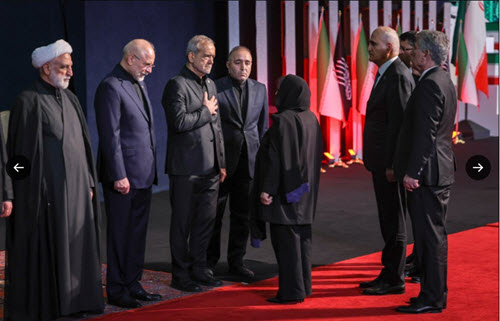
 by admin » Fri Jul 03, 2026 6:33 pm