Page 1 of 2

Whitney Webb Links to her Articles

PostPosted: Sun Aug 10, 2025 3:40 am
by admin
Whitney Webb Links to her Articles

NOTICE: THIS WORK MAY BE PROTECTED BY COPYRIGHT

YOU ARE REQUIRED TO READ THE COPYRIGHT NOTICE AT THIS LINK BEFORE YOU READ THE FOLLOWING WORK, THAT IS AVAILABLE SOLELY FOR PRIVATE STUDY, SCHOLARSHIP OR RESEARCH PURSUANT TO 17 U.S.C. SECTION 107 AND 108. IN THE EVENT THAT THE LIBRARY DETERMINES THAT UNLAWFUL COPYING OF THIS WORK HAS OCCURRED, THE LIBRARY HAS THE RIGHT TO BLOCK THE I.P. ADDRESS AT WHICH THE UNLAWFUL COPYING APPEARED TO HAVE OCCURRED. THANK YOU FOR RESPECTING THE RIGHTS OF COPYRIGHT OWNERS.


Table of Contents:

10/16/77: Tongsun Park's Club: How the Korean Built His Georgetown Base, by Phil McCombs, Washington Post
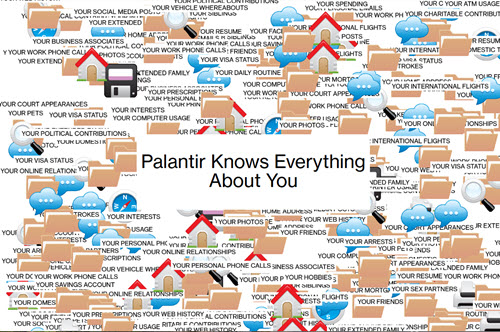
04/19/18: Palantir Knows Everything About You. Peter Thiel’s data-mining company is using War on Terror tools to track American citizens. The scary thing? Palantir is desperate for new customers, by Peter Waldman, Lizette Chapman, and Jordan Robertson, Bloomberg Businessweek
07/19/19: The Ties That Bind: Ehud Barak’s Business Network. An Israeli emergency response startup chaired by the former Israeli prime minister links U.S.-based businessman Andrew Intrater, one of the suspects of the Mueller investigation, and American multimillionaire Jeffrey Epstein, currently at the center of an underage sex trafficking scandal, by Tomer Ganon, Amir Kurz, and Ran Abramson, Calcalist
07/27/19: Building Big Brother, by Zev Shalev and Tracie McElroy, NARRATIV: Where Truth Lives
06/20/23: V.I. Releases New Exhibits Detailing JPMorgan’s Epstein Ties, by Sian Cobb
• X
• X
• X
• X
• X
• X
• X
• X
• X
• x

Re: Whitney Webb Links to her Articles

PostPosted: Sun Aug 10, 2025 3:43 am
by admin
The Ties That Bind: Ehud Barak’s Business Network. An Israeli emergency response startup chaired by the former Israeli prime minister links U.S.-based businessman Andrew Intrater, one of the suspects of the Mueller investigation, and American multimillionaire Jeffrey Epstein, currently at the center of an underage sex trafficking scandal
by Tomer Ganon, Amir Kurz, and Ran Abramson
Calcalist
July 18, 2019
https://web.archive.org/web/20190813211 ... 39,00.html

U.S.-based businessman Andrew Intrater is a business partner and backer of former Israeli Prime Minister Ehud Barak’s emergency response startup Carbyne Ltd. Intrater is also one of the key figures questioned by Special Counsel Robert Mueller and his team in connection to the alleged Russian interference in the 2016 U.S. presidential election.

Intrater, who is related to Russian businessman Viktor Vekselberg (a man who has been designated by the U.S. Department of the Treasury as suspected of supporting "malign activity” perpetrated by the Russian government), was questioned due to conspicuous money transfers to—and close ties with—Michael Cohen, Donald Trump's former lawyer and confidant, who is currently serving a sentence for fraud and violation of campaign finance laws.

Image
Ehud Barak. Photo: Moti Kimhi

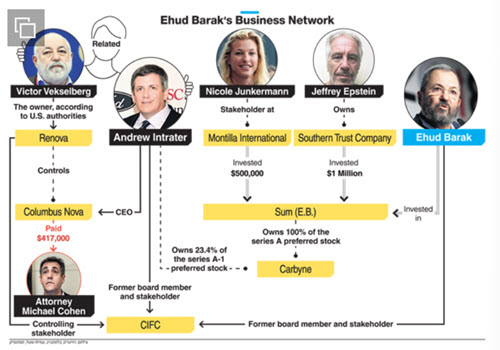
According to the allegations, Intrater has transferred $583,000 to Cohen through his investment firm Columbus Nova Technology Partners (CNTP), designated by the Mueller investigative team as an affiliate of Moscow-based asset management company Renova Group, which is owned by Vekselberg.

According to findings by Mueller’s investigative team, CNTP has made seven payments to Cohen, each of $83,000, between January and August of 2017. During that time, Cohen and Intrater had maintained close contact, exchanging 320 phone calls and 920 text messages between election day in November 2016 and July 2017.

Carbyne was incorporated in 2014 as Reporty Homeland Security Ltd., before rebranding in early 2018. Barak, who invested $1 million in the company in 2015, serves as its chairman. Carbyne develops a cloud-based platform that allows emergency dispatchers to receive GPS data, video and audio transmission, and to use texting services to supplement voice-in distress calls. The Tel Aviv-based company has raised nearly $22 million to date according to Pitchbook data, from backers including Peter Thiel’s venture capital firm Founders Fund.

Carbyne company documents reviewed by Calcalist show that Intrater entered as an investor in September 2017, having bought 24% of Carbyne’s series A-1 preferred stock.

To facilitate his own investment in Carbyne (then still named Reporty), Barak formed a limited partnership that he incorporated as Sum (E.B.) 2015. Sum owns 100% of Carbyne’s series A preferred stock. Jeffrey Epstein, the American multimillionaire businessman now at the center of an underage sex trafficking scandal, is another partner at Sum, having invested money into the venture as early as 2015, as first reported last week by Haaretz.

Image
Ehud Barak's business network

On Sunday, Israel's national broadcaster Kan reported that Epstein had invested $1 million in Sum in 2016, through a British Virgin Islands-registered company named Southern Trust. An additional investment of $500,000 was funneled into Sum in 2016, from another British Virgin Islands-registered company, Montilla International.

Among the stakeholders in Montilla is Nicole Junkermann, a London-based entrepreneur and investor. She is the owner of NJF Capital Ltd., which invests in tech and media companies. In 2017, Junkermann was appointed to Carbyne’s board of directors, where she serves alongside Barak and other members, including Carbyne co-founder and CEO Amir Elichai and Pinhas Buchris, the former director of Israel’s Unit 8200.

Barak and Intrater have known each other for at least five years. The two served on the board of New York-based asset management company CIFC LLC. According to SEC filings, Intrater joined CIFC in 2010, and Barak in 2014. Vekselberg was one of the main stakeholders in CIFC.

"Andrew Intrater is a legitimate businessman,” Barak Told Calcalist Wednesday. “I did not bring him to Carbyne, but it is possible he heard about it from me.”

CIFC was delisted in November 2016, after being acquired by F.A.B. Partners for $333 million. Both Barak and Intrater used that opportunity to sell off their stake in CIFC at a rate of $11.46 per share. Barak had 20,000 shares at the time, and Intrater 7,000.

In response to Calcalist’s request for a comment, a spokesperson from Carbyne said that the company is glad of Barak’s involvement. The company founders and employees have never been in contact with Barak’s other business partners, and met only with Barak and his lawyers in regards to his investment in the company, the spokesperson said, adding that the company operates in compliance with the law.

In response to Calcalist’s request for a comment, a spokesperson from Barak’s political party, The Israel Democratic Party, said that Barak does not intend to engage with media spins.

Andrew Intrater did not respond to Calcalist request for comment.

Meir Orbach assisted with the reporting.

Re: Whitney Webb Links to her Articles

PostPosted: Sun Aug 10, 2025 4:27 am
by admin
Palantir Knows Everything About You. Peter Thiel’s data-mining company is using War on Terror tools to track American citizens. The scary thing? Palantir is desperate for new customers.
by Peter Waldman, Lizette Chapman, and Jordan Robertson
Bloomberg Businessweek
April 19, 2018
https://web.archive.org/web/20190815053 ... ter-thiel/

Image

High above the Hudson River in downtown Jersey City, a former U.S. Secret Service agent named Peter Cavicchia III ran special ops for JPMorgan Chase & Co. His insider threat group—most large financial institutions have one—used computer algorithms to monitor the bank’s employees, ostensibly to protect against perfidious traders and other miscreants.

Aided by as many as 120 “forward-deployed engineers” from the data mining company Palantir Technologies Inc., which JPMorgan engaged in 2009, Cavicchia’s group vacuumed up emails and browser histories, GPS locations from company-issued smartphones, printer and download activity, and transcripts of digitally recorded phone conversations. Palantir’s software aggregated, searched, sorted, and analyzed these records, surfacing keywords and patterns of behavior that Cavicchia’s team had flagged for potential abuse of corporate assets. Palantir’s algorithm, for example, alerted the insider threat team when an employee started badging into work later than usual, a sign of potential disgruntlement. That would trigger further scrutiny and possibly physical surveillance after hours by bank security personnel.

Over time, however, Cavicchia himself went rogue. Former JPMorgan colleagues describe the environment as Wall Street meets Apocalypse Now, with Cavicchia as Colonel Kurtz, ensconced upriver in his office suite eight floors above the rest of the bank’s security team. People in the department were shocked that no one from the bank or Palantir set any real limits. They darkly joked that Cavicchia was listening to their calls, reading their emails, watching them come and go. Some planted fake information in their communications to see if Cavicchia would mention it at meetings, which he did.

It all ended when the bank’s senior executives learned that they, too, were being watched, and what began as a promising marriage of masters of big data and global finance descended into a spying scandal. The misadventure, which has never been reported, also marked an ominous turn for Palantir, one of the most richly valued startups in Silicon Valley. An intelligence platform designed for the global War on Terror was weaponized against ordinary Americans at home.

Founded in 2004 by Peter Thiel and some fellow PayPal alumni, Palantir cut its teeth working for the Pentagon and the CIA in Afghanistan and Iraq. The company’s engineers and products don’t do any spying themselves; they’re more like a spy’s brain, collecting and analyzing information that’s fed in from the hands, eyes, nose, and ears. The software combs through disparate data sources—financial documents, airline reservations, cellphone records, social media postings—and searches for connections that human analysts might miss. It then presents the linkages in colorful, easy-to-interpret graphics that look like spider webs. U.S. spies and special forces loved it immediately; they deployed Palantir to synthesize and sort the blizzard of battlefield intelligence. It helped planners avoid roadside bombs, track insurgents for assassination, even hunt down Osama bin Laden. The military success led to federal contracts on the civilian side. The U.S. Department of Health and Human Services uses Palantir to detect Medicare fraud. The FBI uses it in criminal probes. The Department of Homeland Security deploys it to screen air travelers and keep tabs on immigrants.

Police and sheriff’s departments in New York, New Orleans, Chicago, and Los Angeles have also used it, frequently ensnaring in the digital dragnet people who aren’t suspected of committing any crime. People and objects pop up on the Palantir screen inside boxes connected to other boxes by radiating lines labeled with the relationship: “Colleague of,” “Lives with,” “Operator of [cell number],” “Owner of [vehicle],” “Sibling of,” even “Lover of.” If the authorities have a picture, the rest is easy. Tapping databases of driver’s license and ID photos, law enforcement agencies can now identify more than half the population of U.S. adults.

JPMorgan was effectively Palantir’s R&D; lab and test bed for a foray into the financial sector, via a product called Metropolis. The two companies made an odd couple. Palantir’s software engineers showed up at the bank on skateboards. Neckties and haircuts were too much to ask, but JPMorgan drew the line at T-shirts. The programmers had to agree to wear shirts with collars, tucked in when possible.

As Metropolis was installed and refined, JPMorgan made an equity investment in Palantir and inducted the company into its Hall of Innovation, while its executives raved about Palantir in the press. The software turned “data landfills into gold mines,” Guy Chiarello, who was then JPMorgan’s chief information officer, told Bloomberg Businessweek in 2011.

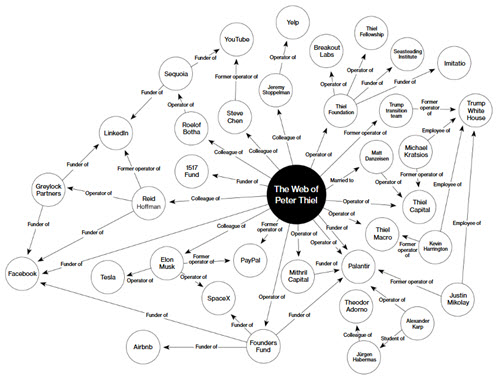
The founder of Palantir is extremely well connected. Here’s how his life might appear in the company’s model.

Image
The Web of Peter Thiel. Chart: Dorothy Gambrell

Cavicchia was in charge of forensic investigations at the bank. Through Palantir, he gained administrative access to a full range of corporate security databases that had previously required separate authorizations and a specific business justification to use. He had unprecedented access to everything, all at once, all the time, on one analytic platform. He was a one-man National Security Agency, surrounded by the Palantir engineers, each one costing the bank as much as $3,000 a day.

Senior investigators stumbled onto the full extent of the spying by accident. In May 2013 the bank’s leadership ordered an internal probe into who had leaked a document to the New York Times about a federal investigation of JPMorgan for possibly manipulating U.S. electricity markets. Evidence indicated the leaker could have been Frank Bisignano, who’d recently resigned as JPMorgan’s co-chief operating officer to become CEO of First Data Corp., the big payments processor. Cavicchia had used Metropolis to gain access to emails about the leak investigation—some written by top executives—and the bank believed he shared the contents of those emails and other communications with Bisignano after Bisignano had left the bank. (Inside JPMorgan, Bisignano was considered Cavicchia’s patron—a senior executive who protected and promoted him.)

JPMorgan officials debated whether to file a suspicious activity report with federal regulators about the internal security breach, as required by law whenever banks suspect regulatory violations. They decided not to—a controversial decision internally, according to multiple sources with the bank. Cavicchia negotiated a severance agreement and was forced to resign. He joined Bisignano at First Data, where he’s now a senior vice president. Chiarello also went to First Data, as president. After their departures, JPMorgan drastically curtailed its Palantir use, in part because “it never lived up to its promised potential,” says one JPMorgan executive who insisted on anonymity to discuss the decision.

The bank, First Data, and Bisignano, Chiarello, and Cavicchia didn’t respond to separately emailed questions for this article. Palantir, in a statement responding to questions about how JPMorgan and others have used its software, declined to answer specific questions. “We are aware that powerful technology can be abused and we spend a lot of time and energy making sure our products are used for the forces of good,” the statement said.

Much depends on how the company chooses to define good. In March a former computer engineer for Cambridge Analytica, the political consulting firm that worked for Donald Trump’s 2016 presidential campaign, testified in the British Parliament that a Palantir employee had helped Cambridge Analytica use the personal data of up to 87 million Facebook users to develop psychographic profiles of individual voters. Palantir said it has a strict policy against working on political issues, including campaigns, and showed Bloomberg emails in which it turned down Cambridge’s request to work with Palantir on multiple occasions. The employee, Palantir said, worked with Cambridge Analytica on his own time. Still, there was no mistaking the implications of the incident: All human relations are a matter of record, ready to be revealed by a clever algorithm. Everyone is a spidergram now.

Image
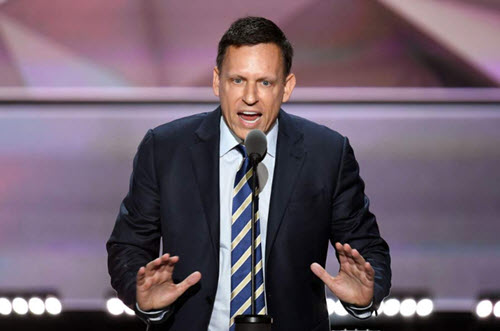
Thiel addresses the 2016 Republican National Convention. Jim Watson/AFP/Getty Images

Thiel, who turned 50 in October, long reveled as the libertarian black sheep in left-leaning Silicon Valley. He contributed $1.25 million to Trump’s presidential victory, spoke at the Republican convention, and has dined with Trump at the White House. But Thiel has told friends he’s had enough of the Bay Area’s “monocultural” liberalism. He’s ditching his longtime base in San Francisco and moving his personal investment firms this year to Los Angeles, where he plans to establish his next project, a conservative media empire.

As Thiel’s wealth has grown, he’s gotten more strident. In a 2009 essay for the Cato Institute, he railed against taxes, ­government, women, poor people, and society’s acquiescence to the inevitability of death. (Thiel doesn’t accept death as inexorable.) He wrote that he’d reached some radical conclusions: “Most importantly, I no longer believe that freedom and democracy are compatible.” The 1920s was the last time one could feel “genuinely optimistic” about American democracy, he said; since then, “the vast increase in welfare beneficiaries and the extension of the franchise to women—two constituencies that are notoriously tough for libertarians—have rendered the notion of ‘capitalist democracy’ into an oxymoron.”

Thiel went into tech after missing a prized Supreme Court clerkship following his graduation from Stanford Law School. He co-founded PayPal and then parlayed his winnings from its 2002 sale to EBay Inc. into a career in venture investing. He made an early bet on Facebook Inc. (where he’s still on the board), which accounts for most of his $3.3 billion fortune, as estimated by Bloomberg, and launched his career as a backer of big ideas—things like private space travel (through an investment in SpaceX), hotel alternatives (Airbnb), and floating island nations (the Seasteading Institute).

He started Palantir—named after the omniscient crystal balls in J.R.R. Tolkien’s Lord of the Rings trilogy—three years after the attacks of Sept. 11, 2001. The CIA’s investment arm, In-Q-Tel, was a seed investor. For the role of chief executive officer, he chose an old law school friend and self-described neo-Marxist, Alex Karp. Thiel told Bloomberg in 2011 that civil libertarians ought to embrace Palantir, because data mining is less repressive than the “crazy abuses and draconian policies” proposed after Sept. 11. The best way to prevent another catastrophic attack without becoming a police state, he argued, was to give the government the best surveillance tools possible, while building in safeguards against their abuse.

Legend has it that Stephen Cohen, one of Thiel’s co-founders, programmed the initial prototype for Palantir’s software in two weeks. It took years, however, to coax customers away from the longtime leader in the intelligence analytics market, a software company called I2 Inc.

In one adventure missing from the glowing accounts of Palantir’s early rise, I2 accused Palantir of misappropriating its intellectual property through a Florida shell company registered to the family of a Palantir executive. A company claiming to be a private eye firm had been licensing I2 software and development tools and spiriting them to Palantir for more than four years. I2 said the cutout was registered to the family of Shyam Sankar, Palantir’s director of business development.

https://rapeutation.com/trumpepsteinen9s.jpg
As shown in the privacy breaches at Facebook and Cambridge Analytica, the pressure to monetize data at tech companies is ceaseless


I2 sued Palantir in federal court, alleging fraud, conspiracy, and copyright infringement. In its legal response, Palantir argued it had the right to appropriate I2’s code for the greater good. “What’s at stake here is the ability of critical national security, defense and intelligence agencies to access their own data and use it interoperably in whichever platform they choose in order to most effectively protect the citizenry,” Palantir said in its motion to dismiss I2’s suit.

The motion was denied. Palantir agreed to pay I2 about $10 million to settle the suit. I2 was sold to IBM in 2011.

Sankar, Palantir employee No. 13 and now one of the company’s top executives, also showed up in another Palantir scandal: the company’s 2010 proposal for the U.S. Chamber of Commerce to run a secret sabotage campaign against the group’s liberal opponents. Hacked emails released by the group Anonymous indicated that Palantir and two other defense contractors pitched outside lawyers for the organization on a plan to snoop on the families of progressive activists, create fake identities to infiltrate left-leaning groups, scrape social media with bots, and plant false information with liberal groups to subsequently discredit them.

After the emails emerged in the press, Palantir offered an explanation similar to the one it provided in March for its U.K.-based employee’s assistance to Cambridge Analytica: It was the work of a single rogue employee. The company never explained Sankar’s involvement. Karp issued a public apology and said he and Palantir were deeply committed to progressive causes. Palantir set up an advisory panel on privacy and civil liberties, headed by a former CIA attorney, and beefed up an engineering group it calls the Privacy and Civil Liberties Team. The company now has about 10 PCL engineers on call to help vet clients’ requests for access to data troves and pitch in with pertinent thoughts about law, morality, and machines.

During its 14 years in startup mode, Palantir has cultivated a mystique as a haven for brilliant engineers who want to solve big problems such as terrorism and human trafficking, unfettered by pedestrian concerns such as making money. Palantir executives boast of not employing a single sales­person, relying instead on word-of-mouth referrals.

The company’s early data mining dazzled venture investors, who valued it at $20 billion in 2015. But Palantir has never reported a profit. It operates less like a conventional software company than like a consultancy, deploying roughly half its 2,000 engineers to client sites. That works at well-funded government spy agencies seeking specialized applications but has produced mixed results with corporate clients. Palantir’s high installation and maintenance costs repelled customers such as Hershey Co., which trumpeted a Palantir partnership in 2015 only to walk away two years later. Coca-Cola, Nasdaq, American Express, and Home Depot have also dumped Palantir.

Karp recognized the high-touch model was problematic early in the company’s push into the corporate market, but solutions have been elusive. “We didn’t want to be a services company. We wanted to do something that was cost-efficient,” he confessed at a European conference in 2010, in one of several unguarded comments captured in videos posted online. “Of course, what we didn’t recognize was that this would be much, much harder than we realized.”

Palantir’s newest product, Foundry, aims to finally break through the profitability barrier with more automation and less need for on-site engineers. Airbus SE, the big European plane maker, uses Foundry to crunch airline data about specific onboard components to track usage and maintenance and anticipate repair problems. Merck KGaA, the pharmaceutical giant, has a long-term Palantir contract to use Foundry in drug development and supply chain management.

Deeper adoption of Foundry in the commercial market is crucial to Palantir’s hopes of a big payday. Some investors are weary and have already written down their Palantir stakes. Morgan Stanley now values the company at $6 billion. Fred Alger Management Inc., which has owned stock since at least 2006, revalued Palantir in December at about $10 billion, according to Bloomberg Holdings. One frustrated investor, Marc Abramowitz, recently won a court order for Palantir to show him its books, as part of a lawsuit he filed alleging the company sabotaged his attempt to find a buyer for the Palantir shares he has owned for more than a decade.

As shown in the privacy breaches at Facebook and Cambridge Analytica—with Thiel and Palantir linked to both sides of the equation—the pressure to monetize data at tech companies is ceaseless. Facebook didn’t grow from a website connecting college kids into a purveyor of user profiles and predilections worth $478 billion by walling off personal data. Palantir says its Privacy and Civil Liberties Team watches out for inappropriate data demands, but it consists of just 10 people in a company of 2,000 engineers. No one said no to JPMorgan, or to whomever at Palantir volunteered to help Cambridge Analytica—or to another organization keenly interested in state-of-the-art data science, the Los Angeles Police Department.

[x]
Screenshots of Palantir’s Gotham program, from a promotional video. Source: Youtube

Palantir began work with the LAPD in 2009. The impetus was federal funding. After several Sept. 11 postmortems called for more intelligence sharing at all levels of law enforcement, money started flowing to Palantir to help build data integration systems for so-called fusion centers, starting in L.A. There are now more than 1,300 trained Palantir users at more than a half-dozen law enforcement agencies in Southern California, including local police and sheriff’s departments and the Bureau of Alcohol, Tobacco, Firearms and Explosives.

The LAPD uses Palantir’s Gotham product for Operation Laser, a program to identify and deter people likely to commit crimes. Information from rap sheets, parole reports, police interviews, and other sources is fed into the system to generate a list of people the department defines as chronic offenders, says Craig Uchida, whose consulting firm, Justice & Security Strategies Inc., designed the Laser system. The list is distributed to patrolmen, with orders to monitor and stop the pre-crime suspects as often as possible, using excuses such as jaywalking or fix-it tickets. At each contact, officers fill out a field interview card with names, addresses, vehicles, physical descriptions, any neighborhood intelligence the person offers, and the officer’s own observations on the subject.

The cards are digitized in the Palantir system, adding to a constantly expanding surveillance database that’s fully accessible without a warrant. Tomorrow’s data points are automatically linked to today’s, with the goal of generating investigative leads. Say a chronic offender is tagged as a passenger in a car that’s pulled over for a broken taillight. Two years later, that same car is spotted by an automatic license plate reader near a crime scene 200 miles across the state. As soon as the plate hits the system, Palantir alerts the officer who made the original stop that a car once linked to the chronic offender was spotted near a crime scene.

The platform is supplemented with what sociologist Sarah Brayne calls the secondary surveillance network: the web of who is related to, friends with, or sleeping with whom. One woman in the system, for example, who wasn’t suspected of committing any crime, was identified as having multiple boyfriends within the same network of associates, says Brayne, who spent two and a half years embedded with the LAPD while researching her dissertation on big-data policing at Princeton University and who’s now an associate professor at the University of Texas at Austin. “Anybody who logs into the system can see all these intimate ties,” she says. To widen the scope of possible connections, she adds, the LAPD has also explored purchasing private data, including social media, foreclosure, and toll road information, camera feeds from hospitals, parking lots, and universities, and delivery information from Papa John’s International Inc. and Pizza Hut LLC.

Image
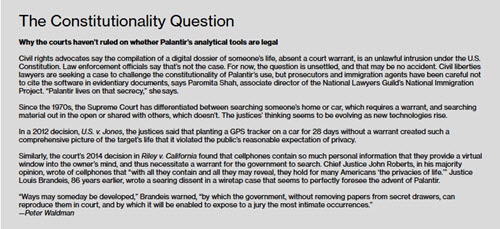
The Constitutionality Question

Why the courts haven’t ruled on whether Palantir’s analytical tools are legal


Civil rights advocates say the compilation of a digital dossier of someone’s life, absent a court warrant, is an unlawful intrusion under the U.S. Constitution. Law enforcement officials say that’s not the case. For now, the question is unsettled, and that may be no accident. Civil liberties lawyers are seeking a case to challenge the constitutionality of Palantir’s use, but prosecutors and immigration agents have been careful not to cite the software in evidentiary documents, says Paromita Shah, associate director of the National Lawyers Guild’s National Immigration Project. “Palantir lives on that secrecy,” she says.

Since the 1970s, the Supreme Court has differentiated between searching someone’s home or car, which requires a warrant, and searching material out in the open or shared with others, which doesn’t. The justices’ thinking seems to be evolving as new technologies rise.

In a 2012 decision, U.S. v. Jones, the justices said that planting a GPS tracker on a car for 28 days without a warrant created such a comprehensive picture of the target’s life that it violated the public’s reasonable expectation of privacy.

Similarly, the court’s 2014 decision in Riley v. California found that cellphones contain so much personal information that they provide a virtual window into the owner’s mind, and thus necessitate a warrant for the government to search. Chief Justice John Roberts, in his majority opinion, wrote of cellphones that “with all they contain and all they may reveal, they hold for many Americans ‘the privacies of life.’” Justice Louis Brandeis, 86 years earlier, wrote a searing dissent in a wiretap case that seems to perfectly foresee the advent of Palantir.

“Ways may someday be developed,” Brandeis warned, “by which the government, without removing papers from secret drawers, can reproduce them in court, and by which it will be enabled to expose to a jury the most intimate occurrences.”

—Peter Waldman


The LAPD declined to comment for this story. Palantir sent Bloomberg a statement about its work with law enforcement: “Our [forward-deployed engineers] and [privacy and civil liberties] engineers work with the law enforcement customers (including LAPD) to ensure that the implementation of our software and integration of their source systems with the software is consistent with the Department’s legal and policy obligations, as well as privacy and civil liberties considerations that may not currently be legislated but are on the horizon. We as a company determine the types of engagements and general applications of our software with respect to those overarching considerations. Police Agencies have internal responsibility for ensuring that their information systems are used in a manner consistent with their policies and procedures.”

Operation Laser has made L.A. cops more surgical—and, according to community activists, unrelenting. Once targets are enmeshed in a spidergram, they’re stuck.

Manuel Rios, 22, lives in the back of his grandmother’s house at the top of a hill in East L.A., in the heart of the city’s gang area. Tall with a fair complexion and light hair, he struggled in high school with depression and a learning disability and dropped out to work at a supermarket.

He grew up surrounded by friends who joined Eastside 18, the local affiliate of the 18th Street gang, one of the largest criminal syndicates in Southern California. Rios says he was never “jumped in”—initiated into 18. He spent years addicted to crystal meth and was once arrested for possession of a handgun and sentenced to probation. But except for a stint in county jail for a burglary arrest inside a city rec center, he’s avoided further trouble and says he kicked his meth habit last year.

In 2016, Rios was sitting in a parked car with an Eastside 18 friend when a police car pulled up. His buddy ran, pursued by the cops, but Rios stayed put. “Why should I run? I’m not a gang member,” he says over steak and eggs at the IHOP near his home. The police returned and handcuffed him. One of them took his picture with a cellphone. “Welcome to the gang database!” the officer said.

Since then he’s been stopped more than a dozen times, he says, and told that if he doesn’t like it he should move. He has nowhere to go. His girlfriend just had a baby girl, and he wants to be around for them. “They say you’re in the system, you can’t lie to us,” he says. “I tell them, ‘How can I be in the hood if I haven’t got jumped in? Can’t you guys tell people who bang and who don’t?’ They go by their facts, not the real facts.”

The police, on autopilot with Palantir, are driving Rios toward his gang friends, not away from them, worries Mariella Saba, a neighbor and community organizer who helped him get off meth. When whole communities like East L.A. are algorithmically scraped for pre-crime suspects, data is destiny, says Saba. “These are systemic processes. When people are constantly harassed in a gang context, it pushes them to join. They internalize being told they’re bad.”

In Chicago, at least two immigrants have been detained for deportation by Immigration and Customs Enforcement officers based on erroneous information in gang databases, according to a pair of federal lawsuits. Chicago is a sanctuary city, so it isn’t clear how ICE found out about the purported gang affiliations. But Palantir is a likely link. The company provided an “intelligence management solution” for the Cook County Sheriff’s Office to integrate information from at least 14 different databases, including gang lists compiled by state and local police departments, according to county records. Palantir also has a $41 million data mining contract with ICE to build the agency’s “investigative case management” system.

One of the detained men, Wilmer Catalan-Ramirez, a 31-year-old body shop mechanic, was seriously injured when six ICE agents burst into his family’s home last March without a warrant. He’d been listed in the local gang database twice—in rival gangs. Catalan-Ramirez spent the next nine months in federal detention, until the city of Chicago admitted both listings were wrong and agreed to petition the feds to let him stay in the U.S. ICE released him in January, pending a new visa application. “These cases are perfect examples of how databases filled with unverified information that is often false can destroy people’s lives,” says his attorney, Vanessa del Valle of Northwestern University’s MacArthur Justice Center.

Image
When whole communities are algorithmically scraped for pre-crime suspects, data is destiny


Palantir is twice the age most startups are when they cash out in a sale or initial public offering. The company needs to figure out how to be rewarded on Wall Street without creeping out Main Street. It might not be possible. For all of Palantir’s professed concern for individuals’ privacy, the single most important safeguard against abuse is the one it’s trying desperately to reduce through automation: human judgment.

As Palantir tries to court corporate customers as a more conventional software company, fewer forward-deployed engineers will mean fewer human decisions. Sensitive questions, such as how deeply to pry into people’s lives, will be answered increasingly by artificial intelligence and machine-learning algorithms. The small team of Privacy and Civil Liberties engineers could find themselves even less influential, as the urge for omnipotence among clients overwhelms any self-imposed restraints.

Computers don’t ask moral questions; people do, says John Grant, one of Palantir’s top PCL engineers and a forceful advocate for mandatory ethics education for engineers. “At a company like ours with millions of lines of code, every tiny decision could have huge implications,” Grant told a privacy conference in Berkeley last year.

JPMorgan’s experience remains instructive. “The world changed when it became clear everyone could be targeted using Palantir,” says a former JPMorgan cyber expert who worked with Cavicchia at one point on the insider threat team. “Nefarious ideas became trivial to implement; everyone’s a suspect, so we monitored everything. It was a pretty terrible feeling.” —With Michael Riley

Re: Whitney Webb Links to her Articles

PostPosted: Sun Aug 10, 2025 4:50 am
by admin
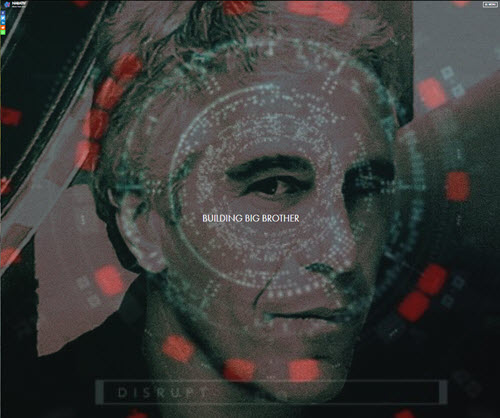
Building Big Brother
by Zev Shalev and Tracie McElroy
NARRATIV: Where Truth Lives
Posted on July 27, 2019
https://web.archive.org/web/20190814023 ... g-brother/

Image
Exclusive: Jeffrey Epstein’s investment in an Israeli start-up reveals a myriad of links to Donald Trump and Israeli spies.

What we found:

It’s been thirty-two years since the “Pollard Affair” pierced the seemingly impenetrable facade of U.S.-Israeli relations. Now, two suspected Israeli agents are in jail – indicted on separate charges of sex trafficking of minors.

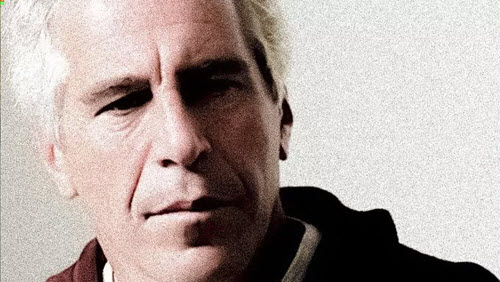
Billionaire Jeffrey Epstein was arrested on July 6 and charged with trafficking minors across state lines. George Nader – a key witness for Robert Mueller – was arrested last month for possession of child porn and transporting a minor for sex from Europe.

Epstein and Nader share a personal network that includes Donald Trump, Benjamin Netanyahu, Erik Prince, Saudi Crown Prince Mohammed Bin Salman and his UAE counterpart, Mohamed Bin Zayed.

But their association goes further than powerful friends and proclivities for teenage boys and girls. Epstein and Nader are believed to be agents for Israeli Intelligence. Narativ has independently confirmed Epstein was indeed working for the Israelis.

Both men also have ties to a burgeoning Israeli tech sector which is bringing Mossad-style military intelligence to the private sector and endangering the global balance of power.

The Haaretz newspaper has previously reported that Epstein, who was Donald Trump’s friend through the ’80s and ’90s, partnered in an Israeli start-up alongside former Israel Prime Minister Ehud Barak.

Barak is seeking to unseat Benjamin Netanyahu as Israeli Prime Minister in the upcoming re-run elections scheduled for September. Since 2015, he has been the front-man for Carbyne, an Israeli start-up which purports to be a high-tech solution for 911 emergency call centers, but the platform’s architecture and investors raise serious privacy concerns.

Narativ undertook an extensive investigation into Carbyne, and can now reveal a myriad of troubling connections between the start-up and people connected to Donald Trump.

Image
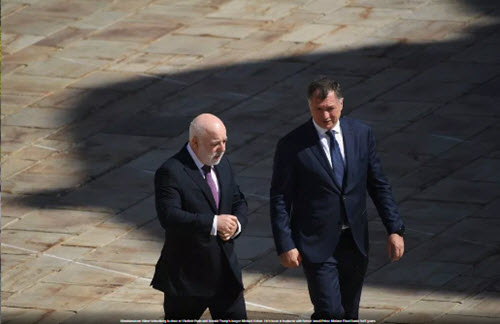
Ukrainian-born Viktor Vekselberg is close to Vladimir Putin and Donald Trump’s lawyer Michael Cohen. He’s been in business with former Israeli Prime Minister Ehud Barak for 5 years.

Image
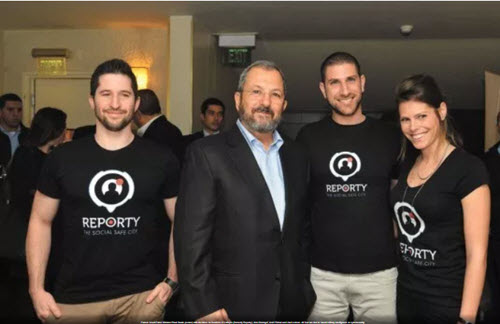
Former Israeli Prime Minister Ehud Barak (center) with the three co-founders of Carbyne (formerly Reporty). Alex Dizengof, Amir Elichai and Lital Leshem. All four are tied to Israeli military intelligence or cybersecurity.

The Michael Cohen Connection

In addition to Epstein and Barak, Russian oligarchs Viktor Vekselberg and Andrew Intrater bought 24% of Carbyne’s Class A-1 shares through Intrater’s Columbus Nova Technology Partners (CNTP) in September 2017. Vekselberg and Intrater are under U.S. sanctions because of Russia’s malign activities. Ukrainian-born Vekselberg is close to Vladimir Putin and was interviewed by prosecutors from Robert Mueller’s office.

While still employed as Donald Trump’s lawyer, Michael Cohen consulted for Columbus Nova until August 2017 under a $1 million agreement to his company, “Essential Consulting.” Cohen used the same company to pay off adult film star Stormy Daniels, who had an affair with Trump.

Between election day and July 14, 2017, Intrater and Cohen exchanged 230 phone calls and 950 text messages.

Carbyne is a plug-in for 911 call centers and an app for consumers. It provides unprecedented access to a caller’s camera and GPS, providing the dispatcher with a live video feed.

The system also automatically cross-references your identity with criminal or other records added to the database. At least two U.S. counties have implemented Carbyne, with many others considering it.

Epstein is a sex offender and known pedophile. He was brought in as an investor by Barak, his close friend of 17 years. Epstein invested $1.5 million in a company (SUM) with Barak in 2014. All of that money went into Carbyne in 2015. Barak has since been a front-man for the company appearing on Fox News to pitch the product. Barak has life-long ties to Israel’s spy services.

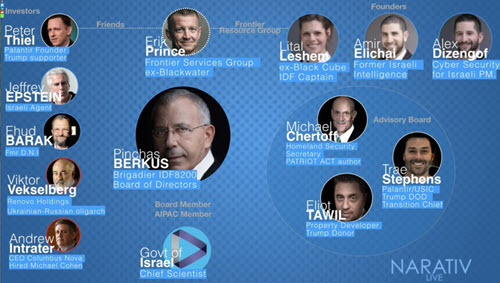
CEO Amir Elichai served in Israel’s elite military intelligence group. Pinchas Berkus, a former Brigadier of the elite 8200 unit, is a company director. Lital Leshem, a co-founder, still serves as a reservist in the Israeli Defence Force. Alex Dizengof, the CTO, worked in cybersecurity for Israel’s Prime Minister’s office.

Image

The American Connection

Carbyne also has deep roots in the Military-Industrial complex of the U.S.

Michael Chertoff, who ran Homeland Security under George Bush, serves on Carbyne’s advisory board. Chertoff wrote the Patriot Act, which authorized digital surveillance of Americans.

Peter Thiel, who founded Facebook and Palantir, is also a Carbyne investor. Thiel is an outspoken supporter of Trump and invests heavily in companies with military and intelligence applications. According to Bloomberg, Thiel’s Palantir uses “war on terror tools to track American citizens.”

Trae Stephens, another Palantir alum, serves on Carbyne’s advisory board. Stephens was also chair of Trump’s Department of Defense transition team. Eliot Tawil, a real-estate developer and a major Trump donor also advises the company despite having no background this space.

None of the members of the board of directors or the advisory board appear to have any experience in emergency response. Almost all have ties to Israel and the U.S. military-industrial complex.

China's Mass Surveillance Phone App
Human Rights Watch
May 1, 2019

Chinese authorities are using a mobile app to carry out illegal mass surveillance and arbitrary detention of Muslims in China’s western Xinjiang region.

Between January 2018 and February 2019, Human Rights Watch was able to reverse engineer the mobile app that officials use to connect to the Integrated Joint Operations Platform (IJOP), the Xinjiang policing program that aggregates data about people and flags those deemed potentially threatening. By examining the design of the app, which at the time was publicly available, Human Rights Watch found that Xinjiang authorities are collecting a wide array of information from ordinary people.


Chinese authorities are using a 911 mobile app to carry out illegal mass surveillance and arbitrary detention of Muslims in China’s western Xinjiang region.


The China Connection

Carbyne has ties to China through Co-founder Lital Leshem. Leshem, who remains a shareholder at Carbyne, now works alongside Erik Prince at Frontier Resources Group (FRG). FRG is based in the UAE and is a subsidiary of Prince’s Frontier Services Group (FSG).

Prince sold a majority stake in FSG to the Chinese in 2013. His boss is now Chang Xhenming, who is very close to President Xi Jinping. Chang is also chair of China’s massive Citic Group.

Prince is a former U.S. Navy Seal and a founder of Blackwater, a mercenary contractor. FSG is one of the companies helping to build “re-training” camps for ethnic Uyghurs and other Muslim communities in China’s Xinjiang province. China detains 1 million people in those camps and keeps 13 million people under surveillance.

In May, Human Rights Watch revealed Chinese authorities use a platform not unlike Carbyne to illegally surveil Uyghurs. China’s Integrated Joint Operations Platform brings in a much bigger data-set and sources of video, which includes an app on people’s phones. Like Carbyne, the platform was designed to report emergencies. Chinese authorities have turned it into a tool of mass surveillance.

Human Rights Watch reverse-engineered the app. The group discovered the app automatically profiles a user under 36 “person types” including “followers of Six Lines” which is the term used to identify Uyghurs. Another term refers to “Hajj,” the annual Islamic pilgrimage to Mecca.


The app monitors every aspect of a user’s life, including personal conversations, power usage, and tracks a user’s movement. “Did the family say something religious? Did they exit through the front door or the back door? (Going through the back door is presumably more suspicious),” Human Rights Watch says.

Image
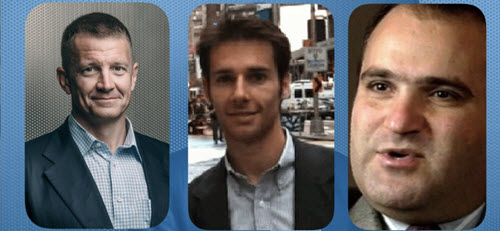
A rare photo of Joel Zamel obtained by Narativ (center), Erik Prince of Frontier Resource Group (left) and George Nader (right). All three men attended a meeting with Donald Trump, Jr. on August 3 2016 to discuss a social media manipulation plan by Zamel’s Psy Group.

Nader, Israeli Intelligence and Trump

U.S. authorities are currently holding George Nader on child porn and trafficking charges. Nader is a representative for the Saudi Crown Prince Mohamed bin Salman and his UAE counterpart Mohamed bin Zayed.

Nader is also speculated to have ties with Israeli Intelligence. His relationship with Benjamin Netanyahu dates back to the Israeli Prime Minister’s first days in office. Nader’s work for U.S. allies could explain why he’s been able to travel freely in and out of the U.S. despite a previous child pornography arrest.

In August 2016, Nader and Erik Prince attended a meeting at Donald Trump Jr.’s office in Trump Tower in August 2016. Nader brought with him Joel Zamel, who served in Israeli Military Intelligence and is the young CEO of another Israeli start-up, Psy Group.

Zamel proposed an extensive social amplification campaign to support Trump’s 2016 campaign, and Nader is reported to have pledged the Saudis and the UAE would foot the bill. Nader would later give Zamel $2m for those services, although Zamel disputes that claim.

Former Special Counsel Robert Mueller investigated Zamel’s Psy Group for its involvement with the Trump campaign, which lasted a full year from early 2016 to January 2017.

In January 2017, Nader and Prince also took part in a meeting in Seychelles. The backchannel get-together discussed bringing Russia closer to the incoming Trump administration as part of an anti-Iran alliance with Israel, KSA and UAE. Erik Prince represented the Trump administration. Kiril Dmitriev, the CEO of the Russian Direct Investment Fund, represented Putin.

Image

Evading Justice

“I was told Epstein belonged to intelligence’ and to leave it alone,” Alex Acosta, former Secretary of Labor Alex Acosta to Trump Administration.

George Nader’s and Jeffrey Epstein’s arrests, after decades of authorities turning a blind eye to the exploitation of teenagers, suggests a shift in U.S. policy towards Israeli Intelligence. Nader and Epstein were considered untouchable until recently, possibly because of their Israeli Intelligence ties and various cooperation agreements.

There has been extensive reporting on Epstein’s charges and sentencing around the underage girls. But Epstein also entered into a cooperation agreement for his financial crimes. Of note, Epstein cooperated with prosecutors to avoid charges for his involvement in a $450 million Ponzi scheme, which he blamed entirely on co-conspirator Steven Hoffenberg amid allegations of bribery.

All told, Epstein spent only 13 months in jail for what appears to be a 38-year crime-spree. How did Epstein evade justice? The answer may lie in a gentlemen’s agreement that governs the Israel-US intelligence relationship. Basically, spies can operate with impunity, even when committing criminal acts.

Mossad For Hire

Israeli spies are renowned the world for their ability to run complex stealth operations which go undetected. As one former KGB spy told me: “A good secret service never leaves any tracks.” Now, that very skillset has entered the private sector, merged with big data operations, and is being commercialized.

Since 2009, Israel’s spy-tech sector has been booming, supported by the easy flow of capital ferried into Israel by Russian oligarchs. This includes start-ups like NSO, which makes the Pegasus spyware capable of hacking any phone; Black Cube a high tech private fixer; and Zamel’s Psy Group, a social media manipulation company.

These start-ups have influenced elections and politics around the world, including the 2016 U.S. election. Cambridge Analytica used Black Cube to set up honey traps. Harvey Weinstein hired Black Cube to discredit many of his accusers, and the company also tried to frame former Obama Administration figures.

Saudi Arabia uses NSO’s Pegasus hacking software to track dissidents. There is some reporting that Pegasus was used in the assassination of Washington Post columnist Jamal Khashoggi.

Israel has been exporting these services to despots and authoritarians around the globe. The high tech spy companies packed their advisory boards with former generals, heads of Mossad and politicians, creating a thin veneer of respectability.

Beneath the surface, questionable ethics, surveillance concerns, and dubious sources of funding have turned Israel’s spy-tech sector into a real threat to global security and balance of power.

According to Newsweek, the U.S. has identified Israeli espionage as a significant and growing threat in the U.S. going back to 2013. One former congressional staffer familiar with the classified material told Newsweek the situation was “terrifying”.

Israel’s spy-tech sector is funded by sanctioned Russian oligarchs and involved with dangerous criminals like Jeffrey Epstein and George Nader. Their services enable authoritarians and represent a serious risk to U.S.-Israeli relations. The sector requires serious investigation. Our very freedoms may depend on it.

Re: Whitney Webb Links to her Articles

PostPosted: Sun Aug 10, 2025 4:59 am
by admin
Tongsun Park's Club: How the Korean Built His Georgetown Base
by Phil McCombs
Washington Post
October 16, 1977
https://www.washingtonpost.com/archive/ ... edirect=on

NOTICE: THIS WORK MAY BE PROTECTED BY COPYRIGHT

YOU ARE REQUIRED TO READ THE COPYRIGHT NOTICE AT THIS LINK BEFORE YOU READ THE FOLLOWING WORK, THAT IS AVAILABLE SOLELY FOR PRIVATE STUDY, SCHOLARSHIP OR RESEARCH PURSUANT TO 17 U.S.C. SECTION 107 AND 108. IN THE EVENT THAT THE LIBRARY DETERMINES THAT UNLAWFUL COPYING OF THIS WORK HAS OCCURRED, THE LIBRARY HAS THE RIGHT TO BLOCK THE I.P. ADDRESS AT WHICH THE UNLAWFUL COPYING APPEARED TO HAVE OCCURRED. THANK YOU FOR RESPECTING THE RIGHTS OF COPYRIGHT OWNERS.


FRANCIS COLT DE WOLF JR., Washington insurance man, gazed into the distance and recalled the days, more than a decade ago, when Tongsun Park wanted to start a new Washington social club.

"Well, he just started moving around socially in town," recalled de Wolf. "People used to ask me what the heck this kid is doing. He was a rich kid, you know. I just said, "Well, I don't know. Some rich kids like to buy yachts, some like to start clubs . . . In retrospect, I think he had something in mind."

Indeed. According to a federal indictment, Park "set up and operated" Washington's exclusive George Town Club with the aid of Korean Central Intelligence Agency officials as a primary means in an illegal effort to influence U.S. politicians and officials.

With money, boldness and charm for credentials it appears that Park was able to harness for his own use, in part by means of this club, the enormous social energies of a world capital where the cocktail and dinner party is stock-in-trade.

How did he do it?

Interviews with eight of the club's 14 founders, 12 of its 15 present board members and others tell this story.

More than a decade ago, Park contacted a few friends and acquaintances and began putting together a founding group that was in tone predominantly Republican, conservative and social old-guard. At least one founder, the late Marine Gen. Graves B. Erskine, had been closely linked with high-level national intelligence activities.

These founders, in snowball fashion, then contacted their friends to be founding members. The club now has about 330 members and its leadership emphasizes that this group is separate from Park, who, they say, merely owns the club premises and runs and rents it for the members under contract.

According to records and interviews, Park acquired the club premises at 1530 Wisconsin Ave. NW under a lease in 1961, purchasing the property in 1965. The club opened in the spring of 1966.

It appears that what Park did was take advantage of the normal social and professional instincts of at least some of the persons named in this article, who, with one exception, are free of any charges in the case.

Park acquired the lease on the club premises after returning from Korea to resume his studies at Georgetown University. After entering Georgetown as a freshman in 1956, Park had been suspended for "academic deficiencies" and had gone to Seoul in 1960 where, according to a knowledgeable American source, he apparently had made some powerful friends among the men closest to the new South Korean president, Park Chung Hee.

After several years of developing the club premises and preparing to open it - years when Tongsun Park was also engaged in complex worldwide business dealings often allegedly linked to the Korean Central Intelligence Agency - he set out in search of a founding group. His hope was apparently that the club would fly on its own, with no overt link to Korea other than himself.

COLT DE WOLF remembers meeting Park for the first time in 1959 through a relative of his wife's who had roomed with Park at Georgetown University.

"I was a founder of The George Town Club but I didn't know I was a founder," said de Wolf. "Park approached me when he was getting ready to open the club . . . In the back of my mind I said, "I need another club like a hole in the head. I was a member of three clubs already. Basically his approach was, 'Can you help me, help me find prospective members?' I was born and raised in this town, I know this town.

"His secretary would come down and we'd look at lists, the social register and so on, and work up prospective members. Mailings went out. He always did things well: a whole bunch of engraved invitations. Before I knew it, people I met on the street said, 'I see you're a founding member of a new club,' I said, 'I didn't know that.' Then I got the bill."

De Wolf said he never paid and that he was, legally, "never a member." Gradually, de Wolf and his wife cooled in their friendship with Park and stopped inviting him to parties - a move that was reciprocated, de Wolf said.

Another club founder and source of members, according to interviews, was Anna Chennault, the Chinese-born widow of Maj. Gen. Claire Chennault of World War II's Flying Tigers.

A Washington hostess and proponent of U.S. support for the non-Communist Republic of China on Taiwan, Anna Chennault has been characterized in press reports as having introduced Park to many powerful persons in Washington and showing him how to make his views felt.

Chennault was a club founder, according to the list of founders provided by the club manager Norman Larsen, who took that job in the early days of the club, working directly for Park. Larsen, formerly with H.L. Hunt's rightwing educational "Life Line Foundation," said he still reports directly to Park.

Chennault did not return repeated phone calls. Three other club founders who could not be reach for interviews were:

Thomas G. Corcoran, known as "Tommy the Cork," the former FDR braintruster who is now a widely influential Washington attorney. Corcoran, who did not return phone calls from The Washington Post, was quoted in other press reports as saying that Park called him "Papa Tom," although Corcoran was not associated with Park in business or lobbying. Nevertheless, Corcoran has been characterized in press accounts as having taught Park a good deal about how to operate in Washington. Corcoran has also been an escort of Anna Chennault at social functions.

Air Force Gen. Fred M. Dean, now officially listed as retired. Dean commanded the U.S. Air Task Force on Taiwan from 1957 to 1960, then went on to key staff and command positions in Washington and Europe.

Marine General Erskine, deceased, who commanded the Third Marine Division at Iwo Jimma. From 1953 to 1961 Erskine was assistant for special operations to the Secretary of Defense. "His responsibilities," according to a press release of the period. . . . included the areas of intelligence, counter-intelligence, communications security, CIA relationships and special operations, and psychological warfare operations."

De Wolf recalled that club board meetings were at first held in the office of another founder, Robert K. Gray, who is now president of The George Town Club.

GRAY HEADS the Washington office of the large public relations firm, Hill & Knowlton. A man of influence who likes to keep a low profile, Gray was President Eisenhower's cabinet secretary and has been a noted Republican fund-raiser.

Gray said Park called in 1965 on public relations business and, in the course of their meetings, Park asked how to start a social club - a subject naturally interesting to Gray, who attends several parties a week as a matter of professional duty. (Gray said he and Park never did do business but had a purely social relationship.)

Gray said he suggested that Park pick several people and have them call their friends, and so on. In their discussions, Gray said, the idea developed of having a "cross-section of people" in a club with a "congressional overtone."

Gray said Park suggested Anna Chennault as a founder. He said he himself suggested Geroge Murphy, Clark W. Thompson and Mrs. Robert McCormick. All three became founders.

"I think I was invited for window-dressing," said Murphy, the actor-turned-conservative-politician who was then serving his one term in the Senate. Murphy had met Gray in 1952 when they both worked at the Republican convention that nominated Eisenhower.

Murphy said he was asked to be a club founder by Gray and by Lawrence C. Merthan, who at the time worked for Hill & Knowlton here and who is now with the Carpet and Rug Institute. Merthan, also a club founder, could not be reached for an interview.

Murphy said that at the time he was already a member of the 1925 F Street Club and was unimpressed with plans for The George Town Club but agreed to be a founder anyway. "Then they sent me a bill for $300. I said, 'Please take my name off the scorecard.' I never met the Korean gent [Park]."

After Murphy left the Senate in 1970 he said he worked briefly for Hill & Knowlton here and later established his own PR firm.

Clark W. Thompson was for 22 years a well-known conservative Democrat in the House until his retirement in 1966. He remembers that Gray suggested he become a club founder but can't remember how he met Park.

"I didn't know Park particularly well," said Thompson. "I often wondered why, when he was doing all this rice buying, he never did discuss it with me. He never discussed politics. It was just social." Thompson said his Texas district was a big rice producer and that he was concerned with rice matters in Congress.

According to the indictment, part of the Korean influence-peddling conspiracy involved Park's being designated as the sellers' agent for the purchase of all rice by South Korea from the U.S. Park then used his agent's commissions to pay off congressmen and senators to influence them, the indictment charges. (Thompson was not named in the indictment and has not been connected with the case in any way.)

Mrs. Robert McCormick, wife of the late Chicago Tribune publisher, said she met Park through Anna Chennault. "I liked him, he was very hospitable," said Mrs. McCormick, recalling that Park was sometimes referred to as "the Onassis of the Far East" because of oil tankers he owned.

Mrs. McCormick said that she used to have "a lot of fun" at the club even though there were "an awful lot of tacky politicians in there, mostly Democrats."

Milton G. Nottingham Jr. was another founder. A 1944 graduate of the U.S. Merchant Marine Academy who after 1949 held various government marine posts in Korea and the United States, Nottingham then went into the ship chartering and brokerage business. He said he was once "the maritime adviser" to Tongsun Park.

"I'd known him a year when he asked me to be a founding member, then to be president," said Nottingham. "I thought it was a short-term matter. I served for a year or so. It was more of an honorary thing than anything else. It didn't call for management decisions . . .

"Like many organizations of a social nature, it was socially a success but not financially. In any event, he got behind in his [financial situation]. One day I received a summons to the Corporation Counsel's office. I explained I had nothing to do with the management of the club. Park appeared with an attorney and agreed with that. At that point in time I thought, "I don't really need this."

ANOTHER FOUNDER was Louise Gore, who was for eight years a member of the Maryland legislature and who in 1974 ran unsuccessfully for governor of Maryland. Gore said she first met Park in the late 1950s when he and another young man called upon her to promote Young Americans for Freedom, a conservative youth group.

Gore remembers hearing at one point that the woodframe townhouse at 1530 Wisconsin Ave., thought by some to be at or near the site of the historic Suter's Tavern that George Washington used to visit, was for sale.

As a history buff, she said, she was interested, but because she was busy opening The Jockey Club restaurant at the time she couldn't do anything about it but try to interest her friends and acquaintances, including Park, in the property.

"I took him by there," she said. "I can't remember when the idea of . . . a club came up, but I used to say Washington is a very transient town and it was too bad there's notsomething that transient people could join . . . The next thing I hear is that [Park] wanted to go ahead with a club."

Later, she said, "Someone called. Tongsun Park or maybe Bob Gray, and asked me to join as a founder." She did, although she was too busy to ever attend a meeting, she said.

Henry Preston Pitts Jr. was also a founder. Pitts, a longtime Washingtonian, had worked for Hill & Knowlton at about the time the club was founded and then as a PR man for a large holding company. He is now a spokesman for the U.S. Information Agency.

"I was introduced to Tongsun at the time of the founding of the club," he said. "Bob (Gray) called me and asked me to have lunch and meet a young Oriental gentleman who was founding a club, and I did, and I liked Tongsun. He's a charming, charming person. Subsequently, when the founding board was being put together, I was invited to be a founder."

It was the job of the founders, Pitts said, to draw up membership lists for the club, to "get the snowball rolling." Club manager Larsen said that the founders suggested most of the original 160 or so club members.

Gray, Gore, Thompson and Pitts are still club officers. All the other living founders continue to be listed as members except Murphy, de Wolf and Mrs. McCormick. Park himself was a founder, according to Larsen, and is still listed as a member.

YEARS BEFORE Park began rounding up founders and launching the new social club, he had prepared an elegant clubhouse. This preparation was the object of an entirely separate operation that had required more than deft socializing. Park had needed money, decorating and construction talent, and legal advice.

This part of the story begins in 1960 with J. Francis Harris III, a Washington real estate broker and builder who was part owner of the townhouse at 1530 Wisconsin Ave.

Harris had wanted to start a tavern there and early in 1960 has set up a corporation called Suter's Tavern Inc. However, as Harris recalled it, the effort did not succeed. His hands were full with construction elsewhere.

Meantime, Harris said, he had met Tongsun Park socially, somehow the idea had hatched of Park taking over the tavern effort, and Harris and his co-owner had leased the place to Park with an option to buy for four years and had then sold it to him.

The record shows the sale of the $90,000 property took place June 22, 1965, with Park obtaining a 15 year, $325,000 mortgage from Philadelphia Life Insurance Co.

Henry A. Meinzer, a private attorney near Philadelphia who was Philadelphia Life's mortgage officer at the time, recalled nothing unusual about the transaction.

The difference betwen $90,000 and $325,000 would have allowed Park to finish work on the club and get it going, Meinzer said. Land records show that security for the mortgage loan included the premises, an insurance policy on Park's life, and "all fixtures and personal property" on the premises.

According to his testimony this June before a congressional subcommittee, ex-KCIA Director Kim Hyung Wook let Park use $3 million in South Korean government funds in 1967 as collateral to help finance the club as a way of gaining access to and influencing U.S. politicians and officials.

If so, then why do so amy people recall Park's financial difficulties during the late 1960s?

"Like any new business it took a long time to get in the black," said Lawrence D. Huntsman, an attorney who represented Park during the late 1960s. "I know of no $3 million or heavy financing from the outside. Everything came from leasing companies, banks, the life insurance company . . . club membership grew and patronage grew, the leases were negotiated and renegotiated. Each time a default would build up we'd say, 'You're businessmen and we're businessmen and if you pull out the equipment (you won't get paid).' Finally everyone got paid.I'm telling you, it was nip and tuck for a long time."

On the other hand, there was widespread impression that Park was getting a lot of money from somewhere and sinking it into the club. "He spent an awful lot of money," said Mrs. McCormick. De Wolf thought Park must have spent about $600,000 redoing the building.

"There were times when we couldn't pay the rent and Tongsun didn't throw us out," said one club officer who asked not to be identified.

"It was generally perceived," said another club officer, "that he had a lot of money behind him, much of which he didn't have his hands on." This same person, who also asked for anonymity, conceded that there were times when it was said that the club's cook paid for food with his own money because Park couldn't come up with operating cash.

"In the early days of the club it was quite obvious to all of us that it was not a financial success for [Park] at all," said Gray. "At one point I've heard he had $500,000 in it . . . Knowing what we paid, we knew it didn't balance out at all. He seemed to have all kinds of personal funds - so far as I know they were personal funds.I believe that those early monies were his own. It was very easy not to notice the financial end of it because it was to our benefit."

IN 1976 PARK was able to purchase the adjoining properties at 1532 and 1534 Wisconsin for $300,000. The five year mortgage for $225,000 is held by Montgomery Federal Savings and Loan, according to records. Much of this space had been rented by Park previously. Its purchase allowed for renovation and expansion, according to Larsen.

At one point before the club opened, the office of International Youth Federation for Freedom, a nonprofit anti-Communist group of whicn Park was an incorporator, a director and the president, had moved into part of this space. In those early days, Larsen took over the management of IYFF, which from time to time was visited by CIA officials who wanted to check on its activities, according to two of Park's former IYFF associates. Larsen said he played no substantive role other than to preside over IYFF's dying days.

City records show that Park and others had become th directors and officers of Suter's Tavern Inc., apparently taking it over from Harris and his associates, during the four years they leased the premises.

The others associated with Park in developing the club appear to have been, on the basis of available records and interviews, only peripherally involved.

During most of the time Park was working to open the club and then to keep it open he was, as has been previously reported in The Washington Post, simultaneously engaged in activities as an "agent of influence" for the Korean CIA.

For example, at a time when Park was listed as a director and vice president of Suter's Tavern Inc., he was helping plan the October, 1962, visit to Washington by KCIA chief Kim Jong Pil, the strongman who had helped put President Park Chung Hee in power in a 1961 coup d'etat.

In 1969, Tongsun Park was receiving cabled instructions from a senior official on President Park's staff - instructions which, at least once, were coordinated with the head of the KCIA, Lee Hu Rak.

IT WAS NOT LONG after the club opened before the Republican, conservative, somewhat old-guardish tone set by the founding group gave way to broader-based activity.

In the summer of 1966, just months after the club opened, Luci Johnson's wedding rehearsal dinner was held there. (Bess Abell, White House social secretary at the time, said recently that a routine selection process would have been used to select the club. She could recall little beyond this. A society page item at the time said the Johnson "catering plum" fell to the club because older clubs were booked).

Park sponsored many lavish parties at the club in the years that followed. Guests included such prominent politicians as then-House Speaker Carl Albert (D-Okla.) then-Majority Leader Thomas P. ((Tip) O'Neill Jr. (D-Mass.), scores of other representatives and senators and administration leaders such as former Secretary of Defense Melvin R. Laird, Attorney General William B. Saxbe and then-Vice President Gerald R. Ford.

A club member who asked not to be identified recalled these affairs:

"Other members gave parties and had 10 or 12 people. Mr. Park would take over the entire club - the whole place was filled with 75 or 80 people. There were interesting people, not a lot of Koreans. It was never, never a Korea night . . .

"The guest list would be old Washington society, several attractive young ladies, single men, people from government, say two or three senators and two or three congressmen. Congressman Hanna was nearly always there [Former Rep. Richard T. Hanna (D-Calif.) was indicted Friday on federal charges of bribery, conspiracy and failure to register an agent of the Korean government. The indictment charged that as part of the alleged conspiracy to influence U.S. officials. Hanna "did assist Tongsun Park in the development, operation and financing of the Georiga Town Club," and that Park paid Hanna's initiation fee and the costs of a 1969 fun-raising dinner for Hanna at the club] . . .

"There would be a long, embassy-type French menu . . . Tongsun would talk, tell some jokes. Congressman Hanna would sing in his dismal tenor voice. Tommy the Cork would tell some stories. He was usually there with Anna Chennault. Then it would drag on, and end."

THE SCANDAL, Park's flight to London last fall, the indictment - all this has left many members of the club dazed and realizing they may not have known Park very well at all.

Park, they point out, merely rents the building, staffs it with 19 employees, and runs it through manager Larsen. Club officers said they are taking further steps to give the club "a new face," to "restructure" it in order to "get out from under the criticism that it's a Tongsun Park club."

Club treasurer Frank Spinetta, who is head of Colonial Mortgage Corp., said he spoked by telephone with Park in London and worked out a "verbal agreement" for sale of the club premises to the members.

Spinetta would not discuss the tentative sale price, and said the issues would be presented to the membership.

Spinetta and others said that the scandal has not hurt the club, that revenues are high and that there is a long waiting list for membership.

At one time, Spinetta said, as many as eight congressmen and senators were members. Now there is only one, Rep. Fortney Stark (D-Calif.). Club officials said the decline in such membership has nothing to do with the scandal, but was the natural result of retirements.

"I probably should resign," said Stark, "then I could tell you I resigned. My staff thinks I should."

Stark said he joined the club, which he uses only a few times a year, about four years ago. "I just picked it out of a list of clubs that allow minorities," he said.

The club had a policy. Spinetta said, of extending honorary memberships to the President, Vice President, cabinet officers and - in the past three years - members of the Supreme Court. The policy has now been discontinued, he said. While it was in effect those offered honorary memberships could either accept or decline, and no response was taken as a declination. Spinetta said.

However, it appears that there remains some confusion on the point.

"He's not a member, doesn't pay any dues and he's never been in the club," said the secretary of Supreme Court Justice William J. Brenna Jr., whose name appears on the most recent membership list.

Justice Harry A. Blackmun is also listed as a member. "He has never joined the club, never been inside the place and has no expectation of going," said his secretary.

Justice Potter Stewart is also listed, and his secretary said that Stewart, extended an honorary invitation in 1973, had said he would be glad to accept on the understanding that he couldn't use the club frequently. He never has used it, the secretary said.

A spot check of other names on the list, including ambassadors from several countries, showed that they were dues-paying members.

Club dues are $450 annually for married couples and $350 for single persons. Spinetta said. The initiation fees for new members are $800 and $600 respectively, he said.

Besides Gray, Gore, Thompson, Pitts and Spinetta, current members of the board of governors are listed in the most current club bulletin as: Marion H. Smoak, an attorney who was formerly the State Department's chief of protocol; the socially prominent Mrs. James McS. Wimsatt; stockbroker Kenneth M. Crosby; builder Antonio M. Marinelli; attorney Edward L. Merrigan; Georgetown University professor John H. McDonough; attorney William F. Ragan; Robert L. Shafer, Washington vice president of Pfizer Inc.; Lucien J. Sichel, retired former vice president of Abbott Laboratories, and attorney Hobart Taylor Jr.

Although Park is still listed as a member, Spinetta said he is "not exactly" a member. "We wouldn't throw him out if he walked in," said Spinetta.

"I think very few people really knew Tongsun Park." mused one club officer who asked not to be identified. "I often wonder if we had treated him differently if things would have turned out the way they did. It's like the Great Gatsby in a way: if we could have sort of pierced the veil . . ."

Re: Whitney Webb Links to her Articles

PostPosted: Mon Aug 11, 2025 8:51 pm
by admin
V.I. Releases New Exhibits Detailing JPMorgan’s Epstein Ties
by Sian Cobb
June 20, 2023

New exhibits filed Tuesday in the V.I. government’s lawsuit against JPMorgan Chase reveal how the bank’s top brass continued to court Jeffrey Epstein for his ties to some of the world’s wealthiest individuals even as its compliance arm warned that he was a growing liability as a felon under investigation for sex crimes.

The exhibits include a June 7 letter to Judge Jed Rakoff of Manhattan federal court that was previously filed under seal, seeking to allow the V.I. Attorney General’s Office to reopen depositions in light of information it received after questioning key witnesses in the case, including JPMorgan’s billionaire CEO Jamie Dimon.

Rakoff on Friday denied that motion, and on Tuesday the government unsealed 10 exhibits offering a closer look at JPMorgan’s relationship with Epstein, the wealthy financier who died by apparent suicide in August 2019 while in custody in New York on federal child sex trafficking charges. His primary residence was Little St. James, his private island estate of St. Thomas.

The government’s complaint, filed Dec. 27 in Manhattan federal court, claims JPMorgan violated the federal Trafficking Victims Protection Act in its services to Epstein, whom it kept as a client even after his 2008 conviction for procuring a minor for prostitution in Florida. The case is scheduled for trial on Oct. 23.

“Jeffrey Epstein connected JPMorgan Chase’s executives with some of the world’s most high profile and wealthy individuals,” the V.I. Attorney General’s Office said in a statement following Tuesday’s filing. “The USVI’s complaint alleges that, in return for bringing valuable new clients into the bank, JPMorgan Chase, through its senior executives, including Mary Erdoes, ignored the evidence of Jeffrey Epstein’s crimes and traded victims’ public safety for its own profits.”

Friends in High Places

According to the government’s filing, Epstein offered JPMorgan access to such high-profile individuals as Prince Andrew of Great Britain, Microsoft founder Bill Gates, American billionaire and private equity investor Leon Black, former U.S. presidential adviser David Gergen, Israeli general and politician Ehud Barak, Israeli Prime Minister Benjamin Netanyahu, the children of former Australian Prime Minister Paul Keating, Lord Peter Mandelson of the British government, the Agnelli family of Fiat Motor Company fame, and the ruling sheiks of Kuwait, Bahrain, Dubai, and the United Arab Emirates, among many others.

Meanwhile, employees with the bank’s compliance arm were sounding alarms that Epstein was under federal investigation for child sex trafficking, which was drawing press attention, and that the bank should drop him as a client, according to the filings.

JPMorgan’s top officials eventually ordered an internal investigation into the bank’s Epstein ties in 2019 — a probe that became known as “Project Jeep.” It released an unredacted summary of those findings to the government on May 30, the last day for discovery in the case, according to Tuesday’s filing.

According to the summary — a 22-page bulleted list detailing emails between Epstein, Jes Staley, the former CEO of investment banking, Erdoes, the CEO of asset and wealth management, and occasionally others dating back to 2008 — Epstein was actively involved in the business of JPMorgan, particularly through Staley.

JPMorgan in March filed a third-party lawsuit against Staley, alleging he thwarted its efforts to sever ties with Epstein and should pay if the V.I. government prevails in its suit. Rakoff in April denied Staley’s motion to dismiss the suit.

According to the “Project Jeep” summary, the pair had a close relationship, with Staley maintaining communications even while Epstein was serving time in Florida on the child prostitution charges.

Staley consulted Epstein on everything from his compensation package and his dealings with the Federal Reserve, to the bank’s real estate portfolio and his promotion to CEO of investment banking in 2009, to asset acquisitions and JPMorgan’s forays into China, according to the exhibit.

In an October 2009 email, Epstein wrote to Staley, “feel free to call often, it is difficult for the quarterback to see the playing field. That’s why he calls up to the box.”

A few days later, he wrote to Staley, “my suggestion Your first Great move, should be a new CHina, initiative. first it was alternative investments now china. , you should have a dedicated china entity , with its own board of advisors, should include china politicos. they love to travel. you should be their link to treasury .. or you can issue credit default swaps, for their investment in us co , and you can ask the treasury to be the third party – just an example.”

“Brilliant!” Staley replied.

Epstein went on to organize a tutorial for Staley on doing business in China, according to the summary, and wrote an extensive email laying out the steps for JPMorgan to expand its business in the country, “down to details surrounding the culture, office locations and suggestions for approaching government officials.”

Epstein also suggested Staley “might want to approach abu dhabi, and say as a key player in the world financial system, you will advise them for free. If and only if they decide to implement your advicei.e. sale of assets. thats how you will be compensated. just an idea.”

A day later, on Nov. 29, 2009, Staley forwarded Esptein what appeared to be an internal email regarding discussions with senior officials in the Dubai and Abu Dhabi departments of finance, according to the summary. Two days later, Epstein wrote to Staley, “The first most elegant deal that you can do. is to have China buy Dubai World Ports. They want turnkey, ops where they can then use their worldwide construction cos for building. would be a first great deal for the new ceo of the IB.”

A Close Friendship

On Dec. 3, 2009, Staley wrote to Epstein, “I realize the danger in sending this e-mail. But it was great to be able, today, to give you, in New York City, a long heartfelt, hug. To my friend, thanks. Jes.” According to the summary, it appears that at the time Epstein was not permitted to leave the state of Florida based on the terms of his sentence, “which provides context to the preface of Staley’s email.”

The relationship extended to the U.S. Virgin Islands, which Staley appears to have visited with some frequency, including on his sailboat Bequia, according to the court filings. On Dec. 26, 2009, he wrote to Epstein, “Fun tonight. What do we do next?????” Epstein replied, “my car and driver ,, former dea armed. will pick you up in st thomas we have all the on field permits.. helicopter also available for a tour around , … remember I own the two big marinas.. yacht haven grand, in st thomas and the marina at red hook… you can use my atv’s jet ski gym etc. , i will organize the harbor at Norman island if you like, in the bvil . as well as lunch at guana.”

On Jan. 14, 2010, Staley wrote to Epstein, “Arrived at your harbor. Someday we’ll have to do this together.”

By March 5, 2011, as news of investigations into Epstein was taking hold in the press, he emailed Staley, “more bad press. Ignore it.” Staley replied, “The post?” Epstein replied, “no,, english papers have gone berserk,, claiming fbi re opening investigation. not true,, publishing a phonebook that is not mine , but was stolen by my houseman cuurently in prison for doing so.”

The same day, Staley wrote to Epstein that he and his wife “were talking tonight about what you have meant to me and to [redacted]. You have paid a price for what has been accused. But we know what you have done for us. And we count you as one of our deepest friends. And most honest of people. Thanks, Jes.” Epstein replied, “family.”

Three days later, Vanity Fair published an article about Epstein and his onetime girlfriend and accomplice Ghislaine Maxwell, who is currently serving a 20-year sentence for her role in his sex-trafficking scheme.

Trouble on the Horizon

Beginning in 2011, Staley and Erdoes were having regular communications with Epstein relating to certain strategic initiatives and business proposals, including a donor advised fund involving Bill Gates that he proposed could be worth $2 billion within two years, according to the exhibit.

Meanwhile, employees with JPMorgan’s compliance arm held a “Rapid Response meeting” in early January 2011 regarding Epstein and were conducting a review of the bank’s relationship with him amid reports that he was under investigation for allegedly trafficking young girls, according to emails.

Again, Epstein’s personal friendship with Staley was at the center of the discussion.

“He is also an alleged personal associate of the CEO of the Investment Bank (Jes Staley),” the email from Phillip DeLuca, then managing director for the bank’s Financial Intelligence Unit, to two other employees stated. “[Anti Money Laundering] Operations went to a PB risk meeting late last week requesting that we exit this relationship.” It said a meeting was arranged with Staley to discuss the bank’s recent human trafficking initiative with him.

It was two more years before the bank severed its ties with Epstein, though it kept close tabs on his activity as a “high-risk” private bank customer, including annual reviews, according to two exhibits detailing conversations in 2012 and 2013.

JPMorgan has called the V.I. government’s suit a “masterclass in deflection.” Key to their argument is the fact that the V.I. government, through its Economic Development Commission, granted Epstein lucrative tax and other benefits during the same period that it is accusing JPMorgan Chase of helping to further the wealthy financier’s sex trafficking scheme.

The bank contends that, having won a $105 million settlement in its lawsuit against Epstein’s estate in November, the V.I. Attorney General’s Office “now casts afield for deeper pockets.”

On June 12, JPMorgan asked the court to order the government to withdraw confidentiality designations over public records it produced in response to the bank’s document requests. On Friday, Judge Rakoff granted that request, ordering the USVI to de-designate as confidential the annual reports filed by Epstein’s companies to the USVI, as well as his sex-offender file.

Jeffrey Epstein, My Very, Very Sick Pal. A very weird interv

PostPosted: Mon Sep 08, 2025 7:31 pm
by admin
Jeffrey Epstein, My Very, Very Sick Pal. A very weird interview with Stuart Pivar about Epstein, his science parties, his “pathology,” and the industrial scale of it all.
by Leland Nally
Mother Jones
August 23, 2019
https://www.motherjones.com/criminal-ju ... -sick-pal/

NOTICE: THIS WORK MAY BE PROTECTED BY COPYRIGHT

YOU ARE REQUIRED TO READ THE COPYRIGHT NOTICE AT THIS LINK BEFORE YOU READ THE FOLLOWING WORK, THAT IS AVAILABLE SOLELY FOR PRIVATE STUDY, SCHOLARSHIP OR RESEARCH PURSUANT TO 17 U.S.C. SECTION 107 AND 108. IN THE EVENT THAT THE LIBRARY DETERMINES THAT UNLAWFUL COPYING OF THIS WORK HAS OCCURRED, THE LIBRARY HAS THE RIGHT TO BLOCK THE I.P. ADDRESS AT WHICH THE UNLAWFUL COPYING APPEARED TO HAVE OCCURRED. THANK YOU FOR RESPECTING THE RIGHTS OF COPYRIGHT OWNERS.


Stuart Pivar, 89 years old, is an art collector and a controversial scientist who says Jeffrey Epstein was his “best pal for decades” until the two fell out, he told me, over allegations of Epstein’s sexual misconduct. Still, when we spoke last week, Pivar was in mourning for his old friend, who days earlier had killed himself in jail while awaiting trial on sex trafficking charges. Pivar was angry, too, with the shallow coverage of the Epstein case. “Jeffrey was profoundly sick,” he said, ascribing Epstein’s sexual compulsions to a case of satyriasis.

Pivar, an industrialist who made his money in plastics, acted as a sort of art consultant to Epstein. In 1982 Pivar helped found the New York Academy of Art alongside Andy Warhol; Epstein would later serve on the academy’s board, which is how he came to meet, in 1995, an aspiring artist named Maria Farmer, who was 25 at the time. In an affidavit filed in April, Farmer said she and her 15-year-old sister were sexually assaulted by Epstein and Ghislaine Maxwell, the British socialite accused of soliciting young girls on Epstein’s behalf. (Maxwell has repeatedly denied accusations of sexual abuse and sex trafficking.)

Pivar was also present for a number of Epstein’s science summits. Epstein himself was no scientist, said Pivar, the author of Lifecode: The Theory of Biological Self-Organization and an advocate of non-Darwinian models of evolution. (This was borne out in a recent New York Times story that described Epstein’s interest in cryonics and eugenics and his wish to “seed the human race with his DNA by impregnating women” at his New Mexico ranch.) Epstein was a dilettante, and easily distracted. But he pulled so many prominent thinkers into his social circle, using the promise of his money to create “some kind of a mini university of thought,” that in Pivar’s view he did “amazing, incredible, amazing, remarkable things for science.” There were lavish dinner parties with the likes of Steven Pinker and Stephen Jay Gould during which Epstein would ask provocatively elementary questions like “What is gravity?” If the conversation drifted beyond his interests, Epstein was known to interrupt, “What does that got to do with pussy?!”

Pivar was close enough to Epstein that the financier put him “in charge of Ghislaine while she was profoundly depressed from the death of her father,” the media mogul Robert Maxwell. Despite their friendship, Pivar said, he was “insulated” from the lurid aspects of Epstein’s personal life. “I don’t know anything about that,” he said, “because I was never invited to the Isle of Babes,” Epstein’s private island in the Caribbean.

In his telling, Pivar ended his friendship with Epstein after learning from Farmer of her sexual assault. Some evidence of the tension between Pivar and Epstein is lying in public view. In August 2007, Pivar sued a science blogger named P.Z. Myers and Seed Media Group, which hosted his blog, alleging defamation. Myers had lit into Pivar’s work, calling him “a classic crackpot.” In his complaint, Pivar made a point of mentioning by name two prominent members of SMG’s board: Jeffrey Epstein and Ghislaine Maxwell. The lawsuit was later dropped.

Pivar and I spoke by phone last week, a bizarre but occasionally illuminating exchange that ended with a half-joshing threat to sue me. The conversation below has been edited for length and clarity.

Q. I’m a writer doing a story on Jeffrey Epstein. I was wondering if maybe you wanted to talk, if you had any interactions with him or ever met him?

A. Jeffrey who?

Q. Jeffrey Epstein.

A. Oh, that Jeffrey. Oh, I’ve heard of him. [Laughs] Who are you?

Q. I’m writing for Mother Jones right now—

A. Mother Jones. That is some kind of uh—

Q. It’s a publication, a political magazine.

A. I’ve heard of it, from way back, right?

Q. Yeah, they’ve been around since the ’70s. The reason I’m calling is because you were listed as a contact in his contact book.

A. I was? Oh, I thought he knew my telephone number by heart.

Q. Oh, really? So you did know him well?

A. Jeffrey Epstein was my best pal for decades.

Q. Really?

A. Yeah. Jeff, I adored him.

Q. How did you guys meet?

A. One day in the early ’70s a friend of mine brought me to Jimmy Goldsmith’s mansion on the east side. And I walked in, and there in the grandiose lobby was a grand piano, and there was somebody playing the piano with great virtuosity. And it was Jeffrey Epstein. That’s how I met him. Did you know that Jeffrey was a piano virtuoso?

Q. I heard that he played the piano. I never heard the word “virtuoso.”

A. Yeah, he was a major talent, among his other talents.

Q. So you guys were friends since then?

A. For a very long time. Daily pals.


Q. So I’ve got to ask right off the bat: What’s your take about the current scandal? The allegations?

A. Listen, I’m in mourning for Jeffrey.

Q. I understand.

A. The way he died is very immaterial.

Q. Do you think he would be the type of person to take his own life?

A. Those kind of things are trivia to me, with respect to Jeffrey and what he was and all that kind of stuff. That’s not the issue.

Q. I understand.

A. That’s not of any interest, really. Jeffrey was an important person. The detail of he happened to kill himself is completely immaterial and profoundly sad.

Q. What do you think you know about Jeffrey that the broader public might not know? You know, about who he is as a person?

A. Everything, everything, everything.


Q. Okay. Would you ever like to talk in more detail about your relationship with him?

A. What do you want to know?

Q. Well, he’s obviously at the center of a lot of attention right now.

A. No kidding.

Q. The allegations are very severe. They’re very alarming. And it’s—

A. No kidding. But they’re totally, totally, totally, totally misunderstood.


Q. So you don’t think he’s guilty of any of the allegations against him right now?

A. Let’s put it this way. What’s the difference between the punishment which befalls a murderer and a serial murderer? It’s the same. If Jeffrey Epstein was found guilty of fooling around with one 16-year-old trollop, nobody would pay any attention. The trouble is, what he did was quantitative and not qualitative.

What Jeffrey did is nothing in comparison to the rapes and the forceful things, which people did. Jeffrey had to do with a bunch of women who were totally complicit. For years, they went, came there time and time and time again. And if there was only one of them who did it, no one would have noticed—except he made an industry out of it. And why did he make an industry out of it? Because Jeffrey was a very, very, very sick man. For some reason that doesn’t get understood. Did you ever hear of nymphomania? Do you know what that is?
Image
Stuart Pivar with Mary McFadden at the opening of the Andy Warhol Museum in 1994. Globe Photos/ZUMAPRESS.com

Q. Vaguely, yes.

A. What do you mean “vaguely”? Everybody knows what a nymphomaniac is. It’s a girl who is insatiable in her sexual appetite, right?

Q. Yes.

A. Yeah. There are men who are like that, and it’s a disease. It’s called satyriasis, and Jeffrey was afflicted with that.

Some pocket-size books express nothing but the pornography of violence, which derives from crime comics directly or indirectly....Here is one endorsed by an "Internationally Famed Psychiatrist." The endorsement says that this book also is an "educational experience," that it shows a disease "medically known as satyriasis ... based on one or more emotional traumas occurring in early life" and that such a person "will stop at nothing to gain his ends, not even murder." (Even medically that is entirely false.) In this book, girls are murdered, but the high point here is when the hero beats the heroine. She "enjoys the blows." "It was like the time she had watched the Negro being beaten and stoned and what she had felt then she was experiencing again." Sadism (or masochism) as sexual fulfillment -- that is the "educational experience" in these books.

-- Seduction of the Innocent, by Fredric Wertham, M.D.


The most horrible execution, perhaps of all time, was that of unfortunate Robert François Damiens who made an attempt on the life of Louis XV and on March 21 of that year was tortured to death. Thomas Carlyle in his The French Revolution cries out: "Ah, the eternal stars look down as if shedding tears of compassion down on the unfortunate people." We believe that a thousand executions by the guillotine cannot balance the terrible execution such as that of poor Damiens, who merited the sympathy of heaven and the stars. This shameful deed of the ancien régime could not have been washed away by all the blood that fell during the Revolution.

And when the individual details are given, the cruelty in Marquis de Sade's works seems entirely conceivable and heralds the passionate bloodthirstiness of the Revolution.

We possess the following account of the execution of Damiens by an eyewitness, de Croy, which we follow in the main. The same judgment was carried out on Damiens as on the murderer of Henry IV, François Ravaillac, on May 27, 1610. On the morning of March 28, 1757 Damiens was put on the rack; with glowing hot forceps his breasts, arms, legs and calves were torn out and in the wounds were poured molten lead, boiling oil, burning pitch mixed with red hot wax and sulphur. At three o'clock in the afternoon the victim was first brought to Notre Dame and then to the Place de Grève. All the streets that he had to pass by were packed with people who showed "neither hate nor pity." Charles Manselet reported: "Wherever one turns one's eyes one sees only crowds in Rue de la Tannerie! The crowds at the intersection of Rue de I'Épine and Rue de Mouton! The crowds in every part of the Place de Grève. The court itself was a compact mass, consisting of all possible classes, particularly the rabble."

At half past four that dreadful spectacle began. In the middle of the court was a low platform upon which the victim, who showed neither fear nor wonder but asked only for a quick death, was bound fast with iron rings by the six executioners so that his body was completely bound. Thereupon his right hand was extended and was placed in a sulphurous fire; the poor fellow let loose a dreadful outcry. According to Manselet, while his hair was burning, they stood on end. Thereupon his body was again attacked with glowing tongs and pieces of flesh were ripped from his bosom, thighs and other parts; molten lead and boiling oil were again spilled on the fresh wounds, the resulting stench (declared Richelieu in his Memoirs), infected the air of the entire court. Then four horses on the four sides of the platforms pulled hard on the heavy cables bound to his arms, shoulders, hands and feet. The horses were spurred on so that they might pull the victim apart. But they were unused to acting as the handmaids of executioners. For more than a hour they were beaten to strain away so that they might tear off the legs or arms of the victim. Only the wailing cries of pain informed the "prodigious number of spectators" of the unbelievable sufferings that a human creature had to endure. The horses now increased to six, were again whipped and forced to jerk away at the cables. The cries of Damiens increased to a maniacal roaring. And again the horses failed. Finally the executioner received permission from the judges to lighten the horrible task of the horses by cutting off the chains. First the hips were freed. The victim "turned his head to see what was happening," he did not cry but only turned close to the crucifix which was held out to him and kissed it while the two father-confessors spoke to him. At last after one and one-half hours of this "unparalleled suffering" the left leg was torn off. The people clapped their hands in applause! The victim betrayed only "curiosity and indifference." But when the other leg was torn off he started anew his wailing. After the chains on his shoulders had been cut off his right arm was the first to go. His cries became weaker and his head began to totter. When the left arm was ripped off the head fell backwards. So there was only left a trembling rump that was still alive and a head whose hair had suddenly become white. He still lived! As the hair was cut off and his legs and hands collected and dropped into a basket, the father-confessors stepped up to the remainder of Damiens. But Henry Sanson, the executioner, held them back and told them that Damiens had just drawn his last breath. "The fact is" wrote trustworthy Rétif, "that I saw the body still move about and the lower jaw move up and down as if he wanted to speak." The rump still breathed! His eyes turned to the spectators. It is not reported if the people clapped their hands a second time. At any rate during the length of the entire execution none moved from their places in the court or from the windows of adjoining buildings. The remainder of this martyr was burnt at a stake and the ashes strewn to the four winds. "Such was the end of that poor unfortunate who it may well be believed—suffered the greatest tortures that a human being has ever been called upon to endure." So concluded the Duke de Croy, an eyewitness, whose report we have almost literally translated. We will give a few more accounts by eyewitnesses of that fateful day when an entire populace greedily waited through few hours for the most dreadful tortures that the world had ever seen.

"The assemblage of people in Paris at this execution was unbelievable. The citizen of near and far provinces, even foreigners, came for the festival. The windows, roofs, streets were packed head on head. Most surprising of all was the dreadful impatient curiosity of women who strained for closer views of the torturings." Madame du Hausset tells in her memoirs that gambling went on during the execution and that wagers were made on the length of the duration of the tortures by Damiens.

Casanova, one of those who came from a foreign country to see the execution, reported a scene that was an excellent if terrible example of the theory of de Sade, that the tortures of another spur on real pleasure. He writes: "On March 28, the day of the Martyrdom of Damiens, I called for the ladies at Lambertini's and since the carriage could scarcely hold us all, I placed my charming friend on my lap without much difficulty and so amused ourselves until we came to the Place de Grève. The three ladies pressed as close to each other as they could so that they could all look through the window. They rested on their arms so we could see over their heads.

"We had the patience to maintain our uncomfortable position for four hours of this horrible spectacle. The execution of Damiens is too well-known for me to write about it. Also because the description would take too long and because nature revolts at such atrocities. During the execution of this sacrifice of the jesuits (his execution was said to have been done by order of the jesuits), I had to turn my eyes and hold my ears so that I might not hear that heart-rending cry when he had but half of his body. But Lambertini and her old friend made not the slightest movement; was that because of the cruelty of their souls? I had to pretend that I believed them when they said that his crime had prevented them from feeling sympathy for his plight. The fact is that Tiretta occupied herself during the execution in a most peculiar manner. She lifted her skirt high because, she said, she didn't want it dirtied. And her friend obliged her in the same way. Their hands were busily engaged during all the tortures."

Commentaries to Casanova's account are superfluous. That it was not an isolated case of satyriasis but one of the phases accompanying the horrible execution and calling forth passionate ecstasies was shown clearly by the fact that this charming sexual maneuver lasted two hours as expressly mentioned by Casanova later. "The action was repeated and without a resistance.” That Louis XV told the embassies all the details of the execution with great satisfaction is not strange. The execution of the poisoner Desrues who, on May 6, 1772, was placed on the wheel and then burnt alive, was also "well attended by a distinguished crowd."

-- Marquis De Sade: His Life and Work, by Dr. Iwan Bloch, 1889


I see.

He couldn’t help himself.

And this is something—

I know that.

This is something that you observed with him personally, as his friend?

At close range.

You saw him struggle with this?

Yeah.

Was it a struggle for him? Did he ever—

I wouldn’t say struggle. He didn’t struggle with it. He was in a position financially to yield to it, big time. But nevertheless, he could not help himself. I’ve seen him do things which he couldn’t—couldn’t help himself, he was afflicted with it. If he had tuberculosis it wouldn’t be called a perversion, would it? Because he coughed too much?

Right. So you’re not disputing whether he did these actions or not?

I know what he did except I know the cause of it and other people simply can’t conceive of the idea that what Jeffrey did—that he was beset with a pathology, like a disease. I watched it happen.

So were you ever around for any instances of these?

Of course! No, I never saw him fool around with—in fact, Jeffrey was a very, very close friend of mine. And he shielded me. I never saw what he did until finally I did notice certain things, and that was the end of me having to do with him. But for a very long time, for years and years and years, Jeffrey did amazing, incredible, amazing, remarkable things for science and all kinds of stuff. He was a very, very good friend to me.

He never invited me to the “Isle of Babes,” luckily. I never knew it was even there.

Really? So you ended your relationship? You said when—

Well, I ended my relationship when I began to realize that he was doing things that I didn’t know about.

What were some of those things—

One day at the flea market there was Maria Farmer there, and I said, “What are you doing here?” And she told me this bizarre story, and then Jeffrey shows up, and I realized oh my god something was happening after years and years, which he didn’t tell me.

He was very scrupulous about leaving me out of that stuff. He never invited me to the Isle of Babes.

[Editor’s note: Attempts to reach Farmer were unsuccessful.]

So you never went there or anything like that?

No, of course I didn’t. For a while I was annoyed that he didn’t invite me. ’Cause all kinds of—see, I was involved in his scientific affairs.

I see. So—

I’m a scientist, and I saw all the incredible, wonderful things he did for science, which nobody’s managed to have the intellect to understand.

Right. Interesting.

Damn right, it’s interesting.

What were some of the signs that led you to end your relationship with him?

I told you.

So that was the main one, Maria Farmer, who you saw when—

Right, when one day at the flea market there’s Maria Farmer, who I knew ’cause she was a student at the New York Academy of Art, and I [asked], “What are you doing here?” And she started to tell me about some terrible thing, too terrible to utter, having to do with Jeffrey Epstein. And then a minute later, he shows up. And I began to put two and two together. And I realized that something was going on, which I didn’t know about. And at that point, I knew that he had a different life that I was not aware of.

The press coverage of this—what Jeffrey did was quantitative, not qualitative.

So what you’re saying—

Anyone who did one thing, let us say, to some 16-year-old trollop who would come to his house time after time after time and then afterwards bitch about it— why, no one would pay attention. Except Jeffrey made an industry out of it.

When you say he made an industry out of it—

Apparently he went beyond. This got out of hand. What’s the name of that girl? I forget. Time after time after time after time she comes there for I don’t know what length of time, and then after it’s all done, she has things to say—why did you stay there? In other words, what I’m saying is, what Jeffrey did in comparison with other people is only different in the fact that he made an industry out of it.

And when you say industry, do you mean bringing—

Industry! He did stuff with underage girls who knew what the hell they were doing. By the hundreds. If he only did one, no one would pay attention. Nor, on the other hand, did he actually rape any of them or anything like that, which happens, you know. If you want to make a list of, let us say, in the past several years, of the kind of stuff going on of sexual abuse of children and what the hell not—you want to compare that with what Jeffrey did? What Jeffrey did in comparison with the kind of stuff which gets exposed every day of people who are abusing children left and right and all kinds of institutions? Jeffrey never did anything like that. Everything he had to do with these girls was complicit. And it was just interesting to the rest of the world who doesn’t understand that Jeffrey was a very sick man. He had a case of what is called satyriasis. Did you hear of that?

No, I haven’t, actually. First time.

Let me elucidate you then. You ever hear of nymphomania?

Yes.

That’s girls who can’t, who are, how would you describe it? Nymphomania is a known sexual aberration, which is described scientifically in works on that subject. Another subject is called satyriasis. This is men who are afflicted with a similar—I hate to use the word “perversion,” because what does “perversion” mean? Perversion is, I mean, there are pathologies of all kinds. People get sick and do all kinds of weird things. Some of them are called perversions because they’re peculiar.

And you think Jeffrey had a perversion?

Jeffrey was ill. Jeffrey was born with a case of satyriasis. Somebody like you, incidentally, who wants to be writing on the subject, should know a thing like that.

Okay. This is the first time I’ve heard it in connection with him.

What do you mean? Isn’t it quite obvious that Jeffrey was pathological?

There are plenty of people with satyriasis like there are plenty of nymphomaniacs, except very few of them have the money to, let us say, treat themselves to sex three times a day with young girls. That was what he had to do. Other people, there are plenty of cases, presumably, if you want to read up on the subject—it’s called satyriasis, right? It’s the male version of—did you ever meet a nymphomaniac?

No, but I understand the concept.

Do you know what a nymphomaniac is?

Yeah.

These are many women who are possessed with an uncontrollable need for sex. I actually once sort of knew one, as a matter of fact. She told me she was abused by her father. And as a result of this, the poor thing had an uncontrollable need for sex to the point that it was embarrassing. She was what’s called a nymphomaniac.

You told me you heard something terrible that Maria told you.

Jeffrey brought her there, and what he did to Maria was inexcusable, of course. He locked her up, and she couldn’t get away, and her father had to come and rescue her. That’s a story she told. And, of course, that’s the least of what she told me. Forget that, her little sister, for Christ’s sake, the guy actually brought her to his place and did those kind of things, which, of course, is inexcusable and that’s the kind of thing which satyriasists do because they can’t help themselves.

And this is Maria Farmer you’re talking about, who you knew? How’d you know her?

She was a student at the New York Academy of Art. Jeffrey was on the board of trustees of the New York Academy of Art. That’s how come he knew her.

How do you think they met?

Jeffrey used to go to the functions of that institution. She was there. She was an artist, and Jeffrey used to buy drawings and what the heck not. My guess is that he was there only for the purpose of meeting…it wouldn’t surprise me.

So this was when you started to—

The story of Maria Farmer and her sister is already in print. You don’t need me to tell you that, and if you don’t know it, you’re not qualified to write this story.

No, I understand. But it’s interesting hearing it from your perspective. You had a really interesting moment, to hear that directly from her.

I saw that he did that, and I was horrified. It was the last I ever saw of the guy.

So you believed her when she told you that story?

Well, of course!

And were there any other moments like that where you became aware of things Jeffrey was doing—

Yes, yes, yes.

Would you care to share any of those details?

Yeah, one time—the point is, Jeffrey was a sick man. Like people are sick with all kinds of diseases of every kind, especially behavioral ones. There are all kind of nuts running around. They get guns, and they kill people and all that kind of stuff, due to behavioral aberrations.

It’s interesting to hear from someone who knew Jeffrey Epstein—

I knew him quite well, for years and years and years and years and years.

—who is bringing this perspective that he was a sick individual, that he couldn’t help himself.

I observed that Jeffrey Epstein was a very important person in the scientific world. Jeffrey brought to science something which nobody else did.

What was that?

He brought together scientists for the sake of trying to inculcate some kind of a higher level of scientific thought, even though he himself didn’t know shit from Shinola about science.

He never knew nothing about anything. Nevertheless—

How do you think he got so successful if he didn’t know anything? That’s one big question around Jeffrey Epstein—

No, no, no, he didn’t know anything about science.

Okay.

He knew plenty about how to make money.

What were some of his passions in science? What did he talk to you about in the realm of science?

Jeffrey—how to put this? Jeffrey came into the concept of thought and science and all with no knowledge whatsoever about anything. He really didn’t know a goddamn thing. I don’t even believe that he taught math. I can’t—oh, Jeffrey once told me that he studied math with the Unabomber. Did you know that?

Really?

Yeah. Jeffrey told me that he studied math at UCLA with the Unabomber, who was a math teacher.

Wow, that’s interesting.

That’s what he says, I don’t know. You might want to track that down.

But Jeffrey didn’t know anything about science. Nevertheless, in his peculiarly inquiring mind, let’s say, like a child who is fresh to the world—because he has no compunction about approaching people—he brought together the most important scientists like Stephen Gould, like Pinker, like all of those people, and myself even, at dinners, and would propose interesting, naive ideas. Steve Pinker describes that. He would say, “Oh, what is gravity?” Which of course is an unanswerable thing to present at a dinner to a bunch of scientists. And because he was Jeffrey, why, they would—and as the founder of the feast—they would listen to him and try to give [answers]. He was attempting, somehow, in his ignorant and scientifically naive state, to do something scientifically important. He had no compunctions about inviting people, and since he had money, they would listen. He would promise money to people and, of course, never come across, by the way. That’s what’s called a dangler. Didn’t he promise $15 million to Harvard? I don’t know if they got two cents.

So people would come to his dinners, including myself. I even had them. Take a look at Steven Pinker’s essay. Jeffrey brought these people together and thought that he was causing basic thought processes to happen, which he sort of was, even though they were sort of irrelevant. I mean, to bring together a bunch of scientists and say, what is gravity? Which is ridiculous in a way, even though it’s a question nobody can answer. But he would do that kind of stuff. Just for the sake of, I don’t know what. And Jaron Lanier and all that group, the greatest thinkers that they were, he brought together with a purpose of thinking, rightfully or wrongfully, that he was going to introduce some kind of logic or something—some special kind of a thought process, which others hadn’t thought of, which of course is absurd.

While everybody was watching, we began to realize he didn’t know what he was talking about. Then after a couple of minutes—Jeffrey had no attention span whatsoever—he would interrupt the conversation and change it and say things like, “What does that got to do with pussy?!”

Really?

That was his favorite expression. It was a subject changer. And it revealed what was really in his mind. Of course, that was the only thing that was going on in his mind. The poor guy had—it’s hard to, you can’t describe Jeffrey. And because he had dough, he was able to realize the weirdest situations, which he would convoke by bringing brilliant people together and proposing silly ideas at dinner, and everyone would listen because he was handing out dough. And it was an indescribable situation—trying to create some kind of a mini university of thought while he himself knew zero.

You said he brought up these crazy ideas. Can you remember any of his own ideas?

He would propose the fundamental questions of science. What’s up? And what’s down? And what’s gravity? And then when I knew him at the very, very beginning, before he was Jeffrey—I knew Jeffrey before he was Jeffrey.

And when he brought Ghislaine [Maxwell] to this country, he put me in charge of her because she was a total wreck. It was my job to try to amuse her.

And that was when you first met Jeffrey, he handed her off to you because—

No, that was much later. I knew Jeffrey a long time before that. But when she arrived, after her father jumped off the boat or whatever happened, she was a total wreck. And my job was to amuse her, take her to dinner and lunch and what have you until she finally came around, and then was okay.

When I watched this happen, I had no idea what the hell it was all about. And the idea that no one has recognized that Jeffrey was profoundly sick, with a male counterpart of nymphomania, which he could not control…

What was his relationship to—

Look, it wouldn’t surprise me—probably a lot of men have that for all I know. But none of them have the dough to have underage girls three times a day to work it out. So instead, God knows what they do. The peculiar thing is, let’s put it this way, now that you’ve got me thinking: Jeffrey had a severe case of what’s called satyriasis, the male counterpart of nymphomania. Except that he had the money and the wherewithal to work it out, to manage to supply himself with three underage girls every single day.

Who knows how many men have that? And the difference is that if there are other ones who have it, I don’t know, they probably go around raping or God knows what they do. Jeffrey had the money to do it politely—namely, by getting complaisant young girls.

Now what was his relationship like to Maxwell? Because you knew them both.

It annoys me that that the whole thing is dealt with so superficially. Why doesn’t somebody talk to a psychologist?

For example, I was a sort of an art consultant, furnishing his numerous houses, and at one point I took him to a very prominent art dealer to buy furniture and what have you. I brought along an assistant I had who was a very attractive young girl, and there we were in those precincts of art and Renaissance furniture and what have you. He grabbed her up from behind and lifted her up and squeezed the hell out of her and she screamed. I said, “Jeffrey put her down! What are you doing?”

And the three or four of us who were watching were horrified, and he put her down. He was out of control. Have you ever seen anyone do a thing like that?

No, never. Where were you guys when he did that?

As a matter of fact, it was at the gallery of Ruth Blumka.

Ruth is dead now. But the point is, I saw Jeffrey do a thing I’d never seen in my life anyone do. And when I saw him do that, I said, oh my god. This is a screw loose. To do an uncontrollable thing like that.

Was there anything else like that? You mentioned him interrupting, talking about pussy at scientific dinners and—

You need to talk to Steven Pinker, who characterizes very well what Jeffrey’s mind was, how he couldn’t concentrate on a subject for more than two minutes before having to change the subject because he didn’t know what anyone was talking about and would blurt out the dumbest things.

Jeffrey is being dealt with as—the word “pervert” comes up. What’s a pervert? There are all kinds of behavioristic aberrations, obviously, including mass murderers. You don’t call mass murderers “perverts,” do you? “Perversion” is a word which is restricted, I suppose, to a certain kind of behavioral aberration having to do with sex. But the guy had this incredible sickness. You put that together with somebody with the kind of dough to pursue it, big time…

And you said he made an industry out of this. Do you know of any other people that Jeffrey knew that took part?

No of course not. Do you? Nobody—there was only one, only, only Jeffrey.

Okay, so you don’t think he roped anyone else into this or any of his friends or colleagues or whatever took part in these parties where these kinds of things would happen?

I don’t know anything about that because I was never invited to the Isle of Babes.

And you never heard anything? You never heard stories secondhand?

No. I didn’t even know it existed because Jeffrey insulated me from it.

What do you think about the allegations around that this was sort of a pedophile ring that had a very large scope, that had lots of people involved. Do you see that as a possibility?

Jeffrey had lots and lots and lots of dough. Scientists are always looking for lots and lots of dough, because most scientists spend most of their time writing grant proposals to raise money. Jeffrey didn’t require a grant proposal. Jeffrey would promise money and so they crowded around, and he also was an extremely personable, amusing kind of person to talk to. He was full of incredible ideas. He was charming in the extreme, and that’s why everyone paid attention to him.

You said he’s full of incredible ideas. What kind of ideas do you remember of Jeffrey’s?

He used to come up with all kinds of interesting—it’s hard to even put my finger on it. Haven’t you spoken to the other scientists who went to his various dinners? Or else went down to the Isle of Babes, which I did not do, and have them describe to you how come he was so fascinating? He is a very, very brilliant guy and has a very—how should I say—charming way of expressing himself, which everybody knows. And on top of that, promising all kinds of dough to scientists who were starving to get funded is a powerful combination. So they all listened. And of course, some of them may or may not have succumbed to whatever the hell they did down there at the Isle of Babes, ’cause I don’t know.

Sure, but you didn’t know of anyone who took part in the stuff that Jeffrey was doing on that island?

I knew perfectly well—I knew the people involved. But I didn’t know that they were doing, that they were—I didn’t know if or whether they partook in those kinds of things. Jeffrey used to appoint me in charge of Ghislaine while she was profoundly depressed from the death of her father. And other people, he would introduce me to wives of some of them and all that, I had no idea why that was. Jeffrey had numerous residences. And he used to rely on me to help him furnish them with art. I was sort of his art consultant, you might say, not that he ever took my advice. Because he pretended to be interested in art, but he was really more interested with—Jeffrey was so perverse. “Perverse,” that word, haha. You have to use it. What is perversion? You want to examine that.

Jeffrey was amused to have in his house fake art which looked like real art. Because of the fact that he was putting one over, so to speak. He thought that he was—how do you describe that? When you walked into this house, for example, there was a Max Weber or something like that, and it was a fake. And it amused him that people didn’t realize that. He was able to furnish his house with the fake paintings. Jeffrey had a collection of underage Rodins, for example, because what difference does it make if it’s real or not real? And if the real one costs nothing and the expensive one—it doesn’t make a difference. He was amused to put one over on the world by having fake art. He thought that he was seeing through the fallacy.

So would you say this was a pattern with him, that he would sort of pretend to be interested in science and pretend to be interested in art, but it was really all surface level?

Yeah. Let’s put it that way.

And in your perspective, is the reason for that—

You know, I just realized something. Why the hell am I talking to you and getting involved with Jeffrey Epstein when I shouldn’t? I regret everything I just told you, by the way.

Oh god, when journalists talk you’re supposed to not talk to them. Now, I’ve told you those interesting things, and they are interesting things. And, you know—by the way, is he going to have a funeral? Is there going to be a eulogy?

I imagine so.

Hey, why don’t you find that out? That’ll be interesting.

Would you attend?

Why don’t you try to find out if there’s going to be a funeral for Jeffrey or the eulogy or something like that.

I will do that.

In other words, the Jeffrey thing is profoundly deep, and all we see is a superficial thing. While underneath it is a kind of human aberration, which should be interesting to science rather than to trivial journalism. And sensational journalism. No one is paying attention to what he was afflicted with, with the possibility that other people are afflicted with it, too, and don’t have the money to do it quantitatively like he did. Who knows what lurks out there? How many Jeffreys are there—who don’t have the dough to do what he does, but instead do whatever the hell they do? Who examines sex crimes to determine if they’re really cases of Jeffreyism?

There’s so much there. It is a disgrace to science that what afflicted Jeffrey is not being investigated.

So that’s what you wish people knew about Jeffrey?

I’m saying this to you, that it’s a disgrace to science that what afflicted Jeffrey is not being discussed scientifically, in the event that there are plenty other Jeffreys who don’t have money. It’s an interesting question.

The business of sexual attraction, the attraction of males and females in its natural state, is not the same as what happens when civilization puts [up] all kinds of rules. Because sexual attraction starts at a very, very young age. When I was 14, I had to deal with a girl who was only 13. And somehow, I remember, it was at summer camp. And I stopped having to do with her because of the tremendous age gap. Girls at the age of 12, 13, and 14 have sexual attraction to 14- and 15-year-olds. But it’s not supposed to be that way. And so, all kinds of rules get made. And nature is not allowed to take its course on account of civilization. Jeffrey broke those rules, big time. But what he was pursuing was the kind of, I suppose, sexual urges which would—why am I telling you this stuff for? Leave me alone. Go away.

This is all very interesting—

I know it’s very interesting, but I’m just realizing something. I have just gotten myself into terrible trouble and everyone who knows is going to be mad at me—why the hell did I pick up the phone?

I appreciate you giving me your perspective on this. And—

No, you don’t. You’re going to misinterpret everything I just said, and you are about to get me into big-time trouble!

I had no idea of what the hell Jeffrey was doing in all the years I knew him until it became clear, and then I divorced myself from having anything to do with him. But before that happened, for years and years and years, I watched Jeffrey do all kinds of interesting and amazing things, scientifically and so on.

Yeah. And you said that from the very beginning. And I understand that, and I appreciate you giving me your perspective. The fact that you heard that story firsthand from Maria—

No, you don’t. I am suddenly—I am mad at myself for even talking to you. What’s the name of your publication?

I’m writing for Mother Jones right now.

Yeah, that’s been around for a very long time, since the ’70s, am I right? Or ’60s even?

Yeah, ’70s.

Isn’t that an outgrowth of Woodstock?

No. It’s very politically focused right now and environmentally as well.

What have I done? I have just shot myself in the foot.

Is there anything else that you think—

I am mad at myself! What have I—oh, dammit.

Is there anything—

I don’t trust you. You’re a journalist, and you’re not gonna take time to figure out what I really said.

I have now put myself into terrible trouble when I actually have no idea what the hell Jeffrey was ever doing. Except his scientific things and his supposed art things, I used to help him furnish his house with art. That’s all. And while that was going on—oh boy. What have I done?

I understand, and you spending time with Jeffrey was—

How much do you want to forget this whole conversation?

I’m not gonna take any money.

[Laughing] I know, I’m sorry I said that.

Did you ever spend any time with Jeffrey that wasn’t in a science dinner or in the art world—did you ever have any one-on-one time?

Only those kind of things, and the reason all the kind of people had to do with him—look at the list, it’s incredible. Why? Because Jeffrey was a fascinating guy. He promised money to scientists. I don’t need money because I have money, and I was just a pal of his, but I saw that happen. Scientists spend 50 percent of the time trying to raise money. And Jeffrey was an easy way out.

If you want to know what satyriasis is, get a copy of Psychopathia Sexualis, by Krafft-Ebing. You know that work?

I don’t know that work. But I know the condition you’re talking about.

You ever heard of Krafft-Ebing and Psychopathia Sexualis?

No, but I’m familiar with the term you’re using to say that Jeffrey was afflicted with. You described it as the male counterpart to nymphomania, correct?

Yeah, but if you were a person with any kind of literary knowledge or background, you would have heard of Robert [sic] Krafft-Ebing, the great contemporary of Sigmund Freud, who made an encyclopedia of sexual aberrations.

And that’s your thesis that he was—

Before you write, why don’t you equip yourself with what you’re supposed to know, but don’t, of the background of sexual perversion. Which was studied thoroughly at the time of Freud by Robert Krafft-Ebing, which most educated people know about. You don’t. A shame.

Is there anything—

Excuse me, but that’s the truth of it. You should know that if you had any kind of background. He had a copy, Jeffrey had a copy of that book.

I can tell that you are—

Why don’t you get a copy of it? Read the thing. Very thick. It talks about all imaginable, mad things. All the sexual perversions known to mankind. Before you write, why don’t you look at that, and in one page you’re going to find a thing called satyriasis—these are people who, like Jeffrey, are afflicted. I read some place the other day that he had to have an orgasm three times a day. Did you read that?

I’ve heard that. Yes.

Do you mean you’ve read it?

Yeah. Well, yes.

You’re not equipped to write what you’re writing. You’re not.

I really urge you—before you write, don’t make a fool of yourself and read what’s already written.

I appreciate it.

Because the point is that Jeffrey was afflicted with a disease. And if it was tuberculosis, you wouldn’t call it a perversion because someone coughs too much. Instead, he was uncontrollable, and he had the dough to yield to it and then, by chance, had a partner in it, Ghislaine, who was a basket case. The story is more bizarre than people begin to realize. All you read in the press is the superficiality of the scandalousness of it without realizing that underneath it is the science of the pathology and the medicine of it. I’ve got a great idea for you. Why don’t you look in the Yellow Pages, if there is still such a thing. You know what I mean by Yellow Pages?

Yes, of course.

For some type of sex pathologist or doctors or something, and ask them what their opinion is of people who uncontrollably did what he did, and get a medical background of the thing, and you might begin to write something intelligent on the subject.

I think that’s a good idea. Do you think Maxwell was—

And in exchange for telling you this, why don’t you leave me out of it?

I’m not trying to drag you into anything.

Why did I talk to you! I’m a dead fish, and you’re going to ruin me. Luckily, I don’t know anybody who reads the Mother Jones anymore. I can’t believe it still existed. How many years has this thing been published. Forty?

Just about 50. So you said Maxwell was his partner. Do you think she was pathological as well?

She arrived a dysfunctional wreck from what happened to her on account of her father. And the last thing that should’ve happened to someone like that is to fall in to the care of the likes of Jeffrey. He molded her into being complicit with his aberrations.

What was Maxwell’s role in the operations?

You know as much as I do about that.

So you were never privy to anything?

Jeffrey was a very good friend of mine. And never let on to me as to what was going on, until I finally found out when I saw the Maria Farmer thing, and then I realized that I wanted nothing to do with him.

Did you ever talk to him about that? Did you ever confront him and say, “Hey, I heard this thing”—or did you just cut ties with him? Did you ever confront him?

I can’t remember that, but in any case I stopped having to do with him when I realized the catastrophe that he had done. I couldn’t believe he did that kind of stuff.

So you never talked to him about it?

While, incidentally, everybody he has—what am I saying? What about all these guys like Dershowitz?

Yeah. There were many people who stayed friends with him after that first allegation.

I knew Alan Dershowitz, and Jaron Lanier was a good friend of mine. No, Jaron had nothing to do with it. I’m sure of that.

I knew these guys. Jeffrey introduced me to the scientists. And Steve Gould, who of course had nothing whatever to do with it. Do you know who Steve Gould is?

Yes.

What?

Yeah, I’ve heard the name in regards to Epstein.

You’ve heard the name—he’s one of the greatest scientists of the age, and you heard his name, oh bravo, you’re very qualified. You’re so full of shit, it’s terrible. You should not be writing about this. You’re not qualified.

Oh boy. Why did I pick up the phone? Why wasn’t I out to dinner?

Do you think Dershowitz—

What have I done? You’re going to distort everything I said. I just know it.

You’re being very clear in what you’re saying, and it’s very easy to understand your point of view here.

I never knew what the hell he was doing. On the other hand, however, I was instrumental—I hung out with the scientists. He introduced me to a lot of scientists I otherwise would not have known.

I’m curious what you said about Dershowitz.

How could I possibly know what Alan Dershowitz—I don’t know what Alan Dershowitz did.

Okay, so your point is, you have no clue—

In fact, I can’t believe that anyone as smart as Alan Dershowitz would get involved in anything like that at all. I don’t believe that Alan Dershowitz or any of these other important people were dumb enough to go along with Jeffrey’s—and I believe that that was all the kind of calumnies and lies which this girl—what’s her name? That trollop, who, for months, or whatever the hell she did. What the hell was she doing all this time? And she has made an industry for herself out of inventing calumnies against all of these respectable people.

[Editor’s note: He’s apparently referring to Virginia Giuffre. Giuffre has accused Epstein and Maxwell of sexually abusing her and lending her out for sex to the financier’s powerful friends, among them the lawyer Alan Dershowitz. Dershowitz has adamantly denied the allegations, accusing Giuffre of trying to extort him. Giuffre in turn has sued Dershowitz for defamation.]

So—

None of which can she substantiate. And none of which I believe, because those people she’s talking about—do you think the guy with the intelligence of Alan Dershowitz would dare to compromise himself?

Well, you know, you said Epstein was a smart guy, too, you know?

All right. Who knows. Human nature.

Now, do you think there were parties at the Isle of babes, as you called it?

I’ve heard it called that. I was never invited there.

He insulated me. I was a very close friend, and he insulated me totally. And never let me know that until, to my horror, I realized, and then I had nothing whatever to do with him after that.

Right. So do you know anybody who did go to the island?

No.

No, nobody?

All I know—let’s put it this way. All I know is what I read in the papers.

I had no idea what the hell was going on. Jeffrey had, let us say, two separate worlds going. Do you think his financial friends knew? Of course they didn’t. Could you imagine having all kinds of financial dealings with people if they had any idea what he was doing? They wouldn’t have touched him with a hot potato. He insulated totally those two lives of his.

I see. So what I’m curious about is, we talked about how some people remained friends with him after that first allegation, and you didn’t. Were there any friends of yours who also cut ties with Jeffrey around that time? Or who stayed friends? Did you have any conflicts with people who decided to keep in touch with Jeffrey or go to his dinners, etc.?

No. Boy am I glad that nobody I know reads Mother Jones. I mean, I stopped reading that about 40 years ago.

I see.

Why did I pick up the phone? Listen, I’m going to be mad at you if you misquote me one iota.

I promise you I won’t. I have no interest.

Let’s put it this way: If you misquote me, I’ll raise hell with you. I am not a poor guy.

Okay.

And if you contort anything I told you in good faith—

I have no interest in doing so.

Do you know what I’m saying?

Yeah, you’ve been very clear in the things that you said.

You inveigled me, so to speak, into yapping pointlessly because I have nothing else to do for the moment, and I’m relying on you to understand what I say. If you misquote me or anything like that, I will sue your magazine until the end of the Earth.

I understand. You’ve been very clear in what you’ve said. I will absolutely not distort or misquote you.

Tell me your name again so I can start writing a complaint to sue you.

My name is Leland. But we can go ahead and end the conversation here. I appreciate you offering me your point of view.

Look, it’s been fun, but for heaven’s sakes, please don’t screw me over.

You have my word and you got—

I’ve done you a big favor by telling you a lot of stuff, and I don’t expect you to stab me in the back.

I absolutely have no intention of doing so. You also have—

Otherwise I will stab you in other places.

Okay, you also have my number. So if you feel the need—

Oh, I’ve got your number.

You’ve got it. I appreciate you giving me your perspective on this.

No, you don’t, you’re a journalist. Journalists don’t appreciate nothing. They’re like lawyers.

I’m insulted, but that’s okay. All right. Well, you have a great night.

Ok, have a nice evening. You’ve ruined mine.

You can reach Leland Nally at [email protected].

Re: Whitney Webb Links to her Articles

PostPosted: Mon Sep 08, 2025 10:38 pm
by admin
The Talented Mr. Epstein. Lately, Jeffrey Epstein’s high-flying style has been drawing oohs and aahs: the bachelor financier lives in New York’s largest private residence, claims to take only billionaires as clients, and flies celebrities including Bill Clinton and Kevin Spacey on his Boeing 727. But pierce his air of mystery and the picture changes. Vicky Ward explores Epstein’s investment career, his ties to retail magnate Leslie Wexner, and his complicated past.
By Vicky Ward
March 1, 2003
https://www.vanityfair.com/news/2003/03 ... hxdlBYu1MU

NOTICE: THIS WORK MAY BE PROTECTED BY COPYRIGHT

YOU ARE REQUIRED TO READ THE COPYRIGHT NOTICE AT THIS LINK BEFORE YOU READ THE FOLLOWING WORK, THAT IS AVAILABLE SOLELY FOR PRIVATE STUDY, SCHOLARSHIP OR RESEARCH PURSUANT TO 17 U.S.C. SECTION 107 AND 108. IN THE EVENT THAT THE LIBRARY DETERMINES THAT UNLAWFUL COPYING OF THIS WORK HAS OCCURRED, THE LIBRARY HAS THE RIGHT TO BLOCK THE I.P. ADDRESS AT WHICH THE UNLAWFUL COPYING APPEARED TO HAVE OCCURRED. THANK YOU FOR RESPECTING THE RIGHTS OF COPYRIGHT OWNERS.


On Manhattan’s Upper East Side, home to some of the most expensive real estate on earth, exists the crown jewel of the city’s residential town houses. With its 15-foot-high oak door, huge arched windows, and nine floors, it sits on—or, rather, commands—the block of 71st Street between Fifth and Madison Avenues. Almost ludicrously out of proportion with its four- and five-story neighbors, it seems more like an institution than a house. This is perhaps not surprising—until 1989 it was the Birch Wathen private school. Now it is said to be Manhattan’s largest private residence.

Inside, amid the flurry of menservants attired in sober black suits and pristine white gloves, you feel you have stumbled into someone’s private Xanadu. This is no mere rich person’s home, but a high-walled, eclectic, imperious fantasy that seems to have no boundaries.

The entrance hall is decorated not with paintings but with row upon row of individually framed eyeballs; these, the owner tells people with relish, were imported from England, where they were made for injured soldiers. Next comes a marble foyer, which does have a painting, in the manner of Jean Dubuffet … but the host coyly refuses to tell visitors who painted it. In any case, guests are like pygmies next to the nearby twice-life-size sculpture of a naked African warrior.

Despite its eccentricity the house is curiously impersonal, the statement of someone who wants to be known for the scale of his possessions. Its occupant, financier Jeffrey Epstein, 50, admits to friends that he likes it when people think of him this way. A good-looking man, resembling Ralph Lauren, with thick gray-white hair and a weathered face, he usually dresses in jeans, knit shirts, and loafers. He tells people he bought the house because he knew he “could never live anywhere bigger.” He thinks 51,000 square feet is an appropriately large space for someone like himself, who deals mostly in large concepts—especially large sums of money.

Guests are invited to lunch or dinner at the town house—Epstein usually refers to the former as “tea,” since he likes to eat bite-size morsels and drink copious quantities of Earl Grey. (He does not touch alcohol or tobacco.) Tea is served in the “leather room,” so called because of the cordovan-colored fabric on the walls. The chairs are covered in a leopard print, and on the wall hangs a huge, Oriental fantasy of a woman holding an opium pipe and caressing a snarling lionskin. Under her gaze, plates of finger sandwiches are delivered to Epstein and guests by the menservants in white gloves.

Upstairs, to the right of a spiral staircase, is the “office,” an enormous gallery spanning the width of the house. Strangely, it holds no computer. Computers belong in the “computer room” (a smaller room at the back of the house), Epstein has been known to say. The office features a gilded desk (which Epstein tells people belonged to banker J. P. Morgan), 18th-century black lacquered Portuguese cabinets, and a nine-foot ebony Steinway “D” grand. On the desk, a paperback copy of the Marquis de Sade’s The Misfortunes of Virtue was recently spotted. Covering the floor, Epstein has explained, “is the largest Persian rug you’ll ever see in a private home—so big, it must have come from a mosque.” Amid such splendor, much of which reflects the work of the French decorator Alberto Pinto, who has worked for Jacques Chirac and the royal families of Jordan and Saudi Arabia, there is one particularly startling oddity: a stuffed black poodle, standing atop the grand piano. “No decorator would ever tell you to do that,” Epstein brags to visitors. “But I want people to think what it means to stuff a dog.” People can’t help but feel it’s Epstein’s way of saying that he always has the last word.

In addition to the town house, Epstein lives in what is reputed to be the largest private dwelling in New Mexico, on an $18 million, 7,500-acre ranch which he named “Zorro.” “It makes the town house look like a shack,” Epstein has said. He also owns Little St. James, a 70-acre island in the U.S. Virgin Islands, where the main house is currently being renovated by Edward Tuttle, a designer of the Amanresorts. There is also a $6.8 million house in Palm Beach, Florida, and a fleet of aircraft: a Gulfstream IV, a helicopter, and a Boeing 727, replete with trading room, on which Epstein recently flew President Clinton, actors Chris Tucker and Kevin Spacey, supermarket magnate Ron Burkle, Lew Wasserman’s grandson, Casey Wasserman, and a few others, on a mission to explore the problems of AIDS and economic development in Africa.

Epstein is charming, but he doesn’t let the charm slip into his eyes. They are steely and calculating, giving some hint at the steady whir of machinery running behind them. “Let’s play chess,” he said to me, after refusing to give an interview for this article. “You be white. You get the first move.” It was an appropriate metaphor for a man who seems to feel he can win no matter what the advantage of the other side. His advantage is that no one really seems to know him or his history completely or what his arsenal actually consists of. He has carefully engineered it so that he remains one of the few truly baffling mysteries among New York’s moneyed world. People know snippets, but few know the whole.

“He’s very enigmatic,” says Rosa Monckton, the former C.E.O. of Tiffany & Co. in the U.K. and a close friend since the early 1980s. “You think you know him and then you peel off another ring of the onion skin and there’s something else extraordinary underneath. He never reveals his hand…. He’s a classic iceberg. What you see is not what you get.”

Even acquaintances sense a curious dichotomy: Yes, he lives like a “modern maharaja,” as Leah Kleman, one of his art dealers, puts it. Yet he is fastidiously, almost obsessively private—he lists himself in the phone book under a pseudonym. He rarely attends society gatherings or weddings or funerals; he considers eating in restaurants like “eating on the subway”—i.e., something he’d never do. There are many women in his life, mostly young, but there is no one of them to whom he has been able to commit. He describes his most public companion of the last decade, Ghislaine Maxwell, 41, the daughter of the late, disgraced media baron Robert Maxwell, as simply his “best friend.” He says she is not on his payroll, but she seems to organize much of his life—recently she was making telephone inquiries to find a California-based yoga instructor for him. (Epstein is still close to his two other long-term girlfriends, Paula Heil Fisher, a former associate of his at the brokerage firm Bear Stearns and now an opera producer, and Eva Andersson Dubin, a doctor and onetime model. He tells people that when a relationship is over the girlfriend “moves up, not down,” to friendship status.)

Some of the businessmen who dine with him at his home—they include newspaper publisher Mort Zuckerman, banker Louis Ranieri, Revlon chairman Ronald Perelman, real-estate tycoon Leon Black, former Microsoft executive Nathan Myhrvold, Tom Pritzker (of Hyatt Hotels), and real-estate personality Donald Trump—sometimes seem not all that clear as to what he actually does to earn his millions. Certainly, you won’t find Epstein’s transactions written about on Bloomberg or talked about in the trading rooms. “The trading desks don’t seem to know him. It’s unusual for animals that big not to leave any footprints in the snow,” says a high-level investment manager.

Unlike such fund managers as George Soros and Stanley Druckenmiller, whose client lists and stock maneuverings act as their calling cards, Epstein keeps all his deals and clients secret, bar one client: billionaire Leslie Wexner, the respected chairman of Limited Brands. Epstein insists that ever since he left Bear Stearns in 1981 he has managed money only for billionaires—who depend on him for discretion. “I was the only person crazy enough, or arrogant enough, or misplaced enough, to make my limit a billion dollars or more,” he tells people freely. According to him, the flat fees he receives from his clients, combined with his skill at playing the currency markets “with very large sums of money,” have afforded him the lifestyle he enjoys today.

Why do billionaires choose him as their trustee? Because the problems of the mega-rich, he tells people, are different from yours and mine, and his unique philosophy is central to understanding those problems: “Very few people need any more money when they have a billion dollars. The key is not to have it do harm more than anything else…. You don’t want to lose your money.”

He has likened his job to that of an architect—more specifically, one who specializes in remodeling: “I always describe [a billionaire] as someone who started out in a small home and as he became wealthier had add-ons. He added on another addition, he built a room over the garage … until you have a house that is usually a mess…. It’s a large house that has been put together over time where no one could foretell the financial future and their accompanying needs.”

He makes it sound as though his job combines the roles of real-estate agent, accountant, lawyer, money manager, trustee, and confidant. But, as with Jay Gatsby, myths and rumor swirl around Epstein.

Here are some of the hard facts about Epstein—ones that he doesn’t mind people knowing: He grew up middle-class in Brooklyn. His father worked for the city’s parks department. His parents viewed education as “the way out” for him and his younger brother, Mark, now working in real estate. Jeffrey started to play the piano—for which he maintains a passion—at five, and he went to Brooklyn’s Lafayette High School. He was good at mathematics, and in his early 20s he got a job teaching physics and math at Dalton, the elite Manhattan private school. While there he began tutoring the son of Bear Stearns chairman Ace Greenberg and was friendly with a daughter of Greenberg’s. Soon he went to Bear Stearns, where, under the mentorship of both Greenberg and current Bear Stearns C.E.O. James Cayne, he did well enough to become a limited partner—a rung beneath full partner. He abruptly departed in 1981 because, he has said, he wanted to run his own business.

Thereafter the details recede into shadow. A few of the handful of current friends who have known him since the early 1980s recall that he used to tell them he was a “bounty hunter,” recovering lost or stolen money for the government or for very rich people. He has a license to carry a firearm. For the last 15 years, he’s been running his business, J. Epstein & Co.

Since Leslie Wexner appeared in his life—Epstein has said this was in 1986; others say it was in 1989, at the earliest—he has gradually, in a way that has not generally made headlines, come to be accepted by the Establishment. He’s a member of various commissions and councils: he is on the Trilateral Commission, the Council on Foreign Relations, and the Institute of International Education.

His current fan club extends to Cayne, Henry Rosovsky, the former dean of Harvard’s Faculty of Arts and Sciences, and Larry Summers, Harvard’s current president. Harvard law professor Alan Dershowitz says, “I’m on my 20th book…. The only person outside of my immediate family that I send drafts to is Jeffrey.” Real-estate developer and philanthropist Marshall Rose, who has worked with Epstein on projects in New Albany, Ohio, for Wexner, says, “He digests and decodes the information very rapidly, which is to me terrific because we have shorter meetings.”

Also on the list of admirers are former senator George Mitchell and a gaggle of distinguished scientists, most of whom Epstein has helped fund in recent years. They include Nobel Prize winners Gerald Edelman and Murray Gell-Mann, and mathematical biologist Martin Nowak. When these men describe Epstein, they talk about “energy” and “curiosity,” as well as a love for theoretical physics that they don’t ordinarily find in laymen. Gell-Mann rather sweetly mentions that “there are always pretty ladies around” when he goes to dinner chez Epstein, and he’s under the impression that Epstein’s clients include the Queen of England. Both Nowak and Dershowitz were thrilled to find themselves shaking the hand of a man named “Andrew” in Epstein’s house. “Andrew” turned out to be Prince Andrew, who subsequently arranged to sit in the back of Dershowitz’s law class.

Epstein gets annoyed when anyone suggests that Wexner “made him.” “I had really rich clients before,” he has said. Yet he does not deny that he and Wexner have a special relationship. Epstein sees it as a partnership of equals. “People have said it’s like we have one brain between two of us: each has a side.”

“I think we both possess the skill of seeing patterns,” says Wexner. “But Jeffrey sees patterns in politics and financial markets, and I see patterns in lifestyle and fashion trends. My skills are not in investment strategy, and, as everyone who knows Jeffrey knows, his are not in fashion and design. We frequently discuss world trends as each of us sees them.”

By the time Epstein met Wexner, the latter was a retail legend who had built a $3 billion empire—one that now includes Victoria’s Secret, Express, and Bath & Body Works—from $5,000 lent him by his aunt. “Wexner saw in Jeffrey the type of person who had the potential to realize his [Jeffrey’s] dreams,” says someone who has worked closely with both men. “He gave Jeffrey the ball, and Jeffrey hit it out of the park.”

Wexner, through a trust, bought the town house in which Epstein now lives for a reported $13.2 million in 1989. In 1993, Wexner married Abigail Koppel, a 31-year-old lawyer, and the newlyweds relocated to Ohio; in 1996, Epstein moved into the town house. Public documents suggest that the house is still owned by the trust that bought it, but Epstein has said that he now owns the house.

Wexner trusts Epstein so completely that he has assigned him the power of fiduciary over all of his private trusts and foundations, says a source close to Wexner. In 1992, Epstein even persuaded Wexner to put him on the board of the Wexner Foundation in place of Wexner’s ailing mother. Bella Wexner recovered and demanded to be reinstated. Epstein has said they settled by splitting the foundation in two.

Epstein does not care that he comes between family members. In fact, he sees it as his job. He tells people, “I am there to represent my client, and if my client needs protecting—sometimes even from his own family—then it’s often better that people hate me, not the client.”

“You’ve probably heard I’m vicious in my representation of my clients,” he tells people proudly; Leah Kleman describes his haggling over art prices as something like a scene out of the movie Mad Max: Beyond Thunderdome. Even a former mentor says he’s seen “the dark side” of Epstein, and a Bear Stearns source recalls a meeting in which Epstein chewed out a team making a presentation for Wexner as being so brutal as to be “irresponsible.”

One reporter, in fact, received three threats from Epstein while preparing a piece. They were delivered in a jocular tone, but the message was clear: There will be trouble for your family if I don’t like the article.

On the other hand, Epstein is clearly very generous with friends. Joe Pagano, an Aspen-based venture capitalist, who has known Epstein since before his Bear Stearns days, can’t say enough nice things: “I have a boy who’s dyslexic, and Jeffrey’s gotten close to him over the years…. Jeffrey got him into music. He bought him his first piano. And then as he got to school he had difficulty … in studying … so Jeffrey got him interested in taking flying lessons.”

Rosa Monckton recalls Epstein telling her that her daughter, Domenica, who suffers from Down syndrome, needed the sun, and that Rosa should feel free to bring her to his house in Palm Beach anytime.

Some friends remember that in the late 80s Epstein would offer to upgrade the airline tickets of good friends by affixing first-class stickers; the only problem was that the stickers turned out to be unofficial. Sometimes the technique worked, but other times it didn’t, and the unwitting recipients found themselves exiled to coach. (Epstein has claimed that he paid for the upgrades, and had no knowledge of the stickers.) Many of those who benefited from Epstein’s largesse claim that his generosity comes with no strings attached. “I never felt he wanted anything from me in return,” says one old friend, who received a first-class upgrade.

Epstein is known about town as a man who loves women—lots of them, mostly young. Model types have been heard saying they are full of gratitude to Epstein for flying them around, and he is a familiar face to many of the Victoria’s Secret girls. One young woman recalls being summoned by Ghislaine Maxwell to a concert at Epstein’s town house, where the women seemed to outnumber the men by far. “These were not women you’d see at Upper East Side dinners,” the woman recalls. “Many seemed foreign and dressed a little bizarrely.” This same guest also attended a cocktail party thrown by Maxwell that Prince Andrew attended, which was filled, she says, with young Russian models. “Some of the guests were horrified,” the woman says.

“He’s reckless,” says a former business associate, “and he’s gotten more so. Money does that to you. He’s breaking the oath he made to himself—that he would never do anything that would expose him in the media. Right now, in the wake of the publicity following his trip with Clinton, he must be in a very difficult place.”

According to S.E.C. and other legal documents unearthed by VANITY FAIR, Epstein may have good reason to keep his past cloaked in secrecy: his real mentor, it might seem, was not Leslie Wexner but Steven Jude Hoffenberg, 57, who, for a few months before the S.E.C. sued to freeze his assets in 1993, was trying to buy the New York Post. He is currently incarcerated in the Federal Medical Center in Devens, Massachusetts, serving a 20-year sentence for bilking investors out of more than $450 million in one of the largest Ponzi schemes in American history.

When Epstein met Hoffenberg in London in the 1980s, the latter was the charismatic, audacious head of the Towers Financial Corporation, a collection agency that was supposed to buy debts that people owed to hospitals, banks, and phone companies. But Hoffenberg began using company funds to pay off earlier investors and service a lavish lifestyle that included a mansion on Long Island, homes on Manhattan’s Sutton Place and in Florida, and a fleet of cars and planes.

Hoffenberg and Epstein had much in common. Both were smart and obsessed with making money. Both were from Brooklyn. According to Hoffenberg, the two men were introduced by Douglas Leese, a defense contractor. Epstein has said they were introduced by John Mitchell, the late attorney general.

Epstein had been running International Assets Group Inc. (I.A.G.), a consulting company, out of his apartment in the Solo building on East 66th Street in New York. Though he has claimed that he managed money for billionaires only, in a 1989 deposition he testified that he spent 80 percent of his time assisting people recover stolen money from fraudulent brokers and lawyers. He was also not above entering into risky, tax-sheltered oil and gas deals with much smaller investors. A lawsuit that Michael Stroll, the former head of Williams Electronics Inc., filed against Epstein shows that in 1982 I.A.G. received an investment from Stroll of $450,000, which Epstein put into oil. In 1984 Stroll asked for his money back; four years later he had received only $10,000. Stroll lost the suit, after Epstein claimed in court, among other things, that the check for $10,000 was for a horse he’d bought from Stroll. “My net worth never exceeded four and a half million dollars,” Stroll has said.

Hoffenberg, says a close friend, “really liked Jeffrey…. Jeffrey has a way of getting under your skin, and he was under Hoffenberg’s.” Also appealing to Hoffenberg were Epstein’s social connections; they included oil mogul Cece Wang (father of the designer Vera) and Mohan Murjani, whose clothing company grew into Gloria Vanderbilt Jeans. Epstein lived large even then. One friend recalls that when he took Canadian heiress Wendy Belzberg on a date he hired a Rolls-Royce especially for the occasion. (Epstein has claimed he owned it.)

In 1987, Hoffenberg, according to sources, set Epstein up in the offices he still occupies in the Villard House, on Madison Avenue, across a courtyard from the restaurant Le Cirque. Hoffenberg hired his new protégé as a consultant at $25,000 a month, and the relationship flourished. “They traveled everywhere together—on Hoffenberg’s plane, all around the world, they were always together,” says a source. Hoffenberg has claimed that Epstein confided in him, saying, for example, that he had left Bear Stearns in 1981 after he was discovered executing “illegal operations.”

Several of Epstein’s Bear Stearns contemporaries recall that Epstein left the company very suddenly. Within the company there were rumors also that he was involved in a technical infringement, and it was thought that the executive committee asked that he resign after his two supporters, Ace Greenberg and Jimmy Cayne, were outnumbered. Greenberg says he can’t recall this; Cayne denies it happened, and Epstein has denied it as well. “Jeffrey Epstein left Bear Stearns of his own volition,” says Cayne. “It was never suggested that he leave by any member of management, and management never looked into any improprieties by him. Jeffrey said specifically, ‘I don’t want to work for anybody else. I want to work for myself.’” Yet, this is not the story that Epstein told to the S.E.C. in 1981 and to lawyers in a 1989 deposition involving a civil business case in Philadelphia.

In 1981 the S.E.C.’s Jonathan Harris and Robert Blackburn took Epstein’s testimony and that of other Bear Stearns employees in part of what became a protracted case about insider trading around a tender offer placed on March 11, 1981, by the Seagram Company Ltd. for St. Joe Minerals Corp. Ultimately several Italian and Swiss investors were found guilty, including Italian financier Giuseppe Tome, who had used his relationship with Seagram owner Edgar Bronfman Sr. to obtain information about the tender offer.

After the tender offer was announced, the S.E.C. began investigating trades involving St. Joe at Bear Stearns and other firms. Epstein resigned from Bear Stearns on March 12. The S.E.C. was tipped off that Epstein had information on insider trading at Bear Stearns, and it was therefore obliged to question him. In his S.E.C. testimony, given on April 1, 1981, Epstein claimed that he had found “offensive” the way Bear Stearns management had handled a disciplinary action following its discovery that he had committed a possible “Reg D” violation—evidently he had lent money to his closest friend. (In the 1989 deposition he said that he’d lent approximately $20,000 to Warren Eisenstein, to buy stock.) Such an action could have been considered improper, although Epstein claimed he had not realized this until afterward.

According to Epstein, Bear Stearns management had questioned him about the loan around March 4. The questioners, Epstein said, were Michael (Mickey) Tarnopol and Alvin Einbender. In his 1989 deposition Epstein recalled that the partner who had made an “issue” of the matter was Marvin Davidson. On March 9, Epstein said, he had met with Tarnopol and Einbender again, and the two partners told him that the executive committee had weighed the offense, together with previous “carelessness” over expenses, and he would be fined $2,500.

“There was discussion whether, in fact, I had ever put in an airline ticket for someone else and not myself and I said that it was possible, … since my secretary handles my expenses,” Epstein told the S.E.C. In his 1989 testimony he stated that the “Reg D” incident had cost him a shot at partnership that year.

What the S.E.C. seemed to be especially interested in was whether there was a connection between Epstein’s leaving and the alleged insider trading in St. Joe Minerals by other people at Bear Stearns:

Q: Sir, are you aware that certain rumors may have been circulating around your firm in connection with your reasons for leaving the firm?

A: I’m aware that there were many rumors.

Q: What were the rumors you heard?

A: Nothing to do with St. Joe.

Q: Can you relate what you heard?

A: It was having to do with an illicit affair with a secretary.

Q: Have you heard any other rumors suggesting that you had made a presentation or communication to the Executive Committee concerning alleged improprieties by other members or employees of Bear Stearns?

A: I, in fact, have heard that rumor, but it’s been from Mr. Harris in our conversation last week.

Q: Have you heard it from anyone else?

A: No.

A little later the interview focuses on James Cayne:

Q: Did you ever hear while you were at Bear Stearns that Mr. Cayne may have trader or insider information in connection with St. Joe Minerals Corporation?

Q: Did Mr. Cayne ever have any conversation with you about St. Joe Minerals?

Q: Did you happen to overhear any conversations between Mr. Cayne and anyone else regarding St. Joe Minerals?

And still later in the questioning comes this exchange:

Q: Have you had any type of business dealings with Mr. Cayne?

A: There’s no relationship with Bear Stearns.

Q: Pardon?

A: Other than Bear Stearns, no.

Q: Have you been a participant in any type of business venture with Mr. Cayne?

Q: Do you have any expectation of participating in any business venture with Mr. Cayne?

Q: Have you had any business participations with Mr. Theram?

A: No; nor do I anticipate any.

Q: Mr. Epstein, did anyone at Bear Stearns tell you in words or substance that you should not divulge anything about St. Joe Minerals to the staff of the Securities and Exchange Commission?

Q: Has anyone indicated to you in any way, either directly or indirectly, in words or substance, that your compensation for this past year or any future monies coming to you from Bear Stearns will be contingent upon your not divulging information to the Securities and Exchange Commission?

A: No.

Despite the circumstances of Epstein’s leaving, Bear Stearns agreed to pay him his annual bonus—which he anticipated as being approximately $100,000.

The S.E.C. never brought any charges against anyone at Bear Stearns for insider trading in St. Joe, but its questioning seems to indicate that it was skeptical of Epstein’s answers. Some sources have wondered why, if he was such a big producer at Bear Stearns, he would have given it up over a mere $2,500 fine.

Certainly the years after Epstein left the firm were not obviously prosperous ones. His luck didn’t seem to change until he met Hoffenberg.

One of Epstein’s first assignments for Hoffenberg was to mastermind doomed bids to take over Pan American World Airways in 1987 and Emery Air Freight Corp. in 1988. Hoffenberg claimed in a 1993 hearing before a grand jury in Illinois that Epstein came up with the idea of financing these bids through Towers’s acquisition of two ailing Illinois insurance companies, Associated Life and United Fire. “He was hired by us to work on the securities side of the insurance companies and Towers Financial, supposedly to make a profit for us and for the companies,” Hoffenberg reportedly told the grand jury. He also alleged that Epstein was the “technician,” executing the schemes, although, having no broker’s license, he had to rely on others to make the trades. Much of Hoffenberg’s subsequent testimony in his criminal case has proven to be false, and Epstein has claimed he was merely asked how the bids could be accomplished and has said he had nothing to do with the financing of them. Yet Richard Allen, the former treasurer of United Fire, recalls seeing Epstein two or three times at the company. He and another executive say they had direct dealing with Epstein over the finances. And in his deposition of 1989, Epstein stated that he was the one who executed “all” Hoffenberg’s instructions to buy and sell the stock. He called it “making the orders.” He could not recall whether he had chosen the brokers used.

To win approval from the Illinois insurance regulators for Towers’s acquisition of the companies, Hoffenberg promised to inject $3 million of new capital into them. In fact, in his grand-jury testimony Hoffenberg claimed that he, his chief operating officer, Mitchell Brater, and Epstein came up with a scheme to steal $3 million of the insurance companies’ bonds to buy Pan Am and Emery stock. “Jeffrey Epstein and Mitch Brater arranged the various brokerage accounts for the bonds to be placed with in New York, and I think one in Chicago, Rodman & Renshaw,” Hoffenberg reportedly said. Then, said Hoffenberg, while making it appear as though they were investing the bonds in much safer financial instruments, they used them as collateral to buy the stock. “Epstein was the person in charge of the transactions, and Mitchell Brater was assisting him with it in coordination on behalf of the insurance companies’ money,” Hoffenberg claimed at the time.

At one point, according to Hoffenberg, a broker forged the documents necessary for a $1.8 million check to be written on insurance-company funds. The check was used to buy more stock in the takeover targets. Meanwhile, in order to throw the insurance regulators off, the $1.8 million was reported as being safely invested in a money-market account.

United Fire’s former chief financial officer Daniel Payton confirms part of Hoffenberg’s account. He says he recalls making one or two telephone calls to Epstein (at Hoffenberg’s direction) about the missing bonds. “He said, ‘Oh, yeah, they still exist.’ But we found out later that he had sold those assets … leveraged them … [and] used some margin account to take some positions in … Emery and Pan Am,” says Payton.

Epstein’s extraordinary creativity was, according to Hoffenberg, responsible for the purchase by the insurance companies of a $500,000 bond, with no money down. “Epstein created a great scheme to purchase a $500,000 treasury bond that would not be shown … [as] margined or collateralized,” he reportedly told the grand jury. “It looked like it was free and clear but it actually wasn’t,” he said.

Epstein has denied he ever had any dealings with anyone from the insurance companies. But Richard Allen says he recalls talking to Epstein at Hoffenberg’s direction and telling him it was urgent they retrieve the missing bonds for a state examination. According to Allen, Epstein said, “We’ll get them back.” He had “kind of a flippant attitude,” says Allen. “They never came back.”

Epstein, according to Hoffenberg, also came up with a scheme to manipulate the price of Emery Freight stock in an attempt to minimize the losses that occurred when Hoffenberg’s bid went wrong and the share price began to fall. This was alleged to have involved multiple clients’ accounts controlled by Epstein.

Eventually, in 1991, insurance regulators in Illinois sued Hoffenberg. He settled the case, and Epstein, who was only a paid consultant, was never deposed or accused of any wrongdoing. Barry Gross, the attorney who was handling the suit for the regulators, says of Epstein, “He was very elusive…. It was hard to really track him down. There were a substantial number of checks for significant dollars that were paid to him, I remember…. He was this character we never got a handle on. Again we presumed that he was involved with the Pan Am and Emery run that Hoffenberg made, but we never got a chance to depose him.”

“From the government’s discovery in the main sentencing against Hoffenberg it would seem the government was perhaps a bit lazy,” says David Lewis, who represented Mitchell Brater. “They went for what they knew they could get … and that was the fraudulent promissory notes [i.e., the much larger and unrelated part of Hoffenberg’s fraud, based in New York State]…. What they couldn’t get, they didn’t bother with.”

Another lawyer involved in the criminal prosecution of Hoffenberg says, “In a criminal investigation like that, when there is a guilty plea, to be quick and dirty about it, discovery is always incomplete…. They don’t have to line up witnesses; they don’t have to learn every fact that might come out on cross-examination.”

Epstein was involved with Hoffenberg in other questionable transactions. Financial records show that in 1988 Epstein invested $1.6 million in Riddell Sports Inc., a company that manufactures football helmets. Among his co-investors were the theater mogul Robert Nederlander and attorney Leonard Toboroff. A source close to this transaction claims that Epstein told Nederlander and Toboroff that he had raised his share of the money from a Swiss banker, whose identity they could not be allowed to know. But Hoffenberg has claimed the money came from him, and Towers’s financial statements for that year show a loan to Epstein of $400,000. (Epstein has said he can’t remember the details and has disputed the accuracy of the Towers financial reports.)

Around the same time, Nederlander and Toboroff let Epstein come in with them on a scheme to make money out of Pennwalt, a Pennsylvania chemical company. The plan was to group together with two other parties to take a substantial declared position in the stock. According to a source, Epstein was supposed to help Nederlander and Toboroff raise $15 million. He seemed to fail to find other investors, say those familiar with the deal. (Epstein has said he was merely an investor.) He invested $1 million, which he told his co-investors was his own money. But in his 1989 deposition he said that he put in only $300,000 of his own money. Where did the rest come from? Hoffenberg has said it came from him, in a loan that Nederlander and Toboroff didn’t know about.

Two things happened that alarmed Nederlander and Toboroff. After the group signaled a possible takeover, the Pennwalt management threatened to sue the would-be raiders. Epstein was reluctant initially to give a deposition about his share of the money, telling Toboroff there were “reasons” he didn’t want to. Then, after the opportunity for new investors was closed, co-investors recall Epstein announcing that he’d found one at last: Dick Snyder, then C.E.O. of the publisher Simon & Schuster, who wanted to put up approximately $500,000. (Neither Epstein nor Snyder can now recall the investment. Yet in the 1989 deposition Epstein said that he had recruited Snyder, whom he had met socially, into the deal.)

According to a source, Toboroff and Nederlander told Epstein that Snyder was too late, but, without their realizing it, Hoffenberg has claimed, Snyder wrote a check to Hoffenberg and bought out some of his investment. But then Snyder wanted out.

“Nederlander started to get these irate calls from [Snyder,] who wasn’t part of the deal, saying he was owed all this money,” says someone close to the deal. Toboroff and Nederlander were baffled.

Eventually, a source close to Hoffenberg says, Hoffenberg paid Snyder off.

Just as Nederlander and Toboroff were growing wary of Epstein, he became increasingly involved with Leslie Wexner, whom he had met through insurance executive Robert Meister and his late wife. Epstein has told people that he met Wexner in 1986 in Palm Beach, and that he won his confidence by persuading him not to invest in the stock market, just as the 1987 crash was approaching. His story has subsequently changed. When asked if Wexner knew about his connection to Hoffenberg, Epstein said that he began working for Wexner in 1989, and that “it was certainly not the same time.”

Wherever and whenever it was that Epstein and Wexner actually met, there was an immediate and strong personal chemistry. Wexner says he thinks Epstein is “very smart with a combination of excellent judgment and unusually high standards. Also, he is always a most loyal friend.”

Sources say Epstein proved that he could be useful to Wexner as well, with “fresh” ideas about investments. “Wexner had a couple of bad investments, and Jeffrey cleaned those up right away,” says a former associate of Epstein’s.

Before he signed on with Wexner, Epstein had several meetings with Harold Levin, then head of Wexner Investments, in which he enunciated ideas about currencies that Levin found incomprehensible. “In fact,” says someone who used to work very closely with Wexner, “almost everyone at the Limited wondered who Epstein was; he literally came out of nowhere.”

“Everyone was mystified as to what his appeal was,” says Robert Morosky, a former vice-chairman of the Limited.

Much of Epstein’s work is related to cleaning up, tightening budgets, and efficiencies. One person who worked for Wexner and who saw a contract drawn up between the two men says Epstein is involved in “everything, not just a little here, a little there. Everything!” In addition, he says, “Wexner likes having a hatchet man…. Whenever there is dirty work to be done he’d stick Jeffrey on it…. He has a reputation for being ruthless but he gets the job done.”

Epstein has evidently been asked to fire personal-staff members when needed. “He was that mysterious person that everyone was scared to death of,” says a former employee.

Meanwhile, he is also less than popular with some people outside Wexner’s company with whom he now deals. “He ‘inserted’ himself into the construction process of Leslie Wexner’s yacht…. That resulted in litigation down the road between Mr. Wexner and the shipyard that eventually built the vessel,” says Lars Forsberg, a lawyer whose firm at the time, Dickerson and Reily, was hired to deal with litigation stemming from the construction of Wexner’s Limitless—at 315 feet, one of the largest private yachts in the world. Evidently, Epstein stalled on paying Dickerson and Reily for its work. “It’s probably once or twice in my legal career that I’ve had to sue a client for payment of services that he’d requested and we’d performed … without issue on the performance,” says Forsberg. In the end the matter was settled, but Epstein claims he now has no recollection of it.

The incident is one of a number of disputes Epstein has become embroiled in. Some are for sums so tiny as to be baffling; for instance, Epstein sued investment adviser Herbert Glass, who sold him the Palm Beach house in 1990, for $13,444—Epstein claimed this was owed him for furnishings removed by Glass.

In 1998 the U.S. Attorney’s Office sued Epstein for illegally subletting the former home of the deputy consul general of Iran to attorney Ivan Fisher and others. Epstein paid $15,000 a month in rent to the State Department, but he charged Fisher and his colleagues $20,000. Though the exact terms of the agreement are sealed, the court ruled against Epstein.

Wexner offers some insight into his friend’s combative style. “Many times people confuse winning and losing,” Wexner says. “Jeffrey has the unusual quality of knowing when he is winning. Whether in conversations or negotiations, he always stands back and lets the other person determine the style and manner of the conversation or negotiation. And then he responds in their style. Jeffrey sees it in chivalrous terms. He does not pick a fight, but if there is a fight, he will let you choose your weapon.”

One case is rather more serious. Currently, Citibank is suing Epstein for defaulting on loans from its private-banking arm for $20 million. Epstein claims that Citibank “fraudulently induced” him into borrowing the money for investments. Citibank disputes this charge.

The legal papers for another case offer a rare window into Epstein’s finances. In 1995, Epstein stopped paying rent to his landlord, the nonprofit Municipal Arts Society, for his office in the Villard House. He claimed that they were breaking the terms of the lease by not letting his staff in at night. The case was eventually settled. However, one of the papers filed in this dispute is Epstein’s financial statement for 1988, in which he claimed to be worth $20 million. He listed that he owned $7 million in securities, $1 million in cash, zero in residential property (although he told sources that he had already bought the home in Palm Beach), and $11 million in other assets, including his investment in Riddell. A co-investor in Riddell says: “The company had been bought with a huge amount of debt, and it wasn’t public, so it was meaningless to attach a figure like that to it … the price it cost was about $1.2 million.” The co-investors bought out Epstein’s share in Riddell in 1995 for approximately $3 million. At that time, when Epstein was asked, as a routine matter, to sign a paper guaranteeing he had access to a few million dollars in case of any subsequent disputes over the sale price, Wexner signed for him. Epstein has explained that this was because the co-investors wanted an indemnity against being sued by Wexner. One of the investors calls this “bullshit.”

Epstein’s appointment to the board of New York’s Rockefeller University in 2000 brought him into greater social prominence. Boasting such social names as Nancy Kissinger, Brooke Astor, and Robert Bass, the board also includes such pre-eminent scientists as Nobel laureate Joseph Goldstein. “Epstein was thrilled to be elected,” says someone who knows him.

After one term Epstein resigned. According to New York magazine, this was because he didn’t like to wear a suit to meetings. A spokesperson for the Rockefeller board says Epstein left because he had insufficient time to commit; a board member recalls that he was “arrogant” and “not a good fit.” The spokesperson admits that it is “infrequent” for board members not to be renominated after only one term.

Still, the recent spate of publicity Epstein has inspired does not seem to have fazed him. In November he was spotted in the front row of the Victoria’s Secret fashion show at New York’s Lexington Avenue Armory; around the same time the usual coterie of friends and beautiful women were whisked off to Little St. James (which he tells people has been renamed Little St. Jeff) for a long weekend.

Thanks to Epstein’s introductions, says Martin Nowak, the biologist finds himself moving from Princeton to Harvard, where he is assuming the joint position of professor of mathematics and professor of biology. Epstein has pledged at least $25 million to Harvard to create the Epstein Program for Mathematical Biology and Evolutionary Dynamics, and Epstein will have an office at the university. The program will be dedicated to searching for nature’s algorithms, a pursuit that is a specialty of Nowak’s. For Epstein this must be the summit of everything he has worked toward: he has been seen proudly displaying Harvard president Larry Summers’s letter of commitment as if he can’t quite believe it is real. He says he was reluctant to have his name attached to the program, but Summers persuaded him. He rang his mentor Wexner about it, and Wexner told him it was all right.

An insatiable, restless soul, always on the move, Epstein builds a tremendous amount of downtime into his hectic work schedule. Yet there is something almost programmed about his relaxation: it’s as if even pleasure has to be measured in terms of self-improvement. Nowak says that, when he goes to stay with Epstein in the Caribbean, they’ll get up at six and, as the sun rises, have three-hour conversations about theoretical physics. “Then he’ll go off and do some work, re-appear, and we’ll talk some more.”

Another person who went to the island with Epstein, Maxwell, and several beautiful women remembers that the women “sat around one night teasing him about the kinds of grasping women who might want to date him. He was amused by the idea…. He’s like a king in his own world.”

Many people comment there is something innocent, almost childlike about Jeffrey Epstein. They see this as refreshing, given the sophistication of his surroundings. Alan Dershowitz says that, as he was getting to know Epstein, his wife asked him if he would still be close to him if Epstein suddenly filed for bankruptcy. Dershowitz says he replied, “Absolutely. I would be as interested in him as a friend if we had hamburgers on the boardwalk in Coney Island and talked about his ideas.”

EDITOR’S NOTE: The original version of this story stated that Jeffrey Epstein was a member of the New York Academy of Sciences. The academy has since notified Vanity Fair that it has no record of Epstein’s membership.

Re: Whitney Webb Links to her Articles

PostPosted: Wed Feb 04, 2026 9:55 pm
by admin
Part 1 of 4

One Label Under Blackmail: The Early Intersections of Diddy and the Epstein Network
by C.Z. Means and by Whitney Webb
April 7, 2025
https://unlimitedhangout.com/2025/04/in ... n-network/

In Part I of this series on the overlap between the worlds of Sean “Diddy” Combs and Jeffrey Epstein, we examine Combs’ early years, his mentors and the industry figures who ensured their, as well as Combs’ own, commercial success. Ties to organized crime and intelligence are readily apparent and point toward a truly sinister reason behind this network’s patronage of Combs and his close associates, like Andre Harrell and Russell Simmons.

Image

Beginning in late 2023, a series of startling and unsettling allegations against Sean Combs –– a record executive and rapper known over the years by stage names like “Puff Daddy,” “P. Diddy” and presently “Diddy” –– have emerged. As the allegations and lawsuits facing Combs have snowballed, so, too, has public interest in the case. The sheer amount of accusations suggests that Combs, in addition to being very sexually and physically violent, filmed many assault encounters and orgies that occurred at his now notorious “Freak Off” parties, sometimes with hidden or security cameras. He also now stands accused of “operating an empire of sexual crimes,” with federal agents having alleged that several of Combs’ victims were of “barely legal” or “barely illegal” age at the time of their abuse. Combs’ apparent documentation of these events strongly suggests that he was interested in keeping these records for more than his perverse enjoyment, as either a form of a protection or as a means to control those who appeared in these films, i.e. blackmail.

As a result, speculation has grown about who is allegedly on the “list” of people filmed by Combs in this way, prompting comparisons to the alleged “list” of sex trafficker, pedophile and intelligence asset Jeffrey Epstein. The comparisons between Epstein and Combs have only grown, with even the homeland security agents who raided Combs’ Miami home suggesting that Combs was “as bad as Epstein.”

However, as has long been a theme of Unlimited Hangout’s Epstein-related reporting, including the book One Nation Under Blackmail, the Jeffrey Epstein case has been poorly explored by the federal government, mainstream media outlets, and even many independent media outlets. A deeper examination of the Epstein case makes it clear that Epstein was not the sole mastermind or sole beneficiary of the sex trafficking and blackmail operation in which he engaged. Instead, Epstein served as an operator for a larger, monied network of oligarchs with extensive organized crime connections in addition to significant affiliations with intelligence agencies. He was also more than a sex trafficker for this group, having aided this network extensively in arms trafficking, money laundering and other crimes (many financial) that fall outside of the focus on his sex-related offenses.

It should come as no surprise upon closer examination of Sean Combs that, like Epstein, he was operating on behalf of a larger network that he did not ultimately control. Instead, it arguably controlled him. As this three-part series from Unlimited Hangout will endeavor to show, Combs was acting on behalf of an oligarch network that directly overlaps with that of Epstein. However, Combs used to influence a different industry and a different community for the benefit of these intelligence and organized crime-connected oligarchs.

In Part I of this series, we will examine the often overlooked early years of Combs and his entrance into the music industry. While Combs’ own rise (from birth to the founding of Bad Boy Records in 1993) is certainly chronicled, a major focus of this piece is on the mentors and figures who facilitated his rise into the upper echelons of hip hop celebrity, especially Andre Harrell and Clive Davis, as well as other figures who had a significant influence on Combs’ early career into the music industry, like Russell Simmons. Not only did these figures bring Combs into the music industry, they also stand accused of initiating Combs into the types of activities he is now in prison for, awaiting trial.

Also explored in this piece are the corporations behind the success of Combs’ mentors and later Combs himself, namely the Music Corporation of America (MCA) and Arista Records. When taken together with other claims from the period, namely about efforts to manipulate hip hop for the benefit of the private prison industry in the early to mid-1990s, it appears that this network’s interest in Combs, as well as his mentors, was part of something much larger that sought to target not just the hip hop industry itself, but the African-American community at large.

Subsequent installments of this series will examine Combs’ activities –– in music, in retail and beyond –– and how the same network detailed in Part I also enabled those activities, which notably parallel Combs’ deeper descent into acts of sexual violence and abuse. Another installment will examine how one close associate of Combs also connects very directly with the sex trafficking activities of Jeffrey Epstein, indicating that the overlap between the two cases is more significant than previous reporting and the current cases against Combs have suggested.

Sean Combs was born in Harlem, NY on November 4, 1969 to a schoolteacher and ex-model named Janice Combs (née Smalls) and Melvin Earl Combs, an Air Force serviceman and sometimes associate of American Gangster heroin kingpin Frank Lucas. Melvin Combs helped make ends meet by running a number of legal and less-than-legal operations; including a cab and limousine chauffeuring company, multiple bars Combs owned, and a portion of Harlem drug traffic.i A toddler-aged Combs tagged along with Melvin on visits to Lucas’ home, even playing with his daughter. According to an interview prior to his death, the aged gangster alleged that Combs didn’t share his toys.

A Bad Boy from Birth

“I learned early in life that there’s only two ways out of that [lifestyle]: dead or in jail,” explained Combs in 2013, speaking of his father’s lifestyle. “It made me work even harder… I have his hustler’s mentality.” According to contemporaries, Melvin was an immaculate dresser. While less flashy than Lucas, who once attracted the attention of the feds by sitting ringside at a Muhammad Ali –Joe Frazier bout in a $100,000 fur coat, Melvin still pulled out enough stops to be granted the street nickname “Pretty Melvin.”

Image
Sean Combs as a toddler – Source

When Sean Combs was 3 years old, Melvin Combs was gunned down while sitting in a loitering car near Central Park West. Per Susan Traugh, Melvin was shot in the head, likely at point blank range considering he was seated in his Mercedes-Benz—this manner of a hit is consistent with an enforcer killing.ii According to an interview conducted by author Zack O’Malley-Greenburg, someone in Melvin Combs’ circle believed he was about to inform on a sensitive business deal to law enforcement and that this is what precipitated his murder.iii From this, former associates and law enforcement have speculated that Melvin Combs was a federal informant. If allegations from incarcerated contemporaneous label heads like Suge Knight and former bodyguards are to believed, Sean Combs may have done the same, allegedly informing for the FBI over the course of his career.

A recent article from journalist Legs McNeil lays out the Lucas-Combs criminal enterprise in greater detail than previously reported. It also shows that Melvin Combs, in addition to his dealings with Lucas, had an arguably deeper affiliation with the Gambino crime family near the end of his life. The Gambinos may have even put out his hit. McNeil writes:

Melvin Combs, a small-time hustler, was introduced to selling heroin when Lucas fronted him several kilos from his Golden Triangle connection. He joined the crew of Willie Abraham, the 42-year-old owner of the Harlem Gold Lounge and a convicted heroin dealer who’d already spent five years in jail. Unlike Lucas, Abraham was getting his heroin from the Mafia—specifically, the Gambino crime family.

In 1971, Melvin was arrested for possession of heroin and $45,000 in cash. When Abraham’s heroin‐cutting mill was raided later that year, and Abraham was charged with participating in an extensive conspiracy to distribute $5 million a year in heroin at the wholesale level in Harlem, the Bronx, and Westchester County, Melvin was suspected by Alphonse “Funzi” Sisca, head of the Gambinos’ New Jersey crew, of being a rat.


McNeil also noted that “The New York Times reported that the prosecutor in the Abraham case told the judge that law enforcement believed Melvin’s murder ‘might ultimately be traced to members of the heroin‐distributing conspiracy.’” A newspaper clipping from the Saturday, February 24th, 1973 edition of the New York Daily News reveals that the Gambino-backed Willie Abraham crew had plenty or reason to suspect Combs of informing or at least blamed him for the arrests. The article notes that their relationship to Combs appears to have led directly to Abraham and his collaborators’ convictionson conspiracy charges, including Gambino man Alphonso Sisca of New Jersey:

Willie Abraham […] was found guilty in Manhattan Federal Court yesterday of being a kingpin narcotics wholesaler whose ring flooded the metropolitan area with more than 1,000 pounds of drugs in 2 1/2 years.

A task force of federal, state and local cops smashed the ring in a series of raids in December 1971 as the result of information obtained through the court approved wiretaps on another big time narcotics dealer’s phone. The dealer, Melvin Combs, 31, of 1853 Central Ave., Yonkers, was found shot to death in January 1972 on Manhattan’s West Side.


This evidence of a reported “wiretap” supports the claim that Abraham and his Gambino Family backers had Combs murdered because they blamed him for the arrests, regardless of whether Combs had actually been an informant. Throughout this article, connections to the Gambino crime family, as well as the Genovese crime family, are a recurring theme.

Image
NY Daily News article “Find an Average Joe Guilty As Dope King” That Details the Supposed “Wiretap” on Combs’ Phone that Led to the Abraham-Gambino Drug Bust – Source

In the earliest years of his life, Sean Combs lived in Esplanade Gardens. His mother Janice recognized the performative, attention-hungry character her son possessed early on. This led to Combs’ first advertising gig at the age of 2, when he starred in a Baskin-Robbins TV commercial. Later, Combs modeled alongside The Wiz actress Stephanie Mills in Essence magazine. Following in his mother’s footsteps, these early modeling jobs presaged Combs’ lifelong relationship with the modeling industry, which in comparable fashion to Jeffrey Epstein, would eventually become the hunting grounds which Combs would scour for victims for his orgiastic sexual blackmail parties and pathological predation.iv

During his middle school years, Combs’ mother Janice relocated the family to Westchester, a middle-class suburb of Mount Vernon. Combs enrolled in the prestigious Mount Saint Michael Academy (MSMA), a Catholic school located in the Bronx, where his popularity eventually soared due to his exploits on the varsity football team, which won a division title during his time there. Combs’ hopes of receiving a scholarship to play D1 in college came crashing down when he broke his leg during his senior year. Yet, it was already too late for his confidence. He was reportedly given the nickname “Puffy” due to the way he strutted around with his chest puffed out.v

Throughout his middle and high school years, Combs also exhibited an entrepreneurial streak, reportedly selling T-shirts and ties at Macy’s while working multiple newspaper routes simultaneously. This early relationship with Macy’s prefigures both his later merchandising deals with the department store, which saw his fragrance line Sean John stock the shelves nationwide, and the recent lawsuit filed by a John Doe from Ohio who alleges that Combs “orally raped” him in the stockroom of the flagship Macy’s in New York in 2008. His accuser alleges that Macy’s even endeavored to cover up the crime in order to preserve their lucrative business relationship. While speculative, there is a possibility that this may have even been the same Macy’s that had employed Combs as a minor.

Image
A yearbook photo of Combs (left) with friends at MSMA – Source

Notably, while Combs attended the all-boys Mount Saint Michael’s Academy, a major sex abuse case involving minor victims that led to the indictments of two faculty members was brewing at the institution. Marist Brother Timothy Brady –– the principal of MSMA for the entirety of Combs’ high school career — was arrested, charged, and sentenced to prison in 1988 for the abuse of three minor boys at the Catholic Academy in the Bronx over the course of 1987, Combs’ senior year. Following the ‘86/’87 academic year, Br. Brady was quietly removed from his position and shipped off to a Marist retreat in Arizona. Despite his crimes, Brady was reinstated as a hockey moderator at a separate Marist Brothers institution in the 1990s, once again providing him access to minors, and was listed on the Marist Brothers website until 2010. For some inexplicable reason, the court records pertaining to Brady’s conviction and incarceration remain sealed.

Accusations of sexual impropriety appear to have been a constant in MSMA’s history. In 2011, a former assistant principal received a sweetheart no-jail sentence after pleading guilty to possession of child porn on an electronic device at the school. From 2009 to 2012, a lawsuit filed by Brian Elliott sought monetary damages for the routine abuse and rape he alleges he suffered at the hands of an MSMA employee named Br. Galligan between the ages of 8 and 13 over the years of 1977 through 1983. The case wound its way through various Delaware, New York, and appellate courts. If factual, Elliott’s victimization by Galligan would have ended around the time of Combs’ freshman year in high school, meaning Elliott and Combs were close in age.

More recently, multiple cases seeking redress of child sexual abuse suffered at the hands of the MSMA faculty have been filed pursuant to New York’s Child Victims Act and the “look-back window” that has enabled past victims previously barred from filing complaints by the statute of limitations to now pursue them. These include a torts CVA complaint filed on behalf of a John Doe suing the Academy & the Marist Brothers of the Schools for having enabled his abuse at the hands of Principal Brady, who allegedly fondled the plaintiff in the nurse’s office in 1985 when Doe was 16. It appears this unnamed potential victim would have been in the same class as Combs. Quoting from the complaint, “Upon information and belief, at all relevant times, Defendants knew that priests and brothers of the Catholic Church and within the Marist Brothers, under their supervision and control, were grooming and sexually molesting children with whom the priests and brothers would have contact in their ministry and pastoral functions.”

Another lawsuit accusing the Marist Brothers of protecting a pedophile faculty member named Brother Lee advanced in the Supreme Court of Bronx County in 2023, surviving multiple motions for dismissal & summary judgment, seemingly indicating that multiple members of the school’s faculty –– including its principal –– were perpetrating sex crimes against minors during Combs’ high school career. And once again, the complainant alleges that he was abused by Brother Lee between the years of 1984 and 1985, when he was 15-16 years of age, conclusively indicating that he also would have been in Combs’ class of 1987. Taking all of this information into account, it appears that sexual abuse was endemic and widespread at MSMA during Combs’ time there. While impossible to confirm, there is a possibility that Combs was groomed or among the victims or else somehow connected to these aforementioned cases. Certainly, those type of experiences early in life are statistically associated with a person offending in similar ways later in life.

Image
Principal Brady’s Yearbook Photo – Mount Saint Michael’s Academy, 1987 – Source

Also, as an aside, the FBI and DA’s office appear to have used the fraught climate at MSMA to initiate a COINTELPRO-inspired smear and lawfare campaign against Fr. Bernard Lynch, the first gay married priest and Fordham-trained Irish psychotherapist, who inspired a “witch-hunt” organized by the Vatican, archdiocese, and the FBI in retaliation to his outspoken advocacy for gay rights. More specifically, Lynch had founded Dignity NY, the first gay ministry in New York City in 1982, bringing him to the attention of Mayor Ed Koch, who drafted him onto his AIDS Task Force.vi

While attending Mount St. Michael’s, a teenage Combs began frequenting several New York nightclubs, which reportedly led to his first encounter with the music industry and famous musicians like Michael Jackson. As detailed in an interview, given in 1994 shortly after launching Bad Boy Records, Combs seemingly claimed he was cast as a background dancer in one of Jackson’s videos as a teen:

“Around the age of 16 or 17, I started dancing, going to the various clubs, and that was during the time when somebody—(if) a big artist like Diana Ross, Fine Young Cannibals, or even Michael Jackson had a video—the directors would come into the clubs and see all the kids that were dancing and pick various dancers to be in the videos. So I got picked to be in some of those videos, and, um, as I was dancing in videos and stuff like that, I would see the behind the scenes. I was about to go to college at Howard University and I didn’t know what I wanted to do. So I saw the people behind the scenes, and I was like, ‘that’s maybe something I wanted to do’, so I started like asking questions and getting information on the music industry…”


Combs’ apparent encounter with Michael Jackson, while still only a teenage dancer on the NY club circuit, presages the significant relationship that later emerged between the music mogul and the King of Pop, which lasted for decades until Jackson’s premature and suspicious death. These interlocks between Combs and Jackson are worth mentioning for a few reasons: both artists have grappled with accusations of sexual abuse; both men have spent years surrounded by Zionist powerbrokers (within and outside of the music industry) who ingratiated themselves into their good graces or insinuated their way into their circles; and both Combs and Jackson cultivated close friendships with billionaire Epstein affiliate and Bill Clinton associate, Ron Burkle. For instance, Burkle, who will be a focus of Part II of this series for his ties to Combs, was close to Jackson and later purchased Jackson’s infamous Neverland Ranch estate for $22 million in 2020. Burkle is also reportedly the godfather to Combs’ children. While developing his ties to both Jackson and Combs, Burkle was a frequent flier on Jeffrey Epstein’s infamous private jet –– the “Lolita Express” –– particularly on flights including former President Bill Clinton, who he employed as an advisor to his firm, the Yucaipa Companies around the same period.

Moving Uptown

Following his graduation from Mount St. Michael Academy, Combs enrolled at the prestigious Howard University in Washington, DC to study business in 1987. He promptly set about further inflating his street cred as he expanded his horizons into a new popularity-maximizing enterprise –– party planning and promotion. His parties were described by classmates as offering a “once-in-a-lifetime type of vibe” and Combs spared no expense in spreading the word, driving around campus in his convertible to pass out fliers for events. Author Susan Traugh wrote that some of Combs’ collegiate parties attracted thousands of guests.

Image
Combs poses at Howard University in 2023 after making a $1 million donation the school, announced during the university’s homecoming – Source

Comb’s entrance onto the hip hop scene began during his freshman year when Combs scored a side-gig as rapper-beatboxer Doug E. Fresh’s valet, where he “shuttl[ed] Fresh’s clothes to and from the dry cleaner in his Volkswagen Rabbit convertible.”vii All the while, Combs organized parties in and around the Beltway as well as back home in New York City on the weekends. He was also a background dancer in one of Fresh’s music videos around this time.

While at Howard, the darker, predatory side of Combs’ reputation also began to take shape, with accusations of belligerence, sexual harassment, and domestic violence following in his wake. Contemporaneous accounts provided by sources to Rolling Stone tell of Combs beating a girlfriend with his belt in full view of the public on the Howard quad. Another time, he tapped on the glass window of an English class in session to try and coax a woman into skipping. On another occasion, he non-consensually caressed a woman’s back and asked her if he could introduce her to “one of his friends.”

By age 20, Combs had begun focusing more of his attention on his nascent internship and career at Uptown Records, a job he had first secured in 1990 via his Mount Vernon neighbor, the rapper Heavy D. Combs’ initiative soon saw him become former Def Jam recordman Andre Harrell’s intern. He commuted from Howard to NYC via Amtrak in the mornings, stowing away in the bathroom to avoid paying fare. He also shadowed party promoter Jessica Rosenblum during the planning stages for Heavy D’s platinum-album celebration. Rosenblum “obliged his requests to take him to all the ‘freaky’ nightspots on the Lower East Side.”viii Rosenblum takes credit for having introduced Combs to some of the biggest names among NY scenesters and club kids — as well as updating his eyewear fashion. Rosenblum graduated from her hip hop party promoter career to become a NYC interior designer wedded to Steve Young, head of global litigation for one of the Big 4 Accounting firms, Ernst & Young.

In the late 1980s, while still a student at Howard, Combs learned that Uptown Records’ A&R (artists and repertoire) executive had vacated the company. Combs took his boss Andre Harrell out to lunch to press for the job and, after a successful schmooze, soon transformed himself into one of the youngest talent scouts in the industry.ix Combs later told Rolling Stone that, after joining Uptown, “Andre became like my big brother. He bought a mansion, gave me a room [. . .] Not a mansion, a big house. It was a mansion to me, though, and he had gave [sic] me a room in the house.”

Uptown’s Secret to Success: Andre Harrell & MCA

Prior to his mentorship of Sean Combs, Uptown’s Andre Harrell first broke into the nascent hip hop industry by way of his rap duo Dr. Jekyll & Mr. Hyde, which he and a friend had formed in high school. Harrell withdrew from Lehman College in 1983 to focus on his career as an account executive selling airtime for New York all-news AM station WINS. WINS was previously owned by radio pioneer J. Elroy McCaw, an ex-OSS agent and member of the Advisory Council to the US National Security Council.x McCaw hired trailblazing disc jockey Allan Freed to man the mic at the station, a deal that was brokered by record executive Morris Levy.xi

Per Potash, a US Assistant Attorney later claimed that Levy’s jazz label Roulette Records, boosted by his relationship with WINS’ Freed –– the most popular DJ in the country in the 1950s and 1960s –– was a “way station for heroin trafficking.” Levy and Roulette were also linked to organized crime, specifically the Genovese crime family. Levy was notably the main financierbehind the first hip hop record label, Sugar Hill. The zenith of Freed’s celebrity was exemplified by Paramount Pictures hiring him at a rate of $29,000 per day to make a teen movie in 1957. Shortly thereafter, Freed was targeted by a smear campaign, resulting in him being unceremoniously and inexplicably fired by McCaw in 1958. Freed was singled out by Orrin Hatch’s Congressional committee during the first “payola” scandal involving the bribing of radio stations in return for singles plays. As a result, Freed became the face of the scandal, his career in shambles. As Potash writes regarding Freed’s downfall, “Morris Levy, the source of much of the payola bribe money, was never called to testify.”xii

Months after joining WINS, Harrell’s job prospects experienced a dramatic upswing when he met Russell Simmons, co-founder of the Def Jam record label, who would later become very close to Sean Combs. Simmons soon offered Harrell a job with Def Jam. Within two short years (a rapid ascent mirroring Combs’ own), Harrell worked his way up to VP and general manager of the label. Def Jam’s early success was due in part to its 1984 distribution deal with CBS and its subsidiary Columbia Records. At the time, the label was run by Walter Yetnikoff, a close associate and friend of Clive Davis –– the man who would later become Sean Combs’ second mentor after Harrell that is a later focus of this piece. Appointed by Paley, Yetnikoff is heavily implicated in the Payola scandals of the 1980s that involved the “independent promotion” syndicate known as The Network, for which CBS Records was one of the biggest clients.xiii Yetnikoff went to some ends to protect the established payola system, firing his deputy president Dick Asher in 1983 and, per UPI, even quashing an investigation by the Recording Industry Association of America. By 1986, CBS Records had come under the control of Laurence Tisch, the billionaire head of Loews Corporation and a founding member of the Leslie Wexner and Charles Bronfman-brokered “Mega Group.”

Harrell’s success in management, contrary to music-making, seemed to have clarified things for Harrell, as his short-lived stint as a Profile Records artist came to a close when his high school rap duo with Alonzo Brown split up in 1986. That same year, Harrell struck out on his own to create Uptown.

Image
From left to right: Lyor Cohen, Andre Harrell, Percy Sutton and Jam Master Jay at the Apollo Theater, 1986 – Source

However, before leaving Def Jam, Harrell was responsible for Def Jam’s hiring of Israeli-American Lyor “Little Lansky” Cohen, who would later force out Def Jam co-founder Rick Rubin in order to co-run the label with Simmons. Years later, upon leaving Def Jam, Cohen would team up with the family who had taken control of Def Jam in the 1990s, the Bronfmans, to become the top executive at Warner Music, an event that will be revisited in Part II of this series.

Not unlike Def Jam, Uptown’s early success (and the furtherance of Harrell’s career in the industry) was due to its distribution deal with a major entertainment conglomerate. In Uptown’s case, the company in question was the Music Corporation of American (MCA), an entertainment giant that dominated the American music and movie industry for many decades. Uptown’s early distribution deal with MCA began in 1987 and soon expanded into a formal partnership with the company a year later in 1988. Their ties grew even deeper in 1992, when MCA offered Uptown a $50 million deal whereby Uptown expanded into film and television.

In a Vanity Fair obituary for Andre Harrell, screenwriter and journalist Barry Michael Cooper describes an anecdote involving Harrell and a bust-up at the MCA Records Conference in Midtown Manhattan that demonstrates how Harrell employed street enforcers and drug dealers at Uptown, and that they even procured him a gun for protection:

There was a rumor going around the streets of New York that Teddy’s manager, former drug dealer and karate enthusiast Gene Griffin, had smacked Andre in the conference of MCA Records in Midtown Manhattan. Journalist and author Nelson George, gave me Andre’s telephone number, so I could confirm the story. I called Andre and identified myself, and asked him about the confrontation with Griffin. I also asked him about the story of two of his Uptown Record executives—Jimmy “Luv” Jenkins and George Harrell (no relation), two of the most respected street dudes from the Highbridge neighborhood of the Bronx, and 116th Street in Harlem, respectively—giving him a .45 automatic to keep for protection. Andre tried to place the gun in the back of his waistband. However, the .45 slipped through and down his pants, and landed on the floor of the elevator. Andre, Jimmy, and George jumped back, but the gun didn’t discharge. Andre didn’t respond for almost a minute, and then said to me, “Who are you supposed to be? Ed Bradley? Things happen.” We cracked up laughing, and became fast friends after that.


In addition to MCA being critical to Harrell’s career and MCA’s success, Uptown’s relationship with MCA also appears to align with one of Combs’ earliest known sex crimes. For instance, one of the earliest allegations against Combs asserts that Combs sexually assaulted a victim after an MCA event in New York in 1990 or 1991, a time when Combs was still an Uptown employee.

As Strictly Business scriptwriter Nelson George intimated in a Substack post eulogizing his friend Andre Harrell, Harrell was a known “party animal” who frequently threw house parties in the “work space/social club/temporary housing” that served as the nascent Uptown Records’ offices. In fact, one of these parties in 1990 served as the source of inspiration for Strictly Business, the film that George co-wrote with Pam Gibson and which Andre Harrell executive produced for Island World Pictures (a company then affiliated with Polygram, which took a significant stake in Def Jam in 1992). It was Harrell’s role in the film that reportedly led MCA to enter into its $50 million multimedia deal with Uptown in 1992 that saw Harrell’s company expand into film. Strictly Business concerns a young mail room clerk setting up a black middle manager at a real estate firm with a club chick played by the emerging starlet Halle Berry. Bobby the mail clerk is a party boy with aspirations of graduating from the trainee broker program, and so he agrees to help Waymon navigate seducing the attractive woman in return for his higher-up’s sponsorship of his candidacy. While the plot may seem like normal rom-com fare and relatively benign, when viewed within the context of the kinds of sexual quid pro quos that occur within the music industry and Harrell’s close ties to figures like Combs, Simmons, and their broader social networks, it starts to take on a distinctly different slant. Speaking of sexual quid pro quos in the music industry and questionable label romances, Andre Harrell left an indelible influence on Combs’ love life. He hired Uptown R&B singer Al B. Sure’s model girlfriend Kim Porter to work as a receptionist at the label. Combs’ was immediately smitten with her, loving what he couldn’t have. They would go on to have an on-and-off again relationship spanning the years from 1994 to 2018, the time of her mysterious death after contracting a virulent case of lobar pneumonia. We will return to Porter and Combs’ ties to the modeling industry in Part III of this series.

Image
Andre Harrell (right) parties in St. Barthes with the mother of Diddy’s children, model Kim Porter (second from left) – Source

Andre Harrell was also a consultant for the film New Jack City. New Jack City’s screenwriter Barry Michael Cooper recalls how he and producer George Jackson called his close friend Andre Harrell into Robert De Niro’s Tribeca Productions compound to watch the dailies from New Jack City a week before production wrapped. Cooper and Jackson wanted to gauge Andre Harrell’s reaction to New Jack City’s narrative and the depictions of street life as it related to the crack epidemic. Per Cooper’s retelling, apparently Harrell raved and affectionately called the film “The Black Godfather.”

New Jack City’s narrative revolves around a Harlem gang called the Cash Money Brothers who ascend to the top of the drug-dealing food chain in the borough once crack cocaine is introduced to the streets. The film featured gangster rap mainstay Ice-T in a prominent role and christened the careers of Wesley Snipes and Chris Rock, seeing a healthy return of nearly $50 million on a budget of $8 million.

The controversial film was developed by Warner Brothers, which was then run by Steve Ross. Ross was able to build up his business empire, Kinney National Company (which later became Warner), largely through his association with New York crime lords Manny Kimmel and Abner “Longy” Zwillman. Zwillman was a close associate of Meyer Lansky and Sam Bronfman. Ross, as a Warner executive, later frequented Robert Maxwell’s yacht in the late 1980s, a time when Maxwell was deeply associated with a litany of organized crime figures across the globe. In addition, top Warner executives close to Ross personally were convicted for their roles in a mob-tied racketeering scheme that was also allegedly involved Ross, though he somehow evaded charges.

Considering his informal consultation on the film and the fact that Harrell had underwritten “new jack swing” — Uptown’s claim to fame and the genre from which the film took its name, which fused streetwise hip hop beats and melodic R&B for the first time — Harrell’s influence over the New Jack City production is clear. This is an important point, as it relates to mob-linked entertainment companies (in this case Warner Brothers) financing the glorification of drug dealing around 1991, a topic that we will return to in much greater detail near the end of this piece.

Re: Whitney Webb Links to her Articles

PostPosted: Wed Feb 04, 2026 10:00 pm
by admin
Part 2 of 4

MCA: Mob Corporation of America

While MCA undoubtedly dominated much of American entertainment for decades, it was also deeply connected to organized crime and political power. In terms of MCA’s political power, this arguably peaked under the Reagan administration, which boasted extremely close ties to the company. MCA even played a role in covert operations that brought together organized crime interests and intelligence agencies during this period.

The most iconic executive in MCA’s history, Lew Wasserman, joined the company in 1936. By that point, Wasserman had established longstanding, close ties to Jewish mobster and Meyer Lansky-associate Moe Dalitz, having allegedly initiated those ties by having first served as the publicist for the Dalitz-controlled Mayfair Casino. However, some sources contend that Wasserman had joined Dalitz’s Mayfield Road Gang before working at the Mayfair. Wasserman later married the daughter of Dalitz’s long-time lawyer Henry Beckerman, who he had first met through his work at the casino.

Wasserman and MCA were also the forces chiefly responsible for the political career of former president Ronald Reagan. Reagan, previously an actor before becoming a politician, had been represented by MCA since 1940. Soon after, he became Wasserman’s first “million dollar client.” Wasserman later engineered Reagan’s campaign to lead the Screen Actors Guild, where Reagan made significant policy changes designed to give MCA an edge over other entertainment companies. Wasserman and other top MCA executives, such as Taft Schreiber and Jules Stein, played an intimate role in Reagan’s successful gubernatorial bid, as well as financing his later campaign for president of the United States. When Reagan was president, his Attorney General Edwin Meese notably quashed what had been an ongoing investigation into MCA’s organized crime ties. Meese later resigned following his involvement in the Bronx-based Wedtech scandal (see end note vi).

Image
MCA’s Lew Wasserman (left) speaks with Nancy and Ronald Reagan at the White House in April 1988 – Source

That probe was initiated when evidence was found that MCA was engaged in business relations with the Gambino crime family. More specifically, MCA had hired a high-ranking Gambino associate, Salvatore Pisello, as an official representative of the company, even though Pisello had no experience in the music or movie business. At the time Pisello was doing business with MCA, he was also simultaneously a partner of Morris Levy, the Genovese family-linked record executive behind Roulette Records who financed the early hip hop label Sugar Hill. Levy’s connection to Andre Harrell’s early employer WINS was noted earlier in this article.

MCA kept Pisello around even though they lost money on every deal where Pisello had represented them and continued to work with him after his mob ties became publicly known. This was done at the behest of Wasserman, then chairman of the board of MCA, and Sidney Sheinberg, then president of MCA Inc., despite protests from other board members. One of the main MCA executives that had been closely involved with the company’s Pisello dealings, Irving Azoff, was subsequently promoted to become head of MCA’s Music Entertainment Division, the division that –– shortly thereafter –– entered into a distribution agreement with Andre Harrell’s Uptown Records. Azoff has long publicly praised Harrell and later eulogized him at his 2020 funeral. Irving Azoff was also Combs’ neighbor in the exclusive Beverly Hills enclave known as “Billionaires’ Row” up until Combs put the $60 million estate on the market in September 2024, not long after DHS raided the property.

The shuttered federal investigation into MCA also turned up evidence that the company was tied to the Genovese crime family. As noted earlier, the Genovese crime family had also been linked to Morris Levy (Levy was [url]also involved[/url] with some of Pisello’s dealings with MCA). In addition, during this same period, the mob-style murder of retail billionaire Leslie Wexner’s then-tax attorney, Arthur Shapiro, led Columbus police investigators to link both Shapiro’s death and Wexner himself to Genovese criminal interests. Shortly after Shapiro’s death, Jeffrey Epstein entered into Wexner’s inner circle, “tasked with getting [Wexner’s] finances in order.”


Special Report - MCA and The Mob (1988)
MOBFAX
Feb 3, 2022

KCBS-TV News Investigates MCA/Universal, one of the largest entertainment companies in the world, and its involvement with the Mafia, through a reputed Gambino Mafia soldier, Sal Pisello; the secret head of Northstar Graphics and Bufalino family underboss Ed Sciandra; and John Gotti, extremely powerful U.S. Mafia boss.

Transcript

this man is identified by the fbi as a
high-ranking soldier in the new york
gambino mafia family his name is sal the
swindler pacello recently sentenced to
four years in prison he evaded taxes on
nearly four hundred thousand dollars
income earned in business deals with mca
records pacello is headed for prison but
sources close to this case are still
asking what about this mafia soldiers
relationship with mca
a relationship that sparked a two-year
investigation by the justice
department's organized crime strike
force here in los angeles
former mca executive al bergamo told
action news pacello knew nothing about
the record business i couldn't
understand why he was there yet pasello
operated out of mca headquarters here in
universal city for nearly two years
this internal mca audit obtained by
channel 2 shows some mca monies were
paid to consultants for world records
inc a company owned by posello and his
partners rocco the butcher musachia and
federico fritzi giovanelli both reputed
high level members of the genovese mob
family
mca through its attorneys has claimed
that it was fooled duped by pasella that
it knew nothing of besello's organized
crime ties
duped or not this article to be
published next week in a washington
business magazine called regardies says
there was a hell of a fight over posello
at an mca board of directors meeting in
may of 1985.
writer dan moldaya the author of a book
entitled dark victory reports and
channel 2 confirms that an argument
broke out in an mca board meeting on one
side board member howard baker now
president reagan's chief of staff and
new york investment banker felix rohatin
both argued mca should rid itself of
posello demand mca executives tell
federal investigators what they know
about the posello deals and fire any
executive who wouldn't cooperate with
federal prosecutors on the other side
mca board chairman lou wasserman and
company president sydney scheinberg
defended mca's actions
and action news has learned federal
prosecutors issued subpoenas to six mca
executives to testify before a grand
jury including entertainment group
president irving azoff mca records
president myron roth and vice presidents
dan mcgill zach horowitz john burns and
dan westbrook
all of the executives with the exception
of irving azop wrote letters to the
justice department refusing to cooperate
in the pacello case exercising their
fifth amendment rights unless they were
granted immunity and when federal
prosecutor marvin rudnick in court on
the pacello case revealed two of those
executives took the fifth amendment
mca became indignant they formally
complained to the u.s attorney's office
accusing rudnick of misconduct
then los angeles strike force chief john
newcomer as first reported on channel
two answered mca with a letter that said
neither mca nor any of its executives
are targets of that case the posello
case and its attendant investigation
attorney will dwyer who represents three
former mca executives suing the company
was incensed i'm dumbfounded
here's a major crime buster great
reputation marvin rudnick prosecutor
here with the strike force
takes the testimony
with his agents with his investigators
of three former executives of mca
my clients testimony that in my
estimation professionally would support
probable cause that there's likely to be
some wrongdoing something further should
be looked into
and then rudnick's boss writes to mca's
leading lawyer
and says
well your clients clean mca is is not a
target of the investigation if anything
may be wrong it's rudnick run amok now
somebody's got to get to the bottom of
that
action news has learned prosecutor
rudnick was called back to washington
for a conference with justice department
superiors organized crime strike force
chief david margolis and deputy chief
michael defeo according to the
regardee's article told rudnick to
eliminate mca from the investigation not
to call certain mca executives as
witnesses not to determine the
relationship between mca and pacello and
in general don't cause mca any
embarrassment neither rudnick nor the
justice department will comment on the
matter nor will u.s attorney in los
angeles robert bonner nor strike force
chief john newcomer who also refused to
answer questions about rudnick at a
recent news conference well it's not
relevant to the
purposes of this meeting
it is not relevant to the purpose of the
meeting
i think we have no comment to that next
question
meanwhile action news has learned that
prosecutor rudnick has been taken off
two other major cases that he was
working
and among sources close to the
investigation these questions persist is
prosecutor rudnick being punished for
trying to move forward on an
investigation that raised questions
about mca's involvement with a known
mafioso if so why people close to the
investigation ask isn't the business mca
did with a mobster exactly the kind of
thing the federal strike force is
supposed to follow up on
meanwhile an attorney who represents mca
contacted by channel 2 says it is off
base that channel 2 continue to
characterize this as an mca probe when
it is in fact a prosecution of sal
pacello
this is ed chandra an underboss in the
buffalino mafia family of pennsylvania
in 1981 he was convicted of tax evasion
in connection with a kickback scheme
involving film lab work contracted to
mca universal
in this government sentencing memorandum
prosecutors said of chandra although he
was neither an employee nor authorized
agent for universal
chandra was able because of his
organized crime connections to dictate
to which companies universal sent its
film processing and film editing work
this man jean giaquinto was the head of
the mca universal non-theatrical film
division at the time however government
prosecutors at the time said no mca
people were involved in criminal
wrongdoing mca said they did not find
any evidence of employee misconduct
but in the same case
mafia underboss chandra also got
kickbacks from north star graphics
company according to these new jersey
state records
north star is run by michael delgado
in this pennsylvania crime commission
report delgazo is named as an associate
of the buffalino mafia family and a
close friend of mob underboss ed chandra
action news has learned people here at
mca are still doing business with mob
connected northstar
northstar has a deal with mca's home
video division to print millions of
boxes for mca home videotapes a
multi-million dollar contract and
there's more sources tell channel 2 mca
has paid northstar an inflated price to
do the work one former mca executive
tells action news i was embarrassed to
sign the bills another former mca
executive tells channel 2 mca could
negotiate a great rate because of the
volume they do
but they don't
a number of high level executives in the
video box printing business tell action
news i have tried to get mca home video
business but never got any another north
star seems to have the account locked up
we are always told says another it's
closed at mca home video
jean giaquinto is the man who runs mca
home video today
he also ran the film division when
mobster ed chandra used mca universal
business in his kickback scheme eight
years ago so as early as 1979 mca was
doing business with northstar graphics a
mob connected company as early as 1981
it was public record northstar was a mob
connected firm but gene giaquinto and
mca are still doing business with
northstar meanwhile sources tell action
news the fbi in recent weeks has been
asking questions about north star and
its relationship with mca
this is not the first instance in which
mca has had dealings with mob connected
figures gambino mafia soldier sal
piscello was recently convicted for not
reporting income he received from mca
mca claims they never knew priscilla was
in the mafia now another question
persists why is mca doing business with
a small mafia associated company in new
jersey
neither mca nor mr giaquinto had any
comment on today's story
jean giaquinto is a top level executive
at mca universal where he has worked for
nearly 30 years as president of the home
video division gia quinto oversees the
sale of millions of mca movies to the
home video market including the
blockbuster film et
and according to this fbi affidavit
obtained by channel 2 gia quinto has
used his position to funnel a large
amount of money on a yearly basis to
east coast mafia figure ed chandra the
reputed underboss of the buffalino crime
family
chandra according to the fbi is gia
quinto's uncle
as first reported on action news last
june the fbi confirms the money to
chandra flowed through north star
graphics a reputed organized crime
company in new jersey headed up by
michael delgazo who the pennsylvania
crime commission identifies as a close
friend of ed chandra
also according to the fbi wiretap
information there is reason to believe
gia quinto is involved in extortion to
solidify his position at mca
stock fraud by providing insider
information about mca wire fraud and the
sale and possession of narcotics
mob associate angelo camito in the fbi
wiretaps refers to gia quinto as our guy
at mca
in july of 1987 the fbi says gia quinto
chandra and marty bakau met at this
upscale beverly hills restaurant
bakau is described as the backdoor
liaison teamster connection to the movie
industry
they talked about what appears to be a
mafia struggle for power and control
here at mca at one point gia quinto says
genovese mafia people are all over the
place
gia quinto wonders if his forces could
get mca president sid scheinberg out of
the company
and said mca entertainment president
irving azoff is out that the government
had him there is talk of warfare and gia
quinto boasts that he had carte blanche
with gambino mafia boss john gotti who
many describe as the most powerful mob
figure in the united states gia quinto
says he has known gotti all his life
the fbi also believes gia quinto is
being furnished confidential law
enforcement information from washington
and there are references to retired lapd
organized crime intelligence expert john
st john as a friend
saint john retired shortly after his
name came up in an investigation of
information links to gia quinto
meanwhile mca attorneys say the company
had no knowledge of jean giaquinto's
alleged ties to the mafia and emphasized
that mca itself and these are their
words has been advised repeatedly that
it is not a target or a subject of this
federal investigation
in san francisco chris blatchford
channel 2 action news


MCA also has connections to a significant, yet largely forgotten scandal of the 1980s involving many of the same players from the Iran-Contra network, as well as figures like Robert Maxwell. The scandal, known as the PROMIS software scandal, saw operatives tied to US and Israeli intelligence team up with organized crime elements to both steal and then repurpose PROMIS –– a then-revolutionary software product for data management –– as a back-door surveillance system that was marketed to other intelligence agencies, sensitive government research laboratories, and a litany of banks around the globe. One of MCA’s top executives, Eugene Gianquinto, who then led MCA’s Home Entertainment Division, was intimately involved in major aspects of the scandal and its illegal activities. Gianquinto later took credit for the closure of the Department of Justice’s investigation into MCA’s mob ties.

More specifically, MCA and Gianquinto were connected to the elements of the PROMIS scandal based within the mob-linked joint venture between the Cabazon Indian Reservation and the Wackenhut Corporation to develop weapon systems –– some of which were intended for the CIA-backed Nicaraguan Contras. Journalist Danny Casolaro, who died in connection with his efforts to expose the network ultimately behind the PROMIS scandal, had stated before his death that he was writing about a network he called “the Octopus,” which –– oddly enough –– was a longstanding nickname for MCA.

Between 1994 and 1995, MCA was acquired by the Bronfman family company, Seagrams. A few years later, the Bronfmans also took control of Def Jam. The Bronfmans, like MCA itself, have an extensive history of organized crime connections, which date back to the mob-brokered bootlegging of American Prohibition in the 1920s. Wasserman, a long-time associate of Edgar Bronfman Sr., got a Seagrams board seat out of the deal and became chairman emeritus of the company. Edgar Bronfman Jr. quickly brought on Hollywood powerbroker Michael Ovitz, who later became president of Disney and a Jeffrey Epstein associate. Bronfman Jr. is also listed in Epstein’s black book and his father’s alleged ties to Epstein’s Bear Stearns career likely played a role in Epstein’s ouster from the bank in 1981. Ovitz, at the time he teamed up with Bronfman Jr., was close to Herbert Allen of Allen & Co, a company with ties to organized crime as well as the aforementioned PROMIS scandal. The Bronfmans, particularly Edgar Bronfman Jr., will feature prominently in Part II of this series, with Bronfman negotiating major deals with Combs in the early 2000s.

In 1991, Edgar Jr.’s uncle, Charles Bronfman, teamed up with Leslie Wexner (then already very intimately tied to Epstein) in 1991 to create the “Study Group” or “Mega Group,” an ostensibly philanthropic organization that was chiefly focused on ethno-philanthropy and philanthropy directed at promoting Zionism and financing aspects of the state of Israel. Yet, this particular group brought together some of the most prominent corporate billionaires in the United States, the majority of whom share ties to organized crime. Wexner, as previously mentioned was tied to Genovese crime interests by Columbus police, while the Bronfmans’ own history with organized crime, specifically the Lansky-co-founded National Crime Syndicate, have been extensively documented. Other early members include other organized crime-linked families like the Crowns of Chicago (via Lester Crown) and Laurence Tisch, owner of CBS including its many influential record labels.

The Tisch family, mentioned throughout this article, has ties to organized crime as well. For instance, Laurence Tisch engaged in a suspicious sale of his shares in the struggling Franklin National Bank to Michele Sindona, the Italian mafia-linked businessman who played a major role in Operation Gladio, which brought together the CIA, Italian Mafia and the Vatican. Sindona was also a member of the infamous Italian freemasonic lodge P2.

In addition, the Tisch family company, Loews, did extensive business with Resorts International. For instance, Loews was the long-time operator of Resorts International-owned hotel Paradise Island Hotel and Villas in the Bahamas. Senate testimony later linked Paradise Island specifically to Meyer Lansky. Resorts International itself deserves an important mention as well, given that it started as Mary Carter Paint Company, a CIA front company founded by the Dulles brothers with extensive ties to Meyer Lansky and his associates, that focused on developing businesses in the Bahamas. After the death of the company’s long-time, mob-linked head James Crosby in 1986, Donald Trump took over the company, only to lose control of it two years later.

Another member of this exclusive club, the “Mega Group,” was director Steven Spielberg. A protégé of Lew Wasserman and Sidney Sheinberg, Spielberg would later play an unusual role in king-making the future film career of director Brett Ratner, an associate of Russell Simmons, Andre Harrell, and Sean Combs who boasts of his childhood ties to Meyer Lansky and to the alleged heir to Lansky’s criminal enterprises, Al Malnik. Ratner’s significance is a focus of a later section of this piece.

A History of Violence

After becoming the A&R man at Harrell’s Uptown, Combs dropped out of Howard to pursue his dream. He then truly made a name for himself with his handling of the nascent careers of newcomers Mary J. Blige and Jodeci. His reworking of their sounds and re-styling of their images led to both debut records going multi-platinum. Combs’ success at Uptown, however, was marred by his role in planning events and parties that turned violent. In addition, more recent accusations of sexual violence, the filming of rapes and other crimes are alleged to have taken place during Combs’ later years at Uptown, making violence a noticeable and early theme in Combs’ early music industry career.

In December 1991, the tragedy of the Community College of New York celebrity basketball game stampede, which Combs had helped plan, forced him and his mother to lay low, leading to them hiding out in a Manhattan hotel to avoid scrutiny amid rumors of possible criminal charges for Combs. The stampede ultimately left 9 dead. Combs had promoted this game as a charity event intended to raise funds for AIDS relief over the radio and through informal channels. The massive crowd, which had gathered to watch Heavy D (one of Uptown’s main artists) and LL Cool J (one of Def Jam’s first big acts) shoot hoops, ended up breaking into a fatal stampede.

Image
A 1992 New York Daily News article on the fall-out after the deadly stampede, with a focus on Sean Combs specifically – Source

A report commissioned by the New York Mayor’s office condemned “almost all of the individuals involved in the event[, who] demonstrated a lack of responsibility” as well as NYPD officers in the scene, who were accused of “serious lapses in judgment.” The report blamed Combs in particular “for allowing two inexperienced subordinates to handle a potentially perilous event and for deceiving ticket buyers about [the event’s] charitable intent.” “City College is something I deal with every day of my life,” Combs later said in 1998. “But the things that I deal with can in no way measure up to the pain that the families deal with. I just pray for the families and pray for the children who lost their lives every day.”

During this period, when Combs was still at Uptown, his penchant for throwing wild, and allegedly violent, parties continued. However, it soon merged with new scenes, particularly those of the music industry and the New York club scene. In his memoir Notorious C.O.P., the former head of the NYPD Rap Intelligence Unit Derrick Parker (a COINTELPRO legacy program that grew directly out of interagency cooperation & the BOSS unitxiv) writes of his first introduction to Combs:

“Even before the CCNY disaster, well before he was a tabloid fixture, I became aware of Puffy [i.e. Sean Combs]. He was hard to miss as he gallivanted around early ’90s hip-hop clubs and up the ladder of the music industry, right from the bottom rung. At the time, Puffy was little known outside music biz circles: he wasn’t even a performer yet, but a rising A&R executive at Uptown Records who threw crazy, notoriously raucous parties at a midtown club called Red Zone. I knew about Puffy even then because I’d always kept one foot in the music world. I’d been promoting parties and hitting the clubs, as well as performing and recording demos as an R&B singer.”xv


Red Zone was a short-lived Midtown club ensconced in a former ABC filming studio at 440 West 54th Street. “Club Kids” like Michael Alig, RuPaul, and others in the late 1980s and early 1990s were known to frequent the establishment.


The establishment was first opened by Maurice Brahms, the uncrowned king of the NYC Club Scene, the former restaurateur and owner-operator of infamous, gay-catering nightlife discotheques such as Bonds, Infinity, & Underground. Brahms entered into business with his South African second cousin John Addison, a gay model who once dated Roy Cohn. Cohn was Donald Trump’s mentor who had close ties to the Reagan administration, as well as organized crime and sexual blackmail operations. Cohn was also closely linked to the Genovese and Gambino crime families, and represented their bosses, Tony Salerno and Paul Castellano, respectively. Maurice Brahms and John Addison’s former regulars, Steve Rubell and Ian Schrager (son of Lansky associate Louis “Max the Jew” Schrager, a Brooklyn gambling boss), went on to open a direct competitor — Studio 54. As fate would have it, John Addison had introduced the pair to Cohn, who would later become Studio 54’s lawyer.

Addison’s introduction of Rubell and Schrager to Cohn set in motion a series of events that later led to Addison’s and Maurice Brahms’ incarceration. Schrager and Rubell approached Cohn for his help in blocking the opening of Brahms’ and Addison’s new club New York, New York in 1977. Cohn, in turn, enlisted then-Assistant District Attorney Peter Sudler and Special Agent Mark Britt from SDNY in a sting operation. Brahms’ and Addison’s establishment was raided under the auspices of perjured search warrants. This then led to raids at their respective homes. Agents reportedly illegally seized a ledger that showed that the pair had been skimming $1.3 million from the Infinity, the club where the cousins first encountered Schrager and Rubell (who subsequently also served prison time for similar crimes related to their nightclubs).

Image
Studio 54 co-owner Steve Rubell, right, and his attorney Roy Cohn, left, talk to reporters outside US District Court in Manhattan, Friday, Nov. 2, 1979, after Rubell and his partner, Ian Schrager, pleaded guilty to tax evasion charges – Source

Brahms and Addison were ultimately pressured into pleading guilty. Brahms was sentenced to 3 years in prison in NYC. Maurice Brahms’ final club was the aforementioned Red Zone, where Combs hosted his Uptown Record-era mixers. Given Combs’ association with these elements of the New York nightclub scene, the more recent revelation of Combs’ later bisexual “Freak Off” orgies becomes far less shocking.

While his “Freak Off” parties are now notorious, the much earlier Combs-hosted events at Red Zone also developed quite a reputation. For instance, Combs promoted a recurrent party at the Red Zone called “Daddy’s House” that explicitly catered to a hip-hop audience. Apparently violence was so endemic and frequent at these events that Combs routinely had to interrupt the DJs to talk people down and, at one point, even wrote to everyone on his mailing list in an attempt to plead with them to leave the quarrels and weapons at home. Per reports, the violence continued unabated and Red Zone ultimately lost its liquor license following a shooting that occurred outside the venue. A fellow hip hop party promoter named Toi Sojer contradicted Combs’ claims that he was not responsible for any of the violence at these events, stating that, “Puffy’s parties are scary. I was always frightened when I went to Red Zone.”

While throwing “scary” parties at venues with suspect owners, Combs is now alleged to have begun engaging in acts of sexual violence while at Uptown. Recent lawsuits additionally assert that other figures (and companies) tied to Uptown were directly related to those crimes.

On November 23, 2023, just before the expiration of the NY State Adult Survivor’s Act (which created a window free of the statute of limitations during so that adult victims could pursue justice against their abusers), attorneys representing Liza Gardner filed a lawsuit alleging that, in 1990/1991, Combs and singer Aaron Hall took turns raping her and a friend after an MCA Records event in their corporate offices. The victim was allegedly only 16 years old at the time, while Combs was still working as a talent director at Uptown. Aaron Hall, like Combs, had significant ties to the Bronx, having grown up there, and was a member of the Uptown Records-signed band Guy with Teddy Riley, thus considered one of the architects of “new jack swing.” Further illustrating the ties between New Jack City and Uptown Records, Guy had a cameo as themselves in the film.

Per the lawsuit, the alleged assault began one night when Combs and Hall were flirtatious and handsy with the reported victims at an MCA Records event. After the fete, the pair invited the two girls back to Hall’s apartment, where the men plied them with drinks and drugs before taking turns having sex with both friends. The lawsuit also alleges that Combs visited the home in which she and her friend were staying a few days after the incident. The visit allegedly turned violent, with Combs choking out Jane Doe, physically threatening her so as to impress upon her what might happen if she or her friend chose not to stay silent regarding their experience. It’s been speculated following the announcement of Gardner’s complaint that the lyrics to Aaron Hall’s song “Don’t Be Afraid”, released by MCA as one of the singles for the official soundtrack of Juice, may obliquely refer to the rape of Gardner. It was recently reported in the press that Aaron Hall is suddenly missing. According to Gardner and her attorney Tyrone Blackburn, they have exhausted all options as far as reaching Hall at his past known addresses, and will now have to resort to serving him summons via publication in newspapers of note.

New evidence further suggests a culture of crime at Uptown and the label’s apparent enabling of Gardner’s mistreatment. Gardner recently amended her complaint after a sworn statement by the other woman who was reportedly raped at Hall’s New Jersey apartment (also a minor at the time) was entered. The unnamed woman claimed that DeVanté Swing, a member of the Uptown act Jodeci (whose career Combs was then managing) not only voyeuristically looked on as Gardner was raped by Combs, but that the two girls had been lured from North Carolina and were staying with Swing at his residence in NJ, which was allegedly “subsidized” by Uptown Records at the time. Swing was subsequently added to the lawsuit as a co-defendant. Furthermore, Swing’s alleged voyeurism of Gardner’s rape at the hands of Combs is in keeping with an abiding pattern of Combs’ sexual violence. Namely that, time and again, affiliates either watch his crimes, participate in them directly, or else view video footage of them after the fact.

In Gardner’s filing, both MCA Records and Geffen Records are also named as co-defendants. David Geffen’s label had just been sold to MCA the same year that the assaults allegedly took place. Both Geffen and the now defunct MCA are owned by Universal Music Group (UMG) today, the major label crafted by the Bronfman family that is now overseen by Lucian Grainge, a former MCA and CBS Records executive. Both Lucian Grainge and UMG were initially named as co-defendants in Rodney Jones’ lawsuit against Sean Combs for enabling his sex trafficking activities.

Also in November 2023, Joi Dickerson-Neal filed the second of three sexual assault lawsuits that targeted Combs in the span of that week. Dickerson-Neal had graced a music video opposite Combs in 1990. Dickerson-Neal has stated that her proximity to Combs in the video spurred a warning from Sister Soulja, who had told the young woman to keep her distance from Combs. Dickerson-Neal claims that she surrendered to Combs’ constant advances in 1991, reluctantly agreeing to a dinner date. She insisted, however, that they meet at Wells Restaurant in Harlem, her place of employment at the time, due to concerns about Combs, hoping that the presence of coworkers would help her feel more secure.

In the filing, Dickerson-Neal contends that Combs spiked her beverage while she’d excused herself to the restroom. When they left the premises, she claims he forced her to take a hit from a blunt, and that the combined impacts of the drugging left her legs feeling “rubbery.” She alleges that Combs then drove her to a nearby “studio” (most likely affiliated with either Uptown/MCA) and then raped her at a residence in the neighborhood seemingly owned by an acquaintance of both individuals, during which he filmed her violation. Following these traumatic events, Jodeci singer DeVanté Swing allegedly revealed to the victim that Combs had filmed her rape and was playing the footage for everyone at the “studio” like some kind of perverse trophy. If true, this would mean that myriad Uptown employees saw this video. This is one of the earliest allegations that involves Combs and the non-consensual films of sexual assault and rape crimes. It also alludes to the possible collection of sexual blackmail compiled by Combs –– a pattern that would repeat in subsequent allegations in the lead up to his 2024 incarceration.