
Clive Davis: The Hidden Power Behind Combs’ Bad Boy Records
Eventually, Andre Harrell felt Combs was getting too “cocky” in his position at Uptown and fired him in 1993. Nevertheless, the two remained friends, with Harrell becoming the godfather to Combs’ son Justin, who was born later that same year. Combs, shortly after leaving Uptown, created Bad Boy Records with Kirk Burrowes in 1993. Combs’ new label quickly entered into a distribution deal with Arista Records worth $15 million. Davis says he met Combs when Combs was 23 years old and that, soon after meeting, Davis “helped introduce [Combs] to the right music executives who could assist him in ushering in ‘the forthcoming Hip Hop revolution.'”
Bad Boy Records’ prolonged success was ensured by its early deal with Arista (which later expanded into a joint venture) as well as the man who would become Combs’ second record mentor in the music industry, Arista’s founder and president Clive Davis. Davis’ Arista was originally founded as part of Columbia Pictures’ music label portfolio. At the time Arista entered into its joint venture with Combs’ Bad Boys, the label had been sold by Columbia Pictures to BMG, a German media company. However, Davis controlled Arista as if it were his own personal fiefdom until 2000, when he left the label due to BMG’s age restriction policy for executives. Bad Boy Records ended what had then become a joint venture with Arista a few years after Davis’ departure. Shortly thereafter, Bad Boy attached itself to Bronfman-controlled interests in the music industry, which will be revisited in Part II of this series.
Clive Davis grew up in Crown Heights, the son of a middle-class Jewish electrician and salesman. He excelled at Erasmus Hall High School and was a member of the New York City branch of the National Honor Society dubbed Arista, which would later serve as inspiration for the name of his label at Columbia Pictures. His early academic success earned Davis a full scholarship to New York University. He then attended Harvard Law School, from which he graduated in 1956.
Two years following his graduation, Davis joined “…the large, white-shoe firm, Rosenman, Colin, Kaye, Petschek, and Freund. Sam Rosenman was counsel to Franklin Roosevelt and Harry Truman; Ralph Colin’s clients included William Paley and CBS.”xvi Other notable clients of Rosenman & Colin LLP include two offshore banks owned by Bruce Rappaport that had served as “repositories of illicit funds from several illegal operations,” specifically related to drug trafficking. Rappaport, as noted in One Nation Under Blackmail, boasted close ties to the CIA, particularly via his close friend William Casey, as well as to Israeli intelligence and organized crime. Rappaport was particularly affiliated with organized crime networks that included Semion Mogilevich, an Eastern European mob boss who became a close business associate of Robert Maxwell in the late 1980s.
Clive Davis’ storied career in the music industry began via his earlier career at Rosenman & Colin. While working at the firm (which –– as previously noted –– counted CBS as a client), Davis was hired to become assistant counsel of the CBS subsidiary, Columbia Records. He became the label’s general counsel a year later. Davis had been hired by Harvey Schein, a former colleague of Davis’ at Rosenman & Colin.
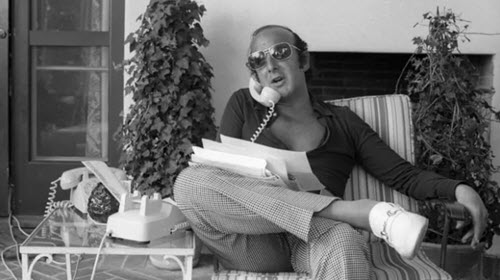
Clive Davis in 1960 – Source
Schien was a protégé of William Paley, the long-time head of CBS and “father of modern broadcasting.” Paley, the son of Ukrainian Jewish immigrants, had worked building up CBS into the main network of radio and main record label in the United States, having a profound effect on mass media and the shaping of Americans’ musical tastes and political perceptions. During World War II, Paley served in the Office of War Information, becoming Chief of Radio of the U.S. military’s Psychological Warfare Division. Paley developed a very close relationship with scions of the Rockefeller dynasty, David and Nelson, as well as others close to the Rockefellers, like former Secretary of State Henry Kissinger. David Rockefeller and Kissinger both later eulogized Paley at his funeral in 1990, with Kissinger also serving as the chairman of Paley’s foundation.
In the mid-1980s, Paley personally ensured that Laurence Tisch would take over CBS (including its record labels). As noted earlier in this piece, Tisch, in 1991, served as a founding member of the so-called “Mega Group” alongside Leslie Wexner, Charles and Edgar Bronfman and Lew Wasserman protégé Steven Spielberg, among others.
Clive Davis’ infamous and undeniably “revolutionary” tenure as President of CBS Records (1967-1973) is most aptly characterized by the transition from the jazz, folk, and pop ethos of the 1950s to the industry-wide embrace of rock in the 1970s. Somewhat akin to the careers of Andre Harrell or Combs, he was a relatively young label executive well-placed to take advantage of shifting cultural trends, effectively making his name synonymous with an emergent genre for a time.
In Davis’s self-hagiographizing, he had an epiphany at the 1967 Monterey Pop Festival and became determined to pivot to rock music. “I sensed change. I don’t know, even now, how I knew”.xvii Of course, this was an exaggeration, as rock had already been dominating the singles charts for more than a decade. Davis’ legacy in this period as it relates to rock music was essentially ensured after he poached an assembly of Monterey acts from their minor labels along with those who were still languishing in obscurity.xviii During his tenure at Columbia Records, Davis managed and/or signed Bob Dylan, Janis Joplin, The Electric Flag, Santana, Bruce Springsteen, Billy Joel, Chicago, Loggins & Messina, Aerosmith, Earth Wind & Fire, and the Grateful Dead.
While Davis had been successful at CBS, he left the company under a cloud of scandal. Davis became a focus of an investigation led by the US Attorney’s Office in Newark, a probe that would later become known as Project Sound. As part of the investigation, “allegations began to surface in the press that CBS Records had bribed black radio stations and done business with an organized crime figure.” The scandal ultimately led to Clive Davis’ decision to make a deal in 1971 with two record producers tied to Motown Records, Kenny Gamble and Leon Huff.xix Davis had sought out Gamble and Huff due to a desire to “conquer the R&B charts.” As part of the negotiations, Davis allowed Gamble’s and Huff’s company to promote the music that, per the deal, was produced and distributed by CBS.
Perhaps unknown to Davis at the time, Gamble’s and Huff’s company and its promotional efforts engaged in the practice of payola, the illegal practice whereby firms pay radio stations to play singles without disclosing that payments were made. CBS was implicated in the arrangement through David Wynshaw, Clive Davis’ closest aide at CBS.xx Press reports soon stated that CBS music subsidiaries were being investigated for bribing radio stations, not just with money, but also drugs and sex, in order “to increase use of its products on black-oriented radio stations.”
CBS, in connection with the Project Sound probe, uncovered that Davis had left a “trail of phony invoices” totaling at least $94,000 over six years that were meant to cover up Davis’ use of funds for personal parties and renovations to his properties.xxi Davis was ultimately fired by CBS as a result.
Soon, the CBS “payola” scandal took on a darker hue. In February 1972, a few days after Davis had been fired from CBS, eight people were indicted in Newark on conspiracy and smuggling charges connected to a “multimillion dollar heroin ring operating in Italy, Canada, and the United States.”
The connective tissue between CBS and this drug bust soon became apparent. A woman, recently fired from CBS for being “doped up” at work, had been indicted after working for a food stand that doubled as a front for the heroin ring in question. Patsy Falcone, aka Pasquale Falconio, an associate of the Genovese crime family, had also been indicted. Investigators found that Falcone also had a tie to CBS by way of his “friendship” with Davis’ protege David Wynshaw as well as via Frank Campana, a former CBS A&R man with whom Falcone had started a management company. Falcone and Campana’s company managed several acts signed to CBS. Investigators later stated that Davis’ name had been mentioned by Falcone in bugged telephone conversations and that evidence found on Falcone had listed Wynshaw as a “source for prostitutes.”
Documents incriminating Wynshaw were reportedly found on Falcone at the time of his arrest. It was later reported that, “with the help of Dave Wynshaw, Falcone bilked CBS Records. The two men set up sham companies in… New Jersey… CBS unwittingly paid more than $75,000 to these nonexistent operations.”xxii Wynshaw figured prominently into Davis’ downfall as it was Wynshaw who had both helped facilitate the money funneled to Falcone and who had written up false invoices that obscured the payments that Davis had used for personal enrichment. It was also believed that Wynshaw’s role involved laundering money that was used for “off-the-record” items, like procuring drugs and prostitutes for CBS parties, conferences, & artists, leading him to be colloquially known as “Clive’s pimp” at the label.
As a Rolling Stone article from the period speculated based on industry rumors at the time, Davis’ unceremonious firing by CBS over personal enrichment and embezzlement of funds (of $94,000, then deemed paltry by industry insiders) may have been a strategic attempt to get ahead of the larger “Drugola” scandal and the possibility that federal investigators might pursue charges against Davis, his trusted aide Wynshaw, and others at the company.
Despite the scandal, Davis quickly found his way back into the industry. A little over a year after having been fired from CBS/Columbia, in the summer of 1974, Davis was hired as a consultant for Bell Records, “a barely profitable subsidiary of Columbia Pictures (no corporate relation to CBS).” According to a 1977 New York Times article, “Davis’s consulting took the form of letting go most of [Bell’s] performers and the executives who had signed them, retaining only a handful as the basis for a renamed company, Arista, with himself in the president’s chair.”
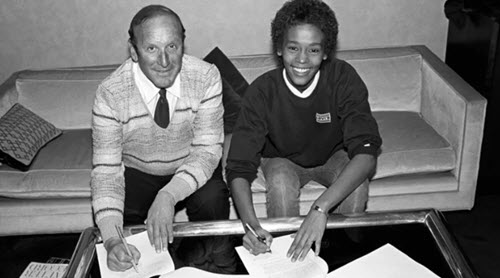
Clive Davis signs a young Whitney Houston to Arista Records – Source
Arista’s formation and success relied heavily on Alan Hirschfield, a major entertainment executive who had recently become CEO of Columbia Pictures. Hirschfield was instrumental in bringing Davis on as a consultant for Bell and who supported Davis’ formation of Arista. Davis, as well as Hirschfield’s family, have framed Hirschfield as having essentially co-founded the label with Davis.
Hirschfield had found himself serving in the top post in Columbia Pictures thanks to the same connection that saw him become at top executive at other entertainment conglomerates, like Fox and Warner Brothers. That connection was to Allen & Company, as Hirschfield’s father Norman was a close friend and associate of Charles and Herbert Allen, the founders of the company. Norman Hirschfield also worked for Allen & Co., particularly in its natural gas division and also in scouting other “business opportunities” for the firm. Later, in the 1970s and 1980s, when Allen & Co. took a stake in a major entertainment firm, Columbia included, they ensured their interests were represented through the installation of Norman’s son, Alan Hirschfield, in a top executive post.
Charles and Herbert Allen and their firm Allen & Co. have documented ties to intelligence-linked figures and scandals, as well as organized crime. As noted in [url]One Nation Under Blackmail[/url], the Allen brothers had significant organized crime connections, particularly via companies based in the Bahamas that were run and developed by close associates of Jewish mobster and co-founder of the National Crime Syndicate, Meyer Lansky. In addition, Allen & Co. was a client of the CIA-linked David Baird Foundation and Charles and Allen and David Baird had several dealings with an associate of mob boss Moe Dalitz and Alexander Guterma, who was a key part of the United Dye scandal that had also ensnared figures like Roy Cohn. Allen & Co. also financed Earl Brian’s efforts to buy out Inslaw Inc. as part of the PROMIS scandal (discussed in greater detail shortly) and had other close business ties to Brian, including being significant shareholders in Brian’s company Hadron.
The Allen brothers also had significant ties to Leslie Wexner’s mentors, Max Fisher and Alfred Taubman. Taubman had been close to the Allens since the 1950s. For Fisher, the connection was forged at the time he was heading up United Brands, the CIA-linked company that Fisher took over the same year that its former top executive, Eli Black, suspiciously fell to his death from the 44th floor of the Pan Am building in Manhattan. Black was the father of Leon Black, the Drexel Burnham Lambert executive who would later found Apollo Global Management and become a very close and now notorious associate of Jeffrey Epstein. While still at United Brands, Fisher joined Taubman and the Allen brothers in a joint venture that culminated in the takeover of the Irvine Ranch in California.
The overlap doesn’t end there. Columbia Pictures’ Alan Hirschfield was a close associate of lawyer Allen Tessler and served alongside Tessler as a top executive at Data Broadcasting Corporation. Tessler was the family lawyer for the organized crime-linked Gouletas family and their real estate empire. Tessler also later joined the board of Leslie Wexner’s The Limited in 1987. Evangeline Gouletas shared an office space with Epstein during this time, which also coincides with the development of the close-knit relationship between Wexner and Epstein.
Another key client of Tessler’s was the aforementioned Earl Brian, who had close ties to Allen & Co. and was one of the masterminds of the PROMIS scandal that involved MCA, organized crime, US intelligence and Israeli intelligence (with Robert Maxwell facilitating aspects of the scheme on behalf of Israel). Tessler’s law firm, Shea & Gould, also represented organized crime clients like Carmine de Sapio, a close friend of Roy Cohn’s, and also had significant connections to William Casey, Reagan’s CIA director. Tessler, who was chairman of Wexner’s The Limited’s Finance Committee by 1990, came into direct contact with Epstein some time around this period as well. Tessler appears in Epstein’s infamous “black book” with two addresses and four different phone numbers listed. Among the numbers listed is Tessler’s line at Data Broadcasting, where he and Hirschfield worked side-by-side. The company had been acquired by Earl Brian’s firm Infotechnology in 1987.
In other words, Clive Davis’ ascent to become a major music executive was aided largely by figures tied to same clandestine network composed of intelligence-linked and organized crime elements that also forms the basis for the network that would also later figure prominently in the rise of Jeffrey Epstein. This is also evident in Davis’ close friendship with the family of the Mega Group’s Laurence Tisch, particularly his nephew Jonathan who took over the family business Loews Corp in 1989. This connection later led Davis to donate several million to the Tisch School of the Arts at NYU, producing the Clive Davis Institute of Recorded Music under the Tisch School umbrella. It is also notable that the “drugola” scandal linked to Davis had ties specifically to the Genovese crime family, an organized crime network also linked to MCA, Morris Levy, Roy Cohn and Leslie Wexner, as noted earlier in this piece.
Mentors in Crime
After the scandal around Combs began to break, Clive Davis, as well as Andre Harrell of Uptown and Russell Simmons of Def Jam/Rush Management, have been accused of propelling Combs into the patterns of criminal behavior for which he is now infamous. For instance, one-time rival (and former friend of Combs) Suge Knight has claimed that Davis, Harrell and Simmons used “alcohol, drugs” – specifically cocaine – to “compromise” Combs’ “manhood.” This is particularly significant in the case of Davis’ ties to the “Drugola” scandal, which involved using sex, drugs and bribes to specifically target “black-oriented radio stations” and music. Claims similar to those made by Knight have since been echoed by Combs’ former bodyguard Gene Deal.
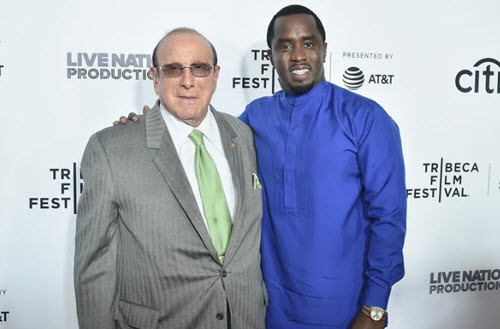
Clive Davis and Sean Combs – Source
It is worth noting here that Davis’ protégé L.A. Reid, who took over Arista Records from Davis, has also been accused of sexual misconduct and assault. Reid, alongside Combs, were both instrumental in the success of recording artists Justin Bieber and Usher. Knight has argued that Davis, Simmons and Harrell first “compromised” Combs and then Combs went on to use alcohol, drugs, and gay sex to “control” younger artists like Usher and Bieber. Notably, Combs’ entry into the world of Andre Harell, Simmons and, shortly thereafter, Clive Davis, coincides with the development of his obsessive drive to record everything, presumably for blackmail-related purposes. For instance, music video director Cole Bennett asserted that Combs told him that he’d begun recording “footage of everything” in 1992 and even advised Bennett to do the same.
In addition, Kirk Burrowes, the co-founder of Bad Boy Records with Combs, has claimed that Combs sought to compromise him using this same method. Burrowes has filed a lawsuit against Combs, claiming Combs subjected him to “repeated sexual harassment, physical aggression and forced compliance with degrading sexual acts” throughout the 1990s. Burrowes claims that Combs targeted him with “unwanted sexual advances” including acts of “nudity, sexual overtones, voyeurism and acts of exhibitionism,” some of which allegedly took place during business meetings, and that this was part of a larger “campaign of control.” The outcome of this campaign, per Burrowes, was the use of “physical violence, blackmail, career sabotage and financial extortion” to force Burrowes out of his 25% stake in Bad Boy Records. Though Davis was a key part of the early creation and formation of Bad Boy Records, he is not named in Burrowes’ suit.
However, Combs may have been “controlled” in a similar way by Davis, per some sources. Suge Knight, for instance, has alleged that he was told by the former head of Interscope Records, Jimmy Iovine, that Combs had regularly engaged in sexual acts with Davis, suggesting that his relationship with Davis and Davis’ early, crucial involvement with Bad Boy were built on the back of sexual favors. This is certainly possible given the well-known mechanism within the entertainment industry of sexual favors as a way to secure lucrative roles and deals –– e.g. the Harvey Weinstein scandal. In addition, Davis notably came out publicly as bisexual in a memoir published when he was 80 years old, where he writes that he began to openly engage in sex with the same gender in the 1980s. Combs’ alleged bisexuality has been a major topic of discussion in relation to the scandal leading up to his arrest last year. Knight has also claimed that Russell Simmons and Andre Harrell had also engaged in similar behavior with each other. Notably, the network behind Clive Davis, which overlaps with that behind Epstein, also involved similar “sugar daddy”-style relationships. These include rumors that Epstein and his long-time benefactor Leslie Wexner were intimate, e.g. former State of Ohio Inspector General David Sturtz telling journalist Bob Fitrakis that Epstein was Wexner’s “boyfriend.”
The Rat Pack
Given that Russell Simmons is one of the men alleged to have mentored Combs in this type of criminal behavior, it is worth taking a look also at some of the recent allegations that have been made against Simmons and some of his associates, who – like Simmons – also boasted close ties to Combs.
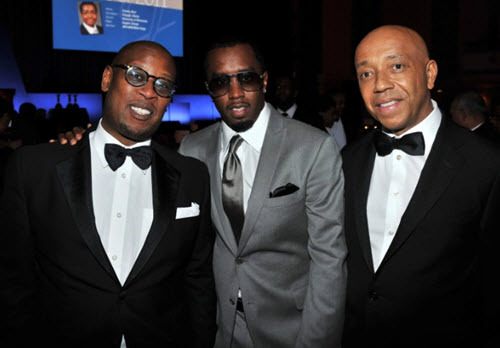
From left: Andre Harrell, Sean Combs, Russell Simmons – Source
Beginning in 2017, Russell Simmons was hit with a slew of rape and sexual harassment lawsuits and accusations. One of Simmons’ earliest accusers, model Keri Claussen Khalighi, alleged that Simmons raped her in full view of the director Brett Ratner in 1991. Before the 2017 allegations, police had previously probed Simmons and Ratner for claims of jointly engaging in sexual battery back in 2001. Over a dozen women have since accused Simmons of sexual misconduct or crimes, while Ratner himself has been separately accused of similar crimes, including rape, by at least 10 women. Following the barrage of accusations, Simmons has laid low in Bali, Indonesia, embracing life as a “stateless” US citizen in a bid to evade the court’s jurisdiction. As will be explained in greater detail shortly, Ratner fled to Israel but is now planning a comeback, currying favor with the Trump family to that effect.
Ratner is a long-time close associate of Simmons, with some reports calling Ratner a “protégé” of Simmons. Simmons is credited with helping start Ratner’s career, as the two met while Ratner was still in film school (NYU’s Tisch School) and Ratner began filming music videos for Simmons-managed artists like Public Enemy soon after their meeting. Ratner also filmed a music video for Combs’ longtime associate Heavy D, who had first gotten Combs his internship at Uptown, in 1994. Getty images alone hosts hundreds of photographs of Ratner and Simmons partying together over the years.
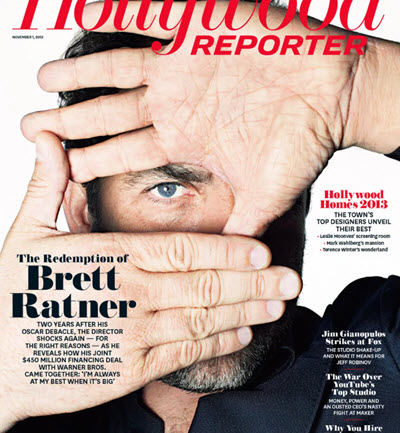
Brett Ratner on the cover of Hollywood Reporter – Source
Ratner, like Simmons, was also a very close associate of Combs, bringing Combs as his guest to several premieres of his films. Ratner was also a frequent attendee of numerous Combs-hosted parties as well as charity fundraisers. They also arrived together at prominent award shows and Ratner also filmed music videos for Combs, such as his 2001 single “Diddy.” Combs selected Brett Ratner and Ron Burkle, among others, to be his guests of honor when he delivered a commencement address to his alma mater Howard University in 2014.
Ratner’s close association with both Simmons and Combs is notable for a few reasons. First, there is the fact that Ratner, as previously mentioned, was accused by several actresses of sexual misconduct, resulting in him being dropped from his agency and the “canceling” of his Hollywood career. In addition, Ratner took overdirecting the X-Men series from Bryan Singer, with whom Ratner is reportedly close. Singer has been accused of pedophilia and sordid affiliations with the Digital Entertainment Network (DEN), which was run by pedophile Marc Collins-Rector and also involved child star turned crypto mogul Brock Piece. (For Unlimited Hangout’s past reporting on DEN and Pierce, see here)
Second, there is the man that Ratner considers his father –– Alvin Malnik. The feeling is apparently mutual, with Malnik referring to Ratner as one of his sons. The close-knit tie is telling as Malnik has very significant organized crime ties, particularly to Meyer Lansky. Not only that, but according to a Forbes investigation cited by the LA Times, Malnik “invented the black art of money-laundering, taking mob money and routing it to legitimate ventures.”
Forbes wrote that:
In the 1960s, Miami lawyer Alvin Malnik set up the Bank of Commerce in the Bahamas. Mob money flowed into its secret numbered accounts by the hundreds of millions–[mob financier Meyer] Lansky money, most of it–and then out again into Tibor Rosenbaum’s International Credit Bank of Switzerland before returning to the United States for investment.
For those familiar with One Nation Under Blackmail, both Lansky and Rosenbaum also had significant ties to the Israeli intelligence apparatus, especially Rosenbaum who helped finance keys aspects of Israeli intelligence, including via the means that Malnik reportedly helped to develop.
In addition, Malnik’s other ties to Lansky were considerable. For instance, Malnik had previously been banned from working in New Jersey casinos due to state regulators confirming his ties to Lansky and Sam Cohen, another mobster. Malnik had even been named Lansky’s “heir apparent” by Reader’s Digest upon Lansky’s 1983 death, while the Miami News noted that Lansky had wanted Malnik to take over all of his “legitimate enterprises” after this death. That article also cited federal agents that claimed that Malnik also stood to inherit “Lansky’s lucrative gambling, pornography, prostitution, labor racketeering and extortion operations.” Malnik also had a close association with Joel Steinger, a notorious fraud that operated a massive Ponzi scheme targeting the elderly and terminally ill. Steinger, like Malnik, had developed close ties to Lansky personally by the 1970s and married the daughter of a Miami banker alleged to be a close Lansky associate.
In addition, Malnik was involved in strange ways with Michael Jackson in his later years. As noted previously, billionaire Ron Burkle ––- who also cultivated close ties to Bill Clinton and Jeffrey Epstein, along with Combs himself –– had significant connections to Jackson during this same period. The Malnik-Burkle-Jackson connection, as well as Burkle’s significant ties to both Epstein and Combs, will be covered in Part II of this series.
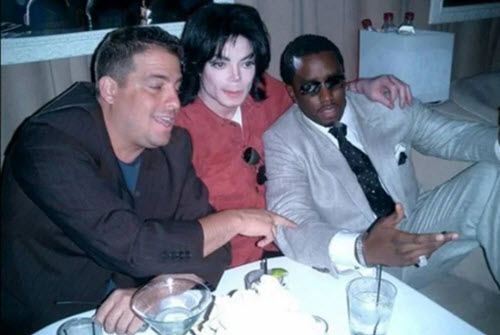
Ratner (left) with Michael Jackson and Sean Combs in an undated picture at Ratner’s Beverly Hills home – Source
Malnik’s own “protégé,” his adopted son Brett Ratner, claims to have also fostered a close relationship early on with Meyer Lansky himself. In a 2011 interview, Ratner stated the following:
“I grew up on Miami Beach. I lived on Collins Avenue at the Carriage House on 54th Street. And two doors down was the Imperial House where every day after school I would ride my bike and I would walk down the street with an old man who would walk his dog. We would walk together and everyone at the store would kiss my ass when I was with him. He would take me to this restaurant called the Villa Capri and everybody was always treating me so nice. I didn’t realize it until I was in line at the supermarket with my mom and I opened up Rolling Stone and I saw his picture on the back. It was Meyer Lansky’s obituary. Everybody thought it was weird because he was 80 and I was 12. He was the biggest gangster in the world and he was like my best friend as a kid.”
While some may discount this claim as fantasy on Ratner’s part, his close ties to Malnik –– Lanksy’s “heir” –– during the same period of his alleged association with Lansky lends the story credence. In addition, it is worth noting that Ratner’s “big break” that allowed him to become a famous director came somewhat unexpectedly in his “mediocre” film school career via Steven Spielberg. As previously noted, Spielberg was a protégé of Wasserman and Schienberg of MCA, a company with significant mob (and intelligence) affiliations, while Wasserman himself was connected to Lansky’s network via his long-time tie to Lansky associate Moe Dalitz. Spielberg is also a reported member of the previously mentioned “Mega Group” that unites Spielberg with organized crime-linked oligarchs like Epstein’s main benefactor Leslie Wexner, among others.
Ratner would later follow the Lansky model of evading charges and scrutiny for illegal activities by immigrating to Israel. After he was accused of extreme sexual misconduct, including alongside Simmons, Ratner fled to Israel. A week before his escape, Ratner had been Benjamin Netanyahu’s special guest, along with former Epstein defense lawyer Alan Dershowitz, at the United Nations. Articles on Ratner’s trip to the UN with Netanyahu noted that Ratner is a former close business associate of Australian media tycoon James Packer, who has been closely linked to Netanyahu. Packer’s business venture with Ratner, RatPac Entertainment was notably partnered for several years with Dune Entertainment, the film business of Trump’s former Treasury Secretary Steve Mnuchin. Mnuchin left the venture shortly after joining the first Trump administration, which coincided with many of the accusations against Ratner being made public, crippling the firm’s once meteoric rise.
Packer, for his part, was a key part of the corruption trial that continues to dog current Israeli Prime Minister Benjamin Netanyahu, but has taken a backseat following the onset of the Israel-Gaza War in October 2023. Packer’s ties to both Netanyahu as well as former Mossad chief Yossi Cohen were deemed so extensive that they were considered a “national risk” in court testimony. Packer also once threatened to “sic” Mossad operatives on businessmen and was seeking to form a cybersecurity venture with Mossad-linked individuals around the same time he created RatPac with Brett Ratner. In addition, Packer was known to have partied with Jeffrey Epstein and Ghislaine Maxwell, including on the yacht of Australian trucking magnate Lindsay Fox in 1995 when Epstein and Maxwell were the “guests of honour” on the cruise. Furthermore, Packer has also come under scrutiny for his ties to Stanley Ho, a casino magnate with ties to Chinese organized crime and to the Clinton-era scandal “Chinagate,” which also involved Epstein. As it relates to Epstein, a star in many of Ratner’s films with close social ties to the director, Chris Tucker, would later find himself on infamous Epstein-brokered plane trips alongside Bill Clinton and Kevin Spacey.

Brett Ratner sits between Elon Musk and Donald Trump at Mar-a-Lago in January 2025 – Source
The Combs-Simmons-Ratner clique have a history of cultivating ties to Donald Trump. For instance, one image photographed by Getty shows Ratner on stage with Combs at Russell Simmon’s “Art for Life Palm Beach” event honoring Combs in 2005. The event was hosted at Trump’s Mar-a-Lago and attended by the Trumps. The Trumps also attended some premieres of Ratner’s films. Trump became closely associated with Combs beginning in the 1990s. While those ties will be discussed in detail in Part II of this series, it is worth noting that First Lady Melania Trump has teamed up with the self-exiled Ratner, who is now directing a documentary about her life that is due to launch on Amazon Prime later this year. The First Lady is an executive producer of the film, which began production shortly after her husband’s 2024 election win.
In addition, according to New York magazine, Ratner was recently seen visiting Mar-a-Lago along with the aforementioned James Packer, where they were photographed dining with Trump and Elon Musk earlier this year. A month later, it was reported that Packer bought a Trump-owned property neighboring both Mar-a-Lago’s private club and the Trump estate there. The property was previously used by close Trump associates visiting Mar-a-Lago and by the Secret Service during his first presidential term. Ratner has reportedly been involved in “fanning” the closeness between Trump and Packer that resulted in the property sale. Notably, Packer had previously bought a property neighboring another state leader, Israel’s Benjamin Netanyahu, back in 2016. In addition, Ratner and the Trump family, as well as Russell Simmons, were among the guests invited to the wedding of Al Malnik’s son, Jarod Malnik, in early 2024.