
The Dark Reason They Destroyed Pre-1800 Books
Tartaria Vault
Jan 30, 2026 #tartaria #lostcivilization #libraryfires
How did hundreds of libraries across continents burn within the same critical two-century window—targeting repositories of ancient knowledge while leaving adjacent structures intact? From the Great Fire of London to the destruction of Copenhagen's archives, from the Lisbon earthquake fires to the systematic emptying of French monastery collections, the pattern of destruction reveals a coordination that official explanations cannot adequately address.
As I examined acquisition records, institutional histories, and the gaps in documented provenance, a disturbing pattern emerged: the losses were too thorough, clustered too precisely, and targeted materials with an apparent selectivity that suggests curation rather than accident. These weren't random fires or isolated catastrophes—they were cascading events spanning continents within a narrow historical window, all eliminating pre-1800 primary sources, all eliminating primary sources that might have documented Tartarian civilization, all creating dependency on institutional authentication systems established afterward.
This investigation explores the systematic erasure of verifiable historical records—the library fires that eliminated original manuscripts describing pre-modern world systems, the transitions that broke chains of custody for Tartarian-era documents, the consolidation of archives into state-controlled institutions, and the authentication methods developed after the sources themselves disappeared. The deeper we examine the coordination problem, the pattern of what survived versus what burned, and the knowledge that became inaccessible, the more difficult it becomes to accept the official narrative of unfortunate accidents rather than deliberate historical filtration.
The material on this channel presents exploratory interpretations of history and imaginative speculation, conveyed through narrative storytelling rather than precise historical documentation. Viewpoints and visual representations are dramatized or intentionally constructed to support alternative narrative exploration. Visual elements may at times be created using automated or generative tools. The content shared should not be considered factual.
Transcript
I have always carried the assumption
that library archives stretch backward
into deep history. Medieval manuscripts,
Renaissance texts, ancient chronicles
preserved through centuries of careful
stewardship. That's what we're told.
That's what I believed. But that
assumption shattered within the first
hour of actual research. Because when
you request documents from before 1800,
when you ask to see the original texts,
the unrestored manuscripts, the primary
sources that should anchor our
understanding of history, you encounter
a pattern, not scarcity, not difficulty,
but absence, systematic, inexplicable
absence. The librarians offer
explanations. fire, water damage,
natural deterioration. And individually,
each explanation sounds reasonable,
plausible even. But when you map the
pattern, when you trace these losses
across continents, while certain old
money dynasty families, private
libraries remained mysteriously
untouched, their pre-800 collections
intact behind locked estate doors. The
official story collapses.
This isn't about one fire. It's about
dozens. hundreds. A cascading wave of
destruction that swept through the
repositories of human knowledge with
such precision, such thoroughess that
almost nothing survived the transition
into the modern era.
And the deeper I looked, the more I
realized this wasn't random. This was
curated. The Library of Congress fire of
1814,
the burning of Alexandria's successor
institutions across the 1700s,
Copenhagen's Great Library Fire of 1728,
the Turin fire of 1667, the Lisbon
earthquake and subsequent fires of 1755
that consumed untold archives, Moscow's
library fires during the Napoleonic
invasion, the systematic destruction of
monastery collections during the
dissolution movements across across
Europe, one after another, decade after
decade, each event erasing centuries of
accumulated knowledge. But here's what
makes the pattern impossible to ignore.
The timing. These fires didn't occur
randomly across history. They clustered.
They concentrated in a specific window
roughly 1650 to 1850. A period that just
happens to bracket the transition into
what we call modernity, what we call the
enlightenment, what we call the
documented era. Before this window,
records exist, but only as copies,
reproductions, versions published after
the fact, after the fires, after the
losses. We have what survived the
filter, not what was originally written.
Ask yourself, what didn't survive? I
started documenting the losses
systematically, not as isolated
incidents, but as a coordinated
timeline.
1666, the Great Fire of London destroys
St. Paul's Cathedral and its library,
one of England's largest repositories of
pre-reformation texts. 1,671
severe fire at the escoral monastery in
Spain, consuming irreplaceable
manuscripts from the Islamic period and
earlier Christian texts.
1728 Copenhagen University library
burns. Thousands of medieval manuscripts
lost, including the only copies of
numerous Norse and Danish historical
texts.
1731.
The Ashburnham House fire in London
destroys a significant portion of the
Cotton Library. Manuscripts dating to
Anglo-Saxon England, many the only
surviving copies of their kind. 1755
Lisbon earthquake and subsequent fires
obliterate the Royal Library, the Jesuit
archives, and countless private
collections spanning centuries of
Portuguese exploration and scholarship.
1794,
Revolutionary France systematically
empties and destroys aristocratic and
church libraries across the country.
1812, Moscow burns during Napoleon's
retreat. The Kremlin archives, library
collections, historical documents gone.
1814 Washington D.C. The Library of
Congress loses its entire collection of
3,000 volumes. The foundational texts of
American governance and historical
reference. The list continues. Italy,
Germany, the Netherlands, England again,
Russia again, Spain again, fire after
fire after fire. Go to Wikipedia. I
know, I know, but humor me. And search
for list of library fires. Scroll
through that list. Notice the dates.
Notice the clustering. Notice how many
happened in that exact 200year window.
Then come back here and tell me in the
comments if you think this is
coincidence.
Because once you see the timeline laid
out, once you count them yourself, the
official explanation starts to feel
insufficient. Because these weren't just
accidents of fate. These fires occurred
during periods of political upheaval.
Yes, but political upheaval doesn't
explain the precision. Wars destroy
cities chaotically. Earthquakes don't
target libraries specifically. Random
fires don't consistently burn the
archives while leaving adjacent
structures intact. Yet, that's exactly
what the pattern shows. The Library of
Alexandria, the original, supposedly
burned multiple times across centuries.
But its successor institutions, the
libraries that claimed lineage to
Alexandria's tradition, also burned.
Constantinople's libraries burned during
the fourth crusade. Then again during
the Ottoman conquest. Baghdad's house of
wisdom destroyed in 1258. Nandanda
University's library in India burned by
invaders in 1193.
Different continents, different
cultures, different centuries, same
result. the systematic eraser of
preodern textual history. And here's the
strangest part, the silence, the
collective acceptance, the way
historians acknowledge these losses with
footnotes and passing mentions as if the
destruction of humanity's accumulated
knowledge were just an unfortunate but
unremarkable fact of history. No
outrage, no investigation into patterns,
no questions about what was deliberately
targeted versus what was collateral
damage, just acceptance. I began
examining what remains, the text that
supposedly survived. Medieval
manuscripts in museum collections, yes,
but authenticated how. Dated using
methods developed when provenence
established through what chain of
custody?
The deeper I went, the more
uncomfortable the answers became. Most
manuscripts we attribute to the medieval
period were discovered or authenticated
in the 18th and 19th centuries after the
fires, after the upheavalss, after the
transition into modernity.
Carbon dating wasn't available until the
midentth century. And even then, it
dates the physical material, the
parchment, the ink components, not the
text itself.
Paleographic analysis relies on
comparing handwriting styles to known
exemplers.
But if those exemplars were also created
during the postfire period, you're
dating documents against other documents
of uncertain origin. It's circular. It's
built on assumptions layered upon
assumptions. And when you ask
librarians, when you press archavists
for original documentation chains for
the unbroken custody records that should
exist for priceless manuscripts, you
encounter gaps, transfers during
wartime, evacuations during fires,
periods where records were consolidated
or reorganized. The chain breaks always,
right around 1750 to 1850. Once you see
it, you can't unsee it. Let me be clear
about what I'm not claiming. I'm not
saying every medieval text is
fabricated. I'm not saying history was
invented wholesale in the 19th century.
But I am saying this. We cannot verify
the contents of libraries before
approximately 1800 because the physical
evidence was systematically destroyed.
Whether through accident, negligence or
intention, the result is the same. We
have copies of copies, translations of
translations, and authenticated
documents whose authentication
relies on standards established after
the original sources disappeared.
We're told the Library of Alexandria
contained hundreds of thousands of
scrolls. We're told it preserved
knowledge from across the ancient world.
But we can't name most of those texts.
We can't describe their contents. We can
only reference later summaries, later
claims about what existed. The same
pattern applies to monastery libraries
across Europe, to the great Islamic
libraries of Baghdad and Cordoba, to the
temple libraries of Asia. We have
descriptions of what was supposedly
lost, but the actual texts gone, burned,
destroyed, erased, and in their place, a
standardized history, a narrative that
conveniently begins in earnest around
1800 with verified documents,
authenticated sources, and unbroken
chains of custody. The pattern repeats
with unsettling precision. If you've
made it this far and you're seeing what
I'm seeing, consider subscribe or
becoming a YouTube member, your support
is vital when it comes to this type of
research. There's another layer to this,
another question that emerges when you
map not just what was destroyed, but
what replaced it. After the fires, after
the upheavalss, after the consolidation
of archives into national libraries and
state controlled institutions, something
changed.
The nature of what was considered
knowledge shifted.
The kinds of texts deemed worthy of
preservation narrowed. The editorial
standards, the cataloging systems, the
very framework for understanding
history, all of it standardized.
Who decided what got reprinted after the
fires? Who chose which surviving
manuscripts would be authenticated and
which would be dismissed as forgeries?
who established the chronologies we
still use today. Not independent
scholars working in isolation, not
competing traditions preserving
different versions of the past, but
centralized institutions, state
libraries, national archives,
universities operating under royal or
governmental charters. This raises a
simple but critical question. What
didn't fit the narrative? What texts
described technologies that contradicted
the story of linear progress? What
history suggested different political
structures, different forms of
knowledge, different understandings of
human capability?
What was deemed too dangerous, too
destabilizing, too incompatible with the
world being constructed in the 1800s?
We'll never know because it burned. I
want to show you something specific. A
pattern within the pattern across the
destroyed libraries. Certain categories
of texts appear with suspicious
frequency in the lists of losses,
alchemical treatises, hermetic
manuscripts, technical manuals
describing construction methods,
astronomical charts that predate the
supposed invention of precision
instruments, geographical maps showing
coastlines and land masses with accuracy
that shouldn't have been possible. These
aren't fringe subjects. They appear in
catalog after catalog mentioned in
passing as part of collections lost to
fire or neglect. But when you aggregate
them, when you see how consistently
these specific types of knowledge
disappeared, you begin to notice a
curation process at work. The texts that
survived, religious doctrine in approved
versions, classical literature in edited
translations, historical chronicles
written by victors preserved by states.
legal codes, administrative records, the
machinery of power and the narratives
that legitimize it, the texts that
burned, alternative cosmologies,
technical knowledge that suggested
advanced capabilities, histories that
contradicted emerging national
mythologies, books that described the
world differently than the standardized
model required. And that's where
forbidden becomes unavoidable as a
descriptor. Not because someone stamped
forbidden on the cover, but because the
pattern of destruction suggests
selection, choice, intentionality. Some
knowledge was allowed to continue. Other
knowledge had to end. I keep returning
to a specific set of photographs. Royal
portraits from the 1850s through 1880s.
European monarchs posed in their private
libraries surrounded by shelves of
leatherbound volumes stretching into
shadow. But here's what nor at me. Those
libraries still exist. The families
still occupy the estates. The books
still line the walls behind velvet ropes
and security glass. And we're not
allowed to read them. Not the public,
not researchers, not historians
requesting access to verify the very
sources cited in academic texts. These
collections remain sealed. private
ancestral property protected by
centuries of inherited privilege. While
monastery libraries burned, while
university collections vanished in
flames, while public repositories across
Europe succumbed to fire after
convenient fire, certain families lost
nothing. Their collections endured,
intact, complete,
suspiciously untouched by the
catastrophes that consumed everyone
else's records.
specific families. And I have to be
careful here or this video gets buried
by the algorithm before you ever see it.
Families whose names appear in banking,
in industry, in the consolidation of
power across the exact period when
everything else burned.
What do those books contain? What
knowledge sits behind locked doors in
estates you'll never enter?
What texts were deemed too important to
risk in public institutions?
Ask yourself, why did public archives
burn while private collections survived?
Why were certain bloodlines immune to
the fires that ravaged institutional
knowledge? And why, two centuries later,
do those same families still refuse
access to materials that could answer
the very questions historians claim they
cannot resolve? Let me ground this in
something concrete, something you can
verify yourself. Go to any major
library. Request original manuscripts
from before 1750. Not faximiles, not
published editions, but the actual
physical documents. You'll find they're
rare, extraordinarily rare. And the ones
that exist often share certain
characteristics. They come from royal
collections, from state archives, from
institutions with direct ties to
governmental power. The independent
monastery libraries, the private
scholarly collections, the merchant
guild archives, those materials are
lost. But the state sanctioned materials
survived. Convenient, isn't it? Now go
further. Ask to see the acquisition
records for these surviving documents.
When did the library obtain them? From
whom? Under what circumstances?
You'll find gaps, transfers during the
Napoleonic Wars, acquisitions during the
dissolution of religious orders by
donations from private collections whose
provenence trails end abruptly,
documents surfacing in the 19th century
with authentication based on stylistic
analysis. Circular reasoning that
assumes the chronology it's trying to
prove. The evidence suggests something
much larger than carelessness or natural
decay. It suggests a historical
consolidation, a moment when knowledge
was centralized, standardized, and
filtered. When the past was rewritten,
not through lies exactly, but through
selective preservation.
What we have today isn't the archive of
human history. It's what was allowed to
remain after the fires. There's a
haunting quality to walking through old
library buildings. The ones constructed
in the mid 1800s, purpose-built to house
the recovered and preserved knowledge of
civilization.
Their architecture is telling fireproof
design, metal shelving, concrete
construction.
As if the builders knew consciously or
unconsciously that preservation required
fortification against the very pattern
that had just consumed everything that
came before. Were they protecting
knowledge or protecting the narrative
they just constructed?
I think about the books that burned, not
as abstractions, but as specific texts
written by specific people who believed
they were preserving something
important, who believed future
generations would read their words,
understand their discoveries, build upon
their foundations. But we can't because
the chain broke, the fires came, and
what emerged on the other side was a
controlled story, a manageable past, a
history that fit the needs of emerging
nation states and industrial modernity.
The official explanation that fires just
happened, that accidents accumulated,
that this was merely the unfortunate
cost of preserving fragile materials
across turbulent centuries, collapses
under the weight of the pattern's
precision. Too many fires, too
convenient timing, too consistent in
what was lost versus what remained. Too
thoroughly did these events erase
alternative understandings of history,
technology, and human capability? And
too silent are the institutions that
benefit from this eraser. So what was in
those books? What knowledge burned in
library after library, century after
century, until nothing verifiable
remained before 1800? We can't know.
That's the point. That's the mechanism
of control. You can't question what you
can't access. You can't challenge
narratives built on sources that no
longer exist. You can't verify claims
about the past when the evidence is ash.
What we're left with is faith. Faith
that the summarizers accurately
represented what they destroyed. Faith
that the survivors of the fires
preserved the most important materials.
faith that the institutions now
controlling access to history have no
reason to maintain particular narratives
over others.
But when you look at the pattern, the
systematic, coordinated, impossibly
precise destruction of preodern records
across continents and centuries, that
faith becomes difficult to sustain.
Maybe there were advanced construction
techniques we've forgotten. Maybe there
were alternative energy systems, social
structures, technological capabilities
that don't fit the story of linear
progress from primitive to modern. Maybe
the world before 1800 was radically
different than we've been taught. And
maybe that difference was incompatible
with the order being established in its
place. Or maybe it was exactly as we're
told, random fires, natural decay, the
simple entropy of time working against
preservation. But either way, the result
is the same. We exist in an era where
human history begins in earnest around
1800 with verified sources,
authenticated documents, and
institutional authority.
Everything before that exists only in
translation, in copies, in versions
filtered through the very institutions
that benefited from consolidation.
Ask yourself,
what did we lose? What couldn't be
allowed to survive? What knowledge was
too dangerous to permit across the
threshold into modernity?
And when you realize you'll never know
the answer, that the fires made certain
you'll never know, the silence becomes
deafening.
Because if you wanted to erase a past,
if you wanted to rewrite history at
scale, you wouldn't need to destroy
every copy of every text. You'd only
need to destroy enough that verification
becomes impossible.
Enough that the surviving fragments
could be reinterpreted, reorganized, and
presented as authoritative by the
institutions you control. You'd need
fires, lots of them, across a critical
period, targeting the repositories that
preserved alternative knowledge. And
then you'd need everyone to accept it as
coincidence.
FREDA BEDI CONT'D (#4)
Re: FREDA BEDI CONT'D (#4)
 by admin » Sun Feb 08, 2026 7:42 pm
- admin
- Site Admin
- Posts: 41396
- Joined: Thu Aug 01, 2013 5:21 am
Re: FREDA BEDI CONT'D (#4)
by admin » Thu Mar 12, 2026 10:51 pm
Golden Corridor - PressTV - Pepe Escobar 2026
Marcelo Dionisio
Feb 26, 2026
Sometimes to hear the voice of the future, we must go where silence speaks louder than anything else.
So, here we are at the end of a road that dissolves into the sea. That's where our story begins.
The world is like a vast canvas.
Invisible lines shaping the course of our destiny. [music]
Corridors like vital arteries connect the heartbeat [music] of the planet. A maze of ancient roots carrying tales of power and trade century after century.
[music]
Some places can't be understood just by looking at a map. You have to walk them,
breathe the air, listen to the signs hidden in their assignment. Iran is one of those places.
I'm Pepscobar, geopolitical analyst. For decades, I followed countless trails where power moves from the west down to
the east. But no land has gripped my mind the way Iran has.
Rooted in history, yet always reaching toward the future. and a land that once again just might rewrite the rules of
the game. So, here I am searching for something that's been largely overlooked and unheard.
Tan. Layers and layers of time.
[music]
[music]
[music]
[music]
It's imperative to come to the brain of [music] Iran's decision making where maps are drawn and pieces in the chessboard [music] are moved. Thran is
not just the capital of Iran. It may soon become the capital of a new Eurasian [music] project somewhere between Shanghai and St. Petersburg.
[music]
[applause]
An official invitation to the S film festival brought me here.
[music]
I am a geopolitical analyst. I'm very well known in the west in Russia.
Iran is a priceless ancient bridge between east and west. Around years ago, [music]
the Aminid Empire built a royal road, a km long route stretching from Souza to Sardis.
This grand artery symbolized mastery over land roots and facilitated trade between great empires.
During the Cassanian era, the Silk Road,
Asia's vital lifeline, ran through the heart of where else? Iran.
Caravans of silk, spices, and precious goods moved along these paths, carrying with them cultures, ideas, and civilizations.
In the Middle Ages, Islamic empires expanded both land and sea roots.
The ports of the Persian Gulf and the Sea of Oman became Iran's gateways to the world.
Today, Iran sits at a strategic crossroads between the Caspian [music]
Sea, the Persian Gulf, and the overland roots of the Caucuses and Central Asia.
[music]
It is striving to transform the north [music] south and east west corridors into powerful interconnected arteries.
Roots that carry not [music] only commerce but the shifting weight of regional and global geopolitics. [music]
to make friends.
I recognize the new generation when they are like you. You are where your work is.
Go to conv if you can go to the south. Go to never really stayed in the house.
For quite a while, I sensed that something crucial was taking shape here.
Something you can't quite see with just your eyes.
So on the sidelines of the festival, I spoke with an Iranian journalist was also attracted to the concept of the root. Not one that sees Iran as a destination, but as a connector,
redefining its role as a vital link.
I know all this. I want to know the main challenges at the moment.
It's an economic one.
What is missing from the Iranian point of view in terms of infrastructure from
the Caspian crossing Iran to Barabas and Shabah? What is missing?
And the geopolitical story which is much bigger because it bypasses the west completely.
They they have to up their game. His ass.
Thank you, Ahmed. That was very good.
I am a bit sad because it's much more complicated than I thought. A little later, I was introduced to Dr.
Hassan Abidini, a media and policy analyst.
Salam salam. [laughter]
Very nice to meet you. Thank you. Thank you for receiving me.
Foreign speech. Foreign speech. Foreign speech.
What's missing?
What's the major problem for Iran in terms of finishing infrastructure and
logistics from the Caspian
So okay example you have uh cargo coming from St. Petersburg to Astraan very
fast. So arrives in Astrahan. He has to cross the Caspian to the northern Caspian Iranian port.
Can this be done quickly in one year?
within a year.
New questions emerge, questions that could only be pursued up up close. So I had to hit the road and see for myself.
Iran was reshaping regional equations.
So I decided to start my journey from the north where some of the answers might still be hidden.
Railos emerged from the mountains cutting into the green heart of the north.
From Bandar Abbas to Rasht, this line is part
of a much larger project, the International North South Transportation Corridor, INSTC.
This is not just a route. It's a complex chess board where geopolitics plays out,
connecting Iran and wider Eurasia. Here,
through mist and forests, Iran reaches the Caspian Sea.
The North is way more than a border.
It's a vital gateway. Iran, Russia, the Caucuses, Central Asia, they all come together in one single frame.
Ports like Anzali and Amiraabad are Iran's twin arms in the costume. With a
combined capacity of over million tons annually, these ports serve as the lifeline for landlocked countries.
Kazakhstan, Russia, Turkmanistan, they all watch these lines closely.
Here in Astada, Iran's rail network connects to the caucuses. Goods travel from St. Petersburg to Bundarabas in
just days, half the time of the classic Suez Canal route and at a fraction of the cost. Last year alone,
over million tons of cargo crossed Iran's northern borders.
% of Caspian Sea trade passes through Iran. Routes once overlooked have now become the pulse of modern global trade.
The North South corridor is not just a pathway, it's a battleground.
Iran is no longer just a transit country. It has become a player, a root designer, an indispensable partner in
shaping the future order of Eurasia.
We are about to get into the Caspian.
This is just a little branch, right? But then when you get to the Casper, you see everything that's a stable.
This is Bandar Anzali overlooking the Caspian Sea connected to Russia, Kazakhstan and Turk Manistan.
The volume of trade with Russia through the port grows every year. how these Russian imports will keep coming um to
Iran if preferentially navigating the Caspia from Astraan to
Bandar Atali now or through let's say a left of the Caspian uh
highway plus railway that's a very very long story we will address it throughout our our our long story.
What stands out most in Anzalei is the paradox between vast potential and some serious infrastructure limitations.
Iran's greatest need now is a real connection to the national and international networks,
not merely to ease exports, but to secure its geopolitical position on the Eurasian highway.
This port needs expansion. Number one, very, very important. Number two,
um is Iran does Iran have enough uh cargo boats considering exports from
Russia might skyrocket in the near future when the when the corridor will be fully functional. Nobody has this answer so far.
To find the answer, I sought out someone who has stood at the heart of Iran's border trade for years.
Fore.
Well, our story gets much more complicated.
You see this beautiful railway here? It starts down there in Bander Abbas in the
south. It crosses Iran for over kilometers. And guess what happens?
Let's say around from to kilometers from where we are at the moment. It stops just like that. [laughter]
No railway. And it's crazy because we are very close to the Caspian Sea. So this is one of the major logistical
problems of the international north south transportation corridor.
You have to build the rest of the railway of course to a Caspian Sea port.
So how you going to do it? And this is one of the major problems at the moment because it involves building a stretch
of the railway. Who's going to finance it? A line rising from the heart of the Persian Gulf pauses at the edge of the
Caspian Sea as if awaiting a momentous decision. In May that wait came to an end.
Tran and Moscow under the weight of Western sanctions forged an agreement that is rewriting Eurasia's transport
map. Tran and Moscow have found a new language under pressure, rail, continuous, and southbound.
[applause]
Russia is investing billion to build it km long Rasht Aara rail
line a crucial link in a chain that starts in Mumbai passes through Shabahar and Bandar Abbas and reaches here at
Astara when Iran's border meets the Caucus' railway. So this is no longer just a railway project. It's a new geography of power. I met with Mr.
Mustafa Agdam, a raot transport expert and fright forwarder for international corridors. He had a different
perspective on the future of these routes.
products apart from coal.
Western Russia. Yes.
N and a half hours by plane. I do it all the time.
Foreign speech. Foreign speech. Foreign speech.
It's a very long way. It's a very long wait. Is that Foreign speech. Foreign speech. Foreign speech.
Hand fresh.
So basically what he's saying is that the best route is this one Iran and through Kazakhstan right so this uh
trajectory is uh not very well planned in the end is this what you're saying
and you still need to build this stretch through.
Well, the Russians said that they were going to uh finance this stretch.
CP China Pakistan China Pakistan Economic Card.
Foreign speech. Foreign speech. Foreign speech.
Yes. But if China uses Iran, same thing in the Iran Turkey border.
No, they don't have to change Turkey border. Pakistan.
So that's it. Pakistan, Iran, Turkey. Yeah. Perfect. Yes.
Because they all pass through Iran. Of course, here we have the junction of this I would say this complex of roads
coming from southern Russia crossing Kazakhstan, crossing Turk Manistan,
arriving in North Iran and then from North Iran to Tehran and then joining our corridor where we are exactly at
this moment over here and then we continue all the way to Bandar Abbas
or later on to Chabahar as well but that's all another long story and of
course uh from Bandar Abbas to Mumbai it's a we can call it a sort of a Indian
Ocean uh silk road it's a cargo straight from band Abbas in Mumbai and vice versa
which is going to be a very very busy road from now on maritime road from now on so this gives to all of you an idea
of how important is the corridor even if they choose let's say the leftand side
road or the right side road crossing three countries and then arriving to Iran but it's very important because
it's the only north south corridor across Eurasia
everything else that we have is horizontal
The road from Tehran to Bander Abbas is a vital artery of Iran's trade. A route that trucks and vehicles carry the nation's good to ports and beyond.
Sacred Comm is not just a religious center. It's a point through which the arteries of Iran's economy and trade flow.
The north south corridor passes through here of course where faith and politics are interwoven.
It's decorative and the transit routes carry not only cargo but vital information.
K is a reminder that Iran cannot be measured by economic geography alone. To understand it, one must listen to its
history and culture, to the meaning cities bring to the roots they lie on.
And finally, I arrived in Isvah, a diamond of a city where you can hear history echo in every stone and every brick.
The north south corridor cuts through the eastern part of what is in fact a vast province passing through the
ancient town of Naine with roads and rail lines flowing like life blood through its landscape.
In Naksha Jahan Square where Persian Islamic architecture tells a story of thousand years old. The quiet murmur of
prayer blends with the bustle of the bazaar. A living testament to the cultural vitality of a people seasly
connecting history with the future. In the surrounding markets, I found crafts born not just out of trade, but of
identity and art, and took home, of course, a few keepsakes, each telling a story of Iran's past and present.
This is fantastic. Where where is it from exactly? Do you know? Saras.
Saras. Where is it? Where is northeast on the border of Iran and Afghanistan? Like northeast. Okay. Northeast km away from the border.
The north south corridor is not just a route for good. [clears throat] It's a bridge between cultures and commerce,
between past and future, between tradition and modernity.
Bundabas smells of salt and trade.
[music]
This is a deep south where the land speaks to the sea. I passed through fish markets and aging warehouses through sun
weather faces and soaked shoes drawn toward the very pulse of the corridor.
Here in [music] the heart of the city,
the north south corridor reaches its end. Well, not really. Actually, a new [music] beginning.
Right there is Hormus Island, also known as the red island. And way way way back
kilometers is the straight of Hormuz.
The railway from the caucuses, the highway carved through the desert, the containers that have crossed thousands of kilometers, they all converge here.
Key question. Where next? Which direction? Which port? Which horizon?
Bundabas is the corridor's last stop on land. And within it lies the Shahid Raji
port. It runs strategic terminal on the Persian Gulf. A place where trade is no longer measured in dollars, but defined by the geometry of power.
This is where global commerce arrives in Iran and departs from Iran as well. uh
we can say bandabaz is an essential node of a maritime silk road and that
involves major players involves not only Russia, Iran and India as part of the
international north south transportation corridor. It also involves China. This
is technically also part of China's new silk floor. Here every day, thousands of
tons of cargo from China, India, and Central Asia are loaded and unloaded.
This port forms the backbone of Iran's trade.
And now, welcome to the West Asia Express.
Coming and everything coming and going from West Asia where we are. Bye-bye.
Middle East doesn't exist. This is West Asia.
From Shanghai to Mumbai, from St.
Petersburg to Astraan, all routes converge here. A key artery for strategic goods, raw materials,
industrial equipment, and economic dreams. This control tower is the real
deal. It controls everything that's happening inside this gigantic
port complex but also in the province of Hormuz all the way to the street of
Hormuz. So let's call it the strategic tower. That's what it is.
In this new era, the geography of power is drawn not with armies but with railways, containers and ports.
Shahid Raja is not the final stop of the north south corridor. It is the beginning of a future where Iran is not just a pass but a destination.
So this is let's say the hot part of the Persian Gulf and at the same time it's very important because it's a trade center.
It's the key node in Iran for the international north south transportation cor. So remind reminding all of you St.
Persburg Astraan, the Russian port in the Caspian Sea across the Caspian or roads to the
right or to the left of the Caspian. Uh crossing Iran from Thran arriving here and here Bandarabas
from here it can go to Mumbai or it can go to China as well. It can go to all parts of Asia from here. That's why this
port complex is so important and it's going to be one of the absolute musts in term of of the international north south
transportation corridor being viable within the next few years with all the challenges involved of course but
there's a strong possibility that the corridor will be fully operational before the end of this decade and of
course auspiciously maybe in the next two to three years. So we are right at the center of the action in West Asia.
Now it's fascinating because there's a a lot of those containers they are from a firm called West Asia
uh transportation. So the terminology itself speaks um by to the old Middle
East which was a configuration by the former British Empire. The correct terminology to everything that is
happening around us is West Asia and Iran is the main player in West Asia.
The southern sky was bright, not with light, but with a hidden possibility.
down below where the sea narrows and the paths of oil and politics merge.
Geography is no longer a map. It's an equation. Every day, of the world's
oil flows silently go through this straight. But nothing here is truly
silent. The winds from Oman carried the hum of tankers and from above I watched
as power moved across the water. We were headed to Chabahar, a remote point now
standing at the center of tomorrow's game.
They have ready.
[music]
[music]
Okay. Okay.
[music]
[music]
I arrived in Chabahar, a strategic port in [music] southeastern Iran, where the land sinks into endless blue and the
future crashes against the shores with every wave.
Along the coastal road, mountains change their faces as if I had entered another world. Martian, silent and yet alive.
The Martian mountains of Chabaha. From a time long gone, from a land that seems
to have always been a passage. Mountains that could have leapt from the dreams of a suralist painter.
To the east of Chabahar lies the port of Beris.
Yeah, priest. Calm yet alert. Like the watchtowwer of the south. Fantastic.
Not just a fishing village, now a vital link in a global chain.
forchech.
As you may see there is a facility to accept the different type of ships container ship and it's a deep water port.
Yes of course more than m depth is here. So, so very big missiles are able to come here to Bert and have the
operation for cargo discharge, cargo load and then departure to the other places.
So, it is correct to define Chabahar as the maritime capital of Iran. It's not a hyperbolic. It is straight to the point.
So, Asian shipping lines are already using Shabahar. Some of them. Yes. Some of them. Yes.
Do you do you plan maybe not for the moment? Is there some sort of synergy between Chabahar and Guadada?
See, because I I I listen I read some stuff but it's very up in the air. Yeah.
Uh yeah, of course there is a lot of discussions about the Chahar and Guada.
The the distance between these two ports are not too much. So km. Yes. Is is exactly close to each other.
Yes. But the difference between us and them is the hinterland. Yeah.
In terms of the international north south transportation corridor is is there going to be a synergy between
Bandar Abbas and Chabahar and which one will be more important for the corridor Bandar Abbas or Chabahar? I can say if
you look to the Iranian uh to sorry to international uh north so transit corridor uh bus and chabahar are two
wings for one two wings for okay so uh chabahar is more closer to China more
closer to India so it means the ships can reach this place at least days sooner than bander
so there's a two-day difference between here and bandas fantastic can we continue our convers conversation in your office.
Of course, [laughter] because Harwood melts down. Thank you.
Okay. Thank you very much. I invite you to come with me over there. Okay.
We were comparing Chabahar with Guada and you told me something I would say absolutely essential that
Chabahar is a provider for the Iranian interland and while Guadada is more or less isolated in the Arabian Sea. Could
you please elaborate? when you are looking to the map you will find out there is at least five provenences
uh with population around % of total population of Iran are living on that
place so it means chabahar has two potential the first potential is related to those activities which is related to
the people who are living in that place in that five provenences which I mentioned to you and the other thing is
close distance to the other countries like Afghanistan and the countries located at the east of the Caspian Sea.
So this is um my view on on on what happening when you are comparing between Shabahar and Guada.
Can we say at the moment that the international north south transportation corridor coming and going through
Shabahar is already on right. We have some cargo from Afghanistan exporting from here. Arrival
cargo to Afghanistan transiting from Chabahar and also Usuzbakistan, Kasakistan, Turkmanistan,
all these countries are very interested to use the potentials of Chabahar. every day day by day we will see more and more interest more and more more guests are
coming here to see what's happening here and then based on that to to send their caros uh to how long does it take for a cargo ship
from Chabahar to Mumbai and how long does it take from Chabahar to Shanghai eastern China
okay um if we are talking about uh India from Mumbai to Chabahar days
and to China to and vice versa and vice versa again. So it means Chabahar made uh Middle East closer to China.
Would you say that Chinese sooner or later will invest directly in the expansion of Chabahar?
Chinese will be very soon interested on Chabahar because Chabahar is a gateway for Iranian people
and a gateway for the other countries um around Iran. And if they can make some
investment here, they will have better situation to attract more cargos with uh less charges. And in this this is very
interesting because it would mean an extension of the international north south transportation border because so
far technically it's Russia Iran India India but soon it could become Russia Iran
India China China and in Iran two corridors are very important one of them is international north south corridor and another
corridor which is subsidiary of that is east axis of Iran east axis yeah which is connecting Iran to the Afghanistan and the countries
located at the eastern part of the Kasmar.
So would you say that the overall strategy of positioning Chabahar as essential for every not only the north
south corridor but other corridors do you think it's the right strategy at the moment?
Right. Of course Chabahar is a gateway new gateway. We are as Iranian we are not only dependent on one port of Bandarapas. We should have alternative.
Mhm.
For our uh domestic trade, for international trade also we have a lot of opportunities to bring the investment
of the other countries to make some facilities here and enjoy the advantages of that. So it means a combination
between domestic trade and international trade which could be integrated in port of Java.
Chabahar.
This is how you build a railway from scratch. Chabahar to Zahedan is part of
the Indian silk road because what comes from Mumbai and arrives in Chabahar for
instance. take the railway to Zahedan and you are in the Afghan border and from there everything can go to
Afghanistan and can go to Afghanistan and Central Asia at the same time. So the claim that Chabahar is the maritime
capital of Iran is absolutely correct and it's being built right at this minute and in the end I met with Mr.
Arbabi a man who spoke of a greater map.
A map in which Chabahar is not merely a port but a rising economic pole. A chain
of logistics, production and export all springing up from one simple powerful element. Location, location, location.
When is the railways going to be finished? I I saw the beginning of when it's going to be finished because we had different numbers.
Could you explain briefly how does it work the
free trade zone? For instance, I am an investor from China. I want to use your free trade zone. How does it work?
Free zone uh of Iran uh have many uh facilities for the investors. For
example, for the tax uh we can uh give investors years uh free tax.
Free tax years.
Yeah. Uh and so they can uh bring equipments for the factories by zero ras.
Yeah. uh and uh so we can uh give them uh land
uh for the build of the factories uh by very easy process.
How do you see Chabahar years from now?
I'm sure after years we have many products to export uh will be ready to export for example for China, for India,
for other countries.
Excellent. And so we are trying to get a relation between Iran and Pakistan in
the Rimdan border. And so get a relation between Rimdan to CPC, China and Pakistan economic corridor.
And here everything ends. Now everything actually begins at the edge of Iran.
at the edge of Asia where land speaks with the sea and the sea entrust his secrets to distant empires.
So we are at the Iran Pakistan border as you can see no Salafi jihadis around no
CIA no MIbut they must be around here anyway. So this has been an extraordinary trip tracking the
international north south transportation corridor all across Iran from the Caspian across central Iran all the way
here to Bandar Abbas and Chabahar and the Iran Pakistani border. So uh you may
have now uh let's say a more firm idea about the strategic importance and the
strategic relevance of the international north south transportation corridor. The landscape around here in the sea of Aman
is absolutely breathtaking. This is one of the most beautiful places in the world. And from now on in Shabahar for
instance, which is an enormous building site, the maritime capital of Iran, the
potential for expansion, for trade, for integration, Eurasia integration,
Russia, Iran, India is absolutely limitless.
This is not just a border. It's a gateway between dreams and power,
between today's geopolitics and tomorrow's geoeconomics.
Marcelo Dionisio
Feb 26, 2026
Sometimes to hear the voice of the future, we must go where silence speaks louder than anything else.
So, here we are at the end of a road that dissolves into the sea. That's where our story begins.
The world is like a vast canvas.
Invisible lines shaping the course of our destiny. [music]
Corridors like vital arteries connect the heartbeat [music] of the planet. A maze of ancient roots carrying tales of power and trade century after century.
[music]
Some places can't be understood just by looking at a map. You have to walk them,
breathe the air, listen to the signs hidden in their assignment. Iran is one of those places.
I'm Pepscobar, geopolitical analyst. For decades, I followed countless trails where power moves from the west down to
the east. But no land has gripped my mind the way Iran has.
Rooted in history, yet always reaching toward the future. and a land that once again just might rewrite the rules of
the game. So, here I am searching for something that's been largely overlooked and unheard.
Tan. Layers and layers of time.
[music]
[music]
[music]
[music]
It's imperative to come to the brain of [music] Iran's decision making where maps are drawn and pieces in the chessboard [music] are moved. Thran is
not just the capital of Iran. It may soon become the capital of a new Eurasian [music] project somewhere between Shanghai and St. Petersburg.
[music]
[applause]
An official invitation to the S film festival brought me here.
[music]
I am a geopolitical analyst. I'm very well known in the west in Russia.
Iran is a priceless ancient bridge between east and west. Around years ago, [music]
the Aminid Empire built a royal road, a km long route stretching from Souza to Sardis.
This grand artery symbolized mastery over land roots and facilitated trade between great empires.
During the Cassanian era, the Silk Road,
Asia's vital lifeline, ran through the heart of where else? Iran.
Caravans of silk, spices, and precious goods moved along these paths, carrying with them cultures, ideas, and civilizations.
In the Middle Ages, Islamic empires expanded both land and sea roots.
The ports of the Persian Gulf and the Sea of Oman became Iran's gateways to the world.
Today, Iran sits at a strategic crossroads between the Caspian [music]
Sea, the Persian Gulf, and the overland roots of the Caucuses and Central Asia.
[music]
It is striving to transform the north [music] south and east west corridors into powerful interconnected arteries.
Roots that carry not [music] only commerce but the shifting weight of regional and global geopolitics. [music]
to make friends.
I recognize the new generation when they are like you. You are where your work is.
Go to conv if you can go to the south. Go to never really stayed in the house.
For quite a while, I sensed that something crucial was taking shape here.
Something you can't quite see with just your eyes.
So on the sidelines of the festival, I spoke with an Iranian journalist was also attracted to the concept of the root. Not one that sees Iran as a destination, but as a connector,
redefining its role as a vital link.
I know all this. I want to know the main challenges at the moment.
It's an economic one.
What is missing from the Iranian point of view in terms of infrastructure from
the Caspian crossing Iran to Barabas and Shabah? What is missing?
And the geopolitical story which is much bigger because it bypasses the west completely.
They they have to up their game. His ass.
Thank you, Ahmed. That was very good.
I am a bit sad because it's much more complicated than I thought. A little later, I was introduced to Dr.
Hassan Abidini, a media and policy analyst.
Salam salam. [laughter]
Very nice to meet you. Thank you. Thank you for receiving me.
Foreign speech. Foreign speech. Foreign speech.
What's missing?
What's the major problem for Iran in terms of finishing infrastructure and
logistics from the Caspian
So okay example you have uh cargo coming from St. Petersburg to Astraan very
fast. So arrives in Astrahan. He has to cross the Caspian to the northern Caspian Iranian port.
Can this be done quickly in one year?
within a year.
New questions emerge, questions that could only be pursued up up close. So I had to hit the road and see for myself.
Iran was reshaping regional equations.
So I decided to start my journey from the north where some of the answers might still be hidden.
Railos emerged from the mountains cutting into the green heart of the north.
From Bandar Abbas to Rasht, this line is part
of a much larger project, the International North South Transportation Corridor, INSTC.
This is not just a route. It's a complex chess board where geopolitics plays out,
connecting Iran and wider Eurasia. Here,
through mist and forests, Iran reaches the Caspian Sea.
The North is way more than a border.
It's a vital gateway. Iran, Russia, the Caucuses, Central Asia, they all come together in one single frame.
Ports like Anzali and Amiraabad are Iran's twin arms in the costume. With a
combined capacity of over million tons annually, these ports serve as the lifeline for landlocked countries.
Kazakhstan, Russia, Turkmanistan, they all watch these lines closely.
Here in Astada, Iran's rail network connects to the caucuses. Goods travel from St. Petersburg to Bundarabas in
just days, half the time of the classic Suez Canal route and at a fraction of the cost. Last year alone,
over million tons of cargo crossed Iran's northern borders.
% of Caspian Sea trade passes through Iran. Routes once overlooked have now become the pulse of modern global trade.
The North South corridor is not just a pathway, it's a battleground.
Iran is no longer just a transit country. It has become a player, a root designer, an indispensable partner in
shaping the future order of Eurasia.
We are about to get into the Caspian.
This is just a little branch, right? But then when you get to the Casper, you see everything that's a stable.
This is Bandar Anzali overlooking the Caspian Sea connected to Russia, Kazakhstan and Turk Manistan.
The volume of trade with Russia through the port grows every year. how these Russian imports will keep coming um to
Iran if preferentially navigating the Caspia from Astraan to
Bandar Atali now or through let's say a left of the Caspian uh
highway plus railway that's a very very long story we will address it throughout our our our long story.
What stands out most in Anzalei is the paradox between vast potential and some serious infrastructure limitations.
Iran's greatest need now is a real connection to the national and international networks,
not merely to ease exports, but to secure its geopolitical position on the Eurasian highway.
This port needs expansion. Number one, very, very important. Number two,
um is Iran does Iran have enough uh cargo boats considering exports from
Russia might skyrocket in the near future when the when the corridor will be fully functional. Nobody has this answer so far.
To find the answer, I sought out someone who has stood at the heart of Iran's border trade for years.
Fore.
Well, our story gets much more complicated.
You see this beautiful railway here? It starts down there in Bander Abbas in the
south. It crosses Iran for over kilometers. And guess what happens?
Let's say around from to kilometers from where we are at the moment. It stops just like that. [laughter]
No railway. And it's crazy because we are very close to the Caspian Sea. So this is one of the major logistical
problems of the international north south transportation corridor.
You have to build the rest of the railway of course to a Caspian Sea port.
So how you going to do it? And this is one of the major problems at the moment because it involves building a stretch
of the railway. Who's going to finance it? A line rising from the heart of the Persian Gulf pauses at the edge of the
Caspian Sea as if awaiting a momentous decision. In May that wait came to an end.
Tran and Moscow under the weight of Western sanctions forged an agreement that is rewriting Eurasia's transport
map. Tran and Moscow have found a new language under pressure, rail, continuous, and southbound.
[applause]
Russia is investing billion to build it km long Rasht Aara rail
line a crucial link in a chain that starts in Mumbai passes through Shabahar and Bandar Abbas and reaches here at
Astara when Iran's border meets the Caucus' railway. So this is no longer just a railway project. It's a new geography of power. I met with Mr.
Mustafa Agdam, a raot transport expert and fright forwarder for international corridors. He had a different
perspective on the future of these routes.
products apart from coal.
Western Russia. Yes.
N and a half hours by plane. I do it all the time.
Foreign speech. Foreign speech. Foreign speech.
It's a very long way. It's a very long wait. Is that Foreign speech. Foreign speech. Foreign speech.
Hand fresh.
So basically what he's saying is that the best route is this one Iran and through Kazakhstan right so this uh
trajectory is uh not very well planned in the end is this what you're saying
and you still need to build this stretch through.
Well, the Russians said that they were going to uh finance this stretch.
CP China Pakistan China Pakistan Economic Card.
Foreign speech. Foreign speech. Foreign speech.
Yes. But if China uses Iran, same thing in the Iran Turkey border.
No, they don't have to change Turkey border. Pakistan.
So that's it. Pakistan, Iran, Turkey. Yeah. Perfect. Yes.
Because they all pass through Iran. Of course, here we have the junction of this I would say this complex of roads
coming from southern Russia crossing Kazakhstan, crossing Turk Manistan,
arriving in North Iran and then from North Iran to Tehran and then joining our corridor where we are exactly at
this moment over here and then we continue all the way to Bandar Abbas
or later on to Chabahar as well but that's all another long story and of
course uh from Bandar Abbas to Mumbai it's a we can call it a sort of a Indian
Ocean uh silk road it's a cargo straight from band Abbas in Mumbai and vice versa
which is going to be a very very busy road from now on maritime road from now on so this gives to all of you an idea
of how important is the corridor even if they choose let's say the leftand side
road or the right side road crossing three countries and then arriving to Iran but it's very important because
it's the only north south corridor across Eurasia
everything else that we have is horizontal
The road from Tehran to Bander Abbas is a vital artery of Iran's trade. A route that trucks and vehicles carry the nation's good to ports and beyond.
Sacred Comm is not just a religious center. It's a point through which the arteries of Iran's economy and trade flow.
The north south corridor passes through here of course where faith and politics are interwoven.
It's decorative and the transit routes carry not only cargo but vital information.
K is a reminder that Iran cannot be measured by economic geography alone. To understand it, one must listen to its
history and culture, to the meaning cities bring to the roots they lie on.
And finally, I arrived in Isvah, a diamond of a city where you can hear history echo in every stone and every brick.
The north south corridor cuts through the eastern part of what is in fact a vast province passing through the
ancient town of Naine with roads and rail lines flowing like life blood through its landscape.
In Naksha Jahan Square where Persian Islamic architecture tells a story of thousand years old. The quiet murmur of
prayer blends with the bustle of the bazaar. A living testament to the cultural vitality of a people seasly
connecting history with the future. In the surrounding markets, I found crafts born not just out of trade, but of
identity and art, and took home, of course, a few keepsakes, each telling a story of Iran's past and present.
This is fantastic. Where where is it from exactly? Do you know? Saras.
Saras. Where is it? Where is northeast on the border of Iran and Afghanistan? Like northeast. Okay. Northeast km away from the border.
The north south corridor is not just a route for good. [clears throat] It's a bridge between cultures and commerce,
between past and future, between tradition and modernity.
Bundabas smells of salt and trade.
[music]
This is a deep south where the land speaks to the sea. I passed through fish markets and aging warehouses through sun
weather faces and soaked shoes drawn toward the very pulse of the corridor.
Here in [music] the heart of the city,
the north south corridor reaches its end. Well, not really. Actually, a new [music] beginning.
Right there is Hormus Island, also known as the red island. And way way way back
kilometers is the straight of Hormuz.
The railway from the caucuses, the highway carved through the desert, the containers that have crossed thousands of kilometers, they all converge here.
Key question. Where next? Which direction? Which port? Which horizon?
Bundabas is the corridor's last stop on land. And within it lies the Shahid Raji
port. It runs strategic terminal on the Persian Gulf. A place where trade is no longer measured in dollars, but defined by the geometry of power.
This is where global commerce arrives in Iran and departs from Iran as well. uh
we can say bandabaz is an essential node of a maritime silk road and that
involves major players involves not only Russia, Iran and India as part of the
international north south transportation corridor. It also involves China. This
is technically also part of China's new silk floor. Here every day, thousands of
tons of cargo from China, India, and Central Asia are loaded and unloaded.
This port forms the backbone of Iran's trade.
And now, welcome to the West Asia Express.
Coming and everything coming and going from West Asia where we are. Bye-bye.
Middle East doesn't exist. This is West Asia.
From Shanghai to Mumbai, from St.
Petersburg to Astraan, all routes converge here. A key artery for strategic goods, raw materials,
industrial equipment, and economic dreams. This control tower is the real
deal. It controls everything that's happening inside this gigantic
port complex but also in the province of Hormuz all the way to the street of
Hormuz. So let's call it the strategic tower. That's what it is.
In this new era, the geography of power is drawn not with armies but with railways, containers and ports.
Shahid Raja is not the final stop of the north south corridor. It is the beginning of a future where Iran is not just a pass but a destination.
So this is let's say the hot part of the Persian Gulf and at the same time it's very important because it's a trade center.
It's the key node in Iran for the international north south transportation cor. So remind reminding all of you St.
Persburg Astraan, the Russian port in the Caspian Sea across the Caspian or roads to the
right or to the left of the Caspian. Uh crossing Iran from Thran arriving here and here Bandarabas
from here it can go to Mumbai or it can go to China as well. It can go to all parts of Asia from here. That's why this
port complex is so important and it's going to be one of the absolute musts in term of of the international north south
transportation corridor being viable within the next few years with all the challenges involved of course but
there's a strong possibility that the corridor will be fully operational before the end of this decade and of
course auspiciously maybe in the next two to three years. So we are right at the center of the action in West Asia.
Now it's fascinating because there's a a lot of those containers they are from a firm called West Asia
uh transportation. So the terminology itself speaks um by to the old Middle
East which was a configuration by the former British Empire. The correct terminology to everything that is
happening around us is West Asia and Iran is the main player in West Asia.
The southern sky was bright, not with light, but with a hidden possibility.
down below where the sea narrows and the paths of oil and politics merge.
Geography is no longer a map. It's an equation. Every day, of the world's
oil flows silently go through this straight. But nothing here is truly
silent. The winds from Oman carried the hum of tankers and from above I watched
as power moved across the water. We were headed to Chabahar, a remote point now
standing at the center of tomorrow's game.
They have ready.
[music]
[music]
Okay. Okay.
[music]
[music]
I arrived in Chabahar, a strategic port in [music] southeastern Iran, where the land sinks into endless blue and the
future crashes against the shores with every wave.
Along the coastal road, mountains change their faces as if I had entered another world. Martian, silent and yet alive.
The Martian mountains of Chabaha. From a time long gone, from a land that seems
to have always been a passage. Mountains that could have leapt from the dreams of a suralist painter.
To the east of Chabahar lies the port of Beris.
Yeah, priest. Calm yet alert. Like the watchtowwer of the south. Fantastic.
Not just a fishing village, now a vital link in a global chain.
forchech.
As you may see there is a facility to accept the different type of ships container ship and it's a deep water port.
Yes of course more than m depth is here. So, so very big missiles are able to come here to Bert and have the
operation for cargo discharge, cargo load and then departure to the other places.
So, it is correct to define Chabahar as the maritime capital of Iran. It's not a hyperbolic. It is straight to the point.
So, Asian shipping lines are already using Shabahar. Some of them. Yes. Some of them. Yes.
Do you do you plan maybe not for the moment? Is there some sort of synergy between Chabahar and Guadada?
See, because I I I listen I read some stuff but it's very up in the air. Yeah.
Uh yeah, of course there is a lot of discussions about the Chahar and Guada.
The the distance between these two ports are not too much. So km. Yes. Is is exactly close to each other.
Yes. But the difference between us and them is the hinterland. Yeah.
In terms of the international north south transportation corridor is is there going to be a synergy between
Bandar Abbas and Chabahar and which one will be more important for the corridor Bandar Abbas or Chabahar? I can say if
you look to the Iranian uh to sorry to international uh north so transit corridor uh bus and chabahar are two
wings for one two wings for okay so uh chabahar is more closer to China more
closer to India so it means the ships can reach this place at least days sooner than bander
so there's a two-day difference between here and bandas fantastic can we continue our convers conversation in your office.
Of course, [laughter] because Harwood melts down. Thank you.
Okay. Thank you very much. I invite you to come with me over there. Okay.
We were comparing Chabahar with Guada and you told me something I would say absolutely essential that
Chabahar is a provider for the Iranian interland and while Guadada is more or less isolated in the Arabian Sea. Could
you please elaborate? when you are looking to the map you will find out there is at least five provenences
uh with population around % of total population of Iran are living on that
place so it means chabahar has two potential the first potential is related to those activities which is related to
the people who are living in that place in that five provenences which I mentioned to you and the other thing is
close distance to the other countries like Afghanistan and the countries located at the east of the Caspian Sea.
So this is um my view on on on what happening when you are comparing between Shabahar and Guada.
Can we say at the moment that the international north south transportation corridor coming and going through
Shabahar is already on right. We have some cargo from Afghanistan exporting from here. Arrival
cargo to Afghanistan transiting from Chabahar and also Usuzbakistan, Kasakistan, Turkmanistan,
all these countries are very interested to use the potentials of Chabahar. every day day by day we will see more and more interest more and more more guests are
coming here to see what's happening here and then based on that to to send their caros uh to how long does it take for a cargo ship
from Chabahar to Mumbai and how long does it take from Chabahar to Shanghai eastern China
okay um if we are talking about uh India from Mumbai to Chabahar days
and to China to and vice versa and vice versa again. So it means Chabahar made uh Middle East closer to China.
Would you say that Chinese sooner or later will invest directly in the expansion of Chabahar?
Chinese will be very soon interested on Chabahar because Chabahar is a gateway for Iranian people
and a gateway for the other countries um around Iran. And if they can make some
investment here, they will have better situation to attract more cargos with uh less charges. And in this this is very
interesting because it would mean an extension of the international north south transportation border because so
far technically it's Russia Iran India India but soon it could become Russia Iran
India China China and in Iran two corridors are very important one of them is international north south corridor and another
corridor which is subsidiary of that is east axis of Iran east axis yeah which is connecting Iran to the Afghanistan and the countries
located at the eastern part of the Kasmar.
So would you say that the overall strategy of positioning Chabahar as essential for every not only the north
south corridor but other corridors do you think it's the right strategy at the moment?
Right. Of course Chabahar is a gateway new gateway. We are as Iranian we are not only dependent on one port of Bandarapas. We should have alternative.
Mhm.
For our uh domestic trade, for international trade also we have a lot of opportunities to bring the investment
of the other countries to make some facilities here and enjoy the advantages of that. So it means a combination
between domestic trade and international trade which could be integrated in port of Java.
Chabahar.
This is how you build a railway from scratch. Chabahar to Zahedan is part of
the Indian silk road because what comes from Mumbai and arrives in Chabahar for
instance. take the railway to Zahedan and you are in the Afghan border and from there everything can go to
Afghanistan and can go to Afghanistan and Central Asia at the same time. So the claim that Chabahar is the maritime
capital of Iran is absolutely correct and it's being built right at this minute and in the end I met with Mr.
Arbabi a man who spoke of a greater map.
A map in which Chabahar is not merely a port but a rising economic pole. A chain
of logistics, production and export all springing up from one simple powerful element. Location, location, location.
When is the railways going to be finished? I I saw the beginning of when it's going to be finished because we had different numbers.
Could you explain briefly how does it work the
free trade zone? For instance, I am an investor from China. I want to use your free trade zone. How does it work?
Free zone uh of Iran uh have many uh facilities for the investors. For
example, for the tax uh we can uh give investors years uh free tax.
Free tax years.
Yeah. Uh and so they can uh bring equipments for the factories by zero ras.
Yeah. uh and uh so we can uh give them uh land
uh for the build of the factories uh by very easy process.
How do you see Chabahar years from now?
I'm sure after years we have many products to export uh will be ready to export for example for China, for India,
for other countries.
Excellent. And so we are trying to get a relation between Iran and Pakistan in
the Rimdan border. And so get a relation between Rimdan to CPC, China and Pakistan economic corridor.
And here everything ends. Now everything actually begins at the edge of Iran.
at the edge of Asia where land speaks with the sea and the sea entrust his secrets to distant empires.
So we are at the Iran Pakistan border as you can see no Salafi jihadis around no
CIA no MIbut they must be around here anyway. So this has been an extraordinary trip tracking the
international north south transportation corridor all across Iran from the Caspian across central Iran all the way
here to Bandar Abbas and Chabahar and the Iran Pakistani border. So uh you may
have now uh let's say a more firm idea about the strategic importance and the
strategic relevance of the international north south transportation corridor. The landscape around here in the sea of Aman
is absolutely breathtaking. This is one of the most beautiful places in the world. And from now on in Shabahar for
instance, which is an enormous building site, the maritime capital of Iran, the
potential for expansion, for trade, for integration, Eurasia integration,
Russia, Iran, India is absolutely limitless.
This is not just a border. It's a gateway between dreams and power,
between today's geopolitics and tomorrow's geoeconomics.
- admin
- Site Admin
- Posts: 41396
- Joined: Thu Aug 01, 2013 5:21 am
Re: FREDA BEDI CONT'D (#4)
by admin » Tue Mar 24, 2026 9:08 pm
Iran Genetics — Scientists Didn't Expect This!
The DNA Thread
Mar 2, 2026 #ancientdna #hiddenhistory #dnasecrets
Iran's DNA just broke every rule scientists had.
What they found inside 10,000-year-old bones will change how you see history forever.
This isn't the Iran your textbooks taught you. Beneath every empire, every conquest, every religion — there was a genome running silently for thousands of years. And it was hiding secrets nobody expected.
From a forgotten woman buried in the Zagros Mountains to a ghost civilization swallowed by the Persian Gulf — this is the real story of Iranian blood.
Transcript
What if everything you learned about Iran was built on a story that was never fully true? Not the history books, not the maps, not the empires, the DNA. For decades, scientists thought they understood where Iranians came from. They had the Persians, they had the Aryans, they had Cyrus the Great and the greatest empire the ancient world had ever seen. But then they started digging into the actual genome, into the bones, into the blood. And what they found, nobody expected. Not the historians, not the geneticists, not even the researchers who designed the experiments. Because beneath the story of Persia, beneath the empires and the invasions and the conquests, there was a deeper story, a biological story, one that had been quietly running for years and waiting for science to finally catch up. Today, we are going to read that story layer by layer, genome by genome. And I promise you, by the end of this video, the way you think about ancestry, your identity, and history will never be the same again. If you are fascinated by lost histories and ancient DNA mysteries, hit that subscribe button right now because this channel exists for exactly this kind of story. And before we go any further, drop your country in the comments below. Where are you watching this from? And have you ever done a DNA ancestry test? What did it reveal about you? Let us know because by the end of this video, your answer might surprise you more than you think. Though, now let's go back, way back, not to Cyrus, not to the Persian Empire, much further. years ago, in the highlands of Western Iran, there was a valley. The Zagros mountains rose around it like walls. The air was cold and thin, and a small group of people lived there in mudbrick rooms, farming goats, grinding barley, and building a life that history would completely forget. We don't know what they called themselves. We don't know what language they spoke. We don't know what gods they prayed to, but in the s, archaeologists found their home, a site called Ganj Dar, which means treasure valley in Persian. and buried in the floor of a small room. They found her, a woman around to years old in a grave with two other people beside her. For decades, she was just a skeleton in a storage room. Then in scientists from Cambridge University, University College Dublin, that in South Korea's UNIST extracted her DNA from her petrus bone, the densest bone in the human skull, the one that survives the longest, and sequenced her genome. What they found stopped everyone in their tracks. Researchers Ggo Yorrene Jones Ericson and their team publishing in scientific reports confirmed something extraordinary. This woman's DNA did not match the early farmers of Anatolia who built Europe. It did not match the Levventine farmers of the Middle East. Say it did not match anything in the known ancient Eurasian database. She was something separate, something isolated, something older in the sense of divergence, a population that had split off from the rest of the world's farming communities and gone its own way quietly in those mountains for thousands of years. Think about what that means. At the very moment civilization was being invented, agriculture, animal farming, we permanent settlements. Three completely different groups of people were doing it independently in parallel without knowing about each other. the Anatolians in Turkey, the Levventines in modern Israel and Jordan, and her people, the Zagros farmers of Iran. Three separate human experiments running at the same time, never talking to each other, never mixing their blood.
And here is the part that will stay with you. Where her community at Ganjara holds the earliest confirmed evidence of goat domestication on Earth. Her people were the first humans in history to look at a wild animal and decide, "We can tame this. We can build a life around this. The agricultural revolution that eventually fed all of humanity. It may have had one of its earliest roots right here in this forgotten valley with these forgotten people. She gave the world its food system. And history never even gave her a name. But but here is what makes this even more remarkable. Her DNA, this -year-old genome, didn't disappear. It survived. It passed down through generations, through thousands of years, through every empire that rose and fell over that land. Scientists found her genetic signal alive in modern Iranians today. She is still there in the blood of people living right now, millennia later.
But her descendants didn't stay isolated forever, because something was coming. We something fast and powerful and completely unstoppable. And it was coming from the north around 2,000 B.CE. Roughly 4,000 years ago, the world changed. Out on the vast grasslands north of the Black Sea and the Caspian Sea, there lived a people we now call the Yamna. Bronze Age pastoralists, herders, riders, warriors. Genetically, they were built from a mixture of Eastern European hunter gatherers and ancient Cauasus ancestry, and they started moving. Well, most people know that the yamnia swept into Europe. Genetic studies, including the landmark paper by Hawk and colleagues published in Nature, showed that up to 75% of the ancestry of Bronze Age Europeans, traces back to this steppe migration. They brought horses. They brought wheels. They brought a language that would eventually become almost every language spoken in Europe today.
But here is what almost nobody teaches. They also went south into Iran. Researchers analyzing Y chromosome data from modern Iranians, including a study published in PLS 1in found Hapla group R1A, the genetic fingerprint of the Yamna step populations, distributed across multiple Iranian ethnic groups, Kurds, Persians, Mazanderanis, all carrying a piece of that Bronze Age steppe wave in their Y chromosomes. This wasn't a peaceful migration. Settlement patterns from that era, weapon burials, skeletal trauma evidence. We sudden population shifts all point to something violent. A confrontation between the new arrivals and the people already there.
And now here is the twist that nobody in mainstream history will say out loud. The people we celebrate as the builders of the Persian Empire, the forebears of Cyrus, Darius, Xerxes, may themselves be the descendants of invaders who replaced an earlier civilization, the great Persian kings, warriors, conquerors, who may have had conquerors in their own ancestry.
But the Zagros woman's people were not erased. A 2025 study, the results of which were presented in February of that year, confirmed over 3,000 years of genetic continuity in northern Iranian highland populations. The ancient genome held on. It went underground, but it survived.
And it wasn't the only thing arriving in Iran from the outside. Because while the steppe warriors came from the north, well, something completely different was traveling along the most famous road in human history, and it was coming from the east. For over a thousand years, the Silk Road connected China to the Mediterranean. Merchants, ideas, religions, diseases, all of it moved along those routes. But no one thought about what else was moving along them, until geneticists looked.
A 2019 genome study covered by Ura from the Basque Country Research Network, confirmed measurable East Asian and Central Asian genetic components in specific Iranian populations, particularly in eastern Iran. The signal traces back to Silk Road era Sagdian merchants, Turk pastoralists, and later Mongol era movement.
Now stop and think about that. The Mongols invaded Iran in 1258 CE. They destroyed cities. They burned libraries. They killed millions. Iranian historians call it one of the darkest chapters in their entire civilization. And yet, the Mongol genetic signal is still detectable in living Iranians today. The people your history books call destroyers, they became part of the Iranian genome. They are inside the descendants of the civilization they supposedly destroyed.
This is what DNA does that history cannot. It doesn't take sides. It just records what happened. And the genetic record of the Hzara and Balac communities of eastern Iran, communities that have historically faced discrimination within Iran for being too foreign, too central Asian, shows that they carry a layer of Iranian and Central Asian genetic history that no other group preserves. The people called outsiders were carrying history that insiders had lost.
But the east came from the east and the north came from the north. So, the strangest signal of all came from somewhere no Iranian history book ever looks. It came from across the water from the south in the southernmost part of Iran along the coast of Hormuz province on the shores of the Persian Gulf. There live a people called the Bandari. They are Iranian citizens. They speak Persian and Arabic dialects. They have lived on that coast for centuries. But something about their DNA confused scientists. A 2011 study published in the Journal of Human Genetics examining mitochondrial DNA and Y chromosome variation across Iran found a subsaharan African-related genetic signal in these southern coastal populations. Not a small signal, a real measurable ancient one. And it wasn't from the Arab slave trade, which is what most people assume when they hear African ancestry in the Gulf region. This signal was older, much older. It pointed to prehistoric maritime exchange, ancient seafaring across the Persian Gulf and Indian Ocean, long before recorded history, when people on both sides of the water were crossing it, and leaving pieces of themselves on the other shore.
Supporting this, a landmark 2023 study published in Nature, led by researchers from Harvard, revealed that Persian Gulf merchants were genetically embedded in the medieval Swahili coast of East Africa. The Indian Ocean wasn't a barrier. It was a highway, a two-way genetic highway, and Iran was at one end of it.
Now, look at the Bandari people today. Their music, especially the healing ceremonies called Zar rituals, carries rhythms and structures that directly echo subsaharan East African traditions. Scholars of ethnomusicology have noted this for decades. And now, genetics confirms that the cultural echo has a biological root. These are not borrowed traditions. These are inherited ones.
When and here is the injustice in this story. For generations, Bandari people were looked at as foreign within their own country. Too dark, too different, too African. Yet, their genetic data shows they may represent some of the oldest continuous coastal populations on the Iranian plateau. The people called foreign were the most ancient ones of all.
But Iran's south remembered Africa. Its east carried the Silk Road. Its north held the steppe warriors. And in Iran's northwest, something was quietly doing something no scientist thought was possible. It was preserving an entire civilization in its blood.
There is a small religious community in Iran called the Zoroastrians. They follow one of the oldest religions in the world, a faith that was born in Iran during the second millennium B.CE, centuries before Islam, centuries before Christianity was established in the region. Today, they number only a few thousand in Iran itself, quietly living, quietly practicing men almost invisible to the outside world. But when scientists sequenced their DNA, something extraordinary emerged. A 2017 study published in the American Journal of Human Genetics, led by Scioa Lopez, Mark Thomas, Lucy Van Dorp, and Garrett Helenthal at University College London, revealed that Iranian Zoroastrians show increased genetic homogeneity compared to every other Iranian population tested. In plain language, they had been marrying within their own community for a very very long time. In the study used advanced hapletype analysis and found that the last significant genetic mixing in the ancestors of Iranian Zoroastrians dated to somewhere between 570 B.CE and 746 CE, older than the admixture date of any other Iranian group tested. In other words, their genome stopped taking in outside DNA right around the time the Achaeminid Persian Empire was at its height. Around the time of Cyrus the Great, around the time of Darius, around the time of Xerxes.
One, they froze themselves in time genetically. Every generation that married within the faith, not out of hatred of others, but out of preservation of themselves, was unknowingly keeping ancient Iran alive in their cells.
And the proof extends beyond Iran's borders. When the Islamic conquest arrived in the 7th century CE, many Zoroastrians fled. They sailed to the western coast of India. They settled in Gujarat. They became the Parsis, the Persian people. And they have lived in India ever since, maintaining their identity, their fire temples, their sacred traditions.
The UCL study found that Parsis carry almost the same genetic signature as Iranian Zoroastrians. The migration story their oral tradition had always told, confirmed, validated, written in the genome. Think about what that means. Two communities separated by an ocean for over a thousand years. One in Mumbai, one in Tehran, and their DNA still telling the same story. They didn't just preserve a religion, they preserved a genome. A biological letter written 2,500 years ago, still being read today.
But here is the question that nobody asks next. If Zoroastrians preserved the old Iran in their blood, what did 1,400 years of Islamic civilization actually do to everyone else? The answer will surprise you. In 651 CE, the last assassinated emperor was killed and the Arab Islamic conquest of Iran was complete. A new language poured in. A new religion, a new architecture, new poetry, new law, new science, new everything. For 1,400 years, Iran has been one of the great centers of Islamic civilization. Persian and Arabic became so deeply intertwined that Persian itself absorbed thousands of Arabic words. The Iranian cultural golden age, its philosophers, its astronomers, its poets, all built their legacy inside an Arab Islamic framework.
You would assume that means a lot of Arab DNA entered the Iranian population. You would be wrong. So an HLA class 2 genetic diversity study conducted at Shiraz University of Medical Sciences published in the Iranian Journal of Immunology used a MOA analysis to compare the genetic distances between Iranian populations and populations across the broader Middle East. The findings were stark. Iranian Arabs, the Arabic speaking communities of southwest Iran, are genetically more similar to other Iranians than to Arabs from Saudi Arabia, Kuwait, or the Arabian Peninsula. So this means the Arabic- speaking Iranians are largely Iranians who adopted the language, not Arab immigrants who moved in.
And at the broader genome level, multiple studies confirm that the Arab genetic contribution to the overall Iranian gene pool is small, measurable, but small. Iran speaks Arabic infused Persian. Iran practices a religion born in Arabia. Iran built its medieval golden age on Arab Persian intellectual exchange. But its genome, its actual biological inheritance, remained almost entirely pre-Islamic.
Culture is a costume. You can take it off and put on a new one. DNA is a skeleton. It doesn't change because a new empire arrived. And nowhere in Iran did the skeleton hold more firmly than in the mountains.
Deep in the Zagros range, in the highlands of western Iran, there are communities that live the way their ancestors lived 4,000 years ago. The lure, the baktiari, says the mazanderani of the Albor's mountains in the north. Every spring, baktiari families pack everything they own onto the backs of horses and mules and walk across mountain passes covered in snow down into green valleys. Then back again in autumn, the same roots, the same mountains, the same rhythm of life their great great grandparents walked and their DNA walks with them.
A 2025 study, a collaboration between the Max Plank Institute for Evolutionary Anthropology, Harvard's Reich Lab, and the University of Tehran, analyzed ancient Iranian samples spanning from the copper age through the Sassinid era. The results confirmed that Highland Iranian populations show the strongest genetic continuity with Bronze Age Iranian samples of any group in Western Asia. Scientists have a term for this, a genetic refugeium. A place so geographically protected by mountains, by deserts, by sheer inaccessibility, that invasions couldn't reach the bloodlines. It's where the ancient genome just kept going generation after generation untouched. The people who call these communities rural, backward, old-fashioned are looking at the most direct living link to the builders of the first Iranian civilizations. The very people who carry the least mixed genome are the ones carrying the deepest Iranian history.
But here is where the story takes its most unexpected turn. Because the most shocking discovery in Iranian genetics wasn't about the Baktiari in the mountains. It wasn't about the Bandari on the coast. It wasn't even about the Zoroastrians in their fire temples. It was found when a scientist decided to compare the Iranian genome to a population that Iranians are told to consider their enemy. Multiple population genomic studies cross-referencing ancient Zagros Neolithic ancestry data with modern population genetics might have found something that stops you cold when you see it. Modern Iranians and Ashkenazi Jews share a significant specific ancient ancestry component. Both populations trace part of their genetic inheritance to the same source, the Zagros Neolithic farming population, the same people as the woman in the Ganjari grave. This is not recent mixing. This is not medieval exchange. This is not the result of Persian and Jewish communities living near each other for centuries, though they did. If this shared lineage is old, 10,000 years old, from before Persia, before Israel, before any of these names existed, before written language, before history itself was invented. These are two populations connected by a genetic thread that goes back further than any religion, any border, any conflict ever could.
And now the history hits different. In 539 B.CE, Cyrus the Great marched into Babylon and freed the Jewish people from captivity. It is recorded in the Hebrew Bible in the book of Isaiah, ch. 45. Cyrus is the only non-Jewish figure in the entire Hebrew Bible to be called the anointed one, the Messiah, by the Jewish prophets. The Cyrus cylinder, the clay tablet he issued, now sitting in the British Museum in London, is considered the world's first declaration of human rights. It freed enslaved people. It allowed exiled communities to return home. And why would a Persian king show that kind of respect and care for a Jewish population? History gives political answers. DNA gives a different one. The king who freed them, and the people he freed, were at a genetic level distant cousins sharing ancestry from a world that had existed and gone silent 6,000 years before either of their civilizations was born. They did not know this. They could not have known this. But the genome knew.
In a modern world, where Iran and Israel are locked in one of the most dangerous geopolitical conflicts on the planet, where missiles are exchanged, where leaders speak of each other's destruction, the DNA of their populations is quietly telling a 10,000-year-old story of shared origin. Ancient DNA has a way of making enemies into cousins. The question is what you do with that information.
But here is where Iran's genetic story leaves everyone, including the scientists, without an answer. Because after all of this, the Zagros farmers, the steppe warriors, the Silk Road migrants, the African maritime connections, the Zoroastrian time capsule, the conquest that couldn't conquer the genome, there is still a portion of the Iranian genetic profile that doesn't match anything.
A 2021 study by Fernandez and colleagues published through molecular biology and evolution, specifically examined ancient ancestry patterns in modern Iranians and Arabians and they found it clearly -- a component the researchers called deep Iranian ancestry or basal Eurasian ancestry. A genetic signal so old and so isolated that it doesn't match any sequenced ancient population in the database. No grave has been found. No site has been excavated that explains it. No human remains have been unearthed that carry it in its original unmixed form. Yet, it exists only as a shadow in the genome of living people.
And here is the theory that keeps scientists up at night. Around 20,000 years ago, during the last ice age, sea levels were much lower than today. The Persian Gulf, that body of water between Iran and the Arabian Peninsula, was not a sea at all. It was dry land, a fertile basin fed by the Tigris, the Euphrates, the Karun, and other rivers. Possibly one of the most habitable pieces of land on Earth at the time. And scientists have theorized that the basal Eurasian population, the source of this deep, unmatched signal, may have lived in that basin. A civilization that never built monuments on land we can reach today, because their land is now under 100m of salt water.
If this theory is correct, then the Iranian plateau doesn't just sit at a crossroads of ancient civilizations. It sits at the edge of the Genetic Ground Zero of modern humanity's expansion into all of Eurasia. Every non-African person alive today carries some trace of what those people carried. And the clearest echo of them, the least diluted signal, may survive in Iran. An entire civilization swallowed by the sea, leaving only a thread of code in the bloodstream of the living. No name, no language, no monuments, no stories, just the genome still running, still being carried forward by people who will never know whose ancient breath they are continuing.
And right now, as you are watching this, there is an excavation underway on the eastern Iranian plateau. Results not yet published. Researchers who have said quietly in academic circles that what they are finding may require a fundamental rewrite of when and how modern humans first spread across Asia. When those results drop, this channel will be the first to cover it. So, make sure you are subscribed and leave this video on for someone who needs to hear this story. Because this is not just Iran's history.
The DNA Thread
Mar 2, 2026 #ancientdna #hiddenhistory #dnasecrets
Iran's DNA just broke every rule scientists had.
What they found inside 10,000-year-old bones will change how you see history forever.
This isn't the Iran your textbooks taught you. Beneath every empire, every conquest, every religion — there was a genome running silently for thousands of years. And it was hiding secrets nobody expected.
From a forgotten woman buried in the Zagros Mountains to a ghost civilization swallowed by the Persian Gulf — this is the real story of Iranian blood.
Transcript
What if everything you learned about Iran was built on a story that was never fully true? Not the history books, not the maps, not the empires, the DNA. For decades, scientists thought they understood where Iranians came from. They had the Persians, they had the Aryans, they had Cyrus the Great and the greatest empire the ancient world had ever seen. But then they started digging into the actual genome, into the bones, into the blood. And what they found, nobody expected. Not the historians, not the geneticists, not even the researchers who designed the experiments. Because beneath the story of Persia, beneath the empires and the invasions and the conquests, there was a deeper story, a biological story, one that had been quietly running for years and waiting for science to finally catch up. Today, we are going to read that story layer by layer, genome by genome. And I promise you, by the end of this video, the way you think about ancestry, your identity, and history will never be the same again. If you are fascinated by lost histories and ancient DNA mysteries, hit that subscribe button right now because this channel exists for exactly this kind of story. And before we go any further, drop your country in the comments below. Where are you watching this from? And have you ever done a DNA ancestry test? What did it reveal about you? Let us know because by the end of this video, your answer might surprise you more than you think. Though, now let's go back, way back, not to Cyrus, not to the Persian Empire, much further. years ago, in the highlands of Western Iran, there was a valley. The Zagros mountains rose around it like walls. The air was cold and thin, and a small group of people lived there in mudbrick rooms, farming goats, grinding barley, and building a life that history would completely forget. We don't know what they called themselves. We don't know what language they spoke. We don't know what gods they prayed to, but in the s, archaeologists found their home, a site called Ganj Dar, which means treasure valley in Persian. and buried in the floor of a small room. They found her, a woman around to years old in a grave with two other people beside her. For decades, she was just a skeleton in a storage room. Then in scientists from Cambridge University, University College Dublin, that in South Korea's UNIST extracted her DNA from her petrus bone, the densest bone in the human skull, the one that survives the longest, and sequenced her genome. What they found stopped everyone in their tracks. Researchers Ggo Yorrene Jones Ericson and their team publishing in scientific reports confirmed something extraordinary. This woman's DNA did not match the early farmers of Anatolia who built Europe. It did not match the Levventine farmers of the Middle East. Say it did not match anything in the known ancient Eurasian database. She was something separate, something isolated, something older in the sense of divergence, a population that had split off from the rest of the world's farming communities and gone its own way quietly in those mountains for thousands of years. Think about what that means. At the very moment civilization was being invented, agriculture, animal farming, we permanent settlements. Three completely different groups of people were doing it independently in parallel without knowing about each other. the Anatolians in Turkey, the Levventines in modern Israel and Jordan, and her people, the Zagros farmers of Iran. Three separate human experiments running at the same time, never talking to each other, never mixing their blood.
And here is the part that will stay with you. Where her community at Ganjara holds the earliest confirmed evidence of goat domestication on Earth. Her people were the first humans in history to look at a wild animal and decide, "We can tame this. We can build a life around this. The agricultural revolution that eventually fed all of humanity. It may have had one of its earliest roots right here in this forgotten valley with these forgotten people. She gave the world its food system. And history never even gave her a name. But but here is what makes this even more remarkable. Her DNA, this -year-old genome, didn't disappear. It survived. It passed down through generations, through thousands of years, through every empire that rose and fell over that land. Scientists found her genetic signal alive in modern Iranians today. She is still there in the blood of people living right now, millennia later.
But her descendants didn't stay isolated forever, because something was coming. We something fast and powerful and completely unstoppable. And it was coming from the north around 2,000 B.CE. Roughly 4,000 years ago, the world changed. Out on the vast grasslands north of the Black Sea and the Caspian Sea, there lived a people we now call the Yamna. Bronze Age pastoralists, herders, riders, warriors. Genetically, they were built from a mixture of Eastern European hunter gatherers and ancient Cauasus ancestry, and they started moving. Well, most people know that the yamnia swept into Europe. Genetic studies, including the landmark paper by Hawk and colleagues published in Nature, showed that up to 75% of the ancestry of Bronze Age Europeans, traces back to this steppe migration. They brought horses. They brought wheels. They brought a language that would eventually become almost every language spoken in Europe today.
But here is what almost nobody teaches. They also went south into Iran. Researchers analyzing Y chromosome data from modern Iranians, including a study published in PLS 1in found Hapla group R1A, the genetic fingerprint of the Yamna step populations, distributed across multiple Iranian ethnic groups, Kurds, Persians, Mazanderanis, all carrying a piece of that Bronze Age steppe wave in their Y chromosomes. This wasn't a peaceful migration. Settlement patterns from that era, weapon burials, skeletal trauma evidence. We sudden population shifts all point to something violent. A confrontation between the new arrivals and the people already there.
And now here is the twist that nobody in mainstream history will say out loud. The people we celebrate as the builders of the Persian Empire, the forebears of Cyrus, Darius, Xerxes, may themselves be the descendants of invaders who replaced an earlier civilization, the great Persian kings, warriors, conquerors, who may have had conquerors in their own ancestry.
But the Zagros woman's people were not erased. A 2025 study, the results of which were presented in February of that year, confirmed over 3,000 years of genetic continuity in northern Iranian highland populations. The ancient genome held on. It went underground, but it survived.
And it wasn't the only thing arriving in Iran from the outside. Because while the steppe warriors came from the north, well, something completely different was traveling along the most famous road in human history, and it was coming from the east. For over a thousand years, the Silk Road connected China to the Mediterranean. Merchants, ideas, religions, diseases, all of it moved along those routes. But no one thought about what else was moving along them, until geneticists looked.
A 2019 genome study covered by Ura from the Basque Country Research Network, confirmed measurable East Asian and Central Asian genetic components in specific Iranian populations, particularly in eastern Iran. The signal traces back to Silk Road era Sagdian merchants, Turk pastoralists, and later Mongol era movement.
Now stop and think about that. The Mongols invaded Iran in 1258 CE. They destroyed cities. They burned libraries. They killed millions. Iranian historians call it one of the darkest chapters in their entire civilization. And yet, the Mongol genetic signal is still detectable in living Iranians today. The people your history books call destroyers, they became part of the Iranian genome. They are inside the descendants of the civilization they supposedly destroyed.
This is what DNA does that history cannot. It doesn't take sides. It just records what happened. And the genetic record of the Hzara and Balac communities of eastern Iran, communities that have historically faced discrimination within Iran for being too foreign, too central Asian, shows that they carry a layer of Iranian and Central Asian genetic history that no other group preserves. The people called outsiders were carrying history that insiders had lost.
But the east came from the east and the north came from the north. So, the strangest signal of all came from somewhere no Iranian history book ever looks. It came from across the water from the south in the southernmost part of Iran along the coast of Hormuz province on the shores of the Persian Gulf. There live a people called the Bandari. They are Iranian citizens. They speak Persian and Arabic dialects. They have lived on that coast for centuries. But something about their DNA confused scientists. A 2011 study published in the Journal of Human Genetics examining mitochondrial DNA and Y chromosome variation across Iran found a subsaharan African-related genetic signal in these southern coastal populations. Not a small signal, a real measurable ancient one. And it wasn't from the Arab slave trade, which is what most people assume when they hear African ancestry in the Gulf region. This signal was older, much older. It pointed to prehistoric maritime exchange, ancient seafaring across the Persian Gulf and Indian Ocean, long before recorded history, when people on both sides of the water were crossing it, and leaving pieces of themselves on the other shore.
Supporting this, a landmark 2023 study published in Nature, led by researchers from Harvard, revealed that Persian Gulf merchants were genetically embedded in the medieval Swahili coast of East Africa. The Indian Ocean wasn't a barrier. It was a highway, a two-way genetic highway, and Iran was at one end of it.
Now, look at the Bandari people today. Their music, especially the healing ceremonies called Zar rituals, carries rhythms and structures that directly echo subsaharan East African traditions. Scholars of ethnomusicology have noted this for decades. And now, genetics confirms that the cultural echo has a biological root. These are not borrowed traditions. These are inherited ones.
When and here is the injustice in this story. For generations, Bandari people were looked at as foreign within their own country. Too dark, too different, too African. Yet, their genetic data shows they may represent some of the oldest continuous coastal populations on the Iranian plateau. The people called foreign were the most ancient ones of all.
But Iran's south remembered Africa. Its east carried the Silk Road. Its north held the steppe warriors. And in Iran's northwest, something was quietly doing something no scientist thought was possible. It was preserving an entire civilization in its blood.
There is a small religious community in Iran called the Zoroastrians. They follow one of the oldest religions in the world, a faith that was born in Iran during the second millennium B.CE, centuries before Islam, centuries before Christianity was established in the region. Today, they number only a few thousand in Iran itself, quietly living, quietly practicing men almost invisible to the outside world. But when scientists sequenced their DNA, something extraordinary emerged. A 2017 study published in the American Journal of Human Genetics, led by Scioa Lopez, Mark Thomas, Lucy Van Dorp, and Garrett Helenthal at University College London, revealed that Iranian Zoroastrians show increased genetic homogeneity compared to every other Iranian population tested. In plain language, they had been marrying within their own community for a very very long time. In the study used advanced hapletype analysis and found that the last significant genetic mixing in the ancestors of Iranian Zoroastrians dated to somewhere between 570 B.CE and 746 CE, older than the admixture date of any other Iranian group tested. In other words, their genome stopped taking in outside DNA right around the time the Achaeminid Persian Empire was at its height. Around the time of Cyrus the Great, around the time of Darius, around the time of Xerxes.
One, they froze themselves in time genetically. Every generation that married within the faith, not out of hatred of others, but out of preservation of themselves, was unknowingly keeping ancient Iran alive in their cells.
And the proof extends beyond Iran's borders. When the Islamic conquest arrived in the 7th century CE, many Zoroastrians fled. They sailed to the western coast of India. They settled in Gujarat. They became the Parsis, the Persian people. And they have lived in India ever since, maintaining their identity, their fire temples, their sacred traditions.
The UCL study found that Parsis carry almost the same genetic signature as Iranian Zoroastrians. The migration story their oral tradition had always told, confirmed, validated, written in the genome. Think about what that means. Two communities separated by an ocean for over a thousand years. One in Mumbai, one in Tehran, and their DNA still telling the same story. They didn't just preserve a religion, they preserved a genome. A biological letter written 2,500 years ago, still being read today.
But here is the question that nobody asks next. If Zoroastrians preserved the old Iran in their blood, what did 1,400 years of Islamic civilization actually do to everyone else? The answer will surprise you. In 651 CE, the last assassinated emperor was killed and the Arab Islamic conquest of Iran was complete. A new language poured in. A new religion, a new architecture, new poetry, new law, new science, new everything. For 1,400 years, Iran has been one of the great centers of Islamic civilization. Persian and Arabic became so deeply intertwined that Persian itself absorbed thousands of Arabic words. The Iranian cultural golden age, its philosophers, its astronomers, its poets, all built their legacy inside an Arab Islamic framework.
You would assume that means a lot of Arab DNA entered the Iranian population. You would be wrong. So an HLA class 2 genetic diversity study conducted at Shiraz University of Medical Sciences published in the Iranian Journal of Immunology used a MOA analysis to compare the genetic distances between Iranian populations and populations across the broader Middle East. The findings were stark. Iranian Arabs, the Arabic speaking communities of southwest Iran, are genetically more similar to other Iranians than to Arabs from Saudi Arabia, Kuwait, or the Arabian Peninsula. So this means the Arabic- speaking Iranians are largely Iranians who adopted the language, not Arab immigrants who moved in.
And at the broader genome level, multiple studies confirm that the Arab genetic contribution to the overall Iranian gene pool is small, measurable, but small. Iran speaks Arabic infused Persian. Iran practices a religion born in Arabia. Iran built its medieval golden age on Arab Persian intellectual exchange. But its genome, its actual biological inheritance, remained almost entirely pre-Islamic.
Culture is a costume. You can take it off and put on a new one. DNA is a skeleton. It doesn't change because a new empire arrived. And nowhere in Iran did the skeleton hold more firmly than in the mountains.
Deep in the Zagros range, in the highlands of western Iran, there are communities that live the way their ancestors lived 4,000 years ago. The lure, the baktiari, says the mazanderani of the Albor's mountains in the north. Every spring, baktiari families pack everything they own onto the backs of horses and mules and walk across mountain passes covered in snow down into green valleys. Then back again in autumn, the same roots, the same mountains, the same rhythm of life their great great grandparents walked and their DNA walks with them.
A 2025 study, a collaboration between the Max Plank Institute for Evolutionary Anthropology, Harvard's Reich Lab, and the University of Tehran, analyzed ancient Iranian samples spanning from the copper age through the Sassinid era. The results confirmed that Highland Iranian populations show the strongest genetic continuity with Bronze Age Iranian samples of any group in Western Asia. Scientists have a term for this, a genetic refugeium. A place so geographically protected by mountains, by deserts, by sheer inaccessibility, that invasions couldn't reach the bloodlines. It's where the ancient genome just kept going generation after generation untouched. The people who call these communities rural, backward, old-fashioned are looking at the most direct living link to the builders of the first Iranian civilizations. The very people who carry the least mixed genome are the ones carrying the deepest Iranian history.
But here is where the story takes its most unexpected turn. Because the most shocking discovery in Iranian genetics wasn't about the Baktiari in the mountains. It wasn't about the Bandari on the coast. It wasn't even about the Zoroastrians in their fire temples. It was found when a scientist decided to compare the Iranian genome to a population that Iranians are told to consider their enemy. Multiple population genomic studies cross-referencing ancient Zagros Neolithic ancestry data with modern population genetics might have found something that stops you cold when you see it. Modern Iranians and Ashkenazi Jews share a significant specific ancient ancestry component. Both populations trace part of their genetic inheritance to the same source, the Zagros Neolithic farming population, the same people as the woman in the Ganjari grave. This is not recent mixing. This is not medieval exchange. This is not the result of Persian and Jewish communities living near each other for centuries, though they did. If this shared lineage is old, 10,000 years old, from before Persia, before Israel, before any of these names existed, before written language, before history itself was invented. These are two populations connected by a genetic thread that goes back further than any religion, any border, any conflict ever could.
And now the history hits different. In 539 B.CE, Cyrus the Great marched into Babylon and freed the Jewish people from captivity. It is recorded in the Hebrew Bible in the book of Isaiah, ch. 45. Cyrus is the only non-Jewish figure in the entire Hebrew Bible to be called the anointed one, the Messiah, by the Jewish prophets. The Cyrus cylinder, the clay tablet he issued, now sitting in the British Museum in London, is considered the world's first declaration of human rights. It freed enslaved people. It allowed exiled communities to return home. And why would a Persian king show that kind of respect and care for a Jewish population? History gives political answers. DNA gives a different one. The king who freed them, and the people he freed, were at a genetic level distant cousins sharing ancestry from a world that had existed and gone silent 6,000 years before either of their civilizations was born. They did not know this. They could not have known this. But the genome knew.
In a modern world, where Iran and Israel are locked in one of the most dangerous geopolitical conflicts on the planet, where missiles are exchanged, where leaders speak of each other's destruction, the DNA of their populations is quietly telling a 10,000-year-old story of shared origin. Ancient DNA has a way of making enemies into cousins. The question is what you do with that information.
But here is where Iran's genetic story leaves everyone, including the scientists, without an answer. Because after all of this, the Zagros farmers, the steppe warriors, the Silk Road migrants, the African maritime connections, the Zoroastrian time capsule, the conquest that couldn't conquer the genome, there is still a portion of the Iranian genetic profile that doesn't match anything.
A 2021 study by Fernandez and colleagues published through molecular biology and evolution, specifically examined ancient ancestry patterns in modern Iranians and Arabians and they found it clearly -- a component the researchers called deep Iranian ancestry or basal Eurasian ancestry. A genetic signal so old and so isolated that it doesn't match any sequenced ancient population in the database. No grave has been found. No site has been excavated that explains it. No human remains have been unearthed that carry it in its original unmixed form. Yet, it exists only as a shadow in the genome of living people.
And here is the theory that keeps scientists up at night. Around 20,000 years ago, during the last ice age, sea levels were much lower than today. The Persian Gulf, that body of water between Iran and the Arabian Peninsula, was not a sea at all. It was dry land, a fertile basin fed by the Tigris, the Euphrates, the Karun, and other rivers. Possibly one of the most habitable pieces of land on Earth at the time. And scientists have theorized that the basal Eurasian population, the source of this deep, unmatched signal, may have lived in that basin. A civilization that never built monuments on land we can reach today, because their land is now under 100m of salt water.
If this theory is correct, then the Iranian plateau doesn't just sit at a crossroads of ancient civilizations. It sits at the edge of the Genetic Ground Zero of modern humanity's expansion into all of Eurasia. Every non-African person alive today carries some trace of what those people carried. And the clearest echo of them, the least diluted signal, may survive in Iran. An entire civilization swallowed by the sea, leaving only a thread of code in the bloodstream of the living. No name, no language, no monuments, no stories, just the genome still running, still being carried forward by people who will never know whose ancient breath they are continuing.
And right now, as you are watching this, there is an excavation underway on the eastern Iranian plateau. Results not yet published. Researchers who have said quietly in academic circles that what they are finding may require a fundamental rewrite of when and how modern humans first spread across Asia. When those results drop, this channel will be the first to cover it. So, make sure you are subscribed and leave this video on for someone who needs to hear this story. Because this is not just Iran's history.
- admin
- Site Admin
- Posts: 41396
- Joined: Thu Aug 01, 2013 5:21 am
Re: FREDA BEDI CONT'D (#4)
by admin » Wed May 13, 2026 10:43 pm
Alexander the not so Great: History through Persian eyes
by Prof Ali Ansari
Institute of Iranian Studies, St Andrews University
BBC News
Published 15 July 2012
https://www.bbc.com/news/magazine-18803290
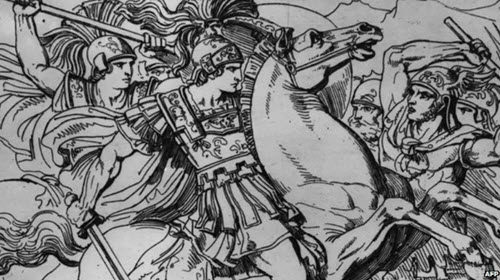
Circa 330 BC, Alexander the Great King of Macedonia, on his horse Boucephalus
Alexander the Great is portrayed as a legendary conqueror and military leader in Greek-influenced Western history books but his legacy looks very different from a Persian perspective.
Any visitor to the spectacular ruins of Persepolis - the site of the ceremonial capital of the ancient Persian Achaemenid empire, will be told three facts: it was built by Darius the Great, embellished by his son Xerxes, and destroyed by Alexander.
That man Alexander, would be the Alexander the Great, feted in Western culture as the conqueror of the Persian Empire and one of the great military geniuses of history.
Indeed, reading some Western history books one might be forgiven for thinking that the Persians existed to be conquered by Alexander.
A more inquisitive mind might discover that the Persians had twice before been defeated by the Greeks during two ill-fated invasions of Greece, by Darius the Great in 490BC and then his son, Xerxes, in 480BC - for which Alexander's assault was a justified retaliation.
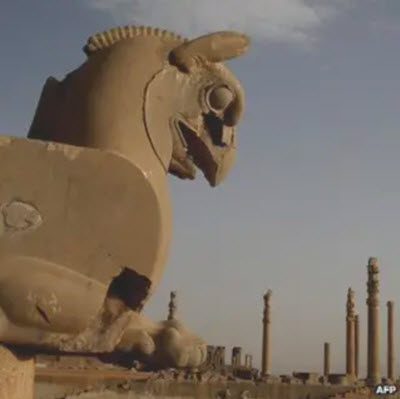
Alexander the Great razed the ancient city of Persepolis
But seen through Persian eyes, Alexander is far from "Great".
He razed Persepolis to the ground following a night of drunken excess at the goading of a Greek courtesan, ostensibly in revenge for the burning of the Acropolis by the Persian ruler Xerxes.
Persians also condemn him for the widespread destruction he is thought to have encouraged to cultural and religious sites throughout the empire.
The emblems of Zoroastrianism - the ancient religion of the Iranians - were attacked and destroyed. For the Zoroastrian priesthood in particular - the Magi - the destruction of their temples was nothing short of a calamity.
The influence of Greek language and culture has helped establish a narrative in the West that Alexander's invasion was the first of many Western crusades to bring civilisation and culture to the barbaric East.
But in fact the Persian Empire was worth conquering not because it was in need of civilising but because it was the greatest empire the world had yet seen, extending from Central Asia to Libya.
Persia was an enormously rich prize.
Look closely and you will find ample evidence that the Greeks admired the Persian Empire and the emperors who ruled it.
Much like the barbarians who conquered Rome, Alexander came to admire what he found, so much so that he was keen to take on the Persian mantle of the King of Kings.
And Greek admiration for the Persians goes back much earlier than this.
Xenophon, the Athenian general and writer, wrote a paean to Cyrus the Great - the Cyropaedia - showering praise on the ruler who showed that the government of men over a vast territory could be achieved by dint of character and force of personality:
Later Persian emperors Darius and Xerxes both invaded Greece, and were both ultimately defeated. But, remarkably, Greeks flocked to the Persian court.
The most notable was Themistocles, who fought against Darius's invading army at Marathon and masterminded the Athenian victory against Xerxes at Salamis.
Falling foul of Athenian politics, he fled to the Persian Empire and eventually found employment at the Persian Court and was made a provincial governor, where he lived out the rest of his life.
In time, the Persians found that they could achieve their objectives in Greece by playing the Greek city states against each other, and in the Peloponnesian War, Persian money financed the Spartan victory against Athens.
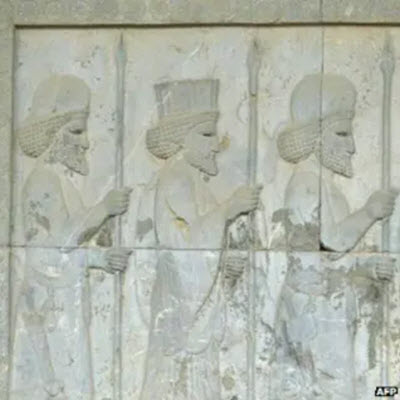
Achaemenid soldiers, seen in wall-carvings in Persepolis
The key figure in this strategy was the Persian prince and governor of Asia Minor, Cyrus the Younger, who over a number of years developed a good relationship with his Greek interlocutors such that when he decided to make his fateful bid for the throne, he was able to easily recruit some 10,000 Greek mercenaries.
Unfortunately for him, he died in the attempt.
Soldier, historian and philosopher Xenophon was among those recruited, and he was full of praise for the prince of whom he said: "Of all the Persians who lived after Cyrus the Great, he was most like a king and the most deserving of an empire."
There is a wonderful account provided by Lysander, a Spartan general, who happened to visit Cyrus the Younger in the provincial capital at Sardis.
Lysander recounts how Cyrus treated him graciously and was particularly keen to show him his walled garden - the origin of our word paradise - where Lysander congratulated the prince on the beautiful design.
When, he added, that he ought to thank the slave who had done the work and laid out the plans, Cyrus smiled and pointed out that he had laid out the design and even planted some of the trees.
On seeing the Spartan's reaction he added: "I swear to you by Mithras that, my health permitting, I never ate without having first worked up a sweat by undertaking some activity relevant either to the art of war or to agriculture, or by stretching myself in some other way."
Astonished, Lysander applauded Cyrus and said: "You deserve your good fortune Cyrus - you have it because you are a good man."
Alexander would have been familiar with stories such as these. The Persian Empire was not something to be conquered as much as an achievement to be acquired.
Although Alexander is characterised by the Persians as a destroyer, a reckless and somewhat feckless youth, the evidence suggests that he retained a healthy respect for the Persians themselves.
Alexander came to regret the destruction his invasion caused. Coming across the plundered tomb of Cyrus the Great in Pasargad, a little north of Persepolis, he was much distressed by what he found and immediately ordered repairs to be made.
Had he lived beyond his 32 years, he may yet have restored and repaired much more. In time, the Persians were to come to terms with their Macedonian conqueror, absorbing him, as other conquerors after him, into the fabric of national history.
And thus it is that in the great Iranian national epic, the Shahnameh, written in the 10th Century AD, Alexander is no longer a wholly foreign prince but one born of a Persian father.
It is a myth, but one that perhaps betrays more truth than the appearance of history may like to reveal.
Like other conquerors who followed in his footsteps even the great Alexander came to be seduced and absorbed into the idea of Iran.
Ali Ansari is a professor in modern history and director of The Institute of Iranian Studies at The University of St Andrews, Scotland.
by Prof Ali Ansari
Institute of Iranian Studies, St Andrews University
BBC News
Published 15 July 2012
https://www.bbc.com/news/magazine-18803290
Eastern territories of the Achaemenid Empire, including Arachosia.
Arachosian soldier of the Achaemenid army, circa 470 BCE, Xerxes I tomb.
Arachosian priests of Zoroastrianism carrying various gifts and animals for a ritual of sacrifice at Persepolishttps://commons.wikimedia.org/wiki/File:Persepolis,_capital_of_Persia_(TerraX,_English_redub).webm
Animated reconstruction of Persepolis
Arghandab River Valley between Kandahar and Lashkargah
The ancient Arachosia and the Pactyan people during 500 BC.
Arachosia is the Hellenized name of an ancient satrapy in the eastern part of the Achaemenid, Seleucid, Parthian, Greco-Bactrian, and Indo-Scythian empires. Arachosia was centred on the Arghandab valley in modern-day southern Afghanistan, although its influence extended east to as far as the Indus River. The main river of Arachosia was called Arachōtós, now known as the Arghandab River, a tributary of the Helmand River ... Arachosia was a part of the region of ancient Ariana....
In Old Persian inscriptions, the region is referred to as Harauvati. This form is the "etymological equivalent" of Vedic Sanskrit Sarasvati, the name of a river literally meaning "rich in waters/lakes"....
Arachosia bordered Drangiana to the west, Paropamisadae (i.e. Gandahara) to the north (a part of ancient India (present day Pakistan) to the east), and Gedrosia (or Dexendrusi) to the south. Isidore and Ptolemy (6.20.4-5) each provide a list of cities in Arachosia, among them (yet another) Alexandria, which lay on the river Arachotus. This city is frequently mis-identified with present-day Kandahar in Afghanistan....
In his list, Ptolemy also refers to a city named Arachotus, or Arachoti (acc. to Strabo), which was the earlier capital of the land....
The inhabitants of Arachosia were Iranian peoples, referred to as Arachosians or Arachoti. They were called Pactyans by ethnicity, and that name may have been in reference to the present-day ethnic Pashtun tribes.
Isidorus of Charax in his 1st century CE "Parthian stations" itinerary described an "Alexandropolis, the metropolis of Arachosia", which he said was still Greek even at such a late time....
According to Arrian, Megasthenes lived in Arachosia and travelled to Pataliputra, to the court of Chandragupta Maurya.
The region is first referred to in the Achaemenid-era Elamite Persepolis fortification tablets.With over 2100 texts published, the Persepolis Fortification Texts in Elamite, transcribed, interpreted, and edited by the late Richard Hallock, already form the largest coherent body of material on Persian administration available to us; a comparable, but less legible, body of material remains unpublished, as does the smaller group of Aramaic texts from the same archive. Essentially, they deal with the movement and expenditure of food commodities in the region of Persepolis in the fifteen years down to 493. Firstly, they make it absolutely clear that everyone in the state sphere of the Persian economy was on a fixed ration-scale, or rather, since some of the rations are on a scale impossible for an individual to consume, a fixed salary expressed in terms of commodities. The payment of rations is very highly organized. Travelers along the road carried sealed documents issued by the king or officials of satrapal level stating the scale on which they were entitled to be fed. Tablets sealed by supplier and recipient went back to Persepolis as a record of the transaction. Apart from a few places in Babylonia for short periods, Persepolis is now the best-documented area in the Achaemenid empire.
-- Persepolis Fortification Tablets, by R. T. Hallock, 1969
Elamite, also known as Hatamtite, is an extinct language that was spoken by the ancient Elamites. It was used in present-day southwestern Iran from 2600 BC to 330 BC. Elamite works disappear from the archeological record after Alexander the Great entered Iran. Elamite is generally thought to have no demonstrable relatives and is usually considered a language isolate. The lack of established relatives makes its interpretation difficult.
Proto-Elamite is the oldest known writing system from Iran. It was used during a brief period of time (c. 3100–2900 BC); clay tablets with Proto-Elamite writing have been found at different sites across Iran. It is thought to have developed from early cuneiform (proto-cuneiform) and consists of more than 1,000 signs. It is thought to be largely logographic....
The Elamite language may have remained in widespread use after the Achaemenid period. Several rulers of Elymais bore the Elamite name Kamnaskires in the 2nd and 1st centuries BC. The Acts of the Apostles (c. 80–90 AD) mentions the language as if it was still current. There are no later direct references, but Elamite may be the local language in which, according to the Talmud, the Book of Esther was recited annually to the Jews of Susa in the Sasanian period (224–642 AD)....
-- Elamite language, by Wikipedia
It appears again in the Old Persian, Akkadian and Aramaic inscriptions of Darius I [550 B.C.–486 B.C.] and Xerxes I [518 B.C.–August 465 BC] among lists of subject peoples and countries.The scribes of the Neo-Assyrian bureaucracy had also used Aramaic, and this practice was subsequently inherited by the succeeding Neo-Babylonian Empire (605–539 BC), and later by the Achaemenid Empire (539–330 BC). Mediated by scribes that had been trained in the language, highly standardized written Aramaic (named by scholars as Imperial Aramaic) progressively also become the lingua franca of public life, trade and commerce throughout the Achaemenid territories. Wide use of written Aramaic subsequently led to the adoption of the Aramaic alphabet and (as logograms) some Aramaic vocabulary in the Pahlavi scripts, which were used by several Middle Iranian languages (including Parthian, Middle Persian, Sogdian, and Khwarazmian).
-- Aramaic, by Wikipedia
The Aramaic inscription of Laghman, also called the Laghman I inscription to differentiate from the Laghman II inscription discovered later, is an inscription on a slab of natural rock in the area of Laghmân, Afghanistan.... Since Aramaic was an official language of the Achaemenid Empire, and reverted to being just its vernacular tongue in 320 BCE with the conquests of Alexander the Great, it seems that this inscription was addressed directly to the populations of this ancient empire still present in this area, or to border populations for whom Aramaic remained the language used in everyday life....
In 1915, Sir John Marshall had discovered the Aramaic Inscription of Taxila,
Aramaic inscription of Taxila.
The Aramaic Inscription of Taxila 'is an inscription on a piece of marble, originally belonging to an octagonal column, discovered by Sir John Marshall in 1915 at Taxila, British India.
-- Aramaic Inscription of Taxila, by Wikipedia
followed in 1932 by the Pul-i-Darunteh Aramaic inscription.
The Pul-i-Darunteh Aramaic inscription, also called Aramaic inscription of Lampaka, is an inscription on a rock in the valley of Laghman ("Lampaka" being the transcription in Sanskrit of "Laghman"), Afghanistan.
-- Pul-i-Darunteh Aramaic inscription, by Wikipedia
In 1958 the famous Bilingual Kandahar Inscription, written in Greek and Aramaic was discovered,
... This bilingual edict was found on a rock on the mountainside of Chehel Zina (also Chilzina, or Chil Zena, "Forty Steps"), which forms the western natural bastion of ancient Alexandria Arachosia and present Kandahar's Old City.
The Edict is still in place on the mountainside. According to Scerrato, "the block lies at the eastern base of the little saddle between the two craggy hills below the peak on which the celebrated Cehel Zina of Babur are cut". A cast is visible in Kabul Museum. [T]he Edict.. advocates the adoption of "Piety" (using the Greek term Eusebeia for "Dharma") to the Greek community....
According to Sircar, the usage of Greek in the Edict indeed means that the message was intended for the Greeks living in Kandahar, while the usage of Aramaic was intended for the Iranian populations of the Kambojas....At Alexandria-in-Arachosia (mod. Kandahar) a bilingual Greek-Aramaic text, urging vegetarianism and filial piety, was cut into the cliff face by the side of the main trade road. The inscription demonstrates a keen awareness of the culturally specific traditions and languages of the region's "Yona and Kamboja" (Greek and Persian) populations: the Greek version combines vocabulary appropriate to oracular pronouncement and contemporary philosophy, while the Aramaic version, heavily influenced by Old Persian, assimilates dhamma to Zoroastrian truth.
-- Chapter 1: India – Diplomacy and Ethnography at the Mauryan Empire, Excerpt from "The Land of the Elephant Kings: Space, Territory, and Ideology in the Seleucid Empire", by Paul J. Kosmin, 2014English (translation of the Greek)
Ten years (of reign) having been completed, King Piodasses made known (the doctrine of) Piety (εὐσέβεια, Eusebeia) to men; and from this moment he has made men more pious, and everything thrives throughout the whole world. And the king abstains from (killing) living beings, and other men and those who (are) huntsmen and fishermen of the king have desisted from hunting. And if some (were) intemperate, they have ceased from their intemperance as was in their power; and obedient to their father and mother and to the elders, in opposition to the past also in the future, by so acting on every occasion, they will live better and more happily."...
-- Kandahar Bilingual Rock Inscription, by Wikipedia
In the same year 1963 and again in Kandahar, an inscription in "Indo-Aramaic" known as the Kandahar Aramaic inscription or Kandahar II was found, in which the Indian Prakrit language and the Aramaic language alternate, but using only the Aramaic script....
-- Aramaic Inscription of Laghman, by Wikipedia
Alexander the Great in Arachosia, 329 BCE.
The chronologically next reference to Arachosia comes from the Greeks and Romans, who record that under Darius III the Arachosians and Drangians were under the command of a governor who, together with the army of the Bactrian governor, contrived a plot of the Arachosians against Alexander (Curtius Rufus 8.13.3). Following Alexander's conquest of the Achaemenids, the Macedonian appointed his generals as governors (Arrian 3.28.1, 5.6.2; Curtius Rufus 7.3.5; Plutarch, Eumenes 19.3; Polyaenus 4.6.15; Diodorus 18.3.3; Orosius 3.23.1 3; Justin 13.4.22).
-- Arachosia, by Wikipedia
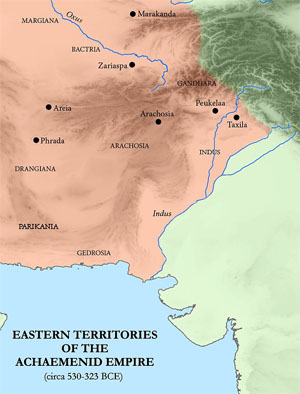
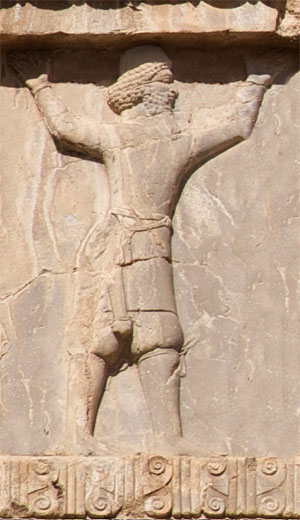
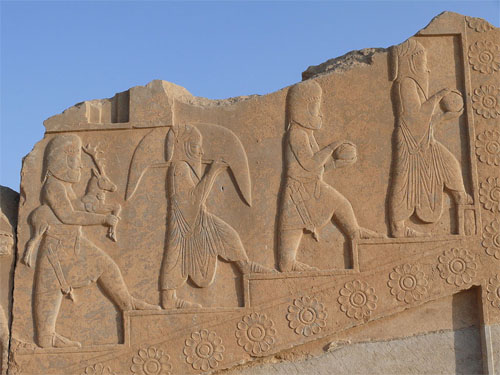
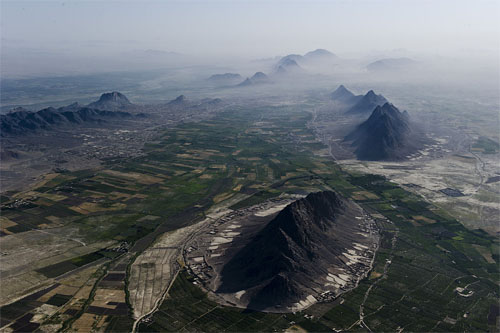
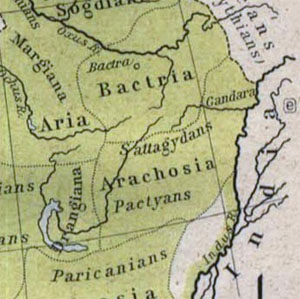
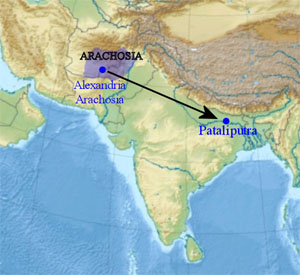
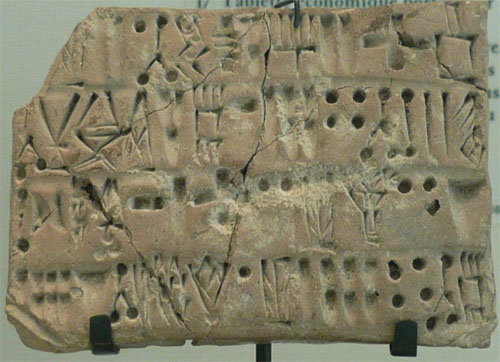
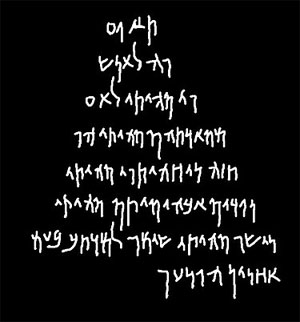
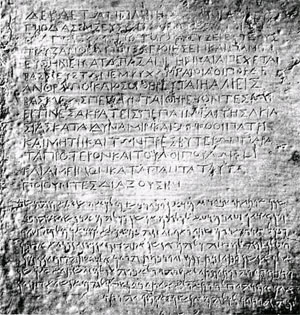
Circa 330 BC, Alexander the Great King of Macedonia, on his horse Boucephalus
Alexander the Great is portrayed as a legendary conqueror and military leader in Greek-influenced Western history books but his legacy looks very different from a Persian perspective.
Any visitor to the spectacular ruins of Persepolis - the site of the ceremonial capital of the ancient Persian Achaemenid empire, will be told three facts: it was built by Darius the Great, embellished by his son Xerxes, and destroyed by Alexander.
That man Alexander, would be the Alexander the Great, feted in Western culture as the conqueror of the Persian Empire and one of the great military geniuses of history.
Indeed, reading some Western history books one might be forgiven for thinking that the Persians existed to be conquered by Alexander.
A more inquisitive mind might discover that the Persians had twice before been defeated by the Greeks during two ill-fated invasions of Greece, by Darius the Great in 490BC and then his son, Xerxes, in 480BC - for which Alexander's assault was a justified retaliation.
Alexander the Great razed the ancient city of Persepolis
But seen through Persian eyes, Alexander is far from "Great".
He razed Persepolis to the ground following a night of drunken excess at the goading of a Greek courtesan, ostensibly in revenge for the burning of the Acropolis by the Persian ruler Xerxes.
Persians also condemn him for the widespread destruction he is thought to have encouraged to cultural and religious sites throughout the empire.
The emblems of Zoroastrianism - the ancient religion of the Iranians - were attacked and destroyed. For the Zoroastrian priesthood in particular - the Magi - the destruction of their temples was nothing short of a calamity.
The influence of Greek language and culture has helped establish a narrative in the West that Alexander's invasion was the first of many Western crusades to bring civilisation and culture to the barbaric East.
But in fact the Persian Empire was worth conquering not because it was in need of civilising but because it was the greatest empire the world had yet seen, extending from Central Asia to Libya.
Persia was an enormously rich prize.
Look closely and you will find ample evidence that the Greeks admired the Persian Empire and the emperors who ruled it.
Much like the barbarians who conquered Rome, Alexander came to admire what he found, so much so that he was keen to take on the Persian mantle of the King of Kings.
And Greek admiration for the Persians goes back much earlier than this.
Xenophon, the Athenian general and writer, wrote a paean to Cyrus the Great - the Cyropaedia - showering praise on the ruler who showed that the government of men over a vast territory could be achieved by dint of character and force of personality:
"Cyrus was able to penetrate that vast extent of country by the sheer terror of his personality that the inhabitants were prostrate before him…," wrote Xenophon, "and yet he was able at the same time, to inspire them all with so deep a desire to please him and win his favour that all they asked was to be guided by his judgment and his alone.
"Thus he knit to himself a complex of nationalities so vast that it would have taxed a man's endurance merely to traverse his empire in any one direction."
Later Persian emperors Darius and Xerxes both invaded Greece, and were both ultimately defeated. But, remarkably, Greeks flocked to the Persian court.
The most notable was Themistocles, who fought against Darius's invading army at Marathon and masterminded the Athenian victory against Xerxes at Salamis.
Falling foul of Athenian politics, he fled to the Persian Empire and eventually found employment at the Persian Court and was made a provincial governor, where he lived out the rest of his life.
In time, the Persians found that they could achieve their objectives in Greece by playing the Greek city states against each other, and in the Peloponnesian War, Persian money financed the Spartan victory against Athens.
Achaemenid soldiers, seen in wall-carvings in Persepolis
The key figure in this strategy was the Persian prince and governor of Asia Minor, Cyrus the Younger, who over a number of years developed a good relationship with his Greek interlocutors such that when he decided to make his fateful bid for the throne, he was able to easily recruit some 10,000 Greek mercenaries.
Unfortunately for him, he died in the attempt.
Soldier, historian and philosopher Xenophon was among those recruited, and he was full of praise for the prince of whom he said: "Of all the Persians who lived after Cyrus the Great, he was most like a king and the most deserving of an empire."
There is a wonderful account provided by Lysander, a Spartan general, who happened to visit Cyrus the Younger in the provincial capital at Sardis.
Lysander recounts how Cyrus treated him graciously and was particularly keen to show him his walled garden - the origin of our word paradise - where Lysander congratulated the prince on the beautiful design.
When, he added, that he ought to thank the slave who had done the work and laid out the plans, Cyrus smiled and pointed out that he had laid out the design and even planted some of the trees.
On seeing the Spartan's reaction he added: "I swear to you by Mithras that, my health permitting, I never ate without having first worked up a sweat by undertaking some activity relevant either to the art of war or to agriculture, or by stretching myself in some other way."
Astonished, Lysander applauded Cyrus and said: "You deserve your good fortune Cyrus - you have it because you are a good man."
Alexander would have been familiar with stories such as these. The Persian Empire was not something to be conquered as much as an achievement to be acquired.
Although Alexander is characterised by the Persians as a destroyer, a reckless and somewhat feckless youth, the evidence suggests that he retained a healthy respect for the Persians themselves.
Alexander came to regret the destruction his invasion caused. Coming across the plundered tomb of Cyrus the Great in Pasargad, a little north of Persepolis, he was much distressed by what he found and immediately ordered repairs to be made.
Had he lived beyond his 32 years, he may yet have restored and repaired much more. In time, the Persians were to come to terms with their Macedonian conqueror, absorbing him, as other conquerors after him, into the fabric of national history.
And thus it is that in the great Iranian national epic, the Shahnameh, written in the 10th Century AD, Alexander is no longer a wholly foreign prince but one born of a Persian father.
It is a myth, but one that perhaps betrays more truth than the appearance of history may like to reveal.
Like other conquerors who followed in his footsteps even the great Alexander came to be seduced and absorbed into the idea of Iran.
Ali Ansari is a professor in modern history and director of The Institute of Iranian Studies at The University of St Andrews, Scotland.
- admin
- Site Admin
- Posts: 41396
- Joined: Thu Aug 01, 2013 5:21 am
Re: FREDA BEDI CONT'D (#4)
by admin » Wed May 13, 2026 11:15 pm
Part 1 of 2
Persepolis
by Wikipedia
Accessed: 5/13/25
https://en.wikipedia.org/wiki/Persepolis
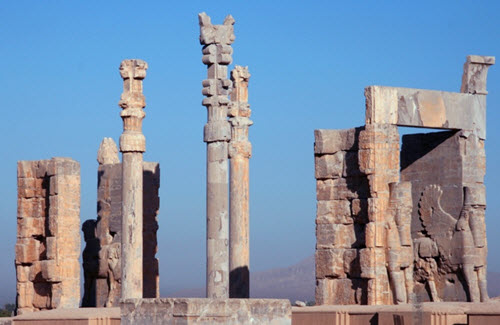
Gate of All Nations in Persepolis
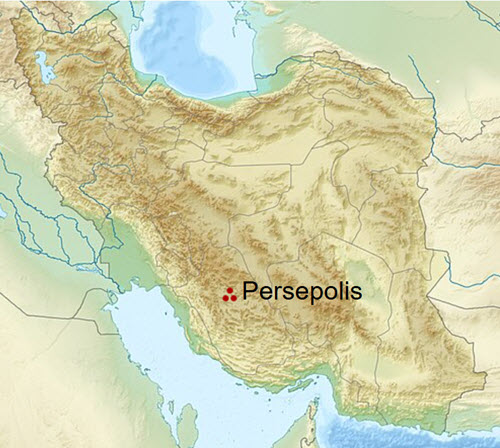
Map of Iran
Location: Marvdasht, Fars province, Iran[1]
Coordinates: 29.935°N 52.890°E
Type: Settlement
History
Builder: Darius I, Xerxes I and Artaxerxes I
Material: Limestone, mud-brick, cedar wood
Founded: 6th century BC
Abandoned: 330 BC
Periods: Achaemenid Empire
Cultures: Persian
Events
• Battle of the Persian Gates
• Macedonian sack of Persepolis
• Nowruz
• The 2,500 Year Celebration of the Persian Empire
Site notes
Condition: Ruins
Management: Cultural Heritage, Handicrafts and Tourism Organization of Iran
Public access: Open
Website: persepolis.ir
Architecture
Architectural styles: Achaemenid
UNESCO World Heritage Site
Official name: Persepolis
Type: Cultural
Criteria: i, iii, vi
Designated: 1979 (3rd session)
Reference no.: 114
Region: Asia-Pacific
Persepolis[a] was the ceremonial capital of the Achaemenid Empire (c. 550–330 BC). It is situated in the plains of Marvdasht, encircled by the southern Zagros Mountains, Fars province of Iran. It is one of the key Iranian cultural heritage sites and a UNESCO World Heritage Site.[2]
The earliest remains of Persepolis date back to 515 BC.[3] The city, acting as a major center for the empire, housed a palace complex and citadel designed to serve as the focal point for governance and ceremonial activities.[4] It exemplifies the Achaemenid style of architecture. The complex was taken by the army of Alexander the Great in 330 BC, and soon after, its wooden parts were completely destroyed by fire. According to one theory, Alexander deliberately set fire to Persepolis to avenge the destruction of Athens by the Persians; a second theory is that it was at the urging of Thaïs, a courtesan, during a feast when Alexander was intoxicated.[3][5]
The exact function of Persepolis remains unclear. It was not one of the largest cities in ancient Iran, let alone the rest of the empire, but appears to have been a grand ceremonial complex that was only occupied seasonally; the complex was raised high on a walled platform, with five "palaces" or halls of varying size, and grand entrances. It is still not entirely clear where the king's private quarters actually were. Until recently, most archaeologists held that it was primarily used for celebrating Nowruz, the Persian New Year, held at the spring equinox, which is still an important annual festivity in Iran. The Iranian nobility and the tributary parts of the empire came to present gifts to the king, as represented in the stairway reliefs. It is also unclear what permanent structures there were outside the palace complex; due to these factors, Persepolis is more often referred to as a complex rather than a "city" in the usual sense.[3]
The exploration of Persepolis from the early 17th century led to the modern rediscovery of cuneiform writing and, from detailed studies of the trilingual Achaemenid royal inscriptions found on the ruins, the initial decipherment of cuneiform in the early 19th century.[6]
Etymology
Persepolis is derived from the Greek Περσέπολις, Persepolis, a compound of Pérsēs ([x]) and pólis ([x], together meaning "the Persian city" or "the city of the Persians"). To the ancient Persians, the city was known as Pārsa (Old Persian: [x]), which is also the word for the region of Persia.[7][8]
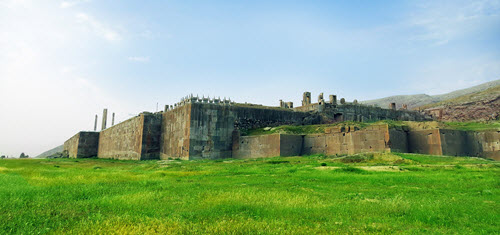
As is typical of Achaemenid cities, Persepolis was built on a (partially) artificial platform.
An inscription left in 311 AD by Sasanian Prince Shapur Sakanshah, the son of Hormizd II, refers to the site as Sad-stūn, meaning "Hundred Pillars".[9] Because medieval Persians attributed the site to Jamshid,[10] a king from Iranian mythology, it has been referred to as Takht-e-Jamshid (Persian: [[x], Taxt e Jamšīd; [[x]ʃiːd]), literally meaning "Throne of Jamshid". Another name given to the site in the medieval period was Čehel Menâr (Persian: [x], "Forty Minarets"),[9] transcribed as Chilminara in De Silva Figueroa[11] and as Chilminar in early English sources.[12]
History
Construction
Archaeological evidence shows that the earliest remains of Persepolis date back to 515 BC. André Godard, the French archaeologist who excavated Persepolis in the early 1930s, believed that it was Cyrus the Great who chose the site of Persepolis, but that it was Darius I who built the terrace and the palaces. Inscriptions on these buildings support the belief that they were constructed by Darius.
With Darius I, the sceptre passed to a new branch of the royal house. The country's true capitals were Susa, Babylon and Ecbatana. This may be why the Greeks were not acquainted with the city until Alexander the Great took and plundered it.
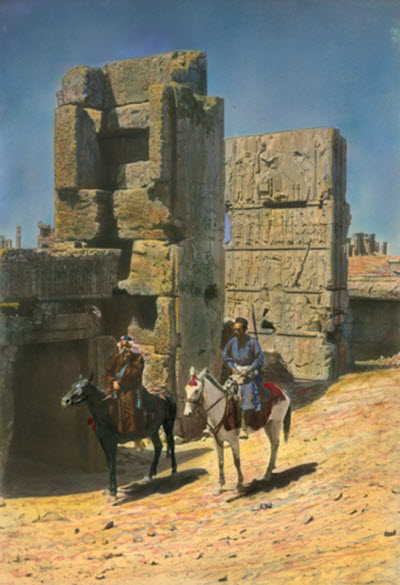
Persepolis in 1920s, photo by Harold Weston
Darius I's construction of Persepolis was carried out parallel to that of the Palace of Susa.[13] According to Gene R. Garthwaite, the Susa Palace served as Darius' model for Persepolis.[14] Darius I ordered the construction of the Apadana and the Council Hall (Tripylon or the "Triple Gate"), as well as the main imperial Treasury and its surroundings. These were completed during the reign of his son, Xerxes I. Further construction of the buildings on the terrace continued until the downfall of the Achaemenid Empire.[15] According to the Encyclopædia Britannica, the Greek historian Ctesias mentioned that Darius I's grave was in a cliff face that could be reached with an apparatus of ropes.[16]
Around 519 BC, construction of a broad stairway was begun. Grey limestone was the main building material used at Persepolis. The uneven plan of the terrace, including the foundation, acted like a castle, whose angled walls enabled its defenders to target any section of the external front.
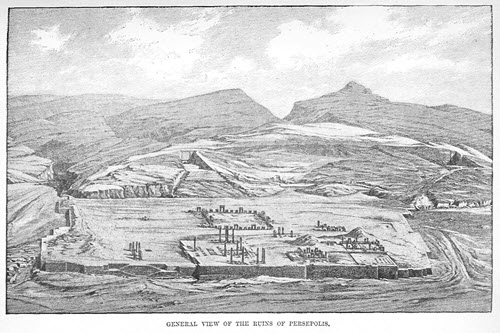
General view of the Persepolis
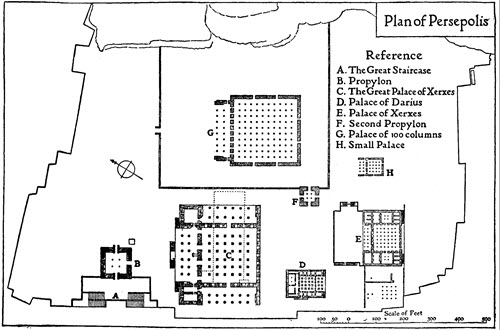
Aerial architectural plan of Persepolis
https://en.wikipedia.org/wiki/File:Persepolis,_capital_of_Persia_(TerraX,_English_redub).webm
Animated reconstruction of Persepolis
Destruction
After invading Achaemenid Persia in 330 BC, Alexander the Great sent the main force of his army to Persepolis by the Royal Road. Diodorus Siculus writes that on his way to the city, Alexander and his army were met by 800 Greek artisans who had been captured by the Persians. Most were elderly and suffered some form of mutilation, such as a missing hand or foot. They explained to Alexander the Persians wanted to take advantage of their skills in the city but handicapped them so they could not easily escape. Alexander and his staff were disturbed by the story and provided the artisans with clothing and provisions before continuing on to Persepolis. Diodorus does not cite this as a reason for the destruction of Persepolis, but it is possible Alexander started to see the city in a negative light after this encounter.[17]
Upon reaching the city, Alexander stormed the Persian Gates, a pass through Zagros Mountains. There, Ariobarzanes of Persis successfully ambushed Alexander the Great's army, inflicting heavy casualties. After being held off for 31 days, Alexander the Great outflanked and destroyed the defenders. Ariobarzanes himself was killed either during the battle or during the retreat to Persepolis. Some sources indicate that the Persians were betrayed by a captured tribal chief who showed the Macedonians an alternate path that allowed them to outflank Ariobarzanes in a reversal of Thermopylae. After several months, Alexander allowed his troops to loot Persepolis.
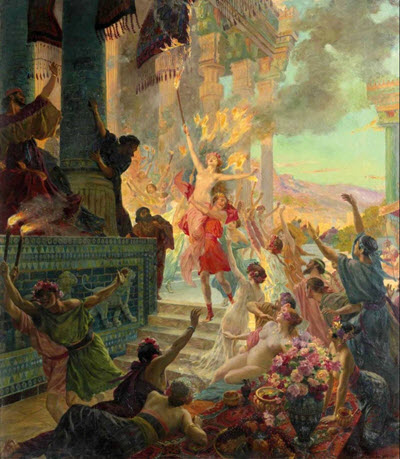
"The Burning of Persepolis", led by Thaïs, 1890, by Georges-Antoine Rochegrosse
Around that time, a fire burned "the palaces" or "the palace".
Thaïs setting fire to Persepolis
It is believed that the fire which destroyed Persepolis started from Hadish Palace, which was the living quarters of Xerxes I, and spread to the rest of the city.[18] It is not clear if the fire was an accident or a deliberate act of revenge for the burning of the Acropolis of Athens during the second Persian invasion of Greece. Many historians argue that, while Alexander's army celebrated with a symposium, they decided to take revenge against the Persians.[19] If that is so, then the destruction of Persepolis could be both an accident and a case of revenge. The fire may also have had the political purpose of destroying an iconic symbol of the Persian monarchy that might have become a focus for Persian resistance.
Several, much later, Greek and Roman accounts (including Plutarch, Diodorus Siculus and Quintus Curtius Rufus) describe that the burning was the idea of Thaïs, mistress of Alexander's general Ptolemy I Soter, and possibly of Alexander himself. She is said to have suggested it during a very drunken celebration, according to some accounts to revenge the destruction of Greek sanctuaries (she was from Athens), and either she or Alexander himself set the fire going.[20]
The Book of Arda Wiraz, a Zoroastrian work composed in the 3rd or 4th century, describes Persepolis' archives as containing "all the Avesta and Zend, written upon prepared cow-skins, and with gold ink", which were destroyed. Indeed, in his Chronology of the Ancient Nations, the native Iranian writer Biruni indicates unavailability of certain native Iranian historiographical sources in the post-Achaemenid era, especially during the Parthian Empire. He adds: "[Alexander] burned the whole of Persepolis as revenge to the Persians, because it seems the Persian King Xerxes had burnt the Greek City of Athens around 150 years ago. People say that, even at the present time, the traces of fire are visible in some places."[19][21]
On the upside, the fire that destroyed those texts may have preserved the Persepolis Administrative Archives by preventing them from being lost over time to natural and man-made events.[22] According to archaeological evidence, the partial burning of Persepolis did not damage what are now referred to as the Persepolis Fortification Archive tablets, but rather may have caused the eventual collapse of the upper part of the northern fortification wall, preserving the tablets until their recovery by the Oriental Institute's archaeologists.[23]
After the fall of the Achaemenid Empire
In 316 BC, Persepolis was still the capital of Persia as a province of the great Macedonian Empire (see Diodorus Siculus xix, 21 seq., 46; probably after Hieronymus of Cardia, who was living about 326). The city must have gradually declined in the course of time. The lower city at the foot of the imperial city might have survived for a longer time;[24] but the ruins of the Achaemenids remained as a witness to its ancient glory.
The nearby Estakhr gained prominence as a separate city very shortly after the decline of Persepolis. It appears that much of Persepolis' rubble was used for the building of Istakhr.[25] At the time of the Muslim invasion of Persia, Estakhr offered a desperate resistance. It was still a place of considerable importance in the first century of Islam, although its greatness was speedily eclipsed by the new metropolis of Shiraz. In the 10th century, Estakhr dwindled to insignificance. During the following centuries, Estakhr gradually declined, until it ceased to exist as a city.
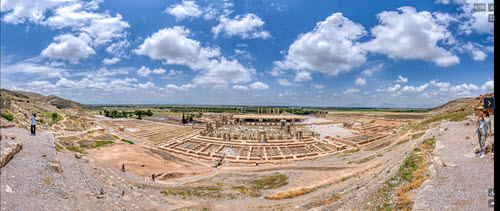
Persepolis Panorama (17 May 2024)
Geography
Persepolis is near the small river Pulvar, which flows into the Kur River. The site includes a 125,000 m2 (1,350,000 sq ft) terrace, partly artificially constructed and partly cut out of a mountain, with its east side leaning on Rahmat Mountain.
Archaeological research
See also: Nowruz § Achaemenid period
Odoric of Pordenone may have passed through Persepolis on his way to China in 1320, although he mentioned only a great, ruined city called "Comerum".[26] In 1474, Giosafat Barbaro visited the ruins of Persepolis, which he incorrectly thought were of Jewish origin.[27] Hakluyt's Voyages included a general account of the ruins of Persepolis attributed to an English merchant who visited Iran in 1568.[28][29] António de Gouveia from Portugal wrote about cuneiform inscriptions following his visit in 1602. His report on the ruins of Persepolis was published as part of his Relaçam in 1611.[30]
In 1618, García de Silva Figueroa, King Philip III of Spain's ambassador to the court of Abbas I, the Safavid monarch, was the first Western traveler to link the site known in Iran as "Chehel Minar" as the site known from Classical authors as Persepolis.[31][11]
Pietro Della Valle visited Persepolis in 1621, and noticed that only 25 of the 72 original columns were still standing, due to either vandalism or natural processes.[32] The Dutch traveler Cornelis de Bruijn visited Persepolis in 1704.[33]
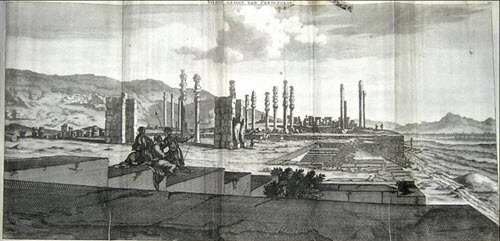
Sketch of Persepolis from 1704 by Cornelis de Bruijn
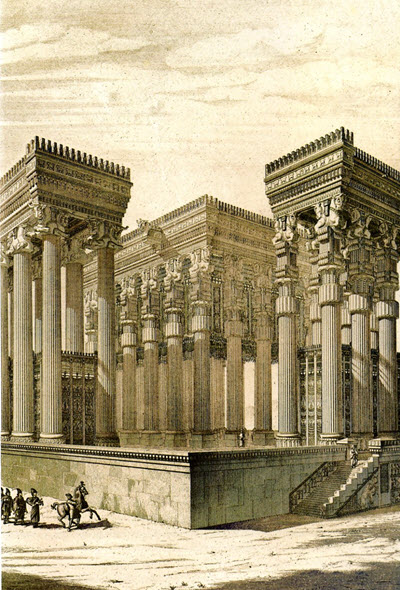
The Apadana by Charles Chipiez
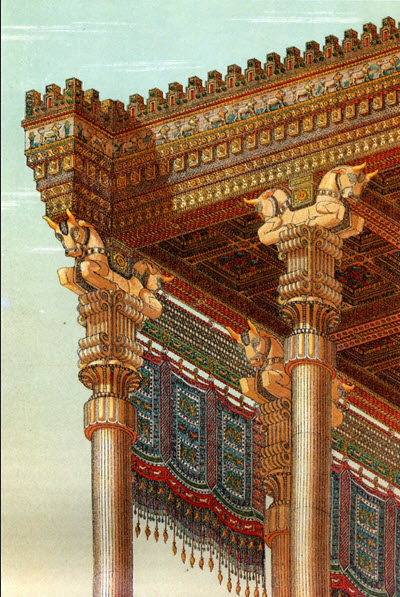
Apadana detail by Charles Chipiez
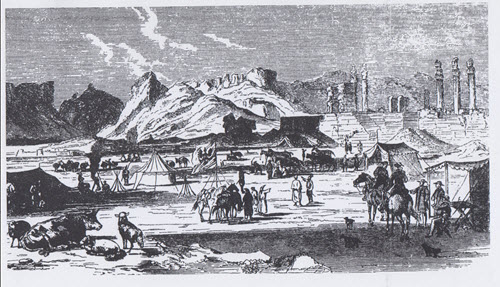
Prussia board at Persepolis, 1862–1863
The first scientific explorations in Persepolis were conducted by Ernst Herzfeld in 1931
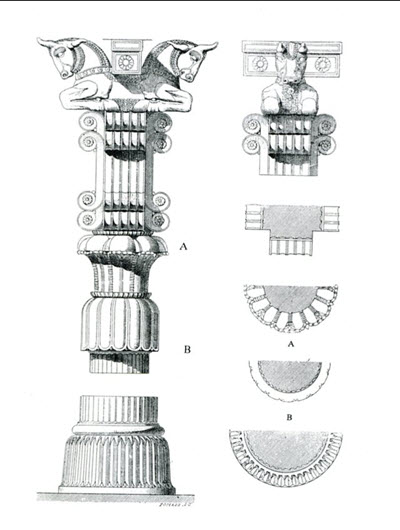
The design and details of the columns of Persepolis
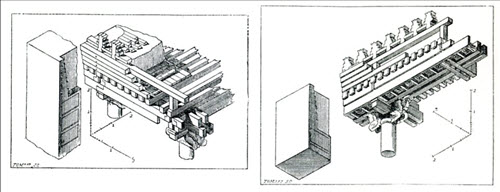
Roof design of palaces at Persepolis
The fruitful region was covered with villages until its frightful devastation in the 18th century; and even now it is, comparatively speaking, well cultivated. The Castle of Estakhr played a conspicuous part as a strong fortress, several times, during the Muslim period. It was the middlemost and the highest of the three steep crags which rise from the valley of the Kur, at some distance to the west or northwest of the necropolis of Naqsh-e Rustam.
The French voyagers Eugène Flandin and Pascal Coste are among the first to provide not only a literary review of the structure of Persepolis, but also to create some of the best and earliest visual depictions of its structure. In their publications in Paris, in 1881 and 1882, titled Voyages en Perse de MM. Eugene Flanin peintre et Pascal Coste architecte, the authors provided some 350 ground breaking illustrations of Persepolis.[34] French influence and interest in Persia's archaeological findings continued after the accession of Reza Shah, when André Godard became the first director of the archeological service of Iran.[35]
In the 1800s, a variety of amateur digging occurred at the site, in some cases on a large scale.[34]
The first scientific excavations at Persepolis were carried out by Ernst Herzfeld and Erich Schmidt representing the Oriental Institute of the University of Chicago. They conducted excavations for eight seasons, beginning in 1930, and included other nearby sites.[36][37][38][39][40]
Frieze designs at Persepolis
Herzfeld believed that the reasons behind the construction of Persepolis were the need for a majestic atmosphere, a symbol for the empire, and to celebrate special events, especially the Nowruz.[8] For historical reasons, Persepolis was built where the Achaemenid dynasty was founded, although it was not the center of the empire at that time.
Excavations of plaque fragments hint at a scene with a contest between Herakles and Apollo, dubbed A Greek painting at Persepolis.[41]
Architecture
Persepolitan architecture is noted for its use of the Persian column, which was probably based on earlier wooden columns.
The buildings at Persepolis include three general groupings: military quarters, the treasury, and the reception halls and occasional houses for the King. Noted structures include the Great Stairway, the Gate of All Nations, the Apadana, the Hall of a Hundred Columns, the Tripylon Hall and the Tachara, the Hadish Palace, the Palace of Artaxerxes III, the Imperial Treasury, the Royal Stables, and the Chariot House.[42]
Remains
Entrance staircase
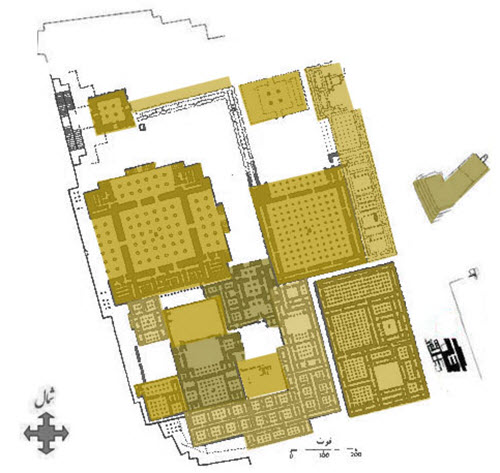
Reliefs of lotus flowers are frequently used on the walls and monuments at Persepolis.
Ruins of a number of colossal buildings exist on the terrace. All are constructed of dark-grey marble. Fifteen of their pillars stand intact. Three more pillars have been re-erected since 1970. Several of the buildings were never finished.
Behind the compound at Persepolis, there are three sepulchers hewn out of the rock in the hillside.
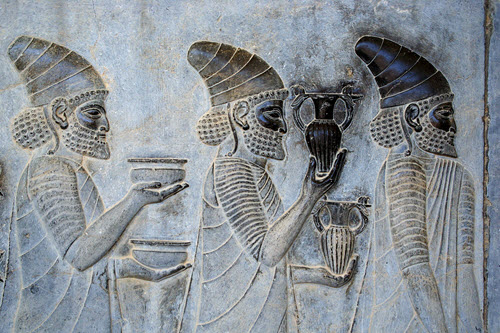
A bas-relief from the Apadana Palace depicting Delegations including Lydians and Armenians[43] bringing their famous wine to the king.
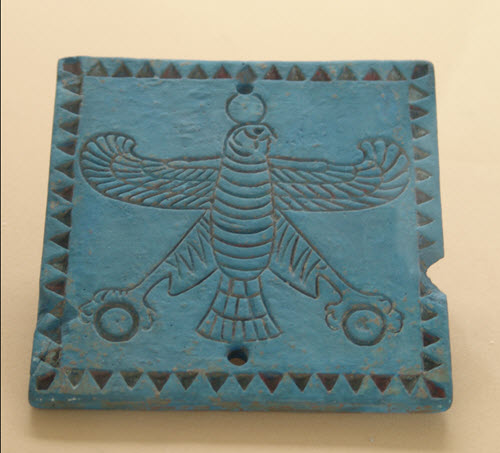
Achaemenid plaque from Persepolis, kept at the National Museum of Iran.
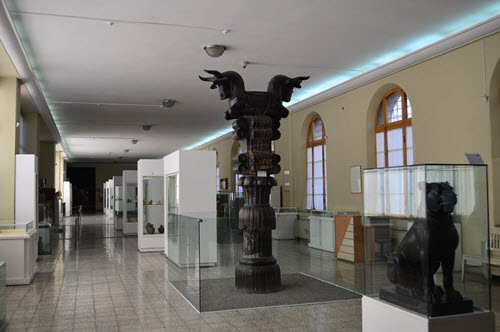
Objects from Persepolis kept at the National Museum of Iran
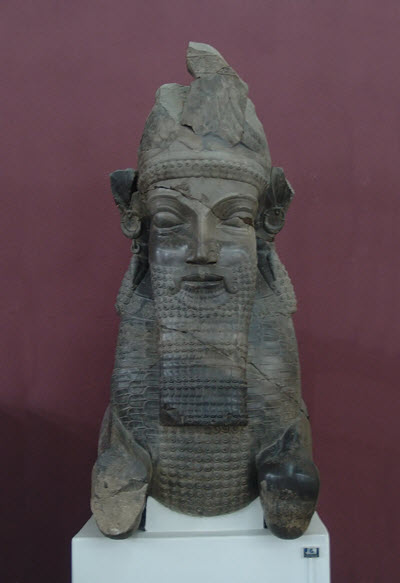
The head of a Lamassu from Persepolis, kept at the National Museum of Iran
Door-Post Socket
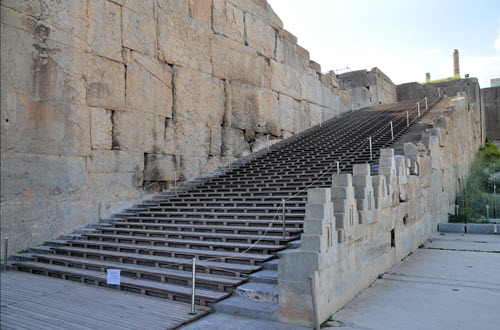
The Great Double Staircase at Persepolis
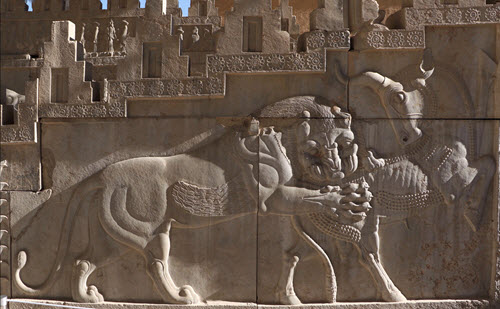
A bas-relief at Persepolis, representing a symbol in Zoroastrianism for Nowruz.[ b]
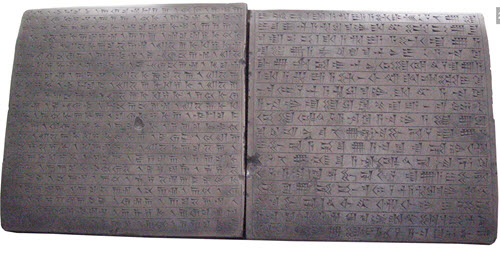
Tablets of Xerxes, kept at the National Museum of Iran
One of the four existing statues of Penelope was discovered at Persepolis, and is kept at the National Museum of Iran
The Gate of All Nations
Main article: Gate of All Nations
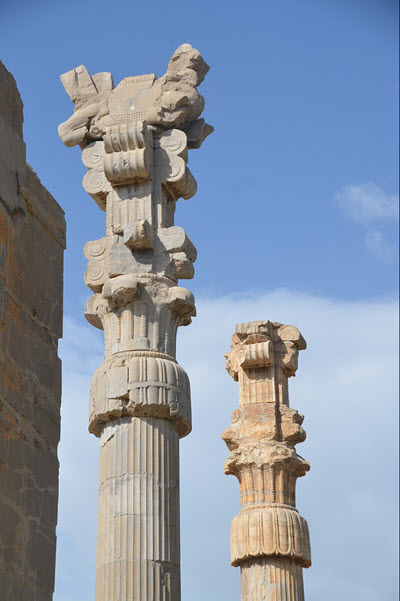
The stone columns of the Gate of All Nations, they are 16½ meters high and were topped with capitals in the form of a double bull.
The Gate of All Nations, referring to subjects of the empire, consisted of a grand hall that was a square of approximately 25 m (82 ft) in length, with four columns and its entrance on the Western Wall.
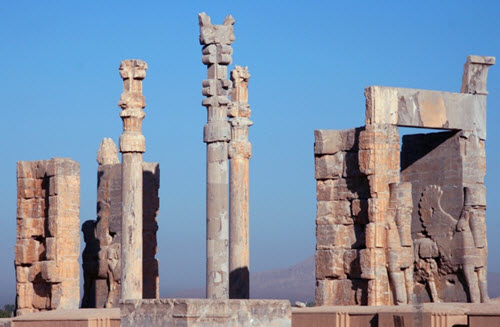
The Gate of All Nations, Persepolis
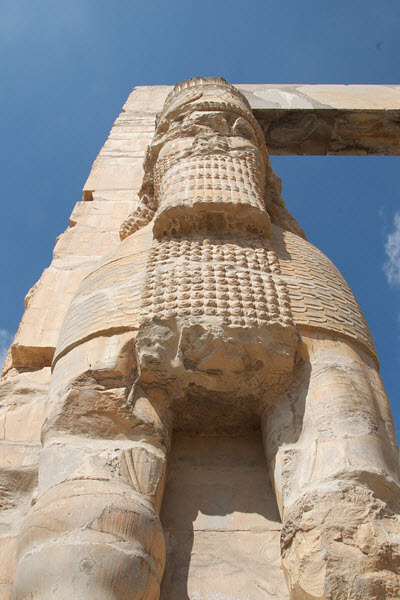
A Lamassu at the Gate of All Nations
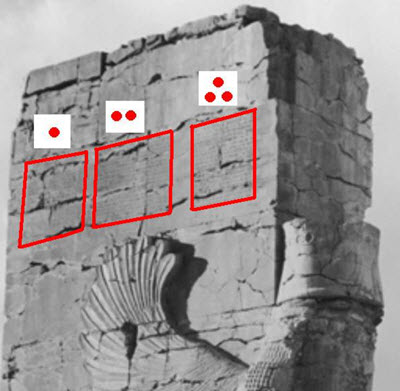
The position of three languages inscriptions on The Gate of All Nations, Persepolis
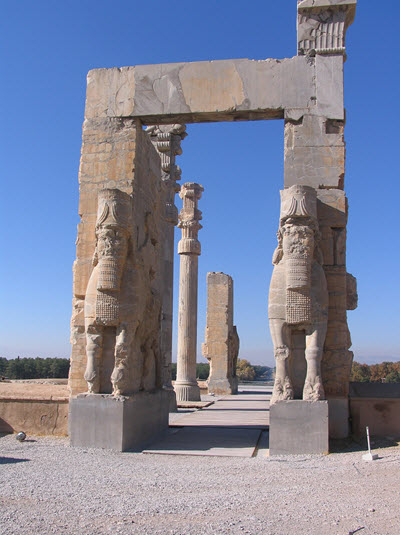
The two Lamassu at the Gate of All Nations.
The Apadana Palace
Main article: Apadana
Darius I built the greatest palace at Persepolis on the western side of platform. This palace was called the Apadana.[44] The King of Kings used it for official audiences.
Foundation tablets of gold and silver were found in two deposition boxes in the foundations of the Palace.[45] They contained an inscription by Darius in Old Persian cuneiform, which describes the extent of his Empire in broad geographical terms, and is known as the DPh inscription:[46][47]
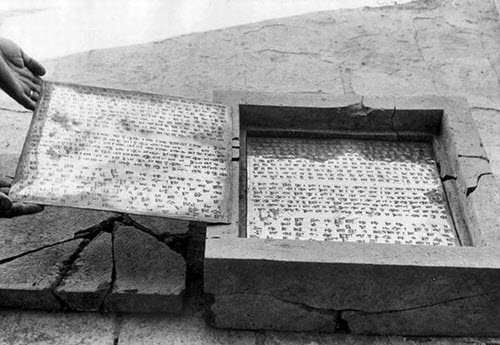
Gold foundation tablets of Darius I for the Apadana Palace, in their original stone box. The Apadana coin hoard had been deposited underneath. c. 510 BC. Both are kept at the National Museum of Iran.
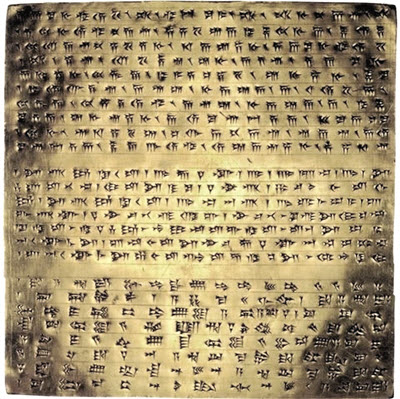
One of the two gold deposition plates. Two more were in silver. They all had the same trilingual inscription (DPh inscription).[48]
The reliefs on the staircases allow one to observe the people from across the empire in their traditional dress, and even the king himself, "down to the smallest detail".[14]
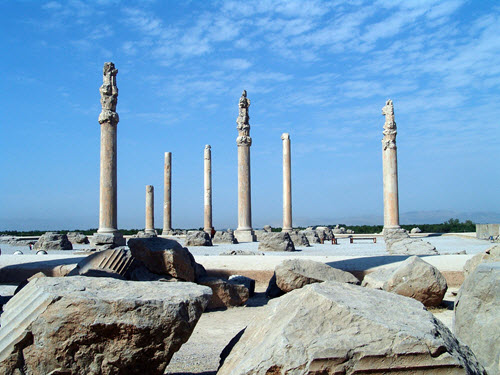
Apadana palace, Persepolis
Depiction of trees and Lotus flowers at the Apadana, Persepolis
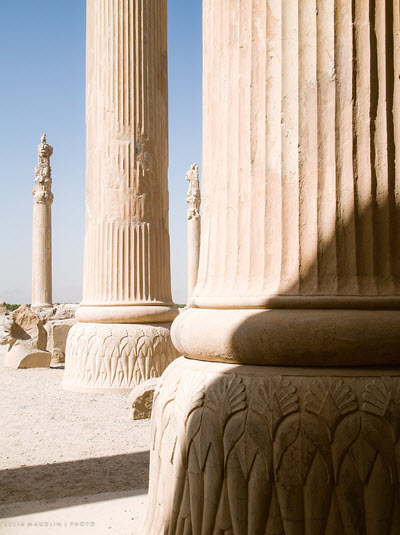
Apadana's columns, Persepolis
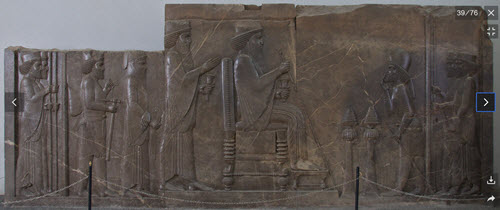
The central wall of the northern stairs of Apadana palace, which shows Xerxes sitting on the throne and receiving an important official. Kept at the National Museum of Iran. Its counterpart remains at Persepolis.
Apadana Palace coin hoard
Apadana hoard
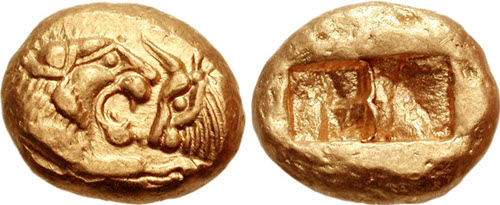
Gold Croeseid minted in the time of Darius, of the type of the eight Croeseids found in the Apadana hoard, c. 545–520 BC. Light series: 8.07 g (0.285 oz), Sardis mint.
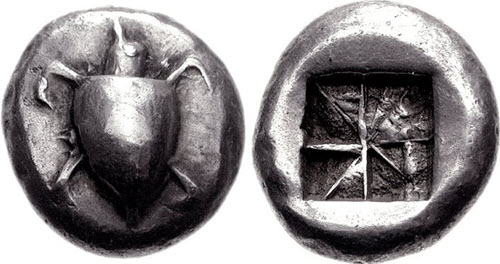
Type of the Aegina stater found in the Apadana hoard, 550–530 BC. Obverse: Sea turtle with large pellets down centre. Reverse: incuse square punch with eight sections.[46]
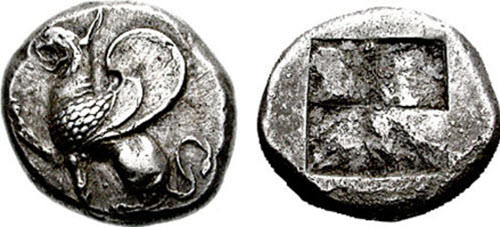
Type of the Abdera coin found in the Apadana hoard, c. 540/35–520/15 BC. Obverse: Griffin seated left, raising paw. Reverse: Quadripartite incuse square.[46]
Main articles: Apadana hoard and Achaemenid coinage
The Apadana hoard is a hoard of coins that were discovered under the stone boxes containing the foundation tablets of the Apadana Palace in Persepolis.[46] The coins were discovered in excavations in 1933 by Erich Schmidt, in two deposits, each deposit under the two deposition boxes that were found. The deposition of this hoard is dated to c. 515 BC.[46] The coins consisted in eight gold lightweight Croeseids, a tetradrachm of Abdera, a stater of Aegina and three double-sigloi from Cyprus.[46] The Croeseids were found in very fresh condition, confirming that they had been recently minted under Achaemenid rule.[50] The deposit did not have any Darics and Sigloi, which also suggests strongly that these coins typical of Achaemenid coinage only started to be minted later, after the foundation of the Apadana Palace.[50]
Persepolis
by Wikipedia
Accessed: 5/13/25
https://en.wikipedia.org/wiki/Persepolis
Gate of All Nations in Persepolis
Map of Iran
Location: Marvdasht, Fars province, Iran[1]
Coordinates: 29.935°N 52.890°E
Type: Settlement
History
Builder: Darius I, Xerxes I and Artaxerxes I
Material: Limestone, mud-brick, cedar wood
Founded: 6th century BC
Abandoned: 330 BC
Periods: Achaemenid Empire
Cultures: Persian
Events
• Battle of the Persian Gates
• Macedonian sack of Persepolis
• Nowruz
• The 2,500 Year Celebration of the Persian Empire
Site notes
Condition: Ruins
Management: Cultural Heritage, Handicrafts and Tourism Organization of Iran
Public access: Open
Website: persepolis.ir
Architecture
Architectural styles: Achaemenid
UNESCO World Heritage Site
Official name: Persepolis
Type: Cultural
Criteria: i, iii, vi
Designated: 1979 (3rd session)
Reference no.: 114
Region: Asia-Pacific
Persepolis[a] was the ceremonial capital of the Achaemenid Empire (c. 550–330 BC). It is situated in the plains of Marvdasht, encircled by the southern Zagros Mountains, Fars province of Iran. It is one of the key Iranian cultural heritage sites and a UNESCO World Heritage Site.[2]
The earliest remains of Persepolis date back to 515 BC.[3] The city, acting as a major center for the empire, housed a palace complex and citadel designed to serve as the focal point for governance and ceremonial activities.[4] It exemplifies the Achaemenid style of architecture. The complex was taken by the army of Alexander the Great in 330 BC, and soon after, its wooden parts were completely destroyed by fire. According to one theory, Alexander deliberately set fire to Persepolis to avenge the destruction of Athens by the Persians; a second theory is that it was at the urging of Thaïs, a courtesan, during a feast when Alexander was intoxicated.[3][5]
The exact function of Persepolis remains unclear. It was not one of the largest cities in ancient Iran, let alone the rest of the empire, but appears to have been a grand ceremonial complex that was only occupied seasonally; the complex was raised high on a walled platform, with five "palaces" or halls of varying size, and grand entrances. It is still not entirely clear where the king's private quarters actually were. Until recently, most archaeologists held that it was primarily used for celebrating Nowruz, the Persian New Year, held at the spring equinox, which is still an important annual festivity in Iran. The Iranian nobility and the tributary parts of the empire came to present gifts to the king, as represented in the stairway reliefs. It is also unclear what permanent structures there were outside the palace complex; due to these factors, Persepolis is more often referred to as a complex rather than a "city" in the usual sense.[3]
The exploration of Persepolis from the early 17th century led to the modern rediscovery of cuneiform writing and, from detailed studies of the trilingual Achaemenid royal inscriptions found on the ruins, the initial decipherment of cuneiform in the early 19th century.[6]
Etymology
Persepolis is derived from the Greek Περσέπολις, Persepolis, a compound of Pérsēs ([x]) and pólis ([x], together meaning "the Persian city" or "the city of the Persians"). To the ancient Persians, the city was known as Pārsa (Old Persian: [x]), which is also the word for the region of Persia.[7][8]
As is typical of Achaemenid cities, Persepolis was built on a (partially) artificial platform.
An inscription left in 311 AD by Sasanian Prince Shapur Sakanshah, the son of Hormizd II, refers to the site as Sad-stūn, meaning "Hundred Pillars".[9] Because medieval Persians attributed the site to Jamshid,[10] a king from Iranian mythology, it has been referred to as Takht-e-Jamshid (Persian: [[x], Taxt e Jamšīd; [[x]ʃiːd]), literally meaning "Throne of Jamshid". Another name given to the site in the medieval period was Čehel Menâr (Persian: [x], "Forty Minarets"),[9] transcribed as Chilminara in De Silva Figueroa[11] and as Chilminar in early English sources.[12]
History
Construction
Archaeological evidence shows that the earliest remains of Persepolis date back to 515 BC. André Godard, the French archaeologist who excavated Persepolis in the early 1930s, believed that it was Cyrus the Great who chose the site of Persepolis, but that it was Darius I who built the terrace and the palaces. Inscriptions on these buildings support the belief that they were constructed by Darius.
With Darius I, the sceptre passed to a new branch of the royal house. The country's true capitals were Susa, Babylon and Ecbatana. This may be why the Greeks were not acquainted with the city until Alexander the Great took and plundered it.
Persepolis in 1920s, photo by Harold Weston
Darius I's construction of Persepolis was carried out parallel to that of the Palace of Susa.[13] According to Gene R. Garthwaite, the Susa Palace served as Darius' model for Persepolis.[14] Darius I ordered the construction of the Apadana and the Council Hall (Tripylon or the "Triple Gate"), as well as the main imperial Treasury and its surroundings. These were completed during the reign of his son, Xerxes I. Further construction of the buildings on the terrace continued until the downfall of the Achaemenid Empire.[15] According to the Encyclopædia Britannica, the Greek historian Ctesias mentioned that Darius I's grave was in a cliff face that could be reached with an apparatus of ropes.[16]
Around 519 BC, construction of a broad stairway was begun. Grey limestone was the main building material used at Persepolis. The uneven plan of the terrace, including the foundation, acted like a castle, whose angled walls enabled its defenders to target any section of the external front.
General view of the Persepolis
Aerial architectural plan of Persepolis
https://en.wikipedia.org/wiki/File:Persepolis,_capital_of_Persia_(TerraX,_English_redub).webm
Animated reconstruction of Persepolis
Destruction
After invading Achaemenid Persia in 330 BC, Alexander the Great sent the main force of his army to Persepolis by the Royal Road. Diodorus Siculus writes that on his way to the city, Alexander and his army were met by 800 Greek artisans who had been captured by the Persians. Most were elderly and suffered some form of mutilation, such as a missing hand or foot. They explained to Alexander the Persians wanted to take advantage of their skills in the city but handicapped them so they could not easily escape. Alexander and his staff were disturbed by the story and provided the artisans with clothing and provisions before continuing on to Persepolis. Diodorus does not cite this as a reason for the destruction of Persepolis, but it is possible Alexander started to see the city in a negative light after this encounter.[17]
Upon reaching the city, Alexander stormed the Persian Gates, a pass through Zagros Mountains. There, Ariobarzanes of Persis successfully ambushed Alexander the Great's army, inflicting heavy casualties. After being held off for 31 days, Alexander the Great outflanked and destroyed the defenders. Ariobarzanes himself was killed either during the battle or during the retreat to Persepolis. Some sources indicate that the Persians were betrayed by a captured tribal chief who showed the Macedonians an alternate path that allowed them to outflank Ariobarzanes in a reversal of Thermopylae. After several months, Alexander allowed his troops to loot Persepolis.
"The Burning of Persepolis", led by Thaïs, 1890, by Georges-Antoine Rochegrosse
Around that time, a fire burned "the palaces" or "the palace".
Thaïs setting fire to Persepolis
It is believed that the fire which destroyed Persepolis started from Hadish Palace, which was the living quarters of Xerxes I, and spread to the rest of the city.[18] It is not clear if the fire was an accident or a deliberate act of revenge for the burning of the Acropolis of Athens during the second Persian invasion of Greece. Many historians argue that, while Alexander's army celebrated with a symposium, they decided to take revenge against the Persians.[19] If that is so, then the destruction of Persepolis could be both an accident and a case of revenge. The fire may also have had the political purpose of destroying an iconic symbol of the Persian monarchy that might have become a focus for Persian resistance.
Several, much later, Greek and Roman accounts (including Plutarch, Diodorus Siculus and Quintus Curtius Rufus) describe that the burning was the idea of Thaïs, mistress of Alexander's general Ptolemy I Soter, and possibly of Alexander himself. She is said to have suggested it during a very drunken celebration, according to some accounts to revenge the destruction of Greek sanctuaries (she was from Athens), and either she or Alexander himself set the fire going.[20]
The Book of Arda Wiraz, a Zoroastrian work composed in the 3rd or 4th century, describes Persepolis' archives as containing "all the Avesta and Zend, written upon prepared cow-skins, and with gold ink", which were destroyed. Indeed, in his Chronology of the Ancient Nations, the native Iranian writer Biruni indicates unavailability of certain native Iranian historiographical sources in the post-Achaemenid era, especially during the Parthian Empire. He adds: "[Alexander] burned the whole of Persepolis as revenge to the Persians, because it seems the Persian King Xerxes had burnt the Greek City of Athens around 150 years ago. People say that, even at the present time, the traces of fire are visible in some places."[19][21]
On the upside, the fire that destroyed those texts may have preserved the Persepolis Administrative Archives by preventing them from being lost over time to natural and man-made events.[22] According to archaeological evidence, the partial burning of Persepolis did not damage what are now referred to as the Persepolis Fortification Archive tablets, but rather may have caused the eventual collapse of the upper part of the northern fortification wall, preserving the tablets until their recovery by the Oriental Institute's archaeologists.[23]
After the fall of the Achaemenid Empire
In 316 BC, Persepolis was still the capital of Persia as a province of the great Macedonian Empire (see Diodorus Siculus xix, 21 seq., 46; probably after Hieronymus of Cardia, who was living about 326). The city must have gradually declined in the course of time. The lower city at the foot of the imperial city might have survived for a longer time;[24] but the ruins of the Achaemenids remained as a witness to its ancient glory.
The nearby Estakhr gained prominence as a separate city very shortly after the decline of Persepolis. It appears that much of Persepolis' rubble was used for the building of Istakhr.[25] At the time of the Muslim invasion of Persia, Estakhr offered a desperate resistance. It was still a place of considerable importance in the first century of Islam, although its greatness was speedily eclipsed by the new metropolis of Shiraz. In the 10th century, Estakhr dwindled to insignificance. During the following centuries, Estakhr gradually declined, until it ceased to exist as a city.
Persepolis Panorama (17 May 2024)
Geography
Persepolis is near the small river Pulvar, which flows into the Kur River. The site includes a 125,000 m2 (1,350,000 sq ft) terrace, partly artificially constructed and partly cut out of a mountain, with its east side leaning on Rahmat Mountain.
Archaeological research
See also: Nowruz § Achaemenid period
Odoric of Pordenone may have passed through Persepolis on his way to China in 1320, although he mentioned only a great, ruined city called "Comerum".[26] In 1474, Giosafat Barbaro visited the ruins of Persepolis, which he incorrectly thought were of Jewish origin.[27] Hakluyt's Voyages included a general account of the ruins of Persepolis attributed to an English merchant who visited Iran in 1568.[28][29] António de Gouveia from Portugal wrote about cuneiform inscriptions following his visit in 1602. His report on the ruins of Persepolis was published as part of his Relaçam in 1611.[30]
In 1618, García de Silva Figueroa, King Philip III of Spain's ambassador to the court of Abbas I, the Safavid monarch, was the first Western traveler to link the site known in Iran as "Chehel Minar" as the site known from Classical authors as Persepolis.[31][11]
Pietro Della Valle visited Persepolis in 1621, and noticed that only 25 of the 72 original columns were still standing, due to either vandalism or natural processes.[32] The Dutch traveler Cornelis de Bruijn visited Persepolis in 1704.[33]
Sketch of Persepolis from 1704 by Cornelis de Bruijn
The Apadana by Charles Chipiez
Apadana detail by Charles Chipiez
Prussia board at Persepolis, 1862–1863
The first scientific explorations in Persepolis were conducted by Ernst Herzfeld in 1931
The design and details of the columns of Persepolis
Roof design of palaces at Persepolis
The fruitful region was covered with villages until its frightful devastation in the 18th century; and even now it is, comparatively speaking, well cultivated. The Castle of Estakhr played a conspicuous part as a strong fortress, several times, during the Muslim period. It was the middlemost and the highest of the three steep crags which rise from the valley of the Kur, at some distance to the west or northwest of the necropolis of Naqsh-e Rustam.
The French voyagers Eugène Flandin and Pascal Coste are among the first to provide not only a literary review of the structure of Persepolis, but also to create some of the best and earliest visual depictions of its structure. In their publications in Paris, in 1881 and 1882, titled Voyages en Perse de MM. Eugene Flanin peintre et Pascal Coste architecte, the authors provided some 350 ground breaking illustrations of Persepolis.[34] French influence and interest in Persia's archaeological findings continued after the accession of Reza Shah, when André Godard became the first director of the archeological service of Iran.[35]
In the 1800s, a variety of amateur digging occurred at the site, in some cases on a large scale.[34]
The first scientific excavations at Persepolis were carried out by Ernst Herzfeld and Erich Schmidt representing the Oriental Institute of the University of Chicago. They conducted excavations for eight seasons, beginning in 1930, and included other nearby sites.[36][37][38][39][40]
Frieze designs at Persepolis
Herzfeld believed that the reasons behind the construction of Persepolis were the need for a majestic atmosphere, a symbol for the empire, and to celebrate special events, especially the Nowruz.[8] For historical reasons, Persepolis was built where the Achaemenid dynasty was founded, although it was not the center of the empire at that time.
Excavations of plaque fragments hint at a scene with a contest between Herakles and Apollo, dubbed A Greek painting at Persepolis.[41]
Architecture
Persepolitan architecture is noted for its use of the Persian column, which was probably based on earlier wooden columns.
The buildings at Persepolis include three general groupings: military quarters, the treasury, and the reception halls and occasional houses for the King. Noted structures include the Great Stairway, the Gate of All Nations, the Apadana, the Hall of a Hundred Columns, the Tripylon Hall and the Tachara, the Hadish Palace, the Palace of Artaxerxes III, the Imperial Treasury, the Royal Stables, and the Chariot House.[42]
Remains
Entrance staircase
Reliefs of lotus flowers are frequently used on the walls and monuments at Persepolis.
Ruins of a number of colossal buildings exist on the terrace. All are constructed of dark-grey marble. Fifteen of their pillars stand intact. Three more pillars have been re-erected since 1970. Several of the buildings were never finished.
Behind the compound at Persepolis, there are three sepulchers hewn out of the rock in the hillside.
A bas-relief from the Apadana Palace depicting Delegations including Lydians and Armenians[43] bringing their famous wine to the king.
Achaemenid plaque from Persepolis, kept at the National Museum of Iran.
Objects from Persepolis kept at the National Museum of Iran
The head of a Lamassu from Persepolis, kept at the National Museum of Iran
Door-Post Socket
The Great Double Staircase at Persepolis
A bas-relief at Persepolis, representing a symbol in Zoroastrianism for Nowruz.[ b]
Tablets of Xerxes, kept at the National Museum of Iran
One of the four existing statues of Penelope was discovered at Persepolis, and is kept at the National Museum of Iran
The Gate of All Nations
Main article: Gate of All Nations
The stone columns of the Gate of All Nations, they are 16½ meters high and were topped with capitals in the form of a double bull.
The Gate of All Nations, referring to subjects of the empire, consisted of a grand hall that was a square of approximately 25 m (82 ft) in length, with four columns and its entrance on the Western Wall.
The Gate of All Nations, Persepolis
A Lamassu at the Gate of All Nations
The position of three languages inscriptions on The Gate of All Nations, Persepolis
The two Lamassu at the Gate of All Nations.
The Apadana Palace
Main article: Apadana
Darius I built the greatest palace at Persepolis on the western side of platform. This palace was called the Apadana.[44] The King of Kings used it for official audiences.
Foundation tablets of gold and silver were found in two deposition boxes in the foundations of the Palace.[45] They contained an inscription by Darius in Old Persian cuneiform, which describes the extent of his Empire in broad geographical terms, and is known as the DPh inscription:[46][47]
Gold foundation tablets of Darius I for the Apadana Palace, in their original stone box. The Apadana coin hoard had been deposited underneath. c. 510 BC. Both are kept at the National Museum of Iran.
One of the two gold deposition plates. Two more were in silver. They all had the same trilingual inscription (DPh inscription).[48]
Darius the great king, king of kings, king of countries, son of Hystaspes, an Achaemenid. King Darius says: This is the kingdom which I hold, from the Sacae who are beyond Sogdia, to Kush, and from Sind (Old Persian: [x], romanized: Hidauv, locative of Hiduš, i.e. "Indus valley") to Lydia (Old Persian: Spardâ) – [this is] what Ahuramazda, the greatest of gods, bestowed upon me. May Ahuramazda protect me and my royal house!
— DPh inscription of Darius I in the foundations of the Apadana Palace[49]
The reliefs on the staircases allow one to observe the people from across the empire in their traditional dress, and even the king himself, "down to the smallest detail".[14]
Apadana palace, Persepolis
Depiction of trees and Lotus flowers at the Apadana, Persepolis
Apadana's columns, Persepolis
The central wall of the northern stairs of Apadana palace, which shows Xerxes sitting on the throne and receiving an important official. Kept at the National Museum of Iran. Its counterpart remains at Persepolis.
Apadana Palace coin hoard
Apadana hoard
Gold Croeseid minted in the time of Darius, of the type of the eight Croeseids found in the Apadana hoard, c. 545–520 BC. Light series: 8.07 g (0.285 oz), Sardis mint.
Type of the Aegina stater found in the Apadana hoard, 550–530 BC. Obverse: Sea turtle with large pellets down centre. Reverse: incuse square punch with eight sections.[46]
Type of the Abdera coin found in the Apadana hoard, c. 540/35–520/15 BC. Obverse: Griffin seated left, raising paw. Reverse: Quadripartite incuse square.[46]
Main articles: Apadana hoard and Achaemenid coinage
The Apadana hoard is a hoard of coins that were discovered under the stone boxes containing the foundation tablets of the Apadana Palace in Persepolis.[46] The coins were discovered in excavations in 1933 by Erich Schmidt, in two deposits, each deposit under the two deposition boxes that were found. The deposition of this hoard is dated to c. 515 BC.[46] The coins consisted in eight gold lightweight Croeseids, a tetradrachm of Abdera, a stater of Aegina and three double-sigloi from Cyprus.[46] The Croeseids were found in very fresh condition, confirming that they had been recently minted under Achaemenid rule.[50] The deposit did not have any Darics and Sigloi, which also suggests strongly that these coins typical of Achaemenid coinage only started to be minted later, after the foundation of the Apadana Palace.[50]
- admin
- Site Admin
- Posts: 41396
- Joined: Thu Aug 01, 2013 5:21 am
Re: FREDA BEDI CONT'D (#4)
by admin » Wed May 13, 2026 11:33 pm
Part 2 of 2
The Throne Hall
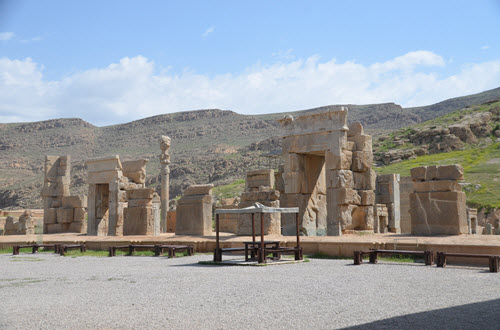
The Throne Hall, Persepolis
Next to the Apadana, second largest building of the Terrace and the final edifices, is the Throne Hall or the Imperial Army's Hall of Honor (also called the Hundred-Columns Palace). This 70 m2 × 70 m2 (750 sq ft × 750 sq ft) hall was started by Xerxes I and completed by his son Artaxerxes I by the end of the fifth century BC. Its eight stone doorways are decorated on the south and north with reliefs of throne scenes and on the east and west with scenes depicting the king in combat with monsters. Two colossal stone bulls flank the northern portico. The head of one of the bulls now resides in the Oriental Institute in Chicago[51] and a column base from one of the columns in the British Museum.[52]
At the beginning of the reign of Xerxes I, the Throne Hall was used mainly for receptions for military commanders and representatives of all the subject nations of the empire. Later, the Throne Hall served as an imperial museum.
The Tachara Palace
Tachara, was the exclusive palace of Darius the Great at Persepolis. Only a small portion of the palace was finished under his rule, it was completed after the death of Darius in 486 BC, by his son and successor, Xerxes,[53] who called it a Taçara, which means "winter palace" in Old Persian. It was then used by Artaxerxes I. In the 4th century BC, following his invasion of Iran in 330 BC, Alexander the Great allowed his troops to loot Persepolis. This palace was one of the few structures that escaped destruction in the burning of the complex by Alexander's army, and because of that, Tachara is the most intact building of Persepolis today. It is also the oldest structure at Persepolis. Tachara stands back to back to the Apadana, and is oriented southward.[54]
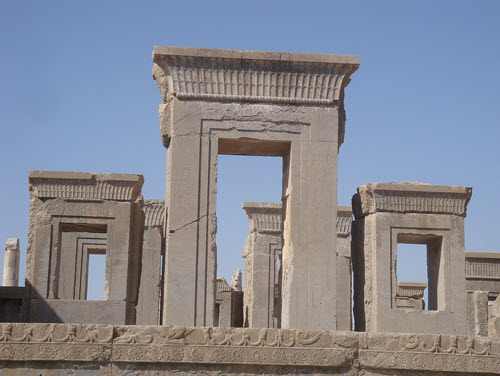
Tachara is the most intact building of Persepolis today.
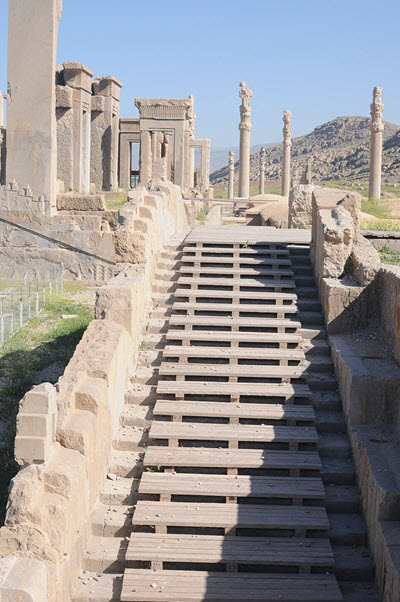
The staircase of Tachara palace at Persepolis
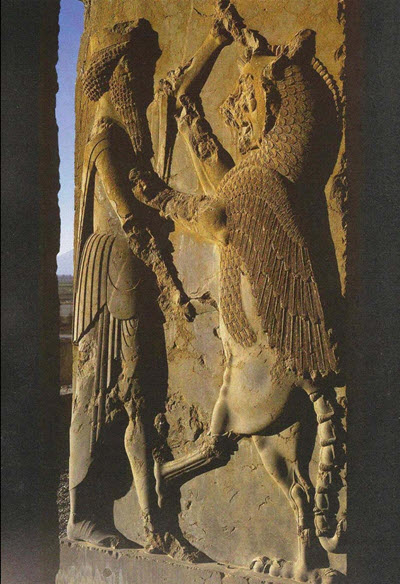
The relief of king's battle with devil at Tachara palace, Persepolis
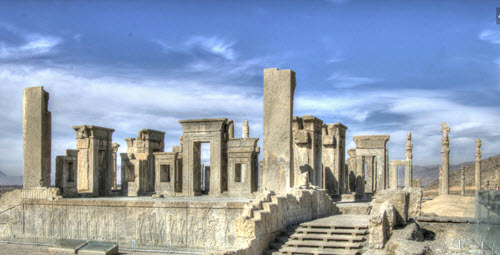
Tachara Palace, Persepolis
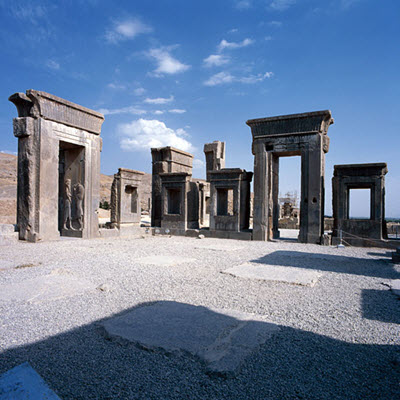
On the structure of Tachara palace
The Hadish Palace
The Hadish Palace of Xerxes is one of palaces at Persepolis. It's located on the east of the Palace of H (Artaxerxes I). The palace occupies the highest level of terrace and stands on the living rock. The inscriptions of the palace attest that the building was built by order of Xerxes. It covers an area of 2550 square meters (40*55 meters). A double staircase on the west leads to courtyard of the Tachara chateau and another staircase on the northeast connects to courtyard of the Council Hall.
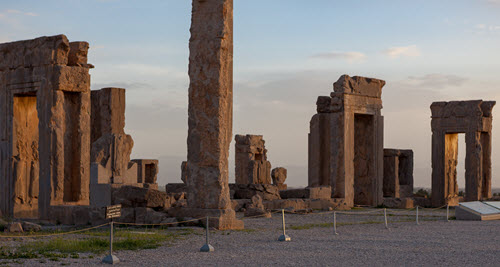
The Hadish palace, Persepolis
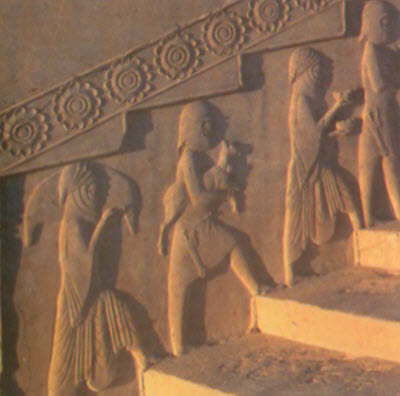
Lotus on the walls of Hadish palace, Persepolis
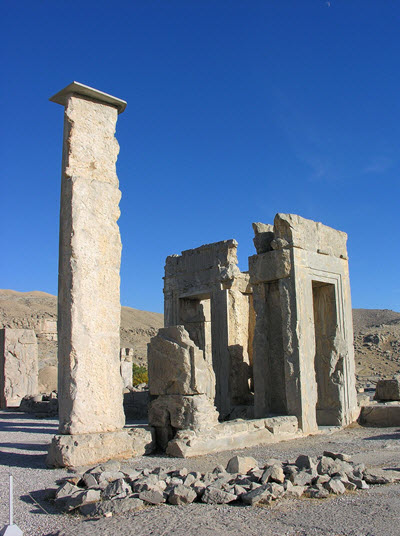
Hadish palace was built by the order of Xerxes
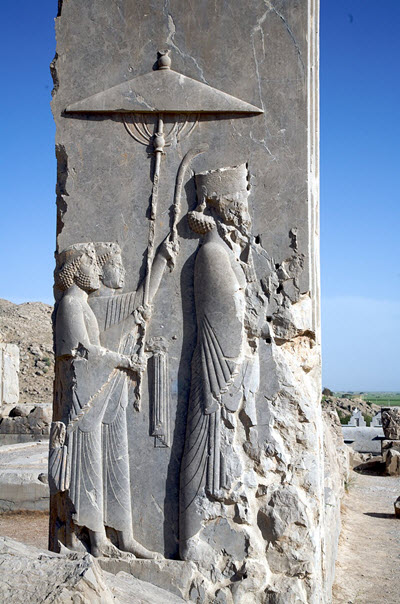
Xerxes at the Hadish palace
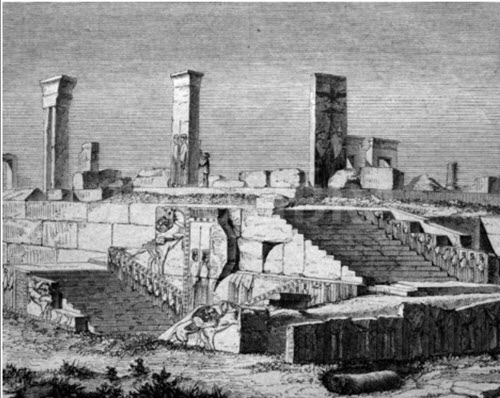
Hadish Palace at Persepolis, 1886
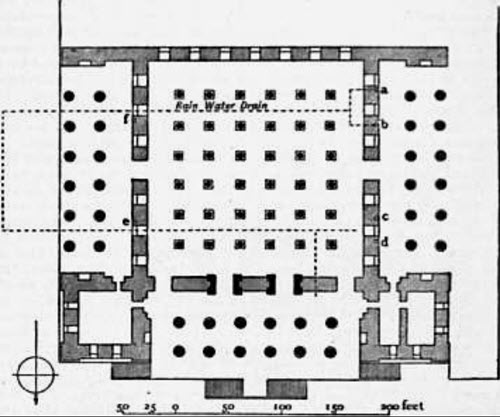
The hall of Hadish palace.
Other palaces and structures
The Council Hall, the Tryplion Hall, the Palaces of D, G, H, storerooms, stables and quarters, the unfinished gateway and a few miscellaneous structures at Persepolis are located near the south-east corner of the terrace, at the foot of the mountain.
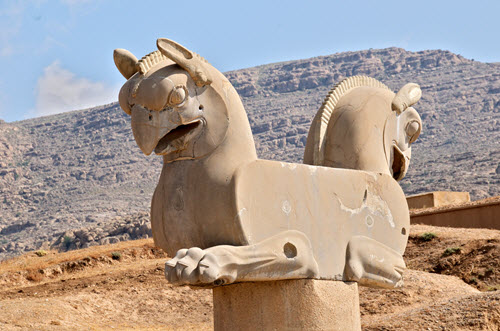
Huma bird at Persepolis
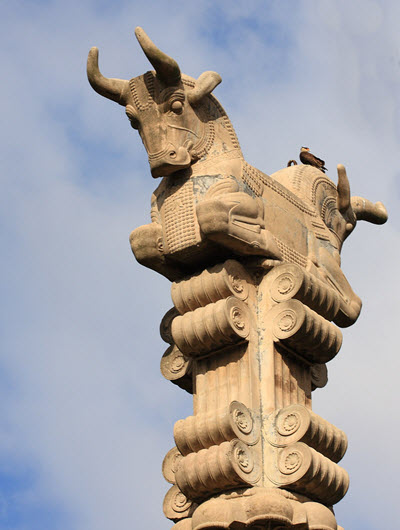
A well-preserved column at Persepolis
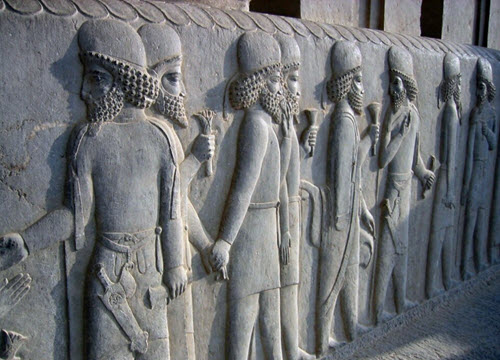
Reliefs from the Council Hall, Persepolis
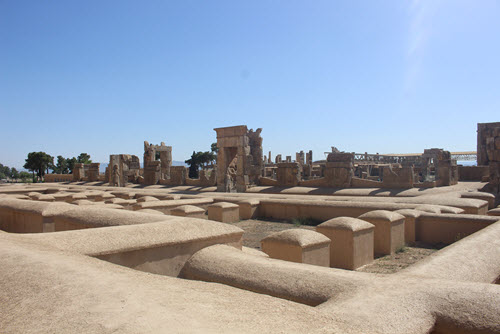
Part of the treasury, Persepolis
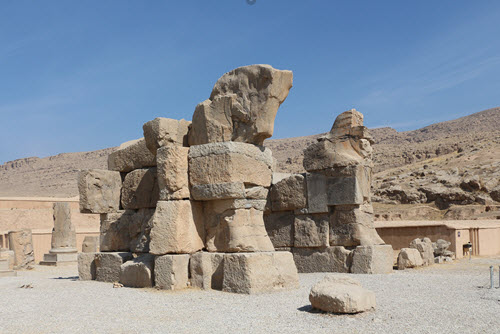
The unfinished gate of Persepolis, started by the order of Artaxerxes III, continued by his successors Arses and Darius III.
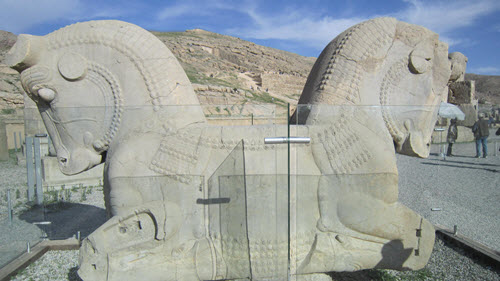
A column head.
Tombs
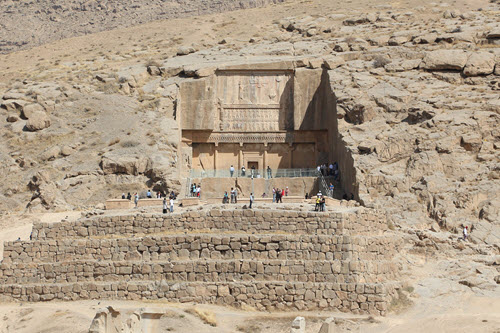
Tomb of Artaxerxes III, Persepolis
It is commonly accepted that Cyrus the Great was buried in the Tomb of Cyrus in Pasargadae, which is mentioned by Ctesias as his own city. If it is true that the body of Cambyses II was brought home "to the Persians," his burying place must be somewhere beside that of his father. Ctesias assumes that it was the custom for a king to prepare his own tomb during his lifetime. Hence, the kings buried at Naghsh-e Rostam are probably Darius I, Xerxes I, Artaxerxes I and Darius II. Xerxes II, who reigned for a very short time, could scarcely have obtained so splendid a monument, and still less could the usurper Sogdianus. The two completed graves behind the compound at Persepolis would then belong to Artaxerxes II and Artaxerxes III. The unfinished tomb, a kilometer away from the city, is debated to who it belongs.[55]
Ancient Texts
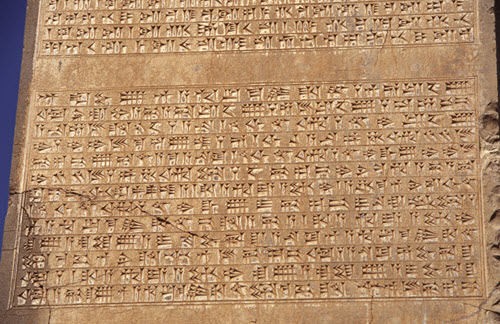
Babylonian version of an inscription of Xerxes I, the "XPc inscription"[56][c]
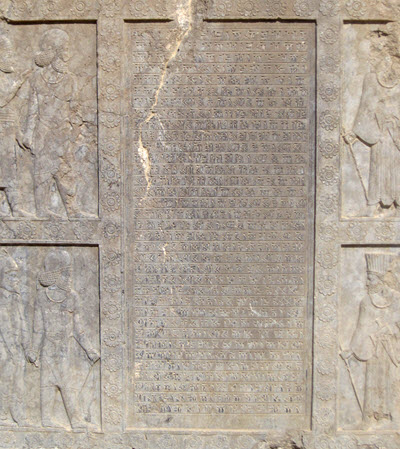
The inscription of Artaxerxes III at Tachar palace, Persepolis.
Modern events
2,500-year celebration
Persepolis hosted the 100th anniversary of the Armenian Philharmonic Orchestra on September 6, 2025.
In 1971, Persepolis was the main staging ground for the 2,500-year celebration of the Persian Empire under the reign of Mohammad Reza Pahlavi, the second and last Shah of the Pahlavi dynasty. It included delegations from foreign nations in an attempt to advance the Iranian culture and history.[57]
First concert
In a groundbreaking cultural event, Iranian vocalist Alireza Ghorbani performed the first-ever concert at Persepolis from 29 June to 1 July 2024, and received an overwhelmingly enthusiastic response from attendees.[58][59][60] Another historic event took place on September 6th, 2025, with Persepolis hosting the 100th anniversary of the Armenian Philharmonic Orchestra. Over 1,500 people attended.[61] With ambassadors from 23 countries and envoys from the UN, it was the first-ever international public concert at Persepolis,[62] a historic cultural milestone for Iran-Armenia,[63] and the site's second international event since the 2,500-year celebration of the Persian Empire in 1971.[64]
Nowruz Celebrations
Every year during Nowruz, a large number of people come to Persepolis to celebrate the new year. In 2024, 10,000 people were at Persepolis when Nowruz started.[65][66]
Cultural events
Various events are held in Persepolis every year, including the Shahnameh reading festival and other cultural events.[67][68]
Conservation issues
The site is also threatened by the presence of lichens that have grown on the surface of the monuments, some of which have eroded intricate carvings and motifs. Some of the lichens are estimated to be around 1,700 years old, and their spread has been attributed to industrialisation, acid rain and the extreme desert climate.[69]
The controversy of the Sivand Dam
Construction of the Sivand Dam, named after the nearby town of Sivand, began on 19 September 2006. Despite 10 years of planning, Iran's Cultural Heritage Organization was not aware of the broad areas of flooding during much of this time,[70] and there is growing concern about the effects the dam will have on the surrounding areas of Persepolis. Activists expressed concern that the dam's placement between the ruins of Pasargadae and Persepolis will flood both. Engineers involved with the construction deny this claim, stating that it is impossible, because both sites sit well above the planned waterline. Of the two sites, Pasargadae is considered the more threatened.[71]
Museums (outside Iran) that display objects from Persepolis
One bas-relief from Persepolis is in the Fitzwilliam Museum in Cambridge, England.[72] The largest collection of reliefs is at the British Museum, sourced from multiple British travellers who worked in Iran in the 19th century.[73] The Persepolis bull at the Oriental Institute in Chicago is one of the university's most prized treasures, part of the division of finds from the excavations of the 1930s. New York City's Metropolitan Museum and Detroit Institute of Art houses objects from Persepolis,[74] as does the Museum of Archaeology and Anthropology of the University of Pennsylvania.[75] The Museum of Fine Arts of Lyon[76] and the Louvre of Paris hold objects from Persepolis as well. A bas-relief of a soldier that had been looted from the excavations in 1935–36 and later purchased by the Montreal Museum of Fine Arts was repatriated to Iran in 2018, after being offered for sale in London and New York.[77]
Forgotten Empire Exhibition, the British Museum
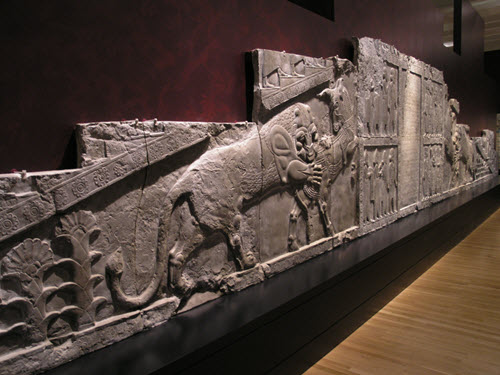
Forgotten Empire Exhibition, the British Museum
Persepolitan rosette rock relief, kept at the Oriental Institute
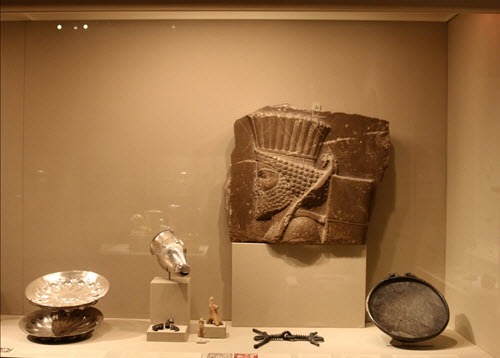
Achaemenid objects at the Metropolitan Museum of Art, including a bas relief from Persepolis
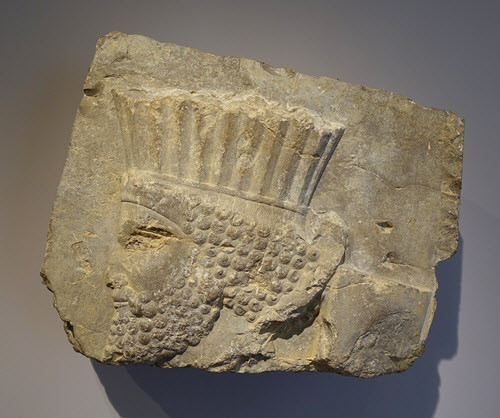
Head of an archer of the royal guard from Hadish palace, Sackler Museum - Harvard University
Foreign visitors graffiti at Persepolis
Main article: Foreign visitors graffiti at Persepolis
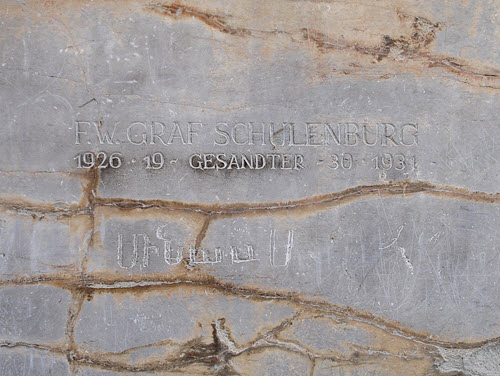
Friedrich Werner von der Schulenburg inscription on an ancient monument at the entrance of Persepolis (Iran)
Some European travelers throughout history have left graffiti on the walls of Persepolis during their visits.
Gallery
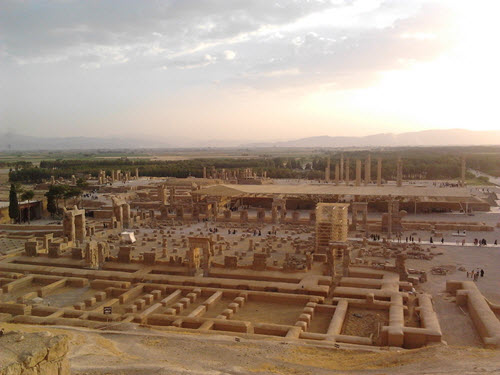
A general view of the Persepolis.
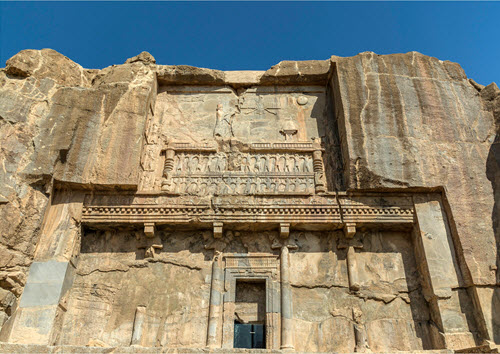
The tomb of Artaxerxes II at Persepolis
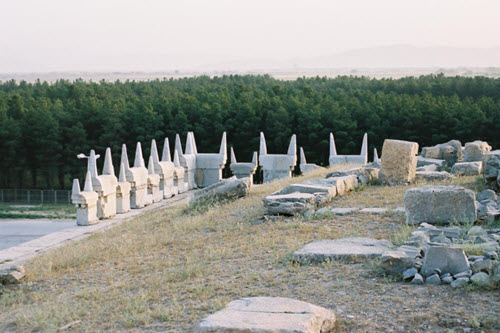
Horn-shaped stones at Persepolis.
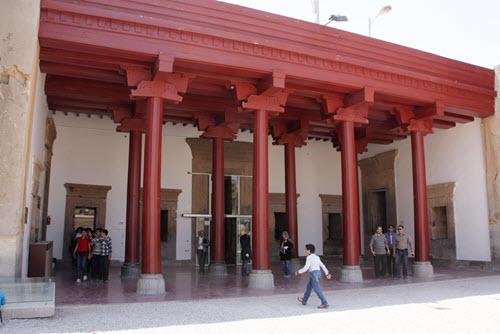
The Queen's Quarters, built by the order of Xerxes. The palace was excavated and rebuilt by Ernst Herzfeld in 1931, and today it is used as a museum and the central office of Persepolis.
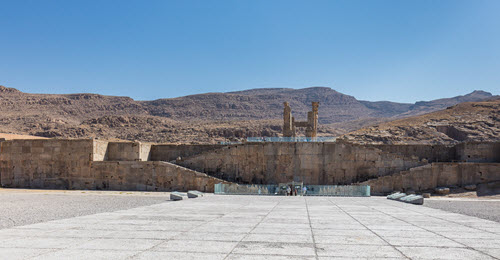
The entrance of Persepolis.
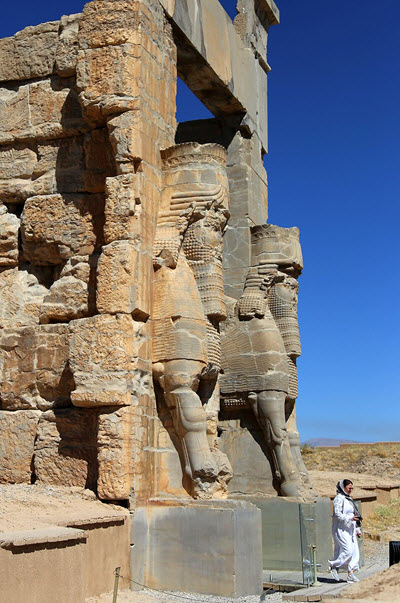
Persepolis, Fars province, Iran
See also
Iran portal
• Achaemenid architecture
• Behistun Inscription
• Cities of the Ancient Near East
• Foreign Visitors Graffiti at Persepolis
• Istakhr
• List of World Heritage Sites in Iran
• Naqsh-e Rustam
• Palace of Darius in Susa, similar structure built at the same time
• Pasargadae
• Persepolis (comics)
• Persepolis F.C.
• Qadamgah (ancient site)
• Tachara
Notes
a. /pərˈsɛpəlɪs/; Old Persian: [x], romanized: Pārsa; New Persian: [x] romanized: Takht-e Jamshīd, lit. 'Throne of Jamshid'
b. Eternally fighting bull (personifying the moon), and a lion (personifying the sun) representing the spring.
c. Known as XPc (Xerxes Persepolis c), from the portico of the Tachara.
References
This article incorporates text from a publication now in the public domain: Chisholm, Hugh, ed. (1911). "Persepolis". Encyclopædia Britannica (11th ed.). Cambridge University Press.
1. "Location of Persepolis". Google Maps. Archived from the original on 20 April 2023. Retrieved 24 September 2013.
2. UNESCO World Heritage Centre (2006). "Pasargadae". Archived from the original on 5 March 2020. Retrieved 26 December 2010.
3. Mousavi, Ali, Persepolis: Discovery and Afterlife of a World Wonder, p. 53, 2012, Walter de Gruyter, ISBN 978-1614510338, Google Books Archived 20 April 2023 at the Wayback Machine
4. Gates, Charles (2011). Ancient cities: the archaeology of urban life in the ancient Near East and Egypt, Greece and Rome (2nd ed.). London: Routledge. pp. 186–187. ISBN 978-0-203-83057-4.
5. venetis, evangelos (2014). "5, IRAN AT THE TIME OF ALEXANDER THE GREAT AND THE SELEUCIDS". In Daryaee, Touraj (ed.). The Oxford Handbook of Iranian History. Oxford University Press. pp. 148, 149. ISBN 978-0199390427.
6. Mousavi, Ali (14 March 2012). "VI. Persepolis and the Puzzle of Cuneiform Inscriptions". Persepolis. De Gruyter. pp. 113–122. doi:10.1515/9781614510338.113. ISBN 978-1-61451-028-4. In this way, the exploration of the ancient ruins at Persepolis proved to be an important key to the development of historical and archaeological studies in the first half of the nineteenth century.
7. Bailey, H.W. (1996) "Khotanese Saka Literature", in Ehsan Yarshater (ed), The Cambridge History of Iran, Vol III: The Seleucid, Parthian, and Sasanian Periods, Part 2 (reprint edition), Cambridge: Cambridge University Press, p. 1230.
8. Michael Woods, Mary B. Woods (2008). Seven Wonders of the Ancient Middle East. Twenty-First Century Books. pp. 26–28. ISBN 978-0822575733. Persepolis means.
9. Shahbazi, A. Shapur; Bosworth, C. Edmund (1990). "Capital Cities– Encyclopaedia Iranica". Encyclopædia Iranica. Vol. IV. pp. 768–774. Archived from the original on 10 April 2021. Retrieved 5 August 2018.
10. Holland, Tom (2012). In the Shadow of the Sword. Little, Brown. pp. 118–122. ISBN 978-1408700075.
11. De Silva Figueroa, Garcia (1667), L'Ambassade de D. Garcias de Silva Figueroa en Perse..., translated by De Wicquefort, Abraham, Paris: Louis Billaine, archived from the original on 29 November 2022, retrieved 29 November 2022.
12. "Chilminar", Encyclopædia Britannica, vol. II (1st ed.), Edinburgh: Colin Macfarquhar, 1771, pp. 183–184.
13. Perrot, Jean (2013). The Palace of Darius at Susa: The Great Royal Residence of Achaemenid Persia. I.B.Tauris. p. 423. ISBN 978-1848856219. Archived from the original on 20 April 2023. Retrieved 25 December 2021.
14. Garthwaite, Gene R. (2008). The Persians. John Wiley & Sons. p. 50. ISBN 978-1405144001. Archived from the original on 20 April 2023. Retrieved 19 October 2020.
15. 2002. Guaitoli. M.T., & Rambaldi, S. Lost Cities from the Ancient World. White Star, spa. (2006 version published by Barnes & Noble. Darius I founded Persepolis in 500 BC as the residence and ceremonial center of his dynasty. p. 164
16. "Persepolis". Encyclopædia Britannica. Archived from the original on 10 April 2021. Retrieved 16 October 2017.
17. "Persepolis". World History Encyclopedia. Archived from the original on 17 April 2021. Retrieved 16 February 2021.
18. "Persepolis". toiran.com. Archived from the original on 5 February 2015. Retrieved 2 January 2015.
19. Sachau, C. Edward (2004). The Chronology of Ancient Nations. Kessinger Publishing. p. 484. ISBN 978-0-7661-8908-9. p. 127
20. Mark, Joshua J. "Alexander the Great & the Burning of Persepolis" Archived 22 April 2021 at the Wayback Machine, 2018, World History Encyclopedia
21. Anonimo (1974). "Al-Beruni and Persepolis". Acta Iranica. 1. Leiden: Peeters Publishers: 137–150. ISBN 978-90-04-03900-1.
22. Wiesehöfer 10–11.
23. Henkelman 2008:Ch 2.
24. "Persepolis". Wondermondo. 13 February 2012. Archived from the original on 28 May 2018. Retrieved 13 February 2012.
25. Streck, M.; Miles, G.C. (2012). "Iṣṭak̲h̲r". In P. Bearman; Th. Bianquis; C.E. Bosworth; E. van Donzel; W.P. Heinrichs (eds.). The Encyclopedia of Islam, Second Edition. Brill Online.
26. Mousavi, Ali (2012). Persepolis: Discovery and Afterlife of a World Wonder. Walter de Gruyter. ISBN 978-1614510338. Archived from the original on 20 April 2023. Retrieved 19 October 2020.
27. Murray, Hugh (1820). Historical account of discoveries and travels in Asia. Edinburgh: A. Constable and Co. p. 15.
28. "Principal Navigations, Voyages, Traffiques and Discoveries of the English Nation, by Richard Hakluyt : chapter11". ebooks.adelaide.edu.au. Archived from the original on 3 July 2019. Retrieved 3 July 2019.
29. Tuplin, Christopher (2007). Persian Responses: Political and Cultural Interaction with(in) the Achaemenid Empire. ISD LLC. ISBN 978-1910589465. Archived from the original on 20 April 2023. Retrieved 19 October 2020.
30. Gouveia, António de (1611). Relaçam em que se tratam as Guerras e Grandes Victorias que alcançou o grande Rei da Persia Xá Abbas do grão Turco Mahometto, e seu filho Amethe: as quais resultaram das Embaixadas, que por mando da Catholica e Real Magestade del Rei D. Felippe segundo de Portugal fizeram alguns Religiosos da ordem dos Ermitas de S. Augustinho à Persia. Lisboa: Pedro Crasbeeck. pp. 31–32.
31. C. Wade Meade (1974). Road to Babylon: Development of U.S. Assyriology. Brill Archive. pp. 5–7. ISBN 978-9004038585. Archived from the original on 20 April 2023. Retrieved 19 October 2020.
32. M. H. Aminisam (2007). [x] (Persepolis). AuthorHouse. pp. 79–81. ISBN 978-1463462529. Archived from the original on 20 April 2023. Retrieved 19 October 2020.
33. Ali Mousavi (2012). Persepolis: Discovery and Afterlife of a World Wonder. Walter de Gruyter. pp. 104–107. ISBN 978-1614510284. Archived from the original on 20 April 2023. Retrieved 19 October 2020.
34. Ali Mousavi, Persepolis in Retrospect: Histories of Discovery and Archaeological Exploration at the ruins of ancient Passch, Ars Orientalis, vol. 32, pp. 209–251, 2002
35. "Godard, André – Encyclopaedia Iranica". iranicaonline.org. Archived from the original on 25 February 2013. Retrieved 3 July 2019.
36. [1] Archived 5 February 2011 at the Wayback Machine Ernst E Herzfeld, A New Inscription of Xerxes from Persepolis, Studies in Ancient Oriental Civilization, vol. 5, 1932
37. [2] Archived 5 February 2011 at the Wayback Machine Erich F Schmidt, Persepolis I: Structures, Reliefs, Inscriptions, Oriental Institute Publications, vol. 68, 1953
38. [3] Archived 5 February 2011 at the Wayback Machine Erich F Schmidt, Persepolis II: Contents of the Treasury and Other Discoveries, Oriental Institute Publications, vol. 69, 1957
39. [4] Archived 5 February 2011 at the Wayback Machine Erich F Schmidt, Persepolis III: The Royal Tombs and Other Monuments, Oriental Institute Publications, vol. 70, 1970
40. [5] Archived 5 February 2011 at the Wayback Machine Erich F Schmidt, The Treasury of Persepolis and Other Discoveries in the Homeland of the Achaemenians, Oriental Institute Communications, vol. 21, 1939
41. Roaf, Michael; Boardman, John (1980). "A Greek painting at Persepolis". The Journal of Hellenic Studies. 100: 204–206. doi:10.2307/630751. JSTOR 630751. S2CID 161864288. Archived from the original on 16 October 2017. Retrieved 16 October 2017.
42. Pierre Briant (2002). From Cyrus to Alexander: A History of the Persian Empire. Eisenbrauns. pp. 256–258. ISBN 978-1575061207. Archived from the original on 20 April 2023. Retrieved 19 October 2020.
43. R. W. Ferrier. The Arts of Persia. page 39, image 21
44. Penelope Hobhouse (2004). The Gardens of Persia. Kales Press. pp. 177–178. ISBN 978-0967007663. Archived from the original on 20 April 2023. Retrieved 19 October 2020.
45. Wright, H. C. (1981). "Ancient Burials of Metal Documents in Stone Boxes: Their Implications for Library History." The Journal of Library History (1974), 16(1), 48–70.
46. Zournatzi, Antigoni (2003). "The Apadana Coin Hoards, Darius I, and the West". American Journal of Numismatics. 15: 1–28. JSTOR 43580364.
47. Persepolis: discovery and afterlife of a world wonder. 2012. pp. 171–181.
48. DPh – Livius. Archived from the original on 11 April 2021. Retrieved 26 March 2020.
49. DPh inscription Archived 11 April 2021 at the Wayback Machine, also Photographs of one of the gold plaques Archived 11 April 2021 at the Wayback Machine
50. Fisher, William Bayne; Gershevitch, I.; Boyle, John Andrew; Yarshater, Ehsan; Frye, Richard Nelson (1968). The Cambridge History of Iran. Cambridge University Press. p. 617. ISBN 978-0521200912. Archived from the original on 20 April 2023. Retrieved 20 November 2018.
51. "Oriental Institute Highlights". Oi.uchicago.edu. 19 February 2007. Archived from the original on 14 June 2011. Retrieved 30 December 2012.
52. "British Museum collection". The British Museum. Archived from the original on 18 April 2021. Retrieved 3 November 2020.
53. Hobhouse, Penelope (2004). The Gardens of Persia. Kales Press. ISBN 978-0-9670076-6-3.
54. Mousavi, Ali (19 April 2012). Persepolis: Discovery and Afterlife of a World Wonder. Walter de Gruyter. ISBN 978-1-61451-033-8.
55. Potts, Daniel T (2012). A Companion to the Archaeology of the Ancient Near East. John Wiley & Sons. ISBN 978-1405189880. Archived from the original on 20 April 2023. Retrieved 19 October 2020.
56. "XPc – Livius". livius.org. Archived from the original on 18 April 2021. Retrieved 26 March 2020.
57. Amini, Hassan (8 October 2023). "Decadence and Downfall: The World's Most Expensive Party". BBC. Retrieved 12 December 2023.
58. "Iranian Singer Alireza Ghorbani Mesmerizes Audience During Concert at Historic Persepolis". Iran Front Page. 2 July 2024. Retrieved 4 July 2024.
59. "Alireza Ghorbani's concert at Persepolis extended". Tehran Times. 3 July 2024. Retrieved 4 July 2024.
60. "کنسرت علیرضا قربانی در تخت جمشید شیراز". ایسنا (in Persian). 1 July 2024. Retrieved 4 July 2024.
61. "کنسرت ارکستر فیلارمونیک ارمنستان در تخت جمشید - تسنیم". خبرگزاری تسنیم | Tasnim (in Persian). Archived from the original on 9 October 2025. Retrieved 28 November 2025.
62. YJC, باشگاه خبرنگاران جوان | آخرین اخبار ایران و جهان | (4 September 2025). "نوای ارمنی در پارسه/کنسرت ارمنستان در تخت جمشید با حضور دیپلماتهای ۲۳ کشور". fa (in Persian). Retrieved 28 November 2025.
63. "کنسرت ارکستر فیلارمونیک ارمنستان در تختجمشید پیام روشن صلح و گفتوگوی تمدنی را منتقل میکند/ دیپلماسی فرهنگی میتواند درها و راههای همکاری بیشتر را باز کند + فیلم". خبرگزاری میراث آریا (in Persian). 5 September 2025. Retrieved 28 November 2025.
64. "دیپلماسی فرهنگی، دیپلماسی مذهبی و نمونههای جهانی". خبرگزاری میراث آریا (in Persian). 6 September 2025. Retrieved 28 November 2025.
65. "۱۰ هزار مسافر نوروزی لحظه تحویل سال را در تخت جمشید جشن گرفتند". خبرگزاری مهر | اخبار ایران و جهان | Mehr News Agency (in Persian). 20 March 2024. Retrieved 30 April 2024.
66. "Hafez, Sa'di mausoleums, Persepolis among most visited in Nowruz". Islamic Republic News Agency. 30 May 2024.
67. "جشنواره شاهنامهخوانی در تخت جمشید برگزار میشود". Mehr News Agency (in Persian). 12 March 2024. Retrieved 30 April 2024.
68. "(تصاویر) بازدید هیئت فرهنگی چین از تخت جمشید". Fararu. 30 May 2025.
69. "The stone-eaters that threaten Iran's ancient Persepolis". France 24. 16 September 2024. Retrieved 16 September 2024.
70. Vidal, John (23 December 2004). "Dam is threat to Iran's heritage". The Guardian. Archived from the original on 10 April 2021. Retrieved 10 June 2018.
71. Esfandiari, Golnaz. "Iran: Activists Say New Dam Threatens Ancient Historical Sites". Radiofreeeurope/Radioliberty. Retrieved 12 December 2023.
72. A Persepolis Relief in the Fitzwilliam Museum, Cambridge. Richard Nicholls and Michael Roaf. Iran, Vol. 15, (1977), pp. 146–152. Published by: British Institute of Persian Studies.
73. Allen, Lindsay (1 January 2013). ""Come Then Ye Classic Thieves of Each Degree": The Social Context of the Persepolis Diaspora in the Early Nineteenth Century". Iran. 51 (1): 207–234. doi:10.1080/05786967.2013.11834730. ISSN 0578-6967. S2CID 193984848.
74. Harper, Prudence O., Barbara A. Porter, Oscar White Muscarella, Holly Pittman, and Ira Spar. "Ancient Near Eastern Art." The Metropolitan Museum of Art Bulletin, v. 41, no. 4 (Spring, 1984).
75. "Relief – B10301 | Collections – Penn Museum". penn.museum. Archived from the original on 15 February 2020. Retrieved 8 September 2020.
76. "Découvrir les collections". Musée des Beaux Arts Lyon. Archived from the original on 24 September 2020. Retrieved 8 September 2020.
77. Mashberg, Tom (23 July 2018). "Judge Orders Return of Ancient Limestone Relief to Iran". The New York Times. ISSN 0362-4331. Archived from the original on 10 April 2021. Retrieved 3 July 2019.
Further reading
• Curtis, J. and Tallis, N. (eds). (2005). Forgotten Empire: The World of Ancient Persia. University of California Press. ISBN 0-520-24731-0.
• Devos, Bianca (2018). ""History is repeated": The representation of Persepolis in the Iranian press of the 1930s". Die Welt des Islams. 58 (3): 326–356. doi:10.1163/15700607-00583P03. S2CID 166200185.
• Frye, Richard N. (1974). "Persepolis Again". Journal of Near Eastern Studies. 33 (4): 383–386. doi:10.1086/372376. S2CID 222453940.
• Wilber, Donald Newton. (1989). Persepolis: The Archaeology of Parsa, Seat of the Persian Kings. Darwin Press. Revised edition ISBN 0-87850-062-6.
External links
• Definitions from Wiktionary
• Media from Commons
• Quotations from Wikiquote
• Texts from Wikisource
• Textbooks from Wikibooks
• Persepolis – official website (in English and Persian)
• Persepolis at the Ancient History Encyclopedia with timeline, illustrations, and books
• Arthur John Booth. The Discovery and Decipherment of the Trilingual Cuneiform Inscriptions (1902)
• Persepolis Photographs Archived 5 February 2007 at the Wayback Machine and Introduction to the Persian Expedition Archived 15 May 2011 at the Wayback Machine,
• 360 degrees panorama gallery of Persepolis
• Google Maps
• "Persepolis" at Cultural Heritage Organization of Iran
• Persepolis Tours
• Greek Art And Arch itecture In Iran (Mentions Ionian work in Persepolis)
• Persepolis: The Magnificent Ancient Capital of the Persian Achaemenid Empire at Amazing Iran Media
The Throne Hall
The Throne Hall, Persepolis
Next to the Apadana, second largest building of the Terrace and the final edifices, is the Throne Hall or the Imperial Army's Hall of Honor (also called the Hundred-Columns Palace). This 70 m2 × 70 m2 (750 sq ft × 750 sq ft) hall was started by Xerxes I and completed by his son Artaxerxes I by the end of the fifth century BC. Its eight stone doorways are decorated on the south and north with reliefs of throne scenes and on the east and west with scenes depicting the king in combat with monsters. Two colossal stone bulls flank the northern portico. The head of one of the bulls now resides in the Oriental Institute in Chicago[51] and a column base from one of the columns in the British Museum.[52]
At the beginning of the reign of Xerxes I, the Throne Hall was used mainly for receptions for military commanders and representatives of all the subject nations of the empire. Later, the Throne Hall served as an imperial museum.
The Tachara Palace
Tachara, was the exclusive palace of Darius the Great at Persepolis. Only a small portion of the palace was finished under his rule, it was completed after the death of Darius in 486 BC, by his son and successor, Xerxes,[53] who called it a Taçara, which means "winter palace" in Old Persian. It was then used by Artaxerxes I. In the 4th century BC, following his invasion of Iran in 330 BC, Alexander the Great allowed his troops to loot Persepolis. This palace was one of the few structures that escaped destruction in the burning of the complex by Alexander's army, and because of that, Tachara is the most intact building of Persepolis today. It is also the oldest structure at Persepolis. Tachara stands back to back to the Apadana, and is oriented southward.[54]
Tachara is the most intact building of Persepolis today.
The staircase of Tachara palace at Persepolis
The relief of king's battle with devil at Tachara palace, Persepolis
Tachara Palace, Persepolis
On the structure of Tachara palace
The Hadish Palace
The Hadish Palace of Xerxes is one of palaces at Persepolis. It's located on the east of the Palace of H (Artaxerxes I). The palace occupies the highest level of terrace and stands on the living rock. The inscriptions of the palace attest that the building was built by order of Xerxes. It covers an area of 2550 square meters (40*55 meters). A double staircase on the west leads to courtyard of the Tachara chateau and another staircase on the northeast connects to courtyard of the Council Hall.
The Hadish palace, Persepolis
Lotus on the walls of Hadish palace, Persepolis
Hadish palace was built by the order of Xerxes
Xerxes at the Hadish palace
Hadish Palace at Persepolis, 1886
The hall of Hadish palace.
Other palaces and structures
The Council Hall, the Tryplion Hall, the Palaces of D, G, H, storerooms, stables and quarters, the unfinished gateway and a few miscellaneous structures at Persepolis are located near the south-east corner of the terrace, at the foot of the mountain.
Huma bird at Persepolis
A well-preserved column at Persepolis
Reliefs from the Council Hall, Persepolis
Part of the treasury, Persepolis
The unfinished gate of Persepolis, started by the order of Artaxerxes III, continued by his successors Arses and Darius III.
A column head.
Tombs
Tomb of Artaxerxes III, Persepolis
It is commonly accepted that Cyrus the Great was buried in the Tomb of Cyrus in Pasargadae, which is mentioned by Ctesias as his own city. If it is true that the body of Cambyses II was brought home "to the Persians," his burying place must be somewhere beside that of his father. Ctesias assumes that it was the custom for a king to prepare his own tomb during his lifetime. Hence, the kings buried at Naghsh-e Rostam are probably Darius I, Xerxes I, Artaxerxes I and Darius II. Xerxes II, who reigned for a very short time, could scarcely have obtained so splendid a monument, and still less could the usurper Sogdianus. The two completed graves behind the compound at Persepolis would then belong to Artaxerxes II and Artaxerxes III. The unfinished tomb, a kilometer away from the city, is debated to who it belongs.[55]
Ancient Texts
Babylonian version of an inscription of Xerxes I, the "XPc inscription"[56][c]
The inscription of Artaxerxes III at Tachar palace, Persepolis.
There are a total of 11 existing inscriptions at Persepolis, related to Darius the Great, Xerxes, Artaxerxes II and Artaxerxes III. The relevant passages from ancient scholars on the subject are set out below:
Persepolis was the capital of the Persian kingdom. Alexander described it to the Macedonians as the most hateful of the cities of Asia, and gave it over to his soldiers to plunder, all but the palaces. (2) It was the richest city under the sun, and the private houses had been furnished with every sort of wealth over the years. The Macedonians raced into it, slaughtering all the men whom they met and plundering the residences; many of the houses belonged to the common people and were abundantly supplied with furniture and wearing apparel of every kind...
72 (1) Alexander held games in honor of his victories. He performed costly sacrifices to the gods and entertained his friends bountifully. While they were feasting and the drinking was far advanced, as they began to be drunken, a madness took possession of the minds of the intoxicated guests. (2) At this point, one of the women present, Thais by name and Attic by origin, said that for Alexander it would be the finest of all his feats in Asia if he joined them in a triumphal procession, set fire to the palaces, and permitted women's hands in a minute to extinguish the famed accomplishments of the Persians. (3) This was said to men who were still young and giddy with wine, and so, as would be expected, someone shouted out to form up and to light torches, and urged all to take vengeance for the destruction of the Greek temples. (4) Others took up the cry and said that this was a deed worthy of Alexander alone. When the king had caught fire at their words, all leaped up from their couches and passed the word along to form a victory procession [epinikion komon] in honor of Dionysius.
(5) Promptly, many torches were gathered. Female musicians were present at the banquet, so the king led them all out for the komos to the sound of voices and flutes and pipes, Thais the courtesan leading the whole performance. (6) She was the first, after the king, to hurl her blazing torch into the palace. As the others all did the same, immediately the entire palace area was consumed, so great was the conflagration. It was most remarkable that the impious act of Xerxes, king of the Persians, against the acropolis at Athens should have been repaid in kind after many years by one woman, a citizen of the land which had suffered it, and in sport.
— Diodorus Siculus, 17.70.1–73.2, 17.70 (1)
On the following day, the king called together the leaders of his forces and informed them that "no city was more mischievous to the Greeks than the seat of the ancient kings of Persia [...] by its destruction they ought to offer sacrifice to the spirits of their forefathers."
7 (1) But Alexander's great mental endowments, that noble disposition, in which he surpassed all kings, that intrepidity in encountering dangers, his promptness in forming and carrying out plans, his good faith towards those who submitted to him, merciful treatment of his prisoners, temperance even in lawful and usual pleasures, were sullied by an excessive love of wine. (2) At the very time when his enemy and his rival for a throne was preparing to renew the war, when those whom he had conquered were but lately subdued and were hostile to the new rule, he took part in prolonged banquets at which women were present, not indeed those whom it would be a crime to violate, but, to be sure, harlots who were accustomed to live with armed men with more licence than was fitting.
(3) One of these, Thais by name, herself also drunken, declared that the king would win most favor among all the Greeks, if he should order the palace of the Persians to be set on fire; that this was expected by those whose cities the barbarians had destroyed. (4) When a drunken strumpet had given her opinion on a matter of such moment, one or two, themselves also loaded with wine, agreed. The king, too, more greedy for wine than able to carry it, cried: "Why do we not, then, avenge Greece and apply torches to the city?" (5) All had become heated with wine, and so they arose when drunk to fire the city which they had spared when armed. The king was the first to throw a firebrand upon the palace, then the guests and the servants and courtesans. The palace had been built largely of cedar, which quickly took fire and spread the conflagration widely. (6) When the army, which was encamped not far from the city, saw the fire, thinking it accidental, they rushed to bear aid. (7) But when they came to the vestibule of the palace, they saw the king himself piling on firebrands. Therefore, they left the water which they had brought, and they too began to throw dry wood upon the burning building.
(8) Such was the end of the capital of the entire Orient... .
(10) The Macedonians were ashamed that so renowned a city had been destroyed by their king in a drunken revel; therefore the act was taken as earnest, and they forced themselves to believe that it was right that it should be wiped out in exactly that manner.
— Quintus Curtius Rufus 5.6.1–7.12 5.6 (1)
And did not Alexander the Great have with him Thais, the Athenian hetaira? Cleitarchus speaks of her as having been the cause for the burning of the palace at Persepolis. After Alexander's death, this same Thais was married to Ptolemy, the first king of Egypt.
— Cleitarchus, FGrHist. 137, F. 11 (= Athenaeus 13. 576d-e)
Modern events
2,500-year celebration
Persepolis hosted the 100th anniversary of the Armenian Philharmonic Orchestra on September 6, 2025.
In 1971, Persepolis was the main staging ground for the 2,500-year celebration of the Persian Empire under the reign of Mohammad Reza Pahlavi, the second and last Shah of the Pahlavi dynasty. It included delegations from foreign nations in an attempt to advance the Iranian culture and history.[57]
First concert
In a groundbreaking cultural event, Iranian vocalist Alireza Ghorbani performed the first-ever concert at Persepolis from 29 June to 1 July 2024, and received an overwhelmingly enthusiastic response from attendees.[58][59][60] Another historic event took place on September 6th, 2025, with Persepolis hosting the 100th anniversary of the Armenian Philharmonic Orchestra. Over 1,500 people attended.[61] With ambassadors from 23 countries and envoys from the UN, it was the first-ever international public concert at Persepolis,[62] a historic cultural milestone for Iran-Armenia,[63] and the site's second international event since the 2,500-year celebration of the Persian Empire in 1971.[64]
Nowruz Celebrations
Every year during Nowruz, a large number of people come to Persepolis to celebrate the new year. In 2024, 10,000 people were at Persepolis when Nowruz started.[65][66]
Cultural events
Various events are held in Persepolis every year, including the Shahnameh reading festival and other cultural events.[67][68]
Conservation issues
The site is also threatened by the presence of lichens that have grown on the surface of the monuments, some of which have eroded intricate carvings and motifs. Some of the lichens are estimated to be around 1,700 years old, and their spread has been attributed to industrialisation, acid rain and the extreme desert climate.[69]
The controversy of the Sivand Dam
Construction of the Sivand Dam, named after the nearby town of Sivand, began on 19 September 2006. Despite 10 years of planning, Iran's Cultural Heritage Organization was not aware of the broad areas of flooding during much of this time,[70] and there is growing concern about the effects the dam will have on the surrounding areas of Persepolis. Activists expressed concern that the dam's placement between the ruins of Pasargadae and Persepolis will flood both. Engineers involved with the construction deny this claim, stating that it is impossible, because both sites sit well above the planned waterline. Of the two sites, Pasargadae is considered the more threatened.[71]
Museums (outside Iran) that display objects from Persepolis
One bas-relief from Persepolis is in the Fitzwilliam Museum in Cambridge, England.[72] The largest collection of reliefs is at the British Museum, sourced from multiple British travellers who worked in Iran in the 19th century.[73] The Persepolis bull at the Oriental Institute in Chicago is one of the university's most prized treasures, part of the division of finds from the excavations of the 1930s. New York City's Metropolitan Museum and Detroit Institute of Art houses objects from Persepolis,[74] as does the Museum of Archaeology and Anthropology of the University of Pennsylvania.[75] The Museum of Fine Arts of Lyon[76] and the Louvre of Paris hold objects from Persepolis as well. A bas-relief of a soldier that had been looted from the excavations in 1935–36 and later purchased by the Montreal Museum of Fine Arts was repatriated to Iran in 2018, after being offered for sale in London and New York.[77]
Forgotten Empire Exhibition, the British Museum
Forgotten Empire Exhibition, the British Museum
Persepolitan rosette rock relief, kept at the Oriental Institute
Achaemenid objects at the Metropolitan Museum of Art, including a bas relief from Persepolis
Head of an archer of the royal guard from Hadish palace, Sackler Museum - Harvard University
Foreign visitors graffiti at Persepolis
Main article: Foreign visitors graffiti at Persepolis
Friedrich Werner von der Schulenburg inscription on an ancient monument at the entrance of Persepolis (Iran)
Some European travelers throughout history have left graffiti on the walls of Persepolis during their visits.
Gallery
A general view of the Persepolis.
The tomb of Artaxerxes II at Persepolis
Horn-shaped stones at Persepolis.
The Queen's Quarters, built by the order of Xerxes. The palace was excavated and rebuilt by Ernst Herzfeld in 1931, and today it is used as a museum and the central office of Persepolis.
The entrance of Persepolis.
Persepolis, Fars province, Iran
See also
Iran portal
• Achaemenid architecture
• Behistun Inscription
• Cities of the Ancient Near East
• Foreign Visitors Graffiti at Persepolis
• Istakhr
• List of World Heritage Sites in Iran
• Naqsh-e Rustam
• Palace of Darius in Susa, similar structure built at the same time
• Pasargadae
• Persepolis (comics)
• Persepolis F.C.
• Qadamgah (ancient site)
• Tachara
Notes
a. /pərˈsɛpəlɪs/; Old Persian: [x], romanized: Pārsa; New Persian: [x] romanized: Takht-e Jamshīd, lit. 'Throne of Jamshid'
b. Eternally fighting bull (personifying the moon), and a lion (personifying the sun) representing the spring.
c. Known as XPc (Xerxes Persepolis c), from the portico of the Tachara.
References
This article incorporates text from a publication now in the public domain: Chisholm, Hugh, ed. (1911). "Persepolis". Encyclopædia Britannica (11th ed.). Cambridge University Press.
1. "Location of Persepolis". Google Maps. Archived from the original on 20 April 2023. Retrieved 24 September 2013.
2. UNESCO World Heritage Centre (2006). "Pasargadae". Archived from the original on 5 March 2020. Retrieved 26 December 2010.
3. Mousavi, Ali, Persepolis: Discovery and Afterlife of a World Wonder, p. 53, 2012, Walter de Gruyter, ISBN 978-1614510338, Google Books Archived 20 April 2023 at the Wayback Machine
4. Gates, Charles (2011). Ancient cities: the archaeology of urban life in the ancient Near East and Egypt, Greece and Rome (2nd ed.). London: Routledge. pp. 186–187. ISBN 978-0-203-83057-4.
5. venetis, evangelos (2014). "5, IRAN AT THE TIME OF ALEXANDER THE GREAT AND THE SELEUCIDS". In Daryaee, Touraj (ed.). The Oxford Handbook of Iranian History. Oxford University Press. pp. 148, 149. ISBN 978-0199390427.
6. Mousavi, Ali (14 March 2012). "VI. Persepolis and the Puzzle of Cuneiform Inscriptions". Persepolis. De Gruyter. pp. 113–122. doi:10.1515/9781614510338.113. ISBN 978-1-61451-028-4. In this way, the exploration of the ancient ruins at Persepolis proved to be an important key to the development of historical and archaeological studies in the first half of the nineteenth century.
7. Bailey, H.W. (1996) "Khotanese Saka Literature", in Ehsan Yarshater (ed), The Cambridge History of Iran, Vol III: The Seleucid, Parthian, and Sasanian Periods, Part 2 (reprint edition), Cambridge: Cambridge University Press, p. 1230.
8. Michael Woods, Mary B. Woods (2008). Seven Wonders of the Ancient Middle East. Twenty-First Century Books. pp. 26–28. ISBN 978-0822575733. Persepolis means.
9. Shahbazi, A. Shapur; Bosworth, C. Edmund (1990). "Capital Cities– Encyclopaedia Iranica". Encyclopædia Iranica. Vol. IV. pp. 768–774. Archived from the original on 10 April 2021. Retrieved 5 August 2018.
10. Holland, Tom (2012). In the Shadow of the Sword. Little, Brown. pp. 118–122. ISBN 978-1408700075.
11. De Silva Figueroa, Garcia (1667), L'Ambassade de D. Garcias de Silva Figueroa en Perse..., translated by De Wicquefort, Abraham, Paris: Louis Billaine, archived from the original on 29 November 2022, retrieved 29 November 2022.
12. "Chilminar", Encyclopædia Britannica, vol. II (1st ed.), Edinburgh: Colin Macfarquhar, 1771, pp. 183–184.
13. Perrot, Jean (2013). The Palace of Darius at Susa: The Great Royal Residence of Achaemenid Persia. I.B.Tauris. p. 423. ISBN 978-1848856219. Archived from the original on 20 April 2023. Retrieved 25 December 2021.
14. Garthwaite, Gene R. (2008). The Persians. John Wiley & Sons. p. 50. ISBN 978-1405144001. Archived from the original on 20 April 2023. Retrieved 19 October 2020.
15. 2002. Guaitoli. M.T., & Rambaldi, S. Lost Cities from the Ancient World. White Star, spa. (2006 version published by Barnes & Noble. Darius I founded Persepolis in 500 BC as the residence and ceremonial center of his dynasty. p. 164
16. "Persepolis". Encyclopædia Britannica. Archived from the original on 10 April 2021. Retrieved 16 October 2017.
17. "Persepolis". World History Encyclopedia. Archived from the original on 17 April 2021. Retrieved 16 February 2021.
18. "Persepolis". toiran.com. Archived from the original on 5 February 2015. Retrieved 2 January 2015.
19. Sachau, C. Edward (2004). The Chronology of Ancient Nations. Kessinger Publishing. p. 484. ISBN 978-0-7661-8908-9. p. 127
20. Mark, Joshua J. "Alexander the Great & the Burning of Persepolis" Archived 22 April 2021 at the Wayback Machine, 2018, World History Encyclopedia
21. Anonimo (1974). "Al-Beruni and Persepolis". Acta Iranica. 1. Leiden: Peeters Publishers: 137–150. ISBN 978-90-04-03900-1.
22. Wiesehöfer 10–11.
23. Henkelman 2008:Ch 2.
24. "Persepolis". Wondermondo. 13 February 2012. Archived from the original on 28 May 2018. Retrieved 13 February 2012.
25. Streck, M.; Miles, G.C. (2012). "Iṣṭak̲h̲r". In P. Bearman; Th. Bianquis; C.E. Bosworth; E. van Donzel; W.P. Heinrichs (eds.). The Encyclopedia of Islam, Second Edition. Brill Online.
26. Mousavi, Ali (2012). Persepolis: Discovery and Afterlife of a World Wonder. Walter de Gruyter. ISBN 978-1614510338. Archived from the original on 20 April 2023. Retrieved 19 October 2020.
27. Murray, Hugh (1820). Historical account of discoveries and travels in Asia. Edinburgh: A. Constable and Co. p. 15.
28. "Principal Navigations, Voyages, Traffiques and Discoveries of the English Nation, by Richard Hakluyt : chapter11". ebooks.adelaide.edu.au. Archived from the original on 3 July 2019. Retrieved 3 July 2019.
29. Tuplin, Christopher (2007). Persian Responses: Political and Cultural Interaction with(in) the Achaemenid Empire. ISD LLC. ISBN 978-1910589465. Archived from the original on 20 April 2023. Retrieved 19 October 2020.
30. Gouveia, António de (1611). Relaçam em que se tratam as Guerras e Grandes Victorias que alcançou o grande Rei da Persia Xá Abbas do grão Turco Mahometto, e seu filho Amethe: as quais resultaram das Embaixadas, que por mando da Catholica e Real Magestade del Rei D. Felippe segundo de Portugal fizeram alguns Religiosos da ordem dos Ermitas de S. Augustinho à Persia. Lisboa: Pedro Crasbeeck. pp. 31–32.
31. C. Wade Meade (1974). Road to Babylon: Development of U.S. Assyriology. Brill Archive. pp. 5–7. ISBN 978-9004038585. Archived from the original on 20 April 2023. Retrieved 19 October 2020.
32. M. H. Aminisam (2007). [x] (Persepolis). AuthorHouse. pp. 79–81. ISBN 978-1463462529. Archived from the original on 20 April 2023. Retrieved 19 October 2020.
33. Ali Mousavi (2012). Persepolis: Discovery and Afterlife of a World Wonder. Walter de Gruyter. pp. 104–107. ISBN 978-1614510284. Archived from the original on 20 April 2023. Retrieved 19 October 2020.
34. Ali Mousavi, Persepolis in Retrospect: Histories of Discovery and Archaeological Exploration at the ruins of ancient Passch, Ars Orientalis, vol. 32, pp. 209–251, 2002
35. "Godard, André – Encyclopaedia Iranica". iranicaonline.org. Archived from the original on 25 February 2013. Retrieved 3 July 2019.
36. [1] Archived 5 February 2011 at the Wayback Machine Ernst E Herzfeld, A New Inscription of Xerxes from Persepolis, Studies in Ancient Oriental Civilization, vol. 5, 1932
37. [2] Archived 5 February 2011 at the Wayback Machine Erich F Schmidt, Persepolis I: Structures, Reliefs, Inscriptions, Oriental Institute Publications, vol. 68, 1953
38. [3] Archived 5 February 2011 at the Wayback Machine Erich F Schmidt, Persepolis II: Contents of the Treasury and Other Discoveries, Oriental Institute Publications, vol. 69, 1957
39. [4] Archived 5 February 2011 at the Wayback Machine Erich F Schmidt, Persepolis III: The Royal Tombs and Other Monuments, Oriental Institute Publications, vol. 70, 1970
40. [5] Archived 5 February 2011 at the Wayback Machine Erich F Schmidt, The Treasury of Persepolis and Other Discoveries in the Homeland of the Achaemenians, Oriental Institute Communications, vol. 21, 1939
41. Roaf, Michael; Boardman, John (1980). "A Greek painting at Persepolis". The Journal of Hellenic Studies. 100: 204–206. doi:10.2307/630751. JSTOR 630751. S2CID 161864288. Archived from the original on 16 October 2017. Retrieved 16 October 2017.
42. Pierre Briant (2002). From Cyrus to Alexander: A History of the Persian Empire. Eisenbrauns. pp. 256–258. ISBN 978-1575061207. Archived from the original on 20 April 2023. Retrieved 19 October 2020.
43. R. W. Ferrier. The Arts of Persia. page 39, image 21
44. Penelope Hobhouse (2004). The Gardens of Persia. Kales Press. pp. 177–178. ISBN 978-0967007663. Archived from the original on 20 April 2023. Retrieved 19 October 2020.
45. Wright, H. C. (1981). "Ancient Burials of Metal Documents in Stone Boxes: Their Implications for Library History." The Journal of Library History (1974), 16(1), 48–70.
46. Zournatzi, Antigoni (2003). "The Apadana Coin Hoards, Darius I, and the West". American Journal of Numismatics. 15: 1–28. JSTOR 43580364.
47. Persepolis: discovery and afterlife of a world wonder. 2012. pp. 171–181.
48. DPh – Livius. Archived from the original on 11 April 2021. Retrieved 26 March 2020.
49. DPh inscription Archived 11 April 2021 at the Wayback Machine, also Photographs of one of the gold plaques Archived 11 April 2021 at the Wayback Machine
50. Fisher, William Bayne; Gershevitch, I.; Boyle, John Andrew; Yarshater, Ehsan; Frye, Richard Nelson (1968). The Cambridge History of Iran. Cambridge University Press. p. 617. ISBN 978-0521200912. Archived from the original on 20 April 2023. Retrieved 20 November 2018.
51. "Oriental Institute Highlights". Oi.uchicago.edu. 19 February 2007. Archived from the original on 14 June 2011. Retrieved 30 December 2012.
52. "British Museum collection". The British Museum. Archived from the original on 18 April 2021. Retrieved 3 November 2020.
53. Hobhouse, Penelope (2004). The Gardens of Persia. Kales Press. ISBN 978-0-9670076-6-3.
54. Mousavi, Ali (19 April 2012). Persepolis: Discovery and Afterlife of a World Wonder. Walter de Gruyter. ISBN 978-1-61451-033-8.
55. Potts, Daniel T (2012). A Companion to the Archaeology of the Ancient Near East. John Wiley & Sons. ISBN 978-1405189880. Archived from the original on 20 April 2023. Retrieved 19 October 2020.
56. "XPc – Livius". livius.org. Archived from the original on 18 April 2021. Retrieved 26 March 2020.
57. Amini, Hassan (8 October 2023). "Decadence and Downfall: The World's Most Expensive Party". BBC. Retrieved 12 December 2023.
58. "Iranian Singer Alireza Ghorbani Mesmerizes Audience During Concert at Historic Persepolis". Iran Front Page. 2 July 2024. Retrieved 4 July 2024.
59. "Alireza Ghorbani's concert at Persepolis extended". Tehran Times. 3 July 2024. Retrieved 4 July 2024.
60. "کنسرت علیرضا قربانی در تخت جمشید شیراز". ایسنا (in Persian). 1 July 2024. Retrieved 4 July 2024.
61. "کنسرت ارکستر فیلارمونیک ارمنستان در تخت جمشید - تسنیم". خبرگزاری تسنیم | Tasnim (in Persian). Archived from the original on 9 October 2025. Retrieved 28 November 2025.
62. YJC, باشگاه خبرنگاران جوان | آخرین اخبار ایران و جهان | (4 September 2025). "نوای ارمنی در پارسه/کنسرت ارمنستان در تخت جمشید با حضور دیپلماتهای ۲۳ کشور". fa (in Persian). Retrieved 28 November 2025.
63. "کنسرت ارکستر فیلارمونیک ارمنستان در تختجمشید پیام روشن صلح و گفتوگوی تمدنی را منتقل میکند/ دیپلماسی فرهنگی میتواند درها و راههای همکاری بیشتر را باز کند + فیلم". خبرگزاری میراث آریا (in Persian). 5 September 2025. Retrieved 28 November 2025.
64. "دیپلماسی فرهنگی، دیپلماسی مذهبی و نمونههای جهانی". خبرگزاری میراث آریا (in Persian). 6 September 2025. Retrieved 28 November 2025.
65. "۱۰ هزار مسافر نوروزی لحظه تحویل سال را در تخت جمشید جشن گرفتند". خبرگزاری مهر | اخبار ایران و جهان | Mehr News Agency (in Persian). 20 March 2024. Retrieved 30 April 2024.
66. "Hafez, Sa'di mausoleums, Persepolis among most visited in Nowruz". Islamic Republic News Agency. 30 May 2024.
67. "جشنواره شاهنامهخوانی در تخت جمشید برگزار میشود". Mehr News Agency (in Persian). 12 March 2024. Retrieved 30 April 2024.
68. "(تصاویر) بازدید هیئت فرهنگی چین از تخت جمشید". Fararu. 30 May 2025.
69. "The stone-eaters that threaten Iran's ancient Persepolis". France 24. 16 September 2024. Retrieved 16 September 2024.
70. Vidal, John (23 December 2004). "Dam is threat to Iran's heritage". The Guardian. Archived from the original on 10 April 2021. Retrieved 10 June 2018.
71. Esfandiari, Golnaz. "Iran: Activists Say New Dam Threatens Ancient Historical Sites". Radiofreeeurope/Radioliberty. Retrieved 12 December 2023.
72. A Persepolis Relief in the Fitzwilliam Museum, Cambridge. Richard Nicholls and Michael Roaf. Iran, Vol. 15, (1977), pp. 146–152. Published by: British Institute of Persian Studies.
73. Allen, Lindsay (1 January 2013). ""Come Then Ye Classic Thieves of Each Degree": The Social Context of the Persepolis Diaspora in the Early Nineteenth Century". Iran. 51 (1): 207–234. doi:10.1080/05786967.2013.11834730. ISSN 0578-6967. S2CID 193984848.
74. Harper, Prudence O., Barbara A. Porter, Oscar White Muscarella, Holly Pittman, and Ira Spar. "Ancient Near Eastern Art." The Metropolitan Museum of Art Bulletin, v. 41, no. 4 (Spring, 1984).
75. "Relief – B10301 | Collections – Penn Museum". penn.museum. Archived from the original on 15 February 2020. Retrieved 8 September 2020.
76. "Découvrir les collections". Musée des Beaux Arts Lyon. Archived from the original on 24 September 2020. Retrieved 8 September 2020.
77. Mashberg, Tom (23 July 2018). "Judge Orders Return of Ancient Limestone Relief to Iran". The New York Times. ISSN 0362-4331. Archived from the original on 10 April 2021. Retrieved 3 July 2019.
Further reading
• Curtis, J. and Tallis, N. (eds). (2005). Forgotten Empire: The World of Ancient Persia. University of California Press. ISBN 0-520-24731-0.
• Devos, Bianca (2018). ""History is repeated": The representation of Persepolis in the Iranian press of the 1930s". Die Welt des Islams. 58 (3): 326–356. doi:10.1163/15700607-00583P03. S2CID 166200185.
• Frye, Richard N. (1974). "Persepolis Again". Journal of Near Eastern Studies. 33 (4): 383–386. doi:10.1086/372376. S2CID 222453940.
• Wilber, Donald Newton. (1989). Persepolis: The Archaeology of Parsa, Seat of the Persian Kings. Darwin Press. Revised edition ISBN 0-87850-062-6.
External links
• Definitions from Wiktionary
• Media from Commons
• Quotations from Wikiquote
• Texts from Wikisource
• Textbooks from Wikibooks
• Persepolis – official website (in English and Persian)
• Persepolis at the Ancient History Encyclopedia with timeline, illustrations, and books
• Arthur John Booth. The Discovery and Decipherment of the Trilingual Cuneiform Inscriptions (1902)
• Persepolis Photographs Archived 5 February 2007 at the Wayback Machine and Introduction to the Persian Expedition Archived 15 May 2011 at the Wayback Machine,
• 360 degrees panorama gallery of Persepolis
• Google Maps
• "Persepolis" at Cultural Heritage Organization of Iran
• Persepolis Tours
• Greek Art And Arch itecture In Iran (Mentions Ionian work in Persepolis)
• Persepolis: The Magnificent Ancient Capital of the Persian Achaemenid Empire at Amazing Iran Media
- admin
- Site Admin
- Posts: 41396
- Joined: Thu Aug 01, 2013 5:21 am
Who is online
Users browsing this forum: No registered users and 117 guests