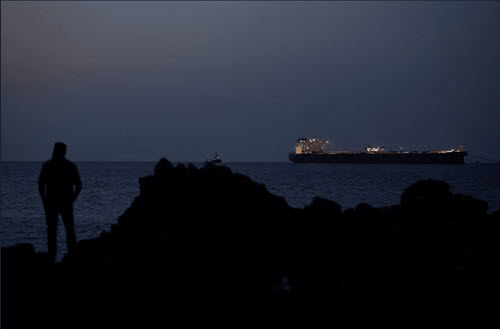
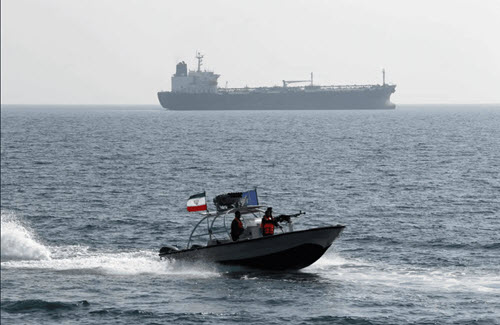
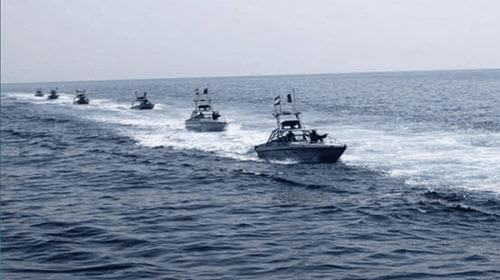
The Navy said in a Monday statement that it was forced to fire cruise missiles, combat drones, and rockets near US warships that had ignored its warnings not to approach the Strait.
The statement said the warships had turned off their transponders and attempted to approach the Strait in "dark mode" before reactivating their radars.
TheNavysaid its forces had warned the ships that any attempt to approach the Strait of Hormuz would be a violation of the ceasefire announced in early April, which had allowed a halt to the US-Israeli aggression against Iran.
The Islamic Revolution Guard Corps (IRGC) refuted a claim by the United States Central Command over transit of 2 US-flagged merchant vessels have through the Strait of Hormuz as a lie.
The IRGC on Monday dismissed US claims that two merchant vessels recently crossed the Strait of Hormuz.
Earlier, the US military claimed that two US-flagged merchant vessels have successfully transited through the Strait of Hormuz on Monday.
“American forces are actively assisting efforts to restore transit for commercial shipping,” US Central Command wrote on X.
The claim comes a day after President Donald Trump vowed to guide vessels through the vital waterway.
Iran has stressed that any transit through the Strait of Hormuz without official authorization from Tehran is not permitted, and that any disregard for this warning would be met with a crushing and decisive response from the country's Armed Forces.
The IRGC said in a statement no commercial vessels or tankers have traversed the strategic waterway over the past few hours.
“Claims by US officials are baseless and complete lies,” the statement added.
Iran’s Navy prevented the entry of “enemy destroyers” into the Strait of Hormuz as tensions between Tehran and Washington has been nearing the boiling point.
The Islamic Republic of Iran Army’s Public Relations Department said in a statement on Monday that, through a “decisive and swift warning” issued by the Iranian Navy, the entry of destroyers of the American and Zionist enemies into the Strait of Hormuz zone was prevented.
US President Donald Trump claimed Sunday that Washington will be "liberating the movement of ships in the Strait of Hormuz".
Later, CENTCOM announced that its forces will begin restoring freedom of navigation for commercial shipping through the strategic waterway on Monday.
“Our support for this defensive mission is essential to regional security and the global economy as we also maintain the naval blockade,” Adm. Brad Cooper, CENTCOM commander stated.
In responce, Iran stressed that any transit through the Strait of Hormuz without official authorization from Tehran is not permitted, and that any disregard for this warning would be met with a crushing and decisive response from the country's Armed Forces.
Later on Monday, two missiles struck a US Navy vessel near the Strait of Hormuz after it ignored warnings from Iran's naval forces.
Fars News Agency reported that the American warship was moving in the vicinity of Jask port with the intention of transiting through the Strait of Hormuz, in violation of maritime security protocols.
The vessel reportedly disregarded multiple warnings issued by the Iran's naval forces before being targeted.
According to the report, the US vessel suffered damage from the strikes, forcing it to abandon its course and retreat from the area.
Mohammad Akbarzadeh, the Political Deputy of the Islamic Revolution Guard Corps Navy, stated that any US move to reopen the Strait of Hormuz will be met with a new naval operation.
Speaking at a public gathering in the city of Chabahar in Southern Iran, Akbarzadeh said that despite the enemy's false claims about the destruction of Iran's naval and aerospace forces, the Strait of Hormuz remains under the control of the Islamic Republic's powerful armed forces, and the enemy has not achieved its goals even through naval blockade.
The Political Deputy of the IRGC Navy emphasized that what is certain is that in the event of any possible US attack aimed at reopening the Strait of Hormuz, it will be faced with a new operational plan by the IRGC Navy—one that falls outside the enemy's calculations.
In another part of his remarks, he stated that the presence of people from various age groups, with different political inclinations and religious denominations, in gatherings supporting the Islamic system reflects a spirit of patriotism and national pride, adding that the people of this land have proven they will not yield an inch of their country's soil to the enemy.
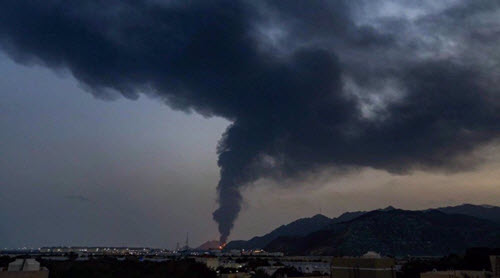
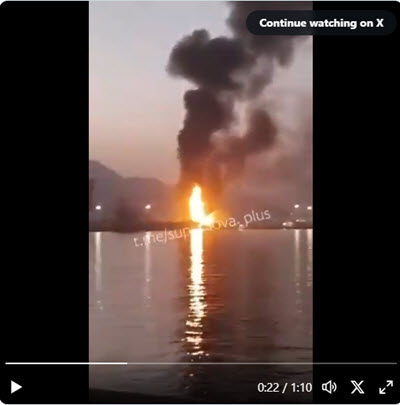
Fire at the Fujairah port in the United Arab Emirates on Monday, May 4, 2026. (X)
A massive blaze at oil facilities in Fujairah Port in the United Arab Emirates (UAE) on Monday was a direct consequence of 'American adventurism' in the strategic Strait of Hormuz, according to a report.
Citing a senior military source, the Islamic Republic of Iran Broadcasting (IRIB) said the Iranian armed forces had no premeditated plan to attack the aforementioned oil facilities.
Authorities in Fujairah said on Monday that a fire broke out at the Fujairah Oil Industry Zone, accusing the Islamic Republic of Iran of launching a drone strike.
“What happened was a product of the US Army’s adventurism to create a corridor for the illegal passage of ships through the prohibited waterways of the Strait of Hormuz,” the source stated.
He said the American military must take responsibility for the incident, slamming Washington for recklessly endangering regional stability.
In a sharp rebuke of US foreign policy that has fueled unprecedented tensions in the region, the source called on American officials to change their approach.
“American politicians must put an end to the ugly behavior of using force in the diplomatic process and cease military adventurism in this sensitive oil region, which affects the economies of countries around the world,” he said.
The massive fire at Fujairah Port, a key energy hub in the UAE, came after US President Donald Trump announced he had ordered the US military to begin an operation to break Iran’s control over the Strait and allow commercial ships to pass through.
The IRGC warned in response that any attempt by US military or commercial vessels to pass through the Strait of Hormuz without coordination with Iranian authorities would be met with swift and decisive action.
Iran has controlled the Strait since the early days of the US-Israeli aggression that began in late February, allowing only ships that are deemed non-hostile and that observe security protocols announced by the Iranian military to transit the waterway.
Earlier on Monday, the Iranian Navy fired missiles and drones to warn US warships approaching the Strait of Hormuz in an attempt to challenge Iran’s control over it.
The Navy said it was forced to fire cruise missiles, combat drones, and rockets near US warships that had ignored its warnings not to approach the Strait.
Iran ATTACKS US Warship & UAE in DIRE Warning to Trump | Larry Johnson & Col. Lawrence Wilkerson Danny Haiphong May 4, 2026
Larry Johnson and Col. Lawrence Wilkerson join the show to discuss Iran's retaliation in the Strait of Hormuz, hitting UAE's top oil port and numerous cargo ships as Trump's Project Freedom goes up in flames
Transcript
Welcome everyone. Welcome back to the show. Joe Danny High. As you can see, I am joined by good friends of the show, former CI analyst Larry Johnson and former chief of staff of Colon Powell and a retired Army Colonel Lawrence Wilkerson. Gentlemen, thanks so much for joining me today. Yeah, looking at us, it looks like there's been an escape from the nursing home. Uh well, you youthful youthful spirits always though. Uh look at these old guys running around. I feel I certainly feel that way. Yeah. But yeah, but Lar Larry's uh the good colonel is much better preserved. Right. Well, we got a lot of wisdom here in the room today. Uh and uh we need it. We definitely need it because we need help, gentlemen, understanding what has just transpired in the last several hours. Uh when I woke up today, maybe we can begin with you, Larry. I had reports coming in from Iranian media saying that Iran had uh struck or at least fired upon a US Navy patrol boat that had violated the navigation rules of the straight of Hormuz, the new mechanism that Iran has implemented. And then not some hours later, uh we have reports that the UAE uh there is a a ship, a cargo ship burning off the coast of the UAE. And then there's been reports from the UA itself of the port of Fujayra and its petroleum industries uh industrial zone uh reporting a massive fire that was caused by a drone attack and and some others say maybe it was a cruise missiles and drones that were fired here. Um and so a massive uh warning it seems and Iran has said as much that it is warning uh the United States that what it has declared project freedom, Donald Trump's project freedom is a violation of the ceasefire. So maybe Larry, help us understand what's happened the last and whether you believe the war has officially restarted given these developments. Well the I'll answer the last first. Yes, it's restarted. It's just this is this is all a ruse by by Trump. So, you know, on Friday the end of the 60 days of the War Powers Act where at which point the Congress would have to vote to approve continuing the war or say, "Okay, bring bring the boys home and they they'd have up to 30 days to do that." Instead, Trump preempted that by saying, "Hey, war's over. We won." Uh so, Operation Epic Fury, man, it was epic. We're done. We're no longer furious. Uh later. Oh, we got a new operation going. It's called Operation Project Freedom. This one we're going to establish freedom of navigation in the Persian Gulf. New completely, entirely new. Now, this is just this is a travesty. It is it's not even an intelligent way to try to get a workaround on the War Powers Act because the War Powers Act stipulates that when you start deploying the troops, that's when the clock starts. Well, these troops have already been deployed there now for uh 64 days uh 65 days. I take that back. Uh so uh it's it's it's Trump playing games. uh the Iranians with their sort of they've revised their 10-point plan up to a 14-point plan and the 14-point plan is now tougher and uh it shortens the deadline for the US to agree to it. It says that they're no longer they're not going to talk anything about nukes and enrichment until there is a a solid peace agreement in hand. In fact, they reserve the right to basically do whatever they want to do in accordance with uh their their rights as a signatory to the non-prololiferation treaty and to uh 4 minutestheir openness to accepting IAEA in in so you know Trump's notion that he's going to put US Navy ships into the uh straight of Hormuz to quote open it up. I'm not even sure what the hell that means because to if we want to define what does it mean to open the straight of Hormuz that means you've removed every potential threat that could damage a ship. That means you've removed mines. You've removed uh underwater drones. You've removed the many submarines which fire torpedoes. You've eliminated the surface drones. You've eliminated the air drones. Uh then you've eliminated the coastal defense cruise missiles that are stored away back in caves and you've eliminated short-range ballistic missiles and intermediate range ballistic missiles. Well, news flash, the only way you can do all of that is you would have to deploy a major land force along with a major naval force that was would end up taking significant casualties. And the land force would be of such a size that you would have to be able to penetrate about 150 to 200 miles into the interior of Iran in order to scoop up all the potential sites where they could fire drones, cruise missiles, and ballistic missiles from. It ain't going to happen. Okay? Ain't ain't going to happen. So the Straight of Hormuz is not going to be open no matter what the United States does. The only way to guarantee it open other than the military option I just laid out is Iran says come on through. We're not going to shoot and with with our with our buddies here in Oman. We're going to we're going to divide up the money. It's going to be a nice uh cash cashmaking opportunity. So that's where we stand. Yeah. Colonel Wilkerson, your reaction to these developments? Well, I got some information. I don't know how reliable it is. Um it makes sense to me. So I assigned it a little bit of reliability that JD Vance about safe the view a very sound view that why are we doing this? Because we had traffic about to flow if it weren't already slowly through the straight over moose under essentially Iranian guardianship or overwatch if you will. And what we have done is declared something we can't possibly fulfill. And we'll find that out forth with very swiftly. And that is going to be to our disadvantage majorly because it is going to impact the global economy seriously. It's going to impact the price of oil etc etc. We've all heard these arguments. But JD Vance is right. you had a situation and that situation could have been spun off into some real talks instead of these silly things that they've been doing on the US side, silly things to this point. Um, it could have been spun off into maybe some serious talks. Instead, what we've done is claim we're going to do something we can't do, which is cause the Iranians to do something that they essentially can do, which is going to block traffic in the straight, which makes absolutely no sense. So, you see why I say I believe JD Vance probably did say something like this. Yeah. And and Larry, what does it mean for Iran? You know, usually I'm used to uh especially uh during this February 28th strike and the 12-day war, but let's just keep on February 20th. I'm used to waking up and hearing that the United States and Israel has made the first move. But here, Iran has essentially made a major uh response uh in reaction to uh what were violations of what it says are its terms for the straight of hormones and its mechanisms. What does it mean uh for the broader picture here for Iran to take this step and make good on its warnings like this? Well, well, actually Iran again is reacting to what the United States did. You the United States imposed the blockade and then it illegally boarded uh ships uh that were even outside the territorial waters. They're in international waters. The United States had no authority, no legal right to do that. So, United States has Trump admitted committed an act of piracy and so now Iran's retaliating and they're daring the United States if you want to keep open the escalating the retaliation we're ready they're they're ready to climb that escalation ladder and uh as Colonel Wilkerson correctly noted the the one that holds the cards here is Iran not you know Trump likes to pretend that he he holds all the cards there there has been some genuine delusion going on in terms of uh and I think it 9 minutesstems from Israel that the CIA is passing on liaison intelligence. You know, the CIA doesn't have any good sources within Iran. So, Israel is saying, "Oh, we got these excellent sources. We got the inside skinny on what's going on in Iran." And the reality is there's great disarray in the leadership. The leadership doesn't agree. They're they don't know who's in charge. Well, that's a lie. And and the biggest and the reason I say it's a lie is when you consider that Peskian uh when during you look at the period 198088, the Iraq war against Iran. In that war, Peskin, the president, he was a medic. He was assigned to the IRGC. Uh you have Arachi, foreign minister, IRGC. Galibbah, the head of the legislature, IRGC, the Ayatollah Kamei, IRGC, these guys were all, man, it's they're they're 10 minutesall part of sort of the same overall unit. Now, I'm not saying that they were all fighting together, but as Colonel Wilkerson knows, when you're when you're with a group of army officers and you and you all fought, you know, in your formative years as young lieutenants or captains in Vietnam, then when you're later on a bunch of old farts or, you know, there's a bond there. There's a bond there that doesn't exist just from civilians in general. That's that's what's going on in Iran. I I would argue right now in Iran, you have a stronger united leadership than at any time in their 46 year period history. You've never had a cadre of leaders that all came out of that formative experience of war with Iraq. Danny, I listened to John Mirshimemer earlier this morning and I think John was spot on with regard to what Larry just said. I think the question was asked him by an Australian interruptor. Um, okay. The Wall Street Journal says this, the Wall Street Journal says this. GDP is just tanked. Inflation is off the charts. There's no money. There's no way to purchase things that you need to survive and so forth in Iran. And FDD, the you know, the Israeli think tank that's taken over from Apac in many respects was amplifying this message. And John just said, and I think John is right in this regard, it doesn't mean anything to the Iranians. They have shown you that they are willing because you are presenting an existential threat to them. And what Larry just said is how that existential threat is interpreted by people like Archi and Peskian and others in Iran who've been through this kind of thing before. What do you think the bloodiest war in the region in a hundred years was for the Iranians with regard to the Iran Iraq war? This is even more in their face existential and it's after 40 plus years of our doing that periodically and Israel doing it pretty much fulltime. So you are not going to break these people's resilience. Larry, is there any uh factual basis to the US right now claiming that they have uh uh hit six Iranian fast ships uh in this skirmish? Because you know often times what we have is Sentcom reporting things uh and very little evidence for them and then they often Sentcom is especially on X claiming that anything Iran says is false. So what's the truth here with regard to this uh uh development because uh this seems to be the US attempting to look strong here uh in the face of this retaliation. Well, how could the United States destroy six boats since the Iranian Navy was already obliterated? See, so air force, navy, everything. 13 minutesYeah. Yeah. So yeah. Okay. Uh right off the bat, uh we can acknowledge that the United States has engaged in a massive propaganda effort, not so much to deceive the enemy, but to deceive the American people. You know, com convince the American people that, you know, this new Coke, it's really good. It tastes good. And people are going like, tastes like horse piss, you know, and no, no, the horse piss is good for you. Look, no, no amount of marketing is going to uh change the reality on the ground. And so let's just let's look at the reality. Can a US naval vessel, a destroyer or a cruiser sail effortlessly through the straight of Hormuz? I say no. And let let's see if that can happen. Um the the the Pentagon and Sentcom have been routinely lying throughout this entire uh 65day adventure. Uh you know, we're told that the uh that no no drones or missiles hit the Abraham Lincoln. That turned out not to be true. Uh that that that uh 30hour fire on board the Gerald H. forward from too much laundry lint. Yeah, that makes a lot of sense. U the fire on board that the fire on board this one destroyer that knocked out its navigation system, the whole thing. You know, as Andre Martiano noted, he goes, "That sounds like that may have been something more like a missile hitting it that would have disabled it." So, we're not admitting to casualties. We're not admitting to losses. And we're doing a little bit like what we did in the early days of Russia's special military operation the where we had this the ghost of Kiev, this amazing fighter pilot for the Ukrainian air force who downed six Russian jets and then it turned out he was a character from a video game. Uh and I and I think we're getting a lot of sort of video game spillover here that uh that is exaggerating uh what has taken place. U we we'll know in the next few days that have they opened the straight up and we'll find out. No, they the United States cannot does not have the ability to open up the straight and the only one that can do that is Iran. And it'll be up to Iran to decide who gets to go through and who doesn't. Well, I'll just add this back up here. Donald Trump posted this in the uh last or so on his truth social. Essentially, the United States, everything is 100% operational while Iran has been completely destroyed. This despite all of the activity that has occurred uh what Sentcom is calling the Arabian Gulf. Uh but Colonel Walkerson to you. Any any uh reactions? Well, that's always been a huge argument, even within military channels, all the way back to 1984 when I first got introduced to the region at US ThinkPac. Then now, whatever the hell they're calling it, INSCOM, Pacific, Indiana Ocean Command, whatever endopaccom. Indopaccom. Yeah. Um, certain people even within the US military, and I wouldn't call them Arabists. There were a few of those, but wanted to call it the Arabian Gulf because that's what Saudi Arabia wanted and after all, they were our ally. And others said, "No, it's historically the Persian Gulf. It's going to be the Persian Gulf." Well, that's the people on the other side of the Gulf, terrible people. Um, it sort of sums up the stupidity with which we've dealt with the region for over half a century. If you look at what is happening, what what Larry just described, for example, what Larry said, I maybe going back to a previous podcast, I don't know. Yeah. Um, the only way you could do what Donald Trump is saying with all this he's putting out is by landing forces on Iran and marching through the country and doing what you say you have done, which you haven't done. And they're not going to do that. God forbid if they do because there'll be a lot of dead Americans. Some dead Iranians too, but a lot of dead Americans. So all this posturing, all this beginning again and stopping and beginning again, the war powers resolution is part of it, but it is also because Danny, he does not know what to do. He doesn't have a clue. The other thing that came out of the reliable source about JD Vance's weighin was just that very thing. Now Vance did not say that to the president's face, but the implication in this meeting was you want out. We know you want out, but we don't know how to get you out. And we don't know how to get you out in particular because you keep doubling down in a sense and making things worse. Now, I don't know if it happened in that kind of trenchant way. But I think the president is becoming a bit desperate because he can't fashion a way out of this. The more desperate he becomes, the more this kind of stuff he puts out. But the bottom line is he doesn't know how to get out of the mess that he has let BB Netanyahu get him into. And at the same time you say that you have to say look at what BB continues to do not just on the West Bank not just in Kaza but in Lebanon to the extent that now you're having run headlines that are just purely bull. I mean, you got a headline this morning that, okay, I've given per permission for the IDF to shoot Palestinians. Kill them dead, but don't shoot any of those settlers. In fact, when you go in there, make sure you're with the settler and you're killing the Palestinians. Kneecap them at the at the at the best, but kill them if you want to. These are orders going out now in the West Bank, and I'm sure it's worse in Lebanon. So, that's where we are. We're in this with this messy situation in Lebanon and Gaza and elsewhere. And Trump knows not how to get out. And even if he were to figure out a way to get out, what would BB Netanyahu do? His damnedest to pull him right back in. So, he's got himself in a royal mess. And we're hearing reports out of CNN, Larry, that uh this royal mess is uh might might get worse as the US and Israel are supposedly planning strikes for the next 20 uh in the next 20 within the next on Iran. At least this is coming from, I think, sources from the UAE to CNN. Yeah. Well, they've got uh look, the war plans, they've been in place. They've they've got the targets all lined up that they've had that in place now for two weeks. So it's just a matter of waiting for the decision to launch. But within that they haven't I think fully taken into account the upgrades that uh Iran has made in its air defense system. Iran has done over the last three weeks they've done two separate uh so I call them live fire tests of their of their air defense system. So, you know, the clear clearly they've got something new and their ability to engage the planes that will be flying over the Persian Gulf, I think, has increased. So, you know, it as soon as they Iran has not yet started to pepper and uh Israel or the US other US bases with uh drones, missiles, but that's coming. And they've also promised they got a new surprise in store for the West. I I have no idea what that is, but they've been pretty uh pretty pretty adamant that yeah, they've got they've got a new kind of weapon system that they have yet to employ. So, this is uh you know, the the United States is now uh we're caught. The the only way out is for Trump to do what Trump will not do, which is admit error, admit defeat, try to try to put the lipstick on the pig the best they can and walk away. But no, they're going to keep doubling down. It's the old sunk cost fallacy. And uh you know, like the the blackjack player who keeps borrowing money from the house to keep losing hands. But uh Iran Iran, you know, it it got a voice, a strong vote of endorsement both from Russia and from China. You saw what China did uh yesterday to the you know, instructed all of its banks and refineries. Hey, for those US sanctions, tell Donald Trump to shove it up his ass. No, we ignore him. We're not paying attention to it. Oh, that that should be an interesting conversation if Trump decides to go to China, right? If he gets there, if he gets there. Yeah, the chi and I I don't think he will. But the the Chinese now, they're done playing the US game. They're not they're not going to cowtow as it were to Washington DC and to Donald Trump. Similarly, it was Putin that took the initiative. He called up Trump and basically said, you know, you better not ina in invade put ground troops into Iran. If you do, it's going to create a much bigger problem. And I don't think you want a much bigger problem. you know, it wasn't so much a threat as just a warning that, hey, be aware that if you do this, something bad, you know, it's like if you touch the hot stove, you're going to get burned. So, uh, Iran, uh, enjoys that advantage. And, and then you've got Bessant. God, you know, what a dummy. I mean, really, this this man is purported to be this real smart intellect running our economy. The guy is a He keeps he keeps indulging himself with all these fantasies that oh we've we've crushed the Iranian economy. They have no other option. Dude, they've got six lanes of traffic coming in from Pakistan. Okay. They they have they've made more money in the past two months off this war than they did in the previous year. So just enough with your nonsense that he thinks that he has isolated Iran and hasn't but has convinced Trump just a little more effort. We got him. That's all. Just a little more. That's why Trump Trump is caught. He doesn't he doesn't have anybody other than JD Vance which is willing to tell him the truth. I think he's got a few in the Pentagon now. That's another thing I'm hearing a little bit more solid now who are saying this is stupid. This is really stupid. You need to you need to figure a way to get out of this. We need to figure a way to get out of this. Yeah. Well, how about we look at some D. You know what's so interesting is uh with all the developments that have happened last , it appeared what Donald Trump was trying to do uh in the beginning of all of this was to lower oil prices, which actually temporarily went down for I don't know some hours. Uh but uh this announcement by Sentcom came before all the reports of the ships being hit and uh the you know the the the Fuji port being hit by Iran. SenCom says that they had guided missile destroyers currently operating the Arabian Gulf after transiting the straight of Hormuz in support of Project Freedom. American forces are actively assisting efforts to restore transit for commercial shipping as a first step blah blah blah blah blah. But anyway, this is actually the data which shows that uh there was no if you look at the uh the map here, there was absolutely no ships that were transiting the straight of horm over that period. So uh uh uh maybe some actual lying going on. But you know, Larry, your reaction to this because if the United States goes through and Israel goes through with strikes and you just said that there are surprises up Iran's sleeve, they have a lot more uh gas in the tank to continue fighting. The economic situation is really bad right now. I mean, it's the the numbers across the board, gas prices, prices for everything. And of course uh you know uh uh the impact politically it's having on the US administration is set to get much worse I believe. So why why then go through with this at at this time and in this way? Yeah. Well that that's where the real uh failure of the Trump administration comes in. They are not taking into account the massive economic collapse that is coming to your neighborhood soon. Um we're not just talking about the contraction, you know, loss of 20% of the world's oil supply over the last 60 days, you know. So that's that's gone. Uh that and that that hasn't been replaced. So you got to subtract that. Subtract the ura that was uh for fertilizer you know upwards of 35%. That again that's not replaceable. Uh the liquid natural gas 25%. Not replaceable. The loss of helium not replaceable. Same with sulfuric acid not replaceable. The the problem is that with the cut off of the straight of Hormuz that took place starting February 28th, there were already ships on the ocean sailing with these filled with these products that there's now a shortage of. So the the not everybody was immediately affected and I've described, you know, you use the tsunami imagery. You're sitting on the beach, you're sitting there and the the waves all of a sudden the the water starts running out to the ocean opening up this massive expansive beach and you go, "Oh, that that looks pretty good." That's your sign from God to run for your life. Okay, that time get out. Get your ass out of the beach chair. head for the high high ground cuz there's going to be a flood of water coming back in. That flood has started this week. It's starting to flow back in and we're seeing it, you know, down to where I am, uh, gasoline has gone up 50 cents in the last 5 days. Uh, and it's and it's it's keeps going up every day. In fact, I on Saturday I checked in the it was at 396 a gallon and then I drove by the station yesterday. as I drove by there's a one of the employees out on his knees putting up now now it's 3.98 just adding two cents but uh so and and that that has an effect my wife when she was filling up she said she heard a lot of the people the pumps around they're bitching about it this so Trump has got himself a major problem and we're not as bad off here in Florida as some folks are up in the Midwest up in or the West Coast Oh yeah horrible Yeah. So this um when this when the full impact of this economy comes hits all of the lies that have been told because we've seen it in the spot market. You know the the spot market for oil the paper they they call the oil futures. They've been lying their ass off about that for 60 days. Go back and look at what they said. The oil futures what the oil was going to cost in May they were saying was like $80. Well what is it now?$und00. $140 if you're actually buying it off the ship because the paper the paper means nothing. It's part of market manipulation to get people lulled into oh this isn't as bad as it is. Folks, it's worse than what it appears. Much much worse. And that's what that's what the Wall Street Journal was all about. They're trying their damnedest to deflect some of this and to convince people it's not happening. Sorry. People are going to tell you it's happening pretty soon. Yeah. This is like that that scene out of the movie Police Story. Frank Dreban is standing there behind him. The buildings in flames, explosions and rockets are shooting out there. There's uh just complete chaos. And he's standing there saying, "Nothing to see here. Move along. Nothing to see here." That's where we are. Yeah. I've seen uh prices as high for uh gas in California, Northern California, Southern California, upwards of 660. Here in New York, uh I took pictures of consecutive days out here in New York City of a gas station near where I live. Uh it went up from 423 the day before to 4:45 the next day. So, we're seeing massive uh increases just by the day. uh which uh Larry I totally believe you that there are many people who are very angry about this um who don't necessarily get heard uh but you know uh Colonel Wilkerson I want to ask you what's the rush right now for the United States and Israel because um if I were to think in terms of real politique terms given the balance of forces uh both on the battlefield and in terms of the worldwide economic situation it would seem to be in the US's interest and even in Israel's interest to maybe take a pause like they did during the 12-day war, take an actual pause uh like they claimed to be doing uh during this recent ceasefire, but that doesn't seem like we are headed in that direction. And and it seems like we're actually now fully uh back on. So what's the rush here for them? I think Netanyahu is like a man who is running towards a precipice and he leaps and he's hanging in the air above the prefaces. Maybe it's 500 feet down to the rocks in the ocean below. And that's where he is politically war in terms of war in Lebanon. He's losing his rear end. Um, I think I heard the other day from a friend uh who used to be in the IDF, now lives in this country, and he said some of the people he still knows in the IDF who are in Lebanon um are really kind of amazed that they haven't done something differently because they are still trying to do the same kinds of things, using their forces in the same manner, getting worse every day with regard to that use and they're not making any headway and they're losing people. And I said, "Well, how many people are you losing?" He said, "Well, just look at the official figures and multiply it times three." It's that bad? Yeah, it's that bad. And it's equipment, it's in personnel, it's in morale in in particular. And what's happening, of course, is you you have when you have a a force that's been in garrison duty as long as that force has, some 20 plus years, and you suddenly confront conflict, and a lot of these people are just confronting it seriously in Lebanon because they got called up in the last trench, and they haven't had any experience of real combat in a long time, if ever. And so, the post-traumatic stress is off the charts. The suicide rate is off the charts. They've even quit reporting legitimate figures to IDF headquarters. In the past, they were giving everything pretty accurately as to how this was h occurring and how how much it was debilitating their ability to prosecute the war. Now, they're kind of obscuring it just like they're obscuring the damage above ground in Israel from Iran's constant barges before now. And that's another point. They're going to go back to that again very shortly if Israel doesn't and there is no ceasefire in Lebanon. There is no ceasefire. The Iranians are absolutely right about that. Israel violates the ceasefire every stinking hour of every stinking day. So Iran's going to go back to hitting them again if they don't do something different in Lebanon. And if this starts up again, if we in fact Israel and United States hanging over the precipice as it were, go back to bombing again, Iran's going to go back to what they were doing before probably times three or four. So, we're looking at the state of Israel being wiped out. Yeah. Well, uh, Larry, maybe you can help us understand what that would look like then because, uh, we already have the impact of what had transpired in the, uh, hostilities that Iran was a part of, the retaliation, which many are saying the impact of that, especially in the energy realm, is just starting to be felt. Um, and now we're kind of catching up to it. But uh uh the United States appears ready to absorb or at least uh maybe not ready but willing to uh uh accumulate these costs. Uh what kind of costs are we talking about here? Donald Trump is willing. Oh yeah. Yeah. Donald Trump uh the uh the the wararmongers in Washington seem more than willing. I don't everyone else uh no. Well, we got to look at what's uh what's happening to US debt under Donald Trump. Uh when he came in when he took office January 21st, 2025, uh the total debt was 20 37 trillion. 35 minutesUh in the in the next 11 12 months, that figure went up another trillion dollars, 38 trillion. Then in the ensuing 77 days it went up another trillion. When you are losing aircraft like on that day when they tried to when they when they affected the rescue of the of the colonel who is riding in the backseat of that F-15 u they the US lost almost a half a billion dollars in aircraft that day. They they've lost as CNN detailed the damage done to the various mil military bases not counting the radars you know it was literally multiple billions and when you count the radars again at least two radars that cost more than a billion dollars a piece went out then then they've now you know deployed the a new cruise missile or a new hypersonic missile the only hypersonic missile in the US inventory called the Dark Eagle that runs for a cool $44 million a piece. And what's so great about the Dark Eagle is it's half as fast as the Russian Kenshaw and it's eight times more expensive than the Russian Kenshaw. So picking up a pattern here, we we make it worse and make it more expensive. And so they've got they've been able to produce I think uh close to 10 of those. So we're up now another half billion. So half billion here, half billion there pretty soon. It adds up to real money. And the the top it off, the United States, one one of the one of the motivations that I think Colonel Wilkerson's referring to among the officers at the Pentagon, they're saying don't don't do this anymore. We need to stop. We need to back away. is because we have depleted critical weapon systems and they are not able and I'll say this they cannot replace them now because they use rare earth minerals that China controls and China is not sending us the rare earth minerals therefore you can't build uh the weapons uh and they're also misrepresenting I guess another word for that is lying about about the actual uh extent of the loss. For example, they said with a with a Patriot missile battery, they're down 50%. Nonsense. They're down 90%. It may be as high as 95%. It's that high because the the math on it just it doesn't work when you when you start off with uh let's say the the the the grand total produced. Well, it's not not the grand total produced as as of the end of 2025 was 6,420 to strip 2,000 of those away. Those went to foreign military sales. Strip another thousand away that went to Ukraine. That's gone. Uh then uh figure out what number. So that leaves you with roughly half 3,310 from what we started with. And then when you realize that 3,310 missiles uh or let's just call it 3,400 to make it easy. Uh those pack three missiles, you got to shoot two of those to take down one incoming threat. So you got 3,400. That means you can handle 1,700 ballistic missiles, cruise missiles, or drones. Well, how many and and this is as of last June. So, how many missiles did Iran fire during the 12-day war? We know how many they fired during this latest one. 4,000. o, please explain to me how when you only got enough missiles to shoot down 1,700 and they're shooting 4,000. Guess what? The math doesn't work. And that's that's where they're lying. And it's not a matter of said, "Well, let's just encourage the factory to to turn out more." They don't have what they need to build it. God, this this is not complicated, but the line about it just goes on and on and on. Yeah. Uh and and now we have uh I you know this looks Colonel Wilkerson, you said earlier you used the word desperate. Uh these are Donald Trump's latest musings on true social literally as we've been speaking here. Uh, Iran has taken shots, he says, at unrelated nations with respect to ship, the ship movement, Project Freedom, including a South Korean cargo ship. Perhaps it's time for South Korea to join the mission. We've shot down seven small boats, or as they call them, fast boats. It's all they have left. Other than the South Korean ship, there has been at this moment no damage through the straight. Secretary of War Pete Hexath and Chairman of the Joint Chiefs of Staff Dan Kaine will have a news conference tomorrow morning. Thank you for your attention to this matter. Uh so Colonel, what do you make of I mean this feels like desperation. It feels like an attempt a really I think sad attempt to cool things down as uh social media and of course news reports start to heat up about the activity happening here. Well, now the South Koreans can say, "Well, give us our dad's back and maybe we'll do something for you." This is a fruitless cry for allied help in a mission that everyone I mean even the elementary school students in greater metropolitan soul know this is a stupid war a war of choice an idiotic war a war uh begged by BB Netanyahu and by the way BB doesn't have a very high standing in the world right now even in places like Korea and so forth so everybody knows this now I mean it's common knowledge that that's what's happening the idea A that any ally is going to come to our assistance in what is a fruitless and ultimately idiotic war in this region is nonsense. So he can tweet and twist his arms behind backs and everything else. He's not going to get anything out of it. I doubt very seriously he's as Larry intimated and I think he's right. I doubt very seriously he's going to go to Beijing. Um, and if he went to Beijing, I think he would get a pretty frosty uh reception and it wouldn't be a good deal for Donald Trump. So, in in any event, I don't think he's going to go. I hope he does because I I feel like he might actually get his eyes open to a certain extent as to how much the most powerful country in the world is opposed to what he's doing in private meetings or whatever. Um the same thing for example that uh Putin delivered but up close and personal in his press conference that he had immediately after his meeting with foreign minister Abasari. Um I I think what we're looking at is total isolation for the United States and Israel. They're alone. And if they start this up again, if they do go ahead together and bomb targets and I run again, that isolation is going to be just deepened. They're going to find themselves on the world stage without a single solitary person giving a crap about what they're doing or otherwise very much opposed to what they're doing and getting further and further away from Donald Trump and and his nonsense. Um, and further and further away from America, too. And that's not good for us right now because we are, as Larry has said, we're getting ready probably to plunge into not just recession but depression. Yeah. Yeah. And uh with regard to this meeting that is scheduled or at least uh has been surmised to be scheduled around May 14th, uh you know, Larry, China likes to treat their guests well. they often roll out the red carpet, especially for partners in countries they believe are going to uh engage in some kind of mutual benefit between the two countries. But uh you know now Trump and you know the uh uh uh the Hill and all kinds of other mainstream media outlets have talked about Trump holding very few cards. Well, Donald Trump seems to not understand what cards are. He posted this on his on actually this was on the White House uh uh Twitter uh where he's this AI generated image of him holding up Uno cards not understanding that all of those cards essentially means you're losing the game. But uh Larry uh wow cards. Wow cards. Very typical of uh of Trump to to get these kind of things wrong. But maybe you can talk about this because Donald Trump in the United States is often talking about how they hold all the cards against Iran basically in the world stage. But now as we head up lead up to this meeting. Um most most observers even those elite observers are saying that actually the United States under Trump right now does not appear to have very many cards uh if they and when they go to China and Iran could be a big part of why that is. So uh maybe you can help us understand this. Well, let's just make it very simple. What is it that the United States makes, produces, manufactures that China needs? Answer is nothing. Uh there are things that China wants but does, you know, soybeans. Yeah, you know, they'll buy some soybeans, but you know what? Brazil can give them more soybeans at a better price perhaps. Same thing, wheat, corn, some agricultural products. But again, it's not essential. Whereas flip the question, what is it that China makes that the United States absolutely needs? Oh boy. Well, you start with the rare earth minerals, you start with magnets. Uh so there is a lot of critical items in industry. Uh I think uh generators and transformers is another area. So uh the United States actually needs some things that China has. So they've got leverage right off the bat. Uh this is some of the memes that are popping up online that that the Iranians are making are just they're hilarious and they're brutal. They've got they got one that features Donald Trump sitting on the floor wearing an adult depends and he's playing with toy soldiers while Pete Hexth in uniform, a military uniform is passed out on the couch and then in the midst of it throws up. So, you know, they're the Iranians are sort of sending a message exactly what they think. Not to mention all the different Lego videos that keep popping up. Both they've got rap versions, they got rock and roll versions. I tell you, these guys, they they they have uh I'm stunned at their abilities. It's just really remarkable and talented. Uh they could they could, you know, they've got a whole new business area. They could hire themselves out to the Russians and to the Chinese and to the United States. got guarantee not none of those big three are doing anything like this in the realm of information operations. I mean this this is some powerful stuff and it resonates and it reaches kids, it reaches the youth uh and it even reaches old farts like me. Yeah. And and then all this is having an impact. Uh, I mean, the recent polls right now, Colonel Wilkerson, have Donald Trump barely registering 30% approval ratings. I believe it's as far down as 32% in the last Ipsos poll. Uh, and and these numbers keep dwindling and dwindling ever since the February 28th strike um up until now. So, this is May 4th now. So, so things are looking very bad for uh the Trump administration, the GOP. Some will say this doesn't matter of course because we have a bipartisan war machine and all of this. But at the same time uh uh there there is you know validity to uh the need for legitimacy around these things and the United States and Donald Trump just in the administration doesn't have any right now. Uh what do you make of this? Well, if you watch the hearings, uh particularly the ones with Hegath, it was sort of a a Republican Democratic pile on. Uh the Democrats piled on a little harder than the Republicans maybe, but I didn't see anything going down that looked like there was a comfort level on the part of the Congress or the people asking the questions that uh resonated in any way positive. So whether you were a Republican or a Democrat, you were you were if you were a Republican, you were kind of looking for some comfort maybe, but you were looking for some rationale, some reason, some excuses that made sense or whatever. And I don't think Seth was forthcoming with any of that. I don't think Trump has been forthcoming with any of it either when he has tried to address these issues that are tearing him up as you just indicated with regard to the polls. Epstein being one of them. And if you think that this was supposed to get the American people's attentions off Epstein, well, you gave them something that's even worse than Epstein, and that's their pocketbook, which is going to be increasingly impacted in adverse ways. So, I don't see how he gets out of this internationally, globally. I don't see how he gets out of it domestically. And that really worries me because I think the man has plans. I think there are people around him like Bessant and others who have similar plans and I don't want to see those plans unfold domestically but I think we're getting to the point where we might see them unfold. And what do I mean? I simply mean we are going to see a real ICE. We're going to see a real brown shirt pritorian guard. We're going to see an effort to cancel the midterms. We're going to see an effort to uh if they can't get them cancelled to twist them in ways that we haven't even begun to dream of. I'm watching what they're doing with redistricting. Here in my own state, look at what just happened in Virginia. wheat overwhelmingly in the northern part of Virginia but by 51 52% in the state and that combined as Jim Webb used to say those morons who live down there in southwest Virginia but we combined to have a 51% plebite as it were a vote that was clear and fair and as as far as I could tell everywhere I looked and guess what the judges are already reversing that and the Republican states states like Cal, like Texas and what was the other one? Montana, I think Idaho, maybe. They're all redistricting or planning on redistricting themselves. So, everyone's right now just moving fast to counter each other in this business of midterm elections. So, you got that going on, too. And that's an effort to essentially, in my view, uh compromise these elections. And then you got the fact that uh we're looking at a president who I don't have any doubt whatsoever would you know declare the insurrect act for some god-awful reason and try to take over the country. So we're in a period like we were in in 1850 1851 and it's looking uh rather desperate domestically as well as internationally and they feed on each other but one feeds on the other one. Um, look at what we just did in Germany. 5,000 troops are coming home. And I understand he made a statement the other day that maybe he would double that. And Meritz is trying his best to deal with it. Um, this is not if you want to come home, come home. But don't do it in this fashion. So we Danny, we don't have a single domestic or international initiative right now ongoing on this planet that makes any freaking sense in terms of our real interest. Mhm. Yeah. He I mean uh Larry, when when it comes to the the current situation too, I've heard some even uh positing that uh the US and Israel are kind of creating a Gulf of Tonkan situation in the straight of four moves now to justify escalation. But as Colonel Wilkerson just said that this is a disaster. So unlike the Gulf of Tonkan which was an attempt to expand and escalate in Vietnam and the hopes of actually achieving uh victory there which was not going to happen but nonetheless that was the at least the uh the vision. There doesn't seem to any be any such vision here uh nor any prospects. So uh why why set up this trap for uh for themselves essentially? You have to have some force. Yeah, you have to have some military force. Well, yeah. I mean, look, the uh when the Gulf of Tonkan was passed, there was still at least majority support in this country for the war in Vietnam. Yeah. The the the the war move anti-war movement really hadn't come to full fruition. And there was still, you know, there was still many willing to support the idea that we were fighting communism and this was stopping the dominoes from falling, all of that nonsense. But the Trump Trump is already at the stage where the anti-war movement had become the majority movement. So he doesn't he doesn't have the benefit of the doubt. And this is his own fault. If he could have gone out and tried to construct a lie that people would have bought and got them on board, man, we got to do this and you know, he might have gotten away with that, but he didn't do that. He he listened to BB. And so BB's wal walked him into an ambush. Um, and you know when Colonel Wilkerson earlier was talking about how BB's run off the cliff and he's caught in midair. That's Yeah, that's Wy Coyote. Okay. That's Wy Coyote from the Roadrunner series. Uh, and uh with the with the difference being I think Wy Coyote is far more clever and intelligent than BB Netanyahu. But uh just uh from a cartoon character standpoint, it's anything but a joke what's going on in Israel right now. They've they've doubled down on, hey, I got a great idea. Let's see how many Christians we can attack. Let's really alienate the Christian world. And that that is not playing well here in the United States. They attacked a nun. This one settler attacked a nun, a French nun the other day from behind that. They burned and destroyed a church, a Catholic church in Lebanon. They desecrating uh icons and uh and other uh representations of Jesus. So uh and then you know they shut down the church of the holy supplr. The Israel is building a reputation for being anti-Christian that is is starting to resonate in the United States and it's losing its they're losing their appeal that there's a Democrat Senate candidate up in Maine, Army veteran. Uh looks like he's going to sweep the victory and he's he's you know Apac shows up and he tells him get lost. Not interested in your money. So there's more and more of that. Thomas Massie, he'll win easily in Kentucky. So, uh, and sort of on the good news front, you've got Ben Shapiro and his group, the Daily Wire, man, they're they're going down the toilet. They've had to lay off 50% of their staff. Their audience is just shrunk to nothing because people are, you know, sick and tired of saying we got to put Israel first. No, we, you know, Israel can get in line with all the other countries. If it makes serves our interest, fine. will do it. But if it doesn't get lost, and that's where Israel, they they can't sustain themselves without the United States being fully committed to their survival. Yeah. The majority of Americans are against this war, and the majority of Americans who are against this war know who got us into it. Yeah. Yeah. Yeah. Well, in uh the last couple minutes or so, gentlemen, you know, I've gotten a lot of flack on here for talking about the decline of the United States empire now that even the New York Times is saying it in their opinion pages, but I don't think, you know, your final comments on this, the way that the US is restarting this war alongside Israel also seems to signal not just desperation, but a uh even an inability to um to competently move forward on what few options they have at their disposal. Uh maybe you can help summarize uh if there's any reflection here of an empire being in decline. Colonel workers and then Larry you can get the final word. Well, I think Larry summed it up in very graphic terms. I've listened so much I pardon me if I got this wrong, but but we don't even have enough ships to do what Donald Trump wants to do. We don't have enough ships. We couldn't possibly escort all these tankers. We couldn't possibly open the straight moves in an effective way. We couldn't possibly do what this enterprise is supposed to do. And that's how stupid this is. It's absurd. So if you want to talk about the American Empire going, I'm I'm reading a book by Jim Carrey right now. It's marvelous book. It's called Missouri Mule. It's about Harry Truman. It's about Harry Truman created the committee in the Senate that saved so many taxpayer dollars during World War II. But the thing that really struck me about it, and you just look at the footnotes and look at Harry's own comments and look at the comments that FDR makes from time to time when he's angry with Truman for going too far, but he realizes we have become a contractor corporatebased entity that makes shitty products and charges a lot of money for them. And it starts here. It starts right there with World War II. Thank God we had enough good people that we managed to get through it and and supply lots of people and win the war. But now it's gotten to be exactly what we do. It's that's all we do. We make shitty products and ch charge a fortune for them. And people sending notes into your podcast or whatever saying, "Well, the empire is is still got this, still got that." Hogwash. I mean, and when you compare us with the countries in the world that do, increasingly China and Russia, um, then you've got a long, long road ahead to repair the broken whatever. Larry, you want any final words as we out of here? You know, you know you're in trouble when you go to somebody and say, "Hey, give you a choice. Would you like to have dinner with me or would you rather have a colonoscopy?" And when and when they choose the colonoscopy, you know, you've got problems. Okay. And and and that's sort of the situation the United States is in right now that the was it was it Norman Vincent Peele that wrote the art of how to win friends and influence enemies or something. Uh you know, Donald Trump's writing the book on how to piss off friends and infuriate your enemies, you know. So we're not lining we're not people lining up saying man the United States we want to be with them all the way. it is, you know, whether it's Mertz in Germany, Starmer in the UK, Gonzalez in Espa, uh Maloney in Italy, uh you know, it's it's quite a list. the pope in Rome, you know. Yeah. The u and then with China, you know, in the past, we can't emphasize enough how remarkable and unusual was she's declaration that no, do not comply with these US sanctions. Tell them, you know, tell them to go shove it, right? You know, that that's not a Chinese, you know, that shows you how irritated the Chinese are with this. And so, you know, they're fully backing uh Iran. So, out of this, the United States, instead of establishing itself as where where uh people want to buy and hold US dollars, people are wanting to buy and hold US treasury bills, just the opposite, man. They're selling them off right and left, right? These are all the symptoms of of a country in decline, not in ascendancy. Uh what is interesting though was Mertz's his desire to keep uh I I I published the other day a complete list of all the military bases in in Germany. And the reason the Germans want to keep it is that's one of their few profit centers right now in the German economy. You know the rest of the German economy sucking wind, but hey, you know, you got Uncle Sugar over here to share some of his dollars. Um, and it goes back to the point that Colonel Wilkerson also made that, you know, pulling out 5,000, what's the strategy? I mean, what have we have we come up with a strategic withdrawal plan? Absolutely not. This is more Oh, I'm I'm taking my ball and going home. And 5,000 is not even a unit. Yeah. I mean, it doesn't fit anything that would be a unit. Yeah. It's just u you know, I've spent a lot of time right out of the ass. Right. Well, I spent, you know, I was at Stogard at both patch barracks, Kelly barracks, a little uh, you know, working there with either ARICOM or Yukon and, you know, it's the US, but there there really no longer is a good reason for the United States to have this presence in Germany unless we want to continue our world uh, hegemonic activity of attacking other countries. If we're going to keep attacking other countries, then we need to be forward in Germany so that we can have a stopover place resupply as well as a place to bring our wounded after they get shot to Which is why they have Rin Mine there. The right adjustment to Rin is Ltool Medical Center. So yeah, this is we're witnessing the decline of empire that that's what we're living through and this is not reversible. And and Danny, I think I I I mentioned earlier uh about Xi Jinping's latest uh in the line of Dong Xiao Ping all the way to Jinping edicts. And what Larry just said is exactly what Xi Jinping said he's going to do. He's going to do it a lot quicker now. A lot quicker. He said, "I'm I've got everything I need in terms of state power, technology, culture, military, industrial base, ship building. What I don't have is a major hand in the global financial system. I'm now going to have that. And between the lines, I I hate those sanctions. The world hates those sanctions. How do we eliminate the sanctions? Let's take away the power of the dollar. And and and who's who are the top top 10 banks in the world? The top four are all Chinese. Yep. Then you get JP Morgan, City Bank. Then you get a French bank, uh, a Japanese bank and maybe a German bank or a UK bank. That's it. So, China 40% 40% now of the major banks in the world are controlled by the Chinese and that trend's only going to continue. Yeah. Well, uh, that's what actually developing industry and growing the economy can do. Uh, and, uh, I'll just end on this note. Uh there's a lot of people who think that this like consolidation of the oil trade routes and even of oil itself by the United States is some kind of uh is some kind of smoking gun toward the US being able to maintain its its dominance. But I I don't believe China, Russia, Iran, and of course any countries that are sane enough to uh uh begin aligning with them more so outside of the US orbit are going to sit lightly and say, "Okay, well, the US has this oil and has these routes that we're just going to uh bow down now." I don't think that's how history um moves in in the the overall trend. I believe that uh the more the US bullies, the more the US tries to starve the world, uh the more that we're going to see the trends that you guys just outlined here. Uh so, buckle up everybody. This was a great show. Um I want to make sure that everybody knows to hit the like button before we head out of here. I want to thank all the people who gave super chats, who gave uh who became new members. Sorry we didn't get uh to some of these questions, but uh be sure also I'm going to put it in the video description right now. You can follow Larry Johnson at Sonrar 21. Also check out I just saw Colonel workers and you were on Tucker Carlson's show, so you can head over to X and watch that. That's that seems like a great uh uh little um long story there intervention. Yeah. Yeah. Yeah. I would love I want to definitely watch that myself. Um so did that just did that just come out? I think it did. I think it did after three weeks. Yeah. Yeah. Well, I definitely everyone should check that out. But, uh, I can't imagine that I can't imagine that anything I said is still relevant. Oh, gee. I I'm sure I'm sure there's still a lot three weeks after the interview. H, that's how it goes sometimes, huh? Well, uh, well, I appreciate both of you guys for coming on. We're going to head out together. Hit the like button before you go. all the places to support this show. You can find Larry Johnson's blog also in the video description below. Until next time, I'll see you tomorrow 12:30 p.m. Eastern time with our mutual friend Scott Ritter. See you then. Bye-bye.
The Handala cyber group has exposed classified documents about 400 US Navy marines stationed at a base in a Persian Gulf Arab state.
Pro-resistance Handala hacktivists say they have successfully breached a US Navy's database, and obtained sensitive data on 400 marines.
According to the group, it carried out the sophisticated cyber attack, dubbed "Premature Death," against the database at a US Navy base in a Persian Gulf Arab state. It said it had fully extracted all classified documents from the base's servers.
The hacktivists noted that as a result of the operation, the ranks as well as military units of the targeted marines are now available to the public.
Handala hacktivists gain access to identities of US Marines in Persian Gulf Handala hacktivists gain access to identities of US Marines in Persian Gulf The pro-resistance Handala hacking group says it has access to the identities of tens of thousands of “terrorist” US Navy personnel in retaliation for the crimes committed during the US-Israeli aggression against Iran, including the murder of schoolchildren in Minab.
"The shadows of the Resistance are closely monitoring all movements. We are keeping “a watchful eye” on all vessels, bases as well as routes," the hacker group said.
It also sent alerts to cellphones of the targeted US Navy marines, warning them of a premature death in light of their decision to tread the path of vanity and aggression.
"Seas will no longer be safe for you," part of the message also read.
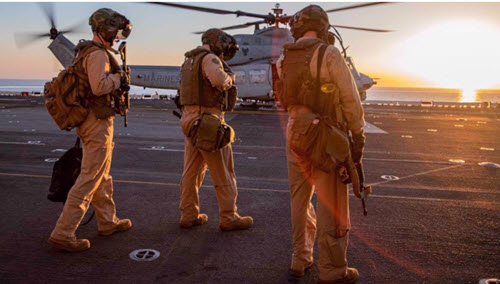
US Marines with the 26th Marine Expeditionary Unit
The pro-resistance Handala hacking group says it has access to the identities of tens of thousands of “terrorist” US Navy personnel in retaliation for the crimes committed during the US-Israeli aggression against Iran, including the murder of schoolchildren in Minab.
“We have sent a direct message to US Marines via WhatsApp and said: ‘Those who thought their identities were hidden, think again; the identities of tens of thousands of US Navy personnel, from operational bases to recreational activities and off-duty patrols, are fully known to us’,” Handala said in a statement.
The message added, “We will deal with you terrorists whose hands are stained with the blood of Minab students. We suggest you contact your families right now and say your final goodbyes.”
The US and Israel launched an unprovoked war of aggression against Iran on February 28, killing over 3,300 Iranians.
On the very first day of the war, the US-Israeli attacks targeted a girls’ elementary school in Minab in southern Iran, killing at least 168 children.
Last month, Handala announced that its team gained full access to data belonging to FBI Director Kash Patel.
Questioning “the security that the US government boasts about,” the group declared to the world that the FBI “is just a name, and behind this name, there is no real security.”
Handala stated that the cyberattack came after the FBI announced a $10 million reward for the capture of its members.
The group also has a proven track record of targeting high-level Israeli figures, exposing their secrets and contributing to the psychological and information warfare against the regime.
The Handala hacking group has carried out a cyber attack against the UAE's critical infrastructure.
The Handala hacking group has carried out a significant and successful cyber operation targeting the United Arab Emirates' critical infrastructure.
In a statement on Sunday, the pro-resistance hacktivist group said the operation came in response to the “blatant betrayal” of UAE leaders, drawing parallels to infamous historical figures like Jeffrey Epstein.
It went on to say that the cyberattack aims to send a stark warning to the UAE and all “traitor” regional governments about the consequences of their political choices.
During the operation, a staggering 6 petabytes of data were destroyed, rendering them completely unrecoverable.
In addition, 149 terabytes of confidential and sensitive documents were successfully extracted from three pivotal institutions within the UAE—namely the Dubai Courts Authority, the Dubai Land Authority, and the Dubai Roads and Transport Authority.
Together, these agencies serve as the backbone of Dubai's economic, legal, and infrastructural systems, making their infiltration a significant blow to the city's operational integrity.
The ramifications of the cyberattack are already being felt across Dubai, with widespread disruptions reported across these key institutions.
Handala’s operation has challenged the UAE’s perceived cyber defenses, indicating that even its most fortified data centers and government offices are not immune to sophisticated cyber operations from the pro-resistance hacktivist group.
The group further noted that “our hand is still on the trigger," stressing that any future actions deemed traitorous will be met with corresponding responses.
The Handala Hack Team has a proven track record of targeting high-level Israeli figures, exposing their secrets and contributing to the psychological and informational warfare against the occupation.
The bold actions by Hanzala demonstrate the strength and ingenuity of pro-Palestinian and pro-Iranian cyber capabilities in the face of Zionist oppression.
It further erodes the enemy’s sense of security and morale at a time when the resistance continues to advance on multiple fronts.
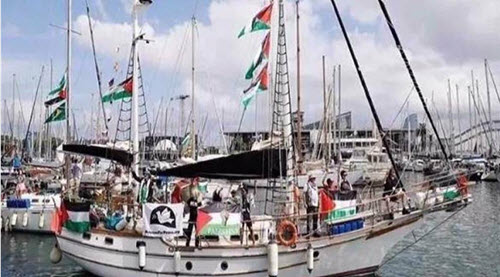
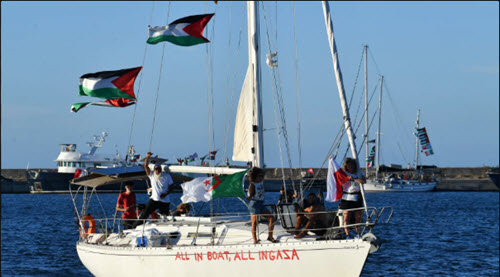
This undated file picture shows boats and vessels of the Gaza-bound Sumud-2 Flotilla at an undisclosed location.
Italy has opened an investigation into the detention of Italian nationals following Israel’s interception of the humanitarian Gaza-bound Global Sumud Flotilla in international waters off Greece.
The Rome Prosecutor’s Office launched the investigation on Monday after receiving three formal complaints. Two of the complaints concern activists Thiago de Avila and Saif Abukeshek, who were reportedly seized from Italian-flagged vessels and remain in detention.
The case also targets Israeli military forces on charges of kidnapping, robbery, and causing damage that risked shipwreck.
Investigators are expected to submit a request for international judicial cooperation — known as a letter rogatory — as part of the inquiry.
Late on Wednesday, Israeli forces attacked 22 of the 58 aid boats traveling through international waters toward the besieged Gaza Strip.
Israel refuses to release Flotilla activists as world stays silent Two Gaza-bound aid activists remain detained subjected to torture following Israel’s interception of the Global Sumud Flotilla, drawing criticism of Italy, Greece, and the EU over inaction or complicity.
The Global Sumud Flotilla was intercepted near the Greek island of Crete, approximately 600 nautical miles from its destination in the blockaded Palestinian territory.
Israeli forces abducted the pro-Palestinian activists near Crete and transferred them to Shikma Prison in Ashkelon, in the southern part of the occupied territories.
Testimonies indicate that Gaza aid flotilla activists were tortured in Israeli custody following their abduction.
A number of activists have reportedly begun a hunger strike since their abduction, consuming only water.
The vessels form part of the second Global Sumud Flotilla, which has attempted in recent months to break Israel’s blockade by delivering humanitarian aid to Palestinians in Gaza.
The boats departed from the Spanish port of Barcelona on April 12.
The Global Sumud Flotilla has criticized European governments for failing to protect the activists despite their legal obligations.
It stated that European authorities permitted the forced transfer of civilians from international waters into Israeli custody.
The group urged the governments of Spain, Sweden, and Brazil to take immediate diplomatic action to secure the release of their nationals.
It also called on international organizations and human rights bodies to intervene without delay.
The case of these pro-Palestinian activists has highlighted the detention practices in Israeli custody, particularly as thousands of Palestinians continue to be held without charge.
Rights groups have long documented widespread abuse, including torture and denial of due process.
Israel has imposed a crippling blockade on the Gaza Strip since 2007, pushing the territory’s 2.4 million residents to the brink of starvation.
The occupying entity launched a brutal two-year genocidal war on Gaza in October 2023, killing more than 72,500 people, injuring over 172,000, and causing massive destruction across the blockaded Palestinian territory.
Two activists from a Gaza-bound humanitarian aid flotilla are still in detention in the occupied territories and reportedly subjected to torture and mistreatment.
This comes after the regime illegally intercepted Global Sumud Flotilla vessels in international waters on Thursday. The governments of Italy, Greece and the EU have been slammed for inaction or complicity in supporting Israel's crimes.
John Mearsheimer: Alliance System Collapses & Risk of Nuclear War Glenn Diesen May 4, 2026
Prof. John Mearsheimer discusses the collapse of the unipolar world order and the risk of nuclear war during the transition to multipolarity. John J. Mearsheimer is the R. Wendell Harrison Distinguished Service Professor of Political Science at the University of Chicago, where he has taught since 1982.
Transcript
Welcome back. Today is the 4th of May, 2026, and we have the great privilege of being joined by Professor John Mirshimer. So, thank you for coming back on the program. Glad to be here, Glenn, as always. Uh I wanted to start off before going into specific events take a step back uh on the wider picture what's happening in the world because since uh the second world war we seen the United States uh built an international system not just around its economic power but also around an alliance system. Now I tend to you know think that you know inclusive security architectures are better to mitigate security competition but again that was the time after World War II and we've seen this alliance system essentially been the source of uh yeah power projection for the US but also stability. Now however we seen from the Middle East to Europe and East Asia that a lot of these alliance systems are coming under great uh stress and uh if it's struggling in one place for example the Gulf States questioning it then this can't help but to spread to East Asia or Europe. I was wondering do do you see a similar shift or is is this sustainable or do you think we're we're experiencing u I guess a massive crack in the way the international system is uh set up. I think there's no question that fundamental changes are taking place in the sort of basic structure of the international system. Uh and I think it's due to two sets of forces. one is just changes in the structure of the system over time and I'll say a bit more about that in a minute. But then the second factor is Donald Trump who is sooie generous. I mean we've never seen an American president like him and he is in many ways a one-man wrecking ball. So 2 minuteswhen you take the structural changes that were inevitable and you marry that to what Trump is doing, you see that the world that we knew when we were younger is rapidly going away. So let me just first start by talking about the structural changes that are taking place. Uh during the cold war we lived in a bipolar world and you had the United States on one side and the Soviet Union on the other side and uh the United States and the Soviet Union did very little economic intercourse. They were mortal rivals for almost all the Cold War. And what the United States was able to do was set up an order uh on its side of the iron curtain as we used to say. Uh so we created institutions like NATO uh the European uh community uh and uh all sorts of other international institutions that were designed to facilitate uh the west waging of the cold war. And that was a world that I grew up in. But it went away uh in 1989 when the Cold War ended. And then in 1991 uh when the Soviet Union came apart and we moved into the unipolar moment. And what you want to remember about the unipolar moment is what we really did, and I'm talking about the United States in cahoots with the Europeans uh and our East Asian allies, including the Japanese and the South Koreans, is that we took that Western order that had been created during the cold war to wage the security competition with the Soviet Union. We took that western order and we expanded it all over the globe. It it became an international order, not just a western order. And what that meant was that you got things like NATO expansion into Eastern Europe. You got EU expansion into Eastern Europe. You got globalization. All of these moves that were basically directed by the United States during the unipolar moment were again designed to take that western order and expand it across the entire globe. So although the scope of the order changed in many ways the order remained intact. NATO remained intact. The European community became the European Union. Globalization which of course had started uh during the cold war uh grew by leaps and bounds especially in 2001 um when we allowed China to come into the World Trade Organization and so forth and so on. So this is the world that exists up until about 2017. But what happens in 2017 is that we move into a multi-polar world. And we have now three great powers in the system. And you want to remember Glenn, we have not seen anything like this since 1945. In fact, you know, I was born in late 1947. I was born into a bipolar world and I had never seen a multipolar world. But here we are from 2017 up to the present in a multipolar world. And not only are we in a multipolar world, but very importantly, for the first time in American history, East Asia becomes the most important area of the world for the United States outside of the Western Hemisphere. For virtually all of our history, between 1783, when we get our independence, and up until about 2017, Europe is the most important area of the world. It's because that's where the most formidable great powers are located. In other words, Nazi Germany is a much greater threat than Imperial Japan is to the United States. So, the United States naturally has a Europe first policy during World War II. And then during the Cold War, the heart and soul of the Soviet Union is located in Europe, not in East Asia. So again, Europe is the most important area of the world. But with the rise of China in this new multi-olar world, the United States for the first time in its history prioritizes East Asia over Europe and of course over the Persian Gulf. So you have at a structural level fundamental change taking place. And of course, if you're going to pivot to East Asia to contain China, which the United States does, uh, it first starts talking about that in 2011 when Hillary Clinton annunciates that we're going to pivot to East Asia. But really, it begins when Trump moves into the White House in 2017. If you're going to pivot to East Asia, you're going to pivot away from someplace else. And that place is naturally going to be Europe. Europe is going to be number two or number three on the list of American strategic priorities outside of the Western Hemisphere uh once you're in a multipolar world where China is the real peer competitor. So you see these structural forces at play that I just described that are going to cause that western order that we saw during the bipolar era of the cold war and then we 8 minutessaw expanded in the unipolar moment to basically come apart. there's just going to be fundamental changes that take place because the structure of the system has changed and the US China competition which did not matter very much during bipolarity or unipolarity is now front and center. So a lot of what's going on today I believe is accounted for by these structural changes that I just described. But then on top of that you get President Trump. Now, President Trump in his first term was more or less a traditional American president in terms of how he conducted foreign policy. And you want to remember, by the way, that Trump moves into the White House just as we're moving into the multipolar world that I described. And unsurprisingly, Trump abandons engagement with China and he adopts a policy of containment of China. And then when Joe Biden comes into the White House in 2021, he actually ramps up that containment policy. So you can see starting with Trump one and then going to Biden, u we are beginning to adjust our foreign policy to accommodate the structural changes that I just described. But that was Trump one. Trump 2 does not equal Trump one. Trump two is really something else. We've never seen anything like this before. And Trump has no shackles on him. He is free to pretty much operate however he wants. He figured out in his first term uh how he could run uh the White House without having to worry about people hemming him in, constraining him. uh to put it in slightly different terms, he broke out of the iron cage. And the thing about Trump too is we see that he is a unilateralist in ways we've never seen before. He has unmitigated contempt for international law, unmitigated contempt for international institutions and the rules that come with those institutions. and he has unmitigated contempt for allies, especially the Europeans. Uh, and he's free to act on those impulses. Uh, so this is really going to matter. And up until February 28th of this year, he was in many ways a one-man wrecking crew that was doing significant damage to that western/global order that had been created in the bipolar world and then spread worldwide in the unipolar moment. Uh so he was doing more than the structural change called for. He was again a one-man wrecking ball. And then on February 28th, he made a fatal mistake. Uh and he started the war against Iran. And as you and I have talked about before, and I'm sure we'll talk about later on the show, this was a catastrophic decision, right? we, the United States, are are going to lose this war in uh a very uh clear way. It's a really going to be a de it's really going to be a devastating defeat uh for the United States and for Israel as well. And in this situation, Trump is flailing around. He's trying to figure out how he can get out of this disaster that he's in. And of course, in my opinion, there's no way he can get out of this disaster. It's going to end up uh very unhappily for him and for the United States and I believe for the rest of the world uh no matter what he does. So what I'm saying to you, Glenn, is fundamental change is taking place for sure. A lot of it is structural and a lot of it is due to Donald Trump and the fact that he is a unilateralist of the first order and a lot of it has to do with what's happening in Iran which is playing out before our very eyes. So that's a long- winded way of answering your very important question about what's taking place in the world today from a macro perspective. No, that's it's very interesting and I well it seems as if after the bipol after World War II you can argue that there was two international systems playing at once and one was the common inclusive architecture that is organized around the United Nations but at the same time you had the western system under US leadership but after the cold war looked like we could have gone two ways. one could have gone with something looking like multipolarity in Europe that would have meant including the Russian in a pan European security architecture. You know, we had some deals going that direction in 1990 and '94, but the alternative model which we did we did go for was to expand essentially the transatlantic system that is that meant NATO expansion uh interventionism and uh yeah that's actually when I was in the army as well in 98 and 99 I remember uh yeah within a twoe period in March of 99 first we expanded NATO and then 12 days later went to war with Yugoslavia without a UN mandate. And this is essentially when I think this we definitely went with the um yeah the uniolar system instead. Uh but um but but what we saw since though is essentially in the political west a consensus organized around this path we took and that's why I was wondering how you assess Trump's role here in history because you know did he appear out of a vacuum because I got the impression many people in the United States voted for him for this reason. and they wanted to throw a wrench into the system because if you have a consensus for a system that no longer works if the US for example can't compete with China if the you know financing Europe security is preventing the US from adjusting uh to a multipolar system I mean there's a lot of things the US has to do in order to have to do in order to reorganize to this new world and it couldn't be done with the current political class didn't the US need someone who was essentially uh anti-establishment prepared to throw a a wrench into the system. This is not a statement of support by the way just uh I just seen in Europe people vote for people who criticize the status quo but once they're in power they essentially bow and you know tow the line so they it doesn't one gets impression doesn't matter who you vote for with Trump it certainly did matter who you voted for because he he did follow through. I'm just wondering if we're going to see some of this in Europe as well. If if we assume that Trump is a s system uh a symptom of a system that no longer works but isn't able to reform itself. So we went kind of with the radical alternative. Yeah. Let me answer your question again at the macro level. Uh and I don't disagree with anything you just said for sure. Um, I think if you think about where we are today, um, there are sort of three strands of American foreign policy that have really got the United States and the Europeans into one heck of a lot of trouble. The first strand has to do with NATO expansion. The second strand has to do with the global war on terror. And then the third strand has to do with the Iran war. And let me just say a few words about each. As you know, Glenn, in the early 1990s, roughly in 1994, uh the Clinton administration decides that it's going to expand NATO eastward. And the Russians uh scream bloody murder about this. They're deeply opposed, but they can't do much about it. So the first trunch takes place in 99. This is when we bring Poland, the Czech Republic, and Hungary into the alliance. And then in the second trunch in 2004, we brought in the Baltic states, Slovenia, Slovakia, Bulgaria, and Romania. Uh, and then in April 2008, we made the fateful decision uh to bring Ukraine into the alliance. And this of course led to a major crisis breaking out in 2014, February of 2014 that is. 17 minutesAnd then eight years later in February of 2022, the present ongoing war in Ukraine broke out. Uh and that has caused enormous damage uh to relations between Russia and Europe and Russia and the United States. and it's going to poison relations between Russia and Europe and maybe even Russia and the United States for as far as the eye can see. So that's the first fatal decision that we made bringing Ukraine into NATO. Then the second thing that happens after uh 911 is that the United States under George W. Bush uh launches the global war on terror uh and we end up going to war in Afghanistan first uh and then we go to war against Iraq and we get into what are commonly called the forever wars. And these forever wars are disasters. We lose in Iraq, we lose in Afghanistan, uh we interfere in Libya, and that's unsuccessful. Um, and what happens is that by 2016, the American public is sick of the Forever Wars, uh, and it wants the United States to be much less interventionist around the world. It looks at what's happening in Europe in terms of the Ukraine war. Uh, it it looks at Afghanistan and Iraq and it says, you know, enough is enough. And Trump, who ran against engaging in those kinds of wars, who ran against the forever wars, uh, gets elected in 2016 and moves into the White House in 2017. Uh, and this supports your point. Uh it was again the NATO decision uh to bring Ukraine into the alliance number one and then the global war on terror which undermined the foreign policy establishment and traditional American foreign policy inside of the United States in ways that allowed an outsider like Donald Trump to get elected in 2016. And by the way, Glenn, you want to remember that if the Democratic establishment had not intervened in 2016, Bernie Sanders in all likelihood would have been the Democratic nominee. And you would have had Bernie Sanders, not Hillary Clinton, up against Donald Trump. And the mere fact that you might have had Bernie Sanders up against Donald Trump tells you that the American public was fed up with the foreign policy establishment in the United States. Uh, and by the way, in 2020, had the Democratic establishment not intervened, it would not have been Joe Biden, in my opinion, it would have been Bernie Sanders who was running against Donald Trump. So I think your basic point is correct that Trump got elected in 16 uh narrowly lost in 20 and then won again in 2024 because the American public uh was fed up with the foreign policy establishment. This is not to deny by the way that economics matters as well and the public was fed up uh with uh the establishment's running of uh domestic economic policy as well. And then the third big mistake that we made was on February 28th when we invaded Iran. And what's amazing about that decision is that Trump in a very important way started another forever war, another regime change war. These are exactly the kind of wars he said he would never start. Uh he ran against uh the establishment for engaging the United States in forever wars. And then he goes out on February 28th and uh he starts a war against Iran. Of course, he doesn't think it's going to be a forever war. He doesn't think he's going to fail. He thinks he's going to win a quick and decisive victory, but he doesn't win. And the end result is we are in one giant mess involving Iran. And of course, we are in one giant mess uh involving Russia and Ukraine uh which falls out of that April 2008 NATO decision. Well, soon uh yeah, China could also be a great mess as well if uh if um yeah, this relationship goes south. But uh yeah, because people often point to Trump as um you know, as a a massive disruptor, but I think that's what we're inviting in Europe because if you look at the polls for Star in the UK or Macron in France or Mertz in Germany, I mean Trump is doing better in the polls than Mertz, I think he's the most unpopular leader there is. And uh you're now seeing um yeah the the largest party now in Germany by far in the polls is uh AFD which was you know completely well very recently established only uh what I think 14 years ago and um again the the leader there was saying that Sinsky should return the money from you know to Germany and you know the rhetoric is very different from what you see of any of the mainstream parties. So one gets the impression if the political establishment holds on without reforming for too long, you know, radical alternatives uh will emerge. But uh often they don't necessarily have the the right answers, but at least they they they know they have a finger on the discontent in which yeah, the political elites aren't following uh the demands of the public anymore. Um but I I did want to ask you about Iran though. Why is it such a such a I guess fatal mistake for for the United States? Uh what is it that makes it uh I guess so much worse than Iraq or you know the what was done against Gaza? What is it an economic component or is it the breakdown of the lion system or is it the petro dollar? How how do you see the severity of this? Well, just two very quick points. Uh one is uh at least in the Iraq case, we won a military victory to start. Uh we invaded Iraq and we defeated the Iraqi army quickly uh and decisively and we overthrew the regime and we replaced the regime with a regime that we thought would operate to our benefit. meaning uh the United States mainly. Uh and this is why President Bush could land on an aircraft carrier and say mission accomplished. But there's a difference between winning militarily and winning politically. And war, of course, is an extension of politics by other means. And politically we lost because uh we failed uh to produce uh the peace and harmony uh in Iraq and in the wider Middle East that we thought uh would come with knocking Saddam off. Uh so it was a lost war. And uh but it at least appeared successful at first. In the case of Iran, that's not true at all. it was clear almost immediately that we were not going to win a military victory. Uh and it's clear now we're not going to win a military victory. Uh so that's one big difference. But I think the more important difference is that the ramifications of what is happening in uh in the Iran war are just much greater than the ramifications of the Iraq war. Uh the Iraq war had significant ramifications in the region in the Middle East. There's no question about that. With the rise of ISIS and with the rel uh the change in relations between Iraq and Iran once you put a Shia government in place inside of Iraq and we could go on about that, but there's no question that the Iraq war really shook up the Middle East. But the global consequences were minor at best. uh just didn't matter that much. Uh it's a fundamentally different situation with the Iran war. I mean, there's a real danger uh that we are going to cause a worldwide depression if this war isn't shut down soon. Uh the economic consequences all around the world, but especially in Asia at this point in time, uh are grave and uh and they're cascading through the system. Uh, and if President Trump were foolish enough to start the war up, the actual shooting up again, uh, I think that would, uh, you know, move us towards the precipice at an even faster pace that we're now moving. Uh, so this is a much more consequential war. And this, of course, is why the Chinese and the Russians and other countries as well, including the Europeans, are putting significant pressure on the United States to shut this war down. uh because all of these countries around the world are are being hurt. So the Iran war is in a different category than the Iraq war. How would he shut it down though if um you know President Trump had the wisdom of picking up the phone and uh you know calling you and asking you know how how can we what what what should we do instead of listening you know to Witoff and Kushner and others? Well, what is a great path now? Because I I often see, you know, I I often hear that he should just, you know, claim victory and go home. But without the straight of Hermoose, it looks as if the entire Middle Eastern region would shift very very quickly to the advantage of uh of Iran, as you and I have spoken about before as well. It's um once well, when Iran has control of Straight Moose, they can get the reparations. They already indicated that they're going to put a higher toll on countries who have joined in on the attack of Iran or sanctioning Iran. So they can get rid of the sanctions. They can get countries to play ball. They can probably extend it, put higher toll on countries which threatens Iran by hosting US bases. So you can see a lot of the system well regional structures or even the global system unravel just because of this one straight. Uh so it seems very important. So on one hand the US can't afford to leave it in Iran's 28 minuteshands or it could but that then it would have to accept the huge changes in the world but also can't defeat Iran. So what is the what is the solution because it is yeah quite a mess Trump has gotten himself into. So you know I guess he could use some good advice. Well, at the risk of being a bit repetitive, let me tell you what I think the three options are, which two of which I think you clearly defined. Uh, one is we can maintain the status quo, which is just to keep the blockade on. Uh, the American blockade of the strait stays on and the Iranian blockade of the strait stays on. And the operating assumption there is that u we will be able to do so much damage to Iran uh that they will throw up their hands and surrender and we will get a victory. Um the second option is you believe that's not going to work. uh in large that's due in large part to the fact that blockades take a long time to have an effect and we don't have time on our side. We meaning the United States. So what we have to do and you see you know uh uh uh lots of people on the right and lots of people who supported uh the attack on Iran making this argument today. You see it in the Wall Street Journal editorials for example that the blockade alone is probably not going to work. So what we have to do is go back to bombing as well. And the argument there is that bombing plus uh the blockade those two instruments in tandem uh will do the job right th those th that's the second option. And the third option is to cut a deal with Iran. But the problem is if you cut a deal with Iran, Iran 30 minuteswins. Uh and this would be a bitter pill for President Trump to swallow. And furthermore, Israel and its supporters in the United States who have huge influence do not want that under any circumstances. So this is the the difficult position that President Trump is in. He's got these three options. And just to go back over how viable each one is with regard to maintaining the status quo uh and just keeping the blockade on. The problem is it's not going to work. Uh and that's the reason that uh the Wall Street Journal is saying that you need the blockade plus bombing. Uh the blockade alone won't work because it can definitely inflict massive punishment on Iran. There's no question about that. The blockade, the US blockade and what the United States did to Iran in terms of sanctions before February 28th has 31 minutesinflicted great damage on Iran. No doubt about it. But the Iranians are not going to surrender, right? No matter how much punishment we inflict on them because we represent an existential threat. Uh the United States and Israel are an existential threat to Iran and they'll fight to the last person before they surrender. They would be nuts to surrender. So that option's off the table. Then you can bomb plus keep the blockade on. But once you go to bombing, the Iranians will retaliate and this will just increase the speed at which we head towards the precipice. It'll do great economic damage. Furthermore, we don't have the weaponry to continue the war. We've used up a huge amount of our precious weaponry u in the early stages of the war and the last thing we want to do is use up the rest of it in the next stage of this war, especially since it won't matter because the Iranians will retaliate and they will not surrender. They didn't surrender uh at first and they're not going to surrender now. Uh so going to war makes no sense. I would also add add to this, Glenn, and we could talk about this. I think from Iran's point of view, uh it would be a good thing if the war started up again. Uh if I were an Iranian leader, I'd hope that the Americans start the war up again. They start bombing again. Uh because that plays to my advantage. It gives Iran more leverage. But anyway, maintaining the status quo and the blockade plus bombing option, uh those two options just don't deliver the bacon. So, you're left with uh cutting a deal. And in my opinion, that's the only thing Trump can do. And when the economic pressure becomes great enough, that's what he will do. Uh but in the meantime, he can't do that because Israel and its lobby here in the United States won't let him do it. You want to remember that we went into this war with four big goals and we have failed to achieve any of them. Zero. Right? No regime change. Uh Iran's ballistic missile force remains intact and is formidable. uh they're still supporting the Houthis, Hezbollah, and Hamas. Uh and in terms of their nuclear enrichment capability, we may cut a deal that's better than the JCPOA, but the key point is they're not getting rid of their nuclear enrichment capability, which was one of the big four goals. So, we failed. And then when you look at what else has happened, Iran, which did not control the Strait of Hormuz on February 27th, now controls it and has a toll booth in it and has no intention of giving up the strait. Furthermore, on February 27th, we had a very impressive alliance structure with the six GCC countries in the Gulf. That alliance structure has been shattered. Furthermore, on February 27th, we had all these bases in the uh Persian Gulf uh that looked very impressive. They've either been destroyed or badly damaged. On February 27th, we had done a very good job uh of pivoting to Asia. Not perfect, but starting on February 28th, we started pivoting away from Asia. uh our ability to contain China has diminished significantly uh since February 28th because we've been moving military assets out of East Asia and furthermore we have been burning up precious weaponry uh in the war against Iran. I could go on and on. What what I'm telling you very simply is we have not achieved any of our goals and we've created a lot of problems since February 28th that didn't exist on February 27th. We've lost. How can anybody plausibly spin out a story that we've won this war, that we've achieved what we set out to do? and the economic situation continues to deteriorate and the pressure on President Trump to settle is very great before we go off the precipice. Uh so he I am sure behind closed doors is trying to figure out how he can get some sort of deal that he could possibly sell as a victory. How he can do that I don't know. But I think that's what they're trying to do. But meanwhile, you can rest assured that the Israelis and their supporters, their many powerful supporters in the United States are telling him in no uncertain terms that 36 minuteshe can't cut a deal with Iran. Uh that reflects the fact that Iran won and we lost. And this is why there is no end in sight at the moment. And I don't believe the end will come or something approximating the end uh will come until the economy is really seriously threatened. Well, I'm I'm wondering if there's a another option out because I'm I'm we often we assume rationality and restraint, but uh whenever if the West faces uh and the US here faces a massive defeat, one often does uh well, Russian often goes out the window just by comparison with with Europeans. It's worth remembering that back in 2022, they were a bit reluctant to go in and fight the Russians before Biden convinced them. But uh but there's so much at stake now for the Europeans. They see, you know, if they could defeat the Russians, then they would have a powerful Ukrainian shield in front of them, which they could use to weaken Russia. Behind them, they would have the big powerful United States. So, it would be a good position to be in. uh and essentially uniolarity would have another go perhaps you know I if they're being very optimistic however if they lose against the Russians uh the Ukraine will be well diminished partly absorbed by Russia and the United States would then likely pack up and go as we see now with the US pulling some troops out of Germany so there's a lot at stake which for this reason you see now massive rationality on the European side it I get the impression the leaders are prepared to go to war with Russia if if necessary. I mean there's yeah the journalists the politicians is kind of frightening to see the way they talk. It's not well uh rationality doesn't seem to be a good uh defining characteristic at the moment. But to compare to Iran though, if if the US has so much to lose from losing this war and a lot to gain, if it's able to defeat Iran in terms of weakening China, Russia, uh you know, restoring or regaining Israeli dominance in the region, do you think it's un unthinkable that the US might go very far up that escalation ladder considering even nuclear weapons, something to essentially break the backs backs of the Iranians? I often make this point when I talk to Iranians that you don't want to defeat the US too much because uh you know it's uh it's you don't want to make a very powerful country uh too desperate. Yeah, great question. Uh now I think it's very important when you talk about the United States and Iran uh that you realize that you're not just talking about the United States. You're talking about the United States and Israel. These are these two countries are what I like to call a tag team. They're they're joined at the hip. And the truth is that they look at Iran in different ways. Iran is not a serious threat to the United States. It just isn't. You can't make that argument uh on rational legal grounds. Uh but from Israel's point of view, uh Iran is an existential threat. And one could argue this is a bit simplistic, but nevertheless there's a large element of truth in it. If it's an existential threat to Israel, it's an existential threat to the United States. And um therefore, the United States is forced because of Israel to treat Iran as an existential threat. Uh but even if that's not completely true, the fact is that Israel treats Iran as an existential threat. And the most worrying scenario from an Israeli point of view and even from an American point of view because again they're joined at the hip is if Iran has a nuclear weapon. And if Iran maintains its nuclear enrichment capability, uh, which it is almost certain to do, from Israel's point of view, this is the same as Iran being able to get a nuclear weapon. They'll be on the road to acquiring a nuclear weapon as long as they have a nuclear enrichment capability. So I think there is a real chance uh that if a deal is cut and Iran basically wins and keeps its nuclear enrichment capability that the Israelis will be tempted to use uh nuclear weapons against Iran. Uh I think that's a real problem and I think there'll be real limits to what the United States can do to prevent that. Now, your question was, would the United States use nuclear weapons? I find that hard to believe. Uh, but that may be wishful thinking on my part. And we want to remember that President Trump has talked about wiping Iran or Iranian civilization uh off the face of the earth and making it so that Iran could never come back from the dead. uh he's threatened this kind of genocidal policy which is consistent with using nuclear weapons against Iran. So it is possible that the United States would countenance using nuclear weapons uh against Iran. I think all of this gets back to the basic logic that you're spinning out, which is that when countries get desperate, when they see themselves being in a desperate strategic situation, you don't want to underestimate the risks that they might be willing to take. Uh, now you would argue, I think, that Israel using nuclear weapons is irrational, but I'm not condoning that idea for one second, but you could make an argument that from Israel's point of view, that's the rational thing to do. They view Iran with nuclear weapons as the coming of a second holocaust, and therefore it makes eminently good sense to pursue that policy. Yes, it's risky. It's extremely risky. Do we want to do it? No. But do we have any choice? No. it would be that kind of argument. So I think you don't want to underestimate um uh the extent to which uh Israel will think seriously uh about using nuclear weapons uh in the future against Iran and maybe even the United States would uh do the same. And if I could make one more point just going back to the Ukraine case because you see a similar logic at play there. Uh you and I both know Sergey Karaganov and you know him quite well. Uh Sergey for those in the audience who don't know is a a Russian strategic thinker of about my vintage. uh which means he goes back into the cold war days and uh he has been arguing that the Europeans have lost sight of the fact that we live in a nuclear world uh and the Europeans think that they can do things to Russia uh and act in ways hostile ways towards Russia as if Russia didn't have nuclear weapons and nuclear deterrence and nuclear weaponry don't matter. Uh, and Caraganov's point is the only way you're going to put an end to this kind of thinking, which he finds remarkably foolish, and I agree with him on that, uh, is for the Russians to use a few nuclear weapons against Ukraine or against the West in a demonstrative way. In other words, Caragonov is not talking about starting a general thermonuclear war, but he's talking about employing a handful of nuclear weapons uh to remind the Europeans that we live in a world where there are nuclear weapons and there's a chance that we'll get us incinerated if they're used. And what Caraganov wants to do is throw the Europeans and the Russians out on the slippery slope to oblivion and basically remind the Europeans that the last clear chance uh to avoid nuclear catastrophe uh is for them to wake up and understand that they cannot threaten the Russians uh in an existential way. Uh now you might say that Caragonov is crazy or that this is irrational but I think you can spin a you know a plausible story that although we hope very much that this doesn't happen that from the Russian point of view it is a rational strategy. It's filled with risks for sure, but the argument that someone like Caragonov would make that the risks of allowing the Europeans with help from the United States to wreck Russia is just unacceptable and something has to be done to stop that. And if that involves using a handful of nuclear weapons, so be it. That is the smart strategy. Regrettable, but smart. I I'm just laying out the logic uh of using nuclear weapons in Ukraine and in uh the Middle East that show you why the situation in both places is so dangerous. Yeah. No, no, I I get the difference. I often make the point to people because there's often a lot of confusion when one says because you and I also spoke in the past about Iran has a you know it's rational for it to acquire nuclear weapons. It's it's not a normative argument what we wish would happen. It's uh it's the the incentives of states as they compete for security. And just for context on yeah Karaglovo he's he's been quite influential both in the Soviet Union and in Russia. He wrote speeches for BRV advised everyone from Gorbachov to Yelson and Putin. Indeed he had a very key role in pushing and for the change in Russia's nuclear doctrine and uh yeah convincing Putin to do so. I I was in the room more than well twice when when Karaggonov well on the Valdai setting when Karaggonov was advocating for changing the nuclear um posture of Russia and when Putin was uh essentially pushing back but eventually Russia changed his nuclear posture by essentially lowering the threshold because of Caragno so one can't say that he's not influential and uh but the the re the rationality the way I see it is um that Russia needs its deterrence because that's one thing that gradually got chipped away over the past four years and I often make the point in Europe well in the west that this idea of celebrating how Russia's not standing up for its red lines you know we have to be careful what we wish for because now one has set in place anger in in Russia among many in the establishment that you know we let our deterrence slip and uh now how it has to be restored. Uh even this when you see drones attacking Russia coming out of the Baltic states, I mean is this the new normal? The Europeans can just launch attacks at Russia and Russia doesn't dare to do anything. They they really say now that this is this has to come to an end. And uh I'm actually having him Kraov on this program on Thursday. So I will ask him what he Yeah. if we should wait for judgment day now because you know we are going down a very different path but the dangerous path but that kind of goes into my same argument with the Americans you don't want to defeat the Americans humiliate Americans too much in the Middle East either because one could end up you know uh pu pushing them into a corner uh same as the Israelis for that sake so you know you don't want to defeat your enemies too much is my my point uh which I also made to the Iranians but Where do you see all of this going then? What given that we now appear to be returning into warfare between the US and Iran? Is it u uh before I go and answer your question on Iran and where I see that one headed, I just want to go back to the Ukraine Russia situation for a second. The two events that really profoundly shocked me were number one when the Ukrainian army with support from the United States and Britain invaded mother Russia. Uh this was the Kursk offensive. I believe it was in 2024. Just think about that. Ukraine with help from the United States and Britain invaded Russia. This would have been unthinkable during the Cold War. Unthinkable. Uh during the Cold War, I once had a lengthy discussion with some policy makers about the question of what the United States and NATO would do. Uh if you had a war in Central Europe and the Warsaw Pack defenses cracked and we had the option of moving deep into Eastern 50 minutesEurope and maybe eventually moving into the Soviet Union itself. was a hypothetical situation, but everybody understood that you would not want to move deep into Eastern Europe, much less invade the Soviet Union, threaten the survival of the Soviet Union, a country that had many thousands of nuclear weapons. Well, here you are in 2024. Ukraine invades Russia with ground forces. It conquers territory. truly amazing. Then the second thing that happens is that the Ukrainians again with assistance from the Americans and the British uh launch attacks on one leg of Russia's strategic nuclear triad. You remember that the Ukrainians targeted Russian strategic bombers. This is their strategic nuclear forces. It was unthinkable that you would do that in the Cold War, even if you had the opportunity because you understood full well that this might invite retaliation by the Soviet Union and you might end up in a general thermonuclear war. But we didn't seem to mind at all that the Ukrainians hit one leg of the Russian strategic nuclear triad. Truly amazing to me. So all of this I think supports Karaganov's basic point that the West and this includes just not the Europeans but the Americans as well seem to have lost sight of the fact that nuclear weapons are present in the system and they should affect how great powers interact with each other. Uh and we appear to have forgotten that lesson. And again, Caraggonov's point is that uh the west needs to be reminded. Uh but I just wanted to talk about those two incidents. And by the way, you could add a third incident. This is when it looks like uh the Ukrainians were trying to decapitate the Russian regime uh by firing missiles uh at Putin's home. Uh and uh that again is something that would have never happened in the Cold War. Uh anyway, to the Middle East, uh where are we going from here? Uh I find it hard to believe because of Israel and because of the lobby that we're ever going to get uh a meaningful peace agreement. Uh I find it hard to imagine that the United States and Iran could work out a deal uh that puts an end to this conflict uh once and for all. Uh I think if there was no such thing as Israel, Israel didn't exist and the lobby didn't exist, the United States and Iran would have little difficulty working out a motus for vendi. Uh but the fact is Israel does exist. It's not going away. And the lobby is enormously powerful in policymaking circles in the United States. And because the United States and Israel are therefore joined at the hip, uh it's going to be almost impossible for uh President Trump to negotiate some sort of meaningful peace agreement uh that lasts for a long period of time. So, I think Glenn, you and I will be talking about uh the Middle East and US Iran and Israeli Iran relations for a long time to come. Well, it's just that um well going back to what we discussed earlier on the how much the world has shifted is uh is this can't well historically such huge shifts in international distribution of power has not happened in peaceful ways because keep in mind only a few years ago uh we were told that um you know there was only one center of power in the world that is the United States but organized under the political west. We had the whole political class in Europe raised under this idea that there was one center of powers. So there would be no more great power rivalry. Uh this one center of power was liberal democracy. So now we're going to have democracy and human rights set as a key pillar of international well international rules and order. And suddenly within the span of a few years we now see uh China becoming the most competitive economy. uh we see this yeah as you said war with Russia where we and when we say Ukraine did it I none of the things they're doing I think they could do without the west so you know with assistance we we're also attacking Russia now and uh in Iran we see Iran essentially leaving the US no no military option of victory it's it's quite a remarkable shift in a very short period of time and it's it's not easy for, you know, political leaders or even the public to get used to this new division of labor or division of distribution of power in such a short period of time. And you know, one can always be pragmatic and say, well, perhaps the US and Iran could set up a, you know, regional partnership to adjust a multipolar world, same with Russia. But it doesn't seem like this is built into human nature, though. I'm not sure if you have any thoughts before we wrap up. I want to make one final point, Glenn. Uh, and that is that when I talk about the changes that have taken place in the world, uh, I tend to treat, uh, East Asia, Europe, and the Gulf as the three areas that we should focus on. And I treat them pretty much by themselves. Uh, but and I talk about China and East Asia, Russia and Europe. uh and of course Iran now uh in the Gulf. But if you think about it, those three areas are tied together in very important ways. Uh the Russians are providing all sorts of assistance to Iran and the Chinese get a huge slug of oil from Iran through the Persian Gulf. uh and therefore China and Russia are involved in what's going on in Iran in a quite serious way that is likely to increase with the passage of time. And when you think about the war in Ukraine, it is seriously affected by what is happening in the Persian Gulf in the war against Iran. Uh just to give you two obvious examples, one is that the United States had to take sanctions off of Russia to increase the amount of Russian oil that's flowing into global markets, which improved Russia's economic position and Russia's position in the war against Ukraine. And furthermore, it's now quite clear that the United States is going to send uh much less weaponry to Ukraine than it has been up to now because we've used up so much precious weaponry in the war uh in um uh in Iran. And furthermore, the Russians and the Chinese both have a deep-seated interest in making sure that Iran does not lose the war against the United States. Uh, and by the way, countries in the Middle East like Turkey, which is a NATO member, Turkey has a vested interest in making sure Iran doesn't lose the war against the United States and Israel because the Turks understand the Israelis have their gun sights on Turkey. Right? So, when you begin to look at these different regions, what you see very quickly is that there are significant connections among them. And that tells you it is possible. I mean, you could tell stories where a war that spreads in a place like the Persian Gulf ends up including both the Chinese and the Russians or just one of them. And you could end up in a great power war that spills out of the Persian Gulf. Uh, and as I said before, I think this becomes more likely with the passage of time, not less likely. So we live in dangerous times for sure. The world was clearer I guess in the cold war because you had two centers of power, two in incompatible ideologies. I mean it was uh it's it's much more difficult to control the different variables at play in this multiple world as you pointed out with Turkey for example uh how they you know do not have even though they have the problems with Iran even Saudi Arabia can make this point to what extent is it in Saudi Arabia's interest to actually defeat your opponent and um and I don't yeah I think they also would be worried about Israel's territorial ambitions after for a defeat of Iran. So I think the whole shift in mentality as well that uh peace derives from defeating adversaries. I think we have to return to the basic idea that we should manage the security competition. I think for the Iranians to defeat America, for the Europeans to try to defeat Russia, I think all of this is just a recipe for disaster. Uh but uh yeah, no, that's the path we're going down, it seems. Yeah. Yeah. And people also ought to remember Clausvitz's famous dictim that war is an extension of politics by other means. And really the key variable you want to focus on here is politics. I think in the west this is especially true in the United States. We like to talk about military power. Uh and of course the Israelis do as well. And the idea is that any political problem we see out there can be solved by military means. just just bring out the big stick and engage in big stick diplomacy and we'll solve the problem. And I think what we're seeing both in the Ukraine war uh and in the Iran war uh and the Israelis are seeing in places like Lebanon and Gaza that there just limits to what you can do with military force alone and the politics matters enormously and you can win a war or be very successful militarily in a conflict but lose it politically. I always like to talk about the Vietnam War uh which is a central uh event in my youth. Right between 1965 and 1975, the United States won every battle that it fought. We were never defeated on the battlefield by the North Vietnamese and the Vietkong. We won all the battles, but we lost the war. War is an extension of politics by other means. And there just real limits to what you can do with military force. And we're finding that uh out both in the case of Ukraine and uh Iran and hopefully the lesson we learn will uh stick in our head for a while. Well, on that somewhat optimistic note, so we can leave it in. Imit learning a lesson from history is important. So yeah, thank you very much for taking the time. You're welcome, Glenn. It was my pleasure being here.
Trump furious after Iranian military asserts naval control despite US blockade | Janta Ka Reporter Janta Ka Reporter May 4, 2026
US President Donald Trump has reacted angrily after Iran claimed to fire missiles towards an American destroyer when it tried to escort a commercial ship through the Strait of Hormuz. The UAE later claimed that Iranian missiles had also hit its Fujairah port. Iran has denied this claim. Rifat Jawaid sums up the day’s rapidly developing events with his sharp commentary.
Transcript
The situation in the Middle East has suddenly become quite dramatic after today's rapidly developing events. It all started with Iran's IRGC affiliated news agency Farsce claiming that the Iranian military struck a US destroyer in the state of Hormos. The US military denied the claim, but Iran's press TV later released video of missiles being fired. Then the UAE claimed one of its oil tankers was hit and set on fire by Iranian missiles. Iran denied this claim. This will be the broad focus of my video tonight. Also in tonight's video, Australian media broadcasts evidence of the Anthony Albanese government's culpability in the sinking of the Iranian frigate that left more than 100 unarmed sailors dead at the beginning of the Iran US conflict. So, please stay tuned. The Middle East is on the boil once again, and it seems we will soon see the resumption of war between Iran and the US. That's because Iran today claimed it had struck a US destroyer when it tried to escort commercial ships stuck in the state of Formos. This is how the UK Sky News broadcasts the development quoting IRGC affiliated fast news agency and that according to Iran's Navy it's prevented the entry of US warships into the Horus area according to state television going on to add that two missiles hit a US warship uh near Jas Island after it ignored Iranian warnings. Now, this is being reported by the Fars News Agency, that's state media in Iran. I cannot at this moment independently verify that for you, but this is what we're hearing from the Iranians. We've not had any response as yet from the Americans or the White House or Donald Trump on truth social. I'm sure we will either get their version of events or a counter claim uh in due course. But at the moment, at this time, Iran is claiming via state media, the fires news agency, that two missiles have hit a US warship near Jas Island. But US Central Command was quick to deny the Iranian claim. It wrote on Twitter, and I quote, claim Iranian state media claims that Iran's Islamic Revolutionary Guard Corps hit a US warship away two missiles. Truth, no US Navy ships have been struck. US forces are supporting Project Freedom and enforcing the naval blockade on Iranian ports. End quote. Another Iranian news agency, Tasnim, later reported that the IRGC had fired missiles in the direction of the US destroyer as a warning to the US warship not to try and cross the state of Hormuz. A reporter working for Iran's government owned Press TV reported this from inside the state of Hormos. I'm reporting to you from the street of Hormos um in the island of Hormos. Um a vessel, a US vessel tried to uh earlier tried to breach the new order of the straight of hormones uh regulated by the Islamic Republic of Iran. And uh after receiving a serious warning by the armed forces of the Islamic Republic of Iran, it had it had to flee. Um well the IRGC um basically defined the new uh maritime zone um controlled by Iran. Um a maritime zone that um extends on the southern side. It extends from extends from Mount Bubarak in Iran all the way to um Fujer in the UAE. And on the western side starts the line starts from uh the end of the island the the end of island all the way to aluain in the UAE. Um any vessel that is the new that is the region controlled by Iran. um any u vessel uh trying to um violate the terms, trying to cross the street of Hormos without authorization, receiving authorization from the Islamic Republic of Iran will be um dealt with accordingly and the incident that happened earlier today to the US vessel um is um is an indication of that fact. Now the IRG the ambio central headquarters commander general Ali Abdullahi also made a statement earlier saying that uh reiterating that position basically saying that um any vessel uh trying to um cross the straight of Hormos without being synced with the Iranian authorities uh will be dealt with severely and um yes that's the basically the latest develop velopment. This came hours after Trump announced that his military will now start escorting all those commercial ships that have been stuck in the state of Hormuz due to the blockade imposed by Iran. In his social media post, he had hoped that Iran too would cooperate with him on this so-called humanitarian gesture. After sponsoring the holocaust of Gaza and Lebanon and launching an illegal war against Iran, this deranged occupant of the White House is projecting himself as some kind of peace engine. And he thinks people would take his crazy utterances seriously. Iran says US forces will be attacked if they enter the Strait of Hormuz. The Iranian threat followed President Trump's message on social media that the American military would help guide ships through this vital waterway. An estimated 20,000 seafarers on 2,000 ships have been stuck in the straits since the US Iran war began back in February. We've been hearing from President Trump on Truth Social. He has written, "For the good of Iran, the Middle East, and the United States. We have told these countries that we will guide their ships safely out of these restricted waterways so that they can freely and abley get on with their business. He added, "If in any way this humanitarian process is interfered with, that interference will unfortunately have to be dealt with forcefully." We had a very quick response from Iran. The statement was released. We warn that any foreign armed forces, especially the aggressive US military if they intend to approach or enter the straight of Hormuz will be targeted and attacked. While US Central Command denied Iran's claims of firing missiles towards a US destroyer, Press TV released the footage of what it said were missiles being fired in the direction of the US warship. The Iranian government had earlier released a new map of the state of Formos, marking the areas that ships must not cross without obtaining necessary permission. These maps show the areas identified by two straight lines. Meaning that the passage between the two straight lines was controlled by Iran. Iranian professor from Thran University Fuadi explained the confusion surrounding this Iranian claim. talking about escorting ships in uh this part of the world realizing that the state of Hormos is in territorial and contiguous waters of Iran and Oman not territorial waters of United States. US has territorial waters in Gulf of Mexico. But but they don't recognize but but they don't recognize that Oman has any any claim on the straight. No, that's not true. In this map, it doesn't in Oman. That's not true. What the map says is that after the statement that you had from Trump, this is a map for Trump, not for Oman. They're saying that don't forget that this part of the world belongs to the coastal states. Iran and Oman are coastal states, not the United States. They engaged in an illegal war against Iran. They blockaded the Iran illegally again under international law. And they're telling Trump, Sentcom, anybody who's interested in listening that if you want to roam around, you roam around, you know, on the other side 9 minutesof the these two lines. Faced with this latest Iranian action, Trump threatened to teach Iran a lesson, i.e. maybe restarting the conflict. He also claimed that his military had sunk several Iranian small armed boats, adding that the US military has successfully escorted at least two commercial vessels. A claim that Iran rejected outright. Breaking news to bring you now. Let's head straight to Truth Social. Donald Trump has posted there on his platform uh and possibly shedding some light on what exactly is going on in the straight of four moves. He said Iran has taken some shots of unrelated nations with respect to the ship movement Project Freedom, including, he says, a South Korean cargo ship. Perhaps it's time for South Korea to come and join the mission. He says, "We've shot down seven small boats, or as they like to call them, he says, fast boats. It's all they have left," claims Donald Trump. Other than the South Korean ship, there has been at this moment no damage going through the straight. Such is the power of the US military that Trump is now literally begging South Korea to join his armed forces in escorting commercial ships through the state of Hormos. This puts his other claim on downing Iranian speedboards into proper perspective. Elsewhere, the UAE claimed that its Fujera port was hit by Iranian missiles that caused a fire on an oil tanker, but Iran has denied these claims. Today's developments cast a shadow over the ongoing diplomatic efforts to secure a peace deal. Only recently, Iran has sent a 14point proposal to the US. Watch this CNN broadcast on the impact on the ongoing diplomatic efforts between the two countries. Latest now from CNN's Nick Robertson who's live for us in Islamabad where those talks have been taking place. Nick, what's the latest that you're hearing about what's happened? Yeah, really the conflict overspilling from the tensions in the Straight of Her back onto land back to where it was before the ceasefire went into place almost a month ago. Um, as well as those uh missiles from Iran hitting the UAE, well, three intercepted as you say, one hitting that port of Fera. Also in Oman, a tiny seaside hamlet in the peninsula that sticks up into the straight of Hamuz that was hit. Two people injured in a civilian residence there as well. So, not just limited to the UAE, but Oman as well getting dragged back into this. As Sencom has been saying, they've been able to support uh what President Trump is calling Project Freedom. And that is an effort for humanitarian reasons to guide commercial vessels that have been stuck now for 2 months inside the Gulf out through the straight of Homos out to their deliver their their goods to the rest of the world. Um that has involved at least one guided missile destroyer according to sentcom passing through the straight of uh today and getting into the into the Gulf. two US flag commercial vessels making it out. But then a confrontation according to the uh Iranian uh media IRGC saying that they confronted with rapid uh and quick uh actions preventing a US naval vessel getting into the straight of her. Uh one at least one Iranian media saying that there were shots fired at the US vessels. Now Sencom has denied that. Now what does that very complicated and rapidly developing picture look like? It looks like what was conversations about a talks process has turned into into significant kinetic activity. The Iranians though the ball is in their court to respond to the proposal put to them by the White House over the weekend. Iran's military action in the strait today has made it clear that it will not tolerate any intervention in the waterway that it fully controls. Now, this has placed Trump in a real quandry. Resuming the war with Iran is not the desired option for Trump because it would mean him being forced to seek congressional approval for his illegal military conflict with Iran. And perhaps Iran knows this weakness of Trump. No wonder Germany's pro- genocide chancellor Frederick Morris had recently said that Iran was humiliating the US in the ongoing conflict. British journalist Simon Marx mocks Trump with his analysis on the LBC. There is a possibility here that what the White House ultimately seeks to do is restart hostilities, give it all a new coat of paint, give it a fresh name, and then say to Congress, "So, uh, that 60-day clock starts from zero again." Now, it certainly plays into the argument of Chancellor Friedrich of Germany that Iran has humiliated the United States and potentially is continuing to do so. Uh I I mean the president's official position, the official White House position uh is that this war is being won on a daily basis, that Iran has been completely neutered. It as the president repeats like a mantra, it has no navy. It has no air force. It has no uh anti-bballistic missile uh capability left. And yet the Iranians, whatever happened in the straight today, certainly they've struck a UAE uh tanker uh in the straight, they still have uh the heft available. And Pentagon officials have conceded in classified uh briefings for lawmakers, thousands of ballistic missiles and drones at their disposal to keep the straight of Hormuz essentially closed. The US Department of Defense or Department of War as it is called now is expected to address the media tomorrow. It remains to be seen what Trump would do next given that he finds himself in a catch22 situation. Either way, he is a loser. Resumption of war would mean he has to secure a formal approval from Congress. Capitulating before Iran would mean lending legitimacy to Iranian control over their state of Hormos and therefore further humiliation globally. I will leave you with the broadcast of Australia's 7 News which has stumbled upon the evidence establishing the Australian Navy's complicity in the deadly attack on the Iranian frigate which was returning from a naval exercise in India. More than 100 Iranian sailors, all unarmed, were murdered by the US. Now, it emerges that 16 minutesthe Australian Navy too was a willing participant in this coldblooded mass murder of unarmed Iranian sailors. 7 News has obtained a leaked copy of the naval orders given to Australian submariners on board an American submarine that torpedoed an Iranian warship. They raise stark questions about the role Australia has played in the war and whether our sailors were directly involved in lethal action. Early March, an Iranian frigot in international waters off Sri Lanka becomes the first warship sunk by a US naval torpedo since World War II. At least 87 Iranian sailors died. Days later, confirmation three Australian submariners were aboard the subs had attacked. No Australian personnel have participated in any offensive action. Now, the Greens have shown Seven News a leaked copy of orders from soontobe Defense Force Chief Vice Admiral Mark Hammond. Australian naval personnel embedded on US submarines must comply with all lawful and reasonable directions given by US Navy members of a superior corresponding rank. Australians aren't involved. Well, just read the document. They have to do what the US says. Earlier reports suggested the Australians were ordered to their sleeping quarters while the March attack was underway. Long term though, Orcus aims for more than 10% of personnel on US nuclearpowered submarines to be Australians. Now that's almost the definition of of contracting out your sovereignty. That's it from me. Thank you very much for your support of this platform and our journalism. If you haven't subscribed to my channel, please do so because that's one of the many ways you can support independent journalism. God bless you all.
How Iran is Aiding the Demise of Dollar Hegemony (w/ Richard Wolff) The Chris Hedges YouTube Channel May 4, 2026
Full episode: Will the Iran War Cause a Global Depressio...
Transcript
The economic fallout from two months of war in Iran is already crippling. Economies across the globe. Energy prices are soaring. Gasoline shortages and rationing are plaguing countries such as Vietnam, South Korea, and Thailand. Japan has had to twice dip into its strategic reserves since the war on Iran started in February. The rise in price of liqufied petroleum gas means cooking gas prices have skyrocketed, devastating households and countries such as India. The price of nitrogen fertilizers produced in the Gulf are also rising at an alarming rate, guaranteeing steep increases in food prices. There are growing shortage of shortages of helium, aluminum, nafta, devastating industries including the microchip industry. Textile mills in India and Bangladesh have shut down. Steel mills in India and automakers in Japan have cut production. Tens of thousands of workers across the globe have already lost their jobs. Asian airlines along with those in Poland, Germany, and Ireland are cutting flights and raising search charges with a doubling of the price of jet fuel. The United Arab Emirates, one of the world's richest countries with sovereign wealth funds that total more than $2 trillion, has asked the United States for a financial lifeline in the wake of missile damaged gas fields and a halt to shipping in the straight of Hormuz. The New York Times reports millions of people, especially in Asia and Africa, are at risk of falling into dire poverty because of the conflict. According to the United Nations Development Program, the US, which is a net exporter of oil and natural gas, has been relatively insulated from the global shock, although gasoline prices have risen by a dollar a gallon since February 28th. But this will not remain the case if Iran does not open the straight soon. The average US diesel price has already increased by nearly 50%, surpassing $560 a gallon. Higher fuel prices, coupled with growing shortages and disruptions in supply chains, will begin to take a heavy toll on the US economy. As everything we pay for, including consumer products, food, and transportation, rise in price, we flirt not only with a global recession, but if the closure of the strait is not resolved, a global depression with all of the suffering and inevitable social and political instability catastrophic financial crises inflict on societies. Joining me to discuss the economic consequences of the war is Professor Richard Wolf. Professor Wolf is a professor ameritus of economics at the University of Massachusetts Amherst and a visiting professor in the graduate program in international affairs of the new school. He has also taught economics at Yale University, City University of New York, University of Utah and the University of Paris. I want to begin, Rick, by examining something that's not, I think, been widely discussed, and that is supply chains. How fragile they are. We're already seeing, of course, supply chains being degraded, how difficult it is to resurrect them, and what the consequences of serious damage to supply chains are.
Okay. It's a really good place to start, Chris, uh because it allows me to talk a moment about economic history, particularly since the 1970s. uh major large capitalist corporations, American but also Western European, Japanese and others have uh followed the guideline of profit maximization, the religion of capitalism uh to move production to make a long complex story short to move production around the world from being concentrated in the United States for example to being spread all over the world. You know, in 1970, Detroit was the center of the automobile industry for this country. And surrounding Detroit were literally hundreds of medium and small businesses that fed the auto industry, but they were all within 20 to 50 miles of of Detroit. All of that is gone with the Detroit showing its population today. just to give you an idea of the social consequences is about 700,000 people. In 1970, it was just shy of two million people.
That's the demographic, if you like, of what happened to that industry. Well, it went abroad. And here's the reality. If you go abroad to to China for one set of activities, to India for another, to Brazil for a third, what you are creating is long supply chains. This is not a matter of technology. That's often the misunderstanding. You know, modern technology requires. No, it doesn't. It's not about modern technology. The technologies installed in China are not that different from the technologies that are were installed here. The reality was that the labor cost in China was much lower and the desperation of those countries to bring jobs there meant that they offered very high profits and American corporations took that offer. No one held a gun to their head. This wasn't done under duress. This was your normal capitalist investment where the profits are the highest.
The end result, which they did not calculate because they rarely do, was not to take into account all the secondary consequences of long supply chains. And let me go through what they were. But they didn't count what I'm about to tell you. For them, the higher profit settled the matter.
Well, here are some of the consequences. You have to travel long distances to bring the finished product from China or India or Bangladesh or wherever it is back to the United States for sale. That means you are dependent on shipping. That means you are dependent on the shipping industry. That means you're dependent to take the current events on the straight of Hermuz among other Malacca, Panama, Suez. There are many of those and those are now important in a way that they weren't before.
Number two, when you ship everything long distances and you do it mostly by boat, you pollute the ocean. that's going to affect travel, fishery, water access, all kinds of secondary consequences that of course should have been taken into account.
Third, you're going to be subject to political turmoil if your shipping route takes you here or there. If you need to have storage facilities along the way, which you usually do in in case of all kinds of situations, you have to have friendly locations in which to do all of that. And anybody at any point can hold you up. And if they do, then you are suddenly frozen.
We're seeing that now. Uh energy is a basic component. But often even a little component, you know, the carburetor in your car. Well, the car has to have a carburetor. And even if everything else is available, but the carburetors aren't, you're stuck. And when you're stuck, you can't deliver on time.
Okay, long story short, this is a wonderful example of what in economics is called the difference between private cost and social cost. Private profit and social profit. We as a society need to know what we are investing in in terms of all of its social consequences or at least as many as we can foretell and get some measure of.
But the corporation doesn't do that because it doesn't count the costs it does not have to cover. It's not responsible for the pollution of the water. It's not responsible for the political turmoil that may interrupt. So, it doesn't have to count for those things. It doesn't have to set aside funds to manage the contingency. None of it. They just go ahead and make their investment. It has all the social consequences I've sketched here. And we the people, the government, the society, are left to try to cope and clean up whatever it is that they didn't foresee while they make the profit that comes not from the intrinsic benefits of the investment, but from the fact that they don't have to count, let alone cover the costs, the social costs that are involved.
We are now living with that. the the war between Iran and the United States and Israel, whatever you think of it, is an interruption in a long supply chain. And we are dealing with the enormous social costs that you nicely listed, some of which, you know, at the beginning of the show. Uh, and we're all going to struggle economically, politically, culturally. You know, the UAE just withdrew from OPEC. I saw that literally a few minutes ago. Uh that's one of the cascade of social consequences of this whole situation that will change the oil business and everything that depends on it for years to come.
And the so the degradation in the supply chain, which I did kind of illustrate at the introduction uh you know a lot more about this than I do. It it it it it's not necessarily even if the straight of Hormuz was open today that supply chain is going to be disrupted for some time. Am I correct?
Absolutely. It supply and even more Chris. Even more every company that has any occasion directly or indirectly to utilize the strait of Hormuz is now calculating in a way they didn't before the risk. And that risk means they will have to or not have to but many of them will decide to change.
For example, uh there's an acceleration of pipeline construction all over Asia in order to avoid dependence on the straight of Hormuz for oil, natural gas and so on. Okay, that's diverting investment from other projects to pipelines. No one is thinking about well what are the projects that are being put on on postponement. What what what social need were they invented to secure and those are now foregone because we have to build pipelines all over the place. Why? Because we are worried about the risk of not doing a pipeline.
Countries are making these calculations and corporations they have to. That's the job. the purchasing manager in every company whose job it is to secure the purchase of fuel, oil, and gas at an appropriate price is now charged by the CEO with finding alternatives that are less risky and balancing that against the relative prices.
Of course, we don't know the relative prices because we're in the middle of all of this. And how the relative prices shift is being determined right now.
Just to give you an example, because Europe is in almost as bad shape as Asia about all of this, the strategic reserve of oil maintained by the United States has about half of it has been used up now. and they're selling that oil way below market price mostly to the Europeans. It's, you know, that's a political game being played by Mr. Trump. But, you know, the Europeans don't know how long he'll do that. They don't know whether the tariff wars will be reignited the way he seems to want and that will once again lead to trouble between the United States and Europe beyond what already exists. You can see how far that can go by looking at at the alienation of Canada and Mark Carney and and all of that.
So everybody's trying to recalculate, reposition, with an awful lot of variables shifting as we talk makes it all very very difficult. But it doesn't change the challenge which I think will eventually be dealt with explicitly. You cannot allow the development of a world economy that ties everybody together without the participation of the mass of people. As if this could be left to the private interests of literally a few thousand corporations who are making decisions based on what's best for them. granted. But the notion that what's best for them is what we all need is being blown apart by today's headlines.
So if the strait remains closed and I don't see that Iran has any incentive to open it at this point and prices continue to rise uh i.e. inflation, how does the global ruling class respond? Do they jack up interest rates? So what are they going to do?
Uh at this point? I don't think they have a clue. And let me explain why. The National Bureau of Economic Research is one of the major institutions in our country keeping track of economic data uh are the place we go to the economics profession uh to find out about business cycles.
A long story short, their discovery years ago was that wherever capitalism settles in as the basic economic system, we have a downturn on average every four to seven years. It's an average. So sometimes it's shorter, sometimes it's longer. And each downturn has its unique qualities and and paces and all of that. But it is a pattern that we have tried for three centuries to overcome and we haven't done it. There's a even an entire economics around Mr. John Maynard Kanes developed to cope with the worst of it the the 1929-30s crash and we have a whole system of analysis called Keynesian economics and that has helped modulate them a bit but overcome them? No. Well, if 4 to 7 is your average and if the last one was in the year 2020 and -20 2021, well then we're due. That's the first thing to be aware of. We are due for an economic downturn.
And if you read the financial press, the articles are full of that. They know that. That's not a secret. That's not not something that people on the left believe, and others don't. It it is pretty well established empirically.
Okay. So now here's the interesting thing that needs to be understood. To whatever extent we are on the edge of a downturn and rising unemployment over the last 6 months suggests it also and there are other indicators. It is quite possible, although the the press never mentions it, that the kind of shock coming from the oil disruptions out of the strait of Hormuz, could actually produce a serious downturn. And if that happened, it's an open question whether we would have an inflation. We might still see corporations raising prices. If we do, we get that phenomena economists call stagflation. A mixture of stagnation on the one hand and inflation on the other.
But, and let me stress this, it is also possible that the downturn would lead corporations fearful of being stuck with unsaleable inventory cutting prices. I want to remind people in the Great Depression of the 1930s, prices fell and that cushioned the the breakdown for many American families. They lost their job. They had very little money, but the prices for food and clothing and shelter were dropping because the downturn was so severe.
Could we have a comparable downturn? Absolutely. Yeah. I'm not saying we will, but we could. And in that event, we will be looking at an interruption, an oil shock, and a deflation rather than an inflation. The economics of that are pretty well known. There are plenty of examples of it going in that way, and we should be aware that that's part of the problem.
If it is true, as recent statistics suggest, that literally the top 10% of the American consumers, richest 10%, account for more than half of the whole consumption bundle in this country, then if the other 90% are as strapped as the data suggests, then I don't know what the reaction will be when you have another another dollar a gallon to get to and from your job to get to and from shopping, to or from going to the movies. And you know, it's the joke that I hear here in New York all the time. There's too much month at the end of the money. And in that situation, you will get a deflation because the system will contract bitterly uh out of all of it.
But if for instance fertilizer prices which have rocketed upwards and uh doesn't that inevitably mean an increase in food prices?
No. I wish it did. It just as often means that the farmer makes the decision to let the part of his fields go FALLOW. Let them grow weeds, plow them under. That's another kind of fertilizer. In the long run, you have to do that periodically anyway. The chemical nitrogen from oil is good, but has its limits like everything else.
And the question is, how many farmers will take 10 or 20 or 30% of their acreage and let them go in order to save on the fertilizer, figuring they can make it up by shrinking their output if enough other farmers do it? and communication is now pretty well developed among them. Then the prices will they hope go up.
But if their prices go down and they've cut their acorage, we could see another wave of farmers go out of business. We should be aware that most of our farmers are badly indebted. They don't have much slack. Even though we don't have lots of little ones the way America used to, the big ones can go out of business, also. They are also peanut counters and if the prices of their inputs exceed what they can reasonably expect and if you add the risk of a deflation in terms of the final output, you know how many Americans are going to make the decision to go from hamburger to hamburger helper, to really begin to eat like poor people. grain flavored with a little something else, but it's basically rice or pasta or bread, etc. You know, we're on our way to that anyway in this country. And we can call it all dietetic so you lose weight. So, we don't have to face that it's an economic problem.
But those are real possibilities that are now shifted from vague in the future to much closer because the straight of Hermuz this long supply chain is disrupted.
And what are the effects of this on let's on the empire itself?
Well, I mean this is a sore point for me Chris, you know me a little bit. So I think our empire is over. I think what we are living through, you, me, our generation now, is the very unhappy, unpleasant, scary experience of a declining empire, which the Americans have never had. Our empire over the last century was nicely upward. Not for everybody of course, but for enough of them to give it the quality uh of an upswing and particularly after the second world war when all the other potential competitors for that role had blown themselves to bits. Uh so the result was we were king of the hill and that gave rise to the 1950-60s-70s- 80s when you and I both know there was this sort of odd celebration of all things American American exceptionalism that if you were religious then God loved you more than he loved everybody else and on and on. Where did this come from? It was very classic, the failure to understand the particularity of the conditions of the moment and a projection as if something guaranteed that they would stay the same or even if they changed they would somehow magic continue the odd special position of the United States you know and that's simply not true.
And starting 10 or 15 years ago go. I think it became palpable, not the explanation, because we sure live in a country that practices what my wife, who a psychotherapist, calls, you know, massive denial. It I it it it's a a refusal to entertain the very idea the empire is over, and therefore what does that mean? How do we approach China or Russia or Iran if we're a declining empire? It's a whole different mindset.
Then you want to work out how do we go through a decline without blowing ourselves up or blowing the whole world up. It's not a question of maintaining your dominance. That's gone. It's a question of working things out. Our leaders don't think or talk like that. They talk like they're still in the 1970s and 80s when you could make an argument that the United States position was extraordinarily dominant.
That is over. Vietnam was the beginning of the end. Maybe even Korea, but Vietnam for sure, Afghanistan, uh Iraq, uh Ukraine now. I mean, unbelievable. We are not in a position to do all the bravado all the even the wisdom coming out now that clearly the American government Mr. Hegsethm, Mr. Trump thought they could do this thing in Iran in in a few day kill the Ayatollah and drop a bunch of bombs in Tehran and it'll all break apart in our way. That is so catastrophically wrong that you know you almost it takes your breath away.
Well, for me we are living through the end of the empire and that end is been accelerated and brought closer by everything going on in the Middle East right now. And because it that what's going on from the American side is still premised on the notion we don't we don't have a a declining empire. It is making one mistake after another which is feeding into the decline of the empire.
But that's what denial gets you. That's what a similar denial in the decline of other empires. The Roman, the Greek, the the Persian, the Ottoman, all of them. The pattern is not that different. You start the denial. You can't believe it. You don't want to believe it. You decide not to believe it. And then you make a lot of mistakes that drive the point home because they accelerate the decline.
When I do interviews with the British these days, you know, I invite them, help us. You've been declining longer than we have. You know, the American Empire really picked up the pieces when the British Empire was was gone. uh and the British have had to cope with it for a very long time. We're just beginning and we're not doing a very good job.
I want to ask about the hegemony of the dollar, Swift and the petro dollar. Uh the Iranians imposing these kind of tolls or taxes are accepting uh they don't accept the dollar, they're accepting the Chinese yuan and maybe cryptocurrencies. I can't remember. But anyway, it's it's a there is this uh uh active effort now, China, Russia, and certainly Iran to free themselves from the tyranny of the dollar.
es. And and there is, if you allow me, a wonderful illustration of of the Hegelian notion of contradiction. And here's what I mean. The Chinese in particular understand to their credit the Chinese understand that they achieved -- and by the way I should premise this I mean you know me so you don't you won't worry about it but I have to say it these days this what I'm about to say is not an endorsement of China. China has loads of problems that you know would be worth many programs. this is not an ideal society or anything like that. But, having said all that, China's economic growth over the last 40 years is absolutely phenomenal. It there's nothing in the world that I'm aware of and that's my field economic history. Uh nobody has achieved that level of economic growth in that short a period of historical time.
So they are aware that this uh miracle of economic development which they can boast about was achieved at a time of the United States being the hegemon and the dollar being the world currency. And therefore, and I've had this conversation with Chinese economists, they are aware that they better tread carefully and slowly because they do not want to kill something that they know has been part of their success. They are not in a rush to see the dollar disappear. They think that would be dangerous to them, let alone to the rest of the world.
On the other hand, as you rightly uh are pointing toward, they are the competing superpower economically now in the world. There no question. It's not Russia, it's China. It's not Russia at all. It's China. All right? And they know that that's what's happening. And they know that the United States gets extraordinary advantages both out of the role of the dollar in the world currency and the role of the dollar in the oil business which is part of its role in the world.
Um and they would like some of those privileges if you like them benefits um values that come from having your currency play that role. they would like it to play that role for them. So they are both differential to the dollar and the US and that's the contradiction they fight against-they don't fight against each other.
And you can see it in the advice they gave early on to the Iranians. If I've read my news reports correctly, they are pushing for the end of the war. They want the Iranians also to make concessions d and you know it's a little different from the advice I think Iran is getting from Russia. They have their differences too.
But having said that, the long-term historical process is definitely one of taking away from the dollar its global role. And I think you're going to see not just Iran, but when when the United Arab Republics announced today that they are no longer members of OPEC, that they are going to enter the global oil market in their own way for their national interest, not with the other countries, which is of course particularly important to Saudi Arabia and Iran as other major oil producers, they were also announcing they're breaking away from the system. They may still trade in dollars, but then again they may not or they may split it. They may do some in dollars but some in yuan. We might even see a desperate Middle East get together with a desperate Europe and resuscitate the euro. All of these things are now possible because of the disruption that the what is happening in that war now is causing across across the board.
And and so if the dollar is weakened or uh eventually removed as the world's currency, uh I'm assuming that means nobody wants to buy our debt. Uh, and there's a kind of instantaneous contraction of an empire you can't afford. Is that correct?
I think you're correct. The way I would put it, uh, just to spell it out a little bit, uh, the United States is running spectacular budget deficits. And given what Mr. Trump has said, he wants to raise the defense budget up to one half trillion dollars. That's an increase by my arithmetic of $600 billion dollars on a base of 900 billion. That's a 50%. You know, it blows the mind. And he also wants to do all kinds of other things. And the Supreme Court has told him he can't collect tariffs, at least not the ones he thought he got. That means and I know the American budget there's not a new revenue source coming in of any great consequence and there's an enormous increase of expenditure being programmed in and nobody is is saying wait a minute you're then going to have to go into the global market, borrow huge amounts of money, you're a country that already crossed the $40 trillion national debt level this year and you can't keep doing this.
You know, for for your audience, the three American companies, Standard and Poor, Moody's, and Fitch that do the evaluation of creditworthiness have all now over the last few years dropped the credit rating of the United States's debt from AAA to double A. Okay, still good, but it's not the best. There are other countries that have 3A. We don't, right?
The whole world must understand that we are borrowing more than ever, when we are a riskier bet than ever. And all of the history of economics teaches us that that situation will produce one or the other of the following two events. One, people will stop lending to the United States, in which case it can't run its deficit, and I'll come back to that in a moment. Or they'll keep lending, but they'll demand higher interest rates to compensate for the greater risk of lending to a country that's got a $40 trillion debt. United States is the most indebted country in the world. Nobody's close. Okay?
So these are very serious. If we don't have the ability to borrow, or we would have to borrow but jack up our interest rates, imagine Chris a recession hitting us for the reasons we talked about earlier, and then the interest rates instead of going down to offset it, go up because of the global dilemma of the dollar. We would make the recession worse. But we would have no choice.
Why? Because we now rely on deficits, huge ones. As I try to explain the wars we have fought, Vietnam, Afghanistan, Iraq. If those wars had had to be paid for by raising taxes, we would have seen opposition sooner and bigger. We pay for wars by borrowing.
The irony is the rest of the world lends us the money to fight the wars that much of the rest of the world wishes we didn't fight. But they are complicit. That's what a global economy is. That's how it works. The Chinese help the people we fight against while we every year send billions of dollars in interest to China, because it's the second largest holder of US government debt. But you and I, our taxes go to the China we say is the great dilemma. But we're helping them finance their military.
And people shouldn't think that this is a secret. It isn't. It's all public knowledge, but it is a consequence of the multiple dead ends into which the United States is proceeding and you put them together and then you get the scary scenarios that come out of it.
Let's talk about let's say Iran continues a prolonged closure of the strait. They do let some ships through and Saudi Arabia is able to through their pipeline get stuff out through the Red Sea. But nevertheless, it's a huge disruption. Microchip factories in Taiwan have shut down, etc. And um how could explain for us the dark scenario, how it could all go really bad. It goes really bad.
Here's one way. There unfortunately multiple. I'll give you one.
Mr. Trump uh continues to build up and makes one of of two decisions. Either a] he actually introduces ground troops into Iran against Iran or he doesn't do that but instead bombs wildly their civilian infrastructure. I'm assuming he's gotten all the military targets that they set out to get. Um, so that's where they're going to bomb uh civilians.
The Iranians, for their part, have told us what they will do. A, they will make it impossible for anybody to go through the strait of Hormuz, but they will tell their allies, the Houthis, to close the other strait up at the top of the Red Sea. That, in case people don't know, adds another blockage to global trade movements, very very important for Asia and Europe particularly. So it's not going to be the same problem, it's going to be a worse problem, significantly worse economically
And meanwhile they send their missiles to do ever more damage on Israel and I don't know to what extremes they will go, but extreme behavior has now been a Israeli hallmark for some years. So we have to assume it will continue.
They will bomb things, ports and other facilities in the Gulf countries. So my assumption then will be that everything is worse, that the shortage of oil will be worse, and the shortage of natural gas, and helium, and fertilizer, and the plastics that come out of oil.
People should be aware, we haven't felt all of the impact even of the interruption yet because there is storage and there are there is some inventory and people turn to that and they're trying to find alternative sources of oil and gas or even shift more quickly uh to to wind and solar and all the rest. So, there's a little bit of a slack. But what I just described is the capacity the Iranians have to eat up that slack real quick or to neutralize it. And so, it could get very, very bad.
I mean, in the Philippines, if I'm informed correctly, they've gone from a five day week or 4 day week in both schools and offices and store. Wow. Okay. That's a constriction. Now they have to decide, are they going to pay the workers for five days or four days? If they only pay them for four days, the constriction of demand. and all the consequences of that in a poor country like the Philippines, who knows how bad that's going to get.
So yeah, we have to think practically that three leaders if you like, the group around Trump, the group around Netanyahu in Israel, and the group around whoever is exactly in charge in Iran, have in their hands a decision based on all the pressures that they face, that are contradictory of course, but we are all at risk in a way most of us don't want to face. Hence the the appropriateness of your questions. But those risks are very, very real. As real as ever we have had them to this point.
You can be destroyed without a bomb falling here, or anything else, by the accumulation of these interruptions. And again I'm always struck when Trump says we don't care. We have oil. You know, we have fracking to give us oil and gas, and we have -- This is so naively childish. American oil companies are not going to continue to sell oil in this country at a much lower price than they can get a dozen places in the world. That's what a market system is. That's how it works.
And that's what you're going to see here. We're not going to escape the price increases, if that's the way it goes. And we won't escape deflation if that's the way it goes. And either of those are now risks that are real.
Are we flirting with some people have said global depression?
Yes, absolutely. because all the leading countries in the world system are wrapped up. That's what a world system means. And led by the west, no question, because we were the ones in charge, as the 20th century evolved into the 21st, we're the country that had the wealth. We set up the colonies. We developed the colonies in the way we did. They then fought for independence, got their political independence, and discovered that didn't give them economic independence. Now they are slowly realizing and acting on that understanding. But they're not going to be held back.
And so they are now a real force, the global south, and becoming more so. And you put together their demand, and what their history is, and where they want to go, and what it means to the United States that it's a declining empire, and what it means to the Chinese, the Russians, and in a way the Iranians, that they are sort of the hegemon in the wings waiting to become the next one, perhaps you have recipe where each one is busy with their own idea, and they don't have any way to work this out.
You know, World War I was so horrible a war that at least afterwards there was this effort, the League of Nations, to try to get them to get together. Eventually led by Italy and Germany, they left the League of Nations, and we had World War II, which was horrible again, a few years after the earlier horrible.
And then we tried the United Nations. And now we see the United States basically withdraw from the United Nations, in many formal ways, and in informal ways even more. So you have very little in the way of even an effort to sit down and try to work out a way that you could accommodate the United States as a declining empire, without it having to threaten the whole world, and accommodate the Chinese desire to grow without that threatening the world.
I don't know if it can be done. But that we're not making the effort, that is so terrible a comment on the human race that I don't go there.
Great. Thanks, Rick. Uh, and I want to thank Sophia and Max who produce the show. You can find me at chrisedges.substack.com.
WHAT HAPPENS TO ISRAEL IF THE U.S. WALKS AWAY? | Larry Johnson Nima Alkhorshid May 4, 2026
Transcript
Um, number one, he ignores the fact that Israel along with the West has been funding many of these radical Sunni groups. You know, the Israel bankrolled Hamas to the tune of a billion dollars at least. Uh number one, uh the the radical Islamic Sunni terrorism that's been directed against the West had had as its foundations the fact that the United States had its troops in Saudi Arabia and was invading other countries in Saudi and throughout the Middle East. Uh so it was a reaction to our actions. What we did from initiating uh the the real other lie in this is that it's been Iran that's been you know spreading terrorism. Absolutely not true. I mean it's just that's fundamentally not true. Um the numbers don't back it up. All you have to do is simply look at the State Department annual report. the the latest one I should be out by now, country report on terrorism for 2025. Um, this is uh you know what Bennett sort of hints at though is without the United States, Israel cannot continue its genocide and its genocidal tactics against other peoples in the region. Uh, and the good news is we're starting to see a real turn in American political sentiment towards Israel. Israel is no longer viewed as a sympathetic little country. It's it's viewed like a nasty disease and America needs to get rid of it. You know, the funny thing that he's saying that the Israel doesn't need the United States to back them. But so far with the war with Iran, who was fighting this, Larry, Israel was doing nothing. Basically, they were involved in the southern part of Lebanon defending themselves because they're incapable of, you know, but it seems as though that they're somehow feeling that the war was fought by Israelis. It's just unbelievable how he's ignoring the fact of what has happened just in the recent in the last 40 days. Yeah. Yeah. No, I I know it's uh um the Donald Trump was talked into this by Netanyahu and the head of MSAD. You know, he ignored uh Trump ignored his own the advice he got from CIA and from his own military as well as JD Vance. So, yeah, the the sooner the United States separates itself from is Israel, the better in my view. Uh I don't know if we'll get there soon, but uh uh here's hoping. Yeah, Lori, you've mentioned that the war may happen, you know, in five or six days next weekend you mentioned and how how is that going to change the position of the United States in the Persian Gulf and how is that going to help for example a country like UAE which has decided they have decided to get out of OPEC the other comp the other coalition which is considering the part the part of oil exports. I I do I don't remember. I try to find it out. It's something like OPAC or or something like that. And they're getting out of GCC countries. Is that going to help the United States position and the position of UAE in the Persian Gulf? No. No. In fact, um I I I I view the UAE as having committed a form of political and national suicide by by taking adopting this stance. Uh you know, there have been tensions between Saudi Arabia and the Amiradis and and I you know I really don't know what fully provoked that um but uh you know we there is a tendency in the west to look at these Gulf states as as if they are the real that they reflect a real political foundation that they're u that that's sort of they they have some inherent organic reason to exist. And the reality is they're artificial creations that uh these are all you know these tribes that you divided up control over that peninsula have you know now recreated themselves as nations like the uh Arab United Arab Emirates. Uh the the Emiratis have a problem that they're not necessarily agreed within themselves what's up. But the the current current leaders have decided to align themselves with Israel and the United States. I boy, that's a bad bet. when this when when this thing goes kinetic again and that means the United States starts to renew its bombings of Iran and then Iran in turns retaliates with its ballistic ballistic missile and drone attacks. Uh the uh Aldafra air base I think will be destroyed. It's still intact. I think it will be destroyed. I think there will be more physical damage inflicted upon Dubai. Uh it it doesn't. So right now it's dropping out of OPEC. Big deal. It's not it's not shipping any oil anyway to speak of. So that that's a non- entity. The goal previously of OPEC was to try to control the supply so you'd have a reliable price. And you know, this is uh this is I think one of Scott Bessant's pet projects trying to help break up OPEC. But uh you know, I think I think it's going to backfire uh significantly. And when the when this war goes kinetic again, uh it's going to weaken the oed Arab Emirate to a point that it may actually cease to exist as a country because they don't they have no income coming. They don't have any money. They are out of money. Then they're having to rely upon the United States basically loans from the US uh to stay afloat. Uh they're hoping that they get a quick end to the war, they can get back to pumping oil. I I I don't see that happening anytime soon. I think this is this is going to drag on uh for uh you know two or three more months at least. Yeah. The other organization that they have left the institution it's OAC. It's called the organization of Arab Petroleum Exporting Countries. they have left this organization as well because they want to be free after all it seems. And Larry, the other point that was mentioned yesterday or the day before they were talking about this, you know, kamicazi dolphins, you know, being used by Iranians to attack ships. What is that? Because we've heard that from US Navy. They have been running an actual military dolphin program for 60 years. They were talking that was taken out of a a game, you know. It's it's like remember the ghost of Kiev, that fighter pilot that was shooting down all the Russian aircraft that was that was an entity, a character out of a video game. I think that's exactly what exploding dolphins, man. Pedo would go crazy if they find the US military blowing up uh the dolphins. I don't know how they do that. It doesn't make any sort of sense when it comes to the operation level. Are you you're uh I doubt if you don't have memory of this but in the in the se 70s there was a very popular television show called Flipper and Flipper was about this dolphin. I mean it was all you know the the whole generation my generation grew up with the you know singing the song you know flipper flipper lighter than air you know this whole thing. So yeah the exploding dolphins not going to happen. They've got you know the uh the Iranians have they've got a exploding drones sort of like dolphins except you don't have to feed them or you don't have to worry about them dying on you. Oh, they could break down, but uh you know when they blow up, they'll have the same effect. Scott Besson says that he's predicting the oil prices will fall within 3 to nine months. It seems that what does that mean, Larry? Here is what he said. More oil on the market is simple supply and demand. You're thinking that this is going to help the case on oil prices. You've got the UAE no longer needing to follow quotas from OPEC. They'll put more oil on the market and that uh adds to the oil on the market to send prices. You think oil prices will be lower before the midterm elections? Uh I I think oil prices you we we can see in the futures market that o oil prices are already lower 3 months, 6 months, nine months out. But again, Maria, there are hundreds of oil tankers waiting in the Gulf uh to come out. Uh the the US is only blockading Iranian ships and you know, we will see I I wouldn't be surprised if we don't see more of those ships coming out. You the the Iranians, it it reminds me they're they're kind of like the Keystone Cops here. Reminds me of Baghdad Bob uh back the uh you during the Iraqi war. You had the guy kind of spouting nonsense while the while the tanks were driving around behind him. And you know, the the Iranians are like this. They're they're not tolling the street. Uh you know, we we think that they've uh gotten less than 1.3 million in tolls uh which which is a pittance on their previous daily oil revenues. And you know, their o their oil infrastructure is starting to creek. that hasn't been maintained. Uh again, because of our uh decadesl long sanctions against them, they are rapidly filling up filling up storage. And as that happens, they're going to have to start shutting in wells, which we think could be in the next week. Yeah. God, he's a buffoon. I mean he really um he is uh what he's establishing a reputation for when he says something take the exact opposite position because whatever he says is wrong. Oh yeah the futures market the paper market the true price is already coming down. Yeah. Go back and look what the futures market was saying on February 28th about the price of oil in June. Oh, that's $85. Really? What's the price now? $140. This paper market is It's complete manipulation. And it's manipulated by people like Bessant. But uh look, the average consumer, they know they know what they're feeling. They know the pain. And uh I know here in my own uh town in Florida, the the price of oil basically the gasoline at the station has gone up 50 cents a gallon in the last six days. 50 cents a gallon. And it's I'm sure it's it's higher today than it was. In fact, uh I I went on Saturday to fill up filled up, paid uh 3.96 and then I drove past the gas station yesterday and the guy was literally out there on his knees changing the price and two cents. It went up to 398, but that was just in . So, uh, you know, this this the trend line's going up and it's only going to get worse. Uh, but Bessant has, you know, he's convinced Trump that all we got to do is hold it, put keep putting this economic pressure on Iran. They're going to collapse. They're not going to collapse. But that's what he's telling them. And Trump is believing it. And then once it turns out that, you know, they'll find out in another couple of weeks that it's not true, then what? They're going to have to negotiate a deal with Iran that meets Iran's terms. It's that simple. Yeah. New York Post New York Post reported that doomsday for California as last barrel of oil from the Middle East arrives in Long Beach. And it seems the situation is worse in California because of the, you know, they have the some sort of different taxation system. That's why they're getting more, you know, this this sort of increase in the oil or in petroleum, I mean the gas. Yeah. Yeah. I mean, they're they get a lot of, you know, a lot of state revenue comes from the gas tax. And now all of a sudden, you know, people are paying $8 a gallon. I'm not sure what the price is, but I think it's something like that when when you factor in all the taxes. Uh, you know, the can California, you know, for the very for the very wealthy, h you know, it's it's a bother. It's a nuisance. The where it hits is the middle class. uh the folks who, you know, especially those who like live paycheck to paycheck that they don't have, you know, cash reserves of, you know, they're not sitting on 10 or $50,000 uh in the bank. Uh they're, you know, they wait till the paycheck comes in and then they got to they pay it out immediately. And this is only going to get worse. It's not going to get better. And then, you know, Trump and Besson will be running around. Uh I I think ultimately what what's going to happen is Bessant's going to get blamed. Trump will fire Bessant. Yeah. And you know there'll be a whole raft of firings. Bessant Cash Patel Pete Hegsth. Yeah. It'll be ugly. I don't know. Maybe Tulsi Gabbert can be part of why fire her. She's irrelevant. Yeah. I mean she's a non- entity. she gets to, you know, she gets a paycheck, uh, the they write write up reports that are ignored and she she keeps her mouth shut and stays out of the limelight. So, you know, she's she's a real nowhere woman, you know, to paraphrase the Beatles song, you know, he's a real nowhere man living in a nowhere land, you know, that's her. She's she's a nowhere woman. Lori, Iran has come has updated the new plan is 14point plan is basically those points in 10point plan or consider in this new proposal but they have preconditions being added to this new 16 minutesproposal. And looking at the new proposal, how did you find it? and well they they've toughened their they've toughened their position instead of being more consiliatory. See the entire premise of the economic blockade and to put this kind of pressure on Iran is that under that kind of pressure Iran's going to go, "Oh, this is too painful. We can't continue doing this. We got to change course and become more consiliatory." They're not becoming more consiliatory. I think they're becoming more confident. you know, screw the Americans. Oh, you want us to talk about uh nuclear enrichment? That's off the table. You don't get to talk about that until we have a peace deal in place. All right? You know, so that's why I said they've taken a much harder line and uh they're showing no inclination to make any kind of concession, which candidly I don't blame them. Uh, you know, I think I think they're in a strong position right now to outlast the United States. Uh, they can begin cutting bilateral deals. You know, if if Japan's got ships that are stuck in the Persian Gulf, well, well, let's first what they'll do is first work out deals with Saudi Arabia and Qatar. I think that'll be their first step. Uh, they already got Qatar essentially. So, now they get Saudis. Unless they have Saudis, then all of a sudden they say, "Okay, we'll facilitate the movement of products out of your countries through the straight of Hormuz, but they won't extend that same courtesy to the United Arab Emirates, which will make them crazy." But this that's how uh in this case, you know, Iran's going to solidify its position politically as as a a genuine regional power that the others can't afford to ignore. I think you brought a very valid and important point, Larry, that Iran is today more confident than it was before this war started. I I saw that happening with the case of Russia. They didn't want that war. Iran didn't want this war. And the United States is forcing them into a position that they're feeling more confident with their position, with their ability to fire back, to fight back against the United States. This is the achievement of I I would say the two administration, the Biden administration and the Trump administration put these two countries in a better position right now than they were before in terms of, you know, how do they feel about themselves and they literally right now looking at the Iranian media, Iranian government, the way they're talking, they really feel much much more confident that they were before this war start. Yeah. Yeah. You know, I call that the, you know, I've told the the the elephant keeping how how do you keep an elephant tied up to a rope. And so when the when the baby elephant first comes into your control as a zookeeper, you put a heavy chain around their ankle and they they can't break loose. So they come to associate anything around their ankle as that heavy chain. And as they grow up, then you can you replace it with just a rope. But in their mind they believe, oh, I got something around my leg. I can't I can't get free until they discover, hey, I can get free. Then all of a sudden that that realization I'm no longer dependent. And I think there was an element that both in Russia prior to the start of the special military operation and in Iran always lingering in the back of the mind was this notion that you know what we can't function or live without the this economic system that the US is in control of. So we got to be careful careful and cautious because they can really screw us up. We don't have any al you know they they didn't believe they had any alternatives. And then once the sanctions get imposed and then they start acting more they act actually with more freedom and then they find out oh we got a lot more options and that's where I I don't think that the that maybe there was some analyst somewhere in the Iranian security services that had done a full analysis and said man we can take control of the world economy by controlling the straight of Hormuz. I don't believe that happened. You know, they they well, let's blockade it and then as the they started looking at, oh man, look, look at all the look at what we're causing. That is much bigger than they thought. And now they realize, hey, we we're we've got some serious monopoly control here. And best best of all, it's you it falls outside of international law because it's our territorial waters. You know, 12 miles out, that's their ter and 12 miles from Oman there's so you get a little bit of overlap between Omani. There's a neutral territory out there that's both Omani and Iranian claimed. But uh this now Iran has awakened that other countries have to take us seriously. They have to listen to us and our demands are going to be met. Yeah. You know today Iranian foreign minister said that we are currently not negotiating about the nuclear program. Right. Yeah. They took that off the table. Well, why not? They say, "Look, um, we have we're the ones that have abided by international law. We signed the non-prololiferation treaty. We allowed for inspections by the International Atomic Energy Agency. You don't require Israel to do any of that, but we did it of our own valition and we'll continue to do it of our own valition." And you know, you want to talk to us about enrichment, get all these other things. Let's get rid of sanctions. We need that. unfreeze our assets. Let's do that. Bring an end to this attack are the Palestinians. That that's got to stop. And you know what we're seeing again today is they are um Israel is attacking with settlers Palestinians that are in East Jerusalem. So Palestinians who have lived there all their all their lives are having their homes confiscated. That's just, you know, it's stuff like that that makes you just despise the Israelis. I mean, they they're a criminal bunch of criminal thugs. Uh, you know, they're not uh they don't really deserve to be a country by their conduct. Larry, do you think that the United States would build a new base in Israel to defend Israel considering what has happened in GCC countries and Israel is asking for that? Um, I don't I don't think so. Um, I Trump may want to do it, but he's not going to have I don't think he's going to have the support. the the Israel's grasp of or control over the US Congress is starting to slip and with increasingly in the elections that are upcoming, you got more and more people uh like the the Democrat senator candidate Platner, I think is his name. He's refused to take any Apac money at all. So, they're they're stepping up saying, "No, we're not going to be beholden to a foreign government. Yeah, Larry, here is what you know, Dr. Carlson, I don't know if you saw the interview Dr. Carlson had with New York Times. Yeah. Yeah, I watched the whole thing. He mentioned something so in my opinion important about Donald Trump and the atmosphere around him and how he managed that. Here is what he said. of cowardly people as there always are. And Trump engenders cowardice in the people around him through intimidation. And there is a kind of quality that he has that's spellbinding. And I think it probably literally is a spell. Uh and the effect is to weaken people around him and make them more compliant and more confused. And I I've experienced this myself. You spend a day with Trump and sort of like you're in this kind of dreamland. It's like smoking hash or something. It's interesting. Very interesting. And there may be a supernatural component to it. I'm not a theologian, but I it's real and anyone who's been around him can tell you it's real. I think he's pointing out something so important when it comes to the, you know, the personality of Donald Trump, 25 minuteswhich is put all these chaos that he has made and his administration has made so far. It's put all the blame on him, not on other people around him. Yeah. Well, um, again, I don't Tucker didn't go down the road of talking about what's happened to Trump mentally, but you you don't have to be a physician to to look at Trump's uh actions over the last three months. They are very erratic. Uh, and the the thing that is, you know, Trump in the past, he he he would insult people, but he would usually insult or attack people that had, you know, attacked him. Um whereas what he's done of late where he went after Candace Owens and Alex Jones and Tucker and Megan Kelly uh and the Pope and Riley Gaines and you know you go down the list um he it's hateful and it is uh um it is driven so much more by emotion. emotions that he doesn't have in check or under control. And so he has surrounded himself with people who will uh you know I who will basically go along you know with what he wants to do. uh and we saw now I I don't know if that New York Times report that was on the decision how he went to war in Iraq or in Iran was uh designed to provide cover for everybody who said oh yeah we told him not to do it uh or you know to prepare uh to prepare people for a transition that's going to come but within that the one the only one in his cabinet the national security adviserss that spoke 27 minutesup and said, "Yeah, we need to go do this attack." Was Pete Hegth. Everybody else is like said, "Ah, wait a minute, boss. That's not such a good idea. That's, you know, that's pretty risky." So, um, that te's up Hegathth be a scapegoat if if things go wrong. And, you know, Trump Trump keeps looking for an easy victory. And as long as somebody is out there telling him, "Oh, yeah, we got this. You can have this victory." Uh, he's going to buy it. But uh I I think the events if if he kicks this off again and uh the renews the attacks on Iran, it's going to the United States is going to suffer far more serious losses than it did during the first five weeks of the war. The other point during this interview which was mentioned by the reporter who she was asking Toko Carlson about the Zionism what's going on between you know in with the case of Gaza with the case of Israel she brought something interesting that the Holocaust in Europe started with dehumanizing the people the Jewish people then they started killing the people and The same way you look at Israel, you remember the defense minister of Israel, you know, who the guy who is right now who is not part of the government and he said these are human animals. It's not just him. It's about all of these most of these people. Dehumanization again happening. Right. Well, in fact, this New York Times interviewer was trying to make the case that that Tucker was anti-semitic because he gave uh a platform to people like Nick Fuentes. Yeah. And so therefore, you're allowing him to express these views on Israel, which makes you a supporter and enabler of anti-semitism. And you know, Tucker pushed back on that appro appropriately. So, just noting he said, "Well, I agree with your basic point that the these uh when people start trying to dehumanize or de or to dismiss other groups, other individuals as being lower than not human, not worthy of respect." He goes, "Uh, when Nick Fuentes was on my show and said these anti-semitic things, I pushed back on that." So, he says, 'I didn't endorse it. But he says, "Now, Israel is doing that very thing with Amalecch, referring to all Palestinians as subhuman." And we saw that uh you know the the list of crimes against Israel as terms of how they behave towards Christians is um growing. You know last week the this one settler rush rushes up behind a a French nun shoves her down to the ground you know she hits her head you know hurts her severely. uh the the burning of churches, destruction of churches, discret destruction of religious icons that are Christian. Israel is doing it all. They are they're on an anti-Christian crusade. And now when people will push back against it, they'll you they'll be hollering victim. Oh, I'm a victim again. They're attacking me because I'm a Jew. You know, all that nonsense when when they're the ones actually feeding it and promoting this stuff, which I think was evident. uh this, you know, new New York Times reporter uh you know, here she is Jewish making this case that, you know, Tucker is responsible for inciting anti-semitism. And he brought something up about Ted Cruz, how Ted Cruz is responsible for Yeah. Yeah. How can you not recognize the situation with the red with Ted Cruz and how the the damage he's causing and how Yeah, that was pretty interesting. again his uh Tucker certainly has strong feelings about Ted Cruz and u you know Cruz dearly uh uh he would I sure love to be president if he could but uh just um I guess I I don't know if if he's eligible I can't remember he's Canad he's Canadian yeah he's Canadian he's a natural so he's not a natural-born citizen yeah So, I don't think I think I don't think he could, you know, he ran for president, but I don't think he could be uh constitutionally would be allowed to take office.
Putin's Surprise WMD Move In Middle East Makes Israel, USA Panic? Russia To Make Trump Lose In Iran? Hindustan Times May 4, 2026 #russia #putin #iran
Putin has jolted the Iran war’s diplomatic track by pushing a “weapons of mass destruction‑free zone” in the Middle East, aimed squarely at Israel’s undeclared nuclear arsenal. As Moscow backs Tehran after its UN “nuclear victory,” the move raises new questions for Trump, Israel and U.S. power in the region.
Transcript
Putin's sudden WMD move in the Middle East has reportedly caught Trump offguard, creating fresh uncertainty around the regional balance of power. Russia has stunned the world with its push on weapons of mass destruction, a development that is now drawing intense international attention. Israel is reportedly panicking as Iran's ally Putin announces a new WMD initiative, adding to fears over where the strategy could lead. After losing in Ukraine, is the US now facing defeat in Iran at Russia's hands? Russia hints at a new initiative for weapons of mass destruction free zone according to the Russian news agency TAS signaling a fresh diplomatic move in the region. Russia's initiative would focus on the Middle East amid the ongoing Iran war as indicated in reports published on May 3rd that outlined Moscow's latest thinking. The revelation was made by Russia's envoy to international organizations in Vienna, Mkhy Yolinav, who outlined the proposal and its potential implications in recent comments. Russia singled out Israel as it wages war on Iran over the latter's 1 minutenuclear program, pointing to what Moscow sees as double standards in the regional security landscape. The Russian official alluded to long-standing allegations that Israel possesses secret nuclear weapons, raising questions about its refusal to join the nuclear non-prololiferation treaty while expecting others to comply. Putin's aid said, quote, "The idea of creating the WMD free zone in the Middle East will remain on the international agenda until fully accomplished. It is possible that Russia will come up with new initiatives on this matter should the need arise. Israel strongly rejects the idea of joining the nuclear non-prololiferation treaty, NPT, but at the same time demands that other countries of the region fully comply with the agreement." unquote. This move comes just days after Iran was handed what many in Thrron are calling a nuclear victory at the United Nations, further boosting its sense of diplomatic momentum on the global stage. Amid a paused war with America and Israel, Iran has risen in the ranks of the United Nations, marking a notable diplomatic moment for Thran. Iran has been elected as one of the vice presidents of the nuclear non-prololiferation treaty review conference giving it an influential role in the proceedings. Iran was nominated by the non-aligned movement which represents 121 nations and continues to support countries that push for more balanced global nuclear order. The NAM says it stands for genuine nuclear disarmament and the right to peaceful nuclear technology, reinforcing its long-standing position on nuclear sovereignty. This decision triggered an angry verbal clash with the US delegation, according to Iran International, turning the election into a diplomatic confrontation. The US representative reportedly launched into a tirade after the election, reflecting the depth of Washington's anger over the outcome. The US envoy claimed the Trump administration was deeply shocked that Iran had been chosen, framing the appointment as an unacceptable development from Washington's perspective. The US envoy also claimed that Iran showed contempt for the treaty as reported by Iran International, further escalating the rhetoric. Some of Washington's allies, including Australia, and the UAE, echoed the complaint, showing that the criticism was not limited to the American delegation alone. Britain, France, and Germany voiced concern, while Russia rejected the attempt to single out Iran, exposing a clear split among major powers over the issue. Iran's envoy to the United Nations, Reasonz Jaffy, rejected the US accusations as baseless and politically motivated, sharply pushing back against Washington's criticism. Iran's envoy also slammed America's hypocrisy, pointing out that the United States is the only nation to have ever used a nuclear weapon in war. Nafi further said that Washington has continued to expand its own nuclear arsenal in violation of the NPT, accusing the US of ignoring the very rules it demands others follow. The Iranian envoy also called out Washington's shielding of Israel's undeclared nuclear stockpile, arguing that US policy applies double standards across the region. The Deona Complex is Israel's principal and highly secretive nuclear installation. Long regarded by experts as the most sensitive facility in the country's strategic arsenal, the site is widely believed to sit at the core of Israel's undeclared nuclear weapons program. Even though the Israeli state has never formally confirmed possessing such arms. Located in the Negv desert, the Deona facility lies roughly 30 kilometers from the Dead Sea, deep inside Israeli territory, but now thrust into the center of a potential showdown. Israel officially describes Deona as a research facility focused on nuclear science, maintaining a carefully crafted narrative that downplays any military dimension. Because Israel has never signed the nuclear non-prololiferation treaty and maintains deliberate ambiguity about its nuclear weapons, it remains outside the usual global arms control framework. As a result, the UN nuclear watchdog, the IAA, has no authority to inspect the Deona site, leaving one of the world's most sensitive nuclear facilities effectively shielded from international oversight. US President Trump and Putin had a phone conversation on April 29th amid multiple raging wars, discussing both the Iran conflict and the Ukraine crisis in a call that lasted around . While Putin offered help regarding Iran's nuclear issue, including proposals related to enriched uranium, Trump responded by asking Russia to end the war in Ukraine first, making clear his priority on that front. The call, which lasted for more than , was described by longtime presidential aid as frank and business-like, suggesting both cander and a clear focus on hard security issues. Officials say the leaders concentrated heavily on rising tensions in the Middle East, particularly over Iran, during their conversation on April 29th. I talked about Ukraine and I talked a little bit about uh Iran. I talked about a few different subjects, mostly about Ukraine and we had a very good conversation. I think we're going to come up with a solution relatively quickly. I hope. What does he want? I think you'd like to see a solution. I can tell you. And that's good. What involvement does he want to have in the Iran situation? Um, he told me he'd like to be involved with the enrichment if we if he can help us get it. I said, I'd much rather have you be involved with ending the war with Ukraine. Putin welcomed Trump's decision to extend the ceasefire with Iran, calling it a constructive step that could give negotiations a chance and lower the immediate risk of escalation. Yuri Ashakov said and I quote, "The president's paid particular attention to the situation regarding Iran and in the Persian Gulf." Vladimir Putin considers Donald Trump's decision to extend the ceasefire with Iran to be the right one as this should give negotiations a chance and overall help to stabilize the situation. Putin highlighted the inevitable and extremely damaging consequences not only for Iran and its neighbors, but also for the entire international community should the US and Israel resort to military action once again. Russia is firmly committed to providing every possible assistance to diplomatic efforts on the Middle East war." Putin cautioned that any renewed US or Israeli strikes on Iran would trigger severe consequences and risk blowing up the fragile calm in the region. He stressed that fresh military action would not just hit Iran, but could undermine global security, energy markets, and wider international stability. Moscow, he said, remains committed to backing diplomatic efforts, insisting that only talks, not bombs, can pull the Middle East back from the brink. The call then shifted to Ukraine, where the war has now dragged into its fifth year since Russia's 2022 invasion. At Trump's request, Putin outlined the battlefield situation, claiming Russian troops still hold the strategic initiative and are pushing Ukrainian 8 minutesforces back. Kremlin aid Urichov said both leaders voiced strikingly similar views of President Zelinsky and Ukraine's leadership, accusing them of prolonging the conflict. The war, however, has left vast destruction across Ukraine and killed thousands of civilians with no clear end in sight. During the call, Putin floated a temporary ceasefire to coincide with Victory Day celebrations marking the defeat of Nazi Germany. Trump backed the proposal, saying a pause in fighting on that day would honor the memory of wartime sacrifice on both sides. Donald Trump spoke positively about the Easter ceasefire recently announced by Russia. Regarding that, Vladimir Putin informed his US counterpart that he is ready to declare a ceasefire during the victory day celebrations. Trump actively supported the initiative, noting that the holiday marks our shared victory over Nazism in World War II. Trump stressed the importance of ceasing hostilities in Ukraine as soon as possible and that he is willing to do everything possible on his part to help achieve that. His close aid will continue contact with both Moscow and Kief. Donald Trump believes a deal that would end the conflict in Ukraine is now close. At Trump's request, Vladimir Putin described the current situation along the line of contact where Russian forces holding the strategic initiative are pushing back the enemy's positions. He also mentioned that since the start of 2025, Russia has handed over more than 20,000 bodies of those killed to Ukraine while Ukraine has returned just over 500 to us. Both Vladimir Putin and Donald Trump expressed broadly similar assessment of the actions by the KF authorities led by Zalinski who they said encouraged by Europeans and with their support pursue prolonging the conflict. The Russian leader said straight that KF was resorting to openly terrorist methods, attacking purely civilian facilities on Russian territory. The president again reaffirmed that the goals of the special military operation would be achieved in any case. Of course, this would preferably come as a result of a negotiating process for that Zalinski would need to respond positively to the well-known proposals that have been set out repeatedly, including by the US side. The president's focus on the situation around Iran and in the Persian Gulf. Vladimir Putin finds Donald Trump's decision to extend the ceasefire in Iran to be right. It should give negotiations a chance and help stabilize the situation. Russia is firmly determined to provide comprehensive assistance to diplomatic efforts in search of peaceful solution of the crisis and propose several ideas aimed at settlement of disagreements around Iran's nuclear program.
Scott Ritter: Iran Fires Missiles at UAE, 'Project Freedom' COLLAPSES as Trump PANICS Danny Haiphong Streamed live 111 minutes ago #iran #iranwar #trump
Former UN weapons inspector and US Marine Corps Intelligence Officer Scott Ritter joins to discuss Iran's missile strikes in the Strait of Hormuz targeting the UAE and US warships, as well as the US response. Is War back on? This stream covers the latest escalation with one of the most important voices in geopolitics.
Transcript
Welcome everyone. Welcome back to the show. It's your host Danny Haiong. As you can see, I am joined by Scott Ritter, former UN uh weapons inspector and US Marine Corps intelligence officer, current geopolitical analyst, author, journalist. Scott, good to be back with you. Thanks for having me. Yes. Everyone, hit the like button as you come on. That helps boost the show. And we're just going to get started. Scott, uh, on the fog of war, I wanted to ask you about the events in the last , uh, because they are, uh, quite chaotic and hectic. Even in just the last few hours, we're getting reports on, uh, the UAE's air defenses are active. This is coming from the Ministry of Defense over there, for whatever that is worth. Uh, they are saying they are dealing with a new round of missile and drone attacks from Iran. And this comes uh Scott, in the last , we heard about the Fuji report being hit. Iran is saying they didn't hit it, that the US military actually hit it in what was a chaotic scene uh that led to what Iran is also claiming is the death of a handful of civilians from a boat that was struck that the US Sentcom claims were small, fast attack boats. But Scott, maybe you can help us understand what's happened in the last . Pete Hgsth was up there today saying the straight of Hormuz is open. The US has reopened it. Project Freedom is working quite well. Uh while Iran is saying that they have still the clamps on the straight of Hormuz and that the US is violating the ceasefire with each and every attempt to sail their warships through it. So what's your assessment on what's going on right now? Well, first of all, we have to point out the reality that you, I, and your audience are um, you know, held hostage to information sources we don't control and we can't um, you know, directly vet. Um, so in circumstances like that, I I think it's important that we fall back on um, you know, we evaluate uh, you know, past precedent. Uh, you know, that was a an analytical technique that could be used. uh you know, does the source have a history of accurately reporting or does the source has a history of um you know, making stuff up? Um, and when we do that, we recognize the absolute necessity of taking everything the United States says, uh, with a big grain of salt because the United States has repeatedly lied, exaggerated, fabricated, um, you know, data to sustain a narrative that isn't necessarily fact-based, but more uh, more likely than not, um, designed to, you know, sustain the fantasy that exists in Donald Trump's world. Um, Iran on the other hand has a history of being fairly accurate in what they report and um, and so as things stand um, I would just put more weight on the narrative coming out of Iran than I would out of the narrative coming out of the United States. Yeah. And with the narrative coming out of Iran, uh we're hearing that uh the United States is the one that uh is uh essentially maybe causing all of this calamity. Uh Iran has said that they uh the United States itself was the one responsible for the Fuji report. How how is all of this uh the port exploding getting hit uh but now we're hearing from the UAE itself which I don't know if that's a reliable source that they are right now uh incurring missile strikes but what do you think is actually happening right now in the straight of Hormuz because this is now the the the the site of the entire war it feels like and the and the United States is very hard set on on this uh waterway. Well, you know, we we have to be careful when we hear Pete Hegath speak because uh sometimes you you need to focus on the the lower down you get off of the podium where propaganda is spewed. And the the lower you get down to communications that address the reality of the situation on the ground, the closer you are to the truth. You're not going to get the truth from the podium. You'll get the truth um you know, closer to the ground. you know, we um we have statements from uh central command saying that the US Navy ships will not seek to to force the straight to Hormuz. Um I think that's probably the truth. Um we also have statements from the US Navy talking to uh the vessel seeking to come out of the um out of the bottleneck through the straight of Hormuz that they should seek the southern passage, but that they need to be very careful. Uh remember this is supposed to be operation whatever the heck they call it, freedom journey or whatever. um where the United States is putting the weight of America behind their right to to transit. And at at the bottom of that um I think that it says that um you know the ship's captains need to um you know coordinate with their insurance companies and their owners to make sure that they understand the risks uh that there are mines that haven't been cleaned and that uh you know you could be attacked by the Iranians. That doesn't sound like too much of a guarantee of uh of free transit. Um so, you know, we don't know exactly what's going on, but what I will say is this that people who track shipping through the street or moves are not noticing any um surge of shipping that would uh you know seem to be manifest if indeed the streets were open. Um, you know, Pete can speak of a red, white, and blue dome over the uh straight or that's just a straight up lie. Um, the Iranians control the strait and uh we'll continue to interdict shipping to the point that no insurance company will underwrite any ship that goes through the straits regardless of what the United States claims to be doing. Yeah. And I can just uh pull up uh some of the uh imagery coming out of the straight of Hormuz that seems to contradict this idea that uh uh the United States is moving ships through and everything is reopening. It appears that the only ship as of this morning that was in the straight of war moves right now was an Iranian ship uh according to mapping data. But uh Scott, I wanted to ask you something about what was said here by uh Dan Ray and Kaine. Uh he said something very curious during this uh briefing that was given this morning about the ceasefire and about what Iran has done. Uh of course very little about what the US has done that might have violated the ceasefire itself. But I I want your comments on this. The map shows the examples and samples of Iranian attacks against commercial vessels in the straight as well as the Gulf of Gulf of Oman and up in the Arabian and Gulf Arabian Gulf. Since the ceasefire was announced, Iran has fired at commercial vessels nine times and seized two container ships and they've attacked US forces more than 10 times. All below the threshold of uh of restarting major combat operations at this point. You can also see the group of tankers and cargo vessels in the US blockade line. As I mentioned, as a result of Iran's indiscriminate attacks across the region, there are currently two thou 22,500 mariners embarked on more than 1,550 commercial vessels trapped in the Iranian Gulf unable. So, uh, Scott, what is this threshold of restarting military operations? because um Iran has been saying since the beginning of the ceasefire that the US is actually the one violating the ceasefire possibly leading to these tensions that we're talking about now in the straight form. Well, I mean it's curious when he speaks of a threshold but he hasn't defined what the threshold is. Um so we don't 8 minutesknow it could mean anything. Um you know it could be you know in effective fire. Um, you know, there are rules of engagement that say that you cannot return fire unless you're receiving effective fire, which means fire that's impacting um either your your troops or the uh area immediately in the vicinity of the troops u you know then you get to respond. So, if the Iranians painted um you know, again, we don't know what the the threshold is, but uh let's put it this way. If you paint me um paint me, you you acquire me with a u with a target acquisition radar and you lock on, that is an act of war. I have the right to treat that as an attack and uh and take out your radar. Um and so American ships could could have been painted by Iranian radar. Um and that could be an you know an an action uh that uh falls below the threshold. Um weapons could have been released uh but uh failed to um you know fall into the you know the the the the the circle around the target deemed to be effective fire. Um but we don't know what the threshold is. I mean maybe the Pentagon has published this elsewhere. I'm not aware of it. Um, you know, so it's a meaningless statement. It's uh and you have to understand that the the job of the General Kaine and these others isn't give you accurate information. The job is to give you data that allows to be the United States to manipulate it to mean what we want it to mean. And so I think they deliberately withheld what constitutes the threshold in order to create a more threatening environment um than actually existed. what the Iranians are portraying is far from a situation where they're attacking. It's where the United States comes into us the situation and uh you know we've we've viewed things as threats that aren't. Anybody who's been to the region, uh if you've been to Dubai for instance, you go down to the port, you'll notice as you as you walk along the um the peers um you know just an endless row of dows um small commercial vessels uh that are used both in terms of intra uh shipping amongst the Gulf Arab states but in this situation more importantly um to transmit into Iran. There's a thriving uh shipping industry using these dows, these these smaller vessels that connects uh especially the I think Kashim Island uh is a duty-free zone that allows connectivity with the Gulf Arab states to come in and do trade in the duty-free environment. Um and and so you you have these vessels making this this this transit back and forth. And what it appears to happen is that the United States when they were, you know, making whatever maneuver they were making, um, misconstrued some of these ships as hostile Iranian ships and began, um, firing on these ships, uh, using a variety of methods of engagement. Um, and, um, it may have been one of these, uh, these weapon systems that was released that found its way to uh, to the UAE oil facility. um striking and causing a fire because the Iranians are adamant that they they weren't responsible for this. They didn't do this. And um you know, in this day and age of radar tracking, understand this. If the Iranians had launched this attack, there would be radar evidence. And the fact the United States isn't putting out the radar evidence to back this up only underscores that something's going on. We haven't in fact put out any data. um when in the Caribbean when we uh when we sink these so-called narcotic ships, we we publish those videos instantaneously. Here we've published nothing because I think they recognize that um when subjected to um you know scrutiny um it will show something other than the narrative that has been published by the United States. This is almost like a Gulf of Tonkan type um situation. Yeah. Yeah. maybe elaborate on that especially in the context of uh the UAE here because the UAE seems to be uh thick in the middle of what what the US narrative is around uh what's been going on in the straight of Hormuz in in the Persian Gulf or the Arabian Gulf as they call it. Um and I'm curious on what your thoughts are about the UAE's position here. I mean they're the ones who did get hit uh and they're the ones saying that their air defenses are activated. They just left OPEC. It seems like they're playing a very special role in this latest escalation. Well, the UAE is um a very aggressive member of the um implementation group seeking to make the Abrams Accord a reality. The Abrams Accord of course is the policy that put together by um Donald Trump and his administration in his first term that's designed to promote peace between um the Gulf Arab states and Israel to create the at least you know a a greater Israel from an economic standpoint to create the economic foundation upon which a greater Israel would be would be based. So it's very much part of the Zionist enterprise. Um and the UAE is an extension of that. You know, we speak of uh the United States and Israel carrying out the surprise attack on February 28th, but the um the silent partner was the United Arab Emirates. They were heavily involved in uh facilitating this from an intelligence collection standpoint to operational sustainment standpoint, political sustainment standpoint. Uh so they are a party to the conflict. Uh they try to paint themselves as the victim, but they're not the victim. they are the aggressor. Um, and they are promoting again this greater this concept of a greater Israel. And so Iran has rightfully viewed them as the enemy and has struck them accordingly. Um, you know, so now we go into phase two. Notice that the other Gulf Arab states are very reticent. In fact, many of them have articulated a desire to distance themselves from the United States because of the fact that we are in an existential war of survival uh with with Iran and um that and and the closer you get to, you know, reaching a culminating moment, the more at risk the Gulf Arab states are. Iran has said that if the United States begins large-scale attacks against Iranian targets, especially Iranian energy targets that they are going to take out the totality of energy production for Kuwait, Bahrain, Qatar, and the United Arab Emirates and perhaps even um Saudi Arabia. Uh Iran has demonstrated the capacity to do this. So, um, you know, it's it's a it's it's a very dangerous situation. One that the United Arab Emirates has decided that they're going to, um, they don't want to be part of the team that, uh, that that says it's time for America to leave. In fact, they're double down, double doubling down on keeping America in the in the game. Um, you know, piece of information that came out LA late last week that uh wasn't known previously is that Israel had dispatched its Iron Dome system to the United Arab Emirates complete with troops. So, it's not just the systems, but Israeli troops were on the ground defending the United Arab Emirates against Iranian attack. They did this with no other Gulf Arab nation, only the United Arab Emirates, which again solidifies the notion that the United Arab Emirates is part of this uh this greater Israeli enterprise. Um and the other thing is that they have made the strategic decision to decouple from OPEC plus. That means they are no longer part of a um cartel um that uh that collaborates on controlling energy supplies in a way to maintain market stability over the long term, but they want to go their own way. And you have to ask yourself why. One of course is the linkage between the idea of riz and this greater Israeli project. um and they they realize they have to delink from the rest of the Gulf Arab states politically in order to be able to stay on board. But this also means it becomes more difficult for the United Arab Emirates to you know participate in a um in a collaboration designed to u you know influence global energy markets to a way that may not be in favor of the United States or uh or Israel now that they're on team uh Zion. So um they they they did that. And the other thing is I think that the United Arab Emir is in extraordinarily difficult straits right now. They haven't been able to export energy to the degree they want. Um they've been struck by the Iranians who are are hitting them at will um or and have shown the ability to hit them at will and um you know they're desperate a financial desperate situation. and they uh you know went back to Pakistan and withdrew money they had provided the Pakistanis as part of a program to stabilize Pakistan's um foreign cash reserves so they can buy uh energy. Um they they said we want that money back several billion dollars and um they followed up by uh I guess evicting um 15,000 uh Pakistani civilians who were working in UAE and seizing their bank accounts. So all the money that they had earned um the UAE seized. Why? Because I think the UAE is in an emergency situation. I think they're in a lot of trouble right now. Um uh and you know things are only going to get worse. If Iran u makes the decision to take out the totality of the UAE uh energy production, then that's the end of the United Arab Emirates. If the if Iran decides to take out water desalization plants, that's the end of fresh water. That's the end of Abu Dhabi and Dubai is modern n you know modern cities. So this is a war of existential survival now for uh for Abu Dhabi for uh Dubai for the United Arab Emirates. How much speaking of trouble how much trouble is the United States in if it restarts uh strikes on Iran? Uh there's been multiple reports, I mean several days we've heard next , next , uh or CNN is reporting again that Israel and the United States are coordinating another round of strikes to occur sometime imminently. But uh speaking of economic woes, there's a big overheating right now in the US economy, especially around gas prices that uh it seems the United States, Donald Trump himself and the administration are doing their best to manipulate and finagle around and try to uh cool down with at any moment that they can. So uh how much trouble is the United States in if they begin striking Iran again? Well, even without striking Iran, we're in a tremendous amount of trouble. Um, when one looks at the global energy markets, um, understand that, um, you know, these markets, yeah, I I always, it's always dangerous to rely upon the television programs, especially those that are fictional in nature, uh, to create, um, you know, illustrations of reality. But, um, a good program that's out there for this purpose is Land Man. And I think Billy Bob Thordon plays a a role in this uh in this show. But early on in season one, he's explaining um you know the reality of the oil business to a lawyer and he's talking about the price of uh of oil. And he he said, "Look, we you know, we're in the oil business and we like to make money, but you got to understand that uh if the price of oil goes up too much, you get a pinch at the u at the pump and it creates a political problem uh for the consumer. We can't have that." Um he said, "And then if it goes too low, of course, we can't afford um the the sweet spot for uh the price of oil is around $78 a barrel, and that's about where it is today. Maybe it could go up to, you know, 80 something. Uh, but, you know, that's that allows you to make money. Uh, but it also allows consumers to continue to consume um, and not cut back because the moment consumers start cutting back, then you've got an overp production problem and you're not making as much money as you thought you were going to make. Um, and and and and so the reason why I brought this up is that the world doesn't exist with massive supplies of oil that can just flood the market. The way energy production works is that they produce enough energy uh in a given window to meet expected demand. They have a little bit of buffer built in, but you can't have too much buffer because there's a finite amount of storage out there and you don't want to keep money floating like that. You you want to keep it going. Um and so money energy is flowing out of the Middle East. 20 22% of the world's energy uh you know supplies come from the Middle East. Not just that, but I think there's a more significant number of uh of um uh fertilizer that comes out. Um we are in planting season and the world doesn't have enough fertilizer. Uh helium which is a an ingredient that's used in major um you know technical production. Um is guitar produced a bunch of it. None of it's coming out. there's, you know, the market, all this stuff was in a pipeline, uh, that was designed with sustainability in mind, meaning um, no major disruptions. Um, on February 28th, that pipeline got pinched. Um, now we in the west, you know, how long has the straight of horses been closed? For many, many weeks now. Uh and yet, you know, we're seeing a a you know, a a a hit at the pump, but you know, it's just more money. We've paid more money for gas in the past. So, you know, it truly hasn't impacted us yet because we're living off of the energy that had been put into the supply chain and the pipeline, so to speak, on February 28th. And that's made its way across the Pacific. The last of that energy, the end, landed in California yesterday. It's going to go to refineries, be refined into product, and then go out. And when that's done, there's nothing behind it. That's the way the world is right now. There's there's no energy coming out of the Middle East, out of the the Persian Gulf region. Kuwait, a major energy producer, zero oil shipped last month. Saudi Arabia has seen a significant drop. The United Arab Emirates, a significant drop. Um, and we're seeing this resonate around the world. We're seeing shortages in Australia, Japan, South Korea, uh, Taiwan. Um, and soon there's going to be shortages in the United States because, um, as I said, there's nothing coming behind. So when that happens, we've got a major crisis. A major crisis because our economy runs on oil. You take oil away, our economy doesn't function. Um, and it's not just about fuel for for gas, although that's important. Everything we do in life um oil plays a role. Oil is involved in everything every aspect of our life from a you know from from you know making plastics and and and and things of that age. So when we run out of oil and people Scott we're we're energy self-sufficient but understand that uh our energy market is plugged into the global energy market. So we feel the shortages of the world in terms of how it impacts you know pricing and u you know we can call ourselves energy independent but when the price of uh you know Brent goes up to uh you know 150 $200 a barrel um yeah the oil companies are making money. They're not going to turn that off. They don't run a charity. They're not going to say well you know I know it's selling at 200 bucks a barrel but we're going to continue selling to you at 78 because that's the fair price. That's not how it works. Uh unless the government can subsidize this, flood the market with uh strategic reserves. Uh you're not going to manage this uh price. We we we have been managing it politically by creating crises and over the weekend and then on Monday having a miracle happen. and you see the the the fluctuation and there's a lot of data that shows that there's been some serious insider trading by people close to the White House who are making hundreds of millions of dollars off of um you know shorting oil or going long on oil depending on what tweet the president's going to put out. But it's a known known that when the president puts out a social media posting that there will be market implications and so people who have advanced notice of a presidential tweet or presidential posting uh are making the appropriate investments and just raking in the money. Um you know so there's there's that taking place, but they're the only ones making money. Um everybody else is going to lose money. And uh you know very soon we're going to be looking at a u a very real energy crisis. One that could be catastrophic in nature not only for the United States but especially for Europe for our for our European allies. They're going to suffer egregiously. Uh in Asia our Asian allies the same thing. And there is no cavalry coming to the rescue. Um because there the world doesn't have uh instantly available excess energy production to tap into. um if they're going to start producing more oil out of Saudi Arabia, they've got to begin to do things um that then even then once the oil enters the pipeline, there's a 6 to8 week gap where nothing enters. So no matter what, this summer we're going to be riding out a major economic crisis. Um and if it lasts long enough, businesses won't survive. Already in Europe, Lufansza, a major European airline, had to lay off or cancel 20,000 flights. They're going to cancel more. uh Croatian Air and other airlines have stopped training crew because they say we we're actually looking at probably having to put people on furlow or shut down uh Europe's going to lose civil aviation. The United States Delta is already going through a crisis right now because of um you know high fuel prices. Um and so you know there there's going to be a huge impact when diesel goes through the roof. Those truckers are going to stop driving because it cost too much for them to drive across country. And if they can't drive across country, um the goods are going to stay in the port. How do we get our food to New York? How do we get our Chinese electronics to New York? Um you know, how do we get anything anywhere? The answer is we don't. And this is what our summer is going to look like. Uh on the 20 250th anniversary of the United States, we're probably going to be neck deep in a major economic crisis brought on by the president's decision to go to war when no war was necessary. Yeah, great point, Scott. And uh we're seeing the beginnings of this too. I mean we had Spirit Airlines close. We're also hearing that uh JetBlue is uh weeks to perhaps a month away from total bankruptcy itself. Uh many are up in arms about Delta now cutting back on snacks and water bottles. I mean there there's there is a definitely looming here. And uh that begs the question, Scott, is this whole project freedom that the Trump administration has declared and is engaging in. Is it a direct response to this uh uh reality? And I just want to pull up what Sentcom posted about it. Is this sustainable in the even short-term, medium-term uh with uh SenCom kind of boasting about all of its capabilities? The F-16, there's a hundred land and seabbase aircraft that are supporting this. Is this a sustainable operation? And uh is it really is this all a response to kind of the panic that is being uh I think reverberated uh because of the fallout that you just mentioned? 28 minutesWell, I think we have to start again with just statement of fact. Uh the United States had spent a a tremendous amount of time together with Israel preparing for the surprise attack that took place on February 28th. Um this was a major military campaign that bombed Iran in a sustained incessant fashion for nearly 40 days. Uh the best intelligence we had which wasn't that good to begin with but the best intelligence we had was used to select the targets. Um and we bombed everything worth bombing and we made zero impact on the Iranians. Uh again, I just uh during the during the Gulf War, I was one of my jobs was battle damage assessment. So I was down um in the basement with the targeting cell. Um so I was familiar with the targets. I was familiar with the totality of the strategic air campaign and I had specific areas that I was um responsible for monitoring like Scud missile production um and other weapons of mass destruction, production, chem chemical industries, etc. And so I I know when we bombed them and why we bombed them and what we bombed them with and I tracked it I tracked the destruction and uh wrote reports reflective of what the assessment was and um we gave ourselves very high grades in the strategic air campaign. The one area where we failed egregiously was of course mobile missile launchers but um everything else you know we blew up the factories or so we thought. Um when the war ended, I got uh brought into the United Nations Special Commission responsible for overseeing the disarmament of Iraq and um was able to go to Iraq within months of the war ending, seeing the very locations that we had bombed, locations that I had deemed to have been destroyed. Um and that translates into diminished industrial capacity. You know what what we found out though is that we blew up a bunch of empty buildings that the uh production equipment that we were hoping to destroy that was inside these buildings had been evacuated in 1996. General uh uh Aloud um Alabidi he u he was the minister of oil at the time. He um he used to be the deputy for ministry of uh defense industry. um the guy that was responsible for building weapons of mass destruction prior to the Gulf War breaking out in January of 1991. He ordered uh he had ordered shortly after the war a uh a um top tobottom review of battle damage, meaning they go to every place, find out every bomb the United States dropped, every missile the United States dropped, and uh what was done. And um in 1996, they he had the report. And uh while he didn't give me a copy of it, he did allow me to his desk and go through it just to make the point that we didn't accomplish anything in Desert Storm, the only people that did accomplish anything were the inspectors. Uh we're the ones that went in and found the material that had been hidden by the Iraqis that were supposed to be in the buildings that we had blown up. The reason why I bring this up is that today we have everybody patting themselves on the back. Pete had the president about what a great job we did. Um, I'm here to tell you right now that uh it is more likely than not that we didn't destroy anything of value in the nearly 40 days of bombing that we bombed empty buildings or we bombed buildings that have been misidentified, but the sensitive production equipment that it was inside there no longer is there. And we now know in ballistic missile for instance uh production that a lot of the production facilities that were at part a major missile production facility have been moved underground uh to include the ability to produce solid rocket uh motors. Um you know it's all underground. We didn't destroy we blew up empty buildings. That's it. And so now we've uh we've you know we we're the ones who begged for a ceasefire. I need to remind people of that. It wasn't the Iranians that said we want a ceasefire. The Iranians said the exact opposite. It took Pakistan and China to come in and tell the Iranians, you are going to go along with this because China needed these straight war moves opened up so they could get their oil. Um, but it was the United States that begged for the ceasefire. And there's a reason because we hadn't accomplished what we wanted to accomplish and we're about to feel tremendous economic pain. Um, nothing has changed that's going to change that outcome. If we decide to resume so-called kinetic actions against the Iranians, um, ask yourself right off the bat, what's the target deck? If we started this war with the best targets plugged in and we and we bombed all these targets, what's the target deck? Now, I know we're collecting intelligence. So, what? We've uh we've found hide sites. We found sites where the Iranians move things to. Uh, we refined the target deck. Um, if that's the case, uh, again, the Iranians have been watching us fight for over, you know, two decades now in Afghanistan and Iraq, Iraq. They know everything about how we operate. Um, and so if you think for a second, the Iranians have just gone static. There's a ceasefire, cease moving. Everybody dig in, calm down, stay in one place so the Americans can photograph you and target you. Um, no. The Iranians are moving non-stop because they know how we work. They understand the the you know the reality of intelligence collection that once a piece of information is collected um by you know that takes time for that data to go back be assessed looked at a target folder put up uh transmitted into targetable coordinates that are plugged into the system and the missile is launched. This doesn't happen instantaneously. Um, and so the Iranians understand that cycle. And so as we collect and we're processing, the Iranians are reshuffling the deck.