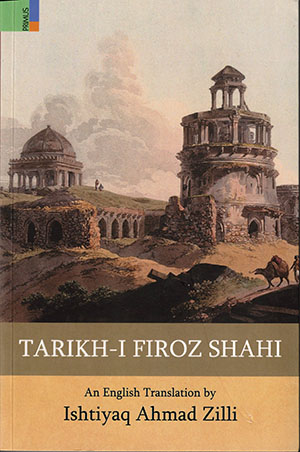
Re: Tarikh-i Firoz Shahi, of Ziaud Din Barni/Shams-i Siraj '
Posted: Mon Nov 22, 2021 4:01 am
Part 1 of 2
EXTRACTS.
[Praises without end, and infinite thanks to that merciful Creator who gave to me his poor abject creature Firoz, son of Rajab, the slave of Muhammad Shah son of Tughlik Shah, His impulse for the maintenance of the laws of His religion, for the repression of heresy, the prevention of crime, and the prohibition of things forbidden; who gave me also a disposition for discharging my lawful duties and my moral obligations. *** My desire is that, to the best of my human power, I should recount and pay my thanks for the many blessings He has bestowed upon me, so that I may be found among the number of His grateful servants. First I would praise Him because when irreligion and sins opposed to the Law prevailed in Hindustan, and mens' habits and dispositions were inclined towards them, and were averse to the restraints of religion, He inspired me His humble servant with an earnest desire to repress irreligion and wickedness, so that I was able to labour diligently until with His blessing the vanities of the world, and things repugnant to religion, were set aside, and the true was distinguished from the false.
1. In the reigns of former kings the blood of many Musulmans had been shed, and many varieties of torture employed. Amputation of hands and feet, ears and noses; tearing out the eyes, pouring molten lead into the throat, crushing the bones of the hands and feet with mallets, burning the body with fire, driving iron nails into the hands, feet, and bosom, cutting the sinews, sawing men asunder; these and many similar tortures were practised. The great and merciful God made me, His servant, hope and seek for His mercy by devoting myself to prevent the unlawful killing of Musulmans, and the infliction of any kind of torture upon them or upon any men.
2. The next matter, which by God's help I accomplished, was the repetition of the names and titles of former sovereigns which had been omitted from the prayers on Sabbaths and Feasts. The names of those sovereigns of Islam, under whose happy fortune and favour infidel countries had been conquered, whose banners had waved over many a land, under whom mosques and pulpits had been built and exalted, the fragrant creed had been extended, and the people of Islam had waxen strong and warlike, the names of these men had fallen into neglect and oblivion. So I decreed that according to established custom their names and titles should be rehearsed in the khutba and aspirations offered for the remission of their sins.
4. Before my time it was the rule and practice that in repressing infidelity four-fifths of the spoil was appropriated to the public treasury and one-fifth was given to the captors; but the rule of the Law is that one-fifth should be taken by the State, and four-fifths allotted to the captors. The provisions of the Law had thus been entirely subverted. As the Law was thus set at nought, every man looked upon himself as the lawful owner of the spoil he captured. Hence, children borne by female captives were the offspring of fornication. To prevent these irregularities I decreed that one-fifth (of the spoil) should be taken by the State, and four-fifths given to the captors.
5. The sect of Shi'as, also called rawafix, had endeavoured to make proselytes. They wrote treatises and books, and gave instruction and lectures upon the tenets of their sect, and traduced and reviled the first chiefs of our religion (on whom be the peace of God!). I seized them all and I convicted them of their errors and perversions. On the most zealous I inflicted punishment (siyasat), and the rest I visited with censure (tazir) and threats (tahdib) of public punishment (tashhir'i zijr). Their books I burnt in public, and so by the grace of God the influence of this sect was entirely suppressed.
6. There was a sect of heretics (mulhid), and sectarians (abahtiyan), who laboured to seduce the people into heresy and schism. They met by night at an appointed time and place, both friends and strangers. Wine was served, and they said that this was their religious worship. They brought their wives, mothers, and daughters to these meetings. The men threw themselves on the ground as if in worship, and each man had intercourse with the woman whose garment he caught. I cut off the heads of the elders of this sect, and imprisoned and banished the rest, so that their abominable practices were put an end to.
7. There was a sect which wore the garments of atheism, and having thrown off all restraint, led men astray. The name of their chief was Ahmad Bahari. He dwelt in the city, and a party of his followers called him a God. They brought those people before me in bonds and chains, and informed me that he presumptuously made himself a prophet, and said that there could be none of the grace of prophecy in any one who had not been admitted into his following. One of his disciples affirmed that a God had appeared in Dehli, that is, Ahmad Bahari. When these facts were proved against them, I ordered them both to be confined and punished with chains. I admonished the others to repent and reform, and I banished them to different cities to put a stop to the influence of this wretched sect.
8. There was in Dehli a man named Ruknu-d din, who was called Mahdi, because he affirmed himself to be the Imam Mahdi who is to appear in the latter days, and to be possessed of knowledge by inspiration. He said that he had not read or studied under anyone, and that he knew the names of all things, a knowledge which no prophet had acquired since Adam. He pretended that the mysteries of the science of letters ('ilm-i huruf) had been revealed to him in a way never made known to any other man, and that he had written books upon the subject. He led people astray into mystic practices , and perverted ideas by maintaining that he was Ruknu-d din, the prophet of God. The elders brought the facts of this case to my attention, and gave evidence of what they had heard him say. When he was brought before me I investigated the charges of error and perversion brought against him, and he was convicted of heresy and error. The doctors of the Law said he was an infidel, and worthy of death, for having spread such vile and pernicious ideas among the people of Islam. If any delay were made in putting them down they would spread like a pestilence, and many Musulmans would stray from the true faith. A revolt (against religion) would follow; and many men would fall into perdition. I ordered that this vile fellow's rebellion and wickedness should be communicated to all societies of learned men, and be made public to all men, high and low: and that in accordance with the decision of the doctors learned in the holy Law, the guilty should be brought to punishment. They killed him with some of his supporters and disciples, and the people rushing in tore him to pieces and broke his bones into fragments. Thus was his iniquity prevented. God in His mercy and favour, made me, His humble creature, the instrument of putting down such wickedness, and abolishing such heresy; and guided me to effect a restoration of true religion. Thanks for this are due to the great and glorious God. Upon hearing or reading the facts here recorded, every well-wisher of His religion will admit that this sect was deservedly punished, and for this good action I hope to receive future reward.
9. A person who was one of the pupils of 'Ain Mahru,1 [[x].] had set himself up as a shaikh in the country of Gujarat, and having got together a body of disciples, used to say, 'Ana-l Hakk" (I am God). He commanded his disciples that when he used these words they were to say, "Thou art, thou art!" He further said, "I am the king who dies not;" and he wrote a book in which he inserted the words of his profession (kalamat). He was put in chains and brought before me. The charge being proved, I condemned him to punishment, and his book I ordered to be burnt, so that his innovation (fasad) might be prevented from spreading among the faithful people of Islam.
10. A custom and practice unauthorized by the Law of Islam had sprung up in Musulman cities. On holy days women riding in palankins, or carts, or litters, or mounted on horses or mules, or in large parties on foot, went out of the city to the tombs. Rakes and wild fellows of unbridled passions and loose habits, took the opportunity which this practice afforded for improper riotous actions. I commanded that no woman should go out to the tombs under pain of exemplary punishment. Now, thanks to the great God, no lady or respectable Musulman woman can go out on pilgrimage to the tombs. The practice has been entirely stopped.
11. The Hindus and idol-worshipers had agreed to pay the money for toleration (zar-i zimmiya) and had consented to the poll tax (jizya), in return for which they and their families enjoyed security. These people now erected new idol temples in the city and the environs in opposition to the Law of the Prophet which declares that such temples are not to be tolerated. Under Divine guidance I destroyed these edifices, and I killed those leaders of infidelity who seduced others into error, and the lower orders I subjected to stripes and chastisement, until this abuse was entirely abolished. The following is an instance: — In the village of Maluh there is a tank which they call kund (tank). Here they had built idol-temples, and on certain days the Hindus were accustomed to proceed thither on horseback, and wearing arms. Their women and children also went out in palankins and carts. There they assembled in thousands and performed idol worship. This abuse had been so overlooked that the bazar people took out there all sorts of provisions, and set up stalls and sold their goods. Some graceless Musulmans, thinking only of their own gratification, took part in these meetings. When intelligence of this came to my ears my religious feelings prompted me at once to put a stop to this scandal and offence to the religion of Islam. On the day of the assembling I went there in person, and I ordered that the leaders of these people and the promoters of this abomination should be put to death. I forbad the infliction of any severe punishments on the Hindus in general, but I destroyed their idol temples, and instead thereof raised mosques. I founded two flourishing towns (kasba), one called Tughlikpur, the other Salarpur. Where infidels and idolaters worshiped idols, Musulmans now, by God's mercy, perform their devotions to the true God. Praises of God and the summons to prayer are now heard there, and that place which was formerly the home of infidels has become the habitation of the faithful, who there repeat their creed and offer up their praises to God.
12. Information was brought to me that some Hindus had erected a new idol-temple in the village of Salihpur, and were performing worship to their idol. I sent some persons there to destroy the idol temple, and to put a stop to their pernicious incitements to error.
13. Some Hindus had erected a new idol-temple in the village of Kohana, and the idolaters used to assemble there and perform their idolatrous rites. These people were seized and brought before me. I ordered that the perverse conduct of the leaders of this wickedness should be publicly proclaimed, and that they should be put to death before the gate of the palace. I also ordered that the infidel books, the idols, and the vessels used in their worship, which had been taken with them, should all be publicly burnt. The others were restrained by threats and punishments, as a warning to all men, that no zimmi could follow such wicked practices in a Musulman country.
14. It had been the practice in former reigns to use vessels of gold and silver at the royal table, and sword-belts and quivers were ornamented with gold and jewels. I forbad these things, and I ordered the fittings of my arms to be made of bone, and I commanded that only such vessels should be used as are recognized by the Law.
15. In former times it had been the custom to wear ornamented garments, and men received robes as tokens of honour from kings' courts. Figures and devices were painted and displayed on saddles, bridles, and collars, on censers, on goblets and cups, and flagons, on dishes and ewers, in tents, on curtains and on chairs, and upon all articles and utensils. Under Divine guidance and favour I ordered all pictures and portraits to be removed from these things, and that such articles only should be made as are approved and recognized by the Law. Those pictures and portraits which were painted on the doors and walls of palaces I ordered to be effaced.
EXTRACTS.
[Praises without end, and infinite thanks to that merciful Creator who gave to me his poor abject creature Firoz, son of Rajab, the slave of Muhammad Shah son of Tughlik Shah, His impulse for the maintenance of the laws of His religion, for the repression of heresy, the prevention of crime, and the prohibition of things forbidden; who gave me also a disposition for discharging my lawful duties and my moral obligations. *** My desire is that, to the best of my human power, I should recount and pay my thanks for the many blessings He has bestowed upon me, so that I may be found among the number of His grateful servants. First I would praise Him because when irreligion and sins opposed to the Law prevailed in Hindustan, and mens' habits and dispositions were inclined towards them, and were averse to the restraints of religion, He inspired me His humble servant with an earnest desire to repress irreligion and wickedness, so that I was able to labour diligently until with His blessing the vanities of the world, and things repugnant to religion, were set aside, and the true was distinguished from the false.
1. In the reigns of former kings the blood of many Musulmans had been shed, and many varieties of torture employed. Amputation of hands and feet, ears and noses; tearing out the eyes, pouring molten lead into the throat, crushing the bones of the hands and feet with mallets, burning the body with fire, driving iron nails into the hands, feet, and bosom, cutting the sinews, sawing men asunder; these and many similar tortures were practised. The great and merciful God made me, His servant, hope and seek for His mercy by devoting myself to prevent the unlawful killing of Musulmans, and the infliction of any kind of torture upon them or upon any men.
All these things were practised that fear and dread might fall upon the hearts of men, and that the regulations of government might be duly maintained."Thanks for God's mercies I will show,
By causing man nor pain nor woe."
Through the mercy which God has shown to me these severities and terrors have been exchanged for tenderness, kindness, and mercy. Fear and respect have thus taken firmer hold of the hearts of men, and there has been no need of executions, scourgings, tortures, or terrors. But this blessed result is altogether due to the mercy and favour of the Creater.Would'st thou see thy land at rest?
Keep the (headsman's) sword at rest!"
By God's help I determined that the lives (khun) of Musulmans and true believers should be in perfect immunity, and whoever transgressed the Law should receive the punishment prescribed by the book and the decrees of judges."Thy power is great, then mercy show:
Pardon than vengeance better know.
Greatness to thee from Heaven descends:
Proneness to wrath thy God offends.
Withhold thine hand, some respite give,
Nor kill the man thou might'st forgive;
Let not his body lifeless fall,
His spirit thou can'st ne'er recall.
See how the mother's tender breast
Is by her child's distress opprest.
Boast not the hundreds thon hast slain.
To save one life's a nobler aim.
Thou shrinkest from the lancet's smart,
Keep then thy sword from neck and heart.
Seek not to shed a victim's gore,
The life-stream stopped will flow no more.
From deeds of blood thy hand restrain,
Thy blood the assassin's blade may stain.
That leader praise whose generous heart,
Disdains with captives' lives to sport.
From the well of fate he life will draw
Who shields the wretch from tyrants' law.
A vanquished foe should claim thy care.
Then pity show— in mercy spare!"
2. The next matter, which by God's help I accomplished, was the repetition of the names and titles of former sovereigns which had been omitted from the prayers on Sabbaths and Feasts. The names of those sovereigns of Islam, under whose happy fortune and favour infidel countries had been conquered, whose banners had waved over many a land, under whom mosques and pulpits had been built and exalted, the fragrant creed had been extended, and the people of Islam had waxen strong and warlike, the names of these men had fallen into neglect and oblivion. So I decreed that according to established custom their names and titles should be rehearsed in the khutba and aspirations offered for the remission of their sins.
3. In former reigns they used to collect frivolous, unlawful, and unjust cesses at the public treasury, such as the Mandavi bark, dalalat-i bazarha, jarari, amiri-tarab, gul-faroshi, jariba-i tambol, changi-ghala, kitabi, bilgari, mahi-faroshi, sabunkari, risman faroshi, raughan-kari, nukhud-biryan, tah-bazari, jhaba, kimar-khana, dad-banki, kotwali, ihtisabi, karhi, charai, musadarat. I had all these abolished and removed from the accounts, and any revenue collector who exacted these cesses from the people was to be brought to punishment for his offence."Would'st thou enjoy a lasting fame?
Hide not the merits of an honoured name!"
The money received in the public treasury should be derived from sources recognized by the Sacred Law, and approved by books of authority. First the kharaj or tenth from cultivated lands, then the zakat or alms, then the jizya or poll tax on Hindus and other separatists, then the khams or fifth of the spoil and of (the produce of) mines. No tax unauthorized by the declarations of the book should be received in the public treasury."Better a people's weal than treasures vast,
Better an empty chest than hearts downcast."
4. Before my time it was the rule and practice that in repressing infidelity four-fifths of the spoil was appropriated to the public treasury and one-fifth was given to the captors; but the rule of the Law is that one-fifth should be taken by the State, and four-fifths allotted to the captors. The provisions of the Law had thus been entirely subverted. As the Law was thus set at nought, every man looked upon himself as the lawful owner of the spoil he captured. Hence, children borne by female captives were the offspring of fornication. To prevent these irregularities I decreed that one-fifth (of the spoil) should be taken by the State, and four-fifths given to the captors.
5. The sect of Shi'as, also called rawafix, had endeavoured to make proselytes. They wrote treatises and books, and gave instruction and lectures upon the tenets of their sect, and traduced and reviled the first chiefs of our religion (on whom be the peace of God!). I seized them all and I convicted them of their errors and perversions. On the most zealous I inflicted punishment (siyasat), and the rest I visited with censure (tazir) and threats (tahdib) of public punishment (tashhir'i zijr). Their books I burnt in public, and so by the grace of God the influence of this sect was entirely suppressed.
6. There was a sect of heretics (mulhid), and sectarians (abahtiyan), who laboured to seduce the people into heresy and schism. They met by night at an appointed time and place, both friends and strangers. Wine was served, and they said that this was their religious worship. They brought their wives, mothers, and daughters to these meetings. The men threw themselves on the ground as if in worship, and each man had intercourse with the woman whose garment he caught. I cut off the heads of the elders of this sect, and imprisoned and banished the rest, so that their abominable practices were put an end to.
7. There was a sect which wore the garments of atheism, and having thrown off all restraint, led men astray. The name of their chief was Ahmad Bahari. He dwelt in the city, and a party of his followers called him a God. They brought those people before me in bonds and chains, and informed me that he presumptuously made himself a prophet, and said that there could be none of the grace of prophecy in any one who had not been admitted into his following. One of his disciples affirmed that a God had appeared in Dehli, that is, Ahmad Bahari. When these facts were proved against them, I ordered them both to be confined and punished with chains. I admonished the others to repent and reform, and I banished them to different cities to put a stop to the influence of this wretched sect.
8. There was in Dehli a man named Ruknu-d din, who was called Mahdi, because he affirmed himself to be the Imam Mahdi who is to appear in the latter days, and to be possessed of knowledge by inspiration. He said that he had not read or studied under anyone, and that he knew the names of all things, a knowledge which no prophet had acquired since Adam. He pretended that the mysteries of the science of letters ('ilm-i huruf) had been revealed to him in a way never made known to any other man, and that he had written books upon the subject. He led people astray into mystic practices , and perverted ideas by maintaining that he was Ruknu-d din, the prophet of God. The elders brought the facts of this case to my attention, and gave evidence of what they had heard him say. When he was brought before me I investigated the charges of error and perversion brought against him, and he was convicted of heresy and error. The doctors of the Law said he was an infidel, and worthy of death, for having spread such vile and pernicious ideas among the people of Islam. If any delay were made in putting them down they would spread like a pestilence, and many Musulmans would stray from the true faith. A revolt (against religion) would follow; and many men would fall into perdition. I ordered that this vile fellow's rebellion and wickedness should be communicated to all societies of learned men, and be made public to all men, high and low: and that in accordance with the decision of the doctors learned in the holy Law, the guilty should be brought to punishment. They killed him with some of his supporters and disciples, and the people rushing in tore him to pieces and broke his bones into fragments. Thus was his iniquity prevented. God in His mercy and favour, made me, His humble creature, the instrument of putting down such wickedness, and abolishing such heresy; and guided me to effect a restoration of true religion. Thanks for this are due to the great and glorious God. Upon hearing or reading the facts here recorded, every well-wisher of His religion will admit that this sect was deservedly punished, and for this good action I hope to receive future reward.
9. A person who was one of the pupils of 'Ain Mahru,1 [[x].] had set himself up as a shaikh in the country of Gujarat, and having got together a body of disciples, used to say, 'Ana-l Hakk" (I am God). He commanded his disciples that when he used these words they were to say, "Thou art, thou art!" He further said, "I am the king who dies not;" and he wrote a book in which he inserted the words of his profession (kalamat). He was put in chains and brought before me. The charge being proved, I condemned him to punishment, and his book I ordered to be burnt, so that his innovation (fasad) might be prevented from spreading among the faithful people of Islam.
Ibn Mansur Al Hallaj, the "Qu'ranic Christ," making the dangerous and fatal "ejaculation," 'ANA' L HAQ (I AM the Truth) IF HALLAJ HAD SAID "ALLAH AL HAZ -- GOD (IN HIS TRANSCENDENTAL ASPECT) IS THE TRUTH, OR "HUWA AL HAQ" (HE IS THE TRUTH) IT WOULD HAVE BEEN A COMMON STATEMENT. HOWEVER AL HALLAJ DECLARED THAT GOD ALONE EXISTS: THEREFORE HE IS THE ONE SUBJECT AND THUS HE ALONE CAN WITNESS HIS EXISTENCE.
-- Toward the One, by Pir Vilayat Inayat Khan
***
Take the famous utterance, 'I am God.' Some men reckon it as a great pretension; but 'I am Gael' is in fact a great humility. The man who says 'I am the servant of God' asserts that two exist, one himself and the other God. But he who says 'I am God' has naughted himself and cast himself to the winds. He says, 'I am God': that is, 'I am not, He is all, nothing has existence but God, I am pure non-entity, I am nothing.' In this the humility is greater.
-- Discourses of Rumi, translated by A. J. Arberry
***
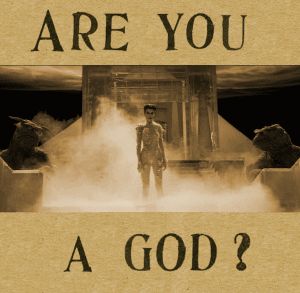
[Gozer] Are you a God?
-- Ghostbusters, directed by Ivan Reitman
10. A custom and practice unauthorized by the Law of Islam had sprung up in Musulman cities. On holy days women riding in palankins, or carts, or litters, or mounted on horses or mules, or in large parties on foot, went out of the city to the tombs. Rakes and wild fellows of unbridled passions and loose habits, took the opportunity which this practice afforded for improper riotous actions. I commanded that no woman should go out to the tombs under pain of exemplary punishment. Now, thanks to the great God, no lady or respectable Musulman woman can go out on pilgrimage to the tombs. The practice has been entirely stopped.
11. The Hindus and idol-worshipers had agreed to pay the money for toleration (zar-i zimmiya) and had consented to the poll tax (jizya), in return for which they and their families enjoyed security. These people now erected new idol temples in the city and the environs in opposition to the Law of the Prophet which declares that such temples are not to be tolerated. Under Divine guidance I destroyed these edifices, and I killed those leaders of infidelity who seduced others into error, and the lower orders I subjected to stripes and chastisement, until this abuse was entirely abolished. The following is an instance: — In the village of Maluh there is a tank which they call kund (tank). Here they had built idol-temples, and on certain days the Hindus were accustomed to proceed thither on horseback, and wearing arms. Their women and children also went out in palankins and carts. There they assembled in thousands and performed idol worship. This abuse had been so overlooked that the bazar people took out there all sorts of provisions, and set up stalls and sold their goods. Some graceless Musulmans, thinking only of their own gratification, took part in these meetings. When intelligence of this came to my ears my religious feelings prompted me at once to put a stop to this scandal and offence to the religion of Islam. On the day of the assembling I went there in person, and I ordered that the leaders of these people and the promoters of this abomination should be put to death. I forbad the infliction of any severe punishments on the Hindus in general, but I destroyed their idol temples, and instead thereof raised mosques. I founded two flourishing towns (kasba), one called Tughlikpur, the other Salarpur. Where infidels and idolaters worshiped idols, Musulmans now, by God's mercy, perform their devotions to the true God. Praises of God and the summons to prayer are now heard there, and that place which was formerly the home of infidels has become the habitation of the faithful, who there repeat their creed and offer up their praises to God.
12. Information was brought to me that some Hindus had erected a new idol-temple in the village of Salihpur, and were performing worship to their idol. I sent some persons there to destroy the idol temple, and to put a stop to their pernicious incitements to error.
13. Some Hindus had erected a new idol-temple in the village of Kohana, and the idolaters used to assemble there and perform their idolatrous rites. These people were seized and brought before me. I ordered that the perverse conduct of the leaders of this wickedness should be publicly proclaimed, and that they should be put to death before the gate of the palace. I also ordered that the infidel books, the idols, and the vessels used in their worship, which had been taken with them, should all be publicly burnt. The others were restrained by threats and punishments, as a warning to all men, that no zimmi could follow such wicked practices in a Musulman country.
14. It had been the practice in former reigns to use vessels of gold and silver at the royal table, and sword-belts and quivers were ornamented with gold and jewels. I forbad these things, and I ordered the fittings of my arms to be made of bone, and I commanded that only such vessels should be used as are recognized by the Law.
15. In former times it had been the custom to wear ornamented garments, and men received robes as tokens of honour from kings' courts. Figures and devices were painted and displayed on saddles, bridles, and collars, on censers, on goblets and cups, and flagons, on dishes and ewers, in tents, on curtains and on chairs, and upon all articles and utensils. Under Divine guidance and favour I ordered all pictures and portraits to be removed from these things, and that such articles only should be made as are approved and recognized by the Law. Those pictures and portraits which were painted on the doors and walls of palaces I ordered to be effaced.