Re: Freda Bedi Cont'd (#3)
Posted: Mon Nov 01, 2021 4:29 am
Chapter 7: The Tughlaq Dynasty, Excerpt from "A Textbook of Medieval Indian History
by Sailendra Nath Sen
© Sailendra Nath Sen 2013
CHAPTER 7: The Tughlaq Dynasty
Ghiyasuddin Tughlaq (1320-25)
Ghiyasuddin was the founder of the Tughluq dynasty. This dynasty is also known as the dynasty of the Qaraunah Turks since his father was a Qaraunah Turk. Ghiyasuddin was a man of humble origin. His success against the Mongols during the reign of Alauddin raised him to a prominent position. He ascended the throne on 8 September 1320 and took up the title of Ghazi or 'slayer of the infidels'.
Domestic Policy
Ghiyasuddin' s first task was to restore administrative order by removing the abuses that had crept in. He won over the nobles by bestowing lands and employment. He recovered most of the treasure squandered by Khusrau Shah. Nothing however, could be recovered from the famous Saint, Shaikh Nizam-uddin Auliya. He encouraged agriculturists and protected the cultivators from harassment. He lightened the burden of taxation by fixing the dues of the State to one-tenth and one-eleventh in a year. He gave up the practice of survey of the land and instead laid down that land revenue should be assessed by the collectors in person. Instead of increasing the revenue, the Sultan's policy was that of 'the extension of cultivation'. This led to reclamation of the wastelands and an increasing acreage under cultivable land. Canals were excavated to irrigate the fields, gardens were planted and forts were repaired. He improved the system of communication by streamlining the postal system. He reformed the judicial system. However, his treatment of the Hindus was not praiseworthy. He devised a system of relief for the poor. He was a patron of literary men and religious institutions. Amir Khusrau, his poet laureate, received a pension of 1,000 tankas per mensem. Amir Khusrau observes: 'He never did anything that was not replete with wisdom and sense.'
Foreign Policy
Ghiyasuddin pursued the Khalji policy of imperialism and wanted to assert his authority over those states which had renounced their allegiance during the weak reign of Khusrau Shah. In 1321 he sent his eldest son and heir-apparent, Jauna Khan, conferred with the title, Ulugh Khan, to subjugate the recalcitrant Prataparudra Deva, the Kakatiya ruler of Warangal. The invaders besieged the fort of Warangal but the heroic resistance of the defenders who snapped the lines of communication with Delhi unnerved Ulugh Khan. Wild rumours, that the Sultan had died, goaded Ulugh Khan to hasten back to Delhi without achieving anything. In 1323 he marched again to Warangal and compelled Prataparudra to surrender along with his family. The Raja was sent to Delhi and Warangal was named Sultanpur. On his way to Delhi, Ulugh Khan invaded Jajnagar in Orissa.
The Sultan devoted his attention to Bengal, then torn by civil war between the various contenders for the throne. The Sultan marched in person towards Bengal in 1324. He placed his nominee, Nasiruddin, on the throne of West Bengal as a vassal of Delhi. East Bengal was annexed to Delhi. On his way back, the Sultan attacked Tirhut (north Bihar) and appointed a governor there.
On his return from Delhi, the Sultan was received at Afghanpur, near Tughlaqabad. The Sultan was received at a wooden pavilion which collapsed; and caused him and his second son, Prince Mahmud Khan's death. According to Isami and Ibn Battuta, the whole thing was the result of a plot masterminded by Ulugh Khan. Ghiyasuddin laid the foundation of a large palace fort which later became known as Tughlaqabad.
Muhammad bin Tughluq (1325-51)
After Ghiyasuddin's death in July 1325, Ulugh Khan ascended the throne under the title of Sultan Muhammad bin Tughluq. His character was a mixture of opposites that defied analysis. According to Barani, the Sultan was 'one of the wonders of creation. His contradictory qualities were beyond the grasp of knowledge and common sense'. He was endowed with a keen intellect which encompassed different subjects like logic, astronomy, philosophy, mathematics, science, and Persian classics. These fine qualities can hardly be reconciled with the vagaries of his nature. Perplexed by this contradiction, Elphinstone expressed the doubt 'whether he was not affected by some degree of insanity'. In making the correct assessment of Muhammad bin Tughluq, one might say that he lacked practical judgement and wise statesmanship. He had an obstinate disposition which brooked no opposition. Moreover, 'the Sultan, like Jahangir afterwards, believed himself to be a just man ... he deliberately defended his conduct against criticism and avowed his resolve to continue his course to the end'.1 [Vincent A. Smith, Oxford History of India, ed. Percival Spear, OUP, 1976, p. 250.]
Relocation of the Capital
One of the most controversial steps taken by Muhammad bin Tughluq was the relocation of the capital from Delhi to Devagiri, also named Daulatabad. It is alleged that the Sultan wanted to punish the people of Delhi who had become hostile to him. However, this has been disputed by modern writers. It appears that the transfer was not a whimsical act but the result of forethought. The Sultan's motive was to set up a capital central to all parts of the empire enabling him to control the entire south and to protect the empire from the ever-present Mongol menace. Having decided the measure, the Sultan ordered in 1328-9, a mass exodus of the people, including his mother and Sufi saints. Though the Sultan made comfortable arrangements for the people during their long journey from Delhi to Devagiri, a distance of 1,500 km., the people suffered great privations. There was a good deal of pressure exerted upon the people to migrate and most of the migrants were not happy. However, Delhi was not deserted. Rather Daulatabad became a second capital, as coins struck at Daulatabad testify. Moreover, the Sultan's ambitious project went awry when in 1334-5 there was a serious rebellion in Mahar (modern Coromandel in Tamilnadu) which enveloped the entire south including Dvarasamudra and Warangal. 'Thus the raison d'etre of keeping Daulatabad as a second capital disappeared.' During 1335-7 the Sultan permitted the people of Daulatabad to return to Delhi. Many of the Sufis and men of learning refused to leave Daulatabad and in course of time it became a centre of Islamic learning.
Introduction of Token Currency
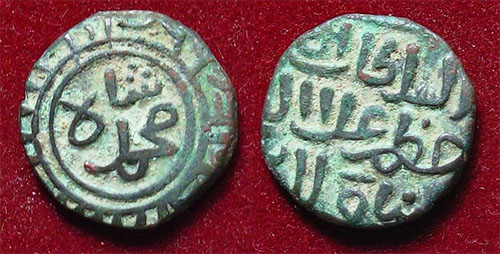
In 1329-30, the Sultan introduced token currency, an experiment which proved a costly failure. Imitating the paper money project of Kublai Khan (AD 1260-94), the Sultan issued bronze coins equivalent to the value of the silver coins. According to Barani, the Sultan was forced to take this drastic step to replenish his treasury exhausted by his lavish gifts and to equip a large army for ambitious foreign expeditions. However, the experiment proved a costly failure as the Sultan was unable to prevent the circulation of forged coins. Thus, the counterfeit bronze coins replaced gold and silver coins completely. Land tax was paid in the token currency. Trade and commerce suffered as foreign merchants suspended their business transactions with India. The abundance of these new coins depreciated their value and they became as 'worthless as stones and potsherds'. To avert the mounting economic crisis, the Sultan stopped the circulation of token currency and ordered the redemption of token coins by gold and silver coins. According to Barani, heaps of bronze coins accumulated near Tughlaqabad.
The Sultan had to cope with the ever present Mongol menace in the frontier region. Despite the internal dissensions which overwhelmed the Mongols, they were strong enough to threaten the Punjab and the areas near Delhi. In the early years of Muhammad Tughluq's reign the Mongols under their leader, Tarmashirin, swooped down upon Sind and even advanced up to Meerut, about 65 km. from Delhi. The Sultan not only defeated the Mongols, but also occupied Kalanaur and extended the frontier up to Peshawar.
Shortly after the transfer of the capital from Delhi to Devagiri, Muhammad entertained the project of making Sind and Punjab immune from the recurring danger of Mongol invasions. The project is described by Barani as the Sultan's ambition to conquer Khurasan, Iraq and Transoxiana. The Sultan mobilized a large army of 3,70,000 soldiers. However, he disbanded the army after keeping them idle for a year. Perhaps the Sultan's aim was to extend control over Kabul and Ghazni.
After the projected Khurasan expedition, the Sultan launched an expedition in the Kulu-Kangra region of Himachal, perhaps to offset Chinese incursions. The expedition that took place in 1333 has been called the Qarachil expedition. The expedition proved a failure and the entire force of 10,000 was annihilated.
Agrarian Reforms
The failure of three experiments -- the exodus from Delhi to Devagiri, the abortive Khurasan expedition and the Qantchil campaign -- affected the reputation of the Sultan and depleted his treasury. Meanwhile certain agrarian measures of the Sultan, epidemics and a famine which lasted several years affecting large parts of the Doab (land between the Jumna and the Ganges), caused widespread distress and a violent peasant uprising.
In 1328-9 the Sultan enhanced the land-tax on the farmers. New cesses were levied and the old cesses -- grazing tax (charm) and house tax (ghari) were collected in a rigorous manner. The most seamy side of the tax system was that assessment was fixed not on the basis of the actual produce, but on the basis of the standard yield. These measures impoverished the peasantry and led to an agrarian uprising which affected large areas, especially the Doab region. According to Barani, the Hindus set fire to their grain barns and drove away cattle from their homes. The magnitude of the disaster did not soften the Sultan's attitude. Instead, he imposed severe repressive measures ordering the revenue officials like the shiqdars and military officials, faujdars, to lay waste and plunder the country. The entire area from Kanauj to Delhi was ravaged. Grain became scarce and a famine broke out in Delhi. The famine spread to Malwa and eastern Punjab. Begun in 1334-5, the famine lasted for seven years. The situation became so intolerable at Delhi, that the Sultan moved the entire imperial camp to a place on the Ganges, 80 km. away, called Swargadwar. The Sultan lived there for two years.
To cope with the devastating famine, the Sultan adopted relief measures. Relief camps were opened at Delhi, and food was imported from Awadh where there was no famine. Agricultural loans (sondhar) were advanced to buy seed and implements and to dig wells. To improve cultivation, the Sultan appointed diwan-i-amir-i-kohi who took charge of a territory roughly corresponding to 100 km. by 100 km. To extend cultivation and to improve the crops, the Sultan appointed 100 shiqdars. They were given large sums of money for giving agricultural loans (sondhar). However, the entire scheme failed owing to the appointment of incompetent and corrupt men to implement the scheme.
Revolts
Muhammad bin Tughluq had to face serious rebellions in different parts of the empire. The Sultan failed to recover Ma'bar where Sayyid Ahsan Shah founded the independent Madurai Sultanate. During the period from January 1335 to July 1337, five rebellions broke out in the south. The Sultan's prestige suffered an irreparable blow with the foundation of the Hindu kingdom of Vijayanagar in 1336 and the subsequent independence of Warangal and Kampili.
Between 1338 and 1341 Bengal cut itself adrift from the sinking wreck of Sultan Muhammad Tughluq's empire. The most serious uprising was, however, was that of Ain-ul-Mulk, g0vernor of Awadh, in 1340, but he was finally defeated.
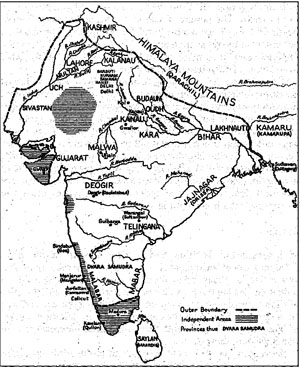
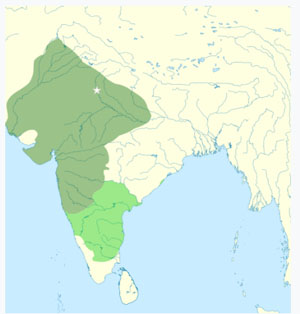
MAP 7.1: The Empire of Muhammad bin Tughluq in 1335. Source: C.C. Davies, Historical Atlas of the Indian Peninsula, 1949, p. 35.
Apart from the revolt of the governor, the Sultan had to face the rebellion of the amiran-i-sada (controllers of 100 villages). The Sultan brutally suppressed the rebellion with the help of Aziz Khammar, governor of Malwa. However, the rebels soon regrouped themselves under Taghi and killed Khammar. In January 1344 the Sultan left Delhi to crush the amiran-i-sada's rebellion. The Sultan met the rebels at Daulatabad and defeated them. A more serious rebellion broke out later at Gujarat and at Bidar by Hasan Kangu. The Sultan led a personal expedition to Gujarat and remained there for two and a half years. He spent the later years campaigning in Saurashtra and then moved to Thatta, in pursuit of the rebel, Taghi. Meanwhile, in his absence, Daulatabad was deserted and a new Bahmani Kingdom born. The Sultan pursued the fugitive and while the army was within a short distance of Thatta, he died on 20 March 1351.
Thus ended the career of one of the most remarkable personalities that ever sat on the throne of Delhi. He had extended the Delhi empire to its farthest limits, but before his death he lost everything to the south of the Vindhyas. Like the waves in the sea the empire reached the highest point only to break down.'2 [R.C. Majumdar, ed., History and Culture of the Indian People, The Delhi Sultanate, vol. VI, Bharatiya Vidya Bhavan, 1967, p. 80.] Muhammad bin Tughluq's character was probably a mixture of opposites. He was endowed with good qualities and some of his experiments and reforms were, to all intents, meant to strengthen the monarchy. He had progressive ideals for administrative reforms. But in enforcing his schemes, he disgusted the people and emptied his treasury. He lacked practical judgement and wise statesmanship, which in a large way, contributed to the decline of the Delhi Sultanate.
Firuz Tughluq (1351-88)
The long reign of Firuz Tughluq, a cousin of Muhammad Tughluq, is
Firuz wanted to create a class of nobility which would be loyal to him. He appointed Khan-i-Jahan Maqbul as the wazir and left much of the work of administration to him. Firuz paid extremely high salaries to the nobles which were given in terms of grants of iqtas. The subservient nobility which the Sultan created was hereditary in character. This policy in the long run weakened the efficiency of administration as it reduced the chances of competent persons being recruited into the service.
Firuz also wanted to strengthen the army for the stability of the state. The regular soldiers should be paid not in cash, but by grants of villages (wajh) in the neighbourhood of Delhi and the Doab. The irregular soldiers (ghair-wajahi) were paid directly from the treasury. Firuz extended the principle of heredity to the army much to its detriment. Thus, if a soldier became old, his son, or son-in-law, or his slave, could be sent in his place. The army became weak as sub-standard horses were produced for mustering. In the latter part of his reign, Firuz enlisted a vast number of slaves, amounting to 1,80,000 men a substantial part of whom were deployed to serve as an armed guard. A separate treasury and a separate diwan was set up for this corp of slaves.
Firuz settled the revenues afresh under the careful supervision of Khwaja Hisamuddin Junaid. Six crore and 75 lakh tankas was fixed on the basis of inspection. Firuz was interested in the economic well-being of the country. Firuz dug two canals to bring water to the new city of Hissar-Firuza (modern Hisar). He dug two canals to bring water to the city from the Sutlej and the Jamuna. Contemporary writers give credit to Firuz for excavating at least six canals which were concentrated in the present Haryana state. Besides canals, Firuz built many dams for purposes of irrigation. He also laid 1,200 gardens around Delhi.
The Sultan abolished various taxes not sanctioned by the Sharia. According to contemporaries, he abolished 21 such taxes. These included the ghari (house tax) prevalent during the time of Alauddin. However, he imposed the Jiziya on the non-Muslims. Even the Brahmins were not spared from the payment of the Jiziya.
Firuz built a number of towns around Delhi. Among the important towns built by him may be mentioned Fatehabad, Hissar, Ferozpur, Jaunpur and Firuzabad. The new towns became centres of trade and handicrafts. Firuz set up a public works department which repaired many old buildings and mausoleums. Qutb Minar was repaired and two Ashokan Pillars were transported to Delhi from Meerut and Topra (in the Ambala district). Firuz established a charity bureau (Diwan-i-Khairat) to help widows and orphans and especially for the marriage of Muslim girls. He also set up an employment bureau to provide employment for clerical and administrative jobs.
Firuz was a great patron of learning. He himself was an accomplished scholar and granted liberal allowances to scholars. He was fond of history and wrote his autobiography, Fatuhat-i- Firuz Shahi. He patronized Barani, Afif and Jalaluddin Rumi. Firuz came across a fine library consisting of 1,300 volumes at the temple of Jvalamukhi in Kangra and ordered a translation of one volume, which treated of philosophy and astrology, into Persian.
Despite all these fine achievements, Firuz's occasional fits of intolerance coupled with the importance given to the orthodox ulamas weakened the basic structure of his benevolent despotism. He 'reversed the trend towards a composite ruling class, consisting of Muslims and Hindus, a trend which had been started by Muhammad bin Tughluq'. In his orthodoxy, he tyrannized the leaders of the Ismaili group of Shias and banned Muslim women from going to the tombs of saints outside Delhi.
Foreign Policy
After his accession, Firuz was faced with the problem of preventing the disintegration of the Delhi Sultanate. The southern states had drifted away from the Sultanate and there were rebellions in Gujarat and Sindh. Bengal, also asserted its independence.
Firuz made spasmodic efforts to regain lost territory. In November 1353, he marched against Shamsuddin Ilyas Shah, the independent ruler of Bengal. Ilyas Shah shut himself up in the strong fort of Ikdala, near Pandua, in the Malda district. Unable to capture the fort, the Sultan returned to Delhi in September 1354. The Sultan undertook a second expedition against Bengal in November 1358 against Ilyas' successor, Sikandar, who survived by taking refuge in the Ikdala fort. The second expedition also proved to be futile. Firuz negotiated a peace settlement and status quo was maintained. 'For nearly two centuries, until the rise of the Afghans, Bengal was not molested by Delhi.'
From Bengal, Firuz returned to Jaunpur, and from there marched against the recalcitrant Raja Gajpati of Jajnagar in Orissa, who had withheld tribute. Firuz seized Cuttack and desecrated the Jagannath temple of Puri. Avoiding battle, the Raja made overtures of peace and agreed to pay regular tribute.
After a stay of four years at Delhi, Firuz led a campaign against Nagarkot in Kangra, reputed to be one of the strongest forts in the country. After a siege of six months, the Raja submitted and agreed to pay tribute.
Firuz led a protracted campaign against Thatta in lower Sindh with an army of 90,000 horses, 480 elephants and a flotilla of 5,000 boats. The Sultan met stiff resistance from the ruler of Thatta, which depleted the strength of his armed forces. Meanwhile famine and pestilence broke out in his camp and Firuz with difficulty retreated to Gujarat. After re-equipping the army, Firuz led a second expedition against Thatta and forced the ruler to submit.
The last years of the Sultan's reign were marked by erosion of central authority. A rebellion in Etawah in 1377-8 was followed by an uprising in Katihar. The death of his eldest son, Fath Khan in 1376 was a profound shock to the Sultan. A senile Sultan became a puppet in the hands of his minister Khan-i-Jahan. However, the Sultan's eldest surviving son, Prince Muhammad, brought about the minister's fall. Firuz abdicated in August 1787 after conferring the royal title on Prince Muhammad. However, a rebellion of Firuz's slaves, numbering 100,000, forced Prince Muhammad to decamp. Firuz now conferred the royal title on his grandson. Tughluq Khan, son of Fath Khan. A few months later on 20 September 1388, Firuz died at the ripe old age of 82.
After the death of Firuz, the government fell into the vortex of anarchy and confusion. A series of puppet Sultans, all equally wanting in personal merit, pass rapidly across the stage. The kingdom, in fact, ceased to exist, and the governor of every province assumed practical independence. For about three years, from 1394 to 1397, two rival Sultans had to find room within the precincts of the Delhi group of cities. Sultan Mahmud, a grandson of Firuz Shah, was recognized as king in Old Delhi, while his relative Nusrat Shah, claimed similar rank in Firuzabad a few miles distant. 'Day by day, battles were fought between these two kings, who were like the two kings in the game of chess.'3 [Vincent A. Smith, Oxford History of India, ed. Percival Spear, OUP, 1976, p. 260.] The authority of the Delhi Sultanate became so shrunken that led an observer to say pithily. 'The orders of the king of the world extend from Delhi to Palam.'
Timur's Invasion
Born in 1336, Timur or Tamerlane ascended the throne of Samarqand in 1369 and became the ruler of a vast empire embracing Transoxiana, a part of Turkistan, Afghanistan, Persia, Syria and a major part of Asia Minor. With a strange admixture of the savage ferocity of Chingiz Khan and the fanaticism of Sultan Mahmud, Timur decided to undertake an expedition to India. His ostensible object was to acquire the vast riches of India and indirectly to punish the infidels.
Before he launched his Indian expedition, his grandson Pir Muhammad, the governor of Kabul, Qandahar and Ghazni, captured Uch and Multan. Leaving Samarqand in April 1398, Timur crossed the Indus in September 1398. The Hindu chiefs of the Salt Range offered no resistance. Only the Rajput fort of Bhatnair offered resistance. The people of Fathabad, Kaythal, Samana and Panipat fled to Delhi. After plundering and massacring the people on the way, Timur crossed the Jamuna on 11 December, and appeared before Delhi. Sultan Muhammad Tughluq and his prime minister Mallu Iqbal endeavoured to oppose him with 10,000 cavalry and 40,000 infantry, but they were hopelessly defeated. Before the occupation of Delhi, Timur butchered one lakh Hindu captives in cold blood. Timur occupied Delhi on 18 December 1398. He ransacked the city and brutally massacred both Hindus and Muslims. Gold and silver ornaments of Hindu women were obtained in such quantities as to exceed all imaginable estimates.
After halting at Delhi for a fortnight, Timur left Delhi on 1 January 1399 to return to Samarqand. Returning through Firuzabad, he plundered Meerut and defeated two Hindu armies near Hardwar. Passing along the Siwalik Hills, he captured Kangra and sacked Jammu. He recrossed the Indus on 19 March 1399. Before his departure, Timur appointed Khizr Khan, as governor of Multan, Lahore and Dipalpur. Thus Timur departed after inflicting 'on India more misery than had ever before been inflicted by any conqueror in a single invasion'. After Timur's exit, Delhi presented a scene of desolation and woe. The Tughluq empire also disintegrated. There followed a chain of independent principalities like Bengal, Gujarat, Malwa, Jaunpur, Lahore, Multan, and Dipalpur. Nasiruddin Mahmud, the last representative of the Tughluq dynasty, died in February 1413, after a nominal reign of about 20 years. Thereupon Khizr Khan occupied Delhi in June 1414 and founded the Sayyid Dynasty.
by Sailendra Nath Sen
© Sailendra Nath Sen 2013
CHAPTER 7: The Tughlaq Dynasty
Ghiyasuddin Tughlaq (1320-25)
Ghiyasuddin was the founder of the Tughluq dynasty. This dynasty is also known as the dynasty of the Qaraunah Turks since his father was a Qaraunah Turk. Ghiyasuddin was a man of humble origin. His success against the Mongols during the reign of Alauddin raised him to a prominent position. He ascended the throne on 8 September 1320 and took up the title of Ghazi or 'slayer of the infidels'.
Domestic Policy
Ghiyasuddin' s first task was to restore administrative order by removing the abuses that had crept in. He won over the nobles by bestowing lands and employment. He recovered most of the treasure squandered by Khusrau Shah. Nothing however, could be recovered from the famous Saint, Shaikh Nizam-uddin Auliya. He encouraged agriculturists and protected the cultivators from harassment. He lightened the burden of taxation by fixing the dues of the State to one-tenth and one-eleventh in a year. He gave up the practice of survey of the land and instead laid down that land revenue should be assessed by the collectors in person. Instead of increasing the revenue, the Sultan's policy was that of 'the extension of cultivation'. This led to reclamation of the wastelands and an increasing acreage under cultivable land. Canals were excavated to irrigate the fields, gardens were planted and forts were repaired. He improved the system of communication by streamlining the postal system. He reformed the judicial system. However, his treatment of the Hindus was not praiseworthy. He devised a system of relief for the poor. He was a patron of literary men and religious institutions. Amir Khusrau, his poet laureate, received a pension of 1,000 tankas per mensem. Amir Khusrau observes: 'He never did anything that was not replete with wisdom and sense.'
Foreign Policy
Ghiyasuddin pursued the Khalji policy of imperialism and wanted to assert his authority over those states which had renounced their allegiance during the weak reign of Khusrau Shah. In 1321 he sent his eldest son and heir-apparent, Jauna Khan, conferred with the title, Ulugh Khan, to subjugate the recalcitrant Prataparudra Deva, the Kakatiya ruler of Warangal. The invaders besieged the fort of Warangal but the heroic resistance of the defenders who snapped the lines of communication with Delhi unnerved Ulugh Khan. Wild rumours, that the Sultan had died, goaded Ulugh Khan to hasten back to Delhi without achieving anything. In 1323 he marched again to Warangal and compelled Prataparudra to surrender along with his family. The Raja was sent to Delhi and Warangal was named Sultanpur. On his way to Delhi, Ulugh Khan invaded Jajnagar in Orissa.
The Sultan devoted his attention to Bengal, then torn by civil war between the various contenders for the throne. The Sultan marched in person towards Bengal in 1324. He placed his nominee, Nasiruddin, on the throne of West Bengal as a vassal of Delhi. East Bengal was annexed to Delhi. On his way back, the Sultan attacked Tirhut (north Bihar) and appointed a governor there.
On his return from Delhi, the Sultan was received at Afghanpur, near Tughlaqabad. The Sultan was received at a wooden pavilion which collapsed; and caused him and his second son, Prince Mahmud Khan's death. According to Isami and Ibn Battuta, the whole thing was the result of a plot masterminded by Ulugh Khan. Ghiyasuddin laid the foundation of a large palace fort which later became known as Tughlaqabad.
Muhammad bin Tughluq (1325-51)
After Ghiyasuddin's death in July 1325, Ulugh Khan ascended the throne under the title of Sultan Muhammad bin Tughluq. His character was a mixture of opposites that defied analysis. According to Barani, the Sultan was 'one of the wonders of creation. His contradictory qualities were beyond the grasp of knowledge and common sense'. He was endowed with a keen intellect which encompassed different subjects like logic, astronomy, philosophy, mathematics, science, and Persian classics. These fine qualities can hardly be reconciled with the vagaries of his nature. Perplexed by this contradiction, Elphinstone expressed the doubt 'whether he was not affected by some degree of insanity'. In making the correct assessment of Muhammad bin Tughluq, one might say that he lacked practical judgement and wise statesmanship. He had an obstinate disposition which brooked no opposition. Moreover, 'the Sultan, like Jahangir afterwards, believed himself to be a just man ... he deliberately defended his conduct against criticism and avowed his resolve to continue his course to the end'.1 [Vincent A. Smith, Oxford History of India, ed. Percival Spear, OUP, 1976, p. 250.]
Relocation of the Capital
One of the most controversial steps taken by Muhammad bin Tughluq was the relocation of the capital from Delhi to Devagiri, also named Daulatabad. It is alleged that the Sultan wanted to punish the people of Delhi who had become hostile to him. However, this has been disputed by modern writers. It appears that the transfer was not a whimsical act but the result of forethought. The Sultan's motive was to set up a capital central to all parts of the empire enabling him to control the entire south and to protect the empire from the ever-present Mongol menace. Having decided the measure, the Sultan ordered in 1328-9, a mass exodus of the people, including his mother and Sufi saints. Though the Sultan made comfortable arrangements for the people during their long journey from Delhi to Devagiri, a distance of 1,500 km., the people suffered great privations. There was a good deal of pressure exerted upon the people to migrate and most of the migrants were not happy. However, Delhi was not deserted. Rather Daulatabad became a second capital, as coins struck at Daulatabad testify. Moreover, the Sultan's ambitious project went awry when in 1334-5 there was a serious rebellion in Mahar (modern Coromandel in Tamilnadu) which enveloped the entire south including Dvarasamudra and Warangal. 'Thus the raison d'etre of keeping Daulatabad as a second capital disappeared.' During 1335-7 the Sultan permitted the people of Daulatabad to return to Delhi. Many of the Sufis and men of learning refused to leave Daulatabad and in course of time it became a centre of Islamic learning.
Introduction of Token Currency
In 1329-30, the Sultan introduced token currency, an experiment which proved a costly failure. Imitating the paper money project of Kublai Khan (AD 1260-94), the Sultan issued bronze coins equivalent to the value of the silver coins. According to Barani, the Sultan was forced to take this drastic step to replenish his treasury exhausted by his lavish gifts and to equip a large army for ambitious foreign expeditions. However, the experiment proved a costly failure as the Sultan was unable to prevent the circulation of forged coins. Thus, the counterfeit bronze coins replaced gold and silver coins completely. Land tax was paid in the token currency. Trade and commerce suffered as foreign merchants suspended their business transactions with India. The abundance of these new coins depreciated their value and they became as 'worthless as stones and potsherds'. To avert the mounting economic crisis, the Sultan stopped the circulation of token currency and ordered the redemption of token coins by gold and silver coins. According to Barani, heaps of bronze coins accumulated near Tughlaqabad.
The Sultan had to cope with the ever present Mongol menace in the frontier region. Despite the internal dissensions which overwhelmed the Mongols, they were strong enough to threaten the Punjab and the areas near Delhi. In the early years of Muhammad Tughluq's reign the Mongols under their leader, Tarmashirin, swooped down upon Sind and even advanced up to Meerut, about 65 km. from Delhi. The Sultan not only defeated the Mongols, but also occupied Kalanaur and extended the frontier up to Peshawar.
Shortly after the transfer of the capital from Delhi to Devagiri, Muhammad entertained the project of making Sind and Punjab immune from the recurring danger of Mongol invasions. The project is described by Barani as the Sultan's ambition to conquer Khurasan, Iraq and Transoxiana. The Sultan mobilized a large army of 3,70,000 soldiers. However, he disbanded the army after keeping them idle for a year. Perhaps the Sultan's aim was to extend control over Kabul and Ghazni.
After the projected Khurasan expedition, the Sultan launched an expedition in the Kulu-Kangra region of Himachal, perhaps to offset Chinese incursions. The expedition that took place in 1333 has been called the Qarachil expedition. The expedition proved a failure and the entire force of 10,000 was annihilated.
Agrarian Reforms
The failure of three experiments -- the exodus from Delhi to Devagiri, the abortive Khurasan expedition and the Qantchil campaign -- affected the reputation of the Sultan and depleted his treasury. Meanwhile certain agrarian measures of the Sultan, epidemics and a famine which lasted several years affecting large parts of the Doab (land between the Jumna and the Ganges), caused widespread distress and a violent peasant uprising.
In 1328-9 the Sultan enhanced the land-tax on the farmers. New cesses were levied and the old cesses -- grazing tax (charm) and house tax (ghari) were collected in a rigorous manner. The most seamy side of the tax system was that assessment was fixed not on the basis of the actual produce, but on the basis of the standard yield. These measures impoverished the peasantry and led to an agrarian uprising which affected large areas, especially the Doab region. According to Barani, the Hindus set fire to their grain barns and drove away cattle from their homes. The magnitude of the disaster did not soften the Sultan's attitude. Instead, he imposed severe repressive measures ordering the revenue officials like the shiqdars and military officials, faujdars, to lay waste and plunder the country. The entire area from Kanauj to Delhi was ravaged. Grain became scarce and a famine broke out in Delhi. The famine spread to Malwa and eastern Punjab. Begun in 1334-5, the famine lasted for seven years. The situation became so intolerable at Delhi, that the Sultan moved the entire imperial camp to a place on the Ganges, 80 km. away, called Swargadwar. The Sultan lived there for two years.
To cope with the devastating famine, the Sultan adopted relief measures. Relief camps were opened at Delhi, and food was imported from Awadh where there was no famine. Agricultural loans (sondhar) were advanced to buy seed and implements and to dig wells. To improve cultivation, the Sultan appointed diwan-i-amir-i-kohi who took charge of a territory roughly corresponding to 100 km. by 100 km. To extend cultivation and to improve the crops, the Sultan appointed 100 shiqdars. They were given large sums of money for giving agricultural loans (sondhar). However, the entire scheme failed owing to the appointment of incompetent and corrupt men to implement the scheme.
Revolts
Muhammad bin Tughluq had to face serious rebellions in different parts of the empire. The Sultan failed to recover Ma'bar where Sayyid Ahsan Shah founded the independent Madurai Sultanate. During the period from January 1335 to July 1337, five rebellions broke out in the south. The Sultan's prestige suffered an irreparable blow with the foundation of the Hindu kingdom of Vijayanagar in 1336 and the subsequent independence of Warangal and Kampili.
Between 1338 and 1341 Bengal cut itself adrift from the sinking wreck of Sultan Muhammad Tughluq's empire. The most serious uprising was, however, was that of Ain-ul-Mulk, g0vernor of Awadh, in 1340, but he was finally defeated.
MAP 7.1: The Empire of Muhammad bin Tughluq in 1335. Source: C.C. Davies, Historical Atlas of the Indian Peninsula, 1949, p. 35.
Apart from the revolt of the governor, the Sultan had to face the rebellion of the amiran-i-sada (controllers of 100 villages). The Sultan brutally suppressed the rebellion with the help of Aziz Khammar, governor of Malwa. However, the rebels soon regrouped themselves under Taghi and killed Khammar. In January 1344 the Sultan left Delhi to crush the amiran-i-sada's rebellion. The Sultan met the rebels at Daulatabad and defeated them. A more serious rebellion broke out later at Gujarat and at Bidar by Hasan Kangu. The Sultan led a personal expedition to Gujarat and remained there for two and a half years. He spent the later years campaigning in Saurashtra and then moved to Thatta, in pursuit of the rebel, Taghi. Meanwhile, in his absence, Daulatabad was deserted and a new Bahmani Kingdom born. The Sultan pursued the fugitive and while the army was within a short distance of Thatta, he died on 20 March 1351.
Thus ended the career of one of the most remarkable personalities that ever sat on the throne of Delhi. He had extended the Delhi empire to its farthest limits, but before his death he lost everything to the south of the Vindhyas. Like the waves in the sea the empire reached the highest point only to break down.'2 [R.C. Majumdar, ed., History and Culture of the Indian People, The Delhi Sultanate, vol. VI, Bharatiya Vidya Bhavan, 1967, p. 80.] Muhammad bin Tughluq's character was probably a mixture of opposites. He was endowed with good qualities and some of his experiments and reforms were, to all intents, meant to strengthen the monarchy. He had progressive ideals for administrative reforms. But in enforcing his schemes, he disgusted the people and emptied his treasury. He lacked practical judgement and wise statesmanship, which in a large way, contributed to the decline of the Delhi Sultanate.
Firuz Tughluq (1351-88)
The long reign of Firuz Tughluq, a cousin of Muhammad Tughluq, is
Firuz's concept of benevolence has been detailed, in the Fatuhat-i-Firuz Shahi. He abandoned the practice of torture for both Muslims and non-Muslims. His idea was that the State should be based on the willing acceptance of the people, rather than fear or threats of violence. He made no attempt to recover advances of money, amounting to two crore of tankas, which had been made to officials by Muhammad bin Tughluq.a watershed in the history of the Delhi Sultanate. He followed a policy of conciliation towards all sections of the people and tried to establish a welfare state. However his administrative reforms, though highly popular in the immediate context, enfeebled the central government in the long run. His narrow, sectarian policy alienated both the Hindus and the Muslims which weakened the fabric of the empire.
Firuz wanted to create a class of nobility which would be loyal to him. He appointed Khan-i-Jahan Maqbul as the wazir and left much of the work of administration to him. Firuz paid extremely high salaries to the nobles which were given in terms of grants of iqtas. The subservient nobility which the Sultan created was hereditary in character. This policy in the long run weakened the efficiency of administration as it reduced the chances of competent persons being recruited into the service.
Firuz also wanted to strengthen the army for the stability of the state. The regular soldiers should be paid not in cash, but by grants of villages (wajh) in the neighbourhood of Delhi and the Doab. The irregular soldiers (ghair-wajahi) were paid directly from the treasury. Firuz extended the principle of heredity to the army much to its detriment. Thus, if a soldier became old, his son, or son-in-law, or his slave, could be sent in his place. The army became weak as sub-standard horses were produced for mustering. In the latter part of his reign, Firuz enlisted a vast number of slaves, amounting to 1,80,000 men a substantial part of whom were deployed to serve as an armed guard. A separate treasury and a separate diwan was set up for this corp of slaves.
Firuz settled the revenues afresh under the careful supervision of Khwaja Hisamuddin Junaid. Six crore and 75 lakh tankas was fixed on the basis of inspection. Firuz was interested in the economic well-being of the country. Firuz dug two canals to bring water to the new city of Hissar-Firuza (modern Hisar). He dug two canals to bring water to the city from the Sutlej and the Jamuna. Contemporary writers give credit to Firuz for excavating at least six canals which were concentrated in the present Haryana state. Besides canals, Firuz built many dams for purposes of irrigation. He also laid 1,200 gardens around Delhi.
The Sultan abolished various taxes not sanctioned by the Sharia. According to contemporaries, he abolished 21 such taxes. These included the ghari (house tax) prevalent during the time of Alauddin. However, he imposed the Jiziya on the non-Muslims. Even the Brahmins were not spared from the payment of the Jiziya.
Firuz built a number of towns around Delhi. Among the important towns built by him may be mentioned Fatehabad, Hissar, Ferozpur, Jaunpur and Firuzabad. The new towns became centres of trade and handicrafts. Firuz set up a public works department which repaired many old buildings and mausoleums. Qutb Minar was repaired and two Ashokan Pillars were transported to Delhi from Meerut and Topra (in the Ambala district). Firuz established a charity bureau (Diwan-i-Khairat) to help widows and orphans and especially for the marriage of Muslim girls. He also set up an employment bureau to provide employment for clerical and administrative jobs.
Firuz was a great patron of learning. He himself was an accomplished scholar and granted liberal allowances to scholars. He was fond of history and wrote his autobiography, Fatuhat-i- Firuz Shahi. He patronized Barani, Afif and Jalaluddin Rumi. Firuz came across a fine library consisting of 1,300 volumes at the temple of Jvalamukhi in Kangra and ordered a translation of one volume, which treated of philosophy and astrology, into Persian.
Despite all these fine achievements, Firuz's occasional fits of intolerance coupled with the importance given to the orthodox ulamas weakened the basic structure of his benevolent despotism. He 'reversed the trend towards a composite ruling class, consisting of Muslims and Hindus, a trend which had been started by Muhammad bin Tughluq'. In his orthodoxy, he tyrannized the leaders of the Ismaili group of Shias and banned Muslim women from going to the tombs of saints outside Delhi.
Foreign Policy
After his accession, Firuz was faced with the problem of preventing the disintegration of the Delhi Sultanate. The southern states had drifted away from the Sultanate and there were rebellions in Gujarat and Sindh. Bengal, also asserted its independence.
Firuz made spasmodic efforts to regain lost territory. In November 1353, he marched against Shamsuddin Ilyas Shah, the independent ruler of Bengal. Ilyas Shah shut himself up in the strong fort of Ikdala, near Pandua, in the Malda district. Unable to capture the fort, the Sultan returned to Delhi in September 1354. The Sultan undertook a second expedition against Bengal in November 1358 against Ilyas' successor, Sikandar, who survived by taking refuge in the Ikdala fort. The second expedition also proved to be futile. Firuz negotiated a peace settlement and status quo was maintained. 'For nearly two centuries, until the rise of the Afghans, Bengal was not molested by Delhi.'
From Bengal, Firuz returned to Jaunpur, and from there marched against the recalcitrant Raja Gajpati of Jajnagar in Orissa, who had withheld tribute. Firuz seized Cuttack and desecrated the Jagannath temple of Puri. Avoiding battle, the Raja made overtures of peace and agreed to pay regular tribute.
After a stay of four years at Delhi, Firuz led a campaign against Nagarkot in Kangra, reputed to be one of the strongest forts in the country. After a siege of six months, the Raja submitted and agreed to pay tribute.
Firuz led a protracted campaign against Thatta in lower Sindh with an army of 90,000 horses, 480 elephants and a flotilla of 5,000 boats. The Sultan met stiff resistance from the ruler of Thatta, which depleted the strength of his armed forces. Meanwhile famine and pestilence broke out in his camp and Firuz with difficulty retreated to Gujarat. After re-equipping the army, Firuz led a second expedition against Thatta and forced the ruler to submit.
The last years of the Sultan's reign were marked by erosion of central authority. A rebellion in Etawah in 1377-8 was followed by an uprising in Katihar. The death of his eldest son, Fath Khan in 1376 was a profound shock to the Sultan. A senile Sultan became a puppet in the hands of his minister Khan-i-Jahan. However, the Sultan's eldest surviving son, Prince Muhammad, brought about the minister's fall. Firuz abdicated in August 1787 after conferring the royal title on Prince Muhammad. However, a rebellion of Firuz's slaves, numbering 100,000, forced Prince Muhammad to decamp. Firuz now conferred the royal title on his grandson. Tughluq Khan, son of Fath Khan. A few months later on 20 September 1388, Firuz died at the ripe old age of 82.
After the death of Firuz, the government fell into the vortex of anarchy and confusion. A series of puppet Sultans, all equally wanting in personal merit, pass rapidly across the stage. The kingdom, in fact, ceased to exist, and the governor of every province assumed practical independence. For about three years, from 1394 to 1397, two rival Sultans had to find room within the precincts of the Delhi group of cities. Sultan Mahmud, a grandson of Firuz Shah, was recognized as king in Old Delhi, while his relative Nusrat Shah, claimed similar rank in Firuzabad a few miles distant. 'Day by day, battles were fought between these two kings, who were like the two kings in the game of chess.'3 [Vincent A. Smith, Oxford History of India, ed. Percival Spear, OUP, 1976, p. 260.] The authority of the Delhi Sultanate became so shrunken that led an observer to say pithily. 'The orders of the king of the world extend from Delhi to Palam.'
Timur's Invasion
Born in 1336, Timur or Tamerlane ascended the throne of Samarqand in 1369 and became the ruler of a vast empire embracing Transoxiana, a part of Turkistan, Afghanistan, Persia, Syria and a major part of Asia Minor. With a strange admixture of the savage ferocity of Chingiz Khan and the fanaticism of Sultan Mahmud, Timur decided to undertake an expedition to India. His ostensible object was to acquire the vast riches of India and indirectly to punish the infidels.
Before he launched his Indian expedition, his grandson Pir Muhammad, the governor of Kabul, Qandahar and Ghazni, captured Uch and Multan. Leaving Samarqand in April 1398, Timur crossed the Indus in September 1398. The Hindu chiefs of the Salt Range offered no resistance. Only the Rajput fort of Bhatnair offered resistance. The people of Fathabad, Kaythal, Samana and Panipat fled to Delhi. After plundering and massacring the people on the way, Timur crossed the Jamuna on 11 December, and appeared before Delhi. Sultan Muhammad Tughluq and his prime minister Mallu Iqbal endeavoured to oppose him with 10,000 cavalry and 40,000 infantry, but they were hopelessly defeated. Before the occupation of Delhi, Timur butchered one lakh Hindu captives in cold blood. Timur occupied Delhi on 18 December 1398. He ransacked the city and brutally massacred both Hindus and Muslims. Gold and silver ornaments of Hindu women were obtained in such quantities as to exceed all imaginable estimates.
After halting at Delhi for a fortnight, Timur left Delhi on 1 January 1399 to return to Samarqand. Returning through Firuzabad, he plundered Meerut and defeated two Hindu armies near Hardwar. Passing along the Siwalik Hills, he captured Kangra and sacked Jammu. He recrossed the Indus on 19 March 1399. Before his departure, Timur appointed Khizr Khan, as governor of Multan, Lahore and Dipalpur. Thus Timur departed after inflicting 'on India more misery than had ever before been inflicted by any conqueror in a single invasion'. After Timur's exit, Delhi presented a scene of desolation and woe. The Tughluq empire also disintegrated. There followed a chain of independent principalities like Bengal, Gujarat, Malwa, Jaunpur, Lahore, Multan, and Dipalpur. Nasiruddin Mahmud, the last representative of the Tughluq dynasty, died in February 1413, after a nominal reign of about 20 years. Thereupon Khizr Khan occupied Delhi in June 1414 and founded the Sayyid Dynasty.