PART 2 OF 2
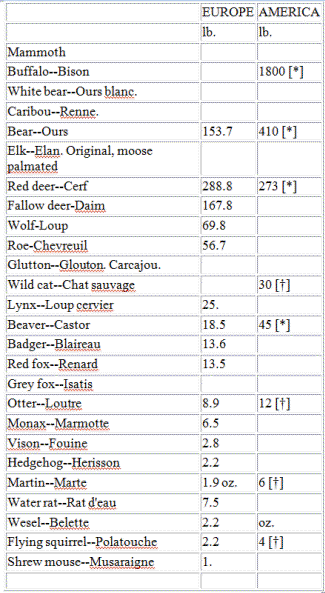
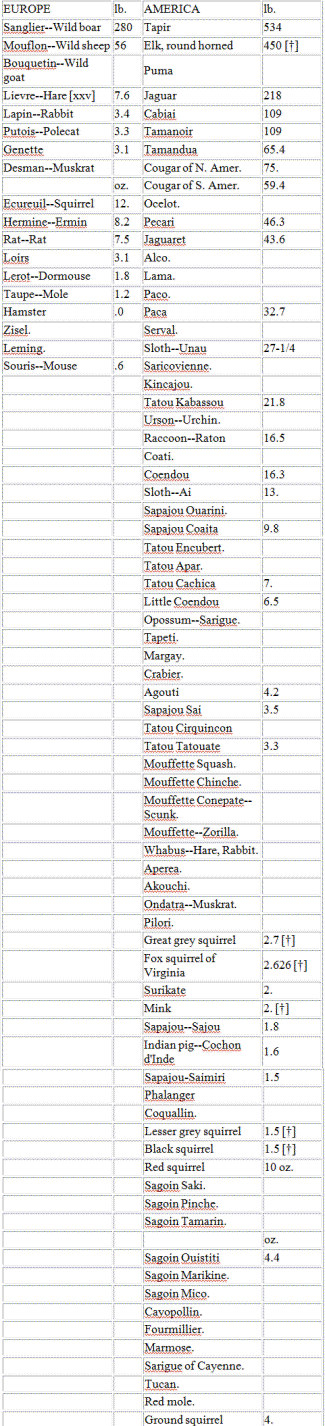
Proceeding to the second table, which arranges the animals found in one of the two countries only, Mons. de Buffon observes that the tapir, the elephant of America, is but of the size of a small cow. To preserve our comparison, I will add that the wild boar, the elephant of Europe, is little more than half that size. I have made an elk, with round or cylindrical horns, an animal of America, and peculiar to it, because I have seen many of them myself, and more of their horns; and because I can say from the best information, that in Virginia this kind of elk has abounded much, and still exists in smaller numbers; the palmated kind is confined to the more Northern latitudes. [xxxviii] I have made our hare or rabbit peculiar, believing it to be different from both the European animals of those denominations, and calling it therefore by its Algonquin name Whabus, to keep it distinct from these, [xxxix] Kalm is of the same opinion. I have enumerated the squirrels according to our own knowledge, derived from daily sight of them, because I am not able to reconcile with that the European appellations and descriptions. I have heard of other species, but they have never come within my own notice. These, I think, are the only instances in which I have departed from the authority of Mons. de Buffon in the construction of this table. I take him for my ground work, because I think him the best informed of any naturalist who has ever written. The result is, that there are 18 quadrupeds peculiar to Europe; more than four times as many, to wit, 74, peculiar to America; that the [xl] first of these 74 weighs more than the whole column of Europeans; and consequently this second table disproves the second member of the assertion, that the animals peculiar to the new world are on a smaller scale, so far as that assertion relied on European animals for support; and it is in full opposition to the theory which makes the animal volume to depend on the circumstances of heat and moisture.
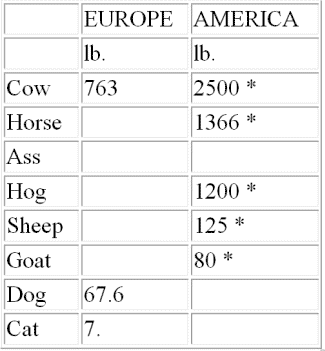
The third table comprehends those quadrupeds only which are domestic in both countries. That some of these, in some parts of America, have become less than their original stock, is doubtless true; and the reason is very obvious. In a thinly peopled country, the spontaneous productions of the forests and waste fields are sufficient to support indifferently the domestic animals of the farmer, with a very little aid from him in the severest and scarcest season. He therefore finds it more convenient to receive them from the hand of Nature in that indifferent state, than to keep up their size by a care and nourishment which would cost him much labor. If, on this low fare, these animals dwindle, it is no more than they do in those parts of Europe where the poverty of the soil, or poverty of the owner, reduces them to the same scanty subsistence. It is the uniform effect of one and the same cause, whether acting on this or that side of the globe. It would be erring therefore against that rule of philosophy, which teaches us to ascribe like effects to like causes, should we impute this diminution of size in America to any imbecility or want of uniformity in the operations of Nature. It may be affirmed with truth that, in those countries, and with those individuals of America, where necessity or curiosity has produced equal attention as in Europe to the nourishment of animals, the horses, cattle, sheep and hogs of the one continent are as large as those of the other. There are particular instances, well attested, where individuals of this country have imported good breeders from England, and have improved their size by care in the course of some years. To make a fair comparison between the two countries, it will not answer to bring together animals of what might be deemed the middle or ordinary size of their species; because an error in judging of that middle or ordinary size would vary the result of the comparison. Thus Monsieur D'Aubenton considers a horse of 4 feet 5 inches high, and 400 lb weight, French, equal to 4 feet 8.6 inches, and 436 lb English, as a middle-sized horse. [xli] Such a one is deemed a small horse in America. The extremes must therefore be resorted to. The same anatomist dissected a horse of 5 feet 9 inches height, French measure, equal to 6 feet 1.7 English, [xlii] This is near 6 inches higher than any horse I have seen; and could it be supposed that I had seen the largest horses in America, the conclusion would be, that ours have diminished, or that we have bred from a smaller stock. In Connecticut and Rhode Island, where the climate is favorable to the production of grass, bullocks have been slaughtered which weighed 2,500, 2,200, and 2,100 lb nett; and those of 1,800 lb have been frequent. I have seen a hog [xliii] weigh 1,050 lb after the blood, bowels and hair had been taken from him. Before he was killed an attempt was made to weigh him with a pair of steelyards, graduated to 1,200 ft, but he weighed more. Yet this hog was probably not within fifty generations of the European stock. I am well informed of another which weighed 1,100 lb gross. Asses have been still more neglected than any other domestic animal in America. They are neither fed nor housed in the most rigorous season of the year. Yet they are larger than those measured by Mons. D'Aubenton, of 3 feet 7-1/3 inches, 3 feet 4 inches, and 3 feet 2-1/2 inches; the latter weighing only 215.8 lb. [xliv] These sizes, I suppose, have been produced by the same negligence in Europe, which has produced a like diminution here. Where care has been taken of them on that side of the water, they have been raised to a size bordering on that of the horse; not by the heat and dryness of the climate, but by good food and shelter. Goats have been also much neglected in America. Yet they are very prolific here, bearing twice or three times a year, and from one to five kids at a birth. Mons. de Buffon has been sensible of a difference in this circumstance in favor of America, [xlv] But what are their greatest weights I cannot say. A large sheep here weighs 100 lb. I observe Mons. D'Aubenton calls a ram of 62 lb one of the middle size. [xlvi] But to say what are the extremes of growth in these and the other domestic animals of America, would require information of which no one individual is possessed. [xlvii] The weights actually known and stated in the third table preceding, will suffice to shew that we may conclude, on probable grounds, that, with equal food and care, the climate of America will preserve the races of domestic animals as large as the European stock from which they are derived; and consequently that the third member of Mons. de Buffon's assertion, that the domestic animals are subject to degeneration from the climate of America, is as probably wrong as the first and second were certainly so.
That the last part of it is erroneous, which affirms that the species of American quadrupeds are comparatively few, is evident from the tables taken all together. By these it appears that there are an hundred species aboriginal of America. [xlviii] Mons. de Buffon supposes about double that number existing on the whole earth. Of these, Europe, Asia, and Africa, furnish suppose 126; that is, the 26 common to Europe and America, and about 100 which are not in America at all. The American species then are to those of the rest of the earth, as 100 to 126, or 4 to 5. But the residue of the earth being double the extent of America, the exact proportion would have been but as 4 to 8. [xlix]
Hitherto I have considered this hypothesis as applied to brute animals only, and not in its extension to the man of America, whether aboriginal or transplanted, [l] It is the opinion of Mons. de Buffon that the former furnishes no exception to it: [li] "Quoique le sauvage du nouveau monde soit a-peu-pres de meme stature que l'homme de notre monde, cela ne suffit pas pour qu'il puisse faire une exception au fait general du rapetissement de la nature vivante dans tout ce continent: le sauvage est foible & petit par les organes de la generation; il n'a ni poil, ni barbe, & nulla ardeur pour sa femelle: quoique plus leger que l' Europeen parce qu'il a plus d'habitude a courir, il est cependant beaucoup moins fort de corps; il est aussi bien moins sensible, & cependant plus craintif & plus lache; il n'a nulle vivacite, nulle activite dans l'ame; celle du corps est moins un exercice, un mouvement volontaire qu'une necessite d'action causee par le besoin; otez lui la faim & la soif, vous detruirez en meme temps le principe actif de tous ses mouvemens; il demeurera stupidement en repos sur ses jambes ou couche pendant des jours en tiers. Il ne faut pas aller chercher plus loin la cause de la vie dispersee des sauvages & de leur eloignement pour la societe; la plus precieuse etincelle du feu de la nature leur a ete refusee; ils manquent d'ardeur pour leur femelle, & par consequent d'amour pour leur semblables; ne connoissant pas l'attachement le plus vif, le plus tendre de tous, leurs autres sentimens de ce genre sont froids & languissans; ils aiment foiblement leurs peres and leurs enfans; la societe la plus intime de toutes, celle de la meme famille, n'a done chez eux que de foibles liens; la societe d'une famille a l'autre n'en a point du tout; des lors nulle reunion, nulle republique, nulle etat social. La physique de l'amour fait chez eux le moral des moeurs; leur coeur est glace, leur societe froide, & leur empire dur. lls ne regardent leurs femmes que comme des servantes de peine ou des betes de somme qu'ils chargent, sans menagement, du fardeau de leur chasse, & qu'ils forcent sans pitie, sans reconnoissance, a des ouvrages qui souvent sont audessus de leurs forces; ils n'ont que peu d'enfans; ils en ont peu de soin; tout se ressent de leur premier defaut; ils sont indifferents parce qu'ils sont peu puissans, & cette indifference pour le sexe est la tache originelle qui fletrit la nature, qui l'empeche de s'epanouir, & qui detruisant les germes de la vie, coupe en meme temps la racine de la societe. L'homme ne fait done point d'exception ici. La nature en lui refusant les puissances de l'amour l'a plus maltraite & plus rapetise qu'aucun des animaux." An afflicting picture indeed, which, for the honor of human nature, I am glad to believe has no original. Of the Indian of South America I know nothing, for I would not honor with the appellation of knowledge what I derive from the fables published of them. These I believe to be just as true as the fables of Aesop. This belief is founded on what I have seen of man, white, red, and black, and what has been written of him by authors, enlightened themselves, and writing amidst an enlightened people. The Indian of North America being more within our reach, I can speak of him somewhat from my own knowledge, but more from the information of others better acquainted with him, and on whose truth and judgment I can rely. From these sources I am able to say, in contradiction to this representation, [lii] that he is neither more defective in ardor, nor more impotent with his female, than the white reduced to the same diet and exercise; that he is brave, when an enterprise depends on bravery; [liii] education with him making the point of honor consist in the destruction of an enemy by stratagem, and in the preservation of his own person free from injury; or perhaps this is nature; while it is education which teaches us to [liv] honor force more than finesse; that he will defend himself against an host of enemies, always choosing to be killed rather than to [lv] surrender, though it be to the whites, who he knows will treat him well; that in other situations also he meets death with more deliberation, and endures tortures with a firmness unknown almost to religious enthusiasm with us; that he is affectionate to his children, careful of them, and indulgent in the extreme; that his affections comprehend his other connections, weakening, as with us, from circle to circle, as they recede from the centre; that his friendships are strong and faithful to the uttermost [lvi] extremity; that his sensibility is keen, even the warriors weeping most bitterly on the loss of their children, though in general they endeavor to appear superior to human events; that his vivacity and activity of mind is equal to ours in the same situation; hence his eagerness for hunting, and for games of chance. The women are submitted to unjust drudgery. This I believe is the case with every barbarous people. With such, force is law. The stronger sex therefore imposes on the weaker. It is civilization alone which replaces women in the enjoyment of their natural equality. That first teaches us to subdue the selfish passions, and to respect those rights in others which we value in ourselves. Were we in equal barbarism, our females would be equal drudges. The man with them is less strong than with us, but their woman stronger than ours; and both for the same obvious reason; because our man and their woman is habituated to labor, and formed by it. With both races the sex which is indulged with ease is least athletic. An Indian man is small in the hand and wrist for the same reason for which a sailor is large and strong in the arms and shoulders, and a porter in the legs and thighs. They raise fewer children than we do. The causes of this are to be found, not in a difference of nature, but of circumstance. The women very frequently attending the men in their parties of war and of hunting, child-bearing becomes extremely inconvenient to them. It is said, therefore, that they have learnt the practice of procuring abortion by the use of some vegetable; and that it even extends to prevent conception for a considerable time after. [lvii] During these parties they are exposed to numerous hazards, to excessive exertions, to the greatest extremities of hunger. Even at their homes the nation depends for food, through a certain part of every year, on the gleanings of the forest; that is, they experience a famine once in every year. With all animals, if the female be badly fed, or not fed at all, her young perish; and if both male and female be reduced to like want, generation becomes less active, less productive. To the obstacles then of want and hazard, which Nature has op- posed to the multiplication of wild animals, for the purpose of restraining their numbers within certain bounds, those of labor and of voluntary abortion are added with the Indian. No wonder then if they multiply less than we do. Where food is regularly supplied, a single farm will shew more of cattle than a whole country of forests can of buffaloes. The same Indian women, when married to white traders, who feed them and their children plentifully and regularly, who exempt them from excessive drudgery, who keep them stationary and unexposed to accident, produce and raise as many children as the white women. [lviii] Instances are known, under these circum- stances, of their rearing a dozen children. An inhuman practice once prevailed in this country of making slaves of the Indians. This practice commenced with the Spaniards with the first discovery of America. — [See Herrera. Amer. Vesp.] It is a fact well known with us, that the Indian women so enslaved produced and raised as numerous families as either the whites or blacks among whom they lived. It has been said that Indians have less hair than the whites, except on the head. But this is a fact of which fair proof can scarcely be had. [lix] With them it is disgraceful to be hairy on the body. They say it likens them to hogs. They there- fore pluck the hair as fast as it appears. But the traders who marry their women, and prevail on them to discontinue this practice, say that Nature is the same with them as with the whites. Nor, if the fact be true, is the consequence necessary which has been drawn from it. Negroes have notoriously less hair than the whites; yet they are more ardent. But if cold and moisture be the agents of Nature for diminishing the races of animals, how comes she all at once to suspend their operation as to the physical man of the new world, whom the Count acknowledges to be "a peu pres de meme stature que l'homme de notre monde," and to let loose their influence on his moral faculties? How has this "combination of the elements and other physical causes, so contrary to the enlargement of animal nature in this new world, these obstacles to the developement and formation of great germs," been arrested and suspended, so as to permit the human body to acquire its just dimensions, and by what inconceivable process has their action been directed on his mind alone? [lx] To judge of the truth of this, to form a just estimate of their genius and mental powers, more facts are wanting, and great allowance to be made for those circumstances of their situation which call for a display of particular talents only. This done, we shall probably find that they are formed in mind as well as in body, on the same module with the "Homo sapiens Europaeus." [lxi] The principles of their society forbidding all compulsion, they are to be led to duty and to enterprise by personal influence and persuasion. Hence eloquence in council, bravery and address in war, become the foundations of all consequence with them. To these acquirements all their faculties are directed. Of their bravery and address in war we have multiplied proofs, because we have been the subjects on which they were exercised. Of their eminence in oratory we have fewer examples, because it is displayed chiefly in their own councils. Some, however, we have of very superior lustre. I may challenge the whole orations of Demosthenes and Cicero, and of any more eminent orator, if Europe has furnished more eminent, to produce a single passage, superior to the speech of Logan, a Mingo chief, to Lord Dunmore, when Governor of this State. And, as a testimony of their talents in this line, I beg leave to introduce it, first stating the incidents necessary for understanding it. In the Spring of the year 1774, a robbery and murder were committed on an inhabitant of the frontiers of Virginia, by two Indians of the Shawanee tribe. The neighboring whites, according to their custom, undertook to punish this outrage in a summary way. Col. Cresap, a man infamous for the many murders he had committed on those much-injured people, collected a party, and proceeded down the Kanhaway in quest of vengeance. Unfortunately a canoe of women and children, with one man only, was seen coming from the opposite shore, unarmed, and unsuspecting a hostile attack from the whites. Cresap and his party concealed themselves on the bank of the river, and the moment the canoe reached the shore, singled out their objects, and at one fire killed every person in it. This happened to be the family of Logan, who had long been distinguished as a friend of the whites. This unworthy return provoked his vengeance. He accordingly signalized himself in the war which ensued. In the Autumn of the same year, a decisive battle was fought at the mouth of the Great Kanhaway, between the collected forces of the Shawanees, Mingoes, and Delawares, and a detachment of the Virginia militia. The Indians were defeated, and sued for peace. Logan however disdained to be seen among the suppliants. But, lest the sincerity of a treaty should be distrusted, from which so distinguished a chief absented himself, he sent by a messenger the following speech to be delivered to Lord Dunmore. "I appeal to any white man to say if ever he entered Logan's cabin hungry, and he gave him not meat; if ever he came cold and naked, and he clothed him not. During the course of the last long and bloody war, Logan remained idle in his cabin, an advocate for peace. Such was my love for the whites, that my countrymen pointed as they passed, and said, 'Logan is the friend of white men.' I had even thought to have lived with you, but for the injuries of one man. Col. Cresap, the last Spring, in cold blood, and unprovoked, murdered all the relations of Logan, not sparing even my women and children. There runs not a drop of my blood in the veins of any living creature. This called on me for revenge. I have sought it: I have killed many: I have fully glutted my vengeance. For my country, I rejoice at the beams of peace. But do not harbor a thought that mine is the joy of fear. Logan never felt fear. He will not turn on his heel to save his life. Who is there to mourn for Logan? Not one." [lxii]
Before we condemn the Indians of this continent as wanting genius, we must consider that letters have not yet been introduced among them, [lxiii] Were we to compare them in their present state with the Europeans North of the Alps, when the Roman arms and arts first crossed those mountains, the comparison would be unequal, because, at that time, those parts of Europe were swarming with numbers; because numbers produce emulation, and multiply the chances of improvement, and one improvement begets another. Yet I may safely ask, How many good poets, how many able mathematicians, how many great inventors in arts or sciences, had Europe North of the Alps then produced? And it was sixteen centuries after this before a Newton could be formed. I do not mean to deny that there are varieties in the race of man, distinguished by their powers both of body and mind. I believe there are, as I see to be the case in the races of other animals. I only mean to suggest a doubt, whether the bulk and faculties of animals depend on the side of the Atlantic on which their food happens to grow, or which furnishes the elements of which they are compounded? Whether Nature has enlisted herself as a Cis or Trans-Atlantic partizan? I am induced to suspect there has been more eloquence than sound reasoning displayed in support of this theory; that it is one of those cases where the judgment has been seduced by a glowing pen; and whilst I render every tribute of honor and esteem to the celebrated Zoologist, who has added, and is still adding, so many precious things to the treasures of science, I must doubt whether in this instance he has not cherished error also, by lending her for a moment his vivid imagination and bewitching language. [lxiv] (4.)
So far the Count de Buffon has carried this new theory of the tendency of Nature to belittle her productions on this side the Atlantic. Its application to the race of whites, trans- planted from Europe, remained for the Abbe Raynal. "On doit etre etonne (he says) que 1' Amerique n'ait pas encore produit un bon poete, un habile mathematicien, un homme de genie dans un seul art, ou une seule science." 7. Hist. Philos. p. 92 ed. Maestricht. 1774. " America has not yet produced one good poet." When we shall have existed as a people as long as the Greeks did before they produced a Homer, the Romans a Virgil, the French a Racine and Voltaire, the English a Shakespeare and Milton, should this reproach be still true, we will enquire from what unfriendly causes it has proceeded, that the other countries of Europe and quarters of the earth shall not have inscribed any name in the roll of poets. [lxv] But neither has America produced "one able mathematician, one man of genius in a single art or a single science." In war we have produced a Washington, whose memory will be adored while liberty shall have votaries, whose name will triumph over time, and will in future ages assume its just station among the most celebrated worthies of the world, when that wretched philosophy shall be forgotten, which would have arranged him among the degeneracies of Nature. In physics we have produced a Franklin, than whom no one of the present age has made more important discoveries, nor has enriched philosophy with more or more ingenious solutions of the phenomena of Nature. We have supposed Mr. Rittenhouse second to no astronomer living; that in genius he must be the first, because he is self-taught. As an artist he has exhibited as great a proof of mechanical genius as the world has ever produced. He has not indeed made a world; but he has by imitation approached nearer its Maker than any man who has lived from the creation to this day. [lxvi] As in philosophy and war, so in government, in oratory, in painting, in the plastic art, we might show that America, though but a child of yesterday, has already given hopeful proofs of genius, as well of the nobler kinds, which arouse the best feelings of man, which call him into action, which substantiate his freedom, and conduct him to happiness, as of the subordinate, which serve to amuse him only. We therefore suppose that this reproach is as unjust as it is unkind; and that of the geniuses which adorn the present age, America contributes its full share. For comparing it with those countries, where genius is most cultivated, where are the most excellent models for art, and scaffoldings for the attainment of science, as France and England for instance, we calculate thus: The United States contain three millions of inhabitants; France twenty millions; and the British Islands ten. We produce a Washington, a Franklin, a Rittenhouse. France then should have half a dozen in each of these lines, and Great Britain half that number, equally eminent. It may be true that France has: we are but just becoming acquainted with her, and our acquaintance so far gives us high ideas of the genius of her inhabitants. It would be injuring too many of them to name particularly a Voltaire, a Buffon, the constellation of Encyclopedists, the Abbe Raynal himself, &c., &c. We therefore have reason to believe she can produce her full quota of genius. The present war having so long cut off all communication with Great Britain, we are not able to make a fair estimate of the state of science in that country. The spirit in which she wages war is the only sample before our eyes, and that does not seem the legitimate offspring either of science or of civilization. The sun of her glory is fast descending to the horizon. Her philosophy has crossed the Channel, her freedom the Atlantic, and herself seems passing to that awful dissolution, whose issue is not given human foresight to scan. [lxvii]
Having given a sketch of our minerals, vegetables, and quadrupeds, and being led by a proud theory to make a comparison of the latter with those of Europe, and to extend it to the Man of America, both aboriginal and emigrant, I will proceed to the remaining articles comprehended under the present query.
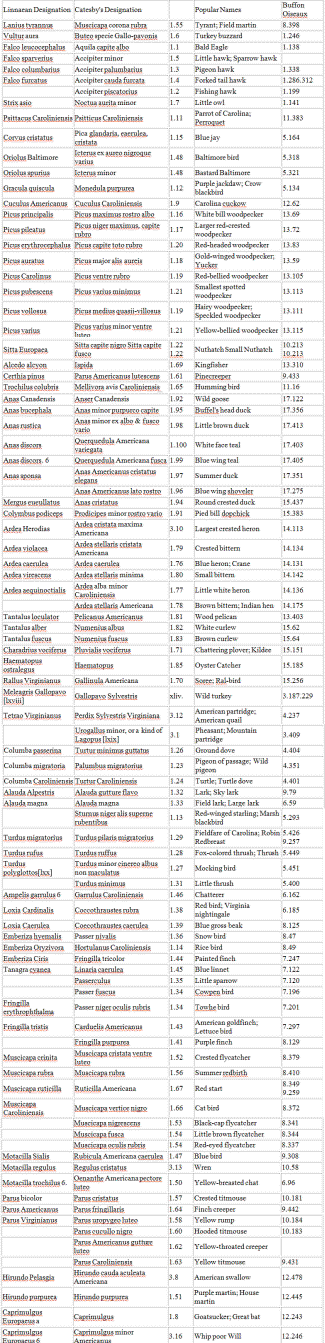
Between ninety and an hundred of our birds have been described by Catesby. His drawings are better as to form and attitude, than coloring, which is generally too high. They are the following:
Besides these, we have
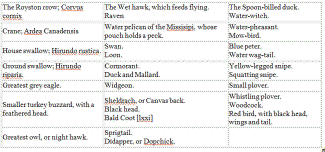
And doubtless many others which have not yet been described and classed.
To this catalogue of our indigenous animals, I will add a short account of an anomaly of Nature, taking place sometimes in the race of negroes brought from Africa, who, though black themselves, have, in rare instances, white children, called Albinos. I have known four of these myself, and have faithful accounts of three others. The circumstances in which all the individuals agree are these. They are of a pallid cadaverous white, untinged with red, without any colored spots or seams; their hair of the same kind of white, short, coarse, and curled as is that of the negro; all of them well formed, strong, healthy, perfect in their senses, except that of sight, and born of parents who had no mixture of white blood. Three of these Albinos were sisters, having two other full sisters, who were black. The youngest of the three was killed by lightning, at twelve years of age. The eldest died at about 27 years of age, in childbed, with her second child. The middle one is now alive in health, and has issue, as the eldest had, by a black man, which issue was black. They are uncommonly shrewd, quick in their apprehensions and in reply. Their eyes are in a perpetual tremulous vibration, very weak, and much affected by the sun; but they see better in the night than we do. They are of the property of Colonel Skipwith, of Cumberland. The fourth is a negro woman, whose parents came from Guinea, and had three other children, who were of their own color. She is freckled, her eye sight so weak, that she is obliged to wear a bonnet in the Summer; but it is better in the night than day. She had an Albino child by a black man. It died at the age of a few weeks. These were the property of Colonel Carter, of Albemarle. A sixth instance is a woman of the property of a Mr. Butler, near Petersburgh. She is stout and robust, has issue a daughter, jet black, by a black man. I am not informed as to her eye sight. The seventh instance is of a male belonging to a Mr. Lee, of Cumberland. His eyes are tremulous and weak. He is tall of stature, and now advanced in years. He is the only male of the Albinos which have come within my information. Whatever be the cause of the disease in the skin, or in its coloring matter, which produces this change, it seems more incident to the female than male sex. To these I may add the mention of a negro man within my own knowledge, born black, and of black parents; on whose chin, when a boy, a white spot appeared. This continued to increase till he became a man, by which time it had extended over his chin, lips, one cheek, the under jaw and neck on that side. It is of the Albino white, without any mixture of red, and has for several years been stationary. He is robust and healthy, and the change of color was not accompanied with any sensible disease, either general or topical.
Of our fish and insects there has been nothing like a full description or collection. More of them are described in Catesby than in any other work. Many also are to be found in Sir Hans Sloane's Jamaica, as being common to that and this country. The honey bee is not a native of our continent. Marcgrave indeed mentions a species of honey bee in Brasil. [lxxii] But this has no sting, and is therefore different from the one we have, which resembles perfectly that of Europe. The Indians concur with us in the tradition that it was brought from Europe; but when, and by whom, we know not. The bees have generally extended themselves into the country, a little in advance of the white settlers. [lxxiii] The Indians, therefore, call them the white man's fly, and consider their approach as indicating the approach of the settlements of the whites. A question here occurs, how far northwardly have these insects been found ? That they are unknown in Lapland, I infer from Scheffer's information that the Laplanders eat the pine bark, prepared in a certain way, instead of those things sweetened with sugar. " Hoc comedunt pro rebus saccharo conditis." — Scheff. Lapp., chap. 18. Certainly, if they had honey, it would be a better substitute for sugar than any preparation of the pine bark. Kalm tells us the honey bee cannot live through the Winter in Canada. [lxxiv] They furnish then an additional proof of the remarkable fact first observed by the Count de Buffon, and which has thrown such a blaze of light on the field of natural history, that no animals are found in both continents, but those which are able to bear the cold of those regions where they probably join.
We have it from the Indians also that the common domestic fly is not originally of America, but came with the whites from Europe. [lxxv]
_______________
Notes:
i. On whose authority has it been said? Bouguer, the best witness respecting the Andes, speaking of Peru, says "on n'y distingue aucun vestige des grandes inondations qui ont laisse tant de marques dans toutes les autres regions. J 'ai fait tout mon possible pour y decouvrir quelque coquille, mais toujours inutilement. Apparamment que les montagnes du Perou sont trop hautes." Bouguer, xv.
See 4 Clavigero, Diss. 3, § 1. See 2. Epoques 268. 1. Epoques 415.
ii. 2. Epoques, 378.
iii. 2. Buffon Epoques, 96.
iv. Five deluges are enumerated by Xenophon, the author of the tract de Equivocis in these words: "Inundationes plures fuere. Prima novimestris inundatio terrarum, sub prisco Ogyge. Secunda niliaca menstrua, sub Aegyptiis Hercule et Prometheo. Bimestris nutem, sub Ogygo Attico in Achaia. Trimestris Thessalica, sub Deucalione. Par Pharonica, sub Proteo Aegyptio in raptu Helenae."
v. 2. Epoques, 138, 139.
vi. See Pleasant's Argus, August 16, '99; that this disappeared December 25, '98, on which day a spring broke out 100 feet higher up the hill.
vii. Qu. If known in Europe before the discovery of America? Ramusic supposes this to be the grain described by Diod. Sic. L. 2, in his account of the travels of Iambulus, in the following passage:


[Ceci bianchi. — Ital. Ers. Franc]




Ramusic says of the Maize "in Italia, a i tempi nostri, [1550,] e stato, veduto 'la prima volta,' and the island in which it was found by Iambulus was Sumatra. — 1. Ramus. 174. The Maison rustique says that Turkey Corn came first from the West Indies into Turkey, and from thence into France." — L. 5, c. 17. Zimmerman says : "Il tire son origine des pays chauds de l'Amerique." — Zoologie geographique, page 24. " Il frumentone fu dalla America in Ispagne, e quindi in altri paesi della Europa." "Dalli Spagnuoli di Europa e di America e chiamato il frumentone col nome Maiz, preso dalla lingua Haitina che si parlava nella isola oggidi appellata Spagnuola, o sia di S. Domenico." — Clavigero I., 56. " Il frumentone, biada dalla providenza accordata a quella parte del mondo in vece del frumento dell Europa, del riso del Asia, e del miglio d' Africa." — 2. Clavig. 218. Acosta classes Indian Corn with the plants peculiar to America, observing that it is called "trigo de las Indias" in Spain, and "Grano de Turquia" in Italy. He says, " De donde fue el Mayz a Indias, y porque este grano tan provechoso le llaman en Italia Grano de Turquia mejor sabre preguntarlo, que dezirlo. Porque en efecto en los antiques no hallo rastro deste genero, aunque el Milio que Plinio escrive aver venido a Italia de la India diez anos avia, quando escrivio, tiene alguna similitud con el Mayz, en lo que dize que es grano, y que nace en cana, y se cubre de hoja, y que tiene al remate como cabellos, y el ser fertilissimo, todo lo qual no quadra con el Mijo, que comunmente entienden por Milio, en fin, repartio el Criador a todas partes su gobierno: a este orbe dio el triga que es el principal sustento de los hombres: a aquel de Indias dio el Mayz, que tras el trigo tiene el segundo lugar, para sustenta de hombres, y animales. — Acosta 4, 16.
viii. "Les pommes de terre sont indigenes en Guiane." — Zimmerman Zool. Geogr. 26. "La Papa fu portata in Messico dall' America Meridionale, suo proprio paese." — 1. Clavigero 58.
ix. Clavigero says: "Non mi sovviene che appo qualche nazione Americana vi sia memoria o degli elafanti, o degl ippopotami, o d' altri quadrupedi di si fatta grandezza. Non so che fin ora, fra tanti scavamenti fatta nella Nuova Spagna, siasi mai scoperto un carcamo d' Ippopotamo, e quel ch' e piu, ne anche un dente d' elefante. — 125.
x. 2. Epoques, 276, in Mexico; but, 1. Epoques, 250, denies the fact as to S. America.
xi. 22. Buflfon, 233; 2. Epoques, 230.
xii. 2. Epoques, 232. Buffon pronounces it is not the grinder either of the elephant or hippopotamus, mais d' une espece la premiere et la plus grande de tous les animaux terrestres, qui est perdue.
xiii. Hunter.
xiv. D'Aubenton.
xv. Xviii. 178; xxii. 121.
xvi. Qu? See 2. Epoques de Buffon, 231, 234.
xvii. Buffon, xviii. 122; Ed. Paris, 1764.
xviii. Xviii. 100, 156. "La terre est demeuree froide, impuissante a produire les principes actife, a developer les germes des plus grands quadrupedes, auxquels il faut, pour croitre et se multiplier, toute la chaleur, toute l'activite que le soleil peut donner a la terre, amoureuse." — Xviii. 156. "L'ardeur des hommes et la grandeur des animaus dependent de la salubrite et de la chaleur de l'air. — Ib. 160.
xix. Viii. 134.
xx. "Tout ce qu' il y a de colossal et de grand dans la nature, a ete forme dans les terres du Nord." 1. Epoques 255. " C'est dans les regions de notre Nord que la nature vivante s'est clevee a sea plus grandes dimensions. — Ib. 263.
*. There exists in the Western and mountainous parts of Pennsylvania an animal which seems to be nearer the hare than our whabus. The meat is black, and an individual weighed 39-1/2 oz. avoird., while the whabus is an animal of white meat, and weighs about 29 oz.; the fur of the former is white, as is the case with most animals in countries abounding with snow.
xxi. It is said that this animal is seldom seen above 30 miles from shore, or beyond the 56th degree of latitude. The interjacent islands between Asia and America admit his passing from one continent to the other without exceeding these bounds. And, in fact, travelers tell us that these islands are places of principal resort for them, and especially in the season of bringing forth their young.
xxii. Xxvii. 130; xxx. 213; 5. Sup. 201.
xxiii. xviii. 145.
xxiv. Quadrup. viiii. 334; edit. Paris, 1777.
xxv. xvii. 82.
xxvi. This sentence in the first edition began as follows: "Kalm tells us that the Black Moose or Renne of America is as high as a tall horse," &c. The author corrected it as in the text, appending a marginal note in these words: "This is not correct. Kalm considers the Moose as the Elk, and not as the Renne. Musu is the Algonkin name of the Orignal, or Elk. — I. xxvii."
xxvii. Xv. 42.
xxviii. I. 359. 1.48, 221, 251. II.52.
xxix. II. 78.
xxx. I. 220.
xxxi. Xxvii. 63.; xiv. 119. Harris, II. 387. Buffon, Quad, ix., 1.
xxxii. Even Amer. Vesp. says he saw lions and wild boars in America. — Letters, page 77. He saw a serpent 8 braccie long, and as thick as his own waist — 111.
xxxiii. Quad. ix. 158.
xxxiv. xxv. 184.
xxxv. Quad. ix. 132.
xxxvi. xix. 2.
xxxvii. Quad. ix. 41.
xxxviii. The descriptions of Theodat, Denys, and La Hontan, cited by Mons. de Buffon, under the article Elan, authorize the supposition, that the flat-horned elk is found in the Northern parts of America. It has not however extended to our latitudes. On the other hand, I could never learn that the round-horned elk has been seen further North than the Hudson's River. This agrees with the former elk in its general character, being, like that, when compared with a deer, very much larger, its ears longer, broader, and thicker in proportion, its hair much longer, neck and tail shorter, having a dewlap before the breast, (caruncula gutturalis Linnaei,) a white spot often, if not always, of a foot diameter, on the hinder part of the buttocks round the tail; its gait a trot, and attended with a rattling of the hoofs; but distinguished from that decisively by its horns, which are not palmated, but round and pointed. This is the animal described by Catesby as the Cervus major Americanus, the Stag of America, le Cerf de l' Amerique. But it differs from the Cervus as totally as does the palmated elk from the dama. And in fact it seems to stand in the same relation to the palmated elk as the red deer does to the fallow. It has abounded in Virginia, has been seen, within my knowledge, on the Eastern side of the Blue Ridge since the year 1765, is now common beyond those mountains, has been often brought to us and tamed, and their horns are in the hands of many. I should designate it as the "Alces Americanus cornibus teretibus." It were to be wished that naturalists, who are acquainted with the renne and elk of Europe, and who may hereafter visit the Northern parts of America, would examine well the animals called there by the names of grey and black moose, caribou, orignal, and elk. Mons. de Buffon has done what could be done, from the materials in his hands, towards clearing up the confusion introduced by the loose application of these names among the animals they are meant to designate. He reduces the whole to the renne and flat-horned elk. From all the information I have been able to collect, I strongly suspect they will be found to cover three, if not four distinct species of animals. I have seen skins of a moose, and of the caribou: they differ more from each other, and from that of the round-horned elk, than I ever saw two skins differ, which belonged to different individuals of any wild species. These differences are in the color, length, and coarseness of the hair, and in the size, texture, and marks of the skin. Perhaps it will be found that there is — 1, The moose, black and grey; the former being said to be the male, and the latter the female. 2, The caribou or renne. 3, The flat-horned elk, or orignal. 4, The round-horned elk. Should this last, though possessing so nearly the characters of the elk, be found to be the same with the Cerf d' Ardennes or Brandhirtz of Germany, still there will remain the three species first enumerated. See Catesby and Kalm — reason to believe that the Moose is the palmated elk or orignal.
xxxix. Kalm II. 340; I. 82.
xl. The Tapir is the largest of the animals peculiar to America. I collect his weight thus. Mons. de Buffon says, xxiii. 274, that he is of the size of a Zebu, or a small cow. He gives us the measures of a Zebu, ib. 94, as taken by himself, viz : 5 feet 7 inches from the muzzle to the root of the tail, and 5 feet 1 inch circumference behind the fore legs. A bull, measuring in the same way 6 feet 9 inches, and 5 feet 2 inches, weighed 600 lb.. — viii. 153. The Zebu then, and of course the Tapir, would weigh about 500 lb. But one individual, of every species of European peculiars, would probably weigh less than 400 ft. These are French measures and weights.
xli. Vii. 432.
xlii. vii. 474.
xliii. In Williamsburg, April, 1769.
xliv. Viii. 48, 65, 66.
xlv. xviii. 96.
xlvi. ix. 41.
xlvii. Perros en la Espanola han crecido en numero y en grandeza, desuerte que plaga de aquella isla. — Acosta iv. 33.
xlviii. Xxx. 219; xviii. 121.
xlix. 1. Epoques, 378.
l. 1. Clavigero, 118.
li. xviii. 146.
lii. Amer. Vesp. 13: "Fuora di misura lussurioai, &c. — 108.
liii. Amer. Vesp. 30, 31, 39, 75: "Di buono sforzo, e di grande animo."— Ib. 78.
liv. Sol Rodomonte sprezza di venire Se non, dove la via meno e sicura. — Ariosto 14, 117.
lv. In so judicious an author as Don Ulloa, and one to whom we are indebted for the most precise information we have of South America, I did not expect to find such assertions as the following: "Los Indios vencidos son los mas cobardes y pusilanimes que se peuden ver: se hacen inocentes, se humillan hasta el desprecio, disculpan su inconsiderado arrojo, y con las suplicas y los ruegos dan seguras pruebas de su pusilanimidad. — 6 lo que refieren las historias de la Conquista, sobre sus grandes acciones, es en un sentido figuardo, 6 el caracter de estas gentes no es ahora segun era entonces; pero lo que no tiene duda es, que las Naciones de la parte Septentrional subsisten en la misma libertad que siempre han tenido, sin haber sido sojuzgados por algun Principe extrano, y que viven segun su regimen y costumbres de toda la vida, sin que haya babido motivo para que muden de caracter; y en estos se ve lo mismo. que sucede en los del Peru, y de toda la America Meridional, reducidos, y que nunca lo han estado." Noticias Americanas. — Entretenimiento xviii. § 1. Don Ulloa here admits that the authors who have described the Indians of South America, before they were enslaved, had represented them as a brave people, and therefore seems to have suspected that the cowardice which he bad observed in those of the present race might be the effect of subjugation. But, supposing the Indians of North America to be cowards also, he concludes the ancestors of those of South America to have been so too, and therefore that those authors have given fictions for truths. He was probably not acquainted himself with the Indians of North America, and had formed his opinion of them from hearsay. Great numbers of French, of English, and of Americans, are perfectly acquainted with these people. Had he had an opportunity of enquiring of any of these, they would have told him that there never was an instance known of an Indian begging his life when in the power of his enemies : on the contrary, that he courts death by every possible insult and provocation. His reasoning then would have been reversed thus: "Sinco the present Indian of North America is brave, and authors tells us that the ancestors of those of South America were brave also, it must follow that the cowardice of their descendants is the effect of subjugation and ill treatment." For he observes ib. § 27, that "Los obrages los aniquilan por la inhumanidad con que se les trata."
lvi. A remarkable instance of this appeared in the case of the late Colonel Byrd, who was sent to the Cherokee nation to transact some business with them. It happened that some of our disorderly people had just killed one or two of that nation. It was therefore proposed in the council of the Cherokees that Colonel Byrd should be put to death in revenge for the loss of their countrymen. Among them was a chief called Silouee, who, on some former occasion, had contracted an acquaintance and friendship with Colonel Byrd. He came to him every night in his tent, and told him not to be afraid, they should not kill him. After many days deliberation, however, the determination was, contrary to Silouee's expectation, that Byrd should be put to death, and some warriors were dispatched as executioners, Silouee attended them, and when they entered the tent he threw himself between them and Byrd, and said to the warriors, " This man is my friend; before you get at him you must kill me." On which they returned, and the council respected the principle so much as to recede from their determination.
"Vivono cento cinquanta anni." — Amer. Vesp. 111.
lvii. Amer. Vesp. 13.
lviii. Amer. Vesp. 13. "Sono donne molto generative," &c.
lix. Amer. Vesp. 9.
lx. Xviii. 145.
lxi. Linn. Syst. Definition of a Man.
lxii. See letter of J. B. Gibson in Appendix iv.
lxiii. 1. Clavigero, 120.
lxiv. No writer, equally with M. de Buffon, proves the power of eloquence and uncertainty of theories. He takes any hypothesis whatever, or its reverse, and furnishes explanations equally specious and persuasive. Thus in his xviii. volume, wishing to explain why the largest animals are found in the torrid zone, he assumes heat as the efficient principle of the animal volume. Speaking of America, he says: "La terre y est froide impuissante a produire les principes actifs, a developer les germes des plus grandes quadrupedes auxquels il faut, pour croitre et se multiplier, toute la chaleur toute l'activite que le soleil peut donner a la terre amoureuse." — Page 156. " L'ardeur des hommes, et la grandeur des animaux dependent de la salubrite, et de la chaleur de l'air." — Ib. 160. In his Epochs again when it is become convenient to his theory to consider the bones of the Mammoth found in the coldest regions, as the bones of the elephant, and necessary to explain how the elephant there should have been six times as large as that of the torrid zone, it is cold which produces animal volume. "Tout ce qu' il y a de colossal et de grand dans la nature, a ete forme dans les terres du Nord." — 1. Epoques, 255. " C'est dans les regions de notre Nord que la nature vivante s'es't elevee a ses plus grandes dimensions." — Ib. 263.
lxv. Has the world as yet produced more than two poets, acknowledged to be such by all nations ? An Englishman only reads Milton with delight, an Italian Tasso, a Frenchman the Henriade, a Portuguese Camouens; but Homer and Virgil have been the rapture of every age and nation; they are read with enthusiasm in their originals by those who can read the originals, and in translations by those who cannot.
lxvi. There are various ways of keeping truth out of sight. Mr. Rittenhouse's model of the planetary system has the plagiary appellation of an Orrory; and the quadrant invented by Godfrey, an American also, and with the aid of which the European nations traverse the globe, is called Hadley's quadrant. Huyghens gave the first description of an instrument of the former kind, under the name of Automatum Planetarium. — 2. Montucla, 485.
lxvii. In a later edition of the Abbe Raynal's work, he has withdrawn his censure from that part of the new world inhabited by the Federo-Americans; but has left it still on the other parts. North America has always been more accessible to strangers than South. If he was mistaken then as to the former, he may be so as to the latter. The glimmerings which reach us from South America enable us only to see that its inhabitants are held under the accumulated pressure of slavery, superstition and ignorance. Whenever they shall be able to rise under this weight, and to show themselves to the rest of the world, they will probably show they are like the rest of the world. We have not yet sufficient evidence that there are more lakes and fogs in South America than in other parts of the earth. Amer. Vesp., 115. Quivi il cielo e l'aere e rare volte adombrato dalle nuvole, quasi sempre i giorni sono sereni? As little do we know what would be their operation on the mind of man. That country has been visited by Spaniards and Portuguese chiefly, and almost exclusively. These, going from a country of the old world remarkably dry in its soil and climate, fancied there were more lakes and fogs in South America than in Europe. An inhabitant of Ireland, Sweden, or Finland, would have formed the contrary opinion. Had South America then been discovered and seated by a people from a fenny country, it would probably have been represented as much drier than the old world. A patient pursuit of facts, and cautious combination and comparison of them, is the drudgery to which man is subjected by his Maker, if he wishes to attain sure knowledge.
lxviii. Clavigero, 85.
lxix. The Pheasant is rarely or not at all found beyond North Carolina. The grouse is first seen in the upper parts of Maryland, in Pennsylvania, and the country North of Ohio, and thence northwardly.==[Capt. Mer. Lewis.]
lxx. Clavigero says that in Mexico "vi sono i rinomati rossignoli."--I.88.
lxxi. The Bald Coot, or Coot, is the Fulica of Linnaeus, and the Foulque of the Encyclop. Meth., differing from the description of the latter only in the color of its feet and legs, which are olive green, without any circle of red, and that of the bill a faint carnation, brown at the point, and the membrane on the forehead of a very dark purple. It is distinguished from the Gallinula chloropis, Poule d'eau, Water-hen, Hydro-gallina, chiefly by the festooned web bordering the toes.
lxxii. See Herrera, Dec. 1, 1. 10, c. 8. " Descubierta Yucatan, se hallo abundancia de cera y miel." — And ib. c. 9. " Ay abispas y abexas, como las de Castilla, aunque estas son menores, y pican con mas furia." — Id. Dec. 2, 1. 3, c. 1.
lxxiii. See 1 Clavigero, 107. " En los terminos de Guayaquil ay abejas, que enxambran y crian miel en el bucco de los arboles son poco mayores que moscas, la cera y miel que labran es rubia y aunque tiene buengusto no es tal como el de Castilla. — Herr. 5, 10, 10.
lxxiv. I. 126.
lxxv. We have the same account from South America. Condamine in his Voyage de la riviere des Amazones, pa. 95, says "Divers Indiens ont rapports qu'ils avoient vu sur les bords de la riviere de Coari dans le haut des terres, un pays decouvert, des mouches et quantite de betes a cornes, objets nouveaux pour eux, et qui prouvent que les sources deccs rivieres arrosent des pays voisins des colonies Espagnoles du haut Perou."